Category: Elections

  • Senate Republicans make a final legislative push ahead of the midterms

    Senate Republicans make a final legislative push ahead of the midterms

    Barely five weeks before November’s midterm elections, Senate Republicans are rushing to pass more legislation that they can run on as polling shows Democrats within striking distance of retaking the chamber.

    The Senate is expected to vote on legislation this week meant to protect consumers from high electricity costs caused in part by the data center building boom. And some Republicans are pushing to take up other bills to address voters’ frustrations with the cost of living.

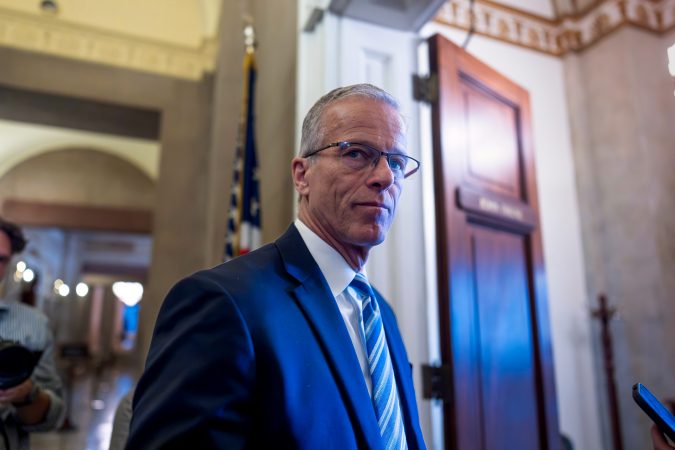
    Senate Majority Leader John Thune (R., S.D.) decided against sending senators home early last week to campaign, opting instead to keep the Senate in session to try to bolster Republicans’ legislative record. This week is the last that the Senate is scheduled to be in session before Election Day.

    Republicans are confronting the once-unthinkable prospect that they could lose the Senate. Democrats are running competitively even in some states that President Donald Trump won by double digits in 2024, giving the party a shot at picking up the four seats they need to recapture the chamber.

    Almost no Republican is in more danger of losing his seat than Sen. Jon Husted (Ohio), who introduced the data center bill that Republicans are set to take up.

    Former Democratic senator Sherrod Brown, who is challenging Husted, has spent millions of dollars on ads attacking Husted over his support for data centers, which the ads blame for “causing electric bills to spike by thousands of dollars.” The National Republican Senatorial Committee warned in a memo last month that the ads are effective, describing data centers as an “anchor hanging around Husted’s neck.”

    Sixty-nine percent of likely voters in Ohio say data centers — enormous warehouses filled with servers that power the artificial intelligence boom and the rest of the internet — are mostly bad for home energy costs, according to a Bowling Green State University/YouGov poll conducted this month.

    Husted has defended his record on data centers and criticized Brown for supporting them in the past. He described his bill as a way to “show the American people that we’re serious about driving down electric prices and making life more affordable for them” — and he almost dared Democrats to block it.

    “If Senate Democrats want to be the lone obstacle to passage, then shame on them,” he told reporters. “That shows that they don’t really care about affordability.”

    It is not clear whether Husted’s bill will pass.

    The House approved it overwhelmingly, but Sen. Martin Heinrich (D, N.M.) blocked Husted from fast-tracking its passage this month, arguing that it did not go far enough. Heinrich sought to pass his own bill to force data centers to shoulder the costs of upgrading the electric grid, which Republicans blocked.

    Husted’s bill does not take full effect for two years and would not bring down electricity prices before the midterms. Some Democrats have argued that it would do little to address affordability at all.

    “Senator Husted’s bill is a fraud,” Senate Minority Leader Chuck Schumer (D., N.Y.) told reporters last week. “It’s voluntary. No company has to do it.”

    Republicans say Democrats are just trying to deny them victories. Sen. Bernie Moreno (R., Ohio) accused Democrats of blocking Husted’s bill “so they can just put up another TV ad to say that electricity prices are high so that they can win an election.”

    Senate Republicans have spent much of the past two weeks working to pass legislation from Sens. Ted Cruz (R., Texas) and Maria Cantwell (D., Wash.) to overhaul regulation of college sports. Cruz has argued the bill is crucial to “protect an American institution that millions of people love,” but some Republicans have groused that it is hardly the most pressing issue for the party to tackle right before the midterms.

    “With gas at over $4 a gallon, a persistent war with Iran, $40 trillion in debt, the Senate has decided that the most urgent thing now is to dictate how college sports are run from Washington,” Sen. Rand Paul (R., Ky.) said on the Senate floor.

    Sen. John Kennedy (R., La.) said he was prepared to support the bill if he secures an amendment vote but argued it is not a priority for voters, describing it as a way “to make the football coaches happy.”

    “I haven’t met a single person on the campaign trail, when they lie down to sleep and can’t, who are worried about the football coaches,” Kennedy told reporters.

    Husted is not the only Republican senator facing a tough race who has pushed to pass legislation that can be campaigned on before heading home.

    Sen. Susan Collins (R., Maine), who is seeking a sixth term in a Democratic-leaning state, has pressed Senate Republican leadership to take up a bipartisan bill to force insurers to cap the cost of insulin at $35.

    Another vulnerable Republican, Sen. Dan Sullivan (Alaska), tried to pass legislation last week meant to protect salmon in his state. He was blocked by Sen. Ed Markey (D., Mass.), who said he needed more time to seek feedback from fishermen in his state.

    Husted and other Republicans are campaigning on the tax and domestic policy bill that Trump signed into law last year, which cut taxes on tips and overtime. But some Senate Republicans have pushed for months to do more to address voters’ affordability concerns.

    Sen. Josh Hawley (R., Mo.) said he had urged Senate leadership to take up the insulin bill, along with legislation to suspend the federal gas tax and other bills to make life easier for working families.

    “My view is that ought to be our sole focus,” Hawley said. “If we’re not going to do that, it’s not clear to me what we’re doing here.”

    Rep. Ashley Hinson (R), who is facing a tight race for an open Senate seat in Iowa, last week called on the House to return to Washington to vote on suspending the federal gas tax as well as other steps to reduce fuel prices. The House adjourned earlier this month and has no plans to return before Election Day.

    Thune has faulted Democrats for obstructing his party’s agenda. Republicans and Democrats have spent months negotiating over legislation to overhaul the federal permitting process, which could bring down energy costs by making it easier to build power lines and other infrastructure. Thune said the Senate could take up such a bill before the midterms if the two sides were to reach a deal, but he acknowledged Thursday that it would not happen, which he blamed on Democrats.

    “While they may acknowledge the need for permitting reform, what they really care about is denying Republicans another legislative win” ahead of the midterms, Thune said on the Senate floor.

    Sen. Sheldon Whitehouse (R.I.) and Heinrich, the Democrats leading permitting negotiations, said Friday that they wanted to give senators more time to review the legislation and warned that trying to pass it before the midterms could kill the bill.

    “We are talking about major changes to how America builds energy and infrastructure,” they said in a statement. “Getting that right has to matter more than election-year deadlines.”

  • At every turn, Trump’s ideas for aiding U.S. consumers run into resistance

    At every turn, Trump’s ideas for aiding U.S. consumers run into resistance

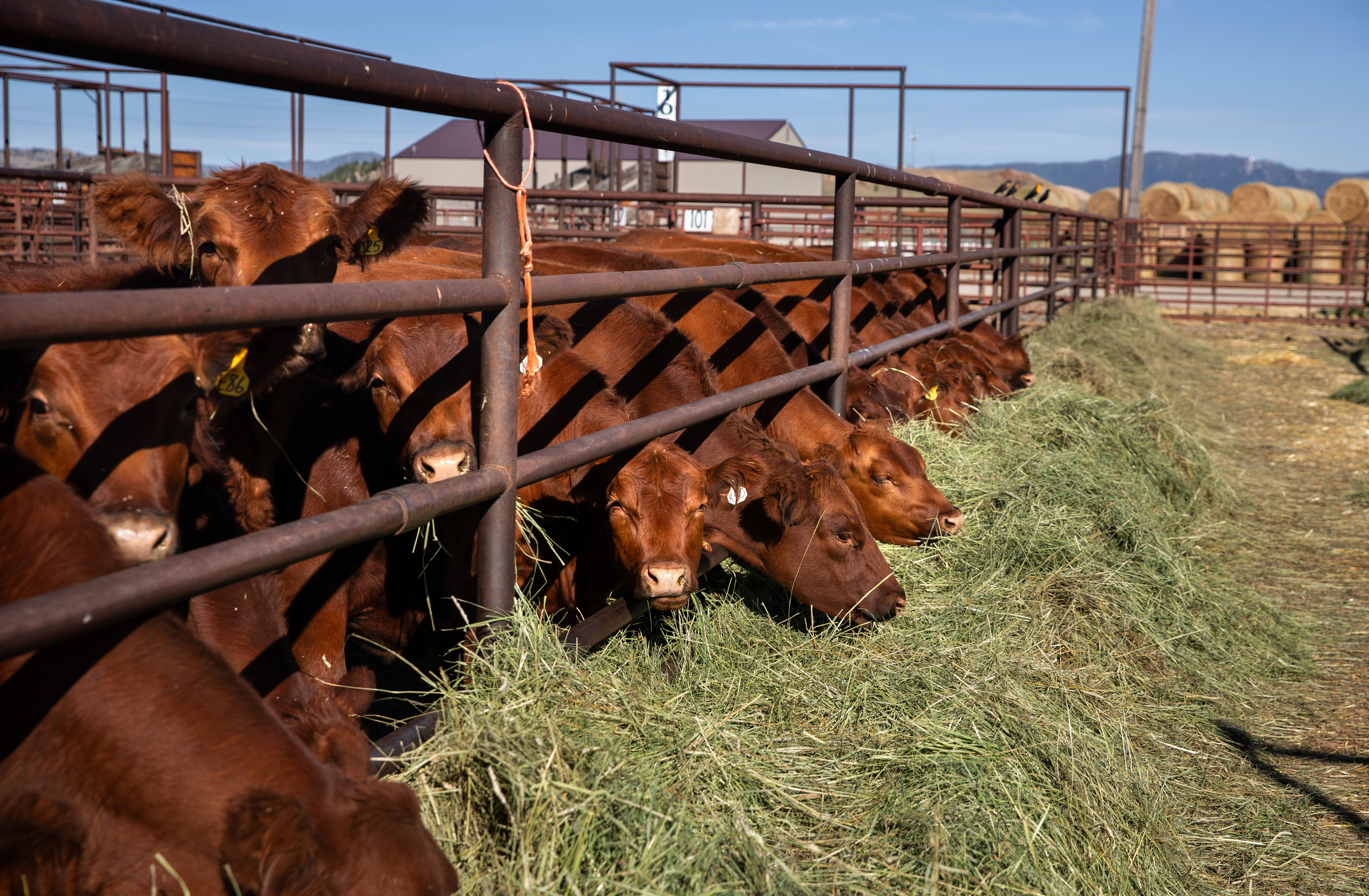
    First came a proposal to permit tariff-free beef imports, but that immediately angered America’s farmers and ranchers.

    Then came a plan to ban exports of domestic diesel fuel, but that met with pushback from major oil companies.

    In between, President Donald Trump pitched the idea of simply cutting $5,000 checks to adult Americans frustrated, polls show, by high food and gas prices — if the GOP maintains control of Congress. But that idea, too, has come under fire, even from some Republican lawmakers concerned about the potential hit to the budget deficit.

    With just five weeks until Election Day, the White House has thrown out multiple ideas for combating persistent inflation, which has outpaced wage growth. But experts say it is unclear whether Trump can execute any policy that would placate inflation-weary voters and help the GOP maintain control of Congress.

    “These are symptoms of panic in the administration about problems that they have in part created,” said David Wessel, director of the Hutchins Center on Fiscal and Monetary Policy at the Brookings Institution.

    Inflation has been running over the Federal Reserve’s target rate since 2021, but an array of Trump policies have fed the problem, economists say. Trump’s decision to join Israel in going to war with Iran has disrupted the global oil supply, leading to elevated energy rates. His tariffs have produced higher prices for some imported goods. And his administration’s immigration crackdown has made low-cost labor harder to find, keeping price pressures on domestic companies high.

    Consumer frustration is reflected in polling. The gap has steadily widened between voters who approve of and disapprove of Trump’s performance as president, and 73% of Americans said they disapprove of Trump’s handling of the economy in a recent poll conducted by SSRS for CNN. Only 27% approved — his lowest approval rating on the issue ever recorded by the survey.

    Against that backdrop, Trump has floated a parade of ideas for cutting prices.

    “President Trump pledged to lower costs and raise real wages for everyday Americans, and the Administration continues to rigorously evaluate every option on the table to deliver,” White House spokesperson Kush Desai said in a statement.

    On top of the political hurdles, however, these policies have been “small in the grand scheme of things … if they’re helpful at all,” said Mark Zandi, chief economist at Moody’s Analytics. “So it’s not like it’s moving the dial on the affordability crisis.”

    Douglas Holtz-Eakin, president of the American Action Forum, a conservative-leaning think tank, said it’s not uncommon for politicians to try to bring down prices in the run-up to elections, especially when their party’s control of Washington is at risk.

    President Joe Biden did the same ahead of the 2022 midterms, notably by calling for a federal gas tax holiday and releasing millions of barrels of oil from the nation’s Strategic Petroleum Reserve in an effort to bring down sky-high gas prices.

    “This whack-a-mole with particular prices is something the Biden guys tried,” said Holtz-Eakin, who was a senior economic adviser to President George W. Bush and the 2008 presidential campaign of then-Sen. John McCain (R., Ariz.). “It doesn’t solve the economic problem, and it doesn’t seem particularly politically successful.”

    For Trump, time is running out, said Rebecca Patterson, a senior fellow at the Council on Foreign Relations.

    The U.S. economy is so big and so complex that improving affordability “is simply not something anyone can do in a month,” Patterson said. “Actions taken today might help in the medium and longer term. But between now and the election, the best you can hope for is that voters appreciate that you’re trying.”

    One idea the administration has executed is buying back Treasury bonds. But so far, the payoff has been minimal.

    In part because of the competition for cash from massive private-sector spending on artificial intelligence, investors are demanding higher interest rates for Treasury bonds. Higher bond yields, in turn, raise interest rates for consumer loans such as mortgages. The average 30-year fixed mortgage rate hit 7% last week for the first time since January 2025.

    In August, Treasury Secretary Scott Bessent announced he would intervene in the bond market by buying back longer-term Treasury bonds to try to slow the rise in yields. That has not yet worked in bringing down yields, though Bessent contended in a recent congressional hearing that it is nonetheless a success because “we then proceeded to have the two most successful Treasury auctions that we’ve had in 20 years.”

    While Bessent was wrestling with the bond market, Trump decided to tackle meat prices.

    In late August, the president signed a proclamation that rolled back tariffs on foreign beef trimmings for 90 days in an effort to boost imports and lower ground beef prices, which have risen almost 25% since the beginning of Trump’s second term.

    But that drew rare pushback from farm-state Republicans, including Sen. Chuck Grassley (Iowa), Sen. Pete Ricketts (Neb.), Sen. Roger Marshall (Kan.) and Rep. Ashley Hinson (Iowa), who is running in a competitive Senate election in her state.

    The lawmakers argued that a flood of cheap foreign beef would undermine American farmers and ranchers, who are already struggling with high fuel, grain, and fertilizer prices due to the Iran war and other factors.

    Trump issued a follow-up executive order aimed at helping ranchers, and the Agriculture Department announced new policies aimed at supporting American beef producers. The administration is now reportedly considering reversing course on beef imports — though the White House has denied that.

    Then came the Republican midterm convention in Dallas, where Trump made his biggest pitch yet: If Republicans keep both the House and Senate on Nov. 3, Trump said, he would give every adult American a $5,000 dividend to spend within the United States.

    Some Republican lawmakers applauded the idea, but others were skeptical, saying the checks not only could exacerbate inflation but also could increase historically large budget deficits. The proposal could cost more than $1 trillion at a time when concern is growing about the nation’s outsize debt, which recently surpassed $40 trillion.

    Public interest groups blasted the idea; Lisa Gilbert, co-president of the left-leaning consumer watchdog Public Citizen, called it an “explicit and desperate attempt to buy votes.”

    And voters largely have not been swayed: A YouGov poll released earlier this month found that 64% of U.S. adults felt they would probably or definitely not receive the dividend if Republicans were to win the election.

    So far, there have been few signs of interest on Capitol Hill, where lawmakers would have to draft legislation to authorize the checks and vote to approve it.

    Last week, after diesel prices hit a record high, Trump and Bessent announced a new idea for tackling soaring fuel prices: a ban on diesel exports. Their theory was that a ban would boost the diesel supply for American consumers, lowering the price at the pump.

    Several Republican candidates in competitive congressional races supported the idea. But major oil companies and Energy Secretary Chris Wright objected, arguing that such a policy would incentivize companies to lower diesel production, which would further raise fuel prices.

    By midweek, the fate of the diesel export ban, too, seemed uncertain: Wright said any new limits on diesel exports were likely to be voluntary.

  • Pennsylvania voters are split on whether they want Gov. Josh Shapiro to run for president in 2028

    Pennsylvania voters are split on whether they want Gov. Josh Shapiro to run for president in 2028

    Voters in the nation’s most contested swing state are split on whether Gov. Josh Shapiro should pursue a White House bid in 2028.

    About the same proportion of likely Pennsylvania voters say they want Shapiro, a first-term Democrat seeking reelection this year, to run for president as those who don’t — 43% to 44%, according to a poll by The Inquirer, the New York Times, and Siena University.

    Almost two-thirds, 64%, of self-identified Democrats back Shapiro seeking higher office, a strong consolidation of support within the party’s base that still leaves room for other prospective candidates. But more than one in five Republicans also support a potential White House run by the governor, a sign of Shapiro’s moderate appeal in a key battleground state.

    Those who want him to run ranked his character and competence as their highest factors, with 41% of respondents giving those as reasons they would want him to run. Nearly 20% said they were satisfied with Shapiro’s performance as governor.

    “I like him. No scandals. He’s an honest man, and he has a nice, wonderful family, and he doesn’t lie,” said Michael Koller, a 77-year-old Democrat in Pittsburgh. “I think he’s helped the people of Pennsylvania just by being a good governor.”

    The survey, conducted Sept. 15 to 21, comes just six weeks before his matchup against Republican State Treasurer Stacy Garrity, whom he has far outpaced in both polling and fundraising. It also arrives before any prominent Democrats have formally declared candidacy for the nation’s highest office, with nearly all vowing to wait until after the midterm elections to make a decision.

    Shapiro has said he is laser-focused on winning in November as well as helping fellow Democrats flip four hotly contested U.S. House seats and take over the state Senate for the first time in more than 30 years. But his fundraising prowess and recent book publication suggest he is well positioned for a run. In interviews with reporters, Shapiro has never outright denied his interest to become commander in chief.

    (function(){function e(){window.addEventListener(`message`,function(e){if(e.data[`datawrapper-height`]!==void 0){var t=document.querySelectorAll(`iframe`);for(var n in e.data[`datawrapper-height`])for(var r=0,i;i=t[r];r++)if(i.contentWindow===e.source){var a=e.data[`datawrapper-height`][n]+`px`;i.style.height=a}}})}e()})();

    And yet despite Shapiro’s 60% job approval rating in a politically divided state, poll respondents highlighted the disconnect between his relatively high popularity as governor, where he is focused on the needs of Pennsylvanians, and their interest in him as a possible president, who would oversee the entire country and control foreign policy.

    A balancing act on Israel

    Kathrine Sidiqi, 77, a Democrat who lives in Delaware County, regards Shapiro as a “competent governor” who impressed her with a quick reopening of I-95 in 2023 after a fiery gasoline tanker crash threatened to close the transportation corridor for months. He expedited government procedures and got it reopened in just 12 days. “Stuff works,” she said.

    However, when asked if she would support Shapiro for president, Sidiqi said no.

    “I am Muslim, and he is too much of a supporter of Israel for me to do that,” she said. “I have nothing against him being Jewish … but he seems to have an outdated opinion of what’s going on.”

    Sidiqi said she does not want the U.S. to provide any taxpayer money for weapons to Israel, a view shared with 60% of Pennsylvania likely voters who are against providing additional American economic and military support to Israel, according to the poll.

    Among Democrats, whom Shapiro would first need to win over in a presidential run, 63% of poll respondents said they would support a candidate who opposed aid to Israel.

    More than 70,000 Palestinians have been killed and nearly all Gazans have been displaced in the three years since Israel launched its war against Hamas, the militant group that carried out the Oct. 7, 2023, terror attack that killed more than 1,200 people, according to the Council on Foreign Relations.

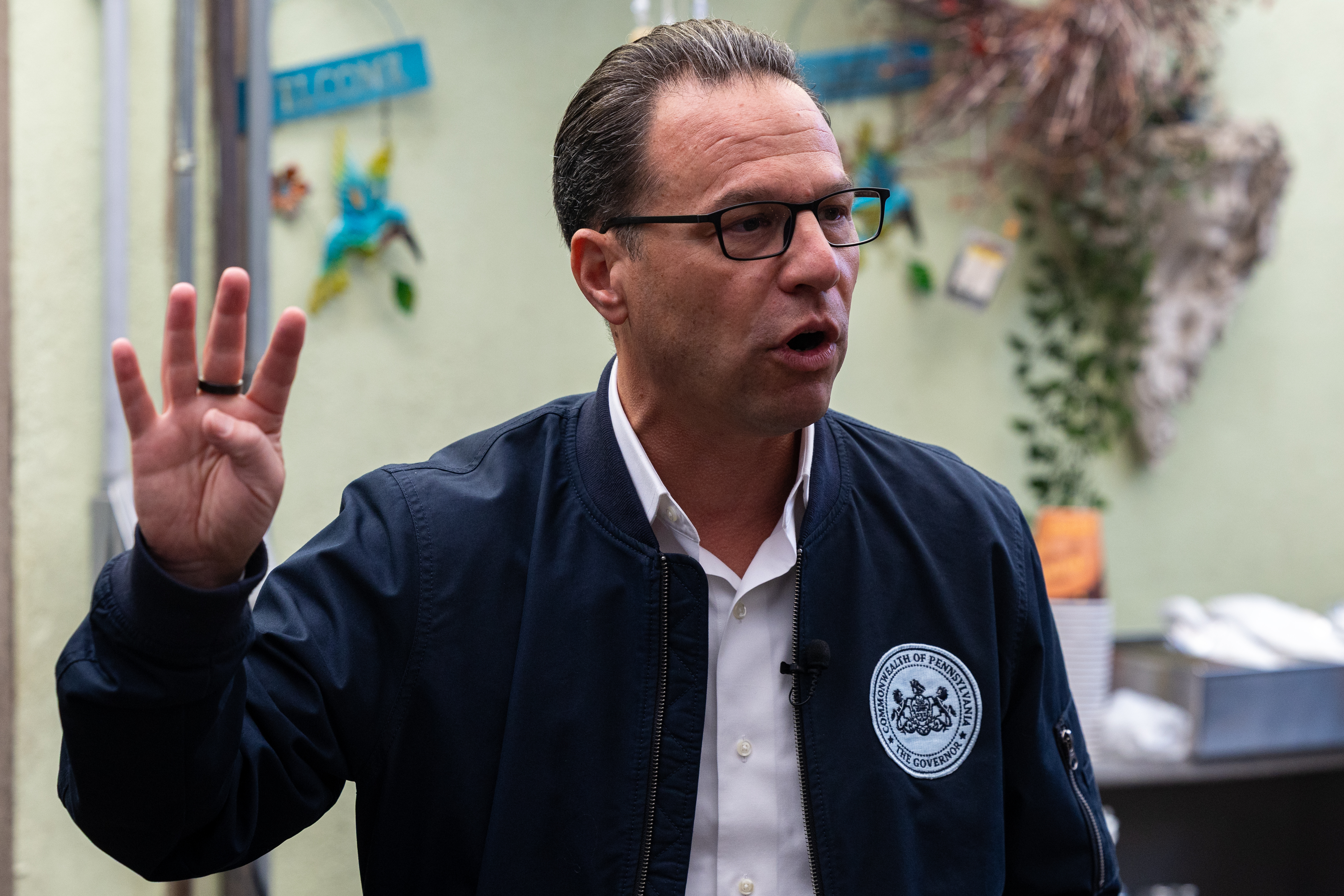
    Gov. Josh Shapiro talks to patrons alongside Michigan Gov. Gretchen Whitmer out in the back patio of Sam’s Morning Glory Diner in South Philadelphia on Friday, Sept. 25, 2026. Aidan T. Gallo / Staff Photographer

    The war in Gaza has bitterly divided Shapiro’s party, and his positions on Israel may have a played a role in preventing his nomination as vice president in 2024. Shapiro in his book called questions about his relationship with Israel from Vice President Kamala Harris’ team “offensive.”

    Shapiro, Pennsylvania’s third Jewish governor, has said his views on the topic have evolved from when he was in college and wrote that peace with Palestinians was “not possible.” The governor now favors a two-state solution, with Israelis and Palestinians “living peacefully side by side, being able to determine their own futures and their own destiny.”

    He has been a vocal critic of Israeli Prime Minister Benjamin Netanyahu, calling him a “destructive force” who has undermined U.S. and Israeli relations.

    The governor has also repeatedly spoken out against antisemitism at campus protests against Israel and called for an encampment at the University of Pennsylvania to be disbanded in 2024.

    (function(){function e(){window.addEventListener(`message`,function(e){if(e.data[`datawrapper-height`]!==void 0){var t=document.querySelectorAll(`iframe`);for(var n in e.data[`datawrapper-height`])for(var r=0,i;i=t[r];r++)if(i.contentWindow===e.source){var a=e.data[`datawrapper-height`][n]+`px`;i.style.height=a}}})}e()})();

    Multiple respondents brought up Shapiro’s Jewish faith unprompted — sometimes in connection with Israel — and questioned whether the country is ready for a Jewish president.

    “I think a Jewish candidate is going to have a hard time winning the election,” said Michael Biello, a 68-year-old Democrat in Philadelphia. “I like his views. I like his policies. I like everything. I just think his religious affiliation will stop him from winning because I think the rest of the country, especially the middle of the country, will rally against him.”

    Shapiro is one of several potential contenders who could make history as the first Jewish president, along with former Chicago Mayor Rahm Emanuel, Illinois Gov. JB Pritzker, Georgia Sen. Jon Ossoff, and Michigan Sen. Elissa Slotkin.

    Shapiro has spoken frequently about his faith and his experiences with antisemitism.

    An arsonist — who said in a 911 call he would “not take part in [Shapiro’s] plans for what he wants to do to the Palestinian people — attacked the governor’s mansion last year during Passover while Shapiro and his family were inside. (The arsonist’s family said he had spiraled into a mental health crisis.) Since then, Shapiro said, there have been a half dozen more terroristic threats against him and his wife “because of how I worship.”

    In his memoir, Where We Keep The Light, published earlier this year, Shapiro wrote that since the Oct. 7 attack in Israel, he and his family “feel both a responsibility and pride demonstrating our faith and living it out loud.”

    Hailey Brinnel, who is Jewish, said she does not believe Shapiro’s faith alone would hinder a potential campaign.

    “People didn’t think New York was ready for a Muslim mayor,” she said, referring to the 2025 election of Mayor Zohran Mamdani. “New York right now has really been changing what I come to think of as someone who’s electable. So I do not think it’s out of the question now.”

    Brinnel, a 31-year-old Democrat, said she will “always love” Shapiro and said she believes he has strong appeal to older, more centrist Democrats. But she is more interested in whether ideologically progressive candidates are electable.

    “After seeing the success of Zohran Mamdani and different democratic socialists, it makes me at least curious if we should be moving in a more progressive direction.”

    How does Shapiro compare with Trump and Vance?

    Several respondents highlighted Shapiro’s support for education, healthcare, and business development work during his first term as governor as reasons he would make a good president. His recent orders on data centers, which face majority opposition in Pennsylvania, have also been a point in his favor among voters.

    Despite his early embrace of data centers, Shapiro in August issued what he called some of the nation’s “strictest guardrails,” requiring developers to get local approval, bring their own power, and hire and train local workers.

    “I appreciate that he went and he asked what other people wanted, and then he advocated against the data centers,” said Mac Alasad-Murphy, a 27-year-old attorney in Haverford.

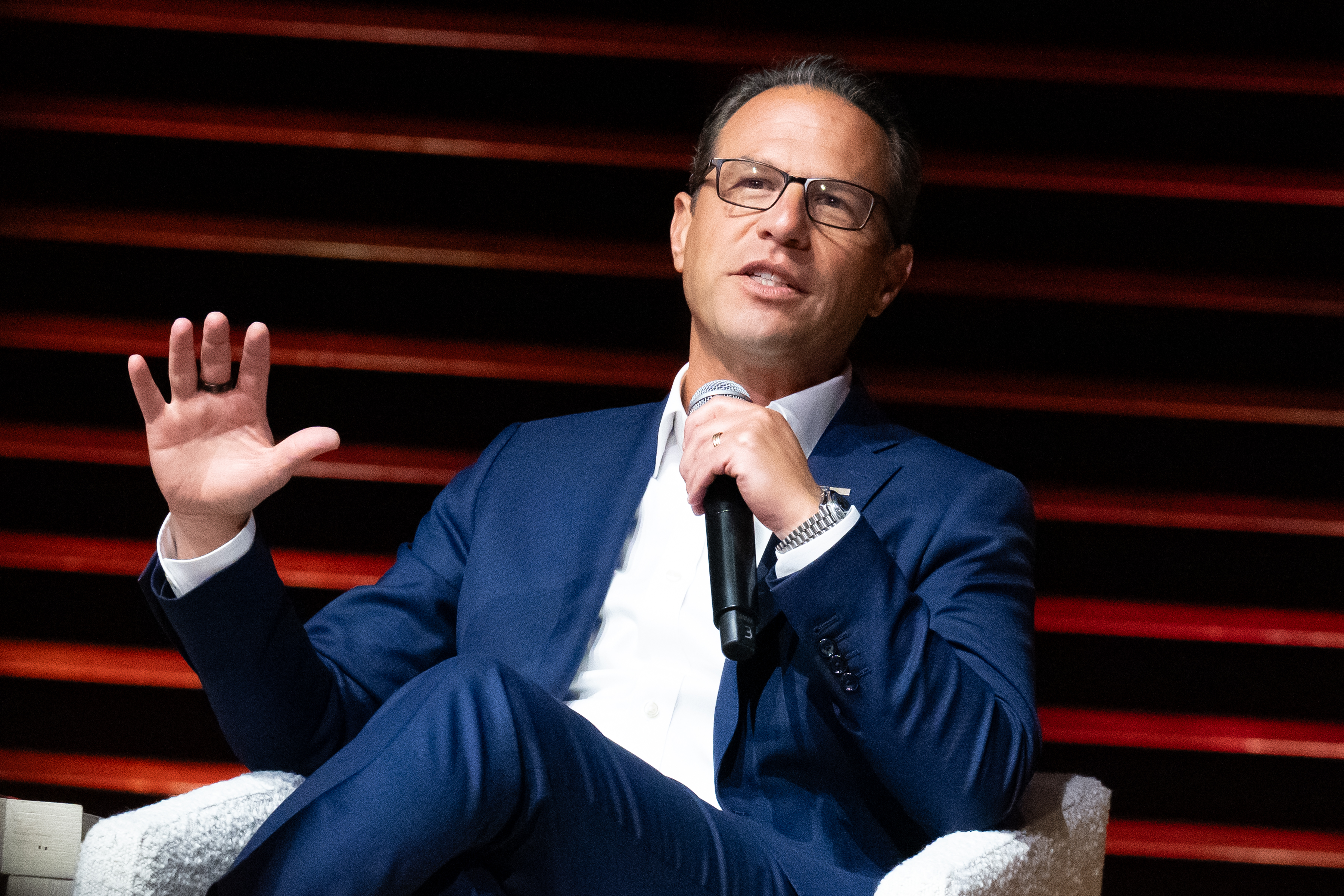
    Pennsylvania Gov. Josh Shapiro speaks during a discussion on free expression and civil dialogue at the Kimmel Center in Philadelphia on Wednesday, Sept. 9, 2026nErin Blewett / For The Inquirer

    Alasad-Murphy, a Democrat, said she believes Shapiro is capable of approaching complicated situations by listening with a careful and cautious ear.

    “He does a really good job of meeting with the people and trying to get an understanding of what the community he’s serving actually wants,” she said.

    (function(){function e(){window.addEventListener(`message`,function(e){if(e.data[`datawrapper-height`]!==void 0){var t=document.querySelectorAll(`iframe`);for(var n in e.data[`datawrapper-height`])for(var r=0,i;i=t[r];r++)if(i.contentWindow===e.source){var a=e.data[`datawrapper-height`][n]+`px`;i.style.height=a}}})}e()})();

    Shapiro’s 63% favorability rating trounces that of President Donald Trump, who has pushed for more data center construction even amid opposition from Republican voters. As gas prices climb to $4.55 in Philadelphia, just 38% of likely Pennsylvania voters have a favorable view of the president while they see him taking little action on the economy and cost-of-living concerns, their top issues.

    Vice President JD Vance has a slightly higher favorability rating than Trump, 44%, as he is increasingly seen as the Republican front-runner in a 2028 primary. Almost half of respondents view Vance very or somewhat unfavorably.

    Among voters in the poll who opposed a potential Shapiro run, 21% said they dislike him personally and 19% they dislike his policies and views.

    Susan Roller, 72, of Lancaster, disagrees with Shapiro’s support for abortion access and vaccine policy.

    “Our current governor doesn’t respect life at all stages, especially pre-born children, and is trying to push through a lot of health initiatives that would take away our freedom of choice,” said Roller, who is a Republican.

    Many of those surveyed said they are interested in seeing who else throws their hat in the ring before deciding whom to get behind in 2028. Democrats mentioned included Kentucky Gov. Andy Beshear, former Transportation Secretary Pete Buttigieg, and U.S. Rep. Alexandria Ocasio-Cortez of New York — all of whom have made visits to Pennsylvania this year.

    Before making her decision, with the 2028 primaries more than a year away, Alasad-Murphy, the Haverford voter, said she wants to understand Shapiro’s plan to tackle the country’s biggest problems.

    “I couldn’t say just because I like him and I like what he’s done for Pennsylvania that I would like what he might do for the country. Those are two completely different things,” she said.

    But his temperament and willingness to work across partisan lines to pass legislation go a long way, she said.

    “He’s very level-headed. He’s very respectful toward others, even when they don’t see eye to eye. And in the current political climate, I think that having stability and respect is really important,” she said.

  • Josh Shapiro and Gretchen Whitmer, potential 2028 rivals, meet at Philly diner to boost Democrats ahead of midterms

    Josh Shapiro and Gretchen Whitmer, potential 2028 rivals, meet at Philly diner to boost Democrats ahead of midterms

    Pennsylvania Gov. Josh Shapiro and Michigan Gov. Gretchen Whitmer, stopped by a Bella Vista diner on Friday morning to pump up Democratic volunteers to turn out voters, with less than six weeks until the high-stakes midterm elections in both of their swing states.

    On the menu: Electing Democratic candidates to Pennsylvania’s four nationally-watched U.S. House seats that could determine control of Congress, and flipping the state Senate to Democratic control for the first time in more than 30 years.

    Shapiro is also seeking a second term as Pennsylvania’s Democratic governor this November, and maintains a sizable polling and fundraising advantage over his Republican opponent, state Treasurer Stacy Garrity.

    “I know we’re in a moment of tumult right now, where chaos and cruelty and corruption is just enveloping our lives. The good news is in 39 days, you’ve got the power to change that,” Shapiro told the group of a couple dozen volunteers from voter protection groups. Servers at Sam’s Morning Glory Diner, wearing T-shirts with messages condemning President Donald Trump and supporting former Vice President Kamala Harris, whisked by with plates of omelettes and pancake stacks.

    Gov. Josh Shapiro talks to patrons alongside Michigan Gov. Gretchen Whitmer out in the back patio of Sam’s Morning Glory Diner in South Philadelphia on Friday, Sept. 25, 2026. Shapiro is canvassing to get Pennsylvania Democrats elected up and down the ballot as the midterms are upcoming in November. He wants to flip the state Senate for Democrats to take back control. Whitmer is present to support Shapiro’s re-election campaign.Aidan T. Gallo / Staff Photographer

    Shapiro also assured voters that elections in Pennsylvania will be conducted fairly and accurately, following a CNN report that Trump’s Department of Justice is sending a surge of election monitors to oversee polling locations.

    “We’re prepared again in court, and we’re also prepared should they try and bring personnel into certain communities, particularly minority communities, to try and intimidate people, make it harder for people to vote, or make them worried about showing up to vote,” he said.

    State election officials are coordinating with the Pennsylvania National Guard, the Pennsylvania State Police and local law enforcement to protect voting access, he said.

    “We will do everything in our power to stop Donald Trump from interfering with this election and ensure, whether you vote by mail or you vote in person, you will have access to the ballot box, and it will be protected,” he said.

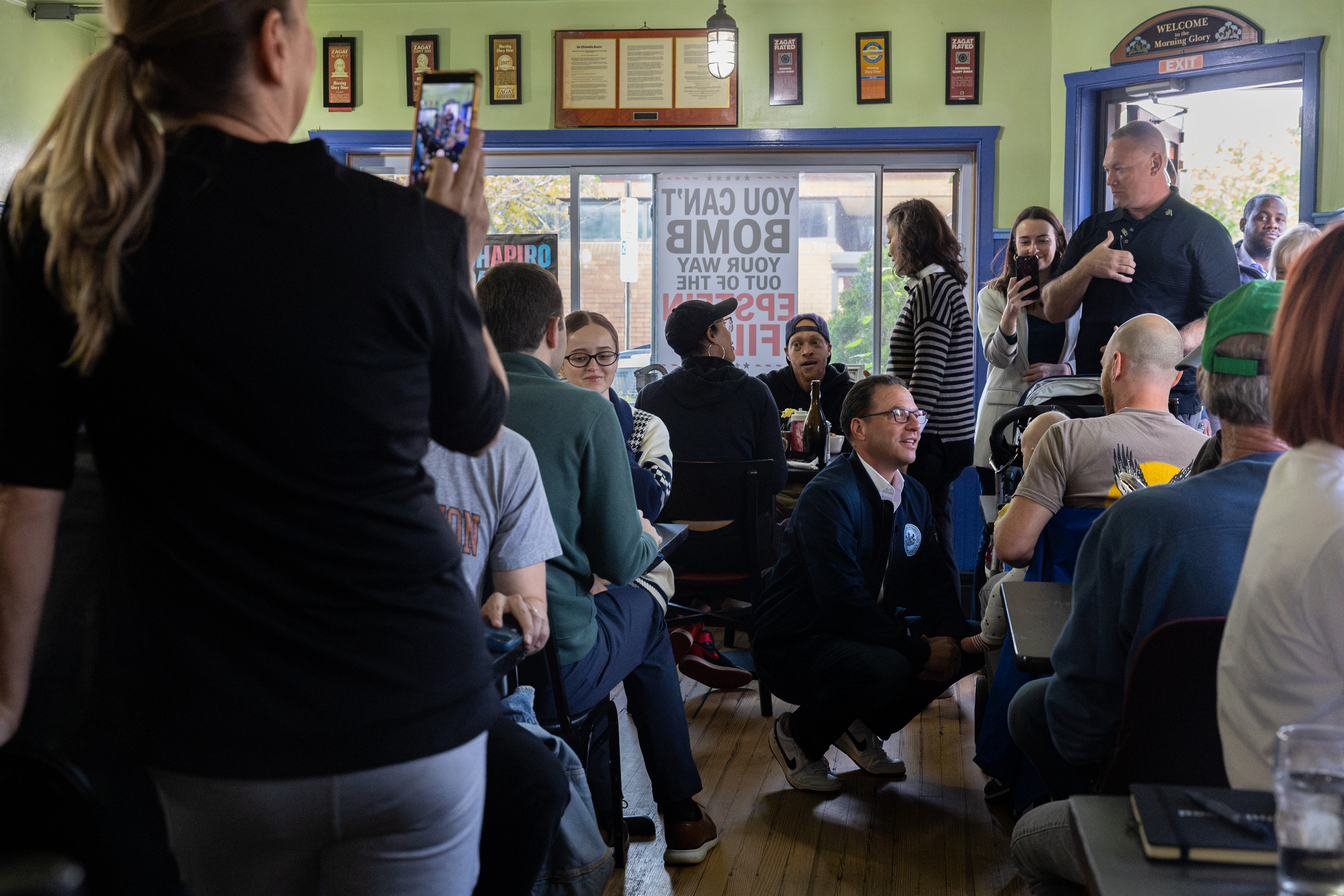
    Gov. Josh Shapiro meets with patrons alongside Michigan Gov. Gretchen Whitmer inside Sam’s Morning Glory Diner in South Philadelphia on Friday, Sept. 25, 2026. Shapiro is canvassing to get Pennsylvania Democrats elected up and down the ballot as the midterms are upcoming in November. He wants to flip the state Senate for Democrats to take back control. Whitmer is present to support Shapiro’s re-election campaign.Aidan T. Gallo / Staff Photographer

    Whitmer is nearing the end of her second term as Michigan’s governor, and like Shapiro, has been floated as a contender in the 2028 Democratic presidential primary.

    The two have been coy about any future pursuits. Shapiro has demurred on his ambitions for higher office, saying he’s focused on his reelection, though he’s also said he will “be a part of that conversation” about who Democrats should nominate for president. Whitmer previously said she had no plans to run in the Democratic presidential primary in 2028 but later walked it back, saying “never say never.”

    But on Friday in South Philadelphia, there were no signs of rivalry. Whitmer said she was in town to help support Shapiro’s reelection effort. Shapiro praised Whitmer, saying she has been a guiding light for the kind of governor he wanted to emulate.

    Whitmer, Shapiro said, is ”someone I have looked up to, someone who knows how to get stuff done in her state, and someone who I think leads with integrity, with purpose, with drive and determination.”

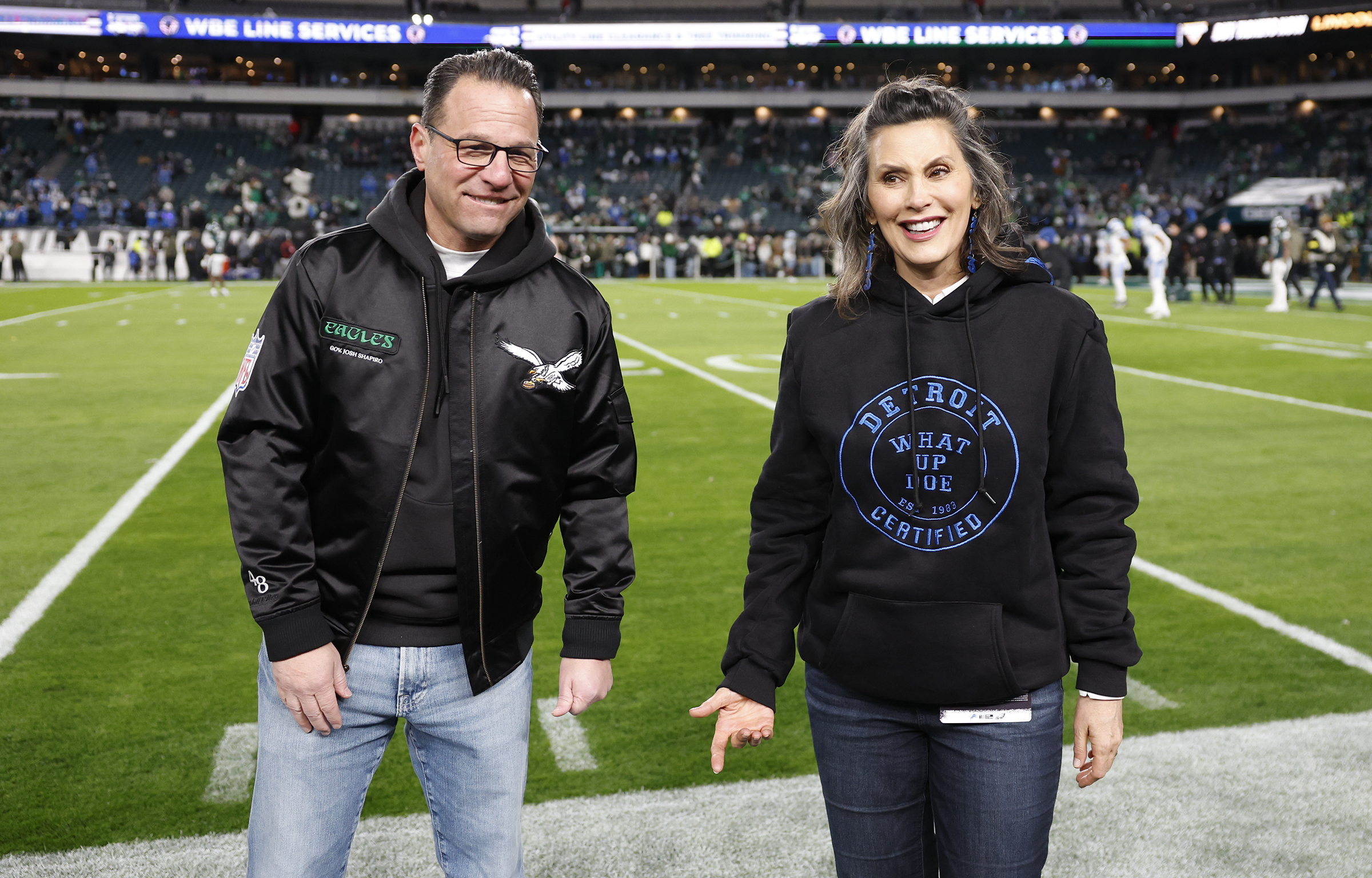
    The two appeared together publicly last year at an Eagles-Lions football game at Lincoln Financial Field, as part of what Whitmer called a friendly rivalry between the NFC championship contenders.

    Pennsylvania Governor Josh Shapiro (right) and Michigan Governor Gretchen Whitmer before the Eagles played the Detroit Lions at Lincoln Financial Field on Sunday, Nov. 16, 2025, in Philadelphia, PA.Yong Kim / Staff Photographer

    During the 2024 presidential election, Shapiro also visited Michigan to stump alongside Whitmer for Harris’ campaign.

    On Friday, Whitmer called Shapiro a “good friend and colleague.”

    “When Washington, D.C. is making life harder — whether it’s through tariffs or a war in Iran that’s jacking up the price of everything — it’s the governors that are protecting our rights, that are making sure we keep more money in our pockets. It’s the governors who are solving problems,” she said. “You got one of the best in the country.”

    After talking with patrons, Shapiro said he planned to sit down with Whitmer to eat something at the restaurant. Featured on Sam’s Morning Glory Diner menu on Friday: “Shapiro 2026″ and “2028 sausage, eggs and gravy.”

    Shapiro did not elaborate on his order.

  • Supreme Court lets Trump administration use revamped federal voter eligibility database for now

    Supreme Court lets Trump administration use revamped federal voter eligibility database for now

    NEW YORK — The Supreme Court on Friday lifted restrictions on a controversial federal voter database before November’s elections, granting President Donald Trump a temporary win in his aggressive campaign against noncitizen voting.

    The court’s three liberal-leaning justices publicly dissented from the decision.

    The emergency order allows states, for now, to use the Department of Homeland Security program, called Systematic Alien Verification for Entitlements, or SAVE, in their efforts to verify the eligibility of voters on their rolls.

    States’ use of the SAVE program is voluntary. The immediate impact on the upcoming midterms is likely limited because existing law blocks most states from systematically purging voters from their rolls within 90 days of an election, said David Becker, an election law expert who leads the Center for Election Innovation and Research.

    He said since the program is voluntary and DHS itself has admitted the data is not perfect, “states may find this to be a useful tool used along with other tools to keep their lists up-to-date.”

    The court’s order puts on hold a federal judge’s June ruling that had deemed the Republican administration’s recently revamped version of SAVE illegal. U.S. District Court Judge Sparkle L. Sooknanan had blocked the use of the tool, saying it violated Americans’ privacy rights and could result in voters being wrongly removed from the rolls.

    A federal appeals court let her order stand.

    But the Supreme Court majority found that a 1996 law explicitly allows DHS to get information about citizenship and immigration from other federal agencies. The federal government also has “an obligation to respond” to states seeking to verify citizenship.

    “The order below prevents the Federal Government from using the program it believes is best suited to the task,” the majority wrote in the unsigned order.

    Justice Ketanji Brown Jackson dissented, joined by Justices Elena Kagan and Sonia Sotomayor. The database has long been seen to fall under federal privacy laws, she wrote, and there are real risks that legitimate voter registrations could be mistakenly revoked.

    “The harm caused by burdening or disenfranchising even a few lawful voters outweighs the nonexistent harm that the Government experiences when it is prevented from taking an action that it likely lacks the authority to take,” Jackson wrote.

    The plaintiffs and counsel team in the case called the ruling “profoundly disappointing” and said it puts “millions of Americans at risk of being unlawfully targeted by the administration’s unreliable voter purge database” before the midterms.

    “However, this case is not over,” their statement read. “The D.C. district court ruled that the expanded SAVE program violated multiple laws. We will be doing everything in our power to protect Americans’ voting and privacy rights by ensuring that the district court decision stands.”

    The White House did not immediately respond to a message seeking comment.

    The SAVE program was created under an immigration law mandating that DHS help federal, state, and local agencies prevent government benefits from going to noncitizens. The Trump administration last year moved to significantly expand its search abilities. Since then, at least 67 million registrations have been scanned through the program, but critics worry it could end up purging valid voters from the rolls.

    Some registrants have already been wrongly flagged. In Travis County, Texas, for example, officials said they investigated 97 voters flagged by SAVE as apparent noncitizens and found that at least 10% of them — and likely up to 21% — were U.S. citizens. The county urged the Supreme Court to reject the administration’s appeal, while the state of Texas submitted its own brief defending the database.

    Even though the use of the SAVE program has been blocked for months, the administration said in court filings that DHS officials have continued using Social Security Administration data “in certain cases to verify information and help determine whether illegal voting may have occurred.”

    DHS in August launched its own investigation to find noncitizen voters on state rolls, according to a federal whistleblower statement that said the effort is rushed, filled with errors and potentially violates state laws. DHS has defended that investigation as being conducted “diligently and professionally.”

    The effort to create a national voter list is among numerous steps Trump has taken during his second term to try to overhaul the way elections are run. Most of those steps have been blocked by various courts, in part because the Constitution gives states and Congress the authority to set election rules, but provides no such power to the president. In mid-September, the Supreme Court rejected a bid from Trump to restrict mail ballot procedures before the midterms.

    Research shows that noncitizen voting, which is already illegal and punishable as a potential felony that could lead to deportation, is exceptionally rare. But Trump has remained fixated on the idea that massive numbers of noncitizens are voting in U.S. races.

  • Welcome to the home stretch | PA 2026 Newsletter

    Welcome to the home stretch | PA 2026 Newsletter

    📅 There are 39 days until Election Day.

    Welcome to the heart of election season.

    Pennsylvania is — once again — at the center of the political universe, and our team is set to bring you the latest as we cover the final stretch of the campaigns from Philadelphia to Washington, D.C. and across Pennsylvania. We’re focusing on the competitive U.S. House races, the battle for the governor’s mansion, and legislative districts across the Keystone State as Democrats fight for control in Harrisburg and in Congress.

    🎤 I’m Sam Janesch, The Inquirer’s national political reporter. I’ll be your host this week as we dig into how Pennsylvania’s always-newsworthy Democratic senator is inserting himself into a campaign season where he’s not even on the ballot. We also have a first look at an unusual new spending effort on behalf of U.S. Rep. Brian Fitzpatrick, who is fighting to keep his seat as the last Republican representing the region in Congress, and new insight into Gov. Josh Shapiro’s polling and money advantages.

    In this edition:

    🗳️ A Democrat in name only: For the first time, a plurality of likely Pennsylvania voters view U.S. Sen. John Fetterman negatively.

    🗳️ Close to home: Fitzpatrick is the least loyal House Republican to President Donald Trump, but he’s still overwhelmingly aligned with the president and his party.

    🗳️ Is this thing on?: Republican Stacy Garrity remains largely unknown in the state, even to a quarter of GOP voters, as Democratic Gov. Josh Shapiro’s lead continues to grow.

    — Sam Janesch, Michelle Baruchman, Fallon Roth, Gillian McGoldrick (pa2026@inquirer.com)

    The latest

    • Pennsylvania voters are giving President Donald Trump worse grades on economic issues as the midterms near. And as gas prices hit $4.55 in Philadelphia, even his 2024 supporters are unhappy.
    • Shapiro has raised $60 million for his reelection, but any leftover money can’t be directly transferred to a 2028 presidential campaign — not that he has declared his candidacy for one, anyway.
    • Only one Pennsylvania Republican received a video shoutout from Trump in his Truth Social endorsement dump last week — and it’s the candidate with perhaps the longest shot of winning. Trump called Garrity “really special,” while slamming Shapiro as a governor who “does not have what it takes.” Meanwhile, U.S. Rep. Ryan Mackenzie is still counting on Trump’s support to help him win in the Lehigh Valley.
    • Outside the midterm elections, another type of political campaign was underway to free convicted former Philadelphia labor leader John Dougherty, widely known as Johnny Doc, from prison. But it was a group of Republicans, including Trump, who ultimately aided the longtime Democratic power broker’s release.

    Data dive

    📊 U.S. Sen. John Fetterman has come a long way from the Bernie Sanders-loving, progressive populist that made him a political sensation starting about a decade ago — at least according to the Pennsylvania voters who elevated him to national prominence.

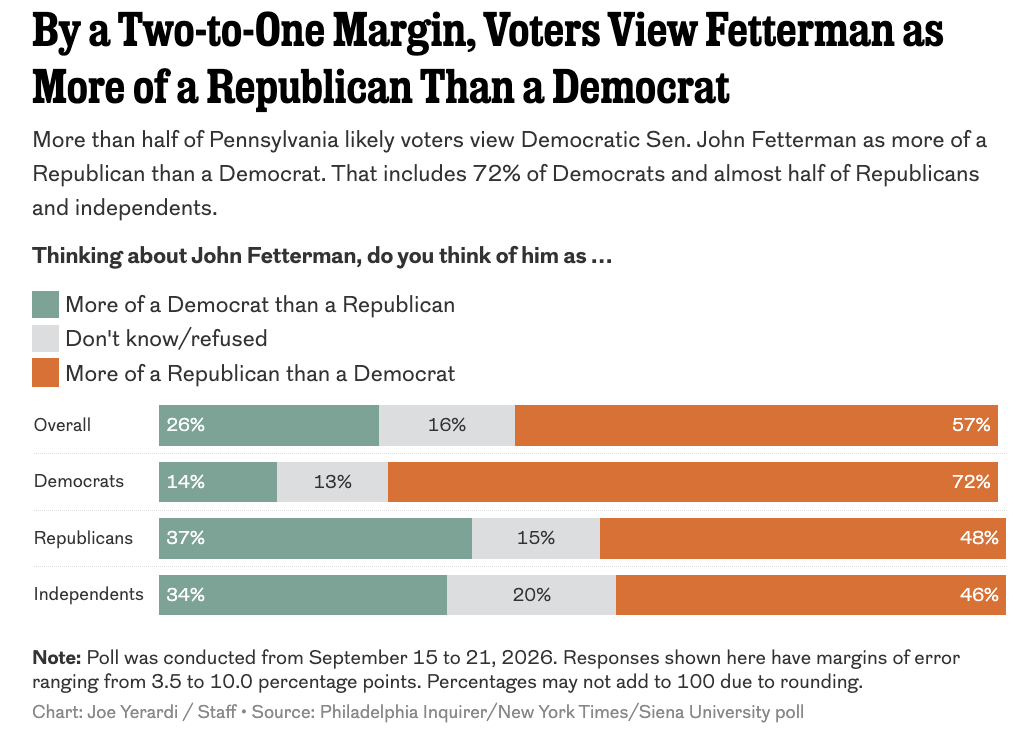
    Four years after his election to the U.S. Senate, a majority of the state’s likely voters think of him as a Republican, according to a new poll conducted by Siena University on behalf of The Inquirer and the New York Times.

    Our polling data shows nearly three-quarters of Democrats think of Fetterman as a Republican. About half of Republicans feel the same way.

    Even though Fetterman has said he will not change parties, that perception could have major implications. Democrats need to net at least four seats to capture the Senate majority starting in January. If they win a slim majority, Fetterman’s wildcard nature could be a roadblock as the party looks to act as a check on Trump in the final two years of his term.

    Democrats in Washington aren’t sweating it. Well, at least not publicly.

    “No,” U.S. Sen. Kirsten Gillibrand, a New York Democrat and chair of the Democratic Senatorial Campaign Committee, said quickly when The Inquirer asked her this week if she or her colleagues are concerned about Fetterman’s role in a narrow majority.

    “I’m very grateful that Sen. Fetterman is serving in the U.S. Senate as a Democrat, and I think he will continue to do so,” Gillibrand said.

    Campaign scrapple

    📺 Exclusive: A top environmental organization is throwing $250,000 toward new digital ads and a mail program supporting Fitzpatrick as he fends off a challenge from Democrat Bob Harvie in the swingy Bucks County-based congressional district that could prove key to flipping party control of the House this fall.

    Fitzpatrick is the only House GOP candidate currently receiving ad support from EDF Action Votes, a super PAC that supports the goals of the Environmental Defense Action Fund.

    US Rep Brian Fitzpatrick speaks during the Garden of Reflection remembrance ceremonies as his opponent, Bob Harvie (3rd from right) listens Friday, September 11, 2026 at Garden of Reflection in Yardley, Pennsylvania.William Thomas Cain / For The Inquirer

    Historically Democratic-aligned groups, like environmental orgs and labor unions, have felt comfortable continuing — or offering new — support for Fitzpatrick despite a national political landscape that has become increasingly unfavorable for Republicans. The Bucks County lawmaker has been known to separate himself from his conference and is the least loyal House Republican to Trump and his party.

    But, according to our recent analysis, he’s still on the president and the GOP’s side most of the time.

    👀 What we’re watching

    🔴 The Pennsylvania Republican Party’s state committee will meet in Pittsburgh this weekend. The committee cleared the field for Garrity as the party’s nominee by endorsing her last September. But since then, she’s struggled across the board — with fundraising, in polls, and more. Politics reporter Michelle Baruchman will be there, hoping to hear from attendees about the party’s outlook heading into November.

    📩 Mail ballots have already begun hitting mailboxes across Pennsylvania, with nearly 14,000 already returned.

    📬 A total of 999,280 mail or absentee ballots have been requested as of Thursday, Sept. 24, according to Pennsylvania Department of State data.

    • The breakdown:

    Quote of the week

    Shapiro, Pennsylvania’s incumbent Democratic governor, is up 21 points over Garrity, according to a new poll conducted by The Inquirer, the New York Times, and Siena University. He also announced a $13.3 million haul this summer and $31 million spent — far outpacing Garrity’s $1.8 million total raised and $1.5 million spent since June.

    As Levy says, Shapiro is highly favored to win in November, with Cook Political Report shifting the race to “Solid Democrat,” just two years after Trump won the state.

    👋 All this election news, and can you believe we still have more than a month to go? You can follow The Inquirer politics team’s coverage here, and we’ll see you in your inbox next Friday.

    By submitting your written, visual, and/or audio contributions, you agree to The Inquirer’s Terms of Use, including the grant of rights in Section 10.

  • ‘Data senator’ ad prompts Frank Farry to send a cease-and-desist letter to his Democratic challenger in Bucks County

    ‘Data senator’ ad prompts Frank Farry to send a cease-and-desist letter to his Democratic challenger in Bucks County

    Bucks County Republican State Sen. Frank Farry’s campaign this week demanded his Democratic challenger take down an advertisement attacking Farry for his position on data centers and air an apology instead, calling the commercial “defamatory” and “demonstrably false.”

    Shohin H. Vance, an attorney representing Farry’s campaign, called for Democrat Eileen Hartnett Albillar to remove the ad and issue a 30-second retraction advertisement, according to an eight-page letter sent Wednesday and reviewed by The Inquirer.

    Harnett Albillar’s ad calls Farry a “data senator” and says he is “the data center industry’s number one fan.” The ad also accuses the Republican lawmaker of voting for data center tax breaks in Harrisburg and notes that Farry’s law firm represents NorthPoint, a real estate company which redeveloped the Keystone Trade Center in Falls Township — the soon to be home of an Amazon data center.

    “The Advertisement, which accuses my client of abusing his public office for his own pecuniary interest, is not only misleading — it is demonstrably false,” Vance wrote in the letter.

    The dispute signifies how AI data centers have become a politically toxic issue as candidates from both parties distance themselves from supporting their development.

    Farry’s 6th State Senate District is one of a handful of competitive seats being targeted by Pennsylvania Democrats in hopes of flipping the state Senate and delivering a Democratic trifecta in Harrisburg.

    Hartnett Albillar’s campaign said Friday it has no plans to stop running the ad.

    “His temper tantrum won’t silence this campaign or stop Eileen from fighting to make Bucks County more affordable,” campaign manager Leigh Stafford said in a statement.

    The Farry campaign, in the letter, rejected the notion that Farry or any clients at his law firm — including NorthPoint — benefitted or profited from Farry’s vote in 2021 to support Act 25. The legislation allows computer data center equipment to be exempt from Pennsylvania’s sales and use tax if it’s being used or sold to a certified data center by a valid owner, operator, or tenant.

    “The vote did not, and could not, benefit the client, and none of it put a dollar in Senator Farry’s pocket,” Vance wrote.

    Farry was serving in the state House at the time and did not raise a conflict of interest on the floor. When asked about this, he said in a statement: “I didn’t raise a conflict on the House floor in 2021 BECAUSE I DO NOT REPRESENT DATA CENTERS.”

    The campaign emphasized in its letter that Farry’s law firm, Begley, Carlin & Mandio, has not represented a data center operator in at least 20 years.

    “To be sure, the Keystone Trade Center is now also the site of a data center, and its developer, NorthPoint, is a client of Begley Carlin. But NorthPoint is not a data center, and the fact that it leases a portion of its 1,800-acre site to a data center operator does not make it one,” Vance wrote.Begley Carlin has represented NorthPoint since July 2020.

    Farry has been with Begley Carlin since 2011, but he said in a statement that he has “not done much work at all” for the firm “as my time is filled with being a State Senator, our local volunteer fire chief, a dad to two young kids, and a husband who among other things recently supported my wife through a two year battle with breast cancer.”

    Adam C. Bonin, an attorney representing Hartnett Albillar’s campaign, wrote in a response to Vance Friday that: “We will neither cease nor desist from engaging in this truthful, accurate speech.”

    Bonin highlighted NorthPoint’s close proximity to the Bucks County data center project, including mentions of the company in Falls Township press releases and in news articles. Bonin also argued that the 2021 state House bill, which Farry supported “made this an attractive deal for NorthPoint and Amazon to make. Without them, perhaps Amazon would have stayed out of Bucks County altogether.”

    “While Senator Farry might not like seeing the truth displayed in such an unflattering way, the advertisement’s statements are amply supported by Farry’s legislative record, his law firm’s own website, official Falls Township records and copious news reporting,” Bonin wrote.

    This is not the first legal dustup to happen in a Bucks County race this election cycle. Last month, Democrat Bob Harvie, a county commissioner challenging GOP U.S. Rep. Brian Fitzpatrick in the 1st Congressional District, filed a defamation lawsuit against a super PAC supporting the Republican. The suit argued that the PAC falsely claimed Harvie was under FBI investigation.

    That followed two cease-and-desist letters: one to the PAC and another to the Fitzpatrick campaign.

    Staff writer Gillian McGoldrick contributed to this article.

  • A GOP backer of Mayor Parker resigned from three city boards as he weighs ‘civic engagement’ opportunities

    A GOP backer of Mayor Parker resigned from three city boards as he weighs ‘civic engagement’ opportunities

    Private equity investor Gregory L. Segall, a Philadelphia Republican who was a key backer of Mayor Cherelle L. Parker’s 2023 campaign, has resigned from three city boards as he weighs other “civic engagement” opportunities, according to a copy of one of his resignation letters obtained by The Inquirer.

    Parker, a Democrat, appointed Segall to the Philadelphia Gas Works board, the Philadelphia Tax Reform Commission, and the Mayor’s Business Roundtables. Segall resigned from all three effective Aug. 31. He also served as a vice chair of Parker’s transition committee when she was taking office.

    “While I am stepping away from this role, I remain committed to civic engagement and intend to explore other ways to continue the journey I have been privileged to pursue over the last several years,” Segall, the chairman and CEO of Versa Capital, wrote in his letter resigning from the Mayor’s Business Roundtables, an advisory group convened by Parker.

    Segall’s moves come as candidates are gearing up to run in next year’s municipal elections, when Parker and all 17 City Council members are up for reelection.

    Candidates in the primary election have until early spring to decide whether they are running.

    Claudia Vargas, a journalist who formerly worked for NBC10 and The Inquirer, reported this week that Segall was considering running for Council.

    When contacted by The Inquirer, Segall, who lives in Chestnut Hill, said Wednesday he is “not running” for Council.

    “People have suggested multiple forms of public service, including Council, and I have no plans or commitments at this time,” Segall, 63, said in an interview.

    Segall said he continues to “strongly support Mayor Parker, and my highest and best hope is that my public service will be in aid of her continued success.”

    Parker on Wednesday declined to comment on the report of Segall exploring a run for office.

    From 2022 through 2025, Segall and his wife donated $37,300 to Parker’s campaign, according to campaign finance records. He also gave $150,000 to a super PAC backing her 2023 run, and $6,200 to her transition committee, the records show.

    Segall introduced Parker last year when she gave a high-profile speech at the Union League, where he is a member.

    “The 2023 election took place at a time of crisis in the city, and getting the right leader was never more critical,” Segall said. “So the reason for my commitment to her was quite simple: Before I’m a Republican, I’m a Philadelphian.”

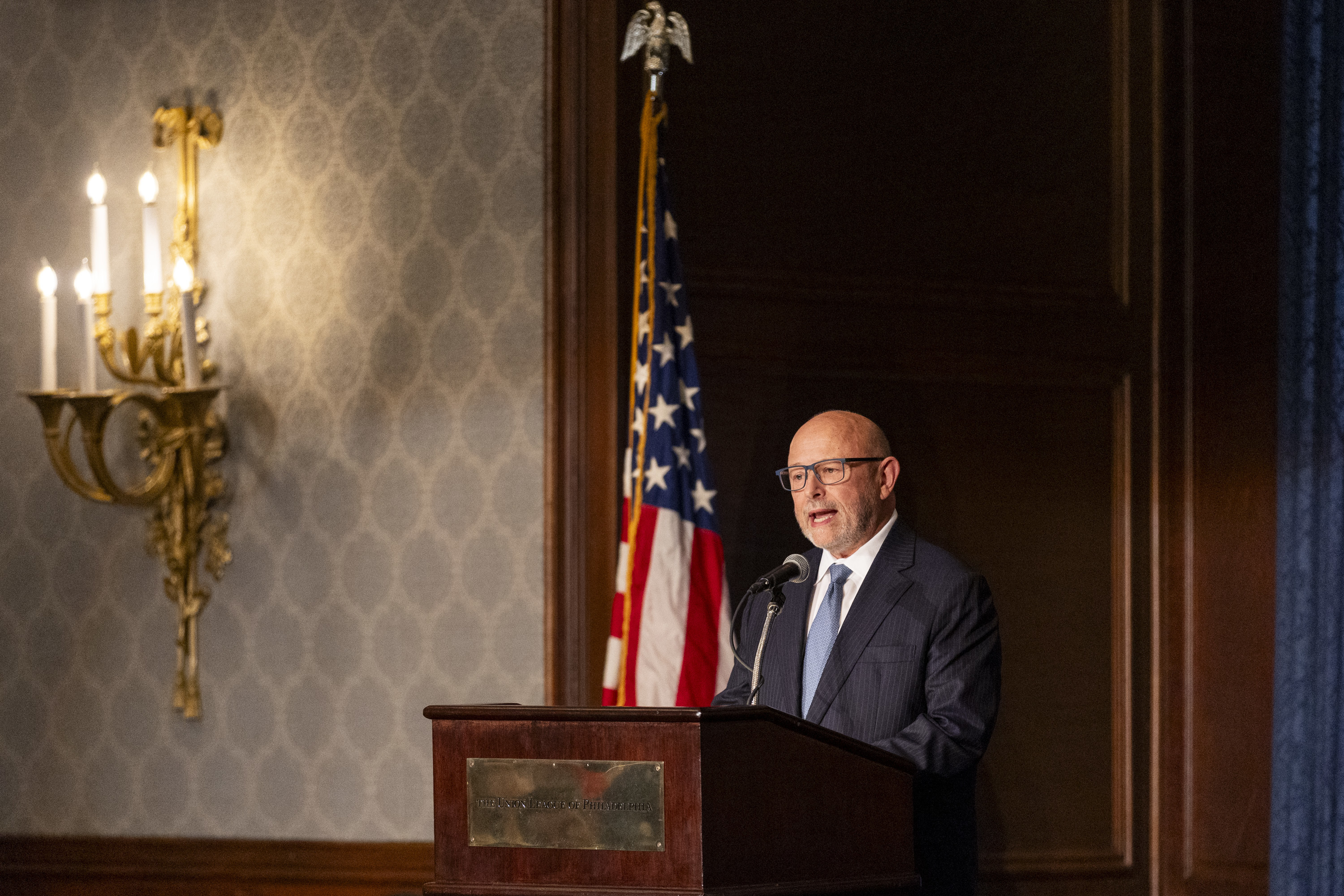
    Gregory Segall, Chairman and CEO of Versa and Supporter of Mayor Parker, speaks at the Union League of Philadelphia Presidential Luncheon in Philadelphia, Pa., on Thursday, September 18, 2025.Tyger Williams / Staff Photographer

    Citing Republican Party sources, Vargas reported that Segall was considering running for one of the two at-large seats on Council that are elected citywide and are set aside by the Home Rule Charter for minority-party or independent candidates.

    Republicans held those seats for about seven decades until Councilmembers Kendra Brooks and Nicolas O’Rourke won them over the last two election cycles as members of the progressive Working Families Party.

    Brooks is considering challenging Parker in next year’s mayoral election, sources previously told The Inquirer, which would require her to resign from her Council seat.

    The Philly GOP has been strategizing ways to recapture the seats, and a run by Segall, a wealthy businessman who could potentially help fund his own campaign, could be a major opportunity for the party.

    Segall donated $2,500 to the Republican City Committee last October.

    GOP chair Vince Fenerty said he has met Segall and thinks he is a “nice and honorable man.”

    “We’re a party that welcomes any potential candidate, and the decision to endorse would be up to our ward leaders,” Fenerty said in an interview Thursday.

    Brian O’Neill, who represents the 10th District in Northeast Philadelphia, is currently the only Republican on Council. Democrats hold the remaining 14 seats.

  • John Fetterman’s favorability dips as voters see him more as a Republican than a Democrat

    John Fetterman’s favorability dips as voters see him more as a Republican than a Democrat

    A majority of Pennsylvania voters view U.S. Sen. John Fetterman (D., Pa.) more as a Republican than a Democrat as he continues to heavily criticize his party and side with President Donald Trump in some major policy areas, according to an Inquirer/New York Times/Siena University poll published Thursday.

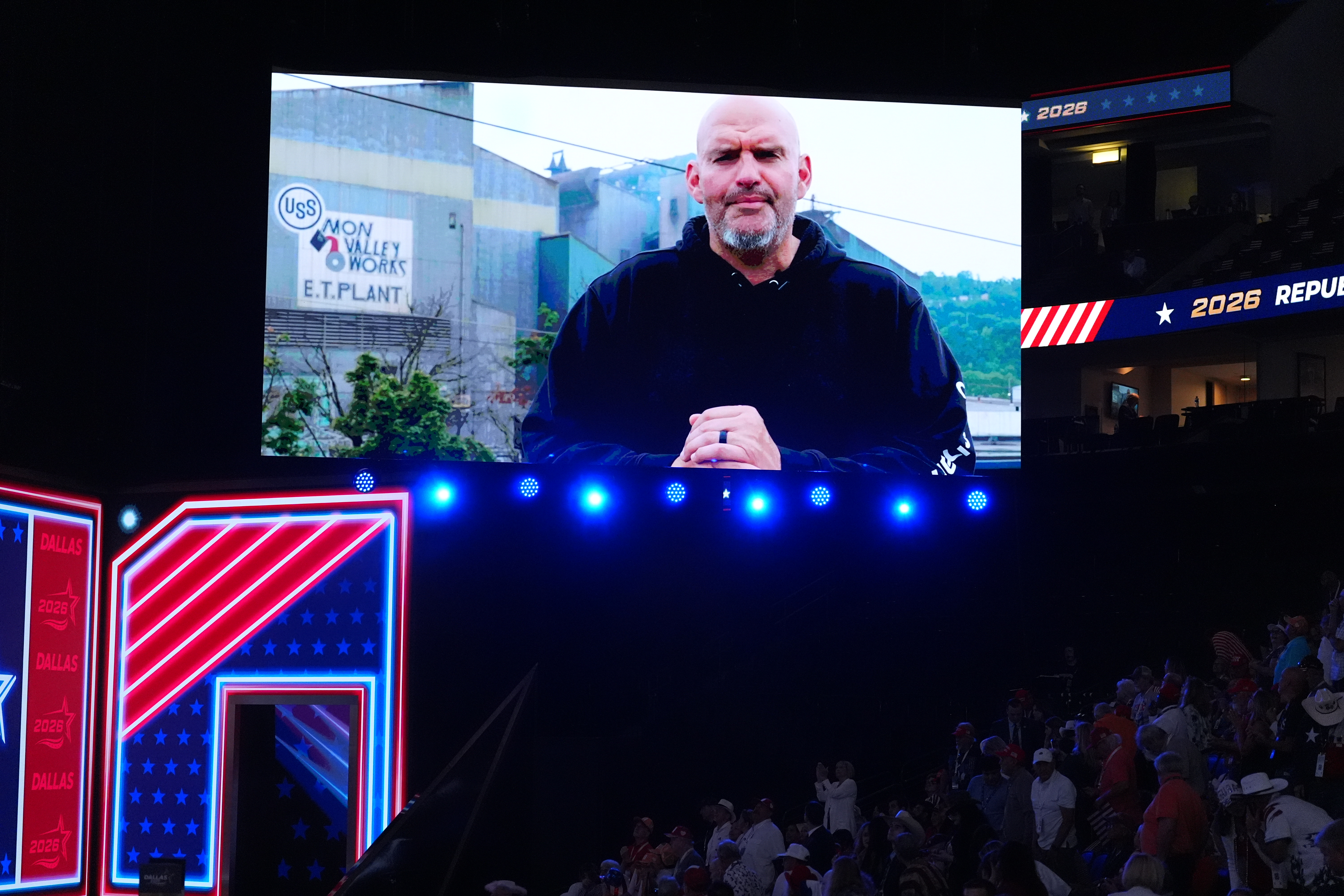
    Fetterman’s overall favorability among Pennsylvanians — which had already taken a dramatic turn in the last year and a half — has also dipped in recent weeks, a period that featured new revelations about the senator’s job performance and his surprise participation in the Republican Party’s midterm convention with a video message praising Trump.

    For the first time in polling conducted by Siena University on behalf of The Inquirer and the New York Times, a plurality of likely voters in the state have a negative view of Fetterman.

    The senator is viewed “somewhat” or “very” unfavorably by 47% of voters and favorably by 42%, according to the poll of 615 likely voters from Sept. 15 to 21. That’s an 11-percentage-point swing since the organizations’ poll in August found Fetterman maintained an overall positive favorability rating.

    Four years after he flipped a Republican-held seat with a promise to be Democrats’ 51st vote in the Senate, just 26% of likely voters consider Fetterman as more of a Democrat than a Republican, the poll found.

    A majority — 57% — view him as more of a Republican.

    (function(){function e(){window.addEventListener(`message`,function(e){if(e.data[`datawrapper-height`]!==void 0){var t=document.querySelectorAll(`iframe`);for(var n in e.data[`datawrapper-height`])for(var r=0,i;i=t[r];r++)if(i.contentWindow===e.source){var a=e.data[`datawrapper-height`][n]+`px`;i.style.height=a}}})}e()})();

    “He insists that he’s not going to be changing parties. However, a lot of people are afraid of that because of the way he has voted,” said Sandra Boyles, a retired teacher and Democrat in Fayette City who believes “a lot of people feel betrayed” by the senator.

    Nearly three-quarters of Democrats see Fetterman as a Republican. And roughly half of Republicans feel the same way, as do a similar proportion of independents.

    Fetterman’s party loyalty has become a pressing question — not just for his own political future, but also for which party controls the U.S. Senate during the final two years of Trump’s presidency.

    Democrats need to win at least four competitive Senate races in Trump-friendly states to win the majority, an uphill battle that has seemed like more of a possibility in recent weeks as the president’s popularity lags.

    Independent election experts consider Democrats to have a real chance of winning states like Texas, Iowa, and Alaska. Ohio, North Carolina and Maine are also official Democratic targets. Even Kansas, which Trump won by 16 percentage points in 2024, appeared to raise some level of concern for Republicans when Vice President JD Vance tried to boost the GOP incumbent this month.

    Neither of Pennsylvania’s U.S. Senate seats is on the ballot this fall. But if Democrats retake the majority by one or two votes, Fetterman’s role as a wild card — even one who votes with Democrats the vast majority of the time — could have an impact as his party tries to rein in or reverse the president’s agenda.

    “That would definitely be a concern of mine,” said Boyles, 74.

    (function(){function e(){window.addEventListener(`message`,function(e){if(e.data[`datawrapper-height`]!==void 0){var t=document.querySelectorAll(`iframe`);for(var n in e.data[`datawrapper-height`])for(var r=0,i;i=t[r];r++)if(i.contentWindow===e.source){var a=e.data[`datawrapper-height`][n]+`px`;i.style.height=a}}})}e()})();

    Fetterman has not said whether he will seek a second term in 2028, and he has repeatedly rejected the idea that he would switch parties.

    “I’m a lifelong Democrat who votes overwhelmingly with my party — and should the Senate flip in November, I will still be the 51st vote that I ran on,” he said in a statement while facing a new round of criticism for appearing by video at the GOP convention in Dallas this month.

    Pennsylvania’s U.S. Senators John Fetterman (left) and Dave McCormick appear together on June 29 to promote the savings accounts for kids that were a signature piece of President Trump’s One Big Beautiful Bill Act.Tom Gralish / Staff Photographer

    Fetterman’s Democratic colleagues have tried to keep him in the fold.

    U.S. Sen. Kirsten Gillibrand, a New York Democrat and chair of the Democratic Senatorial Campaign Committee, said this week that Fetterman is a “very reliable Democratic vote.” As she leads her party’s effort to win the Senate races, Gillibrand said, she does not have, nor has heard others having, concerns about Fetterman’s role in a slim Democratic majority.

    Asked if Fetterman — who appeared at a convention aimed at boosting Republican campaigns — was involved in the Democratic campaign efforts, Gillibrand said she thought Fetterman had visited some candidates but she was not sure.

    “I’m very grateful that Sen. Fetterman is serving in the U.S. Senate as a Democrat, and I think he will continue to do so,” Gillibrand said.

    Still, Fetterman has supported parts of Trump’s immigration enforcement agenda, the war in Iran, and some of the president’s nominees. Senate Democratic leaders would likely try to act as a check on Trump in each of those areas if they win the majority for the next two years.

    Fetterman has also left the door open to leaving the Democratic Party if it makes opposition to Israel an official party stance. The senator has not explained exactly what that situation would look like, though he has been highly critical of Democrats when they push back against the Israeli government’s war against Hamas.

    With the three-year anniversary of the conflict approaching on Oct. 7, more than 70,000 Palestinians have been killed and nearly all Gazans have been displaced, according to the Council on Foreign Relations. Critics say Israel’s military response has been excessive, while Fetterman has said he supports the war in order to root out Hamas fighters who initiated the war by killing more than 1,200 people in Israel in a terrorist attack.

    The latest poll of Pennsylvania voters shows Fetterman’s position is out of step with a majority of voters.

    Among Pennsylvania likely voters, 60% are against the U.S. providing additional economic and military support to Israel, compared with 34% who support it.

    Four in five Democrats, and about a third of Republicans, oppose the aid to Israel. In a sign that Fetterman would face a challenging reelection campaign, 63% of Democrats said they would support a candidate who opposed aid to Israel.

    (function(){function e(){window.addEventListener(`message`,function(e){if(e.data[`datawrapper-height`]!==void 0){var t=document.querySelectorAll(`iframe`);for(var n in e.data[`datawrapper-height`])for(var r=0,i;i=t[r];r++)if(i.contentWindow===e.source){var a=e.data[`datawrapper-height`][n]+`px`;i.style.height=a}}})}e()})();

    Victor Oyola, 47, of Philadelphia, said he considers himself a conservative Democrat and has no issues with politicians supporting Israel’s right to exist. But Fetterman has been more of a voice for the foreign nation than for his home state, he said, while also showing limited interest in other aspects of his position.

    “You don’t want to do the job, but you’re strongly supporting Israel over Pennsylvania?” said Oyola, who works in retirement management. “Everything is Israel, Israel, Israel. But what about Pennsylvania, Pennsylvania, Pennsylvania?”

    Reports of Fetterman’s lack of interest in doing routine aspects of his job as a senator also appear to have played a role in how Pennsylvanians view him.

    In a widely circulated story earlier this month, the Wall Street Journal reported that Fetterman tried to evade meetings with leaders at Children’s Hospital of Philadelphia and with wounded veterans, as well as a funeral for three York County police officers who were killed while on duty.

    Donald Harer, a Democrat from Northumberland who voted for Fetterman in 2022, said that he saw the story and that it seemed like the senator has “really not held his end of the bargain and done his job the way he’s supposed to.”

    As an Army veteran who served in Iraq, Harer said, he was particularly disappointed in Fetterman’s reported refusal to meet with wounded veterans.

    “When he campaigned, when he first started to run, he seemed like a go-getter,” said Harer, an operations manager for a grocery store. “But he let a lot of people down. I kind of call him a traitor.”

    Don Levy, the director of the Siena Research Institute, which conducted the poll, said he did not know if changes in Fetterman’s favorability ratings since last month could be attributed to the recent national attention on him.

    But with recent polls continuing to show Fetterman’s widespread cross-party support, his position as a Democratic darling for the GOP and antagonist for Democrats “looks pretty baked in,” Levy said.

    “The Republicans have now grown in their favorability for him, which may be a reflection of them starting to feel like ‘he’s one of us,’” Levy added. “And Democrats are even more upset with him for moving away from what they believe they elected him to do.”

    Staff writers Joe Yerardi and Gillian McGoldrick contributed to this article.

  • The price of gas is Trump’s weakest issue with Pa.’s voters — including his supporters — in new poll

    The price of gas is Trump’s weakest issue with Pa.’s voters — including his supporters — in new poll

    Pennsylvania voters are giving President Donald Trump worse grades on key economic issues than they did a month ago — a sign of a potentially dimming outlook for Republicans as the president asks voters to act as if he is on the ballot this fall.

    Trump’s overall job-approval rating among likely voters in the state has dropped 5 percentage points since August and now sits at 34%, with 63% disapproval, according to a new Inquirer/New York Times/Siena University poll published Thursday.

    His handling of the economy and the cost of living, which consistently rank as voters’ top concerns this year, is viewed negatively by a larger share of his own Republican supporters and of voters in general than it was last month, according to the poll of 615 likely voters conducted from Sept. 15 to 21.

    Gas prices are Trump’s worst-performing issue among all Pennsylvania voters and among those who voted for the president in 2024, when he won the swing state by nearly 2 percentage points.

    That includes Robert Jenkins, 47, of East Stroudsburg, who said Trump is now running the country like a “cowboy” and has not lived up to the promises he made to bring down prices.

    (function(){function e(){window.addEventListener(`message`,function(e){if(e.data[`datawrapper-height`]!==void 0){var t=document.querySelectorAll(`iframe`);for(var n in e.data[`datawrapper-height`])for(var r=0,i;i=t[r];r++)if(i.contentWindow===e.source){var a=e.data[`datawrapper-height`][n]+`px`;i.style.height=a}}})}e()})();

    And with rising gas prices, the Republican is just thankful that his truck does not run on diesel.

    “Now we’re at like $4.35, $4.40, and I just don’t understand it. I know we’re having the thing with Iran, but I didn’t ever feel in my life that we were that dependent on Iranian oil,” said Jenkins, who works in the registrar’s office at East Stroudsburg University.

    As both parties go all-out to motivate their bases — especially in Pennsylvania, where four key races could determine control of the U.S. House — Democrats clearly have an enthusiasm advantage fueled by a backlash to Trump’s agenda.

    Just under six weeks out from Election Day, about two-thirds of likely Democratic voters are “very enthusiastic” to cast their ballots, while just half of Republican voters say they feel the same way.

    Alex Hansen, 35, a pharmacist and Democrat from Bucks County, said the midterms have become a “referendum” on the Trump administration.

    “The things he’s said and done are just so beyond the pale and unacceptable. … I don’t think it should have to be a public referendum on the federal administration, but that’s what it’s become,” said Hansen, who participated in the survey.

    (function(){function e(){window.addEventListener(`message`,function(e){if(e.data[`datawrapper-height`]!==void 0){var t=document.querySelectorAll(`iframe`);for(var n in e.data[`datawrapper-height`])for(var r=0,i;i=t[r];r++)if(i.contentWindow===e.source){var a=e.data[`datawrapper-height`][n]+`px`;i.style.height=a}}})}e()})();

    Will voters punish Republicans for Trump’s agenda?

    As Democrats look to win control of the U.S. House, they are targeting Trump’s handling of affordability issues specifically — mostly highlighting rising inflation and spiking gas prices due to the war in Iran.

    Just 24% of voters approve and 73% disapprove of his handling of prices at the pump, the poll found. Half of Pennsylvania voters who cast their ballots for Trump in 2024 also disapprove.

    Don Levy, the director of the Siena Research Institute, said as Trump’s approval rating continues to decline, he expects more GOP politicians running in competitive swing districts to distance themselves from the president.

    “There’s tremendous frustration with the president,” Levy added.

    Republican candidates have largely avoided talking about gas prices, highlighting instead the tax cuts and other economic policies the GOP-controlled Congress and White House have enacted in the last two years.

    A bipartisan Ratepayer Protection Act ushered through the House by Republican leaders last week, for instance, aims to prevent data centers from passing on energy costs to consumers. The National Republican Campaign Committee called it a “huge step” in statements praising Pennsylvania Republican lawmakers’ votes for the bill, which has yet to pass the Senate and might not do so before the election.

    On the economy overall, Trump gets positive ratings from just 34% of all voters and 75% of self-identified Republicans — which is less than the 39% and 81% he got, respectively, in August.

    On the cost of living, 25% of all voters and 62% of Republicans give him positive marks, an 8-percentage-point drop for all voters and an 11-point drop for Republicans from a month ago. At the same time, his positive approvals around immigration and the war in Iran, at 42% and 31%, respectively, have remained about the same.

    (function(){function e(){window.addEventListener(`message`,function(e){if(e.data[`datawrapper-height`]!==void 0){var t=document.querySelectorAll(`iframe`);for(var n in e.data[`datawrapper-height`])for(var r=0,i;i=t[r];r++)if(i.contentWindow===e.source){var a=e.data[`datawrapper-height`][n]+`px`;i.style.height=a}}})}e()})();

    Pennsylvania Republicans may now have to grapple with that reality at the ballot box.

    They are defending four competitive districts out of Pennsylvania’s 17 U.S. House seats. And three are running for reelection in what independent election experts consider some of the few “toss-up” races nationwide — U.S. Rep. Ryan Mackenzie, in the Lehigh Valley and Poconos; U.S. Rep. Rob Bresnahan, in a Scranton-based Northeast Pennsylvania region; and U.S. Rep. Scott Perry, in a Harrisburg-based district.

    U.S. Rep. Brian Fitzpatrick, a Republican facing a challenge from Democratic Bucks County Commissioner Bob Harvie, is also in a competitive race drawing national attention.

    The vulnerable Republicans have taken different approaches. Mackenzie and Bresnahan spoke at the first-ever GOP convention in Dallas earlier this month, when Trump pleaded with his supporters to turn out as if he was also on the ballot. Perry, a staunch Trump ally, also attended.

    Fitzpatrick, on the other hand, has tried to distance himself from the president and did not attend the convention.

    U.S. Rep Brian Fitzpatrick (R., Bucks) and his Democratic challenger Bob Harvie (third from right) attend the Garden of Reflection remembrance ceremonies Friday, September 11, 2026 at Garden of Reflection in Yardley, Pennsylvania.William Thomas Cain / For The Inquirer

    But how Trump’s approval ratings — and the fact that 56% of likely voters want to see Democrats control the House — factor into those races remains to be seen.

    Jenkins, the East Stroudsburg Republican, said Trump’s handling of the economy will not affect his vote for Bresnahan because the lawmaker has regularly shown up to the events he leads at a veterans’ association in Monroe County.

    Hansen, the Democratic voter from Bucks County, said he is leaning toward voting for Fitzpatrick in the 1st Congressional District race, but he said he could be open to picking Harvie once he learns more about the candidate’s priorities and “what he plans to do to oppose his Republican colleagues and Trump’s agenda.”

    The pharmacist said he and his wife, who was laid off three months ago, are tightening their purse strings to deal with rising costs as they care for their young child and another on the way.

    But he said he does not view Fitzpatrick as being totally roped into Trump’s negative perception.

    The Bucks County lawmaker is the least loyal House Republican to the president and the GOP, but he has still voted with Trump and his party nearly 70% and 77% of the time, respectively, this term, a recent Inquirer analysis found.

    “Fitzpatrick has put up at least a little bit of resistance, which is better than, you know, a lot of the sock puppets that Republicans have right now in Congress,” Hansen said.

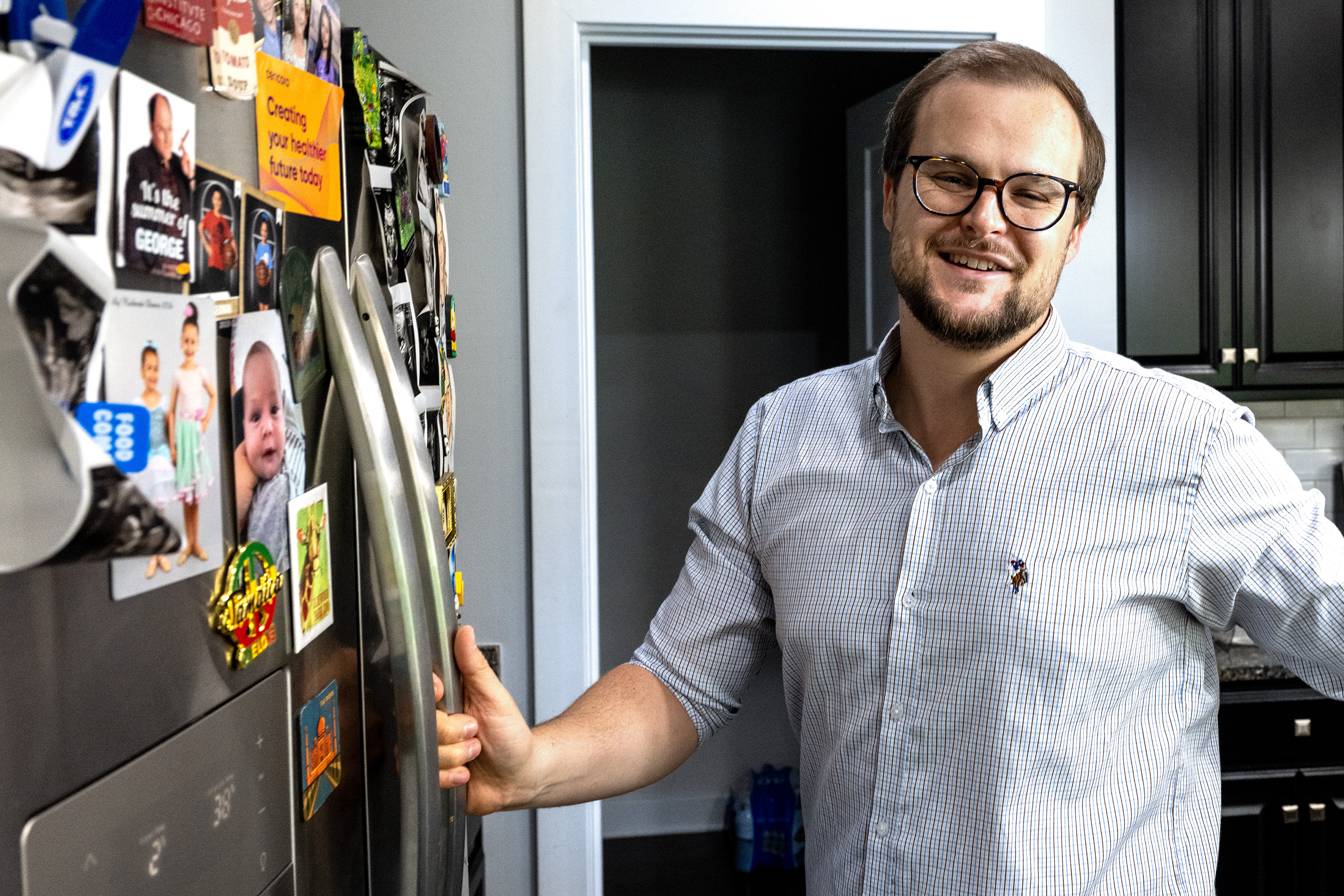
    Alex Hansen at his Bucks County home Tuesday, Sept. 22, 2026. He is one of the voters who participated in an Inquirer/New York Times/Siena University poll that showed dissatisfaction with President Donald Trump. Tom Gralish / Staff Photographer

    How affordability became No. 1 for Democrats this fall

    In the final weeks before the midterm elections, Harvie’s campaign plans to keep tying Fitzpatrick to the affordability crisis. That includes highlighting the Republican lawmaker’s vote to advance the One Big Beautiful Bill Act in the House (before voting against its final passage weeks later) — but also not necessarily aligning him with Trump.

    “It is really about pointing out what Brian Fitzpatrick has done, the votes he’s taken, and how those votes have affected people in this district,” Harvie said in an interview with The Inquirer Editorial Board on Tuesday.

    “Now, are they Trump priorities, too? They are, sure, but it’s not necessarily just hanging Trump around his neck. He’s kind of done that to himself.”

    Harvie and his counterparts in the other swing districts are zeroing in on cost-of-living issues amid voters’ plummeting dissatisfaction with Trump’s handling of the economy.

    Janelle Stelson, a former local TV reporter running against Perry, highlighted the cost of a cheeseburger in a recent ad that referred to Perry’s support of Trump’s tariffs and a separate proposal that would eliminate income and other taxes in favor of a national sales tax. The average cost of a pound of ground beef, which she pegged at $7.29, is more than the $7.25 federal minimum wage.

    Stelson’s campaign said in a statement that Perry “has made life more expensive for Central Pennsylvanians, voting to raise the price of utilities, gas, and housing while gutting benefits for working people.”

    In a statement, Perry said his platform on affordability includes eliminating taxes on tips, overtime, and Social Security. Perry also said he supports reducing electricity costs and raising child tax credits.

    “We draw a strong contrast with our opponent on the kitchen table economic issues that are front and center with Voters,” Perry wrote in the statement, which also disputed Stelson’s ties in the district.

    Spokespersons for Fitzpatrick and Bresnahan did not respond to a request for comment.

    Paige Cognetti, the Democratic mayor of Scranton, who is running against Bresnahan, has contrasted Northeastern Pennsylvania voters’ struggles with rising costs against Bresnahan’s personal wealth and stock-trading while in office.

    “While Rob’s cashing in, NEPA families are paying the price. His corruption is costing us and that’s why he will lose in November,” a Cognetti spokesperson said while noting “record diesel prices, cost-raising tariffs, and sky-high healthcare premiums.”

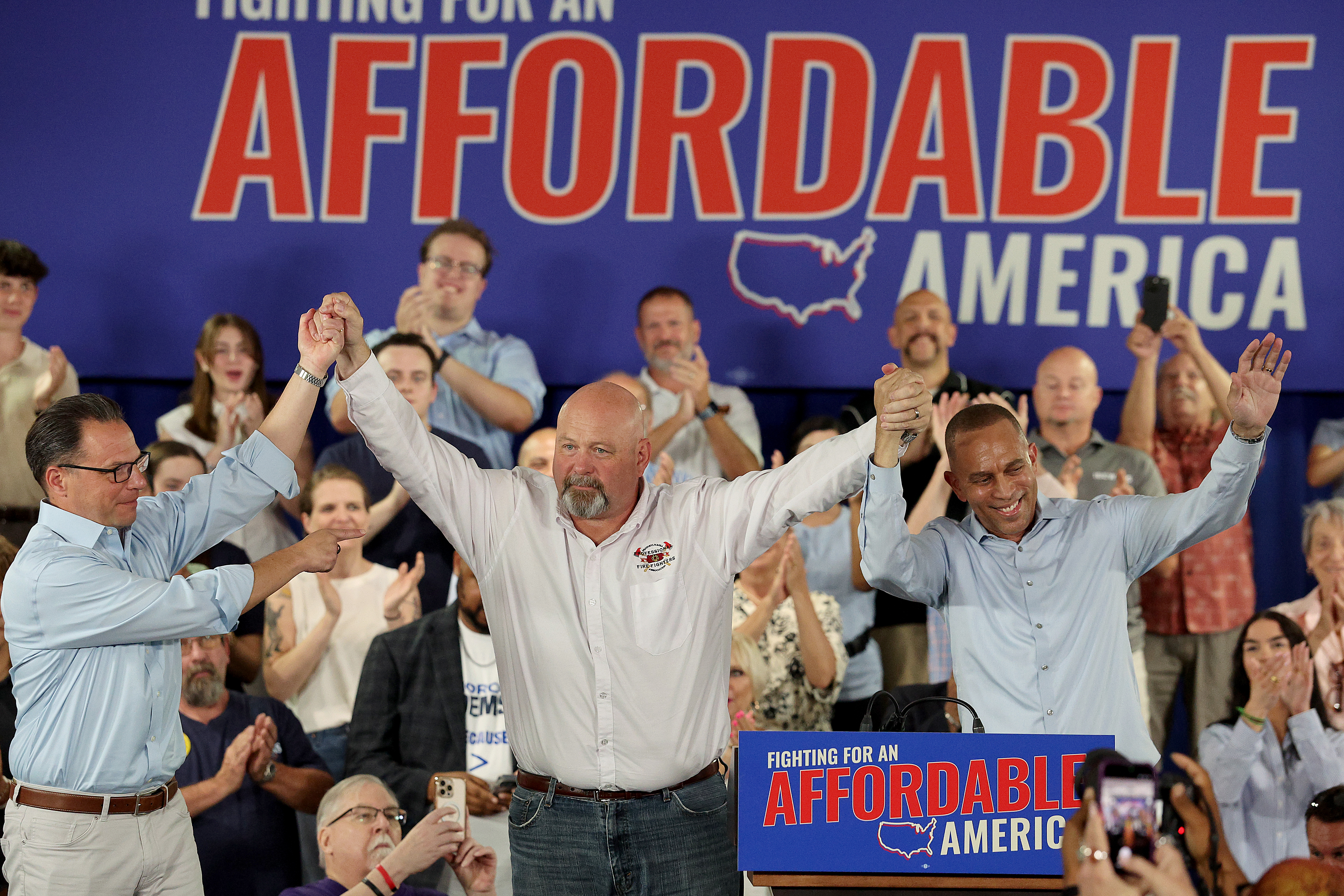
    Governor Josh Shapiro (left) and Minority Leader Hakeem Jeffries (right) pose after rally for Congressional candidate Bob Brooks (center) at the United Steelworkers Union Hall in Bethlehem, Pa. on Sunday, July 26, 2026.David Maialetti / Staff Photographer

    In Mackenzie’s district — where the freshman Republican squeaked through one of the narrowest races in the country two years ago — Ronalyn Birnbaum of Carbon County said she has been working since she was 13 years old. Now, at 69, she said, she has come to terms with not having the money to retire and afford groceries, Medicare, and her inhaler.

    This year, she said, she is giving Democrat Bob Brooks, a union leader and former fighter, her vote.

    “I’m going to give [Brooks] a shot only because I know that Ryan Mackenzie sticks up for a lot of the Trump policies and procedures,” said Birnbaum, a Democrat.

    Andres Weller, Mackenzie’s campaign manager, criticized Brooks’ platform in a statement and said Mackenzie favors “commonsense reforms” and is “running on his bipartisan record of delivering for our community.”

    Benny Stanislawski, a Brooks campaign spokesperson, said in a statement that the Democrat is “running to bring costs down for working families Mackenzie has left behind,” including through the Republicans’ vote for the One Big Beautiful Bill.

    As Democrats’ messaging appears to gain traction, 53% of respondents in The Inquirer/New York Times/Siena poll said they would be more likely to vote for the Democratic candidate in their congressional district, while 44% said they would choose the Republican. The poll did not ask about specific races.

    Both parties still have work to do on their brands. A majority of likely voters see each party as focused on the wrong things — 51% for Democrats and 59% for Republicans.

    Birnbaum said the problems she hopes voters can address at the ballot box — like the cost of living — have been a long time coming.

    “This country should have been fixed a long time ago, but nobody seemed to care, and we’re finding that with the infrastructure here in this country, too,” Birnbaum said. “Nobody thought about these things. They thought about themselves, I guess.”

    Staff writers Gillian McGoldrick and Joe Yerardi contributed to this article.

    Clarification: This story has been updated to clarify the reference to a proposed national sales tax in Janelle Stelson’s ad attacking U.S. Rep. Scott Perry.