The Philadelphia region is under an extreme heat warning Wednesday, leading transit agencies to slow down trains to ensure safe travel amid a high of 98 degrees.
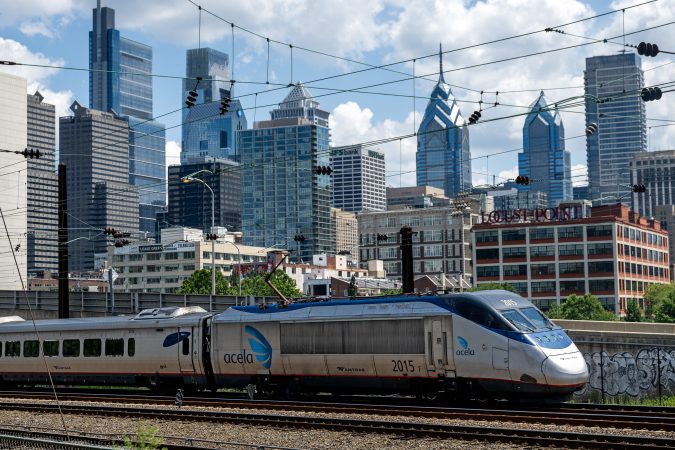
Amtrak and SEPTA were slowing trains down by 5 to 10 mph, and Amtrak was canceling some Acela and Northeast Regional train trips due to the heat, officials said.
Amtrak plans to reduce train speeds through Friday, in addition to canceling at least a dozen trains each day Wednesday and Thursday.
“While these measures are intended to maintain safe and reliable operations, customers traveling during these hours should continue to monitor their train status for the latest updates,” an Amtrak spokesperson said.
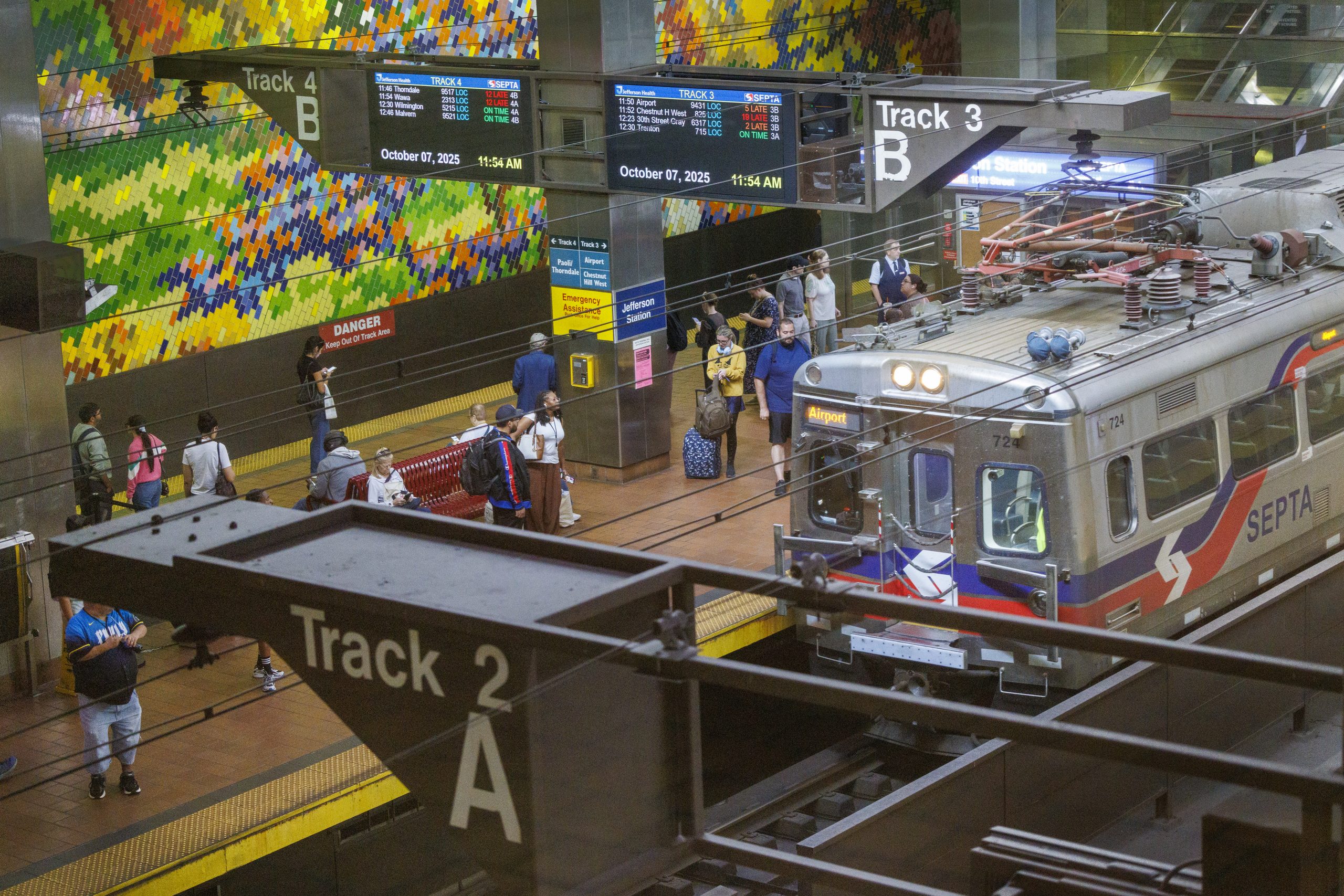
Regional rail train heading to Philadelphia Airport stopping at Jefferson Station. SEPTA Regional rail riders at Jefferson Station, Philadelphia, Tuesday, October 7, 2025.Alejandro A. Alvarez / Staff Photographer
SEPTA has not canceled trips, but it was operating trains at a slower speed, which could lead to delays of up to 15 minutes on Regional Rail and trolleys, SEPTA spokesperson Andrew Busch said. Subway lines were also running slower but were less affected since they are not exposed to direct sunlight as often as other services.
“Bringing speeds 5 to 10 mph slower from their top speed is not always very noticeable to customers, but it can cause some minor delays,” Busch said. “Extreme heat like this makes the tracks more susceptible to damage, and by slowing down the speeds you can help prevent that.”
In extreme heat, rails can begin to warp and eventually crack, creating dangerous circumstances. The wires that hang overhead to power the trains also begin to “sag” in extreme heat, Busch said. The heat also affects electrical equipment like signals and switches, similar to how many across the region can experience power outages in extreme heat.
When temperatures reach 88 degrees, all of these potential safety hazards intensify, Busch said. That is the threshold for when transit agencies begin monitoring their rail systems to see if adjustments are needed.
These safety measures are expected into Thursday and Friday as temperatures are expected to reach 96 and 92 degrees, respectively, according to the National Weather Service. Philadelphia has hit the 100-degree mark three times in 2026, just two shy of the record number for most 100-degree days, according to the weather service.
While the city has not declared a heat emergency, the Philadelphia Office of Homeless Services declared a “code red,” meaning additional outreach was being done to connect those in need to services.
Sandra Shachar has been posting news articles on the walls of the President’s House Site almost every day since January.
She was outraged that President Donald Trump’s administration had dismantled the exhibit telling the story of the nine people George Washington enslaved in his executive mansion at Sixth and Market Streets, and sharing information with visitors was her way to push back.
But Shachar, 72, continued with her routine. This time, two park rangers stopped her.
“When I went to tape my sign up, they came and said, ‘You can’t do that. Please stop,’” the psychologist from Center City said.
Sandra Shachar, 72, cited for vandalism at the President’s House site on July 15, 2026 for attempting to post news articles on the walls.Abraham Gutman
The rangers issued Shachar a citation for vandalism, which carried a $305 fine, and warned her that next time she could be arrested.
The news came as a gut punch.
“It was something I could do,” Shachar said. “And now for doing something, I’m issued a citation that says I have created vandalism on federal property.”
The vandalism citation marks an escalation in the National Park Service’s response to protest at the President’s House, and comes as activists promise to keep the fight over the site’s history alive.
“I don’t care whether you’re a Republican or Democrat, liberal or conservative … this is some scary [expletive],” Coard said. “Despite being very afraid, we got to keep fighting.”
Fascist leaders throughout history have attempted to rewrite the past as part of their campaign to control the future, the attorney said. And that is the level of threat the Trump administration’s changes to the President’s House represent, Coard said.
The new panels have been criticized for minimizing the brutality of slavery, whitewashing George Washington’s culpability, and shifting the focus away from the nine people who were kept in bondage at the nation’s first executive mansion.
It is outrageous that visitors will see panels that, for example, discuss Washington’s “discomfort” with slavery and suggest the lives of those enslaved in Philadelphia were not too bad, Coard said.
“The fact that the federal government would ignore the hell of slavery for the victim but highlight the president’s ‘discomfort,’” Coard said. “What kind of nonsense is that?”
Avenging the Ancestors Coalition’s goal continues to be the full restoration of the site with the original panels that had been developed through partnership with the city and input from the community. The group is exploring new legal strategies, Coard said.
The city is also not done fighting, Mayor Cherelle L. Parker said in a statement.
Security cameras that have been placed at the President’s House site, where new panels have been installed, in Philadelphia, July 15, 2026. Historians and advocates have criticized the new panels for minimizing Washington’s role as an enslaver.Jessica Griffin / Staff Photographer
The case raises “serious legal issues” that go beyond the President’s House, Parker said.
“I will continue fighting on behalf of everyone who supports the core belief: All of our history must be told,” the mayor’s statement said.
It will be up to the Third Circuit to decide whether to grant a second hearing to an issue that three judges had agreed on unanimously.
The efforts to educate visitors about the President’s House continue as well.
Old City Remembers, a grassroots effort, will continue to register volunteers to read aloud the text of the removed signs. And the Black Journey: African-American Walking Tour of Philadelphia will continue to offer tours that tell the story of those enslaved at the site.
Brian Wells, 65, has been putting up protest posters on the President’s House walls since the day after the January removal. On Tuesday, Wells said, national park police stopped him from taping papers and threatened him with arrest.
He thought the heightened security was because of an MLB All-Star event held Tuesday on Independence Mall, but now that the panels have been replaced, he isn’t so sure.
“I will continue with Old City Remembers folks to volunteer to read aloud the text from the former panels,” Wells said Wednesday. “Other actions? I don’t know at this point.”
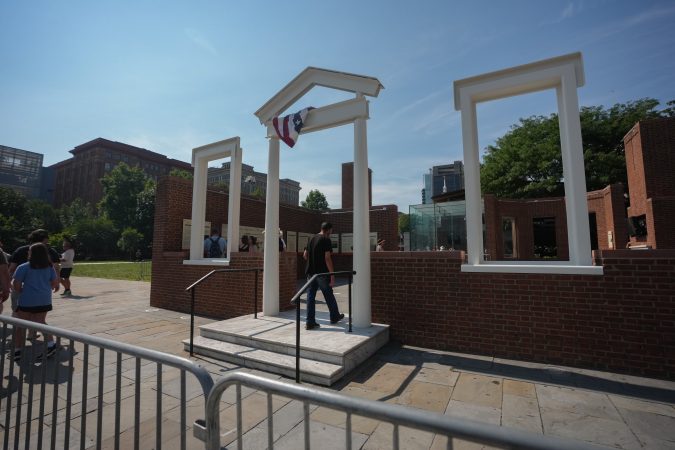
President Donald Trump’s administration has installed its own version of history at the President’s House Site, swapping panels on the brutality of slaveryat the site for displays that experts say sanitize George Washington’s role as an enslaver.
The replacement caps a monthslong legal battle over the site on Independence Mall that was the first direct skirmish between Mayor Cherelle L. Parker and the Trump administration.
The change happened overnight Tuesday into Wednesday, hours after the city hosted MLB All-Star Game events near the site, allowing the government to switch out the displays and shut down the television screens without public scrutiny.
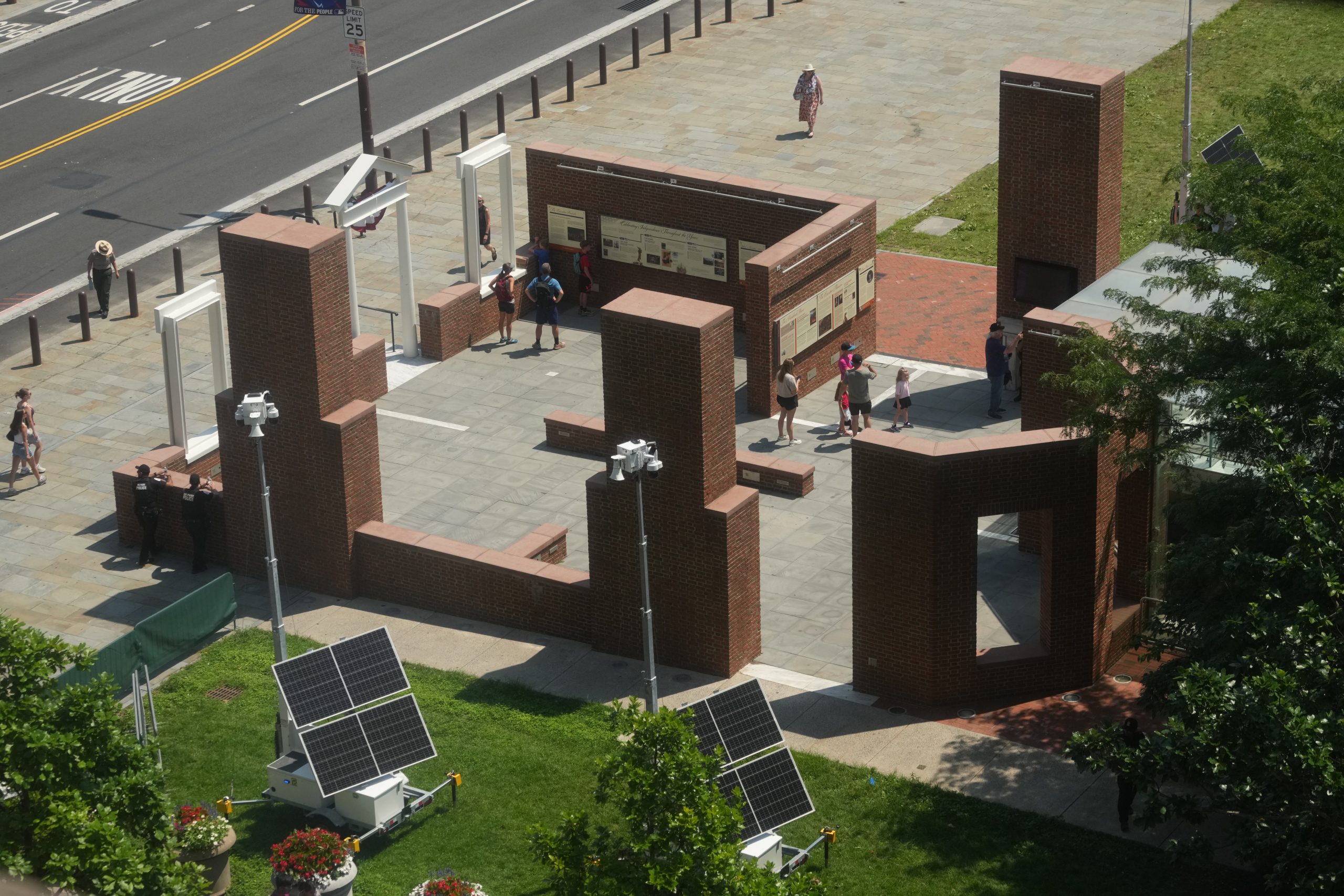
Roughly a week prior to the changes, park employees installed security cameras near the site, which one worker explained as being for the All-Star Game festivities. The cameras were still present Wednesday.
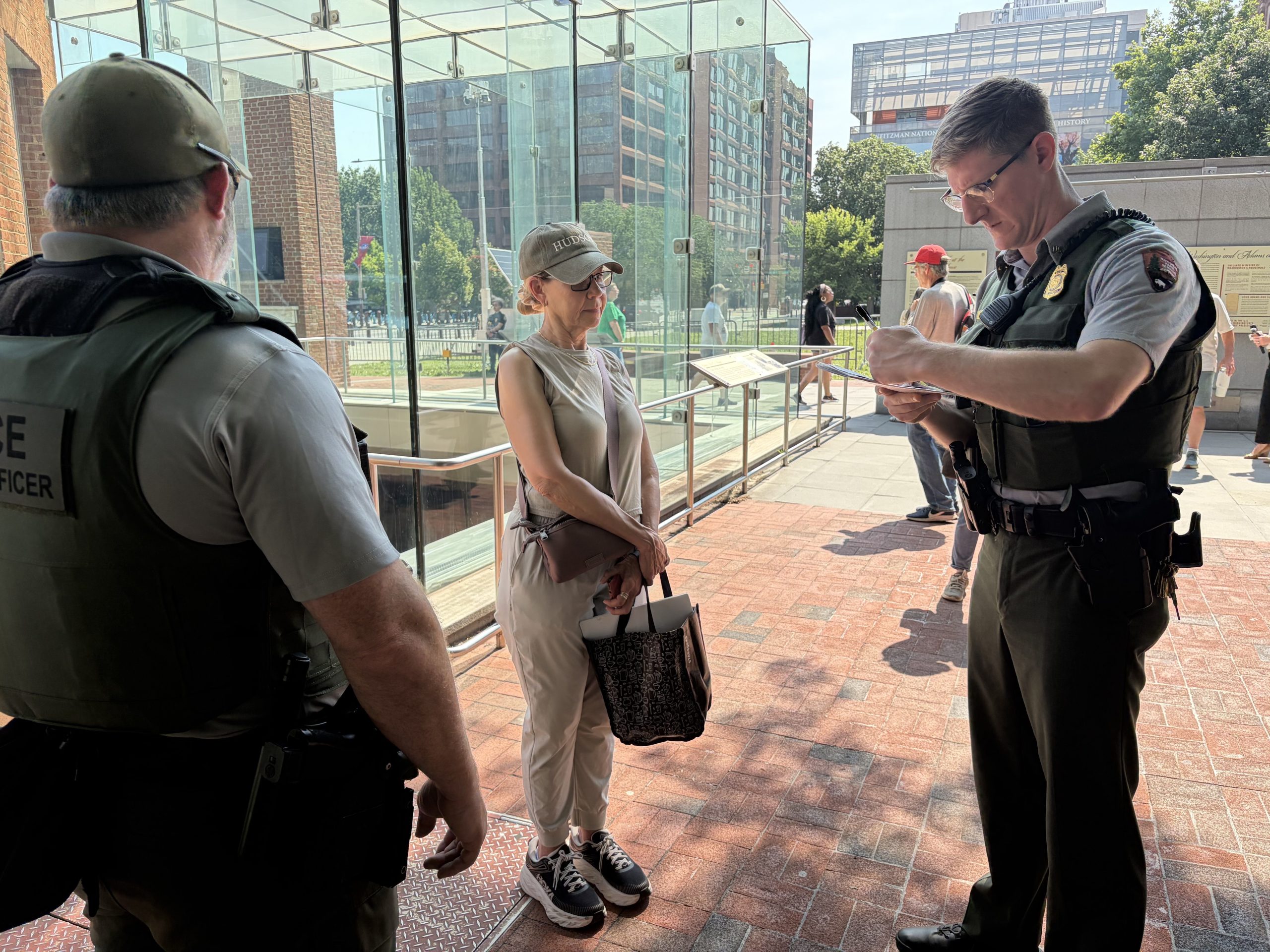
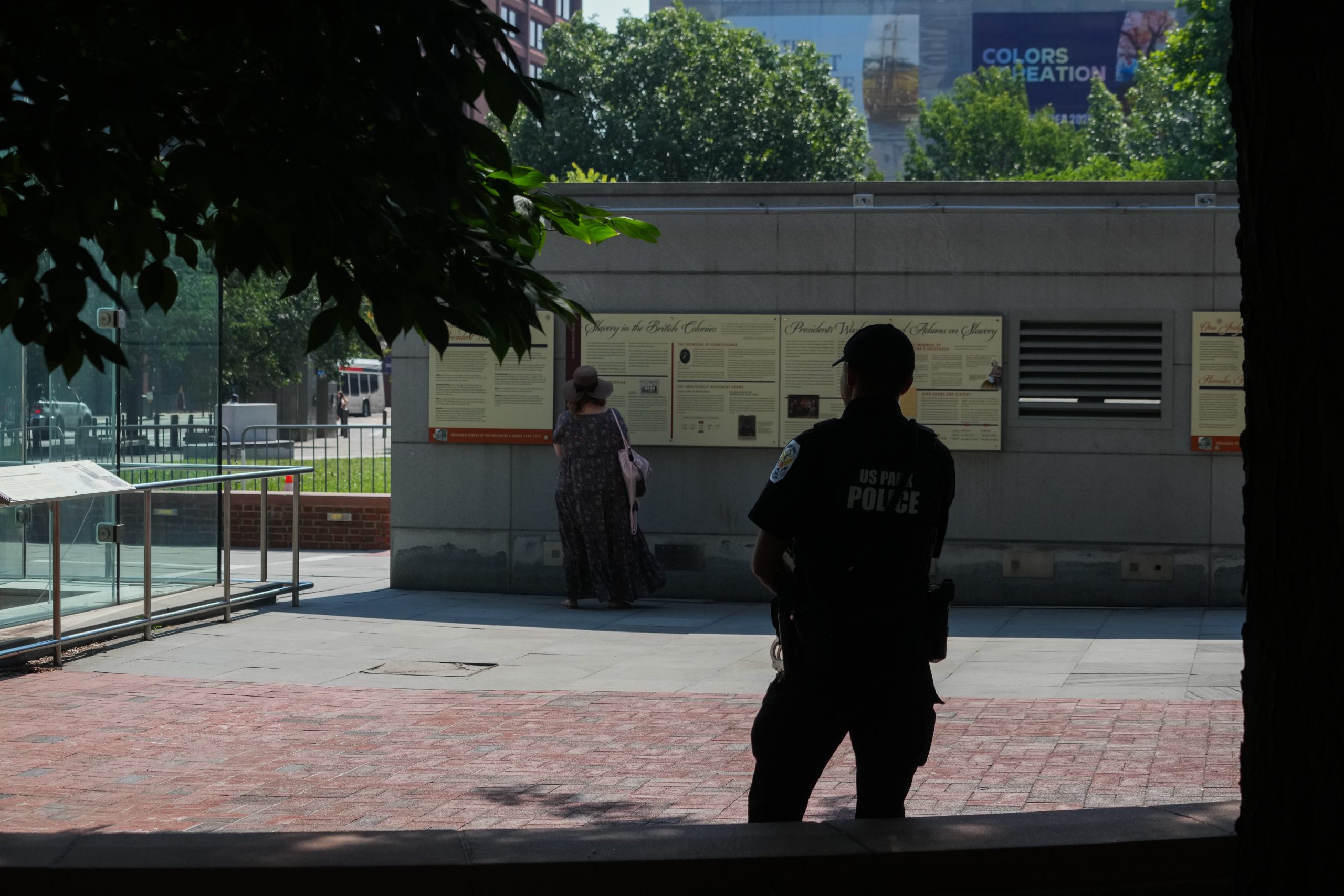
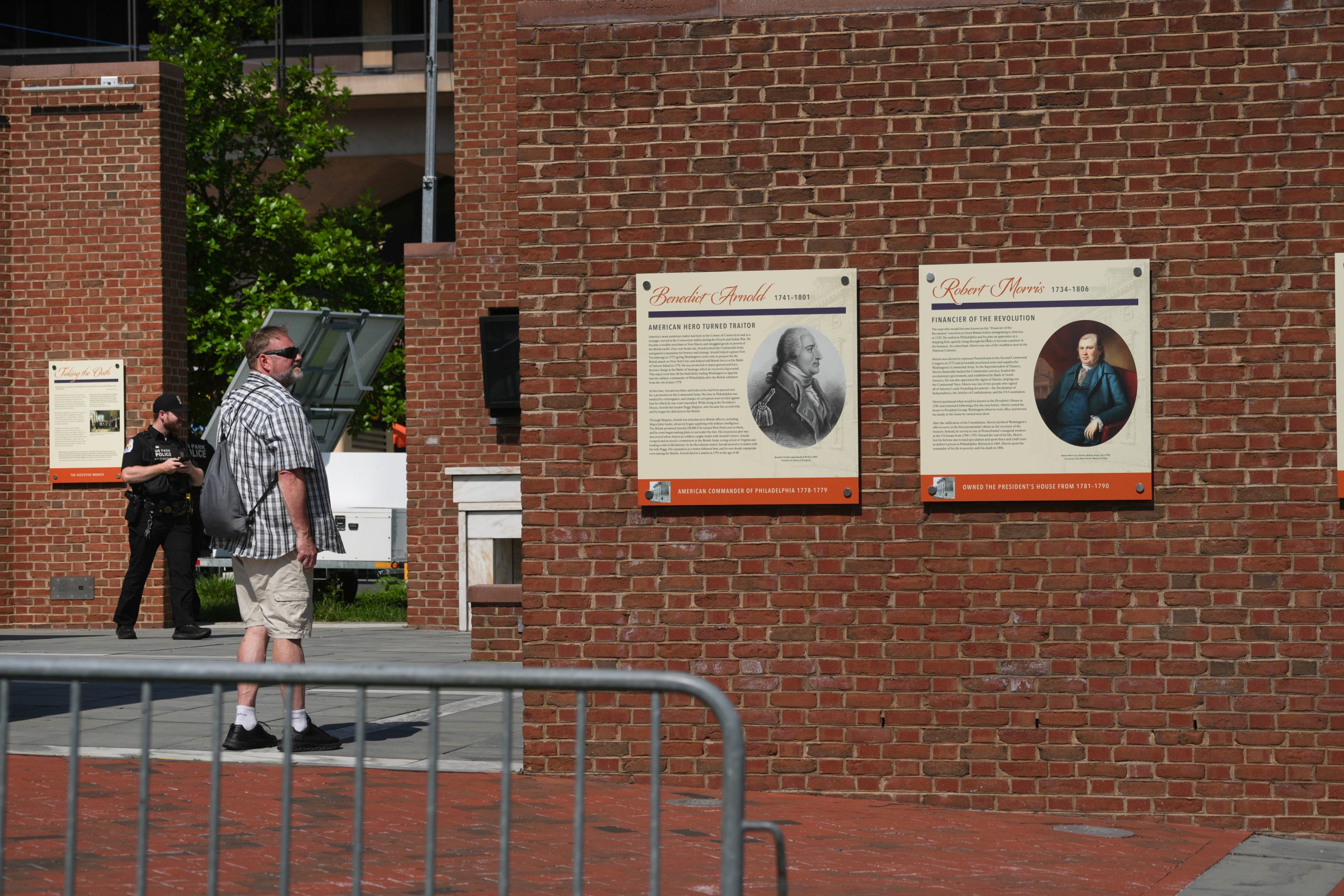
A U.S. parks police officer and a visitor at the President’s House Site, where new panels have been installed, in Philadelphia, July 15, 2026. Historians and advocates have criticized the panels for minimizing Washington’s role as an enslaver.Jessica Griffin / Staff Photographer
In a statement, Parker said the city intended to seek a rehearing on “serious legal issues” presented in the Third Circuit’s decision and slammed the federal government for installing the panels ”under the cover of darkness.”
“It was allowed to do this by the decision of the federal court, but that it did so at night shows it understands this action is shameful, that it violates community trust,” Parker said.
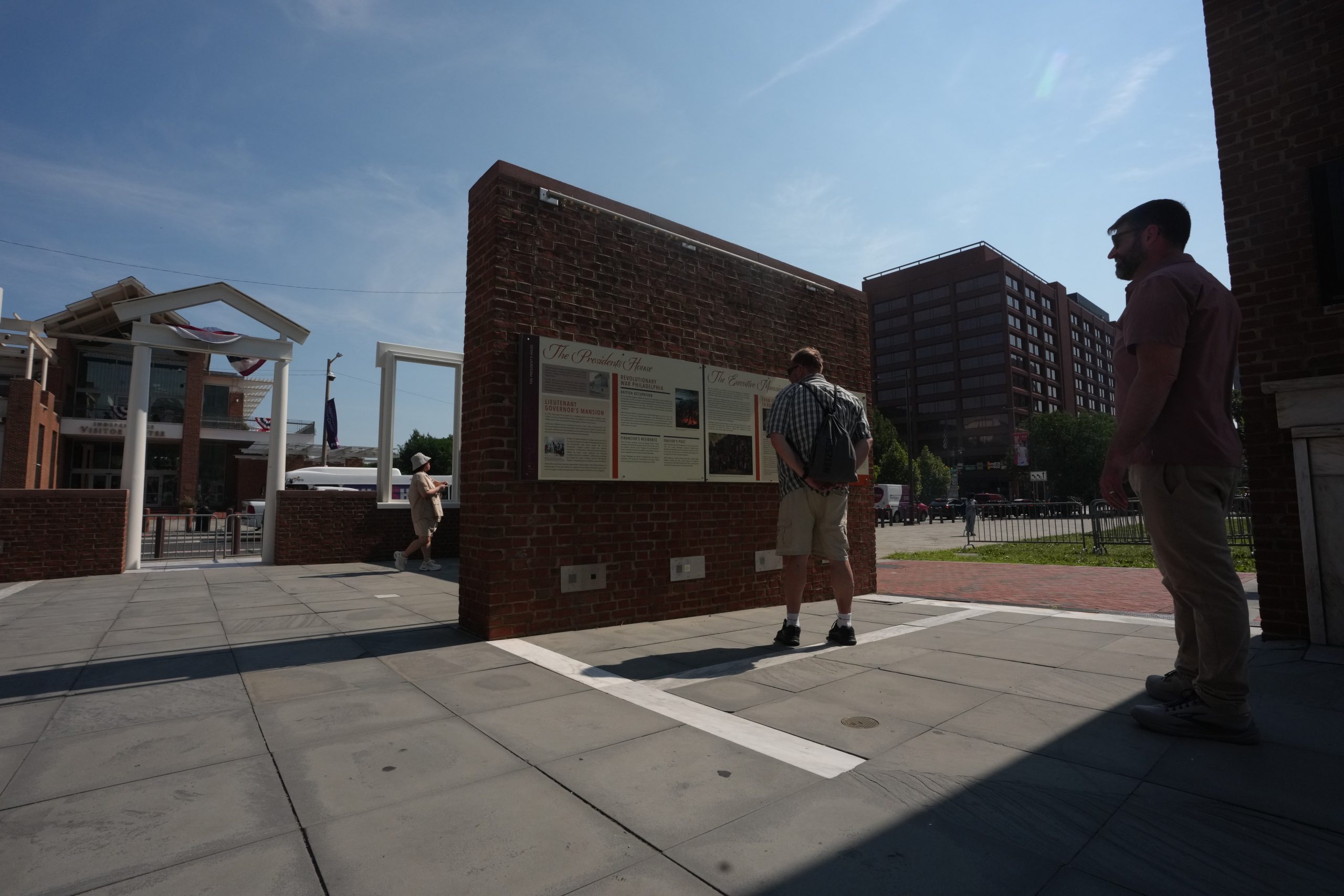
The site now features the 11 panels were proposed by the Trump administration in April, in addition to more than a dozen smaller panels that detail governmental processes, the lives of various historical figures, and a panel dedicated to the escape of Ona Judge and Hercules, two people enslaved by Washington who fled to freedom.
Though the panels do mention slavery and the people Washington enslaved, the new exhibits mostly offer a broad timeline of U.S. history that significantly strays from the original intent of the President’s House asoutlined in the park’s foundation document in 2017: “It would explore the historic context of the site in the context of its ties to slavery and the lives of the enslaved who lived at the site.”
Visitors to the President’s House Site, where new panels have been installed, in Philadelphia, July 15, 2026. Historians and advocates have criticized the panels for minimizing Washington’s role as an enslaver.Jessica Griffin / Staff Photographer
The new panels also soften Washington’s role as an enslaver.
For instance, one display says: “Caught between his private doubts about slavery and his public responsibilities as president, George Washington navigated a nation deeply divided over slavery.”
“Privately, George Washington often expressed discomfort with the institution and a desire to see it abolished,” the panel continued. “Yet as a Virginia plantation owner, his wealth and livelihood were deeply tied to it.”
Later in that panel, the Trump administration writes: “Slaves living in the President’s House experienced a greater modicum of autonomy than elsewhere in the South such as to explore the city and sometimes even attend the theater, with Washington buying the tickets.”
Another panel, titled “Enslaved People at the President’s House,” discusses the lives of each of the nine individuals enslaved by Washington, but reframes Washington’s role.
“President Washington knew and trusted his enslaved house staff enough to buy them tickets for the circus and theater and to let them venture out into the city’s markets on their own,” the panel says.
A spokesperson for the Interior Department said in a statement that the “new panels are full of historical context and highlight the momentous events that took place in the President’s House and other sites at Independence National Historical Park.”
The statement said that the panels “acknowledge the evils of slavery, including its injustice and hypocrisies,” and properly tells the story of the nine individuals enslaved by Washington and the “full story” of U.S. history.
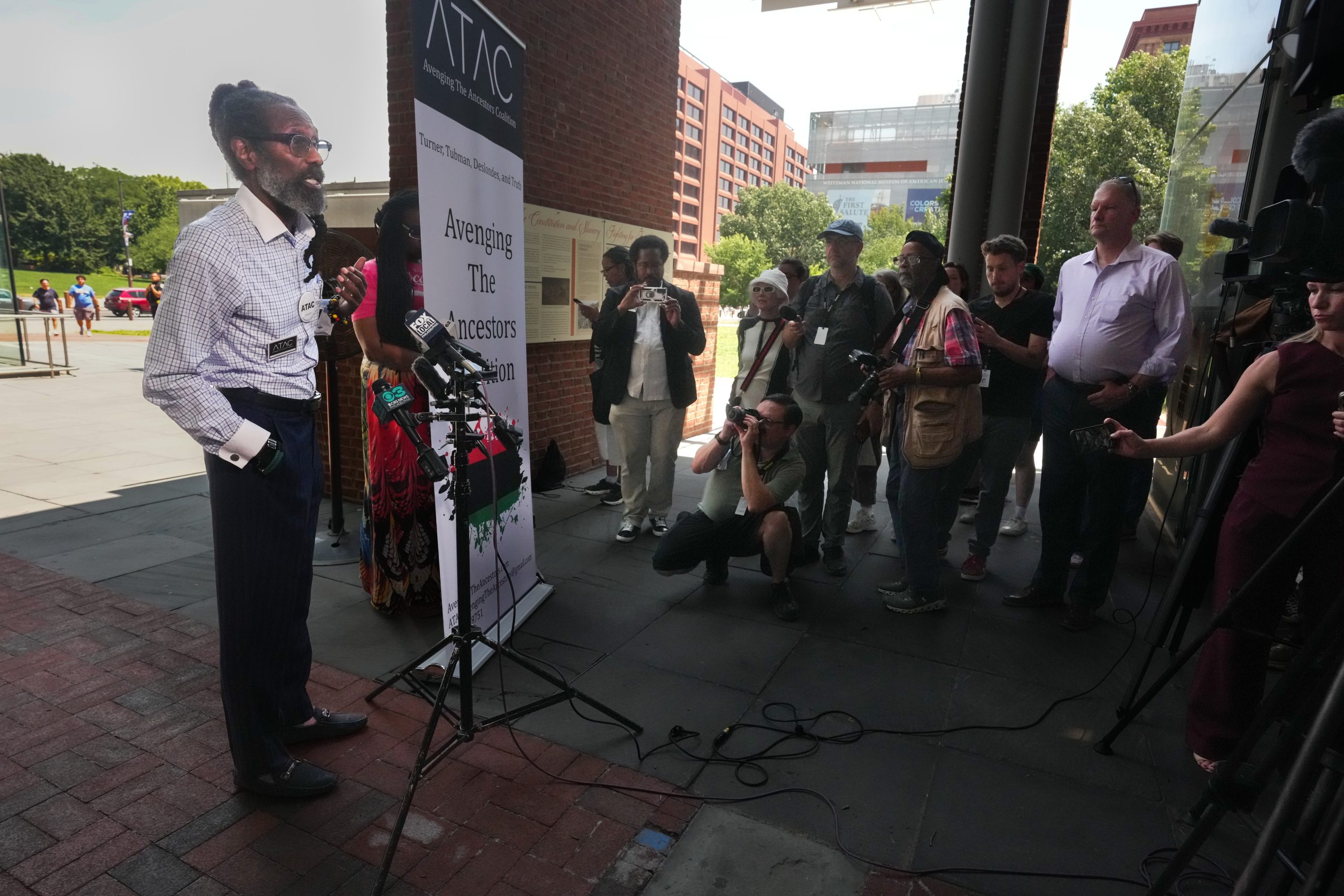
Michael Coard, leader of Avenging the Ancestors Coalition, a group that has fought to protect the President’s House, said stakeholders were “not surprised — we saw it coming” and were reviewing all possible legal avenues and advocacy options.
Shortly after noon, Coard and other activists spoke defiantly at the site.
He called the new panels “a complete whitewashing of American history” and said the few references to existence of slavery are a reminder that “the best lie is one that has a little bit of truth.”
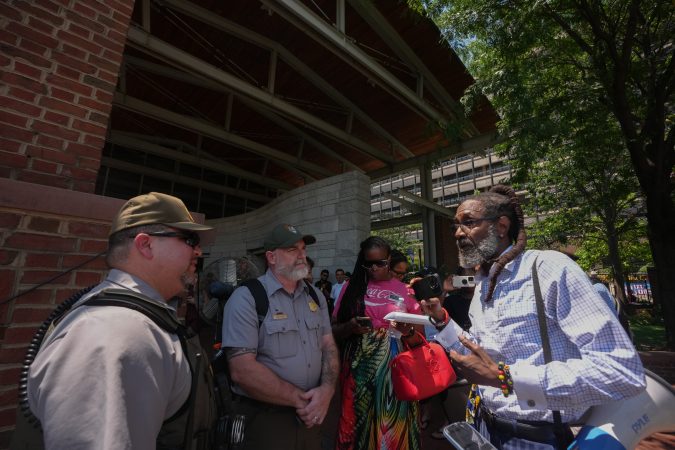
Lawyer Michael Coard holds a press conference at the President’s House Site, where new panels have been installed, in Philadelphia, July 15, 2026. Historians and advocates have criticized the panels for minimizing Washington’s role as an enslaver.Jessica Griffin / Staff Photographer
The drastic alterations are a culmination of about a year of turmoil since the Trump administration began scrutinizing the site as part of the president’s executive order to review or remove displays at national parks that “inappropriately disparage Americans past or living.”
Removals also happened at national parks around the country.
Sheri Utain, 77, has been coming to the President’s House site since January to read aloud the content of the missing panels. When she arrived Wednesday, she was shocked to learn the exhibit had been replaced overnight.
“How sneaky is that?” Utain said. “What kind of government is that?”
Others also continued with their routines, but the response from National Park Service rangers was harsher.
Sandra Shachar has been posting news articles on the President’s House walls almost every day since January to provide visitors updates on the court battles over the slavery exhibit.
Sandra Shachar, 72, cited for vandalism at the President’s House Site on July 15, 2026 for attempting to post news articles on the walls.Abraham Gutman
But Wednesday, the local psychologist was cited for vandalism and ordered to pay a $305 fine.
“It was something I could do … it feels better than doing nothing,” Shachar said, holding back tears. “Part of free speech and our First Amendment rights is to put up signs. It’s not defacing. It’s not vandalizing.”
An Interior Department spokesperson said “any vandalism, tampering, destroying, or defacing of cultural or archaeological resources is a federal crime.”
The installation of the new exhibit marks the end of a phase in the city’s legal battle against Trump’s administration.
The city sued in January when the slavery exhibit was abruptly dismantled, asking a federal judge to issue an injunction ordering the panels be restored. Judge Cynthia M. Rufe issued a blistering opinion on Presidents’ Day ordering the restoration, comparing the Trump administration’s action to the Ministry of Truth from George Orwell’s 1984 novel.
No changes followed on the ground immediately after the ruling because of litigation in federal court in Boston that challenged the legality of display removals in national parks and historic sites nationwide, leading a district judge to order the Trump administration to restore all removed items.
Visitors to the President’s House Site, where new panels have been installed, in Philadelphia, July 15, 2026. Historians and advocates have criticized the panels for minimizing Washington’s role as an enslaver.Jessica Griffin / Staff Photographer
In the aftermath of the 250th anniversary celebrations, Parker said, examining the paradoxes of liberty and slavery that existed during the founding of the United States is key.
“This paradox reveals core questions we still live and struggle with today — how do we share power for the betterment of all people? That is a hard question, and one that President’s House forced us all to consider,” Parker said.
As activists and the city vow to continue the legal fight, the efforts to educate visitors about the history of the President’s House will also continue.
The House passed a bill Tuesday that would make daylight saving time permanent.
Proponents, including President Donald Trump, say the switch would amount to more daylight during the times when Americans are most active. The act is in turn called the Sunshine Protection Act
Trump called the House’s vote “great news for America.”
But critics say it’s not that simple, citing public safety and health issues.
So, if the change really means more sunlight, what could go wrong? And haven’t we tried this before? Here is everything we know so far about a potential switch to permanent daylight saving time.
What is daylight saving time?
Daylight saving time is the period between spring and fall when clocks in most parts of the United States are set one hour ahead of standard time.
The protocol provides the advantage of pushing back the night, allowing for long summer nights.
So what is standard time?
Standard time is the time without daylight saving in effect.
We are currently observing daylight saving (from March through November). Standard is what most of the country would revert to in November — “falling back” an hour — but not if the Sunshine Protection Act has its way.
Some lawmakers have also proposed a permanent standard time, which is favored by sleep researchers and medical professionals. But that is not on the table right now.
The American Academy of Sleep Medicine has advocated for year-round standard time, saying moving the clocks forward presents “significant public health and safety risks” from sleep deprivation.
What states honor which time?
Most of the United States alternates between daylight saving and standard time. The exceptions are Hawaii and most of Arizona, which stay on standard time all year long.
What do supporters say about permanent daylight saving time?
The argument for daylight saving time hinges on what could be accomplished with an extra hour or so of sunlight. Supporters say the pros include basics like more time for youth recreational sports in daylight and more time for summer grilling.
Businesses, from outdoor amusement parks and restaurants with patio seating to retail shops, say more sunlight could mean more time for spending money. Experts say a permanent switch could boost retail and tourism spending.
What do critics say about permanent daylight saving time?
Detractors say permanent daylight saving time would lead to darker and potentially more hazardous winter mornings when children would be waiting for school buses and adults would be commuting to work in darkness.
“Millions of Americans will wake up during the winter months in complete darkness, with the sun not rising until long after people get up and travel to school or work or have to go about their days,” said U.S. Rep. Mary Gay Scanlon (D., Pa.), who voted against the bill. Scanlon also advocated for a bill she introduced that would support permanent standard time, which has not gained traction.
U.S. Rep. Jim McGovern (D., Mass.) voted in favor of the bill, but he questioned whether it was the best way for Congress to be spending its time.
“For folks getting crushed by rent, groceries, utility bills, and healthcare costs, is this really the best the majority can do?” McGovern asked. “Is this really the most pressing issue before the American people at this moment?”
Agricultural advocates also say permanent daylight saving time would negatively affect their crops and livestock, resulting in delayed harvesting, behavioral disruptions, and product loss.
How would permanent daylight saving time look in Philadelphia and across the Northeast?
Pretty dark in the mornings! Because of Philly’s position on the eastern edge of the Eastern time zone, permanent daylight saving time would mean about an hour more of sun before it sets in the evening.
But it would also mean winter sunrises rolling in until as late as around 8:30 a.m. This rings true for areas of New York and New Jersey, too.
Critics caution this would impact morning commutes, circadian rhythms, and general health.
Was the nation ever on year-round daylight saving time? How did it go?
During World War II, the nation moved up the clocks year-round from 1942 to 1945, in what officially was designated “War Time.” The hour switch then became a local option again until 1966, when the Uniform Time Act divided the clock year into standard and daylight saving time.
Later, during the energy crisis of the 1970s, the United States tried year-round daylight saving time, but the experiment was wildly unpopular.
The National School Boards Association called for the experiment’s immediate end because school buses were picking up students in darkness.
The experiment was supposed to last two years — it was abandoned after 10 months.
Where do the House and Senate stand?
The House vote was 308-117.
The Senate’s stance is unclear, with senators expressing mixed feelings so far.
A similar Senate version of the Sunshine Protection Act previously stalled because senators said they needed more time to review the legislation.
Neither of Pennsylvania’s senators has commented publicly about the current legislation. In 2022, Democratic Sen. John Fetterman, then Pennsylvania’s lieutenant governor, said he supported a similar bipartisan bill pushing for permanent daylight saving time.
Sen. Dave McCormick, a Republican, has not voted on the issue previously.
Would permanent daylight saving time happen this year?
It’s a race against the clock. The House approved its legislation to make daylight saving time permanent, but the Senate would have to do the same before the act could get signed into law. If that does not happen by this fall, Americans will still be expected to turn their clocks back to standard time.
As it stands, the current Sunshine Protection Act language does not include a start date. According to the Time and Date website, if the act became law before the November switch, the United States would “lock the clock” where it is. But if it were signed into law during standard time, the nation would perform a final “spring forward” in March and then stay in daylight saving time.
When does daylight saving time end in 2026?
Daylight saving time is scheduled to end when the clocks “fall back” on Sunday, Nov. 1, at 2 a.m. — returning to standard time. This happens on the first Sunday in November.
Staff writer Anthony R. Wood contributed to this article, which contains information from the Associated Press.
An unpleasant meteorological melange of heat and pollutants is about to envelop the region.
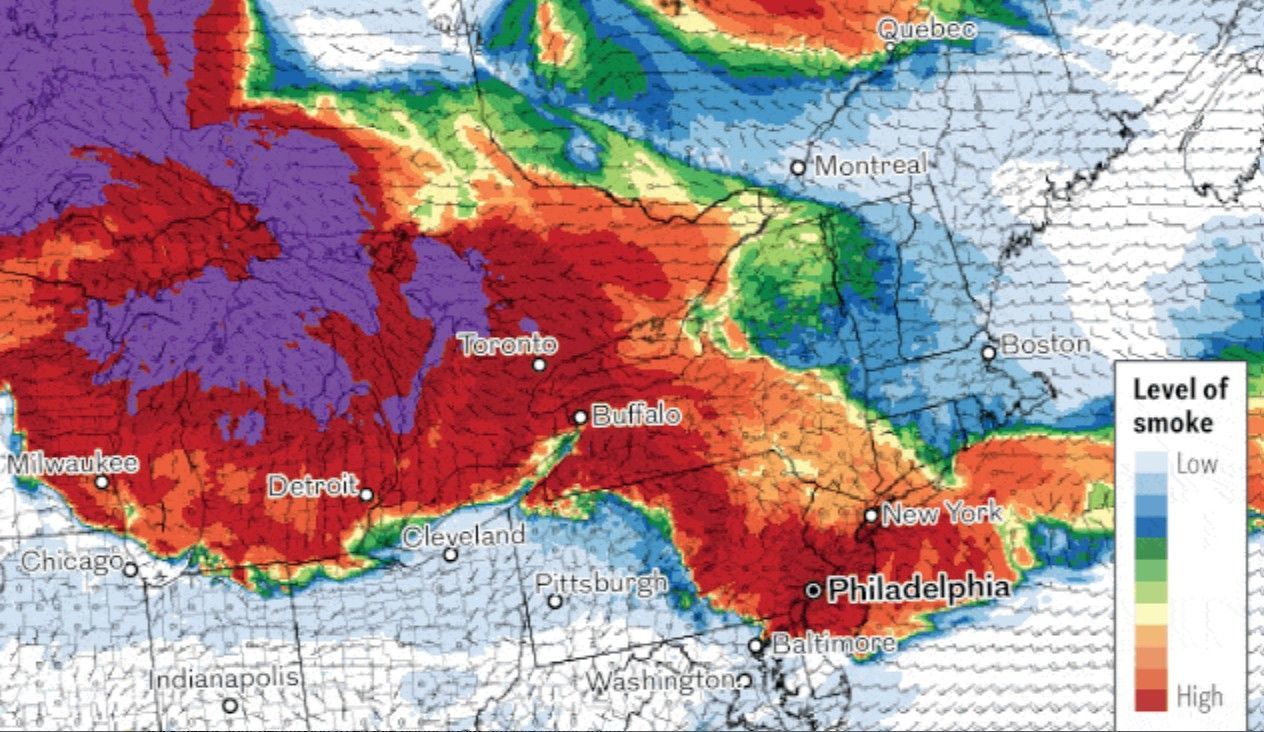
Continuinghigh temperatures and high humidity will be met by smoke drifting south from a batch of Canadian wildfires.
The smoke will bring hazy skies and fine particle pollutants that can irritate lungs and increase health threats to those with asthma and respiratory illnesses.
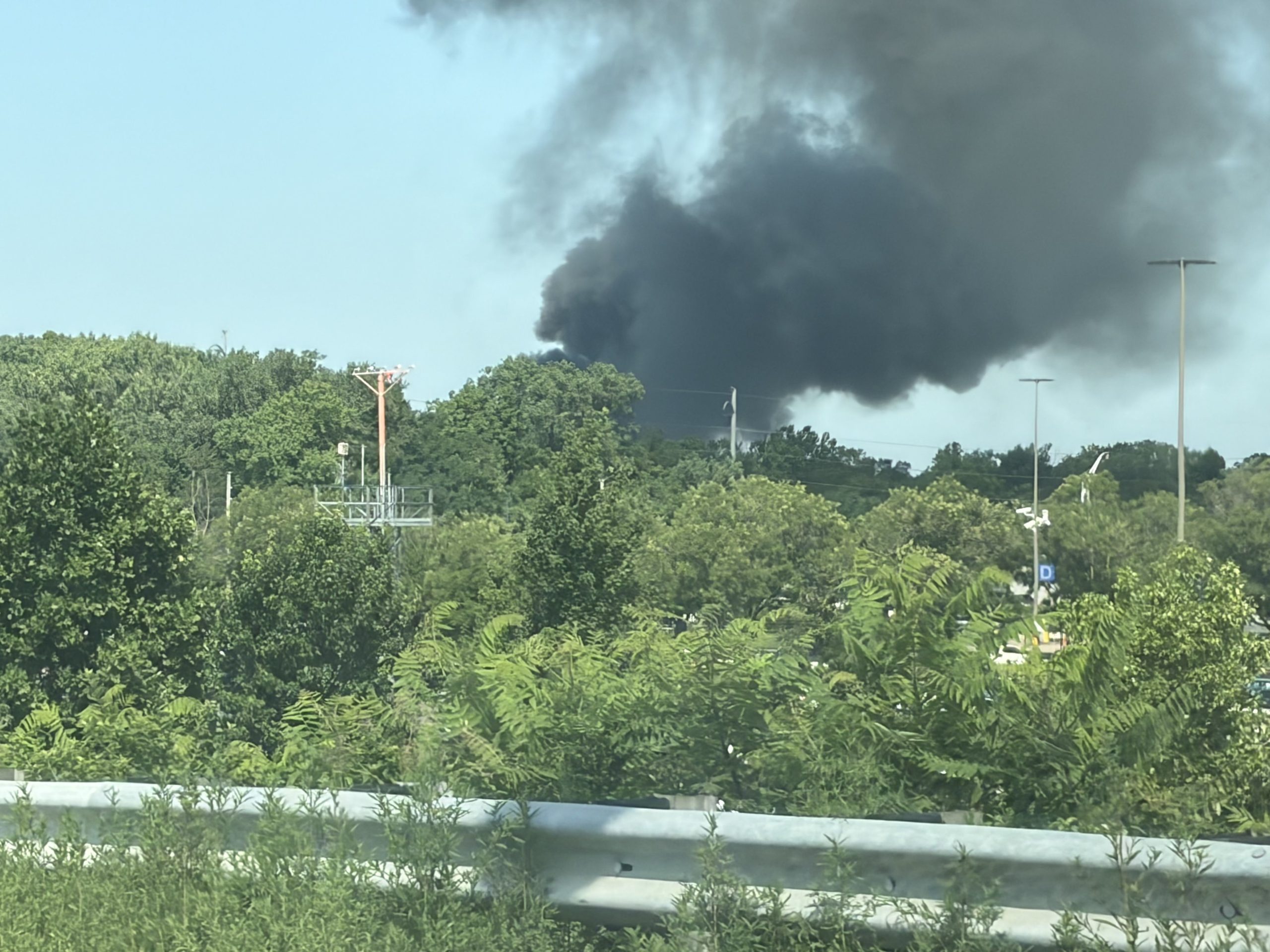
Additionally,smoke from a large scrapyard fire at EMR’s facility in Darby Township, Delaware County, on Wednesday prompted the Philadelphia Department of Public Health to urge residents to take precautions to avoid exposure. The fire was brought under control by 4 p.m., but smoke was still visible.
Map by NOAA shows projected smoke from Canadian wildfires in the Philadelphia area on Thursday.National Oceanic and Atmospheric Administration
The heat
The National Weather Servicehas issued an extreme heat warning for Wednesday with heat index values expected up to 107. Thursday’s forecast calls for areas of smoke and mostly sunny, with a high near 96.
The conditions could worsenground-level ozone, a pollutant that forms when nitrogen oxides and volatile organics emitted by vehicles, power plants, and industry react in sunlight, especially during hot days.
Ozone can cause airways to constrict, leading to shortness of breath, and so it can especially affect those with asthma, emphysema, and chronic bronchitis.
The smoke
And then there is the smoke that carries PM2.5, a fine particulate matter measuring 2.5 microns or smaller. It is of special concern because the particles are so small — far smaller than the width of a human hair — that they are easily inhalable.
Health effects can stem from short or long exposure, and can range from aggravation of asthma and other respiratory illnesses to premature death in people with chronic heart or lung diseases. Children and seniors are most vulnerable.
Philadelphia’s Air Management Services is monitoring for wildfire smoke but has not issued any statements.
The city launched a real-time network of air quality monitors last year that measure PM2.5 and nitrogen dioxide (NO2), a component of ozone.
The air quality in Philadelphia at noon Wednesday was listed as moderate, meaning there may be a risk for people unusually sensitive to air pollution.
The Pennsylvania Department of Environmental Protection has declared a statewide Code Red air quality day for PM2.5 for Thursday due to the wildfire smoke.
Code Red means that young children, elderly people, and those with respiratory problems, such as asthma, emphysema, and bronchitis, are especially vulnerable and should avoid outdoor activities. Everyone else should reduce prolonged or heavy exertion.
When we’ll see smoke
Paul Fitzsimmons, a meteorologist with the National Weather Service in Mount Holly, said smoke from the Canadian wildfires was expected to enter northeast Pennsylvania and northwest New Jersey on Wednesday afternoon. It would then carry into Philly.
“It’s possible for visibility getting into the range of one or two miles,” Fitzsimmonssaid. Typically, visibility is about six miles under clear conditions.
The weather service said the smoke will be closer to the ground and especially acute on Thursday.
“This is the kind that you’ll be able to smell outside, reducing visibility and potentially causing air quality issues,” the forecasting agency said on social media.
Smoke from Canadian wildfires has become almost an annual summer ritual.
(function () {window.addEventListener(‘message’, function (e) { var message = e.data; var els = document.querySelectorAll(‘iframe[src*=”‘ + message.id + ‘”]’); els.forEach(function(el) { el.style.height = message.height + ‘px’; }); }, false); })();
A public health threat
Jane Clougherty, a professor of environmental health at Drexel University’s Dornsife School of Public Health, was in Toronto on Wednesday and said she could see a yellow haze.
“From a scientific standpoint, this increase in the frequency and severity of wildfire smoke absolutely is related to climate change,” Clougherty said.
The combination of increasing heat and wildfires exacerbated by climate change, she said, is a public health threat.
Wildfire season is starting earlier and lasting longer, she noted. Scientists are still studying the impact of wildfire smoke beyond just fine particulate matter.
But Clougherty was also concerned about the scrapyard fire.
The Philadelphia Office of Emergency Management said it had not detected hazardous substances, and a 4 p.m. email by the office said it would no longer be updating residents. However, it was still recommending that people avoid exposure to the smoke, and avoid going outdoors if possible, close windows and doors, and use fans to recirculate air.
A view July 15 from I-95 of a large scrapyard fire in Darby, just outside of Philadelphia.Joseph DiStefano
She said varied materials were burning and could emit volatile organic compounds (VOCs), polycyclic aromatic hydrocarbons (PAHs), and potentially old lead.
She said those gases can heighten the human body’s adverse reaction to fine particles.
She believes that nearby residents should leave if possible, despite the shelter-in-place warning and advice to circulate air with fans. She noted that fans do not filter hazardous particles.
If they cannot leave, she said, she suggests residents use HEPA filters in their air-conditioning or use N95 masks.
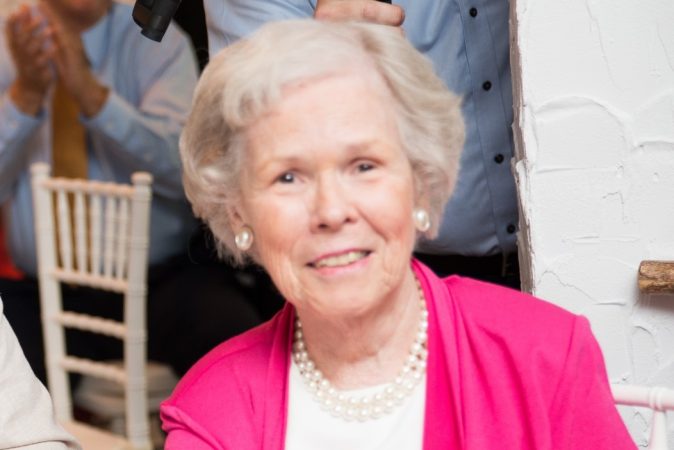
Kathy M. Winter, 91, formerly of Philadelphia, lifelong artist, art and grade school teacher, author, and former council president at Our Mother of Consolation Parish in Chestnut Hill, died Tuesday, June 9, of complications from pneumonia at Forbes Hospital in Monroeville, Pa.
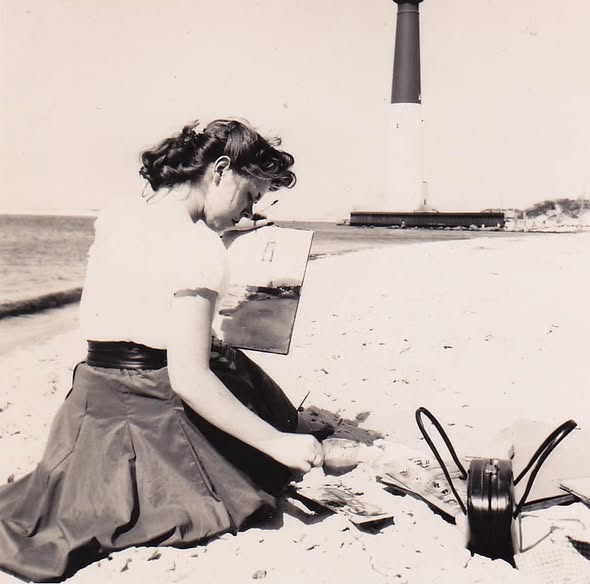
Born in Philadelphia, Mrs. Winter studied art at the Pennsylvania Academy of the Fine Arts and earned a bachelor’s degree in fine arts at the University of Pennsylvania. She specialized in portraits, still life, and landscapes, and worked mostly in watercolors, pastels, oils, and acrylics.
She painted portraits of celebrated naval chaplain John F. Laboon and Chinatown icon T.T. Chang, and contributed to a collection called “Lost Dreams on Canvas” that featured portraits of innocent victims of violent crime in Philadelphia. “You get into a portrait like that,” Mrs. Winter told the Chestnut Hill Local in 2012, “and you’re into the person.”
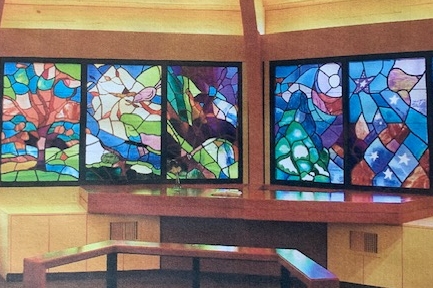
She painted the statue of St. Gianna Beretta Molla for the Shrine of the Nativity of Our Lord in Warminster, and her painting of a restored statue of St. Gabriel for a church in New Orleans was featured in The Inquirer in 2007. She also designed stained glass windows for St. Bede the Venerable Church in Holland, Bucks County, and the chapel at Shore Memorial Hospital in Somers Point, N.J.
“The best thing,” Mrs. Winter told the Chestnut Hill Local in 2012, “is that you don’t have to retire from making art.” Courtesy of the family
Mrs. Winter studied Chinese brush painting with artist Phoebe Shih in Flourtown and showed her work at the Woodmere Art Gallery, the Conshohocken Art League, Daylesford Abbey, the Lutheran Theological Seminary, the Knickerbocker Exhibition in New York, and elsewhere. She also taught art classes at the Abington and Main Line Art Centers, the Conshohocken Art League, Our Mother of Consolation School, and elsewhere.
“The best thing,” she told the Local in 2012, “is that you don’t have to retire from making art.”
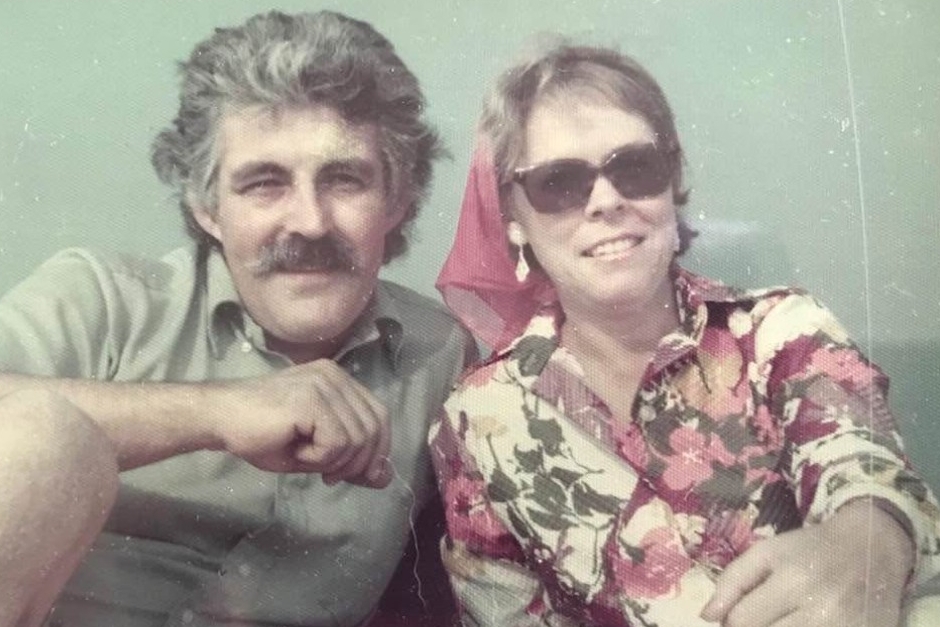
She met her husband, sculptor Joseph Winter, at the Pennsylvania Academy of the Fine Arts in 1953, and they opened Winter Art Studio in their Chestnut Hill home in 1983. For several commissions, he created the sculpture, and she painted it.
“Since Joe was a sculptor and I’m a painter, we complemented each other very well,” Mrs. Winter told the Chestnut Hill Local in 2021. “If we had both been painters or both been sculptors, it would not have worked out so well. There would have been too much competition.”
Mrs. Winter painted fruit and flowers.Courtesy of the family
In 2021, she self-published a 48-page children’s book called How the Bears Got to the Park.It features illustrations by her husband, and the plot she wrote is based on his award-winning 1966 sculpture Family of Bears that is displayed at Three Bears Park at Third and Delancey Streets in Society Hill.
Mrs. Winter was a longtime member and onetime council president at Our Mother of Consolation Parish. She and her husband moved to Chestnut Hill from Southwest Philadelphia in 1962 so their children could attend the parish school, and she taught all subjects to third and fourth graders for a few years.
Parish members scheduled Mass intentions to honor her on June 28, July 5, and July 10. “She was very determined,” her daughter Genienne Navarro said. “She never let anything stand in her way and would move mountains to get something done.”
Kathleen Marie McKenna was born April 21, 1935. Her family moved to Virginia when she was young and returned to Philadelphia a few years later, and she graduated from West Philadelphia Catholic High School for Girls.
Mrs. Winter and her husband, Joe, married in 1956. Courtesy of the family
A perceptive nun recognized her artistic skills in high school and arranged for an admission interview with officials at the Pennsylvania Academy of the Fine Arts. She received a full scholarship, met her husband there, and they married in 1956 and had daughters Kathy and Genienne and a son, Joseph.
Her husband died in 2020, and she moved to the Pittsburgh area a few years ago to be close to family. Mrs. Winter kept in touch with former classmates at the Pennsylvania Academy of the Fine Arts for years and took additional art classes later at Temple University and Chestnut Hill College.
She played piano, doted on her family, and survived cancer in the 1970s. A longtime friend called her a “true, loving, nourishing, protective, guiding, steadfast Blessed Mother to me.”
Her family said in a tribute: “She will be remembered for her friendship, spiritual support, listening ear, humor, deep caring, generosity, and undaunted optimism.”
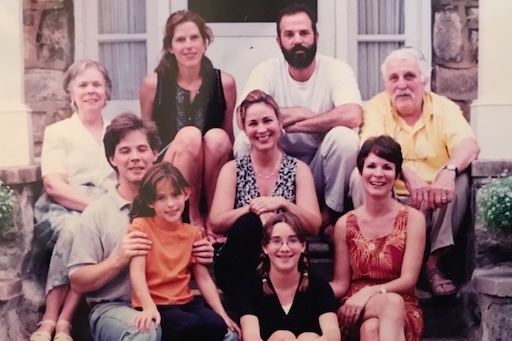
Mrs. Winter (rear left) enjoyed time with her family.Courtesy of the family
Her daughter Genienne said: “Her favorite saying was, ‘Nothing is impossible with God.’”
In addition to her children, Mrs. Winter is survived by six grandchildren, three great-grandchildren, and other relatives. A sister died earlier.
A memorial service is to be at 11 a.m. Saturday, Sept. 19, at Our Mother of Consolation Church, 9 E. Chestnut Hill Ave., Philadelphia, Pa. 19118.
Donations in her name may be made to Our Mother of Consolation Church and School, 9 E. Chestnut Hill Ave., Philadelphia, Pa. 19118.
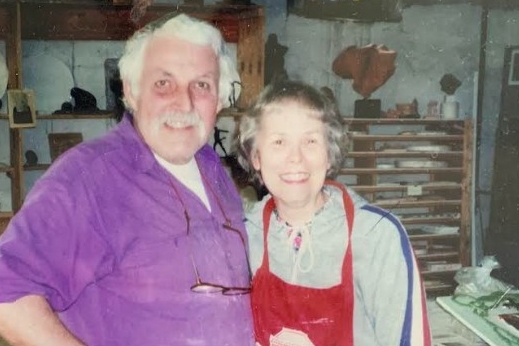
Mrs. Winter and her husband, Joe, pose in their Chestnut Hill home studio. Courtesy of the familyMrs. Winter was an expert in designing stained glass. Courtesy of the family
The Philadelphia region on Wednesday will be under an extreme heat warning, with high temperatures expected to once again hover around the 100-degree mark. But, on the bright side, at least it’s not likely to be record heat for the date.
That dubious honor for July 15 belongs to 1995, when the mercury hit a scorching 103 degrees. Still, Wednesday will be markedly hotter than normal, with typical highs for the date around 86 degrees, according to the National Weather Service.
“Any time we put a warning out, it’s telling people this is significant, and you need to take precautions and be aware of this,” said Paul Fitzsimmons, lead meteorologist at the weather service’s Mount Holly office. “Stay in the air-conditioning, do not exert yourself during the hottest parts of the day.”
It will likely also be noticeably hazy, thanks to smoke from wildfires in Western Ontario, weather service forecasts said.
Wednesday’s forecast high marks yet another hot day in an already steamy summer, with 2026 posting 21 days at 90 degrees or higher so far — and three 100-degree days, just two shy of the record number of century-mark days set in 1988, weather service data indicate. If Wednesday hits 100 degrees, we would only need one more similarly hot day to tie the record.
The record number of 90-degree days in a year, meanwhile, stands at 55, set in 2010. But in general, the region typically has only 13 90-degree days by mid-July, and 30 for the entire year, according to weather service data. The area’s temperatures have been about 3.2 degrees above average this month, Fitzsimmons said.
“That’s certainly noticeable,” Fitzsimmons said. “It’s been quite warm to hot.”
So, no, you’re not imagining things — it has been plenty hot for us around here lately.
We’re not in for much relief in the latter half of the week, either. Weather service forecasts indicated a cold front was expected to pass through the area late Wednesday, dropping temperatures slightly, but highs could stretch into the low to mid-90s Thursday and Friday.
And then, the weekend storms may come. Again.
Weather service forecasts indicate another cold front is likely to approach the area Friday, bringing with it the chance for weekend storms. It remained too early to tell Tuesdayhow it would shake out, but early forecasts said that there was potential for severe weather threats Saturday, with a possible risk of heavy rain and flash flooding, similar to what the area has seen the last two weekends.
Meteorologists have said that it is not uncommon for storms to come in seven-day cycles because of the spacing between atmospheric waves that move weather systems across the country, The Inquirer has reported.
“The overall setup is not that different — we’re going to have hot conditions and humidity,” Fitzsimmons said. “And we are at a time of year where severe weather is favorable, so it’s possible.”
Wednesday’s heat serves as yet another day of record-territory temperatures this month. Less than two weeks ago, during the Fourth of July, Philadelphia saw three consecutive days hit 101 degrees or higher, marking the first time that has happened in records dating to 1873, the weather service said.
Severe storms also hit the region late on Independence Day, bringing heavy rain and wind that caused significant delays to the holiday celebrations, which wrapped up around 3 a.m. A week later, severe weather cropped up once again in the form of several microbursts of winds up to 70 mph that toppled trees, damaged buildings, and knocked out power around the area Saturday — and affected the celebration of the Ben Franklin Bridge’s 100th anniversary.
Even the FIFA World Cup festivities have been affected, with the FIFA Fan Fest closing early on a few occasions because of heat and storms since it launched in June.
The heat has also had deadly effects in Philadelphia, as city officials earlier this month confirmed eight heat-related deaths for the season.
Heat deaths in Philadelphia have averaged about five a year for the last decade. That figure is down significantly from the 1990s; in 1993, the city recorded 118 heat-related deaths. But the number of heat deaths this year so far is the most since Philadelphia recorded eight in 2022, health department records indicate.
A United Kingdom man who was shot and killed while doing contracting work in Roxborough last week was a member of the so-called Traveling Conmen criminal organization and was not authorized to be in the country, officials with the Department of Homeland Security said Tuesday.
The man, 20-year-old Salis Hanrahan, was killed July 8 when George Barr, 75, fatally shot him at his home, according to police. Hanrahan and a group of men were at Barr’s home on the 400 block of Ripka Street that afternoon to work on the property, officials said.
According to the FBI, the Traveling Conmen, also known as Conmen Travelers, are a loosely affiliated group of men from the U.K. and Ireland known to overstay pleasure or tourist visas in the United States, where they travel between cities soliciting contracting work and defrauding property owners.
Police received an emergency call around 2:20 p.m. and arrived to find Hanrahan collapsed on the sidewalk with a gunshot wound to the chest. He was pronounced dead at a nearby hospital shortly after arriving.
On Friday, police announced that Barr had been charged with murder and related crimes. They gave no motive for the slaying.
A spokesperson for DHS said Hanrahan was not authorized to be in the country, though officials were unaware how long he had been here.
Hanrahan was previously denied an electronic travel authorization after officials determined he was a member of the Conmen Travelers, a group recognized by the FBI as a transnational criminal organization, according to the spokesperson.
Members of the group have been accused of demanding large payments from customers that had not been initially agreed upon and convincing homeowners that their properties are in need of costly and unnecessary repairs.
And members of the group allegedly threatened the children of a New York woman that year when they demanded a $200,000 loan after failing to complete a bricklaying job at her home.
Within days, the members began showing off expensive jewelry, including a 10-carat diamond, on social media, according to a BBC News investigation.
Traveling Conmen often do not have authorized work permits and have been accused of leaving homes damaged or with incomplete work, according to the FBI.
It was unclear how Homeland Security came to conclude that Hanrahan is affiliated with the group.
Social media posts described him as a young father who shared an infant with his wife, Roseann.
Michelle Widgins-Lewis, 69, of Philadelphia, singer-songwriter, founder, president, and executive director of Northwest Counseling Service Inc., longtime community housing and education advocate, lecturer, and mentor, died Monday, June 29, of endometrial cancer at Jefferson Abington Hospital.
Inspired to educate and counsel underserved potential homebuyers about predatory mortgage lending, foreclosure, and other important real estate and housing issues, Ms. Widgins-Lewis founded Northwest Counseling Service on North Broad Street in 1982. For the next 44 years, until recently, she interviewed nearly 5,000 people eachyear seeking mortgage prequalification and, funded by the Philadelphia Division of Housing and Community Development, advised them about insurance, eviction, credit rating, grants, conflict mediation, and inspections.
“She helped transform homeownership in Philadelphia,” her family said in a tribute.
Ms. Widgins-Lewis was appointed to the Pennsylvania Housing Advisory Committee in the 1990s by then-Gov. Ed Rendell and served as a technical adviser on real estate matters for the Philadelphia Division of Housing and Community Development. She worked closely with the Pennsylvania Housing Finance Agency and continually lobbied local, state, and federal government officials for better borrowing and foreclosure laws.
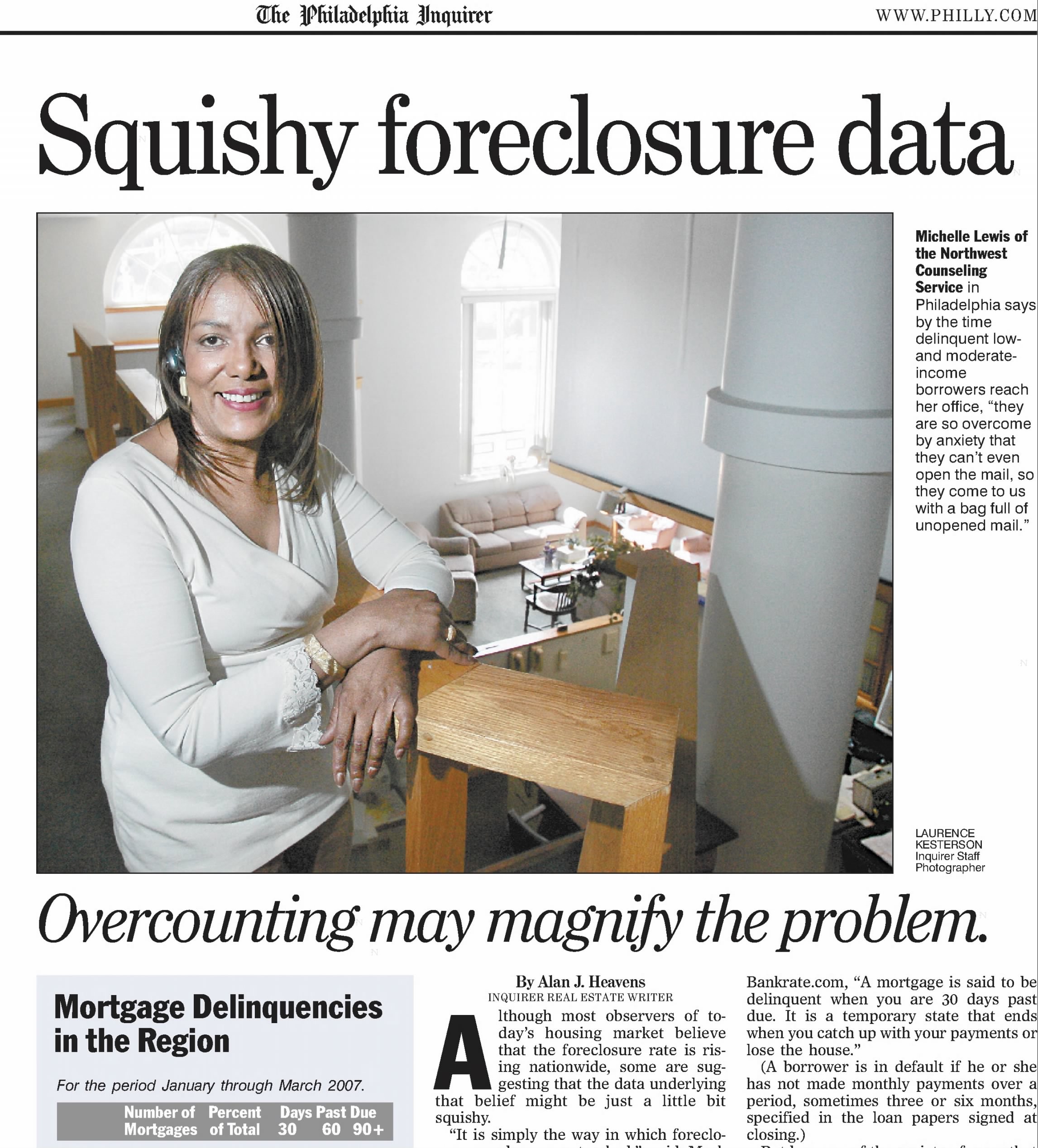
This photo and article about Ms. Widgins-Lewis appeared in The Inquirer in 2007.Newpapers.com
She examined property disputes as a forensic real estate specialist, scrutinized scams as a fraud examiner, testified in federal court as a qualified expert, and was licensed as a real estate broker and appraiser. She monitored local landlord-tenant mediation cases closely and told The Inquirer in 1996 that many tenants “end up with an agreement they can’t live up to.”
People, she said often, are rarely ready to buy their first house. “Instead of considering whether they are prepared to buy a home, people are being propelled into the market by economic pressure that says they should buy because it’s cheaper than renting,” she told The Inquirer in 1995. “That’s not always true.”
She also founded and chaired the Philadelphia Predatory Lending Task Force, which collected and publicized data about unfair lending practices. “This gives us a picture of the type of problems going on in our neighborhoods,” she told the Daily News in 2001.
Ms. Widgins-Lewis was an instructor for the National Real Estate Institute and a leader for the American Society of Certified Housing Executives, the Real Estate Educators Association, and other groups. She wrote articles for journals and forged educational partnerships with colleges and universities.
Ms. Widgins-Lewis performed in several bands and with her sister Dionne.Courtesy of the family
She spoke on panels and at conferences and workshops about homeownership, and was quoted often in The Inquirer and Daily News. Friends called her “truly inspiring” and “a true champion in the mortgage industry” in online tributes. One friend said: “She was a beast in the housing world.”
Ms. Widgins-Lewis sang often as a young girl, got rave reviews on karaoke night when she was older, and went on to perform in several bands and with her sister Dionne at local clubs and festivals. She sang rhythm and blues, pop, standards, and jazz, and wrote at least one song that was recorded and released.
Daily News columnist Stu Bykofsky wrote about her dual career as a singer-songwriter and executive in 1995 and said: “She still has trouble calling herself an artist but feels, at the very least, she’ll always be able to get up and sing at fundraisers for her agency.”
Her family said: “From childhood, Michelle drew people in with her light and her voice.” Her daughter Tracey Thomas said: “She would light up the room.” Her son Mike said: “Everybody loved her.”
Her family said Ms. Widgins-Lewis had “an unwavering commitment to education, integrity, and service.”Courtesy of the family
Michelle Widgins was born May 29, 1957, in Philadelphia. She graduated from Martin Luther King High School and earned a bachelor’s degree at La Salle University and a master’s degree in human services at Lincoln University.
She married Michael Brown, and they had a daughter, Anji, and a son, Mike. After a divorce, she married Tyrone Lewis, and they had a daughter, Tracey, and a son, Richard. They divorced later.
Ms. Widgins-Lewis enjoyed reading and writing. She belonged to the Pi Gamma Mu international honor society, was close with Mayor Cherelle L. Parker and former Mayor Wilson Goode, and was guided, her family said, by “an unwavering commitment to education, integrity, and service.”
Her family is hoping to rename a Northwest Philadelphia street in her honor.
Ms. Widgins-Lewis lived with cancer for 10 years.Courtesy of the family
“She was humble but had drive and determination,” her son Mike said. Her daughter Tracey said: “The world was her stage. I can only imagine how her light will shine in heaven.”
In addition to her children and former husbands, Ms. Widgins-Lewis is survived by eight grandchildren, a sister, two brothers, and other relatives. A sister and a brother died earlier.
A man was killed and four others were injured in a shooting overnightoutside an apartment complex in the city’s Crescentville section.
Nearbyofficers heard several gunshots coming from the 500 block of East Hill Creek Drive, where the Hill Creek Apartments, a Philadelphia Housing Authority complex, is located, at 11:52 p.m., according to police. The responding officers found two people suffering gunshot wounds, an unidentified male who wasshotin the leg and an 18-year-old woman who was shot in the shoulder, Philadelphia Police Capt. Louis Higginson said. Both were transported to Einstein Medical Center, where they were in stable condition.
Additional responding officersfound another unidentified man at the scene who was shot and taken to Temple University Hospital, where he died at 12:14 a.m. Monday, Higginson said.
While investigating, officers were called to a different part of the complex around 12:10 a.m., where they found two additional people who were shot: a 45-year-old man who was shot in the arm and a 16-year-old boy who was shot in the ankle. They had fled from the shooting into a nearby property on the 5500 block of North Hill Creek Drive, police said. They were transported to Temple University Hospital, where they were in stable condition.
Police said they found at least 17 spent shell casings at the scene.
PHA said an unauthorized “pop-up” party held at the Hill Creek Apartments prompted the large gathering before the shooting took place.
“The safety and well-being of our residents remain our highest priority, and PHA is making supportive services available to residents who may be impacted by this tragedy,” a PHA spokesperson said.
As of publication time, police could not confirm a motive and no arrests have been made.
A large crowd, shooting, and vandalism the night before
Police were working to determine if the shooting, which occurred following a large gathering late Sunday night, was connected to another large gathering that ended in shots fired early Sunday morning.
Around 2:45 a.m. Sunday, police responded to the Hill Creek Apartments to assist PHA police officers who were following a reportedly stolen vehicle into the area. During the incident, an unidentified person jumped onto a marked PHA police vehicle and vandalized it, police said.
As police officers worked to disperse a large crowd that had gathered, an unknown person fired several gunshots before fleeing the scene. Two unoccupied vehicles were struck by gunfire, and no injuries werereported.
No arrests have been made, and police did not confirm if these two shooting incidents are connected.
Officers cited three men, ages 22, 23, and 28, for disorderly conduct during Sunday morning’s large gathering.