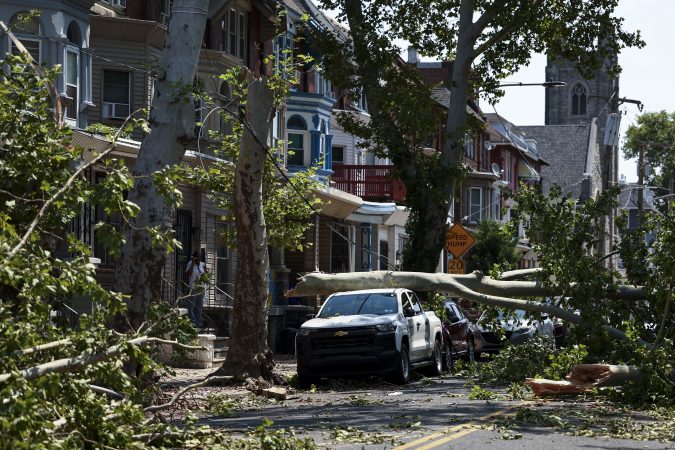
The Pennsylvania Emergency Management Agency is opening three resource centers this weekend in Philadelphia to aid the hundreds of people who experienced damage from last weekend’s major storms.
Each center will have representatives from state and city agencies, including the Pennsylvania Department of Human Services, Pennsylvania Insurance Department, Philadelphia Housing Authority, Peco, and local community organizations.
Visitors can receive resources and assistance with their insurance coverage, avoiding scams, benefits and disability support, and other information related to the storm’s damage and aftermath.
Four “microburst” storms downed hundreds of trees in Philadelphia and Montgomery County Saturday in just a few minutes. The brief storms brought wind gusts between 60 to 70 mph, and toppled trees that had likely been weakened after weeks of heavy snow cover this winter.
The three resource centers will be held at the following dates and locations:
Saturday, July 18: Noon to 8 p.m. at Lucien Blackwell Community Center, 761 N. 47th St.
Sunday, July 19: Noon to 8 p.m. at Vare Recreation Center, 2600 Morris St.
Monday, July 20: 11 a.m. to 7 p.m. at Wynnefield Library, 5325 Overbrook Ave.
The city’s Office of Emergency Management has received more than 1,000 reports of storm damage from residents as of Thursday, according to a PEMA spokesperson. The agency encourages residents who experienced damage to their homes, businesses or other property to fill out the city’s online damage survey so officials can properly document damages and allocate resources appropriately.
Ewart Rouse, 85, of Lawnside, retired award-winning reporter and editor for The Inquirer, author, journalism adjunct professor, mentor, immigrant advocate, and indomitable cricketer, died Thursday, July 2, of age-associated decline at the Samaritan Center at Voorhees.
Born in Trinidad, West Indies, Mr. Rouse immigrated to New York in 1969 and joined The Inquirer in 1974. For nearly 30 years, until he retired in 2002, Mr. Rouse was an award-winning business and news reporter, suburban editor, and mentor to hundreds of young journalists.
He won a 1980 Keystone Award for a news series on city taxi service and was recognized for another series on street gang homicides involving Black youth. Later, he wrote business columns and covered South Jersey news.
He opened a 1975 story about former President Gerald Ford’s first visit to Philadelphia with: “The old man sat alone and dejectedly with his flags against the wall of the Philadelphia National Bank building at 5th and Market Streets. ‘Not one,’ he muttered. ‘I haven’t sold not one flag today.’”
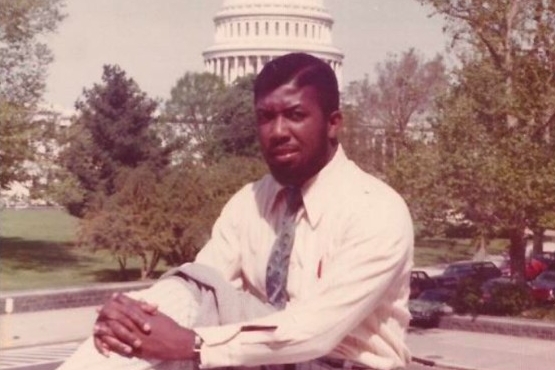
Mr. Rouse worked for the Associated Press in Washington DC.Courtesy of the family
Before The Inquirer, Mr. Rouse was a news and political reporter for the Associated Press in Newark, N.J., Atlantic City, and Washington, D.C. “He was a popular colleague who contributed importantly to the paper’s growth,” Gene Foreman, retired managing editor at The Inquirer, said on Facebook.
Other former Inquirer colleagues called Mr. Rouse “professional and gracious,” “careful and respectful,” and “kind and generous.” Retired Inquirer editor Lil Swanson said on Facebook: “Ewart was filled with wisdom and grace. When he was an editor, young writers flocked to him because he always made their stories better and helped them grow.”
He covered courts and politics for the Trinidad Guardian in Port-of-Spain before leaving for New York, and interviewed Trinidad Nobel laureate V.S. Naipaul for the 1997 book Conversations with V.S. Naipaul. In Philadelphia and South Jersey, he taught news writing, business writing, and investigative journalism at Temple, Rutgers, and Arcadia Universities.
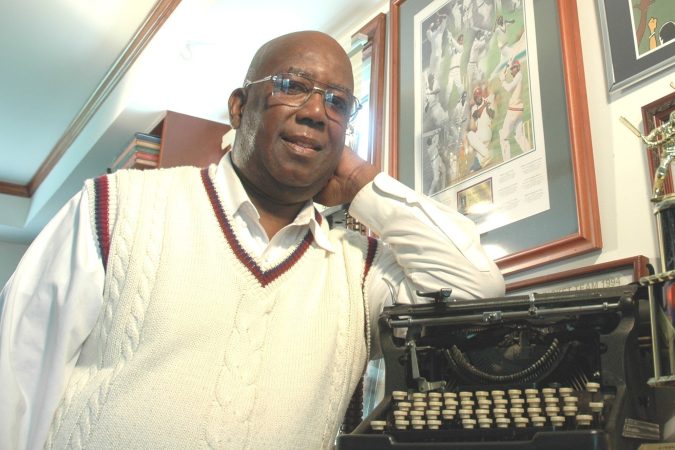
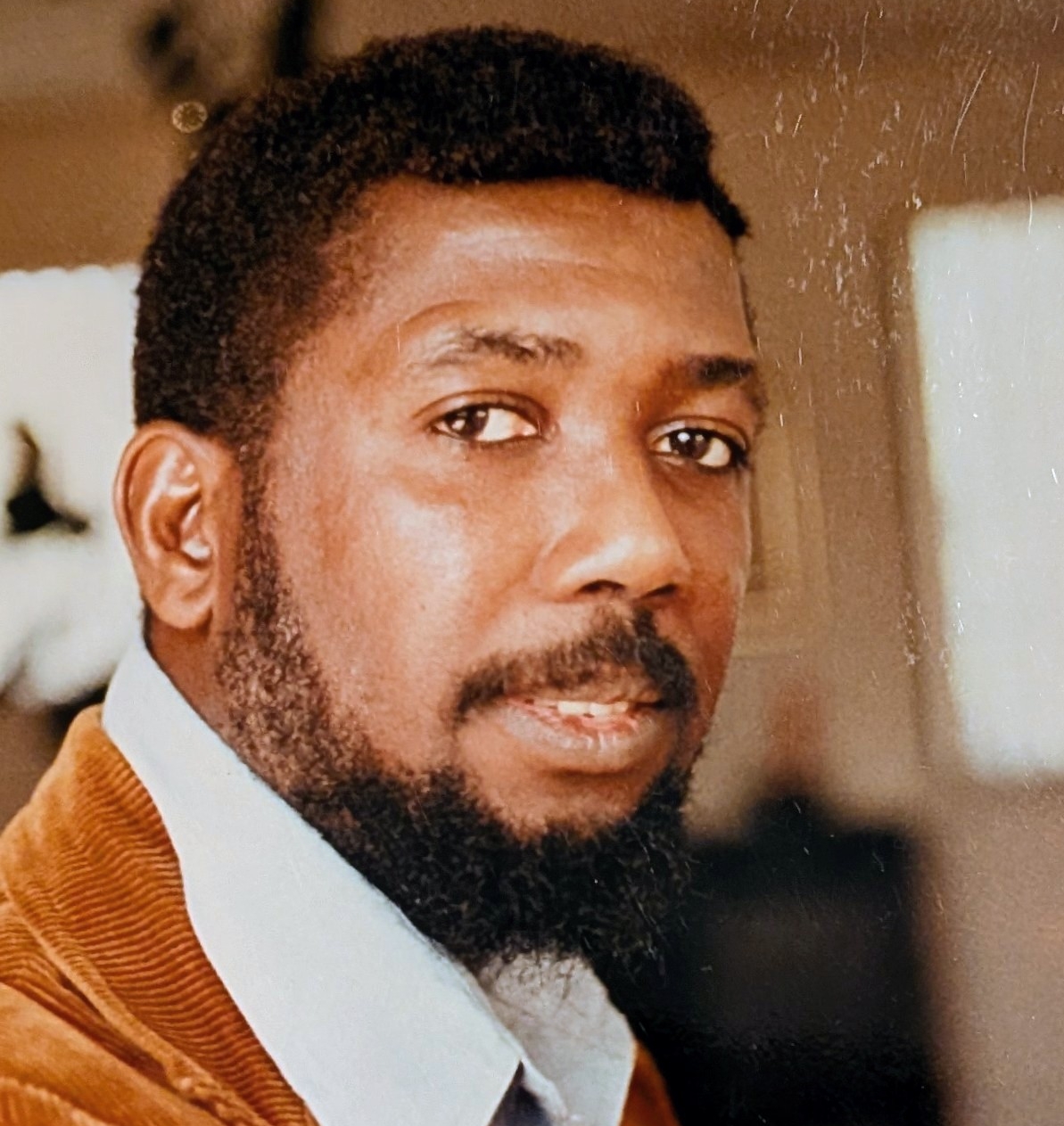
Mr. Rouse loved to play, watch, and write about cricket.Ewart Rouse
Readers called his books “highly entertaining” and “a wonderful addition to cricket literature” in reviews. His daughter Karen said: “The clackety-clack (zing!) of his typewriter was a constant in our home.”
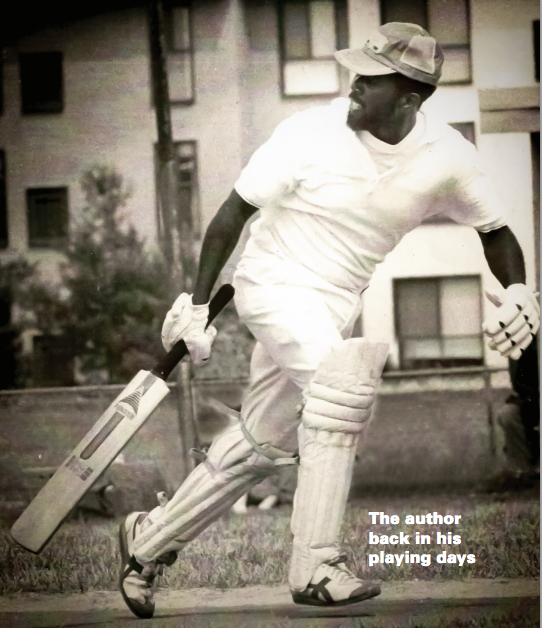
Mr. Rouse played cricket in Trinidad and later in South Jersey, and he cofounded the Philadelphia Cricket League, the New Jersey Cricket Association, and the Echelon Cricket Club. He played the game, managed teams, and became one of the region’s greatest advocates for cricket and its immigrant players.
In 2013, he earned a lifetime achievement award from the South Jersey Caribbean Cultural and Development Organization, and recognition from then-Camden Mayor Dana Redd for his contributions to the community as a journalist, teacher, and cricket activist. “It truly was an honor to be recognized by my own community,” he said on his website, ewartrouse.com.
In a 2016 online interview, Mr. Rouse was asked to advise young writers. “Read anything you get your hands on,” he said, “From books and newspapers … to labels on paint. Each contains nuggets of information that the mind will retrieve for just the right spot in your next project.”
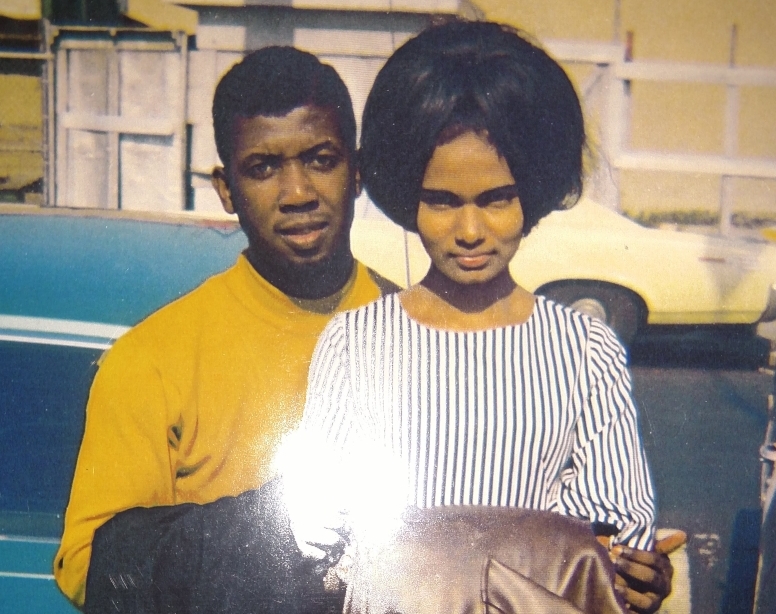
Mr. Rouse and his wife, Vanda, met in Trinidad.Courtesy of the family
Ewart Rigsby Rouse was born Sept. 16, 1940, in Tunapuna, Trinidad. He was an avid reader and creative writer as a boy, and noticed one day that several of his favorite writers — Charles Dickens, John Steinbeck, and Ernest Hemingway — started out as newspaper reporters.
“And now I wanted to be a journalist like them,” he said in a short self-published autobiography.
He met his wife, Vanda, in Trinidad, and they married and had daughters Joann, Karen, and Kristin. They lived in New York, Pleasantville, N.J., and Washington, and settled in Lawnside in the 1970s.
Mr. Rouse was active with the C.C. Morris Cricket Library Association, the South Jersey Writers’ Group, and the Rainy Tuesday Writers Group. He was an avid gardener and routinely gave away bags of home-grown tomatoes to friends and neighbors.
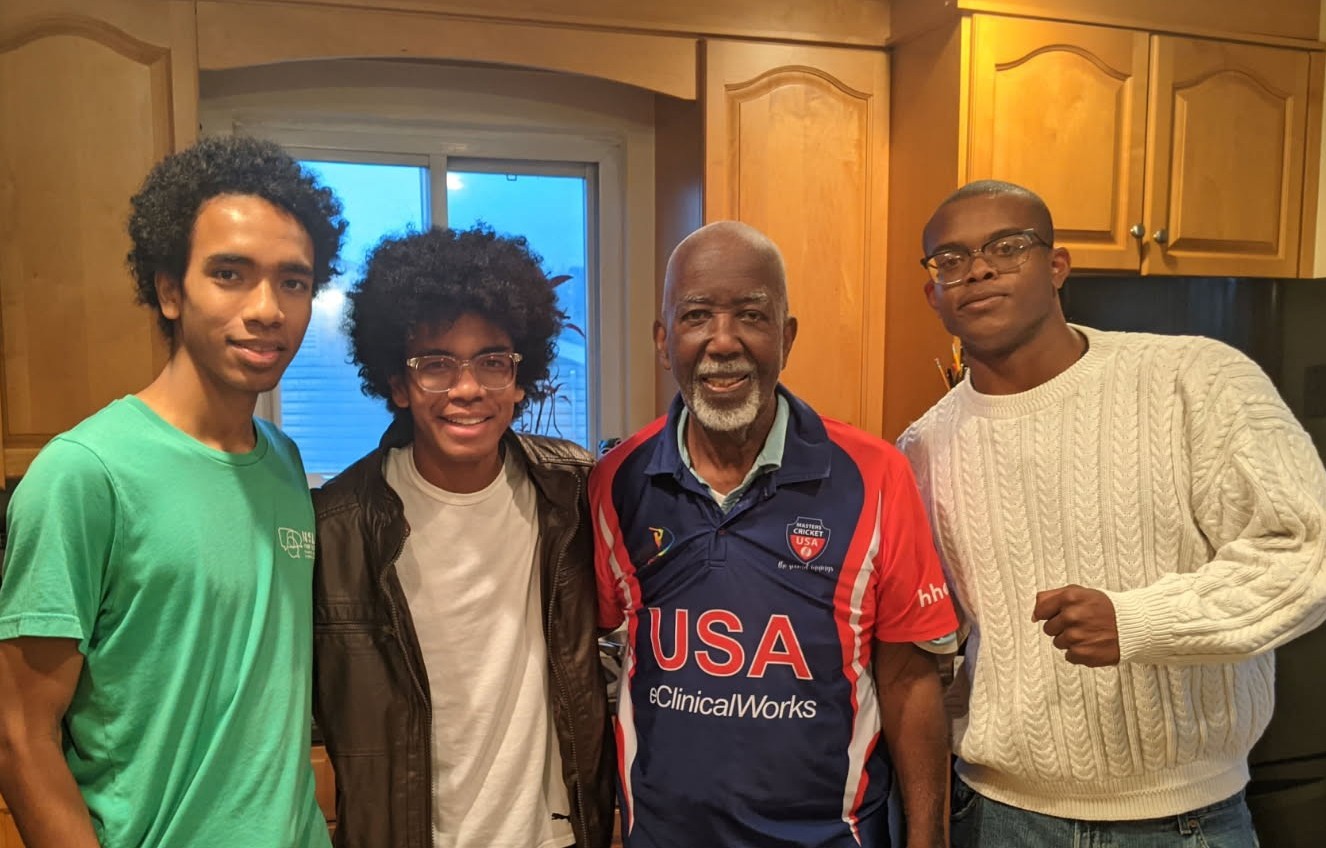
Mr. Rouse enjoyed time with his grandsons. Courtesy of the family
He collected records, listened to Nat King Cole and Frank Sinatra, followed the 76ers, and grilled outdoors as often as possible. He took his family on memorable trips to Trinidad that “opened up a world to us that was accessible, one that we could dare to explore,” said his daughter Karen.
In 2016, Mr. Rouse told aspiring writers: “Who knows, maybe you end up with a bestseller. Some might call you a dreamer. But, hey, as the saying goes, you can’t have a dream come [true] if you don’t have a dream.”
In a matter of seconds, a highway traffic stop in Tredyffrin Township sent Joel Perez Rodriguez from confusion, to panic, to fear.
When he saw red-and-blue emergency lights in his rearview mirror, he did what any law-abiding citizen would do, Chester County prosecutors said Thursday: He pulled onto the shoulder of the Pennsylvania Turnpike.
But Assistant District Attorney Monica Szyszkiewicz said the men who approached Perez Rodriguez’s vehicle on March 28 were not police officers — they were criminals, in league with his sister’s uncle, hired to rob Perez Rodriguez of $49,000 his sister had given him an hour earlier at her home in Germantown.
The botched robbery ended with Perez Rodriguez shot in the chest, as other bullets narrowly missed his wife and 4-year-old son.
Two of those men, Roberto Morel, 51, and Tuften Green, 31, were held for trial Thursday evening on charges of attempted murder, aggravated assault, attempted theft, and related crimes after an hours-longpreliminary hearing before District Judge Lauren Holt. Holt dismissed kidnapping charges the men faced, arguing there was a lack of evidence to support them.
The third suspect, Terrell Adams, 38, waived his hearing, and will also be held for trial.
Lawyers for Morel and Green told Judge Holt that Szyszkiewicz and Pennsylvania State Police investigators had built their case entirely on circumstantial evidence.
Morel’s attorney, Timothy Tarpey, said his client did not spend time with Perez Rodriguez during the three days he and his family visited his sister, and asserted he had no knowledge of the money being exchanged.
But Szyszkiewicz said investigators, using a litany of surveillance footage and cell phone data, had been able to reconstruct the entire plot, which began with the three men meeting up hours before the shooting at a gas station in Germantown. Video from that location, played in court, showed Morel and Green arriving at the same time, in separate vehicles, and discussing their plan, according to Trooper Adam McLaughlin.
“They conspired to pull the victim over for what other reason than to get the money they had received an hour before,” she said, arguing it was no coincidence that Morel had a clear connection to Perez Rodriguez. “Why else would they do that?”
Green’s attorney, Brian McCarthy, said despite the voluminous text messages prosecutors had pored over between his client and Morel, neither man made specific mention of a robbery, nor was there any attempt during the car stop to take the money from the car’s backseat.
Holt was not swayed.
Another video, taken from a Ring surveillance camera near where Perez Rodriguez’s sisterlives showed the three men began following his car moments after he pulled out of her driveway, en route to his home in North Carolina.
And data pulled from Green’s smartphone showed he was on the phone with Morel throughout the entire chase and subsequent shooting. The call ended, Szyszkiewicz said, when Perez Rodriguez fled the scene.
His sister owns a bodega in Germantown and had given him the $49,000 to invest in his tobacco business back in North Carolina.
As the family was driving westbound on the Pennsylvania Turnpike, they were being tailed by a Chevrolet Suburban being driven by Adams, investigators said Thursday, as well as a Honda CRV driven by Morel.
Text messages revealed Green and Morel had discussed adding emergency lights to the SUV, exchanging pictures of them both before and after they had been attached to the vehicle’s dashboard, according to testimony Thursday.
Once those lights were activated, Perez Rodriguez pulled over. He assumed, he said Thursday, that the occupants of the car behind him were undercover officers.
Green and Adams approached his car. Both were dressed in all black, with Adams wearing a hat with “police” sewn into it.
Right away, Perez Rodriguez said he knew something was wrong with the so-called officers. The way they spoke and carried themselves made him suspicious.
His suspicions were confirmed when Green, seeing Perez Rodriguez’s wife was trying to dial 911, stuck a handgun into her ribs and tried to grab the phone from her.
Perez Rodriguez sped away, and Green, according to prosecutors, fired the handgun five times.
An Army reservist, coincidentally driving by in the aftermath of the shooting, saw Perez Rodriguez had pulled again onto the shoulder, and stopped to help, prosecutors said. She helped stabilize his gunshot wound until medics arrived to take him to Paoli Hospital.
All three defendants will be arraigned in county court in West Chester later this month.
Smoke from Canadian wildfires continues to blanket the region, casting a haze across the sky and posing a risk for people with respiratory issues.
With massive fires burning across Western Ontario, forecasters said wind patterns shifted this week to allow the smoke from those fires to enter the Northeastern and Mid-Atlantic United States.
The city raised the air quality alert level from code red to code purple — meaning the air is “very unhealthy” and can cause health issues for all people.
Friday morning, at least six of the city’s air quality sensors were registering above 200 in the amount of fine particulate matter and nitrogen dioxide in the air, a metric called the air quality index. The city website tracking air data warned people to stay inside, keep windows and doors closed, and run air purifiers if possible. Those who must venture outside should wear N95 or KN95 masks.
(function () {window.addEventListener(‘message’, function (e) { var message = e.data; var els = document.querySelectorAll(‘iframe[src*=”‘ + message.id + ‘”]’); els.forEach(function(el) { el.style.height = message.height + ‘px’; }); }, false); })();
An AQI between 150 and 200 is still considered unhealthy to breathe with prolonged exposure, according to the EPA. Children, older people, and those with respiratory issues could be particularly susceptible to health issues. In air quality alerts issued by the National Weather Service, forecasters recommended avoiding prolonged outdoor exposure, particularly activities like exercise.
By Friday a prior heat advisory had been lifted, with temperatures expected to near 90. Air quality tends to worsen in dense, urban environments during hot weather.
Forecasters urged residents across the eastern United States, particularly those with respiratory issues, to monitor alerts from local officials and be mindful of conditions where they live or work.
(function () {window.addEventListener(‘message’, function (e) { var message = e.data; var els = document.querySelectorAll(‘iframe[src*=”‘ + message.id + ‘”]’); els.forEach(function(el) { el.style.height = message.height + ‘px’; }); }, false); })();
If you’re not able to zoom in on the above map, click here for another version.
As Canada grapples with hundreds of active wildfires, the rest of North America is feeling the impact with air quality alerts.
In Philadelphia and elsewhere, the air quality score is considered unhealthy, particularly for the most sensitive people.
Whether you are planning to go out or stay home, here’s what three experts had to say about staying healthy and what precautions are needed:
What makes this smoke so toxic?
Exposure to this particular fire smoke is a serious matter due to “photochemical aging,” said Eric Balaban, a pulmonary and critical care fellow at Temple University.
As smoke travels, it interacts with oxygen, heat, and sunlight, creating a toxic profile that helps generate high levels of ground-level ozone and highly irritating aerosols, Balaban said.
Ground-level ozone is a pollutant that forms when nitrogen oxides and volatile organics emitted by vehicles, power plants, and industry react in sunlight, especially during hot days such as Thursday.
The pollutants aren’t the only problem.
The fine particulate matter within the smoke is small enough to cross from the lungs directly into the bloodstream, Balaban said, increasing the risk of heart attacks and strokes, in addition to causing acute chest tightness, shortness of breath, and dizziness in otherwise healthy people.
Who is at risk during the current unhealthy air quality?
Philly’s air quality score was in the red stage Thursday, according to the Philadelphia department of public health, meaning we are breathing air considered unhealthy. The state Department of Environmental Protection issued a code purple alert for Friday, the second-highest step on the U.S. Environmental Protection Agency’s color scale, which indicates “very unhealthy air.”
It is not the hazardous condition of the maroon level reached in Minnesota, where everyone is presumed to be impacted. But, for Ruth McDermott-Levy, a professor at Villanova University’s school of nursing, “all of us are at risk.”
The risks increase for those with preexisting conditions like chronic obstructive pulmonary disease, asthma, emphysema, and chronic bronchitis.
“Certainly there are groups of people at greater risk, from pregnant women, children, older people, and those with cardiac and respiratory illnesses. But we’re at an unhealthy level for everyone,” McDermott-Levy said.
Symptoms of poor air quality and sensitive populations
While most of the city is continuing daily life as normal, Michele Columbo, the allergy and immunology chief at Main Line Health, urged people to keep an eye on how their bodies react to the air quality.
People can experience “difficulty breathing, dry cough, wheezing, tightness in the chess, and even feel light headed because of [the added] high heat,” Columbo said.
Children in particular are at risk because they breathe faster than adults. And, pregnant people in the third trimester can already be experiencing difficulty breathing without the added contaminants to their lungs.
Adults 65 years or older, individuals with cardiovascular disease, asthma, and other respiratory issues can also be more affected.
What precautions to take if you go outside during unhealthy air levels?
Columbo cautioned people from staying outside for more than a couple of minutes at the time, and even encouraged rescheduling outdoor activities.
If you can’t avoid going outside, wear an N-95 mask, he said.
Traditional surgical face masks are not meant to keep out the kind of pollutant particles that fire brings. During the 2023 Canada wildfires, experts recommended KN95 and N95 masks as the best options.
Both Columbo and Balaban urged patients with preexisting conditions to make sure they have extra respiratory medications and inhalers on hand.
“Anybody with respiratory problems should seek medical advice because it is better to be proactive and inquire medical personnel before the respiratory problem might become potentially more serious,” Columbo said.
Should you take any precautions if staying inside?
Balaban recommends replacing the home air-conditioning filters to improve indoor air quality.
Is fire-related unhealthy air quality the new normal?
For McDermott-Levy, the newest round of wildfires from Canada, as well as the second heat dome to descend on the area in as many weeks, are a window into the future we might already be living in.
“This is climate change and we are living it,” she said.
Balaban encouraged the public to address the “root cause” of it through civic action.
“We have opportunities to mitigate and prevent these environmental catastrophes from happening, but it is something that we need to agree to do together,” he said.
A police officer in Chester County was “legally justified under Pennsylvania law” when he shot a 40-year-old man who allegedly stole his police vehicle and attempted to hit the officer with it last month, the District Attorney’s Office said Thursday.
Joshua McFadden, who was shot in the shoulder by the East Coventry Township officer, was charged Thursday with aggravated assault, robbery of a motor vehicle, burglary, possession of methamphetamine, and related offenses.
Court records did not show a lawyer representing McFadden, who is listed as a Pottstown resident. The officer who shot him was not identified.
“Following a comprehensive review of the evidence, investigators determined that the officer’s use of force was legally justified under Pennsylvania law,” the Chester County District Attorney’s Office said.
On the afternoon of June 22, North Coventry Township police went to a Lowe’s Home Improvement store to investigate a prior retail theft. They saw a suspect, later identified as McFadden, exiting the store, according to an investigative report released by District Attorney Christopher L. de Barrena-Sarobe.
McFadden entered his vehicle, a Silver Infiniti QX30, and was approached by a detective for questioning, the report said. “Am I going to jail?” McFadden allegedly asked before starting his car and fleeing the parking lot.
The North Coventry police did not pursue McFadden, the report said.
McFadden allegedly crashed into another vehicle on Pennsylvania Route 724 and ran into the woods on foot.
A uniformed North Coventry officer responding to the crash tried to catch McFadden and allegedly heard McFadden threaten to shoot the officer, the report said. The officer lost sight of McFadden in the woods.
Police later learned McFadden allegedly entered the home on the 200 block of Pearl Street and demanded a glass of water and the use of the homeowner’s phone to call his wife, investigators said. He left when a family member arrived and told him to leave.
That evening, an East Coventry Township police officer saw McFadden in the area of Kline and Lindberg Avenues and exited his vehicle to stop him.
After a short pursuit in the neighborhood, McFadden allegedly made his way back to the police officer’s patrol vehicle and attempted to steal it, the report said.
The officer returned to his vehicle from the front and McFadden allegedly “hit the gas” and “revved the engine.” The patrol vehicle moved forward and the officer fired one shot, the report said.
“Pennsylvania law makes clear that police may use deadly force to protect themselves and others from death or serious bodily injury,” the report said
During the immediate search and investigation that day, police learned that McFadden had active warrants.
McFadden allegedly told police later that he had used methamphetamines about two hours before he first encountered the police, according to the affidavit of probable cause.
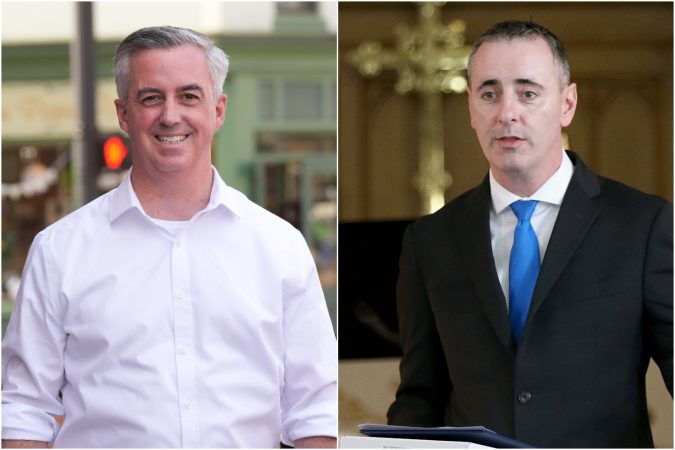
With control of the U.S. House on the line in November, Pennsylvania’s swing-district candidates are stocking up their war chests for a critical election — but one Democrat is lagging behind his counterparts.
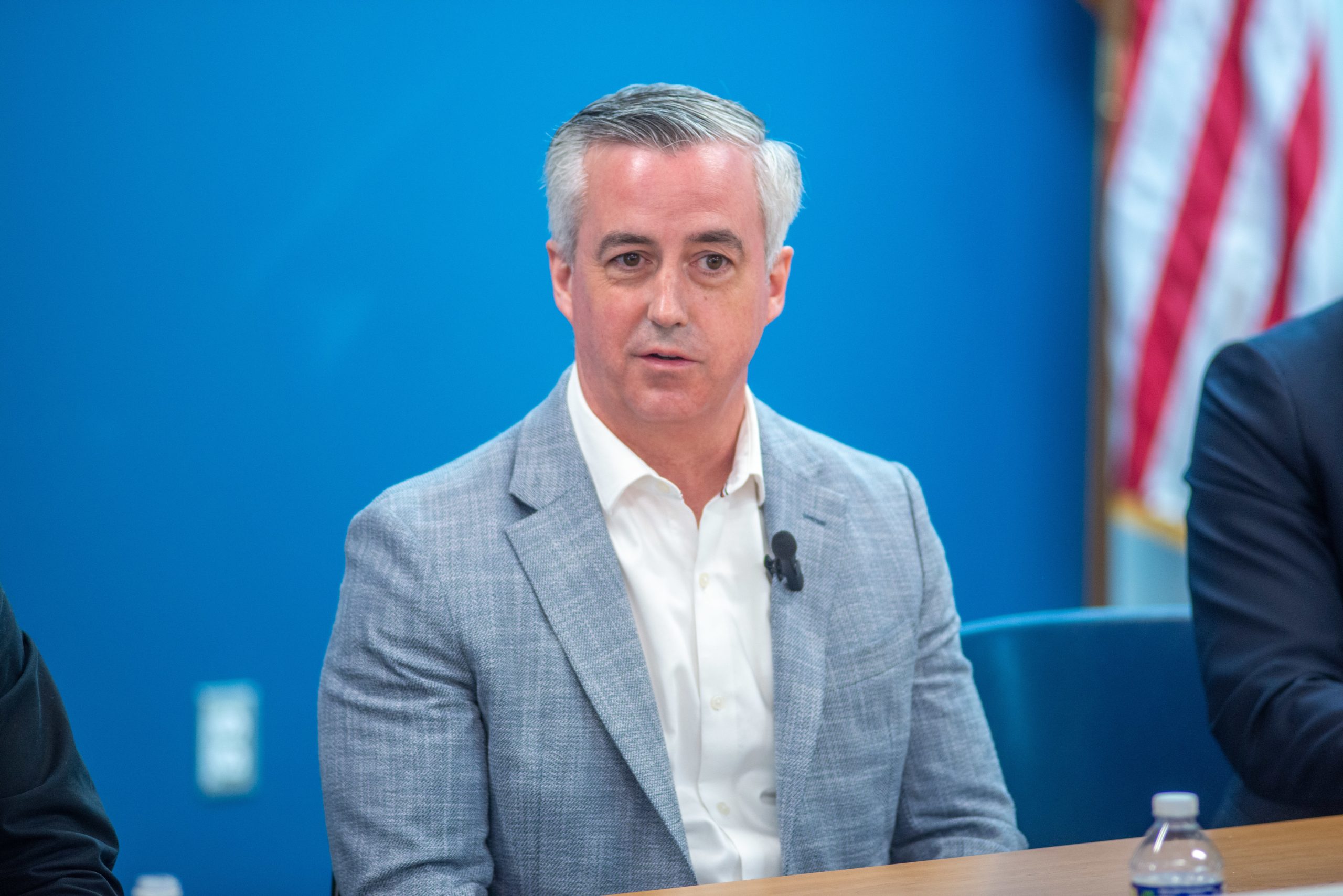
Bucks County Commissioner Bob Harvie, who is challenging longtime incumbent Republican U.S. Rep. Brian Fitzpatrick in the 1st Congressional District, raised almost $552,300 between April 30 and June 30, according to new campaign finance reports filed Wednesday, putting him at a little over $2 million raised since he launched his campaign in April 2025.
But Harvie’s sum for this two-month period is almost half a million less than Fitzpatrick, and roughly $915,000 on average less than the other Democratic candidates.
Fellow swing–district Democrats Bob Brooks, Paige Cognetti, and Janelle Stelsonall outraised the Republican incumbents in the 7th, 8th, and 10th Districts respectively, each gathering more than $1 million during this two-month period, a sign national Democrats say is proof of their strength in these competitive Pennsylvania seats.
The reporting period covers the final weeks before the May 19 primary and the six weeks that followed.
Bucks County Commissioner Bob Harvie hosts a veterans roundtable on May 4 at Middletown Township Building in Langhorne.William Thomas Cain / For The Inquirer
The Bucks County Republican has been tough to beat, thanks to his name recognition and ability to garner support from voters across the political spectrum, but Democrats believe Harvie’s roots in the county, and his electoral record as county commissioner, make him their strongest candidate to date.
(function(){function e(){window.addEventListener(`message`,function(e){if(e.data[`datawrapper-height`]!==void 0){var t=document.querySelectorAll(`iframe`);for(var n in e.data[`datawrapper-height`])for(var r=0,i;i=t[r];r++)if(i.contentWindow===e.source){var a=e.data[`datawrapper-height`][n]+`px`;i.style.height=a}}})}e()})();
And their outlook on the race hasn’t budged. Democrats believe all four swing district Democrats will be successful in November but understand it will take continued investments, including more money, to get all of them across the finish line.
Bucks County’s 1st Congressional District “is a winnable race, and Democrats should be all in on investing in Harvie so that he can help take back control of Congress,” said Dan McCormick, Harvie’s campaign manager, in a statement.
He also added that Harvie doesn’t “take a dime” of corporate PAC money.McCormick did not comment on the contrast between Harvie’s fundraising and that of his counterparts in the other targeted districts.
“Fitzpatrick sees the same polling we do, that’s why he’s busy lighting his money on fire lying about Bob,” McCormick said.
Fitzpatrick began funding ads against Harvie before the May 19 primary, underscoring the significance of Harvie’s challenge in a year Republicans are expected to lose seats nationally. Fitzpatrick’s campaign spent nearly $2 million between May and June, compared with about $360,000 in spending by Harvie’s campaign.
Both parties are targeting the seat, which includes all of Bucks and a sliver of Montgomery County, as they battle to secure control over the U.S. House.
In a pre-primary report that covered April 1 through 29, Harvie had raised about $107,000, in addition to his stockpile reported Wednesday. Fitzpatrick raised $246,000 during that same period.
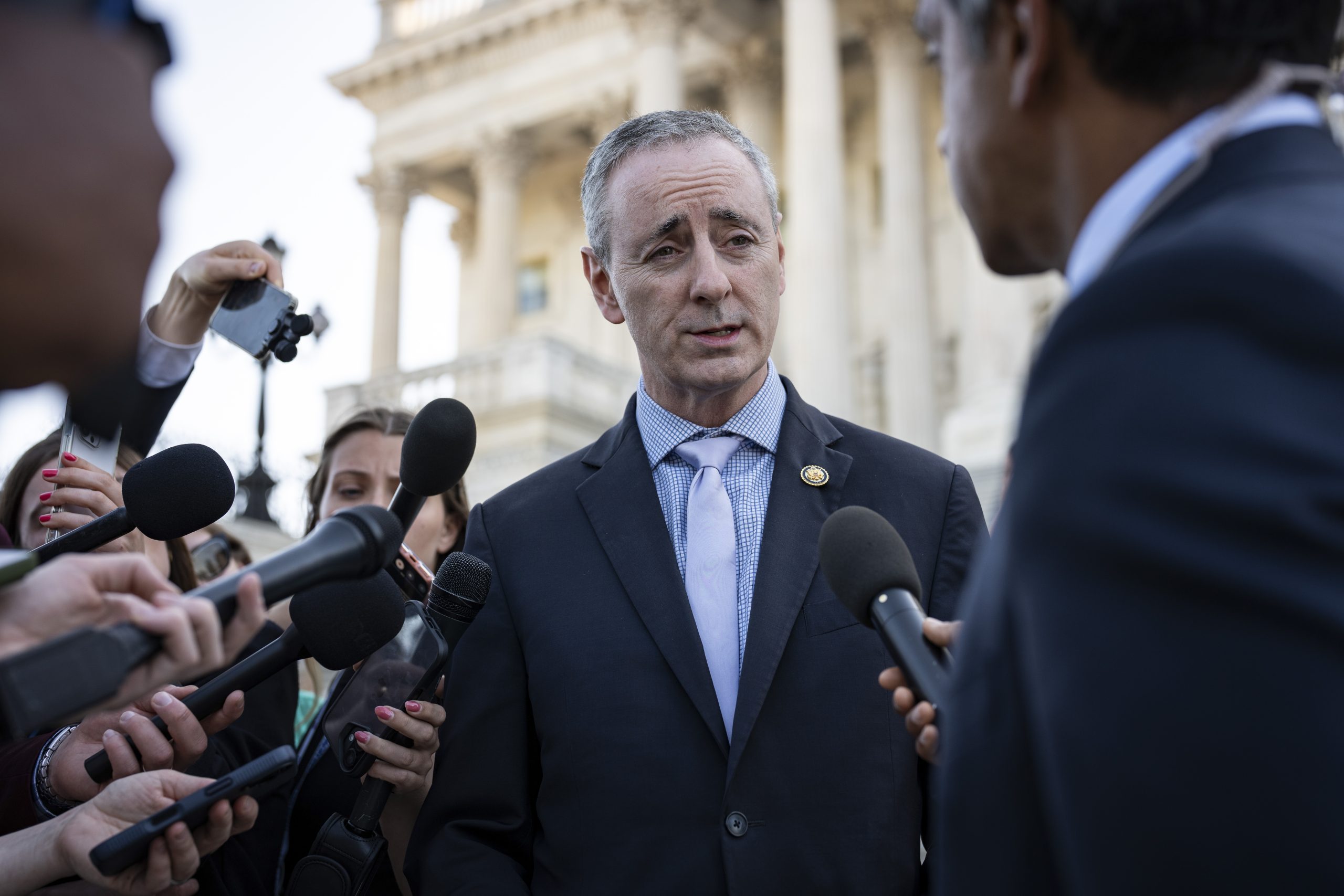
Rep. Brian Fitzpatrick (R., Pa.) speaks to reporters June 3 after the House passed an Iran war powers resolution.Haiyun Jiang
The nonpartisan Cook Political report has rated the 1st Congressional District as “likely” Republican, and the three other swing districts are considered toss-ups.
In a high stakes election year — and with popular Pennsylvania Gov. Josh Shapiro at the top of the ticket and a sinking approval rating for President Donald Trump — Harvie’s fundraising numbers at this point are mostly on par withthe last Democrat to take on Fitzpatrick.
Former challenger Ashley Ehasz, who ran against Fitzpatrick in 2022 and 2024, raised more than $767,000 during this period two years ago, bringing her campaign total to $2.1 million as of June 30, 2024.
Brittany Crampsie, a Democratic strategist in Pennsylvania, said donors may be doing “a little bit of hedging” their spending for Harvie at the moment, waiting to see more information on Shapiro’s poll numbers, Trump’s approval rating, and the national mood before investing more in the 1st District.
“Democratic donors absolutely want to beat Fitzpatrick,” Crampsie said. “We want to control Congress by large margins. But PA-1 is an expensive race. I mean, you might want to be looking at a little bit more information.”
The 1st and 7th Congressional Districts are part of the expensive Philadelphia television market, meaning both Harvie and Brooks will be competing for airtime.
Brooks, who is taking on freshman Republican U.S. Rep. Ryan Mackenzie in the Lehigh Valley, has raised $2.3 million over the entire span of his campaign — getting a boost this period after winning a competitive primary — but it’s not too far off from Harvie’s $2 million total haul.
Christopher Nicholas, a GOP consultant who grew up in Bucks County, said that Harvie is not just in a competition against Fitzpatrick, but also with the three other Democratic contenders in Pennsylvania.
“If you’re some official at the DCCC, and you say ‘Let’s see, get me the report on Pennsylvania,’ and you see this, where is Harvie going to be in the rankings? Is he going to be moving up or moving down? I think that’s a pretty easy question to answer,” Nicholas said.
Eli Cousin, a spokesperson for the Democratic Congressional Campaign Committee, emphasized that Pennsylvanians are wholeheartedly behind all four candidates who he says are “on the front lines of our path back to the House majority and will shake up a broken Washington in order to put Pennsylvania families first.”
Donors still have a lot of time to realize that Harvie is “the right candidate” and to contribute to TV and other ad spends that will come later this summer into the fall, Crampsie said. Some may already be writing checks to the Democratic Congressional Campaign Committee and other Democratic aligned-issues to support their cause of flipping the House blue.
“Fitzpatrick has won several times after being called the number one target, and stakeholders may be less likely to oppose him publicly and want to put their money into spending for Harvie that’s not necessarily into PAC spending … but I don’t think that it’s a sign that people are not supporting Harvie,” Crampsie said.
But even in the races where Democrats are outraising incumbents victory isn’t guaranteed in districts where Republicans have previously managed to prevail despite a cash disadvantage.
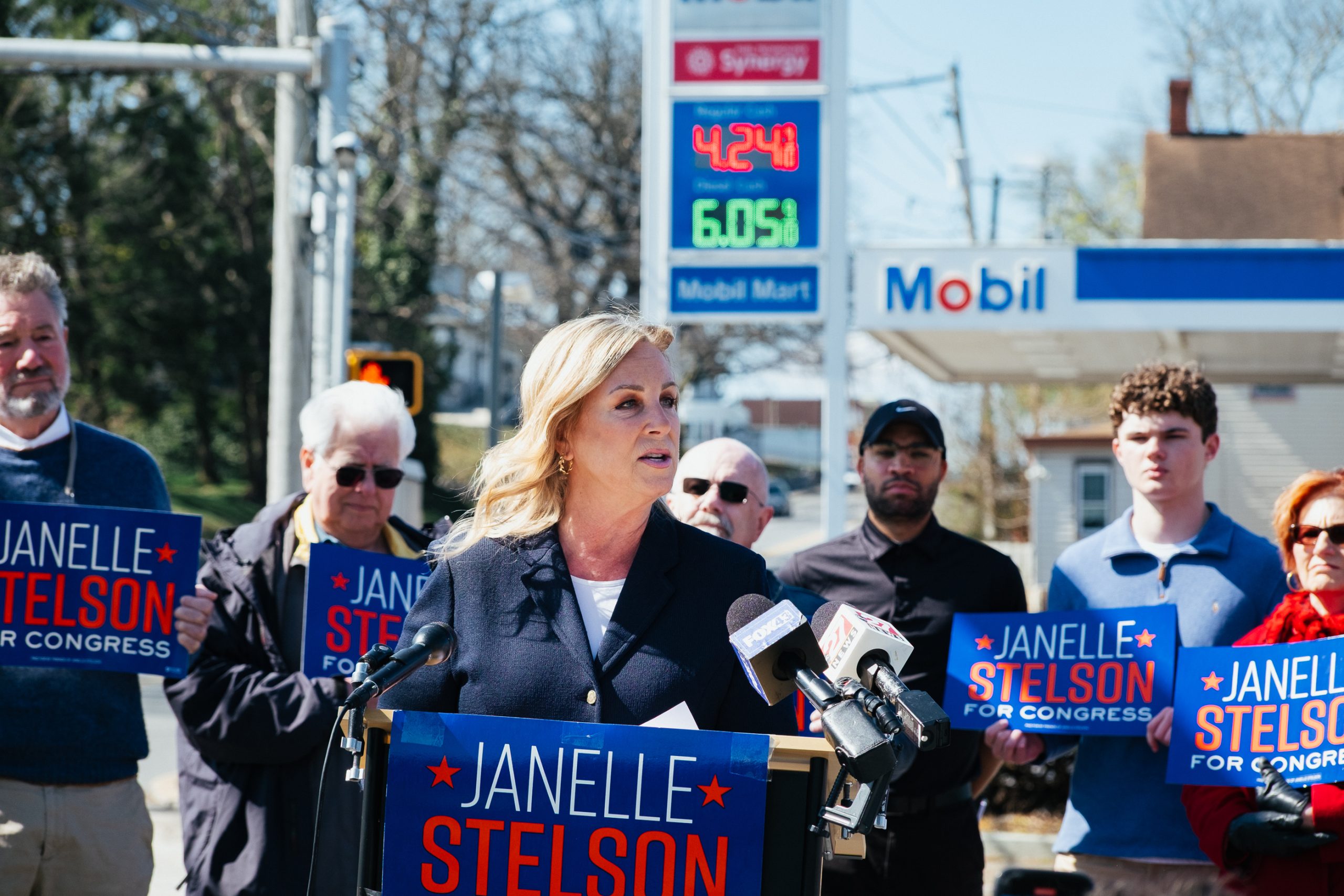
Janelle Stelson, running to represent Pennsylvania in Congress, campaigns at a gas station. Michelle Gustafson
In 2024, Stelson raised about $6.5 million during the entire cycle, roughly $2.1 million more than Republican U.S. Rep. Scott Perry, and still lost. Republicans are hoping Perry can prevail again when they have a rematch in November.
And Republicans see other signs of hope in these races despite Democrats’ momentum. For example, Mackenzie has more than $2.9 million cash on hand, roughly $1.9 million more than Brooks.
“Republicans remain in a strong position to defend our House majority after excellent quarters by our incumbent Members across Pennsylvania,” Reilly Richardson, a spokesperson for the National Republican Congressional Committee, said in a statement.
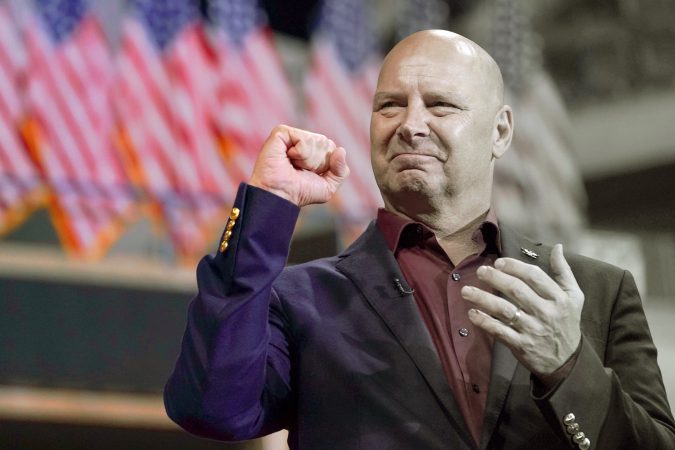
WASHINGTON — Doug Mastriano, the far-right Pennsylvania lawmaker whom President Donald Trump nominated to become the U.S. ambassador to Slovakia, refused to tell senators during his confirmation hearing on Thursday whether he believes all American political leaders should be Christian.
A key Trump ally during the president’s attempt to overturn the 2020 election, Mastriano also rejected claims that he is a conspiracy theorist who assisted in the Jan. 6, 2021, attack on the U.S. Capitol.
And while he said he regretted some of his past statements about the Holocaust and his associations with individuals considered antisemitic, he repeatedly pushed back on Democratic senators’ concerns about his fitness for the role.
“I’ve never been involved in conspiracies,” he said during a heated exchange with U.S. Sen. Tim Kaine (D., Va.), who at different points referred to Mastriano as “gullible” and someone who needs to “look in the mirror a little bit.”
The Republican state senator from Franklin County is a retired U.S. Army colonel who deployed three times to Afghanistan after 9/11 and previously served in Eastern Europe.
He was the Republican nominee for Pennsylvania governor in 2022 with Trump’s backing, but he lost to Democrat Josh Shapiro by nearly 15 percentage points. Mastriano’s nomination for the ambassadorship came as his supporters were promoting him as a write-in candidate for governor ahead of the May Republican primary, in which Treasurer Stacy Garrity was unopposed.
U.S. Sen. Dave McCormick (R., Pa.), who pushed for Mastriano’s nomination and chaired his confirmation hearing during the Senate Foreign Relations Committee hearing Thursday, said Mastriano’s military career made him “highly qualified” for the role.
“This position needs a leader with strategic judgment, intimate knowledge of NATO’s inner workings, and firsthand experience working alongside our allies with an unwavering commitment to advancing America’s interest,” McCormick said during the hearing. “Doug brings that experience, and I’m confident that he’ll represent the United States with great professionalism and integrity.”
Mastriano also leaned on his experience, which he said involved planning operations in the Baltic states and fending off Russian aggression. He said he hoped to strengthen America’s relationship with Slovakia and encourage the country to contribute to Ukraine’s defense.
But Democrats on the committee said they had serious concerns about both Mastriano’s past comments on foreign policy and a range of other issues — including an ideology that has been described as Christian nationalist.
U.S. Sen. Jacky Rosen (D., Nev.) said Mastriano had spoken often about his Christian identity and his belief that the separation of church and state is a “myth.” Rosen, who is Jewish, asked Mastriano to look her in the eye and say whether all U.S. political leaders should be Christian.
Mastriano said that he believed “religious liberty applies to every American” and that it was “why our country was founded.” After Rosen said it was “deeply problematic” that he would not say America is a pluralistic nation where leaders do not need to be Christian, Mastriano responded, “I will look you in the eye and repeat even simpler language” — though he did not answer the original question.
“We are absolutely a pluralistic society and I have worked for non-Christians in the military and the government, and I’ve had them working for me,” Mastriano added.
Rosen also questioned him about previous comments comparing abortion and his loss to Shapiro in the 2022 Pennsylvania governor’s race to the Holocaust.
“There was a social media post that I would not post today,” Mastriano said, calling any comparisons to the Holocaust “unwise.”
Asked about his associations with Andrew Torba, founder of the online platform Gab, which has been used to share extremist and antisemitic views, Mastriano said he “immediately” returned a campaign donation from Torba and cut off advertising on the platform when he learned about the Gab founder’s views.
“You can denounce your past associations with antisemites. You can point to your support of Israel,” Rosen said. “But for me, I’m not sure that either excuses you or erases your record.”
U.S. Sen. Jeanne Shaheen (D., N.H.) questioned Mastriano while displaying a giant poster with his picture and a 2018 quote in which he said European Union leaders were “political, diplomatic enemies of the United States of America.”
She said staff who had interviewed him recently had also quoted him as saying he believed the European Union was a “rising rival comparable to China and that it would eventually create a standing army to challenge the United States.” Visibly frustrated during her questioning, Shaheen said that the EU should be treated as allies, not rivals, and that Mastriano “should absolutely know better.”
The most contentious exchange came between Mastriano and Kaine, who started by saying that he respected the nominee’s military service and that the nomination brought him “a real sense of sadness.”
“You’ve associated with antisemites and Holocaust deniers. You’ve associated with 9/11 conspiracy theorists. You’ve made comments about foreign leaders that are not diplomatic in quality. And you and I share a very special day in American history,” Kaine said. “We were both here on Jan. 6, 2021.”
Mastriano was Trump’s top ally in Pennsylvania as the president contested his 2020 election loss to Democrat Joe Biden. He worked both publicly and privately to contest the vote, and he was near the Capitol on the day that a mob broke in to stop the certification of the results. The Republican lawmaker was not charged with a crime related to any of those activities, which he reminded Kaine about on Thursday.
“That is incorrect,” he said as Kaine pressed and said he had been at the Capitol to overturn the results. “I was here to hear the president. I was here with my wife to hear the president of the United States speak. We didn’t do anything illegal. We came, we saw, we left.”
Asked if he would say, now, that Biden had won the election, Mastriano said only that Biden had been certified as the winner — a phrase that other Trump nominees have used in nomination hearings and that Democrats have described as a pre-negotiated script to appease a president who still stands by the fraudulent claims.
“Conspiracy theorists generally are gullible people. They might have master’s degrees and Ph.D.s, and you’ve got them,” Kaine said to Mastriano, referring to his degree in history.
“I don’t know what you’re talking about, senator,” Mastriano said, denying that he subscribes to conspiracy theories as the two talked over each other.
Kaine said Mastriano could claim, if he wanted, that he only held a public hearing on the 2020 election — an event in Gettysburg that helped spread false claims that there was widespread fraud in the election — but he could not erase his record.
“No, sir, there’s no erasing,” Mastriano said. “Facts are stubborn things.”
The polluted campfire-like vaporfrom Canadian wildfires plummeted air quality Thursday, lowered visibility enough that flights were delayed at Philadelphia International Airport, and prompted cancellation of a concert at Cooper River Park in Camden County.The Phillies moved Thursday night’s game up one hour due to air quality concerns.
The smoke, which was expected to blanket the region at least through Friday, originated from fires burning in Western Ontario, said Sarah Johnson, a meteorologist at the National Weather Service’s Mount Holly office.
It was swept in by winds that mixed to keep it closer to the ground.
“It’s just a factor of the winds at all levels kind of working together,” Johnson explained.
It is difficult to pinpoint when the air quality might return to normal, she said. Those forecasts come from state environmental protection departments and are usually no more than 48 hours out.
The Pennsylvania Department of Environmental Protection has declared a Code Purple Air Quality Alert for Friday. Code purple signifies very unhealthy air, meaning people should avoid long or intense outdoor activities, and sensitive groups should avoid all outdoor activities. The department suggested not using gas-powered lawn and garden equipment, and avoiding the burning of leaves or trash.
Rain forecast for Saturday could help suppress the smoke, Johnson said, but on Thursday afternoon it was too early to be sure.
Poor air quality caused by the fires remained the biggest issue as they burned through forests and buildings before their smoke swept south, collecting ambient pollution from Boston, New York, and other areas before reaching Philadelphia.
Philadelphia issued a Code Red Air Quality Caution Day on Thursday, meaning some people were at risk of experiencing health effects, including elevated risks forpeople with heart or lung disease, asthma, older adults, children, pregnant people, immunocompromised people, people experiencing homelessness, people who use drugs, people without access to air filtration, and outdoor workers.
The city advised people to limit their time outdoors and consider rescheduling activities.
“Today is not the day to start your marathon training plan,” Palak Raval-Nelson, commissioner of the Philadelphia Department of Public Health, said in a statement.
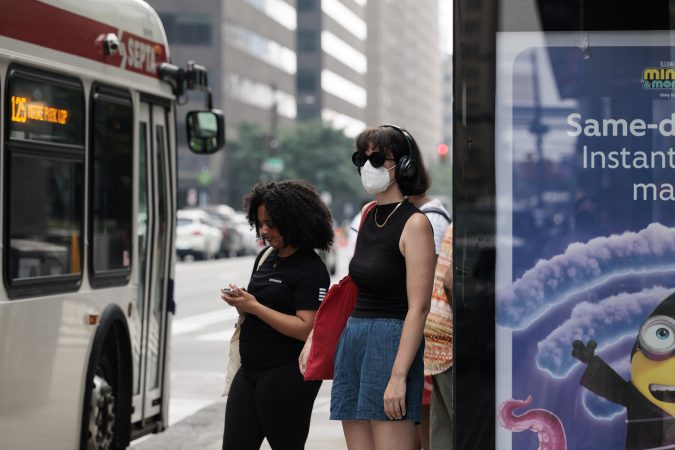
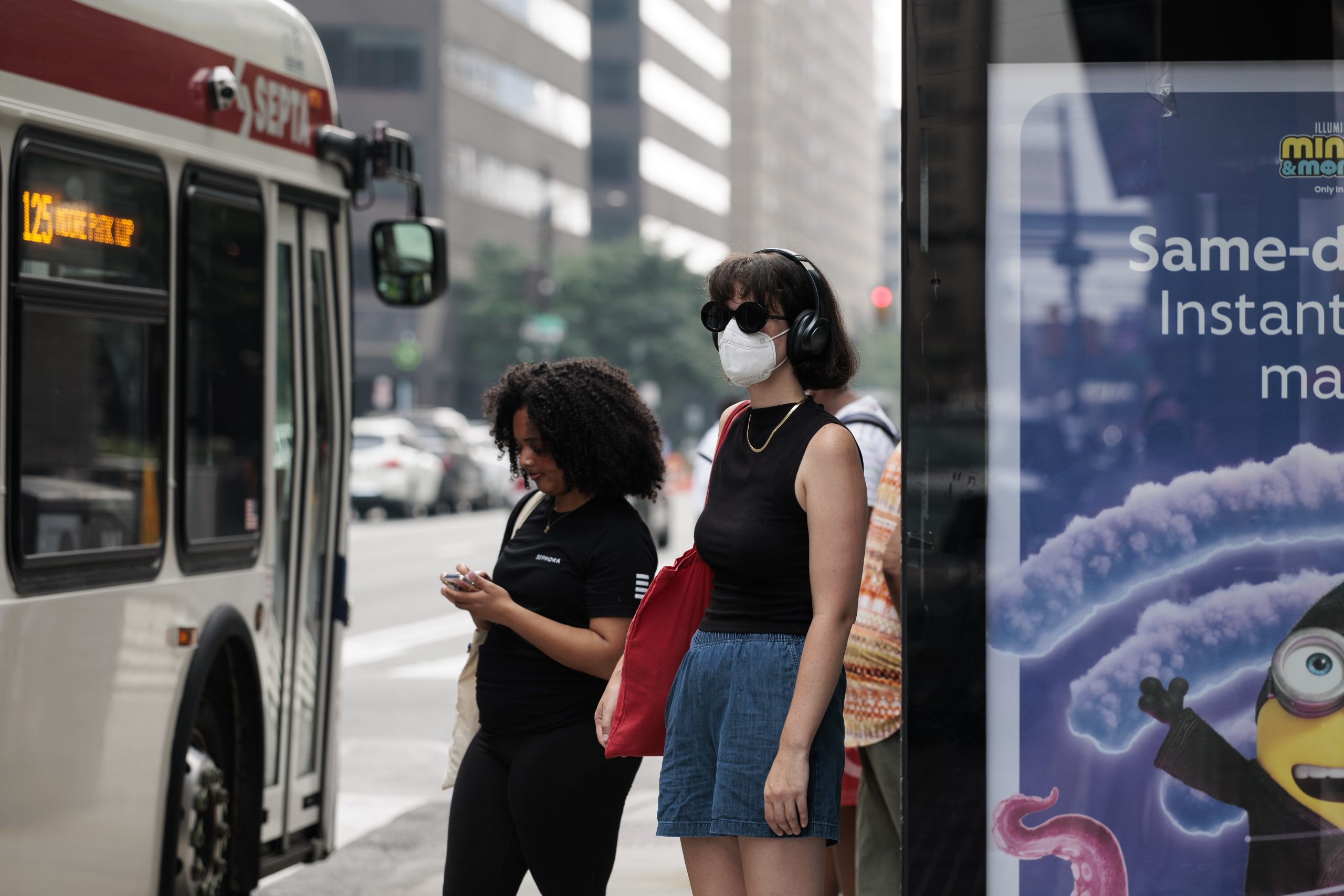
Penn State graduate student Ray Boone waits for the bus with a face mask on because of the air quality, on Thursday, July 16, 2026 at 17th Street and JFK Boulevard in Philadelphia. The Pennsylvania Department of Environmental Protection has declared a statewide Code Red air quality day due to Canadian wildfire smoke blowing into the Philadelphia region.Monica Herndon / Staff Photographer
High temps increase risks
The smoke affected thousands of square miles in the region, from the Poconos to the Shore through Delaware.
The Air Quality Index, or AQI, by the U.S. Environmental Protection Agency was in the unhealthy range for all of the region as of 4 p.m. Thursday. The index ranges from 0 to 500. Unhealthy is from 151 to 200.
Censors in Centre County, Pa., recorded a hazardous AQI of 345 by Thursday afternoon, the highest and most dangerous level. Other sensors in Lycoming and Bradford Counties recorded AQIs above 200, or very unhealthy.
Not helping: Temperatures in the 90s with humidity so high that it made it feel in excess of 100 degrees.
Julie and Bill Guise, 66 and 72, respectively, basked in the somewhat cool breeze billowing from a giant fan inside the President’s House complex at Independence National Historical Park, hoping to get relief from the oppressive air. The Flagstaff, Ariz., residents, however, were unaware of what exactly was causing it.
“We couldn’t figure out what it was,” Bill Guise said of the haze in the atmosphere.
But it did not change their plans. The couple are used to wildfires.
“It’s much worse out West,” Julie Guise added, likening the western smoke, when it’s extra bad, to sitting next to a campfire.
Eric Balaban, a pulmonary and critical care fellow at Temple University, was hesitant but still went running Thursday morning.
“If I didn’t have an addiction to running, I would not have gone. And I would recommend other people not to run. Do as I say, not as I do,” he said with a laugh.
But exposure to the smoke is a serious matter, Balaban said. He noted that the smoke that travels “carries a uniquely toxic profile that poses severe health risks to both healthy individuals and vulnerable populations.”
Ruth McDermott-Levy, a professor at Villanova University’s school of nursing, said that air quality had become a risk not only for those already suffering from health issues, but for everyone.
“All of us are at risk,” McDermott-Levy said. “Certainly there are groups of people at greater risk, from pregnant women, children, older people, and those with cardiac and respiratory illnesses. But we’re at an unhealthy level for everyone.”
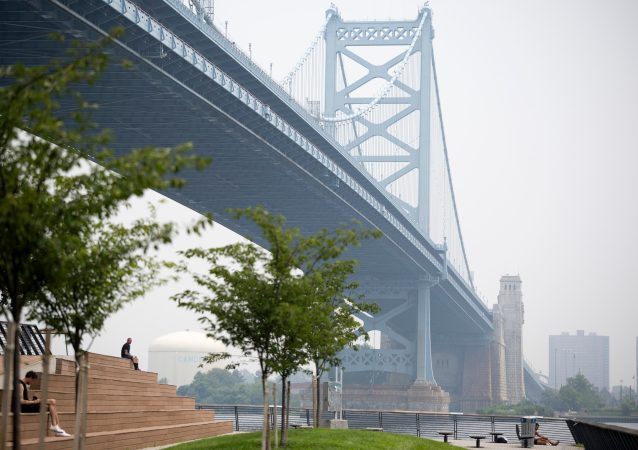
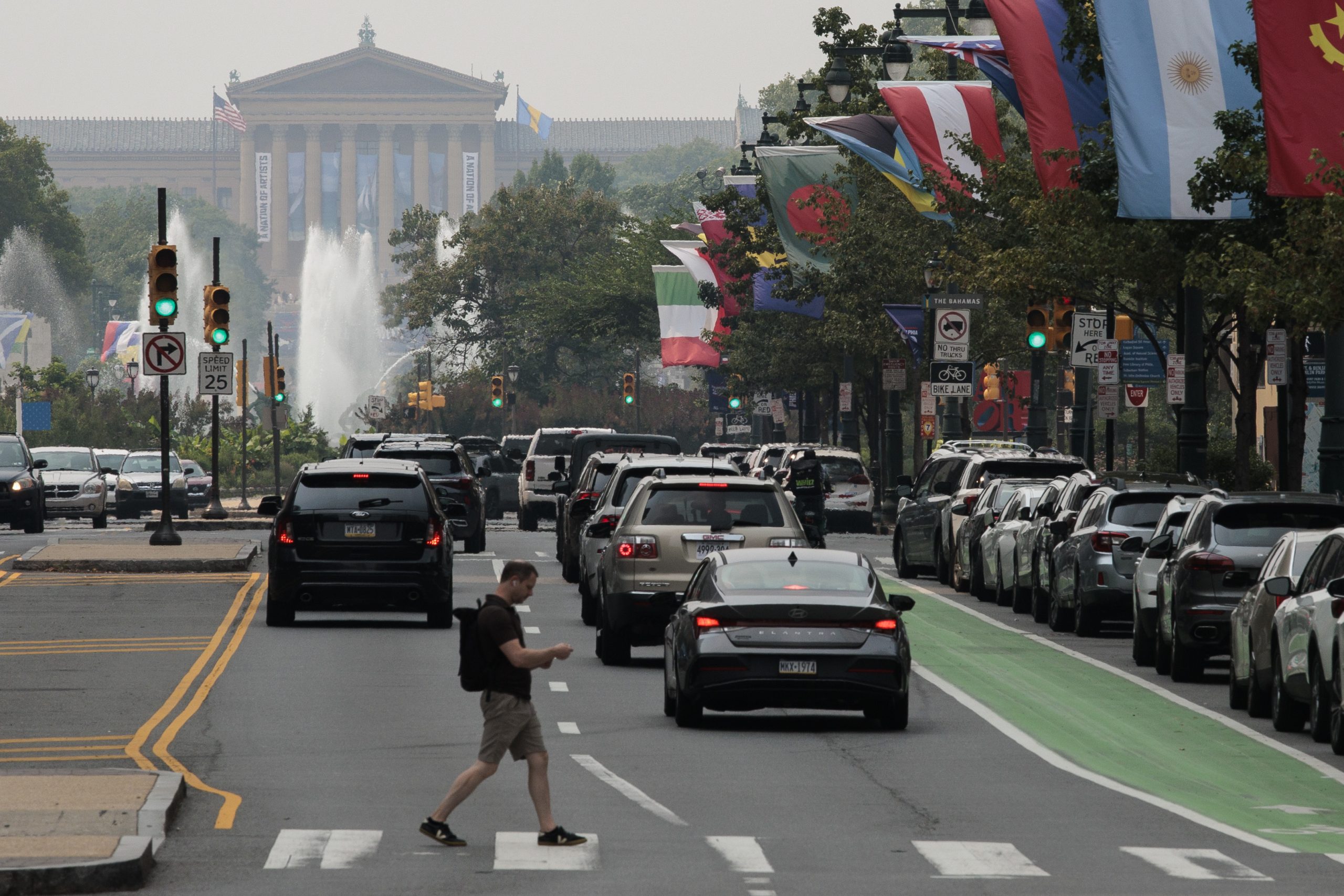
The Philadelphia Museum of Art behind a smokey haze on Thursday, July 16, 2026 in Philadelphia. The Pennsylvania Department of Environmental Protection has declared a statewide Code Red air quality day due to Canadian wildfire smoke blowing into the Philadelphia region.Monica Herndon / Staff Photographer
What’s in the air?
The two major pollutants of concern are ground-level ozone and fine particulate matter known as PM2.5.
Ground-level ozone is a pollutant that forms when nitrogen oxides and volatile organics emitted by vehicles, power plants, and industry react in sunlight, especially during hot days. It can cause airways to constrict, leading to shortness of breath. It can especially affect those with asthma, emphysema, and chronic bronchitis.
Fine particulate matter is so small that it can cross from the lungs directly into the bloodstream, bringing a body-wide exposure that can increase the risk of heart attacks and strokes, in addition to causing acute chest tightness, shortness of breath, and dizziness in otherwise healthy people.
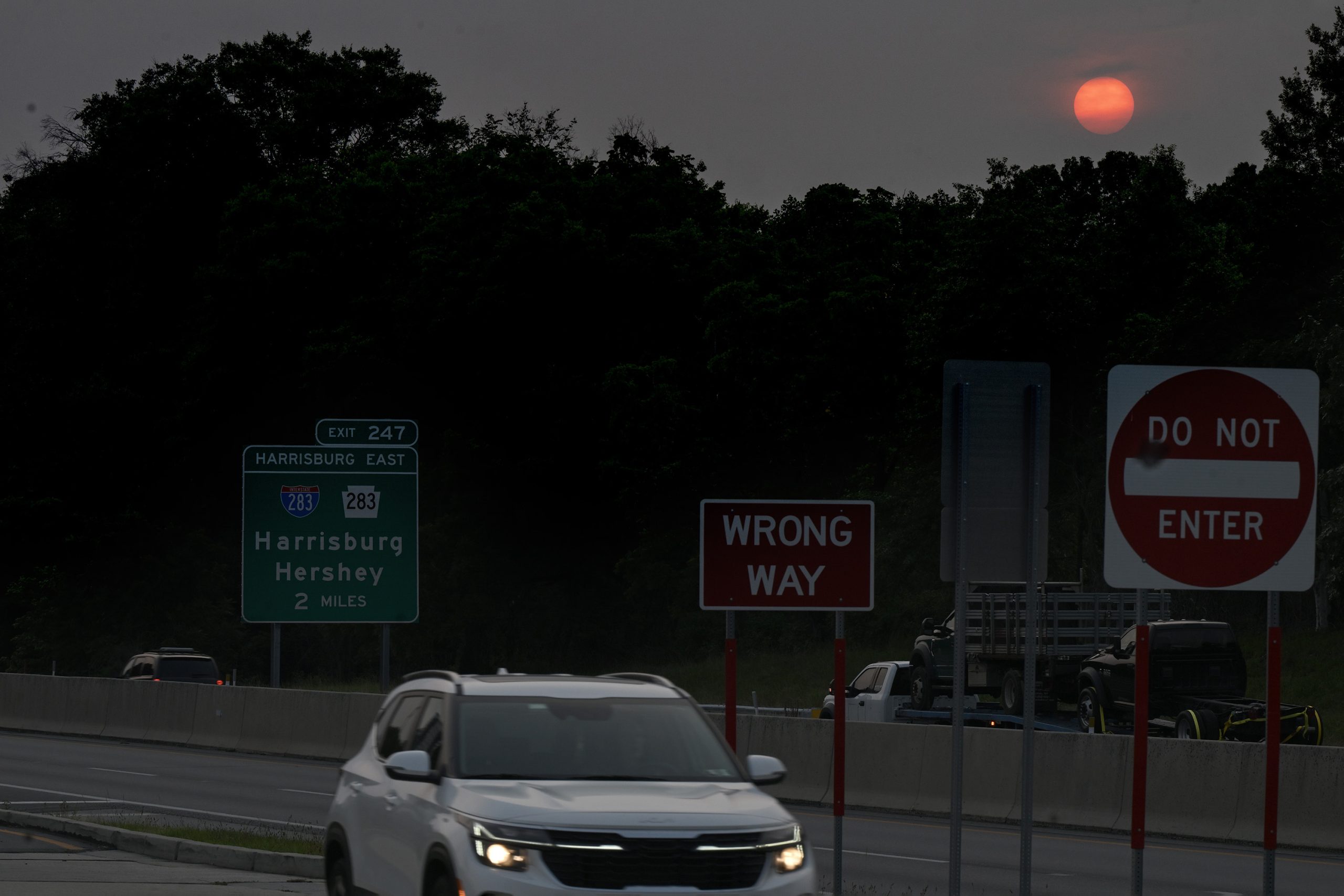
The sun sets in a hazy sky over the Pennsylvania Turnpike Wednesday, July 15, 2026 as the Canadian and Great Lakes wildfire smoke moves into the region’ This at the Highspire Service Plaza], eastbound near Middletown.Tom Gralish / Staff Photographer
Staff writer Nate File contributed to this article.
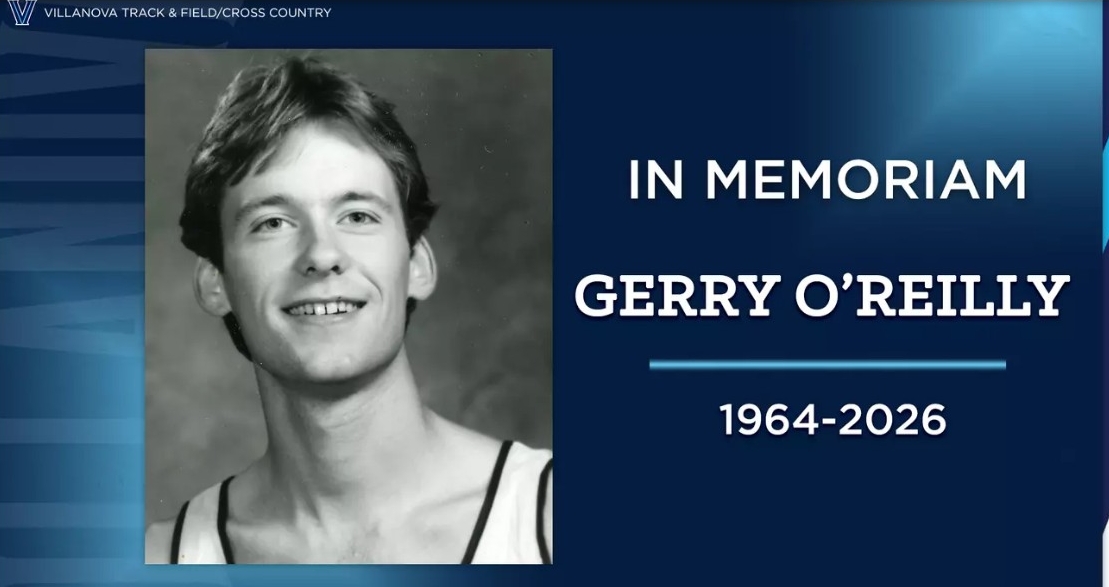
Gerry O’Reilly, 61, of Chester Springs, Hall of Fame middle distance track star at Villanova University, 1988 Irish Olympian in the 1,500-meter run, longtime executive at the Vanguard Group Inc., mentor, and role model, died Thursday, June 11, at Phoenixville Hospital after an earlier sudden cardiac event.
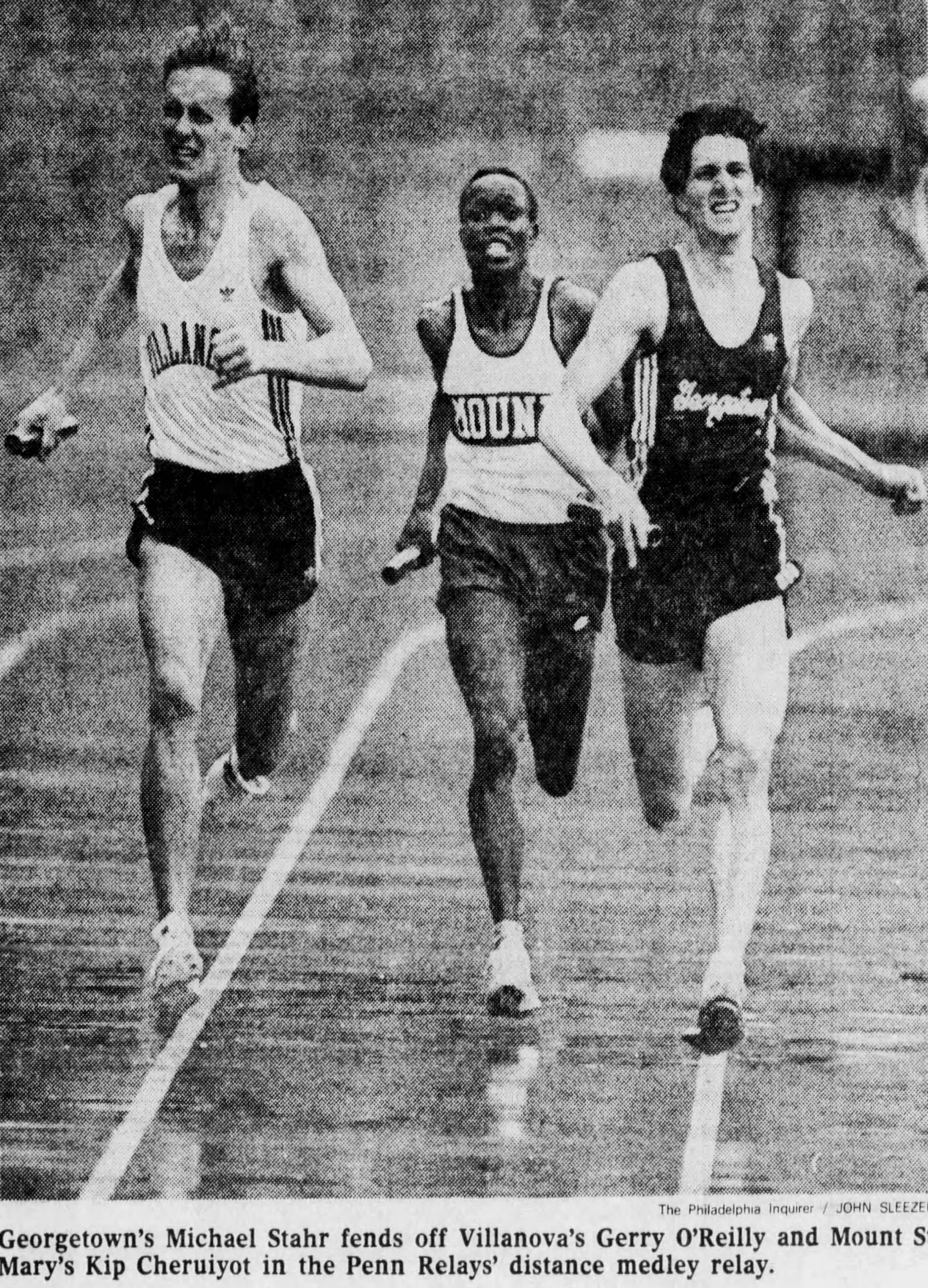
Born and reared in Dunboyne, County Meath, Ireland, Mr. O’Reilly earned a track scholarship to Villanova in 1983 and joined a dozen other Irish athletes in what became known as the school’s Irish Pipeline to the Main Line. He went on to run cross-country and indoor and outdoor track, win seven Big East Conference championships, and hold the Big East outdoor record in the 1,500 for 37 years.
He ran the 1,500- and 3,000-meter runs, the mile, and the distance medley relay at Villanova, and was named All-America four times. He won six national collegiate championships, was named outstanding performer at the 1986 Big East Indoor Championships, and was inducted into the Penn Relays Wall of Fame in 2007 and the Villanova Varsity Club Hall of Fame in 2009.
“Without exaggeration, those were four of the best years of my life,” Mr. O’Reilly told Dave Thomas on the Belmont Plateau Hall of Fame podcast. Villanova “kind of set me up both athletically and academically for the rest of my life.”
Marcus O’Sullivan, former Villanova teammate and countryman, now director of track and field and cross-country at Villanova, said Mr. O’Reilly “had a steadfast moral compass that guided him in his life, and in doing so it had an intoxicating influence on others. … We all need a person like Gerry O’Reilly in our lives.”
After college, Mr. O’Reilly competed in the international Millrose Games in New York, the 1987 World Championships, the 1989 World Indoor Championships, and for Ireland in what is now the World Athletics Championships. At the 1988 Summer Olympics in Seoul, South Korea, he made it to the semifinals of the 1,500.
Irish Olympic team officials called him “an exceptional athlete” and praised his “genuine commitment to helping the next generation.” They said: “Once an Olympian, always an Olympian.”
Irish marathon Olympian John Treacy told the Irish Times: “Gerry was a smashing runner and just the nicest guy, great for staying in contact and communicating with other Irish runners over the years.”
Mr. O’Reilly ran miles at night after school in the rural Irish fields and lanes, and joined the Dunboyne Athletic Club when he was 9. Villanova University
Mr. O’Reilly was also inducted into the Belmont Plateau Hall of Fame in 2025 and recently honored by his hometown Dunboyne Athletic Club.
He earned a bachelor’s degree in economics in 1987, joined Vanguard in 1992 and the trading desk in 1994, and worked as an investment leader and portfolio manager. He was a mentor, colleagues said in a tribute, “who made immeasurable contributions to several of Vanguard’s flagship index funds.”
He served on corporate panels and lectured at leadership development events. Colleagues called him “riveting and influential” and “a giant in every sense except ego.” One said: “You could tell he truly cared about the markets and about doing things right.”
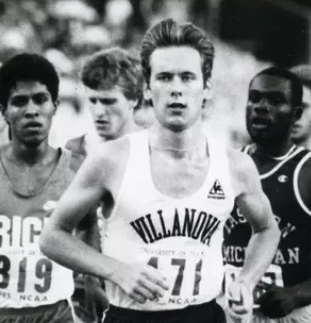
This photo and a story about Mr. O’Reilly (left) appeared in The Inquirer in 1987.Newspapers.com
Gerard Christopher O’Reilly was born July 1, 1964. He was the oldest of six children and excelled at cross-country, track, soccer, and other sports.
He ran miles at night after school in the rural Irish fields and lanes, joined the Dunboyne Athletic Club when he was 9, and was inspired, he said later, by Irishman Eamonn Coghlan’s fourth-place finish in the 1,500 at the 1976 Summer Olympics. Mr. O’Reilly went on to win the 1983 Irish Junior 1,500 championship.
He met fellow track star Melody Sye, and they married in 1992 and had a daughter, Meghan, and sons Keelan, Jack, and Conor. They divorced later.
“Despite all his trophies and merits,” Mr. O’Reilly’s family said in a tribute, “he always remained humble and would say being a dad to his four kids was his proudest accomplishment.”
Villanova honored Mr. O’Reilly online.Villanova University
Mr. O’Reilly was an avid bicyclist, and he spent many weekends on long rides and at Eagles games on Sundays. He liked poker, hikes with his dog, Bear, and watching sports with his family.
“Most of all,” his family said, “he simply enjoyed cracking jokes, sharing stories, and spending time with his friends and family.”
In addition to his children and former wife, Mr. O’Reilly is survived by three sisters, two brothers, and other relatives. “His final gift,” his family said, “was saving multiple lives through organ donation.”