Just days before a midterm election dominated by voter anger over inflation and the economy, a fresh wave of oil company earnings reports threatens to drive more discontent, as high gas prices translate into windfall profits for some of the industry’s biggest players.
ExxonMobil early Friday morning reported a profit of $17.5 billion in the most recent quarter — a jump of 130% over the same period last year. Chevron’s $10.4 billion in profits for the quarter reflected a 185% leap over last year’s third quarter report.
“We continued to rise to the challenge of meeting global energy needs, drawing on unmatched scale, integration, and technical capabilities,” said a statement from ExxonMobil CEO Darren Woods. “Quarter after quarter, the evidence of a stronger business builds. We’re improving both the quality of our portfolio and the ability to optimize around it.”
On Thursday, London-headquartered Shell reported its earnings nearly doubled over the same period last year. All the companies reported their profits from refining had broken records, and their overall earnings are the highest they have been since the energy price surged triggered by Russia’s invasion of Ukraine in 2022.
The reports come at an awkward time for Republican candidates, who have for months seen their poll numbers weighed down by an unpopular war in Iran that is driving fuel prices higher. Democrats have seized on the voter anger, placing blame squarely on the White House for launching the war and on GOP officeholders for refusing to demand an end to it.
Polls show that most Americans believe the Iran war, along with President Donald Trump’s tariffs, have stoked inflation.
“This is happening directly because of the decisions the Trump White House and the Republican Congress made,” said Josh Freed, senior vice president for climate and energy at Third Way, a left of center think tank. “This is not about uncontrollable vagaries of the market, or actions of OPEC or a rogue state taking actions to increase prices. Prices are up in the U.S. because Donald Trump made decisions that increased them. Voters understand that.”
Gas prices now average $4.23 per gallon nationwide, according to AAA, 39% higher than they were before the U.S. and Israel attacked Iran.
White House spokesperson Taylor Rogers said in an emailed statement that lowering gas prices is a priority for Trump and “once the conflict with Iran comes to an end, gas prices will plummet, and the Iranian terrorist regime will not have a nuclear weapon.”
Trump has been assuring voters that gas prices would quickly drop since the early days of the war. The average price of gas so far during his second term recently surpassed the average price during the Biden administration, despite the president repeatedly claiming prices were higher under his predecessors.
In August, Trump suggested that oil companies were exploiting the war to raise prices. But the White House has resisted calls for windfall profit taxes and other accountability measures that Democrats have championed to more aggressively regulate the firms when prices surge.
And this week, Trump tried to frame oil company profits as a good thing for voters.
“Your country is making an absolute fortune because of the situation in the Middle East,” he said at a rally in Corpus Christi on Tuesday. “The fake news will say… isn’t it terrible? He forgot about the price at the pump. No. Your price is coming down. But your country is making a fortune and that’s really good, right?”
“I knew that oil would go up,” Trump said. “I actually thought it would go up two to or three times higher, and I was still willing to do it,” he said of attacking Iran. “We couldn’t let Iran have a nuclear weapon.”
The talking points have delighted Democrats, who say few everyday voters are pleased to see oil companies reaping near record profits as they strain to pay for a tank of gas. “Trump just said the quiet part out loud: He doesn’t ‘give a damn’ about higher gas prices, as long as his billionaire friends are making a fortune,” Sen. Bernie Sanders (Ind., Vt.), posted on social media.
Democrats on the Joint Economic Committee in Congress released a report this week showing how Trump’s oil and gas stocks have soared amid the war, growing by “as much as $35.8 million” this year, based on the president’s financial disclosures.
The White House said Trump does not control his stock market portfolio, which is managed by third party financial institutions. “All holdings are maintained in discretionary accounts and invested through computer-based model portfolios that automatically replicate recognized indexes, such as the Schwab 1000,” said a statement from Davis Ingle, a White House spokesperson. “Neither President Trump nor any member of his family has any ability to direct, influence, or provide input regarding how the portfolio is invested or when investments are bought or sold.”
The big oil companies, meanwhile, are making every effort to stay out of the political fray.
Their reports to investors disclosing the profits stress refining margins, capital expenditures, and inventory assessments, in narratives written in dry technical language that make no mention of the White House, an electorate enraged by the high costs, or the fast approaching election in which soaring prices at the pump could cost one party control of Congress.
In Netflix’s newest season of Monster, an imaginative retelling of the case of Lizzie Borden, Lizzie and her maid bond over a book about the alleged 16th-century serial killer Elizabeth Bathory. Legend claims that this Hungarian countess, in a bid to preserve her youth, bathed in the blood of her virgin victims. In the show, Lizzie and her maid, enamored by this tale, recreate their own bloodbath with cherry juice.
Monster is only the latest pop culture rendition of Elizabeth Bathory’s notorious bloodbaths. Artists such as Paloma Picasso and Lady Gaga have taken a dip in stage blood, portraying the infamous countess. The trope has also turned up in everything fromThe X-Filesto Batman comic books, an Eminem music video and video games. For Halloween, one can even purchase Bathory costumes or miniature bloodbathing figurines.
Despite its enduring popularity, there is absolutely no historical basis for this legend (although Bathory herself was a real person). But the endurance of this myth reflects more deeply rooted and widely circulated stories that specific groups of people may be doing horrific things with the blood of young children. This unsettling legend has persisted not because it is based on true events but because it reflects anxiety about changing power dynamics, as norms around religion and gender shift and vacillate.
Countess Elizabeth Bathory, like so many of our cultural bogeymen, is a Protestant Reformation-era figure. In 1560, she was born into an ancient, illustrious family that was a rival to the mighty Hapsburgs. When she was widowed in 1604, and lost her older brother the following year, Countess Bathory inherited immense amounts of land. She had 17 castles under her control and, as regent for her underage son, served as lord-lieutenant of two prosperous counties.
At first, she was admired and well-respected. Over the next six years, however, she was suspected of treason, threatened by a Hapsburg general and clashed with fundamentalist preachers. In 1610, George Thurzo, the Palatine of Royal Hungary, launched a secret investigation exploring whether she was a vicious killer too. The Countess spent the last four years of her life imprisoned in one of her own castles, without ever being formally charged with any crime. She insisted upon her innocence throughout.
The accusations made against Bathory were that she “was very skilled in magic and sorcerer’s crafts,” in the words of one former servant, and, according to one of her administrators, that she spied on people with the aid of a supernatural pretzel. A pastor claimed that the Countess tried to kill people using enchanted baked goods and that she commanded an army of invisible demon dogs and cats. The other accusations—that she had tortured and murdered anywhere from 50 to 650 girls—earned her a Guinness Book of World Record designation as the “world’s most prolific female serial killer.” She was even said to have forced others into cannibalism. According to the Lutheran pastor John Ponikenus, “some of [these girls] were coerced to eat their own roasted flesh; others, young men, were served the flesh of virgins instead of mushrooms.”
As outrageous as all this was, these gruesome testimonies never made any mention of her bathing in blood.
Bathory’s legendary bloodbaths were tacked onto her story more than a century after her death by a Jesuit priest writing a travel guide. Father Laszlo Turoczi asserted that Bathory had been born a Catholic but had turned away from her faith toward Protestantism. This was patently untrue, as Bathory had grown up as a Protestant. Still, in his 1729 book, Turoczi claimed that heresy made the Countess unnaturally vain, even telling the tall tale that one day, while having her hair dressed, Bathory slapped a maid who pulled her hair. The maid’s blood sprayed across Bathory’s face. The Countess became convinced the blood had a rejuvenating effect and, according to Turoczi’s account, mused, “If a little bit of blood adds so much beauty, what might happen if I wash myself entirely with it?”
Father Turoczi’s embellishments were likely motivated not just by his desire to sell books, but by his prejudices against Protestants and women. His tale conveniently portrayed his religious enemies as depraved and cast powerful women as vapid. The priest depicted the Countess who ruled over vast tracts of land as simpering, “My foremost wish is to please a man.”
It was not just Turoczi’s intolerance and his misogyny, though, that appealed to readers and helped popularize such a tale.Stories of bloodbaths would have been vaguely familiar to most of his readers then, who were aware of accusations of blood libel that had been leveled against Jewish communities, and charges that folk healers were using babies’ blood and body parts in their ointments and salves. Audiences were also likely drawn to Turoczi’s tale because, at the time it appeared in 1729, reports of vampires had been spreading among the border regions of the Hapsburg lands, and such accounts were selling well.
This vampire panic fed a rumor that depraved aristocrats were doing terrible things with the blood of children, which links Father Turoczi’s tale with another conspiracy theory circulating around Paris about the new king, Louis XV: that he was bathing in the blood of children in an effort to cure his leprosy. Those charges were repeated a century later, in the 1860s, in Les Miserables by Victor Hugo, who mentioned the king’s “purple baths.”
In the 1750s, however, this bloodbath rumor led to actual riots. Thousands of Parisians took to the streets, smashing windows, attacking suspected kidnappers and searching for abducted children so they might save them before their blood was used for the king’s wicked ablutions.
Made By History sponsors. FOR USE ON MADE BY HISTORY STORIES ONLY.Inquirer Staff
Nearly three centuries later, the legend of the bloodbath persists in contemporary American politics in surprising ways. It is the basis for the alt-right accusations of Pizzagate (2016) and Frazzledrip (2018), conspiracy theories that Democratic Party officials were participating in child trafficking and ritual murder. It is also the cornerstone of adrenochrome theory, a belief, first popularized in QAnon chat rooms, that global elites kidnap children to harvest their blood for a particular chemical they need for their youth elixirs—or, in other words, that elites use the blood of children in an attempt to preserve their youth, exactly as a Jesuit priest once claimed about the aristocrat Elizabeth Bathory.
The creators of the current season of Monster say it is all about exploring “female rage,” and the series certainly frames Countess Bathory as a woman motivated by fury and vengeance. And yet, history shows us that the legend of Countess Bathory was molded by male fear. During her lifetime, Bathory was denounced by a witch-obsessed pastor. In death, she was exploited by a heretic-hunting priest. The rumors about blood-bathing aristocrats, and accompanying hysterias about stolen children, end up revealing less about their subjects and far more about their architects.
Made by History takes readers beyond the headlines with articles written and edited by professional historians. Opinions expressed do not necessarily reflect the views of The Inquirer.
Election Day is Tuesday and some of the Pennsylvania races we’ve been watching play out for months — and in some cases more than a year — are exceptionally close.
Will a blue wave hit the Keystone State? Or will GOP incumbents fend off challenges in arguably their worst political environment of the Trump era(or maybe any era)?
The consequences will be enormous, and Democrats had momentum heading into the final weekend. But it wouldn’t be a Pennsylvania election if it wasn’t all coming down to the wire.
🗳️ Dynamic duo?: Democrats Bob Brooks and Paige Cognetti lead the GOP incumbents in the 7th and 8th Congressional Districts,the two seats Republicans flipped just two years ago.
🗳️ Neck and neck: In the increasingly bitter Harrisburg-area rematch race, Republican Rep. Scott Perry and Democrat Janelle Stelson are in a dead heat.
– Sam Janesch, Fallon Roth, Michelle Baruchman and Gillian McGoldrick(pa2026@inquirer.com)
Democrats have momentum, but each swing congressional district has seen twists as candidates make their final push before Election Daywhen the state could decide House control.
Fitzpatrick has filed a lawsuit to disqualify Democratic Commissioner Diane Ellis-Marseglia from her duties on Bucks County’s election board because of her support for Harvie.
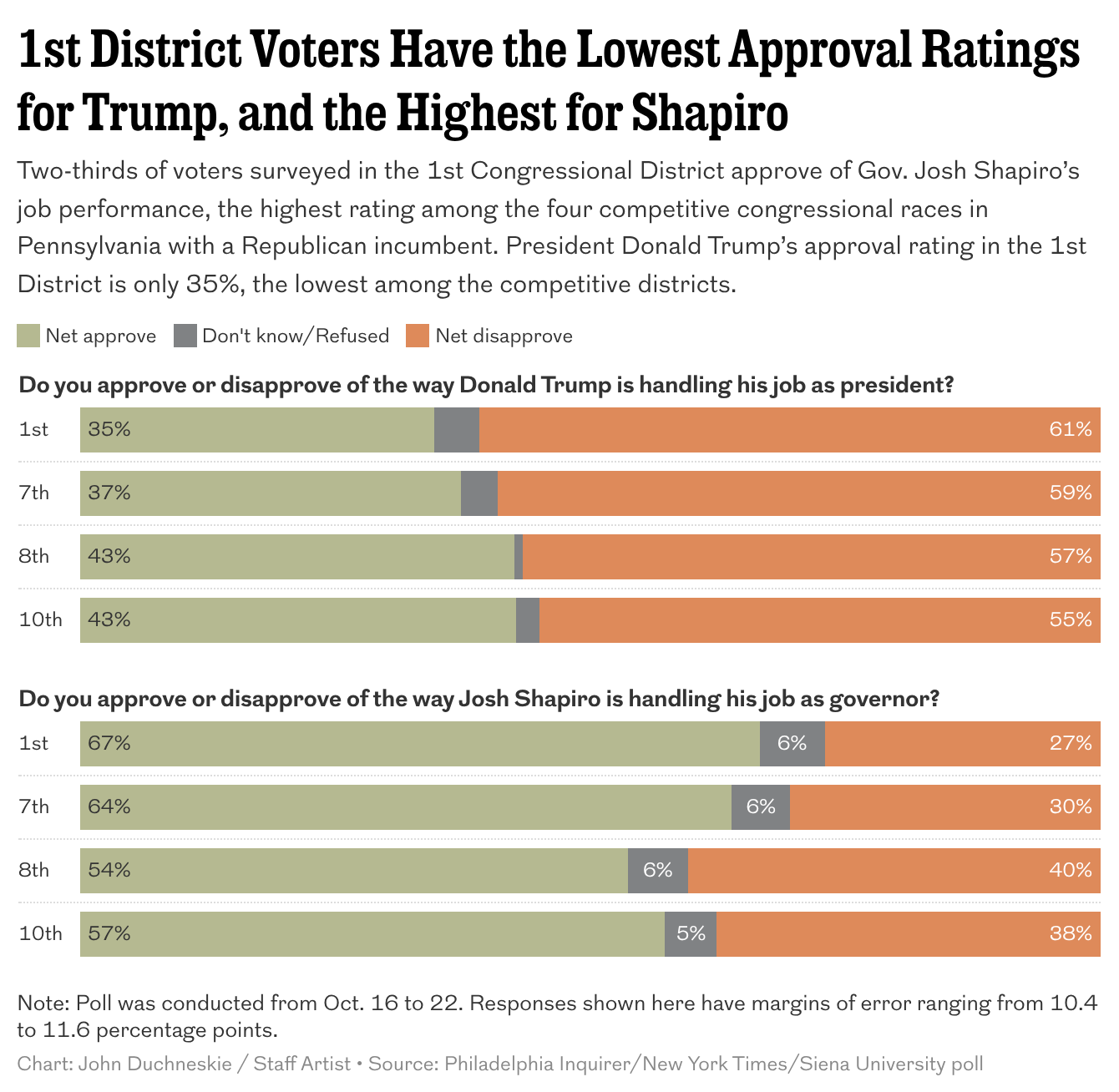
📊 President Donald Trump and Gov. Josh Shapiro are on totally opposite sides of the popularity spectrum in Bucks County’s 1st Congressional District.
Out of the state’s four swing districts,Trump has his worst approval rating in the 1st (35% approve compared to 61% disapprove) and Shapiro has his best (67% approve while 27% disapprove), a new Inquirer/New York Times/Siena University poll found.
Results from a Philadelphia Inquirer/New York Times/Siena University poll showing approval ratings for President Donald Trump and Gov. Josh Shapiro among 1st Congressional District voters.John Duchneskie
So what does that mean for the closely-watched matchup between Democrat Bob Harvie who is narrowly leading Republican U.S. Rep. Brian Fitzpatrick 48% to 46% in the poll?
In many ways, it creates the political environment Democrats have been hoping for since Fitzpatrick first won the seat in 2016— disdain for Trump driving voters to the polls, and Shapiro’s popularity while he’s on Tuesday’s ballot pulling Harvie and other downballot Democrats across the finish line.
But Fitzpatrick, a five-term incumbent, has survived blue waves and Shapiro’s big margins at the top of the ticket before.And the Republican has spent much of his campaign separating himself from Trump and the GOP as Democrats try to tie them together.
We’ll see which strategy pays off on Tuesday.
Campaign scrapple
Democrats seem to have given up on retaining the 36th Senatorial District seat in Lancaster County, where incumbent James Malone won in an upset in a 2025 special election in the +15 Trump district.
According to media tracker AdImpact, Democrats have spent more than $2 million in the race so far, but it’s nearly stopped entirely since Oct. 13. Just prior to the spending freeze, Malone faced several attacks from Republicans over his past blog posts, including a 2023 Tumblr fan fiction about lesbian Dungeons and Dragons characters.
U.S. Rep. Donald Norcross on stage at a get out the vote rally organized by the Gloucester County Democratic Committee on Oct. 24.Aliya Schneider / Staff
Over in Jersey, Democratic U.S. Rep. Donald Norcross dropped to his knees as he mocked U.S. Rep. Jeff Van Drew’s fealty to Trump as he sought boost the campaign of Van Drew’s Democratic challenger, Cape May Mayor Zack Mullock.
Norcross also compared Van Drew to Hitler, our colleague Aliya Schneider reported. The Democratic lawmaker called Van Drew to apologize for his remarks after being contacted by The Inquirer.
👀 What we’re watching
🚨 Philly and its suburbs will be the statewide focus in the final days before the election as the candidates at the top of the ticket look for every last vote with a string of events:
Gov. Josh Shapiro, on his statewide bus tour, is hitting all four of the collar counties over as many days. Sunday is devoted to Philadelphia (including an Eagles watch party in the Northeast) and he’ll finish out Monday in Montgomery County, where the governor grew up and still resides.
Republican nominee Stacy Garrity will also be making a stop in purple Bucks County on the eve of the election. Our poll showed her trailing by a wide margin in the Bucks-based 1st District.
Speaking of Bucks…Democrat Bob Harvie will campaign with Shapiro there on Saturday, but he’ll spend election eve with another potential presidential contender: former Chicago Mayor Rahm Emanuel.
📫 People voting by mail have until 8 p.m. on Election Day to return their ballots. Democrats are outpacing Republicans in total requests and returns. Here’s more from the state data:
Democrats have requested 841,155 mail ballots, and returned 75% of them, as of Thursday. That’s 629,099 Democratic ballots already cast 4 days out from the election.
Republicans have requested 325,188 mail ballots, and returned 75% of them, for a total of 243,338 GOP mail ballots already cast.
Another 147,669 mail ballots have been requested by unaffiliated and third-party voters, who have returned 63% of them so far, or 93,400 mail ballots cast.
All of us political junkies feel it at the end of every campaign cycle. One candidate said it out loud.
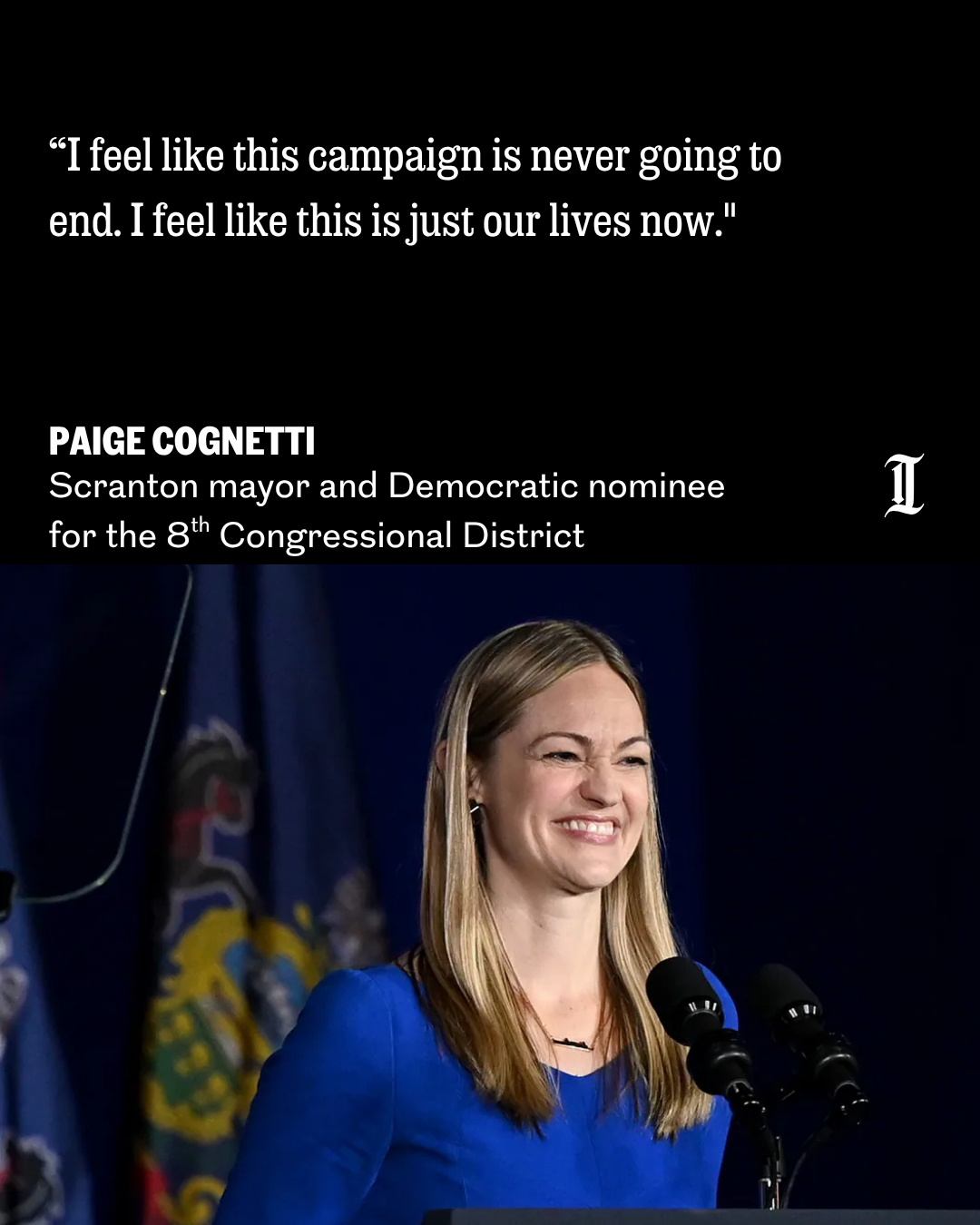
Scranton Mayor Paige Cognetti, the Democratic nominee against Republican U.S. Rep. Rob Bresnahan in the 8th Congressional District, opened a local candidate forum last week by addressing the elephant in most similar rooms across the country right now — she and other candidates are everywhere right now. And it can feel like a lot.
“I think it’s 11 days,” Cognetti said at the Oct. 23 forum. “You won’t have to see my face on your screen and your television screen every single day.”
The Democrat launched her campaign nearly 14 months ago and — like many others in her position — have been at a near-sprint since.
Is this “just our lives now?” We’ll find out soon.
👋 We hope you have a spooky Halloween weekend filled with sweet treats ahead of next week’s frights: waiting for the election results. 👻 We’ll see you next Friday with our final edition to break it all down.
A U.S.-based blockchain intelligence firm says a North Korean unit was likely behind the hack that impacted more than $6 billion on Binance, the world’s biggest cryptocurrency exchange.
Binance said it worked with blockchain partners to freeze roughly $3 billion in affected assets. It said Friday that it was beginning to recover assets for users.
The cryptocurrency exchange said deposits were unaffected, while withdrawals have been suspended and are expected to resume in the next day or two. It said it will cover all losses.
The company said on X that an initial investigation suggested the incident may have involved a compromised laptop, but that a subsequent investigation uncovered additional “points of breach.”
TRM, in a post on its website Thursday, attributed the attack to TraderTraitor, which it described as North Korea’s elite hacking unit. “We make this judgment with high confidence,” the firm said.
“An attacker moved approximately USD 6.36 billion out of Binance wallets on ten blockchains, most of it in about 20 minutes,” TRM said. That would make the hack the largest cryptocurrency theft on record, it said.
In February last year, another cryptocurrency exchange, Bybit, suffered a $1.5 billion hit when it was hacked. The FBI said North Korea and TraderTraitor were responsible for the hack.
“Several features of this attack match earlier North Korea-linked heists, including the Bybit hack,” TRM said.
Blockchain analysis company Chainalysis also believed the Binance hack was “likely done by DPRK group TraderTraitor,” its co-founder and CEO Jonathan Levin wrote on X. DPRK stands for the Democratic People’s Republic of Korea, North Korea’s official name.
Asked about the potential ties to North Korea, a Binance spokesperson said only that the company is “working closely with our law enforcement partners to confirm the identity of the criminals and bring them to justice.”
Experts say North Korea has turned to crypto hacking and other illicit cyber activities as a source of badly needed foreign currency to support its troubled economy and fund its nuclear program in the wake of tough U.N. sanctions and other difficulties.
In December 2022, South Korea’s spy agency said North Korean hackers had stolen an estimated 1.5 trillion won ($1.1 billion) in cryptocurrency and other virtual assets in the past five years, more than half of it in 2022 alone. It said North Korea’s capacity to steal digital assets was considered among the best in the world.
Changpeng Zhao, also known as CZ, founded Binance in 2017. In 2023, he pleaded guilty to a felony linked to failing to prevent money laundering on the platform, and stepped down as the company’s CEO. U.S. President Donald Trump pardoned Zhao in 2025.
Zhao posted Thursday on X that “User funds are safe!” but added that the theft “does look like a hack on Binance.” He added that while he doesn’t manage Binance anymore, “as a shareholder, I expect all user funds will be fully covered.”
The event, meanwhile, also raises questions about why stronger approval controls were not in place, said Kok Tin Gan, co-founder and CEO of cybersecurity firm NyxLab.
“This looks like one signature that gave the attacker a never-expiring, full-access token to a Binance hot wallet,” he said, referring to cryptocurrency wallets that hold users’ “private keys,” or unique authorizations, digitally and which are connected to the internet.
Binance said on X it had “found no evidence of any wallet private key leak” and that the company would release more technical details when its probe is complete.
JERUSALEM — Israel’s final election results confirmed that Prime Minister Benjamin Netanyahu and his allies lost their parliamentary majority and that weeks of difficult negotiations among very different parties, from ultra-Orthodox Jewish to secular to Arab-led, lie ahead.
The results released early Friday showed Netanyahu’s bloc won 53 seats in Tuesday’s election. The main opposition bloc won 48. Arab-led parties secured the other 19, a historic showing. Now parties must meet, bargain, and seek a way to team up for at least 61 seats in the 120-member Knesset.
Netanyahu, Israel’s longest-serving prime minister, remains in charge. His main opponents would most likely need to partner with the Arab-led parties to replace him.
Underscoring the fraught path ahead, Avigdor Lieberman, the leader of a right-wing anti-Netanyahu faction, on Friday appeared to rule out any partnership with Arab-led parties. That alone would make it nearly impossible for Netanyahu’s opponents to form a coalition to oust him.
The president will task someone with forming a government
Difficult decisions lie ahead. Will the main opposition parties that campaigned hard to unseat the divisive Netanyahu make the politically sensitive choice to partner with Arab-led ones? Or will they toss their vows aside to team up with Netanyahu in a potentially fractious unity government?
Israel largely shuts down on Friday for the Jewish Sabbath, and it was not clear who might be meeting with whom. Israelis debated possible coalitions and challenges, as some expressed traditional wariness around Arab parties and others insisted it was time for Jewish-led parties to embrace them.
The election results still need to be certified and submitted to the president next Wednesday. Then President Isaac Herzog will task someone with forming the new government. That could be the leader of the party that received the most votes — Netanyahu — or whoever leaders of the various parties believe is best suited.
If multiple attempts to form a government fail, Israel faces a new election early next year. Herzog this week said he will do everything in his power to avoid that scenario.
Netanyahu and Likud target Arab parties without evidence
In the hours before final results were announced, Netanyahu and his Likud party amplified unsubstantiated allegations that Arab-led parties had “stolen” the election, potentially with foreign assistance.
The opposition quickly accused Netanyahu of demonizing Arab citizens, who make up 20% of the population and showed up at the polls like never before in outrage over his far-right government.
On Friday, Netanyahu again warned against forming a coalition with Arab parties.
The head of Israel’s election committee, Supreme Court Justice Noam Sohlberg, had said “serious suspicions” of foreign interference had been brought before him. In a letter to the Shin Bet security agency, Sohlberg said he could not verify the claims but asked the agency to investigate.
Israeli media reported that members of Netanyahu’s party accused Qatar of involvement, allegations the Gulf state dismissed as “ridiculous and dangerous.” Many Israelis view Qatar as a patron of Hamas, while Qatar says its relations with the militant group are part of its U.S.-backed mediation efforts in the region.
The election commission said the investigation was based on classified intelligence. Acting Director General Dean Livne did not elaborate but warned that reports about the investigation had been “entirely unfounded.”
“It does not affect the final results that will be submitted to the president, nor does it concern any particular sector of the population,” he said.
By casting doubt on the vote, Netanyahu appeared to be trying to block any potential alliance between his opponents and the Arab-led parties. Netanyahu has suggested that it would be treasonous for chief rival Gadi Eisenkot or others to join with them.
The Shin Bet, seeking to calm tensions, said its investigation was not meant to “cast aspersions” on an entire section of the population that “exercised its right to vote in a democratic and lawful manner.”
The elections committee also sounded a note of caution in a letter written to a concerned member of parliament, saying that “allegations of systematic violations of electoral integrity are baseless.”
The committee wants findings from the Shin Bet within a week.
Opposition could assert control in the upcoming Knesset
Even as coalition negotiations begin, the new Knesset is expected to be sworn in Nov. 10. Once it convenes, Eisenkot’s bloc could join forces with the Arab parties to elect a new Knesset speaker, giving them control over the parliamentary agenda and potentially allowing them to advance and pass legislation before a new government is formed.
But Lieberman, a former Netanyahu ally now committed to ousting him, referred to the Arab parties as “supporters of terrorism” in a Facebook post, saying his Yisrael Beitenu party, which won seven seats, would not partner with them.
Arab party leaders have condemned Hamas’ Oct. 7, 2023, attack on Israel but have declined to label it a terrorist organization, in part because it would appear to justify Israel’s devastating campaign in Gaza.
Hundreds of Israelis have been holding rallies urging Eisenkot and others to join forces with the Arab-led parties, a step that has happened only once before, briefly, in 2021.
“I believe we should join forces and cooperate with the Arab parties, a legitimate population in the state of Israel,” said Miri Sklair, a resident of Jaffa.
Issa Jaber Abu-Ghosh, the former mayor of an Arab village outside Jerusalem, said “Israel all the time claims to be the only democracy in the Middle East,” but that it’s not a “real democracy” if its politics remain divided between Jews and Arabs.
If Netanyahu loses office, that would set off a cascade of events that critics say he has desperately sought to avoid. He would be politically weakened as he faces an ongoing corruption trial, and an official inquiry into the security failures surrounding Hamas’ Oct. 7, 2023, attack would almost certainly be launched.
As Republican anger grew on Thursday over a Democratic effort to stack Alaska’s Senate ballot with candidates to siphon votes from the GOP incumbent, the Justice Department issued dozens of subpoenas to people believed to be connected to the plan, according to two officials familiar with the investigation.
The actions come after a New York Times article on Wednesday revealed a secret plan involving national Democratic operatives and top aides with the Senate campaign of Mary Peltola, a Democrat, to recruit candidates to split votes from Sen. Dan S. Sullivan, her Republican opponent. In particular, the group was involved with recruiting Dan J. Sullivan, a retiree from a small Alaskan fishing village whose candidacy against the senator bearing a similar name has infuriated Republicans for months.
The subpoenas, most if not all of which were issued to Democrats, were part of an effort to quickly establish the facts in the case, taking advantage of federal authorities and investigative tools not readily available to local law enforcement authorities, a senior Justice Department official said.
Separately, the chair of a House oversight committee on Thursday sought interviews with two people involved with the plan.
“Knowing they can’t win on the issues, Democrats schemed to rig the U.S. Senate election in Alaska by deliberately confusing voters,” the committee chair, Rep. James Comer, R-Ky., said in a statement. “Americans deserve answers about this latest attempt by Democrats to defraud the American people, and we will get them.”
Democrats and Dan J. Sullivan have denied working together, but the Times offered fresh evidence to the contrary, prompting a sharp reaction from President Donald Trump and other Republicans. The Justice Department has already sued Alaska at Trump’s behest, seeking to stop the certification of the Senate race if votes for the other Sullivan cause the senator to lose.
The Times did not uncover evidence of illegal activity, and the lawsuit from the Justice Department did not allege any. Ballot-stacking is an age-old practice that has been used by both parties for decades.
In an updated filing on Thursday, however, lawyers for the federal government accused Democrats of having lied to the court. They also argued that certifying an election influenced by a plot to mislead voters would violate the U.S. Constitution, though they did not make clear how.
Legal experts said the Justice Department’s suit, which a federal judge has indicated she wants to resolve swiftly, did not stand a good chance of succeeding.
“It’s performance art this close to the election,” said Republican election lawyer Benjamin Ginsberg.
He also said he does not believe the federal government can prove it has standing in the case and said “I don’t see a federal crime,” in the attempt to recruit alternate candidates.
In June, the Alaska Supreme Court ruled that both Sullivans could remain in the race. The Alaska Division of Elections took steps to differentiate the two candidates on the ballot, labeling the senator a Republican and an incumbent, while including no labels for the other Sullivan.
Ballot-stacking strategies are common in politics and generally considered legal, if misleading. Republicans engaged in the tactic in Alaska this year, too, trying to prop up Democratic candidates in the Senate primary to siphon votes from Peltola. They also supported a legal effort in 2024 to keep a Democratic candidate on the same ballot as Peltola when she was running for reelection to the House. She went on to lose the race.
Separately, Gov. Mike Dunleavy of Alaska, a Republican, ordered the state Public Safety Department to investigate whether any people associated with Peltola’s campaign should face criminal charges or civil penalties for their involvement in the deception. Asked on Fox News whether this was disqualifying for Peltola, Dunleavy said it was “hugely problematic” for her.
“If it leads to criminal charges, we don’t care who that is, we don’t care if it’s a candidate,” he said. “What’s more important is maintaining election integrity for the people of Alaska, and so if it leads to that individual, the candidate, then so be it.”
State election leaders tried to boot Dan J. Sullivan from the ballot this summer, but the Alaska Supreme Court overruled them. Dunleavy told Fox News that he believed state justices would have made a different decision if the Democratic role in Sullivan’s campaign had been known at the time.
The governor also noted than more than 60,000 people have already voted in Alaska without the benefit of knowing what the Democrats had plotted. He described the situation as “a dog’s breakfast.” In an interview with News Nation, Dunleavy said that if crimes were committed, “that may in fact impact whether somebody is seated in the U.S. Senate.”
Dunleavy and Lt. Gov. Nancy Dahlstrom, who oversees state elections, leave office Dec. 7. Their successors will be decided next week.
In a statement, Austin McDaniel, the deputy commissioner of the state’s Public Safety Department, confirmed that the department “has initiated an investigation into the alleged conduct outlined in a recent New York Times article.” He did not have any further comment.
Peltola brushed off the article at a rally on Wednesday, saying it was “just another distraction.”
Comer, the House oversight committee chair, issued interview requests to two people described in the article as being involved in the Democratic scheme. Those people were Elisa Rios, Peltola’s former campaign manager, who was fired in August and later spoke to the Times about the ballot recruitment plan, and Jerid Kurtz, a Democratic operative who worked in secret in Alaska to recruit candidates, according to the Times’ reporting.
Joelle Hall, an ally of Peltola and the former president of the Alaska branch of the AFL-CIO, a prominent labor union federation, said she did not believe the reporting that the Peltola campaign was involved in recruiting other candidates. But even if it was, she said, “there’s nothing illegal about it.”
“I wish everyone would focus on what this really is: a pretext for Trump to come to Alaska and try to steal our election,” she said. “This is going to lead to lawsuits and more lawsuits and everything they can possibly think of to try to stop Mary Peltola from being seated in the U.S. Senate.”
Good morning, South Jersey. Even if you’re not trick-or-treating or headed to a costume party, make a point to go outside. Temps should be pretty mild and it’s peak foliage time.
Speaking of being festive, Inquirer reporters went on a mission to find the best myths, places, and festivities in Philly and South Jersey to compare what each side of the Delaware River offers for Halloween.
Plus, a celebrity hairstylist who is also a Republican candidate for a Gloucester County commissioner seat is running a nonprofit that has been out of compliance with the state for years, and more news of the day.
For those who want to get into the Halloween spirit, there are usually two camps: the people who simply want to have harmless and family-friendly fun vs. those who are in it for the thrill.
In South Jersey, both wants can be satisfied:
If you’re looking for cute festivities, the Diggerfest Fall Festival in West Berlin and the Asbury Park Zombie Walk on the boardwalk are options that all ages can enjoy.
If you’re a horror lover, it’s hard to be beat our legends surrounding the Jersey Devil, the Atco Ghost, and the Absecon Lighthouse in Atlantic City. We also have the Night of Terror at Creamy Acres Farm in Mullica Hill, our massive Halloween park with a haunted hayride and zombie paintball.
After about a year and a half of business, Federal Donuts & Chicken in Marlton is closing on Saturday.
But doughnut lovers won’t go without for too long since the franchise owner already has plans to open a Randy’s Donuts in its place by the end of this year.
After it shutters, there will only be four Federal Donuts left in the area and they’re all franchises.
When it reopens as Randy’s Donuts, the California-based bakery will be the first one in New Jersey.
A grand jury indicted a Burlington Township man on multiple charges for posing as a young boy to solicit underage girls to send him explicit images and videos and then distributing them, Burlington County Prosecutor LaChia L. Bradshaw announced Wednesday.
Some local business owners and residents in Lavallette are skeptical of Netflix’s plans to film there and potentially delay the town putting up their holiday decorations, NBC10 reports.
🧠Trivia time
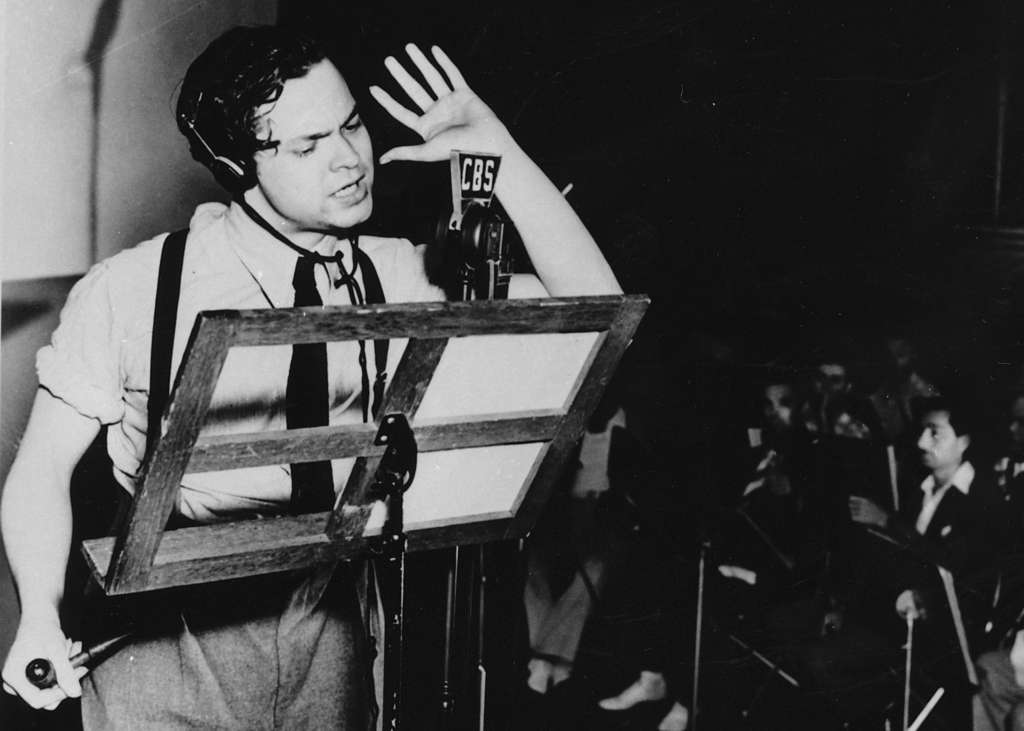
Orson Welles adapted H.G. Wells’ The War of the Worlds for radio that caused scores of people to believe Martians invaded New Jersey in what year?
Mayor Cherelle L. Parker hopes to debut a new city program by the end of the year that is designed to offer affordable mortgages for city residents.
Parker discussed the program, known as “One Philly Mortgage,” at an Axios Live event this week, saying it would be the first of its kind for a major U.S. city. Once launched, it would provide 30-year fixed-rate mortgages for local first-time home buyers with credit scores of 620 or more with no private mortgage insurance.
“We want the lending industry, banking industry, to say, ‘Hey, we’ll take this risk,’” Parker said at the Tuesday event. “But the city of Philadelphia proper shoulders it.”
Parker added that the city has been working with Citizens Bank to serve as its first lending partner, and is in discussions with other financial institutions. The effort is part of Parker’s Housing Opportunities Made Easy initiative, which she proposed in February 2025.
Here is what you need to know:
What is the One Philly Mortgage program?
The One Philly Mortgage program aims to help “low- and moderate-income Philadelphians” buy their first homes, according to the Philadelphia Housing Development Corporation website. Some of the interest for the required loans will be paid for using public funds, and no mortgage insurance is slated to be paid as part of mortgages secured under the program.
Down payments of “no more than 3%” will be required, according to a city flier detailing the program. It would be open to households that make up to 120% of the area median income, which would be about $100,000 for single-person households, or $143,000 for four-person households, The Inquirer previously reported.
“There is an affordability and housing crisis across the nation. Philadelphia is not unique,” Parker said Tuesday. “Imagine getting a mortgage, a 30-year commitment, with no [private mortgage insurance], and we have in essence brought down the interest rates.”
The program is similar to one launched in Massachusetts known as the ONE Mortgage Program. That effort also offers 30-year fixed-rate loans with 3% down payments and waived mortgage insurance for first-time homebuyers with lower credit scores. It has assisted about 22,000 households, according to the Massachusetts state government website.
Parker’s H.O.M.E. initiative
The effort is being touted as part of Parker’s H.O.M.E. efforts, for which City Council previously approved $278 million in its first phase. So far, Parker’s administration has spent only $38 million of that allotted budget, according to a recent Inquirer report, and plans to spend the remaining $240 million by the end of the fiscal year in June.
One of the initiative’s goals is to preserve 30,000 housing units, and it is largely funded with $800 million in city bonds approved by Council in June 2025. However, it has faced some delays caused by negotiations with lawmakers over how those bond proceeds would be spent, The Inquirer previously reported.
In total, 29 housing programs are included under the H.O.M.E. umbrella, but as of Sept. 30, only four have reportedly received funding. Many efforts tied to the initiative have yet to launch.
Program receives some criticism
Despite not yet being launched, the One Philly Mortgage program has faced some criticism in the media following Parker’s discussion of it this week. Fox Business’ The Big Money Show, for example, discussed the effort Wednesday, with one host calling it “insanity.”
“It’s offering an on-ramp to ownership for people that can’t qualify for a mortgage,” said co-host Lou Basenese, adding that it would give “more people an opportunity to lose their home because the lenders get bailed out, the homeowner doesn’t.”
Others on the show Wednesday compared the effort to the 2008 subprime mortgage crisis, which resulted in a serious economic recession. That year, the U.S. housing market collapsed due in large part to subprime mortgage lending. Subprime borrowers, who are usually defined as having credit scores below 620, are seen as high credit risks by lenders.
Drexel University economist Kevin Gillen likewise cautioned in an interview with Axios that the program could face difficulties, saying that increasing homeownership levels was not desirable if the practice “just increases the foreclosure rate in the long term.”
Orson Welles had adapted for radio a classic sci-fi novel: H.G. Wells’ The War of the Worlds.
But scores of people missed it. A second disclaimer, reminding listeners the program was a dramatization, would not air for nearly 40 minutes.
In the meantime, a series of escalating news-like bulletins featuring first-person accounts from authoritative voices reached an incredible conclusion.
Martians had invaded New Jersey.
Space invaders
The novel started it.
Prior to its publication, life existing outside of our earthly bubble was a thrilling concept.
And then Wells published The War of the Worlds, serialized first in magazines before taking book form in 1898. The allegory for British imperialism planted a worrisome thought: What if the Martians were not friendly?
Science fiction started transitioning from stories about peaceful space visitors to tales of aggressive invaders.
Fast-forward to October 1938: The United States was in the throes of the Great Depression, violence was spreading across Europe, and it was Mischief Night.
Orson Welles directs the original radio broadcast of H.G. Wells’ “The War of the Worlds” in 1938, performed by “Mercury Theatre on the Air.” The show was convincing enough to make some think New Jersey was being invaded by aliens.
And this broadcast, despite two more times reminding listeners it was a fictional account, made it seem realistic that meteorite-shaped spacecrafts had landed in the farmlands of New Jersey carrying “the vanguard of an invading army from the planet Mars.”
Martians shooting ray-guns and spreading poisonous gas was a perilous thought, and it didn’t make listeners feel better when the invaders could not adapt to our atmosphere and were defeated by earthling germs.
Fact and fiction
People panicked.
In Philly, “women and children ran from their homes screaming,” and “families packed their belongings and prepared to leave their homes,” The Inquirer reported.
The Inquirer offices reportedly fielded more than 1,000 phone calls from frantic readers who wanted to know if the sky was falling and, if so, how city leaders planned to stop it.
But many newspapers, which were now second fiddle to the nearly ubiquitous radio, got carried away. Reports of emergency vehicles being dispatched, and neighbors kneeling together in prayer, were a bit overblown.
On Halloween, newspaper reporters interrogated Welles. Did he want to frighten people, and blur the line between fact and fiction?
They never did get a good answer.
And all the attention and controversy elevated Welles’ performance into an instant classic and then a legend. It helped catapult the actor’s career, which peaked with his movie Citizen Kane, which detailed the rise and fall of a newspaper magnate.
An outspoken educator once lauded and entrusted by the Philadelphia School District to direct the social studies curriculum is fighting to keep his job as the district faces sustained political pressure over allegations of stoking anti-Israel sentiment.
Superintendent Tony B. Watlington Sr. disclosed the revelation to Congress at a hearinginitiated this fall as part of a federal probe of alleged antisemitism in the district —the second such investigation since the Oct. 7, 2023, Hamas attack on Israel and the war against Hamas that followed.
“Mr. Jimenez is in a termination proceeding,” Watlington told Congress, referring toIsmael Jimenez, the district’s social studies curriculum director, according to a transcript of the hearing released Oct. 21. After fielding complaints from some Jewish parents and outside groups, the district is now undertaking a “comprehensive review” of its social studies curriculum under the purview of a new chief academic officer he had hired, the superintendent said.
Watlington also said hehas ordered a review of some teachers’ personal social media posts.
The House Committee on Education and the Workforce report concluded the district teaches students to “hate Israel” and “embrace radical” ideas. The school district roundly rejects the allegations, which it says were “blatantly partisan.”
Jimenez filed suit against the school district Wednesday in federal court, alleging violations of his First Amendment rights. He said he has suffered financial loss, professional injury, and deterrence of protected expression” from the district’s “unlawful retaliation” over his personal social media posts.
Jimenez could be the first district employee to lose a job amid the furor over its handling of antisemitism allegations. Others in the city’s school district have been investigated over personal social media posts and allegations of expressing antisemitic or anti-Israel sentiments in a school setting, but only one other district educator has faced similar discipline.
Jimenez, whose name was invoked 33 times during the daylong hearing, said in an interview he believes the termination attempt and curriculum changes represent the district “kowtowing” to conservative politicians in power and their allies.
“I think it’s appeasing the authoritarian and the fascist tendencies that the Trump administration made possible, that embolden demagoguery of these politicians who are using claims of antisemitism to stifle any type of critical history, critical social studies,” said Jimenez, 45.
Superintendent Tony B. Watlington Sr. told Congress the district is attempting to terminate Ismael Jimenez, its director of social studies.Jessica Griffin / Staff Photographer
Jason Holtzman, chief of the Jewish Federation of Philadelphia’s Community Relations Council — an organization that has lodged multiple complaints about Jimenez to the district since 2024 — dismissed the notion that the district was reacting solely to the Trump administration.
“As director of social studies for the entire district, Jimenez made statements on camera that rationalized the Oct. 7 massacre and denied the Jewish people’s connection to the land of Israel,” Holtzman said in a statement.
“The Jewish Federation of Greater Philadelphia has raised concerns about Jimenez’s conduct for years, and Jewish parents in Philadelphia asked the district to address these issues more than two years ago, long before the congressional investigation. The concern is not simply how long it took the district to act, but why Jewish students and families had to wait so long for their experiences to be taken seriously.”
The House committee that grilled Watlington has caused ripples in Philadelphia before. In 2023, the University of Pennsylvania’s then-president Liz Magill was called to testify about the university’s handling of antisemitism on campus after Hamas’ Oct. 7 attack. She resigned after days of pressure and ire over her testimony.
A sharp U-turn
Hundreds of pages of documents related to Jimenez’s disciplinary hearings and termination proceedings, obtained by The Inquirer, paint a picture of an educator whose career took a sharp U-turn at the time outside groups began complaining about him.
Jimenez spent 12 years as a district social studies teacher, first at Germantown High, then at Kensington High School for the Creative and Performing Arts. He had no disciplinary incidents during that time.
In 2022, he was promoted to become a social studies curriculum specialist, and then the social studies curriculum director, a job that pays $137,669 annually. The district in 2024 pointed to him as an exemplary employee.
“Mr. Jimenez has invested in the deep and critical work of expanding our city and district’s knowledge and consciousness of the power that Black and African American people have always held, while also advocating for the resources that enable Black and African American communities to truly thrive,” district officials wrote in a February 2024 post celebrating standout Black educators, noting their “immense gratitude and admiration” for Jimenez’s work.
Later that year, in the wake of the Oct. 7 attack on Israel and the start of the politically divisive war between Israel and Hamas, a new group called the School District of Philadelphia Jewish Family Association began lodging complaints about Jimenez.
On March 13, 2024, the SDPJFA sent an email blasting Jimenez to the school board, Watlington, and the district’s chief counsel. Its members, who are not named, objected to what it said was Jimenez’s purchase and distribution of a book about the “colonization of Palestine” for his central office team. The book, the group said, was an attempt to “directly distribute controversial, political information to be shared in classrooms across the district,” which it considered biased, one-sided, and a violation of district policy.
Jimenez, in correspondence with a district official, said that the group’s claim was wrong — another curriculum team member purchased the books, not him. And the books were meant for and distributed only to his curriculum staff, not to schools or students, he said.
The group also objected to Jimenez’s personal social media accounts, which it said contained “antisemitic and anti-Israel views.” The group said they believed the accounts blurred the lines between professional and personal, as Jimenez disclosed his job title.
Jimenez, in the Inquirer interview, said the groups — and Congress — took personal posts out of context, including a post from 2020, when he was still a classroom teacher. In the 2020 post, Jimenez wrote that “Israel is a terrorist state,” which he said was a response to a specific killing.
“I was not talking about an ethnic group,” said Jimenez. “I was not saying, ‘Jewish people are evil,’ or something crazy like that. I literally said the state of Israel, so I was talking about a government, and I made it very clear.”
In April of 2024, the district commissioned an outside firm to investigate possible improprieties by Jimenez.
The Jimenez investigation concluded the educator did not purchase or approve improper or antisemitic learning material, and that the district did not “act indifferently in permitting the creation of a hostile environment in its schools with regard” to Jimenez.
Investigators also, at the time, found that while Jimenez’s personal social media posts were protected by the First Amendment, they violated district policy and were a “cause for concern,” according to the investigation report.
More scrutiny
Soon after that outside investigation concluded, Jimenez’s supervisors began reviewing social studies curriculum in ways they hadn’t before the outside complaints about his work, hesaid.
In June, an activist group backed by GOP donors accused Jimenez of antisemitism with a mobile billboard parked in front of district headquarters and Jimenez’s home. Around that time, similar billboards parked outside the University of Pennsylvania and schools in Central Bucks school district accused other educators of antisemitism.
Jimenez subsequently got written up multiple times, according to district records, with claims of insubordination and not following directives — such as one to respond to an email about proposed professional development sessions on antisemitism and Islamophobia. (Jimenez told his supervisor he had been instructed by his lawyer “not to touch” issues like that one, presumably because of the ongoing outside complaints.)
He was also cited for participating in a radio interview that was streamed on Facebook, and for “liking” posts on his personal account including “Zionism is Racism” and “… the connection of Israel with the system of white supremacy …”
Jimenez, in a response to one write-up, said the district’s social media policy was not clear on whether such passive engagements constituted endorsement or policy violations.
Jimenez that August made an internal complaint about a “toxic work environment,” citing pressure in the wake of the outside pressure and what he said was a lack of support from the district.
In a June 2025 written protest of another disciplinary report, Jimenez said the district’s “actions reflect a troubling pattern of increased scrutiny and appear to be influenced by external attacks on my character rather than any documented violation of district policy. Before the circulation of third-party defamation, there were no documented concerns regarding my work performance.”
Jimenez was eventually suspended with pay, and then without pay, before termination proceedings began in October 2025. Those proceedings are still ongoing, and he is fighting them.
But the scrutiny continues — in February, for instance, the Committee for Accuracy in Middle East Reporting and Analysis, a pro-Israel group, issued a report denouncing the district’s social studies curriculum, which it found is “grounded in a critical race theory framework” and “emphasizes a thematic ‘history of grievance,’ largely at the expense of chronological historical study.”
Jimenez, who has filed complaints with the Pennsylvania Human Relations Commission and the district’s Office of Inspector General, believes the shift from the district promoting him and praising his work to writing him up and now attempting to fire him “is connected to people being scared about these outside attacks,” he said in the interview.
Nearly 2,000 people have signed a petition urging the district to reinstate Jimenez.
“We are concerned that the district has capitulated to the racist, right-wing, and pro-Israel forces that have been attacking Ismael and other antiracist teachers in the school district,” said the petition, started by the Teacher Action Group and Philly Educators for Palestine, a group that recently disbanded.
Aaron Terr, vice president of public advocacy for the Foundation for Individual Rights and Expression, said he did not know enough about Jimenez’s specific case to speak to whether the district’s treatment of him is an attempt to placate political forces.
“The Trump administration has a history of wielding anti-discrimination law against educational institutions in ways that raise serious First Amendment concerns,” Terr said in a statement. “But whatever pressure they face, districts need to meet their dual obligations of addressing discriminatory harassment and respecting educators’ First Amendment rights.”
What Watlington told Congress
Watlington stands by the district’s curriculum, he told the House Education and Workforce Committee, led by U.S. Rep. Tim Walberg (R., Mich.).
Still, Watlington told Congress the district would not use teacher-written social studies curriculum going forward. Watlington said he gave his new chief academic officer, Michael Farrell, the charge to switch to a nationally vetted curriculum, following the standardization of math, English, and science curricula over the past several years.
Jimenez noted the teacher-written social studies curriculum now planned for replacement in the 2027-28 school year was nationally vetted — by the Council of Great City Schools.
“We spent years doing serious intellectual work, developing curriculum grounded in historical inquiry, evidence, and civic reasoning,” he said. “Teaching students about colonialism, resistance, economic inequality, or injustice is not indoctrination. These are essential parts of understanding history and the world we live in. The quality of our work should be judged by its historical accuracy, instructional design, sources, and assessments, not isolated excerpts used to advance a political argument.”
Members of Congress and their staff repeatedly grilled Watlington on posts and activities by individual district employees — not just Jimenez, but also some district teachers, including Hannah Gann, who recently made headlines for pretending to be Black and Palestinian. (She is white and Jewish.)
The stakes are high, as evidenced by Magill’s fate after the Penn congressional hearing.
Watlington said he had told his human resources department to conduct a “look-back” at some district staff’s personal social media posts that may have violated harassment and discrimination policies, even if those had already been probed.
The district was required to examine “any complaint received, regardless of source, related to discrimination based on national origin, shared ancestry,” Watlington told the committee. It agreed to do so in a voluntary settlement of a Department of Education complaint over allegations of antisemitism, but the superintendent said he went further “to do a comprehensive look-back” at any posts that were flagged between 2024 and the present.
“I want to know if anything was missed, quite frankly,” Watlington said. “I’ve asked for a look-back to ensure that things that were investigated, that we didn’t miss anything and that it was done properly.”
Congressional staff cited a 2025 chat on Signal, a private, encrypted messaging platform, started by some district teachers, but allegedly including some district students.
Gann, in the chat, advertised a rally for “rage” and “resistance” with a graphic showing a bulldozer breaking through a fence, as Hamas did during its Oct. 7 terror attack. Watlington was asked whether it was appropriate to share such an image with students
“Absolutely not,” Watlington said. “Let me be crystal clear — teachers have no business, under any circumstances, communicating with children on private chats. Period.”
Staff also pointed to social media posts by Gann and by Shaw MacQueen, another district teacher active in the group Philly Educators for Palestine, which disbanded recently after Gann’s deception was revealed.
Asked if Gann had been disciplined for her posts, Watlington said, “I do know that Ms. Gann, as well as some other individuals, are being reviewed currently.”
Gann declined to comment on the congressional investigation.
MacQueen, who remains a district teacher, said he was surprised to find himself mentioned in a congressional hearing.
He said he was concerned about “continuing attacks” on educators and critical race theory, and also expressed support for the district’s current social studies curriculum and Jimenez.
MacQueen said he was disappointed in the district, which in the past publicly committed to equity and antiracism work, but now is “just going to sit there and say what these people want you to say. I see it as just the continuation of an ongoing history of trying to scare individuals from speaking out, to stop them bringing a light to injustice.”