Category: News

  • A Rocky curse, a no-hitter jinx, and a big night for Philly food | Weekly Report Card

    A Rocky curse, a no-hitter jinx, and a big night for Philly food | Weekly Report Card

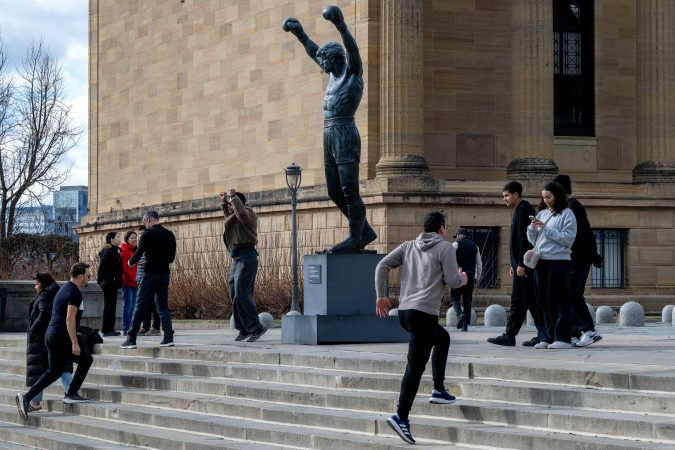
    The Rocky statue curse claims another victim: A

    An Ecuadorian influencer wrapped his country’s flag around the Rocky statue before Sunday’s World Cup match and immediately learned a lesson generations of visiting fans have learned before him.

    Don’t mess with Rocky.

    After Ecuador lost 1-0, social media quickly concluded the curse had struck again. The poor guy spent the next 24 hours apologizing to an entire nation and explaining that he simply didn’t know the rules. (Another fan also put a custom jersey on the statue.)

    But Philadelphians weren’t content with one curse. Almost immediately, attention shifted to Ecuador fans gathering at the Hard Rock Cafe, prompting comparisons to Commanders fans who famously “took over” the same restaurant before getting flattened by the Eagles in the NFC championship game.

    The Rocky curse has decades of lore behind it. The Hard Rock curse appears to have been invented sometime this week.

    Which is exactly how sports superstitions are supposed to work, right?

    Hawker John Culin sells Surfside canned cocktails during a Phillies game at Citizens Bank Park in 2024. Surfside canned cocktails led the Phillies’ stadium drink sales last year.Elizabeth Robertson / Staff Photographer

    Surfside has become the official drink of saying, “Fine, I’ll get one”: A-

    There was a time when a Philadelphia summer meant a soft pretzel, a hot dog, and a beer.

    Now, it apparently means spending $16 on a Surfside at Citizens Bank Park, and somehow doing it again the next inning.

    Stateside says it sold more than 11 million cases of Surfside last year, has moved into a massive new Center City headquarters, and is turning down offers from major beverage companies that want a piece of the business.

    Not bad for something many people first encountered while standing in line at a Phillies game.

    The annoying thing is that it’s also very good, which makes it much harder to complain about the price (not impossible, just harder).

    At this point, Surfside has joined the ranks of Wawa coffee, Tastykakes, and water ice: a local product that quietly became part of Philadelphia culture.

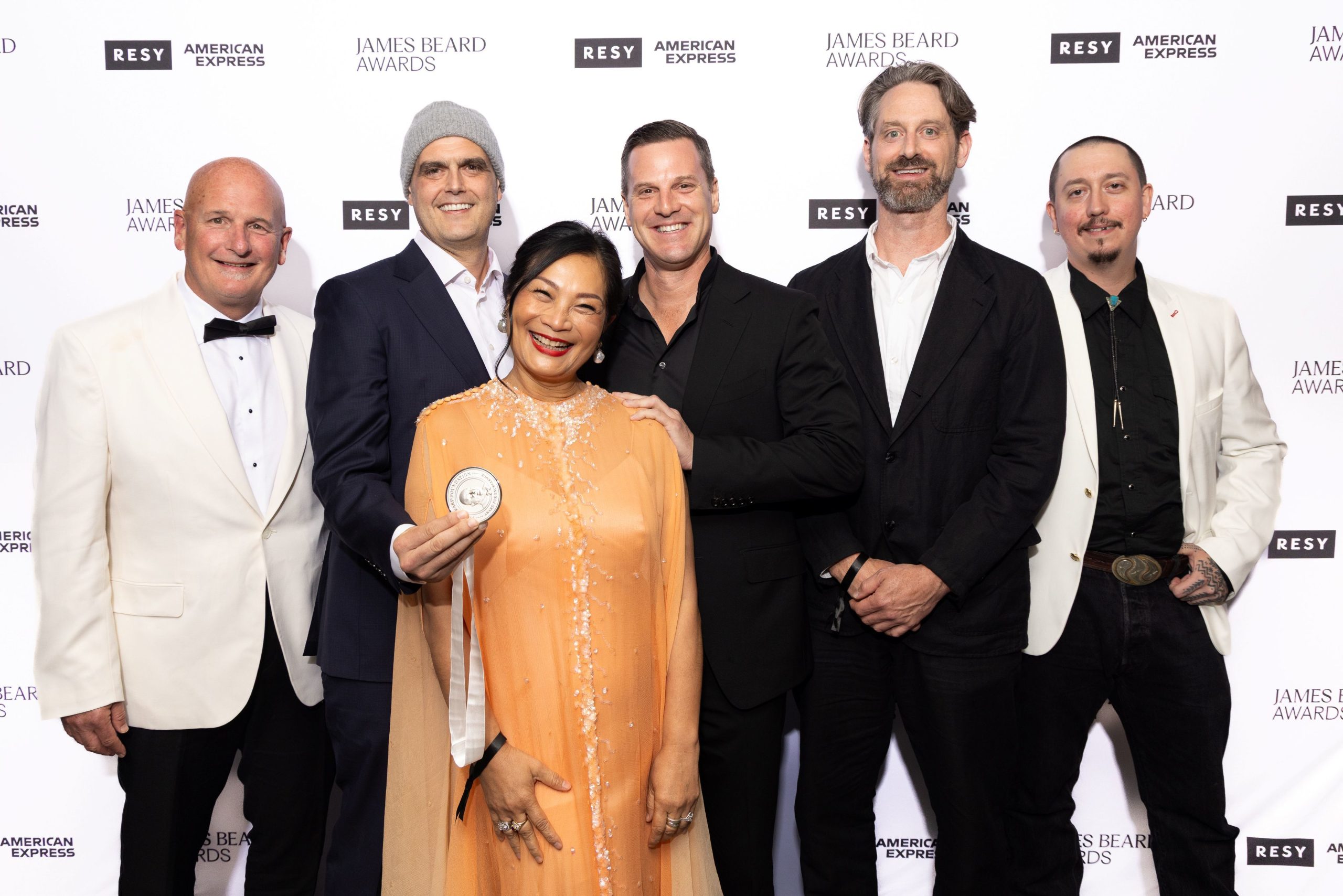
    The team from Kalaya on stage at the 2026 James Beard Awards with chef Chutatip “Nok” Suntaranon (from left): Al Lucas, Nick Kennedy, Greg Root, Jerome Skaggs, and Benjamin Duignan.© Huge Galdones Photography / James Beard Foundation

    Philly’s James Beard haul: A

    For years, Philadelphia food stories came with a chip on their shoulder. The city was seen as underrated and overlooked when compared to New York and D.C. But now, that argument gets harder to make every year.

    This week, Kalaya won outstanding restaurant at the James Beard Awards and Jesse Ito finally captured best chef: Mid-Atlantic after what felt like an annual pilgrimage to the finalist list — he had been nominated for the award NINE times!

    Kalaya has spent years introducing diners to southern Thai cooking at a level that made national critics pay attention. Ito’s Royal Sushi & Izakaya is so sought-after that getting a reservation is almost impossible.

    So these really aren’t underdog stories anymore, they’re expectations. Philadelphia sent seven finalists to Chicago for the awards and came home with two major wins.

    A decade ago, that would’ve been a breakthrough, but now it feels like a normal year.

    Fans reach for a ball that entered the stands during a FIFA World Cup Group E match between Ecuador and Ivory Coast on June 14, 2026, at Lincoln Financial Field. The match marked the first FIFA World Cup game played in Philadelphia.Jose F. Moreno / Staff Photographer

    Philadelphia’s World Cup debut: A

    For months, the conversation centered on everything that might go wrong.

    Traffic, transit, crowds, security, weather — if anyone would actually show up.

    Instead, the first week of the World Cup has mostly served as a reminder that Philadelphia can throw a pretty good party. The city is filled with visiting fans, flags, jerseys, and the sort of international energy that rarely comes through town at this scale. SEPTA has had a few hiccups. The weather has done what Philadelphia weather does. But the city itself has looked good.

    More important, Philadelphians seem to have embraced the whole thing.

    There was always going to be some skepticism, but somewhere between the FIFA Fan Festival, the packed stadium, and thousands of visitors wandering around Center City, the World Cup stopped feeling like something Philadelphia was hosting and started feeling like something Philadelphia was enjoying.

    And we’re only getting started.

    PPA towing residents with permits: F

    Like we just said, the World Cup has gone better than many people expected, which is why this one stands out.

    Fairmount residents were told to register for special parking permits during the FIFA Fan Festival. They registered, but then some got ticketed anyway and a handful even got towed. The PPA says the tickets will be canceled and fees refunded, which is good.

    But “we’ll fix it later” tends to land differently when you’re standing in an empty parking spot wondering where your car went.

    The encouraging part is that the number of mistakes was relatively small compared with the thousands of tickets issued around the festival. But, if you’re one of the people who had to Uber to a tow lot in South Philly to retrieve your vehicle, that statistic probably isn’t very comforting.

    Mike Gansey’s first Philadelphia sports lesson: Never say it out loud: D+

    Every city has its rules, and Philadelphia’s are simple.

    Don’t mess with Rocky. Don’t wear Cowboys gear. And under absolutely no circumstances should you mention a no-hitter while it’s happening.

    The newly hired Sixers president learned that lesson the hard way this week when he casually noted on a TV broadcast that Jesús Luzardo’s no-hitter was still intact.

    Seconds later, it wasn’t. To Gansey’s credit, he immediately did what any reasonable Philadelphian would do: apologize.

    The good news is that Luzardo still pitched well, the Phillies still won, and Gansey appears genuinely remorseful. The bad news is that his first viral moment in Philadelphia involved accidentally becoming the physical embodiment of every fan yelling “shut up!” at their television.

    Welcome to town, Mike!

    The Highmark Mann Center, in Philadelphia, June 15, 2026.Jessica Griffin / Staff Photographer

    The new Mann: A

    For a city that never really got a big Semiquincentennial gift, the renovated Highmark Mann will do nicely.

    Fifty years after opening in 1976, the Mann has emerged from a yearslong renovation looking like the sort of project Philadelphia hoped more places would undertake ahead of 2026. There’s a dramatic new entrance, upgraded sound, expanded public spaces, and a massive digital wall that feels more Times Square than Fairmount Park.

    The Mann opened in 1976, the last time America threw itself a big birthday party.

    It’s fitting that one of the best things to come out of the 250th conversation is a 50-year-old Philadelphia institution getting ready for its next 50 years.

  • President Donald Trump unveils the new Air Force One, a converted Qatari jet

    ANDREWS AIR FORCE BASE, Md. — President Donald Trump on Friday showed off the new Air Force One, a formerly Qatari-owned jumbo jet that has been converted into the official U.S. presidential aircraft.

    The new aircraft eschews the Kennedy-era robin’s egg blue exterior of the old plane for a bolder look, with the underbelly of the plane painted navy blue with a red stripe above it. The plane’s left side, where the president boards, features the presidential seal, while the tail of the aircraft has a massive American flag on it.

    “This plane was transformed into a flying White House at a level of luxury that nobody has ever seen before,” Trump said from inside the massive Andrews Air Force Base hangar, as a couple of hundred assembled Air Force personnel looked on. He spoke after stepping off the new plane in a dramatic flourish, as his signature tune “God Bless the USA” played.

    He confirmed that he would be taking the new jet to the NATO summit in Ankara, Turkey, next month and indicated he would be returning to China “at some point,” presumably a reference to the Asia-Pacific Economic Cooperation summit that China is hosting in November. His return from the Group of Seven summit in France this week was the last planned trip aboard the old Air Force One, he said.

    “Now, when we land at airports in London and in Germany and different places, nobody tops this one, and that’s the way we have to have it for our country,” Trump said, noting that the colors and the design were to “my taste, I will say.”

    He added that the new Air Force One will do a flyover during the July 4 celebrations next month.

    The gift from Qatar is serving as a so-called “bridge” aircraft to carry the president until the new planes ordered directly from Boeing arrive. That delivery is currently slated for 2028.

    The administration formally accepted a luxury Boeing 747 jet from Qatar last year to be used as the presidential airplane, despite questions about the ethics and legality of accepting such an expensive gift from a foreign government. Trump has insisted in the past that he would not fly around in the Qatari jet once he leaves office and said it would instead be donated to a future presidential library.

    Trump on Friday said the U.S. was in a “little bit of a logjam” as they awaited the delivery of the new jets directly from Boeing, which had originally been scheduled for 2024 but have been delayed. He recalled asking the emir of Qatar for use of one of their planes.

    “See, a normal president wouldn’t do this. A normal president wants to stay away from aircraft,” Trump said Friday. “But our country has to be represented properly.”

    The Air Force said in a news release Friday that any plane deemed Air Force One “must meet rigorous security requirements” and that the Qatari plane “was modified under a disciplined engineering approach that prioritized these exact core capabilities above all else.” The Air Force also said “much of the previous head of state interior layout” of the plane was kept intact.

    The Air Force has said in the past that security modifications to the jet would cost less than $400 million.

    Trump’s efforts to reimagine the presidential airplane date back to his first administration, when he directed that an incoming fleet of new jets would adopt a color scheme that was nearly identical to that of his personal airplane. Then-President Joe Biden reversed the decision in March 2023 as an Air Force review suggested that the darker colors could increase costs and delay delivery of the new jets, but once Trump returned to office, he returned to his desired colors for the plane.

    Other government jets that carry other top administration officials will also use the similar red, white, and navy color scheme, the Air Force said earlier this year.

    An Air Force spokesperson, who spoke on condition of anonymity to discuss sensitive plans, told the Associated Press that the two current planes, known as VC-25As, will not be retiring. Instead, they will remain in the fleet until the new Boeing planes, referred to as VC-25Bs, come into service, the spokesperson said.

    It is unclear how the older jets will be used but the spokesperson said that both the Qatari jet as well as the VC-25As will be available for use and “the Presidential Airlift Group will select the appropriate aircraft for each mission based on operational requirements.”

  • At its Juneteenth celebration, Philly’s African American Museum unveiled exhibit on the woman who escaped slavery at the President’s House

    At its Juneteenth celebration, Philly’s African American Museum unveiled exhibit on the woman who escaped slavery at the President’s House

    The line to enter Philadelphia’s African American Museum stretched a full block up Arch Street on Juneteenth Friday morning and never let up all day — not through performances by the West Powelton Steppers and not even when Doug E. Fresh and Slick Rick took the stage.

    History, whether from these hip-hop legends or the Black ancestors summoned by the crowd during the ritual pouring of libations, was all around.

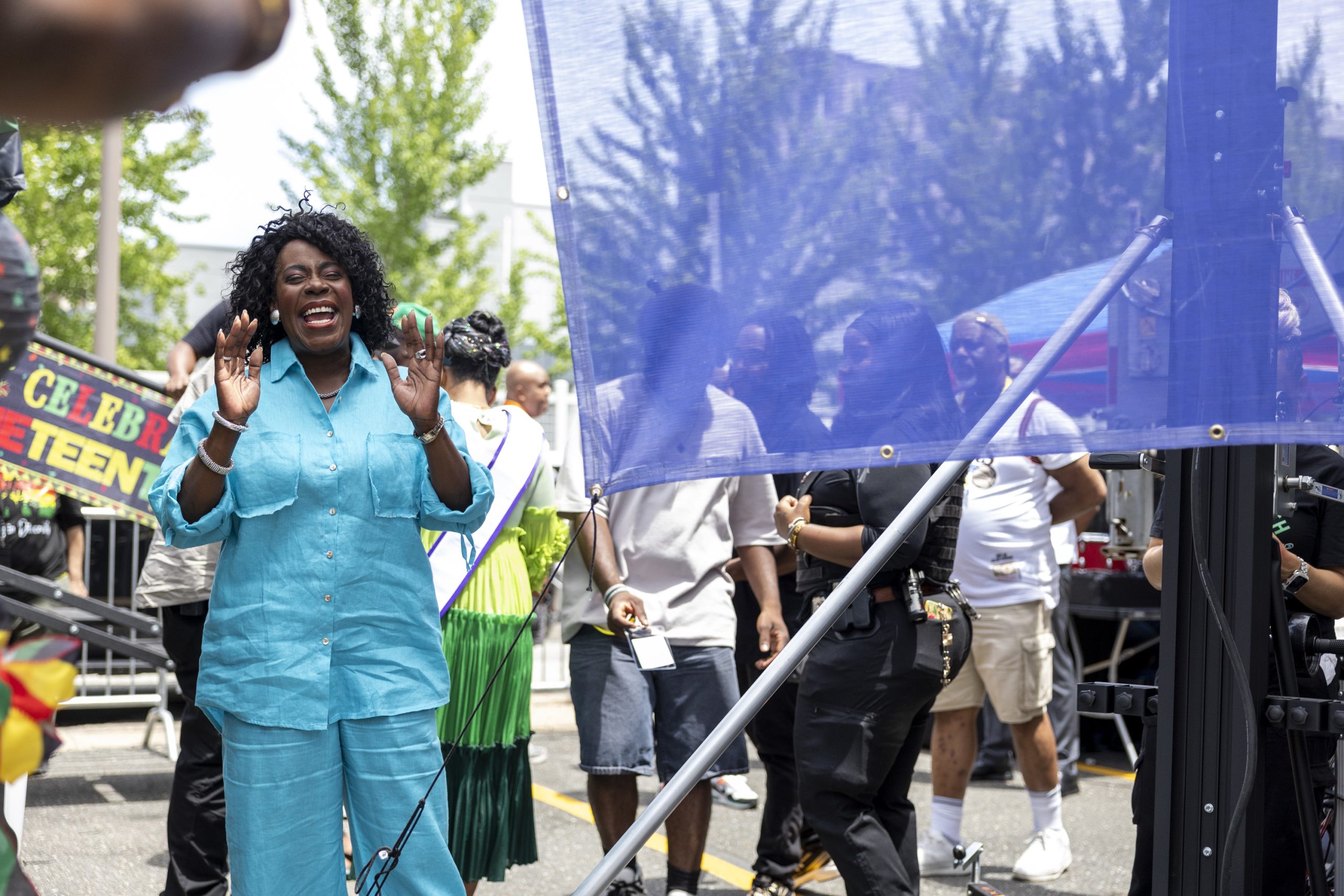
    Tahirah Barnett, of Southwest Philadelphia, with Order of Eastern Stars Prince Hall Adopted Commonwealth of Pennsylvania, (Center right) raises her finger in the air with fellow crowd members as Mayor Cherelle L. Parker speaks at the Juneteenth Block Party at the African American Museum in Philadelphia, Pa., on Friday, June 19, 2026.Tyger Williams / Staff Photographer

    “It’s important for me to be out and show my kids how we connect to our ancestors, how we connect to the present as well, and to be with community,” said Velena Flores, 47, an administrator at Jefferson Hospital. “My grandmothers, they all passed away. My father passed away, my uncles. So all the ancestors are gone.”

    Walene White of Northeast Philadelphia came with her aunt, Tiffany White, and her 13-year-old daughter and niece. As she waited to enter the museum, she reveled in the energy of the day.

    “We’re just breaking down Black history, breaking down the day of Juneteenth — the significance— and letting them come and see and enjoy the environment,” White said.

    The Marian Anderson Scholar Artists and Choral Ensemble performing at the Juneteenth Block Party at the African American Museum in Philadelphia, Pa., on Friday, June 19, 2026.Tyger Williams / Staff Photographer

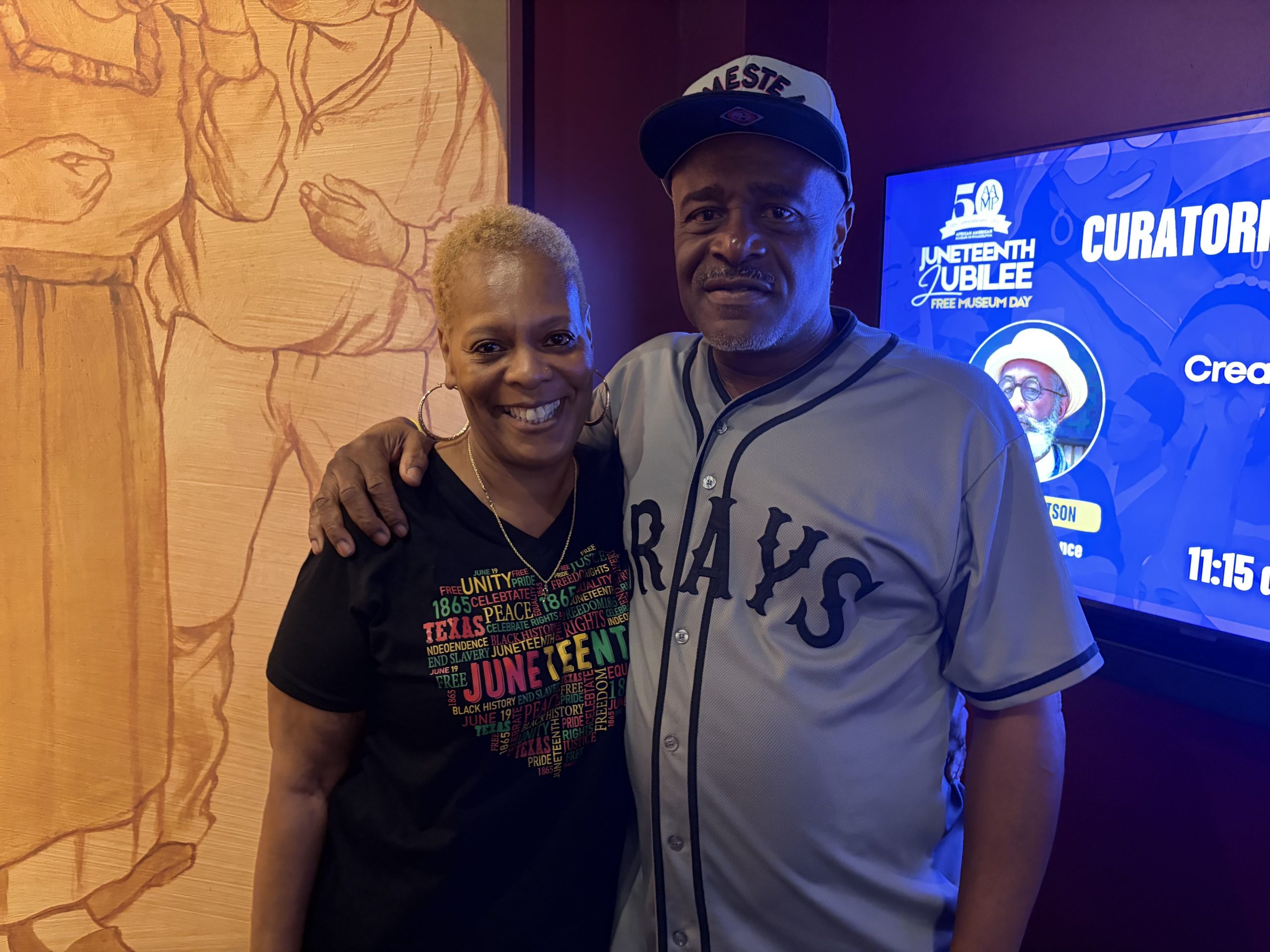
    Inside the museum, Ronald Holmes, 66, of Oxford Circle wore his Josh Gibson No. 20 jersey and Homestead Grays cap, honoring the great Negro Leagues catcher.

    On the first floor, Holmes encountered a new exhibit on Ona Judge, the young woman enslaved by George and Martha Washington who escaped the presidential mansion in Philadelphia on May 21, 1796. She later settled in Portsmouth, N.H.

    Shirley Taylor, 65, and Ronald Holmes, 66, of Oxford Circle, inside the African American Museum of Philadelphia on Juneteenth, 2026.Amy S. Rosenberg / staff

    A few blocks away, at the site of the President’s House, controversy over how that history is presented continued. A federal appeals court ruling issued Thursday said the Trump administration can install its own slavery exhibits over the objections of the city of Philadelphia.

    Inside the AAMP, though, Judge’s story was on full display. Created in collaboration with the Ona Judge Coalition, the exhibit includes video featuring some of the panels that the Trump administration fought to remove.

    “Why would they fight so hard for that?” Holmes said. “And it’s our money they use to fight to take these things down, think about that, too. It’s mind boggling. But that tells you, the struggle is not over. We celebrate where we got to right now, but you know it’s not that final celebration.”

    Mayor Cherelle L. Parker attending the Juneteenth Block Party at the African American Museum in Philadelphia, Pa., on Friday, June 19, 2026.Tyger Williams / Staff Photographer

    Founded in 1976 during the nation’s Bicentennial, the African American Museum in Philadelphia was the first institution funded and built by a major municipality to preserve, interpret, and exhibit the heritage of African American history and culture.

    The Juneteenth Jubilee kicks off the 16-day Wawa Welcome America festival, which culminates in the city’s celebration of the 250th anniversary of the signing of the Declaration of Independence.

    The Juneteenth holiday, which former President Biden made a federal holiday in 2021, celebrates the day in 1865 when a Union general arrived in Galveston, Texas, and informed enslaved African Americans that the Civil War had ended and they were free — more than two years after President Abraham Lincoln issued the Emancipation Proclamation.

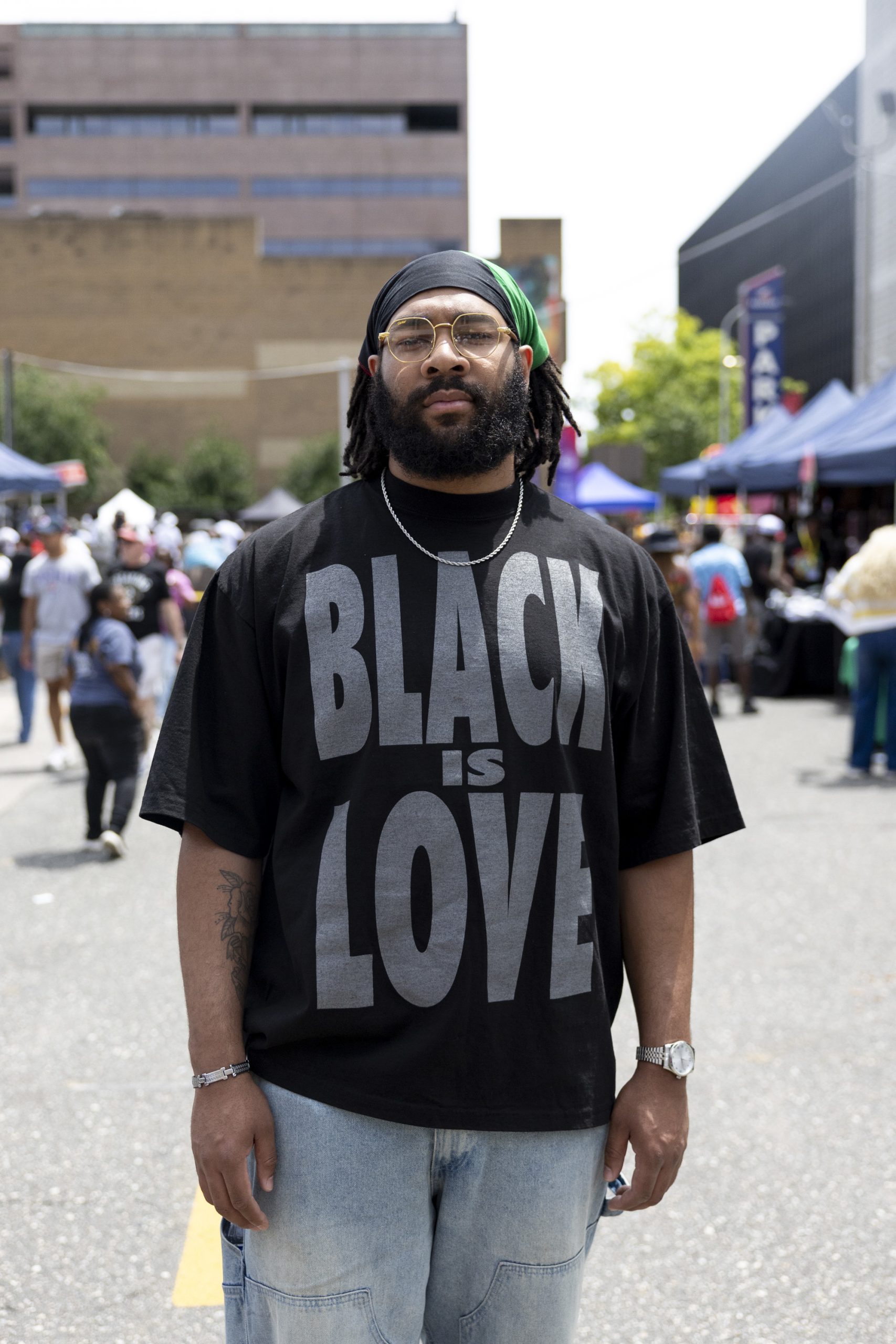
    Aquil Dantzler, 26, of West Philadelphia, Pa., Singer and Song writer, poses for a portrait at the Juneteenth Block Party at the African American Museum in Philadelphia, Pa., on Friday, June 19, 2026.Tyger Williams / Staff Photographer

    Philadelphia Mayor Cherelle L. Parker, attending the block party, said the museum played a “super huge role” in preserving the city’s history and that she remains committed to raising enough money to move the museum to the Benjamin Franklin Parkway. There’s currently $50 million set aside for that move, she said.

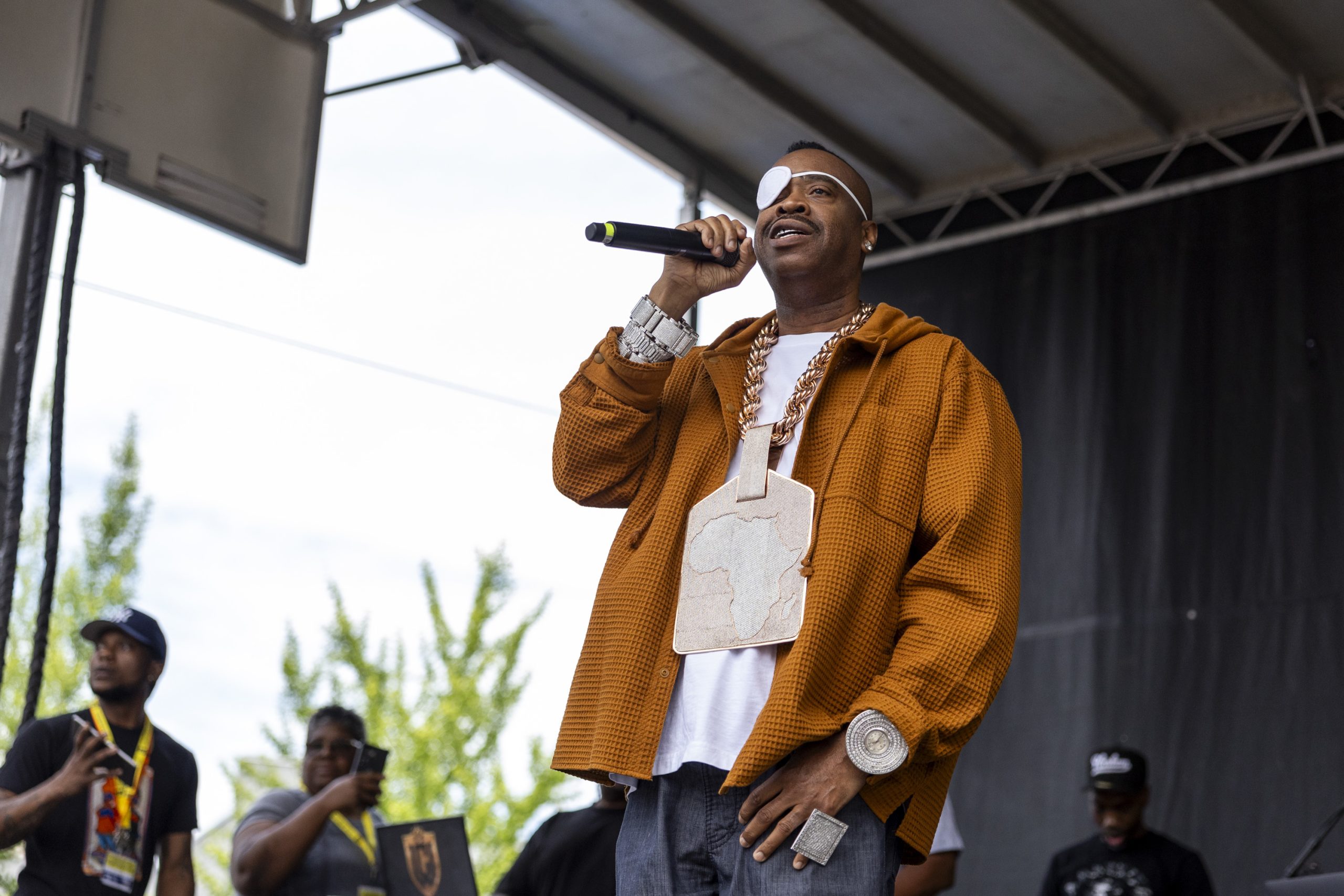
    Slick Rick performing at the Juneteenth Block Party at the African American Museum in Philadelphia, Pa., on Friday, June 19, 2026.Tyger Williams / Staff Photographer

    After posing for photos with 6-year-old Salani Williams, the Little Miss Black America Ambassador, Parker she said the city would continue the legal fight to determine what is displayed at the President’s House site.

    “We do need to think about what it looks like telling the true story of the birthplace of our nation,” she said.

    Pennsylvania Gov. Josh Shapiro stopped by the museum in the afternoon and, after touring its exhibits, told reporters he would coordinate with Parker on the city’s response to the President’s House ruling.

    “Look, it is unfortunate the president continues to try and whitewash our history,” Shapiro said. “I am not going to back down in the face of these attacks coming from the federal government against understanding our freedom, even the painful parts of it.”

    The museum is also hosting “Ruth E. Carter: Afrofuturism in Costume Design,” a touring exhibition featuring more than 80 original designs from the two-time Academy Award-winning costume designer from films including Black Panther, Sinners, Do the Right Thing, Coming 2 America, and Malcolm X.

    Costumes from the movie Sinners from the exhibit “Ruth E. Carter: Afrofuturism in Costume Design” exhibition at the African American Museum of Phiadelphia.Courtesy African American Museum of Philadelphia

    By afternoon, an exuberant, old-school block party had taken over the space behind the museum as thousands danced to performances by Doug E. Fresh, Slick Rick, Leah Jenea, and DJ Jazzy Jeff.

    “There’s only one Philly baby,” Doug E. Fresh told the crowd before recounting the history behind Juneteenth. “A long time ago, when slavery existed, it was supposed to be ended and they extended it 2 1/2 years more. It was a crime. It was disrespectful. But as usual, Black people survived. And thrived.” .”

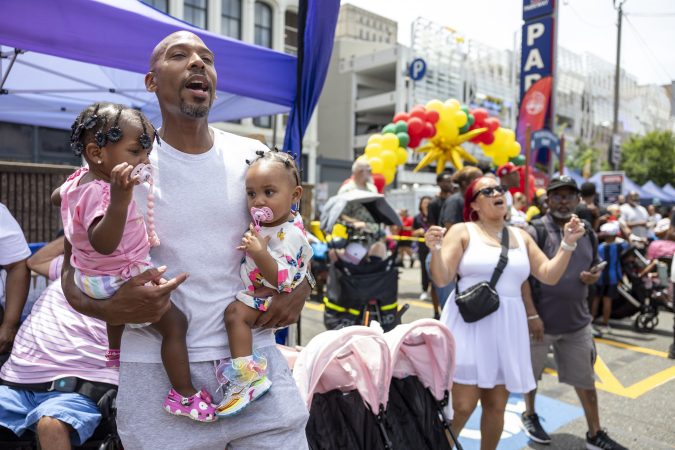
    Aaron McCord, of Morrisville, Pa., is with his daughter Charli, 5, and son Bryson, 9, at the Juneteenth Block Party at the African American Museum in Philadelphia, Pa., on Friday, June 19, 2026.Tyger Williams / Staff Photographer

    There were local performers, artists, food trucks, children’s activities, and a vendor village of jewelry and crafts.

    Tyshia and Joseph Ingram displayed their “ABC Affirmations” flash cards from their business, Liberated Young, they started for their daughter.

    “The day historically, but also what we’re going through in our country right now, is really important,“ Tyshia said. ”One of our favorite affirmations is F is for free.”

    Ashley Jordan, the museum’s president and CEO, said she was excited about the museum’s role in the 250th celebration and its future.

    The Ona Judge exhibit and the President’s House dispute, she said, “show why Black museums matter.”

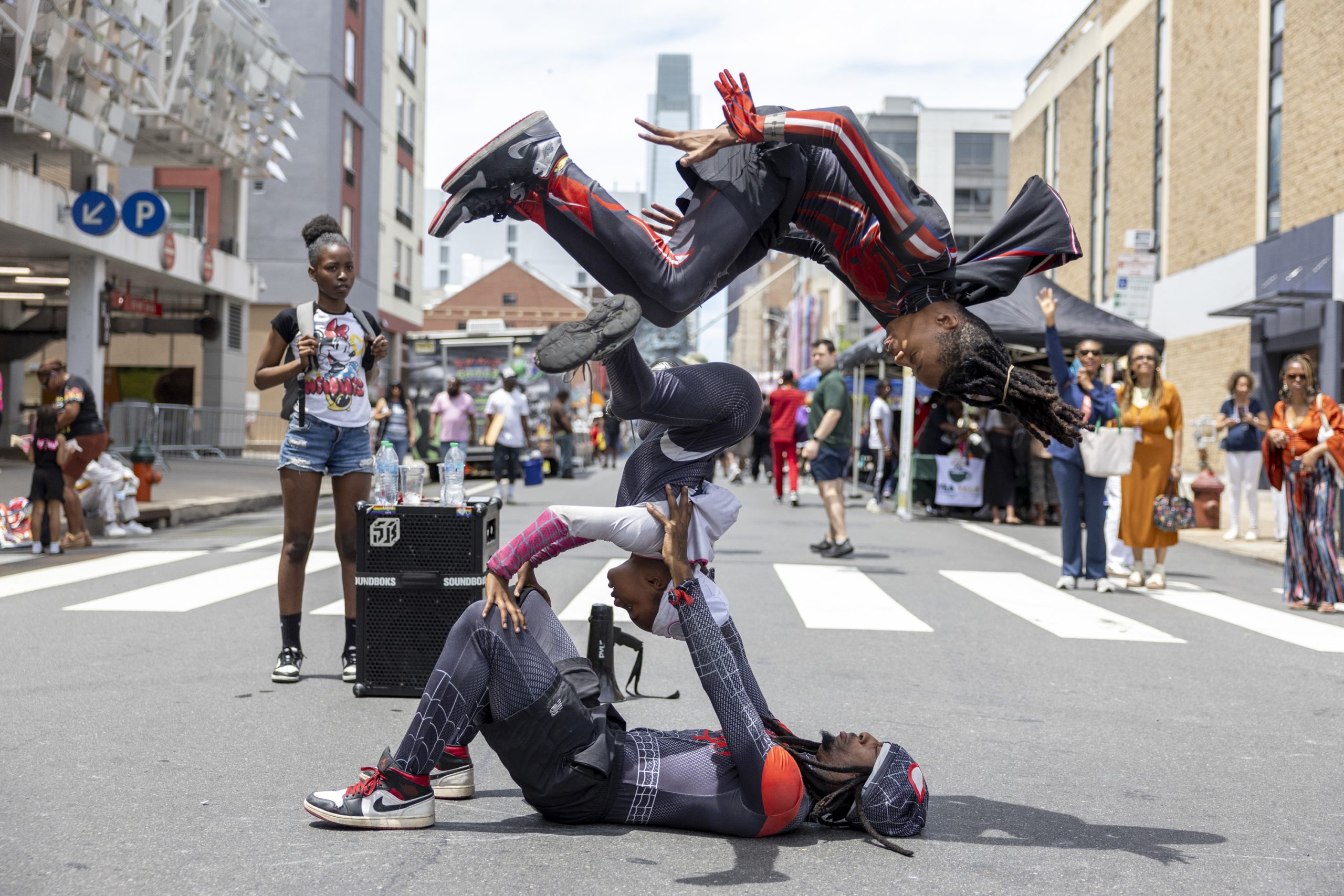
    Crowd Pleaserz Donnie “Nyce” Thompson, of North Philadelphia, his daughter Aniyah, 8, and son Jaden, 16, performing on the street for folks attending the Juneteenth Block Party at the African American Museum in Philadelphia, Pa., on Friday, June 19, 2026.Tyger Williams / Staff Photographer

    “There was a time when the complete story wasn’t being told,” she said. “Entities like us matter so stories can be told unimpaired. It lives here as its own story, its own entity, complete with its own panels.”

    Marquez Efferson, of Northeast Philadelphia, Mlanjeni Magical Touring Theater, making balloons for folks attending the Juneteenth Block Party at the African American Museum in Philadelphia, Pa., on Friday, June 19, 2026.Tyger Williams / Staff Photographer

    The museum’s exhibit “Audacious Freedom” has been expanded to include modern Philadelphia heroes, she said. “You don’t have to look far for history,” she said. “There’s Leon Sullivan, Cecil B. Moore, and Patti LaBelle.”

    Tiffany White and her niece, Walene White, in line outside the African American Museum of Philadelphia on Juneteenth 2026.Amy S. Rosenberg / staff

    Waiting in line, Tiffany White, 37, reflected on the holiday’s significance. “I can’t believe that it took so long to become a holiday,” she said. “And then people didn’t know, and two years later, they were still slaves? It’s crazy.”

    Alaina Gibbs, an innovation strategist at Main Line Health, attended with about 50 colleagues through the health system’s Belonging and Inclusion employee resource group.

    Many gather for this years Juneteenth Block Party at the African American Museum in Philadelphia, Pa., on Friday, June 19, 2026.Tyger Williams / Staff Photographer

    Gibbs and colleague Michelle Johnson, 47, said the visit was part of an effort to engage more with the community.

    “Today was the perfect place to do that,” Johnson said.

    Juneteenth is “really about how you look back at your roots, find your cultural connection, and it’s about observing the freedom that we all enjoy and celebrate,” Gibbs said. “It’s progress.”

    Noting the communication breakdown at the heart of the Juneteenth story, Gibbs added: “It brings the community back together to celebrate the freedom and the communication that’s needed to keep community connections.”

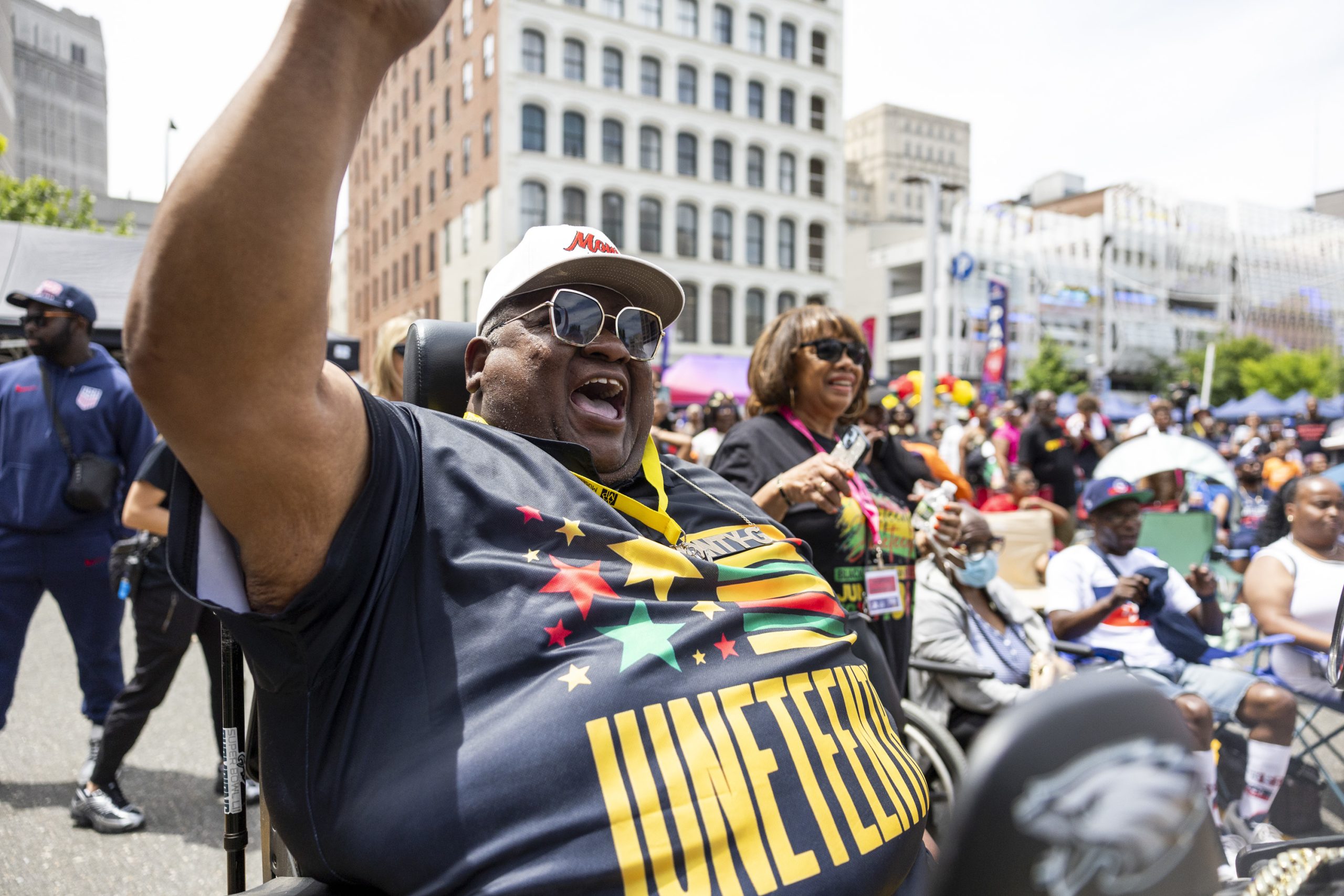
    Monty-G, of South Philadelphia, Pa., seen out in the crowd as Mayor Cherelle L. Parker speaks at the Juneteenth Block Party at the African American Museum in Philadelphia, Pa., on Friday, June 19, 2026.Tyger Williams / Staff Photographer

    “I like seeing the positivity and the togetherness right now in the city, this is the first time we’re coming together as a group from our organization,” Johnson said.

    Flores, meanwhile, said she was mindful of the news surrounding the President’s House and other national debates but focused on the day’s celebration.

    “I tell my kids we can get inundated with negative stuff every day,” she said. “The happiness and the love — that’s what I look for.”

    Kids playing a basketball game at the Juneteenth Block Party at the African American Museum in Philadelphia, Pa., on Friday, June 19, 2026.Tyger Williams / Staff Photographer
    Alexis Nixon, of Salt Lake City, Utah, is checking out GG Afrikan Elganz clothes during her visit to see her brother Daeshawn Nixon, of Brynmawr, Pa., at the Juneteenth Block Party at the African American Museum in Philadelphia, Pa., on Friday, June 19, 2026.Tyger Williams / Staff Photographer
    Kingkilliam Kato, 5, of Camden, N.J., is with his mom Annagjid Kato, for this years Juneteenth Block Party at the African American Museum in Philadelphia, Pa., on Friday, June 19, 2026.Tyger Williams / Staff Photographer
  • Two Deptford High School students created a Jalyx Hunt fan account. Then he showed up at their graduation.

    Two Deptford High School students created a Jalyx Hunt fan account. Then he showed up at their graduation.

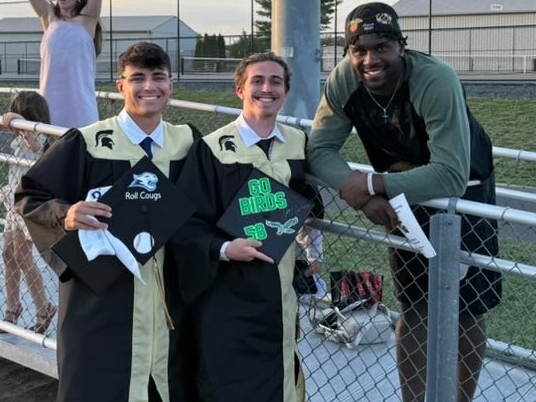
    Following the Eagles’ Super Bowl LIX win, Deptford High School students Hunter Thomas and Dominic Alia made an Instagram fan page for then-rookie edge rusher Jalyx Hunt, who played a key role in wrecking Kansas City Chiefs quarterback Patrick Mahomes’ night.

    Just over a year later, Hunt showed up to the high school graduation of the “Jalyx Hunt enthusiasts.”

    On Thursday, while waiting to receive his diploma, Thomas received a text from his mother. Hunt, whom Thomas invited, was sitting in the away stands of Deptford’s football stadium. He waved to the Eagle, who signaled right back at Thomas and his friend, Antoine Sims.

    “After that, my head starts spinning,” Thomas told The Inquirer. “There’s no freaking way that he actually came.”

    Thomas first met Hunt at last year’s Eagles Autism Challenge. There, he showed the edge rusher the fan page called @jalyxhunt_enthusiast. Hunt loved it and followed the account back. Since then, Thomas and Alia have exchanged direct messages with Hunt, wishing him happy birthday and sending him messages throughout the season.

    Before the Eagles’ final regular-season game this past season, a 24-17 loss to the Washington Commanders, Hunt met Thomas and Alia above the tunnel to sign Thomas’ jersey. “Always love,” Hunt, who recognized the pair, signed. “Go birds!”

    When graduation came around, Thomas had an extra ticket, so he thought to text his favorite player first. To his surprise, Hunt responded that he would be able to come. Immediately, Thomas employed his sister to decorate his graduation cap, complete with Hunt’s No. 58 and a throwback Eagles logo.

    In a post to his Instagram story on Thursday, Hunt shared a photo of his view from the Deptford stands. “I’m locked,” he wrote, tagging the fan account which now sits at roughly 1,000 followers.

    “I get my diploma, and my mom, because she’s a teacher, she gives it to me,” Thomas said. “I hug her, and when I walk back to my seat, I point out to Jalyx. He points back. When I did it, I was just thinking, ‘I got to show him some love.’”

    Jalyx Hunt with Hunter Thomas at Thomas’ high school graduation.Courtesy of Hunter Thomas

    After all his classmates’ names were called and his cap was thrown, Thomas made his way over to Hunt, who was now sitting with Thomas’ father. Hunt caught up with Thomas, telling him that he was cheering loudly when Thomas received his diploma. Eventually, Thomas found Alia on the field and the three posed for photographs.

    “There’s a lot of NFL players with all this clout, and their heads are so big, and then he’s just the most down-to-earth [person],” Thomas said. “He’s like, ‘Yes I play football, but I’m still a normal guy at the end of the day.’

    “He’s one of the nicest people I’ve ever met in my life. Me and Dom said, after we were like, ‘This is like a memory that we’re going to have forever.’”

  • Daveigh Chase, ‘Lilo & Stitch’ voice actor and ‘The Ring’ villain, dies at 35

    Daveigh Chase, an actor known for voicing the character of Lilo in the hit animated film Lilo & Stitch and for her deeply unnerving turn as the child villain Samara in the horror movie The Ring, died on Tuesday in Los Angeles. She was 35.

    Her death, in a hospital, was confirmed by her father, John David Schwallier, who said the cause was complications of bacterial meningitis and a blood infection. Schwallier said his daughter had been homeless and living in Los Angeles with her boyfriend near the hospital where she died.

    Lilo & Stitch, released in 2002 when Ms. Chase was almost 12, told the story of an orphaned Hawaiian girl, Lilo, who brings home an impish blue space alien, Stitch, from the dog pound. Much wackiness ensues.

    The Disney film was a hit, grossing more than $274 million worldwide, according to Box Office Mojo (roughly $500 million when adjusting for inflation). And Ms. Chase, who had brought the plucky Lilo to life, won a Young Artist Academy Award for best performance in a voice-over role, age 10 or younger.

    Her breakout role, however, was in the live-action thriller The Ring, released in the United States roughly four months later, alongside Naomi Watts. Ms. Chase played Samara, a longhaired mystery girl who terrorized unsuspecting viewers of a certain VHS tape.

    The film, a remake of a Japanese film, Ringu, received mixed reviews, but the image of Samara crawling through a blurry television screen became seared in the cultural memory, and Ms. Chase won the award for best villain at the 2003 MTV Movie Awards.

    That year she returned to Lilo in the sequel Stitch! The Movie and in the Lilo & Stitch TV series, which ran from 2003-06.

    She then transitioned to her biggest TV role yet. In HBO’s Big Love — which chronicled the trials and tribulations of Mormon polygamists — she starred as Rhonda Volmer, a cunning 14-year-old bride in waiting, in 32 episodes between 2006 to 2011.

    Daveigh Elizabeth Schwallier was born July 24, 1990, in Las Vegas. Her father was a cook and helped to build motor homes. Her mother, Cathy Annette (Chase) Schwallier, went to nursing school but did not work a regular job.

    The family moved to Albany, Ore., where Ms. Chase would grow up, a few weeks after her birth. Ms. Chase was homeschooled, and at age 6 she won the Little Miss Oregon beauty pageant.

    She starred in a Campbell’s Soup commercial soon after, and then landed the voice-over role in Lilo & Stitch. She would go on to star as Samantha Darko, the younger sister of Jake Gyllenhaal’s Donnie, in Donnie Darko (2001) and in a little-noted sequel, S. Darko (2009). She also voiced Chihiro Ogino in Hayao Miyazaki’s 2001 animated classic, Spirited Away.

    After 2016, she largely stopped acting, and troubles with the law soon followed. In 2017, she was charged with riding in a stolen BMW, according to TMZ; in 2018, she was charged with possession of a controlled substance, according to the New York Post.

    Schwallier, 61, said in an interview Wednesday that Ms. Chase had struggled with drugs since the age of 13. He said that he hadn’t spoken with her since she was 19 and that she had a terrible falling-out with her mother around the same time. Her parents divorced 32 years ago.

    Schwallier had been in touch with Ms. Chase’s boyfriend, Roy Hernandez, and arrived at Los Angeles General Medical Center, where she was being treated, just before she died.

    “Him and her were destitute,” he said, describing the couple’s living conditions.

    In one of at least three GoFundMe pages set up to support Ms. Chase in recent days, Hernandez described her worsening condition: “The doctors say she may not survive, and when she leaves the hospital, we have nowhere to go. My hope is to raise enough money to find a place where we can be together and make her comfortable during her last days.”

    At the premiere of Lilo & Stitch in 2002, the Honolulu Star-Bulletin asked an 11-year-old Ms. Chase if she thought she could handle all the publicity that was sure to come her away after the movie’s release.

    “Well, it is just my voice,” she demurred. “But some people who worked for Disney have recognized me already. I don’t think people will really know who I am. I guess I’ll have to deal with it!”

    This article originally appeared in the New York Times.
  • U.S. intelligence warns Israel is likely to undermine Iran peace deal, officials say

    U.S. intelligence agencies have warned the Trump administration that Israeli Prime Minister Benjamin Netanyahu is likely to take steps that will undermine President Donald Trump’s effort to reach a lasting peace deal with Iran, as the Israeli premier faces intense political pressure to continue waging his country’s war in Lebanon, current and former U.S. officials said.

    Israel appears intent on maintaining military operations against Iran’s proxy Hezbollah in Lebanon, an aim that would flout a core element of the fledgling agreement that calls for an end to hostilities in that country, according to intelligence reports, including one circulated this week, said the officials.

    The analysis comes at a moment of growing tension between Netanyahu’s government and Trump administration officials, who have publicly warned Israel against launching attacks against Hezbollah that might derail Trump’s deal.

    On Friday, Israel launched airstrikes across southern Lebanon in response to a Hezbollah drone strike that killed four Israeli soldiers. As clashes continued, U.S. and Iranian officials said they postponed talks due to begin in Switzerland on Friday. Vice President JD Vance, who was to lead the U.S. delegation, postponed his trip.

    If Netanyahu redoubles his military campaign in Lebanon, he would not only threaten the framework for an agreement signed by the United States and Iran on Wednesday, but he could rupture the relationship with an American president that has been integral to his political fortune.

    Speaking at a news conference in France on Wednesday to announce the U.S.-Iran “memorandum of understanding,” Trump said that he has a “little dispute over Lebanon” with Netanyahu and has urged the Israeli leader to not “knock down a building every time somebody walks into it that’s from Hezbollah.”

    The new U.S. intelligence report concludes that in the face of national elections this fall, Netanyahu’s political survival is linked to showing his domestic audience that he will not withdraw troops from Lebanon and that he is intent on escalating the fighting with Hezbollah, said one U.S. official familiar with the report. The official, like others interviewed, spoke on the condition of anonymity because of the matter’s sensitivity.

    The U.S. intelligence report also describes Israel’s frustration with the terms of the Trump peace memorandum, which undermine its broader objective of maintaining maximum pressure on Tehran, according to a current and former official.

    The report conveys Israel’s perception that the agreement could constrain its ability to defend itself against Hezbollah, one former official said.

    Trump administration officials insist that the terms do not prevent Israel from retaliating against Hezbollah if fired upon and that Netanyahu’s concerns pale in comparison to the need to complete a deal and reopen the Strait of Hormuz to stave off a global economic crisis.

    The report reflected that any suspension of hostilities or withdrawal from Lebanon will be seen in Israel as a defeat for Netanyahu, said the current official.

    “Israeli military activity in Lebanon is for the sole purpose of defending Israeli citizens from continuous attacks by Hezbollah,” said a senior Israeli government official, speaking on the condition of anonymity according to the government’s protocol, in response to a request for comment about the U.S. intelligence analysis.

    Popular opinion in Israel remains highly supportive of efforts to dismantle Hezbollah, the Iranian proxy group that joined its partner, Hamas, in attacking Israel with rockets in October 2023.

    Tens of thousands of Israelis displaced from their homes in the country’s north by drones and missile strikes have demanded that Netanyahu decimate Hezbollah, and he has come under withering criticism from across the domestic political spectrum for failing to eliminate the militant threat.

    Fully 70% of Jewish Israelis support intensifying the fight against Hezbollah, according to a May poll by the Institute of National Security Studies, a leading Israeli think tank, and Israeli political analysts widely say that a military pullback would be interpreted by voters as a sign of defeat.

    Even if Israel does not escalate fighting in Lebanon by bombing the southern suburbs of Beirut, Hezbollah’s seat of power, its refusal to withdraw troops from the country’s south is likely to doom the fragile accord between the U.S. and Iran, a second U.S. official said, offering an independent analysis.

    “Continuing to occupy part of Lebanon is a recipe for disaster,” said the official. “Without a full Israeli withdrawal, the likelihood of resumed hostilities between the [Israeli military] and Hezbollah is all but certain.”

    Israeli cabinet officials are standing their ground. “For every tear shed by an Israeli mother, a thousand Lebanese mothers should cry. All of Lebanon should burn,” National Security Minister Itamar Ben Gvir said Friday on social media.

    Netanyahu is risking “huge friction” with Trump, who undertook the war with Iran on Feb. 28 at the Israeli leader’s urging and soon found himself mired in a conflict that has cost tens of billions of dollars, sent global gas prices soaring, and saw the deaths of 13 U.S. troops, said Danny Citrinowicz, a former Israeli military intelligence analyst.

    “Bibi’s in a very tough situation,” said Citrinowicz, now senior researcher at the Tel Aviv-based Institute for National Security Studies, using the nickname of the Israeli prime minister. “He’s seeing his greatest rival, the Iranian regime, being strengthened by the U.S. administration — and he cannot do anything about it.”

    On two consecutive weekends this month, Netanyahu launched airstrikes against Beirut in response to Hezbollah provocations that threatened to jeopardize Trump’s fragile deal. The strike on June 7 triggered Iran to launch ballistic missiles in retaliation, and tensions were defused only when the White House intervened. Israel struck Beirut again Sunday, hours before the Trump administration pushed through the memorandum of understanding with Tehran.

    Even after the deal was signed, Netanyahu and his allies have remained defiant, insisting they will not withdraw troops from southern Lebanon and would continue carrying out strikes even if that angered Trump.

    The White House threw a brushback pitch.

    “Donald J. Trump is the only head of state in the entire world who is sympathetic to the nation of Israel at this moment in time, and he happens to be the head of state of the world’s superpower,” Vice President JD Vance told reporters in the White House press briefing room Thursday. “If I was in the cabinet of the Israeli government, I might not be attacking the only powerful ally that I have anywhere left in the entire world.”

    The Israel Defense Forces occupy more than 200 square miles of Lebanese territory and have forced more than 1 million residents from their homes — though some have returned — to create what it calls a depopulated “security zone.” More than 3,000 people have been killed by the Israeli campaign since it began in mid-March, according to Lebanese authorities.

    “We will stay in the Lebanon security buffer zone for as long as necessary,” Netanyahu told reporters in Jerusalem this week. On some issues, “we see less eye to eye,” Netanyahu said, referring to his relationship with Trump.

    Harrison Mann, a former U.S. Army officer who served as an analyst at the Defense Intelligence Agency, said the U.S. intelligence reporting captures a key incentive driving Netanyahu’s policy decisions.

    “Permanent war — and territorial expansion — have been the animating forces of Israeli politics for years. It’s no surprise that with elections coming up, Netanyahu has to prove he can do these better than his opponent,” Mann said.

    But Trump has leverage over Israel.

    “The U.S. can cut off munitions, jet fuel, and maintenance support, limiting the scope of any Israeli offensive, freeze critical intelligence sharing, or withdraw U.S. forces currently deployed to project Israeli airspace, raising the cost of any Israeli war,” Mann said.

    U.S. presidents have largely avoided such actions, though some have taken notable steps during moments of tension with the Israeli government.

    President Dwight D. Eisenhower threatened Israel with sanctions if it didn’t remove troops from the Sinai Peninsula in 1956. President Ronald Reagan delayed the delivery of advanced F-16 fighter jets in 1981 in response to Israel’s surprise bombing of an Iraqi nuclear reactor. And President George H.W. Bush withheld housing loan guarantees in an effort to force Israel to stop building new Jewish settlements in the West Bank and Gaza.

    “If you ask me, ‘Has an American president ever threatened to impose real costs and consequences on Israel in real time?’ the answer would be no,” said Aaron David Miller, a senior fellow at the Carnegie Endowment for International Peace who has advised both Democratic and Republican administrations.

    But if Iran does not constrain Hezbollah‘s attacks on northern Israel, “I don’t care what Trump says, Netanyahu is going to respond,” he said.

  • EU leaders squabble over outreach to Moscow as Ukraine war rages on

    BRUSSELS — European Union leaders have been unable to agree on setting up a back channel with Moscow to ensure that the bloc’s interests are protected should progress be made in negotiations to end Russia’s war on Ukraine, some of them said on Friday.

    European Council President António Costa, who chaired their two-day summit in Brussels this week, had directed his office to reach out to the Kremlin and proposed a senior official to make contact. Costa said his aim was not to mediate or set up a parallel negotiating track to the one led by the United States, which is making little progress.

    “We needed to immediately establish this direct contact,” Costa said, clarifying that Brussels would not seek to mediate in negotiations but rather open communications.

    “We cannot depend only on others to interpret Russian messages and we must be able to convey directly to Russia our own messages,” he added.

    European Commission President Ursula von der Leyen said she supported Costa’s approach because “our entire continent is at risk, and this is why Europe must be one of the architects of a just and lasting peace.”

    An unresolved disagreement over diplomacy

    Debate has been swirling around Europe in recent months about whether to appoint a mediator for talks with Russia to help get things moving again, but this has been largely rejected as many believe that Russian President Vladimir Putin would be unlikely to negotiate anyway.

    Instead, the 27 EU countries have focused on concessions that Russia should make to secure peace.

    German Chancellor Friedrich Merz stressed that peace negotiations must ultimately be conducted by Ukraine, Russia, Europe, and the U.S.

    “Who speaks for the European Union is something we don’t need to decide on today,” he said. “We will decide on that when talks come about.”

    He added that Costa has “an important to role to play” as president of the European Council, representing the EU, preparing and organizing summits, and “we don’t need to make decisions going beyond that at the moment.”

    Merz highlighted efforts to coordinate diplomacy by the so-called E3 group of countries — Germany, France, and Britain — a format that he said came about “at the explicit wish of Ukraine.”

    French President Emmanuel Macron said “Europeans are not mediators” in the negotiations but that “Costa, when the competencies are defined, will have a place.”

    Margus Tsahkna, foreign minister of Estonia — a nation on the EU’s eastern flank that has faced drone incursions and was once occupied by the Soviet Union — said that “Europe must not assume the role of a neutral mediator” but instead buttress Ukraine’s position to “force the Kremlin into serious negotiations.”

    Some nations support Costa’s backchannel proposal

    As European leaders left overnight after the summit wrapped up, Belgian Prime Minister Bart De Wever joked that Costa would be the envoy to Moscow.

    “I was just talking about you, António,” De Wever said while laughing and shaking Costa’s hand. “I was full of praise, saying you are the only one who can represent us and that we will send you to Moscow.”

    Irish Prime Minister Micheál Martin said that “opening up a channel is not a mistake in our view, and I trust António Costa.”

    “What was very clear last evening is that any negotiations would have to be first and foremost between Ukraine and Russia, but there are no indications that Russia is coming to the table at all,” he said.

    Speaking to reporters, Czech Prime Minister Andrej Babiš said the leaders had failed at the summit to resolve their differences over the approach overnight. “Europe is unable to agree even on whether there will be negotiations or who will lead them,” he said.

    Russia responds publicly to the overture

    Putin has tried to cut out Europe and Kyiv from negotiations with the U.S. over Ukraine’s future. But the Kremlin said on Friday it was “ready for contact” with Europe, on the condition it abandon its desire to talk to Moscow from the position of force.

    At the same time, Russian Foreign Minister Sergey Lavrov argued that the EU can not be an impartial peace broker. He again rejected Western claims that Moscow was harboring plants to attack Europe as “provocation” and “nonsense” while warning that Europe’s military buildup poses growing security threats.

    “A direct confrontation between NATO and Russia could rapidly escalate into an exchange of nuclear strikes, with catastrophic consequences,” Lavrov said in an essay released by the Russian Foreign Ministry.

  • Comedy trailblazer Tom Dreesen, Sinatra’s longtime opening act, dies at 86

    LOS ANGELES — Tom Dreesen, who along with partner Tim Reid formed one of America’s first interracial stand-up comedy duos and later spent years as Frank Sinatra’s opening act, died Wednesday. He was 86.

    Dreesen died at his home in Los Angeles, according to publicist Lori De Waal. A cause of death was not provided.

    After meeting in Chicago, Dreesen and Reid, who was Black, formed “Tim and Tom” in 1969. Against a backdrop of simmering racial tension, they used humor to address social issues and promote understanding between audiences of different backgrounds. They worked together until the mid-1970s. Reid went on to solo success playing DJ Venus Flytrap on the popular TV sitcom WKRP in Cincinnati, where Dreesen was a guest star.

    “When I was a kid I found an album he and his comedy partner did called Tim and Tom and took it home and played it and it was one of the albums that changed the course of my life. So great,” comedian and filmmaker Mike Binder wrote on X.

    After splitting with Reid, Dreesen honed a solo comedy act, making over 500 national TV appearances, including 60 visits to The Tonight Show Starring Johnny Carson. He also was a frequent guest and sometime guest host on The Late Show with David Letterman. Their friendship dated to the early 1970s when both worked at the Comedy Store in West Hollywood, Calif.

    Dreesen’s final TV appearance came last week on Comics Unleashed with Byron Allen, which replaced Stephen Colbert’s canceled CBS late-night show.

    Dreesen was Sinatra’s opening act for 14 years and became close with the entertainer.

    “If he loved you, he worshipped the ground you walked on,” Dreesen told the Desert Sun newspaper in 2014. ”In a lot of ways, he was like a father to me. I didn’t have a father that really cared that much where I was and what I did. But Frank would give me advice and counsel, and then he was a buddy in a lot of ways. I thought the world of him.”

    Dressen also toured with Sinatra’s fellow Rat Pack member Sammy Davis Jr., as well as Liza Minnelli, Smokey Robinson, Gladys Knight, and Tony Orlando.

    “He was one of the most brilliant comedians of all time. Tonight, he’ll once again be opening for Dean, Frank and Sammy,” Deana Martin, a daughter of Dean Martin, posted on X.

    In 2008, Dreesen co-wrote the book Tim and Tom: An American Comedy Act in Black and White and in 2020 he authored his memoir.

    Dreesen acted in such TV shows as Columbo, Murder, She Wrote, and Touched by an Angel. His film roles included Spaceballs, Man on the Moon, and Trouble With the Curve, as well as the HBO movies The Rat Pack and Lansky.

    Dreesen was active in charitable work, motivational speaking, and veterans’ causes, including serving as ambassador for the Gary Sinise Foundation.

    “America lost one of our great comedians and patriots, and I lost a dear friend,” Sinise posted on X.

    He was born on Sept. 11, 1939, in Chicago and raised as one of eight children in suburban Harvey. He enlisted in the U.S. Navy at age 17 and after getting out in 1960 he returned home to work a series of jobs, including selling insurance.

    Dreesen is survived by daughters Amy and Jennifer from his marriage to Maryellen Subock, which ended in divorce in 1984, as well as seven grandchildren. He was preceded in death by his son Tommy.

  • Friction between Trump and Republican senators is growing before the pivotal midterm elections

    WASHINGTON — The relationship between President Donald Trump and Senate Republicans neared a breaking point this week as he upended their efforts to speedily confirm one of his own nominees and said he would not sign the renewal of a key surveillance law unless they agree to new terms.

    Trump’s overnight social media post Wednesday that he was delaying Jay Clayton’s nomination to become national intelligence director, just hours before the U.S. attorney’s confirmation hearing, further strained relations between the Senate and White House that have been worsening for weeks. Later that day, some Republican senators who have been hesitant to challenge the president directly on the Iran war were blunt in their criticism of his deal to end it.

    “This is the worst foreign policy blunder in decades,” Sen. Bill Cassidy (R.,La.) said in a post on X.

    The open tensions are an almost complete reversal from a year ago when Senate Republicans worked closely with Trump on a complicated effort to push through his massive package of spending and tax cuts.

    At the time, criticism of the president was almost nonexistent among Republicans on Capitol Hill, and they planned to highlight passage of that bill in the midterms. But as the November election draws closer and Republicans are trying to defend their majorities, Trump is instead needling Congress with his demands and reversals, driving several Republican senators to disparage his actions publicly for the first time.

    “I think somebody’s not dialing the president into the complexities of what he’s done here,” Sen. Thom Tillis (R., N.C.) said Wednesday after Clayton’s confirmation was postponed. “I mean, my God.”

    The slow unraveling of what once seemed like an airtight alliance between the executive and legislative branches in a Republican-led Washington extends to their policy priorities.

    Trump appears to have lost interest in most of the GOP agenda and has become almost singularly focused on his voting legislation to require proof of citizenship, which has almost no chance of passing. At the same time, he has asked members of Congress to fund parts of his White House ballroom project, allow a temporary intelligence director that none of them like, and cede their powers on the Iran war.

    The growing rift has brought much of the Senate’s business to a halt and put Republicans who are up for reelection this year on the defensive. It has also put pressure on Senate Majority Leader John Thune, who has been up-front with Trump about what he can and cannot do in the Senate.

    Trump pressures Thune on voting bill

    Trump has pressured Thune relentlessly to scrap the filibuster and pass the strict proof-of-citizenship legislation, called the SAVE America Act. Thune (R., S.D.) has told Trump publicly and privately that the votes are not there for either step. Still, Trump has kept up the push.

    In a social media post Thursday, Trump said he would be “the last Republican president” if the voting bill does not pass.

    “Senate Majority Leader John Thune, and the Republican Senate, must not let this ‘carnage’ happen,” Trump said. “They will go down on the wrong side of History, as will all Republicans who just stood by and watched.”

    Nonetheless, Trump has yet to go after the well-liked Republican leader on a personal basis, as he often did with Thune’s predecessor, Sen. Mitch McConnell (R., Ky.). Trump once called McConnell a ” dour, sullen, and unsmiling political hack.”

    Trump and Thune talk frequently, even as Thune is sometimes giving the president news he does not want to hear. As Trump pushed for the voting bill, Thune scheduled weeks of floor time to consider it, an effort to make clear that the Senate was supportive, even if the votes are lacking.

    Missouri Sen. Eric Schmitt, one of the president’s closest allies in the Senate, said he has never heard Trump say anything negative about Thune.

    “It’s a difficult position,” Schmitt said of Thune’s role in the Senate. “I think they have a good working relationship.”

    One of Thune’s closest allies, Republican Sen. Mike Rounds of South Dakota, said the even-keeled leader is the “right person at the right time.”

    “In the Capitol today, he is the stable force,” Rounds said. “In Washington, D.C., today, he is the stable force.”

    No signs of revolt among Senate GOP

    There were no signs of a revolt within the GOP conference for now, despite Trump’s pressure.

    Thune “has managed it better than anyone else could manage it,” said Cassidy, who has become a more frequent Trump critic since a primary loss to a Trump-backed challenger.

    Criticism of Trump has at times surfaced even among his closest Senate allies, especially with his proposed $1.776 billion settlement fund for his political allies and his pick for acting intelligence director, Bill Pulte, who has no known intelligence experience.

    But the rift with Trump has also stoked some new internal tensions.

    Several Republican senators criticized Sen. Mike Lee (R., Utah), who has waged an online campaign to eliminate the filibuster and pass the SAVE America Act, in a private conference lunch this week for stoking dissension within the party in an election year.

    Unbowed, Lee has kept up his social media campaign, including a post Friday on X in which he said that giving up because Republicans lack the votes is a “recipe for failure.”

    Texas Sen. John Cornyn, one of those who spoke out at the meeting, replied that it is Lee’s job to find the votes, “if you can.”

    “Can’t just complain about others,” Cornyn posted. “Prove us wrong.”

    Trump’s dwindling number of allies

    Some Senate Republicans have made clear they have no plans to separate themselves from Trump.

    As several of his colleagues criticized Trump’s agreement with Iran this week, first-term Sen. Bernie Moreno (R., Ohio) aggressively defended it on social media.

    “Let’s get the Nobel Peace Prize ready!” Moreno posted on X.

    But Trump has far fewer of those Senate allies than he did when they narrowly passed the tax and spending cuts legislation a year ago. That is in part because he has picked off some of the most loyal Republican votes himself.

    Both Cassidy and Cornyn lost in primaries last month after Trump endorsed their opponents. Tillis announced he was not running for reelection last year after Trump repeatedly criticized him on social media.

    Now all three have become frequent critics.

    Shortly after his election loss, Cornyn posted on social media a fable about a frog and a scorpion. The scorpion asks the frog to carry it across a river, according to the fable, and then stings the frog in the middle of the river, “dooming them both.”

    “The dying frog asks the scorpion why it stung despite knowing the consequence,” Cornyn’s post read. “To which the scorpion replies: ‘I am sorry, but I couldn’t help myself. It’s my character.’”

  • Secret vetting and blocked promotions: Inside Hegseth’s war on diversity

    WASHINGTON — The Navy’s top leadership believed that Rear Adm. Stephen D. Barnett was by far the best choice to lead the command that oversees the Navy’s bases at home and abroad.

    He had more experience than the other candidates and had successfully managed the aftermath of one of the Navy’s biggest messes, a fuel spill that contaminated an aquifer on a base in Hawaii, sickening thousands.

    The final decision this spring fell to Defense Secretary Pete Hegseth.

    To many in the Navy, Barnett’s promotion seemed like a foregone conclusion.

    The officer, however, had a big strike against him. Like other Black military leaders, he had been encouraged by his superiors to help the Navy recruit and retain minority officers, who remain significantly underrepresented in the force. His years-old remarks on the importance of diversity had been flagged in a secret vetting process designed to weed out senior leaders whom Hegseth and his team pegged as a problem.

    Instead of Barnett, Hegseth selected a white officer who was the Navy leadership’s third choice.

    So far this year, Hegseth has blocked the promotions of at least 40 senior officers to general and admiral ranks. About half of those are women or members of minority groups.

    This article, based on interviews with 15 current and former military and administration officials, is a look inside the process Hegseth and his team have used to halt the advancement of senior officers for reasons that have nothing to do with fighting wars or job performance.

    It tells the story of one Black officer — Barnett — whose blocked promotion shocked and angered senior Navy officials.

    The officials discussed sensitive personnel matters on the condition of anonymity. Barnett, who is expected to retire, declined a request for comment. A Pentagon spokesperson did not respond to a detailed list of questions.

    In books and speeches, Hegseth has maintained that the Pentagon’s push over the past decade to build a more diverse force had elevated women and minority officers to senior jobs that they had not earned.

    “When I think about my career in uniform, in almost every instance where there has been poor leadership or people in positions they’re not qualified for, it was based on either the reality or the perception of a ‘diversity hire,’” Hegseth, a former major in the Army National Guard, wrote in his 2024 book The War on Warriors.

    As defense secretary, he has promised to install a new promotion system that will be “ruthlessly meritocratic” and “focused squarely” on “warfighting ability.”

    In practice, though, his approach has made it harder for Black and female officers to get promoted to senior ranks, even when their records are exemplary.

    Such was the case with Barnett. In 2021, he was invited to speak at a Black History Month event at a naval base in Maryland.

    He talked about his career as a flight officer on Navy P-3 Orions, which track enemy submarines. “Just one generation before me, it was nearly unthinkable for a Black person to become a naval aviator,” he said.

    He reflected on his mentors, downplaying the importance of race. “What helped me was people who didn’t look like me,” he said.

    And he spoke about building a force that better represented the nation it serves.

    “As the country becomes more diverse, it makes sense for our military to become more diverse,” Barnett said. “Monolithic organizations cannot and will not survive.”

    At the time, the country was wrestling with the aftermath of the death of George Floyd, an unarmed Black man who was murdered by a white Minneapolis police officer nine months earlier. The Navy had just released a 142-page report with recommendations to remove barriers that had held back high-performing women and minority sailors.

    Five years later, Hegseth was leading the Pentagon. Now Barnett’s remarks were being cited as a reason to deny him a promotion that senior Navy officials said he deserved.

    “It’s Black over white”

    Hegseth has argued that the troops most likely to suffer discrimination in the military are white.

    He traced the problem to the protests and racial reckoning that followed Floyd’s murder. The Pentagon’s generals and admirals, he wrote in his 2024 book, started searching for evidence of institutional bias that did not exist. In the process, he argued, they destroyed the military’s meritocratic culture.

    “It’s Black over white. Female over male. Gay over straight,” Hegseth wrote.

    Internal Pentagon studies told a different story. Nearly a third of Black U.S. military troops reported experiencing racial discrimination, harassment, or both during a 12-month period, according to a survey conducted during President Donald Trump’s first term.

    In his book, Hegseth dismissed such data.

    As secretary of defense, he has fired or sidelined more than two dozen generals and admirals. Among those dismissed were Gen. Charles Q. Brown Jr., the second Black man to serve as chair of the Joint Chiefs of Staff, and Adm. Lisa Franchetti, the first woman to lead the Navy.

    Those ousters were all publicly announced. The extent of Hegseth’s vetoing of generals and admirals selected for promotion has remained secret until now.

    By law, one-star and two-star officers are chosen by promotion selection boards made up of senior military officers. The meetings are so confidential that board members are not permitted to tell others that they are part of the process.

    Last year, Hegseth and his top aides ordered the Army, Navy, Air Force, and Marine Corps to do online searches of the officers selected by the boards, to look for photos, videos, or news articles that might draw Hegseth’s ire, current and former defense officials said.

    The officials undertaking the reviews hoped that if they could show that the officers had been following previous Pentagon policies that Hegseth would allow their nominations to go forward to the White House and Congress for final approval.

    Inside the Pentagon, such material was referred to as “D-ROG,” short for derogatory material.

    Once the reviews led by each military service were complete, Hegseth’s staff conducted their own searches to make sure that the services had not missed or intentionally ignored anything.

    It was not clear whether Hegseth had the authority to pull names off the list. Congress had entrusted management of one-star and two-star promotion boards to the service secretaries, not the secretary of defense.

    The first test case was with an Army one-star promotion board. Last fall, Hegseth ordered Army Secretary Daniel P. Driscoll to remove two Black and two female officers from a 29-person promotion list. Driscoll, citing their decades-long records of exemplary service, repeatedly refused. The standoff lasted months.

    Finally, in March, Hegseth removed the officers’ names from the list and forwarded it to the White House.

    Around the same time, a senior aide to Hegseth accused the Navy, in a handwritten note, of promoting candidates that the defense secretary believed should have been blocked.

    Hegseth’s aides wanted the Navy to form a new promotion board that would choose a new list, Navy officials said.

    The Navy pushed back. Hegseth instead removed nine officers from the Navy’s original 31-person list.

    Soon, Hegseth was pulling officers from nearly every active duty and reserve officer promotion list. Officers who had spoken publicly about the importance of diversity in the ranks were removed from lists. So too were those who had strongly urged their troops to get the COVID vaccine.

    Hegseth has removed a total of 32 officers from Air Force and Navy one-star and two-star promotion lists, defense officials said. The only Black officer and the only female officer were removed from a Marine Corps promotion list. The two Marines’ promotions are in limbo.

    Much of the vetting process has remained shrouded in secrecy. In some instances, officers up for promotions were not told that they had been removed from the lists. Hegseth also has refused to give Congress the names of officers pulled from the lists, officials said. The Senate’s version of the 2027 defense bill would require Hegseth to provide “a written justification and notification” when removing an officer from a promotion list.

    Even the services often are not told why individual officers are vetoed.

    Military officials, though, said they have noticed patterns. Officers who had commanded aircraft carriers or amphibious assault ships have been especially vulnerable. The reason: Those ships have public affairs sailors on board who documented their skippers participating in events related to diversity or the COVID vaccine.

    Now those articles, videos, and photos, posted on the Navy websites, were being used against them, current and former Navy officials said.

    Among those targeted was Vice Adm. Sara Joyner, a three-star fighter pilot who military officials wanted to move to a higher-profile job in the Pentagon.

    Joyner had spoken at events designed to encourage and mentor female aviators and submariners. She also had appeared in a Navy recruiting ad describing her childhood and her trailblazing career as the first woman to command a carrier air wing.

    “One day, everyone will see that I’m not just a girl with a dream,” her character in the 2021 ad said. “I’m a sailor with one.”

    To Hegseth, the appearances and the ad were a big problem.

    Unlike with the one- and two-star ranks, there are no promotion boards for most three-star and four-star generals and admirals. Typically, the service secretaries and service chiefs identify their preferred candidate among two or three choices and present them to the chair of the Joint Chiefs of Staff, who can weigh in. Then the candidates are sent to the defense secretary, who picks a nominee from the shortlist.

    Joyner worked for Gen. Dan Caine, the chair of the Joint Chiefs of Staff, running a team that conducted classified war games and assessments of new weapon systems. Caine urged Hegseth to nominate her for the new position, current and former officials said. He also asked John Phelan, then the Navy secretary, to help persuade Hegseth to reconsider her promotion.

    Their interventions failed. Senior officers who are not promoted are usually expected to leave. The Times was unable to reach Joyner for comment. She retired last fall.

    A high-flying Navy career

    When Barnett joined the Navy in 1991, he never expected he would become an admiral. He didn’t come from a family with a deep history of military service and had not attended the U.S. Naval Academy.

    In 2023, he shared the story of his life and career in an interview with his hometown radio station in Columbia, Tenn.

    Barnett’s interest in the Navy was piqued by one of his fraternity brothers at Tennessee State University, a historically Black college. At the time, he was married with a child. The Navy offered a good salary, adventure, healthcare, and stability.

    “So, one day after thermodynamics class, I joined,” he told the radio host. “I kind of did it on a whim.”

    Barnett, who went by the call sign “Big Daddy,” recalled how much he enjoyed being part of a team. His P-3 surveillance plane had a crew of 11 sailors who flew sorties lasting as long as 10 hours. He rose through the ranks flying more than 250 missions in Iraq and serving in increasingly sensitive commands.

    Then, in 2021, the Navy’s Red Hill Bulk Fuel Facility leaked petroleum into an aquifer in Hawaii that tens of thousands of residents depended on for their drinking water.

    Adm. Samuel Paparo, who was serving as commander of the U.S. Pacific Fleet, asked Barnett to rush to Joint Base Pearl Harbor-Hickam in Hawaii to lead the cleanup.

    “I only need you there for 12 months,” he recalled Paparo telling him. Barnett remained for more than three years, working to decontaminate the aquifer and win back the trust of scared and angry residents.

    In a statement, Sen. Mazie Hirono (D., Hawaii) recalled him as “an important and trusted partner.”

    “He was proactive, communicative, and professional,” she said.

    Barnett’s work fixing Red Hill and experience overseeing three large regional commands made him the Navy’s top pick for a third star and the job running its bases.

    Before senior Navy officials recommended Barnett for the promotion, they searched the internet for anything in his public record that might offend Hegseth. Navy officials hoped that, if they put Barnett’s remarks in context, Hegseth might overlook them.

    Barnett had spoken at a few Black History Month events and talked in interviews about the legacy of service members, like Doris “Dorie” Miller, who became the first Black recipient of the Navy Cross for his heroics at Pearl Harbor. A photo of Miller hung in Barnett’s Hawaii office.

    In 2018, Barnett had appeared at a Navy-sponsored event during LGBTQ Pride month. “Together, we can make the world safer, freer, and more equal for everyone,” he said, according to an article posted on a Navy website.

    His statements were in line with Pentagon policy at the time, the Navy concluded.

    “If one were scrutinizing with extreme sensitivity, the only potential ‘signals’ are those of empathy and inclusivity,” according to an internal review obtained by the New York Times. “His digital footprint is remarkably disciplined and issue focused.”

    Phelan, the Navy’s senior civilian leader, and Adm. Daryl Caudle, its highest-ranking officer, picked Barnett to lead Navy Installations Command. Caine agreed.

    The final decision, though, did not fall to the Navy or the chair. It was made by Hegseth, who decided that Barnett should not advance.

    This article originally appeared in the New York Times.