Category: News

  • Trump, Hegseth clashed at Camp David over Iran missile depletion concerns

    Trump, Hegseth clashed at Camp David over Iran missile depletion concerns

    President Donald Trump’s frustration over the Iran war boiled over at Camp David last week, where he demanded answers from Defense Secretary Pete Hegseth on why he had apparently been misled on extreme munitions shortages that now threaten to limit military options with Iran, two people familiar with the exchange told The Washington Post.

    The encounter took place on the sidelines of his Cabinet meeting at Camp David on Friday where Trump vented at Hegseth that he thought the munitions issue “had been fixed,” according to both people familiar with the conversation, who, like others, spoke on the condition of anonymity due to fear of retaliation.

    The shortages, particularly in long-range guided missiles and air-defense interceptors, have been part of the reason Trump has pulled back from launching additional massive strikes against Iran in recent days, one of the sources said.

    Trump said Monday that he had ordered and subsequently called off “the biggest attack since World War II,” pending claims of new negotiations over the Strait of Hormuz.

    The president asserted overnight that the United States has “massive amounts” of munitions, saying in a post on Truth Social that “large amounts are being manufactured and shipped to the U.S. as needed.” The “‘leakers’ of these treasonous statements are being hunted down,” he added.

    While the United States has announced new production agreements for some of the most critical munitions, such as Patriot air defense missiles, the munitions themselves can take as long as two years to produce, and there’s no immediate relief in sight for the shortages.

    In the first month of fighting alone, the U.S. fired off more than 850 Tomahawk cruise missiles and more than 1,000 Patriot and Terminal High Altitude Area Defense (THAAD) systems, The Post previously reported.

    The U.S. also used more than 1,300 of the Army’s tactical ballistic missiles in the initial weeks of fighting, one U.S. official told The Post. The ATACMs stockpile — a short-range missile also in demand by Ukraine — is drained to the extent that there’s basically none left, said one of the people familiar, an assessment also reported earlier this week by Reuters.

    The scarcity of defensive munitions has had an impact beyond the Middle East. Ukraine is running out of air defenses, and there are few options with which to replenish from Western stockpiles, leaving them exposed to Russia’s long-range attacks.

    The lack of interceptor missiles is also altering how the U.S. decides whether to employ munitions against an incoming threat, based on where it’s assessed to be heading and whether or not it’s “a factor,” the U.S. official told The Post, a change in tactics that was first reported by NBC News.

    Back at Camp David, as he was confronted by Trump over the bare weapons stockpile, Hegseth defended himself and blamed his deputy, Stephen Feinberg, for the shortages and for not ensuring Trump was fully apprised of the issue, both people familiar said.

    The exchange underscored Trump’s increasing frustration with his defense secretary, who was one of the biggest early advocates for taking military action against Iran, convincing Trump it would be a quick and relatively easy win, according to multiple officials.

    “This is 100% fake news. Literally never happened. And President Trump has the utmost confidence in Secretary Hegseth,” said White House press secretary Karoline Leavitt in response to questions from The Post.

    More than five months after the start of the conflict, and with 18 U.S. service members killed and hundreds injured, Iran and the U.S. remain at a stalemate, with increasing concern from Arab neighbors about the long-term economic effects of the war and the impact of the closure of the Strait of Hormuz.

    “Secretary Hegseth did not mislead anyone about our munitions posture, and he did not blame Deputy Secretary Feinberg. These claims about depleted stockpiles, internal disagreements, the Secretary’s position on Iran … are equally fictional,” Pentagon chief spokesman Sean Parnell said.

    In a July Senate hearing, Hegseth sparred with Democrats over whether he had provided Trump with honest assessments of the Iran war, including the risks an extended campaign would pose for U.S. military inventories.

    During the hearing, Hegseth declined to discuss his advice to the president and repeatedly blamed any shortages on the Biden administration’s handling of the military, not on the operations that have occurred under Trump’s watch.

    Hegseth, Feinberg and Joint Chiefs Chairman Gen. Dan Caine have asked lawmakers to provide them $67 billion in additional military funding to help cover the costs of the Iran war, with Hegseth telling lawmakers in testimony last month the request filled an “urgent, necessary” need to refill the military’s stockpiles.

    Senate Republicans have yet to agree on a strategy to take up the package.

    The administration’s overall defense budget request for the coming fiscal year is a record $1.5 trillion and includes tens of billions of dollars to build missiles. But the proposal has stalled as Democrats object to the massive increase, leaving the Pentagon without a clear path to replenishing critical weaponry.

    Ever since Signalgate, where Hegseth sent classified information to a chat group that included a reporter just months after being confirmed to the role, rumors have swirled about how long the defense secretary would remain in Trump’s good graces. The president has consistently praised Hegseth, saying he looks straight out of “central casting” and that “he loves war.”

    Since taking office, Trump has launched military operations in seven countries: Yemen, Somalia, Syria, Iran, Iraq, Nigeria and Venezuela.

    The successful operation to capture former Venezuelan strongman Nicolás Maduro appeared to further secure Hegseth’s position. But the stalemate over the Strait of Hormuz and the massive cost and length of the Iran war has eroded Trump’s confidence in him, one of the people familiar with the Camp David conversation said.

    “Secretary Hegseth isn’t going anywhere, and he’s going to continue to work side by side with Deputy Secretary Feinberg to execute President Trump’s agenda,” Parnell said in response to questions about that exchange and the munitions depletion.

    Stockpile pressures are not a new challenge. Before the war even started, Caine warned Trump that the U.S. did not have the stockpiles necessary to sustain a prolonged conflict.

    But the pace and sheer volume of munitions expended by both sides has rapidly accelerated the depletion of key U.S. offensive and defensive munitions.

    From Feb. 28 to April 7, which marked the first day of the ceasefire, the U.S. struck more than 13,000 targets in Iran. It has also defended against more than 8,500 incoming Iranian munitions or drones.

    The U.S. launched Operation Epic Fury already facing shortfalls in critical munitions.

    In the summer of 2025, it expended more than a quarter of its total inventory of THAAD interceptors during Israel’s 12-Day war and Operation Midnight Hammer, where U.S. forces struck Iran’s nuclear sites. The current conflict “has made those inadequacies even worse,” said Brad Bowman, an Army veteran and senior director at the Foundation for Defense of Democracies.

    While Hegseth and the Pentagon have announced numerous new industry framework agreements to rebuild the arsenal, defense firms “aren’t going to start bending metal until you have a contract and congressional appropriations,” Bowman said.

    As a result, it could be years before the inventories are rebuilt. “We’re often talking years between spending what we need to spend, getting the contracts signed, and delivery,” he said. “You don’t just flip the switch and suddenly the munition appears in the hands of the warfighter.”


  • A police officer in Delaware County shot and killed a person early Thursday morning

    A police officer in Delaware County shot and killed a person early Thursday morning

    A police officer in Delaware County shot and killed a man wielding a knife early Thursday morning, according to Aldan Borough Mayor Michael Ceci.

    Ceci said the shooting by an Aldan Borough police officer happened about 3:30 a.m. near South Clifton and Aldan Avenues. Aldan Borough is a town of about 4,200 people located six miles west of Philadelphia.

    The officer was responding to a 911 call, Ceci said. The officer first deployed a Taser, then shot the man, who was pronounced dead at Lankenau Medical Center.

    The officer was taken to Mercy Fitzgerald Hospital for “evaluation of minor injuries.”

    “Per borough’s use-of-force policy, the officer is being reassigned to administrative duty, pending the completion of an investigation,” Ceci said.

    An Aldan Borough police vehicle is parked outside the police station.Brett Sholtis

    The Delaware County District Attorney’s Office is investigating, Ceci said.

    By late Thursday morning, there were few signs of the deadly encounter in the tree-lined residential neighborhood. News crews gathered at nearby Providence Park, within eyeshot of both the police station and the house where neighbors said the shooting happened.

    Longtime resident Rich Cooper said he was up late working on home renovations when he saw a police car pull up next door.

    Cooper said he heard what he believed to be two gunshots in quick succession. When he stepped outside, he said, he could smell the smoke from the bullets discharging.

    Cooper said he did not hear any argument or shouting prior to the gunfire. “No yelling. They pulled up, and pop, pop.”

    Within minutes, the corner was swarmed with at least 14 police cars, Cooper said.

    Cooper said it was not the first time police had visited the house next to his.

    “I don’t know what they’re doing over there,” Cooper said.

  • Group demands N.J. yank school guidance on transgender students

    Group demands N.J. yank school guidance on transgender students

    A conservative law firm is calling on New Jersey officials to repeal state guidance on parental notification when students question or attempt to change their gender at school.

    The Liberty Justice Center, a Texas-based nonprofit that has waged such battles for free around the country, warned New Jersey Attorney General Jen Davenport in a letter Tuesday that keeping the guidance, known as Policy 5756, in place will lead to “federal investigations or lawsuits for the violation of federal civil rights.”

    The center also sent letters to attorneys general in New York, Illinois, and Washington, where similar policies are in place. The effort comes a week after the Trump administration threatened two school districts in Maryland and Michigan with sanctions, including pulling their federal funding, if they don’t repeal their policies.

    “By withholding information from parents regarding their children, these school districts are violating federal law, not to mention basic morality,” Timothy Snowball, a senior attorney at the center, said in a statement. “Parents have the fundamental right to direct their children’s upbringing, and these attorneys general must comply with federal law or face possible legal action.”

    New Jersey’s policy, which the state Department of Education issued in 2018, prohibits the disclosure of a student’s gender identity without their consent unless “a specific and compelling need” obligates school officials to alert parents, such as health and safety concerns or a bias incident.

    Several school districts and parents have challenged the policy in court, arguing it interferes with parents’ constitutional right to raise their children as they want. The state’s attorneys have countered that students have a constitutional right to privacy, disclosure risks harm to students whose parents aren’t supportive, and the policy is voluntary guidance districts don’t have to follow. Judges so far have let it stand.

    It’s unclear how many of the state’s 600 districts have adopted the state guidance. The group Defending Education, which opposes such policies, estimates 130 districts have done so, but local advocates suspect that’s an undercount, as school boards typically act on state guidance.

    Snowball said the U.S. Supreme Court’s March order in a California case known as Mirabelli v. Bonta should spur states with similar policies to reexamine and revoke them.

    California’s law requires schools to support a child’s social transitioning and bars alerting parents without the child’s consent. After it was challenged, a trial court issued an injunction that blocked enforcement of the law, an appeals court stayed that injunction, and a split Supreme Court vacated the stay and returned the case to circuit court, saying parents claiming religious exemptions likely will prevail.

    The Liberty Justice Center filed a brief supporting parents in the California case.

    “The constitutional questions have now been squarely presented, and the legal issues are no longer theoretical. Your office should reevaluate the state’s current position to ensure that New Jersey’s policies and enforcement actions comply with parents’ federally protected rights before further litigation compels that result,” Snowball wrote to Davenport.

    Spokespeople for Davenport and the New Jersey Department of Education did not respond to requests for comment.

    But Robert Kim, executive director of the Education Law Center, said Davenport and the other attorneys general shouldn’t change course because of the California decision, which was not a final ruling on the case’s merits but instead just a preliminary order issued in response to an emergency application — meaning there were no oral arguments, briefs filed, or extended opinion written.

    “It is a very limited window into this emerging area of law,” Kim said.

    The Liberty Justice Center’s letter-writing campaign adds “fuel to the fire that’s stemming from this pattern of disturbing behavior by the Trump administration, this fixation to aggressively target a small portion of the student population, the transgender community, for disfavored treatment by the federal government,” Kim said.

    Michael Gottesman, founder of the New Jersey Public Education Coalition, also doesn’t think the California decision should sway policymakers here, noting that California’s policy is mandatory while New Jersey’s is voluntary.

    The policy’s critics also ignore that the state’s Law Against Discrimination protects people from being forcibly outed, Gottesman added.

    “The policy basically sets up a process which recognizes the fact that parents have rights, but students do too,” Gottesman said. “There’s a whole line of cases in the Supreme Court on parents’ rights, but there’s also a whole line of cases in the Supreme Court about students’ privacy rights.”

    Opponents have mischaracterized the policy, which balances parental notification with student privacy, said Dillon Reisman, a staff attorney with the American Civil Liberties Union of New Jersey.

    “Our state’s policies have never required schools to lie to parents when a parent asks about their student’s gender identity. The policy already recognizes that health and safety concerns or harassment, intimidation, and bullying laws might require schools to affirmatively notify parents of a student’s gender identity if it’s relevant,” Reisman said. “Those are two things that already meet the U.S. Supreme Court standard from Mirabelli v. Bonta.”

    This story originally appeared on New Jersey Monitor.

  • Tupac Shakur was killed in Las Vegas in 1996. Here’s who was there that night

    Tupac Shakur was killed in Las Vegas in 1996. Here’s who was there that night

    LAS VEGAS — New details about one of hip-hop’s most enduring mysteries — the 1996 killing of rap icon Tupac Shakur — could finally come to light in the upcoming trial of Duane “Keffe D” Davis.

    Davis, 63, is accused of orchestrating the drive-by shooting near the Las Vegas Strip that also wounded rap music mogul Marion “Suge” Knight. Davis’ jury trial will begin Monday, nearly three years after he was arrested in 2023. He pleaded not guilty.

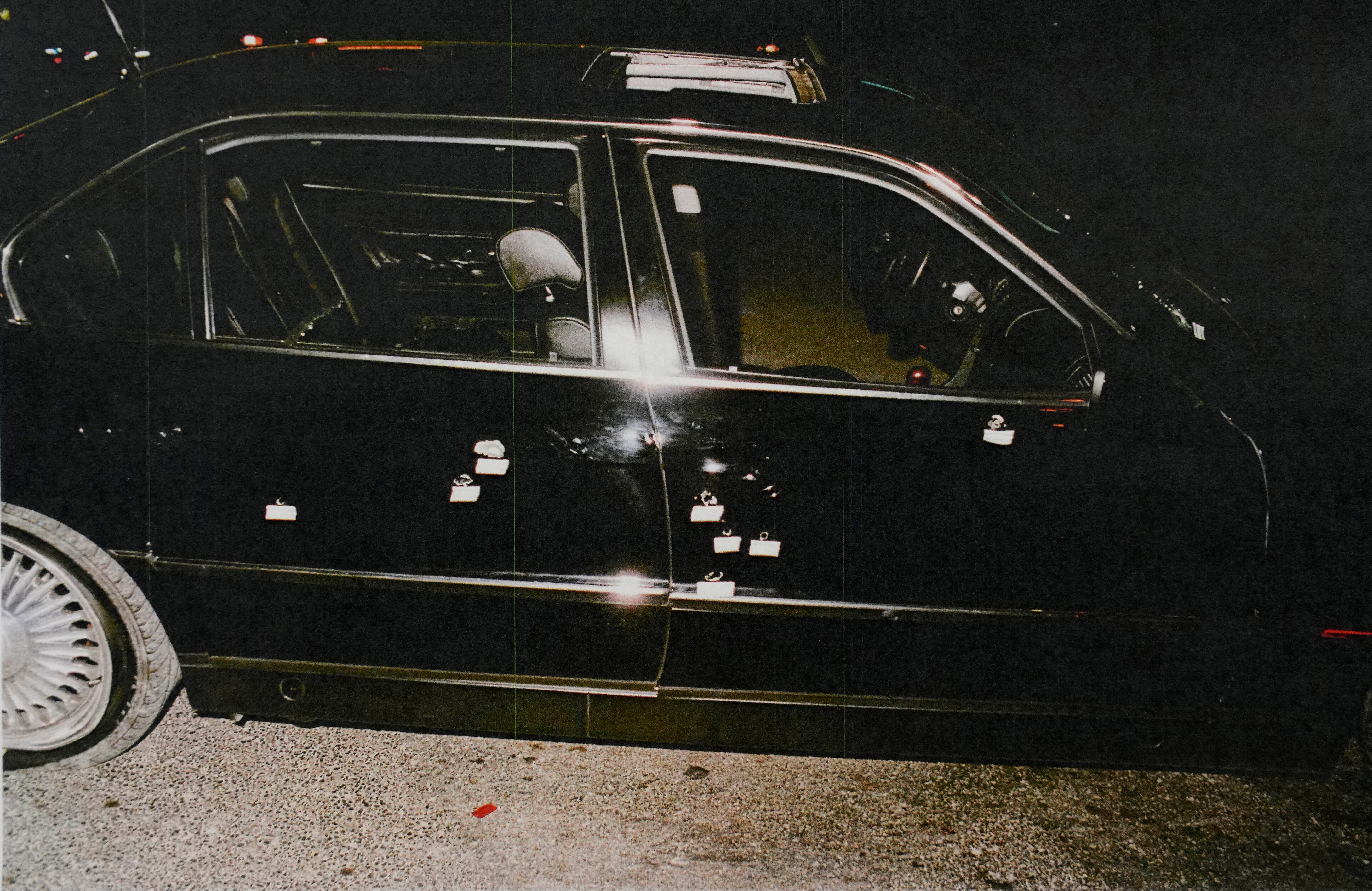
    On the night of Sept. 7, 1996, Shakur was in the passenger seat of a black BMW that Knight was driving when a white Cadillac pulled up on their right side and gunfire erupted. Knight was wounded but survived. Shakur died a week later at the age of 25.

    Police and prosecutors say the shooting stemmed from a fierce competition for dominance in a musical genre that pitted East Coast members of a Bloods gang sect against West Coast members of a Crips sect that Davis has said he led in Compton, Calif.

    That night, three others were with Davis in the Cadillac, but none of them faced charges in Shakur’s killing before they died.

    Here’s what we know about who was in both vehicles from authorities, court records, grand jury testimony, interviews, and Davis’ 2019 tell-all memoir, Compton Street Legend.

    Tupac Shakur

    Shakur is considered one of the most influential rappers of all time. He had five No. 1 albums, was nominated for six Grammy Awards, and was inducted into the Rock & Roll Hall of Fame in 2017. He received a posthumous star in 2023 on the Hollywood Walk of Fame and he will appear in the upcoming video game Stranger than Heaven.

    His death came as his fourth solo album, All Eyez on Me, remained on the charts, with some 5 million copies sold. He also used the stage names 2Pac and Makaveli. As an actor, he starred in several films.

    Shakur was born Lesane Parish Crooks in New York in 1971, and his name was changed a year later. His late mother, Afeni Shakur, and late stepfather Mutulu Shakur were active in the Black Panther Party in New York. Tupac Shakur was not close with his biological father, William “Billy” Garland.

    Two of the rapper’s siblings, Sekyiwa “Set” Shakur and Maurice “Mopreme” Shakur, have criticized authorities for inaction and slowness in charging anyone with their brother’s death.

    Marion “Suge” Knight

    Knight founded Death Row Records, a Los Angeles-based music label that represented Shakur at the time of his death. Knight’s moniker was shortened from “Sugar Bear,” his nickname growing up in Compton.

    Knight and Shakur were headed to a nightclub when their car was shot at near the Las Vegas Strip. Knight was grazed by a bullet or shrapnel.

    Now 61, Knight is serving a 28-year prison sentence in California for running over and killing a Compton businessperson outside a burger stand in January 2015. The case capped the former rap music mogul’s downfall from his heyday as one of the biggest — and most feared — names in the music industry.

    Davis said he and Knight knew each other growing up and even played on the same youth football team in Compton. Knight went on to play college football at the University of Nevada, Las Vegas. Briefly, during the 1987 NFL players’ strike, he was a replacement player for the Los Angeles Rams.

    In his memoir, Davis describes Knight and himself as the “only living eyewitnesses to what truly happened.”

    “Like two rams locking horns, Suge and I looked each other dead in the eye,” he writes when describing the moments right before the shooting.

    Orlando “Baby Lane” Anderson

    Law enforcement authorities long suspected that Anderson was the gunman. He was 22 at the time. Though Davis was his uncle and 12 years older, he described their relationship as that of brothers, friends, and even father-son.

    Shortly before the drive-by shooting, Anderson was beaten in a brawl at the MGM Grand casino involving Shakur and his associates, including Knight. Authorities, authors, and Davis himself say the shooting was an act of retaliation for beating up Anderson.

    “Them jumping on my nephew gave us the ultimate green light to do something,” Davis writes in the book.

    Davis said he obtained a handgun from an associate and tossed it into the back seat of the Cadillac but did not say who fired the fatal shots. Anderson was sitting in the backseat of the car, behind his uncle.

    Neither the Cadillac nor the gun used in the shooting were recovered, according to retired Las Vegas police Detective Clifford Mogg, who was assigned to the investigation in early 2018.

    “We were never able to identify the person who rented the car, where it was rented from, and then when it comes to the gun, we have never recovered as of this date, the weapon that was used in the murder,” Mogg said in testimony to the grand jury.

    Anderson, who denied involvement in Shakur’s killing, died two years later in what police said was an unrelated shooting at a Compton car wash.

    Deandrae “Freaky” Smith

    Also known as “Big Dre,” Smith was in the back seat of the car that night, sitting next to Anderson.

    Although authorities have said they believe Anderson pulled the trigger, the grand jury testimony challenged that theory.

    Denvonta Lee, a former associate of Davis, told the grand jury that it was Smith who shot Shakur and Knight. He said Anderson tried reaching over Smith but didn’t have a “clear shot” out the left-rear passenger window.

    The former associate, who wasn’t in the car but recounted a conversation he had with Smith days after the shooting, said Smith took the gun from Anderson, opened fire and let Anderson take credit for Shakur’s death.

    Smith was 30 when he died in 2004 of natural causes, according to the Los Angeles County coroner’s office.

    Terry “Bubble Up” Brown

    Brown was driving the Cadillac from which the shots were fired.

    Davis said in his memoir that they were driving toward Las Vegas Boulevard that night but spotted Shakur “hanging out of the window” of the BMW and waving to fans. Davis told Brown to make a U-turn, and they drove slowly past the rapper’s convoy until Davis said they “found who we were seeking.”

    Brown died in a 2015 shooting at a medical marijuana dispensary in Compton.

    The Los Angeles County coroner’s office said his full name was Terry Tyrone Brown, although Brown has been referred to as both “Terrence” and “Terrance” in investigative records.

  • National Gallery studied whether Freedom 250 IndyCar vibrations will affect art

    National Gallery studied whether Freedom 250 IndyCar vibrations will affect art

    When the Freedom 250 Grand Prix kicks off this month as part of President Donald Trump’s summer celebrations, IndyCar racers will weave at speeds up to 185 mph among federal buildings, the National Gallery of Art, the National Archives, and the Smithsonian Institution’s Hirshhorn, Air and Space, and American Indian museums.

    One of those institutions, the National Gallery of Art, has studied vibrations ahead of the race as it prepares for possible effects on its art — but it’s declining to say what it found.

    “In preparation for the Freedom 250 Grand Prix, the National Gallery conducted an extensive vibration study and based on the results we have implemented a set of measures to ensure the safety of our staff, visitors, collection, and facilities during the race,” gallery spokesperson Chris Abanavas said in a statement. “While we are not releasing the specifics, I can share that any such measures are only being taken out of a great abundance of caution.”

    The study didn’t raise concerns about structural risk to the buildings, Abanavas added. The race will also limit attendance at the free museum to ticket holders to the event’s secured area.

    The Smithsonian determined the race, which will take place Aug. 22-23, will not threaten any objects in its collections and has taken no special precautions as a result, a Smithsonian official said. But the institution will monitor the situation before and during the race, so it can protect exhibits if that changes.

    While the event is a first for D.C., it is not the first such race to pass through city streets and near museums, which commonly face vibrations from construction, musical events, and large crowds. But some historic preservationists worry the risk to delicate art pieces, historic documents, and priceless murals near the circuit has been underexamined.

    In March, the National Park Service consulted with the D.C. State Historic Preservation Office about the IndyCar event, noting that it saw “no adverse effects.” The letter did not mention the museums along the route. (The National Park Service and the National Archives did not respond to a request for comment.)

    Some preservationists who spoke with the Washington Post called the analysis insufficient and said a more comprehensive review of potential damage to historic properties or artifacts would have taken years, not months.

    “I can’t think of any place in that whole area that goes where the speed limit is higher than 25 miles an hour,” said Michelle Arcari Rose, a former associate general counsel at the National Trust for Historic Preservation, which has sued to stop Trump’s White House ballroom project. “So whereas people think these grand prix races aren’t a problem, we certainly don’t know, right? It’s a huge risk to then unleash cars at 185 miles per hour in a place where we’ve never had cars really going more than 25 miles an hour.”

    Mary Okin, assistant director of the nonprofit Living New Deal, sent a letter last week to the National Park Service and other agencies expressing concern that the event was permitted “without meaningful” consultation with “known preservation stakeholders.” The letter and the National Gallery of Art’s vibration study were first reported by the New Republic.

    “Such vibrations are well above normal street traffic and even go beyond those of jackhammers, pile drivers, and even freight trains,” she wrote.

    Okin is calling for safeguards including temporary sound barriers and damage assessments to help protect buildings such as the Wilbur J. Cohen Building, which sits on the circuit’s south edge and houses fragile New Deal-era murals.

    “They’re vulnerable,” said Okin, whose organization has worked on the building’s preservation. “Excess vibrations and sound, as well as the construction of the racetrack itself, could very well cause damage.”

    The General Services Administration, the body that manages real estate for the federal government, reviewed the proposed route for potential impacts on its assets and identified no areas of concern, a spokesperson said in a statement.

    “The White House and [IndyCar owner] Penske have followed all appropriate protocols and been in close coordination with all relevant agencies to ensure this is also the safest and most secure race for all visitors to enjoy,” said Davis Ingle, a White House spokesperson.

    While many major motorsport races are held on permanent road courses or oval tracks, temporary street circuits are a familiar part of international racing.

    IndyCar stages several events on public roads in cities such as St. Petersburg, Fla.; Long Beach, Calif.; Detroit; and Toronto, while Formula One also races on street courses in places including Monaco, Singapore, and Las Vegas. The roads are closed, lined with concrete barriers, and transformed into racecourses for the events before reopening to traffic.

    One of the closest comparisons with D.C.’s race is the Firestone Grand Prix of St. Petersburg, in which the street circuit runs next to the Dalí Museum. A museum spokesperson said the collection has remained safe and secure throughout the event’s history. The museum has not conducted race-specific vibration studies, but its galleries were built to museum standards and the collection is continuously monitored.

    Green Savoree Racing Promotions, which organizes the St. Petersburg race, said the museum closes to visitors while racing is underway and reopens after the event concludes. The promoter also noted that the museum is housed in a hurricane-rated building constructed to Florida standards, allowing the artwork to remain in place during extreme weather, and said it was not aware of any additional precautions being necessary during the race.

    In a statement, a Freedom 250 Grand Prix spokesperson said race organizers have “tremendous respect for the history and the structures surrounding the racing circuit in Washington, D.C.”

    “IndyCar has successfully hosted races on downtown street circuits in urban areas for decades,” the spokesperson said. “With this excellent track record and the thorough preparation we have done for this event working closely with all the appropriate local and federal agencies, we do not anticipate any impact on the structures surrounding the circuit” as a result of the race.

    Researchers have started paying closer attention to how vibrations from construction, live music, and major events may affect the art and artifacts inside museums.

    One 2023 report studied the effects of vibrations from music and a NASCAR street race on museums in Chicago. In that case, racecars passed a south wall of the Art Institute of Chicago, near galleries holding a Van Gogh exhibition.

    Advisers who reviewed data and consulted with NASCAR beforehand told the museum vibrations from the cars shouldn’t pose a major risk, according to the report. Afterward, they found museumgoers’ foot traffic caused greater vibrations in gallery floors than the race outside. (An author of the report declined to be interviewed, and the Art Institute says it works with specialists before any major activity that might cause vibrations.)

    On Tuesday, there were few apparent changes at the National Gallery of Art except for enclosures set up around some artworks outside.

    The I.M. Pei-designed triangular skylights, which abut a cascading sunken fountain and illuminate the underground cafe, have been boarded up. Between the West Building and the Sculpture Garden, a massive Alexander Calder sculpture made of sheet metal, Tom’s, has been enclosed in a protective barrier.

    Some sculptures and installations were boarded up “out of an abundance of caution,” said Abanavas, citing “the increased visitor traffic around the National Mall this summer for events including the Grand Prix.”

    As of publication, the Post did not identify significant changes to public collections inside the National Gallery of Art’s East Building, which closely faces the racetrack on Pennsylvania Avenue.

  • Philly Haitians and allies march to demand protections as TPS expires

    Philly Haitians and allies march to demand protections as TPS expires

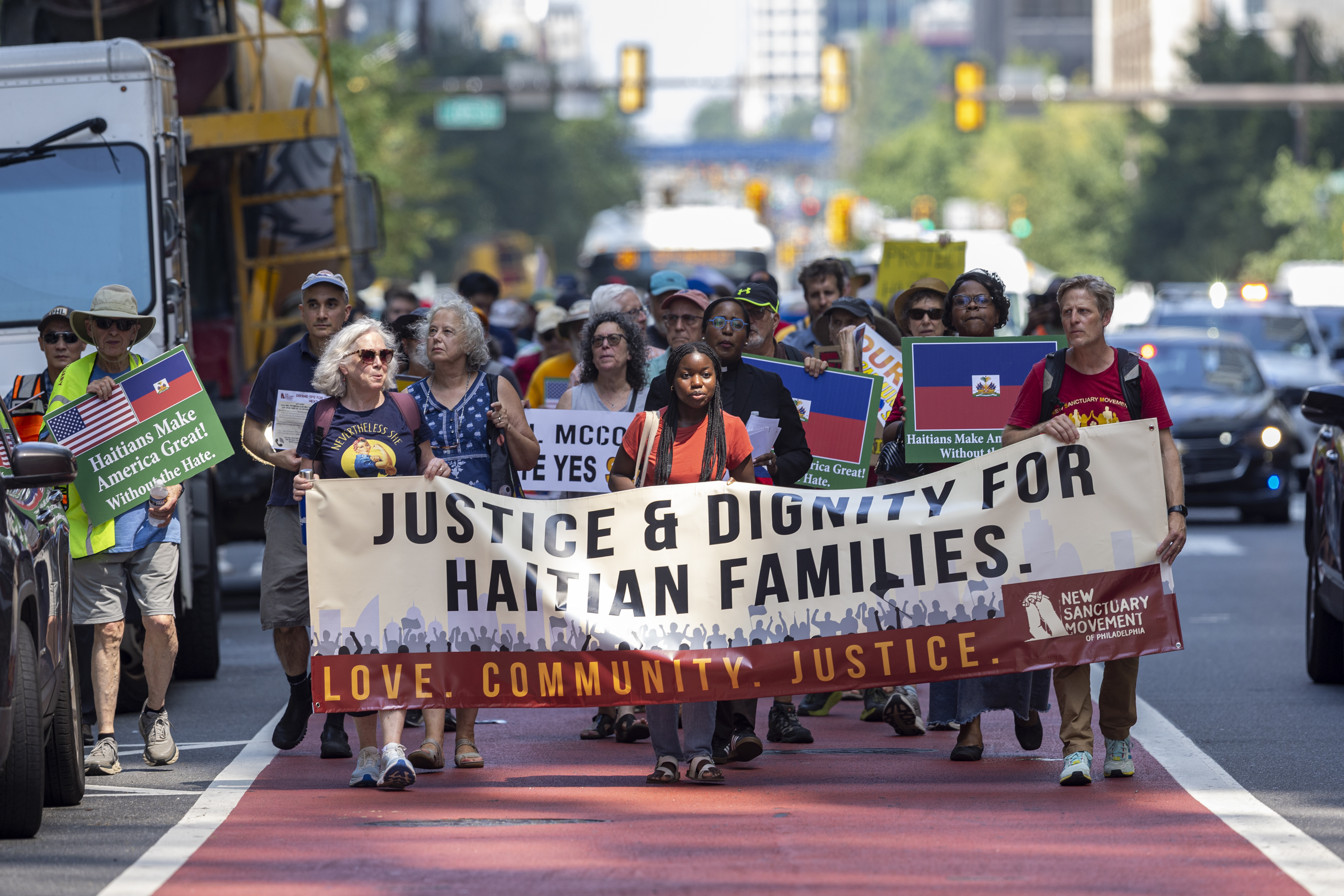
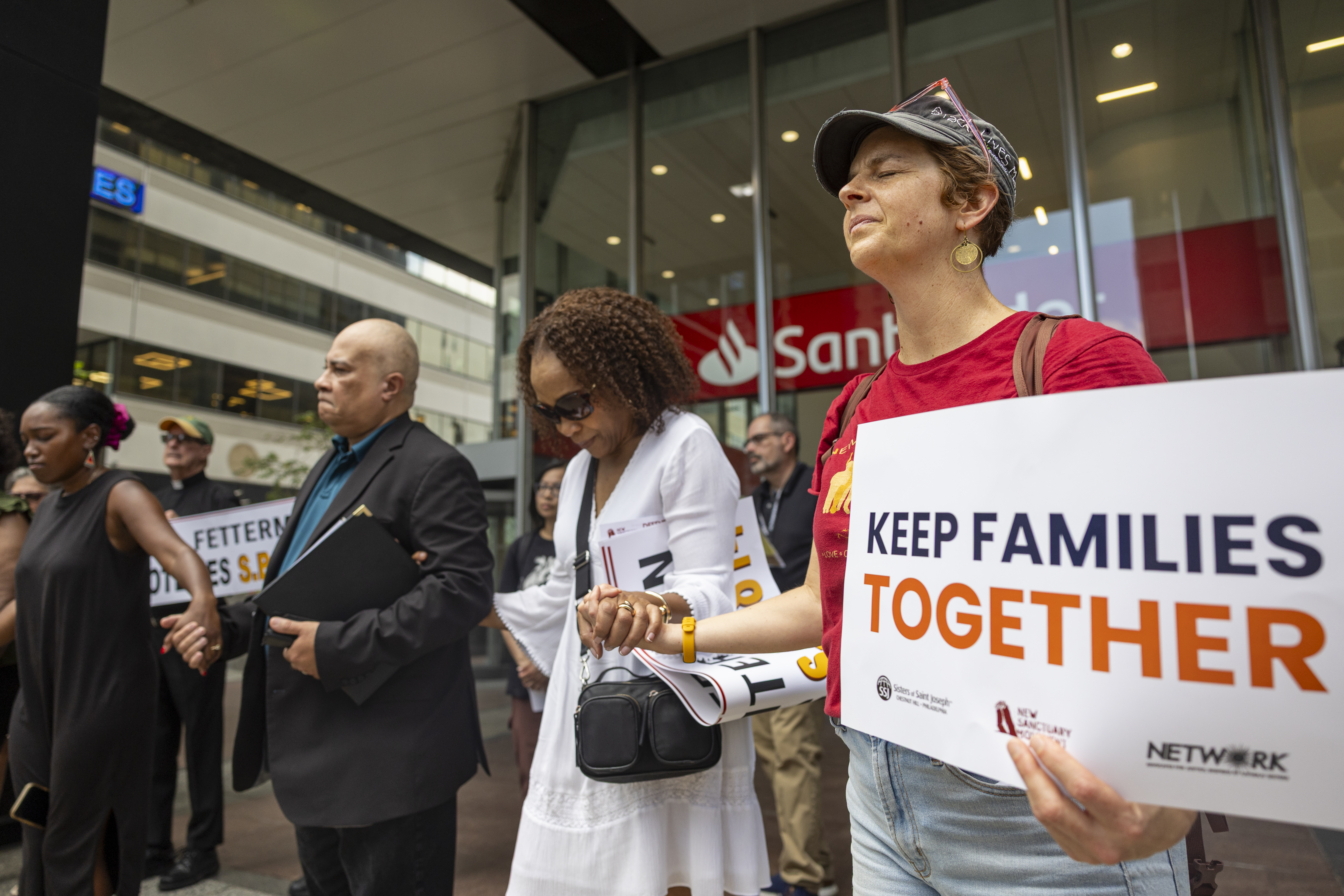
    Dozens of Haitians, allies, and supporters rallied in Center City on Thursday, demanding that Pennsylvania’s U.S. senators help restore temporary protected status (TPS) for thousands now in danger of being deported to the shattered Caribbean nation.

    They gathered outside the office of Republican U.S. Sen. Dave McCormick near 20th and Market Streets, then marched to the office of U.S. Sen. John Fetterman, a Democrat, near Second and Chestnut Streets.

    People held up signs that said, “Our Haitian community is here to stay,” even as protections and work permits have ended for about 350,000 Haitians in the U.S. The Haitian community numbers about 11,000 in Philadelphia, and leaders say it seems everyone knows someone who had TPS or has it themselves.

    Speakers said that TPS is more than an immigration status, that it is what allows neighbors, friends, and family members to live here, to work, pay taxes, and help build the country.

    They called on the senators to help pass Senate Bill 4814, which would require the secretary of the Department of Homeland Security to designate Haiti for TPS through April 2029.

    A spokesperson for McCormick said: “We respect everyone’s right to come together and voice their opinion. We appreciate the input.”

    Efforts to reach a spokesperson for Fetterman were not immediately successful.

    Pastor Kenel Stevenson said he knows of no local Haitians who have been taken into custody by U.S. Immigration and Customs Enforcement, or fitted with ankle monitors, as the ACLU says is happening elsewhere.

    But the mood among his fellow Haitians is grim, he said.

    “There is fear, fear of repatriation, of being returned to a place where there is no safety,” Stevenson said.

    Nearly 100 people gathered before moving east toward Fetterman’s office shortly before noon, filling the breadth of Chestnut Street as police officers stopped traffic for the group to pass. Oppressive heat and humidity caused some older people to lag.

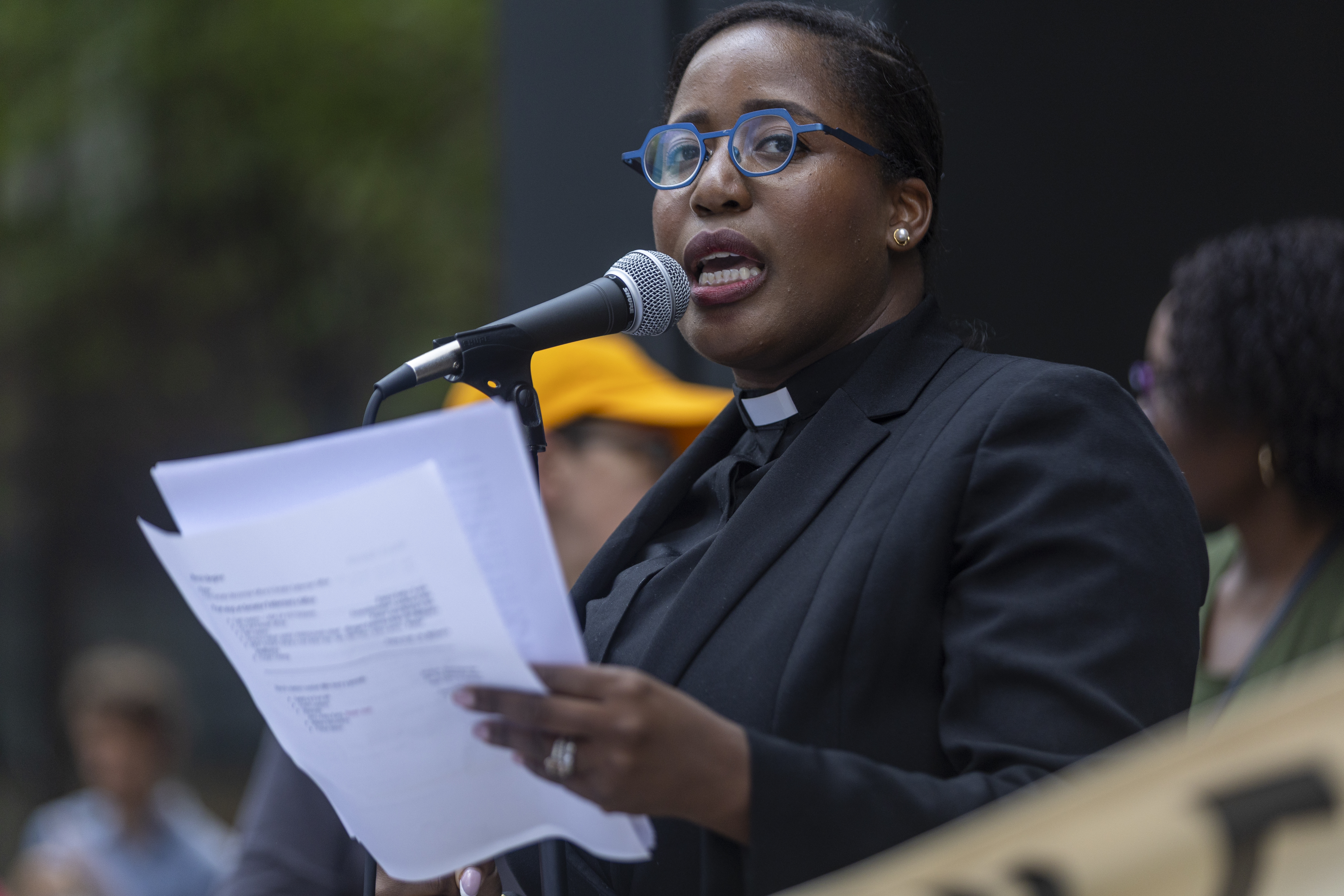
    Reverend Jennifer Joseph of Zion Community Church in Delaware County addresses the crowd outside of U.S. Senator Dave McCormick’s office in Philadelphia on Thursday.Aidan T. Gallo / Staff Photographer

    TPS has expired for an estimated 350,000 Haitians, ending their ability to legally work in this country and putting them at risk of deportation to a homeland riven by natural disaster and violent crime.

    The Rev. Frantz Ulysse, pastor of the First Haitian Church of God of Prophecy in Olney, said fear and uncertainty are not things he expected his parishioners to feel on American soil.

    He searches himself to offer hope at a moment when people are desperate for some sense of tranquility.

    “I had a mother called me the other day and asked if I could take custody of her child if she’s taken away,” Ulysse said.

    Community leaders fear mass family separation, as Haitian nationals have married U.S. citizens and are raising American-born children.

    “We are not criminals,” he said. “We have engineers, doctors, professors,” people who are eager to help and contribute.

    “If people go back to Haiti, they will die, and if they stay as things are, they are in hiding, scared, and can’t leave their house,” he said, joining others outside Fetterman’s office.

    Still, he said, he has not given up hope.

    “America is a country of immigrants, and I believe they will stand with us,” Ulysse said. “Help us fight until the end!”

    Hundreds of Haitian nationals have been told by immigration officials to appear at ICE offices to be fitted with ankle monitors, according to the ACLU.

    Temporary protected status provides permission to live and work in the United States for people whose homelands are riven by war, natural disasters, epidemics, or other extraordinary circumstances.

    Haiti suffered a massive earthquake in 2010 that led the Obama administration to announce that undocumented Haitian immigrants in the U.S. would be eligible for TPS. Thousands more would be welcomed over time under humanitarian programs and become eligible as Haiti grew mired in crisis ― a deadly cholera epidemic, hurricanes, the collapse of basic government functions, and the rise of armed gangs.

    Reverend Katie Aikins, of West Philadelphia, prays for the Haitian people alongside faith leaders and community members before the march begins outside of U.S. Senator Dave McCormick’s office on Thursday.Aidan T. Gallo / Staff Photographer

    Haitian American pastor Ketty Pointe-Jour said Thursday that her immigrant parents would not believe what is happening today.

    They fled Haiti for their lives, she said, and “the U.S. opened its arms for them. The America they knew in the ’60s and ’80s is completely different from what we are seeing now.”

    The Trump administration has sought to end TPS for Haiti and other nations. In June, the Supreme Court ruled that the administration could terminate temporary protected status for countries like Haiti and Syria.

    More broadly, the ruling appears to make Department of Homeland Security decisions about TPS unreviewable by lower courts, creating deep uncertainty for the future. The White House has pledged to deport people who lose legal status, including those who had TPS.

    Haitians are not the only population affected.

    TPS is set to lapse for more than 170,000 people from El Salvador in September, and in October 100,000 from Ukraine face the same termination.

    Advocates say the Trump administration’s promise of deportations will hurt families that include spouses and children who are American citizens.

    What is more, immigration researchers and organizations say, the country will pay a financial price ― in lost taxes, wages, spending, and services, as large numbers of workers and dollars exit the U.S. economy.

    The nation’s 1.3 million TPS holders work at higher proportions than the country as a whole, pay billions of dollars each year in federal and local taxes, and contribute to the solvency of a Social Security system from which they are unlikely to ever draw benefits.

    Outside Fetterman’s office, Dottie Baumgarten said she came from her Cheltenham home to support the Haitian community. She hoped the presence of supporters helped immigrants feel less alone.

    “The Haitian challenge is not just Haitians,” she said, “it’s immigrants in general, and we have to support them. We are destroying their families.”

  • Feds will take over gun case of Olney man at center of missing women investigation, as Philly DA withdraws charges

    Feds will take over gun case of Olney man at center of missing women investigation, as Philly DA withdraws charges

    Federal prosecutors will take over the criminal case against the Olney man whose house is at the center of a sprawling investigation into the fate of two missing women, officials said Thursday.

    Assistant District Attorney Alyssa Amoroso withdrew the charges the Philadelphia DA’s office had filed against Eugene Albert Horsch for illegal gun and drug possession Thursday morning, telling a city judge that the U.S. Attorney’s Office would instead handle the case.

    Horsch, 44, has been in federal custody since June after a U.S. park ranger encountered him and another woman inside a black BMW near Independence Hall, acting suspiciously. Police said they searched Horsch — who was not allowed to possess guns because of felony convictions — and found a switchblade and a glass pipe in his pants, as well as two illegal guns, drugs, and a phony federal drug enforcement badge in his car.

    And then, in an unsettling twist, the woman with Horsch presented a fake ID bearing the name of a woman, Blair Tonzelli, who had been reported missing in 2023.

    Horsch was charged with illegal gun and drug possession after his June 19 arrest, and was held on $500,000 bail.

    About a week later, he was charged with a federal firearms violation, allowing him to be held in federal custody until trial.

    Eugene Albert Horsch, 44, of Philadelphia.Courtesy of Philadelphia police

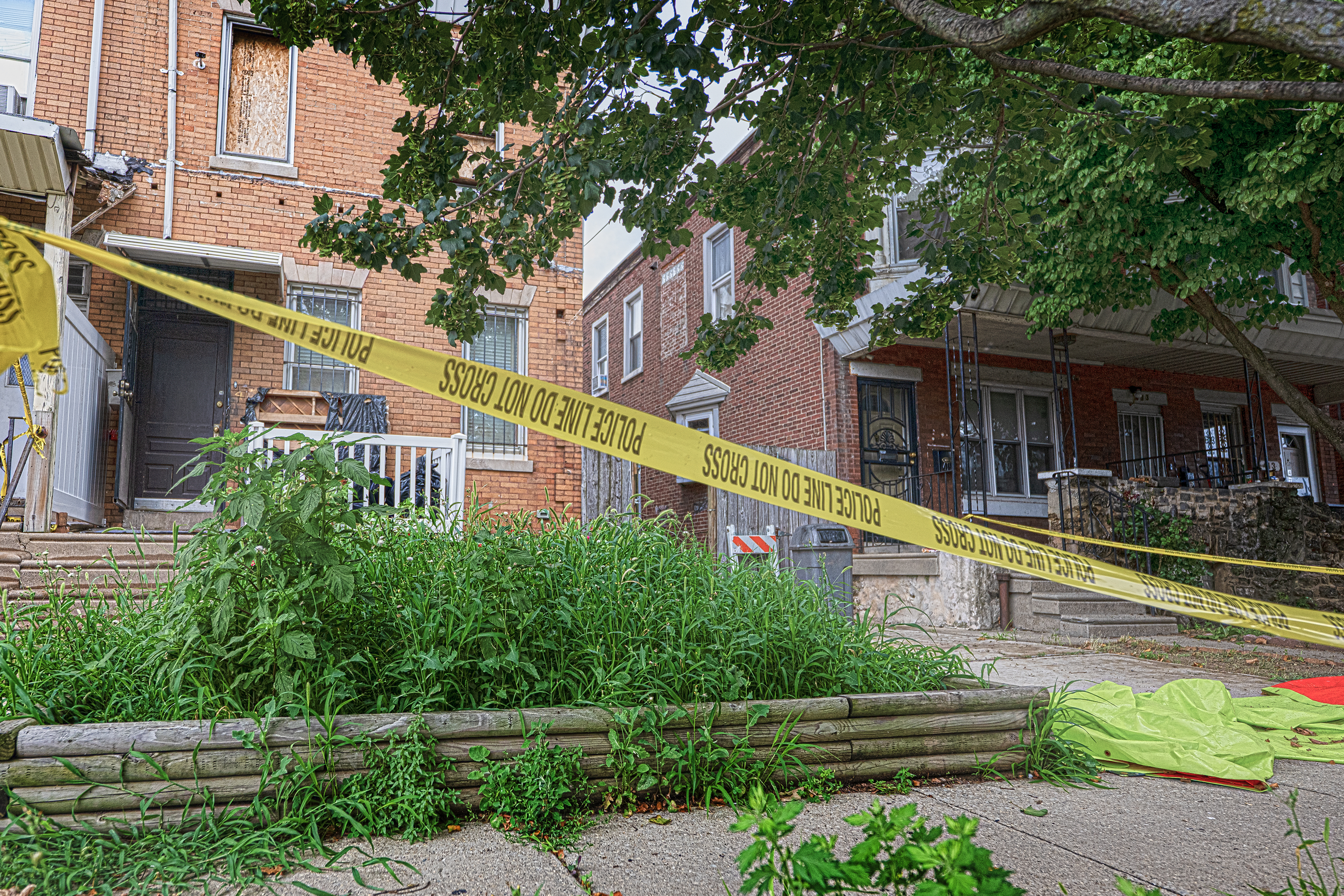
    In the days after Horsch was arrested with the weapons in Center City, local and federal investigators searched his decrepit twin house on Chew Avenue and found another gun, as well as materials to grow marijuana.

    They also discovered a trove of more concerning materials — barrels of chemicals in the basement, several urns holding cremated remains, supplies to make counterfeit IDs, documents tied to at least two women who have been missing for years, and a handwritten letter that described hurting people and mentioned the serial killer Ted Bundy.

    A woman also told investigators Horsch had told her he knew how to use chemicals to melt bodies in the basement.

    As officials investigated the whereabouts of Tonzelli, the woman whose name appeared on the ID handed to park rangers, they learned that she was reportedly last seen at the Chew Avenue house in late 2022.

    They also found that another missing woman was last seen at the address. Amy McHale, the ex-wife of Horsch’s deceased father, Raymond “R.C.” Horsch, disappeared in June 2016.

    In the months since the investigation began, police have repeatedly searched Horsch’s home, excavated its yard to recover pipes to test for DNA, and pored over hundreds of pieces of documents and Horsch’s devices in hopes of learning the fate of the missing women.

    Law enforcement sources said none of the items recovered from inside the home — including what initially appeared to be significant amounts of blood — tested positive for blood or either woman’s DNA. It was not immediately clear if the tests of the excavated pipes have been completed.

    The strange, complex backstory of Eugene Horsch and his father has also clouded portions of the investigation.

    Raymond “R.C.” Horsch in 1999.S. E. Stokowski / Wikimedia

    Raymond Horsch was a porn actor and director who produced films and self-published novels that often featured women in addiction in violent fantasies — including some that depicted various ways to kill women. He cast himself in some of the stories as an “empathetic” serial killer who preyed on addicted women to end their suffering, and billed the books as stories that combined real details from his life story with his fantasies.

    Investigators have since found themselves working to sort fact from fiction in discerning whether anything more sinister happened inside the home, or if it was just a den for troubled drug users.

    Eugene Horsch’s lawyer, Jerome Brown, has said his client did nothing wrong. Brown did not attend Thursday’s hearing.

    Horsch, too, did not appear in court. He remains in federal custody as Philadelphia homicide detectives and federal officials continue to investigate.

  • Dick Langman, retired award-winning editor at The Inquirer, has died at 99

    Dick Langman, retired award-winning editor at The Inquirer, has died at 99

    Dick Langman was always a wordsmith.

    Even as a boy in New York, he loved language, literature, and poetry. He earned a bachelor’s degree in English, took graduate classes at the University of Missouri School of Journalism, and could recite lines from Shakespeare, Wordsworth, and Frost on demand.

    He was generally calm and reasonable, too, his sons said. “He didn’t get upset easily,” his son Mark said.

    His vocabulary was extensive, and he could spell practically any word. So it is no surprise that he spent 50 years, from the early 1950s to his retirement in 2002, as an editor, page designer, and reporter for The Inquirer, the Bulletin, the Morning Call of Allentown, the Pottstown Mercury, the Honolulu Star-Bulletin, and the Evening Tribune in Hornell, N.Y.

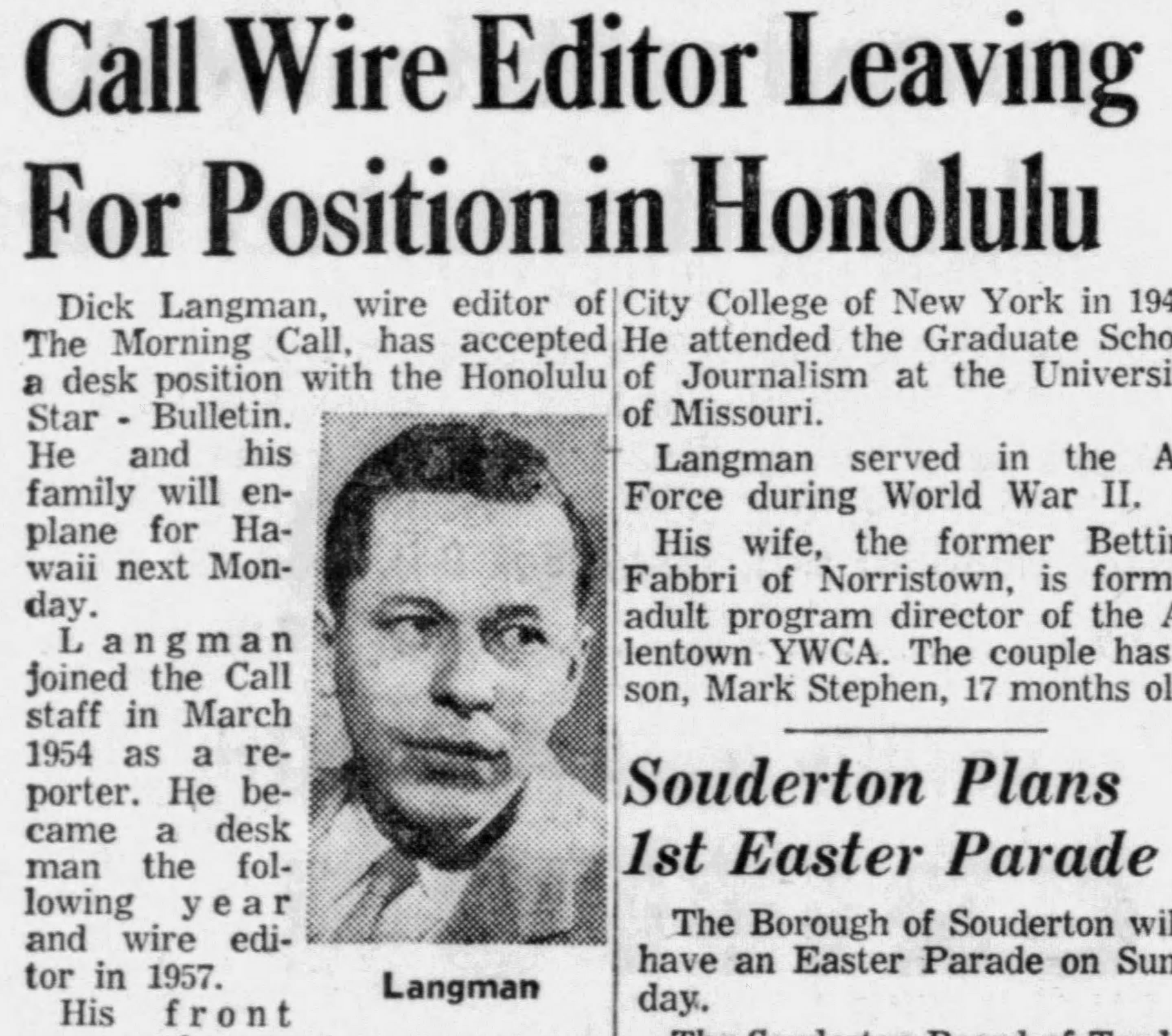
    The Morning Call published this story in 1959 when Mr. Langman left to work in Hawaii.Newspapers.com

    He joined The Inquirer in 1981 and worked mostly nights for 21 years as a copy editor, assistant news editor, and suburban assigning editor. Former colleagues at The Inquirer called him a “meticulous” editor, “enormously patient,” and “a man of great integrity” in online tributes.

    He won an award from the old Pennsylvania Newspaper Publishers Association in 1957 for a front page he designed for the Morning Call and spent 20 years as assistant city editor and news editor at the Bulletin. “I’m glad that I had a chance to work with him,” a former Inquirer copy desk colleague said. “What a pro.” Another said: “I could not have had a better teacher.”

    On Saturday, June 13, Dick Langman died of complications from pneumonia at Bryn Mawr Hospital. He was 99.

    Long before he came to Philadelphia in 1961, Mr. Langman was a seasoned newspaperman. He honed his reporting skills as a writer at the Evening Tribune in New York and the Mercury in Pottstown.

    Mr. Langman and his wife, Betty, married in 1954.Courtesy of the family

    In January 1954, he opened a Page 1 story for the Mercury with: “From clomping around in wooden shoes in Holland to wearing modern footwear in Bechtelsville is a long way, and Mrs. LaVerne Fronheiser is glad to be home. She’s not too glad, however, because her husband had to stay in Germany, where he’s stationed with the infantry.”

    On Page 1 in March 1954, he wrote: “They had need of a chaplain yesterday at borough hall. He could have served well the 50 moaners and groaners whose cars were tagged for parking violations.”

    He moved on to the Morning Call and covered high school sports and other news. He left for Honolulu in 1959 and became sports editor at the Star-Bulletin. But he missed the East Coast and returned to work at the Bulletin in Philadelphia in 1961.

    “Hawaii is one of the loveliest places in the world,” he told the Morning Call. But his wife, Betty, had roots in Norristown, he said, and they both got homesick.

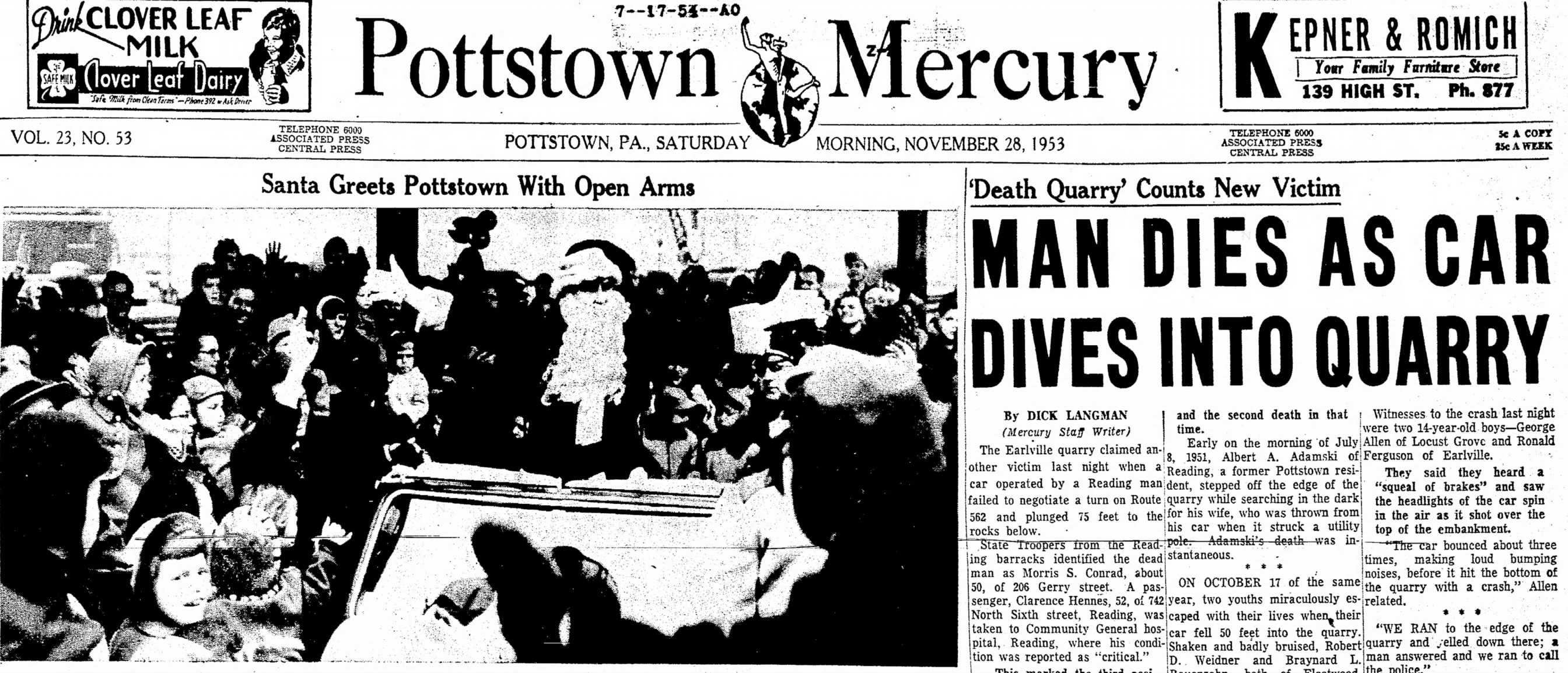
    Mr. Langman wrote this Page 1 story for the Pottstown Mercury in 1953.Newspapers.com

    Earlier, after college, Mr. Langman worked briefly for the Associated Press in New York and as a statistician for what is now the Elias Sports Bureau. He enlisted in the Army after high school in 1944, went to active duty in 1945, and served until the end of World War II.

    At The Inquirer, a former colleague recalled, Mr. Langman edited a story about a horse that had injured a leg. Naturally, he tried to find out which leg was hurt.

    “Dick was a painstaking editor,” his former colleague said on Facebook, “and a master in getting the details right.”

    Richard Langman was born Sept. 5, 1926, in New York. He graduated from Stuyvesant High School and earned a bachelor’s degree at City College of New York in 1948.

    Mr. Langman enjoyed cooking and shared his favorite recipes with colleagues at The Inquirer.Dick Langman

    He met Betty Fabbri, the society editor at the Mercury, and they married in 1954. The Morning Call announced their union in its Breakfast Chatter column by saying: “Best wishes to reporter Dick Langman, who walks the long mile in Norristown Sunday with Bettina.”

    He and his wife had sons Mark, Peter, and Andrew, and lived in Allentown, Ardmore, and the Quadrangle retirement community in Haverford. His wife died in 2017.

    Mr. Langman and his wife shared wanderlust, and they went to Russia, Austria, Hungary, Europe, and elsewhere. They visited Italy 10 times, France three times, and Cape May as often as possible.

    They liked to cook together, too, and he shared his favorite recipes with colleagues at The Inquirer. At the Bulletin, he became part of the “old bulls” lunch group.

    He submitted his own prewritten obituary to his funeral director long before it was needed and said: “He enjoyed classical music, poetry, mystery novels, and British mystery and comedy.” He also liked crossword puzzles, fishing, table tennis, classic movies, and duplicate bridge.

    He cheered for the New York Yankees baseball team and the Green Bay Packers and Penn State football teams.

    “He delighted in jokes and was a real fan of the Marx Brothers,” his son Peter said. “When we were children and a local movie theater would feature a Marx Brothers film for one night, my parents made sure that we went. Fond memories indeed.”

    In addition to his sons, Mr. Langman is survived by two grandchildren and other relatives.

    Services were held earlier.

    Donations in his name may be made to the Lenfest Institute for Journalism, 100 S. Independence Mall West, Suite 600, Philadelphia, Pa. 19106.

  • Judges reinstate convictions for ‘Chester Trio,’ who say they were wrongly accused of woman’s 1997 murder

    Judges reinstate convictions for ‘Chester Trio,’ who say they were wrongly accused of woman’s 1997 murder

    The Pennsylvania Superior Court has reinstated the murder convictions of three men who were granted new trials after being imprisoned for nearly 25 years for a crime they say they did not commit.

    The men, known as the “Chester Trio,” were convicted in separate trials in the 1997 beating death of 70-year-old Henrietta Nickens in her Delaware County home and are serving life in prison.

    Derrick Chappell, 44, Morton Johnson, 46, and Samuel Grasty, 49, have insisted for decades that they were not responsible for the death of Nickens, whose battered body was found face down in the bedroom of her Chester home, her bed and walls stained with blood.

    In 2024, a Delaware County Court judge vacated the three men’s convictions, saying newly tested DNA from the crime scene cast doubt on their culpability and might have persuaded jurors to reach a different conclusion had they been presented with that evidence at trial.

    But late last month, a panel of Superior Court judges disagreed and reversed that outcome.

    In a 2-1 decision, the judges said that they did not consider the evidence presented by defense lawyers to be new, and that it therefore would not have changed jurors’ minds.

    Judges Maria McLaughlin and Megan Sullivan said in a 41-page opinion that the newly tested DNA — recovered from Nickens’ dress and bedsheet, a green jacket found at the scene, and items in the jacket’s pockets — did not offer any revelations because it matched an unknown DNA profile that had been presented to the jurors who decided the trio’s fate.

    “This same information was previously considered by all three separate fact-finders and rejected,” the judges said of the verdicts in three trials.

    During the trials, they said, jurors were told that the DNA found at the scene was not a match for any of the defendants.

    And they said the newly tested DNA did not alter the argument defense lawyers made at the earlier trials that someone other than the three men had broken into Nickens’ home, raped her, and beaten her to death.

    Prosecutors relied on witnesses who testified that they had overheard the men discussing their involvement with the crime.

    Their star witness, 15-year-old Richard McElwee, testified that he had acted as a lookout while the men robbed Nickens of $30. He pleaded guilty to third-degree murder in exchange for his testimony and was sentenced to six to 12 years in prison.

    The men’s lawyers have long contended that the prosecution’s witnesses were unreliable and that the investigation was flawed. And they emphasized the lack of a DNA match for the men.

    Paul Casteleiro, legal director of the nonprofit law center Centurion Ministries and Grasty’s attorney, said he was dismayed by the court’s decision and, along with attorneys for Chappell, has filed an appeal.

    “We’re going to fight this every way possible,” he said.

    A spokesperson for Delaware County District Attorney Tanner Rouse said the office appreciated the Superior Court’s affirmation of the jury verdicts.

    As the men continued to assert their innocence, the possibility that Nickens was raped and beaten by a single assailant was central to defense arguments during 2023 hearings in which they sought to overturn their convictions.

    In presentations before Delaware County Court Judge Mary Alice Brennan, the attorneys called on forensic experts who testified that the new tests showed a sample of Nickens’ blood and semen from the unknown assailant were deposited on her bedsheet at the same time, lending credence to their theory that she had been raped and beaten by the same person.

    Prosecutors rejected the contention that Nickens had been sexually assaulted, and suggested the semen found on the sheet and in her body was from an earlier consensual encounter.

    Brennan sided with the defense lawyers when she vacated the murder convictions the following year.

    Jack Stollsteimer, then the Delaware County district attorney, swiftly appealed that decision, leading to the Superior Court decision reinstating the convictions.

    Defense lawyers, in turn, have appealed that decision, saying the Superior Court panel had erred. Their arguments mirrored a strongly worded dissent by Superior Court President Judge Anne Lazarus, who said she believed that the recent DNA testing constituted a new finding — and that it was exculpatory.

    The evidence, she wrote, “does significantly more by excluding the petitioners from being present at all in Nickens’ home.”

    But her colleagues rejected that view in the majority opinion, which was sharply critical of the lower court’s decision to overturn the men’s convictions.

    That decision, they said, was based on “erroneous conclusions.”

    Because of that, the judges said, “we reverse.”

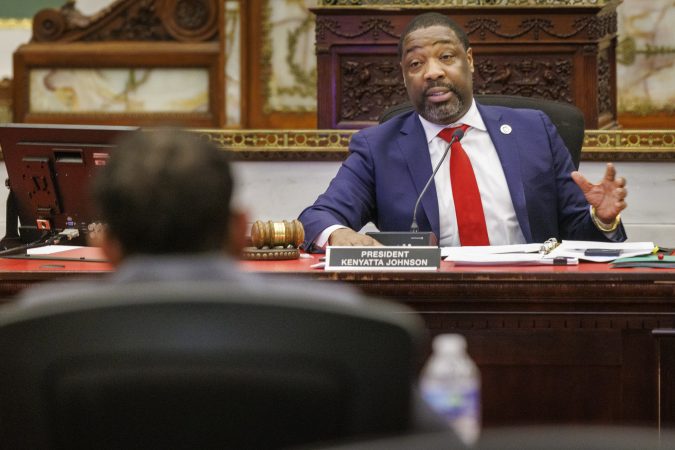
  • A sweeping audit of the Philadelphia School District’s management and operations is coming, at City Council President Kenyatta Johnson’s request

    A sweeping audit of the Philadelphia School District’s management and operations is coming, at City Council President Kenyatta Johnson’s request

    The Philadelphia School District is about to face significant new scrutiny, with City Council President Kenyatta Johnson asking for a sweeping performance audit of the school system’s management and operations.

    City Controller Christy Brady has agreed to the request, which came via a letter in recent weeks signed by all 17 Council members, Johnson’s office told The Inquirer. The comprehensive review will go beyond the audit Brady’s office performs annually, delving into areas such as staffing and outside contractors.

    Council laid out no deadline for the audit but made clear it is expecting the results in time for next budget season, which will begin in the new year and ramp up in the spring.

    The district, one of the largest in the United States, has a $4.6 billion budget, which funds education for 113,000 students in 213 district schools and 65,000 in 81 charters. About $2 billion of that money comes directly from the city.

    “While the SDP is subject to regular financial statement audits that examine the accuracy of financial reporting and compliance with applicable accounting standards, this request seeks a performance audit focused on evaluating the efficiency, effectiveness, and management of financial and operational practices, including budgeting decisions, resource allocation, internal controls, and long-term fiscal planning,” Johnson said in a statement Thursday.

    The news comes during a period of heightened tensions between Council and the district, spurred by members’ frustration over the school board’s move to close 17 schools and a separate $300 million structural deficit that took Council by surprise.

    Last week, at a news conference where several members “begged” the district to come to the table to negotiate over school closings, Councilmember Curtis Jones Jr. said Council has “tools in our tool belt that we will use” if the board does not change its mind about some building closures.

    Jones has sponsored legislation to hold hearings on creating an independent financial authority, like the Pennsylvania Intergovernmental Cooperation Authority, to oversee the district’s finances.

    Council sources told The Inquirer that there is no indication that the district has conducted malfeasance, but that given the billions that flow to the district from city coffers, Philadelphia officials want a closer accounting of how the money is being spent.

    After the board voted to begin the closure process in April, multiple members of the public also called for increased financial scrutiny of the district.

    Reginald Streater, the school board president, said in a statement Thursday that the board and district will work with the controller’s office “to continue strengthening our financial processes and procedures.”

    Streater said the audit squares with the board’s approach to governance.

    “Good governance is not about assuming we have all the answers; it is about asking the right questions, using evidence to guide decisions and being willing to improve. We look forward to understanding the proposed scope of the audit and ensuring that the examination is constructive and focused on helping the district work well for students, families and educators,” Streater said.

    Superintendent Tony B. Watlington Sr. stressed the district’s academic strides, history of audits with no material weaknesses, and moves to solidify its credit rating.

    Frustration over a budget deficit and school closings

    Johnson, in his statement, said that the audit will reassure Council that “resources are being managed effectively and operations are functioning efficiently by the SDP,” and that he believes its findings will help inform priorities for next fiscal year’s budget.

    This year’s budget season was chaotic.

    After Mayor Cherelle L. Parker introduced her initial budget, Watlington ordered $225 million in cuts, including some school cuts, with 300-plus teachers, counselors, and climate staff slated to lose their positions.

    The problem, Watlington underscored in remarks in March, was “not because we’re not good stewards of the dollars, but because of historic underfunding.” (The district achieved its highest credit rating ever under Watlington, who has said he wants to be the superintendent to retire the system’s structural financial issues permanently.)

    Philadelphia’s school system cannot raise its own revenue but instead depends on the city and state to bankroll it, unlike every other district in Pennsylvania.

    City Hall seemed shocked at the news of the deficit and job cuts, despite the fact that Watlington had warned officials in 2025 that a budget gap was coming. The school district spent $300 million in reserves that year to avoid layoffs and program cuts as federal COVID-19 funds dried up.

    After Watlington said he would be forced to make the school cuts, Parker then upped her proposed 20-cent-per-trip rideshare tax to a $1-per-trip levy. That frustrated a Council already catching heat from city residents anguished over plans to close schools.

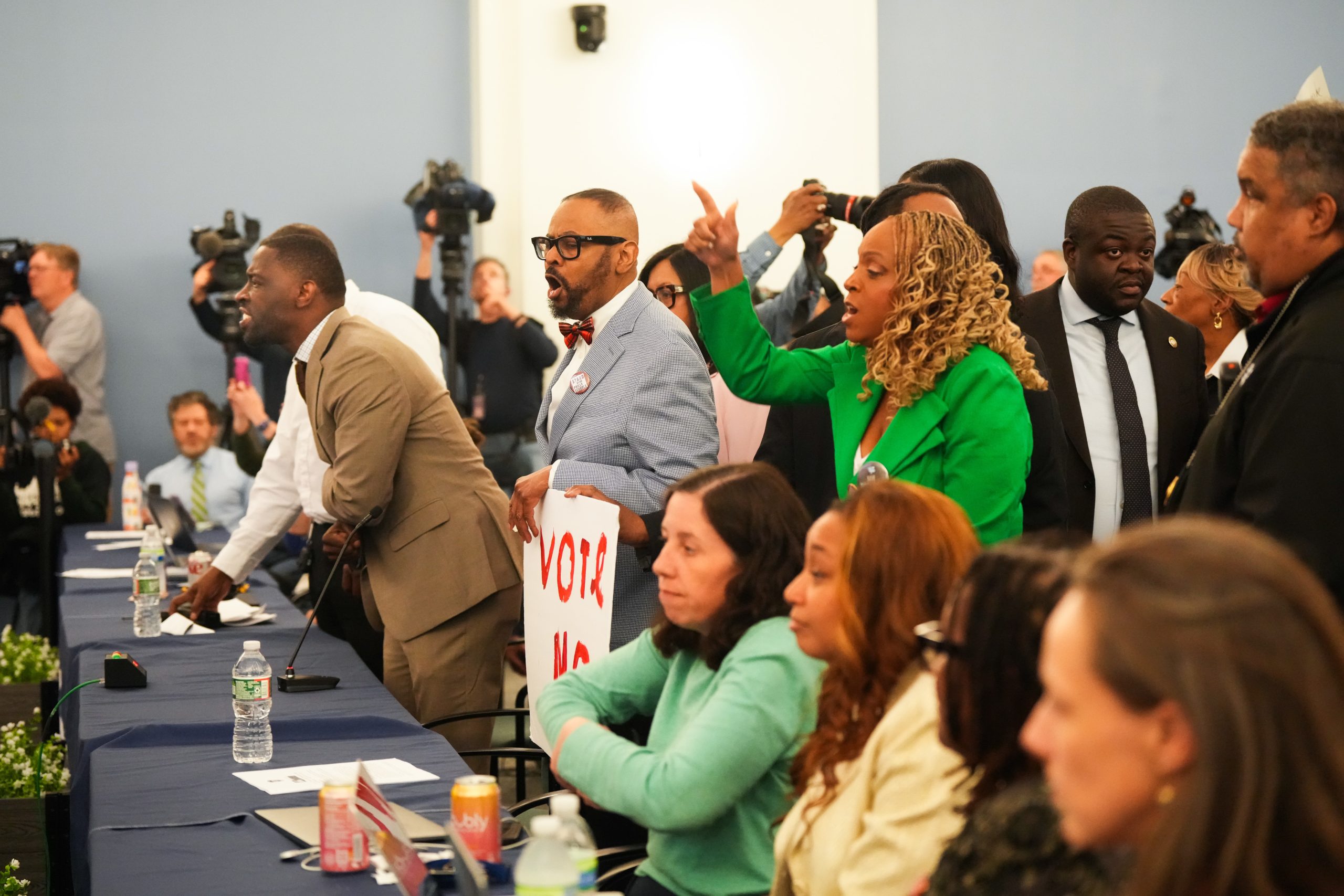
    (Left to Right) Councilmembers Isaiah Thomas, Curtis Jones Jr., and Jamie Gauthier protest at Thursday’s school board meeting as the board prepared to vote on the facilities plan.Jessica Griffin / Staff Photographer

    In April, several Council members took the dramatic step of repeatedly disrupting the school board’s vote in an attempt to get it to reconsider the closures of a handful of schools, including Lankenau and Robeson High Schools and Overbrook Elementary.

    The school board proceeded anyway — Council approves school board members, who are appointed by the mayor, and the city’s budget, but had no formal authority over the closures.

    The rideshare tax ultimately died.

    Eventually, Parker, Watlington, Council, and the school board worked out a deal to save the 300 jobs, with the city promising $216 million over five years from yet-unspecified sources.

    But it quickly became clear that some Council members remained frustrated with the school system and were looking for a way forward.

    Councilmember Isaiah Thomas has said he will not vote to reconfirm any school board member who voted for the closings; he and others have also said they believe it is time to rethink the school board’s governance structure.

    The city, as a primary funder of the district, needs a clearer picture of what is going on, they say.

    “Given the SDP’s current budget challenges, requests for additional public revenue, and recent proposals involving school closures and operational reductions, City Council believes a comprehensive performance and management review is warranted to ensure transparency, accountability, and informed public decision-making,” Johnson said in the statement. “The City of Philadelphia has a responsibility to ensure that all available revenues, expenditures, obligations, and funding strategies have been thoroughly reviewed before significant decisions affecting students, families, educators, neighborhoods, and public assets are implemented.”

    What will the special audit examine?

    City Controller Christy Brady (second from left, standing next to Mayor Cherelle L. Parker) is seen in this January file photo. Alejandro A. Alvarez / Staff Photographer

    Brady, in a statement, said the audit will “ensure resources are being managed effectively, operations are functioning efficiently and students are receiving the support they deserve. We’ve been encouraged by the SDP administration’s response to our previous audits and the steps it has taken to implement our recommendations. We expect this audit will continue that collaborative approach and continue to produce positive results for the benefit of students, educators and taxpayers.”

    Council has asked Brady to go deep, from probing into the current structural deficit and the projections used to get there to the status of Philadelphia Parking Authority revenues, both expected and received.

    Brady will also look at the district’s use of reserves and its administrative costs, and she will explore “the effectiveness and efficiency of administrative and operational expenditures, including central office functions, non-instructional spending and other costs not directly tied to classroom instruction.”

    She will look into how the district’s budgeting methods and long-term planning square with industry best practices, and examine contract management and consultant utilization to try to find areas “for improved accountability, transparency, and cost efficiency.”

    Brady is also charged with a deep dive into the financial effects of forthcoming school closings, and the potential ramifications of the closings on surrounding neighborhoods.