Category: News

  • U.S. strikes Iran in response to attack on ship Trump says violated ceasefire

    WASHINGTON — The U.S. struck Iran on Friday to respond to a drone attack a day earlier on a cargo ship in the Strait of Hormuz, a provocation that U.S. President Donald Trump said violated the ceasefire.

    U.S. Central Command said the military struck missile and drone locations and coastal radar sites in Iran.

    The strikes came shortly after Trump told reporters, “You’ll find out” whether the U.S. would response to the drone attack.

    “I don’t like the fact that they took a shot yesterday, actually four of them,” Trump said at the White House shortly before the U.S. struck back. When asked why there would be strikes when Trump has insisted talks with Tehran are going well, Trump said of Iran: “They’re a little bit different.”

    He then abruptly cut off questions and reporters were ushered out of his office.

    The British military said on Thursday that a container ship was hit by a projectile off the coast of Oman, coming hours after Iran threatened vessels to stop using the route. The United Kingdom Maritime Trade Operations center said no injuries were reported.

    The development came during a fragile time for the U.S. and Iran as they work to negotiate a permanent end to the war. Iran has increasingly challenged the region and the U.S. over its control of the Strait of Hormuz, even with the current interim deal it reached with the U.S. last week.

    The attack on the cargo ship happened while a United Nations maritime agency was beginning an operation to move stranded ships out of the strait this week, using an alternative route, hugging the shores of Oman rather than sailing through the central part of the strait.

    The International Maritime Organization halted the evacuations after the attack and said on Friday they won’t resume until there are guarantees that the other ships won’t be attacked.

    About 115 ships were able to move out of the strait in recent days, leaving about 500 still in the area, said Arsenio Dominguez, the agency’s secretary-general.

    The opening of the alternative passage through the strait was expected to relieve pressure on the world economy and remove Iran’s main source of leverage in ongoing peace talks with the U.S.

    The U.S. and Iran are still negotiating terms of the deal, including issues such as getting ships through the key strait and addressing the future of Iran’s stockpile of highly enriched uranium. Under the interim deal, the two sides have 60 days to work out the details.

    Shipping analysts said the drone strike cast a shadow over what had been a growing stream of trapped vessels finally leaving the Gulf and an increasing flow of tankers carrying crude oil.

    “A week of widening commercial confidence in the Strait of Hormuz has hit its first significant test,” said marine data company Windward on X. It said that while the strait remains operationally open with 43 transits recorded after the incident, “the pace of normalization has slowed.”

    On Wednesday before Thursday’s drone strike, 78 vessels transited the strait, the highest number since the war began, although below the prewar averages of 130 or more per day.

    At least two tankers reversed course while attempting to transit the strait on the U.N.-backed route near Oman after Iran insisted vessels use only the Teheran-approved routes, according to marine data and analytic firm Lloyd’s List Intelligence.

    More than two dozen ships were still transiting the strait’s southern route after the attack, Lloyd’s said Friday.

  • Speed cameras on Frankford Avenue will begin issuing fines

    Speed cameras on Frankford Avenue will begin issuing fines

    Starting Friday, drivers traveling 36 mph or faster on Frankford Avenue in Northeast Philadelphia will face a minimum $100 fine.

    Ten new speed-enforcement cameras were activated on April 13, initiating a 60-day warning period which brought mailed warnings to violators of the road’s 25 mph speed limit.

    “Speed cameras are a tremendous tool that helps save lives,” said Gabe Roberts, acting executive director of the Philadelphia Parking Authority, in an emailed statement.

    There are three tiers of penalties for speeding on the 4.5-mile stretch of U.S. Route 13 that are now going into effect.

    Fines are $100 for traveling 11-19 mph over the speed limit; $125 for going 20-29 mph over; and $150 for speeding by 30 or more mph.

    Tickets are mailed to the registered owner of the vehicle speeding. No points — PennDOT’s method of recording driving violations — are added to the motorist’s driver’s license.

    The cameras are placed at 9900 Frankford Ave.; 8300 Frankford Ave.; 7000 Frankford Ave.; 6400 Frankford Ave.; 3100 Levick St.; and 2100 Robbins St.

    Automated speed enforcement cameras went live Monday April 13 on the portion of U.S. Route 13 shown in green. Philadelphia Parking Authority will install cameras on the rest of the corridor in July 2026.City of Philadelphia

    Speed-enforcement cameras were first piloted in Philadelphia on Roosevelt Boulevard in June 2020, with 32 automated cameras placed along the highway previously considered the most dangerous road in the city.

    According to the Philadelphia Parking Authority, speed violations have since decreased on the boulevard by more than 90%, and there has been a 50% reduction in pedestrian-involved crashes.

    There are now a total of 80 speed cameras operating throughout the city, with additional cameras installed on Broad Street and nearby five school zone locations.

  • Nursing homes, factory owners, and immigrants brace for fallout from Supreme Court ruling

    Nursing homes, factory owners, and immigrants brace for fallout from Supreme Court ruling

    Immigrants began making plans to sell or rent their homes, secure bank accounts, and figure out thorny issues like child custody arrangements. Business owners started calculating how many days they can continue to employ workers whose legal status is set to expire. And nursing home leaders warned they would have fewer beds to offer if health aides are forced to leave the country.

    Panic rippled through communities from Florida to Ohio and beyond in the hours after the Supreme Court cleared the Trump administration Thursday to strip humanitarian protections from Haitians and Syrians — and potentially all 1.3 million immigrants from over a dozen countries who had been previously shielded from deportation.

    “The residents will be losing caregivers that they really have become attached to,” said Colin O’Leary, executive director at Laurel Ridge Rehabilitation & Skilled Care Center in Boston. Managers at the facility were racing to figure out how much longer staff members from Haiti with temporary protected status could continue taking care of patients. “That’s a lot for our residents to handle.”

    Attorneys said Haitians and Syrians could lose work permits in little more than a month, but the deadline remained unclear because lower court judges must issue orders to implement the decision. Stephen Miller, the White House deputy chief of staff, told reporters Thursday that Haitians and others with temporary protected status should be detained and deported once they lose the benefit.

    “If you no longer have status in this country, then you’re supposed to be deported,” Miller said.

    Some of those immigrants have lived in the United States for decades and said they feared being sent back to conflict-ridden homelands that they barely know and whose languages some do not speak.

    Temporary protected status, a program created in 1990, grants work permits and deportation reprieves to immigrants for up to 18 months if their nations are engulfed in war, natural disasters, or other emergencies. Applicants cannot have serious criminal records and the government can, and has, renewed the protections multiple times.

    President Donald Trump and his allies have alleged that the temporary protections have lasted long after the emergencies have passed and have allowed undocumented immigrants and visa overstayers to live and work in the United States.

    But the program also has become a political wedge. When he was a senator representing Florida, home to thousands of Haitians, Venezuelans, and others with the protections, Secretary of State Marco Rubio favored the protections.

    Approximately 350,000 Haitians and roughly 6,000 Syrians have TPS, but the Supreme Court ruling ultimately could affect immigrants from 17 countries whose citizens were safeguarded under the program when Trump took office. His administration has sought to terminate protections for 13 of those countries.

    Harlaine, 38, a registered nurse in Florida, said she hasn’t been to Haiti since she left for the U.S. at age 7 and had never visited because everyone told her it was too dangerous. She spoke on the condition that only her first name be used because she fears being targeted by immigration authorities.

    “To tell me to go back to a country that I know nothing of is the sickest and most evil thing I think that somebody could do,” she said.

    News of the ruling devastated residents and staff at healthcare and elder care facilities across the country, since a large share of the Haitian immigrant population works in those industries. Nursing homes, labor unions, and governors condemned the decision and called for an emergency resolution. Advocates called the decision one of the largest “de-legalization” efforts in U.S. history.

    Ohio Gov. Mike DeWine, a Republican, characterized the decision as “a mistake” and said it is too dangerous to deport people to Haiti, including the more than 10,000 Haitians living and working legally in his state. New York Gov. Kathy Hochul (D) vowed to fight the ruling, even as the path to challenging it is unclear.

    “I’m telling you it’s going to cripple our healthcare system,” Hochul told reporters. “Who’s going to show up tomorrow to take care of Grandma? Who’s doing that? Who’s stepping up?”

    Miami Jewish Health, a senior living community and healthcare provider in Florida, cut 120 nursing home beds a few months ago, in part due to staffing issues, including those stemming from the pending cancellation of TPS for Haitians. About 40 healthcare employees and contracted food and housekeeping workers were affected by the Supreme Court ruling, said Jason Pincus, a vice president at the center.

    Goodwin Living, a senior living nonprofit that serves thousands of older adults in Northern Virginia and Washington, D.C., braced for staff cuts, and at Laurel Ridge Rehabilitation & Skilled Care Center in Boston, managers prepared for having to say goodbye to dietary aides and certified nursing assistants who care for about 115 elderly residents.

    Rita Siebenaler, a resident of Goodwin House Bailey’s Crossroads in Virginia, called the decision “sad, dreadful, and very upsetting for the seniors that I know.”

    “We are now threatened with the loss of valuable, trained, vetted, very, very reliable caretakers,” she said.

    The decision is expected to hit hard in Springfield, Ohio, where about one in four residents is Haitian. Trump falsely claimed on the 2024 campaign trail that Haitian immigrants there were eating cats and dogs. The loss of hardworking employees, homeowners, and renters who became trusted members of the community will be painful, residents said.

    Ross McGregor, a fifth-generation Springfield resident and the president of a heavy machinery factory in town, has employed dozens of Haitians with temporary protections in the past, and worried that he will not be able to find workers in the future.

    “If anything, right now our business is starting to pick up and grow,” said McGregor, 61. “I might have trouble hiring because the workforce is already challenging in Springfield.”

    Harlaine, the nurse from Florida, obtained temporary protected status after Haiti’s catastrophic earthquake in 2010. She said she paid her way through college to earn a bachelor’s degree, taking years longer than most students to finish because she had to pay for it herself. She went on to work in emergency rooms, including during the deadly COVID pandemic that killed her sister.

    Now she is facing the loss of her life in the U.S. She lives with her elderly mother, a retired factory worker who also has the temporary status, and her 17-month-old son, who is a U.S. citizen. Her mother paid off the home with her wages, she said.

    Starting over in Haiti, she said, is unimaginable.

    “You’re basically sending me to stick out like a sore thumb,” she said. “I barely know the language. That’s crazy.”

    Fissures have emerged in recent weeks among some Republicans over Trump’s immigration enforcement policies.

    Some House Republicans broke ranks in April to help Democrats pass legislation that would have extended Haitians’ TPS protections through April 2029. This month, the U.S. Chamber of Commerce and other business leaders pressured Trump to back off a plan to require green-card applicants to leave the United States for processing, fearing they’d get stuck abroad and it would harm their workforces.

    Advocates for immigrants say it is inhumane to deport so many residents to struggling countries. Some are trying to find alternate ways to stay legally, but attorneys say they could be detained pending an asylum hearing if they lose TPS.

    “People haven’t been here in this country in some artificial limbo like in a waiting room. People have married, people have had children, people who have started businesses, people have made this country their home,” said Jessica Bansal, an attorney involved in the case. “Are half a million people going to be torn from their communities in 32 days? Or will Congress and the people do something to stop it?”

    Mustafa Doe, a Syrian immigrant in his 20s with TPS, was among the plaintiffs named using a pseudonym in the case the Supreme Court decided Thursday. In an interview, he said he fears persecution in his homeland because he is gay and not a practicing Muslim. He works for a Fortune 500 company in New York, helping manage its philanthropic programs. But he said he also recently bought a co-op and sits on the board, and now fears he will have to sell it.

    He is among the younger residents in a building of older residents who rely on him to help lug heavy bags of groceries upstairs and even paint the building.

    “It is like a family,” he said.

    His parents are legal U.S. residents and most of his relatives are scattered across the U.S. Nobody is left in Syria to receive him if he is forced to go back. He said he came to America with a student visa in 2021 to attend college.

    “There’s no one in Syria,” he said. “It’s literally just going to be me.”

  • Vance dismisses Watergate scandal, says ‘deep state’ went after Nixon

    Vice President JD Vance on Thursday expressed sympathy for former President Richard M. Nixon, suggesting that Nixon was wrongly forced out as president in 1974 and comparing his political travails decades ago to those facing President Donald Trump now.

    “As I joked … backstage, if Watergate happened tomorrow, it would be like a 12-hour news story,” Vance said in remarks at the Richard Nixon Presidential Library and Museum in California. “The idea that it would have taken down a presidency is crazy.”

    A spokesperson for Vance did not immediately respond to questions about whether the vice president was being facetious and how he was defining Watergate.

    The Watergate scandal, which began in 1972 with a botched attempt to bug the Democratic National Committee’s offices at the Watergate Hotel in Washington, mushroomed into a wide-ranging investigation by reporters and lawmakers that revealed Nixon was aware of the break-in and directed secret White House payments in an effort to cover it up. He resigned as president two years after the scandal broke, with Nixon blaming the Washington Post for its central role in exposing his involvement in the break-in and other abuses.

    The scandal also prompted a series of reforms intended to rein in presidential authority, including more independence for government watchdogs such as inspectors general, which Trump has steadily rolled back.

    Historians said Thursday that the full scope of the Watergate scandal, ranging from the president’s efforts to apply pressure to his “enemies list” to asking for a census of Jewish Americans serving in government because he believed they were unpatriotic, revealed Nixon’s abuses of presidential power.

    Vance “should know better as a well-educated lawyer,” said Timothy Naftali, a previous director of the Nixon library, referring to Vance’s law degree from Yale University.

    Naftali, a Columbia University presidential historian, referenced tapes that contained thousands of hours of Nixon’s Oval Office conversations.

    “You can hear him suborn perjury on the tapes. He’s telling an intermediary, what to tell someone who’s about to be interviewed by the FBI, what to say and what not to say,” said Naftali, who oversaw the Nixon library’s Watergate exhibit. “You can hear Nixon being told that money had been found to hire teamsters to go and break the bones of demonstrators. That’s all illegal.”

    “It’s not as if it’s a matter of partisan interpretation. The evidence is overwhelming,” Naftali said, offering additional examples of Nixon’s efforts to subvert legal protections. “If he does know all of this, he’s telegraphing the kind of president he hopes to be.”

    Some conservatives in recent years have reframed the scandals that ended Nixon’s presidency, arguing that government bureaucrats and the media unfairly sought to push him out.

    In his remarks, Vance also repeatedly compared Nixon to Trump, pointing out the similarities in their political coalitions as well as their experiences with overseas wars.

    “One of the other lessons of Richard Nixon is it’s not just that he got out of Vietnam, but that he got out of Vietnam from a position of strength. OK?” Vance said, making a comparison with Trump’s war against Iran. “It’s one thing to tuck tail and run. It’s another thing to clearly define an objective, to accomplish that objective, and then to ensure that you don’t allow mission creep to transform a victory into a defeat.”

    Vance also alluded to lawmakers’ efforts to investigate both presidents. Trump was twice impeached in his first term, after first pressuring the Ukrainian government to investigate his rival Joe Biden, and then after lawmakers said he helped incite a riot at the U.S. Capitol on Jan. 6, 2021, as he attempted to have the results of the election overturned.

    Nixon resigned as president while an impeachment process into his Watergate-related conduct was underway. Lawmakers ultimately decided to end the process given Nixon’s resignation. His former vice president, Gerald Ford, later issued a controversial pardon.

    “If you look at the story of how the ‘deep state’ took down Richard Nixon, it’s not all that different from what the same groups of people, the same institutions tried to do to Donald Trump and the first Trump administration,” Vance said to applause. “There is a parallel.”

    The 41-year-old Vance also mused on his own similarities to Nixon, who served as a California senator in his late 30s and became vice president when he was 40.

    “Young senator, vice president, writes some best-selling books, is hated by the media,” Vance said. “It kind of sounds like JD Vance. … I’ve always liked Richard Nixon.”

  • N.J. hospitals could lose an estimated $3.6 billion from Medicaid changes through 2032

    N.J. hospitals could lose an estimated $3.6 billion from Medicaid changes through 2032

    New Jersey hospitals could lose an estimated $3.6 billion from Medicaid changes through 2032, forcing them to bring their expenses in line, Inspira Health Network CEO Amy Mansue said Friday during a panel discussion in Cherry Hill.

    “That will only happen with dramatic changes in how we look at our business,” she said during the Southern New Jersey Development Council’s Annual Health Care Leadership Forum at the Legacy Club of Woodcrest.

    Mansue predicted that health systems will close little-used programs. “There is no way to cut that much money out of the hospitals without doing some of that,” she said.

    The $3.6 billion estimate from the New Jersey Hospital Association does not include hospitals’ losses from the growing population of uninsured people who show up at emergency departments because they can’t afford to pay cash for a doctor visit.

    Already nearly 69,000 people have allowed their individual coverage from New Jersey’s Affordable Care Act marketplace to lapse after temporarily enhance tax subsidies expired at the end of last year. Thousands more are expected to lose Medicaid coverage next year when new requirements to stay enrolled take affect.

    New Jersey’s regulatory burden

    The hospital executives pleaded for state officials to reduce the red tape that makes it hard to implement programs needed to meet community needs.

    “We need to be more nimble, we need to be more adaptable, we need to be more flexible,” said Aaron Chang, president of Jefferson Health NJ, which includes hospitals in Cherry Hill, Stratford, and Washington Township.

    Jennifer Khelil (left), Virtua Health’s chief clinical Officer; Aaron Chang (center), president of Jefferson Health New Jersey; and Amy Mansue, CEO of Inspira Health spoke Friday at the Southern New Jersey Development Council’s Health Care Leadership Forum.Southern New Jersey Development Council

    Inspira is adding a $220 million patient tower at Inspira Mullica Hill in Harrison Township, near the intersection of Routes 55 and 322. Construction is expected to be completed Oct. 1, Mansue said. “The reality is we’re not going to open until March” because it will take that long to get all the regulatory approvals, she said.

    Inspira operates three other hospitals in Cumberland and Salem Counties.

    Raynard E. Washington, who heads the N.J. Department of Health, spoke after the panel and said Gov. Mikie Sherrill is serious about making it easier to do business in the state. She told state agencies “to limit additional regulations and to look for opportunities to streamline,” he said.

    Workforce development is a top priority

    Six years ago, Virtua and Rowan University started working together to create the Virtua Health College of Medicine & Life Sciences out of Rowan’s School of Osteopathic Medicine, Rowan’s School of Nursing & Health Professions, and Virtua’s Our Lady of Lourdes Nursing School, plus a new school of translational biomedical engineering and sciences.

    The institution officially launched in 2022 with $85 million in support from Virtua and $125 million from Rowan and has seen its class sizes grow steadily.

    “We are now training about 360 nurse graduates every year, 300 medical students,” said Jennifer Khelil, Virtua’s chief clinical officer. Virtua operates five hospitals in South Jersey.

    Workforce efforts also reach into high schools, Chang said. Jefferson Cherry Hill Hospital has a relationship with Cherry Hill West High School that brings 12 to 15 interns to the hospital.

    “Because of the internship, their exposure to the hospital environment, whether it’s the ancillary departments and or the clinical areas, over 95% of those individuals get a healthcare job as a first foray into the workforce,” Chang said.

    Editor’s note: This story has been updated to correct the time period for the Medicaid cuts.

  • Jerry Moriarty, painter whose brushstrokes elevated comics, is dead at 88

    Jerry Moriarty, painter whose brushstrokes elevated comics, is dead at 88

    In the late 1970s, comic artist Art Spiegelman and his wife, the editor Françoise Mouly, began dreaming up a new magazine, one they hoped would elevate cartooning into the realm of high art.

    A colleague suggested that they talk to Jerry Moriarty, a painter who lived in Manhattan, a little uptown from their SoHo loft.

    Arriving at Mr. Moriarty’s studio, Spiegelman was stunned by what he encountered: comics that were painted.

    “It was totally mind-blowing,” Spiegelman, whose graphic memoir Maus won a Pulitzer Prize in 1992, said in an interview. “It was exactly what we were groping for, which was a place that wasn’t underground comics anymore, nor was it art underground.”

    Raw, their magazine, debuted in 1980 with Jack Survives, the first in a series of painted comics by Mr. Moriarty about a stoic Everyman who muddles through the indignities of life in a hat and tie, refusing to capitulate.

    “It’s as if Edward Hopper had taken up songwriting,” comic artist Chris Ware wrote in the Believer magazine in 2009. “For lack of a better word, it’s poetry — I believe the first that comics has ever seen — and poetry as fresh and affecting now as when first drawn.”

    Mr. Moriarty died on March 25 at his home in Binghamton, N.Y., where his nephew Kevin Moriarty had been caring for him in his final years. He was 88. His death, which was not widely reported, was confirmed by his brother Fred Moriarty, who survives him.

    A self-described loner, Mr. Moriarty refused to sell his paintings, and supported himself by teaching at the School of Visual Arts in Manhattan. In many ways, he had the sort of average life embodied by his Everyman character, Jack, who resembled Mr. Moriarty’s father in appearance (and only in appearance).

    “Jack is an average man wanting to be average,” he wrote in The Complete Jack Survives, a 2009 collection of his Jack comics. “I am an average man who doesn’t want to be average, and art allows me to express that frustration.”

    Jack’s spare dialogue — often spoken aloud to himself — reminded Mr. Moriarty’s admirers of Samuel Beckett’s minimalist, existentialist plays.

    In another panel, Jack is in his office. He opens his lunch and discovers that his wife has packed him a cat-shaped cookie.

    “I can’t eat a cat cookie,” he says out loud, seemingly to nobody, before taking a bite. “You have to start with the head or it looks at you to the end.”

    To describe his craft, Mr. Moriarty created a portmanteau: paintoonist, a fusion of painter and cartoonist. The word hasn’t yet appeared in the Oxford English Dictionary, but it certainly defined him.

    “There’s a kind of stillness in his work,” Hillary Chute, a professor at Northeastern University and a scholar of graphic narratives, said in an interview. “So you enter it as a story, and it has psychological depth, but also the kinds of composition that you would see in paintings.”

    Jerome Brien Moriarty was born on Jan. 15, 1938, in Binghamton, the third of four children. His father, John Moriarty, was an expert in Morse code who telegraphed play-by-play accounts of sporting events for the Associated Press. His mother, Esther (Turner) Moriarty, sold magazine subscriptions and worked as a sales clerk at a department store.

    Growing up, Jerry loved cowboy movies and radio shows. He also read and collected comics.

    “At age 8, I crossed the ‘fantasy barrier’ and became an ‘art kid’ because I could copy Superman or Bugs Bunny better than my classmates,” he wrote in the catalog for “Uninked: Paintings, Sculpture and Graphic Works by Five Cartoonists,” a 2007 exhibition at the Phoenix Art Museum.

    His father bought him a drafting table and encouraged him to pursue a career in art, setting up a studio in the cellar.

    “It was dank, low and funky, but I loved the cellar because no one came down there unless they had to,” Mr. Moriarty said in the Believer. “Sometimes my dad came down after supper and watched me paint, still in his shirt and tie from work.”

    After graduating from high school, he moved to Brooklyn to study at the Pratt Institute, earning a bachelor of fine arts degree in 1960.

    He remained in New York City, working as a freelance illustrator and contributing drawings to Esquire, GQ, Seventeen, the New Yorker, and pinup magazines. In 1963, he began teaching at the School of Visual Arts, painting in his studio at night.

    Jack came along in the late 1970s after a student gave Moriarty a copy of the war comic Frontline Combat, which he had read as a teenager.

    “I took it home and I fell on the floor,” he said in a 2009 interview with the Daily Cross Hatch, an online comics journal. “Not only was it better than I remembered, it was inspiring. I thought, ‘How many other things since that period have I not seen?’ So I started going to comic cons, and that’s where the collector in me started to awaken.”

    To Moriarty, Jack wasn’t just a character on canvas; he was a way to reconnect with his father, who had died when he was 14.

    “Jack Survives is a whimsical, one-sided conversation with my father where I am 99% of it,” he told the Believer. “Dad is in Jack as a quiet presence who survives Jack’s frustrations far better than I do.”

    Mr. Moriarty moved on from Jack in the late 1980s and continued to paint, though in an entirely new way — in panel form, much like a comic book artist. In one painting, Moriarty peers down from the ceiling at his father, who is reading the newspaper. In another, he is an old man painting in his cellar.

    “There was no conscious attempt to be poetic or subtle,” he said. “I am not a fan of bigness or theatricality. I prefer string quartets to symphonies, jazz trios to big bands.”

    He also savored solitude.

    “Loner and loneliness are not the same,” he said. “Everybody has been lonely, but not everybody is a loner. Jack is alone, but he is not a loner. I am a loner, and I fully understand why that makes me strange to society. I am not lonely. Being alone is total freedom for me.”

    He usually started painting after midnight, finished by 3 a.m., ate dinner, watched movies, went to bed at 7 a.m., woke up at 2 p.m., had breakfast and watched Jeopardy! He had no use for the hoity-toity art world.

    “It was about as pure an experience of being an artist as I’ve ever witnessed,” Spiegelman said. “It was, in some ways, without ambition and without a thought about posterity.”

    This article originally appeared in the New York Times.

  • Rachel Maddow recalls her ‘formative’ time in Philly and the city’s most overlooked hero ahead of MS NOW event

    Rachel Maddow recalls her ‘formative’ time in Philly and the city’s most overlooked hero ahead of MS NOW event

    Rachel Maddow’s brief turn as a Philadelphian began with her bicycle being stolen on the first day of a new job.

    “I got to work at 9 a.m. and I got out for lunch before noon, because I didn’t have anything to do,” Maddow said. “My bike was already gone.”

    MS NOW’s top star was in Center City on Thursday night to interview constitutional legal expert Sherrilyn Ifill live in front of nearly 2,000 people at the Academy of Music.

    But prior to the event, she reminisced about her brief time in Philly in the early 1990s, shortly after she came out as gay during her freshman year of college at Stanford University.

    “It didn’t go well at home, so it was a bit of a scramble in terms of like paying for college, figuring out what I was going to do, where I was going to live,” Maddow said. “And I got an internship at a think tank at Penn.”

    Maddow lived in West Philadelphia and basically ate nothing but Ethiopian food for a few months, though she can’t remember the name of the street: “It was in the 40s and it was one of the tree-named streets.”

    In college she was an AIDS activist and focused on healthcare policy, so landing at the University of Pennsylvania’s Leonard Davis Institute of Health Economics seemed liked an ideal fit.

    Maddow said her job was to answer the phone. But the internship didn’t last long.

    “I was not an additive,” Maddow said. “I don’t think I was an asset to the organization.”

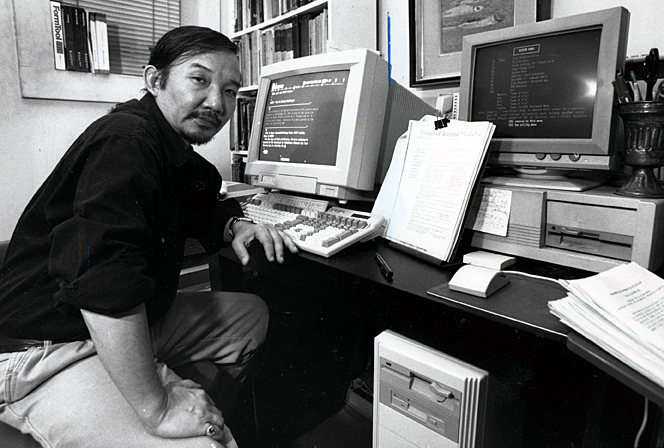
    Kiyoshi Kuromiya seen here in 1992, was a gay civil rights activist who helped establish ACT UP Philly. GEORGE REYNOLDS / Staff Photographer, file

    Maddow’s activism began when she was still in high school, when she began working at a hospice for people who were dying during the AIDS epidemic.

    Still, those few months living in Philadelphia influenced Maddow’s developing political voice. She idolized ACT UP Philly, an activist organization fighting for people with HIV/AIDS, and thinks that gay civil rights activist Kiyoshi Kuromiya is the city’s most overlooked hero for the work he did helping connect people with hard-to-find information about the virus and treatment.

    “He saved millions of lives,” Maddow said. “The city needs to build a statue for Kiyoshi Kuromiya.”

    Maddow has returned to Philly a number of times over the years, and every time she does, it makes her feel like she’s 19 again. Things have changed — seeing Indego bicycles to rent on street corners after hers was stolen is pretty jarring — but though her time living here was brief, she didn’t hesitate saying, “Philly was really formative for me.”

    “The thing I loved about Philly at the time, and that I kind of fell in love with, even before I really knew what to do with it, was the really sparky, edgy, impolite activist spirit,” Maddow said. “I think I’m just a middle-class polite kid who doesn’t like to offend anybody, and Philly kind of shook me out of that a little bit, and made me aspire to edgier things.”

    More live events and a new app coming from MS NOW

    Nearly 2,000 people attended Thursday night’s event at the Academy of Music. MS NOW

    A strong Philly current ran through MS NOW’s event Thursday night, which highlighted the messy history of the American experiment leading up to the country’s 250th anniversary next week.

    MS NOW president Rebecca Kutler, who oversaw the event, is a Philly native who grew up in Center City and later Montgomery County. Host Ali Velshi lives in Bryn Mawr and commutes to New York every day to host The 11th Hour, which he recently took over as part of a lineup change.

    Former White House press secretary for then-President Joe Biden and current MS NOW host Jen Psaki was also part of Thursday event, where she interviewed Pennsylvania Gov. Josh Shapiro, who was raised in Upper Dublin Township in Montgomery County. Psaki doesn’t have any connection to the area other than friends who live here — and

    “My mother’s best friend of 70 years lives here,” Psaki said.

    Thursday’s event was part of a larger strategy of engagement at the network after breaking away from NBC and becoming part of Versant, hence the name change from MSNBC to MS NOW. Ratings are up, but the cord-cutting trend is undeniable, so MS NOW is attempting to secure a digital future while it remains a popular TV destination.

    The network has now hosted three large fan events since 2024 and another is planned for Sept. 26 ahead of the midterm elections, though further details have not been announced. Attendees in Philly on Thursday night received a free, one-year subscription to MS NOW’s membership product that is set to launch soon. It will act as a streaming platform and online community for the network’s progressive fans and provide access to its biggest stars.

    “We’re always looking for ways to connect with our MS NOW community, to meet more viewers where they are, and to engage them in new ways,” said Lauren Peikoff, the network’s executive producer of live events.

    Cecil Parker, a Philadelphia musician, said the state of affairs in Washington compelled him to attend Thursday’s event.

    “Urgency. That’s the all-encompassing word,” Parker said, who often tunes into MS NOW to get their take on the news. “They have their opinions, but it’s based on the facts. So I dig that.”

    Some audience members traveled from as far as Arizona and California to have a chance to hear Maddow and her MS NOW colleagues in person.

    Tony Clyburn and his wife, Lisa, drove more than 10 hours from West Columbia, S.C., to take part. A radio host back home, Clyburn said it was inspiring being in a room with people from different walks of life who want what’s best for their neighbors and their country.

    “These gatherings are good because they’re as close to a town hall as we can get,” Clyburn said.

  • John Bolton, former Trump adviser, pleads guilty in classified information case

    John Bolton, former Trump adviser, pleads guilty in classified information case

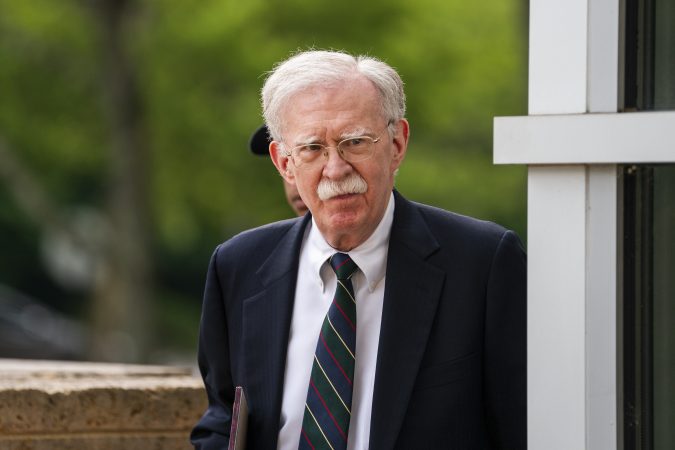
    WASHINGTON — John Bolton, a former top adviser to President Donald Trump who became one of his most outspoken critics, pleaded guilty Friday morning to mishandling classified information in a case that could send him to prison.

    Bolton appeared in U.S. District Court in Greenbelt, Md., and admitted to a single charge of illegal retention of classified information over notes he compiled for a book that excoriated Trump.

    “I’m sorry for it,” he told Judge Theodore Chuang, who said he would sentence Bolton in October.

    Under the plea deal, Bolton could be incarcerated for up to five years, according to the terms of the plea deal described in court. The deal also includes a fine of $2.25 million. If Bolton had gone to trial and lost, he could have faced decades in prison.

    When he was first indicted, Bolton sought to frame the case against him as part of a push by the president to misuse the Justice Department to punish his perceived political enemies. The case against Bolton, however, began in the first Trump administration and gained momentum during the Biden administration, as investigators gathered additional evidence.

    The original 18-count indictment against Bolton accused him of using personal email and a messaging app to share more than 1,000 pages of notes, which included national defense information, with two family members who did not have security clearances.

    The accusations against Bolton center on his notes for The Room Where It Happened, his 2020 memoir about his time as Trump’s national security adviser. Those relatives were Bolton’s wife and daughter, according to people with knowledge of the matter, who spoke on the condition of anonymity to describe details of the case that were not in court filings.

    According to the indictment, Bolton’s notes revealed that he understood that he was documenting intelligence secrets. One entry began, “The intel briefer said,” while another read, “While in the Situation Room, I learned.”

    The first Trump administration fought unsuccessfully to prevent the publication of Bolton’s book, but the criminal investigation ultimately focused not on what was in the published manuscript, but instead on what Bolton wrote in private notes and correspondence.

    Unlike some other investigations involving classified information, including charges filed in 2023 against Trump, Bolton was not accused of retaining the secret documents themselves, but rather of keeping diaries and sending emails that mentioned details of his daily work in national security.

    Bolton’s emails, however, were later hacked by someone associated with the government of Iran, the indictment said.

    “A representative for Bolton notified the U.S. government of the hack in or about July 2021,” according to the filing, “but did not tell the U.S. government that the account contained national defense information, including classified information, that Bolton had placed in the account from his time as national security adviser.”

    One section of the indictment described Bolton apparently being taunted by his hacker. A message on July 25, 2021, warned, “I do not think you would be interested in the FBI being aware of the leaked content of John’s email (some of which have been attached).”

    The email went on to declare: “This could be the biggest scandal since Hillary’s emails were leaked, but this time on the GOP side! Contact me before it’s too late.”

    A representative for Bolton forwarded the email to the FBI.

    This article originally appeared in the New York Times.

  • City officials plan to revamp Market Street from Sixth Street to City Hall

    City officials plan to revamp Market Street from Sixth Street to City Hall

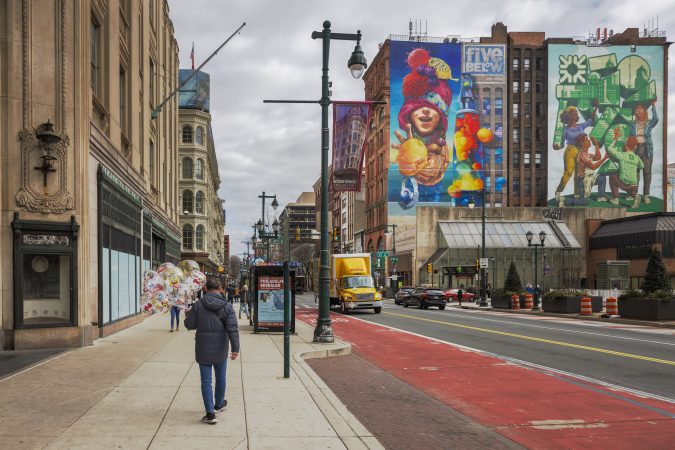
    Philadelphia officials are planning a major renovation of Market Street’s sidewalks, landscaping, and streetscapes, from Sixth Street toward City Hall.

    The announcement of a $2.5 million federal grant to begin the planning and design comes on the heels of the recently completed renovation of the thoroughfare in Old City from Second to Sixth streets. That effort took 18 months of construction and $16 million.

    The stretch to City Hall poses more logistical problems and could prove a heavier lift because of its dense use.

    The planned revamp is part of Mayor Cherelle L. Parker’s pledge to revitalize the Market East corridor.

    Most recently, the row of storefronts on the 900 block of Market owned by Comcast and Harris Blitzer Sports & Entertainment have begun hosting small pop-up businesses for the summer, as the city celebrates the 250th anniversary of the Declaration of Independence.

    The Department of Planning and Development is overseeing the revitalization, and the public-private Market East Corridor Advisory Group is helping to craft a vision.

    The new $2.5 million grant from the U.S. Department of Transportation, which the city will match, is limited to planning the streetscape along Market Street between 6th and Juniper Streets.

    Construction is years away, said Kelley Yemen, Philadelphia’s director of the Office of Multimodal Planning. Her office is gathering information to evaluate everything from traffic patterns to potential road diets and bike lanes.

    “Everything’s on the table at this point,” Yemen said.

    Safety remains a primary driver, she said, given that the section of Market Street is situated on the city’s “high-injury network.”

    However, she said redesigning the corridor poses unique logistical challenges compared with the recent improvements in Old City.

    Market East serves as a major commercial hub with heavy transit use, requiring planners to balance the needs of transit riders, pedestrians, and cyclists.

    Additionally, the shallow depth of the underground subway system may constrain surface-level landscaping.

    Yemen explained that any trees or plantings must account for the height of the subway ceiling, potentially leading to elevated planters rather than vegetation that’s rooted in the ground.

    The city is working with the consulting firm WSP and a team of subconsultants to develop design options.

    Yemen anticipates the design will take two to three years, as the city also has to navigate federal environmental reviews.

    Though the planning phase is now paid for, the city does not yet have money to fund construction and will likely look to federal or state grants for help in the future.

    Public involvement will be a key next step, she said.

    The planning commission is expected to launch a broader public engagement push this July to gather community input on the larger Market East revival.

  • Philly’s weather forecast has drought-easing rains this weekend, then a heat wave through July 4

    Philly’s weather forecast has drought-easing rains this weekend, then a heat wave through July 4

    The region may be getting some significant drought relief during the weekend, and then it may be some time before it gets relief from heat that could persist through July Fourth.

    Rounds of showers — possible Friday night into Saturday evening when Croatia and Ghana meet in a World Cup match in South Philly — should be more widespread across the region than Monday’s scattershot downpours, said Brian Hurley, senior branch forecaster with the Weather Prediction Center, in College Park, Md.

    The severe storms likely would stay well to the south of Washington, D.C. However, “you always have potential” for a few thunderstorms, he said.

    Then, after two decent days Sunday and Monday, what is looking like the longest-lasting hot spell of the season to date is due to get underway Tuesday as temperatures head to the mid-90s.

    “That’s going to be main story,” said Hurley.

    The wild card for the duration would be the possibility of “ring of fire” thunderstorms, forecasters said, which might have temporary cooling effects. Those are storms that form along the boundaries of high-pressure heat domes, and Philly may be near the eastern edge.

    How hot might it get next week in Philly?

    Expect some tweaking during the next few days, but with “increasing confidence” the National Weather Service in Mount Holly was seeing heat indexes in the triple figures next week.

    Come Tuesday, daytime temperatures should be “off to the races,” said Bill Deger, senior meteorologist with AccuWeather Inc., which has forecast highs up to 98 degrees late in the workweek.

    It also will be steamy, and that will inhibit nighttime cooling as water vapor slows the escape of daytime warning. Readings are unlikely to get lower than the 70s Wednesday through at least next Saturday.

    The heat could lap into the following week, said Deger. “It shows some staying power,” he said.

    The region already has had 14 days with official temperatures of 90 or higher in 2026, about half the average total for an entire year.

    The potential for those ring-of-fire storms would be a wild card, said Hurley and Deger.

    Cooling thunderstorms can break heat waves, although they may come with a price. Ring-of-fire storms in July 2020 wrung out as much as 6 inches of rain that set off widespread flooding.

    As drought continues, the Philly region could use more rain

    Six inches might be a bit over the top, but the region could use more rain to ease the ongoing drought conditions.

    Some areas received close to 2 inches on Monday and Tuesday; however, the jackpot zones eluded areas where the dry conditions have been most intense — parts of South Jersey and Chester County.

    The entire region remained in some state of drought according to the interagency U.S. Drought Monitor, but Chester County was in “severe drought,” along with small pieces of Bucks and Delaware Counties. In “extreme drought” were all of Cape May County, other Jersey Shore towns, and areas bordering Delaware Bay.

    In an analysis based on a network of measuring stations throughout the counties, the weather service’s Middle Atlantic River Forecast Center calculated that Cape May County received less than a half inch of rain, and Cumberland and Salem Counties about 0.6 inches.

    In contrast, Burlington, Camden, and Gloucester Counties weighed in with well over an inch.

    On the other side of the river, Philly’s total was 1.28 inches, compared with 0.71 for Chesco, which, like New Jersey, is under a state-declared drought emergency.

    All this could change next week.

    .