NEW YORK — The Trump administration will not seek new bids to repair the Lincoln Memorial Reflecting Pool, Interior Secretary Doug Burgum said Sunday as he faced new questions about the troubled project and the taxpayer money involved.
Like President Donald Trump, Burgum said he was 100% sure that vandals caused the damage to the century-old Reflecting Pool on the National Mall. Trump has charged that a 350-foot gash was cut into the pool’s liner in the midst of recent renovations, while Burgum described it as multiple cuts adding up to that figure. He also said the pool would have to be at least partially drained in the coming week to finish the repairs.
The repairs will not be opened up to new contractors, he said.
“We’ll use the same company, because they did a fantastic job,” Burgum told CNN’s State of the Union. “Thankfully, the vandalism was small. It was bad. I mean, it could cost tens of thousands of dollars to repair, so then it could fall into a felony … just like damaging any other government property could. But the job that was done to fix the Reflecting Pool was done extremely well.”
Trump this spring pledged to beautify the Reflecting Pool before the nation’s 250th birthday celebrations on July Fourth. Water was drained and the Republican president directed that the bottom be painted a color he called “American flag blue.” But after the site was restored, the water was plagued by an algae bloom for more than a week, and pieces of the new coating have appeared to be peeling off the bottom.
The pool was closed for the Independence Day celebration, but Burgum said that was due to a safety issue related to the fireworks.
The evolving debate over the Reflecting Pool has inflamed the broader fight over Trump’s aggressive push to overhaul Washington landmarks, including the White House, nearly two years into his final term in office.
Authorities have arrested more than a half dozen people in relation to Reflecting Pool damage, including former Olympian David Hearn, who was indicted last week on a felony charge of property destruction.
The top federal prosecutor in the District of Columbia, U.S. Attorney Jeanine Pirro, said Hearn ripped up recently installed sealant on the pool in “a deliberate act” that caused more than $1,000 in damage. She accused him of “forcefully and violently” pulling up the bottom liner “with both hands” and acting belligerently toward an employee who told him to stop.
Hearn’s lawyers, Democracy Defenders Fund co-founder Norm Eisen and Mary Dohrmann, said the charges were “outrageous and should be alarming to every American.” Eisen and Dohrmann construed the case as representative of “the misuse of government power against an ordinary citizen based on a concocted narrative.”
Burgum was asked and did not answer directly whether there was photographic evidence of vandals cutting the pool’s liner. He was also asked whether Hearn should face a 10-year prison sentence, which is the maximum legal penalty for his charge.
“Just because you were a former something doesn’t exclude you from the law today,” Burgum told CNN. “The courts will decide.”
Meanwhile, questions loom over the no-bid contracts for the project that were awarded to vendors with prior ties to Trump.
Ohio-based Green Water Solutions, also known as Greenwater Services, was given a $1.7 million contract to install a water-purification system in the Reflecting Pool, while Virginia-based Atlantic Industrial Coatings was awarded $14.7 million to repaint and waterproof the pool’s concrete floor.
About 10 Democratic senators and House members are investigating the pool project.
“Taxpayers deserve a full explanation of how these failures occurred and who will be held accountable for correcting them,″ said a letter signed last month by six senators.
The report released late on Independence Day by the White House Domestic Policy Council comes in the midst of Trump’s aggressive campaign to overhaul some of Washington’s most sacred cultural and historic institutions. Trump in March revealed his intention to force changes at the Smithsonian Institution with an executive order that targeted funding for programs that advanced “divisive narratives” and “improper ideology,” as he continued a broadside against culture he deems too liberal.
“The Smithsonian Institution, and the National Museum of American History in particular, under its current leadership and current interpretive ideology, cannot be trusted to tell America’s story honestly and in a way that is inspiring, unifying, and worthy of our great republic,” according to the report by the council, which is led by a former top Trump speechwriter.
The authors added: “As this report shows, confirmed in the words of Museum leadership, this ideological capture has moved the Museum’s mission away from straightforward historical education and scholarship toward an extreme political activism that seeks to transform our country.”
The Smithsonian did not immediately respond to requests for comment Sunday.
Historian Lonnie Bunch, the Smithsonian’s current secretary, is the first African American to lead the institution. In an unrelated interview that aired Sunday on NBC’s Meet the Press, Bunch said, “The notion of being a more perfect union, not the perfect union, is really what motivates me.”
“I think what I want people to understand is that there is a responsibility to continue to make those aspirations available, accessible, meaningful to a whole range of people,” Bunch said. “And that, in essence, America’s greatest strength, it’s not running away from its history, but it’s understanding how that history shaped us and continues to shape us.”
Historian Anthea M. Hartig is the first woman to serve as director of National Museum of American History.
Trump’s escalating effort to force changes at the Smithsonian marks the Republican president’s latest move to transform cultural pillars of society, such as universities and art, that he considers out of step with conservative sensibilities. Trump had himself installed as chairperson of the John F. Kennedy Center for the Performing Arts with the aim of overhauling programming, and his handpicked board voted to add his name to the building, only to have a federal judge later order the signage to be removed.
Trump has also imposed changes on historical sites beyond Washington, including in Philadelphia, where the administration won a court ruling last week allowing it to reinstall interpretive panels that critics say whitewash the history of slavery at the site of President George Washington’s home. Advocates, academics and officials have been concerned for months that the version that complies with Trump’s order could give a history that plays down the pain in the nation’s past in favor of a more triumphant view.
Gov. Josh Shapiro (D., Pa.) accused Trump and his allies of trying to “rewrite history.”
“There’s not one individual narrative that a president gets about our history,” Shapiro, a potential presidential prospect, said in an interview that aired Sunday on CNN’s State of the Union. “And any president should want to make sure that that full history is shared, that the American people are able to draw their own conclusions.”
Shapiro added, “If we understand where we came from, we’re going to have a better path forward.”
Trump’s Domestic Policy Council does not necessarily agree.
The National Museum of American History “confronts visitors with materials intended to undermine faith in American institutions and the longstanding shared ideals of the American people,” the council’s report said. “We must be committed to restoring truth and sanity in how American history is presented and taught.”
In seeking to fulfill Trump’s order, which he called “Restoring Truth and Sanity to American History,” the review concluded by finding that the museum “by the intention and at the direction of current Museum and Smithsonian leadership, has become subject to institutional capture by a radical, activist ideology that is fundamentally opposed to telling the noble, honest story of the great country we know and love.”
ANKARA, Turkey — Since he started work as NATO secretary-general almost two years ago, Mark Rutte has spent much of his time trying to keep the United States anchored to the world’s biggest military alliance, employing outright flattery to dissuade U.S. President Donald Trump from acting on threats to abandon it.
But the goalposts keep shifting, raising the stakes ahead of this week’s summit in Turkey.
Initially, it was about money. Trump has long railed against NATO allies for spending too small a fraction of their national budgets on defense. But those problems were addressed at their summit last year, when U.S. allies committed to invest as much as America, in gross domestic product terms.
NATO’s real problem now is turning that money into military capabilities, particularly as European countries worry about a possible attack from Russia.
Still, Rutte tried to put to bed any lingering concerns at a White House meeting last month, with a new pitch using a chart labeled the “The Trump Trillion” in gold letters — showing $1.2 trillion in spending by European allies and Canada since 2017.
But Trump appeared unmoved, saying he was still disappointed at some NATO allies’ refusal to join the Iran war, which he had launched alongside Israel without consulting them.
“We don’t need their money — we don’t need anything,” Trump said. “I just want loyalty.”
Trump suggested he might have skipped the upcoming summit entirely were it not being hosted by Turkish President Recep Tayyip Erdogan. It’s a sign that even Erdogan and Rutte — foreign leaders Trump seems to hold in rare esteem — will have their work cut out for them in keeping the summit on track.
Rutte set a new marker for flattery at White House
Historically, the prime tasks of NATO’s top civilian official — always a European, never an American — have been to encourage consensus in an organization that makes its decisions unanimously, and to speak on behalf of all 32 member countries.
But during both of Trump’s terms, Rutte and his predecessor at the helm of NATO, Jens Stoltenberg, have dedicated a huge amount of energy just to keep the United States inside their alliance.
Trump has threatened to leave NATO, dallied with pulling U.S. troops out of Europe, and vowed to take over the island of Greenland — a semiautonomous part of ally Denmark. He has cast doubt over whether he would defend another member not spending enough on their military, eroding trust.
Rutte’s approach has been heavy on flattery. Last month’s carefully choreographed pitch in the Oval Office — with props redolent of an American flag — laid down a new marker, even for a man heavily criticized for likening Trump to a “daddy.”
The charts showed tens of thousands of U.S. jobs were being created and a backlog of $300 billion in European orders for military equipment — all thanks to the “leader of the free world,” Rutte said.
He pushed back, gently, on Trump’s complaints that NATO did not support the U.S. against Iran, noting that up to 5,000 U.S. planes took off from bases in Europe before an April ceasefire.
Trump has threatened to pull forces from Europe
NATO cannot function without its biggest and most powerful ally. Europe is being pushed to fend for itself even as Russia, the historical reason for the alliance, poses a greater threat.
Last month, the Pentagon surprised its NATO allies by announcing that it was scaling back the number of troops, warships, aircraft, and drones it would provide if one of them came under attack. Trump has also sent conflicting messages about whether U.S. troop numbers would be lowered or increased.
The cutbacks and mixed messaging have undermined unity at the alliance, just as Russia has been probing Europe’s defenses with drone flights near military bases across multiple countries, according to a study released on Thursday.
Flattery worked last year, but there are new challenges
Each summit is meant to showcase the commitment to collective security — the all-for-one, one-for-all pledge enshrined in Article 5 of NATO’s treaty. It’s only been invoked once, when allies came to America’s aid after the Sept. 11 attacks.
The last NATO summit was held in the Hague, the hometown of Rutte, a former Dutch prime minister. The Dutch royal family hosted dinner, and Trump stayed overnight at the king’s palace.
Rutte got the allies behind a major defense spending pledge, and Trump left a happy man, calling his NATO partners a “nice group of people.”
This year, the summit will be hosted by Erdogan, another key NATO member with an independent streak. His close ties to Trump may keep the American president at the table, but it’s unlikely to mend the rifts.
Rutte has tried to convince Trump that his European partners are spending so much more that America can safely turn its attention to security challenges posed by China while they handle the war in Ukraine.
But Trump wants more now, and his demand for “loyalty” is hard to capture on any chart.
Rutte’s predecessor, Stoltenberg, has written in his memoir about chairing a 2018 summit that Trump nearly upended.
“If an American president says he no longer wishes to defend the other allies and leaves a NATO summit in protest, then the NATO treaty and its security guarantee aren’t worth very much,” Stoltenberg wrote.
TEHRAN — Among the tens of thousands of mourners gathered in central Tehran for the funeral of Ayatollah Ali Khamenei are families of the schoolchildren from the southern city of Minab who, like the supreme leader, were bombed to death on the first day of the U.S.-Israeli war against Iran.
At least 175 civilians were killed at the girls’ elementary school, most of them students, in what appeared to be a strike by a U.S. Tomahawk missile. So far, the United States has not taken responsibility or released the results of any investigation. In Iran, the children’s deaths have become a potent symbol for U.S.-Israeli brutality and an unjust war.
Parents and other family members made the 800-mile trip to the Iranian capital by train, car, and bus, and on Sunday, they were brought to the Grand Mosalla religious center for the funeral prayers. The crowd swelled in size ahead of the prayers, with tens of thousands packing into the open-air complex.
Many mourners had hoped that Khamenei’s son and successor, Mojtaba Khamenei, would appear in public for the first time since his father’s assassination to lead the prayers, but he did not show, probably because of concerns for his safety.
Ayatollah Jafar Sobhani, a prominent theologian and member of the Council of Experts that chose Ali Khamenei’s successor, led the ceremony instead.
Also present Sunday was Ahmad Vahidi, the recently appointed commander of Iran’s powerful Islamic Revolutionary Guard Corps — a key member of the surviving regime, which has emerged emboldened and even more hard-line after months of attacks by two of the world’s most powerful militaries.
Vahidi, too, had been in hiding since the war. A shudder rippled through the crowd as people recognized him. After the prayer concluded, isolated chants broke out, invoking his name: “Vahidi! Vahidi! Revenge! Revenge!”
The Minab school attack occurred on Feb. 28, the same day that Ali Khamenei was killed at his leadership compound, along with other members of his family and other senior officials.
Hanzaleh Salehi, 43, whose son was killed in the school strike, said he remembers hearing confirmation of the supreme leader’s death while he was in the morgue identifying his child’s body. Experiencing the two losses back to back left him feeling frozen, he said.
“We want to send our voice to the world,” Salehi said, wearing a T-shirt that showed his son’s framed portrait. “I want the world to realize how the Iranian people are treated. This was not the first crime, and it may not be the last.”
An invitation from the Iranian government to attend the proceedings, albeit under restricted conditions, including accompaniment by a government-provided guide and interpreter, has allowed the Washington Post its first opportunity to report from Iran since the war began. The views of people interviewed at the funeral events are unlikely to represent all of Iranian society, given the risks posed to those who have opposed or been critical of the government.
While the U.S. has not accepted responsibility for the attack, video evidence and Post reporting found that the school was on a U.S. target list, suggesting it was carried out by U.S. forces. The Pentagon said it launched an investigation, but more than four months later, no findings have been published.
In Iran, the strike is a national tragedy. Memorials to the children have been installed in government offices and businesses and at Iranian embassies abroad. In Tehran, an installation of backpacks, flowers, and children’s shoes commemorates those killed in Minab at the capital’s international airport.
One of the Minab booths set up for Khamenei’s funeral displayed dozens of portraits of the children above a chalkboard, exercise books, and school desks.
Fatimeh Yavari, 39, from Semnan, east of Tehran, stopped to take pictures of the display with her two children. The Minab children “are like my own children. I cried for all of them like I was burying my own child,” Yavari said, growing emotional behind her sunglasses. “It was a great tragedy.”
Minab is a small town that’s home to large military installations in a province, Hormozgan, that is a critical export hub near the port city of Bandar Abbas.
Yasir Pour Jomeh, 39, a dock laborer, traveled 24 hours by bus and private car to Tehran so he could help oversee a Minab booth during the funeral. He said that after the Minab attack, there was a surge of support for the government in the area.
“People realized how supportive the supreme leader was of the people,” Jomeh said. “Even some who were against the establishment turned back.”
After the public viewing of Khamenei’s body ends on Saturday evening, his casket will be carried on an hourslong funeral procession through the Iranian capital.
That procession is expected to draw even larger crowds that those at Mosalla, and the daylong event could prove to be one of the most logistically difficult portions of the ceremony.
After the funeral procession, Khamenei’s body will be flown to the Iranian city of Qom, a center of Islamic learning, before it is brought to the Iraqi cities of Najaf and Karbala, both homes to holy Shiite shrines that are pilgrimage sites. Finally, Khamenei will be buried in his hometown, Mashhad, in eastern Iran.
For all the power he has flexed over the past year and a half, President Donald Trump could not control the scorching, dangerous, record-shattering weather in the nation’s capital for the 250th anniversary of America’s independence, or the lightning strikes in the distance that prompted officials to evacuate the National Mall ahead of his planned speech.
But nearly every other aspect of the celebration in Washington bore Trump’s imprint, as decisions he made transformed an official commemoration of American history into another polarizing moment in American politics.
After a chaotic scene unfolded early Saturday evening, with Secret Service officials forcing defiant Trump supporters to flee the president’s Salute to America event as severe weather loomed, Trump told them all to come back. The show would go on.
His supporters, wearing gear bearing his name and slogans, trekked back to stand in security lines again in the rain.
“I said, ‘There’s no way — if we have to speak in front of one person at 4 o’clock in the morning, I’m going to be here,’” Trump declared when the rain had stopped and he began speaking after 11 p.m. to a crowd half the size of what it had been earlier. “There’s no way we can be deterred.”
“This is an evening for the ages. I believe this is something very special,” Trump said into the night, describing the attendees’ perseverance and late-hour return as “bigger than if we didn’t have the lightning blaring.”
“But this is bigger. A little more inconvenient, but it’s bigger. I think, in its own way, it’s more beautiful.”
It was but the latest twist in a national celebration that Trump defined in his terms — and for which the president has called the shots.
Ever the showman, Trump throughout his speech brought notable Americans out onto the stage with him — war veterans as old as 107 who saluted from wheelchairs, astronauts from the Artemis II and Apollo 17 missions, and families of soldiers killed in battle.
He praised the “unstoppable spirit that created the world’s most powerful industries and built the strongest military anyone had ever seen‘” but also reprised his political grievances.
Trump joked that he was serving his third term as president, a reference to his false claims that the 2020 election was stolen from him. He prompted cheers from his supporters as he touted his bill to assert federal control over election rules — legislation that Senate Republican leaders have repeatedly told him won’t pass as it is currently written. And he lobbed several verbal attacks at “communists,” his label for the democratic socialists who have won several recent Democratic primary elections.
Before Saturday night’s rally, Trump didn’t pretend that the celebrations would be anything other than his usual unapologetic rhetoric.
“Has anyone ever seen a Happy Dumocrat?” the president wrote of his opposing political party on social media on Saturday morning, his first Fourth of July greeting of the day. Weeks earlier, Trump had abruptly announced that he would also serve as the headlining act of a rally kicking off the two-week Great American State Fair on the National Mall, calling himself “the Number One Attraction anywhere in the World, the man who gets much larger audiences than Elvis in his prime.”
“Only Great Patriots invited” Trump wrote of the launch of a fair that was, in theory, open to all, later billing the kickoff to the 250th anniversary festivities as a “Trump rally.”
Milestone anniversaries like the semiquincentennial present rare moments of shared civic ritual, occasions when presidents are widely expected to place themselves within the sweep of the American story, rather than at the center of it. This year’s celebration, instead, reflected both Trump’s vision of America, and America’s divisions over Trump.
The decision to have Trump speak late Saturday also reshaped a long-standing July Fourth tradition. Security restrictions prevented attendees from bringing coolers or arriving throughout the evening, and the speech was already set to delay the fireworks until after 10:30 p.m.
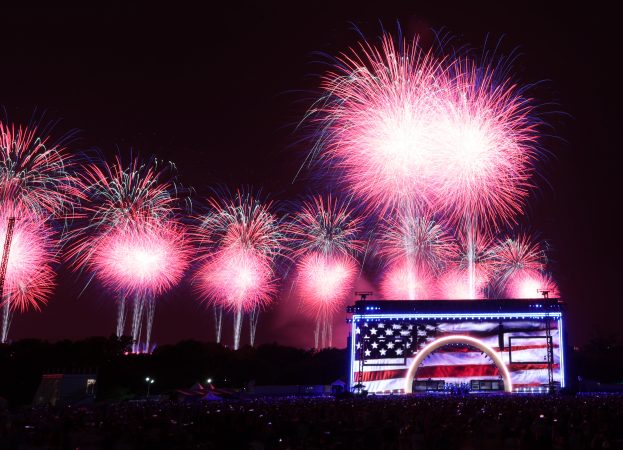
The pyrotechnics finally began moments before midnight, with Trump remaining in a climate-controlled box at the National Mall to watch. The massive show set a record, organizers said.
As Americans sweltered through a dangerous heat wave, with Washington’s heat indexes reaching 115 degrees, Trump had warned that he planned to “make a really long speech … just to show that I can do anything.” Organizers instructed those attending not to arrive too early to limit their time outside.
In the end, the late-night speech was about 35 minutes long.
The National Mall fair itself, long touted as a showcase for American greatness and national unity, instead became a Rorschach test. Trump supporters praised the patriotic atmosphere and military flyovers.
His critics, meanwhile, pointed to images of sparse crowds, a mock-up of Trump’s proposed triumphal arch on the grounds, and administration officials touting their accomplishments as evidence that the president’s personal involvement had undercut what might otherwise have been a broader civic celebration.
With just months to spare before the occasion, Trump had pushed aside America 250, the long-standing bipartisan commission tasked a decade ago with planning anniversary festivities, replacing it with his own group of political allies, Freedom 250. His advisers argued the move was necessary because the commission had become bogged down by bureaucracy.
But as Trump’s chosen planning organization became increasingly seen as a partisan entity, vendors and performers alike ultimately pulled out of the fair, which has struggled to draw large crowds for much of its first week.
Besides supplanting the bipartisan commission, Trump has increasingly put his imprint on other aspects of this year’s commemoration. His face appears on a commemorative gold coin marking the anniversary and on limited-edition “patriot passports.” Administration officials have pushed for a $250 bill bearing his portrait, and Trump this week posted an image of a $100 bill featuring his autograph — marking the first time a sitting president’s signature has been featured on U.S. currency.
As he has throughout the anniversary celebration, Trump cast himself as central to the story he wants the country to tell about itself: that America was diminished before him, revived by him, and is now celebrating its founding through his restoration — a promised “Golden Age.” At Mount Rushmore on Friday night, he told the crowd that he “saved, almost single-handedly,” the Second Amendment and that he was going to “give our country its identity back.”
“We never had the American Dream, however, like we have it right now,” Trump said Saturday on the National Mall. “The American Dream is back. Very strong. Beautiful.”
Republican President Gerald Ford took a different approach during the nation’s bicentennial celebration in 1976, even as he was running for reelection in the aftermath of Watergate and the Vietnam War. In his remarks, Ford made no mention of the campaign, the Democratic front-runner Jimmy Carter, or his GOP primary challenger, Ronald Reagan.
Ford’s only reference to electoral politics came as a broader reflection on self-determination: “This November the American people will, under the Constitution, again give their consent to be governed,” he said, outside Independence Hall in Philadelphia. “This free and secret act should be a reaffirmation by every eligible American of the mutual pledges made 200 years ago by John Hancock and the others whose untrembling signatures we can still make out.”
But comparisons with past presidents are complicated by the fact that patriotism itself has become more polarized, said Tevi Troy, a presidential historian and senior fellow at the Reagan Institute.
“There’s a feeling out there that Republicans are more patriotic than Democrats, or that the patriotism gap can differ depending on which party is in the White House,” Troy said. “While Trump does things in terms of partisanship that you can safely say are unprecedented, he is also president in a more divided time.”
A recent Gallup poll found that national pride has fallen to its lowest point since the organization began asking in 2001 how proud respondents were to be an American. Just 33% reported being “extremely proud,” down eight percentage points from a year ago and 37 points since a high in 2003. The partisan gap there is wide, with Republicans reporting much higher American pride while Democrats and independents have hit record lows for their respective groups, Gallup found.
John Pitney, a former national Republican official who now teaches political science at Claremont McKenna College, said Trump is diverging from the tradition of presidents who have used moments of national triumph and tragedy to speak as Americans first, not as partisans.
“I remember Reagan at Normandy in 1984 — the 40th anniversary of D-Day, surrounded by people who were veterans of that war,” Pitney said. “There is a reason why that speech is still remembered. It wasn’t about him.”
When Jared Adkins gets interested in something, he goes all in. That’s how he ended up learning about distilling, opening Bluebird Distilling in Phoenixville roughly a decade ago. Then, he became infatuated with pizza dough.
It’s led to an expansion of the business: Bluebird Distilling & Dough House, which will open its doors officially on Tuesday.
The $2.2 million renovation adds a whole new component to the cocktail bar, which will now offer a “neo-Neapolitan” — a modern, Americanized take on the classic — pizzeria and restaurant. Changes also haveexpanded the bar itself, added to the dining room, and enhanced the retail and bottle shop.
Adding food was something Adkins, Bluebird’s owner and master distiller, didn’t initially anticipate when they opened the distillery in 2015. But in 2022, he started to get the itch. He considered a full-scale restaurant, and began the early planning for one. But then there was just something about pizza dough that caught his attention.
He signed himself up for pizza school, and spent three days in Washington, D.C., learning from chefs about the art of pizza making.
“There was like a light bulb that went off,” he said. “We’re already doing so much fermenting that just seemed the natural next step to get into dough making.”
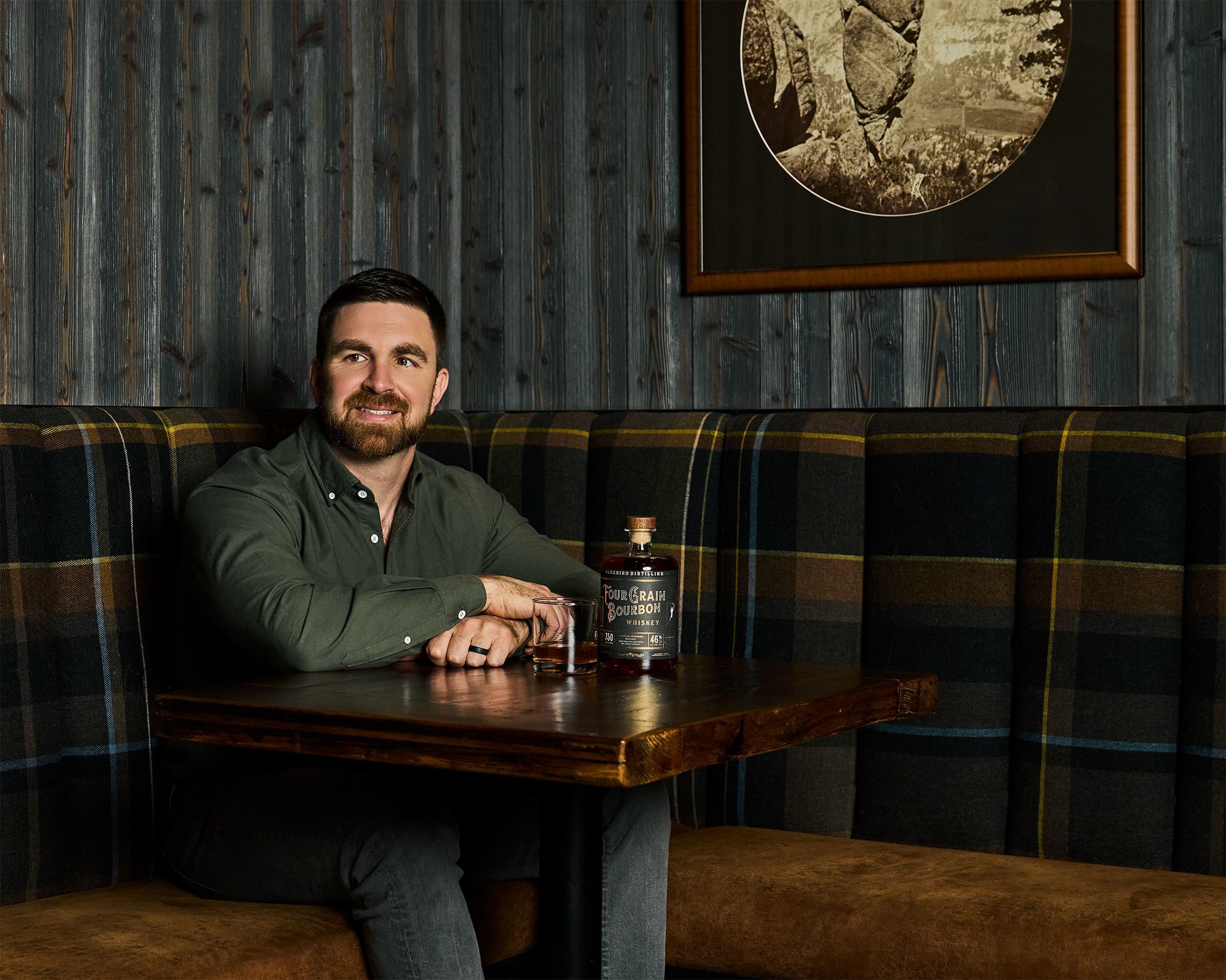
Bluebird Distilling founder and master distiller Jared Adkins. The expansion has been a year in the making, a longer consideration for Adkins.Photos courtesy of Ed Newton
As he threw himself into dough-making a few years ago, he connected with pizzaiolo Gregorio Fierro to learn the basics. That helped get his vision off the ground, as he began designing what the kitchen would look like.
DevonMigeot is joining as executive chef to bring the menu to fruition every night. Migeot spent roughly a decade working as sous chef at Philadelphia’s Zahav and Laser Wolf, plus Tresini in Ambler, and as chef du cuisine at Rosalie in Wayne.
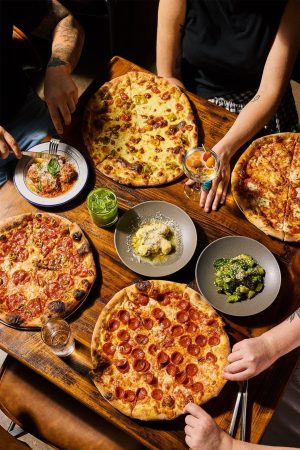
Together, they’ll offer pizza made with 100% Petra stone-ground Italian flour, milled from 100% Italian wheat, with no preservatives or additives. The business will have house-baked breads, plus shareable small plates. Offerings will include ricotta gnudi with sweet corn, brown butter, and scallions; meatballs with beef, pork, gravy, and Parmesan; beets and burrata; chicory salad; a snacking plate of meats and cheeses; and more.
The decision to expand into food comes at a particularly salient time, Adkins said. The industry as a whole has been seeing a decrease in people drinking.
“It’s kind of perfect timing that it’s going to fill a niche where maybe people aren’t coming in solely just for drinks anymore as much, but now [we’re] giving another artisan aspect of having pizza, or something that we’re really putting a lot of time in, to craft the best,” he said.
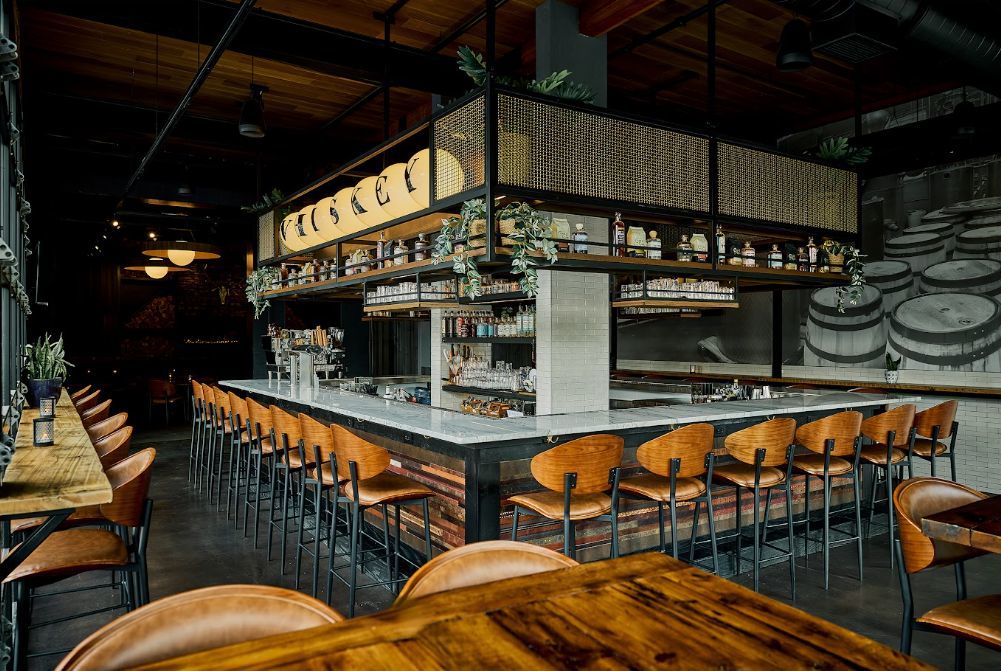
A look at the expanded cocktail bar, part of the distillery’s larger renovation.Photos courtesy of Ed Newton
The distillery will still, of course, honor its roots with its spirits and cocktails. It’ll feature old favorites, such as Bluebird (a vodka, blueberry, lime, and mint mix) and the Phoenixville Old Fashioned.
But new additions will join too. Customers can try the Huntsman, which will feature French cigar bourbon, morel-infused vermouth, tobacco bitters, and stave smoke; or the Rum Ham, a pancetta fat-washed Bluebird dark rum along with burnt pineapple syrup, and tiki bitters; or Off the Vine, a “garden-inspired” martini composed of Juniperus Gin, basil, lemon, agave nectar, Aleppo pepper, and “clarified” tomato.
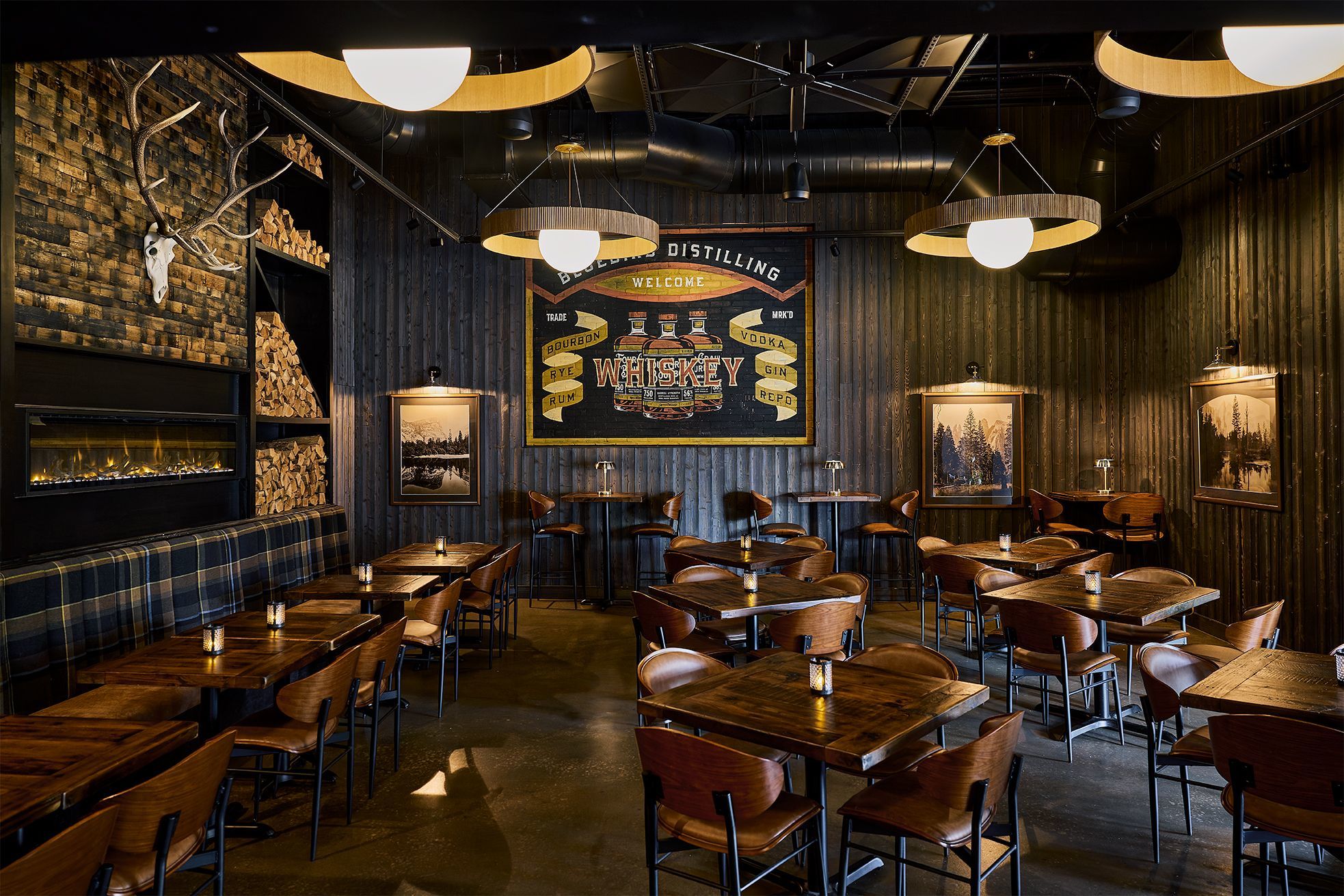
The renovation also came with some aesthetic changes. In 2015, they led with a steampunk vibe, Adkins said. They refreshed the interior, using a Japanese-style charred wood that resembles the inside of a barrel.
A transformed Bluebird Distilling will open July 7 after a $2.2 million renovation has expanded founder Jared Adkins’ vision. The space adds a new neo-Neapolitan pizzeria and restaurant, plus a reimagined cocktail bar, dining room, and retail and bottle shop.Photos courtesy of Ed Newton
The outside patio is now enclosed, featuring a “huge” rectangular bar, which can seat up to 30 people. Adkins described the bar area as light and airy, where it feels communal and social. It feels more “upper casual” than “too-serious speakeasy.” Surrounded by windows, it feels like you’re sitting on the street, in the middle of the action, he said.
When customers are ready for dinner, they can head back to the lounge, which curates a masculine, Western style.
And the kitchen, where customers get to enjoy watching the whole process unfold, embraces that steampunk essence with barrels hanging from the ceiling.
“I feel like as you walk through the area, you’re getting two or three different experiences all at once,” he said.
The bar was open through renovations, but operating with 50% of the facility for the last seven or so months, and maintaining about 80% of their normal crowds. It took some ingenuity, he said.
As they look at the new chapter, it feels like starting all over again, he said.
“I think it fills a gap on one side for us there, of now we have something else that we can present to our customers for an overall experience,” he said. “That’s what we’re going for the most. We’re giving our cocktail experience, our spirits experience, and now a dough side of it.”
This suburban content is produced with support from the Leslie Miller and Richard Worley Foundation and The Lenfest Institute for Journalism. Editorial content is created independently of the project donors. Gifts to support The Inquirer’s high-impact journalism can be made at inquirer.com/donate. A list of Lenfest Institute donors can be found at lenfestinstitute.org/supporters.
If you’re a regular visitor to the Jersey Shore, catching up with your longtime favorite foods, chefs, and restaurants can often tell a wider story about what’s been happening in your favorite beach towns. The economic pressure of rising real estate prices has made the arrival of a sweet little BYOB like Joy & Salt on Long Beach Island a test case for the future of the small operator. The saga of ongoing attempts to revitalize Atlantic City’s Tennessee Avenue development? It just got a fresh boost from the comeback of a talented local chef. A new gem for stellar soul food, a growing audience for deep-crusted pizza, the rise of fancy iced coffee (with everything but the taste of coffee), and sage advice on how to choose the right pasta shape all added a tasty helping of color to this week’s fresh batch of restaurant reports from LBI to Margate.
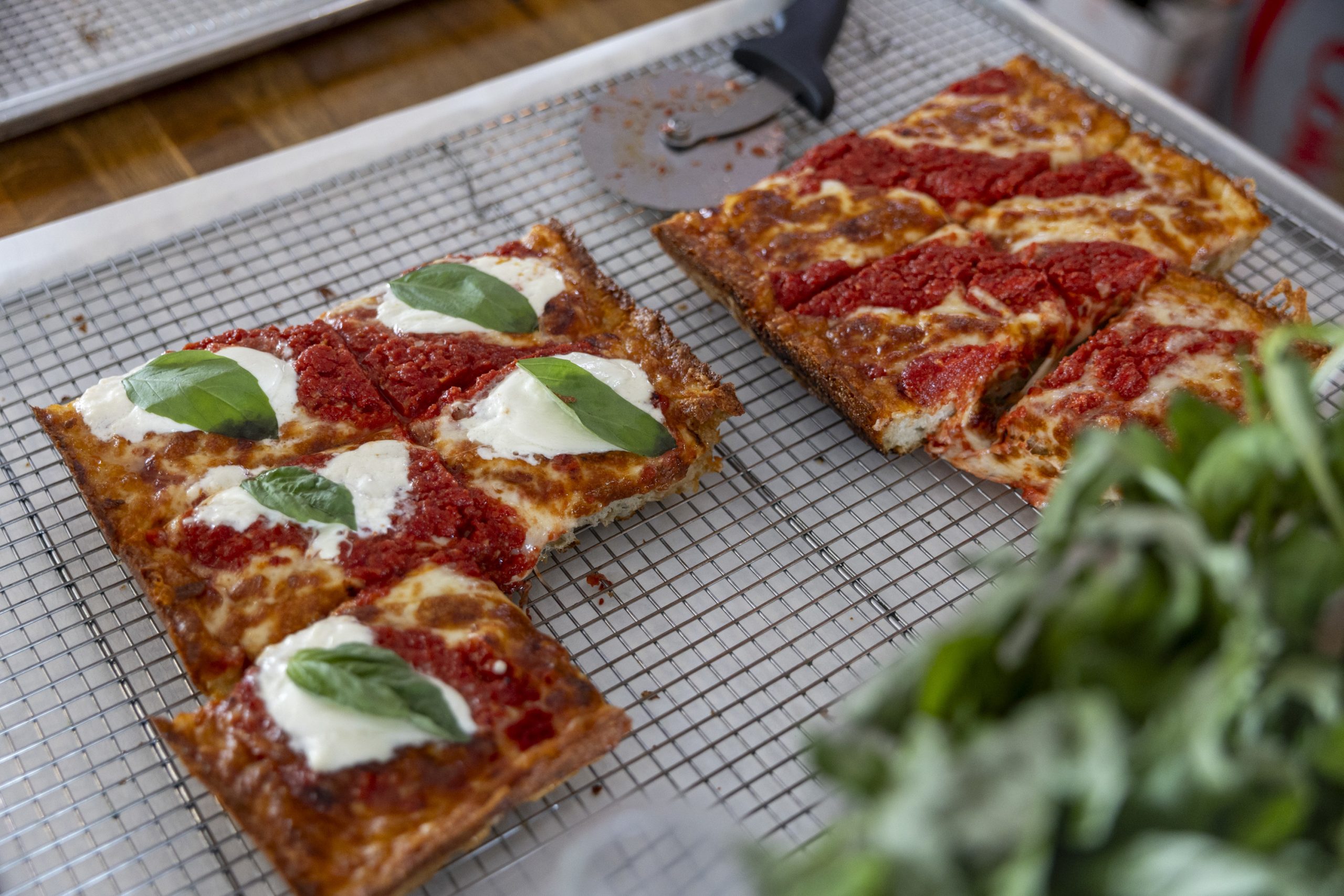
The burrata with fresh basil and plain cheese pie at Queen City Crust in Beach Haven, N.J., on Thursday, June 18, 2026.Tyger Williams / Staff Photographer
I also delve into the Ventnorian controversy over a classic sub shop that’s been remade into an artisan sourdough bakery and touched a nerve with locals who fear their community is becoming too bourgeois. Then again, when something is as good as Florida Cuts is, perhaps it’s not simply change for the sake of trends but actual progress.
Next week: new options from Cape May to Ocean City.
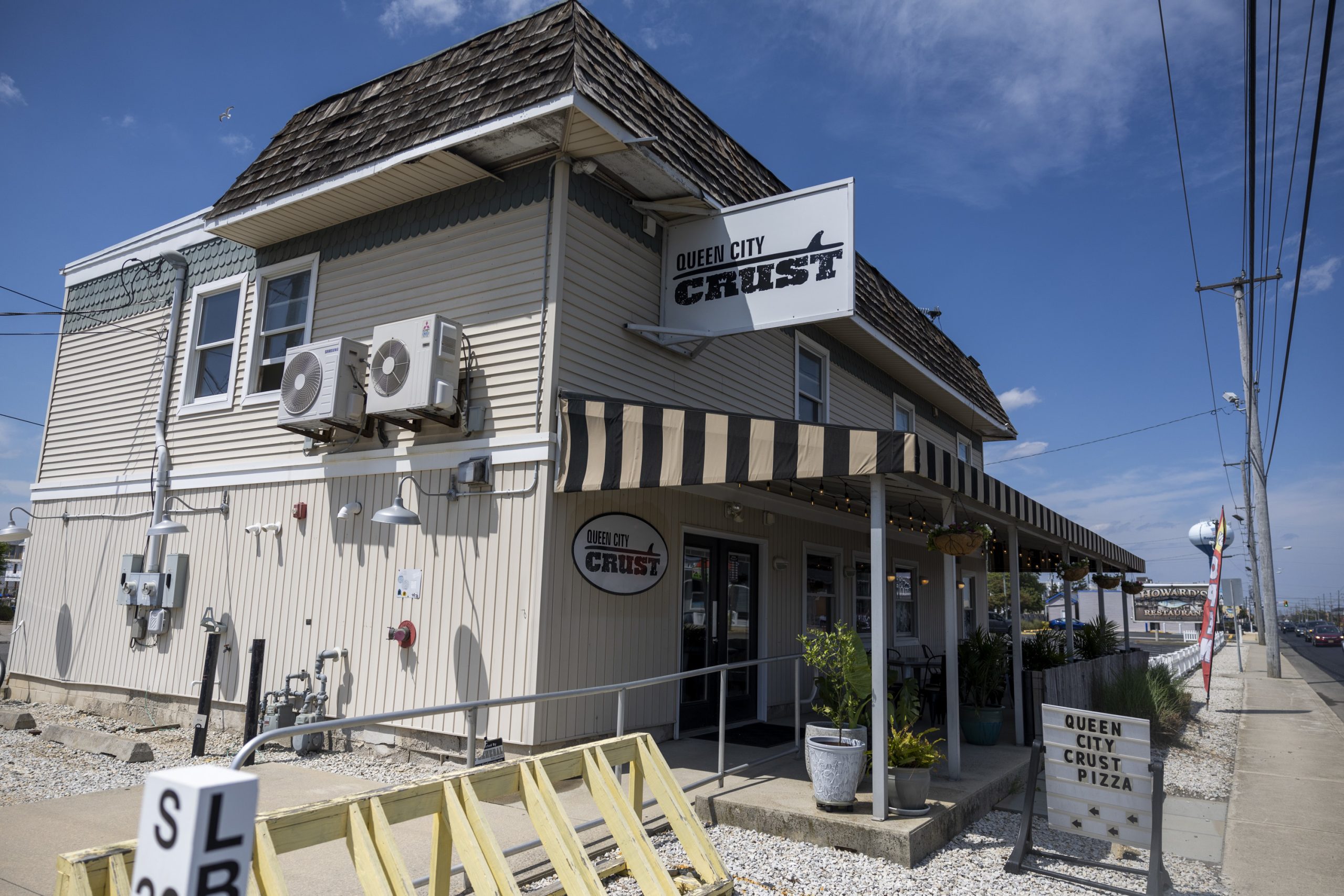
The outside of Queen City Crust in Beach Haven, N.J., on Thursday, June 18, 2026.Tyger Williams / Staff Photographer
LONG BEACH ISLAND
Joy & Salt Cafe
With a temporary sign, and an understated location at an intersection near the ocean where drivers slingshot on and off the causeway to Long Beach Island, you could easily miss Joy & Salt Cafe. But it’s worth a stop at this low-key newcomer to Ship Bottom, a collaboration between two veteran chefs hoping to claim one of the few remaining corners of the island and make what partner Jordan Miller says is “a last-ditch effort for the charm of an old-school BYOB.”
Miller and his business partner and co-chef, Jimi Savianeso, make up for the understated location with genuine hospitality and hands-on scratch cooking. The duo met cooking on the line years ago at local favorite Black-Eyed Susans. With years of fine dining experience behind them, they are opting for a more casual approach to this diner-space and channeling good local ingredients into food they simply like to eat.
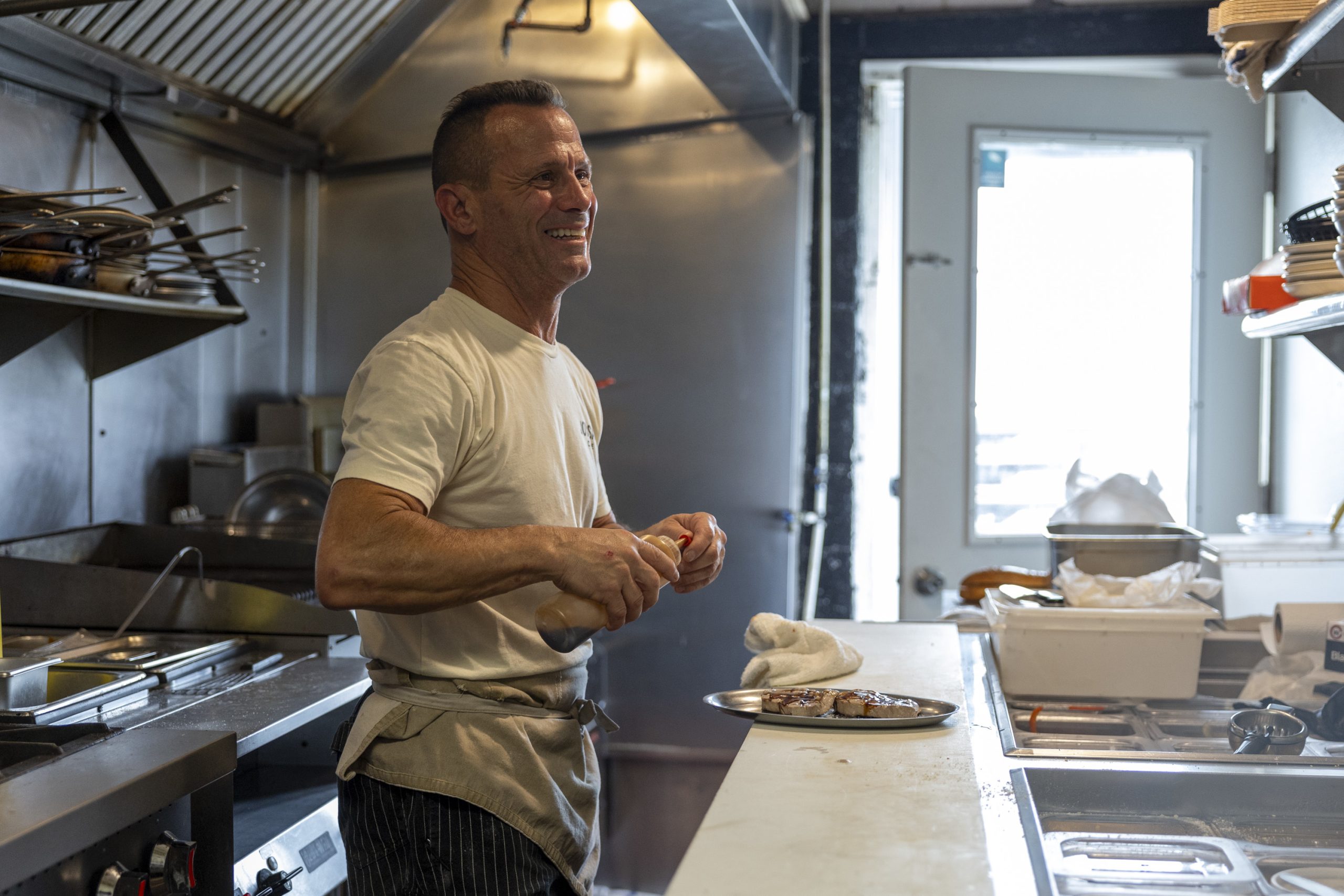
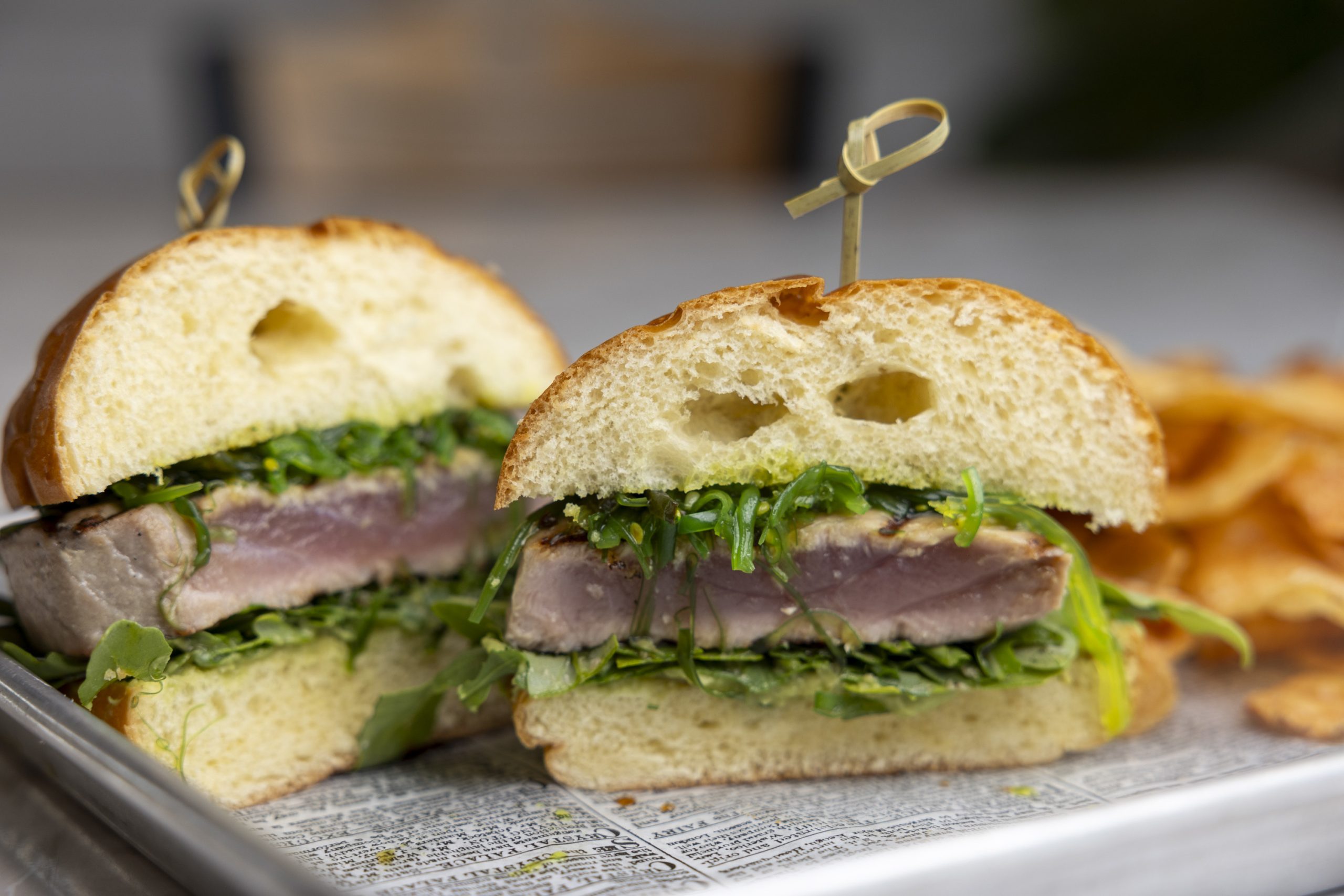
James Savianeso, chef and co-owner of Joy & Salt Cafe, working in the kitchen in Ship Bottom, N.J., on Thursday, June 18, 2026.Tyger Williams / Staff PhotographerThe grilled ahi tuna sandwich at Joy & Salt Cafe in Ship Bottom, N.J., on June 18, 2026.Tyger Williams / Staff Photographer
That could mean a flavorful chowder made from just-dug whole clams, a slice of locally fished grilled tuna on brioche glossed in house-made Japanese barbecue sauce, or a bountiful chilled shrimp cocktail tossed in a saucy Mexican-style marinade (the secret? fresh tomato juice and orange soda). The duo routinely cook fresh-off-the-boat seafood specials for dinner sourced from the nearby docks, but the menu’s default is a homey Italian touch that comes natural to Savianeso, whose North Jersey upbringing imbues his red sauce and sausage and peppers with a nonna-esque magic. That is especially evident at lunch, where Savianeso’s chicken cutlet parm drenched in super-creamy vodka sauce may well become LBI’s sandwich of the summer.
Joy & Salt Cafe, 816 Long Beach Blvd., Ship Bottom, N.J. 08008; 609-342-0794; joysaltkitchen.com
Ellis’ Chicken & Crab Cakes
Takeout can be tricky when determined diners are waiting in lines up to two hours for a seat at one of the Tide Table Group’s roster of popular restaurants on Long Beach Island (Parker’s Garage, Bird & Betty’s, Black Whale, Ship Bottom Shellfish) and in Manahawkin (Mud City Crab House, the Old Causeway Steak & Oyster House). They’ve addressed that conundrum with the creation of Ellis’ Chicken & Crab Cakes, a convenient destination for some of their greatest hits, collected in the fast-casual confines of a crisply rehabbed former antiques shop in Beach Haven that doubles as a boardinghouse for many of the company’s summer workers.
The name offers a good clue as to the specialties: the fried chicken is the same crackle-crusted, buttermilk fried bird from Parker’s Garage. The crab cakes comes in two styles, the somewhat bready OG cakes from Mud City or the baked variation from Parker’s which I far preferred, not only because they’re gluten-free, with tapioca starch for binding, but because they’re made from sweet lump crab bound with a béarnaise sauce flavored with tarragon and Old Bay. The super-plump peel-and-eat shrimp offer a worthy, non-fried option. But this kitchen’s best assets are all about the crisp. Don’t leave without a side of deep-fried green tomato tots covered in creamy drizzles of zesty pimento cheese.
Ellis’ Chicken & Crab Cakes, 208 N. Bay Ave., Beach Haven, N.J. 08008; 609-342-1100; ellislbi.com
Queen City Crust
Jersey Shore pizza has been trending toward thicker crusts in recent years, rising from the cardboard-thin rounds that have long been the boardwalk prototype to heartier, pan-baked pies with flavorful slow-fermented doughs and borders that snap with crispy cheese edges. Bakeria 1010 and Squares & Fare are two outstanding examples I’ve enjoyed in Ocean City and Somers Point, respectively. Long Beach Island has also gotten into the Detroit-style pie action with Queen City Crust, a former pop-up sensation that is now in its third year as a standalone storefront in Beach Haven.
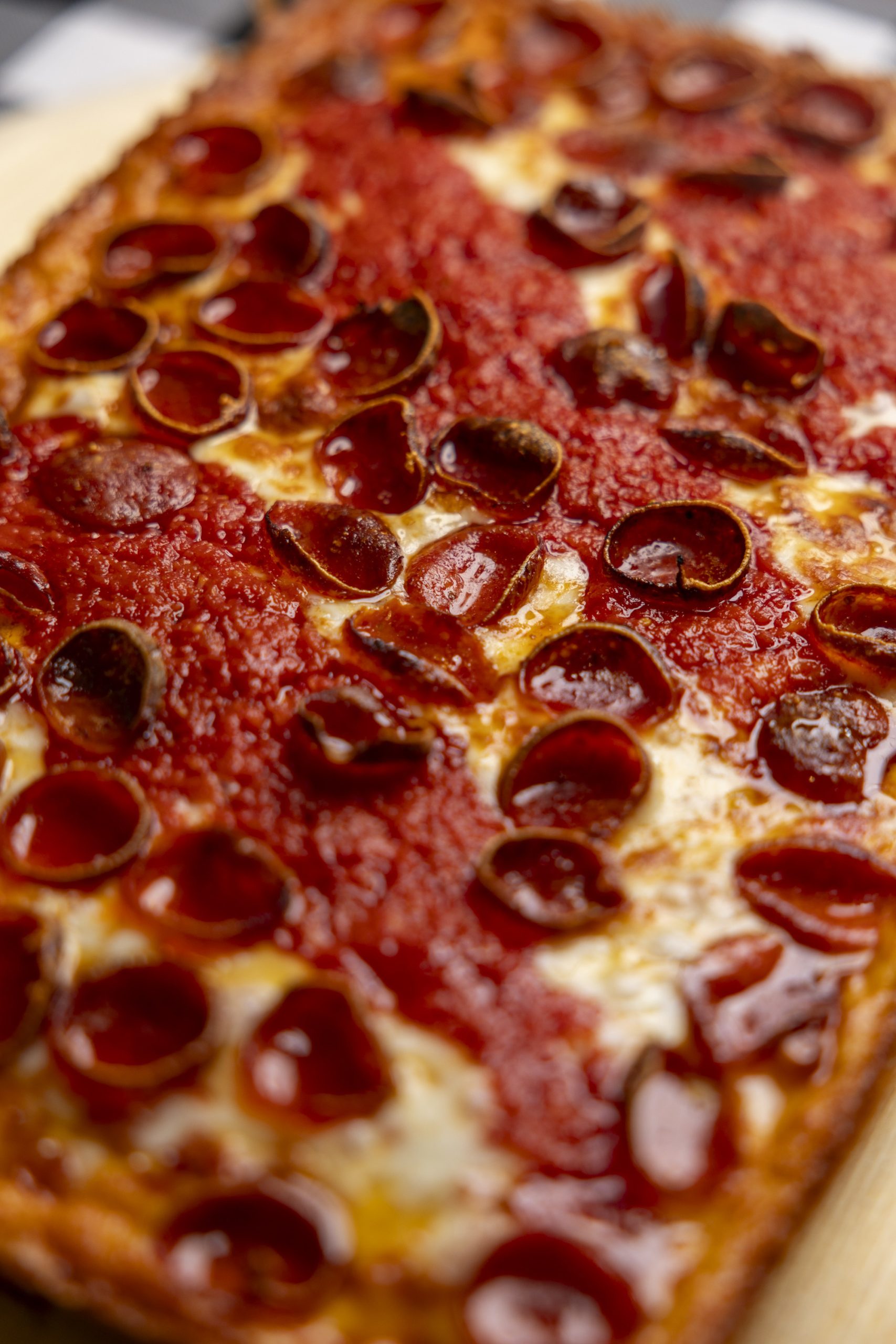
Hot honey pepperoni pie Queen City Crust in Beach Haven, N.J., on Thursday, June 18, 2026.Tyger Williams / Staff Photographer
Owner Troy Sambalino, who spends his offseason running the service pass at Jean-Georges in Manhattan, says the Detroit style, which involves a slower, lower-temp prebake followed by a hot flash to finish pies to order, is ideal for beach locations with the technical limitations of a standard oven. But he still manages to crank out 200 pies on a busy Friday night, good enough to earn him the No. 1 spot in a 2025 ranking of 55 Shore pizzerias by NJ.com.
Sambalino has a patient approach to his dough, which, after a two-day cold ferment, has both an impressively airy interior and a bottom that forms a delicate crisp against the olive oil-lined pan. Mozzarella and tangy cheddar are his cheese combo of choice, with the cheddar tucked near the edges forming a toasty crisp. One 10-by-13-inch pan can easily feed two to four people, but I appreciate that Queen City also sells its pies by the slice so you can taste a variety of toppings. From the cup-and-char pepperoni drizzled with hot honey to sausage with crunchy banana peppers, basil-topped puddles of milky burrata laced with bright tomato sauce, or a fusion pie of breaded chicken bits streaked with spicy Asian barbecue sauce, these pies offer hearty satisfaction when your teeth sink into their crusts.
Queen City Crust, 13504 Long Beach Blvd., Beach Haven, N.J. 08008; 609-661-7769; queencitycrust.com
Guapo’s Coffee House
As I steadily caffeinated during my restaurant research missions up-and-down the Jersey Shore, my encounters with confectionary-sounding coffee drinks that included “dulce de leche, “dot cake,” and “banana bread” in the titles made it clear that running a cafe in 2026 is as much about thinking like a pastry chef as a barista.
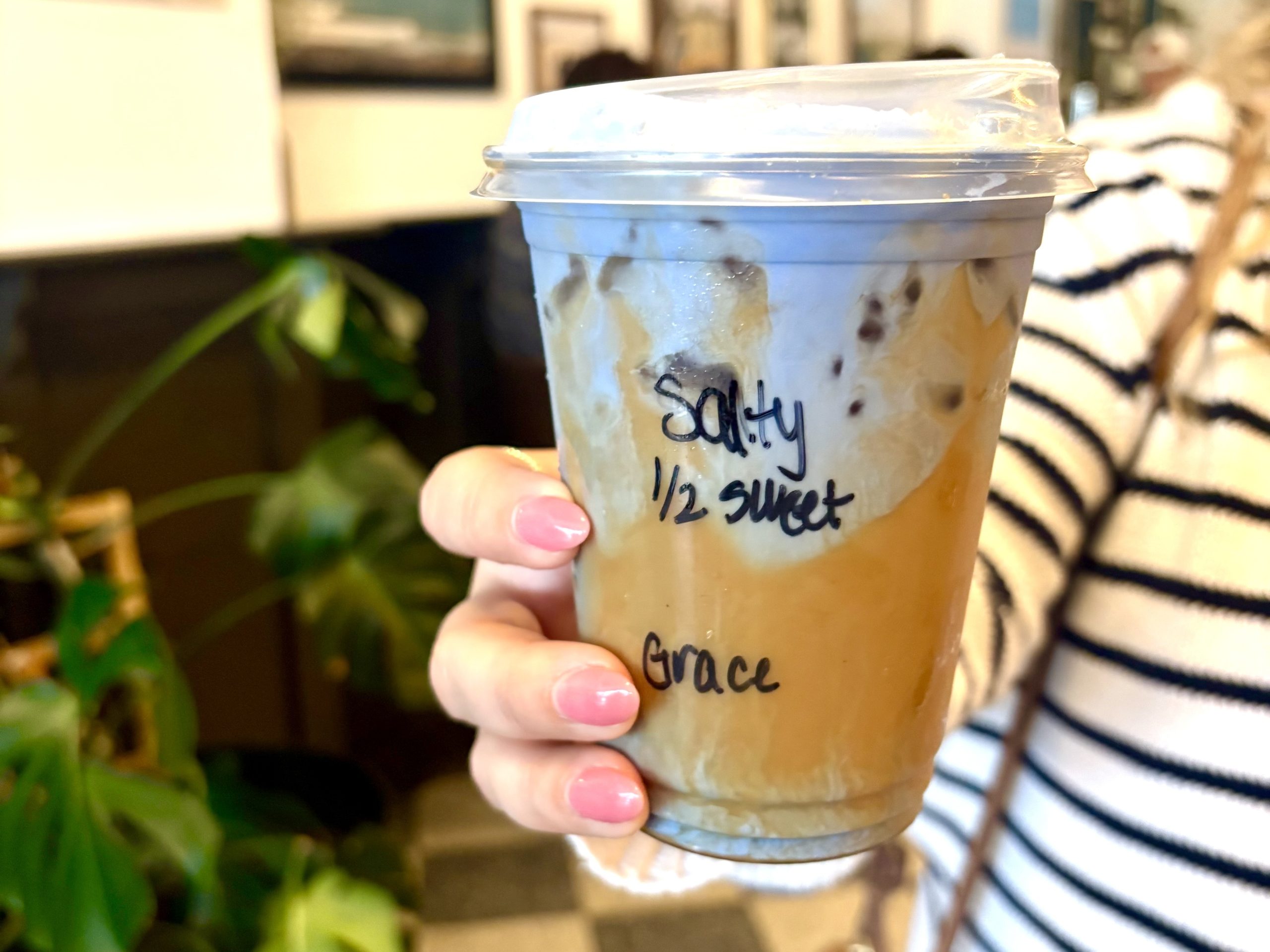
The Salty Dog iced coffee at Guapo’s Coffee House in Beach Haven blends salted caramel-sweetend espresso with whipped cream turned blue with spirulina. It’s become a viral hit.Craig LaBan / Staff
In general, I’m not a dessert coffee fan. But the reason I returned multiple times to Guapo’s in Long Beach Island is because their specialty drinks still taste like they also actually include coffee. Even owner Sammy Jo Alvarez’s most viral and colorful drink, the Salty Dog (named for her pup Guapo), still delivers a toasty undertow of the house blend of Ethiopian and Colombian beans, roasted to a medium hue by Yellow Dog Roasters in nearby Manahawkin. The secret to making creatively flavored drinks that still have coffee integrity, says Alvarez, a longtime local bartender before launching her roof deck-topped cafe in Beach Haven four years ago, is balance and focusing on natural ingredients. All the add-in ingredients here are made in-house, from the sea salted caramel syrup to the top layer of fresh whipped cream (aka “cold foam”) that she turns sky blue with organic spirulina. “Basically, it looks like a day at the beach inside a cup — and people love it.”
Guapo’s Coffee House, 106 N. Bay Ave., Beach Haven, N.J. 08008, 609-661-3504; guaposcoffee.com
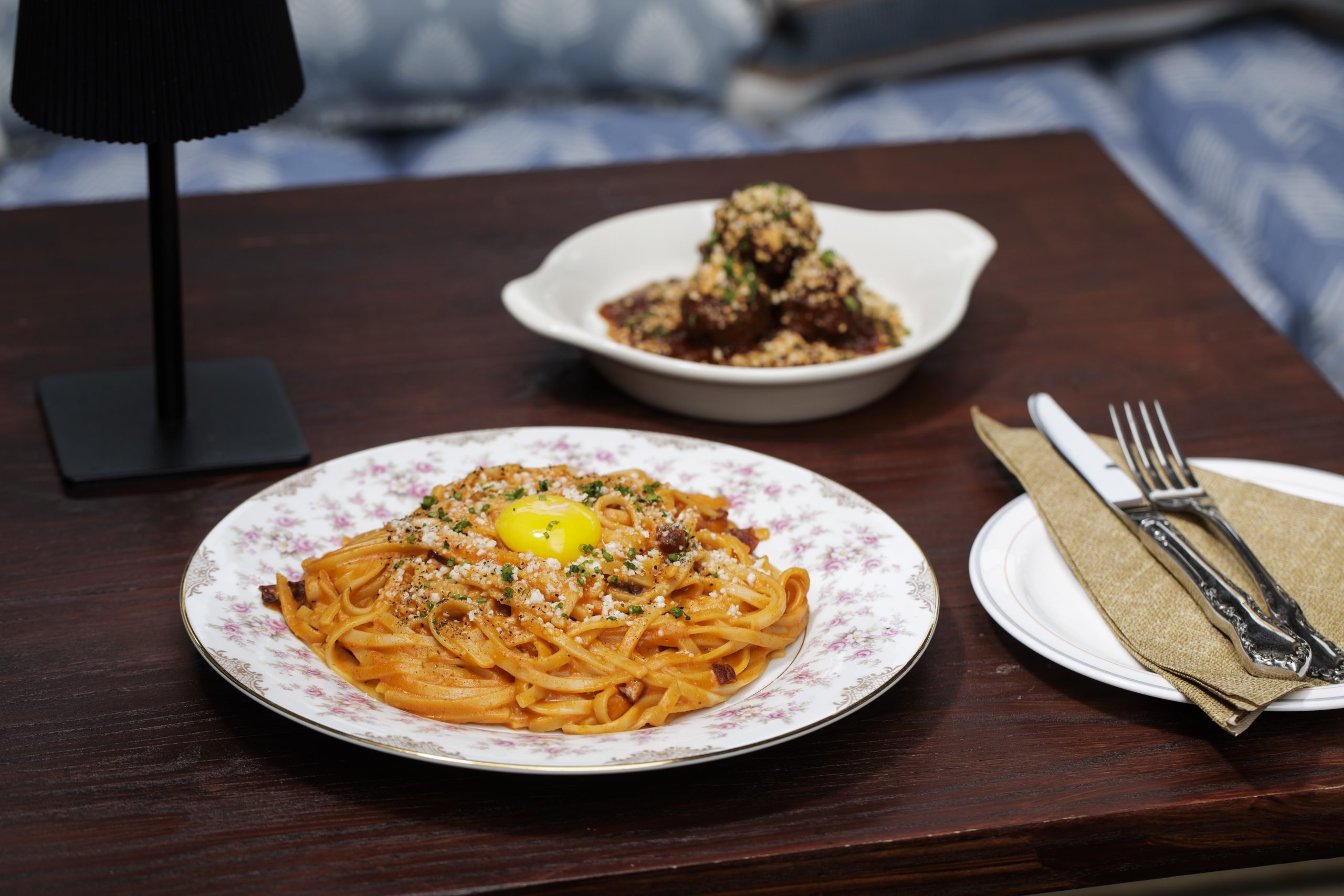
The gochujang carbonara and Oaxacan meatballs at the Iron Room in Atlantic City, N.J. The Iron Room is hidden behind a door at Bar 32.Monica Herndon / Staff Photographer
ATLANTIC CITY
Nana’s Good Eats
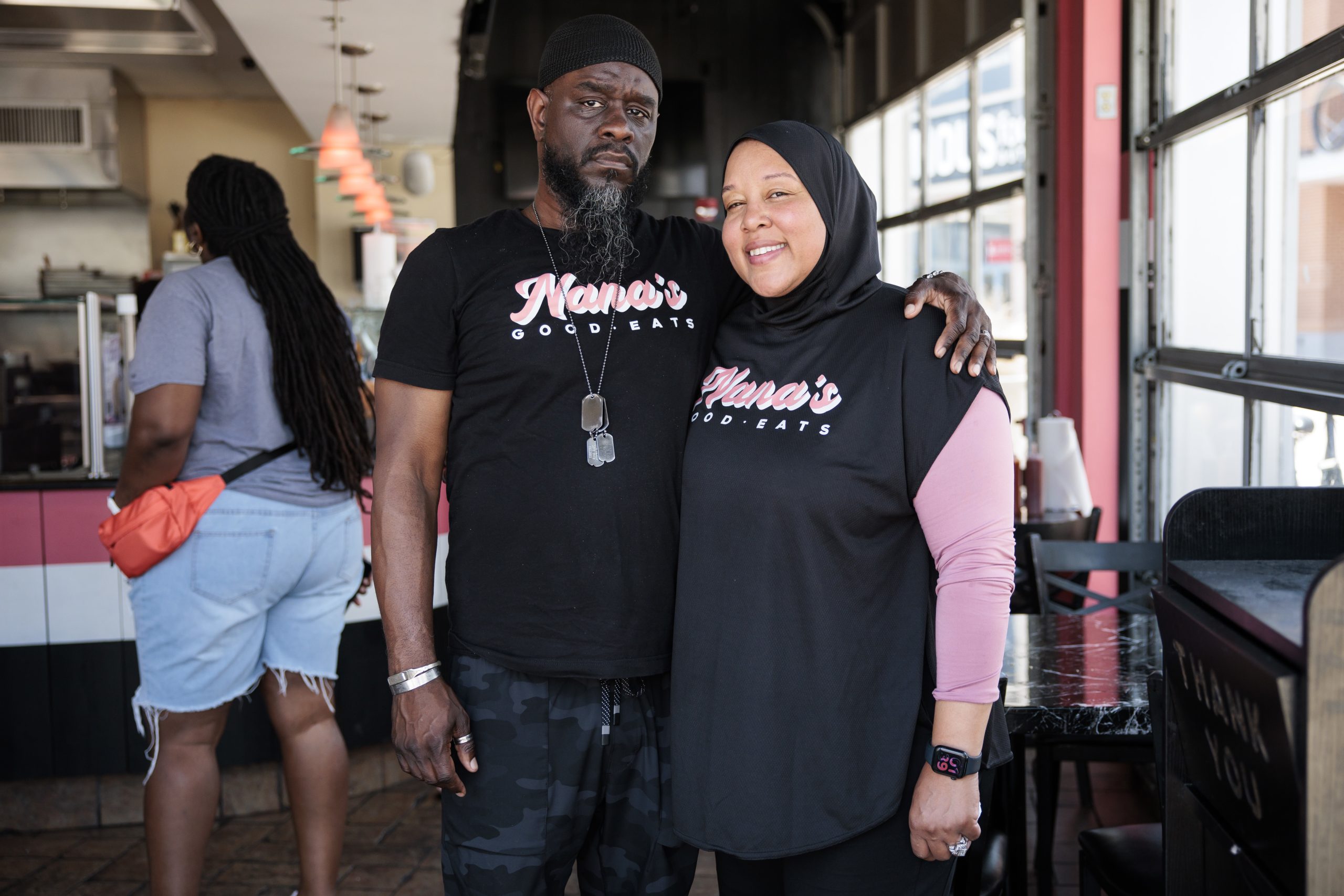
If there’s a 20 minute-plus wait for your food at Nana’s Good Eats, it’s for a good reason: nothing hits the fryer before you order from this cheerful soul food hub, located on the pedestrian pavilion of Atlantic City’s Tanger Outlet mall. The wait is absolutely worth it, because Nana’s serves up some of the most delicious fried whiting I’ve had in recent memory, a huge portion of plump and lemon-scented fresh fillets sealed inside a delicate cornmeal crust, just as owner Samantha Prescott’s grandpa Dennis McDowell, a professional chef, taught her as a little girl. (“Most parents lead with how to tie your shoe, but my grandpa started by teaching me how to stir a pot of grits so it doesn’t stick to the bottom.”) Prescott’s cooking chops are also evident in her succulent fried jumbo shrimp, as well as every side I sampled. The mac and cheese retained the almost fluffy texture of perfectly cooked cavatappi while a balanced five-cheese sauce remained creamy, not broken or greasy. The tender braised collards were infused with the whiff of smoked turkey wings and a perky finishing tang.
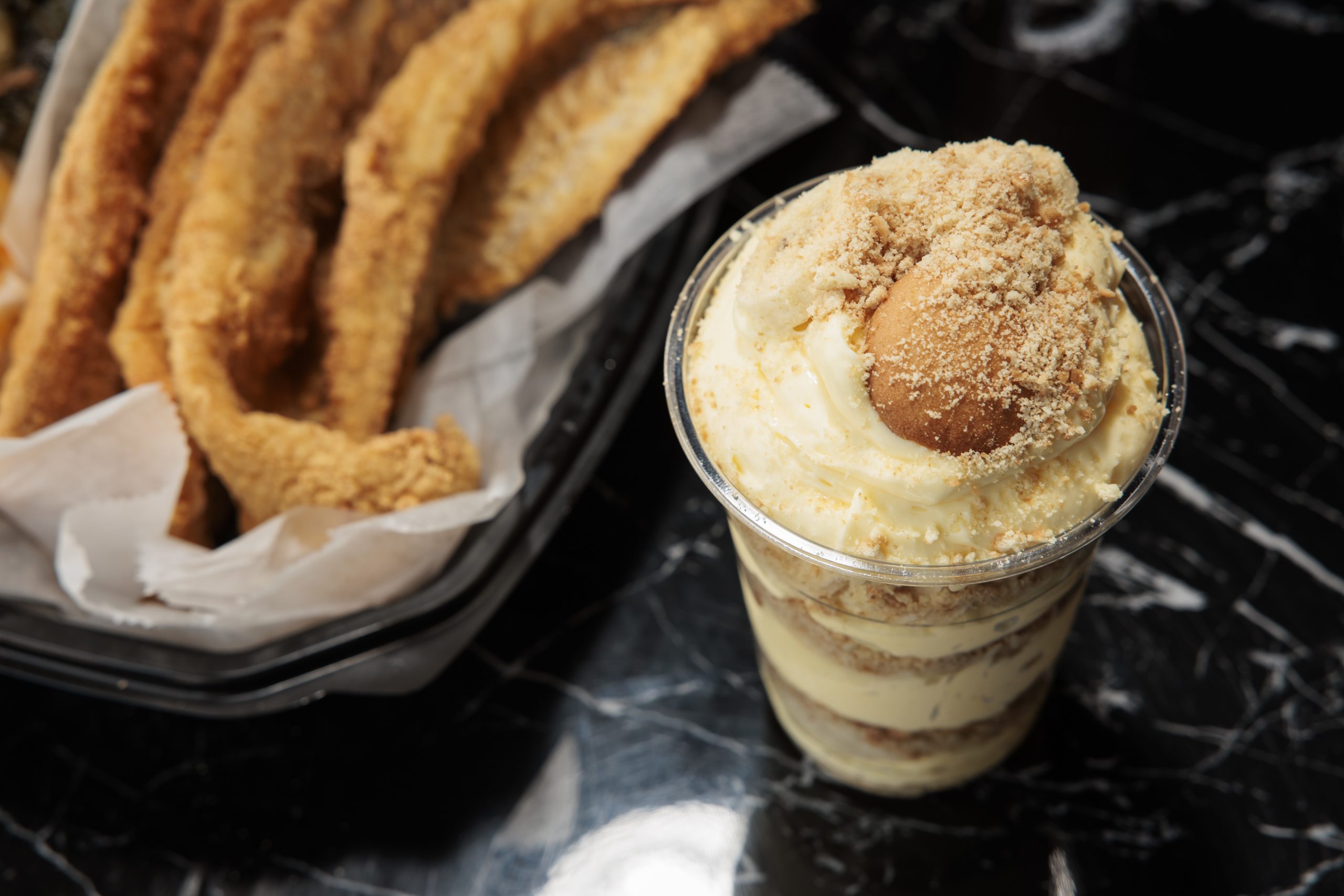
The OG banana pudding at Nana’s Good Eats in Atlantic City, N.J.Monica Herndon / Staff PhotographerOwners Rahman and Samantha Prescott at Nana’s Good Eats in Atlantic City, N.J.Monica Herndon / Staff Photographer
Prescott’s talent as an entrepreneur, meanwhile, answers all that savory goodness with the sweet indulgence of her first endeavor, Nana’s Good Puddin’. Prescott brought the customization concept of Cold Stone ice cream to the world of pudding in a popular dessert business she opened in 2020 in the Hamilton Mall, which she has since closed and merged into the Atlantic City Good Eats location. The build-your-own options here are vast, with 30 different base puddings (from classic flavors to white chocolate, pistachio, or Oreo cream), crunchy cookie add-ins and various different crumbles. I chose the OG banana pudding and was impressed by its banana-flavored intensity, but also by the meticulous manner in which it was constructed to order, with multiple layers of creamy pudding, crunch and vanilla wafer cookies being patiently added until, at last, it was finally handed over and I dove in spoon first.
Nana’s Good Eats, 122 N. Michigan Ave., Atlantic City, N.J. 08401; on Facebook
The Iron Room
Do you believe in do-overs? The reboot of chef Kevin Cronin’s Iron Room, Atlantic City’s favorite hidden gastropub — now in its third incarnation and second location — might be the spark that finally gives the Tennessee Avenue development some momentum. First, you have to find it. True to its speakeasy roots (the original Iron Room was located behind a liquor store) this restaurant is tucked into an enclosed back alley patio accessed through the rear door of another establishment, Bar 32 Chocolate & Cocktails. A tall green wall on one side of the 50-seat al fresco space faces an awning-covered bar where some of the best cocktails I sipped this summer — a smooth but potent Manhattan; the mezcal-washed Storm Queen — are served in antique crystal coupes inherited from Cronin’s grandmother while a retro acoustic soundtrack sets a mellow mood.
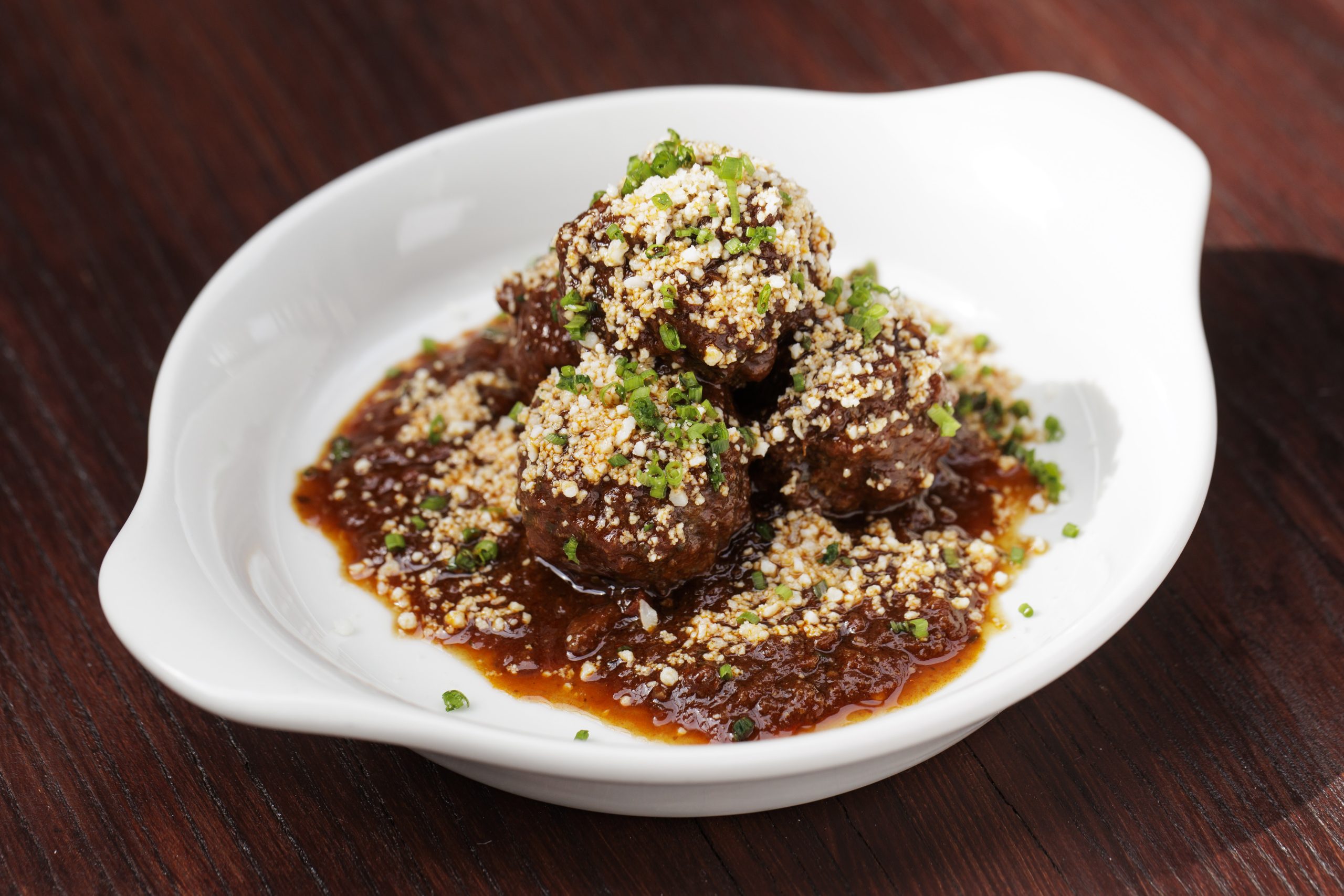
The Oaxacan meatballs at the Iron Room on Thursday, June 11, 2026 in Atlantic City, NJ. The Iron Room is hidden behind a door at Bar 32.Monica Herndon / Staff Photographer
The small plates emerging from the shipping container kitchen are pure fusion fun, with bold flavors that resurrect some established Iron Room hits, including a thick-cut hunk of candied Nueski’s bacon, truffled udon mac and cheese, and a tamari-charred hanger steak fanned over brussels sprouts. Cronin’s new creations are equally bold. The spicy Oaxacan chorizo meatballs glazed in red salsa and shavings of Bar 32 chocolate were a favorite, along with the barbecue sauced boneless Korean-fried chicken and a rich pasta carbonara blushing with Korean gochujang spice. I would have loved the shrimp toast had the top layer of crustacean paste not been turned an unappetizing gray by the addition of black garlic. Next time, I’d consider preordering one of the menu’s large-format specials: a spatchcocked whole barbecue chicken with sides; a “big ass whole snapper” with tostones, or the Ron Swanson special (a rib eye, deviled eggs, and a flight of Lagavulin) that was also an old Iron Room “iykyk” draw. Hopefully, this time it will take.
The Iron Room, 121 S. Tennessee Ave., Atlantic City (enter through Bar32 Chocolate, and head to back alley through back door); instagram.com/ironroom_ac
Bar 32 Chocolate & Cocktails
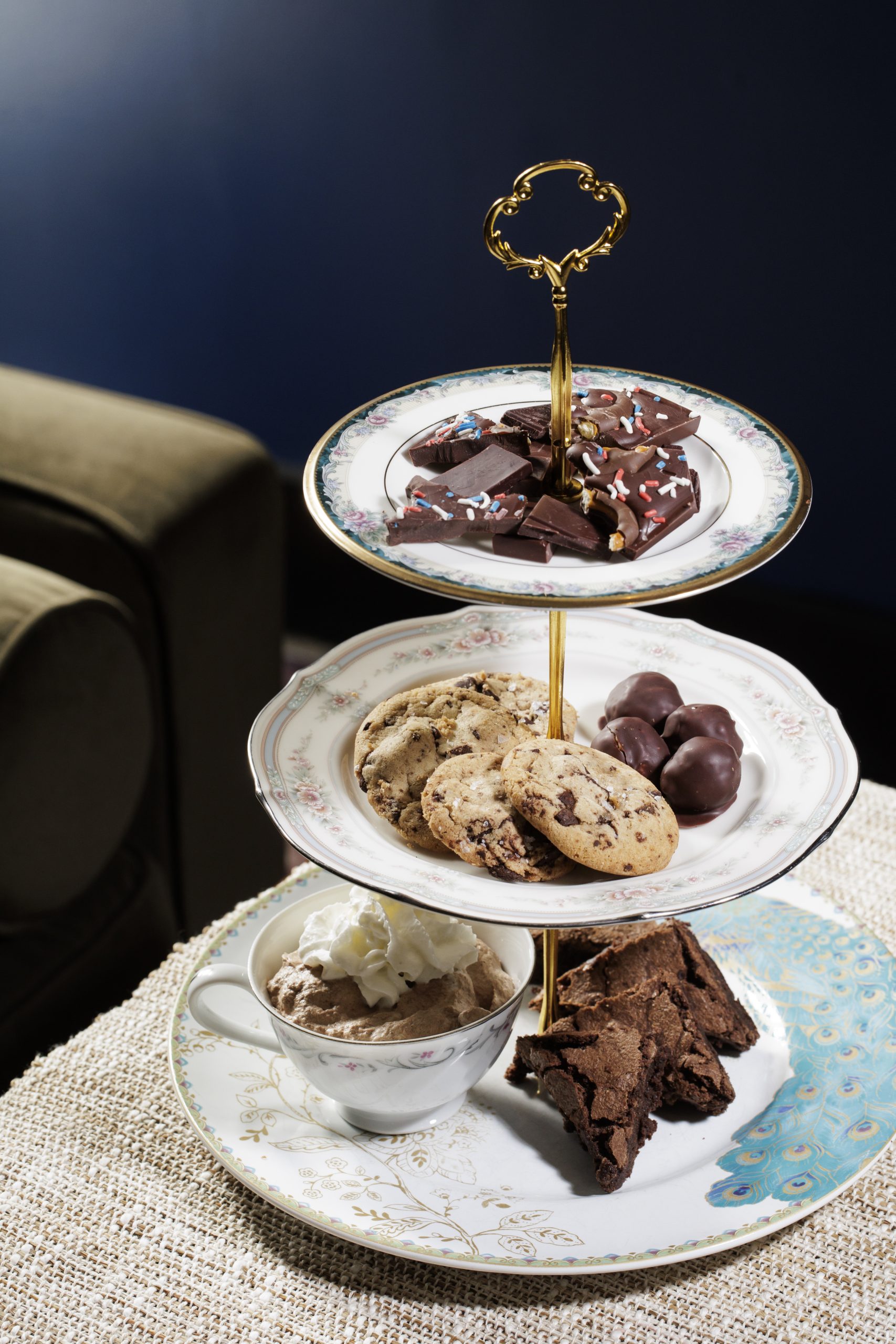
There’s no dessert served at the Iron Room by design. The separate and independent bar that fronts it has that course covered. Nicole Callazzo’s revamp of the project formerly known as Made Atlantic City Chocolate Bar has kept the original concept’s ambitious bean-to-bar chocolate production in place as the anchor for the chocolate-themed sweets menu. While there are more sophisticated chocolatiers in the region, the quality of Callazzo’s small batch chocolates made from ethically sourced cacao, which can take up to five days to make, is satisfying in a straightforward way. You can sample a little bit of several specialties on a tiered platter, which brings multiple shades of chocolate bars, double fudge brownies, chocolate mousse, and various bonbons. Try it while sipping a martini infused with the bar’s own 60% cocoa chocolate. The baked-to-order brown butter cookie skillet is also a popular choice here, if you have an extra 15 minutes to wait. But I’d return especially for one of the Bar 32 whiskey flights, which pair three different pours of Michter’s (or Whistle Pig) whiskey with different chocolates for $40. Considering the quality of the spirits, it’s a fair deal.
Bar 32 Chocolate & Cocktails, 121 S. Tennessee Ave., Atlantic City, N.J. 08401, 609-248-6960; bar32chocolate.com
“A little bit of everything” at Bar 32 on Thursday, June 11, 2026 in Atlantic City, NJ. Bar 32 offers bean-to-bar chocolate, handmade desserts, and craft cocktails.Monica Herndon / Staff Photographer
Moments at Scannicchio’s
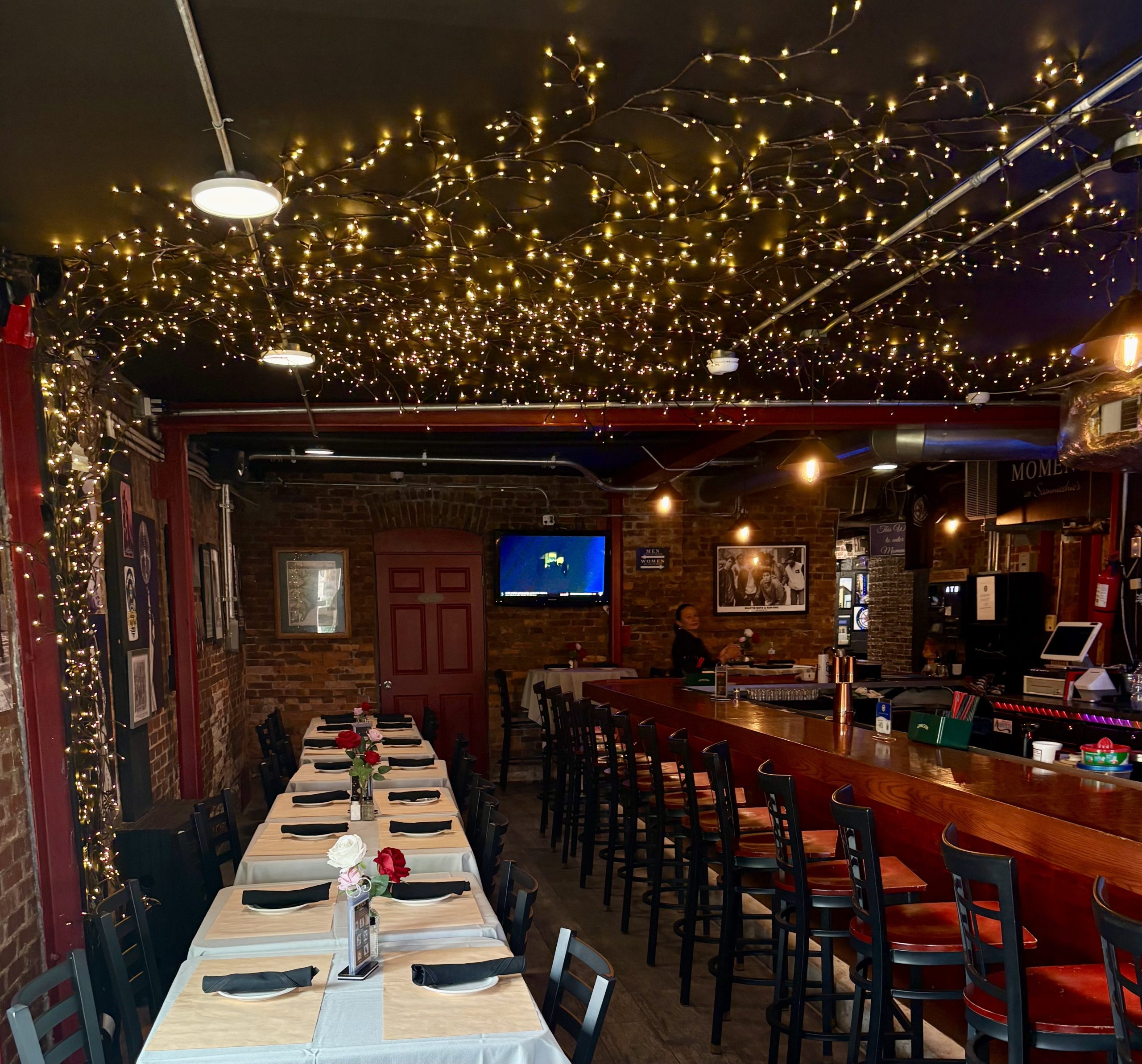
Some places are all about the food. Others revel in quirky ambiance. You can get a bit of both at this Atlantic City sibling to Scannicchio’s, one of my favorite old-school Italian haunts in South Philly. The AC experience offers the split personality of two adjoined spaces: the charming intimacy of a dark corner barroom lit with Christmas lights, and a bright sports bar lounge next door where a DJ spins retro hits for a handful of dancers while spillover dinner crowds sup at high-tops in the glow of large TVs.
The corner dining room of Moments at Scanniccho’s in Atlantic City is darker and more intimate than the neighboring lounge.Craig LaBan / Staff
A tender and massive double-cut pork chop Siciliana buried beneath a zesty gravy of cherry peppers, onions, olives, and mushrooms was the hands-down highlight of our meal. The big menu also showcases several familiar favorites from the South Philly original (clams casino, a stuffed artichoke, the sausage and figs app), although it was not cooked with the same consistency and finesse. Even so, we enjoyed the experience. And I’ll especially treasure the moment our larger-than-life server (who had a bear hug for every one of the restaurant’s many regulars) offered a memorable logic for his general preference of pasta shape with entrees: “Why should I waste calories twirling spaghetti when I can just get straight to it with penne? Stab and eat! Stab and eat!” Such wisdom alone is worth the visit.
Moments at Scannicchio’s, 2647 Fairmount Ave., Atlantic City, N.J. 08401, 609-344-5338; momentsatscannicchios.com
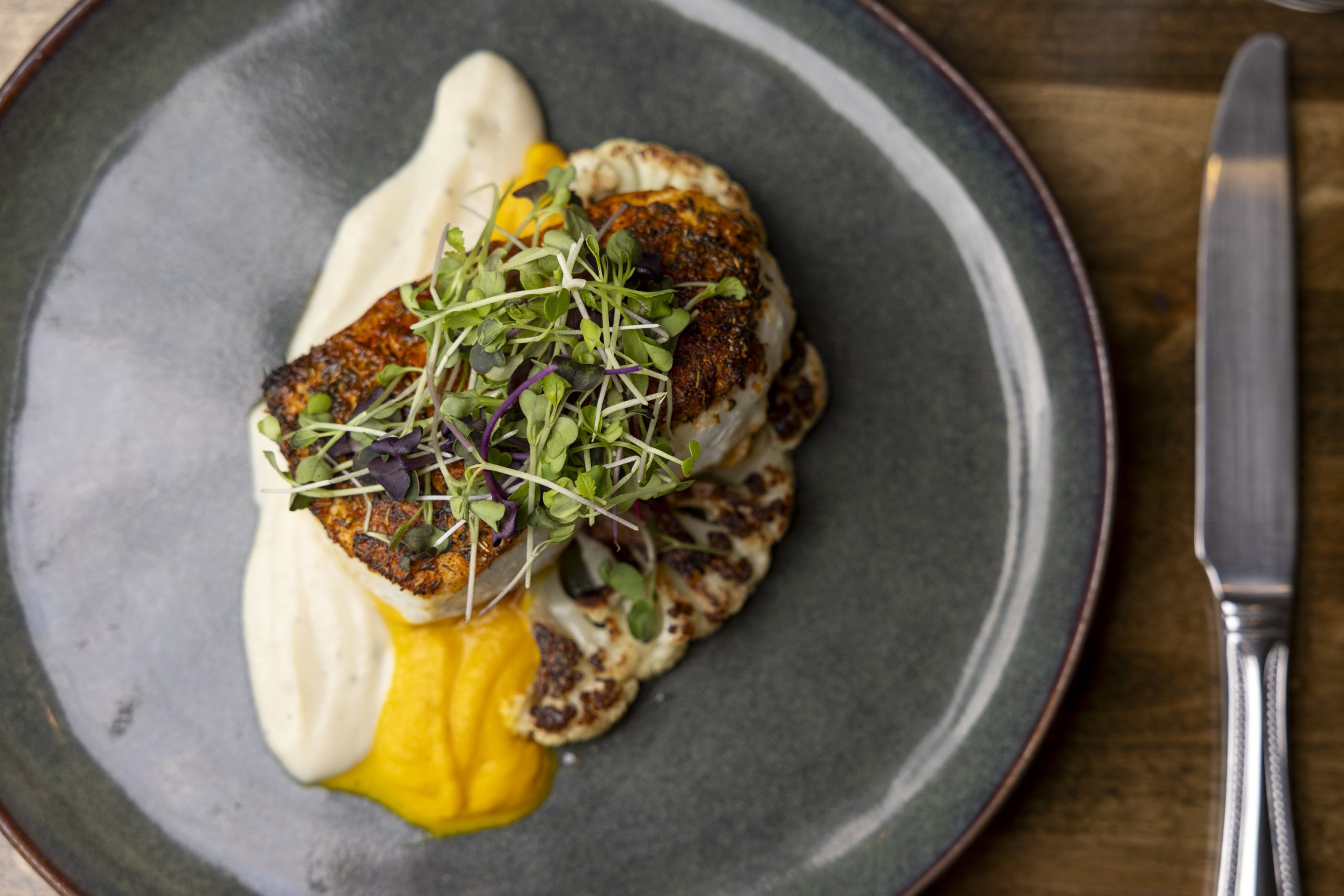
The halibut entree at Rustico in Ventnor City, N.J., on Wednesday, June 10, 2026.Tyger Williams / Staff Photographer
VENTNOR
Rustico
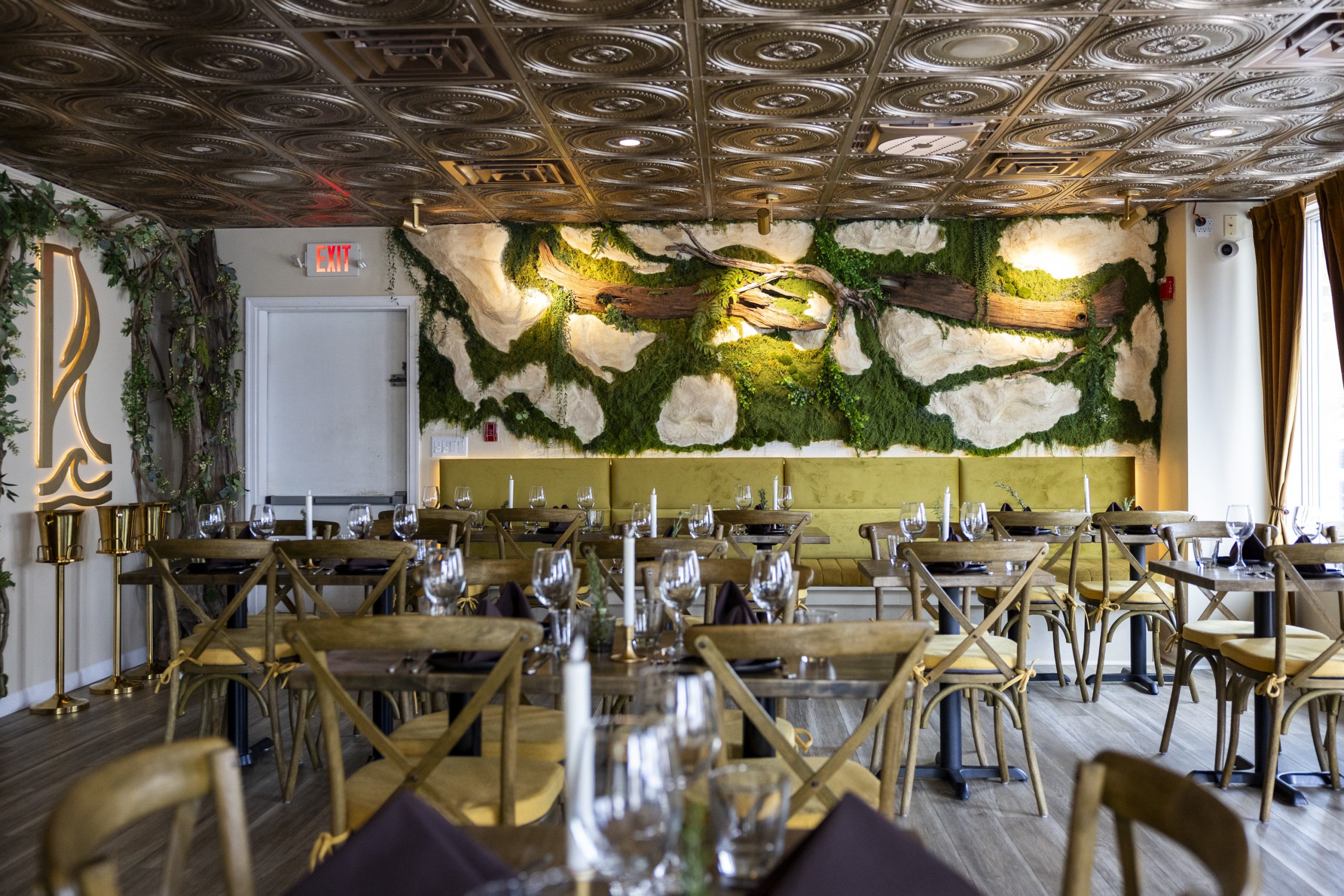
Few restaurant couples have been able to create evocative dining experiences in small BYOB spaces through DIY design as deftly as Tanya and Petar Petrov. A veritable lemon grove on the ceiling of their debut Italian hit last year, Martina’s, conjured a glimpse of the Amalfi Coast on Atlantic Avenue. This year, they’ve turned to a closer source of marine inspiration — the bay beside their Ventnor home — for the makeover of Petar’s former Cafe Velo into Rustico, a naturalistic dinner cove that wraps diners in plastered wall montages of foraged driftwood, sea moss, and rocks. The menu is still decidedly Italian. While some Ventnorians have complained to me about menu overlap between the two restaurants, the fact that waiting lists can exceed 300 names for those hoping to get into 48-seat Martina’s means there is a legitimate demand for 80 more seats at Rustico (plus 28 more outside), where devotees can order the tried-and-true arancini, linguine with vongole, and chicken Parm.
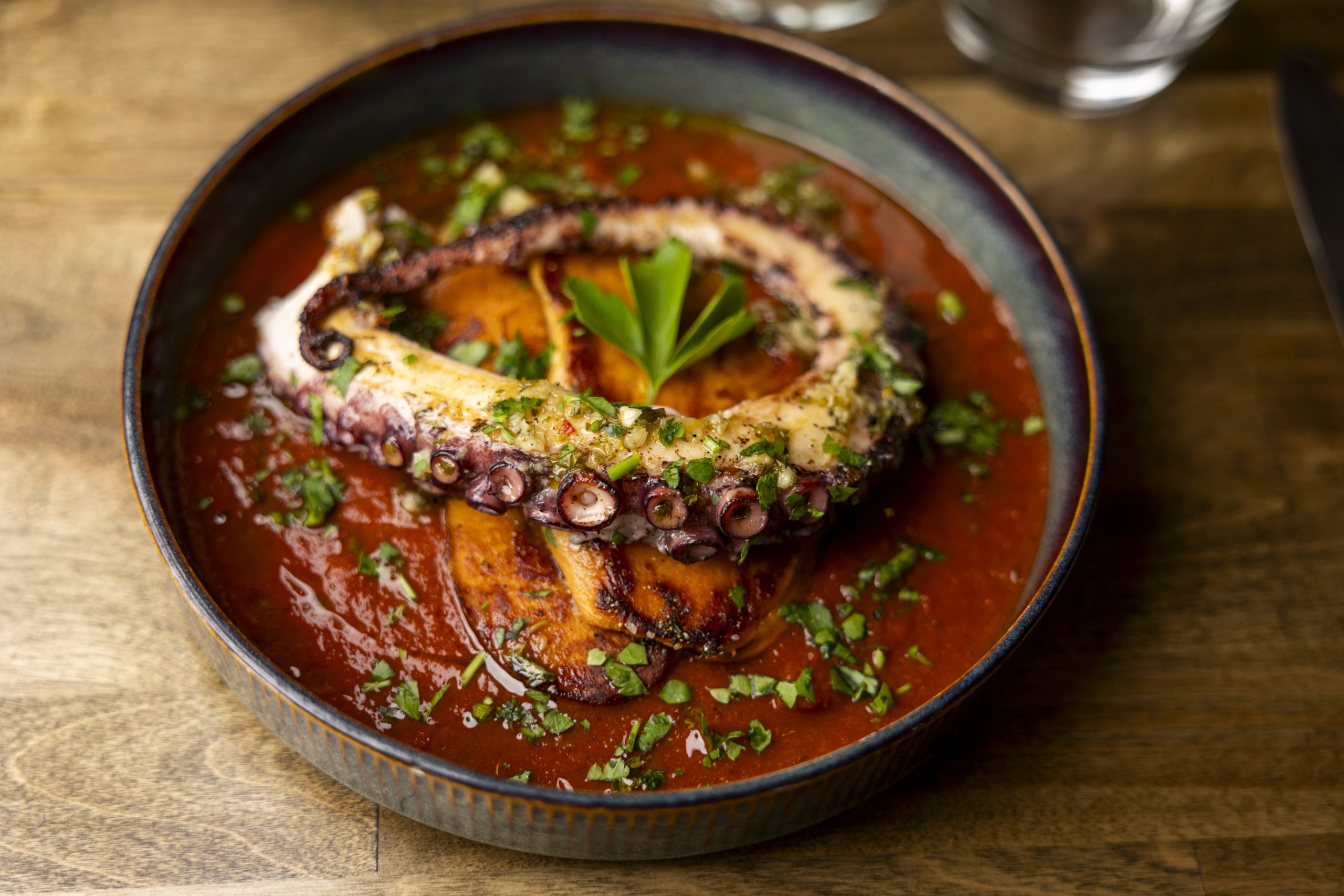
The octopus dish at Rustico in Ventnor City, N.J., on Wednesday, June 10, 2026.Tyger Williams / Staff PhotographerThe inside of Rustico in Ventnor City, N.J., on Wednesday, June 10, 2026.Tyger Williams / Staff Photographer
The chicken Parm was the least compelling thing we ate at Rustico. An unconventional starter of grilled octopus curled over a platform of sweet potato turned out to be delicious, the potato’s soft sweetness contrasting the texture of the meat while balancing the savory tomato sauce. That dish is a legacy of Cafe Velo’s early days, when the tiny kitchen would cross-utilize ingredients between the popular breakfast and dinner menus. Rustico, which expanded both its dining rooms and kitchen, has capacity now to undertake ambitious specials like broiled lobster and linguine feasts for two (very limited nightly). A soulful short rib and shiitake ragù was a hearty winner over fresh pappardelle made by Haddon Township’s Severino, whose owner is the Petrovs’ neighbor.
Fresh seafood also remains a strength, with entrees like blackened ahi tuna with red bliss potato hash and hollandaise. A moist and meaty halibut set over two-toned purees of cauliflower and carrot was also fantastic, a special-turned-standby from chef de cuisine Lorenzo Hernandez. Of course, I ordered at the very moment this kitchen ran out of halibut. Luckily, Petar had a spare portion in the fridge at nearby Martina’s, and he retrieved it just in time for this busy kitchen not to miss a beat: “That’s the beauty of having two restaurants so close,” says Petar. “Stuff happens!”
Rustico, 6525 Ventnor Ave., Ventnor City, N.J. 08406, 609-727-0499;rusticoventnor.com
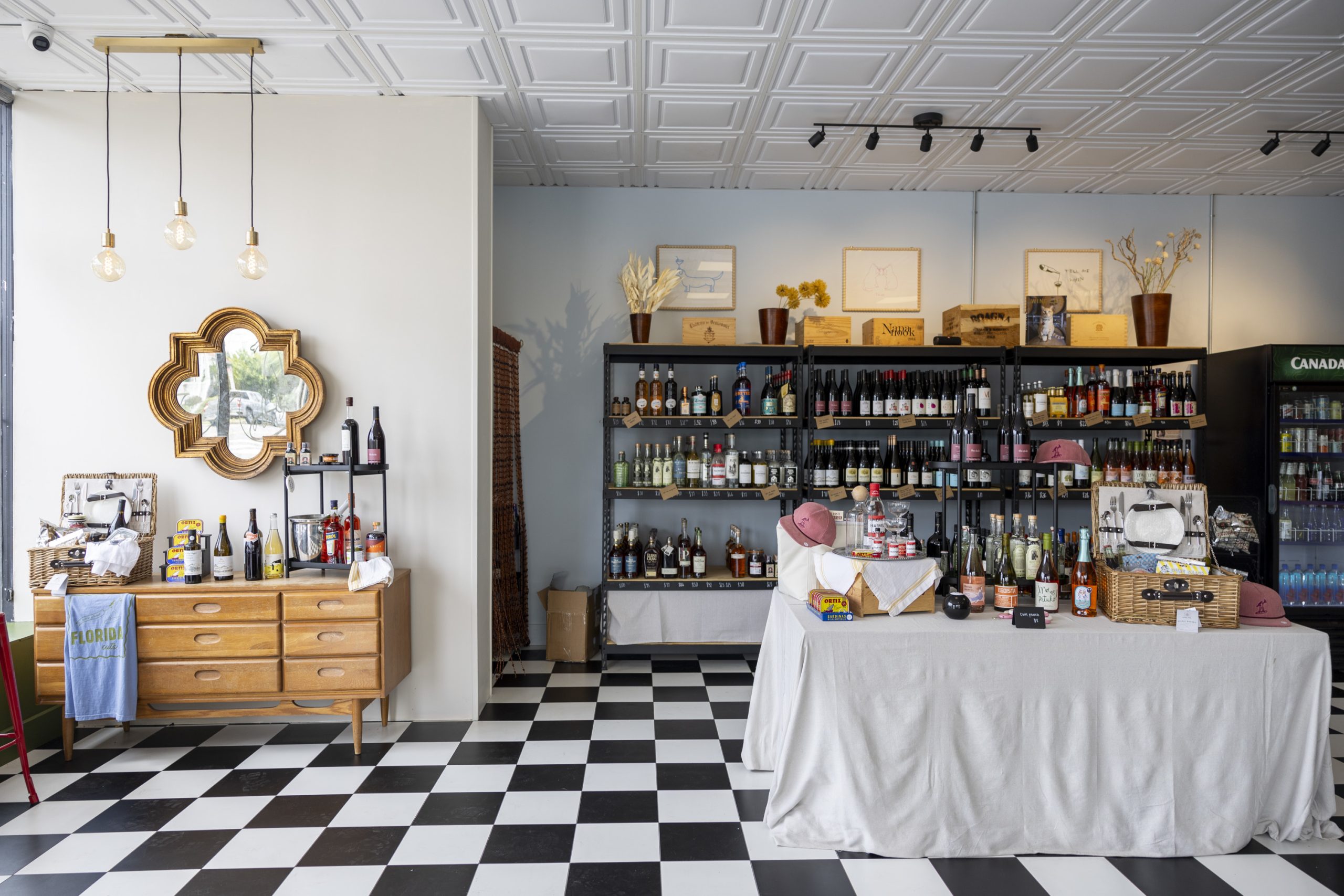
The inside of Florida Cuts in Ventnor City, N.J., on Wednesday, June 10, 2026.Tyger Williams / Staff Photographer
Florida Cuts
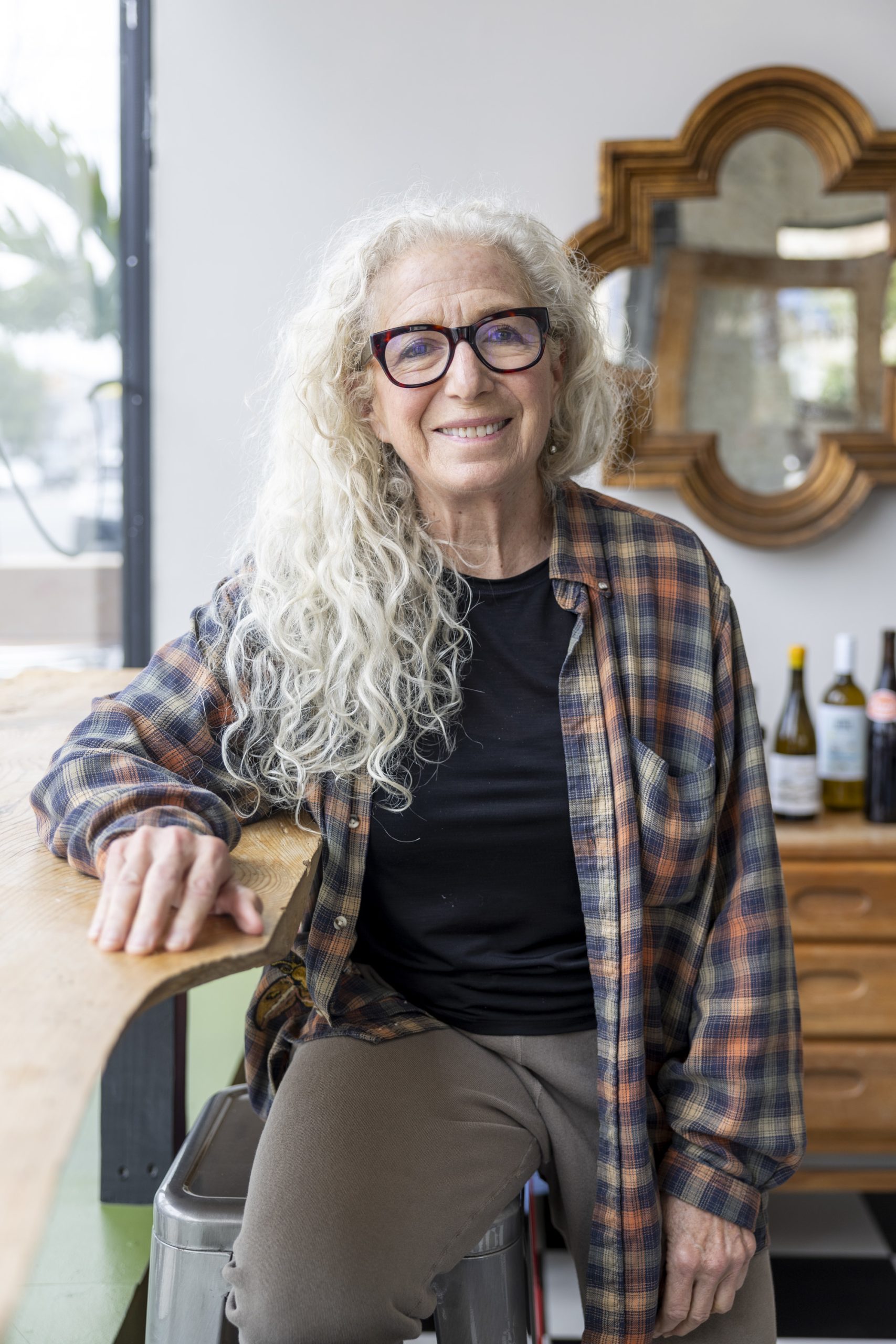
Cookie Till of Steve & Cookie’s bought the half-century-old Florida Cold Cuts & Liquors deli in 2022 and began to reshape it to her vision. What was a gradual makeover the first few years, most notably upgrading the sandwiches and bottle selection, became a wholesale change this spring when Till removed “cold” from the name and replaced the classic sub shop format with an artisan sourdough bakery turning out a lineup of grab-and-go sandwiches built on two kinds of focaccia and sesame-speckled semolina baguettes. The longtime tuna salad and Italian hoagie crowd is not pleased: “Cookie really took a good thing … and turned it into something nobody needed,” a reader wrote me in a direct message on social media.
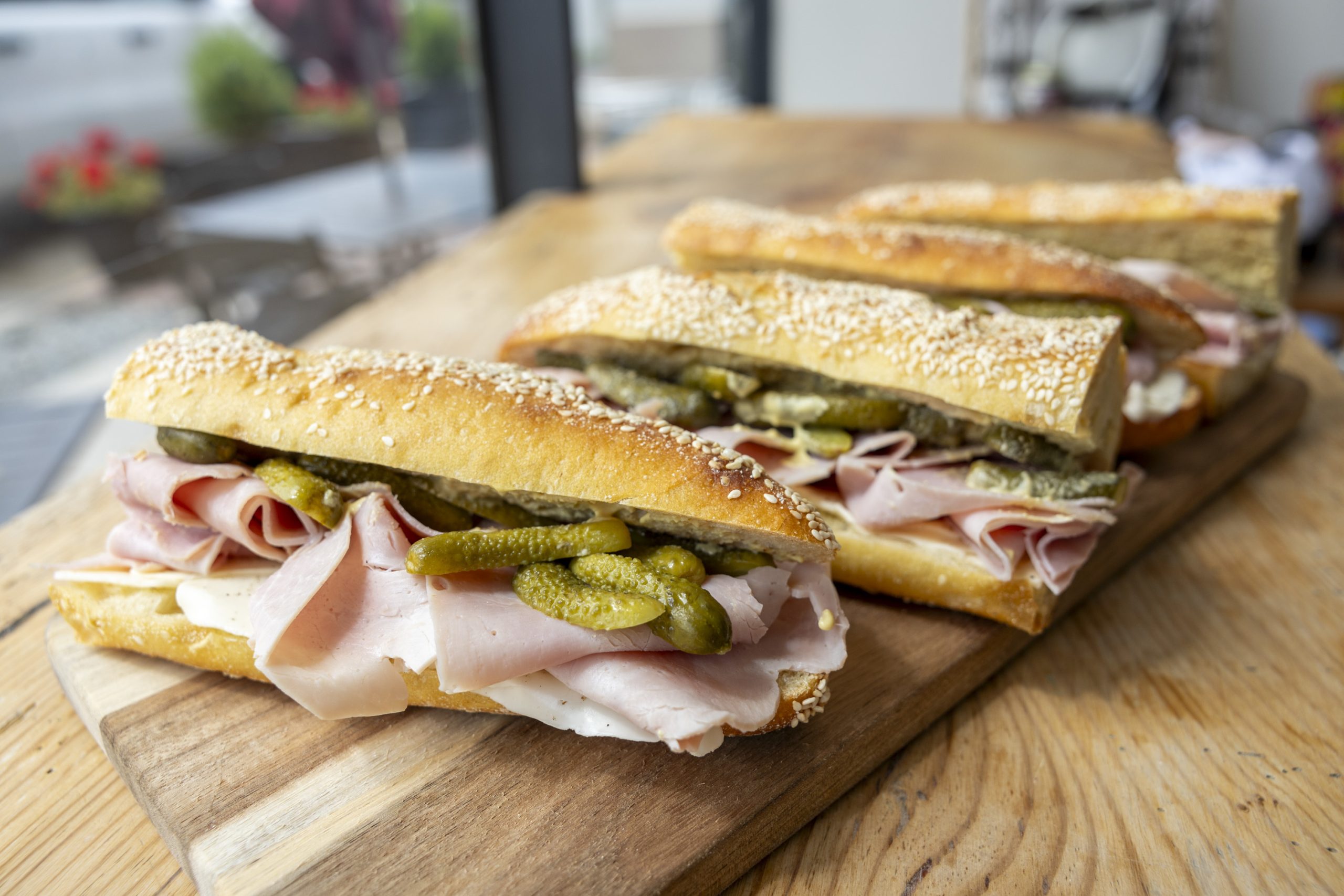
The ham and butter baguette at Florida Cuts in Ventnor City, N.J., on Wednesday, June 10, 2026.Tyger Williams / Staff Photographer
I loved the old corner shop’s house-baked tavern ham sandwiches as much as anyone, but I disagree. What makes a smart restaurateur like Till so invaluable is her willingness and wherewithal to take risks to do things differently. Till has a track record of creating top-notch progressive concepts people simply didn’t realize they needed until she made it happen, from a craft coffee shop in Ventnor No. 7311 to an interactive organic farm with a philanthropic mission at Reed’s Farm. There are plenty of places to get a classic sub on Absecon Island, but there is nothing like the new Florida Cuts, where lead baker Santina Renzi (a longtime key contributor at Her Place Supper Club), consultant Jon Taus, and sourdough specialist Victoria McHugh are working with Till’s partner Kim Richmond to create stellar loaves made from flour milled from local grains that result in bread with integrity and flavor. They’re used for original sandwiches that are largely outstanding, from the minimalist focaccia laced with mortadella, ricotta, and pistachios (all crackly crust and lush stuffing richness), to the freshly house-roasted turkey layered with Steve & Cookie’s signature “ugly tomato salad,” Gorgonzola, and crispy shallots. The tuna salad fragrant with lemon zest and crunchy peperoncini rings is a sleeper hit, while the ham and butter on a sesame semolina loaf can compete with Philly’s best.
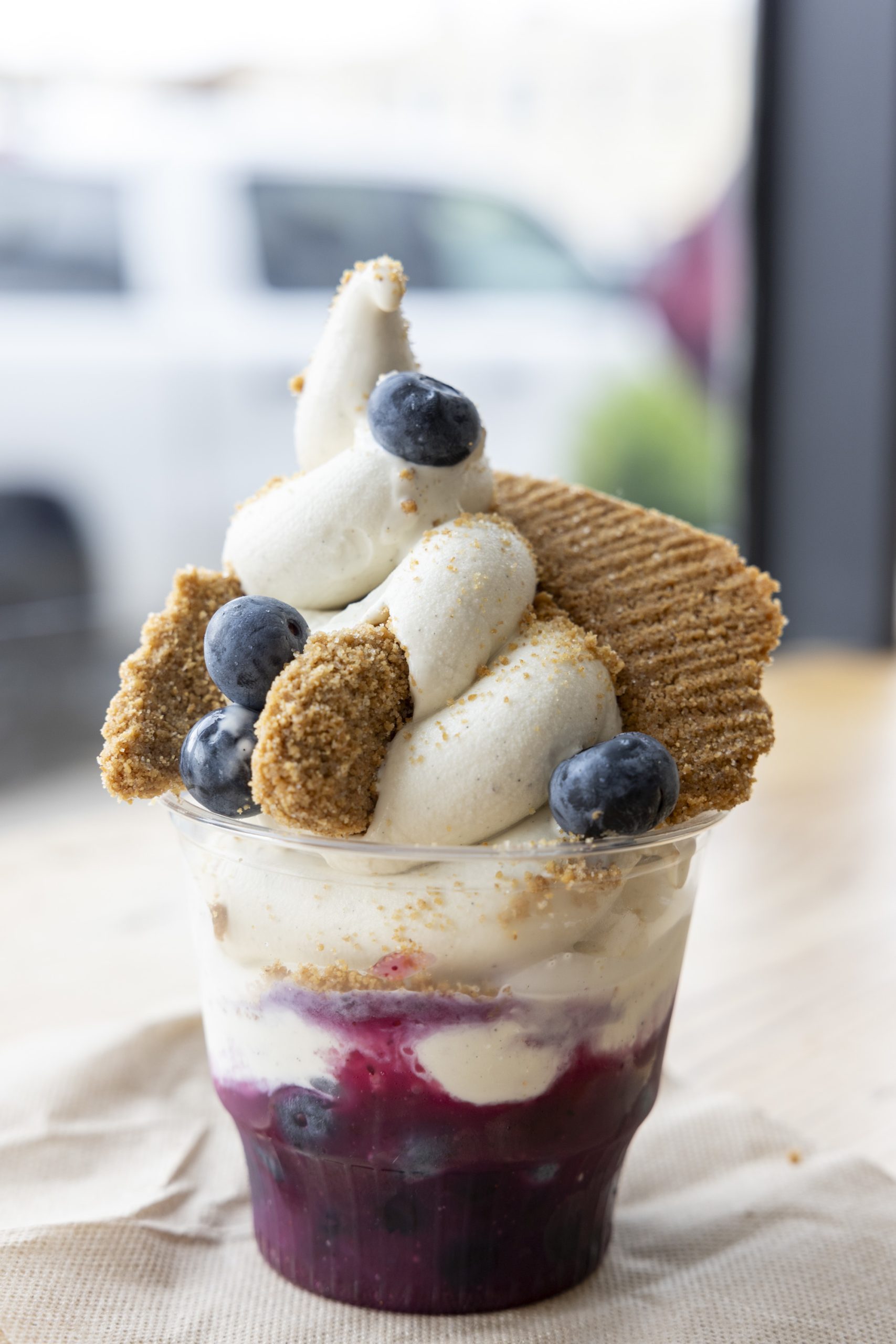
Owner Cookie Till at Florida Cuts in Ventnor City, N.J., on Wednesday, June 10, 2026.Tyger Williams / Staff PhotographerThe soft-serve sundae with Steve& Cookie’s blueberry pie at Florida Cuts in Ventnor City, N.J., on Wednesday, June 10, 2026.Tyger Williams / Staff Photographer
My one disappointment was the cutlet sandwich, which didn’t have nearly enough Caesar salad inside. But there were so many consolations: a fridge case stuffed with local farmstead cheeses; focaccia flatbread topped with butter-poached clams; warm rounds of fresh-baked sesame tahini cookies; shelves stocked with quality spirits and affordable natural wines. There’s also soft-serve now, offered as a sundae layered with Cookie’s famous blueberry pie. Now I definitely need that, even if I didn’t know it before I walked in the door.
Florida Cuts, 7301 Ventnor Ave., Ventnor City, N.J. 08406; floridacuts.com
MARGATE
Tideline
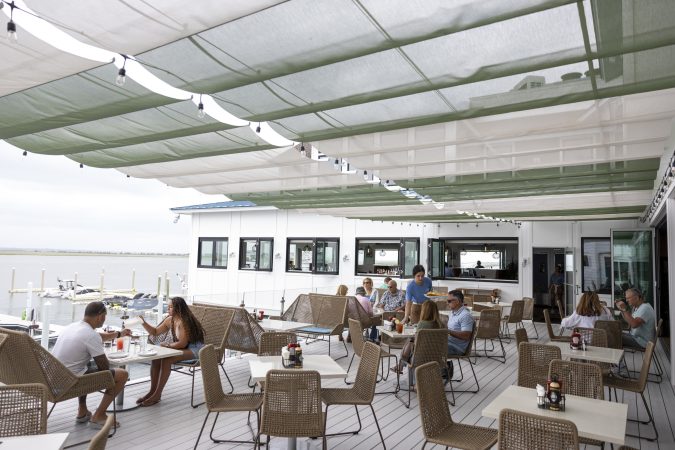
The scene at Tideline on the bay behind Margate City, where full restaurant service is offered on deck to 30 moored boats and 12 Jet Skis at a time, could make anyone have yacht envy. But this splashy yearling from the family behind Tomatoes — an unabashed gesture to the city’s ever more ritzy denizens — has room on its multifloor 240-seat bar complex for everyone else to linger, nibble, imbibe, and observe. One of the area’s most spectacular bay perches for sunset views is an undeniable bonus. Given the swanky setting, the food from chef Carlo Marsini’s kitchen is a notch better than it has to be, from the generously stuffed truffled cheesesteaks and chicken Italiano cutlet sandwiches to the shot glasses stuffed with fried soft-shell crab halves dunked into an avocado green crema sparked with poblanos.
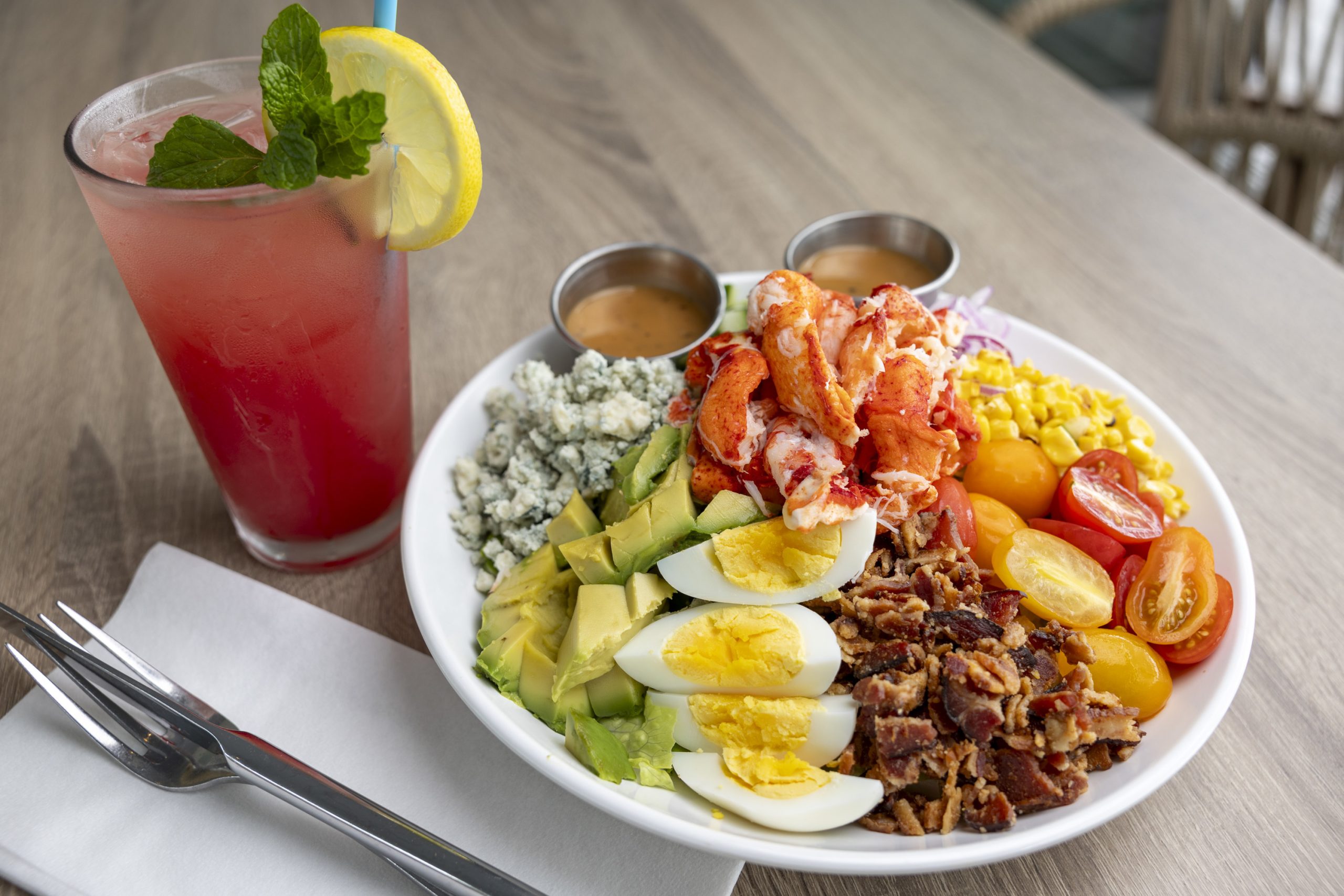
The lobster Cobb salad at Tideline in Margate City, N.J., on Wednesday, June 10, 2026.Tyger Williams / Staff Photographer
I’d definitely return for the generous lobster Cobb salad and a Dockside cocktail of watermelon juice spiked with Tito’s. But don’t get too ambitious. The items we ordered from the large plate section, chicken kebabs and a $32 coffee-rubbed pork chop, were incinerated by the grill chef. The drink menu has a danger zone, too, with a cocktail called Liquid Asset. It’s made with trendy Clase Azul Gold tequila and a chile pepper but what’s spicy is the price tag of $1.1 million. That’s because this drink comes with a 39-foot speed boat. That may be the stuff yacht club dreams are made of for some, even if there’ve been no takers yet. But unsurprisingly, this land-loving mezcal fan wasn’t even tempted.
Tideline, 9317 Amherst Ave., Margate City, N.J. 08402; 609-350-6717; tidelinemargate.com
Superintendent Tony B. Watlington Sr. has promised “white-glove treatment” for families and schools affected by a facilities master plan that will close 17 schools and modernize 169 over the next decade. And he appointed a Philadelphia School District veteran to lead the charge.
Shakeera Warthen-Canty, formerly assistant superintendent of school operations and management, was recently named head of the new School Transition Office, tasked with implementing the $3 billion plan remaking schools across the city.
Warthen-Canty and four other employees will work in the new office, which will also pull in as-needed help from departments across the district — school safety, transportation, student placement, facilities, and more.
“We know that this is going to be a big task, but it’s going to be met,” said Warthen-Canty, who’s spent decades in the district as a teacher and principal. “We know there have been some challenges, but we want to make sure our communities and families know that we have a place where you can get answers.”
Warthen-Canty officially assumed the new role Wednesday ahead of the 2026-27 school year, which Watlington has designated as a planning year for schools affected by closures and other major shifts.
Experts in their communities
Initially, the office will focus on schools closing, merging, and undergoing major renovationsin the 2027-28 school year; other projects are slated to happen in subsequent years.
Watlington announced the office’s formal launch at Patterson Elementary in Southwest Philadelphia, a school set to undergo a $45 million renovation as it grows from a K-4 to a K-8. It will take in some students from nearby Tilden Middle School, which is slated to close.
The transition office will be key as the complex work moves along, said Warthen-Canty. Patterson is slated to get 13 additional classrooms, a new gym or cafeteria, and an elevator.
“Some of the pieces of what that looks like, what elements need to be there, we need the Patterson team to work alongside of us,” she said.
Folks on the ground “know their communities, they’re experts in their communities. And that’s a part of the planning,” she said.
System-wide, how many projects can be completed and in what time frame is not assured.
The district will allocate $1 billion of its capital budget over the next 10 years to complete some of the projects, but it’s also banking on $2 billion from philanthropic and state sources — money that’s not guaranteed.
And while Warthen-Canty believes the facilities plan will ultimately expand opportunity and better position the district to advance students’ academics, she knows some of its transitions — particularly the closures — will be tough.
“My heart goes out” to affected families and schools, Warthen-Canty said. “Even people that are being co-located or merging, those are major changes.”
Part of the work, Warthen-Canty said, is going to be convincing families in schools where those major changes are happening that should they shouldremain in the district.
In the case of the school system forcing families to leave their schools and go elsewhere, “we want to make sure that there’s extracurriculars in these schools they’re going to. We’re increasing the art and music,” Warthen-Canty said. “What are the resources we can put in place so that we’re ensuring that when the students get there that they’re going to have that well-rounded education, increased opportunities?”
Yolanda Welch, owner of All Day Hoagies, walked down West Girard Avenue to grab lunch. It was just a couple hours before the start of another World Cup match in Philly, but near the FIFA Fan Festival, Brewerytown’s main drag was nearly empty.
“Normally, I’m not able to do this,” Welch said, as the lunchtime rush usually keeps her too busy to leave her post.
She had free time on Thursday, she said, because the regular midday crowd had thinned ever since the FIFA Fan Festival arrived at Lemon Hill, about a half-mile away.
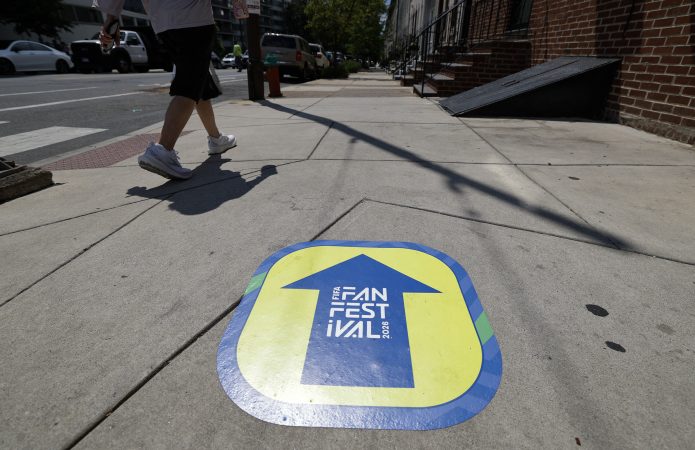
City officials have estimated that hundreds of thousands of people have flocked to the monthlong World Cup watch party, which started in mid-June and is set to run through mid-July. But last week some Brewerytown business owners said they had yet to reap the benefits.
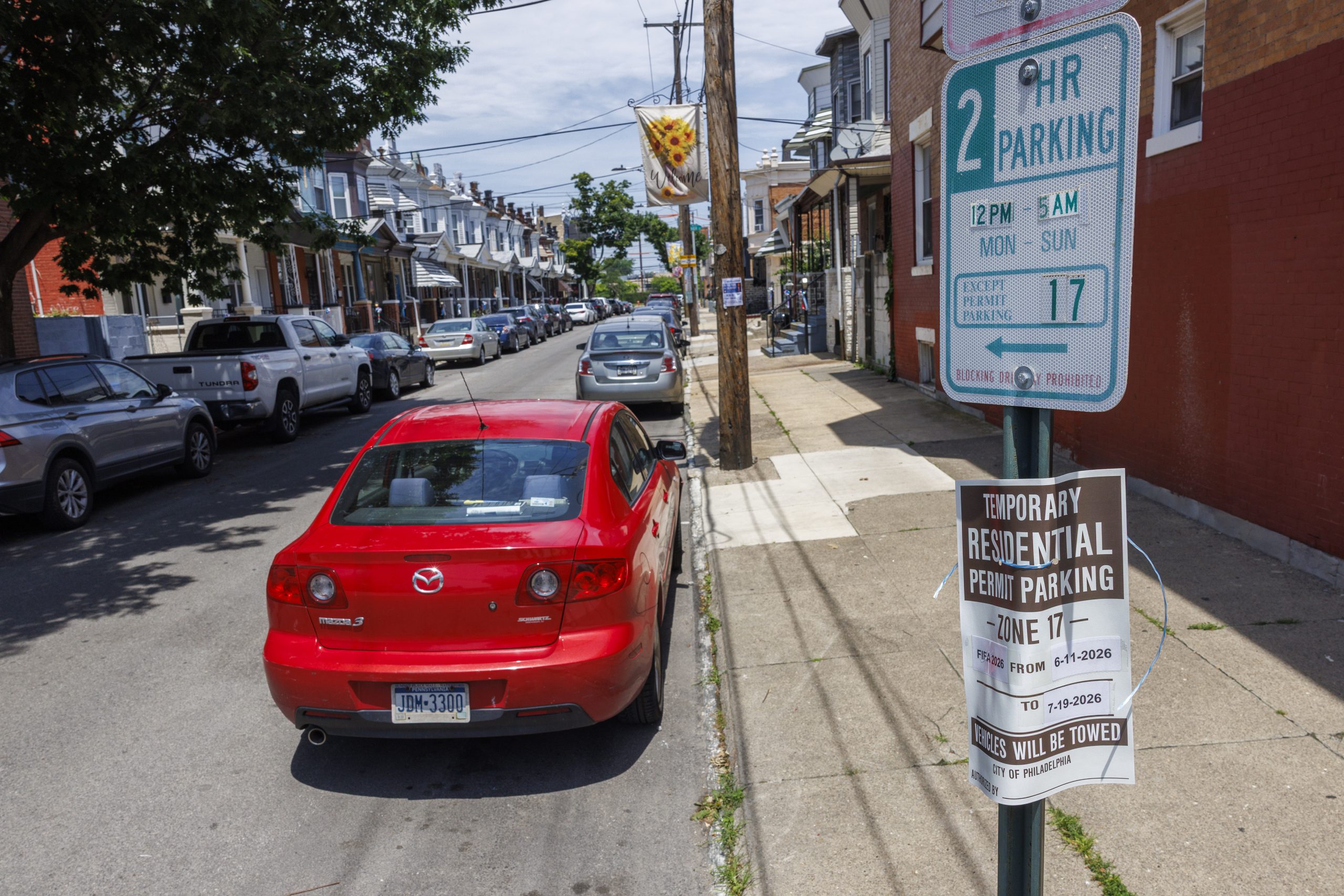
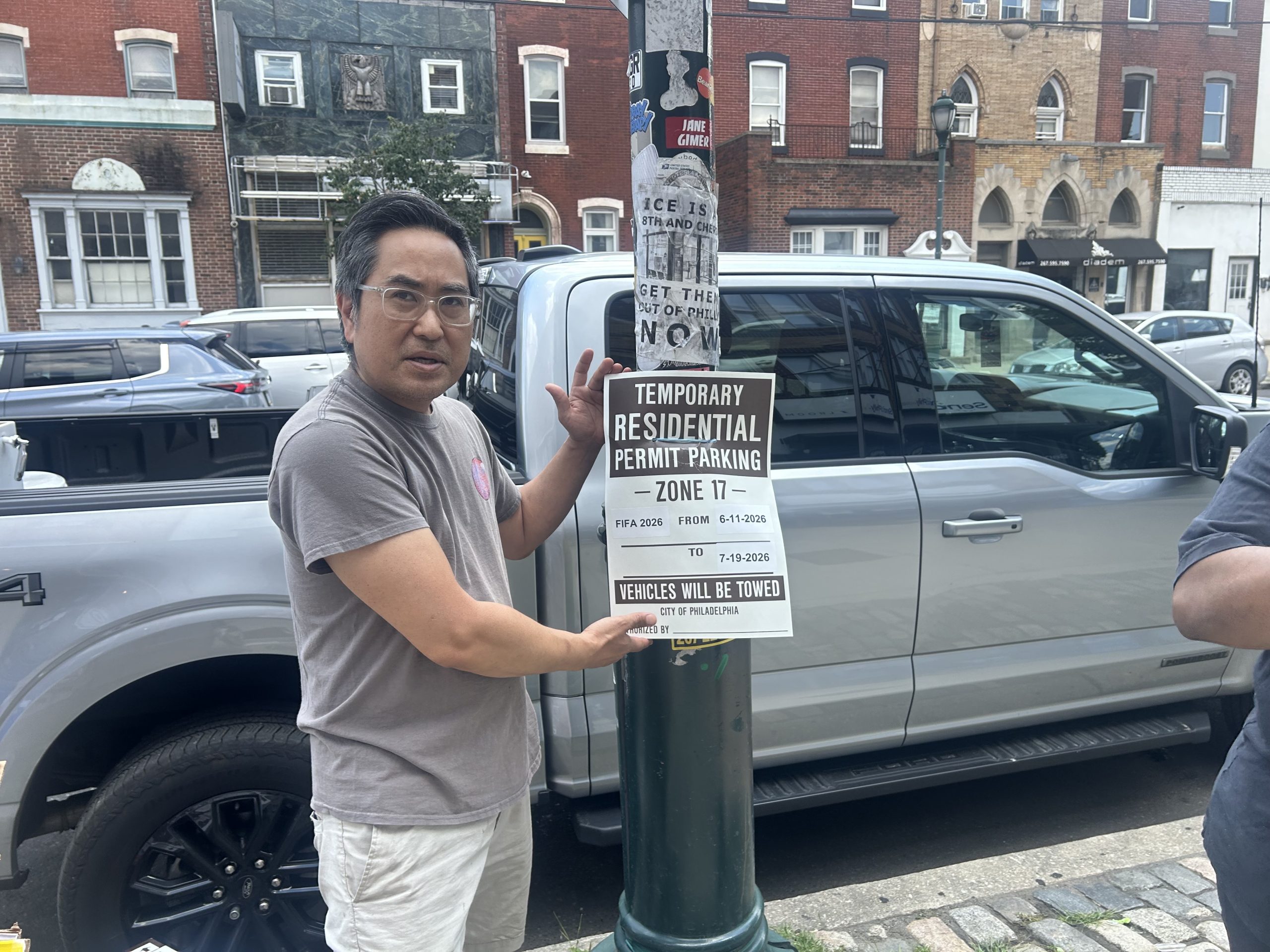
In nearby Fairmount, some bar managers said they had seen a soccer-fueled boost in business. But several other neighborhood shop owners said they were only breaking even, with the slight increase in tourist traffic offset by a sharp drop in regular customers. Parking restrictions and street closures have kept many locals away, business owners said.
Temporary parking restrictions near the FIFA Fan Festival are keeping some customers away, said local business owners.Alejandro A. Alvarez / Staff Photographer
A World Cup let-down for some in Brewerytown
Many Philadelphia business owners said they had high expectations for the World Cup: Some near the Fan Festival stocked up on inventory and even hired extra staff.
“I ordered all kinds of soccer stuff to put in ice cream,” said Welch, who owns the hoagie shop and I Scream for Ice Cream. “I bought a whole [World Cup] banner.”
As of Thursday, Welch said she hadn’t seen enough soccer fans to justify putting out the merchandise or unfurling the banner, which still sat in her car.
Business is down precipitously at All Day Hoagies, which usually goes through 200 rolls a day. Since the World Cup began, the number has dropped to 125 or fewer.
Every night, a handful of people cancel their Baby’s reservations, saying they are worried about parking, Kim said. Staff has tried to dispel misinformation on social media, and lends temporary parking passes to diners, but uncertainty remains.
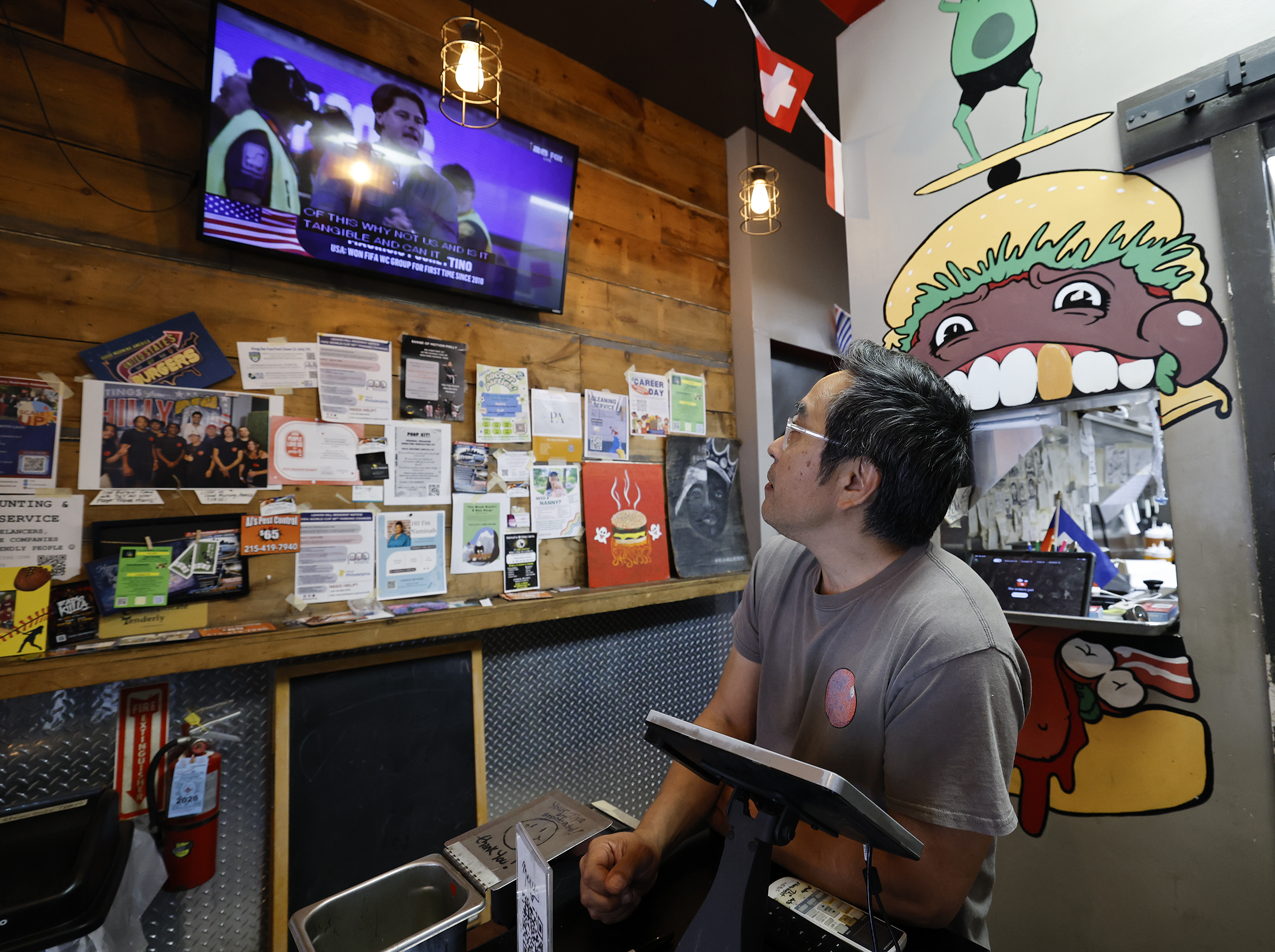
Josh Kim, owner of Spot Gourmet Burgers, watches World Cup programming from his Brewerytown burger joint. Yong Kim / Staff Photographer
Some businesses are faring better than others, even if they aren’t seeing crowds of soccer fans every day.
Josh Kim, owner of Spot Gourmet Burgers in Brewerytown, said international tourists have made special trips to his restaurant for one thing: American cuisine.
“When people go to Italy, they want pasta and pizza,” Josh Kim said. “When they come to America, they want burgers.”
June 19 was a particularly busy day for him: After the Brazil-Haiti match in South Philly, Spot’s sold 200 burgers in less than an hour, he said.
But no other recent days have been as lucrative, and Josh Kim said he worries it could take a while for regular customers to return to Girard Avenue once the World Cup games — and the restrictions — are over.
Josh Kim, owner of Spot Gourmet Burgers, points out a temporary residential parking permit sign on Girard Avenue. He said parking confusion has hurt business in the neighborhood during the FIFA Fan Festival.Erin McCarthy/Staff
“Consumers are habitual,” Josh Kim said. “If [they] break that habit, they no longer think about going to Girard Avenue. … They’ll go up Ridge.”
On Boathouse Row, across the street from the Fan Festival, Cosmic Café and Ciderhouse has seen steady business, manager Sachael Sciarretta said. About 30% of the cafe’s regulars drive there, and he said he hasn’t seen them since the festival began. But business from soccer fans has made up for the loss.
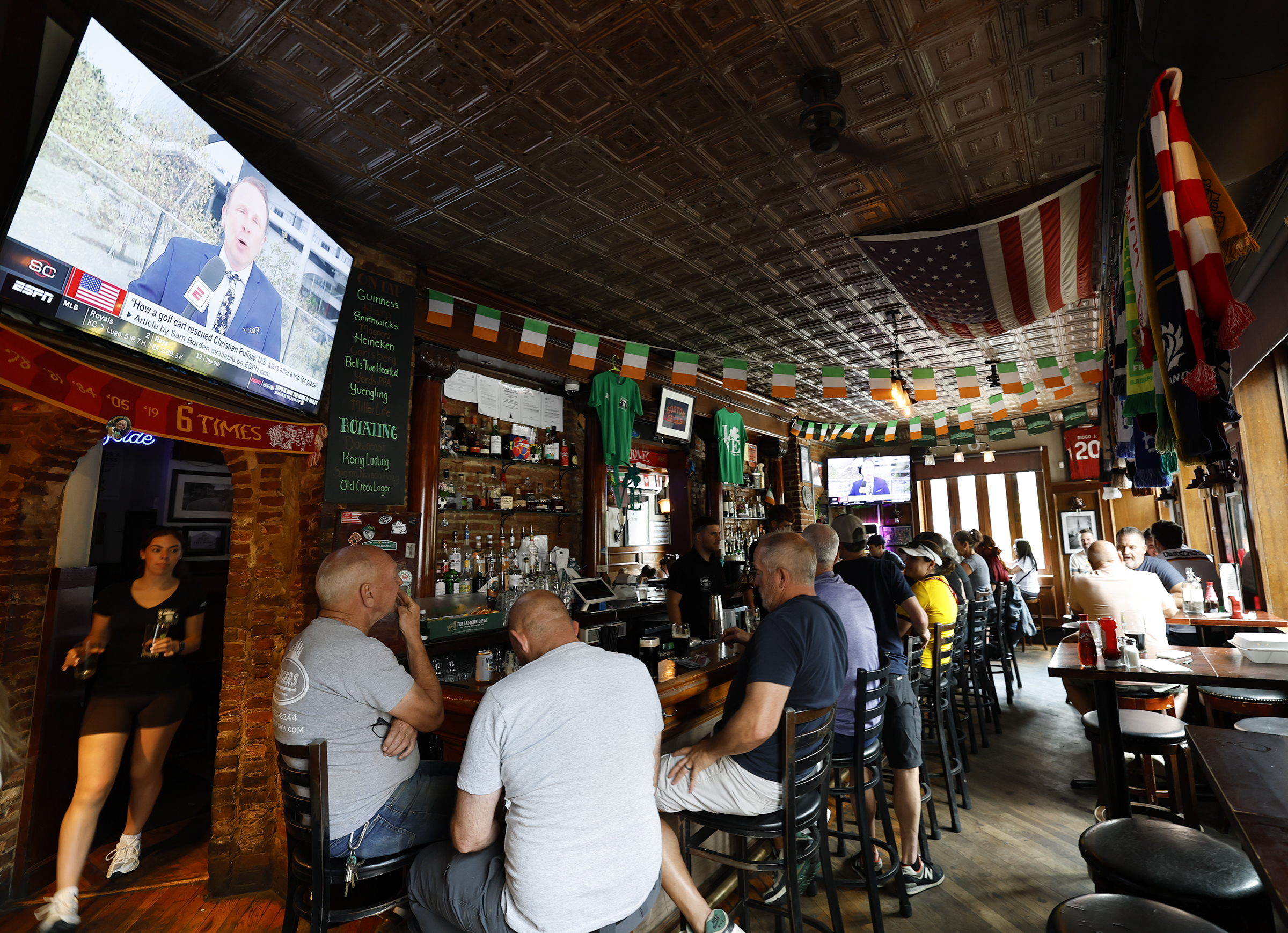
Fairmount bars and restaurants seem to have been among the biggest World Cup winners. On Thursday afternoon at the Black Taxi, an Irish pub a few blocks from the festival, almost every seat was filled — several by customers donning soccer jerseys.
Regulars and soccer fans eat and drink at the Black Taxi Irish Pub in Fairmount on Thursday, June 25.Yong Kim / Staff Photographer
“Foot traffic has been great, and the neighborhood is buzzing,” said manager Neil McKernan, who estimated that sales are up 30%.
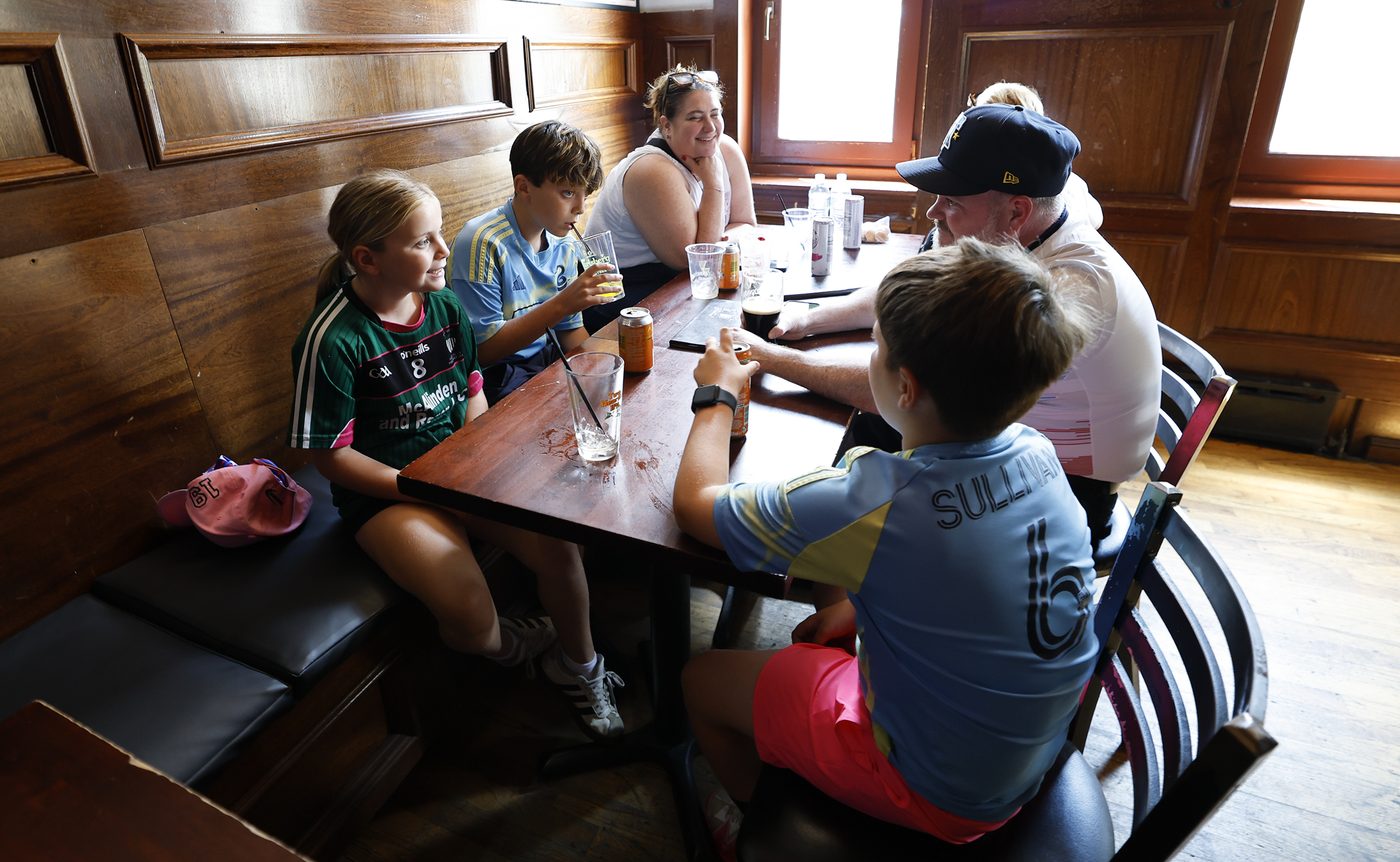
In the dining room, the Trainor family enjoyed a meal before walking to the Fan Festival to watch the 4 p.m. match between Curacao and Ivory Coast.
It was the first time that Kelly Trainor, 42, of Glenside, had been to the Fairmount watering hole, and she brought along her three young children.
“We can’t afford tickets to the game,” Trainor said. “So this is the next best thing.”
The Trainor family, of Glenside, enjoyed refreshments at the Black Taxi before attending the FIFA Fan Festival.Yong Kim / Staff Photographer
Back in Brewerytown, where the business corridor was quiet, some owners said they wished they could have been more involved in the festivities. Josh Kim, of Spot Gourmet Burgers, said perhaps organizers could have allowed local restaurateurs to sell from food trucks outside the fan entrance.
“If we were able to activate this corridor, it would have been a lot different,” Kim said.
“Why didn’t they work with the local businesses so we could make the money?” added Welch, of All Day Hoagies. “Because we ain’t making none.”
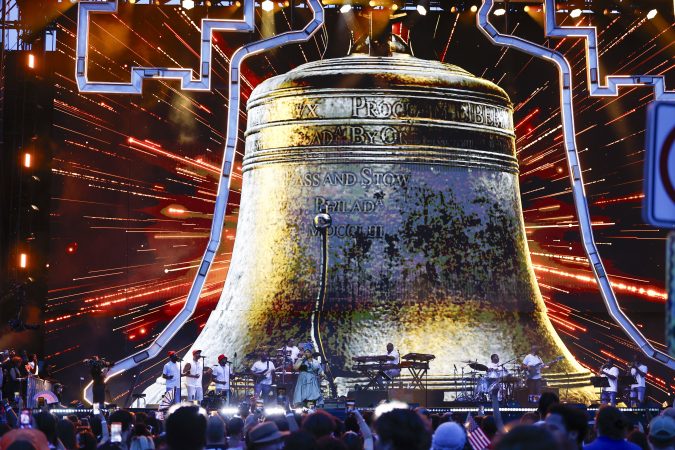
An unscheduled and dramatic light and sound show — this one produced by nature — interrupted Philadelphia’s July Fourth extravaganza Saturday night, forcing crowds to evacuate the Parkway three hours before the man-made fireworks show was scheduled to start.
People were told to leave the area and seek shelter midway through the One Philly: Unity Concert for America. But city officials were not quite ready to call it a Semiquncentennial — a year in the planning — and two hours later the city announced the event would resume with a shortened schedule and the fireworks finale. This time, the manmade kind.
Forecasters had been warning for the last two days that potent thunderstorms were possible Saturday night, as so often happens when a heat wave begins to break down.
July Fourth marked the third consecutive day that the temperature had reached 100 in Philly, tying a record set in 1963 and 2011, and the atmosphere on Saturday, congested with water vapor, was exhibiting clear evidence that it was about to pop. A severe-storm watch covered the entire region.
Earlier, declaring a measure of independence from steaminess that made the atmosphere feel like sweat itself, hundreds of thousands in the region celebrated the day 250 years ago when rebellious colonists gathering in Philadelphia announced to the world they had formed a fragile new nation.
From a ceremonial burial to a patriotic pet parade, for a day at least, anxieties over divisiveness, a national identity crisis, historical controversies, AI, or the state of the economy and the world yielded to an air of celebration robust enough to compete with the heat.
About the only serious clouds during the day were the ominous storm forecasts, but the day belonged to the sun, albeit a hot one.
It was a day to savor the fact that the nation has been able to withstand a Civil War; two World Wars; a Great Depression; and a Cold War nuclear stare down with the Soviet Union, whose life span it has exceeded by about 180 years.
And as the festivities got underway, a ceremony on Independence Mall, where the Declaration of Independence was read on July 4, 1776, suggested the United States plans to stick around for a while. That would be the burial of the national time capsule, to be opened in 2276.
“I know that we’re here for a burial,” said Mayor Cherelle L. Parker, but “this one is about hope … about believing that the generations who come after us will build a stronger nation.”
One piece of evidence that people were ready to make a patriotic day of it was the fact that by 11 a.m., the wait to visit Independence Hall was seven hours; two hours just to enter Independence Square. Maps became impromptu fans for people waiting to see the Liberty Bell. Yet the crowds were enduring it all with a remarkable equanimity on a day when people evidently were primed to savor a remarkable occasion.
The daytime events included the Celebration of Freedom event and the must-see Betsy Ross House Patriotic Pet Parade.
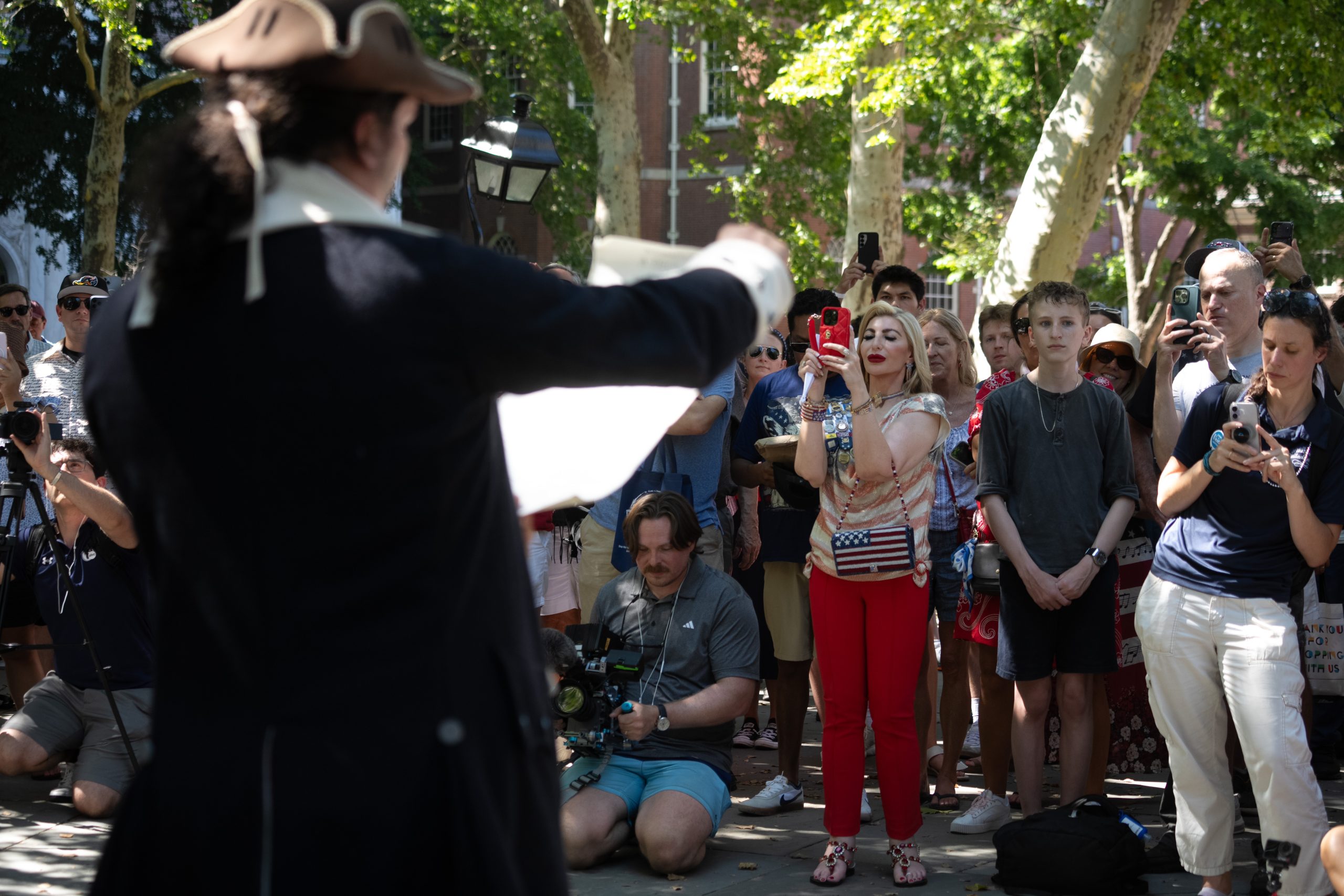
Josh Martin plays historic person Joseph Plumb, during a reading of the Declaration of Independence behind Independence Hall.Jessica Griffin / Staff Photographer
City officials were aware that the Unity Concert For America and fireworks might interrupted by a natural light show but they were determined to proceed come thunder or high water. Fireworks had been scheduled for 11:45 p.m.
They certainly weren’t factors in the time capsule event, where onlookers showed up adorned in red, white, and blue, along with Indy, a bald eagle. Tucked into the capsule were items from the three branches of government, all the territories, and all the states, including a whale bone from Maine and poems from Alabama.
“A time capsule is more than a collection of artifacts,” Parker said. “It’s a message from one generation to the next about who we were, what we valued, and what we believed was worth preserving.”
Mayor Cherelle L. Parker speaking at the Constitution Center.Jessica Griffin / Staff Photographer
What some people were on Saturday, even those enjoying themselves and not complaining, was certifiably hot.
(We will eschew saying hotter than a firecracker, but note that this publication used that phrase to describe the record July Fourth heat in 1966.)
British pop-rock vocalist Seal, who was the opening act at 5:45 p.m., did complain: “I know it’s hot, but it’s not hot enough.” Wearing a banana-yellow blazers, Seal, of Nigerian and Brazilian descent, proclaimed, “It’s only 105. I want it to be 110.”
Actually, it got only 101, and that was indeed hot enough for most folks.
Adorned in red, white, and blue, people gathered in the shade at the Independence Beer Garden across Sixth Street from Independence Mall, escaping some of the heat to sip beer with the World Cup displayed on a big screen.
Sandra Rahn, from Jacksonville, Fla., was among the escapees. She was taking a break from the sun to watch the game. Her Yorkie pup, Matilda, was cooling off alongside her, following the Patriotic Pet Show at the Betsy Ross House.
Rahn, her husband, and Matilda, arrived Wednesday to celebrate the country’s 250th, attending as many outdoor events as they could so Matilda could be part of the festivities.
“Everybody’s excited and outside; it’s been great,” Rahn said.
On Monday, they are to head home to Florida, where they hope to “cool off.”
For the record, at 3 p.m. the heat index in Philly was 103; in Jacksonville, 98.
And hidden in plain sight among those braving the serpentine line to visit Independence Hall were numerous time travelers from the Revolutionary era.
Aaron Patrick journeyed — like many Revolutionary War soldiers once had done — from Carlisle, Cumberland County, and donned a wool waistcoat and a black tricorn hat as he made his way through the line. Temperature check: about 93 degrees Fahrenheit.
“Everyone’s hot,” Patrick said. ”I’m just a little warmer than most.”
The outfits start with a linen shift for women or a linen shirt for men, said Abby Harting, a historical clothing expert. “It’s naturally cool, wicks sweat away — it’s perfect for a muggy, hot day, because the fabric does the same thing it did 250 years ago,” Harting said.
On top of the linen, the boys and men in the group wore a light wool waistcoat, while the girls and women wore a “stay,” which serves the same purpose as a bra, and another layer. Harting noted the women’s layers were designed to last for years and adapt to a person’s changing body.
She said their decision to dress up was a bit of “experiential archaeology,” and a great way to imagine what those in 1776 were experiencing — both mentally and physically — as they adopted the Declaration of Independence.
For Washington, D.C.-area couple Katelyn and Zachary Damm, their historical hobby started with the tricorn hat given to Zachary by his father-in-law. From there, they turned to Amazon to order their clothes.
The buffs prepared for their trip by reading about the era and studying the Declaration of Independence, Zachary Damm said.
“All of our freedoms date back to this day,” Katelyn Damm said. “That makes it special.”
The 18-year-old yellow Labrador retriever, sporting big blacked-out goggles and using a baby-dog stroller to move around, immediately stole the show at the Patriotic Pet Show. With his long fluffy blond hair waving in the breeze, Bruno’s confident smile told the crowd everything they needed to know: This veteran was here to bring home gold.
Not all the activities were of a festive nature. Striking Peco workers picketed outside the power company’s headquarters.
Outside the Liberty Bell, about 200 folks gathered in the yard next door at the President’s House to honor the nine people enslaved by George and Martha Washington in the 1790s. This year, attendees said the annual independence gathering, with its focus on freedom, truth, and remembrance, felt different.
“Over the last six months, since the president issued an executive order, they have tried to whitewash and bend history in a way that doesn’t tell the whole story of the country,” said Dawn Chavous, spokesperson for Avenging the Ancestors Coalition. “We are here because it’s important to not only remember, but protect and defend the history of America, which includes Black and African American history.”
Primarily, however, people went about the business of celebrating across the region.
In Doylestown, Gov. Josh Shapiro joined the Fourth of July parade, and, of course, people gathered for holiday block parties.
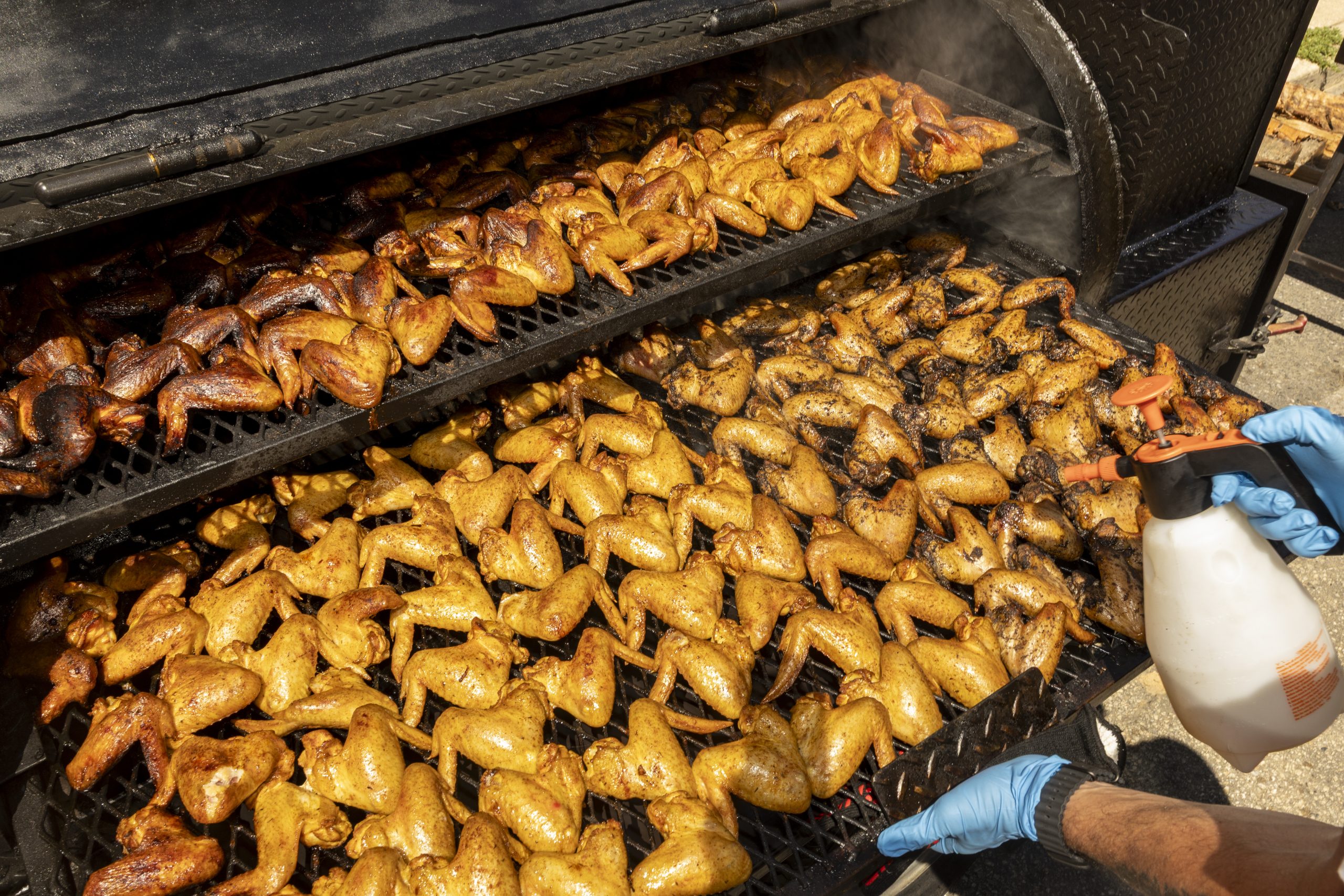
Danny Torres, who runs the barbecue business The Latin Grill, prepares Puerto Rican and Jerk seasoned chicken wings in a grill at a block party in the Ludlow section of Philly.Aidan T. Gallo / Staff Photographer
In Philly’s Ludlow section, Johanna Rodriguez and Michael Cunningham mixed fresh lemonade as they watched their daughter and son splash around in the swimming pool in the middle of their Jefferson Street block.
Rodriguez said the block takes Fourth of July seriously because it’s one of the only times everyone comes outside to enjoy the festivities and see each other in person.
“Obviously, having a block party with all the neighbors coming together is always the best,” Rodriguez said. ”Just hanging out and talking about the old days. It brings back the classic vibes.”
No one appeared to be complaining about the heat from the grill or the sun.
For the record, according to Thomas Jefferson, on the afternoon of July 4, 1776, at what is now Independence Mall the temperature was a pleasant 76 degrees.
Staff writers Maggie Prosser, Isabel Maney, and Michelle Myers contributed to this article.