Category: News

  • Some Philly special-needs students are waiting hours this summer for buses that never come

    Some Philly special-needs students are waiting hours this summer for buses that never come

    Brent Rose and his 9-year-old son, Alexander, were ready for the bus on the first day of the program Alexander is attending at De Burgos Elementary in North Philadelphia this summer for kids with special needs.

    Alexander, who is on the autism spectrum, was told to be ready for the bus to pick him up at 8:08 a.m. But when it still had not come by 9:30, Rose’s wife drove their son from their home in Center City.

    The episode was not an anomaly. Three weeks into the Philadelphia School District’s extended school year program, Rose said that on more than half of the days, his son’s bus simply has not shown up.

    “It’s a huge inconvenience,” said Rose, who works for the IRS and has had to show up late or call out due to the problems. “You couldn’t just leave any 9-year-old out there and say good luck, but certainly not one on the spectrum, and say it’s going to be OK.”

    Rose said the district has directed him to call dispatch for First Student, the company that operates his son’s bus route.

    But often no one answers that line, Rose said, making it impossible to know whether a bus will eventually show up or not.

    A spokesperson for the school district said the district is aware that “some families have experienced transportation delays and service disruptions for the Extended School Year (ESY) programming,” which schools nationally are required to offer to students with disabilities at risk of regressing over the summer.

    “While the majority of routes are operating as scheduled, we recognize that some students have experienced significant delays, and we understand the impact this has had on families,” said the spokesperson, Naima DeBrest.

    DeBrest attributed the delays to “staffing and operational issues affecting a portion of the transportation services provided by First Student.” She said the district had been working with First Student “to improve reliability,” including by reassigning 10 of the company’s routes.

    Brenna Rudisill, a spokesperson for First Student, said the company recognized that “some families experienced transportation delays early in the program, and we apologize for the inconvenience and frustration that caused.” She said First Student had taken on additional routes after other vendors left the district.

    “Our team has been working every day to stabilize and improve service,” Rudisill said.

    For Rose, though, the issues have not resolved. On Thursday, after the bus was an hour and 20 minutes late, he called dispatch and was told a bus would arrive in half an hour. Rose did not see whether it eventually came; he had to pick up his wife from the hospital, taking his son with him.

    On an earlier occasion when he was able to reach the bus dispatch, Rose used his phone to Google Translate for another parent who did not speak English and was also waiting at the stop: “The bus isn’t coming.”

    Noting that First Student advertises an app with real-time updates on bus locations, Rose questioned why parents do not have access to that information.

    That way, “you could contact work before you’re really behind,” said Rose, who also has gotten calls from De Burgos some days telling him he needs to pick up his son because no bus will be coming.

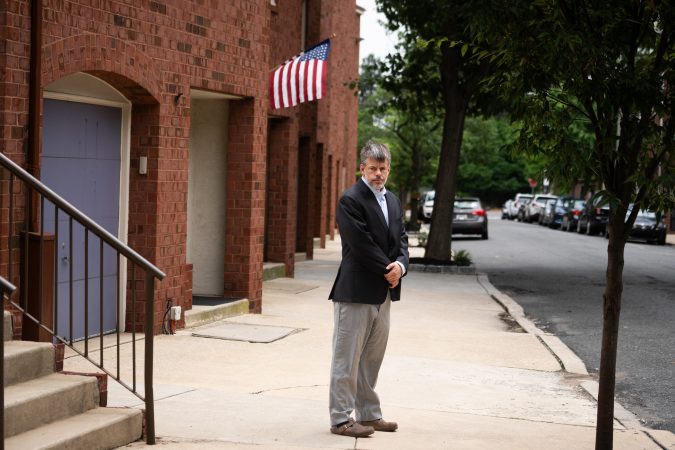
    Brent Rose stands at the bus stop where his nine-year-old son, who has autism, waits for the bus to travel to Philadelphia’s Extended School Year program for kids with special needs, in Philadelphia, July 10, 2026. The problem is that his bus often never shows up to take him there.Jessica Griffin / Staff Photographer

    DeBrest said the district is “in the early stages of implementing a new routing software system that will include a parent-facing application allowing families to track buses in real time.” In the meantime, she said, First Student has an automated text messaging service that can update parents.

    Rose said that, despite many calls to First Student and messages to the district about the buses, he was unaware of that service.

    He noted that the extended school year programming is not convenient for working parents: The day ends at 1:30, and it’s not easy to find aftercare for the rest of the afternoon.

    But he and his wife have rearranged their schedules and enrolled their son for the last three summers because they think the program is important for his progress, “and we think the teachers do a good job,” Rose said.

    When “the buses aren’t even doing what they’re supposed to do,” though, “it gets really frustrating,” Rose said.

  • Pa. lawmakers and Gov. Josh Shapiro have approved a $50.8 billion state budget, delaying action on key issues

    Pa. lawmakers and Gov. Josh Shapiro have approved a $50.8 billion state budget, delaying action on key issues

    HARRISBURG — Gov. Josh Shapiro signed a $50.8 billion state budget on Sunday following the rushed passage of the overall deal by the General Assembly that lawmakers said helps address the state’s affordability crisis but delays action on some of the most significant issues before the legislature.

    The agreement, which was due at the beginning of the month, marks an improvement from last year’s nearly five-month budget impasse in the split legislature that required school districts, counties, and social service providers to take out expensive loans or close altogether.

    “We managed, as the [vote count] indicates, to find compromise without compromising our core values,” Shapiro said during a news conference Sunday evening, before signing his fourth budget as Pennsylvania’s governor.

    The deal was hashed out over weeks in closed-door meetings among top leaders and includes new transparency requirements for data centers, publicly funded housing projects, and public transit agencies. Lawmakers also agreed to a long-sought cost-of-living adjustment totaling approximately $168 million per year for some Pennsylvania retired teachers, police officers, and firefighters — some of whom have not seen an increase to their monthly pension payments in more than 20 years.

    Gov. Josh Shapiro, flanked by fellow state Democrats, signs the 2026-27 Pennsylvania state budget in Harrisburg, Pa. on Sunday, July 12, 2026.Gillian McGoldrick / Staff

    More education funding, data center requirements

    Pennsylvania will have invested nearly $2 billion in new school funding through its adequacy and tax equity formulas since 2024. That’s when lawmakers first employed the new calculations to close a $4 billion “adequacy gap” after a landmark court ruling that found the state was illegally underfunding students in low-income districts. This year’s installment of adequacy funding topped $565 million, as part of an effort to prevent districts from having to raise property taxes on already low-income residents. The additional investment sends $136 million more this year to the School District of Philadelphia.

    Legislative leaders failed to agree in the final budget on other issues that have seen broad support in both chambers, such as repealing a sales tax exemption for data center projects, allowing local moratoriums on data center projects, or banning cell phones in K-12 schools. They may revisit the issues during the fall legislative session.

    Instead, they approved a new reporting requirement that will force data centers to submit annual reports detailing their water and energy usage. The companies will face a $10,000-a-day fine for failing to submit their reports.

    The General Assembly also voted to close a sales-tax loophole that allowed online sellers to avoid paying Philadelphia’s local 2% sales tax on items sold in the city. Mayor Cherelle L. Parker had requested that the loophole be closed as part of her own budget pitch in a move estimated to bring an additional $1.5 million to the city.

    No decision on skill games

    But the budget does not address some of the most pressing issues before the General Assembly, including whether to tax and regulate skill games or allow the more than 70,000 gambling machines in Pennsylvania bars, corner stores and fraternal organizations to become illegal come October. The state has until then to decide how to approach the machines after the state’s Supreme Court last month determined that skill games, which have for years operated in a legal gray area, are slot machines and should be regulated as such. They also punted on finding a long-term funding solution to fund mass transit until next year, when a two-year fail-safe runs out.

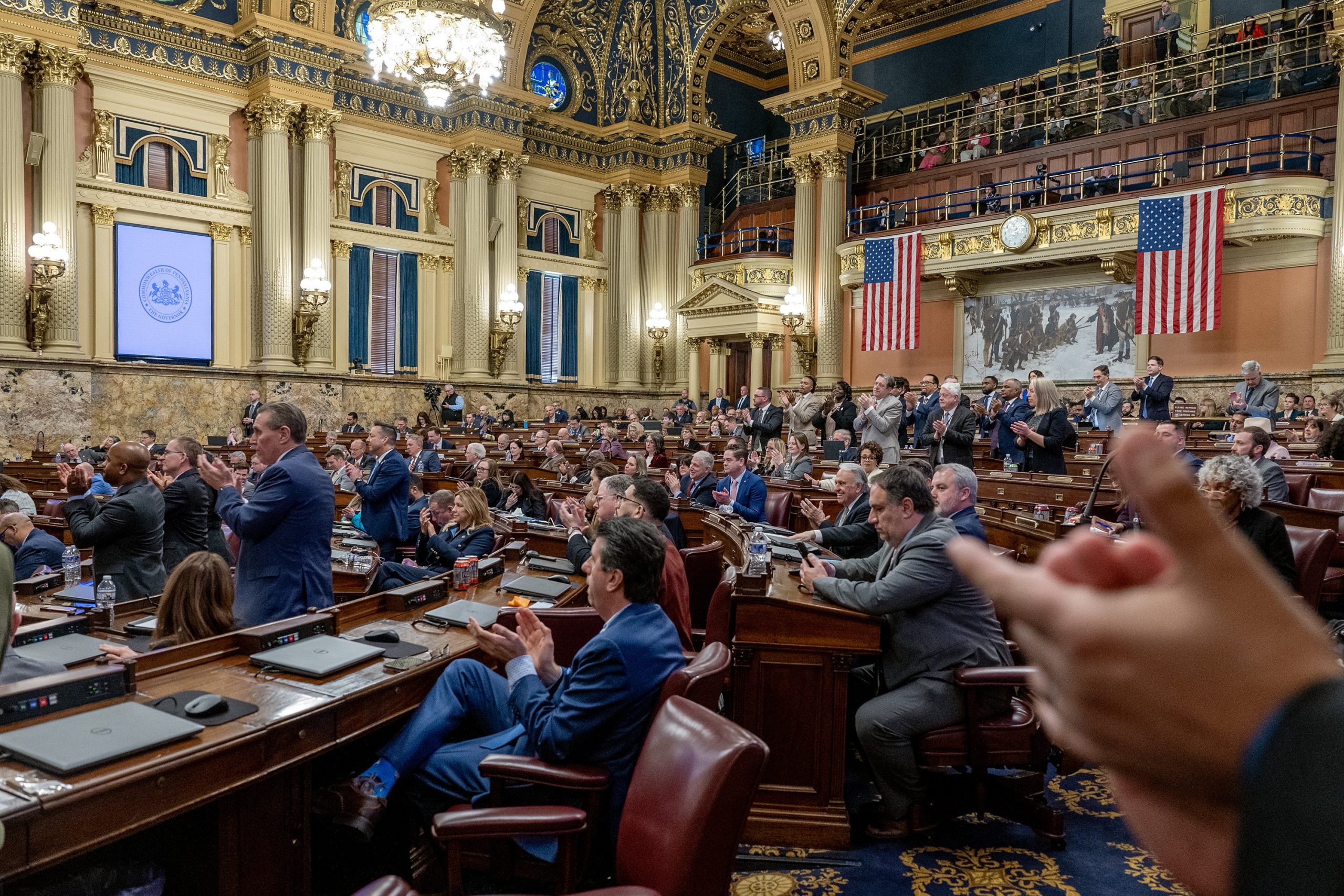
    The state House chamber as Gov. Josh Shapiro makes his annual budget proposal in Harrisburg Tuesday, Feb. 3, 2026.Tom Gralish / Staff Photographer

    Shapiro, a first-term Democrat facing reelection this year, proposed a $53.3 budget in February that for a fourth time emphasized top Democratic initiatives such as raising the state minimum wage to $15 per hour or legalizing recreational marijuana. He also proposed other initiatives, such as a $1 billion critical infrastructure fund to help the state drive out public dollars to build more housing and energy generation, which did not see funding in the final budget deal.

    State Sen. Nikil Saval (D., Philadelphia) was among the two Democrats who opposed the state budget, in part because it did not make the ambitious investments needed to address the state’s limited affordable housing stock.

    “We cannot defer at this moment,” added Saval, the chair of the Philadelphia delegation in the Senate, in his floor remarks before the vote.

    Lawmakers also declined to create any new generators of revenue for Pennsylvania, and deferred addressing the state’s multibillion dollar structural deficit until future years.

    ‘Met in the middle’

    The overall deal passed with bipartisan support in the GOP-controlled Senate, 44-6, and in the House, where Democrats hold a narrow majority, 167-35.

    “We have met in the middle,” said Senate Majority Leader Joe Pittman (R., Indiana). “I am proud of this product, despite what some naysayers may say.”

    The 2026-27 budget, which is a 1.4% increase in spending over the prior fiscal year, has no widespread tax increases. It also largely relies on accounting maneuvers like spending down unused or underused dedicated funds to address the structural deficit instead of pulling from the state’s emergency savings account.

    One of the accounting moves to balance Pennsylvania’s budget includes delaying two months of payments totaling $1.3 billion to insurance companies that fulfill the state’s ballooning Medicaid programs until the next fiscal year. Without those delayed payments, the budget would total closer to $52.1 billion.

    Several GOP House members opposed the budget, arguing it is unbalanced and only postpones tax increases to future years if spending isn’t cut.

    State Rep. Brad Roae (R., Crawford), called the final budget a “fake number.” State Rep. Charity Grimm Krupa (R., Fayette) called it “voodoo math.” And State Rep. Marc Anderson (R., York) said the state was “cooking the books.”

    But broadly, both Democratic and Republican members called the budget a reasonable compromise, acknowledging that they will have additional work to do in the fall legislative session and during next year’s budget negotiations to balance the state’s finances. During speeches on the Senate floor, several Republican senators quoted The Rolling Stones’ song “You Can’t Always Get What You Want,” emphasizing the second half of the refrain: “You might find you get what you need.”

    State Rep. Jordan Harris (D., Philadelphia) also turned to music to represent his position on the budget deal, paraphrasing Anthony Hamilton’s “Do You Feel Me” as a response to his constituents’ concerns about affordability by sending more state dollars to school districts to help them avoid property tax increases and raising monthly pension payments for retirees.

    “I am glad to stand today to support it, to let the people of Pennsylvania know, baby, the message is getting through,” Harris added.

    Pennsylvania Legislative Correspondents’ Association Intern Ethan Young contributed to this article.

  • The Southeast Asian Market in FDR Park sustained heavy damage from Saturday’s storm

    The Southeast Asian Market in FDR Park sustained heavy damage from Saturday’s storm

    Sokah McNear had just handed a customer a spiral potato from her stand at the Southeast Asian Market in South Philadelphia on Saturday afternoon when her husband pointed to the dark clouds that had suddenly gathered in the sky.

    “I said, ‘OK, this is your last potato,’” recalled McNear, the vice president of the vendors’ association at the long-running outdoor market in FDR Park. She switched off her stove, and nearly a dozen friends and family members who had been working the stall with her started to pack up.

    Within minutes, they were caught in a torrential downpour. Then came the winds, whipping through dozens of tents across the market.

    McNear and her family were struggling to keep their tent from flying away when another vendor raced by, yelling that it was no longer safe to stay outside. As branches cracked and fell from nearby trees, they abandoned the tent and ran to their car.

    “We sat in there for maybe five minutes. Then we came out and saw the devastation,” McNear recounted on Sunday.

    All of the market’s 53 tents were damaged. Tables were overturned, with ruined food and clothing scattered throughout the market. Two vendors suffered minor injuries when a tree branch fell on their tent.

    Flying debris left a cut on a customer’s nose, said Sonetha Svay, who sells cookies and bagels at the market. “Everything was just flying. We really didn’t know what to do — we just hung on,” she said.

    Eventually, she sheltered in her car with the woman and two other customers. A tree branch also fell on a tent near hers, she said, but the vendors working there had already fled.

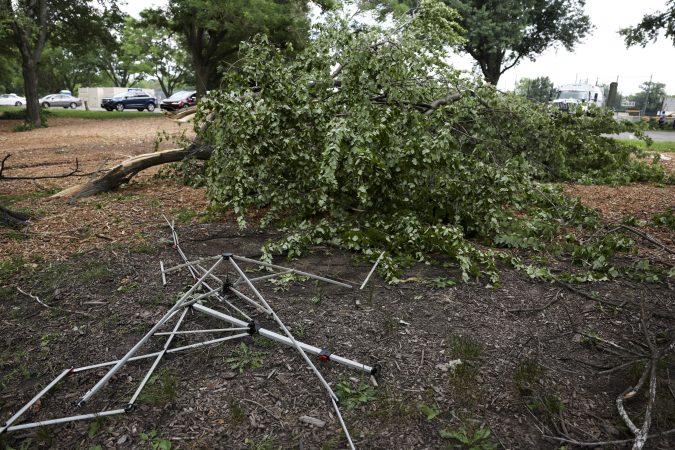
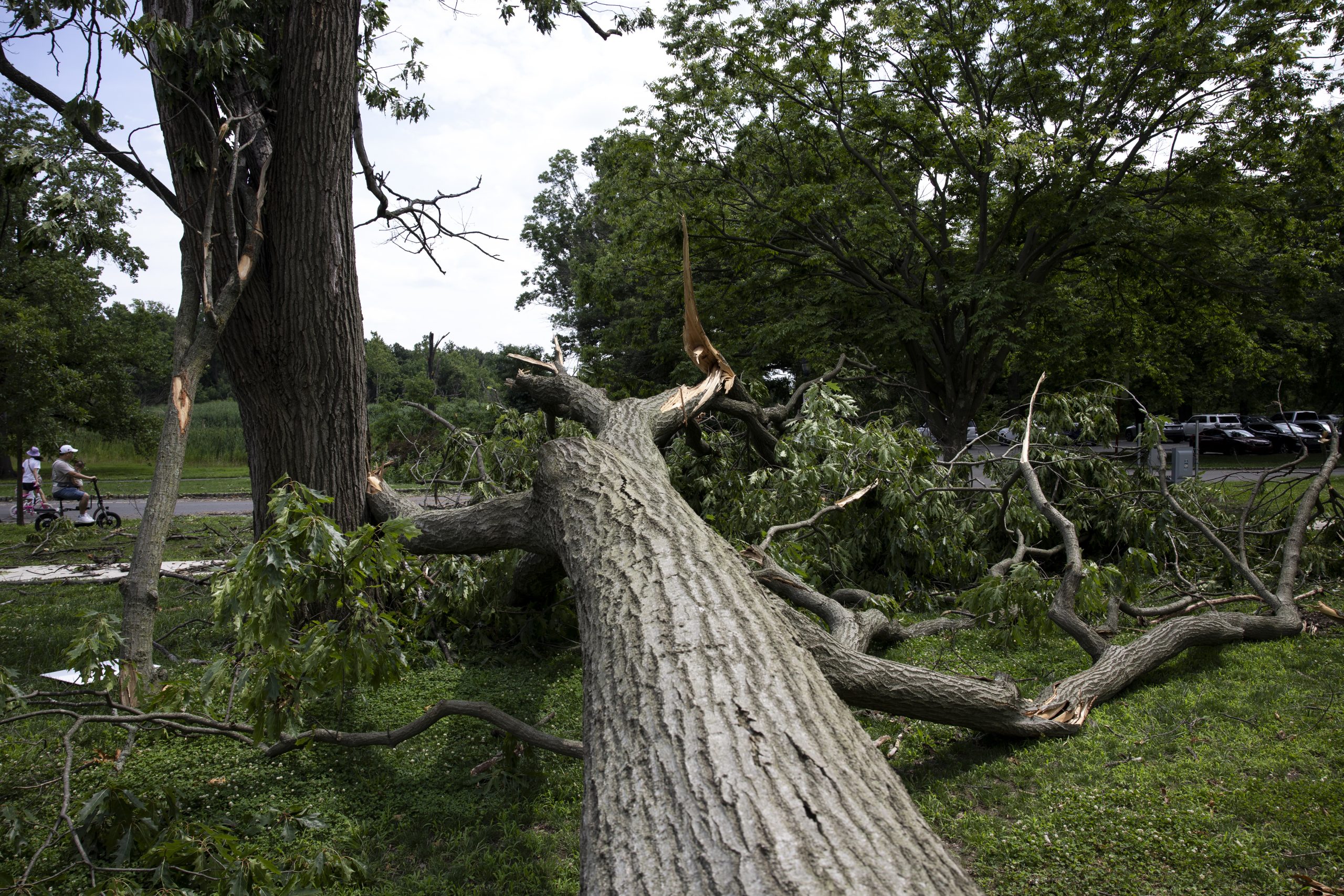
    A large downed tree near the Anna C. Verna Playground at FDR Park in South Philly on Sunday, July 12, 2026. The Southeast Asian Market, which was also damaged, is near the playground. On Saturday severe thunderstorms caused damage across the region.Monica Herndon / Staff Photographer

    Afterward, Svay, McNear, and other vendors picked through what was left of the market in shock.

    Melissa Mgar, the vendors’ association secretary, had raced home with her three young children after a falling tree branch narrowly missed their car. She returned to find all three of her family’s tents destroyed. “One was crumpled into a ball,” she said.

    Food inside coolers had survived, but nearly everything else — including supplies for barbecue and papaya salad — was lost.

    Mgar, who has been selling at the market for more than 20 years, estimated her losses at around $1,500. She said she believed inventory at her neighbor’s clothing tent next door was “completely damaged.” Svay also lost her tent and food and estimated damages around $1,000.

    Between ruined food and other merchandise and broken tents and equipment, most stalls likely sustained damage between $500 and $1,000, McNear said.

    Vendors have already been struggling this season with market closures related to high-profile events like the World Cup at the sports stadium complex across the street from FDR Park, McNear said. Food and other supplies are more expensive now, too.

    When she first saw the damage, McNear said, she panicked, worrying that vendors or customers had been injured. Once she made sure no one was seriously hurt, she said, her mind turned to the impact on the market. “These are people’s livelihoods,” she said.

    By Sunday, the market was still closed for safety reasons. “You don’t want any more of these branches to fall,” McNear said.

    Most vendors had managed to clean up what was left of their tents. Market organizers were encouraging donations from the public to help vendors rebuild. A “Dolla Holla” sale set for next weekend was postponed.

    Trees had fallen all over the park, and the Friends of FDR Park marshaled volunteers to help clear debris. Park director John Murawski said he was too busy overseeing cleaning operations to comment. On the park’s Instagram account, staff noted that the storm had also caused flooding throughout the park.

    McNear said that the market’s vendors are resilient and determined to bounce back from an unexpected setback.

    “If you see any of the videos [from the market cleanup], everyone is still smiling. Everyone has such a positive attitude. Even with the devastation, we’re helping each other as a community,” she said.

    Added Mgar: “After the storm, it’s going to be sunshine.”

  • McConnell says a fall led to his hospitalization, breaking weeks of silence about health condition

    McConnell says a fall led to his hospitalization, breaking weeks of silence about health condition

    WASHINGTON — Sen. Mitch McConnell on Sunday revealed for the first time that a fall led to his hospitalization, breaking the silence about his condition after weeks of mounting speculation about the Kentucky Republican’s health.

    McConnell, 84, said in a statement that he has undergone a battery of tests as doctors try to determine what led to his fall. He explained the long silence about his condition by saying that “folks of my generation often hesitate to share the vulnerability that comes with growing older.”

    “Even in the public eye, I feel that same instinct — I can’t help it,” he said.

    McConnell said he is now in a rehabilitation center and will not be returning to the Senate “quite yet.” He said he continues to work with his staff on Senate business in the meantime.

    The statement included a smiling picture of the senator with his wife, Elaine Chao, a tacit response to speculation online that McConnell had died or was incapacitated.

    It comes following his hospitalization on June 14. McConnell’s office for weeks provided little information, insisting only that he was “receiving excellent care” and recovering. As his hospital stay grew longer, speculation mounted about his condition. It grew so intense that Kentucky’s Democratic Gov. Andy Beshear took the extraordinary step of asking that McConnell update the public about his health in a “transparent manner.”

  • What videos show about ICE’s pursuit of immigrant’s van before Houston shooting

    What videos show about ICE’s pursuit of immigrant’s van before Houston shooting

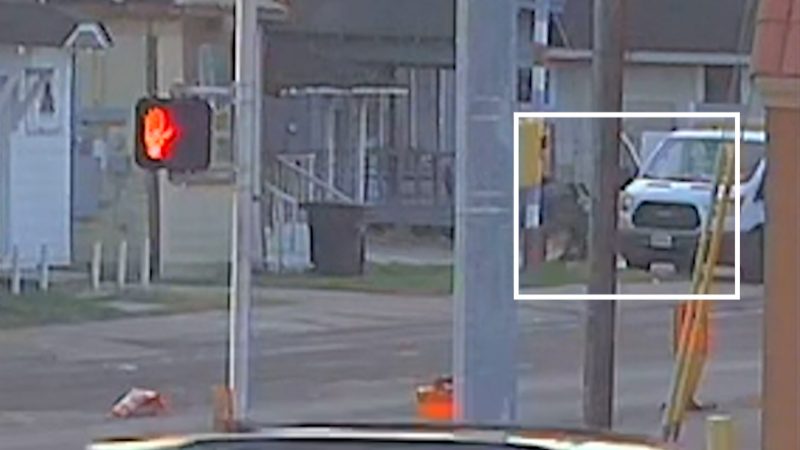
    Videos that capture the minutes leading up to and immediately after an Immigration and Customs Enforcement agent fatally shot an undocumented Mexican immigrant in Houston early Tuesday morning show agents aggressively following a white work van and then approaching the vehicle on foot.

    Security camera footage from nearby businesses and residences, obtained and analyzed by the Washington Post, provides a nearly continuous, six-minute-long view of Lorenzo Salgado Araujo’s van as he is pursued by federal agents. But the agents were not wearing body cameras, and the videos do not clearly capture the moment an ICE agent fires his gun shortly before 7 a.m. local time — a finding that may complicate any investigation into whether ICE personnel were justified in using deadly force against Salgado Araujo.

    The Department of Homeland Security released a statement hours after the deadly shooting saying that Salgado Araujo, 52, had rammed an ICE vehicle and “weaponized” his white work van “in an attempt to run over” a federal immigration officer. DHS did not identify the officer or say how many times he fired but said he did so in “self-defense.”

    The videos show federal officers in two unmarked SUVs following him closely, at one point cutting off his van and driving on the wrong side of the street toward it. The videos do not appear to show Salgado Araujo ramming a vehicle, but at times, the van and the SUVs are partially obscured from camera view by buildings and trees.

    A DHS spokesperson said the department’s Office of the Inspector General is investigating the agent-involved shooting, and the FBI is investigating “the potential assault on a federal law enforcement officer.” The agency did not comment on the Post’s attempt to confirm the timeline of events.

    Harris County District Attorney Sean Teare said the county was collecting surveillance footage and witness testimony to determine what happened.

    The videos could provide key evidence to corroborate what transpired. The officers involved in the incident had not been issued body cameras and were not wearing them, according to a DHS spokesperson. Surveillance footage and witness recordings have become key in several shootings over the past year involving federal immigration officers, and in some instances have directly contradicted statements by DHS.

    Unlike the shootings of Renée Good and Alex Pretti, two U.S. citizens killed by immigration officers in January, no video recorded by witnesses has emerged so far of Salgado Araujo’s killing.

    In a statement Friday, the agency said the officers who followed Salgado Araujo‘s van had seen two similar vehicles weeks earlier on the property of a person suspected of being in the United States illegally. DHS said officers were on their way to that person’s residence when they saw Salgado Araujo’s van. Rep. Sylvia Garcia (D., Texas), who represents the district where the shooting took place, said in a TV interview Thursday that an ICE official told her that Salgado Araujo was not the person sought by agents.

    Around 5:50 a.m., surveillance video from outside Salgado Araujo’s home shows him getting into his white van and beginning the drive to work. At some point, he picks up the other three men.

    An hour later, the van is captured by a camera as it heads south on Highway 90, driving about 50 mph, according to the Post’s calculations. Two black, unmarked SUVs appear to be in pursuit.

    His white van makes an abrupt turn onto another street, followed by one of the two SUVs.

    The SUV sticks close to the van, pulling up alongside it. Seconds later, the SUV cuts off the van, and Salgado Araujo veers to the left.

    Meanwhile, a second unmarked SUV enters Canal Street and drives onto the wrong side of the road toward the van, which backs up as the SUV approaches. It is not clear in the video whether the van makes contact with either SUV at this point.

    The van then drives forward, going back the way it came.

    As the van drives slowly away from the SUVs, at least three officers are seen pursuing on foot. It is not clear how close the van came to the officers as it turned, but the Post’s analysis indicates at least one officer was close to the passenger side of the van.

    The van rolls less than 200 feet before pulling off to the side. Within seconds, several officers converge on the van. Officers pull out at least one person from the passenger side and put handcuffs on them.

    Aftermath video of the scene shows Salgado Araujo on the ground by the driver’s side. Two officers are next to him, one kneeling. They appear to be checking on Salgado Araujo, who is visibly distressed.

    According to his family, he had been shot in the abdomen. He later died of his injuries.

    The three men who were in the van with Salgado Araujo said a federal officer fired at them almost immediately after exiting his vehicle and that at no point did Salgado Araujo veer in his direction. All three men were arrested and are in immigration detention.

    DHS characterized Salgado Araujo as an “illegal alien” from Mexico, but his son told the Post that his father was doing what he could to legalize his status in the U.S.

    Salgado Araujo’s death marks the first fatal shooting involving ICE agents since Good and Pretti were killed in separate incidents in Minneapolis in January during an enforcement surge in that city.

  • Before Reflecting Pool, algae contractor had troubled project on a trash-infested river

    Before Reflecting Pool, algae contractor had troubled project on a trash-infested river

    A year before Greenwater Services got a $1.7 million contract to clean the algae-infected Reflecting Pool, it had received another no-bid government contract to deploy at the trash-plagued Tijuana River.

    Greenwater, which is owned by a Trump donor, was hired to treat sewage in the Tijuana River with its “nanobubble technology,” a system that injects ozone into water. But the monthlong water purification pilot to evaluate the technology was cut short last October when a storm flooded the river’s banks. The remnants of machinery were washed into the border river, with diesel leaking along the way, frustrating scientists and environmentalists at federal agencies who had questioned internally whether the company’s project would work in a flood-prone area.

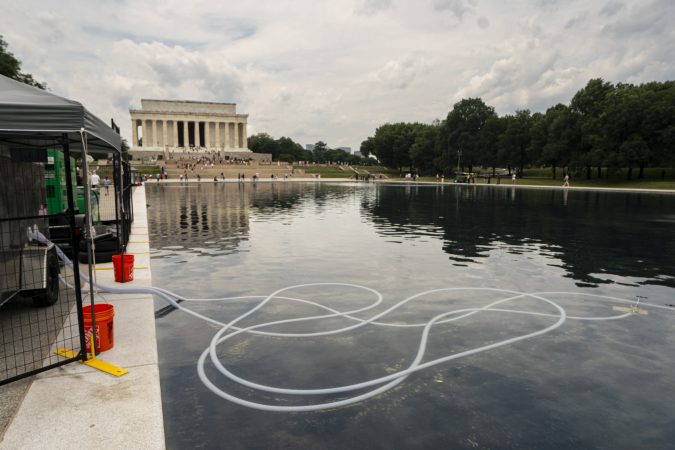
    Eight months later, the company brought its equipment to clean up a mess at the Reflecting Pool in Washington. In April, as part of his effort to remake the nation’s capital city ahead of America’s 250th birthday, President Donald Trump drained the pool at the base of the Lincoln Memorial to add a new coating to the bottom that would make the water shine “American flag blue.” But a week after the $14 million renovation was finished in June, an outbreak of algae floated along the water’s surface, hiding the new blue coating under a thick, mossy shade of green. Algae had long been a problem for the pool, but a Washington Post analysis of satellite data found that the post-renovation bloom was the worst outbreak dating back at least five years.

    The Department of Interior gave Greenwater and its nanobubble technology an expedited, no-bid contract to clean up the muck, even though other companies had expressed interest in the work to the National Park Service. Administration officials cited an urgent need to solve the problem before the 250th celebrations, and said they didn’t have time to allow companies to compete for the bid, according to a federal contracting document.

    Greenwater, founded in 2019 in Ohio, is owned by J.J. Cafaro Investment, according to the contracting documents it filed with the government. J.J. Cafaro is an heir to an Ohio-based mall development company and a Republican donor who has given about $350,000 to Trump-related political committees and owns a $16 million mansion down the road from Mar-a-Lago. He said he considers the president “a friend,” and Trump once described Cafaro as “a man who made a lot of money in Cleveland, does a good job and a fantastic man.” Cafaro has denied his relationship with Trump played a role in securing Greenwater’s contract for the Reflecting Pool.

    Chas Antinone Jr., Greenwater’s president and chief operating officer, has said the company has been expanding on the use of its technology, mostly in small bodies of water under 100 acres — such as a free demo to Trump’s Bedminster resort in 2024, Antinone told the San Diego Union-Tribune. The manager of Trump National Golf Club Bedminster brought Greenwater into conversations with the Interior Department about cleaning the Reflecting Pool, the New York Times reported.

    In total, the federal government has paid Greenwater $2.8 million between the Tijuana River and Reflecting Pool contracts.

    Company spokesperson Erin Kramer said Cafaro is not involved in the company’s day-to-day operations, and she shared research showing the technology has cleaned algae in studies. (Cafaro did not respond to requests for comment.)

    “Private demonstrations, self-funded projects, research partnerships, and public-agency work are ways new environmental technology moves from research to adoption,” Kramer said in response to questions about the Bedminster demo.

    Asked about the Bedminster connections, the Interior Department press office emailed a statement saying the White House was not involved in the selection process for any contract.

    Since the Times reported last month on his company’s no-bid contract, Cafaro has become a sort of bogeyman for liberals online. On Monday, the Democratic National Committee’s rapid response X account shared a photo of Cafaro along with news that the Interior Department planned to use the same contractor that installed the liner to repair the pool, even though Cafaro doesn’t own or operate that company.

    That photo featured Cafaro posing with former Real Housewives of Orange County star Kelly Dodd. But Dodd later posted a video clarifying that she merely posed with him because “he looked a little peculiar, and I liked his whole [get up]” but she only met him once at an event in Palm Beach, where she also saw Trump.

    “This has gone viral. I don’t know why I got lumped in with this guy,” she said. “I can safely tell you I don’t know this man.”

    ‘Hope it doesn’t rain’

    Flowing along the U.S.-Mexico border and discharging into the Pacific Ocean, the Tijuana River has been plagued by untreated wastewater, sewage, and debris dating back decades.

    The U.S. International Boundary and Water Commission gave a no-bid contract for Greenwater last year, initially offering more than $2 million for a pilot that would encompass 120 days of work. Officials said there was an “urgent need to assess the effectiveness of this technology in addressing the public health threat” and that “the technology is proprietary and not in use by any other company.”

    Until permanent infrastructure to address the pollution problems is in place, officials must “think creatively and evaluate every credible tool that can bring relief to affected Americans now,” Frank Fisher, an IBWC spokesperson, said in a statement to the Post.

    After Greenwater secured the project but before work got underway, career scientists exchanged emails asking about the initial $2 million cost and the feasibility of the project. Environmental Protection Agency staff who were consulting IBWC questioned their plans.

    “Wow. $2.4m for 90 days?” Thomas Konner, an environmental engineer for the EPA, wrote to IBWC and EPA officials on July 1.

    “Hope it doesn’t rain on their parade!” he followed up on Aug. 25.

    Months before, another scientist questioned the approach and called it a “Sisyphean task” — and forecast the storm. “I really don’t think the ozone will do any good unless you are able to ozonate the entire flow, but that’s based on my gut feeling and nothing else,” Douglas Liden, then an environmental engineer with the EPA, wrote to colleagues. “I also think the first storm will wash out any equipment you install, just as it did in Nogales, AZ.”

    Phillip Musegaas, executive director of the nonprofit San Diego Coastkeeper, which obtained the emails through a Freedom of Information Act request, said local groups have long hoped for a solution to one of the nation’s worst environmental disasters, which has sickened residents, closed beaches, and contaminated the air and water. Greenwater was supposed to take the nanobubble technology to the noxious hot spot — Saturn Boulevard — where the pungent water foams, an IBWC official wrote in the emails planning the project. But the company’s pilot was cut short by the storm and it never went to Saturn.

    Debris from the equipment washed into a barrier set up to collect trash along the river, according to photos shared with Voice of San Diego.

    “We were skeptical about it, but we wanted to see if it would work properly,” Musegaas said. “The fact that the whole project ended early because they let the equipment get washed away was pretty frustrating.” The company later acknowledged that the nanobubble machines could not operate continuously as intended because trash floating in the river clogged the machines.

    The company also said, in a report to the government about that pilot, that its machines hadn’t been affected by a previous rainstorm. The night of the next big storm, Greenwater said, it moved the machines to “a higher elevation” because of rising water levels, but “an unexpected flooding event occurred” that “carried large quantities of trash and debris that inundated and damaged” the machines. The company then said it shut the project down because of “safety concerns and site conditions.” The IBWC said in a December news release, citing the Greenwater report, that the project was “successfully completed” and the “technology has the capability to kill bacteria and eliminate odors associated with sewage.”

    Heather Raymond, the water quality director for Ohio State University’s College of Food, Agricultural, and Environmental Sciences, has tested Greenwater Service’s technology for years. Raymond, who does not work for the company nor on the Reflecting Pool and the Tijuana River projects, said the technology showed promise in trials when her team tested it in large tanks in controlled settings where algae levels were reduced, and small lakes where they saw some improvements in the local advisories for toxin levels.

    “There’s still a lot to learn in scaling this up in the water quality conditions and amount of treatment needed to be successful,” Raymond said.

    In the case of the Reflecting Pool, workers from the National Park Service used hydrogen peroxide and vacuuming to clear the algae in addition to the temporary units. Greenwater also said it had temporary units running by June 7, but the units were taken offline on June 12. Within 24 hours, an algae bloom developed, and the units returned. The company has since installed a permanent system in the Reflecting Pool’s pipes and said the water has cleared even though green sediment remains at the bottom.

    This week, the Reflecting Pool has been fenced off following the Fourth of July fireworks display, and Interior Secretary Doug Burgum said the workers will drain the pool and repair the peeling coating.

    The nanobubble technology has been turned off ahead of the draining, a person familiar with the plan said, speaking on the condition of anonymity out of fear of retaliation. By the middle of the week, the pool appeared green and murky, its bottom invisible under the mossy shade.
  • Ukraine’s prime minister steps down as Zelensky announces government reshuffle

    Ukraine’s prime minister steps down as Zelensky announces government reshuffle

    KYIV, Ukraine — Ukrainian Prime Minister Yulia Svyrydenko stepped down on Sunday as President Volodymyr Zelensky announced fresh changes to Ukraine’s government, saying he had offered a new and important position to the former premier.

    Zelensky, who has remained in office under martial law because wartime elections are prohibited, has periodically reshuffled his government in an effort to bring fresh momentum to his administration.

    Svyrydenko, who has served as Ukraine’s economy minister, was named prime minister in July 2025 at the age of 39 after playing a lead role in securing a mineral agreement between Ukraine and the United States, seen as an important way of tying U.S. interests to Ukraine’s security.

    In a statement on social media, Svyrydenko said she was “proud to have had the honor of leading the government during one of the most difficult periods in Ukraine’s modern history.” She also said she had discussed “next steps” with Zelensky, but did not provide further details.

    “I remain ready to serve the Ukrainian state and carry out every task aimed at strengthening Ukraine’s position, defending our national interests and bringing a just peace closer,” she said.

    Zelensky announced her resignation in a post saying that Ukraine was “changing its political strategy.” He also said he had offered Svyrydenko the opportunity to lead “a new, important area” in Ukraine’s relations with a key international partner.

    “Each priority area of foreign policy will be assigned to a specific person with substantial experience who is capable of implementing what we agree on at the leaders’ level and what the Ukrainian people expect,” Zelensky said, describing the impending reshuffle.

    The Ukrainian leader also said there would be changes among the top ranks of Ukraine’s law enforcement agencies.

    Zelensky met with a series of senior officials following the announcement, including Energy Minister Denys Shmyhal, Interior Minister Ihor Klymenko, and Defense Minister Mykhailo Fedorov.

    The overhaul, which Zelensky has yet to explain in detail, would be the fourth major reorganization of his government since the start of Russia’s full-scale invasion.

    Ukraine continues strikes against Russian oil sites

    Elsewhere, a Ukrainian attack in southwest Russia killed one person and wounded three more, local officials said Sunday, as Kyiv’s forces continued to bombard Russia’s oil facilities.

    The head of Russia’s Samara region, Gov. Vyacheslav Fedorishchev, said that a child was among the injured. He also said that residential homes and apartment buildings were damaged in the strike, as well as an unspecified “industrial site.”

    Russian media outlets reported that the attack’s target was the region’s Syzran Oil Refinery, with many sharing images that appeared to show plumes of black smoke rising over the site. The refinery, which is owned by oil and gas giant Rosneft and sits some 500 miles east of the border, has been a repeated target for Kyiv’s forces.

    Meanwhile the governor of Russia’s Rostov region, Yuri Slyusar, said that a tanker had been damaged in a drone attack in the Azov-Black Sea maritime canal. The tanker was empty and there is no threat of an oil spill, Slyusar said.

    Ukraine’s drone strikes on oil refineries and other infrastructure across Russia have triggered a widespread fuel crisis with gasoline shortages and rationing in multiple regions and motorists waiting for hours to fill their tanks. Moscow has responded by intensifying its bombardment on Kyiv and other cities, exposing Ukraine’s vulnerability to ballistic missile strikes.

    Zelensky has described the strikes on Russia’s energy infrastructure as part of Kyiv’s campaign of “long-range sanctions” carried out in response to Moscow’s refusal to halt its four-year invasion of its neighbor.

    Meanwhile, Russia’s Ministry of Defense said Sunday that it had attacked the ports of Odesa and Chornomorsk in Ukraine’s Odesa region. Ukrainian officials have not yet commented on the claims.

  • Iran reports new attacks on military targets on its largest island near the Strait of Hormuz

    Iran reports new attacks on military targets on its largest island near the Strait of Hormuz

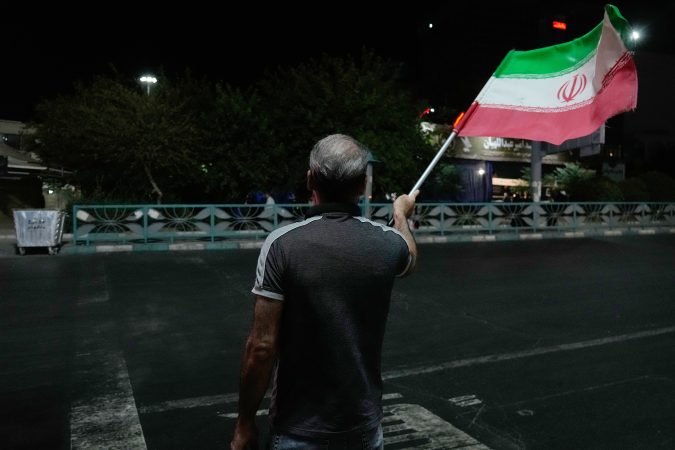
    DUBAI, United Arab Emirates — The United States attacked Iran on Sunday over an Iranian strike on a container ship in the Strait of Hormuz that set it ablaze and left a crew member missing. Iran responded with attacks on countries including Bahrain, Kuwait, Qatar, Jordan, and Oman — the nation on the other side of the strait that Tehran has pressed to join in managing shipping traffic.

    The U.S. struck again later Sunday. Iran’s state-run IRNA news agency cited the governor of Qeshm island near the strait as saying projectiles had been fired at military targets, with no casualties. IRNA said explosions were also heard in the coastal city of Bandar Abbas and Hajiabad city to the north.

    A U.S. official, speaking on condition of anonymity because they were not authorized to publicly discuss military operations, said a few strikes were conducted on missile and air defense systems, as well as small boats of the paramilitary Revolutionary Guard at a couple of locations around the strait to further degrade Iran’s ability to attack commercial shipping.

    Iran and the U.S. are nearly at the midway point of the 60-day period of their interim deal aimed at reaching a permanent end to the war. The strait, a key route for the global supply of oil and natural gas and long considered an international waterway, has become a sticking point in negotiations that seem in danger of collapse.

    The United Nations secretary-general, António Guterres, was “deeply concerned by the serious escalation,” according to a statement.

    Iran says the strait is closed and the U.S. disagrees

    The U.S. military’s Central Command said earlier Sunday that it hit some 140 targets, including missile and drone launch sites, ammunition dumps, communication equipment, and other sites. It said the attacks, heavier than in recent days, would weaken Iran’s ability to threaten shipping.

    “We bombed the hell out of them last night,” President Donald Trump told NBC’s Meet the Press.

    Semiofficial Iranian news agencies reported that a navy officer was killed. Iran retaliated by attacking nations in the region hosting U.S. military forces, while insisting it alone must control the strait and potentially charge vessels for traveling through it.

    “The era of one-sided deals is OVER,” Mohammad Bagher Qalibaf, the speaker of Iran’s parliament and a main negotiator, wrote. “We told you: keep your word or pay the price. Reality is knocking.”

    The U.S. has launched three rounds of airstrikes targeting Iran in the last week over Iranian attacks on ships heading through the strait using a route off Oman, seeking to avoid the Islamic Republic’s territorial waters.

    The U.S. military and Trump asserted that the strait remained open Sunday. Iran said it was closed until calm is restored, and Tehran would consider targeting “additional enemy bases in the region” if it faced more attacks.

    The U.S. military said over 140 ships had transited the strait over the past week. A multinational body overseen by the U.S. Navy said traffic continued “at reduced levels” off both Oman and Iran. It said nearly 140 vessels transited daily before the war.

    About a fifth of all traded oil and natural gas passed through the strait before the war began. Iran’s grip on it led to a global energy crisis, though oil prices have sharply dropped since wartime highs of $120 a barrel.

    Oman summons Iranian envoy to protest attack

    Missile alerts sounded across several Gulf Arab countries.

    Qatar’s military said it intercepted incoming Iranian fire, with explosions heard in the neighboring United Arab Emirates. Three people, including a child, were wounded as a result of shrapnel from the interception of Iranian attacks, Qatar’s Interior Ministry said, giving no further details on their condition.

    Missile alerts sounded in Bahrain, an island kingdom in the Persian Gulf that is home to the U.S. Navy’s 5th Fleet.

    Kuwait’s Defense Ministry said three “land border posts” in the north and an offshore drilling platform of the Kuwait Oil Company were damaged, with one platform worker wounded.

    A day after Oman and Iran held talks on the strait, the Omani state news agency said drones struck sites in an area on the waterway.

    Oman summoned the Iranian ambassador to protest the strikes, the first such move since the war began, calling Iran’s acts “irresponsible.”

    Three Iranian missiles struck areas across Jordan, causing minor damage but no injuries, Jordan’s state news agency reported.

    Sirens also sounded in the UAE, but the government said missiles did not cross into its territory.

    Iranian strike on ship harms Indian crew

    A Cyprus-flagged container ship was hit by Iran and suffered “significant engine room damage,” the U.S. Central Command said.

    Oman’s maritime authority said it rescued 23 crew members but one was missing. India’s Ministry of External Affairs called him an Indian national and it was working with Oman to locate him.

    The United Kingdom Maritime Trade Operations center, overseen by the British military, said the ship had been moving along Oman’s shoreline.

    Iran’s paramilitary Revolutionary Guard said multiple vessels “disregarded our warnings” and ignored instructions to follow what it called an approved route. One “was struck by a warning shot and brought to a stop.”

    Iranian state media later reported U.S. strikes across the country, including southern Iran in the province closest to the strait and military sites in a province near Tehran.

    Attacks followed more diplomatic talks about the strait

    The strait sits in Iran and Oman’s territorial waters. Oman on Saturday said it and Iran agreed to continue discussing the strait “at the technical and political levels.”

    Trump suggested last week that the interim deal on the war was “over.” But mediators, including Pakistan, Qatar, and Egypt, have continued efforts to reach an agreement. A regional official involved in mediation, speaking on condition of anonymity to discuss talks, said efforts to shore up the ceasefire continued Sunday. Pakistan said its foreign minister spoke by phone with Iran’s top diplomat and urged “de-escalation” on both sides.

    Iran’s new supreme leader, unseen since the war began, on Saturday vowed in his first statement since the funeral of his father, Ayatollah Ali Khamenei, that Iranians would avenge his killing in the war’s opening strikes on Feb. 28.

    Such revenge “is the will of our nation and must certainly be carried out,” Supreme Leader Ayatollah Mojtaba Khamenei said in a statement carried on state television.

  • Lindsey Graham was facing reelection in November. What happens now?

    Lindsey Graham was facing reelection in November. What happens now?

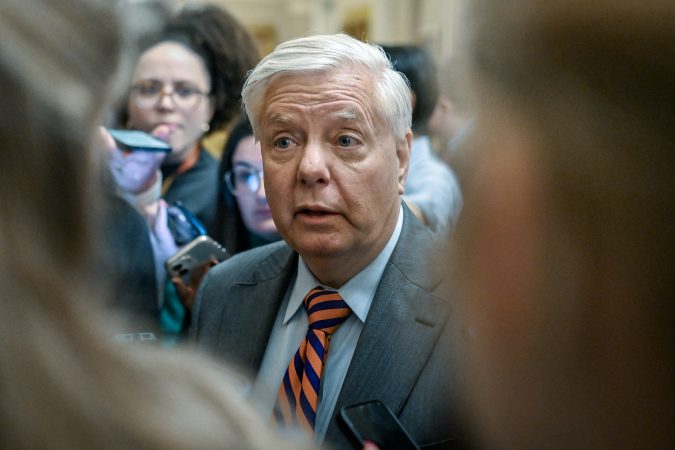
    The sudden death of Sen. Lindsey Graham (R., S.C.) comes less than four months before he was set to appear on the ballot as a strong favorite to win a fifth term.

    Now, South Carolina Republicans are facing a fast-paced scramble to replace him on the general election ballot. (Graham won the Republican primary by a wide margin this year.)

    South Carolina law sets out a timeline for replacing him on the ballot. Its provisions suggest a special primary election will take place Aug. 11, according to the schedule set out in the law.

    Candidates can file for the seat as soon as July 21, the second Tuesday after Graham’s death, and the filing period will close on July 28. State law says that the election must happen on the second Tuesday after that deadline. If no candidate secures a majority, a runoff between the top two finishers would take place two weeks later, on Aug. 25.

    Gov. Henry McMaster, a Republican, can appoint a replacement to serve out the rest of Graham’s Senate term, through Jan. 3, 2027, under state law. The replacement could choose to compete for the Republican nomination in the special primary.

    Graham, 71, died of “a brief and sudden illness” Saturday evening, his office said in a statement just after 2 a.m. ET Sunday.

    Rep. Nancy Mace is looking at a potential run for the seat, according to four people familiar with her thinking, who spoke on condition of anonymity to describe private talks. Mace ran for governor this year, finishing a distant fifth in the Republican primary.

    While Graham drew Republican primary challengers this year, he won the nomination by a wide margin, avoiding a runoff. President Donald Trump supported Graham, a onetime critic of the president who had shifted to a supportive posture in recent years.

    One of Graham’s opponents in the primary was businessperson Mark Lynch, who finished second with nearly 29% of the vote. He said on social media Sunday morning that “while we had our political disagreements, today is not a day for politics.”

    Previously, Lynch had strongly criticized Graham for his support of U.S. military intervention abroad, seeking to appeal to more isolationist members of Trump’s MAGA base.

    The third-place finisher was Thomas Keith Dismukes, a motivational speaker who campaigned on “faith, family, limited government, and the restoration of principles that make America great.” Other Republican contenders included Pat Herrmann, a county Republican Party chair and small-business owner, and Calvin Cowen, an engineer and city council member.

    The Democratic nominee for Senate is Annie Andrews, a pediatrician who has been a strong fundraiser in the race.

    “I hope that South Carolinians will join me in setting partisanship aside and offering gratitude to Senator Lindsey Graham for his service to the great state of South Carolina,” Andrews said Sunday morning, praising him as a “man of great faith who proudly served our nation as a JAG officer and Air Force colonel.”

    This article originally appeared in the New York Times.

  • Philly picks up the pieces from ferocious ‘microbursts’ that sent trees crashing into houses and cars, and cut power

    Philly picks up the pieces from ferocious ‘microbursts’ that sent trees crashing into houses and cars, and cut power

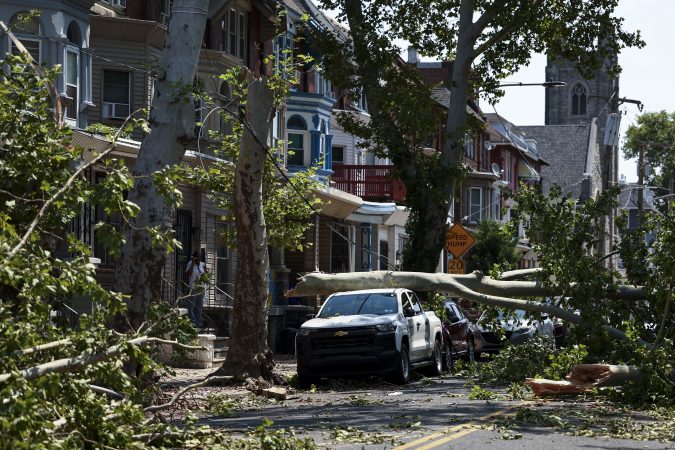
    Philadelphia Mayor Cherelle L. Parker has declared a disaster emergency one day after at least four storms known as microbursts ripped through parts of Philadelphia and Montgomery County, downing trees and power lines and causing electrical outages and road closures.

    A disaster emergency declaration allows the city to more quickly mobilize resources, bypass certain regulations, and potentially obtain state or federal assistance.

    Parker applauded the work of first responders and city crews, who she said had been working since Saturday afternoon to deal with a storm that tore off roofs and partially collapsed buildings in the city.

    “I’m here to say we’re not going anywhere, that we’re going to stay at it,” Parker said at a news conference Sunday afternoon.

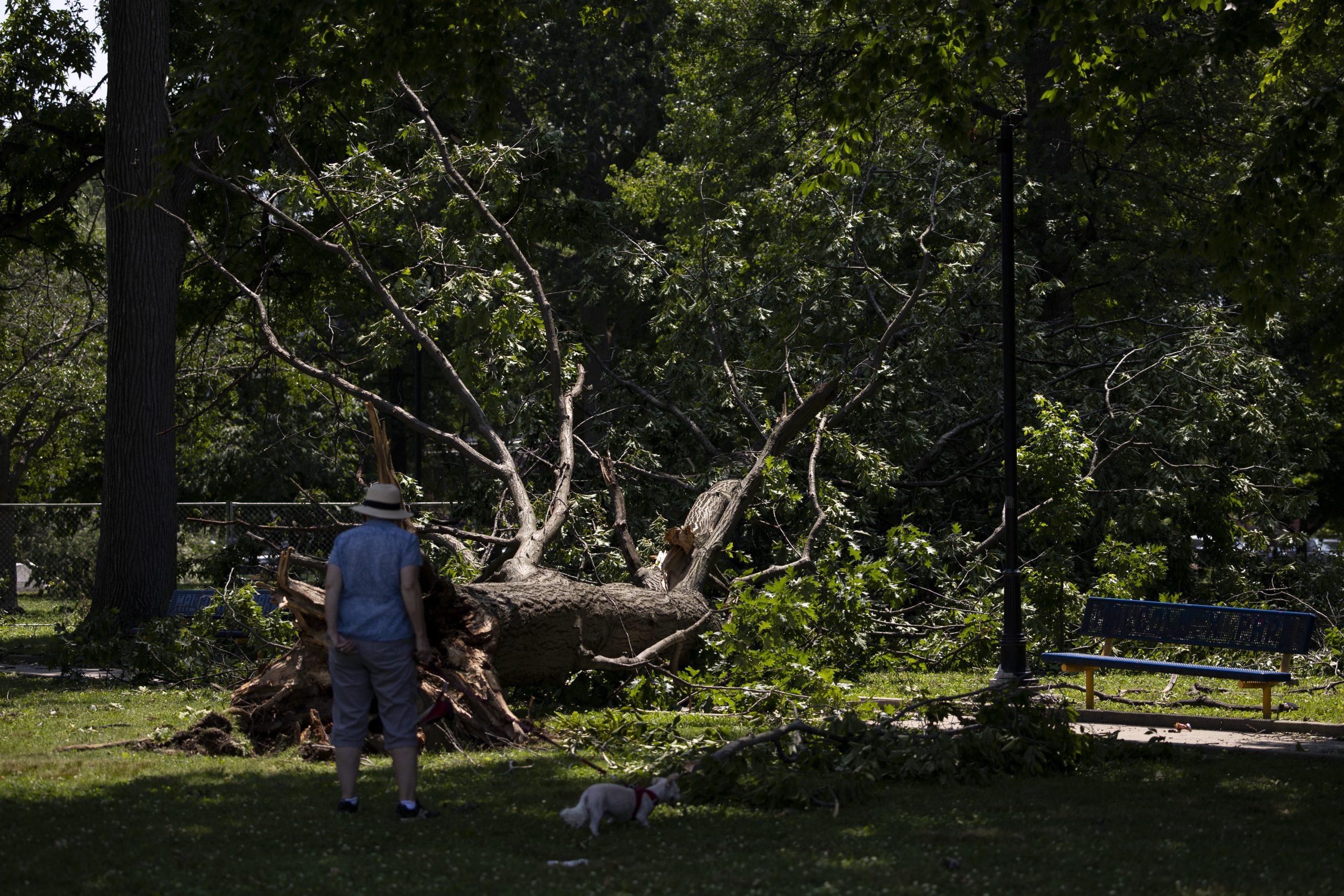
    Parker and more than a dozen city officials and staff toured the cleanup effort at Malcolm X Park, where they had to carefully walk around a tree with a branch that looked ready to fall off at any moment.

    Parker said the city and related entities are investigating 125 downed wires and handling more than 296 tree emergencies similar to that one.

    Office of Emergency Management Director Dominick Mireles said the city has received over 100 public reports of damage to personal property, and there were still about 2,500 power outages around Philly as of early Sunday evening.

    Susan Blum, and her dog Lucy, look at the downed trees at Malcolm X Park on Sunday, July 12, 2026, in West Philadelphia. On Saturday severe thunderstorms caused damage across the region. “I felt like we were in the middle of a hurricane,” Blum said. “The rain was going sideways.”Monica Herndon / Staff Photographer

    Mireles urged people to stay out of areas marked off by caution tape due to the ongoing threat of live electrical wires or trees with dangerous overhanging branches.

    Mireles emphasized that the city will not charge for tree removal or other services and to beware of people attempting to take advantage of the situation for money.

    Mireles said the disaster emergency declaration will help the city to hire more arborists to remove trees and obtain machinery such as wood chippers.

    Parker said the fallen trees will not slow down the city’s “clean and green” efforts to plant trees and beautify neighborhoods. She said she was thankful that the storms did not result in any loss of life.

    “It was by the grace of God that we stand here today,” she said.

    How can damage be reported?

    For immediate hazards, and to address any life-threatening emergencies, call 911. All non-emergency issues in the city should be reported to 311.

    Parker urged Philadelphia residents with damage to fill out an online survey at https://www.phila.gov/damagereporter.

    People with power outages should call Peco at 1-800-841-4141.

    For flooding, contact the Philadelphia Water Department at 215-685-6300.

    Parker urged people to check on their neighbors and help one another.

    What the damage looked like

    In South Philly’s Girard Estates neighborhood, Scott Hutcheon used 311 to request help with a mature tree that had splintered apart and fallen on his 2017 Chrysler minivan.

    “I really didn’t hear the branch fall, but I heard the winds howling. They were coming down the street like a freight train,” Hutcheon said Sunday.

    The 43-year old electrician and father of four had to keep his kids, who didn’t understand how vicious the winds were, from going out on the porch to get closer to the action.

    “I don’t think that I’ve seen winds this strong since Hurricane Sandy,” said Hutcheon, referring to the 2012 tropical storm that deluged the region and much of the East Coast.

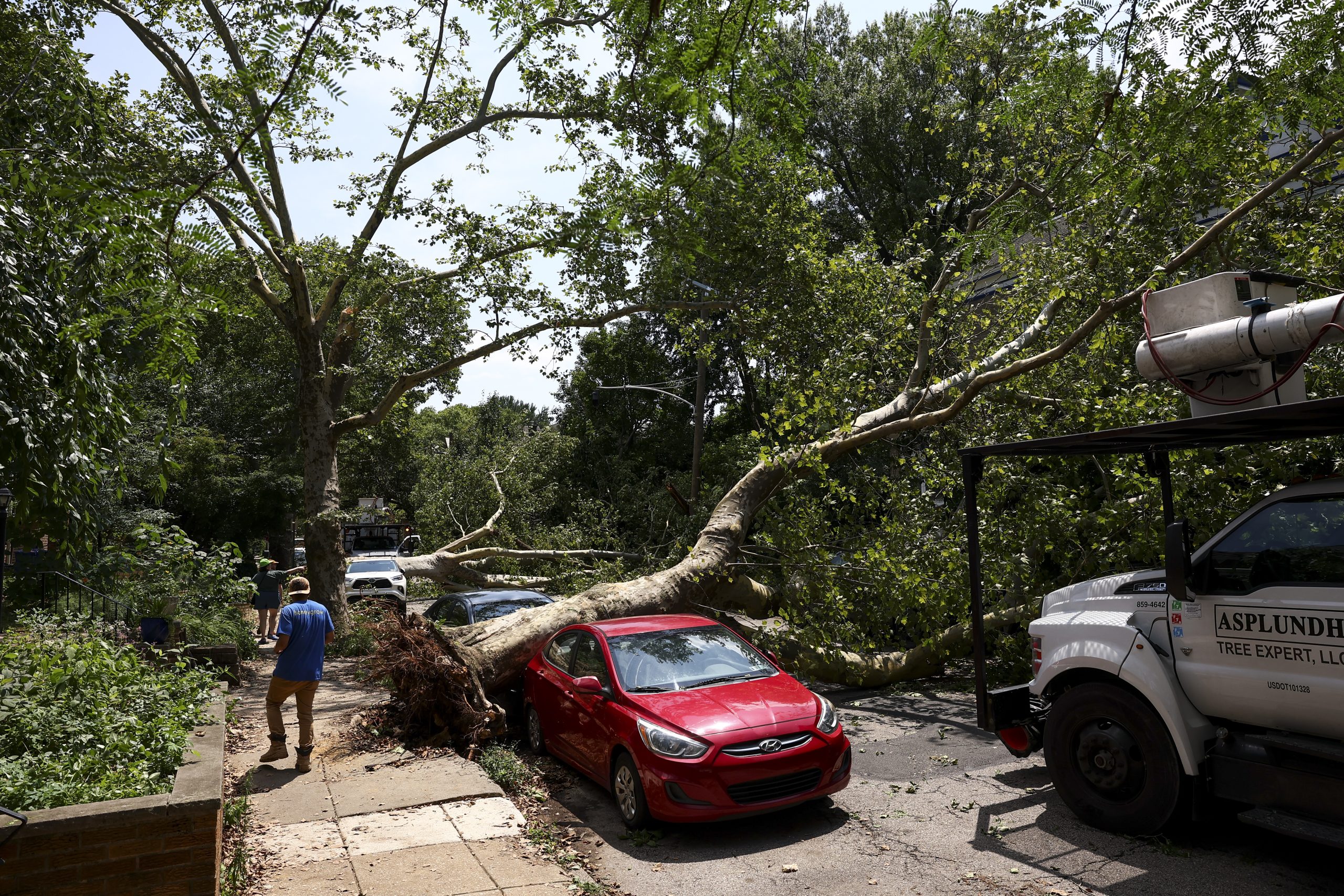
    Multiple fallen trees crushed cars on the 4500 block of Larchwood Avenue on Sunday, July 12, 2026, in West Philadelphia. On Saturday severe thunderstorms caused damage across the region.Monica Herndon / Staff Photographer

    Hutcheon said he hopes the tree is removed soon because 19th Street is a bus route, but he understood that workers had to address another tree on nearby Colorado Avenue first. That one had fallen on a house, he said.

    His neighbor, Joanne Podagrosi, noted that the storm felled two trees on their block, as well as a large bough of branches. The debris lay on the street late Sunday morning, wreathed by smaller leaves and branches, while police tape kept cars from turning down the street.

    “It was just a blur of rain,” said Podagrosi. She said she’s lived on the street 22 years, “and it’s the worst we’ve ever seen.”

    What is a microburst?

    At least four microbursts hit the region, the National Weather Service (NWS) said Saturday. The first hit Lower Merion in Montgomery County. Subsequent microbursts landed in Northeast Philly, West Philly, and South Philly.

    “Microbursts are where during a thunderstorm, we see a rapid increase in the updraft, and then it ultimately stops, and the whole mass of the storm goes down, and that’s how you get those very strong winds,” said NWS meteorologist Ray Martin. “As they say, what goes up, must come down.”

    City emergency management officials said winds reached up to 70 mph.

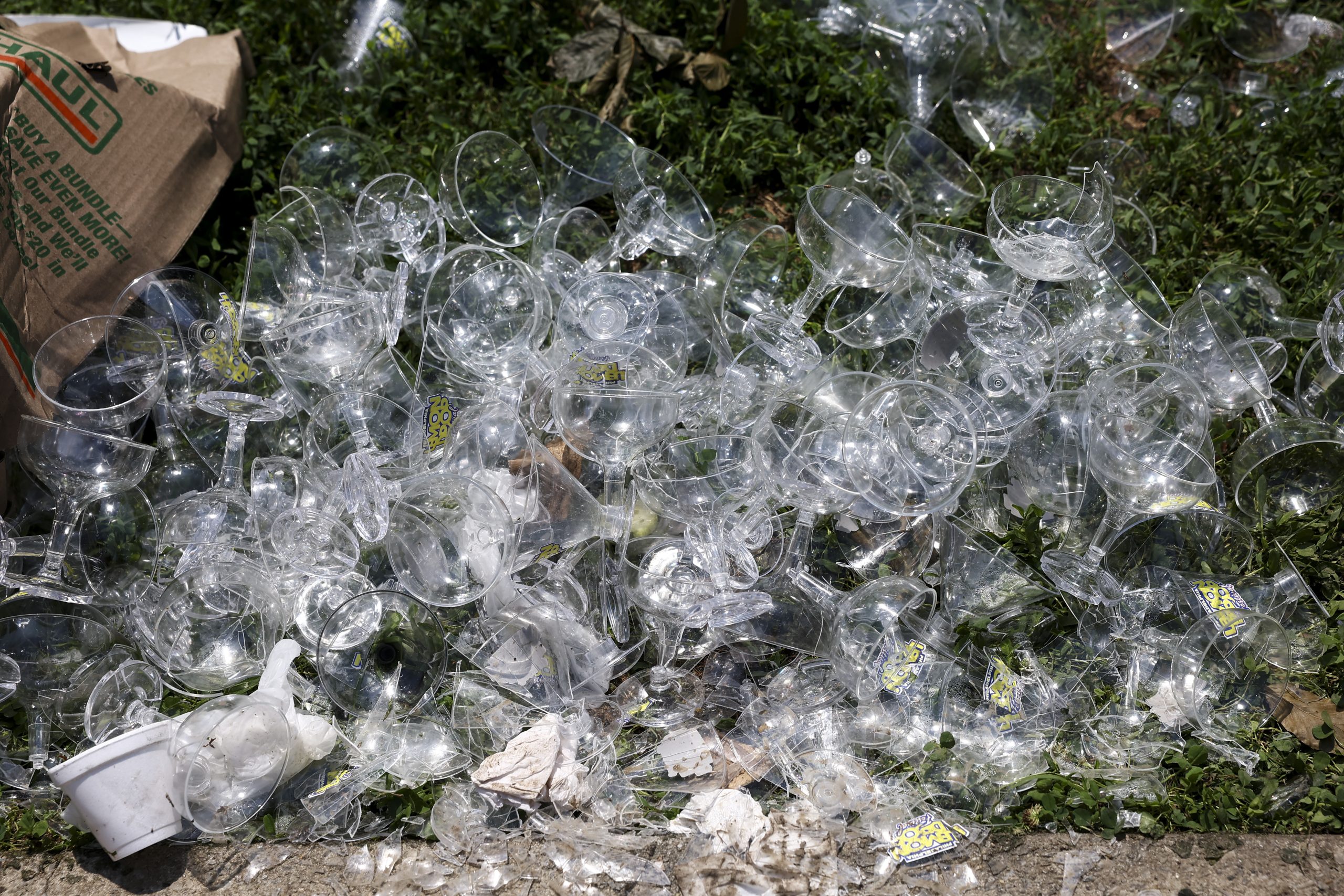
    Broken plastic glasses from the Lemon Drop Festival litter the ground at Malcolm X Park on Sunday, July 12, 2026, in West Philadelphia. On Saturday severe thunderstorms caused damage across the region.Monica Herndon / Staff Photographer

    Philadelphia Police Commissioner Kevin Bethel said Saturday that the city’s 911 dispatchers fielded 3,000 calls during a one-hour period at the height of the storm.

    A Philadelphia Housing Authority (PHA) property on Vine Street near 55th in West Philadelphia had part of its roof blown off during the storm. Eleven units in the building were affected, officials said, and residents were relocated to nearby hotels.

    Those displaced residents will be moved into new PHA units on Monday while repairs are completed, according to PHA president Kelvin A. Jeremiah.

    Elsewhere in the city, at least two buildings partially collapsed due to the storm: a vacant property at 24th Street near Washington Avenue, and another building in West Philadelphia on Lansdowne Avenue near 56th Street.

    Slightly fewer than 7,000 Peco customers remained without power Sunday at 4:30 p.m., down from 34,000 Saturday evening, according to the Peco outage tracker. Most of the outages were concentrated in West Philly and Montgomery County.

    The damage was evident to anyone walking or driving around the city.

    Trees were ripped from the squares of dirt where they’d grown for decades and lay toppled on sidewalks and roadways. Debris from drywall or similar construction materials was scattered on the Girard Point Bridge linking South and West Philly.

    At the Wawa on Bartram Avenue, guests tugged on a locked door and peered inside before seeing the handwritten signs turning them away: “Power outage. System down.”

    Just a block away, the traffic light was blinking red, leaving drivers to move through the intersection on their own.

    At the edge of Yeadon Borough, a downed tree had dragged an electrical line with it. Cars swerved around both. All along Cobbs Creek Parkway in West Philly, drivers faced fallen trees and road closures.

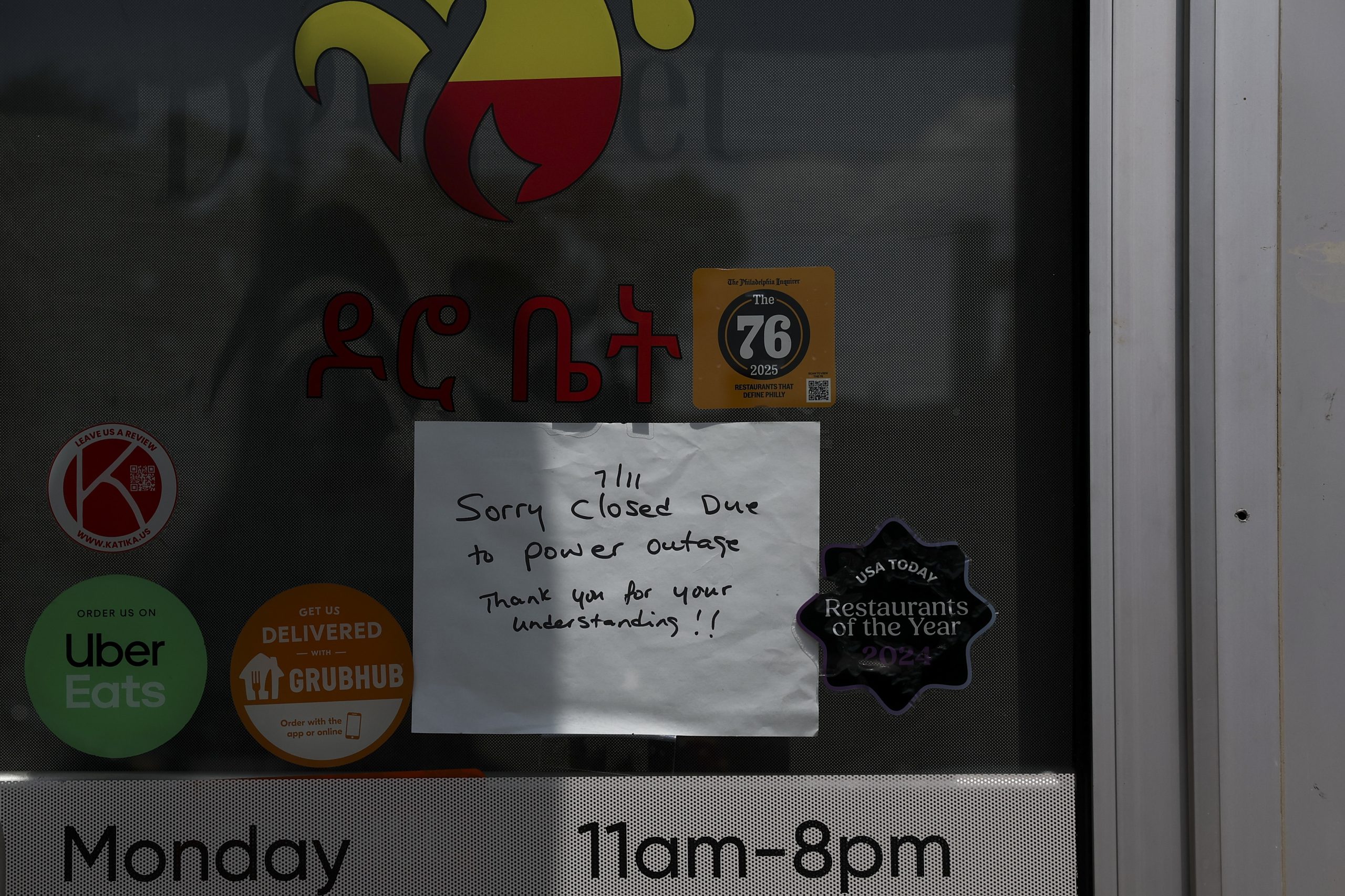
    Signage on Doro Bet notes that they are closed due to the power outage on Sunday, July 12, 2026, in West Philadelphia. On Saturday severe thunderstorms caused damage across the region.Monica Herndon / Staff Photographer

    Lower Merion Township was one of the worst-hit places, and its leadership declared a state of emergency Saturday afternoon.

    The disaster declaration has since been lifted, but “at least 55 township streets are still blocked or partially blocked with trees,” the township said.

    Resident Gigi Moffat said one upshot is that the disaster brought people together. In her neighborhood, people were out cleaning up, checking on neighbors, and offering people coffee.

    “Everyone stayed really positive, which is great,” she said.