Category: News

  • Philly’s e-bike and e-scooter boom comes with a more dangerous price than traditional cycling

    Philly’s e-bike and e-scooter boom comes with a more dangerous price than traditional cycling

    It was the first weekend of summer break. Abigail Gillon, an honor student, had just finished sixth grade. She was free.

    “My last text to her was at 2:14” on June 14 last year, said Abby’s mom, Lori Kralle.

    An hour later, Kralle received a call from an emergency room nurse about her 12-year-old daughter.

    Abby had been riding an electric scooter with her best friend, Isabelle, in Aston Township. The girls were sharing the scooter when they drove off the curb and fell into the street. They were struck by an oncoming car at 2:22 p.m. Emergency responders found them holding each other in fetal position, Kralle said. Abigail died two days later. Her friend was severely injured.

    “It didn’t just tear away and take away Abigail’s life, it took apart everybody’s life, her friends and family,” Kralle said.
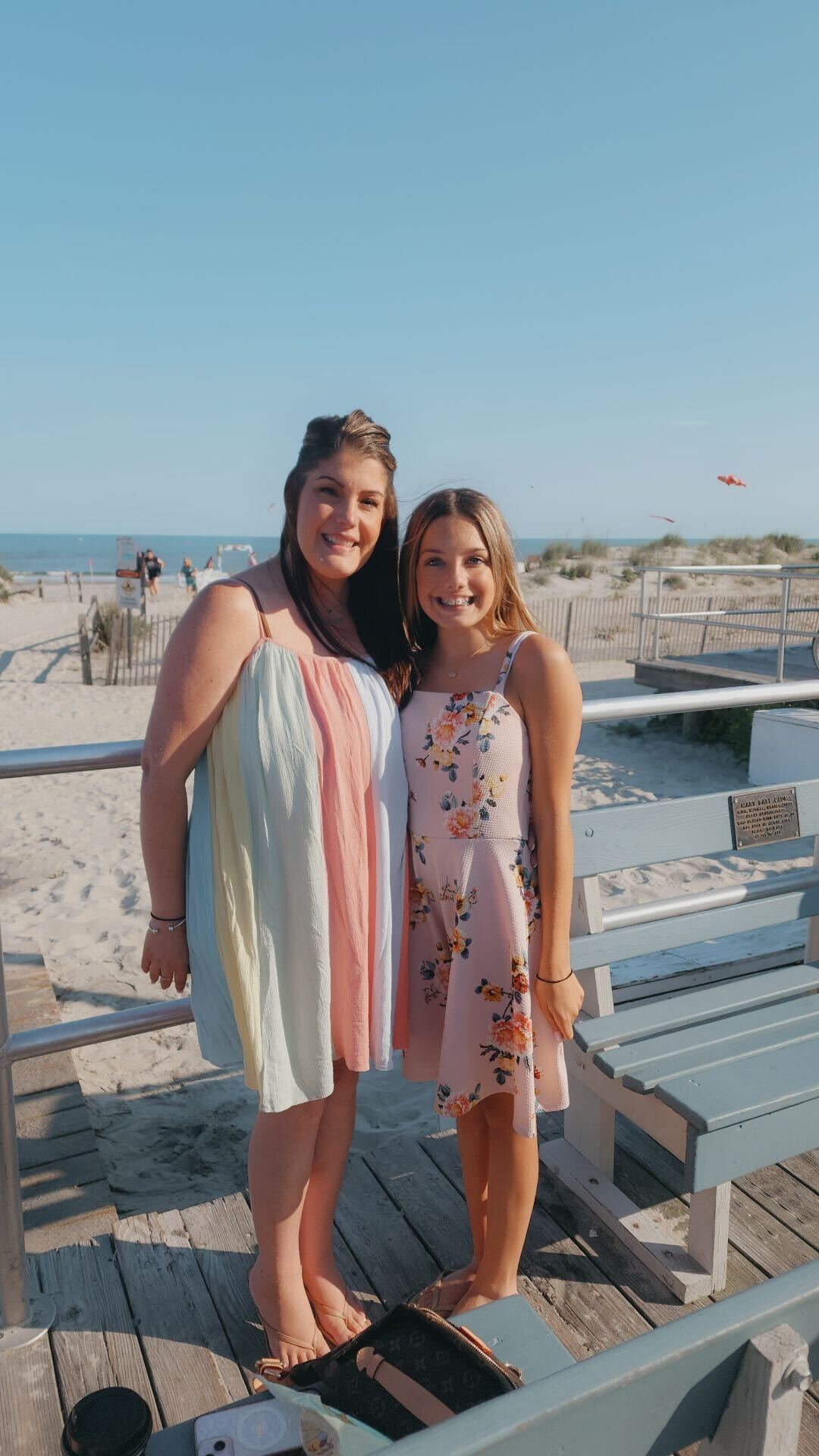
    Lori Kralle with her daughter, Abby Gillon.Lori Kralle

    Last year, more traffic crashes causing injury and death in Philadelphia involved electric bikes and scooters than manual ones, according to Pennsylvania Department of Transportation data. The finding highlights a new reality in which e-bikes and e-scooters present a major safety problem, the state confirmed.

    The high numbers of injuries and deaths point to the need for legal clarity, statewide safety regulations, and new infrastructure to protect users of e-bikes, e-scooters, and bicycle riders from cars and trucks, traffic safety advocates contend.

    (function(){function e(){window.addEventListener(`message`,function(e){if(e.data[`datawrapper-height`]!==void 0){var t=document.querySelectorAll(`iframe`);for(var n in e.data[`datawrapper-height`])for(var r=0,i;i=t[r];r++)if(i.contentWindow===e.source){var a=e.data[`datawrapper-height`][n]+`px`;i.style.height=a}}})}e()})();

    “There’s a lot of technology out there and there is no real enforcement and regulation,” said Nicole Brunet, president of PA Safe Roads PAC. “It’s causing devices to be on the road that are unsafe.”

    In 2025, e-bikes and e-scooters were involved in 197 crashes on city streets, excluding interstates — a 40% increase over 2024. Four riders were killed and 193 were injured in those collisions, PennDot figures show.

    Meanwhile, 193 reported crashes involved standard bikes, more numerous in the city than their electric cousins, as well as traditional foot-propelled scooters, the state figures indicate.

    E-bikes and scooters are poorly defined in Pennsylvania law. The ambiguity makes it hard for governments to identify problems; PennDot did not analyze separate crash data for the electric devices until 2024, for instance, due in part to uneven reporting.
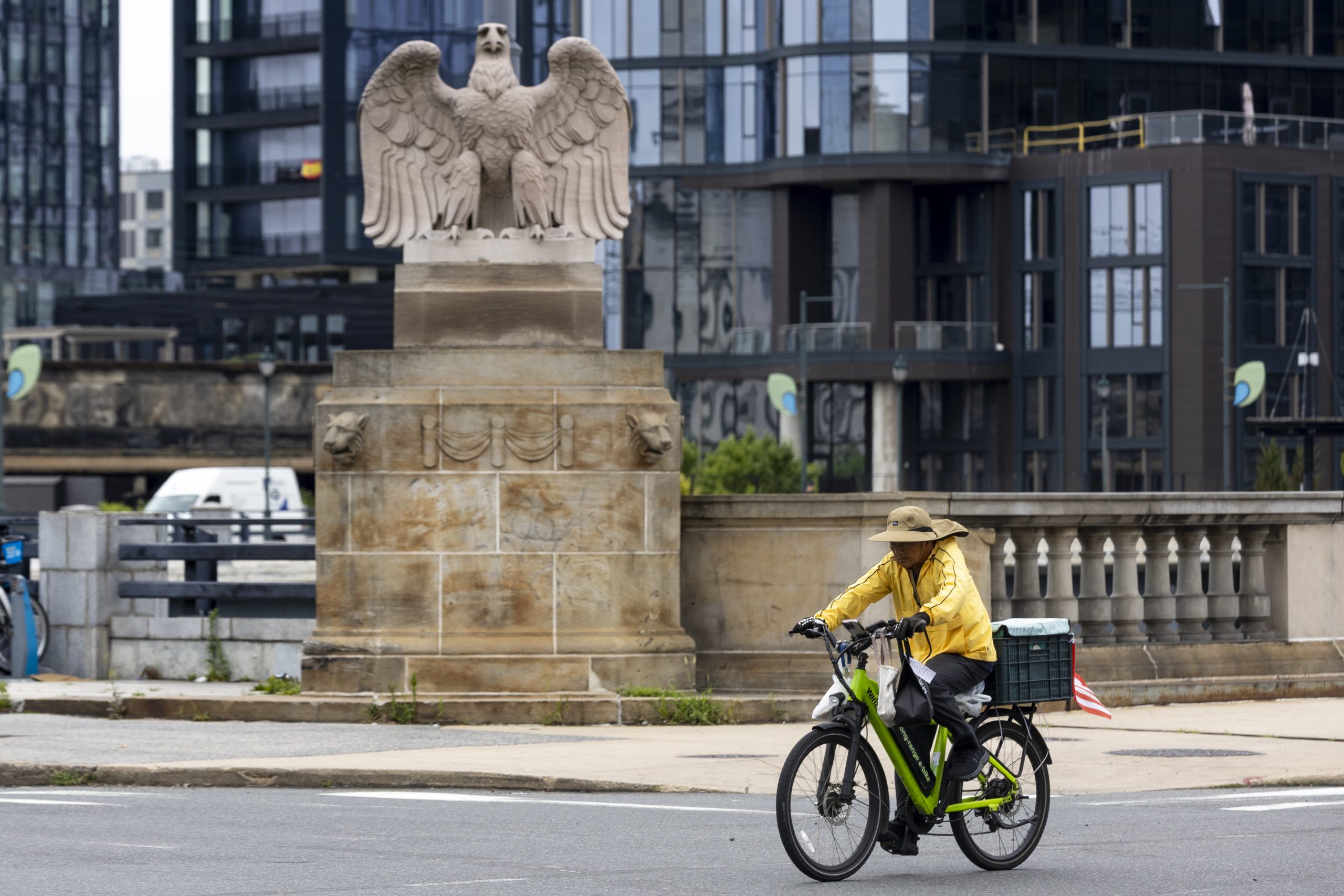
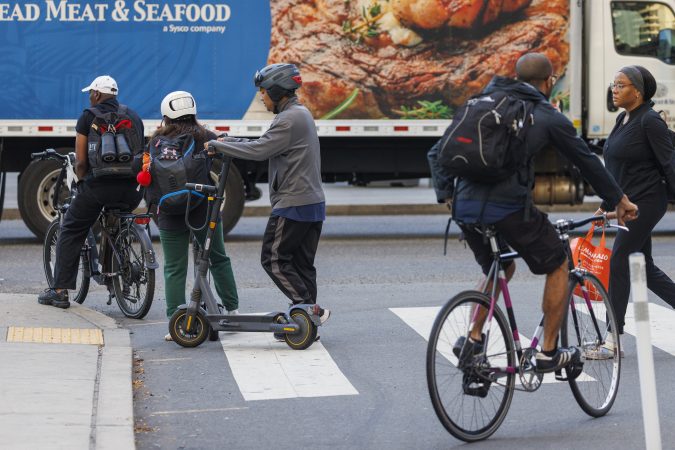
    A delivery driver riding an e-bike drives past an intersection on Walnut Street in West Philadelphia on Tuesday, July 7, 2026.Aidan T. Gallo / Staff Photographer

    State law authorizes the use of low-speed electric bikes — those that weigh less than 100 pounds, have engines that generate no more than 750 watts, and travel below 20 mph — on public roadways. E-scooters are not street legal in Pennsylvania.

    This narrow definition, however, does not differentiate among the many new types of electric bikes or e-scooters for sale, which can reach speeds of 60 mph or even 100 mph.

    (function() { var l = function() { new pym.Parent( ‘crash-types3__graphic’, ‘https://media.inquirer.com/storage/inquirer/ai2html/crash-types3/index.html’); }; if(typeof(pym) === ‘undefined’) { var h = document.getElementsByTagName(‘head’)[0], s = document.createElement(‘script’); s.type = ‘text/javascript’; s.src = ‘https://pym.nprapps.org/pym.v1.min.js’; s.onload = l; h.appendChild(s); } else { l(); } })();

    Two states, two speeds

    Governmental response has been uneven, with neighboring states moving in opposite directions and local jurisdictions sometimes banning e-bikes and e-scooters or enacting bespoke rules.

    “What we’re seeing right now is sort of a wild, wild west,” said State Sen. Tim Kearney, a Delaware County Democrat.

    Kearney wrote and introduced “Abby’s Law” — SB 1008 — in September last year.

    The bill says no person under 16 could operate a privately owned “low-speed electric scooter” on public roads; a helmet would be required until age 18. The bill would set a uniform 20 mph speed limit and prohibit tandem riding on e-scooters.

    Local police would issue summonses for those and other traffic violations by riders. Municipalities could increase penalties for second and third violations, as long as the fine is no more than $250.

    (function() { var l = function() { new pym.Parent( ‘crash-types3__graphic’, ‘https://media.inquirer.com/storage/inquirer/ai2html/crash-types3/index.html’); }; if(typeof(pym) === ‘undefined’) { var h = document.getElementsByTagName(‘head’)[0], s = document.createElement(‘script’); s.type = ‘text/javascript’; s.src = ‘https://pym.nprapps.org/pym.v1.min.js’; s.onload = l; h.appendChild(s); } else { l(); } })();

    In New Jersey, former Gov. Phil Murphy, a Democrat, signed the most restrictive electric cycling law in the nation on his last day in office earlier this year. The law, which takes effect later this month, requires all e-bike users to obtain a license and register their devices with the New Jersey Motor Vehicle Commission, even if they do not go over 20 mph.

    Models that can travel between 21 and 28 mph or have a throttle are classified as “motorized bicycles” and must also have liability insurance. The lower-powered e-bikes provide “pedal assist,” which cuts off at 20 mph.

    Enforcement could be tricky, especially at the Shore. The MVC says out-of-state visitors can ride legally, but language in the law appears to grant the exemption just to people who have registered devices in their home states. That is not an option in Pennsylvania.

    The MVC is now taking reservations for appointments; officials have acknowledged the deadline might need to be extended.

    E-scooters with a top speed of 19 mph are legal.

    In Pennsylvania, more than a year after Abby Gillon’s death, Kearney’s bill has not had a public hearing or a vote in the Senate.

    “We need to get people to acknowledge what’s actually happening on the road, and then stop sticking our heads in the sand about the various bureaucratic reasons not to move forward with it,” Kearney said.

    Wide use, thin information

    Government officials face challenges identifying and classifying the many varieties of electric bikes and scooters — also known as micromobility vehicles — transportation activists and state officials said. That makes information, including about crashes, hard to come by.

    PennDot, for instance, began counting electric bikes and scooters separately from pedal cycles, unmotorized scooters, and pedestrians for its annual tally of crashes only in 2024.
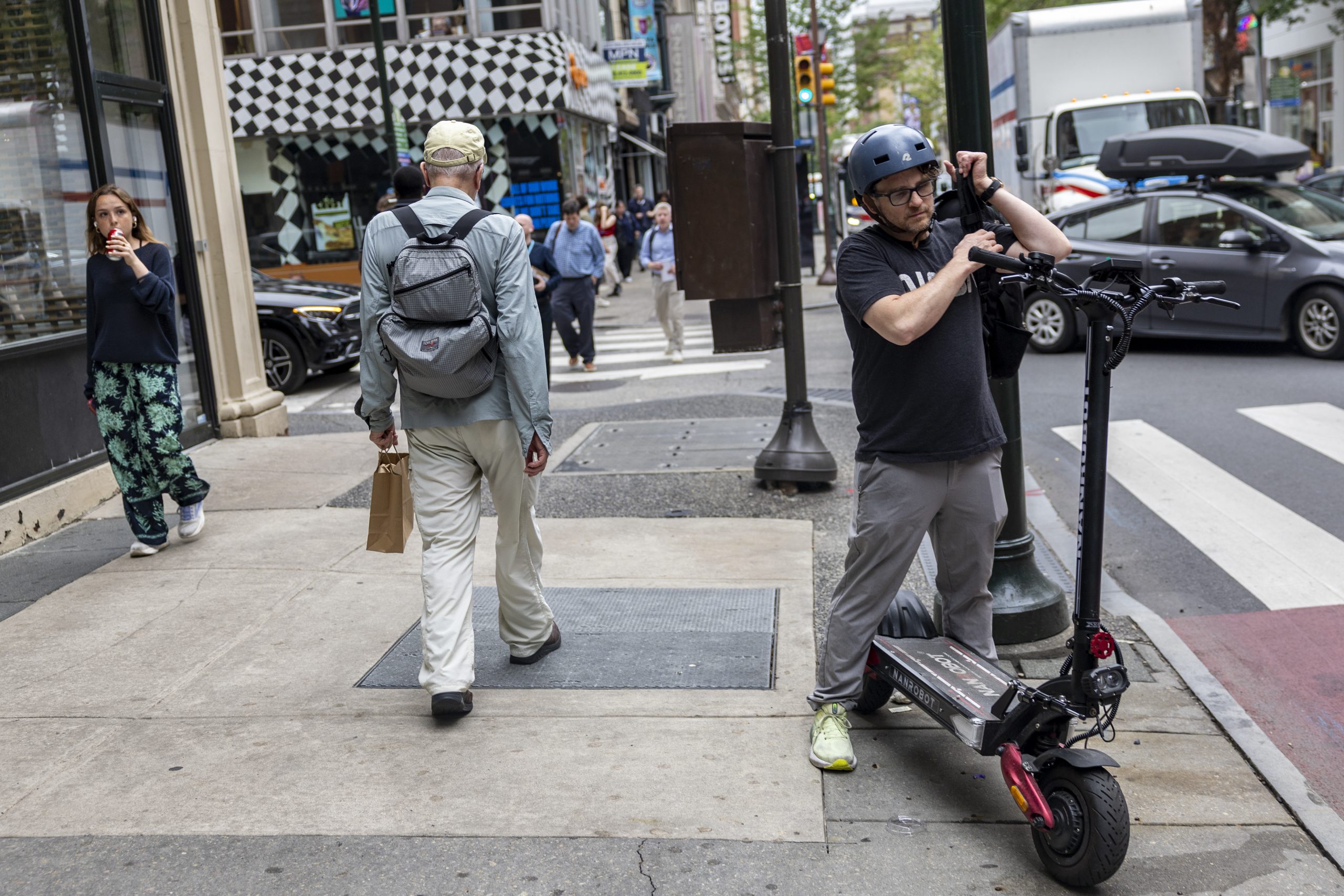
    A man gets ready to leave on his electric shooter in Center City.Aidan T. Gallo / Staff Photographer

    After a vehicular crash, law enforcement is required to report to PennDot details of crashes that involve injuries, fatalities, or significant damage to vehicles.

    Regarding the data prior to 2024, Robert A. Ranieri, crash-analysis manager at PennDot, said via email: “I don’t find that fully reliable since we didn’t look at all the narratives and the police may not have reported them properly at the time.”

    While his office works to verify the data, “not all reports are touched by my staff,” Ranieri said.

    Similarly, the crash data on electric bikes likely include vehicles known as e-motos, which look like pedal bikes but go faster than 20 mph, said John Boyle, research director at the Bicycle Coalition of Greater Philadelphia.

    In general, e-motos being lumped in with e-bikes is causing a lot of issues as communities and states try to regulate the higher-speed micromobility devices, Brunet said.

    E-scooter law is ‘basically ignored’

    The recently released PennDot data include at least 92 crashes in Philly involving e-scooters, which are technically illegal to ride on public streets in Pennsylvania.

    Last year, there were four reported fatalities involving e-scooters, though they made up only 14% of micromobility devices, according to the Bicycle Coalition’s 2025 bike count data.

    Standard bikes, in comparison, resulted in the same number, a total of four deaths, last year.

    “Some of the e-scooters have a top speed of 60 mph, which is crazy fast,” Boyle said, but “the law is basically ignored.”

    There is a gray market of electric scooters and bikes available for purchase, transportation experts told The Inquirer.

    “You can purchase electric bikes or scooters for $800 on Amazon and they have 1,000 to 2,000 watts,” Boyle said.

    The bikes are sometimes marketed as “Class 2,” meaning their motor tops out at 20 mph, but with a few basic adjustments can easily go faster, Boyle said.
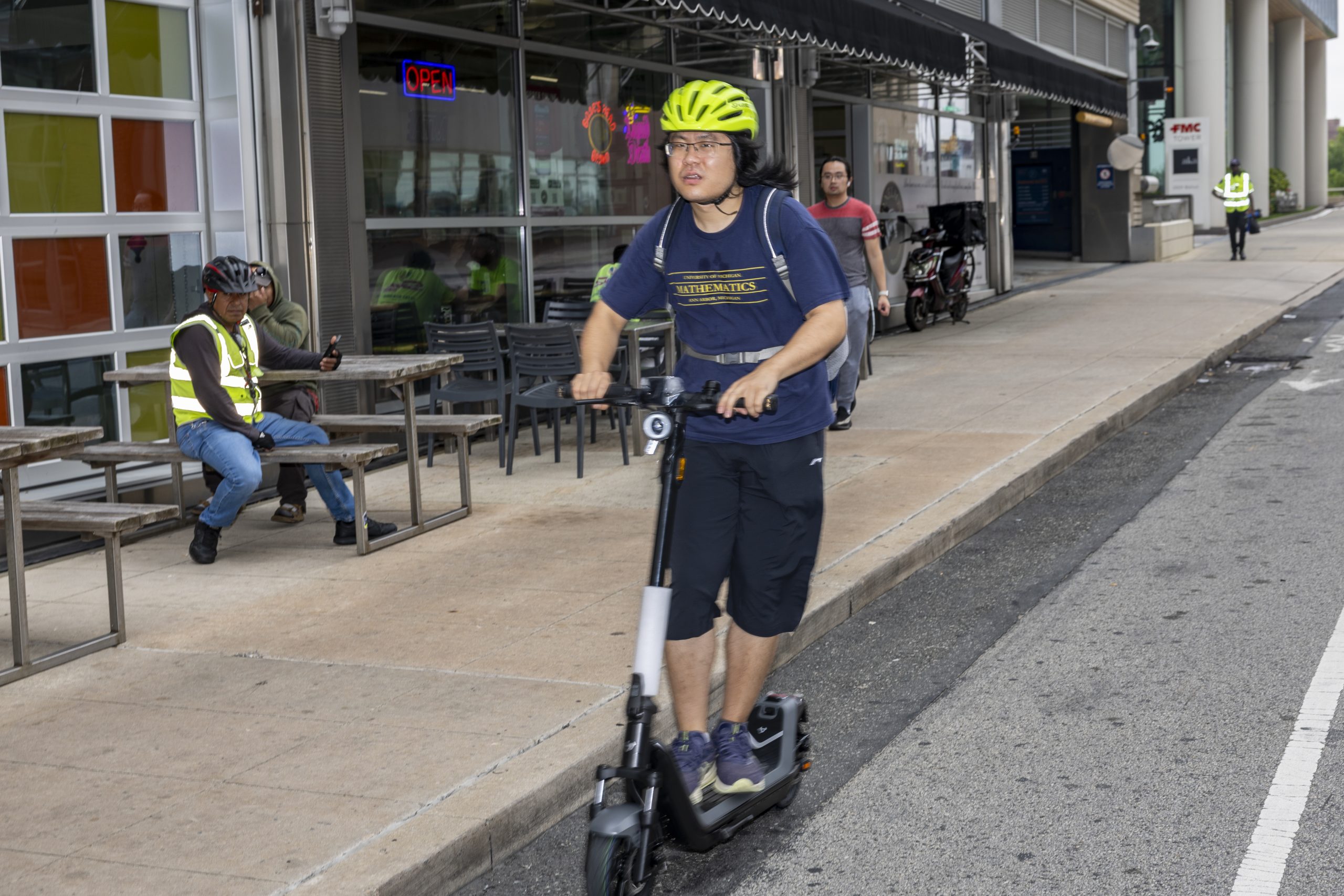
    A man rides an electric scooter down a bike lane near Drexel University’s campus.Aidan T. Gallo / Staff Photographer

    Motorcycles, unlike e-motos, have quality standards and regulations. When it comes to selling a motorcycle in Pennsylvania, dealerships are required to handle legal requirements, title transfers, and state registrations.

    Reining in the manufacturers and dealers of electric bikes, motos, and scooters is an important step, Boyle said, but the state first needs to better define in the law what electric bikes and scooters are.

    Brunet, president of PA Safe Roads PAC, said her organization supports the Safe System approach to transportation safety, which involves education, enforcement, and infrastructure.

    “Philly just needs to keep building better bike infrastructure. … There is definitely a lot to do to make roads safer so that the people choosing these devices get home safe,” Brunet said.

    Several bills to regulate e-scooters have been proposed in the state legislature, but none have been passed.

    Pittsburgh embraced e-scooters

    At the same time, State Rep. Emily Kinkead (D., Allegheny) is pushing a proposal to bring a shared e-scooter program back to Pittsburgh and give the option to 53 smaller cities.

    Special legislation gave Pittsburgh the right to test a shared e-scooter rental program in partnership with Spin, a private company, from 2021 to 2023, when the trial expired.

    Kinkead called it a success, noting her north Pittsburgh district has steep hills and limited transit links.

    “What I saw … was not college kids goofing around, it was people who were trying to get around the North Side with grocery bags,” Kinkead said at a recent public hearing on the bill.

    The city had 230,000 unique e-scooter users during the test, said Ryan Seiferet, who managed the program for the Pittsburgh Department of Mobility and Infrastructure.

    A survey of about 1,000 participants showed 44% of e-scooter riders used them to get to work and one-third to travel between transit stops and home. Regular users tended to have low incomes.

    While rules are needed in the state, especially for privately owned scooters, “We want to make sure we aren’t penalizing or disincentivizing a valuable micromobility travel option” for people, said Jessie Amadio, an organizer for Philly Bike Action.

    The electric scooter program was relatively safe, with one reported injury per 17,000 rides, according to a DOMI report.
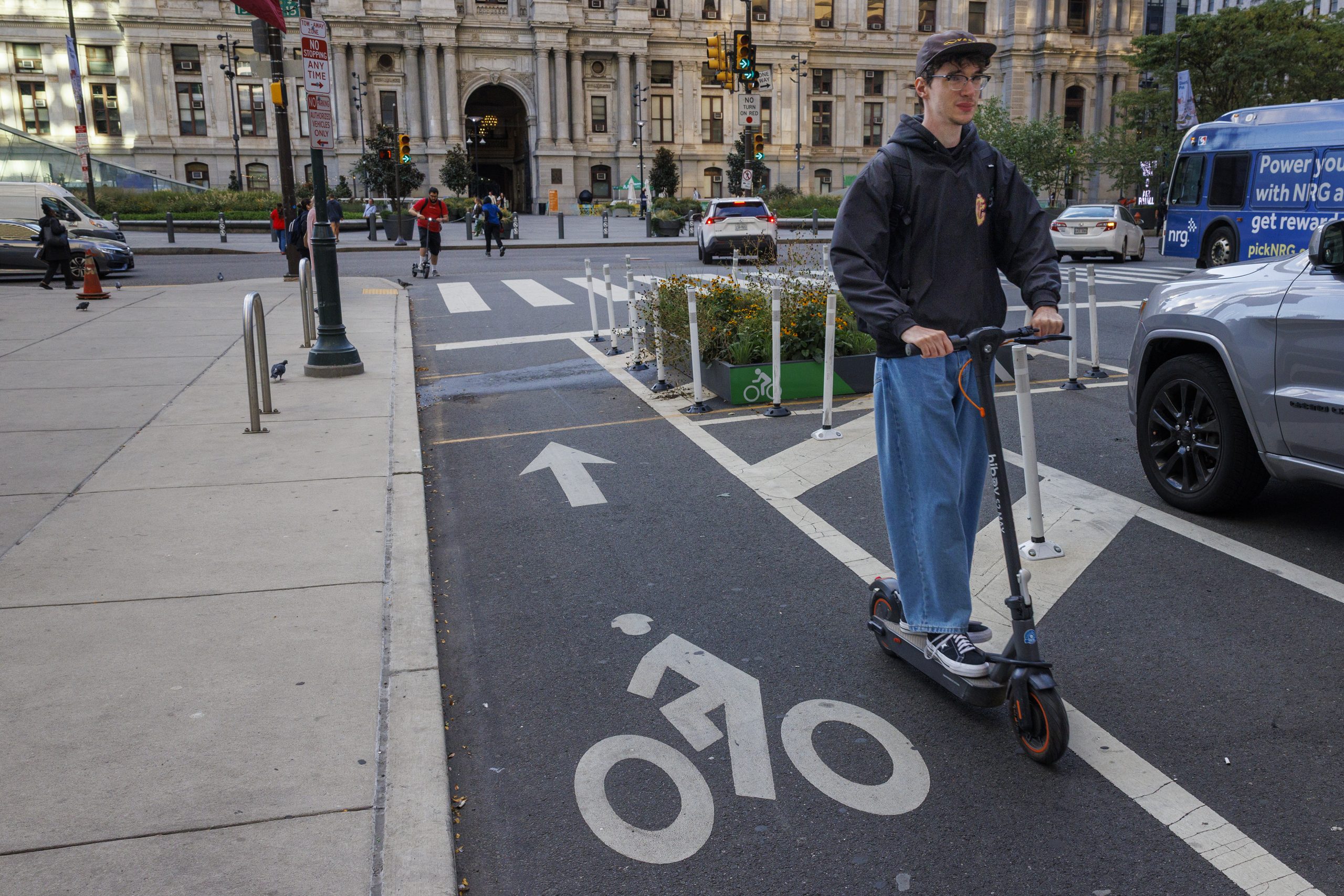
    Electric scooters going against directed traffic flow at Market Street at 15th in Center City.Alejandro A. Alvarez / Staff Photographer

    News site Next Pittsburgh found, however, that a handful of the injuries were serious and, in some cases, life-threatening. Spin planned to deploy scooters with larger tires for stability, the site reported.

    Kinkead said shared e-scooters can be tightly controlled in agreements between a city and an e-scooter firm; in Pittsburgh, the scooters could not exceed 15 mph, enforced by software. E-scooters stopped working if the rider strayed into a town that did not allow them.

    Philadelphia, however, is opting out. Mayor Cherelle L. Parker’s administration asked that the city not be included in the shared e-scooter bill, said State Rep. Ed Neilson, a Democrat who represents a Northeast district and chairs the House Transportation Committee.

    “Because of the historic nature of the city and the millions of people that come every year, we just don’t want to block or impede that,” Neilson told colleagues in the hearing.

    Most agree that the state needs to take some sort of legislative action soon.

    “Getting as far as we have gotten [with Abby’s Law] on the Senate’s desk and to still not have anything signed or put into order is very frustrating,” Lori Kralle said.

    “What does it take? For another mother to get that phone call?” she added. “I don’t wish that on anybody.”

  • 4 wounded when gunfire erupts in Southwest Philly, police say

    4 wounded when gunfire erupts in Southwest Philly, police say

    Four people were wounded when gunfire erupted at a basketball court Monday night in Southwest Philadelphia, police said.

    The shooting happened at the James Finnegan Playground around 8:20 p.m. near 69th Street and Guyer Avenue in the city’s Elmwood section, police said.

    The location was initially reported as South 68th and Harley Streets, next to the Paschall Playground, which is nearby the other playground.

    Three victims, ages 18 and 19 and 20, were shot in the lower parts of their body, said Inspector D.F. Pace. Two of the victims were taken to Penn Presbyterian Medical Center. The third victim was transported by private vehicle to the Hospital of the University of Pennsylvania.

    All three were listed in stable condition, Pace said.

    A 40-year-old man mowing a residential lawn was hit in the face with what was believed to be a fragment of a bullet that ricocheted off something, Pace said.

    That man was treated at the scene.

    Three persons of interest were taken into custody and a car with three guns, including a long gun, was being held by police, Pace said.

    A fourth gun was found near the basketball court, he said.

    There was no early indication of a motive.

  • Microburst storms caused unprecedented tree damage in some Philly-area neighborhoods

    Microburst storms caused unprecedented tree damage in some Philly-area neighborhoods

    Hundreds of trees fell in Philadelphia within a matter of minutes during a weekend storm that left a narrow but destructive band of what one official called “unprecedented” damage in its wake in the region.

    “We’ve never seen anything like this,” Parks and Recreation commissioner Susan Slawson said. “We’ve never seen a 15 and 20 minute storm come through an isolated area and take down that many trees.”

    Those downed trees came following a series of four “microbursts,” which brought wind gusts traveling 60 to 70 mph. Those isolated instances of high winds primarily impacted parts of Philadelphia and Montgomery County.

    Microbursts, the National Weather Service said, happen when a thunderstorm experiences a rapid increase in updraft. When that updraft stops, the mass of the storm system comes crashing back down, resulting in severe winds that sent trees tumbling into homes and vehicles, damaged public parks, and left neighborhoods grappling with cleanup efforts days later.

    Slawson’s department, which handles downed trees in the city, had responded to at least 340 emergency requests as of Monday afternoon, and inspected about 220 trees. The hardest hit areas, she added, were in South Philadelphia, Wynnefield, and Southwest Philadelphia.

    The harsh winter’s heavy caps of ice and snow that lasted for weeks likely left some trees weakened or damaged, Slawson said, making them more vulnerable to being toppled. Those that fell were being taken to the city’s Fairmount Park Organic Recycling Center in West Fairmount Park.

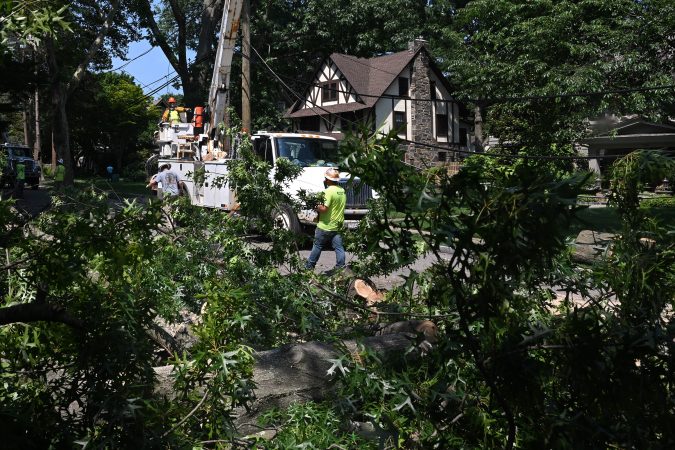
    Evidence of the damage was apparent around the region Monday. In Malcolm X Park in West Philadelphia, piles of giant fallen trees, cut into large chunks, sat waiting for disposal. And nearby on Spruce Street, a downed tree blocked a busy two-way road between 53rd and 54th Streets, its corpse resting atop a crushed red pickup truck.

    “They need to cut these trees down, they’re too tall,” said Schonder Pickney, 61, who lives across the street from the wreckage. She and her neighbors had asked the city to remove some of the old trees that appeared dangerous, but she said nothing came from it.

    Philadelphia Parks and Recreation workers throw debris into an auxiliary chipper at Wharton Square Playground in Point Breeze, on
    Monday.Aidan T. Gallo / Staff Photographer

    Private tree management companies, like Rapid Tree Care in Grays Ferry, were inundated with service requests following the storm. Caleb Coome, the company’s founder, said that the storm’s intensity knocked down large trees across densely populated city blocks, and across multiple homes.

    “It’s definitely unprecedented in terms of the amount of volume over a couple-day span,” said Coome, whose company has been in operations for three years.

    Homeowners impacted by fallen trees, he said, were largely concentrated near FDR Park and the stadiums in South Philly, as well as the Cobbs Creek and Cedar Park neighborhoods in West Philly. Homeowners face logistical and financial hurdles for cleanup, as much of the damage occurred in areas with tight rowhouses.

    In those tight quarters, a single fallen tree can span up to six properties, creating liability issues and disputes among neighbors over who is responsible for removal costs. A downed tree spanning multiple properties must be removed all at once, rather than limb-by-limb, for safety reasons, Coome said.

    Some parts of the suburbs also saw shared tree damage. For example, in Narberth, Hugh Parker and his family hurried home from the Shore Saturday after they heard from neighbors that a 40-foot tree had been knocked down in their front yard.

    Hugh and Grace Parker continue the cleanup in the basement of their Narberth home Monday. It flooded during weekend’s storm.Tom Gralish / Staff Photographer

    Located on their neighbor’s property, the tree landed to cover their driveway, as well as a car belonging to Parker’s wife, Grace. As it came down, the tree’s canopy also took down power lines and blocked the street, and the damage it did to the vehicle remained unclear Monday.

    A day later, Peco reconnected their power, which Parker said had been out for a little more than 24 hours. Then, he smelled smoke, thanks to a power line that started a fire after power had been restored. After about 30 minutes, the fire went out, but no one from the utility had come to check the power lines as of Monday morning.

    “It was like something from a movie scene — there were sparks flying 10 to 15 feet in the air,” said Parker.

    In Lower Merion Township, the local fire department responded to 98 incidents over the weekend, including numerous water rescues. Montgomery County communities were some of the hardest hit.

    “It became apparent that nearly every street in Narberth had a tree down, a substantial tree on a car,” said Narberth Council Vice President Cyndi Rickards said.

    The episode also highlights what many local officials have said is a need to further discuss improving local infrastructure and resources for extreme weather events.

    “I think this is the reality of storms now,” said Lower Merion Commissioner Ray Courtney. “They are hard, they are intense, and they dump a lot of precipitation in a short period of time, and all local governments, and our state and federal government, need to be thinking about improvements to our infrastructure, and the resiliency against this kind of weather event.”

    In addition to downed trees in the area, roughly 1,500 Peco customers remained without power across 119 reported outages as of late Monday afternoon. That number is down significantly from the height of the storm, when some 60,000 customers experienced extended outages. Overall, 105,000 Peco customers experienced some loss of power during the course of the storm, the company said.

    Power for all customers in the region, Peco added, was expected to be restored by 11 p.m. Monday.

    Among those impacted were West Philadelphia resident Lisa Phillips, who lives on the 5100 block of Hazel Avenue. A tree on her block went down Saturday, taking power lines with it. Electrical workers arrived Monday to take care of the downed lines, but she was still waiting for the city to clear the tree from her street.

    “Never in my life have I experienced anything like this,” she said.

    Staff writers Isabel Maney, Olivia Prusky, and Fallon Roth contributed to this article.

  • Darline Graham Nordone, sister of Lindsey Graham, picked to fulfill remainder of his U.S. Senate term

    Darline Graham Nordone, sister of Lindsey Graham, picked to fulfill remainder of his U.S. Senate term

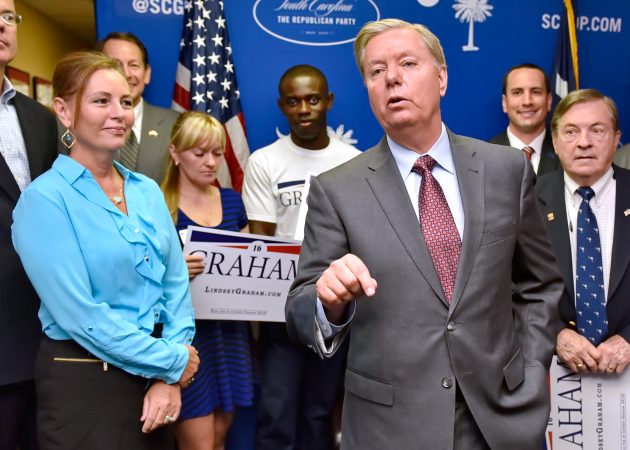
    COLUMBIA, S.C. — Lindsey Graham’s sister, Darline Graham Nordone, has been named as her late brother’s temporary replacement in the U.S. Senate.

    South Carolina Gov. Henry McMaster announced at a news conference at the Statehouse on Monday that Nordone would serve the remaining months on Graham’s current term, which expires in January. A person familiar with the appointment process but not authorized to speak about it publicly said Nardone would be sworn in Wednesday. She will be the first woman to represent the state in the U.S. Senate.

    “It is such an honor,” Nordone said. “Lindsey has always been there for me. And now, I will be there for him.”

    Graham died over the weekend at age 71. He never married or had a family of his own, but Nordone was often by her brother’s side for the political touch points of his career, speaking at events and appearing in some of his campaign ads.

    After their parents died at a young age, Graham was left to raise his sister, for whom he later became legal guardian. They were very close, and she was there as he filed reelection paperwork earlier this year, along with her children and grandchildren.

    A special election will be held next month to pick a new Republican nominee in the general election for Graham’s seat. He had been seeking a fifth term this year.

    The rare open Senate seat has ignited a scramble among South Carolina’s most ambitious conservatives, who have been eager to climb the political ladder.

    Republicans just finished a sprawling and bruising contest to figure out their nominee for succeeding McMaster, who is wrapping up his second term. State Attorney General Alan Wilson won the nomination, overcoming a field that included Lt. Gov. Pamela Evette, Rep. Nancy Mace, and Ralph Norman — all of whom are now eyeing Graham’s seat following his death over the weekend.

    How will a special primary work?

    According to South Carolina law, a one-week filing period for a special primary election begins on the second Tuesday after the candidate’s death, or July 21.

    The special primary election would be held on the second Tuesday after that filing period closes, or Aug. 11. Any necessary runoff would follow two weeks after that, or Aug. 25.

    From that point, the new nominee would have just over two months to campaign for the general election on Nov. 3.

    All of this is problematic according to federal law, which requires military and overseas ballots to go out 45 days before any federal election. For the special election primary, that would have been June 27. Federal Election Commission officials didn’t immediately return a message seeking clarity about the process.

    Who could replace Graham permanently?

    Graham died on Saturday night, and a preliminary medical examiner report said he suffered a tear in his aorta, known as an aortic dissection.

    In the hours after Graham’s death was announced, South Carolina’s Republican circles were already swirling with rumors about possible replacements.

    Evette, who has served nearly eight years alongside McMaster and received his endorsement in the governor’s race, is one possibility. She lost the June 23 runoff to Wilson.

    A person with knowledge of Evette’s thinking but not authorized to discuss it publicly said that she was getting encouragement from across the state and feels she would have good chances in the special primary.

    A person with knowledge of Mace’s thinking but not authorized to speak about it publicly said she was considering the race. Mace is not running for reelection to the House.

    But another Republican from the state, Rep. Russell Fry, could be a possibility. The two-term lawmaker represents the growing area around Myrtle Beach, and he’s been a top Trump ally.

    Businessperson Mark Lynch, whom Graham defeated in the primary, could also jump into the race. A person familiar with but not authorized to speak publicly about the thinking of Mark Sanford — South Carolina’s former governor who also served two separate stints in the U.S. House — said he was considering it, too.

    Treasury Secretary Scott Bessent, who lived in South Carolina before joining the Trump administration, has fielded calls about potentially replacing Graham but doesn’t have interest in the role and enjoys working for the president, according to a person who insisted on anonymity to describe private conversations.

    How does Graham’s death affect the general election?

    No Democrat has won a Senate seat in South Carolina in decades, and Republicans in recent history typically take statewide seats by double digits. When he last ran in 2020, Graham defeated his Democratic opponent, Jaime Harrison, by a 10 percentage-point margin.

    So while history suggests that Graham was en route to a fifth term, Republicans are carefully surveying the landscape.

    Charleston pediatrician Annie Andrews won the Democratic nomination last month and has raised more than $8 million in the race, and she had just under $3 million cash on hand at the end of May, according to federal filings. Graham had taken in $6 million, with just over $4 million on hand.

    In a statement Sunday, Andrews called on South Carolinians to join her “in setting partisanship aside and offering gratitude” to Graham for his service.

    What happens to South Carolina’s Republican clout?

    Graham leaves a major void in the Senate, where seniority can determine influence. He served more than two decades in the chamber, positioning himself to lead committees and set the agenda.

    Tim Scott, South Carolina’s junior senator, has been in office only since 2012 — short by the state’s standards. Fritz Hollings served for 38 years, and Strom Thurmond was there for 47.

    Scott, who co-chaired Graham’s reelection effort, described his former colleague as “irreplaceable.”

    “America lost a statesman, but I lost a friend,” he told ABC’s This Week.

  • Nearly $6 million of cocaine bound for Philly intercepted as part of citywide bust, DA Krasner says

    Nearly $6 million of cocaine bound for Philly intercepted as part of citywide bust, DA Krasner says

    Law enforcement officials seized nearly $6 million worth of crack-cocaine destined for Philadelphia as well as thousands of fentanyl pills in a monthslong drug operation, authorities said Monday.

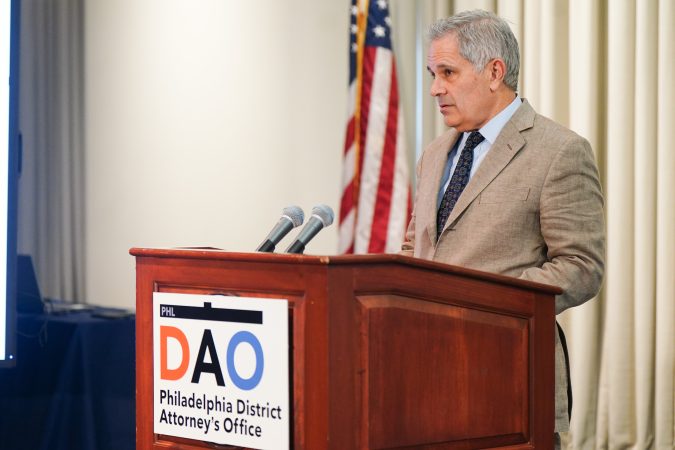
    The seizure was the culmination of an 18-month joint investigation into several men who supplied or sold the potent synthetic opioid and other deadly drugs in the city’s Kensington neighborhood and elsewhere, according to Philadelphia District Attorney Larry Krasner, who said the cocaine seizure happened last week.

    In all, Krasner said, law enforcement recovered 58 kilograms of cocaine with a street value of $5.8 million and fentanyl pills worth around $200,000.

    The bust is the latest eye-grabbing effort to stem the flow of fentanyl and other deadly drugs into the city, and specifically to Kensington, considered one of the nation’s largest open-air drug markets.

    The FBI targeted a sprawling criminal syndicate in the neighborhood last year when it arrested 33 members of the Weymouth Street gang, which was accused of running a 24/7 market for fentanyl and other drugs on the narrow block for nearly a decade.

    And in May that year, the Office of the Attorney General announced a joint operation that had seized more than $6 million in fentanyl cut with the veterinary sedative xylazine, effectively disbanding a North Philadelphia trafficking organization in the process.

    In the latest raid, investigators were tipped off to the criminal activity in December 2025 when members of the Delaware River Port Authority Police pulled over 46-year-old Raabitah Reynolds as he drove back to Philadelphia from New York City.

    After obtaining a search warrant for Reynolds’ vehicle, officers recovered a 9mm handgun and equipment for packaging drugs.

    Later, when they searched a South Philadelphia stash house tied to Reynolds, they recovered 2 kilograms of fentanyl that was ready to be packaged, a gallon jar of PCP, various pills, and more firearms, according to Assistant District Attorney Stephen Girman.

    Reynolds was charged with two counts of felony possession with the intent to deliver, two counts of criminal conspiracy, and related crimes. He is being held at the Curran Fromhold Correctional Facility with bail set at $500,000.

    The haul was “a significant drug seizure in and of itself,” Girman said, but investigators did not stop there.

    Reynolds’ arrest led them to one of his buyers, Khalil Dandy, a drug dealer who is accused of effectively controlling sales on a block at Kensington Avenue and E Street, according to Girman.

    Dandy, 36, ran that operation from his home at a Center City condominium located near 12th and Chestnut Streets, Girman said.

    Officers began visiting the Kensington block to conduct undercover buys, according to Girman, learning that Dandy was supplying fentanyl and crystal meth to street dealers in the neighborhood.

    Dandy was arrested on March 18 and charged with possession with the intent to manufacture or deliver and related crimes. He was released from custody on bail as he awaits a preliminary hearing.

    Meanwhile, investigators offered information about Reynolds to the DEA field office in New York, which led to the raid of a “pill mill” operating out of a Brooklyn apartment.

    There agents recovered more than 20 kilograms of fentanyl that had been pressed into blue pills to pass off the deadly drug as oxycodone, Girman said.

    These pills “are exceptionally dangerous, because people can take them thinking they are a regular prescription painkiller, and they can be filled with a fatal amount of fentanyl,” he said.

    And as investigators traced Reynolds’ network, they learned he was also involved in bulk cocaine sales that came from a supplier on the West Coast.

    Those shipments were shipped to Philadelphia in crates to be sold throughout the region, according to Girman.

    In early July, investigators intercepted two of those containers, and with the assistance of a K9 unit, recovered a total of 58 kilograms of cocaine from within.

    They arrested another Philadelphia man, 51-year-old Ephraim Ramsey, who had showed up to pick up the drugs.

    Ramsey was charged with one count of felony possession with the intent to deliver and one count of criminal conspiracy.

    And when Philadelphia police went to arrest Reynolds at an apartment in the city’s Kingsessing neighborhood, he led them on a chase through a second-story window and into a back alley before being apprehended.

    From a separate apartment on City Avenue, investigators recovered more than 2,000 of the blue fentanyl-laced pills as well as counterfeit Adderall, according to Girman.

    In a third residence in Olney — a house being prepped to stash the cocaine shipments — officers recovered an AR-15 rifle with an obliterated serial number.

    Krasner, touting the success of the operation, said he was pleased that law enforcement officers had targeted large shipments of contraband as opposed to targeting “young people with a small amount of drugs in their pocket.”

    “This, in my opinion, is a much more important and much more effective approach,” he said.

  • Blanche stares down confirmation hurdle of lingering GOP doubts

    Blanche stares down confirmation hurdle of lingering GOP doubts

    WASHINGTON — Sen. Thom Tillis (R., N.C.), who is still undecided about Todd Blanche’s nomination as permanent attorney general, drew a red line last month: He would vote no if Blanche was too soft on the rioters who had ransacked the Capitol on Jan. 6, 2021.

    Soon after, Tillis, a moderate on the Senate Judiciary Committee, said he had a “positive predisposition” after meeting with Blanche, despite the fact that the acting attorney general had recently signed off on a $1.8 billion fund that could have been funneled to those who stormed Congress.

    Just a single no vote from a Republican would deadlock the committee and effectively sink the confirmation of Blanche, who became the Justice Department’s acting leader after Pam Bondi was fired in April. That gives Republicans on the panel rare leverage to extract concrete concessions from Blanche, 51.

    Whether they will use that leverage is arguably the biggest wild card before Blanche’s high-stakes confirmation hearing on Wednesday.

    It is not yet clear how the death of a committee member, Sen. Lindsey Graham (R., S.C.) late Saturday, will affect the timing of the hearing — or who will be chosen by leadership to replace him on the panel.

    “Blanche tries to dress it up, but at the end of the day, he’s just Donald Trump’s personal lawyer, and that is all he will ever be,” said Sen. Chris Van Hollen (D.,Md.), who squared off in May against Blanche in a contentious hearing that centered on creation of the compensation fund.

    Republicans are not in revolt, but they are restless. During a testy confrontation in late May, Republican senators lambasted Blanche for agreeing to create what critics have described as a “slush fund.” The deal forced them to defend a related provision shielding Trump and his family from tax investigations that might be worth more than $100 million to the president.

    Blanche quickly backtracked from the fund proposal, telling lawmakers during a June 2 hearing before the House, “We are not moving forward with the fund, period.” But Democrats have pointed to his flat refusal to put his reversal in writing as an indication that he could devise an alternative.

    In private meetings, Blanche has repeatedly told senators the fund plan was “dead,” at times repeating the word three times for emphasis, according to people familiar with the conversations. But he has given no indication that he intends to scrap the part of the agreement offering immunity on past IRS audits.

    On Monday the federal judge who oversaw the case, Kathleen M. Williams, issued a scathing decision calling the lawsuit an improper exercise in self-dealing, and criticizing Blanche for his actions.

    The tax provision has emerged as a major sticking point for another Republican on the Judiciary Committee, Sen. John Cornyn of Texas, who lost a primary election this spring.

    Unlike Tillis, Cornyn has not yet indicated how he is leaning and has requested a follow-up briefing on the tax issue. “I will not make a decision on confirmation until after that briefing and completion of his hearing before the committee,” Cornyn wrote in a recent social media post.

    Cornyn and Tillis have also questioned Blanche’s independence from White House control. Tillis, who is retiring next year, warned Blanche during an interview on CNN that he would oppose his nomination if he detected “even a whiff of a lack of independence.”

    Democrats say there has been a waft, not a whiff. They see the hearing as an opportunity for the committee’s Republican majority to reassert legislative authority over a department they regard as a cabal of Trump’s former personal lawyers acting in his interests, rather than for the public good.

    “A lot depends on how much Trump baggage Republicans want to carry into the November election,” said Sen. Sheldon Whitehouse (D., R.I.), who serves on the committee.

    The committee, led by Sen. Chuck Grassley of Iowa, has pushed through Trump appointees, even those Republicans have criticized — like FBI Director Kash Patel — after extracting vague assurances from the nominees that they would safeguard the department’s tradition of independence and abide by the rule of law.

    Blanche is unique among recent Cabinet nominees in that he is basically seeking confirmation for a job he has already been doing for a year and a half, first as the deputy attorney general, then as acting attorney general.

    Allies of Blanche believed he could simultaneously restore stability and competence to the department in the wake of Bondi’s turbulent tenure — and take a handful of calibrated actions sufficiently drastic to convince Trump he was tough enough.

    He has been a compliant if not always gung-ho executor of Trump’s demand that the department open investigations against his perceived enemies and let friends off the hook. He played a major role, along with Bondi, in protecting the president during the furor over the Jeffrey Epstein files, vetting documents for Trump-related material and personally interviewing Epstein’s longtime associate, Ghislaine Maxwell, in prison.

    During his monthslong audition for the job, he trumpeted Trump’s false claims of election fraud and greenlit the prosecution of former FBI Director James Comey, for posting an image of seashells on a beach spelling out “86 47.” He oversaw the drafting of the $1.8 billion fund that spurred a powerful backlash in his own party.

    Blanche has a mixed record when it comes to the attacks on the Capitol in the wake of Trump’s defeat in 2020, the issue Tillis has identified as dispositive for his support.

    It is not clear what Blanche, a former federal prosecutor in New York, thought of Trump’s decision to offer broad clemency or pardons to hundreds of rioters convicted of crimes. He has not talked about it much. But there is no indication he protested to anyone in the White House, and he has often diverted questions about its moral and political implications, citing Trump’s nearly unrestricted pardon power under the Constitution.

    No one can last long in Trump’s orbit while offering frank criticism about the Jan. 6 rioters — or, for that matter, the riot itself.

    But as Bondi’s deputy, he repeatedly clashed with the department’s most outspoken defender of the Jan. 6 rioters, Ed Martin, a right-wing lawyer from Missouri who raised money for many of the participants and even defended some in court.

    Martin, who now serves as the department’s pardon attorney, was one of the first officials to back the idea of paying restitution to the Jan. 6 rioters, claiming they had been wronged by the criminal justice system. But Blanche shut down that proposal, according to allies of Martin and lawyers who helped the rioters file claims against the government.

    He has since been more equivocal, however, holding up the presidential pardons during an appearance in March at the Conservative Political Action Conference as a prime example of the Trump administration helping those rioters who faced excessively aggressive prosecution.

    Nonetheless, criticism from Martin’s allies persists. Jonathan Gross, a rabbi and lawyer who represented several Jan. 6 defendants before working in the Justice Department’s civil rights division, has been particularly vocal. Gross, who has left the department, claimed that Blanche stood in the way of efforts to investigate and expose wrongdoing by the prosecutors who worked on Jan. 6 cases.

    Even if Blanche’s nomination were to make it out of the Judiciary Committee, he would still face the uncertainties of a floor vote. He could only afford to lose four Republicans if all Democrats vote no — three if Sen. Mitch McConnell (R., Ky.), who has remained hospitalized, is a no-show.

    Another senator on the committee who could complicate the confirmation is Josh Hawley (R., Mo.,) who is typically in lock step with the White House. Hawley has criticized the department for failing to restrict access to abortion pills by mail — part of a campaign spearheaded by his wife, a conservative lawyer who argued a case involving the medication before the Supreme Court.

    Blanche has met with many of the Republicans on the committee and said he was open to meeting with all the Democrats, too. Only a couple have taken him up on his offer, including Sens. Richard Blumenthal of Connecticut and Alex Padilla of California.

    Blanche also met with Sen. Lisa Murkowski of Alaska, one of the few Republicans to criticize Trump publicly. Their conversation was cordial, but Murkowski asked him pointed questions about his handling of the Epstein files, a person with knowledge of the exchange said.

    Blanche made his first visit to the state last week, for a previously scheduled listening tour aimed at addressing violent crime, fentanyl traffic, and cutting regulations on the state’s critical energy sector. Questions about his confirmation followed him north.

    During a sit-down interview with a local TV station, Blanche wryly dismissed a scathing letter, signed by 1,200 former department employees, calling on the Senate to reject his nomination.

    “There’s 1,200 former DOJ employees, I think, out of what — 40,000?” he said. “I’m not a math guy, but that’s not a very high percentage.”

    This article originally appeared in the New York Times.

  • Fans express ‘heartbreak’ after storm causes Louis Tomlinson show to be canceled

    Fans express ‘heartbreak’ after storm causes Louis Tomlinson show to be canceled

    The groans were audible outside Philadelphia’s Highmark Mann Center for the Performing Arts, where pop singer Louis Tomlinson was slated to take the stage.

    Tomlinson had been scheduled to perform at the venue’s Skyline Stage on Saturday. Then the skies opened up.

    “Due to impacts of severe weather on our campus, we are not able to proceed with tonight’s performance,” the venue said in a statement. The show was not rescheduled. Ticketmaster is in the process of issuing refunds.

    For rabid fans of the singer, a former One Direction member with a devoted army of admirers, the last-minute cancellation cut deep.

    “I came all the way from Italy,” a fan who goes by Crystal wrote on X. “I spent so much time and money to be here. I know this isn’t Louis’ fault, but right now I’m angry, exhausted, and my bank account is empty.”

    One Directioners and Tomlinson superfans are pretty common in the area. There’s a One Direction-themed smoothie shop in Scranton that enthusiasts travel hours to visit. And Tomlinson’s former bandmate and collaborator Zayn Malik has expressed his own devotion to the region.

    Tomlinson’s Philadelphia show would have been the 19th on his 27-stop North American tour, part of the “How Did We Get Here?” world arena tour in support of his third studio album of the same name. His show a few days earlier at Madison Square Garden was sold out.

    Tomlinson and officials at the performing arts center said Saturday’s intense storm — which caused significant damage across the city, particularly in parts of West Philadelphia — left the venue grounds and some equipment damaged.

    On Reddit, a purported venue employee said there was flooding, downed trees, and power outages.

    The venue did not respond to a request for comment.

    “[I’m] absolutely gutted that the show can’t happen tonight,” Tomlinson said in an X post. “I understand how frustrating it is and how gutted you all must feel. I wish I had better news for you all.”

    Online, fans swapped stories about how far they had traveled for the show and how many of Tomlinson’s tour stops they had caught so far.

    One fan drove eight hours from North Carolina. Others attempted to snag tickets to shows scheduled for later dates.

    The extent of the Highmark Mann’s damage was unclear. Bob Dylan was scheduled to perform on the main stage — which has covered amphitheater seating, in contrast to the all-outdoor Highmark Skyline Stage — on Tuesday evening.

    Tomlinson’s next show was also set for Tuesday, at the TD Garden in Boston.

  • Philly court declines to let city resume work on Pine and Spruce Bike Lanes

    Philly court declines to let city resume work on Pine and Spruce Bike Lanes

    A Philadelphia judge has blocked the city from resuming work to upgrade protections for the bike lanes along Pine and Spruce Streets in Center City, the latest turn in a high-profile legal battle.

    In an order dated July 6, Common Pleas Judge Damaris L. Garcia denied the city’s motion to dissolve an August 2025 injunction that had stopped the Streets Department from making certain changes.

    Friends of Pine and Spruce, a group of residents with homes along the narrow streets, won the 2025 order after suing the city on grounds that there was no legal authority to remove parking spaces to create “neighborhood loading zones.”

    “This is a very significant ruling in this case,” said George Bochetto, the lawyer for FOP.

    The Streets Department intended the zones to give residents, delivery trucks, and contractors places to stop without parking in the bike lanes.

    A ban on stopping in bike lanes was enacted in 2024 after a physician, Barbara Friedes, was killed by a drunk driver while cycling on Spruce Street. The crash helped galvanize support for a a parking ban in the bike lanes, and a planned upgrade, including with curb-style concrete barriers between traffic and the bike lanes.

    “It’s a disappointment,” Jessie Amadio, an organizer with Philly Bike Action, said of the latest ruling. “There has been a tremendous amount of grassroots support, keeping the civic pressure on for two years.”

    City Council passed an ordinance last year empowering the Streets Department to make any parking changes it deemed necessary. That cleared up any ambiguity, city lawyers argued in a hearing last month.

    The judge’s decision dealt a blow to the loading zones, but did not address the bigger question of whether the city has the right to improve bike-lane protections.

    FOPS amended its lawsuit to include a new complaint that the ordinance violated Sunshine Law requirements that lawmakers conduct business in the open. In addition, it alleges that Council violated the separation of powers in the city charter by delegating lawmaking to the executive branch.

    That challenge is pending and set for trial next year.

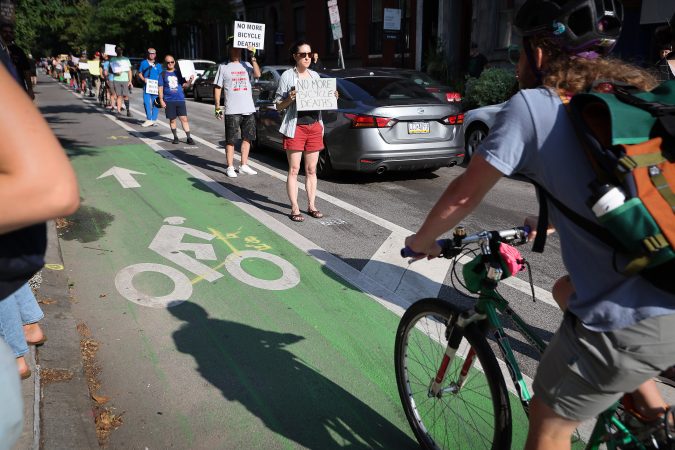
    Philly Bike Action and other advocates are planning an 8:30 a.m. memorial Sunday at 18th and Spruce Streets, where Friedes was killed two summers ago.

    “I’ll also say this: There are a lot more dangerous things happening in those bike lanes, with e-bikes and e-scooters,” Bochetto said. He said a girl on an e-scooter crashed into a light pole near his house, captured by security cameras.

    Garcia did not write an opinion explaining the order.

  • Judge says Trump IRS lawsuit was filed for ‘improper purpose,’ refers lawyer for possible discipline

    Judge says Trump IRS lawsuit was filed for ‘improper purpose,’ refers lawyer for possible discipline

    WASHINGTON — President Donald Trump’s lawsuit against the Internal Revenue Service over his leaked tax returns was filed for an “improper purpose,” a judge said Monday in a scathing decision that referred one of his lawyers for potential disciplinary action and characterized the $10 billion complaint as an exercise in self-dealing.

    U.S. District Judge Kathleen Williams accused Trump and his lawyers of having manipulated the court system when he sued a federal agency under his control, bypassing a requirement that parties in a lawsuit must have adverse interests and laying the groundwork for a settlement that granted him immunity from tax audits and created a fund to compensate allies of the president who say they were unjustly persecuted.

    The judge stopped short of explicitly voiding the deal shielding Trump from tax scrutiny but said the government cannot claim that the agreement was the result of a legitimate legal process.

    “Whether Executive Branch actors can privately agree to give themselves and their former clients blanket immunities and billions of dollars in tax monies for legally undefined grievances was never an issue advanced to this Court,” said Williams, an appointee of President Barack Obama. “The question is whether the Parties could do so by claiming to be adverse and engaging the legitimacy of a court proceeding. The answer is a resounding ‘no.’”

    Ruling comes just ahead of key confirmation hearing

    Though the practical impacts of the ruling may be limited since the lawsuit was withdrawn months ago and the administration had already abandoned the $1.776 billion Anti-Weaponization Fund that came out of it, the order nonetheless amounts to a scathing rebuke and tees up a politically uncomfortable line of questioning for Acting Attorney General Todd Blanche as faces the Senate Judiciary Committee for his confirmation hearing on Wednesday.

    “The nature of the suit itself and the conduct of the Parties and counsel from its filing make plain that this was an attempt to use the Court to provide some legitimacy to an agreement to confer immunity to people and entities affiliated with the President and to earmark billions of dollars from American taxpayers to redress grievances not defined in the law,” Williams wrote in her ruling.

    She added: “The President may be the functional ‘dominus litus’ of the Executive Branch, but as a party to a civil suit, he, as well as all the parties and lawyers before a court, are bound by the rules. Ensuring that our courts are used only for the express purpose created by the Constitution is the obligation of every judge and an obligation that this Court must discharge in light of the matter before it.”

    The suit against the IRS and Treasury Department in January accused the federal agencies of a failure to prevent a leak of the president’s tax information to news outlets between 2018 and 2020.

    In May, however, the administration announced that it was settling the case and creating a fund to compensate people who believe they’ve been mistreated by the criminal justice system. The fund was quickly shelved amid bipartisan backlash, though the Trump administration has said it intends to proceed with a separate element of the deal affording Trump and family members protection from audits.

    From the start, the judge had appeared skeptical of the complaint and assigned a group of attorneys to determine whether there was a conflict in the case since, as sitting president, Trump was suing “entities whose decisions are subject to his direction.”

    Even after the settlement was revealed, she directed Trump attorneys to lay out their positions on whether the parties in the case were truly adverse to each other, whether the settlement was premised on fraud, and whether the case should be reopened.

    She made clear in her ruling that she was not satisfied by the lawyers’ answers.

    “After a review of the record, and the Parties’ statements, the Court declines to adopt or accept the credulous exercise of divorcing President Trump’s current job title from an understanding of what happened here,” she wrote.

    Ruling also raises the possibility of disciplinary actions

    The judge referred Trump attorney Alejandro Brito, who filed the case, for possible disciplinary action before the state bar in Florida and said another lawyer, Daniel Epstein, will not be granted permission to file within the Southern District of Florida for up to a year.

    A spokesperson for the Trump legal team responded to a request seeking comment from Brito with a statement that blamed the IRS for allowing his tax returns to be leaked.

    The judge also ordered that her ruling be sent to the state bars in New York and the District of Columbia, where ethics complaints have been filed against Blanche and Associate Attorney General Stanley Woodward.

    Williams pointed to Blanche’s congressional testimony in early June in which he revealed that the anti-weaponization fund was no longer moving forward. Though nothing had been filed in court, Blanche appeared confident in his testimony that he “could speak for, and bind, both sides of this matter,” Williams said.

    “Acting Attorney General Blanche’s apparent capacity to speak for both Plaintiffs and Defendants, sign a ‘settlement’ document on behalf of all Parties to this action, and then repudiate part of that agreement, demonstrates that there was only one party whose interests were being represented throughout this case,” the judge wrote.

    The judge also raised ethical concerns about Blanche and Woodward’s involvement in the settlement given Blanche’s past representation of Trump as well as Woodward’s previous defense of Jan. 6 defendants and a co-defendant in Trump’s classified documents case.

    “Instead of either recusing because of their previous representations or vigorously defending this lawsuit as required to do so by DOJ policies and procedures, these lawyers agreed to a ‘settlement’ involving a staggering amount of money potentially benefitting former clients,” she said.

    Blanche denied in a CNN interview last spring that he had come up with the settlement terms, saying, “The president has outside counsel, and their counsel, the Department of Justice, not me.”

  • U.S. attacks Iran and Tehran retaliates across the Middle East as both vie for control of strait

    U.S. attacks Iran and Tehran retaliates across the Middle East as both vie for control of strait

    DUBAI, United Arab Emirates — The U.S. launched strikes on Iran early Tuesday morning, hours after President Donald Trump said Washington is “reinstating” a blockade on Iran in the Strait of Hormuz. Trump separately suggested the United States will charge other ships for safe passage, upending hundreds of years of American policy supporting freedom of navigation across the globe.

    Iran responded with attacks targeting Bahrain, Jordan and two tankers associated with the United Arab Emirates traveling through the strait, killing one mariner and wounding eight others. The Emirates threatened to retaliate against Iran, potentially drawing the nation home to Abu Dhabi and Dubai back into fighting with Tehran.

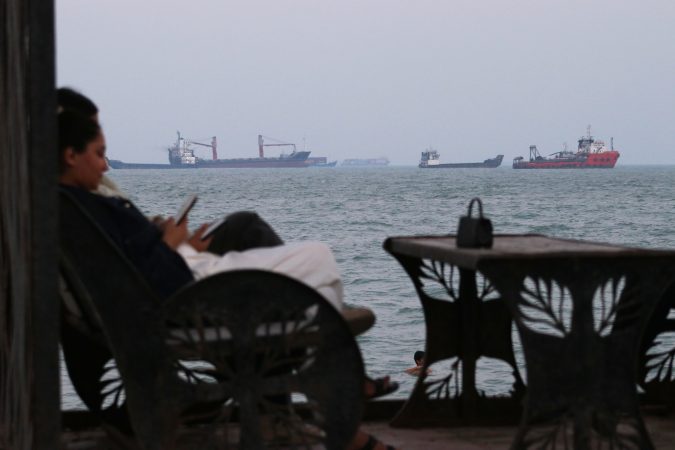
    The attacks come as Iran and the U.S. both vie for control of the strait through which a fifth of all traded crude oil and natural gas once passed in peacetime. The price of benchmark Brent crude oil rose to a one-month high of over $84 in trading early Tuesday, still well below the nearly $120 reached at the height of the war but threatening to make costs everywhere higher.

    Trump insists strait will be open

    The U.S. military’s Central Command said it struck areas around Abu Musa, Bandar Abbas, Bushehr, Chahbahar, Jask and Konarak, targeting Iranian “coastal defense systems, missile and drone sites and maritime capabilities.” Iran acknowledged strikes around those areas, but provided no immediate casualty or damage assessments.

    “These strikes will continue imposing a heavy cost on Iranian forces and degrade their ability to attack innocent civilians and commercial shipping in the Strait of Hormuz,” the U.S. military said.

    Moments after the military announced the new strikes, Trump called it “another major attack.”

    “We’re hitting them very hard. And it’ll continue, and we’ll see what happens,” he told reporters in the Oval Office. “We’re knocking out all of their offensive capability and we’re controlling the straits. We’re putting the blockade back.”

    Trump also provided new details on his administration doing an about-face and suggesting it will charge tolls for ships going through the strait, after previously suggesting that it wouldn’t.

    “We’re protecting a very rich portion of the world,” he said. “We’re spending money. And so, what we’ve done is, we are going to be reimbursed for protection.”

    It’s a change in U.S. policy that, until now, said the strait should remain open to all without tolls — as it was before the U.S. and Israel attacked Iran on Feb. 28. Any attempt by the U.S. or Iran to charge fees would violate global norms on freedom of navigation and raise tensions, likely causing further economic disruption far beyond the region.

    The U.S. Navy has fought for freedom of navigation on the seas since the Barbary Wars and the War of 1812.

    Attacks resume across the Mideast

    The United Arab Emirates’ Defense Ministry said early Tuesday that Iran attacked two tankers in the Strait of Hormuz, killing one mariner and wounding eight others.

    The Emirati Defense Ministry said Iran launched two cruise missiles at the tankers Mombasa and Al Bahiyah.

    The attacks set both tankers ablaze, though the fires were extinguished.

    Iran’s paramilitary Revolutionary Guard claimed the attack on the tankers, saying the vessels “ignored repeated warnings.”

    “They chose to pass through a minefield and were subsequently targeted and disabled,” the Guard said.

    Bahrain also came under renewed attack early Tuesday morning as Iran retaliated over the latest round of U.S. airstrikes. Bahrain sounded its missile alert sirens twice, urging the public to seek shelter. There was no word on any damage or casualties from the attack.

    The Emirati Defense Ministry said the attack on the tankers killed one Indian national and wounded six Indians and two Ukrainians.

    “The UAE reserves its full right to respond to this escalation and to take all necessary measures to protect its territory, its citizens and residents,” the Defense Ministry added.

    The Emirates used similar language before launching attacks against Iran during the war. Fighter jets could be heard overheard Tuesday morning in Dubai.

    The U.S. Embassy in Abu Dhabi and the U.S. Consulate in Dubai alerted Americans early Tuesday that consular appointments had been canceled through Wednesday “due to the regional security situation.”

    Jordan’s military said it intercepted four missiles from Iran, according to a statement carried by the kingdom’s state-run Petra news agency. Jordan hosts U.S. forces and has come under attack by Tehran in recent days.

    Trump says Iran failed a test

    Earlier Monday, Trump told conservative radio host Hugh Hewitt that the agreement reached last month was “built to test” Iran, adding that “when you’re dealing with sleazebags (agreements) don’t mean much.”

    “They didn’t honor the test,” the president said.

    Iran asserts it has the right to manage traffic through the strait and potentially charge fees in accordance with the interim peace deal. The U.S. has disputed that.

    The American military and the United Nations’ International Maritime Organization have tried to establish a route through the strait along the coast of Oman that would be outside of Iranian control. Iran has attacked ships using that route, saying the U.S. is violating the interim peace deal. The U.S. has attacked Iran in response, drawing Iranian attacks on U.S.-allied Arab states.

    Exchanges of fire in recent days had already cast further doubt on the interim peace deal. Washington had lifted a blockade it imposed in mid-April as part of that deal, which also called for the strait to be fully reopened.

    “We are reinstating the THE IRANIAN BLOCKADE,” Trump said on social media. “All other countries will have fair and open use of the Strait.”

    The president said the U.S. would be “reimbursed” by 20% of the value of cargo to help cover “any and all costs necessary to do the job of providing safety and security.”

    The U.S. military said it will resume its blockade of Iranian ports at midnight local Wednesday in Dubai.