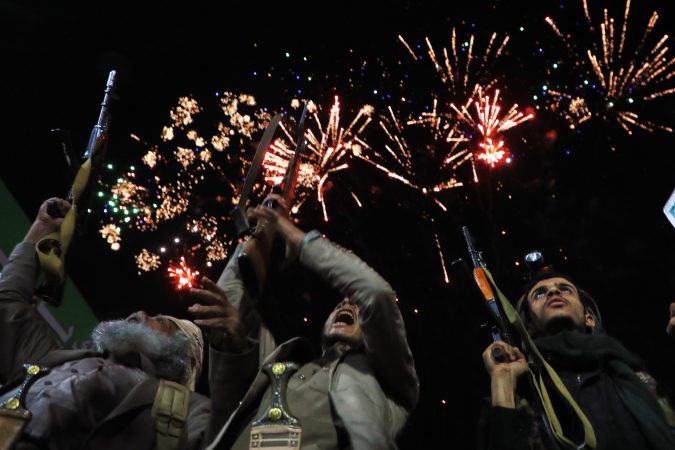
CAIRO — Yemen’s Iran-backed Houthi rebels said Saturday that they fired missiles and drones at Saudi Arabia in response to Saudi airstrikes on the strategic Red Sea city of Hodeida, in an escalation over vital shipping routes in the Middle East while the United States and Iran vie for control of the Strait of Hormuz.
Brig. Gen. Yahya Saree, the Houthis’ military spokesperson, said in a recorded statement that the attack targeted facilities in the Red Sea cities of Yanbu and Jizan that belong to Aramco, the world’s largest oil company.
Saudi Arabia’s civil defense said alerts sounded multiple times early Saturday in both cities, but the kingdom didn’t comment further.
Red Sea escalation further threatens global shipping
The Houthis have said they would close the Bab el-Mandeb Strait to Saudi-linked shipping in retaliation for the kingdom’s blockade on Yemen and a recent attack on the international airport in Yemen’s rebel-held capital, Sanaa.
“Nothing short of ending the aggression and lifting the blockade, otherwise, it’s all illusion and mirage,” Mahdi al-Mashat, head of the Houthi-led Supreme Political Council governing rebel-controlled territories in Yemen, said of what it would take for the Houthis to not blockade the Bab-El-Mandeb.
That strait, at the southern tip of the Arabian Peninsula, is a vital shipping chokepoint connecting the Red Sea to the Gulf of Aden. Around 12% of the world’s trade, including a quarter of its container traffic, passes through the narrows.
The Houthis targeted two Saudi oil tankers in the Red Sea this week. In response, Saudi Arabia struck Hodeida, the Saudi-led coalition opposing the rebels said Saturday. The strikes late Friday hit the port and the state-run telecommunications corporation, injuring two people, said Anees al-Asbahi, a spokesperson for the Houthi-run health ministry.
The Saudi-led coalition said it didn’t hit the port but struck “legitimate military targets” in Hodeida province that “were linked to threats to commercial vessels in the Red Sea.”
Iran’s foreign minister, Abbas Araghchi, called for “diplomacy and dialogue” to solve the Yemen conflict without “military confrontations” in an interview published Saturday by the state-run newspaper called Iran.
Iran condemns Ukrainian attack on commercial vessel
“Iran had a peaceful night,” Hossein Kermanpour, a spokesperson for Iran’s Health Ministry, posted on X.
U.S. Central Command didn’t immediately respond to a request for comment. Unlike the previous 13 nights, it didn’t announce new strikes.
But Iran’s foreign ministry condemned what it called a Ukrainian attack Saturday on an Iranian commercial vessel in the Caspian Sea, saying one person was killed and another was hurt and calling it an act of aggression. In a separate statement, Araghchi said he spoke with European Union foreign policy chief Kaja Kallas about it and that Tehran demanded a response.
Ukrainian President Volodymyr Zelensky earlier said on X that Ukraine “achieved very strong results with long‑range strikes in the Caspian Sea — including vessels used in military cargo shipments involving Iran.”
While efforts at mediation between the U.S. and Iran continue, Israeli Prime Minister Benjamin Netanyahu plans to travel to the United States next week and meet with President Donald Trump in Washington on Tuesday, his office said Friday. They last met in Washington in February, weeks before they launched the war.
Over 7,000 people have been killed, including in Lebanon
A tenuous ceasefire that halted major operations for weeks has seemed to unravel this month. The U.S. accused Iran of striking three ships in the Strait of Hormuz and responded by striking dozens of targets in Iran, which retaliated by firing at U.S.-allied Gulf Arab states.
The U.S. military has renewed its blockade of Iran’s ports. Iran’s Revolutionary Guard has advised residents of neighboring countries to stay away from bases with U.S. troops.
The war has killed more than 3,400 people in Iran, according to its Health Ministry. Eighteen U.S. service members, 24 civilians in Israel, and smaller numbers of civilians including foreign workers and mariners have been reportedly killed across the region.
In Lebanon, more than 4,000 people have been killed since Iran-backed Hezbollah militants fired at Israel in support of the Islamic Republic two days after the war began and Israel responded with strikes and ground forces. Thirty-eight Israeli troops have also died.
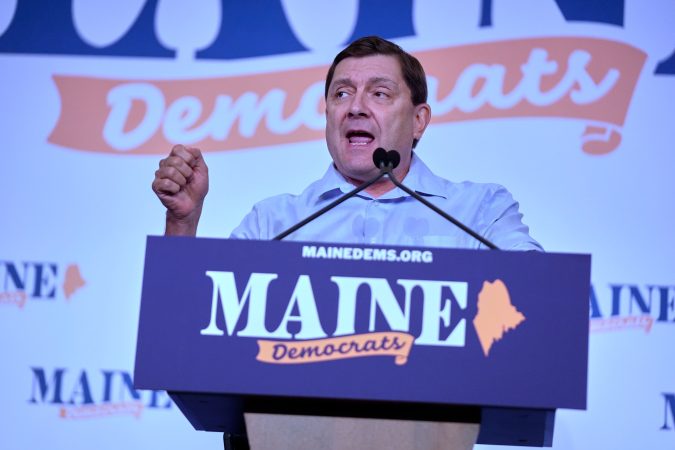
BANGOR, Maine — The Maine Democratic Party formally selected Troy Jackson as its new Senate nominee on Saturday, ending three tumultuous weeks that nearly derailed the party’s quest to unseat veteran Republican Sen. Susan Collins.
With just 101 days remaining until the November election, Democrats must now unify a party riven by the spectacular collapse of Graham Platner’s campaign following a sexual assault allegation and refocus attention on the long-indomitable Collins, whose defeat is key to long-shot Democratic hopes of retaking control of the U.S. Senate.
Accepting the nomination from a convention center in downtown Bangor with a 31-foot-tall statue of Paul Bunyan outside, Jackson repeatedly framed the election not as a partisan fight but an opportunity for the working class to stand up to a creature of Washington who had grown more loyal to her corporate benefactors than her constituents.
“This movement is not from the left. It’s not from the right,” he said, as supporters waved “Retire Susan” signs in the crowd. “It’s from the bottom — and we are growing.”
Jackson is a 58-year-old logger and former leader of the Maine Senate who aligned with Platner and Sen. Bernie Sanders (I., Vt.) during an unsuccessful run for governor this year.
He won the nomination by commandeering the progressive movement that had propelled Platner. Jackson’s supporters swept the delegate selection process for a hastily organized convention to choose Platner’s replacement, compelling most of Jackson’s rivals to drop out ahead of the meeting Saturday in Bangor.
Jackson’s challenge is to forge a broad coalition that can win in November, including the independent and crossover Democratic voters who have helped Collins hold on for five terms in an increasingly blue state.
Jackson has his own vulnerabilities — including a long history of opposing abortion rights and a temper that undercut his legislative leadership in Augusta — that could hurt his appeal with women voters who have been critical to Collins’s victories. He has also been reluctant to align with the national Democratic Party, which could provide critical resources in a marquee race.
Ahead of the convention, Democratic-leaning voters in Bangor remained wary of Jackson but highly motivated to beat Collins.
“Progressives and Democrats are often put in this position where we have to vote for whoever is put up against the greater evil,” Molly Wunderli, a 36-year-old graphic designer, said Friday as she left the library downtown.
An unenrolled voter who considers herself to the left of the Democratic Party, Wunderli expressed frustration that Platner was not properly vetted and about the rushed process to choose his replacement, which put the decision in the hands of just 600 people. But given the stakes, she said there was no question she would vote for Jackson in November.
“I hope he’s as advertised,” Wunderli said. “I’m always worried now about the other shoe dropping.”
The campaign has been clouded since the beginning by a bitter ideological battle among Democrats. While the national party establishment recruited Maine Gov. Janet Mills to run, the progressive base in Maine rallied around Platner, a combat veteran and oyster farmer whose populist outsider platform electrified liberal voters.
Mills’ candidacy fizzled before the June primary, even as Platner was beset by an escalating series of scandals that he largely attributed to poor mental health following his military service: old social media posts dismissive of sexual assault, a tattoo resembling a Nazi symbol, sexually explicit text messages he sent to other women after he married, and allegations by ex-girlfriends who described volatile relationships with him. Efforts by national Democrats to push Platner aside only infuriated his supporters, and he won the nomination handily last month.
Then came an accusation of sexual assault from a woman Platner used to date, which he has denied. Under pressure from allies and threats from national Democrats to withhold financial support, Platner withdrew on July 10, setting off a scramble to find a new Democratic candidate.
That was demoralizing for progressive Democrats like Percy Williams, a 29-year-old middle school English teacher from Bangor. She was excited not only by Platner’s policies but also a persona that she believed carried a wide appeal in Maine.
“Some of my family members are Republicans, and they liked him because he talks like them,” Williams said.
While she had hoped Secretary of State Shenna Bellows, another unsuccessful gubernatorial candidate this year, would replace Platner, Williams said she came around on Jackson because “he’s the best that has a shot at actually winning.”
The Platner scandals still cast a pall over the race — and Collins will inevitably try to tie Jackson to the man with whom he shared such close political ties.
A Republican super PAC released its first ad on Saturday, highlighting Jackson’s temper and history of clashing with female colleagues. “Troy Jackson is like Graham Platner, but worse,” the narrator warns.
Jackson never mentioned Platner during the convention, but he did nod to the concerns about his anger. He was introduced by a former state legislator he once fought with, who praised his passion. Jackson told reporters later that “I do wear my heart on my sleeve,” but he always apologized to “anyone that I may have argued with that I might have went too far.”
But even Democratic voters unenthusiastic about Jackson are furious at Collins. A common criticism is that Collins, who presents herself as a moderate who will stand up to President Donald Trump, only breaks with him on votes that she knows Republicans will win anyway.
“She’s had multiple opportunities to be a Margaret Chase Smith and stand up for what’s right,” said Frank Bragg, an 85-year-old retired physician, referencing the former Maine senator who delivered a famous floor speech in 1950 denouncing McCarthyism. “And she’s just gone along with Trump.”
Bragg pointed to Collins’ support of the Save America Act, a Trump priority that would require photo identification to vote and roll back most mail voting, despite Maine overwhelmingly rejecting a similar ballot measure in November.
A Republican-turned-Democrat who once supported Collins in her early elections, Bragg said he appreciated what the senator had done for Maine, “but it’s also about standing up for the country.” He will vote for Jackson in November, though Bragg considers him “sort of another machine politician. It’s a bit of the same old, same old.”
With his nomination essentially sewn up before the convention, Jackson has already begun consolidating Democratic support in Maine and shifting his message to attacking Collins.
He secured endorsements from most of his opponents for the Senate nomination ahead of Saturday, as well as from Hannah Pingree, who defeated Jackson in the gubernatorial primary in June. Social media accounts for his campaign are pumping out posts slamming Collins for her closeness to the Trump administration and for confirming to the Supreme Court Brett M. Kavanaugh, who provided a decisive vote to overturn the constitutional right to abortion.
But an ongoing rift with national Democrats could complicate the campaign. Despite his extensive history in elected office, Jackson is, like Platner, running as a disrupter — emphasizing his roots in conservative northern Maine while favoring progressive policies to rein in corporate power, expand healthcare access, and dismantle U.S. Immigration and Customs Enforcement, the controversial federal agency involved in a fatal shooting in Biddeford this month.
Jackson told the New York Times this week that, if elected, he would not support Sen. Chuck Schumer (N.Y.) continuing as Democratic leader of the Senate. He also expressed doubt about accepting help from Schumer, who has thus far declined to endorse Jackson, in the general election.
That could be an enormous handicap for Jackson, who is not a prolific fundraiser. Conservative groups have already lined up tens of millions of dollars to defend Collins.
Elizabeth Hannigan, a 33-year-old data analyst from the Bangor area, recalled seeing a Collins ad nearly every commercial break during the World Cup, touting all of the money she’s brought home to Maine. Hannigan said she worries whether Jackson will have enough time to mount a victorious campaign.
She wants Jackson to “get the national party behind him, not just the Sanders wing.” Hannigan, who considers herself to the center of the Democratic Party, said it would provide a signal of trust; she does not want to elect another Sen. John Fetterman (D., Pa.), a onetime progressive champion who has increasingly broken with his party since he arrived in Washington in 2023.
“I want someone who will vote with the general Democratic agenda,” Hannigan said.
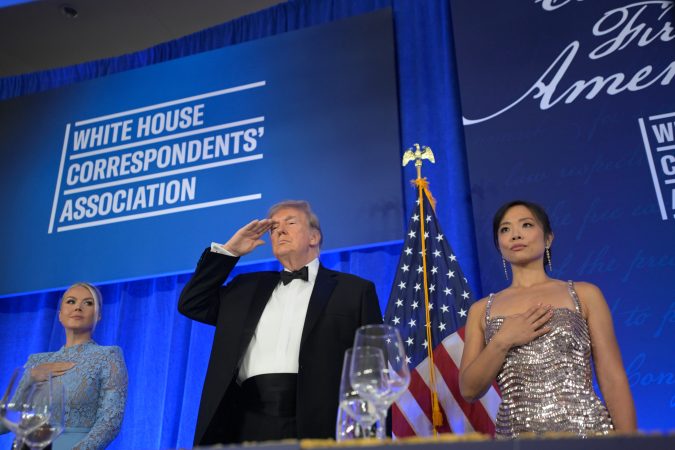
President Donald Trump attacked a slew of journalists and some of his favorite political foils at a slimmed-down redo of the White House correspondents’ dinner on Friday, comparing one female reporter to a transgender social media star, mocking politicians’ physical appearances, and bringing his audience to mostly stunned silence for more than an hour before pulling out a red Trump 2028 cap and declaring he was running for another term.
Three months after a gunman exchanged fire with authorities outside the first correspondents’ dinner, throwing the event into chaos, Trump addressed reporters even as he embraced an aggressive stance that favors targeting journalists to root out leakers in his administration.
Trump veered on and off his prepared script for the evening, at one point calling it a “fricking stupid speech.”
The fraught event put the president on the dais with reporters who have covered him aggressively. Trump rarely speaks to audiences that aren’t packed with his supporters, leading to an unusual dynamic in a ballroom of reporters who are professionally bound to maintain poker faces.
Some of his first jokes drew laughs, including one that acknowledged the interrupted first run of the meal.
“I hope that everyone finally got to enjoy their entire, very delicious beef tenderloin, very special beef. And I want you all to know that Bobby Kennedy, who’s right here, personally ran over the cow with his car,” he said.
But the tone quickly shifted to a far more caustic attack on his favorite foils, including some of the reporters in the room. The bitterness was sharper even than some of his political rallies, where attacks on his enemies are leavened with boasts of his accomplishments. On Friday, he had little to sell, and a lot to complain about.
He said that he had once mixed up CNN reporter Kaitlan Collins, whom he said “never smiles,” with a transgender social media personality, Dylan Mulvaney, after he called the 34-year-old cable news star a “young, attractive woman.”
He said he planned to host twice-weekly fights at the White House.
“We will have sloppy Chris Christie, one of the sloppiest human beings, fighting,” Trump said to silence. “I could mention the governor of Chicago, but I’m going to mention instead Jerry Nadler. Oh my God! They’re fighting for a big piece of cheesecake, big fat piece of cheesecake.”
Then he told a joke about Sen. Adam Schiff (D., Calif.).
“I hate some people,” he said to groans. “He’s a liar, and I called him watermelon head because he has the largest head I’ve ever seen with the smallest neck, pencil neck. How does that make a fat, ugly head on a little pencil neck?”
Commerce Secretary Howard Lutnick laughed at that one, putting his hand on his forehead.
“This night is all about the First Amendment. Tonight was a full display,” CBS chief White House correspondent Weijia Jiang said after Trump finished talking. As the outgoing president of the White House Correspondents’ Association, Jiang led the event. She complimented Collins and a Wall Street Journal reporter whom Trump also attacked during his speech.
The speech took place as the administration has stepped up its legal pursuit of journalists who report on subjects that the White House views as national security threats, with Trump saying Friday that he believed journalists were legitimate targets for investigation.
A federal judge offered a withering takedown a day earlier of the Justice Department’s effort to subpoena New York Times journalists over their reporting about security concerns around a new, Qatari-gifted Boeing 747 the president has been using as Air Force One. Trump was unrepentant.
“We’re not after journalists. We’re after leakers. We’re after people that are cowards, people that are unpatriotic, people that are treasonous in many cases,” Trump said in the Oval Office a few hours before the correspondents dinner. “And the way you find them is through the journalists. When the journalists probably know they shouldn’t write, they shouldn’t be giving information out like that.”
He said that even though the Justice Department withdrew the subpoenas on Thursday, “we have a long way to go with that case,” suggesting that the New York Times reporters’ legal peril was not over.
Trump had offered mixed messages about his plans for a dinner that traditionally has involved presidents giving lighthearted speeches that poke fun at themselves and at the people who cover them.
In the event, he offered a mix of barbs directed at the press and his political opponents, with a few toward his own administration.
“We’ll do a little ripping, if you don’t mind,” he said, saying that “this place is the really largest group of Trump derangement syndrome people ever put together at one time.”
He said that the speech he had originally planned to deliver, “I’m telling you, I had something. I was going to go after you.”
Media critics have long questioned the White House correspondents’ dinner, which was first held in 1921, saying that it is an overly cozy moment of socializing between the president and reporters who cover the White House. Trump skipped the event during his first term.
Trump acknowledged that Friday’s speech was his first to the annual dinner. And he joked that he didn’t plan to do it again, unless the event was renamed the “Trump White House Correspondents’ Dinner” — a line he delivered with a chuckle, before later saying that he planned to come next year.
Trump came to the dinner once before, as the guest of the Washington Post during the Obama administration. President Barack Obama mocked Trump that year over his questioning of Obama’s citizenship. Many analysts have credited that moment with sparking Trump’s decision to run for president, but Trump said Friday that wasn’t true, and that he had enjoyed the moment because of all the attention.
Before the president took the stage, he was confronted with reporters whom he has attacked and who have won awards for aggressive coverage of his administration.
He greeted one of the lead Associated Press reporters who was kicked out of the White House press pool because the outlet refused to relabel the Gulf of Mexico to Trump’s preferred “Gulf of America.”
He shook the hands of a team of Wall Street Journal reporters who won an award for their coverage of his connections to convicted sex offender Jeffrey Epstein. He shrugged his shoulders and smiled as CNN anchor Wolf Blitzer recounted how he had sued the Journal for $20 billion and how one reporter was forced to relocate her family because of threats against them.
Then he greeted Tyler Pager, a New York Times reporter who was served with a subpoena this month for his coverage of security issues around Air Force One.
The Society of Professional Journalists called this week for the White House Correspondents’ Association to use the dinner to condemn the Trump administration’s attacks on journalists.
“We believe it is hypocritical to celebrate the First Amendment in front of the man who relentlessly attacks it,” the group said in an open letter.
Trump never delivered the speech he planned for the April 25 dinner at the Washington Hilton before it was interrupted by a gunman who attempted to storm the basement ballroom where the dinner was being held. Cole Tomas Allen, 31, has been charged with attempting to assassinate the president, and an FBI special agent said in an affidavit that Allen had set an email to be sent to friends and family with “targets, prioritized from highest-ranking to lowest.”
Trump acknowledged the risks around the event, saying, “It was not easy finding shoes to go on with your bulletproof vest, which many people didn’t want to wear, because they’d rather die than look 20 pounds heavier. … They put one on me. I said: ‘Are you sure? I’m not wearing this.’”
Security was high at the event, which was held at the Waldorf Astoria in downtown Washington. Trump’s family company operated that venue as the Trump International Hotel during the president’s first term, then sold their lease on the property in 2022 for $375 million.
The guest list had shrunk to fewer than 700, a stripped-down affair with attendees including mostly just the journalists who cover the president, rather than the more than 2,500 — including government officials, political operatives, and mostly B-list celebrities — who attended in April.
But many of the original tensions remained.
In the hours following the April shooting, Trump was unusually conciliatory toward reporters, making an appearance in the White House briefing room still dressed in his tuxedo as he took questions from many of the reporters who had been at the dinner earlier in the evening.
But that tone dissipated by the next day, when he called CBS News anchor Norah O’Donnell “a disgrace” after she read excerpts from the alleged gunman’s manifesto to him.
Since then, his administration has returned to attacks on the press.
Trump last week called for stripping broadcast licenses from networks that didn’t air his primetime speech about election integrity. And the Justice Department this month issued the subpoenas to New York Times journalists who had reported on security concerns surrounding the luxury Boeing 747 that the Qatari government gifted for use as Air Force One, seeking their phone records in pursuit of leaks.
One element of the dinner was consistent with April: Entertainer and magician Oz Pearlman was once again on the program, a selection that sidesteps the politics of humor. This time he guessed correctly that acting attorney general Todd Blanche had $85 in his pocket.
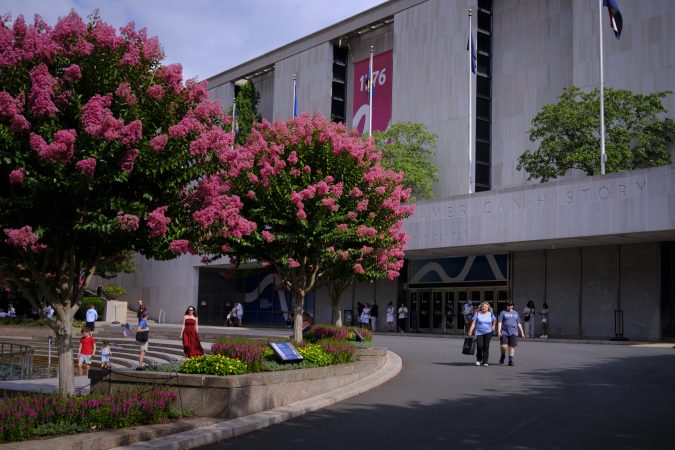
President Donald Trump on Friday ordered the installation of signs outside the Smithsonian’s National Museum of American History that warn people that the museum does not accurately reflect American history while pointing them to material that does — a dramatic escalation in his campaign to wrest control of how the nation’s story is told.
The executive order, signed at the end of a week of contentious congressional hearings on the museum, directs Interior Secretary Doug Burgum to erect temporary signage along the National Park Service-controlled sidewalks and walkways the public uses to reach the museum. The signs would inform visitors of the White House’s criticisms, tell them the museum’s exhibits “should be renovated,” and direct them elsewhere “to locations and resources for accurate information regarding America’s history.”
The move marks a new front in a 16-month pressure campaign against the Smithsonian Institution that has included museum content reviews, funding threats, and a successful effort to push out a museum director. Now the White House is moving to plant a competing government narrative on the ground outside one of the country’s most visited museums — an approach historians say has no precedent.
Trump grounded the order in the White House Domestic Policy Council’s July 4 report, “Saving America’s Story,” which he said “demonstrates that the Smithsonian leadership does not present American history as a shared national inheritance to be taught and celebrated, but instead views American history as a ‘prime tool’ to advance ideas of social justice and the radical transformation of our society.”
A companion White House statement went further, accusing the Smithsonian and its history museum of veering “toward extreme political activism, rooted in Marxism, to divide, dispirit, and discourage Americans.” It said that “in the last decade, Americans have witnessed a concerted effort to rewrite American history and force our Nation to adopt a factually baseless ideology aimed at discrediting American heroes and diminishing American achievement.”
Trump also accused the museum of failing to appropriately honor the 56 signers of the Declaration of Independence during the country’s 250th anniversary year, and directed Burgum to install temporary exhibits or signage on Park Service land that “corrects inaccurate information presented in the Museum.”
The Smithsonian declined to comment. Its leaders have said the White House’s report mischaracterizes the museum, and that they are committed to accuracy and nonpartisan scholarship.
The order drew swift condemnation from Democrats who oversee the institution. Rep. Melanie Stansbury (D., N.M.), ranking member of the House Administration Committee, called it “one of the dumbest and most bizarre Executive Orders we have ever read.”
“This EO is a clear political overreach, driven by an ideological agenda to rewrite American history,” Stansbury wrote on X. “Our Smithsonian institutions do not belong to the President, but to the American people and so does our nation’s history.”
Sarah Weicksel, executive director of the American Historical Association, said the plan to station government material outside the museum was “an absolute affront to the professionals who work in that building” and likened the signage to issuing a trigger warning to visitors before they encounter exhibits such as the Star-Spangled Banner.
“There’s no precedent for this,” Weicksel said. She noted that the Smithsonian has weathered exhibit controversies before — most famously over its presentation of the Enola Gay and the bombing of Japan — but said the executive branch had never before sought “to present a completely alternative narrative” to the one told inside the national museum.
The report and order rested on “a very narrow and very circumscribed definition of patriotism,” Weicksel added, one at odds with the founding generation the administration invokes. The nation’s founders, she said, understood that “one’s love of nation is tied to recognizing where it has gone wrong, where it can do better.”
Her deepest worry, she said, was that the campaign would erode public trust in an institution that teachers and researchers have relied on for more than 150 years.
“The White House is essentially telling the American public not to trust the Smithsonian Institution,” she said.
Conservatives who have long pressed for change at the Smithsonian welcomed the order, though some hoped it would go further. Mike Gonzalez, a senior fellow at the Heritage Foundation who testified at both congressional hearings this week, said the provisions he valued most were those naming administration officials, including Domestic Policy Council chief Vince Haley, and directing them to use “any and all available authorities” to force corrections.
“If they can use this EO to clean house and get rid of the leadership, then that would be great,” Gonzalez said, adding that he thought installing the signs “is a clever thing.”
When asked if he had consulted with the White House on the report or the executive order, Gonzalez said any such conversations would be “private.”
The order is the latest chapter in a fight that has escalated steadily since Trump’s March 2025 executive order demanding “improper ideology” be removed from the Smithsonian. Since then, the White House has launched reviews of the content of several Smithsonian museums, criticized specific exhibits and wall texts, and threatened to withhold funds already approved to the institution if it fell short.
As a public-private institution, the sprawling museum and research complex is historically independent, with a federal budget appropriated by Congress. But those funds are disbursed by the White House’s budget office, and the administration has said all spending must align with the president’s orders.
The White House report’s footnotes signal the pressure will continue, promising a “future update” on the Smithsonian’s approach to diversity, equity, and inclusion.
There was one especially pleasant weekend back in June, as summer was officially arriving and Philly was in the middle of hosting three Group Stage matches for the World Cup. It was breezy with sunshine and low humidity and temperatures in the mid-80s; nothing like two weekends later as America turned 250 and temperatures hit 101 degrees or higher for three days in a row, the first time that happened in over 150 years of record keeping.
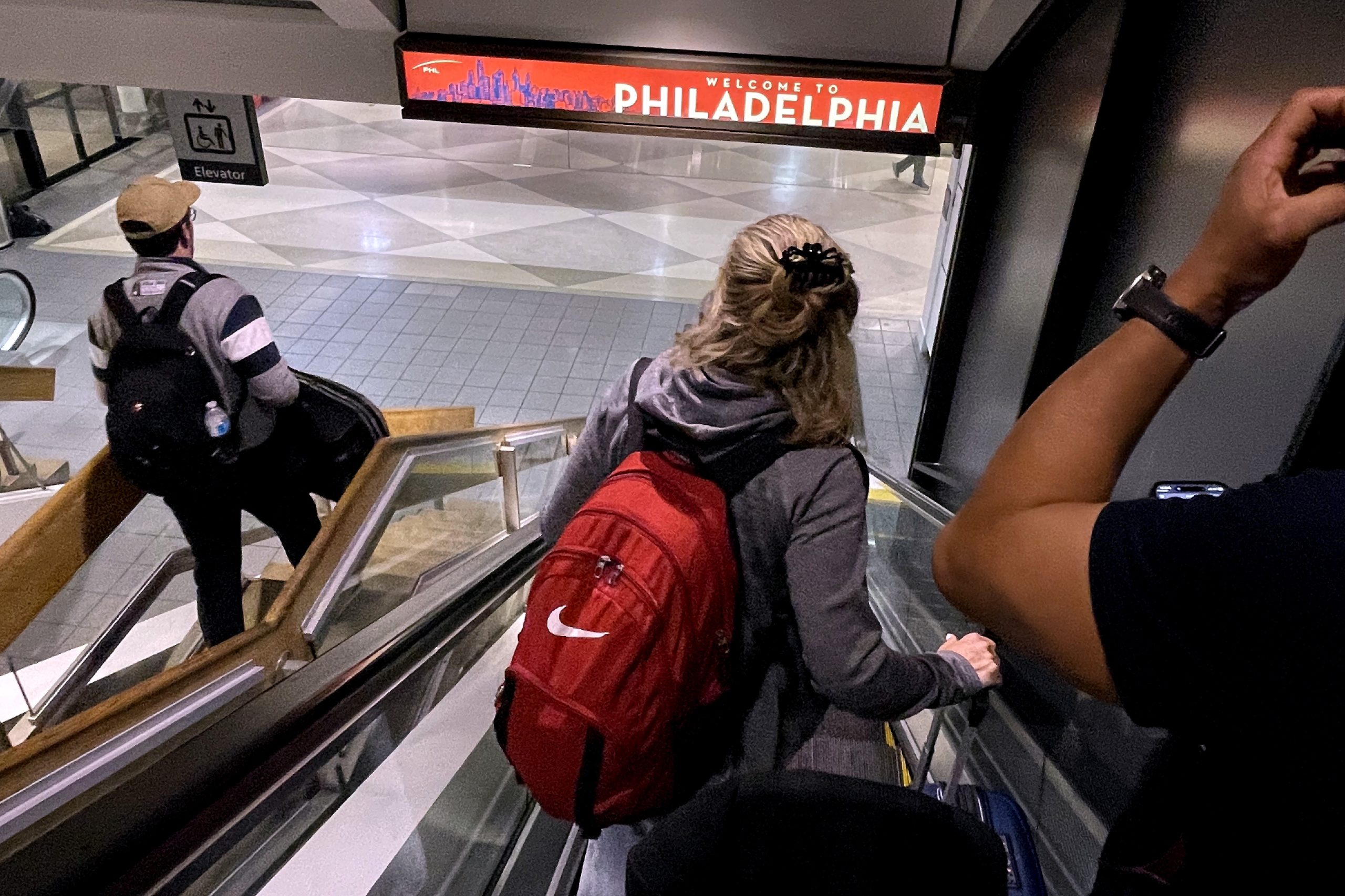
Between covering some news that weekend, I walked around Center City just soaking up the street scene. It wasn’t just the wonderful weather, but an international vibe that was welcoming and friendly. I watched visitors speaking multiple languages rolling suitcases in and out of hotels and ride share cars, and saw sidewalk cafes overflowing with different colored jerseys and scarves.
Philadephia International Airport arrivals June 21, 2026.Tom Gralish / Staff Photographer
It reminded me of the energy I feel almost every time I walk around the city, going back to my first night here and the weeks spent in my early days at the newspaper with unhoused men.
We’ve long known we have one of the most walkable downtowns in the country, but USA Today told everyone else again this summer, naming Philadelphia number one — for the fourth year in a row. Center City is compact and easy to explore on foot, with many stores, restaurants, museums, attractions, and parks all within a short walk.
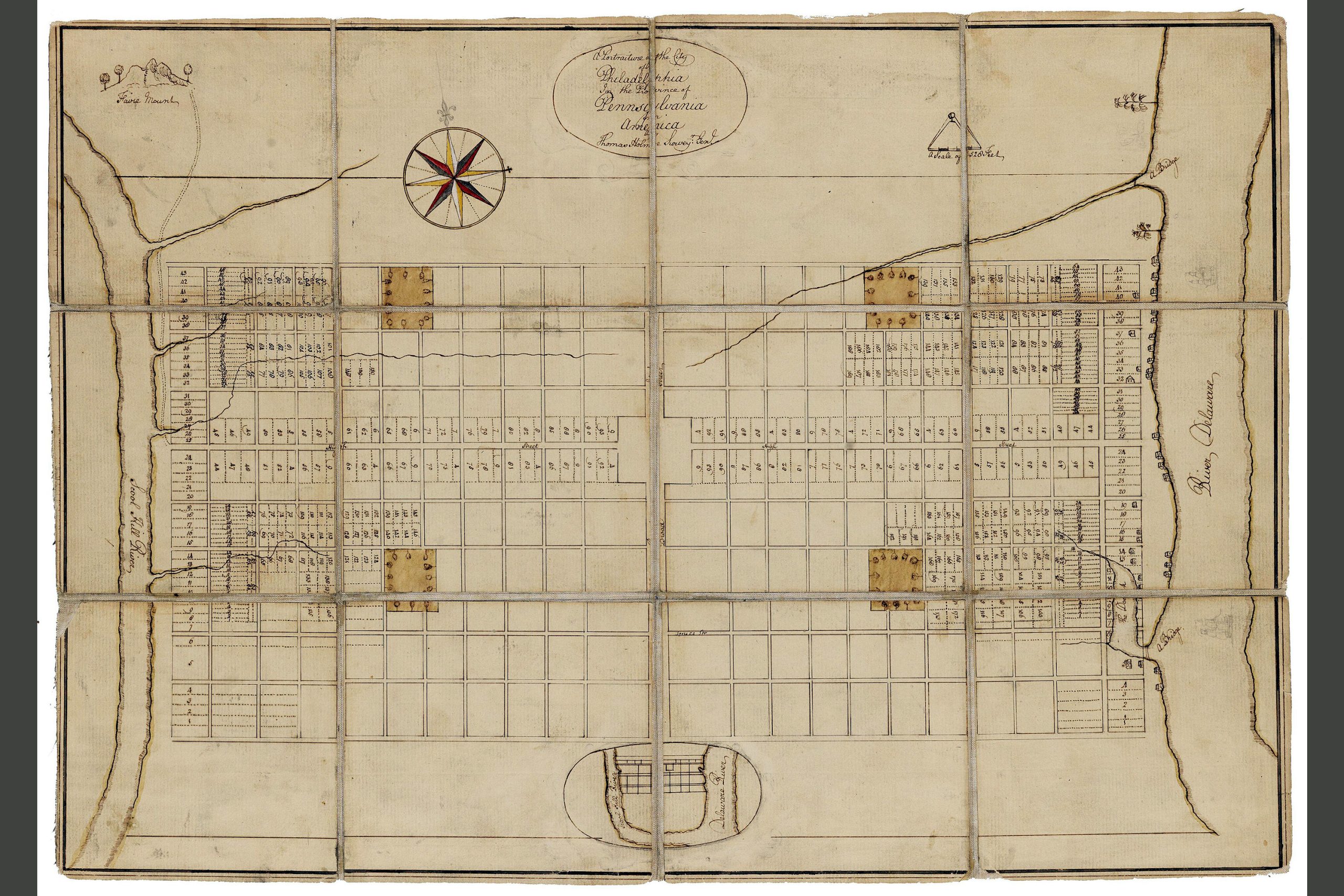
“A Portraiture of the City of Philadelphia, In the province of Pennsylvania in America” by Thomas Holme. In 1682, William Penn appointed Holme surveyor-general of Pennsylvania and charged him with the task of laying out the “greene country towne” that Penn envisioned. This map, printed in London, was used for both reference and promotional purposes to show the unique layout of Penn’s emerging city.Historical Society of Pennsylvania
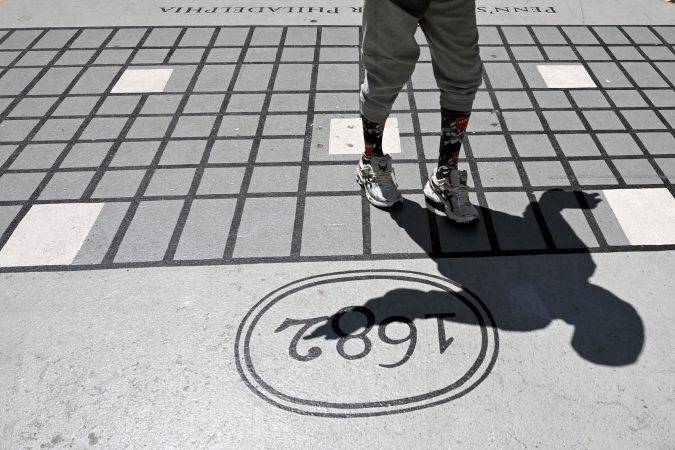
Credit William Penn’s 1682 street plan that created small rectangular blocks with straight, predictable streets. I was thinking about that as I looked down at the grid on the ground in the courtyard of City Hall, when Lyn-el “The Torch” Wright paused right in front of me: “take a picture of my sneaks.” That’s his shadow above.
I did, and asked if they were special, wondering if they had something to do with Adidas, the official World Cup sponsor and match ball provider. No, not really, he said, but then educated me on what the kids today were wearing: Asics and Saucony. And Salomon.
So, being a history nerd, I had to enlighten him on the design he was standing on. Titled “Compass Rose,” it was commissioned by Edmund Bacon in 1994 as a gift to the city to mark Penn’s 350th birthday. It was painted by David Salama and Pat Sprott and updated by Mural Arts Philadelphia in 2004, 2015 and 2022. It marks the exact center of the middle of Penn’s five squares (Franklin, Logan, Rittenhouse, and Washington being the others).
I didn’t actually say all of that (unlike similar “TED Talks” my grandson is subjected to), but our conversation is the other thing I like most about walking around Philadelphia. Meeting and talking to people.
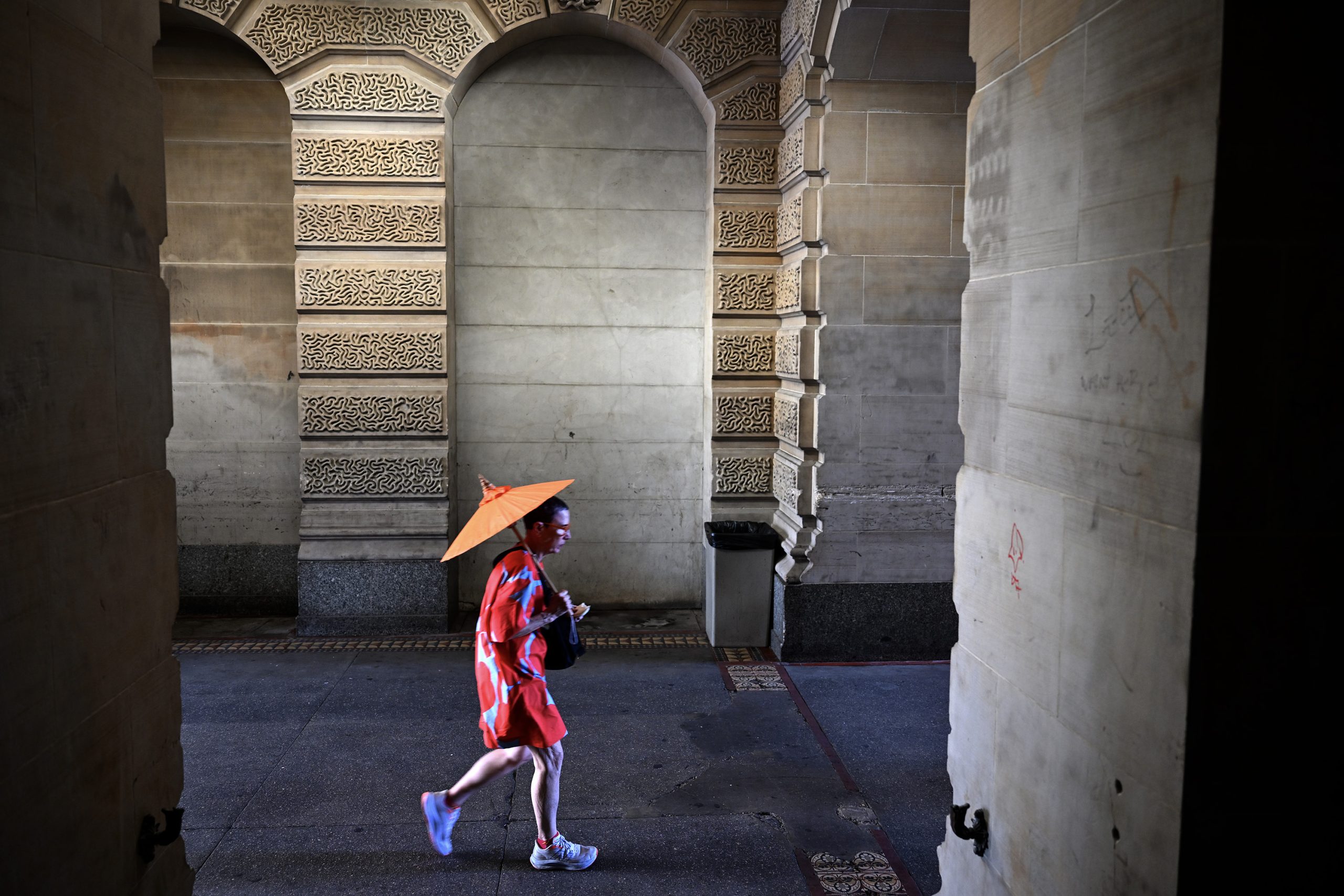
Passing through the south portal of City Hall on Monday, July 20, 2026. She said the umbrella was a recent purchase. “Anything to keep cool in the heat.”Tom Gralish / Staff Photographer
The day was a remarkable one in Center City, similar to the summer solstice back in June. And it was coming off the week of heavy rains, microbursts, and then, the Canadian and Great Lakes wildfire smoke that moved into the region.
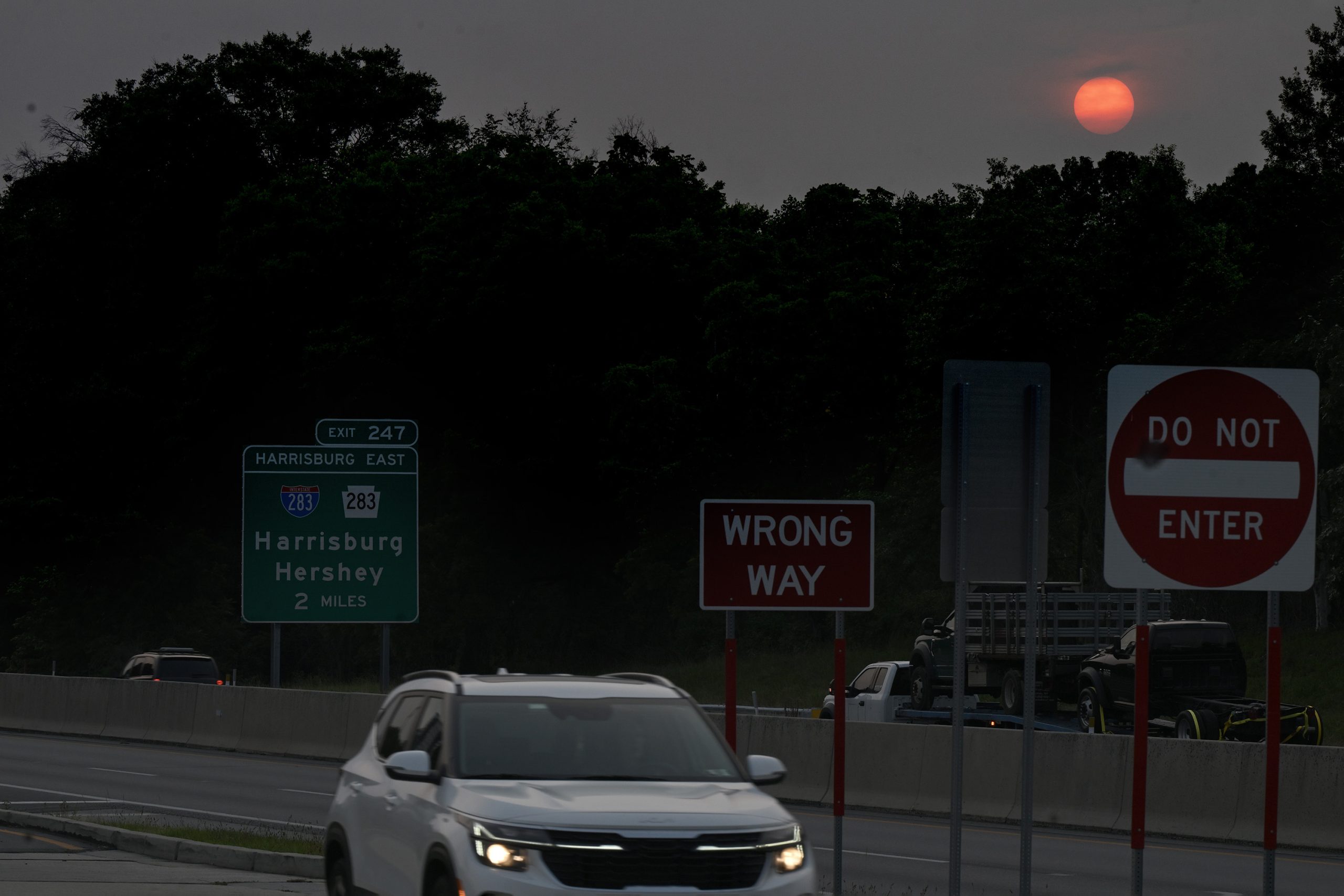
The sun sets in a hazy sky over the Pennsylvania Turnpike Wednesday, July 15, 2026.Tom Gralish / Staff Photographer
When the skies finally cleared last Sunday, I joined hundreds of outdoor enthusiasts taking advantage the improved air quality and photographed along the Schuylkill River Trail.
I scouted angles to get as many people — and a variety of runners and walkers — in the same frame. But, perhaps because I covered a memorial for Barbara Friedes, a 30-year-old CHOP doctor who was killed on her bike by a drunk driver in July 2024, my attention drifted toward the bicycles.
When I saw a patch of backlit trees I knew if I panned with my camera and a slow shutter speed the highlights would turn into nice blurs — while the biker would be (somewhat) sharp and in focus.
One of the advantages of digital photography is that you can get immediate feedback and adjust your camera settings for the effect you desire. I wanted to get a colorfully outfitted biker, and by the time the “right” one passed in from of me, I was set (1/20th second at f/22, with an ISO of 640 on my Nikon Z8 with a 24-70mm lens).
Finally, here’s one more “nice day” photo I made after talking with “The Torch.”
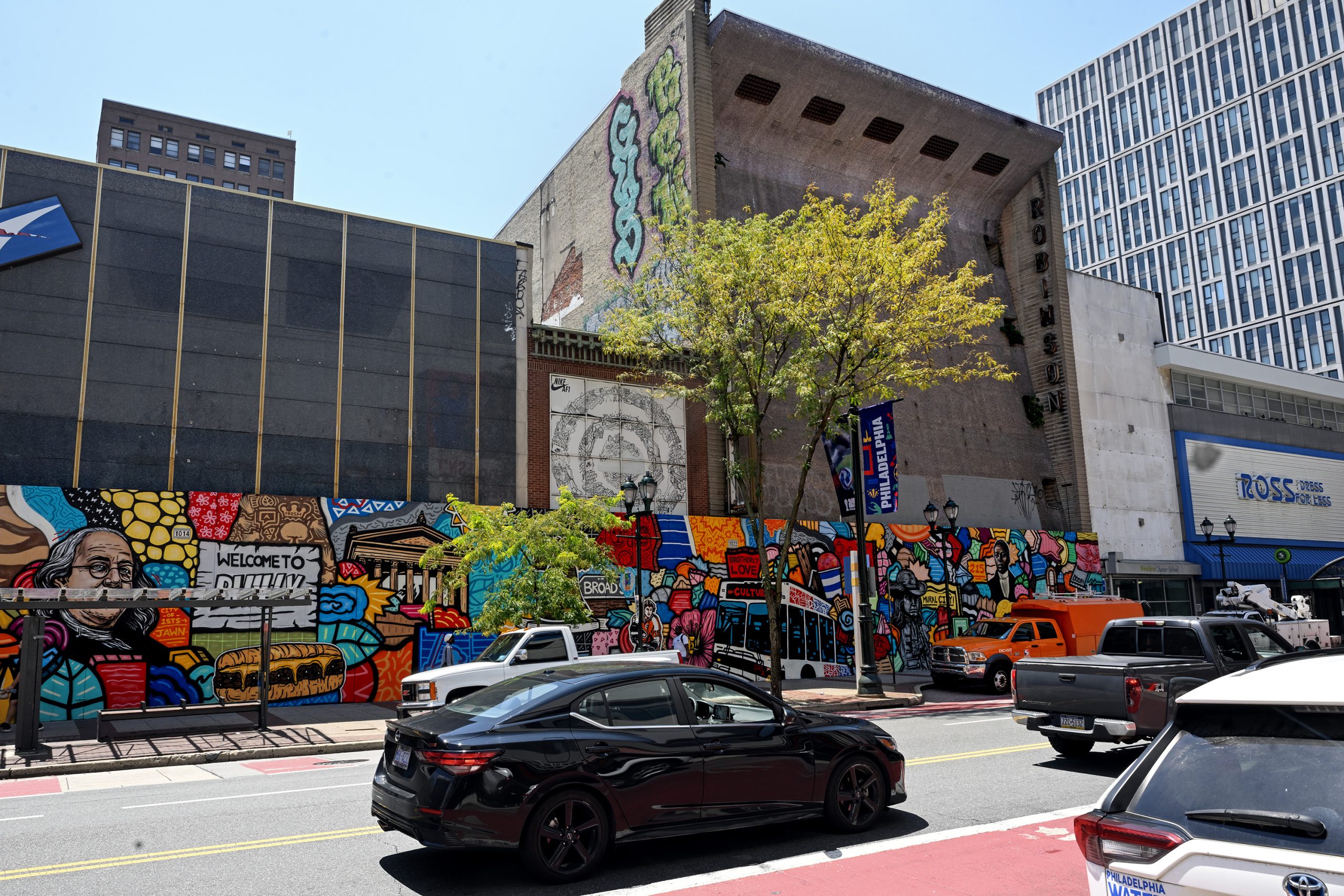
I spent a good part of the winter and early spring of 2024 along an eight block stretch of Market East while the city was dreaming and debating its potential driven by later-scraped plan by the Sixers to build a $1.55 billion downtown arena.
It was a tattered corridor, especially the south side of the 1000 block that was mostly boarded up storefronts. The city started trying to freshen it up before our summer of celebrations.
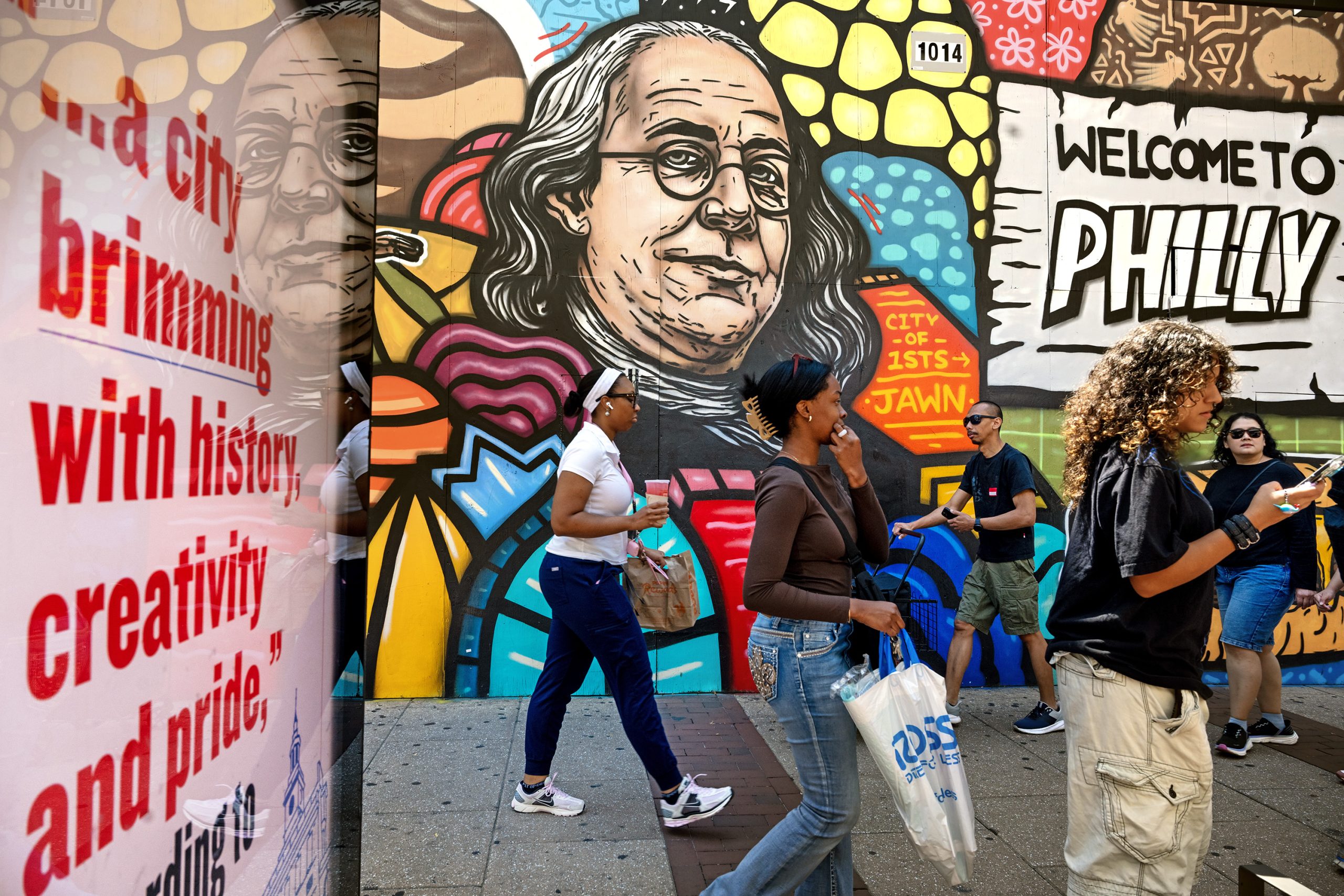
Walking there on Monday I admired the 150-foot mural “Welcome to Philly” artist Alloyius McIlwaine was commissioned to paint there before the big summer. I didn’t want to merely record his month-old work, but as I stepped into a bus shelter to get out of the flow of pedestrian traffic, I was immediately stuck by Ben’s reflection in the shelter’s glass — and the words of an unrelated advertisement.
I didn’t want a photo that called too much attention to a single fellow walker, so I waited patiently for that magic moment when my frame was filled with a half-dozen people.
Since 1998 a black-and-white photo has appeared every Monday in staff photographer Tom Gralish’s “Scene Through the Lens” photo column in the print editions of The Inquirer’s local news section. Here are the most recent, in color:
Following my first visit to Boston two years ago, I penned a column (against my better judgment) bemoaning what a surprisingly good time I had there (against my will).
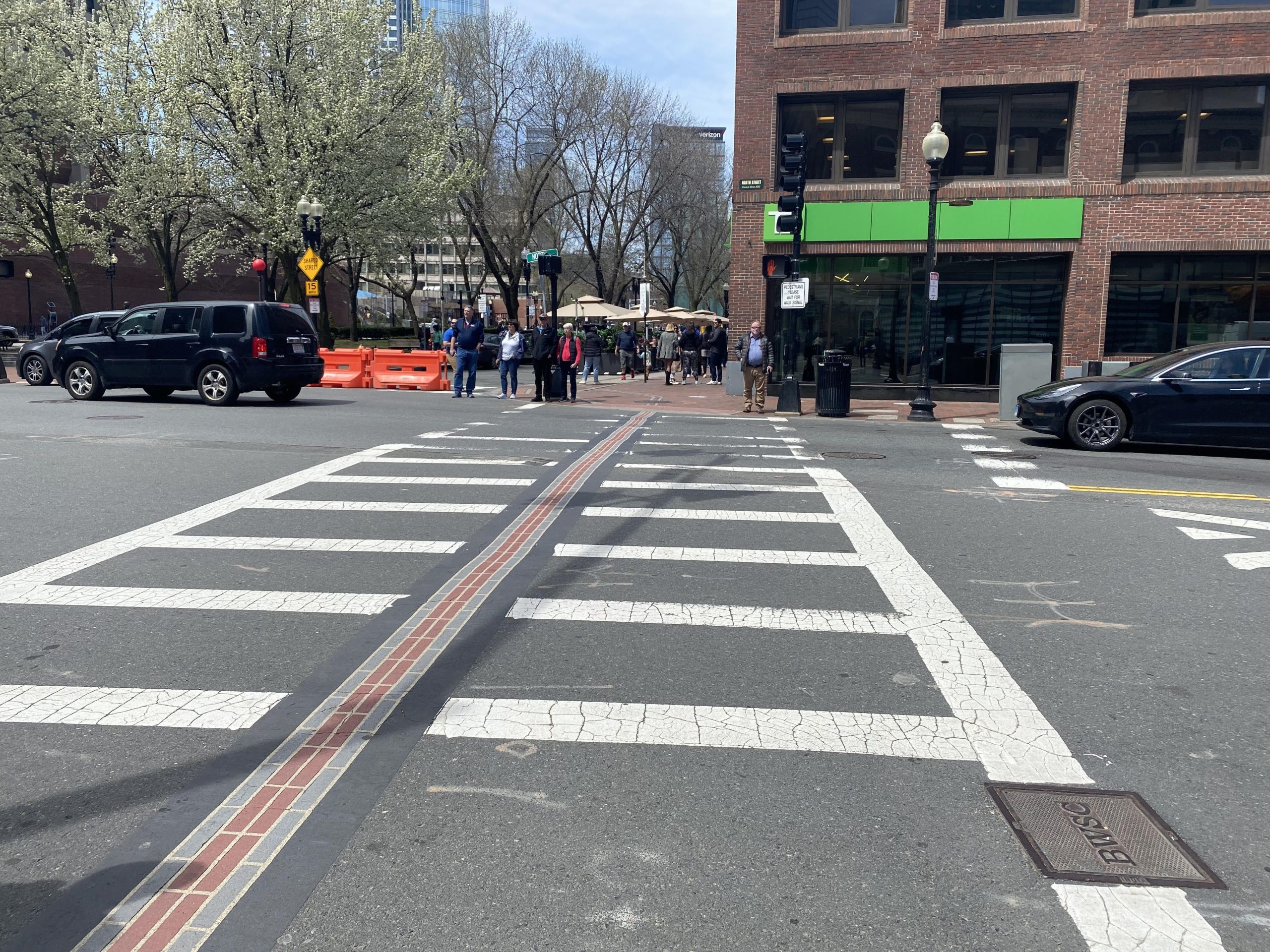
I was particularly taken with the city’s Freedom Trail, a 2.5-mile walking path embedded in Boston’s sidewalks that leads to 16 historic sites. Far from being half-baked, I had to admit this Beantown tourist attraction was “annoyingly great.”
Look at the Freedom Trail being all cute running through this Boston Street. Gawd! STEPHANIE FARR / Staff
Why didn’t we have anything like this in Philly, I wondered, and could we get our own version in time for the nation’s 250th anniversary?
I was flooded with emails in response from readers who not only agreed with me, but offered route suggestions and names for a potential Philly path. I also received a cryptic message from someone at Visit Philadelphia who said they had some things up their sleeves.
That was more than two years ago and I’d all but given up hope. Then I received an email this month from Jenea Robinson, vice president of communications for Visit Philadelphia.
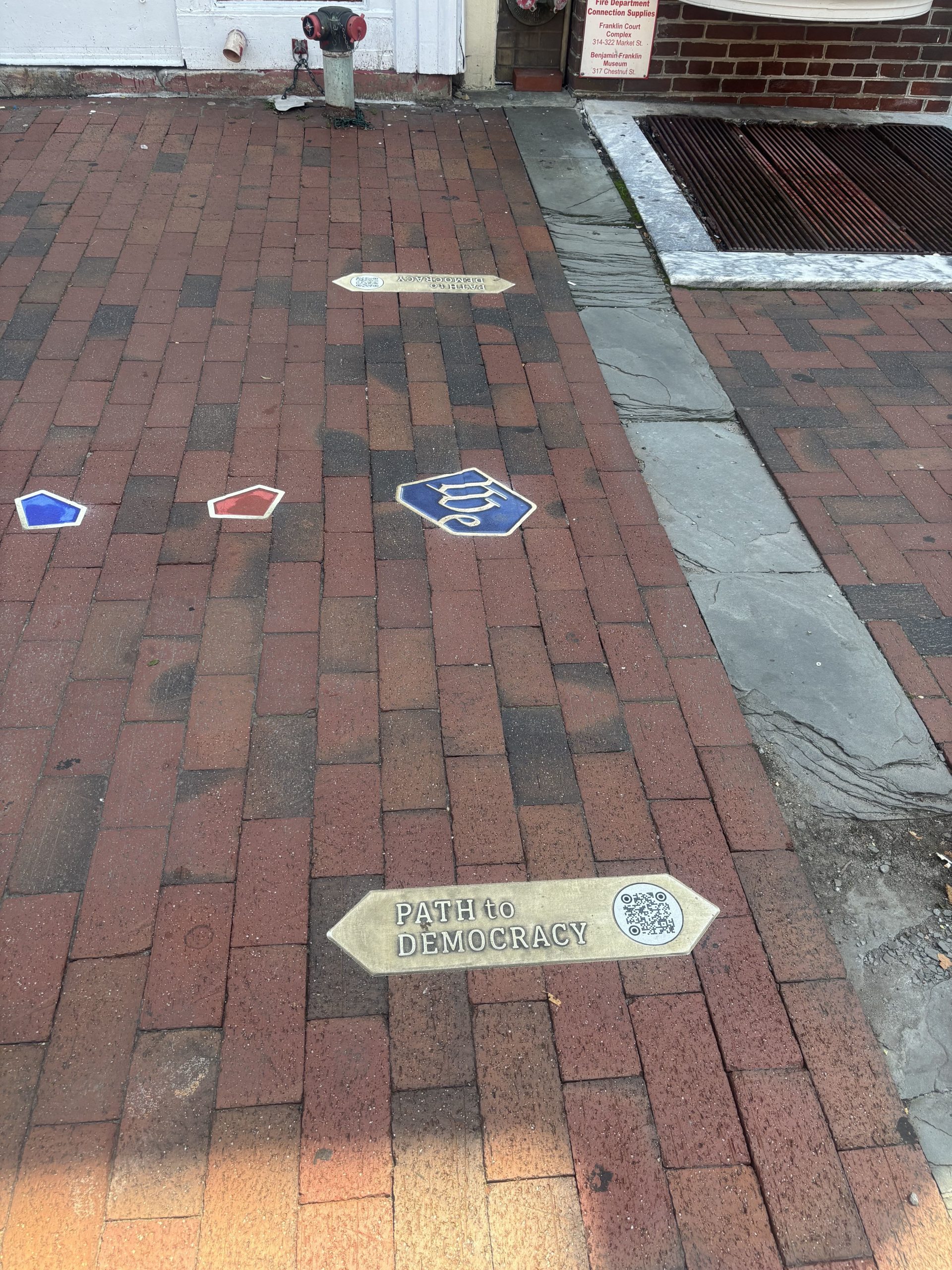
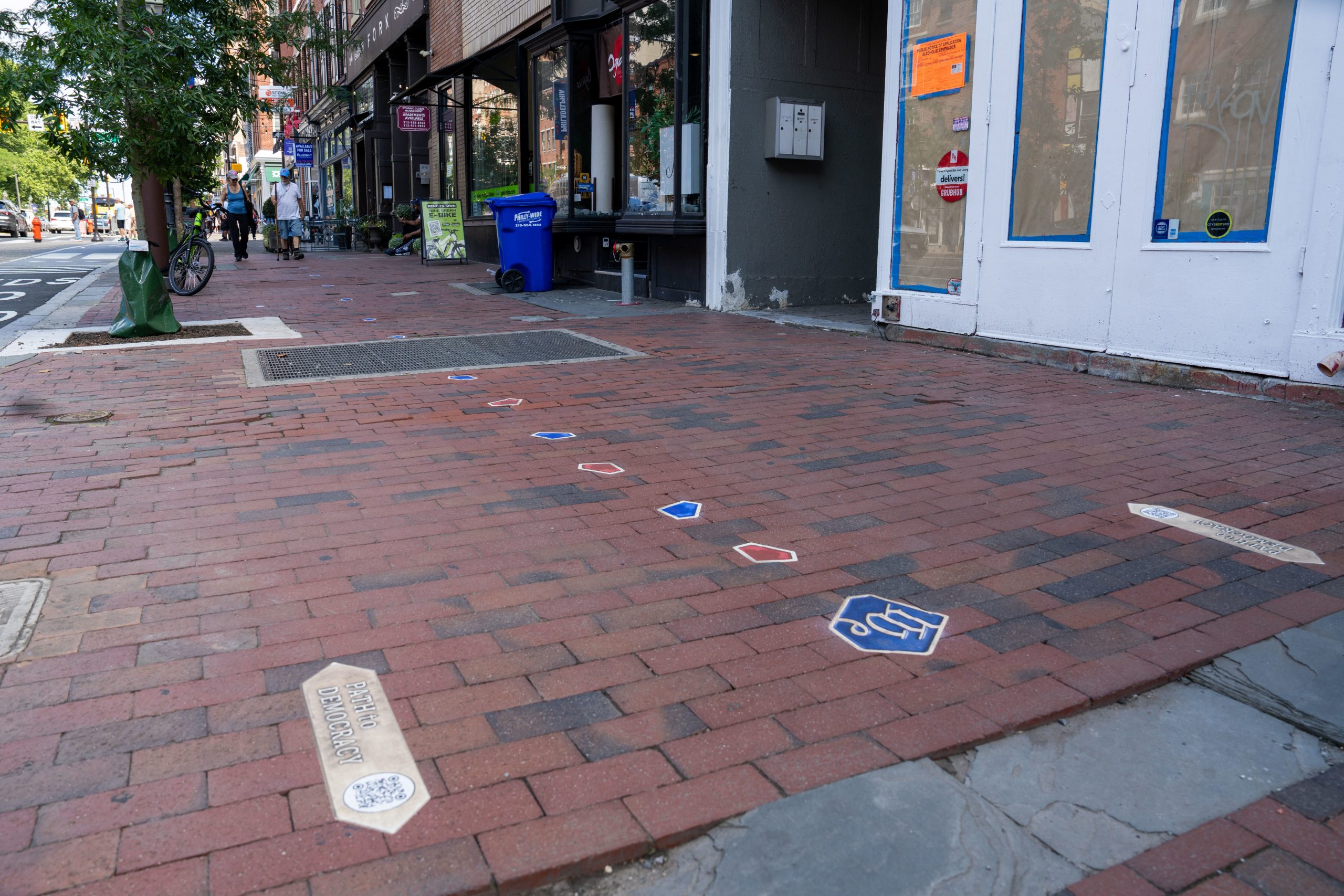
Vinyl decals resembling ceramic tiles and a brass plaque mark the public pilot version of the Path to Democracy.Stephanie Farr / Staff
“Because you wrote that delightfully, ‘annoyingly accurate’ story about Boston’s Freedom Trail a few years ago, I wanted to make sure you got the first look at Philadelphia’s answer to it: Path to Democracy,” she wrote.
Could it be true? Are we actually getting our own historic trail and did someone really call my work “annoyingly accurate?!?” Be still my craggy, Philly heart!
‘A legacy project’
Still in its early phases, there are currently only six stops on the Path to Democracy as it undergoes public beta testing through Labor Day. The full path, which is slated for next summer, will have 21 stops and is based on a self-guided tour Visit Philly has had on its website for years, said Kyle Stein, senior marketing project manager for Visit Philly.
“This is something we wanted to introduce to people this year and have it be a legacy project for years to come,” he said.
(function(){function e(){window.addEventListener(`message`,function(e){if(e.data[`datawrapper-height`]!==void 0){var t=document.querySelectorAll(`iframe`);for(var n in e.data[`datawrapper-height`])for(var r=0,i;i=t[r];r++)if(i.contentWindow===e.source){var a=e.data[`datawrapper-height`][n]+`px`;i.style.height=a}}})}e()})();
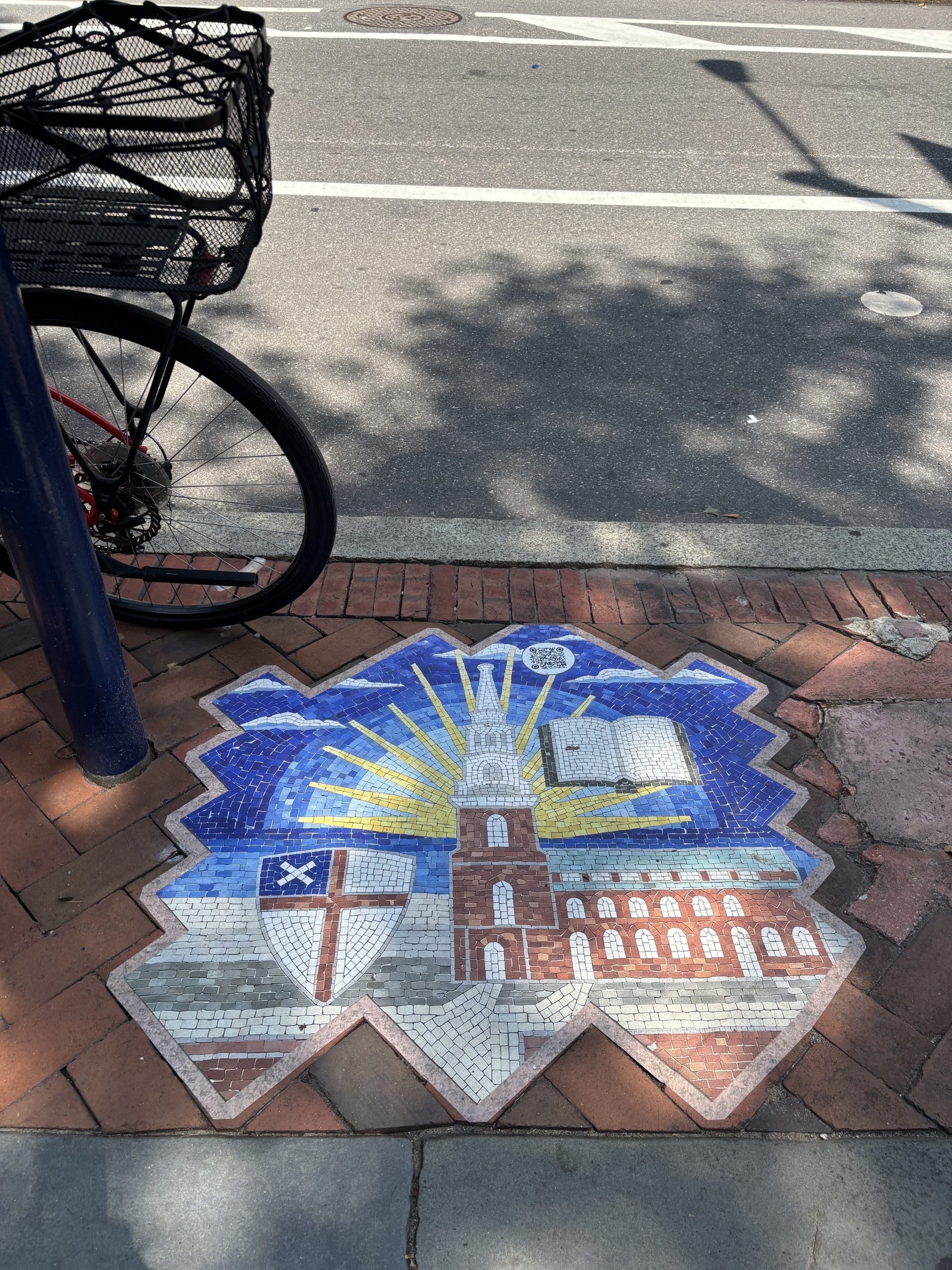
In its final iteration, the Path to Democracy will be marked by colorful ceramic tiles, brass directional plaques, and large tile mosaics embedded in the sidewalks that will pay “homage to all of the art across Philadelphia” and particularly, to that of Isaiah Zagar, Stein said.
“Whatever look and feel we went with had to be authentic to Philadelphia,” he said.
For now, Visit Philly is using sturdy, eye-catching vinyl decals that resemble tiles and mosaics to mark the path and stops along it. Zagar’s studio wasn’t consulted on the project, but Stein said Visit Philly would love to work with them going forward.
The vinyl mosaic decal at Christ Church along the Path to Democracy.Stephanie Farr / Staff
The Path to Democracy will not only be unique from Boston’s trail in look but in substance as well. The Freedom Trail traces Revolutionary War history, but Philly’s path will highlight sites and people that have shaped American democracy over the years.
“It’s not just something that happened in 1776,” Stein said. “Democracy is something that is an evolving thing.”
I knew there was only one way to suss out this path and that was to walk it myself. Plus, Stein said feedback from locals is essential during beta testing, and who doesn’t love being essential and opinionated in Philly?
Choose-your-own adventure
I snagged a parking space on Race Street near Second last week, knowing that the sites are all within a four-block radius from Front to Fourth and from Market to Arch Streets.
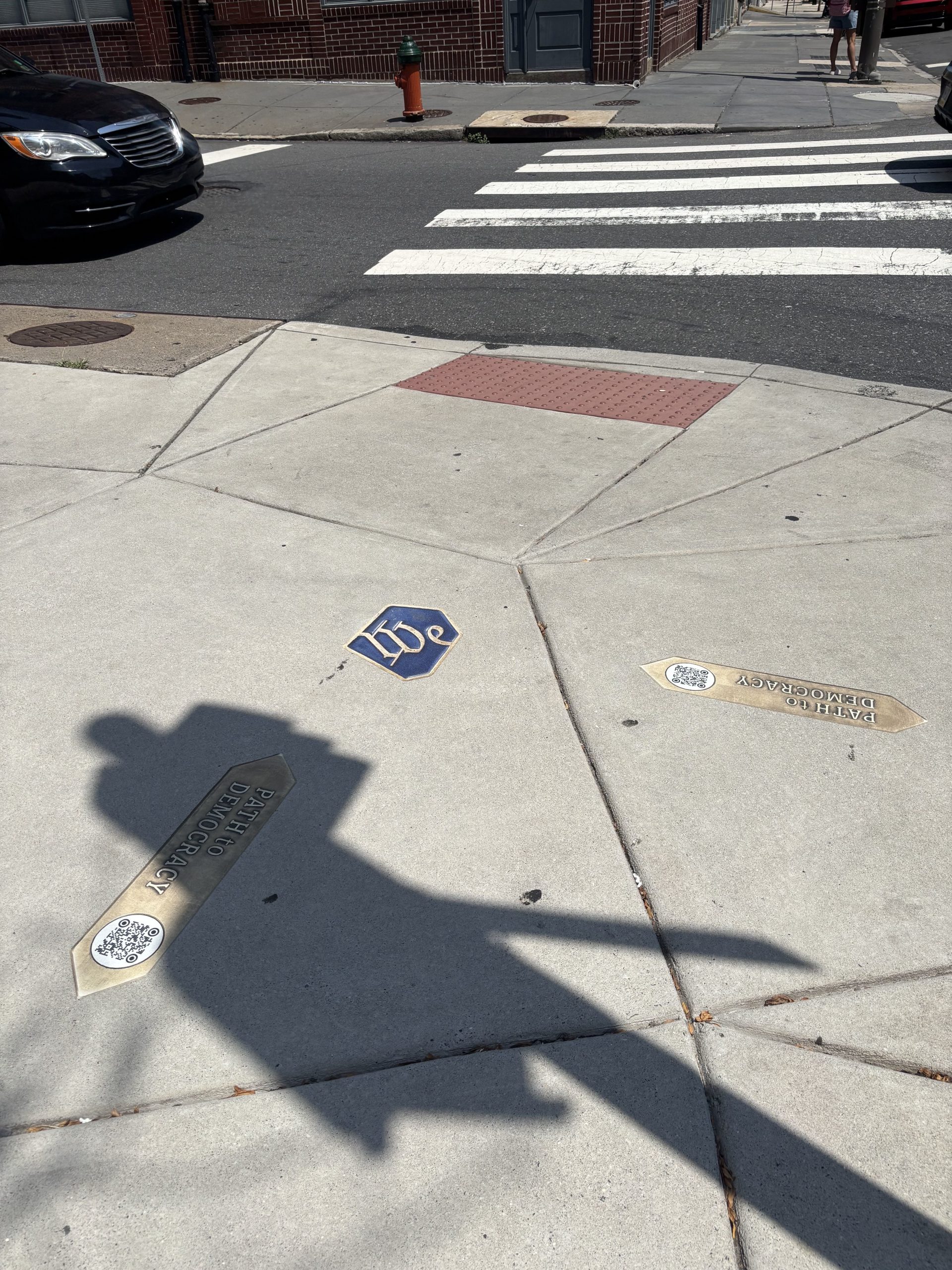
My first stop wasn’t planned. I just kept my eyes on the ground until something caught them, which happened at the corner of Second and Arch Streets. I spotted a blue vinyl tile that said “We” (written in the script of the Declaration of Independence) and two vinyl directional decals that said “Path to Democracy” with QR codes that led to an accompanying website. One pointed up Arch Street to Third and the other pointed down Second Street to Market.
Vinyl brass-colored decals at Third and Arch Streets in Old City denote that the Path to Democracy can be taken in one of two directions here. In the center is a “We” tile that is found on multiple spots along the path as well.Stephanie Farr / Staff
I decided I’d follow the arrow pointing right up Arch Street. As I walked, I spotted gem-shaped blue-and-red vinyl decals that were peppered like breadcrumbs down the sidewalk and led me straight to the Betsy Ross House.
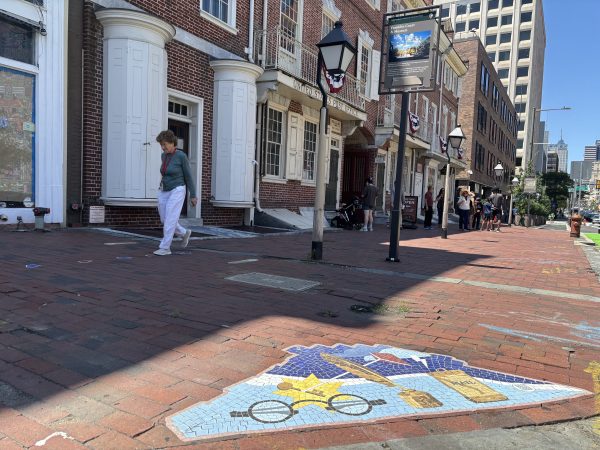
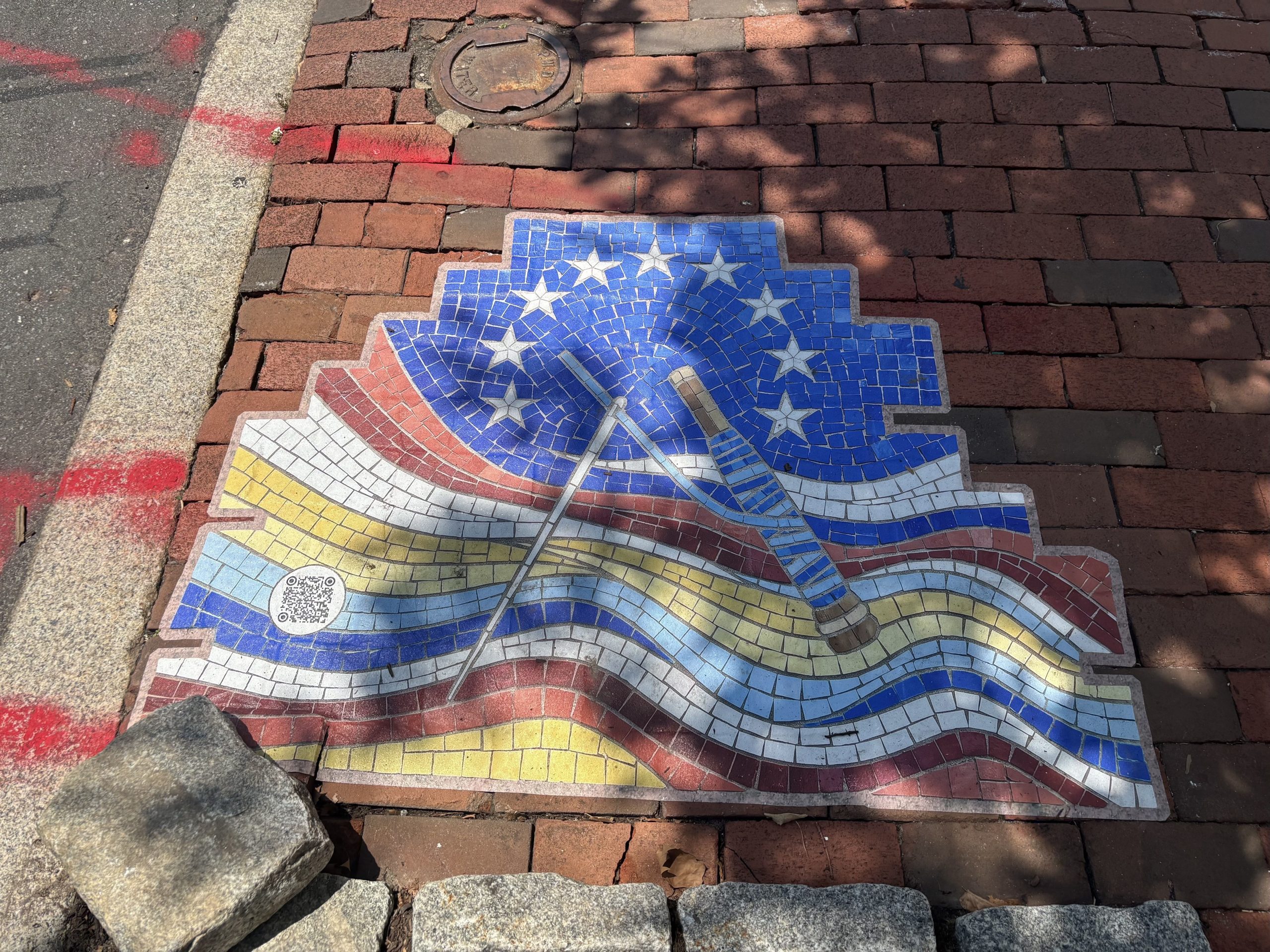
On the sidewalk outside of the site, I spotted a lovely vinyl mosaic of a needle and thread superimposed upon a multicolored flag. A QR code on it took me to a mobile-friendly webpage about Ross. I listened to a 51-second audio clip about her life and read about the mosaic before me. Also provided on the page was the Betsy Ross House’s address, operating hours, and other useful visitor information.
The vinyl mosaic decal outside of the Betsy Ross House along the Path to Democracy.Stephanie Farr / Staff
At the bottom of the site was a nifty little guide showing me that I was currently a four-minute walk away from Christ Church in one direction and a two-minute walk away from the Arch Street Meeting House in the other.
“All right, this is pretty cool,” I whispered.
Confusing corners
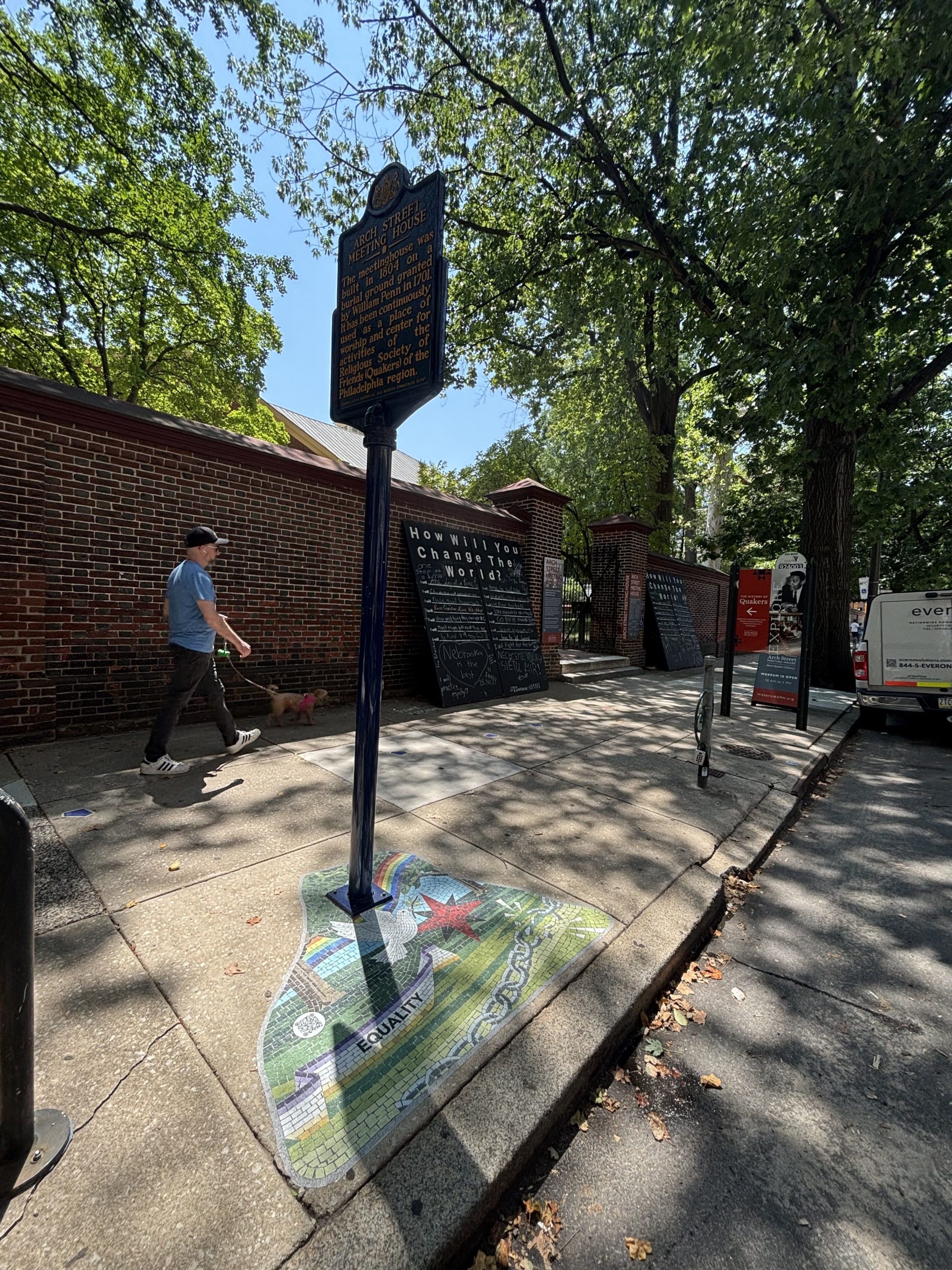
I chose to follow the blue-and-red vinyl decals to the Arch Street Meeting House where a vibrant vinyl mosaic of a dove and the word equality was plastered on the sidewalk. The QR code led to a page about the meetinghouse and to an audio clip about how “Religious radicals founded Philly.”
When I was done, I discovered I’d reached the end of the path, much to my chagrin. I didn’t realize it wasn’t a continuous loop and I had to retrace my steps back past the Betsy Ross House to the next site, Christ Church.
From there, the vinyl decals led me to the southwest corner of Second and Market Streets, where a directional decal with arrows on both ends pointed me toward Front Street on my left and also to Third Street on my right.
“Well this is confusing,” I thought.
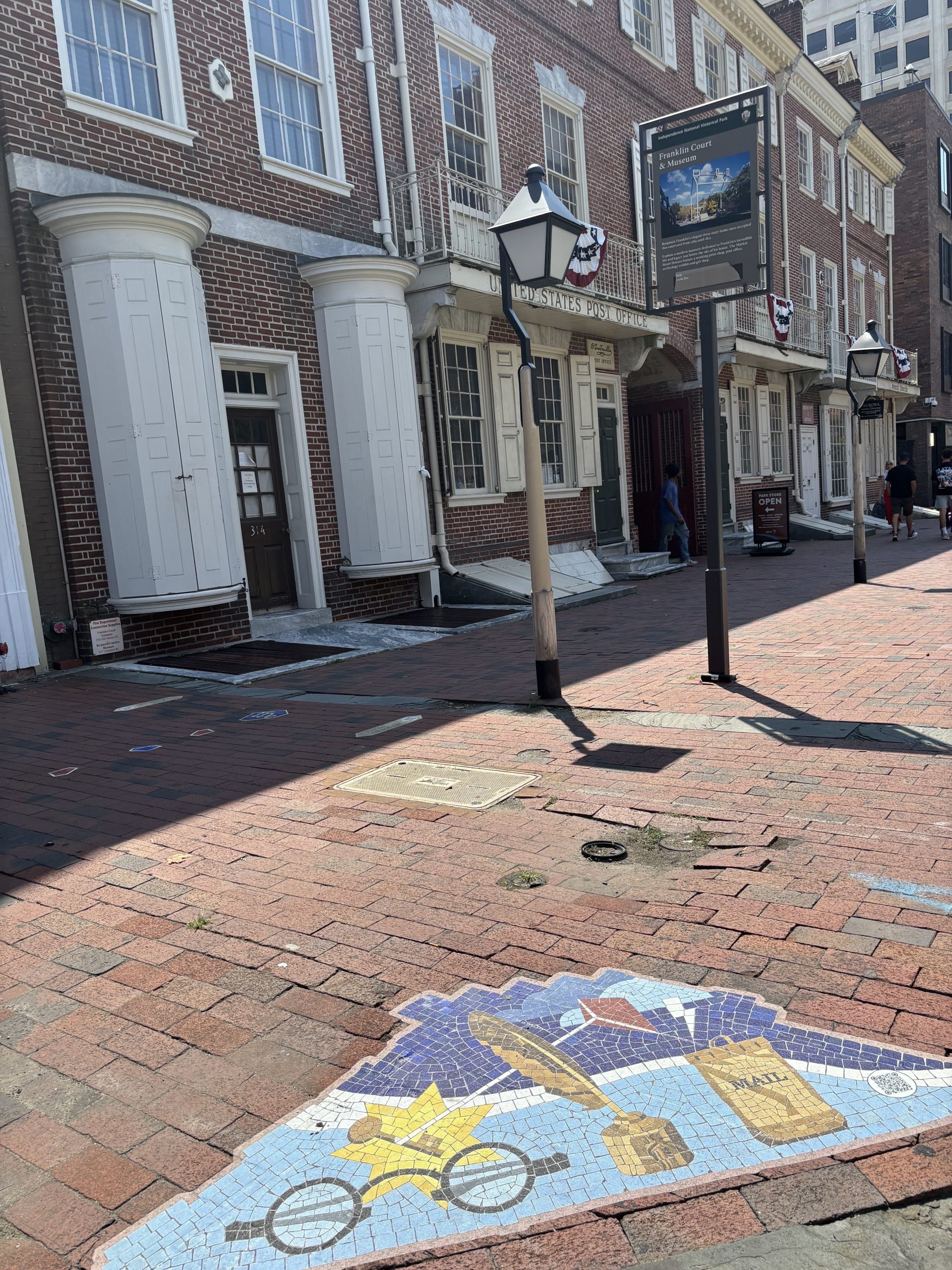
I decided to follow the path up Market Street past Third Street to Franklin Court, where I spotted a large vinyl mosaic decal of a key, kite, quill pen, and spectacles.
The Path to Democracy leads to just outside Franklin Court, where this vinyl mosaic decal located.Stephanie Farr / Staff
I headed inside Franklin Court and walked around. I always forget how many privies there are in there (the place had more johns than the Second Continental Congress!).
Franklin Court marked another terminus of the path, so I turned around and headed back down Market Street to Front to check out the other direction of the trail I’d forgone.
Lesser-known sites
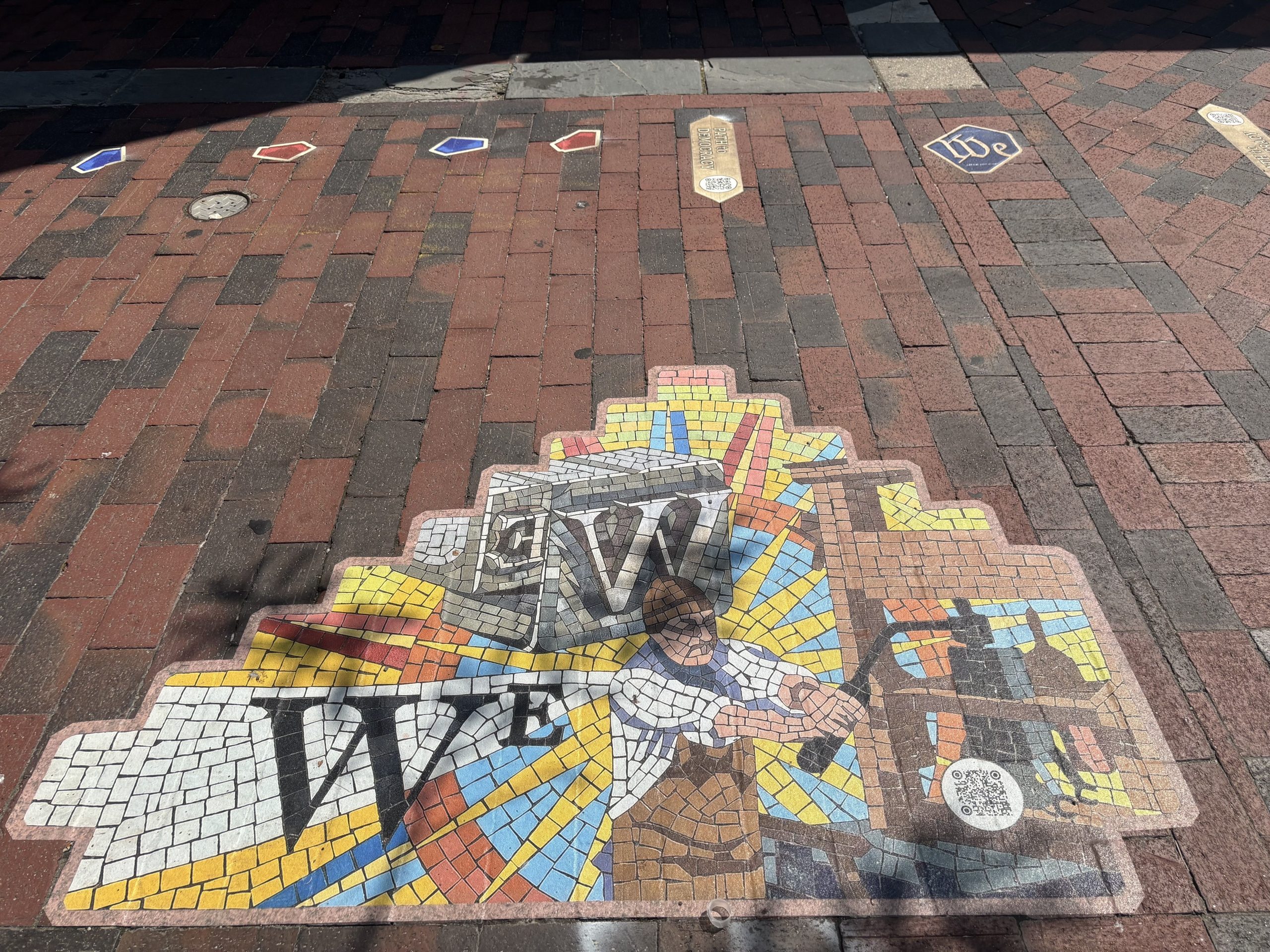
On the southeast side of Second Street as it crosses Market, I found a large mosaic decal of a man operating a printing press. Scanning the QR code, the website told me this was once “Printers’ Row,” where many important documents — including the first copies of the Declaration of Independence — were made.
Unlike the other sites along the path, there was nothing already at this one to indicate it was of any importance, aside from an easy-to-miss plaque embedded in a crumbling wall of a vacant building nearby.
A vinyl mosaic decal marks the site of Printer’s Row on Market Street near Second along the Path to Democracy.Stephanie Farr / Staff
I appreciated this more-obscure site being highlighted on the path. Stein said its inclusion in the beta test was very intentional.
“Not every historic site in Philly is one people can enter. We wanted a tried-and-true one, like the Betsy Ross House, and lesser-known ones, like Printers’ Row,” he said.
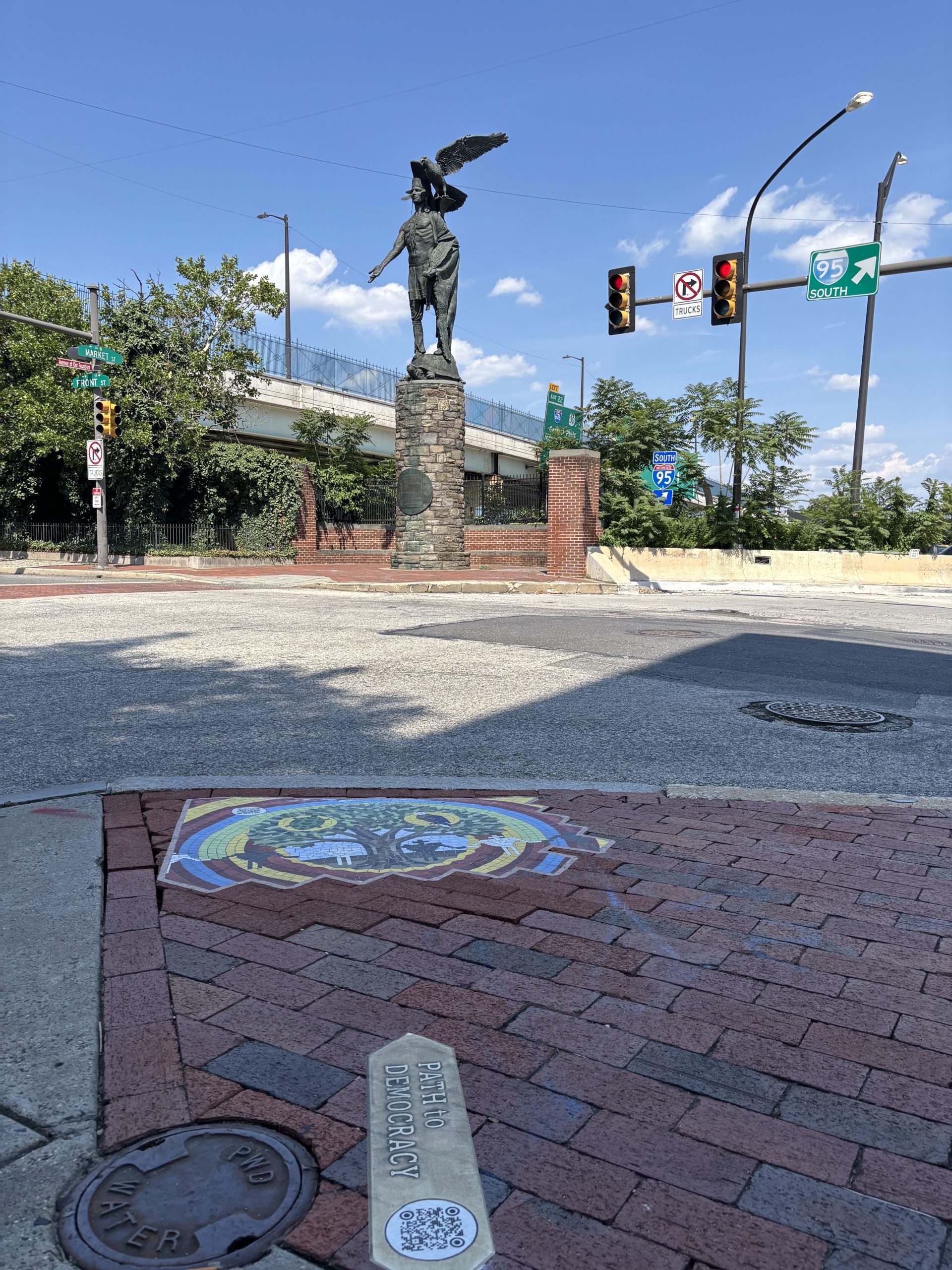
Following the decals, I reached my final stop at the corner of Front and Market Streets. There, a vinyl mosaic decal of a tree, animals, and human figures was situated on the sidewalk catty-corner to the Chief Tamanend statue at the I-95 on-ramp.
As I listened to the accompanying audio via the QR code, I found myself staring at the statue.
The Path to Democracy highlights the “Chief Tamanend” statue at Front and Market Streets in Old City.Stephanie Farr / Staff
Then, I did something I’ve never done before — I crossed the street and approached it. I stood below Chief Tamanend’s feet, I looked up at him and the eagle on his shoulder, I marveled at the details of his clothing, I read the accompanying bronze plaque.
And I couldn’t believe that it took me this long and this path to do so.
A worthy pursuit
I spent about two hours walking the path, but I backtracked often and took my time. You could feasibly do it in 30-60 minutes.
After my walk, I filled out the pilot program survey via the QR code.
“I want more sites and would love for it to be a circular path you could start at any place and keep going around until you get back where you started, like a Phlash bus loop,” I wrote.
Vinyl decals mark the Path to Democracy on the 300 block of Market Street in Old City during the beta testing phase of the project.Courtesy of Visit Philadelphia
Stein said the goal is to have the path be multidirectional.
“I think in the future we’re considering the best way to actually connect the sites,“ Stein said. ”Printers’ Row and Chief Tamanend was an opportunity to test out a spur. That will be something we may come up against in the future, some sites may not fall within a perfect pathway.”
While I didn’t see anyone else following the path as I was exploring it, Visit Philly’s Robinson told me about 50 people a day have been scanning the QR codes.
Though there are still some kinks to work out, the Path to Democracy shows a lot of promise. Like democracy itself, we don’t know where it will lead, but it’s a worthy pursuit — and one that requires our participation to succeed.
So before Labor Day, go try it out and provide feedback. You could help shape a path in Philly that may be walked for generations to come.
“We just want Philadelphians to be proud of this and be aware of it,” Stein said. “I think that this path is another way for us as Philadelphians to celebrate how great this city and these sites are.”
The Path to Democracy leads to the Arch Street Meeting House, where a vinyl mosaic decal wraps around the site’s historical marker.Stephanie Farr / Staff
Before you start pointing out that he’s 41, remember who we’re talking about. This is arguably the greatest basketball player of his generation — one of the few athletes whose name alone can change the mood of an entire city. There will be plenty of time to debate how much he has left in the tank.
But now isn’t the time.
Now is the time for imagining LeBron in a Sixers jersey. It’s for checking the schedule, texting your friends in all caps and wondering how quickly the team store can stock No. 23.
Will this end with a championship? Nobody knows. But sports are supposed to be fun, and this is fun.
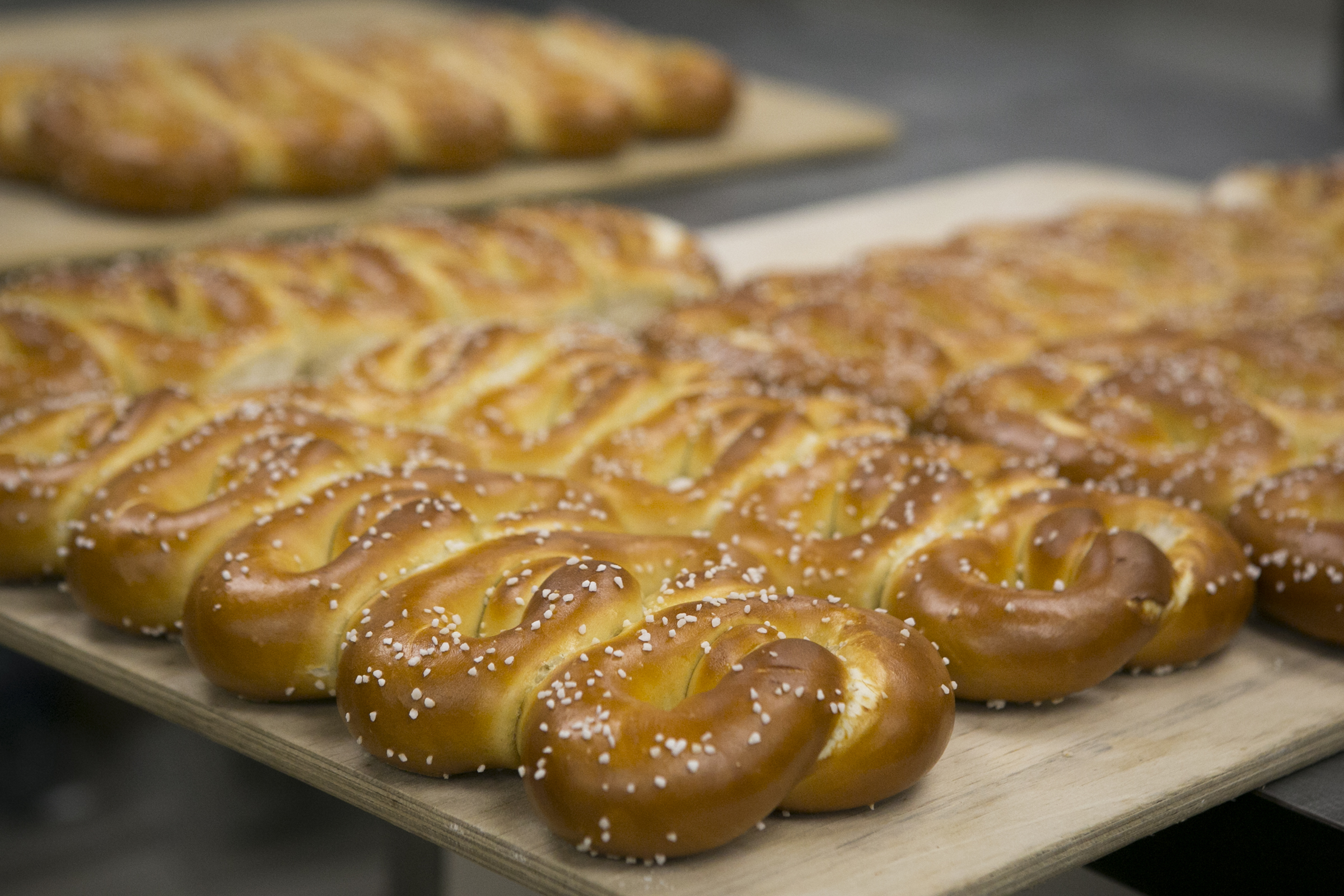
Freshly baked “penny pretzels” cool in the test kitchen at Philly Pretzel Factory headquarters in Bensalem, Pa., on the morning of Thursday, August 9, 2018.MAGGIE LOESCH / Staff Photographer
Keep your protein out of my pretzel: C
There are plenty of places to squeeze in an extra 20 grams of protein. A Philadelphia soft pretzel shouldn’t be one of them.
Sure, the business logic is there. But some foods don’t need to become “functional.” They already have a purpose.
A Philly soft pretzel isn’t just a snack. It’s breakfast after a youth soccer game, lunch when you’re running late. It’s something you grab at a Wawa, a corner store, or outside the stadium without giving a second thought. It’s warm, salty, a little messy, and unapologetically carb-heavy.
We’ve spent years turning ice cream into protein shakes, cookies into protein bars, and cereal into a dietary supplement. Now we’re coming for the pretzel? Somewhere, Gritty is shaking his fuzzy orange head.
If you want more protein, eat some chicken. Leave the pretzel alone.
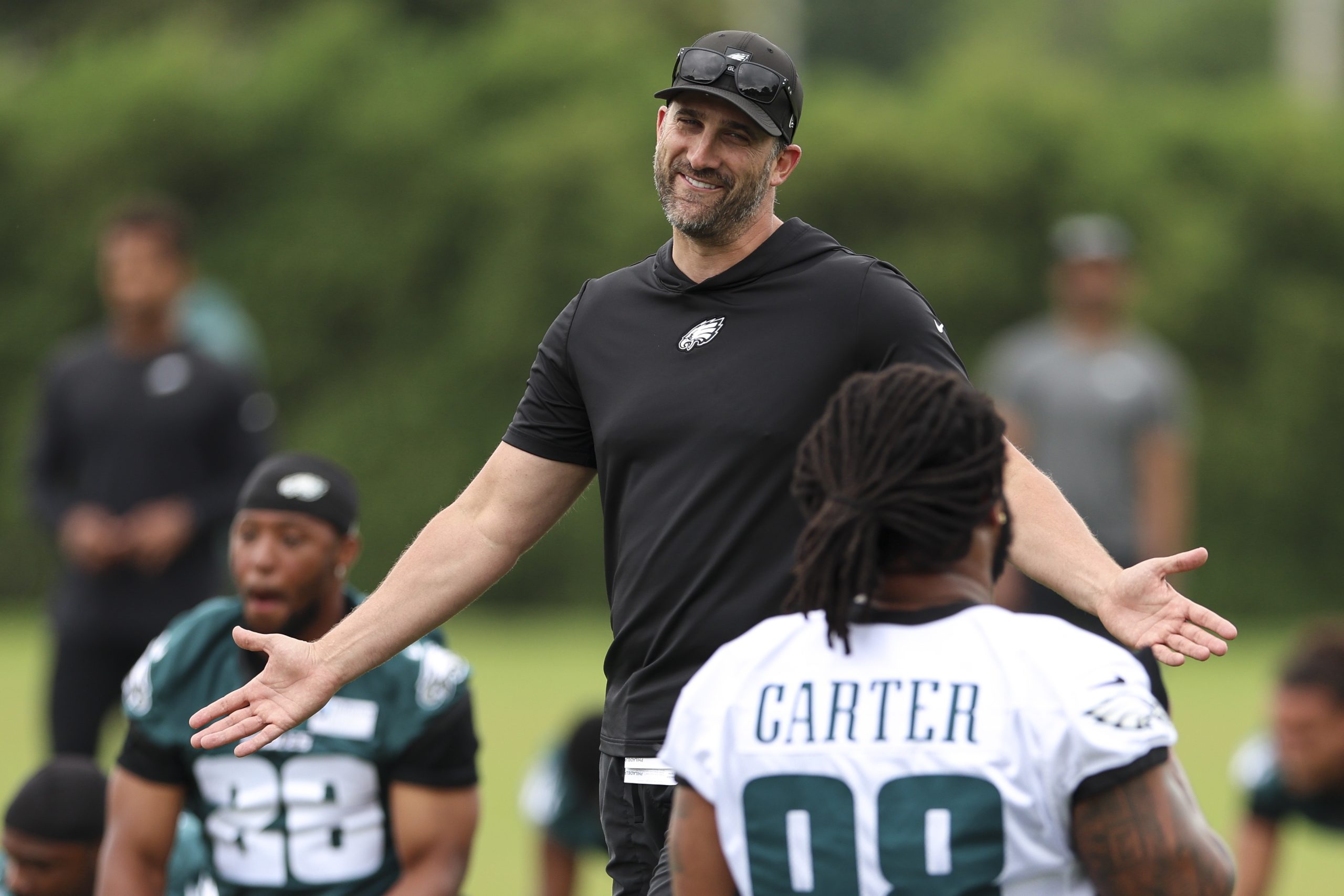
Philadelphia Eagles head coach Nick Sirianni laughs with defensive tackle Jalen Carter during mandatory mini-camp at the Jefferson Health Training Complex on Wednesday, June 10, 2026, in Philadelphia.Monica Herndon / Staff Photographer
Nick Sirianni’s AI pep talks: D
The robots aren’t taking over the Eagles playbook just yet. Instead, Nick Sirianni says he’s been using ChatGPT to find inspirational sports stories to share with his players, according to The Athletic.
Somewhere, decades of coaches who relied on Remember the Titans, grainy YouTube highlight reels, and laminated printouts with motivational quotes are shaking their heads.
Apparently even locker room speeches have entered the AI era.
It’s objectively funny to imagine Sirianni sitting at his computer typing, “Give me a great relentless effort true sports story,” before walking into a room full of NFL players.
Then again, maybe this is just what coaching looks like in 2026. At least he’s using ChatGPT to inspire the team — not to draw up game plays.
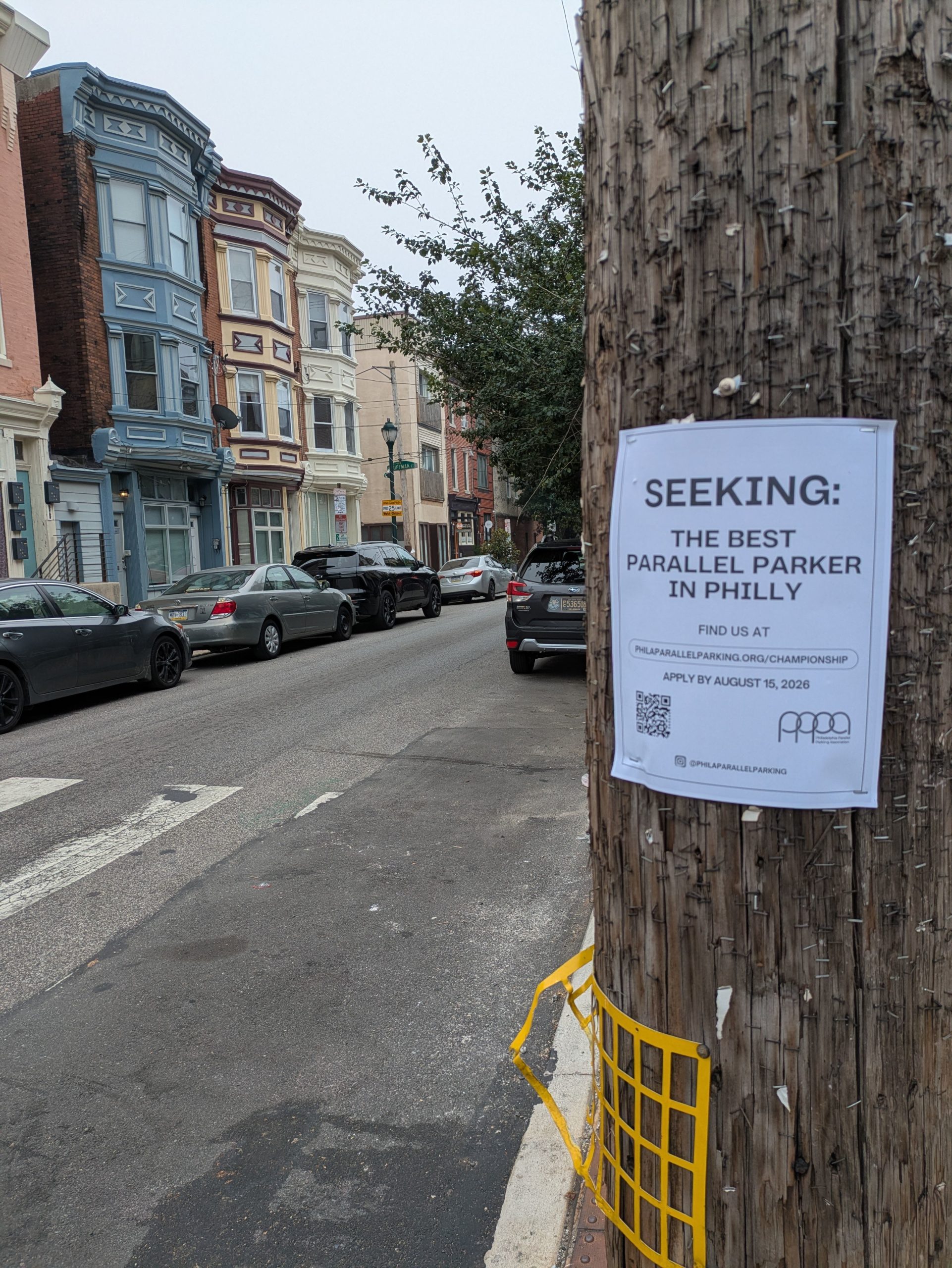
A sign advertising the 2026 Philadelphia Parallel Parking Association Championship is affixed to a pole across from some fine examples of parallel parking in the city.Courtesy of Adam Wodka
Competitive parallel parking: A
There are two types of Philadelphians. Those who dread parallel parking, and those who quietly believe they’re among the best to ever do it.
This is a city where successfully squeezing into a parking spot the size of a shoebox earns applause from strangers, where people take it personally when someone leaves three feet between bumpers, and where every South Philly resident has at least one story about fitting into a space they probably shouldn’t have.
The organizers somehow made it even more Philly by including an “under duress” category, complete with a savesies chair, an angry neighbor yelling that the spot is reserved for their granddaughter, honking traffic, and other distractions. That’s less a competition than an average Tuesday.
The winner gets $76… just enough to cover your next parking ticket, and the most Philadelphia prize imaginable.
The worst part? Players from the Nationals, Yankees, and even the Dodgers got it right. Come on, Bryce. You’ve spent years playing in the birthplace of American democracy. We weren’t expecting a dissertation on the Continental Congress, we just wanted 1776. Heck, the basketball team that plays across the parking lot isn’t called the 75ers.
Then again, if the price of 40 home runs is occasionally forgetting what year America declared independence, that’s probably a trade Phillies fans are willing to make.
$1,500 in Philly rent: B
Nobody is going to look at 591 square feet and say, “Wow, what a palace.” That’s about what $1,500 a month gets you in Philadelphia, according to a new RentCafe study. It’s smaller than the national average and not even enough for a typical one-bedroom apartment.
But perspective matters.
In Manhattan, the same $1,500 gets you about 210 square feet — roughly enough room for a bed, a mini fridge and an existential crisis (a dorm room, essentially). In Boston, it won’t even cover a studio.
So suddenly, Philly’s 591 square feet starts looking… respectable.
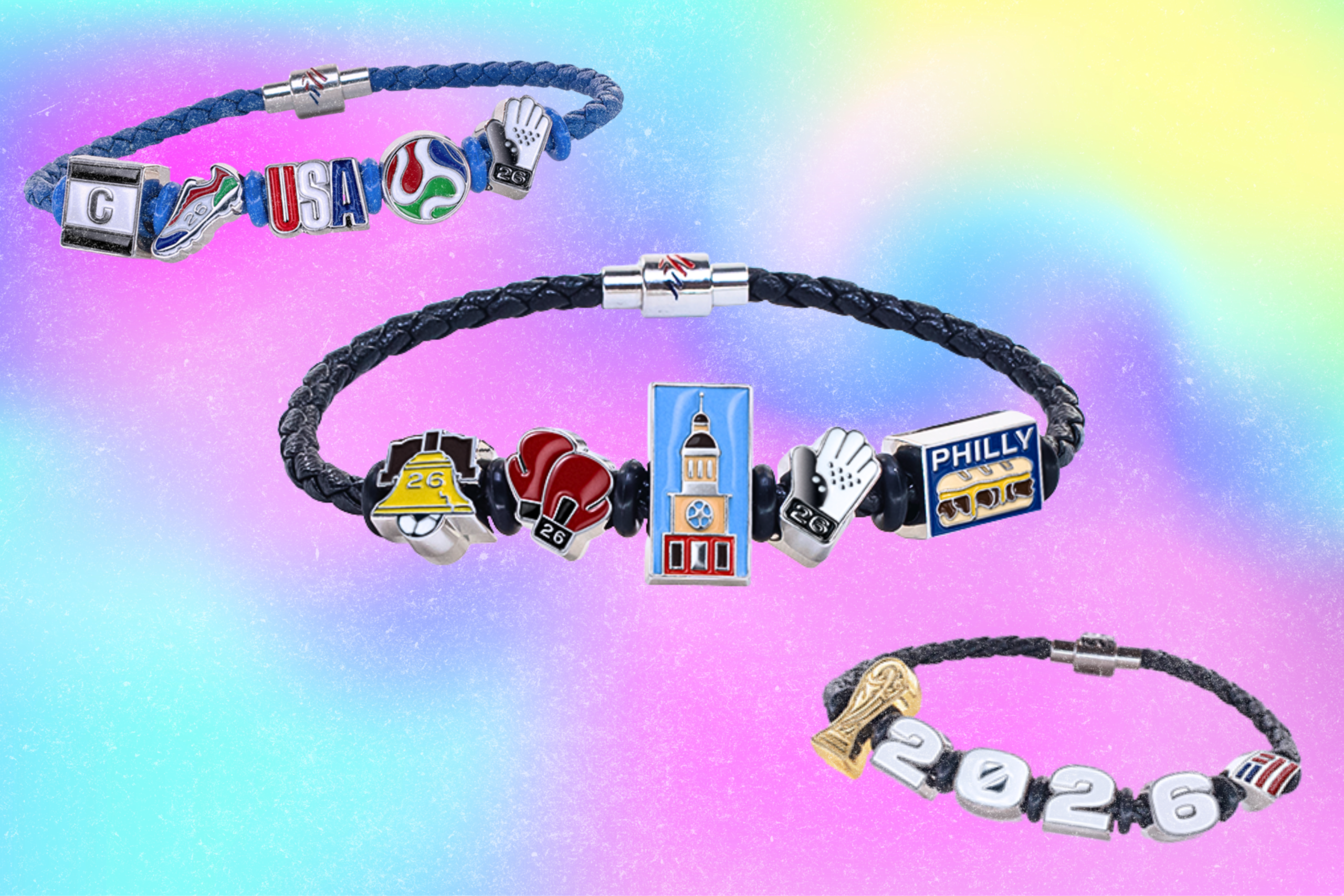
A free charm bracelet available at FIFA Fan Festivals nationwide, including Philadelphia’s in Lemon Hill, had fans waiting hours in line to get one. Bank of America is behind the coveted Fan Bands, drawing hours-long lines.Emily Bloch / Staff illustration / Bank of America
Nothing stays free for long: A-
The World Cup ended, everyone went home, and right on schedule, the internet got to work.
Remember those free Bank of America charm bracelets that had people waiting in line for hours at Lemon Hill?
Honestly, you almost have to respect the hustle. If someone is willing to pay $150 because they didn’t want to stand in a four-hour line for a tiny cheesesteak charm, that’s capitalism doing what capitalism does.
Did you know islands dwell on the Delaware and Schuylkill? We’ll show you a photo taken on a Philly-area island, you drop a pin where you think it was taken. Closer to the location results in a better score. Good luck!
Round #43
Question 1
Where is this historic house?
Loading…
ClickTap on map to guess the location in the photo
ClickTap again to change your guess and hit submit when you're happy
You will be scored at the end. The closer to the location the better the score
Don Nigroni / Spotlight PA
Pretty good/Not bad/Way off! Your guess was from the location.Spot on! Your guess was exactly at the location. Here's also where a random selection of Inquirer readers guessed.
Fort Mifflin, an American Revolutionary War historic site, is located on Mud Island along the Delaware. Situated in the shadow of Philadelphia International Airport, the surrounding wetlands were drained in the 19th century, connecting the island to the western bank of the river.
Quiz continues after ad
Question 2
Where is this mural?
Loading…
Jose F. Moreno / Staff Photographer
Pretty good/Not bad/Way off! Your guess was from the location.Spot on! Your guess was exactly at the location. Here's also where a random selection of Inquirer readers guessed.
Viewed from the Manayunk towpath, this mural is located on Venice Island, one of the city's lowest-lying areas. A narrow wedge of land spanning nearly 70 acres and approximately 1.7 miles in length, the island lies between the Schuylkill and the Manayunk Canal.
Quiz continues after ad
Question 3
Where is this trail?
Loading…
Jose F. Moreno / Staff Photographer
Pretty good/Not bad/Way off! Your guess was from the location.Spot on! Your guess was exactly at the location. Here's also where a random selection of Inquirer readers guessed.
The Fairmount Water Works Trail and Boardwalk is a short section of the Schuylkill River Trail that extends onto an island behind Lloyd Hall. According to Billy Penn, the island is unofficially known as the Isle of Jean, named by Philadelphia resident Jean Knight.
Your Score
ARank
🏝️ Amazing work. Isle be impressed.
BRank
⛵Good stuff. That was smooth sailing.
CRank
🚣♀️ C is a passing grade, but you meandered a little.
DRank
🤿 D isn’t great, it’s low-lying territory.
FRank
🌊 We don’t want to say you failed, but you disappeared beneath the tide.
You beat % of other Inquirer readers.
We’ll be back next Saturday for another round of Citywide Quest.
South Jersey dessert lovers looking for banana pudding, cinnamon rolls, cookies, and more sweets just gained a new stop in Washington Township.
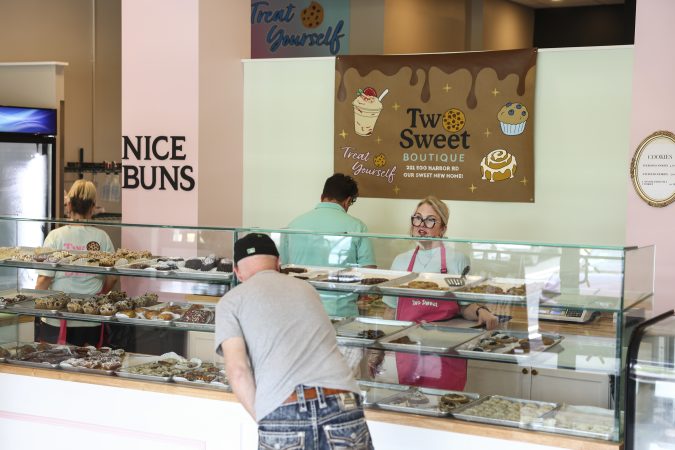
Two Sweet Boutique, named for its founding by a mother-daughter duo, moved to their new location at 201 Egg Harbor Rd. and opened on July 8.
Jeanne Centrone, who runs the bakery with her daughter Alex Centrone Coyle and husband, Rocco Centrone, said the store has stayed busy since its launch. Some days, floods of customers have wiped their shelves clean, forcing Two Sweet to close early. People have been waiting outside before the store opens.
“Everything is homemade,” Centrone said. “We bake from 5 a.m. until 5 at night. Sometimes we’re here later. I think we pride ourselves in that.”
The opening came weeks after Two Sweet closed its former spot at 1526 Hurffville Rd. in Deptford, where it served patrons for nearly a decade.
“We got a lot of new customers out of it. Something that started out devastating turned around and worked in our favor. We haven’t heard anything since,” Centrone said. “It was an honor that the governor wanted to come here to our little shop.”
The original business began when a neighbor offered to rent out his vacant property to Centrone and her daughter so they could sell their sweets.
At the time, Centrone was making chocolate-covered fruit trays, and Alex Centrone Coyle baked cakes. They started Two Sweet with cupcakes, cookies, and chocolates in a 900-square-foot space with no air-conditioning. But as time went on, the Centrones, Washington Township residents, experimented with more recipes and grew their staff and customer base.
“Through trial and error, it’s exploded,” Centrone said.
Two Sweet’s new location, which neighbors tanning salon Glow Lab in a local shopping center, is more than 1,800 square feet and will soon feature a coffee bar with hot coffee, cold brew, lattes, and iced tea, Centrone said. The larger space, which formerly housed The Color Room beauty salon, has given the family more room to bake and store their ingredients.
Centrone’s other two daughters are helping out at the bakery, too, along with about five bakers and a few employees working the counter. The Centrones are looking for new hires to support the recent rushes.
“I hope that things continue on a positive note and we continue to grow, with the shop and with the community,” Centrone said. “We’re extremely grateful the way that we’ve been welcomed here and the way people continue to show up every day.”
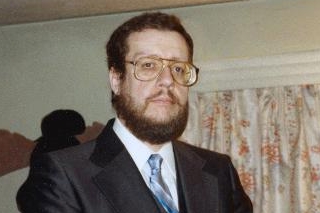
Al Campbell, 74, of Philadelphia, retired longtime copy editor at The Inquirer, former copy boy, clerk, and library assistant at the Bulletin, mentor to many, and steady pitcher for the old Horsham Neighbors softball team, died Tuesday, June 9, of heart and kidney failure at the home of his brother Bob in the Northeast.
Born in Philadelphia and a 1969 graduate of Northeast High School, Mr. Campbell spent nearly three years as a copy boy and editorial assistant in the old Bulletin newsroom before joining The Inquirer as a copy editor in 1970. That move to 400 N. Broad St. kicked off a colorful 46-year career at The Inquirer that included stints on the suburban news copy desk and the night sports copy desk, and a self-assigned 24-7 job as a friend and mentor to dozens of reporters, columnists, editors, and photographers.
“Al was so kind and funny,” a former Inquirer colleague said on Facebook. “He made The Inquirer a better place.” Other former colleagues called him “a sage and an icon” and “a real pro and fun to be around.”
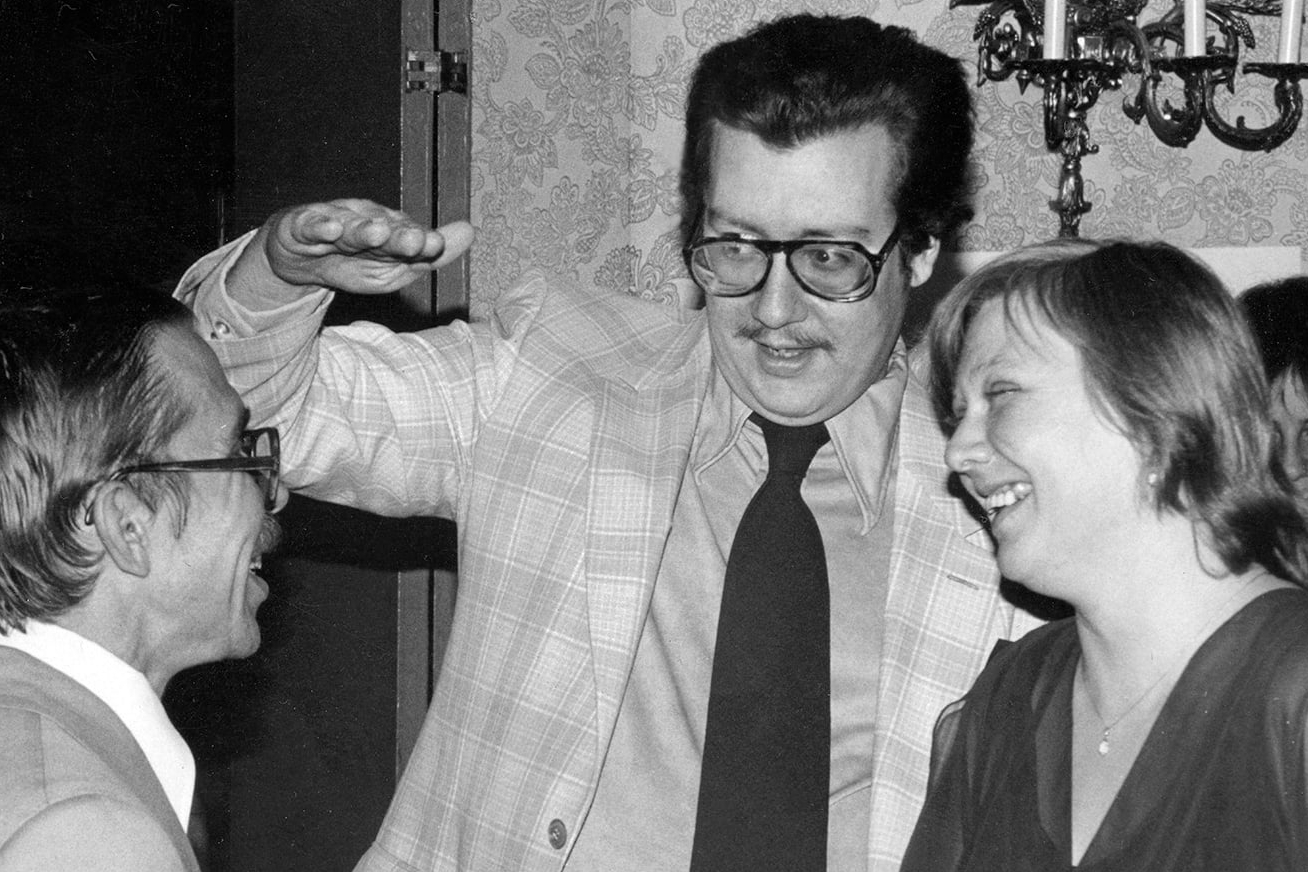
Big and often boisterous — everybody called him Moose — Mr. Campbell was the son of a newspaper reporter, and he was adept at polishing prose, detecting mistakes, and working with reporters and photographers, usually over the phone. “Moosey looked out for us,” a former colleague said on Facebook.
Mr. Campbell (center) “was a stickler for details,” his brother Bob said. Courtesy of the family
He came up with witty headlines and captions, had years of practical and institutional knowledge of Philadelphia politics, culture, and sports, and worked nimbly on deadline, making him a favorite of other editors and page designers. He also served as a newsroom union steward.
“He was a stickler for details,” his brother Bob said. “People said his favorite saying was: ‘I got you covered.’”
A photographer said on Facebook: “He saved my neck many times with caption corrections.” Longtime Inquirer colleague Don McKee said: “He was diligent and took the job seriously. He actually cared about what we wrote and what went in the paper.”
Away from the newsroom, Mr. Campbell organized softball games between Inquirer staffers and hosted memorable late-into-the-night parties at his home in the Northeast. He was quick with a joke and “put a smile on everyone’s face,” a longtime friend said.
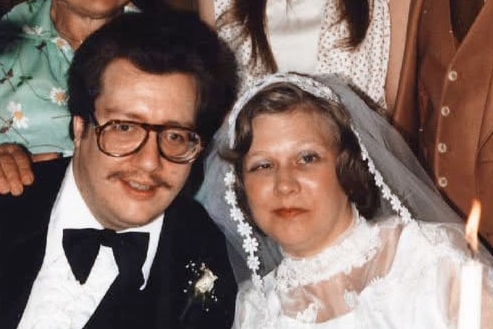
Mr. Campbell and his wife, Jean, married in 1980.Courtesy of the family
Alan Douglas Campbell was born Oct. 10, 1951. He was on track and basketball teams in high school, joined the Boy Scouts and Army Reserve Officers’ Training Corps, and studied at Temple University briefly before going into newspapers full-time.
He met Jean Hunsberger in school. They reconnected at their 10-year high school reunion in 1979, married in 1980, and lived in a cozy house he called Moose Manor. His wife died in 2022.
Mr. Campbell was fascinated by trains and public transportation, and he rode his bicycle as a boy to nearby train stations to watch the locomotives roar by. Later, he rode the trains to the suburbs and Washington, and assembled an extensive collection of model trains that he displayed at his home.
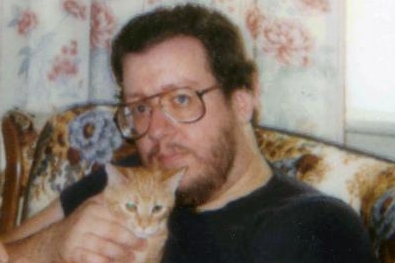
Mr. Campbell was a cat lover. Courtesy of the family
He loved cats, old movies, and comedy shows. He celebrated his Scottish heritage and became licensed as a massage therapist.
“Moose was one of a kind,” a former colleague said. His brother Bob said: “He was the most gentle soul on the planet.”
In addition to his brother, Mr. Campbell is survived by a brother, Tom, and other relatives.
A celebration of his life is to be held later.
Donations in his name may be made to the Pennsylvania SPCA, 350 E. Erie Ave., Philadelphia, Pa. 19134.
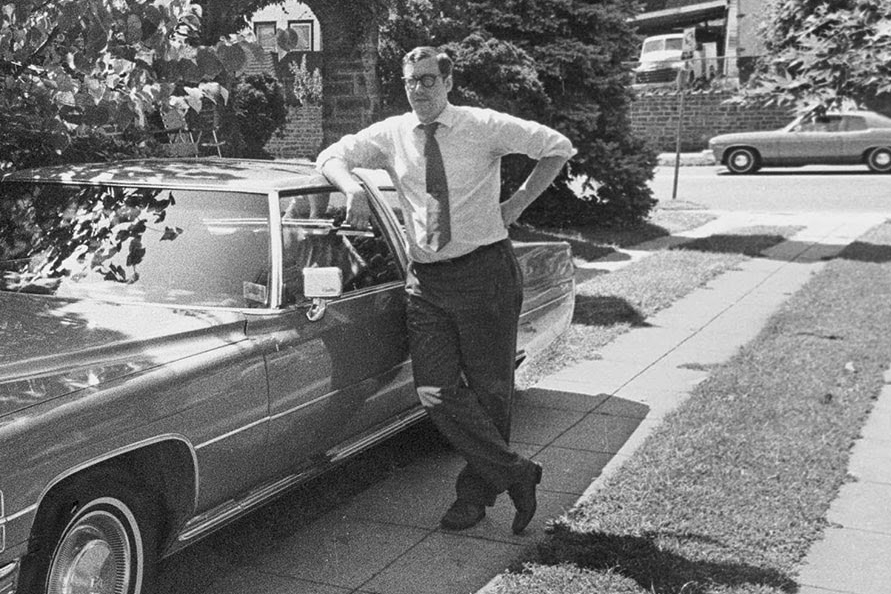
Mr. Campbell started his 46-year career at The Inquirer in 1970.Courtesy of the familyMr. Campbell was a playing manager for the Horsham Neighbors softball team in the 1980s.Courtesy of the family