Category: News

  • Should you drink Philly’s tap water?

    Should you drink Philly’s tap water?

    If you live in Philly and want to know information about your tap water quality, start with the latest consumer confidence report, which is required to be produced annually by every community water system in the country. Most people never read them, but the reports provide essential information about drinking water quality.

    Like other large water systems, the Philadelphia Water Department publishes this information online, including the most recent 2025 drinking water quality report. The report provides an overview of Philly’s drinking water from source to tap. It reports that levels of approximately 100 regulated contaminants all meet federal standards.

    As an interdisciplinary scientist and engineer, I study drinking water infrastructure and how science gets translated into policy and decision-making.

    While the Philadelphia Water Department report is a good place to start, knowing what it tells you and where there may be gaps requires some background on how drinking water is regulated.

    How drinking water gets regulated

    In the U.S., drinking water is regulated under the Safe Drinking Water Act, which set limits for just over 20 contaminants when it became law in 1974.

    Subsequent amendments and regulatory processes have brought the total to about 100. That’s still a small number compared to the approximately 700 disinfection byproducts, the tens of thousands of chemicals in commercial use in the U.S. today, or other contaminants of emerging concern.

    While not all of these compounds end up in drinking water in amounts that can harm public health, the U.S. Environmental Protection Agency’s regulatory process is designed to be reactive, not proactive.

    Before setting a limit, the EPA must demonstrate that a contaminant may cause adverse health effects, that it occurs at levels that are a public health concern, and that regulation would meaningfully reduce risk.

    This process is repeated contaminant by contaminant, though a single glass of tap water may contain dozens of trace contaminants at once. The EPA has recently moved partly toward regulating mixtures of contaminants. The 2024 federal PFAS rule set individual limits for six PFAS compounds and also regulated four of them as a mixture. However, proposed changes to the 2024 federal PFAS rule include rescinding the mixture provision.

    Goals versus limits

    Federal drinking water standards involve two numbers for each contaminant. The maximum contaminant level goal, or MCLG, is the concentration at which the contaminant is believed to pose no significant risk to health in people who drink that water every day for 70 years.

    For chemicals classified as possible human carcinogens, MCLGs are typically set at a level where drinking the water daily for 70 years would cause one additional cancer case per 1 million people above the background rate.

    However, MCLGs are nonenforceable. Enforceable drinking water limits, also called maximum contaminant levels, or MCLs, are often higher than MCLGs because they take cost and feasibility into account.

    Levels of forever chemicals

    Two forever chemicals, PFOA and PFOS, deserve attention first. Both are types of perfluoroalkyl and polyfluoroalkyl substances, commonly called PFAS. PFAS are a family of synthetic chemicals widely used in consumer products. They persist in the environment and accumulate in the body.

    The 2025 report from the Philadelphia Water Department shows Philly’s highest reported levels of PFOA at 6.1 parts per trillion, or ppt, and PFOS at 4.6 ppt. Both are above the new federal limit of 4 ppt.

    But Philly remains in compliance. Meeting the federal limit is not required until 2029, and the EPA has proposed extending that deadline to 2031.

    The levels are well below Pennsylvania’s limits of 14 ppt for PFOA and 18 ppt for PFOS.

    Encouragingly, the Philadelphia Water Department is expanding its capacity to remove PFAS systemwide using powdered activated carbon. Small-scale tests have shown that powdered activated carbon can be effective for removing PFOA and PFOS, though effectiveness in real treatment conditions depends on dosing, contact time, and other factors.

    Lead, disinfectants, and sodium

    Lead in drinking water comes from lead leaching into the water from service lines leading from the water main to your house or from plumbing inside your home. Lead can cause serious health problems, and it accumulates in the body.

    As required by the Lead and Copper Rule, the Philadelphia Water Department’s treatment includes corrosion control that forms a protective coating on the inside of pipes. This reduces the amount of lead that leaches into drinking water from lead service lines. Homes built before a 1986 federal ban on lead pipes and solder carry the most risk, as do homes with lead service lines. More recent brass fixtures could legally contain small amounts of lead until 2014.

    The Philadelphia Water Department is required to collect samples from homes in Philly with lead service lines every three years. Testing in 2025 showed 90% of sampled homes were at or below 2 parts per billion, or ppb. That’s well under the 15 ppb EPA action level. But testing results ranged from 0 to 21 ppb, meaning some homes with lead service lines had measurable lead in their water.

    The maximum contaminant level goal for lead is zero because no safe level of childhood lead exposure has been determined.

    Chemical disinfection keeps water safe across Philly’s 3,000 miles of pipe but produces byproducts linked to increased cancer risk. These byproducts form when the disinfectant, in this case sodium hypochlorite, reacts with organic matter remaining in the water after treatment. Levels rise the longer water sits in the pipes.

    The Philadelphia Water Department’s 2025 annual averages were 51 ppb total trihalomethanes and 41 ppb haloacetic acids – both well under federal limits of 80 and 60 ppb, respectively. However, individual samples exceeded those limits. This suggests some homes further out in the distribution system may experience elevated levels.

    Finally, sodium levels are a concern for people with sodium-restricted diets, including those with hypertension, heart failure, or kidney disease. The American Heart Association recommends that people in these groups limit sodium intake to 1,500 milligrams per day. Depending on which plant serves you, Philly tap water carries 4 to 44 milligrams of sodium per 8-ounce glass. Over eight glasses a day, that’s roughly 30 to 350 milligrams, or up to nearly 25% of the recommended daily limit.

    What you can do

    Reducing your household exposure to drinking water contaminants isn’t difficult.

    A carbon filter certified to NSF/ANSI Standard 53 will measurably reduce disinfection byproducts, PFOA and PFOS, and lead. A certified carbon filter for a pitcher, faucet, or refrigerator works well to reduce levels in drinking water; reverse osmosis does more, but it costs more and wastes water.

    In addition, if your home has a lead service line or older plumbing, the Philadelphia Water Department recommends running cold water from the tap for 3-5 minutes when it has been unused for more than six hours before drinking or cooking with it. This flushes out water that has been in contact with plumbing.

    The Philadelphia Water Department offers free lead testing of tap water on request. The Centers for Disease Control and Prevention and EPA recommend that children at risk for lead exposure should have their blood lead levels assessed.

    Sodium is a different case: Standard carbon filters don’t remove it, but an ion-exchange pitcher, such as ZeroWater, or a reverse osmosis system will.

    Christine Kirchhoff is an associate professor of civil and environmental engineering and law, policy, and engineering at Penn State University.

    Reprinted from The Conversation.
  • Oxford may soon disband its police department. The community is worried about losing its homegrown force.

    Oxford may soon disband its police department. The community is worried about losing its homegrown force.

    Oxford officials are inching closer to disbanding the borough’s century-old police department and joining a regional law enforcement agency, as increasing costs of maintaining the local force have outpaced revenue. But the plan has prompted worries from some residents.

    The seven-member borough council will review final agreements to join the Southern Chester County Regional Police Department at its Aug. 17 meeting, where officials are poised to cast their final vote to move ahead with regionalization.

    First responders represent some of the most expensive parts of a municipality’s budget, between salaries, health insurance, and pensions, as well as facilities and equipment costs. Oxford will join a smattering of other area municipalities that have moved to regionalization as a way to save money.

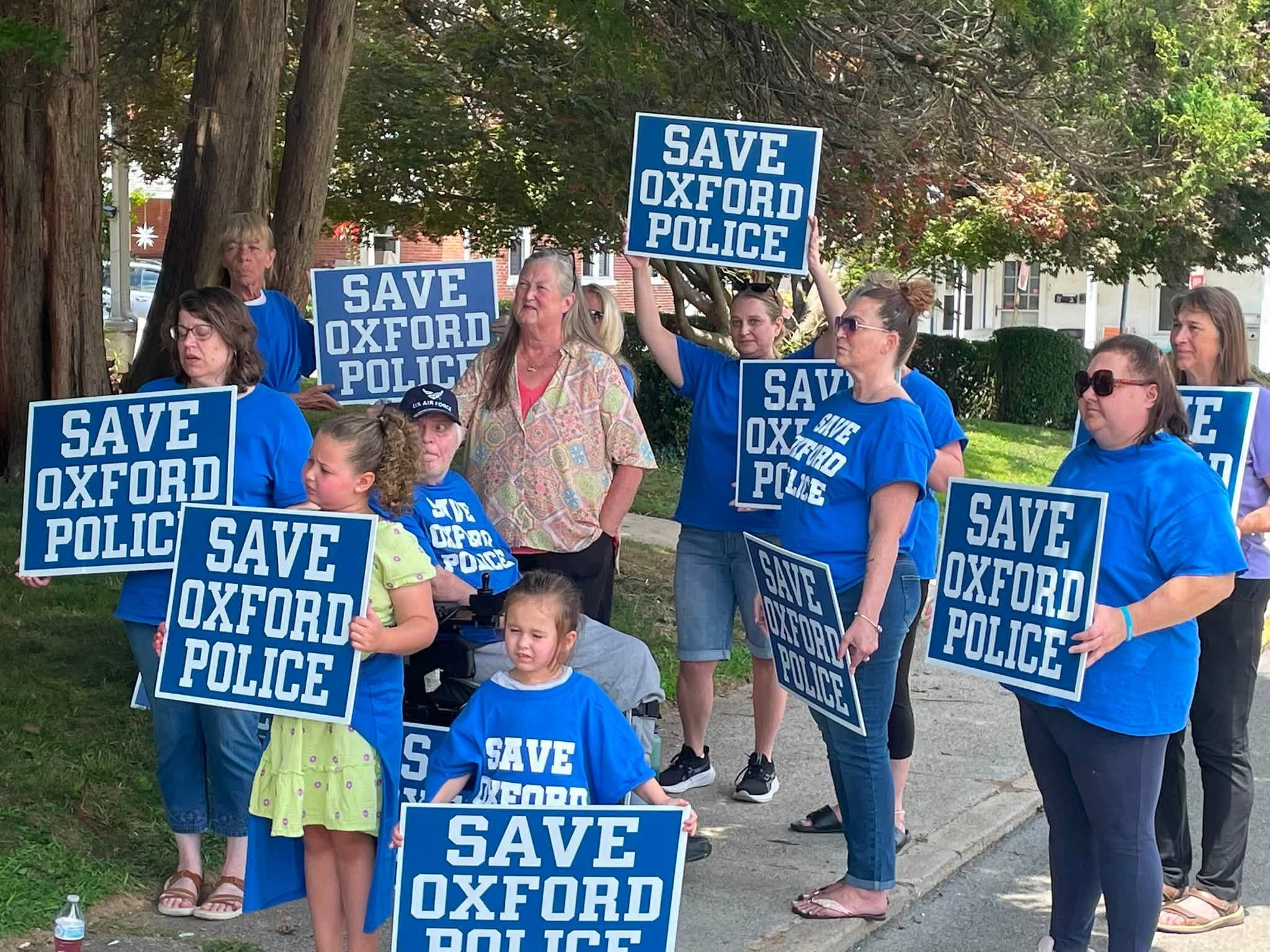
    But the prospect has sparked concerns in the community of roughly 5,800 people. Some fear that dissolving the borough’s department will increase emergency response times and potentially leave the municipality unprotected. And they worry about losing the officers who have grown up alongside them and understand their community. Some residents have called on the township to try to save the department by cutting costs in other ways.

    “These are people that literally would pull my kid over, give him a ticket, and ask how his dad is when he had cancer,” Oxford resident MaryAnn Riess said. “This is personal. This is a small town. These guys, all 11 of them, mean something to us. We buy them coffee. We buy them doughnuts. They are part of our extended family. This matters to us, and how they’re being treated matters to us.”

    Mayor Phil Harris does not disagree. But he says it is becoming impossible to maintain the department at its current level — let alone increase salaries or staffing.

    “We all want the same thing. I want our officers in a different uniform in our town doing the same job, with more equipment and more access to the tools they need to continue to perform at a very high level,” he said. “That’s the goal.”

    Years of deliberation

    When Oxford’s council casts its vote later this month, it will be after more than three years of studies and evaluations, the township said.

    In 2023, leadership found its police department — which consists of a police chief, 10 full-time officers, and several part-time officers — was the borough’s largest operating expense. It accounts for about half of the borough’s expenditures, with more than $2 million budgeted in 2026 for police.

    Meanwhile, the borough’s revenues were not keeping pace. Officials began exploring how they could sustainably provide public safety services long-term.

    Original fiscal forecasts were quite “bearish,” Harris said. But even when the borough performed better than earlier projections, the writing was still on the wall, he said.

    Its higher revenue was in part thanks to an influx of new homes with higher-than-expected earned income tax. But the largest indicator of why revenue rose was a 21% tax increase during the same period.

    “We’re seeing the operational and the structural imbalances continue within the police department,” he said. “We’re struggling on the operational side to be able to maintain what we currently have.”

    A July analysis from Keystone Municipal Solutions found that though Oxford’s financial status had improved, it levied the second-highest millage rate in the county, increasing by 21% since 2023, compared with the average of 12% across the county. Additional raises were seen as “counterproductive to the growth necessary for long-term fiscal stability.”

    The analysis evaluated five possible service alternatives: keeping the borough’s department, restructuring the existing department, reducing staffing and supplementing coverage with Pennsylvania State Police, relying entirely on the state police, and merging with the Southern Chester County Regional Department.

    At its July 29 meeting, the borough council voted 6-1 to authorize the council president, borough manager, mayor, and solicitor to negotiate with the regional department. They will present those agreements to the full council in August.

    If the council votes in the affirmative, the borough will join New Garden, West Grove, and Avondale in the regional department. Formed in 2017, the department employs 21 full-time officers.

    It is projected the regional department would add 12 more officers with the inclusion of Oxford. Oxford would receive 24-7 police services, with at least two officers on patrol at all times, like the current structure.

    Harris said the goal is for every officer who wants to go to the regional department to do so. But there are protections and a path for those who do not.

    Oxford is a ways further west from its partners; the borough is up to 16 miles away from them.

    To keep response times low, the borough would have a substation — though likely not in Oxford’s existing police building — with cars in the borough. Officers would start and end the clock within Oxford’s boundaries, so there would be no shift-change gaps. They hope to retain the administrative assistant and have a lieutenant stationed on duty at the substation, Monday to Friday.

    Officers would get new uniforms, the cars would be relabeled, and Oxford’s assets would become part of the regional department’s assets.

    According to the report, after an increase in costs associated with up-front transition costs in 2027, annual savings would range from $300,000 to $320,000 “before declining slightly toward the end of the projection period.” The report estimates cumulative savings through the projection period at approximately $1.4 million.

    “What you get by regionalizing is the economy of scale,” Harris said. “You get stability across those lines, and it’s predictability — and you can spread things out, and you can plan.”

    More regionalization

    The Southern Chester County Regional Department is part of a broader swell across the state of municipalities utilizing regionalized services to slash expenses, said John Brenner, executive director of the Pennsylvania Municipal League.

    You would be “hard pressed” to find a community that spends less than 50% of its budget on public safety, he said. And those costs continue to rise.

    “That puts pressure on local officials again to say, ‘OK, what is more efficient here? Is there a better way to do this?’ And I think a number of local officials throughout the state have said, ‘You know what? Regionalization might make a lot of sense,’” he said.

    It is not a perfect solution: Across the state, municipalities have joined and then withdrawn from regional services due to increasing costs under the agreement, according to the analysis by Keystone. Similarly, Kennett Square pulled out of the regional fire and emergency services commission that it had helped start after costs soared too high. It rejoined the commission earlier this year, having not found a cheaper alternative.

    In Chester County, some municipalities contract out with their neighbors’ forces. Oxford tried to embrace such a model, but its closest neighbors have relied entirely on the Pennsylvania State Police for public safety, at zero cost. Contracting Oxford’s force was an expense those communities could not take on.

    Across Chester County, more than 20 municipalities rely on the state police for full coverage. Around a dozen others use partial coverage.

    But that was not a direction Oxford wanted to go. While the state police do a “great job,” they are “not a community-based police department,” Harris said.

    “We were desirous of having a community-based police department that operates in a different model, that knows the neighbors, that knows the streets, that goes out to the festivals, that shakes the hands and goes to the schools and the nonprofits,” he said. “We felt like the [regional department] brings that model and it maintains that standard.”

    Residents are concerned

    Danny Graham grew up running around town with the men who would go on to become police officers in Oxford. There is a distinct “hometown” feeling to the force, he said. It feels like the officers know what to do, how to calm people down. And they respond almost immediately, he said, recalling an incident outside his home when they were there within 2.5 minutes.

    Oxford police responded to 4,406 calls for service in 2023, according to the most recent data in the Keystone report. A majority were for property and house checks, followed by traffic stops, medical emergencies, and more.

    Serious crime — such as larceny or violent crime — was “not prevalent,” according to the report.

    But residents worry about what regionalization will do to that community culture and speed of response.

    In response, Graham created Save Oxford Police, a Facebook group that amassed nearly 1,000 members in recent weeks. A Change.org petition calling for saving the department has accrued hundreds of signatures.

    He said he did not understand how the borough could have enough cash flow for other expenses, but would not invest in the department.

    “Something stinks in Oxford, and we’re trying to find that smell,” he said.

    He hopes that, if enough people come to the Aug. 17 meeting, they can shut the regionalization effort down by postponing the vote, with the hope something could come up in the interim to save the department.

    But, if not that, “it’s no longer Save Oxford Police. It’s Save Oxford Police Officers, because now that means more than the department itself,” he said.

    Riess, who believes the Oxford police force is a greater extended family for the borough, said that sitting out on the patio at a restaurant recently, her group watched an officer test each business door, making sure they were locked.

    “Do you really think that’s going to happen [with regional]?” she said.

    “I’ve never seen regional do that, but I haven’t seen any officers really do that. Except Oxford,” Graham said.

    This suburban content is produced with support from the Leslie Miller and Richard Worley Foundation and The Lenfest Institute for Journalism. Editorial content is created independently of the project donors. Gifts to support The Inquirer’s high-impact journalism can be made at inquirer.com/donate. A list of Lenfest Institute donors can be found at lenfestinstitute.org/supporters.

  • Pa. small towns set to get latest wave of federal funding for EV chargers

    Pa. small towns set to get latest wave of federal funding for EV chargers

    HARRISBURG — As Pennsylvania prepares to receive millions of federal dollars to build electric vehicle charging stations, the small towns that will host the devices hope they can double as tourist magnets.

    “People can let their vehicles sit for a bit and walk the stores downtown and grab food,” Steve Herman said of the vision for the devices. “They’ll serve folks who are living here but also draw in visitors.”

    Herman is transportation planning program director for SEDA-COG, an economic development organization that covers eight central Pennsylvania counties. He’s spent the past year working with chambers of commerce and community groups to explore how to make the chargers economic assets. If planned properly, he said, the stations can “draw people into our downtowns.”

    The funding is the latest wave of a $5 billion federal program created under the Biden administration to build out EV chargers across the country. A previous phase of the program placed chargers along interstates and other major roads, but this round is focused on building chargers in local communities. All told, Pennsylvania is slated to receive $171 million by the program’s end.

    In the past year, Herman has surveyed where the best locations for chargers would be, hosting in-person workshops on the program and polling residents. He even created a tool that lets people drop pins on a map to recommend locations for chargers.

    He reported his findings to the Pennsylvania Department of Transportation, which has been consulting with dozens of other local planning councils across the state in preparation for the funds.

    “Compared to Philadelphia or Pittsburgh, [there are] differences in terms of existing network and priorities,” Herman told Spotlight PA, referring to current charger access. “We already have some in university towns and hospitals and destinations like that, even some of the grocery stores. But [there’s] not as widespread availability. The community charging program will broaden that out.“

    Pennsylvania has built at least three dozen chargers so far — the most of any state in the U.S. Each charging port cost roughly $163,000.

    Clean energy and transportation experts attribute the fast deployment to PennDot, which had previously partnered with the Department of Environmental Protection to research the issue. The agency also worked directly with local gas stations to dole out grants.

    Environmental advocates view EVs as a key part of combating climate change, as the transportation industry is one of the largest sources of greenhouse gas emissions in the U.S. Over half of those emissions come from passenger cars and trucks.

    Alissa Burger, regional policy director at clean transportation industry group CALSTART, said the federal funds are “creating a foundation” for states to have basic EV charging infrastructure that will “encourage their citizens to consider switching over to a zero-emission vehicle.”

    She added: “You’re not gonna get an EV if you feel nervous about where you’re going to charge it.”

    Previously, states were on their own, Burger said. For instance, she pointed to the 2019 PennDot plan to build out EV infrastructure. That pitch proposed just four charging stations and identified only state sources for funding.

    “There was intention. I don’t think there was a lot of funding behind it,” Burger said.

    So far, Pennsylvania has already spent or plans to spend roughly $60 million of the $171 million allocated to the state. The remaining $100 million has been obligated — meaning a contract is in place to spend the funds — to the grant program that Herman of SEDA-COG is participating in, per PennDot.

    That initial commitment is important, as unobligated funds can be clawed back by federal officials when the program expires in October. The EV charging effort is among a slate of initiatives funded by the Bipartisan Infrastructure Law that the Trump administration has tried to roll back or freeze.

    In the first weeks of his second term, President Donald Trump issued an executive order to freeze funding to this and other programs within the BIL. Trump said the freeze was for the purpose of eliminating “unfair subsidies and other ill-conceived government-imposed market distortions that favor EVs over other technology.”

    As a result, the federal Department of Transportation paused funding to states. But after a suit by environmental organizations and states, including Pennsylvania, a federal judge ruled the order unconstitutional and returned the funds.

    The Federal Highway Administration also issued new guidelines for the National Electric Vehicle Infrastructure program last August, which environmental advocates said slowed down EV build-out by forcing states to resubmit their plans.

    Under the NEVI program, states get funding to grow their electric charger network. Site hosts, such as gas stations and local governments; EV charging companies; and contractors can apply for money to buy, install, and operate EV chargers. These funds can be used to pay for up to 80% of the total costs to build, replace, or upgrade a charging station.

    The first tranche of funding was released in 2021 and designated for a specific use: ensuring that there was an EV charger every fifty miles on major highways in the state, namely the Pennsylvania Turnpike. The money was aimed at building chargers for passenger vehicles.

    Pennsylvania was the first state to meet that goal, which allowed PennDot to tap the funding dedicated to setting up charging networks in less-trafficked routes. That second tranche went toward areas like Northeast Pennsylvania, Erie, and the Pittsburgh suburbs.

    The latest and final round of funds, for “community-focused EV charging projects,” is what has small towns excited.

    PennDot is still in the process of mapping out where to place chargers, working with local planning organizations like SEDA-COG to finalize locations.

    The agency is doing this work in stages, targeting different regions of the state. Officials plan to begin announcing this fall which municipalities will be awarded grants to build charging stations, and say the process of choosing locations should wrap up by next summer.

    Spotlight PA is an independent, nonpartisan, and nonprofit newsroom producing investigative and public-service journalism that holds power to account and drives positive change in Pennsylvania. Sign up for our free newsletters.

  • Philly school principals were asked about their jobs. Here’s what they had to say.

    Philly school principals were asked about their jobs. Here’s what they had to say.

    Most Philadelphia principals believe the city’s district and charter schools are moving in the right direction, though they are also frustrated with punishing workloads and inadequate access to resources.

    And while the majority of principals are satisfied with their leadership roles, Philadelphia School District school leaders are less likely to feel positive about their levels of support and autonomy. Only about half of district principals reported feeling backed by central administration, and about the same number said felt they had the authority to make decisions about school policies and practices.

    Two-thirds of principals citywide have considered leaving their jobs, with most contemplating K-12 jobs outside Philadelphia or in the education sector but not in a school or district.

    The results come via a new survey commissioned by the Philadelphia Citywide Talent Coalition, a group asked by the Philadelphia Mayor’s Office of Education to design and implement strategies to hire and retain more effective teachers and teachers of color.

    Elevate 215, a Philadelphia-based education nonprofit, commissioned the study on the talent coalition’s behalf, surveying 135 district and charter school principals this spring.

    Here are some takeaways from the recently released report:

    There are some reasons to be optimistic

    Most principals have spent more than a decade in Philadelphia schools, district or charter.

    Both charter and district principals said they think Philadelphia schools are going in the right direction — 64% of charter principals and 55% of district principals. (In all, 36% and 45%, respectively, believe the sectors are going in the wrong direction.)

    Charter and district principals report a satisfaction gap in some areas

    While charter and district principals report similar levels of satisfaction in areas like relationships with students (95% for district principals and 96% for charter principals), there were areas of disparity.

    More than three-quarters, 80%, of charter principals felt they had access to adequate funding, supplies, and support staff. Just 23% of district principals were satisfied with their level of resources.

    Facilities satisfaction was a key area of difference, too — 83% of charter principals said they were satisfied with their access to adequate facilities, while 34% of district principals did.

    Only 32% of district principals said they were satisfied with their workload; 54% of charter principals reported workload satisfaction.

    In all, 51% of district principals said they felt supported by their central office administrators, while 88% of charter principals did. The same percentage of district principals said they felt they had autonomy to make decisions regarding school policies and practices; 81% of charter principals did.

    Principals’ top challenges are consistent

    Principals across sectors reported that staff shortages, workload, inadequately prepared teachers, and expectations around student achievement are top challenges.

    Principals sound off

    Asked what policymakers should know, the principals — who were not identified in the report by name or school — had much to say.

    “One piece of advice I would give policymakers is to listen directly to school leaders who are doing the work every day,” one principal wrote. “Retention will improve when leaders are not expected to carry the weight of academics, culture, staffing, family engagement, safety, and community concerns without adequate support.”

    Another principal was succinct, writing: “do not micromanage!”

    “People need to be paid more, especially teachers. We also need to be able to enforce truancy policies. It’s frustrating for all involved,” another principal said.

    “Attract, support, and help retain high-quality educators,” wrote another principal. “We can’t [hire large numbers of teachers without permanent certification] and expect miracles. Hold parents more accountable for school attendance — other states do.”

    Another principal focused on a lack of experienced educators: “Offer veteran teachers a higher salary to commit to working at schools such as mine in Kensington where the only applicants are just out of college with no experience. The children continue to fall further behind even with [academic coaches] in our building.”

    “Schools in hard to fill locations require veteran teachers with heart who understand their skills are needed desperately,” the principal said.

  • Delco man pleads guilty to stalking Philly TV news personality

    Delco man pleads guilty to stalking Philly TV news personality

    A Delaware County man who previously got in trouble for leaving lewd and threatening voicemails for U.S. Rep. Madeleine Dean pleaded guilty Wednesday to stalking a Philadelphia TV news personality.

    Stephen M. Cilurso, 73, of Aldan, admitted to one count of stalking by use of the mail and one count of witness tampering before U.S. District Judge Gail A. Weilheimer in Philadelphia federal court.

    U.S. Attorney David Metcalf did not identify the victim, but court records describe the target of Cilurso’s homophobic and threatening mailed letters as a TV news personality who has a spouse and children.

    Cilurso mentioned the man’s children by name in several of his threatening letters, according to the memorandum for Cilurso’s plea deal with prosecutors.

    Even after Cilurso was contacted in March by law enforcement about the harassment, he continued to send letters to the TV personality — but this time he was asking the victim to help get the criminal investigation dropped, the memo said.

    Cilurso reportedly did the same with Dean (D., Montgomery).

    He was charged in 2021 with making threatening and lewd calls to Dean’s office because she was involved with the impeachment of Donald Trump, whom he supported in 2020. At one point, he mentioned Dean’s daughter by name.

    After police began to investigate the calls, Cilurso left additional messages apologizing for his behavior and begging Dean to tell detectives to stop the investigation.

    Cilurso pleaded guilty in the Dean case and was sentenced to probation, court records show.

    In January, Cilurso was arrested for allegedly making threats to New Jersey Gov. Mikie Sherrill when she was a member of Congress.

    On Thursday, the Essex County Prosecutor’s Office confirmed that Cilurso pleaded guilty in March to one count of fourth-degree stalking in the Sherrill case. His sentence is pending.

    In the Philadelphia case, Cilurso mailed his first letter in 2019 and included homophobic comments and mentioned that he had just seen the victim with his kids.

    Cilurso continued mentioning the victim’s children in subsequent letters as well as the victim’s spouse, prosecutors said.

    He also threatened to release snakes around the victim’s home.

    “Regarding why the snake letters were mailed, the defendant stated he saw a news segment where Victim 1 revealed on the air that he is deathly afraid of snakes,” the plea memorandum said.

    “The defendant thought Victim 1’s fear of snakes was funny, so he began mailing threatening communications to Victim 1 indicating he was planning to release snakes at Victim 1’s residential property,” the memo said.

    In a September 2025 letter, Cilurso again used homophobic slurs and mentioned the victim’s spouse. At the end of the letter, according to the memo, Cilurso wrote: “I hope what happened to Charlie Kirk happens to you.”

    The victim received that letter about a week after Kirk, a conservative activist, was fatally shot on Sept. 10.

    Prosecutors said the victim felt as if his life was in imminent danger after receiving that letter and installed security cameras around his house. He also contacted Philadelphia police, who then notified the U.S. Postal Inspection Service.

    After being interviewed by law enforcement in March, Cilurso sent additional letters to the man, but was now asking for his help to stop the investigation.

    “I am the 73 year old scumbag who wrote you” the letters, Cilruso wrote, according to the memo.

    The plea memo said Cilurso begged for the victim to “help me out of this nightmare. Please ask the FBI to drop any future charges against me … I will donate a monetary amount to your favorite charity on your behalf … [D]on’t let me go to jail again and be away from my 3 remaining cats. I love my cats as you love your [children],” he wrote, again using their actual names.

    In a side note, the agents confirmed that Cilurso owned three cats.

    In another letter, Cilurso admitted that an agent had come to his house and told him to stop communicating with the victim, the memo said.

    In his last letter in March, according to the memo, Cilurso wrote: “I know that I told you that I would not write you again, but things have changed and not for the better for me.”

    Cilurso described health problems he claimed he had, and said he would take his own life and the lives of his cats rather than go back to jail, the memo said.

  • Trump goes unmentioned but not ignored as Clinton, Bush, and Obama step up as essayists on presidents

    Trump goes unmentioned but not ignored as Clinton, Bush, and Obama step up as essayists on presidents

    WASHINGTON — When George W. Bush wrote an essay this year about another president named George, he avoided mentioning the one named Donald.

    So did Barack Obama and Bill Clinton. The three ex-presidents joined a roster of historians and authors in contributing to the In Pursuit project, a 250th-anniversary series that had each writer produce an essay about a president or first lady.

    Though the project was explicitly designed to transcend today’s politics, some of its essays nevertheless reflect anxieties that are flaring in the era of President Donald Trump over the use of power, the health of the democracy, and the integrity of the presidency.

    The project is being curated by Colleen Shogan, the U.S. archivist who was fired without explanation by Trump last year. She instructed contributors not to be partisan or ideological. “Everybody took those instructions and that guidance very seriously,” she told the Associated Press. The goal was for all Americans to “feel welcome to be able to read these lessons and essays and learn something from them.”

    The mission, Shogan said, “is to surface the lessons from the past 250 years of American history, so that we can learn from those lessons, from both our successes and our failures, so we can plan for the present and the future. It’s what has been described as debriefing the American story.”

    The essays cover 43 presidents — all but Democrat Joe Biden and Republican Trump — and 30 first ladies. They are being published online at inpursuit.org and on Substack chronologically and weekly into December.

    Trump and Biden were judged too fresh to be appraised by history, a call that may have also set aside passions of the moment.

    Without naming Trump, Bush’s essay is difficult to read without thinking of Trump’s reluctance to cede power after his 2020 election defeat and his musings about a third term in defiance of the Constitution’s two-term limit.

    Bush hails the heroism of humility

    Bush’s essay celebrates George Washington, the original “No Kings” guy. Bush, a Republican, hails a man whose legacy only grew larger because he modeled the limits of the presidency for centuries to come.

    “Our first president could have remained all-powerful,” Bush writes, “but twice he chose not to. In so doing, he set a standard for all presidents to live up to.” First, Washington resigned as commander in chief of the Continental Army, then set the precedent of serving only two presidential terms before that limit was enshrined in the Constitution.

    Bush went on: “George Washington’s humility in giving up power willingly remains among the most consequential decisions and important examples in American politics.” Bush’s essay, released Presidents Day as the first in the series on Substack, drove heavy engagement.

    Retired Gen. Stanley McChrystal, who led U.S. and international forces in the Afghanistan War, sized up a fellow general, Ulysses S. Grant, in another essay that drew much attention for its parallels with today.

    History offers lessons on ‘law over loyalty’

    McChrystal presents the Union general and post-Civil War president as a leader who displayed “an absolute commitment to principles larger than personal ambition” and who, before his presidency, resisted pressure on military leaders to “align with political factions and be loyal to a person rather than the Constitution.”

    The emphasis on personal loyalty resonates in a time when Trump has repeatedly demanded fealty from officials in his administration.

    The “temptation to bend institutions toward personal power is not unique to Grant’s era,” McChrystal writes. “Our future still depends on whether our leaders choose law over loyalty.”

    This month, in the latest In Pursuit installment, Democrat Bill Clinton writes about Theodore Roosevelt, focusing on that president’s drive to expand the universe of “we the people” at the expense of powerful corporate interests, while also emphasizing Roosevelt’s exclusionary views on Black and Indigenous people.

    The essays frequently address presidents’ failures alongside their accomplishments, a contrast with Trump’s calls for federal cultural institutions to stick to patriotic interpretations of American history.

    Presidents, the chief justice, and first ladies contribute

    Among the In Pursuit contributors are Chief Justice John Roberts (writing about William Howard Taft, the only president who also served on the Supreme Court); Hillary Clinton (Eleanor Roosevelt); Michelle Obama (Jacqueline Kennedy); GOP operative Karl Rove (William McKinley); documentarian Ken Burns (Franklin D. Roosevelt); and historian Michael Beschloss (Lyndon Johnson). Democrat Barack Obama presents Abraham Lincoln.

    The project is being staged by More Perfect, a nonpartisan alliance of dozens of presidential centers along with academics and organizations dedicated to advancing democracy. It is where Shogan now practices her archivist craft that Trump shut down by firing her in February 2025.

    She still has not been told why. Nor has Congress apparently been notified of the reason. The law requires Congress to be told but does not specify a deadline. The National Archives is the central repository of federal documents both precious and routine, and its leader has discretion over which records to preserve and display, and how.

    “That is a position that used to be a nonpartisan position, much like the Librarian of Congress, the secretary of the Smithsonian,” she said. “And I took that very seriously and acted the entire time when I was archivist in a nonpartisan way.”

    The White House did not respond when asked why Trump fired the archivist and whether the administration will tell Congress the reason.

    Trump has long begrudged the archives for notifying the Department of Justice of his alleged mishandling of classified documents after he left office following his first term, though Shogan was not working for the agency then.

    Shogan sees hunger for history without a slant

    Shogan said she has been overwhelmed with the public response to the series so far and figures that speaks to a hunger for history shorn of partisanship. The essays have received more than 1 million cumulative views on Substack and her podcast of the same name registered 160,000 audio downloads and nearly 64,000 YouTube views at last count. A documentary about the series is scheduled to air on PBS in October.

    In the essays, readers learn something new not just about the giants, but about presidents such as Millard Fillmore — “a historic punchline — best remembered, ironically, for being so forgotten,” in the words of his essayist, former New York congressman Steve Israel.

    Then there was Franklin Pierce, presented by his essayist as a pro-slavery president and “permanent victim” of Washington’s alcohol-soaked culture.

    Yale history professor David W. Blight recounts how Pierce won the presidency for the Democrats in 1852 despite vicious trolling by the Whigs. Fielding Mexican War veteran Gen. Winfield Scott in that election, they labeled Pierce, who also served in the war, the “hero of many a well-fought bottle.”

  • Philadelphia Historic District’s ‘firstivals’ have drawn super fans who have traveled from the nation’s first circus to its first zoo

    Philadelphia Historic District’s ‘firstivals’ have drawn super fans who have traveled from the nation’s first circus to its first zoo

    Christine Barnabic had already run a 5K at Belmont Plateau on Saturday morning when, still in her running gear, she hopped on her scooter and headed from her home in Fairmount to the Philadelphia Zoo. Her purse held commemorative pencils and a tattered punch card.

    When she arrived, the punch card had 10 holes in it — one for each “firstival” she had attended so far this year. At the zoo, she got her 11th hole punched, and a hat to celebrate her attendance.

    “It’s just really neat to recognize these firsts in America,” Barnabic, 42, said.

    The Philadelphia Zoo, for its part, was the first public zoo to open in the United States, in 1874. It is just one stop along the Philadelphia Historic District’s “52 Weeks of Firsts” events that celebrate Philly’s history and cultural significance by showcasing things that happened here first.

    The series launched Jan. 3, commemorating the first balloon flight in America. Barnabic missed the first run of events, but once she attended an event marking the first circus performance in the U.S., she was hooked.

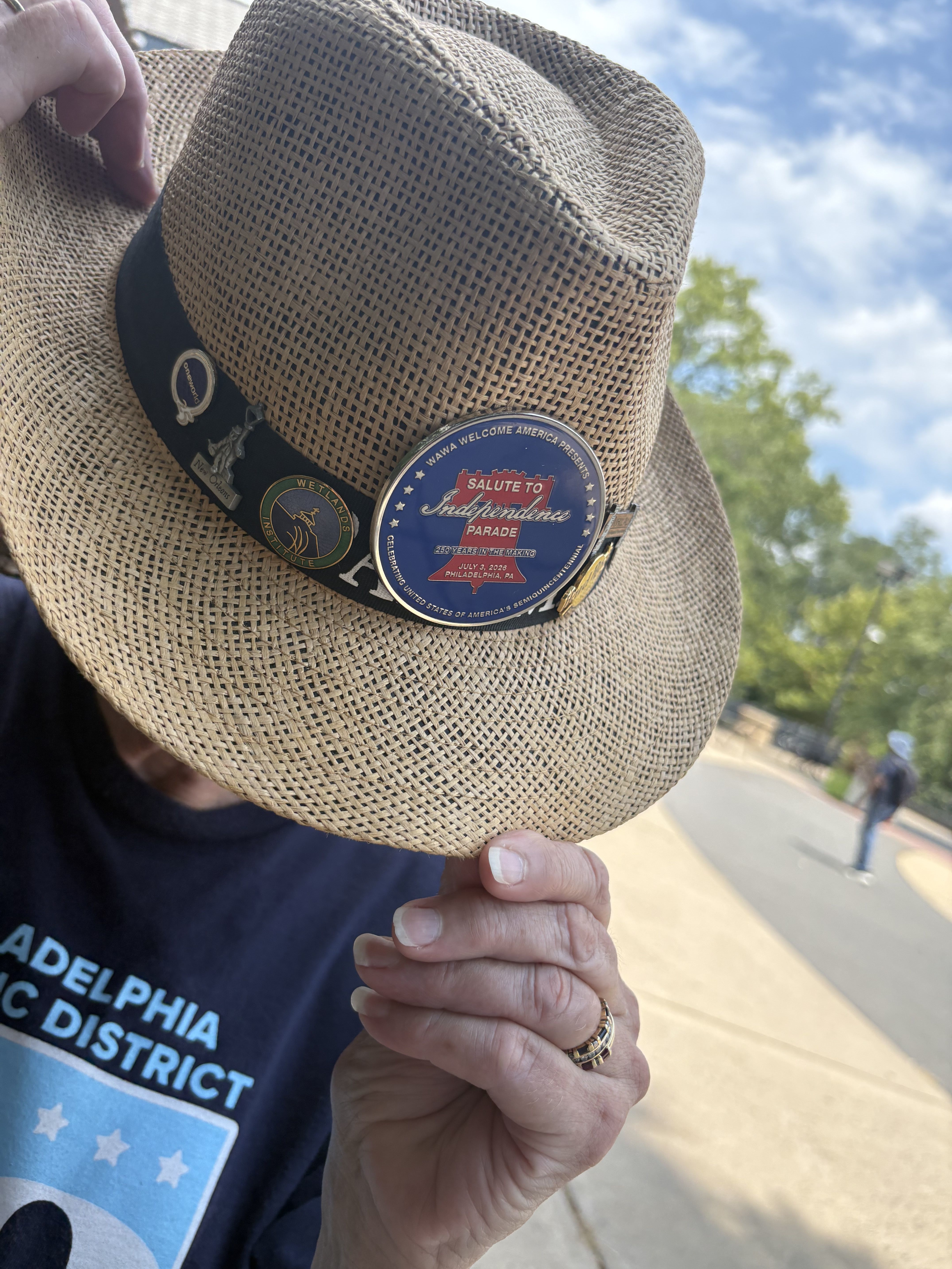
    Amanda Meiluch displays her hat adorned with pins for America’s 250th as part of the city’s 52 Weeks of Firsts celebrations Saturday, Aug. 8, 2026.Brett Sholtis

    She started posting selfies taken at each firstival and was stunned to learn she had won a prize pack including a Slinky, a record of old songs, tickets to the Betsy Ross House and Eastern State Penitentiary, and free admission to adult circus classes — each gift celebrating a historic milestone that happened in Philly.

    Barnabic said she is no history expert, but she is an enthusiast. She manages a company that does fitness tours for people who are in town for conferences or staying at hotels. To her, checking off the firstivals also boosted her knowledge.

    “And people are very friendly here,” she said.

    Todd Marcocci at Under the Sun Productions has been coordinating the events for the historic district. He said he knows at least four people who have attended all 32 events so far.

    The firstivals are often held at popular public locations, and many, like Barnabic, have been drawn in and kept coming back, Marcocci said. The zoo commemoration, for example, was held near the Ferris wheel, which is open to the public, no ticket required.

    “It’s been great, because each week there is variety. It’s beyond education. You think you know a lot about history, but everyone learns something here,” Marcocci said.

    Retired historian Lee Arnold agreed. In March, he attended the first flower show event at the Pennsylvania Horticultural Society and kept coming back.

    He has his own side quest: He is gathering commemorative items from all of the firstivals that he plans to give to the Historical Society of Pennsylvania for posterity.

    These days, Arnold leads history tours a couple of days a week for Grim Philly. He said he enjoys showing people the U.S. post office, the First Continental Congress, the first use of the phrase “United States of America,” and the invention of the Slinky, which can all be traced back to a four-block area in Old City.

    Artist Gwenn Seemel’s No. 1 captures many of the Philadelphia Zoo’s first milestones.Gwenn Seemel and Colibrí Workshop

    “It’s just wonderful. As I say to my tourists, everything started here,” Arnold said.

    For anyone feeling left out, 20 more firstivals remain on the calendar. They highlight everything from the first people to live in the region (at Penn Museum’s new Native North America Gallery) to the first modern detective story, “The Murders in the Rue Morgue,” written in 1841 by then-Philadelphia resident Edgar Allan Poe.

    (And yes, Philly invented cheesesteaks and water ice, according to the historic district, and forthcoming food-themed celebrations are on the list, too.)

    For the firstival diehards, the weekly events have also fostered a kind of community, said Amanda Meiluch, who took the train in from Penndel to volunteer at the event.

    She did not start out as a volunteer, but after a few weeks, she decided to make it official.

    In the process, the retired accountant has befriended other regulars — one of whom gave her a hat after dealing with a particularly sunny day. A week later, they saw each other again, and her friend was delighted to see that Meiluch had adorned the hat with pins celebrating the city’s history.

    “She made me happy. And I made her happy. That’s all you can do in this world,” Meiluch said.

  • The manager at Trump’s North Jersey golf club set up the botched renovation of the Reflecting Pool, according to a NYT investigation

    The manager at Trump’s North Jersey golf club set up the botched renovation of the Reflecting Pool, according to a NYT investigation

    The person who set up the botched renovation of the Lincoln Memorial Reflecting Pool in Washington is the manager at President Donald Trump’s golf club in Bedminster, N.J., according to an investigation by the New York Times.

    The Times found that David Schutzenhofer, who has run the Trump Organization’s golf club in North Jersey since 2006, was chosen by Trump to lead the renovation of the national landmark, which had leaked for years and was full of algae.

    The Times reported that Schutzenhofer does not have formal training in architecture or engineering and is Trump’s private employee, but that the golf club manager “played an off-the-books role in government decisions” regarding the project.

    The company that Schutzenhofer chose to do the renovation partnered with a company that enlisted the help of a third company that had never won a government contract, and applied the pool’s lining that later peeled away.

    Charles Birnbaum, president of the nonprofit Cultural Landscape Foundation, told the Times that paying millions of dollars to a first-time contractor to undertake a plan orchestrated by a golf-club manager to fix a national landmark was “like asking the museum guard to restore a painting in the Met.”

    In January, Schutzenhofer attended the World of Concrete trade show in Las Vegas in search of ideas for fixing the Reflecting Pool, according to the Times. Vendors recommended he call Rodney Jarboe, president of Creative Polymers, a company based in Missouri.

    Jarboe told the Times he first spoke with Schutzenhofer in March and was told the president wanted the work done in time for the Fourth of July, which Jarboe called “a very tight deadline.”

    He said Schutzenhofer decided to coat the Reflecting Pool with a polyurea liner, but Trump’s tariffs made getting polyurea coatings difficult. So Jarboe partnered with a California-based company called Rhino Linings, which then got a Virginia-based company called Atlantic Industrial Coatings to help apply the coating.

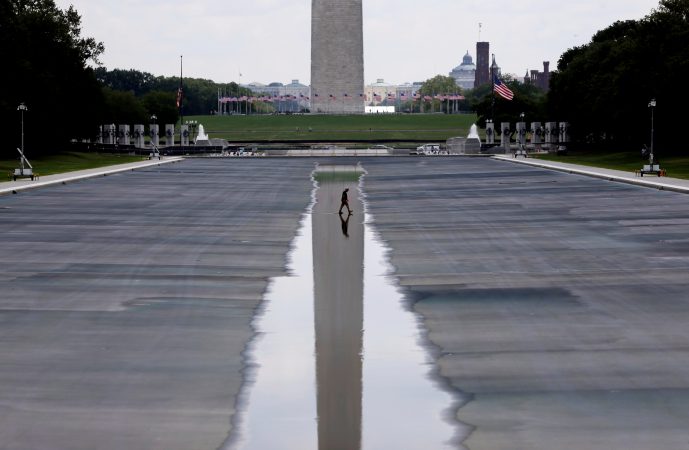
    Soon after the Trump administration said the renovations were finished in early June, the blue lining began to peel. Algae also returned. The Reflecting Pool was then drained so it could be repaired.

    Spokespeople for the Trump administration defended the project in statements to the Times. Neither Schutzenhofer nor Rhino Linings responded to questions about their roles, according to the Times. Atlantic said in a statement that a “very small part” of the liner needed repairs but otherwise declined to comment.

    Trump has claimed without evidence that vandalism was behind the damage to the Reflecting Pool. But in a court filing, Jeanine Pirro, the U.S. attorney for the District of Columbia, admitted that “the damage was the result of a botched installation.”

    A judge this week dismissed felony charges against Olympic canoeist David Hearn after he was accused of vandalizing the Reflecting Pool. And Pirro has moved to dismiss cases against several others.

  • Lake Mead hits historic low water level as Colorado River struggles

    Lake Mead hits historic low water level as Colorado River struggles

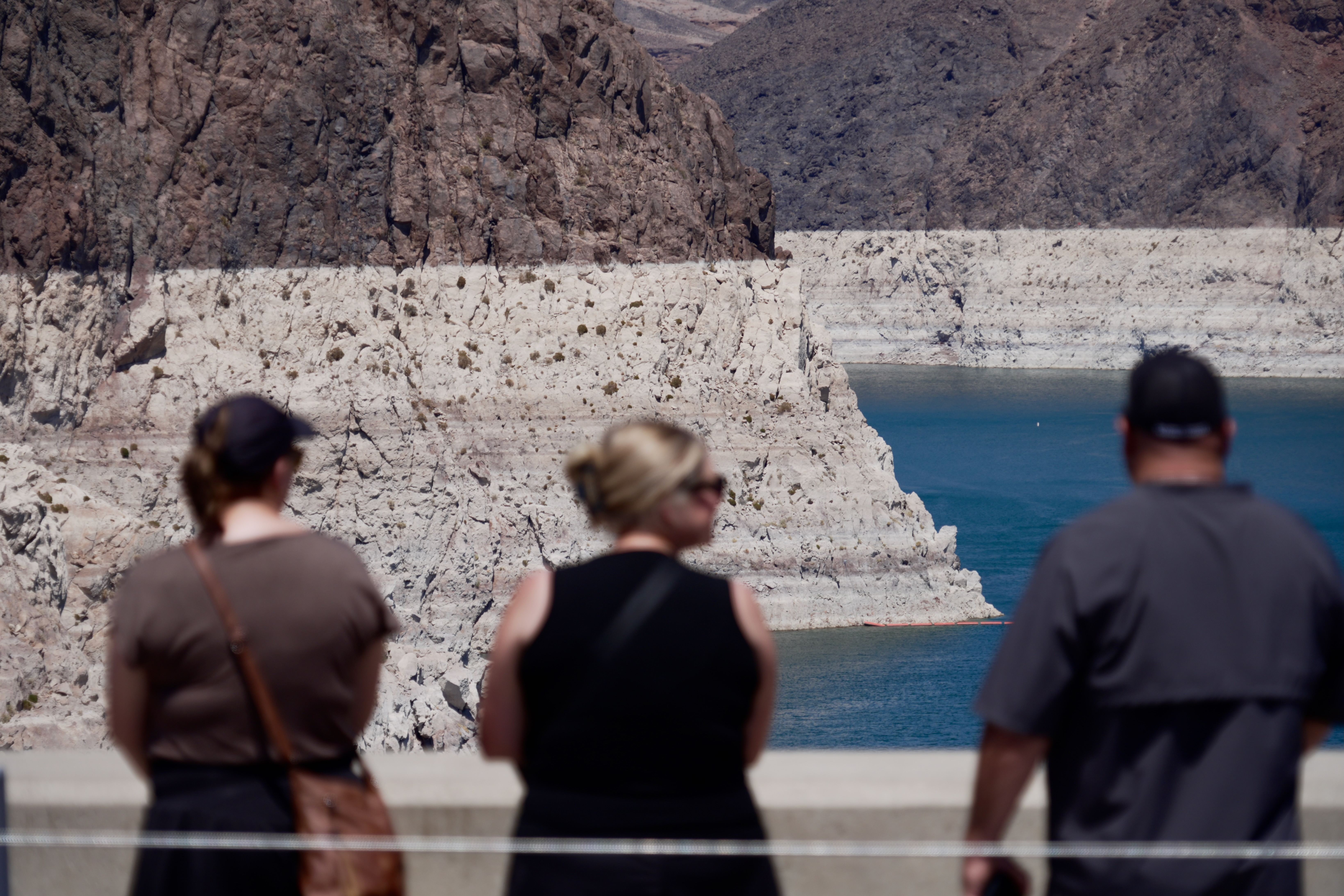
    BOULDER CITY, Nev. — Lake Mead, the largest reservoir in the United States, has plummeted to its lowest water level since it was filled some 90 years ago, another sign of the crisis plaguing the Colorado River system.

    Water levels at Lake Mead hit 1,040.4 feet above sea level on Friday, according to federal data. That’s just below the elevation of 1,040.58 feet recorded on July 28, 2022, at the reservoir that straddles the Arizona-Nevada border outside Las Vegas.

    The record follows a winter that produced the worst snowpack on record in the Colorado River Basin. Melting snow feeds the river, which is relied upon by farmers, industries, wildlife, hydropower producers, and more than 40 million people across seven U.S. states, tribal nations, and Mexico.

    It comes a week after federal officials announced a short-term proposal to stave off a crisis in the beleaguered waterway. Federal officials stepped in after states that rely on the river — California, Colorado, Arizona, Nevada, New Mexico, Wyoming, and Utah — failed to reach an agreement on how to share the dwindling resource long term. Under the proposal, California, Nevada, and Arizona would share water cuts.

    Years of overuse combined with drought and rising temperatures have been depleting Lake Mead and Lake Powell, the country’s second-largest reservoir. Together, the two bodies of Colorado River water are the lowest they’ve been in nearly seven decades.

    To protect the strained system’s ability to produce hydropower, federal officials said Thursday that they will not release cool Lake Powell water from Glen Canyon Dam in northern Arizona to protect a threatened native fish whose habitat is between the reservoirs.

    Severe drought in 2022 on Lake Mead, which is held back by the Hoover Dam, exposed human remains and forced water officials in Las Vegas to pump water from deeper within the reservoir to continue to supply water to millions of people.

  • Pirro, Trump’s longtime champion, is on the outs over Reflecting Pool move

    Pirro, Trump’s longtime champion, is on the outs over Reflecting Pool move

    Jeanine Pirro swept into Washington last year as a camera-ready prosecutor and staunch ally of President Donald Trump. Suddenly she was everywhere: crime scenes and community forums, court hearings and TV interviews, TikTok-style videos and black-tie dinners.

    But after more than a year in office as U.S. attorney in the nation’s capital, Pirro now finds herself at odds with Trump — with her job at risk — over scraps of blue liner that peeled off the Lincoln Memorial Reflecting Pool.

    Pirro, who left her job as a Fox News host to become the top federal prosecutor in D.C., immediately began seeking the toughest charges possible for violent crimes. She launched criminal probes of more than a half-dozen public officials who had drawn Trump’s ire — then punted the blame to judges and juries when those efforts collapsed.

    But her moves to drop several cases of alleged vandalism at the newly renovated pool contradicted Trump and blamed the administration’s handpicked contractor for botching a project the president had championed. And in the end, they exposed a crack in Pirro’s ability to balance Trump’s demands with her legal responsibilities.

    “She thought she had covered all of her bases — that’s what she thought — and then, of course, things went south,” a person who has known Pirro for decades said of her current predicament with the president.

    People who have followed Pirro’s trajectory as a judge, district attorney, conservative author, and TV personality say she is a prosecutor at heart who has long been passionate about fighting crime and protecting victims, and who found a renewed sense of purpose when Trump tapped her to run one of the busiest U.S. attorney’s offices in the country.

    Her detractors say few in the Justice Department have been as willing as Pirro to gin up prosecutions or test the boundaries of the system in pursuit of Trump’s fixations and antagonists.

    This account of Pirro’s tumultuous time as U.S. attorney, and how she has handled being the prosecutor in Trump’s backyard, is based on court records and interviews with 11 people familiar with key events. Almost all spoke on the condition of anonymity to offer candid assessments of Pirro while her job is seemingly on the line. Pirro, through a spokesperson, declined an interview request.

    Her troubles began after the Trump administration installed a coat of blue sealant at the Lincoln Memorial Reflecting Pool in anticipation of this year’s July Fourth festivities. Pieces of paint quickly started coming apart and floating to the surface, and some visitors who reached out to grab them were arrested, court records show.

    Trump claimed vandals had torn up the pool’s “beautiful facade,” and Pirro initially filed criminal charges against four people, including a former Olympic canoeist who was indicted on a felony count of destruction of property. In her booming New York brogue, Pirro castigated that defendant at a news conference and said her office was “committed to protecting our national resources, our monuments, and our parks from vandals.”

    But Pirro abruptly dropped all four cases weeks later, blamed the Interior Department for misleading prosecutors into filing unsupported criminal charges, and was soon inside the Oval Office to explain herself.

    A former judge and district attorney who served for decades in Westchester County, N.Y., Pirro arrived at the White House on Monday with boxes of evidence showing that the Interior Department had awarded a no-bid contract to a company that misapplied the liner, according to people familiar with the matter. That evidence is detailed in an explosive, 20-page court filing that the U.S. attorney’s office submitted last week, which stated that “the damage was the result of a botched installation and not vandalism.”

    Pirro had personally reviewed and signed off on the filing, and it conveyed her frustration that the documents from Interior were not quickly turned over to prosecutors, as well as her view that they “demolished” any chance of building a winning case against the alleged vandals, according to people with knowledge of her thinking. Interior Secretary Doug Burgum pushed back, writing on X that the “evidence is clear” that vandalism was what damaged the pool.

    One person familiar with Pirro’s thinking described her approach to the White House meeting as: “Stand her ground, be focused, make her case, and do the right thing.”

    The rift between Trump and Pirro, over peeling bits of paint at a national monument, came after she had launched criminal probes into six Democratic lawmakers who criticized the administration’s military actions, as well as the Federal Reserve chair at the time, Jerome H. Powell, who refused Trump’s demands to resign or institute lower interest rates.

    A federal judge rejected Pirro’s attempts to issue subpoenas in the Fed investigation, and she later closed that probe without seeking criminal charges, but Trump praised her doggedness in taking the case as far as she could. A grand jury declined to indict the Democratic lawmakers, and Trump soon moved on to other issues.

    This time, Pirro’s office said in the Reflecting Pool court filing, prosecutors were voluntarily dismissing the charges. Trump said Pirro “folded like an umbrella.”

    “I just think she was totally wrong,” Trump told reporters Wednesday, noting that National Park Service employees had told authorities they saw vandals in action. He described problems with the contractor as “a couple of little things” and said he hadn’t made a determination on whether to keep Pirro on the job.

    Trump continued his criticism Friday, saying on social media that “U.S. Attorney Jeanine Pirro should revisit her hastily made decision.”

    Pirro had befriended Trump decades ago in New York’s social circles, but they had never worked together, and one dynamic underlying their rare public break is that both are more comfortable calling the shots than deferring to others, said the longtime friend, who has seen them together.

    “She has a lot of respect for the president,” this person said, adding, “They have a relationship that for the first time has now transformed into a professional subordinate situation.”

    Pirro, 75, leads the only U.S. attorney’s office in the country with the dual mandate to prosecute local crimes and complex federal cases. Trump named her interim U.S. attorney in May 2025. She was later confirmed by the Senate, earning support from Republicans that Trump’s first pick for the job, Ed Martin, couldn’t muster.

    She came into a deep-blue city where only 6.5% of D.C. voters cast ballots for Trump in the 2024 election. Protests flared when immigration raids and street arrests swept up hundreds of people after Trump declared a crime emergency in D.C. last year, bringing in teams of federal officers and National Guard troops to patrol city streets. Pirro has often been the one absorbing the blowback from heated community meetings and in court, where juries have voted down felony charges for some defendants and acquitted others of assaulting federal officers.

    “The truth is that with the federal surge — whether you like it or you don’t like it — crime is down,” Pirro told the dozens of community members in the D.C. police’s Fifth District office in Northeast Washington after a tense weekend last October in which 12 people were shot.

    Homicides last year declined by roughly one-third, totaling 127, according to D.C. police statistics. They have dropped another 32% this year, and stood at 66 as of Thursday. Robberies and property crimes also have declined, but assaults with dangerous weapons have risen 42% this year, to 758 instances, according to the police data.

    “President Trump said, ‘I’m going to make D.C. safe and beautiful,’” Pirro added at the October meeting. “And you know what? He’s going to do it. … Every day we’re pushing. Pushing against juries, pushing against judges.”

    On social media, she frequently repeats a similar message, crediting the president with making the city safer.

    Those who have worked with Pirro describe her as a decisive boss, quick to grasp legal nuances and less abrasive than her brash TV persona. She has taken a particular interest in a new task force to disrupt international cryptocurrency scams, and she has called on the D.C. Council to toughen sentencing laws for juvenile crimes and partnered with Mayor Muriel E. Bowser (D) on efforts to strengthen domestic violence legislation. Pirro, according to those who know her, is meticulous about her fashion choices, known for her sweet tooth, and on friendly terms with some of her staff, attending trivia night at a brewery/pizzeria this year.

    Pirro has attempted to rebuild the U.S. attorney office’s ranks, which were decimated by staff departures and Martin’s purge of prosecutors who had investigated the Jan. 6, 2021, attack on the U.S. Capitol. The Justice Department is now offering $25,000 bonuses to lawyers who sign a commitment to stay at the office for two years, according to two people familiar with the matter, who spoke on the condition of anonymity because they were not authorized to discuss it.

    “I think that U.S. Attorney Pirro, over the past year and a half that she’s been there, has led an unprecedented effort to literally turn this city on its head to be a safe place for all of us to live and eat,” acting attorney general Todd Blanche said at a news conference Wednesday, a notable show of support that buoyed Pirro’s allies. Blanche added that Trump was allowed to dismiss any U.S. attorney.

    Although Pirro’s office has had a mixed record with jury trials in U.S. district court over the past year, there have been no major setbacks in the office’s biggest cases. Those include the prosecutions in the killing of a 21-year-old congressional intern; the fatal shooting of a young couple outside the Capital Jewish Museum last year; the ambush-style attack in which one National Guard member was killed and another wounded; and the case of Cole Tomas Allen, who has been charged with attempting to assassinate Trump at the White House correspondents’ dinner this year. The trial of an alleged terrorist behind the infamous bombing of Pan Am Flight 103 over Lockerbie, Scotland, is scheduled for this year in D.C., with Pirro’s office running the prosecution.

    But critics say Pirro has curtailed prosecutors’ autonomy and jacked up their workloads by ordering them to seek the maximum possible charges in every case. Judges and public defenders have criticized Pirro’s office for bringing cases during Trump’s federal law enforcement surge that were based on incomplete or shoddy investigations, leading to multiple instances in which the U.S. attorney’s office dismissed charges after the defendants spent time in jail.

    “I think many Americans have a sense that in Trump 2.0, prosecutions are being brought for reasons other than public safety,” Paul Butler, a Georgetown University law professor, said in an email assessing Pirro’s record as U.S. attorney. “We are now seeing many jurors more carefully scrutinizing cases, and that’s a good thing in terms of how the system is supposed to work.”

    Longtime defense attorney Joe Flood, who practices in the D.C. area, recalled that he first encountered Pirro in the 1990s when she was the Westchester County district attorney, and he was defending people facing the death penalty in New York. She made death-penalty cases central to her political ambitions, he said, as she geared up for a potential run for state attorney general or governor, but she never got a defendant sentenced to death and eventually left elected office for her television career.

    In Trump’s second term, Flood said, some U.S. attorneys in key offices have discovered that being a responsible prosecutor is sometimes a fireable offense. He noted that Erik S. Siebert, whom Trump had appointed as the interim U.S. attorney for the Eastern District of Virginia, was forced out last year after declining to seek criminal charges against former FBI director James B. Comey and New York Attorney General Letitia James. Career prosecutors in both cases had said the evidence was too flimsy to take to court.

    “The reality is if you’re an ethical U.S. attorney, and you won’t be bent to Trump’s will, you’re gone,” Flood said. Of Pirro’s decision to drop the Reflecting Pool cases, he added: “She gets some credit for standing up to Trump.”

    Judges have also criticized Pirro’s office for wiping out the most serious convictions from the Jan. 6 riot — the seditious conspiracy cases against the far-right Proud Boys and Oath Keepers.

    Members of the extremist groups stockpiled firearms and led the charge into the Capitol, according to the evidence presented at their trials. Pirro this year signed on to key court filings to clear those charges as a matter of loyalty to Trump, according to people familiar with the matter. But she declines to take questions about those moves, even as federal judges bemoan the historical consequences of undoing convictions for crimes against the country.