Progressive Democrats notched another big victory in Tuesday’s Minnesota Senate primary. But a moderate Democrat narrowly won the high-profile governor’s race in Wisconsin, defying expectations of an easy win for the party’s surging democratic socialist wing.
President Donald Trump, meanwhile, suffered a defeat after the candidate he endorsed for Minnesota governor fell short in the Republican primary.
Here are five takeaways from Tuesday’s primaries:
Crowley upsets Hong in Wisconsin governor’s race
Milwaukee County executive David Crowley defeated Francesca Hong, a State Assembly member and democratic socialist, in the Democratic primary for governor after an unusually unpredictable — and unexpectedly close — primary.
Crowley initially dropped out last month, saying it was clear he could not win. Lt. Gov. Sara Rodriguez dropped out the following week, citing irregularities with her campaign’s financial reports. Then Crowley returned to the race with the endorsement of Wisconsin Gov. Tony Evers (D). After that, yet another Democrat — Mandela Barnes, a former lieutenant governor — dropped out, further scrambling the race. To add to the confusion, Barnes and Rodriguez remained on the ballot.
Hong was the latest democratic socialist to catch fire after several other democratic socialists defeated House Democrats in primaries earlier this year. She led in polling in the final weeks of the race but attracted criticism for calling years ago for the cancellation of Thanksgiving, which she described as a holiday “celebrating colonialism.” Evers warned that Hong probably could not defeat Rep. Tom Tiffany, who won the Republican nomination.
Progressives prevail in Minnesota
Another progressive, Lt. Gov. Peggy Flanagan, won the Democratic primary for an open Senate seat in Minnesota, defeating a more moderate rival, Rep. Angie Craig. Flanagan had the backing of Sens. Elizabeth Warren (D-Massachusetts) and Bernie Sanders (I-Vermont) and other progressives in Congress. She will face Michele Tafoya, a former sideline reporter for NBC’s “Sunday Night Football” who easily won the Republican nomination.
Republicans view Flanagan as vulnerable due to the welfare-fraud scandal that rocked the state while Flanagan was in office, and they have expressed enthusiasm that Tafoya could put the seat in play.
However, no Republican has won a Senate seat in Minnesota since 2002, and Republicans are more optimistic about flipping Democratic-held seats in Michigan, New Hampshire and Georgia than Minnesota. The Cook Political Report, which rates the race as “likely Democratic,” said it would maintain its rating regardless of which Democrat won the nomination.
Another progressive, Matt Little, won the Democratic primary to succeed Craig in the House. Little, a former state senator and Lakeville mayor, was endorsed by Rep. Greg Casar (D-Texas), the chairman of the Congressional Progressive Caucus, among others.
Another Democrat falls to a primary challenge
Luke Bronin, a 47-year-old former Hartford mayor, ousted Rep. John B. Larson, 78, from his House seat representing central Connecticut in the latest generational clash to convulse the Democratic Party.
Larson is not the only older House Democrat to lose a primary this year. Reps. Al Green (D-Texas), who is 78; Adriano Espaillat (D-New York), who is 71; Diana DeGette (D-Colorado), who is 69; and Shri Thanedar (D-Michigan), who is 71, all lost primaries to younger challengers. (Green lost his seat to another House Democrat, Rep. Christian Menefee, after redistricting reshaped their districts.)
Unlike some of those races, Larson’s primary did not feature a strong ideological divide. Instead, Bronin campaigned on “energy, urgency and change,” and urged Larson to “pass the torch,” though he did not explicitly criticize Larson as too old.
Larson, in turn, tried to cast himself as more progressive than Bronin and emphasized his experience representing the solidly Democratic district.
“It’s not about age, generational change,” Larson said at a recent rally alongside Connecticut Gov. Ned Lamont (D) and labor groups. “This campaign … is about who has the record of delivering in this community.”
Lamont, 72, who is running for a third term, also faced a younger primary challenger on Tuesday. He prevailed, easily defeating state Rep. Josh Elliott, 41.
Graham, Norman advance to runoff in South Carolina
Sen. Lindsey Graham (R-South Carolina) defeated a primary challenger in June, avoiding a runoff by winning a majority of the vote. But his sudden death last month forced South Carolina to hold a second Republican primary, pitting Graham’s sister, Sen. Darline Graham — whom Gov. Henry McMaster named to succeed him — against nine other Republicans.
Graham won 33 percent of the vote on Tuesday, leading her rivals. But she did not win a majority of the vote, forcing an Aug. 25 runoff. She will face Rep. Ralph Norman, who trailed Graham with 25 percent of the vote.
Trump endorsed Graham ahead of the primary, giving her an edge in the runoff — but it’s not clear whether it will be enough to defeat Norman.
Consider what happened in the Republican primary for South Carolina governor. Trump endorsed Lt. Gov. Pamela Evette, who made the June runoff along with Alan Wilson, the state attorney general. When it appeared that Evette might lose to Wilson ahead of the runoff, though, Trump also endorsed Wilson, allowing him to claim victory days later when Wilson won.
Trump could be more reluctant to back Norman, who endorsed former South Carolina governor Nikki Haley over Trump in 2024 in the presidential primary. It is also unclear whether Rep. Russell Fry — who finished third in the primary — will endorse Norman or Graham.
Asked Tuesday night whether he would campaign for Graham in South Carolina, Trump told reporters, “I think so.” He added that he also liked “the other people” in the race, without naming them.
“They’re all Trumpers,” he said.
Norman told The Washington Post last week that he wasn’t sure Trump would issue a dual endorsement again. “I think people see it for what it is,” Norman said. “Double endorsement, really, is problematic to me.”
But, he added, “I’d love to have it at any time.”
Lindell loses primary despite Trump’s endorsement
Trump endorsed Mike Lindell, the MyPillow chief executive who enthusiastically supported his efforts to overturn the 2020 election results, for governor of Minnesota.
But Trump’s endorsement wasn’t enough. Lisa Demuth, the state House speaker, defeated Lindell on Tuesday. She will face Sen. Amy Klobuchar, who easily won the Democratic nomination, in November.
Lindell’s loss was the latest blow to Trump’s endorsement record. The candidates he backed for governor in Georgia and Iowa also lost. So did Rep. Andy Ogles (R-Tennessee) and Amir Hassan, whom Trump backed for an open House seat in Michigan.
Other Trump picks prevailed on Tuesday.
Graham led in South Carolina. Tiffany won in Wisconsin. Michael Alfonso won the Republican primary for a House seat in northern Wisconsin that his father-in-law, Transportation Secretary Sean P. Duffy, once represented. And former congressman Jerry L. Carl and state Rep. Rhett Marques won primaries for House seats in Alabama that the state legislature redrew earlier this year following a Supreme Court ruling that weakened the Voting Rights Act.
Natalie Allison, Matthew Choi and Ben Binday contributed to this report.
Residents protest against the disbanding of Oxford borough’s police department. Photo courtesy of Danny Graham
Residents in Oxford are concerned about the future of emergency response times and municipal protections in the 5,800-person borough if council moves ahead with disbanding its police department in favor of joining a regional agency.
That’s a decision council will make at an Aug. 17 meeting as it grapples with rising costs to maintain a century-old police force.
For some residents, the decision feels personal. “This is a small town. These guys, all 11 of them, mean something to us. We buy them coffee. We buy them donuts. They are part of our extended family. This matters to us, and how they’re being treated matters to us,” one said.
Traffic signal and safety improvements are expected in six Chester County municipalities thanks to recently awarded state funds. The largest is a nearly $640,000 grant for Tredyffrin Township to make improvements along Lancaster Avenue.
The region will see two celestial events — a partial solar eclipse today and the Perseid’s meteor shower, which will peak tonight — and there are several great viewing spots nearby, including Valley Forge National Historical Park and French Creek State Park. Here’s what to know.
Honey Brook Townshiphas named Nancy Freenock its next township manager and secretary. An attorney by trade, Freenock previously served as the city manager for Warren and borough manager for Clarion, both in Western Pennsylvania.
East Vincent Township is hosting a special planning commission meeting tomorrow at 6:30 p.m. at the municipal complex and on Zoom to consider AQ Dev, LLC’s conditional use application to build 53 single-family homes at 446 Stony Run Rd.
West Vincent Township’s board of supervisors is slated to consider Toll Brother’s proposal to build 46 homes near South Chester Springs and Conestoga Roads at its meeting on Monday.
The third season of Tires, which was created by comedian Shane Gillis and is set and was partly filmed in West Chester, drops on Netflix tomorrow.
Spooky season may still be a couple of months away, but Spirit Halloween has already opened at a former Rite Aid on Paoli Pike in West Chester. It’ll be joined this month by one at the former Tuesday Morning space in Downingtown.
A new coworking space, iThrive Coworking, recently opened at 10 Leopard Rd. in Paoli.
🍽️ On our Plate
Sweltering summer heat and humidity have you clamoring for a cool treat? Revisit our guide to the region’s ice cream shops, including the ever-popular La Michoacana in Kennett Square.
🎳 Things to Do
🎙️ Sound of Summer Free Concert Series: The final show of the season features a performance by Kennett Square’s own rock band The Holy Smokers. ⏰ Wednesday, Aug. 12, 6:30-8:30 p.m. 💵 Free 📍 Anson B. Nixon Park, Kennett Square
🎸 80’s Revolution: The band will transport attendees back a few decades, playing some of the most iconic tunes from the 1980s (leg warmers optional). ⏰ Friday, Aug. 14, 7:30 p.m. 💵 $23-$28 📍 Uptown! Knauer Performing Arts Center
🖼️ Look Around Music and Arts Festival: Hear live music, browse works of art, see skating demonstrations, and grab a bite to eat at this festival. ⏰ Saturday, Aug. 15, noon 💵 $25 in advance, $30 at the door 📍 The Elks Lodge, West Chester
🎶 Eagleview Summer Concert Series: Old 97’s frontman Rhett Miller headlines the next show. Local trio The MAKs will also perform. ⏰ Tuesday, Aug. 18, 7-9 p.m. 💵 Free 📍 Eagleview Town Center, Exton
The property includes a sprawling residence, a guest house, and a pool.Next Door Photos | Courtesy of Pat McGowan/The Collective.Real Estate
This Kennett Square property features not one but two homes, both situated on a large lot. The main six-bedroom home is a renovated and expanded mid-19th-century barn, complete with old beams, a stone fireplace, and an expansive walk-out lower level with a kitchenette. The second home, a restored 1800s farmhouse with two bedrooms, spans nearly 1,500 square feet and has its own driveway. Both overlook a pool and hot tub.
By submitting your written, visual, and/or audio contributions, you agree to The Inquirer’s Terms of Use, including the grant of rights in Section 10.
This suburban content is produced with support from the Leslie Miller and Richard Worley Foundation and The Lenfest Institute for Journalism. Editorial content is created independently of the project donors. Gifts to support The Inquirer’s high-impact journalism can be made at inquirer.com/donate. A list of Lenfest Institute donors can be found at lenfestinstitute.org/supporters.
P.S. This will be my last week writing the Cherry Hill newsletter as I pass the baton to my colleague, Laura Smythe. It’s been a pleasure bringing you township news week in and week out for the past year-and-a-half — thanks for making space in your inbox and sharing your feedback with me! Please continue to tell us your ideas and look for me to pop up here every now and again in the future.
Cherry Hill native Larry Berg (right) has been named the next commissioner of Major League Soccer. Major League Soccer
Major League Soccer has appointed Cherry Hill native Larry Berg its next commissioner, a role he’ll begin come January.
Unlike his predecessors — he’ll be just the third individual to hold the job — Berg has a major soccer background that he’ll lean on to stoke its next era.
His passion for the game began thanks in part to a poster for a youth soccer league his dad saw taped to a local telephone pole. Knowing nothing about the sport, Berg’s dad signed him up, and the rest is history.
A judge has tossed a case against local freelance journalist and former East student Benjamin Shore, who the school district claimed was filing too many public records requests that amounted to harassment.
A new indoor golf simulator concept is setting up shop in Cherry Hill. Back Nine will be located at 1409 Route 70, though a timeline for opening hasn’t been announced yet.
Roadwork continues on Cooper Landing, Haddonfield-Berlin, Kresson, Old Orchard, and Springfield Roads, as well as Chapel Avenue this week. Here’s what to know. There will also be roadwork on Greentree Road through tomorrow.
Camden County was scheduled to conduct mosquito spraying throughout Cherry Hill this morning.
The fire department is hosting a child safety seat event Friday from 9 a.m. to noon at the Deer Park Station.
Philadelphia Magazine recently profiled a couple who turned their Cherry Hill home into a colorful retreat amid the woods. Check it out here. (Want to have your home featured in The Inquirer? Nominate it as a “Haven” by sending some details andphotos to properties@inquirer.com).
🍽️ On our Plate
Landmark eatery The Pub in neighboring Pennsauken is for sale after its longtime owners, the Gelman family, who’ve helmed it for the past 26 years, said “it’s time for a new steward.” The Inquirer’s Michael Klein has the details.
Drive-through-only chain 7 Brew Coffee is looking to expand into Cherry Hill and is proposing one of its popular concepts at 800 Route 38. The former Delcrest Medical Services building would be demolished to make way for the 510-square-foot shop and its two-lane drive-through, plus a bypass lane. The township’s planning commission will consider the application at Tuesday’s 7:30 p.m. meeting.
Sweet Cherry, an ice cream joint that also serves food and Mexican snacks, has opened at 2442 Route 38, taking over the former Sushi House space. It serves burgers, hot dogs, and Mexican street food, in addition to scoops of ice cream, water ice, and shakes. (South Jersey Food Scene)
🎳 Things to Do
🎶 Twilight Concert Series: Be transported to the islands when Polynesian luau band Paradise Island takes the stage. ⏰ Thursday, Aug. 13, 8 p.m. 💵 Free 📍 Cooper River Park Jack Curtis Stadium
👻 Monster-Mania Con: Meet celebrities from popular horror films, browse merchandise, and catch some spooky screenings at this three-day event. ⏰ Friday, Aug. 14-Saturday, Aug. 16, times vary 💵 $41.74-$72.49 📍 DoubleTree by Hilton Cherry Hill Philadelphia
The family room has lots of windows that look out on the backyard.Derrick Kunzer | Courtesy of Amy Rossano/ Epique Realty
This four-bedroom split-level home in the Old Orchard section of Cherry Hill has undergone a number of updates, including a renovated eat-in kitchen with white cabinetry and stainless steel appliances. Some of its features include a dining room, a family room with a brick fireplace, and a fenced backyard with a patio. There’s an open house Saturday from noon to 2 p.m.
By submitting your written, visual, and/or audio contributions, you agree to The Inquirer’s Terms of Use, including the grant of rights in Section 10.
This suburban content is produced with support from the Leslie Miller and Richard Worley Foundation and The Lenfest Institute for Journalism. Editorial content is created independently of the project donors. Gifts to support The Inquirer’s high-impact journalism can be made at inquirer.com/donate. A list of Lenfest Institute donors can be found at lenfestinstitute.org/supporters.
The Cheltenham school board said it would review safety procedures and assess the culture in all of its athletic programs as it pledged to rebuild community trust after an explosive grand jury report condemned the district’s response to the assaults of a football player last season in a high school locker room.
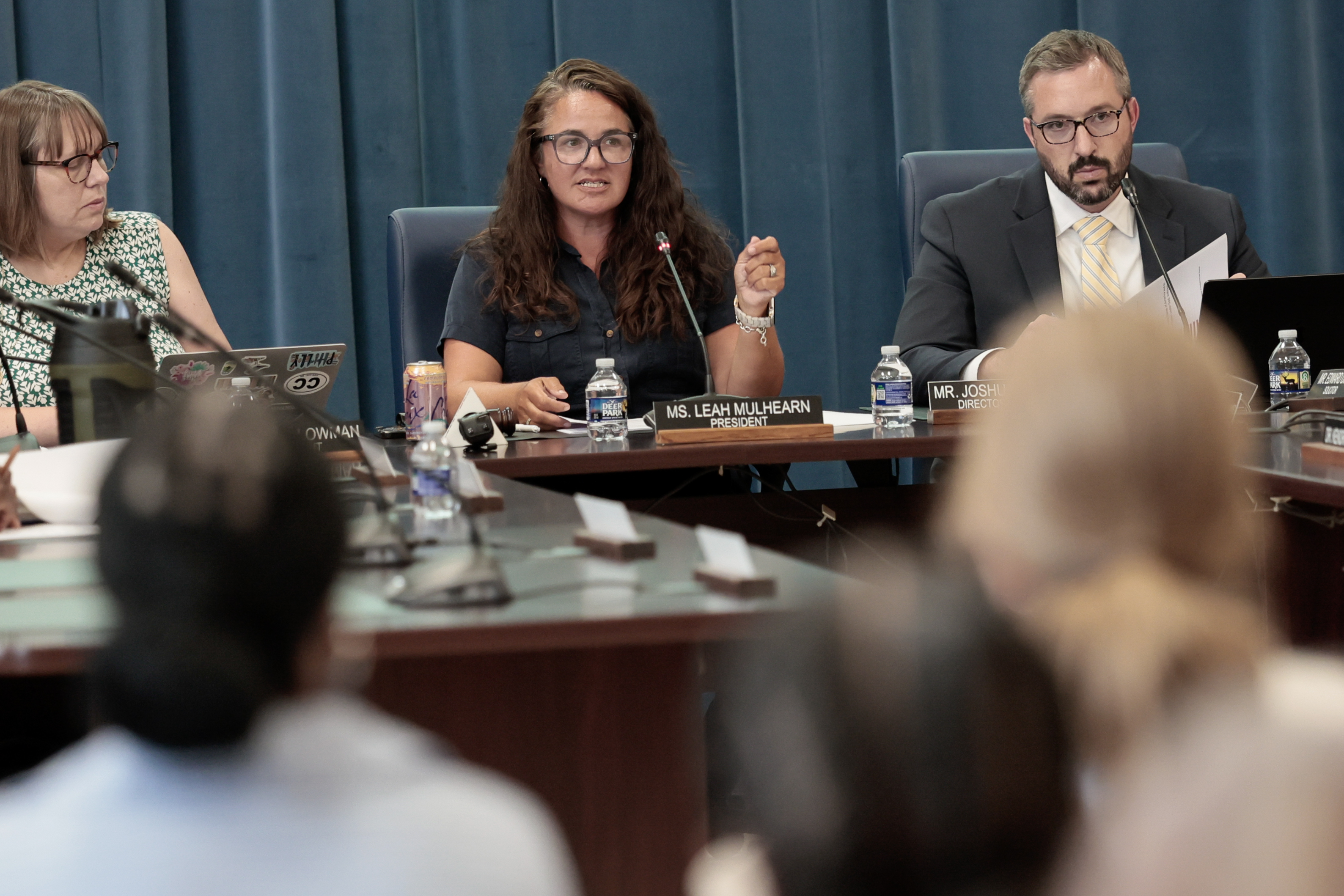
The attacks on the 15-year-old, which took place in August and September 2025, “arose in the context of a culture of intimidation and acceptance of violence,” board president Leah Mulhearn said Tuesday night at the board’s first meeting since criminal charges were announced against four coaches and six players.
Mulhearn, who also announced that veteran educator Chris McGinley would be tapped as interim superintendent, promised the board would move quickly to fix problems.
The district already canceled the 2026 football season in May. “Football will not return until we address this, no matter how long it takes,” Mulhearn said.
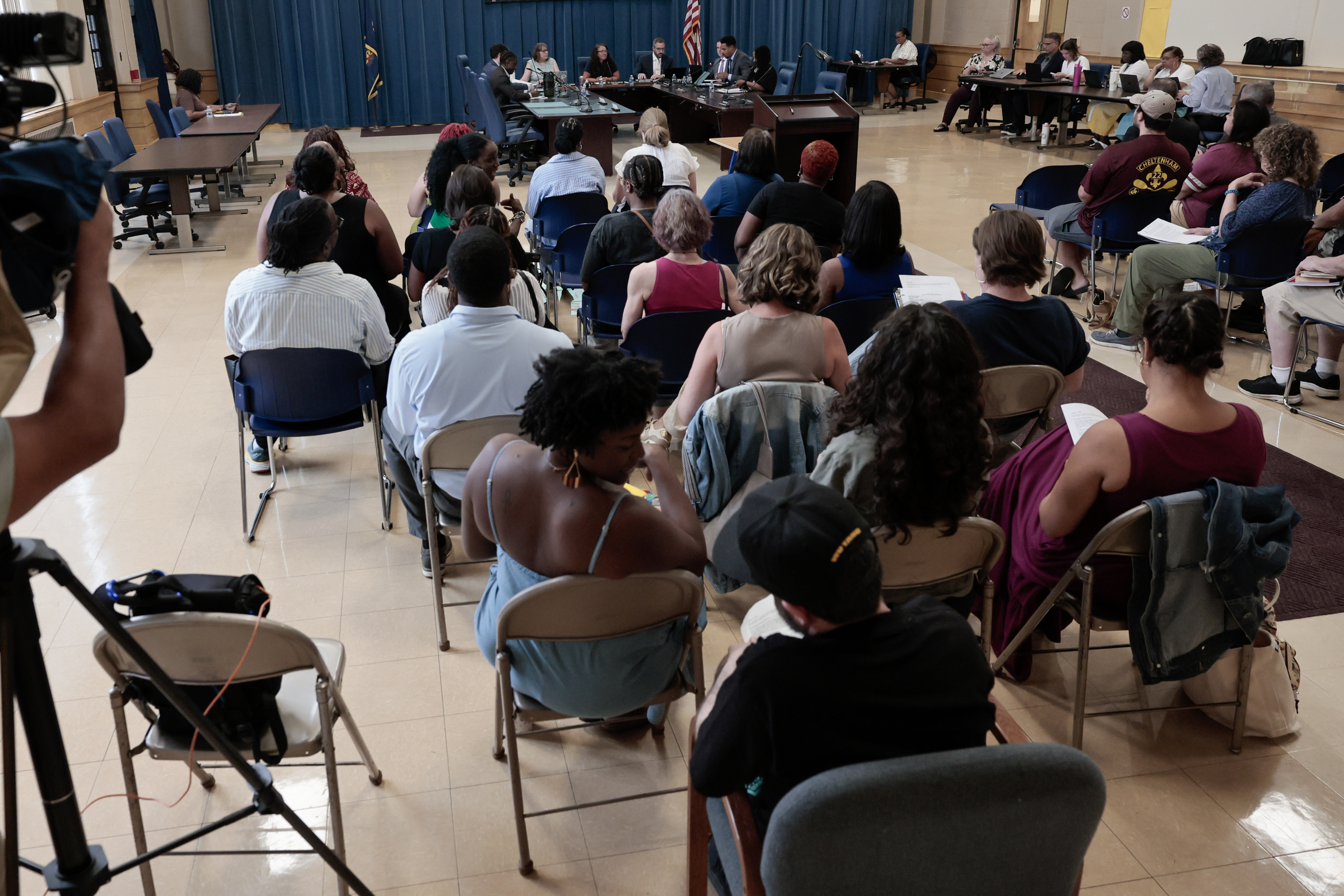
Parents, who lined up behind a microphone in the district’s administration building awaiting their turn to speak, expressed skepticism and demanded more from the board after a grand jury report accused the district of endangering students through a failed response to the assaults, one of which was captured on video.
In emotional comments, some parents said their children had been assaulted in the schools, while others questioned how they could believe the board, when they had warned against hiring a coach who has since been charged with conspiracy and endangering the welfare of a child.
“We entrusted our children to this district,” said Chowan Cowans, who withdrew her son, a rising senior and former Cheltenham football player, because “I don’t feel safe with him being there anymore.”
Cowans accused the district of a lack of transparency, which “has to mean something when the truth is uncomfortable,” she said.
PTO president Stephanie Curry (center) waits in line to speak during the Cheltenham School Board meeting in Elkins Park on Tuesday, August 11, 2026. The school board was meeting for the first time since criminal charges against four football coaches and six players were announced, and since Brian Scriven resigned as superintendent. .Elizabeth Robertson / Staff Photographer
Employees at the high school appeared to minimize the Sept. 3 assault after it was reported to them by the 15-year-old victim’s mother, according to the grand jury report. They also took the head coach, Terence Tolbert, at his word that he had not instructed the player not to tell his parents what happened, and they included the coach in their investigation — which failed to uncover that there were two assaults, the report said.
It also noted that employees were also confused about their mandatory reporting requirements.
On Tuesday, Mulhearn said that while the board “may differ with the grand jury with respect to some of its findings about how the district and board responded, the hard truth is that we must acknowledge that mistakes were made.”
Mulhearn said the board would “move with deliberate speed to address these issues.” She said the board would enlist an outside attorney, Leigh Dalton — who was hired by the Central Bucks School District last year to investigate special-education abuse allegations — to review the district’s policies and procedures and make recommendations within 60 days.
She did not comment on Superintendent Brian Scriven’s resignation last week. Some parents questioned whether and when the board’s position on Scriven had shifted, after the board praised the superintendent’s leadership in May.
A district spokesperson did not respond to a question this week about whether Scriven, who received a new five-year contract in December, would receive any payout following his resignation.
Nor did the board indicate whether it was considering taking action against any employees at the high school. One parent, for instance, asked whether Mark Hoff, the former vice principal at Cheltenham High School, would still become the vice principal at Wyncote Elementary, in light of the grand jury report faulting high school employees.
Taryn Knox (left) speaks to School Board President Leah Mulhearn and Director of Business Joshua Sweigard during the Cheltenham School Board meeting in Elkins Park on Tuesday, August 11, 2026. The school board was meeting for the first time since criminal charges against four football coaches and six players were announced, and since Brian Scriven resigned as superintendent. .Elizabeth Robertson / Staff Photographer
The board, which appointed director of business services Joshua Sweigard acting superintendent on Tuesday, will hold a special meeting next week to appoint McGinley as interim superintendent, Mulhearn said. McGinley previously led both the Cheltenham and Lower Merion districts and more recently served on the Philadelphia School Reform Commission and Philadelphia school board. His most recent position was as the faculty program coordinator of the Educational Leadership and Policy program at Temple University.
Parents’ pleas
Parents urged the board to commit to more steps. In a joint statement, the United Parents Group, the Special Education Alliance of Cheltenham, and the Cheltenham African American Alliance called for numerous actions, including a community town hall ahead of the first day of school and an assembly on the first day “to enforce a zero-tolerance policy regarding sexual harassment, bullying and hazing.” They also called for safety data to be a part of every school board meeting.
“We are demanding a fundamental shift in how our school district operates,” Aubria Nance, reading from the groups’ joint statement, told the board.
“Every time I hear a commitment to our students’ safety, I want to see the proof,” said Erin Fadako, a parent at the school.
The Inquirer reported last week that some football parents had urged the district not to hire Tolbert, saying he had allowed bullying while previously serving as head coach in Abington, where he left after one season.
“Everyone from the administration on down that has failed these students, you all have approved them to be hired here,” said Taryn Knox, who was among the football parents who had asked the district not to hire Tolbert.
After a year of negative news coverage, Knox said, “we’re now about to go into the next school year, and the news is still here.”
The Cheltenham school board meeting Tuesday, Aug. 11, 2026, in Elkins Park.Elizabeth Robertson / Staff Photographer
As they voiced their frustration, parents pleaded with the board to make real changes.
“Stop being risk averse and do what you need to do to make it safe for our children,” said Stephanie Curry, president of the high school’s parent teacher organization. “Our kids are the ones that are suffering.”
Gina LaPlaca, the former mayor of Lumberton Township who pleaded guilty earlier this year to driving drunk with her toddler in the car, has been charged with faking signatures on a nominating petition to run for township committee, the Burlington County Prosecutor’s Office said.
LaPlaca, 47, and her husband, Jason Carty, 49, were both charged by summons with third-degree knowingly filing a false petition, two counts of third-degree tampering with public records or information, and fourth-degree falsifying or tampering with records.
LaPlaca also was charged with fourth-degree making a false statement under oath.
According to the prosecutor’s office, multiple people whose names and purported signatures appeared on LaPlaca’s nominating petition indicated that they had neither signed the petition nor authorized anyone to do so on their behalf.
The petition was submitted by Carty to the Lumberton Township municipal clerk and contained an affidavit signed by LaPlaca that she “personally circulated the petition [and] that such petition was signed by each of the signers thereof in his/her own handwriting,” the prosecutor’s office said.
Carty also allegedly collected signatures for the petition.
Without the allegedly fake signatures, the prosecutor’s office said, LaPlaca’s petition would have lacked the needed number of signatures required to qualify for the primary.
Both LaPlaca and Carty are scheduled to appear in Superior Court in Mount Holly on Sept. 21.
In March, LaPlaca, who served as mayor until December and is still a member of the township committee, pleaded guilty before Burlington County Superior Court Judge Craig Ambrose to driving under the influence and child endangerment.
Under a deal with prosecutors, LaPlaca entered a three-year diversionary program for first-time offenders. She also agreed to attend regular Alcoholics Anonymous meetings and install an ignition interlock device in her vehicle. LaPlaca told the judge she had installed an interlock device last October. And she had already completed inpatient and outpatient treatment, prosecutors said.
Prosecutors said cell-phone video showed LaPlaca driving a blue 2019 BMW erratically on Route 38, swerving across the center line and nearly striking a utility pole. After the motorist who recorded the video alerted police, officers located LaPlaca and found an open container of alcohol in her vehicle, authorities said.
LaPlaca told police she had been drinking before picking up her 2-year-old son from daycare, prosecutors said. At the time, her blood-alcohol concentration measured 0.30% — more than three times New Jersey’s legal threshold for intoxication.
Despite calls from state lawmakers to step down, she declined to resign as mayor and remained in office until her term ended in December.
In a text message Tuesday, LaPlaca said: “I’m still in process of retaining counsel so there’s not much I can say other than these charges are absolutely baseless.”
Carty could not be reached for comment Tuesday. A lawyer for Carty also could not be reached.
In a separate case, Carty was arrested in late May and charged with aggravated assault and harassment, court records show.
The New Jersey Globe news outlet reported last month that LaPlaca had alleged that Carty tried to strangle her. But then she allegedly wrote a letter to the Burlington County Prosecutor’s Office saying that her husband did not assault her and that she wished for the charges to be dropped, the New Jersey Globe reported.
A spokesperson for the Burlington County Prosecutor’s Office declined to comment on the alleged letter, but did say that the case had been transferred to the Mercer County Prosecutor’s Office.
A spokesperson for the Mercer County’s Prosecutor’s Office could not be reached for comment.
A teen sought in connection with the killing of a Pennsylvania State University student in South Philadelphia surrendered to police on Tuesday, the U.S. Marshals Service said.
Kadafi Fleming, 19, is also a suspect in the theft of a Philadelphia police officer’s car during a Monday morning robbery that ended in a shootout, according to the U.S. Marshals Service.
Fleming surrendered around 6 p.m. Tuesday at the Philadelphia Police Department’s headquarters at 400 N. Broad St., the U.S. Marshals Service said.
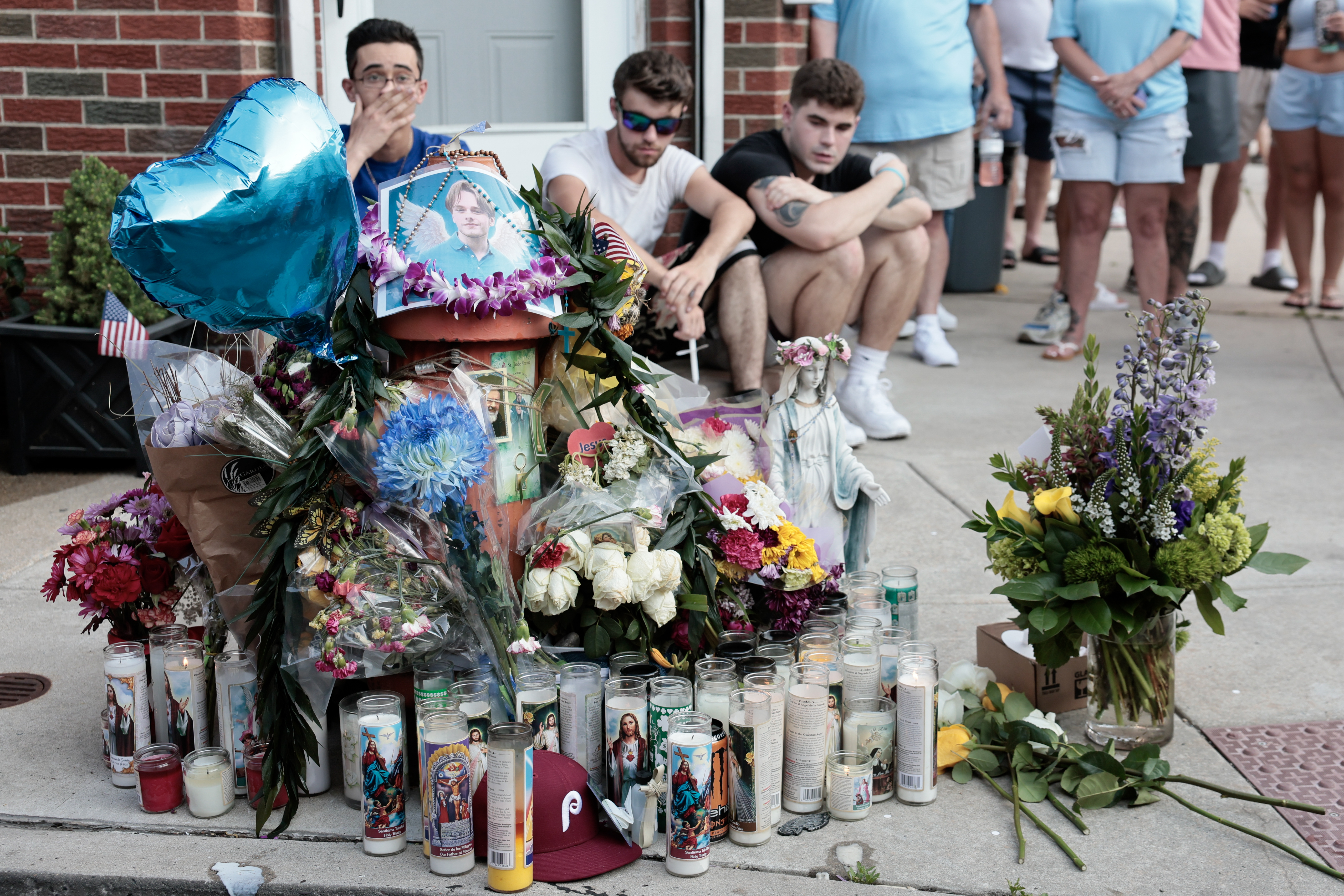
Authorities previously charged Azzubair Outen-Fleming, 16, and Kaiseem Smith, 16, with murder, robbery, and related crimes in the killing of 22-year-old William “Billy” Schmidt, who was robbed of his cell phone and shot on June 6 on the 1900 block of Durfor Street. This week, the marshals announced that they were seeking Fleming on a robbery charge in connection with the killing.
Fleming is Outen-Fleming’s older brother, authorities said.
The announcement of the marshals’ manhunt for Fleming came after another crime in South Philadelphia: About 3:15 a.m. Monday on the 6900 block of Grosbeak Place, authorities said, thieves stole a green Dodge Charger belonging to an off-duty police officer.
Supervisory Deputy U.S. Marshal Robert Clark said the officer found the thieves a few blocks from where his car had been stolen and exchanged gunfire with them before they fled.
Fleming has been named a person of interest in that theft, Clark said.
It was unclear Tuesday whether anyone had been injured in the shootout. Philadelphia police did not respond to requests for information about the incident.
.
Clark added that he did not expect the search to last long, noting that marshals had captured Fleming’s brother in June more than 1,700 miles away at a home in Colorado Springs, Colo.
Smith, who is accused of being the triggerman in Schmidt’s killing, turned himself in to authorities shortly after Outen-Fleming’s arrest. Outen-Fleming’s stepfather, Donte Abdulmalik, 35, has also been arrested and charged with helping his stepson evade the authorities.
A South Philadelphia babysitter, originally from Argentina, was released from ICE detention Monday after being arrested at Philadelphia International Airport last month.
Iliana Lick’s arrest made national headlines as the Trump administration steps up efforts to increase immigration enforcement at American airports.
Lick, 30, had been in Philadelphia since September 2024. She had a valid work authorization and a pending asylum application, but had overstayed her visa, according to the Department of Homeland Security. She was arrested as she headed to Kansas City to watch Argentina play in the World Cup, transported by Immigration and Customs Enforcement to Louisiana, Texas, and New Mexico instead.
“After nearly a month in custody, countless phone calls, legal proceedings, and several transfers across different states, this is a moment we have been praying and hoping for,” her boyfriend, Steven Melchiorre, 35, wrote in an update to supporters on Facebook and a GoFundMe page that has raised more than $18,000 for legal fees.
Though Lick’s release is a victory, the fight to stay in the country is far from over.
As a condition of her release on $10,000 bond, Lick had to surrender her passport and has to wear an ankle monitor.
Immigration advocates keeping track of those being arrested at the Philadelphia airport have said at least 10 people have been detained since mid-July. Of those, Lick is only the second to be released from custody.
Immigration advocate Vivian Chang, executive director of Asian Americans United, said the release of people arrested by ICE, whether at airports or during immigration check-ins, can be a crapshoot.
“You need like a CNN story and so many news articles, so much fundraising, all of that,” Chang said. “The vast majority of people can’t access that. They don’t get coverage, and that’s what the Trump administration is counting on.”
The Inquirer wrote about Lick’s case, and her story was most recently featured on CNN.
For its part, the Department of Homeland Security has said it is making sure undocumented immigrants are flying only to self-deport, offering them a $2,600 payment and a free flight home as an alternative to detention.
A New York Times report found instances of immigration arrests in at least 15 airports, with many of the cases getting follow-ups in local media markets.
Britni Zahodnick, who with her husband, Zane Schultz, has employed Lick as a babysitter for their two young children, ages 4 and 1, for more than a year, said she is grateful for the media attention.
When Zahodnick first learned of the arrest, she said, she was not seeing people talking about the issue on social media platforms. That changed in recent weeks.
In Philadelphia, people have rallied behind Lick, she said.
Donations have helped her to retain counsel, post bond, and pay fortransportation back to her South Philly home.
Zahodnick hopes attention to cases like Lick’s highlights how immigration enforcement is affecting people who have deep roots within their communities.
“A lot of the campaigning on this increased enforcement of immigration was really around criminals, and it just hasn’t panned out that way,” she said.
Gov. Josh Shapiro made a declaration in the early days of his administration: Pennsylvania is open for business.
The move would ultimately include promises to slash bureaucratic red tape, cut permit wait times, and offer a new direct line to Shapiro’s office for major corporations hoping to set up shop in Pennsylvania.
Pennsylvania would “move at the speed of business” and “get stuff done,” the new mottos used by his administration, he said. He’s campaigning for reelection in November on the same catchphrases, and boasting major successes like the 12-day repair of I-95 in 2023 that traditionally would have taken months to reopen as an example of how he can think outside the box to solve problems.
What’s more: He sees delivering for residents — showing them government can actually solve problems — as the future of the nationalDemocratic Party, while it searches for an effective message and messenger heading into the 2028 presidential primary, which he is widely expected to enter.
It was with this same spirit last summer that Shapiro announced the largest single private sector investment in Pennsylvania history: Amazon committed $20 billion in Pennsylvania that included two data center campuses in Luzerne and Bucks Counties. Pennsylvania scored the project because of its promise to fast-track permitting and use tax breaks for the massive developments.
“Pennsylvania’s gonna be better off. I think America’s gonna be better off, because we’re going to win the battle of AI supremacy and it’s going to be done right here in the commonwealth of Pennsylvania,” Shapiro said in an interview on CNBC’s Squawk Box on the day he announced the deal.
Gov. Josh Shapiro announces a $20 billion investment by Amazon in Pennsylvania data centers in Salem Township and Falls Township on June 9, 2025.Commonwealth Media Services
But in a year’s time, the politics — and public opinion on both sides of the aisle — have dramatically shifted on data center development. Shapiro’s early welcome of data centers has created an opening for criticism from his gubernatorial opponent and members of his own party.
Yet efforts to cut red tape have proven to be slow and overblown: Only six data centers are actually under construction in Pennsylvania since the announcement, and 10 have received at least one state-level permit approval, according to Shapiro’s office. Still, Shapiro’s popularity is being evaluated by some voters and anti-data center activists on a perception that he moved too quickly and sacrificed the state’s safety in favor of Big Tech.
“I am all about legislators and decision makers getting s— done. This version of it is reckless and it’s irresponsible and it’s not actually serving our people,” said Carrie Santoro, the executive director of progressive advocacy groupPennsylvania Stands Up who has been holding town hall meetings in communities around the state on data centers.
“Governor Shapiro intends to use all the tools available to him to stop the dozens of speculative data center projects that do not meet community needs and Pennsylvania should expect to hear more from him on that in the coming weeks,” said Shapiro’s press secretary, Rosie Lapowsky.
Now Shapiro, who otherwise maintains vast popularity ratings in the state, faces a vulnerability on one of voters’ top priorities as he heads into November, and a particularly sensitive concern among Democrats as he potentially vies for the party’s nomination in two years.
Many states, including Pennsylvania, had already begun welcoming the major projects, and some hyperscale developers plan to spend billions of dollars to build them. Pennsylvania’s General Assembly first approved a sales tax exemption for data center developments in 2021, when Shapiro’s predecessor, Democratic Gov. Tom Wolf, was still in office.
Shapiro, for his part, initially embraced data centers as an economic opportunity for Pennsylvania, bringing union jobs for construction workers to build out the physical infrastructure for the computers running AI software. He also wanted to position Pennsylvania to inherit the most benefit from providing space for AI to operate, leading not only other states but also other countries in the race to advance new technology. He and U.S. Sen. Dave McCormick (R., Pa.) appeared together as early embracers of the technology and the massive buildings needed to power it, speaking together during McCormick’s first AI summit in Pittsburgh last summer.
Sen. Dave McCormick shakes hands with Gov. Josh Shapiro at a panel discussing state investment and infrastructure at the Pennsylvania Energy and Innovation Summit at Carnegie Mellon University in Pittsburgh on July 15, 2025.Kaiden J. Yu / Staff Photographer
But as communities began to push back against the rapid proliferation of data center proposals, in part to protect their water and energy resources, Shapiro adjusted.
Shapiro, like many elected officials, has changed his positions and rhetoric on the unpopular developments. He announced his Governor’s Responsible Infrastructure Standards (GRID) as a way to incentivize developers to follow transparency and environmental requirements in order to receive tax breaks. And when the General Assembly failed to approve his GRID standards or any substantial data center restrictions, Shapiro said he’d act on his own, though it’s still unclear what that will entail.
“You want to build a data center there? You’ve got to bring your own power; you’ve got to pay for your own power. You’ve got to be transparent with the local community — tell them who the hyperscaler is, tell them what’s going to go on there. You’ve got to have a local benefits agreement to help that community. You’ve got to protect the water sources that are used to cool off those facilities,” he said in a June interview with GZERO.
The Democratic governor has been lauded nationally for challenging PJM Interconnection, which is the electric grid operator for Pennsylvania and 12 other states over its efforts to raise prices on ratepayers. He capped the price Pennsylvania consumers could pay through 2029, as residents fear rate hikes due to the data center boom.
But Shapiro’s plan on data centers is too little, too late, Santoro said.
“I saw the GRID proposal as him moving on this issue, and the thing that I am concerned about is he didn’t move enough to keep up with how much voters have moved on this issue,” she said.
Some of those voters would agree. A Quinnipiac University poll of Pennsylvania voters, conducted in early June, found just 24% of those surveyed — and 40% of Democrats — approved of “the way Gov. Josh Shapiro is handling data centers in Pennsylvania.” It’s a stark contrast to Shapiro’s overall approval numbers, in which he’s maintained above 50% approvals — record-high favorability ratings for a first-term Pennsylvania governor.
People sign in and head into an East Vincent Township supervisors meeting where an agenda item involved a data center proposal at the former Pennhurst state hospital grounds on Dec. 17, 2025, in Spring City, Pa. Marc Levy
Joanna Tenney, 36, of East Vincent in Chester County, held a sign at a June rally in the state Capitol that read: “Shapiro: Amazon’s bootlicker.” A registered Democrat, she voted for him in 2022, and believes he should be held accountable for supporting data center development in Pennsylvania that led to the fast-tracking of a now-stalled 125-acre data center project near where she lives.
She’s so fed up with Shapiro’s approach to data centers that she said will be writing in the name of her state senator, Sen. Katie Muth (D., Chester), who has been on the front lines of advocating for many state environmental issues, for governor on her November ballot. Tenney said she and a few other anti-data center advocates plan to run a write-in campaign for Muth.
“We’ve elected somebody that we thought was going to make the right choices by us, and we don’t really see that happening,” Tenney said.
Muth, who took office in 2018, said she would not be supporting Shapiro or “any elected official who puts the interests of Big Tech ahead of the health, safety, and future of Pennsylvania communities.”
If Shapiro changes his stance on data centers, she would support him, Muth said. She is the prime sponsor of a bipartisan bill to place a three-year moratorium on hyperscale data center development.
“Get right on the issue, Right your wrongs. If you can’t be on the side of science and people, my support is MIA,” she added.
Emily VanFleet, 26, lives in Archbald in Northeastern Pennsylvania, where six data center projects are underway comprising more than 50 buildings that, when completed, will cover 14% of the town. VanFleet, who is an unaffiliated voter, said she also supported Shapiro in 2022. But because of his public support for speeding up data center development in Pennsylvania, she is “certainly not going to vote for him this upcoming election,” she said. She isn’t sure she’s going to vote at all.
“I want Shapiro to stop being a coward,” VanFleet said in June. “I have emailed him, I have called him, I have reached out to him so many times. I have not heard back, not once. I see his videos all over social media that he has an open-door policy, but I have yet to see it.”
(In May, Shapiro’s administration announced that one of the unpopular Archbald developments, Project Gravity, was removed from a fast-track permitting program for failing to properly engage with the community.)
But negative attitudes toward Shapiro’s position on data centers may be limited statewide and his position is unlikely to dramatically knock down his high popularity or reelection odds: The June Quinnipiac poll found 56% of those surveyed approve of the way he is handling his job as governor overall, and recent polling shows Shapiro ahead 53% to 40% against his Republican challenger, state Treasurer Stacy Garrity.
The data center pitfall
Shapiro’s political opponents — both immediate and prospective — are also seizing on the issue.
Garrity, of Athens in Northeastern Pennsylvania, has also led a statewide listening tour on the topic. In June, she convened one of those sessions in Hatfield with a group of commissioners, zoning planners and emergency responders to talk about how they have been impacted by data centers. She blasted Shapiro for his role in attracting Amazon and said his proposed new requirements amount to a “flip flop.”
“Josh Shapiro has failed on this topic. He was the biggest cheerleader for data center development in Pennsylvania, until he wasn’t,” Garrity said at the June 24 meeting.
Pennsylvania Treasurer Stacy Garrity participates in the podcast “Ruthless” during an event hosted by Americans for Prosperity, Concerned Veterans for America, and the Libre Initiative at the National Constitution Center in Philadelphia on Jan. 29. Elizabeth Robertson / Staff Photographer
Garrity has her own mixed record on data centers.
At the time of the Amazon announcement, Garrity called the investment “great news” that would bring “historic investment” and “create thousands of jobs.” And her current position remains unclear. She has said she opposes a statewide moratorium but wants “a pause” on development instead.
Like Republicans running in districts that supported Trump in 2024 but oppose data centers, she appears to be attempting to find a pro-business and pro-regulation path.
“We want to make sure data centers are an addition to the grid, not a contraction. If there’s infrastructure that needs to be added to the grid, rate payers shouldn’t be paying for it,” she said. “I’m not opposed to data centers, but we have to do them the right way, and we haven’t done it. It’s because of a lack of leadership from the government.”
Garrity’s “long record of supporting completely unregulated data center development makes it clear that she just can’t be trusted,” said Manuel Bonder, a spokesperson for Shapiro’s campaign.
Local government leaders said at Garrity’s campaign roundtable in June that there has been lack of guidance around issues, especially around power demand, water use, infrastructure, environmental impacts, and community compatibility.
Kathie Doyle, a Republican on the Richland Township Board of Supervisors, said confusion around data centers have “set off a firestorm” in her community. Earlier this year, warnings of a supposed proposal for a data center in the Bucks County township circulated on social media, but turned out to be a “business park” with two buildings.
“Our residents don’t understand that we just cannot say no,” she said. Municipalities in Pennsylvania cannot outright ban data center development.
Santoro said Shapiro’s inconsistency is a liability that could sway some voters away from casting their ballot for him.
“Certainly he is giving her an ‘in’ by staying on the wrong side of this,” she said.
And it’s not just Republicans seizing on Shapiro’s position. The early reputation Shapiro earned as a champion of data centers may become a point of attack among other Democratic contenders for the presidency in 2028, too. In a veiled jab at Shapiro in June, Illinois Gov. JB Pritzker, knocked Pennsylvania on a businesspodcast for allowing Constellation Energy to restart Three Mile Island nuclear plant just to power Microsoft’s data centers.
“My guess is that’s going to be a reasonably unpopular thing to have done,” Pritzker said, without noting Shapiro by name on the Prof G Markets podcast.
Vulnerability for down-ballot Democrats
With a $50 million campaign war chest and high approval ratings, Shapiro is widely favored to win reelection this year. But his record on data centers could prove a liability for those he’s hoping to pull along, some advocates, like Santoro, say.
Shapiro has been staking much of his national political clout on his ability to flip four House districts in Pennsylvania for Democratic control of the U.S. House, drawing voters to the polls with his name at the top of the ticket. He’s also aiming to flip Pennsylvania’s Senate into Democratic control for the first time since 1993, giving him a Democratic trifecta in Harrisburg, as the state’s split legislature has blocked many of Democrats’ priorities from becoming law.
Santoro predicted that could be in jeopardy “if he does not change course.”
“Shapiro’s leadership on data centers will be the thing that costs us the first Democratic trifecta in 31 years, and I think that while he will likely win reelection with this wildly unpopular position on data centers, other elected officials and candidates will not,” she said.
Other Democratic candidates aware of data centers’ deep unpopularity are differentiating themselves on the issue, despite remaining otherwise aligned with Shapiro. Scranton Mayor Paige Cognetti, who is running in Pennsylvania’s 8th Congressional District, released a new ad last month putting data center developers on notice.
“Big Tech needs to pay their own way, not hide behind [nondisclosure agreements]. No tax breaks. Don’t raise our electric bills. Don’t poison our water. And hire local union labor,” she said, in the ad spot. “You can’t meet that? Then get out.”
Cognetti’s stance isn’t vastly different from Shapiro’s — both want to end blanket tax breaks — but her rhetoric is much stronger, and she’s putting the issue at the forefront of her campaign.
Democrats insist Republicans, including those running at the state level, don’t have the moral high ground on data centers after failing to pass through several measures that would have enacted stricter controls for their approval.
Sam Silverman, a former congressional aide and founder of Silverman Strategy Group, a strategic communications firm focused on technology and politics, said Shapiro’s approach to data centers — proposing a plan rather than enacting a moratorium — presents a risk that could either pay off and become the model for other states, or fail to fully address all future concerns and is unpopular.
“Shapiro is going out in front by proposing a bargain now. If the standards protect ratepayers, produce visible benefits, and hold bad actors accountable, Pennsylvania could have a model others can follow,” he said. “But because he is putting forward the deal now, he will be judged on whether it delivers.”
Taking a risk involves trust, though. Shapiro can afford to make a big swing at one of the hottest issues in politics because voters put so much faith in him, Silverman said.
“Most politicians do not have the amount of trust and political capital to take a risk, either,” Silverman said.
Whether the governor is triumphant will come down to what standards go into effect and whether bad actors are held accountable, he said, “and whether Pennsylvanians believe those standards are working.”
BIG BEAR LAKE, Calif. — Jackie, the bald eagle who became an internet sensation and a symbol of the species’ recovery in California, died Monday after being treated for an illness at a veterinary facility, her caretakers announced.
For more than a decade, nature lovers watched via an online video feed as Jackie and her partner Shadow tended to their nest each year atop trees near Big Bear Lake in the San Bernardino Mountains east of Los Angeles.
The nonprofit Friends of Big Bear Valley installed the nest camera in 2015 and documented the successes and failures of each breeding season. In 2024, Jackie diligently sat on her eggs for more than 2½ days straight after a winter storm blanketed the nest with snow.
The Los Angeles County Department of Parks and Recreation’s San Dimas Raptor Rescue team found Jackie on July 17 following reports that the bird had been involved in a fight with two other eagles and was found to be ill.
Jackie had been receiving medical treatment for three weeks at the Ojai Raptor Center, where she was treated for a variety of ailments including anemia. Despite undergoing a blood transfusion and oxygen therapy, her condition worsened and the center announced the animal’s death Monday.
“We know this news will be deeply felt by the many thousands of people around the world who have followed her journey, hoped alongside us, prayed for her, and supported the people caring for her,” the center’s statement said. “Our team is heartbroken. It has been an extraordinary privilege to care for her.”
The California Department of Fish and Wildlife is caring for the remains.
Among those who enjoyed monitoring Jackie’s nests from afar was biologist Kelly Sorenson, executive director of the Ventana Wildlife Society in central California. While his group was not involved with the Big Bear eagles, he sees their breeding as emblematic of the comeback the species has made in the state over the past decades.
American bald eagles teetered on the brink of extinction until the pesticide DDT was banned in the 1970s and other protections were established, leading the species to rebound and be removed from the federal endangered list.
“You want to see a success story like that,” Sorenson said Monday. “Having access to a live cam to see the nesting first hand is very powerful. It brings people in on an emotional level.”
DAMASCUS, Syria — A Syrian court on Tuesday sentenced ousted President Bashar Assad and his brother in absentia for murder, torture and crimes against humanity committed before and during the country’s 14-year civil war that left about half a million people dead.
The verdicts by a court in Damascus are the first against Assad or any members of his inner circle since his family’s five decades in power came to an end 20 months ago. They are mostly symbolic, however, because Assad and his brother Maher fled to Russia, where they received asylum after the Syrian government’s stunning collapse in December 2024.
Six other former officials were also sentenced to death in absentia. The only former official sentenced to death and in custody is Assad’s maternal cousin Atef Najib, who oversaw a crackdown on dissent that led to an uprising that sparked the civil war. Najib stood inside a cage wearing a prisoner’s uniform as the judge read his sentence aloud, and a crowd gathered outside the heavily guarded courthouse.
Even though Assad is unlikely to ever face justice, the verdicts will be popular among many Syrians, especially those who have expressed frustration that the new government hasn’t moved with enough speed or strength against Assad-era figures.
Some human rights groups, though, expressed concerns that the trials were rushed, potentially unfair, and, at the very least, exposed flaws in Syria’s justice system.
“Bashar Assad used state agencies to commit war crimes and crimes against humanity,” said judge Fakhareddine al-Aryan during a court session that was aired live on state TV — a contrast with Assad-era trials, which were conducted in secret. The verdicts al-Aryan read aloud found Assad and the others guilty of premeditated murder, including against children, as well as other acts of brutality, including torture.
Al-Aryan said Najib could appeal.
“Today is the day of justice for all the wounded, martyrs, detainees and Syrians who were forced to leave their country,” said attorney Adnan al-Masalmeh, who represented families of Najib’s victims. “Today marks a victory of right against injustice, a victory of the Syrian people against the ousted regime.”
Najib is one of the highest-ranking security officials to be put on trial. He is a former army brigadier general who was in charge of political security in Syria’s southern Daraa province.
During his tenure, more than a dozen teenagers who scrawled anti-government graffiti on a school wall were arrested and tortured. The case became a catalyst for mass protests against the repressive policies of Assad’s security forces.
The protests were met by a brutal government crackdown in 2011 that spiraled into the civil war that ended with Assad’s ouster in a lightning rebel offensive.
Some of Najib’s victims were present at the courthouse, including two who were teenagers in 2011 and expressed their opinions to the Associated Press.
“Today we reached a point where the blood was not wasted,” said Mouawiya Sayasneh, about those who died in the crackdown. Fifteen years later, “there is happiness that Atef Najib was sentenced to death,” he said.
Another man, Nayef Abazeid, who was detained at the age of 13 in 2011, expressed his satisfaction with the sentence, adding, “Our biggest happiness will be when Bashar Assad is executed.”
Maher Assad was a former commander of the Syrian military’s 4th Armored Division — which opposition activists have accused of killings, torture, extortion, and drug trafficking, in addition to running its own detention centers.
“Today’s scenes outside the courthouse reflect 15 years of pain and a justice long denied,” said Hiba Zayadin, Syria researcher at Human Rights Watch. She said the rights group opposes the death penalty in all cases, including this one, because ”it’s cruel and irreversible, especially when a fair trial isn’t guaranteed.”
She said the appeal process for Najib “needs to meet fair trial standards.” Real accountability for Assad-era crimes depends on Syria building a justice system that lasts, she said.
The Washington-based Syria Justice and Accountability Center described Tuesday’s conviction of Najib as a “historical step in Syria’s transitional period,” but said it exposed major flaws in the justice system which likely jeopardized his right to a fair trial.
It said that SJAC’s trial monitoring team attended Najib’s trial and documented multiple issues such as rushed proceedings and witness testimony that did not connect Atef to the crimes he was charged with. SJAC said Najib’s lawyer “lacked the capacity and willingness to meaningfully engage with the case or mount an adequate defense.”