CHICAGO — Meta insists it has a long history of protecting its youngest customers as it defends itself against a swath of lawsuits alleging its social media empire harms children.
In the latest such instance, the social media giant is fighting allegations in a California federal court that it contributes to the youth mental health crisis by deliberately and stealthily designing features to get children hooked on its platforms Instagram and Facebook. Four states are seeking billions of dollars in damages as well as fundamental changes to how Meta runs those apps.
Children’s mental health, and what they do and see on social media, are all issues “Meta takes seriously and tries to act on,” Paul Schmidt, a lawyer for the tech giant, said in opening statements this week.
Critics say the company’s safety record falls short and that many of its protections simply don’t work.
They include Marc Berkman, executive director at the Organization for Social Media Safety, who said Meta introduced safeguards promising to protect children in response to public pressure rather than out of concern.
There’s been a “lack of real institutional willingness to act here,” Berkman said.
Here’s a look at some of the changes Meta has introduced, along with the work advocates say could still be done.
Instagram users have always been able to block others — and, along with Meta’s oldest crown jewel, Facebook — the app has gradually added features for reporting problematic accounts and inappropriate content.
In 2016, Instagram users were given the option to delete or filter comments they found offensive, and later added warnings that prompted users to reconsider posting potentially harmful content, as well as options to limit comments and tags on their posts.
Meta also says it prevents adults from starting private chats with teens if they are not already connected, and has increased checks to make sure users under 13 — the minimum age for holding a Facebook or Instagram account — aren’t online. Schmidt said in his opening remarks that Meta recognizes some users still sign up using incorrect birthdays but that the company takes enforcement of age limits seriously.
The company says it also posts warnings and resources at the top of Instagram search results related to suicide, self-harm and eating disorders, and touts its “Teen Accounts,” launched in 2024, as a safe space for teenagers online. It aligns photo and video restrictions for teen accounts with those for a PG-13 movie, unless there’s parental permission otherwise.
Critics complain these changes amount to little more than corporate posturing.
A September 2025 report from former employee and whistleblower Arturo Béjar and four online safety advocacy nonprofits accused Meta of not taking “real steps” to address youth safety, instead opting for “splashy headlines about new tools for parents and Instagram Teen Accounts for underage users.”
“We really found that overall what Meta was marketing under Teen Accounts was very lacking in actual protections,” said Haley Hinkle, policy counsel at Fairplay, which co-authored the report. They evaluated 47 of Meta’s 53 safety features for teens on Instagram and found 60% of them were either not available or didn’t work as advertised, Hinkle said.
Meta called the report’s findings “misleading” and “dangerously speculative.”
Scrolling and core design
Researchers say Meta’s efforts to reduce the risk of children becoming addicted to the scrolling features of social media platforms have been largely unsuccessful.
Ashley Shea, a Ph.D. candidate specializing in social media and online spaces at Cornell University, points to what academics call “attention-capture deceptive designs” that are not exclusive to Meta’s platforms. They include infinite scrolling, “casino style” pulls to refresh content, push notifications and algorithmic recommendations. Those features “prey on the cognitive vulnerabilities” of young people with developing brains, in particular the need to feel rewarded.
Meta has taken important steps to address problematic content, cyberbullies, and sexual predators, Shea said, but she has not seen the same level of effort to offset the addictive impact of attention-capture deceptive designs.
Nudges and time management controls
“There’s no question that some teens struggle to manage their time with social media,” Schmidt said Tuesday, adding that Meta’s time management tools prove its evolution on the issue. Those tools include parental supervision controls and in-app “nudges” for teen users who repeatedly look at the same type of content or spend too long on Instagram or Facebook late at night.
Hinkle notes the “entirely voluntary” time management tools are not easy to set up, and amount to “far too little, too late.”
Béjar, the former Meta employee and whistleblower, agrees. In testimony Wednesday, he said a tool called “Take a Break” is “designed to fail.” Users have to turn the feature on themselves and, he said, very few do.
Across the board, tech companies exist to maximize revenue, said Berkman, and for almost every social media platform today, that means “maximizing children using their features for as long as they can.”
Legal challenges focused on “the fact that these are defective products by design because of their features, not the content per se” is something new, Shea added. And beyond the courtroom, mounting pressure on lawmakers could bring more industrywide changes.
“The momentum only continues to grow,” she said. “Ultimately, these are for-profit companies that respond to economic pressures. And so I think that the more economic pressure they’re confronted with through these litigations, the quicker they will have to adapt.”
PLYMOUTH, Mass. — Hundreds of Lindsay Clancy supporters, many wearing pink with the words “Believe,” “She Needed Help” and “Peace For Lindsay,” gathered Thursday outside the courthouse where she is on trial in the killings of her three children.
Several of the 300 women, and a few men, said Clancy’s story resonated with them and that they wanted to raise awareness about how the mental health system treats women. Clancy’s lawyer does not dispute that she killed the children, but says she should not be held criminally responsible because she was mentally ill.
The livestreamed trial has sparked massive discussions online and has brought attention to postpartum psychosis, a rare mental illness Clancy’s attorney Kevin Reddington says she had that is linked to the stress, sleep deprivation and hormonal changes that follow childbirth. Reddington said she also has bipolar disorder. After strangling her children, Clancy jumped from a second-story window and remains paralyzed from the waist down.
Reddington says Clancy repeatedly sought help: She turned to multiple outpatient providers, tried various drugs they prescribed, called a suicide hotline, went to an emergency room, and even checked herself into a psychiatric hospital.
Prosecutors say the former labor and delivery nurse planned the Jan. 24, 2023, killings and contrived to get her husband out of the house by sending him to pick up medicine for one of their children and dinner for the family. They have also questioned the seriousness of her suicide attempt, and witnesses have testified that Clancy wouldn’t always take prescribed medications.
Thursday’s rally was the first time during the nearly monthlong trial that supporters have come out in such large numbers.
“Women are being dismissed, neglected and ignored when we speak up,” said April Vincent, a 52-year-old paralegal from Providence, Rhode Island. “We’re scared because nobody takes us seriously.”
The women stood silently for more than an hour ahead of Thursday’s proceedings, where a chaplain called by the defense testified about visiting Clancy in the hospital after the killings.
At the sight of Reddington outside the courthouse, the crowd broke into applause.
Rally organizer Renee Kimball implored the crowd to trust that Reddington “has Lindsay’s fight.”
Toward the end of their rally, supporters formed a circle, said the Lord’s Prayer, held up their arms and formed hearts with their hands. Some held flags from different countries to show that the support for Clancy was global.
Clancy, 36, has pleaded not guilty to murder charges in the deaths of Callan, Dawson and Cora Clancy, who ranged from 8 months to 5 years old. Researchers estimate that postpartum psychosis — which is more serious and less common than postpartum depression — afflicts 1 to 2 per 1,000 women after delivery.
Jeanne Zaborski, a 72-year-old retired nurse from Rockland, Massachusetts, said she hopes the case raises awareness about postpartum health. She and many others at the rally said they had been following the trial almost daily.
“It’s very sad,” Zaborski said. “I am a mother. I am a grandmother. I have a sister who had problems after birth and it’s just very sad. I hope Lindsay gets the care she needs and deserves and other women will come together like we did today.”
In court, Sheila Cavanaugh, a chaplain at Brigham and Women’s Hospital in Boston, testified that when she first visited and prayed for Clancy, she was unconscious. By Jan. 31, 2023, Clancy was conscious and no longer connected to a ventilator, Cavanaugh said, but “her emotional state was very neutral – a flat affect.”
Cavanaugh said she “vividly remembers” one of the first things Clancy said to her.
“She said to me, as I held her hand to comfort her, ‘I’m so glad my children are safe,’” Cavanaugh said. “I replied theologically to Lindsay. I said, ‘Lindsay, your children are safe. They’re safe in heaven with God.’”
“We prayed for them,” said Cavanaugh, who saw Clancy more than 200 times and still visits her at the state mental hospital where she resides.
Cavanaugh said Clancy “alluded to hearing a voice, and the voice, according to Lindsay, told her that if she did not follow the command, neither she nor her children would be safe.”
U.S. Central Command, which oversees military operations in the Middle East, said on social media that the carrier arrived in the region Wednesday. It was not clear when the USS Abraham Lincoln would arrive back in the U.S. or whether it would make a port stop along the way, but the journey takes just over a month.
The Washington arrived as concerns have grown about the Lincoln’s lengthy deployment, which has included a record-setting uninterrupted time at sea of more than 250 days, and about reports of crew stress and poor mental health, as well as supply shortages, including food and hygiene products.
Several Democratic lawmakers have pressed the Department of Defense for accountability over conditions aboard the Lincoln, which Defense Secretary Pete Hegseth has said were “completely misrepresented.”
Hegseth spoke with the Lincoln’s crew last week, and Adm. Brad Cooper, head of U.S. Central Command, visited this past weekend. In an editorial published Sunday by The Wall Street Journal, Cooper said the crew “delivered a performance for the ages, and now you are going home.”
Extended deployments of carriers wear on service members who are away from home for long periods and increase strain on the ship and its equipment. While renewed hostilities between the U.S. and Iran calmed in recent weeks, the Navy is enforcing a reimposed blockade on Iranian ports in the Strait of Hormuz, and the Trump administration has offered no clarity on how it intends to wind down the war.
Hegseth has said the U.S. can maintain the blockade “indefinitely.”
President Donald Trump this week downplayed reports about conditions on the Lincoln, which left its homeport in San Diego in November and arrived in the Middle East in January. Trump called the nearly nine months at sea that the sailors endured a “good period of time” but added that “over the years, we’ve had them out there much longer.”
Trump told reporters Monday that he spoke with a retired admiral over the weekend who recounted being on ships for “much longer.” Trump said the admiral assured him that the Lincoln is “beautifully maintained and beautifully taken care of.” Trump did not name the admiral.
In a statement Sunday after visiting the Lincoln, Cooper praised the carrier’s leaders for prioritizing mental health and resilience.
“History will record this deployment as one of the most operationally intense and consequential of the modern era,” Cooper said.
The Washington joins the USS George H.W. Bush in the Middle East, leaving Asia without an American carrier strike group at a time when China has shown more signs of aggression.
The lack of a U.S. carrier in the Pacific may be short-lived if the Navy deploys another in the next couple of months. But it shows how the open-ended operations with Iran are running some American sailors ragged, analysts say, while the Trump administration further retreats from the Asia-Pacific region and focuses on the Western Hemisphere.
He had received an email from WHYY’s Terry Gross, herself, asking to be interviewed on NPR’s Fresh Air.
“It was so articulate and so like her,” the writer told the Hollywood Reporter. She laid out talking points and a run of show, according to Vilanch. “It felt real.”
But when Vilanch jumped on their scheduled video call, Gross was nowhere to be found. It finally dawned on Vilanch: He had been scammed. And he was not alone.
A recent string of scams and catfish-style attempts targeting stars and other media personalities are using Philly’s own Gross as the bait. Vilanch says he was the latest victim.
“If somebody claiming to be Terry Gross contacts you for an interview, it is a scam,” the comedian said in a Facebook post last week. He encouraged other potential victims to contact NPR and WHYY.
Online forums reveal a number of recent catfishing attempts involving someone purporting to be Gross.
“These impersonation scams are increasingly common,” said Siwei Lyu, digital media forensics expert and director of the Institute for Artificial Intelligence and Data Science. “Authors are a particularly attractive target because an unexpected invitation from a prominent host or podcast can seem both flattering and plausible.”
It is unclear if one person is behind all of the Fresh Air-centered fraud or if multiple impostors are responsible. Lyu says scam scripts and techniques are easily shared, adapted, and copied, “so the same premise can be used by many unrelated actors.”
On a Facebook group for authors, a writer posted in July about being approached by Fresh Air and asked to donate money. Months earlier, psychologist Steven Pinker, author of The Better Angels of Our Nature, said he was similarly approached by “Terry Gross” via a fake Gmail account as part of a scam targeting authors.
I am targeted by several publishing scams a week, promoting book clubs, reading groups, influencers, publicity campaigns, list placers… all using AI-generated bullet points flattering my books. Yesterday it was "Terry Gross" (with a gmail, not https://t.co/5mhqQcYHlC email… https://t.co/uBFuvSQ5Wi
In Vilanch’s case, he said “Gross” asked him for money to support NPR’s nonprofit public radio efforts amid government cuts. He told the Hollywood Reporter that he thought the request was odd, but that enough credibility within the email chain had been established. So he went for it.
From there, the scammers prepped him for Fresh Air, sending interview questions and scheduling their virtual interview. When the big day arrived, Vilanch was greeted by two video boxes: a screen that read “NPR,” and one with a man who identified himself as “Mike,” the new interviewer. When Vilanch eventually bailed, he sent a final message, according to the Hollywood Reporter: “Whoever you are, I hope you enjoy the paltry sum that I sent.”
Then he reached out to NPR and WHYY. WHYY confirmed it was aware of the scams and investigating.
“WHYY, NPR and Fresh Air with Terry Gross & Tonya Mosley are aware of fraudulent emails in which individuals have impersonated Terry and members of the Fresh Air team attempting to deceive potential guests,” the news organization said in a statement. “As the article in The Hollywood Reporter mentions, other programs and podcasts have also been the subject of these scams.”
The Fresh Air situation is one of several podcast/radio scams targeting Hollywood. According to the Hollywood Reporter, Broadway actor Seth Rudetsky was targeted by a scammer posing as Nikki Glaser who solicited a podcast interview in exchange for a fee. Later, Rudetsky also received an invitation from someone supposedly working on Amy Poehler’s podcast, Good Hang.
In addition to money, some of the scams also target the victim’s social media accounts or login credentials.
Sportswriter Jemele Hill said someone once lied and claimed to be booking her for a new Facebook show hosted by Rob Dyrdek of Ridiculousness. She handed over her Facebook credentials. It took weeks to get them back, she wrote in an X post. “It’s a very sophisticated operation.”
In April, figure skater and personality Adam Rippon told a story on his podcast about being similarly catfished by someone purporting to be on Katie Couric’s podcast via Facebook Live. The follow-through scammed him out of his own Facebook credentials.
“I know I made a grave error,” he said. His Facebook account was ultimately suspended.
A spokesperson for WHYY added that Fresh Air cohost Tonya Mosley has been the named catfish in similar scams, imploring would-be guests to send money in exchange for a radio slot. As a nonprofit organization, WHYY says, it never requests payment for interviews, nor does it pay guests to be interviewed on any of its programs.
“Any communication asking a prospective guest to pay a fee — or offering payment for an interview while claiming to represent WHYY or Fresh Air — should be treated as suspicious,” the statement said.
It is unclear if any of the scams are connected. What they all have in common, though, is their apparent leverage of a celebrity figure along with heavy use of AI to capture the alleged host’s voice and flatter victims with deep-cut knowledge about their work. Lyu said generative AI’s rise in popularity and usage makes hoaxes like this even easier, allowing scammers to quickly personalize messages and operate at a greater scale.
“The technology is new, but the underlying strategy is classic social engineering,” Lyu said. “Establish trust through a recognizable identity, then use that trust to obtain money or account credentials.”
WHYY said it is concerned about its own brand and credibility being used in this case.
“We take the misuse of our journalists’ and programs’ names seriously and are concerned that scammers are exploiting the trust audiences and guests place in Fresh Air,”WHYY said. “We are working with law enforcement to address the situation.”
Welcome America Inc., the nonprofit behind Philly’s Wawa Welcome America festival, has named Philly public relations executive Nicole Cashman as its interim CEO.
The founder and CEO of communications firm Cashman & Associates, Cashman will follow Michael DelBene, who served as CEO since 2019 and grew the July Fourth festival and other large-scale events to new heights and a wider audience. DelBene left the organization earlier this year.
Cashman & Associates has worked with Welcome America Inc. for 25 years as its marketing and communications arm. This long-standing relationship and intimate knowledge of the organization led to the decision to name Cashman as the new CEO, officials said.
“Nicole has spent her career helping tell Philadelphia’s story and bringing people together around the experiences that make our city extraordinary,” said Mayor Cherelle L. Parker, who chairs the Welcome America board of directors. “Nicole understands the important role Welcome America plays in our city, creating moments that bring together our communities, welcome visitors, and showcase Philadelphia on a national and international stage.”
Fireworks over the Philadelphia Museum of Art and the statue of George Washington at Eakins Oval during the Wawa Welcome America Festival on July 4, 2023 following a free concert featuring Demi Lovato and Ludacris on the Benjamin Franklin Parkway.Charles Fox / Staff Photographer
Cashman founded her agency in 2001 and has accumulated a portfolio of some of the city’s high-profile agencies and events, including Comcast, Adventure Aquarium, and Philabundance. She has also served in leadership roles at Atlantic City Alliance and Visit Philadelphia.
The PR exec will join Welcome America as it transitions between CEOs and prepares for the coming year’s slate of celebrated civic events and cultural experiences. Welcome America is a public-private partnership that receives city and state funding as well as corporate sponsorships. Parker and City Councilmember Mark Squilla are board members.
“I have had the privilege of working alongside Welcome America for 25 years and have seen firsthand the extraordinary impact this organization has on Philadelphia and the region,” Cashman said. “… Welcome America means a great deal to me, and I’m excited to help guide it through this next chapter as we reimagine the organization for 2027 and beyond.”
Welcome America will look for a permanent CEO, Cashman said, as she will not fill the position long term, just during the period between DelBene and the nonprofit’s next executive leader.
“Michael set the bar high. He was great to work with and I have enormous respect for what he accomplished — I want to build on that success,” Cashman said.
Cashman could not say who would run 2027’s Fourth of July concert but did say Welcome America would surely be a part of the 16-day festival thrown each year.
Besides the Fourth of July festival, Welcome America also oversees the city’s official holiday tree in Dilworth Plaza. The 55-foot concolor firs, planted decades ago and brought into Philly each December, serve as a meeting place for holiday shopping and traditions, amid the Christmas Village and other attractions scattered around City Hall.
This holiday celebration is what Cashman and Welcome America are moving full steam ahead on, with planning already underway, she said.
“We know how important this level of programming around the holidays is to the city, our partners, the public, and visitors,” Cashman said. “So I’m really focusing on finalizing those plans, and that is our primary focus for the remainder of 2026.”
Temple University will significantly raise the salaries of its police force under a new five-year contract aimed at addressing its longstanding problem of attracting and retaining enough officers.
The new contract — which comes a year before the previous contract was set to expire — was initiated by university president John Fry after a staffing study released in December found the school needed to increase its number of police officers.
The new pay scale more closely aligns with that of the Philadelphia Police Department, the university said, and is expected to help the school reach its goal of increasing its number of patrol officers by 29, or 58%, over five years. It now has 79 police officers on staff — about 50 of them patrol officers — with three more poised to start Sept. 8. Five more are ready to graduate from Temple’s police academy in October, with more lined up to start there, the university said.
“We understand, like in our bones, how vital this work is not only to the safety of our students and our employees but to our neighbors, which we prioritize as well,” Fry said in an interview Thursday. “If we’re going to make North Philadelphia in particular an investable area, it all starts with public environment and public safety. No one’s going to contemplate making major research or commercial or residential or retail investments in an area that they don’t have confidence in.”
Under the new pact — which was ratified in June and runs through June 30, 2031 — an officer with at least three years of experience will start at a salary of $92,000, up $8,572, or 10.25%, from the previous salary of $83,428.
Those with at least five years of experience will start at $100,000, up $12,878, or 14.75%, from $87,122.
And officers will get raises ranging from 3% to 6.5% at anniversary milestones or across-the-board increases of 3% — whichever is greater. The agreement was announced Thursday.
“From a competitive standpoint, this new contract will make a huge difference,” Andrew Lanetti, president of the Temple University Police Association, the union, said in a statement. “It is going to entice young officers at the beginning of their career to join Temple, and it will also entice officers from other agencies to join our department.”
And it is helping to keep officers, too, he said in an interview.
“Many people who were thinking about moving on to other departments have now changed their minds,” he said.
Officers will see significant salary bumps, ranging from $5,000 to $17,000, as they reach each level, he said.
The contract, said Denise Wilhelm, interim vice president of public safety, also has made officers feel more valued.
“This is a true partnership, and it shows,” Wilhelm said.
Temple enrolled 29,503 students last year excluding its campuses in Rome, Tokyo, and Kyoto, Japan. Its police officers patrol on and around the school’s main campus and health sciences campus in North Philadelphia and on its Ambler campus.
The university had faced criticism from the Temple police union in the past for not doing enough to recruit and retain officers. In a social media post in December 2024, the union said the department had lost more than 50 officers since 2022.
The new pact also includes paid parental leave, an additional week of vacation for a total of five after 15.5 years, field training officer pay, and hazard pay for working during declared states of emergency, the university said.
The staffing study released in December showed that Temple was below the middle tier of a framework that rates law enforcement agencies. The university at that time had 77 sworn officers — 50 of them patrol officers — and Fry pledged to add 29 patrol officers, one detective, six sergeants, and one lieutenant over the next five years. That would increase the overall number of sworn officers to 114.
“We must, and we will, deploy ever more compelling and creative incentives to make Temple’s Department of Public Safety a destination employer for law enforcement in our region,” Fry, who named public safety a top priority when he started as Temple’s president in November 2024, said at that time.
Retaining and hiring police officers have remained challenging, as has been true for police departments nationally. The university in the past had increased salaries and benefits, added signing and retention bonuses and higher contributions to retirement accounts, and hired an associate director to focus solely on hiring, recruitment, retention, and training.
But the overall number of officers had declined over the last few years anyway. Temple ended the last academic year with 76 officers, down one from December.
Fry said he is confident this time will be different because the strategy is long-term and intentional, with the university prepared to make the budgetary investment, even though it means sacrifices will have to be made elsewhere.
“We’re certainly going to do better than we have been doing,” he said.
The university is preparing to bring in new leadership for public safety. Jennifer Griffin, Temple’s former vice president of public safety, resigned in June after nearly four challenging years on the job. The university is conducting a national search for her replacement.
Griffin had started in August 2022 as the university continued to cope with the aftermath of the shooting death of student Samuel Collington outside his off-campus apartment in November 2021.
She led the department when Temple Officer Christopher Fitzgerald was shot and killed in 2023 while on duty and through other challenges facing the campus.
During her tenure, the university implemented or began implementation of all 68 recommendations from a safety audit by former Philadelphia Police Commissioner Charles Ramsey’s firm.
Everything seemed primed for President Donald Trump to get his ballroom.
No, not that ballroom. His other ballroom.
Across the Atlantic, in the tiny village of Doonbeg, where the Trump International Golf Links & Hotel rises above the dunes of a wind-swept beach, the president and his family had promised to build “the nicest ballroom in Ireland” — a grand edifice that would extend across 12,000 square feet and seat 320 guests at 42 tables.
And unlike in Washington, where Trump’s push to fast-track a grandiose White House ballroom set off a political and legal fight that has now reached the Supreme Court, the population of Doonbeg, which hovers around 300, had lined up behind the project.
In a letter to the local planning commission, a local pub owner said it would halt the village’s decline. Another resident said it would create jobs and bring in offseason tourism. A statement by the Doonbeg Football Club called the golf resort “not just a business … but an integral part of our community.”
Even the snail lobby had been appeased.
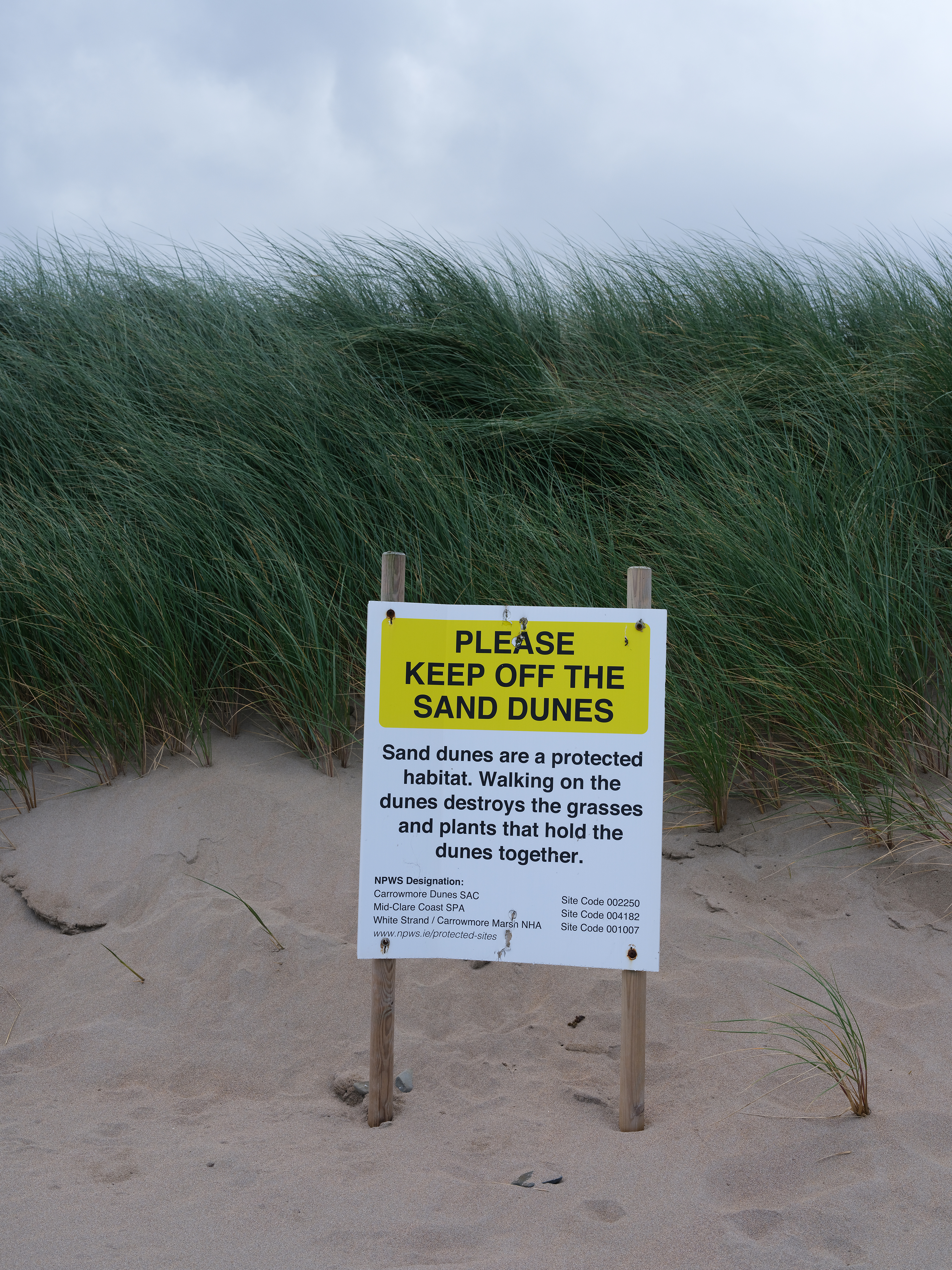
Questions over the fate of the threatened Vertigo angustior snail — a microscopic mollusk nestled in Doonbeg’s sandy dunes — had bedeviled the golf property even before the Trump Organization owned it. But in February, the commission approved the ballroom provided the Trumps offer a snail restoration plan.
“The ballroom,” said Rita McInerney, a Doonbeg resident and member of the Clare County council, had become “part of the community’s vision.”
The jubilation, however, was quickly cut short.
Days after the February approval, a lone appeal was lodged by Liam Madden, a hermetic figure notorious for blocking hundreds if not thousands of development projects across Ireland, including a previous expansion plan in Doonbeg. Impervious to shaming or calls for decency, he once stirred such rage that a foe attacked him with a blowtorch.
“Please,” Madden urged the appellate board, “refuse this nonsense.”
Trump’s other ballroom was stalled.
Guests ride horses at Trump International Golf Links Ireland.Anastasia Taylor-Lind
How to torpedo a project
Madden is a tall man with white hair who lives in a historic house behind a thick stone wall in the Irish village of Longford. He owns no cell phone. He has no website. No social media accounts. The only way to find him is either through his malfunctional landline or an email address that identifies him, in Latin, as the “Irish Vitruvius.”
And yet, people across this country know the name Liam Madden.
When confronted by bothersome development projects, the Irish over the years have turned to this quarrelsome and punctilious man for his ability to torpedo plans. He is what many in Ireland call a “serial objector” — someone who makes a living by appealing planning commission decisions. Madden, however, bristles at that classification.
Instead, when he’s feeling reticent, he describes himself as “the most successful appellant in the history of the Irish state.” At other times, including in interviews with the Washington Post, he referred to himself as a “god,” a “hero,” a “celebrity.”
“There simply isn’t anyone better,” he said. “It’s a scientific fact.”
“I’m modest as well,” Madden, 76, added. “That’s one of my failings.”
His profession is an unintended outgrowth of Ireland’s wildly permissive planning appellate system. In most of Europe and the Americas, a person typically needs to legally demonstrate some stake — financial, geographic or otherwise — to gum up a project with an objection. Ireland has taken a different tack.
All anyone has to do to file an appeal — and trigger a monthslong review by An Coimisiún Pleanála, the national appellate planning board — is submit a preliminary “observation” and pay a nominal fee. Appellants don’t have to be Irish. Or even in Ireland.
“There’s no such thing as too much democracy,” reasoned Lorcan Sirr, a housing analyst at Technological University Dublin.
A house in Doonbeg is painted in preparation of the Irish Open Golf Tournament.Anastasia Taylor-Lind
The system increasingly has become a matter of national controversy. Developers complain that it’s an impediment to progress, vulnerable to abuse and fueling a cottage industry of serial objectors, some of whom have used appeals to extract payments from developers. In 2024, lawmakers proposed reforms.
Madden, who’s never been accused of such improprieties, looks at other serial objectors as a lesser form of the species. He said he would never profane his craft with profit-seeking. What motivates him is the pleasure of winning — identifying even the smallest legal violations to bedevil his adversaries.
That, and bald-faced publicity. “I’m perpetually seeking notoriety,” he said.
So in January, while flipping through the papers, he saw what he recalled as a “golden opportunity.” In Doonbeg, roughly three hours from Madden’s house by car, Eric Trump had proclaimed his intent to build the “nicest ballroom in Ireland.”
Madden knew then what he must do.
“If there is a God in heaven,” he declared one July evening, “I will win the planning appeals and capitalize on it for notoriety.”
Volunteers for Doonbeg Tidy Towns water flowers along Main Street.Anastasia Taylor-Lind
A village praying for a golf course
Doonbeg was in trouble. As the 1990s drew to a close, the shoreline village, whose history dated to at least the 1500s, was fading.
“We weren’t poor in community,” said Tommy Comerford, a fifth-generation Doonbeg resident. “But we were poor in jobs and opportunities to keep our young people.”
The community pitched the European Regional Development Fund on a golf course — and won financing for it. Designed by famed golfer Greg Norman, the Doonbeg Golf Club opened in 2002, just as the local population fell to 206.
Busloads of golf tourists from the United States and Canada were soon rolling in. Seasonal employment at the club — which quickly added a luxury hotel and events space — grew to 300 people. Residents who’d left were coming back.
“The golf resort is so important to us,” said Seoirse Comerford, 52, who returned to take over the family pub.
But the resort could not turn a profit. By 2011, it had lost a reported $70 million. In January 2014, it was put up for sale, and worry spread through Doonbeg.
“It was like, ‘Oh my God, 300 jobs — gone,’” said Caroline O’Brien, a resident.
A savior, however, quickly arrived: an American buyer named Donald Trump. He touched down at Shannon Airport in May 2014 and immediately declared his plans for the resort.
“One of the main reasons I’m here is siting the ballroom,” Trump said. “A truly great ballroom. I believe people from all over the world will be using this ballroom.”
The sand dunes of Trump International Golf Links, as seen from Doughmore Bay Beach. Anastasia Taylor-Lind
‘I’ll be a friend to the snail’
Shortly after the sale’s announcement, an Irish environmentalist named Tony Lowes got a call from Trump.
“I’ll be a friend to the snail,” Lowes recalled Trump declaring.
Questions over the threatened Vertigo angustior, a fickle creature with exacting ecological needs, had long troubled the golf course. Even before it was built, Lowes’s Friends of the Irish Environment had filed a lawsuit to protect the snail. A judge ordered that the snail’s lot be “maintained or improved” and a settlement agreement even allowed for the appointment of a snail expert as a sort of steward.
For years, the snail thrived, and Trump promised to sustain its roll.
But Lowes said the Trumps haven’t kept their word, and the snail’s population has plunged. Shortly after they bought the resort, the snail expert was dismissed. (The expert didn’t respond to requests for comment.) Then, in 2016, the Trumps proposed building a 1.7-mile rock barrier wall along Doughmore Bay Beach to forestall shoreline erosion and protect the links from storm damage.
Environmentalists said the plan, even after it was scaled down, would alter the dunes’ delicate alchemy and doom the snail. To block construction, Friends of the Irish Environment filed an appeal with the national planning board. At its side, with his own appeal, was Liam Madden.
The board decided against the Trumps. Madden basked in glory.
Comparing himself to Saint Patrick, Madden at the time said he’d drive Trump “out of Ireland” like a “snake.”
Trump International Golf Links Hotel, seen from Doughmore Bay Beach. Anastasia Taylor-Lind
The making of a serial objector
When he graduated from architecture school in 1973, Madden said he wanted only an architect’s life. But the planning system was so integral to his work that he immersed himself in planning law and, upon submitting his first appeals, realized, “I was very good at it.”
During the mid-1990s, as Ireland experienced a building boom, people began seeking out Madden for his unusual acumen. Some wanted him to clear a project’s way. Others wanted the opposite. He became friend and foe to developers.
“He had a nickname among developers: the ‘Condom Man,’” said Irish federal senator Joe Flaherty. “You’d use him once, and then throw him out.”
Most of Madden’s work was done in obscurity. But his name nonetheless often rose to public notice.
First came a political campaign in 2004 against a candidate also named Liam Madden, for nothing more than what Madden called “devilment.” Then he stalled a project by the Gaelic Athletic Association, which is Ireland’s largest sporting organization, until it apologized to him over a decades-old grievance.
In 2013, Madden delayed the reopening of St. Mel’s Cathedral, a massive church that suffered a devastating fire, by objecting to a glass elevator that he alleged would offend the “modesty” of “Scotsmen visiting in their kilts.”
The town was furious.
“It was hugely emotional for the town,” Flaherty said. “It was two middle fingers to the local community.”
The attention only spurred Madden on. He objected to a fast food development. He objected to converting an abandoned factory into a car auction site. He objected to Trump’s barrier wall. And he objected to UFC legend Conor McGregor’s bid to build a boutique hotel, challenging him to a “bare-knuckle fight.”
Louis Herterich, a longtime client, said most people simply didn’t get Madden. “He’s just different,” Herterich said. “His god is being right and getting it right and winning.”
Flaherty added: “Nobody in their right mind would want to be Liam Madden — the criticism, the open contempt — but he relishes it.”
In a way, the two men said, they almost felt sorry for Trump.
“Even if he loses,” Flaherty said, “he’ll just find something else and keep going at it.”
Newly built houses in Doonbeg. Anastasia Taylor-Lind
A fatal error?
To Madden, there is no way he’ll lose — not this one.
“I’ve caught them with their pants down,” he said while beaming one July evening.
He returned to the snail — this time focused on helicopters. The Trump Organization, a promotional video indicated, allows guests to be ferried in and out by helicopter. In materials published online, an aviation company, Executive Helicopters, said it has two “heli landings” at the resort, one by the hotel and one on the golf course.
To Madden, this was a “fatal error”: The Trump Organization neither mentioned the helicopters nor sought to measure their ecological impact. The ballroom proposal thus was “tainted at law and beyond remedy,” he wrote.
Plus, Madden wrote, “Would our poor little Vertigo Angustior survive?”
The Trump organization didn’t respond to a request for comment. Golf course manager Joe Russel declined to comment. Executive Helicopters didn’t respond to a request for comment.
Geraint Ellis, an expert on Irish planning law who reviewed the appeal at The Post’s request, said Madden’s objection wasn’t frivolous. “Mr. Madden seems to have found some issues that are worthy of further scrutiny,” Ellis said.
As word spread of the objection, Doonbeg residents reacted with outrage. The golf resort had nothing to do with Trump, resident Rita McInerney said. Doonbeg started the resort, and will rise or fall with its fortune. How could a single outsider with nothing at stake kick up such trouble?
“Ludicrous,” she said.
“Disgraceful,” agreed Seoirse Comerford.
“Totally unfair,” added Tommy Comerford.
Doonbeg resident Rita McInerney said the ballrom became “part of the community’s vision.” Anastasia Taylor-Lind
In Washington, the White House ballroom is well underway. Foundational construction has started. The $900 million, 90,000-square-foot structure is coming into focus, including new details like gold-colored presidential seals. The Supreme Court is expected to rule this week, potentially giving it a green light.
But in Ireland, where the national appellate board is expected to rule by year’s end, Liam Madden insists the other ballroom will never be approved.
“Joe Biden beat Donald Trump once,” he said. “I’ve beaten him twice.”
The financial struggles of a once-popular theater in Collingswood have spiraled into debate over who runs it in the first place and whether taxpayers should have paid millions of dollars to keep it afloat.
Collingswood Borough has rented the property housing the Scottish Rite Auditorium, which seats 1,050, for $1 annually from the Scottish Rite Freemasons for 23 years.
But Collingswood officials say they are looking to transfer management of the Scottish Rite — one of the largest theaters in South Jersey and once host to major touring acts like Kansas, David Crosby, and America — to Camden County after declining ticket sales left the onus on Collingswood to pay for expenses in recent years.
Commissioner Jim Maley, a former mayor and a Democratic member of borough government for the last 37 years, said post-pandemic theater losses have cost the borough $505,000 since 2020.
Maley helped found the nonprofit that manages the Scottish Rite property, Collingswood Foundation for the Arts, with the help of two former officials back in 1999. The foundation, which Maley said was created to secure arts grants for Collingswood, has long received the borough’s financial support without question.
That changed recently.
At a heated meeting of Collingswood’s three-person board of commissioners on Aug. 3, the public demanded to know who runs the Scottish Rite, whether it is really part of the borough, and, if not, why taxpayers are paying for it, especially when Collingwood schools are struggling.
Now, residents and at least one commissioner are scrambling to find answers, while Maley says the new round of questioning is just another effort by naysayers to undermine him.
What changed?
On July 31, a website by an anonymous user went live: “The Scottish Rite. Who actually runs it?”
The site, with a corresponding Google Drive of public documents, alleges that Maley and other officials created a conflict of interest by authorizing millions in payments and loans to Collingswood Foundation for the Arts, Maley’s brainchild, since 2003.
The conflict-of-interest accusation is not the first in Collingswood.
Maley said the theater issue is another example of meaningless attacks against him. The foundation managing the Scottish Rite is part of the borough, he said, and thus deserves its dollars.
Who runs the Scottish Rite?
Maley begins his account of the theater in 2003, when the Collingswood Foundation for the Arts gained control of the Scottish Rite. That is also when the borough secured a lease for the property and entered into a management agreement for the theater with the nonprofit.
The Collingswood Foundation for the Arts, which manages the Scottish Rite Auditorium and the Collingswood Grand Ballroom at 315 White Horse Pike, was the subject of recent confusion at a Collingswood commissioners meeting on Aug. 3, 2026.Sarah Nicell
Maley and his fellow commissioners passed an ordinance at that point to borrow $5 million in bonds to fund a loan to the foundation for renovations to the Scottish Rite. The loan was never paid back, Maley said, since there was no expectation the nonprofit would do so.
At first, Maley said, borough employees ran the theater.
But when the nonprofit made more money, its staff — one full-time employee and four regular part-timers, with 20 or more brought in specifically for events — switched to the foundation’s payroll, a change confirmed by Elizabeth Pigliacelli, Collingswood’s chief financial officer.
The borough allocated hundreds of thousands of dollars in its annual budgets for the theater’s operating expenses, insurance, and utilities, and the nonprofit repaid Collingswood at the end of each year.
That is, until the pandemic hit.
Deficits at the theater left the borough paying $250,000 and $55,000 in 2020 and 2021, respectively. The theater managed to power through for the next three years, but the borough had to pay the theater $200,000 in 2025 to keep it afloat, along with $100,000 to apply for a state grant for renovations to the property. That grant has not been awarded.
A 2007 management agreement on the borough website, the most recent available, says the foundation should pay for its own operations. Still, Maley said, the borough “has always been ultimately responsible.”
A duty to understand
Some residents say public records muddy Maley’s picture.
Unlike other borough entities, the foundation has not hosted regular board meetings for two years, according to Maley. Those meetings have never been public.
And while the borough rents the Scottish Rite property, the municipality’s public works department does not maintain it. On an Aug. 14 visit to the theater, Jimni Kricket, a South Jersey landscaping business, was doing outdoor work. The company is owned by Paula Lara, the executive director of Collingswood Foundation for the Arts.
“Public works does all municipal properties,” Commissioner Amy Henderson Riley said in a text, “except you’re correct that her company has the contract for that property. why? I don’t know.”
When the commissioners were asked on Aug. 3 who sits on the board, no one could answer.
Maley later told The Inquirer the board is made up of Collingwood’s current elected officials, but Mayor Solano-Ward and Henderson Riley, both Democrats elected last year, said they were not aware of that arrangement.
“If I don’t understand the relationship, how the heck is the public supposed to understand what this is?” Henderson Riley said.
Henderson Riley said she started questioning the nonprofit when she spotted a bill in the treasurer’s July report for the foundation’s “legal fees,” more than $2,300. The meeting minutes are not yet public, but Henderson Riley said she voted against the payment, and the bill was not paid.
The nonprofit was sued in January by Chammings Electric, a Vineland-based company, for thousands in unpaid bills for work at the Scottish Rite. The lawsuit, the second against the foundation since 2024, is ongoing.
Henderson Riley said she sought legal advice from the borough solicitor, Caitlin Harney Norcia, but Harney Norcia told her she could not answer because the nonprofit has paid her for attorney services.
“I just want to understand,” Henderson Riley said. “If it’s part of the Borough, I have a fiduciary duty to protect our assets, to understand what this is.”
In the meantime, Henderson Riley said, she has sought special counsel to help resolve the problem, which she said will likely take weeks.
The foundation’s nonprofit status also complicates the puzzle.
The foundation’s tax-exempt status was revoked by the IRS in 2024, since the nonprofit had failed to file its annual reports since 2020. Maley said that the missed deadlines were mistakes and that he has since filed them to hopefully re-up the foundation’s tax exemption.
New Jersey law confirming whether a municipality can create and run a nonprofit is hard to find.
But in a 2017 notice, the New Jersey Division of Local Government Services published its view, after some officials raised questions about whether a government can establish a charity. Municipalities are not allowed to create or operate nonprofits, and while local officials can facilitate the creation of a local nonprofit, the notice states they cannot “control its operations” by using taxpayer dollars.
The notice also said local officials cannot appoint government officials or staff as the majority of the nonprofit’s board.
Still, Maley said the nonprofit’s creation was facilitated by municipal lawyers. Several South Jersey attorneys specializing in municipal government declined to comment or said they could not due to their work with Collingswood Borough.
Lara did not return requests for comment.
‘Pass the buck’
Kate Delany, president of South Jersey Progressive Democrats and a Collingswood resident since 2007, was one of several people to demand answers at the Aug. 3 commissioners meeting.
“There are better ways to spend that money if we could get some of that back in our community,” Delany said.
Schools are one clear area in need of money, Delany said.
Maley said Collingswood has started conversations with Camden County to shift ownership “because they have a greater ability to handle the expense.”
Dan Keashen, a Camden County spokesperson, said nothing has been decided yet, since preliminary conversations have not begun. But some Collingswood residents do not want the theater to trade hands, since they worry about losing their chance at answers.
Delany, whose polling place is at the Scottish Rite, said Collingswood should not “pass the buck” to the county.
“That’s something we want to stop,” Delany said. “It’s a Collingswood issue, and we want it to stay in Collingswood.”
As we alluded to last week, we at Down the Shore are moving from complaints and pet peeves to soliciting solutions, including from our text group, The Shore Line.
We received many ideas, mostly grouped around a few big problems: parking and cars, costs, public access, plus some thoughts on restaurants.
Several proposed off-island parking and shuttles to reduce the number of cars on barrier islands. One suggested congestion pricing for cars on the islands, or beach tags for cars (oof). Another idea: beach tags that could be used in any town, like a museum pass.
Kenneth Lacovara, founding executive director of Rowan University’s Edelman Fossil Park & Museum, said in an interview that, while not questioning that the father-son team found the Megalodon tooth as they said, there is no chance the tooth originated in Sea Isle.
“I don’t see how a Megalodon tooth could naturally occur on the coast of Sea Isle City.”
Deposits from the Megalodon’s Miocene epoch would be 500 to 600 feet under the sea along this part of the coast, Lacovara said, as the cakelike geographic layers get deeper and deeper as you head from, say, Philadelphia, down to Sea Isle.
Even with ocean dredging for beach replenishment, Megalodon shark teeth fossils from that depth would not surface.
“That fossil didn’t come from Sea Isle City,” Lacovara said.
Michael Bowers, 42, said he discovered the fossil while visiting Sea Isle City with Bo, 11, a dirt bike rider, who documented the find on his YouTube channel, Fastkid71. They sought out experts from the Cape May Whale Watch & Research Center and from the New Jersey State Museum, who validated the tooth’s authenticity.
“I’m not suggesting they are faking it,” Lacovara said. “That Megalodon tooth is not there naturally. It was maybe dropped by somebody, or lost by somebody. It’s more like finding a treasure than a paleontological discovery.
Mystery unlocked? Or deepened? I’m just the messenger!
📮 Have ideas or news tips about the Shore or this newsletter? Thoughts about the Megalodon? More suggestions for improving the Shore experience? Send them to me here.
🌧️ A little rain in the forecast but not a washout.
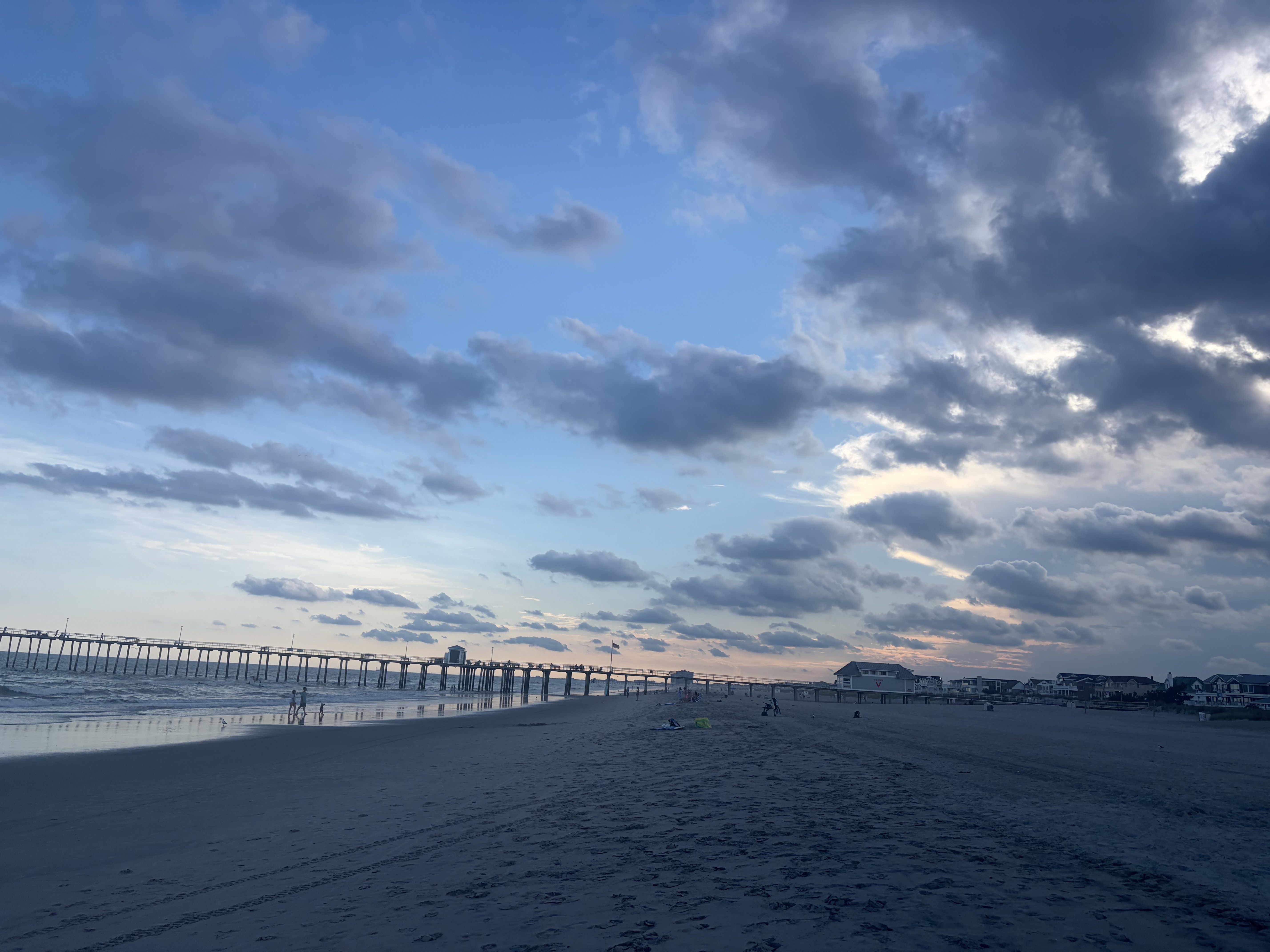
The wind shifted to a cool ocean breeze just before dusk on Aug. 17, 2026, in Ventnor, N.J.Amy S. Rosenberg / staff
Your thoughts on: Shore fixes
Jenifer Baldwin says towns should focus on sustainability and public access:
Make townships responsible for providing public parking and public restrooms with outdoor showers and changing rooms. Start working toward zoning that requires new development to include affordable public accommodations (motels, campgrounds, public beach facilities). Get creative about linking our barrier islands with alternative modes of transportation. Go car free in designated areas.
Kara Cumiskey says the problem is “cars, cars, cars.”
I think that there should be a “beach tag” for cars. Or some type of “congestion pricing” for bringing your car onto the Island. I have a rental property that has 4 bedrooms. The tenants this week brought 7 cars.
One texter thinks Shore towns need to add a golf cart lane.
Maybe either a lane or certain streets to use golf carts. It is horrifying the way people pack kids in them and drive in traffic. Many do not drive safely either. Toddlers sitting on someone’s lap or just on a seat!
Several texters, like this one, urged everyone to just … be nicer.
It really comes down to respecting one another and that starts at home. I know I sound like an old head (I’m only 45) but it’s what is wrong with the world today.
🧠 Trivia time
Kevin Pellegrini was first with the answer to Avalon’s old white underaged drinker roundup bus, the Magic Bus.
This week’s question:
This beach town established its beach patrol in 1855, making it the oldest operational beach patrol in the country and the future home of an International Lifeguard Museum.
Which town is it?
A. Wildwood, N.J.
B. Rehoboth Beach, Del.
C. Atlantic City, N.J.
D. Huntington Beach, Ca.
If you think you know the answer, email us. First one gets a shout-out.
Your Shore memory
Not to shock everyone with a winter memory, but it’s almost Labor Day! This is from Lisa Guercio.
The best off season Shore memory was a weekend special at the Bolero Hotel in Wildwood. It was a snowy weekend with my first walk on the beach with snow over the sand. We also got to swim in the indoor pool on the roof while the snow was falling, which was a thrill. There were also ice chunks in the ocean that were a wonderful sight. The shore in off season is better than summer, as far as I’m concerned. Especially now that it so unaffordable during the summer season anyway.
The Lower Merion Board of School Directors recently banned two parents from attending meetings in-person for the next year.Joe Lamberti
Two parents were recently banned from attending Lower Merion school board meetings in person for the next year, with the district saying one exhibited “bullying” and “disruptive” behavior.
The parents, Rebecca Foscolo and David Smyth, are among those pushing for less screen time for their kids, a topic that Foscolo admits led to some “extra spicy” behavior at a recent meeting.
But being banned from in-person attendance — both can submit written comments and watch live streams — could be violating their constitutional rights, according to the ACLU of Pennsylvania.
West Nile virus-positive mosquitoes were recently found in the township. Officials suggest residents take precautions, including by reducing standing water on their properties and wearing protective clothing or repellent when outdoors.
SEPTA is rolling out the first phase of its bus network overhaul Sunday, impacting 30 routes, including along the Lancaster Avenue corridor. Here’s what to expect. See how your route is impacted with The Inquirer’s interactive map.
Basketball brand AND1 may be synonymous with New York, but it’s rooted in the Main Line. The Inquirer’s Alex Coffey revisits the cheeky company’s early days, which included an inaugural location in Ardmore and later Rosemont.
Neighboring Upper Merion Township rejected a proposed 5-million-square-foot AI data center campus last week, the nearest of which would have been not far over the township line at 411 Swedeland Rd. in King of Prussia. Developer Brian O’Neill can still appeal the board’s denial.
Two ramps on I-476 will be closed Friday at 10 p.m. and reopen Saturday at 9 a.m. They are the the northbound I-476 ramp to westbound I-76 and the westbound I-76 ramp to southbound I-476.
🎸 Classic Albums Live: Hear covers of the Rolling Stones, the Black Crowes, and Aerosmith. ⏰ Friday, Aug. 21, 8 p.m. 💵 $29.50-$71.42 📍 Ardmore Music Hall
📚 Philadelphia Book Crawl: Several local bookshops — Mavey Books in Ardmore, Children’s Book World in Haverford, Narberth Bookshop, and Chapter Two Books in Wynnewood — are participating in the region-wide event. ⏰ Saturday, Aug. 22, times vary 💵 Pay as you go 📍 Locations vary
🍬 End of Summer Camp: Kids can make edible crafts and play candy-themed games during each day session of this weeklong camp. ⏰ Monday, Aug. 24-Friday, Aug. 28, 10 a.m.-noon 💵 $42.40 per session 📍 The Candy Lab
🎵 Music in the Park: The final concert of the season features a performance by folk duo The Mingo Creek Balladeers. ⏰ Wednesday, Aug. 26, 7 p.m. 💵 Free 📍 Narberth Park gazebo
The home has been completely updated.Courtesy of Brian Griffin and Erica Deuschle/Keller Williams Main Line
Spanning four bedrooms and four bathrooms, this Ardmore home has been completely updated, inside and out. Among its features are a first-floor office, a kitchen with a butler’s pantry, and a nearby mudroom. It also has a finished basement with a full bathroom that could serve multiple uses. Upstairs, the primary suite has a walk-in closet, while outside there’s a deck leading to the backyard. There’s an open house today from 5 to 7 p.m. and on Saturday from noon to 2 p.m.
By submitting your written, visual, and/or audio contributions, you agree to The Inquirer’s Terms of Use, including the grant of rights in Section 10.
This suburban content is produced with support from the Leslie Miller and Richard Worley Foundation and The Lenfest Institute for Journalism. Editorial content is created independently of the project donors. Gifts to support The Inquirer’s high-impact journalism can be made at inquirer.com/donate. A list of Lenfest Institute donors can be found at lenfestinstitute.org/supporters.