Category: New Jersey News

  • 🎃 Where to go pumpkin picking | Inquirer South Jersey

    🎃 Where to go pumpkin picking | Inquirer South Jersey

    Good morning, South Jersey.

    It’s that time of year: Our latest roundup of farms will point you toward pumpkin picking, hayrides, and other kinds of festive fall fun in the region.

    And privacy advocates are pushing for businesses to be more transparent about their use of automated license plate readers.

    Plus, Wayfair is set to open a brick-and-mortar store in Cherry Hill, and more news of the day.

    — Taylor Allen (southjersey@inquirer.com)

    P.S. Thank you for your continuing support. We want your thoughts! Tell us your opinion of the newsletter by taking our survey or replying to this email.

    If someone forwarded you this email, sign up for free here.

    Pick your perfect pumpkin

    The leaves are changing, the weather is getting cooler, and it’s now time to go out and find your perfect pumpkin. These locations are worth the trek:

    🎃 Johnson’s Corner Farm: Not only does this option provide the classic farm experience in Medford, but it turns into a harvest festival on the weekends complete with food vendors and live music.

    🎃 Springdale Farm Market: Take a pumpkin-picking hayride in Cherry Hill. Don’t leave without its famous home-baked pies.

    🎃 Terhune Orchards: If you don’t mind taking a ride further north, head up to Terhune Orchards in Princeton to pick pumpkins, flowers, and apples — and on a weekend, you can do it all while listening to live music. Hang out with barn animals and paint a gourd, while you’re at it.

    For more options, peruse the entire guide full of seasonal fun.

    Under scrutiny
    While out shopping, New Jersey consumers are starting to notice more cameras.

    Retailers are placing automated license plate readers at entrance and exit points, and they tend not to be especially open about how the technology is being used.

    As an example, the country’s largest mall owner, the Simon Property Group — which owns Gloucester Premium Outlets in Blackwood — has a history of sharing its feeds with law enforcement in California. It’s unclear if they do or have done the same here, and the group and local police did not respond to interview requests with the Inquirer.

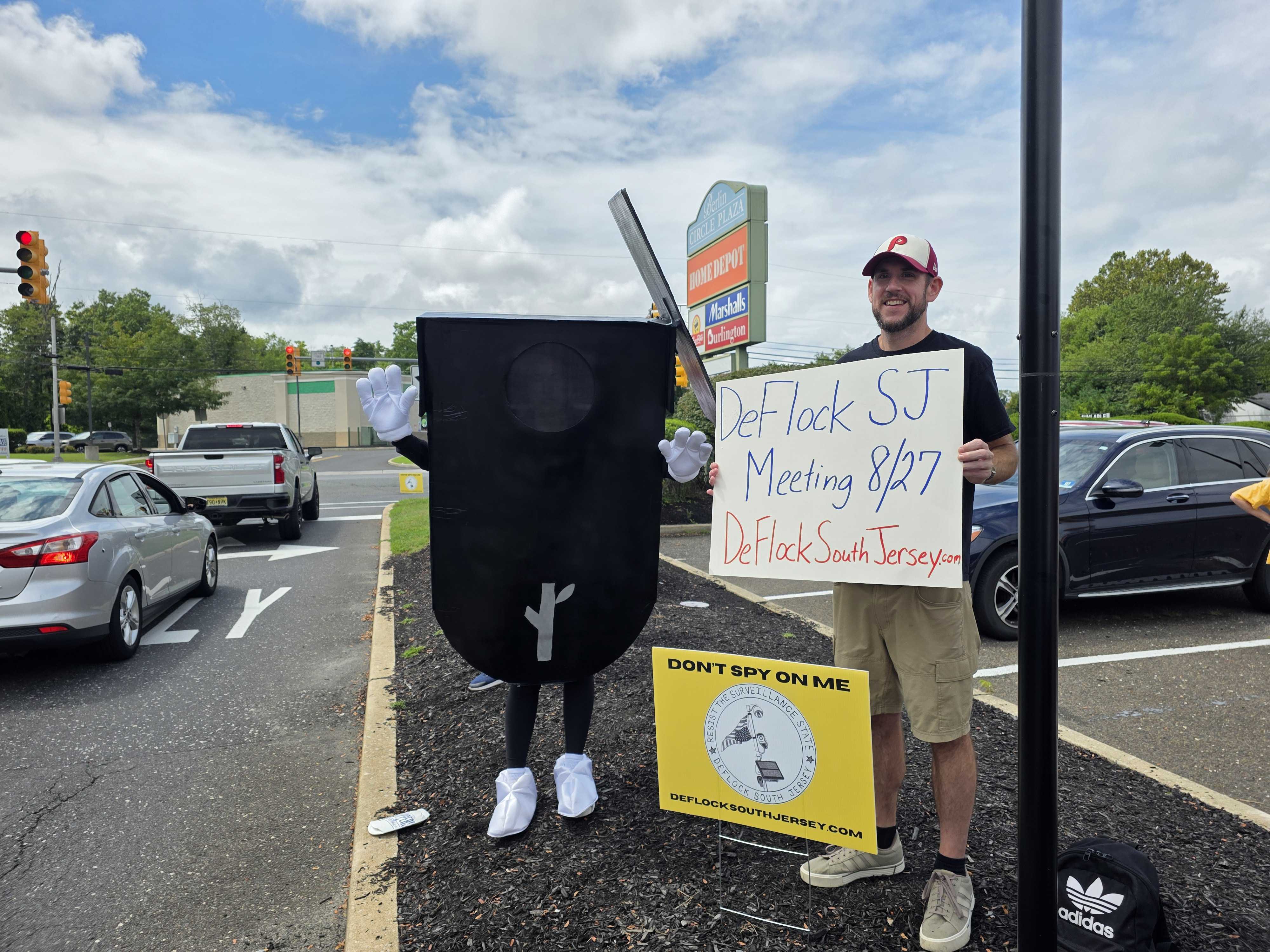
    DeFlock South Jersey, a resident group concerned about privacy, emerged over the summer to raise awareness of the pervasiveness of the cameras. Its activism has taken the form of popping up at town council meetings, filing record requests, boycotts, and Flocky — a human-size anti-Flock mascot.

    Reporter Ximena Conde has the story.

    What to know today

    🧠 Trivia time

    What was Lucy the Elephant’s original name?

    A) Lucy the Great

    B) Ellen the Elephant

    C) Elephant Bazaar

    D) The Great Elephant

    Think you know? Check your answer.

    What we’re …

    🍴 Craving: Chicken lollipops from Karachi Kafe in Voorhees.

    🚁 Mapping: LeBron James’ helicopter commutes between Philly and NYC.

    🍷 Tasting: This affordable pinot noir.

    📸 Photo of the week
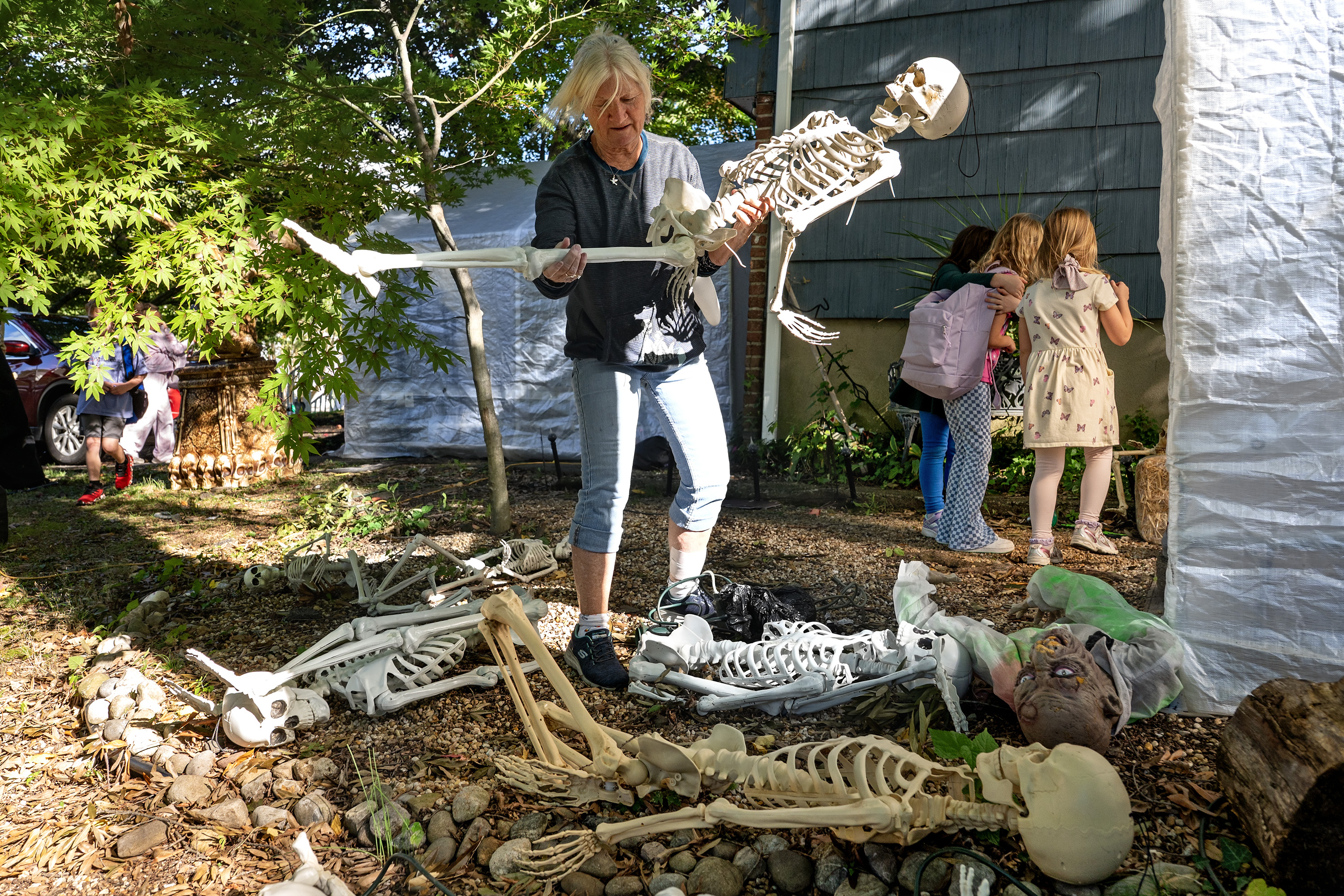
    Linda DeMarco sets up the front yard of her Collingswood home with Halloween decorations on Monday. Tom Gralish / Staff Photographer

    🔮 One last festive thing: It’s the season where your neighbors transform their homes into elaborate haunted displays. It’s not too early to start tracking and mapping the best Halloween displays.

    Enjoy your weekend. I’ll be back in your inbox on Monday. 📧

    By submitting your written, visual, and/or audio contributions, you agree to The Inquirer’s Terms of Use, including the grant of rights in Section 10.

  • One of New Jersey’s oldest lighthouses will reopen to the public

    One of New Jersey’s oldest lighthouses will reopen to the public

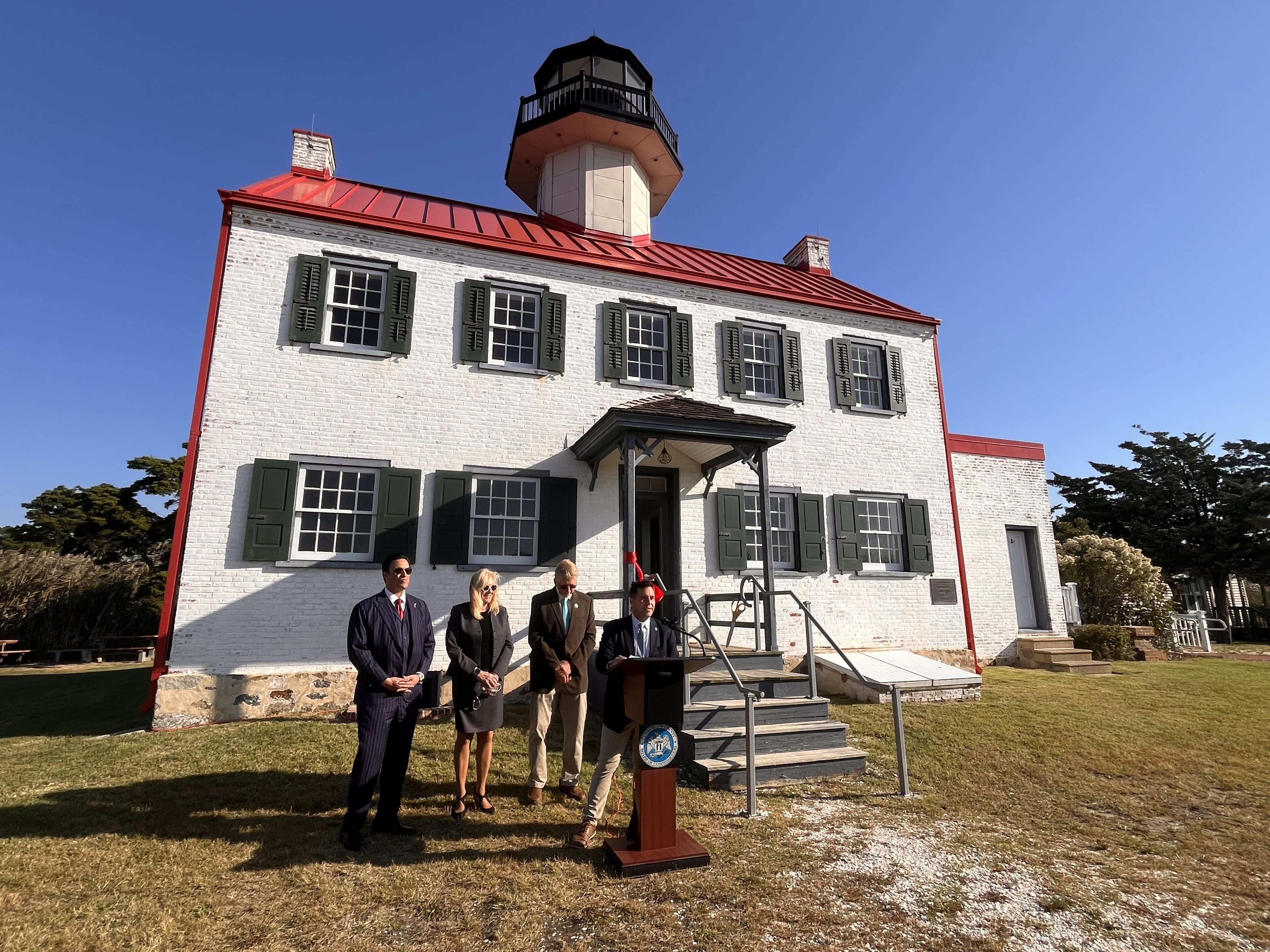
    East Point Lighthouse, set on the Delaware Bay and amid 7,600 acres of wetlands, will reopen to the public this month after being closed for two years.

    Ed Potosnak, commissioner of the New Jersey Department of Environmental Protection, announced a lease agreement with Cumberland County on Thursday on the steps of the lighthouse that dates to 1849.

    The quaint white-and-red lighthouse within the state’s Heislerville Wildlife Management Area in Cumberland County will reopen to the public on a limited basis Oct. 16.

    The number of days and hours are expected to grow when a full plan, which will include programs, is developed by early next year. Admission will be free, at least for now.

    “It’s one of the state’s few surviving lighthouses from the 19th century,” Potosnak said. “With this agreement, it’ll be open again to the public.”

    (function(){function e(){window.addEventListener(`message`,function(e){if(e.data[`datawrapper-height`]!==void 0){var t=document.querySelectorAll(`iframe`);for(var n in e.data[`datawrapper-height`])for(var r=0,i;i=t[r];r++)if(i.contentWindow===e.source){var a=e.data[`datawrapper-height`][n]+`px`;i.style.height=a}}})}e()})();

    Who will run the lighthouse?

    Cumberland County will lease the landmark at Maurice River Cove at little to no cost.

    Because the lighthouse is on state land, the DEP will be responsible for overall maintenance. Cumberland County and Maurice River Township will help with programming, such as festivals, visitor services, and coordinating volunteers for tours.

    Potosnak said the DEP is also working with the U.S. Army Corps of Engineers to design a bulkhead, dunes, or another method to protect the lighthouse from the encroaching bay and rising sea levels.

    The DEP installed geotubes — long membranes filled with sand — years ago along a beach that fronts the lighthouse, but they are at the end of their life expectancy.

    County Commissioner Director Sandy Taylor, who grew up nearby on the bayshore, said the reopening is personal for her.

    “That we finally have the opportunity to keep the lighthouse open for our community, for the county, for many visitors from around the state is huge for us,” she said.

    Ed Potosnak, commissioner of the New Jersey Department of Environmental Protection, announces that the East Point Lighthouse on the Delaware Bay will reopen. Behind him (from left) are State Sen. Mike Testa, Cumberland County Commissioner Director Sandy Taylor, and Maurice River Mayor Ken Whildin.Frank Kummer

    Maurice River Township Mayor Ken Whildin recalled how the lighthouse helped guide maritime traffic until it was decommissioned during World War II so German U-boats could not be guided by it.

    The lighthouse survived an arson in 1971 and was restored in the 1990s. Whildin emphasized that reopening the site has been a priority.

    He said he frequents a local Wawa and is routinely stopped by residents asking when the lighthouse will reopen.

    The lighthouse, Whildin said, is “not only a beacon of light, but it’s also a beacon of hope.”

    And State Sen. Mike Testa noted the lighthouse’s prominent location along a key migration path for horseshoe crabs and monarch butterflies.

    The beacon also remains an active navigational aid for the U.S. Coast Guard, he said.

    “This is a really good day,” Testa said.

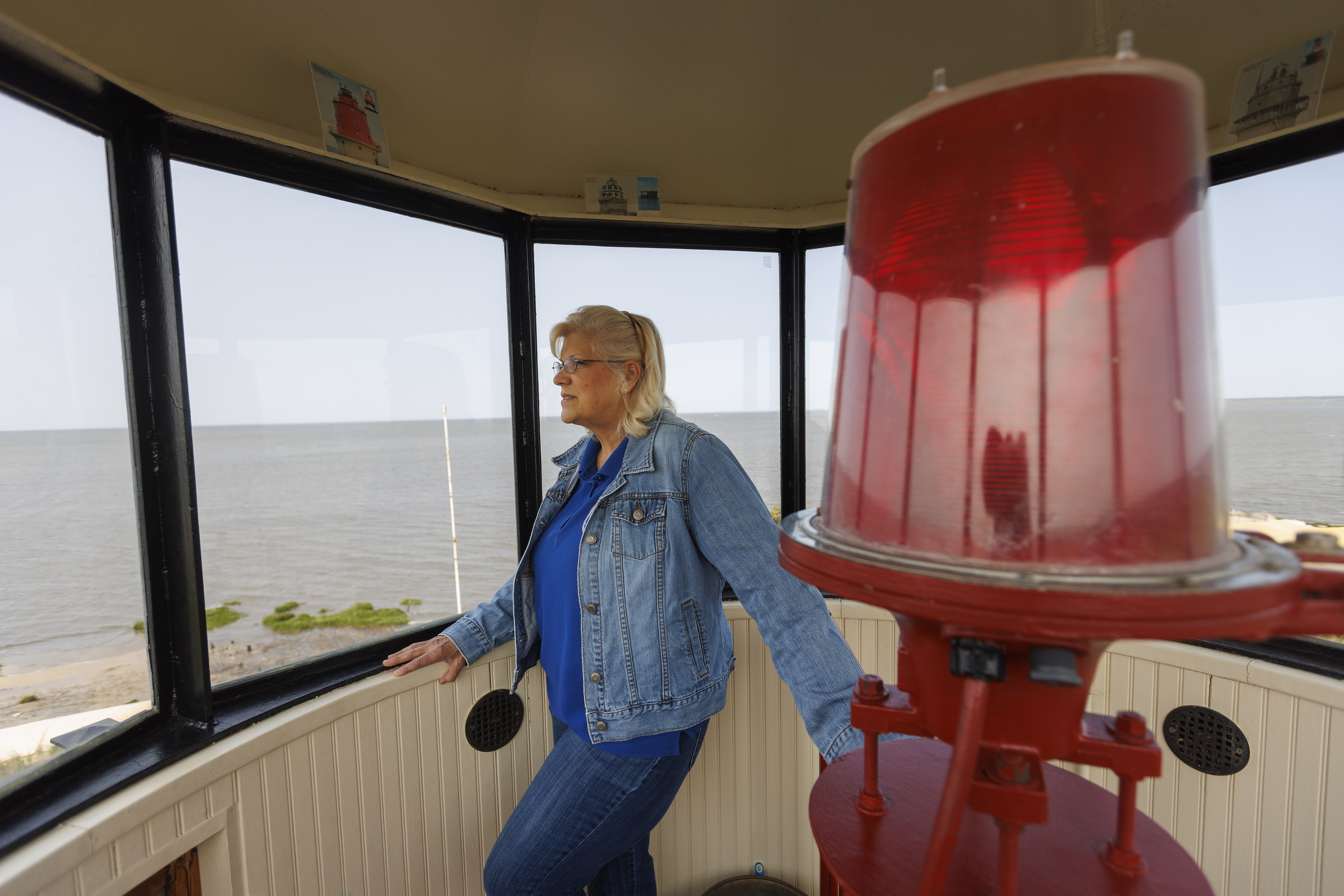
    Nancy Patterson, with the Maurice River Historical Society, in the lantern room of East Point Lighthouse in 2023. The group previously operated the lighthouse until its lease expired with the state.Alejandro A. Alvarez / Staff Photographer

    Why the lighthouse closed

    The lighthouse closed in 2024 after the DEP, under the administration of former Gov. Phil Murphy, failed to reach a lease agreement with the previous operator, the Maurice River Historical Society.

    Nancy Patterson, the group’s volunteer president, had been tussling with the state since 2017 over the terms of a new lease.

    But efforts stalled, and the lighthouse was closed.

    It is unclear what role the historical society will play going forward, though officials credit the group with reviving the lighthouse’s fortunes.

    After the fire, the society led an $850,000 restoration effort along with the Cumberland County Improvement Authority and the New Jersey Historic Trust.

    The historical society began managing the lighthouse in the 1990s under a lease of the small property at the confluence of the Delaware Bay and Maurice River.

    The group installed period-replica pieces in various rooms to give visitors an idea of what life in a lighthouse was like. Those have been removed.

    ‘A great day’

    Matthew Pisarski, head of the county planning department, said details of the interior are still being worked out, as is programming.

    “We’re really excited at the opportunity to interpret the site and not only talk about the history of the lighthouse, but talk about some of the techniques of preservation that’s gone on, some of the challenges like rising tides, and preservation of historic properties.”

    Potosnak, the DEP commissioner appointed by Gov. Mikie Sherrill, said the current government agencies now involved began meeting in March to find a way to reopen the lighthouse.

    “It’s a great day for the residents of New Jersey,” Potosnak said. “When people roll up their sleeves and work together, good things can happen.”

  • From the Gloucester Outlets to Home Depot: Businesses using license plate readers come under scrutiny

    From the Gloucester Outlets to Home Depot: Businesses using license plate readers come under scrutiny

    It wasn’t a deal that caught Adam Sheridan’s eye as he drove through the Gloucester Premium Outlets this summer.

    It was an automated license plate reader.

    “I looked up, because all I do now is look up at every telephone pole, and there’s a camera right there,” he said. “I don’t know if it’s new or just no one ever noticed.”

    Regardless of when three Flock-brand cameras were strategically placed at the entrance and exit points of the outlets, people like Sheridan are taking notice.

    The technology is designed to capture license plates, along with car make and model, and any bumper stickers a vehicle might have.

    How the outlets manage that data is less clear.

    Until recently, local law enforcement has drawn much of the scrutiny over the use and misuse of automated license plate readers, brought to light through internal audits and public records requests. It is through those mechanisms that the public learned police followed a woman leaving Texas to self-administer an abortion and three former Georgia deputies used the cameras to stalk people.

    Privacy advocates note no such transparency tools are required for businesses, which have largely been prickly about revealing too much about their camera use. Many businesses opt to keep private the number of cameras they have on site, who gets to see data collected, and data-sharing agreements. Seizing on a growing backlash against Big Tech and artificial intelligence, critics want to force a conversation about camera use by private businesses.

    Sarah Hamid is director of strategic campaigns at the Electronic Frontier Foundation, which has been studying surveillance technology for more than 30 years.

    When private businesses use this type of surveillance, there’s “less of a paper trail” if the data are misused, she said.

    “So the public can’t point to this undeniable record, because regardless of what PR statement comes out of a large retail vendor, at the end of the day, what the data-sharing rules are for that corporation are many times not just specific to that corporation — and private — but also specific to the specific store and location,” Hamid said.

    Take the Simon Property Group, the country’s biggest mall owner, with the Gloucester Outlets among its properties.

    A 2024 report in Forbes found Simon had a nationwide contract with Flock, the lead manufacturer of license plate readers, with a network of cameras across 49 states. Internal emails at the time showed Simon was directly sharing its feeds with at least two law enforcement agencies in California, regardless of a crime taking place. But it is unclear if such a data-sharing agreement exists with the Gloucester Township Police Department.

    Simon did not respond to requests for an interview regarding its Flock cameras at the outlets or other properties, including the King of Prussia Mall. Local police did not respond to questions regarding data sharing with the outlets.

    Determined to raise awareness about the ubiquity of these license plate readers, a group of local, privacy-minded residents created DeFlock South Jersey over the summer. They have peppered town council meetings and filed records requests to learn about the contracts their local municipalities have with these camera manufacturers. To get the attention of businesses, they have opted for boycotts and a showman’s approach.

    DeFlock South Jersey’s inaugural event was an August “camera tour” at the Cherry Hill Mall, a Lowe’s in Lawnside, and a Home Depot in West Berlin to highlight their use of automated license plate readers. Stuffed into a life-size, homemade Flock costume — white Mickey Mouse-style gloves included — one member gestured to the cameras above.

    Bill Helfand, 81, held up a sign that read “Big Brother is watching you,” as the group tried to talk about privacy concerns before the light turned green for waiting cars. Helfand kept his warning short.

    “If Home Depot wants to give up somebody else’s information, they can do it,” he said.

    Automated license plate readers on private property

    Businesses using automated license plate readers have access only to the data collected on their property, but they can opt to make their data accessible to local law enforcement. If the local police department is contracting with a company like Flock, which has data-sharing agreements with law enforcement agencies across the country, a vehicle’s identifying information could suddenly be part of a national database.

    The thread of who has access to the data can be easy to lose and has come to matter in cases involving U.S. Immigration and Customs Enforcement, though Flock says it does not have a contract with the agency and Home Depot says it does not grant license plate reader access to federal law enforcement.

    404 Media reported last year that local Texas law enforcement was sharing Flock data from Home Depot and Lowe’s with federal immigration authorities. Both retailers have had their parking lots targeted by ICE as the Trump administration pursues its mass deportation campaign.

    A Home Depot spokesperson said parking area security cameras have been in place for many years, declining to say how long license plate readers have been part of the mix. The spokesperson directed The Inquirer to the company’s website, which says the readers are for “detecting and preventing theft and protecting the safety of our customers and associates.”

    Lowe’s website said its cameras “automatically capture images of vehicles and their license plates, along with the date, time, and general location,” for all the reasons Home Depot listed and the added task of assisting with parking enforcement.

    “We only disclose your personal information if required by law or legal process, or when we believe doing so will help protect the safety, property, or rights of individuals or Lowe’s,” says the company’s website.

    Home Depot and Lowe’s did not say how many of their stores in New Jersey use the cameras.

    Like the home improvement stores, a Cherry Hill Mall spokesperson declined to reveal the brand of cameras the mall uses or how many, citing security concerns and directing The Inquirer to the mall’s website for any information about the automated license plate readers.

    Owned by Pennsylvania Real Estate Investment Trust (PREIT), the mall captures license plate data, as well as the location and time of sighting, according to the site.

    “This same information can be observed by any person walking through the parking lot,” reads the mall’s website, which says the data are kept for 30 days and then deleted.

    It is an argument supporters of the technology often make and one being increasingly met with pushback by groups like DeFlock South Jersey, determined to keep the pressure.

    On Saturday, Flocky, the human-size anti-Flock mascot, will be hitting the streets of South Jersey again, this time at a Home Depot in Lawnside.

  • Bruce Mabine, retired OB-GYN physician and award-winning associate professor at Temple, has died at 76

    Bruce Mabine, retired OB-GYN physician and award-winning associate professor at Temple, has died at 76

    Bruce Mabine knew he wanted to be a doctor after he was mesmerized by an X-ray of his own hand when he was 10. So he graduated from what is now the Temple University Lewis Katz School of Medicine in 1977.

    He knew he wanted to support expectant mothers, babies, and families. So he specialized in obstetrics and gynecology, and delivered thousands of babies over his 43-year medical career.

    He knew he wanted to lift up and educate students. So he taught thousands of aspiring doctors in labs and classrooms, and mentored other health professionals for more than two decades as an associate professor at Temple.

    He also volunteered at clinics, looked after individuals in need wherever they were, and worked at grueling jobs that paid more in satisfaction than money. “Money is not the only issue in life,” he told the Courier-Post of Camden in 1992. “This is a good way to strike a balance. It’s gratifying to help someone who really needs it.”

    On Monday, Oct. 5, Dr. Mabine died of cancer at his home in Philadelphia. He was 76.

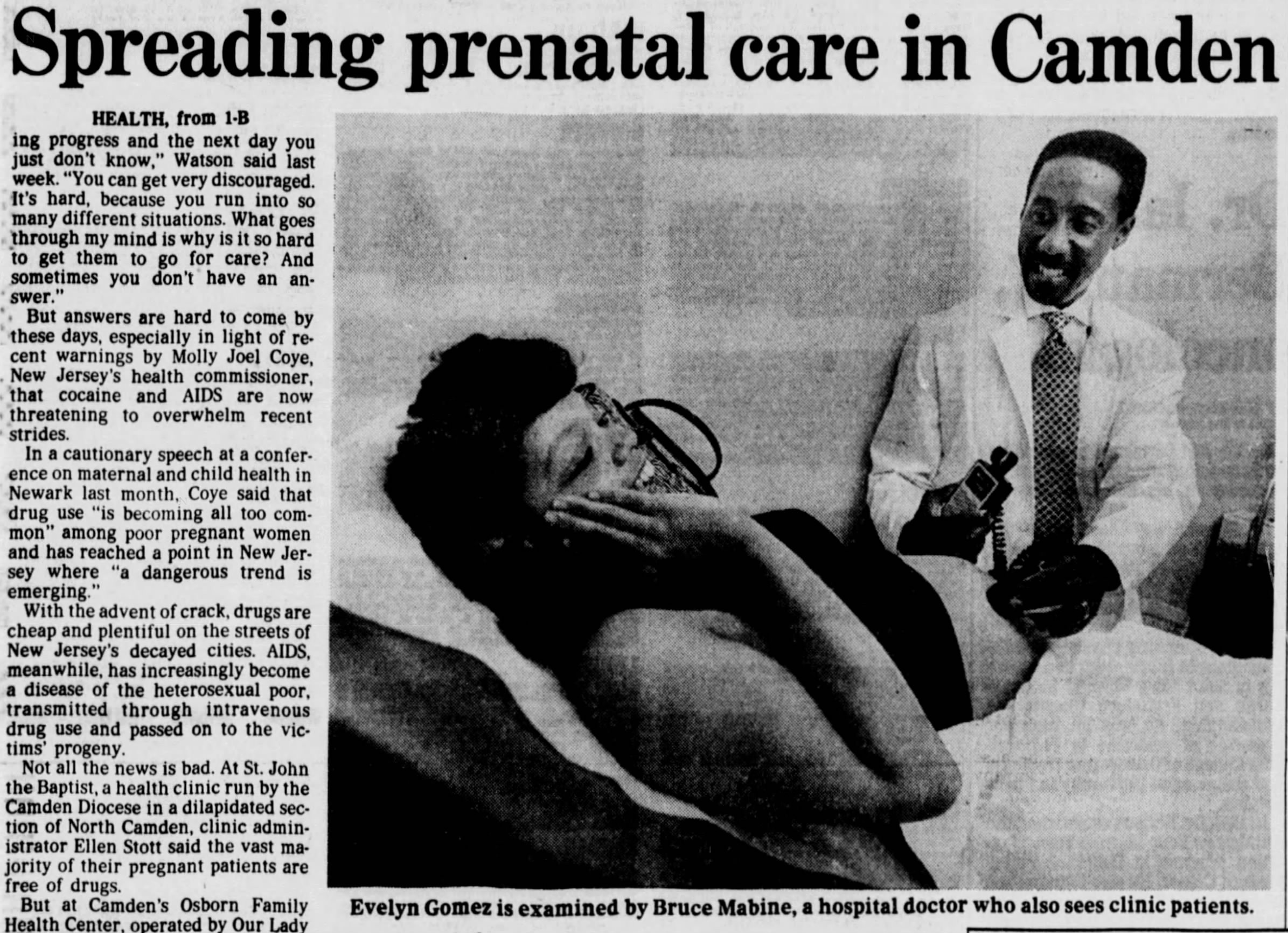
    This photo and story about Dr. Mabine was published in The Inquirer in 1989.Newspapers,com

    “He cared deeply about his patients, colleagues, learners, and health equity,” said his wife, Lynda Thomas-Mabine, also a physician. “He was the kind of person whose presence left an impression long after he had left the room.”

    Born in Philadelphia, Dr. Mabine was an associate professor and director of community services for Temple’s Department of Obstetrics, Gynecology, and Reproductive Sciences from 2000 until his retirement in 2024. He worked at Temple, Episcopal, and Jeanes Hospitals, directed the physician assistants clinical rotation, and earned an excellence in teaching award in 2015 from the Association of Professors of Gynecology and Obstetrics.

    Earlier, beginning in 1981, he worked for 19 years at Our Lady of Lourdes Medical Center in Camden and was chief of the Department of Obstetrics and Gynecology at the center’s Osborn Family Health Center. He spoke Spanish and French as well as English, and went out of his way to treat expectant mothers dealing with malnutrition, drug and alcohol abuse, and other issues.

    “Bruce was a wonderful person and a great doctor,” a former colleague at Osborn said in an online tribute. Another called him a “happy, kind, and caring man.”

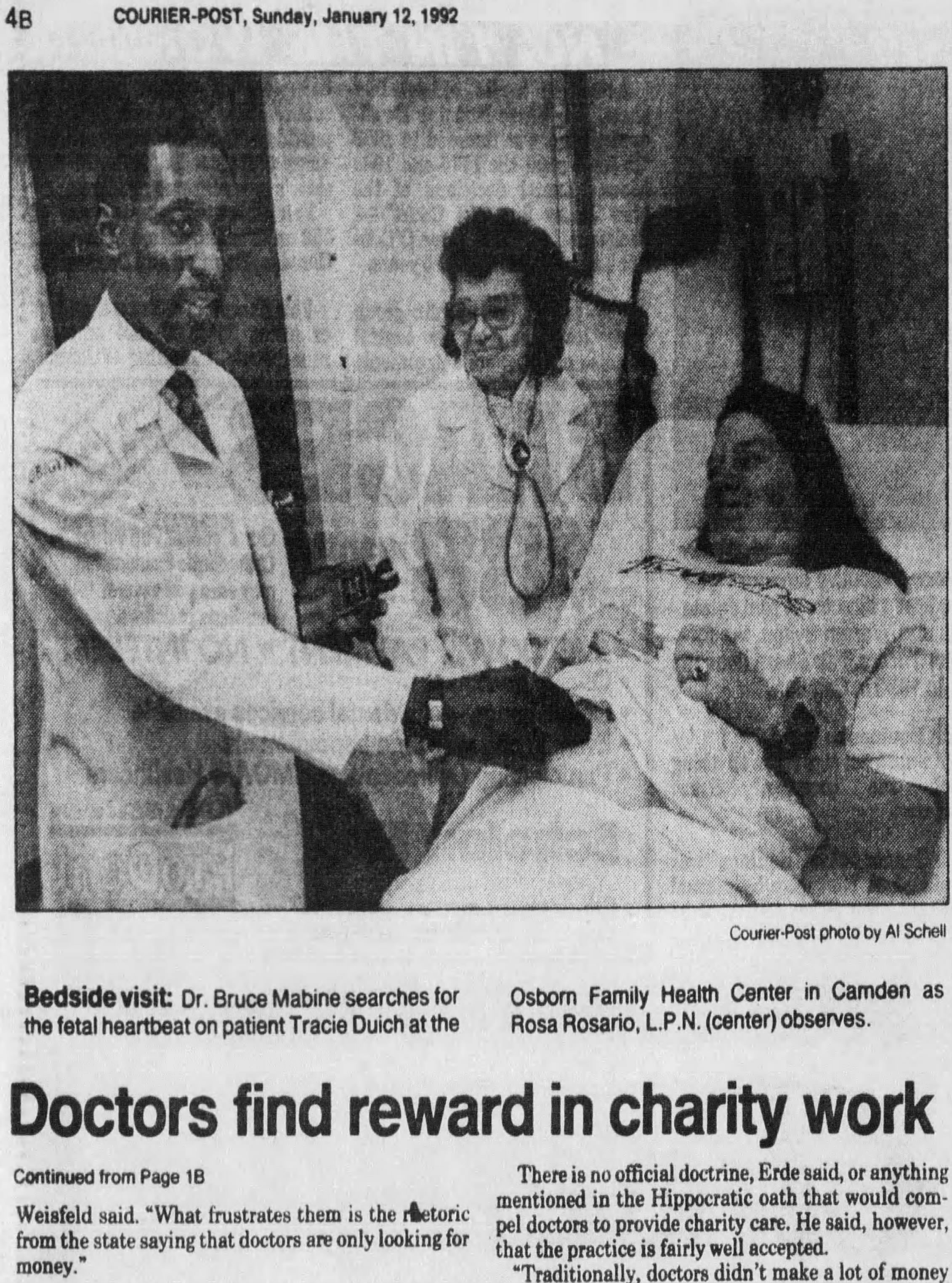
    This photo and story about Dr. Mabine appeared in the Courier-Post in 1992.Newspapers.com

    His concern for others was featured in The Inquirer and the Courier-Post, and he answered readers’ questions in a Courier-Post column called “The Doctor is In.” He earned a bachelor’s degree in biology at Hampton University in Virginia in 1973 and routinely recruited Hampton graduates to the Temple medical school.

    He and others also fundraised nearly $1 million to support scholarships at Hampton. One of his favorite sayings was “Do the right thing even when no one is watching, especially when no one is watching.”

    His wife said: “Bruce’s life was defined by purpose, intellect, service, and an unwavering commitment to others.”

    Bruce Junious Mabine was born Aug. 29, 1950. He grew up near the Navy Yard in South Philadelphia and was on his high school gymnastics and chess teams.

    Dr. Mabine and his wife, Lynda, married in 2006.Courtesy of the family

    His wife said he called himself a “major nerd.” She praised his “dry sense of humor” and “brilliant mind.”

    He graduated from West Philadelphia High School in 1967, became an officer for the Gamma Epsilon Theta fraternity at Hampton, and edited the minority students newsletter at Temple medical school.

    He married Gwendolyn Watts, and they had a son, Kenneth. After a divorce, he married Joanne Smith, and they had a daughter, Joanna. Joanne Mabine died in 2001.

    Dr. Mabine met Lynda Thomas at Temple, and they married in 2006, lived in Lower Gwynedd and Philadelphia, and traveled together for years on memorable trips to Paris, Hawaii, Florida, Virginia, Delaware, and elsewhere. “We built homes filled with love, warmth, laughter, family, music, and faith,” his wife said.

    Dr. Mabine “lived with purpose,” his wife said.Courtesy of the family

    Dr. Mabine enjoyed music, especially Smokey Robinson, the Delfonics, the Beatles, and Jimi Hendrix. He could hear colors and see sounds, his wife said, and he spun records as a popular disc jockey at family and social events.

    He loved peanut butter cups and was a huge Eagles fan.

    “He lived with purpose,” his wife said. “He served with integrity. He gave generously. And he loved deeply.”

    In addition to his wife and children, Dr. Mabine is survived by other relatives. A brother died earlier.

    Dr. Mabine (center) enjoyed time with his family.Courtesy of the family

    Visitation with the family is to be from 8 to 10 a.m. Saturday, Oct. 10, at Salem Baptist Church, 2741 Woodland Rd., Abington, Pa. 19001. A service is to follow.

    Donations in his name may be made to the Hampton University Ogre Phi Ogre 1 Endowed Scholarship, 100 E. Queen St., Hampton, Va. 23668.

  • Environmentalists rally against New Jersey plan to restore Atlantic white cedars

    Environmentalists rally against New Jersey plan to restore Atlantic white cedars

    Bob Williams, a rangy 77-year-old forester, pulled his pickup truck over on a sand road in Wharton State Forest, stepped out, and pointed to a wide pond.

    “This was once an old cranberry bog with a nice stream running down the middle,” he said.

    In just eight months, beavers transformed the stream into a sprawling pond that’s currently drowning Atlantic white cedar trees and inviting invasive phragmites reeds to takeover.

    “You can see them dying,” he said, pointing to discolored cedar. “See those in the distance? They’ll soon be gone.”

    The majestic cedars, which soar up to 80 feet and give Pinelands’ rivers their signature tea color, hover at a tipping point.

    New Jersey harbors the East Coast’s last major concentrations of Atlantic white cedar, holding roughly half its remaining stock. Yet the state’s historical 115,000 acres have collapsed to just 25,000.

    State officials have a $19 million plan to reverse the decay by jump-starting restoration of 10,000 acres. The first phase targets 171 upland acres off Sandy Causeway in Waterford Township and was crafted by Williams. New Jersey’s Pinelands Commission will vote on the proposal Friday.

    However, environmentalists, even those who support restoration, are challenging the strategy, directing the most ire at the part calling for culling mature, healthy trees. They spoke out against the plan at a Sept. 11 Pinelands Commission meeting. They’ve rallied against it on social media and blogs.

    “It is about asking whether the state is choosing the least destructive way to create the conditions cedar needs,” Jeff Tittel, retired director of the New Jersey Sierra Club, wrote in the Jersey Vindicator, an online publication. “There is a difference between ecological restoration and an industrial logging operation wearing a green hat.”

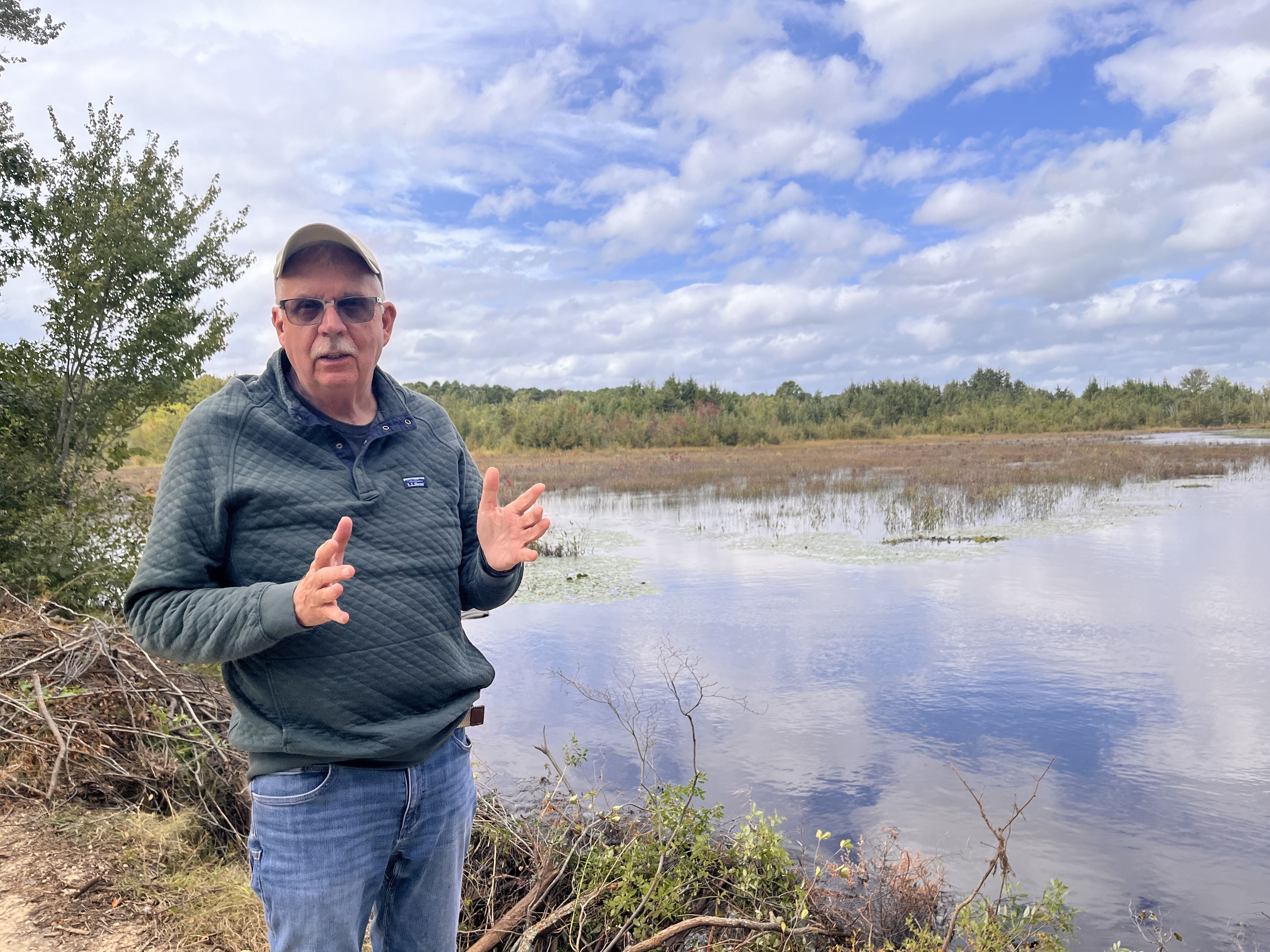
    Forester Bob Williams shows an area of Wharton State Forest in New Jersey’s Pinelands. Beavers have built a dam and flooded a stream that’s now a wide body of water drowning Atlantic white cedar that can be seen in the distance.Frank Kummer

    ‘Collaboration with nature’

    Atlantic white cedar was logged for centuries before the federal Pinelands Protection Act of 1979 was enacted to save New Jersey’s forests and massive underground aquifers from rapid sprawl. Freshwater swamps were drained for development. Beavers built dams. Fires burned through life-sustaining peat.

    In recent decades, climate change has worsened severe weather combining with sea level rise to push in damaging salt water from the coast, leaving behind so-called ghost forests, vast tracts of spindly, dead cedar trees.

    Williams drew up the plan with Lawrenceville-based engineering firm, WSP U.S. He says time is of the essence to carry it out and believes in active management of state forests, which includes cutting some trees, rather than a hands-off approach.

    “The time of let’s leave it to nature is passed,” Williams said. “We need to apply our energy, our resources, and knowledge to start a collaboration with nature.”

    (function(){function e(){window.addEventListener(`message`,function(e){if(e.data[`datawrapper-height`]!==void 0){var t=document.querySelectorAll(`iframe`);for(var n in e.data[`datawrapper-height`])for(var r=0,i;i=t[r];r++)if(i.contentWindow===e.source){var a=e.data[`datawrapper-height`][n]+`px`;i.style.height=a}}})}e()})();

    ‘Most beautiful white cedar forest’

    Jason Howell, an advocate with the Pinelands Alliance, is skeptical, fearing that the plan is a step toward logging in the protected Pinelands National Reserve.

    “What they’re defining as the area to be restored is, the majority, among the most beautiful white cedar forest in Wharton State Forest,” Howell said as he walked through the trees recently, noting tall, mature cedar.

    “I’m not denying there’s a need to restore Atlantic white cedar,” he said. “But this is a timber harvest logging plan. They have 20 or so log loading areas in the plan. They are going to go in there with giant machines.”

    The plan calls for removing up to 2,475 cords of cedar. That could amount to 64% of the cords of cedar in the project area. There are an estimated 12,000 cedar in the 171-acre area.

    “This is the beginning of a plan to log and clear-cut most of the river corridors in Wharton State Forest (10,000 acres), including the Batsto, the Mullica, the Wading, and more,” Howell wrote on a recent Facebook post with hundreds of comments.

    Phragmites have taken over the area of this beaver pond, helping crowd out Atlantic white cedar in Wharton State Forest.Frank Kummer

    A ‘selective harvest’

    New Jersey State Forester Todd Wyckoff says there is a misunderstanding of the plan, and that the goal is not to clear-cut woods for loggers, but to save the forests.

    Wyckoff said there must be healthy cedars present for restoration to work. Some will have to be cut, he said, so others can thrive and grow. He said it would not make sense to try to restore cedar in a section of Wharton where there are none.

    “Given the type of tree and the type of forest that Atlantic white cedar forests are, they just aren’t competitive in shade,” Wyckoff said. “They need that competing vegetation to be removed to have an open, full sunlight.”

    Temperature in dark cedar forests and swamps can run 15 degrees cooler just a few feet within.

    Wyckoff said existing healthy, wind-resistant cedars will be retained to drop seeds, rather than relying on costly and labor-intensive seeding by hand.

    “This is often framed as a clear-cut, but it’s really a selective harvest,” he said. “The reason to act now is that the sites we’ve selected have cedar in the canopy.”

    Once sunlight hits the forest floor, cedars reseed aggressively, sprouting a carpet of “800 to over 1,500 seedlings” per area, he said.

    In addition, Wyckoff said it is critical that restoration areas be in uplands outside of areas that face saltwater intrusion, further limiting available areas.

    New Jersey’s Pinelands National Reserve spans about 1.1 million acres with a roughly 300,000 acre core where virtually all development is banned.

    Gregory McLaughlin, New Jersey’s Forest and Natural Lands administrator, dismissed beliefs that there’s a profit-driven incentive to log the land. In fact, he said, restoration is costly.

    “The New Jersey Forest Service is not in the commercial logging business,” McLaughlin said. “We’re not approaching this from a standpoint of a profit margin … In protecting these forests and restoring these forests and creating healthy forests, we have to cut some trees.”

    State officials said no contracts had been awarded for tree removal or logging.

    Once, hundreds of small sawmills dotted the Pinelands, but now only a handful survive. Owners who support the plan note that they are part of the Pinelands historic culture.

    Ed Sherwood, who owns a small cedar forest in Forked River, appeared during a recent Pinelands Commission meeting and spoke in favor the plan.

    “I don’t make a lot of money in it,” he told the commissioners — but protecting the cedar, he said, is vital.

  • Customers looking for nostalgia can buy records, make music, and rent DVDs at this new Camden County shop

    Customers looking for nostalgia can buy records, make music, and rent DVDs at this new Camden County shop

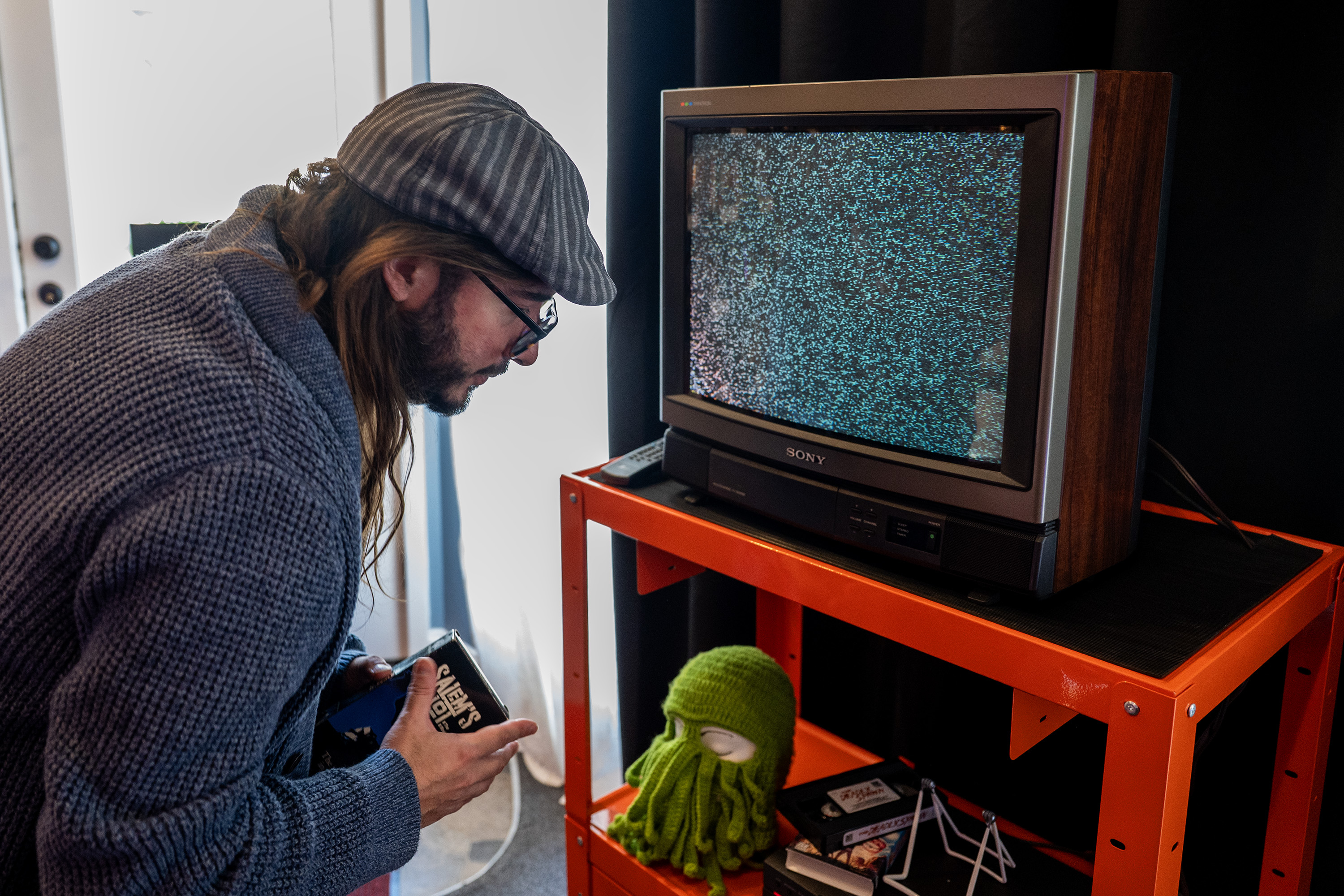
    A new storefront in Collingswood is a one-stop shop for music makers, record lovers, and those who really miss renting VHS tapes.

    Joseph Mallah, the owner of Vintage Future Now, is still figuring out how to describe the place.

    “It’s like a bag of squirrels. I don’t know,” he said. “How do I say stuff about it?”

    Mallah, 42, recently opened the shop at 554 Haddon Ave. as a hodgepodge of all the things he likes. After moving to South Jersey, he said he wanted to invent a creative space for artists to make and buy music.

    Mallah shares his Vintage Future Now space with his friend Mike Jada, who has turned his own lifelong movie collection into Deja Vu Video, where people can rent some of Jada’s favorite movies.

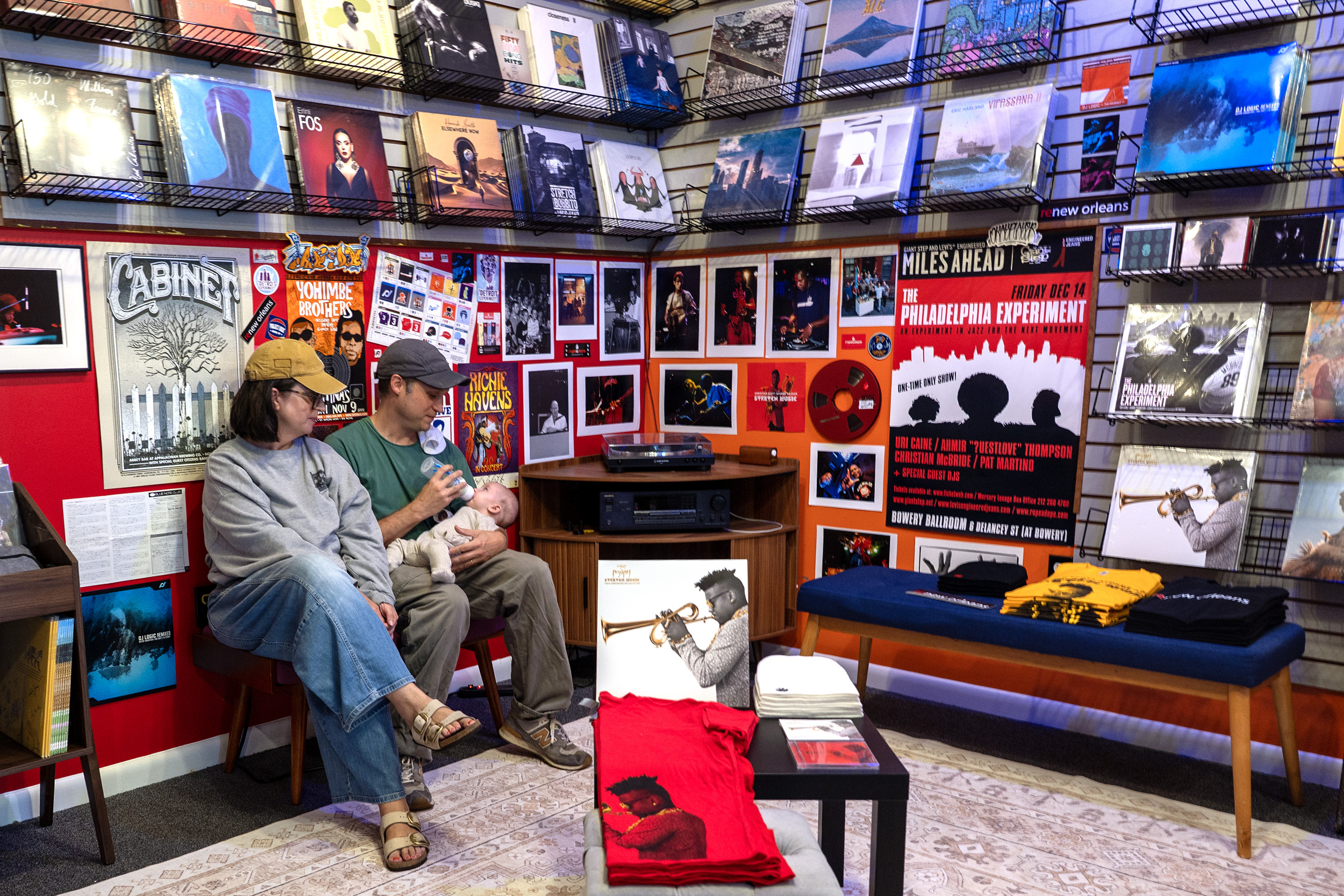
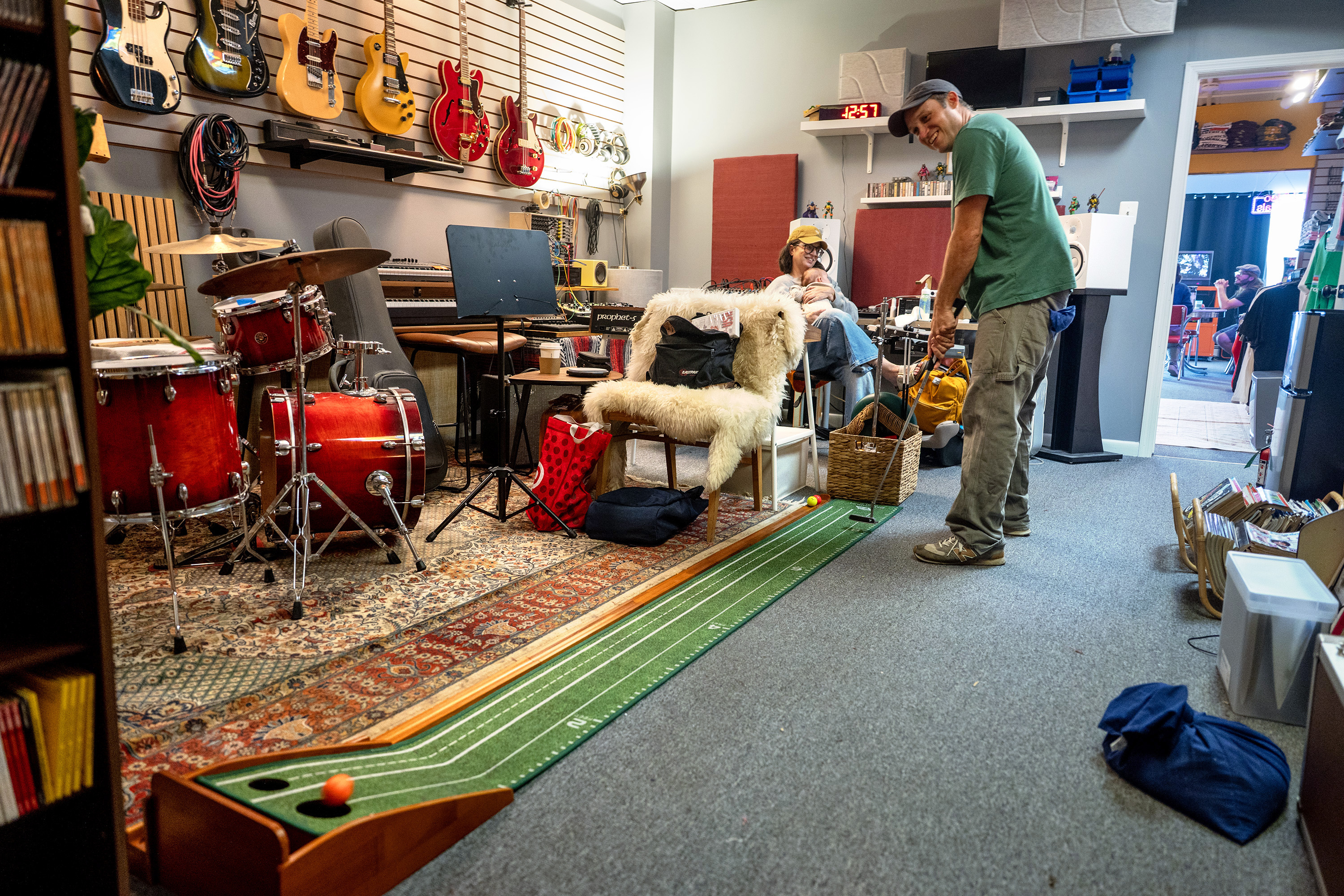
    Owner Joseph Mallah putting in his office/music space in back of the Vintage Future Now shop in Collingswood on Sept. 30. He is not a golfer but has the putting hole green because that’s what executive offices have in movies, he says. His wife Samantha Mallah and their two-month old son Elliot are in rear.Tom Gralish / Staff Photographer

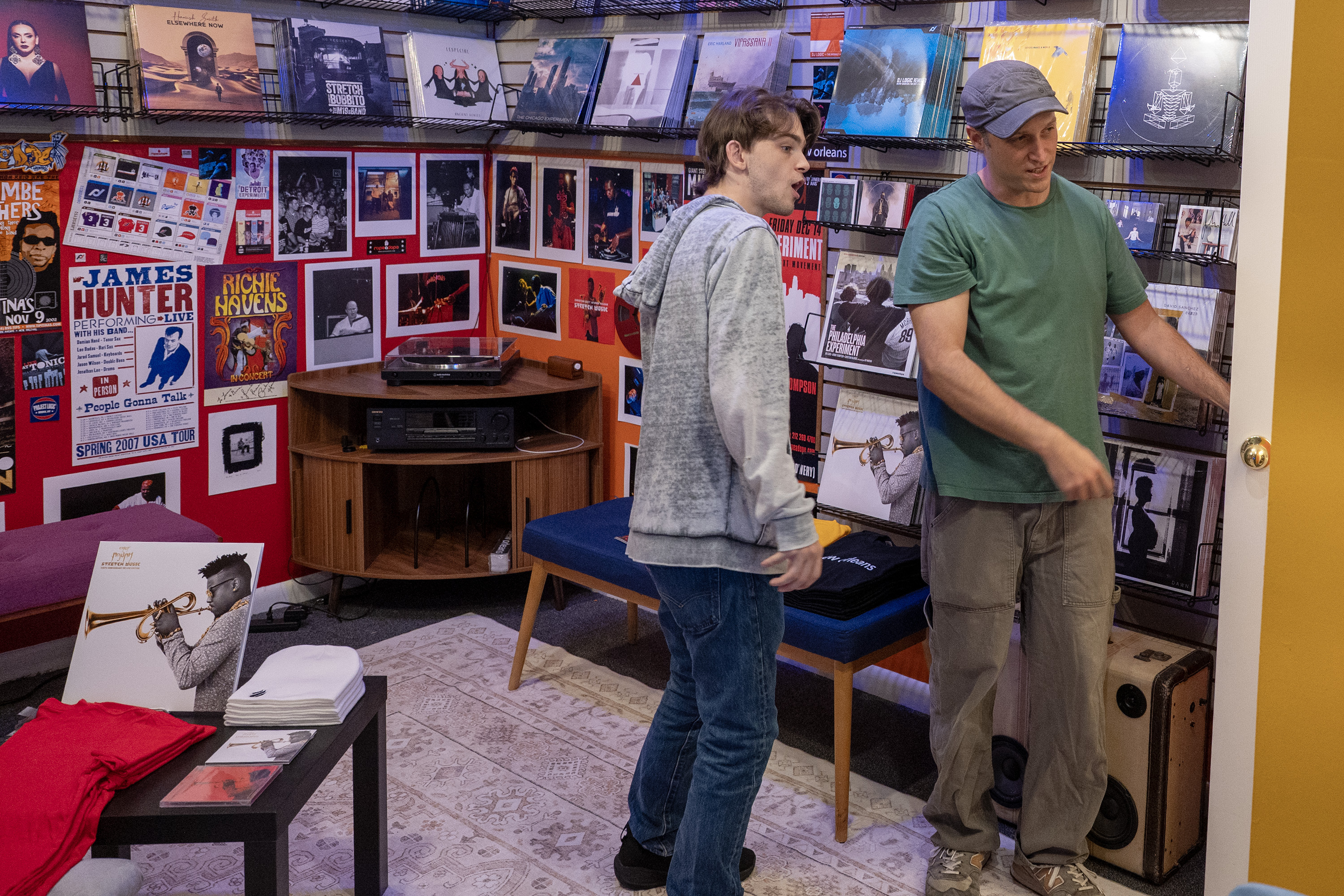
    In the backroom, there are instruments, from synthesizers to guitars, and recording equipment for local bands who need a place to experiment. In the middle of the store, Ropeadope, a music and apparel brand, sells jazz-adjacent vinyl and T-shirts.

    The walls, peppered with film and band posters, will eventually feature pictures of customers that Mallah takes with his Polaroid (at the end of September, there were two). As decor, there’s a mini golf-putting green, Teenage Mutant Ninja Turtle figurines, and a pile of old People magazines.

    Mallah said he wants to give local musicians a low-stakes environment to record quick songs without too much thought, and then release their music onto his shelves so their neighbors can take a listen.

    “Can you imagine if we did an EP a week or album a month for 30 years?” Mallah said. “If you dug it up later … what did the people in South Jersey feel?”

    After years spent teaching Logic Pro at Apple, working at Adventure Aquarium, mailing records, and helping Philly bands cut demos in his garage, Mallah said having his own business could help him spend more time with family.

    Old magazines collected by owner Joseph Mallah — including a People from 1984, the year he was born.Tom Gralish / Staff Photographer

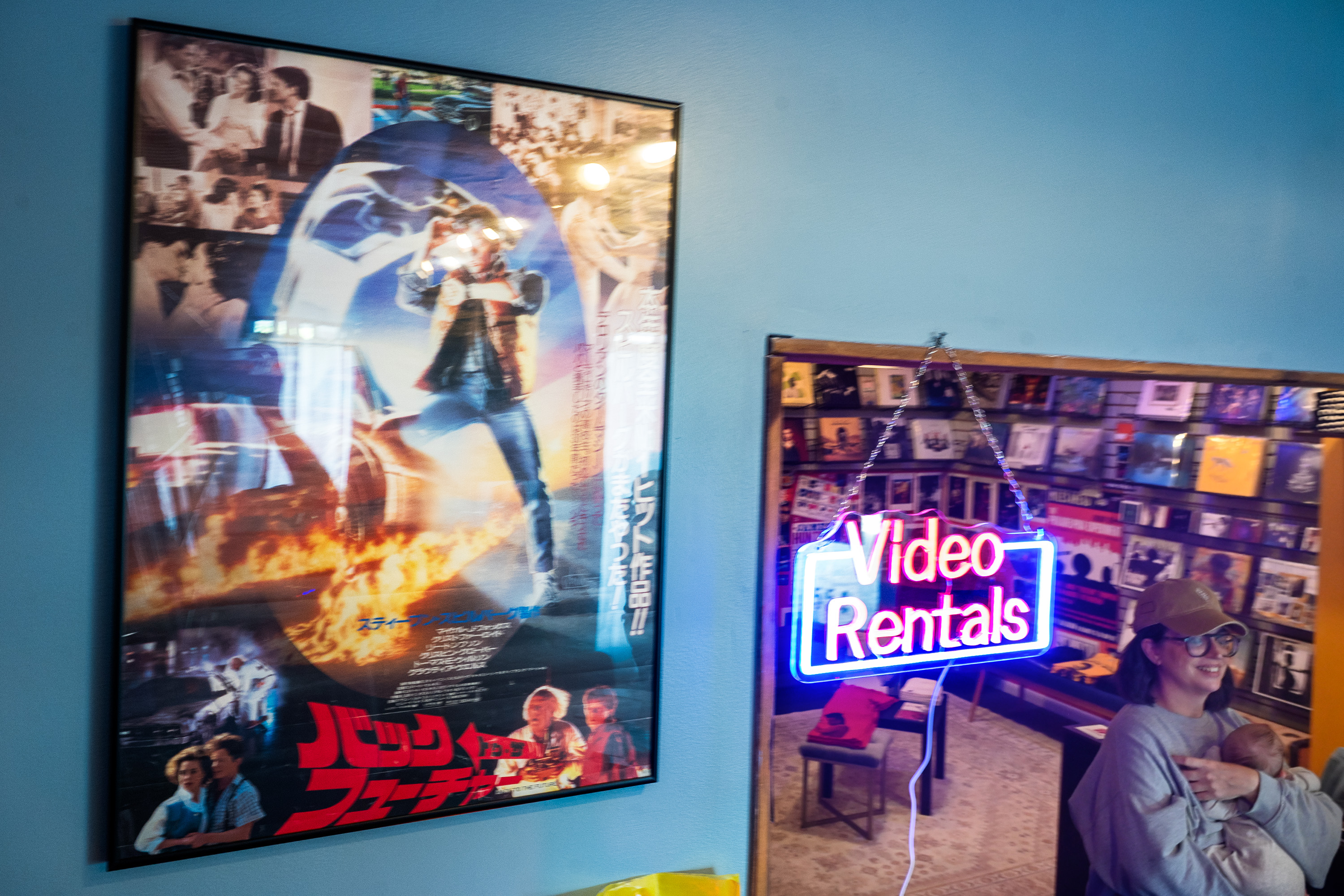
    Deja Vu Video — the DVD, Blu-ray, and VHS rental area — takes up the front of the shop. Jada estimated that about 3,000 films and TV series are on display and categorized by genre, ranging from Poliziotteschi/Eurocrime to Bigfoot to Legit Cinema, a section for movies that are on the more-normal side, he said.

    After years of accumulating physical media, Jada, a Haddon Township resident, decided it was time to share his passion with the community. He met Mallah at Collingswood Music, a store that sells instruments and vinyl records and offers music lessons.

    The movies, rentable for $5 per week, come from Jada’s personal library, taken from his storage space and from a friend who had been holding onto the films to save Jada space.

    His favorite collection is a mishmash genre he calls Bikers, Hippies, Hillbillies, Cars, and Creeps, which includes 1971 horror film Werewolves on Wheels. Some movies are for rent as a pair to make themed double features, like The Incredible Shrinking Man and Attack of the 50 Foot Woman or The Incredible Two-Headed Transplant and The Thing with Two Heads.

    Samantha Mallah with 2-month old son Elliot at the Vintage Future Now shop.Tom Gralish / Staff Photographer

    It’s been more than a decade since Blockbuster declared bankruptcy, years since the death of Redbox, and longer since the COVID-19 pandemic solidified the appeal of streaming services. But as movie theaters make a comeback in the Philly region and people crave holding physical media in their own two hands, the appetite for a video, music, and record store isn’t so surprising. Mallah and Jada haven’t hosted a grand opening yet, but they’ve already had shoppers wander through their doors and sign up for rentals.

    “It’s not like we’re going to put Netflix out of business or anything,” Mallah said. “We just have to pay the rent.”

    Horror VHS tapes collected by Mike Jada at the Deja Vu Video section of the Vintage Future Now shop in Collingswood.Tom Gralish / Staff Photographer

    Recently, Doug Huber, 26, left work at Cafe 1903 down the street to check out the new shop, which has started testing the waters with soft opening hours. He said he hasn’t visited a video rental store since his last stop at South Jersey’s long-closed Wow Video when he was a kid.

    “The fact that you have Bill Bixby’s The Incredible Hulk, like, the complete series?” Huber said. The 1977 TV show featured Bixby as Dr. David Banner and Lou Ferrigno, a 6-foot-5 bodybuilder, as his green counterpart.

    Huber, who picked up a shirt from the Ropeadope section and posed for one of Mallah’s Polaroids, said he’d likely be back, potentially to pick up a sci-fi horror film. His favorite is The Thing.

    Owner Joseph Mallah shows customer Doug Huber (left) his T-shirt printer.Tom Gralish / Staff Photographer

    In 2026, most people don’t have VHS and DVD players laying around their houses. To fix that problem, Jada is working on collecting equipment that customers will eventually be able to rent and take home with their movie of choice.

    Plus, Jada still has more films back home awaiting shelf space, so he plans to rotate the selection over time.

    “I feel like every town should have a video store,” Jada said. “And once upon a time, they did. Then they got displaced by the big chains, and then got displaced by streaming. Now that it seems like the sentiment toward streaming has changed a little bit, it seems like it’s a good opportunity to bring some of this stuff back.”

    Mike Jada loads a VHS tape for playing on vintage CRT television at the Vintage Future Now shop in Collingswood on Sept. 30.Tom Gralish / Staff Photographer
  • More issues discovered with New Jersey’s voter registration system, Gov. Mikie Sherrill says

    New Jersey Gov. Mikie Sherrill disclosed additional issues with the state’s voter registration system Wednesday, months after she announced the discovery of noncitizens on the voter rolls.

    Sherrill said Wednesday that a review of the state’s voter registration processes revealed that the same system that allowed for those improper registrations also allowed people to register who said they were not of legal age to vote. No underaged voters were registered as a result, however.

    She also identified a separate problem, which dates back to 2016, that appears to have allowed people incarcerated for indictable offenses to register in violation of state rules.

    “The review showed that this issue had gone undetected and unaddressed, with some going as far back as a decade,” Sherrill said Wednesday. “My administration found them and moved immediately to fix them.”

    Both issues were found after Sherrill’s administration launched a review after discovering that thousands of people who identified themselves as noncitizens were registered to vote in New Jersey between June 2023 and June 2024 because of what she described as a glitch in the Motor Vehicle Commission’s software.

    An outside firm is still conducting an independent investigation, according to her office.

    Incarcerated registrants

    The review found that about 340 people may have improperly registered through the MVC’s reentry program, which is designed to help people leaving prison obtain driver’s licenses and other ID.

    The MVC’s mobile clinics also help them register to vote.

    In New Jersey, people who are serving a sentence for an indictable offense (comparable to a felony in other states) are not allowed to vote until their sentence is complete. But people who are serving for misdemeanors or are in jail as they await trial are still allowed to vote.

    The review found that some people incorrectly said they were eligible to register even though they were serving time for an indictable offense. Sherrill’s administration is referring 340 registrations from this program to county election offices for vetting.

    The review separately found about 60 people who are currently registered to vote but are not eligible because of their incarceration status. Their names are being sent to the counties, which routinely review and remove individuals who are no longer eligible to vote because of their sentences, Sherrill’s office said.

    The governor said she directed the MVC to create a prompt at reentry events where people who want to register to vote must confirm that they are not incarcerated for an indictable offense to prevent this issue in the future.

    Sherrill spokesperson Darwin Pham said the investigation is ongoing when asked whether anyone who improperly registered through the reentry program actually voted.

    Age verification

    Sherrill has blamed former Gov. Phil Murphy’s team, as well as software vendor IDEMIA, for the registration of people who had answered they weren’t citizens and therefore ineligible to vote. Both have denied responsibility.

    The governor’s review found that about 750 additional voter registrations were impacted by a similar issue related to the software during that June 2023-24 period. These individuals selected “no” when asked if they are old enough to vote but were still registered to vote. However, Sherrill said they were all of voting age anyway — as indicated by their dates of birth — and no one underage voted as a result of the issue.

    Many of these people “were well above voting age,” indicating they likely pressed the wrong button by mistake, her office said.

    Even though they are all of legal age to vote, since these individuals indicated that they weren’t of age while answering the software’s prompts, the system did not ask them the verification questions required for a legal registration, a state official said.

    About 370 of these 750 people actually voted, according to Sherrill’s office. Of those, about 320 may have other valid voter registrations — such as by changing their address or party — and will be sent to counties for review. About 50 of these people who voted had only registered with the error so they are being removed from the rolls.

    About 380 of the 750 people did not vote and did not have any other registrations, and are being deleted from the rolls, according to the governor’s office.

    This issue is similar to the noncitizens who were improperly registered even when they indicated they are not citizens.

    U.S. Rep. Jeff Van Drew’s office, which met with IDEMIA as part of a House Republican probe into the issue, said the state reached out to the software company in June 2024 after noticing voter registration files missing their age and party affiliation. Van Drew spokesperson Paxton Antonucci said the software had not prompted those customers to fill out those demographic questions because they indicated they were not citizens.

    Sherrill has framed the issue as a “glitch” in the IDEMIA software, but IDEMIA spokesperson Lisa Shoemaker said the company’s software operated how the state directed it to, and accurately recorded applicants’ responses.

    The issue at hand, from IDEMIA’s perspective, is about the Division of Elections’ responsibility to verify the data before registering people to vote.

    “IDEMIA’s software accurately recorded applicants’ responses and operated according to state specifications,” Shoemaker said in a statement after Sherrill’s announcement Wednesday. “We do not determine eligibility or register voters. The MVC sends data to the Division of Elections, which is responsible for validating the information and determining voter eligibility.”

    To avoid similar issues in the future, Sherrill said she directed the MVC to implement an automatic daily audit process that compares voter registration records against customers’ responses before sending the information to elections department. The program, as directed, would prevent registrations with missing or conflicting information from being sent to the DOE and flag incomplete or inconsistent records for review by MVC staff.

    To make voting policies and processes clearer, the MVC is also working to make voter registration prompts clearer by expanding the available languages to English, Spanish, Portuguese, Hindi, and Simplified Chinese, adding multilingual signage, and implementing handheld translation devices that support more than 80 languages.

    The agency is also updating its online license-renewal pages to state voter eligibility requirements clearly and making sure the department’s website can be translated on supported browsers.

  • A teen driver in Camden County was charged with assault after he allegedly struck 6 people with his SUV

    The 16 year-old driver of an SUV that struck six teen pedestrians in Lindenwold Tuesday was charged with aggravated assault and joyriding.

    The teen, who has not been identified, allegedly drove his vehicle onto a sidewalk on Gibbsboro Road, near Lindenwold High School. When police arrived around 2:10 p.m., officers found one pedestrian trapped beneath the SUV and five more people who had been struck while walking on the sidewalk.

    The victims range from 14 to 16 years old, police wrote in a Tuesday statement. “Two occupants of the involved vehicle” had been detained at the scene during the initial police investigation Tuesday.

    The driver will face one count of second-degree aggravated assault, six counts of third-degree aggravated assault, and one count of joyriding. He is being held at the Camden County Juvenile Detention Center.

    The trapped pedestrian was transported by medical helicopter to Cooper Norcross University Hospital, and the remaining teens were taken to local hospitals for treatment.

    “The investigation remains ongoing as all victims continue to recover,” Lindenwold police wrote in a statement Wednesday morning.

  • Longtime Phish fan and respected show ‘taper’ killed in crash after band’s Atlantic City concert

    Longtime Phish fan and respected show ‘taper’ killed in crash after band’s Atlantic City concert

    A fatal crash in Atlantic City early Sunday morning between a car and a pedestrian has rattled the community of fans of the jam rock band Phish.

    Duncan Oldham, 69, of Geneva, N.Y., was struck and killed by a driver following Phish’s Saturday night show — a 3½-hour show and one of a three-night run at Jim Whelan Boardwalk Hall.

    Oldham was a highly regarded “taper” — someone who records a band’s shows in their entirety and shares them — among the Phish fan base. The practice is embraced by the band, with its shows including a dedicated taper section with a recognizable sea of microphones.

    “Duncan was a well-known Phish taper going back to the 90s,” one member of the Phish Subreddit wrote. “Many of his sources still circulate and are the best ones available for shows that haven’t been officially released by the band. It’s a huge loss to the community.”

    Oldham attended and taped the band’s Friday performance. His recording had already been uploaded. At Sunday’s Phish show at Boardwalk Hall, the first following the crash, fans said the band’s crew acknowledged the loss, putting out a sign in the taper section.

    Phish has not publicly commented.

    Oldham was struck near the intersection of Iowa and Pacific Avenues around 12:05 a.m. Sunday, according to police. He was pronounced dead at the scene.

    The driver remained at the scene, police said. No additional details have been released and no charges have been filed.

    The Atlantic City Police Department and the Atlantic County Prosecutor’s Office were investigating the crash.

    Emotions were raw as friends of Oldham, Phish fans, and fellow tapers processed the death.

    “I watched my best friend die in front of me,” audio engineer Charlie Miller wrote on social media shortly after the crash. Miller was on the scene and gave a statement to police. “I’m devastated.”

    According to Miller, who is well known among the Grateful Dead and Phish fan bases, he and Oldham were leaving the Tropicana after having post-show pizza when a car failed to yield for Oldham at the crosswalk.

    “The Phish crew, Phish management team, Boardwalk Hall event staff, first responders, Clarion Inn staff and the Phish fans have all been very supportive,” Miller added. “Duncan’s last words before the accident were ‘that was a really good show.’”

    Tributes to Oldham continue to mount online, celebrating his legacy as a taper along with his love for food and his pugs.

    One Reddit user called him “Not just a taper, but a super nice guy. This [is] a loss not just to his close friends, but also those of us that casually knew him from shows. I’m still trying to wrap my head around this one.”

    A former neighbor called him a constant at Phish concerts.

    Another user remarked on Oldham’s willingness to share his taper archive treasures.

    On Facebook, a fellow taper called him “a good man who cared about our taper community, and we gave our love back to him. A contributor to our community like Duncan will be sorely missed by all.”

    At Phish shows since Oldham’s death, fans took Sharpies to yellow balloons, penning lyrics and tributes to Oldham on the spheres before tossing them into the crowd.

    “Be at peace, Duncan,” one balloon said.

  • New Jersey bill would limit employers’ ability to use AI to monitor workers or make changes to their jobs

    New Jersey bill would limit employers’ ability to use AI to monitor workers or make changes to their jobs

    As tech CEOs debate the looming threat of artificial intelligence to worldwide safety and economic stability, lawmakers in New Jersey have begun taking steps to protect the workforce from fast-moving changes that have already disrupted how many do their jobs.

    The state Senate Labor Committee last week voted unanimously to approve a bill that would regulate how employers use AI to monitor, evaluate, and ultimately replace workers.

    The bill, which comes amid a broader backlash to AI and surveillance technology, now moves to the Senate budget committee for consideration before a vote by the full chamber. The “Fair Act” would require private- and public-sector employers to provide 60 days notice before implementing AI that would impose significant changes to job expectations. Employers who eliminated jobs because of AI advances would be required to offer training, extended severance pay, and benefits, according to the bill.

    It would also regulate how employers use electronic monitoring tools to collect information about employees’ productivity, and how “automated employment decision-making systems” are used to hire, promote, and fire people.

    “It makes sure employers can’t spy on you when you are off the clock. Your boss should not be able to follow you home,” said Charle Wowkanech, president of the New Jersey State AFL-CIO, which represents 1 million public- and private-sector workers and their families, who spoke at a recent rally outside the Statehouse to draw attention to the bill.

    Artificial intelligence is already monitoring the productivity of thousands of people who work in grocery stores, factories, and cannabis operations in the state, said Daniel Ross, president of United Food and Commercial Workers Local 152, which represents workers in New Jersey, Pennsylvania, Delaware, and Maryland. “The time-test matrix is so unreasonable that workers skip bathroom breaks, they don’t take water breaks, to avoid falling behind,” Ross said.

    “Surveillance is not mainly harmless oversight, as it’s sold by employers,” Ross said. “Workers subjected to these practices experience elevated stress levels, declining mental health, and [increased] injury rates.”

    Other states have already taken up the issue.

    California, Colorado, Connecticut, Illinois, and New York have enacted various workplace protections from AI, according to Multistate, a clearinghouse for state legislation across the country. Pennsylvania has introduced its own bill to regulate AI in the workplace.

    However, New Jersey business and industry leaders urged the committee to rethink some of the most sweeping provisions of the bill.

    Most of the 1,300 members of the Chamber of Commerce Southern New Jersey are small businesses, which are not equipped with vast human resource or legal departments to implement the law, said Adam Guzjewski, president of Katz Government Affairs.

    The bill requires employers to comply with vague requirements to ensure AI does not undermine “an employee’s autonomy, dignity, or welfare.”

    But Jack Kelly, a lobbyist for the New Jersey Business and Industry Association, said it’s unclear how these requirements will be enforced for businesses.

    “Large corporations may have dedicated legal compliance and technology teams. Many New Jersey businesses do not. For small businesses, these requirements create significant barriers to entry,” Kelly said.

    New Jersey’s legislation is not out of step with how other states have regulated AI use, said Tony L.J. Lin, an associate professor of accounting at Rowan University who studies artificial intelligence in the workplace.

    “If AI materially restructures jobs, we need a mechanism for retraining and redeployment,” Lin said.

    States should push back on efforts to evaluate employees through invasive means like monitoring keystrokes, simply because this strategy likely does not fully show a worker’s productivity or value, Lin said.

    Lin said there is great potential to improve jobs using AI. A nurse-practitioner, for instance, would benefit from technology that handles automated tasks. But a nurse-practitioner will always be valued for the “human judgment, contextual understanding accountability” aspects of the job, he said.

    Debbie White, president of the largest nurses union in New Jersey, isn’t so sure.

    “Healthcare employers are increasingly using AI and electronic monitoring systems to track worker productivity, evaluate performance, and influence staffing decisions,” White testified during the Oct. 1 hearing in Trenton.

    However, White said these systems fail to measure “the reality of nursing care,” which often involves time comforting ailing patients and educating their families among other overlooked aspects of the job.

    “AI can be useful, but it can’t replace the judgment of a nurse at the bedside,” she said.