Category: Nation & World

  • Trump overhaul could gut Head Start preschool standards, leaving states to set the rules

    Trump overhaul could gut Head Start preschool standards, leaving states to set the rules

    WASHINGTON — President Donald Trump’s administration is planning a dramatic overhaul of Head Start that would gut its quality standards, upending the hallmarks of the early education program for impoverished children, two people familiar with the deliberations said.

    Head Start, established in the 1960s to help fight poverty, has long been considered by experts to be a gold standard early learning program. Its regulations, which stretch more than 100 pages, outline requirements on everything from child-to-teacher ratios and child health screenings to family engagement.

    Trump’s Republican administration would replace those regulations with around a dozen pages of rules, leaving most of the specifics up to state and local law, said the people familiar with the deliberations, who spoke on the condition of anonymity to discuss information that was not yet public and because they feared reprisal.

    In a post on X on Saturday night, the Department of Health and Human Services, which oversees Head Start, said to expect a rule to be published this week. The administration “remains committed to strengthening Head Start by preserving federal investment in the program while advancing reforms that expand access, increase local flexibility, reduce unnecessary administrative burden, and ensure services are delivered effectively to children and families in need,” department spokesperson Emily Hilliard said Monday in an email.

    The draft rules would require more documentation from parents who are homeless or unemployed, the people familiar with the deliberations told the Associated Press. An early version of the proposal also would have barred parents who are in the United States illegally from enrolling their children, even if the children are U.S. citizens. It’s unclear whether those provisions will make the final draft.

    Head Start, which operates in all 50 states, has long enjoyed robust bipartisan support. But some prominent conservatives in recent years have called for its elimination, saying the federal government should get out of the education business at every level. Deregulating the program would deliver a win for them and aligns with the Trump administration’s goals of scrapping rules it views as onerous or unnecessary.

    Head Start is designed to target poverty, experts say

    Head Start serves more than half a million low-income babies, toddlers, and preschoolers nationwide. For families that qualify, it offers free preschool and screenings to identify developmental delays. It also offers supports for families.

    If the changes take effect, they could make Head Start unrecognizable, said Khari Garvin, who ran the Office of Head Start under Democratic President Joe Biden.

    “We’d have the carcass of Head Start,” Garvin said. “You might have a program that’s called Head Start, but in substance it will not be.”

    The proposed rules were originally reported in the Bulwark.

    Tommy Sheridan, deputy director of the National Head Start Association, said the organization has yet to see the proposed rules. But he said the potential for a massive overhaul has left the organization on edge.

    “We’re very anxious,” Sheridan said. “When it does come out … we’ll be ready to fight back where we need to fight back.”

    Still, he emphasized that Head Start centers might not be impacted for months, if the rules get on the books at all. Once the proposal is made public, federal law requires the administration to give at least a month for the public to weigh in on it. Then, once finalized, it may take more time for the rules to take effect. There’s also the potential for a lawsuit to halt implementation.

    Current rules cover dental screenings, staff-to-student ratios

    Head Start was created as part of President Lyndon B. Johnson’s War on Poverty and targets the myriad challenges that low-income households face. It serves children and adults alike, coaching parents on reaching their goals, connecting them with services, and even employing them.

    Head Start operators, which include school districts and nonprofit organizations, are required to provide medical, dental, and vision screenings for children and to monitor them for developmental delays. There’s also a curriculum framework and prohibitions on physical and emotional abuse of children.

    Many of the features that make Head Start distinct from mainstream preschools are spelled out in 122 pages of performance standards. The Trump administration’s proposal would toss most of that rule book and replace it with a much shorter version that eliminates or loosens many requirements, the people familiar with the proposal said. But the proposal also calls for some new regulations, such as requiring all instruction in English.

    Requirements around staff-to-student ratios and safety standards would be erased. Operators instead would be instructed to follow local and state laws, which are often far more permissive. And the new proposal also says nothing about suspensions and expulsions, the people said, making it easier for programs to kick out kids with disabilities who are difficult to educate.

    Jody Smith, a lead teacher for a Head Start program south of Seattle, said she’s seen firsthand how critical many of the requirements are, especially the ones for engaging with families and screening kids for disabilities. Smith was a high school dropout and a young mother when she enrolled her first child in Head Start, where she was encouraged to go back to school and inspired to become a teacher. Later, Head Start helped diagnose her youngest child with autism.

    Without Head Start, “I would have probably stayed as a poverty line,” Smith said. “And I don’t know that we would have gotten as far in life as we have.”

    Head Start has faced several threats

    The numerous standards are key to preparing Head Start kids for kindergarten, said Ruth Friedman, who helped President Barack Obama’s administration draft the regulations now in jeopardy.

    “If the administration strikes down those standards, it would set back our nation’s educational goals and our efforts to reduce poverty, and it is explicitly prohibited by the Head Start law itself,” Friedman said.

    Head Start, which has enjoyed robust bipartisan support for decades, has faced several threats since Trump took office last year. Project 2025, a conservative policy blueprint authored by the official who is now Trump’s budget chief, called for the federal government to get rid of the program altogether. Last year, in a draft budget, the administration proposed exactly that, saying: “The federal government should not be in the business of mandating curriculum, locations, and performance standards for any form of education.” After public outcry, Health Secretary Robert F. Kennedy Jr., whose department oversees Head Start, told Congress the program’s funding was safe.

    Funding for the program was disrupted not long after Trump took office, leading some programs to have to shutter temporarily. It was once again halted after a government shutdown in October that led some centers briefly to close their doors.

    Earlier this year, Trump officials also erased a Biden-era rule that mandated raises and greater benefits for Head Start employees. When the rule went in to effect in 2024, Head Start teachers, the majority of whom have bachelor’s degrees, earned less than $40,000 a year on average.
  • Senate leaders reach funding deal to avoid shutdown during campaign season

    Senate leaders reach funding deal to avoid shutdown during campaign season

    WASHINGTON — Key senators unveiled a short-term spending bill on Sunday that would keep federal agencies funded past the midterm elections and into early December as they look to avoid a government shutdown during the middle of campaign season.

    The Senate is likely to vote on the measure before leaving Washington at week’s end for its traditional August recess, a period that many lawmakers want to spend shoring up their reelection prospects rather than working in the nation’s capital.

    The bill generally funds the federal government at current levels though Dec. 11. The House has passed a similar measure, but it did not include various exceptions sought by the White House. Senators have been spending recent days negotiating which of those exceptions to include.

    One exception that did not make it into the bill, Democrats noted, was the administration’s request to include $1 billion to build “Trump-class” battleships.

    In another major difference with the House bill, Democrats say they also were able to include language that will ensure the administration cannot transfer funds from other programs to the Border Patrol.

    The late-summer action on a funding fix is unusual. Normally, Congress waits until the final days or hours of a funding deadline to pass short-term funding extensions, but this time senators are acting two months before the end of the fiscal year on Sept. 30.

    Senate Majority Leader John Thune said passing the measure was his top priority going into the August recess. He noted that the American people have already experienced two record-breaking government shutdowns in the past 10 months.

    “We need to ensure that they do not face a third,” Thune said.

    Both parties want to avoid another shutdown

    A short-term funding extension is needed because Congress has struggled to get the dozen annual appropriations bills negotiated and approved before the Sept. 30 deadline. By extending government funding now, lawmakers can use the ensuing months to work out their differences on full-year funding.

    It won’t be an easy lift as Republicans seek a dramatic increase in defense spending while cutting non-defense spending. Trump proposed a 10% cut in non-defense programs overall. Meanwhile, he called for boosting defense spending by some 44%.

    A potential shutdown before voters go to the polls is a scenario that both parties are looking to avoid, as polling indicated that neither party evaded blame for last fall’s record 43-day shutdown. Democrats sought to extend an expiring health insurance tax credit and refused to go along with a short-term spending bill that did not include that priority. But Republicans said that was a separate policy fight to be held at another time.

    A second spending battle over funding for the Department of Homeland Security took 76 days to resolve when Democrats refused to fund U.S. Immigration and Customs Enforcement and the Border Patrol without changes to those operations.

    The bill delays a controversial policy on grants

    Sen. Susan Collins, the Republican chair of the Senate Appropriations Committee, along with Democratic senators, are seeking to block a proposed rule from President Donald Trump’s administration related to grants. The rule would require a senior political appointee at each agency to review grant proposals through criteria that include “ensuring that discretionary awards advance the President’s policy priorities.”

    Collins and Sen Patty Murray, the top Democrat on the Appropriations Committee, said the rule would not take effect during the course of the stopgap spending bill. Collins said she advocated for significant changes to the rule, “citing its potential to politicize grants and harm small, rural communities, families, and biomedical research.”

    Democrats want to kill the administration’s effort altogether. Senate Democratic leader Chuck Schumer said it was a “disgraceful” effort that would “further politicize all federal grants.”

    “While Republicans rejected killing the proposed rule outright, I’m going to keep fighting to put a stop to it once and for all, and I will keep pressing my Republican colleagues to do exactly that,” Murray said.

    Democrats fear Trump would turn federal grants into a cudgel to punish perceived political foes and reward allies, while also undermining Congress’s constitutional power of the purse. The White House Office of Management and Budget says its effort is about improving accountability to ensure taxpayer dollars aren’t wasted or misused.

  • GOP holdouts agree to support Blanche’s nomination after he rescinds settlement fund

    GOP holdouts agree to support Blanche’s nomination after he rescinds settlement fund

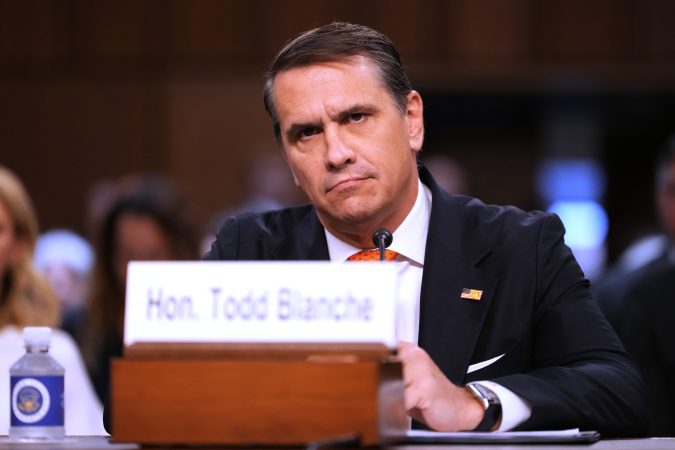
    WASHINGTON — Two Republican senators who threatened to block acting Attorney General Todd Blanche’s confirmation to lead the Justice Department said Monday that they will support his nomination, ending an impasse over plans to create a fund to compensate allies of President Donald Trump.

    The endorsement from GOP Sens. John Cornyn and Thom Tillis paves the way for the Senate Judiciary Committee to advance Blanche’s nomination on Tuesday after the Justice Department and lawmakers reached a deal to formally rescind the $1.8 billion “Anti-Weaponization Fund” proposed to settle Trump’s lawsuit against the Internal Revenue Service.

    Cornyn and Tillis had refused to back Blanche’s bid for the permanent post without official confirmation killing the fund meant to compensate people who believe they were unfairly prosecuted by the Justice Department. Blanche’s written order, issued late Sunday, came after days of negotiations between the Justice Department and the Republican senators, who are leaving Capitol Hill when their terms end in January.

    “We want to express our gratitude to Mr. Blanche and his staff for working with us on this, and we look forward to voting to advance his nomination out of the Senate Judiciary Committee soon,” Cornyn, of Texas, and Tillis, of North Carolina, said in a statement.

    DOJ order says ‘beyond any doubt’ that fund is dead

    Blanche has repeatedly said that the Justice Department was scrapping plans for the fund, which sparked bipartisan outcry over the possibility that violent rioters who attacked police at the U.S. Capitol on Jan. 6, 2021, could be considered for payments. But skeptical lawmakers said they were concerned that could be revived without a commitment in writing, especially because Trump has continued to defend the idea.

    In his order posted on social media late Sunday, Blanche wrote that the department was confirming “beyond any doubt, that there is no Fund.”

    Since the settlement of the president’s lawsuit against the IRS was announced, “No Members were appointed; no funds were transferred; no process for receiving claims was established; no claims were paid,” the order said. “This order establishes, beyond any doubt, that there is no Fund.”

    Cornyn and Tillis had also pressed the Justice Department to limit the scope of a separate piece of the settlement that provided broad immunity for Trump and members of his family from tax audits.

    Under the deal, the Justice Department clarified in writing that the tax audit immunity agreement “applies by its terms only retroactively” to claims open at the time of the settlement and does not protect the president from examination of future tax filings. It also makes clear that only the parties that brought the lawsuit — Trump, two of his sons, and the Trump Organization — are covered by the tax agreement.

    Cornyn and Tillis said in their statement that they were “pleased” with the concessions made by Blanche.

    “From the outset, we were clear that we needed a written document addressing our concerns on the IRS audit agreement and the anti-weaponization fund that included constraining the scope of audit protection by limiting it to the parties of the Settlement Agreement and legally ending the anti-weaponization fund,” they wrote.

    Democrats, however, noted that the order rescinding the fund doesn’t stop the Trump administration from compensating Jan. 6 rioters through a previously established process that allows people to file claims for damages if they believed they were wronged by the government.

    “This supposed ‘deal’ doesn’t prevent payouts to violent insurrectionists in the future,” Democratic Sen. Adam Schiff said in a social media post. Schiff added that it also “leaves in place a tax-immunity deal that could help Trump skip taxes on the $2.3 billion he made last year, and still leaves it vague who and what is covered.”

    Cornyn, Tillis echo GOP colleagues’ concerns

    Blanche’s nomination was thrown into doubt last week after the Judiciary Committee postponed a vote that had been scheduled for Thursday morning as Tillis and Cornyn said they needed more from the administration before they could provide the necessary votes.

    After the Thursday vote was delayed, Trump said in a social media post that he might pull Blanche’s nomination and resubmit it after Cornyn and Tillis leave office next year. And on Saturday the president threatened to push forward with the fund if the two Republicans blocked Blanche’s nomination.

    On Sunday evening, Trump said that people who had faced charges from the Jan. 6, attack on the Capitol and could have benefited from the fund had “their lives destroyed.”

    “This would be a reimbursement for the pain that they suffered,” Trump said. “A lot of people like it.”

    Blanche, who served as Trump’s defense lawyer in his criminal cases, entered the Justice Department last year as deputy attorney general. He was elevated to the top post after Pam Bondi was fired in April by Trump, who was frustrated by her failure to successfully prosecute his political enemies.

    Though Blanche insisted he wasn’t auditioning for the permanent job, he has moved quickly since taking the reins of the department to promote the Trump administration’s agenda and accelerate investigations into the president’s perceived foes.

  • Eastern Washington fires have burned 600 structures and forced the evacuation of 60,000 people

    Eastern Washington fires have burned 600 structures and forced the evacuation of 60,000 people

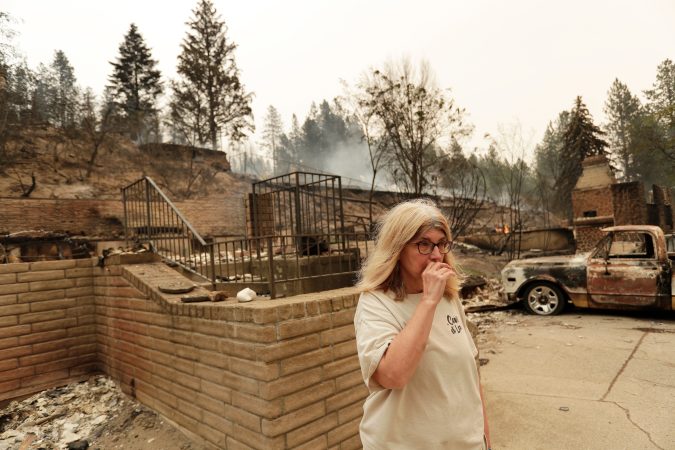
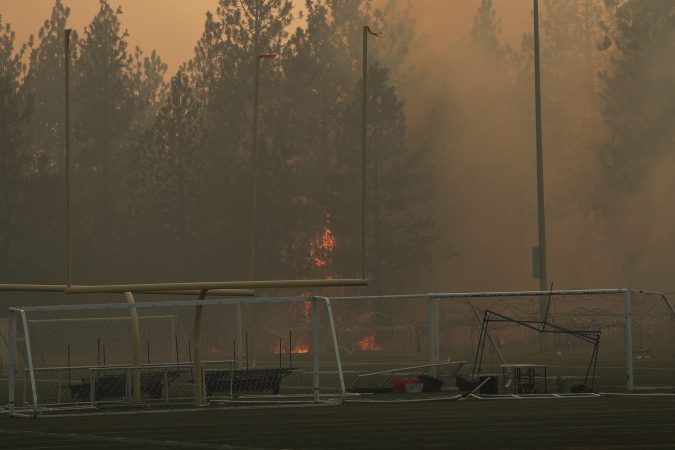
    Wildfires in eastern Washington state forced the evacuation of 60,000 people in the Spokane area while destroying at least 600 homes, businesses, and other structures, authorities said Sunday.

    The fires in and around Spokane, the state’s second largest city, burned about 8.2 square miles over the weekend and were among dozens of wildfires across the Western U.S. that stretched the ability of federal, state and local agencies to fight them.

    A total of about 390 square miles has burned across the state, and some of the fires, including those in the Spokane area, have not been contained.

    No one hurt or unaccounted for — so far

    Fire and law enforcement officials said there had been no reports of injuries or people unaccounted for — but they stressed it was early in the response effort.

    Officials also said that the evacuees in Spokane included patients at its U.S. Veterans Affairs hospital.

    Video from the Spokane area showed buildings on fire, black smoke billowing up near neighborhoods, and the smoking ruins of homes, with only chimneys still standing. Several officials expressed concern that the area does not appear likely to get a break in coming days from the weather, which is expected to remain dry.

    “We are not out of danger,” U.S. Sen. Maria Cantwell said during a news conference with federal, state and local officials in Spokane. “The next couple of days will be challenging.”

    Investigators had yet to determine how the blazes started.

    Grassland in flames in parts of Idaho, Oregon

    Spokane was hardly the only place struggling to contain fires.

    Crews using bulldozers and helicopters continued for a 10th day to fight a fire that has burned nearly 525 square miles of grassland in western Idaho and eastern Oregon. The area is home to cattle ranches, and authorities said the fire is threatening more than 600 homes and 800 other structures.

    The weather in the area was expected to remain sunny — and dry — well into the week, with temperatures rising to more than 90 degrees Fahrenheit on Wednesday. Officials say the fire was caused by lightning.

    The National Weather Service issued warnings about the air quality in eastern Washington, eastern Oregon, western and central Idaho, and western Montana. It issued red flag fire warnings for parts of Utah and Montana and western Nebraska, and extreme heat warnings for the southern parts of Arizona, California, and Nevada and northern Montana.

    High winds make it hard to fight fires in Spokane area

    While temperatures Sunday in Spokane were forecast to remain below 80 F, wind gusts from 35 mph to 45 mph were expected by the afternoon, said Benjamin Cossel, public information officer for the federal response team from California called in Saturday night to deal with the fires.

    “We have weather working against us, and we have terrain working against us,” Cossel said.

    There were three fires in the Spokane area: the Old Trails Fire, the Fairview Fire, and the Meadowview Fire. Washington Gov. Bob Ferguson declared a state of emergency Saturday, and the National Weather Service issued a “particularly dangerous situation” red flag alert for eastern Washington.

    Cossel said that as it gets warmer during the day, cool air that’s closer to the ground and keeping winds at bay will rise, allowing those winds to move through the area. The Spokane River cuts through the city of about 229,000 people, and there are steep canyons on both sides that channel the wind.

    “They push the fire through the canyons, up, up the slopes, and then outside the slopes and around,” he said. “It’s very, very hilly, very, very steep slopes, a lot of canyons that create really turbulent, really challenging sort of wind scenarios.”

    Spokane sets up shelter for impacted residents

    Authorities in Spokane set up a shelter at the city’s main convention center. About 400 people were staying there, officials said Sunday.

    Spokane County Commissioner Chris Jordan said relatives of his were in an area affected by the fires and that they don’t know if their home is still standing. He said he spoke with them as they were leaving the home.

    “They’re in their car and all they can see is smoke everywhere, and it was incredibly scary for so many people,” he said during the news conference.

    Heather Rosenstrater, president and CEO of Avista Corp., the area’s electric and natural gas utility, said about 10,000 people were without power Sunday, down from a peak of 30,000. Avista needs to repair two transmission lines, she said, so it’s possible that demand for electricity over the next few days could cause outages.

    Meanwhile, several larger fires continued to burn in less populated areas northwest of Spokane, including one about 80 miles from the city that has burned about 210 square miles. Another fire in eastern Oregon, about 70 miles to the northwest in the Stinkingwater Mountains, has burned about 336 square miles.

    “The whole northwest is heavily impacted right now,” said Keila Vizcarra, the spokesperson for the federal team from California handling what’s been named the Big Grass Fire in western Idaho and eastern Oregon.

  • Iran’s leaders show a united front over the war but are divided over what the goal is

    Iran’s leaders show a united front over the war but are divided over what the goal is

    CAIRO — With escalating attacks against U.S. bases and its allies over the past week, Iran’s leaders are showing considerable unity over their war strategy: hanging tough, determined to show Iran can endure more than America and its allies can.

    But within the leadership, there are sharp differences over what the endgame should be.

    On one side, the ultra-hardliners who oppose any negotiations with the United States are pressing for total victory in the war. Known as the “Paydari” movement — Persian for “stability” — they are hard-core ideologues who want to enforce the Islamic Republic’s control over society.

    On the other, those who support President Masoud Pezeshkian and powerful parliament speaker Mohammad Bagher Qalibaf — who doubles as Iran’s chief negotiator — see military pressure as a way to win a negotiated deal with the United States. This camp is also spurred by concern over the economic toll Iran is suffering from the war and the need to adapt to social change in the country.

    “Negotiation is a political tool and a complement to military action to force the enemy to a point of compulsion and extract real concessions,” an adviser to Qalibaf, Mahdi Mohammadi, wrote on his Telegram channel Thursday.

    The unusually open rivalry within the theocracy’s leadership points to a struggle for control over Iran’s postwar future. A huge question mark is where the new supreme leader, Ayatollah Mojtaba Khamenei, stands. Reportedly injured in the strike that killed his father in the opening minutes of the war on Feb. 28, Khamenei remains in hiding, and both sides have claimed his support.

    Iran is determined to show strength

    In a boost for Qalibaf and Pezeshkian, the ceasefire deal reached with the U.S. in April received strong backing in Iran’s top leadership body, the Supreme National Security Council. Twelve of its 13 members approved it, including senior figures in the Revolutionary Guard and the military.

    The lone vote against the deal is widely believed to have come from Saeed Jalili, the most prominent figure in the Paydari movement.

    But the ceasefire crumbled as the two sides trade strikes and as Iran presses for control over passage through the Strait of Hormuz, which before the war carried a fifth of the world’s traded oil and gas. Iran was also frustrated that financial promises under the deal — including the release of billions of frozen assets — didn’t materialize, and now the American blockade is back in place.

    With no benefits from the deal, “there’s no serious division” in the leadership over how to respond, said Ali Vaez, Iran project director at the International Crisis Group.

    They believe U.S. President Donald Trump “only understands the language of force, and therefore, they would have to gain the upper hand in order to compel him to deliver,” Vaez said.

    The hard-liners are pressuring Iranians

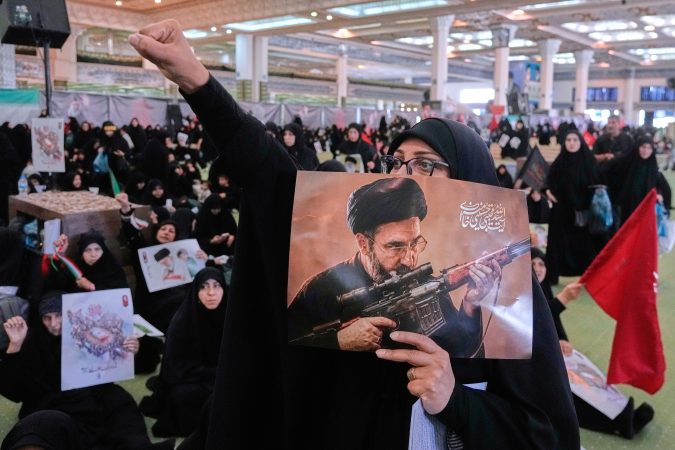
    The funeral for slain Iranian supreme leader, Ali Khamenei, earlier this month appeared to show the strength of the ultra-hardline Paydari. Crowds called for revenge on the U.S. and Israel for the war. Videos showed mourners in Tehran welcoming Jalili, while Pezeshkian was greeted at one point with insults and cries of “Death to the compromiser!”

    The ultra-hardliners have used nightly rallies and their control of state television, known by the acronym IRIB, to drum up opposition to negotiations. At rallies and on TV, speakers have portrayed Iran as headed for total victory and denounced those who compromise with the Islamic Republic’s archenemy, the United States.

    State television cut off a June 30 live broadcast with Qalibaf as he discussed negotiations with Washington. Earlier this month, it cut off broadcasting a speech by Pezeshkian to businesspeople seconds after he said that the elder Khamenei had given permission for renewed U.S. talks before his death.

    Pezeshkian and his camp have pushed back, portraying IRIB as dividing the country at the time of war. The president accused the broadcaster of making it like “the military are on one side, and the government is on another side.”

    Last month, the president’s media office condemned state television for what it described as “censoring” the president and other government heads, signaling an open rift.

    The hard-liners have sought to press their influence in other ways. In past weeks, authorities shut down cafes in central Tehran that were popular with residents during the ceasefire. Videos on Iranian social media showed many women at the cafes flouting mandatory veiling laws, and crowds mixing freely.

    The closures were brief but signaled that “religious extremist parties” were showing their influence, said Mohamad Ali Abtahi, a reformist cleric and an aide to former President Mohammad Khatami, who is still widely considered to be the leader of Iran’s reformist groups.

    While Jalili’s supporters are a minority they are influential, said Vali Nasr, professor of international affairs and Middle East studies at Johns Hopkins University.

    “They have a lot of money. They have a lot of power. They have put a lot of people in the bureaucracy” and developed connections in the Revolutionary Guard, Nasr said.

    The pragmatists say the public must be heard

    The more pragmatic camp argues that maintaining unity during the war requires addressing the public’s unhappiness over the economy as well as political and social repression. This, as Iran’s currency continues to slide, inflation spirals, and unemployment rises. A final agreement with the U.S. could bring Iran a huge windfall with the lifting of sanctions and the return of billions in assets.

    Small flashes of impatience with the war have emerged. In July, over 250 former lawmakers, clerics, professors, and other public figures signed an anti-war petition warning of the costs of the conflict. “We believe that the overwhelming majority of the Iranian people want peace and the right to a decent life,” the statement read. Others have spoken out against stepped-up executions of protesters following wide-scale anti-government protests in January.

    A top reformist party that assisted Pezeshkian’s presidential campaign warned that the war’s domestic toll was “undermining internal social cohesion.” That brought a rebuke from Tasnim, a news agency close to the Revolutionary Guard, which said the statement amounted to blaming Iran for a war started by the United States.

    In mid-July, the president’s son and influential adviser, Youssef Pezeshkian, posted a series of messages about the need to balance realistic military aims with a weak economy. Referring to the decades of sanctions and confrontation with the West, he said Iran has “been prevented from growing and has suffered greatly. It has become sick.”

    Both sides are looking to what happens after the war

    Ultimately, both sides are jockeying for power after the war, given the unusual uncertainty brought on by the change in the supreme leadership. Abtahi, the reformist cleric, said Mojtaba Khamenei’s real views are still not known, so while some believe he could be more radical than his father, others see the potential for him to bring moderate change.

    The supreme leader, because of the power invested in him, could act as a “brake” to restrain the more extremist factions, Abtahi said. But over time, the confrontation with more radical factions could grow more dangerous “if that brake isn’t used.”

  • Hundreds of thousands line Amsterdam canals for the annual Pride boat parade

    Hundreds of thousands line Amsterdam canals for the annual Pride boat parade

    AMSTERDAM — Hundreds of thousands of people lined Amsterdam’s canals on Saturday to watch the city’s canal boat parade, the highlight of an annual Pride festival that this year comes just a week after a deadly attack on a Pride event in Berlin.

    Openly gay Dutch Prime Minister Rob Jetten, dressed in a white shirt, black life vest, and gold necklace, waved to crowds as he sailed in a small boat through the colorfully decorated parade of 80 vessels, waving to participants and spectators as techno music pumped from speakers along the route.

    The colorful floating parade came a week after the Berlin attack left one person dead and 29 injured. A suspect, Abdul Ballout, was suspected of driving a van into a crowd near the festival Saturday night before apparently stabbing others with a machete in what authorities believe was an Islamic extremist attack. Ballout was shot and killed by police during a confrontation on Sunday in a suburb of the city, authorities said.

    Jetten, the first Dutch prime minister to ever take part in the boat parade, said in a video posted on X that the event was more important than ever because worldwide the freedom and security of the LGBTQ+ community “is under pressure with new discriminatory legislation, lack of safety on the street, or last week’s terrible attack in Berlin.”

    Amsterdam Mayor Femke Halsema said in the aftermath of the German attack that authorities in the city would “where necessary take extra measures that visitors will hopefully notice as little as possible.”

    Motorboats carrying police officers cruised the canals and a helicopter hovered overhead as Saturday’s parade got underway.

    The Berlin attack also cast a shadow Saturday over Hamburg’s Pride parade, one of Germany’s biggest, where increased security was noticeable as dozens of trucks made their way through Germany’s second-biggest city.

    Police and organizers said about 300,000 attended, compared with about 260,000 people last year, German news agency dpa reported. Hamburg’s police chief said earlier this week that roughly twice as many officers as last year would protect the event.

    The boat parade is the traditional highlight of Amsterdam’s Pride. This year it coincides with a World Pride celebration that also is being hosted by the Dutch capital.

    Rod Lugtenburg, 55, from Toronto, said he came to Amsterdam for World Pride. He stood on the city’s famous Skinny Bridge wearing a T-shirt emblazoned with a rainbow maple leaf as the boats passed.

    “For me, it’s about acceptance, being able to be who you are,” he said.

    “I have Dutch heritage and I have always loved the fact that the Dutch have been leading the way” in acceptance and rights for the LGBTQ+ community. “And Canada is right behind them, so I’m very proud.”

    The joyful event happened against a backdrop of rising reports of verbal and physical assaults on members of the LGBTQ+ community in the Netherlands, which has long been considered a haven of tolerance. On Friday, a court in Amsterdam convicted a man of using discriminatory language at a Pride event in the city earlier in the week. He was ordered to do 40 hours of community service.

    Boats taking part in the parade included vessels representing the Dutch government ministries, the military, and police as well as LGBTQ+ organizations and clubs.

    The Netherlands LGBTQ+ rights group COC, which is celebrating its 80th anniversary this year, had a boat in the parade carrying a manifesto calling for progress in the fight for human rights for LGBTQ+ people in the Netherlands. It also carried a portrait of activist Marsha P. Johnson, who took part in the Stonewall rebellion when patrons at the New York inn of that name resisted a police raid on June 28, 1969. The raid helped usher in a new, militant phase of the movement for gay rights.

    Another boat carried two giant inflatable likenesses of U.S. President Donald Trump and his Russian counterpart Vladimir Putin. The two figures, dressed in Delft blue and white costumes and each clutching a tulip, leaned toward one another for a kiss, in the style of pottery figurines that are a staple of tourist souvenir stores throughout the Netherlands.

    The group that created the boat said on its website said they re-imagined the symbol of love and unity “not to provoke, but to pause power for a moment and highlight something human.”

  • Moscow mayor calls deadly bomb attack on restaurant a ‘terrorist act’

    Moscow mayor calls deadly bomb attack on restaurant a ‘terrorist act’

    Moscow mayor Sergei Sobyanin on Sunday called a bomb attack on a restaurant in the capital the day before a “brutal terrorist act,” but did not say who was responsible.

    The blast on Saturday evening at the Balzi Rossi, an upscale Italian establishment in central Moscow, killed three people, including the woman bomber, Russian state media said, citing local officials.

    “Yesterday, a brutal terrorist act was committed in Moscow that claimed human lives. The victims are currently in the city’s hospitals, where they are receiving all necessary care,” Sobyanin wrote on social media Sunday.

    He added that a probe into the attack was underway. “Those responsible for committing this crime will certainly be found and will face the punishment they deserve,” he wrote.

    At least 21 people were wounded when the explosive device detonated at the restaurant on Kudrinskaya Square, the National Anti-Terrorism Committee said late on Saturday, according to Russian state news agency Ria Novosti.

    A woman attempted to smuggle the bomb into the establishment, but a security guard refused to let her in before the bomb exploded, reported Ria Novosti. The Moscow Investigative Committee said on Saturday evening the attack was still being investigated.

    As of early afternoon on Sunday, there was no further information from Russian authorities, and no one had publicly claimed responsibility.

    According to Ria Novosti, the restaurant was closed for a private function on Saturday evening.

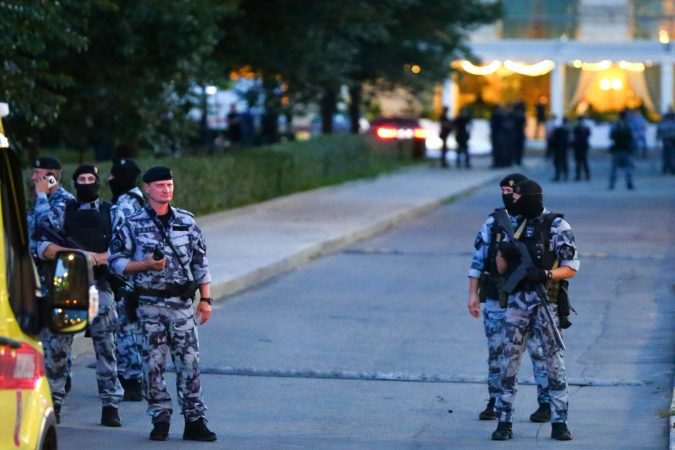
    Footage released by Russian state media showed heavily armed law enforcement officers, several ambulances, and other emergency vehicles at the site.

    Earlier this year, Russia’s Federal Security Service announced that authorities would tighten security around senior military and government officials, after a series of assassination attempts in Russian cities that followed the Kremlin’s full-scale invasion of Ukraine in February 2022.

    So far, Russian authorities have not drawn any connections between Saturday’s blast and these earlier attacks or the war in Ukraine.

    Russia previously said Kyiv was behind a car bombing in Moscow last April that killed Lt. Gen. Yaroslav Moskalik, a deputy head of the main operational department in Russia’s General Staff. Ukraine did not publicly claim responsibility.

    But Ukraine’s SBU security service earlier said it had organized the killing in December 2024 of Lt. Gen. Igor Kirillov, who headed the Russian military’s nuclear, biological, and chemical protection forces.

    Kirillov was killed by a bomb hidden in a scooter outside his apartment building in Moscow, a day after Ukraine’s security service leveled criminal charges against him.

    Among other prominent victims of bombing attacks in Russia were Daria Dugina, the daughter of influential nationalist thinker Aleksandr Dugin, and Vladlen Tatarsky, a well-known pro-Kremlin military blogger.

    Kyiv denied involvement in the attack on Dugina, and did not respond to Russian accusations that it was behind Tatarsky’s death.

  • 2 killed when firefighting helicopters collide near Athens as Europe’s wildfire emergency rages

    2 killed when firefighting helicopters collide near Athens as Europe’s wildfire emergency rages

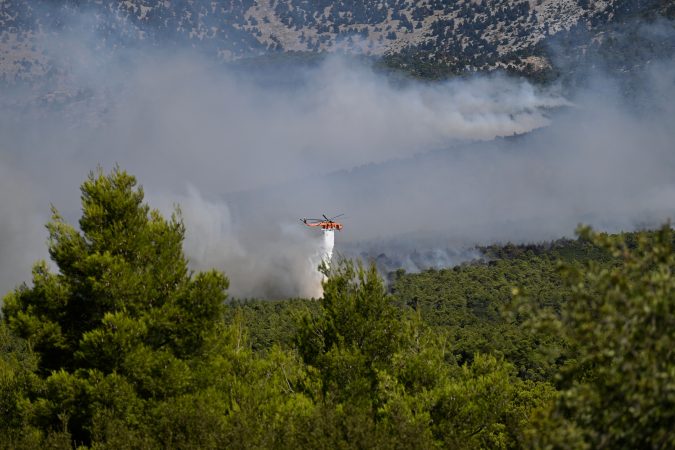
    ATHENS, Greece — Two Greek firefighting helicopters collided in midair on Sunday as they were battling a wind-driven wildfire west of Athens, sending one aircraft crashing to the ground. Two crew members, a Greek and a Danish national, died in the crash.

    The collision laid bare the danger at the most volatile front of Europe’s wildfire emergency. Strong winds drove flames deeper into the region of the Greek capital and forced fresh evacuations, France guarded a still-burning scar four times the size of Paris, while Spain’s major fires stopped advancing.

    Greek Prime Minister Kyriakos Mitsotakis expressed “sorrow for the tragic accident” and extended condolences to the families of the firefighters killed in the crash.

    “The loss of the Greek coordinator and the Danish pilot at the time they were attempting the major fire in Porto Gremeno fills us all with grief,” Mitsotakis said in a statement.

    The aircraft were Bell helicopters operating over the Psatha area west of Athens, each with a two-person crew. Foreign firefighting and helicopter crews are often deployed in Greece to help tackle wildfires during the country’s hot, dry summers.

    The two crew members who were recovered alive were a Greek and a British national.

    The flames had spread rapidly, threatening communities and an industrial district as violent gusts prevented firefighting aircraft from collecting water from the sea. The blaze carried a grim resonance in a region where the 2018 Mati wildfire killed 104 people, Europe’s deadliest blaze this century.

    Farther west, containment brought no end to the emergency. France’s largest wildfire remained held within its perimeter after forcing 224,000 people to flee in what may have been the country’s largest civilian evacuation outside wartime.

    Hot spots still burned within a 162-square-mile scar, thousands remained unable to return home, and nearly 3,000 firefighters were deployed against the Gironde megafire and a second, still-uncontained blaze in Provence.

    Together, fires in France and Spain have driven roughly a third of a million people from homes and vacation sites, emptied communities at the height of the European summer, and stretched emergency services across simultaneous disasters.

    Record damage underscores Europe’s growing wildfire threat

    The mass evacuations in France and Spain are the latest measure of a wildfire threat growing across Europe.

    The continent entered 2026 after its worst fire year on record, with more than 3,860 square miles burned in 2025. Over the past four decades, wildfires have been linked to nearly 800 deaths across much of Europe, according to the European Environment Agency.

    Europe is the world’s fastest-warming continent. It has warmed more than twice the global average since the 1980s, according to the European Union’s Copernicus Climate Change Service.

    Human-caused climate change made the extreme fire-weather conditions behind this year’s French blazes at least twice as likely, scientists at World Weather Attribution found in a rapid analysis conducted while the fires were still burning.

    Gale-force winds cripple aerial assault near Athens

    Nearly 500 firefighters and 23 aircraft were deployed in Greece, but gale-force winds drove flames through dry forest and crippled the response, preventing some aircraft from reaching the sea to collect water.

    Authorities ordered the evacuation of Kandili, Agia Skepi, and Toutouli as smoke rose over the mountains. Crews were particularly concerned about Porto Germeno, a seaside community on the Gulf of Corinth.

    The fire began Friday near Agios Vasileios before sweeping toward Porto Germeno and into the forested mountains west of Athens. Firefighters evacuated 254 people by sea Friday and another 12 Saturday — often the last escape route when fire and smoke cut the few roads from coastal communities.

    Wildfire meteorologist Theodore Giannaros estimated the blaze had affected 15 to 19 square miles, though authorities had issued no official figure.

    Elsewhere in Greece, flames threatened homes on Kefalonia, forcing evacuations from inland communities as aircraft made water drops over the Ionian island. Firefighters battled another blaze near Nea Tenedos on the peninsula of Halkidiki.

    Earlier this week, two firefighters died fighting a fire on Crete, while a third was killed on the Peloponnese.

    “A pristine forest, a paradise, was surrendered to the hands of the fire,” local farmer Minas Tzortzanis said Saturday. “There are no words to explain what has happened. Destruction. Total destruction.”

    France holds off renewed flames

    In southwestern France, the Gironde megafire remained held within its perimeter Sunday but continued to burn after scorching 162 square miles of forest in 10 days.

    “The fire is now fixed, which does not mean that the fire is extinguished,” the Gironde prefecture said, using the French firefighting term for a blaze whose advance has been stopped.

    The region remained under France’s highest red forest-fire alert. Dry conditions, soaring temperatures around Bordeaux, and afternoon winds threatened to rekindle the flames.

    In Le Porge, local officials said about 150 homes were destroyed. Mechanic Matthieu Plessis returned Saturday to the ruins of a house that had been in his family for seven generations.

    “There are places I don’t even recognize anymore,” he said. “You don’t even know what was here anymore, or who lived where.”

    Firefighters from Ukraine, Lithuania, and French Polynesia were expected Sunday and Monday to reinforce the operation.

    Provence fire stops advancing but remains uncontained

    In southeastern France, nearly 1,500 firefighters battled a separate blaze in the Var department that tore through about 7 square miles in little more than a day.

    The Gros Bessillon fire was stabilized Sunday after its perimeter held overnight, but it remained uncontained. Some 2,500 people were evacuated as flames threatened nearby communities.

    It was the fourth major fire to strike central Var since July 19. A smaller blaze near Brignoles earlier in the week forced actor George Clooney and his family, along with about 700 other residents, to evacuate before it was brought under control.

    Prime Minister Sébastien Lecornu said France’s fires were generally under control but warned that conditions remained volatile. He appointed a national coordinator to oversee reconstruction in fire-ravaged areas.

    More than 452 square miles have burned across France this year.

    Spain’s deadly fire siege eases

    Spain’s major fires — which have killed at least 13 people, produced the country’s largest recorded wildfire, and prompted a national emergency — were no longer advancing on Sunday.

    In Zamora province near the Portuguese border, more than 20 ground and aerial units guarded the perimeter of the Fermoselle fire against flare-ups in the rugged Arribes del Duero landscape. Most evacuees had returned home, according to local media.

    Spanish Prime Minister Pedro Sánchez has called for a national pact to confront wildfires, warning that climate change is making them increasingly destructive.

  • How a ‘perfect storm’ spread fire, heat, and smoke across the Northern Hemisphere

    How a ‘perfect storm’ spread fire, heat, and smoke across the Northern Hemisphere

    Chicago and New York choked under orange and white skies. Madrid and Bordeaux had flames licking at their doorsteps. Vast forests, rural communities, and ranchlands full of livestock in Canada and Oregon have burned — and all in the month of July alone.

    Major wildfires and their massive, suffocating plumes of smoke blanketed vast swaths of North America and Europe, in some cases combining with intense heat waves that exacerbated flammable conditions and contributed to human misery.

    According to a wildfire smoke analysis by the Washington Post, about 20% of Northern Hemisphere land area — covering around 7.5 million square miles — experienced moderate or greater concentrations of black carbon, the soot particles released by wildfires, at some point during July.

    That included large swaths of North America — stretching into the Arctic Circle — as well as Western and Southern Europe and parts of Russia.

    Against the backdrop of a changing climate, July has illuminated what it can look like when severe weather, at heightened frequency and intensity, combines to form a hellish landscape. Like 2023 and 2024, this summer is the latest chapter in the Northern Hemisphere’s fiery era, as wildfires become more frequent and intense and oppressive heat and smoke harming the health of millions become increasingly normal.

    “It was like the perfect storm of very hot conditions with strong winds that fanned these fires,” said Dmitri Kalashnikov, a climate postdoctoral researcher at the University of California at Merced, referring to the flames he saw explode in Minnesota and Ontario in mid-July. Heavy smoke from those fires made its way through the Midwest and the East Coast in subsequent weeks, temporarily making cities there among the most polluted in the world.

    “That direct clear linkage of big heat wave, lots of fire, then lots of smoke impacts was kind of a wow moment for me,” Kalashnikov said.

    In some cases, this sprawling smoke lingered over densely populated cities for days, causing poor air quality that spread toxins and increased the risks of asthma attacks, heart disease and strokes.

    “There is no safe level of exposure to wildfire smoke,” said Ze’ev Gedalof, a forest ecology expert at the University of Guelph in Ontario. “We just need to expect that this is the new normal.”

    Cities such as Cleveland, Denver, Detroit, Milwaukee, New York, and Philadelphia all experienced at least four days with moderate or higher smoke concentrations during July. In Baltimore, Minneapolis, and Portland, Ore., the tally was three moderately smoky days, while D.C. and Boston had two each.

    In Canada, Calgary, Edmonton, Montreal, Ottawa, Toronto, and Winnipeg all experienced three to five smoky days, while Spain’s Madrid had three and France’s Bordeaux had four.

    And across many of these cities, fire and smoke were not the only summer scourge.

    Many of the fires occurred in areas that have recently experienced record-breaking temperatures from towering heat domes. The heat and dryness that spike as a result of these powerful areas of high pressure can drive wildfire risks. A recent study by Kalashnikov and other researchers at UC Merced found that from 2001 to 2024 more than 40% of the area torched by fires in the western United States had burned during or in the immediate aftermath of a heat wave.

    “The conspicuous overlap between record-breaking warmth, dryness, and/or low snowpack and these fires is simply not a coincidence. The scientific evidence linking increasingly extreme fire weather, as well as increasingly extreme wildfires themselves, to climate warming is clear,” wrote climate scientist Daniel Swain in a series of posts on social media about the conditions across the hemisphere.

    Several factors could be behind this summer’s many heat domes.

    Changing jet stream wind patterns, partly linked to El Niño and a marine heat wave in the Pacific, may be playing a role, as could an unusual cold blob of water in the North Atlantic. The jet stream has been arcing up and over both the United States and Western Europe, with heat domes bubbling underneath.

    But a heat dome doesn’t make a wildfire.

    “There will not always be extreme wildfire outbreaks when exceptional heat and dryness occur, that is true,” Swain added in one of his posts. “But such conditions greatly raise the ceiling on what is possible in a warming world — and sometimes, as is happening now, that increased potential will be realized.”

    In recent days, firefighters have made progress in containing blazes across the two countries; in the region around Bordeaux, authorities have now allowed nearly 150,000 people back to their homes, Reuters reported, to begin a recovery.

    “Considering the damage to the ecosystems and the livelihoods, communities affected are going to need support from authorities for a very long time,” said Maria Alcazar Castilla, the deputy regional director for the Red Cross in Europe. “There’s people that need to build their homes, to recover livelihoods, etc. All that, in economic terms, is extremely expensive.”

    Some parts of the world have always been vulnerable to fire. Canada has enormous ranges of dense boreal forest — roughly the size of the United States west of the Rocky Mountains — with few roads and scant human population. That kind of forest has evolved to burn in order to rejuvenate, said Jen Beverly, a wildfire researcher at the University of Alberta — but now has grown susceptible to more extreme fires.

    “The forest don’t change quick enough to be able to reflect in the data like that. That means it’s climate change,” Beverly said.

    Around 14,500 square miles of Canada have burned through July 31 this season — already above the 10-year average, although not on pace to match the extreme fire seasons of 2023 and 2025.

    The intense conditions generated by July’s wildfires include the fire in Bordeaux that created its own thunderstorm. The phenomenon, known as a pyrocumulonimbus cloud, occurs when the intense heat of a wildfire sends a column of hot air and smoke high up into the atmosphere, where it cools and condenses into a cloud. The resulting thunderstorm, with high winds and lightning strikes, can further fan the flames.

    “It might last for one to three to four hours, and all the while it’s connected to that fire source. And at the same time, the fire is being altered and energized by that storm that it generated,” said Mike Fromm, a meteorologist at the U.S. Naval Research Laboratory. “So it’s a feedback loop.”

    Now, the American West is bracing for more of the same.

    A fast-moving wildfire driven by strong winds and high temperatures swept across northwest Spokane on Saturday before jumping the Spokane River and prompting the evacuation of thousands of people.

    In California, Arizona, and Nevada, a new heat dome that settled over the region this weekend was expected to send temperatures up to 115 degrees Fahrenheit in cities like Phoenix, and another bout of extreme heat could expand across the country in the days to come.

  • Several states report cyberattacks as spy agencies suspect Iran is targeting water

    Several states report cyberattacks as spy agencies suspect Iran is targeting water

    Federal authorities are warning that critical infrastructure systems in the United States could be at risk after at least seven states reported cyberattacks that interrupted their water or wastewater operations last week.

    According to a joint alert from the FBI and the Environmental Protection Agency, “malicious cyber actors” have been remotely tampering with some water systems’ internet-connected programmable logic controllers, or PLCs, causing loss of water pressure and flooding.

    The warning, issued Thursday, comes after U.S. intelligence officials said Iran was likely behind a coordinated cyberattack on more than 30 municipal water systems in Minnesota. Experts have also warned for years that the U.S. water industry, which has resisted regulation efforts, has been vulnerable to cyberattacks.

    Intelligence agencies have not definitively concluded that Tehran was responsible for the disruptions in Minnesota, but the hack follows urgent warnings by federal cybersecurity officials that Iran for months has been targeting internet-exposed devices that control operations at water, wastewater, and energy facilities in the U.S. In July, federal cybersecurity authorities specifically warned that Iranian hackers were exploiting vulnerable PLCs.

    President Donald Trump has blamed Minnesota’s government, not Iran, for that attack. The FBI did not respond to a request for comment Friday about whether it believed Iran was responsible, saying the agency and others were “fully engaged to protect critical infrastructure.”

    The Post reported Thursday that intrusions have been noted at several water and energy systems across the country since shortly after the war began on Feb. 28.

    Federal authorities have not identified which states were affected in recent hacks. Outside of Minnesota, Michigan and South Dakota have also reported attacks. However, experts said it is likely many more states are affected, given that the brand of PLCs targeted — Rockwell Automation/Allen-Bradley — is widely used.

    “We only have one internet and it’s the same equipment for all these victims. … Theoretically, you should see these [vulnerabilities] in all 50 states,” said Joshua Corman, a public safety and resilience expert at the Institute for Security and Technology.

    To date, the cyber attackers have employed “low sophisticated tactics” to hack into internet-connected PLCs, often ones with weak or nonexistent credentials, according to Alec Davison, an analyst with WaterISAC, an information sharing program with the government intended to strengthen security. The hackers have subsequently modified passwords to lock out operators and disconnect controllers, he said in an email.

    “This has led to boil water notices and forced utilities into sustained manual operations,” Davison wrote.

    The risk is that cyberattackers tampering with PLCs could change the “logic” or software of a system so that an operator might not detect an issue with, say, dangerous levels of chemicals.

    A July 22 advisory issued by the Homeland Security Department’s Cybersecurity and Infrastructure Security Agency noted that the FBI and CISA have observed Iranian hackers tampering with the PLC’s logic software, “allowing systems to enter unsafe conditions without notifying operators of the anomalies.”

    “Operators see normal displays. No alerts fire and the process can enter an unsafe condition without anyone knowing,” said Kurt Gaudette, head of intelligence for Dragos, a cybersecurity firm that specializes in protecting critical infrastructure.

    Experts widely agreed that water infrastructure in the United States has been uniquely vulnerable for more than a decade. Of the roughly 151,000 water plants in the United States, about one-third service residential communities year-round. But only about 420 water plants participate in WaterISAC to try to improve cybersecurity across the water sector.

    “We have under half a percent paying attention to cybersecurity,” Corman said. “U.S. water is incredibly prone. We’ve been prey, we just didn’t have predators with an appetite for water, but that’s over.”

    Another issue is that many small- and medium-size utilities are using third-party integrators or contractors to configure the security settings on their systems, and these contractors are using default credentials and weak passwords.

    Compounding the problem, the water industry has also resisted efforts to be regulated for cybersecurity. After the Biden administration tried to impose cybersecurity audits of water utilities in 2023, some water industry groups and three states — Missouri, Arkansas, and Iowa — sued, causing the EPA to roll back its standards.

    Nate George, the mayor of Braham, Minn., which experienced a hack last week that caused the town’s plant to briefly go offline, said in a statement on Saturday to the Washington Post that cities such as his need more resources to comply with mandates to ensure their utility systems and infrastructure are safe.

    “I would actually argue it falls mostly on states that mandate local governments make certain upgrades to their utility systems or other infrastructure but fail to provide the funding to pay for it or maintain it,” said George, a Republican running for state auditor in Minnesota.

    Cybersecurity threats to the water sector, however, are only expanding.

    Trump, at a meeting with cabinet officials at Camp David on Friday, waved off the suggestion that Iran was involved in the Minnesota attack — and in turn blamed its officials, a frequent political target.

    “I blame it on Minnesota because they’re grossly incompetent,” Trump said at the cabinet meeting. “I would blame it on Minnesota and the governor, the corrupt governor of Minnesota. Iran’s got bigger problems than worrying about Minnesota.”

    Gov. Tim Walz (D) pointed the finger at Iran as well as at Trump.

    “Trump knows exactly who is responsible for this attack, and knows that other states were hit too,” Walz wrote on X. “This is what modern warfare looks like, and it further illustrates there’s no plan to win a war with Iran.”