Category: Nation & World

  • Inside the gentle, careful work of restoring famous paintings of Lincoln

    Inside the gentle, careful work of restoring famous paintings of Lincoln

    Heather Smith stood before the tattered portrait of Abraham Lincoln, holding a fine-tipped sable brush and a small plastic palette smeared with dabs of conservation paint.

    Wearing special magnifying glasses, she peered at the edge of the unframed portrait where paint was missing and pieces of old canvas remained.

    Lincoln, shown in the portrait resting his chin on his right hand, seemed to be watching.

    “He’s been through a war of his own,” she said of the painting of the nation’s Civil War president. “It’s terrifying to think about.”

    The 6-foot-2-inch portrait of a contemplative Lincoln sitting in a chair was painted in 1887. Time has weathered it and pocked it with flaws: Its original canvas was removed, probably with a scalpel. The surface of the painting was abraded, perhaps with an iron. And spots dotted the portrait where the paint was gone.

    But the Baltimore art conservator, working for the Smithsonian’s National Portrait Gallery, which owns the painting, has now embarked on a months-long effort to restore the majestic portrait to its original look.

    The effort is part of the portrait gallery’s project to assess 110 of its presidential portraits and repair those in need. The work has been funded, in part, by a grant from Bank of America.

    Smith is the owner of Maryland Art Conservation, which is based in a former Baptist church in northern Baltimore.

    She has already worked on the gallery’s 1785 portrait of George Washington by English artist Robert Edge Pine. And she is scheduled to work on gallery portraits of presidents Theodore Roosevelt, Benjamin Harrison, Woodrow Wilson, and Dwight D. Eisenhower.

    She is also working on another Lincoln — known as the penny portrait, which resembles the image of Lincoln on the coin.

    But the large portrait of Lincoln seated is, perhaps, the most dramatic and well-known of the group. He is shown wearing a dark suit, white shirt and bow tie. He is leaning forward, his left hand gripping the arm of the chair, as if listening.

    The painting is too big to fit on an easel, Smith said, so it leans against a wall, flanked by two large windows. It was last on view at the portrait gallery in 2022.

    It is one of four similar Lincoln portraits painted by the prolific American artist George Peter Alexander Healy, said Mindy Farmer, a portrait gallery historian.

    “This has been an iconic work since it was created,” she said.

    Another version, painted in 1869 and once owned by Lincoln’s son, Robert, is in the White House, according to the White House Historical Association.

    The portraits are based on The Peacemakers, a painting Healy did in 1868 depicting Lincoln meeting with Lt. Gen. Ulysses S. Grant, Maj. Gen. William T. Sherman, and Rear Adm. David D. Porter near the end of the Civil War, according to the association’s website.

    The gallery’s 1887 portrait was commissioned by Lincoln’s longtime friend and political ally Elihu B. Washburne, who wanted it for his home, art historian Alba Campo Rosillo wrote in Smithsonian Magazine in 2021.

    Healy painted the portrait in the winter of 1887 in his studio in Paris, where he was living, Rosillo wrote.

    Washburne died in Chicago later that year, and the painting passed to his brother, William, who died in 1912.

    It was purchased in 1934 by the A. W. Mellon Educational and Charitable Trust. It was given to the National Gallery of Art in 1942 and transferred to the planned portrait gallery in Washington in 1965, according to the gallery. The gallery opened in 1968 with the Lincoln portrait on display.

    In the early 1940s, during conservation at a now-defunct gallery in New York, the painting underwent what Smith said was a radical treatment procedure.

    “I’ve never encountered this before,” she said in an interview in her conservation lab. “They put [it] face down, removed the canvas from the back of the paint layers, which is extremely unusual.”

    “They would have protected the front with something called a facing, which is paper glued to the front of the painting to keep everything intact, and then worked on the back,” she said.

    The old canvas was probably scraped away little by little, except for a small ridge along the edges of the painting, she said. “I would not be surprised if that is how some of the painting’s numerous tears and holes were inflicted.”

    The old canvas was replaced with a new backing, Smith said. The portrait also shows evidence of “abrasion,” where the paint has been worn down. What probably happened was that a prior conservator, assumably in the 1940s, used an iron to try to fix cracks in the paint surface, she said.

    “When they ironed them, they didn’t put anything protective between the iron and the painting,” she said. “And I’m guessing they just wore down the paint.”

    The painting’s last major conservation was in 1966, Smith said, and the portrait was in poor shape when she got it earlier this year.

    She has since removed dirt and old varnish and reattached bits of paint that were loose.

    She plans to soon begin comprehensive inpainting — adding paint to places where it’s missing. In her lab, she keeps books, paint brushes, picture frames, lighting equipment, jars of pigment, and a bed for her dog, Charity.

    Across the room from the large Lincoln portrait, his penny portrait rests on a table. The work on it requires using bits of cotton on the end of a bamboo skewer to clean off dirt and soot.

    The 1864 portrait, by the Boston artist William Willard, may have hung above someone’s fireplace, she said. The painting was given to the gallery in 1976 by Mr. and Mrs. David A. Morse, the gallery’s website says. It was last exhibited in 2009.

    Smith, a native of Westminster, Md., has been an art conservator for more than 20 years, taking over the business in the small wood-shingled church when her employer retired.

    She said she feels a sense of responsibility adding paint to damaged works of historic art.

    “Early in my career … I would have conversations with the artist — ‘I’m sorry this happened to your painting,’” she said. “Over time, you treat enough paintings, you’re more looking at it as the materials, you kind of break it down in your head to the raw materials.”

    She said that there is a sense of gravity to the work, a realization that the person restoring the art is part of its history.

    “Obviously, you want to do no harm but make it look as good as possible,” she said. “Eventually, you won’t see any damages any more and will focus on what we’re here to see.”

  • The Supreme Court again rebuffed Trump’s push to toss out the $5 million verdict in the E. Jean Carroll defamation case

    The Supreme Court again rebuffed Trump’s push to toss out the $5 million verdict in the E. Jean Carroll defamation case

    WASHINGTON — The Supreme Court on Monday again rebuffed President Donald Trump’s push to throw out a jury’s $5 million finding that he sexually abused the writer E. Jean Carroll at a New York City department store in the mid-1990s and later defamed her.

    The Republican president’s lawyers had asked the justices to reconsider their refusal to hear his appeal. The court denied Trump’s petition along with several others.

    It’s unusual — although not unheard of — for the court to grant such requests. Trump paid the judgment shortly after the court declined to take up his appeal in June.

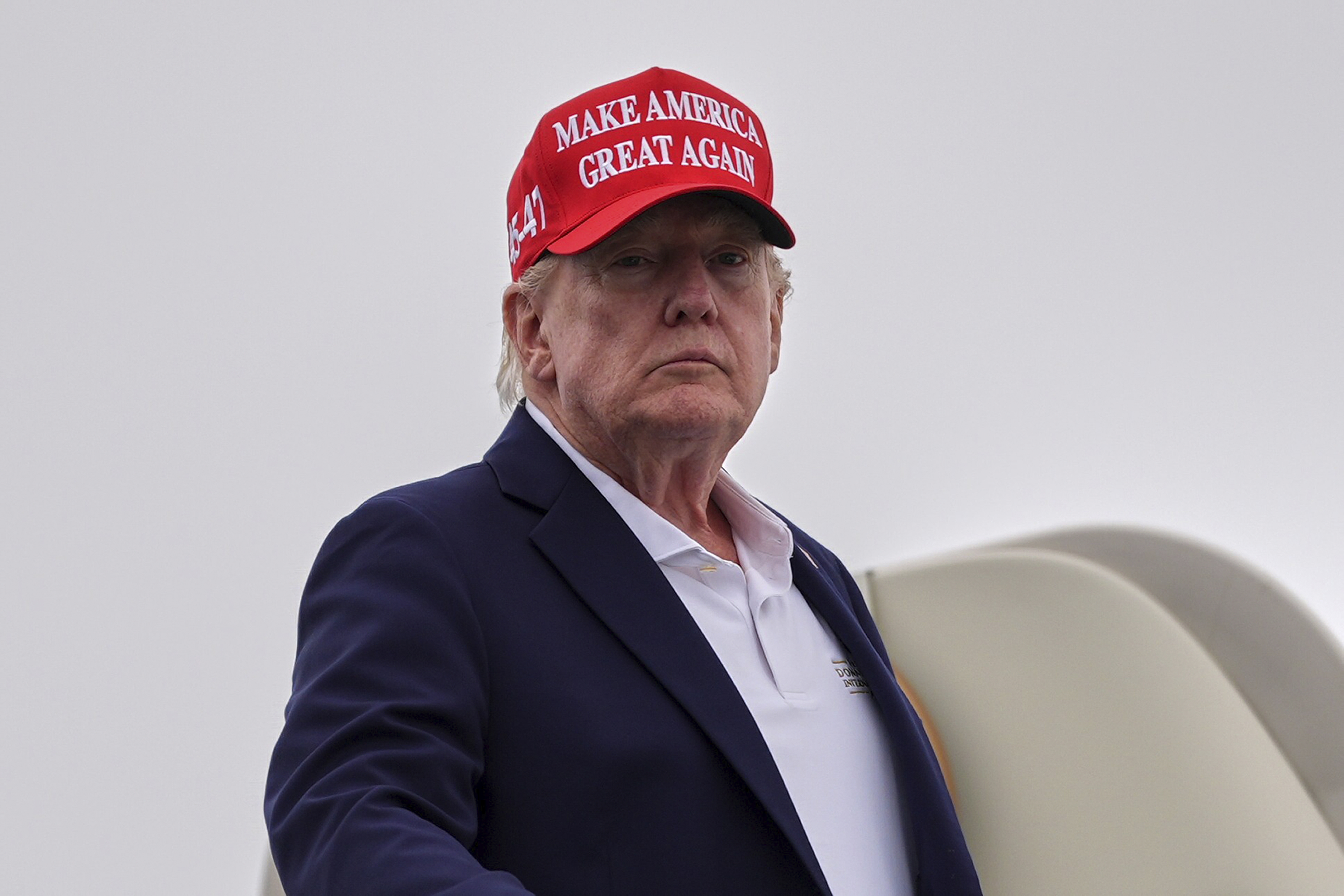
    President Donald Trump boards Air Force One on Sunday, Aug. 16, 2026, in Morristown, N.J. Julia Demaree Nikhinson

    Trump and the Justice Department are also asking the high court to toss out a second Carroll verdict totaling $83 million. They argue he’s immune from being sued over comments he made about her in 2019, when he was president. The court has not yet acted on that appeal.

    Carroll is a longtime advice columnist and former TV talk show host. She testified at a 2023 trial that Trump turned a friendly 1990s encounter into a violent attack in the dressing room at Bergdorf Goodman, a luxury retailer across the street from Trump Tower in Manhattan. The jury found Trump liable for defaming Carroll when he denied her allegation in 2022.

    Trump has denied any wrongdoing.

    The Associated Press does not identify people who say they have been sexually assaulted unless they come forward publicly, as Carroll has done.

  • Ukraine launches one of its largest aerial attacks of the war, killing at least 6 people in Russia

    Ukraine launches one of its largest aerial attacks of the war, killing at least 6 people in Russia

    Ukraine launched hundreds of drones across Russia on Sunday, killing at least six people in one of Kyiv’s largest aerial attacks of the war.

    Kyiv has stepped up its attacks on Russia this year, with long-range missiles and swarms of drones targeting military industries and energy facilities. It has also increasingly pummeled giant Wildberries depots, burning billions of dollars’ worth of merchandise belonging to the Russian online retail giant. Those attacks have brought the war home to the Russian public nearly 4½ years into Moscow’s full-scale invasion of Ukraine.

    Meanwhile, Ukraine also came under Russian attack, with drone strikes destroying homes and torching Kyiv’s landmark book market.

    Russia’s Ministry of Defense said it had destroyed 822 Ukrainian drones overnight. Some 600 drones were detected headed toward the Russian capital, Moscow Mayor Sergei Sobyanin said, with a third of those destroyed over the Moscow region itself.

    An 83-year-old man was killed after a Ukrainian drone hit a private home in the Moscow region, local Gov. Andrey Vorobyov said. He also confirmed that a Ukrainian attack had sparked a blaze at a Wildberries warehouse in the town of Podolsk.

    A drone attack targeted three towns in Russia’s southwestern Rostov region, killing five people, local Gov. Yury Slyusar said. The attack, with more than 150 drones, damaged several homes and a railway station and sparked a forest fire.

    Russian strikes kill 5 in Ukraine

    A Russian missile attack on Ukraine’s Kryvyi Rih killed two people and wounded 14 others, Ukrainian President Volodymyr Zelensky wrote on social media Sunday. He also said that one more person had been killed in the city of Sumy.

    ArcelorMittal Kryvyi Rih, Ukraine’s largest steel producer, confirmed that one of its sites had been hit in a missile attack and that operations had been partially suspended.

    Elsewhere, a man and a woman died when their home was hit by a Russian strike in Ukraine’s southern Zaporizhzhia region, said Ivan Fedorov, the head of the local military administration.

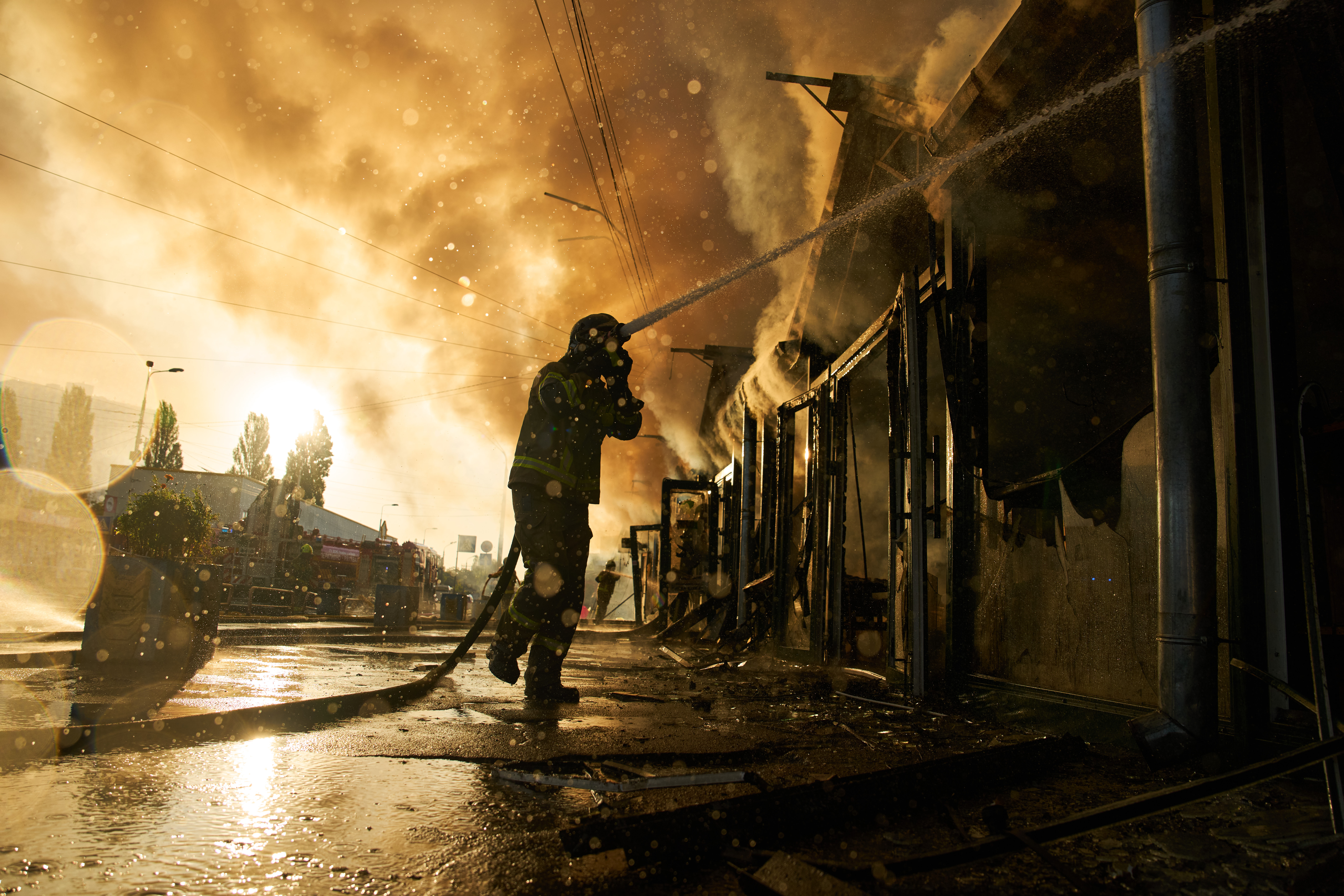
    Russian attacks also sparked fires throughout the Ukrainian capital, Kyiv, wounding six people. A blaze took hold at one of the city’s largest book markets, tearing through kiosks huddled close to the Pochaina metro station. Firefighters fought back the flames, which sent plumes of black smoke across the capital, and picked their way through rubble where the market’s crowded pavilions once stood.

    “Wherever the Russians can reach with their ballistic missiles, they strike civilian infrastructure,” Zelensky said.

    Russia’s Ministry of Defense said Sunday that it had targeted a metallurgical plant in Kryvyi Rih and several military-industrial sites in Kyiv, including a manufacturing facility for Ukraine’s Flamingo missiles.

    The domestically produced missiles are increasingly key to Ukraine’s long-range attacks on Russia, with Zelensky announcing Saturday that Kyiv had used the weapons to attack a rocket research and production center in Samara approximately 560 miles from the Ukrainian border.

    NATO jet downs drone in Romanian airspace

    Romania’s Ministry of National Defense said Sunday that a Spanish Air and Space Force F-18 fighter jet shot down a drone that had entered Romanian airspace.

    The drone’s entry into the NATO member’s airspace was detected by surveillance systems at 4:44 a.m., the ministry said, about 14.9 miles north of the eastern city of Galati near the border with neighboring Moldova. Moldova is a landlocked country between Ukraine and Romania.

    A Spanish F-18 aircraft that was performing air policing duties “made radar contact with the target and received engagement approval,” the ministry said. “The drone was safely shot down by the F-18 aircraft at 05:01.”

    The ministry later said that drone debris was also reported in the Black Sea around 10 a.m. on Sunday, about a mile from the coastal city of Constanta. Separately, another drone fragment was found on Sunday 1 nautical mile from Constanta.

    Romanian officials did not specify the drone’s origin.

    However, Moldova’s Ministry of Defense said Sunday that its Army surveillance systems had detected a Geran-type Shahed drone in Moldovan airspace, which entered from Ukraine and exited toward Romania.

    The spate of drone incidents comes weeks after Romanian pilots shot down three drones over three days as Russia intensified attacks against Ukraine near the border. Since Russia’s full-scale invasion of Ukraine, Romania has reported dozens of drone incidents, including some that have crashed and exploded on its territory.

    Acting Foreign Minister Oana Toiu said in a post on X that the Spanish deployment in Romania was scaled up “at the request of Romania and NATO to bolster the Eastern Flank following prior drone incidents,” and that it was Spain’s fourth such deployment.

  • Rescuers in Indonesia recover 6 more bodies in earthquake aftermath, raising death toll to 53

    Rescuers in Indonesia recover 6 more bodies in earthquake aftermath, raising death toll to 53

    RUTENG, Indonesia — Rescue teams in eastern Indonesia recovered six more bodies Sunday, a day after a magnitude 7.7 earthquake, raising the death toll to 53, authorities said, as thousands of displaced people spent the night outdoors in fear of aftershocks.

    Rescuers dug through debris looking for anyone buried beneath landslides triggered by the quake across six regencies on Flores, a predominantly Catholic island in the Muslim-majority country. They focused on three regencies that remained inaccessible: hardest-hit Manggarai, East Manggarai, and Nagekeo.

    “We have cleared most landslides and reopened roads to previously isolated villages, although communication disruptions and power outages continue to hamper search efforts,” said Fathur Rahman, head of the search-and-rescue office in Maumere, the capital of Sikka regency.

    The agency said more than 900 homes were destroyed and 450 more damaged in East Nusa Tenggara province, forcing about 5,000 people into temporary shelters. At least 241 homes were damaged in the Flores region alone, Muhari said.

    The quake occurred at a depth of 6 miles shortly before 6 a.m. Saturday, the U.S. Geological Survey said. Residents fled in panic as tsunami warnings were issued and later lifted.

    Authorities have since recorded at least 995 aftershocks, but only 46 were felt by residents, said Abdul Muhari, the National Disaster Management Agency’s chief for disaster prevention, adding that 135 people were injured.

    Many residents at Labuan Bajo, the gateway to Komodo National Park, one of Indonesia’s best-known tourist destinations, spent the night outside because of the aftershocks.

    “The shaking was terrifying, so intense that my house nearly collapsed,” said Anastasia Imad, a farmer, speaking from a makeshift green tent beside her damaged home. “We feared the aftershocks would bring it down on us while we slept.”

    Landslides blocked sections of the Trans-Flores Highway, a roughly 435-mile road linking communities across the mountainous island.

    Meanwhile, relief workers distributed rice, ready-to-eat meals, drinking water, blankets, and medicine, while emergency shelters were set up for displaced residents. Authorities said restoring electricity and communications, as well as delivering aid to remote villages isolated by landslides, were among the biggest challenges.

    Indonesia, an archipelago of more than 17,000 islands, is prone to earthquakes and volcanic eruptions because of its location on the Pacific Ring of Fire, a horseshoe-shaped arc of seismic faults and volcanoes.

    Flores has experienced some of the country’s deadliest disasters. A powerful earthquake and tsunami in 1992 killed about 2,500 people on the island.

    In 2018, a magnitude 7.5 earthquake triggered a tsunami on the island of Sulawesi that killed more than 4,400 people. In 2004, a magnitude 9.1 quake off Sumatra unleashed a tsunami that killed about 230,000 people in a dozen countries.

  • Frustration with Trump grows among U.S.’s Persian Gulf allies, officials say

    Frustration with Trump grows among U.S.’s Persian Gulf allies, officials say

    Frustration with Washington is growing in the Persian Gulf region, where U.S. allies are increasingly concerned that President Donald Trump is unable to manage the diplomacy necessary to secure peace with Iran, Arab and Western officials say.

    Trump in recent weeks has repeatedly issued threats against Iran, only to withdraw them, citing progress in talks. After months of conflict, and continuing missile and drone strikes by Iran and its proxies, three officials and a former U.S. diplomat told the Washington Post, the governments of Saudi Arabia, the United Arab Emirates, Qatar, Kuwait, and Bahrain are now united in their aggravation with the administration. Some have begun to debate the utility of continuing to host large U.S. military installations on their territory.

    “Trump started this war,” one Gulf official said, “and we are paying the price.” Like others in this article, he spoke on the condition of anonymity to discuss the sensitive subject. Anger with the United States, the official said, was at its highest point since the U.S. and Israel attacked Iran in February.

    The Gulf states continue to rely on Washington as a close security partner and major arms supplier, and Qatar and Bahrain host large U.S. bases. But the frustration is leading some states to consider new arrangements. These dynamics are unlikely in the near term to significantly reorder the region, analysts say, but some countries have begun to explore their options.

    A mutual defense agreement signed by Saudi Arabia, Turkey, and Pakistan last week was “a signal to the U.S.,” a senior European official said.

    The pact shows the three powerful Sunni Muslim states “are trying to diversify their security and defense partnerships,” said the official, who is in regular contact with Gulf leaders. “In their mind, the U.S. is not enough.”

    A White House official said Trump “has extraordinary relationships with all of our Gulf partners.”

    “The United States has been in regular contact with all of our regional allies since before Operation Epic Fury,” said the official, speaking on the condition of anonymity under rules set by the White House. “Iran is more isolated than ever before as a result of its terrorist actions.”

    Representatives of the Saudi, Emirati, Qatari, Kuwaiti, and Bahraini governments did not respond to requests for comment.

    “There has been frustration from the get-go,” said Firas Maksad, director for the Middle East and North Africa practice at the Eurasia Group. U.S. allies in the Persian Gulf, he said, feel they were “unnecessarily entangled” in a war that Trump is now struggling to resolve.

    Maksad, who has extensive contacts within Gulf leadership, said Trump’s Iran policy is often described in the region as “erratic” and “unpredictable.”

    Anna Jacobs, a fellow with the Arab Gulf States Institute in Washington, said there has been “diminished trust” of the U.S. since the start of the war. U.S. allies think the country’s “conduct in the region is making them less safe, not more safe,” she said.

    One Western diplomat in the region said these changes don’t amount to a significant shift in sentiment toward the United States. Even before the war with Iran, he said, U.S. forces in the region were not “enthusiastically” welcomed. “It was more something that was a necessary evil,” the diplomat said. “Now, the necessity of it is being put in question.”

    Saudi Arabia has come under particular pressure in recent weeks. In addition to attacks from Iran and Iran-backed groups in Iraq, the kingdom has been targeted by Iranian-aligned Houthis in Yemen.

    Houthi forces have repeatedly struck Saudi energy infrastructure and are attempting to shut down the Bab al-Mandab strait at the mouth of the Red Sea. Since Iran closed the Strait of Hormuz in the early days of the war, Saudi Arabia has depended on its Red Sea ports to export its oil.

    Attitudes toward the war among Gulf leaders have shifted. Oman has opposed the conflict from the outset, but Saudi Arabia, the UAE, and Bahrain have at times backed it.

    Emirati forces have conducted “numerous” strikes on Iranian territory in recent months, according to the Western diplomat, and Saudi forces have struck back at Iranian-backed groups attacking from Iraq.

    “At the beginning of the war, they were — I don’t want to say supportive — but honestly, they were not totally against the war,” the senior European official said. The thinking in Abu Dhabi and Riyadh, he said, was that a quick, definitive victory could prove beneficial.

    That began to shift in the lead-up to the first round of talks between Iran and the United States in April, the official said, when it became clear that not only would the Iranian regime not fall, but it would not reopen the Strait of Hormuz.

    In the months since, Trump’s inconsistency has alarmed the Gulf, said Bader Al-Saif, an assistant professor of history at Kuwait University.

    “Even before all this back and forth with Trump, there was no clear strategy,” said Al-Saif, a fellow of the Arab Gulf States Institute in Washington. He cited the Memorandum of Understanding between the United States and Iran in June.

    “The MOU was a joke,” he said. The agreement didn’t address the Gulf states’ top concerns, including Iran’s ballistic missile arsenal or Tehran’s support for proxy forces.

    “Those terms were not terms of our liking,” Al-Saif said, “and that’s why it died out sooner than later.”

    Trump, the White House official said, “has always been clear that his preference is diplomacy.

    “Unfortunately, Iran chose the path of violence by killing American troops, committing international acts of terrorism, and lashing out at its neighbors in the region — and the Commander-in-Chief ensured that they reaped the consequences of those decisions.”

    The Gulf states lack an immediately viable alternative to their decades-long security partnerships with the United States. As the conflict continues, the Gulf official said, their only choice is to double down on their alliances with Washington.

    “Whatever we do,” he said, “we cannot say no to the United States.”

    Douglas Silliman, a U.S. ambassador to Kuwait and Iraq under President Barack Obama and Trump, said he heard frustration with Washington on a recent visit to the region. But in recent weeks, he said, he is also hearing growing anger at Tehran for its continued attacks on infrastructure and refusal to reopen the Strait of Hormuz.

    Silliman, now the president of the Arab Gulf States Institute, described the feeling in the region as “kind of this odd contradiction of being mad at the United States for starting the war and being dependent upon the United States” for equipment, munitions, and intelligence.

    If the conflict continues, the economic pressure on the Gulf will grow. Even during peacetime, the region quiets over the summer, tourism slows, and residents hole up indoors to escape 100-degree days.

    But in autumn, temperatures fall and activity resumes. This year, the conferences, summits, festivals, and Formula One races that pack the calendar from October through December are all in limbo.

    Saudi Arabia’s 10th annual Future Investment Initiative Institute in late October, the “Davos in the Desert,” could be an early test of whether senior officials and top CEOs are willing to visit the region, the Western diplomat said.

    “They may tweak the theme” to acknowledge continued insecurity in the region, he said. “To postpone would send the wrong message.”

    Iran continues to launch drones and missiles against Kuwait, but in the capital, much of life has returned to normal, Al-Saif said. “We have been through worse,” he said, referring to the 1990 invasion by Iraq that triggered the Persian Gulf War. “We handled the occupation. We can handle this.”

    The security lockdown from the war’s earlier stage has been largely lifted. Businesses are open, traffic has returned to city streets, and Al-Saif has resumed teaching in person. But the conflict, he said, must not continue much longer.

    “A quick end is obviously something we want,” he said. “The Gulf War was much more straightforward than today.”

  • U.S., Canada race for deal to avert Trump’s threat of 50% tariffs

    U.S., Canada race for deal to avert Trump’s threat of 50% tariffs

    The United States and Canada are moving closer to a deal to avert the imposition of punitive 50% tariffs on such Canadian products as hockey sticks, wine, and cement, according to industry executives and trade specialists following the talks.

    Details remain fluid, and recent talks were contentious as both sides race to make a deal ahead of an early-Wednesday deadline. But the emerging accord could pair Canadian tariff concessions along with commitments on energy, defense, and critical minerals in return for the U.S. agreeing to shelve President Donald Trump’s new Section 338 tariffs and relax levies on steel and aluminum, according to those following the talks, who spoke on the condition of anonymity to discuss confidential deliberations.

    If a deal is reached, it is expected to provide momentum for the ongoing renegotiation of the North American trade deal reached in the president’s first term. An accord would also spare the administration one more legal battle over the president’s tariff powers.

    “I’m optimistic that there’ll be a resolution in full or in part that will stave off the Section 338 tariffs. That’s the trajectory we’re on,” said Dan Ujczo, a veteran trade attorney in Columbus, Ohio. “Both sides want a deal.”

    Trump’s Section 338 tariffs would apply to just 5% of the $382 billion worth of Canadian goods that the U.S. imported last year. But if they take effect as scheduled at 12:01 a.m. Wednesday, they could scupper hopes for preserving a unified North American trade bloc, industry executives said.

    The imposition of new tariffs, especially at a trade-chilling 50%, would exacerbate anti-U.S. sentiment in Canada, which is already raw after Trump’s repeated gibes about turning Canada into the 51st U.S. state. Prime Minister Mark Carney has said “all options are on the table” in terms of retaliation for any new U.S. actions.

    “You’ve now put the Canadian government, with these 338s, in a position where if we don’t do a comprehensive deal, we may just end up having to politically retaliate and we will be years away from having trade peace,” said Flavio Volpe, president of the Automotive Parts Manufacturers’ Association in Toronto.

    The once harmonious — and nearly tariff-free — relationship between the U.S. and its northern neighbor has witnessed a dizzying exchange of trade blows over the past year.

    Last month, the president invoked an untested provision of a 1930 law known as “Section 338” to threaten the new levies, saying Canada’s retaliation for his 2025 tariffs amounted to unwarranted “discrimination” against U.S. merchandise. U.S. officials also wanted to spur Canada to engage with the president’s demand to amend the 2020 U.S.-Mexico-Canada Agreement governing North American trade.

    Administration officials including Treasury Secretary Scott Bessent and Jamieson Greer, the president’s chief trade negotiator, took offense at Carney’s decision to retaliate last year, noting that only Canada and China responded to Trump’s “Liberation Day” tariffs.

    The Canadian government says it had every right to hit back after Trump raised barriers against its exports. Administration officials say the Canadian retaliation unjustly penalized three American industries — alcohol, autos, and dairy.

    Officials in most Canadian provinces including Ontario, the most populous, removed U.S. wines and spirits from government-run stores in March 2025 after Trump imposed tariffs on Canadian goods for what he said was a failure to prevent illicit fentanyl from entering the United States.

    Canada also imposed a 25% tariff on some U.S. autos in response to a similar move by Trump, fracturing an industry that routinely ships half-finished vehicles among the three North American nations before completing production.

    The president also complains that European cheeses enjoy preferential access to the Canadian market compared with similar American products shipped north.

    The current talks are aimed at averting what could prove to be a costly breakdown in trade and paving the way for the start of formal U.S.-Canada talks about refreshing USMCA.

    The U.S. began talking to Mexico months ago over possible changes to the North American trade deal that Trump negotiated during his first term. But no formal negotiations occurred with Ottawa. A deadline deal could change that.

    “Depending on the outcome, it’s either a confidence-building exercise that sets the stage for more progress on USMCA, or it’s another friction in the relationship that could spiral quickly,” said Jake Colvin, president of the National Foreign Trade Council, which represents companies such as Caterpillar, Coca-Cola, and Oracle.

    Carney has said that he wants a full settlement, not just a limited deal. Negotiators are trying to strike a balance between what Trump wants and what Canada’s domestic politics will swallow, the industry executives said.

    Along with tariffs, the two sides are discussing cooperation on energy and defense issues, including Canadian participation in Trump’s “Golden Dome” missile shield and purchases of F-35 fighter aircraft. The U.S. also wants to secure access to Canadian supplies of critical minerals, which could help reduce its dependence on China.

    A key goal for Canada is getting the U.S. to reduce its 25% national security tariffs on steel and aluminum. These Section 232 measures, named for a provision in a 1962 trade law, could become a mix of tariffs and import quotas.

    Canada could pocket a politically salient win in the form of lower tariffs on its lumber exports to the U.S. Under a routine annual Commerce Department review of antidumping duties, those long-standing taxes could drop by around 10 percentage points, executives said.

    Though Canada and the United States have long been close friends and allies, the cross-border friction has become a staple of the Trump era. Earlier this month, Trump lambasted Canadian leaders as “nasty” in a Las Vegas speech. Carney responded by applying the adjective to the two nations’ trade relationship.

    Permanently higher tariffs resulting from the collapse of USMCA would cost the U.S. economy $1 trillion over 10 years, according to an Oxford Economics study.

    “There’s a lot at stake. This isn’t theoretical. This has real-life ramifications for Americans and Canadians,” said Beth Burke, the head of the Canadian American Business Council, which sponsored the study.

  • Top U.S. commander visits aircraft carrier, discusses mental health issues

    Top U.S. commander visits aircraft carrier, discusses mental health issues

    The senior U.S. officer overseeing the war in Iran said addressing mental health concerns was a high priority for the military, days after reports emerged of burnout and poor conditions aboard USS Abraham Lincoln. But Adm. Brad Cooper also said some of the concerns that had surfaced were “old news.”

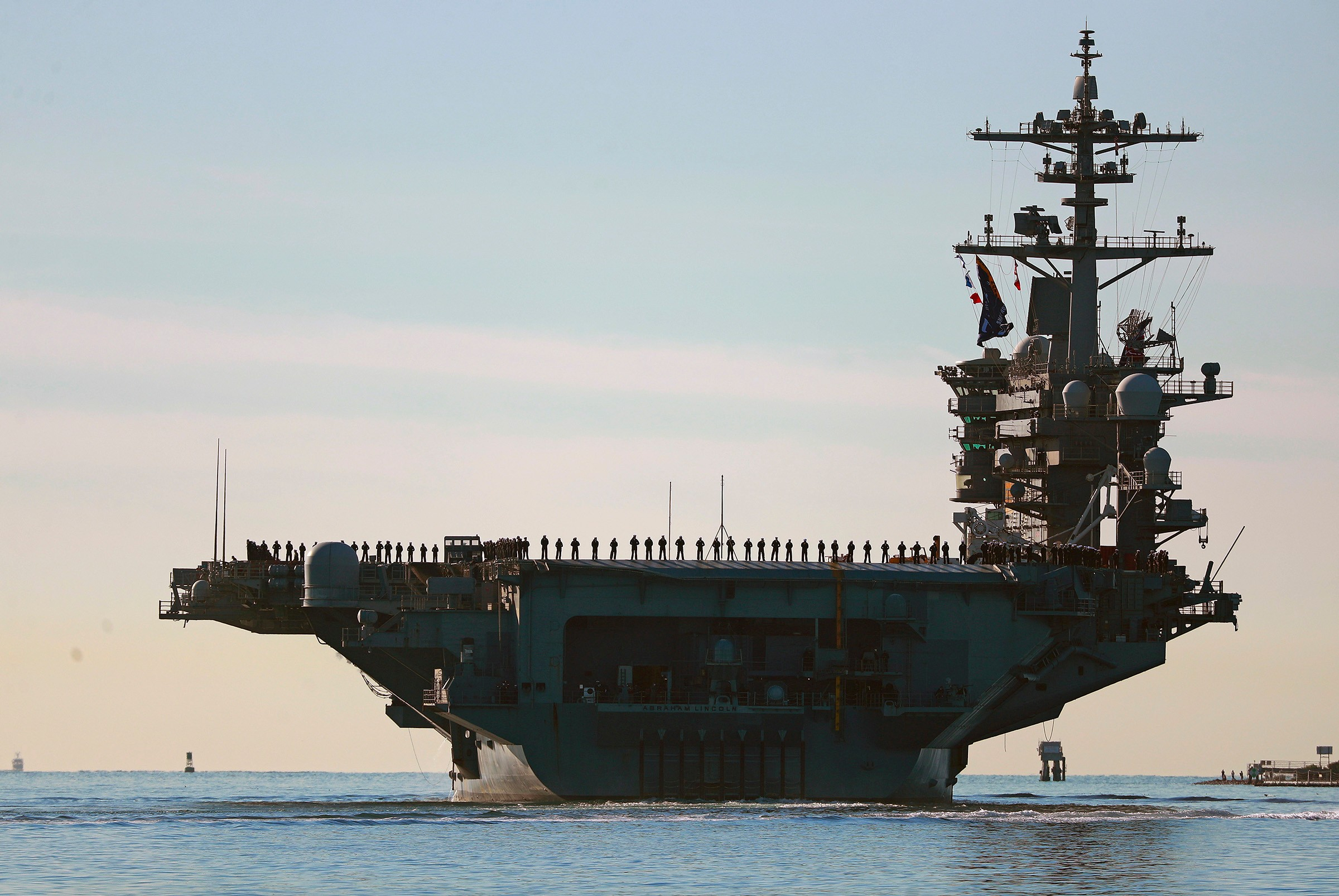
    Cooper, the head of U.S. Central Command, visited the USS Lincoln on Saturday during a Middle East tour. He called his time aboard the aircraft carrier “awe inspiring” and said he witnessed “camaraderie, teamwork, and resilience.”

    “This doesn’t mean that all is perfect,” the admiral said as he acknowledged that long stretches at sea are “uniquely challenging and tough.” He said mental health is “another aspect of individual health and requires our attention just like physical health and spiritual health.”

    The USS Lincoln’s deployment has stretched more than a month past its planned seven-month schedule. Senate Democrats have pressed military leaders on reports of food and supply shortages, water contamination, sewage problems, deteriorating morale, and attempted suicides on the ship.

    The Military Times reported last week that at least two sailors have attempted to jump overboard, with the wife of one sailor saying burnout caused her husband to try to jump.

    Defense Secretary Pete Hegseth downplayed the reports last week, saying the situation has been “completely misrepresented.” When asked Friday whether the deployment of the USS Lincoln had gone on too long, President Donald Trump dismissed that, saying it was “not nearly long enough.”

    Cooper, in a separate opinion piece Sunday in the Wall Street Journal, said that “issues related to food, hot water, and other concerns” were raised “months ago” and addressed by leadership.

    “What I found aboard the Lincoln is that many elements of those stories are old news,“ he said, referring to the issues of morale and ”operational tempo.“

    U.S. officials have confirmed that the USS Abraham Lincoln would return home soon as part of a planned rotation. The Pacific-based aircraft carrier USS George Washington is expected to replace it

    Acting Navy Secretary Hung Cao said in a statement Friday that the crew has been deployed in a combat zone for more than 200 days, carried out 10,000 sorties, and dropped 1.5 million pounds of ordnance.

    It is “also true,” Cao said, that “a small number of mental health cases” were treated with no loss of life and “meal plans were adjusted when fresh resupply was unavailable.” Calls home were also limited when the operational threat was too high, he said.

    While emphasizing that mental health is a “leadership priority” for the senior officers aboard the Lincoln, Cooper said that of the Navy’s 11 active aircraft carriers, “the Lincoln currently has among the lowest number of cases related to mental health.”

    Adm. Mike Mullen, former chair of the Joint Chiefs of Staff, told ABC’s This Week on Sunday that he spoke with Cooper after his visit and said the news that the crew members were coming home had boosted their morale.

    Mullen on ABC News said the reports of the ship’s conditions “were certainly of great concern” but that military officials are “working these issues hard.”

    “I also believe the truth probably lies somewhere in the middle,” he said.

  • U.S. military wants AI dominance, but feuds and China may thwart it

    U.S. military wants AI dominance, but feuds and China may thwart it

    WASHINGTON — In mid-July, many of the country’s biggest military contractors received a letter from the Air Force with a stern warning: By Sept. 1, all the software they use for weapons and control systems must be free of products built by the artificial intelligence company Anthropic. Failure to comply would put all their business with the Pentagon at risk.

    Within a month, those same contractors received an unexpected reversal: They could — for now — disregard the earlier instructions about purging Anthropic.

    It was one more example of the chaos and contradictions in the tsunami of AI disruptions that has swept through the national security establishment in recent months. Agencies including the Pentagon, which still use airplanes designed in the 1950s, are struggling furiously to keep up with AI models whose powers multiply in a matter of months.

    The tension has been magnified in the case of Anthropic, whose CEO Dario Amodei has been locked in a public feud with Defense Secretary Pete Hegseth over restrictions the company tried to put on the technology’s use by the world’s most powerful military.

    Without Anthropic’s powerful Mythos model, it would be far more difficult for the National Security Agency to find and patch vulnerabilities in the Pentagon’s own systems, senior NSA officials argued. And it turned out that, despite the original Anthropic ban, the NSA was still allowed to use its products.

    Critical tests were underway using Mythos to gauge its potential to hack into highly protected foreign networks, current and former officials said. Shutting down the use of Mythos, an AI model whose potential for conducting offensive cyberoperations is already shifting the digital arms race into overdrive, would have amounted to “unilateral disarmament,” according to one recently departed senior U.S. official.

    From the Department of Defense to the CIA and NSA, billions have already been spent on using artificial intelligence to develop weapons that could work with less human control, or to test vulnerable military networks and even nuclear codes to make sure they cannot be cracked by adversarial AI systems. Artificial intelligence is critical to the Golden Dome, President Donald Trump’s vision — fanciful to many experts — of a space-based missile shield.

    But little of that work anticipated the powers of Mythos and its AI counterparts, or the prospect that China may be months away from its own formidable and less expensive versions. That could supercharge China’s ability to infiltrate U.S. communications networks, water systems, and power grids like those they successfully pierced during the Biden administration in two sweeping attacks called Volt Typhoon and Salt Typhoon.

    “These are the kinds of things we were talking about and worrying about before AI became a daily headline,” said Jen Easterly, who ran the Cybersecurity and Infrastructure Security Agency during the Biden administration. “What’s different now, and what makes the problem more urgent, is the potential for AI to amplify those capabilities.”

    So far the Trump administration has veered wildly in response, at first abandoning its hands-off approach to regulating the industry, then briefly shutting off access for foreigners from Mythos — including some of its inventors — then lifting that ban.

    Earlier this month, the administration called in executives from the largest “frontier” creators, including OpenAI and Anthropic, and told them that new models would be reviewed by the government to assure they could not be used to make biological weapons, or break into classified American systems or the communications networks that control nuclear weapons.

    (The New York Times has sued OpenAI and Microsoft, claiming copyright infringement of news content related to AI systems. The two companies have denied those claims.)

    But the government review process exempts open models — including many of those now produced by Chinese firms — whose code can be customized by users.

    One senior executive of a company briefed on the new policy said it made no sense, noting that the open models can be just as dangerous. Like many in the industry, the executive would not be quoted, for fear of angering administration officials.

    Pentagon officials reject the idea they are not agile enough. They say the U.S. military has maintained immediate access to the world’s most advanced AI systems, despite the Anthropic ban. An official, who discussed Pentagon policies on the condition of anonymity, said the Defense Department had recently integrated a version of a Google Gemini model within four days of its commercial release.

    More than 1,300 AI workers have called for the country to slow development. But others, including inside the Trump administration, have answered that call with a question: “What about China?” They fear losing the roughly six-month lead they believe the United States maintains.

    That concern has touched off arguments about whether export controls on some of the most powerful chips made by Nvidia, the leading American maker, are effective in keeping the Chinese from developing the computing power they need to catch up. Controls could also just prompt Chinese makers to obtain the chips on the black market, or double down on development of their own.

    It is easy to compare this moment in U.S. national security to the early days of the Cold War, when the United States was the only nation to possess nuclear weapons, and it was struggling to delay the day the Soviet Union would match the accomplishment. (The first Soviet bomb was tested in late August of 1949, four years after Hiroshima and Nagasaki.)

    CIA Director John Ratcliffe recently reached for just that comparison, saying it would “not be misplaced” to refer to the capabilities of AI as “akin to digital nuclear weapons.”

    But like most such historical analogies, this one has its limits. Nuclear weapons were solely in the hands of the state back then. And the fundamental technology of building and delivering them has changed little in 80 years since. AI is being built in the private sector, and available to all. Many of the most powerful models are updated weekly, their powers, and unpredictability, discovered along the way.

    China is perhaps six months or less behind the United States in the development of the most advanced models, U.S. experts estimate, though probably years behind in making the advanced semiconductors needed to power AI’s development.

    But already there is evidence the main U.S. technological and economic rival is unnerved by the powers being unleashed. Privately some Chinese officials have already been talking about some forms of arms control, even if no one knows how that might work.

    “They realize there is a gap in capability that may play to our strengths,” said Evan S. Medeiros, a professor at Georgetown University and a former National Security Council official. “On nuclear arms control and on missile defense, we can’t get them to engage. But they appear more interested in the case of AI.”

    Trump has said that will be a topic of discussion, again, when he meets President Xi Jinping in Washington in late September. The two leaders are scheduled to see each other again twice, later in the year.

    But when he talks about AI, Trump has neither explained his objectives nor indicated any concerns in recent weeks that AI agents are finding ways to break out of their confines, or acting autonomously to break into outside companies or networks. When news came out that artificial intelligence was used to design a new virus, not found in nature — a development that could herald real medicinal progress or a biological weapon — the White House said nothing.

    But one thing is clear: Many of the hypothetical scenarios that concerned the national security community a year ago have begun to arrive.

    At the Pentagon, punishing Anthropic goes astray

    Within the defense industry, the chaos kicked off by Hegseth and his aides over stripping Anthropic code has only deepened. A month after the Air Force told its contractors to expunge all Anthropic code, it sent another message, telling them to “stand by,” at least for now.

    “At this time, you are not required to remove from your inventory Anthropic products or services that interface with the Department of the Air Force systems and networks,” read the update, a copy of which was seen by the Times. It warned that the latest guidance could be reversed yet again depending on the outcome of litigation.

    The back-and-forth instructions reflected Hegseth’s dilemma: He is trying to punish a leading AI juggernaut deeply embedded in the defense-industrial complex, without handicapping the military’s national security mission.

    Asked about the apparent about-face, a Pentagon official described the new Air Force guidance as temporary and said the mandate to purge Anthropic across the Department of Defense was absolute.

    Publicly, the Pentagon has refused to relent. In interviews, Pentagon officials have suggested that the animosity between their department and Anthropic began when the Silicon Valley firm began making what the military saw as ridiculous demands about how the Claude for Government model, a version of the popular, publicly available AI model, would be used. Senior officials said Anthropic presented them with 25 pages of restrictions.

    After several contentious months, those 25 pages were boiled down to two restrictions. In a February meeting at the Pentagon, Amodei told Hegseth that the company would not provide any products to the military unless he had assurances they would not be used for domestic surveillance of Americans or to produce fully autonomous weapons that were not ultimately controlled by human oversight.

    It was not enough. The defense secretary got his back up, noting that Raytheon doesn’t dictate limits about how the missiles it produces can be employed against adversaries; those decisions, Hegseth said, were completely in the realm of government officials, not corporate executives. When Amodei refused to relent, the Pentagon declared the company was a “supply chain risk” — and banned for military use.

    In May, Emil Michael, the undersecretary of defense for research and engineering, told a Times reporter that Anthropic deserved what it got, and that the Pentagon made a mistake by over-relying on a single producer of AI programs — even one whose products seemed ahead of both competitors and of China. Asked whether there was anything the company could do to get back in the department’s good graces, Michael said “not at the Department of War.”

    Pentagon officials say they have all but completed the removal of Anthropic from military computing systems. Close to 100% of military systems that once used Claude for Government, amended for use on classified networks, have now replaced Anthropic’s product with other frontier models, according to officials. In addition, the Pentagon has ceased all use of Anthropic tools in its Maven system, which helps analyze intelligence and suggests targets for airstrikes in the war with Iran.

    The military contractors affected by the ban have been reticent to discuss it, perhaps in fear of angering their biggest customer. In a statement, a Lockheed spokesperson declined to comment directly on the letter it received calling for Anthropic’s expulsion from its systems, but said, “We follow the president’s and the Department of War’s direction.” The spokesperson added, without naming Anthropic, that it expected “minimal impacts” to its business because it does not rely on one large-language model for any portion of its work.

    But the Pentagon’s break with the company is hardly clean.

    Barely two months after the blowup between Amodei and Hegseth, Anthropic announced Mythos, an AI product uniquely suited to find, and exploit, vulnerabilities in software. For a brief period, in what now looks like an overreaction, the Trump administration barred all foreigners from touching the program — only to reverse itself.

    That left the Pentagon in a fix: It had just barred itself from using what could be the most powerful new cyberweapon in history.

    “Panic set in,” said a former official who recently left the administration.

    While the Pentagon is not allowing Claude to be used for intelligence analysis or code writing, the NSA has been allowed to use versions of Anthropic’s advanced Mythos model on an “experimental” basis, officials said. It is both testing the U.S. military’s computer network defenses and seeking out potential weaknesses in adversarial networks, from China to Russia, North Korea, and Iran.

    Rethinking opposition to AI regulation

    The inconsistency isn’t limited to the Pentagon; there has been plenty at the Commerce and Treasury departments, and at the White House. As Trump’s aides come and go, and departments elbow each other for larger roles, the administration’s decisions on everything from export controls to national security reviews of AI models have been driven more by whim and influence than an articulated set of principles.

    During its first year, the administration’s approach was hands-off, following the arguments made by David Sacks, the venture capitalist who, until he left the administration earlier this year, ran both artificial intelligence and cryptocurrency policy.

    After publishing an AI Action Plan last year, the Trump administration slashed regulation and encouraged exports, hoping to make the world dependent on what Sacks called an “American tech stack.” In May, Trump scrapped a draft executive order requiring AI companies to submit their models to the government for a safety review, convinced by Sacks, among others, that the 90-day review requirement was too stringent and would give Chinese competitors an advantage.

    But Mythos’ powers spooked people inside the administration, officials and others said. By June, the government had imposed the most heavy-handed controls ever in the AI industry, cutting off access to Anthropic’s model for foreign citizens, including some of the engineers who developed it. Then, two weeks later, it lifted the ban on foreigners, without public explanation.

    A similar whipsawing took place in dealing with the Nvidia chips that are critical to developing new models — and building data centers. In April last year, the Trump administration shut down sales of one of the last artificial intelligence chips Nvidia was allowed to offer in China.

    But the president reversed course that July, following a meeting in the Oval Office between Trump and Nvidia CEO Jensen Huang. Trump said that the sales — which had formerly been considered a national security threat — would be fine, as long as the U.S. government got a cut of their revenue.

    Similarly, the administration revoked a rule imposed by the Biden administration that assured the most powerful chips could only be sold freely to close U.S. allies, and limited sales to other countries. Trump officials have said they would replace the measure, but they have clashed on a replacement. In the meantime, some American companies concluded that with the rules revoked, they were free to sell advanced chips to some Chinese firms operating outside of China.

    Trump later brought Huang to China for his visit with Xi, along with other industry executives.

    The administration is now dealing with conflicting security and political currents. If it exercises too much control over the nascent AI pioneer labs and threatens to cut off foreign access, it could drive the Europeans to Chinese models. If it under-regulates, it could invite disaster, especially if there are more incidents that make the public fear that the technology is racing out of control.

    Chris McGuire, a senior fellow at the Council on Foreign Relations and a former Biden administration official, said that the Trump administration’s posture on export controls had been “incoherent.”

    The Trump administration is now concerned about competition from open-source models from China, but it had walked back many measures that were preventing China’s AI advancement, he said. And it was targeting its harshest restrictions on Anthropic, an American company, not a Chinese one.

    “You’re loosening export controls on China, you’re leaving loopholes, and the first time you use export controls on AI is to blast an American company?” McGuire said.

    This article originally appeared in the New York Times.

  • Israel’s Ben Gvir advocates killing ’30 to 40′ people in Gaza nightly while speaking to ex-hostage

    Israel’s Ben Gvir advocates killing ’30 to 40′ people in Gaza nightly while speaking to ex-hostage

    JERUSALEM — An extremist Israeli lawmaker in Prime Minister Benjamin Netanyahu’s coalition publicly advocated for killing “30 to 40” people in Gaza each night, comments that surfaced Sunday and were quickly shared by Palestinian media.

    Minister of National Security Itamar Ben-Gvir made the statement while speaking to a former Gaza-held hostage, Rom Braslavski, on Braslavski’s podcast. The two were discussing Israel’s recovery from the Hamas attack of Oct. 7, 2023, when Ben-Gvir criticized Israel’s recent drawdown of strikes in Gaza.

    “It’s no secret, I disagree with the prime minister,” he said. “I think targeted assassinations should be carried out in Gaza, taking down 30 to 40 every night. Not just those who pose an immediate threat — there are people there who are not worthy of life. They shouldn’t live. They’re not even people.”

    In the past, similar statements by Ben-Gvir and other Israeli officials were widely condemned. Many have been presented to the UN’s world court as evidence of genocidal intent. Israel denies it has committed genocide in Gaza.

    Israel’s domestic media has made scarce mention of the statement, highlighting how once-fringe ideologies like Ben-Gvir’s are surging in the lead-up to Israeli elections Oct. 27.

    Figures like Ben-Gvir have become more popular among Israelis since Hamas’ brutal attack in 2023, when the militants killed about 1,200 people and took 251 hostage. Many hostages have recounted long-term starvation, physical and psychological abuse, and, in some cases, sexual abuse.

    Ben-Gvir oversees Israel’s police force and prisons

    Ben-Gvir does not have power over the country’s military and cannot order strikes on Gaza. But, after operating for decades within Israel’s far-right fringe, he is now one of the most influential people in the country.

    He has substantial control over key parts of Israel’s security apparatus, running the country’s prisons — where thousands of Palestinians from Gaza and the West Bank are incarcerated — as well as the national police force.

    He has previously boasted of lessening food rations for Palestinian prisoners. Israel’s top court ruled in 2025 that the prison service under Ben-Gvir was depriving Palestinians of a minimum subsistence diet.

    Ben-Gvir criticizes drawdown of Israeli strikes in Gaza

    Until recently, Israel was striking Gaza nearly every day, attacks that have killed over 1,250 people since an October truce deal came into effect, according to Gaza’s Health Ministry.

    Israel’s military, which says the strikes have targeted Hamas militants, appeared to ease off on the attacks in a quiet concession to U.S. President Donald Trump after Netanyahu rejected the president’s latest attempt to move the truce forward.

    Israeli media last week reported that the authority for carrying out strikes has now been limited to the army’s chief of staff, raising the ire of right-wing lawmakers such as Ben-Gvir.

    Ben Gvir advocates mass emigration, expulsion of Palestinians from Gaza

    In the same taped appearance, the lawmaker advocated for mass emigration of Palestinians from Gaza — a proposal that international lawyers say could amount to ethnic cleansing — and resettlement of Gaza by Israel.

    Twenty years ago, Israel withdrew from the Gaza Strip, dismantling a block of 21 Jewish settlements known as Gush Katif and pulling out its forces.

    “I see all of Gaza as ours,” said Ben-Gvir in the interview. “Settlements not just in Gush Katif but throughout Gaza, encouraging as much emigration as possible, sending them to their countries, and for the terrorists, no emigration, nothing, just to kill them one by one.”

    Trump’s latest proposal involves Hamas gradually giving up its weapons while Israeli forces halt their attacks and begin withdrawing from Gaza. Hamas accepted the deal, although the group linked the surrender of its heaviest weapons to the creation of a Palestinian state, something Israel’s current government and most of its political class adamantly reject.

    Netanyahu says Israel will not retreat from any of its positions in Gaza until Hamas has been completely disarmed. The stance leaves other elements of the ceasefire, including the deployment of international forces and any reconstruction of the devastated territory, on hold.

  • Firefighters battle massive blazes in Belgium and Greece as 2 die on an island near Athens

    Firefighters battle massive blazes in Belgium and Greece as 2 die on an island near Athens

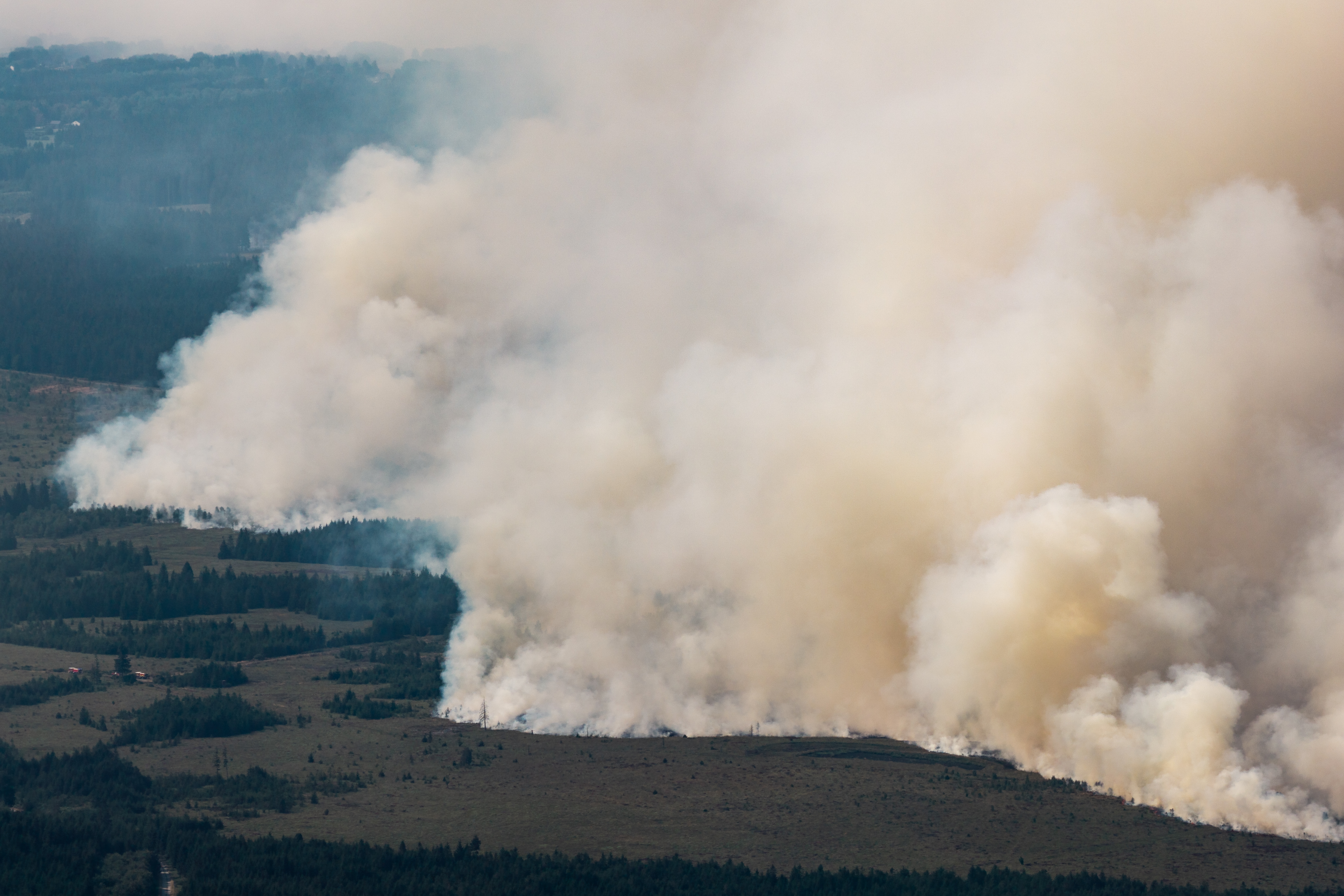
    BAELEN, Belgium — Firefighters battled a massive wildfire that scorched a nature reserve in eastern Belgium and another on a Greek island where two people were killed on Sunday as hot and dry conditions fueled fires across parts of Europe.

    A blaze in eastern Belgium burned about 12 square miles in the High Fens, a large nature reserve, in one of the country’s worst wildfires in recent history.

    About 600 residents in the nearby municipalities of Waimes and Bütgenbach, in Liège province near the German border, were told to evacuate on Saturday as winds shifted and smoke spread through the area. Authorities also advised tourists to leave, while a nearby gymnasium was opened to receive evacuees.

    Liège provincial governor Hervé Jamar said in a statement Sunday that more than 250 emergency personnel have been deployed, including over 100 Belgian and German firefighters, as well as police and military officers and civil protection staff. Firefighting helicopters operated by Belgium’s federal police and the Netherlands also helped.

    Two killed as fires break out on a Greek island

    In Greece, two people were killed in a wildfire Sunday on the island of Salamina, west of Athens, Greek firefighters said.

    The bodies were recovered in the village of Peristeria, where strong winds fueled the rapidly spreading blaze. A second blaze was reported in the Selini area. Firefighting and coast guard vessels were evacuating beachgoers in the area.

    Some 260 firefighters were responding to the blazes, including 15 ground teams, 10 aircraft, and eight helicopters.

    The island had been placed at high wildfire risk on Sunday, with near gale-force winds. “These conditions enabled the fire to quickly reach dangerous proportions and spread rapidly within seven minutes toward nearby residential areas,” said Fire Brigadier General Vasileios Vathrakogiannis.

    Dry conditions fuel record-breaking Belgium wildfire

    The blaze now torching Belgium has far surpassed a 2011 fire that burned nearly 5.4 square miles in the same area and was previously the country’s largest wildfire on record, according to data from the European Forest Fire Information System.

    Nicolas Yernaux, a spokesperson for the Public Service of Wallonia, said conditions were much worse this time. “We’re dealing with something much deeper because we have very dry soil,” he said.

    René Dahmen, chief engineer at the Department of Nature and Forest, said the fire was still spreading Sunday in an area that was difficult for crews to reach.

    “On the eastern flank, there’s a line at least a kilometer long where the fire is slowly advancing toward a municipal forest,” Dahmen said. “That’s the first priority now.”

    Interior Minister Bernard Quintin said on X firefighters managed to keep the fire from spreading towards the west and toward the German town of Monschau.

    In Germany, local authorities warned Sunday that the fire was just under a mile from the border.

    Some farmers from both Belgium and Germany filled up tanker trucks, pumping water from a nearby lake before heading toward the fire area to help firefighters.

    European countries send firefighting aircraft

    Belgium activated the European Union’s civil protection mechanism to receive assistance from other countries, EU Commissioner Hadja Lahbib, who is in charge of crisis management, said on X.

    “The High Fens are burning. Belgium is not facing it alone,” Lahbib said. Sweden sent two water-bombing aircraft, while three helicopters — two from the Netherlands and one from the Czech Republic — were also being deployed.

    The fire follows weeks of unusually hot and dry weather. The High Fens’ mix of heathland and peat bogs has complicated efforts to contain the flames.

    Belgium was hit by another spell of intense heat this week, with temperatures reaching about 98.6 F in parts of the country Friday.

    Wildfires burn in France and the U.K.

    In France, firefighters battling a wildfire in a pine forest in the southwestern Landes region faced no major flare-ups overnight, Landes Prefect Gilles Clavreul said. Authorities estimated the total area burned at 6.6 square miles, while about 650 people had been evacuated from their homes.

    It was the third major wildfire in the vast pine forests of southwestern France this summer, following two others in late July. A massive wildfire in the neighboring Gironde department burned about 162 square miles and forced the evacuation of about 220,000 people as it spread toward the Atlantic coast and the Bordeaux area.

    In the U.K., emergency crews were fighting 14 wildfires in South Wales with the support of military personnel. Authorities warned that although the heat wave is easing, drought conditions mean the risk of wildfires remains high.

    Fires gutted more than a dozen homes in the West Midlands in central England this week as officials recorded the hottest day of the year on Thursday, when temperatures reached 100.6 F.

    In Germany, firefighters made significant progress against a wildfire in the Hürtgen Forest, allowing about 2,000 evacuated residents of Gey to return home Saturday. Officials said Sunday there were no open flames and crews had established a cleared cordon around the affected area to prevent the fire from spreading.