Category: Nation & World

  • The U.S. national debt is set to hit $40 trillion this week

    The U.S. national debt is set to hit $40 trillion this week

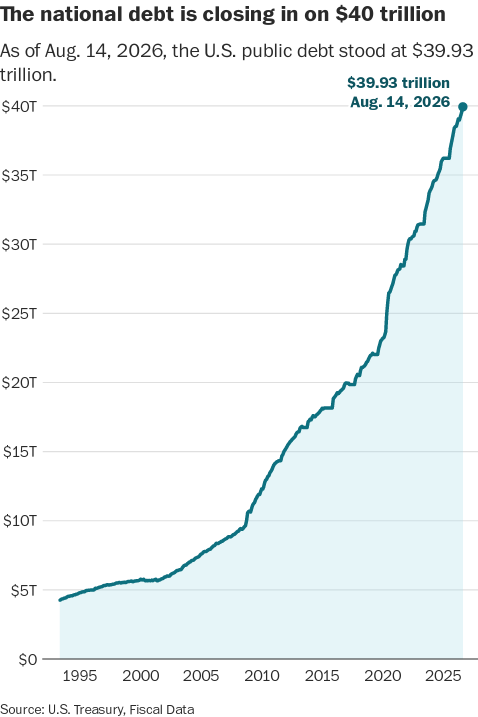
    The U.S. national debt is likely to surpass $40 trillion this week, months earlier than forecasters previously expected, in part because of billions of dollars in lost revenue from President Donald Trump’s invalidated tariffs.

    The lost revenue has forced the U.S. Treasury Department to borrow more rapidly to cover the nation’s bills: Six months ago, the nonpartisan Congressional Budget Office projected that total borrowing would top out at $39.4 trillion this fiscal year. But on Monday, Treasury reported that the debt stood at $39.9 trillion and counting.

    The faster accumulation of debt means the next deadline for raising the legal limit on borrowing is also likely to arrive ahead of schedule. Just last year, Congress set the debt limit at $41.1 trillion. Budget analysts now say borrowing could hit that threshold by early next year, forcing lawmakers either to suspend it or raise it again to avoid the risk of an economy-shaking default.
    Trump is already focused on the debt limit, which has repeatedly plunged Washington into a dangerous game of legislative chicken. Late last month, the president urged the Senate to address “the ever looming Debt Ceiling disaster” before leaving town for its August recess.

    Senate leaders did not comply, but Majority Leader John Thune (R-South Dakota) told reporters at the time that “we’ll have to be dealing with it.” He added: “$40 trillion in debt — seems to me that should get our attention.”

    For the past quarter-century, the national debt has grown under both parties, through the tax cuts of the George W. Bush era, the wars in Iraq and Afghanistan, the Great Recession, the 2017 Trump tax cuts and the nearly $2 trillion Biden administration initiative to prop up the economy during the coronavirus pandemic. Trump pledged during his first campaign in 2016 to eliminate the debt within eight years; instead, it has doubled since he first took office.

    This year, the gap between spending and revenue was already expected to approach $2 trillion, the CBO reported in February. Days later, the U.S. Supreme Court struck down Trump’s “Liberation Day” tariffs, cutting federal revenue by an estimated $250 billion. The Treasury has also increased borrowing lately to build up its cash reserves.
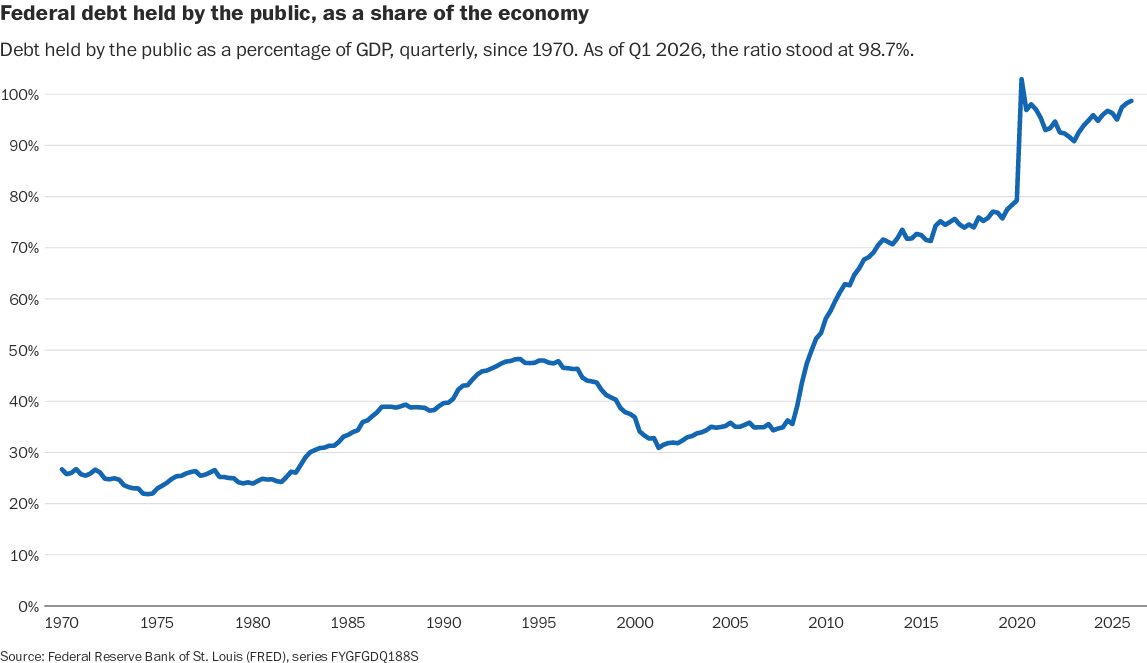
    Military spending tied to the conflict with Iran could add more to the debt in the months ahead, according to the Bipartisan Policy Center, a nonpartisan Washington think tank that tracks federal spending.

    “Our current fiscal trajectory is plainly unsustainable, and that’s the best-case scenario,” BPC president and CEO Margaret Spellings said in a statement. “AI disruption, a recession, global war, or any number of other events could quickly push us over the edge from a challenge into a full-blown crisis. Even in the rosiest scenarios, we’re speeding toward a cliff and refusing to turn the wheel.”

    In an email, White House spokesman Kush Desai said that “the Trump administration remains focused on slashing waste, fraud, and abuse across the federal government while accelerating economic growth, policies that will get America’s debt-to-GDP ratio trending in the right direction.”

    So far, Washington lawmakers have raised or suspended the debt limit every time it has been reached, but often after dramatic, deadline-pushing partisan battles. Even these near misses have rattled markets and carried a price: Standard & Poor’s, Fitch and Moody’s have each downgraded the credit rating of U.S. government debt since 2011, moves tied at least partly to debt ceiling brinkmanship.

    Congress last raised the debt limit in quieter fashion, adding $5 trillion to the debt ceiling as part of the One Big Beautiful Bill Act, the Republicans’ marquee tax and spending law. Measures to raise the debt ceiling often include spending cuts aimed at reducing the annual budget deficit. But the One Big Beautiful Bill Act, which Trump signed in July 2025, did the opposite: That law added $4.7 trillion to projected deficits over the next decade, according to CBO estimates.

    According to preliminary projections by the BPC, Washington is on track to next hit the debt limit between late winter and midsummer 2027. Based on the latest borrowing figures, the center’s estimate is “trending toward the earlier end” of that range, Shai Akabas, the center’s vice president of economic policy, said in a statement.

    Hitting the debt ceiling would not by itself trigger a default. Once the borrowing limit is reached, Treasury can pay bills by drawing on its cash reserves and using stopgap accounting maneuvers known as “extraordinary measures,” which typically buy another six to nine months, according to the BPC. Only after that runs out does the government reach what’s known as the X-date, when the Treasury risks running out of cash and defaulting on its obligations.

    If Republicans lose one or both chambers of Congress in the Nov. 3 midterm elections, they could attempt to raise the debt limit in the lame-duck period during November and December — before the new Congress is seated in January. Otherwise, they could be forced to make policy concessions to Democrats that Republicans — and the White House — would prefer not to make.

    But raising the debt ceiling could prove challenging even under total GOP control. Especially in the House, where the GOP holds a slim majority, party leaders would be forced to win over their fiscal hawks, who have previously revolted when a debt ceiling increase was not accompanied by an agreement to cut spending.

    “You have to raise the debt limit just the same way that you have to pay your credit card bill,” said Marc Goldwein, senior policy director for the Committee for a Responsible Federal Budget, a nonpartisan group focused on deficit reduction. It reflects spending choices you’ve already made, he said. “But if you keep getting credit card bills that are more than you can afford, it’s probably a good time to reassess how much you’re spending, or to get a second job, right?”

    As with many credit cards, interest is itself becoming a bigger part of the problem. Last week, the U.S. government sold 30-year bonds at 5.216 percent, the highest rate in a quarter-century, Bloomberg News reported. Treasury rates ripple into mortgage rates, corporate debt and other borrowing.

    Annual interest payments on the debt are projected to top $1 trillion this year, according to CBO — about the size of the Pentagon budget. They now consume about 19 percent of federal revenue, according to the Peter G. Peterson Foundation, a nonpartisan group that tracks the debt and advocates for fiscal discipline, and are projected to climb to 26 percent by 2036.

    “Interest costs are paying for your past, not paying for your future,” said Peterson Foundation chief executive Michael Peterson, and unfairly burden future generations.

    “It’s immoral to, year after year, trillion after trillion, just keep borrowing the money, not paying your bills for immediate consumption and deferring not only the principal balance but the interest costs onto our kids and grandkids,” he said.

    Peterson pointed to Social Security as a preview of what happens when Washington puts off big problems: Unless Congress acts, the program’s trust fund is projected to become insolvent in 2032, triggering an automatic 22 percent cut in benefits.

    “Can a democracy that’s run by all of us collectively make tough decisions to sacrifice in the short term for long-term benefit?” Peterson said. “The political system hasn’t risen to this challenge in recent decades.”

    Theodoric Meyer and Jarrell Dillard contributed to this report.
  • White House attacks CNN reporter after Trump clash, and targets her children

    White House attacks CNN reporter after Trump clash, and targets her children

    The White House on Monday leveled a sharply personal attack against CNN reporter Kristen Holmes after she asked President Donald Trump a pointed question during a news conference, crossing a barrier rarely breached by politicians to invoke her children.

    “Jon Ossoff said you’d rather travel with your aide Natalie Harp and build the ballroom than do your job as president,” Holmes said. “What is your response?”

    Trump answered Holmes’ question with an insult to Sen. Jon Ossoff (D., Ga.), whom he called a “Pee-wee Herman look-alike,” referring to the Paul Reubens character.

    Then the White House’s “rapid response” account on X took up the altercation, posting a video clip of the exchange and assailing Holmes as a “disgraceful, humiliating embarrassment to her alleged profession.”

    In a follow-up tweet, the account dipped into a more personal line of attack: “Someday, your children will come across your disgusting and inhumane question,” the White House wrote. “They will be sickened and embarrassed to have a parent be so callous and vindictive. It’s quite troubling.”

    The White House did not respond to a request for comment about its social media posts.

    Trump’s personal attacks on journalists have been a defining feature of his combative approach to the press. Though he has criticized reporters throughout his political career, his critiques of women journalists, particularly those representing CNN, have grown more heated in recent months. And the administration has increasingly used official White House social media accounts to escalate what might once have been spur-of-the-moment exchanges.

    Most recently, at the rescheduled White House Correspondents’ Association dinner in July, Trump said that CNN anchor and chief White House correspondent Kaitlan Collins should “just smile” — a misogynistic trope — and likened her appearance to that of Dylan Mulvaney, a transgender activist villainized in conservative circles.

    He followed up by posting an edited image imposing Collins’ likeness on an image of Mulvaney, which was later shared by an official White House account.

    Trump’s critique of Holmes, a senior White House correspondent, continued during the news conference.

    At another point, the president shushed her: “Quiet. Quiet. Quiet. You’re very disrespectful in front of this young man, OK? Don’t you find her disrespectful? He understands. Quiet. Who are you with?”

    “I’m with CNN,” Holmes replied.

    “Fake news. You’re fake news. You’re loud. You’re a loud, boisterous person. You’re fake news,” Trump said. “Be quiet, be quiet, be quiet. You’re a fake reporter, and you report fake news.”

    CNN, in a statement, defended Holmes, calling her “one of the most respected and accomplished journalists covering the White House” and said it rejects the attacks “in the strongest possible terms.”

    “This afternoon, she did her job and asked the President of the United States a tough, relevant, and newsworthy question on behalf of the American people,” a CNN spokesperson wrote in a statement. “Public officials are free to challenge reporting they disagree with, but personal attacks on journalists for asking questions are beneath the office and inconsistent with the principles of a free press.”

    Holmes’ colleagues on CNN’s White House team rushed to her defense. “What a horrible to thing to say. Kristen is an incredible reporter, person and, above all, mother,” White House correspondent Alayna Treene wrote on X. “I don’t understand such a reaction to a journalist asking the president for his response to something a Democratic senator has leveled against him.”

    “Kristen is an excellent reporter who asked a good question, to which the president gave a fulsome answer,” Betsy Klein, a senior White House reporter, wrote. “You know what’s disgusting and inhumane? Bringing her perfect children into this.”

  • Justice Department creates a new pathway to restore gun rights for some convicted of felonies

    Justice Department creates a new pathway to restore gun rights for some convicted of felonies

    WASHINGTON — The Justice Department finalized a rule Monday that will pave the way for people who’ve been barred from owning firearms because of criminal convictions to apply to have their gun rights reinstated.

    The process launched by newly confirmed Attorney General Todd Blanche is a victory for Second Amendment advocates who have long pushed for nonviolent people with felony convictions to be given a pathway to regain their legal right to own firearms.

    “The Second Amendment is not a second-class right, and the federal government should not permanently deprive Americans of a constitutional right without regard to whether they pose a danger to public safety,” Blanche said in a statement. The attorney general said the new process will protect “public safety while giving deserving Americans a real path to restoration.”

    It’s the latest move by President Donald Trump’s administration to ease firearms restrictions. The Justice Department moved earlier this year to roll back and modify a slate of gun regulations. Separately, the department recently decided against challenging a court ruling that struck down regulations on firearm suppressors and certain guns.

    Federal law has long allowed people who’ve had their gun rights stripped because of felony convictions to petition the government for the ability to own firearms again, but Congress since 1992 has effectively barred the federal Bureau of Alcohol, Tobacco, Firearms, and Explosives from processing applications.

    The Trump administration’s rule aims to circumvent that by establishing a new application system using an online portal.

    The Justice Department says restoration will be granted on a case-by-case basis, weighing a person’s record and reputation to determine whether they pose a likely threat to public safety. Officials say people who have been convicted of violent crimes, registered sex offenders, people living in the country illegally, and others whom officials believe pose a danger to society will be denied “absent extraordinary circumstances.”

    Kris Brown, the president of Brady, which advocates for stronger gun laws, said her group is still reviewing the administration’s final rule but has stressed the need for a “robust and thoughtful system that minimizes the risk to public safety.”

    “Yet the Trump administration has consistently shown us they have no such discretion, including by restoring gun rights to convicted domestic abusers and violent January 6 insurrectionists, and by tirelessly rolling back broad policies proven to prevent crime and gun violence,” Brown said in a statement.

  • Kindergarten vaccine exemptions jump to another record high

    Kindergarten vaccine exemptions jump to another record high

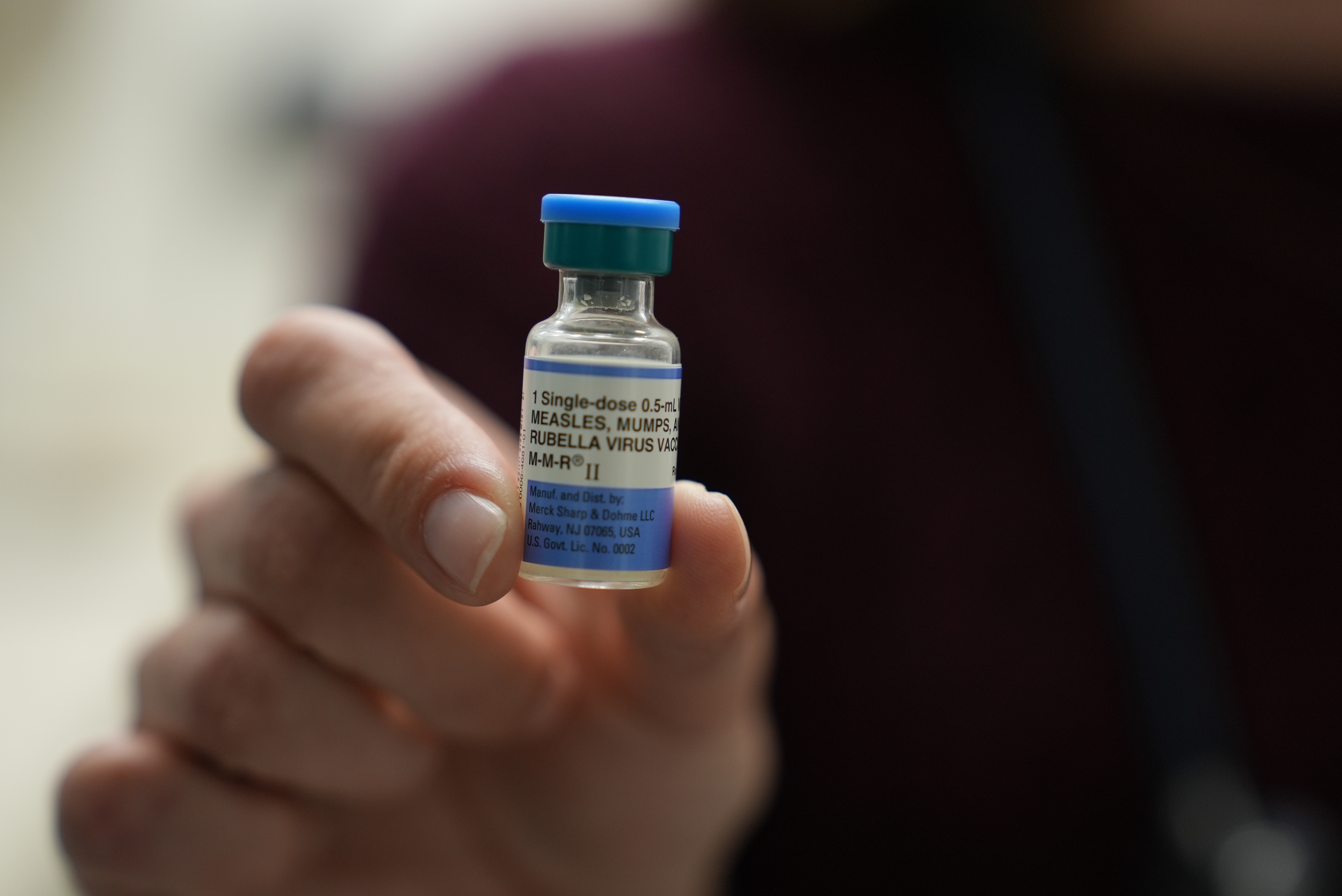
    The share of U.S. kindergartners with exemptions from school vaccine requirements for the 2025-2026 school year rose to another record high, according to federal data posted Monday. The sharp increase from 3.6% to 4.2% seeking exemptions — about 155,000 students — extends a yearslong erosion of childhood immunization rates as the country battles its worst measles resurgence in 35 years.

    As exemptions increased, U.S. kindergarten vaccination rates fell slightly for all reported vaccines from the year before. Coverage for the major vaccines required for kindergarten — MMR (measles, mumps, and rubella); DTaP (diphtheria, tetanus, and acellular pertussis); poliovirus vaccine (polio); and varicella (chickenpox) — decreased in more than half of states for the second year in a row, the CDC said.

    The latest numbers from the Centers for Disease Control and Prevention arrive as President Donald Trump and Health Secretary Robert F. Kennedy Jr. seek sweeping changes to the childhood immunization schedule.

    Trump last week directed federal health officials to move toward giving the measles, mumps, and rubella vaccines separately rather than in the combined MMR shot and to space out childhood vaccinations over more medical visits. The combined shot has been a cornerstone of measles prevention for decades, and separate measles, mumps, and rubella vaccines are not currently available in the United States.

    The proposal defies guidance from major medical groups and is directly at odds with CDC’s own scientific guidance.

    “No published scientific evidence shows any benefit in separating the combination MMR vaccine into three individual shots,” the agency says on its MMR vaccine safety page as of Monday. Elsewhere on CDC’s website, the agency says combination vaccines reduce the number of injections children receive while providing the same protection and may help more children get recommended vaccinations on time.

    The new CDC data released this week shows a continuing decline in childhood vaccination rates and rise in exemption rates, and what’s at stake as the administration seeks to remake federal vaccine policy.

    The biggest factor in the increasing exemption rate came from families seeking nonmedical exemptions, the data shows. Exemptions increased across a broader expanse of the country last year, rising in 41 states and the District of Columbia, compared with 36 states and the District the previous year. Twenty-four states now report exemption rates exceeding 5%.

    In terms of vaccine coverage, the data shows that 92.4% of kindergartners had received the required two doses of the MMR vaccine during the 2025-2026 school year, down slightly from 92.5% the previous year. Before the coronavirus pandemic, the rate was 95%, the level at which it is generally considered unlikely that a single infection will trigger a disease cluster or outbreak. The number of kindergartners attending school without documentation of completing the MMR vaccine series was about 280,000 during the 2025-2026 school year.

    Coverage for other required childhood vaccines also declined, dropping to 92% for DTaP, from 92.1% the previous year, and to 92.4% for polio, from 92.5% the previous year.

    “Measles and other infectious diseases don’t stop at the classroom door,” said James Campbell, chairperson of the American Academy of Pediatrics committee on infectious diseases and a professor of pediatrics at the University of Maryland. “That’s why school entry requirements matter: They protect and keep entire communities safe, and experience shows that when parents receive clear, trustworthy information from health professionals, they’re far more likely to choose vaccination.”

    On Friday, CDC reported 2,566 confirmed measles cases so far this year, 101 more than the previous week’s tally and already exceeding the 2,289 cases recorded during all of 2025. Ninety-three percent of the cases were in people who were unvaccinated or whose vaccination status was unknown.

    CDC made no mention of the record increase in exemptions in a statement accompanying Monday’s data, and stopped short of directly encouraging parents to vaccinate their children. Instead, CDC said that it “continues to encourage parents to discuss vaccination options with their doctors.”

    If parents are worried about what shots their children need for school, they should keep in mind that states, not the federal government, generally set vaccination requirements for school attendance, public health experts say. As of Aug. 11, 30 states had announced that they are no longer relying solely on federal guidelines for their own childhood vaccine recommendations, according to KFF, a health policy organization. Many state health departments have said they will rely on external expert groups such as the American Academy of Pediatrics instead.

    Decades of research involving millions of children have established the safety and effectiveness of the MMR vaccine. Two doses of the vaccine are about 97% effective in preventing measles, which can result in serious complications, including pneumonia, swelling of the brain, and, in rare cases, death from respiratory and neurological complications, according to CDC. Extensive research has found no link between MMR vaccination and autism.

    The White House has said its proposed changes to the immunization schedule, which also call for reducing the number of universally recommended vaccines, are designed to align the United States with its peer nations. But peer nations like Denmark, Australia, and Canada give MMR immunizations in a combination vaccine. Britain this year began replacing the MMR shot with a four-in-one vaccine that also protects against chicken pox.

    Sen. Bill Cassidy (R., La.) blasted Trump’s overhaul of the childhood vaccine schedule Sunday, saying it will raise costs for patients and make vaccines less accessible. Trump has defended the move as sparing children from the combination MMR vaccine, which he said was “sort of like a nuclear weapon.”

    “Now instead of your child getting two shots, she has to get six shots,” Cassidy said Sunday on ABC’s This Week. “Instead of … you missing work to take your child to the doctor two times, you’re doing it six times. And instead of the insurance company paying for two visits, it’s now paying for six visits.”

    The collision between the White House’s vaccine agenda and the scientific guidance of the agency charged with carrying it out also presents an immediate test for Erica Schwartz, who began work as CDC director last week.

    During Schwartz’s confirmation process, senators repeatedly pressed her on whether she would defend scientific evidence if Kennedy or other administration officials sought changes unsupported by it. Cassidy ultimately supported her nomination after initially expressing concerns, saying after additional conversations that he was confident Schwartz “knows what she is doing and will stand against those who do not.”

    Even though CDC is responsible for federal vaccine policy following recommendations from its independent vaccine advisory committee, scientists at the agency said they did not know that the executive order was coming, and officials are unsure of what it means for the agency.

    The White House is calling for Kennedy’s Department of Health and Human Services Task Force on Safer Childhood Vaccines to craft proposed changes within 90 days. The long-defunct panel was revived last year after a push from anti-vaccine activists. That task force makes recommendations that aim to improve vaccine safety, not to determine the optimal vaccine schedule, public health law experts have said.

  • A dispute about fact vs. fiction at the trial over Tupac Shakur’s 1996 killing in Las Vegas

    A dispute about fact vs. fiction at the trial over Tupac Shakur’s 1996 killing in Las Vegas

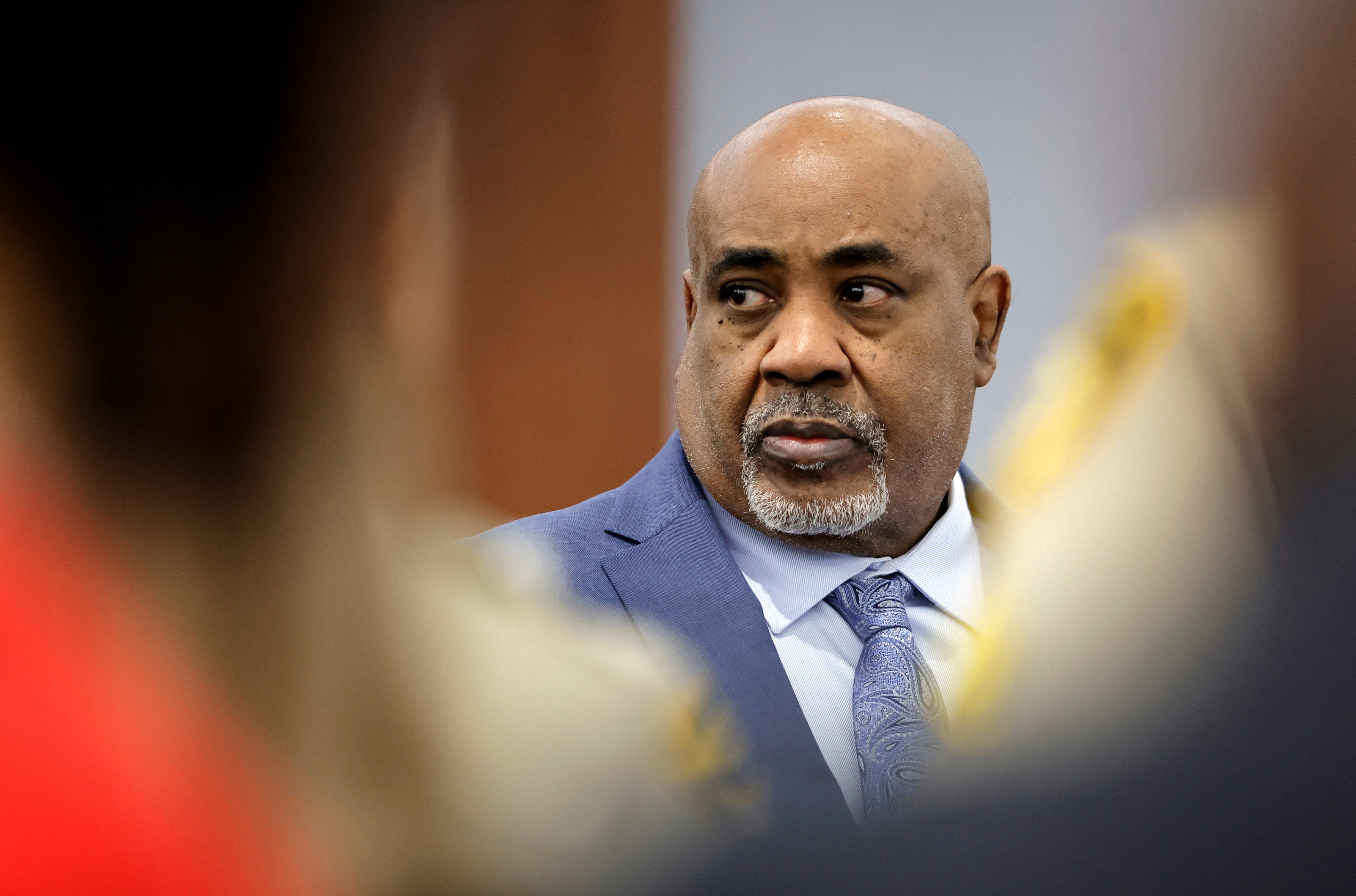
    LAS VEGAS — A prosecutor said Monday that while few have been willing to speak about the 1996 killing of Tupac Shakur, Duane “Keffe D” Davis is the “one person who has a hard time being silent.”

    “Let’s be clear, Duane Davis did not pull the trigger. But he did plan the shooting in retaliation of the beating of his nephew,” Chief Deputy District Attorney Binu Palal told jurors at the start of Davis’ Las Vegas trial. “Remarkably, you will learn that from Duane Davis himself.”

    Davis, 63, is charged with murder with a deadly weapon with the intent to promote, further, or assist a criminal gang in Shakur’s death. He pleaded not guilty. His lawyer in the defense opening called the prosecution’s narrative “fiction.” If convicted, Davis faces life in prison.

    Palal showed jurors video of Shakur’s entourage attacking Davis’ nephew Orlando “Baby Lane” Anderson outside a boxing match at the MGM Grand hours before the shooting on Sept. 7, 1996.

    Davis spent the next two hours planning how to get even, said Palal, and Shakur was gunned down “in an act of revenge.”

    What he told investigators in 2008

    In a 2008 interview with a federal task force investigating the killing of Shakur’s rival, the Notorious B.I.G., Davis instead talked about the Shakur shooting. He described handing a gun to the men in the back seat of a white Cadillac that fired on a black BMW with Shakur and Marion “Suge” Knight inside.

    As prosecutors played audio of Davis explaining the moment Shakur was shot, members of Shakur’s family, including his stepbrother Maurice “Mopreme” Shakur, stared ahead and listened intently from the audience.

    Palal told jurors Davis held onto a visceral hatred for Shakur for decades that drove him to speak.

    He said as early as 1998, the defendant talked to the FBI and admitted he had been in Las Vegas the night of the shooting. He spoke again in 1999 to the FBI and said again he was in Las Vegas then but denied responsibility.

    In 2009, he admitted to his role in the killing in an interview with Las Vegas police, Palal said.

    “And now 30 years later, we’re going to ask you to finally hold Duane Davis accountable,” Palal said.

    He also showed jurors the 2019 memoir that Davis co-authored, Compton Street Legend, that the prosecution will use and that the defense fought to keep out of the trial, along with several of the defendant’s interviews.

    How Davis’ legal team is defending him

    Davis, wearing a blue suit and tie, watched the presentation while sitting next to his attorney. He sat quietly with his hands folded on the table in front of him, occasionally nodding along as his attorney spoke.

    “The state has just told you what they believe is the evidence in this case,” attorney Michael Sanft said to jurors in his opening. “What they are telling you, they are representing as fact, when it’s really fiction.”

    Sanft said Davis wasn’t previously charged for the 1996 killing because law enforcement knew that he was “full of crap.”

    “There’s no facts,” he said, to back up what Davis said in his book.

    The defense attorney also pointed to missing documents in the original investigation and distrust between Los Angeles and Las Vegas police departments. He pointed out that the Compton Police Department was shut down in September 2000 due to corruption.

    He called one detective’s work “biased,” “sloppy,” and “incomplete.” He said retired Detective Clifford Mogg read portions of Davis’ book into the record as if it were fact, but said Mogg didn’t verify claims in it.

    Most eyewitnesses didn’t live to trial

    The story of the drive-by shooting has long gripped the hip-hop community, partly because no one was charged until Davis was indicted in 2023.

    The other three men riding in the Cadillac have all died in the years since.

    “When he says he’s the only person who can tell what happened, he’s right,” Palal said.

    Shakur remains a cultural icon and is considered one of the most influential and versatile rappers of all time, despite dying at 25. He was nominated for six Grammy Awards and was inducted into the Rock & Roll Hall of Fame in 2017.

    Witnesses describe the night Tupac was shot

    Retired Las Vegas police officer Garry Dale was the first of the 35 to 45 witnesses the prosecution plans to call at the trial, which is expected to last about a month. He recounted how he and another officer stopped a car carrying Knight and Shakur because the vehicle didn’t have a license plate. They let the pair go with a warning.

    About 10 minutes later the two officers responded to a call about a shooting and found Shakur being pulled from the car by EMTs, Dale said. Knight had been grazed by bullets, but told the officers to take care of Shakur, he testified.

    Dale jumped in the ambulance and tried to get Shakur to tell him who shot him. The retired officer said that Shakur said something like “no, we’ll take care of it.”

    Another witness, Ingrid Stokes, testified that she and her friends were heading home from Las Vegas when they encountered Shakur and Knight, who was friends with a woman in Stokes’ group.

    Knight invited them to a nightclub, she said, and they decided to meet them there.

    The car Stokes was riding in was one lane over and a car length ahead of Knight’s vehicle, when they heard gunshots while stopped at an intersection, she said.

    Stokes said they feared more gunfire and drove away, almost hitting a white four-door vehicle in the process.

    When they returned to the scene, police treated them like suspects, she said, and made them sit on the sidewalks. She was scared to talk about the case, worried about poor treatment from law enforcement and the potential for retribution from the unknown shooter.

    “Snitches get stitches,” she said.

  • Congo’s fast-moving Ebola outbreak becomes the country’s worst with over 2,300 dead

    Congo’s fast-moving Ebola outbreak becomes the country’s worst with over 2,300 dead

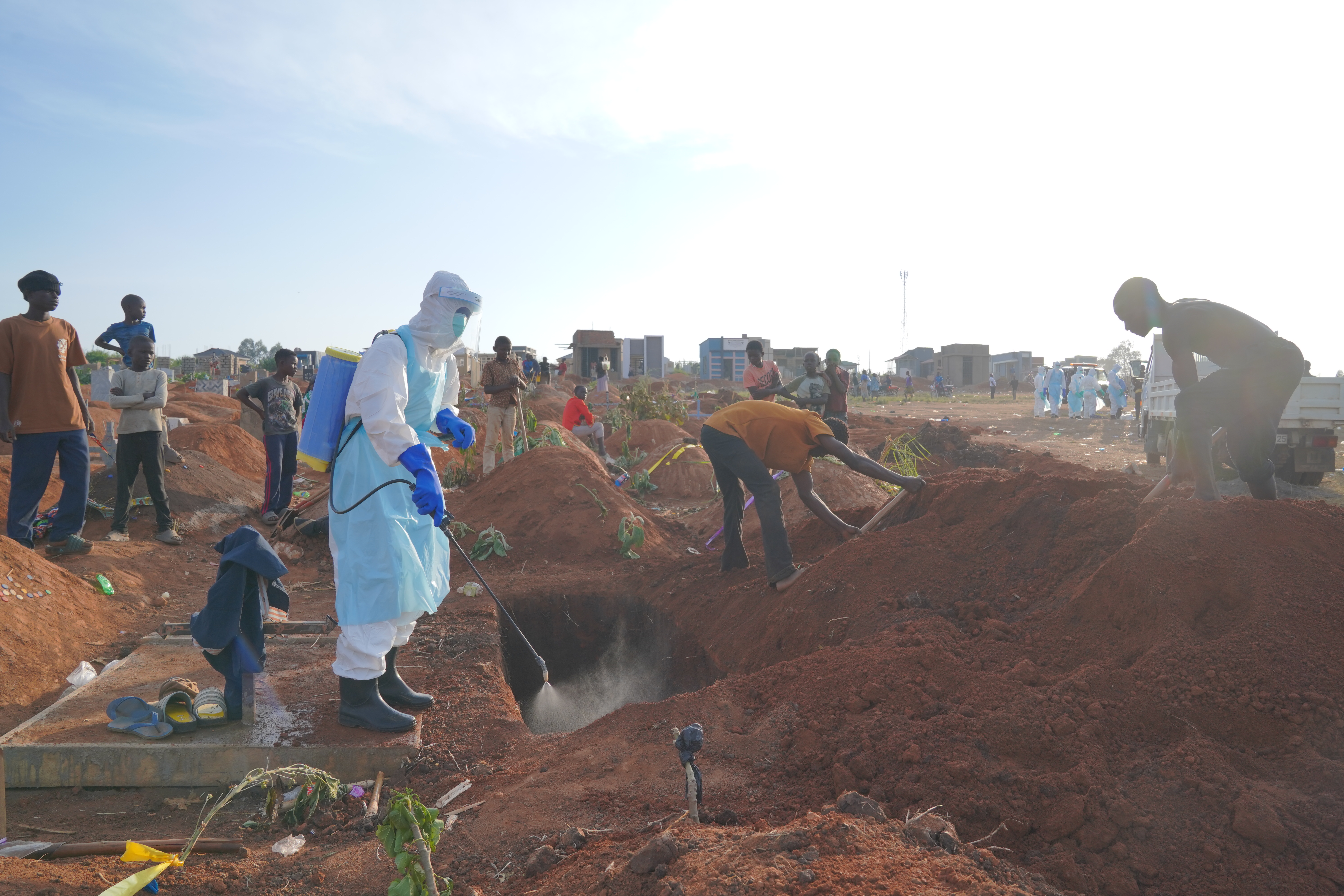
    BUNIA, Congo — Congo’s fast-moving Ebola outbreak has now killed over 2,300 people and become the deadliest outbreak of the disease on record in the Central African nation.

    The outbreak unfolding in one of Congo’s most vulnerable regions is the fastest-growing Ebola outbreak ever, with 4,945 cases including 2,325 deaths, according to government data released overnight into Monday.

    This is Congo’s 17th and largest Ebola outbreak. The toll eclipses that of the country’s 2018-2020 outbreak when 2,299 deaths out of 3,481 cases were recorded.

    The latest data shows 101 new cases and 33 deaths reported in the previous 24 hours. Over 1,000 people have recovered, while 730 remain in hospitals or isolation.

    The outbreak has infected and killed more people at a greater speed than any other outbreak in history. The World Health Organization has said it is on track to surpass the 2014-16 Ebola outbreak in West Africa, the deadliest on record with more than 11,000 deaths.

    There are no approved vaccines or treatments for the rare Bundibugyo virus responsible for the current outbreak across six provinces in Congo’s east. Trials for those are ongoing in Ituri province, the epicenter.

    Most new cases and deaths are being reported outside of people being monitored. Challenges also include strikes by some unpaid health workers, threats by rebel groups, anger from long-traumatized communities, territories difficult to reach due to bad roads, and misinformation asserting that Ebola isn’t real.

    WHO warned over the weekend that the outbreak is still moving at an “exceptional pace” ahead of efforts to track it, noting that it reached a weekly record of 579 cases and 304 deaths in the previous week.

    “A substantial scaling up of response activities is underway to get ahead of the outbreak,” the agency said.

    On Friday, United Nations humanitarian chief Tom Fletcher announced the allocation of an additional $30.5 million and the deployment of 20 more staff to aid the response on the frontlines.

    “This is a wake-up call,” Fletcher said. “We need speed, scale and solidarity before this virus gets even further ahead of us.”

  • British leader exchanged texts with someone posing as Trump’s chief of staff

    British leader exchanged texts with someone posing as Trump’s chief of staff

    LONDON — British Prime Minister Andy Burnham exchanged brief text messages with a person he thought was President Donald Trump’s chief of staff, Susie Wiles, a government official said Monday.

    Burnham quickly grew suspicious and reported the interaction to security authorities, the official added.

    It was unclear when the exchanges took place. A spokesperson for Burnham declined to comment publicly, citing a long-standing policy not to comment about national security issues.

    But the government official, who declined to be identified because of the security policy, said the prime minister had exchanged a few messages of no significance with someone claiming to be Wiles, Trump’s top White House aide.

    The official declined to provide details about the text messages, which were first reported by Politico, or to say which security agency Burnham had reported them to.

    Wiles is one of Trump’s closest advisers. She comanaged his 2024 presidential campaign and has been running his White House staff since he returned to office in 2025.

    Last year, the Wall Street Journal reported that senators, governors, and some business leaders had received phone calls or text messages from someone claiming to be Wiles, and that Wiles had said contacts on a personal cell phone of hers had been hacked. The Journal said at the time that federal officials were investigating.

    In 2024, David Cameron, then the British foreign secretary, had a video call and exchanged several text messages with someone pretending to be Petro Poroshenko, a former president of Ukraine.

    As foreign secretary in 2018, Boris Johnson had an 18-minute phone call with someone claiming to be the prime minister of Armenia. According to audio that was later released, the pair talked about President Vladimir Putin of Russia and about the poisoning of Sergei Skripal, a Russian double agent, in Salisbury, England.

    This article originally appeared in the New York Times.

  • What we know about damages from Hurricane Lala in Hawaii

    What we know about damages from Hurricane Lala in Hawaii

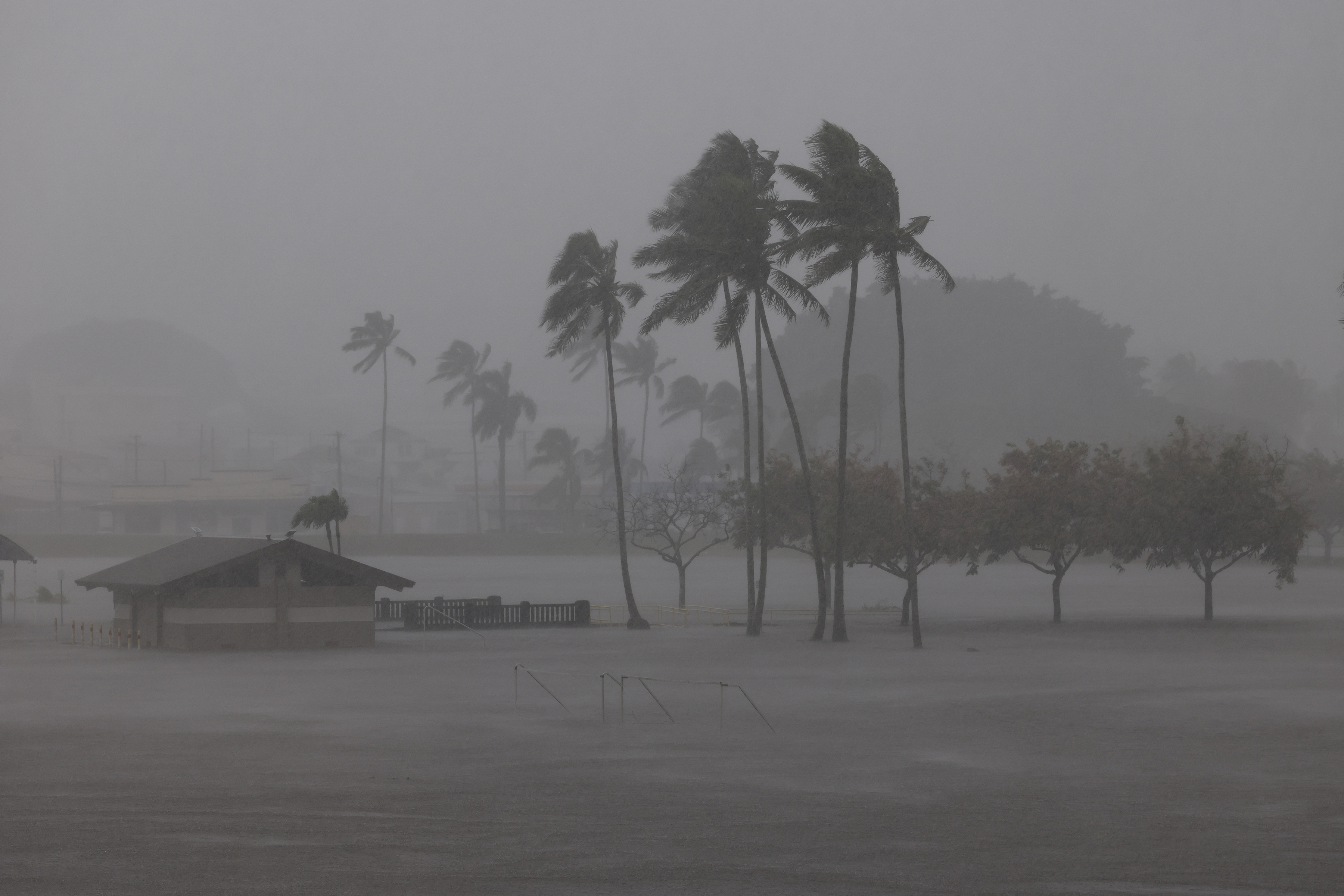
    Hawaii residents faced extensive power outages, submerged bridges and roads, and damaged homes after Hurricane Lala brushed along the islands.

    Hurricane Lala, which was a Category 1 hurricane, did not make landfall but moved close enough to wash out highways, wreck properties, and topple trees. Hurricanes are common in the Pacific Ocean, but landfall in Hawaii is rare because of its small size in relation to the expansive ocean. The eye of Lala did not cross over into land, but the outer bands still left significant destruction, primarily affecting people living along the southern and eastern edges of Hawaii’s Big Island.

    On Sunday and Monday, residents and emergency crews continued to sift through damage. Here’s what we know:

    The Big Island was drenched

    Gov. Josh Green of Hawaii said that some areas received as much as 30 inches of rain and that there were several reported mudslides. More than 13 inches had fallen at Hilo International Airport as of Sunday night. About 35 inches of rain was recorded near Nene Cabin, a weather observation site on the southern tip of the Big Island. Laupahoehoe, on the Hamakua coastline in the northeast part of the island, measured more than 43 inches during the storm, with the majority of precipitation falling within 24 hours beginning Saturday afternoon.

    Hilo, on the eastern edge of the Big Island, is one of the rainiest cities in the United States, and residents are used to frequent downpours. But many residents said they were surprised at the intensity of the storm.

    Hurricane Lane in 2018 similarly passed south of Hawaii and produced comparable rainfall totals in the same locations. The difference with Lala is that it came dangerously close enough to produce damaging winds, including hurricane-force winds, on the Big Island.

    Residents were spared the worst of the worst, which is found in the eyewall, but the more intense side of Lala (the right side in the direction the storm is traveling) hit the Big Island directly. One wind gust at the Mauna Kea Summit measured 140 mph, and another near sea level in Kona registered 78 mph. (Hurricane-force winds are 74 mph or greater.)

    One person was killed, and about 100 homes were damaged on the Big Island.

    On Saturday, when the storm passed through, a 45-year-old man was killed in a head-on car accident in the southern area of the Big Island. A 21-year-old woman was critically injured from the collision.

    Two paramedics were also rescued in Naaleuh, in the southern region of the Big Island, after floodwaters trapped them in their vehicle.

    About 100 homes had been damaged or washed away because of the storm, Green said.

    Officials said some of the worst damage may have occurred in rural places in the southern edge of the Big Island but that fallen electrical lines have complicated efforts for people to get to the area.

    The coastal town of Pahala, which has about 1,800 residents, was cut off from the rest of the island after floodwaters inundated roads and bridges — six were destroyed or severely damaged, officials said. Part of a major highway also collapsed, which blocked road access to Ka’u Hospital, the region’s only hospital.

    County fire officials said they were prepared to use helicopters to move patients with medical emergencies.

    “There’s a lot of damage that we’ll be working on,” Green said Sunday afternoon.

    Hundreds of thousands remain without power

    More than 114,000 homes and businesses remained without power in Hawaii on Monday, down from about 200,000 customers Sunday. That includes about 40% of the customers on the Big Island, which is largely rural.

    People could face days or weeks without power because the storm downed transmission lines that connect power plants to homes and businesses. Because of widespread flooding and other challenges traveling along rural roads, officials said it could take weeks for the power to be fixed on the Big Island.

    Green said that schools, state and county offices, and courts across the state would be closed Monday, as Hawaii recovered from the storm and worked on restoring power. All airports and harbors had reopened, according to the Hawaii Department of Transportation.

    The damaged transmission lines include one that runs for 42 miles on the Big Island. In addition to knocking out power lines, the storm also damaged many of the large structures that carry the lines on the Big Island and Oahu.

    This article originally appeared in the New York Times.

  • Russian court jails a Kremlin critic for 11 years for opposing the war in Ukraine

    Russian court jails a Kremlin critic for 11 years for opposing the war in Ukraine

    A Russian court on Monday convicted a prominent opposition politician for speaking out against the war in Ukraine and sentenced him to 11 years and one month in prison in the latest crackdown leading up to next month’s parliamentary election.

    The verdict against Lev Shlosberg, a senior member of the Yabloko party, was another step by the Kremlin to stifle dissent since Russia invaded its neighbor in February 2022. Yabloko is the only official political party overtly opposing the war.

    In a separate ruling Monday, Russia’s Supreme Court upheld its earlier decision to bar Yabloko from the ballot in the Sept. 18-20 parliamentary vote, denying an appeal by the party.

    The moves against Shlosberg and Yabloko highlight the Kremlin’s intolerance toward any criticism of the war, now in its fifth year.

    It was Shlosberg’s second trial in 2 years

    Shlosberg, 63, is Yabloko’s deputy chairman and served in the regional legislature of Pskov from 2016-21. He stood trial in the city of Pskov, some 370 miles northwest of Moscow, on charges of “discrediting” and spreading “false information” about the Russian military.

    The charges stemmed from a debate in which he called for ending the war and from posting on his Telegram channel a British tabloid front page featuring an image of a bloodied woman next to one of Russian President Vladimir Putin, with the headline: “Her blood … his hands.” Shlosberg has rejected the charges as unfounded.

    It was the second trial for Shlosberg in the last two years. He has also been designated a “foreign agent,” a label that carries strong pejorative connotations in Russia and brings additional government scrutiny. He was convicted of violating the foreign agent regulations.

    In December 2025, he was placed in pretrial detention on the new charges and has been behind bars ever since. He is one of several prominent Yabloko members in recent years to be jailed or designated a “foreign agent” as Kremlin pressure on the party has mounted.

    Yabloko called the sentence ‘barbaric’

    In his final statement to the court Friday, Shlosberg said that for 30 years, Russia has traveled “a path from hopes for freedom to the almost complete destruction of human and civil rights and freedoms.”

    He said the war in Ukraine has “changed the lives of every Russian citizen without exception,” and predicted that once its true death toll becomes known, “the entire country will shudder.”

    Yabloko said Shlosberg received a “barbaric sentence” for “love of the Motherland and calls for a ceasefire.” In a statement on Telegram, the party said Shlosberg will appeal.

    Amnesty International denounced the verdict against Shlosberg.

    “His arbitrary prosecution and sentencing are blatant reprisals for exercising his right to freedom of expression to call for peace,” said Marie Struthers, the group’s Eastern Europe and Central Asia director.

    “The Russian authorities must immediately and unconditionally release Lev Shlosberg and quash his conviction,” her statement added. “They must repeal legislation criminalizing peaceful anti-war expression, end the persecution of Yabloko members and supporters, and respect the rights to freedom of expression, association, peaceful assembly, and political participation for all Russians.”

    Supreme Court upholds removing Yabloko from the ballot

    In Moscow, the Supreme Court upheld its ruling of a week ago to remove Yabloko from the ballot in the election for the State Duma, Russia’s lower house of parliament, denying an appeal by the party.

    The Central Election Commission in July had allowed Yabloko on the ballot along with 10 other parties. Young social media users and many Russian opposition figures in exile have since come out in support of Yabloko, urging voters to back the party, once a leading liberal voice in parliament that later lost its bloc of seats as the Kremlin tightened its grip on politics.

    In recent years, Yabloko was the only registered opposition party that opposed Russia’s full-scale invasion of Ukraine.

    Its campaign slogans for this year’s election included, “For a ceasefire agreement, diplomacy, and peace!” “Our goal is to prevent nuclear war!” and “For a Russia free from fear and political repression!”

    Several Kremlin parties publicly assailed Yabloko for its anti-war stance after it got a slot on the ballot. The Motherland Party filed a lawsuit with the Supreme Court, demanding its removal from the ballot, accusing Yabloko of copyright infringement and exceeding campaign spending limits. The party also viewed Yabloko’s stance on Ukraine as unlawful and tantamount to calling for the violation of Russia’s territorial integrity.

    Yabloko rejected these accusations, but the Supreme Court sided with the Motherland Party.

    As the court met Monday on Yabloko’s appeal, the party’s supporters gathered outside the courthouse and Russian media reported that several dozen people were detained.

    Liberal politician Grigory Yavlinsky, who co-founded Yabloko in the 1990s and chairs its political committee, deplored the court’s ruling in an online statement. It marked “a serious, deepening crisis in the Russian political system and a lack of understanding of a desired future,” he said.

    “People begin to feel this more acutely, regardless of their political views and positions,” he said, adding that Yabloko’s campaign “for peace and freedom” hit this particular “sore point.”

    Yabloko chairperson Nikolai Rybakov told reporters after the ruling that the party will continue its fight by lodging a complaint to the Presidium of the Supreme Court and possibly going to the Constitutional Court.

    “We achieved the main thing: The whole world knows how many people in Russia want peace, want to live normally, and to raise children under a peaceful sky in their country,” Rybakov said.

    Regarding the prison term handed to Shlosberg, Rybakov said, “Our feelings are with Lev and other political prisoners who have fought and are fighting for peace, for people to not die.”

  • Trump administration briefly pauses contentious border project in Texas’ Big Bend National Park

    Trump administration briefly pauses contentious border project in Texas’ Big Bend National Park

    WASHINGTON — The Trump administration said Monday it is temporarily pausing construction of a contentious border construction project in Texas’ Big Bend National Park while the head of the agency tasked with building the wall visits to do an “on-the-ground evaluation.”

    The project through the national park in southern Texas has faced fierce bipartisan opposition by critics who say it is marring the area’s pristine environment. They argue the region’s rugged and remote terrain already serves as a deterrent to migrants and smugglers. Border crossings in the area have historically been lower than other regions and have dropped even further over the past two years.

    “CBP is pausing all construction activity in Big Bend National Park while I visit and conduct a personal, on-the-ground evaluation,” Rodney Scott, who heads Customs and Border Protection, said on X. Scott said over the next couple of days, he was going to “listen to local leadership, community members, and stakeholders” to address what he said were “real” national security threats while protecting the park.

    While it isn’t clear whether the brief suspension portended a more permanent halt to the construction in the area, it reflected the intensity of the bipartisan opposition and was a rare concession from the administration on a signature promise of the president’s that it has raced to complete.

    Congress gave the Trump administration $46 billion last summer to build a wall from the Pacific Ocean to the Gulf of Mexico, and the administration has been charging ahead and waiving numerous regulations in an effort to swiftly build the wall.

    Scott has said that he expects the first layer of the wall to be built by the end of next year.

    But the administration has run into fierce opposition in Texas especially when it comes to construction in and near Big Bend National Park and a state park to the west.

    Customs and Border Protection earlier this year backed off of plans to build a 30-foot-tall bollard wall through the parks but was still moving forward with other border protection measures such as a new road, lights, miles of barriers designed to stop cars from crossing the border, and technology such as fiber optic cables to be buried under the fences.

    That has sparked opposition from Democratic and Republican sheriffs in the region, former national park officials, local residents who rely on the parks for their livelihood, and from some Texas elected officials. Critics have said it will scar the rugged landscape that attracts tourists who raft down the Rio Grande and take advantage of some of the clearest night skies in the U.S. to gaze at stars.

    Last week, bulldozers were seen clearing land at the park, sparking even more concern and raising questions from one of the state’s Republican senators. Sen. John Cornyn, who lost the Republican primary to the state’s attorney general, wrote to Homeland Security Secretary Markwayne Mullin over construction concerns.

    “My constituents believe that the 1,000-foot riverbank cliffs and remote Big Bend terrain offers its own source of deterrence for any illegal migrants crossing into the United States. The dangerous terrain includes steep mountains, deep canyons, and expansive deserts which they believe act a natural barrier that limits large-scale movements,” Cornyn wrote.