Category: Nation & World

  • Amazon cargo jet pilots appeared to try aborting landing, NTSB investigation indicates

    Amazon cargo jet pilots appeared to try aborting landing, NTSB investigation indicates

    The pilots of the Amazon cargo jet that overran a runway at Miami International Airport on Sunday were not fully in control of the aircraft as it touched down and appeared to have temporarily considered aborting the landing, according to a timeline of the final seconds before the deadly crash that federal investigators unveiled late Tuesday.

    The sequence of events detailed by National Transportation Safety Board investigators likely cost the pilots hundreds of feet of runway length and crucial seconds in the moments before the plane ran off the runway, striking two vehicles as it exited the airport grounds and crossed a public road, killing five before coming to a stop, according to aviation experts who reviewed the timeline.

    “You either land or you go around. You don’t land, attempt to go around, and then get back to landing again, unless there was some mechanical malfunction,” said Steven Arroyo, an aviation expert and retired United Airlines pilot.

    “I have never seen anything like this,” he added of the information that NTSB investigators detailed Tuesday night.

    The NTSB has yet to release a transcript from the cargo jet’s cockpit voice recorder, a readout of which they are expected to publicize Wednesday. Investigators are also expected to interview the aircraft pilots then, according to Jennifer Homendy, the board chair.

    During a news conference late Tuesday night, Chihoon Shin, the lead crash investigator, laid out a timeline of what happened during the last 30 seconds captured by the flight data recorder. Flight data recorders are designed to stop operating when the airplane’s electric power supply is cut off, as would happen during a crash.

    The problems with the landing were apparent from the start of that timeline.

    At 30 seconds out, according to Shin, the plane’s nose landing gear and its right-side main landing gear touched down. At that point, the plane was traveling at nearly 182 mph — faster than what is considered ideal for such planes, according to experts.

    It would take another seven seconds before the pilots applied the brakes, and another four seconds after that before the left-side main landing gear would make contact with the runway, Shin said.

    That touchdown sequence was “really bad,” said Michael O’Donnell, an aviation consultant who previously led the Federal Aviation Administration’s aviation and airport safety divisions.

    “The nose should not hit first,” he explained. “That is an unstable approach right there, and that really tells me that the go-around should have been executed a lot sooner and they weren’t in total control of the aircraft.”

    But perhaps more critical was what the pilots tried to do next. Fifteen seconds before the recording ended — or four seconds after all their landing gear was on the runway — the pilots released the brakes, and appeared to try to increase thrust, in what aviation experts said was a telltale sign of a “delayed decision” to abort the landing.

    The plane was moving at 138 mph when the brakes were released, and “throttles increased to values consistent with go-around thrust,” Shin told reporters.

    The pilots did not idle the throttles and reapply the brakes until 11 seconds before the recording ended, at which point the aircraft was moving at nearly 135 mph, according to Shin. While the brakes remained engaged for the rest of the recording, he added, the pilots never deployed the airplane’s speed brakes, which are flaps located on the wings, or its thrust reversers, both of which could have helped slow the aircraft further.

    “There’s all kinds of red flags with a go-around decision made that late,” O’Donnell said, adding, “If you do the math, that’s a lot of runway that went by while they were doing that.”

    Investigators did not detail how close to the end of the runway the plane was at the junctures they identified.

    “That’s something we still have to determine,” Homendy told reporters.

    But at the ground speeds that NTSB investigators specified, the plane would have been moving down the runway at a pace of about 200 feet per second during those four seconds when the brakes were released.

    It is not clear if those roughly 800 feet, and the lost seconds of deceleration, might have allowed the plane to come to a stop before it struck the vehicles, or have made the difference between life and death for the victims. When the recorder stopped, the plane was still moving at nearly 75 mph, according to Shin.

    But aviation experts said that the pilots’ apparently erratic and conflicting actions in the moments before the crash were perplexing.

    “If you’re going to do a go-around, you absolutely have to commit,” said Pablo Rojas, a lawyer for Podhurst Orseck, a Miami law firm that specializes in aviation accidents, noting that hesitation by the crew cost valuable seconds on the runway.

    This article originally appeared in The New York Times.

  • U.S. says it has destroyed 5 Iranian oil tankers after missile attacks on Navy warship

    U.S. says it has destroyed 5 Iranian oil tankers after missile attacks on Navy warship

    WASHINGTON — Iran has launched missiles toward U.S. targets in Jordan, Iranian state-run media said, following the latest American strikes.

    It’s the latest tit-for-tat retaliation after the U.S. military said it destroyed five Iranian crude oil tankers following two attacks on a U.S. warship by Iran’s Revolutionary Guard over the past two days.

    U.S. Central Command, when asked about the strikes on the Jordanian airbase, said it had no information to offer.

    The Iranian tankers destroyed in the attack were the Kivik, Charminar, Horizon 1, and the Riesco in the Gulf of Oman, Central Command said. The U.S. military also destroyed the vessel Derya, which was located near Kharg Island in the Strait of Hormuz.

    Central Command said the crews of the five vessels were told to abandoned ship before the attacks.

    The strikes come just three days after U.S. forces destroyed three Iranian oil tankers after Iran’s Revolutionary Guards tried to attack a U.S. aircraft carrier and destroyer.

    Iranian state television also reported the U.S. strikes, saying U.S. forces attacked at least three Iranian oil tankers near the southern port of Jask and near Kharg Island in the Persian Gulf. It said the crews were evacuated.

    Secretary of State Marco Rubio said the U.S. will not allow Iran’s attacks to go unanswered.

    “Iran continues to try to hit U.S. naval ships. And for every time they do that or try to do that, they’re going to lose tankers. And I think you’ll see that again today,” Rubio told reporters Tuesday when asked about the latest attacks in Iran while on a trip to Colombia.

    Danny Citrinowicz, an Iran expert at Israel’s Institute for National Security Studies, warned that such back-and-forth strikes can only risk more retaliation and further impact to the global economy.

    “There is no kinetic solution to the Strait of Hormuz problem,” he said on social media. “Every attempt to impose one only brings Washington and Tehran closer to an escalation that may become increasingly difficult to control.”

    An Iranian state TV reporter in Jask said an Iranian tanker was struck near the coast of Yekbeni, while another explosion was heard in the area whose source and location were not immediately clear.

    State TV later reported that the U.S. military attacked a second tanker near waters off Jask. It said the crews of both vessels were being evacuated by lifeboat toward the Jask coast.

    Separately, state television reported that another Iranian tanker was attacked in Kharg Island anchorage area. It said the crew was safely evacuated shortly after the strike.

    Iran’s Revolutionary Guard Navy on Tuesday warned crews of oil tankers near ports in Kuwait and Bahrain to immediately leave their vessels, saying the ships could be targeted in retaliation for U.S. attacks on Iranian tankers. It accused Kuwait and Bahrain of hosting U.S. forces and assisting in the attacks.

    On Saturday, the U.S. military said it had struck three Iranian oil tankers after Navy warships were targeted with ballistic missiles, warning that it would, “if necessary, destroy Iran’s limited and exposed oil fleet.” Iran later said it planned to announce a new “exclusion zone” near the Strait of Hormuz aimed at vessels intending to transit.

    The latest strikes are part of a dual economic and military approach by President Donald Trump as he struggles to bring an end to a more than six-month-old war with Tehran.

    The Trump administration on Tuesday also imposed sanctions on additional elements of Iran’s aviation industry, targeting more than two dozen commercial and private airlines as well as foreign cargo service providers in its new push to isolate Tehran from its remaining trading partners.

    Both the U.S. and Iran are seeking to exert control over the Strait of Hormuz, where about one-fifth of the world’s oil passed before the war began. Rising energy prices are posing political problems for Trump and his Republican Party ahead of the November midterm elections. A barrel of international standard Brent crude briefly climbed as high as $99.46 on Tuesday.

    A U.S. blockade of Iranian ports has squeezed the country’s economy by limiting its oil exports, while the American military has been helping a limited number of ships transit on a route through the Strait of Hormuz off Oman. Tehran wants ships to follow a route that it chooses through the strait, which was considered an international waterway before the war.

  • New grand jury subpoenas being sent in investigation targeting Trump-Russia probe, sources say

    New grand jury subpoenas being sent in investigation targeting Trump-Russia probe, sources say

    WASHINGTON — The Justice Department is demanding testimony before a Florida grand jury in an investigation aiming to establish an intelligence community conspiracy against President Donald Trump, according to multiple people familiar with the matter.

    New subpoenas being issued to former government officials represent an escalation in the yearlong investigation as the Justice Department pursues a loosely defined theory that members of the intelligence community who scrutinized Trump over the last decade, including over Russian interference in the 2016 election, conspired against him and violated his rights.

    Investigators in recent days contacted some defense lawyers for witnesses advising them of forthcoming grand jury subpoenas. It was not clear how many as of Tuesday had received a subpoena or were still waiting to receive one, and the identities of the witnesses receiving subpoenas were also not immediately clear. The people who confirmed the subpoenas spoke on condition of anonymity to discuss a secretive grand jury investigation.

    Investigation has focused on the Trump-Russia probe

    The contours of the conspiracy investigation aren’t fully known, but agents and prosecutors over the last several months have focused intensely on one of Trump’s chief grievances: the U.S. government response to Russian interference in 2016 and an intelligence community assessment that Moscow meddled on Trump’s behalf at the direction of Russian President Vladimir Putin.

    Trump, who spent much of his first term shadowed by an investigation into whether his campaign colluded with Russia to sway the outcome of the election, has for years lashed out at the intelligence community finding and cast it as a “deep state” conspiracy to undermine the legitimacy of his win.

    Investigators searching for potential crimes in connection with the intelligence community response have conducted numerous voluntary interviews, but the subpoenas prepared for witnesses in recent days represent an apparent effort to lock down sworn testimony before a grand jury.

    It remains unclear whether anyone will be charged or for what offense, though lawyers for former CIA Director John Brennan have said they have been informed that he is a target as investigators examine whether he falsely testified to Congress — something he and his attorneys have consistently denied. The Justice Department last spring subpoenaed witnesses before a Washington grand jury as part of an investigation into Brennan, but swiftly withdrew the subpoenas in favor of voluntary interviews.

    The investigation is being run out of Florida, with the Justice Department in April bringing back into government service a top prosecutor from the Reagan administration, Joe diGenova, to serve as a counselor to the attorney general and help lead a team of agents and prosecutors.

    DiGenova, who had previously asked then-Attorney General Pam Bondi to appoint him to the job and has openly and repeatedly claimed Trump was the victim of an intelligence community conspiracy, declined to comment Tuesday when reached by the Associated Press.

    In an indication of the wide-ranging nature of the investigation, the AP reported last month that diGenova’s team has sought interviews with law enforcement officials involved in the 2022 FBI search of Trump’s Mar-a-Lago property in Palm Beach, Fla. The search recovered a trove of classified documents that formed the basis of a since-abandoned Justice Department prosecution of Trump, who has long decried the FBI operation as an invasion of his privacy.

    Concerns from defense lawyers about a ‘favored’ judge

    Investigators have set up shop in Fort Pierce, Fla., the home court of U.S. District Judge Aileen Cannon, the Trump-appointed jurist who repeatedly appeared skeptical of the classified documents case against him and ultimately dismissed it after concluding that the prosecutor who filed the charges was illegally appointed.

    Lawyers for Brennan last year asked the chief judge of the federal court in Florida to prevent the investigation from being steered to Cannon, whom they described as a “favored” Trump judge. They have since sued the Trump administration, demanding a court order requiring prosecutors to preserve records from the investigation so that Brennan could challenge any eventual prosecution of him as vindictive and selective.

    Trump came to office in 2017 under scrutiny from the intelligence and law enforcement community about whether his successful campaign had conspired with Russia, which stole politically damaging Democratic emails and orchestrated their release through WikiLeaks as part of a wide-ranging interference scheme.

    A Justice Department special counsel, Robert Mueller, investigated but found insufficient evidence to prove a criminal conspiracy between Russia and the Trump campaign, though his team of investigators did find that Russia interfered in sweeping fashion in the election and that the campaign eagerly hoped to benefit from Moscow’s help.

    Subsequent investigations by an inspector general and Justice Department prosecutors identified numerous errors and omissions by agents who conducted the Russia probe but found no evidence of criminal wrongdoing by senior law enforcement officials nor proof of an anti-Trump conspiracy like what prosecutors are now hoping to prove.

    Deeply frustrated by those outcomes, Trump has amplified his demands for retribution, which his Justice Department has heeded. Last year, Bondi directed prosecutors to put evidence before a grand jury following the release of documents aimed at calling into question the legitimacy of the Trump-Russia inquiry.

  • Honoring 9/11 heroes, Trump repeats disputed account of his role in recovery

    Honoring 9/11 heroes, Trump repeats disputed account of his role in recovery

    At an event where he awarded the Medal of Freedom posthumously to a man who died saving multiple people on Sept. 11, 2001, President Donald Trump returned to a disputed account of his own role in ground zero recovery efforts.

    Trump gave the nation’s highest civilian honor on Tuesday to the family of Welles Crowther, a 24-year-old equities trader and volunteer firefighter who saved an estimated 18 people before dying in the World Trade Center’s South Tower. Crowther has become known as “the man in the red bandanna” because of the cloth he tied around his nose and mouth to protect against heavy smoke while helping people out of the burning building.

    “The man in the red bandanna has become more famous than me,” Trump said during the speech on the Ellipse, where a steel beam recovered from the World Trade Center was on display. “I don’t like it.”

    Before recounting Crowther’s heroic acts, Trump claimed that he took “a big group of people” working on his building to ground zero to help in the aftermath of the attacks, re-upping widely disputed claims that he played a role in the response. Trump did not specify how soon after the attacks they went to ground zero. Richard Alles, a retired New York City Fire Department battalion chief, told PolitiFact in 2019 that he had “no knowledge” of Trump being at the site and said that there would be a record if Trump had sent a crew of 100 workers.

    There are videos of Trump in a suit in the neighborhood near ground zero days after the attacks, but not at the site of the disaster.

    Trump War Room, an X account for Trump’s political operation, posted a video recorded on Sept. 13, 2001, that showed Trump claiming that “has about 100 men working down here” and “was just down at Ground Zero.” The White House did not respond when asked for records that corroborate Trump had workers involved in the recovery.

    Trump on Tuesday also claimed that two firefighters carried him away when it appeared the U.S. Steel Building, now known as One Liberty Plaza, could also collapse. The president did not specify when, exactly, this incident occurred, and the White House did not respond to a request for the date.

    “We thought it was coming down on top of us,” Trump said. “And two firemen, big strong guys. … They grabbed me under the arms.”

    Trump told a version of the story about being evacuated by firefighters on the campaign trail in 2016. At the time, he said that it was a couple of days after the other buildings collapsed and said that the building was “not so far from us,” suggesting he was not inside the building.

    Trump’s exaggerations and fabrications related to the terrorist attacks have generated controversy for years. In 2015, he falsely claimed during a rally that “thousands and thousands of people were cheering as that building was coming down.” He claimed the celebrations occurred in Jersey City, which he said has “large Arab populations.” He doubled down on the claim even when told police said such celebrations never occurred. In 2016, Trump claimed that he “helped a little bit” with clearing the rubble after the attacks, which has not been corroborated by first responders or media coverage.

    Tuesday’s event was organized by the Tunnel to Towers Foundation, which assists the families of Sept. 11 first responders and has transported the steel beam from the World Trade Center to landmarks around the country, including the Space Center in Houston, Mount Rushmore in South Dakota, and MLB games.

    First responders and the families of those who died responding to the attacks entered the event Tuesday on a blue carpet flanked by red, white, and blue flowers and portraits of the firefighters, police officers, and medical professionals who died responding to the attacks. Several cabinet officials attended, including Commerce Secretary Howard Lutnick. On Sept. 11, Lutnick was the chairperson of Cantor Fitzgerald, which lost 658 of its employees in the attacks, including his younger brother, Gary. Lutnick was taking his son to his first day of kindergarten when the terrorists struck.

    Trump is expected to commemorate the 25th anniversary of the 9/11 attacks on Friday at the Pentagon before flying to Ireland for a tournament at Trump International Golf Links Ireland. All of the living former U.S. presidents are expected to attend a memorial at ground zero in New York, which the White House has said Vice President JD Vance will attend. Trump did not respond when reporters asked why he could not go to both the Pentagon and ground zero.

    In Washington on Tuesday, Trump presented the Medal of Freedom to Crowther’s mother, Alison Crowther, and his sister, Paige Crowther Charbonneau. Alison Crowther said she sees how young people continue to be inspired by her son as she travels to schools to speak about his legacy.

    “Twenty-five years after September 11th, his life continues to remind us of something very simple,” she said. “In moments when others need us, each of us has the power to keep courage, compassion, and service. That’s the real meaning of the red bandanna: To be courageous, to find the good, and to be the good.”

  • Americans’ satisfaction with schools is at a low point, new Gallup poll shows

    Americans’ satisfaction with schools is at a low point, new Gallup poll shows

    Americans’ satisfaction with the quality of K-12 education in the country has hit a low point, driven by a growing political divide and concerns that schools are not preparing children for college and future jobs.

    Just 32% of American adults say they are “completely” or “somewhat” satisfied with the U.S. school system, according to an August poll published Tuesday by Gallup and the Walton Family Foundation and shared exclusively with the Associated Press. That’s an 11-point drop over the past two years and the lowest since Gallup began polling on the subject 27 years ago.

    At the same time, dissatisfaction has increased to a high of 67%.

    Experts on education and school policy say the findings are deeply concerning but not surprising.

    Democrats are driving the recent slide, with their satisfaction dropping about 19 points since President Donald Trump’s second term began in 2025. Independents’ satisfaction appears to be down as well, about 10 points from 2024, while Republicans’ satisfaction has also fallen slightly, about 6 points.

    The Trump administration has contributed to the erosion in public confidence by depicting schools as political battlegrounds, raising concerns about what teachers should be allowed to say in the classroom, and moving to abolish diversity programs and dismantle the Education Department, said Jack Schneider, director of the Center for Education Policy at the University of Massachusetts Amherst.

    “It’s terrifying. We’re on the precipice of the dissolution of the public education system as we have known it,” Schneider said. Democrats, he said, are also particularly concerned by Trump’s signature school choice program that will use taxpayer-supported scholarships to pay for kids’ private school tuition.

    National test scores have fallen since the pandemic

    But politics alone does not explain the dissatisfaction. Gallup polling shows public confidence in schools generally has declined since the COVID-19 pandemic closed classrooms, exacerbating academic declines, mental health issues, and other problems.

    Headlines have consistently told a story of a national drop in test scores, especially in reading, which sends a message that schools have struggled to rebound since COVID lows.

    “We’ve had a drumbeat of bad news about test scores and other social trends that could be driving this,” said Sarah Reckhow, a political-science professor at Michigan State University who specializes in public policy. “There’s a ton of debate, discussion, and noise about technology and AI in education,” she said. And recently, kids’ screentime at school has dominated education headlines locally and nationally.

    However, parents have a different view about their own children’s education. About two-thirds of parents with school-age children say they are satisfied with their child’s education, which is also a low point in the trend — parents haven’t had a similarly discontented view since 2013 — but double the 32% satisfaction with U.S. education among adults overall.

    That reflects a steady trend of parents feeling more confident about their own schools than the narrative they hear from elected officials and headlines about the national picture.

    “When people weigh in about the nation’s schools, what they are commenting on are 98,999 schools that they haven’t set foot in,” Schneider said.

    A separate survey, also conducted in August by Gallup and Walton, asked Americans how well they thought schools were preparing kids for the future. Only about 2 in 10 said schools are doing a “good” or “excellent” job teaching critical thinking or preparing students for the current workforce. Schools’ highest marks were for preparing students to adapt to new technologies, with 44% giving schools a high ranking in this area.

    Gallup senior education researcher Zach Hrynowski says the findings highlight a frustration with institutions more broadly.

    “People have a general negative vibe about everything in the country right now,” Hrynowski said. “People are frustrated, and don’t think any institution is working particularly well.”

  • Putin assures Trump that Moscow doesn’t have aggressive plans toward Europe, Kremlin says

    Putin assures Trump that Moscow doesn’t have aggressive plans toward Europe, Kremlin says

    KYIV, Ukraine — Russian President Vladimir Putin assured U.S. President Donald Trump in a phone call Tuesday that Moscow doesn’t harbor aggressive intentions toward Europe, a senior Kremlin official said, after European officials blamed Moscow for sabotage campaigns on their soil.

    Ukrainian President Volodymyr Zelensky said meanwhile that U.S. envoys who visited Kyiv presented some “very good, worthwhile ideas” for ending Russia’s 4½-year-old war, adding that he hopes to meet with Trump within two weeks.

    But Russia remains determined to accomplish its military goals and it believes it is close to winning, Kremlin spokesperson Dmitry Peskov said. Ukrainian and Western observers, however, believe that Moscow has been unable to make any significant progress on the front line.

    The war could yet drag on for years as Russia reconstitutes its forces and its defense industry, said U.S. Undersecretary of Defense Elbridge Colby.

    “We must be prepared for a protracted conflict and for Ukraine’s requirements to persist in the months and years ahead,” Colby told an online meeting of countries helping Ukraine.

    U.S. envoys Jared Kushner and Steve Witkoff visited Moscow and Kyiv for separate talks with Putin and Zelensky over the weekend. The meetings appeared to produce no substantial breakthrough on ending the fighting, and both countries resumed their deadly air war after a weekend truce in their capitals for the American visitors.

    The attacks killed seven people and injured 28 in Kyiv and the surrounding region, authorities said. Officials from Russia reported three people killed and 13 wounded in areas it controls.

    Kremlin says call between Putin and Trump was ‘constructive’

    Yuri Ushakov, Putin’s foreign affairs adviser, said the hourlong conversation between Putin and Trump was “constructive and quite frank.” Moscow has a positive view of the results of the weekend visit by Witkoff and Kushner, he added.

    There was no immediate White House comment on the call.

    Ushakov told reporters that “in view of the speculation about Russia’s alleged hostile intentions toward European countries, it was underlined that we don’t have any aggressive plans regarding Europe.”

    That claim runs counter to European authorities’ versions of recent incidents, such as the German government last week blaming Russia for an attempted attack at Leipzig/Halle Airport in August using a drone laden with explosives.

    Ushakov said Putin told Trump about the combat situation in Ukraine and Russia’s plans to make battlefield gains and achieve its military goals in what Moscow calls its “special military operation,” not a war.

    Zelensky aims to meet with Trump this month

    Zelensky said he is counting on meeting with Trump around Sept. 20 — about the same time that the U.N. General Assembly is being held in New York. Putin isn’t expected to attend.

    He indicated he will press Trump to provide more Patriot air defense systems that Kyiv needs to counter Russia’s ballistic missiles.

    Ukraine needs 300 Patriot missiles from its partners’ stocks, 500 air-to-air interceptors, and $2 billion for more drones, U.K. Defense Secretary Wes Streeting told the meeting of countries providing help.

    Also on Tuesday, the European Commission approved a loan of 3.2 billion euros ($3.7 billion) for Kyiv to purchase components for Patriot air defense systems, Ukraine’s Defense Ministry said on its Telegram channel.

    Zelensky thanked U.S. officials for their efforts to unblock negotiations with Russia, which have been stuck since early this year with little progress.

    “As for the peace package that Kushner spoke about and the new ideas, I’ll tell you frankly, there were indeed a couple of very good, worthwhile ideas,” Zelensky said in audio messages answering reporters’ questions.

    The proposals will remain under wraps for now, he said, but he expressed hope that talks involving delegations from Ukraine, Russia, and the U.S. can take place in the fall.

    Ukraine is “ready to find a compromise” on the issues of grain exports and energy, he said. Moscow and Kyiv have targeted each other’s grain ships in the Black Sea, raising concerns that two of the world’s major suppliers won’t be able to get their produce to market.

    Ukraine has also battered Russian oil facilities while Russia has pounded Ukraine’s power grid ahead of winter.

    Russia is confident of victory, Kremlin spokesperson says

    Peskov said he believed “victory is very close” on the battlefield.

    “We’re very confident in our military potential,” he told reporters, while insisting Russia wants to find a peaceful solution and welcomes Trump’s diplomatic efforts.

    Putin has sought to portray Russia as negotiating from a position of strength. But European officials and Western analysts say its bigger army is unable to make significant progress on the 800-mile front line, where it is pushing to capture the Donetsk region of eastern Ukraine, part of its industrial heartland.

    “Russian forces will not seize Donetsk … until 2032 at their current rate of advance — if they can seize it at all,” the Institute for the Study of War, a Washington-based think tank, said Sunday. “The Russian rate of advance has slowed significantly across the theater since 2025, when Russia’s rate of advance had already begun to slow.”

    With troops bogged down on the battlefield, both countries have intensified their aerial campaign of drones and missiles.

    Top Ukraine diplomat says ‘horrific’ attack hurts peace efforts

    Russia’s main targets in its overnight attack were Kyiv and the Odesa region of southern Ukraine, Ukraine’s Interior Minister Ivan Vyhivskyi said.

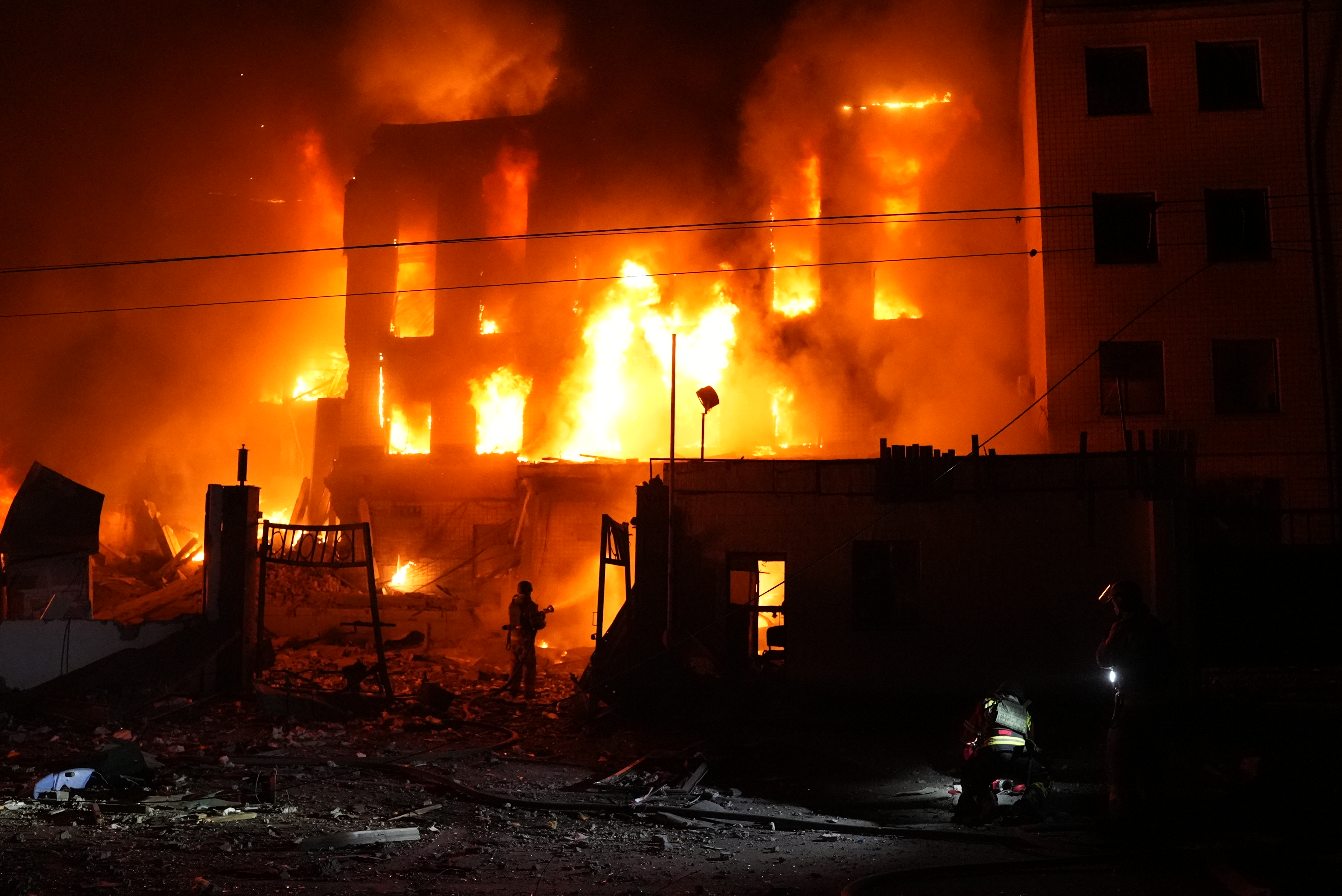
    Explosions were heard in Kyiv for nearly five hours, according to Vyhivskyi. More than 50 sites were damaged during the attack, including residential buildings, dormitories, schools, stores, and gas stations, he said.

    Ukrainian Foreign Minister Andrii Sybiha called it “a horrific attack” and accused Putin of undermining U.S. peace efforts.

    The Russian Defense Ministry said its forces overnight launched a massive strike on Ukrainian military industry facilities.

    It provided a detailed list of its targets. They included places storing Ukrainian drones and cruise missiles, as well as transport, logistics, and distribution centers for military cargo in Kyiv and the Kyiv region, the ministry said.

    Drone incursion is reported in Romania

    Romania’s Ministry of National Defense said a drone entered its territory and later crashed in neighboring Moldova east of the countries’ shared border after about 30 minutes. Two Spanish F-18 warplanes tracked its trajectory, the ministry said.

    Moldovan police said a drone crashed in a sunflower field outside a village in the Riscani district, causing fires, but no one was injured.

    Ukraine neighbors both Romania and Moldova, and the countries have reported dozens of drone incidents since Russia’s full-scale invasion in 2022.

  • Iceland summons U.S. ambassador over provocative Trump map

    Iceland summons U.S. ambassador over provocative Trump map

    A day after summoning the U.S. ambassador for a formal rebuke, Iceland’s leaders on Tuesday publicly condemned a social media post from President Donald Trump showing the American flag covering their nation along with Greenland, Canada, Mexico, and Caribbean states.

    “It is an insult to Icelanders, Canadians, Greenlanders,” Prime Minister Kristrun Frostadottir of Iceland told reporters Tuesday, referring to Trump’s Monday post, which did not include any written commentary.

    “There is nothing funny or normal about making fun of the sovereignty of states,” she added.

    Icelanders have been wary of Trump since he threatened Greenland, their closest neighbor. Now, this social media post feels like a marked escalation in rhetoric, said Eirikur Bergmann, a politics professor at Bifrost University in Iceland.

    “Icelanders are used to looking toward the U.S. as Iceland’s defender,” he said. “Now, our protector has become our intimidator.”

    The U.S. embassy in Reykjavik declined to comment on Trump’s post or Iceland’s response, and the White House did not immediately respond to a request for comment.

    Trump’s post tests Iceland’s resolve just over a week after the Nordic country voted against exploring European Union membership.

    That vote sharply divided public opinion, as many of the 400,000 people living in Iceland felt like they were at a turning point. Many said that the vote came down to questions of how to protect their stability and sovereignty.

    Some Icelanders, who wanted to explore membership, saw the bloc as a potential protector in a world where superpowers are circling the Arctic and Trump is shaking international alliances. Iceland, the only NATO member without its own military, relies on the alliance for protection. And Trump’s aggressive remarks about Greenland have alarmed many Icelanders.

    Icelandic voters who wanted to explore EU talks said in interviews that they were shocked when Trump repeatedly confused Iceland with Greenland in a major speech in January. Many, too, were offended by reports that Billy Long, Trump’s pick to be the new U.S. ambassador, joked in private that Iceland could become the 52nd state. (Long apologized.)

    But late last month, those voters lost out to Icelanders who thought it would be better for Iceland to stay out of the bloc.

    Now, Bergmann said, Iceland’s choice to go it alone is heightening the national anxiety.

    “Iceland doesn’t have the same options as before of fleeing into the arms of Brussels as a response to an intimidation like this,” he said.

    In a show of sovereignty and outrage, Iceland’s government is reacting forcefully to Trump.

    Foreign Minister Thorgerdur Katrin Gunnarsdottir summoned Long to express what her ministry called a “clear message that the image was wholly inappropriate.”

    The ministry did not make Gunnarsdottir available for an interview.

    Gunnarsdottir told reporters that Trump administration officials had repeatedly offered her advice about their boss: “We should perhaps not take the current U.S. president literally, but we should take him seriously,” she said she was told.

    This post, she said, crossed a line. “This is not a joke in my opinion,” she said.

    “And if this is supposed to be a joke,” she continued, “it’s a bad joke.”

    This article originally appeared in the New York Times.

  • UAE warned Netanyahu of major Hamas operation days before Oct. 7 attack, news report says

    UAE warned Netanyahu of major Hamas operation days before Oct. 7 attack, news report says

    JERUSALEM — Prime Minister Benjamin Netanyahu was directly warned by the president of the United Arab Emirates that Hamas was planning a major offensive just days before the militant group attacked on Oct. 7, 2023, according to an Israeli newspaper report.

    UAE President Mohammed bin Zayed spoke with Netanyahu 10 days before the attack and said Yahya Sinwar, the leader of Hamas in Gaza at the time, was planning an operation, the Haaretz daily said.

    Bin Zayed said it would lead to bloodshed and could destabilize the region and undermine the Abraham Accords, the normalization agreements between Israel and several Arab and Muslim-majority nations, the newspaper reported.

    But Netanyahu “reacted with relative calm,” according to Haaretz, which said he assured bin Zayed that Israel was prepared for any scenario and a possible attack was more likely to come from the occupied West Bank.

    Hamas militants killed some 1,200 people and took another 251 hostage in the Oct. 7 attack. Hundreds of Israelis, mostly soldiers, have been killed in continued fighting in wars in Gaza, Lebanon, and Iran.

    Haaretz reported Netanyahu’s office called the report an “absolute lie” and said Netanyahu did not speak with the UAE president “during the period in question and received no warning from him.”

    Netanyahu has rejected calls for an official government inquiry into the events surrounding the Oct. 7 attack.

    His office denied Tuesday that the UAE gave him a warning. “If there was any relevant information, it was passed through intelligence channels between the two countries,” the statement said.

    The UAE’s Foreign Ministry also said that it would not comment on “speculation regarding conversations between government leaders.”

    Israel and the UAE have maintained “open and direct lines of communication” since they formally established ties five years ago, the statement said. It added: “When necessary, all relevant intelligence has been and continues to be communicated.”

    Israel is holding national elections next month and Netanyahu’s actions around the time of the Oct. 7 attack are a key issue in the campaign.

    Gadi Eisenkot, a former top general who is seen as Netanyahu’s main opponent in election, accused the prime minister of ignoring dozens of warnings ahead of the attack.

    “He is unfit,” Eisenkot wrote on social media.

    Another Netanyahu rival, Naftali Bennett, said, “Netanyahu bears personal and direct responsibility for the failure that led to the deaths of thousands of Israelis on his watch.”

    Israel’s offensive in Gaza has killed more than 73,650 Palestinians, according to Gaza’s Health Ministry.

  • Documents suggest New Yorkers were misled about air quality after 9/11

    Documents suggest New Yorkers were misled about air quality after 9/11

    NEW YORK — In the harrowing months that followed the attacks on the World Trade Center, New Yorkers were repeatedly assured that the air around the fallen towers was safe to breathe.

    But 10 months later, health officials were still finding evidence of asbestos as much as half a mile away, according to a sample of air quality records being released Tuesday.

    The documents, reviewed by the New York Times in advance of their release, include more than 170,000 pages of air quality reports, contamination records, and correspondence among city officials that were stored in 68 boxes in a city office, shielded from public view for more than two decades, and, according to city officials, discovered only last year.

    Mayor Zohran Mamdani has directed his administration to release the records to the public through an online portal, timing it to the commemoration of the 25th anniversary of the attacks in lower Manhattan.

    Over the course of the next year, his administration intends to review, redact, and publicize many more papers, found in municipal and insurance offices, that relate to the environmental toxins brought about by Sept. 11.

    The records being released Tuesday provide a snapshot of the frenzied months following the attacks, when New York City and its leaders were struggling to balance the city’s recovery with fears of terrorism and lingering toxins.

    The documents are limited in scope, offering only a fraction of the air quality reports taken around ground zero. And while they also include a smattering of internal memos — including the so-called Harding memo, in which the city discussed its potential liability stemming from the Sept. 11 air quality — many more are presumably absent.

    But even in a scattershot way, the records seem to strengthen the notion that New Yorkers were instructed to return to the ground zero area before it was safe to do so, potentially exposing workers and residents to dangerous toxins.

    “The very least our city owes the families, survivors, and first responders whose lives were forever changed by the horrific terror attack of Sept. 11 is transparency and accountability,” Mamdani said in a statement.

    Releasing the documents was both a massive logistical hurdle, for which the mayor budgeted $34 million, and an acknowledgment that, even after so many years, as fewer Americans remember the attacks, the health effects persist. More people are believed to have died from illnesses related to the attacks than the nearly 3,000 people who were killed Sept. 11. They are succumbing to lung and blood cancers and heart and respiratory diseases.

    Records related to 15 John St., a building less than a mile from the World Trade Center, offer a glimpse into the prolonged, frenzied, and often confusing cleanup work that took place around ground zero.

    On July 13, 2002, with New Yorkers still reeling from the attacks on the World Trade Center that blanketed lower Manhattan in debris, inspectors were busy collecting dust samples from the building.

    Each report echoed the last: Asbestos present on the facade ledge. Asbestos present on the west side roof. Asbestos present on the top electrical cable.

    Some reports show that asbestos levels appeared to stay under limits set by environmental and worker protection agencies; others indicate they may have been too high, though many of the papers are not accompanied by written analysis.

    The documents show that the asbestos found at 15 John St. was not an outlier: Lists of environmental quality measurements taken by city agencies, the Environmental Protection Agency, and privately contracted laboratories demonstrate the presence of asbestos and other contaminants, sometimes at levels exceeding acceptable limits, in dust and air in other parts of lower Manhattan after Sept. 11.

    They include records preserved by the Giuliani administration, as well as documents related to 7 World Trade Center, which collapsed on the afternoon of Sept. 11.

    A letter to the city’s Department of Environmental Protection from a New Yorker in February 2002 underscores how isolated and frightened people felt at that time.

    A resident of 333 Rector Place detailed what she viewed as extensive missteps by city officials and her building’s property manager in attempting to remove asbestos and other contaminants from the premises.

    “Sept. 11, 2001. Felt I had to do something,” the resident, Marisa Ramírez de Arellano, wrote, describing how she had “scooped up dust from coffee table into a paper bag. Also started to clean the floor with wet paper towels,” an effort she acknowledged was “mostly futile.”

    Reached Monday, Ramírez de Arellano, 80, said she had spent several years after the attacks under the care of an allergist and a pulmonologist. She was prescribed steroids and other medications because respiratory tests led doctors to fear she had suffered lung damage, she said.

    She said she spent several hours in her apartment Sept. 11 because she “didn’t realize that very lightweight dust that was coming in was as bad for human beings as it turned out to be.” She left the apartment when firefighters came to evacuate her.

    By the time she returned several weeks later, officials said the air was safe to breathe, but she had doubts, especially one night when a hazmat team came to dig up the grass from a small roundabout in the neighborhood.

    “They dug several inches down and took it all away and replaced it with new dirt, new sod, new grass,” Ramírez de Arellano said. “And I thought, if they were thinking the grass is contaminated, then what are we all breathing?”

    A draft document of data collected by the city’s DEP listed locations throughout lower Manhattan where asbestos levels in some dust samples exceeded hazardous limits in the days immediately after the attacks. Another undated document lists ambient samples that were also above acceptable asbestos limits.

    An audit from November 2001, prepared by a private firm and submitted to the federal EPA based on data collected by New York City and state agencies, showed other troubling findings. That audit demonstrated that air concentration of the carcinogen benzene was still spiking near the towers’ footprint, and that the concentration of asbestos in the air at the Fresh Kills landfill on Staten Island had increased after the attacks.

    But the uncertainty about the air quality in residential and commercial buildings in lower Manhattan was already raising concern among public officials including Rep. Jerrold Nadler, a Manhattan Democrat whose district included ground zero at the time.

    “Congressman Nadler believes that the EPA has neglected its responsibility for monitoring indoor air quality around ground zero,” according to a memo from a city official, Ester Fuchs, sent to six others including the city’s top lawyer, Michael Cardozo, on Feb. 28, 2002, two months after Michael Bloomberg took office as mayor, replacing Rudy Giuliani.

    She noted that Nadler said that the federal Environmental Protection Agency “handed over responsibility for measuring indoor air quality to the city without putting in place proper oversight measures,” a responsibility the city passed on to property owners.

    (BEGIN OPTIONAL TRIM.)

    The city’s health department instructed citizens to “clean their buildings with wet mops and rags,” Fuchs said, and summarized the agency’s position that air quality testing, while painting an incomplete picture, had not shown results “that would indicate long-term health impacts.”

    In an interview this week, Nadler recalled trying to persuade the administrations of Giuliani and Bloomberg to release whatever information they had collected on air quality around the site of the attacks.

    “They knew about the air quality and they essentially did nothing about it,” Nadler said. “I suspect that all they cared about was getting Wall Street reopened, and they didn’t give a damn about the health of the people down there.”

    Indeed, city and federal officials, most memorably Christine Todd Whitman, the administrator of the EPA at the time, reassured Americans that the air around ground zero was safe to breathe. Whitman has since apologized.

    A review of news articles and interview transcripts in the days and weeks following Sept. 11 show that Giuliani continued to vouch for the safety of the air quality.

    “I come down here in the morning and sometimes the odor is terrible,” he said in late October 2001, according to an article in the New York Daily News, which had reported on toxic chemicals and metals that had been released into the environment around ground zero. “You smell it and you feel there must be something wrong with it. But what I’m told is that it is not dangerous to your health.”

    In February 2002, Bloomberg said, “Every test that has been done says the air quality was in acceptable limits. I think some people are just never going to want to believe that.”

    A spokesperson for Bloomberg declined to comment. A spokesperson for Giuliani did not respond to a request for comment.

    Correspondence between Deutsche Bank, at 130 Liberty St., and the city DEP discusses testing from September 2001 through April 2002 that found asbestos in dust samples exceeding the 1% threshold for harm throughout the building, as well as the presence of carcinogenic organic contaminants, heavy metals, fungi, and bacteria.

    The bank’s experts “have recommended a systematic testing program” to quantify the hazard and identify appropriate methods for handling and disposing of the materials, the company’s managing director for corporate real estate wrote in a June 2002 letter to the DEP commissioner. The building would eventually be demolished.

    Asbestos exposure can cause lung tissue scarring, mesothelioma, and lung cancer. Dust, smoke, and other pollutants from the site have also been associated with lymphoma, leukemia, and other cancers.

    The release of the documents resolves litigation brought by 9/11 Health Watch, an advocacy organization that sued to force the publication of the documents.

    “For 25 years, four different mayoral administrations kept from the public, the U.S. Congress, and the City Council documents showing what the city actually knew about the danger of the toxic chemicals in Lower Manhattan and Western Brooklyn after the World Trade Center collapse, even as city officials continued messaging to the public that the air was ‘safe and acceptable,’” Ben Chevat, the executive director of the 9/11 Health Watch, said in a statement.

    But the documents’ release may expose the city to new or amended lawsuits. The information could also help those sickened in the years after Sept. 11 with their applications for federal victim compensation funds. The mayor and the city’s chief lawyer, Steven Banks, agreed that it was important to make the documents public, Banks recalled in a recent interview.

    “For years, families, city workers, and survivors have been crying out for more transparency from their government,” Banks wrote in an introductory letter contained in the document release.

    In a recent interview, Denise Verzi discussed losing her husband, Michael Verzi, a New York City firefighter, to lymphoma that was linked to his time working at ground zero.

    “He truly loved being a firefighter. That was his calling,” Verzi said of her husband, who died in 2022. “All that being said, now years later we’re finding out that there’s all these files.”

    She said her husband and his colleagues had been assured that “the air quality is fine, you can be down there.” And while they would have gone to the site regardless, she said, “maybe different precautions would have been taken.”

    “I don’t understand hiding it to begin with,” Verzi said. “That was horrific. But 25 years in, there’s people that are still getting sick.”

    This article originally appeared in the New York Times.

  • Navy failed to protect pilots from brain injury, House report says

    Navy failed to protect pilots from brain injury, House report says

    As concerns mounted that the extreme physical strain of flying fighter jets was causing brain injuries in pilots, and may have led to the death of a number of career aviators, the Navy did almost nothing.

    It didn’t even study its pilots to understand if it had a problem.

    That is one of the numerous findings in a harshly critical report released Tuesday by the powerful House Oversight Committee. The report said that because the Navy had repeatedly failed to act, Congress should pass legislation requiring the military to create a specific program to study and care for the brain health of all aviators.

    “Despite credible warnings, external reporting and internal awareness, the Navy has yet to determine whether the very conditions that define naval aviation may also be causing long-term harm to the pilots who endure them,” the report said. “Instead, it has relied on a system designed to respond to visible injuries, while leaving potential cumulative damage largely unexamined.”

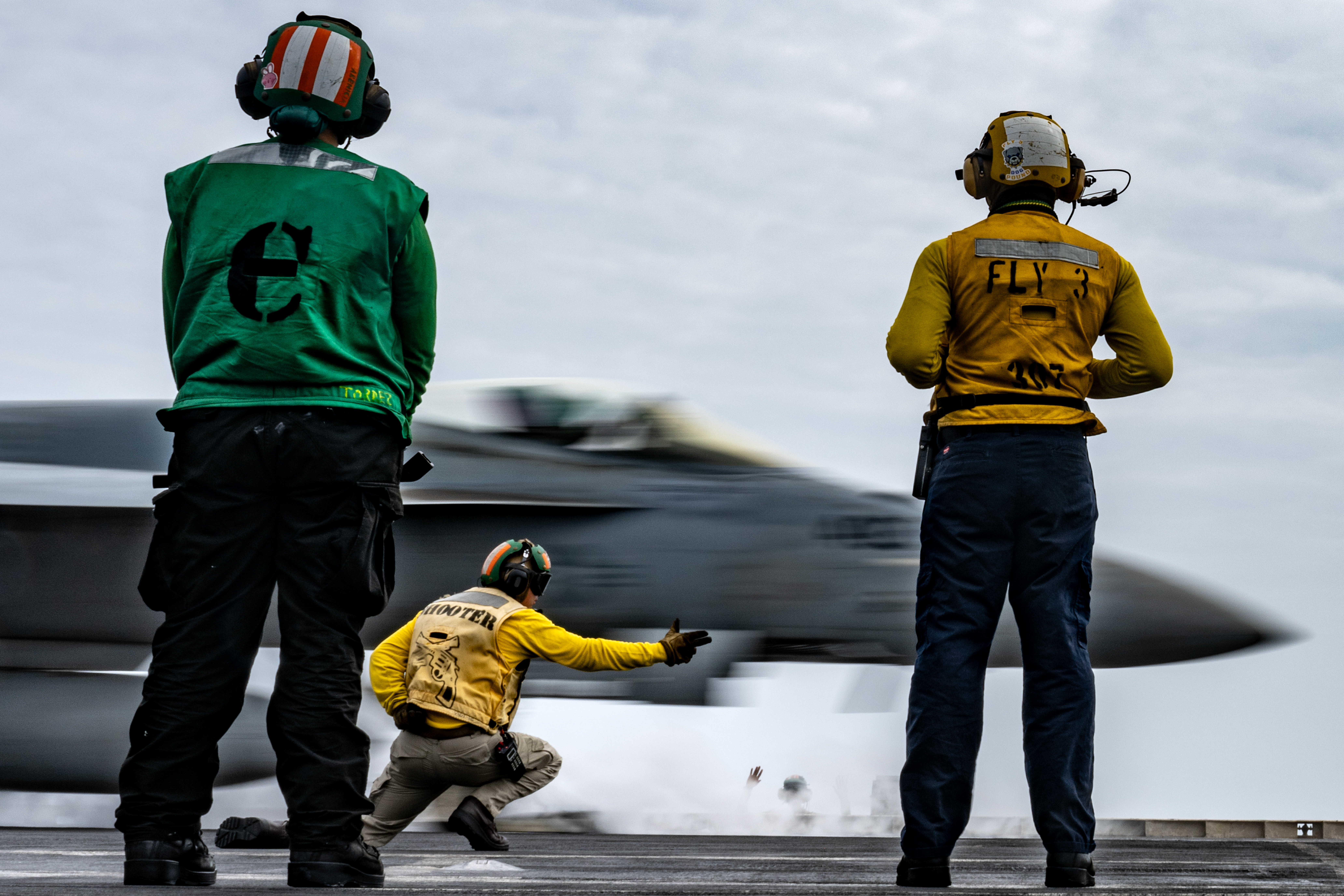
    Naval aviators are repeatedly exposed to body-crushing forces as they catapult off aircraft carriers and pull high G-force turns in training. The Navy has never studied how those forces over time affect the human brain, which contains 100 billion neurons in a network with a consistency similar to Jell-O.

    A number of career pilots have raised concerns that those repeated exposures may cause brain injuries that slowly accrue over years of service and lead to debilitating mental health problems.

    “Landing on a carrier is like a car crash. In my career I’ve been in hundreds of car crashes,” said Matthew Buckley, a former TOPGUN pilot who after 15 years of flying struggled with headaches, mood swings, and suicidal thoughts. He later started an organization to help the many other pilots he encountered who were experiencing similar problems.

    “I’m almost shaking, I’m so furious,” he said after learning about the findings of the House committee. “People have died. We know we have a problem. And you’re telling me someone needs to call for legislation to have the admirals do their jobs? It’s insane.”

    In 2024, the New York Times published an investigation showing that three pilots who all had symptoms consistent with brain injuries died by suicide in an 18-month span, and that a dozen current and former pilots were struggling with similar issues.

    In the following months, Rep. James Comer (R., Ky.), who heads the House Oversight Committee, formally demanded to know how the Navy was responding to the problem.

    The report released this week said the Navy had barely responded at all: It had not done a formal investigation to see if fighter jets were causing injuries. It had not put monitoring in place that might detect injuries. And it had no plans to offer expanded brain health services to its aviators.

    While the Navy has done extensive research on the immediate health effects of flying fighter jets, it has never looked at the long-term impacts. Because the Navy had no evidence of a brain-injury problem, its medical officials maintained that no problem existed. It continued to do so even as Navy doctors started sending pilots who were experiencing issues to a civilian neurologist.

    When that neurologist raised concerns to the Navy in 2020 that he was seeing a pattern of brain injury, he said it stopped sending him patients.

    Internal documents reviewed by the House committee showed that a few years later, when three career pilots who flew the Navy’s F/A-18 Super Hornet died by suicide, several Naval officers grew deeply concerned.

    In 2024 a Navy doctor and former pilot conducted an informal survey of pilots and found widespread mental health issues that were often going untreated. His report rippled through the pilot community, and a Navy captain soon sent the report to several admirals.

    “Feedback from the bro-network is that this is a hot topic … and it is affecting retention of our senior aviators,” the captain wrote. “The suicides may, or may not, be linked by common causes. But we will not know until we choose to study this problem.”

    The committee said no study took place.

    Instead, Naval leaders blamed the crisis on stubborn barriers to seeking mental health, including pilots not coming forward out of fear that they might be grounded. The Navy tended to blamed individuals for not seeking help. The House report found no evidence that leaders considered that the problem could be caused by its jets.

    The Navy’s elite TOPGUN fighter jet school saw things differently.

    In 2024 it surreptitiously set up a brain health program, known as Project Odin’s Eye, to monitor its top flyers, modeled on a program created by the Navy SEALs. TOPGUN did not alert the larger Navy to the suspected problem, or inform other fighter wings, the report said.

    Navy leadership knew nothing about Project Odin’s Eye until the Times wrote about its existence in December 2024.

    After the Times published its investigation, top Navy leaders pushed Navy medical experts on whether flying was causing brain injuries, according to the report. In a bit of circular reasoning that seemed pulled straight from the novel Catch-22, the experts said the Navy had never studied the problem, so there was no hard evidence that it existed. And since there was no hard evidence that existed, there was no reason to study it.

    “The medical team argued that because there was no evidence, there would be no need to investigate further,” the report noted.

    The House committee was particularly critical of that decision because, it said, the Navy was “well equipped” to study the issue, and already had an extensive aviation physiology research and monitoring program that could easily add a brain health study.

    The Navy, by its own estimate, could conduct a long-term study of brain health for 1,000 pilots for $3.9 million — about the cost of training one pilot to fly.

    Instead, the Navy chose to do nothing, the report said.

    “In sum, the Navy’s response to the committee reveals a paradox: A well-funded and expansive research enterprise that has nonetheless failed to address a consequential question in aviator health,” the report said. “Given the Navy’s substantial investment in human capital, failing to allocate comparable resources to understanding risks and protecting that investment, particularly in terms of long-term health, is unfortunate.”

    The committee recommended that Congress step in and require a comprehensive program that would create a frontline brain healthcare program for all pilots, modeled on Project Odin’s Eye.

    The committee also called for requiring the Defense Department to track catapult takeoffs and high G-force maneuvers in aviators’ medical records, and conduct a comprehensive study of the cumulative effects over time, including after pilots leave the military.

    This article originally appeared in the New York Times.