Take the B (Broad Street) Line to 15th Street/City Hall, transfer to the eastbound L, and disembark at Spring Garden Station, on the southern edge of the neighborhood.
Correct, to a point.
“I didn’t say where I need to get to in Northern Liberties, right?” said Jena Burley, the SEPTA training facilitator teaching the class.
Ack! Maybe the passenger would be better off taking the L for one more stop to Front-Girard, depending on the precise destination.
“Ask for as much specific information as possible,” Burley said.
SEPTA supervisors, administrators, and managers have been assigned 1,300 shifts as ambassadors in critical transit and Regional Rail stations from June 13 through July 19.
Jena Burley leads the SEPTA ambassador class.Tyger Williams / Staff Photographer
Four to 12 ambassadors will provide information, directions, and, ideally, a friendly welcome in each designated station — along with crowd control, and de-escalation techniques for conflict.
It’s a lot, which is why up to 1,000 employees have spent half a day in training with a detailed curriculum that feels like cramming for finals.
I worked with them through scenarios of escalating severity to simulate situations they will encounter: sweaty, frustrated crowds on platforms; medical emergencies; confusion over SEPTA’s fares and methods of payment; and how to troubleshoot travel glitches. And scarier stuff.
“This summer is an opportunity for SEPTA to shine, and you are such a big part of that,” said Lex Powers, chief officer for customer experience.
The Disney approach
This summer SEPTA is also debuting a new customer-service philosophy that subordinates other priorities to creating a safe and positive experience for people using the system.
The transit agency has used ambassadors since 2000 to help customers during special events like the Eagles Super Bowl parade last year, service changes, and the like. Officials rebooted the training program.
This summer, ambassadors will carry “cheat sheet” cards and wear blue vests to differentiate them from other workers in typical yellow safety vests.
I got my own blue vest at the start of the class — pretty snazzy — and tried to earn it.
Brittany Davis, of Northeast Philadelphia, a service planner at SEPTA, gets her vest.Tyger Williams / Staff Photographer
Cultural correctness
The recent training included “cultural diplomacy” briefing sheets with guidance on customs and backgrounds of the countries with national teams playing here, prepared by the World Affairs Council of Philadelphia and protocol experts.
For instance,I learned:
Never flash the “OK” hand gesture to a Brazilian. It’s offensive, like flipping the bird.
When greeting or handing things to a person from Ivory Coast, use your right hand. It is a social slight to use the left, which is reserved for personal hygiene.
In some cultures, such as Ghana, it is customary to exchange pleasantries before getting down to business. People from Curaçao, influenced by Dutch culture, can be more direct and, while friendly, value personal space.
‘Bring the temperature down’
My fellow trainees and I shared tables in a conference room and huddled to work through often complex scenarios in a 24-page workbook.
You notice a particularly long line forming at one fare gate and go to investigate. …
A customer is tapping a credit card over and over, but it doesn’t work. Another customer tries to squeeze past them, increasing tension, and voices in the line start to rise.
“You want to bring the temperature down,“ said Noah Lee, manager of service-information development, with whom I shared a table. ”Take the person whose card doesn’t work off to the side to figure it out, and let other people go through.“
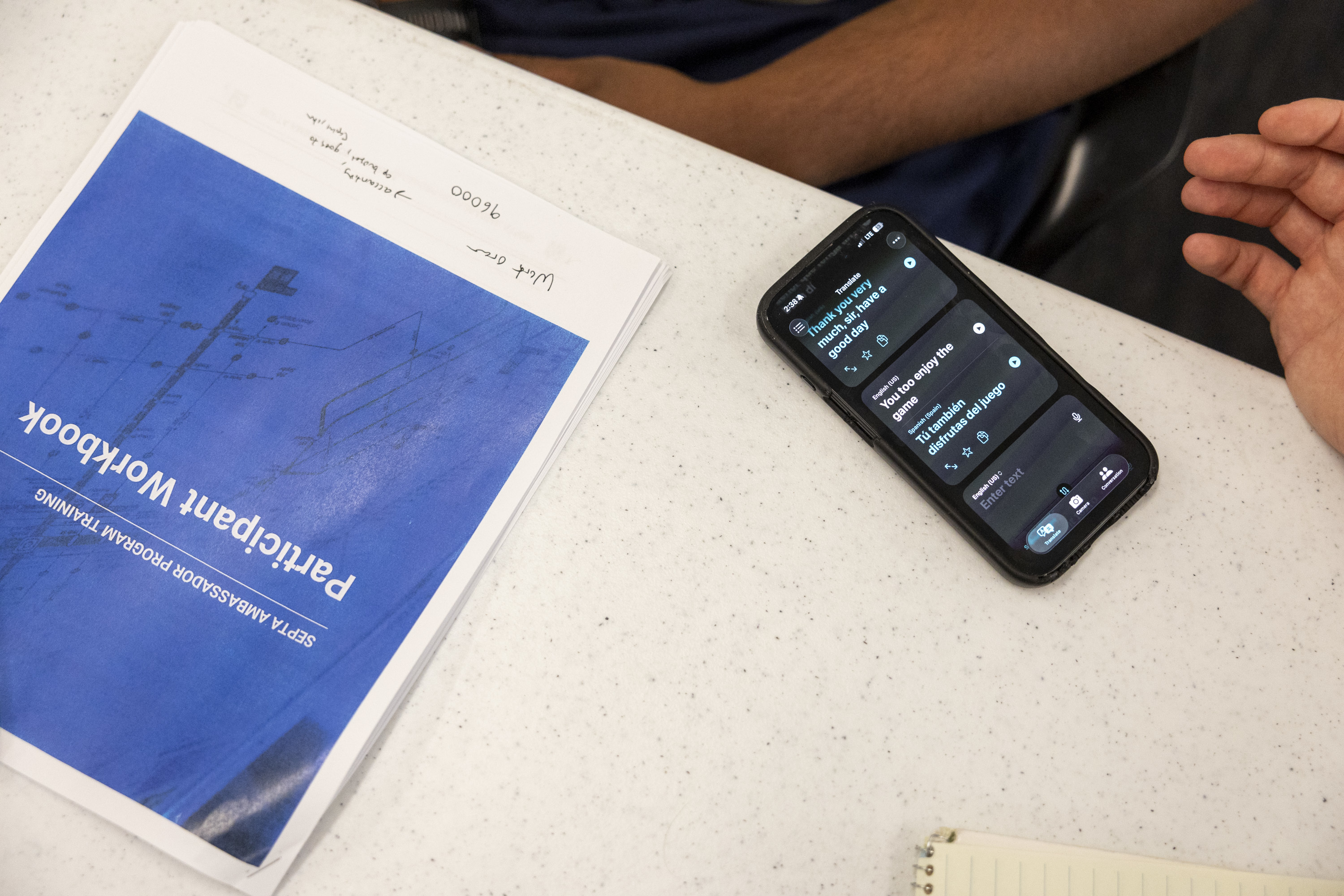
Nithin Vejendla, an operation planner, speaks Spanish in the Google Translator app.Tyger Williams / Staff Photographer
Nithin Vejendla said the bottleneck could be a two-person job and suggested bringing in another ambassador to wave people through the gate.
“Try empathizing with them,” said Vejendla, a SEPTA operations planner who was at my table. “Like, ‘I know it’s frustrating. I’ve had times where [tapping] doesn’t work. … We’ll get you on the next train.’”
Meanwhile, fix it. Is the person tapping incorrectly? Maybe the card reader’s bad, so try another turnstile. Consult a cashier.
The situation worsens.
A customer that has been held up in the line starts pushing and shoving the people in front of them. They are clearly agitated … [and] verbally threatening people.
“If they keep escalating, at that point your responsibility shifts to keeping the other passengers safe,” Vejendla said. “Maybe you stay between them and the fare gates, a physical barrier.“
Lee worked an ambassador shift during the 2025 Super Bowl parade and said he didn’t see anything like that.
“The atmosphere was joyful, and it was in the morning,” Lee said.
Vejendla, an operations planner who has worked at SEPTA for almost three years, was an ambassador for the Eagles parade and the Flower Show, and when SEPTA briefly cut and changed bus routes last year.
Later, trainees downloaded Google Translate to practice.
Vejendla speaks fluent Spanish and rough French. Powers, his boss, was teasing him about it.
“Lex was like, and I quote, ‘I can’t believe the system understood you. That French accent was terrible.’”
When emergencies arise
Sometimes, the scenarios are more serious. People wind up in the track area, trying to retrieve an item or having fallen off a platform. What do you do?
“Stop the train. Think about everything else later,” Burley said.
Heather Jordan, employee relations manager, (right), and Kim Smith, senior project engineer and track engineering with SEPTA, (left), are looking at the SEPTA app to answer questions for an exercise during the SEPTA’s Ambassador class.Tyger Williams / Staff Photographer
Go to the cashier and get them to push the Emergency Train Stop button, which activates a “stop” signal light. There are red flags in the booth to wave at incoming trains.
Moving your arm back and forth at chest level is a traditional railroad stop signal. “Or go berserk,” Burley said, waving your arms over your head or flashing a phone flashlight.
Do not enter the track area, and don’t try to pull a person up. The third rail carries 600 to 750 volts of electricity.
“You’re there to keep customers safe, but if you’re not safe, you can’t help,” Burley said.
As class ended and everyone left, I carried a deeper respect for the job of ambassador. I wished my fellow students good luck.
The Kennedy Center’s board plans to fight a federal judge’s order to remove President Donald Trump’s name from the performing arts center.
The center’s trustees on Thursday voted to seek a last-minute stay of U.S. District Judge Christopher Cooper’s directive to take Trump’s name off the center’s exterior by Friday as they appeal his ruling that renaming the center was illegal, according to a meeting attendee and someone briefed by a meeting attendee, who both spoke on the condition of anonymity for fear of retribution.
The board’s decision came a day before Cooper’s deadline for the center to remove Trump’s name from its building and branding, part of a ruling in which the judge also granted a request from Rep. Joyce Beatty (D., Ohio) to temporarily block steps toward a planned two-year shutdown.
Cooper’s order, the most significant legal blow yet to Trump’s effort to remake the Kennedy Center, found that the board exceeded its authority in December when it voted to rename the venue “The Donald J. Trump and The John F. Kennedy Memorial Center for the Performing Arts.” Congress gave the center its name, Cooper wrote, and only Congress can change it.
In February, Trump announced that he planned to close the center for two years starting in early July. The closure was necessary, he said, to make roughly $250 million in renovations, a decision that blindsided staff, artists, and even some trustees. The board — stacked with loyalists who elected Trump chairman after he purged his predecessors’ appointees in February 2025 — voted in March to approve the closure. The center’s executive director, Matt Floca, testified in April that the building’s deterioration is so severe that staying open during construction would be “irresponsible,” citing failing roof panels and water seeping into electrical vaults.
But Cooper ruled that the closure decision was made rashly, without the board weighing enough information about the potential harms. He did not bar trustees from ever shuttering the building, leaving the door open for the board to reconsider whether it should “come to this decision anew after independently balancing its multiple obligations to the Center in a prudent fashion.” The center’s general counsel highlighted that language last week in a memo to staff, noting that the court did not require the center to stay open during renovations or present any particular programming.
The center has so far signaled that it will comply. In last week’s memo, the general counsel’s office ordered employees to erase all references to Trump from official materials, starting immediately with email signatures, letterhead, and other documents, followed by signs, brochures, ID cards, and the building’s exterior by Friday’s court-ordered deadline. On Monday, the center erased Trump’s name from its website and YouTube page, and by Thursday, it had done the same with its Facebook, LinkedIn, and X accounts.
“We are complying with the court’s order while evaluating all legal options to preserve this revitalization and recognize President Trump’s leadership,” spokeswoman Roma Daravi said.
Late Thursday afternoon, the center’s Instagram account was still branded “The Trump Kennedy Center,” and the president’s name remained emblazoned across the building’s facade.
Hours after Cooper’s rulings, Trump lashed out at the judge and suggested he would abandon his involvement in the Kennedy Center altogether. In social media posts after the ruling, the president insisted that the building must close for renovations to proceed safely and said that unless he was “free to do what I do better than anyone else,” he had no interest in continuing. Trump said he had instructed the Commerce Department to arrange a “full and complete transfer” of the institution to Congress, a proposal that puzzled lawmakers and legal observers, since federal law vests management of the center in its board of trustees.
Last week, Trump appeared to walk that back. When asked on Friday how he wanted to be involved at the center, Trump said, “The same way it is.”
“I’m the chairman, so we’ll just keep it going,” he told reporters aboard Air Force One.
On Wednesday, a White House official said the president will remain engaged in the center’s affairs as administration officials devise plans to fix “the facility’s major issues.” The White House contested the notion that Cooper’s rulings were a “defeat” for Trump.
SAN JUAN, Puerto Rico — The U.S. government on Thursday announced sanctions against Cuba’s state-owned oil and gas company in a move some experts say will only deepen the island’s crises and hit vulnerable Cubans the hardest.
Secretary of State Marco Rubio asserted that key assets of the company, known as Cupet, were “unlawfully expropriated from American owners years ago.”
He also accused Cuba’s government of weaponizing energy.
“While the Cuban people have suffered fuel shortages and blackouts because of decades of under-investment in critical infrastructure, Cuba’s Communist leaders have diverted energy resources to line their own pockets,” Rubio said in a statement.
He further noted, without providing evidence, that Cuban officials “resell countless barrels of scarce energy on the secondary market, hoarding energy supplies for its military, intelligence and repressive forces, and rationing energy as a tool of social control.”
Bruno Rodríguez, Cuba’s foreign affairs minister, pushed back against Rubio’s comments in a post on X.
“The U.S. Secretary of State, driven by ambitions of conquest, presidential aspirations, and the vindictive sentiments of the elitist clique that propelled his political career, is now further tightening the economic and energy blockade against Cuba,” he wrote. “To justify this, he doesn’t resort to excuses prepared by his State Department, but rather to the usual vulgar lies, the most aggressive, ignorant, and rabid rhetoric among Cuba’s enemies.”
Cuba’s government has previously said that sanctions punish all Cubans and are aimed at strangling the economy to destabilize both the government and its people.
Cupet’s fuel sales to the public are almost nonexistent and are currently rationed.
William LeoGrande, an expert on Cuba at the American University in the United States, said the latest U.S. measure seems like an effort to block any major oil shipments.
“It appears that they’re all in on strangling the Cuban economy,” he said. “Their policy is a contradiction. They claim they don’t want to create a humanitarian crisis, although that’s exactly what they’re doing.”
‘Risk of triggering mass migration’
Ricardo Herrero, a Cuban economist based in the U.S. and executive director of the Cuba Study Group, a nonpartisan organization based in Washington, D.C., said he was “genuinely vexed” by the move.
“How are private importers supposed to store diesel and get it into vehicles without using CUPET facilities?,” he wrote on X. “This undermines what, until this morning, had been a humanitarian priority for the US. Either something much bigger is afoot, or we’ve entered the ‘indiscriminate cruelty’ phase of this policy.”
It’s unclear whether Cupet has any assets in the U.S., although it’s unlikely, LeoGrande said.
He said he could understand the logic of the measure to decentralize the government and strengthen and empower the private sector by enabling it to sell gasoline to state enterprises, or force those enterprises to move toward privatization so they could be oil recipients.
“Now, the Cubans are not going to privatize Cupet in the hope that might work and that somehow the U.S. might allow oil to go through in that way,” LeoGrande said.
He noted that most private businesses in Cuba are small and don’t have the infrastructure to land an oil tanker, unload the product and distribute it.
“They’re running a huge risk of triggering mass migration,” he said of the U.S. government.
Rubio said in a statement that all property or interests of Cupet located in the U.S. or in possession or control of U.S. people are blocked.
“President Trump wants a new future for the Cuban people with greater economic and political freedom and opportunity,” Rubio wrote on X. “Until then, we will continue to target the Communist regime’s ability to leverage its energy trade to further its corrupt agenda and violently repress the Cuban people.”
Cuba is already struggling under a decades-old embargo and a lack of petroleum as the U.S. keeps pushing for a change in its economic and political model.
Power outages — already common given the economic and energetic crisis gripping the island for the past five years — have only intensified since U.S. President Donald Trump threatened tariffs in late January on any country that sells or provides oil to Cuba.
Both countries have acknowledged that they’ve held talks, but the scope of them is unknown.
Meanwhile, Trump has been threatening military action in Cuba ever since the U.S. military invaded Venezuela and arrested former President Nicolás Maduro.
Last Thursday, Trump said Cuba has “sort of collapsed” and said “we’re going to handle that as soon as we’ve finished” military operations in Iran.
WASHINGTON — President Donald Trump said Thursday that he plans to nominate Jay Clayton, the U.S. attorney for the Southern District of New York and a former Securities and Exchange Commission chairman, as director of national intelligence.
Trump announced the nomination on social media amid pressure from Congress to name a permanent replacement for Tulsi Gabbard, who announced her resignation last month. Trump faced intense pushback over his decision to name Bill Pulte, head of the Federal Housing Finance Agency, as acting director. The job oversees the coordination of 18 intelligence agencies.
The resulting uproar led to a standoff in Congress after Democrats said they would refuse to renew foreign intelligence powers unless Trump pulled Pulte’s nomination and named a permanent nominee.
“Few people anywhere in the Legal Community are respected at the level of Jay,” Trump wrote. “I encourage the United States Senate to confirm Jay as soon as possible.”
Speaking later Thursday in the Oval Office, Trump said he still plans to keep Pulte in the role “for a little while” after earlier saying he wants Pulte to downsize the office. He called Clayton an “incredible talent” and said, “Nobody has better credentials.”
As the U.S. attorney in Manhattan, Clayton oversees the most prestigious of the Justice Department’s prosecution offices, with a vast portfolio ranging from terrorism and espionage cases to security fraud and public corruption.
He took over from interim U.S. Attorney Danielle Sassoon, who resigned in February after refusing to carry out orders from the Justice Department to drop corruption charges against Mayor Eric Adams. The case was eventually dropped after prosecutors from Washington submitted a request to a judge.
Republicans hope to move quickly on nomination
The Senate Intelligence Committee plans to hold a confirmation hearing for Clayton on Wednesday, according to a person who requested anonymity to discuss it ahead of an official notice.
Senate Majority Leader John Thune (R., S.D.) told reporters that the Senate hopes to receive Clayton’s nomination paperwork from the White House as soon as Thursday. “We will move quickly,” he said.
Democrats are holding up the renewal of a key surveillance law, the Foreign Intelligence Surveillance Act, in protest of Trump’s decision to temporarily tap Pulte. They say they won’t support an extension of the law, which expires at midnight Friday, until Trump withdraws Pulte’s appointment.
Trump previously said Pulte would take over on June 19. It is unclear whether the Senate could move quickly enough to confirm Clayton before that date.
“I don’t know what realistic is, but we’re gonna probe the limits of it,” Thune said.
Connecticut Rep. Jim Himes, the top Democrat on the House Intelligence Committee, said that he has “known and respected” Clayton for decades and that if Trump had named him as the DNI nominee last week, “lots of pain might have been avoided.”
“His intelligence, temperament and deep commitment to public service will make him a terrific DNI,” Himes said.
Asked about Clayton’s nomination, Senate Democratic Leader Chuck Schumer said, “Pulte has to go.”
“He cannot be in the DNI role,” Schumer said. “It’s too important.”
Trump’s pick has led SDNY during a tumultuous period
Clayton navigated his way through a 14-month tenure in the Southern District of New York without clashing with the federal judges in the busiest court in the nation, unlike his counterparts in upstate New York and New Jersey. After his interim term expired after 120 days, the judges of the Southern District appointed him as U.S. attorney.
Clayton was sworn in April 2025 on the same day three prosecutors resigned, saying they felt pressured to admit wrongdoing or regret about prosecuting the case against Adams.
Then, weeks later, the office had to withstand controversy over the Trump administration’s firing of one of its most respected and successful prosecutors, Maurene Comey. She claims she was fired because of Trump’s dislike of her father, former FBI Director James Comey.
Under Clayton, the Manhattan U.S. Attorney’s Office facilitated the unsealing of thousands of pages of court records from the prosecutions of Jeffrey Epstein and Ghislaine Maxwell — documents that were made public as part of the Justice Department’s release of records related to the late sex offender and his longtime confidant.
Clayton filed documents with the court explaining the process the government followed in releasing the materials.
Clayton has also overseen the prosecution of former Venezuelan President Nicolás Maduro and Maduro’s wife, Cilia Flores, on drug trafficking charges.
Clayton has overseen cases involving national security threats
Several recent terrorism cases brought by Clayton’s office touch on the global threats and influences that he’ll be navigating if confirmed as director of national intelligence.
They include the May arrest of Mohammad Baqer Saad Dawood al-Saadi, an Iraqi and Iranian citizen accused of plotting 20 attacks in Europe and Canada and planning to attack a Manhattan synagogue and Jewish centers in Los Angeles and Scottsdale, Ariz., in retaliation for the U.S. war on Iran.
“There are foreign nations and terrorist organizations that see our success as a threat. A threat that they want eliminated,” Clayton said at a recent press briefing. “That is a stark truth.”
“And don’t take my word for it,” he added. “Take their words and their actions. When your enemies tell you something, and when they act, you should know that they mean it.”
The first Trump administration tried in June 2020 to install Clayton, then the chairman of the SEC, as U.S. attorney in Manhattan, but backed down and instead allowed Deputy U.S. Attorney Audrey Strauss to serve in the post. The reversal came after then-U. S. Attorney Geoffrey S. Berman agreed to step down, following assurances that probes into Trump allies would not be disrupted and that Strauss could lead the office.
At the time, the office was looking into dealings by Rudy Giuliani, who was serving as Trump’s personal attorney, and was also investigating the actions of a state-owned Turkish bank.
DUBAI, United Arab Emirates — President Donald Trump said Thursday he had called off new military strikes on Iran, claiming a breakthrough in negotiations to end the war just hours after the American leader threatened to escalate the conflict by seizing control of Iran’s oil industry.
Trump has said multiple times in recent weeks that the warring parties have been on the cusp of a deal without anything coming to fruition. A spokesperson for Iran’s Foreign Ministry said in a live phone call on state television that mediators were active and nothing had been finalized to end the conflict that began Feb. 28 when the U.S. and Israel jointly attacked Iran.
Trump opened an Oval Office event Thursday afternoon saying: “We just made a great settlement of the war with Iran.” He offered scant details, other than to say he expects an agreement to extend a fragile ceasefire that started in April to be finalized “over the next few days.”
Extending the terms of the ceasefire gives U.S. leaders more time to negotiate over Iran’s nuclear program, the main reason Trump and Israeli Prime Minister Benjamin Netanyahu used to justify launching the war. Netanyahu’s office said Thursday that Israel is not a party to the emerging agreement between the U.S. and Iran.
The announcement came after two days of back-and-forth attacks between the U.S. and Iran had pushed the Middle East closer to the resumption of a full-scale war.
Trump had threatened further escalation earlier Thursday, posting on social media that the U.S. would hit Iran “VERY HARD TONIGHT” and take “total control” of its oil and gas industries. A few hours later, Trump posted on social media that significant points in the negotiations “have been brought to the highest level of Iranian leadership and approved.”
Esmail Baghaei, the spokesperson for Iran’s Foreign Ministry, said in his phone call on state television that text of a deal is “mostly finalized.”
“The problem is that the contradictions in America’s position has caused turbulence to this process,” he said Thursday night.
A major sticking point in negotiations has been Iran’s nuclear program, which the U.S. and Israel fear could lead to an atomic weapon, but which Tehran says is for peaceful purposes. Another key issue is Iran’s stranglehold on the Strait of Hormuz, a critical shipping lane for transporting oil and natural gas.
Trump again moves quickly from threats to negotiating
Trump’s rapid shift Thursday from dire threats to promoting peace negotiations again underscored his whipsaw approach to the war. He suggested on Monday that a deal to end the conflict could be reached in a matter of days.
Then back-and-forth strikes rattled the Middle East this week. The first involved attacks between Iran and Israel, followed by the two rounds of fire between the U.S. and Iran, which targeted countries where U.S. troops are based. The U.S. strikes began after Trump blamed Iran for downing an American attack helicopter near the Strait of Hormuz. Both pilots were rescued safely.
Iran’s Foreign Ministry said the U.S. attacks had “effectively rendered the ceasefire … meaningless,” without saying it was abandoning it.
After Trump threatened more attacks were to come on Thursday, Iran’s parliamentary speaker, Mohammad Bagher Qalibaf, responded on social media that “wrong strategies and impulsive decisions” would wreak havoc on energy markets and “create an endless quagmire that you will be stuck in for years.”
It wasn’t the first time Trump threatened escalation before giving negotiations another chance. In April, he warned Iran that “a whole civilization will die tonight, never to be brought back again” if it didn’t agree to his terms, before extending a ceasefire.
Trump threatened to seize Iran’s main oil terminal
Iran’s monthslong disruption of shipping through the Strait of Hormuz has crimped global energy supplies, driven up fuel prices and made food and other basics more expensive well beyond the region.
Trump had threatened Thursday to seize Kharg Island, the heart of Iran’s oil industry, through which 90% of its exports pass.
But Trump himself soon voiced doubts about taking over the oil terminal, saying in an interview with Fox News: “I don’t know that America has the stomach for it, to be honest.”
“I don’t want to have boots on the ground,” Trump said. ”But if I wanted to, we could put a small group of soldiers and take over the place.”
Tensions persist over Iran’s nuclear program, Strait of Hormuz
U.S. Treasury Secretary Scott Bessent said in a social media post that the U.S. would extract funds from frozen Iranian accounts to offset the costs of damage to American allies and any tolls Iran imposes for ships to transit the Strait of Hormuz.
Beyond the deadlock over the strait, the two sides also remain at odds over Iran’s nuclear program. Tehran insists its nuclear efforts are peaceful. The U.S. and Israel fear Tehran’s stockpile of highly enriched uranium could be used to build an atomic weapon.
Iran has insisted that any deal to end the war must also end fighting in Lebanon between its ally militia Hezbollah and Israel. But Israeli Prime Minister Benjamin Netanyahu appears intent on pursuing his goal of destroying the militant group.
Iranian student says hope dwindles as attacks escalate
A 25-year-old student in northern Iran says Iranians are fearing “chaos” amid the war with the U.S. and Israel and multiplying crises at home.
The student, who lives in the city of Babol, said many Iranians are struggling to afford groceries in the face of mass job losses and triple-digit food inflation. He spoke on the condition of anonymity out of security fears.
“Everything is going wrong and there is no hope among the people,” the student added.
The student first spoke to The Associated Press before the war when he participated in widespread anti-government protests. He now says his chief concern is that Iran “maintain territorial integrity and deterrence” in the face of attacks by the U.S. and Israel.
U.S. fires on another merchant ship to enforce blockade
The U.S. military’s Central Command said Thursday that it struck a Guinea-Bissau-flagged tanker attempting to evade the American blockade on Iranian ports. It said the M/T Jalveer was transporting Iranian oil when it was disabled late Wednesday after its crew failed to obey U.S. orders.
It’s the ninth merchant vessel the U.S. military says it disabled to enforce the blockade.
Three Indian sailors were killed when American forces struck the Palau-flagged M/T Settebello on Tuesday, India’s minister overseeing ports and shipping said Thursday on X.
U.S. Central Command said American forces issued warnings before firing on the ship, which it accused of trying to evade the blockade.
The leader of the International Maritime Organization, a United Nations agency, condemned the attack.
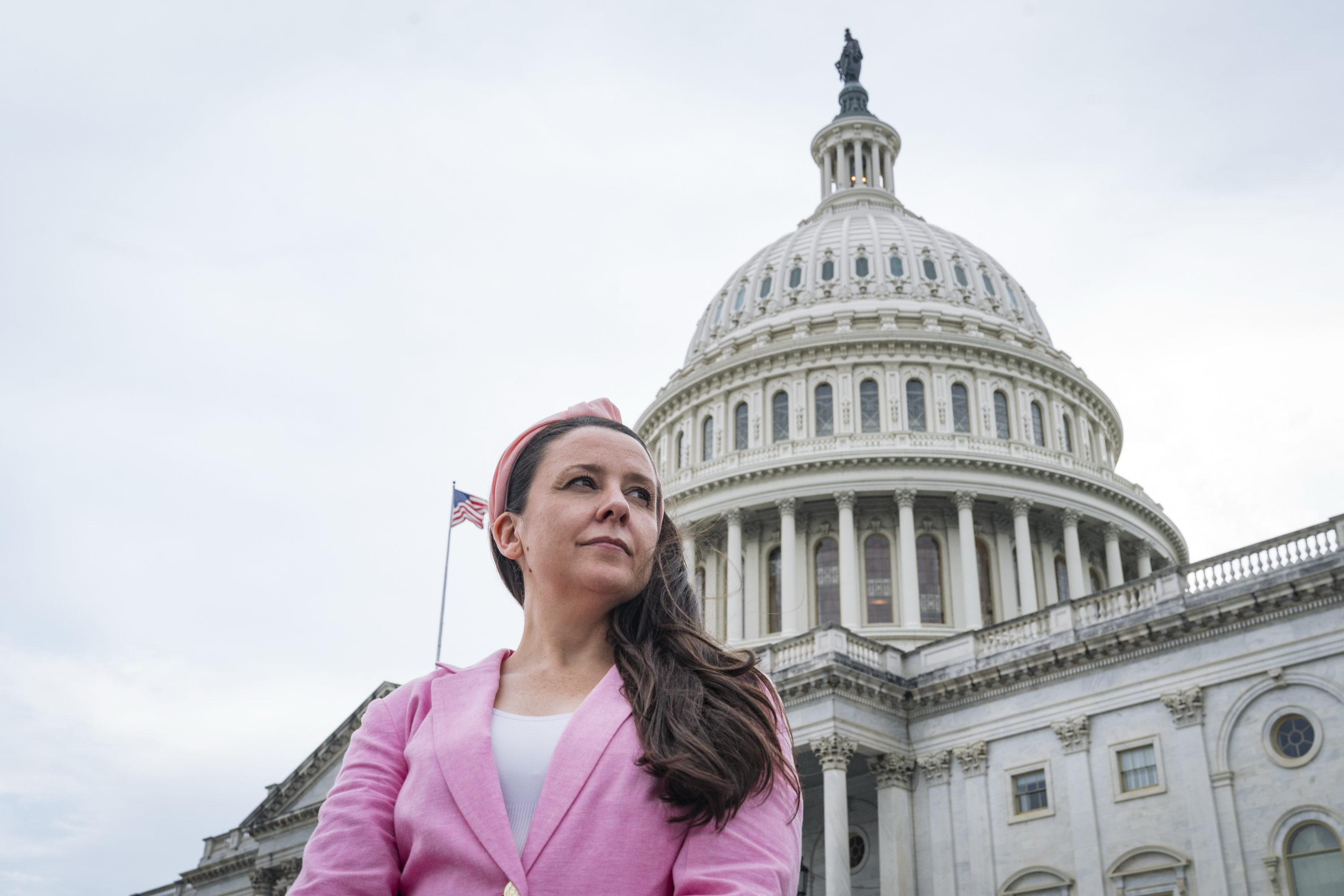
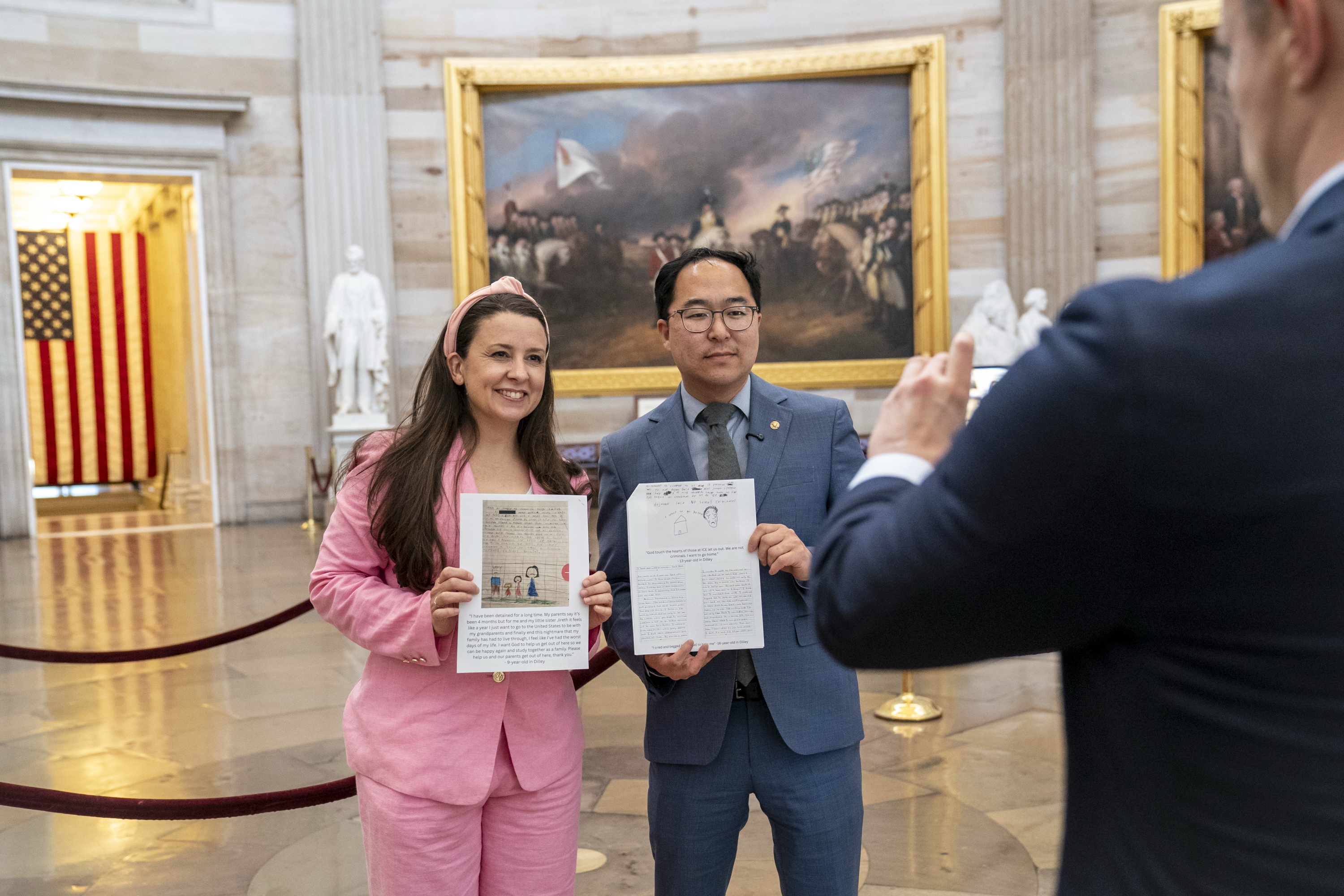
WASHINGTON — Rachel Griffin Accurso — Ms. Rachel, to her millions of followers — made her first visit to Capitol Hill on Tuesday afternoon, wearing a bubblegum-pink linen suit and wheeling a black suitcase filled with stapled packets of handwritten letters and drawings. They were the words and artwork of children, all of whom have been — or remain — in the custody of U.S. Immigration and Customs Enforcement at the nation’s only family immigration detention center.
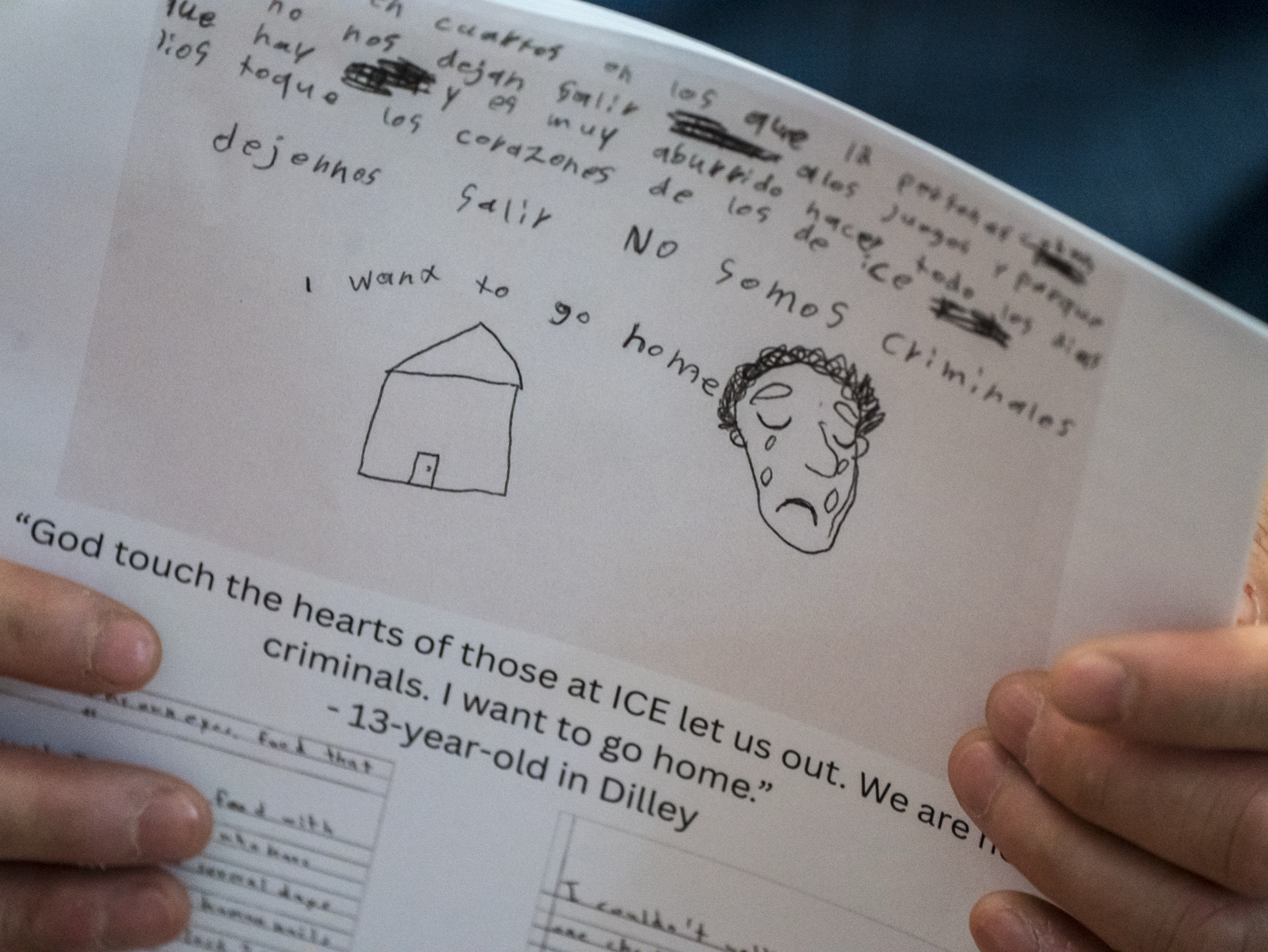
“I cry a lot,” read one letter from a 7-year-old boy held at the Dilley Immigration Processing Center in South Texas. “I want to get out of here.” Among the illustrations were portraits of crying faces, families standing together behind bars and a red house that a 9-year-old child longed to return to. Accurso clutched one packet in her hand, ready to offer it to the first lawmaker she encountered.
She had come with a plan: Over a brief two-day visit to Washington, she wanted to deliver the letters and drawings to members of Congress and tell them about the children she’d met. Her goal was to urge every official she spoke with — Democrats and Republicans alike — to end family detention and reunite the children and parents who had been separated by ICE enforcement.
Sen. Andy Kim (D., N.J.) holds the letter of a child detained at the Dilley Immigration Processing Center in southern Texas. Maxine Wallace
It was a new foray into the political realm for the early-childhood educator, who became the reigning star of children’s media with her wildly popular educational videos on YouTube and Netflix. Through her adult-facing social media platforms, Accurso has also emerged as a powerful advocate for vulnerable young people around the world, making headlines — and sometimes drawing backlash — for speaking out on behalf of children in Gaza, Sudan, and other humanitarian crisis zones.
Now her efforts include children closer to home. Over the past few months, Accurso has become an increasingly prominent voice in the debate over family immigration detention and the mounting concerns about conditions at the Dilley detention center. She has spoken directly to 10 families there via video calls, she said, and has publicly shared clips from several of those conversations with her 5 million Instagram followers. Accurso helped launch a petition to close the Dilley facility that has more than 324,000 signatures, including dozens of celebrities (Ben Stiller, Ayo Edebiri, Cynthia Nixon, and John Legend are among the many signatories). She also shared an open letter addressed to CoreCivic, the private prison contractor that has operated Dilley since its Obama-era construction in 2014: “What we have to agree on is not harming children,” she wrote.
When Accurso arrived on Capitol Hill along with her husband, Aron Accurso, they were welcomed by Sen. Andy Kim (D., N.J.). He offered them a brief tour through the Capitol, noting that the Senate had voted just days before to approve $70 billion in funding for President Donald Trump’s immigration enforcement agencies. “When you’re talking about this,” he said, nodding to the packet in Accurso’s hand, “what’s funding this? That’s what’s happening in this building.” As they spoke, the House was preparing to vote on the same funding package.
Accurso and Kim in the Capitol Rotunda on Tuesday.Maxine Wallace
Accurso and Kim posed for photos and filmed a brief video together in the Capitol Rotunda, then parted ways before she headed to the Hart Senate Office Building.
She was stopped repeatedly by enthusiastic interns and staff members who asked for selfies to show their own children, or their nieces and nephews. “What’s their name?” Accurso always asked, before deftly switching the phone setting to record a personalized video for each child: Hi, Ava! Hi, Maeve! Hi, Hugh!
Then she would steer the conversation toward the names of other children — some she had spoken with personally, and others whose circumstances were recounted to her by lawyers, advocates and journalists working with families at the Dilley facility. There was Amalia, an 18-month-old who suffered a near-fatal health crisis while in ICE custody at Dilley; Deiver, a 9-year-old who missed his friends at school and wanted to participate in the state spelling bee; Guri, a 12-year-old who has been detained with his family since February and has experienced chronic blood in his stool for months.
Accurso poses for a group photo with some staff from the office of Sen. Jeff Merkley (D., Ore.) on Tuesday. Maxine Wallace
Accurso was greeted with joyful shouts of recognition in the office of Sen. Jeff Merkley (D., Ore.). She left a packet with the staff of Sen. John Cornyn (R., Texas) and noted that they seemed friendly. She walked into the office of Sen. Lisa Murkowski (R., Alaska) with a cheerful, lilting “Hi, friends!” and the staff member’s subsequent gasp — “Oh my gosh!” — was audible down the hall.
“Well, I hope this works,” Accurso said, as the clock ticked to a quarter past 6 and it became clear that most of the offices were now closed. She had visited 10.
So she headed for the exit and learned the news as she was leaving: Minutes before, the House had narrowly passed the $70 billion funding package — including $38 billion for ICE enforcement and $26 billion for the Border Patrol. The vote paved the way for the agencies to build a detention system and pursue what Trump had pledged would be the largest mass-deportation operation in the country’s history.
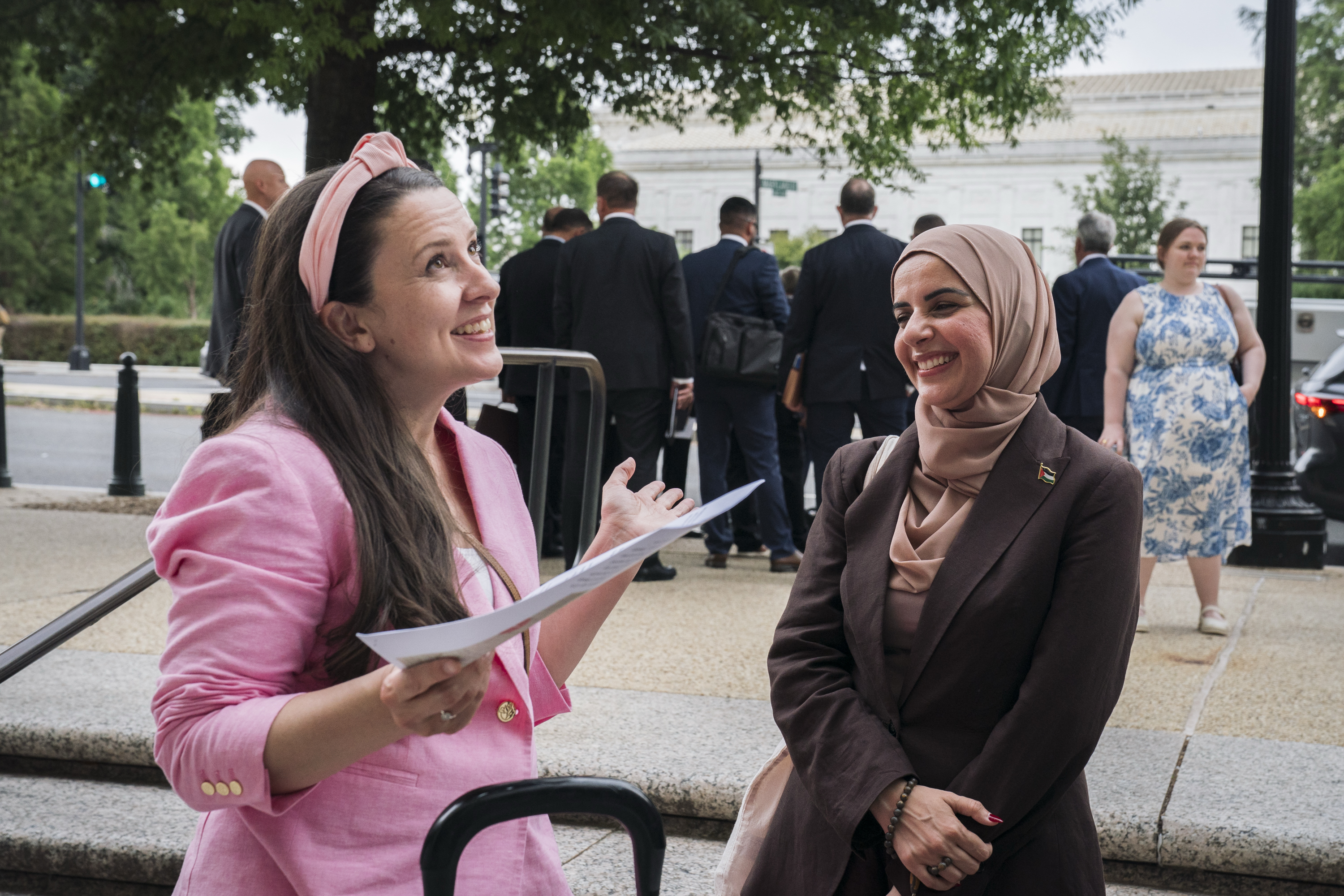
Accurso on Tuesday outside the Hart Senate Office Building with Leqaa Kordia, a Palestinian woman detained for a year amid a Trump administration crackdown on protesters last spring.Maxine Wallace
The day before she took the train to Washington from her home in New York, Accurso visited children and families at a hospitality tent set up by volunteers outside Delaney Hall, an immigration detention center in New Jersey where demonstrators and law enforcement have clashed in recent weeks.
Accurso delivered toys and art supplies to the tent and, with the families there, sang a song written by the Peace Poets along with children detained at Dilley: “I’ll sing from here and you sing from there, together we’ll sing down the walls everywhere.”
She spoke with a 13-year-old girl who described what it felt like to have only brief visits with her father, a truck driver who has lived in the United States for 20 years and supports his wife and three children, the youngest of whom has complex special needs.
“We went to go and visit my dad, and it was really sad,” the teen told Accurso, who wiped away tears as she listened. “He looked like a prisoner. But I knew in my heart that he shouldn’t be in there.”
Earlier this year, as she read more about the children being swept up in ICE enforcement operations, Accurso said, she began contacting legal experts, advocates, and journalists on the ground in Texas who detailed alarming conditions at the facility and helped connect her to families detained together there.
Those parents described children who were deteriorating physically and mentally; several kids said the water in the facility made them feel ill. Autistic children were suffering in particular, Accurso said; one nonverbal 5-year-old named Gael had not had a bowel movement in nine days and had begun hitting himself in distress. Families told her that their children couldn’t sleep because the lights were on all night.
She felt haunted by those conversations, Accurso said later, in an interview with the Washington Post: “I kept thinking, ‘How is this happening?’”
Several children and teens who were included on Accurso’s social media platforms were subsequently released from detainment, including Gael; Deiver, the 9-year-old who begged to go to the state spelling bee; and Olivia Mabiala Andre, a 19-year-old asylum seeker and nursing student. Accurso posted about her gratitude and relief in those moments, but she said she is acutely aware of how many children remain behind, including those who don’t feel safe speaking publicly about what’s happening to their families.
As of early June, about 320 people were at the Dilley center, including nearly 90 children, according to Faisal Al-Juburi, co-CEO of the Texas-based nonprofit Refugee and Immigrant Center for Education and Legal Services (RAICES). In the past year, he said, RAICES has documented roughly 1,500 medical concerns from families held at Dilley.
Accurso has highlighted concerns voiced by medical experts: In April, responding to mounting reports of dangerous conditions for children at the Dilley center — including unsafe water, the spread of measles, delayed medical care and declining mental health — the American Academy of Pediatrics requested urgent access to the facility, reiterating that “no time in detention is appropriate for a child.”
A spokesperson for CoreCivic said in an emailed statement that its facilities are safe, and noted that while some lighting is on during overnight hours, “lighting over sleeping areas is turned off during sleeping hours.”
The spokesperson referred to a statement by Kristen Dauss, the company’s vice president and chief medical officer: “The children and their families at DIPC receive care that is clinically rigorous, federally overseen and delivered with dignity.” Dauss added that children receive clean water from the same regularly tested municipal source that supplies local drinking water, appropriate nutrition and hygiene supplies.
Dauss echoed those points in a recent response to Accurso’s letter to CoreCivic. In a separate emailed statement, a spokesperson for the Department of Homeland Security echoed that families at Dilley are provided appropriate living conditions and medical care.
When Accurso talks to people about the firsthand accounts she has heard, “they’re shocked,” she said. “Why don’t people know? But I also feel like I didn’t know the extent of what was happening, either. We have to get the information out.”
This underscores the value of Accurso’s work and platform, said Elora Mukherjee, an attorney who represents numerous families detained at Dilley and serves as director of the Immigrants’ Rights Clinic at Columbia Law School. With her vast audience, Accurso represents a different way to inform people, beyond the reach of mainstream media: “Overwhelmingly, the American public still does not realize that, as a nation, we are imprisoning babies, toddlers and children who have done nothing wrong,” she said. “Sustained attention on cruelty against children is critically important.”
Al-Juburi noted that although the country’s current immigration policy represents “generations-long, systemic issues that need to be addressed, fundamentally, by our legislative branch,” there is a meaningful impact when prominent people raise their voices.
Culture often shifts before the law does, he said: “We will not see policy change until the public demands it. And that is what gives me hope when people like Ms. Rachel turn their spotlight onto a cause like this.”
The sun was falling through mottled clouds as Accurso left the Hart Building and wheeled her suitcase down Constitution Avenue toward the Capitol. She wanted to record a video there for the children detained at Dilley and the ones waiting in the tent outside Delaney Hall. She would tell them that she’d brought their letters and their artwork to the place where decisions about their future were made. “I have your words right here,” she would say into her phone camera, holding the stapled packet close to her chest. “I’m always going to stand with you.”
But when she arrived at the building, she first took a moment to sit quietly on the empty steps. The House’s vote, and its ramifications, were at the forefront of her mind. She felt a heavy sense of sorrow and defeat, she said.
She adjusted her knotted pink headband and looked up toward the towering dome, bathed in the softening light of dusk. She thought about how young people often stop her — more than a dozen had done so just in the past few hours — to thank her and urge her to keep going. The next day, she would come back and meet with more elected officials in the House. She would make sure that all 535 packets of letters and drawings were delivered to every member of Congress. She would keep telling the stories of the children she’d met.
“I’ll never stop trying, for them,” she said. “I can’t say, ‘I’m just one person, so I’m not going to make a difference.’ What if everyone said that?”
The FDA last month gave its first OK to fruit-flavored vapes — essentially endorsing them as a less-harmful alternative to traditional cigarettes. The decision came despite the agency’s longstanding position that such flavors appeal to children and must show extra health benefits to warrant approval for adults.
Health groups and Washington lawmakers quickly condemned the decision and have called for an explanation.
A six-page FDA memo released this week provides more details about the agency’s rationale. In it, FDA regulators appear to sidestep previous statements about the risks of sweet vaping flavors while acknowledging shortcomings in the data submitted by vape manufacturer Glas Inc.
Smokers who tried Glas vapes were much more likely to completely switch from cigarettes over the course of a three-month study, according to the memo.
But the data did not show “statistically significant differences” between adults using the company’s mango and blueberry flavors and those using a tobacco-flavored e-cigarette.
That means the new vapes failed to meet the same bar as a handful of other flavored products previously sanctioned by the FDA, including menthol-flavored vapes from Juul and NJOY. Those companies showed that adults who used menthol were significantly more likely to cut down or quit cigarettes compared with those vaping tobacco flavors.
Elsewhere, FDA regulators explained that the Glas flavored vapes “did not have to demonstrate added adult benefit,” because young people were unlikely to use them. Glas requires users to unlock each e-cigarette with an age-verifying cellphone app.
The agency’s authorization also runs counter to recent FDA guidelines advising companies that fruit and dessert flavors would have to meet “a high evidentiary burden” for adult use, given their risks to children. Tobacco-flavored products are not popular with teens and generally face lower regulatory hurdles at the FDA.
The FDA document is also unusual in its brevity.
Previous FDA memos on new vaping products typically run dozens of pages. For example, last year’s document authorizing Juul’s menthol e-cigarettes was more than 90 pages and included detailed scientific data from research involving 50,000 people.
The short memo on Glas does not include key details, such as how many smokers the firm studied.
Previously, the FDA almost always posted such memos immediately after announcing an authorization. The document on Glas appeared on the agency’s website more than a month after regulators OK’d the products.
The agency has faced questions from members of Congress about the decision. Last month, 10 Democratic senators sent a letter to the agency requesting more information about the authorization, calling it a “shortsighted and reckless decision.”
The application from Glas, which also included menthol and tobacco-flavored vapes, followed a winding path to authorization. The small, Los Angeles-based company submitted a marketing request to the FDA in 2021.
In February, FDA scientists authorized several of the flavors. But that decision was blocked by a senior official reporting to then-FDA Commissioner Marty Makary, according to internal memos later released by the agency.
The mango- and blueberry-flavored products were finally OK’d during Makary’s last full week leading the agency. He resigned the post after months of criticisms from industry stakeholders, including tobacco companies that have lobbied President Donald Trump’s Republican White House for looser regulations on vaping flavors.
A spokesperson for the company could not immediately provide comment when reached Thursday morning.
Two men living in the Republic of Georgia have been charged by federal authorities in Philadelphia with running an international money laundering scheme that tried to use cryptocurrency exchanges to mask the source of nearly $400 million, prosecutors said Thursday — including at least $20 million that came directly from accounts associated with illicit actors on the dark web.
Igorevich Tkachuk, 37, of Ukraine, and Alexander Vladimirovich Ledenev, 25, of Russia, were arrested Wednesday in Georgia, where both live in the coastal city of Batumi, according to U.S. Attorney David Metcalf. Prosecutors will seek to extradite them to Philadelphia to face money laundering charges.
Metcalf said the two men were part of an organization that dubbed itself “AudiA6.” The group had two primary functions, prosecutors said: managing a cybercrime forum known as Dark2Web, where users could strike deals to commit crimes against targets for money, and running a cryptocurrency-based money laundering service, through which users could have their virtual currency “mixed” into different streams that would make the origins harder for authorities to trace.
Prosecutors said Dark2Web was an online forum that allowed users to discuss deals about committing crimes.Court filings, U.S. Attorney's Office
Over the last five years, prosecutors said in a criminal complaint, AudiA6 received $389 million from customers to launder, which the group would “mix” in exchange for a commission fee.
About $20 million of those deposits came from accounts prosecutors said were known for committing illicit activity, including groups that perpetuated ransomware attacks or people who were known to have received stolen funds online. Millions more appeared tied to similarly suspicious groups through indirect transactions, they said.
Over the course of the scheme, prosecutors said, AudiA6 received at least $10 million in profit. The group would often charge higher commission fees for smaller transactions.
According to the complaint, federal authorities conducted six undercover transactions with AudiA6 between December 2022 and May 2026. In each, the document said, agents said in messages — typically in Russian — that they wanted to exchange “dirty” digital currency, such as Bitcoin, and AudiA6 took the funds, “mixed” them, and returned the washed proceeds, minus a commission.
In one case this April, an agent in Philadelphia sent a message to the AudiA6 exchange saying: “is [Bitcoin] from scam OK? Stolen bitcoin…”
According to the complaint, the person running the exchange replied: “don’t care.”
AudiA6 then mixed about $5,000, the complaint said, keeping a fee of about $300.
A few weeks later, the document said, an agent in Philadelphia reached out to the exchange again and asked about laundering proceeds from selling cocaine online.
“Is it ok or are the risks too high?” the agent asked, according to the complaint.
“Everything like that needs to go through a mixer,” the operator wrote back, before laundering about $5,100 worth of bitcoin and keeping $400 as a fee.
Despite AudiA6’s promises to customers that the mixed transactions would make funds untraceable, investigators said, the group “was not actually sending and receiving from distinct, unconnected sources.”
“Instead,” they said, “transactions could be directly traced through exchange records.”
Neither Tkachuk nor Ledenev had attorneys listed in court records Thursday.
Each could face up to 20 years in prison if convicted, prosecutors said.
For the past year, FIFA, the governing body of international soccer, has leased an office on the 17th floor of New York’s Trump Tower that has sat all but empty. The rent goes to President Trump’s family business, but soccer officials say the space sits largely idle.
Paying rent to the Trumps was the choice of Gianni Infantino, FIFA’s president, who has made being close to Trump a top priority. He has lavished the president with praise, trophies and a medal. He has made pilgrimages to Mar-a-Lago, the Trump National Doral golf club and even the “Melania” documentary premiere.
Infantino has publicly boosted the president through impeachments and plummeting poll numbers.
It was all in service, Infantino’s supporters say, of ensuring that the World Cup, which begins this week, goes off without a hitch. Trump could disrupt the games in any number of ways. Infantino, allies say, is handling a volatile president who responds to praise and gifts.
“He’s straightforward in terms of what you need to do to manage the relationship,” said Majed Al Sahib, a soccer official from Saudi Arabia who said that Infantino was being pragmatic.
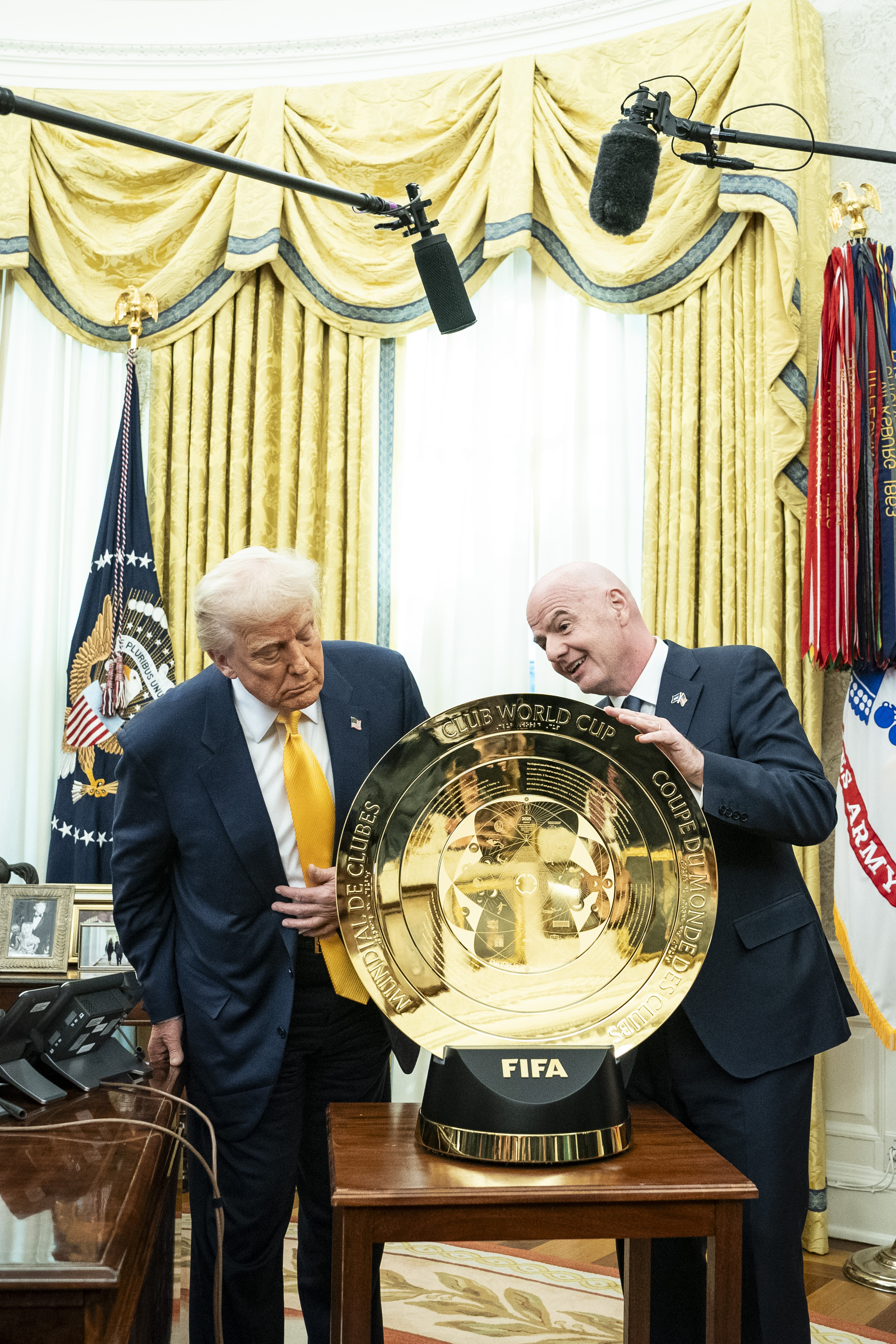
President Trump and Gianni Infantino at the White House in 2025 with a trophy intended for the winner of the Club World Cup competition. Trump kept it, and FIFA commissioned another.Haiyun Jiang / The New York Times
FIFA officials are clear about what they want from the World Cup. They want a higher profile in the United States and more growth in the world’s biggest consumer market. They also want to shed the reputation for corruption and cartoonish excess that led to Justice Department prosecutions.
Infantino failed to woo the Biden administration, former government officials said. But he found a receptive ear in Trump, who calls him “the king of soccer.” A decade ago, soccer executives were terrified to travel to the United States, fearing they’d be arrested. Now, Infantino is an Oval Office regular.
Infantino presided over the previous two World Cups, in Russia and Qatar, and drew criticism for cozying up to autocrats in both countries. His amity with Trump has him once again defending his way of operating in what is supposed to be a politically neutral position.
“I think it is absolutely crucial for the success of a World Cup to have a close relationship with the president, with the government,” Infantino said last year. “I have a lot of friends.”
This World Cup will be a test of whether that friendship pays off.
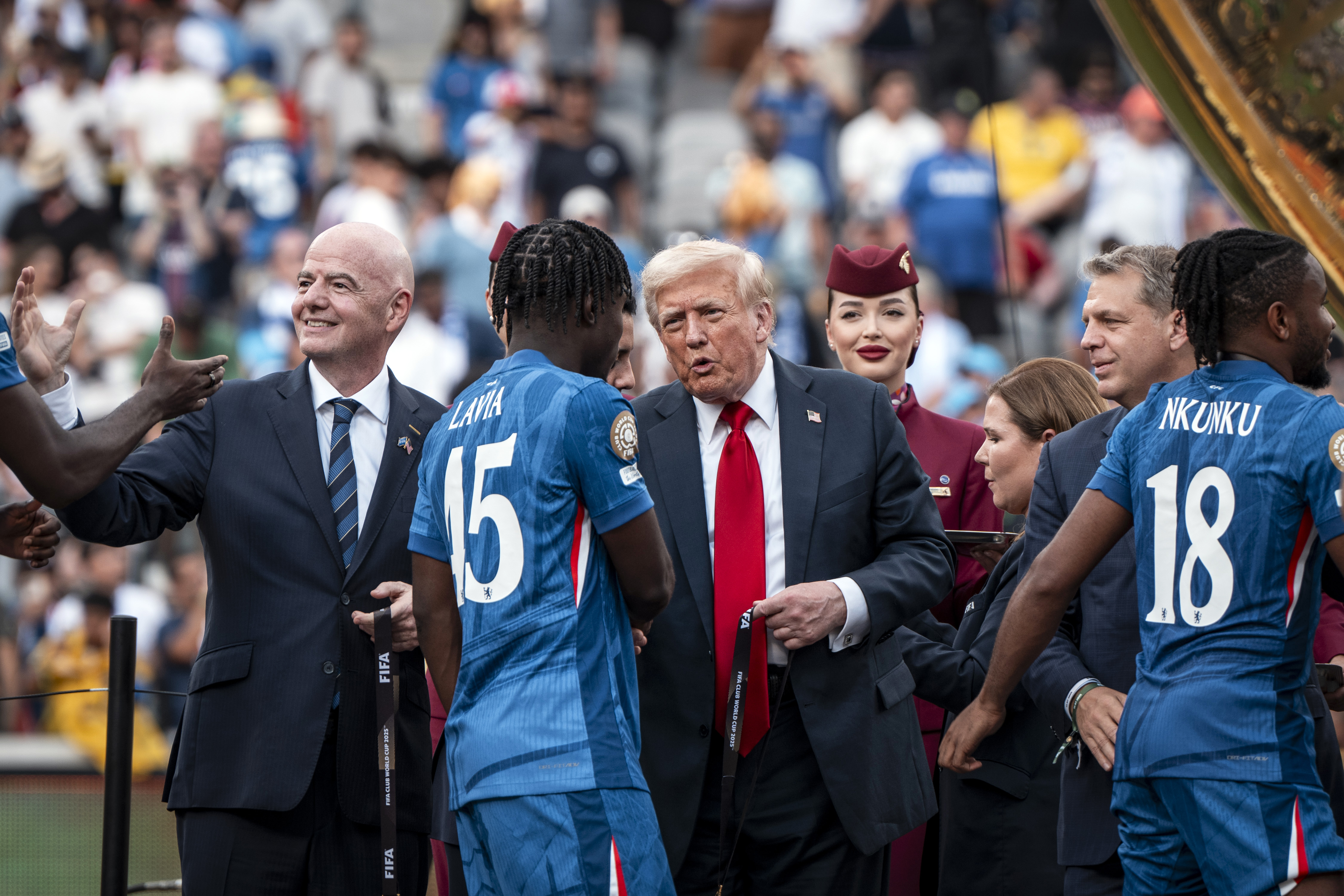
Infantino and President Trump onstage during the Club World Cup final in New Jersey last year.Haiyun Jiang / The New York Times
A top FIFA official says he believes there is an unofficial understanding that the authorities will not conduct immigration enforcement outside of stadiums. (A FIFA spokesman denied any deal and said enforcement was up to the government. The Department of Homeland Security did not address the question.)
The Justice Department also recently dismissed long-running criminal charges as part of its FIFA investigation. Prosecutors said the case “doesn’t fit within the administration’s priorities.”
And Trump seemed to defer to Infantino this spring on allowing Iranian players to come to the United States. “If Gianni said it,” the president said, “I’m OK.”
Still, Trump undercut Infantino recently by criticizing the high cost of tickets. And whatever reassurances may have been made on immigration, support staff for Iran’s national team was denied visas, along with a Somali referee.
Infantino’s coziness with the president also appears to be influencing FIFA in Trump-like ways that could outlast the tournament.
FIFA is exploring hotel deals that would license its name just as the Trump family has long done, according to three people familiar with the discussions. He has also expressed interest in launching a FIFA cryptocurrency, just as the Trumps have done.
A FIFA spokesman said the organization was paying “market rent” in Trump Tower and that the office would be used during the World Cup.
Inside FIFA, many officials privately question whether this has all been in service of Infantino himself. He has accompanied Trump on state visits, sat center stage at the inauguration and has attended diplomatic events.
What does any of that, his critics ask, have to do with soccer?
Infantino declined to be interviewed. His yearslong campaign to curry favor with Trump, and the hand-wringing it has prompted, was described in dozens of interviews with FIFA insiders and others close to the two men. Some spoke on condition of anonymity to describe private conversations.
“Infantino thinks he’s the leader in the relationship,” said Sepp Blatter, the former FIFA president whose ouster at the height of the corruption scandal paved the way for Infantino’s ascension. “But nobody can lead Trump.”
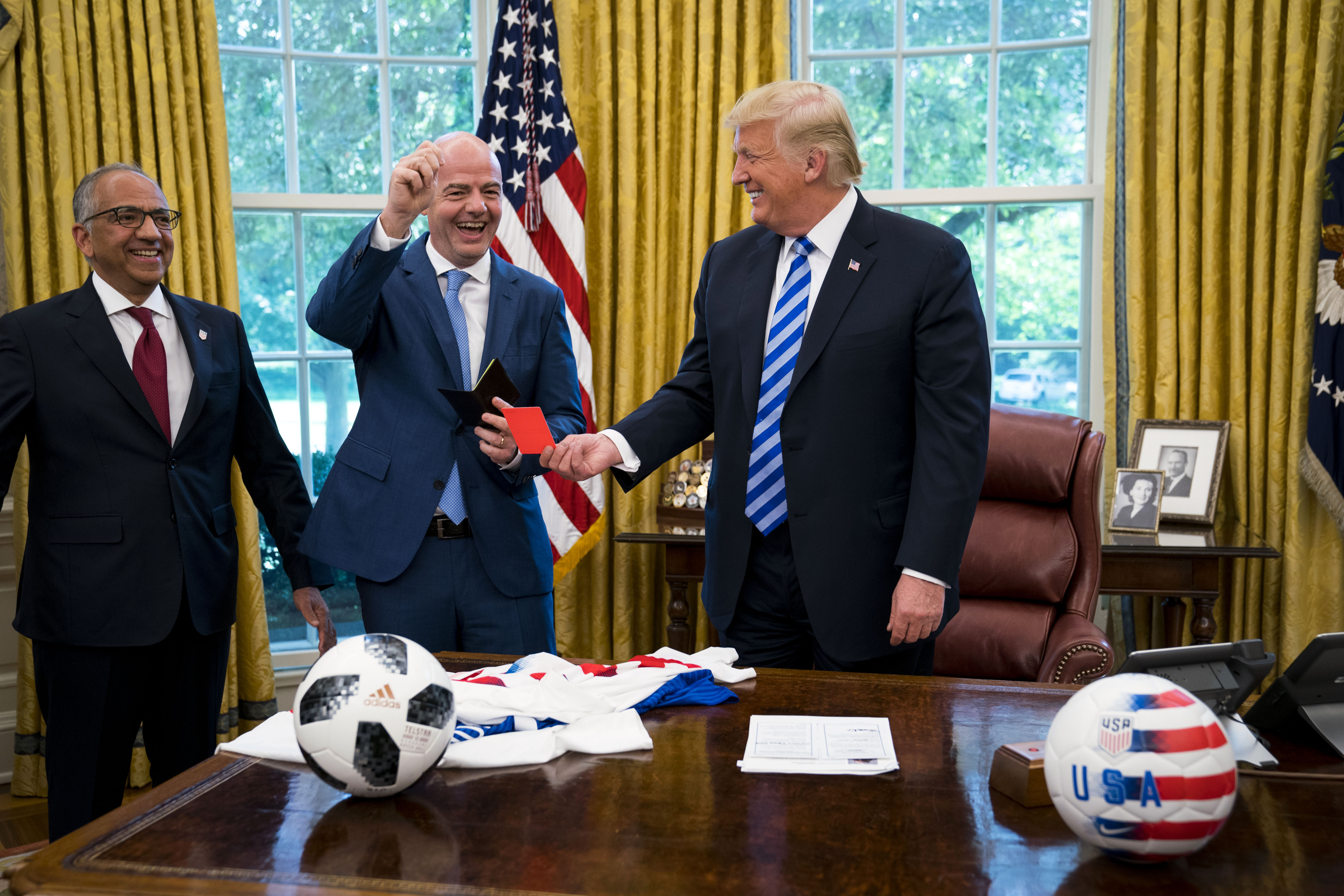
Infantino meets with Trump for the first time in the Oval Office and jokes about penalty cards.Doug Mills / The New York Times
The first meeting
The men first met in the Oval Office in the summer of 2018. The United States had just won the right, along with Canada and Mexico, to host the World Cup, and the mood was celebratory.
“You’re pretty famous, right?” Trump asked. “Pretty important and pretty famous.”
“Yeah,” Infantino replied. “It looks like it.”
Infantino, a lawyer and the son of an Italian immigrant who worked on Switzerland’s railways, had secured the FIFA presidency the same year that Trump was elected.
In that first White House meeting, he presented the president with a Trump jersey and a set of penalty cards that the men joked could be used on the news media.
“You are part of the FIFA team now,” Infantino said.
It was a remarkable turnabout. Three years earlier, the Justice Department had unveiled an indictment detailing corruption in world soccer. Major brands did not renew their sponsorship deals, and the organization suffered financial losses.
But if Infantino was eager to welcome the president onto FIFA’s team, he quickly found himself on the Trump Team — a pretty important, pretty famous endorser of a president in the middle of an impeachment inquiry.
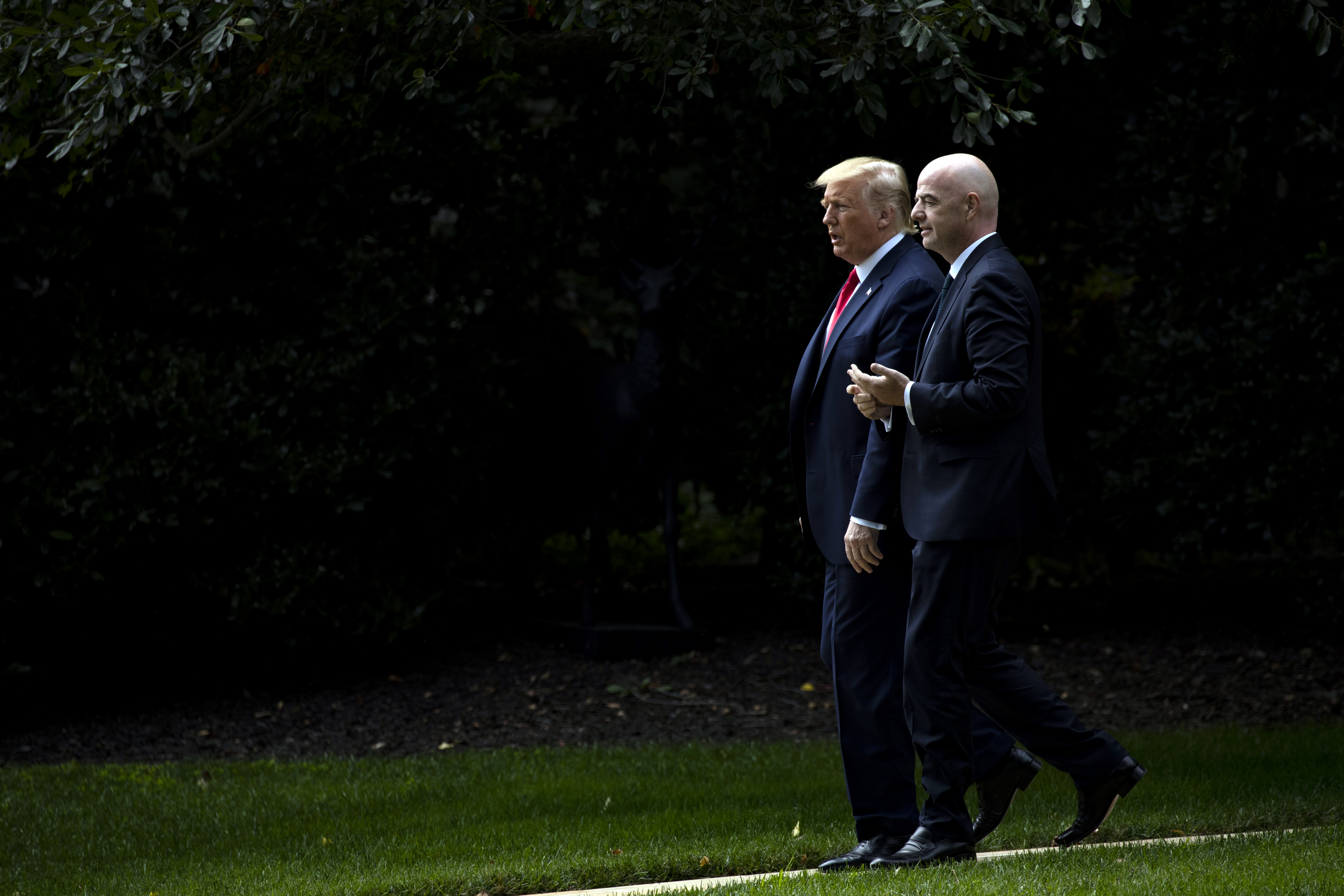
“Gianni, we’re going to have to extend my second term,” Trump said on the South Lawn in September 2019, as Infantino smiled beside him.
Months later, as lawmakers debated charges of obstruction and abuse of power against Trump, Infantino praised him before business leaders in Davos, Switzerland.
“You might wonder why the president of FIFA is introducing the president of the United States of America,” Infantino said. He joked that it had been suggested that the two of them might be the most important people in attendance.
Soon, Infantino was back at the White House, this time as an unusual guest for the signing of the Abraham Accords, which established diplomatic ties between Israel and some Arab nations. He also arranged a “courtesy visit” with the attorney general, who was overseeing the FIFA cases.
“I am fully convinced,” Infantino said after that meeting, “that the credibility and reputation of FIFA is being restored at the highest level.”
Then came the 2020 election, and Infantino’s fortunes changed.
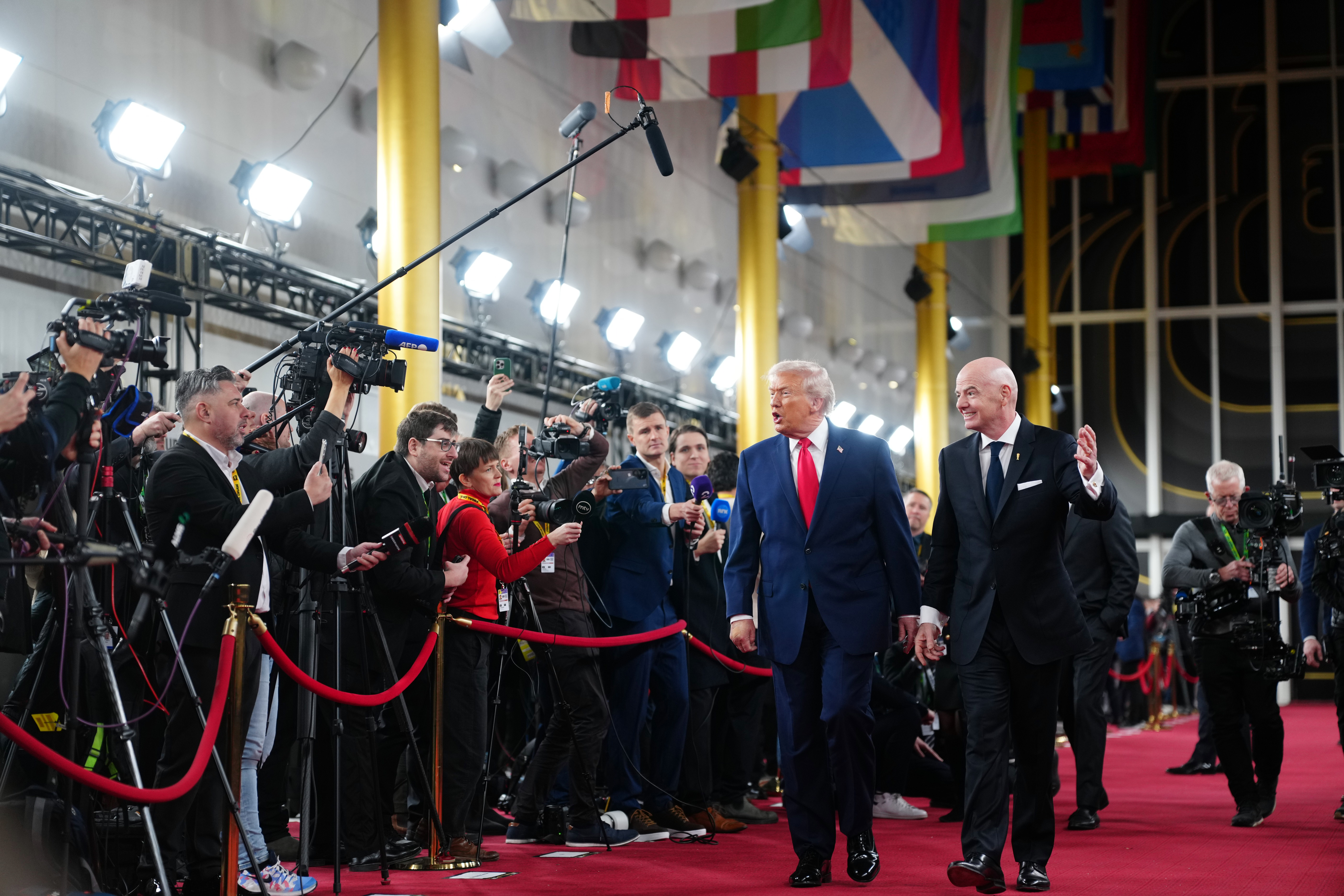
President Trump and Infantino attended the World Cup draw at the John F. Kennedy Center for the Performing Arts last December. FIFA had planned to have the event in Las Vegas but moved it to Washington.Tierney L. Cross / The New York Times
A chilly reception, and then a thaw
President Joseph R. Biden Jr. proved to be less welcoming to FIFA than his predecessor. There were no Oval Office greetings.
Administration officials said they had been wary of getting too close to a scandal-tainted organization. They saw no benefit in putting the president alongside Infantino.
“There was definitely a hands-off, keep-them-at-a-distance approach at the White House,” said Caitlin Durkovich, a former National Security Council official who helped oversee World Cup planning. She said FIFA repeatedly tried to arrange meetings with top officials.
In interviews, FIFA officials said that Infantino had been trying to raise FIFA’s profile. More practically, they said, he wanted people, when they Googled “FIFA,” to find anything but stories about bribery and kickbacks.
But even an attempt to meet formally with Secretary of State Antony J. Blinken at the 2022 World Cup in Qatar fell flat, according to three people familiar with FIFA’s efforts to arrange a meeting. Infantino’s few interactions with American officials were mostly perfunctory and private, like a half-hour meeting with the national security adviser to address security and visa wait times.
So when Trump won re-election in 2024, there was an opportunity to build on Infantino’s foundation. And Trump seemed eager to pick up where they had left off.
Days before Trump’s second inauguration, the men convened at Mar-a-Lago, the president’s private club in South Florida, and flashed thumbs-up signs for a photo that Infantino posted to Instagram.
Trump thanked him by name at a victory rally. And Infantino had an elevated seat behind Trump at the inauguration.
Infantino eagerly promoted all of it, sounding at times like Trump’s campaign partner. “Together we will make not only America great again, but also the entire world,” he said.
Infantino, it seemed, had achieved everything he wanted: accolades, endorsements and a World Cup task force, proposed by Infantino himself, that gave FIFA a formal place among Trump’s inner circle.
But soon it was clear that such closeness had drawbacks.
‘Private political interests’
When the world’s top soccer officials gathered in Paraguay for their annual meeting in May 2025, Infantino was on the other side of the globe, tagging along on Trump’s state visit to Persian Gulf countries.
The trip had little to do with soccer, and when he finally arrived at the FIFA meeting, he was several hours late. European soccer officials walked out, protesting his prioritization of “private political interests.”
“I felt that I needed to be there to represent football and all of you,” Infantino told them.
It was then that behind-the-scenes grumbles exploded into view. FIFA is an unusual amalgam of 211 countries and territories, each with its own politics. Infantino’s closeness to Trump had impressed some constituencies and alienated others.
“It’s a matter of priorities, and at that moment Trump was the priority for Infantino,” said David Goldblatt, author of “The Ball Is Round: A Global History of Football.”
But Infantino was undeterred.
One of his signature innovations was a 32-team tournament for the world’s best professional teams: the Club World Cup. But when he plugged the event from the Oval Office, he suddenly credited Trump as a co-creator. (After Trump kept the original Tiffany & Company trophy, FIFA presented the winners with another.)
Then, on the eve of the tournament, U.S. Customs and Border Protection announced that agents would be “suited and booted ready to provide security for the first round of games.”
Tournament officials panicked, terrified that immigration agents would arrest fans, according to three people who participated in planning discussions. Such a spectacle could deter attendance at the 2026 World Cup and potentially lead to a global backlash against FIFA.
By then, Infantino was living in Miami, in the president’s orbit. His advisers strategized about asking Trump for a moratorium on immigration actions, both during the club matches and the World Cup.
While no one close to either man has indicated what, exactly, they discussed privately, FIFA officials said that Infantino pressed the immigration matter. Whether for that reason or not, the government’s social media post was removed and ICE raids never materialized.
Soccer officials said they believed there was a similar understanding for the World Cup. But, as is often the case with Trump, nobody can say for sure.
The Department of Homeland Security, which oversees Immigration and Customs Enforcement, did not acknowledge any such agreement.
“U.S. Customs and Border Protection, in coordination with D.H.S. and other agencies, is dedicated to ensuring the safety and success of the FIFA World Cup,” a D.H.S. spokesperson said.
By some measures, the club tournament represented a win for Infantino’s strategy. He got an Oval Office platform, Ivanka Trump participated in the draw, immigration agents stayed away, and Trump attended the final match.
But it was also a reminder that when there is a limelight, Trump often seizes it for himself.
Appearing onstage after the final whistle, Trump lingered longer than planned, upending meticulous choreography, confusing the winning team and standing squarely before the cameras during the trophy presentation. FIFA and Secret Service officials were alarmed, and fireworks were delayed because of the president’s presence.
It went viral, with Trump basking in FIFA’s moment.
The FIFA Peace Prize awarded to President Trump. The trophy, co-produced by a FIFA employee’s father, was spontaneously sourced from miscellany in FIFA’s possession.Tierney L. Cross / The New York Times
The FIFA Peace Prize
Oval Office visits are now routine for Infantino.
“Always happy to be here, at home, if I can say that,” he said last year.
“You are home,” Trump replied.
When Trump assembled dignitaries and business titans for a state dinner for Crown Prince Mohammed bin Salman of Saudi Arabia, Infantino was there.
“I think we should all support what he’s doing,” Infantino said at a business conference in Miami. “Because I think it’s looking pretty good.”
Infantino has sought to capitalize on access to Trump allies. Under his watch, FIFA discussed with former Treasury Secretary Steven Mnuchin an investment in a streaming service, according to a senior FIFA official. Nothing materialized, only because the venture was put on hold, according to a person who was part of the talks.
More recently, FIFA has explored hotel licensing deals with a prominent South Florida developer who is poised to develop the waterfront opposite Mar-a-Lago.
Infantino also lobbied for Trump to be awarded the Nobel Peace Prize, which the president has craved. When the award went to the Venezuelan politician María Corina Machado, Infantino had an idea.
Three weeks after the Nobel announcement, senior FIFA officials were told that Infantino wanted to announce a peace prize of his own. How long, they asked, did they have to work out the details — the criteria, for example, or the makeup of the nomination committee? Those questions went unanswered.
Some of the most senior officials were told straightaway whom the first honoree would be, according to a person with direct knowledge of the plans, who learned about the prize and its recipient on the same day.
FIFA did not have time to consider what its prize would look like. But luckily, the father of an employee was a sculptor, and FIFA had in its collection of miscellany a miniature version of one of his pieces, according to two soccer officials. The trophy was in hand.
The FIFA Peace Prize was announced Nov. 5, with the award to be bestowed at the World Cup tournament draw a month later.
FIFA had planned to have that event in Las Vegas. But Paolo Zampolli, a longtime Trump ally serving as a presidential envoy, encouraged Infantino to reconsider.
“To move the president of the United States is a big process,” he recalled saying. Last-minute events might prevent a trip to Las Vegas, he said, but a local venue would better assure his attendance. “You know how important FIFA is for us,” Zampolli added. (FIFA said Zampolli had no influence over the choice.)
Infantino moved the event to the John F. Kennedy Center for the Performing Arts in Washington, teasing that the site might be called the Trump-Kennedy Center. Trump attended and, to nobody’s surprise, was the first recipient of the FIFA Peace Prize. He received a certificate, a medal and the repurposed trophy.
Trump called it “truly one of the great honors of my life.”
The award angered many soccer officials, who said that it had embarrassed FIFA and cast the organization as partisan.
Lise Klaveness, the president of Norway’s soccer federation and a human rights lawyer, said the prize breached FIFA’s rules on political neutrality. She announced that Norway would back an ethics complaint against Infantino.
Ms. Klaveness said in an interview that she recognized that FIFA needed “friendly relations” with the governments hosting World Cup games. But she said there needed to be “checks and balances,” to keep FIFA from being used for political purposes.
Infantino, though, has worn his friendship with the president on his sleeve. And his head. At one public meeting, world leaders and delegates were given red “USA” baseball caps. Infantino happily donned his, emblazoned with the numbers 45-47, signifying the Trump presidencies.
This winter, as Infantino marked a decade in the job, he celebrated with a party at a Four Seasons hotel in Miami. Ivanka Trump and her husband, Jared Kushner, attended.
The celebration carried into spring, when Infantino announced at a soccer meeting in Vancouver that he would run for a third term. He argued that the organization had repaired its reputation and played a slide show that included Trump.
“We have definitely come a long way these last 10 years,” he told soccer officials. FIFA, he said, was now “sitting at the top tables, in every aspect.”
The war in Ukraine has often been compared to World War I for its brutal infantry assaults and heavy casualties. Yet the idea that it could, by any measure, surpass a conflict so long and bloody that French soldiers hoped it would be “the last of the last” once seemed unthinkable.
That is just what happened on Thursday. The war in Ukraine — which reached 1,569 days, or more than four years and three months — has now outlasted World War I.
When President Vladimir Putin of Russia sent his troops into Ukraine in February 2022, he believed the country would fall within days. After Ukraine pushed the Russians back and the conflict settled into a war of attrition, even many of those fighting could not imagine it would last this long.
“I thought maybe two or three years, and then politicians will find some kind of consensus,” said a Ukrainian soldier who, for security reasons, gave only his call sign, France, a nod to his time in the French Foreign Legion.
But the war has raged on, and, with peace talks stalled, it shows no sign of ending soon. Polls suggest that about half of Ukrainians believe it will not end before next year, which would push it closer to another threshold: the duration of World War II, which lasted six years. And there are many Ukrainians who would argue that the current war really began in 2014 when Russian troops seized Crimea.
Historians caution that drawing parallels with the two world wars has limits. The global scale of those conflicts, involving many theaters and armies, makes comparisons about casualties and firepower difficult. Ukraine did not exist as a country during World War I.
Still, the war in Ukraine, like World War I, is likely to rank among the most consequential conflicts in modern European history, said Yaroslav Hrytsak, a Ukrainian historian. Both wars transformed Europe’s geopolitics by reshaping military alliances and driving a defense buildup not seen in decades.
Military analysts also note that both conflicts reshaped the nature of warfare through the introduction of new technologies — planes and tanks a century ago; drones across the air, sea and land today. In both cases, the advances made war only more brutal for humans.
“In many respects, this war in Ukraine is the one that most closely resembles World War I,” said Michel Goya, a former French colonel and a military historian.
The comparison begins with the opening phase of both wars. In 1914, the Germans launched a rapid offensive toward Paris in the hope of securing a swift victory. Russian forces had the same objective when they raced toward Kyiv, Ukraine’s capital, in 2022. In both cases, the attackers came close to their target but were ultimately driven back.
Eventually, both wars settled into mostly static fighting along a largely frozen front. When soldiers on the Ukrainian battlefield hunkered down in trenches and bunkers in late 2022, historians described it as a return to World War I-style trench warfare.
Scenes from the trenches of eastern Ukraine closely echoed those in northern France a century earlier. Ukrainian and Russian troops were often separated by just a few hundred yards, sometimes close enough to see one another. Assaults began with artillery barrages to pin down the opponent, followed by the storming of enemy trenches by infantry squads.
“In general, when the front freezes, you’re back to World War I,” Goya said.
In both wars, he added, it was the intensity of firepower, mainly artillery, that forced armies to turn to trenches. “You bury yourself to protect yourself,” he said.
That calculus later changed in Ukraine with the introduction of a new class of weapon: drones. Networks of open trenches were rendered unsafe as drones monitored the battlefield around the clock and struck with greater precision than artillery shells.
Now, Ukrainian soldiers say, survival depends on going smaller and deeper. Instead of sprawling trench systems, troops shelter in dugouts housing no more than a handful of soldiers. Such bunkers are small enough to be difficult to spot from the sky and deep enough to withstand strikes. A soldier operating on his own will often dig a position barely larger than a foxhole.
In a recent interview near Ukraine’s southern front, a Ukrainian commander, who also only gave his call sign, Sour, for security reasons, recalled how his troops had to storm a well-fortified Russian dugout four times before forcing the soldier inside to surrender. The dugout had right-angled corners reinforced with metal sheets designed to absorb an explosive shock wave, he said.
The commander, who leads the 5th Center of the International Legion, part of Ukraine’s military intelligence forces, said he took the captured Russian soldier to his unit’s training ground and asked him to dig a similar position so he could study how it was built.
“In this environment, the people who dig survive longer and stay safer,” France, the Ukrainian soldier, said.
As drones have come to dominate the battlefield, World War I-style opposing trench networks, separated by a narrow buffer zone, have given way to a miles-wide contested combat area scattered with dugouts. In this “kill zone,” any movement is quickly targeted by drones.
Large-scale troop assaults of the kind seen a century ago have become all but impossible under the constant gaze of drones. Such assaults have been replaced with attacks by just one or two soldiers.
Tanks, first introduced in 1916, were still a feared weapon in the first years of the war in Ukraine. They are rarely used now because their size makes them easy targets for drones, though some tanks have been retrofitted with protective metal cages that turn them into “Mad Max”-style vehicles.
While the battlefield today bears less and less resemblance to that of a century ago, the scale of the destruction looks remarkably similar.
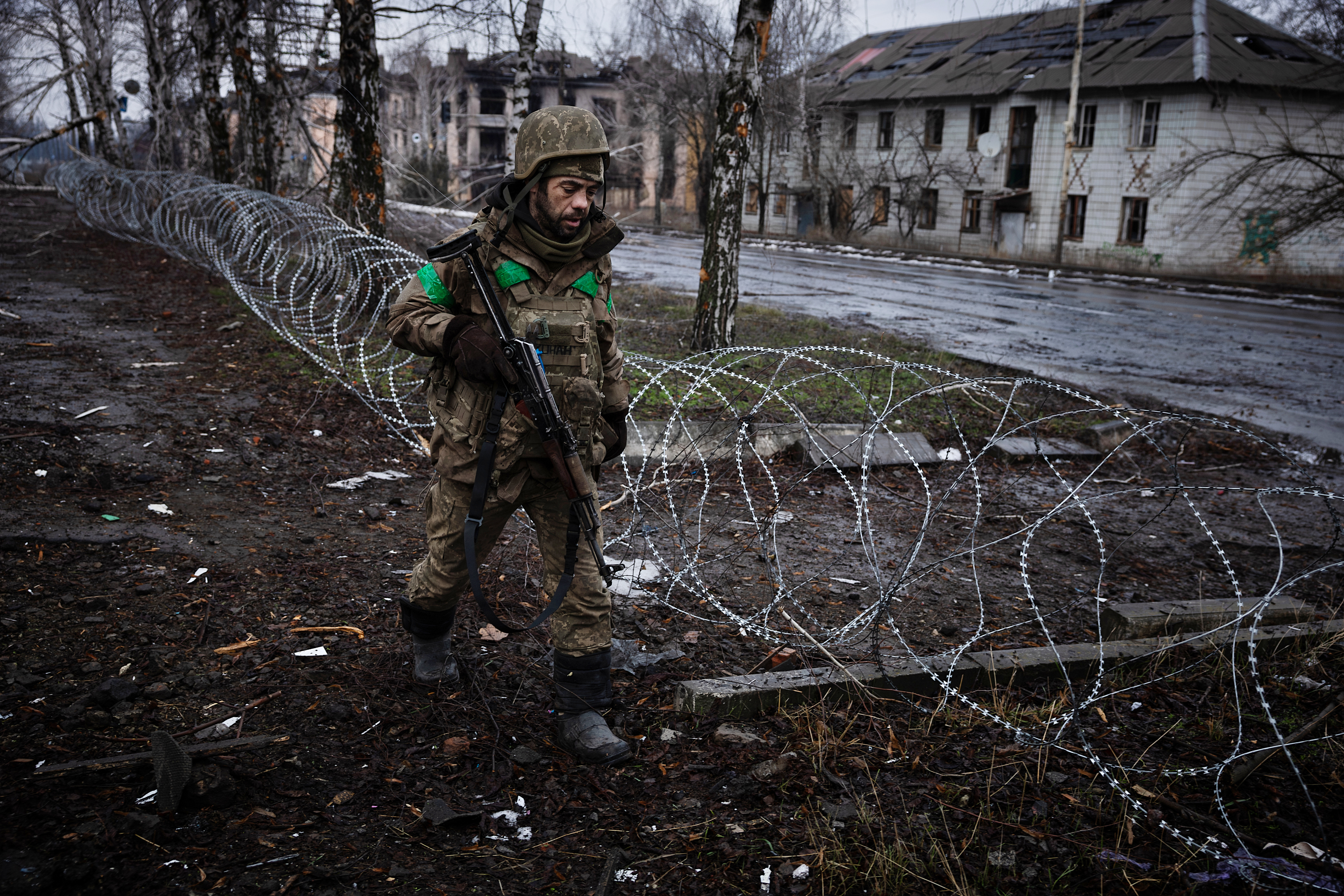
In Ukrainian command posts near the front, live footage from reconnaissance drones shows scenes reminiscent of World War I battlefields: splintered trees, ruined houses, and fields pockmarked by shell craters.
Casualties are difficult to compare, given the difference in scale between the two wars. A century ago, millions of soldiers were sent into battle across multiple fronts in Europe. Today, the forces involved number in the hundreds of thousands. Roughly 9 million to 11 million soldiers died in World War I, compared with about half a million in Ukraine so far.
Still, military analysts and officials, including Adm. Pierre Vandier, who holds the post of Supreme Allied Commander Transformation in NATO, say drones have made the Ukrainian battlefield lethal at levels comparable to World War I. Vandier made the comparison after a study trip to Ukraine this spring.
A mother cries at the coffin of her son Oleh Borovyk, a Ukrainian serviceman who was killed in fighting with Russian forces near Pokrovsk, during his funeral ceremony in Boiarka, Ukraine, on Dec. 3, 2025. Evgeniy Maloletka
So grinding is the fighting in Ukraine that Russian advances have at times been slower than those in some of World War I’s most deadlocked battles.
Russia’s offensive on Pokrovsk, an eastern Ukrainian city it recently fully captured, progressed at an average pace of about 75 yards per day, slower than in the bloody Battle of the Somme during World War I, according to an analysis by the Center for Strategic and International Studies, a Washington-based think tank.
The question now is whether either side can break the deadlock.
In World War I, the Allies prevailed by combining economic pressure on Germany through a tight naval blockade with military pressure through relentless offensives.
Ukraine’s strategy to end the war carries some echoes of that approach.
Drone strikes on Russia’s oil assets, the backbone of its economy, are designed to curb Moscow’s ability to finance its war effort. Kyiv lacks the manpower to replicate the offensives of World War I, but it has flooded the battlefield with small attack drones in the hope of inflicting unsustainable losses on the Russian army.
“This is World War I, but with drones,” Hrytsak, the historian, said.
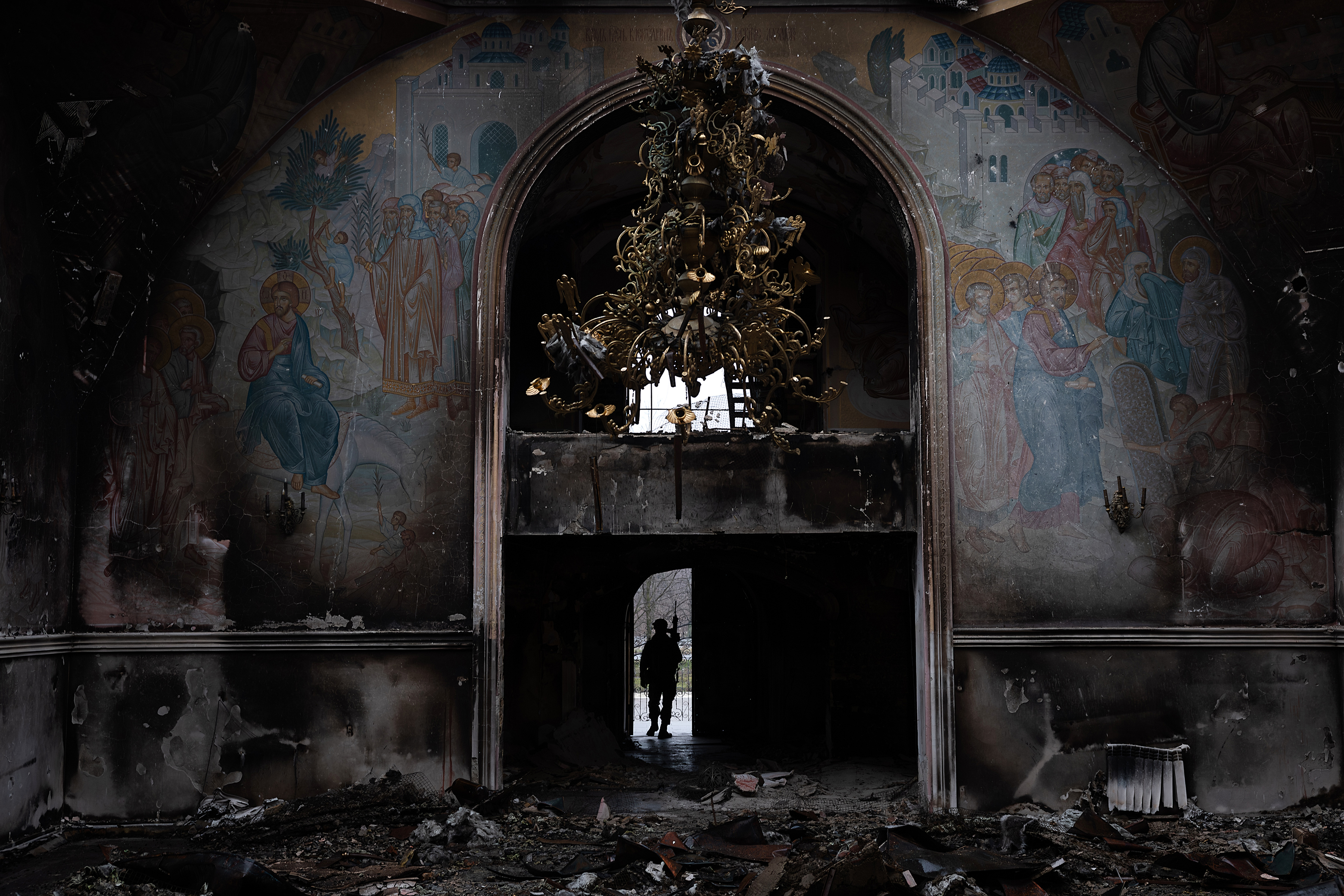
A Ukrainian soldier is seen through the door of a destroyed church in Kostiantynivka, Ukraine, on Jan. 8.Tyler Hicks