Category: Nation & World

  • ‘A million years isn’t enough’: Victims’ relatives confront Gilgo Beach serial killer at sentencing

    RIVERHEAD, N.Y. — After decades waiting for justice, relatives of women murdered by New York’s Gilgo Beach serial killer laid into him Wednesday before he was sentenced to life in prison. He told them: “I am responsible” for the crimes.

    “The words I would say would have no meaning,” added Rex Heuermann, the Long Island architect who lived a secret life of violence for years before admitting he killed eight women.

    The sentencing capped an extraordinary investigation that solved one of New York’s most perplexing mysteries. The seemingly unconnected and largely overlooked disappearances of young women became the focus of true-crime documentaries, books, and podcasts after police began discovering the victims’ skeletal remains in the sandy scrub along a coastal parkway.

    Heuermann, 62, will have no possibility of parole.

    But “a million years isn’t enough,” Jasmine Robinson, a cousin of victim Jessica Taylor, said. “Nothing will ever make this right.”

    “You fill me with so much repugnance, I can’t stand it,” Robinson said.

    Judge calls Heuermann ‘despicable’

    As a series of victims’ kin spoke, Heuermann sat with his hands on the defense table, looking straight ahead and lightly tapping his fingers. Then Amanda Funderburg, victim Melissa Barthelemy’s sister, urged Heuermann to look at her.

    He glanced in her direction, but his eyes were slightly downcast.

    “I hope you suffer,” said Funderburg, who recounted getting a taunting phone call from him days after Barthelemy disappeared, when Funderburg was 15 years old.

    JoAnn Mack, the mother of victim Valerie Mack, told the killer that her daughter “had dreams, and you took them all away from her.”

    “Justice has been done, but it can’t replace what has been taken,” Mack said. Valerie Mack had worked as an escort in Philadelphia.

    Heuermann pleaded guilty in April to charges that he murdered seven women: Barthelemy, Mack, Taylor, Megan Waterman, Amber Lynn Costello, Maureen Brainard-Barnes, and Sandra Costilla.

    Heuermann also admitted in court to killing an eighth victim, Karen Vergata, though he was never charged in her death. He said he strangled his victims, many of them sex workers, and dismembered some of their bodies.

    “Are you at least a little sorry?” Judge Timothy Mazzei asked him Wednesday in a loud, indignant voice.

    Heuermann nodded and appeared to mouth “yes.”

    “You are disgusting — a despicable man, if you are a man at all,” the judge said, his voice rising. “And you are a coward.”

    As Heuermann was led away in handcuffs, spectators in the packed courtroom seemed to jeer.

    Victims’ children recount a confounding loss

    Most of the women disappeared between 2000 and 2010, and most of their remains were found on a parkway not far from Long Island’s Gilgo Beach, some 50 miles from Manhattan.

    Costilla’s remains were found in 1993, more than 60 miles away in the Hamptons, while Vergata’s remains were found in 1996 on Fire Island, more than 20 miles east of Gilgo Beach.

    Brainard-Barnes’ two children, who were 7 and 1 when she disappeared in 2007, underscored Wednesday how her absence shaped their lives and how she never got to know the adults they grew up to be. Her sister, Melissa Cann, said she lived with “survivor’s guilt” for decades, wondering whether she could have done something more to protect Brainard-Barnes.

    “It was a weight I carried everywhere,” Cann said, sobbing deeply. But, she said, that guilt is “not mine to carry. It is for Rex and Rex alone.”

    Liliana Waterman was 3 when her mother, Megan Waterman, vanished. The daughter said she didn’t fully understand what had happened until she was about 9.

    “In an instant, my world was shattered,” she said. “Was she in pain? Was she scared?”

    How the Gilgo Beach serial killer was caught

    The case spilled into view in 2010, when investigators started to find remains along Ocean Parkway while looking into the disappearance of another sex worker, Shannan Gilbert, whose death was ultimately ruled an accidental drowning.

    The case went cold until 2022, when detectives linked Heuermann to a pickup truck that a witness reported seeing when one of the victims disappeared in 2010.

    Eventually, they matched DNA from a pizza crust Heuermann discarded in a Manhattan trash can to genetic material extracted from highly degraded hair fragments found on the women’s remains.

    Investigators amassed other evidence, including cell phone and tracking data showing Heuermann arranged meetings with some victims shortly before their disappearances.

    After Heuermann’s 2023 arrest, prosecutors recovered what they described as a “blueprint” for the killings from his computer files. Among the documents was a series of checklists with reminders to limit noise, clean the bodies and destroy evidence.

    Calling the man “a monster,” Suffolk County District Attorney Ray Tierney declared there was nothing Heuermann could say to mitigate his deeds.

    As part of his guilty plea, Heuermann agreed to cooperate with the FBI’s behavioral analysis unit to help catch other serial killers.

    Heuermann spent the last three years alone in a segregated cell at the Suffolk County jail, reading crime novels, occasionally being visited by his lawyers or family, and striking up a brief correspondence with the infamous “Happy Face Killer,” according to Sheriff Errol Toulon.

    Through their lawyers, Heuermann’s ex-wife and two grown children said they did not attend the sentencing out of respect for the victim’s families.


  • There’s a bit of good news for coral reefs

    There’s a bit of good news for coral reefs

    NAIROBI, Kenya — As spiking ocean temperatures are devastating reefs around the world, a handful of scientists have found a reason for cautious optimism. They’ve used artificial intelligence to detect sheltered pockets where cool currents, reduced exposure to sunlight, and locations outside cyclone paths mean corals are more likely to survive.

    The study, led by the Wildlife Conservation Society and presented on Tuesday at the Our Ocean Conference in Mombasa, Kenya, is currently undergoing peer review for publication in the journal Environmental Research Letters.

    Five scientists identified 42 factors that create the conditions for the coral havens, called refugia, and then ran those through a program with nearly 38,000 human observations of coral cover and composition gathered over 65 years. The program identified more than 5,800 square miles of climate-resilient ocean in 72 countries.

    The work found three times as many refugia as a landmark 2018 assessment known as the 50 Reefs Study, the first paper to systematically identify areas around the globe where coral might still be saved. Scientists and environmentalists said the new assessment offered a more nuanced picture of the state of the world’s reefs and could help fine tune conservation priorities.

    “This study sharpens decades of work on reef resilience to climate change,” said David Obura, a former chairperson of IPBES, the global intergovernmental scientific panel on biodiversity, who was not involved in the new research. “It focuses attention on the critical question: Will climate refuges comprise 10%, 1%, or even less of the former extent of coral reefs?”

    Coral reefs are crucial ecosystems. They nurture an estimated quarter of ocean species at some point during their life cycles, supporting fish that provide protein for millions of people and protecting coastlines from storms.

    They are also vulnerable to bleaching, which occurs when heat causes corals to lose the algae they need to survive. Bleached corals can recover, but if the water they live in stays too hot for too long, they die.

    “Every tenth of a degree warming drives reefs to the limit,” Obura said.

    According to Australian researchers who study ocean heat, the demise of the Great Barrier Reef could occur within a generation unless humanity acts with far more urgency to rein in climate change. A study published in 2025 found that virtually all the corals in the Atlantic Ocean will stop growing and could succumb to erosion by the end of the century if global temperatures continue to rise.

    The newly identified refugia are not evenly spread around the world. More than half are in five countries: the Bahamas, Cuba, Australia, Indonesia, and the Philippines. Others cluster around small islands in places like Vanuatu, American Samoa, Christmas Island, and the Chagos Archipelago.

    These havens can protect coral from the effects of warming, but their concentration makes them vulnerable to other threats like overfishing and pollution. Although most are found in nominally protected zones, lack of funding means many of those areas are only “paper parks” lacking practical protections.

    The research is expected to fuel a central conservation debate: How much funding should go to protect refugia, some of which may eventually fail as the oceans heat further; how much into restoration work; and how much into halting greenhouse emissions and pollution?

    Despite warnings from scientists and pledges from world leaders, countries are burning more fossil fuels than ever and greenhouse gas emissions continue to rise.

    Traditionally, reef research has focused on areas that have avoided the worst overheating. Such reefs are usually dominated by large branching corals like Acropora, an expansive genus incorporating species like the staghorn and the flamethrower; or plating corals like Montipora, whose delicate whorls spiral out from a central stem. Globally, their numbers are crashing.

    But the new research broadened the focus to corals that could also resist and recover: the helmet-shaped towers of the Porites lutea or the luminous ridges and bumps of Echinopora. Coral communities dominated by fast-growing weedy varieties, such as the lime and flamingo pink Pocillopora, are also often more resilient.

    They will need to be. Subsurface conditions across the tropical Pacific are already significantly warmer than average, according to the World Meteorological Organization. And, an El Nino weather pattern that recently formed in the Pacific could exacerbate those hot conditions.

    “It’s not to say the maps are perfect, but they are better than starting with nothing,” said Joseph Maina, an associate professor at Macquarie University in Sydney, who helped coordinate the data analysis. “Governments shouldn’t use the maps blindly, but get their own experts to look here first.”

    This article originally appeared in the New York Times.

  • Why the stress building on California’s faults could result in a major quake

    Why the stress building on California’s faults could result in a major quake

    California is no stranger to earthquakes, but the Los Angeles area may be at an increased risk of a more substantial quake in the years ahead.

    A recent study in the journal Advancing Earth and Space Sciences found seismic stress is accumulating on key faults near the greater Los Angeles metro area, in some sections reaching peak levels. And the findings reveal what researchers are calling an “earthquake gate” lurking just northeast of the city.

    While swarms of smaller quakes have rattled Los Angeles over the past century and a half, the last devastating quake to strike the city was on Jan. 9, 1857. Known as the Fort Tejon quake, the violent magnitude-7.9 tremor ruptured a 225-mile stretch on the southern part of the San Andreas Fault.

    But that portion of the fault has since remained largely dormant, with stress continuing to build elsewhere along the fault, as well along the neighboring San Jacinto Fault.

    Researchers analyzed 1,000 years of paleoseismic data, or a reconstruction of past tectonic activity. They found that stress along multiple portions of the faults is the highest it has been in at least a millennium, including along the Mojave South segment of the San Andreas Fault and the San Jacinto Bernardino segment of the San Jacinto fault.

    The San Andreas and San Jacinto fault systems are the largest in California, and run parallel to each other east of Los Angeles. They meet at a point called Cajon Pass, an “earthquake gate” of sorts.

    “The simplest way to think about an earthquake gate is a junction in a road network,” Liliane Burkhard, the study’s lead author, said in an email. “Most of the time, traffic follows one road and stops when it hits the junction. But under certain conditions, it can cross over and continue down a second road, covering much more ground. At Cajon Pass, the San Andreas and San Jacinto faults approach each other closely but do not directly connect at the surface.”

    That means seismic activity on one fault can cross the pass and affect the other.

    “Whether a rupture on one fault crosses over to the other appears to depend on how similarly stressed the two systems are at the time,” wrote Burkhard, who is also a researcher at the University of Bern in Switzerland. “When their stresses rise together in concert (not necessarily at the same level), the gate tends to open and the rupture can propagate across both faults. When their stress levels are mismatched, the rupture tends to stop at the junction.”

    During the 1857 Fort Tejon quake, the rupture did not cross Cajon Pass. But Burkhard referenced the 1812 Wrightwood earthquake, which ruptured both faults. Now, concern is increasing that a similar event could unfold again.

    “Right now, both systems are highly stressed and their levels are converging, which makes the current situation worth paying attention to,” Burkhard cautioned.

    Both the San Andreas and San Jacinto are “strike-slip” faults, with segments of the Earth’s crust sliding horizontally. Others may be “normal,” “reverse,” or “thrust” faults; the last of these is the most effective at producing tsunamis.

    While a significant quake may be overdue, the extent of any future rupture, and subsequent quake magnitude, is impossible to predict. But the researchers’ findings indicate that, when one fault ruptures, both will.

    “The stress conditions we model suggest that a joint rupture of both systems is likely and maybe more than at any point in the past millennium, which is the more important and less well-understood dimension of the hazard,” Burkhard said.

    The tricky part about predicting earthquakes is that there’s no magic stress threshold that results in a quake.

    “You can think of it less like a light switch and more like a pressure gauge that has historically tended to trigger in a certain range,” Burkhard said. “What we can say with confidence is that current stress levels are at or above the high end of those ranges, which tells us that the system is in a state we have not seen in the past 1,000 years.”

    But is 1,000 years of data enough to draw conclusions?

    Harold Tobin, the director of the Pacific Northwest Seismic Network and a professor at the University of Washington, says yes.

    “I think this 1,000-year simulation spans enough time to support a meaningful and useful conclusion,” Tobin, who was not involved in the recent study, said in an email. “[The] record is really short in North America, so paleoseismic evidence — geologic sleuthing — has to be used. The thousand-year paleoseismic record for the Southern California San Andreas and other faults that they use in this study (the “MRM”) is already a phenomenal achievement. … [It’s] enough to capture quite a few earthquake recurrence cycles on the relevant segments of the San Andreas fault system.”

    So when might the next big quake occur? Tobin said the complex nature of California’s fault systems makes for limited predictability.

    “Major quakes on major fault systems tend toward some degree of periodic recurrence, but that’s variable,” he wrote. “For example, evidence tends to favor more regular periodicity of recurrence for the truly giant subduction zone earthquakes, or for very straight, geometrically simple faults (an example is the Alpine Fault in New Zealand).”

    But in Southern California, he said, the complex of interacting faults “may exhibit a more chaotic recurrence pattern.”

  • Russia’s war in Ukraine comes back into Trump’s focus with no end in sight

    President Donald Trump met with Ukrainian President Volodymyr Zelensky at the Group of Seven summit in France on Tuesday and expressed exasperation as Russia’s war in Ukraine crept back into Washington’s focus with no end in sight.

    “It’s sort of the same thing,” Trump told reporters at the summit. “They just keep going fighting, losing soldiers. They lose so many soldiers.”

    “Not since World War II has anything like this happened,” Trump said, before invoking his exaggerated claims as a global peacemaker.

    “I settled eight wars,” he said. “This was the one I told you was going to be the easiest to settle, but they just, there’s a lot of dislike between the two leaders.”

    During his campaign, Trump said he would end the war within 24 hours. In France on Tuesday, he voiced unhappiness with the number of deaths but said that the United States is ultimately not affected.

    “We have nothing do with it,” he said. “We sell weapons to them. … The European Union pays us full price for weapons. … This has no impact on us other than we sell weapons. We’re thousands of miles away.”

    For four months, the conflict largely dropped off the White House agenda as Trump and his team focused on their own war against Iran.

    Trump meetings with Zelensky on Tuesday followed a call with Russian President Vladimir Putin on Sunday. Trump urged Putin to make a deal but said there was little sign of one. “I don’t like to see 25,000 young people die every month. They go to this front and get blown up.”

    He added, “The whole thing is ridiculous.”

    Zelensky, who attended the summit at the invitation of French President Emmanuel Macron, is hoping to reengage Trump, and European leaders have urged the president to break the impasse by hosting direct talks between Zelensky and Putin in the United States.

    Ukraine officially opened negotiations with Brussels this week over its bid for European Union membership. That step marks the start of a long and complex path in Ukraine’s ambition to join the EU, a process that Kyiv has urged the bloc to fast-track.

    Zelensky is expected to join leaders of the EU’s 27 nations at a summit in Brussels on Thursday.

    Since U.S.-led negotiations to end the Ukraine war fell by the wayside in recent months, Zelensky has been pushing to revive talks with a more prominent role for his European backers, led by France, Germany, and Britain.

    Some European nations have conveyed that they are willing to engage with Moscow in negotiations, while also warning of new Russia sanctions and sending military aid to Ukraine.

    At the summit, Zelensky also briefed G7 leaders on the damage to the Kyiv Pechersk Lavra church complex, one of the holiest sites in Eastern Orthodoxy, which caught fire last week following a Russian airstrike, according to local officials.

    The briefing came amid a broader escalation in the war. Ukraine has knocked out key Russian energy facilities, causing fuel shortages across multiple regions, while Kyiv and other Ukrainian cities have endured some of the war’s deadliest missile and drone strikes.

    The United Nations reported last week that at least 274 civilians were killed and nearly 1,800 injured in Ukraine in May, more than in any month since April 2022.

    Zelensky promised retaliation after visiting the church complex Monday. On Tuesday, Moscow officials reported shooting down dozens of Ukrainian drones approaching the capital. Ukraine also hit a key oil refinery in Kapotnya in the Moscow region, setting of a major fire.

    The extent of the damage was unclear, but the facility supplies up to 40% of the capital’s gasoline needs and about 50% of its diesel and could compound fuel shortages already affecting multiple Russian regions.

    Several of Russia’s largest gas stations are rationing fuel sales following months of sustained damage to major refineries that process crude oil, local media reported Tuesday.

    Zelensky is also hoping to step up pressure on Putin to hold direct, face-to-face talks, which have not occurred since Russia’s invasion began in 2022.

    Putin and other senior Russian officials, however, have dismissed such talks as pointless unless Zelensky is prepared to sign a final deal meeting Russia’s maximalist demands. They have also invited him to Moscow, which Zelensky has rejected, accusing Russia of “playing games” and insisting that any meeting take place in a neutral country.

    During their phone call Sunday, Putin congratulated Trump on his 80th birthday, according to the Kremlin.

    Trump called for an end to the war in Ukraine, and the two leaders agreed that U.S. envoys Steve Witkoff and Jared Kushner would visit Russia again in the near future.

    Putin had repeatedly offered help mediating between the United States and Iran given the close cooperation Moscow forged with Tehran in recent years, but Trump rebuffed those offers, telling Putin he should focus on resolving his own war.

    The recent deal to end the war against Iran could hinder Russia’s efforts to shore up its wartime budget, which has partly benefited from disruptions to Middle Eastern fuel supplies. In March, the Trump administration temporarily lifted sanctions on Russian oil exports seeking to keep global fuel prices in check.

    On Tuesday, during a bilateral meeting with the president of the United Arab Emirates, Trump appeared to suggest the U.S. could let the sanctions waiver lapse when it expires on Wednesday, though he stopped short of giving a timeline.

    “Soon, we’ll be able to do that because the oil is now flowing,” Trump said when asked whether the U.S. planned to tighten sanctions on Russia. “We took sanctions off because obviously we’re not looking to impede the oil, but we’re in a position to do that soon.”

  • DOJ urges appeals court to let Trump build ballroom, citing failed UFC attack

    DOJ urges appeals court to let Trump build ballroom, citing failed UFC attack

    The Justice Department is asking a federal appeals court to let President Donald Trump continue building his planned White House ballroom, arguing that a thwarted attack on Trump’s recent Ultimate Fighting Championship event proves the need for the facility.

    Brett Shumate, an assistant attorney general, urged a panel at the U.S. Court of Appeals for D.C. to lift a lower court’s order blocking much of the construction on the 90,000-square-foot ballroom, contending that the project’s security features are needed to protect the president. As evidence, Shumate cited the foiled threat against the UFC event on the White House grounds over the weekend. Authorities have said they intercepted and stopped plans to fly explosives-laden drones over attendees and gun down people who fled.

    “This latest assassination plot against President Trump and dignitaries at the White House demonstrates the compelling need for the East Wing Project, with a Ballroom designed to defend against just such attacks,” Shumate wrote in a letter filed Tuesday and made public early Wednesday.

    Shumate argued that the ballroom’s planned “Drone Port and Sniper Nests” would have been able to “destroy any effort” to attack the UFC event, and that the ballroom’s “mass and height” would provide a shield for the White House.

    U.S. District Judge Richard Leon ordered a halt to aboveground construction on the project in April, saying that the administration failed to demonstrate that the ballroom needed to be completed immediately for national security reasons. The three-judge appeals panel previously stayed Leon’s order while it considers the administration’s appeal, allowing construction to continue in the interim. Administration officials have said they expect the project to take at least two more years.

    The Justice Department has previously argued that other threats to the president, such as a shooting at the White House correspondents’ dinner, prove why the space is needed.

    Those arguments did not sway Leon, an appointee of President George W. Bush, who has kept his order in place. Two of three judges hearing the administration’s appeal — Bradley Garcia, a Biden appointee, and Patricia Ann Millett, an Obama appointee — appeared skeptical of the Justice Department’s arguments about Trump’s authority to build the ballroom in a court hearing this month.

    The National Trust for Historic Preservation, which sued to halt the ballroom’s construction, has previously said it would continue its legal challenge despite the Justice Department’s past demands.

    The shooting at the correspondents dinner was an “awful event” but did not change the legal reality that the Constitution and federal law require Trump to get Congress’s approval for the project, the trust said in April. The nonprofit, which is authorized by Congress to protect federal buildings, has pushed back sharply against the Justice Department’s contention that the lawsuit endangers the president.

    The Washington Post reported Tuesday that contractors’ internal estimates for the cost of the ballroom had risen to $600 million, with half paid by taxpayers. The White House put the cost at $200 million last year and said it would be paid by private donors.

  • Death of woman released by ICE on a winter day is now ruled a homicide

    Death of woman released by ICE on a winter day is now ruled a homicide

    The grainy security footage from the Pittsburgh transit authority shows Daphy Michel seated on a steel bench. She had been released hours earlier from U.S. Immigration and Customs Enforcement custody, and temperatures that night would dip to freezing. The 31-year-old asylum seeker wore a hooded sweatshirt to keep herself warm.

    Over the course of three days, Michel appears to have never left that bench, said her family’s attorney, who viewed the security footage and shared stills with the Washington Post. She had a history of untreated mental health issues and sat staring as people passed by, a plastic bag with her belongings, including a cellphone, placed beside her.

    By March 2, the Haitian woman was no longer sitting. The last image captured in the footage, according to the attorney, shows her lying on the ground. Emergency responders arrived at the scene and transferred Michel to a hospital, where she died that day.

    It was at least the second death this year involving an individual who was released by federal immigration authorities and died days later of complications related to hypothermia. The Allegheny County medical examiner’s office ruled Michel’s death a homicide on Friday. That conclusion means officials determined her death was the result of someone else’s actions, but it does not necessarily imply criminal wrongdoing.

    “The opinion of the forensic pathologist in this case is that Ms. Michel was a vulnerable adult, suffering from untreated severe mental health issues and a significant language barrier when she was released from federal custody on February 27,” Jim Madalinsky, the county’s public information officer, said in a statement. “Based on all available information during the investigation, the pathologist ruled Ms. Michel’s death a homicide.”

    The finding comes as ICE is eliminating its requirement to report deaths that occur within 30 days of people being released from its custody, and as the Trump administration continues to detain large numbers of migrants. Michel entered the country through the southern border in 2022 and was granted humanitarian parole, said her family’s attorney, Joseph Patrick Murphy. She died before the first hearing in her immigration case.

    A spokesperson for the Department of Homeland Security, which oversees ICE, did not say what time agents released Michel on Feb. 27 but stated that she had all her possessions and a fully charged phone. That day, temperatures in Pittsburgh reached a high of about 55 degrees, though they dropped nearly 30 degrees at night before a cold front brought flurries later that weekend, according to airport weather data.

    “ICE had NOTHING to do with this woman’s death,” DHS spokesperson Lauren Bis said. “She passed away THREE days after ICE encountered her.”

    The circumstances of Michel’s death echo those of the death of a visually impaired refugee in Buffalo in February. Immigration agents left Nurul Amin Shah Alam, 56, a Rohingya refugee from Myanmar who spoke little English, outside a closed coffee shop on a cold winter night. His body was found days later and his death also was ruled a homicide.

    The investigation of Alam’s death is ongoing.

    It’s unclear whether Pennsylvania officials will open an investigation of what happened to Michel days before her death. The Allegheny County district attorney’s office said in a statement that it is still gathering records and declined to comment on any possible investigation.

    “We do express our heartfelt sympathy to the family of Ms. Michel,” officials with the prosecutor’s office said.

    Guerline Jozef of the Haitian Bridge Alliance, an immigrant advocacy organization, said Michel came to the country at a time of massive domestic upheaval in the Caribbean nation following the assassination of its president. Armed groups violently took control of the nation’s capital while Haiti experienced a series of natural disasters that displaced thousands.

    Thousands of Haitians fled to South America and, eventually, the United States. Many, like Michel, were allowed to enter during the Biden administration while pursuing asylum claims but were targeted for removal once President Donald Trump took office.

    Jozef said that given Michel’s mental health struggles, ICE could have ensured she was in contact with a relative before her release.

    “We know that, allegedly, ICE is saying that they are not responsible. But we beg to differ,” she said. “There are certain protocols they could’ve taken to make sure she was released into her family and community safely,” Jozef said. “None of that happened.”

    ICE detention standards require agents to prioritize safety and consider “any special vulnerabilities” when deciding when, where, and how to release someone. Agents are instructed to provide detainees with a free phone call to make arrangements and are permitted to leave people near public transportation during operating hours.

    The guidelines also say ICE “must provide transportation” to detainees who “are not reasonably able to walk” because of issues such as age and mental health, or any conditions that endanger health and safety.

    In September, local authorities arrested Michel on charges of making terroristic threats and harassment, court records show. Charleroi regional police alleged she had been yelling in the street at “imaginary people,” according to Murphy. He said Michel struggled with undiagnosed and untreated mental illness. She remained in jail for six months. Then a judge dismissed her case, Murphy said, because she could not be prosecuted for making threats against people who did not exist.

    A day later, ICE agents took her into custody, affixed a tracking monitor to her ankle, and released her.

    “She was released with all of her belongings, including a fully charged phone, in sunny weather in the middle of Pittsburgh, where public transport is readily available,” said Bis, the DHS spokesperson.

    Murphy said Michel lived with her brother, who never received a phone call from ICE or his sister alerting him of her release. It wasn’t until the morgue contacted him three days later that Michel’s brother learned what had happened. He declined to comment through the attorney.

    Michel underwent repeated psychiatric examinations while at the county jail, Murphy said. When the judge ordered her release, Washington County authorities contacted ICE. It was unclear whether county officials communicated what they knew about Michel’s mental state to immigration agents. The county jail did not respond to requests for comment.

    Murphy believes it was “outrageous” and grossly negligent for ICE to have released Michel by herself on a winter day.

    “Even a 10-year-old could do more to help themselves,” he said. “She couldn’t speak English and she was effectively unable to care for herself.”

    An obituary for Michel shared on the website for Hogan-Melenyzer Funeral Home & Cremation Services says that she was born in Aquin, a port city on Haiti’s southern coast. After arriving in the United States, she settled in Charleroi, a community where about 1,200 Haitians had come to live in recent years. Now, according to local media reports, only a few hundred remain, driven away by fear over the immigration crackdown and the closure of several businesses.

    “Daphy was a person with a kind heart, who loved her family very much,” the obituary says. “… She was always ready to help those who needed her help and her presence brought joy and happiness and light into the lives of all who knew her.”

  • Under Trump, Democrats draw red lines on national security

    Under Trump, Democrats draw red lines on national security

    In early June, Sen. Mark Warner was preparing to argue that despite deep distrust of the Trump administration, his fellow Senate Democrats should take a risk and help renew a controversial surveillance law that was soon due to expire.

    Then, hours before a meeting with his colleagues, the senator from Virginia learned that President Donald Trump had tapped Bill Pulte, a mortgage agency official and staunch loyalist, as his acting intelligence czar.

    “I said: ‘Holy crap, I just didn’t think Donald Trump could still surprise me,’” said Warner, the top Democrat on the Senate Intelligence Committee, in an interview.

    Pulte’s appointment, which tanked the renewal of Section 702 of the Foreign Intelligence Surveillance Act, is a glimpse into the frustrating life for national security Democrats in the second Trump administration.

    Center-left lawmakers who built their political brands around support for the U.S. military and intelligence community are increasingly drawing red lines on Trump policies they see as dangerous or incoherent — including the war in Iran, lethal strikes against alleged drug traffickers around Latin America, and personnel moves like tapping Pulte, who has no national security experience, as the acting director of national intelligence.

    In some cases, Democrats are voting to curtail the funding and authorities for these agencies — a trend that could have lasting consequences for one of Washington’s last areas of relative bipartisan consensus.

    “It is a sign of the times,” said Sen. Elissa Slotkin (D., Mich.), in an interview. “People who love this country, who have put their life on the line for the country — in uniform, in the intelligence community — are now pushing back on this president abusing it.”

    Multiple Democratic lawmakers said that their constituents were urging them to take hard-line stances against the Trump administration, including on national security issues.

    “It’s a reflection of where America is,” said Rep. Jason Crow (D., Colorado.), an Army veteran and member of the House Armed Services and Intelligence committees. “The vast majority of Americans do not want this war in Iran. The vast majority of Americans don’t think that just continuing to throw money at the [Defense Department] is the way to solve our problems.”

    In response to a request for comment, the White House listed instances where Section 702 has helped protect U.S. citizens, including by thwarting a “mass casualty terror attack” at a Taylor Swift concert in Austria and stopping North Korean cyberattacks.

    More than 60% of the information included in the president’s daily intelligence briefing contained information gathered through the program, the White House said.

    “Democrats will oppose anything to attack President Trump,” said White House spokesperson Anna Kelly in a statement, noting the president “will continue to prioritize maintaining ‘peace through strength’ and safeguarding America’s national security as Commander-in-Chief — just as he was elected to do.”

    Slotkin, a career CIA officer, is one of the few Democrats in Congress who has professionally relied on the information gathered under Section 702, which allows national security agencies to surveil the texts, emails, and calls from foreigners living abroad and suspected of posing a threat.

    But when the Republican-led Senate sought to renew the program in June, she and other Democrats united against it, demanding that Trump first backtrack on appointing Pulte.

    Joining a group of GOP civil libertarians who argued the program risked abusing Americans’ privacy rights, Democrats allowed the program to expire over the outcry of other Republicans, who argued the lapse would endanger U.S. citizens during the FIFA World Cup and conflict in Iran.

    “The consequences, to be frank, could be fatal,” said Sen. Tom Cotton (R., Ark.), the chairperson of the intelligence committee, in a speech last week. “Americans should not have to face that risk because of partisan game-playing.”

    Democrats have instead argued that it is the Trump administration that is endangering Americans by launching military operations without the approval of Congress and appointing unqualified people to leading national security roles.

    “To me, one of the only things more risky than letting FISA lapse is putting in a man with no experience and who is being sent to weaponize the DNI’s office against the American public,” Slotkin said.

    Hours after a last-ditch effort to renew the program failed last Friday, Trump nominated Jay Clayton, a senior Justice Department attorney, as the director of national intelligence. Democrats have signaled they will support Clayton, whose confirmation hearing is Wednesday, potentially opening a path for Congress to reauthorize Section 702.

    But the normally broad bipartisan consensus on core national security legislation is increasingly under pressure.

    In the past two weeks, an extraordinary number of Democrats on the House and Senate armed services committees opposed their panel’s version of the National Defense Authorization Act, Congress’s must-pass defense policy bill.

    Last year, only one Democratic senator voted against the bill in the committee’s markup. This year, nine did.

    In the House, that number went from two to 12 in the same period. Half of the Democrats who opposed the bill are veterans.

    The opposition came after Republicans voted down Democrat-led amendments that would have constrained the war in Iran and slashed the $1.15 trillion authorized in defense spending, a massive jump from last year’s budget.

    “I’ve usually voted for the [National Defense Authorization Act] because I support the troops, but this is just totally out of control,” said Rep. Seth Moulton (D., Mass.), a Marine Corps veteran who led multiple failed amendments in the committee’s markup.

    Over the weekend, the administration announced a preliminary deal with Iran to halt the fighting and eventually reopen the Strait of Hormuz, a vital waterway for global energy supplies that has been almost entirely closed for months.

    Some Democrats offered cautious support for the deal, while criticizing the Trump administration’s decision to launch the war without the approval of Congress in late February. Many have already signaled they will oppose any bid for supplemental funding to cover the costs incurred by the war.

    The war, which according to Pentagon estimates has cost about $30 billion, has led to a spike in global energy prices.

    Rep. Chrissy Houlahan (D., Pa.), an Air Force veteran, voted for the NDAA despite reservations that the committee was doing too little to rein in Defense Secretary Pete Hegseth.

    Still, she argued, Democrats needed to find points of “leverage” to exert oversight of the administration. When the House voted last week on a last-minute bid to extend FISA, Houlahan, who also serves on the intelligence committee, opposed it.

    In an interview, Houlahan described her discomfort in blocking what she considers a vital intelligence tool. Ultimately, she decided that she needed to help send a signal to the administration that Pulte’s appointment was unacceptable.

    “There’s strong hope that this is going to not be the new norm,” said Sen. Andy Kim (D., N.J.), who worked in the Pentagon and State Department before being elected to Congress. “I’m somebody that’s still a deep believer that the last place that partisan politics belongs is in national security.”

  • COVID vaccine linked to broad protections against heart conditions, study finds

    COVID vaccine linked to broad protections against heart conditions, study finds

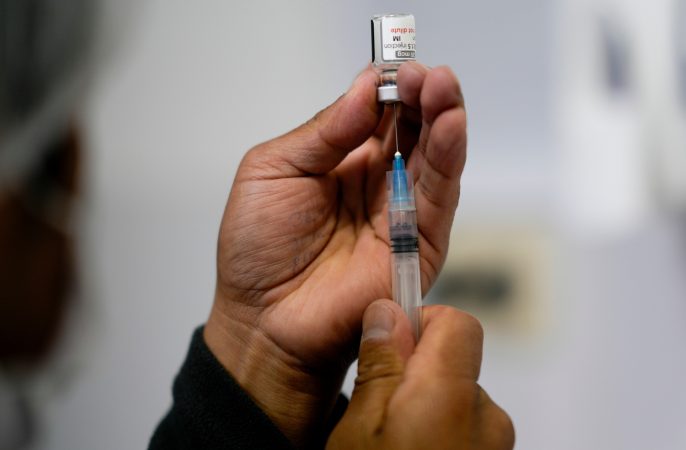
    The coronavirus vaccine reduced the risk of major cardiovascular events linked to COVID-19 — strokes, heart attacks, and hospitalization from heart disease — by about 40%, according to a new study. The findings, the latest in a growing body of research about the vaccine’s benefits for heart health, suggest such benefits observed in earlier studies have persisted for years.

    The study, published Monday in JAMA Internal Medicine, also suggested the vaccine has a broader public health benefit. The vaccine modestly reduced cardiovascular conditions, hospitalizations, and deaths of all causes, including those not linked to COVID, researchers said.

    “It tells us that these vaccines have actually brought beneficial effects even in people who don’t really know that they actually have contracted COVID-19,” said Ziyad Al-Aly, a physician-scientist and senior clinical epidemiologist at Washington University in St. Louis and co-author of the study.

    Previous studies have indicated the coronavirus vaccine reduces the incidence of heart attacks and strokes, including a study of around 46 million adults in England between 2020 and 2022.

    Researchers behind the latest findings set out to determine if those benefits persisted in the years after the onset of the pandemic.

    “Vaccine formulations have changed, and also the virus itself has changed over time,” Al-Aly said. But he said they found the more recent vaccine formulas still protected against heart conditions.

    The study, conducted among veterans who used the Department of Veterans Affairs health system, examined around 1 million veterans between 2024 and 2025. The research compared those who took the seasonal influenza vaccine and those who opted to take both the flu vaccine and the updated COVID-19 vaccine that season. The research reviewed multiple types of vaccines, including mRNA shots and Novavax.

    The researchers followed up with the cohorts after around eight months, noting whether they had a COVID-19-associated cardiovascular event, defined as a severe heart condition contracted soon after a COVID-19 infection.

    The cohort that took the COVID vaccine had a 37.7% lower risk of COVID-associated heart conditions, the study found. The benefit was most pronounced among patients over 75 and those with preexisting conditions such as cardiovascular disease, diabetes, or chronic lung disease.

    “To me, this continues to emphasize that we should be encouraging vaccination, especially amongst older individuals,” said Nisha Viswanathan, a physician and director of the Long COVID program at the University of California Los Angeles, who was not involved in the study.

    Patients who took the COVID vaccine were also around 6% less likely to suffer from severe heart conditions overall, including ones not linked to a COVID-19 infection, according to the study. The vaccine was also associated with reduced deaths and hospitalizations of all causes by around 7%.

    Al-Aly said that while those percentages appeared low, it still translated to averting around 23 major cardiovascular events, 30 hospitalizations, and 16 deaths per 10,000 vaccinated individuals.

    “Extrapolating these estimates to a population of 1 million people, vaccination could plausibly be associated with averting approximately 2370 [major cardiovascular] events and 1580 deaths over an 8-month period,” the study states.

    Al-Aly and Viswanathan both noted that the study’s population was largely older, white, and male, and that the extrapolations on the vaccine’s public health benefit should be treated with caution.

    Why did the vaccine produce some protection against heart conditions not connected to a COVID diagnosis? Al-Aly suggested that the trend could suggest patients are contracting mild cases of the virus without realizing it.

    “This study actually gives us a glimpse of the hidden burden of COVID-19 that’s actually still likely circulating in the population,” Al-Aly said.

    Viswanathan said that was plausible, but that it was also possible that the COVID vaccine could have additional benefits and side effects on the body. She noted studies have shown that other vaccines can help prevent a wider host of illnesses and chronic conditions, and that research is ongoing on the potential secondary effects of mRNA vaccines such as the COVID vaccine.

    COVID vaccines have also been linked to a risk of myocarditis and pericarditis, inflammation of the heart muscle and lining, but cases are rare and generally mild, and experts have said the benefits of vaccination outweigh the risk of side effects.

    In October, researchers at the University of Florida and the University of Texas published a study that found the COVID vaccine improved cancer patients’ responses to immunotherapy.

    “MRNA vaccines are doing something else to our system that we haven’t completely understood yet, and I do think there’s probably a lot of positive that is going to come,” Viswanathan said.

  • U.S. infant mortality rate fell to an all-time low, though it still trails other similar nations

    NEW YORK — Infant mortality in the U.S. dropped to a new all-time low in 2025, according to preliminary government data.

    There were slightly fewer than 5.4 infant deaths per 1,000 live births in 2025, according to the Centers for Disease Control and Prevention.

    While that appears to be a small decline from about 5.5 in 2024 and 5.6 in the two years preceding, researchers say it is statistically meaningful and translates to hundreds of fewer infant deaths per year.

    It’s difficult to pinpoint what’s driving the recent developments, but “this is an encouraging data point, and we hope that this trend will continue,” said Michael Warren, chief medical and health officer for the March of Dimes.

    Infant mortality is the measure of how many babies die before reaching their first birthday. Because the number of babies born in the U.S. varies year to year, researchers calculate rates to compare infant mortality over time.

    The overall numbers, too, have been going down. U.S. infant deaths fell to about 19,350 last year, according to provisional CDC data that may rise a little as additional analysis is completed. The final tally is still expected to be down from about 20,050 in 2024 and about 20,160 in 2023, according to the agency.

    The U.S. rate has inched down over the decades — it was at 7.5 per 1,000 three decades ago — thanks to medical advances and public health efforts.

    But it has remained worse than in other high-income countries, which experts have attributed to poverty, inadequate prenatal care, and other problems. A study published last year found the U.S. infant mortality rate in 2022 — when the rate rose — was nearly twice as high as what was seen in several other high-income democratic nations, including Italy, Japan, Spain, and Sweden.

    That was the year of the first statistically significant jump in the U.S. rate in about two decades. Experts attributed that rise to a rebound in RSV and flu infections.

    In 2023, U.S. health officials began recommending two new measures to prevent the toll on infants: One was giving a lab-made antibody shot for infants that helps the immune system fight off the virus, and the other was giving an RSV vaccine to women between 32 weeks and 36 weeks of pregnancy. A March of Dimes expert last year said the effort likely contributed to the improvement in 2024.

    Meanwhile, a decline in sudden infant death syndrome could be connected to an increase in education around safe sleeping for infants, Warren said in a statement.

    The CDC posted the 2025 provisional data in late May. On Tuesday, the agency released a more in-depth analysis of 2024 infant mortality data, offering details not yet available for 2025. Among that report’s highlights:

    — Death rates declined both for the youngest infants, less than 28 days old, and for older infants. Those declines continued last year, the 2025 provisional data indicate.

    — In 2024, infant mortality continued to differ by race, sometimes dramatically. Death rates for infants born to Black women were more than twice as high as those for the infants of Hispanic, white, and Asian American women.

    — Researchers noted a decline in the mortality rate for infants born at full term, at 39 to 40 weeks. But rates did not change significantly for other gestational age groups.

    — Mississippi had the highest infant mortality rate, at 9.65 deaths per 1,000 births, and New Hampshire had the lowest, at just under 3 per 1,000.

    “These differences are reflective of a variety of reasons related to access to care, community factors, and policies that improve health and outcomes,” Warren said.

  • ICE removed detainee protections after private outreach from top contractor

    ICE removed detainee protections after private outreach from top contractor

    When U.S. Immigration and Customs Enforcement was revising the federal standards that govern immigration detention centers, one of its top contractors privately asked for changes that could benefit its business, according to a person briefed on the discussions.

    Geo Group, which oversees more than a dozen ICE detention facilities, has faced lawsuits in three states alleging it violates minimum-wage laws by paying some immigrant detainees $1 a day to work. The company maintains that the work is voluntary and that it operates the program at the direction of the government.

    Geo asked that ICE remove lines saying contractors needed to follow state and local laws around the treatment of detainees and that ICE amend language to support its legal position in these cases, the person said, speaking on the condition of anonymity for fear of reprisal. The company also asked that the standards specify that detainees are not employees of the facilities where they work.

    The new national detention standards, which ICE posted to its website Monday, include some of Geo’s requested changes. The document says detainees are not employees “and are not entitled to wages or benefits under applicable wage laws or labor regulations.”

    The revised rules no longer say detainees must be paid at least $1 per day, and no longer include several references to contractors having to comply with state or local laws.

    ICE standards are the key rules that govern the conditions of detention centers, where hundreds of thousands of people are held each year. The policies, which ICE enforces through its contracts with private companies and local governments, cover a wide range of facility operations, including how body cavity searches must be conducted as well as when detainees should be placed into solitary confinement.

    Geo’s input in the new standards, which has not been previously reported, highlights the ICE contractor’s influence over the agency that is both its regulator and, corporate filings show, its biggest customer.

    Two of the Trump administration’s top immigration officials — border czar Tom Homan and ICE’s acting director, David Venturella — previously worked for Geo Group, prompting Sen. Elizabeth Warren (D., Mass.) to question in a letter last month “whether ICE enforcement priorities are being driven by the financial interests of politically connected detention contractors.”

    As the administration has ramped up arrests of immigrants, it has relied on Geo to help it significantly expand the nation’s capacity for holding ICE detainees. Advocates for immigrants and some state regulators say poor oversight at many of these facilities has led to the mistreatment of migrants.

    This month, New Jersey sued Geo for refusing to allow state health inspectors full access to its Delaney Hall facility, in Newark, where the state says detainees have staged hunger strikes to protest being fed spoiled or rotten food and not being given access to basic hygiene products. Geo’s lawyers have said in court filings that only ICE can grant state inspectors access to the facility.

    In the new standards, ICE said part of the goal of the revisions was to “reduce the burden on our detention operators.” At least one other detention contractor, CoreCivic, was consulted on the new standards, the person said. It’s unclear whether CoreCivic offered input.

    “As part of the revision process, ICE consulted with a variety of stakeholders, including facility operators responsible for implementing the standards,” Lauren Bis, a spokesperson for the Department of Homeland Security, said in a statement. “ICE considered that input alongside operational, legal, and policy requirements when making a final decision on the standards.”

    Ryan Gustin, a CoreCivic spokesman, said that the company is sometimes asked by government partners for input on standards but that “ultimately, government officials decide on the standards and policies they develop and enforce.”

    Abigail Jackson, a White House spokesperson, said Homan adheres to federal ethics and conflict-of-interest rules. Geo Group did not respond to requests for comment.

    It’s not uncommon for federal agencies to solicit feedback on policy changes from the industries they regulate, said Steve Schooner, a professor of government procurement law at George Washington University.

    But typically, these discussions are done through a comment period that is open to businesses, advocacy groups, and other members of the public, he said. ICE did not hold a public comment period on the new standards.

    “The reason we do public commenting is because there are various stakeholders,” Schooner said. ICE’s contractors, he added, “are probably not the best voice to represent the people who are being detained.”

    Venturella, who was picked to lead ICE last month, is a former senior executive at Geo Group, where he earned millions of dollars overseeing the company’s detention business, corporate filings show. He worked as an executive at Geo from 2012 to 2023 and as a paid consultant for Geo through Jan. 31, 2025, the company said in a filing.

    Venturella joined DHS as a senior adviser less than two weeks later, and was granted a waiver from a federal ethics rule that generally bars government employees from working on contracts awarded to their former employers for one year, the Washington Post reported last year, based on interviews and documents.

    DHS declined a request to share this waiver, arguing that doing so would jeopardize the privacy of a government employee.

    Geo Group and CoreCivic each donated $500,000 to Donald Trump’s presidential inaugural fund in December 2024, election spending data shows. A Geo Group subsidiary, Geo Reentry Services, has contributed $2 million to MAGA Inc., a Trump-aligned super-PAC, since last October, the records show.

    Gustin said CoreCivic has consistently contributed to inauguration events for both Democrats and Republicans.

    New versions of ICE standards go into effect gradually, as they become incorporated into new or modified contracts. At least one new detention center in Appleton, Minn., already has agreed to follow the 2026 rules, federal procurement records show.

    It’s unclear how the revisions would help Geo fend off legal challenges to its $1-a-day work program, said Jacqueline Stevens, the founding faculty director of Northwestern University’s Deportation Research Clinic. Federal law and state laws define employees broadly as people who work for pay, she says, and ICE cannot override those laws by changing its contractual standards.

    “ICE cannot magically wipe out those protections,” Stevens said.

    ICE previously has made two revisions to the standards under Trump, and each time critics accused the agency of weakening protections for immigrant detainees. Revisions in 2019 removed the mandatory minimum ratio of toilets per detainee, as well as a line that banned the use of “hog-tying” or unnecessarily tight restraints.

    The 2026 standards added some protections for detained immigrants, including an effort to expand access to language translation services, stricter rules around who can be put into solitary confinement, and a requirement that facilities alert ICE when they cannot accommodate the medical needs of any detainee.

    ICE also specified in the new standards that facilities do not have the right to refuse any person that the agency decided to detain.

    One of Geo’s recommendations, which proposed stipulating that the government would reimburse contractors up to $100 million for legal losses associated with wage lawsuits, was not reflected in the new standards, the person familiar with the discussions said.