Category: Nation & World

  • Trump says he is nominating former Oklahoma state trooper Lance Schroyer as ICE director

    NEW YORK — President Donald Trump on Saturday said he is nominating Lance Schroyer, a former Oklahoma state trooper, as the next director of Immigration and Customs Enforcement.

    Trump said on his Truth Social platform that his new pick for the immigration enforcement agency is a former U.S. Marine and a “PATRIOT with real operational experience.” He called Schroyer a ”proven leader with DECADES of experience locking up the worst of the worst.”

    Schroyer hails from the same home state as the new Department of Homeland Security Secretary Markwayne Mullin, a former congressman. Earlier this month, Mullin brought Schroyer onstage at a National Sheriffs’ Association event, calling him a “good friend of mine” and noting DHS had recently hired him.

    On Saturday, Mullin quickly praised Schroyer in a statement highlighting the former trooper’s 29-year career and his work with federal and state partners on a U.S. immigration enforcement program.

    “President Trump made a great pick, and I’m confident Lance’s strong leadership and firsthand experience will empower the men and women of ICE to deport criminal illegal aliens, secure the homeland, and protect the American people,” Mullin said.

    If confirmed, Schroyer will lead ICE at a time when the public mood has soured on Trump’s immigration crackdown, which sent surges of federal immigration officers into American cities to round up immigrants. Those raids sent tensions soaring and prompted clashes between protesters and law enforcement, leading to the fatal shootings of two U.S. citizens in Minneapolis earlier this year.

    Trump returned to the White House on a promise of mass deportations, and ICE has been a central executor of that vision. The agency is undergoing massive growth from a one-time injection of $75 billion last year, which has allowed for the hiring of 12,000 officers and increased detention capacity.

    Mullin, who started in his role in March, has promised to keep his department out of the headlines and has indicated a softer tone on immigration, although he is expected to align with the president’s priorities on mass deportations.

    Claire Trickler-McNulty, a former senior ICE official, said prior confirmed ICE directors have often been attorneys, though some state and local law enforcement officials have also been nominated. She said Schroyer’s background in Oklahoma suggests Mullin likely had influence over the pick.

    “I think probably given the attention on ICE, he wants to feel like he has somebody he can trust in there,” she said in an interview.

    John Torres, another senior ICE official, said Schroyer faces an uphill climb toward Senate confirmation but his experience being at the state and local level instead of the federal level might help.

    “He won’t have any of that baggage, where they’re going to turn around and say, oh, well, he worked for this administration or that,” Torres said.

    Schroyer’s nomination comes after former ICE director Todd Lyons resigned at the end of May. David Venturella, a former executive at a private prison operator, has been serving as the acting head of the agency. Venturella is expected to stay on as the acting director until Schroyer is Senate confirmed, according to a DHS official speaking on condition of anonymity.

    ICE has not had a Senate-confirmed director since the Obama administration, a result of polarizing politics around the agency and immigration policy.

  • NASA races to save Swift telescope from falling back to Earth with daring rescue mission

    CAPE CANAVERAL, Fla. — NASA is racing to save an aging telescope from falling back to Earth with a daring rescue mission.

    The $30 million salvage operation gets underway as soon as this week with the planned launch of a robotic lifesaver.

    NASA hired startup Katalyst Space Technologies to boost the Swift Observatory to a higher orbit where it can continue hunting for some of the universe’s biggest explosions. A three-armed spacecraft built by Katalyst will chase after Swift once it takes off from an atoll in the Pacific’s Marshall Islands aboard an airplane-launched Pegasus rocket. Liftoff could occur as early as Tuesday.

    Scanning the cosmos since its launch in 2004, Swift has been sinking faster and faster because of recent intense solar activity. It needs to get to a higher, more stable orbit as soon as possible to survive.

    NASA’s Hubble Space Telescope — also at risk — could be next.

    Like Swift, Hubble is losing altitude as the sun erupts with one flare after another. Katalyst Space CEO Ghonhee Lee said his company’s next-generation robot, still in development, could save the day for the much bigger Hubble in a couple years.

    Only China has attempted a mission like the upcoming one, successfully boosting a satellite into a higher graveyard orbit four years ago.

    “This is the first American space robot to go up and do anything like this,” Lee told the Associated Press. “NASA has all these big senior observatories … all of them can benefit from a service like this. So what we’re proving with this mission is this is a new play in the playbook that’s available.”

    It will take Katalyst’s autonomous spacecraft, named Link, about a month to rendezvous with Swift and catch it, and another couple of months to raise its orbit from the current 224 miles to the desired 373 miles.

    The 1.6-ton gamma ray observatory must be above 185 miles for the rescue to work. It’s expected to reach that point of no return in October, according to the latest estimates.

    Roughly the size of a small kitchen refrigerator with a 40-foot solar wingspan, Link sports three arms with a reach of just over 3 feet. Each arm has two fingerlike pinching grippers that resemble the hands of a Lego mini figure.

    If all goes well, Swift could be back in business by September, according to Lee.

    Worth hundreds of millions of dollars, Swift was never designed to be repaired, let alone retrieved by hands — human or otherwise. That’s what makes this so challenging, according to company officials, who stress there is no guarantee it will work.

    NASA signed a contract with Katalyst last September with only two requests: It has to be a rush job, but please don’t make things worse. Nine months later, the company is ready to rumble.

    “I have to be honest. No one thought it was going to be possible. No one thought we would get as far as we’ve already gotten today,” said Shawn Domagal-Goldman, NASA’s astrophysics director.

    NASA has bought a little more time for Swift, turning off all scientific instruments to slow its descent. Observations ceased in February.

    NASA’s science mission chief Nicky Fox said it’s worth the effort.

    “If we let Swift reenter, we would lose that telescope. We would lose a lot of capability,” she said. “We don’t currently have the budget to build another one to replace that.”

    While not everything can be saved in space, Swift is special, said Domagal-Goldman.

    True to its name, Swift is designed to pivot quickly to capture late-breaking astronomical events such as gamma ray bursts and exploding stars. With more discoveries expected by the Webb Space Telescope and soon-to-launch Roman Space Telescope, Swift, if saved, would be busier than ever as “NASA’s first responder.”

    Katalyst sees Swift as the jumping-off point for a new repair business in space. The company’s next-generation robotic rescuer, scheduled to fly next year, will tackle satellites as high as 22,300 miles up. Lee envisions hundreds of robots in orbit one day, not only fixing and hoisting satellites but also refueling them and building solar farms, data centers, and other platforms.

    Hubble, which is 36 years old and received repeat servicing by spacewalking astronauts during the shuttle era, could follow in 2028 with a life-extending Katalyst boost.

    “It’s a national treasure,” Fox said. “People love Hubble.”

  • Venezuela government accused of politicizing earthquake relief

    The Venezuelan opposition party led by exiled former legislator and Nobel laureate María Corina Machado mobilized volunteers throughout the nation last week to collect donations for homeless earthquake survivors, but it encountered an unexpected obstacle: the National Police.

    On Thursday, Heidy Loicett, a leader of the opposition party, Vente, stood under a blue tarp on a sidewalk in Portuguesa, a state some 275 miles from the disaster zone, as people came by with a variety of items such as diapers, bottled water, and used clothing. The police came by, too, she said.

    Several Venezuelan National Police officers and officials from the federal Civil Protection agency tried to shut down the charity drive, she explained in a telephone interview after the encounter, adding that she was told that all donations had to be channeled through the federal government.

    “They said we couldn’t have a donation center, that the only authorized donation drop-off center was Civil Protection and the government,” Loicett said. “That was political persecution.”

    The clash over who gets to take credit for the humanitarian relief effort for the earthquake-shattered nation highlights a much larger, high-stakes battle for political survival in a fractured Venezuela.

    Last week Venezuela suffered two devastating earthquakes that killed more than 1,400 people, just six months after the U.S. military raided the country and seized the country’s former leader, Nicolás Maduro. Critics say they fear that Venezuela’s acting president, Delcy Rodríguez, will politicize the tragedy, using the disaster response to establish her legitimacy at a critical inflection point.

    Rodríguez’s government, which did not respond to requests for comment, has said the authorities are trying to impose order and keep areas and roads hit by the earthquakes clear so relief convoys and emergency responders can do their work unimpeded.

    It is also a general rule of politics that opposition figures are quick to highlight any failures of the governing party.

    Rodríguez had been vice president before the United States captured Maduro and said it was going to run the country, elevating her to the top job. Her tenure depends on the Trump administration’s approval, and her management of this crisis is also a key moment for President Donald Trump.

    White House officials have said the alliance with Rodríguez was meant to stabilize Venezuela and help revive its battered economy. The disaster is likely to put that relationship to a severe test.

    Experts say that tightening control over aid and stifling the opposition’s grassroots relief efforts is a page out of a decades-old authoritarian playbook. Rodríguez, they say, is gambling that international crisis management can mask the state’s internal decay and secure her hold on power.

    That strategy was on full display in a widely circulated video in which a police officer appears to tell volunteers where the United Socialist Party of Venezuela, the ruling government party, had authorized donation drop-offs. Donation centers set up by the opposition in other cities were told that they could not display signs reading “Donation Center,” because those words could be used only by the government’s authorized drop-off sites, political activists said.

    “They told us we could not use the words ‘donation center,’ like if they had trademarked those words,” said María Oropeza, a Vente party official. “It is inevitable that they will try to use this tragedy at their favor to stay in power.”

    Party officials said police backed off after crowds started gathering and taking videos. The volunteers took down the offending signs, and the drive continued.

    Volunteers from the opposition planned to try to make deliveries to the earthquake zone over the weekend, but the authorities announced that civilians without authorization would be prohibited from entering La Guaira, the hardest-hit coastal area.

    Government officials said the rush of volunteers in the disaster zone was blocking traffic, which was critical for the movement of heavy machinery.

    “Those who do not have rescue or security duties in La Guaira state should please refrain from traveling there, as you are obstructing the movement of personnel needed for our military, police, Civil Protection, firefighters, and rescue workers to reach the disaster zone,” Rodríguez said. “These are critical hours.”

    She called for unity in the time of crisis, and has welcomed a number of international search and rescue delegations, including from the right-wing governments of El Salvador and Argentina.

    Rodríguez’s decision to accept help from political adversaries underscored a delicate balance of projecting an image of effective disaster management while scoring political points before potential elections, said Pablo Quintero, a political consultant, who said he works mostly with the opposition in Venezuela.

    “In the face of catastrophes, governments act based on political interests,” he said. “In this case, the Chavista government is acting to gain greater prominence, to demonstrate its management capacity to the international community, and in some way to send a message to the population that they have managed to unify the country.”

    But Machado is acting in her own interests too, he said.

    “María Corina Machado has a political agenda,” he said. “And the objective reality is that her media operatives are running a campaign to demonstrate the government’s incompetence.”

    Machado was said to be trying to go back to Venezuela, which frustrated some U.S. officials, who considered a return in the wake of an emergency to be a “political stunt,” the New York Times reported Saturday.

    A spokesperson for Machado said she was not available for comment.

    Rodríguez, as Maduro’s vice president in charge of the economy, was part of a repressive government that stole a presidential election in 2024.

    After the U.S. raid in January that removed Maduro but allowed Rodríguez to stay on as interim leader, the Trump administration said Venezuela would eventually move toward elections and a restoration of democracy. The disaster engulfing Venezuela could delay such a transition, experts said.

    “It’s hard to imagine that Delcy won’t use the earthquakes to delay discussions of a democratic transition; some of that is certainly legitimate in the face of such an overwhelming humanitarian emergency,” said Cynthia Arnson, an adjunct professor at the Johns Hopkins University School of Advanced International Studies.

    But it may not work out as she hopes, Arnson said.

    “The political effects of natural disasters are often severe,” she said. “Weeks or a few short months after the immediate emergency, the quakes are likely to magnify the incapacity of the government to meet basic needs, let alone undertake any kind of reconstruction.”

    Widespread corruption of international aid sent after a 1972 earthquake in Nicaragua was among the events that led to the unraveling of a dictatorship led by Anastasio Somoza Debayle. An earthquake in Mexico City in 1985 helped lead to the end of one-party rule there more than a decade later.

    Benigno Alarcón, the former director of the Center of Government and Political Studies at Universidad Católica Andrés Bello, said there was “no doubt” that Rodríguez would try to capitalize on the catastrophe — and she would not be the first.

    He said many Venezuelans still recall the 1999 mudslides that occurred in the quake zone — including La Guaira — when the ruling party’s former leader, Hugo Chávez, refused to accept humanitarian assistance from the U.S. military.

    “Remember that these are not new people in power,” he said. “These people in the government have been in government for a long time.”

    Rodríguez and Machado would hardly be the first to politicize natural disaster recovery, said Brian Naranjo, a former top U.S. diplomat in Venezuela. He cited the words of the liberator, Simon Bolivar, amid the political machinations following a catastrophic earthquake in 1812 in Venezuela.

    “If nature opposes us,” Bolívar said, “we shall fight nature and make it obey.”
  • 3 firefighters killed, 2 injured while tackling wildfires on the Colorado-Utah border

    BEAVER, Utah — Three firefighters were killed and two sustained burn injuries when they were overcome by flames from fast-moving wildfires in hot, windy conditions near the Colorado-Utah border.

    The firefighters deployed emergency shelters during the burnover incident on Saturday in Mesa County, Colo., the U.S. Interior Department said.

    They worked for the U.S. Wildland Fire Service and U.S. Forest Service and were part of an interagency response to the Knowles and Gore fires, which merged with other fires to form the Snyder Fire. So far, about 44 square miles have burned.

    Temperatures in Grand Junction hit a high of 93 degrees Fahrenheit, with winds gusting to 44 mph, according to the National Weather Service.

    The U.S. Wildland Fire Service, created earlier this year to streamline firefighting and fire reduction across public lands, said in a statement that it “stands united” with the Forest Service in grief and “in our unwavering support for the loved ones left behind.”

    “Their bravery, dedication, and sacrifice will never be forgotten,” the statement said.

    The names of the firefighters who perished were being withheld pending notifications to their loved ones, the Interior Department said.

    The Mesa County Sheriff’s Office was asking people to evacuate the potential path of the fire and to turn on irrigation water to saturate the land. The federal Bureau of Land Management closed public access to lands it manages nearby.

    “Firefighter and public safety are the highest priority,” the agency said in a statement. “The temporary closing of the lands is to reduce exposure to hazardous situations due to the rapid rates of spread and fire behavior that the fire has exhibited. The public is to remain clear of these closed lands.”

    Hot, dry, and windy conditions

    Wildfire activity has intensified across the western United States, as consecutive days of hot, dry, and windy weather have fueled flames in Utah, Arizona, and elsewhere as new fires popped up across the region.

    The largest blaze, the Cottonwood Fire, was burning in rugged terrain in southwest Utah. It ballooned Saturday to more than 144 square miles after marching through canyons and mountainsides, destroying part of a ski resort and other summer cabins along the way.

    Authorities in Beaver County began working with fire teams on Saturday to assess the extent of the damage, but no estimates were immediately available. Utah Gov. Spencer Cox in a post on social media called it bleak, but he thanked crews for what he called “several miraculous stops and saves.”

    The cliffs and steep slopes have made the job even harder, said Alyssa Mason, a spokesperson assigned to the fire.

    “It’s hard to get dozers and other heavy equipment into that. It’s hard to get engines into that,” she said. “It doesn’t make it impossible to firefight, but it does just kind of slow things down.”

    Hundreds of firefighters have been arriving in the arid state to battle new starts as well as those that have been growing because of what forecasters called critical fire weather — dangerously low humidity levels, warm temperatures, and gusty winds.

    The danger is even higher this year because of Utah’s record-low snowpack and its warmest winter on record. Much of the West is grappling with similar conditions, according to the National Interagency Fire Center.

    Nationally, nearly 3 million acres have burned since the start of the year. That is more than the 10-year average.

    Emergencies declared in Utah and Colorado

    The conditions in Utah were critical enough for Cox to declare an emergency earlier this week and clear the way for the state to ban fireworks ahead of the July Fourth holiday. The order comes as Utah is experiencing one of the most severe wildfire seasons in recent history, fueled by historic drought conditions.

    State officials said that over the past week, Utah has seen an increase in wildfire starts, with each fire showing unprecedented behavior. These starts have stretched the state’s wildland firefighting capabilities, State Forester Jamie Barnes said.

    Colorado Gov. Jared Polis also declared an emergency on Saturday, and authorized the use of the National Guard to tackle the fires.

    Forecasters with the National Weather Service over recent days have been issuing red flag warnings for a wide swath of the West, from California to Arizona and New Mexico.

    South of Grand Canyon National Park, authorities said the flames of a new wildfire were moving away from Grand Canyon Village and the nearby community of Tusayan on Saturday. But about 50 miles away, another fire prompted Coconino County officials to issue evacuation orders for those near Kendrick Mountain.

    Parts of northern Arizona were without power Saturday as the utility serving the area initiated a safety shut-off in hopes of lessening the wildfire risk.

    Power shutoffs have become more common in the West as wildfire risk has expanded. It is usually a last resort after utility forecasters weigh factors like sustained wind and gust speeds, available fuels, and topography.

    With extreme fire conditions persisting in Utah, Rocky Mountain Power also shut off power lines serving Beaver County and other areas.

  • France records around 1,000 additional deaths as extreme heat breaks European records

    BERLIN — France saw around 1,000 additional deaths last week at the height of its record-smashing heat wave, the country’s public health agency said Sunday, as the head of the World Health Organization warned that Europe is now the fastest-warming continent and needs to do more to protect its citizens.

    Temperature records were toppled in several countries on the weekend, wildfires were sparked in Germany, and Berlin police used water cannons to cool down the crowds.

    Meanwhile, the heat wave slowly moved toward eastern parts of the continent.

    Germany marked a new record for the third day in a row with 107 degrees Fahrenheit in Neißemünde, near the border with Poland, which baked under its new all-time high of 104.9 F. The Czech Republic also experienced its hottest day ever with 106.4 F.

    A new study from the World Weather Attribution, a Europe-based collaboration of scientists, reported Friday that the record-breaking heat and humidity in Europe this past week would not have been possible without climate change.

    The rapid study found that the heat would have been virtually impossible just five decades ago, and is 200 times more likely today than it would have been 20 years ago.

    France records surge in deaths during heat wave

    France reported a surge in deaths last week, including a sharp increase at private homes, especially in the Paris region, the national public health agency said Sunday.

    There were more than 1,200 deaths on Wednesday, when France was sweltering under its hottest temperatures, increasing to more than 1,400 deaths on each of the two following days, Public Health France said. In April and May, before the heat wave, France’s rate of deaths was about 900 to 1,000 per day.

    The agency concluded that France experienced a total of at least 1,000 additional deaths during those three days alone, an estimate it cautioned is likely to increase as more data is collected, including for deaths at home.

    The increase was sharpest in areas under red warnings of extreme heat, it said. Those warnings blanketed about three-quarters of the country at the peak of the heat wave. The agency said that 85% of the deaths involved people aged 65 and above.

    Europe is fastest-warming continent, WHO warns

    “Europe is the fastest-warming continent on Earth, heating at twice the global average,” WHO Director-General Tedros Adhanom Ghebreyesus said Sunday on X. “Right now 150 million people are living under extreme heat, hundreds have died, schools are shut, grids are buckling.”

    Driven by climate change and global warming, the “once-in-a-generation” heat wave is now occurring nearly every year, Tedros said, adding that more than 1,300 excess deaths have been recorded since June 21 linked to high temperatures in Europe.

    “Heat stress is often called the ‘silent killer’ — and European homes, workplaces, and schools were not built for these temperatures,” Tedros warned as he called on European countries to implement action plans. He said they should focus on preparedness, prevention, and stronger health system responses.

    Lightning strikes Swedish theme park

    In Sweden, several people were injured when they were hit by lightning at an amusement park, the country’s TT news agency reported.

    Three adults were taken to the hospital, among them a woman with serious injuries, after the lightning struck the Tosselilla Sommarland park in Tomelilla in the south of the country.

    Across Europe, the extreme heat has been followed by severe thunderstorms.

    Denmark, which marked new temperature records on Saturday, recorded 1,156 lighting strikes by Sunday morning, according to public broadcaster DR.

    Wildfires burn forests contaminated with WWII ammunition

    In Gohrischheide, in eastern Germany, a fire broke out in a large forest that’s still contaminated with ammunition from World War II, which made the firefighters’ efforts even more complicated.

    Similarly, a major firefighting operation was underway in southwest Germany near the village of Traisen, where the heat sparked a forest fire in an area that also contained unexploded ordnance. Firefighters had to be temporarily stop after explosions took place and an ordnance disposal unit was brought in to continuously assess the situation, German news agency dpa reported. Some 650 people in Traisen had to leave their homes Sunday afternoon because the fire continued to spread.

    The big cities’ fire departments were busy sending out ambulances to people suffering from heat-related illnesses. In Berlin, an additional 500 ambulance dispatches were reported on Saturday, most of them heat-related.

    Berlin police use water cannons to cool down locals. tourists

    The German capital’s police found a way to help suffering Berliners and tourists alike. They put up two huge water cannons — usually used to disperse unruly protesters — in front of the city’s iconic Brandenburg Gate and sprayed the cool water across the cheering crowd.

    The heat also continued to damage the country’s infrastructure, with the concrete surface on countless highways breaking up, and a weekend warning by national rail operator Deutsche Bahn to avoid all unnecessary train travel.

    More than 600 passengers had to be evacuated from an overheated train in Brandenburg after a tree fell onto an overhead power line during a storm on Saturday evening. The train, which was on its way from Hamburg to Prague, lost power. The air conditioners stopped working and the doors were locked until emergency responders forced them open. Two people were hospitalized with heat-related problems, dpa reported.

    In the eastern city of Leipzig, no trams will be running until early Monday morning due to heat damage to tracks and switches. The Leipzig Public Transportation Authority said that the high temperatures had caused the joint sealant for asphalt and concrete in switches and tracks to run and clump together in many places throughout the city’s network.

  • Iran attacks Bahrain and Kuwait following U.S. strikes and threatens to halt talks

    DUBAI, United Arab Emirates — Iran again launched drone and missile attacks Sunday targeting Bahrain and Kuwait in response to new U.S. airstrikes against the Islamic Republic, and threatened a “complete halt” in negotiations to end the war if Washington continues its attacks.

    Efforts to reopen the Strait of Hormuz without Iran’s direct oversight sparked the days of crossfire and have imperiled the talks for a lasting ceasefire. A multinational maritime body overseen by the U.S. Navy said Saturday it would expand a route near Oman for inbound and outbound traffic, setting up a new flashpoint with Tehran.

    The global community has long considered the strait an international passageway, despite its location in Iran and Oman’s territorial waters. In recent days, Iran has twice attacked vessels going through a route on the Omani side in an evacuation effort backed by a United Nations agency.

    Iran insists that it alone must govern the strait, the narrow mouth of the Persian Gulf that once carried a fifth of the world’s oil and natural gas. Iranian Foreign Minister Abbas Araghchi reiterated the claim on Sunday.

    “Any attempt to establish new or separate arrangements from those currently being carried out by the Islamic Republic of Iran will only lead to further complications, delay the reopening of the Strait of Hormuz and increase the level of tension,” Araghchi said.

    The United States and Iran have been debating the terms of an interim deal, including shipping arrangements on the strait, the removal of a U.S. blockade on Iranian ports and sanctions on Iran, and the future of Iran’s stockpile of highly enriched uranium. Under the memorandum of understanding signed this month, they have 60 days to iron out details.

    The interim deal is meant to end fighting on all fronts before certain key issues can be discussed. Continued fighting in Lebanon, where an Israeli soldier was killed by Hezbollah fire early Sunday, also threatens the agreement.

    Strikes target Gulf states hosting U.S. military

    Iran’s paramilitary Revolutionary Guard claimed responsibility for the attacks in Bahrain and Kuwait.

    Kuwait’s military said air defenses intercepted Iranian drones and missiles just after the U.S. strikes in Iran. Kuwait, which hosts a major U.S. military base, said it intercepted two ballistic missiles. There were no reports of injuries or damage.

    Bahrain’s Interior Ministry said the Iranian strikes damaged a residential building near the international airport but no one was killed. The ministry released photos of an eight-story building, its top floor destroyed and windows blown out.

    Bahrain is home to the U.S. Navy’s 5th Fleet, whose base came under repeated attack during the war. The damaged building was not near the fleet’s headquarters.

    Bahrain’s Foreign Ministry denounced what it called “a dangerous escalation that reveals that what Tehran is doing is not a passing act, nor an isolated incident, but rather a deliberate approach and a systematic pattern of repeated aggression.”

    Trump accuses Iran of violating ceasefire with ship attack

    The U.S. military’s Central Command said it struck Iranian military “surveillance infrastructure, communication systems, air defense sites, drone storage facilities, and minelayer capabilities” following an attack on a ship at sea Saturday. The Panamanian-flagged tanker Kiku carried crude oil for the state-run energy company of Qatar, a key mediator between Iran and the U.S.

    President Donald Trump on social media accused Iran of violating the ceasefire and warned of a point where the U.S. may no longer be reasonable “and will be forced to militarily complete the job.”

    “If that happens, the Islamic Republic of Iran will no longer exist!” Trump wrote.

    The exchanges of fire began when an Iranian drone struck a merchant vessel off Oman on Thursday and the U.S. military retaliated with strikes.

    Ship traffic on the strait had increased over the past 72 hours, off both Iran and Oman, the multinational maritime body overseen by the U.S. Navy said Sunday, adding that “U.S.-assisted commercial transits continued uninterrupted despite the elevated threat environment.”

    It said 89 such transits had been made, still below the historical average of 138 vessels a day.

    Iran calls for new “conflict control unit” in Lebanon

    Last week, Israel and the Lebanese government signed a framework agreement to end the latest fighting between Israel and the Iranian-backed Hezbollah militant group, which began two days after the Iran war began when Hezbollah fired at Israel. Israel responded with an invasion that has occupied large swaths of southern Lebanon, and it has said it will not withdraw until Hezbollah is disarmed.

    But last week’s deal did not include Iran or Hezbollah, which has criticized the deal and rejected calls to disarm.

    On Sunday, Araghchi again said the U.S. must force Israel to halt attacks and withdraw. Israel occupies around 231 square miles in southern Lebanon, which it says it needs as a security buffer.

    But sporadic clashes have continued, and Hezbollah’s leader said Saturday that the group would continue fighting until Israel withdraws from Lebanon.

    Key Iranian negotiator and parliament Speaker Mohammad Bagher Qalibaf said Sunday that a new “conflict control unit” formed among Iran, the United States, and Lebanon should meet as soon as possible, Iran’s state broadcaster reported.

    The frequency of Israeli strikes in Lebanon has decreased significantly since the Iran-U. S. deal was signed, but two separate strikes hit southern Lebanon on Sunday morning — one in Taybeh town and the other in the Nabatiyeh area, according to Lebanon’s National News Agency. There was no immediate word on casualties.

    Overnight, Hezbollah militants killed an Israeli soldier in Deir Siryan village in southern Lebanon, according to Israel’s military. Hezbollah did not comment.

    “We are prepared to rapidly resume offensive operations in both Lebanon and Iran if required,” said Israel’s military chief of staff, Lt. Gen. Eyal Zamir.

  • A federal judge tossed a Justice Department lawsuit seeking Pennsylvania voters’ private information

    A federal judge tossed a Justice Department lawsuit seeking Pennsylvania voters’ private information

    A federal judge on Saturday dismissed a U.S. Department of Justice lawsuit seeking to obtain Pennsylvania’s entire, unredacted, voter-registration database.

    President Donald Trump administration’s doesn’t have the legal authority to demand the “highly sensitive” information, wrote Cathy Bissoon, Pittsburgh’s federal court chief judge. And while the Justice Department couldn’t articulate the “basis and purpose” for its request, Bissoon said, the administration has been “say[ing] the quiet parts out loud.”

    “Public statements from government officials reveal its intentions: to create a nationwide voter-database, for potential weaponization in future elections; as a ‘fishing expedition,’ hoped to advance unsubstantiated claims of non-citizen voting; and as a tool for immigration enforcement,” the Barack Obama-appointed judge wrote.

    The Justice Department sued more than half of the states in the union for their voter-related records. Bissoon’s ruling marks the Trump administration’s 10th defeat in a district court, which the judge notes with a positive spin.

    “The administration’s demands have yielded one unexpected benefit, namely, bipartisan agreement,” Bissoon said. “Five of the district judges are Trump appointees.”

    The Justice Department did not immediately respond to a request for comment.

    “No matter what the Trump Administration tries next, we’re going to stand up to protect Pennsylvanians’ right to privacy — and our fundamental right to vote,“ Gov. Josh Shapiro said in a post on X.

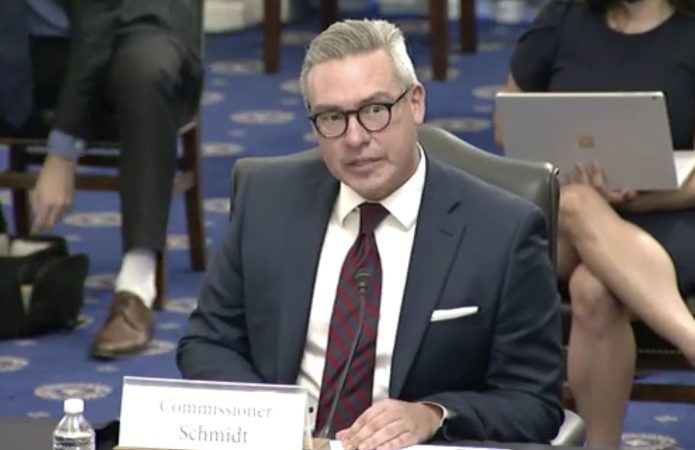
    The Trump administration sued in September after Pennsylvania Secretary of State Al Schmidt refused to turn over all voter-registration data — which includes sensitive information such as Social Security numbers — from the November 2022 election through the 2024 presidential election.

    Schmidt, who previously served as the lone Republican on Philadelphia’s election board, responded to DOJ’s August request by offering to share the redacted public voter file. There is no precedent to justify turning over the unredacted information, Schmidt argued, and releasing the sensitive files would violate state law.

    “This request, and reported efforts to collect broad data on millions of Americans, represent a concerning attempt to expand the federal government’s role in our country’s electoral process,” Schmidt said in his response to the DOJ.

    The federal government sued Schmidt, invoking federal voter election law and “ironically,” according to Bissoon, the Civil Rights Act of 1960.

    “Every state has a responsibility to ensure that voter registration records are accurate, accessible, and secure — states that don’t fulfill that obligation will see this Department of Justice in court,” then-Attorney General Pam Bondi said in a statement announcing the suit.

    The Trump administration’s push to obtain the unredacted voter rolls has alarmed multiple civil rights groups, including the American Civil Liberties Union, National Association for the Advancement of Colored People, and the League of Women Voters.

    Far from boosting the public’s confidence in election integrity, the request seems like an attempt to undermine it, Lauren Cristella, the president of the Committee of Seventy, a Philly-based civic engagement group, previously told the Inquirer.

    “They are insinuating that there’s something wrong,” Cristella said. “Even though there is no credible evidence.”

    Others raised privacy concerns over sharing sensitive information of millions of voters nationwide.

    The Trump administration’s argument hasn’t found much traction in federal courts throughout the country so far. Bissoon joins district judges in Arizona, California, Maine, Maryland, Massachusetts, Michigan, Rhode Island, Oregon, and Wisconsin in dismissing the lawsuits, according to the Brennan Center for Justice, a legal nonprofit affiliated with New York University.

    The U.S. Court of Appeals for the Sixth Circuit last week rejected the Justice Department’s appeal to obtain Michigan’s voter rolls, the first federal appeals panel to do so.

    A lawsuit to obtain New Jersey’s unredacted voter rolls is ongoing.

    Bissoon opened her opinion by saying limiting the federal government’s power has been among the “bedrock principles of conservative political ideology” and quoting former President Ronald Reagan’s commitment to states’ rights.

    “That was then,” the judge said, “this is now.”

  • McCormick and Fetterman are stepping in to fill Pennsylvania’s empty booth at Trump’s Great American State Fair

    In the latest twist over Pennsylvania’s participation in President Donald Trump’s Great American State Fair, U.S. Sens. Dave McCormick and John Fetterman announced Saturday that the state where America was founded will be represented after all.

    Pennsylvania Gov. Josh Shapiro initially signaled the intention for the state to participate in Trump’s 16-day fair on the National Mall. But this week, he said state officials could not find a Pennsylvania business to sponsor the state’s booth.

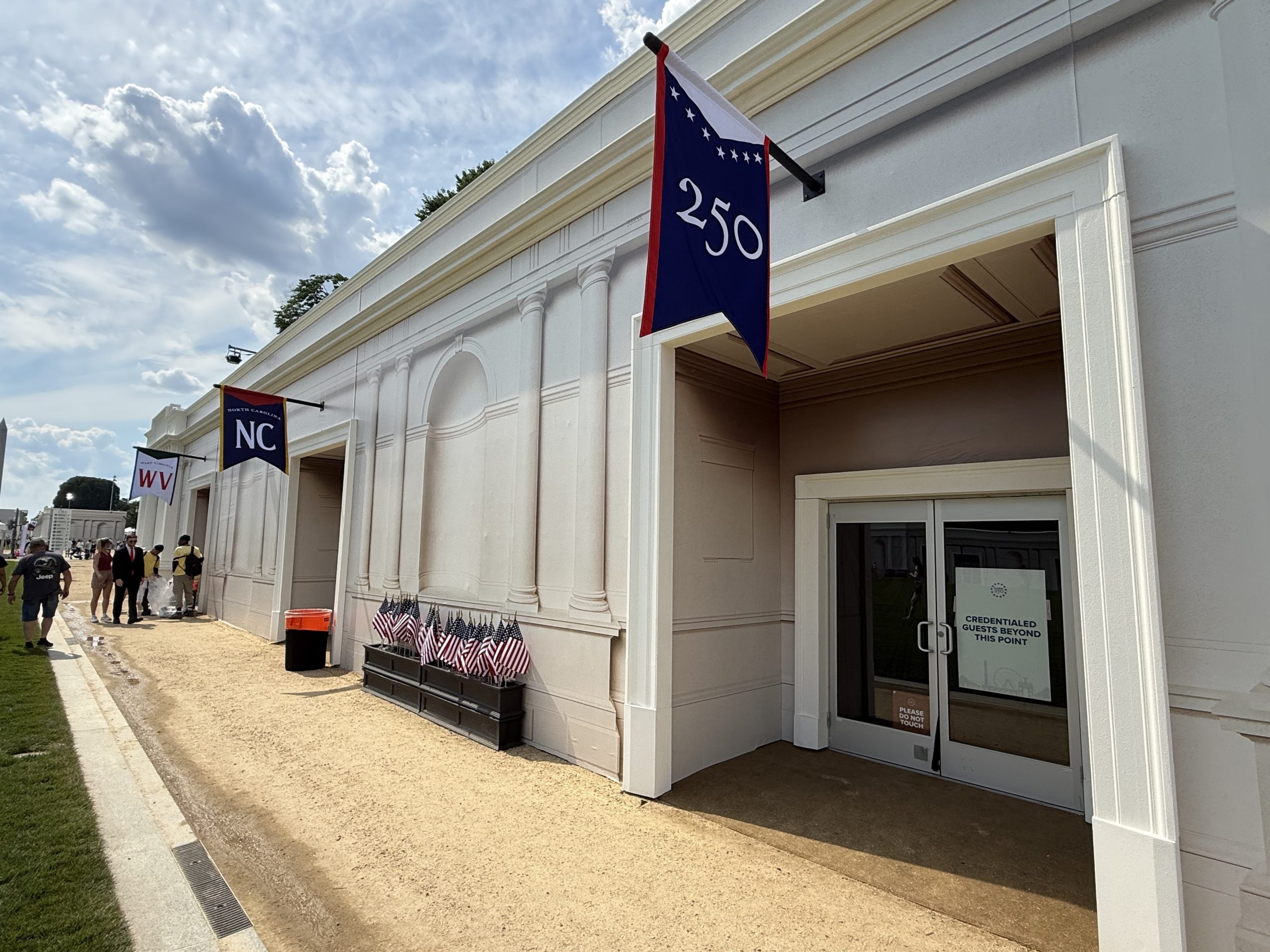
    On the fair’s opening day, Pennsylvania had no official presence, and the booth reserved for the commonwealth remained empty, except for a flag that read “250” in Pennsylvania’s space.

    After that news, McCormick (R., Pa.) and Fetterman (D., Pa.) said in a joint news release Saturday that they secured private-industry sponsors for the booth at no cost to taxpayers. Sponsors include the Pennsylvania Chamber of Business and Industry, the Pennsylvania Farm Bureau, and other organizations.

    “Pennsylvania is where America’s story began, and there was no way we were going to let the Commonwealth go unrepresented during our Nation’s 250th birthday celebration,” McCormick said in the release.

    “Celebrating America’s 250th birthday and Pennsylvania’s special role in our country is important and bipartisan,” Fetterman said. “We discovered our commonwealth wasn’t participating in the Great American State Fair on the National Mall, and we should be.”

    A ferris wheel is on the National Mall as part of the Great American State Fair, one of the celebratory events organized by the Trump administration commemorating the 250th anniversary of the United States in Washington, D.C., June 25, 2026. At the kickoff to the Great American State Fair, exhibits celebrating the nation were on display. So were conservative themes. (Alex Kent/The New York Times)ALEX KENT

    Shapiro told the New Republic earlier this week that when his administration approached major Pennsylvania companies to participate, “none were interested.”

    “It reflects this sad state of affairs that we find ourselves in — that the president has politicized this to a degree that businesses don’t want to participate,” he told the New Republic.

    However, sources who worked on the sponsor search confirmed for The Inquirer that at least two major Pennsylvania companies agreed to provide products and other donations to give away at Pennsylvania’s fair booth but were unable to initially do so due to short notice. The sources asked The Inquirer to not name them because they were not authorized to speak on the search.

    In a statement Saturday after the senators announced their plans, a Shapiro spokesperson said the administration was “unwilling to spend hundreds of thousands of taxpayer dollars to fund the Great American State Fair amid the historic slate of events across Pennsylvania in 2026.”

    Before McCormick and Fetterman’s intervention, Shapiro administration officials were told that Freedom250, the organization planning the fair, would be “handling the booth” in the absence of formal state participation, said Rosie Lapowsky, Shapiro’s press secretary.

    Pennsylvania’s Department of Agriculture also sent state literature that began appearing in the booth on Saturday, according to Freedom250.

    The Great American State Fair Thursday, June 25, 2026, in Washington, D.C. This pavilion would have belonged to Pennsylvania if the state had participated in President Donald Trump’s 250th anniversary event on the National Mall.Sam Janesch / Staff

    But Pennsylvania’s search for business sponsors was brief, according to a source close to the search.

    The Pennsylvania Chamber of Business and Industry, which was charged with finding sponsors, said Shapiro’s office called the organization less than two weeks before the fair began. Other states, the chamber said, had been working on their displays since January.

    “The Governor’s team asked us for assistance with business outreach for the Great American State Fair just two weeks before the event. While there was interest, the short time frame made it difficult for many businesses to fully commit,” said Jon Anzur, the chamber’s senior vice president of public affairs. “We are now reengaging those and other companies as we partner with Sens. McCormick and Fetterman.”

    In the absence of official Pennsylvania representatives and sponsors, McCormick and Fetterman were suddenly on Saturday able to secure private groups to staff the booth and help coordinate sponsors for the remainder of the fair.

    According to a source briefed on the conversation, Shapiro and McCormick spoke Saturday about the senators’ plans to fill the booth, and Shapiro offered to send additional state literature. The Inquirer is not naming the source because they were not authorized to speak on the conversation.

    Crayola is among the sponsors that will send along crayons, markers, and coloring books for a coloring station, which should be operational as early as Sunday. Other sponsors have signed on as well, though they were not immediately identified and their contributions were not disclosed.

    Pennsylvania is among a list of at least 10 states, some Democratic-led, that have officially dropped out of the Great American State Fair, including Connecticut, Illinois, Maine, Massachusetts, North Carolina, Oregon, Rhode Island, Vermont, and Washington.

    During the fair’s opening days, nearly every other state was represented, with most sending government staff or tourism officials to host educational or interactive exhibits.

    New Jersey also officially declined to participate, but Cape May County, a Republican stronghold, stepped in to represent the state. Its exhibit features an 8-ton sand sculpture created by a Wildwood artist over the course of more than four days.

    Delaware highlighted Founding Father Caesar Rodney’s ride to cast the decisive vote for independence in Philadelphia.

    Sam Janesch and Andrea Padilla contributed to this article.

  • Desperation mounts in Venezuela as earthquake death toll rises to 1,430

    LA GUAIRA, Venezuela — Tensions flared Saturday as desperation grew among anguished residents of the Venezuelan state of La Guaira, where rescuers and civilians searched for earthquake survivors amid a sharply rising death toll.

    Venezuela’s government said the number of people killed rose to 1,430 Saturday morning and families reported at least 68,900 people missing, three days after the one-two punch of 7.2 and 7.5 magnitude earthquakes that devastated the South American nation.

    Venezuelans looking for loved ones and neighbors used shovels, heavy equipment, ropes, and bare hands atop mounds of toppled concrete throughout La Guaira, one of the country’s hardest-hit states.

    Most of those digging were civilians who took search efforts into their own hands, and tensions peaked over inadequate response from the Venezuelan government, whose soldiers, firefighters, police, and military cadets were evidently underprepared to respond to the tragedy.

    Frustration was only amplified by state efforts to project the image of a robust state response.

    “There’s a pile of bodies over there from last night. Newborn babies. Look what time it is, and they still haven’t come to recover them. At 8 p.m. there were people alive down there, and they haven’t bothered to rescue them. We’ve located several bodies, and they haven’t helped us recover them either,” said Mileidy Romero, who was among those searching the rubble in the seaside town of Caraballeada. “What are they waiting for?”

    Aid agencies consider the first 48 to 72 hours as crucial for retrieving people alive, though that can be extended if they have access to food and water.

    However, a growing number of international rescue teams were joining the effort to save lives nearly 72 hours after the quake.

    Acting President Delcy Rodríguez said on state television Saturday that more than 14,000 members of the military and police are patrolling the area, where access is now blocked and special permits are required to enter. More rescue teams sent by governments across the world arrived in Venezuela on Saturday.

    Simón Bolívar International Airport, which serves Venezuela’s capital, Caracas, was badly damaged in the quake. One runway was operational on Saturday as U.S. teams worked to repair the crucial throughway, Jeremy Lewin, a senior State Department official in charge of foreign assistance, told reporters.

    Government forces distributed food and water to survivors in La Guaira, and Rodríguez said her government was mounting a full response during these “critical hours for rescuing people alive.”

    The disaster poses a huge challenge for Rodríguez, the former vice president who took office in January after the capture and removal of then-President Nicolás Maduro by the United States. Venezuela has been facing economic disarray for more than a decade, and many people reject the legitimacy of the political movement Rodríguez represents.

    Search teams and foreign aid from Mexico, the U.S., Brazil, El Salvador, France, El Salvador, and more continued to arrive in Venezuela Saturday morning to bolster recovery efforts.

    Lewin, the State Department official, said the U.S. military would help coordinate flights to bring in search and rescue workers, mobile hospitals, and supplies. He said two 80-person search teams were at work and a U.S. Navy transport ship was docked off the coast of Venezuela ready to receive airlifted survivors in need of medical attention. Lewin said it is a “race against the clock” to find people injured in the quakes.

    “People are trapped under rubble, and the priority is to get the search and rescue teams and the medical professionals and others to them as quickly as possible to save lives,” he said.

    The International Organization for Migration said up to 6.76 million people could be affected, some 2 million of them in Caracas alone. The destruction was amplified by the quick succession of shallow quakes, experts said.

    Loyce Pace, the International Red Cross’ regional director for the Americas, said “people are still terrified to reenter what were their homes.”

    Indeed, many continued to sleep on the street.

    In the city of Maiquetia, people lined up outside stores and pharmacies that served them one by one behind closed doors. At one point a woman in a crowd threw herself to the ground to protect a package of diapers with her body, desperate to keep it.

    Traffic and throngs of motorcyclists at times disrupted search efforts. Mexican soldiers and volunteers repeatedly asked for silence to try to hear signs of life under the rubble, but bikers — civilian and uniformed — continued to honk horns and rev engines, to the first responders’ frustration.

    Yuleidy Cadenas, 28, stood across the street from a collapsed public housing building, hoping her son, mother, and brother would be pulled out alive.

    She fled barefoot from another building as it collapsed Wednesday and found her mother’s 12-floor apartment tower had pancaked.

    “I got on top of the rubble and told them to yell back, and nobody did, not my brother, nor my son, or my mother,” Cadenas said.

  • Trump’s Religious Liberty Commission takes aim at church-state separation

    Trump’s Religious Liberty Commission takes aim at church-state separation

    The Trump administration took aim at the separation of church and state Friday, issuing a draft report from the president’s Religious Liberty Commission that says the separation concept is a legal error and that Americans should view religion as an “essential support” and always remember “the Creator who made us and bestows our rights.”

    The 224-page report recommended the Justice Department issue guidance to promote “an originalist understanding” of how the Constitution sees the relationship between religion and government. The founders had diverse views about the topic, but recent Supreme Court rulings have suggested a more narrow interpretation of what justices considered constraints on religious freedom.

    Friday’s report also said faith-based groups working with the government shouldn’t have to accommodate civil rights laws or anything that conflicts with their religious beliefs; public schools should allow religious displays (it mentioned only the Ten Commandments); and soldiers who refused to be vaccinated and were punished should have their positions restored and be financially compensated. It called for the end to the Johnson Amendment, which bars nonprofits from making political endorsements.

    At an Oval Office news conference announcing the report, commission chairperson Dan Patrick, the Republican lieutenant governor of Texas, said the commission recommends that any official — in government, a school, the military, a hospital, etc. — who alleges a violation of church-state separation must in writing “point out exactly where you have violated the Constitution, because you have not, and from this day forward, that phrase should have no power over people of all faiths ever again in America.”

    While the phrase “church-state” separation is not in the Constitution, the concept of space between government and religion is in the First Amendment, which calls for no government “establishment of religion.” Americans have disagreed over the meaning of establishment since the founding.

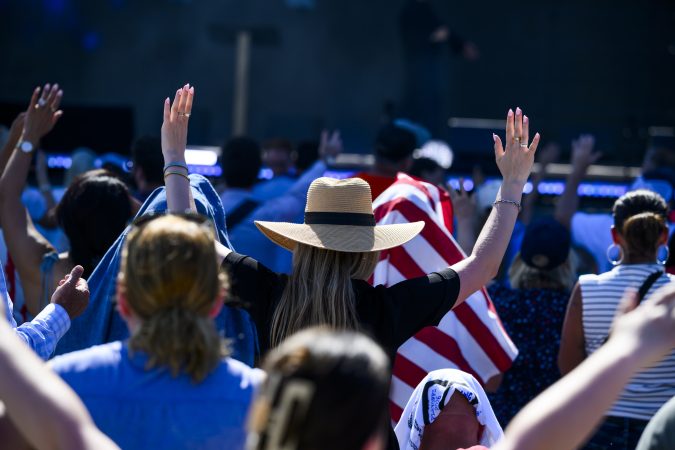
    The report was issued at a time when many conservatives are aggressively working to elevate religion — particularly Christianity — into the public square, fueled by Supreme Court decisions saying that such expression is constitutional. Several states have mandated that the Ten Commandments be displayed in public school classrooms, and many are requiring schools to release students for Bible classes during the school day. Last month, the White House hosted a daylong evangelical prayer festival on the Mall for the country’s 250th birthday, featuring commission members and others preaching from the stage.

    On Friday, the Texas education board approved a mandatory reading list for more than 5 million public school students in the state that includes Bible passages.

    President Donald Trump’s Religious Liberty Commission, created last year, is made up of all conservative Christians and one Orthodox Jew, groups who experts say make up a minority of Americans. In February, a coalition of groups representing other religious groups, as well as nonreligious and interfaith Americans, sued the administration over the commission, saying it was put together without the transparency and diversity required of a federal commission.

    The Rev. Paul Raushenbush, one of the plaintiffs in the lawsuit and head of the Interfaith Alliance, had applied unsuccessfully to be a member of the commission.

    The draft report, he wrote in a statement, “reflects the narrow, Christian nationalist worldview of the illegitimate commission. … A betrayal of the original intention of the promise of religious freedom guaranteed in the First Amendment, the report and the commission behind it fail to represent and uplift the importance of religious diversity and tolerance for all faiths in our country — not just a special, chosen few. The report is a wish list of divisive, unpopular ideas far-right religious groups have pushed for years.”

    Raushenbush also noted that while the report expresses concern about anti-Christian bias and antisemitism, it made no similar mention of growing Islamophobia around the country.

    The report is a draft, and comments from the public are open until July 12.

    The lawsuit against the commission had sought to stop the release of any report until the court ruled on whether the commission was illegally constituted. It also asked the court to mandate any commission recommendations include a disclaimer stating that the report was produced by a body that was not fairly balanced.

    Asked about the lack of religious diversity on the commission, a Justice Department spokesperson said the group was a way for Trump to create “opportunities for Americans from all walks of life to share their testimonies, concerns, and recommendations to better support Civil Rights and religious freedom in the United States.”

    “The Department of Justice’s mission is to uphold the rule of law and ensure fair and impartial justice for all Americans, which is an endeavor every American should support regardless of their political or religious beliefs,” the Justice Department statement said.

    People called to testify before the commission included a worker at an Alaska women’s shelter who turned away a homeless man who later sued for gender discrimination, and foster parents in Vermont who said their religion kept them from affirming children who were undergoing gender transitions — even though the state required foster parents to do so.

    Speaking at the White House, commission vice chairperson Ben Carson said Trump was doing more than anyone else in the country for religious liberty.

    “Our founding document says that our rights come from our creator and not from government,” he said. “People who try to divorce us from that heritage? Do they realize that that’s our family document? Do they realize that our family just says we are one nation under God?”

    Trump noted that he won the overwhelming majority of evangelicals in his elections.

    The White House is facing other litigation over its religion-related actions. Americans United for Separation of Church and State, among other advocacy groups, has a total of seven lawsuits.

    Some note that Trump’s Justice Department asked other federal agencies for examples of what it called “anti-Christian bias” and sought access to any complaints received as a result. Others note the proselytizing of some agency heads, including Defense Secretary Pete Hegseth and Agriculture Secretary Brooke Rollins.