Federal prosecutors have accused a Chester couple with trapping two intellectually disabled Delaware County women in a double-wide trailer far from home, where they were sexually abused and regularly beaten.
That abuse, prosecutors said after the couple was arrested in 2024, was the culmination of a monthslong nightmare that ended that year and in which Michael Swanson and his former wife, Nicole, groomed and manipulated the women in Chester and then in Tallahassee, Fla., where the couple attempted to hide from a Delaware County Child and Youth Services caseworker in the trailer.
Along with Swanson’s new girlfriend and a man who owned their house on Broomall Street in Chester, the couple conspired to defraud the women of their Social Security benefits and food-assistance cards, stealing thousands of dollars in public benefits after convincing the women to move from their family homes into the squalid property.
Despite ample evidence gathered by prosecutors, charges against Nicole Swanson were dismissed that year, and last month, a Delaware County judge ruled that Michael Swanson was mentally unfit to stand trial.
Now the cases will be tried in federal court.
Prosecutors with the U.S. District Court for the Eastern District of Pennsylvania this month charged Michael and Nicole Swanson, Caitlyn Eusden Swanson, and David Dziobcynski with a host of federal crimes for their part in the abuse.
Their arguments were identical to those made by Delaware County attorneys.
They said the defendants, led by Michael Swanson, “groomed, lured, and enticed intellectually disabled women” to live with them, according to an Oct. 8 grand jury indictment.
Michael Swanson, prosecutors said, engaged in sex with the women despite their lacking the capacity to consent. And Nicole Swanson “encouraged the victims to join sexual relationships” with her ex-husband, the document said, and “sometimes engaged in the sex with them herself.”
As a result of Swanson’s criminal behavior, one of the victims gave birth to his child in February 2023.
Meanwhile, the Swansons, aided by Dziobcynski, isolated the women from their families and convinced them to submit new applications for government benefits — listing them as payees, the document said.
The group took EBT cards meant to help feed the disabled women and spent the funds on themselves, according to prosecutors, and they took control of bank accounts that held their Social Security benefits.
And when Delaware County caseworker for some of the Swansons’ children grew suspicious of the arrangement, prosecutors said, the defendants schemed to evade scrutiny.
In July 2023, Swanson wired more than $20,000 from one victims’ account to his own. He rented a passenger van, taking the women to the Florida trailer where Nicole Swanson had fled with their children.
Dziobcynski, prosecutors said, had already harassed the CYS caseworker for months, calling her phone more than 110 times and leaving multiple threatening voicemails.
And the physical and sexual abuse continued in Tallahassee, according to the document.
There, Nicole Swanson told one of the women to engage in sex with Michael Swanson, recording the interaction on her cell phone, prosecutors said.
And Michael Swanson threatened the women, warning them against telling authorities or social workers about their situation. In one instance, Swanson told one of the women he would cut off her hair should she do so, the document said.
A defense attorney said the Swansons had a history of brain trauma and behavioral issues, and said Michael Swanson gave highly emotional, childlike responses during a psychological exam.
But prosecutors presented their own psychological expert who suggested Swanson’s behavior was more like a “caricature” of mental incapacitation, falling outside what would be expected of someone with a disability, the Daily Times reported.
Michael Swanson was released from custody in 2024 and placed on house arrest after paying $1 of a $900,000 nominal bail.
Court records did not make it immediately clear whether he or the other defendants had been arraigned in the federal case or whether they had hired attorneys.
Eric Lewis, the city employee accused of ambushing Philadelphia police officers with a shotgun on Saturday and fatally shooting Officer Shane Seiber, had a criminal history that included a 2015 gun-related conviction and a homicide charge for which he was acquitted.
Despite that, the city hired Lewis in May 2024 to work a $47,000-per-year job with the water department as a trades helper. His hiring has raised questions about how a person with a criminal background who allegedly went on to shoot at police officers could have been employed by the city.
But according to officials in Mayor Cherelle L. Parker’s administration, the city was barred from considering Lewis’ most serious previous criminal allegations under its relatively strict laws that govern when and how employers can weigh an applicant’s criminal history.
That includes a homicide charge stemming from a 2019 killing in which Lewis was later acquitted. The murder case has become the subject of intense public scrutiny, with District Attorney Larry Krasner alleging that police botched the investigation.
Under local law, the city is prohibited from considering charges that did not result in a conviction while making hiring decisions.
The city also could not deny Lewis employment based on a 2015 conviction on misdemeanor charges of simple assault and carrying a firearm in public. That conviction, which resulted in a sentence of probation, took place more than seven years before Lewis was hired, putting it outside the window when the city could consider such a record in making hiring decisions.
A moment of silence is held for fallen Philadelphia Police Officer Shane Seiber before the game between the Carolina Hurricanes and the Philadelphia Flyers at Xfinity Mobile Arena on Sunday.Isaiah Vazquez / For The Inquirer
Candi Jones, the city’s chief human resources officer, said in an interview Wednesday that a criminal record does not automatically disqualify someone from employment.
“As an employer, the city’s focus is on supporting our employees and their families who are victims of this terrible crime, as we grieve together,” she said, adding: “The safety of city employees and the public is and will always be a fundamental priority.”
The city in 2011 first passed the Fair Chance Hiring Law, commonly known as the “ban the box” law, which required that most employers in Philadelphia remove questions on job applications about criminal backgrounds.
In 2016, the city strengthened the law to ban employers from asking job applicants about criminal history until after they made a conditional offer of employment. That amendment also limited employers from considering any criminal convictions more than seven years old.
Philadelphia City Council again amended the law last year to shorten the window for considering misdemeanor convictions to four years. That took effect well after Lewis was hired.
Proponents said prohibiting employment discrimination based on criminal history ensures job opportunities for the thousands of people in Philadelphia with conviction and arrest records. Critics have said the law places high burdens on private employers and poses safety risks.
Jones said the city stands by its practice.
“As an employer, we do engage in inclusive employment practices [and] we do provide employment opportunities to formerly incarcerated individuals,” she said.
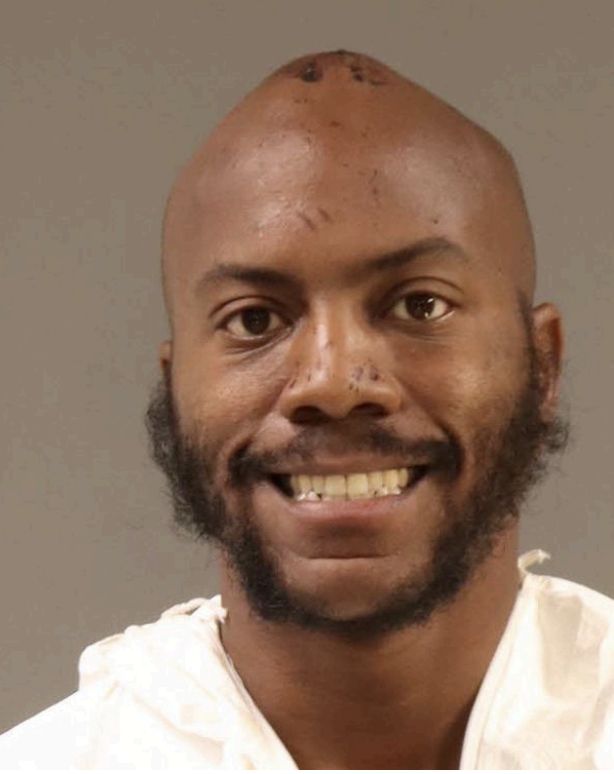
Eric Lewis, charged with murder in the shooting death of police officer Shane Seiber, is shown in a Philadelphia Police Department photo.Philadelphia Police Department
Jones said Lewis went through the city’s typical hiring process for civil service employees, who make up the majority of the more than 29,000 members of the city workforce. The city’s website describes the job of trades helper as an entry-level position that involves assisting a more experienced worker with equipment maintenance and repairs.
According to Jones, Lewis submitted an application, was placed on an eligibility list for the job, participated in an interview, and was subject to a background check.
In making its hiring decision, the city likely would have been able to consider one low-level conviction that fell within the seven-year look-back window that was in place when Lewis applied.
Lewis was charged in July 2018 with simple assault and recklessly endangering another person after police said he punched a woman in the face, according to the affidavit of probable cause for his arrest.
He later pleaded guilty in Municipal Court to disorderly conduct, a third-degreemisdemeanor, by engaging in fighting, according to court records. He was sentenced to one year of probation.
Jones said the city’s pre-employment screenings are designed to ensure that an applicant is reviewed on an individual basis.
She said the nature of convictions is considered, as well as their relevance to the position and the risk they pose. For example, she said, applicants for public safety jobs may receive more scrutiny, and child welfare laws dictate background check procedures for workers who interact with children.
In addition to being barred from considering older criminal convictions, employers are prohibited from inquiring about a job applicant’s previous arrests or charges that are no longer pending and did not result in a conviction.
In 2023, Lewis stood trial for murder in the 2019 shooting death of Christopher Williams.
That case has since drawn fresh scrutiny after The Inquirer reported that Lewis was acquitted by a judge who was so concerned about the weakness of the police investigation in the case that he contacted the department’s internal affairs bureau.
On Tuesday, Krasner accused police of mishandling the case, and he said one officer who dated Lewis’ sister gave fabricated information to investigators, something he characterized as potentially “criminal.”
Sgt. Eric Gripp, a police spokesperson, said that the department was reviewing the case, but that its focus is on supporting the families of the officers involved in the shooting and those grieving the loss of Seiber.
The federal judge who accused District Attorney Larry Krasner of potentially breaking the law said he will not step back from the case in which he believes Krasner’s wrongdoing occurred, according to an order he filed Wednesday.
The decision by U.S. District Judge Paul S. Diamond was a rejection of a request by Krasner, who said in court documents last month that Diamond should be removed from the case due to his “apparent bias” against the city’s top prosecutor.
But Diamond, in his order, said he found Krasner’s arguments not only unconvincing but “frivolous.” He also rejected a request by Krasner to reconsider his order barring Krasner from participating in the underlying case moving forward, saying the decision to do so was “reasonable and warranted.”
Krasner’s “intemperate filings provide no basis for recusal or reconsideration of my rulings,” Diamond wrote, adding separately that Krasner’s filings “generate more heat than light.”
The decision was the latest development in a high-profile saga that has led to a series of controversial developments concerning Krasner’s office.
Chief among them was Diamond’s issuance of a memorandum last month in which he said Krasner and one of his top supervisors, Matthew Stiegler, may have committed crimes including conspiracy, obstruction of justice, or perjury while participating in a post-conviction case Diamond has been overseeing.
The judge also said he had referred the matter to the U.S. Attorney’s Office for a potential criminal inquiry. Federal prosecutors have declined to comment on how or if they might proceed.
Krasner, a Democrat, has denied wrongdoing. And in a series of documents he filed last month, he said Diamond — who was appointed by President George W. Bush, a Republican — had exhibited consistent bias against him in the case, including by misinterpreting witness testimony, making inconsistent credibility determinations, and reaching “baseless” conclusions about what happened.
The underlying matter centers on Dennis Johnson’s attempt to have his 2009 murder conviction overturned. Krasner’s office had once supported that effort, but tried to change course earlier this year after prosecutors discovered that the staffer who filed the brief backing Johnson’s position had made a series of mistakes.
After that discovery, those prosecutors and Krasner held a variety of discussions about what went wrong and how the office should move forward. And this summer, when Diamond called hearings to address similar questions, the prosecutors involved in the discussions with Krasner told the judge that the DA had acted in ways they viewed as inappropriate — including, they said, by considering a plan to fault a single staffer, and threatening “consequences” for those who didn’t follow his orders.
Diamond said some of the actions could amount to obstruction of justice or criminal conspiracy.
Krasner has said those characterizations were wrong, and that some of the prosecutors who spoke out against him were “legally incorrect” about what took place and had behaved in ways that were insubordinate.
Beyond the issues Diamond ruled on Wednesday, the case — and the merits of Johnson’s petition — remain pending.
Shane Hennen, 41, said little beyond answering routine legal questions while admitting to crimes including bribery and wire fraud. He declined to comment afterward.
But the pleas were a significant development for Hennen, who became a central figure in several high-profile betting prosecutions over the last year. This summer, he also pleaded guilty in a third gambling case, one in which he provided rigged card-shuffling machines to Mafia-affiliated poker games in New York City — high-stakes contests that also involved former NBA players.
His connection to each of those schemes made Hennen — known as “Sugar Shane” in gambling circles — one of the more prominent players in scandals that shook the sports world and led to questions about the explosion of legalized sports betting. Hennen now faces the prospect of years behind bars.
For a while, Hennen was unrepentant, saying it was normal for gamblers to use any available method to find an inside edge, comparing his methods to those used by financial professionals on Wall Street.
“There ain’t one stockbroker who became rich just by guessing right all the time,” he told the New York Times this summer. “This is what the United States of America has revolved around, for hundreds of years.”
Such bravado may have helped contribute to his downfall. In text messages he sent to coconspirators in one of the schemes in 2023, Hennen boasted about how bribing a star player for the Jiangsu Dragons was providing clear and easy winnings on bets his group could place in Philadelphia.
“Nothing gu[a]rantee[d] in this world,” Hennen wrote, ”but death taxes and Chinese basketball.”
In the scheme targeting games in the NCAA and China, prosecutors said, Hennen and another professional gambler, Marves Fairley, launched the operation in 2022.
That year, prosecutors said, the pair approached Antonio Blakeney — a former NBA player who became a leading scorer in the Chinese Basketball Association — to deliberately underperform in games in China.
In return, prosecutors said, Blakeney received bribe money. Hennen and Fairley, meanwhile, placed large bets against Blakeney or his team, including at the Rivers Casino sportsbook in Fishtown.
In one instance in 2023, prosecutors said, the men wagered nearly $200,000 on the Guangdong Southern Tigers to beat Blakeney’s team, the Jiangsu Dragons.
Blakeney averaged 32 points per game that season, prosecutors said. But in the game the bettors targeted, he scored just 11 points, and his team lost by nearly 30.
Following their success in China, Hennen and Fairley went on to expand the point-shaving operation to target NCAA games.
With the help of so-called fixers — typically basketball trainers or others with connections to NCAA players — the men used the same template: Players were recruited into the conspiracy with the prospect of bribe money, while bettors would then place wagers against the players or teams they paid to underperform.
Prosecutors said the scheme became unusually large in scope. Over the course of two NCAA seasons, prosecutors said, the operation affected at least 29 games involving 17 universities, and caused gamblers to place more than $3 million in illicit bets.
In the NBA scheme, meanwhile, prosecutors charged players including Terry Rozier and Jontay Porter with deliberately underperforming in games to benefit gamblers. And Hennen, prosecutors said, often received tips from those players’ associates, including that they planned to play poorly or even find ways to remove themselves from forthcoming contests.
Hennen then went on to place large bets against Rozier, Porter, or their teams, prosecutors said.
Prior to his time as a high-stakes sports gambler, Hennen was convicted in a smaller-scale gambling operation, receiving probation in 2006 in Allegheny County for using a magnetic device to rig illicit dice games.
After that, he served 2½ years behind bars after he was convicted of stabbing a Duquesne University basketball player in the neck over a dispute about a card game, and later getting caught with cocaine in his car near a Pittsburgh-area casino.
For his most recent gambling cases, U.S. District Judge Nitza I. Quiñones Alejandro said, Hennen faces a maximum sentence of decades in federal prison.
He is scheduled to be sentenced in the poker case in New York in January.
Quiñones Alejandro said she would then sentence Hennen for the two basketball gambling cases in February.
A Haverford College professor accused of cyberstalking and making antisemitic threats to a colleague will be held in custody until his trial, a federal judge ruled Tuesday.
Guangtian Ha, an assistant professor of religion, was arrested last week following an FBI investigation. Prosecutors saidhe used several anonymous accounts on X to send hateful, antisemitic messages to his colleague off and on from October 2025 until May. Prosecutors allege Ha’s posts also exposed his colleague’s home address, infant child’s name, and pictures of the home’s exterior.
Assistant U.S. Attorney Anthony Carissimi said Tuesday that Ha had demonstrated a “persistent obsession” with terrorizing the victims, and that his online activity could not be effectively monitored if he were released before trial.
The spouse and children of the colleague, who has not been named publicly, fled their home, which is in the same neighborhood as Ha’s. Ha sent more than 50 messages across the various accounts, at times threatening the colleague specifically and at other times threatening Jewish people more broadly, invoking Adolf Hitler, the Holocaust, and the Oct. 7 attacks, according to court documents.
Ha pleaded not guilty to the charges Tuesday.
Haverford College campus in 2021.TYGER WILLIAMS / Staff Photographer
Despite the allegations, roughly a dozen Haverford professors across departments, friends, and Ha’s family came to show their support for Ha at the hearing. They said the hateful messages did not represent the man they knew. Ha has no prior criminal record, his attorney Susan Lin said, and has a wife and young child. He came to the United States in 2007.
“Nobody here is going to defend the content of these posts,” Lin said in court, before identifying Ha’s supporters and inviting two to testify to Ha’s character, arguing he should not be in custody while awaiting trial.
“I’ve always known [Ha] as someone who is very justice-oriented” and who cared for students and marginalized people, testified Ahmet Tekelioglu, the executive director of CAIR-Philadelphia, a civil rights advocacy group focused on Islamic civil liberties and fighting hate speech.
“He’s a great human being. I’ve learned a lot from him,” David Harrington Watt, a professor of Quaker studies at Haverford, told the court. Watt, a Christian, teaches courses on antisemitism. He said it was “painful” to read details about the messages Ha allegedly sent, calling them “tragic” and “inexplicable.”
“Everyone that I know is shocked that this came out. … It does feel extremely out of character,” Lillie Olliver, 24, a 2025 Bryn Mawr College graduate, said before the hearing. Olliver wrote a thesis in Haverford’s religion department but didn’t take any of Ha’s courses.
Magistrate Judge Pamela A. Carlos explained her decision to detain Ha was based on her “very serious concern” that the X posts had threatened not only Ha’s colleague and family, but also Jewish people generally. She also expressed worry about Ha being a flight risk, given that he holds a Chinese passport and has traveled abroad.
It is unclear when Ha’s next court date will be. If convicted, the maximum sentence would be five years in prison.
Correction: Lillie Olliver’s relationship with Guangtian Ha was mischaracterized. She wrote a thesis in his department but did not take any of his classes.
District Attorney Larry Krasner said Tuesday that Eric Lewis, the man charged with killing a Philadelphia police officer and shooting at 10 others this weekend, was free to commit that crime because two other officers had botched an earlier murder case against him in a way that was “arguably criminal.”
The startling allegation from the city’s top prosecutor, delivered in a YouTube video Tuesday morning, not only blamed a police officer and a homicide detective with sinking the case against Lewis at a 2023 trial — it also insinuated that their actions had allowed Lewis to remain free to kill Police Officer Shane Seiber three years later.
Krasner did not make himself available to answer questions about the case, and his office did not respond to a list of detailed questions about it this week.
His video statement did not indicate whether his office planned to investigate the officers — one of whom he said dated Lewis’ sister and gave false information to police — for actions he said could amount to obstruction of justice.
Krasner’s explosive remarks, alongside documents in the case and its fallout obtained by The Inquirer, offered insight into an extraordinary set of circumstances: a police officer who the district attorney said sought to “torpedo” his testimony; a homicide detective who appeared to fail to investigate key aspects of the case; and a judge who was left so disturbed that he reported the conduct to the Philadelphia Police Department’s Internal Affairs Bureau.
And it has left the mother of Christopher Williams, the man Lewis was accused of killing in August 2019, confused and seeking answers from Krasner’s office.
“It’s overwhelming,” Darlene Brown said. “It’s information that we never knew.”
The developments come just days after Seiber was killed in a shooting that has rocked the local law enforcement community. And the comments threatened to deepen tensions between the reform-oriented Krasner and many within the Philadelphia Police Department who for years have said his office has failed to hold defendants accountable.
Krasner, in the video, insisted his staff was not to blame for the acquittal, saying they had done “everything humanly possible” to salvage a weak case and convict Lewis.
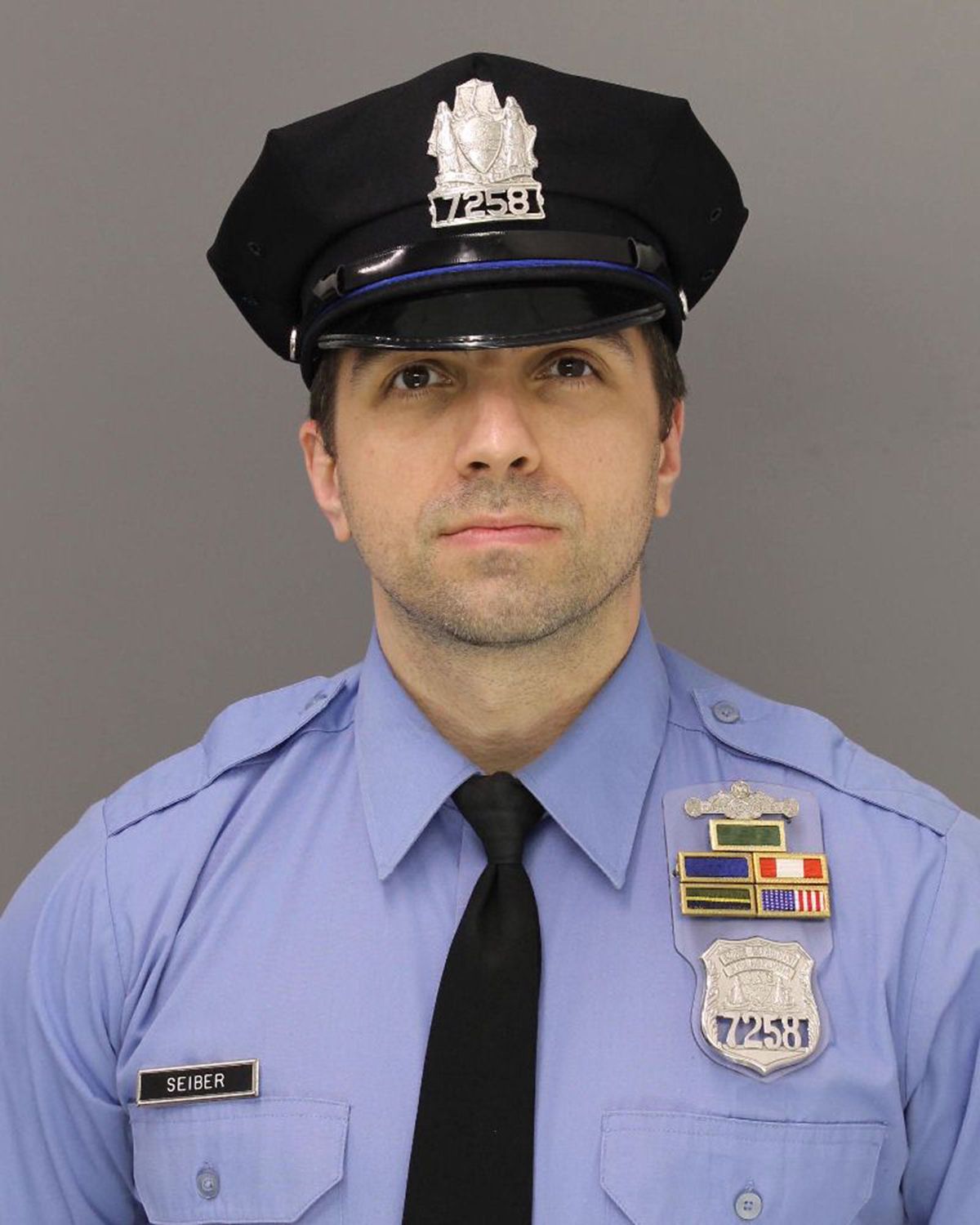
Officer Shane Seiber.Courtesy of the Philadelphia Police Department
Sgt. Eric Gripp, a spokesperson for the police department, said that the department was reviewing the records in the case, but that its focus remained on supporting the family of Seiber, the wounded officer, and the grieving police force.
“There will be a time to address the full record, but it is not now. Assigning blame while families are grieving does nothing to advance accountability or support those affected. True leadership does not seek to assign fault in a moment like this. It stands with the families. And when the time comes, it holds itself to the same scrutiny it asks of others.
“We will have more to say. Right now, these families deserve our attention, our support, and our respect,” he said.
Lewis, 35, remained in custody Tuesday, charged with murder and related crimes in the fatal shooting of Seiber and the wounding of another officer on his porch early Saturday. Lewis went on to fire at nine other responding officers in a nearly hour-long standoff, police said, and was later arrested with three guns — one of which police said he had stolen from an officer he shot.
Seiber, 40, a 10-year police veteran and married father of two, died hours after being struck. His 33-year-old partner, a nine-year veteran, was shot 12 times and remains hospitalized.
The case has led to an outpouring of emotion from across the city, including from police officers who questioned why Lewis — who had been charged by Krasner’s office at least twice for violent crimes — was free to commit the shooting in the first place.
Krasner’s comments served as something of a response to that, and stemmed from a case in which Lewis was charged with killing Williams, 32, in a road-rage shooting in West Philadelphia in 2019.
Eric Lewis, charged with murder in the shooting death of police officer Shane Seiber, is shown in a Philadelphia Police Department photo.Philadelphia Police Department
Prosecutors tried Lewis on charges of murder and related crimes during a two-day bench trial before Common Pleas Court Judge J. Scott O’Keefe in April 2023.
O’Keefe, troubled by weaknesses in the police investigation and inconsistencies in testimony between a witness and homicide detectives, acquitted Lewis.
The judge was so disturbed by the investigation that he contacted the police department’s internal affairs bureau, sending a letter to then-Deputy Commissioner Robin Wimberly.
Krasner said he believed it was the only instance in O’Keefe’s career in which he had taken such action.
O’Keefe declined to comment Tuesday.
A ‘troubled’ investigation
In the letter, a copy of which was obtained by The Inquirer, the judge said he found several aspects of the investigation problematic. One was that two different sets of evidence were recorded under the same property receipt number — a clerical error that O’Keefe said “clearly created a great deal of suspicion” about the investigation.
Other issues revolved around the examination of evidence by then-Homicide Detective Laura Harris.
O’Keefe said it did not appear that Harris, the lead detective, had done any investigation of an eyewitness’ version of events — a key issue since, according to the judge, the witness’ account was “impossible with the physical evidence and the medical examiner’s findings.”
Another was that Harris said she had subpoenaed Lewis’ Facebook and Instagram records and turned them over to the district attorney’s office — but prosecutors insisted they never received those records, and Harris said she did not keep any copies.
In addition, O’Keefe said in his letter, Harris filled out a search warrant to obtain Lewis’ cell phone records, which could have been a key piece of evidence to determine if he had been near the crime scene. But in court, Harris admitted she never actually got a judge to sign the warrant — and therefore never obtained the records.
When she was confronted with that issue on the witness stand by Lewis’ defense attorney, Michael Diamondstein, Harris gave a one-word answer to explain why she had not followed through.
“Oversight,” she said, according to a transcript of the trial.
The transcript showed that Diamondstein, who declined to speak about the case this week, also pointed to inconsistencies in the statements made by the sole eyewitness in the case — a woman who was in the car with Williams during the shooting, and who later identified Lewis as the gunman to police and in court.
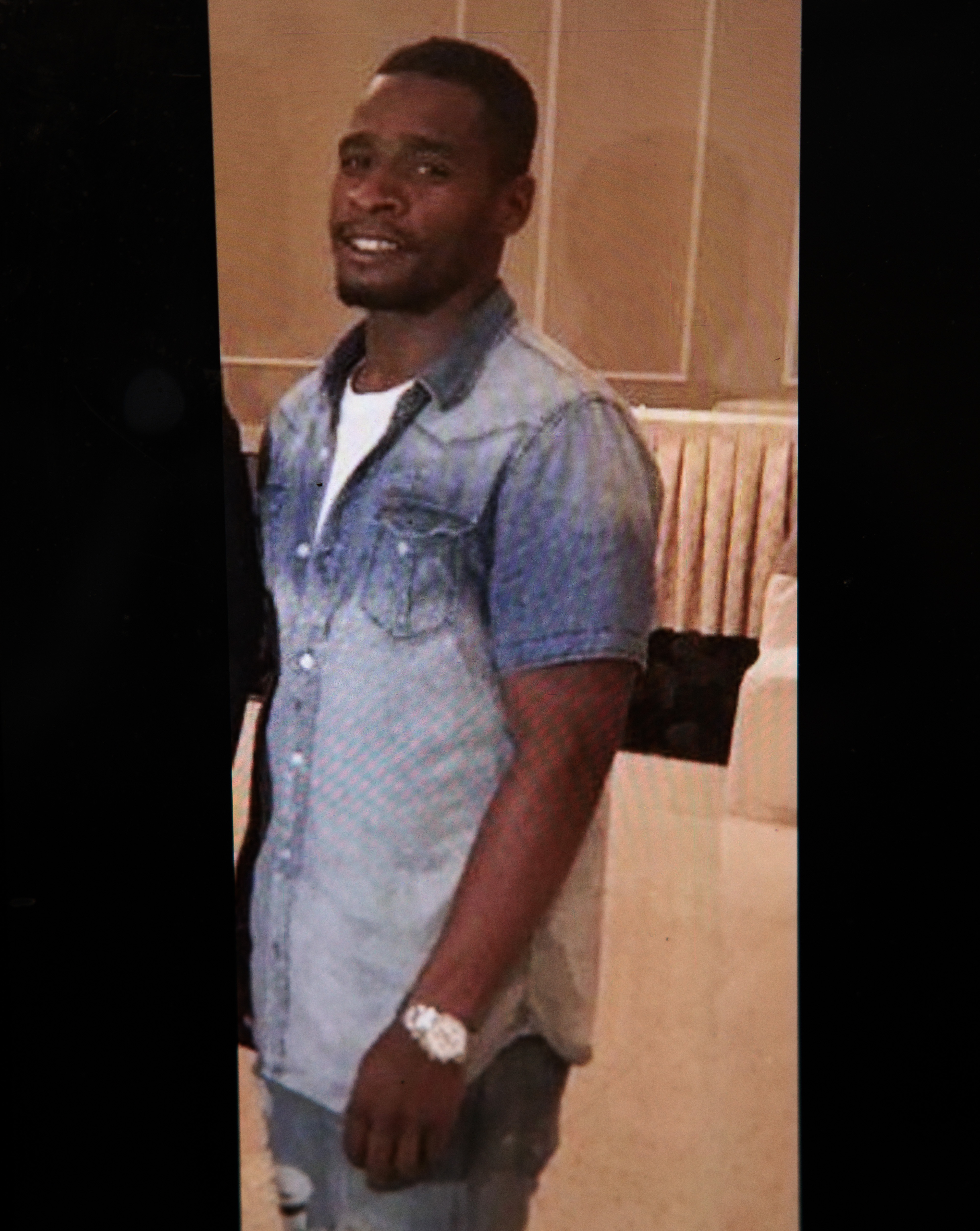
An undated photograph of Christopher Williams, who was killed in 2019. Eric Lewis was charged with his murder, but acquitted in a 2023 trial.Monica Herndon / Staff Photographer
The woman told investigators that she and Williams, driving a Jeep, had pulled onto Fallon Street around 1:15 a.m. on Aug. 31, 2019, but were blocked by a double-parked Nissan.
Williams honked his horn, and an argument broke out with the people in the Nissan, she said, before a bald man walked up and shot Williams.
During the shooting, she said, Williams reached around her hip to grab her black 9mm handgun to fire back. But the woman did not turn that gun over to police until hours later — and a forensic analysis later showed no gunpowder residue inside or on the weapon, suggesting it had been cleaned before it was handed over to police, Diamondstein said.
Diamondstein also said the physical evidence in the case — including the location of Williams’ blood and the shell casings fired by her gun — did not line up with her story.
Assistant District Attorney Erica Rebstock said the witness was traumatized by having just seen her friend get killed, and having been grazed by a bullet.
Still, the prosecutor said, the witness “unequivocally identified” Lewis as the shooter. And the shooting took place directly in front of Lewis’ mother’s house.
But the discrepancies, Diamondstein said, were severe. He again pointed to the testimony of Harris, the detective, and said she willfully ignored discrepancies in how the witness identified the shooters’ car as a Nissan Pathfinder — but Lewis owned a Nissan Xterra. Harris, he said, never tried to sort out those facts.
“That was lies,” he said of Harris’ testimony. “That was intentional falsehood.”
O’Keefe found Lewis not guilty.
Harris declined to comment Tuesday. She was later disciplined for how she handled the case, Krasner said.
Rebstock, the lead prosecutor who is now head of training at the district attorney’s office, did not respond to a request for comment.
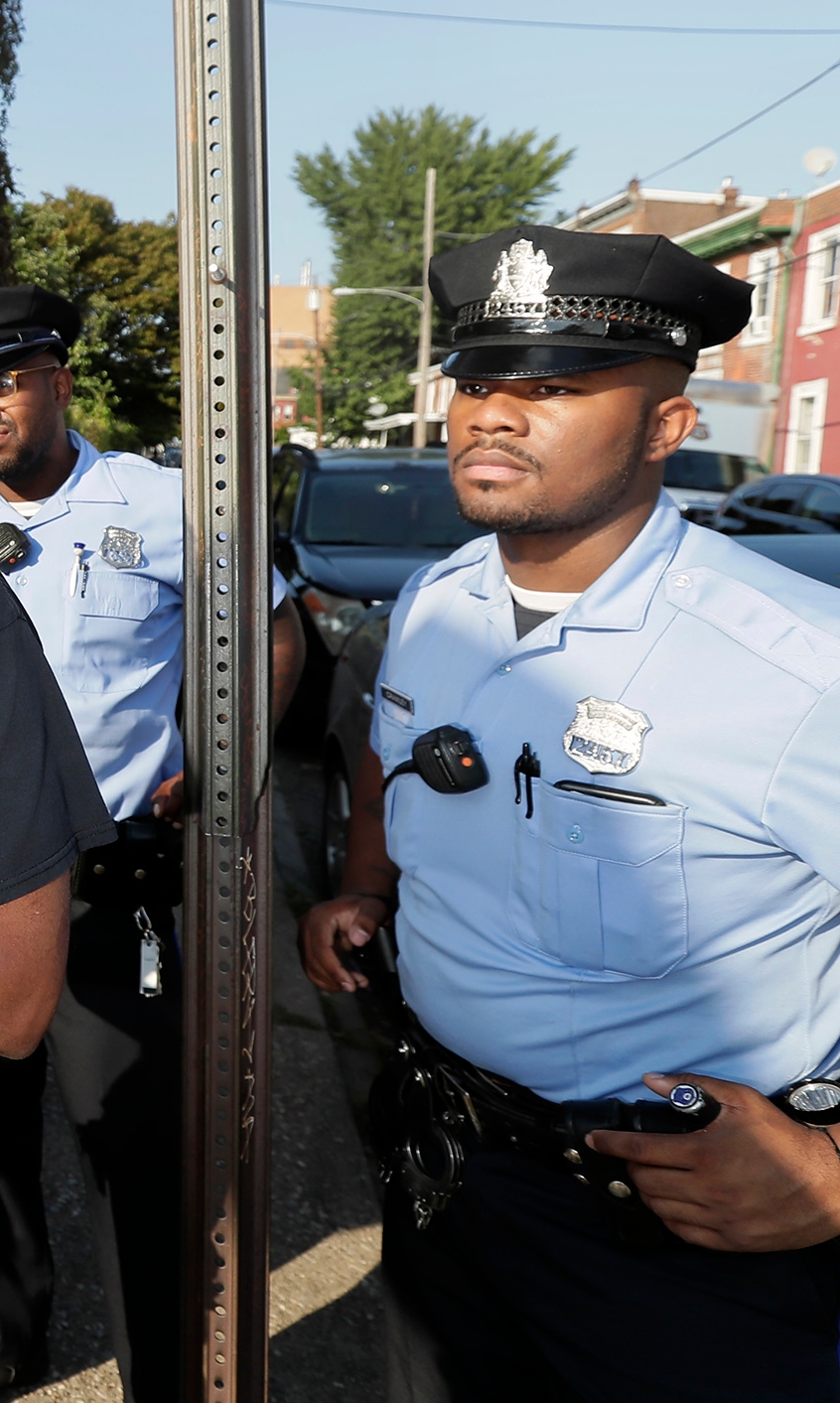
Officer Naeem Crawley, of the 15th District, shown in a 2019 photograph in the Frankford section of the city. ELIZABETH ROBERTSON / Staff Photographer
A cop dating Lewis’ sister
Krasner said the investigation was “deeply flawed.”
But the “worst example,” he said in his video, was the conduct of a police officer who was a potential witness against Lewis.
That officer, Naeem Amir Crawley, had brought information to homicide detectives identifying Lewis as the gunman, according to a source familiar with the case who was not permitted to speak publicly about it.
But Crawley, who records show joined the police department in 2018, was dating Lewis’ sister, Krasner said. Marriage records show the couple were married in February 2024.
Because of that relationship, Krasner said, the officer tried “to torpedo his own testimony” by “making up a complete lie” about an alternate suspect who did not exist, and by giving “false information to law enforcement.”
“It’s obstruction of the administration of justice. And it is frankly, well, outrageous, despicable, and tragic all at the same time,” Krasner said.
Crawley did not testify at the trial or preliminary hearing. It was not immediately clear whether he had been subpoenaed to testify and failed to appear or whether prosecutors did not summon him to court.
The officer was later fired, Krasner said.
Crawley could not be reached Tuesday. Calls and texts to a number listed for him in public records were not returned, and he did not respond to a letter left for him at his home seeking comment on the case.
His wife, Keilah Lewis, also did not return a call or text seeking comment.
A mother seeking answers
The questions surrounding Lewis’ earlier case reopened wounds for the family of the man he was previously accused of killing.
Darlene Brown said she has no doubt that Lewis killed her son. And she resents, she said, how the case fell apart.
“These kids didn’t have to be fatherless had they done their job back in 2023,” Brown said.
“They had him in 2023,” she said. “They freed that murderer, and it took him three years to come back and do it again.”
Brown, in an interview Tuesday, said Krasner’s video statement was the first she had heard anything about police misconduct potentially affecting her son’s case.
Brown said her interaction with law enforcement was challenging from the start. The first detective assigned to the case was rude and did not return her calls, she said. She complained to police leadership and was assigned a new investigator and ended up having a good relationship with Harris, she said.
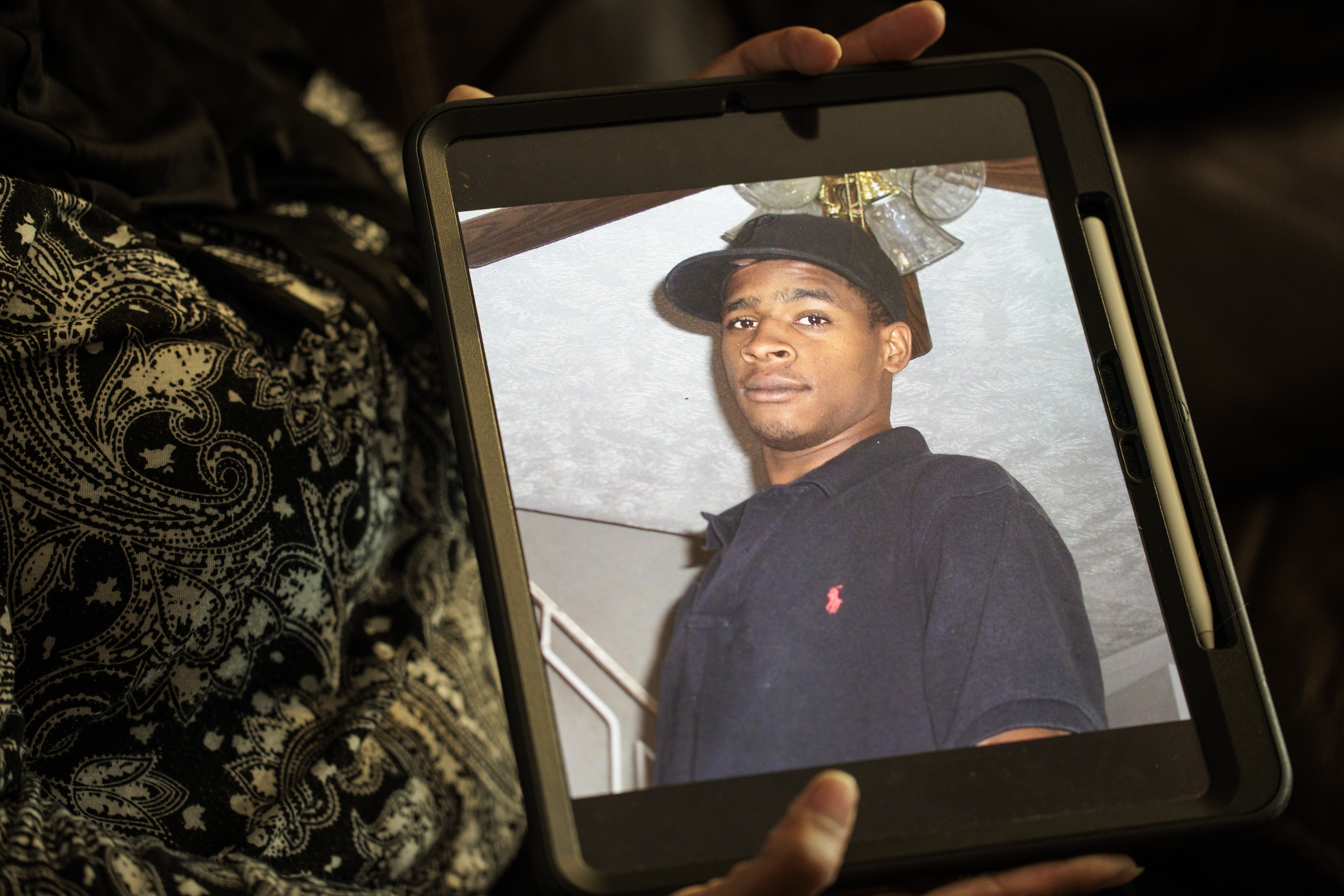
Darlene Brown holds an iPad with an undated photograph of her son Christopher Williams on Monday. Williams was killed in 2019. Eric Lewis was charged with his murder, but acquitted in a 2023 trial.Monica Herndon / Staff Photographer
But she was frustrated, she said, with how the case was handled by the district attorney’s office. The case was transferred between at least two prosecutors, she said, before another took it over before trial.
She felt that the prosecutors were passive, she said, and after the acquittal, Rebstock apologized but did not offer an explanation for what went wrong.
Brown said she called the district attorney’s office Tuesday but had not heard back.
The entire ordeal, she said, has made her feel as if she is reliving the trauma of her son’s death all over again.
“I need answers,” she said.
Staff writers Jesse Bunch and Ryan W. Briggs contributed to this article.
One of the organizers of a scheme to secretly fix college basketball games to benefit professional gamblers was sentenced Tuesday to six years in federal prison — the first penalty imposed in a sprawling scandal that was unveiled in Philadelphia and attracted international attention.
Jalen Smith, 30, of Charlotte, N.C., apologized for his actions during a sentencing hearing before U.S. District Judge Nitza I. Quiñones Alejandro, saying he was drawn to the prospect of easy money, and that he now recognizes his actions were wrong.
“My decisions have consequences,” Smith said, “and I accept all of them.”
Smith, a onetime basketball trainer, pleaded guilty earlier this year to bribery and wire fraud charges for working with other trainers and professional gamblers to recruit NCAA players to underperform in games.
In exchange, prosecutors said, the players were paid bribes — often worth thousands of dollars — while Smith and his co-conspirators placed or coordinated large wagers on the outcomes they expected, such as by betting against players or teams to score a certain number of points.
Smith was one of the scheme’s lead recruiters, prosecutors said, identifying players to participate, paying their bribe money, and delivering instructions and encouragement via text messages and FaceTime calls.
He also pleaded guilty to illegally possessing a handgun that federal authorities found in his house while executing a search warrant related to the gambling case.
Prosecutors said the gambling scheme — which began in the Chinese professional basketball league and expanded to include NCAA contests — affected at least 17 universities and 29 games, and caused gamblers to place more than $3 million in illicit bets.
“This was an extremely serious, far-reaching, massive bribery [and] sports fixing case,” Assistant U.S. Attorney Louis D. Lappen said in court. “I don’t know that we’ve ever seen anything bigger than this anywhere.”
Still, Smith said he didn’t make anywhere near the amount of money his coconspirators did. And his attorney, Rocco Cipparone, said Smith’s windfall over two years totaled around $75,000.
“I was used as a pawn in this scheme,” Smith said in court.
The U.S. Attorney’s Office announced charges against more than two dozen people in January. At the time, the case attracted widespread attention in part because it was one of several federal prosecutions nationwide to target alleged criminality in sports gambling.
Betting on sports — once considered something of a taboo, and previously relegated to shady offshore operations or informal in-person groups — has exploded across the country in recent years, as many states have moved to legalize sports betting or so-called prediction markets.
In this case, prosecutors said, the scheme began in 2022, when a group of “fixers” approached Antonio Blakeney — a former NBA player who went on to star on the Jiangsu Dragons in China — and offered him bribes in exchange for deliberately underperforming in future games.
Smith was not involved in that part of the scheme, prosecutors said. But one of the operation’s masterminds was Shane Hennen, a former Philadelphia resident and well-known sports bettor. And once the scheme showed promise in China, prosecutors said, the leaders decided to try the same tactics in college games.
That’s how Smith became involved, prosecutors said. He used his connections in the basketball world to recruit players — mostly from smaller schools — and kept them engaged with money and texts or calls promising future earnings.
Sometimes that meant sending text messages before or even during games. In 2024, for example, Smith told a player on North Carolina A&T State University that his team needed to lose to Towson University by at least 10 points.
“If it start looking shaky[,] tell 2 or 3 other [teammates] what it is and they paid too,” Smith wrote, according to prosecutors.
More than half of the defendants charged in the scheme have pleaded guilty. Hennen, the former Philadelphia-based bettor who helped launch the operation, is scheduled to do so this week, according to court records.
A trial for the remaining defendants, meanwhile, is scheduled to begin next year.
A prominent Main Line restaurateur will face a Montgomery County judge on charges of unlawful dissemination of images and disorderly conduct after prosecutors said he copied intimate photos of his ex-girlfriend without her consent and sent them to her new boyfriend.
Alessandro “Alex” Fiorello told his ex she was “just mad [she] got exposed” after she confronted him and likened him to a “[expletive] serial killer,” according to the affidavit of probable cause for his Sept. 2 arrest.
Fiorello, 29, of Conshohocken, is the chef/owner of two suburban Italian restaurants — Alessandro’s Wood Fired Italian & Bar in Wayne, which opened in 2020, and Alessandro’s Pizzeria in West Chester, which opened last year. Fiorello’s third restaurant, Alessandro’s Enoteca, is set to open in Bryn Mawr this month.
He waived his preliminary hearing last week during an appearance before a district judge. During that proceeding, prosecutors dropped two counts of harassment that Fiorello faced, as well as one count of stalking, court records show.
His attorney, Michael Kotik, declined to comment on the case Tuesday.
Conshohocken police said Fiorello’s ex-girlfriend contacted them in August to report that Fiorello had sent her new boyfriend intimate and explicit photos of her that he had taken from her cell phone without her permission while she and Fiorello were dating, the affidavit said.
The woman told police Fiorello had gone through her cell phone in January while she was sleeping and duplicated the photos by taking pictures of them with his phone.
She knew he had done this, she said, because Fiorello confronted her about the photos when she woke up. The couple broke up in May.
Later, when the woman began dating someone else, Fiorello found her boyfriend on Instagram and sent him the images, the affidavit said.
Workers’ compensation law firm Pond Lehocky Giordano invested around $1 million in Fiorello’s restaurant group earlier this year, according to the Philadelphia Business Journal. The law firm’s investment was set to fund the opening of Fiorello’s Bryn Mawr restaurant. Pond Lehocky Giordano did not immediately respond to request for comment.
Fiorello was raised in Brooklyn and moved to Chester County as a teenager. He worked in kitchens from a young age, and at one point led his father’s restaurant, Fiorello’s Café in West Chester, as executive chef, according to his website.
Correction: This story has been corrected to note the police department where Fiorello’s ex-girlfriend made her report.
This suburban content is produced with support from the Leslie Miller and Richard Worley Foundation and The Lenfest Institute for Journalism. Editorial content is created independently of the project donors. Gifts to support The Inquirer’s high-impact journalism can be made at inquirer.com/donate. A list of Lenfest Institute donors can be found at lenfestinstitute.org/supporters.
Eric Lewis, the man charged with killing a Philadelphia police officer and seriously wounding another during the weekend, was charged with the murder of a 32-year-old man in West Philadelphia six years ago.
But the case against Lewis in the fatal shooting of Christopher Williams fell apart at a trial in 2023 after a series of issues with the police investigation and prosecution, according to four people familiar with the case. A judge found Lewis not guilty of the crimes, and he walked free.
Now, three years later, police say Lewis, 35, shot two Philadelphia police officers on his West Philadelphia porch early Saturday, then fired at nine other responding officers in a nearly hourlong standoff. He was later arrested by a SWAT team. In possession were a shotgun, and two handguns — one of which police said he stole from an officer he shot.
The shooting left Officer Shane Seiber, 40, a 10-year police veteran, dead hours later. His 33-year-old partner, who has nine years on the force, was shot 12 times and remains hospitalized.
Officer Shane Seiber.Courtesy of the Philadelphia Police Department
Lewis’ criminal history — particularly how he could have evaded justice in a crime that likely would have sent him to prison for decades — has come under scrutiny in the aftermath of a crime that has shattered the local law enforcement community and left Seiber’s family mourning the father of two children.
It has also reopened wounds for the family of the man Lewis was accused of killing in August 2019.
When Darlene Brown saw Lewis’ mugshot come across her phone Saturday evening, she said she screamed in shock that the man she believes killed her son had killed again.
Brown, in an interview at her West Philadelphia home on Monday, said that she is praying for Seiber’s family and that Lewis is finally brought to justice. But she also resents how her son’s case fell apart three years ago.
“These kids didn’t have to be fatherless had they done their job back in 2023,” Brown said.
“They had him in 2023,” she said. “They freed that murderer, and it took him three years to come back and do it again.”
Sgt. Eric Gripp, a police department spokesperson, said officials were reviewing Lewis’ criminal history, including the handling of the earlier murder case.
District Attorney Larry Krasner did not respond to requests for comment Monday.
Eric Lewis, charged with murder in the shooting death of police officer Shane Seiber, is shown in a Philadelphia Police Department photo.Philadelphia Police Department
A concerned judge
Lewis’ criminal convictions date back to 2012 for a series of misdemeanors, including simple assault, carrying a gun in public, and disorderly conduct.
But at least two serious cases against him fell apart at trial.
Court records show Lewis was charged in September 2020 with endangering the welfare of children, making terroristic threats, aggravated assault, and related crimes. Prosecutors later declined to move forward with the case at a trial in November 2022.
Additional details on the case were not immediately available.
In the fall of 2020, while Lewis was jailed on a separate case, he was charged with murder and related crimes for shooting Williams on the 900 block of Fallon Street on Aug. 31, 2019.
Brown said that her son, who got married one year earlier, was driving a Jeep on Fallon Street but was blocked in by a Nissan double-parked in the street. Williams, she said, honked his horn.
Christopher Williams was killed in 2019 in West Philadelphia. Monica Herndon / Staff Photographer
He exchanged words with people connected to the car, she said. Then, prosecutors said, Lewis pulled a gun and fired multiple times into the Jeep, fatally striking Williams.
A source familiar with the investigation said Lewis was identified as a suspect after a police officer from the 15th District came forward with information about the case and identified Lewis as the gunman. That officer was dating someone in Lewis’ family, according to a person familiar with the matter.
But for reasons that were not immediately clear, that officer did not testify at the April 2023 trial before Common Pleas Court Judge J. Scott O’Keefe, said the source, who spoke on the condition of anonymity because they were not permitted to speak publicly about the case.
One of Williams’ friends, who was in the passenger seat of the Jeep when the shooting erupted, later testified at trial and identified Lewis as the gunman, Brown said.
Prosecutors showed a video of the shooter’s Nissan driving in the area before the crime, Brown said. And, she said, the shooting occurred outside the home of Lewis’ mother.
But prosecutors did not present Lewis’ cell phone location records at the trial, the source said, and it wasn’t clear if the homicide detective or prosecutor on the case ever obtained or analyzed those records.
O’Keefe ruled that the prosecution had failed to prove Lewis’ guilt, and found him not guilty.
After the trial, O’Keefe spoke with the attorneys on the case and faulted the investigation, according to a source familiar with the matter.
The judge was so upset that he contacted the Police Department’s Internal Affairs Unit, three people with knowledge of his actions said.
The outcome of that internal investigation was not immediately clear.
Gripp, the police department spokesperson, said officials were reviewing the case and internal affairs records, and that the department would provide additional information at a later date.
“Our immediate focus remains on supporting Officer Shane Seiber’s family, our recovering officer and his family, and the members of this department as we navigate this devastating loss,” he said.
A moment of silence is held for fallen Philadelphia Police Department Officer Shane Seiber in Xfinity Mobile Arena on Sunday.Isaiah Vazquez / For The Inquirer
‘They had him’
Brown, 63, said she did not recall issues with the homicide detective’s testimony. She was upset, though, about how the district attorney’s office prosecuted the case, she said.
The case was transferred between at least two prosecutors, she said, before another took it over before trial.
She said the assistant district attorney was passive during the trial, and after the acquittal, she apologized but did not offer an explanation for what went wrong.
Brown said she left the courthouse devastated — but also feeling as if there was more to it that she didn’t know.
“Something was very off,” she said of the case.
“And now someone else … had to lose their life, when they had him,” said Williams’ older sister, Royce Johnson. “They had him.”
Christopher Williams was killed just a year after he got married. Monica Herndon / Staff Photographer
Williams was born and raised in West Philadelphia, and worked in construction and as a commercial truck driver. He was funny and charismatic, his family said. He gave strong bear hugs, and loved taking his many nieces and nephews for days at the pool, and going on family trips across the region — to Disney, Busch Gardens, and Atlantic City.
His family said they will never be the same.
His mother said seeing Lewis on the news has made her relive the trauma of her son’s killing all over again — the call, the hospital, the trial that left her without closure.
“Since the day I lost my son, I haven’t allowed myself to feel it,” she said. “I keep thinking that if I do, I won’t come back.”
And she couldn’t stop thinking of Officer Seiber’s wife and children, she said.
She paused and touched her face. Her eyes welled with tears, and for a moment, she allowed herself to cry.
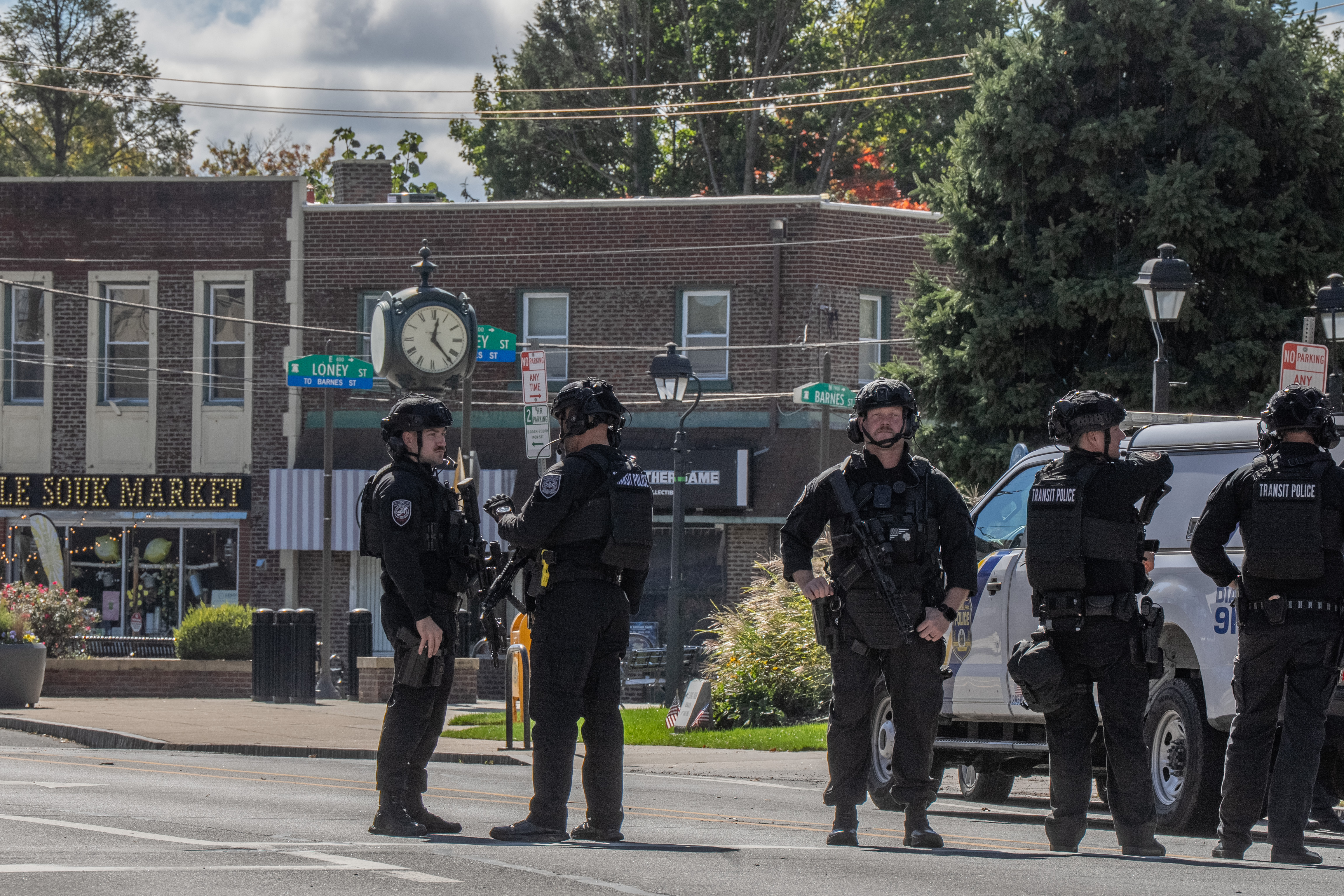
An armed man believed to be connected to an earlier double homicide — who then barricaded himself for hours inside a SEPTA bus in the city’s Fox Chase section — has died after shooting himself, police said.
The man, who was not officially identified, was transported to Jefferson Abington Hospital, where he was pronounced dead, police said. The barricade was declared over just after 5 p.m.
Shortly after 3:40 a.m., Philadelphia Fire Department responders removed two adult women from the scene of a house fire on the 8200 block of Williams Avenue in the city’s Cedarbrook section, police said.
Both women, who were not identified, had been shot, police said.
The women were taken to Jefferson Einstein Philadelphia Hospital, where they were both pronounced dead.
Around 5 a.m., a Route 18 bus pulled into the Fox Chase Loop at Oxford Avenue and Loney Street to drop off two passengers.
“At that time, there were just three people on board — the bus operator, the man who later barricaded himself on the bus, and another passenger,” SEPTA spokesperson Andrew Busch said.
“When the bus stopped for a layover at the loop, the man told the bus driver that he was not getting off the vehicle and to call the police. The other passenger exited the bus without incident and the operator did as well after calling for assistance,” Busch said.
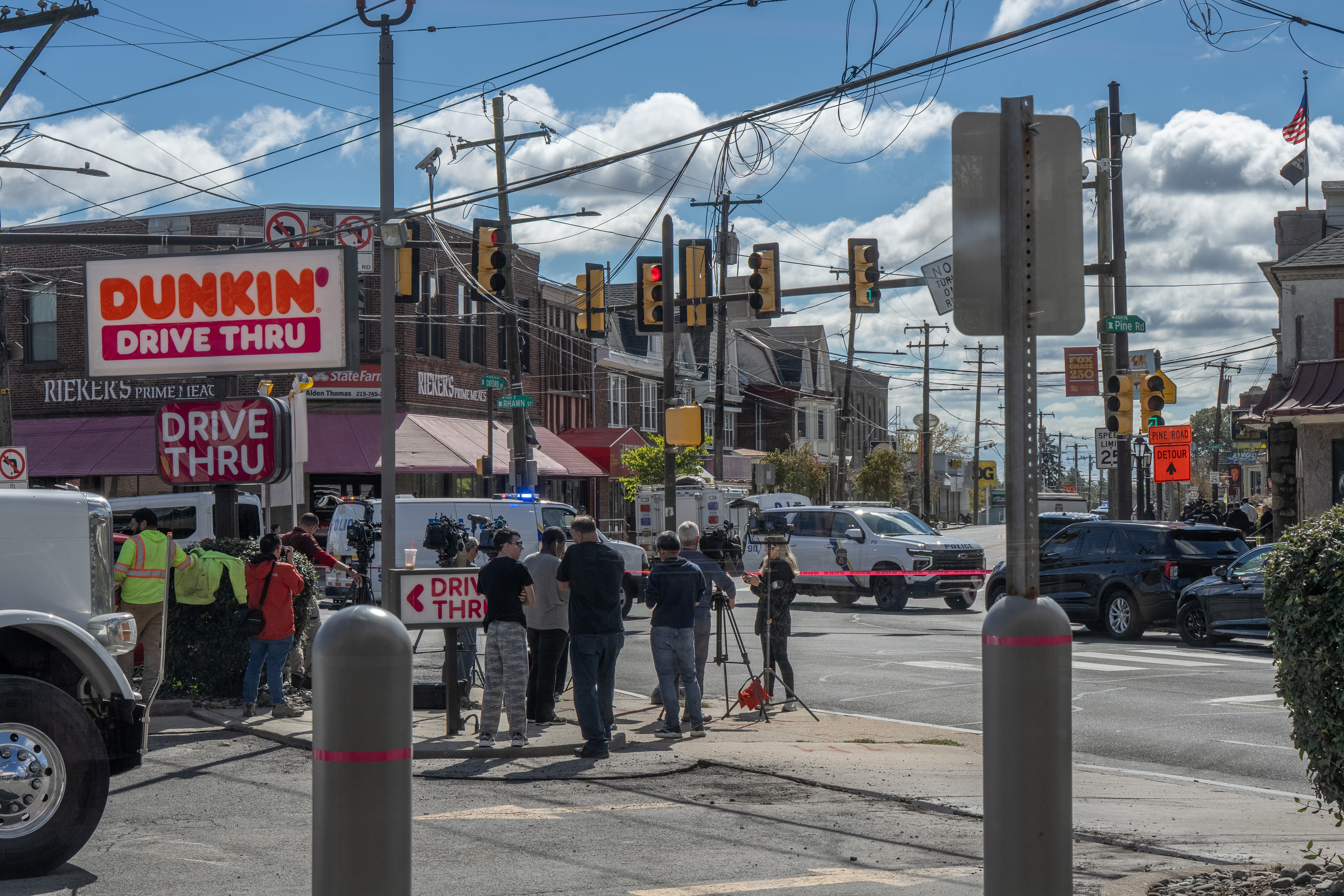
Police in the city’s Fox Chase section near where a man barricaded himself on a SEPTA bus in Philadelphia on Monday.Jessica Griffin / Staff Photographer
The surrounding streets near the barricade were shut down, and SEPTA trains and buses were detoured away from the Fox Chase Loop transit hub.
Police said no officers were injured and the investigation was ongoing.