When the Penn men’s basketball team took to the Palestra for the first time this season, some fans weren’t just there for a basketball game.
They were there for the McCaffery family.
Jack McCaffery, the youngest son of Quakers coach Fran McCaffery, recently was diagnosed with Hodgkin’s lymphoma and will have his first chemotherapy treatment Saturday. He will be treated at the Hospital of the University of Pennsylvania.
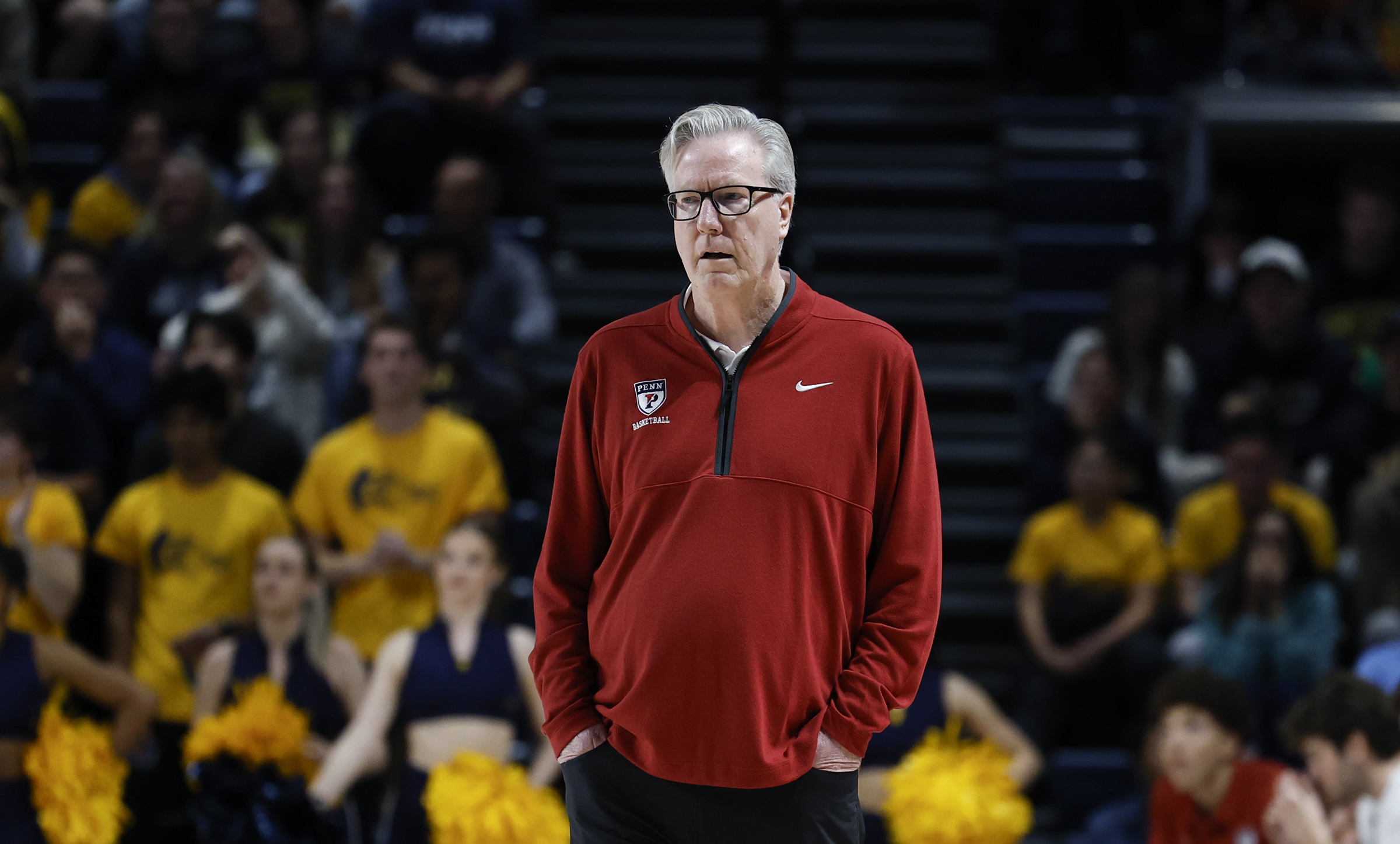
“I think we’re doing about as well as we could be,” Fran McCaffery said after Penn’s 78-65 comeback win over Howard on Monday. “Feel very good about where he is right now. One of the best hospitals in the world, his care team is fantastic. … But it’ll be a long journey.”
Jack McCaffery, a 6-foot-9 sophomore forward, transferred from Butler to Richmond this year, and Spiders coach Chris Mooney said the sophomore guard FaceTimed the team ahead of its Sunday matchup against Temple.
“We’re just trying to be support [to] them in any way we can, and the players have been really good. Just reminding the players, he’s very social, fun kid to be around. I don’t want him to lose that,” Mooney said.
Richmond coach Chris Mooney was asked about Jack McCaffery's Hodgkin’s lymphoma diagnosis:
"He's really an exceptional guy with great personality. I've known Fran and Margaret [McCaffery] for such a long time. From one day to the next, he's had swollen glands, and then we have…
Temple coach Adam Fisher also offered his support.
“Obviously Philly people, hugely involved in Coaches vs. Cancer, just an amazing family,” he said. “So our thoughts and prayers are with them and with the Richmond family.”
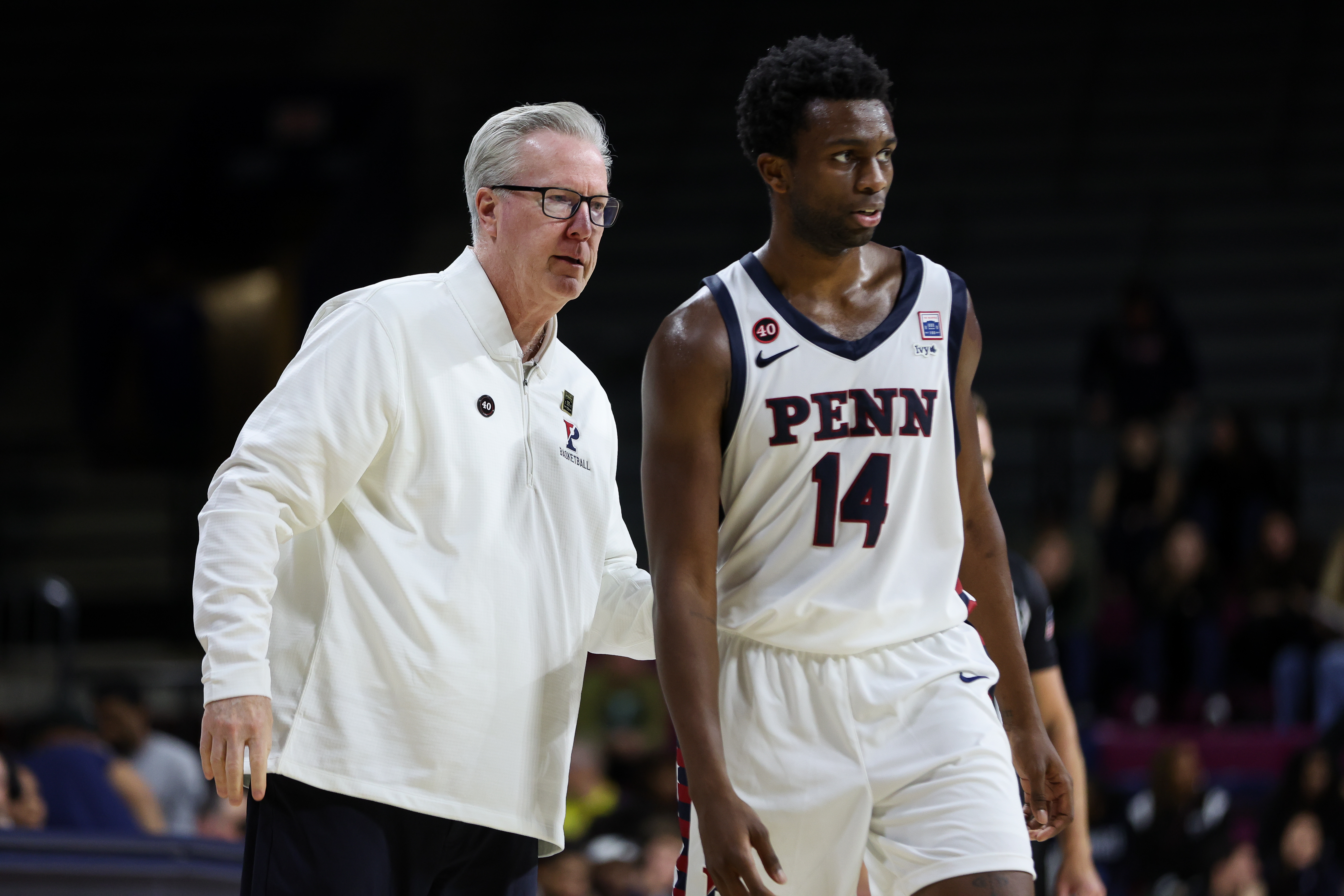
On Monday, coach McCaffery was greeted by friends and family, including his brother, who’s also named Jack, and his daughter, Marit.
“Coach has been really strong,” Penn senior TJ Power said. “It’s been amazing to see honestly how Coach can still be who he is [on] the basketball court but also put his family first.”
Howard jumped out to a 15-1 lead, and Penn continued its shooting woes from its Thursday matchup against Illinois, shooting 34.5% overall, including 16.7% from deep, in the first half. The second half, however, was a different story.
The Quakers stayed in the game with their defense, which translated to ball movement and a 53-point second half compared to 25 in the first.
Transfer guard Sir Mohammed (17 points, five rebounds) led Penn’s physical defense with three steals.
“When Sir’s playing like that, everything else is easier for people,” McCaffery said.
Power made crucial threes to slow Howard’s momentum in the second half — “TJ was cooking,” McCaffery said — but the senior forward believes the Quakers’ surge “started with getting stops and rebounds.”
“The night games in the Palestra are always some of my favorites,” Power said, “When we started making shots, the crowd gave us a lot of life.”
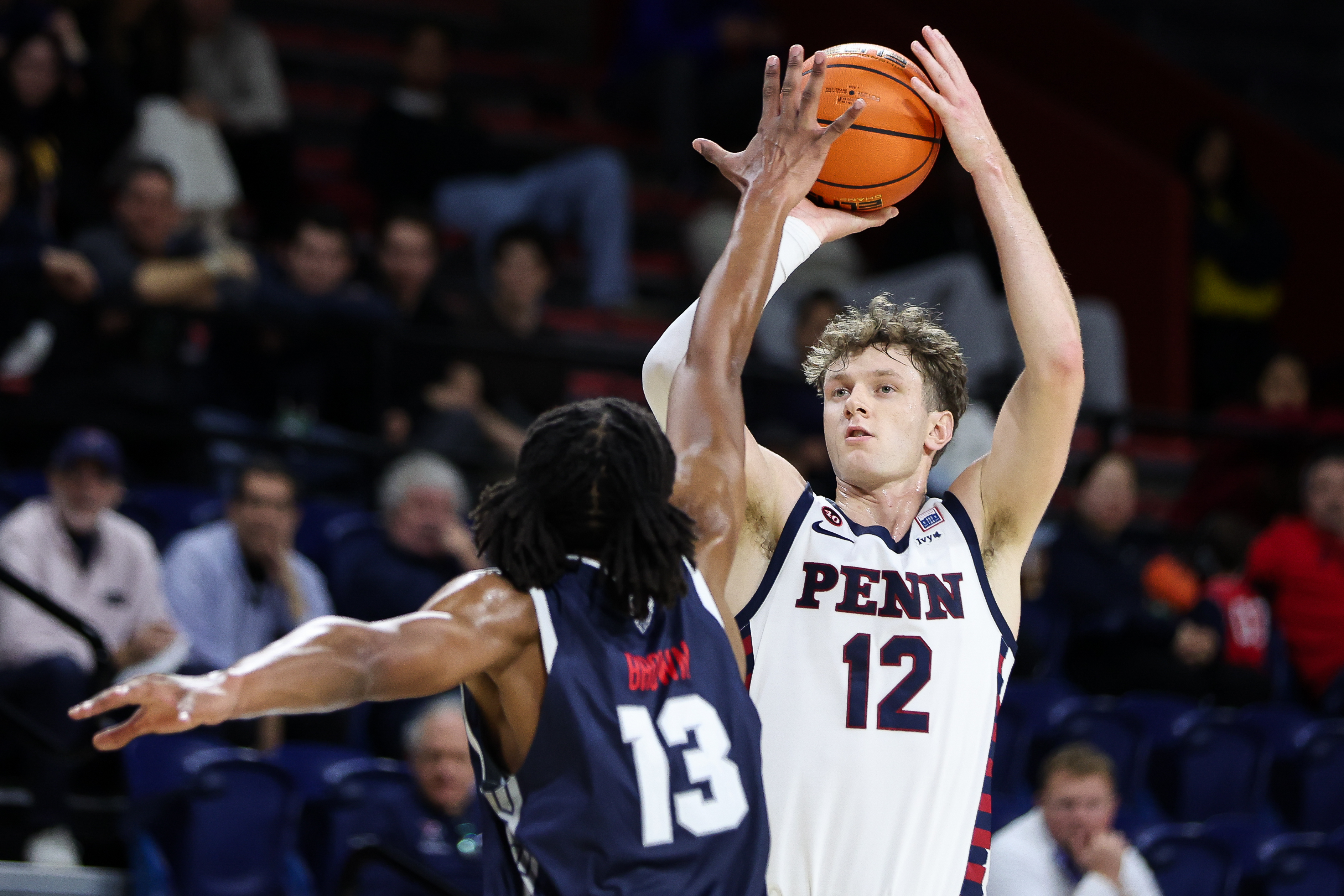
Penn forward TJ Power (12) finished with 23 points on Monday.Isaiah Vazquez / For The Inquirer
Power finished with a game-high 23 points on 8-for-19 shooting, including 6-of-12 from deep. Penn outscored Howard by nearly 20 points in the second half and shot 45.6% overall.
“We’ve got unbelievable leadership on this team, which makes it easier for me,” McCaffery said. “We really grinded just to get back into the game.”
That grind, according to Mohammed, is how the team shows its support to McCaffery.
“Coach shows up for us every day, so it’s our job to go hard every single day,” he said.
Added Power: “Basketball for [the McCaffery] family is their happy place and their release.
“Obviously, it’ll never make up for everything that’s going on, but it’s just a place where Coach can be himself to the fullest. … He was still as sharp and himself as he ever would [be]. And that really helps us stay focused on the task.”
Some Quakers have visited Jack McCaffery at the hospital, and Power, who hopes to visit soon, said “we just have to get our vaccines updated to be able to see him.”
“A lot of times, Coach is there for his players and now it’s a situation where we really just got to rally around Coach and his family,” Power said, “It’s just been like a blanket of love.”
Inquirer staff writers Conor Smith and Mike Livingston contributed to this article.
Once postseason field hockey begins, each team is only promised 60 minutes. That’s the message St. Joseph’s head coach Sam Brown has been saying to his team all season.
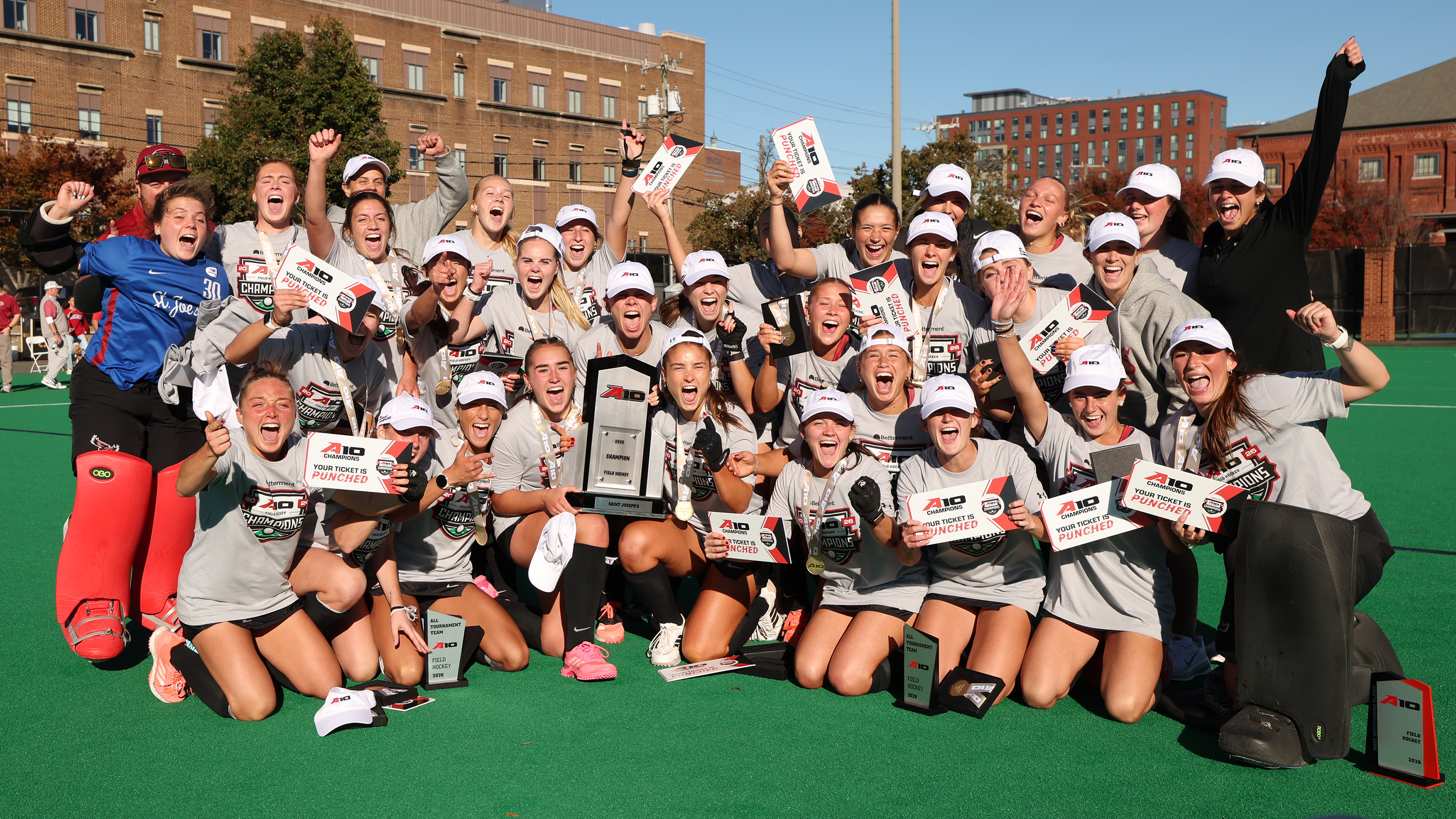
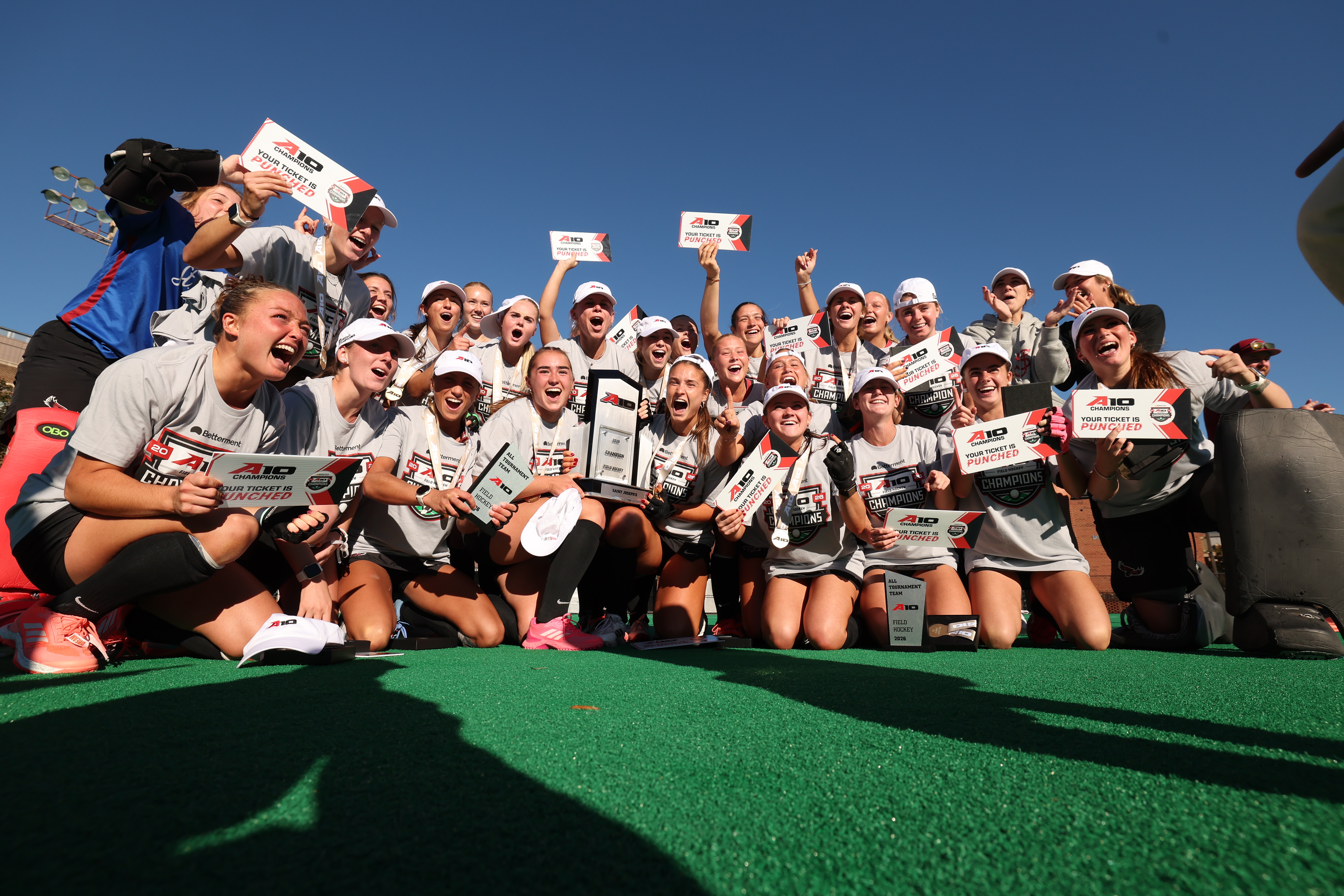
That wasn’t necessarily the case in the Atlantic 10 tournament championship, which St. Joe’s won in a 2-1 shootout over Richmond. It took 75 minutes and eight rounds of a shootout to decide the Hawks’ sixth consecutive A-10 championship.
But as St. Joe’s starts a new slate in the NCAA Tournament, 60 minutes is all it’s promised.
“This team isn’t done, and if they want to play another 60 minutes, we have to show up and perform in the 60 minutes that we were promised,” Brown said. “It’s just game-by-game, step-by-step, survive-and-advance type hockey, and that’s what we love about [the] postseason.”
The Hawks will travel to Evanston, Ill., for their first ever matchup against Vermont in the opening round on Wednesday (2 p.m., ESPN+) at Northwestern’s Lakeside Field.
Brown said it was “a little bit of transition” at the start of the season for the first-year coach to find his footing, but the players always knew they could get to this point, and it was one of the goals they set at the beginning of the season.
“The player group never wavered, and they never set any goal below winning the A-10s and qualifying for the NCAA,” Brown said. “We were obviously hopeful, but at the same time, I think the player group deserves a lot of credit for their ambition and staying true to that through the regular season and tournament.”
Despite being a first-time head coach, Brown has experience in the NCAA Tournament from his time as an associate head coach at Syracuse, where he worked under former Hawks head coach Lynn Farquhar. Syracuse reached the NCAA tournament in each of in his three seasons on staff, including quarterfinal appearances in 2023 and 2025.
St. Joe’s will face Vermont on Wednesday in the opening round of the NCAA Tournament.Nick Sutton / Atlantic 10 Conference
Many of the players on the roster have NCAA Tourament experience as well. This is St. Joe’s sixth consecutive year advancing to the tournament, with 2024 being the last time the Hawks made a national title game appearance.
Brown said being in this position before helps with understanding the postseason environment.
“It does feel different when you step onto a game at the national championship bracket,” Brown said. “So, for us as a coaching staff, it’s important that we embrace that and allow the athletes to soak up that environment because that’s what makes these experiences special.”
Saturday’s conference championship, he said, also helped. The Hawks played from behind to win. The only other time they came back from an early deficit was in a 4-3 win over Villanova on Oct. 18.
Instead of building momentum early in the game, Brown said the Hawks had to bring themselves back.
This lesson was crucial for St. Joe’s, which has a 5-8 record in its eight previous tournament appearances.
The Hawks chased in their eight NCAA losses, which includes four shutout losses. St. Joe’s won one game after trailing in 2022 with a 3-2 first-round win over Wake Forest. Its other four wins came from establishing early leads.
Still, Brown said the focus is on generating opportunities and converting on them.
Brown said there is an element of pressure that comes from competing at St. Joe’s. It’s a pressure Brown is happy to embrace.
“Personally, I love that sort of pressure,” Brown said. “We’re here to compete and to be involved at the business end of the season. So, I think it aligns with our team culture and our team ethos.”
Wednesday’s winner would play top-seeded Northwestern. The Wildcats and Hawks last met in the 2024 national championship, when St. Joe’s lost, 5-0.
Returning players Erika Culp, Milou Kluyt, and Alison Buffington played in that game, while Tristan Groff and Lily DeWan were also on the team during that run.
But right now, it’s about focusing on the next 60 minutes.
“We can’t dismiss what lies beyond, but we also have to earn the right to get there,” Brown said. “If there are athletes that are looking ahead and are hungry for that opportunity to play the No. 1 team in the country, which I think we all are, we only get that opportunity if we pay attention to Wednesday and get the details right and make sure that we progress from that first-round match.”
The breakfast room at the General Curia isn’t spacious. It contains maybe three tables, if that, often occupied by Augustinian friars, all of whom live in the brick building just outside the Vatican.
You can’t help but connect with those around you, which is perhaps the point. Every day, over coffee and fruit, the friars sit together and talk, strengthening the community that underlies their faith.
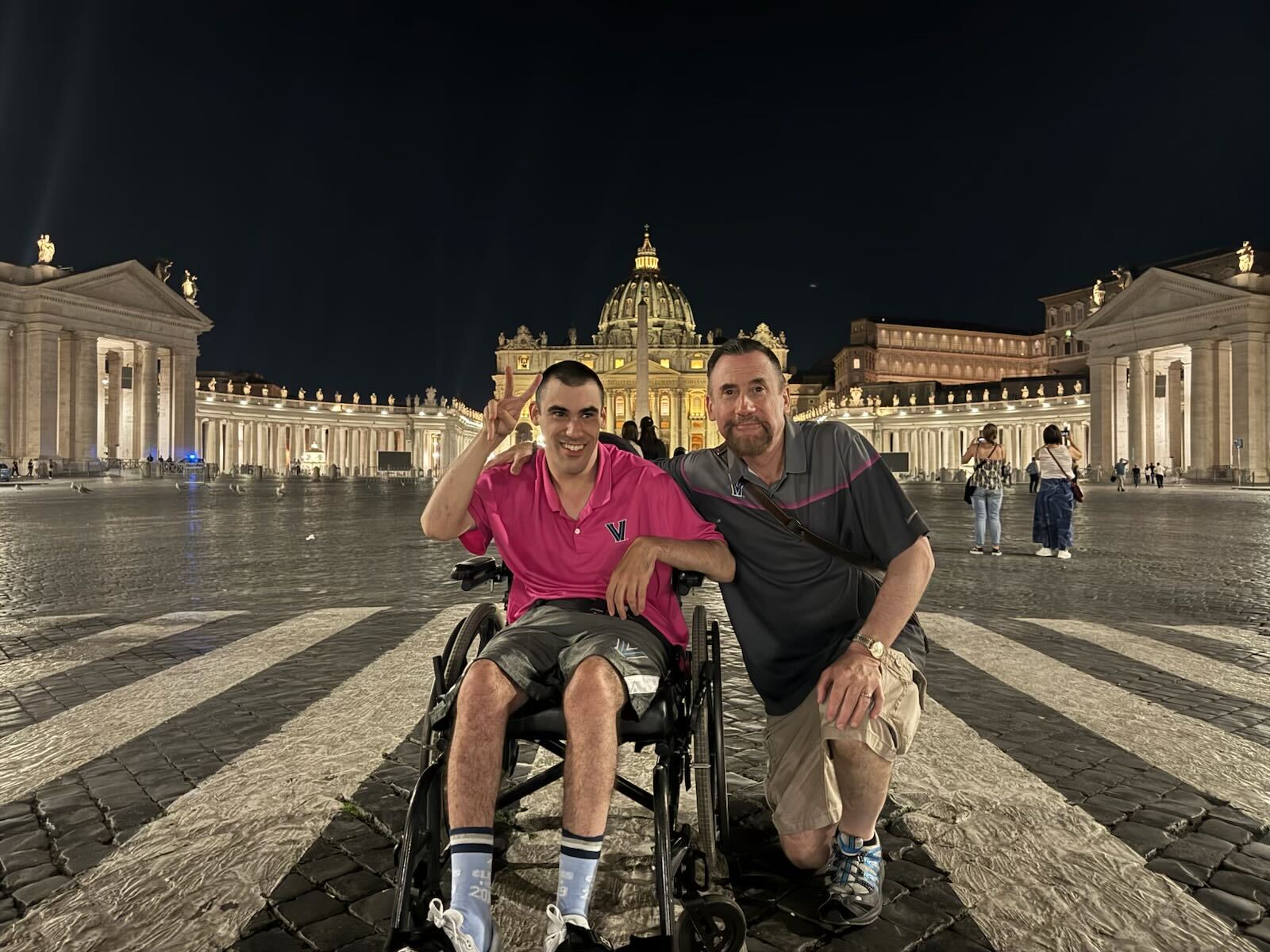
One morning in late September 2023, Archbishop Robert Prevost encountered a familiar face there. Father Joe Farrell was eating with his brother, Tom, and two friends, Michael and Nick Gaynor, who had traveled from Malvern, Chester County to attend the Ryder Cup in Italy.
Nick Gaynor and his father, Michael, during their trip to Rome for the Ryder Cup in 2023.Photo courtesy of Tom Farrell
Prevost joined them at their table. He quickly learned, to his delight, that the Gaynors had ties to his alma mater, Villanova University.
Michael was the dean of undergraduate admissions. Nick, his son, graduated from the school in 2019 and was an ambassador for the women’s basketball program.
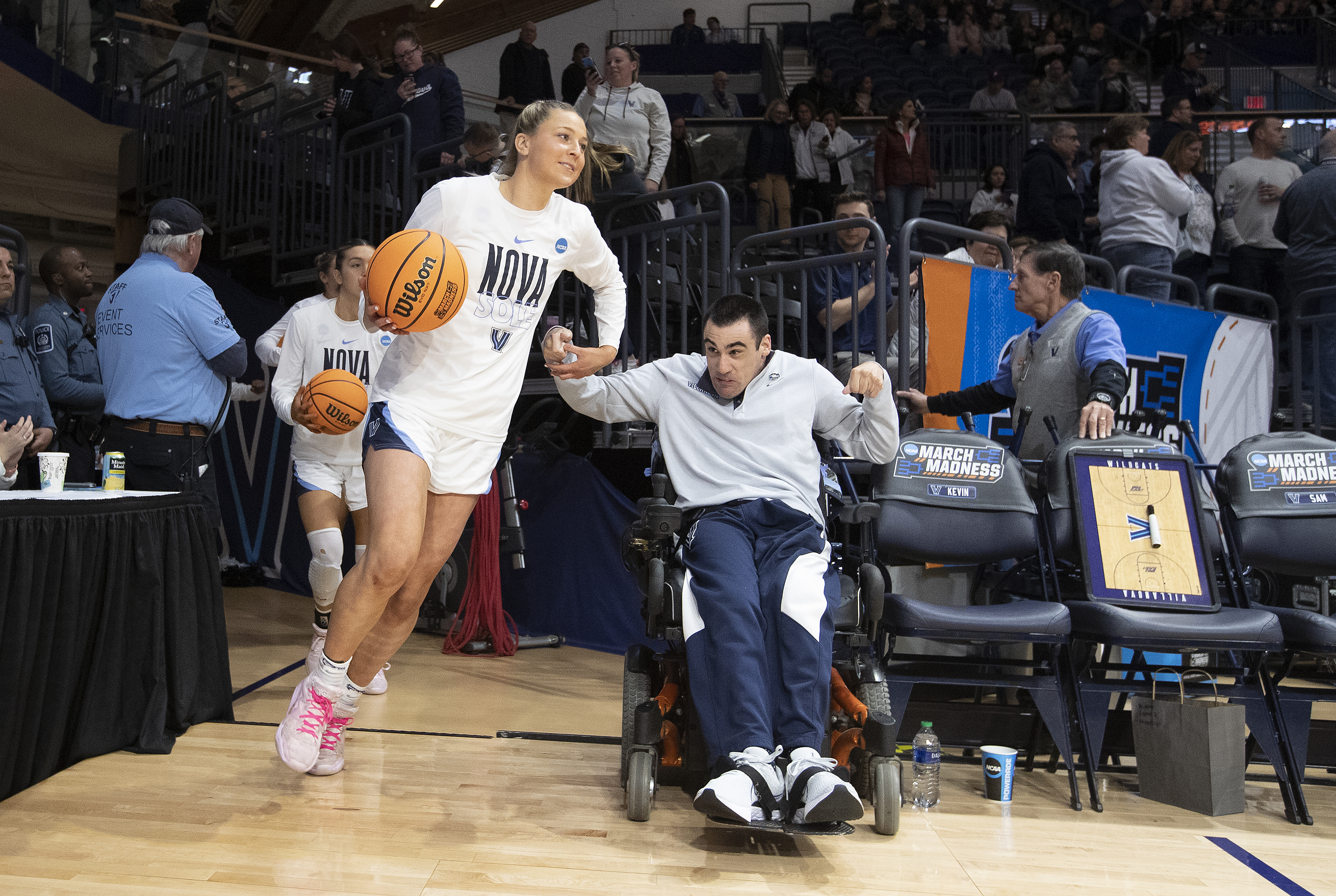
He’d been around the team since he was 5. At first, Michael took his son to games. Then, games turned into practices. By the time he enrolled at Villanova in 2011, he’d transitioned to student manager.
This was not a small commitment. Nick, who was born with cerebral palsy, took only two courses a semester to avoid overextending himself. But he always found time for basketball.
While chipping away at his associate’s and bachelor’s degrees, Gaynor attended every practice and game, crunching film, meeting recruits, and scouting upcoming opponents.
It earned him a nickname.
“Michael called him ‘Nickipedia,’” said head coach Denise Dillon. “Any questions that we might have about a player, he knows. He’s on top of all of it.”
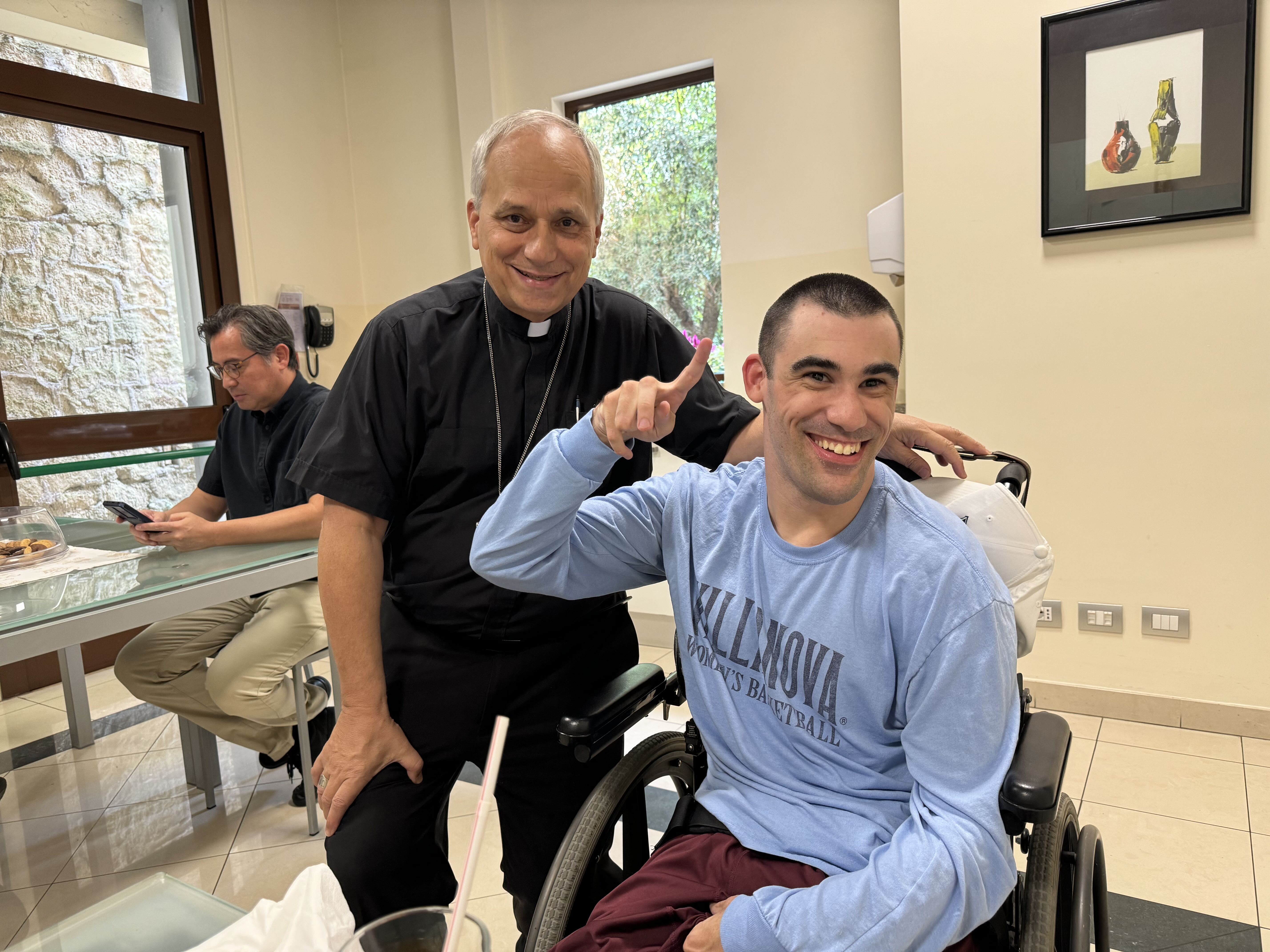
Prevost was drawn to the young man. What started as small talk about a school on the Main Line developed into a conversation about golf, and more. Fifteen minutes later, the man then serving in the role of Prefect of the Dicastery for Bishops took a picture with Nick, said a warm goodbye, and went on his way.
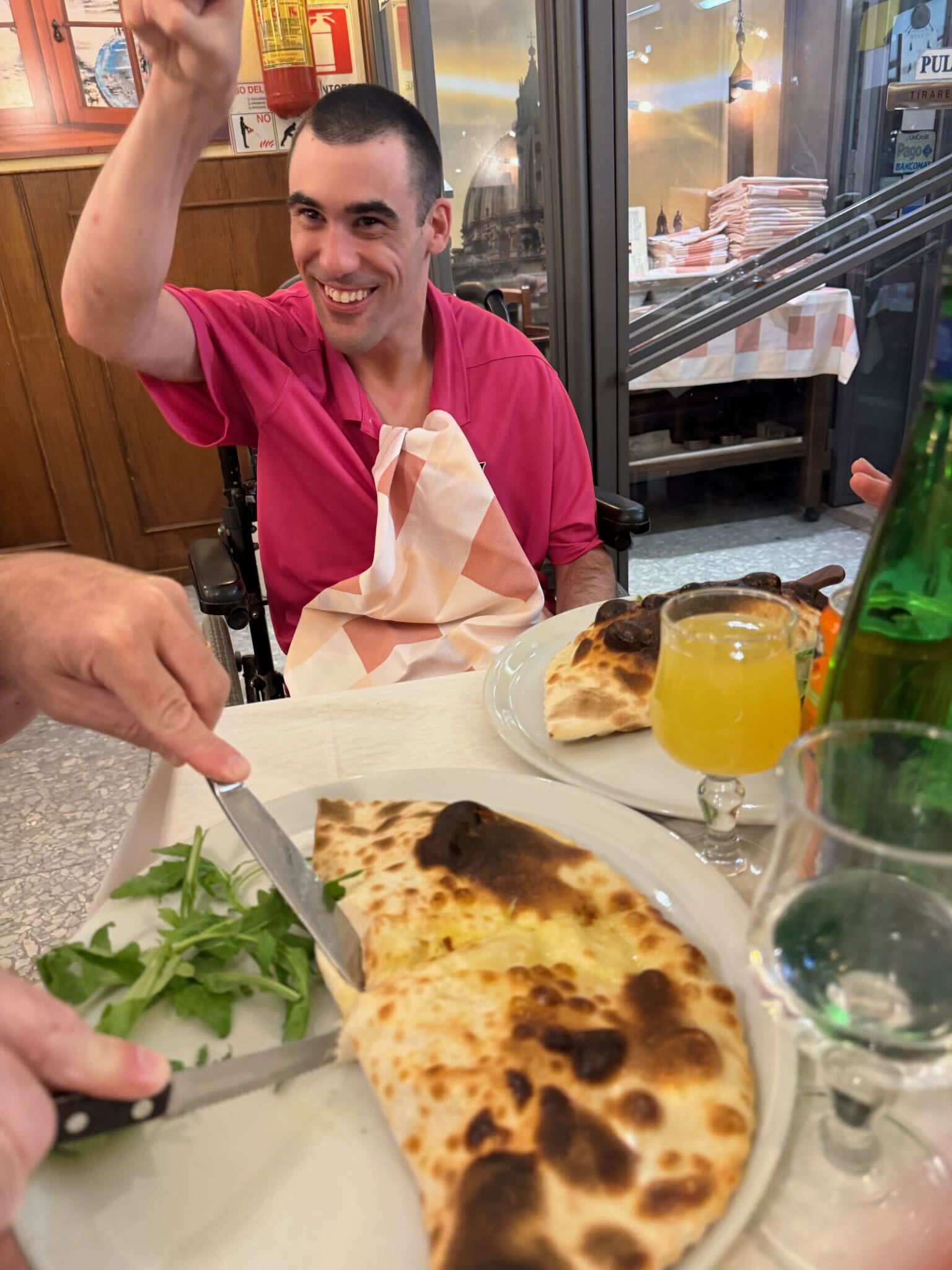
Nick Gaynor at one of the many Italian restaurants he visited in 2023.Photo courtesy of Tom Farrell
That night, while eating pasta carbonara, Michael posited a hypothetical to their group. The archbishop was about to be named cardinal. It was conceivable that he could one day become pope.
What if they had just met a future Supreme Pontiff?
This seemed unlikely. Prevost was a native of Chicago. An American had never been elected to the papacy. But Michael had a feeling, one that proved prescient.
Father Joe invited the Gaynors to stay at the Curia with his brother, which presented more opportunities to run into Prevost. They developed such a rapport that the future pope offered to do Nick a favor.
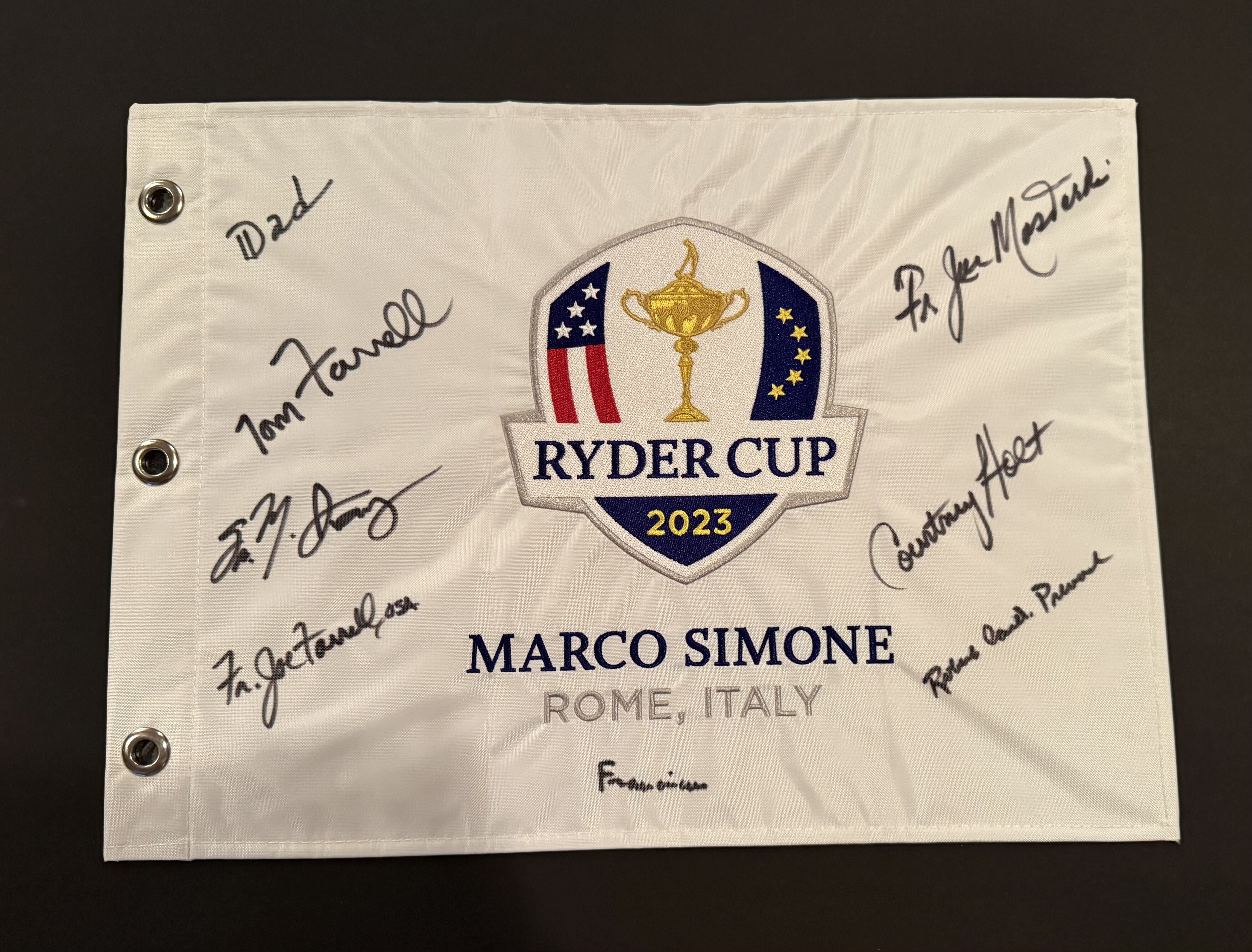
Nick Gaynor has a Ryder Cup flag signed by not one, but two popes.Courtesy of Debbie Gaynor
The Villanova team ambassador had bought a Ryder Cup pin flag, in the hopes of getting it signed by everyone who’d made his trip memorable.
Michael passed it to Father Joe, who passed it to Archbishop Prevost, who then took it straight to the top.
“Bob said, ‘Do you want me to see if Pope Francis will sign this?’” Tom recalled. “Because he would meet with Pope Francis regularly. And sure enough, ‘Francesco’ is at the bottom of the flag.”
Added Nick: “We just hit it off right away.”
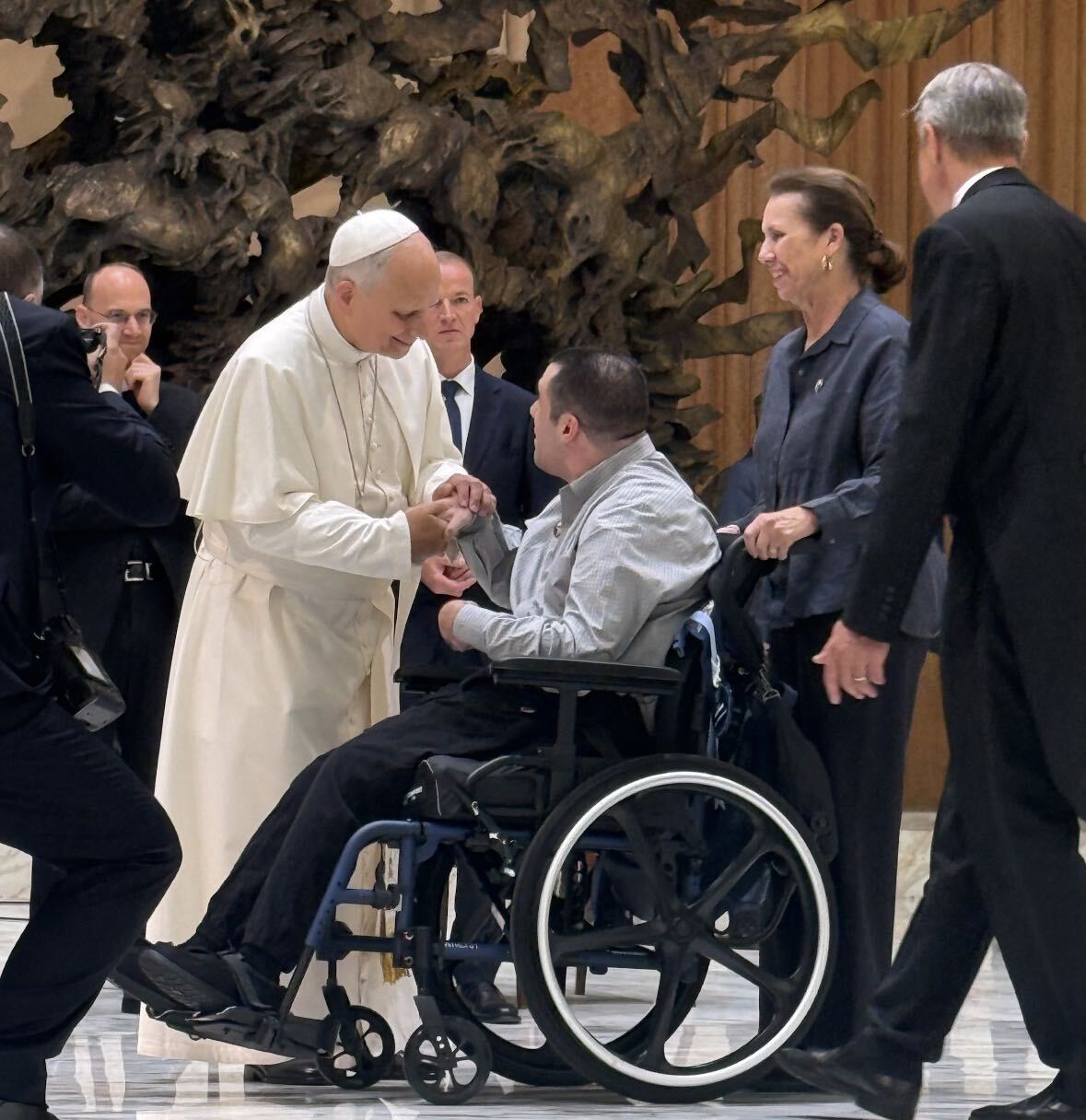
The Gaynors’ Italian adventure ended with a special surprise: an audience with Pope Francis himself, outside of St. Peter’s Basilica. Michael was never the emotional type. But when he saw his son in a wheelchair shake hands with a pope in a wheelchair, he couldn’t help but cry.
Nick Gaynor also met Pope Francis and can say he’s met multiple popes.Courtesy of Debbie Gaynor
One of Michael’s most profound moments would come near the end of his life. Less than a year later, he was diagnosed with stage 4 urothelial carcinoma. He died that August at age 66.
Michael never lived to see his improbable inkling come true. But on May 8, 2025, it did, when onetime Villanova student Bob Prevost was elected pope and chose the name Leo. Watching from home on TV, Nick thought of his late father, how they had met not one Supreme Pontiff, but two.
What the Villanovandidn’t realize at the time was that he and the former archbishop would meet again.
Nick Gaynor renewed acquaintances with the man he first met in his pre-Pope Leo XIV era.Courtesy of Debbie Gaynor
‘Nick, you have a lot of friends’
The Gaynors were not just mourning a beloved husband and father, but also a caretaker who was dogged in his devotion. Michael and his wife, Debbie, always split duties among their twin boys — Nick’s brother, Christian, was also born with cerebral palsy.
The disorder impacted them differently. Christian couldn’t speak, and was cognitively and physically disabled. Nick was only disabled in the physical sense, which opened up opportunities like his role at Villanova.
Because Michael worked on campus, he’d take Nick with him in the morning, dropping off the undergrad at the Davis Center. The elder Gaynor would stick around for games and practices, sitting behind Nick on the bench, going back and forth between the gym and his office.
He’d accompany his son on long road trips with the team, lifting him in and out of his chair, in and out of planes, as Nick hung his arms around his shoulders. During these times, Debbie would often stay with Christian, changing him, feeding him, giving him his medication.
Rome, with its cobblestones and hills, wasn’t the easily city for a handicapped person to navigate. But Michael Gaynor was with his son every step of the way.Photo courtesy of Tom Farrell
These were gestures of love, but required strenuous work. And when it was announced that Villanova would be headed to Rome for a men’s and women’s basketball doubleheader against Notre Dame on Nov. 1, Debbie wasn’t sure she and her son could partake.
They hadn’t gone on a trip by themselves before. There would be logistical complications. At home, Nick used a battery-powered wheelchair, but it would be too heavy to bring on the plane.
So, just as her late husband had three years earlier, Debbie would have to take his manual wheelchair, pushing it over centuries-old cobblestone, up and down steep Roman hills. This would be a physical feat over one day, let alone five.
She talked to Villanova’s athletic department, explaining the help she’d need in getting her son from one place to another. Their response wasswift and unequivocal.
“They said, ‘Debbie, don’t worry. We understand,’” she recalled. “When I was told that that was a possibility, I was like, ‘Oh my gosh.’ I was overwhelmed. I knew that was something I’d want to do, and I know Michael would have done it.”
Nick Gaynor (courtside with Villanova in the 2023 NCAA tournament) has been a fixture with the Wildcats’ program, and their trip to Rome was no different. Charles Fox / Staff Photographer
The school prepared for every contingency. Players, coaches, and spouses of staff took turns pushing Nick throughout the trip. Villanova provided not just a wheelchair-accessible bus, but also a van that could be used in case the bus malfunctioned (which it did, when a window broke).
To Dillon, this was the least the school could do. Gaynor was a constant presence around their team, even before she’d been hired in 2020. Her predecessor, Harry Perretta, said the manager was involved in “everything,” from statistical work to personal guidance.
One night, they were driving back to Philadelphia after a tough loss to Notre Dame. Nick was in the front seat, and his father was in the back.
“I’m b—ing and moaning and complaining,” Perretta recalled. “And he says, ‘Harry, you could always trade with me and take my chair!’”
As team ambassador, Nick is still on campus almost every day, doing much of the same work he was before, while “keeping spirits up,” just like he did with Perretta.
Nick Gaynor met with Pope Leo XIV when Villanova traveled to Rome. courtesy of Debbie Gaynor
On Oct. 31 in Rome, he uplifted an entire auditorium. When Debbie and Nick arrived at the Paul VI Audience Hall after Mass, they thought they’d be in the wheelchair section, watching others meet with Pope Leo.
But suddenly they were whisked from their positions and escorted up a ramp, toward a line of visitors in wheelchairs on the stage.
Nick stuck out his hand. Leo shook it. Then, the Malvern native and the Chicago native leaned in for a hug, as the crowd of 6,000 burst into applause.
“I said, ‘Father, good to see ya,’” Nick recalled. “And he said, ‘Nick, you have a lot of friends out there.’”
This is why we all love Pope Leo! A beautiful moment as he warmly embraces his friend from Villanova. pic.twitter.com/49M7TphxTP
Nick has since given his late father a nickname of his own. It’s “Saint Mike.” As a man who prided himself on humility, he might not have embraced this.
But the moniker is fitting. Michael was never outwardly religious. He didn’t talk at length about his faith, or his Catholic background. But he lived those values with every lift of his son, and push of his wheelchair.
And that effort changed Nick’s life. It wasn’t easy, but it was always worth it, just like this recent trip to Rome, which ended in the most serendipitous of ways.
Michael was not there in the physical sense. But when Debbie sat for Mass at St. Peter’s Basilica, she says she could feel her husband in the room. And when Nick shook hands with Pope Leo, he could tell his saint was looking down on him.
A few days later, while reminiscing on that moment, Nick turned to his mother.
Temple snapped the ball on its own 29-yard line, trailing Navy 42-35 on Saturday with 1 minute, 11 seconds remaining. The Owls had been down 28-0, but surged back. Their comeback fell short when Jaxon Smolik failed to complete his pass to Jayce Freeman on fourth down.
Temple fell to 2-7 (1-4 American Conference) with its fourth consecutive loss. It was the fifth loss decided by eight points or less. Now, the Owls return home to play Alabama-Birmingham (5-4, 3-2) on Saturday (1 p.m., ESPN+).
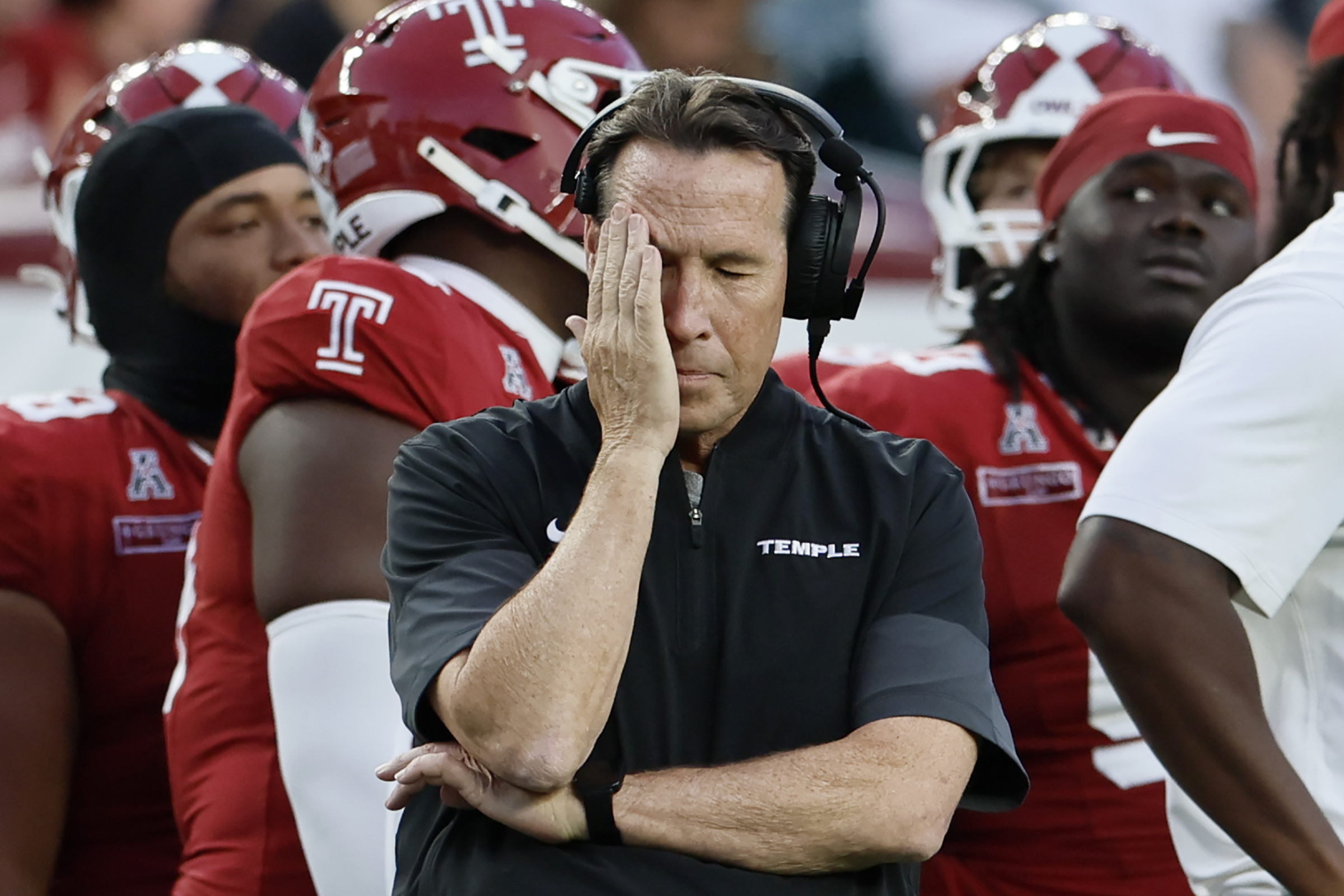
“We’ve been in that situation a couple of times now and we haven’t been able to get it done,” coach K.C. Keeler said on Monday. “I got to figure out what is missing. … I worry about sometimes them [being] afraid to fail. Just go play. Don’t get in those one-score games and be afraid to play.”
Keeler views Temple’s 49-48 loss at Toledo on Sept. 19 as a turning point. The Owls led 42-28 at the two-minute warning before giving up two touchdowns and losing in overtime. Players started pointing fingers at one another rather than themselves — something Keeler said he has never seen his guys do.
He made it clear to his players that Temple doesn’t operate like that.
The Owls took another step back when they lost to previously winless Charlotte on Oct. 17.
Henry Baker has been the defensive playcaller for Temple over its last two games.Isaiah Vazquez / For The Inquirer
Keeler responded by firing defensive line coach Cedric Calhoun, demoting defensive coordinator Brian L. Smith to safeties coach, and elevating Henry Baker as the new defensive play-caller.
Recently, Keeler has seen the Owls buy back in.
“If you look at the last two weeks, we’ve been unbelievable,” Keeler said. “In terms of … playing all the way to the last snap.”
Looking toward UAB
The Blazers beat East Carolina in overtime 30-17 on Oct. 15, and Temple lost to the same team 16 days later. Keeler respects UAB’s defense, praising its defensive line and safety groups.
During Monday’s practice, running back Sam Brown and linebackers Curly Ordonez and Eric Stuart weren’t present due to illness. Running back Hunter Smith didn’t play against Navy because of flu symptoms.
Quarterback Ajani Sheppard, who last played in Temple’s loss to ECU on Oct. 31, was sidelined against the Midshipmen due to a foot injury. Keeler thinks Sheppard will be available to play against UAB.
Getting back on track
With its seventh loss, Temple likely extended its bowl game drought to seven years.
But Keeler is dedicated to righting the ship as the season winds down.
“Every morning I wake up, I’m now 2-7,” Keeler said. “But when I walk in this building, I’m the leader of this pack, and the pack will travel as fast as I travel. So I am all in on us trying to get better.”
In February, Derrick Morton-Rivera celebrated his consecutive Catholic League championship with Father Judge at the Palestra.
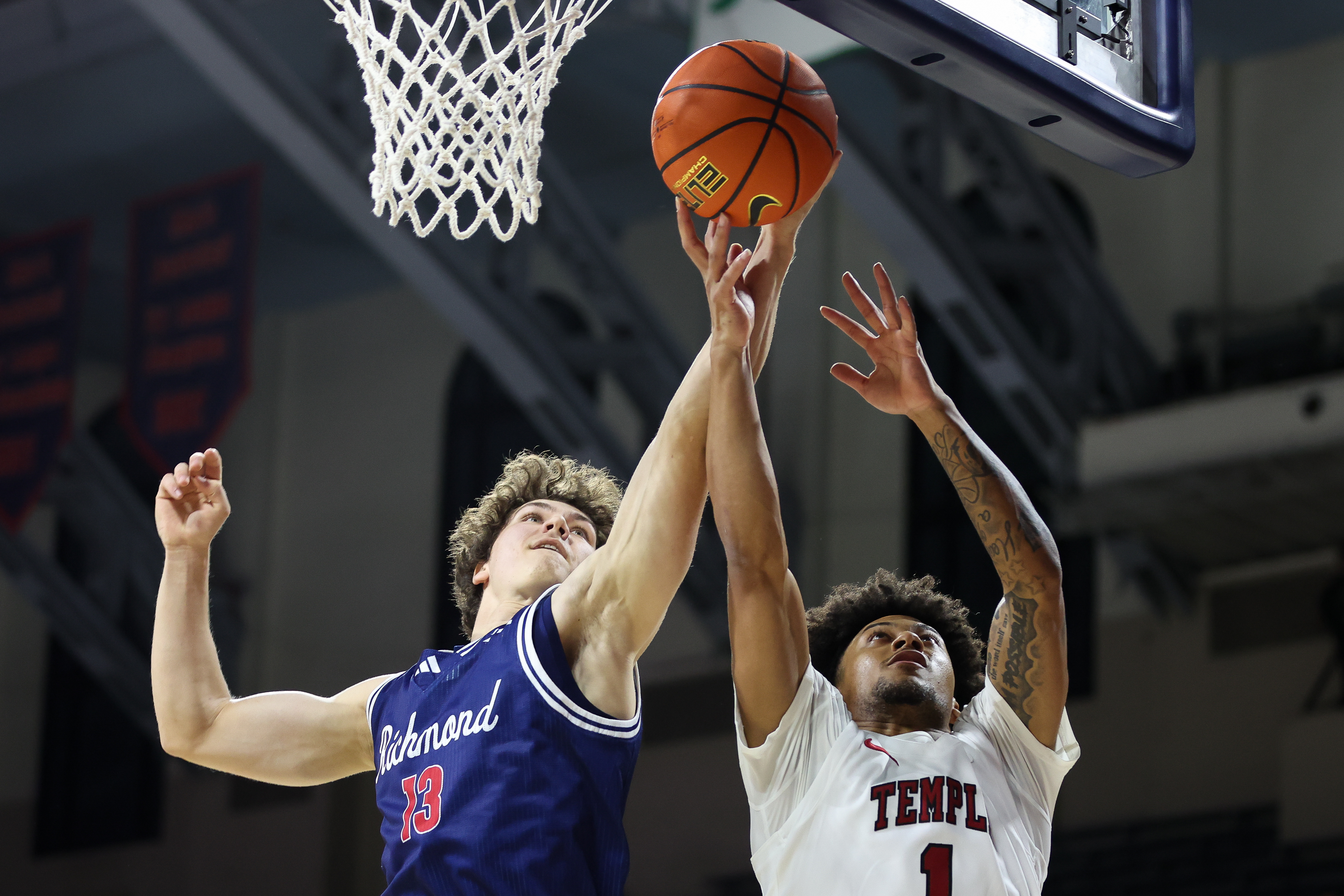
On Sunday, the freshman guard returned to the same court wearing a Temple uniform. But instead of celebrating a victory, Morton-Rivera stepped to the free-throw line in the final minutes and scored the first two points of his college career.
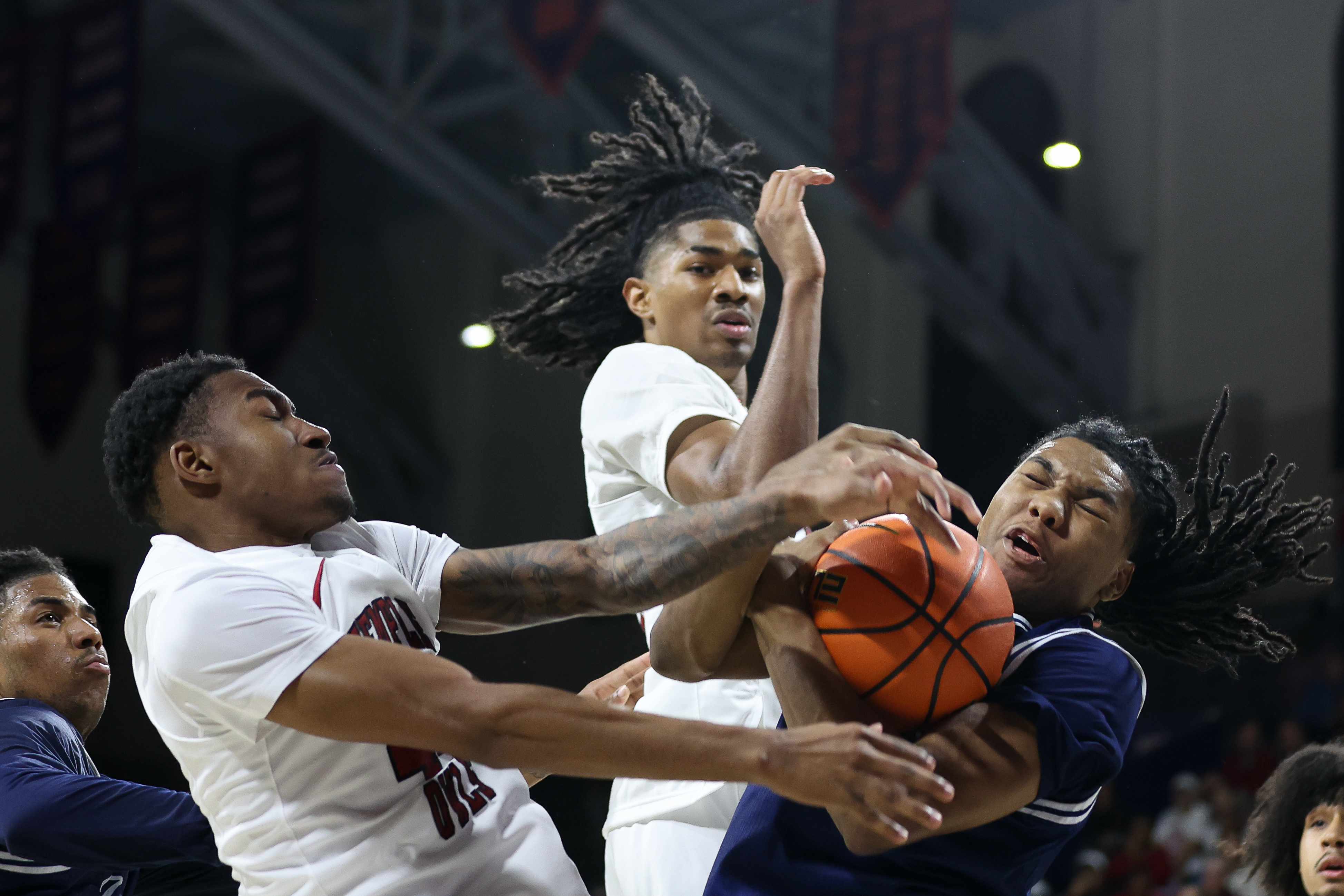
His debut was one of the few bright spots in an otherwise disappointing return to the historic arena for Temple, which lost 79-53 to Richmond during the Palestra’s 100th-year celebration.
The 1-1 Owls played at the building for the first time since 2022 and returned to an arena they called home from 1955-84. Temple entered Sunday with a 280-143 record at the Palestra, a venue closely tied to the program’s history and Philadelphia’s college basketball tradition.
Sunday offered an opportunity to reconnect with that history. Instead, the Owls spent most of the evening trying to overcome an early deficit.
Richmond (3-0) scored the game’s first 14 points, forcing Temple coach Adam Fisher to call an early timeout. The Owls didn’t score until Jordan Marsh made a free throw nearly six minutes into the game.
Temple trailed 37-23 at halftime before Richmond extended its lead to as many as 31 points in the second half. As the deficit continued to grow, boos emerged from the announced crowd of 3,600, a stark contrast to the celebratory atmosphere the occasion was intended to create.
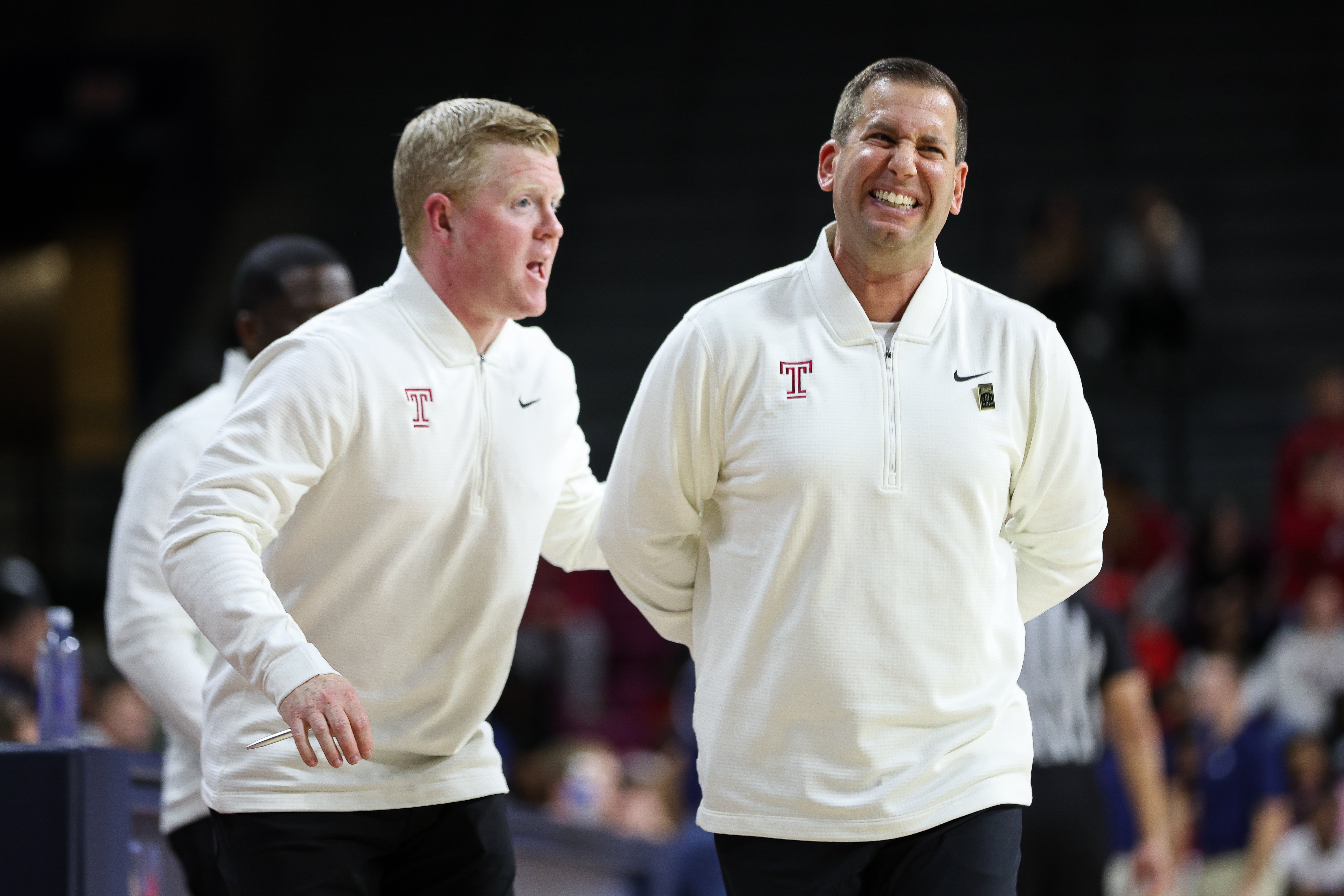
“The game [was], obviously, ugly,” Fisher said. “Didn’t come out with the intensity, didn’t start the right way, and then showed little spurts through the game of playing the right way. But we’ve got to be much better. It starts with me.”
The Owls committed 16 turnovers and shot 29.6% from the field, including 7-for-32 from three-point range. Richmond shot 50.8% and had 22 assists on 30 made baskets.
Temple head coach Adam Fisher said “we’ve got to be much better,” after a loss to Richmond.Isaiah Vazquez / For The Inquirer
“They’re a heavy gap team,” Fisher said. “We talked about spacing for five straight days, showed film today of spacing. They’re going to switch. We had to do a much better job moving the ball. It got stagnant.”
The opportunity to return to the Palestra carried personal significance for Richmond coach Chris Mooney.
Mooney, a Philadelphia native who played at Princeton from 1990-94, recalled competing at the Palestra against Penn and experiencing the atmosphere of the historic Penn vs. Princeton rivalry.
“This is the best venue there is, and it’s my first time coaching here, so I’m thrilled to be back,” Mooney said.
Mooney said he discussed the significance of the arena with his players before Sunday’s game.
“Some guys are really into nostalgia and history,” Mooney said. “Some guys just want to play the game, and that’s another gym, which I respect.”
Mooney also expressed appreciation for the Palestra’s centennial celebration and the opportunity for programs to participate in games at the historic building.
“I hope they continue to do more because it’s such a great place to play,” Mooney said.
While Richmond’s players left with a victory, Morton-Rivera experienced a different kind of homecoming.
The Philadelphia native made his collegiate debut, playing 13 minutes and finishing with two points, two rebounds, and a steal.
His first college points came after he forced a turnover late in the second half and drew a foul while attempting to finish in transition. Morton-Rivera converted both free throws, adding another milestone to his history inside the building.
Temple guard Derrick Morton-Rivera (left) made his college debut on Sunday.Isaiah Vazquez / For The Inquirer
“I thought [Morton-]Rivera played really hard,” Fisher said. “I don’t care he was 0-for-3 [from the field]. He went to the glass; he competed. He gave great effort, energy. If you want to get on the floor on our team, that’s what it’s got to be.”
The moment offered a reminder of the Palestra’s ability to connect different generations and levels of basketball, even on an evening when Temple struggled to produce much worth celebrating.
The Owls will have another opportunity to play at the Palestra on Dec. 12 against St. Bonaventure, their second appearance as part of the centennial celebration.
Before then, they must address the shortcomings exposed Sunday, beginning with Wednesday’s home game against Charleston at the Liacouras Center.
With four minutes to go in the first half Sunday night, “We are Penn State” chants broke out at the Palestra. The Nittany Lions had just capped off a 8-2 run, forcing a Pittsburgh timeout. Two minutes later, those chants became “Let’s go, Pitt” following a thunderous alley-oop on a Panthers fastbreak.
The dueling chants provided the soundtrack for Pitt’s 82-76 win over Penn State, in the 150th matchup between the programs. Panthers guard A’lahn Sumler led all scorers with 26 points in 39 minutes. Meanwhile, Dasonte Bowen scored a team-high 17 points for Penn State.
“I remember being a kid and my dad took me to a Pitt-Penn State football game,” said Penn State coach Mike Rhoades. “And the things I heard in the stands, that was an education for me in grade school. I’ll never forget that, and it’s what rivalry should be about. A lot of these people are probably going to work together tomorrow. So that’s what it should be, and it was good fanfare and good for college athletics, college sports, especially with all the craziness in the world.”
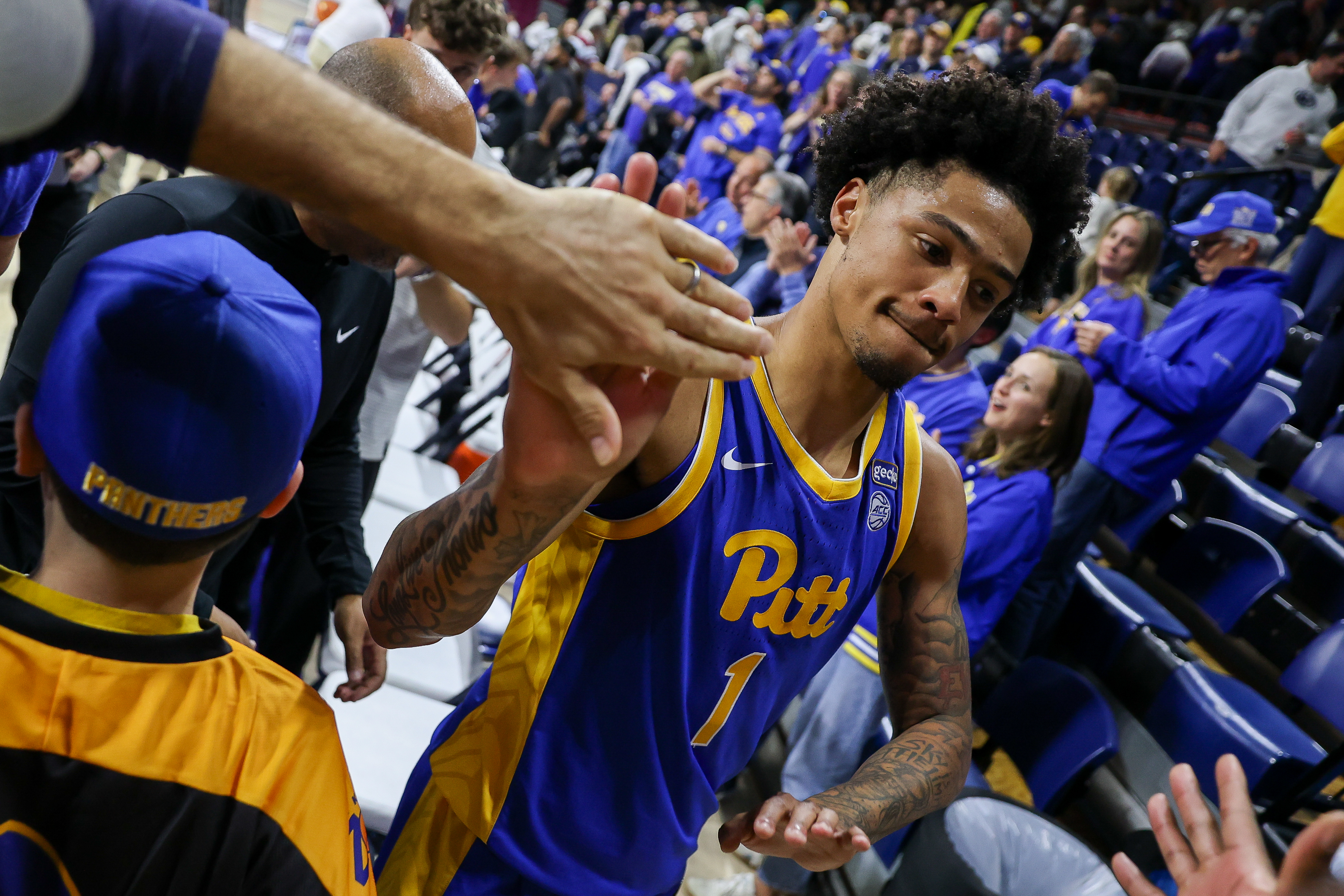
One player in Sunday’s matchup who had prior experience at the Palestra was Pitt guard Jalil Bethea, a former standout at Archbishop Wood. Bethea was a two-time Catholic League MVP and named the Pennsylvania player of the year as a senior. The former five-star recruit and McDonald’s All-American originally committed to Miami but struggled to find his footing during his freshman year. After one season, he transferred to Alabama, where a preseason injury limited his minutes.
Bethea, now at his third school, is playing the sixth-man role for Pitt coach Jeff Capel. In 19 minutes, the 6-foot-5 guard logged seven points and one assist. He also came away with his first win at the storied arena.
“He had never won here,” Capel said. “And I told him we were going to do everything we can to take care of that and change that. And he was a big part of that. He was a big part of that with his drive in the second half.”
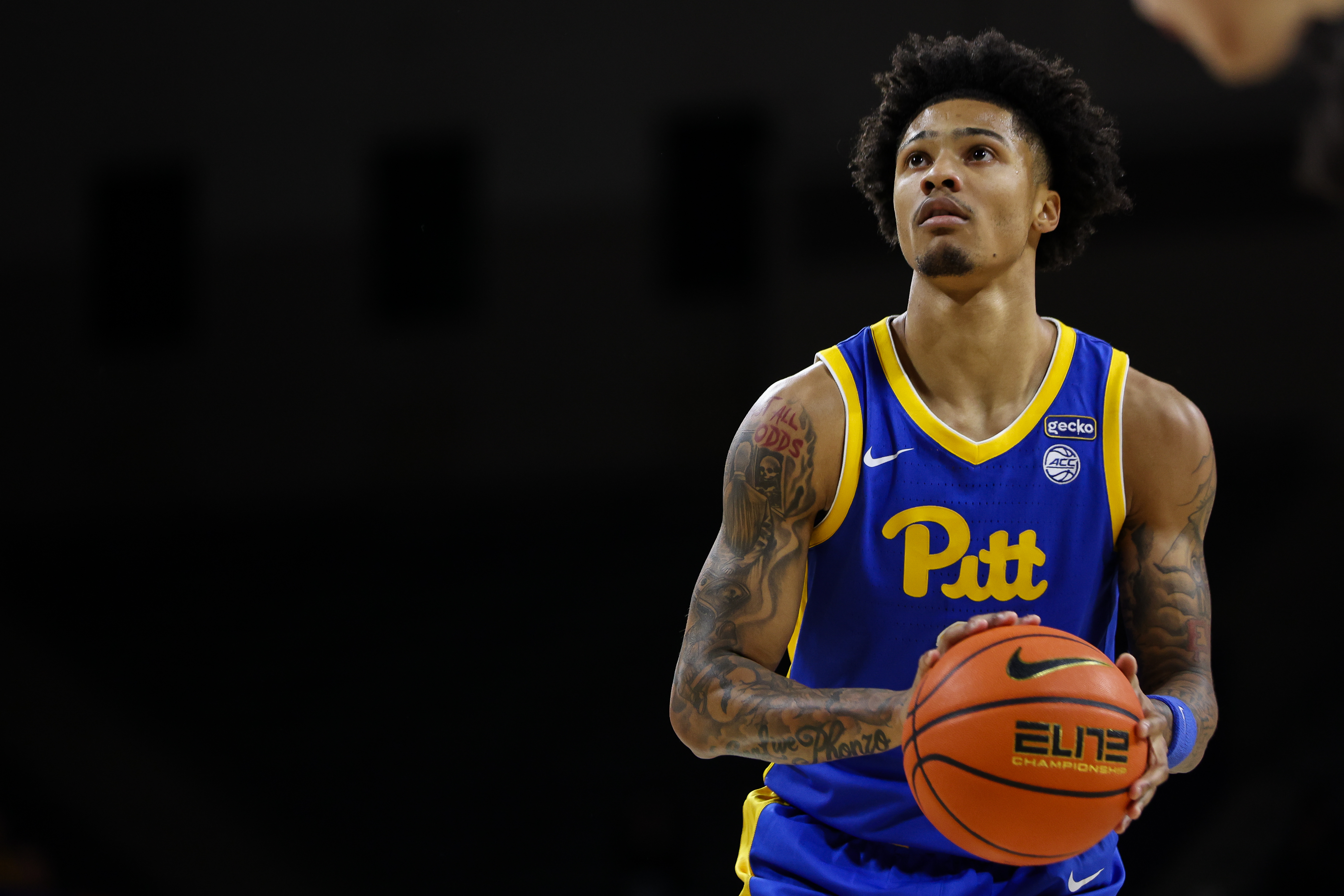
Pittsburgh guard Jalil Bethea finished with seven points and one assist on Sunday.Isaiah Vazquez / For The Inquirer
‘We’ll come back’
Sunday marked the fifth consecutive season that Penn State played at the Palestra. Previously, the Nits had faced Big Ten opponents in the arena. However, because of the Palestra’s 100th year, Penn State and Pitt looked to bring the Keystone State rivalry to West Philadelphia.
The game marked the second straight year that the programs played at a neutral arena after facing off at the Giant Center in Hershey last season.
“We were invited to come down here to celebrate the 100th anniversary … So we decided to do that,” Rhoades said. “So we will play all our games at [the Bryce Jordan Center] this year in the Big Ten, and we’ll come back. Don’t worry, we’ll be back.”
Added Capel: “It was an honor for us. When we talked to Penn State about playing, we wanted to try to take it to different places in Pennsylvania, and this is one that I’m pretty sure Mike [Rhoades] felt the same way — that we really wanted to play here, and the fact that it celebrated 100 years was even more special.”
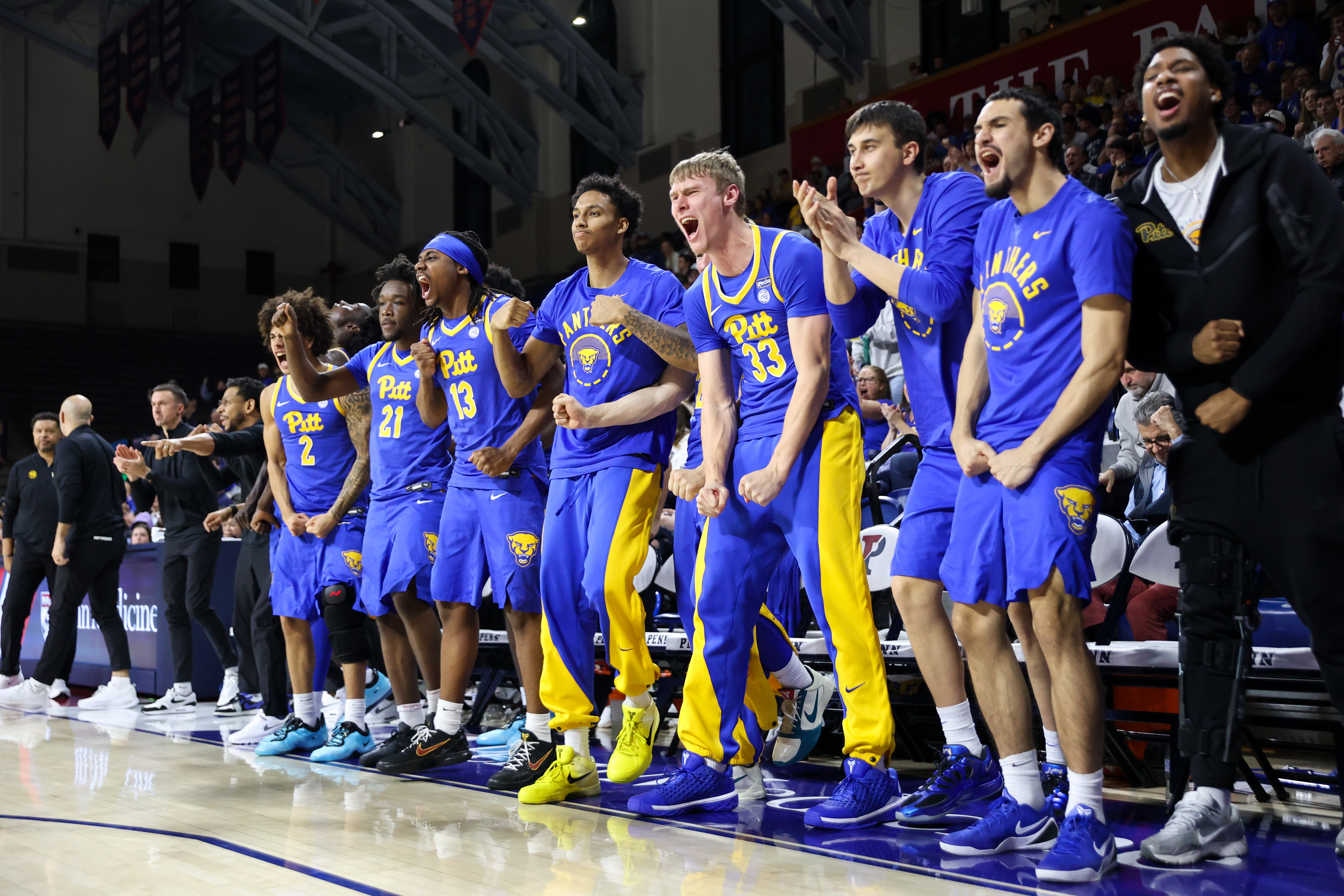
Pittsburgh’s bench reacts after a basket against Penn State on Sunday.Isaiah Vazquez / For The Inquirer
Two games were held at the Palestra on Sunday. In the 5 p.m. game, Temple was routed by Richmond, 79-53. Although the games were played back-to-back, with Penn State-Pitt tipping off at 8 p.m., Sunday was not ticketed as a doubleheader. Following the first game, fans were instructed to exit the arena or head to the box office to purchase tickets for the second matchup.
The late tipoff seemed to affect the game’s attendance. The official headcount for Penn State-Pitt was 2,178. Last season, 4,686 fans filed into the Palestra to watch the Nittany Lions face Illinois at 7 p.m. on a Saturday. Two seasons ago, Penn State played Indiana in front of 6,126 fans. That game started at noon on a Sunday.
“I wish it was a Saturday game and not a Sunday night at 8 o’clock,” Rhoades said. “I’m not in charge of that.”
The fans who did show up on Sunday were treated to a back-and-forth affair between two longtime rivals.
David Frantz, a 2010 Penn State graduate, said he would prefer his alma mater to schedule a Big Ten opponent at the Palestra, but Pitt was a “close second.”
“I lived in Philly for about four or five years now,” Frantz said. “This was the first time I was ever able to catch them at the Palestra. So knowing its history to college basketball, I’m thrilled that this is an annual tradition for the program.”
The College Football Playoff will double in size to 24 teams beginning next year, bringing an end to a three-decade era of conference title games that used to be among the marquee events of the season.
College leaders announced the new format Monday, after ESPN agreed to rework its contract to add the 11 new games. Terms were not announced, though ESPN said it was a deal for five years and additional $1.7 billion, on top of the $7.8 billion contract that runs through the 2031 season.
The revenue generated from the new games will presumably make up for the estimated $345 million the Power Four conference title games were worth. ESPN would then not be on the hook for $140 million of the extra money due to cancellation of the title games, the network reported.
The new format will have five automatic qualifiers — the champions of the Power Four leagues and the best-ranked team in the smaller Group of Six conferences — with the other 19 teams being chosen by a selection panel. Notre Dame does not receive any guarantees, the way it does this year if it’s ranked in the top 12 for what will be the last year of the 12-team postseason.
The top eight seeds will receive first-round byes in the new format and the playoff will start on the second weekend in December, with the first two rounds of games on campus. The traditional Army-Navy game will be played on the first weekend in December, which used to be reserved for conference title games.
Both the Southeastern and Big Ten conferences, whose approval was needed to adopt this change, and their Power Four brethren — the Big 12 and Atlantic Coast Conference — are banking that most of the additional spots will go to their members so some of the second-tier teams have new motivation to keep spending big in an era of NIL and $50 million football rosters.
“Opening the playoff to more programs, more student-athletes and more fan bases across the country is great for college football,” said Mississippi State president Mark Keenum, who is chair of the CFP board. “We look forward to seeing this expanded format come to life next season.”
The first final for the 24-team playoff remains set for Jan. 24, 2028, in New Orleans. Traditional bowl games will still host the quarterfinal and semifinal rounds.
As part of the expansion, the CFP is requiring Power Four teams to play at least 10 “qualifying” regular-season games against conference foes, other Power Four opponents and Notre Dame. Group of Six teams will have to play 10 games against conference opponents and a mix of G6 teams, Notre Dame and other independents.
The agreement guarantees two off weeks during a regular season that will begin the week before Labor Day.
An NFL-sized playoff changes the nature of the college regular season
The move to 24 teams marks the second expansion of the playoff since it began in 2014 as a modest four-team affair. Right after it moved to 12 in 2024, most thought it would eventually max out at 16, which was the SEC’s preference.
But the Big Ten wanted to go bigger, while the SEC balked at that, concerned about the league title game — a property it invented in 1992 and made billions from over the decades — along with the marketability of games featuring third- and fourth-place finishers in power conferences.
ESPN took care of the money problem. Now, the question is whether fans will embrace an NFL-style free-for-all that could include about one-third of the Power Four’s 68 teams, depending on what happens with the Group of Six schools, whose role in these big-money power grabs seems to diminish with every move.
It’s the latest seismic change for a sport that, for decades, built its distinct character and generated controversy by leaning on media and coaching polls to hand out national titles.
The new system won’t be a completely clean break. Critics see a risk in giving more power to a selection committee that hasn’t really mastered the four- or 12-team brackets. The exclusion of Florida State in 2023 and Notre Dame last season stand out as the best examples — and the first rankings release of this season left people scratching their heads again.
Skeptics also view the expanded playoff as another watering-down of what’s largely seen as one of the most important regular seasons in sports, replacing potential matchups between, say, Alabama and Georgia in an SEC title game with a 13 seed vs. 20 seed game that would pit, say, Kentucky and South Carolina.
But, as Big Ten commissioner Tony Petitti argued from the beginning, a postseason that gives bubble teams hope and keeps others vying for home-field advantage or byes will bring more eyes — not fewer — to the end of a regular season that sometimes boils down to only three or four traditional rivalry games with meaning. (One of those traditional games, Ohio State-Michigan, is shaping up to have zero impact on this year’s playoffs this year.)
More at-large berths also help the conferences cash in on the decision to expand their league schedules (the SEC didn’t really want to) and demand more non-league games be played among Power Four teams — all in an effort to beef up strength-of-schedule ratings that will carry weight with a selection committee.
Jack McCaffery, son of Penn coach Fran McCaffery, has been diagnosed with Hodgkin’s lymphoma.
McCaffery, a sophomore on the Richmond basketball team, is taking an indefinite leave of absence. He is receiving treatment at the Hospital of the University of Pennsylvania.
“We are grateful to the Richmond coaching staff and medical team for their prompt response, and to Kevin Mahoney and the doctors and nurses here at the Hospital of the University of Pennsylvania,” Fran McCaffery said in a statement. “He is in great hands and our family feels blessed to be here, where Jack’s care is directed by this world-class care team.”
Fran McCaffery’s second-oldest son, Patrick McCaffery, was diagnosed with thyroid cancer at 14 years old. Patrick’s cancer was treated at the Adolescent and Young Adult Cancer Program at the University of Iowa Stead Family Children’s Hospital.
Fran, who coached at Iowa at the time, later helped raise $1.25 million for the program. In 2015, he was awarded the Coaches vs. Cancer Champion Award for his fundraising work. Since taking over the Quakers, McCaffery has contributed to Philadelphia’s Coaches vs Cancer chapter.
Jack McCaffery started his collegiate career at Butler, averaging 2.8 points and 1.6 rebounds in nine games played in 2025-26 before his season ended in December due to what his Richmond bio described as “an illness and complications from having his wisdom teeth removed.”
McCaffery received a medical redshirt before transferring to play for Archbishop Ryan and Princeton graduate Chris Mooney at Richmond this season.
Roster continuity is hard to find in college athletics, but for St. Joseph’s women’s basketball, that’s never really been a problem.
However, bringing in some reinforcements doesn’t hurt.
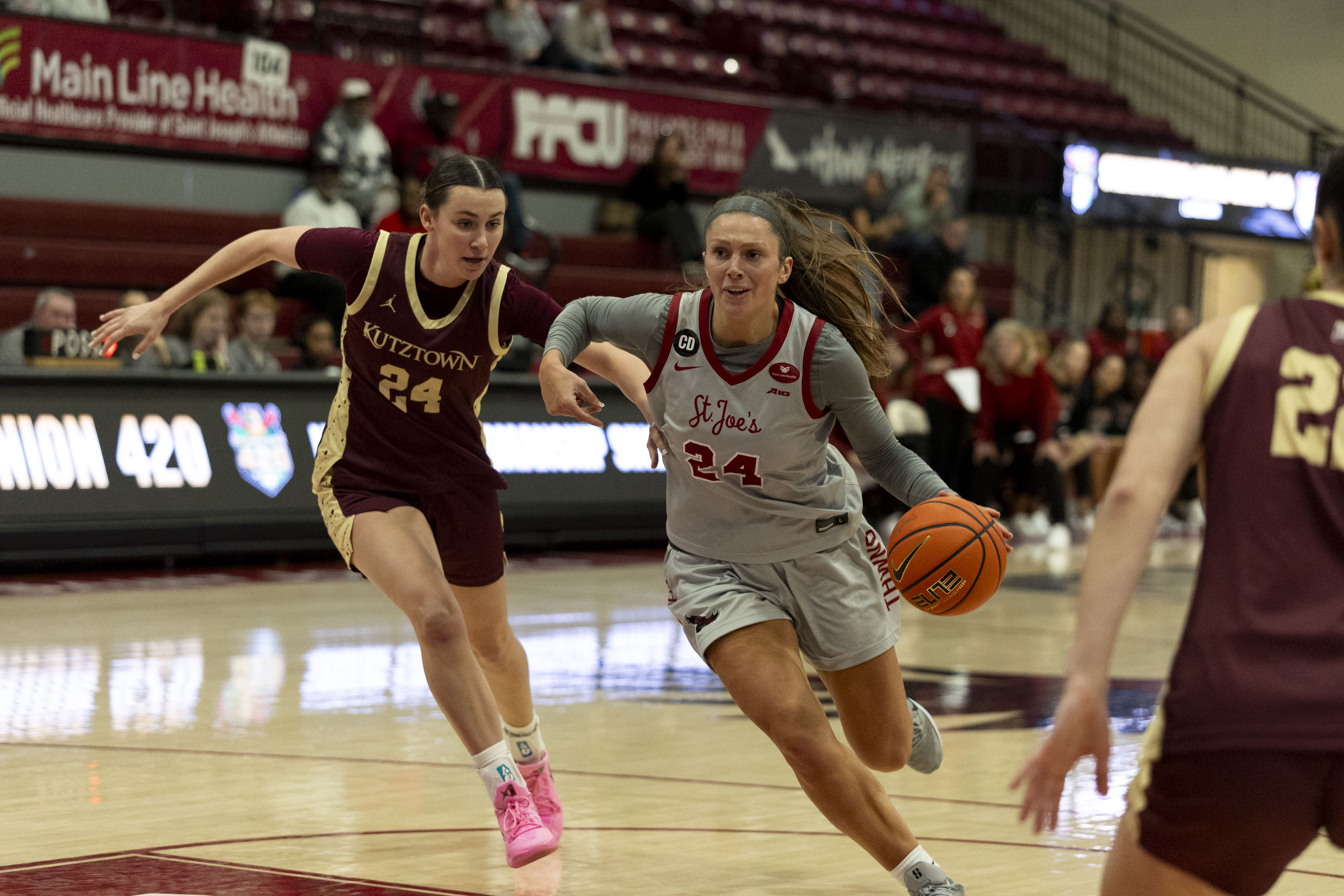
With a mixed effort from returning veterans and new faces, St. Joe’s routed Kutztown, 95-27, in its season opener at Hagan Arena on Saturday.
Transfer Deja Evans scored 16 points in her Hawks debut, all in the first half. The senior forward shot a perfect 8-for-8 from the field.
The Hawks, the unanimous preseason favorites to finish first in the Atlantic 10, returned 10 players from last year’s roster, including eight of their nine top scorers.
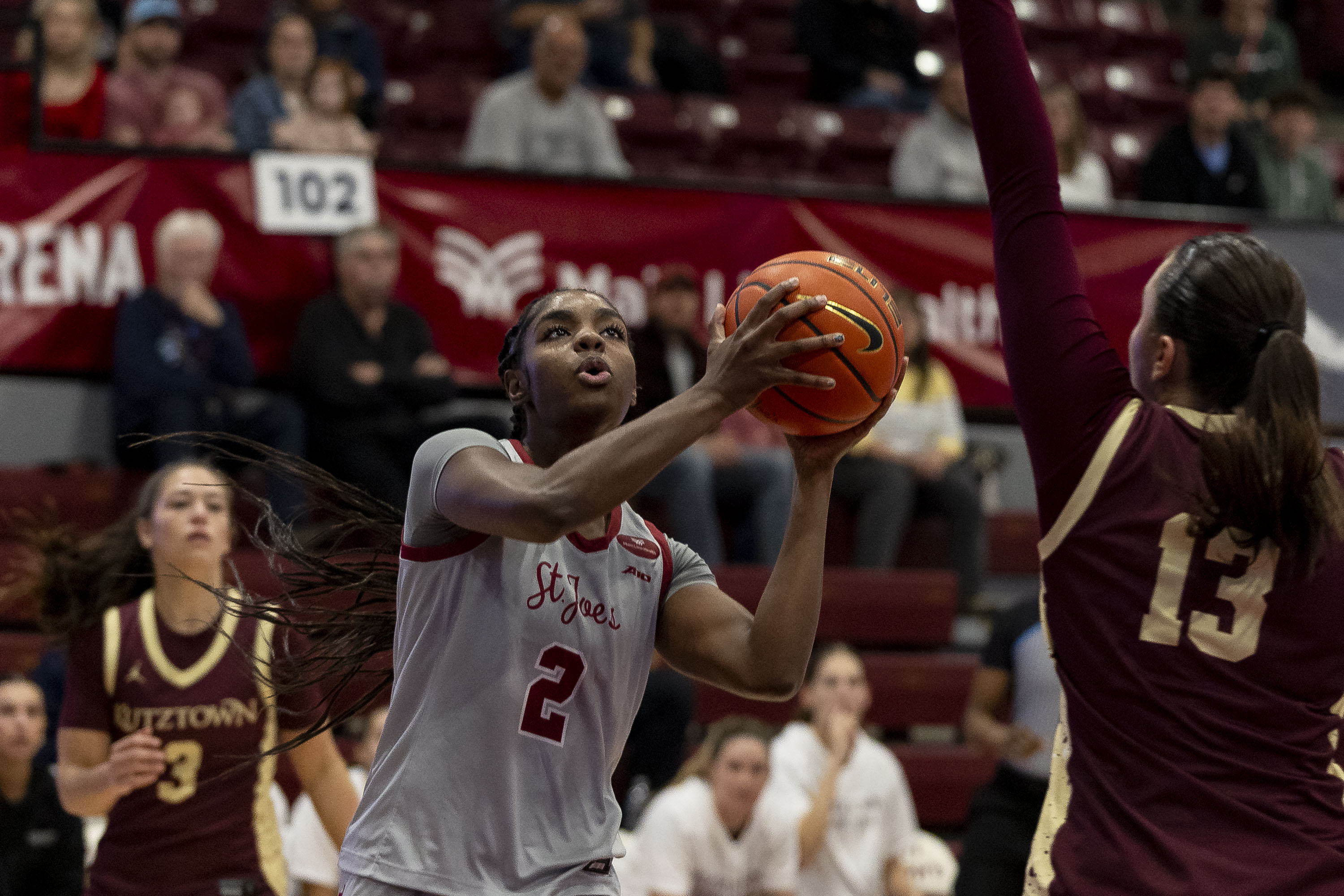
Among the returners were seniors Gabby Casey (game-high 19 points and six steals), and Aleah Snead (eight points).
Head coach Cindy Griffin said the addition of Evans and junior transfer Maddy Potts has worked well for the Hawks because of the maturity that they bring.
Saint Joseph’s Aleah Snead goes up for a shot against Kutztown University on Saturday.Tyger Williams / Staff Photographer
“You have that going for you, plus, you also have the continuity of the group that was already here,” Griffin said. “So I don’t think we really missed the beat.”
Evans, a Conshohocken native, had familiarity with St. Joe’s. The Archbishop Wood alumna spent her freshman season at Albany, before transferring to another Big 5 school, Drexel, for her sophomore and junior seaons. She faced the Hawks twice with the Dragons.
Evans said it made for an “amazing transfer process,” which allowed her to learn the plays and be “aggressive on the court” right away.
“It’s definitely helped me understand a lot,” Evans said. “Just knowing the girls, they’ve made it easier for me. Being able to go talk to them, Aleah and Gabby, they’re leaders for me as well, even though we’re in the same grade. But they’re definitely big leaders on the court.”
Evans and the other starters were pulled in the third quarter when the Hawks were up by over 40 points, giving the younger players a chance to play.
Among them was Jahzara Green, a freshman forward from Gloucester Catholic, who scored nine points in 18 minutes. She also contributed eight rebounds for St. Joe’s, making “an impact right away,” Griffin said.
“She’s again another spark off the bench,” Griffin said. “She’s aggressive. She’s assertive. She’s strong. She rebounds. Great communicator. So really pleased.”
The Hawks finished with 21 assists on 38 field goals and had 18 steals. Still, as the Hawks hit the road for their next game against Cincinnati, Griffin said she wants them to focus on being a great road team as well as at home. That comes with staying focused and getting the right shots, something she wants to see her team improve.
“We got some really great shots, but sometimes maybe we rushed it a little bit,” Griffin said. “I think we got a little bit ahead of ourselves sometimes, but that that’s going to come. I thought we did a nice job taking care of the ball, but, I think the continuity of continuing to share the ball and see the open person.”
Up next…
The Hawks’ first road trip will be to face the Cincinnati Bearcats on Wednesday (6:30 p.m., ESPN+).
ANNAPOLIS, Md. — Temple rallied from a 28-point deficit against Navy, but it wouldn’t be enough, as the Owls found themselves on the losing end of a 42-35 final at Navy-Marine Corps Memorial Stadium.
In the fourth quarter, Temple (2-7, 1-4 American) trailed by just seven points, but Jackson Gutierrez, Navy’s (3-6, 2-4) versatile quarterback, who rushed for five touchdowns and threw for one, put the nail in the proverbial coffin with a minute remaining.
“Digging yourself out of a hole is more about execution than anything else,” said coach K.C. Keeler after the loss. “We battled; they’re starting to understand the concept of playing just one snap at a time… so disappointed for the kids because that was an amazing comeback.”
Gutierrez was the focus entering Week 9. He ranked No. 4 in the nation with 13 rushing touchdowns.
The Owls gave him a helping hand to start. Temple received the kickoff, but Avery Powell muffed the return for Gage Leonard to bring it to Temple’s 23-yard line. Gutierrez finished the job six plays later with a one yard rush, capitalizing on Navy’s first fumble recovery of the season.
Owls quarterback Jaxon Smolik was sacked on third down on Temple’s ifirst full drive. Navy would capitalize after Jordan Collins caught a 63-yard bomb from Gutierrez, leaving Temple’s secondary in the dust. Gutierrez slowly brought it home with another 1-yard run.
Smolik threw for 131 yards in the second half after just 42 in the first. He found Jojo Bermudez once and Jayce Freeman twice in the game’s final 30 minutes.
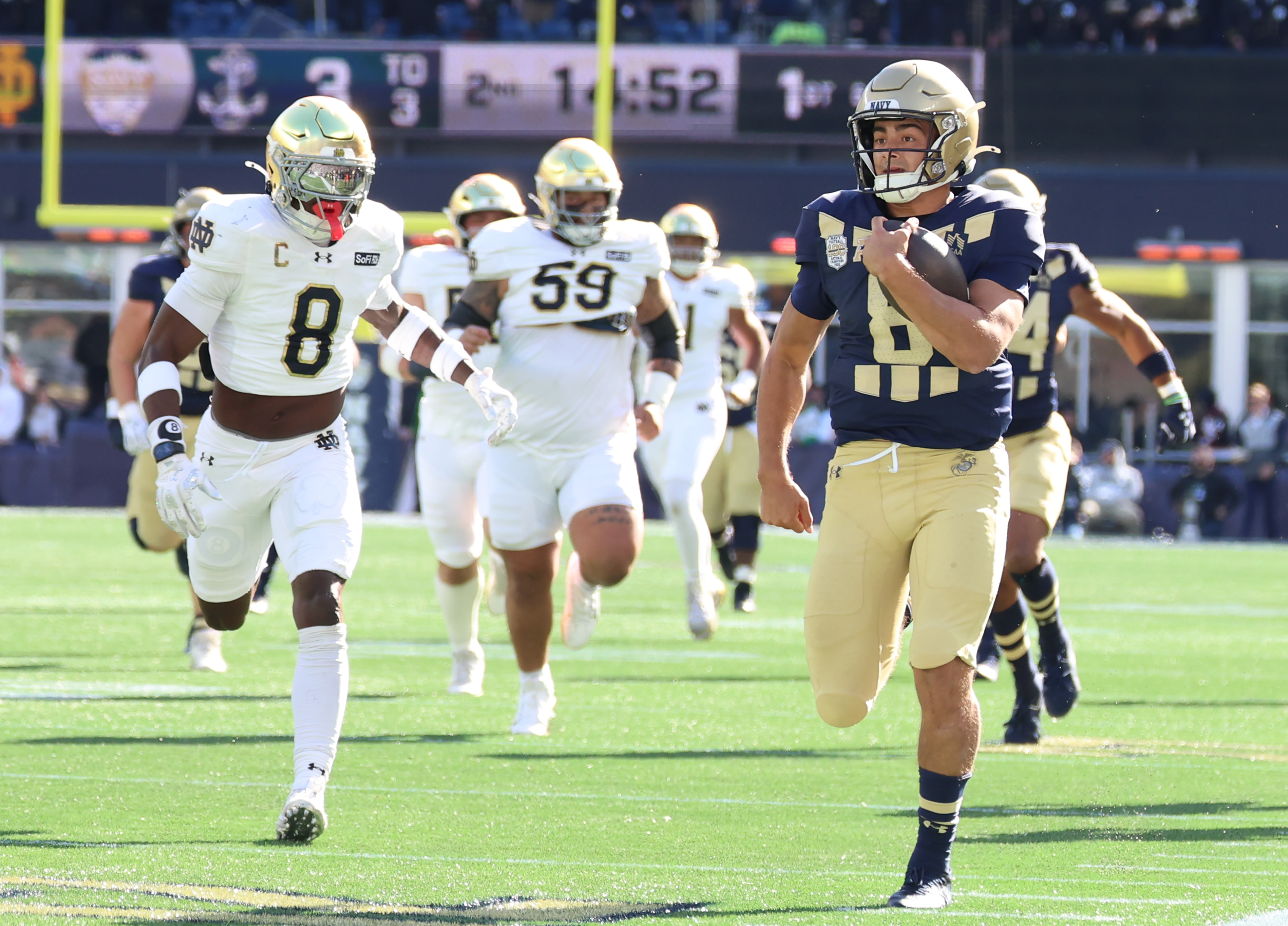
Navy quarterback Jackson Gutierrez, right, seen here in action against Notre Dame, rushed for five TDs in a win over Temple on Saturday. Mark Stockwell
Gutierrez added three more rushing touchdowns and floated a 49-yard touchdown pass to Collins. Gutierrez totaled 358 all-purpose yards and Smolik threw three touchdowns on a 46% completion rate.
“I need to start faster,” Smolik said. “Football is start fast, finish strong, and I need to start a lot faster and be more comfortable.”
Rushing takeover
Temple has built its reputation on rushing. Navy easily outpaced it with running back Michael Barrow’s help.
The Owls’ defense couldn’t contain his sweeps across the scrimmage line, halfback tosses, or his blockers. Barrow stuck to the Midshipmen’s slow and methodical approach on carries, but he still threw together multiple big plays.
One of his second quarter carries broke Temple’s lid.
At its 23-yard line, Temple forced Navy to kick a field goal on fourth-and-6. But linebacker Curly Ordonez was flagged five yards, allowing Navy to go for it. Barrow rushed 12 yards which led to Gutierrez’s third touchdown.
Owls’ revival
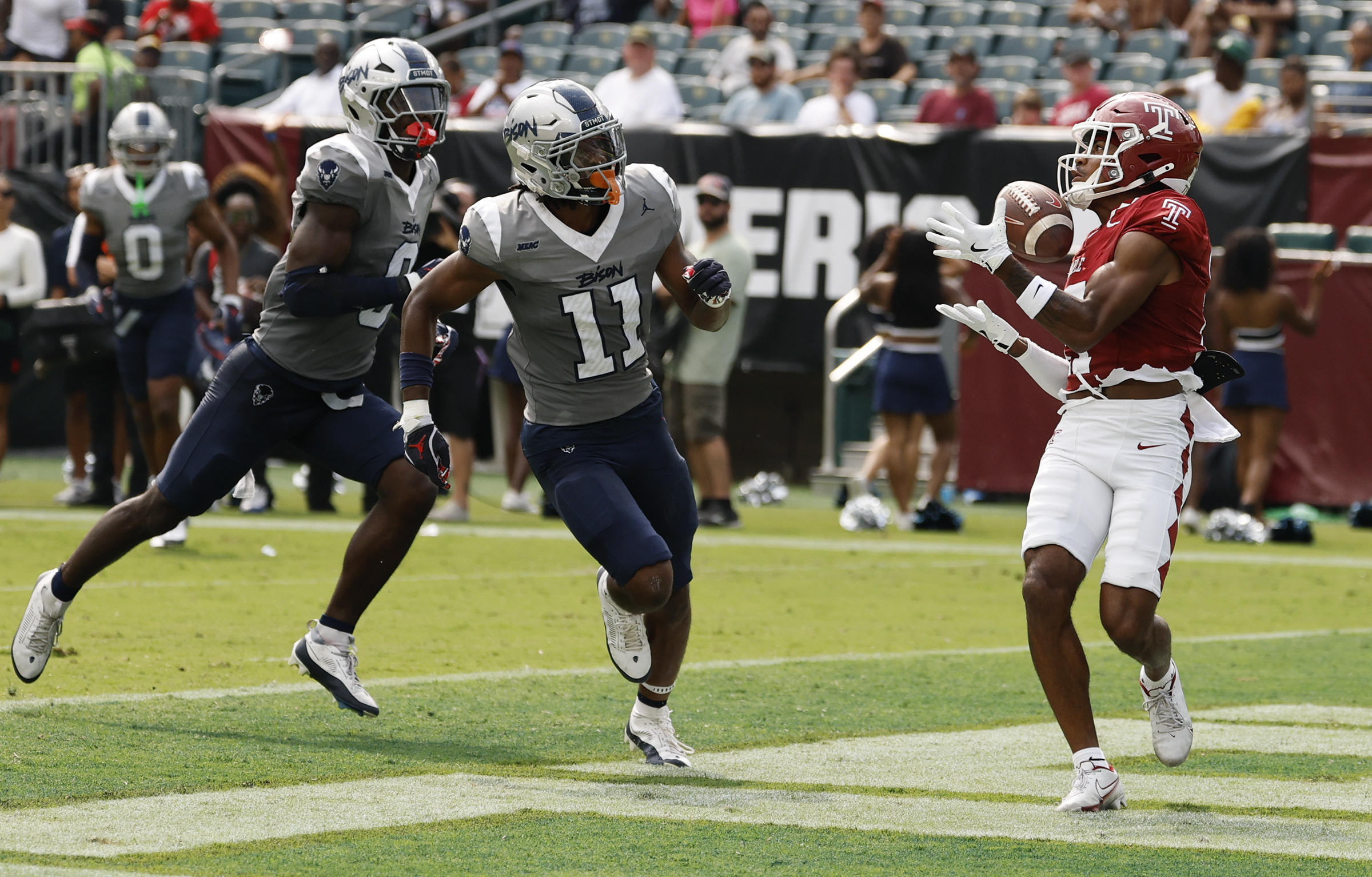
Temple was almost blanked in the first 30 minutes until wide receiver Jojo Bermudez received a punt, and with 10 seconds left, he dashed past 11 guys for a 78-yard return and touchdown.
“Jojo Bermudez put us on his shoulders,” Keeler said. “That play he made at the end of the half, you could just feel the energy in the locker room. Like, we were gonna come out and get this thing done.”
His next score took two seconds less. Smolik connected with Bermudez at Navy’s 43-yard line, who split the defense before trimming the deficit to 14.