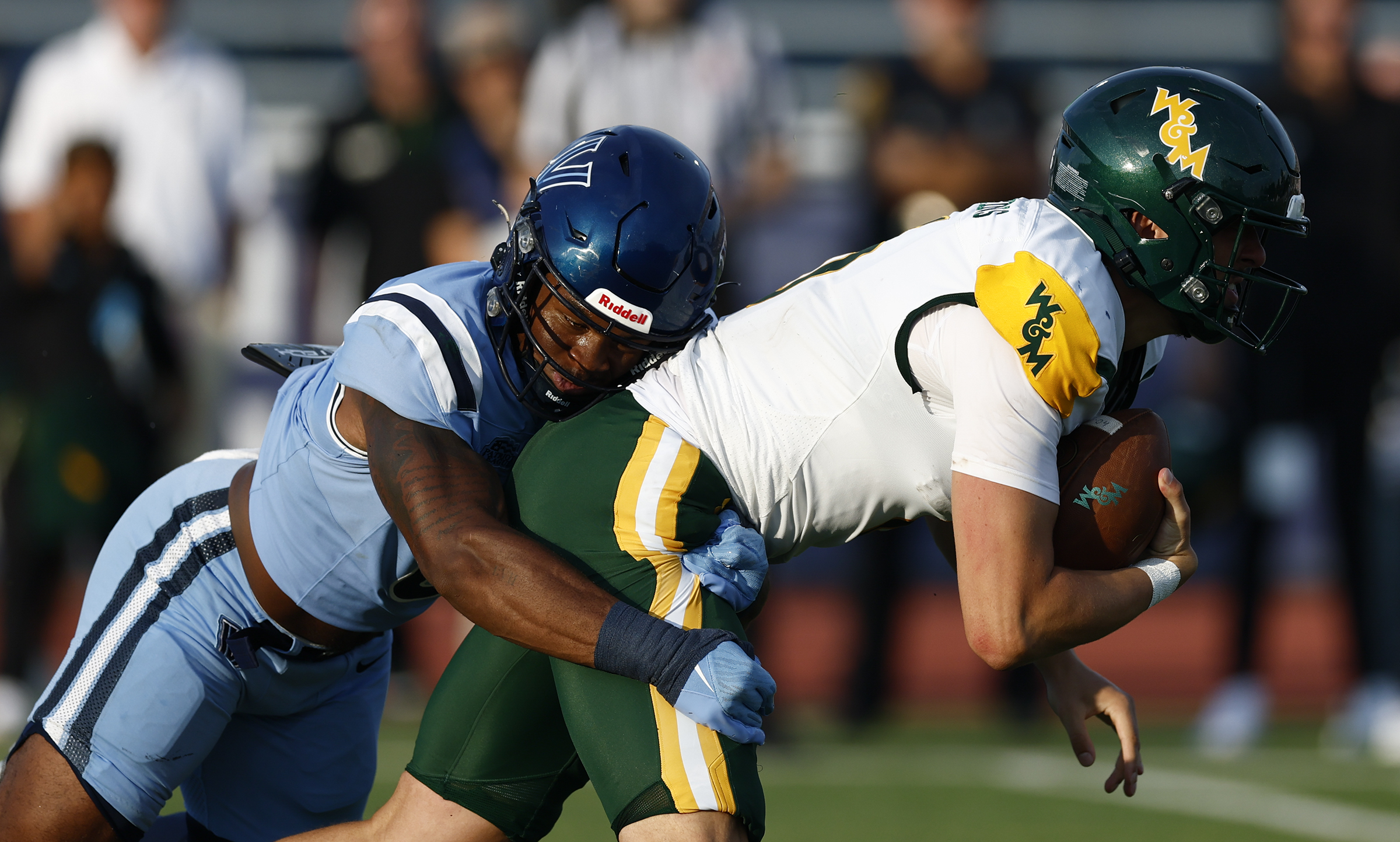
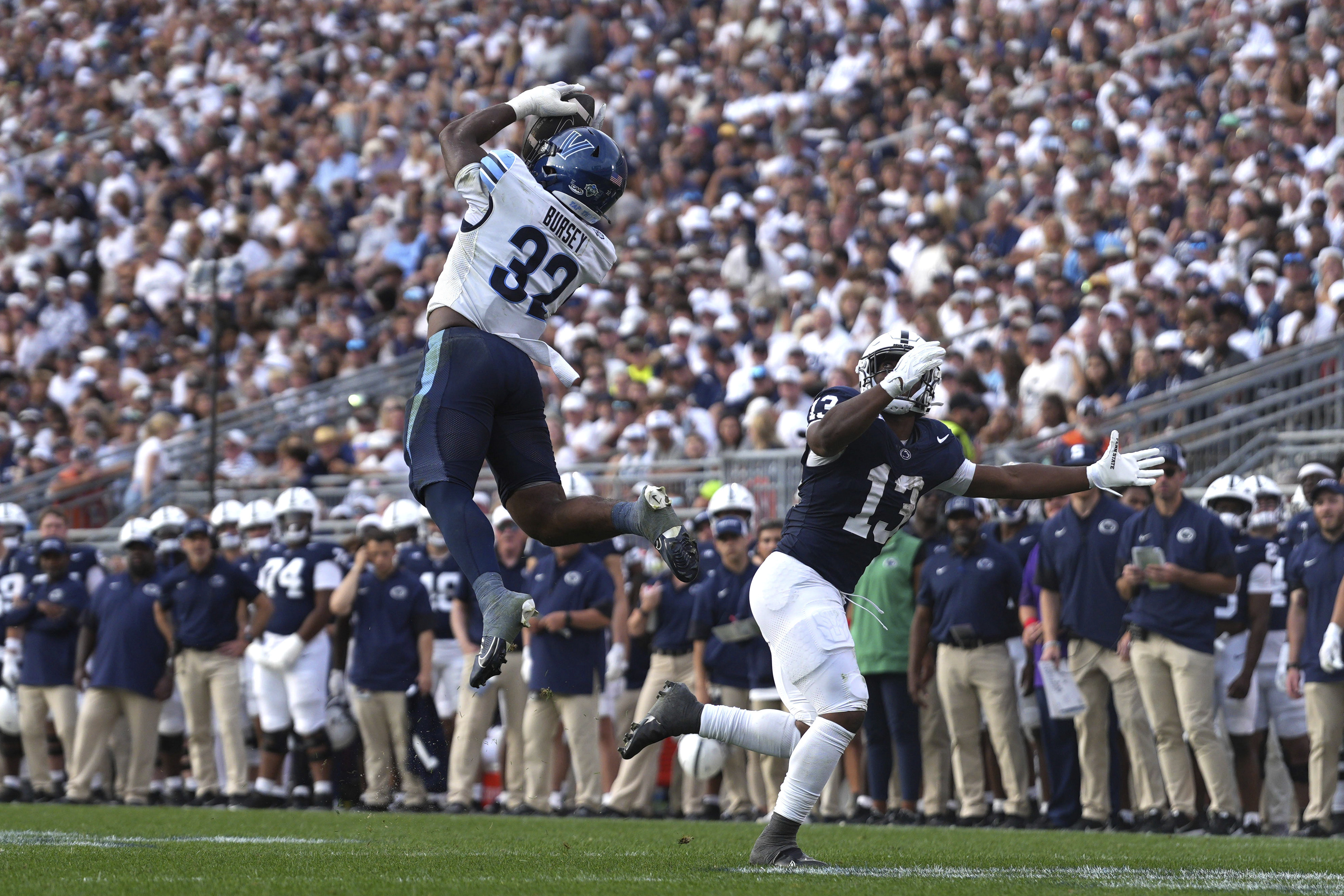
The Villanova linebacker got his first extended snaps defensively during the 2025 season against Colgate and then Penn State the following Saturday. It was a long, “painful” week for Bursey, who quickly learned the stark difference between high school and collegiate football. Despite intercepting Penn State’s Drew Allar, now of the Pittsburgh Steelers, Bursey knew he was not prepared to the level he wanted or needed to be.
Since then, the Villanova redshirt sophomore linebacker has spent countless hours in the film room, and it has earned him the responsibility of wearing the green dot on his helmet, which grants him the ability to communicate with the coaches on the sideline and in the press box on behalf of the defense. Through four games, Bursey ranks 13th in the FCS in total tackles with 42 and he was named the division’s Defensive Player of the Week after recording 14 tackles (eight solo) in Villanova’s Sept. 5 win over Bucknell.
Bursey certainly has come a long way since being thrown into the fire against this weekend’s opponent, Colgate, two seasons ago.
“I don’t ever want to be unprepared,” Bursey said. “So that fear of walking out on Saturday and being unprepared, whether it’s film study, little walk-throughs here and there, even not knowing our scheme, that’s my biggest fear. So me going out there 100% confident starts not just with field work, but understanding what they do, but more importantly, what we do on defense.”
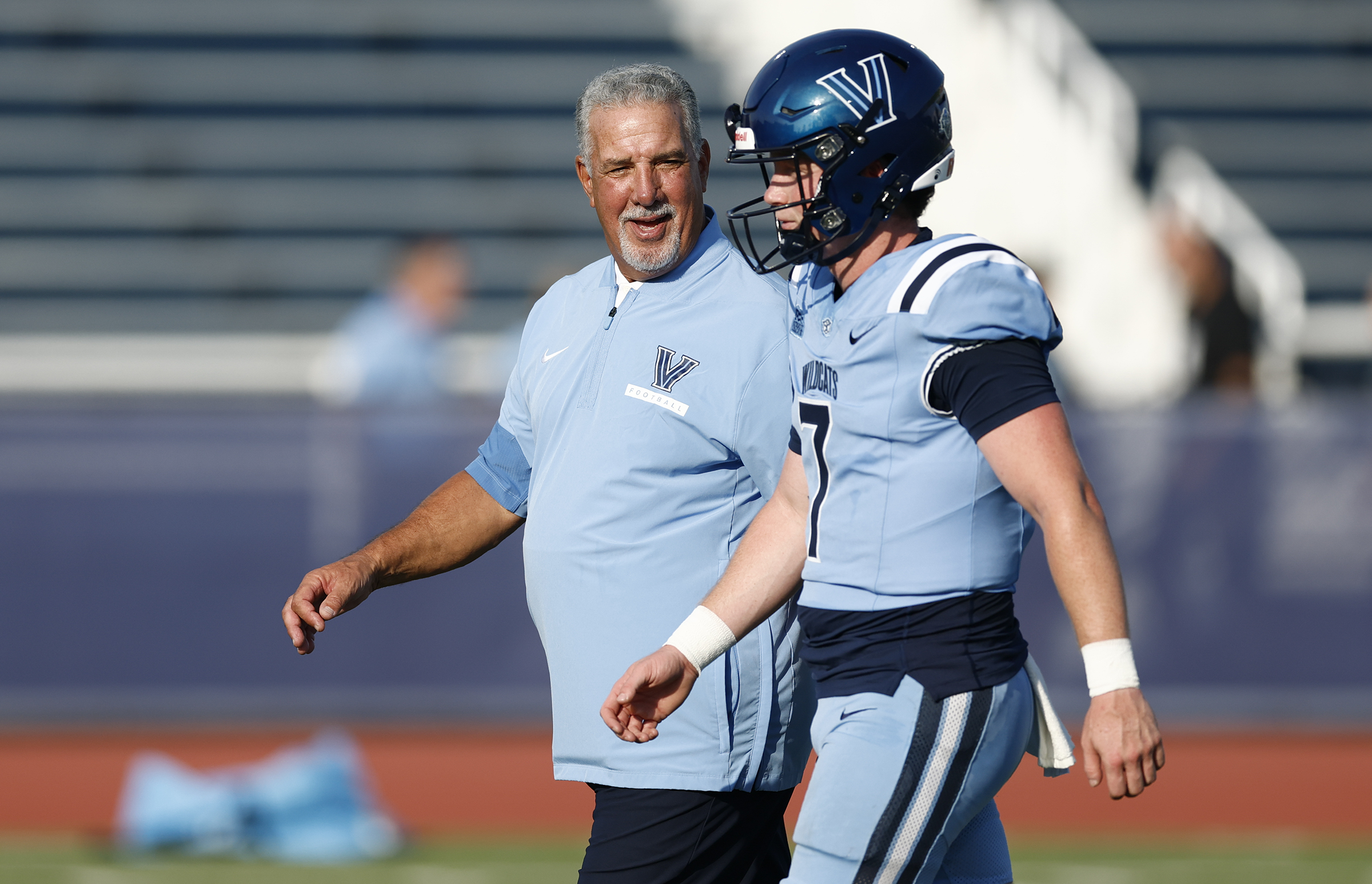
Villanova head coach Mark Ferrante noted after last year’s 52-6 loss to Penn State that Bursey was good enough to play defensive snaps as a freshman in 2024 if not for the team’s immense talent and depth at the position. Villanova linebacker coach Forrest Rhyne, a decorated former Wildcat linebacker himself, agreed with Ferrante’s assessment.
“He’s a guy that came in and was sitting behind really two All-American players, Brendan Bell and Shane Hartzell,” Rhyne said. … “We feel like we have a great tradition of linebacker play here at Villanova, so to come in as a freshman and to feel like you’re in a position ready to play, it’s definitely special. He’s got a super strong build, really fast, everything that you want your linebacker to be, but the thing that separates him is his intelligence.”
Omari Bursey’s first big play with Villanova came last September when he picked off Penn State’s Drew Allar.Kayla Padilla
Ferrante noted that Rhyne spent more time watching film than a lot of the staff when he was a player from 2017-21. Since returning to the program as a coach, Rhyne’s habits are transferring to the program’s current stable of linebackers, including Bursey.
“I think [Rhyne] definitely delivers the message to his guys about the importance of film study,” Ferrante told The Inquirerleading into the Louisville game. “Omari’s one of the guys that definitely listens. … But he definitely spends time in the football library as well. Some do it more than others, and when you see the ones that are doing it, it’s no surprise that they’re also some of the guys that are playing better on Saturday.”
Bursey is currently pursuing a degree through the Villanova School of Business, and a good business program was a priorrity when he was looking at colleges. Villanova entered late in the recruiting process and did not offer Bursey until after his senior year of high school football.
The Wildcats’ offer came almost seven months after Ivy League schools like the University of Pennsylvania and Yale offered Bursey scholarships. But eventually, the Colorado native was swayed to the Main Line after a visit from Ferrante and defensive coordinator Ross Pennypacker.
The linebacker has played 19 games, made 92 tackles, and logged 3½ sacks since he stepped onto the field against Colgate as a redshirt freshman. But this weekend’s game represents more than just a redemption opportunity for Bursey. It is a team-wide effort to claim a first home win since November and climb above the .500 mark for the first time this season.
“Yeah, I think one thing we talked about is we’re winless on this field in nine months,” Bursey said. “So it’s just, how can we get back to our basics? Go back to work, put our heads down, and just find a way to win this weekend. And it’s a league game, so it’s always going to be tough. But we’ve got a brand to protect.”
One thing is for sure: Come Saturday, Bursey will be prepared.
It could be a Patriot League team, a nonconference opponent, or an FBS school, the mentality doesn’t change for Villanova coach Mark Ferrante: “The schedule is the schedule.”
The Wildcats have played two conference games, losing to William & Mary and defeating Bucknell, and two nonconference games, a 59-13 loss to Louisville and a 20-16 win over Long Island on Saturday.
“The nonconference is the nonconference, the in-conference is the in-conference, our approach always has been [the same],” Ferrante said. “We’re going to play who’s on our schedule [and] it shouldn’t matter. You only get so many guaranteed opportunities. You want to try to create more opportunities for yourself at the end of the year, but you better be where your feet are.”
After facing Colgate (3-1, 2-0 Patriot League) at home on Saturday (2:30 p.m., ESPN+), a final nonconference matchup against Morgan State awaits on Oct. 3.
Ferrante is happy the Wildcats are finding ways to win close games with one-score wins over Bucknell and LIU, but he said there is work to be done to play a complete 60 minutes.
“It’s just more consistency,” Ferrante said. “We get great field position, let’s score the touchdown instead of having a turnover. Just got to start feeding off each other a little better, play more complementary football. I hope it’s still a work in progress, and I hope it’s starting to come, but we have not played a full, consistent four quarters yet in any game.”
Villanova also started 2-2 last season before reeling off 11 straight wins and reaching the FCS semifinals.
Even with retaining a majority of the 2025 squad, Villanova is still finding its identity.
“I think they’re starting to realize that they’re not last year’s team,” Ferrante said. “Teams aren’t going to just roll over because Villanova’s coming to town. Teams are going to play harder because Villanova’s coming to town, so we just have to play our game, not play to the level of our opponent.”
Sophomore wide receiver Brandon Binkowski leads Villanova with 259 yards receiving.Yong Kim / Staff Photographer
Penalties have plagued Villanova. The Wildcats have been called for 36 penalties for 305 yards while their opponents have been flagged for 22 penalties for 230 yards.
“We just got to play a little smarter, with a little more focus,” Ferrante said. “Especially the false starts or the offside on offense and defense, respectively. That’s just focus, those are mental penalties [so] we got to clean that up.”
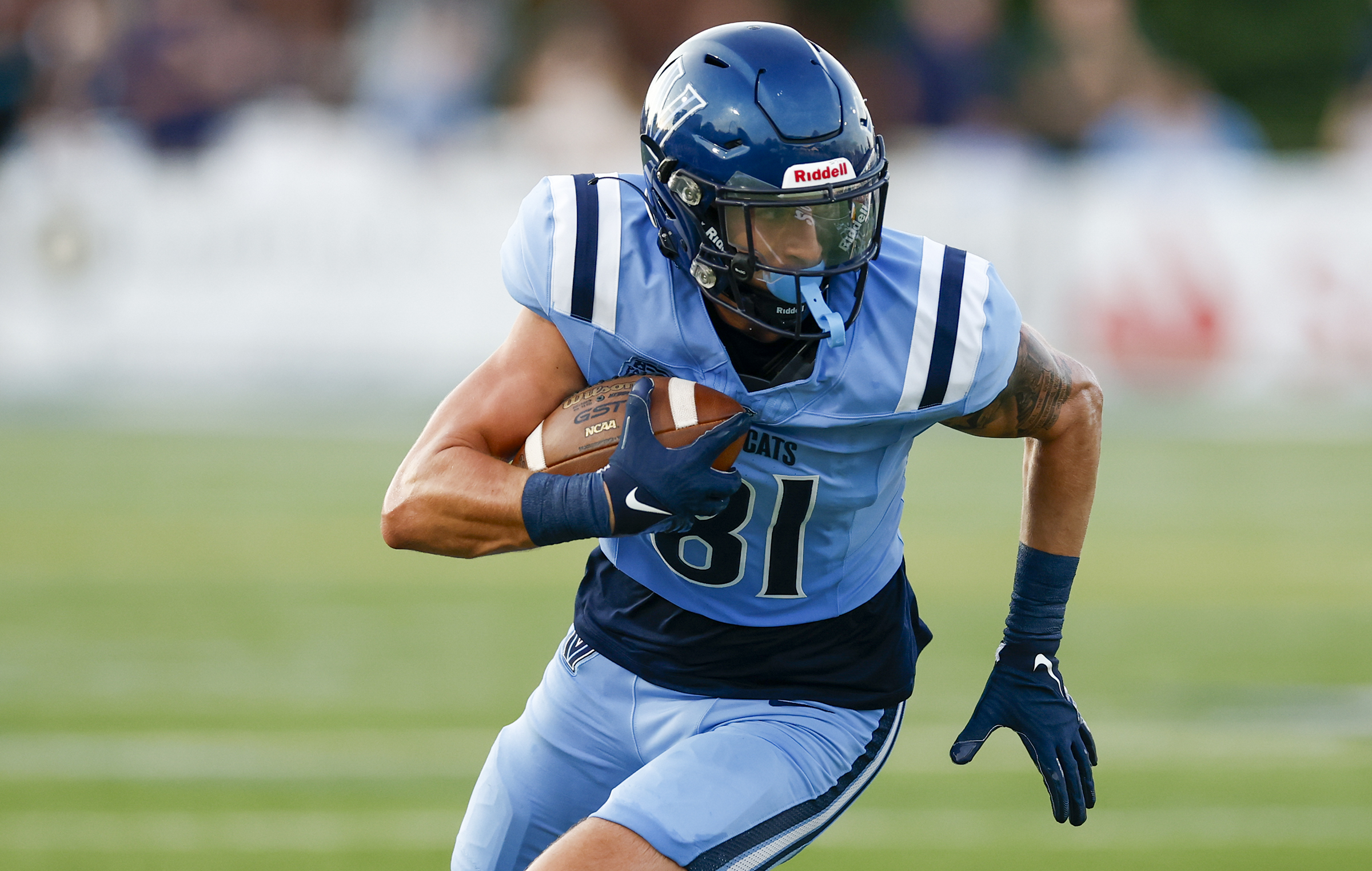
After a rough start against William & Mary, quarterback Pat McQuaide has bounced back with 607 yards passing, four touchdowns, and one interception over the past three games. Sophomore wide receiver Brandon Binkowski is having a breakout season with 18 receptions for 259 yards, while junior running backs Ja’briel Mace and Isaiah Ragland have combined for 457 rushing yards and four touchdowns.
Ferrante believes cleaner football is on the way.
“It’s just little inconsistencies here and there, whether it’s penalties, whether it’s turnovers, whether it’s just not playing with the same level of intensity from one quarter to the next,” Ferrante said. “But you see the improvement in practice and you hear some of the comments that are being made amongst themselves in practice. I think we’re heading in the right direction, we just got to put it on a field on game day.”
Joe Mihalich loves coffee. Dunkin’, specifically. For years, it has been part of his morning routine: picking up a large decaf, hot, with cream, en route to a basketball arena.
Employees at his home Dunkin’, in Mt. Airy, call him by name (“Mr. Joe”). One server, in Flourtown, gave him a black beanie hat with the company’s logo stitched in, as a modest token of appreciation.
Mihalich would usually order ahead on the app, but sometimes, he’d go to the counter, and stick around for refills. He’d often do this before heading to the gym at Hofstra, where he once worked as a head coach.
It was a simple task that gave him joy. Until it wasn’t.
On Aug. 15,2020, the former La Salle point guard was standing in his Long Island driveway, when he suffered a hemorrhagic stroke in his brain.
He underwent an emergency craniectomy; a surgery in which part of the skull is removed to relieve pressure. He came home in a wheelchair, wearing a helmet, unable to say anything but “yes” or “no.”
Mihalich was 64 years old and leading a Hofstra team that had won back-to-back CAA titles. He was on pace for 600 career wins, with likely a decade of basketball ahead. In an instant, that trajectory ceased. How can you coach if you can’t talk? If your right hand is no longer able to draw up plays?
Joe Mihalich was robbed of his voice while coaching at Hofstra… if only temporarily. Nick Wass
Every routine, big and small, was disrupted. Instead of going to practice, Mihalich went to speech, physical, and occupational therapy. Those daily trips to Dunkin’ became infrequent; he couldn’t drive himself, or dictate what he wanted to drink.
Compounding this was the fact that the stroke didn’t affect his cognition. Mihalich was as sharp as he was before. He could still draw up schemes in his mind. He still preferred zone defense over man, and a four-out, one-in offense over three-out, two-in.
He just couldn’t say it. Doctors expressed skepticism that the coach would ever walk or talk at length again. The likelihood of him returning to even a modicum of independence was slim.
But Mihalich decided to throw himself into the challenge, as if he were preparing for a big game. He started working with a speech language pathologist twice a week.
He took his physical therapy seriously, so much so that he was able to go from a wheelchair to a walker, and from a walker to unassisted walking in just over a month.
He gradually began to visit his old haunts. The coach can still remember the day he went back to Dunkin’. It was 2021, in the Garden City location on 7th Street.
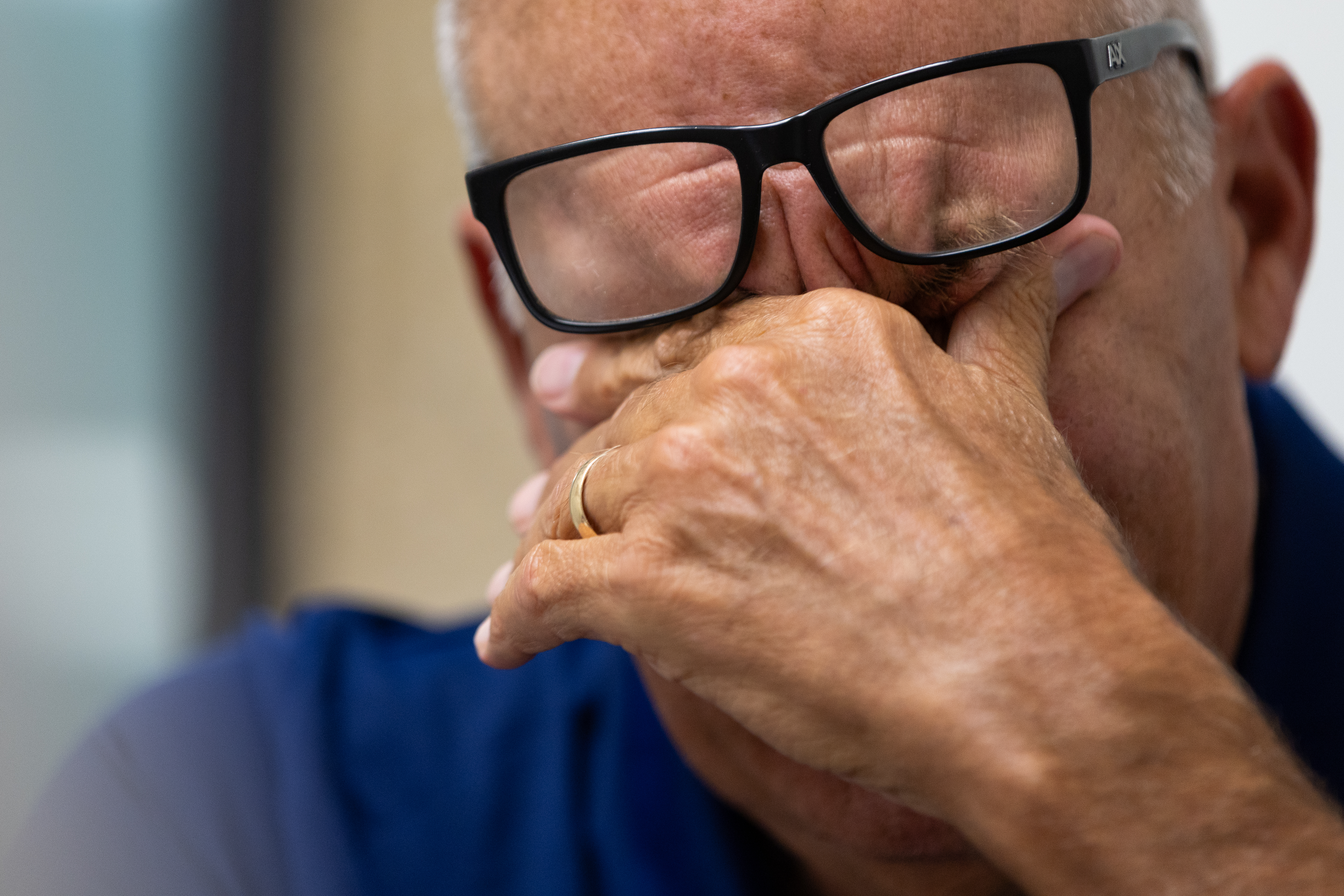
Joe Mihalich cries as he recalls his wife and family’s support for his recovery, in a conversation with The Inquirer last month. Isaiah Vazquez / For The Inquirer
Mihalich walked up to the counter with trepidation. What if the attendant couldn’t understand him? What if he was holding up a line? To prepare, he memorized five words that deep down, he knew by heart: “Large decaf, hot, with cream.”
“I had to repeat it twice,” Mihalich said, “but it was OK.”
In 2021, after taking a medical leave, he returned to Hofstra as a special adviser to the athletic director so the basketball program could transition to Mihalich’s assistant, ex-Sixer Speedy Claxton.
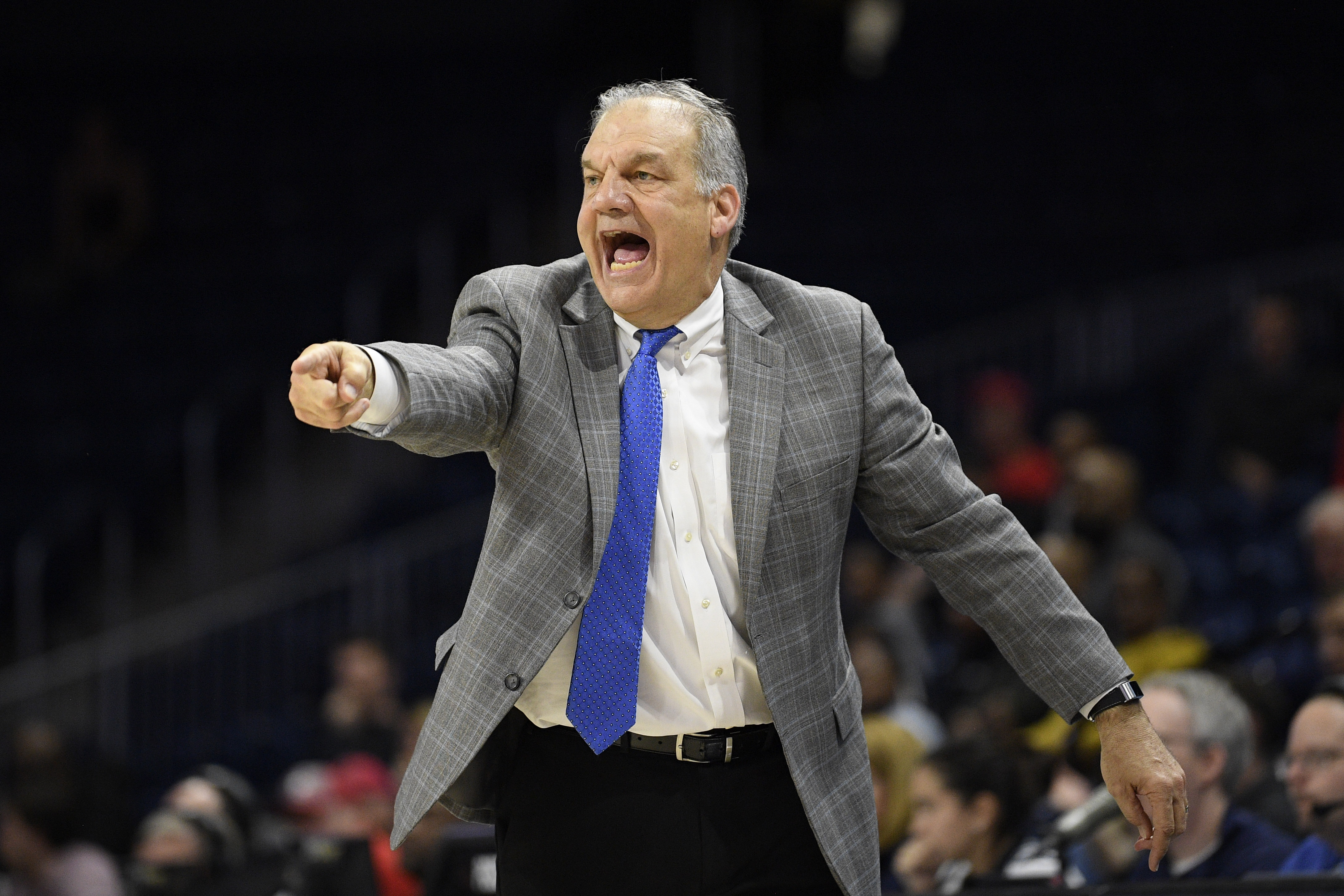
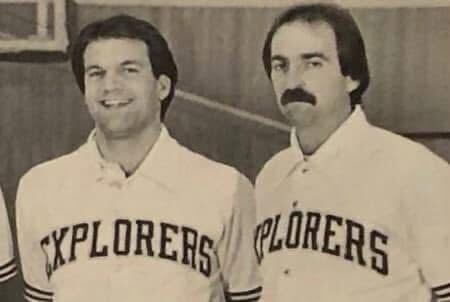
In 2022, La Salle offered Fran Dunphy its head coaching job. He said he wouldn’t take it without Mihalich, a lifelong friend and former Explorers player with whom Dunphy had worked when both were assistant coaches in the 1980s.
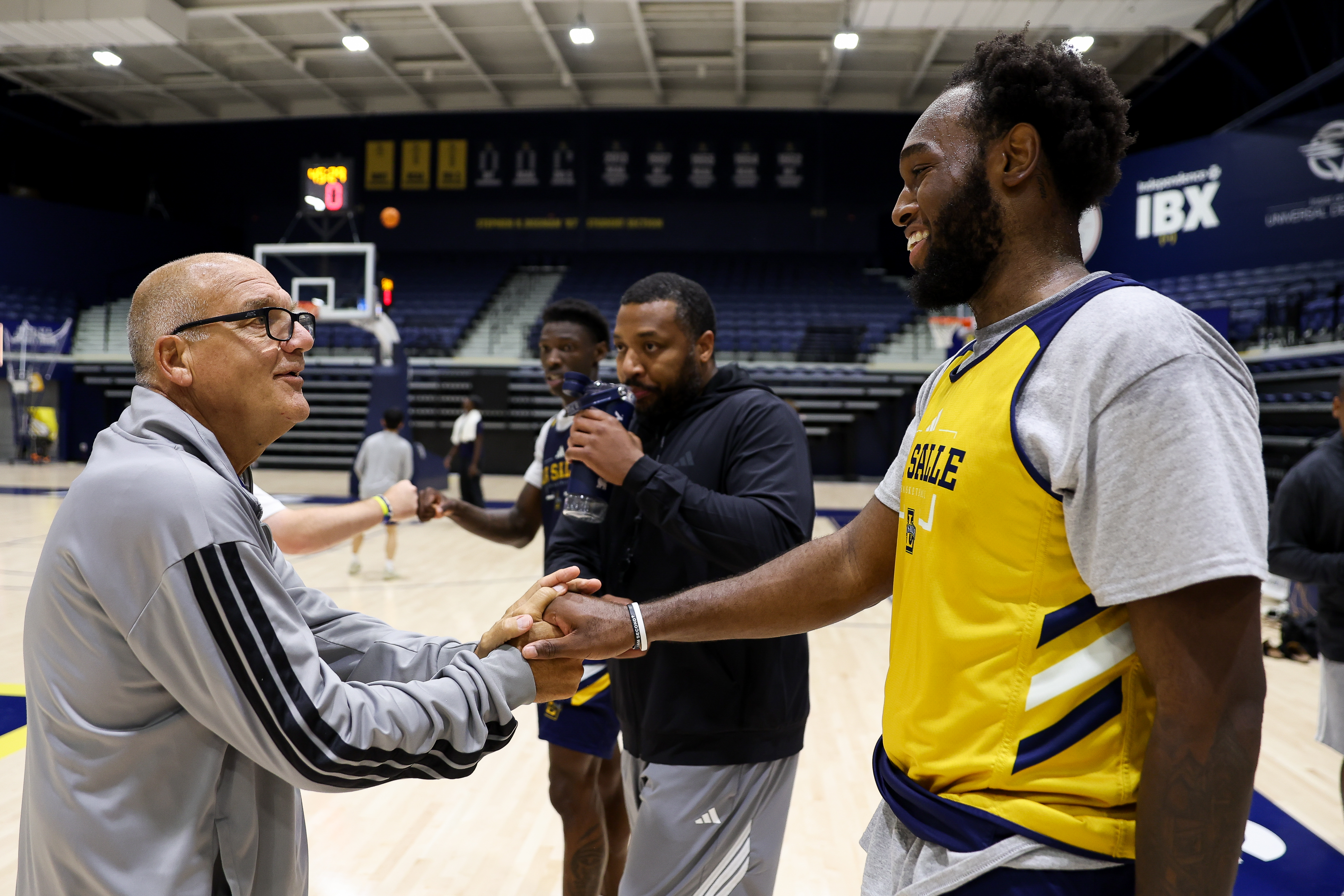
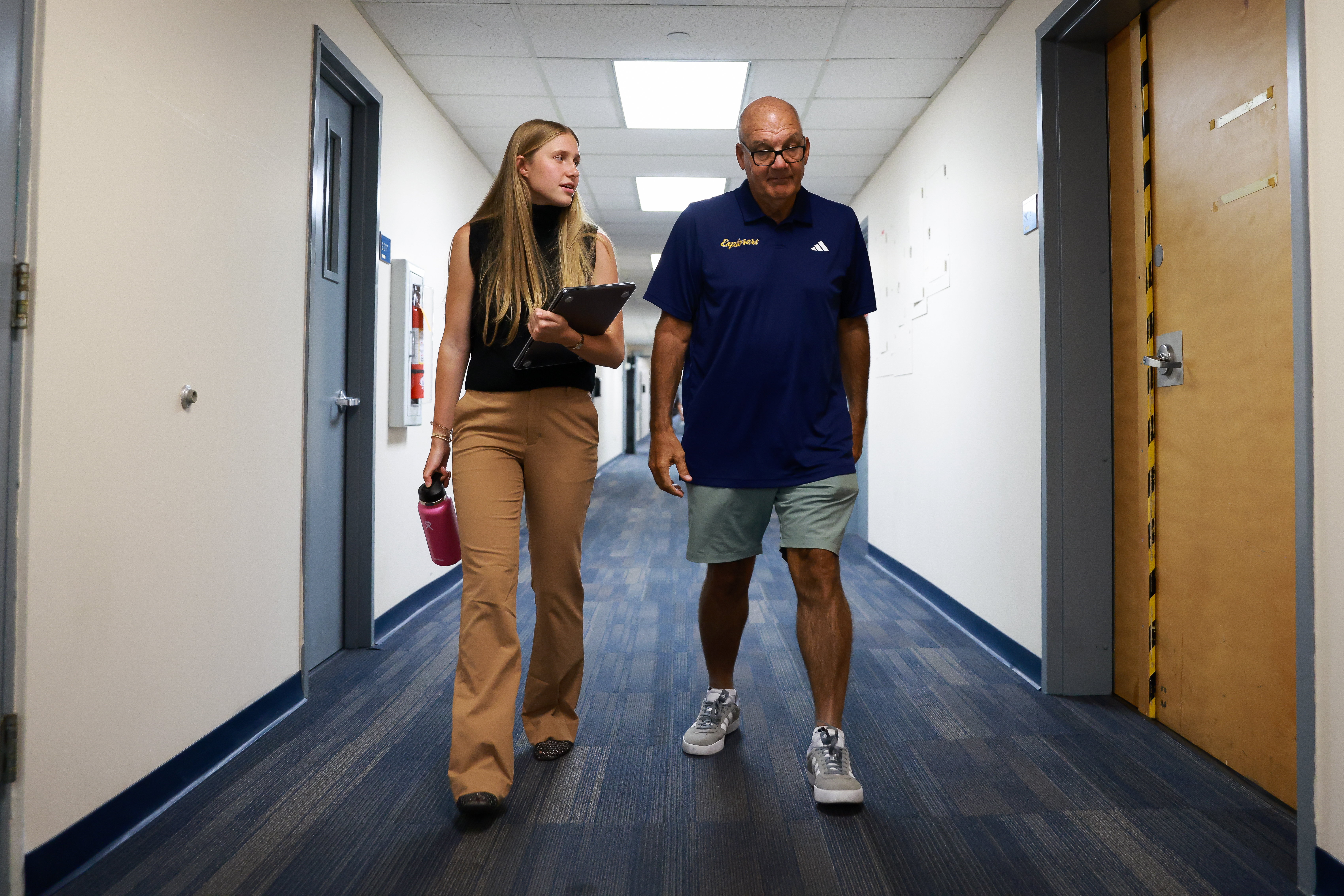
Mihalich has been with the university since Dunphy brought him aboard. He’s at all of La Salle’s home games and practices, doesn’t skip a coaches’ meeting, and is always unafraid to share his thoughts.
After his day is done, typically around 6 p.m., Mihalich heads to theschool’s speech therapy clinic. Those who’ve worked with him say the progress he’s made is rare, given the severity of his brain injury.
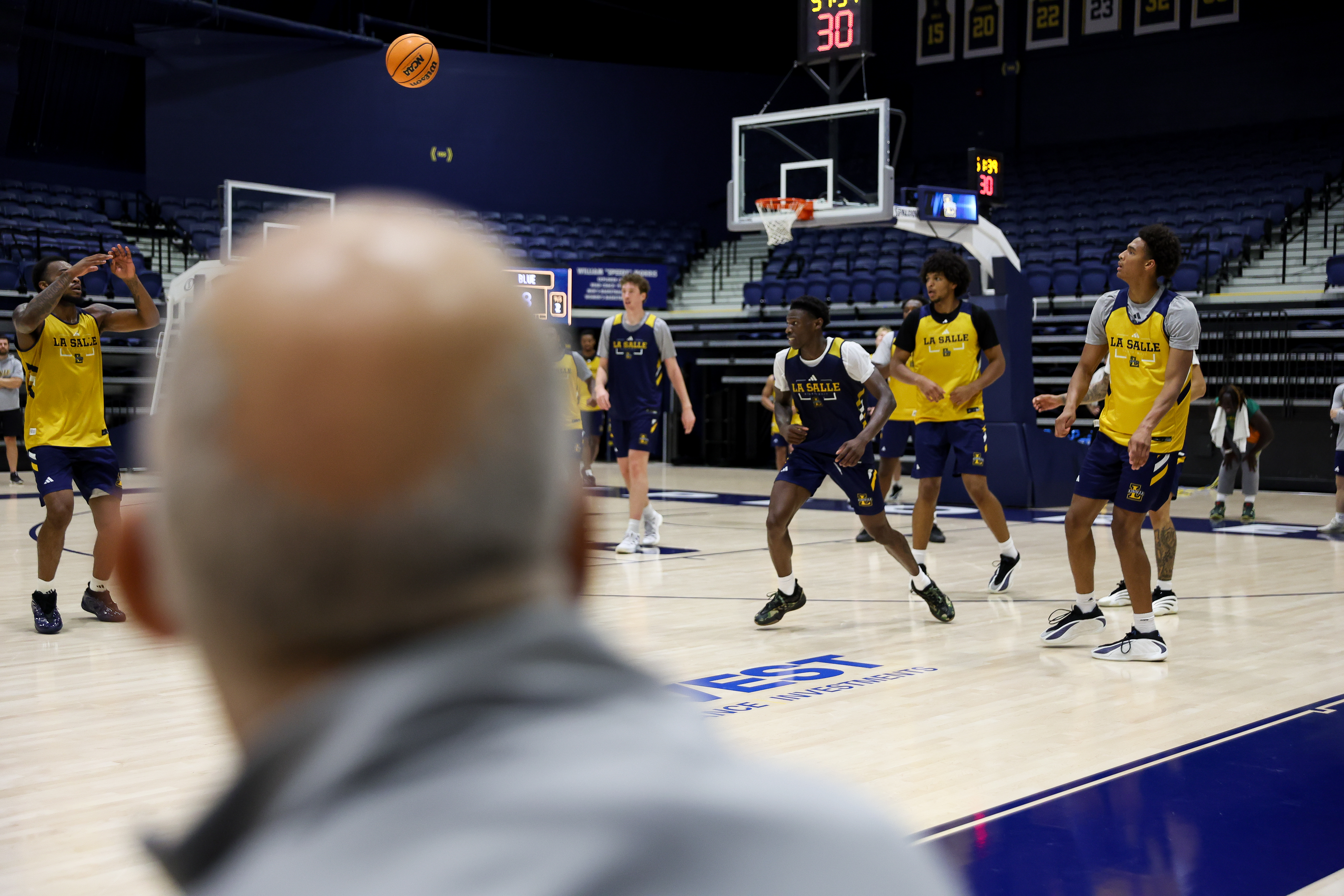
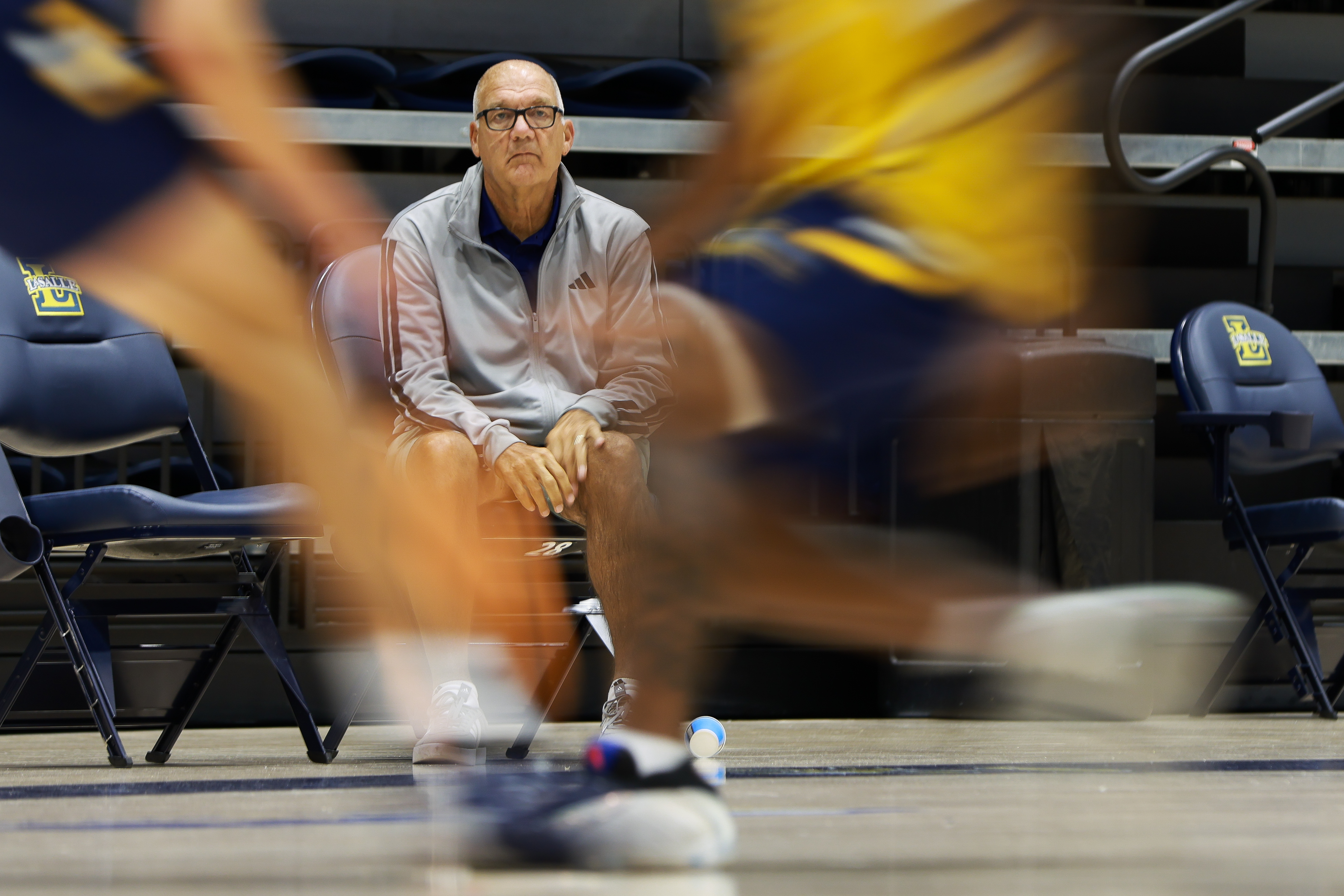
Joe Mihalich looks on from the bench during a La Salle practice earlier this month. Isaiah Vazquez / For The Inquirer
And he’s not finished yet.
“It’s kind of like, ‘You can’t do this?’“ Mihalich said. ”Well, watch me. Watch me.”
Born to be an Explorer
Mihalich was introduced to 20th and Olney at 2 weeks old. His father had gotten a job as a philosophy professor, moving the family from Washington, D.C., to Philadelphia.
They lived on Chew Street in Mt. Airy, a short drive from La Salle. As a child, Mihalich spent most of his time on campus. This remained true until he graduated from the university in 1978.
Fourof his six siblings were students at La Salle; so was Mary, who would become Joe’s wife, and worked as a water girl for the men’s basketball team.
Before Mihalich joined that team, he followed it religiously. The La Salle College High School student regularly attended games at the Palestra. His favorite player was Dunphy, a fellow point guard who made smart decisions and played steady defense.
Mihalich joined the Explorers in 1974 as a walk-on, receiving a basketball scholarship the following semester. After graduating, he took a coaching job at DeMatha Catholic High School in Maryland, where he served under future Hall of Famer Morgan Wootten.
Joe Mihalich (left) and Fran Dunphy were La Salle alums who bonded as members of the Explorers’ coaching staff.provided by La Salle University
In 1981, Mihalich was hired as an assistant for Lefty Ervin at La Salle. Dunphy joined him in 1985, and both men stayed on when Speedy Morris became head coach in 1986.
Together, the two young assistants worked 10- to 12-hour days out of the second floor of Hayman Hall, watching film and meeting with recruits.
They embarked on long road trips to evaluate high school players in Pittsburgh, where the Five-Star Basketball Camp was held. This gave them ample time to get to know the Pennsylvania Turnpike and each other.
Over those 300-plus mile drives, Dunphy and Mihalich mused about someday leading a Division I men’s basketball program.
“I wonder what it’s like,” Dunphy said. “I wonder what kind of pressure the head coach is under, that we’re not seeing. We had great faith in both Lefty and Speedy, when we were together.
“But also knowing that if we ever got that opportunity, we might do it our own way.”
They eventually earned their chance, hundreds of miles apart. Dunphy was named head coach at Penn in 1989, and Mihalich was hired by Niagara University in 1998.
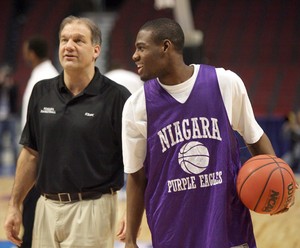
Joe Mihalich (with guard Tyrone Lewis, a product of Truman High in Bucks County) imported an exciting brand of offense when he arrived at Niagara.
The Mt. Airy native immersed himself in the community, going so far as to become a diehard Buffalo Bills fan. He developed a quick-paced, efficient offense, which frequently ranked among the top 75 in the country in offensive rating, according to KenPom.
But even from Western New York, Mihalich never lost touch with his roots. He’d recruit primarily from where he was born (D.C.) and where he was raised (Philadelphia), often targeting kids who were overlooked by the Big 5.
At Niagara, they flourished.
“He would develop them like crazy, from their freshman year to their senior year,” Mihalich’s former assistant Colin Curtin said. “And they would look like totally different players.”
Curtin, a former student manager for Morris at St. Joe’s Prep, has worked with Mihalich for 17 years. When the head coach left Niagara for Hofstra in 2013, he brought Curtin with him, as an assistant.
Mihalich became the second-winningest coach in the school’s history with a record of 154-102. His greatest season there was his last.
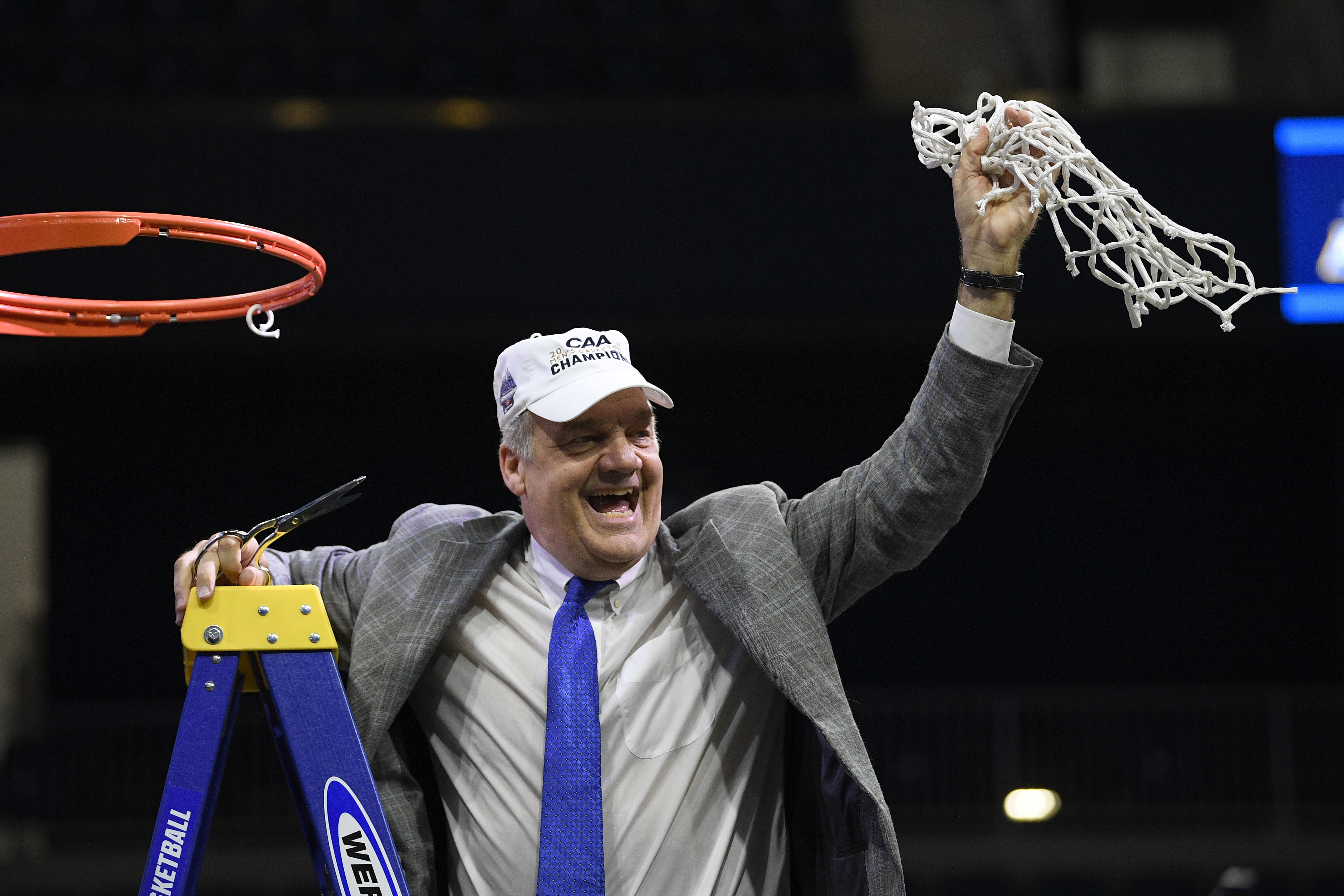
In 2020, Mihalich led Hofstra to its first NCAA Tournament berth since 2001. After winning the CAA title, he climbed high atop a ladderwith a pair of scissors, making the final cut of the net.
Hofstra coach Joe Mihalich holds up the net after cutting it down following the team’s win over Northeastern in the 2020 CAA final. Days later, the world shut down because of the COVID-19 pandemic and the Pride would miss out on a chance to compete in the NCAA tournament. Nick Wass
But Hofstra never got its moment. Two days later, the tournament was canceled due to the pandemic. Five months after that, Mihalich was at home when he got a call from Mary, who was traveling to Ocean City.
He tried to speak but wasn’t able to. The line went dead. She called Curtin, who found the coach standing in his driveway.
He asked if Mihalich was alright.
“I said, ‘Shake your head, yes or no,’” Curtin recalled. “And he shook his head no.”
An unexpected homecoming
While his team embarked on remote summer workouts, Mihalich was placed on a medical leave. He connected with a local speech language pathologist, Alison Durkin, and began to meet with her in the fall.
The coach had been diagnosed with both aphasia, a language disorder, and apraxia, a motor speech disorder. He also lost some mobility on his right side, which prevented him from writing with his right hand.
Alison Durkin (left) with Joe Mihalich and his wife, Mary.Courtesy of Alison Durkin
Mihalich had spent the last four decades amid a symphony of sneakers and basketballs and whistles. In environments that were exciting and fast-paced and energetic.
Now, life was quiet and slow, in the most literal sense. He and Durkin started their sessions with simple, binary questions. Then, they’d count numbers, recite days of the week, and months of the year.
When Mihalich did speak, he was encouraged to over-enunciate. Buffalo Bills became “Bu-fa-lo Bills.” Niagara Falls became “Ni-ag-a-ra Falls.”
They had some initial discussions about a return to his previous role at Hofstra, but decided that was not an option.
“Not only was the job itself linguistically demanding, because you’re producing language on a stage,” Durkin said. “You’re yelling at people. You have seconds to speak. I mean — very demanding.
“And then on top of that, there’s really no reasonable accommodations that could be implemented to make that feasible. So it was definitely not an easy thing.”
Mihalich wasn’t involved in the day-to-day in his AD advisory role, and didn’t interact with players and staff; a choice he’d made himself, to ensure he wouldn’t overstep.
Joe Mihalich goes through a speech therapy session with La Salle student and speech-language pathologist Ella Verello earlier this month. Isaiah Vazquez / For The Inquirer
The coach described those years as “horrible.” He sorely missed the rhythms of his previous life. But he and Durkin kept working, unaware of whether he’d ever grace a court again.
The speech language pathologist introduced basketball terminology to keep her pupil engaged. Instead of reciting “three-pointer” or “rebound,” Durkin would have Mihalich describe exactly what those activities were.
“He knows what boxing out is,” she said, “but could he produce the language to explain it to someone who did not know? That’s a hard task.”
The exercise inadvertently set him up for an opportunity to come. In April 2022, Dunphy called Mihalich to ask if he’d be his assistant at La Salle.
Mihalich was limited in what he could say. But one word came through.
“‘Wow,’” Dunphy recalled. “And he repeated it dozens of times.”
Mihalich returned to campus that summer, with an iPad in hand, to jot down thoughts during practice. Dunphy’s staff quickly learned that they wouldn’t need to actually talk to communicate.
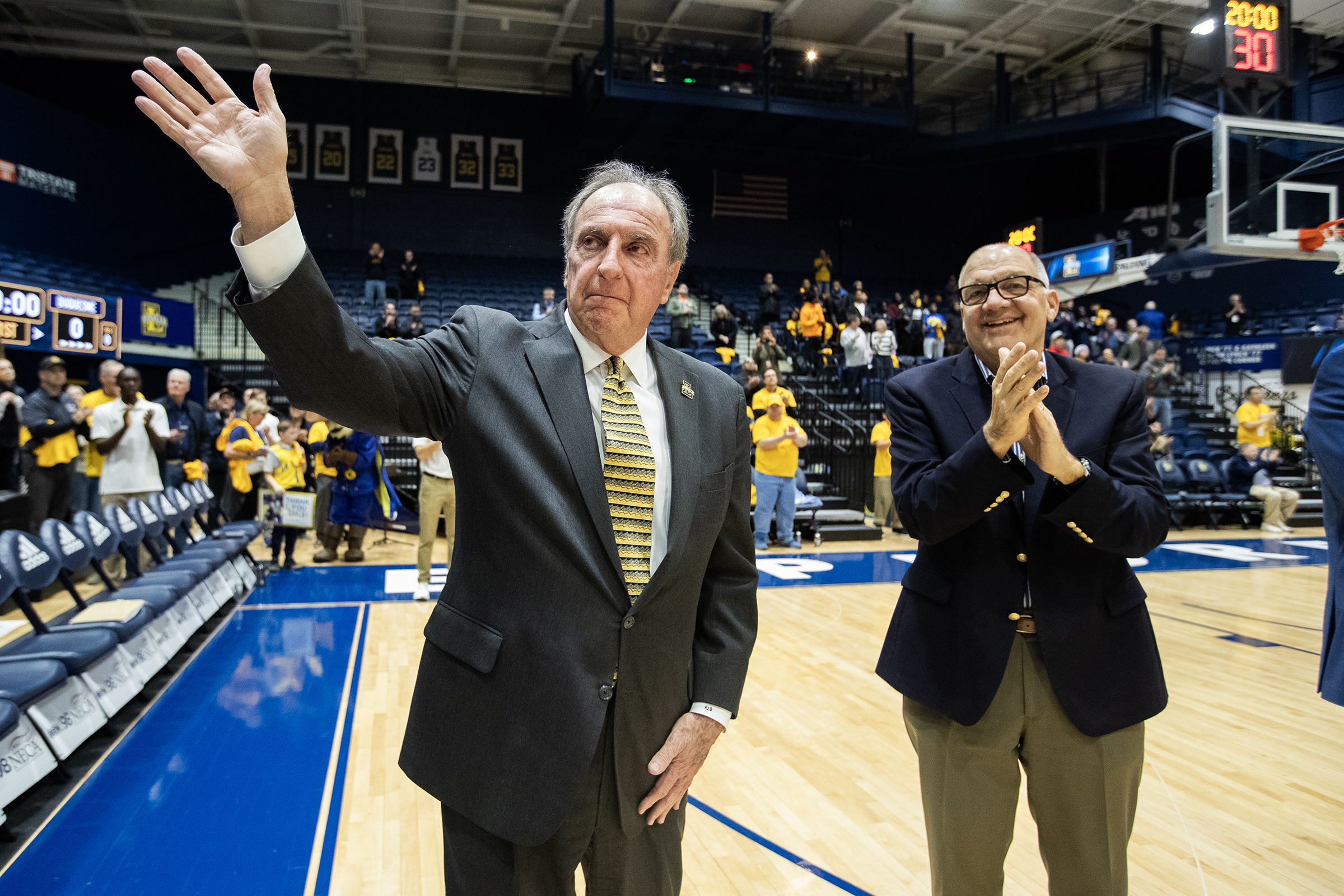
Joe Mihalich (right) was by Fran Dunphy’s side when Dunphy coached his 1,000th game in 2025. Charles Fox / Staff Photographer
One of the assistant coach’s first suggestions was to implement a continuity offense, with players starting in the same spots, and flowing to different set plays.
Mihalich couldn’t vocalize this. So, he picked up a marker with his less dominant, left hand, and started scribbling on the white board in the men’s basketball office, using a language any coach could understand: Xs and Os, dotted and zigzagged lines.
Then he directed his cohorts to the gym, to demonstrate.
“And he goes, ‘Come on, upstairs! Upstairs!’” recalled former La Salle assistant coach Mike Doyle. “‘Alright, let me put my basketball shoes on.’”
If there was one aspect of the sport Mihalich emphasized less, it was defense. His teams at Hofstra and Niagara were known to run and gun. The former head coach didn’t want players expending too much of their energy by guarding an opponent.
Dunphy was much more defensive-minded. So, every now and then, Mihalich would yell “Zone!”
“And then, as soon as we’d go zone, somebody would make a three-point shot, immediately,” Dunphy said, “and I’d say, ‘All right, that’s it. That’s enough.’”
Joe Mihalich’s work on his speech continued at La Salle, where speech-language pathologist Ella Verello (left) is among the team assisting the coach’s therapy. Isaiah Vazquez / For The Inquirer
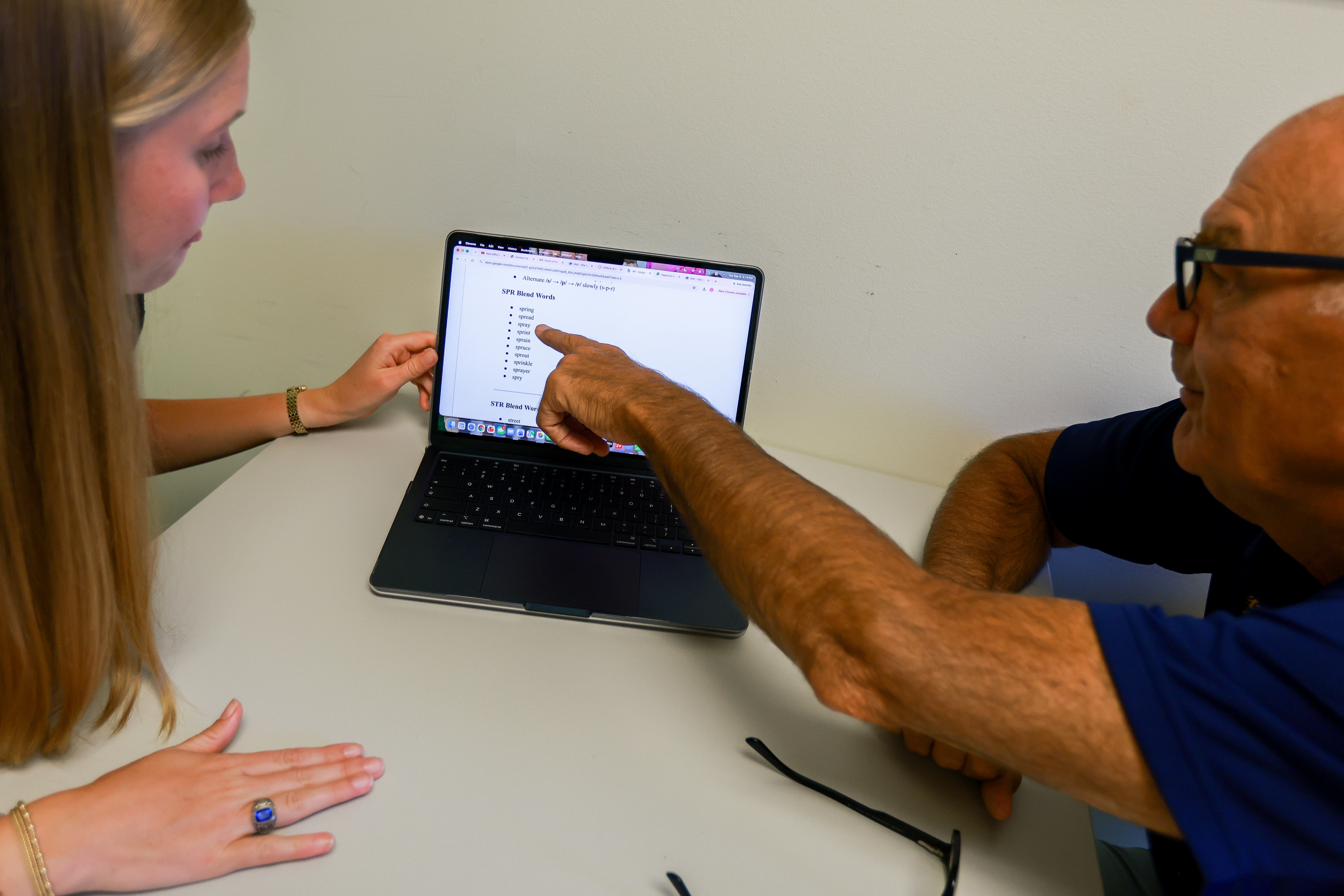
Not long after Mihalich joined the Explorers’ staff, Wendy Silverman, who ran Hofstra’s speech-language hearing clinic, reached out to La Salle on the coach’s behalf.
Mihalich began to take weekly sessions with graduate students at La Salle’s clinic, while working with Durkin remotely, on Zoom. The strategies he learned — speaking slowly, over-enunciating — he’d then bring to the court.
By the end of the 2022-23 season, staff and players could hear a marked difference.
Christine Cahill, the school’s director of academic support for student-athletes, sat next to Mihalich during practice.
“And I told him, it went from like 0 to 70%,” she said, “that first year.”
‘A reason to live’
When Dunphy retired in February 2025, Mihalich was unsure of what he would do next. He initially told Curtin that he wanted to get out of coaching.
But after Darris Nichols was hired at La Salle, his calculus changed. Mihalich had worked with Nichols’ brother, Shane, at Niagara and Hofstra. Curtin would be joining the Explorers’ staff, too.
Joe Mihalich had a connection to coach Darris Nichols and was kept on when Nichols was forming his La Salle staff in 2025. Isaiah Vazquez / For The Inquirer
So, Mihalich decided to give it another go, and Nichols was more than receptive. He saw the former head coach not just as a connector between generations, but someone he could learn from.
“Coming into a new program, he’s helped me navigate it,” Nichols said. “It’s great to have him around.”
Mihalich became an active participant in scouting and recruiting meetings. Just as he had with Dunphy, he started recommending offensive strategies (and of course, more zone).
His speech has progressed to the point where he can now work one-on-one with players. Last year, Mihalich developed a bond with junior guard Rob Dockery, who led La Salle in points, rebounds, and steals.
Dockery’s weakness was his jump shot. His mechanics weren’t consistent, mainly because he wasn’t practicing it enough. Throughout the offseason, the former head coach would routinely text him, reminding the guard to get back in the gym.
“Repeating that same shot, over and over again,” Dockery said. “That’s what he told me. Stick to the same shot.”
Mihalich is still going to speech therapy every week, both at La Salle and with Durkin, and the sessions can be laborious. There are moments when he needs to repeat himself one, or two, or even three times to get his point across.
“But I am here,” he said. And his life is starting to look like it once did. The former head coach wakes up every morning, and drives to the Mt. Airy Dunkin’, where he’s greeted as “Mr. Joe.”
Joe Mihalich has reconnected with basketball and remained a presence at his alma mater for the past four years. Isaiah Vazquez / For The Inquirer
He picks up his coffee — large decaf, hot, with cream — and brings it to the arena, leaving behind a trail of Styrofoam cups.
And for two hours, he sits and watches from his chair, as basketball chaos unfolds around him. A lesser man might see a career cut tragically short. But Mihalich sees something entirely different.
MADISON, Wis. — Kevin Heywood ran onto the field, in a stadium filled with fans donning the blue and green of Notre Dame and the white and red of Wisconsin. For the second time in school history, the Wisconsin Badgers made the two-plus hour trip to face Notre Dame on Sept. 6 at Lambeau Field, home of the Green Bay Packers for the last 69 years.
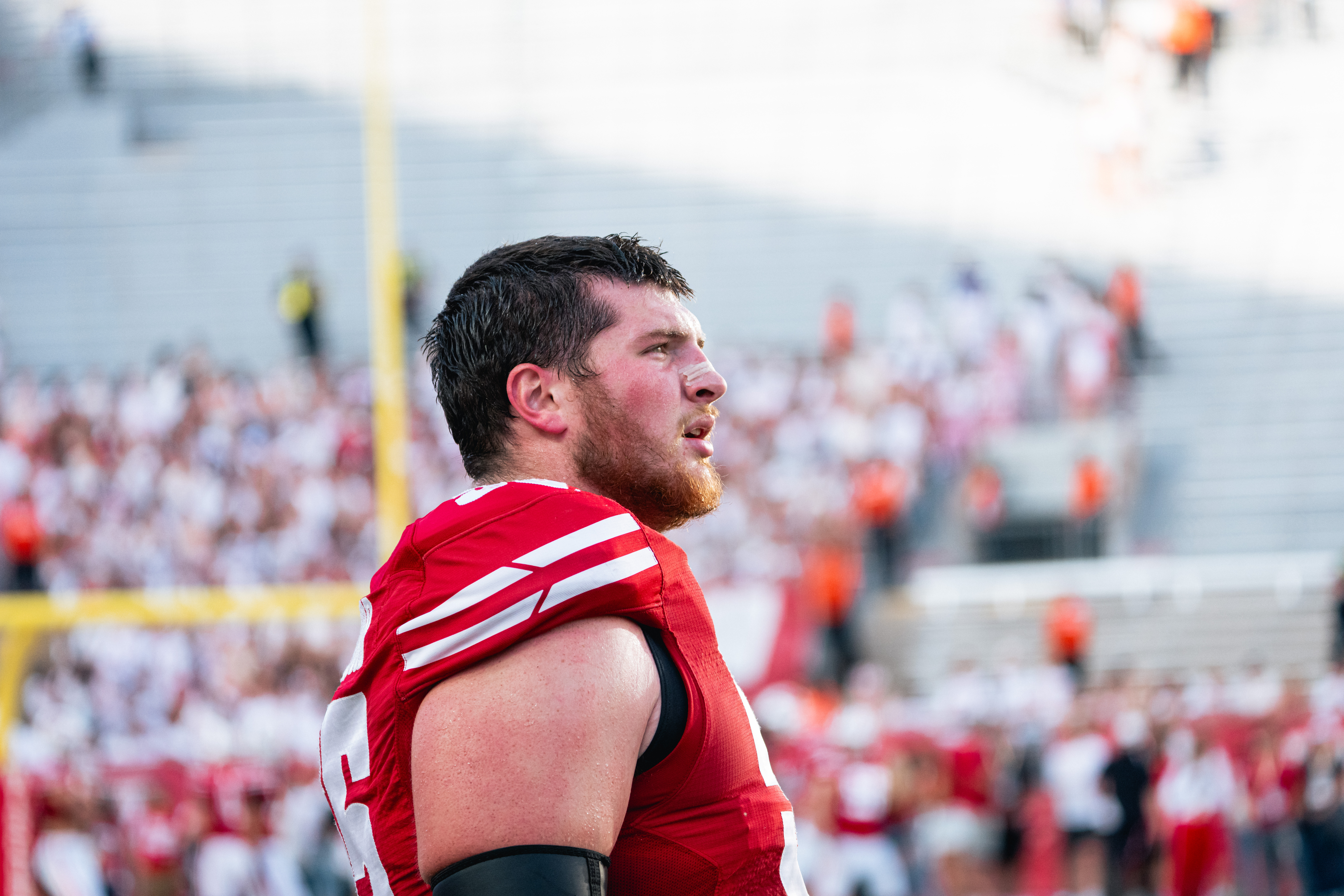
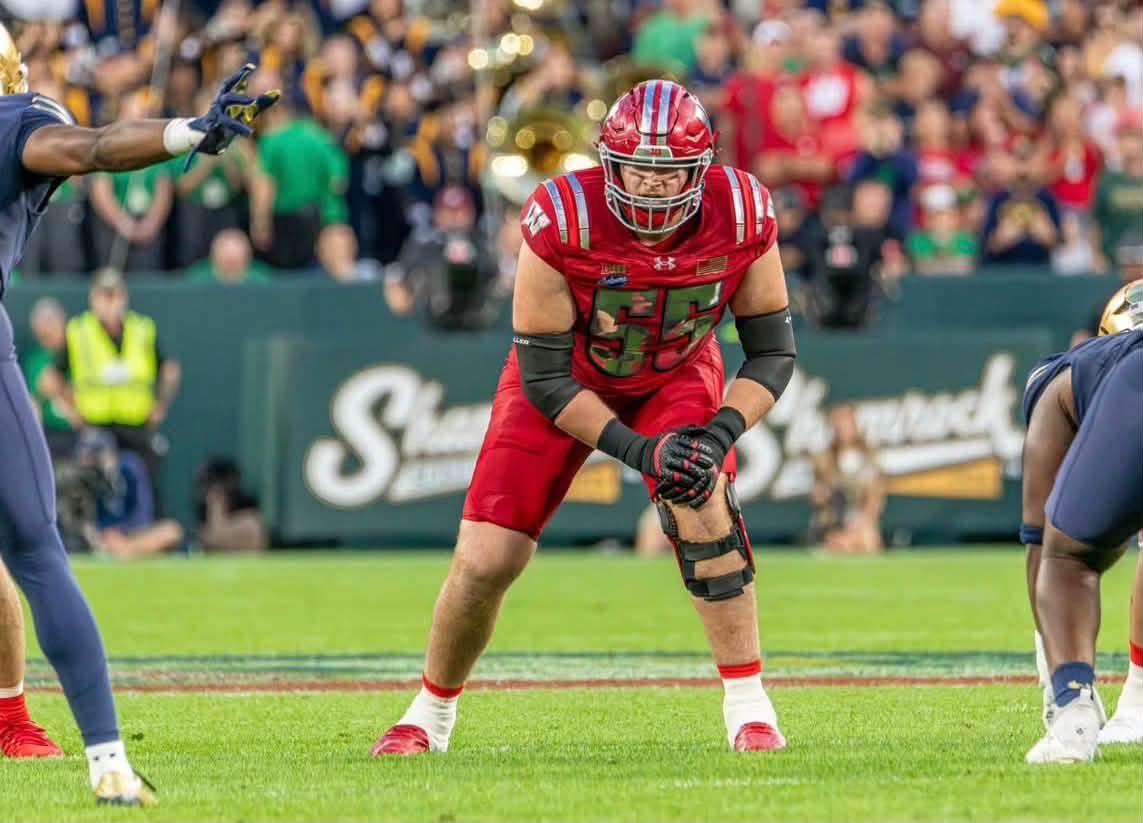
Nearly three weeks since the junior made his first collegiate start at right tackle for Wisconsin, the Pope John Paul II graduate, who stands at 6-foot-9, 320 pounds, looked beyond the Camp Randall Stadium stands after Tuesday’s practice with the vivid memory he’ll keep with him for a while.
“It was crazy,” Heywood told The Inquirer, as he shook his head in disbelief of the experience. “It was really cool. Just running out, look up. It’s just like 50/50 [between the two fan bases] in the stands. … Wish [we] came out with the dub, but learned a lot from that game, [grew] from that game, and just got to keep rolling.”
Rolling from Lambeau Field to now Beaver Stadium, in fact. Wisconsin (2-1) opens Big Ten play three hours west of his hometown Royersford, in a place he knows well. Penn State runs in the family.
His older sister, Claire, graduated from Penn State in May, and Heywood had deeps ties with the program when James Franklin was still the head coach. Deion Barnes, the North Philly native who was the D-line coach at Penn State and now coaches at South Carolina, was Heywood’s former trainer and developed a close relationship with the lineman.
But Heywood ultimately chose Wisconsin, and his journey will come full circle for Saturday’s game at Beaver Stadium (5 p.m., Peacock).
“Just being a kid from Pa., going on a bunch of visits [at Penn State] in high school, it was cool,” Heywood said. “I think it’s a really cool atmosphere for us to play in and [it’ll] be a fun environment for sure.”
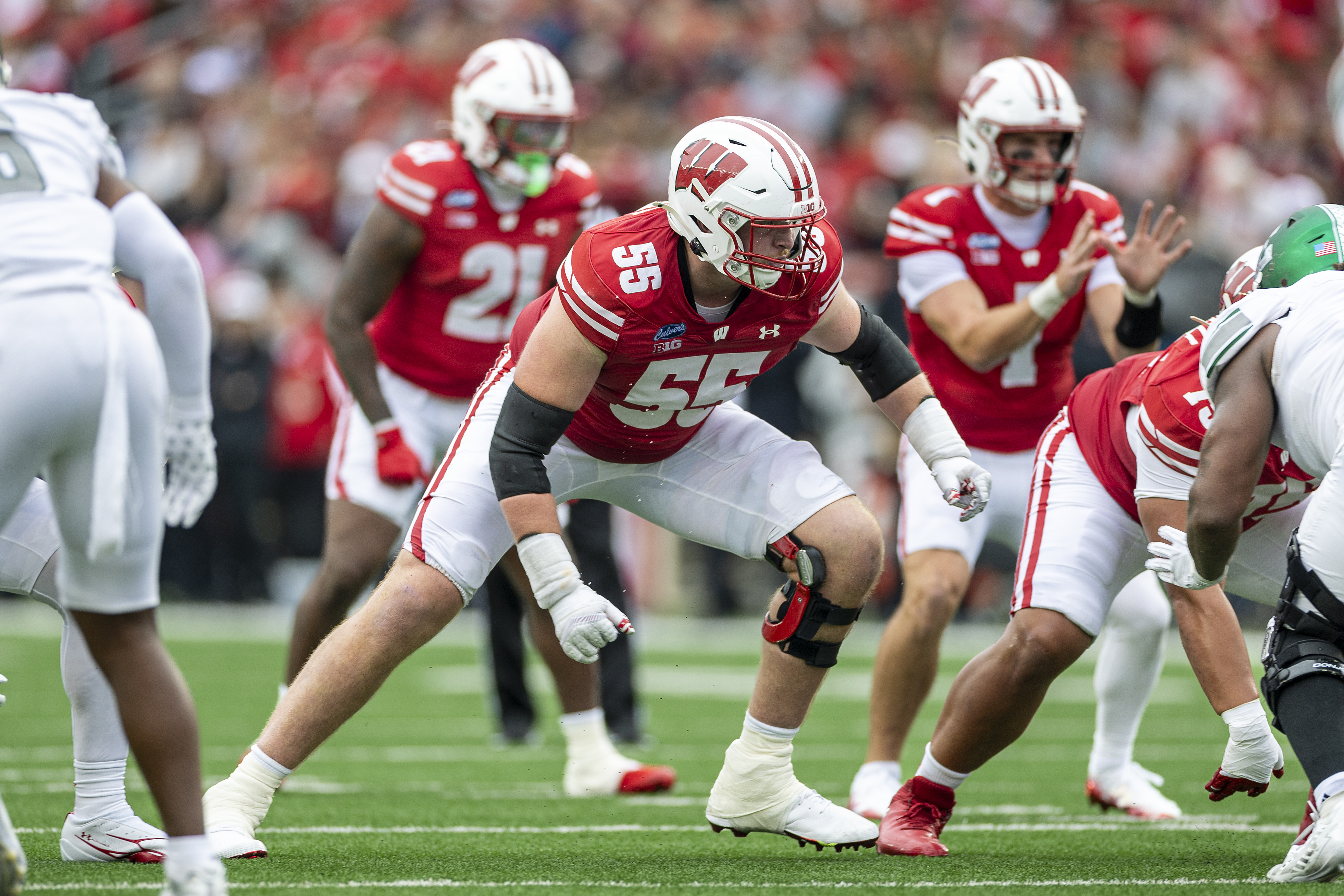
Wisconsin offensive lineman Kevin Heywood blocks against Eastern Michigan on Sept. 19.Courtesy of Wisconsin Athletics
Bouncing back from injuries
Getting to this point wasn’t always as clear-cut. Heywood early enrolled at Wisconsin in 2024 and mostly played on special teams as a freshman.
Last year, heading into his sophomore season as a projected starter at left tackle, Heywood tore the anterior cruciate ligament in his knee during spring practice, ending his 2025 season.
Heywood returned this spring and once again went into this season as a projected starter, but the setbacks continued when he got injured on the second day of fall camp. His starting debut against Notre Dame seemed in doubt, but he was cleared to play a few days before the season opener.
“I’m so proud of how he’s buckled down and fought through the adversity of all the injuries,” said his father Erik Dougherty. “He’s taking everything and [running] with it. We put a lot of stuff in front of him, had him with a lot of people to get him to where he’s at now, but he utilized all those people — and it’s just awesome.”
Added Heywood: “I think the trainers and the strength staff made it very easy. If you’re motivated to come back, you got every tool, every resource to do to get healthy. And I feel better than I did before.”
As he battled his ailments, Heywood also had to endure a coaching change at offensive line. Eric Mateos, who previously coached at Arkansas, was hired last winter to be the new Wisconsin offensive line coach.
The Royersford native says Mateos has taught him to “never be satisfied” and appreciates how “hard he is on us.”
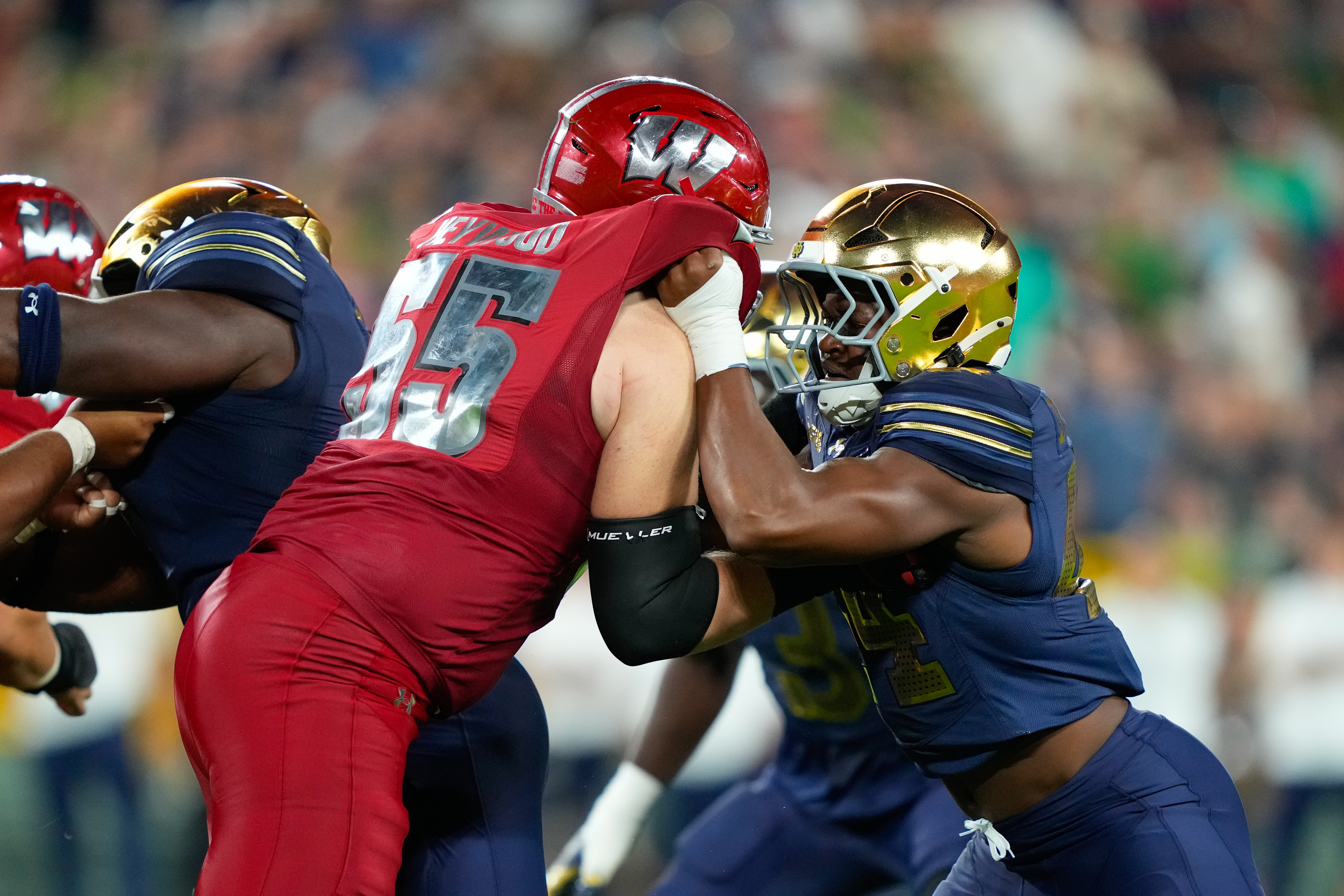
Notre Dame defensive lineman Rodney Dunham (44) against Wisconsin offensive lineman Kevin Heywood (55) on Sept. 6.Kayla Wolf
“He’s pushing everyone in a different way every day,” Heywood said. “There’s always time to clean up on a rep. It’s never going to be perfect. Even when you win a game, you still have to correct yourself and be better and be very hard on yourself.”
Facing the wall
Every time Heywood walks into the team meeting room, he sees the faces of the past Wisconsin All-American linemen. From Joe Thomas to Ryan Ramczyk to Tyler Biadasz, Heywood is reminded of the standard set before him to play on the offensive line.
Thomas and former Rams tackle Rob Havenstein are among the former Badgers linemen who come through to visit, Heywood says.
“Starting is the start of all of it, so I got that down,” Heywood said. “Just got to keep working on my fundamentals and techniques. I have that nastiness. I just need to clean up everything around it, and I’ll be right there with them.”
Wisconsin offensive linemen:
PJ Wilkins, Colin Cubberly, Austin Kawecki, Emerson Mandell and Kevin Heywood taking part in the prestigious OL Masterminds this week #Badgerspic.twitter.com/BuUpKmdXCB
Heywood learned from other professionals, too, this summer. Heywood and four offensive linemen attended the OL Masterminds summit, which Eagles right tackle Lane Johnson is the cofounder of. Wisconsin’s starting center, Austin Kawecki, grew up in Frisco, Texas, where the summit is held, and hosted Heywood and his teammates after the sessions.
“I’d say the biggest thing I took away is just at the end of the day, it’s still a nasty game up front,” Heywood said, while noting he learned some techniques specifically from Johnson as a fellow right tackle. “You can be taught all the techniques in the world, but if you don’t have that edge to you, if you don’t have that nastiness, like, you’re never going to go where you want to go. And I think that’s the main thing I took from it.”
Kevin Heywood played at Lambeau Field for his first career start.Courtesy of Wisconsin Athletics
Doughtery and his wife, Amy, have attended every Wisconsin game so far this season, and will be in the stands on Saturday, along with Claire, and a few of Heywood’s friends from high school.
It is “nerve-racking” watching Heywood play at this level, Doughtery admits, but seeing his son’s dream come to fruition has “filled our hearts.”
“We just have to trust in everything that we instilled in him as a young kid, and he’s taken that and run with it,” Doughtery said. “It’s all him. We just sit back and watch how hard he’s worked and the things that he’s endured.
“He’s got his mind right and he’s focused on what his goals are, and we’re just extremely proud of him.”
The Ivy League was the last college football league to kick off its season, so Penn will play its second game against a team that has already played, and won, four.
Penn welcomes Lehigh to Franklin Field on Saturday (1 p.m., ESPN+) for its first home game under new leadership in coach Rick Santos and freshman starting quarterback Miles Teodecki.
“It is what it is,” Santos said of the Ivy League’s scheduling. “We don’t have as much access to the student-athletes in the summer. So you can look at it like it’s a competitive disadvantage, but for us, we always want to look at it [as], ‘What can we control?’”
Senior defensive back and team captain Josh Narcisse also didn’t think the later start gave Penn a disadvantage.
“Obviously, they have a few more weeks of film that we can watch on them, so if you want to talk about advantages, that’s one,” he said. “Then, obviously, we’re coming in probably a little bit healthier than they are. [They are] probably a little more banged up after four weeks.”
Beginning next season, the Ivy League announced that it will start earlier, however. Week 1 will be Sept. 11, 2027, and there will be a bye week in October.
“I think that’s pretty big for us as a program,” senior tight end Dante Barone said, “but … it doesn’t really change our mentality.”
The mentality, according to Narcisse and Barone, is “to be great.”
“To be a great team, you have to play great teams,” Barone said.
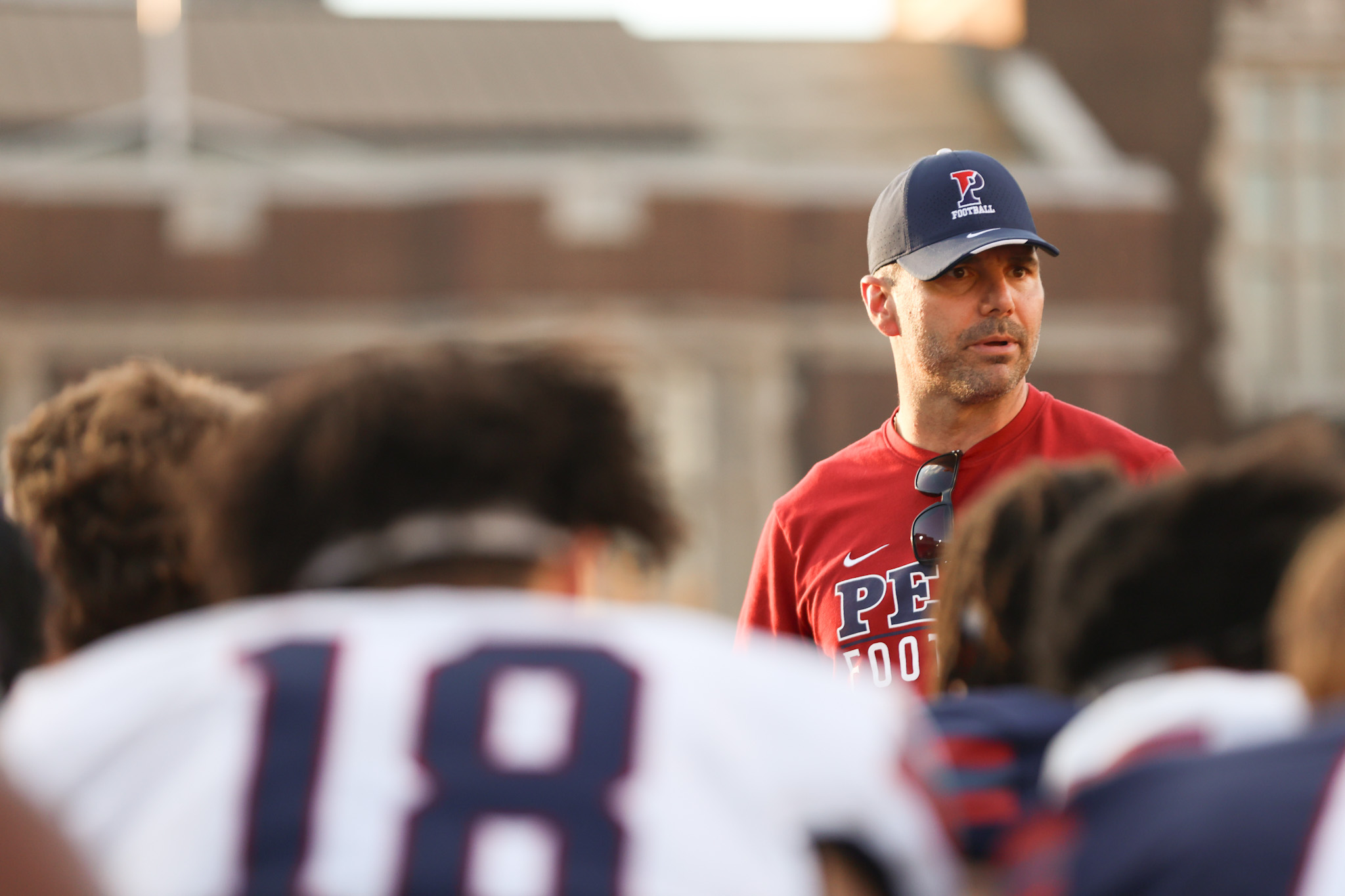
Penn football coach Rick Santos is in his first year with the program.Penn Athletics
Lehigh (4-0) currently is ranked sixth in the FCS and won back-to-back Patriot League championships in 2024 and 2025. The Mountain Hawks also have a new head coach, Richard Nagy, the team’s former defensive coordinator.
“They are one of the best teams in the country in all three phases, extremely well-coached,” Santos said. “I know Coach Nagy very well from battling against him. … So tough-nose[d] team, really well coached. They play hard.”
“[Yoder] never gets tackled by the first guy,” he said, “So we need to wrap up. We need to rally the football. Stopping the run has to be our No. 1 priority this week.”
Hayden Johnson, Lehigh’s starting quarterback, was injured against William & Mary on Sept. 12 and has not returned to action.
“It will be interesting to see if their starting quarterback plays or not. I think both of those guys, though, their signal-callers are elite with their legs, and they can really run,” Santos said.
“With [Lehigh] running the ball as much as they do, they like to control the clock, so that’s going to be something for us is to sustain drives. … We got to make this a four-quarter game.”
While Santos was “very, very encouraged” with Teodecki and the offense in last week’s 20-7 win over Bucknell, he also sees things to tighten up this weekend. The Quakers outgained the Bison, 367-124, and Teodecki threw for 197 yards on 18-of-34 passing with two touchdowns and an interception. He also was Penn’s leading rusher with 87 yards and another touchdown.
“We’ll clean up some things mechanically in the passing game. … We need to finish better in the red zone, and that starts with myself and our offensive staff in terms of play calling, putting the guys in better situations,” he said.
For Narcisse and Barone, it will be their last home opener.
“This is what we look forward to all season,” Narcisse said. “This is why you come out here in the winter when it’s 6 a.m. and nobody sees you working. You’re rolling around the snow. This is why you do that, right? For opportunities like this to shine when the lights are the brightest.”
After Penn State’s rout of Buffalo, head coach Matt Campbell was asked how he views his team ahead of its first Big Ten matchup of the season against Wisconsin.
“Not where we need to be,” Campbell said.
Although the Nittany Lions are No. 13 in the AP Poll and unbeaten after three lopsided nonconference wins, it remains unclear what they’re truly capable of at this stage of the season. But conference play will answer that question. They might have to do that without star wide receiver Koby Howard, who is out with an undisclosed injury.
Campbell said he split the season up for his team into four quarters. The first was from fall camp through the first three games of the year. The second starts Saturday against the Badgers (5 p.m., Peacock), and Penn State faces a tougher challenge with Howard sidelined.
“It’s what you want to be a part of, is these special opportunities, starting this week, to play great teams, great coaches, great opponents, and what’s it going to take?” Campbell said Tuesday. “It’s going to take everything you learned from the first quarter of the season, and that starts with a great practice on Tuesday, and it continues to have a great practice on Wednesday if you want to be your best in the moments on Saturday.”
Howard out for ‘extended period’
Penn State will be without its top offensive playmaker on Saturday. Campbell said that Howard will be out “for an extended period of time.”
“Obviously, disappointing for Koby, but he’s handled it really well,” Campbell said. “I think the best interest of him going forward, making sure we do right by him and certainly our football team.”
Howard currently leads the Nittany Lions with 344 receiving yards and has three total touchdowns this season. He’s targeting to return for Penn State’s matchup at Michigan on Oct. 17.
Penn State wide receiver Koby Howard has scored three total touchdowns so far this season.Barry Reeger
Penn State is in a better position to handle an injury, as it has plenty of other weapons it can look to in Howard’s absence, including Iowa State transfer wide receivers Chase Sowell and Brett Eskildsen.
Eskildsen has been “dinged up” the last two weeks, Campbell said Tuesday, but he confirmed he’s back at full health ahead of Wisconsin. The junior’s speed is unmatched across the roster, which should provide a huge boost to the offense moving forward.
“Every opportunity he’s got, he’s made some dynamic things happen,” Campbell said.
Pass rush vs. offensive line
Through three nonconference games, Penn State has five sacks, but only two of those came from its edge rushers.
It’ll be important for Penn State’s defensive line to succeed in rushing the passer this weekend at a higher clip, considering Wisconsin quarterback Colton Joseph’s dual-threat capabilities.
“I think growth will have to continue to happen,” Campbell said Tuesday. “You’re playing a dynamic playmaker and a guy that can make you pay with his feet really fast, and so I just think us continuing to grow forward. I don’t know if it’ll ever be just one [guy making an impact], and I think that’s a positive thing.”
But the Nittany Lions’ are facing their toughest test yet in the trenches, as Wisconsin’s offensive line features bigger and experienced players compared to what Penn State has seen this year.
That includes Pope John Paul II graduate Kevin Heywood, a right tackle who missed the entire 2025 season with a torn ACL but has impressed so far in his return.
Familiarity for Abu Sama III
Campbell will see a few familiar faces on the opposite sideline at Beaver Stadium on Saturday, including running back Abu Sama III.
The senior spent the last three years at Iowa State, where he rushed for 732 yards and five touchdowns. Sama opted to not follow Campbell to Penn State and became the Badgers’ starting running back instead.
“Abu’s a good player,” Rocco Becht said Tuesday. “He’s one of the best athletes I’ve ever seen. But he does like to get to the outside. He gets east and west, and he tries to bounce it outside and get north quick, and so he’s a strong back. Going to be harder for us on the defensive side to bring him down.”
Former Iowa State running back Abu Sama III (photographed on Sept. 13, 2025) is Wisconsin’s starter in the back field.Michael Woods
Becht said the defensive players who came over from the Cyclones have been relaying what they know about Sama to the defensive staff. It remains unclear, though, if Sama will actually suit up against his former coach, as he currently has the “questionable” tag on the Big Ten availability report.
“I’m excited to get on the field with him on Saturday,” former Iowa State linebacker Kooper Ebel said. “I’m sure we’ll see a lot of each other.”
At the end of Gracie Sullivan’s freshman year at Drexel, the women’s soccer coaching staff approached her with a message: the starting goalkeeper position for next season was “up for grabs.”
Sammy Widnick was transferring and Zara Wickert was graduating, leaving an opening at goalie.
“That just pushed me because I felt like I knew I could do it,” Sullivan said. “It was just whether I wanted to do it or not.”
Sullivan did not see the field during her freshman season, but that is common for a first-year student adjusting to the collegiate level.
She used the season to learn from the goalkeepers ahead of her and spent the offseason working for her opportunity.
“You can always say, ‘Do you want this?’ And they’ll say, ‘Yes.’ But then in training, you need to see the want and desire to develop,” said Mike Paznokas, Drexel’s assistant women’s soccer coach. “It was awesome because in the one-on-one sessions we did, you got to see that. You saw [Sullivan] asking questions, you saw her working her butt off in those sessions to make sure that she’s getting better and understanding the concepts we went over.”
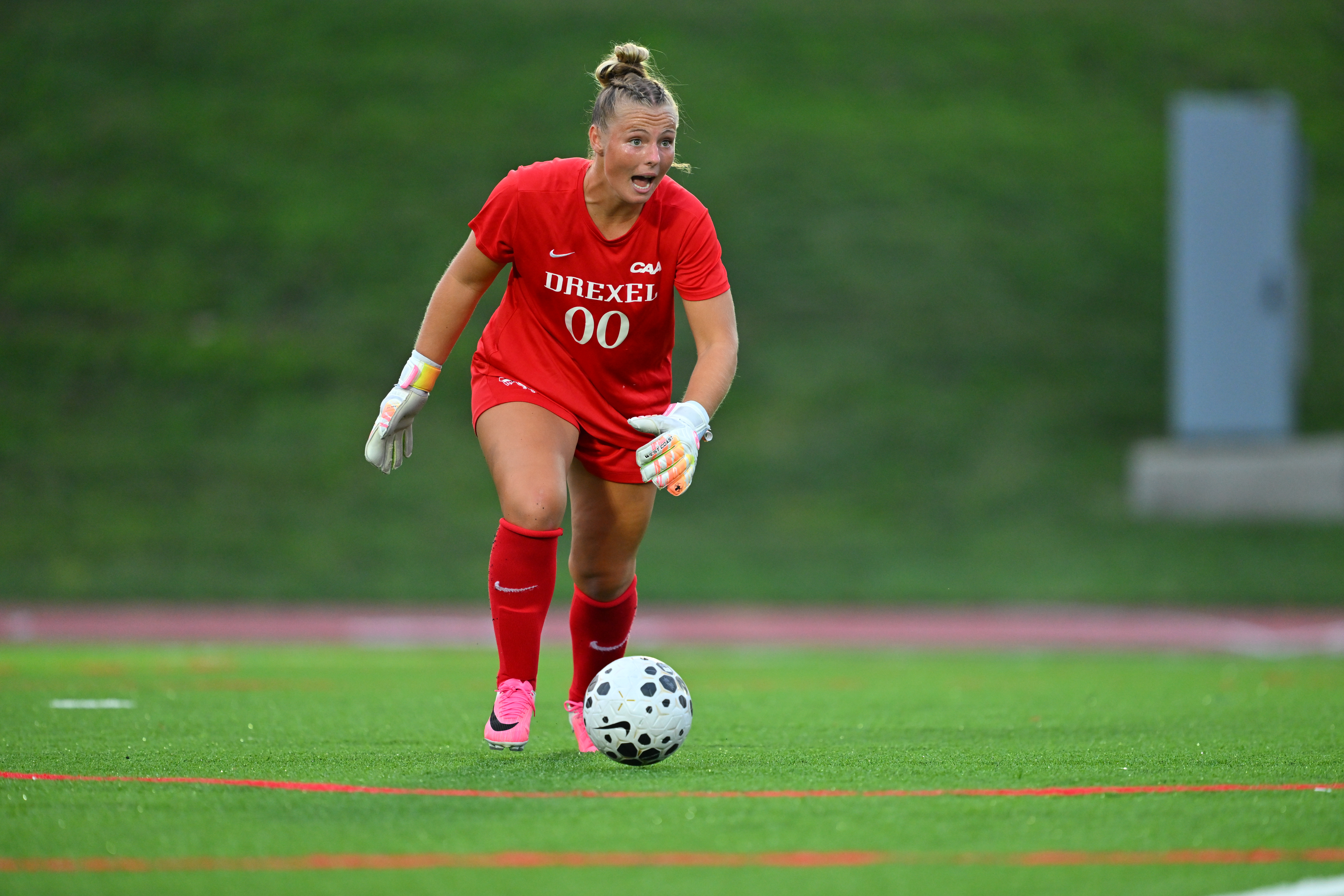
Sullivan is now the starting goalie for the Dragons and had a career-best 10 saves against La Salle on Aug. 28, which is the most saves by an individual Drexel keeper since 2017. Entering Thursday’s match against Hampton, Sullivan has 42 saves so far this season.
The sophomore’s accomplishment has come as no surprise to Paznokas.
“She is very level-headed and when she’s in the game and her brain’s turned off, she can perform amazing things as a goalkeeper,” Paznokas said. “So, not a shock to me she was able to achieve this in the slightest.”
The relationship she built with the other goalies fueled her desire to get better even though she wasn’t seeing playing time as a freshman.
“I really did look up to [Widnick], the starter goalie who was in front of me,” Sullivan said. “I really think she taught me and I just looked up to her during the sessions. There’s always a feeling of tension between goalies and last year there was three of us and there was no tension at all. Without them, I don’t think my freshman year would have been as enjoyable not playing as it was. But we were just so supportive of each other.”
During spring training, Sullivan had extensive one-on-one training with Paznokas, he said, where she improved her feet in possession, long distance distribution, and communication skills.
Soccer runs deep in the Sullivan family. Her grandfather and father played soccer at Holy Family and her second cousins, Cavan and Quinn, play for the Union. Cavan, 16, earned an invitation to the U.S. men’s national team last week.
“I would say that all of the Sullivans, no matter first or second cousins, we’re all very close,” she said. “It’s really exciting to see the different places soccer takes our family.”
Gracie Sullivan started playing soccer at 7 years old for Coppa at the Philadelphia Soccer Club. During her freshman year at Nazareth Academy, she started playing for FC Bucks, now HEX FC.
She originally started as a midfielder in youth soccer. But when she played in the Beach Blast soccer tournament at the Jersey Shore, it sparked her love at goalkeeper.
“I was crazy as a kid, so when we would play Beach Blast, I would be like no I want to play the whole game because I love diving around in the sand,” she said. “So ever since I was 10, I stuck to goalie.”
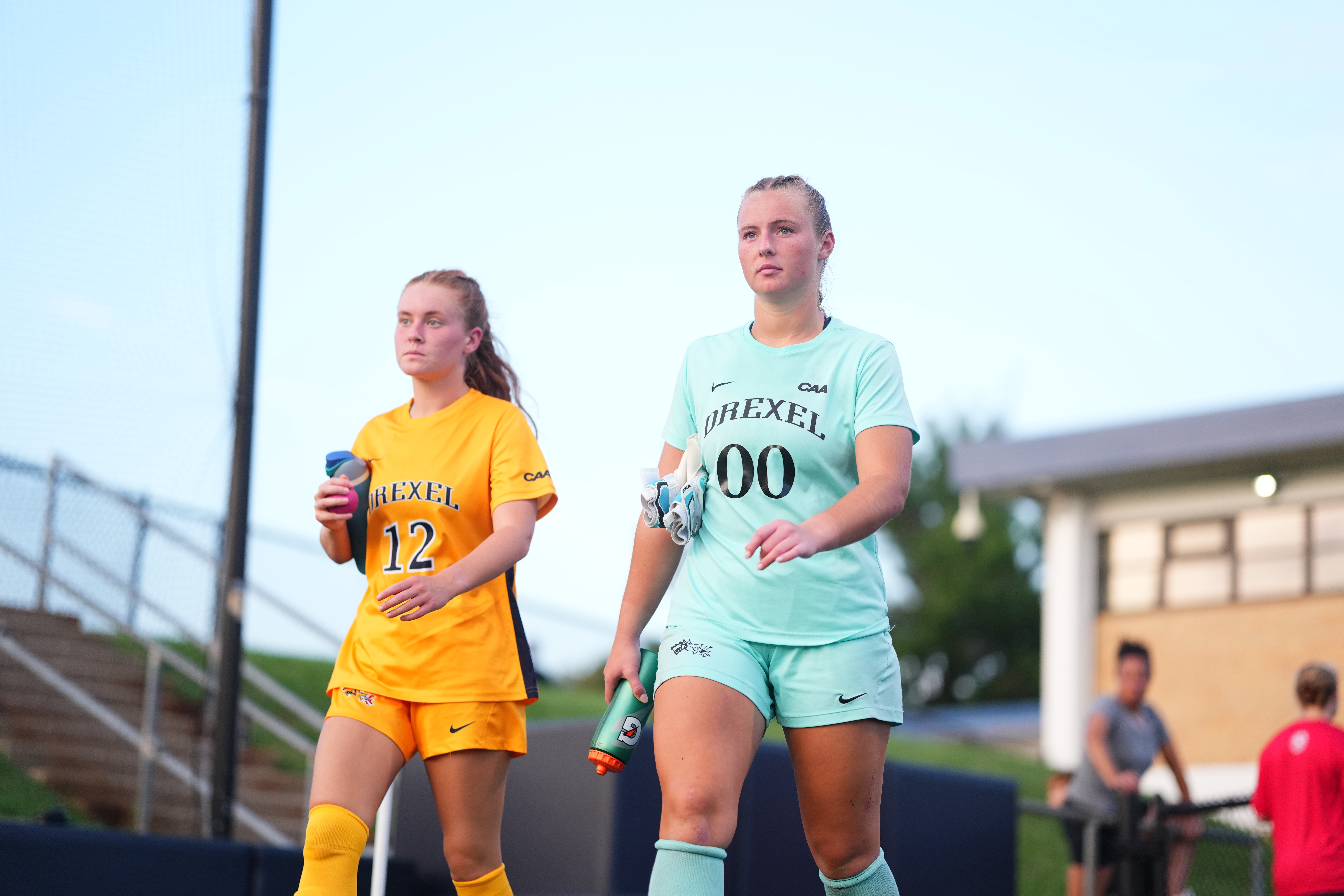
Gracie Sullivan (right) walks out to the field with teammate Riley Lukach (12).Drexel Athletics
This is Shannon Grogan’s first season at the helm for the 4-4-1 Dragons. Sullivan believes the culture shift has driven Drexel’s success.
“This year with the new coaching staff, [Grogan] just brought so much energy and really believes in us, which I think shines down on us and then we believe in ourselves,” Sullivan said. “The team culture has just been so much different and I think on and off the field we have been such close friends and I can really see that on the field and that’s helping us win games honestly.”
Playing goalkeeper comes with a unique pressure, Sullivan said. One little mistake can alter the outcome of the game.
“The hardest part of being a goalie is that we have to be turned on at all times because if we make one mistake that could lose us the game,” she said. “It’s different if a forward were to make a mistake because the ball wouldn’t go in the back of the net. So it’s really important that we have to be our best at all times because if we’re not, then we sometimes could cost our team the game. It just sinks in more to you than it does to anybody else because you feel like you let your team down.”
Though, the Dragons don’t dwell on individual mistakes, she added.
“We all take accountability whether you’re on the bench or you’re playing,” Sullivan said. “We can’t point fingers because that’s not how you’re going to win a game.”
Temple released its men’s and women’s basketball nonconference schedules on Wednesday.
The women’s team opens its 13-game slate at George Mason on Nov. 2, while the men will play 10 of their 14 nonconference games in Philadelphia. Both will host Villanova on Dec. 1.
Here’s a look at the rest of the games.
Women’s schedule
After it’s nonconference opener on Nov. 2, the women’s team returns to the Liacouras Center to host Navy on Nov. 7. George Mason is one of Temple’s three opponents that reached last season’s NCAA Tournament. Temple will also host Ball State on Nov. 24 and face Sweet 16 participant Ole Miss at the West Palm Beach Classic on Dec. 20.
Temple shares a Big 5 pod with La Salle and Villanova. The Owls visit the Explorers on Nov. 11 and host the Wildcats on Dec. 1. Those results will determine whether Temple plays for first, third or fifth place in the Dec. 6 tripleheader at the Palestra. The women’s Big 5 Classic will be held there for the first time during the arena’s 100th anniversary season.
Between its Big 5 games, Temple will visit George Washington on Nov. 17 and host Georgetown on Nov. 22 before facing Ball State two days later. The Georgetown and Ball State matchups give the Owls two home games in three days before they meet with Villanova.
After the Big 5 Classic, Temple hosts Binghamton on Dec. 8, visits St. John’s on Dec. 13 and welcomes Cheyney on Dec. 17. The Owls finish in West Palm Beach, Fla., facing Ole Miss on Dec. 20 and North Dakota State the following day.
Men’s schedule
Six of Temple’s games in Philadelphia are at the Liacouras Center, two are at the Palestra, one is at Xfinity Mobile Arena, and one is on the road at La Salle. Temple opens against Central Connecticut State on Nov. 2 before facing Richmond at the Palestra on Nov. 8 as part of the arena’s 100th anniversary season.
The Owls host Charleston on Nov. 11 and visit La Salle on Nov. 15 for their first Big 5 game. Their first trip outside Philadelphia comes five days later, when they open the three-game Paradise Jam against Middle Tennessee in St. Thomas, U.S. Virgin Islands. Temple will play either Indiana State or Stephen F. Austin next, with its final opponent determined by the tournament results.
Temple returns to the Liacouras Center to face Villanova on Dec. 1. It will be the Wildcats’ first visit to North Broad Street since the 2022-23 season, when the Owls beat Villanova, 68-64. On Dec. 5, Temple will face Drexel, Penn or St. Joe’s in the Big 5 Classic at Xfinity Mobile Arena, depending on the pod results.
The Owls host Cheyney on Dec. 9, bringing together two programs once led by the late John Chaney. He won the 1978 NCAA Division II championship at Cheyney before taking over Temple in 1982. Temple then faces former Atlantic 10 rival St. Bonaventure at the Palestra on Dec. 12, the programs’ first meeting since 2013.
The final home games are against Dartmouth on Dec. 16 and Wright State on Dec. 19. Dartmouth has not faced Temple since the Owls beat Big Green in the 1958 NCAA Tournament on their way to the Final Four. Wright State won the Horizon League regular-season and tournament titles last season. Temple closes its nonconference schedule at Princeton on Dec. 22.
Game times, along with the full American Conference schedules, have yet to be announced.
Silas Graham’s first basketball memory came from the inside of a penalty box.
His father, Nat Graham, was an assistant coach for Boston College at the time. Along with hosting basketball games, the Eagles’ Conte Forum doubles up as a hockey arena. When the hardwood is placed over the rink, the penalty box remained, and it was the perfect place to put a rambunctious toddler.
It was easier to keep Silas contained when he couldn’t walk, Nat remembers. Silas would crawl by his father’s feet while Nat ran drills as an assistant at Cornell — one of his first coaching stops. With Nat on the staff, the Big Red made March Madness appearances in 2008, 2009, and 2010. In diapers, Silas attended all three tournaments.
“It was such a part of his life at that stage,” Nat said. “He idolized the guys. By the time he was walking and talking, I can remember him playing in the living room and pretending to be the guys on the team.”
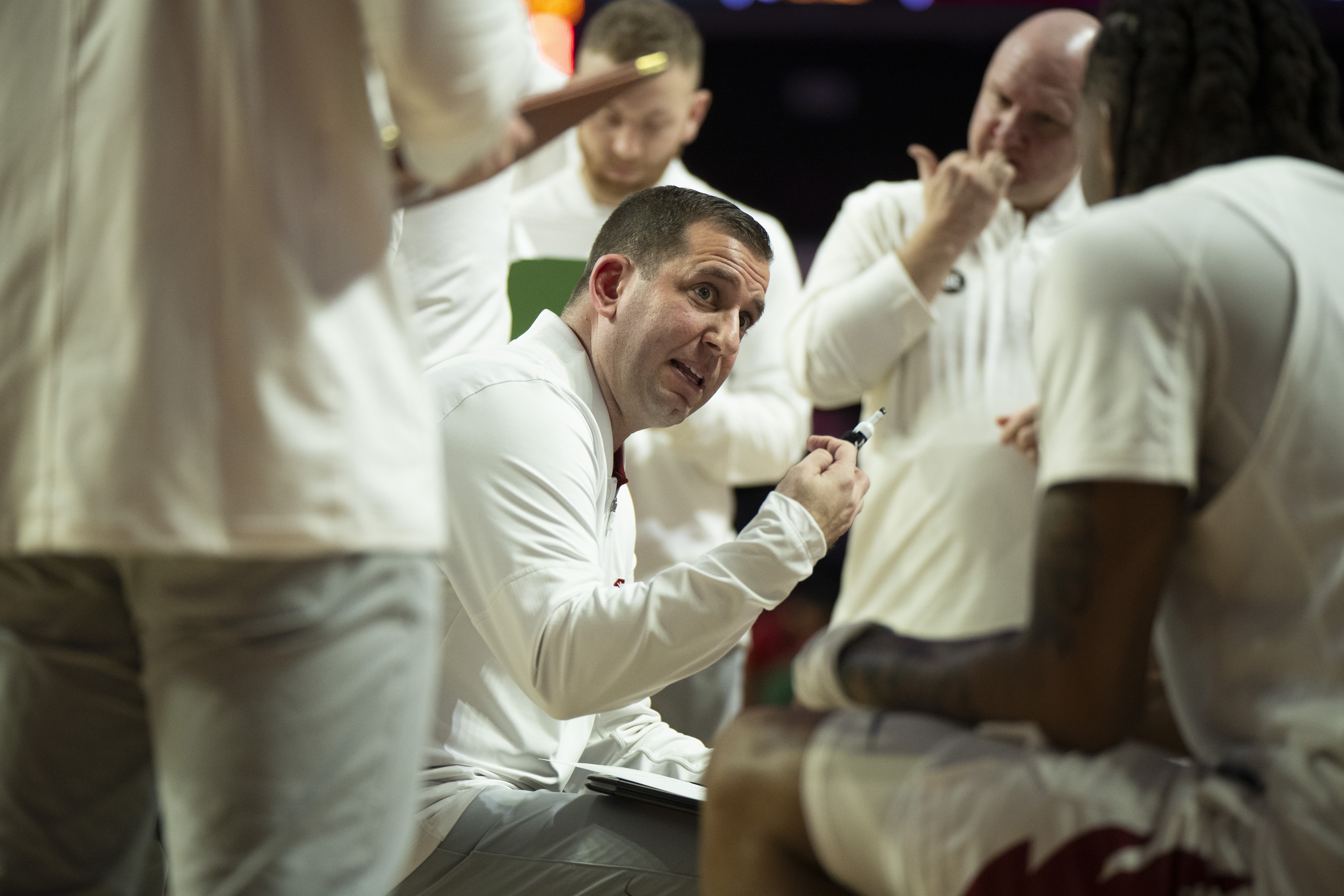
After a four-year stint at Boston College, Nat coached at Penn as an assistant from 2014 to 2025. Coaching alongside his father at Cornell, Boston College, and Penn was Steve Donahue. Silas and Donahue, now the head coach at St. Joseph’s, developed a strong relationship, and it continued once Silas picked up basketball.
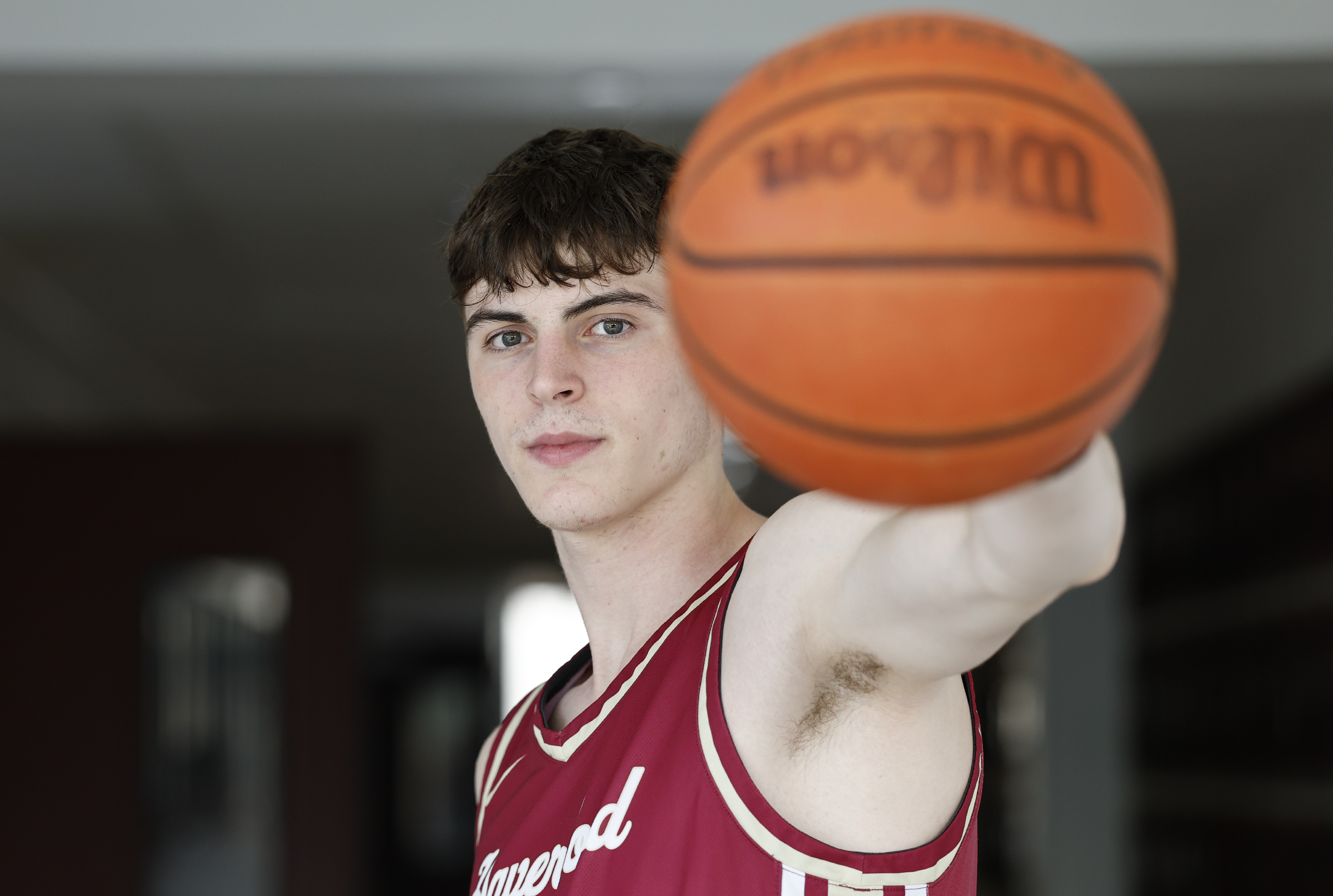
Last year, Silas — now a 6-foot-4 senior guard at the Haverford School — received scholarship offers from Notre Dame and Stanford. However, he gravitated toward Hawk Hill because of his familiarity with the program’s head coach. He announced his verbal pledge to St. Joe’s on Aug 4.
“I don’t need to build a relationship with Coach Donahue,” Silas said. “He can coach me, and I’m going to understand that it’s not the same relationship that it was before, and that he’s going be tougher for me, and I have to be prepared for that.”
Silas Graham committed to play basketball for St. Joseph’s.Yong Kim / Staff Photographer
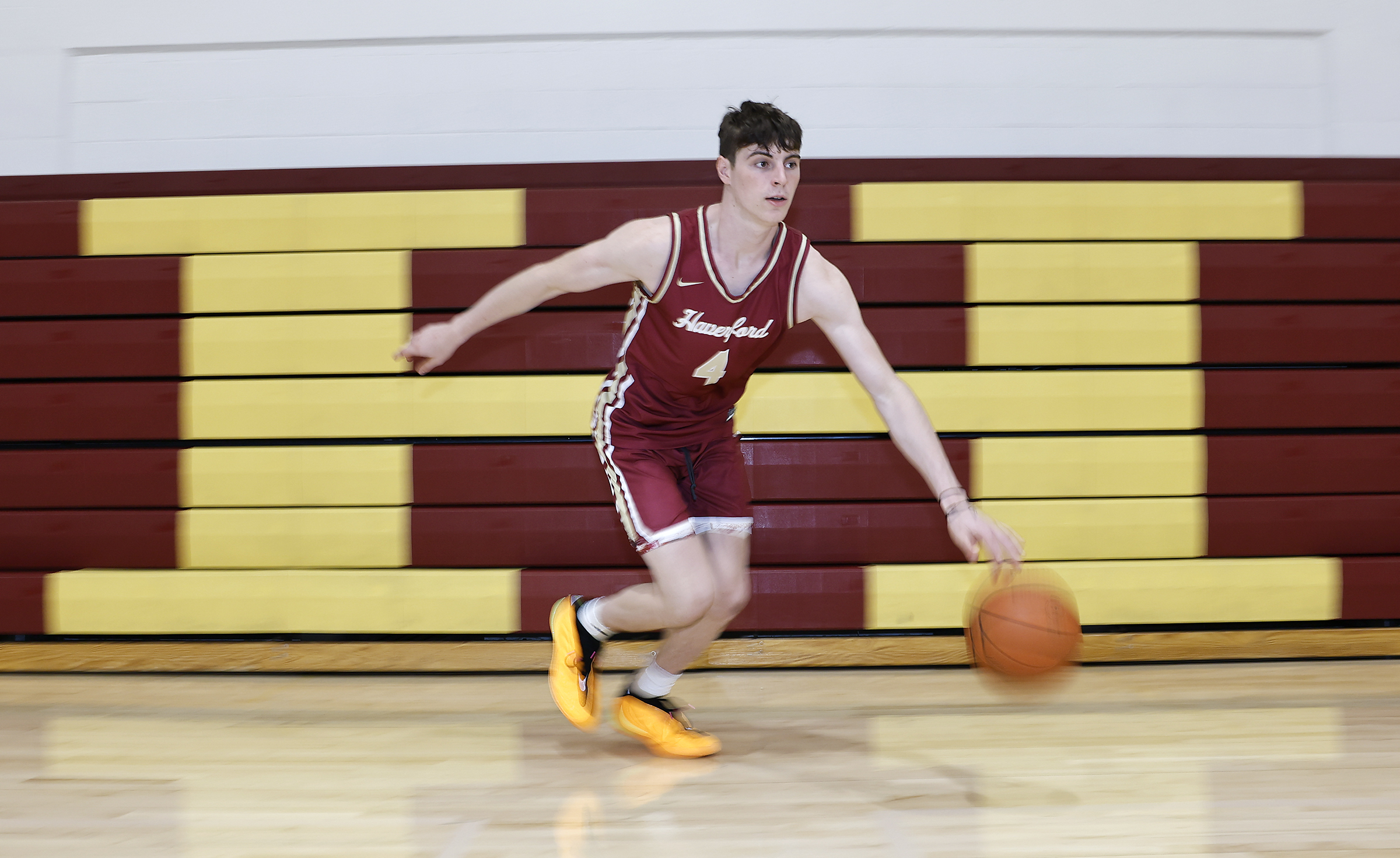
Silas enters his senior year as the Fords’ all-time leading scorer. Last season, he averaged 20.7 points, 9.1 rebounds, and 3.1 assists. 247Sports ranks Graham as the second-best player in Pennsylvania, trailing just Archbishop Wood’s Jaydn Jenkins in the class of 2027.
“I never take it for granted how coachable he is and what a joy [Silas] is to coach,” said Fords coach Bernie Rogers. “Forget all the points and the wins. He’s enjoyable to coach every day and we don’t take that for granted.”
‘Seeing how he operates’
Sitting in the Haverford School bleachers following a team workout, Silas wore a pair of red Cornell basketball shorts. After being dismissed by Penn following the 2024-25 season, Nat returned to Ithaca to serve as an assistant last season.
But just like Donahue, Nat found himself back in the Big 5. This summer, Nat was hired by Drexel to coach on Zach Spiker’s staff. In the near future, Nat will likely see his son on the opposing sidelines of a Big 5 matchup. In the meantime, he has enjoyed coaching Silas during summer runs at Drexel’s Daskalakis Athletic Center.
“We would play with some Haverford kids,” Silas said. “My dad [has] never really been a coach on one of my teams, so it was kind of cool to see that. Obviously he likes to give me pointers about myself, but even him just telling other guys what to do and seeing how he operates basketball-wise is nice.”
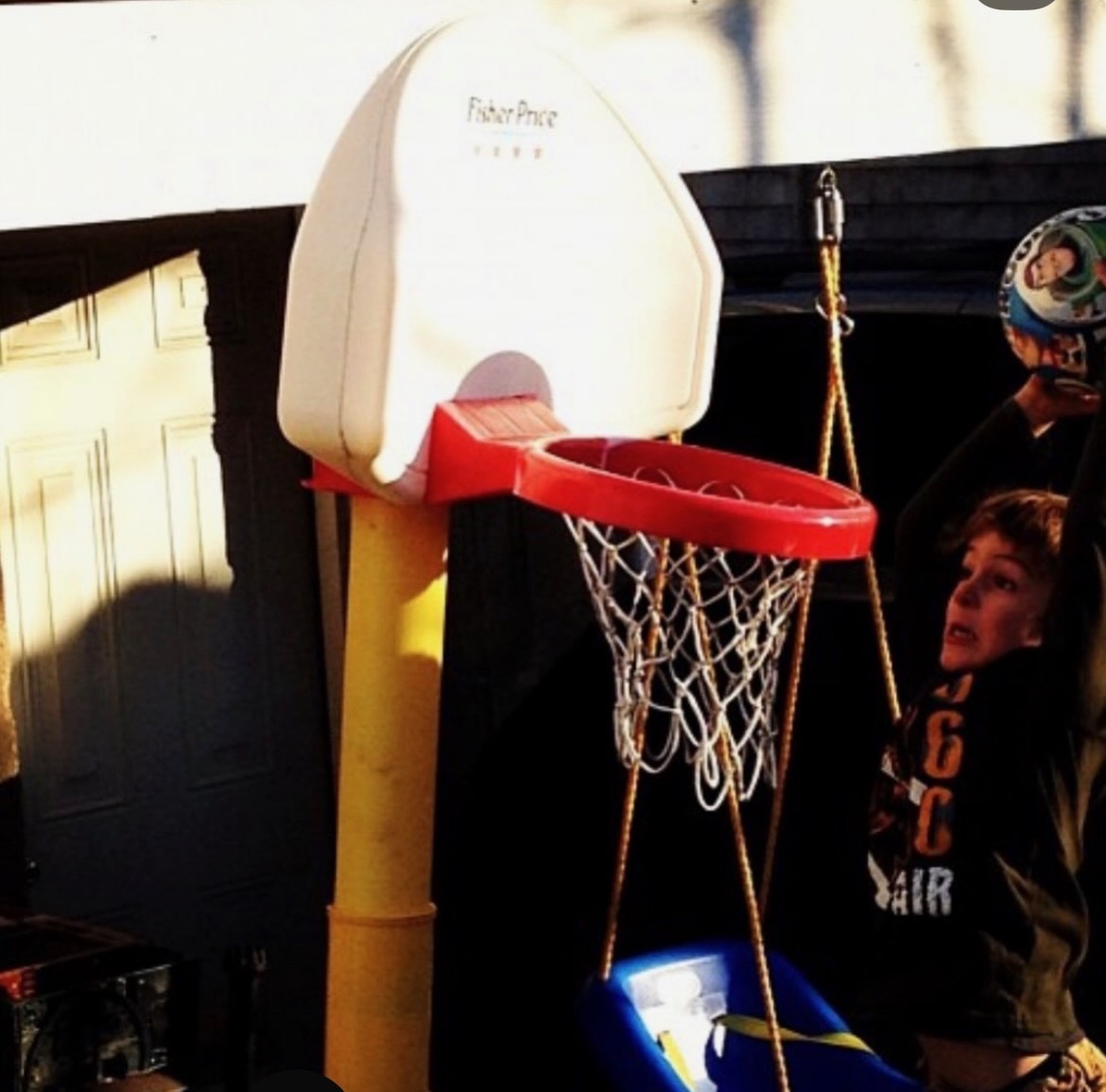
Silas Graham grew up around basketball with his father coaching at the college level.Courtesy of Nat Graham
As a child, Silas rarely responded well to his father’s postgame pointers — and Nat offered plenty.
“I have a friend who’s a trained musician,” Nat said. “He says when he goes to concerts or he goes to a small bar with live music, it’s hard for him to enjoy it because he’s always looking at it critically, and I think the same is true for coaches.
“I can’t turn the coach off. There’s things I see that no one else here sees, and I can’t not tell you. But that process was very difficult. I think in the long run, it may have been beneficial, but it’s not easy as a kid.”
Eventually, Nat broke through. Silas no longer brushes off his father’s criticism and welcomes the additional coaching. Last season, Nat attended two Haverford games while living in Ithaca. Silas is looking forward to having him back in the bleachers during his final high school season.
‘Want them to be well-rounded’
With the recruiting process behind him, Silas is exploring who he is outside of basketball. Nat has long given Silas and his two other children the support to so.
“As much as I love basketball and I can be on them about basketball stuff, I want them to be well-rounded, thoughtful [people],” Nat said. “More developed overall humans than sometimes can happen with sports people.”
Silas has watched his father develop himself outside of basketball.
Off the court, Nat is a committed racial justice advocate. He has written about several racial justice topics including white allyship and police brutality. In 2021, as a member of Penn’s staff, Nat sat during the national anthem to bring attention to institutional racism. Silas is taking an African American studies class, where he noted he is one of two white students.
“It’s cool to see another part of history,” Silas said. “Haverford, we say we’re like ‘woke’ and diverse, we don’t really like to go super deep into all that stuff. We kind of stay surface level, so this is the one class gets intense and emotional, but I think I like it. I think it’ll be interesting for me.”
One area of importance for Silas is wanting to help Philadelphia’s homeless population. This, too, is because of Nat. Growing up, Silas would regularly drive through West Philadelphia with his father to Penn’s campus. From his booster seat, Silas saw how homelessness affected the area.
Silas Graham averaged 20.7 points, 9.1 rebounds, and 3.1 assists last season at the Haverford School.Yong Kim / Staff Photographer
“That’s actually another big thing for my dad,” Silas said. “People don’t understand why people are homeless and they blame it all on them. There’s so many other factors that go into that, but like that’s something I took an interest in.”
Silas is looking forward to his future at Hawk Hill, where he expects to play early. He’s also proud to stay in Philadelphia.
“I love the Big 5,” Silas said. “I grew up around it, and I love like the history behind it. So many Philly guys leave now. Even in high school, Philly guys leave now. So l I think it’s cool that I’m one of the guys that stays.”
Villanova women’s soccer didn’t allow a goal through its first six games of the season.
The team’s streak of holding opponents scoreless finally ended last Thursday, in the 73rd minute against Delaware. However, instead of wilting, Villanova was unfazed, scoring moments after to grind out a 2-1 win.
“There was not a sense of doubt at all in a single moment [Thursday],” graduate goalkeeper Hannah Dickinson said of the Delaware match. “I think that even when we got scored on, you could feel the energy within the stadium and within our team that we know we’re going to win.”
The Wildcats closed nonconference play with an undefeated 5-0-3 record. While the defense’s scoreless streak was impressive, head coach Samar Azem says the team’s response to being scored on spoke volumes.
“If you play with trying to avoid something, it’s going to be the elephant in the room the whole time,” Azem said.
That punch-counterpunch mindset is what the fifth-year head coach has tried to instill at Villanova.
“It was almost the monkey on our back, you don’t want to give up a goal,” Azem said. “It happened. So what? Move on, let’s keep going forward. That’s our mindset. If we score, so what, move on [and] if they score, so what, move on. And the team does that phenomenally well.”
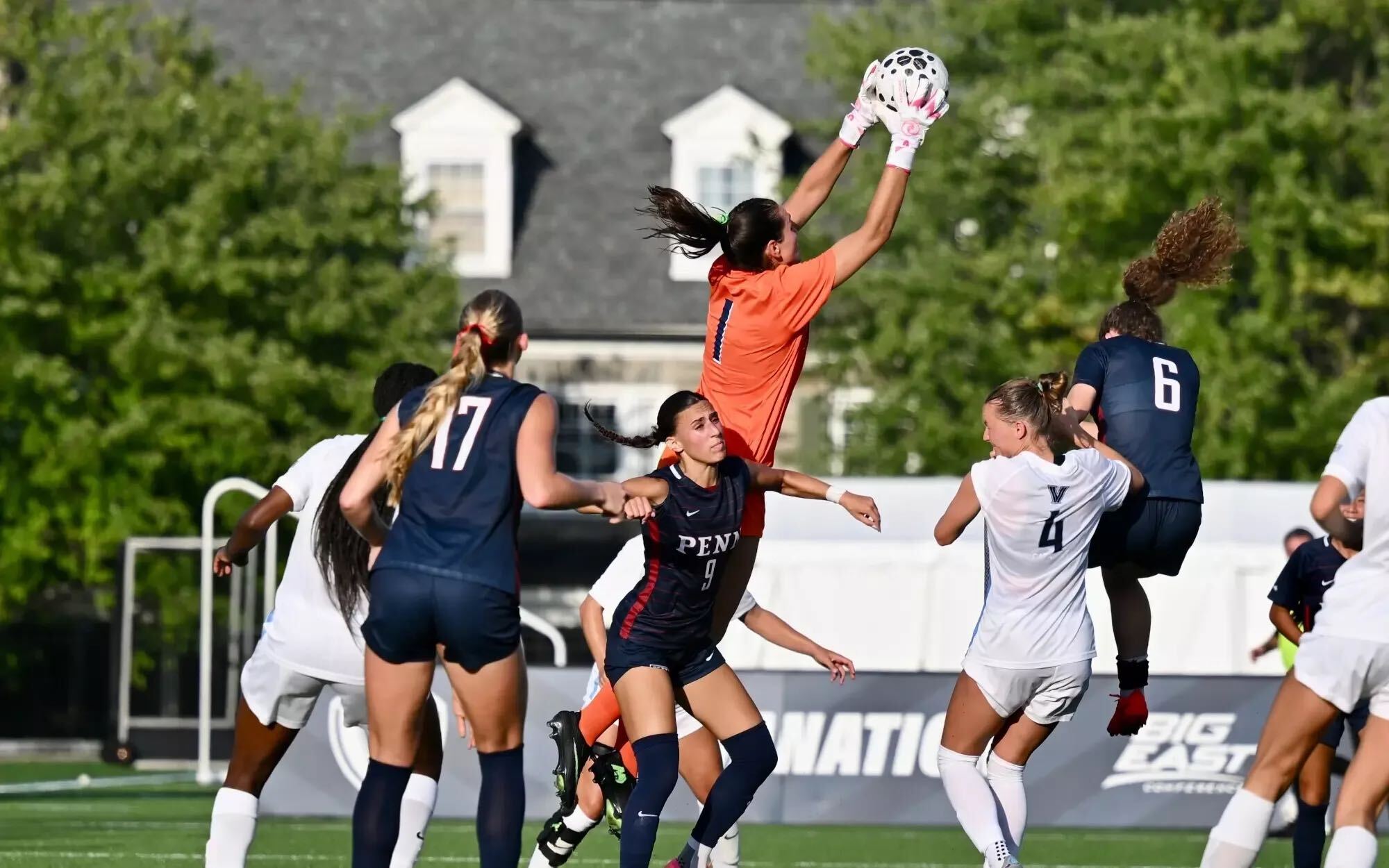
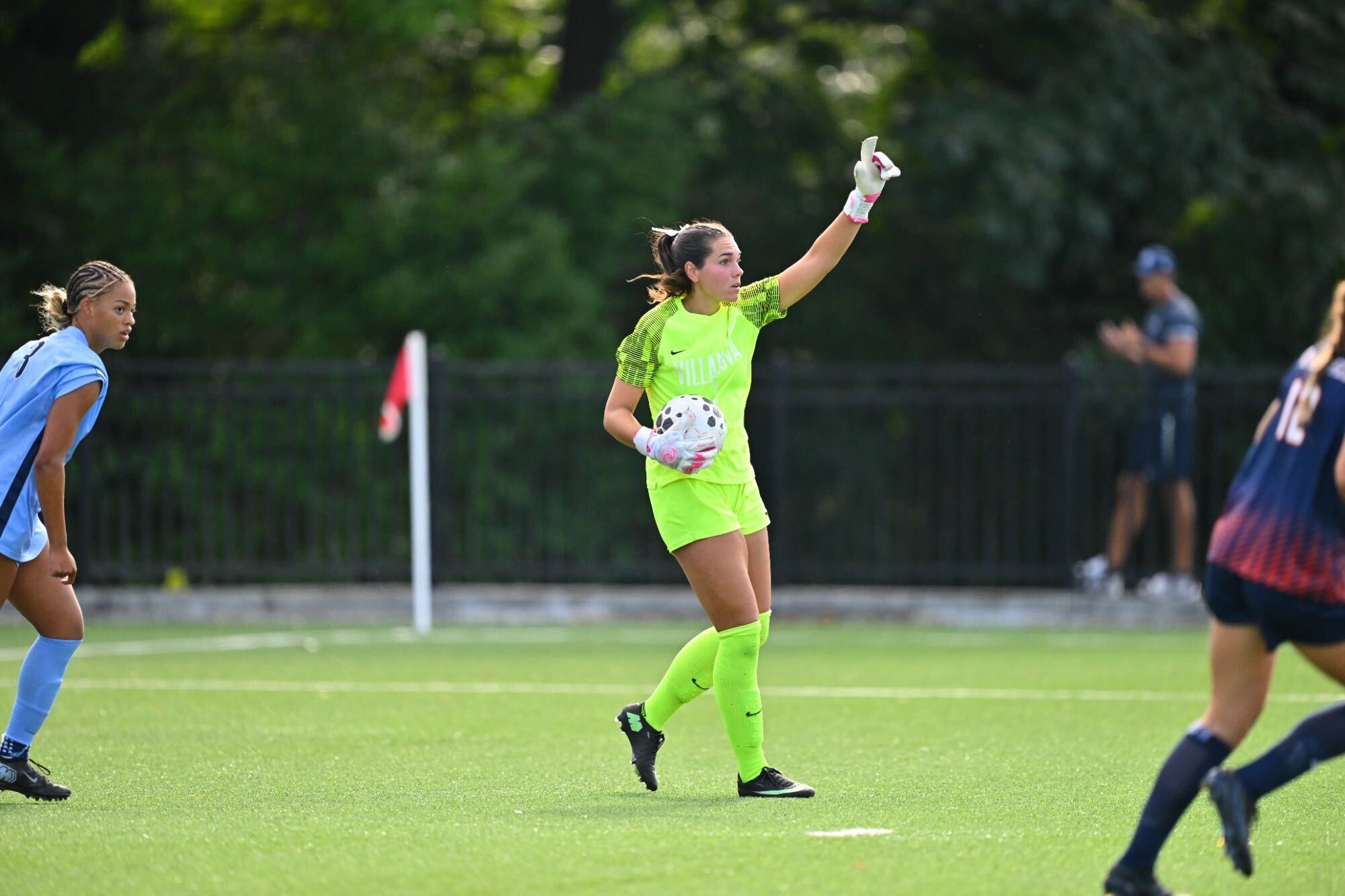
Goalkeeper Hannah Dickinson transferred to Villanova during the 2024 season.Villanova Athletics
As it enters Saturday’s home game against St. John’s, Villanova has set another milestone by becoming the first team in 19 years to surrender two or fewer goals across its first eight games.
When Azem took over the program in December 2021, Villanova had allowed 1.7 goals per game across in its previous five seasons. Since 2022, that number has been cut dramatically to 1.02.
So far this season, the Wildcats have outscored opponents 26-2 and have climbed the national rankings defensively. The Wildcats are tied for fourth in the nation in goals-against average (.250).
“One of the first things we wanted to do was reset our standard for defending,” Azem said. “Each year, it’s gotten better and better, and to see how good it is so early on in the season is a testament to the work the players have put in.”
Dickinson, a captain who was a Big East All-Conference second-team selection in 2024 and 2025, has been key to the success on defense.
This year, the Seattle native is seeing the roots that were built when she transferred to Villanova from USC in 2024 coming to fruition.
“I got here three years ago and we’ve just been continuing to build the foundation,” said Dickinson, who has made 10 saves this season. “We were incredibly close last year to breaking that surface a bit and I think this year we’ve only shown a tiny bit of what we can do, it’s the start of the season so it’s really exciting.”
Azem says the graduate goalkeeper has grown as a leader and is one of the best she’s ever come across throughout her coaching career.
“She’s one of the best aerial [keepers], one of the best at organizing the back line, and then she’s just a fantastic shot-stopper,” Azem said. “When she’s called upon, you’re going to have to be excellent to beat her and that’s why a lot of teams find that it’s difficult to do, but the defense also makes that predictable for her.”
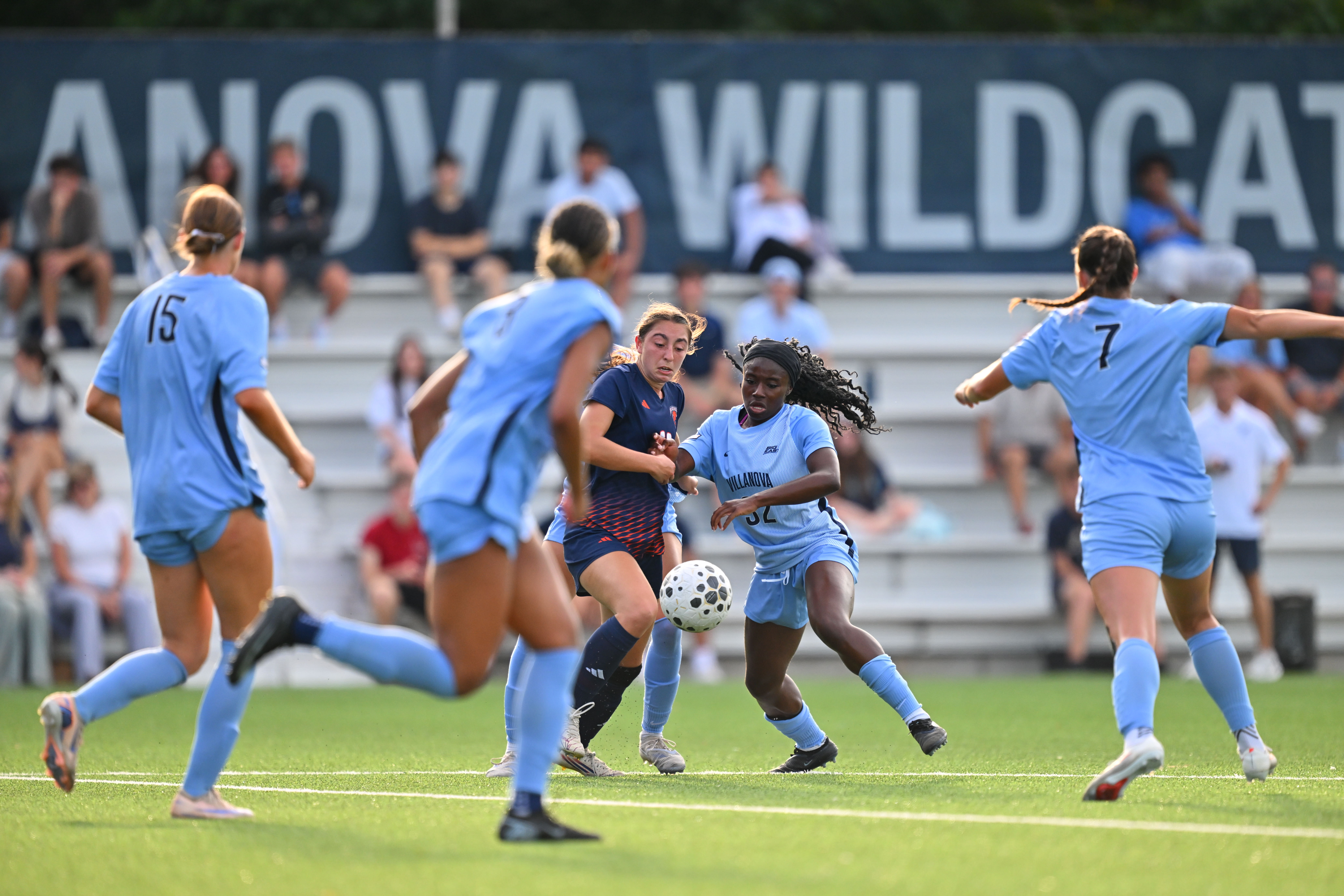
Defender Meredith Palmer and midfielder Amalia Cardo during a game.Villanova Athletics
Junior Meredith Palmer and Bucknell transfer Meghan White have anchored the backline in front of Dickinson. The group is holding opposing teams to seven shot attempts per game, a massive improvement on last season’s mark of 13.9.
Offensively, sophomore Avrie Nelsen, last year’s conference rookie of the year, has tallied five goals in eight games so far this season to equal her total in 18 games from 2025.
Azem credited the alumni and donors who made it possible for this year’s team to come back to campus two weeks early to train. She believes the extra time helped build the foundation.
And with Big East play approaching, Villanova’s defense will remain a key part of its success.
“It’s kind of this identity shift, you go from being the underdog to just perform, show up, compete, and perform,” Azem said.