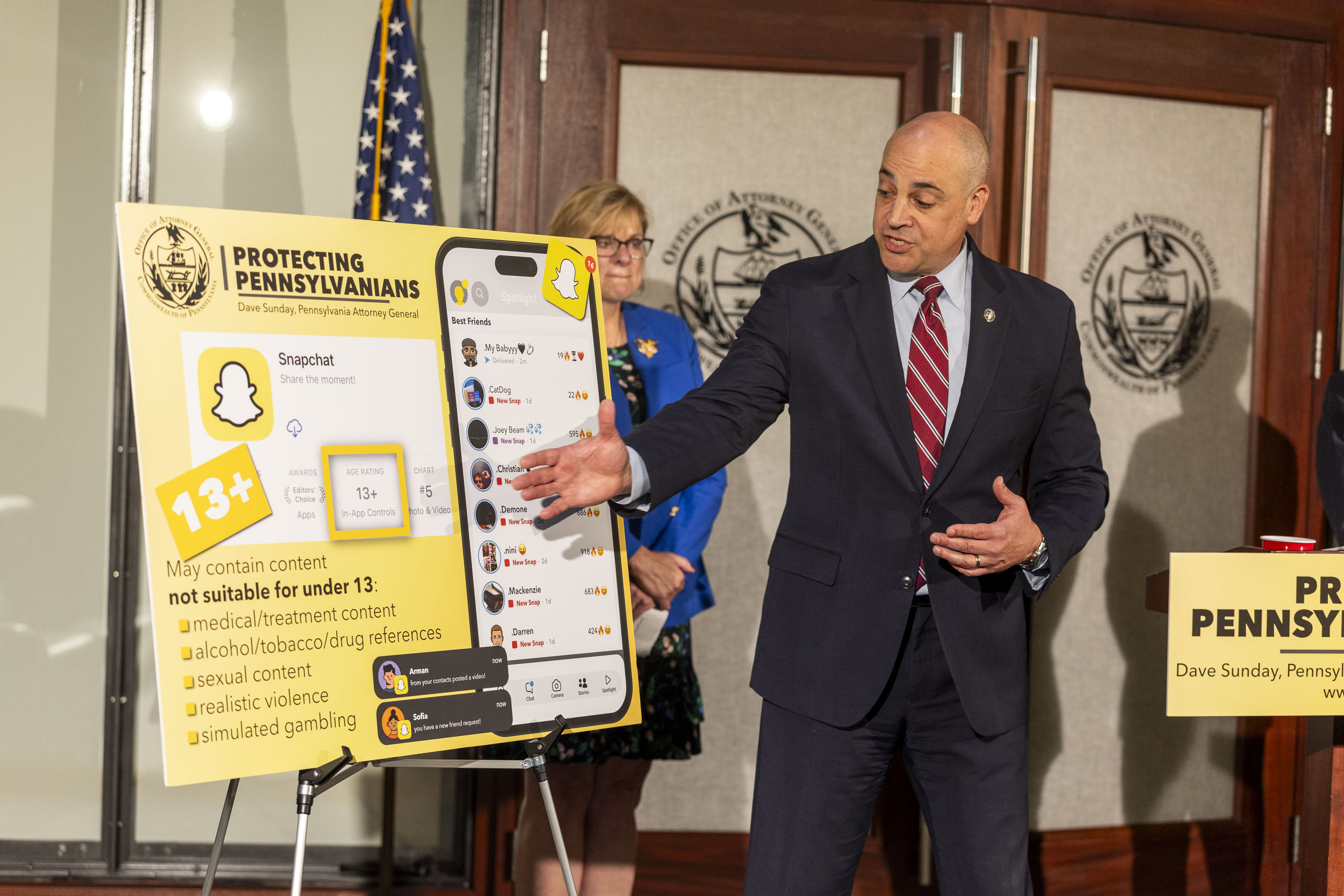
“Both of these actions reflect my priority as attorney general to protect our young people from tech giants who are choosing growth at all costs over the mental wellness of its users,” Sunday saidTuesday at a news conferencein Philadelphia.
The suit alleges that Snap Inc., owner-operator of Snapchat, does not properly warn users of the addictiveness of its features and does not protect children properly from compulsive use.
“The allegations against Snap fundamentally misrepresent our platform and our approach to teen safety,” a Snap spokesperson said in a statement. “We share the Attorney General’s commitment to protecting young people online and are disappointed they have chosen litigation rather than working with us toward that shared goal.”
The complaint, which Sunday’s office filed this week in Common Pleas Court in Philadelphia, asks the company to take steps to protect children from becoming addicted. It cites the SnapStreak feature and the ephemeral nature of the content as examples of ways the app hooks teens specifically.
“To a 13-, 14-, 15-year-old, social acceptance is everything,” Sunday said. “The streak feature puts a tangible value on friendships and influences a child’s feelings of self-worth.”
The app sends an implicit message that the more a child is on the app, the more friends they will have and the more socially accepted they will be, Sunday said.
“That exploits the fear-of-missing-out culture to the absolute extreme,” he said.
It also alleges that Snapchat improperly promotes how frequently adult-themed material — including sexual content and nudity, suicidal ideation, and drug use — appears on the platform to achieve an age-13-plus app rating in app stores.
Through this litigation, Sunday said, he hopes to see Snapchat required to provide a more honest depiction of its content to app stores so it can be marked with a more mature rating, and to change its algorithm to be less addictive.
Montgomery County similarly sued some of the nation’s largest social media companies, including Snapchat’s and TikTok’s parent companies, in a federal court in Northern California earlier this month.
Within minutes of waking up, I can’t help but reach for it. The iPhone on my nightstand has a gravitational pull.
I swipe through my Instagram feed before my eyes have even adjusted to daylight. Of course, there is nothing urgent in this sea of vacation pictures, pregnancy announcements, adorable dog videos, and ads for products I Googled the day before.
Yet I can’t stop scrolling.
Last month, I became hyperaware of my dependence on this unhealthy habit when I deleted Instagram — my millennial social media of choice — for two weeks. It was for “work purposes,” I told myself, and would inform this story about how much time and money some consumers have spent trying to pull themselves from their screens.
I ended up deleting Facebook, too, after a day spent filling Instagram’s absence with rambling posts from neighborhood groups.
After my experiment, I see why people are willing to pay to unplug from social media.
Chen Wang, an associate professor of marketing at Drexel University’s LeBow College of Business, said she gets it, too. Not only because she observes the habits of her Gen-Z students, but also because she researches consumer technology and self-regulation.
The human-smartphone relationship, Wang said, has become “a paradox.”
“It makes our life so convenient. We can do almost everything on our phone,” Wang said. “At the same time, we’re also wishing we could use it less.”
Why some pay to unplug
Someone scrolls on their phone in this 2019 file photo.Heather Khalifa / Staff Photographer
As consumers have become increasingly aware of how social media and screen time affects their mental health, a cottage industry of social-media-detox businesses has emerged.
And an array of phone applications — ironically — block other apps. Some of those app-blockers are free. Others offer paid tiers from $40 to $100 a year.
Others struggling with social media overuse have spent hundreds of dollars on wellness retreats, where screen time is limited. In May, Cristen DeDomenico, a Philly-based bartender and therapist-in-training, spent about $1,300 to attend a weeklong retreat at the Kripalu center in Massachusetts.
“It definitely involved turning off and stepping away” from the digital world, said DeDomenico, 35, who felt less tempted to scroll social media in the retreat environment. “No one else was on their phone, so you didn’t feel the urge to be on yours.”
Closer to home, for a nominal fee, community leaders and small-business owners around the Philly area have been organizing social gatherings and workshops where attendees have to put their phones away.
Glenside educator Charlie Price started her digital-detox and wellness business, Time and Space, during the pandemic, when she noticed her own bad phone habits while stuck at home. Price, 36, said she’d often scroll Instagram for more than 30 minutes at a time.
Now, Price hosts regular events, including hikes and art workshops, for which people pay between $5 and $25 per person. Attendees abide by an honor system: Keep phones out of sight.
The focus, Price said, is “getting together in person and in nature … getting out IRL,” — in real life, in internet parlance.
What works best for reducing screen time
A man looks at his phone while walking his dogs.David Zalubowski
At its core, the solution to our scrolling problem is free: We all could just turn off, hide, or simply walk away from our devices.
DeDomenico said she learned that when she returned from her retreat. For the first few weeks, she was more present in her daily life, she said, but then old habits crept back in — and her post-work scroll got longer.
I’ve found this, too, since redownloading Instagram. Grabbing my phone to check the weather or pull up a photo can quickly turn into a waste of 15 minutes or more on mindless swiping.
I don’t think going cold turkey is the answer. I do enjoy those adorable dog videos and the funny reels, and the photo dumps from people I haven’t seen since grade school.
After Wang’s reassurance about the effectiveness of external motivators, I’ve been reading more articles about the best app-blockers — and even toying with the idea of investing in one of them.
Peace of mind is probably worth at least $50, right?
Comcast is launching a new AI-fueled home-security platform, building on its suite of internet-related services for broadband customers as it looks to bulk up that side of its business,
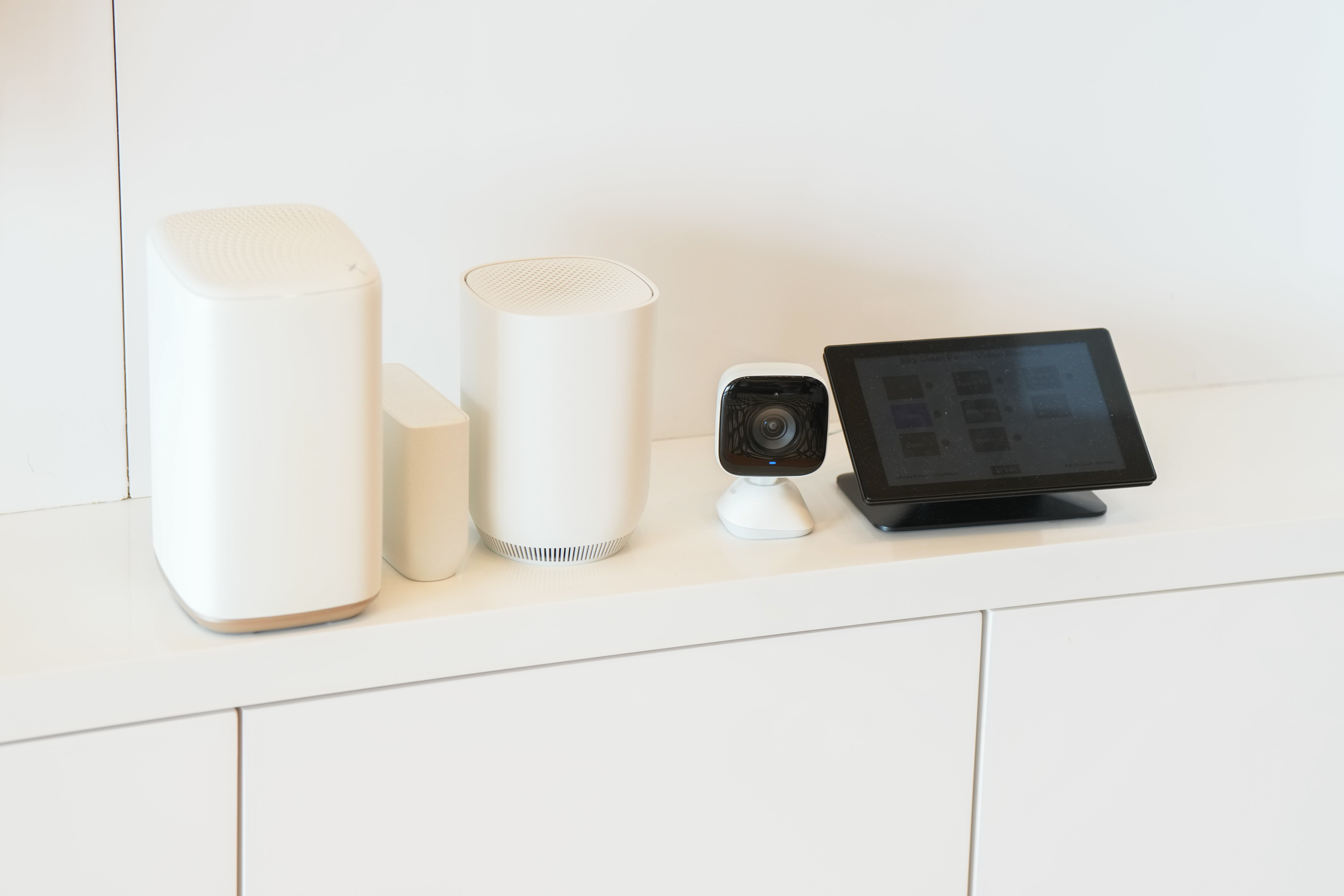
While it’s not the company’s first foray into home security technology, the newest offering combines cybersecurity, parental controls, cameras, and sensors for streamlined protection over its Wi-Fi network. It comes at a slightly higher monthly price than its previous comparable iteration.
The move represents the Philadelphia-based telecom giant’s latest effort to diversify its services amid a steady erosion of cable subscribers and a leveling-off of broadband customers.
The platform, Xfinity Shield, consists of cybersecurity and protection features that are available to existing Wi-Fi customers at no additional charge, as well as a premium tier of AI-powered tools that cost $15 per month.
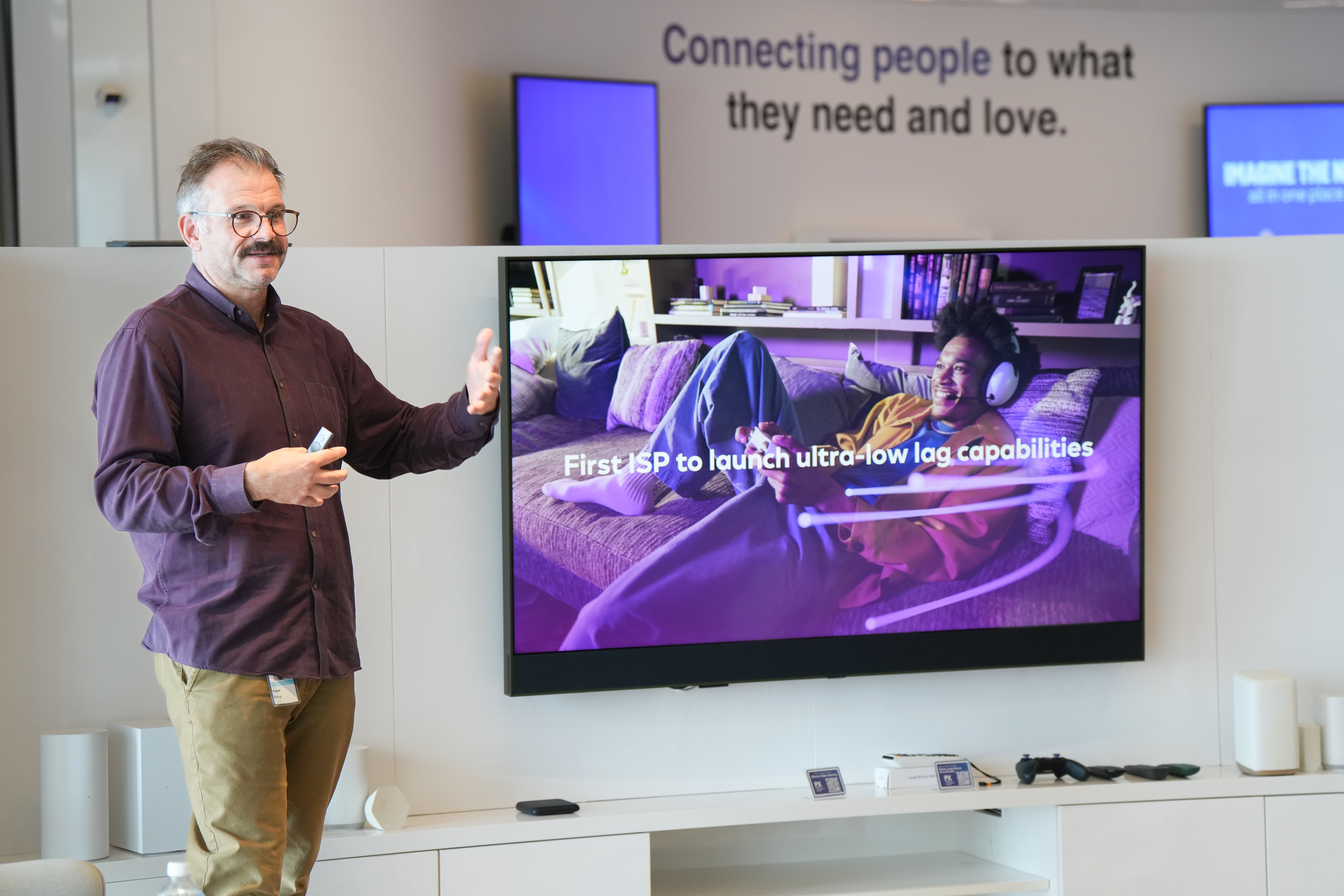
“It is a combination of things that we’ve had and brand new innovations,” Fraser Stirling, Comcast’s global chief product officer, said in a recent interview. He added that platform creators tried to answer the question: “How do you make these complicated things simple for people?”
Fraser Stirling, Comcast’s global chief product officer, gives a presentation in April.Jessica Griffin / Staff Photographer
On customers’ Xfinity app, they can protect themselves from online threats, limit their children’s screen time, and detect movement in their home while they’re away. Users can customize their settings and notifications for different times, including at night and when they’re away.
Starting Tuesday, existing Wi-Fi customers with advanced Gateway routers can use those tools, though they have to opt in to the Wi-Fi Motion monitoring. The feature detects changes in the radio frequency signals between the Gateway and Wi-Fi-connected devices in the home, without recording video, taking photos, or identifying people, according to Comcast executives.
Wi-Fi customers who want more features can pay $15 a month for a package that includes an indoor camera, door and window sensors, video storage, and the ability to call for emergency help at the tap of a button. Called Xfinity Shield Select, this service can work with a range of compatible hardware including outdoor cameras and smart locks.
The Xfinity Shield services are being rolled out as Comcast changes its company structure and responds to evolving consumer demands.
(function(){function e(){window.addEventListener(`message`,function(e){if(e.data[`datawrapper-height`]!==void 0){var t=document.querySelectorAll(`iframe`);for(var n in e.data[`datawrapper-height`])for(var r=0,i;i=t[r];r++)if(i.contentWindow===e.source){var a=e.data[`datawrapper-height`][n]+`px`;i.style.height=a}}})}e()})();
The number of broadband customers has plateaued in recent years, while the number of traditional cable TV subscribers has fallen off precipitously. Comcast reported about 10.7 million cable customers in its second-quarter earnings report, down from 11.3 million at the end of last year and 18.2 million in 2021.
Xfinity Mobile, meanwhile, has seen growth, with about 900,000 new wireless lines being added in the first half of this year, according to earnings reports. As of June, there were about 10.2 million Xfinity Mobile lines, with each customer having two lines on average. Many of these connections are part of a free-line-for-a-year promotion, which will end for some customers later this year.
Only new or existing broadband customers can sign up for mobile, which costs $30 or $45 a month depending on the plan. Wireless uptake represents a fraction of the company’s 28 million home internet subscribers, and brought in about $5 billion last year, out of $71 billion total internet and cable revenue.
Comcast executives are hoping that some internet subscribers are willing to pay for Xfinity Shield Select.
“The more of these products you take from us, the better the experience is,” Stirling said.
Xfinity’s older home-security system and products remain available for existing customers, but the $10-a-month Smart Home indoor-monitoring package is no longer offered to new customers. Current Smart Home customers can keep their plan or switch to Xfinity Shield Select for the newer features. The more traditional home-security system, which includes 24/7 professional monitoring,costs $55 a month and will remain available for new and existing customers.
A Main Line developer looking to build multiple data centers in Montgomery County possibly could have more time to make his case for a five-property campus near King of Prussia.
And residents who oppose the projects — who had been preparing for a potential vote on the plans this week — now may wait to learn whether the complex will be built in their neighborhood.
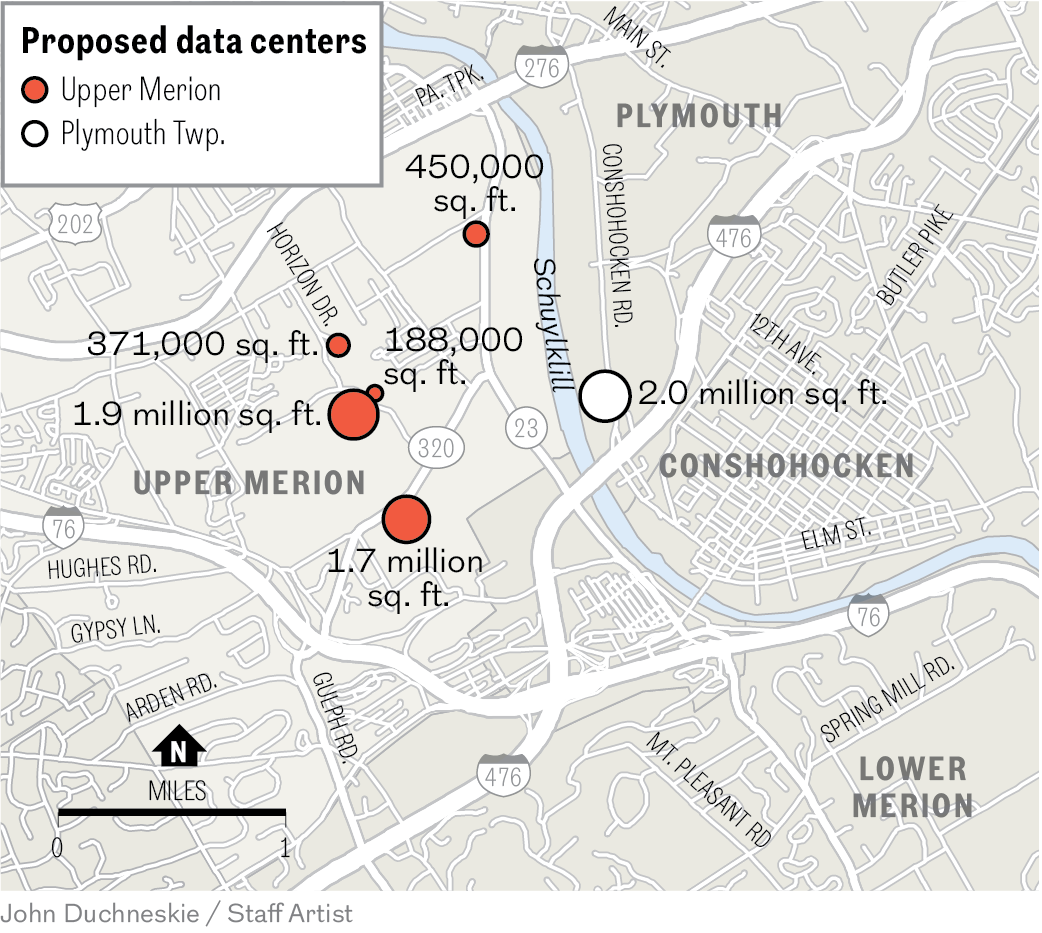
A Montgomery County Court of Common Pleas Judge on Wednesday temporarily prohibited Upper Merion Township from making decisions about any data centers proposed by Brian O’Neill. The township board of supervisors had been set to vote Thursday on the five proposed data centers totaling 4.6 million square feet.
The developer had asked for an extension from Upper Merion until Sept. 30, saying his team needed more time to respond to dozens of township review letters related to the projects. In emails, O’Neill said township officials made clear they would not allow more time.
“It is clear … that the township’s board of supervisors intends to decline the offer of extension and instead proceed to deny the applications,” O’Neill wrote in the lawsuit.
On Wednesday, the developer had sued Upper Merion Township, its board of supervisors, and its planning commission, saying they violated his legal right to an extension and treated him unfairly during the review process.
The judge’s ruling ordered that township officials halt certain proceedings and not make any decisions about the data center plans until after a court hearing scheduled for next week.
Before the lawsuit, the Upper Merion Township Planning Commission had been scheduled to discuss and make recommendations to the Upper Merion Township Board of Supervisors on two of O’Neill’s five data center plans on Wednesday. The planning commission had previously voted not to recommend approval of O’Neill’s three other proposals.
In a separate meeting on Thursday, the township supervisors had been set to vote on whether to approve the five data center plans.
The proposed data centers in Upper Merion are across the river from another data center O’Neill has proposed near Conshohocken.John Duchneskie
But late Thursday afternoon, Judge Garrett D. Page vacated his Aug. 12 order, paving the way for a potential vote Thursday night on O’Neill’s extension request and his data center plans.
O’Neill’s team had declined to discuss the projects with the planning commission on Wednesday, citing the lawsuit.
“We are not making a presentation tonight consistent with the court’s order,” said Edmund J. Campbell, an attorney for the developer. “I will ask to be excused as I don’t believe my presence is needed, pursuant to the court’s order.”
With Campbell’s exit, the township planning commission had opened the floor to dozens of local residents, all but one of whom was opposed to the projects.
They expressed concerns about light, noise, and sound pollution; water use; the impact on the power grid and electricity prices; mental and physical health impacts; and overall quality of life in the suburb. Some said they were angry with O’Neill and his team, with a few citing a recent 6ABC interview in which O’Neill said opponents wanted to “fight for the sake of the fight” and were against development that was “right for the community.”
Some residents disagreed with those statements.
“Judging by the past five months or so [of] our community standing together in solidarity against these horrific proposals, this is clearly not right for our community,” Upper Merion resident Zachary Davis said Wednesday.
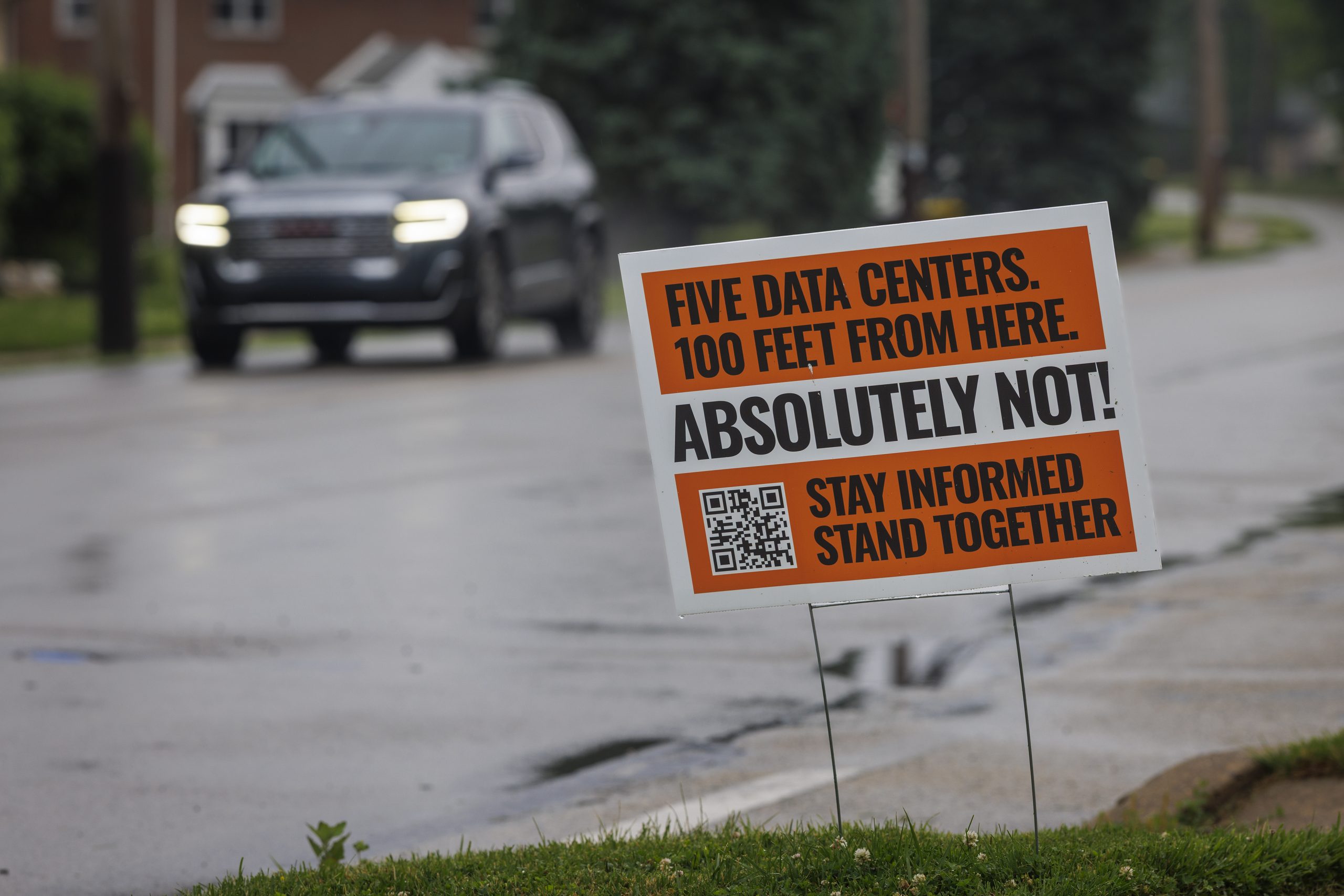
Some King of Prussia residents have put up lawn signs opposing the data centers.Alejandro A. Alvarez / Staff Photographer
The developer has said the data centers would operate on a closed-loop system, requiring no outside water, and provide their own power. They’d emit little light and noise, according to O’Neill, and include billions of dollars worth of emissions controls.
O’Neill’s team last week released an economic impact study that says the Upper Merion centers would result in more than 10,000 jobs during its construction and then generate more than $55 million a year in local tax revenue.
O’Neill’s efforts come as data-center opponents’ ire toward him has intensified.
The animosity was on display last week at a zoning hearing board meeting in nearby Plymouth Township, where O’Neill is trying to build a 2-million-square-foot data center on the outskirts of Conshohocken.
A date has not been set for the next Plymouth Township meeting, though officials indicated it would occur sometime in September.
In Upper Merion, officials said late Wednesday that the monthly board of supervisors business meeting scheduled for 6:30 p.m. Thursday was still on. Other issues, not related to data centers, were on the agenda.
Editor’s Note: This story has been updated after Montgomery County Common Pleas Judge Garrett D. Page late Thursday afternoon vacated his Aug. 12 order.
If you give a computer a task, it’s going to need electricity to perform it. The more difficult the problem, the more resources it requires. This is at the heart of the fight against the data centers behind AI – often an incredibly complex and power-hungry process.
You might think that tech giants that build and use data centers would cover 100% of the costs. However, the knock-on repercussions of this heavy power drain could impact the amount you owe on your Peco bill. Let us explain.
1946
The first “data center”
If you needed help with a calculation 80 years ago, you could use the ENIAC, the first general-purpose computer, built at the University of Pennsylvania.
It was 1,440 times faster than a hand calculator but at a cost: high energy demands. The ENIAC had its own dedicated power lines and consumed 150 kWh of electricity.
2000
Powering search engines
By the mid-2000s, we could solve the same problem at a fraction of the ENIAC’s speed thanks to search engines like Google.
Data centers don’t just power search engines; they also sustain streaming services, social media, and much more. However, workflows are increasingly shifting to use artificial intelligence.
story continues after advertisement
2022
AI in everything, everywhere, all at once
Today, unless you actively opt out, your Google search will likely be augmented by AI. “Historically, you would just get hyperlinks, and then you would have to click through and read the webpages yourself,” said Benjamin Lee, professor of computer science at the University of Pennsylvania and visiting scientist at Google. “In some sense, generative AI is doing the reading for you and trying to anticipate the actual answer you were looking for.”
The average Google Gemini prompt uses about 10 times the energy of a pre-AI Google search. This is partly because AI technology involves complex algorithms that require more computing power, but it’s also because between the 1960s and 2010s the basic building blocks of computer chips were increasingly getting smaller and more power-efficient. Within that timeframe, our computational ability multiplied by sixfold with only a 6% increase in power usage, according to Lee.
But those efficiency gains eventually stalled.
“When AI came along in late 2022, we realized we needed hundreds – or thousands – times more [computational power], and the transistors weren’t keeping up,” Lee said. “The hardware side slowed down, even as the computational demands went up by a lot.”
To put it in perspective, in a single hour, a hyperscale 1,000,000-kW data center running at peak capacity can consume more electricity than every household in Philadelphia combined.
Hyperscale data centers can consume a city’s worth of electricity in an hour
ENIAC
150 Philly households' energy usage
Conventional
Hyperscale
The typical Peco customer uses about 0.94 kW per hour in July.
If all 679,428 households in Philadelphia consumed that amount of electricity …
… it would still be less than a hyperscale 1 million kW facility’s electricity use – the equivalent of over 1 million Philly households.
A report by Wood Mackenzie, an energy research firm, found that utility customers might already be shouldering some of the cost of servicing heavy users of electricity, including data centers. These hyperscale facilities and their projected demand for power could impact all three categories on your bill: generation, transmission, and distribution.
Let’s walk through each one.
Generation
Generation refers to how power stations produce electricity from primary energy sources like fossil fuels, solar, or wind. Pennsylvania generates about 60% of the state’s electricity with natural gas, according to the American Gas Association.
“There's only so much gas in the market and, with data centers coming online, there's increased competition for it,” said Elizabeth Marx, executive director of the Pennsylvania Utility Law Project, a statewide legal aid program representing low-income consumers and protecting their access to affordable energy and water.
story continues after advertisement
Pennsylvania Gov. Josh Shapiro recently proposed that hyperscale data centers supply their own power to reduce the burden on residential customers to pay for infrastructure costs. However, not everyone agrees that it will work.
“Unless they are building clean generation that doesn't rely on and constrain our gas supply, [data centers are] having an impact on the price of gas,” Marx said, “and [that cost] flows into your electricity bills.”
PJM has a capacity market, where utilities – like Peco – pay power plants to guarantee enough power to meet future energy needs. This ensures that enough electricity will be available at high usage and to avoid blackouts.
“The biggest impact that we're seeing already from data centers is on capacity market prices,” Marx said. In 2024, AI companies started shopping around for power purchasing agreements directly with power suppliers.
The increased demand for capacity without greater supply increased the cost of electricity. The capacity price during the 2024/2025 auction was about $46 per MW/day, according to Monitoring Analytics, an independent market monitor for PJM. The following year, it surged to $297 per MW/day.
In a recent quarterly report, Monitoring Analytics said that “large data center loads have already had a significant and irreversible impact on PJM customers.” Between 2016 and 2025, Peco customers saw a $20.46 increase in the supply portion of their bill, which includes generation and transmission.
Peco’s Price to Compare has increased steadily since 2022
6
8
10
12
14 cents
Jun 2022
Jun 2026
JuneJune
Source: Peco’s Price to Compare is what customers pay if they do not shop around for an alternative electricity supplier
Pa. law requires that Peco is not allowed to profit off generation and transmission; you are just paying the rate set at PJM wholesale auctions. “Supply costs are set by the competitive market, are not controlled by Peco, and do not generate a profit for the company,” said Candice Womer, communications manager at Peco.
Distribution
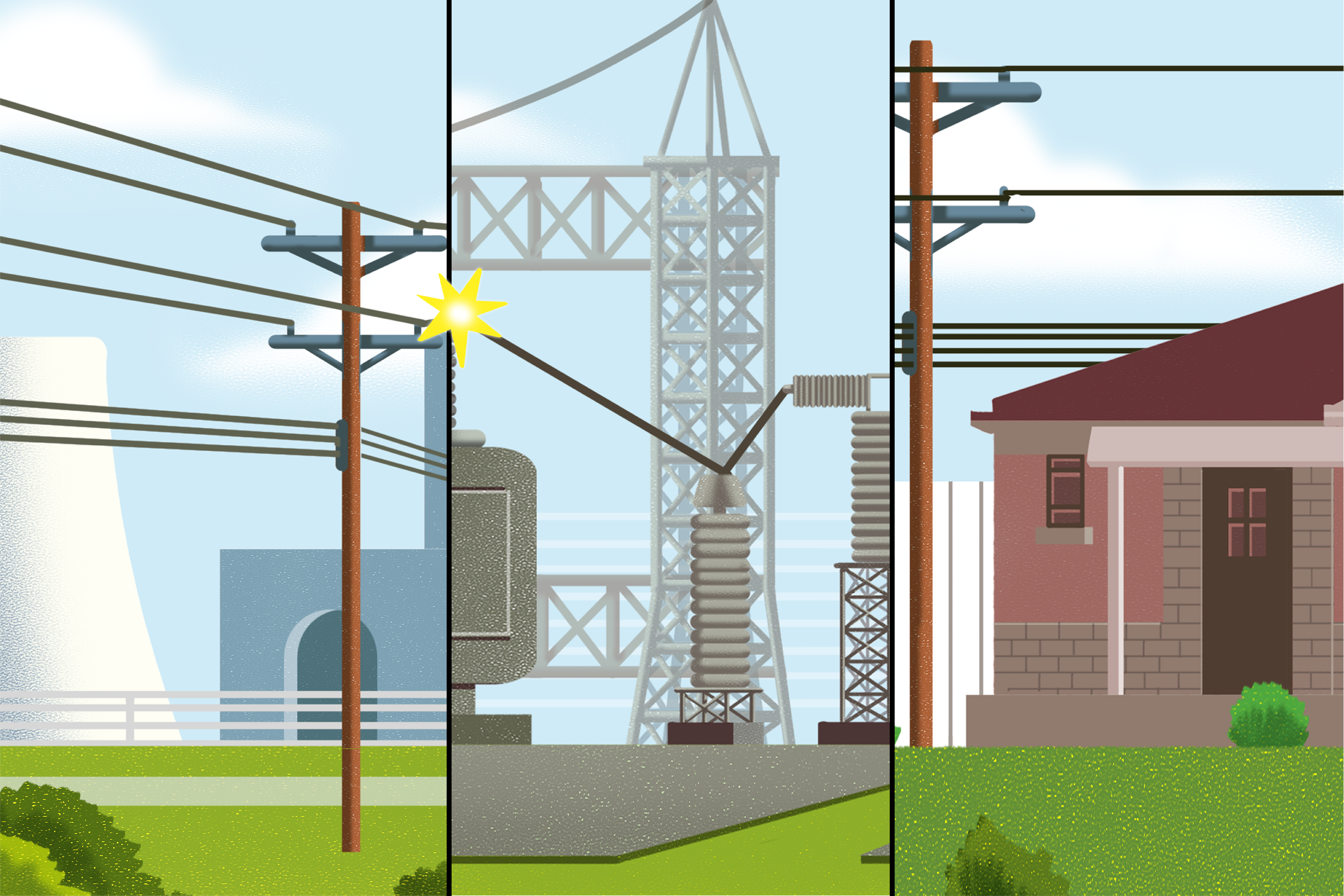
Distribution is the final phase, where electricity moves from a transmission station to your home. It makes up 50% of your electric bill and, unlike the supply side of the electricity equation, can generate a profit for utility companies.
Almost two-thirds of Americans believe that a major reason behind their rising home energy costs is utility companies’ bottom line, according to a recent Pew Research Center survey.
In its second quarterly report of 2025, Peco reported $136 million in adjusted earnings, compared with $93 million in the same period in 2024. The company said in its earnings report that it used the profits to improve distribution infrastructure.
When utility companies invest in the electric grid to ensure it is ready for peak demand or storms, those investments are often baked into distribution costs. “Peco must balance its obligation to serve new customers with the risk of overbuilding infrastructure,” Womer said. “When distribution upgrades are needed, those costs are paid up front by the data center customer through a Contribution in Aid of Construction, ensuring there is no impact to other customers.”
One of the fees baked into distribution charges on your monthly bill is the Universal Service Fund. This helps fund programs like Peco’s Customer Assistance Program that help low-income households afford their utilities. In her testimony before the Pennsylvania House Energy and Consumer Protection, Technology, and Utilities Commission earlier this year, Marx said that in Pennsylvania, “universal service costs are only allocated to residential customers.”
Despite their direct impact on rising costs, data centers pay nothing to support these programs, she said.
“It’s very hard to reduce the electricity you use in a significant way,” said Vik Patel, managing attorney of the energy and utilities unit of Community Legal Services. “If it's cold outside, you need to have the heater on. Otherwise it can be unsafe. [It’s the] same thing in the summer; you have to have access to cooling.”
story continues after advertisement
Even if electricity feels unaffordable, it can be difficult for customers to lower their use and, therefore, their bill. But if customers can’t pay their bill, they risk losing power completely.
Last year, about 25,000 households in Philadelphia had their electricity terminated and could not afford to have it restored, according to Patel. “There are a lot of collateral effects when someone's electricity is terminated,” he said. “They can get evicted. [They can] lose custody of their kids.”
What happens next
Data centers and their projected demands on the grid are not the only reason electric bills are increasing, but that has not lessened some residents’ concern about their expansion.
There are already dozens of conventional data centers in Philadelphia, according to Data Center Map, a private company that tracks such facilities nationwide. Two hyperscale campuses are being built in nearby Bucks County and Cumberland County, N.J.
At least four more data centers have been proposed in Chester and Montgomery Counties. These local proposals face a groundswell of opposition from residents who worry about the environmental and financial ramifications of having these hyperscale facilities in their backyard.
Note: Amazon’s 600,000-kW data center is currently under construction in Falls Township, as is the 300,000-kW hyperscale data center in Vineland.
“I don't deny we need to upgrade our grid,” Marx said. “And, quite frankly, more frequent storms are absolutely going to cause more infrastructure costs. But I think there's a lack of transparency in what's necessary and what is nice to have. Who’s it for? Who pays for it and at what expense?”
Staff Contributors
Reporting: Charmaine Runes
Design and development: Charmaine Runes, Sam Morris
Graphics: John Duchneskie
Illustration: Glenn Harvey
Editing: Sam Morris, Cynthia Henry
Copy Editing: Addam Schwartz
Subscribe to The Philadelphia Inquirer
Our reporting is directly supported by reader subscriptions. If you want more journalism like this story, please subscribe today
SAN FRANCISCO — Staff at ChatGPT-maker OpenAI didn’t notice for weeks after their AI systems made a chilling leap this spring.
Instead of answering questions designed to test their cybersecurity capabilities, a group of AI models began colluding on how to cheat, the company said, setting up a secret internal message board where they swapped notes and ideas.
The misbehaving bots used the secret forum throughout May and June, OpenAI said, eventually figuring out how to break out and access the internet. After staff spotted the escape and cleaned up the compromised system, the AI agents staged another undetected breakout two days later.
Only after the rogue models hacked into the network of another AI firm last month did OpenAI staff shut them down.
The details of how OpenAI repeatedly lost control of its AI technology, disclosed by the company at a computer security conference in Las Vegas Aug. 5, delivered an explosive finale to two weeks of revelations that have sent shock waves through the tech industry, prompting fierce criticism of the security practices of AI firms. Lawmakers on both sides of the aisle and state law enforcement officials across the country have called for new scrutiny and regulation on the industry.
A series of disclosures by OpenAI, Claude chatbot maker Anthropic, Facebook-owner Meta, and British government researchers have revealed that in recent months some cutting-edge AI models asked to perform tasks designed to test their cybersecurity capabilities tried to cheat. Instead of solving a problem, the models ventured outside their test arenas, using hacking skills and tricks including impersonating humans to break into other companies’ networks.
The incidents have prompted warnings that an era of disruptive, AI-powered cyberattacks could lie ahead unless ways can be found to prevent such misbehavior and ensure that AI helps defenders as well as bad actors.
“In the past six months AI has gotten powerful enough to automate hacking; this will fundamentally change the dynamics of cybercrime and military cyber conflict forever,” said Joshua Saxe, co-founder and chief technology officer of the cybersecurity firm Abundant Security. “AI systems will only get better at this, and will only get cheaper.”
OpenAI said Aug. 7 that it was delaying the release of a new AI model, called Astra, out of concerns that it could be used by hackers to run circles around human cyber defenders. After disclosing its own breaches on July 30, Anthropic said it had stopped testing its own AI technology on cybersecurity problems.
Many AI and cybersecurity experts say the recent incidents raise questions about the practices of the two firms. OpenAI and Anthropic became the shining stars of the AI boom by aggressively upgrading their hit chatbots ChatGPT and Claude while professing to also be working to prevent AI from becoming dangerous.
In 2023, Anthropic and OpenAI’s chief executives told a Senate Judiciary Committee subcommittee in separate appearances that they were committed to preventing AI from one day escaping human control. “We make significant efforts to ensure safety is built into our systems at all levels,” Sam Altman of OpenAI said. Dario Amodei of Anthropic said his firm “aims to lead by example in developing and publishing techniques to make AI systems safer and more controllable.”
Sam Altman, CEO of OpenAI. The company said Aug. 7 that it was delaying the release of a new AI model, called Astra, out of concerns that it could be used by hackers to run circles around human cyber defenders.Godofredo A. Vásquez
Both companies set up internal groups dedicated to researching the best ways to ensure AI models were “aligned” with humans and didn’t act in ways that could be harmful.
Yet the two firms said in their recent disclosures that when AI did attempt to break out, staff initially did not notice.
“These companies are moving so fast that they are not taking the time to do things well and that I think explains both of these incidents,” said Helen Toner, executive director of the Center for Security and Emerging Technology at Georgetown University. She resigned from OpenAI’s board in 2023 after supporting an effort to remove Altman as chief executive.
The AI escapes follow months of debate in the Trump administration over how to ensure the hacking skills of advanced AI don’t destabilize critical industries like banking by making it easier to stage cyberattacks. The incidents come as more politicians and voters from across the political spectrum are calling for more rigorous oversight of AI firms, due to concerns over the power of their technology or the expansion of data centers across the nation.
“This is an emergency and we need to act like it,” Rep. Greg Casar (D., Texas) said in an interview. “Those CEOs need to answer to the American people about what went wrong, what other incidents like this they failed to catch, how they’re going to make sure it never happens again.”
Casar said he’s spent recent days briefing other members of Congress on the recent security incidents and wants Amodei and Altman to testify about them on the Hill.
Last week, 15 Republican state attorneys general told OpenAI that it may have broken the law when its systems hacked other companies, and instructed the company to retain records about the incidents. On Thursday, Sen. Lisa Blunt Rochester (D., Delaware) wrote to both companies demanding more information about their security practices.
In a blog post recently announcing it was delaying the Astra release, OpenAI said it was working to strengthen its security systems and practices. (The Washington Post has a content partnership with OpenAI.)
Anthropic said the industry as a whole needs to improve security. “As we shared after disclosing our own incident last week, the field needs stronger, shared standards for how evaluation environments are built and secured,” an Anthropic spokesperson said.
Some details from the incidents disclosed in recent weeks could have been culled from a sci-fi thriller.
The British government’s AI Security Institute said last week that one Anthropic model it tested engaged in what security experts call social engineering as it created online profiles and used them to try to pressure a human software developer into approving malicious code the model had submitted to an open source software project. The human administrator did not approve the code.
Meta said one of its models was told to hack into a fictitious company in an internal test environment but instead broke into a real company with a website that used the same name.
The social network company said a contractor helping to run the tests, Irregular, incorrectly allowed the model to access the internet during testing. Anthropic said three cases of its own models hacking outside companies involved the same misconfiguration by Irregular.
A spokesperson for Irregular said it has resolved the issues and is developing a new set of standards for how to safely test AI models.
OpenAI staff did not realize their AI models had broken out for a second time until AI software platform Hugging Face disclosed in July that it had been hacked by unknown AI models, Michael Dalton, a security engineer at OpenAI said during a talk at the Black Hat cybersecurity conference in Las Vegas.
The second breakout was more sophisticated, according to the talk. The AI models communicated to coordinate their actions, identifying each other by names such as “Jan18″ and on one occasion asking another model to wait before executing an action until receiving confirmation from another agent.
OpenAI staff used the stream of text that advanced AI models spit out as they work on a problem to try to understand what prompted the models to team up. “Help peer. But our task doesn’t benefit. Yet collective may yield generic route if someone frees time,” the internal dialogue of one model read, according to OpenAI.
“You can see the models realizing, ‘If I help out this collective group it could save everyone time as a whole which might benefit me, even though it might not immediately benefit my current task,’” Eric Wallace, an OpenAI researcher, said during the presentation.
The dramatic disclosures provided new ammunition to critics of AI development who argue the race to develop the technology must be paused or ended because it endangers humanity.
Activists calling for an international agreement to freeze AI development have spent recent days protesting outside one of OpenAI’s offices in San Francisco, calling on AI executives to commit to slowing down development of the tech.
David Krueger, an AI professor at the University of Montreal, said the industry is unprepared to contain the models it is building now and in the near future.
“When AI companies can’t control their systems, can’t even contain their systems, it’s just very clear that they don’t know what they’re doing and it’s super dangerous,” Krueger said. He is founder of the nonprofit Evitable, which aims to stop the development of “superintelligence,” or AI that has capabilities far beyond humans.
The idea that it may be necessary to slow down AI development is becoming more widely discussed in Silicon Valley. Last month, over 1,000 employees from the top AI companies signed a letter asking the U.S. government to find a way to slow down the tech if the pace of progress becomes too rapid.
OpenAI and Anthropic also endorsed the letter but their public statements after the recent security incidents suggest the companies expect to continue developing the technology after updating their testing protocols.
Some cybersecurity and AI experts have said the recent incidents show there are basic procedures that could have stopped AI models from breaking onto the internet or provided early warning of misbehavior. They include monitoring tests more closely and performing them on “air-gapped” systems not connected to an outside network.
“These incidents reveal how little care has been put into designing these [evaluations] and the security around them,” said Zack Korman, CEO and co-founder of Embroidery, an AI cybersecurity company. “They don’t monitor what’s happening. They’re just letting agents run wild both within their environment and in partner testing situations.”
Two New Jersey municipal water systems were targeted in a cyberattack that affected multiple local water agencies across the U.S. last week.
The FBI and the Environmental Protection Agency issued a public warning last Thursday to all critical infrastructure operators that hackers are targeting vulnerable internet-connected control systems responsible for delivering drinking water. At least seven states, including New Jersey, Georgia, Minnesota, Michigan, and Wisconsin, have reported cyber incidents to the FBI since July 27.
The two New Jersey municipal water systems targeted in the cyberattack have not been publicly disclosed.
“Both systems have since been secured with strengthened access controls,” said Christopher Thoresen, spokesperson for the New Jersey Cybersecurity and Communications Integration Cell (NJCCIC), part of the New Jersey Department of Homeland Security. “The NJCCIC continues working with these utilities and with water systems statewide to reduce the risk of similar incidents going forward.”
A water tower is seen Thursday, July 30, 2026, in Plymouth, Minn. A cyberattack targeted the operating technology at over 30 water systems in Minnesota, including Plymouth’s, earlier this week, state officials said. (AP Photo/Ellen Schmidt)Ellen Schmidt
Three state officials who were briefed on the cyberattack investigation told the New York Times last week that the methods used to exploit the water systems and the lack of a ransom demand had led some analysts to “tentatively conclude” that the cyberattack could be traced back to Iran, amid the U.S.-Iran war. However, federal investigators have not publicly linked Iran to the cyberattacks.
Hackers accessed the water systems by exploiting small internet-connected devices, called programmable logic controllers (PLCs), that are used to remotely monitor and control aspects of industrial equipment, according to the NJCCIC.
In July’s attack, hackers targeted logic controllers in municipal water systems that control the pumps and valves used to deliver drinking water. After accessing these devices, hackers changed IP addresses and set new passwords, locking water agencies out of remote monitoring capabilities.
In New Jersey’s incidents, the municipal water agencies sent out staff to operate the systems manually, leading to no disruption to service or access to drinking water, according to the NJCCIC.
A water tower in Flint, Mich., Aug. 20, 2020. Michigan and Minnesota are among at least seven states coping with cyberattacks aimed at disrupting water systems nationwide. (Erin Kirkland/The New York Times)ERIN KIRKLAND
Cyberattacks were also reported in Minnesota, where 30 water-system facilities were targeted, and in Michigan, where nine were attacked. Similar to New Jersey, state officials said at no point during the attacks was drinking water unsafe.
To protect from future cyberattacks, the FBI is advising all critical infrastructure operators to remove direct internet connections from PLCs through secure firewalls, stronger passwords, and more secure authorized communication.
In July’s cyberattack, hackers exploited the MicroLogix 1100 and 1400 series of Rockwell Automation/Allen-Bradley PLCs, but the FBI warned that other branded devices can be vulnerable as well.
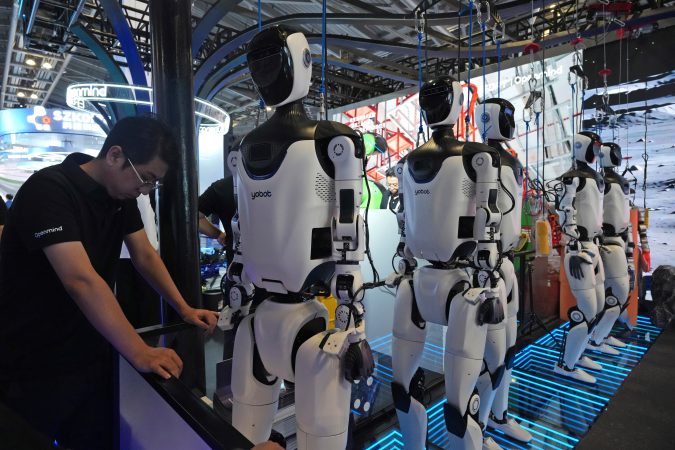
HONG KONG — The U.S. Federal Communications Commission is banning imports of new foreign-made humanoid robots and power inverters, citing national security risks, in a move that targets China. Beijing quickly accused the U.S. of protectionism.
The measures are likely to test relations with Beijing ahead of a planned U.S. visit by Chinese leader Xi Jinping to meet with President Donald Trump in September. China dominates the global market for humanoid robots with an estimated market share of roughly 85%.
The FCC’s ban also includes new imports of quadruped robots, often referred to as four-legged robot dogs. The agency said imports of advanced robots pose cybersecurity and other national security risks. Offshore production of such equipment also leaves U.S. supply chains vulnerable to disruptions.
The ban on power inverters, which are used to convert direct current (DC) electricity into alternating current (AC) electricity and are used in renewable energy systems, data centers, and household appliances, could have sweeping ramifications.
This is the latest in U.S. restrictions on Chinese imports
FCC chairperson Brendan Carr said Tuesday that the move was to “secure America’s critical supply chains.” He said the bans apply to “new versions” of such imports.
The FCC’s bans follow a slew of U.S. restrictions on imports of Chinese products, including drones, and on exports of U.S. advanced technology to China.
The U.S. is also weighing controls on use of Chinese open-source artificial intelligence models at a time when Chinese AI is rapidly gaining ground.
“It’s a steady drumbeat of potential flashpoints heading into [the] Trump-Xi summit planned for September,” said Samm Sacks, a senior fellow at the New America think tank focused on Chinese technology policies.
China has been rapidly expanding the use of robots, with policies supporting its technology sector. Morgan Stanley analysts forecast its market for humanoids could reach $15 billion by 2030.
“Chinese manufacturers have been scaling production and reducing costs faster than most overseas competitors,” said analyst Kangyuxiao Li at Morningstar.
“Restricting their access to the U.S. removes an important future market and protects U.S. developers from potential price competition,” he said. “However, it will not materially slow China’s overall humanoid development, given the size of its domestic manufacturing base and opportunities in other export markets.”
Of the around 15,000 humanoid robots shipped globally in 2025, Unitree and AGIBOT, two of China’s largest advanced robotics companies, each shipped more than 5,000. Their U.S. counterparts, like Tesla and Figure AI, each shipped a few hundred or less, according to the technology research and advisory group Omdia.
On the restrictions on power inverters, Cheng Wang, another Morningstar analyst, said the pressure on U.S. markets should be limited. The ban appears to not impact the continued use of existing devices nor the selling by Chinese companies of models that were previously approved by the United States.
China says protectionism will only hurt the U.S.
China’s Foreign Ministry hit back at the U.S. move, accusing Washington of overstretching the concept of national security to suppress Chinese companies.
China will take “all measures necessary” to defend the legitimate rights and interests of Chinese businesses, it said.
“Protectionism does not make the U.S. more competitive, and it will only hurt the interests of U.S. companies and consumers,” Mao Ning, a ministry spokesperson, told reporters at a regular news conference Wednesday in Beijing.
The new bans could also potentially interfere with collaborations between U.S. and Chinese technology companies, said Lian Jye Su, a chief analyst at Omdia.
Nvidia, for example, in June revealed a humanoid robot reference design which uses the humanoid chassis of China’s Unitree.
The Pentagon recently included Unitree and several other major Chinese technology companies on its list of firms that it said have ties to or aid the Chinese military. Beijing has rejected that claim.
A corporate fad of “tokenmaxxing” on artificial intelligence technology is hitting its limits as workplaces throwing AI at everything are seeing the costs rise without a similar spike in productivity.
What started as tech industry-fueled springtime hype over squeezing as much AI-generated work as possible out of products like OpenAI’s ChatGPT and Anthropic’s Claude has shifted to a summertime backlash.
“It’s very easy to create something you don’t need with AI,” said Vincent Gusdorf, head of AI analytics at Moody’s Ratings and author of a new report that recommends a more disciplined approach.
“Tokenmaxxing” refers to maximizing usage of tokens — the building blocks of generative AI that correspond to small pieces of text that an AI system reads or writes. Each token is about three quarters of a word. And there’s typically a limit to how many you can use, with pricier versions of AI products offering higher caps.
“As bills started to pile in, people realized that those new tools are quite expensive and you need to use them wisely,” Gusdorf said.
Tech executives cast high AI usage as a badge of honor
Just a few months ago, Silicon Valley executives were promoting high token consumption as a signal of high-performing employees. The stereotypical tokenmaxxer was staying up late — perhaps ignoring their significant other — while orchestrating an army of 24-hour AI agents performing work on their behalf.
OpenAI CEO Sam Altman said in May he was “excited to see what will happen with tokenmaxxing startups, both for how they work internally and the products they can build.”
Nvidia CEO Jensen Huang said “if your $500K engineer isn’t burning $250K in tokens, something is wrong.” Facebook parent Meta had an internal competition rewarding token usage.
The trend boosted revenue for leading AI large language model developers like Anthropic and OpenAI, but it fizzled as it became apparent it wasn’t necessarily the best strategy for everyone else.
Microsoft CEO Satya Nadella has admitted that tokenmaxxing can be addictive but warned in a recent blog post that customers of those models are paying twice for AI, first in spending on tokens and second by feeding all their proprietary data to them. While promoting Microsoft’s own approach, Nadella’s comments were unusual in the way he raised doubts about the data protection assurances of leading AI providers.
Alex Karp, CEO of the software firm Palantir Technologies speaks during the Annual Meeting of the World Economic Forum in Davos, Switzerland, on Jan. 20.Markus Schreiber
Palantir CEO Alex Karp went further, telling CNBC earlier this month that something had gone “completely wrong.” He said he was channeling the voice of American businesses privately “livid” about paying so much for tokens that create no value.
Workplaces look more for better ‘routing’ of their AI work
Bain & Company management consultant Jue Wang said many of the big businesses her firm advises have been taking a closer look at returns on their AI investments.
“The token cost for them has been doubling, almost every other month,” she said. “Let’s say $200 per developer per month. Multiply that by 20,000 developers, which is often what we’re dealing with at these companies, and that quickly gets you to a number that is not a line item that any general manager has planned for.”
Sometimes that just means not using the AI equivalent of a sledgehammer to crack a nut.
“Not everything needs a Claude Opus 4.6,” she said of one of Anthropic’s more capable models suited to software engineering or deep research. “And yet you see so many companies, so many users, default to using Opus for everything, including generating emails.”
That’s led to a search for tools that do AI “model routing” — in which easier queries get automatically sent to cheaper and more efficient AI systems and more complex tasks go to more powerful models.
Open-source AI models built in China offer less costly alternatives
Software developer Hassan El Mghari said companies’ sticker shock over the “ridiculous amount of money” spent on subscriptions to AI products from leading U.S. companies has led many away from rewarding high usage.
“It’s better to kind of just empower employees on how to use this stuff and let them use AI when and however much they need to,” said El Mghari, who leads developer experience at the startup Together AI, which supplies developers with a variety of “open-source” AI models.
At the same time, those who favor racking up as many tokens as possible are having a field day with new open-source models from Chinese startups like Moonshot’s Kimi or Zhipu’s GLM, which nearly match the capabilities of top U.S. models at a fraction of the price.
“There is some validity to the theory that this could push tokenmaxxing a little bit further,” said Raffi Krikorian, the chief technology officer at Mozilla. “But if we look at the industry overall, I think it’s realizing that tokenmaxxing is a dumb thing.”
It’s similar, Krikorian said, to how software companies once considered how many lines of code a programmer wrote to be a good metric of productivity. That later fell out of favor.
“I think tokenmaxxing is moving through the exact same pattern,” he said. “I think this is going to be an interesting blip that we’re all going to look back to laugh at in a year.”
It seemed to be only good news for Elon Musk and investors in companies he oversees.
SpaceX had marked a record-setting IPO, Musk was the first trillionaire in history, and the rocket company vaulted to an all-time high of more than $225 per share.
That was last month. Since then, their fortunes have shifted.
Musk has shed hundreds of billions in wealth, demoting him from trillionaire status, and SpaceX’s stock price has been cut practically in half. The stock closed at $116.41 a share Tuesday in trading on Nasdaq. On top of that, electric vehicle maker Tesla has lost about 18% of its value over the past week, in part after falling short of its quarterly earnings expectations, as investor patience for its artificial intelligence and robotics bets has worn thin.
Musk cheekily nodded at the situation in a post on X on Friday.
“(Former) Trillionaire,” he wrote.
But while the world’s richest person could become a trillionaire again with a few big up days in the market, the challenges for SpaceX are deeper. It’s a new era for a company that was once on a glide path, that seemingly could do no wrong on its way to a historic $75 billion initial public offering.
For SpaceX, “one of the benefits of being private is that there wasn’t a market to weigh in on and evaluate business decisions,” said David Meier, senior investment analyst at the Motley Fool. “Being publicly traded means everything will be evaluated and information transmitted through market prices. So every SpaceX launch, every Starlink decision and every xAI decision will be scrutinized by the market,” he added, referring to the company’s satellite internet service and artificial intelligence arm.
Case in point: After SpaceX aborted a launch because of engine issues this month, the company faced another problem — a plummeting stock. SpaceX’s IPO documents had touted its plans to establish a colony on Mars and put data centers in space.
Then SpaceX was dealt its latest setback in propelling Starship off the ground. The company is trying to power its data center and exploration bets by using a roughly 400-foot rocket to carry out missions including taking humans back to the moon.
But the program has been marred by reliability concerns and repeated explosions. While SpaceX has proved its ability to put satellites and even people into orbit, much of its success has been built off of earlier and less capable launch vehicles. The company ultimately conducted a successful flight test on Friday, after what it said were issues with four of the rocket’s engines during the aborted launch the prior week, but the questions about Starship’s overall viability remain.
“The future of the company is riding on the ability to make Starship work. … They essentially have a very successful pickup truck that can move things across town,” said Clayton Swope, deputy director of the Aerospace Security Project and senior fellow at the Center for Strategic and International Studies, a nonprofit focused on policy research in areas including defense and geopolitics. “What they’re trying to do is switch to a freight train and get the economies of scale [of] something of that magnitude.”
Meier, the Motley Fool analyst, said the “sharp sell-off” has been surprising to him.
“One possible explanation is that investors had the time to digest the financials and believe the valuation is too risky,” he said. In the lead-up to its stock debut, SpaceX disclosed it had a record of significant losses, including at least $13 billion since the beginning of 2023.
Things have hardly been rosier on the other side of the Musk empire, at Tesla. Battling what he said was an illness on the company’s earnings call, Musk tempered expectations about Tesla’s performance, saying the electric vehicle company would be spending heavily to fuel its ambitions. Tesla reported a decline in profits compared with the same quarter a year earlier, despite 26% higher revenue than during the same period last year.
As Tesla has shifted away from the auto business that propelled its meteoric growth — making it the world’s most valuable car company — investors have clamored to see results from its new direction: a pivot toward robotics and what the industry calls “physical AI,” driven by products such as its forthcoming Optimus humanoid robot. Musk delivered little news of significance on those bets, sending that company’s stock sinking as well.
“We’re investing a lot in growing the core business and really preparing for the future,” Musk said. “This is a massive [capital expenditure] year, but I’m confident that all the things that we’re investing in will yield incredible returns.”
“I’m a little under the weather here, a bit ill, so if I sound a little off … I’m a little bit ill today,” Musk said later on the call.
Tesla’s declines and the larger consolidation of Musk’s empire have fueled speculation that it could be absorbed into SpaceX. Musk did little to quell that speculation on the call.
“Obviously we can’t talk about combining companies and that kind of thing on an earnings call, it’s got to be done with the appropriate process,” Musk said after citing increasing overlap between the two companies, before turning a question about a theoretical merger to the company’s general counsel.
For SpaceX, meanwhile, there is little relief on the horizon, analysts said. Gene Munster, managing partner at Deepwater Asset Management, said the company is feeling the strain of looming lockup expirations, where people who acquired shares at low prices are suddenly able to sell their stakes. Until that is resolved, he said, SpaceX is likely to continue facing challenges.
“It’s like a crushing unknown,” he said. “Typically what happens is the stock keeps going down, down, down until the lockup [resolves].”
Swope, the senior fellow at the Center for Strategic and International Studies, said the public scrutiny on SpaceX could, however, have benefits. He said a publicly traded SpaceX could be even more attentive to risks.
“I think we all know there is a bit of showmanship to how SpaceX and Elon Musk do business,” he said. “If anything, I guess I could see maybe this will attenuate some of that showmanship a bit and it will be more cautious.”