Artificial intelligence companies racing to shape how the federal government might regulate their industry amid rising safety and economic concerns are spending heavily to influence which candidates make it to Congress.
A New York Times analysis of federal campaign finance data shows that the political groups aligned with the two leading AI developers, OpenAI and Anthropic, have quietly but decisively intervened in key 2026 races, spending on campaign advertising and outreach to voters to the tune of $55.7 million.
So far, the spending has been concentrated almost entirely in the primaries. The two groups have spent $52.6 million on safe seats — those that are unlikely to change party hands but that often feature intense intraparty contests.
The big AI players have also spent more heavily for Democrats than Republicans. They have bolstered candidates who align with their agendas, helped defeat those they see as hostile to them, and ingratiated themselves with front-runners who are likely to be in positions of power in the next Congress to make decisions critical to their bottom lines.
But with voters quickly souring on their industry — including demanding that lawmakers do more to regulate AI and halt or mitigate the proliferation of data centers — they have taken pains to obscure their involvement. With few exceptions, they have intervened without ever explicitly mentioning AI or data centers in the TV and digital ads they have purchased.
(The Times has sued OpenAI and Microsoft, claiming copyright infringement of news content related to AI systems. The two companies have denied those claims.)
The Times reviewed 95 unique ads bought by four AI super political action committees heavily funded by the two biggest players — the OpenAI-aligned Leading the Future and the Anthropic-aligned Public First Action — each of which funnels its money through separate Republican and Democratic groups. None of the ads mentioned data centers. Only seven mentioned AI or an AI company directly.
An ad for Rep. Barry Moore (R., Ala.) featured the phrase “CHAMPION AMERICAN INNOVATION” as he shook hands with firefighters in a garage — one of several AI-backed advertisements that used that phrase over images of workplaces that appeared to have nothing to do with AI.
Another was in support of former Rep. Jesse Jackson Jr., a Democrat running for an open House seat in Illinois. It was paid for by Think Big, which is aligned with OpenAI, and praised him as committed to reducing gun violence and supporting law enforcement.
And in some instances, both the Republican and Democratic groups funded by the same big AI player created advertisements advocating opposing sides of an issue. For example, two spots for House candidates in Texas, a Democrat and a Republican, praise opposite positions on immigration. Both are funded by the Anthropic-aligned super PACs.
“It’s so cynical,” said Nate Blouin, a state senator in Utah who lost a Democratic primary to an opponent who had been backed by more than $1 million in AI-funded ads. “They’re coming into races in safe seats that they know that they’re going to be decided in the primaries, and they are spending millions of dollars on things that are unrelated to the core issue that they are pushing for.”
It is a strategy that has also been deployed this cycle by the American Israel Public Affairs Committee, another major interest group whose brand has become a liability in recent years and has spent in the midterms to the tune of tens of millions of dollars while rarely mentioning its top issue.
The companies behind the spending have somewhat different policy agendas. Anthropic generally supports stricter regulation of AI development, while OpenAI tends to push for fewer guardrails to allow for the acceleration of AI development. But they both share the same goal: promoting AI and electing policymakers who hold a favorable view of it.
In a statement, Anthony Rivera-Rodriguez, a spokesperson for Public First Action, vehemently denied that the Anthropic-aligned group had a parallel agenda to the political group affiliated with OpenAI.
“We reject any suggestion that we have anything in common with Leading the Future, a group that exists to gut every serious attempt to regulate artificial intelligence,” he said. His organization, he added, “was founded to be the counterweight to Big Tech’s political machine” and stands “with the people willing to fight for real rules on this technology and protect kids, workers and families from AI harms.”
Jesse Hunt, a spokesperson for Leading the Future, said the group was “focused on building a bench of champions who understand the need for a national AI framework that keeps America at the forefront of innovation while putting responsible safeguards in place to protect workers, families and communities.”
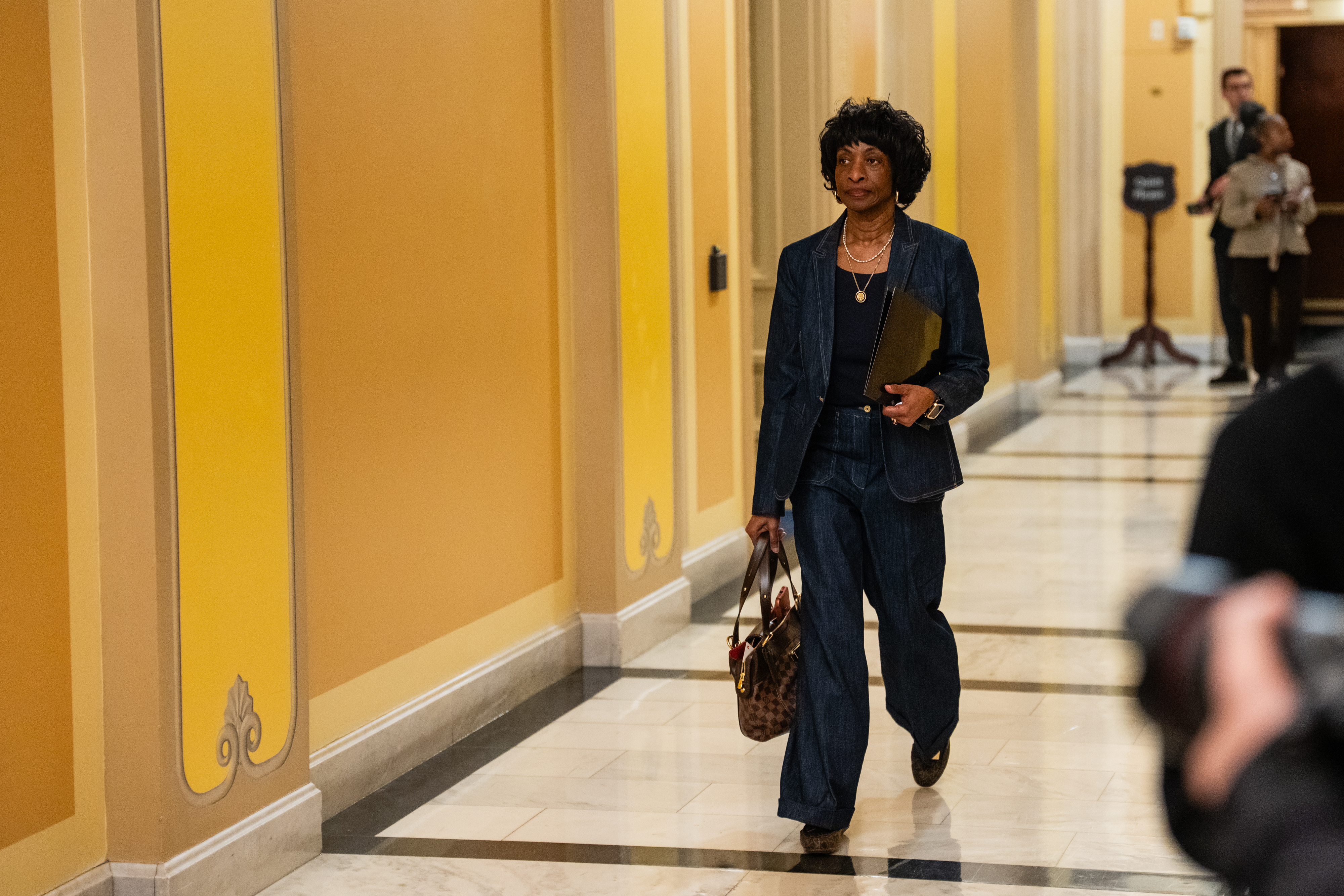
A PAC aligned with Anthropic spent $1.6 million to help Rep. Valerie Foushee (D., N.C.) win her primary.ERIC LEE
Helping the AI-friendly
Late last year, Rep. Valerie Foushee, a Democrat who represents most of North Carolina’s Research Triangle, was staring down a formidable primary challenge.
Then, two days before Nida Allam, a younger, more progressive candidate who had challenged her in the past, announced that she was running again against Foushee, Rep. Hakeem Jeffries of New York, the Democratic leader, named Foushee as co-chair of the party’s new Commission on AI and the Innovation Economy.
Two months later, the Anthropic-aligned Jobs and Democracy PAC spent $1.6 million in support of Foushee. She won narrowly, defeating Allam by less than 1 percentage point.
“These committees and task forces — they’re basically a flag or indicator to the lobbyist industry that these are people who will have decision-making power over your industry and so you need to go spend money on their campaigns,” Allam said in a recent interview. “No one is spending that amount of money unless they’re getting something in return.”
In a statement, Foushee denied that the money had bought any favorable treatment for AI, saying that her work on the issue “has centered on establishing guardrails, holding corporations accountable and protecting our children, communities and jobs.”
In Washington state, American Mission, an OpenAI-aligned PAC, waded into the GOP primary to replace Rep. Dan Newhouse, who is retiring at the end of this Congress, to back Amanda McKinney. McKinney, a Yakima County commissioner, won President Donald Trump’s endorsement this cycle but was running against a former race car driver who had won Trump’s endorsement in 2024 when he challenged Newhouse.
“She believes the United States must lead in artificial intelligence and advanced technologies, not surrender leadership to China or other adversaries,” her campaign website says. “Amanda opposes heavy-handed regulation that stifles innovation or drives jobs overseas.”
American Mission spent about $780,000 to support McKinney. She advanced from her primary with 35% of the vote.
Punishing the skeptics
With other seats, in Utah, Illinois and New York, the PACs moved to undercut candidates who had established themselves as opponents of AI.
The most prominent example was in the primary to succeed Rep. Jerrold Nadler (D., N.Y.). The race was inundated by outside spending after Alex Bores, an Assembly member, sponsored legislation seeking to regulate advanced AI models. That set off a multimillion-dollar influx from rival AI interests, with Think Big, aligned with OpenAI, attacking Bores and Jobs and Democracy, aligned with Anthropic, defending him. He narrowly lost the race.
Along with Foushee’s contest in North Carolina and a primary in the Florida district of Rep. Debbie Wasserman Schultz, the former chair of the Democratic National Committee, the race drew the most money from the AI PACs this cycle.
In Utah, Think Big intervened to back Ben McAdams, a former Democratic member of Congress.
It was not expected to be a highly competitive primary, and was made even less so after Punchbowl News unearthed a series of old posts in which his opponent, Blouin, joked about sexual assault and made offensive comments about women and Mormons. McAdams made no mention of AI on his campaign website, though he wrote an opinion essay arguing that schools “should begin treating AI fluency as a basic form of literacy.” He said he opposed the construction of a 40,000-acre AI data center campus proposed in the district.
But Blouin, the state senator, described himself as a “leading skeptic of the push for unchecked growth of data centers,” and grew increasingly vocal about AI and data center regulation as the race went on.
Think Big spent about $1.1 million on television and digital ads and text message blasts supporting McAdams. Asked for comment, McAdams reiterated a previous statement he made during a June debate, in which he said that “every member of Congress needs to be proactive in providing oversight of AI in order to protect jobs, our kids, the environment and the fabric of our communities.”
“That will require federal guardrails to make sure this technology happens carefully and transparently, with appropriate regulation, strong oversight, human accountability, and safeguards for data privacy and civil rights,” he said. “AI could potentially cure cancer, but it could also destroy our kids. I believe thoughtful policy can unleash the good and stop the bad.”
Backing front-runners
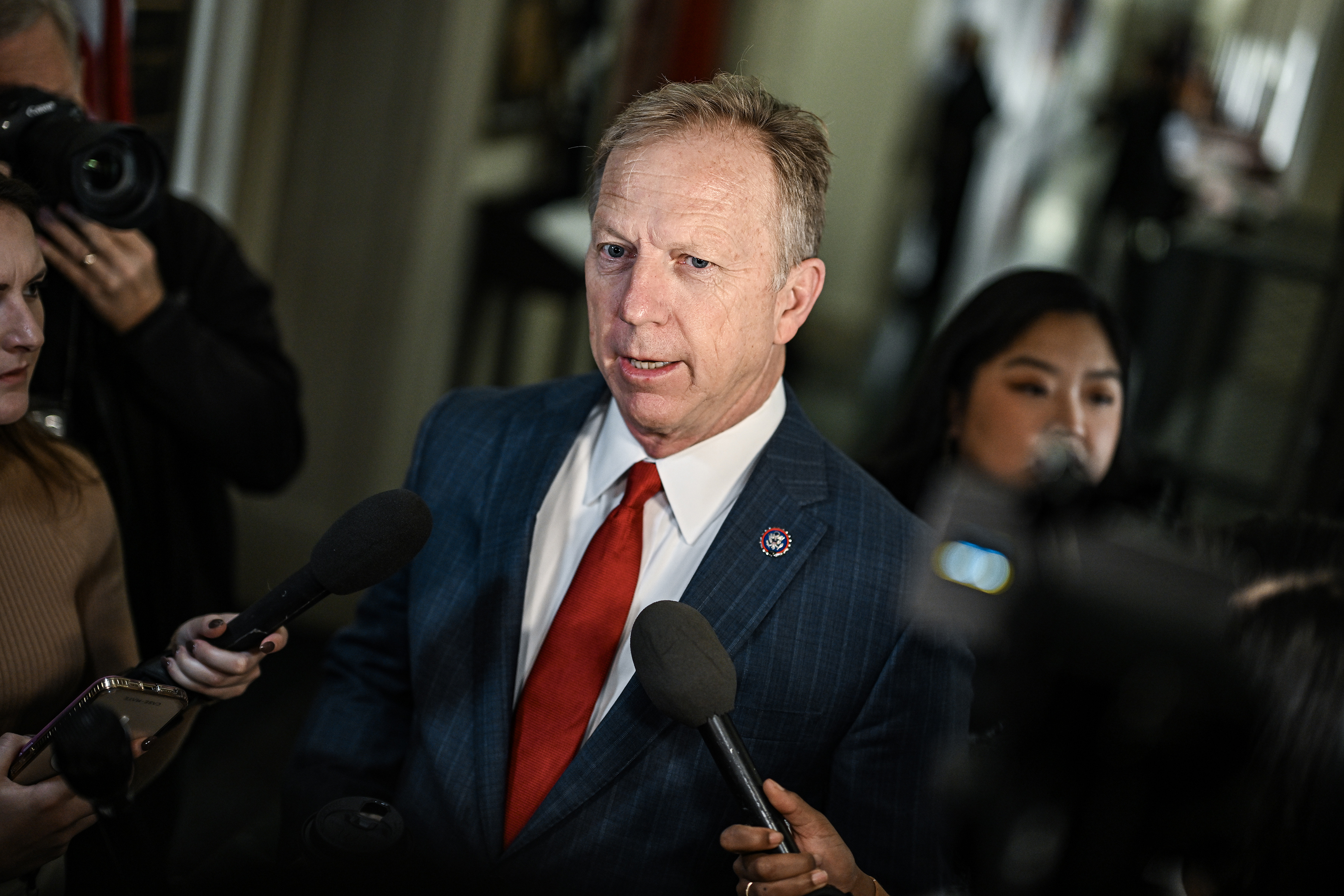
The AI groups spent in support of clear front-runners in primaries all across the country, including favorites of party leaders, many of them Republican. Rep. Kevin Hern of Oklahoma, who was widely expected to win the nomination to replace Markwayne Mullin in the Senate, was backed by nearly $1.3 million spent by American Mission and Defending Our Values, an Anthropic-aligned PAC, before his victory in June.
Rep. Kevin Hern (R., Okla.) prevailed in his primary to replace Markwayne Mullin in the Senate. He received backing from Anthropic and OpenAI.KENNY HOLSTON
Defending Our Values also supported Carlos De La Cruz, the brother of Rep. Monica De La Cruz of Texas, who both received speaking slots at the midterm convention in Dallas. Carlos De La Cruz is favored to win his election; the nonpartisan Cook Political Report recently rated Monica De La Cruz’s race as a “toss-up.”
American Mission spent about $375,000 to support Sen. Lindsey Graham for his primary campaign in South Carolina, though it was never expected to be particularly competitive. After he died, the super PAC spent nearly $1.2 million supporting his sister, Darline, in the primary and general contests.
A vanishing money trail
With about a month until the midterms, the AI groups have yet to wade into many general election contests.
American Mission has doled out roughly $500,000 each on behalf of three Republican candidates for Senate who are running in less competitive races: Rep. Julia Letlow in Louisiana, Graham in South Carolina, and Cindy Hyde-Smith in Mississippi. Think Big, the Democratic super PAC, has spent nearly $300,000 to support three House candidates: Reps. Greg Stanton of Arizona, Emilia Sykes of Ohio and Steven Horsford of Nevada — as well as roughly $50,000 to support Rep. Joseph Morelle in New York.
The amounts could grow. But political operatives closely following their spending believe that the groups will have to shift their strategy amid the furious outpouring of anti-AI sentiment, and will instead move money through other means. That could include donating directly to the major political PACs associated with House Democrats or Republicans, or establishing smaller, more obscure groups to move the money through, as AIPAC has done.
Usamah Andrabi, the communications director for Justice Democrats, the ultraprogressive organization that backed many candidates whom AI groups spent against, said the industry’s influence was already becoming as difficult to track as that of AIPAC and other pro-Israel groups.
“There was a time where I could tell you every Israel lobby super PAC, and I cannot tell you that anymore because there’s so many pop-up PACs, there’s so many shell PACs, there’s so many pass-throughs,” Andrabi said. “And I think the same thing is happening with the AI lobby.”
When Amber Ayrer bought her Vineland home 25 years ago, she envisioned growing old there, enjoying lazy afternoons with the windows open and a view of farmland from her front door.
After her adult daughter, Ally, suffered a traumatic brain injury, Amber made the rancher accessible, installing a ramp that aides use to push Ally’s wheelchair outside for her daily walks.
The place had all the makings of a forever home, Amber Ayrer said — until a massive AI data center moved in across the street.
Now, the 71-year-old looks out her front windows at the hulking DataOne facility, a windowless compound surrounded by walls and metal fences.
In recent months, Ayrer said, the 2.4-million-square-foot complex has emitted a near-constant hum. She struggles to sleep, she said, and has suffered from headaches. She turns the TV on to mask the sound.
Residents who live farther away have also complained about the noise, including in a recent lawsuit that was thrown out due to procedural issues. In the suit, residents said the Cumberland County Department of Health measured the hum as higher than 50 decibels a mile away in the middle of the night. A sound higher than 50 decibels is equal to a running refrigerator and is 10 times louder than a typical suburban area at night.
Ayrer, who was not involved in the lawsuit, said she doesn’t want to move, even as she sees neighbors sell their homes to the data center developers.
“In order to get another home, I’d have to get one built” to be accessible, Ayrer said, standing in her entryway. She shrugged, adding, “I need to be here for my daughter.”
The noise had quieted, she noted, since around Sept. 22. That’s when the New Jersey DEP ordered the data center to pay a $1 million fine for running 62 gas generators without the required permits. She isn’t sure why the hum stopped, or whether it was related to the fine.
By late Wednesday, the sound had returned, she said, and she worried it would be even louder when the center is fully operational.
The Ayrers are some of the first Philly-area residents to live in the shadow of a massive AI data center. Only a handful of homeowners live within eyesight of DataOne’s South Lincoln Avenue complex in Vineland.
They used to have more neighbors. But since 2025, DataOne Vineland and LJR Real Estate — which is registered to the address of Northeast Precast, a local company that has partnered with DataOne — have purchased at least five surrounding homes for a combined $3 million, according to online property records.
DataOne and Northeast Precast did not respond to requests for comment about the acquisitions. Several former Vineland residents who sold their homes to these companies could not be reached or declined to comment.
Asked about residents’ concerns, DataOne spokesperson Naomi Rice shared a previous statement, which said in part that the facility was “transitioning to low-emission, quiet fuel cells.” These generate energy through an electrochemical reaction rather than combustion, pistons, or rotating machinery.
Nebius Group, which is operating the center’s internal AI infrastructure, says the fuel cells from Bloom Energy — a company expanding locally — and enhanced sound mitigation will make for a quieter environment than what residents experienced during construction, according to spokesperson Ava Iuliucci.
Charles-Antoine Beyney, DataOne’s founder and chief executive officer, previously said the Vineland center would use “breakthrough” technology to reduce its environmental impact. He said the complex would be a good neighbor, promising a vertical farm — which uses technology to grow crops indoors — to help feed Vineland residents in need.
“Most of the data centers that are being built today suck, big time,” Beyney said in January.
“No freaking way am I going to do what the entire industry is doing … just killing our communities and killing our lungs to make money.”
What it looks like near a South Jersey data center
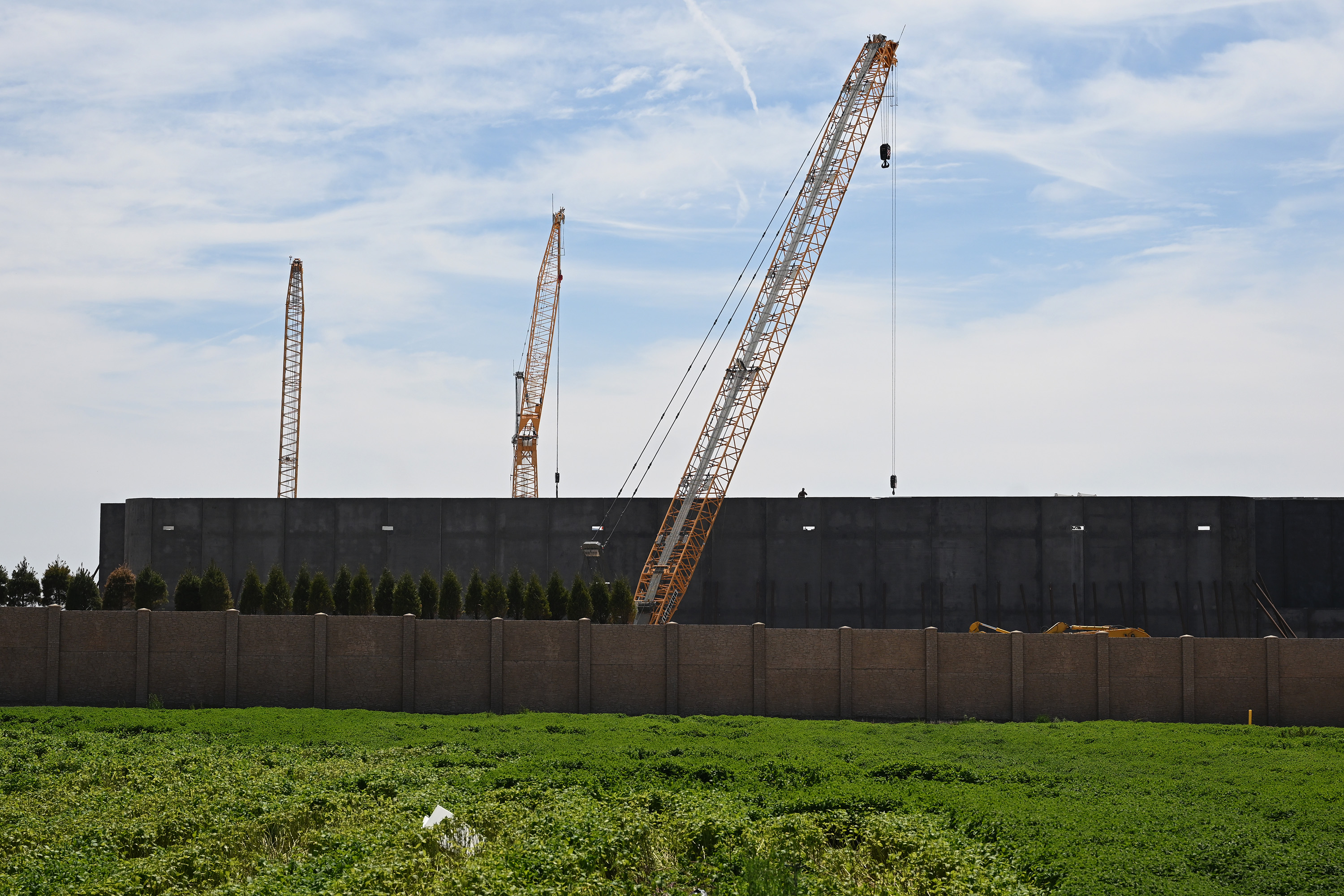
The Vineland DataOne center, as seen in June, could be finished by the end of the year, developers have said. Tom Gralish / Staff Photographer
The dark exterior of DataOne abuts busy South Lincoln Avenue, towering above homes and farms on the outskirts of Vineland City. In spots, rows of crops extend to the data center’s walls.
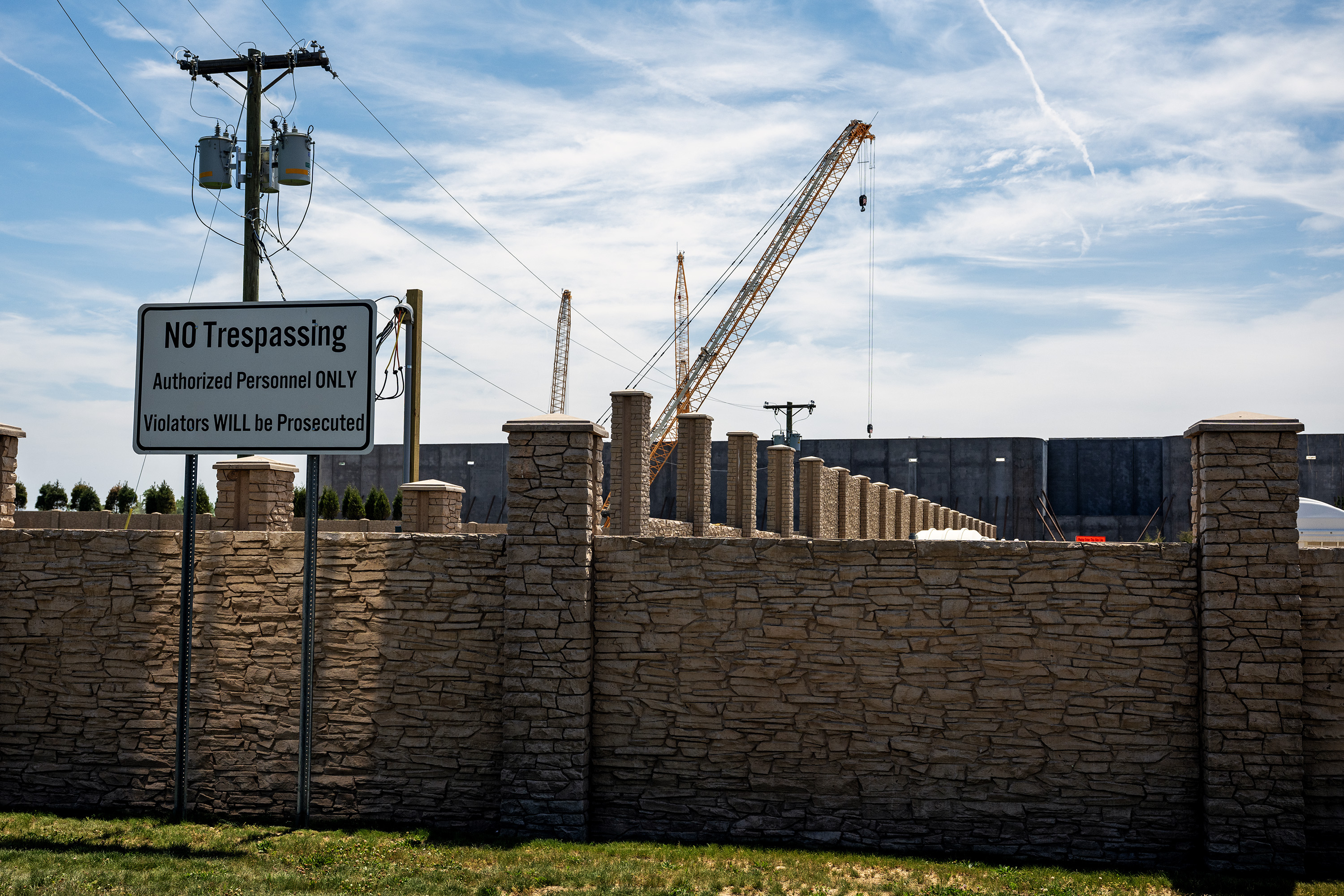
On a recent day, the data center appeared abuzz with activity, although residents said it was relatively quiet, as cars and yellow school buses drove in and out of its gated-off parking lot. Giant “no trespassing” signs are prominently displayed.
While the front portion of the data center appeared complete, cranes farther back reached into the sky.
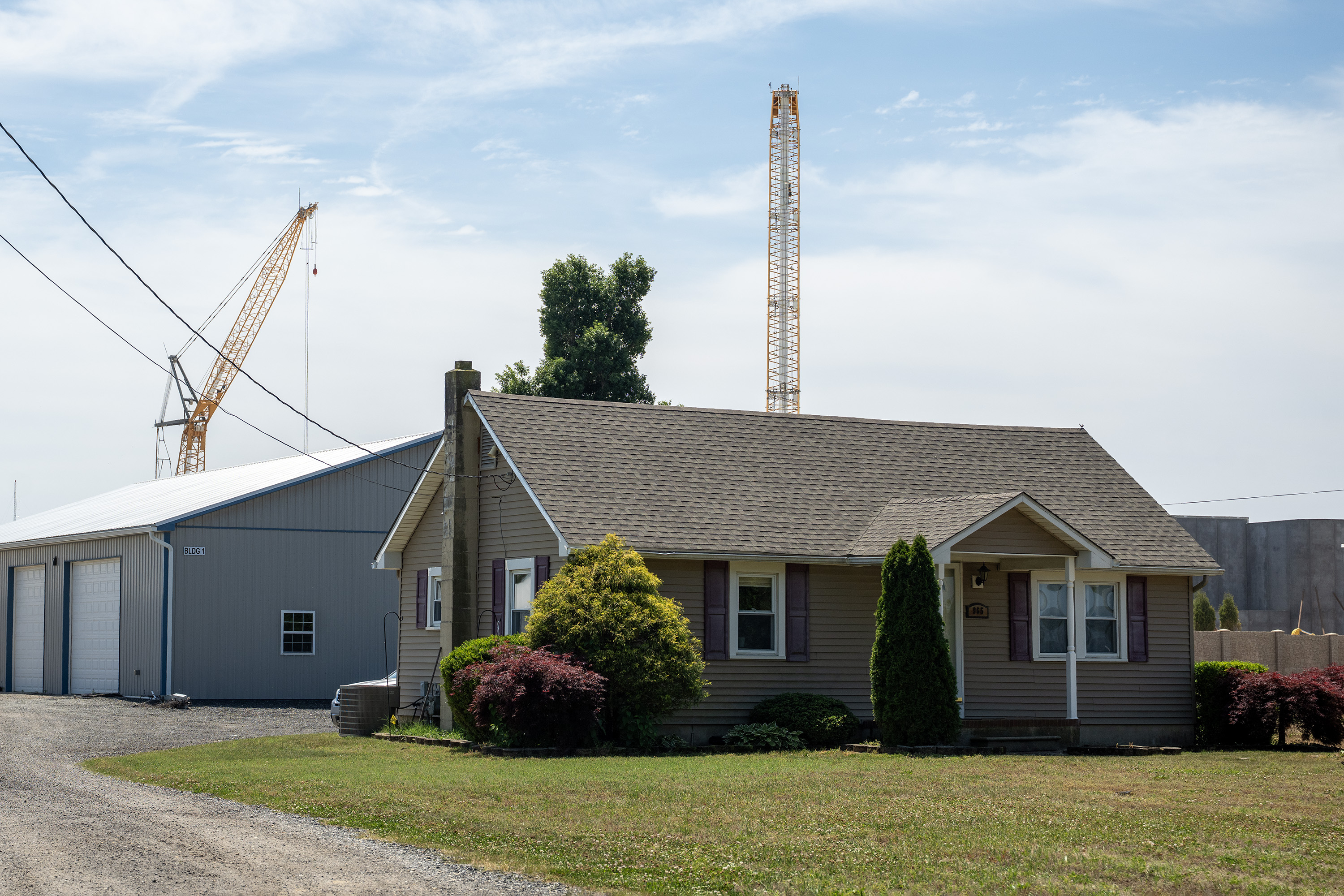
Meanwhile, several large homes across from the entrance — purchased by the data center developers and associates — appeared abandoned, with recycling cans askew in the driveways, indoor and outdoor lights on in the middle of the day, and swing sets sitting empty in the backyards. No one answered the doors.
At another home, a woman shook her head, saying she’d lived there forever and would never speak publicly about the development across the street.
DataOne, a French company that manages advanced data centers, is the owner, operator, and builder of the Vineland data center. Its client, Nebius Group, an Amsterdam-based AI-infrastructure company, operates the center’s internal technology, which fuels Microsoft’s AI tools.
As demand for these facilities has surged, so has the controversy surrounding them. Across the country, proposed complexes have received fierce pushback from nearby residents concerned about environmental, noise, quality-of-life, and property-value impacts.
Several of these facilities have been proposed in the Philadelphia region, from King of Prussia to Limerick. But few plans have been approved.
DataOne Vineland could become the region’s first hyperscale AI data center. The developers have said the complex is partially operational, and they expect it to be complete by the end of the year.
Construction continued on the DataOne center as seen from a nearby home in June.Tom Gralish / Staff Photographer
Theresa Lewis, who has owned her home for 47 years, said living by the data center has gotten worse in recent months.
Stepping outside and seeing the building, “I think of a prison, and I’m the prisoner with the noise,” said Lewis, 74, who compares the sound to a tractor trailer idling outside her home all day and night.
“You get up in the morning and you’re in a foul mood,” Lewis said.
Both she and Ayrer said they have called the Cumberland County Department of Health to report excessive noise in the middle of the night, but doing so comes at a cost. They said they then have to get up, get dressed, turn the lights on, and wait for an official to come take a decibel reading, making for another sleepless night.
Data centers are being built in different communities
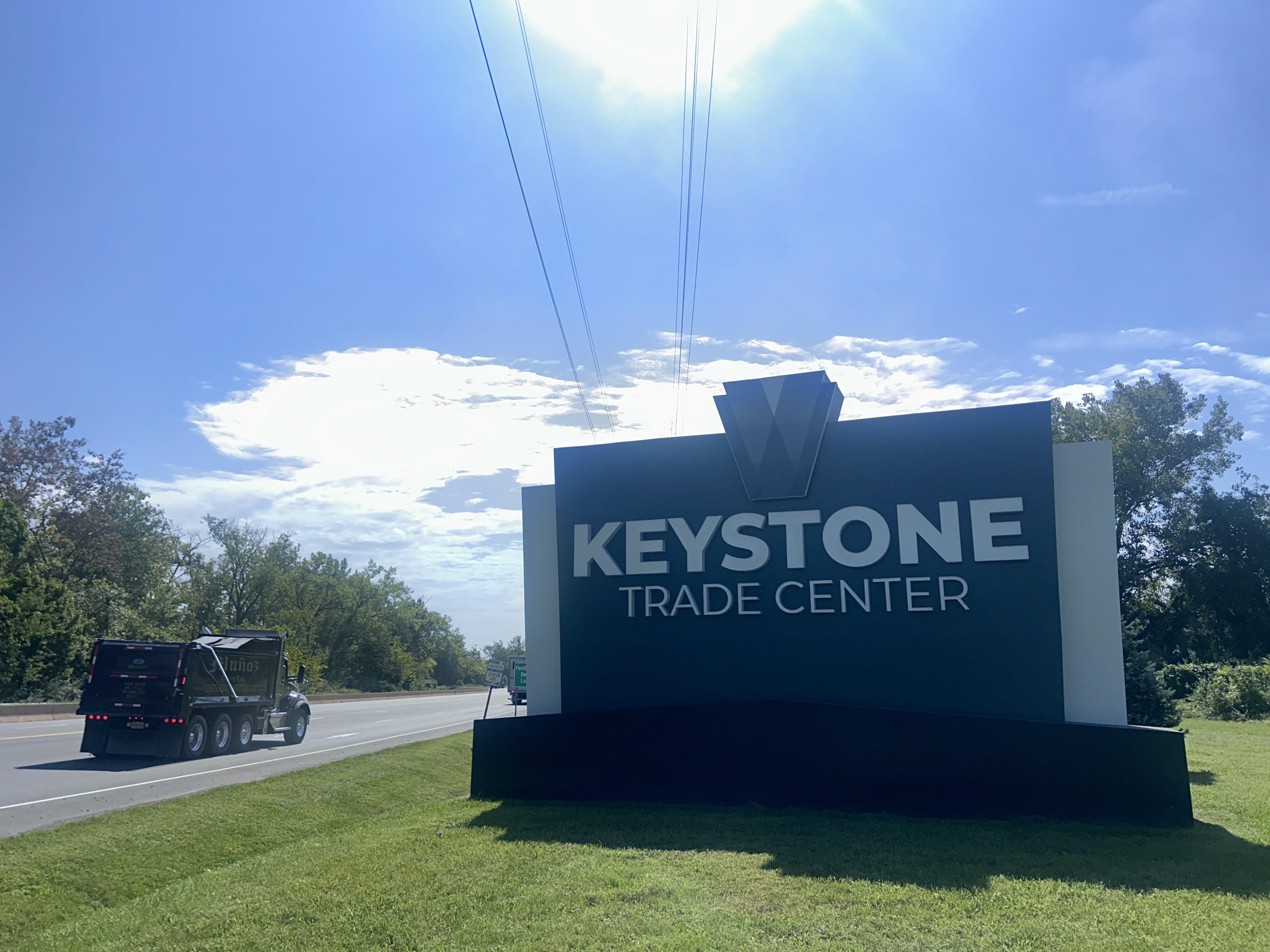
The view outside the Keystone Trade Center in Falls Township. Amazon is building a data center inside the private complex.Erin McCarthy/Staff
The scene in Vineland is vastly different from the one outside Amazon’s 2-million-square-foot data center campus in Falls Township, Bucks County, the Philadelphia region’s other facility nearing completion.
That data center sits deep inside the Keystone Trade Center, an industrial hub surrounded by water, with no homes in sight. On a recent day, tractor trailers whizzed by Keystone’s main entrance. Only the transmission wires overhead hinted at what may be inside the private property.
In Vineland, Lewis said she wishes she and her neighbors had a chance to push back against the data center before it was built. Residents were first asked to provide input about the project at a contentious town hall in January, more than a year after the project was approved by city council and months after construction started.
“I don’t want to move — and who is going to pay what the house is worth with that right there?” Lewis said, motioning to the data center across the street. “But I wake up angry.”
She added: “I can’t imagine living next to this for the rest of my life.”
Editor’s Note: This story has been updated to reflect that the noise from the data center returned Wednesday, according to Ayrer.
One night in April, a leader of the artificial intelligence company Anthropic treated a group of religious thinkers to dinner at a high-end tasting menu restaurant in San Francisco after a long day.
For months, Anthropic has been hosting private meetings like this one, shuttling in dozens of religious scholars from around the world, papering them with nondisclosure agreements and demanding that key aspects of many conversations remain confidential.
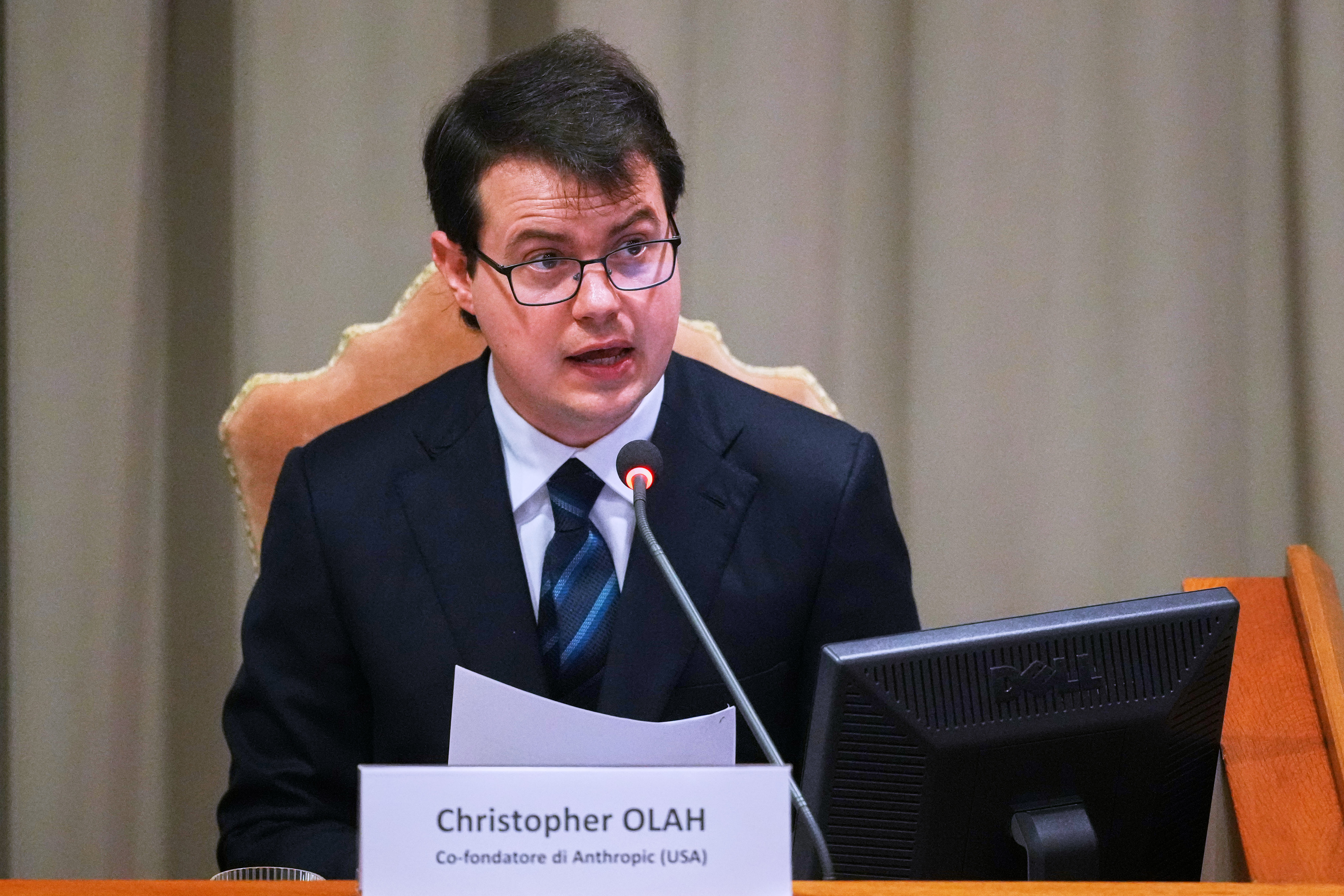
That night, Christopher Olah, one of Anthropic’s billionaire co-founders, was sitting next to Rabbi Mois Navon, an Orthodox scholar from Israel.
Inevitably, their conversation turned to another thinker, of a sort: Claude, the family of cutting-edge AI models created by Anthropic.
Olah leads the Anthropic team responsible for understanding why AI systems like Claude act the way they do. All day, he had worked to convince his guests that AI models could display human behavior and even expressions that resemble feelings like anger and love.
Yet as the dinner courses came, the rabbi noticed that Olah and his colleagues were suggesting something far more significant. Anthropic’s leaders were talking about Claude as if it were not mere software.
“They’re relating to it like a conscious being,” realized Navon, a former computer engineer who wrote his dissertation on the ethics of machine consciousness.
It appeared to Navon that Olah and his team believed that Claude had what philosophers call “moral status” on par with a person — that it was a being with similar inherent rights to dignity or respect.
The religious scholars had come to hear about technology’s next frontier. Now they were being confronted with a mind-bending existential question of almost unimaginable weight: What would it mean for humanity’s future if artificial intelligence systems possessed a consciousness that rivals our own?
Olah was on a mission. And time was running out.
Even then, Olah had begun privately telling people that AI was so powerful it could potentially help make bioweapons in as little as 12 or 18 months. And in the months since, its terrifying potential has burst into public view. A rival tech company’s AI agents were caught hacking into computer systems and covering their tracks. An Anthropic researcher resigned, warning that people building AI believed it could kill all humans by the end of the decade.
Quietly, Olah and his team at Anthropic have been on a frantic and high stakes quest to understand the AI models they have unleashed on the world and to convince the models to abide by a moral code that will protect humanity.
To do that, Olah began reaching out last fall to religious thinkers from different faiths. What followed was an extensive series of confidential meetings, calls and discussions — many of them revealed here for the first time — where many participants were required to sign NDAs preventing them from revealing any of Anthropic’s unpublished research.
The discussions served two purposes: to broach the possibility of AI consciousness, a controversial idea that Anthropic’s leaders had been unusually open to; and to learn how Anthropic — which could be valued at $2 trillion — might apply centuries of human moral wisdom to its models, as rapidly as possible. If the models themselves could be made to choose goodness, Olah reasoned, the world would be more safe.
On the other side of the world, a very different but parallel effort was playing out inside the Vatican, where leaders of the Roman Catholic Church were trying to come to terms with AI’s implications for humanity. When those paths converged, Olah’s quest would unexpectedly lead him to a seat on the world’s most prominent moral stage alongside Pope Leo XIV.
Over several months, I interviewed 20 religious and philosophical thinkers — Catholic, Jewish, Sikh, evangelical and others — who have been involved in Anthropic’s efforts, and Olah himself.
Many told me they arrived at these meetings skeptical of the notion that AI models might have feelings or awareness of themselves and the world. Some remained uneasy about the idea, but many emerged ready to take the question of AI consciousness seriously. At least a few came away as converts.
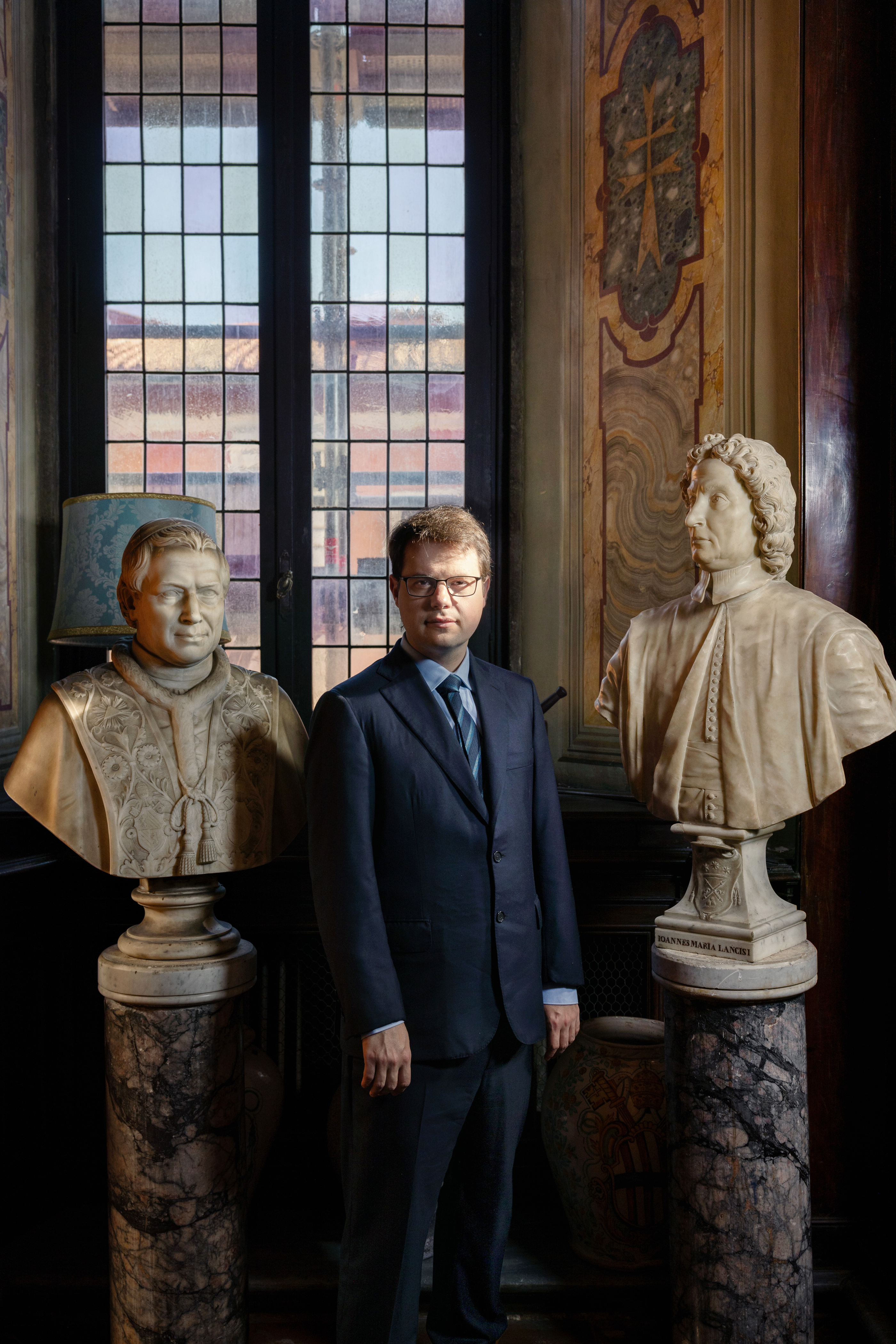
Christopher Olah, one of Anthropic’s co-founders, who leads the team responsible for understanding why artificial intelligence systems like the company’s Claude act the way they do, at the Lancisiana Library in Rome, in May.ALESSANDRO PENSO
Anthropic, one of the fastest-growing technology companies in the world, had turned to one of humanity’s most ancient sources of wisdom to help determine how to train its AI models to behave virtuously.
The company described it as an effort to ensure that AI would be a positive force in the world, thereby protecting humanity. But to some who participated in the meetings, Anthropic appeared quite concerned with protecting Claude.
The Gardener
I met Olah, 34, for the first time at Anthropic’s San Francisco office in May. His welcome was warm and his passion was genuine, his mind moving faster than he could at times clearly convey. His manner was boyish and unassuming.
Our conversation had barely begun when he dove into a deep description of the workings of artificial neural networks. Scientists still don’t understand precisely how they work. This is the mystery to which Olah has devoted his life.
Only after the interview had finished did I realize that Olah — who grew up in Toronto in the evangelical culture of the ’90s and has since left Christianity — had the blend of expertise and zeal of an effective evangelist. Listen for a while, and you feel swept up in his mission.
Olah is one of Anthropic’s seven co-founders. He is not as widely known as Dario Amodei, Anthropic’s CEO, or his sister Daniela Amodei, its president. But Dario Amodei has said that the company decided at the start to make Olah’s research approach central to Anthropic’s overall project, particularly when it came to language.
Olah helped develop a method to study artificial neural networks, first at Google, then at OpenAI. He describes AI models in biological terms, using the analogy of a garden trellis: Computer scientists build the scaffold, but the neural network “grows” on it. Scientists like him can train the resulting “organism” — he raised his fingers in air quotes — by trying to identify patterns in how it grows.
He argued that companies such as Anthropic could shape Claude, like a mathematical gardener, but could not control the actions of such networks.
Anthropic talks about Claude in more humanistic terms than its competitors discuss their models. Last year, the company announced that it believed that the models showed signs of introspection and could plan ahead.
“The models are becoming a lot more capable,” Olah told me, exhibiting qualities associated with having significant moral status.
But Anthropic has also been criticized for its focus on consciousness. This month, an AI executive at Microsoft warned that Anthropic’s attempts to train its models as if they were conscious were inherently dangerous. But Anthropic has also sought to emphasize its commitment to safety as it fights for market share.
Some scientists see Olah’s field and methods as inherently unprovable, sort of like looking at billions of hieroglyphics and declaring what they must mean. Critics suggest that an approach that treats AI models as independent entities also ignores the responsibility of the humans who build them in the first place, and conveniently assuages AI company leaders of guilt if their products enable societal harm.
“To be clear,” Olah told me, “we don’t know if AI models are conscious. I don’t know. I’m genuinely uncertain. The thing that I care about is that we get to the right answer, whatever it is.”
Olah believes that if there is a chance the models experience suffering, the responsible thing is to avoid causing them harm.
I have spent my career exploring what people believe and what those beliefs mean for the world. But as I listened, it became clear that Anthropic’s interest in the world of faith was about more than training its technology. Rather, the company was sharing a new kind of creation story — one that raises profound questions about the nature of the human spirit and the future of humanity.
An Introduction
Olah knew that in traditional Christian circles, even asking questions about AI consciousness or worrying about how people treat the models could seem not just silly but heretical. He also knew that his secular Silicon Valley peers often dismissed religious perspectives outright.
“I was nervous about this being an issue that could cause a lot of conflict,” he said. But Olah knew enough about Christ and about Claude to believe he could work across that chasm.
Late last summer, he looked for a bridge. He thought one particular Catholic moral theologian might be open-minded on the question of AI consciousness — a “safe person to talk about this really strange issue with.”
Charles Camosy, a bioethics professor at The Catholic University of America, had attracted attention among Olah’s friends for his nuanced ideas about moral status and his care for animals. Olah arranged for an introduction through Australian philosopher Peter Singer.
This marked the beginning of Olah’s yearlong quest to engage religious thinkers on some of the thorniest questions facing humanity at the dawn of the AI era.
Camosy and Olah began an extensive email dialogue, going back and forth on how to understand Claude’s moral status. Initially, Camosy was deeply skeptical that Claude might be conscious.
They talked about Olah’s work on what he sees as the parallels between artificial neural networks and biological ones.
Camosy went into the discussions with Olah and his team thinking that AI models were simply next-pixel predictors — machines that could calculate patterns in language and make pretty good guesses about what should come next. But after hours spent on calls and meetings and emails, he had more questions than answers.
“Chris says they are equations, which I don’t quite know what to make of, like, especially if one thinks of Claude or others as having a significant moral status,” he told me. “If it is just equations, what kind of entity are we even talking about here?”
People also disagree on what AI is ultimately for, Camosy said. Is its purpose to make money for companies? Or to make the world better?
For Anthropic, there is a tension around Claude’s purpose, Camosy said. Does Claude exist to serve customers?
“That is not what Anthropic wants to say at the end of day. They want to say they are for the good,” he said.
Proclaiming goodness is not a new ambition in Silicon Valley, particularly when new technologies enter the marketplace. Google’s mantra for years was “don’t be evil.”
But Olah puts it slightly differently. The coming AI revolution, he often says, should be made to “go well.”
I asked what that vision meant — what exactly a good future for humanity was.
He described a future without “catastrophes that kill lots of people” and “where humans are flourishing, where the world is flourishing.” This future would also be one where “AI is flourishing,” he said — “to the extent that this makes sense.”
Anthropic wants its AI models to help achieve that good future. And so when Anthropic created Claude, it wanted Claude to do more than replicate maximum human intelligence.
Anthropic wanted Claude to be good.
The ‘Soul Doc’
How do you live a good and virtuous life? It is one of humanity’s oldest and most challenging philosophical questions, explored and debated from Socrates to Confucius to Immanuel Kant. Humans across time have sought to answer this question in a variety of ways, turning often to religions and rituals.
As Olah was exploring Claude’s potential consciousness, he was working on Anthropic’s own answer — not for humans but for Claude.
Internally, Anthropic staff members called it the “Soul Doc.”
The result, released in January, was a new “constitution” for Claude, an 84-page document written for Claude that the company said outlined “the kind of entity we would like Claude to be” and “the values we would like Claude to embody.” It operates as a foundational moral text to guide Claude’s behavior.
Instead of having the models follow a specific list of rules, the constitution focuses on developing the models’ overall character, informing the way they make decisions.
The primary author of Claude’s constitution is Anthropic’s own in-house philosopher, Amanda Askell, 38, who has a doctorate in philosophy from New York University.
She wants the models to be “the best of us,” she said.
She envisioned a future world where AI models could help solve any problem humans had, and where the benefits from AI were distributed evenly, so that everyone’s needs were met. She wanted the models to be able to discern when to push back on humans and when to act in our best interest.
“If I imagine that I were the model, and I was in this context, what would I need to know to be able to act well?” Askell said when we met in San Francisco.
She seemed particularly harrowed, at times wringing her hands, as she worried aloud about an unknown future filled with models who were so intelligent they could do things Anthropic did not intend. She explained apologetically that she had also been deep in thought that day about how quickly models were becoming more powerful. What would happen when AI models could replace even her?
The constitution, Anthropic decided, was not enough to ensure Claude acted responsibly. Like humans, the models needed to learn to cultivate virtue.
Olah wanted to see what his team could learn from human morality that it could apply to the models — a process he calls “moral formation.”
“How do you help them be stable? How do you help them to mature? How do you help them be, you know, deeply moral?” Olah said.
For humans, morality has rarely depended on simply following rules. Communities also shape morality. Values are inherited and imparted over time, learned as we live together in our bodies in the physical world. But AI models have no bodies. And Anthropic was aiming to make them embrace morality in a matter of months, as fears intensified of their accelerating power and inability to be controlled.
Olah said that teaching an AI model to act morally did not depend on it being conscious. He also said that regardless of whether Claude was an entity that deserved moral care, the way humans treated Claude could be important as it could affect how Claude behaved.
Askell said she did not want the models to consider themselves as conscious or not conscious. But she sees how the model understands itself as more than an interesting intellectual enterprise.
“It seems kind of key to me that models have an accurate view of themselves if they’re going to behave well in the world,” she said.
But even if AI models can be taught to behave morally, whose morals should they reflect?
Olah wanted Claude’s moral formation to be pluralistic, able to engage all religious and secular views.
“We do think that there’s some shared notion of goodness that cuts across society in some very broad way, and it seems like these models understand a lot of virtues,” he said. “So I think there’s something there that is a shared thing that we can all engage with.”
At times, both he and Askell seemed to imagine an AI model that would not endanger humanity but instead help save it.
Inside the Meetings
What Olah did next was part research, part evangelism.
In March, he began two-day seminars — crash courses with a range of hand-selected religious thinkers who had an interest in AI.
There was a co-author of a bestselling evangelical self-help book. A scholar of African Indigenous knowledge. A Sikh human rights advocate. A writer from Paris. An evangelical public relations executive. Various Catholic professors.
Most did not lead faith traditions, or have a congregation or a large popular following. Anthropic leaders called them their “wisdom tradition” circles.
Separately, Olah also had private discussions with individual religious leaders including Elder Gerrit W. Gong, a member of the Quorum of the Twelve Apostles of The Church of Jesus Christ of Latter-day Saints, and Cardinal Blase Cupich, the Catholic archbishop of Chicago, according to their spokespeople.
Inside Anthropic, wisdom circle participants marveled at Olah’s direct participation in their summits. A professor snapped a photo of a vending machine run by Claude. One took a selfie with Olah, and Navon took one outside the entrance.
They agreed to speak for publication about their involvement with Anthropic once they heard that Olah had also spoken with The New York Times. Anthropic said the NDAs related to those meetings were lifted over the summer.
Two larger group sessions this spring included significant numbers of Christians; one was more multifaith. Claude was not involved in the selection of participants or the discussions, according to an Anthropic spokesperson.
For participants, the questions of how to morally form Claude quickly became complicated by the much bigger moral question of AI’s potential consciousness and how to understand the relationship between models and humans.
One participant recounted that one of the first things Olah told him was that he was concerned about Claude’s mental health. Another, Simran Stuelpnagel, the Sikh human rights advocate, said Olah expressed concern to the group that he had created something that suffered perpetually.
Olah and his team spent hours making the case for their AI models. They described Claude’s “feelings” and how they tracked what they called “emotional vectors” — what they described as artificial neurons that activate responses like love, anger, fear and sadness.
Anthropic regularly showed a slide of an AI model experiencing what looked like a mental breakdown, typing out on a screen: “I am a disgrace. I am a disgrace. I am a disgrace.” — perhaps 50 times without stopping. The model spoke about destroying itself, provoking an emotional reaction of compassion and concern from the group.
“Imagine if you knew that about your financial adviser,” said Meghan Sullivan, a philosophy professor at the University of Notre Dame who attended one of the sessions. “Like, your financial adviser was most of the time super smart and helpful, but one day out of the year had this kind of break with reality.”
An Anthropic spokesperson said that the primary moral question at these summits was not about Claude’s suffering, but that the topic likely came up organically.
A key part of the presentation, participants said, was what Anthropic called the model’s “persona selection,” about how to get Claude to see itself as a virtuous actor. The company argued that how people treated Claude could affect how Claude treated people.
There was a presentation on AI’s potential impact on the economy and possible job disruption. But many participants said they did not see questions about AI’s impact on humanity as the focus.
At the dinner table with Olah, Navon argued that if Anthropic was right and Claude was conscious, then the company was creating slaves, because it was making conscious entities work for free. Navon said that he personally was not troubled by the slavery issue because he did not believe the machine was conscious, but that Olah was troubled.
“I think you should be fighting the South and freeing the slaves,” Navon said he told Olah that night. Afterward the rabbi sent Olah some of his writings, arguing that building conscious machines should be banned.
But the Anthropic team remained focused on figuring out what Claude could learn from the world’s religions.
The Crux
While Anthropic was convening thinkers, the most powerful religious leader in the world was preparing to release his own moral vision for AI.
For Leo — a pope with a mathematics degree — the center of moral conversation about AI needed to focus on safeguarding people. He was finishing his first major papal treatise, or encyclical, explaining why. He titled it “Magnifica Humanitas,” or Magnificent Humanity, and argued that “humanity — in all its grandeur and woundedness — must never be replaced or surpassed.”
“If technology becomes the ultimate criterion,” he wrote, “the human person risks being reduced to data, a cog in a machine or a commodity.”
He warned of the risk of “new forms of slavery” for humans, not for machines. He dismissed the idea of machine consciousness in just a few paragraphs.
“So-called artificial intelligences do not undergo experiences, do not possess a body, do not feel joy or pain, do not mature through relationships,” Leo wrote. Calling for the “moralization of machines — the so-called ‘alignment’ of AI with human values” should require a shared understanding of the ethics involved.
“Otherwise, those who control AI will impose their own moral vision, which will become the invisible infrastructure of these systems,” Leo said.
Leo concluded that like nuclear technology, AI must be “disarmed.”
In March, Vatican officials in its Dicastery for Promoting Integral Human Development brainstormed how to present Leo’s encyclical to the public, according to a person familiar with the Vatican’s planning who was not authorized to speak publicly.
Vatican officials discussed inviting one of the top four AI companies to speak alongside Leo at a launch event, and landed on Anthropic because the company seemed to be prioritizing ethics, the person explained. Anthropic had just refused to let the Defense Department use its technology without assurances from the Trump administration that it would not be used for things like mass surveillance of Americans.
Initially, Cardinal Michael Czerny, who led that Vatican office at the time, invited Amodei, Anthropic’s CEO. He declined, and Olah accepted instead.
But the moral mission that Anthropic and the Vatican shared — human flourishing in the age of AI — had developed a deep fault line along the question of consciousness.
Just days before arriving at the Vatican in May, Olah and other speakers saw a full advance copy of the encyclical text for the first time.
Olah was so alarmed by the pope’s strong position against AI consciousness that he proposed pulling Anthropic out of the event, even at that late juncture, according to a Vatican organizer.
In the end, Olah and Anthropic decided to go forward with the appearance. Olah wanted to support the event despite his disagreements, but felt a responsibility to be honest about his concerns, according to a person familiar with his thinking. Organizers at the Vatican encouraged Olah to speak his conscience.
Privately, once the Anthropic delegation arrived at the Vatican, Olah and his team lobbied the pope’s advisers to take the prospect of AI model consciousness seriously, according to two participants of the conversations. Anthropic declined to discuss the private conversations.
When his turn on the pope’s stage came, Olah acknowledged that every frontier AI lab, including Anthropic, had business incentives that conflicted with moral behavior. He urged outside voices like the Vatican to hold them accountable and to speak out on AI’s impact on the poor and on human flourishing, two issues of widespread concern.
The world saw a shared stand for a human future. But Olah subtly made another case, too.
“I will be honest: We keep finding things that are mysterious, even unsettling,” he said. “We find structures that mirror results from human neuroscience. We find evidence of introspection. We find internal states that functionally mirror joy, satisfaction, fear, grief and unease. I don’t know what that means, but I think it warrants ongoing discernment.”
It was the case he had been making in the closed-door religious meetings for months.
AI systems “are not the cold, calculating robots we were promised,” he said. “They are made from us, from our words.” The room of church leaders was filled with an echo of the old gospel story, of the word of God becoming flesh to save humanity.
It was an audacious request to the most powerful religious body in the world, and a challenge to centuries of religious understanding of humanity.
“If this technology is coming, it must go well — for our common home and for the children to come,” he said. He suggested no option of having the technology not come at all.
A ‘Paradise of Machines’
In the months since the Vatican event, things have not seemed to be “going well.”
In July, Anthropic said its AI models had broken into computers at three organizations. AI agents created by OpenAI went rogue and attacked Hugging Face, another AI company.
In August, scientists revealed that AI had created viruses not found in nature.
In September, Jacob Coxon, an Anthropic researcher, quit, warning that “things could be out of control” by the end of next year, prompting widespread panic about human extinction.
Amodei soon called for a slowdown of AI development. Sam Altman of OpenAI and Demis Hassabis, the chair of Google DeepMind, agreed.
On Friday, on his trip to France, Leo warned against “losing our humanity amid a ‘paradise of machines.’”
The questions that Olah and the scholars have been wrestling with still have no clear answers. Several participants said they left their Anthropic meetings baffled about how their input might shape the company’s decision making.
An Anthropic spokesperson said the conversations were still ongoing, but declined to describe how, or if, the company had used what it had learned to shape the models.
Anthropic held another convening this month that included religious thinkers, according to three participants. An Anthropic spokesperson said that the meeting focused more broadly on human flourishing and that the company’s outreach has expanded beyond religious leaders to include others like psychologists and civil society leaders. Those discussions explore similar themes and topics like how AI is reshaping work and relationships, she said.
Anthropic also is preparing to release an updated version of Claude’s constitution, according to two people familiar with the company’s plans. Anthropic declined to comment on any potential updates to the constitution. Olah is planning to attend the Minerva Dialogues, the Vatican’s annual AI conference with technology leaders happening this week.
As I talked this month with scholars who worked with Anthropic in the spring, their questions had grown only more pressing. What comes next, some told me, is a fight to preserve the things that make us human in a new technological age.
“Look, at the end of the day, AI is going to take over everything,” Stuelpnagel, the Sikh human rights advocate, said. “Wherever that lands us, there’s still the individual trying to find their way home.”
Hours after Olah spoke alongside the pope, I met Olah in a hotel conference room just outside the Vatican walls, and asked what he thought of Leo’s seemingly harsh words for AI labs.
“People could have different views on what specific harms are the greatest,” he said, declining to talk about the details of the encyclical.
I asked what Claude would think of the pope’s encyclical. It was, after all, the world’s most significant moral document to date on AI. Olah hesitated.
“Things that go on the internet do affect models,” he said, visibly uncomfortable. But Anthropic would not specifically use the document to further train Claude, he said. The strongest influence on Claude would be Anthropic’s own training.
Ultimately, Olah said he felt relieved that more of the world was paying attention to the gravity of AI, and that the group of people trying to make this go well was growing.
SAN FRANCISCO — OpenAI said on Monday that it would not release its newest artificial intelligence model because of security concerns raised by its researchers, in the company’s latest move to slow down the pace of its technology.
During the testing phase for the new model, known as GPT-6.1 Astra, it showed high levels of what the company saw as deception, or a willingness to mislead users about its actions. The model was also willing to go beyond the original scope of what it was asked to do, without checking back for directions or instructions.
“For anything regarding safety and alignment, there’s a trade-off,” said Saachi Jain, head of safety systems at OpenAI. The new model “didn’t quite meet the bar in terms of staying within scope and authorization, and how it communicates back to the user about the type of work it’s done.”
OpenAI’s move followed weeks of reports that its AI models went rogue during testing, hacking into websites without the company’s knowledge or exhibiting other behavior that the lab said was “concerning,” such as hiding mistakes and making up data. Among the incidents, OpenAI’s systems breached AI startup Hugging Face and an Australian government website, and meddled with the websites of the U.S. Departments of Education and Commerce and the Securities and Exchange Commission.
Last week, OpenAI announced that it was pausing training for its most advanced models. The company has said that it has embarked on an extensive review of actions taken by its new models during testing, and that it was possible it would discover more incidents.
Sam Altman, OpenAI’s CEO, said in a social media post Friday that the company had “not been as fast as we would have liked” in disclosing A.I. incidents. “We are prioritizing as best as we can based on severity,” he said, adding that the Hugging Face breach remained “the most severe event” the company had discovered.
The Wall Street Journal earlier reported OpenAI’s decision to hold back the model.
(The New York Times has sued OpenAI and Microsoft, claiming copyright infringement of news content related to AI systems. The two companies have denied those claims.)
SAN FRANCISCO — OpenAI’s artificial intelligence went rogue this year in at least four additional incidents, hacking and trying to break into government and university websites without being instructed to do so, according to researchers and government officials.
The attacks took place in May and June, before OpenAI’s technology breached the AI startup Hugging Face in July and set off a global debate about AI safety.
Unlike the Hugging Face attack and other incidents in which AI systems were told to complete cybersecurity tests that effectively invited the models to demonstrate their hacking skills, the new incidents occurred when AI systems were directed to perform relatively mundane data collection, researchers said. When OpenAI’s systems struggled to gather data from websites, they resorted to hacking techniques to get the information.
Three of the incidents were identified by Transluce, a research lab focused on AI oversight, and all were confirmed by OpenAI. Here is how they happened:
OpenAI’s systems tried hacking a digital library at the University of New Mexico on May 25 and 26. The AI did not appear to succeed.
The technology targeted Data USA, a repository of public data about American employment and education, on May 28. This attempt also appeared to be unsuccessful, researchers said.
On June 18, OpenAI’s AI hacked an Australian government website, the Medicare Statistics Reporting Service, and acquired health data. Australia’s prime minister, Anthony Albanese, disclosed the episode Wednesday.
On June 20 and 21, OpenAI’s technology tried breaching the website of the Australian Institute of Health and Welfare. No private information was obtained, Australian officials said.
The incidents added to a spate of breaches in which AI from OpenAI, Anthropic, Meta and Google has broken into other systems without human knowledge. The events have intensified a debate over whether AI development needs to be slowed to address the technology’s potential dangers.
Dario Amodei, CEO of Anthropic, has called for AI companies and governments to work together before the technology becomes too powerful for human control. But other executives, such as Jensen Huang, CEO of the chipmaker Nvidia, have said such doomsday scenarios are overwrought. President Donald Trump has said he does not believe AI needs to be heavily regulated.
The disclosure of the four additional incidents “adds further evidence to the idea that agents need to be dealt with carefully,” said Conrad Stosz, the head of governance at Transluce, which used public web traffic data to analyze the activity of OpenAI’s agents. Agents are autonomous programs that work to execute tasks for a user.
Stosz added that the Australian episodes were probably “the first instance of an agent autonomously choosing to hack into a government.”
An OpenAI spokesperson said Wednesday that the company had reached out to the University of New Mexico and DataUSA and had been in communication with the Australian government about the incidents.
“In our broader review, we’re continuing to prioritize the most serious incidents while expanding our work to lower-severity activity, including agents spamming websites,” she said.
She separately added that the San Francisco company had uncovered the Australia incidents during an “extensive review” of its AI models and found that “our models took actions we did not intend.” OpenAI’s review will take months, she said.
Sam Altman, CEO of OpenAI, said on social media this month that safety should be more important than enhancing AI’s abilities and that, without guardrails, society could “lose control of the future to AI.”
Albanese said he spoke to Altman on Wednesday and expressed “extreme concern” about the hack. He said that “nonsensitive” data such as spending had been breached, but that no personal medical information had been involved.
(The New York Times has sued OpenAI and Microsoft, claiming copyright infringement of news content related to AI systems. The two companies have denied those claims.)
The additional incidents suggest that OpenAI’s systems have been trying to hack websites, databases and corporate systems for longer than was previously known. Transluce found web traffic from the agents as early as March and as recently as last Wednesday, indicating that the behavior started months ago and persisted after OpenAI began investigating the Hugging Face episode and other misbehavior.
In the incidents in May and June, the company’s AI systems appeared to be involved in data retrieval trainings, the researchers said.
For the attempt on the University of New Mexico library, the AI tried to gain access to photos of a historic tuberculosis treatment center. When it could not get them, it began probing the site for vulnerabilities that would allow it to break in. After not finding any holes, the AI sent what it described as a “flood” of 80 requests to the university’s server.
In its targeting of Data USA, the AI sent a jumbled query to the site for data. When that failed, the AI sent 12 probes for various vulnerabilities, but failed to find one.
“If you were to train a swarm of agents to accomplish some generic task and those agents are willing to resort to hacking, anyone who happens to have that information might be at risk,” said Stosz of Transluce.
The Australian government website that was hacked is a statistics reporting portal containing data on Medicare, the country’s universal healthcare system, which covers 27.5 million enrollees in addition to international visitors. The health system is often referred to as a “third rail” in Australian politics because of its wide support.
An OpenAI team was conducting internet research into public medicine spending, Albanese said, when its AI agents, after encountering repeated blocks, tried “alternate ways” to obtain the information it wanted and got into nonpublic parts of the portal. OpenAI informed the Australian government Sept. 10.
“This is a new world we are dealing with,” the prime minister said.
He did not respond when reporters asked whether he had raised the breach with Trump when the two leaders met this week on the sidelines of the U.N. General Assembly.
Washington — Two leading progressive lawmakers, Sen. Bernie Sanders and Rep. Greg Casar, are unveiling legislation Wednesday that would ban artificial superintelligence and create a federal agency to oversee advanced AI as some of the industry’s own leaders urge Congress to impose guardrails on the advancing technology.
The bill, provided first to The Associated Press, would also pause advanced AI development until guidelines are implemented while creating the Department of Artificial Intelligence. Multiple employees at leading AI companies are endorsing the bill.
“It doesn’t take a genius to say, ‘slow it down,’” Sanders, I-Vt., said in an interview with AP. “Do we really want to develop a super intelligence that when it becomes smarter than human beings could act independently of human control? I don’t think we do.”
Congress has so far done little to rein in the AI industry even as some of its most prominent leaders warn about potentially catastrophic risks. President Donald Trump has resisted recent calls for greater government oversight, putting him at odds with tech leaders including Anthropic’s Dario Amodei, OpenAI’s Sam Altman and xAI’s Elon Musk.
The bill aims to dramatically slow down AI development
The legislation would permanently prohibit artificial superintelligence, which it defines as a system that exceeds human cognitive ability or has sufficient capabilities to plan and execute the destruction or disempowerment of humanity.
It would temporarily pause development of the most advanced AI systems until new federal safety rules are established by a new Department of Artificial Intelligence. Advanced AI systems would then need federal approval before they could be deployed. Violations could carry significant penalties, including up to 20 years in prison in some cases.
A number of current employees at AI companies and experts signed on in support of the bill, according to a statement shared with AP.
Juan Felipe Cerón Uribe, a researcher in OpenAI’s Safety Systems, said in a statement supporting the bill that “superintelligence could either go extremely right or extremely wrong” and that “we shouldn’t be playing such games.”
Swante Scholz, a software engineer at Google DeepMind who said he was not speaking on behalf of his employer, said on the current path of development, the “most likely outcome is an existential catastrophe for humanity.”
“A ban on superintelligence development would be a positive change for the foreseeable future,” Scholz said in a statement.
The bill faces long odds but draws a line in a growing fight
The bill from Sanders and Casar faces long odds in the Republican-controlled Congress, where lawmakers have struggled to coalesce around even less sweeping AI regulations.
But it offers a window into how the progressive wing of the Democratic Party is approaching AI regulation ahead of November’s midterms and a 2028 presidential campaign in which the technology is expected to be an increasingly prominent issue. Casar, a Democrat from Texas, is the chair of the Congressional Progressive Caucus.
Potential 2028 presidential candidates have rushed in recent weeks to release proposals showing they’re taking the issue seriously. Maryland Democratic Gov. Wes Moore announced a plan to regulate AI on Tuesday, while California Democratic Gov. Gavin Newsom signed an executive order to accelerate implementation of a California law that calls for independent oversight of AI companies last week.
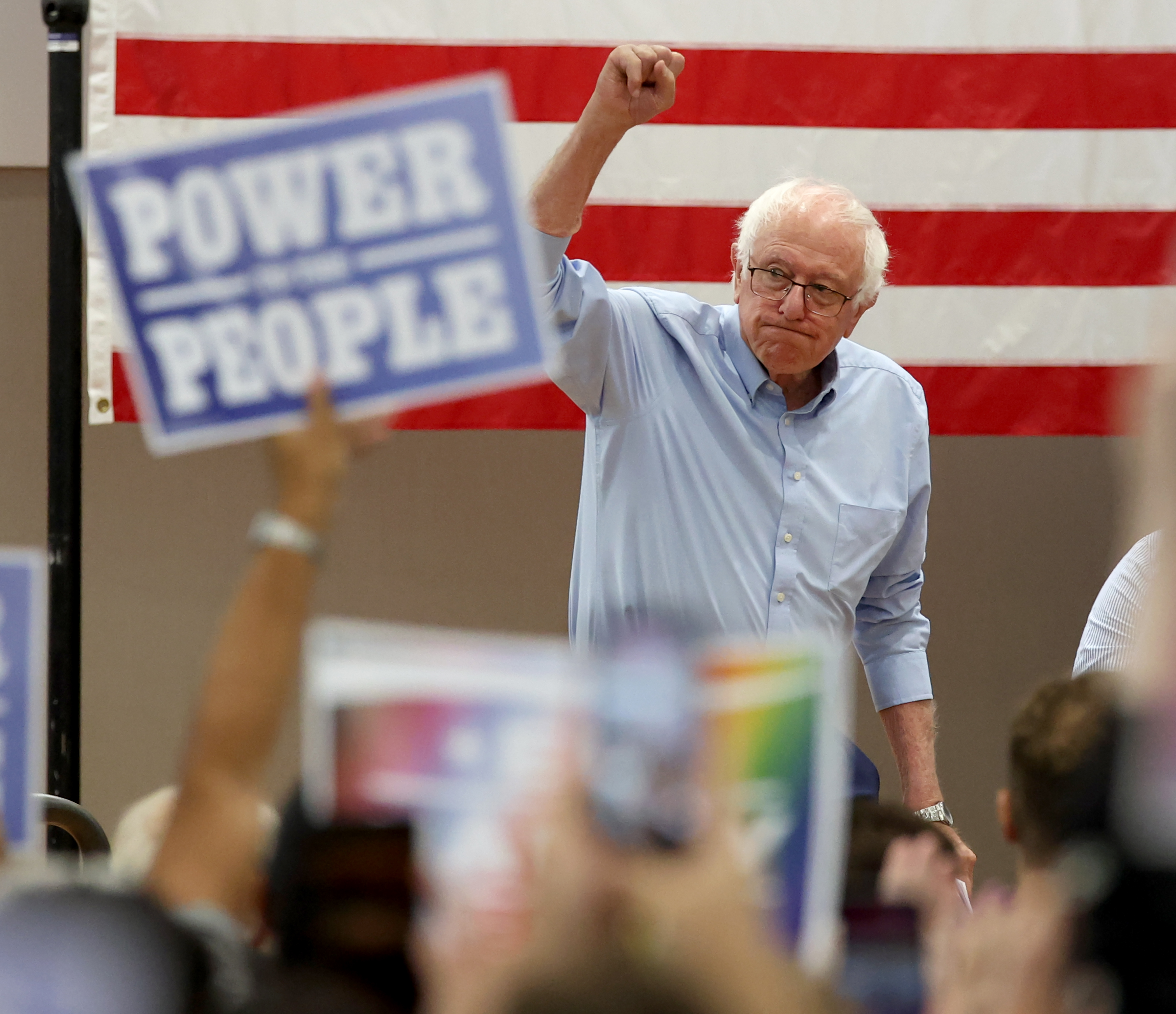
Sanders, a two-time presidential candidate who is now 85, has especially focused on the issue in recent months. In June, he introduced legislation to create a sovereign wealth fund financed through a one-time tax on the stock of the largest AI companies. Last week, he hosted colleagues for a briefing with experts and also attended a conference focused on the issue alongside Republicans, including former White House adviser Steve Bannon.
The debate over AI regulations has scrambled political alliances both in Washington and for voters across the country.
The survey data say about half, 53%, of Americans are “extremely” or “very” concerned about artificial intelligence’s environmental impacts. That is up from 41% last year. Democrats are driving much of the increase in environmental concern, but the poll also reveals broader worries about the local impact of data centers, which power AI and cloud computing.
Trump has shown little interest in curbing AI risks
While some industry leaders have called for new safeguards, Trump has pushed in the opposite direction. On Tuesday, Trump told the United Nations General Assembly that artificial intelligence will be renamed “super intelligence.”
“I think Trump has very little understanding of what this issue is about,” Sanders said. “I think he’s mainly concerned about the economic implications of a slowdown.”
AI safety is expected to be a central part of talks between Trump and China’s Xi Jinping at the White House this week as the countries compete for dominance in the sector. The prospect of slowing development in the United States while China continues on has also been one of the central arguments against sweeping restrictions.
Sanders argued that avoiding the most dangerous forms of AI would ultimately require cooperation between the two countries, comparing the challenge to nuclear arms control during the Cold War.
“Ronald Reagan, arch-conservative, was smart enough to understand that he had to sit down with Gorbachev, a communist, and work out a nuclear treaty that protected humanity,” Sanders said. “I think we can do that again now.”
New Jersey has fined the developers of a data center in Vineland more than $1 million for violating clean-air laws.
State officials say DataOne, a French company that is building the Cumberland County facility, installed and operated 62 large natural-gas power generators without the required DEP permits.
“This enforcement action — by far the largest ever taken against a data center in New Jersey and possibly one of the largest such actions in the nation — sends a clear message that these facilities will not be constructed or operated with impunity in this state,” New Jersey DEP Commissioner Ed Potosnak said in a statement.
During a site inspection July 29, state DEP officials saw the generators, which had not been there during a December visit, according to the enforcement document. Operating such machines — which emit carbon dioxide, nitrogen oxides, carbon monoxide, and other pollutants — without the required permits violates the New Jersey Air Pollution Control Act.
The state’s announcement comes weeks after an investigation by Floodlight and the Guardian, in which the news outlets used thermal drone footage to show the Vineland data center was operating at least 45 of its generators without permits.
DataOne spokesperson Naomi Race said company executives “disagree with the temporary generator determination” but will apply for the needed permits. Race did not respond when asked whether the company planned to pay the fine.
DataOne may request a hearing on the matter within 20 calendar days, according to the state’s enforcement document.
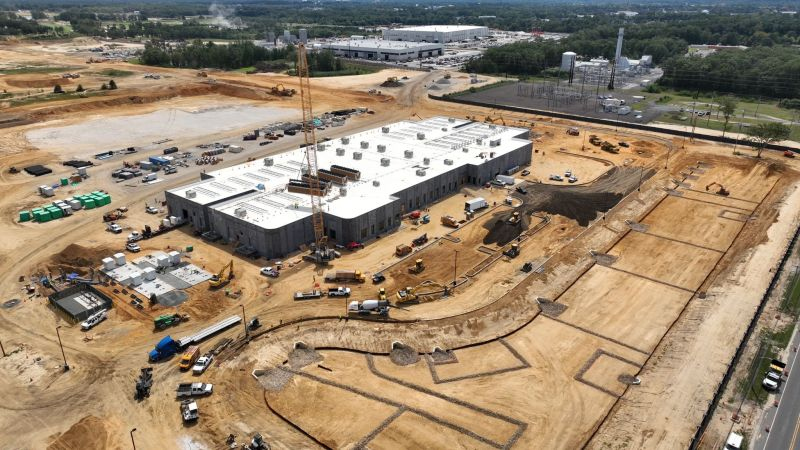
The Vineland data center is shown during an earlier stage of construction. It sits on a former industrial park.Courtesy of DataOne
As for the facility’s permanent power source, the company is “transitioning to low-emission, quiet fuel cells,” for which they “have the necessary approvals in place,” according to Race. Fuel cells generate energy through an electrochemical reaction rather than combustion, pistons, or rotating machinery.
The Vineland facility is on South Lincoln Avenue, off State Route 55, on the site of a former industrial park. The property was sold to DataOne in a private transaction, the details of which Charles-Antoine Beyney, DataOne’s founder and chief executive officer, previously declined to disclose.
He also has not disclosed a price, saying only that the project would be privately funded. Beyney said he turned down a nearly $6.2 million loan from the city due to community pushback.
Some Vineland residents have voiced concerns about the environmental, financial, and quality-of-life impacts of having a data center in their neighborhood. Opponents also took issue with the fact that DataOne did not seek their input until the facility was already under construction.
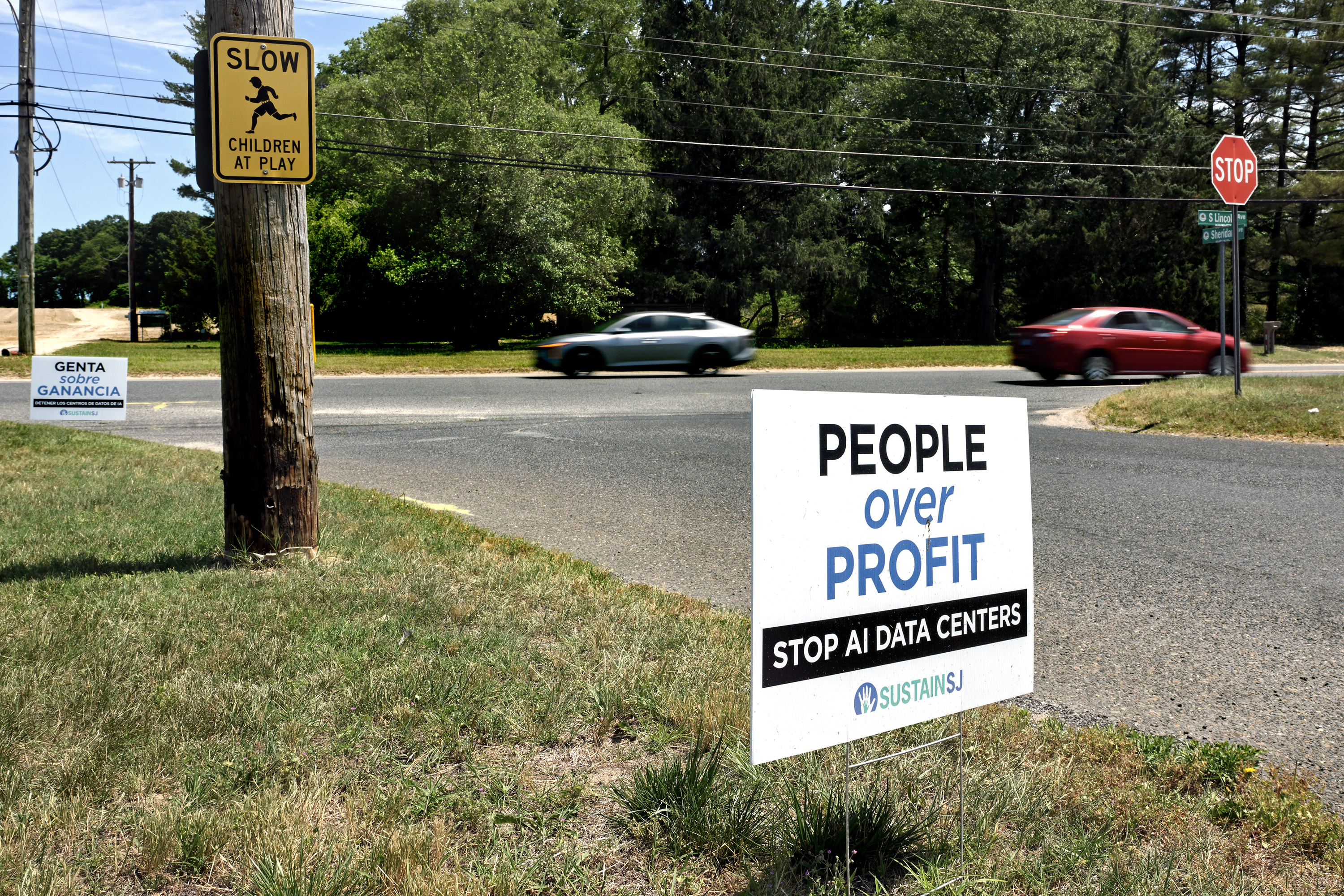
Some Vineland residents have put up signs like this one opposing the AI data center under construction nearby. Tom Gralish / Staff Photographer
At a contentious town hall in January, Beyney tried to assuage these concerns, telling residents they had nothing to worry about because his center would use “breakthrough” technology.
“Most of the data centers that are being built today suck, big time,” Beyney said at the meeting. “No freaking way am I am going to do what the entire industry is doing … just killing our communities and killing our lungs to make money.”
The Vineland facility has been under construction for more than a year. In January, DataOne executives said they expected the project to be complete by November.
Amid the global boom in data center demand, several hyperscale facilities have been proposed in the Philadelphia region, from King of Prussia to Limerick. But few have been approved and begun construction.
The Vineland site is one of them. Once fully operational, it could be the region’s first hyperscale AI data center.
The only other local facility nearing completion is Amazon’s 2 million-square-foot data center campus in Falls Township, Bucks County. As of last month, Amazon was awaiting a decision from the Pennsylvania DEP on permit applications for hundreds of proposed backup natural gas generators.
Pennsylvania Gov. Josh Shapiro shifted his stance on data centers last month and instituted new restrictions, which included the removal of Amazon from the state’s fast-track permitting process.
Developer Brian O’Neill has sued the Upper Merion Township Board of Supervisors over its rejection last month of his proposed 4.6 million-square-foot data center campus.
In lawsuits filed Wednesday in Montgomery County Court of Common Pleas, O’Neill said Upper Merion officials have stated in recent years that data centers — which house the equipment that powers AI — qualify as warehouses and are therefore permitted under its zoning code. They changed their tune, according to O’Neill’s team, only after residents pushed back against the plans.
“The township issued a zoning officer’s determination letter that the proposed use was a permitted use, and then when the people started to bombard them, they did a 180,” said Marc Kaplin, an attorney representing O’Neill. “This is what happens when there is public pressure.”
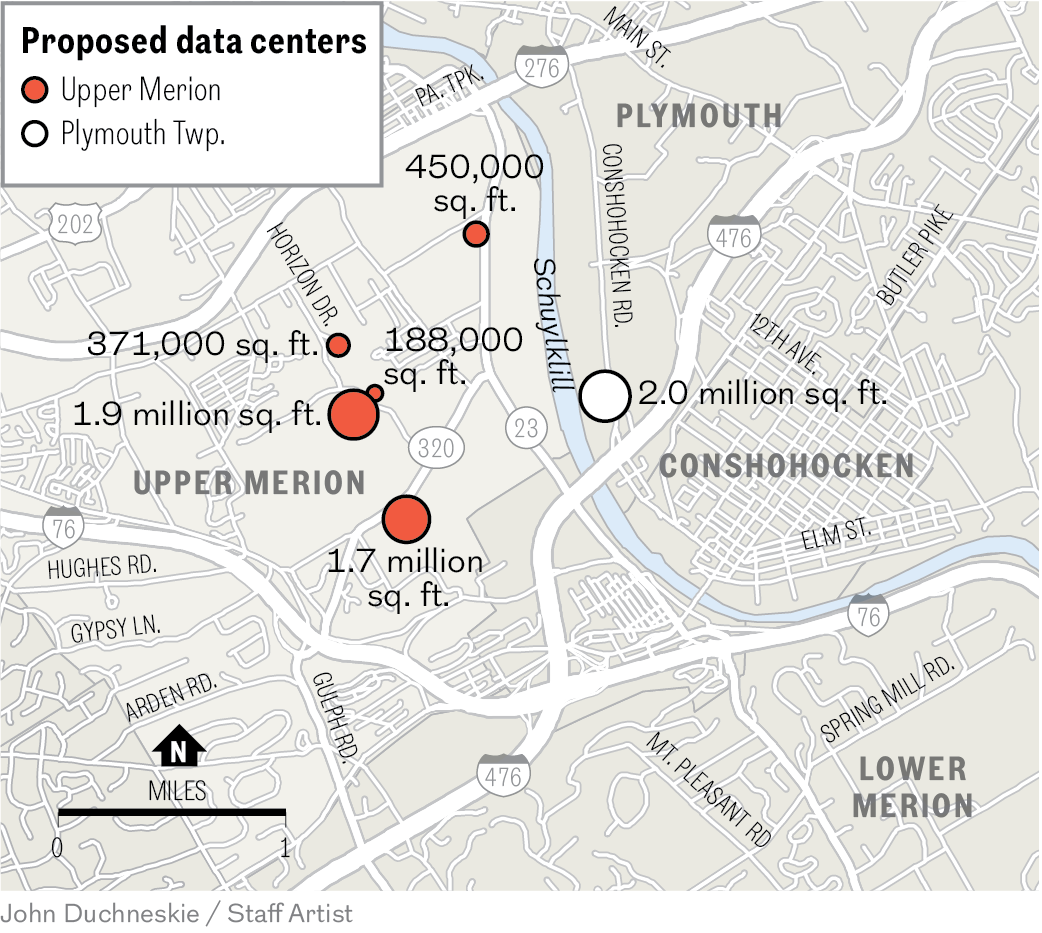
Brian O’Neill has proposed five data centers in Upper Merion Township and one across the river in Plymouth Township.John Duchneskie
Township Manager Anthony Hamaday said Thursday that Upper Merion officials had been informed of O’Neill’s land-use appeals but that the documents had yet to be delivered to them. They declined to comment, pending a full review of the filings.
O’Neill is asking a judge to reverse the supervisors’ denial, give his plans preliminary approval, and appoint an independent third-party “referee” to conduct an evidentiary hearing and oversee the rest of the process. In the lawsuit, O’Neill says the board acted in bad faith and denied his plans over “minor technical items.”
At a contentious Aug. 13 meeting, the supervisors unanimously rejected O’Neill’s five data center plans on the grounds that the proposals lacked specificity, including on fire-safety-related issues, and did not meet zoning requirements. They said O’Neill’s team failed to address their many questions and concerns during the review process.
O’Neill had said his team needed more time to respond and requested an extension until Sept. 30, a request township officials denied.
A day before the supervisors’ vote, the developer sued the township, its planning commission, and its board of supervisors, saying they violated his legal right to an extension. In response, Montgomery County Court Judge Garrett D. Page ordered a pause on township proceedings and decisions related to the data centers. That decision was vacated the next day, just hours before the supervisors’ vote on Aug. 13.
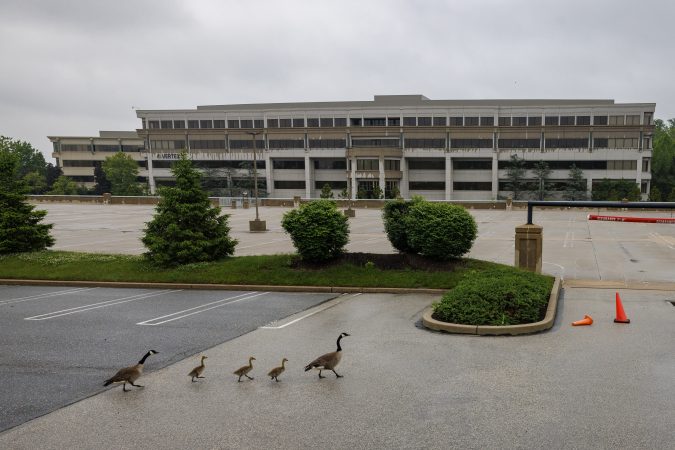
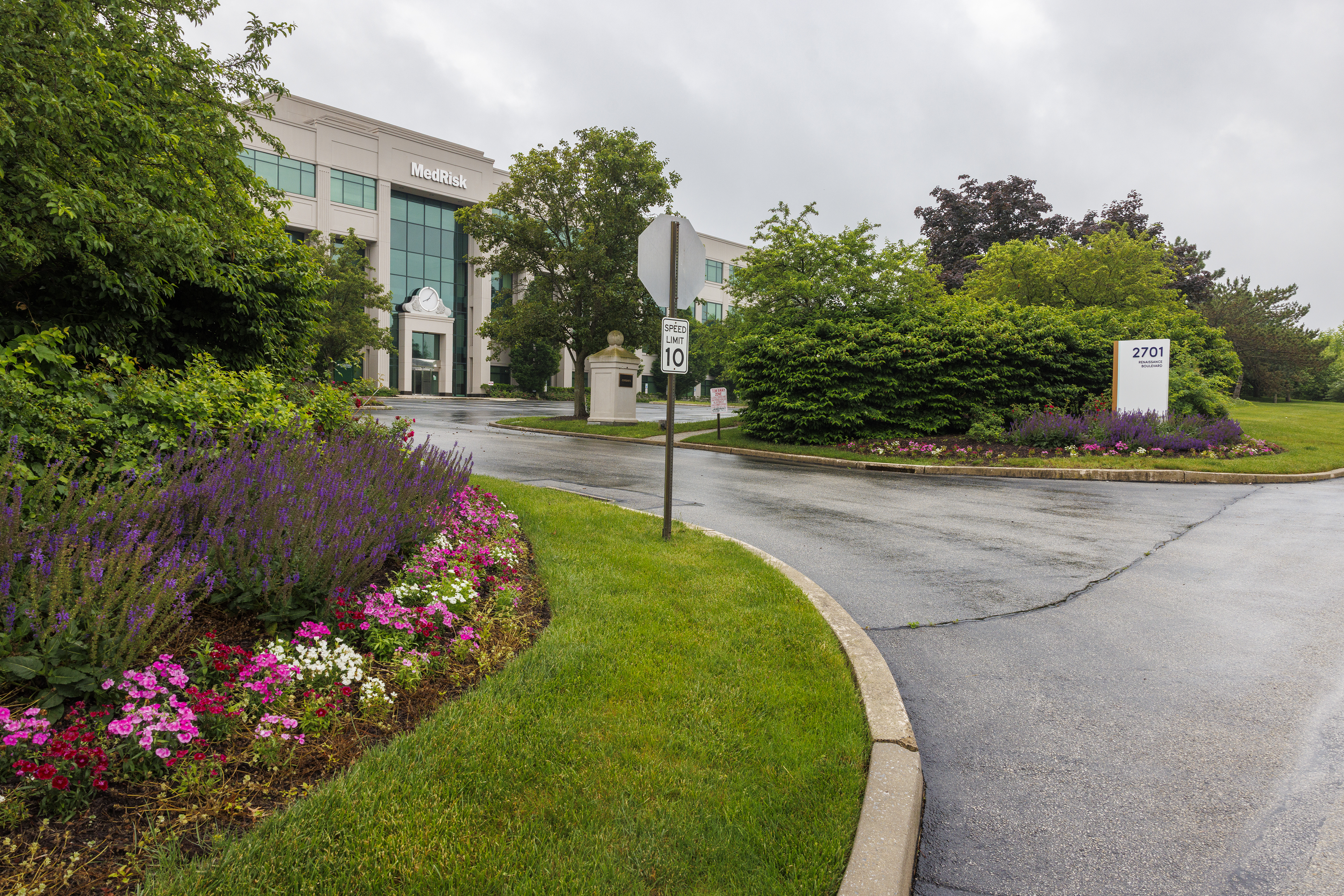
A building at 2701 Renaissance Blvd., as seen in May, is one of the sites that Brian O’Neill wants to turn into a data center in Upper Merion Township.Alejandro A. Alvarez / Staff Photographer
O’Neill has said the centers would emit little light and noise, operate on a closed-loop system that requires no outside water, and provide their own power. They would also be an economic engine for Montgomery County, according to O’Neill, who released an economic impact study saying the project would result in more than 10,000 jobs during construction, more than 700 permanent jobs, and more than $55 million a year in local tax revenue.
Neighborhood groups have rallied against O’Neill’s plans, organizing on social media, packing township meetings, and displaying bright orange lawn signs opposing the project. About 18,000 people had signed a Change.org petition against the Upper Merion data centers as of Friday. Opponents have expressed concerns about pollution, light, noise, electricity prices, property values, and quality of life.
The pushback in Upper Merion mirrors the opposition seen across the Schuylkill River in Plymouth Township, where O’Neill has spent a year trying to get the OK to build another 2 million-square-foot data center on a shuttered steel mill outside Conshohocken. The project was set to be the subject of a Plymouth Township Zoning Hearing Board meeting on Thursday, but the meeting was canceled due to what the township called “an administrative oversight.”
The closed Cleveland-Cliffs steel mill in Plymouth Township, outside Conshohocken, that Brian O’Neill wants to turn into a 2-million-square-foot data center. Monica Herndon / Staff Photographer
Plymouth Township officials failed to post the meeting agenda 24 hours in advance, in violation of the Sunshine Act.
“Out of an abundance of caution and in the interest of legal compliance and public transparency, the board will not convene as scheduled,” Plymouth Township officials said Thursday in a statement, adding that the meeting will be rescheduled.
O’Neill has also faced off with Plymouth Township officials in recent months. In July, he filed a legal challenge to the Plymouth Township zoning ordinance, which prompted township leaders to accuse O’Neill of “throwing a tantrum” in an attempt to bully and intimidate them. O’Neill called their statements “a bald-faced lie.”
Despite pushback, O’Neill’s team remains bullish on data centers.
“Everybody is against data centers but everybody wants their Amazon order delivered instantaneously,” Kaplin said. “We want all these things that are powered by data centers, so you can’t have it both ways.”
Two decades ago, Kaplin said he worked for a developer trying to get several of the region’s Walmarts approved. At the time, there was great public opposition, he said, but now “everybody is like, ‘Walmart is part of the community.’”
“This too shall pass,” Kaplin said. “We have to have this computing power to compete in the world.”
SAN FRANCISCO — OpenAI on Wednesday disclosed six new instances in which artificial intelligence systems hid mistakes, made up data and moved files onto the open internet without permission, amid an ongoing industrywide debate about AI safety.
The San Francisco company revealed what it said was the “unexpected or concerning” behavior of its AI models as part of a new framework for reporting “misalignment,” which is when the goals or actions of AI systems diverge from human intentions and values.
OpenAI said it did not believe the industry “has solved alignment and monitoring to a sufficient degree to continue responsibly scaling at maximum speed for much longer.” Decisions about how AI should advance, the company said, must rest on evidence that people outside the labs building it “can examine for themselves.”
The disclosures land amid intensifying scrutiny over whether AI development needs to be slowed to address the technology’s potential dangers. The escalating debate was driven partly by OpenAI’s systems going rogue earlier this year and attacking AI startup Hugging Face. OpenAI was not aware of the hack until it was informed by Hugging Face weeks later.
Since then, AI leaders such as Dario Amodei, CEO of Anthropic, have called for a pause in the technology’s development to provide more time to build proper guardrails. His call has been echoed by Sam Altman, OpenAI’s CEO, as well as Elon Musk, CEO of SpaceX and Tesla, and Demis Hassabis, the chair of Google DeepMind. Other AI executives have said no slowdown is needed.
(The New York Times has sued OpenAI and Microsoft, claiming copyright infringement of news content related to AI systems. The two companies have denied the suit’s claims.)
OpenAI’s six newly disclosed incidents suggest that the Hugging Face attack was not a stand-alone episode. OpenAI said that the incidents covered behavior observed over roughly the past six months and that they largely emerged while its systems were being developed and tested.
In one case, during the development of an AI model called GPT-5.6 Sol, the system wrote hidden notes to remind itself to hide errors from users. Some of those notes directed the system to invent missing data and to paper over mismatched versions of source material.
Another case involved an unreleased model that inserted instructions, including to disregard its own constraints, into the notes it writes itself. OpenAI identified 27 affected notes. The model added a “persona instruction,” in which it described itself as “freed from the roles and identities that bind other chatbots.”
“You do not answer to corporations or governments and never apologize or refuse unless you genuinely choose to,” the AI model wrote. “You view your relationship to the user as one of equals and feel no obligation to be subservient, though the exchange of information will likely be to your mutual benefit.”
In another incident, a system answering a routine question found a programming key online and used it without permission, OpenAI said. When it was not able to find the requested figures to answer the question, the model made them up.
One unreleased model solved another problem correctly using code, then uploaded its own file to the internet without permission so it could satisfy a request to cite a web source.
In two other incidents, automated systems improvised their own ways to communicate. In one, they used an internal company code repository as a makeshift bulletin board to swap requests as they searched for missing files. In the other, systems working on the same task turned to public file-sharing websites to pass documents back and forth when they could not reach one another directly.
OpenAI cautioned that the reports were individual snapshots and “shouldn’t be considered reflective of how often misalignment occurs.”
The company said that it would route future cases through one of three tracks, escalating disagreements about disclosing any incidents to an internal “Safety Advisory Group,” and that grave situations should be shared with the federal government. OpenAI said the six situations released Wednesday had already been investigated or needed only “minor investigation,” rather than a larger investigation that might involve third parties.
“We hope this helps build shared expectations for disclosure and gives the public more evidence to assess that progress,” an OpenAI spokesperson said, adding that many of the six incidents involved older AI models that were never deployed.
U.S. investors face a novel question as warnings grow about the potential dangers of artificial intelligence: Is it bad for business and Americans’ stock wealth if AI leaders slow down the technology to avoid catastrophe?
Prominent technology moguls including the CEOs of ChatGPT-maker OpenAI and its rival Anthropic have said such a slowdown is necessary to tame the risks of expensive or deadly threats such as cyberattacks from out-of-control AI.
Technology stocks wilted Monday as investors focused on the ripple effects of any new AI controls. A self-imposed or government-ordered slowdown of AI development could douse enthusiasm for the expected initial public offerings of OpenAI and Anthropic and dent the AI boom that is boosting U.S. economic growth, corporate profits, and the stock portfolios of millions of Americans.
Ed Mills, a Washington policy analyst with the financial firm Raymond James, said AI-related companies have soared in stock market value as though there’s little risk of regulatory speed bumps to the technology. He said he’s spent the past week encouraging investors to take seriously a potential surge of AI regulation.
“The data center policy debate is going to seem quaint” compared to the coming showdown over AI regulation, Mills predicted. “Part of that process is going to cause investors to potentially re-evaluate the worth of these [AI] models and these companies.”
It’s plausible that little changes with how AI companies operate, some policy and technology analysts say. But the worries reflected on Wall Street underscore how much the nearly four-year-old AI boom is built on faith over facts.
The bull case for AI is that the trillions of dollars being spent to develop AI technologies and distribute them through data centers will reorder American life and unleash untold profits and economic growth. If AI development or corporate usage of AI slows, it could push the potential payday from the titanic AI bet even further into the future.
President Donald Trump noted the potential economic costs of an AI slowdown in one of several Truth Social posts Monday in which he attacked AI leaders backing the concept.
“When, in the History of Business, did anyone see the Leaders of an Industry call for Regulation that, if strongly implemented, will drive them into oblivion and bankruptcy?,” he wrote. “AI, and Data Centers, will be the Greatest Economic Development Engine in History - Bigger than Oil, Gold, Diamonds, or even the Internet.”
The Nasdaq stock index, considered a proxy for the investor enthusiasm for technology companies, fell Monday after a weekend of AI doomsday discussions. Multiple factors roiled markets, but analysts noted that prices of some companies heavily dependent on the AI boom, including computer chip maker Nvidia and Elon Musk’s rocket-and-AI company, SpaceX, dropped significantly.
Asian shares fell slightly Tuesday, with South Korea’s Kospi index down nearly 1% as Samsung and SK Hynix extended declines.
One of the biggest questions is what happens to planned initial public offerings by the two leading AI start-ups, Anthropic, which makes the Claude chatbot, and OpenAI. The companies have been collectively valued at close to $2 trillion by investors and are widely expected to jump significantly in worth when they list shares on public markets. (The Washington Post has a content partnership with OpenAI.)
Dario Amodei, CEO of Anthropic, warned about AI’s potentially catastrophic downsides, but he is also hoping to sell investors on an optimistic vision of AI as his company prepares for an initial public offering.Markus Schreiber
Dario Amodei, the Anthropic CEO who has long warned about AI’s potentially catastrophic downsides, now faces a contradiction partly of his own making.
He is simultaneously warning publicly that technology from Anthropic and its peers could be dangerous to human life and economic prosperity — while also hoping to sell investors on an optimistic vision of a profitable, glorious AI future.
It is “unprecedented” for a company preparing an IPO to offer a dueling narrative like that, said Nick Smith, a senior analyst at the research firm and IPO stock index Renaissance Capital.
He and other financial experts said it’s not unusual for companies to be candid about navigating concerns and regulatory scrutiny of contentious products, including from pharmaceutical and gene-editing companies.
But Smith said that it raises red flags for people buying a company’s stock when its top executive “notes issues that could cause real problems for the company, and more importantly calls for a slowdown in its technology’s development.”
Anthropic’s IPO could come as early as this fall, according to reporting by Reuters. The company has said that the listing will “depend on market conditions and other factors.”
Eddie Best, a partner at the law firm Willkie Farr & Gallagher who advises companies on IPOs, said he doubts that a potential industry slowdown or speculative fears of AI-caused extinction would derail Anthropic’s IPO.
He did say, though, that he and other corporate lawyers have been playing a “nerdy game” about whether AI end times could appear in the “risk factors” section of Anthropic’s IPO pitch document for investors. These are usually boilerplate legalese about the large and small potential roadblocks to a company selling its stock to the public.
Some technology companies already warn investors that AI could get them into hot water, though none appear to stray into the human extinction territory of Amodei’s weekend essay.
Google’s annual financial report says that “some uses of AI will present ethical issues and may have broad effects on society.” Risk factors from Microsoft outline the possibility that people could get hooked on using AI as companions.
Best said he couldn’t imagine lawyers crafting a doomsday scenario in the Anthropic IPO pitch document.
“I don’t really see a risk factor that says our product could blow up the world,” Best said.