Category: Technology

  • The colonial policing roots of today’s data politics

    The colonial policing roots of today’s data politics

    Data is at the top of everyone’s mind this year: how it’s collected, where it’s stored, who can access it and how it’s used.

    The Electronic Frontier Foundation, a data rights NGO, warns in a new report that law enforcement agencies have been partnering with tech companies to collect large swaths of data on private citizens without warrants under the guise of “fighting crime” or “reducing lawlessness.” Police have been using facial recognition software, audio recording devices, automatic license-plate readers and other “dragnet” technologies to aggregate huge databases on the habits of everyday Americans.

    Watchdog organizations like the ACLU have sounded the alarm that these databases have already been weaponized against the public by organizations such as U.S. Immigration and Customs Enforcement and the U.S. Department of Homeland Security.

    One might be tempted to conclude that this is unprecedented, an outgrowth of the panopticism of the Information Age. But debates about privacy, free speech and data governance have been ongoing for centuries. These debates were especially fraught in the colonial context, where individual rights, national security and public interest were often in conflict.

    The British first established police forces in India in the late 1800s, after nearly two centuries of bloody succession conflicts. In 1857, a great rebellion almost dislodged the British from the subcontinent entirely. Initially disgruntled Indian East India Company soldiers led the rebellion against their white commanding officers in a mutiny. However, the conflict quickly spread across the subcontinent, uniting competing segments of Indian society against the British establishment. Though this rebellion didn’t succeed, it left a lasting political and psychological impact. British accounts describe a sense of helpless horror, a feeling for the first time that their place in the world was no longer secure.

    The British establishment in India believed that the rebellion occurred due to a failure of British intelligence. They had erred by trusting their Indian allies and intermediaries too freely and missed obvious rumblings of disorder. The crown took direct control of India from the East India Company and began to build a new system of governance from scratch.

    The British Raj established its first official police departments in India in 1859, modeled on the Royal Irish Constabulary. The police understood that their job was to maintain order rather than to serve the public. Most departments’ first project was to assemble official statistics and compile them into annual reports. This data, aggregated and synthesized, became the lifeblood of the Empire.

    Nowhere was this development more apparent than in the use of crime statistics. In the 1860s police forces in Northern India reported a supposed explosion in crime, perpetrated by wandering gangs, “criminal tribes” who were criminals by birth. Unlike the “ordinary” criminals of Europe who fell into crime by chance, the criminals of India were born into their “professions.”

    Officials felt that by bringing quantitative data to policing — counting and tracking crimes, where they occurred, and who committed them — allowed them to more fairly and effectively allocate resources. In truth, though, police and other officials used data to reinforce existing biases, arguing that the numbers showed that race, caste and other “biological traits” could be used to predict criminality. Hyper-policing of certain populations produced even more data “proving” that these populations committed more crimes. This decontextualized data gave the government the veneer of objectivity, while serving as the basis for many harmful and discriminatory policies.

    In 1871, the legislative assemblies of three provinces passed the Criminal Tribes Act into law. The Act defined a “criminal tribe” as a “wandering gang, community, or group of persons addicted to the commission of non-bailable offences,” a definition that targeted groups already socially disadvantaged by the caste system.

    In truth, “criminal tribes” as described by British administrators probably never existed. Instead, nomadic and semi-nomadic merchants or artisans, groups of religious mendicants, highway men (usually unemployed former soldiers), pastoralists and any other group who did not fit were all folded into the “criminal tribe” label. Unlike settled agriculturists within the dominant caste order, these groups were difficult to control due to their mobility and lack of social or economic capital. Under the law, they were criminalized and subject to extremely intrusive regimes of surveillance. The police tracked the most minute details of the lives of targeted groups: their fingerprints, their bodily measurements, their habits and their preferences.

    The impact of the state’s surveillance campaigns was that these communities lived in a state of hypervisibility. Communities complained that they were unable to live, work or travel without being disproportionately targeted by police. The increase in police interactions eventually led to a corresponding increase in arrests—which, in turn, was used to justify further surveillance and policing.

    One police officer recounted in the early 1900s that he recommended a whole nomadic community be criminalized under the Act and forcibly settled. The reason? They were reportedly adorned in silver finery while living in weatherworn tents with sparse and shabby furnishings. The only reasonable explanation, he claimed, was that the jewelry was stolen loot.

    Data gave the government the visibility and the leverage required to recruit collaborators. Police relied upon wealthy and landed (“trustworthy”) communities to identify “criminal tribes,” and recruited officers from their ranks. In return, the police offered elites protections against peasant uprisings or labor disputes. Data ownership was thus not just a privilege but a favor, doled out by the state to its allies in exchange for “good behavior.”

    Data collection and policing transformed everyday life. Community and family spaces—town squares, local government offices, playgrounds, parks, schools, shops, even streets—went from being “private” spaces, governed by the people who inhabited them, to “public” spaces subject to the control and surveillance of the state. Regular community events like food festivals, religious processions and public gatherings often felt distinctly different in the presence of police. People knew they were being watched.

    Disputes at street processions and festivities frequently became highly publicized court cases, written about in the newspapers and read aloud in coffee shops and tea stalls. In turn, groups began to use processions to garner such publicity and “make a point” in the first decades of the 20th century: “cow protection” parades by Hindu extremists to intimidate religious minorities, festivals commemorating anti-British war heroes like the Maratha King Shivaji, even protest marches by Muslims against the dissolution of the Ottoman Empire after WWI. Divisive political processions came to replace weddings, funerals and naming ceremonies that had been common in the 19th century.

    At a time when it was considered both scientifically sound and fashionable among the Western-educated class to believe that Indians were too loud and disorderly to govern themselves, public gatherings became performances to authority rather than community events. As debates raged about whether India was ready for independence in the 1920s and 1930s, communities policed themselves and each other, critiquing rituals and expressions that were too loud, too emotional, too rowdy.

    Where there were multiple communities in conflict over public spaces, police involvement caused small disagreements to escalate. In March 1925, a small fight during a religious procession in Delhi sparked communal riots across Northern India that lasted periodically until late September, causing dozens of casualties and at least six deaths.

    Made By History sponsors. FOR USE ON MADE BY HISTORY STORIES ONLY.Inquirer Staff

    Class, caste and religious divisions hardened throughout the 1930s and 1940s, leading to the segregation of formerly integrated spaces. In these ways, the British used information to divide and rule communities, to target the vulnerable, and to suppress dissent. These efforts prolonged the British presence in India for decades, until its hasty exit in 1947 after overseeing a violent and bloody partition of the subcontinent. The ghost of the Empire continues to haunt the region today.

    One critical lesson the Indian public learned during this era was that the collection of information is never neutral. Power shapes how information is collected, stored and interpreted, and information can be used and abused to protect those in power.

    Today every app, website and device contains a back door to collect and sell our information. Companies and officials tell us that these capabilities are benign, used to improve our lives and make us safer—and we believe them at our own peril.

    Niveditha (Nive) Senthilvel is a 2026-27 Fulbright-Nehru scholar and PhD Candidate in South Asian History at Boston University.

    Made by History takes readers beyond the headlines with articles written and edited by professional historians. Opinions expressed do not necessarily reflect the views of The Inquirer.


  • New iPhones arrive, but you can keep your old phone longer by caring for it

    New iPhones arrive, but you can keep your old phone longer by caring for it

    Apple’s latest iPhones, unveiled this week, come with new features, better cameras, and hefty price tags — including a folding model with a starting price of $1,999. If you’re planning to splurge on a new iPhone 18, you will want to take care of it to make it last as long as possible.

    Or save money by holding on to your current device, whether it is Apple or Android, to get the most life out of it.

    As smartphone technology has matured and innovations have become more incremental, people have stopped buying into the idea that they need to upgrade to the newest phone. There is also an environmental push to keep old phones out of landfills as electronic waste becomes a larger sustainability issue. Modern smartphones are also just sturdier and better able to survive dunks and drops.

    The typical smartphone replacement cycle is now four years, according to Counterpoint Research. Some device owners boast in online forums that they have had phones last more than seven years.

    Here are some pointers on extending your phone’s life:

    Take care of your phone’s battery

    The biggest factor in a phone’s longevity is the battery. A rechargeable battery’s life span is related to its “chemical age,” which is based not only on the manufacturing date but also on factors including “temperature history and charging pattern,” according to Apple. The company says that as lithium-ion batteries chemically age, they hold less charge, which results in “reduced peak performance.”

    Samsung warns against running a lithium-ion battery down completely, because that could shorten its life.

    “The battery is absolutely often the first thing to go in most people’s phones,” said Elizabeth Chamberlain, director of sustainability at the device-repair website iFixit.

    Lithium-ion batteries typically last about 300 to 500 charging cycles before degrading noticeably to the point that they can’t last a day without needing a charge, she said. “Many people will hit 500 cycles in two years. Heavy users will get there faster.”

    Batteries get stressed if they are completely drained or fully charged, Chamberlain said.

    So avoid letting your battery die, and also avoid charging it all the way to 100%, “unless you really need a full charge,” she said. “Aim to keep the battery between 20% and 80% charged.”

    If you are in the habit of plugging in your phone when you go to bed, Apple and Samsung both have charging optimization technology that improves battery life by delaying a full charge based on your daily routine.

    This feature, which is on by default in iOS, pauses charging at 80% and then charges to 100% just before you wake up.

    Phone batteries shouldn’t get too hot or cold

    Device makers warn against exposing phones to extreme heat or cold, both of which can damage batteries.

    Apple says batteries warm up as they charge, which can shorten their life span. It warns against using your phone or charging it in very hot temperatures, above 95 degrees.

    Samsung says you shouldn’t leave your phone in, for example, a car’s glove box when it is very hot or cold. And don’t put it in a freezer either — it’s a myth that it can prolong battery life.

    Google, which makes the Android operating system and Pixel phones, says hot batteries drain faster, even when they are not in use, and that can damage the battery.

    Adjust your phone’s power options to boost battery life

    Tweak your device settings so apps or features use less power, which extends your battery’s daily life and the time between charging cycles.

    You can turn down your phone’s screen brightness, turn on the dark theme and reduce the time for the screen to power off. Enable the auto-brightness feature, which adjusts screen brightness according to the level of ambient light. Also check battery usage in your settings to see if there are any power-hungry apps you can switch off or uninstall.

    If the power level dips below 10%, iPhone users can turn on low power mode to stretch their battery’s life before it needs recharging. Samsung’s Android phones have a similar “power saving mode.” You can also leave it on all the time, but it might affect your phone’s performance.

    Phone cases and screens are essential protection

    Phones are sleek capsules with glossy surfaces, meaning they can easily slip from your hand. A sturdy protective case is essential to help cushion the blow from accidental drops.

    However, beware that some phone cases can retain heat, so your phone might stay hot even if it seems cool, Chamberlain warns.

    Don’t forget a screen protector. Plastic versions are cheap but can scuff easily, according to iFixit, which recommends TPU film or tempered glass because they offer better protection against scratches and drops.

    Keep your device clean

    Keeping your phone in your pocket or purse means ports and sockets collect debris that needs to be cleaned out.

    Chamberlain said that when a phone stops charging, often the problem is simply that the charging port is jammed with lint, preventing the cable from connecting.

    You can buy kits with brushes, picks, swabs and dust blowers to give your phone’s ports, speaker and microphone grilles a thorough cleaning. But in a pinch, use a toothpick and a clean toothbrush.

    Update the software regularly

    Software is another important factor in a phone’s life span. Experts advise keeping your operating system and apps up to date so they have the latest privacy, security and battery management features.

    That will be easier to do as your phone ages because some device makers have been extending the time limit for providing updates.

    Google has pledged to provide Pixel 8 and newer phones with seven years of Android and security updates, compared with four to five years for older models. Samsung pledged in 2024 to extend its operating system updates to seven years.

    Apple said Wednesday that iOS 27 will be available on Sept. 14 and the oldest phone with which it will be compatible is iPhone 11, released in 2019.

    Some phones are designed to be easily repaired

    Sometimes your phone will have a problem that can only be solved by repairing it, usually involving paying someone else to fix it.

    But there are device makers that are making it easier to repair phones yourself. Netherlands-based Fairphone makes phones it says are designed for longevity, which come with a stripped-down version of Android and can be easily disassembled using a mini screwdriver. Replacement batteries, screens and other spare parts can be ordered online.

    Fairphone’s Chief Technical Officer Chandler Hatton said the company aims to have its devices last at least five years.

    “What we’re trying to do is to support people to be able to use their device for longer,” Hatton said.

  • Foldable phones are unpopular. Why is Apple selling one?

    Foldable phones are unpopular. Why is Apple selling one?

    Apple this week unveiled an iPhone that unfolds like a book to expand its screen size and closes up to fit in your pocket. It’s the biggest physical change to the iPhone’s design in nearly two decades.

    But even though they’ve been around for years, foldable phones aren’t particularly popular. They’re expensive, awkward and not as durable as regular smartphones. So why did Apple build one?

    The simple answer is that the novel design of today’s foldable phones could help reestablish the high end of the phone market. They are meant to stand out in a sea of standard-issue, if-you’ve-seen-one-you’ve-seen-them-all smartphones.

    The quintessential rectangular smartphones have gotten so good over the years that the most expensive models priced upward of $1,000 have become nearly indistinguishable from their cheaper counterparts. (Carrying a phone with three camera lenses vs. two probably won’t impress people at parties.)

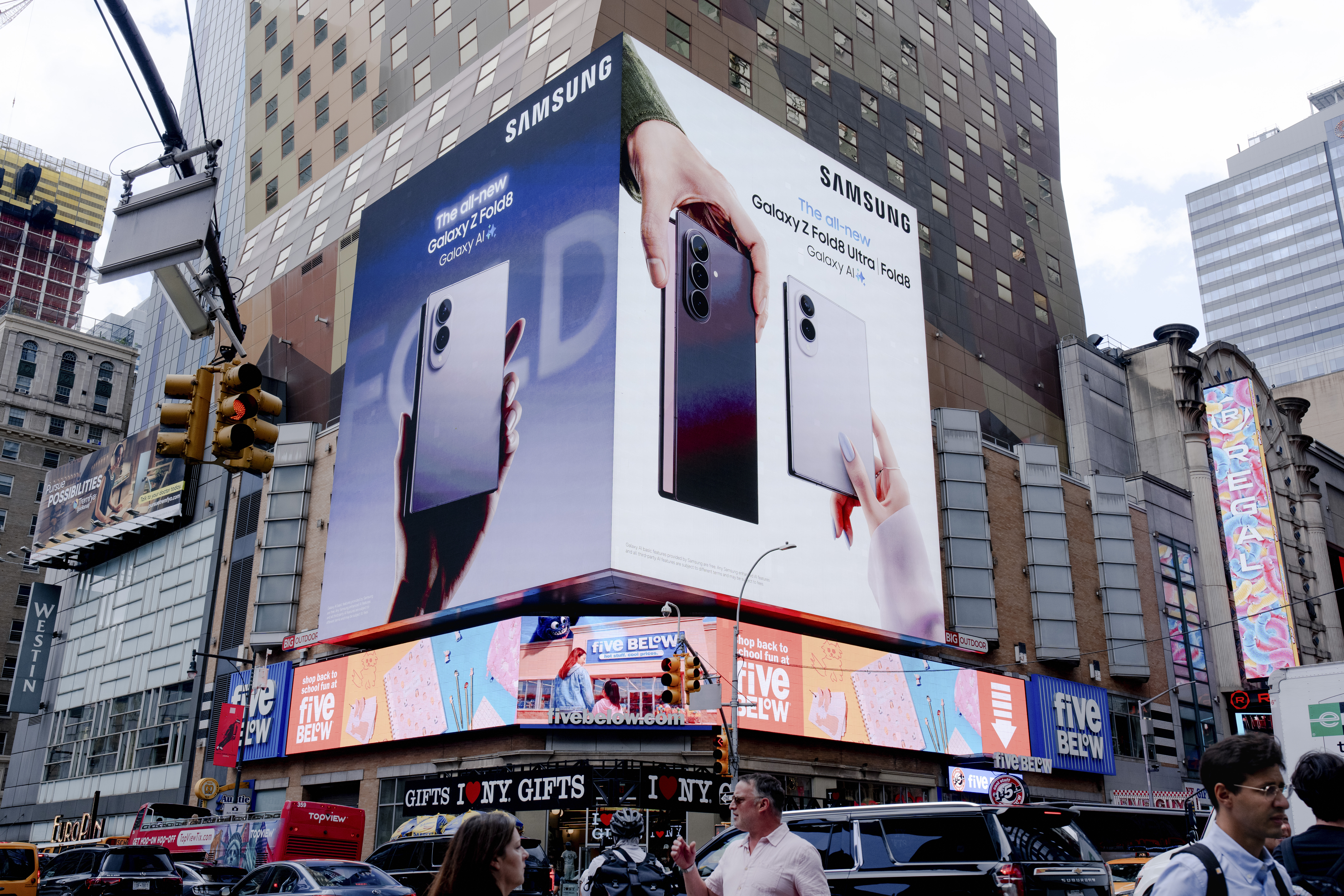
    Foldable phones, on the other hand, are attention-getters. And for their price, they’d better be: Apple’s iPhone Duo will cost $1,999 when it arrives in October to compete with Samsung’s $1,900 Galaxy foldable.

    Samsung billboards in Midtown Manhattan.Lexi Parra

    “Whenever something is exclusive, limited and luxurious, automatically consumer psychology wants it,” said Nabila Popal, a director at IDC, a market research firm. “It’s like handbags. Why is someone buying a Chanel versus that? It’s not because of the leathers. It’s to show that they have a Chanel and they can afford it.”

    Apple and its competitors are following a path that television makers took about a decade ago. When high-definition TVs became commoditized, anyone could buy a bright TV with a large, sharp screen for as little as $500. To find more ways to increase profits, companies like Panasonic, LG, and Sony experimented with quirky new designs, like TVs with curved displays and the ability to play movies in 3D, and charged $3,000 for them.

    Those TV concepts turned out to be flops. But in later years, TV makers found success with a different type of high-end television featuring OLED technology, or organic LED, which had more accurate colors for making movies look better and cost upward of $1,000.

    Apple’s foldable handset is arriving at a moment when people will need extra persuading to upgrade to a new phone. The costs of most consumer goods, and especially electronics, have skyrocketed.

    In response to an industrywide memory chip shortage driven by the artificial intelligence boom, Apple increased prices this year for many of its popular products, including Macs and iPads, by as much as 29%. Apple’s new iPhone 18 Pro phones will cost $1,199, a $100 increase from last year’s model. The chip shortage has also forced companies to raise the prices of video game consoles and phones.

    Foldable phones, which account for less than 2% of the handset market, may be the only part of the phone industry that will grow this year. IDC said it expected the chip-shortage-induced price increases to contribute to a 17% drop in worldwide smartphone sales this year — the steepest annual decline in history. However, sales of foldable phones could grow 12% to 22.9 million because of the iPhone Duo’s arrival, the research firm said.

    Still, a foldable phone could be a tough sell even for a company as influential as Apple. Consumers have generally avoided buying foldable phones not only because of their cost but also because of their trade-offs. Their bendable screens are less durable than normal phone displays, which are protected with hard glass. Folded up, they can feel bulkier and heavier in a pocket.

    Dan Frommer, a writer for the New Consumer, a tech research publication, said he had long been skeptical about the usefulness of foldable phones because so much online content, including the vertical videos on TikTok and Instagram, was produced for the small rectangular screens of normal smartphones.

    “They’ve been used that way for 19 years now,” Frommer said. “What would you actually want a square, big screen for?”

    Apple’s iPhone Duo appears to be addressing some of the shortcomings of previous foldable phones. The device’s name refers to two screens. Closed up, it has a 5.4-inch outer screen that people use as a normal rectangular phone; it opens up to reveal a 7.6-inch inner screen. The larger inner display shows pictures in the same aspect ratio as traditional phone screens. Apple also said the phone’s foldable inner screen was composed of a tougher material than competitors’.

    The iPhone Duo appears to be addressing some of the shortcomings of previous foldable phones.Jason Henry

    In my tests, when opened, the iPhone Duo was extremely thin, measuring two-tenths of an inch. I liked that a Netflix video took up the full screen instead of showing black bars on the sides, which has been the case with other foldables. Closed up, the phone felt dainty and was about the size of a passport. It also felt less chunky in my pocket than other foldables I’ve tested, such as the $1,900 Google Pixel 11 Pro Fold. The more compact and lightweight, the better.

    The inner screen has a matte texture to reduce glare. Still, I occasionally noticed the crease in the center where the screen folds. I didn’t mind it, but that might bother nit-pickers.

    Apple also had to leave out some components to make a phone this thin; the iPhone Duo lacks the advanced camera system featured in the $1,199 iPhone 18 Pro phones. It also doesn’t have a face scanner for unlocking the device, relying instead on a fingerprint sensor on the side of the phone.

    Although Frommer predicted that the Apple foldable wouldn’t be the right fit for him, he admitted he couldn’t resist trying one out in a store.

    “When Apple makes something, there’s an allure to it to encourage people to at least check it out,” he said.

    This article originally appeared in The New York Times.

  • New Apple CEO unveils latest iPhone lineup, including a foldable model called Duo

    New Apple CEO unveils latest iPhone lineup, including a foldable model called Duo

    CUPERTINO, Calif. — Apple on Wednesday unveiled its latest generation of iPhones, including a widely anticipated foldable version called Duo.

    The company’s new CEO, John Ternus, who took over from Tim Cook on Sept. 1, introduced the latest lineup at the company’s Cupertino, Calif., headquarters.

    After cycling through other updates to the iPhone, the Apple Watch and AirPods, Ternus told the audience inside the Steve Jobs Theater that “actually there is one more thing,” in a nod to the trademark phrase from Jobs that the company’s legendary late founder himself borrowed from the 1970s detective show Columbo.

    The foldable phone has the “largest display ever on an iPhone, yet fits into your pocket,” Ternus said.

    The phone opens to a 7.6-inch display that is 80% larger than the newest iPhone 18 Pro. It will let people use an Apple Pencil on the phone, a capability previously reserved for iPad users. Duo, Ternus said, “will redefine the experience of using a foldable phone.”

    The Duo lets users split the screen to use two different apps on the device, or two windows of the same website for things like comparison shopping. With a starting price of $1,999, it is the most expensive iPhone yet.

    The Duo “was always going to eclipse Apple’s other announcements at the event,” said Ben Wood, chief analyst at CCS Insight. “The device adds a distinctive new design to the iPhone lineup and marks the company’s entry into the niche foldable smartphone category.”

    Wood said that while there is certain to be demand for the Duo, which costs less than some analysts had anticipated, foldables still account for less than 5% of the overall smartphone market.

    New iPhone 18 models

    The iPhone 18 Pro and 18 Pro Max, Ternus said, bring improvements to the battery, camera, and performance. They will start at $1,199 and $1,299, respectively. Customers can preorder the phones starting on Sept. 12 and they will be available on Sept. 18, although the Duo will be available on Oct. 23.

    The new models feature a long battery life — 45 hours of video playback for the Pro Max — and faster charging. The camera offers what Apple called “cinematic effects” from regular video captured on the phone, as well as new options for manual controls and “smart focus tracking,” which lets users focus on a single moving subject, such as a kid during a soccer game.

    Apple is also focusing on Siri’s new AI capabilities with the new phones, emphasizing privacy and security to stand apart from rivals who are further along in incorporating AI.

    Many of Apple’s biggest rivals, such as Samsung, Motorola, and Google, have already come out with foldable smartphones. But Apple is not one to rush on new technologies.

    “The foldable launch is straight out of Apple’s playbook: Wait for the product to work out its kinks and for the market to offer glimpses of viability, then enter and shape the category,” said Forrester analyst Dipanjan Chatterjee. But, he added, the question will be whether it can expand demand for what’s still a niche product category.

    Compared with earlier generations, the iPhone 18 costs about $100 more due partly to a global memory chip shortage. The iPhone 17’s price ranges from $799 to $1,999 depending on the model.

    Earlier this year, Apple unveiled artificial intelligence advances, including upgrades to its Siri assistant, emphasizing a focus on privacy and day-to-day use as the company tries to catch up with rivals on AI.

    Ternus takes center stage

    The keynote address for Ternus was his opportunity to set the tone for his vision of Apple’s future, Chatterjee said.

    “John Ternus inherits perhaps the most successful consumer technology juggernaut in modern times. That is both a boon and a burden for him. Tim Cook’s perfected execution, scale, and monetization set a high bar, and Ternus must extend that run,” Chatterjee said. “But he must sustain that momentum while positioning Apple to disrupt itself in the near future, when the iPhone, or any smartphone for that matter, will cease to be the consumer’s primary conduit to the world.”

    Wood noted that, with all the excitement around the Duo, the official arrival of Ternus as CEO “felt like less of a story” than he’d expected.

    “This event marks a seamless transition from Tim Cook, and its timing to coincide with the iPhone Duo was undoubtedly planned,” Wood said. “However, despite the media frenzy about this new device, it is the broader strength of Apple’s hardware, software and services that will drive the company forward.”

  • EPA proposal could leave the public in the dark on data center plans

    EPA proposal could leave the public in the dark on data center plans

    WASHINGTON — A plan by the Environmental Protection Agency could make it harder for the public to learn about and comment on proposed AI data centers that have sparked backlash in communities across the United States and transformed the midterm election landscape.

    The EPA proposal would eliminate a federal requirement that states notify the public and seek comment before issuing air pollution permits for data centers and other industrial facilities. States could still offer opportunities for public comment, but the EPA would no longer mandate them as a condition for states to grant permits.

    Critics say the move could thwart local residents from learning about proposed data centers or making their voices heard before projects are approved and construction begins. The move comes during a widespread backlash as tech giants build hundreds of massive server warehouses to fuel artificial intelligence and cloud computing.

    “By eliminating the long-standing federal requirement for public notice, this proposal continues efforts by the Trump administration to turn its back on the fundamental EPA principle of transparency,” said Mike Koerber, a former deputy director of EPA’s air quality office.

    If made final, the plan could create “an unlevel playing field where citizens in one state are kept completely in the dark about new data centers and heavy industrial emissions in their backyards, while neighboring states maintain oversight,” he said.

    Under the EPA plan, states with weak or no requirements for public comment could speed permits for data centers, power plants and other pollution sources without consulting the public or even informing communities where the facilities are located, Koerber and other critics said.

    Communities deserve a chance to weigh in, advocates say

    “Data centers and other industrial sources should not be able to get their air pollution permits in secret,” said Keri Powell, senior attorney for the Southern Environmental Law Center, an advocacy organization that leads a coalition of nearly 200 environmental, health and community groups that filed comments with the EPA opposing the plan. “Communities deserve a chance to weigh in” before potentially harmful projects are approved.

    An EPA spokesperson called that a false narrative.

    “In our proposal we are saying that states get to pick how they want their permitting process to go for minor sources” of air pollution, spokesperson Carolyn Holran said.

    The EPA proposal does not specifically identify data centers, she said, noting that the plan also would apply to laundromats, car repair shops and even landfills and steel mills that are considered “minor” pollution sources under the federal Clean Air Act.

    The proposal does not demand that states make particular changes to their programs, nor does it alter federal emission standards or weaken environmental protections, Holran said. “Rather, the proposal simply aligns the national program with the Clean Air Act language to ensure that states are in the lead regarding their programs.”

    EPA Administrator Lee Zeldin, who has made U.S. leadership in AI a top agency priority, said in a statement that the plan is aimed at “cutting unnecessary and burdensome red tape, unleashing American energy and advancing cooperative federalism” with states. The EPA is expected to make the rule final next year.

    President Donald Trump continues to stick up for data centers, even as politicians from both parties criticize them and many communities try to block them. Trump said on social media this week that U.S. communities that don’t have data centers will “end up being backwards and poor.”

    Trump says data centers are crucial in the AI race against China

    Trump has acknowledged that data centers need “a little public relations help” and has pushed tech companies to generate their own electricity to shield consumers from higher utility bills. The Republican president calls data centers critical to winning the AI race against China.

    Environmental groups and other critics say the EPA proposal ignores the reality that many states, particularly in the South and Midwest, don’t require public notice or hearings beyond those set by federal agencies. The federal plan would leave many communities in the dark before data centers show up in their backyards, they said.

    “It’s beyond cruel for Trump’s EPA to silence front-line communities who bear the brunt of unhealthy air,” said Brandon Jones-Cobb, a senior attorney at the Center for Biological Diversity, another environmental group.

    The EPA “has already turned its back on science, cut enforcement against industrial polluters and eliminated life-saving air pollution measures,” he said. “Now it wants to shut the public out of decisions to build or expand facilities that expose communities to dangerous air pollution, including data centers.”

    Powell, whose organization focuses on six Southern states from Virginia to Alabama, said many states “only do what is required by federal law” when it comes to public notice of land-use projects and other environmental concerns.

    “We rely on a minimum federal requirement to ensure we have environmental protections and a voice,’’ she said in an interview, calling regulation of data centers a crucial issue in a region where the energy-hungry behemoths are proliferating. Virginia and Georgia are both among states with the highest concentration of current and proposed data centers.

    Americans worry data centers could cause pollution, job losses

    Besides powering AI and cloud computing, data centers are often sources of nitrogen oxide, which helps form ozone, as well as carbon monoxide and other air pollutants. Local communities also have expressed concerns about excessive water use and noise from data centers. Many Americans worry that AI could increase economic disparities and cause widespread job losses.

    Data center advocates stress that local taxes paid by the centers can help fund public schools, reducing the financial burden on homeowners.

    Jane Williams, executive director of California Communities Against Toxics, said even if data centers ultimately are approved, “every community should be able to participate robustly in governmental decisions that can pollute our air.’’

    Rolling back the EPA rule “pulls a dark cloud, filled with soot and toxic chemicals, over communities’ right to know what polluting facilities are planned in their community,” she said.

  • Reed E. Pyeritz, pioneering medical geneticist and Penn professor emeritus, has died at 78

    Reed E. Pyeritz, pioneering medical geneticist and Penn professor emeritus, has died at 78

    Reed E. Pyeritz, 78, of Radnor, pioneering medical geneticist, cofounder of the Marfan Foundation and the American College of Medical Genetics and Genomics, professor emeritus of medicine and genetics at the University of Pennsylvania, author, mentor, veteran, and nationally ranked masters triathlete, died Monday, Aug. 10, of interstitial lung disease at Bryn Mawr Hospital.

    Dr. Pyeritz was a trailblazing expert on the diagnosis and treatment of Marfan syndrome and other inherited cardiovascular disorders. His 44 years of research and clinical work, from 1978 to 2022, advanced the understanding and management of the diseases, and extended the life expectancy of Marfan patients by 30 years.

    “So many of us in the community owe Reed so much,” Bert Medina, board chair of the Marfan Foundation, said in a tribute. “His legacy lives on in all of us, thanks to his dedication.”

    In an online tribute, a relative of former patients said: “Without this amazing doctor, I wouldn’t have my sister or dad. He changed the world for Marfan patients and their families.”

    Dr. Pyeritz joined the faculty at Penn in 2001 and spent more than 20 years treating patients, teaching students, doing landmark studies on the value and social implications of genetic testing, and championing patient-centered care. He was codirector of Penn’s research center on hereditary hemorrhagic telangiectasia, onetime chair of the faculty senate, and a fellow at the College of Physicians of Philadelphia and other medical associations.

    His “vision and scholarship fundamentally transformed the care of patients,” Nimesh D. Desai, director of the Penn Aorta Center, said on X.

    Before Penn, Dr. Pyeritz spent nine years in Pittsburgh with what is now the Allegheny Health Network and 17 years at the Johns Hopkins University School of Medicine in Baltimore. In 1991, his team at Hopkins discovered that mutations in the FBN1 gene cause Marfan syndrome and followed up with new regimens to treat it.

    He cofounded the Marfan Foundation in 1981 and the American College of Medical Genetics and Genomics in 1991. “It became clear that folks with Marfan syndrome could benefit by an organization that allowed them to communicate [and] to stimulate other physicians to become involved,” he said in a 2018 video interview.

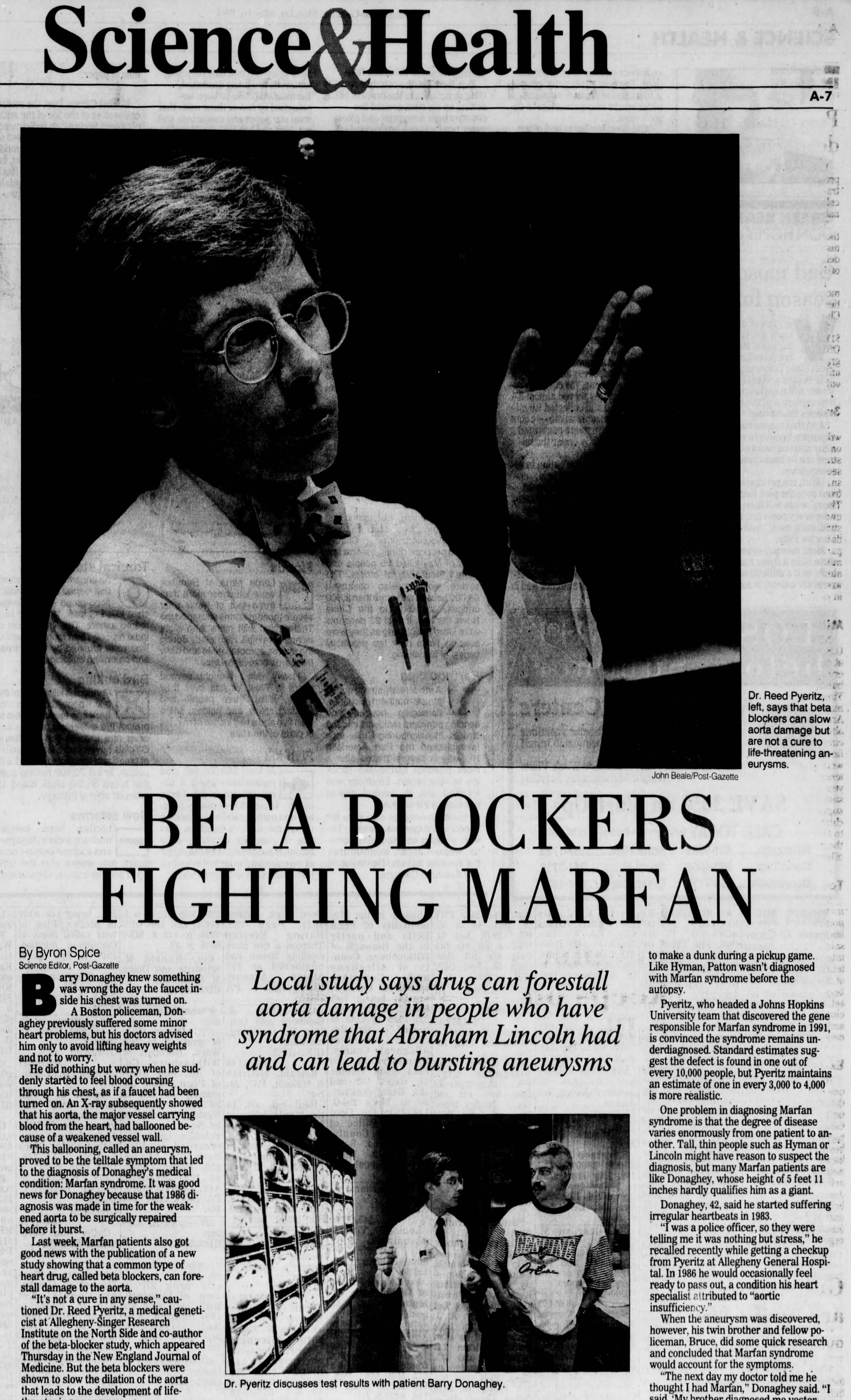
    This story and photos about Dr. Pyeritz appeared in the Pittsburgh Post-Gazette in 1994.Newspapers.com

    Colleagues, friends, and former patients called him “a phenomenal physician,” “a guiding light,” and “an extraordinarily reassuring presence” in online tributes. In 2018, he said: “The most gratifying thing is the fact that folks [with Marfan syndrome] are living their normal life expectancy.”

    Dianna Milewicz, chair of the John Ritter Foundation advisory board, noted his “excellence in clinical care, teaching, and research” on Facebook. Michael L. Weamer, president and CEO of the Marfan Foundation, called him “a true hero” and said his “impact on our community is immeasurable.”

    Dr. Pyeritz edited medical reference books and wrote The Marfan Syndrome and Uncertain Precision: Managing Health Care with Personalized Technologies. More than 700 of his research studies, reviews, and book chapters were published.

    He served 13 years in the Army Reserve Medical Corps and earned lifetime achievement awards from the Marfan Foundation, the American College of Medical Genetics and Genomics, and other groups.

    Dr. Pyeritz and his wife, Jane Tumpson, married in 1972.Courtesy of the family

    On weekends, he did marathons and triathlons, and was part of a world record 100-man, 100-mile relay. His family said in a tribute: “He measured a successful life less by titles or awards than by what one gives, what one learns, whom one loves, and what one leaves behind in others.”

    Reed Edwin Pyeritz was born Nov. 2, 1947, in Pittsburgh. He was fascinated by science and space as a boy, and he built rockets in his backyard and performed scientific experiments in his bedroom.

    He earned a bachelor’s degree in chemistry at the University of Delaware in 1968, a master’s degree and doctorate in biological chemistry at Harvard University in 1972, and his medical degree at Harvard in 1975.

    He met Jane Tumpson in first grade, and they graduated together from Mount Lebanon High School near Pittsburgh in 1965. They reconnected on the tennis court a few years later, married in 1972, and had daughters Allyson and Abigail.

    Dr. Pyeritz, left in the top photo and right in the bottom photo, enjoyed time with his family.Courtesy of the family

    Dr. Pyeritz and his wife honeymooned on Mount Kilimanjaro in Africa and traveled the world together for years. In April, the whole family went to Spain.

    He liked to wear bow ties, build stone walls, watch the news, and spend time outside with his dogs. He followed the Pittsburgh pro sports teams closely and enjoyed Manhattans and chocolate milkshakes.

    “I will miss it all,” he told colleagues at Cure HHT when he retired a few years ago. “But I am certainly looking forward to spending time with my two granddaughters, Tallulah and Penelope.”

    His daughters said: “Ever an adventurer, he instilled in us the importance of making the most of every day, watching the sunrise or sunset, and cherishing the time you have.”

    His wife said: “He loved without exception and reservation.”

    In addition to his wife, daughters, and granddaughters, Dr. Pyeritz is survived by son-in-law Keith Hopkins and other relatives. A brother died earlier.

    A celebration of his life is to be held later.

    Donations in his name may be made to the Marfan Foundation, 22 Manhasset Ave., Port Washington, N.Y. 11050.

    Dr. Pyeritz “loved without exception and reservation,” his wife said.Courtesy of the family
  • Sheri Herman, pioneering internet and cable TV executive, has died at 71

    Sheri Herman, pioneering internet and cable TV executive, has died at 71

    Sheri Herman, 71, formerly of Philadelphia, pioneering internet and cable TV executive, former senior vice president of content and business development for E! Entertainment Television, former president of internet startup American Cybercast, founder of SLH Communications, tech prophet, and dancer, died Thursday, Aug. 6, of heart failure at her home in Telogia, Fla., about 35 miles west of Tallahassee.

    A magna cum laude communications graduate at Temple University, Ms. Herman went to New York after college to produce commercials for an ad agency. Over the next 27 years, she relocated to Denver and Los Angeles, successfully marketed, programmed, and developed dozens of TV networks and online companies, and pioneered the integration of TV and the emerging internet.

    She was “mesmerized” by Apple cofounder Steve Jobs, her sister, Nadine, said, and predicted in the 1970s that one personal device would eventually take pictures, send messages, stream content, and still make phone calls. Jarl Mohn, former president and chief executive officer at E!, called Ms. Herman “a pioneer in incorporating new technologies and branding in entertainment.”

    He said: “She also brought passion and conviction to everything she worked on.”

    Ms. Herman founded her own firm, SLH Communications, in 1999. Courtesy of the family

    Ms. Herman helped turn the startup Movietime channel into E! Entertainment Television in 1990 and told the Los Angeles Times: “We’re going to totally reposition the network. You won’t recognize us.” Over the next few years, E! grew its subscriber base from two million to 55 million, and Ms. Herman won industry awards for her marketing campaigns.

    At American Cybercast, she championed The Spot, a groundbreaking interactive online reality show, in 1995, and told the Los Angeles Times in 1996: “We’re creating a new medium, but we’re kind of a cross between publishing and broadcasting in that we’re going to be advertising driven. If we were a movie studio, we’d be Miramax with a little more edge.”

    Russell Collins, founder of American Cybercast, said: “Sheri Herman was nothing if not fearless. Her determination was boundless and fierce.”

    Ms. Herman was especially effective at fundraising for projects and combining online content with ads and product placement. She trailblazed new internet publishing formats that included text, photos, and videos, and predicted the collision of TV and internet content. In 1996, she told Variety: “Eyeballs will move from TV to PC.”

    Ms. Herman (left) oversaw the development of the Discovery Channel, the Fashion Channel, QVC, and other networks.Courtesy of the family

    As director of programming for the United Cable Television Corp. in the mid-1980s, Ms. Herman collaborated with dozens of networks and oversaw the development of the Discovery Channel, the Fashion Channel, QVC, and other networks.

    As senior vice president of programming and production for the Access Entertainment Network in the late 1990s, she reintroduced popular music videos and, according to Variety in 1998, gained six million subscribers in the network’s first three months of existence.

    She founded her own firm, SLH Communications, in 1999 and contracted with TV Guide, Barnes & Noble, Hilton Hotels, musicians Quincy Jones and Jon Bon Jovi, and other entertainers and businesses. In New York, in the 1980s, she worked with cosmetics mogul Estée Lauder.

    Temple officials noted her “influential career” in a tribute, and longtime friend and colleague Martin Lewis said: “She had a relentless thirst for charting new paths forward. She proselytized new media, new approaches, new everything.”

    Ms. Herman (right) enjoyed time with her family.Courtesy of the family

    In 2007, Ms. Herman reduced her daily responsibilities after being seriously injured in an auto accident in California. She moved to Florida in 2021.

    Lewis said: “She was inventive, creative, exhilarating.”

    Sheri Lynn Herman was born May 21, 1955, in Philadelphia. She grew up in Overbrook Park with her parents and older sister, and graduated from Philadelphia High School for Girls.

    Her family featured several singers, and she spent many holidays singing songs and playing guitar around the piano at her grandparents’ home in Wynnefield. She loved music, studied ballet when she was young, and performed later with the Janosik Polish Dance Ensemble.

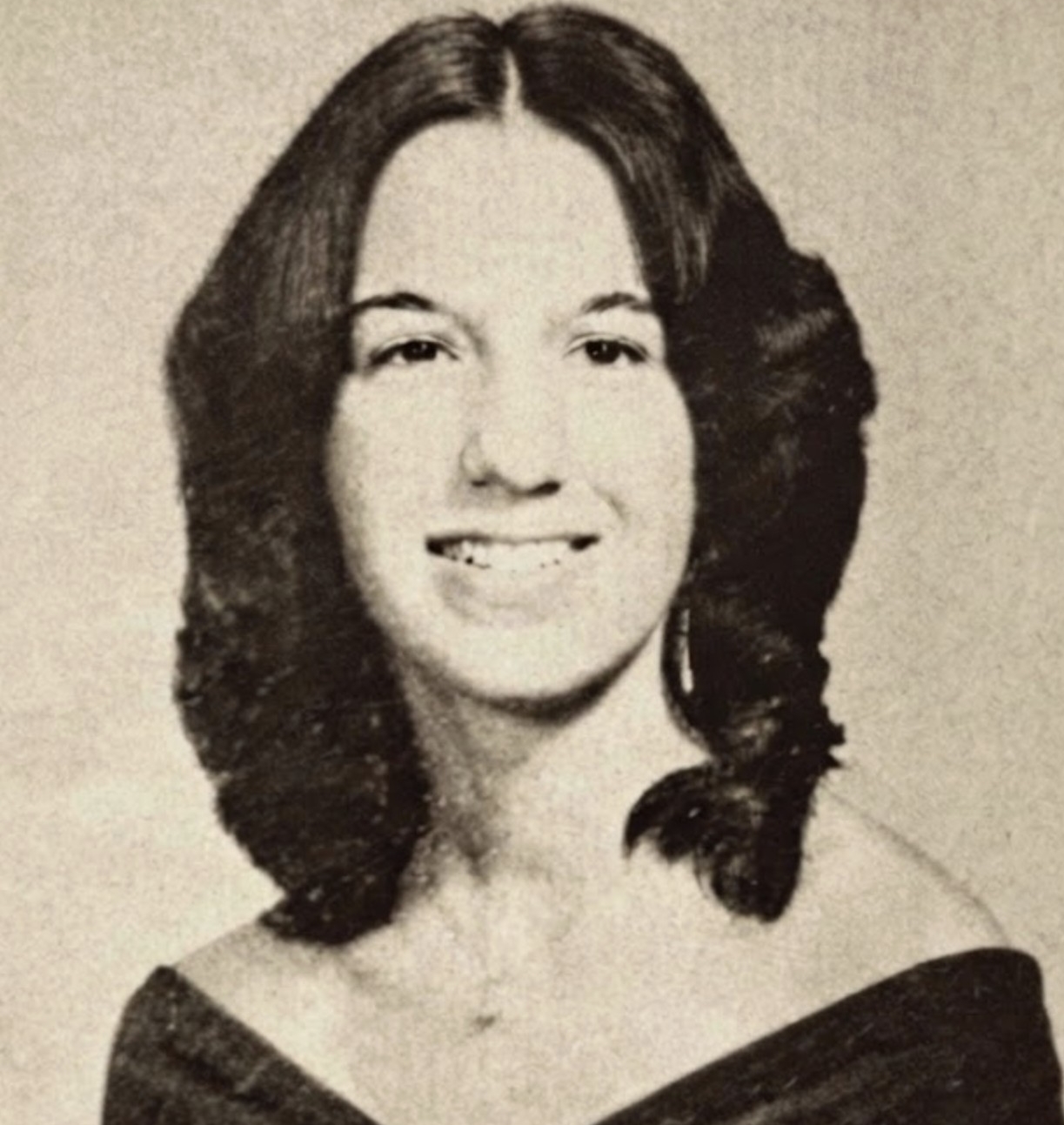
    Ms. Herman was a magna cum laude communications graduate at Temple University.Courtesy of the family

    Stylish and social, Ms. Herman enjoyed traveling and entertaining. She was a skilled seamstress who made her own clothes, an accomplished chef, and adept at interior decorating. She doted on her cats and dogs.

    She married and divorced twice, and, after Philadelphia, lived in New York, Denver, and Los Angeles before Florida. Her sister said: “She was brilliant.”

    In addition to her sister, Ms. Herman is survived by other relatives.

    A celebration of her life is to be held later. Family, friends, and colleagues can connect at www.SheriHerman.com.

    Donations in her name may be made to the Temple University Klein College Recruitment Fund, Annenberg Hall, 2020 N. 13th St., Philadelphia, Pa. 19122.

    Stylish and social, Ms. Herman enjoyed traveling and entertaining.Courtesy of the family
  • Here’s what is changing for teens on Instagram and Facebook

    Here’s what is changing for teens on Instagram and Facebook

    SAN FRANCISCO — Meta said Wednesday that it would change how teenagers use Instagram and Facebook as part of a landmark settlement with 47 states, the District of Columbia and U.S. territories over social media addiction claims.

    Instagram and Facebook currently allow anyone 13 or older to open accounts. Users younger than 18 are automatically directed into Teen Accounts, which are set to private by default and limit certain types of harmful content.

    The settlement is expected to alter the apps further. Meta said new features will be introduced in the next six months, while other changes, like how the company verifies user ages, could take up to a year. In the past year, Meta had already started to introduce some changes mentioned in the settlement.

    Here’s a guide to what to expect.

    Time limits

    Teenagers will be limited to just two hours a day on Instagram and Facebook, unless a parent goes into their settings to give permission for more time. Young users will also be automatically restricted from using the apps overnight, between midnight and 6 a.m.

    In addition, Instagram and Facebook notifications will be silenced during school hours of 8 a.m. to 3 p.m.

    Turning features off

    For the first time, young users will be able to turn off “autoplay,” a feature that automatically plays content while a user watches. They can instead elect to tap or swipe to see the next photo or video on the app. Until now, users were not able to turn that feature off.

    Teenagers will also gain the ability to switch off a setting that gives them an algorithmic, personalized feed. Instead, they can choose to be shown content that is not personally catered to them. This is another option that did not previously exist.

    And every time a user younger than 18 is on Instagram or Facebook for 15 consecutive minutes, that person will receive a prompt on the screen, though Meta did not detail what it would say. The prompts will also appear after 60 minutes and 90 minutes of use, the company said.

    Meta said it would also disable “like” counts, which some people have said can cause anxiety, and block teenagers from using “extreme makeup filters” and filters that mimic cosmetic surgery.

    Extra protections

    Meta said it would roll out stronger protections against “unwanted contact from strangers,” including restricting adults from messaging teenagers or viewing their content. The company did not explain how the protections and restrictions would work.

    Meta also promised to give teenagers a new way to report harmful content and pledged to respond to 90% of those reports within six hours.

    Meta agreed to maintain and improve the tools it offered parents to see how much time their children spent on the apps, what content they were searching and the kinds of contact they made with adults. Parents will be alerted when their children create new accounts or have interactions with accounts the company deems suspicious.

    Age verification

    Social media apps have long struggled to figure out how old their users are, and Meta and others have been developing tools to confirm the ages of new users. Last week, OpenAI announced “ChatGPT for Teens,” a new mode for the chatbot with more protections for young users, and said it tracked more than 2,000 signals to detect whether a user was younger than 18.

    As part of Wednesday’s settlement, Meta said it will invest more in age verification technology to identify which users are teenagers and remove those who it believes are younger than 13.

    This article originally appeared in The New York Times.

  • Pa. and N.J. will each get more than $500 million from landmark Meta settlement over child protections

    Pa. and N.J. will each get more than $500 million from landmark Meta settlement over child protections

    As part of a settlement involving almost every U.S. state, Pennsylvania and New Jersey will each receive more than $500 million from Meta, the parent company of Facebook and Instagram, after a multistate coalition sued the tech giant for failing to protect kids from becoming addicted.

    The two states’ shares are part of a larger payout of the $12.1 billion to $17.1 billion Meta will be required to make over the next 10 years to the states and U.S. territories involved in the suit. The exact figure will depend on other social media companies agreeing to make similar changes.

    Pennsylvania is expected to receive at least $516 million and up to $729 million, while New Jersey is expected to receive at least $525 million and up to $752 million, according to statements from each state’s attorney general.

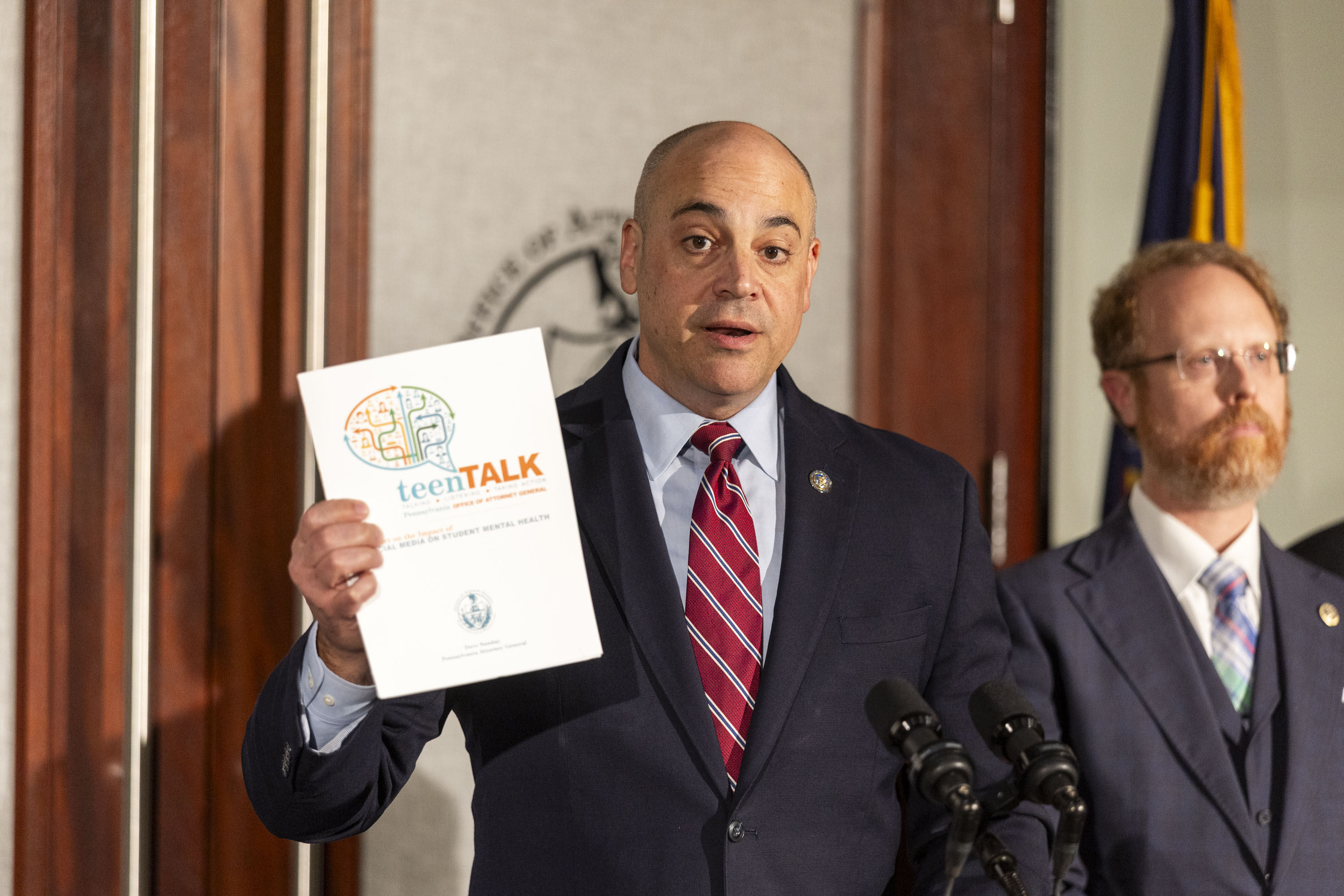
    “We can’t simply tell parents to do better while allowing technology companies to design platforms that are engineered to addict children,” Pennsylvania Attorney General Dave Sunday said during a news conference Wednesday. “Parents deserve better. Children deserve better, and today shows that Big Tech can do better — some just chose not to. Today is the first step in forcing Big Tech to do better.”

    Earlier this week, Sunday announced a lawsuit against Snap Inc., owner of Snapchat, and earlier this month he announced a lawsuit against TikTok over similar child protection issues.

    Meta did not immediately respond to a request for comment.

    In addition to the monetary payments, the tech giant will also be required to make changes to satisfy the states’ concerns over child safety.

    “As a parent, protecting your kids is always your North Star,” New Jersey Attorney General Jennifer Davenport said in a statement. “This agreement achieves critical protections for our children today.”

    Neither attorney general commented on how the settlement funds would be used.

    Instagram and Facebook will have to implement a combined two-hour daily time limit for child users with a mandatory pause after 15 minutes of continuous use and again at 60 and 90 minutes. These time limits will be in effect for five years. If Snapchat, TikTok, and YouTube — social media apps owned by other companies — agree to adopt similar terms, the daily limit on each platform would drop to 60 minutes and last for 10 years.

    Child users also will not be able to access the websites from midnight to 6 a.m., will have limited access during school hours, and will not receive push notifications on weekdays between 8 a.m. and 3 p.m. during the school year.

    The company will be required to bolster its age-assurance measures to more accurately verify the age of users. It will also need to improve its age-appropriate content controls to better shield child users against bullying, content promoting eating disorders, and content related to suicide and self-harm.

    Meta will have to limit its social comparison features, including beauty filters and visible tallies of likes on posts, and will be required to make parent controls stronger and more user-friendly.

    “These are changes that matter because they directly address how young people interact with these platforms, how long they use them, when they use them, what they are exposed to on these platforms, and the role that parents can play in keeping them safe,” Sunday said.

    These changes, which are required to be enacted in the next six months, will be regularly assessed by an independent auditor and the settling parties.

  • Meta reaches $17 billion settlement with states in landmark trial over teen social media addiction

    Meta reaches $17 billion settlement with states in landmark trial over teen social media addiction

    Meta agreed Wednesday to pay up to $18 billion and add stronger child-safety measures to its Facebook and Instagram platforms as part of a landmark legal settlement that ended a trial over teen social media addiction and settled claims filed by nearly every state.

    The settlement resolved a pivotal case years in the making that sought to hold the tech giant accountable for the role its platforms played in undermining children’s mental health. The effort targeted features designed to hook young people’s attention.

    The agreement “institutes real change, real transparency, real protections for children and teens across the country,” California Attorney General Rob Bonta said.

    If approved by the court, the deal will stop an avalanche of litigation by states against Meta, although the company still faces lawsuits from individuals and school districts throughout the U.S. For the states, the settlement delivers money for mental-health programs for kids, including after-school or summer activities and digital literacy counselors.

    Pennsylvania is expected to receive at least $516 million and up to $729 million, while New Jersey is expected to receive at least $525 million and up to $752 million, according to statements from each state’s attorney general.

    “We can’t simply tell parents to do better while allowing technology companies to design platforms that are engineered to addict children,” Pennsylvania Attorney General Dave Sunday said during a news conference Wednesday. “Parents deserve better. Children deserve better, and today shows that Big Tech can do better — some just chose not to. Today is the first step in forcing Big Tech to do better.”

    Earlier this week, Sunday announced a lawsuit against Snap Inc., owner of Snapchat, and earlier this month he announced a lawsuit against TikTok over similar child protection issues.

    “As a parent, protecting your kids is always your North Star,” New Jersey Attorney General Jennifer Davenport said in a statement. “This agreement achieves critical protections for our children today.”

    Neither attorney general commented on how the settlement funds would be used.

    Advocates cheered the new protections, including default time limits and the disabling of features such as “like” counts.

    But “we cannot truly protect all children and teens until these protections are required on every platform and are permanent — that’s something only Congress can do,” said Sacha Haworth, executive director of The Tech Oversight Project.

    The settlement will be paid out over 10 years. California will get the largest sum of at least $1.5 billion, but several other states will still collect hundreds of millions of dollars each over the decade.

    The settlement “will put an end to these dangerous practices and deliver meaningful relief that will protect children from online harm,” Virginia Attorney General Jay Jones said.

    Meta urges rivals to adopt similar safety measures

    Meta said in a blog post that it was “building on our longstanding efforts to empower parents and support teens.”

    “Ensuring teens have a safe and productive experience on our platforms is an absolute imperative for Meta,” the company said. “We want to get this right for parents and teens, and that’s why we partnered with state attorneys general to set a new industry standard.”

    The company urged competitors TikTok and YouTube to adopt similar safety measures.

    The $18 billion settlement is a fraction of Meta’s 2025 revenue of $201 billion. Meta shares were up about 1.5% by midday Wednesday, hours after the deal was announced.

    The agreement cuts short an ongoing court case involving California, Colorado, Kentucky and New Jersey, which were among 29 states that sued Meta in 2023. The federal trial kicked off last week in Oakland, California, where Meta CEO Mark Zuckerberg had been among the witnesses expected to take the stand.

    The lawsuit accused Meta of contributing to the youth mental health crisis by deliberately designing features that addict children to its platforms and hiding them from the public. The case also argued that Meta violated federal laws by routinely collecting data on children under 13 without their parents’ consent.

    The cases in other states had been expected to go to trial later, but are now resolved. The settlement covers 48 states, as well as Washington, D.C., and some U.S. territories. The only two states to be excluded are New Mexico, which went to trial in its case against Meta and won earlier this year, and Florida, where the attorney general said the settlement was not tough enough on Meta.

    Florida Attorney General James Uthmeier wrote on X that the “payouts are peanuts compared to the profound harms Meta’s profit-driven addictive features inflicted on kids.” He wrote in a separate post that his team “will hold them accountable in Florida.”

    New features to include time limits and curbs on push notifications

    Under the proposed settlement, Meta agreed to adopt a series of safety features, including two-hour daily time limits that can only be disabled with a parent’s permission and pauses for children using Instagram and Facebook.

    The company will eliminate push notifications during weekday school hours and bring in “robust” age-assurance measures and “age-appropriate” content controls to prevent bullying and harmful material about eating disorders and self-harm.

    There will be stronger and more user-friendly parental controls and limits on social comparison features such as “like” counts.

    An independent auditor will assess how Meta is implementing the safety features and how effective they are.

    The company said 30% of the settlement amount — about $5.3 billion — will be released to states only if rivals YouTube and TikTok meet two conditions: implementing similar safety features, including a one-hour daily time limit, a nighttime block and age-assurance measures; and paying the same amount, split between the two companies.

    Neither YouTube owner Google nor TikTok responded immediately to requests for comments.

    Meta officials declined to comment on whether they had conversations with their competitors about those conditions, but said they intentionally designed the agreement with the states to incentivize the rest of the industry to follow suit.

    Some of the safety measures Meta will implement, like disabling cosmetic surgery and extreme makeup filters, made sense regardless of whether competing platforms do the same, Meta said. Others, like its overnight block, will function better if they are established across the board, the company said.

    If industry peers sign on to the agreement, Meta will implement stronger defaults for teens’ daily time limit and the length of time for its “night mode.”

    Investigation was led by bipartisan coalition

    The federal lawsuit was the result of an investigation led by a bipartisan coalition of attorneys general from California, Florida, Kentucky, Massachusetts, Nebraska, New Jersey, Tennessee, and Vermont. It followed newspaper reports, first by The Wall Street Journal in 2021, that found the company knew about the harm Instagram can cause teenagers — especially teen girls — when it comes to mental health and body image issues.

    Meta has since added a host of safety features to Instagram, including separate accounts for teenagers with stronger protections around messaging and privacy, along with content restrictions.

    But child-safety advocates and experts, along with some former Meta employees, have long contended that the features are little more than window dressing.

    Victoria Hinks, mother of Alexandra “Owl” Hinks, who died by suicide at age 16, said she was satisfied with the terms of the settlement “as long as they enforce it properly.”

    “It felt like today finally something was done,” she said Wednesday outside the Oakland courthouse where the trial was held. “I feel like justice is possible.”

    Staff writer Dana Munro contributed to this report