Category: Business

  • One of the fastest-growing jobs has a wage theft problem. Pa. will now fast-track investigations

    One of the fastest-growing jobs has a wage theft problem. Pa. will now fast-track investigations

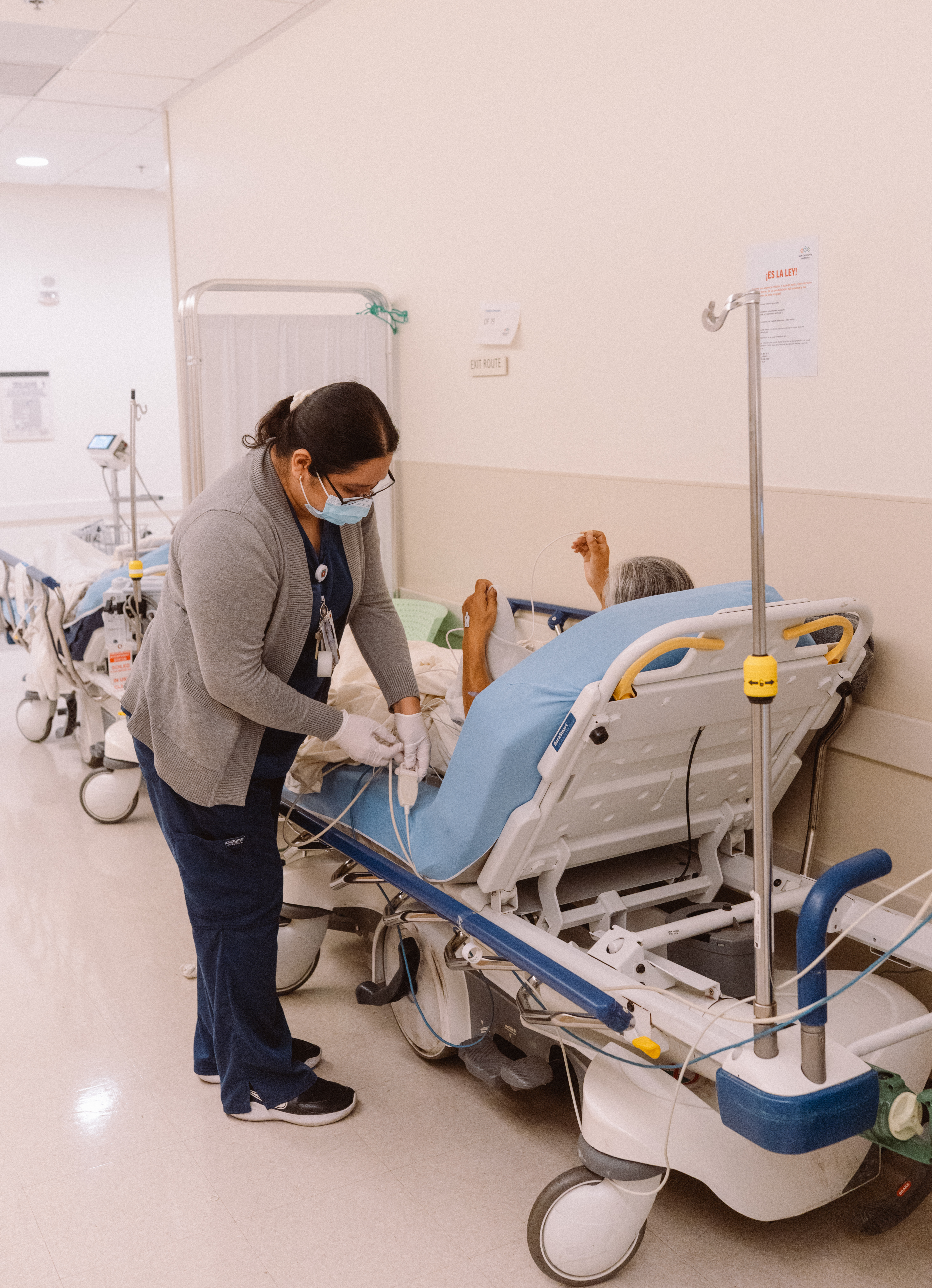
    One of the fastest-growing occupations is also a hot spot for wage theft complaints in Pennsylvania. A new initiative by state regulators aims to help change that.

    Nearly 40% of the minimum-wage complaints sent to Pennsylvania’s Department of Labor and Industry are from the home healthcare industry, State Labor Secretary Nancy Walker said at a news conference Tuesday.

    Under the new initiative, the state won’t wait to receive new complaints, said Walker. Instead, regulators will audit home healthcare agencies, making “legal demands for wage and hour information,” said Walker, to find potential wage violations.

    “We’re here today because these workers are not receiving the wages they earned, and that changes now,” Walker said.

    Demand for home healthcare is expected to continue growing, but attracting workers to the industry has been a challenge.

    Many home healthcare workers, who help patients with daily living needs, have been shorted on their overtime pay in Pennsylvania in recent years and employers have ultimately had to pay back millions in some instances. One contributing factor is that Medicaid doesn’t pay home healthcare employers extra for overtime.

    “The workers doing this care are not always treated the way we should be,” Marshene Ellis, a home care worker for over 17 years, said at Tuesday’s news conference. “I’ve worked for different agencies and seen the broken promises and low wages.”

    Making ‘good jobs’ in home healthcare

    Pennsylvania is home to more than 257,000 home care workers, according to the Bureau of Labor Statistics, but more are needed to meet demand, especially as the population ages.

    Nationally, home health aide is expected to be one of the fastest growing jobs in the coming decade, according to BLS, which predicts 847,300 more home health jobs by 2035.

    In Pennsylvania, some 112,000 care shifts go unfilled every month, according to Matt Yarnell, president of the SEIU Healthcare Pennsylvania union.

    “That means somebody who cannot get themselves out of bed, is laying in that bed hoping someone shows up,” said Yarnell. “We have a lot of work to do in this space.”

    Those in need may find themselves in the emergency room instead, Yarnell added.

    “When families cannot find a home care worker, the impact is immediate,” said Gabrielle Szymanski, of Pennsylvania’s Department of Aging. “Family caregivers are forced to leave work or take on additional responsibilities, and providers struggle to meet demand — and too often people end up in more restrictive and more costly settings.”

    Attracting and retaining home-health workers has been challenging. Turnover is high in the industry, and wages are low. The median wage in Pennsylvania is $14.14 per hour.

    Workers deserve higher wages, said Mia Haney, CEO of Pennsylvania Homecare Association in a statement on Tuesday and pointed to low Medicaid rates as part of the issue.

    “We support holding bad actors accountable, but they should not define an industry overwhelmingly made up of providers committed to their workers and the people they serve,” said Haney, whose organization represents nearly 700 home care and hospice providers.

    Gov. Josh Shapiro’s administration recently added $21 million to the state budget to boost home healthcare wages.

    “It is really really critical that these become good jobs, and that will not happen on its own,” said Yarnell.

  • No tax on tips is here. What employers need to know for 2026 | Expert Opinion

    No tax on tips is here. What employers need to know for 2026 | Expert Opinion

    “No tax on tips” sounds simple. For employers, it isn’t.

    Starting in 2025, employees who received tipped income can now take a deduction for this amount on their individual tax returns, which reduces their taxable income and taxes owed.

    The benefits are obvious, but some of the rules are less so. Here’s what to know.

    Cap on tips deduction

    The deduction is capped at $25,000 per return, even for married couples filing jointly. It phases out for joint filers with $300,000 or more annual income and $150,000 for other taxpayers.

    No deduction for mandatory service fees

    Tips claimed must be voluntary. If you’re charging your customers a mandatory “service charge” and then disbursing the amount collected to your employees, that amount is not eligible as tipped income for purposes of the tax deduction.

    Put simply, a mandatory service charge and a voluntary tip are not interchangeable, said Shanita Jones, a certified public accountant in Philadelphia.

    “Calling a charge a gratuity on the receipt doesn’t automatically make it a tip for tax purposes,” she said. “Owners should verify that their point-of-sale system, bookkeeping records, and payroll system distinguish voluntary tips from mandatory charges.”

    Specific jobs qualify for tip deduction

    Eligible employees must work in one of the more than 70 occupations the IRS has designated as traditionally tipped. These include servers, bartenders, hairstylists, makeup artists, hotel workers, rideshare drivers, and personal trainers. Occupations such as accountants, tax preparers, and most legal professionals aren’t on the IRS list.

    Self-employed workers can also take advantage of the tips deduction, but the deduction can’t exceed the net income of their trade or business.

    States still tax tipped income

    The “no tax on tips” deduction is applied only at the federal level. Neither Pennsylvania nor New Jersey makes this deduction available when calculating state income taxes owed.

    The two states do have a reciprocal agreement so that if a worker who lives in Pennsylvania earns tipped income at their job in New Jersey, they’re still taxed at Pennsylvania rates.

    Other taxes that still apply to tips

    Also, tips are not exempt from all kinds of federal taxes. Employees must still pay the taxes for Social Security and Medicare.

    “Before telling employees their tips are tax-free, make sure you can answer: free from which tax?” Jones said. “The distinction matters because employees may make spending decisions based on what they believe they will keep.”

    Employers must also match the FICA and Medicare payments.

    But restaurants and certain food service businesses may qualify for the federal FICA Tip Credit, said Adrienne Straccione, a partner at accounting and advisory firm Wouch Maloney in Philadelphia.

    This credit is different from the employee tip deduction. It was expanded as part of last year’s tax legislation to include qualifying barbering, hair care, nail care, esthetics, and body and spa treatment businesses. The credit is not a deduction — it is taken against taxes owed and if it exceeds what’s owed it can generally be carried back one year and forward up to 20 years.

    “This expansion can potentially provide a valuable tax benefit on certain employer-related taxes for more employers with tipped workers,” she said.

    Employers must keep accurate tip records

    If you’re an employer, you need to be familiar with the reporting required, Jones said, because no tax on tips does not mean “no reporting of tips.”

    “A tax break for an employee does not erase an employer’s responsibilities,” she said. “Business owners should not stop recording tips or change their payroll practices simply because they hear the phrase “tax-free.”

    For 2025, employers received transition relief because Forms W-2 and 1099 had not yet been redesigned to separately report the information needed for the new deduction. That’s different for 2026. Employers now report cash tips on Form W-2 using Box 12, Code TP, and identify the worker’s qualifying occupation in Box 14b.

    Employers should expect “greater scrutiny of how tips are tracked,” categorized, and reported, Straccione said.

    “Businesses need to understand what code section your employees fall under for the Treasury Tipped Occupation Codes,” she said. “Failure to comply with the new W-2 reporting standards can result in penalties.”

    It’s important that your employees take advantage of the deduction during the course of the year by reducing the amount of federal taxes they’re having withheld from their paychecks. We’ve been recommending to our clients that they help their employees revise their W-4 withholding form to reduce the amount of tax taken from their paycheck. This will leave them with more money left over throughout the year, rather than waiting for a refund from the government.

    Both Jones and Straccione are advising clients to establish written processes for reporting all tips, documenting the distributions, and getting that information into their payroll systems.

    “Cash tips should not disappear from the records simply because they never passed through the business’s card processor,” Jones said. She advises that businesses review their process with their accountant and payroll provider, confirm the applicable year’s reporting requirements, and reconcile records regularly.

    “Tax season should not be the first time you discover that your sales system, payroll records, and books tell three different stories.”

    The no-tax-on-tips deduction is good for both employees and employers. Obviously, the employee gets to save money. But the employer, because their workers are effectively getting paid a little more by the tax savings, may feel less pressure to increase wages this year.

    The deduction won’t last forever. It’s scheduled to expire after the 2028 tax year, unless Congress extends it.

  • Employer health costs are expected to spike in 2027

    Employer health costs are expected to spike in 2027

    Large and small employers are bracing for what looks to be the sharpest increase in healthcare costs in more than two decades. The cost per worker is projected to go up an average of 11% next year, or somewhat lower if workers’ insurance benefits are reduced, according to a U.S. survey released Wednesday.

    The employers’ final costs, after they make changes to health plans, are still expected to increase about 8% next year, the steepest since 2003, according to Marsh, the benefits consultant formerly known as Mercer.

    More than a third of the 1,800 employers surveyed said they anticipated that costs would rise at least 10% after making cuts.

    “This year was a rough year, and next year looks like it will be even rougher,” Beth Umland, director of employer research for health and benefits at Marsh, said in an interview.

    The Marsh survey is the latest report by an employer group or benefit consultant predicting a sharp rise in healthcare costs next year. Many Americans, even those with insurance, are already struggling to afford care, according to various surveys, and healthcare has become a top issue for voters.

    “This seems to be a new normal,” said Ellen Kelsay, the CEO of Business Group on Health, which represents large employers that offer health benefits.

    From 2018 to 2027, healthcare costs could increase 76%, roughly twice the rate of general inflation, according to a survey the employer group released last month. For next year, companies predicted a 9.2% median increase, which fell to 8% after they made benefit changes.

    The cost of providing coverage to employees is becoming an existential business issue, said Mike Pasterick, an executive at insurance broker Aon, which issued its own projection last month. Aon estimated employers’ costs would rise 9.5% next year, pushing the average cost per employee above $19,000 if no changes are made. “This is impacting the companies in a very material way,” he said.

    The upshot is that about 160 million people under 65 who rely on employers for health insurance will again confront higher costs and shoulder more of the burden. More and more, workers are facing year-over-year increases that further stress household budgets already dealing with the growing expenses of groceries and gasoline.

    Workers are facing higher premiums, deductibles and copays, which require them to carry a larger share of their medical bills. Some companies are cutting benefits by discontinuing coverage of expensive GLP-1 drugs to treat obesity, or dropping coverage for spouses who have other insurance options.

    Employers and benefits consultants cited a number of factors contributing to higher costs: rising prices for hospital care and prescription drugs, including expensive medicines for cancer, and robust demand for GLP-1 drugs to treat conditions like diabetes.

    But they also pointed to new contributors like hospitals’ and doctors’ use of artificial intelligence to increase payments through better documentation of care. They also blamed increasing reimbursements to some doctors who are out of network and are exploiting a new consumer protection law that allows them to challenge what they were originally paid.

    The pressure by hospitals and doctors to charge employers even more is likely to intensify with looming cuts to government plans like Medicaid, the federal-state program for low-income individuals. Hospital groups are already seeing an increase in the number of patients who don’t have insurance or can’t pay their bills, and many are expected to charge employers more to help make up for lost revenue.

    Many employees are already being asked to pay significantly more of their medical bills. Workers are paying an average of 10% more in out-of-pocket costs in 2026 — some $2,167 — than they were last year, Aon estimated.

    These kinds of increases are not sustainable, said Rosa Novo, the benefits administrator for Miami-Dade County Public Schools, which covers about 45,000 employees and their families. “It’s become really, really difficult, extremely difficult,” she said. The bulk of the system’s costs are for hospital care, she said, but among the fastest-growing expenses are pharmacy costs.

    For the first time, the school system is exploring new ways of delivering care. “We’re having to reinvent the way we operate,” Novo said. The system is considering contracting directly with hospitals and doctors for some of its employees’ care, like imaging, rather than relying on its insurer to negotiate for it. The system is also starting to demand more visibility into what it pays for care, requiring audits and detailed information about claims.

    “I personally see a readiness to do things differently,” said Elizabeth Mitchell, the CEO of the Purchaser Business Group on Health, which represents employers. She said employers were more interested in seeing more information from insurers about how they were spending their money and consideration of alternatives.

    “It’s more than just talk,” she said, saying many companies are revisiting their arrangements with their insurer or pharmacy benefit manager.

    Like the Miami-Dade school system, many companies are in discussions directly with local hospital groups or other organization to provide care outside their traditional insurance plans. Others are contemplating ways to steer patients to select hospitals or doctors, either by charging them less to see those providers or limiting where employees can get care.

    “We’re seeing a lot of employers taking a closer look at the network,” said Eric Miller, a vice president at Segal, another benefits consultant, despite concerns that employees will be upset if they can’t see their longtime doctor or go to the hospital of their choice.

    “Unequivocally, there is more openness to change and disruption than there ever has been,” he said.

    Smaller employers may be making the most significant changes, said Shawn Gremminger, the CEO of the National Alliance of Healthcare Purchaser Coalitions, many of whose members are smaller companies.

    “I think it’s the smaller market where the pain is most acute,” he said.

    While some are considering moves like offering employees a fixed amount of money to pay for a plan, others are taking a close look at the giant companies that sell them insurance or pharmacy benefit management. In the alliance’s most recent survey, 54% of employers said they were working with one of the three largest pharmacy benefit managers, a drop from 63% the year before. Many said they were moving to one of the smaller pharmacy benefit managers, many of which promise more transparency about how they operate and what they pay for drugs.

    “We may be seeing a tipping point,” Gremminger said.

    This article originally appeared in The New York Times.

  • Workers who job hop could have an added benefit, Rutgers study finds

    Workers who job hop could have an added benefit, Rutgers study finds

    Job hoppers can get a bad rap.

    But a new study suggests there may be a silver lining to switching workplaces: getting up to speed more quickly.

    “Job hopping” is a subjective term, says Scott Bentley, assistant professor at the Rutgers University School of Management and Labor Relations, who co-authored the study.

    He defines it as a “higher than average number of moves between companies over one’s career.”

    People job hop for different reasons — work-life balance, family or financial reasons, or changing careers altogether.

    “For so long we’ve viewed job hoppers in this negative light,” said Bentley, who acknowledged that hiring managers’ concerns about commitment and turnover can be warranted.

    But, he said, some job hoppers “might have a benefit here that merits giving them a second look.”

    Bentley and his colleague examined data on the job moves of 8,693 hedge fund managers between 2004 and 2019. They measured how well the new hires got up to speed in their work, looking at returns on investments for the funds they managed.

    The majority of new hires experienced a dip in their work performance as they first settled into their new position — but those who had changed jobs frequently needed less time to acclimate.

    “If you need someone who can adapt and just perform much quicker, and get up to speed months sooner than someone else, job hoppers might merit a second look,” said Bentley. “On the other hand, if you’re looking for someone to invest in for the long term, someone that’s going to be there, job hoppers might not be your preferred hire.”

    The social aspect

    Starting a new job can be exciting, but it can also be a “very overwhelming experience,” says Bentley.

    Workers have to navigate new commutes and new offices — and that’s the easy part.

    Then there’s the social aspect of the job, which can be “so much more challenging,” he said. “Even that simple walk to go refill your water bottle is kind of fraught with all of this navigation.”

    Social pressure at work can involve small talk with colleagues, or the repeated introductions of a new employee, explaining why they’re there and what they do, he said. Employees have to figure out who their colleagues are, and what employees they might have to interact with to get their jobs done.

    As new workers navigate this, they have to assess what social cues from their past job still apply at this new position, or which of them they have to unlearn to succeed in the new workplace.

    “We were really interested in: Is there something from people’s experiences that can help them overcome this better than others, or navigate it better than others?” he said.

    He and his colleague were curious to learn if people who have changed jobs more often carry skills that others don’t.

    “We believe that job hoppers, by having that broader breadth of experience at places, are able to be better at the learning and unlearning,” he said. They could have the “ability to adapt better than others who don’t have those experiences.”

    From job hopping to job hugging

    During the pandemic, many people switched jobs to negotiate higher wages, but the job-hopping trend has lost some steam .

    “Before, the best approach for earning the largest jump in wages and income was to change jobs, but we’re seeing that differential decrease right now,” Bentley said.

    Last year, the Wall Street Journal reported the difference in salaries between those who move to a new job and those who stay with their employer had reached a 10-year low.

    Though the trend has shifted from job hopping to job hugging — or holding onto a job — “there’s still benefits that people can bring to the workplace from job hopping,” said Bentley.

  • Malvern medical-tech company is slashing jobs as part of cost-cutting campaign

    Malvern medical-tech company is slashing jobs as part of cost-cutting campaign

    Tela Bio, a Malvern-based medical-technology company, plans to cut about 20% of its workforce.

    The layoffs, most of which are to take place this month, will reduce the company’s headcount from 201 full-time employees to 160, according to an SEC filing last week. The locations and types of jobs affected were not specified. Company executives say the move is part of a larger plan to slash Tela Bio’s annual operating expenses by about $17 million.

    CEO Heather Getz said in a statement that they are “implementing a broader initiative to strengthen our cost structure and position Tela Bio for long-term success.”

    Headquartered in the Great Valley Corporate Center, Tela Bio makes biological products for soft-tissue repairs, including hernia surgeries and ab-wall reconstructions. Among its products: OviTex tissue, made from sheep stomach, which Tela Bio says promotes natural healing while reducing plastic in the body.

    Last year, Tela Bio reported more than $80 million in revenue, up 16%, which the company attributed to an increase in customers and higher sales overseas, according to earnings reports. But with $88 million in operating expenses, the company continued to operate at a loss, as it has since its founding in 2012.

    Tela Bio, which went public in 2019, had accumulated a deficit of more than $421 million as of June, according to its latest quarterly report.

    Company executives expect these layoffs to cost about $1.5 million in severance and other employee payouts, according to the SEC filing.

    On Monday, the company also parted ways with Roberto Cuca, who had served as chief financial officer and chief operating officer since 2021. Per the SEC filing, Getz, the CEO, will become the company’s “principal financial officer.”

    Tela Bio executives said they’ll provide more information on cost-cutting efforts on the company’s next earnings call, scheduled for November.

    “We are focused on disciplined execution, strengthening the business, and creating a more efficient organization positioned to deliver sustainable long-term growth,” Getz said, adding that executives ”expect this initiative to extend our cash runway into 2028.”

    Getz was appointed CEO last month, succeeding Tela Bio cofounder Antony Koblish. Previously, Getz was executive vice president and chief financial and operations officer at Butterfly Network, a portable-ultrasound company.

    In announcing Getz’s hiring, Tela Bio executives said she made “transformative changes in [Butterfly Network’s] strategy, capital allocation, cash runway and investor relations while building a performance culture.”

    Butterfly Network remains unprofitable, but has seen recent revenue increases.

  • Apple’s new CEO, John Ternus, takes over from Tim Cook after 15 years

    Apple’s new CEO, John Ternus, takes over from Tim Cook after 15 years

    Apple’s new CEO John Ternus took the helm of the iconic tech giant on Tuesday, ending Tim Cook’s 15-year tenure during which the company’s value skyrocket to $4.6 trillion thanks to the iPhone’s enormous popularity.

    The transition to a new CEO comes at a pivotal time for Apple. Artificial intelligence has unleashed the greatest upheaval within the industry since Steve Jobs unveiled the first iPhone in 2007. Apple has gotten off to a rough start in AI after stumbling in its efforts to deliver new features built on the technology, as promised nearly two years ago.

    Earlier this year, it unveiled new artificial intelligence advances, including upgrades to its Siri assistant, emphasizing a focus on privacy and day-to-day use as the iPhone maker tries to catch up with rivals.

    Ternus faces challenges that will force him to step outside his comfort zone in hardware engineering. Beyond finding ways to keep Apple competitive in the artificial intelligence race, he will need to navigate supply chain questions and relationships with figures such as President Donald Trump, who offered public praise for his predecessor on Tuesday.

    Serving as Apple CEO will also require soft skills, including developing relationships with important figures. Cook cultivated ties with Trump as he navigated the company through business challenges, including Trump’s trade and tariff war targeting countries in Asia, where Apple has extensive manufacturing supply chains. Although he is handing over the CEO reins at Apple, Cook is widely expected to help the company maintain a good relationship with Trump after he shifts to his new role as executive chairman.

    Ternus worked on some of Apple’s signature products under Cook, including the Apple Watch, AirPods, and Apple Vision Pro. He will headline next week’s launch of the latest iPhone at Apple’s Cupertino, Calif., headquarters.

  • Chobani to invest $1.2 billion in Pennsylvania and create 900 jobs

    Chobani to invest $1.2 billion in Pennsylvania and create 900 jobs

    Chobani, the yogurt company, plans to spend $1.2 billion to expand its operations at a manufacturing facility in Pennsylvania, which it is buying from Keurig Dr Pepper for $125 million.

    The company, which bought Philly-founded La Colombe in 2023 for $900 million, plans to convert the 1.5-million-square-foot site into a dairy plant, and expects to add 900 workers over the next five years in the Lehigh Valley.

    Keurig Dr Pepper will continue to employ some of the workers in corporate functions, including delivery and customer service, from the Allentown plant, and the rest of its employees there will be offered jobs with Chobani.

    “We’re so happy to be here bringing our future innovation to life in Allentown, made with fresh Pennsylvania milk and delivered to families across the country,” Hamdi Ulukaya, founder and CEO of Chobani, said in a statement.

    Chobani is buying back Keurig Dr Pepper’s equity in Chobani for $800 million, as Keurig Dr Pepper looks to reduce its debt, the company said in a news release.

    Chobani got its start in 2005 with a facility in upstate New York, and produces yogurts, creamers, and oat milk.

    Its move into Allentown is part of a larger $4 billion investment in manufacturing. That includes building a new facility in Rome, N.Y., and expanding a Michigan site that produces La Colombe products.

    Chobani will “manufacture innovative food products beyond yogurt,” at the new Allentown site, located at 7356 Industrial Blvd. in Upper Macungie Township, according to a news release from Gov. Josh Shapiro. It will produce milk with less sugar and more protein than traditional milk, according to Chobani, which it will sell to customers directly, and use as the base of other products.

    When the facility is up and running, Chobani expects to process more than three billion pounds of milk each year from the state — roughly 30% of what Pennsylvania currently produces annually, according to the governor’s office. Production at the facility is expected to begin next year.

    In a statement, Shapiro touted Chobani’s commitment as the largest private-sector investment in the state’s agriculture industry in history.

    The investment, he said, “will strengthen our dairy industry, support our farmers, and reinforce our position as a national leader in agriculture and food manufacturing.”

    At a Tuesday news conference on a dairy farm in Schnecksville, Chobani CEO Ulukaya said challenges around water, waste water, and energy seemed poised to impede the deal early on. He credited Shapiro with allowing the project to become a reality.

    “I would have given up right in the beginning, because the challenges were super big,” said Ulukaya. “I am so surprised … that the governor and his team pulled this off.”

    While the facility itself will create 900 new jobs, Shapiro noted, the ripple effect is expected be larger, extending to Pennsylvania farmers given the increased demand for milk the facility will create.

    Pennsylvania will provide $50 million in grants and loans toward Chobani’s project, in part for infrastructure improvements needed at the site. The state is also giving $127 million in loans and grants to dairy farmers to help them expand herds, buy equipment, and meet the new milk demand, Shapiro said Tuesday.

    “This announcement is the biggest change for our dairy industry in a generation and represents the culmination of a journey built on collaboration, persistence, and a shared belief in the future of Pennsylvania dairy,” state Agriculture Secretary Russell Redding said in a statement.

    Ulukaya noted Tuesday that he comes from a Kurd family of sheep herders. When he first moved to the United States, he said, his first job was milking cows in upstate New York.

    “In my soul, I’m a farmer, I’m a sheepherder, I’m a nomad, and still trying to be a businessman,” Ulukaya said.

    Chobani’s relationship with Keurig Dr Pepper

    In July 2023, Keurig Dr Pepper made a $300 million investment in La Colombe, becoming its second largest investor with a 33% ownership stake. Later that year, when Chobani acquired La Colombe, Keurig Dr Pepper’s equity in La Colombe became Chobani equity. The company is now selling that full stake back.

    “These transactions reflect the success of our partnership with Chobani and are designed to create value for both organizations,” Keurig Dr Pepper CEO Tim Cofer said in a statement. “Together, they enhance our financial flexibility, strengthen the efficiency of our manufacturing network and support the expansion of our important distribution partnership with Chobani.”

    Ulukaya recounted on Tuesday how Chobani started out of a shuttered Kraft yogurt facility in New York state. Don Cunningham, president and CEO of the Lehigh Valley Economic Development Corp., said Chobani’s new Allentown site was previously a Kraft facility, before Kraft merged with Heinz.

    “History comes around, and tomorrow that plant will be bigger and better than we could have ever dreamed,” said Cunningham.

  • Expanded weed rules could let Barrington’s shuttered International Paper plant become a cannabis business, mayor says

    Expanded weed rules could let Barrington’s shuttered International Paper plant become a cannabis business, mayor says

    Barrington has introduced three ordinances that would expand, regulate, and tax sales for cannabis businesses.

    Kyle Hanson, Barrington’s mayor, said the legislative moves are an effort to make the borough’s International Paper facility, which was set to close Monday, attractive to cannabis companies that could move in.

    The Memphis-based company with nearly 200 facilities across the country announced this summer that its Barrington plant would close in the third quarter of 2026 as part of its restructuring plan and lay off 126 workers.

    Amy Simpson, an International Paper spokesperson, said Monday was the last production date for the Barrington facility.

    While no cannabis business (or others) have approached Barrington about taking over the facility, Hanson said he brought the idea to the borough’s council in the hope that broadening permitted uses could bring more economic development to the closing facility and vacant properties in the district.

    “The decision was more about being proactive with our zoning and giving ourselves additional options as we prepare for the loss of a long-time town business,” Hanson said by email.

    The package, which had its first reading by Barrington’s council on Aug. 11, would allow cannabis cultivators, manufacturers, distributors, and delivery establishments, along with cannabis wholesalers and retailers already permitted in the borough, to operate in the manufacturing district. The proposal would allow cannabis delivery companies to work in the business commercial district, too.

    The borough would apply a 2% municipal transfer tax to sales by those businesses, except cannabis wholesalers, which would get a 1% tax. One ordinance also sets conditions, including that the facilities would be more than 200 feet away from educational buildings and other cannabis plants and more than 50 feet from residential neighborhoods.

    International Paper has other facilities in South Jersey, including in Bellmawr, West Deptford, and Vineland.

    Simpson said the site at 100 E. Gloucester Pike isn’t currently on the market, but a sale should come in mid-2027. She did not answer whether an agreement is currently in place for the property.

    The ordinances are scheduled for a public hearing and vote on Sept. 8. at a borough council meeting. Hanson said council unanimously agreed to move forward with the ordinances for a vote, so he expects all members to approve.

  • U.S. grabs made-in-Philly training ship as Navy seeks to beef up bases after Iran hits

    U.S. grabs made-in-Philly training ship as Navy seeks to beef up bases after Iran hits

    The first of the five $300 million-plus, 525-foot-long ships built at Hanwha Philly Shipyard has been reassigned to U.S. Navy duties for about six months.

    The move comes as the U.S. military realigns resources to support U.S. bases now tasked with replacing military and supply facilities in Bahrain and other Arab countries, which were damaged this year by Iranian missile attacks in the war with the U.S. and Israel.

    It also comes as shipbuilder Hanwha and construction supervisor Tote Services, which has overseen construction of the five National Security Multi-mission Vessels (NSMVs) in South Philly since 2021, have been seeking contracts to build more of the ships, as work on the last one draws toward a close next year.

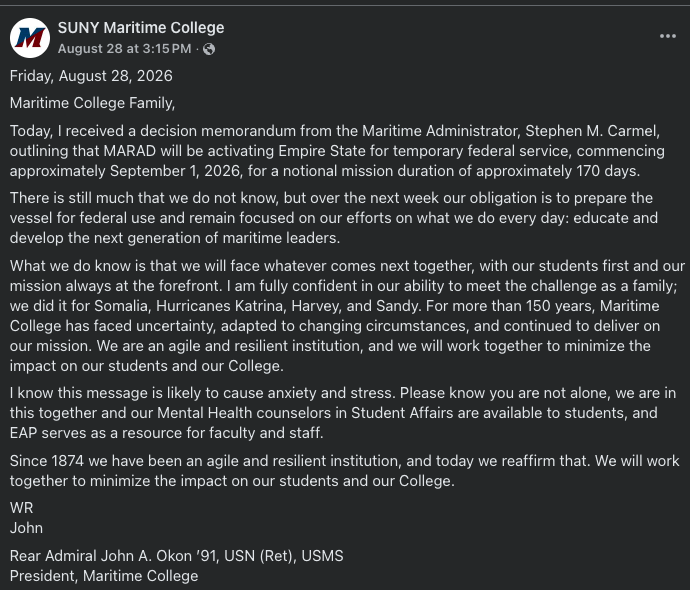
    TS Empire State will be sent over Tuesday for 170 days of “temporary federal service,” retired Rear Admiral John A. Okun, president of the Bronx-based Maritime College of the State University of New York, told faculty and staff in a memo Friday, confirming earlier reports from shipping and government sources.

    “There is still much that we do not know” about how the ship, which normally carries hundreds of cadets on training voyages, will be used by the government, Okun said.

    The memo posted by retired Rear Admiral John A. Okon, president of State University of New York Maritime College, informing faculty and students that their Philadelphia-built training ship, TS Empire State, has been moved to “temporary federal service” starting Sept. 1. Maritime College, State University of New York

    ‘They should be up for it’

    Military commenters linked the move to the U.S. military’s efforts to shuttle supplies to and from its base on Diego Garcia in the Indian Ocean and other far-flung stations, after stations in Bahrain and other Arab countries were damaged by Iran earlier this year in retaliation for U.S. and Israeli attacks.

    The Navy’s Sealift Command, which carries military equipment and supplies, asked for Empire State and said no other available ship has its capabilities for an undisclosed strategic mission, according to an article Monday in GCaptain, published by merchant marine Capt. John A. Konrad V.

    “The ship is likely headed to Diego Garcia,” according to Salvatore Mercogliano, a maritime historian at Campbell University in North Carolina, who reported in social media posts in mid-August that the move was likely.

    The Empire State and its sister ships are oceangoing vessels, and “they should be up for it,” said Gary Kim, a shipbuilding and industrial scholar, reserve officer, and Wharton graduate student who as an active-duty Navy lieutenant worked for the unit that manages the base at Diego Garcia, among other installations.

    The ship’s removal “is likely to cause anxiety and stress” at the academy, so mental health counselors have been made available to midshipman cadets to help them cope, academy president Okun said in his note.

    He pointed out that a previous Empire State training ship — there have been six of that name before the current one — had supported U.S. forces in Somalia in the 1990s, as well as aiding relief work for Hurricane Sandy, which ravaged the Jersey Shore in 2012, among other storms.

    “We will face whatever comes next together,” he said.

    On time and on budget

    Empire State was delivered to the Maritime College in the Bronx in 2023. The next ships in its class were sent to academies in Massachusetts and Maine. TS Lone Star was scheduled to leave Philly Shipyard for its new Texas home on Monday.

    Empire State’s success on deployment could help determine the future of the construction program, which has kept many of Philadelphia’s workers busy since 2021. The yard now employs around 2,000, which Hanwha hopes to double.

    In July, Transportation Secretary Sean Duffy and other federal officials came to Philadelphia to announce that the government planned to purchase two more NSMV-like hulls to be built at the shipyard and used to track enemy missiles, replacing ships built in the 1960s. Duffy praised Tote for building ships “on time and on budget.”

    Tote has noted that the program has run modestly overbudget due partly to much higher steel costs added and other factors. Federal officials said it is far closer to target than recent Navy-run shipbuilding programs.

    Hanwha’s expansion goals

    Hanwha has sought additional contracts to build similar vessels for other federal civilian agencies and as potential replacements for the Navy’s aging hospital ships, USNS Mercy and USNS Comfort.

    Hanwha has said it is losing money on the yard and that it will turn a profit only if it can expand ship construction from the current one ship every eight months or so to at least one every few weeks. Its shipyard on Geoje Island, South Korea, produces almost one ship a week, assembly line-fashion in contrast with the expensive ship-by-ship style that has characterized U.S. ship construction in recent decades.

    Tote officials have said Hanwha needs more space if it is going to build more government ships in Philadelphia. Officials of the Philadelphia Industrial Development Corp., the city/Chamber of Commerce partnership that finds city properties and public financing for industrial users, say they have been helping Hanwha look for expansion sites nearby. In March, the company canceled a plan to add facilities in Paulsboro, Gloucester County, after it could not reach an agreement with port operator Holt Logistics.

    Hanwha last year pledged to invest $5 billion in Philadelphia shipyard facilities. It has so far spent around $200 million, according to company officials.

    Hanwha in August offered to spend over $1 billion for Australia-based Austal’s shipyards in Alabama, amid a boom in public and private military shipbuilding fueled by a record U.S. defense budget.

    Besides finishing the last of the NSMVs, Hanwha is building three liquefied natural gas-fueled cargo ships for the Matson shipping line, which operates between the U.S., Hawaii, other U.S possessions, and China.

    The company has said it would build its own cargo ships if necessary to keep the yard running.

  • Will the Landmark Ritz Five movie theater reopen soon? Here’s what we know.

    Will the Landmark Ritz Five movie theater reopen soon? Here’s what we know.

    The Landmark Ritz Five movie theater could reopen soon, after shuttering abruptly this month because it failed city inspections.

    Landmark Theatres’ parent company, Cohen Media Group, said “we are actively working with the local authorities to address certain requirements related to the theater and are committed to completing the necessary work as quickly and thoroughly as possible,” in a statement shared by spokesperson Daniela Sapkar.

    The Philadelphia Department of Licenses & Inspections ordered the movie theater to close last week after two failed inspections. Violations, noted in a March inspection, included failure to obtain a permit to install a fire alarm system, share documentation that fabrics are flame retardant, ensure that exit doors fully “self-close and latch,” and certify emergency lighting. The theater was also found to be missing a valid food license.

    The theater, located at 214 Walnut St., failed a subsequent inspection on Aug. 11. By Aug. 26, the movie theater was closed, and a cease operations order was plastered on its doors.

    “We understand the importance of this theater to the Philadelphia community and greatly appreciate the patience and support of our guests,” the Cohen Media Group statement said. “We look forward to an imminent reopening.”

    Sapkar said Monday that a reopening date has not yet been decided, “but we’re hopeful it will be as quickly as possible.”

    On Monday morning, the theater’s website still listed that it was temporarily closed “due to administrative issues.” No showtimes were listed for Monday or Tuesday.

    Tickets appeared to be available to purchase online for Wednesday viewings of The Odyssey, The Invite, and Spider-Man: Brand New Day, among other movies.

    Landmark Theatres was purchased by Cohen Media Group in 2018. The Landmark Theatres brand has locations across the country, including theaters in Arizona, California, and Florida.