The skirmishes between the colonies and England in April 1775 grew into a full-on war by January of 1776. No longer contained to New England, the fighting had spread to Canada and the South; so much so that British loyalist and Virginia’s royal governor Lord Dunmore offered freedom to any enslaved man who fought on behalf of the Crown.
The stakes were high.
The colonies were no longer interested in making nice with England. They wanted independence and realized they had to unite to win.
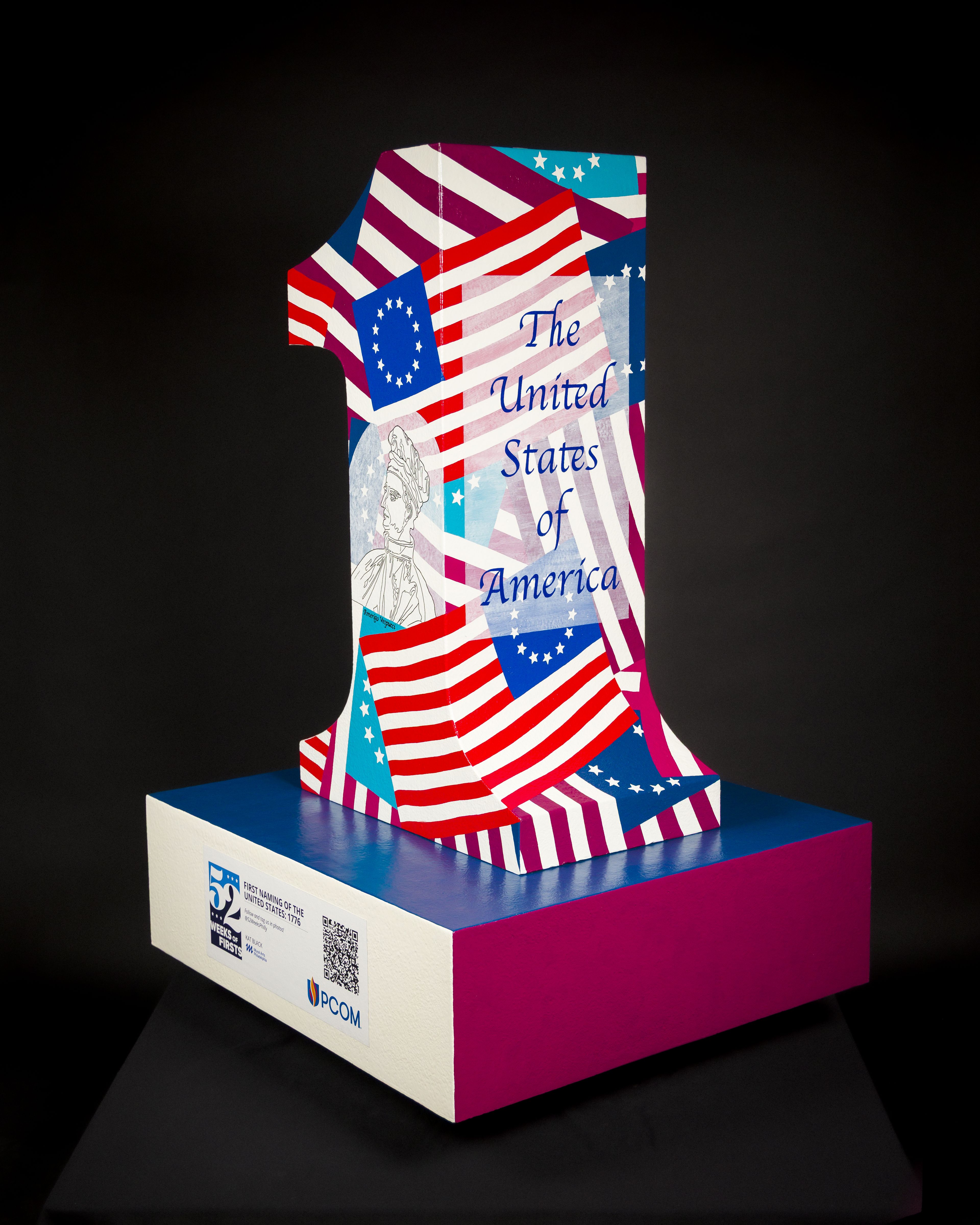
Kat Black’s design presents the flag of the original 13 colonies of 1776 when the name “United States” was approved by the Second Continental Congress in July of 1776 along with the Declaration of Independence.Kat Black for Colibrí Workshop
Stephen Moylan, a Pennsylvanian and officer in the Continental Army, first floated the idea of calling the new nation the “United States” in a 1776 letter to politician and comrade in arms Joseph Reed.
“Moylan wrote the ‘united states’ needed to spend emissaries to Spain and build a case for the rising revolution and secure foreign support,” explained Matthew Skic, director of collections and exhibitions at the Museum of the American Revolution.
”That letter, dated Jan. 2, 1776, is the first documented reference to the colonies as the ‘united states,’” Skic said.
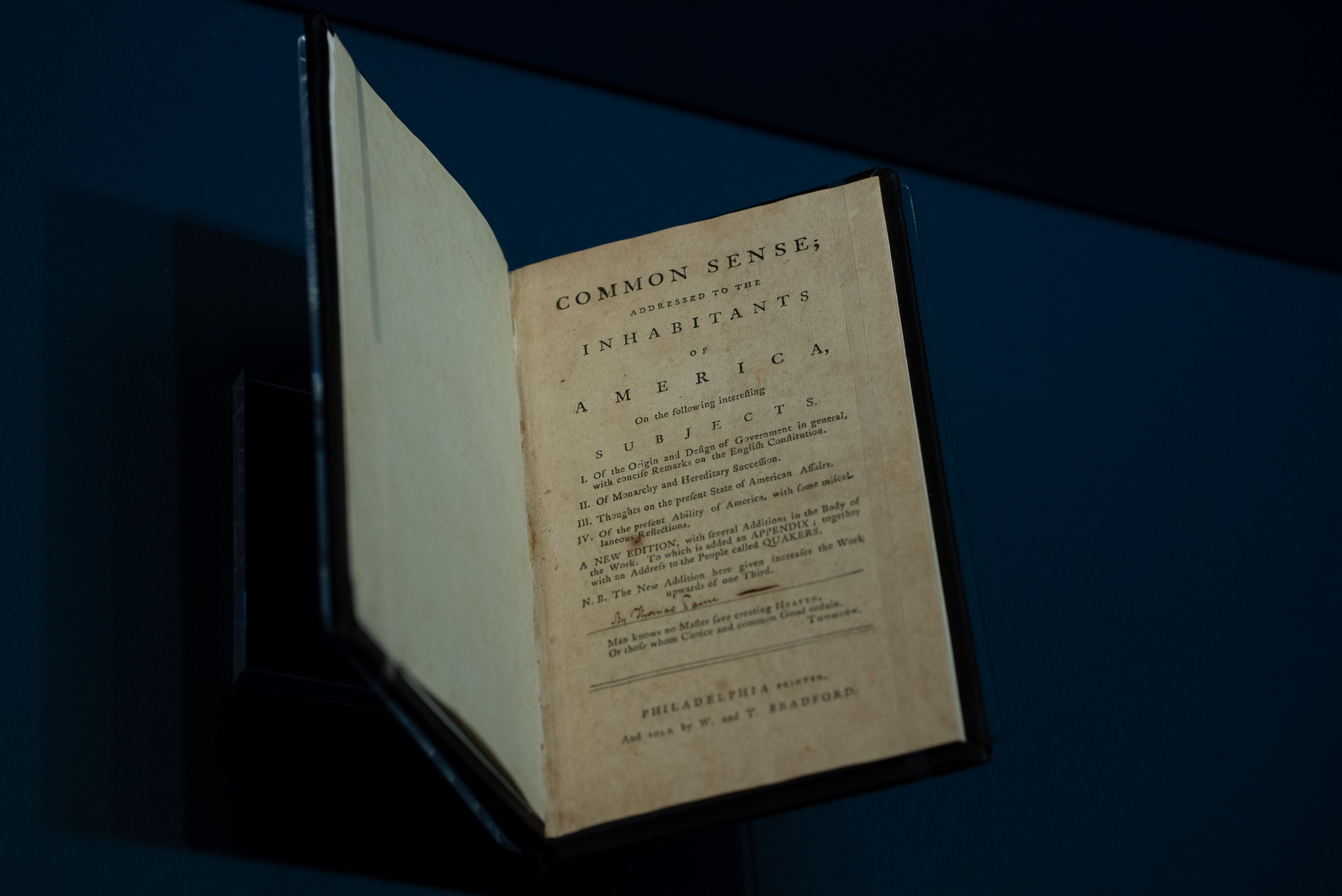
An original copy of Thomas Paine’s 47-page Jan. 1776 Common Sense pamphlet where the revolutionary called for the colonies to form united states independent of English colonies.The Museum of the American Revolution
The pamphlet, read aloud in taverns in Philadelphia and throughout the original colonies, stoked the flames of independence. It was printed in Robert Bell’s print shop at Third and Walnut Streets.
“Paine urged the colonies to form states,” Skic said. “But not the 21st-century perspective of states as in New Jersey, Virginia, or New York. In the 18th century, states were an independent nation or country with its own government.”
And those states, Paine said, needed to come together to defeat a common enemy: England.
In May 1776, Virginia statesman Richard Henry Lee issued a resolution proposing that the Second Continental Congress declare the colonies’ independence, explicitly stating that the new country should consist of independent states formerly known as colonies.
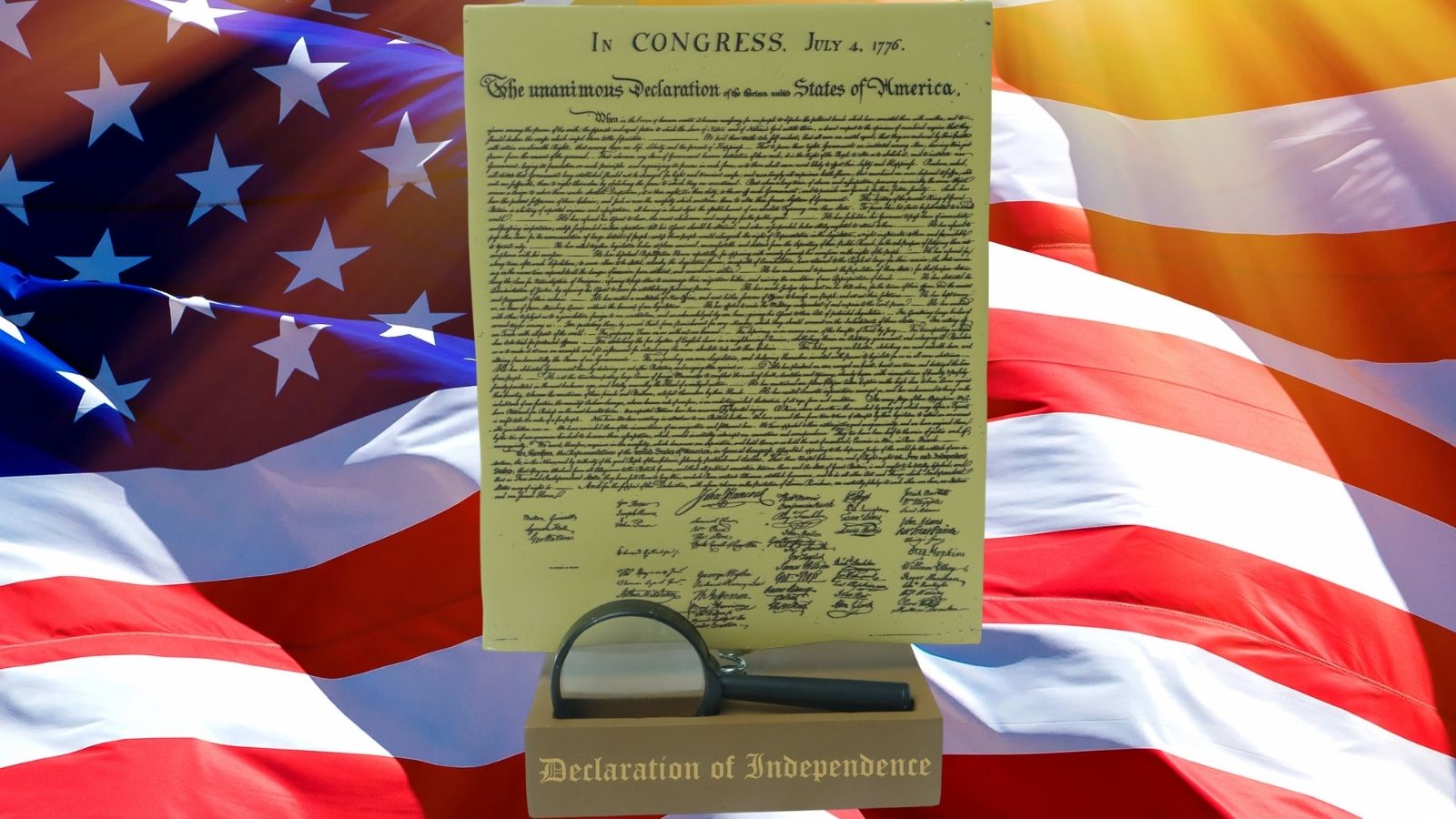
An image from the National Bobblehead Hall of Fame and Museum of its Declaration of Independence bobble created for the nation’s 250th anniversary.Courtesy of the National Bobblehead Hall of Fame and Museum
On July 2, the Second Continental Congress adopted the Declaration of Independence that referred to the new country as the united States. The united was written in lowercase, Skic said, to emphasize the focus on “States.”
However, it wasn’t until Sept. 9 when during the Second Continental Congress — meeting at the Pennsylvania State House, today’s Independence Hall — delegates voted to call the new government the United States of America, with a capital “U.”
“As soon as independence becomes the goal, not just restoring liberty, the United States took hold as a name,” Skic said. “And it happened in a neat six month time period.”
The official naming of the United States will be remembered Saturday at Independence Hall from 11 a.m. to 1 p.m. in the Philadelphia Historic District’s 38th firstival. Firstivals are weekly day parties held in honor of America’s 250th birthday.
“The Continental Congress had been trying to decide how it should be represented when we present ourselves to other countries,” Skic said. “What would be the official seal on our government documents? With the Sept. 9 vote, Congress officially says all of the government’s official documents will say ‘United States.’”
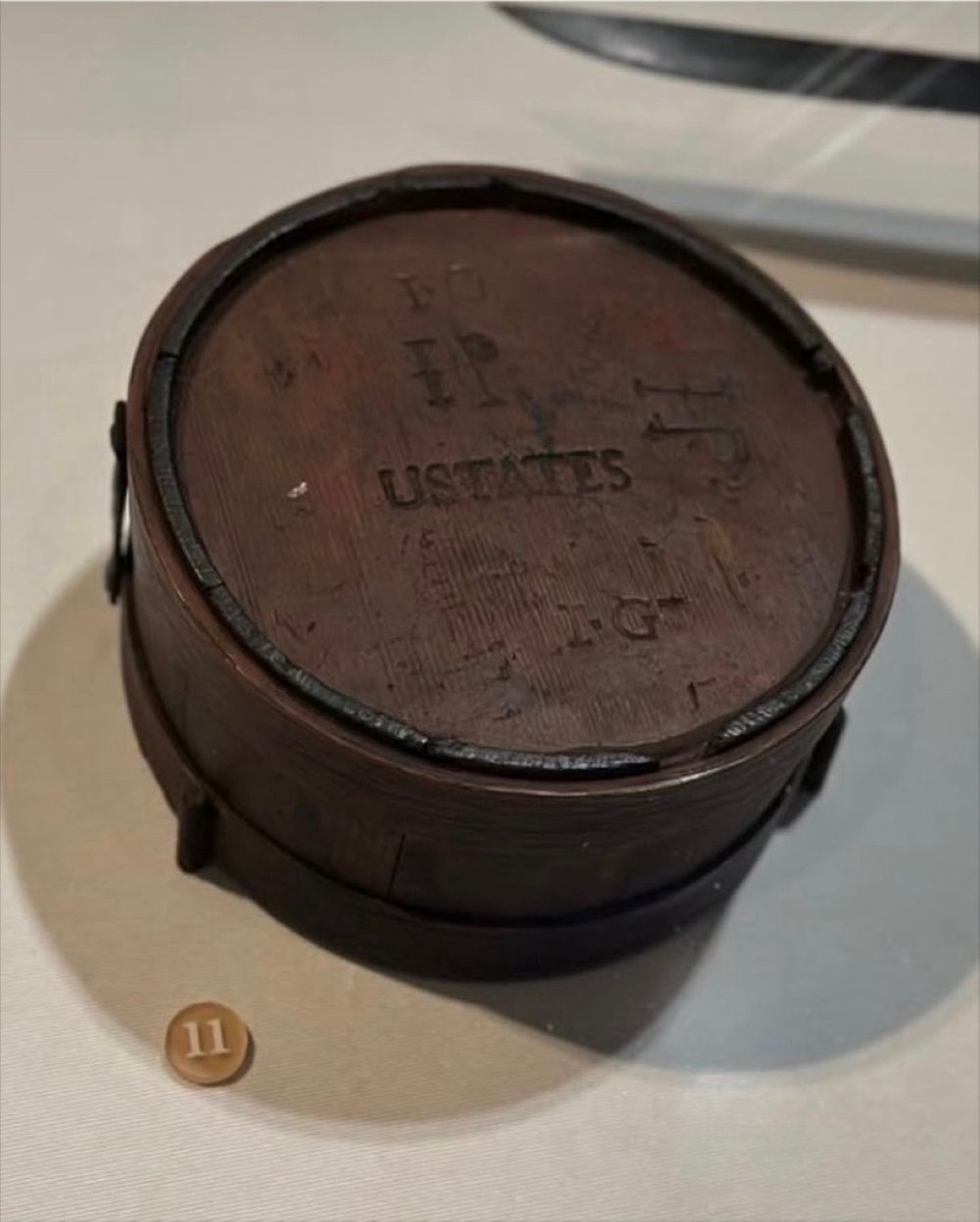
The Continental Congress ordered the Continental Army’s property be marked United States in February 1777.
A Revolutionary War-era canteen marked U. States for United States. One of the first military-issued items that speaks to the formation of America’s independence.The Museum of the American Revolution
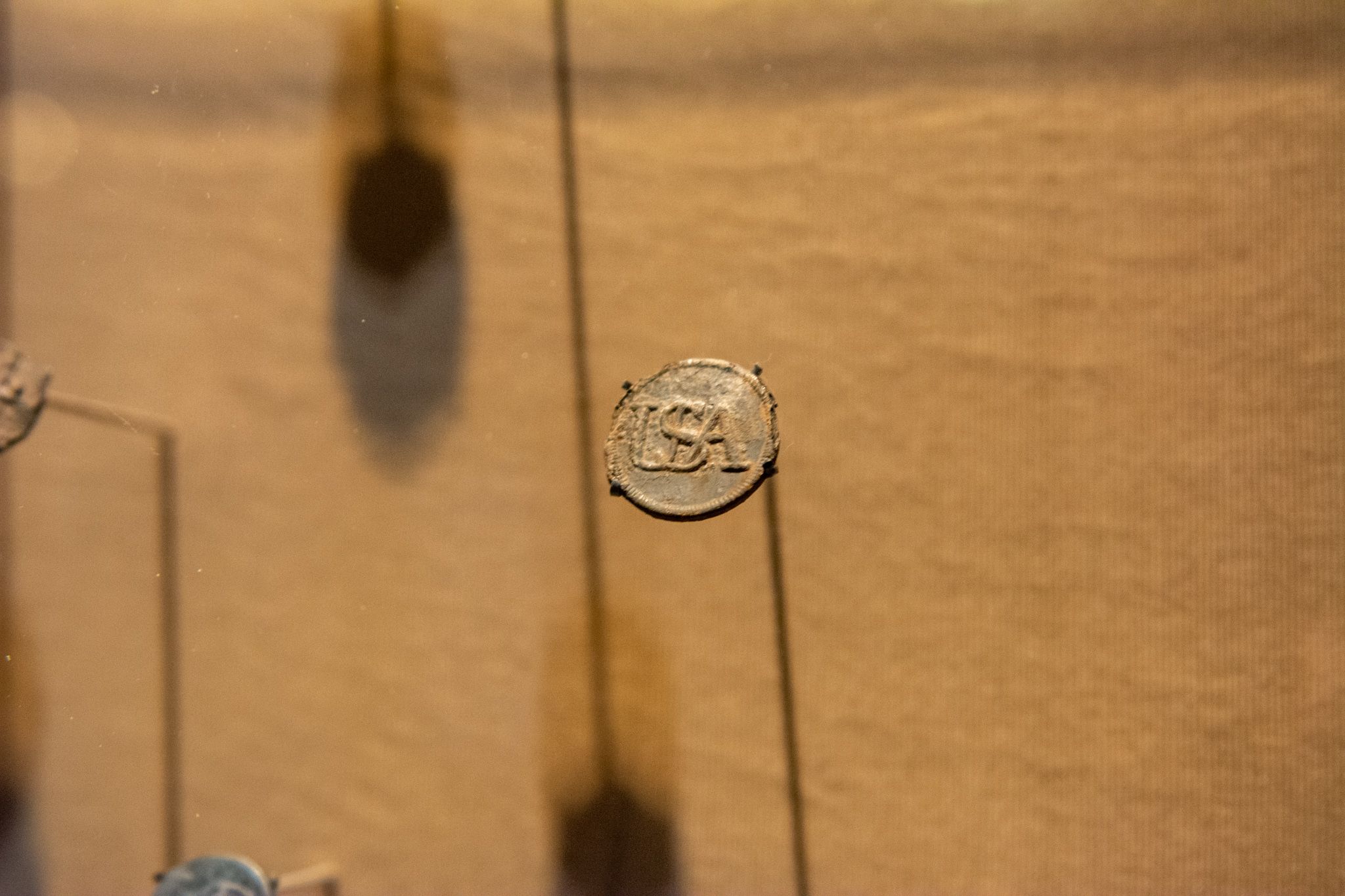
“[The Museum of the American Revolution] has muskets, canteens, and cartridge boxes marked U. States,” Skic said. “We also have one of the only surviving original molds of USA buttons.”
The army would be called the Continental Army through the end of the Revolutionary War in 1783, after which it disbanded. George Washington was elected president in 1789 and soon after his inauguration, it was reestablished as the United States Army.
A previous version of the story misstated Common Sense’s publication date. It was published Jan. 9, 1776.
This week’s Firstival is Saturday, Sept. 19, from 11 a.m.-1 p.m., at Independence Hall, 520 Chestnut St.
To Denise Burgher, co-organizer of this weekend’s 2026 Colored Convention Conference, the attack on civil rights and Black history under President Donald Trump’s administration is chilling.
Among the most egregious, she said, were his attempts to repeal the 14th Amendment, the Reconstruction-era addition to the Constitution guaranteeing citizenship to anyone born in the United States. In June, the Supreme Court upheld birthright citizenship.
“The 14th Amendment overturned the Dred Scott Decision of 1857 ruling Black people — freed or enslaved — do not have the same rights as [their] white counterparts,” Burgher said. “Without that protection, Black Americans’ citizenship would be in question. Don’t think that could happen? We thought a woman’s right to chose was set in stone, too.”
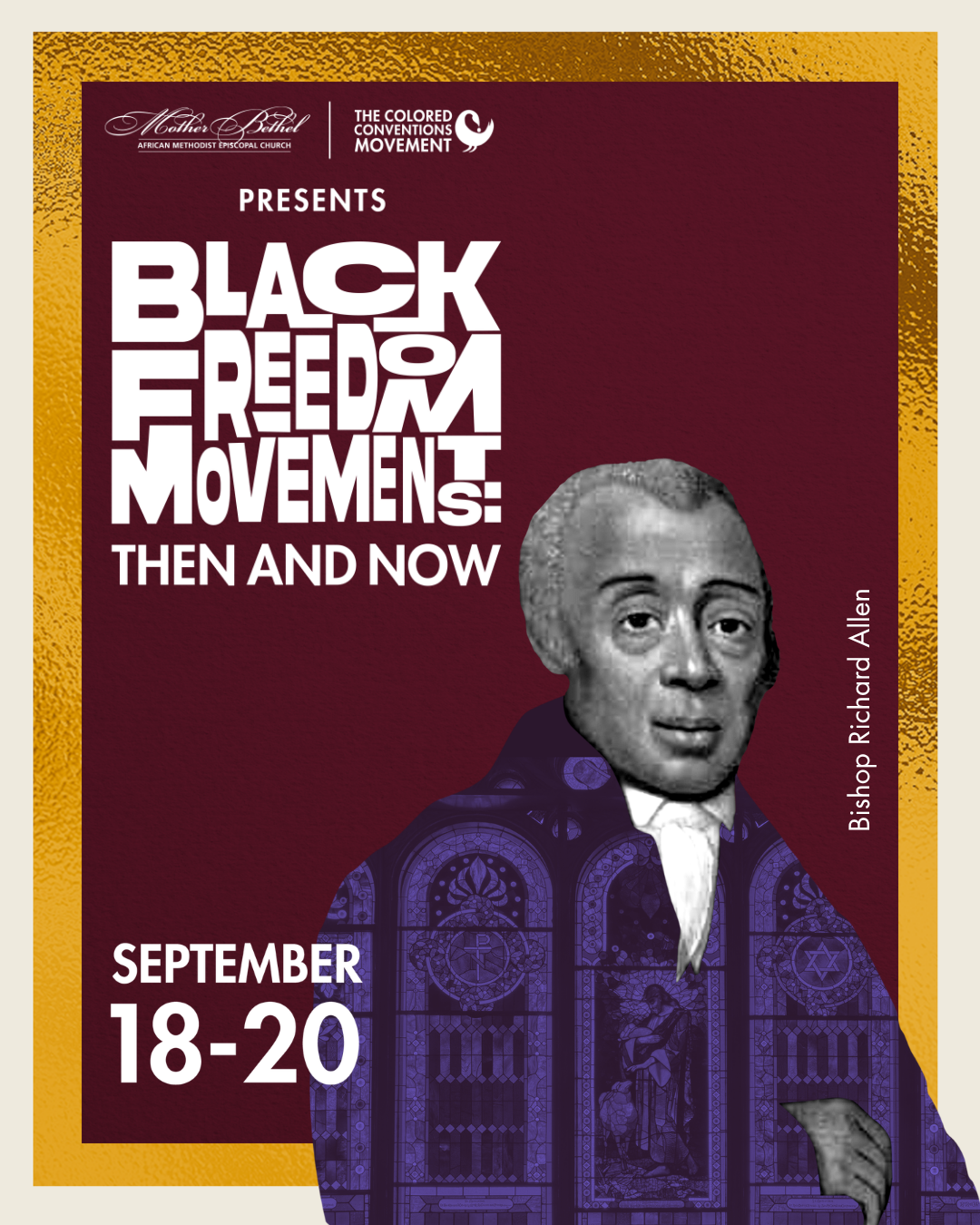
A flyer advertising the 2026 Colored Convention: Black Freedom Movements Then and Now.2026 Colored Convention Committtee
Burgher went on: Last week Trump threatened to snatch the tax exempt status from private schools that give minority students access to scholarships and educational programs, including at historically Black colleges and universities like Howard and Hampton.
It’s clear Black equality in this political climate is not guaranteed.
“We haven’t seen a threat like this on Black livelihood in this country since the post-Reconstruction era,” said Burgher, who is also the director of community engagement and curriculum development at Penn State’s Center for Black Digital Research. “This part of American history was a part of our past, now, it is not so suddenly aggressively and nakedly a part of our present.”
A 19th-century America, she said, calls for 19th-century tactics.
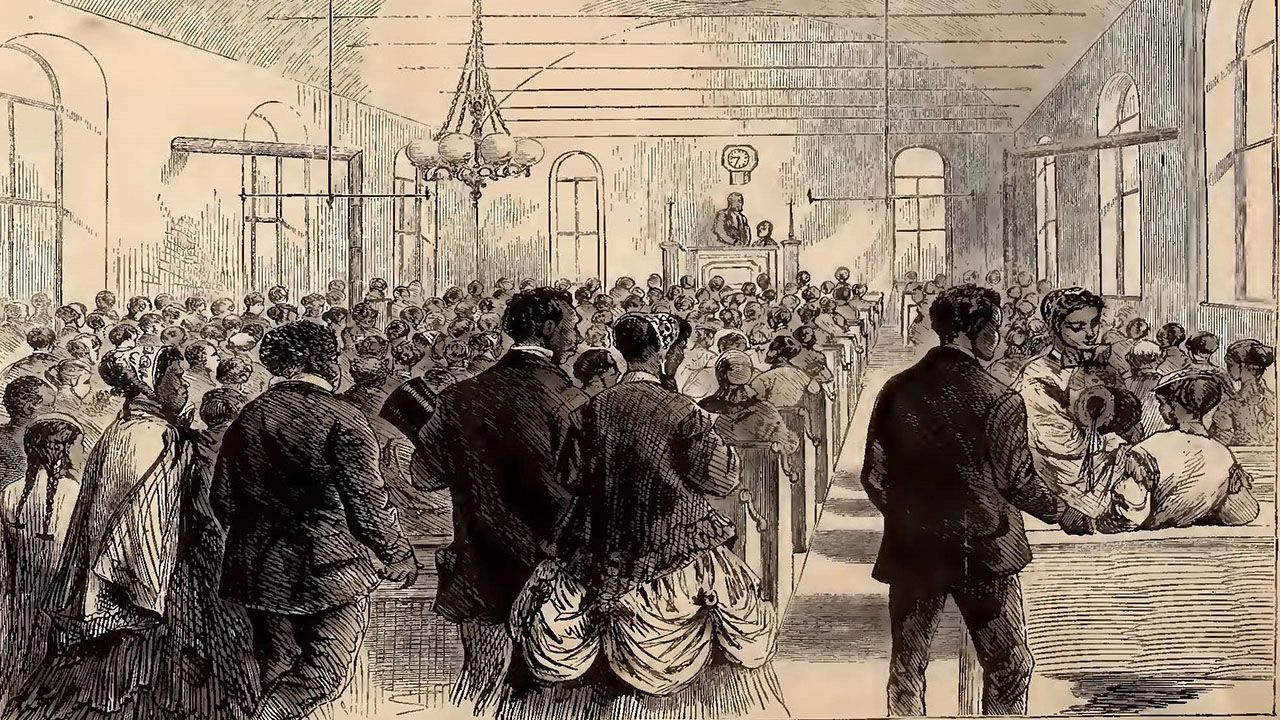
This weekend, Mother Bethel AME will host the “2026 Colored Convention: Black Freedom Movements Here and Now,” a celebration of the first Colored Convention held almost 200 years ago at the church. Dozens of influential free Black clergymen, statesmen, and activists convened at the 1830 Colored Convention and laid the foundation for civil rights groups like the Niagara Movement and the NAACP.
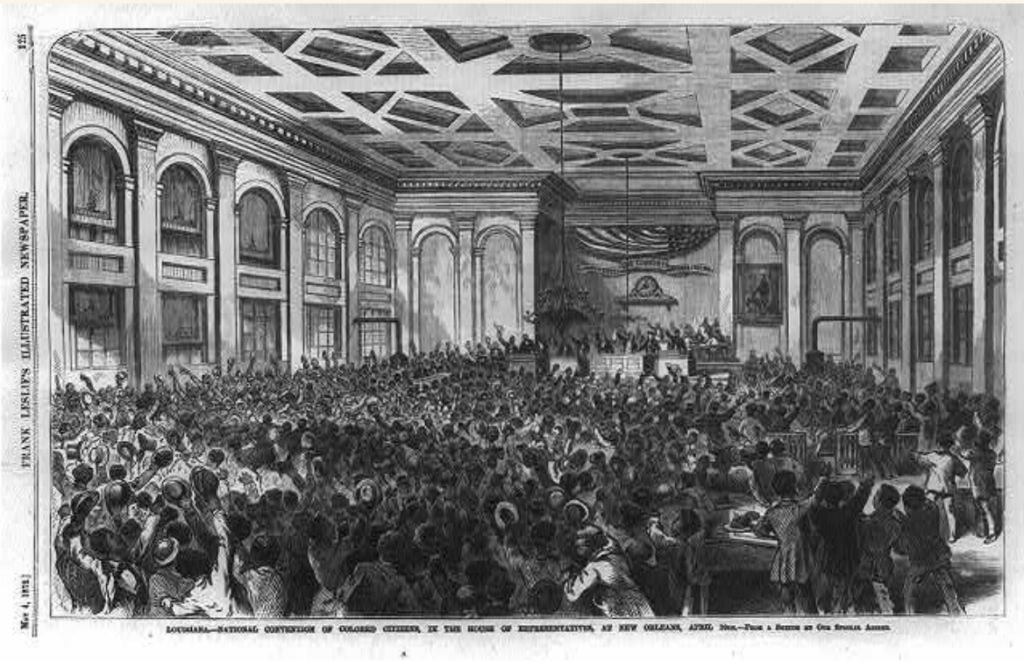
This print from Frank Leslie’s Illustrated Newspaper depicts the National Convention of Colored Citizens’ meeting in the House of Representatives in New Orleans, in April 1872.The Library of Congress
These organizations agitated for civil rights through the Civil War, Reconstruction, Jim Crow and into the 1960s, said Carolyn C. Cavaness, Mother Bethel’s pastor who tapped Burgher and Derrick Spires, historian and associate professor of English at the University of Delaware, to reignite the Colored Convention’s legacy.
“To reclaim and be challenged by such a movement … is of much worth and esteem,” Cavaness said. “We are literally in a struggle now for equality and fairness of all people.”
This weekend’s Colored Convention will feature workshops on genealogy, activism, and the 18th- and 19th-century Black press. Philadelphia school children will attend Thursday for arts and crafts projects that will teach them about the history of the Colored Convention.
Andre E. Johnson, codirector of the Colored Conventions Project and professor at the University of Memphis, will deliver the keynote on the history of the Colored Convention and share how activists can apply 19th-century action plans to 21st-century technology to create a strategy to combat the present crisis.
“In this year of the Semiquincentennial, this is yet another opportunity for Philadelphians to pay attention to history,” Burgher said, “and look at strategies our ancestors used more than 100 years ago. I’m not going to say the same thing is happening, but the events sure do rhyme.”
The event will include a voter-registration drive, emphasizing the importance of voting in the midterms.
Richard Allen founded Mother Bethel in 1794, and by 1830, the church was the cornerstone of the largest free community of African Americans in the country.
In August of 1829, white mobs burned Black businesses and neighborhoods during the Cincinnati Race Riots. In response to the brutal loss of life and business, free man Hezekiah Grice wrote to Allen, asking the influential pastor to gather free Black intellectuals to strategize. His reasoning was, if white mobs could do this in Cincinnati, what’s to stop them from attacking Black communities everywhere else.
More than 2,000 Black people from Cincinnati moved to Canada. The first Colored Convention was held from Sept. 20 to Sept. 24 in 1830 at Mother Bethel, resulting in emissaries from Philadelphia asking the Canadian government to allow Black people to establish communities there.
The Colored Convention held annual meetings at Mother Bethel from 1831-85. By the turn of the 20th century, there were Colored Conventions regularly in nearly every major American city along the Northeast Corridor, in the Midwest, and along the West Coast.
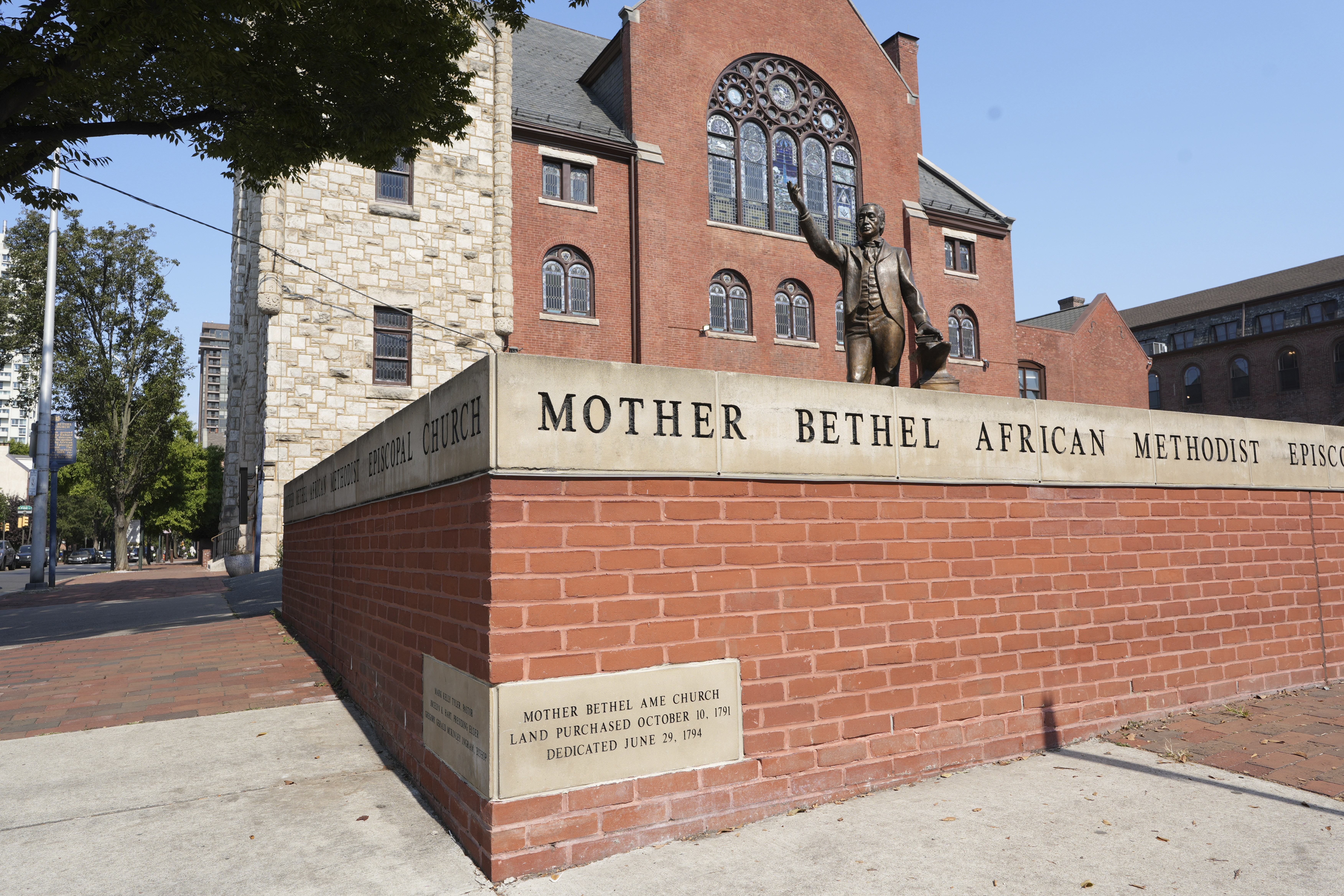
A statue of Mother Bethel AME Church founder Richard Allen stands on the oldest parcel of land continuously owned by Black Americans in Philadelphia on Oct 13, 2024. (AP Photo/Luis Andres Henao)Luis Andres Henao
Black leaders from every walk of life attended, among them Frederick Douglass — known as the Lion of the Convention because of his deep oratory voice and big, distinctive hair — poet Frances Ellen Watkins Harper, newspaperman T. Thomas Fortune, and Philadelphia educators Jacob C. White and Charles L. Reason.
Colored Conventions, Burgher said, became forums for Black leaders to discuss abolition, fugitive slave laws, voting rights, and education. Many Black institutions were born from these conventions, including the charters for Talladega University and Howard University Law School, established in 1865 and 1869, respectively.
The last Colored Convention on record was in 1972 in Newark, N.J., Burgher said.
“I hope this 2026 celebration will not only bring this history home,” Burgher said. “And I also hope it inspires Philly residents to respond to the current moment like history has taught us.”
Until the 1750s, America was a community of loosely organized colonies where residents were content — if not happy — to be a part of the powerful British Empire.
But, after the colonists joined Britain to help the Crown win the French and Indian War, they started to wonder if it was worth it to remain the King’s subjects.
For one, King George III issued the Royal Proclamation of 1763 forbidding Americans west of the Appalachian Mountains, angering the land-hungry colonists.
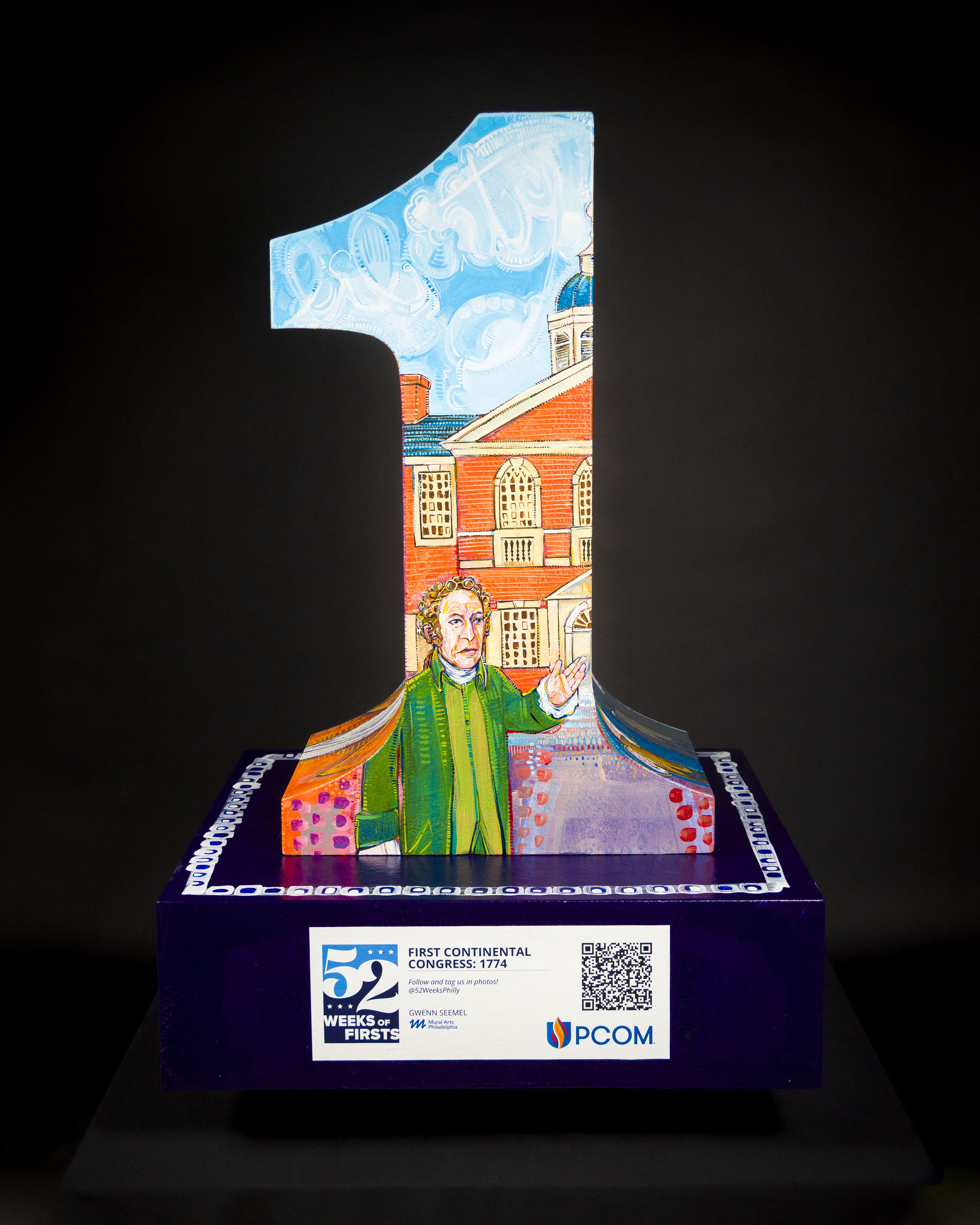
Gwenn Seemel depicts Patrick Henry in front of Carpenters Hall for the No. 1 in honor of the First Continental Congress.Gwenn Seemel courtesy of Colibrí Workshop
Then came the beginnings of taxation without representation. In 1765, England enacted the Stamp Act, levying a tax on every piece of paper, pamphlet, or card bought and sold in America. Eventually, the colonists rebelled and Britain repealed the act five months after it started.
However, the seeds of rebellion were planted.
Uncomfortable with angry subjects, Britain stationed troops in New England. Those rising tensions led to the Boston Massacre in 1770. In 1773, King George III taxed tea imported to the colonies from London. (He was insistent on collecting the colonists’ money by any means necessary.)
When tea arrived from London in Boston Harbor in December of 1773, colonists dumped it into the Atlantic Ocean. In retaliation to the infamous Boston Tea Party, the Crown levied a series of Intolerable Acts.
“In the eyes of the colonists, the Intolerable Acts were severe,” explained Michael Norris, the executive director of Carpenters Hall.
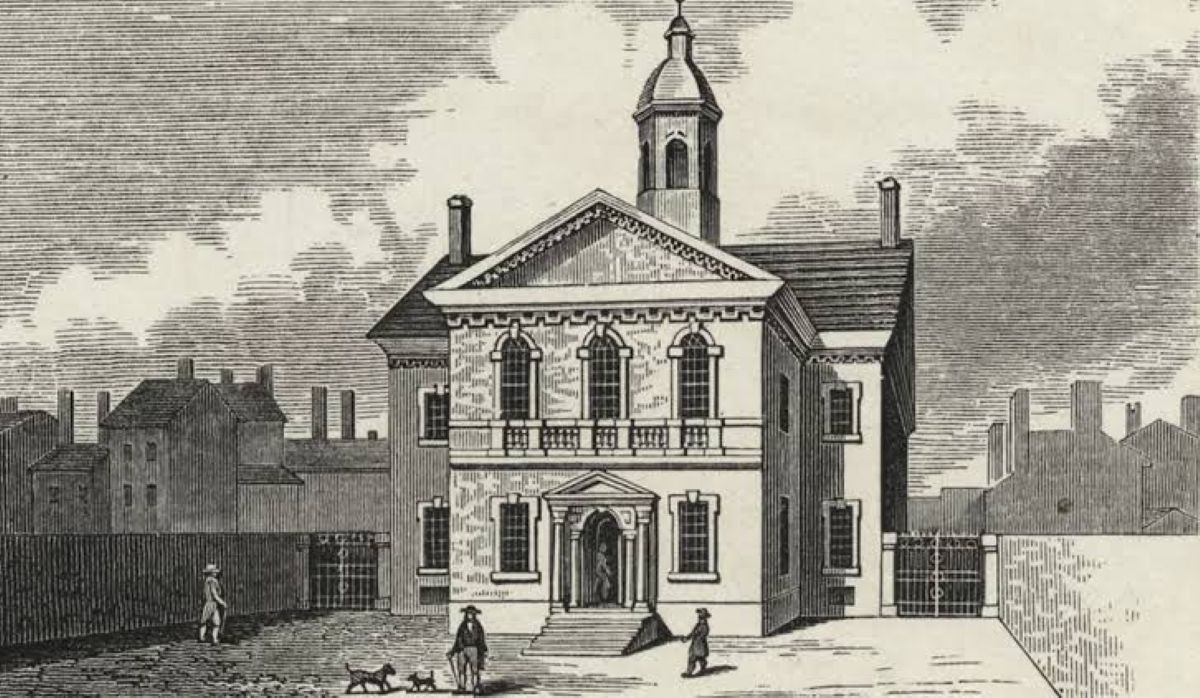
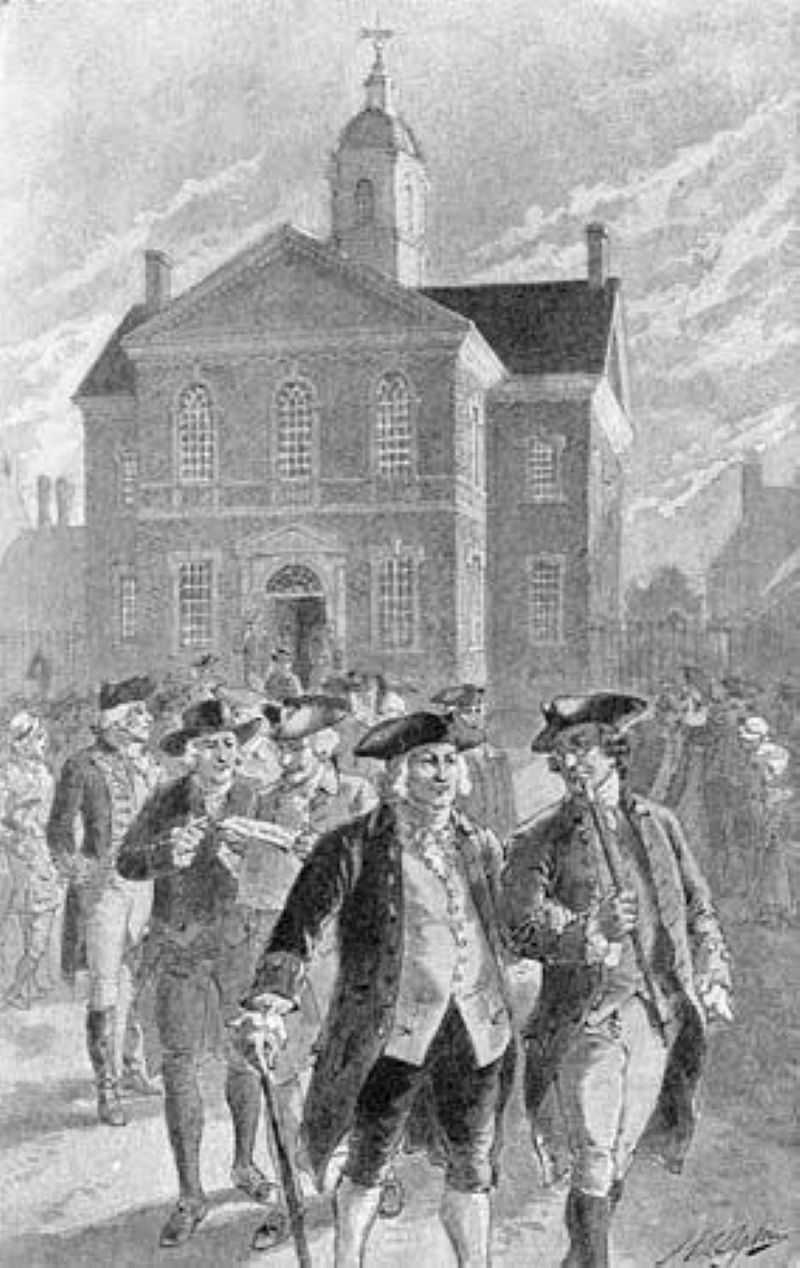
An etching of what Carpenters Hall looked like in the 1700s.Courtesy of Carpenters Hall
The acts, Norris explained, disbanded the Massachusetts legislature, putting Britain in charge of the state’s government. Britain closed the Port of Boston and stationed British troops in Massachusetts, requiring residents to feed, clothe, and house them.
The colonists thought, “if Britain could do this in Massachusetts, what would that mean to the rest of the colonies?”
On Sept. 5, 1774, 56 delegates from 12 colonies — Georgia didn’t come — convened at the then-new Carpenters Hall for the First Continental Congress. Their goal: to work out a deal between the colonies and their Mother Country so life in the New World could continue, albeit a bit smoother.
That first meeting of the Continental Congress will be remembered Saturday at Carpenters Hall from 11 a.m. to 1 p.m. during the Philadelphia Historic District’s weekly “Firstival” celebration. Each Saturday this year, the district is throwing a day party honoring events that happened in Philadelphia that changed the world.
For eight weeks, through Oct. 25, delegates hashed out a plan for independence and to heal their disagreement with the Crown.
An etching of colonists and delegates gathering in front of Carpenters Hall.Courtesy of Carpenters Hall
They drafted a Declaration of Rights & Grievances in which they demanded England send its troops home and stated they wouldn’t stand for taxation without representation. (Historians refer to this declaration as a prelude to the Declaration of Independence.) Delegates also adopted the Articles of Association, in which they voted to stop all trade with England until the Intolerable Acts were repealed.
“They were trying to use their economic muscle to get England to the table,” Norris said.
The First Continental Congress created a unity among the colonies that hadn’t existed before, Norris said. “Up until then, they thought of themselves as British subjects, more connected to the Mother Country than their neighbors. The Congress changed this dynamic.”
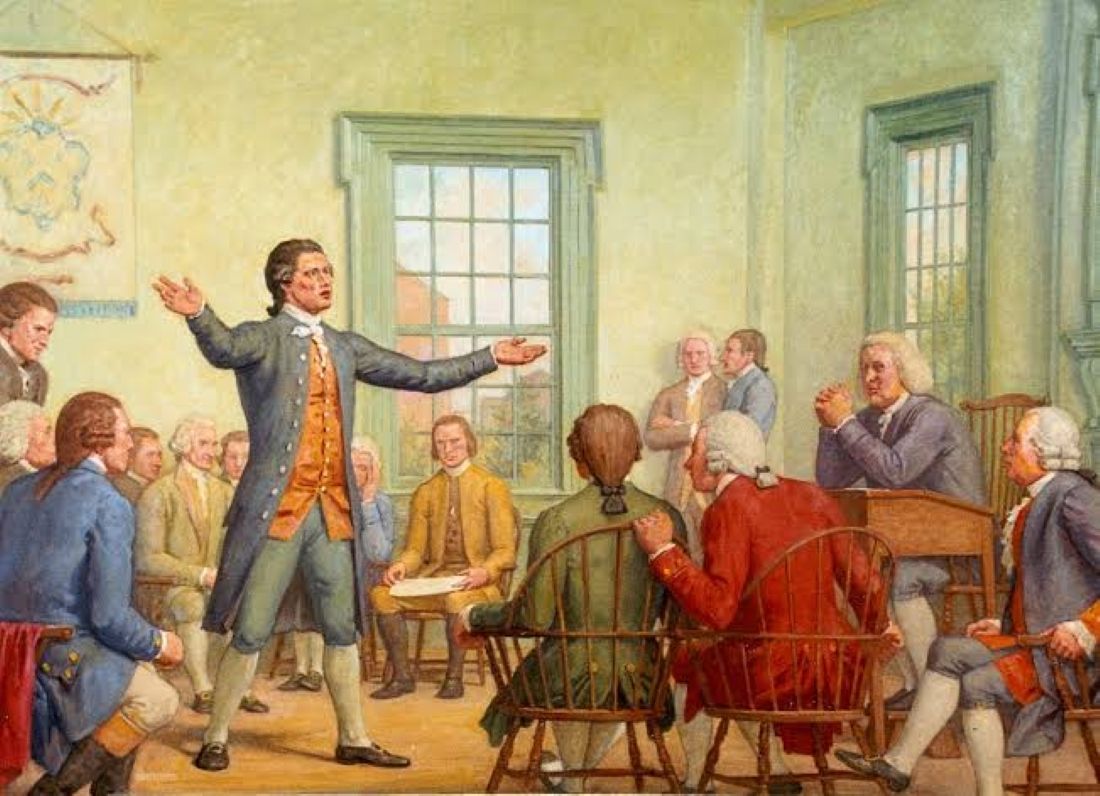
This sentiment is best illustrated in Patrick Henry’s famous quote, during the opening sessions of that first Congress: “The distinctions between Virginians, Pennsylvanians, New Yorkers, and New Englanders are no more,” Henry said. “I m not a Virginian, but an American.”
It is why the late historian David McCullough referred to Carpenters Hall as the “acorn of American democracy.” It is where, Norris said, “the seed of independence was built that ultimately grew into the United States of America.”
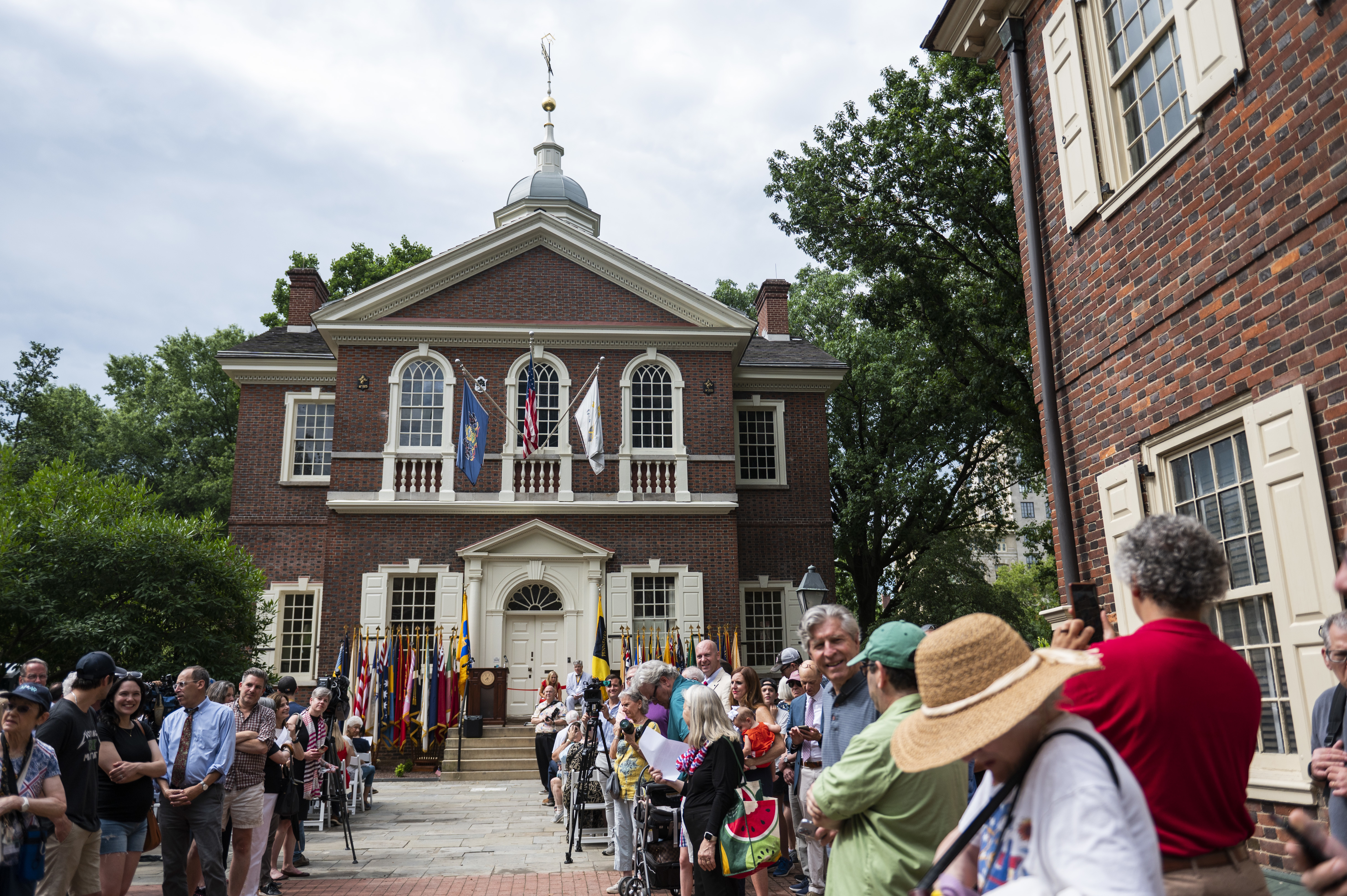
A reopening ceremony at Carpenters Hall on Monday, July 3, 2023. The building opened to the public for the first time since April 2022.Allie Ippolito / Staff Photographer
Delegates planned to reconvene in May of 1775 to address England’s response to their demands. But in April, the first shots of the Revolutionary War were fired and the Continental Army — victorious in the Battles of Lexington and Concord — were in a full-fledged war.
Making nice with England was completely off the table.
This week’s Firstival is Saturday, Sept. 12, from 11 a.m.-1 p.m., at Carpenters Hall, 320 Chestnut St., Philadelphia, Pa.
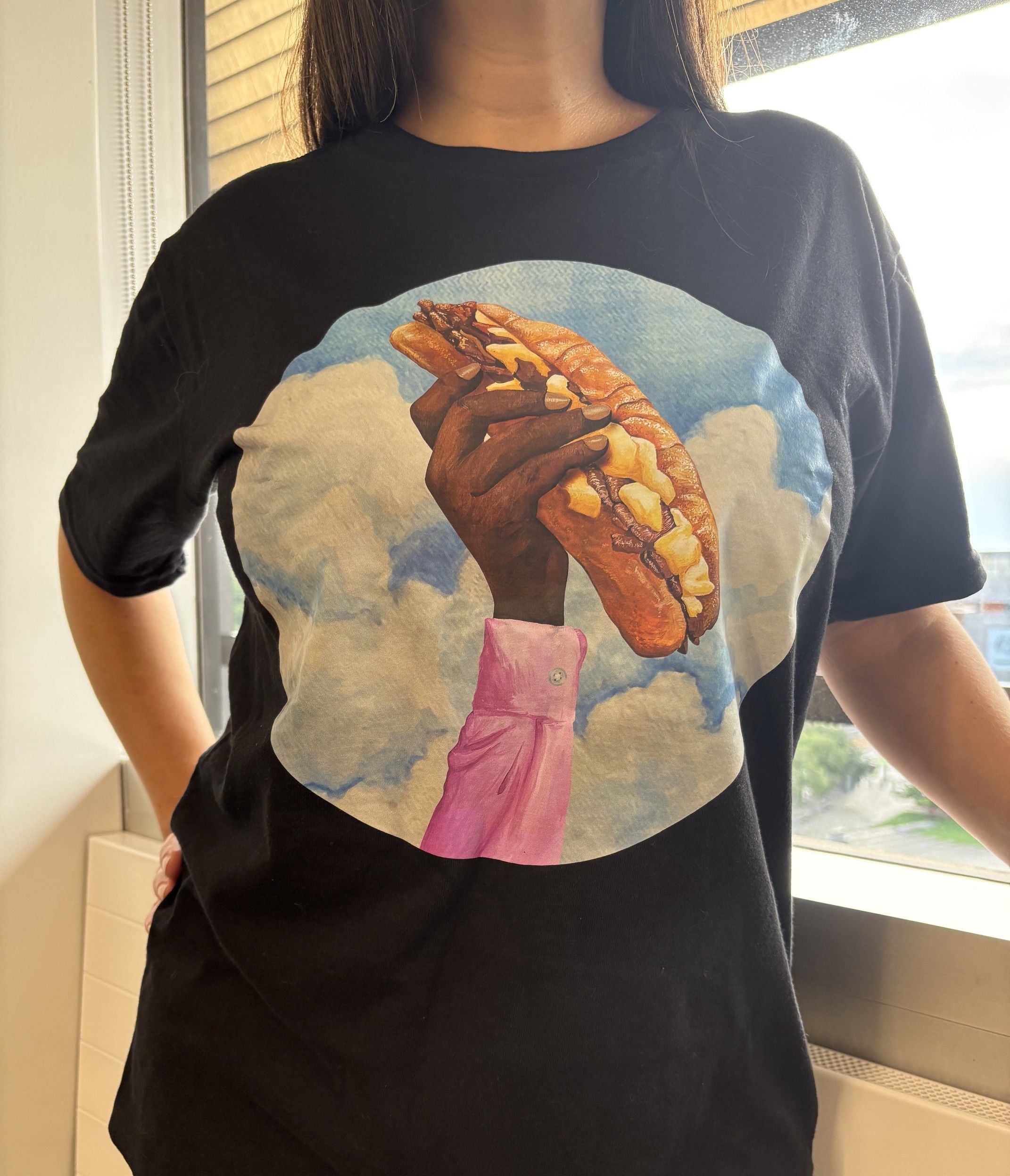
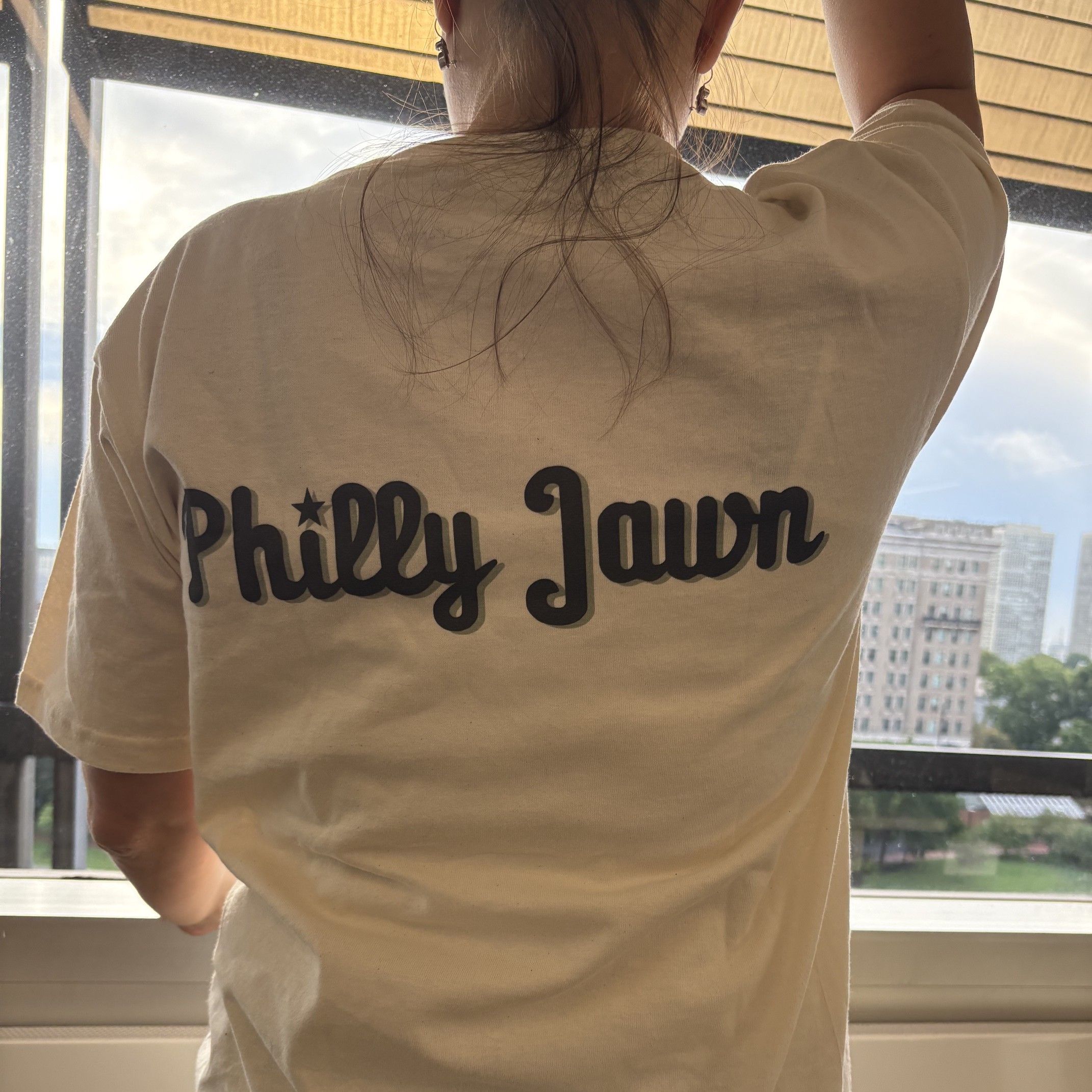
A manicured hand holding a cheesesteak, a hoagie, or an iron skillet filled with scrapple. Now imagine that on a hoodie or T-shirt. Add to that the beloved moniker “Philly Jawn” printed on the back in Philadelphia Phillies-style print and I’m hooked.
I may be a born and bred New Yorker, but after living here for 23 years, I’m a total Philly Jawn.
This latest sartorial homage to Philly food is a collaboration between interior designer Sheila Bridges and food writer, producer, and media entrepreneur Stephen Satterfield.
Sheila Bridges X COMOCO T-shirts featuring a Philly cheesesteak, are part of a limited-edition collaboration between interior designer Sheila Bridges and Stephen Satterfield, best known for the Netfix documentary on African American food, “High on the Hog.”Elizabeth Wellington
Earlier this year Bridges partnered with Walmart on a Philly-centric collection of tableware featuring her iconic Harlem Toille de Juoy print. Satterfield is best known for Netflix’s Peabody and NAACP award-winning series High on the Hog. Its first season featured Philadelphia food and Black catering families including Robert Bogle.
The Sheila Bridges X COMOCO T-shirts and hoodies are available in six foodie styles. In addition to the cheesesteak, hoagie, and scrapple designs are a soft pretzel, a rainbow water ice, and a hot dog.
Black tees feature hands raising hoagies, cheesesteaks, and hot dogs to a clear blue sky with fluffy white clouds. To me, it depicts the heavenly experience of biting into a yummy hoagie, cheesesteak, or hotdog.
“Because of the 250th, I was in this very Philly mindset,” said Bridges, Bill Clinton and author Tom Clancy’s interior decorator, who is calling Philly home these days.
The back of Sheila Bridges X COMOCO T-shirts inspired by iconic Philadelphia food. The shirts are part of a limited-edition collaboration between interior designer Sheila Bridges and Stephen Satterfield, best known for the Netfix documentary on African American food, “High on the Hog.”Elizabeth Wellington
“I love Philly food,” she said. “Every time I’m in town, I’m always looking for a soft pretzel with mustard or a cheesesteak.”
One of Bridges’ in-house artists nailed the illustrations. The shirts were produced by COMOCO Cotton, Satterfield’s apparel brand that uses cotton grown by Black-owned family farms in the South.
“I love how all of the cotton in our products is fully traceable from seed to garment,” Bridges said.
So do I.
Sheila Bridges X COMOCO Cotton’s limited-edition Philly-centric shirts are available online at SheilaBridges.com. Hoodies are $100. T-shirts are $85. Sizes: S, M, L, XL, and 2XL
— Elizabeth Wellington
A childhood anime favorite in 4K
Katsuhiro Otomo’s Akira (1988) is one of my favorite films ever. I watched a grainy pirated copy of it from an USB drive a friend lent me on my laptop screen and was spellbound by the hand-drawn animated frames. The film, based on the manga of the same name, is set in the dystopian faraway year of 2019 where Tokyo is in ruins following sudden destruction in 1988. It is plagued with protests, unemployment, corruption, and an overwhelming sense of decay and anger.
The action of the film unfolds when Shōtarō Kaneda’s bike gang, the Capsules, races against a rival gang in the midst of a rally that quickly escalates and becomes disruptive. In the middle of the action, Kaneda’s best friend Tetsuo Shima clashes with an otherworldly esper and gains supernatural powers, the same powers possessed by Akira who caused 1988’s wreckage. What follows is a tale of Shima developing superhuman strength and a destructive rage that consumes much of the city. The army and the police fail to manipulate Shima into submission.
It is a cyberpunk action film; so yes, there’s blood, death, several crashes, splintering glass, and never-ending dystopic vistas. The excellent score draws heavily from traditional Japanese and Indonesian styles and is composed by Shōji Yamashiro.
Imagine experiencing all of that on a grainy .mov file on a laptop screen. But you don’t have to! A new 4K and IMAX restoration, distributed by Crunchyroll and Sony Pictures Entertainment, has been released with English subtitles and English dub. Watching it felt like I was watching the film for the first time.
The glass shimmers, the blood glows redder, and everything looks grander on the big screen. It is an epic for our times, and for any era where too many people suffer under the reckless might of men drunk on their own power.
The 4K restoration of “Akira” is playing in theaters across the region, including AMC Broadstreet 7, AMC Cherry Hill 24, and AMC Voorhees 16.
— Bedatri D. Choudhury
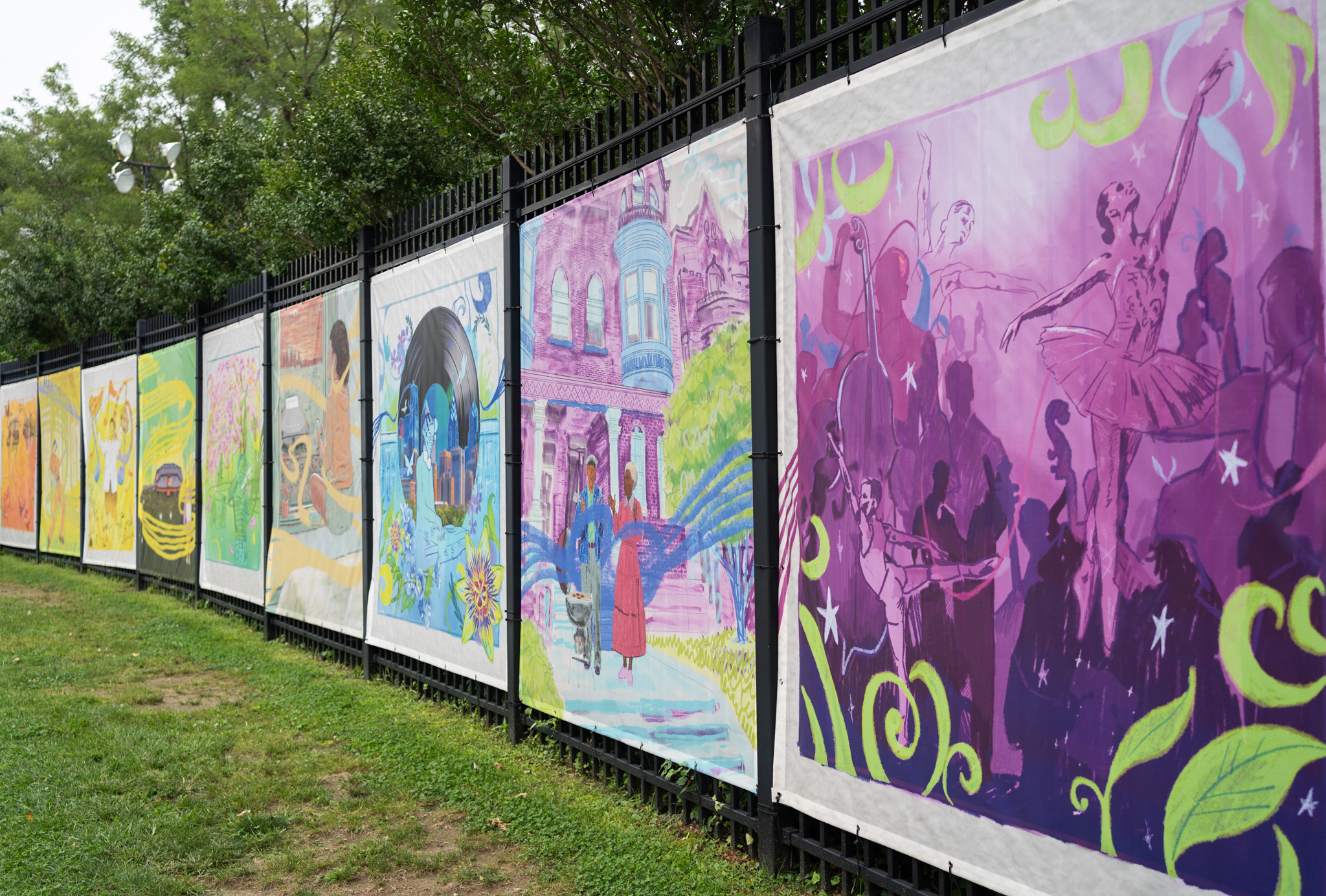
The new art installation, “Echoes Beyond the Stage,” was dedicated to the Highmark Mann Center for the Performing Arts on July 31, 2026.Courtesy of Earl
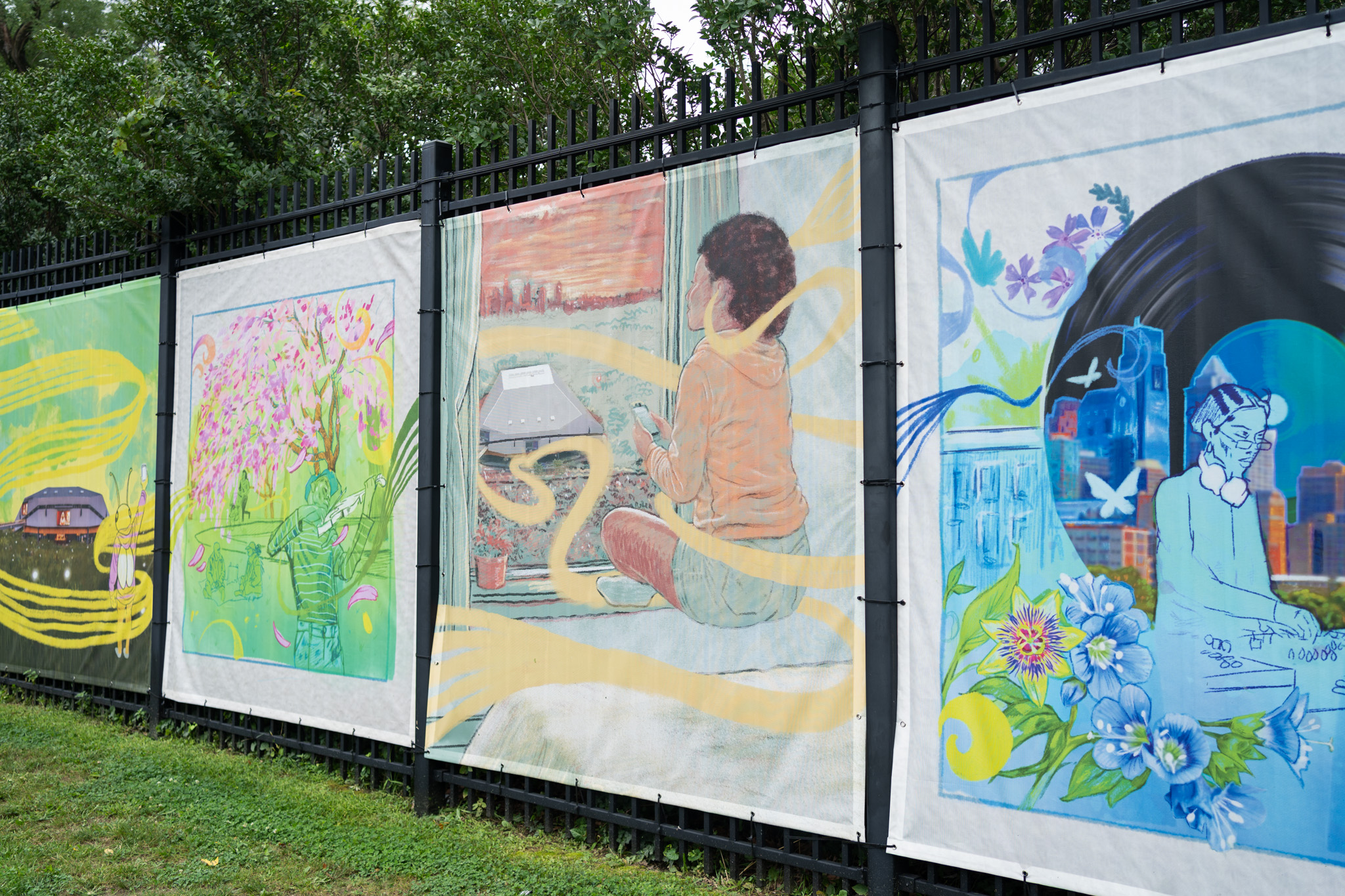
As visitors walk along the gravel-covered trail on Georges Hill Drive, they see a series of 10-foot-long panels that are a part of Echoes Beyond the Stage. The new installation was developed by artists Nile Livingston and De’von Downes to commemorate 50 years since the Mann moved to its current West Fairmount Park location.
Livingston and Downes collaborated with Streets Dept founder Conrad Benner and Mural Arts Philadelphia to create artwork that reflects the amphitheater’s history, while illuminating the people, historic blocks, and other institutions that surround its borders.
The new art installation, “Echoes Beyond the Stage,” was dedicated to the Highmark Mann Center for the Performing Arts on July 31, 2026.Courtesy of Earl
One mural references one of Aretha Franklin’s final performances at the Mann. Another highlights the century-old rowhouses that line the outside blocks, and others reflect the energy of past block parties, barbecues, and other activities brought to the community. Musical notes float from one panel to the next, showcasing the musical influences and memorable performances that have passed through time. Dancers, vocalists, DJs, and instrumentalists perform under purple, green, and amber-covered skies, while spectators watch from their amphitheater seats or windowsills.
While each panel differs in focus, they are bound by visual harmony. These works show Mann is not just a performance venue; it’s an essential part of the community and an integral piece of the city’s broader music history. And the best part? Visitors get a glimpse of it before stepping foot inside through the entrance gates.
The Highmark Mann Center for the Performing Arts is at 5201 Parkside Ave., Phila.
— Earl Hopkins
Turnstile’s ‘Never Enough’ reimagined by Will Yip, Alex G., and … Elton John?!
What do Alex G., Will Yip, and Elton John have in common?
The Havertown indie songwriter, Grammy-winning Philly producer and studio owner, and “Philadelphia Freedom” British rock legend all have a hand in Never Enough: Versions, the new album that reimagines Never Enough, the 2025 album by Baltimore pop hardcore band Turnstile.
Turnstile’s “Never Enough” won a best rock album Grammy for the band and Philadelphia engineer-producer Will Yip. Now it has been reimagined as “Never Enough: Versions,” with new takes on the songs by Elton John, Alex G., Hayley Williams, Branden Woody, Panda Bear, Slayyyter, and more.Trevor Roberts
Never Enough was already one of the most-acclaimed rock albums of the decade. At this year’s Grammys, the Brendan Yates-fronted band’s “Birds” won for best metal performance. And Turnstile and Yip, the owner of South Philly’s Memory Music Studios, who engineered the album and assisted Yates in producing it, won prestigious best rock album trophies.
Now, the 14-song album has been expanded with 22 new tracks, with the original songs remixed, rearranged, and reinterpreted by a dazzling array of artists.
Will Yip in Studio 5 in his newly constructed studio, Memory Music Studios, South Philadelphia, Tuesday, Jan. 13, 2026. He won a Grammy for his work engineering and assisting with production on Turnstile’s “Never Enough” which has now been expanded as “Never Enough: Versions.”Alejandro A. Alvarez / Staff Photographer
The most mind-blowing presence is John, who turns “Seein’ Stars” into a proper song, and whose fame exponential outreaches that of his fellow Turnstile fans.
Those fans include Paramore singer Hayley Williams, who interprets “Ceilings”; boygenius’ Julien Baker, who teams with Sudanese Canadian poet Mustafa on an absolutely gorgeous “Time Is Happening”; jazz trumpeter Brandon Woody, who turns in a lovely instrumental “Dreaming”; and breakout electro-pop star Slayyyter, who soars on a high-flying “Birds.”
Both Baltimore club party MC Rod Lee and New York synth-pop songwriter Porches take on the Never Enough title track. Alex G. — whose full name is Alex Giannascoli and is also in music news for his score to Jane Schoenbrun’s movie Teenage Sex and Death and Camp Miasma — delivers an atmospheric, cinematic spin on “Magic Man,” which is also interpreted by Panda Bear of Animal Collective.
All in all, it’s a thoroughly impressive project that makes Turnstile seem like they might possibly be the coolest band in the world.
“Never Enough: Versions” is available to stream and purchase on music stores and platforms.
The Continental Army won the Revolutionary War in 1783.
But, in the four years following that victory, the new country wasn’t very united. In fact, young America was only a loosely organized group of 13 colonies, with governors fighting to control their own fiefdoms.
That left the states vulnerable to world powers eager to scoop up the fragmented new nation. Add to that, America was broke, with debts owed to France, Spain, and the Netherlands after the Revolutionary War.
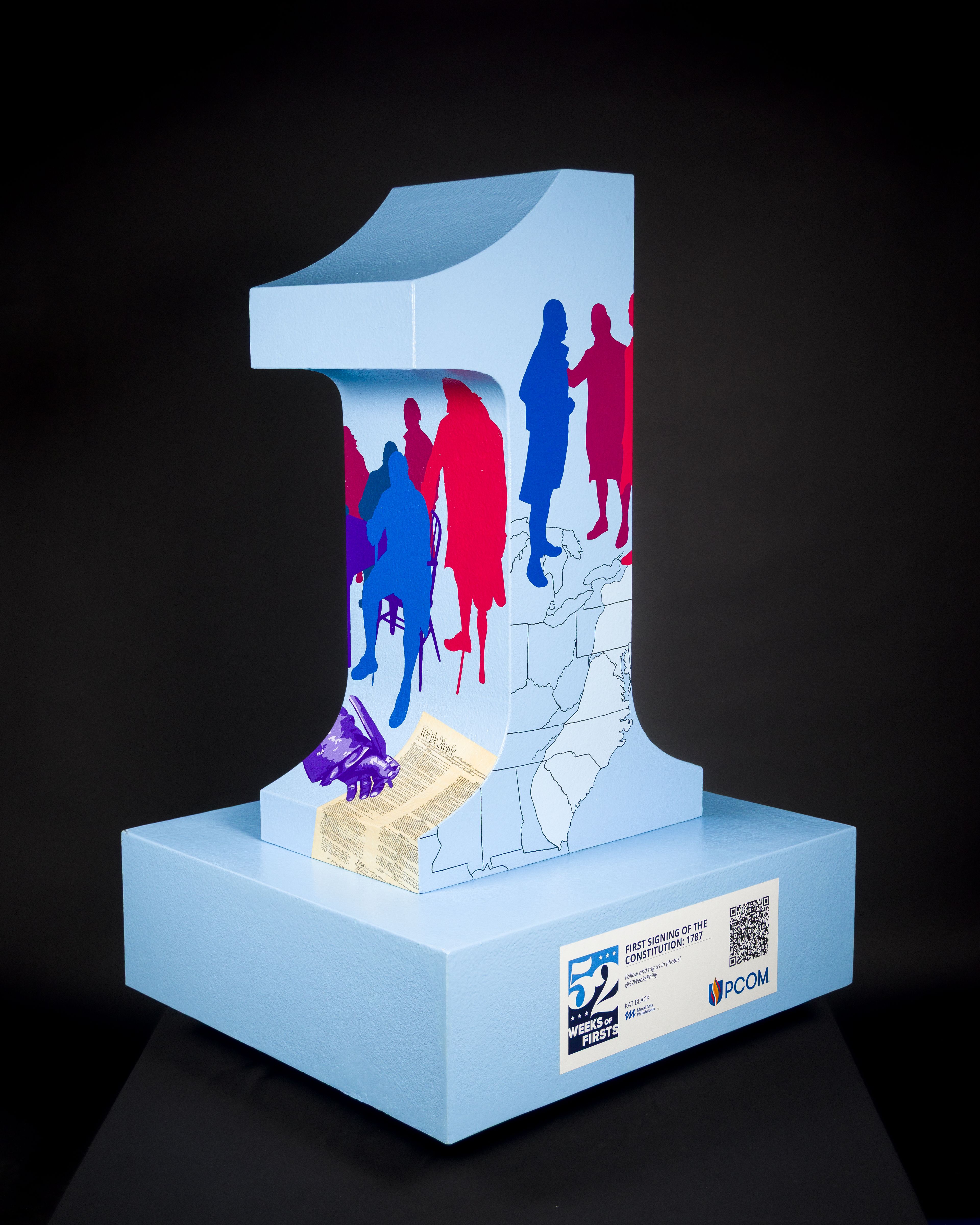
Kat Black’s design emphasizes the dedication and collaboration behind the signing of the U.S. Constitution in 1787.Kat Black for Colibrí Workshop
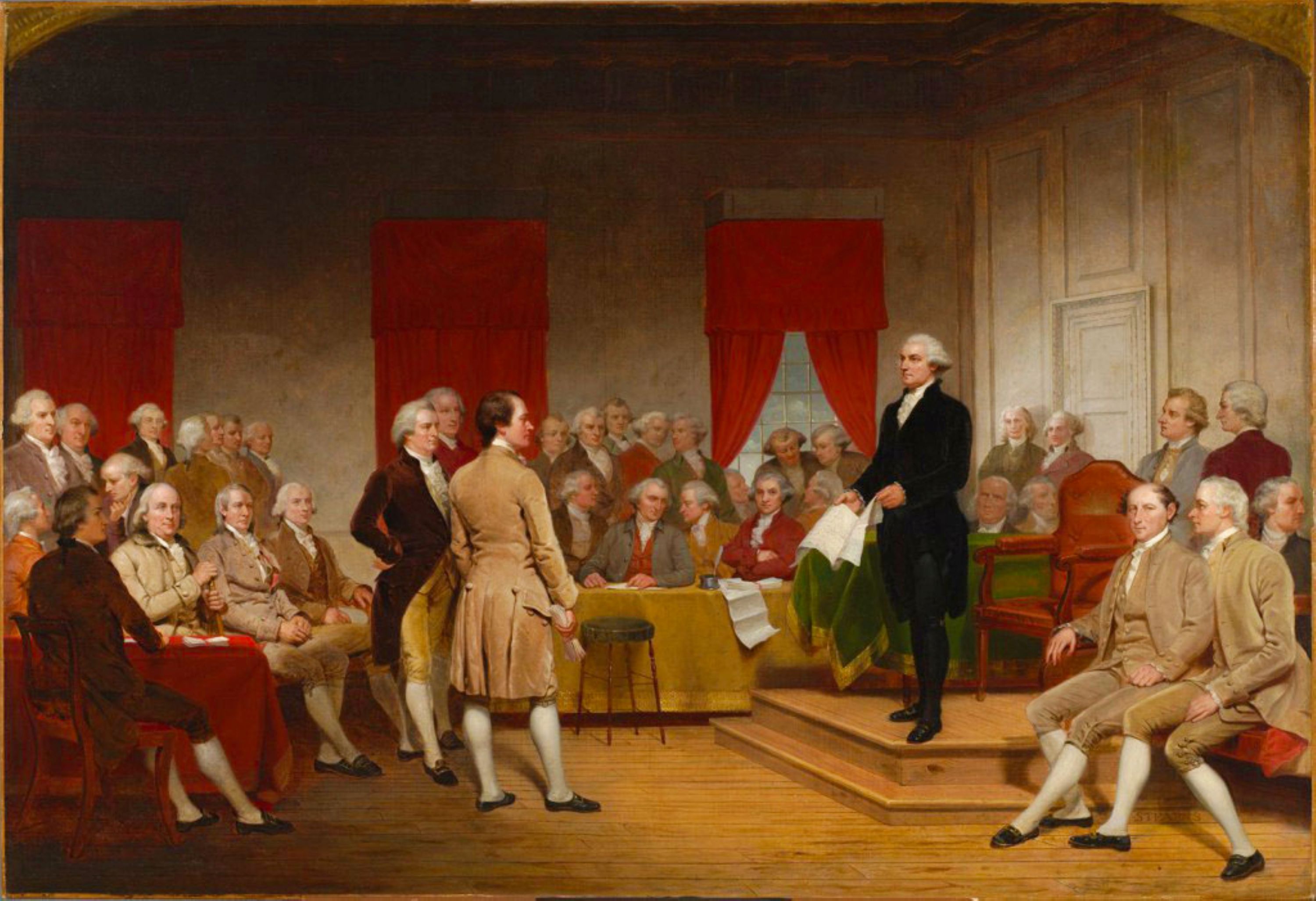
Petrified their “great experiment” would be short-lived and eight years of a violent revolution fought in vain, James Madison, Alexander Hamilton, and John Jay convinced George Washington to convene a Constitutional Convention at Independence Hall in May 1787.
By September, the delegates had worked out the brass tacks of the American government and signed the Constitution, establishing the political system that would help America become a world power.
This firstival will kick off a series of events honoring the Constitution and includes First Amendment Day on Sept. 9 and Constitution Day on Sept. 17.
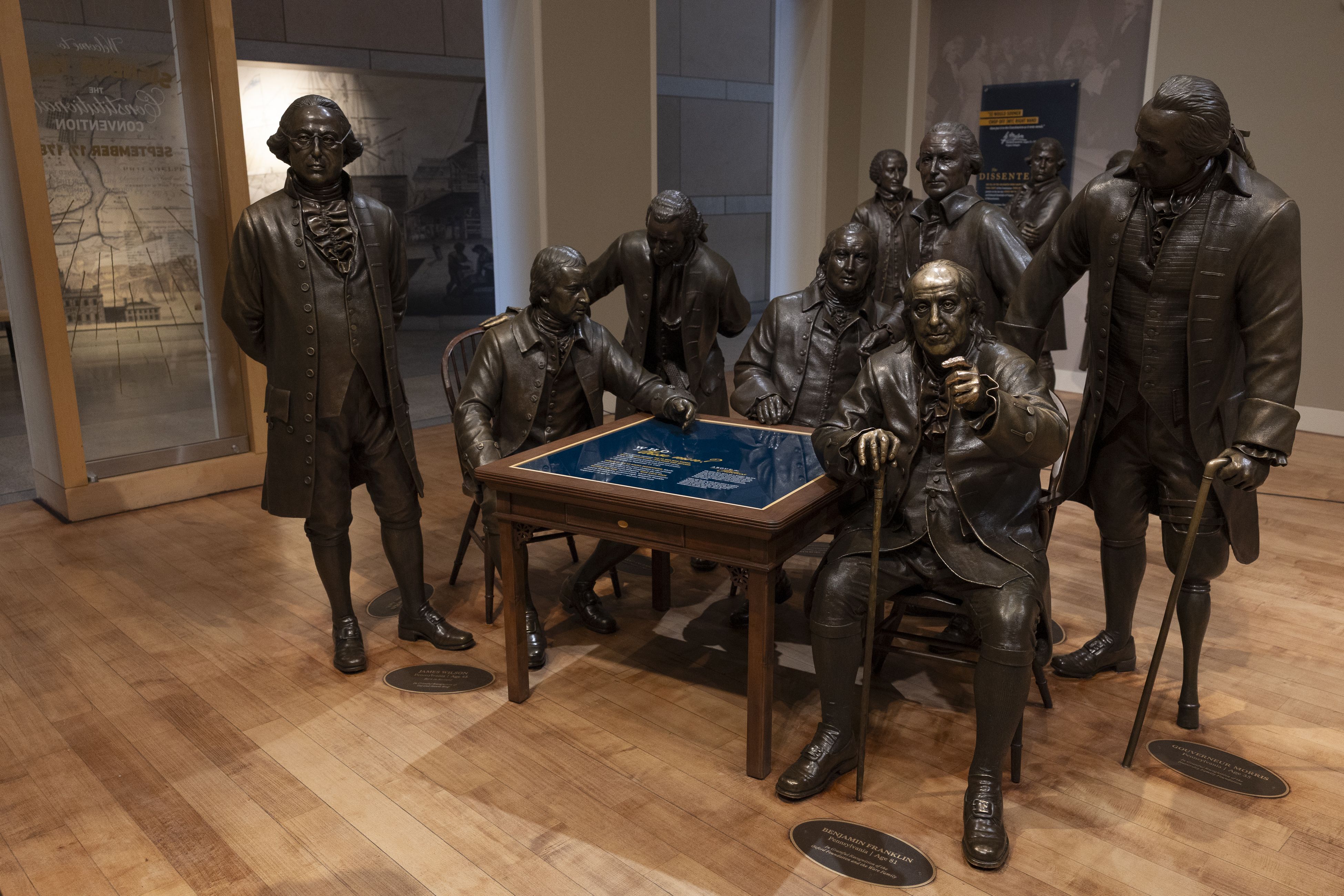
Statues of the delegates are on display at the National Constitution Center, 525 Arch St.Jason E. Miczek courtesy of the National Constitution Cente
“I think many of the Founding Fathers would be surprised to know the form of government they created is still going,” said Vince Stango, interim president and CEO at the National Constitution Center. “The Founders knew it was a ‘great experiment’ and … knew it would take work, compromise, and sacrifice.”
During the summer of 1787, 55 delegates from 12 of the 13 colonies — Rhode Island didn’t send delegates — wheeled and dealed to create a government by the people, controlled by the people, and unable to be corrupted by the people.
The Founding Fathers didn’t agree on much, but none of them wanted to be ruled by a monarch and insisted on a government with checks and balances.
Enter James Madison, author of the Virginia Plan that proposed a strong national government with three branches: executive, legislative, and judiciary.
After the three branches of government were established, a series of compromises were made. Among them, a legislative branch that afforded each state two Senate seats. The number of members of the House of Representatives for each state would be chosen based on population.
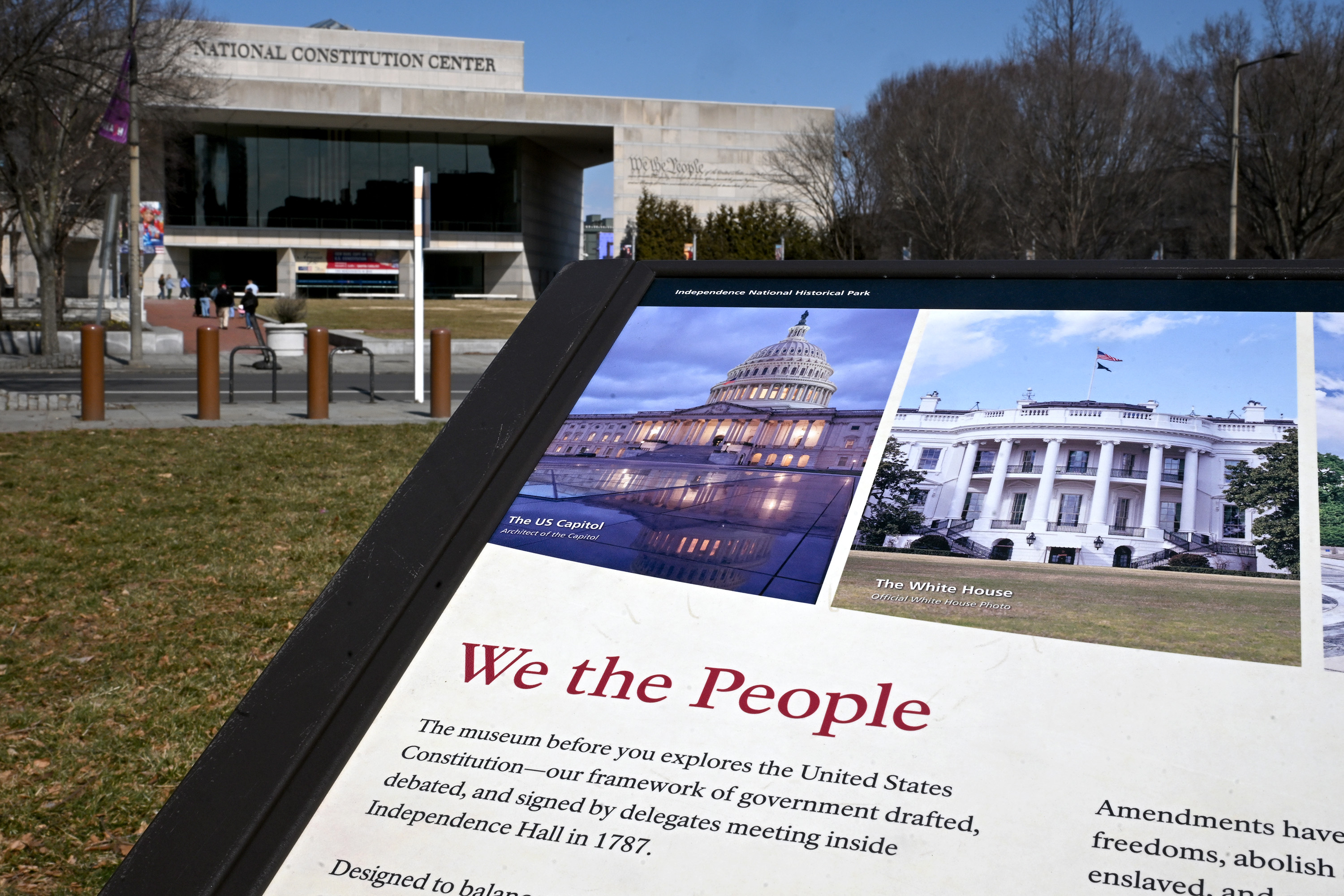
The National Constitution Center, 525 Arch St., is the site of this week’s Firstival, on Saturday, Sept. 5, from 11 a.m.-1 p.m.Tom Gralish / Staff Photographer
This set up a series of compromises that would institutionalize slavery. Enslaved Black people would be counted as three-fifths of a person to boost the Southern states’ population, giving them more representation in the House. Yet Black men — enslaved or free — would not have the right to vote anywhere until the 15th Amendment was ratified in 1870.
Compromises also included allowing the Atlantic slave trade to remain legal. Founders also inserted a Fugitive Slave Clause stating that if an enslaved person emancipated themselves, they could not be freed in the new state. These compromises, made to appease the South, instituted slavery as the law of the land, and paved the way for it to become the backbone of commerce that established America as a superpower.
During the convention, delegates also established the Electoral College. The Founding Fathers didn’t believe the average voter was intelligent enough to choose a president by majority vote.
Nevertheless, America officially became a constitutional republic.
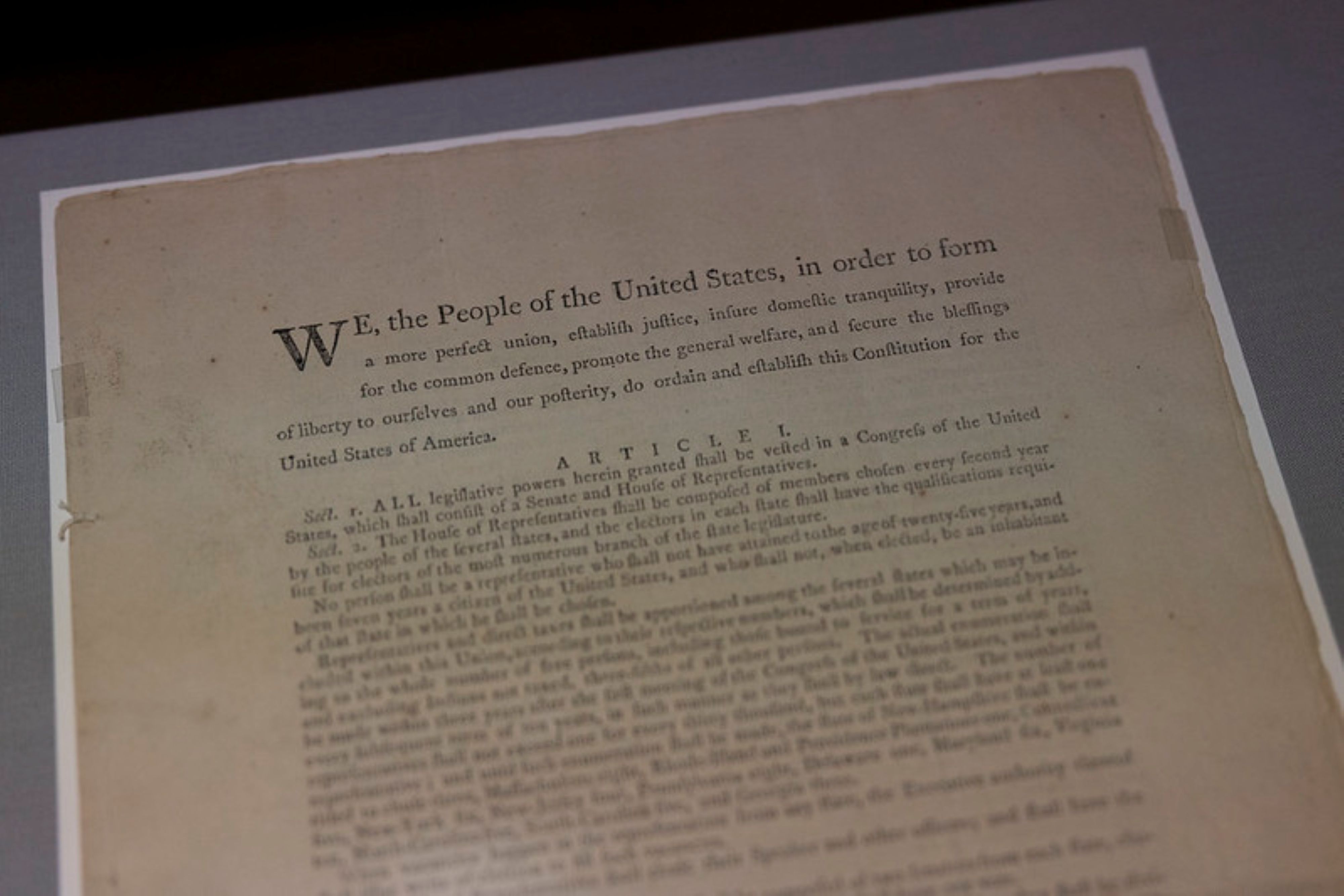
A copy of the United States Constitution, on exhibit in the National Constitution Center.Jason E. Miczek courtesy of the National Constitution Center.
Pennsylvania delegate Gouverneur Morris drafted the preamble and the Constitution’s seven articles between Sept. 8 and Sept. 12.
Although 55 delegates attended the Constitutional Convention, only 39 signed it on Sept. 17. The Constitution still had to be ratified. And there were still some issues.
The anti-Federalists — which included delegates and dissenters George Mason, Edmund Randolph, and Eldbridge Gerry — thought the power of government rested in the hands of the elite and advocated for a Bill of Rights.
After yet another of series of compromises, which included the promise of a Bill of Rights, the Constitution was ratified on June 21, 1788.
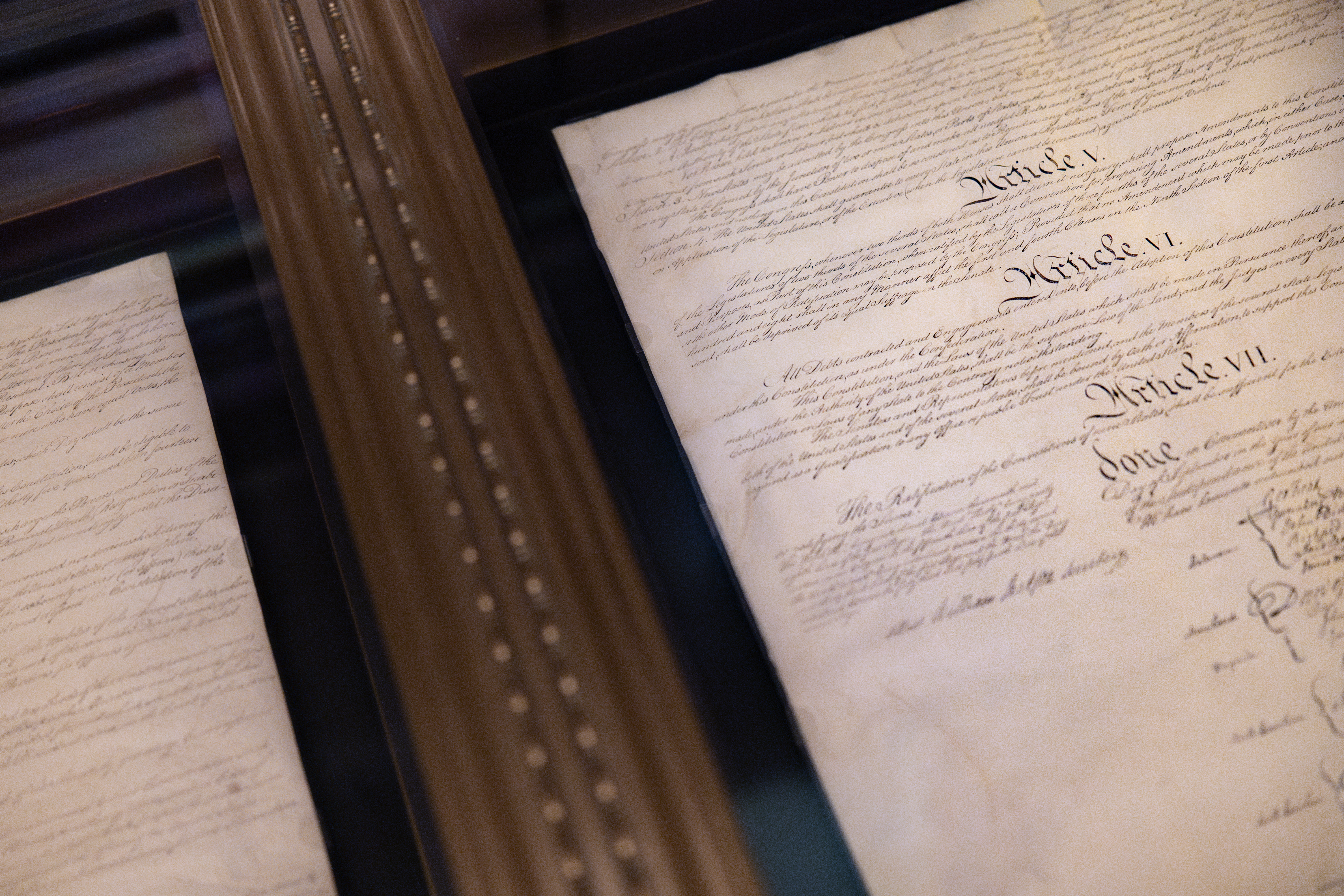
Article V of the Constitution, and the rarely shown fifth page, when it was on public display at the National Archives in Washington. MUST CREDIT: Tom Brenner / For The Washington PostTom Brenner
It went into effect on March 4, 1789, and on April 30 in New York, George Washington was sworn in as president of the United States.
On Dec. 15, 1791, Congress ratified the first 10 amendments of the Constitution, creating the Bill of Rights.
This week’s Firstival is Saturday, Sept. 5, from 11 a.m.-1 p.m., at the National Constitution Center, 525 Arch St.
After 205 years, the Saturday Evening Post, the famed magazine that printed its first issues on Ben Franklin’s Old City printing press and whose Norman Rockwell covers defined the optics of quintessential 20th-century Americana, will print its last issue early next year.
Subscribers received a letter in the September issue, which arrives in mailboxes this week, stating that the January/February 2027 issue will be the publication’s last printed edition. It will continue to publish online.
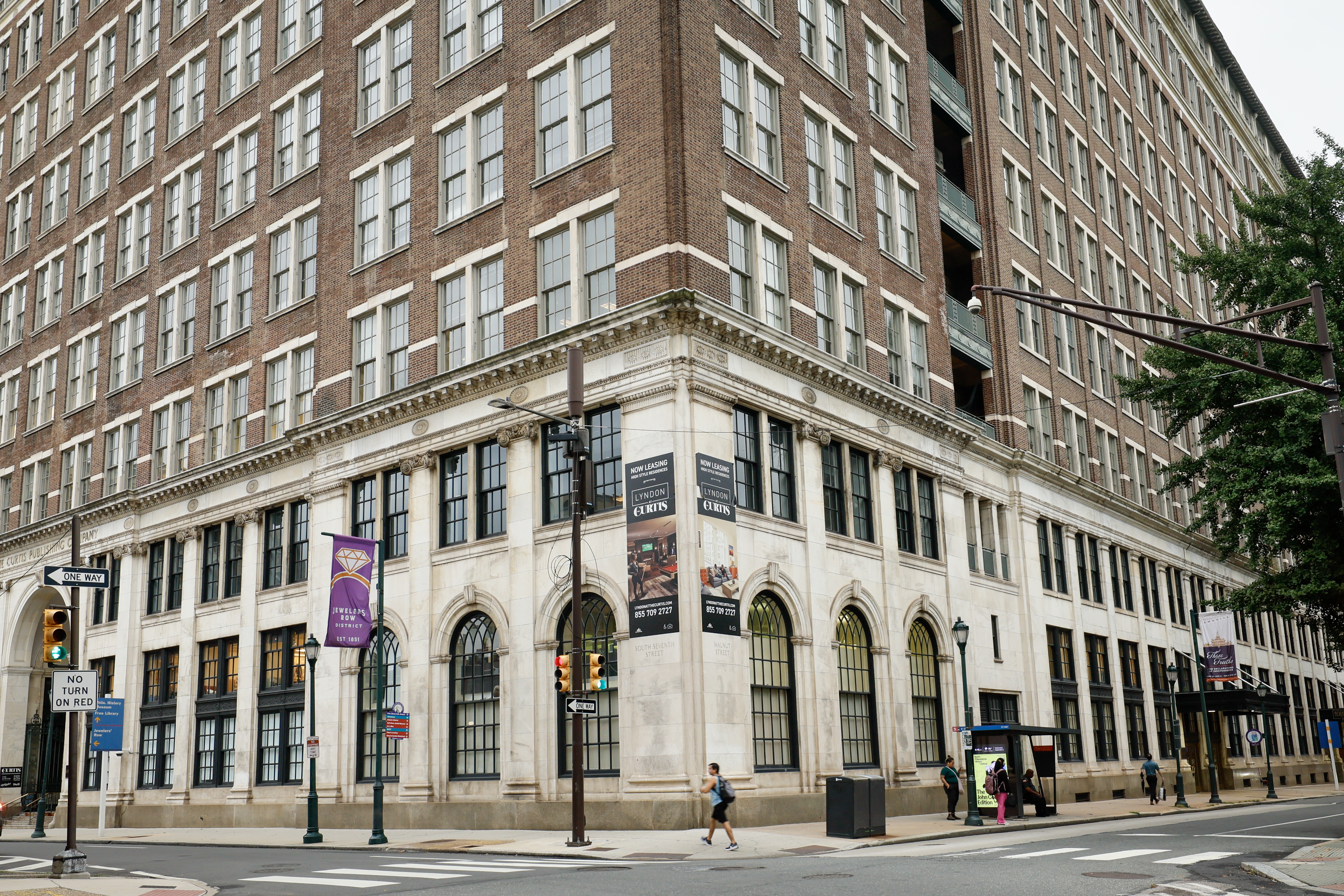
The Post, which was published from the Curtis Building at Sixth and Walnut Streets, from 1910 until 1969, was one of the standouts of 19th-century Philadelphia publisher Cyrus Curtis’ portfolio.
Like many other print publications, the change in readers’ habits has impacted the Post’s bottom line.
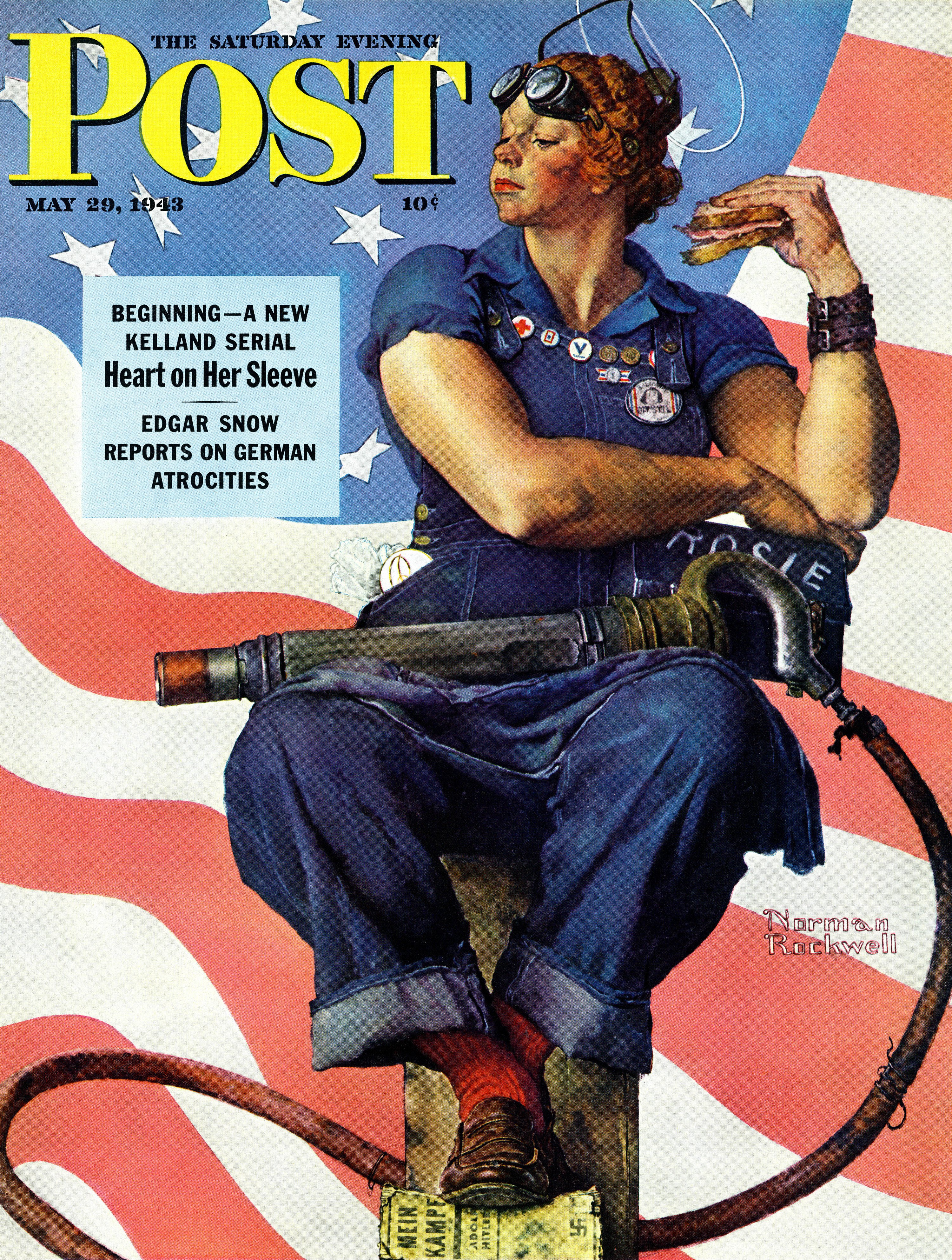
A Norman Rockwell artwork of “Rosie The Riveter,” on the cover of The Saturday Evening Post of May 29, 1943. The January 2027 issue will be the last Saturday Evening Post in print. The magazine, which debuted in 1821, will continue to publish new articles and fiction online.SEPS
“Advertising revenue has shifted away from print and we don’t have that 18-to-45-year-old demographic that does really well with TikTok,” said Joan SerVaas, the president and publisher of the Saturday Evening Post.
SerVaas’ father, Beurt, purchased the near bankrupt Post from the Curtis family in 1969 and moved the publication to Indianapolis.
Her mother, the late Cory SerVaas, who was a journalist and a physician, revamped the Post, adding coverage on health and wellness issues.
Joan SerVaas says she’s in talks with the University of Pennsylvania to purchase the mostly Philadelphia-centric ephemera that includes minutes from Curtis Publishing’s board of directors’ meetings dating back to 1886. Included in the collection are also correspondence from famous writers and artists including Rockwell and J.C. Leyendecker. Many of the original magazines going back to 1821 are also in the catalog.
“It’s really important to us that we preserve this history,” SerVaas said. “And Philadelphia is a wonderful place for it to be preserved because it’s the magazine’s home. Without Philadelphia, we would have no Post.”
The Post may have been based in Indianapolis for more than a half a century, but its media roots are in colonial Philadelphia’s cobblestoned streets.
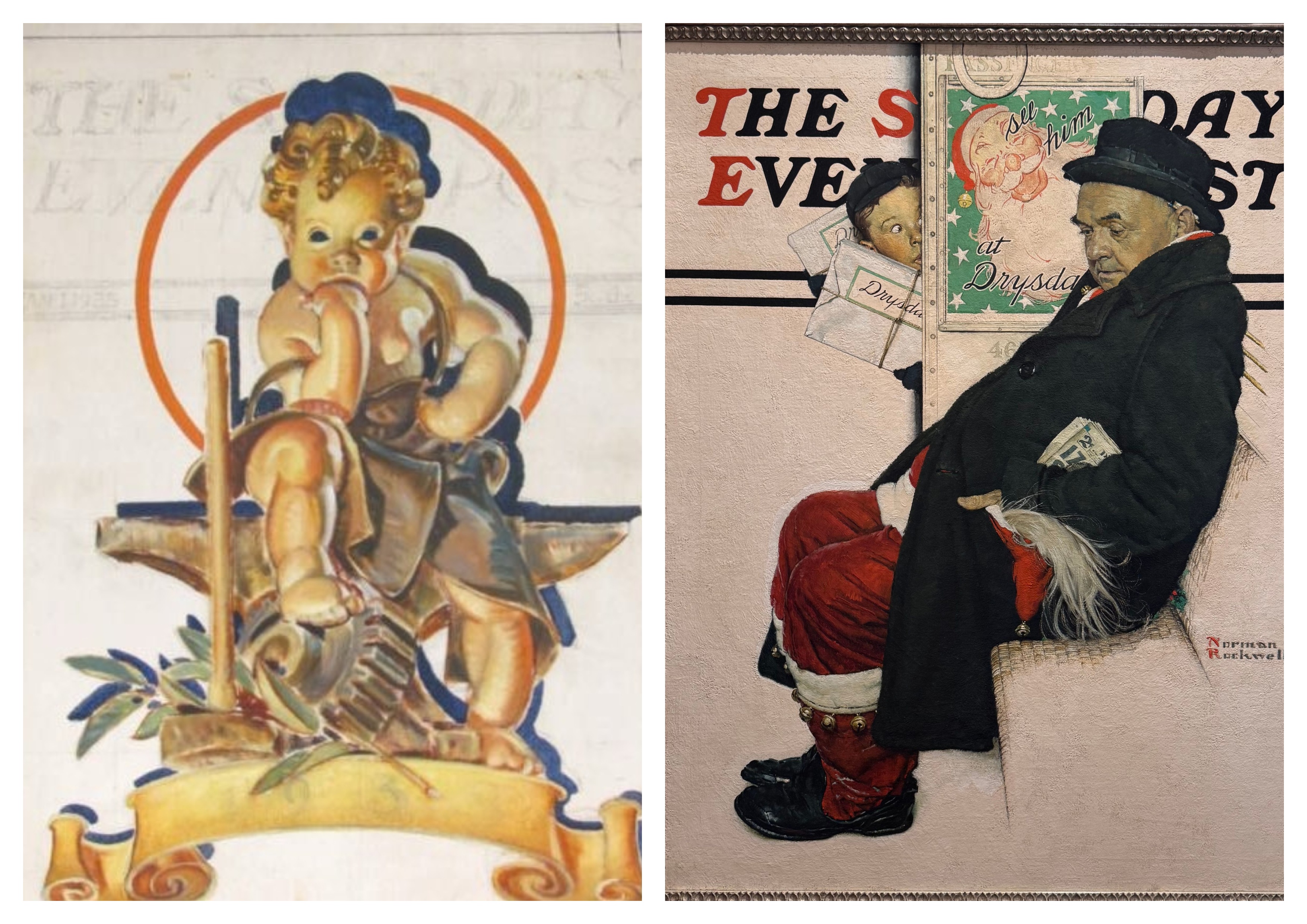
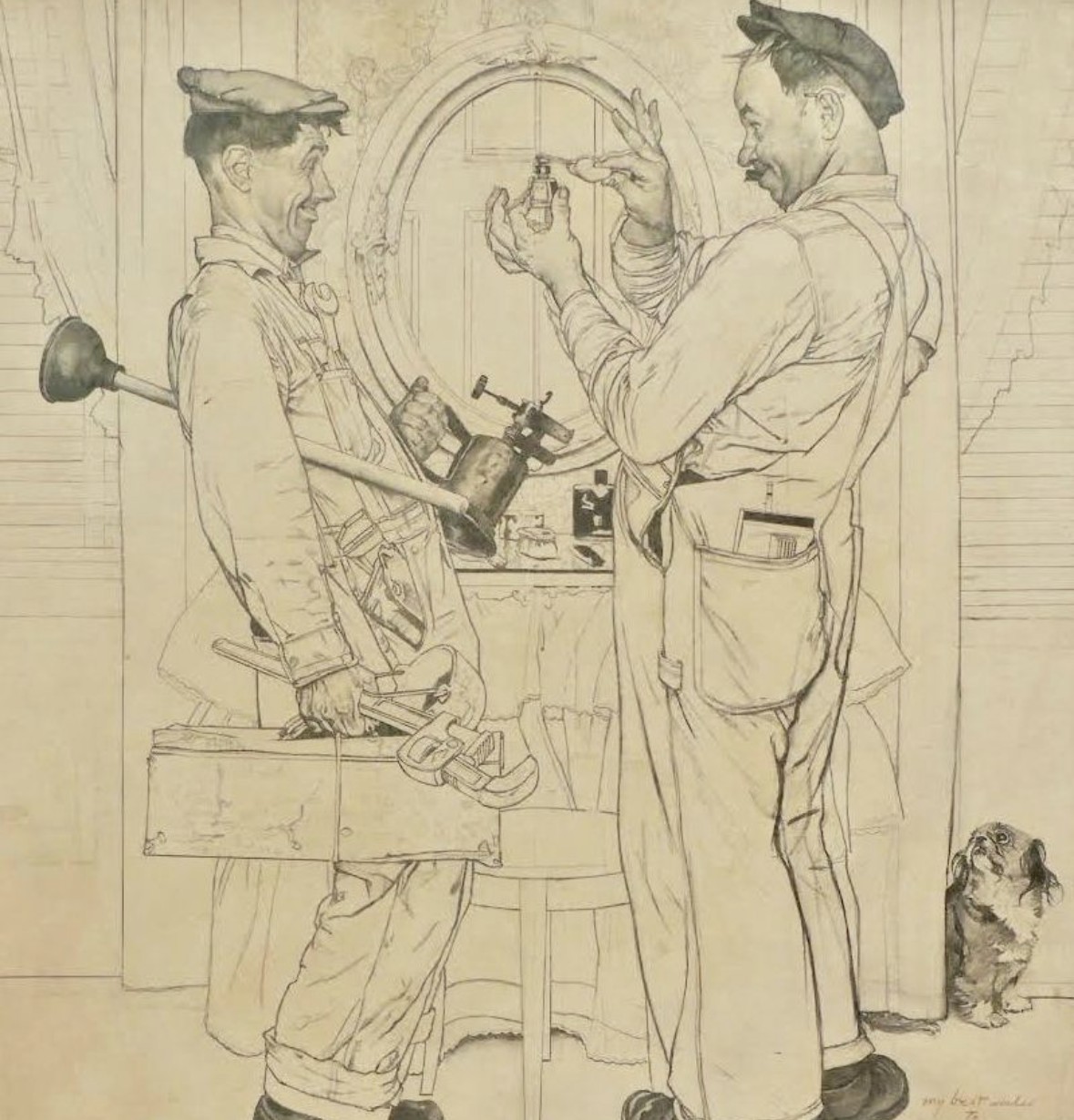
Norman Rockwell’s “Preparatory Drawing for Plumbers,” Saturday Evening Post cover, 1951.courtesy of Woodmere
In 1728, Benjamin Franklin took over the publication of the Pennsylvania Gazette, a general-interest magazine that covered politics, science, and government out of his print shop at No. 53 Market St. By the 1740s, it was the most popular publication in the colonies. Franklin retired in 1748 and the Gazette continued to publish until 1800, 10 years after his death.
By the early 1820s, Franklin’s print shop was owned by Samuel Atkinson. He, along with Charles Alexander, started a newspaper that would carry on the tone of Franklin’s Gazette but print in time to be delivered to Philadelphians in the Saturday evening mail. The Post carried news, but readers liked it because it reported on the drama — including letters — between ex-presidents and political enemies John Adams and Thomas Jefferson. The death of Napoleon was also a big story.
The Post also printed essays, stories, and poems written by major American writers: Edgar Allan Poe, James Fenimore Cooper, Harriet Beecher Stowe, Washington Irving, and Mark Twain. Circulation ebbed more than it flowed until 1897 when Cyrus Curtis — who transformed a farming magazine into Ladies’ Home Journal, the first magazine to reach a circulation of one million — purchased it from publisher A.W. Smythe for $1,000, about $40,000 in today’s money.
The Saturday Evening Post was published from the Curtis Building from 1910 to 1969. Elizabeth Robertson / Staff Photographer
Curtis wanted the Post to be for men what Ladies’ Home Journal was for women: cutting edge, insightful, and of the moment.
In 1899, Curtis hired 32-year-old literary editor George Horace Lorimer, ushering the magazine into its 20th-century heyday.
Lorimer would be one of the first editors to print the work of Joseph Conrad, O. Henry, Rudyard Kipling, and Jack London. And in 1916, when he was just 22, Rockwell received his first commission at the Post, beginning a 47-year relationship that produced 322 original cover illustrations.
Rockwell — whose most iconic paintings include the 1943 Freedom of Want of a family celebrating Thanksgiving dinner; the quirky 1953 Triple Self Portrait, and the 1963 memorial image of image of John F. Kennedy — was just one of many artists who got their break in the art world at the Post.
The Post helped fuel a community of illustrative artists most of whom lived in Philadelphia support themselves for more than 150 years, said William R. Valerio, executive director of Woodmere, the Chestnut Hill museum whose collection includes several Saturday Evening Post covers.
Rockwell’s Santa on a Train, and his Preparatory Drawing for Plumbers have both been exhibited in Woodmere’s Frances M. Maguire second floor gallery, an homage to Philadelphia-based illustrative artists. Many of whose work has graced the cover of the Post.
“Violet Oakley, Jessie Wilcox Smith, Robert Riggs, Benton Spruance, their work has all been in the Post,” Valerio said. “No artist works without community, and the Post helped create a vibrant community of artists in Philadelphia.”
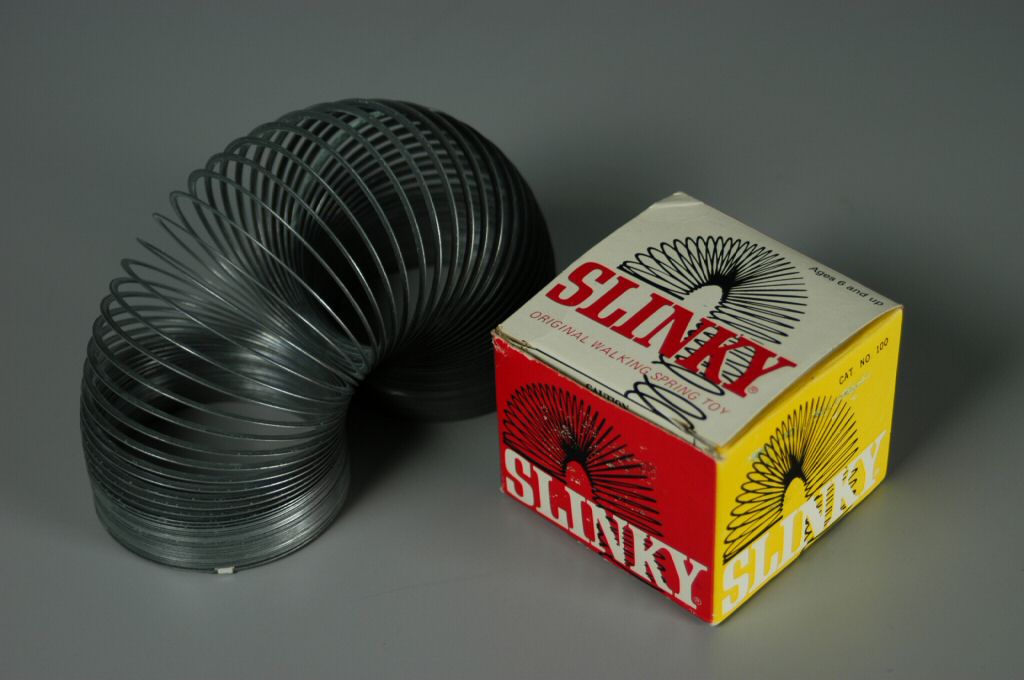
Philadelphia Navy Yard mechanical engineer Richard James was experimenting with a torsion spring in 1943 when the coil tumbled from his desk and landed on a stack of books.
The spring didn’t just sit there. The top coil flipped over onto the next book. Then the back coil flipped over to the next book. Before he knew it, this newfangled thing was taking the hardcovers like stairs.
Fascinated, James went home and showed the new toy to his wife, Betty.
She was enthralled and named the metal thingamajig a Slinky because of its wavy, stealthy movement.
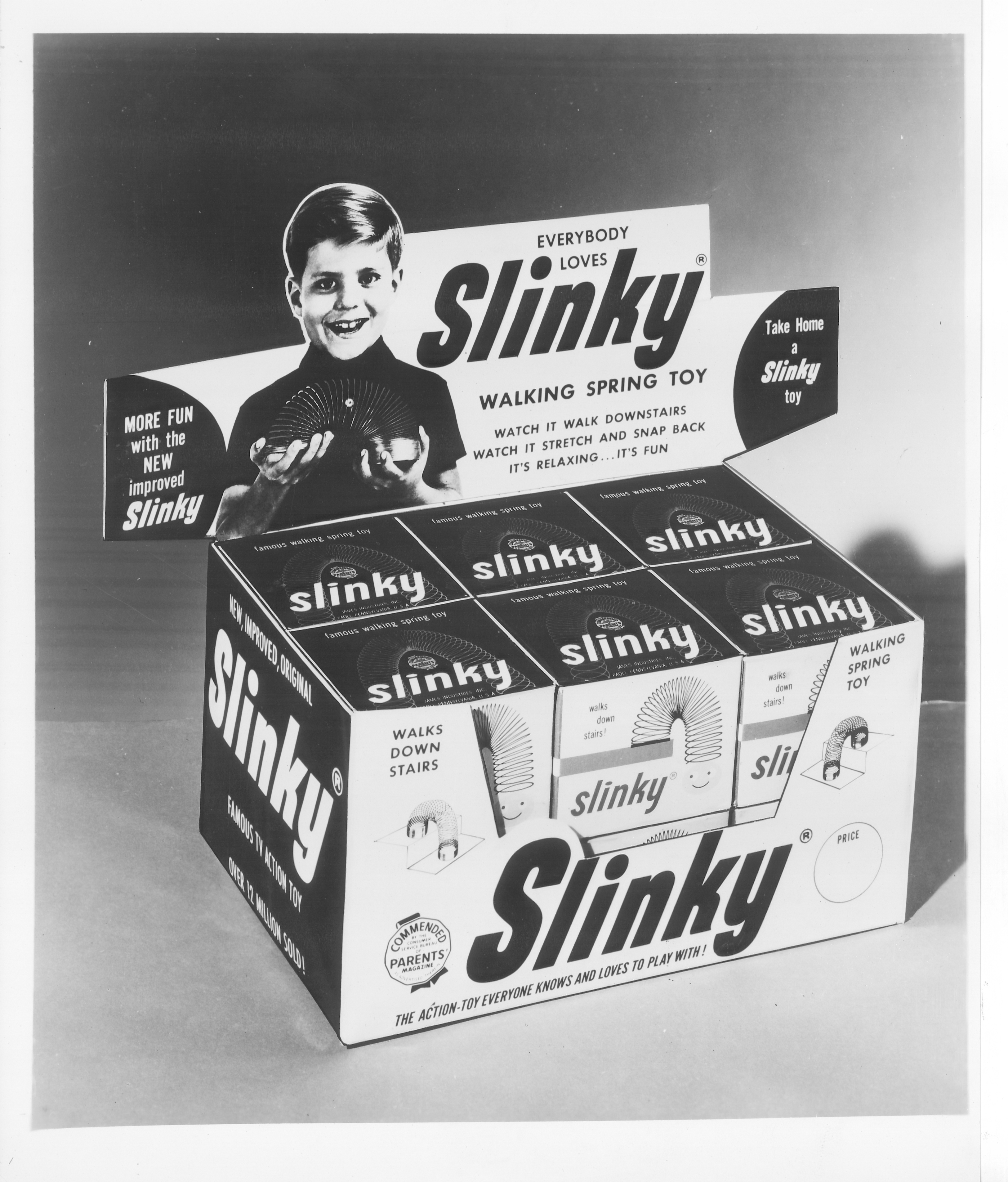
A vintage Slinky display.
James finagled with the metal spring for about two years, perfecting its flip-flop down-the-stack movement. Finally, on Nov. 27, 1945, the Jameses brought 400 Slinkies to Gimbels at Eighth and Market Streets, debuting them to shoppers. The whole lot sold out in 90 minutes for $1 a piece.
A toy craze was born.
This Saturday, the Philadelphia Historic District will host a “Firstival” to fete the Slinky at the American Philosophical Society from 11 a.m. to 1 p.m. The society’s archives house the 1953 study “On Slinky: The Dynamics of a Loose, Heavy Spring” by British mathematician and oceanographer Michael Longuest-Higgens.
Firstivals are weekly day parties celebrating America’s 250th birthday. This week’s Firstival is the 35th.
After the roaring success at Gimbels, Richard James quit his $50-a-week gig at the Navy Yard and founded James Industries, manufacturing Slinkies from a Germantown warehouse. Each Slinky was made from 80 feet of steel on a machine that James invented. It took 10 seconds to make each Slinky.
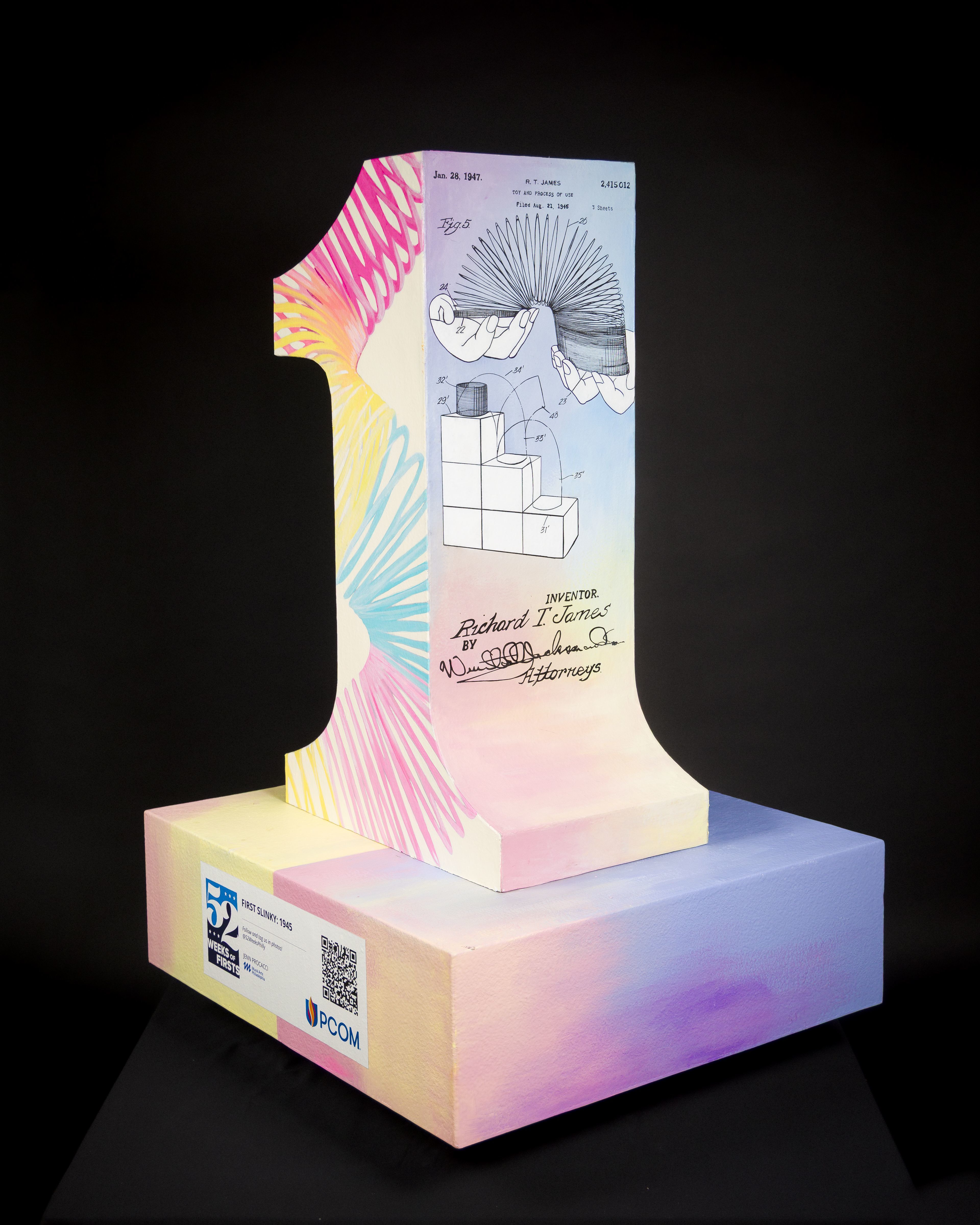
Jen Procacci’s No. 1 features the original blueprints of the Slinky design, commemorating one of America’s most-beloved toys.Jenn Procacci for Colibrà Workshop
Slinkies, considered the first toy craze, predating Cabbage Patch Kids, Tickle Me Elmo, and Beanie Babies, were so popular in the 1940s that Macy’s stopped selling them for a bit because the swarming crowds created a fire hazard.
In the early 1950s, published reports said the Jameses were making more than $1 million a year. James denied those reports in a 1950 Inquirer article but admitted to making “solid profits.” By the end of the decade, the Jameses’ Slinky operation had moved to manufacturing facilities in Clifton Heights and Paoli.
The couple divorced in 1961.
Richard James became a missionary in Bolivia, leaving his wife to manage the business and their six children. Betty James moved her children closer to family in Hollidaysburg, Pa., and commuted to the Philadelphia area for three years before moving the company closer to home in 1964.
In 1962, Betty James launched an aggressive television campaign to build awareness and increase Slinky sales. Songwriters Homer Fesperman and Charles Weagley wrote the unforgettable, now-iconic Slinky jingle.
“It’s Slinky, it’s Slinky. For fun it’s a wonderful toy.
It’s Slinky, it’s Slinky. It’s fun for a girl or a boy.
It’s fun for a girl or boy!”
The Slinky dog became a party trick. People wore Slinky glasses. Plastic Slinkies were introduced to the market.
The Slinky was everywhere.
“During the Vietnam War, soldiers used Slinkies as portable radio antennas,” said Zach Delphais, the public relations manager for Just Play Products, the Bucks County-based brand that owns Slinky today.
Betty James sold Slinky to Michigan-based Poof Industries in 1999.
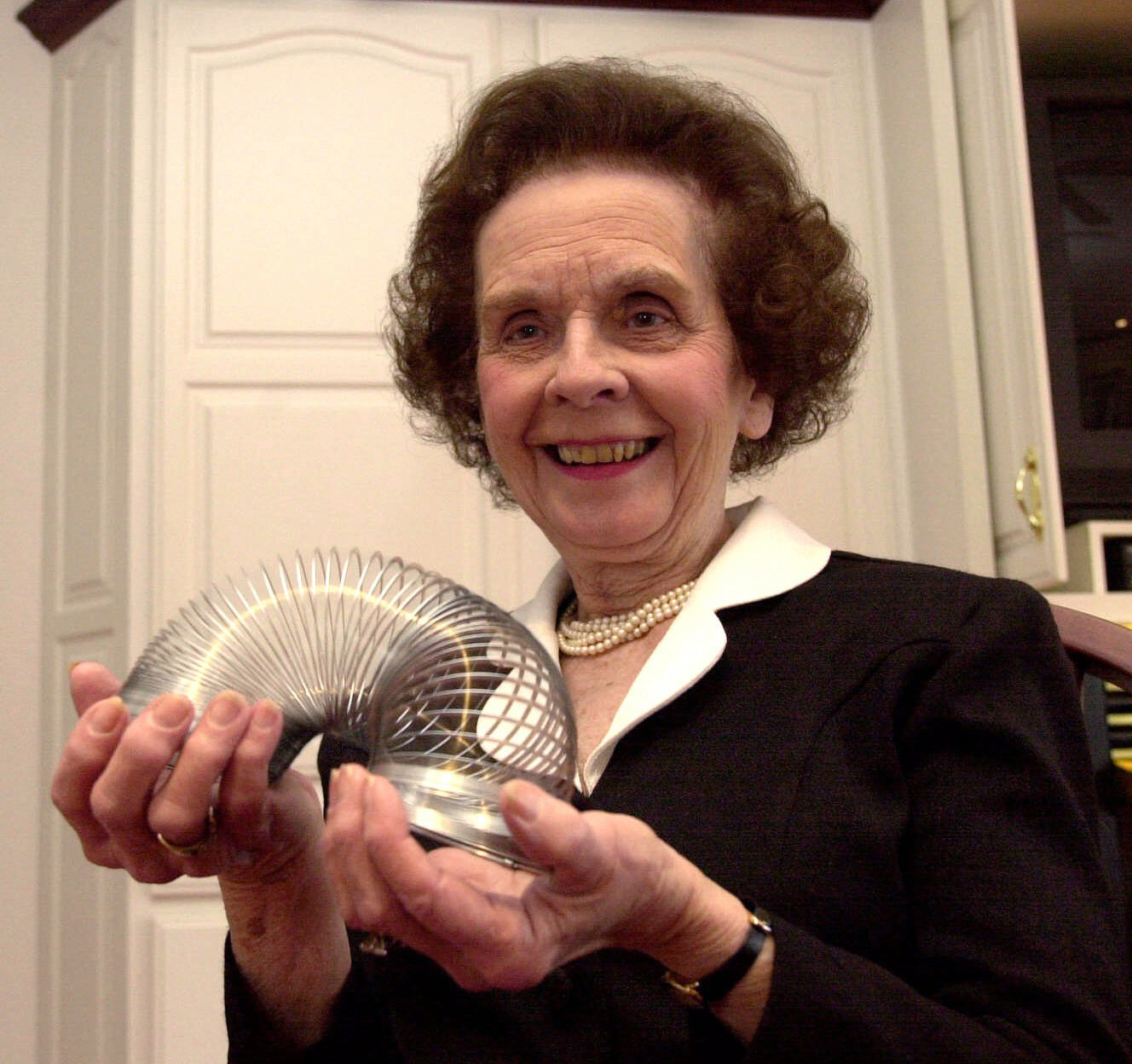
In this Jan. 18, 2001, photo, Betty James, retired president of James Industries, plays with a Slinky. She died in 2008.AP
In 2001, Betty James, then 84, was inducted into the Toy Industry Hall of Fame. At that time, more than 250 million Slinkies had been manufactured from hundreds of thousands of tons of steel.
“Slinky has lasted because it’s simple, it’s iconic, and every generation has connected with it,” Delphais said. “It started right here in Philadelphia. That makes it all the more meaningful.”
This week’s Firstival is Saturday, Aug. 29, from 11 a.m.-1 p.m., at the American Philosophical Society, 104 S. Fifth St.
A 1970s baby, I saw my mother (and all of the mother figures in my life) rocking big hair, glossy lips, sequins, and acrylic nails into the early 1990s.
As did the celebrities who have been a part of my pop-culture consciousness as long as I’ve been alive.
Women like Gladys Knight, Carol Burnett, Betty White, Patti LaBelle, and yes, Dolly Parton. These formidable women taught me my ABCs on Sesame Street, how to count on Electric Company, and random trivia on Password. These aunties in my head were just like my aunties, teaching me, guiding me, laughing with me, smiling with me, leaving powdery perfume trails of Jean Naté and White Shoulders in their wake.
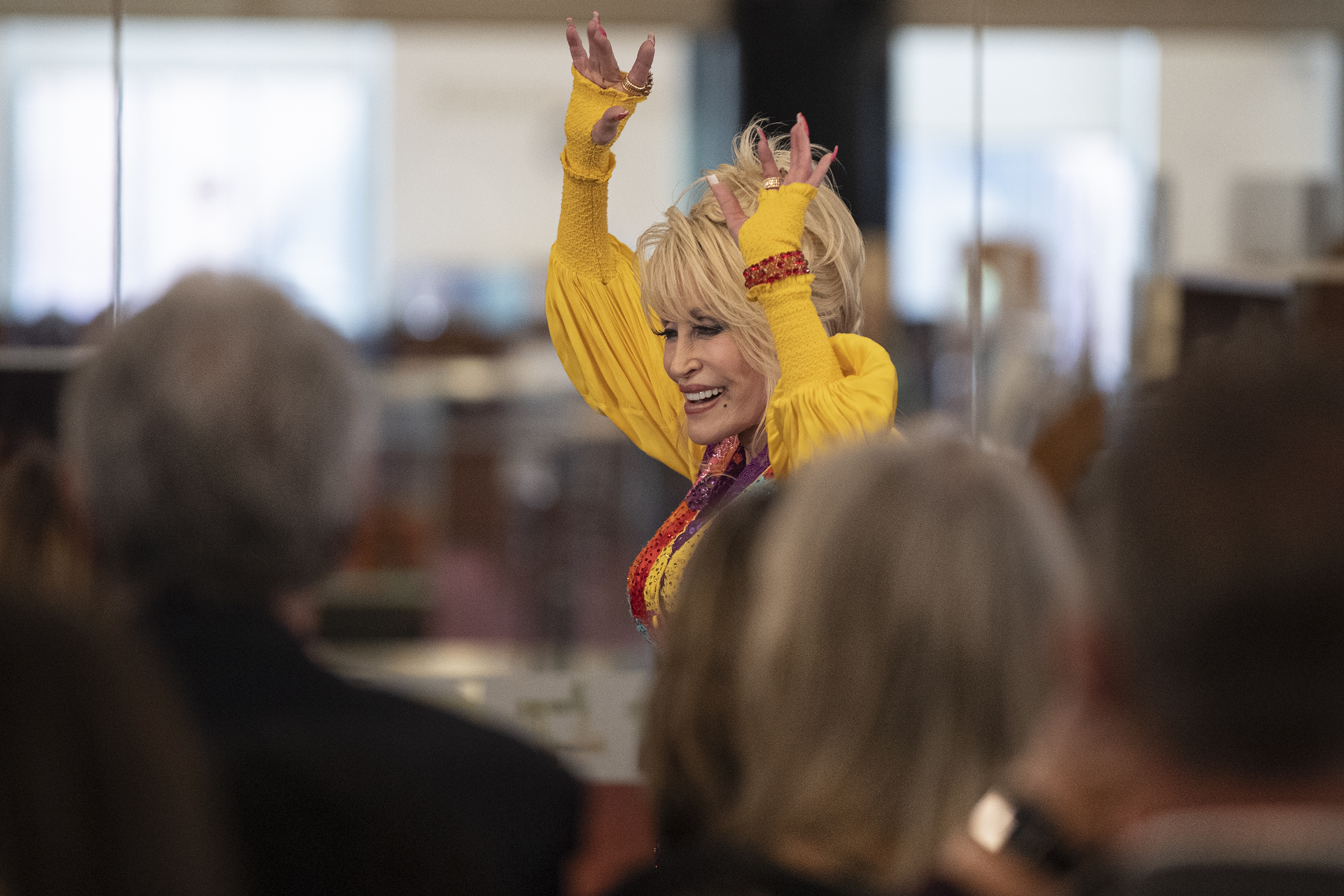
That’s why a video of Parton and LaBelle circulating on social media Tuesday afternoon made me pause and shed a tear.
In the hours after Parton’s nephew Bryan Seaver announced on Instagram the beloved, buxom country music singer had died, a 46-second clip emerged from Parton’s 1987 short-lived ABC variety show,Dolly.
Itis pure, unadulterated ’80s joy.
LaBelle in her crimped “On My Own” hair — the ‘do she debuted when she released the chart-topping hit with Doobie Brother Michael McDonald — is sitting across from Parton, whose trademark curly blond hair is piled high in a massive bouffant.
The divas are dressed in elaborate black gowns drenched in sparkles. Parton’s features a sweetheart neckline and poofy shoulders ending in a lace sleeve that would give Madonna’s wardrobe a run for its money.
The two look like they could be attending a prom, or a tacky wedding. (A Parton classic: ”It costs a lot of money to look this cheap.“) Wherever they are going, we know the vibe is going to be ’80s extravagant.
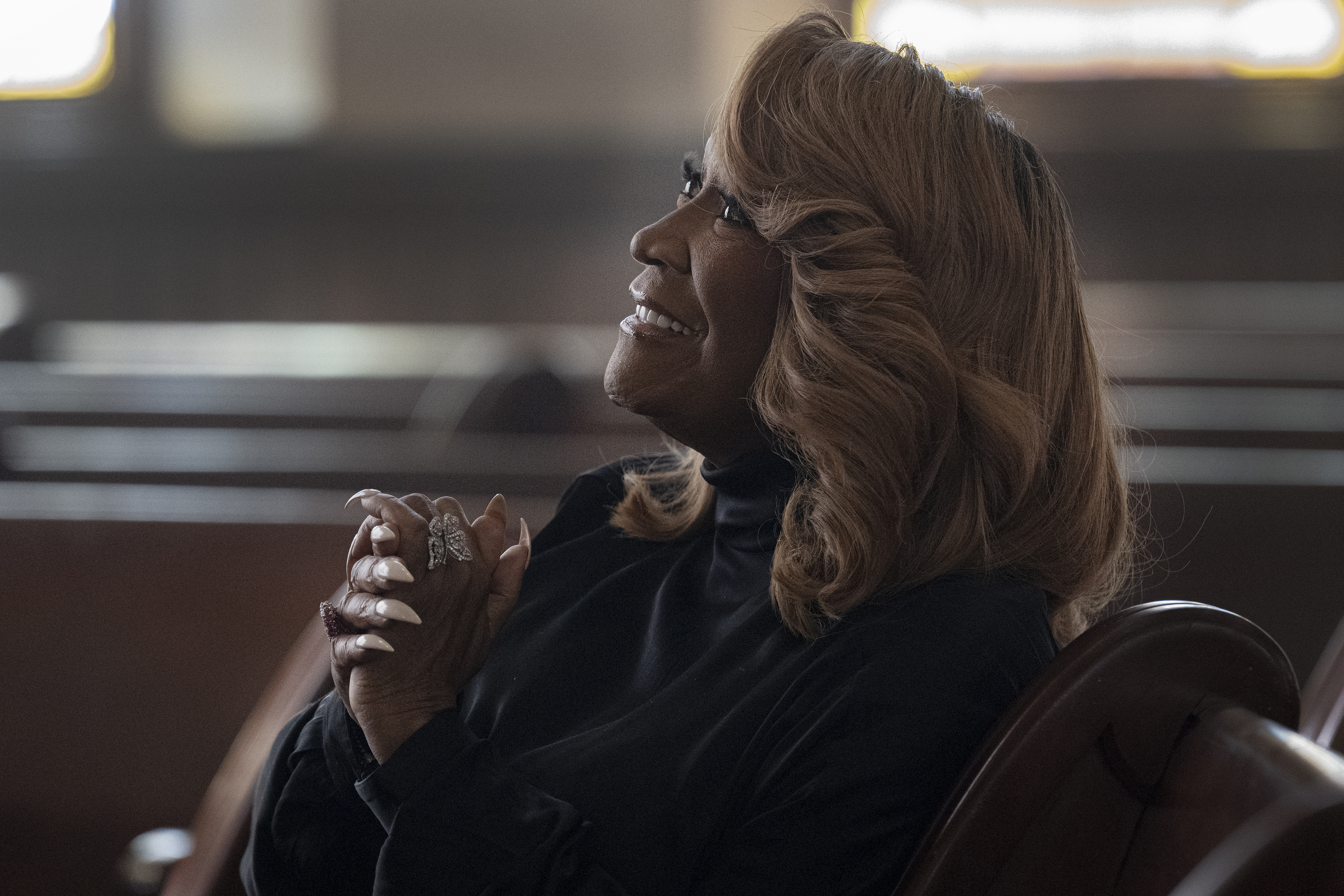
Singer Patti LaBelle is photographed at Mother Bethel AME Church in Philadelphia, Thursday, Jan. 22, 2026, during a shooting campaign for Visit Philadelphia’s Indivisible initiative, part of an effort to celebrate the city’s communities of color during the nation’s 250th anniversary. LaBelle is starring in the campaign’s Black History Month promotion.Jose F. Moreno / Staff Photographer
Parton, in her sweet melodic lilt, asks LaBelle if she would join her in using her acrylic nails as an instrument. The two women look like they are filing their nails as they strike up a rhythm.
Parton, who was born in a log cabin in Tennessee, and LaBelle, a Southwest Philadelphian whose dad was born in Macon, Ga. and moved to the city during the Great Migration, bond over acrylic nails and sing the chorus of the countriest of country songs, “Short’nin’ Bread.”
“Momma’s little baby loves short’nin’, short’nin’ / Momma’s little baby loves short’nin’ bread.”
Nails clicking. Powerful voices crooning. Parton and LaBelle sing the hook of the folk song written by James Whitcomb in 1900 in perfect harmony, their voices blending so beautifully that it’s easy to forget historians’ assertions that Whitcomb “borrowed” the song from Black sharecroppers. Allegedly, he retooled and performed it in a minstrel show.
The video speaks to Parton and LaBelle’s easy friendship and sisterhood.
“I’m deeply saddened by the loss of my dear friend who was loved by all,” LaBelle said in a statement Tuesday. “Dolly’s artistry, brilliance, and extraordinary life inspired so many people including me. Her light will forever shine!”
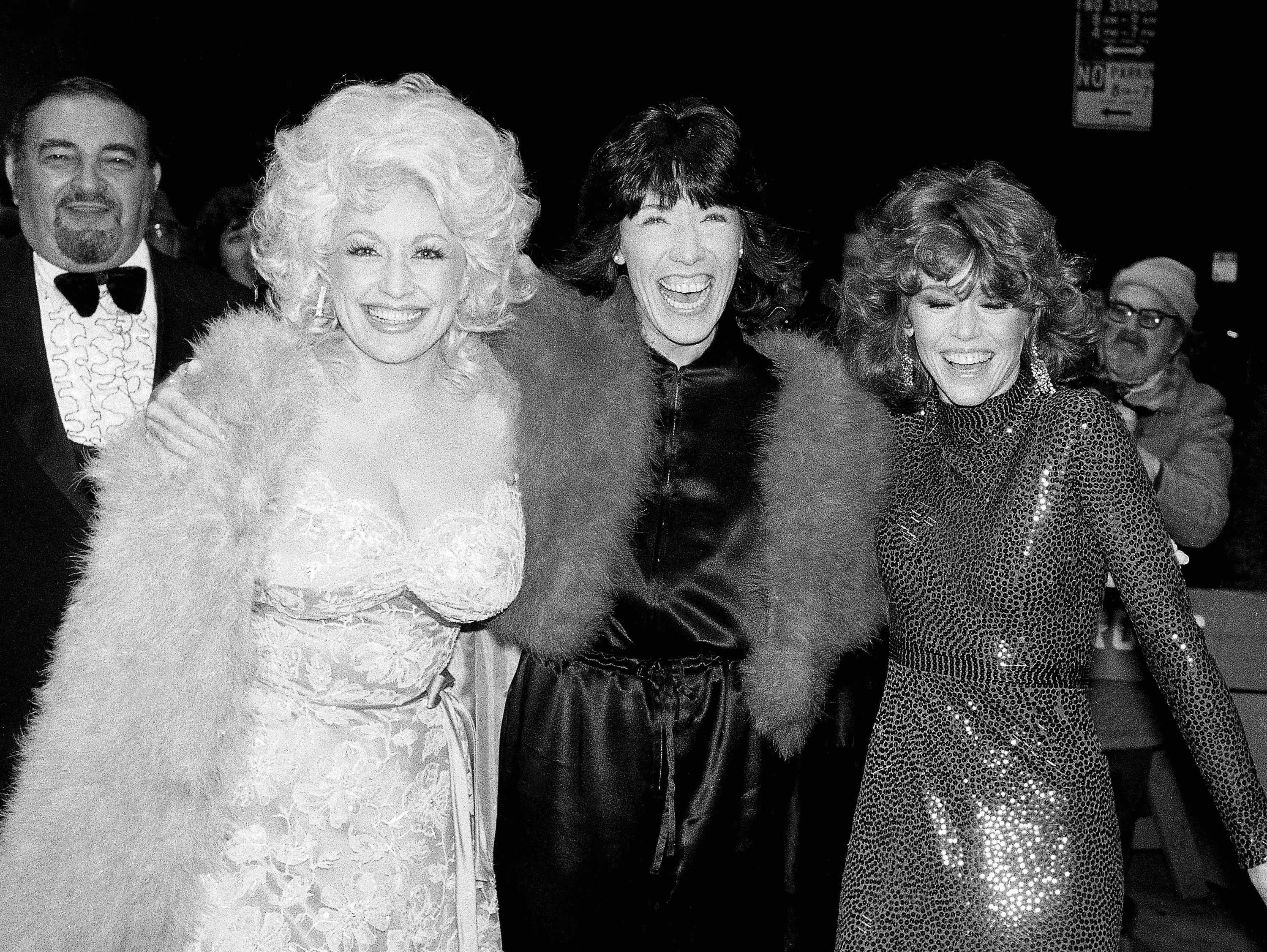
Dolly Parton (left), Lily Tomlin (center), and Jane Fonda arrive for the premiere of their film “9 To 5” in New York on Dec. 14, 1980. (AP Photo/Richard Drew, File)Richard Drew
When this performance was recorded almost 40 years ago, LaBelle and Parton had already been celebrities the better part of two decades. Both were already in their 40s. They’d reached auntie status.
My grandmother used to sing the chorus of “Short’nin’ Bread” while she dealt cards or when she rocked my sister and me in her wooden chair. Parton has been a part of my life in much the same way. Teaching me what it meant to work 9 to 5, performing on musical specials and childhood shows with other aunties and friends like Linda Ronstadt, Emmylou Harris, Loretta Lynn, and the queen of Philadelphia aunties, Patti LaBelle.
Parton was my country music auntie. She was America’s country music auntie.
French inventor Louis Jacques Daguerre introduced the daguerreotype — the world’s first photograph — in Paris in August 1839. By September, he produced a pamphlet introducing the technique to the world.
When the how-to-take-a-photo leaflets arrived in Philadelphia in late September, the city’s cultured men, scientists, and budding artists gave photography a shot.
But unlike today’s pointing and clicking, it wasn’t easy.
“All they got were the pamphlets,” explained Rachel Wetzel, senior photo conservator at the Library of Congress. “Nobody had a camera, plates, chemicals, or darkroom apparatus.”
The newly minted photographers needed paper-thin sheets of silver-plated copper, iodine, and mercury. The ratio of the chemicals needed to be exact, and the amount of sunlight needed for exposure to capture images varied wildly.
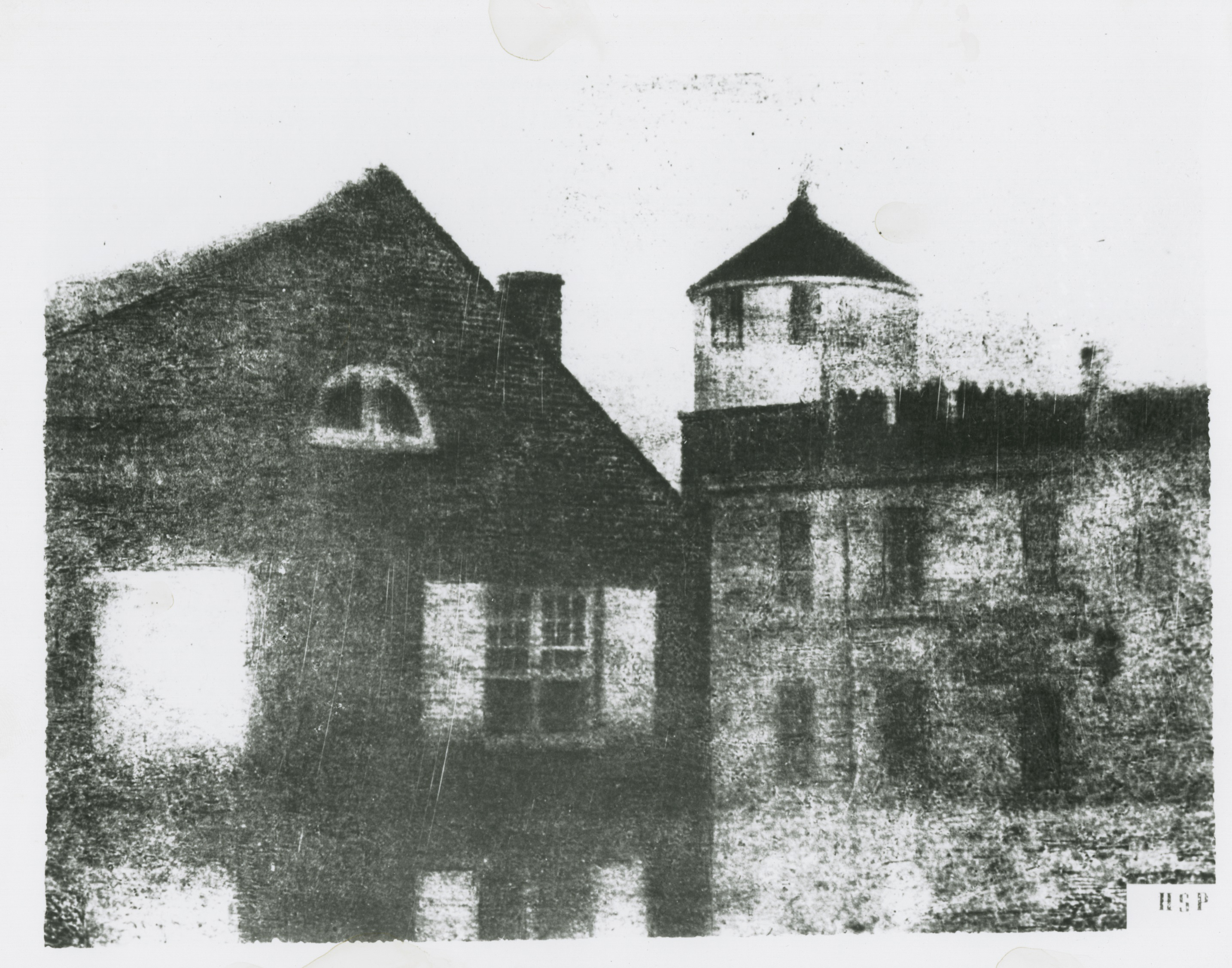
“Central High School, Philadelphia,” is a facsimile of daguerreotype attributed to Joseph Saxton made in 1839.The Historical Society of Pennsylvania
On Sept. 25, 1839, U.S. Mint employee Joseph Saxton, whose office was located on the northwest corner of Chestnut and Juniper Street across from Central High School, photographed the city’s first high school from one of his workplace’s top-floor windows.
Saxton soon took up photography as a hobby but had a hard time getting his hands on the thin, silver-plated copper sheets needed to make daguerreotypes. He asked his friend, lamp maker and metal-plating expert Robert Cornelius, for help.
Cornelius, who had a connection with Scovill Manufacturing, then among the most prominent metalworking manufacturing firms in the United States, happily obliged.
And as it turned out, Cornelius was curious about photography, too.
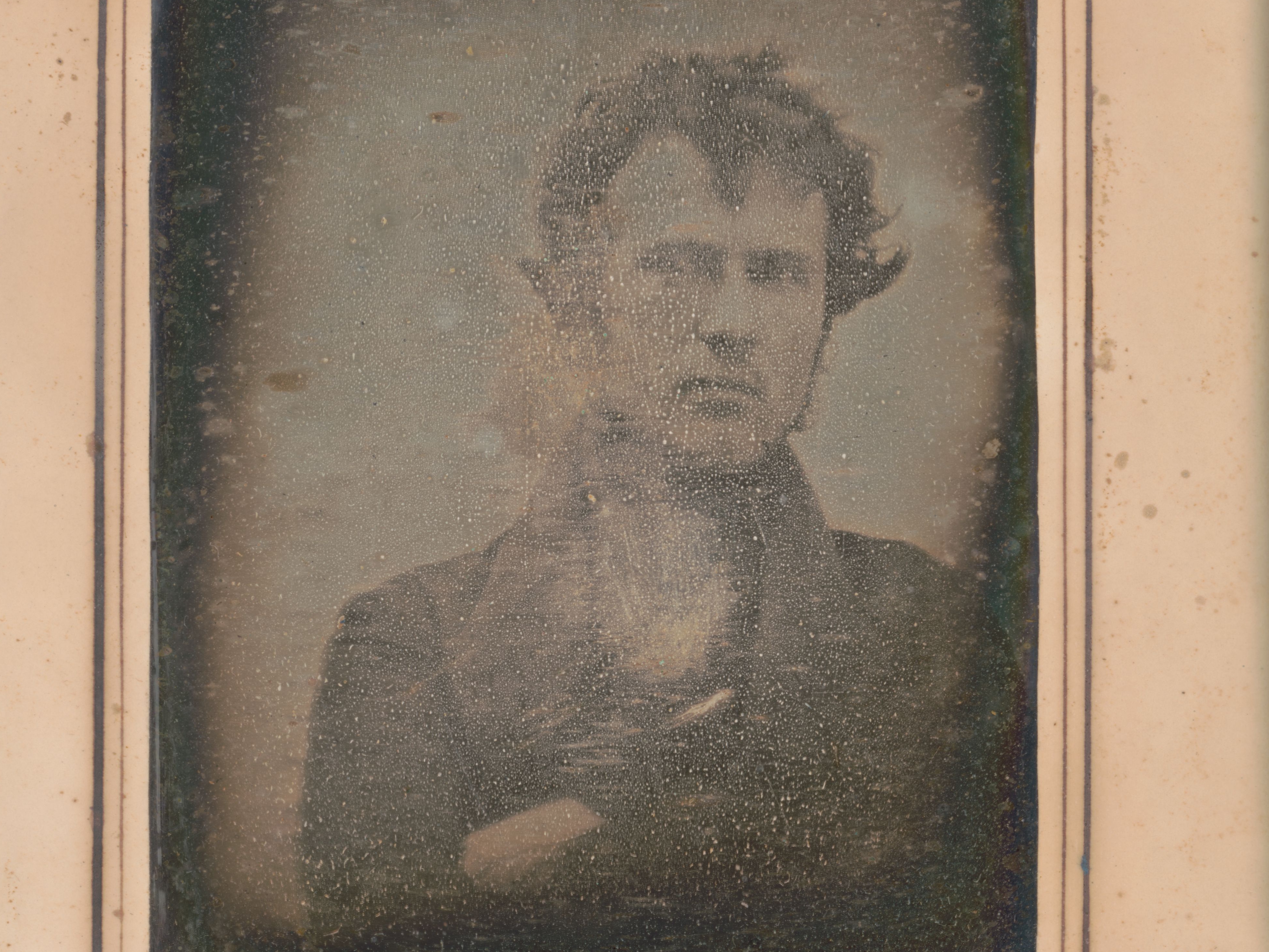
A few weeks later, in late October or early November, Cornelius found himself standing behind his family-owned lamp-making shop at what is today Seventh and Chestnut Streets, experimenting with a camera he fashioned from a small metal box.
Instead of pointing his lens at a lantern, a cobblestoned street, or a traveling horse and buggy, Cornelius turned his camera on himself.
He opened his lens cover and stood still long enough in the sunlight for the exposure to capture his image on a metal plate.
The selfie was born.
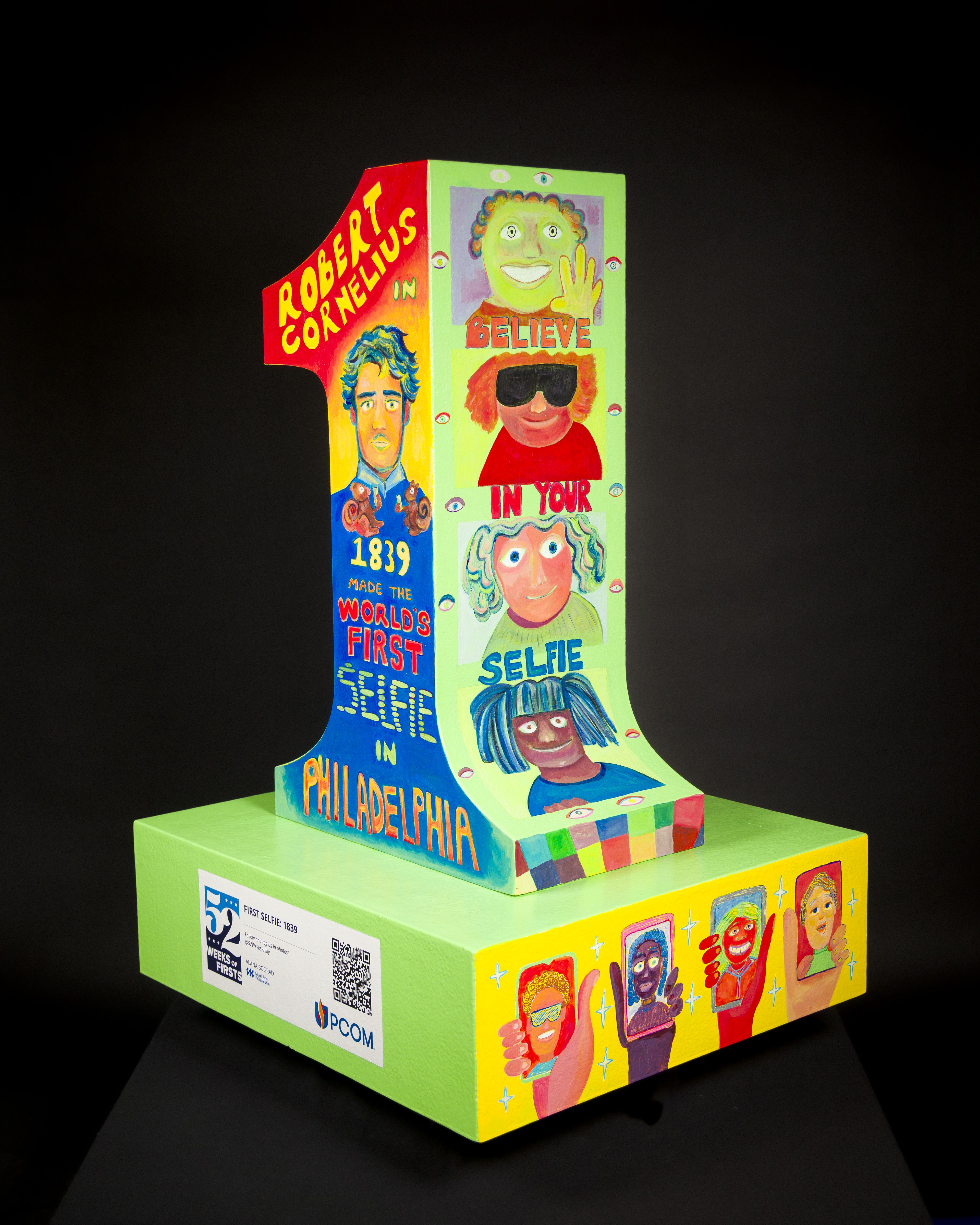
Alana Bograd’s design highlights the fact that the surprising fact the oldest extant photographic portrait photographic portrait was a self-portrait that today we call a selfie. It was taken in Philadelphia by Robert Cornelius in 1839.Alana Bograd for Colibri Workshop
That first selfie is housed in the Library of Congress.
And that magnificent moment — predating social media by almost two centuries — will be feted this Saturday at Franklin Square from 11 a.m. to 1 p.m. The selfie celebration is the Philadelphia Historic District’s 34th firstival, a weekly day party in honor of America’s 250th birthday, giving love to events and happenings with very Philly roots.
When Daguerre came up with his picture-taking method, he did not have portraits in mind, Wetzel said.
Historians aren’t sure why Cornelius decided to make a picture of himself, but in an 1892 American Journal of Photography article, he talked about what it was like standing alone on the streets of Philadelphia waiting for the image to happen, Wetzel said.
“When he stood in front of the camera, he wasn’t sure if he was centered or not,” Wetzel said. “That’s why he’s weighted to the right of the plate.”
The wonder surrounding taking the first selfie seemingly inspired Cornelius.
In May of 1840, Cornelius opened the world’s second portrait studio at Eighth and Lodge Alley (now Ranstead Street), not far from his family’s lamp-making shop.
Business partners Alexander S. Wolcott and John Johnson opened the world’s first portrait studio in New York a few months earlier, but only Cornelius’ 1840 portraits endured, explained Wetzel, who is also a leading historian in Cornelius’ work.
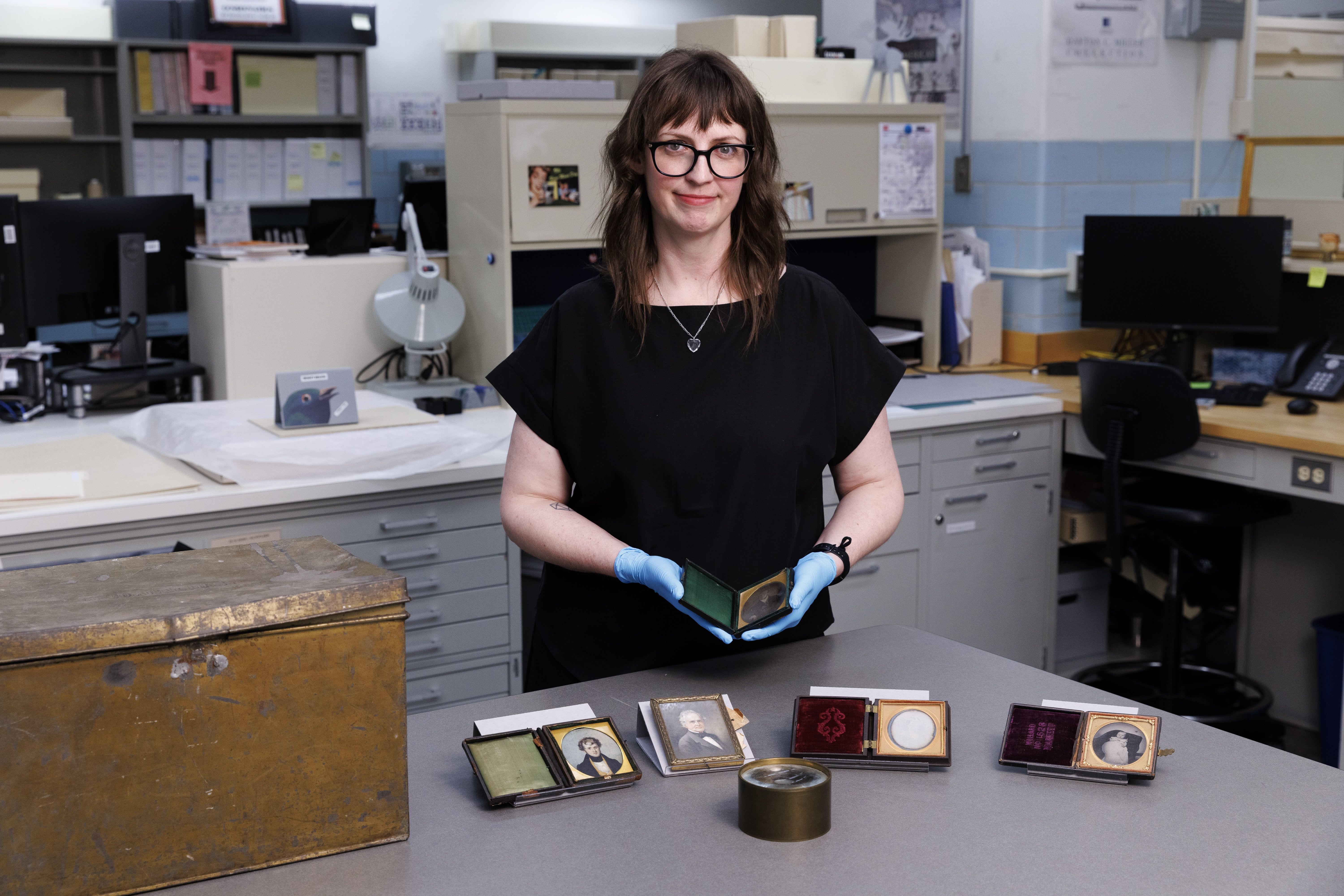
Robert Cornelius historian Rachel Wetzel surrounded by Cornelius’ daguerreotypes at the Library of Congress. Shawn Miller
She began studying Cornelius’ work in earnest in 2015 while working in Philadelphia at the Conservation Center for Art & Historic Artifacts. Wetzel has studied upward of 70 of Cornelius’ portraits, thanks to plates that have survived more than 100 years.
Cornelius took portraits of prominent citizens — many of whom were Quakers — in their Sunday best because at $5 a piece, the equivalent of a week’s salary in those days, they were the only ones who could afford it.
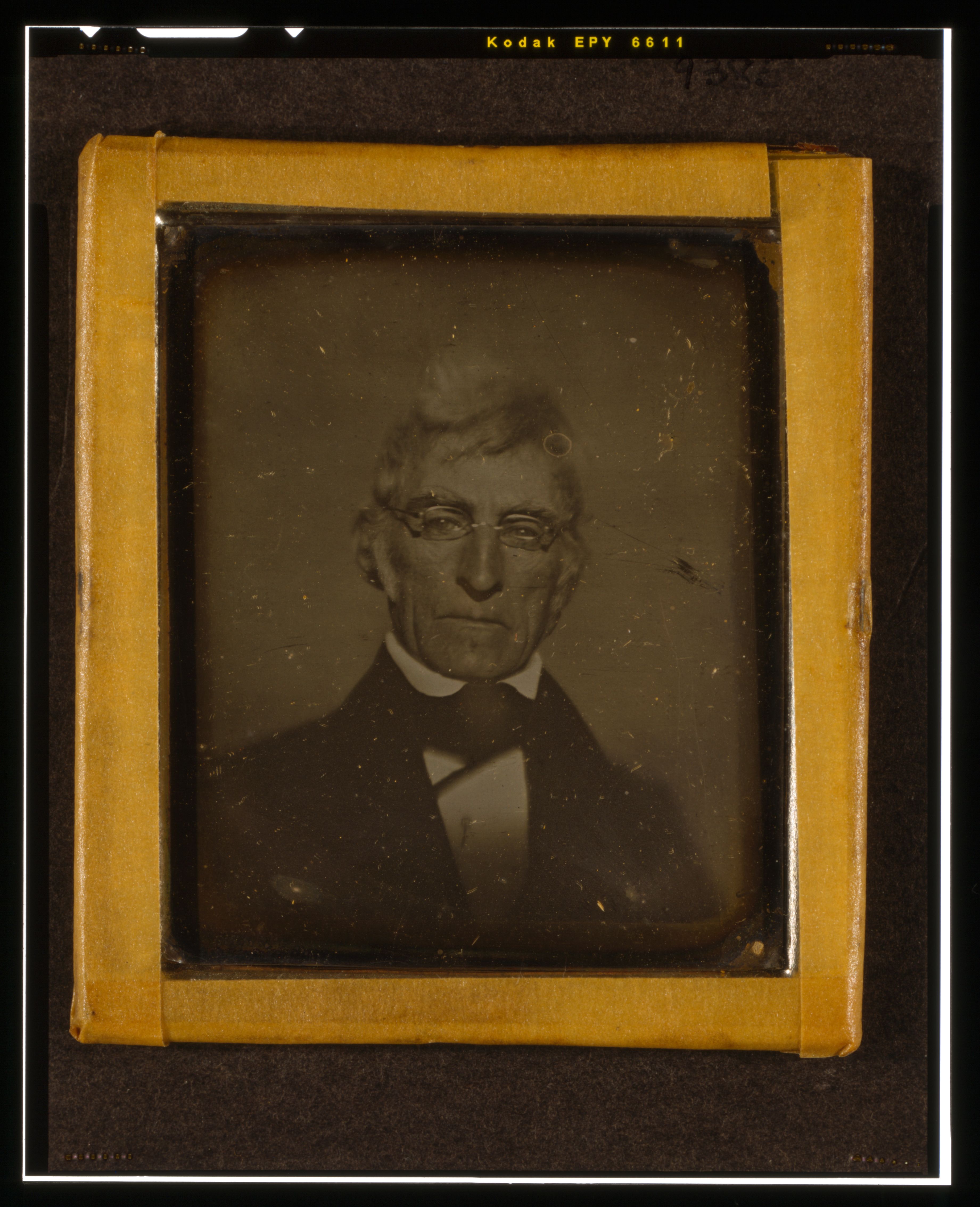
The first portrait he took in his studio was of a man named John McCallister Jr., a wealthy optometrist who, coincidentally, supplied Cornelius with his camera’s lenses.
In 1840, Robert Cornelius opened the first photographic portrait studio in Philadelphia at 8th on Lodge Alley (now Ranstead Street John McCallister Jr. He was the first one to sit in his portrait studio.Robert Cornelius housed at the Library of Congress
Cornelius moved his portrait studio to its second location on Market Street before closing the business in 1843, and returning to his family’s lamp business full time.
“While he’s operating the studio, he never quit working for his family,” Wetzel said. “He’s working the camera, but he had apprentices who polished the plates and did the behind-the-scenes darkroom work.”
As the mid-19th century approached, the Cornelius family’s lamp business began to boom. Street lamps became commonplace. Philadelphians began putting gas lamps in their homes. Cornelius formed a partnership with Isaac Baker and formed Cornelius & Baker, becoming a premier manufacturer of high-end metalwork, lamps, chandeliers, and gas lighting fixtures.
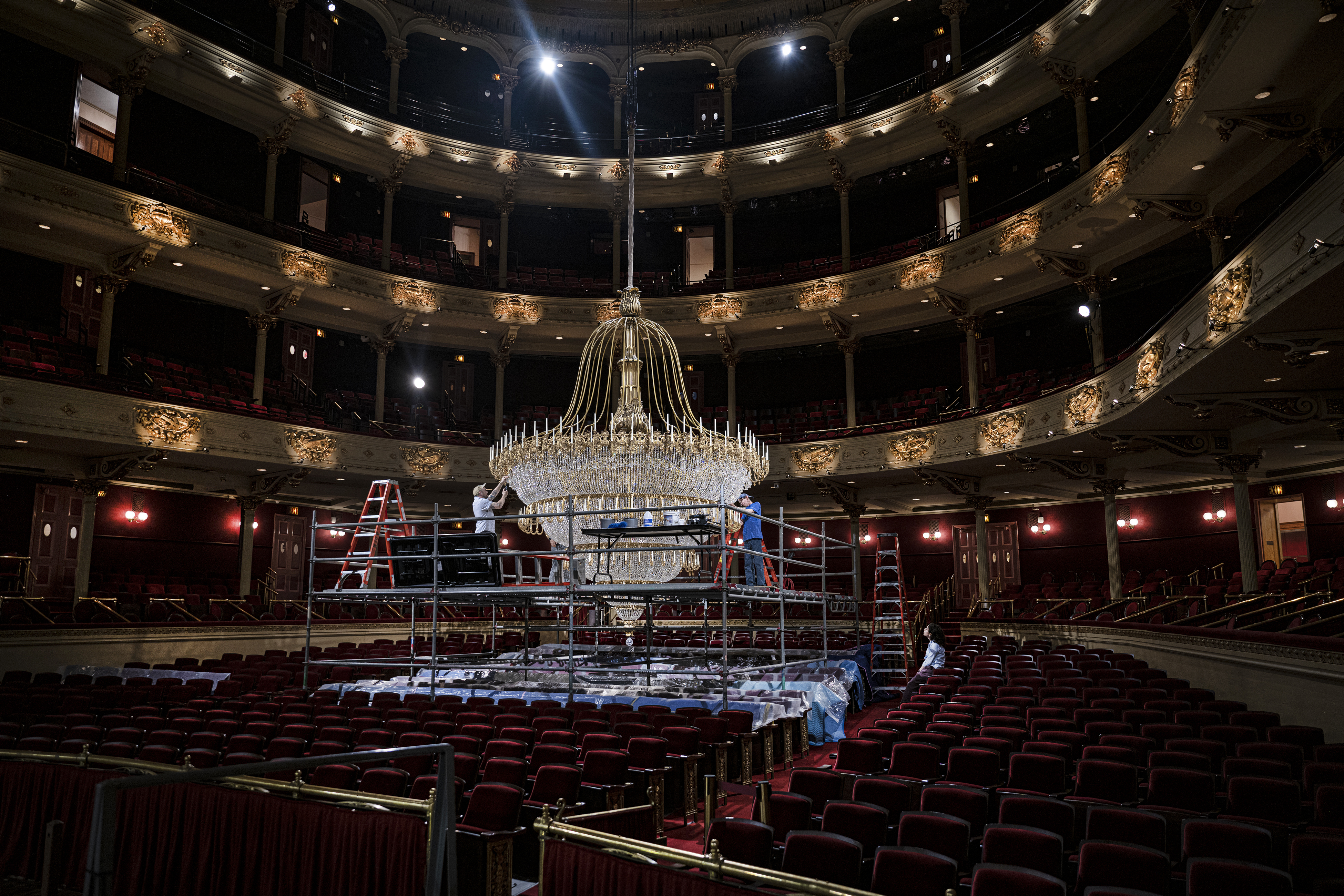
Paul Miers lowers the chandelier at the Academy of Music in Philadelphia to clean it and replace light bulbs on Wednesday, May 29, 2024. The large crystal chandelier, measures 16 ft in diameter, and weighs 5,000 Lb.Jose F. Moreno / Staff Photographer
“Their hand railings, banisters, statues, and chandeliers became world-renowned,” Wetzel said. “Many of their pieces are still found throughout Washington, D.C., and the U.S. Capitol today.”
The Academy of Music’s massive crystal chandelier in the center of its auditorium was built by Cornelius & Baker for the opera house’s historic 1857 opening. (Yes, the guy who took the world’s first selfie also built the Academy of Music’s chandelier. Let that sink in.)
Cornelius’ portrait studio may have been short-lived, but his impact on photography is lasting. Wetzel suggests his apprentices went on to open daguerreotype portrait studios across the city, and by 1849, there were at least 100 in Philadelphia. By the end of the 19th century, the costs had come down considerably, and portraits could be purchased for as little as 25 cents.
“Philadelphians loved portraiture,” Wetzel said.
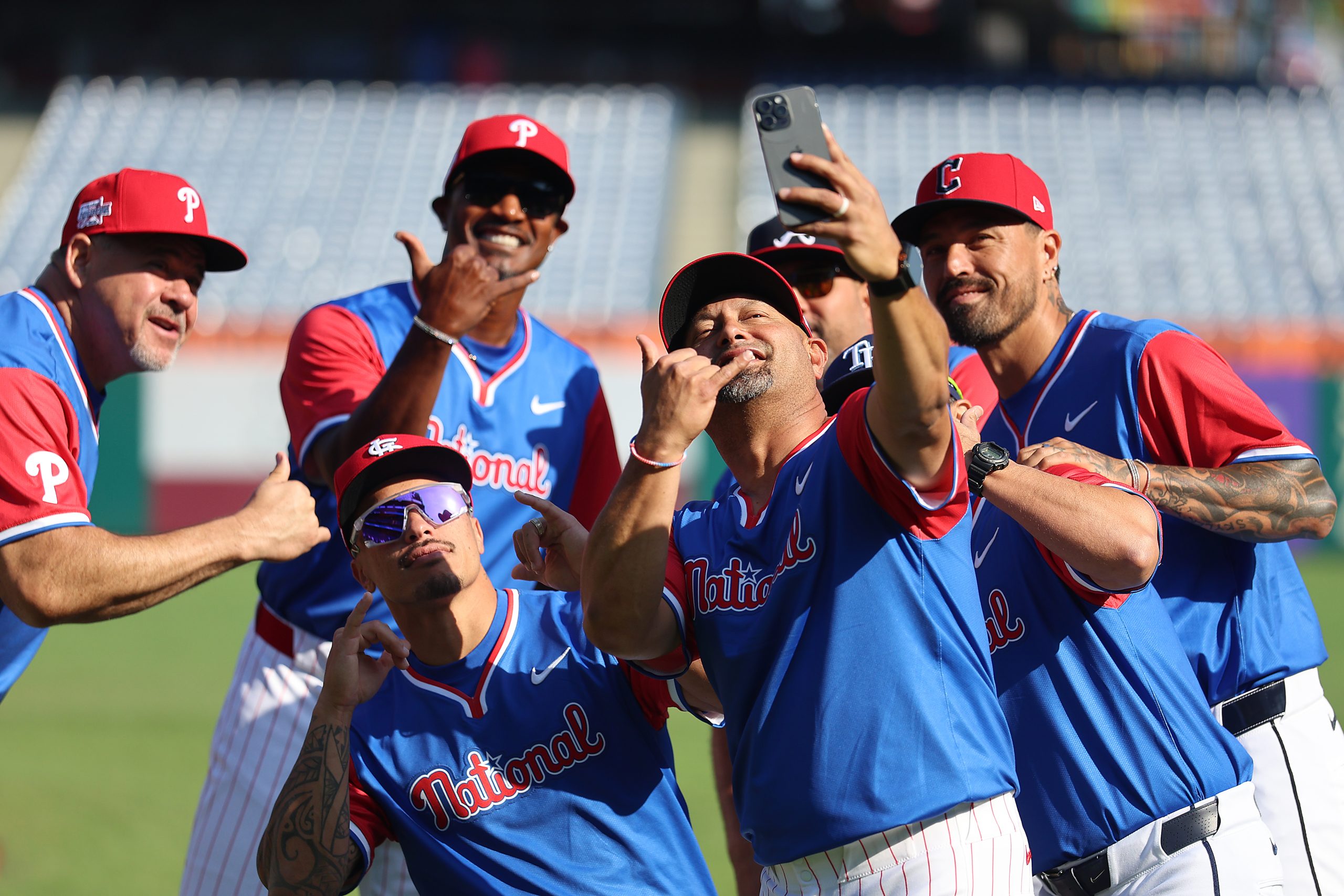
National League Futures manager Shane Victorino (center) takes a selfie with members of his team before the 2026 All-Star Futures game in Philadelphia on Sunday, July 12, 2026.David Maialetti / Staff Photographer
By the mid to late 1850s, daguerreotypes were replaced with the collodion process. But photographs — whether developed in a darkroom or a drugstore, taken on Polaroids, or shot on smartphones — endure.
And the selfie rules.
This week’s Firstival is Saturday, Aug. 22, from 11 a.m.-1 p.m., at Franklin Square, 200 N. 6th St. Firstival celebrants will meet under a tent, and the party will be held rain or shine.
On the advice of United States Treasurer Alexander Hamilton, Congress passed a law establishing America’s first federally funded bank on Feb. 8, 1791.
The bank — located inside Philadelphia’s Carpenters Hall — would serve as the primary fiscal agent for the federal government and one of its many jobs was to issue paper money that was printed by private banknote companies and local print shops.
Coins, though, weren’t in the mix yet.
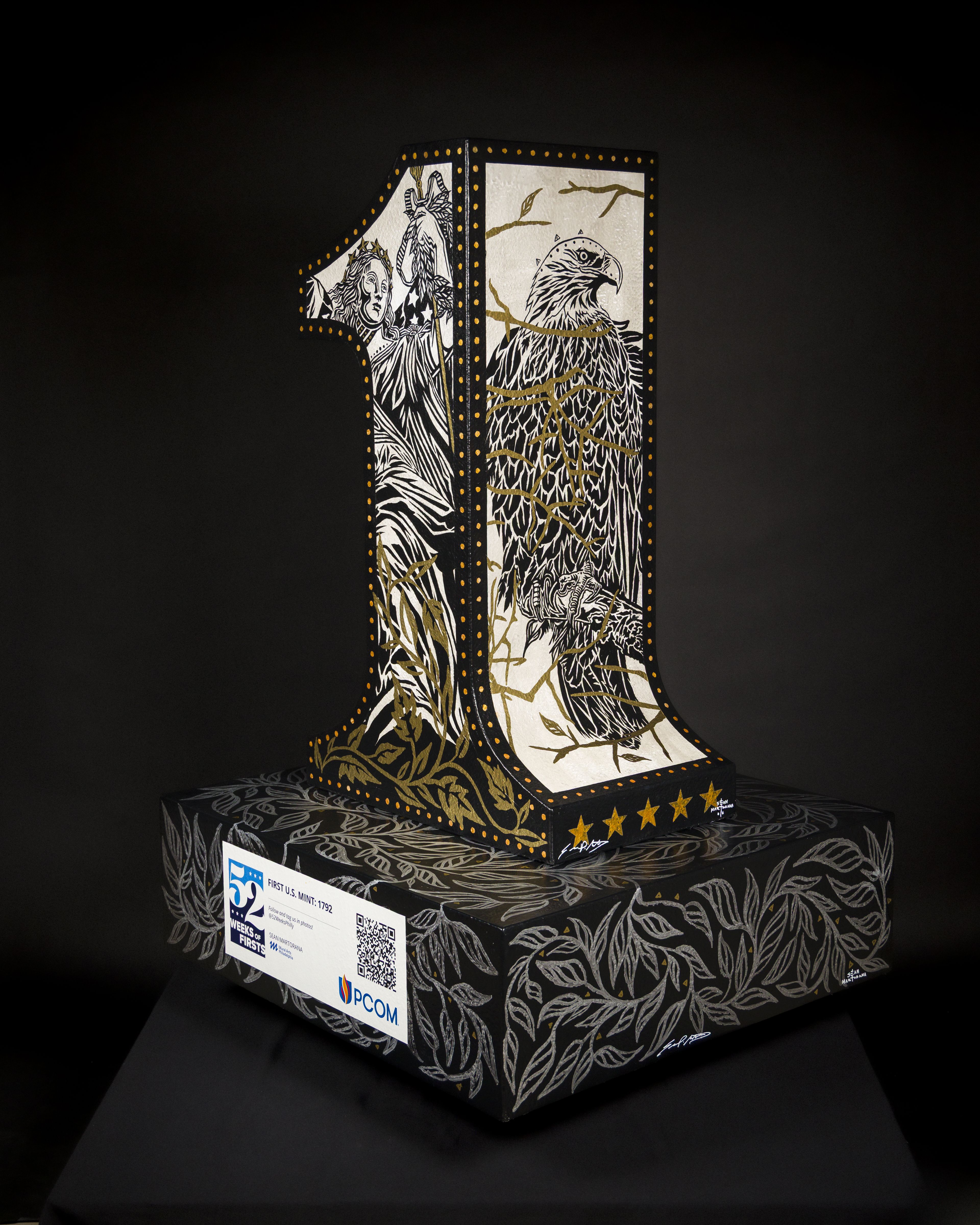
Sean Martorana’s No. 1 reflects themes of craftsmanship, trust and unity of the U.S. Mint.Sean Martorana and the Colibri Workshop
On April 2, 1792, Congress established the United States Mint in Philadelphia with the adoption of the Coinage Act. The act set the dollar as the standard and set denominations — pennies, dimes, nickels, quarters — and their weights, compositions, and regulations.
The new law also required a symbol and inscription of the word “liberty” on each of the coins.
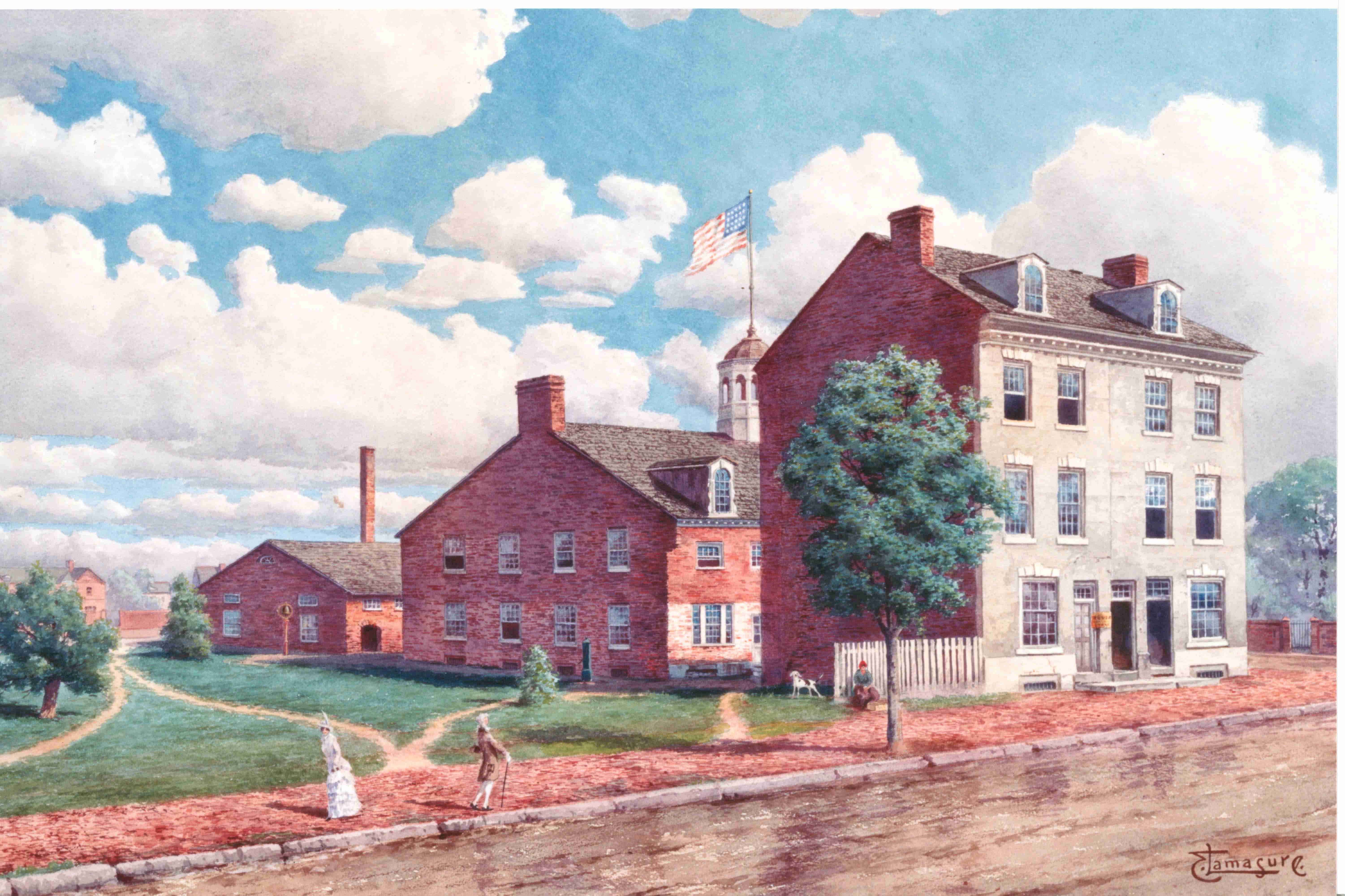
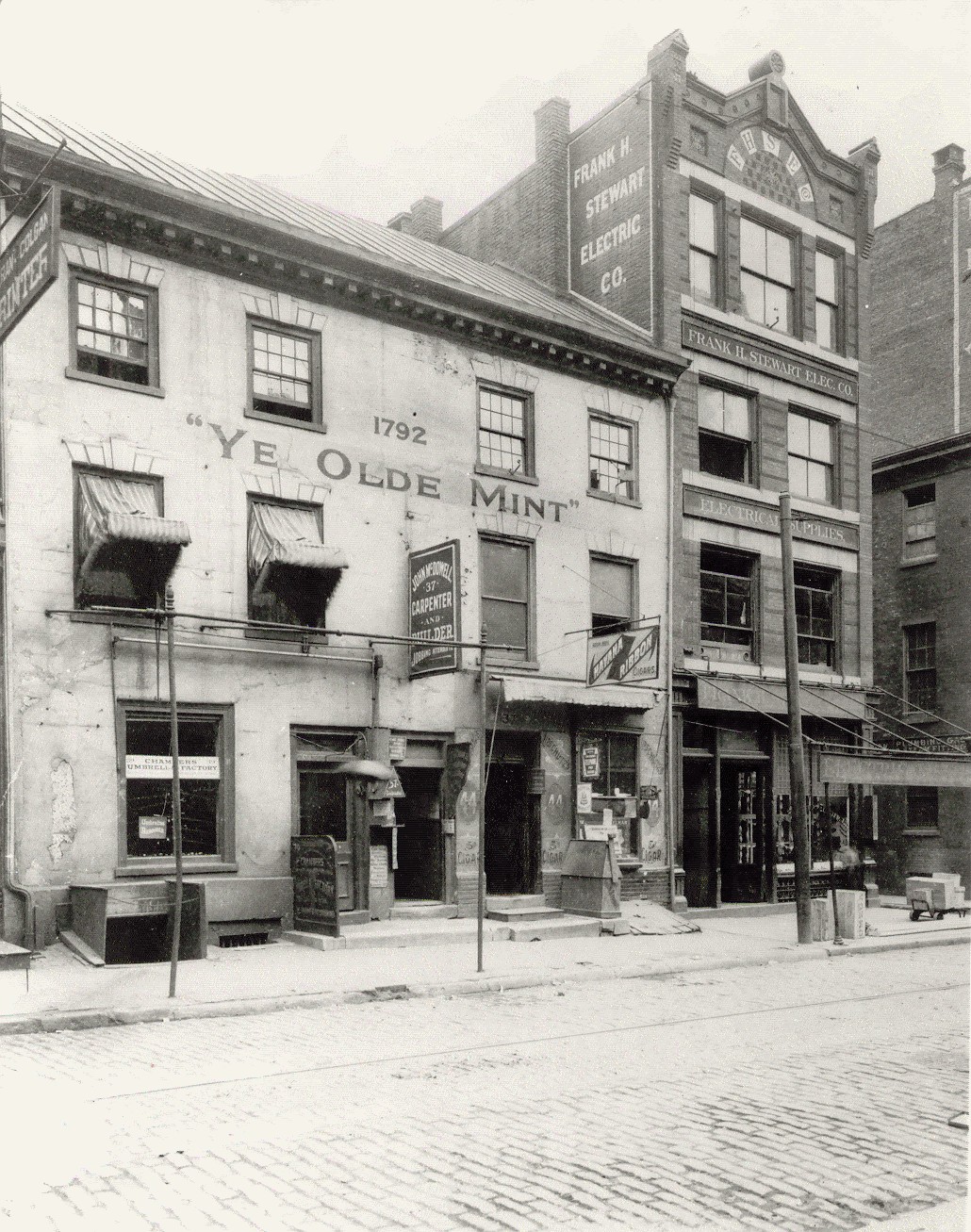
The first U.S. Mint — fondly remembered as Ye Olde Mint — was located on the east side of Seventh Street, just south of Arch, on land purchased by David Rittenhouse.
Ye Olde Mint — the original Mint building — pictured in 1911. It was located on Seventh Street, south of Arch, on land purchased by David Rittenhouse, the first director of the U.S. Mint. The Mint was housed there until 1833.The U.S. Mint
Rittenhouse, the well-heeled great-grandson of America’s first paper mill owner, William Rittenhouse, was an 18th-century astrologer and clockmaker who would serve as the first director of the U.S. Mint. Rittenhouse Square is named after him.
The first coins made after the Coinage Act were half dimes and fashioned off-site, according to Tim Grant, exhibits and public affairs manager at the U.S. Mint. “Made of silver, these half dimes were supposedly struck using silver donated by Martha Washington,” Grant wrote in an email.
The first coins fashioned at the actual mint building were 11,178 copper cents, or pennies, and were delivered in March of 1793. (The U.S. Mint stopped making pennies in November, ending its 232-year production run.)
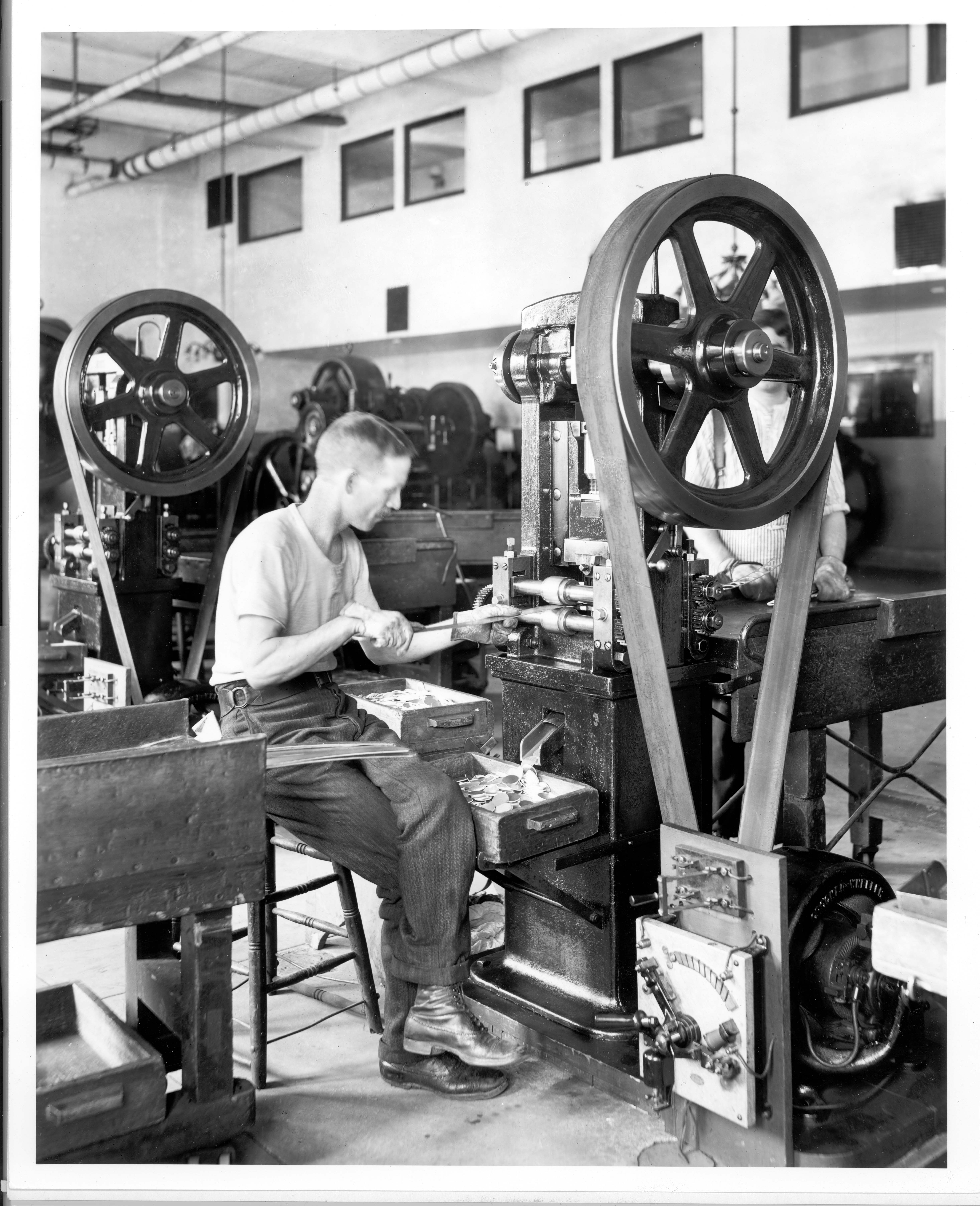
A worker at the cutting press at the U.S. Mint’s third location, which took up the entire block of Spring Garden Street between 16th and 17th Streets in 1901.U.S. Mint
During America’s early days in the late 18th century, work conditions at the U.S. Mint were grueling, Grant wrote. Employees worked 11 hours a day, six days a week, and earned $1 a day. It took workers three years to produce the nation’s first 1 million coins.
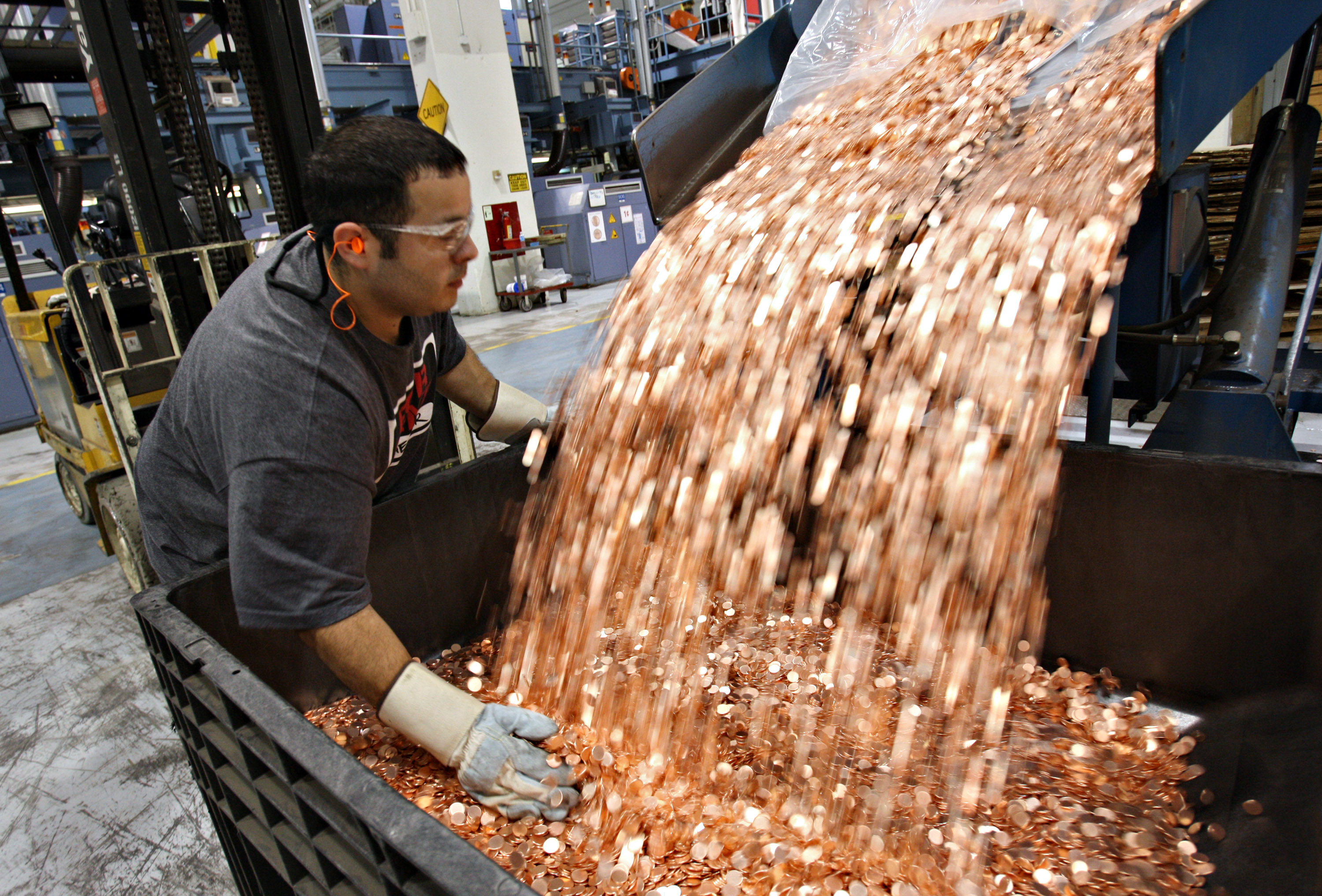
“Today we can produce one million coins in less than a half an hour,” Grant wrote.
As the nation grew, so did its demand for coins.
By the late 1820s, the U.S. Mint had outgrown its original buildings, and in May of 1828, Congress voted to keep the Mint in Philadelphia and erect a second building. The cornerstone of this new, larger U.S. Mint was laid on July 4, 1829, on the northwest corner of Juniper and Chestnut Streets. It opened in 1833. That building served as the U.S. Mint’s home for 68 years.
In 1901, the U.S. Mint moved to its third location, taking up the entire block of Spring Garden Street between 16th and 17th Streets. The building, with a lobby containing seven Tiffany mosaics, was its home through the mid-1960s. The Community College of Philadelphia occupies the site today.
Mike Spinosa, a pit driver at the U.S. Mint, transfers one-cent blanks before they are struck into pennies in Philadelphia in 2007. MUST CREDIT: Demetrius Freeman/The Washington PostStephen Hilger
The Mint returned to Old City in 1969, moving into its current building on five acres on Fifth Street between Arch and Race Streets. It has over 600,000 square feet of manufacturing space.
There are three other active U.S. Mints in America: the Denver Mint, the West Point Mint, and the San Francisco Mint. The San Francisco Mint is not open to the public and specializes in commemorative coins.
“The mission of the United States Mint has remained the same for over two centuries,” Grant wrote. “To serve the American people by safely and efficiently manufacturing, distributing, and circulating precious metal, collectible coins, and national metals.”
This week’s Firstival is Saturday, Aug. 15, from 11 a.m.-1 p.m. at the United States Mint, 151 N. Independence Mall East.