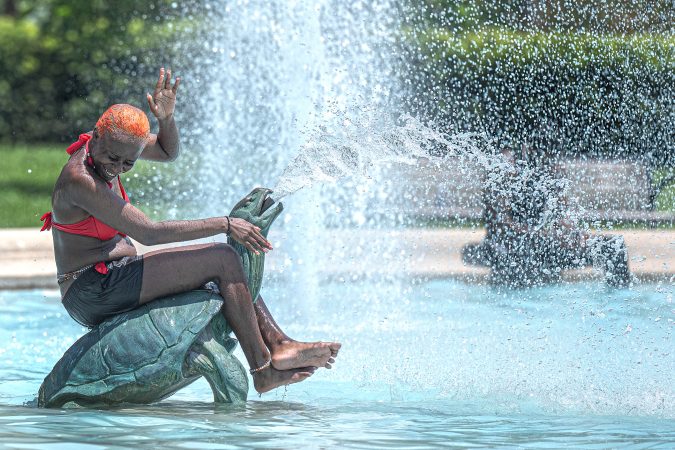
No question, it’s hot, hot, hot. But the city fell short of setting a record-high temperature on Friday for that date.
Another record, however, appears likely: A new warmest low temperature for July 3. The record is 77 degrees, hit three times, most recently in 2002. The low on Friday as of nearly 8 p.m. was 82 degrees, which would be a record-setter.
But there was still the potential for storms to knock that record down before the day is out.
“We are still in the running for our new record warmest low temperature,” said Patrick O’Hara, meteorologist at the National Weather Service office at Mount Holly.
The record high temperature for a July 3 stands at 104 degrees, set in 1966. As of about 4 p.m., the temperature had reached 102, the National Weather Service said.
The Atlantic City Airport, however, hit 105 degrees, setting a new record there, O’Hara said.
The temperature on Saturday is expected to reach a high of 100, O’Hara said. The record for that date is 103.
Just because Philadelphia didn’t break a high-temperature record doesn’t mean the heat hasn’t had a big impact. The Wawa’s Salute to Independence Semiquincentennial Parade, scheduled for Friday, was canceled due to heat concerns.
Storms also posed a risk. A severe thunderstorm watch was issued for the entire region on Friday, and on Saturday, the risk looked even greater.
“Any storm could be strong to severe,” said Ray Martin, meteorologist at the National Weather Service office in Mount Holly.
The risk on Friday was more to the north and west of the city, said Matt Benz, senior meteorologist with AccuWeather.
On Saturday, Benz said there was about a 65% chance of thunderstorms in the evening when Philadelphia’s July Fourth concert is scheduled to be underway on the Benjamin Franklin Parkway.
“At this point, it’s difficult to promise dry weather for fireworks,” he said.
Philadelphia, where fireworks aren’t scheduled to start until close to 12 a.m., might have the best shot of not being impacted by weather, he said.
“As we get close to midnight, we might start to dry out,” he said.
Concern about lightning strikes could be more widespread than storms, Benz said.
Meanwhile, AccuWeather said Philadelphia was forecast to only drop to 83 degrees overnight Friday into Saturday, which would tie the city’s all-time record for a high minimum temperature.
The good news is both SEPTA and Peco reported no major weather-related problems Friday afternoon.
Regional Rail trains were traveling 10 miles slower to alleviate stress on the overhead wire and tracks, which can be impacted by the heat, said Andrew Busch, spokesperson for SEPTA. The slower speed has led to some delays.
Peco recommends that customers keep their thermostats between 75 and 78 during the day and shades drawn, said spokesperson Izamarie Camacho. All unnecessary lights and devices also should be turned off, Camacho said.
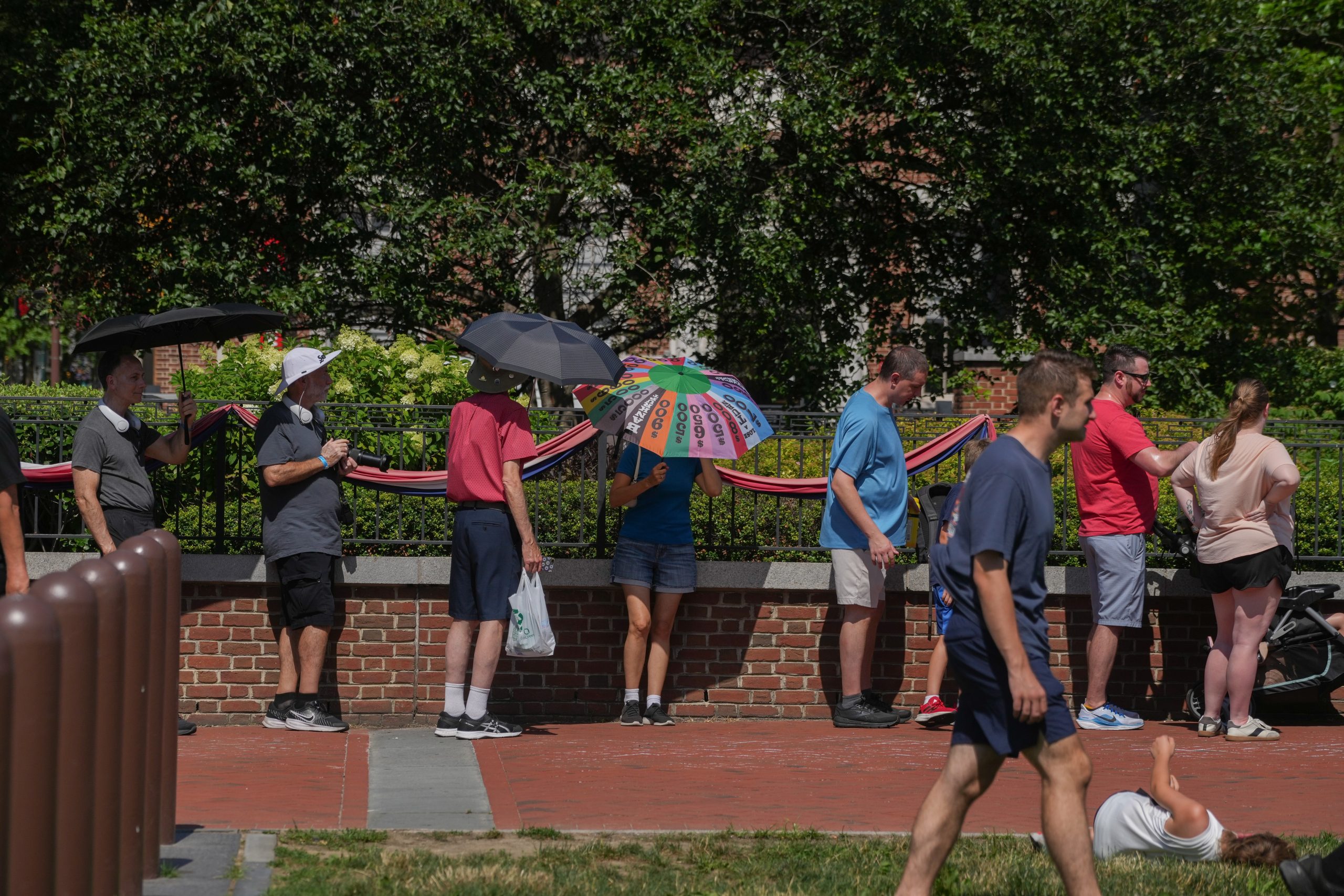
Visitors in Philadelphia shade themselves from the sun, July 3, 2026.Jessica Griffin / Staff Photographer
Local hospitals contacted didn’t report an uptick in heat-related illnesses or injuries. Temple University Hospital’s main campus had five heat-related cases on Friday as of 4:30 p.m., according to a spokesperson. No other information about the cases or whether it was an increase from prior days was available.
The Philadelphia Fire Department has seen “a marked increase in calls” over the last few days, said Rachel Cunningham, communications director. There were more than 1,000 calls on Wednesday and Thursday, but the department didn’t have a breakdown on how many were heat-related.
The number of calls on Friday was not available.
The number of people seen at the department’s medic tents at Lemon Hill, where the FIFA World Cup Fan Festival is occurring, and Lincoln Financial Field, where the games are held, has remained relatively low. Just four people came in on Thursday, with two becoming patients and no one requiring transport to a hospital, Cunningham said. On Wednesday, five people came in, one becoming a patient and no one requiring transport. And on Tuesday, 14 people came in, with five becoming patients and two requiring transport to a hospital.
The coolest spot in the region looks to be the Jersey Shore, Benz said. The Atlantic City boardwalk was 82 degrees at about 3 p.m. Friday.
“You almost have to be touching the water to feel that kind of temperature,” he said.
A sea dip is one sure way to get cool — ocean water temperatures are in the low 60s, he said.
But for those celebrating the holiday in Philadelphia, Benz said “stay hydrated, take it easy, enjoy the Fourth, and keep an eye on the sky.”
Those attending the FIFA World Cup game at Philadelphia Stadium on July Fourth will be treated to more than just soccer.
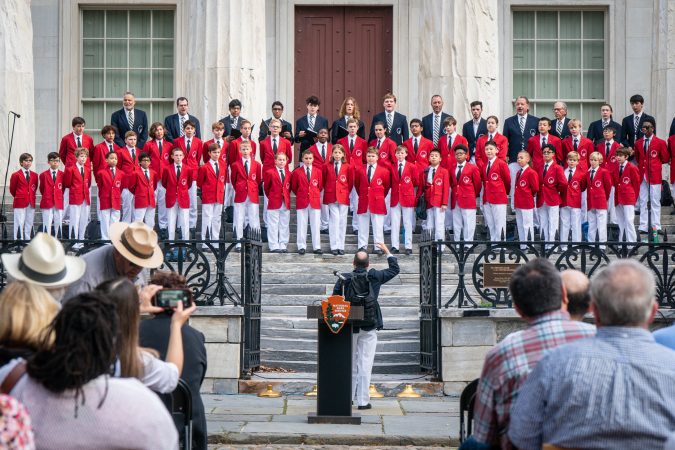
The Roots and the Philadelphia Boys Choir are among those who will perform at the event, marking both Independence Day and the 250th anniversary of the nation, according to a spokesperson for FIFA.
Before the match, Tony Award-winner Idina Menzel will sing the national anthem, while the Philadelphia Boys Choir & Chorale will offer “America the Beautiful.” The Roots, a Grammy Award-winning hip-hop band founded in Philadelphia, also will perform.
Miss Pennsylvania Stephanie Skinner will be on hand to join the celebration, and the VFA-11 and VFA-81 squadrons from Naval Air Station Oceana in Virginia Beach, Va., will do a flyover.
At halftime, Grammy Award-winner DJ Jazzy Jeff will entertain the crowd.
The Roots and DJ Jazzy Jeff are also slated to play the One Philly: Unity Concert for America on the Benjamin Franklin Parkway on Saturday night, which will be broadcast on NBC10.
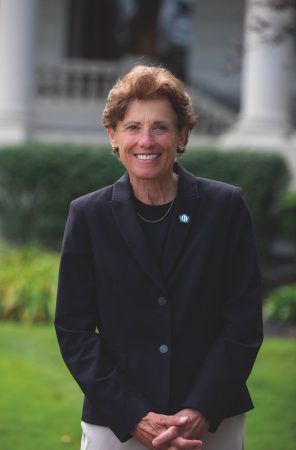
Longtime Immaculata University president Barbara Lettiere said she will retire next summer, following a decade at the helm of the Catholic school.
Lettiere, an Immaculata alumna, donor, and former board chair, was named the first lay president of the Chester County university in 2017.
“The time has come in my life and the life of Immaculata for the next chapter,” Lettiere, 76, said in a statement. “I did not make this decision easily, and it comes with some very mixed emotions.”
The university, which is affiliated with the congregation Sisters, Servants of the Immaculate Heart of Mary,enrolled nearly 2,800 students last academic year, and plans to do a national search for her replacement.
“The board accepts her decision with deep gratitude for her outstanding leadership and dedicated service over the past ten years,” Peggy Behm, board chair, and Sister Mary Ellen Tennity, IHM’s general superior, said in a statement. “Her deep dedication to Immaculata, its students, faculty and staff, and her love for the mission of the IHM Congregation have left a lasting and meaningful impact on the University community.”
Lettiere, a 1972 graduate, had previously served as vice president for finance and administration at Trinity Washington University.
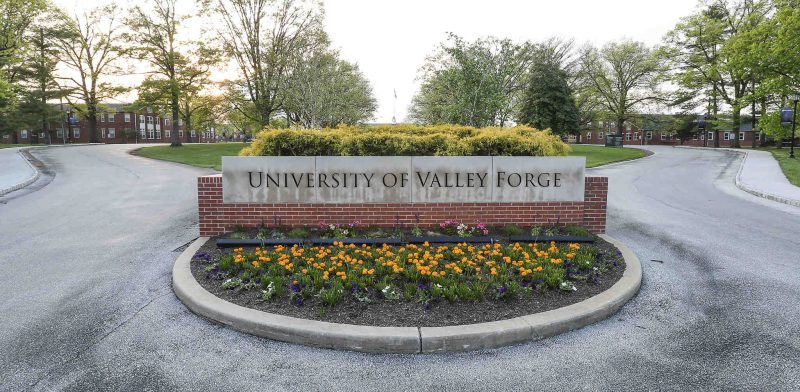
The University of Valley Forge, a small Christian school that prepares students for leadership in the church and the world, has been given a serious warning that it is in danger of losing its accreditation.
The Phoenixville-based college has until Sept. 1 to “show cause” to justify why it should not lose accreditation, according to the Middle States Commission on Higher Education, which posted the action on its website this week. Colleges need accreditation to keep their students eligible for federal aid.
The “show cause” action is the most serious that the commission issues. Others include warning and probation.
The commission cited “insufficient evidence that the institution is in compliance” with standards involving planning, resources, and institutional improvement, and governance, leadership, and administration.
The university must document in its show-cause report “financial resources, funding base, and plans for financial development to support its educational purposes and programs and to ensure financial stability,” the commission said. The school also must provide information on long-range financial planning that includes “realistic enrollment projections and the assumptions on which they are based,” the commission said.
The university did not immediately return a call for comment Wednesday, and when asked for the current enrollment, an employee said she was not permitted to disclose any information and hung up. The school enrolls 589 students, according to the National Center for Education Statistics.
Under the action, the school is required to immediately notify its community of Middle States’ action.
The university started in 1939 as the Eastern Bible Institute, which was aimed at training pastors, evangelists, missionaries and Christian educators, and lay workers, according to the school’s website. It became a college in 1975 and the University of Valley Forge in 2014. The university is part of an international network of Assemblies of God colleges and universities and offers more than 60 degree programs, according to its website.
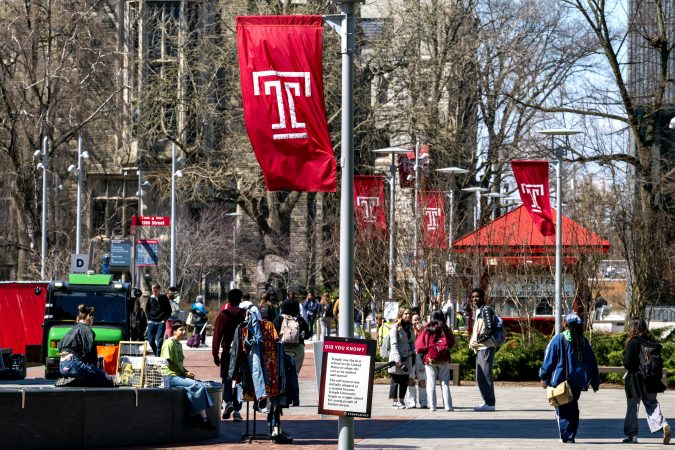
Temple University has asked its schools, colleges, and administrative units to cut a total of $60 million to help offset a projected deficit for 2026-27.
President John Fry shared the plan in a message to the campus community Friday and said a reduction in employees is “inevitable.”
The message did not reveal how many layoffs the university is considering as it attempts to close the $85 million projected gap. The board of trustees’ executive committee is scheduled to meet next week to consider the proposed budget. The university’s current budget is $1.3 billion, excluding the health system.
“Unfortunately, some reduction in force is inevitable, given that nearly 70% of Temple’s operating budget is spent on compensation and benefits,” Fry said in the message. “It is my promise that any employee’s separation from the university will be handled equitably and compassionately.”
He noted that a faculty retirement incentive program this year drew 77 takers — 3% of full-time faculty — andwill lessen the need for layoffs. Those faculty are scheduled to leave by the end of this month and their departuresultimately will save $15 million annually. The elimination of vacant faculty and staff positions also hashelped, he said.
Fry did not detail the cuts that are planned but said that colleges, schools, and administrative units each received a budget reduction target.
Units were asked to make a 5% cut last year, but this year there is a range of percentages among schools, colleges, and administrative units, a university spokesperson said. The spokesperson declined to say how many layoffs will occur.
Some potential cuts that have stirred discussion include a reduction in adjunct professors and a pause in doctoral student admissions by some programs.
Jeffrey Doshna, president of the Temple Association of University Professionals, said Fry’s message seemed to address some of the issues the union has been raising, but said more information is needed, including how many people will lose their jobs and from what areas.
“Hopefully, they will continue to respond to what we are calling for,” he said, including greater transparency, participation in decision-making, and no job cuts.
Temple has been trying to cope with lost revenue from a precipitous slide in enrollment and uncertainty around federal funding. Fry has been warning since early April that the university “must act decisively and with a sense of urgency” to address the projected deficit. An internal Temple report obtained by The Inquirer in April said layoffs were coming.
Fry reported to the board of trustees last week that this year’s fall enrollment looks promising, with deposits by first-year undergraduate and transfer students up over last year at the same time.
He said in his campus message that making the $60 million in cuts is “an important first step toward returning the university to a balanced budget over the next three years.”
Fry acknowledged that the budget reductions “can create uncertainty and anxiety.” But he said the administration has attempted to be transparent and has held meetings with faculty senate, deans, and schools, colleges, and administrative units.
“Navigating through this stark financial reality is not easy,” Fry said. “I recognize the difficulty of this present moment. We will emerge from this process stronger and on a more sustainable path moving forward.”
Jack Pinkowski relished his time as a photojournalist for Temple University’s student newspaper when he was enrolled there in the 1960s.
And he always admired the work of his father, the late Edward Pinkowksi, an historian and author who founded a small newspaper in the Montgomery County borough of Bridgeport.
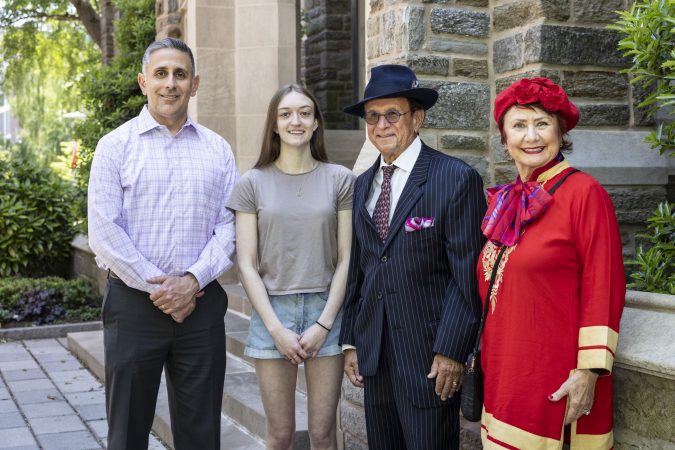
This month, Pinkowski, a 1968 Temple grad, and his wife, Monica, gave Temple a $1.25 million gift, a portion of which will for the first time endow the editor-in-chief position for the Temple News, as well as increase other staff salaries and pay for some story-related travel and new equipment.
Pinkowski said the need for journalists has never been more important, and he lamented the struggles print journalism has faced.
“We hope to show it a lifeline, give it some support to encourage people to go into that as a field of endeavor,” said Pinkowski, 78, of Plantation, Fla. “This named editorship is a tribute to my father for starting a newspaper and having a lifetime as a critical mind that searched for facts and put them together and brought stories to the enjoyment of people.”
Of the gift, $250,000 will be used to create an endowment for the student newspaper, and the remaining $1 million will fund scholarships of up to $10,000 per academic year for students to study at Temple’s Rome campus. Applicants must have knowledge of, coursework in, or a commitment to promoting Polish or Italian studies, history, or culture.
The Pinkowskis made their money by investing in and managing real estate as well as through other careers.
The couple both worked in businesses with global ties — Jack as an importer of furniture and Monica as an importer of gourmet foods to restaurants — and saw the merit in global study. They also both attended a study abroad program for adults at Temple Rome in 2024.
Given the federal government’s policies affecting foreign students, Pinkowski said, he thought it was important to support the Rome campus so that students have an alternative way to attend an American university.
Temple president John Fry said he especially likes that the gift is so personal and that it is widening access to students to participate in both studying on the Rome campus and working for the student newspaper.
“These are two really important experiences that many students have to forgo, and I think the Pinkowskis are making both of those possible,” Fry said. “Its meaning and impact are significant.”
The gift comes as the college prepares to close a record fundraising year, led by a record $55 million gift from alumnus Christopher Barnett in October and a large gift in April from alumna Jane Creamer Sullivan and her late husband, Thomas J. Sullivan, to start its new honors college.
A boost for the Temple News
John DiCarlo, managing director of student media and adviser to the Temple News, said its portion of the Pinkowski gift will be incredibly important in supporting the newspaper with a staff of 37, which last academic year ran on a $115,596 budget that largely covers salaries and print costs.
Most of the costs were covered by the university, with the newspaper responsible for raising $23,500 through ad revenue and other means. If the publication exceeds that goal — which it did last year, raising over $29,000 — it can funnel the additional money back into operations, DiCarlo said.
The new endowment, DiCarlo said, will bring in an additional $10,000 to $12,000 annually, depending on its earnings.
Incoming senior Sienna Conaghan, 20, who will be the inaugural Edward Pinkowski Editor-in-Chief, said she is grateful for the funding, which will cover her approximate $5,400 salary. And she is glad that salaries for other staffers can get boosted, too.
“We’re asking them to do full-time jobs on a college student’s budget and a college student’s schedule,” DiCarlo said. “It takes a lot out of them because they really care.”
Conaghan, a journalism major from West Yellowstone, Mont., estimates that she spends about 30 hours a week on Temple News work. She freelanced freshman year, was assistant sports editor sophomore year, and worked as sports co-editor last year.
The experience is more important than the paycheck, said Conaghan, who plans to pursue a career in sports journalism, but the money helps.
“It has really been everything,” Conaghan said of her Temple News work. “I think I’ve learned so much from working at the Temple News, from how to be a journalist and also just how to be an adult and a person.”
The Pinkowskis initially gave a gift to the Temple News in 2023 to help it reach a fundraising goal. The college wanted to be able to pay student journalists a little more because some were having to take on second jobs to generate more income, DiCarlo said. At that time, he said, he had no idea the couple would return with such a large gift three years later; it is the largest gift the Temple News has ever received.
“Monica and I are avid readers and avid followers of print journalism,” said Jack Pinkowski, a graduate of Philadelphia’s Central High School.
Pinkowski said his father decided to start the now-defunct Bridgeport South Side Press in 1950 because the community did not have a local paper. He also wrote history books about the local area, using skills he developed as a journalist, Pinkowski said.
The Pinkowskis have had other career experience in addition to real estate and import businesses.
He was a general contractor and wedding photographer early on and later spent 18 years as an associate professor of public administration at Nova Southeastern University’s school of business and entrepreneurship in Florida.
And she was a flight attendant at one time and as a child grew up working in a family traveling carnival business in Missouri — which helped pay for her education at the University of Missouri-Kansas City.
Jack Pinkowski said the common thread in their endeavors has been “inquisitiveness and intellectual curiosity and the ability to take something where there’s nothing and make something of it.”
Both Temple officials and the Pinkowskis hope their gift will motivate others.
“I do believe that other people pay attention to that, and it makes them say, well, maybe they can do something as well,” Jack Pinkowski said.
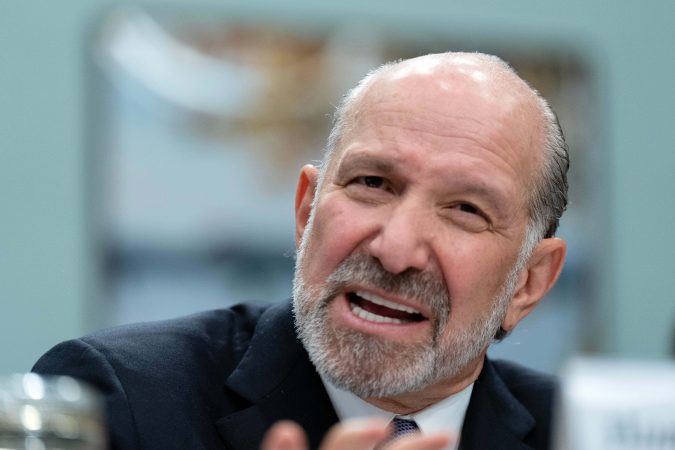
Haverford College students have publicly advocated for the school to consider removing U.S. Commerce Secretary and mega donor Howard Lutnick’s name from the library.
Behind the scenes, an older group has been pushing, too.
About a dozenvocalHaverford alumni have come out in strident disagreement with president Wendy Raymond’s decision in April not to take stepstoward considering the removal of Lutnick’s name.
Several in the group have called for Raymond’s resignation, while at least one said he had withheld his donation. Some were critical of Lutnick even before Department of Justice documents released earlier this year showed he had contact with sex offender Jeffrey Epstein as recently as 2018, long after Epstein pleaded guilty to obtaining a minor for prostitution and soliciting a prostitute.
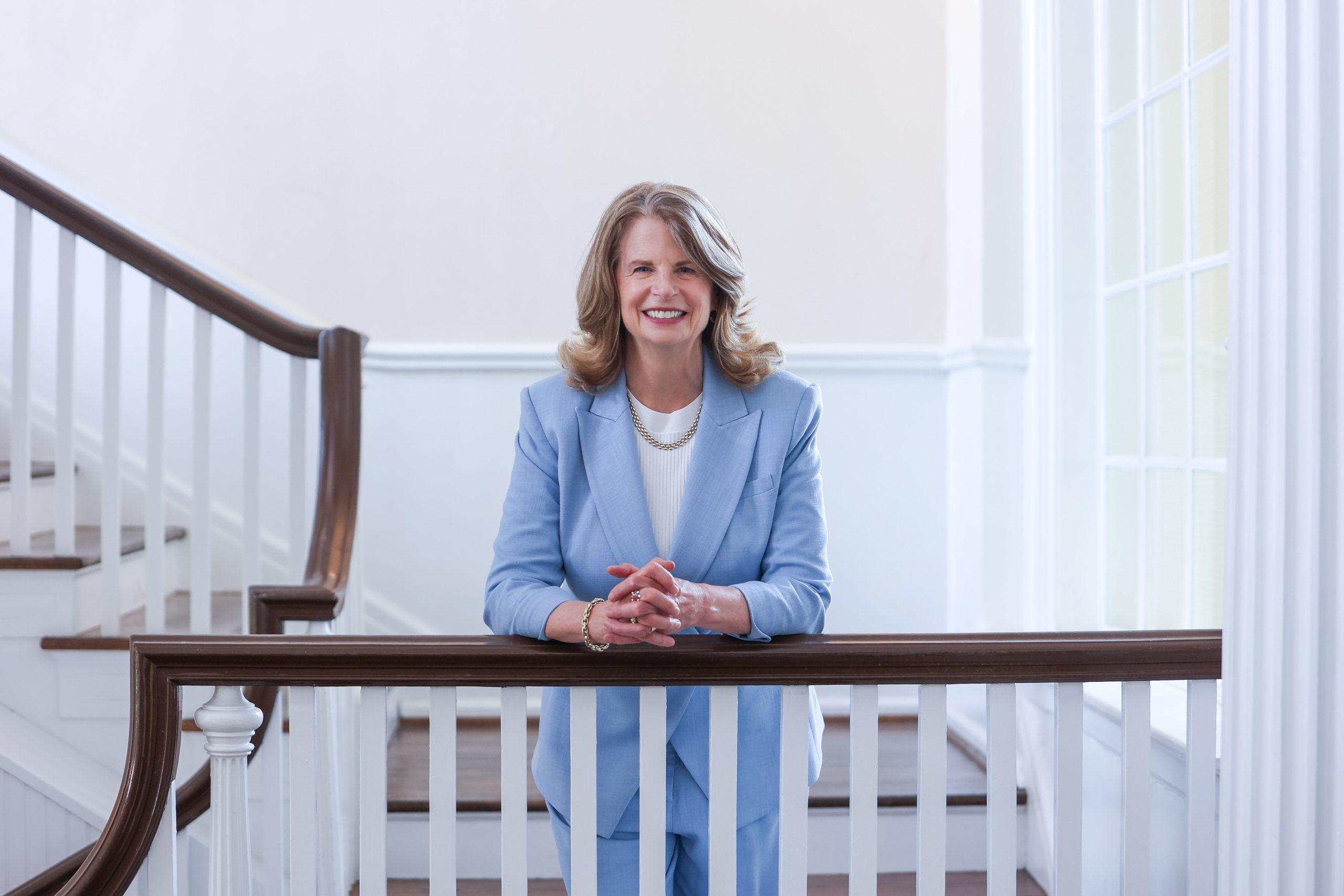
Haverford College president Wendy Raymond has led the college for seven years and previously announced she would step down next June.Courtesy of Haverford College
But Raymond stood by and explained her decision during a Zoom call last week with former board members, and the current board chair said Lutnick himself feels that he is being targeted in a witch hunt, according to accounts of the meeting.
Among the concerned alumni is Norm Pearlstine, a 1963 graduate who served on Haverford’s board of managers from 1986 to 1989 and is a former editor of the Wall Street Journal, Forbes Magazine, the Los Angeles Times, and Time Inc. and former chief content officer at Bloomberg.
“I am appalled,” Pearlstine wrote to Raymond on May 3, days after she announced she would not initiate a committee to consider removing Lutnick’s name from the library. “You should resign immediately so Haverford‘s board can replace you with a leader who puts principle ahead of principal.”
Another alumnus wrote that he would not advise his grandchildren to attend Haverford.
“I cannot imagine that my granddaughters or grandsons would want to enter the Lutnick library or the Lutnick cafe or for that matter, any other building on campus with his name on it,” wrote Joseph Schulze, a 1963 graduate and retired Michigan school superintendent who grew up in the Philadelphia area.
Adi Ignatius, a 1981 graduate and journalist who is editor at large of the Harvard Business Review, said he donated to Haverford every year until 2025, when he withheld his money because of the Lutnick matter.
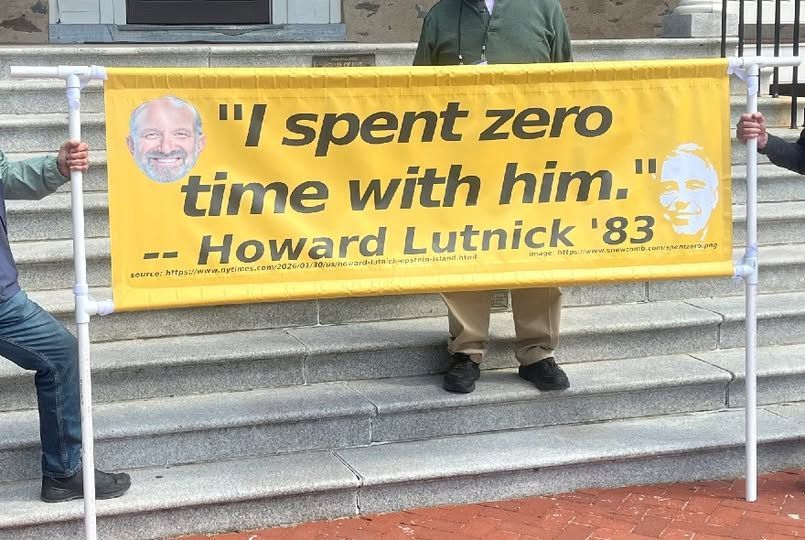
Haverford College alumni from 1971 hold a banner on campus about Howard Lutnick during alumni weekend.Courtesy of Chuck Durante
Haverford in a statement said many community members who oppose removing Lutnick’s name have also written to the college or told Raymond they are againstthe creation of a review committee that was requested through a student resolution this spring.
“President Raymond felt it was in the best interest of the college to reject the resolution because she did not believe this matter met the threshold necessary to constitute a committee given the college’s established standards and the information available to us at that moment,” the statement said.
But, the college said, “the matter is not closed.” Haverford is continuing to monitor “publicly available information” and “community sentiment” on the issue and Raymond or her successor could choose to initiate a committee, the college said.
Haverford not ready to make an ‘indictment’
Raymond, in the June 11 Zoom call with former board members, said she regarded creating a committee close to an “indictment” and did not think the threshold had been met, according to an email account of the meeting by Pearlstine obtained by The Inquirer. Some concerns about Lutnick are political, she said, and she is not willing to consider politics in her decision-making about a renaming committee, according to accounts of the meeting.
Students and alumni have pointed out that Lutnick had previously said he had not been in a room with Epstein, whom he found “disgusting,” since 2005, yet he testified to Congress earlier this year that he had visited Epstein’s private island with his family in 2012 and exchanged emails with him in 2018.
ButRaymond, who has led the college for seven years and previously announced she would step down next June, said in Tuesday’s meeting that she did notthink Lutnick’s lying about when he last had contact with Epstein was enough of a trigger.
Some alumni, supporting Raymond’s decision, have noted there is no evidence Lutnick participated in Epstein’s crimes or improprieties.
“I understand that students might feel strongly in support of wanting to change the name, but I don’t believe there’s a basis to do so,” said Robert Swift, a Philadelphia lawyer and former board member who was on the call Tuesday. “I have serious differences with Howard politically, but that’s not relevant either.”
Swift, 79, a 1968 Haverford graduate who served on the board for 12 years, said Lutnick, a former chair of the college’s board of managers, was generous and served the board well.
“His heart was in the right place,” Swift said.
Some were calling for Lutnick’s removal even before the Epstein connection because they did not like his politics, said one alumnus who asked not to be named because of the sensitivity of the matter.
“I don’t think it’s fair to remove someone’s name from a building simply because you don’t like their politics,” the alumnus said.
George Parker, a 1960 alumnus and a professor of finance at Stanford’s Graduate School of Business, said Haverford should rely on its Quaker roots, which requires governing by consensus.
“We do not have consensus,” Parker, a Quaker originally from the Philadelphia area, said of the Lutnick matter, “and where we do not have consensus, I do not think we should take action.”
Lutnick’s relationship with Haverford
Haverford has been in contact with Lutnick. Michael B. Kim, chair of Haverford’s board of managers and a private equity firm leader in Korea, said during the Zoom call that Lutnick communicated he is especially hurt that his alma mater is taking part in what he feels is a witch hunt, according to meeting accounts.
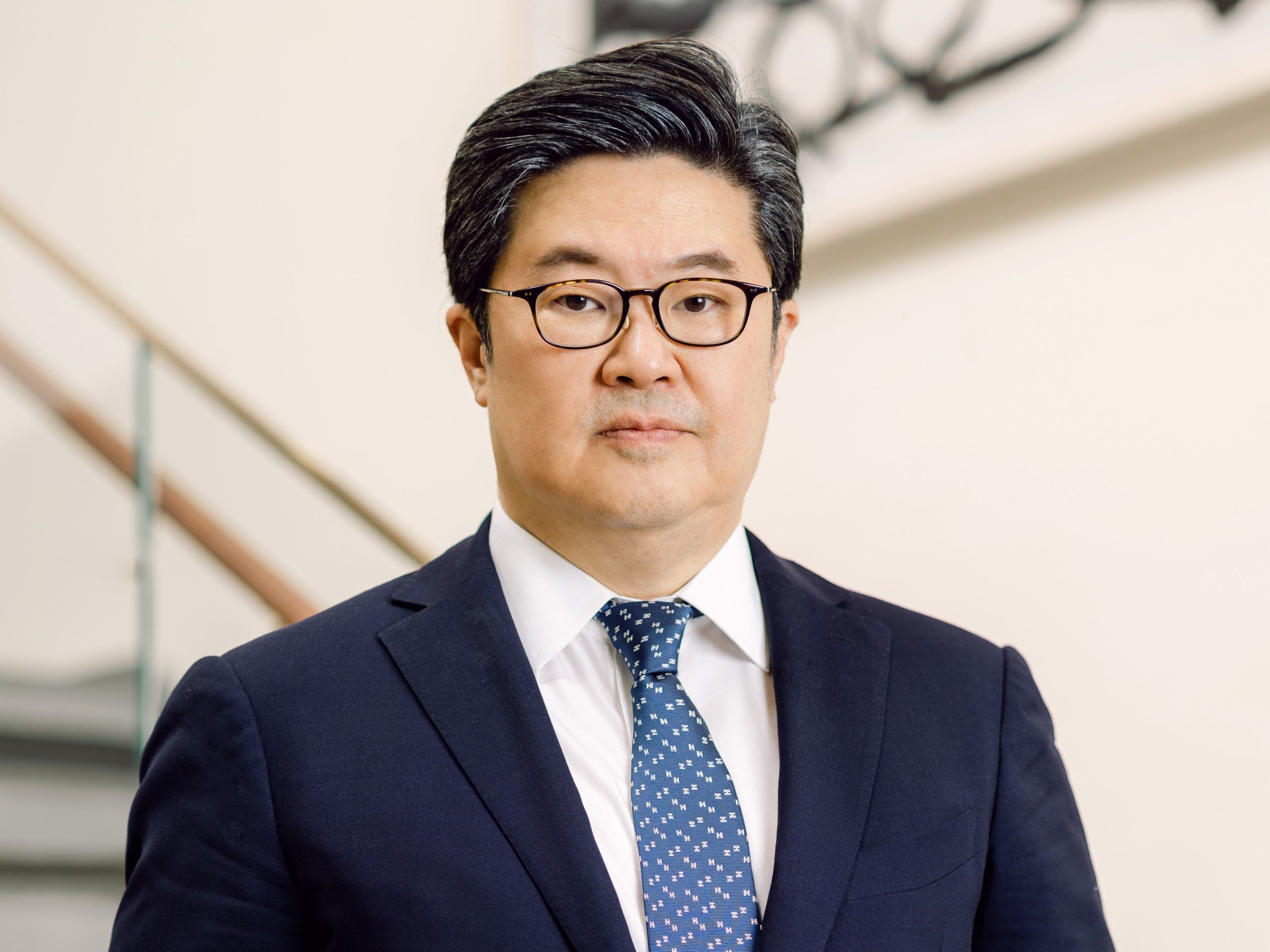
Michael B. Kim, chair of Haverford College’s board of managers.Courtesy of Haverford College
The board agrees with Raymond’s decision, he said.
Lutnick’s relationship with the highly selective, small liberal arts college on the Main Line goes back decades. He lost his mother to cancer when he was in high school and then his father one week into his freshman year. Haverford’s president at the time waived his costs and he graduated in 1983 with an economics degree.
Former chairman of financial firmCantor Fitzgerald, he served on Haverford’s board for 21 years, the last three as chair, until 2015. His name was put on the library after a then-record $25 million donation he and his wife made in 2014. Lutnick has given the school $65 million and is one of its biggest donors.
His Epstein ties gained scrutiny earlier this year. A Commerce Department spokesperson told the Associated Press that Lutnick had had “limited interactions” with Epstein, with his wife in attendance, and had not been accused of “wrongdoing.”
A request to the Commerce Department’s press office to speak with Lutnick got no response.
Under Haverford’s gift policy, the school can rename a building if “the continued use of the name may be deemed detrimental to the college, or if circumstances change regarding the reason for the naming.”
Schulze, the former school superintendent, said he thinks that threshold has been met and a full discussion is needed.
“Somebody else should take over if [Raymond’s] not ready to do that,” he said.
Rob Riordan, a 1964 graduate and Trenton native who lives in Cambridge, Mass., said he was upset Raymond did not honor a request from an overwhelming majority of students at a plenary meeting who requested a committee be formed
“To me, that felt like a violation,” said Riordan, 84, an educator who helped start charter schools in the San Diego area.
Several alumni pointed out that nearby Bryn Mawr and Swarthmore Colleges have removed names of controversial figures from buildings in recent years.
Pearlstine, who was on the Tuesday call, first wrote to Raymond and Kim in July 2025, urging that Lutnick’s name be removed. His concerns are not political, he said, but rather about behavior that conflicts with Haverford’s values.
“Howard Lutnick is a powerful Trump administration cabinet officer who proudly helps the most lawless President in our country’s history implement policies that trample upon human rights, due process, rule of law, and respect for the independence and integrity of institutions of higher learning,” he wrote.
It was not always that way. Ignatius, 67, who lives in Stonington, Conn., said he recalled interviewing Lutnick on stage at Haverford in 2015 and the good will in the audience toward him. Lutnick, who lost his brother andmany of his company’s employees in 9/11, talked about the aftermath and how the company helped care for victims.
“His trajectory since then has been similar to Rudy Giuliani’s,” Ignatius wrote to Raymond and Kim last August. “He has squandered the goodwill he built up after 9/11 and become a partisan troll, espousing values that are inconsistent with — and offensive to — the ideals that Haverford stands for.”
Whitney Soule, admissions dean, said the school received fewer applications for the fall 2026 class after years of increasing applications. Applications at the Ivy League university were down 15.5% from last year.
Soule declined to speculate on the reasons or discuss whether applications from international students or other groups were down. International student enrollments are down nationally amid immigration policies under President Donald Trump’s administration. U.S. universities saw a 20% decline in international students this past spring compared to the year before, Time reported last month.
Soule said 12.5% of the incoming class are foreign students, down from 13.7% last year.
The incoming class is the first since Penn began requiring standardized test scores again. The requirement was paused during the pandemic. Soule said applicants’ middle 50% SAT scores were 1440 to 1550.
“It’s an exciting group of students,” Soule said. “They are coming from all over the world and throughout the United States, and they’re ambitious and curious.”
At Friday’s meeting, the board also agreed to designate former president Liz Magill as president emerita, a prestigious title granted to former leaders. Magill led the university from July 2022 until December 2023, when she resigned amid a bipartisan backlash over her congressional committee testimony regarding the school’s response to antisemitism complaints.
University of Pennsylvania President J. Larry Jameson will conclude his presidency next June, he announced in an email to the Penn community Friday.
“Although I greatly enjoyed serving as president, now is the right time for Penn to begin its next chapter under new leadership,” Jameson said in the email. “My goal was to help restore stability during unanticipated leadership transitions, refocus our community on Penn’s mission, and strengthen Penn for the future during a challenging time for higher education.”
There was much speculation about whether Jameson — an endocrinologist who previously led Penn’s health system and medical school for more than 12 years — wanted or would be asked to remain in the seat beyond next year’s expiration of his current contract. Many have credited Jameson with steadying the school during a turbulent time, including as the school faced funding threats and increased scrutiny by President Donald Trump’s administration.
His departure will leave the Ivy League school searching for a new leader during a time of uncertainty under Trump, who has targeted elite universities.
Board chair Ramanan Raghavendran said he respected Jameson’s decision and the board will begin searching for the school’s next president in the fall.
Jameson, 71, will have served in the top job at Penn just three-and-a-half years, one of its shorter presidential tenures. But he came into the job by circumstance rather than desire.
Jameson took over in December 2023 during perhaps one of Penn’s greatest leadership upheavals. Former President Liz Magill had just resigned amid a bipartisan backlash over her testimony involving the school’s response to antisemitism complaints. He first was named interim president and then was elevated to the permanent post in March 2025.
Jameson earned total compensation of more than $8 million in 2024, the most recent tax year available. That included $5.4 million in “reportable compensation” and more than $2.5 million in other compensation.
“Dr. Jameson stepped in at a pivotal moment, and what he has accomplished in two-and-a-half years has been simply extraordinary,” Raghavendran said in a statement.
Neither Raghavedran nor Jameson were available for interviews Friday, the university said.
In his message, Jameson said “the momentum we have built will continue,” noting his intention to work over the next year on implementing the Penn Forward plan. The plan calls for everything from more transparent and predictable tuition and cost policies and improved student experience to more efficient operations, a focus on keeping Penn at the forefront of best uses of artificial intelligence, and a growing presence in the San Francisco Bay Area — where Wharton already has a campus.
Penn also has some tough decisions ahead in his final year. During the spring semester, the school proposed new open expression guidelines that some on campus say are too restrictive and would chill free speech. The university is considering the feedback and plans to issue final guidelines next academic year.
The university also is undergoing belt-tightening in anticipation of potential federal cuts and increased legal and insurance costs. Penn in January asked schools and centers to pare 4% from their budgets for the next fiscal year, on top of a 5% cut last year.
Penn’s Graduate School of Education laid off several staff members last week as part of those cuts, according to The Daily Pennsylvanian, the student newspaper.
Many at Penn speak highly of Jameson’s leadership, though some wish he had made a stronger defense against some Trump demands.
“Even if this were a good time to search for a new president — and it decidedly is not — I cannot imagine Penn finding a more effective leader,“ Eric Feldman, faculty senate tri-chair and a law school professor, said last month. ”His deep knowledge of the medical school is a significant asset amid continuing pressures on federally funded research, and his extensive leadership experience, spanning decades, makes him uniquely well suited to guide the university through what are likely to be several more complex years.”
During an interview with The Inquirer last month, Jameson explained his decision to resist the Trump administration on some things and negotiate on others.
“My approach has been not just to complain,” Jameson said during his first interview as Penn’s president with a major media outlet, “but to say, ‘Well, here’s where we’re working together very effectively. Here’s where we’re not necessarily aligned, but let’s discuss how to move forward.’”
Jameson was at the helm when Penn last summer struck an agreement with the White House over the prior participation of transgender swimmer Lia Thomas on the school’s swim team. The school agreed to adhere to the Trump administration’s definitions of sex, female, male, women, and men in regard to athletics, and send letters of apology to female athletes who felt aggrieved by Thomas’ participation on their team during the 2021-22 season.
But he also was at the helm when Penn rejected a compact that would have given it preferential treatment for federal funding if it agreed to the Trump administration’s operational demands. The school also is actively fighting a demand by the Equal Employment Opportunity Commission to turn over lists of Jewish people on its campus for its investigation into alleged antisemitism at Penn. The agency sued Penn for not complying with its subpoena and a federal judge sided with the EEOC, but Penn is appealing the decision.
Jameson said he gained new perspective in the presidential role, which “allowed me to learn each day from the people, ideas and achievements that define this university and its extraordinary breadth. …While my career has been in academic medicine, it has been illuminating to reacquaint myself with other fields, from poetry to political science, from finance to fine arts.”
He said the university is on a positive trajectory.
“Penn has tremendous momentum and is exceptionally well positioned for the future,” Jameson wrote.
Drexel University has received a $112.6 million gift — the largest in its history by more than double — to establish its new college of engineering and computing, renovate space in two buildings to foster programs within it, and provide more scholarships.
The gift comes from the Howley Foundation, a Cleveland-based philanthropic group whose mission, according to its website, is “to create social and economic mobility and improve lives” through “quality educational opportunities.”
The foundation is headed by billionaire W. Nicholas “Nick” Howley, a 1975 Drexel graduate, his wife, Lorie, and their daughter Meg Howley, a 2010 Drexel graduate. Nick Howley, who got his degree in mechanical engineering, is the cofounder and board chairman of TransDigm Group Inc., a Cleveland-based aerospace parts manufacturer.
The same foundation in April gave a $74 million gift to St. Joseph’s Preparatory School, also Howley’s alma mater, which school officials believe was the biggest donation ever given to a U.S. Catholic high school.
W. Nicholas “Nick” Howley and his wife Lorie have given $112.6 million to Drexel University through their foundation.Courtesy of Drexel University
The new school, which will be Drexel’s largest, will be named for the Howley family. It will be made up of the School of Engineering, School of Computer and Information Sciences, and School of Biomedical Engineering and Science, which merged earlier this year as part of a consolidation and academic overhaul.
Drexel made the announcement Thursday morning, with commencement scheduled for later in the day at the West Philadelphia university. It was the first major gift to come to the university under president Antonio Merlo, who took over last July.
Drexel’s previous largest gift, $50 million, came from Thomas R. Kline in 2014 to name its law school.
“This investment is a powerful affirmation of Drexel’s strength and leadership in fields where innovation and impact are deeply intertwined,” Merlo said in a news release. “It will not only bring excitement and a new look to our campus, but it will also provide generations of students with access to state-of-the-art facilities, as well as set them on course for a transformational educational experience at Drexel.”
The gift also comes as the university has been aiming to reduce a deficit, making some operational changes, and considering changing its relationship with the Academy of Natural Sciences. The school said in April it would end the year with a $20 million deficit. Drexel is projected to continue to run deficits through fiscal year 2028, according to a report from Moody’s, which downgraded the school’s rating earlier this year. And last fall, Drexel experienced a 19% drop inthe size of its freshman class.
But Merlo in a message to campus last week said the university has seen a 16% increase in students indicating they will attend next fall. And the university is preparing to launch its “renewed curriculum” and change to semester calendar.
A rendering the exterior of the Howley Family Immersive Learning Center at Drexel UniversityCourtesy of Drexel University
“I am filled with optimism about what lies ahead for our students and our institution,” Merlo wrote.
About $76 million of the Howleys’ gift will fund programs and scholarships for talented students from certain schools, primarily in Philadelphia and Cleveland, who enroll at Drexel, regardless of their financial circumstances.
Roughy $36 million will fund about 55,000 square feet of classroom, lab, and other learning spaces in Drexel buildings along Market Street and JFK Boulevard. That includes more than 45,000 square feet in Drexel’s 3101 Market St. facility that will become the Howley Family Immersive Learning Center and include a robotics facility, a flight simulator, a jet engine lab, a soil and concrete analysis lab, and wet labs for chemical engineering, materials science, and cell and gene therapy education.
The remaining 10,000 square feet will become the Walter N. Howley Jr. Innovation garage, named after Nick Howley’s father, who got his bachelor’s degree in commerce and engineering from Drexel in 1951. The space at 32nd and Market Streets will feature work in bays by engineering and computing student organizations, the school said. Students, the university said, will be able to build race cars, electric vehicles, and scale airplanes, as well as rockets, steel bridges, and concrete canoes to enter in national competitions.
Construction will begin on both spaces in spring 2027, the school said.
“I am proud to support Drexel’s mission as a global leader in experiential education,” Howley said in a news release. “The university’s model provides a true return on investment for all students who earn a Drexel degree and I believe it is the best way to encourage upward social and economic mobility.
“The combination of its academic rigor and co-op program make Drexel’s a unique educational experience that goes farther than any other university in propelling its graduates toward their career objectives.”
In addition to his role at TransDigm Group Inc., Howley, who grew up in Havertown and now lives in Ohio, is a founder and cochair of Perimeter Solutions, which provides industrial products and services in areas including firefighting materials, lubricant additives, electronic components, and medical devices. Howley, who also has an MBA from Harvard Business School and is a member of Drexel’s board of trustees, previously donated $15 million to Drexel for scholarships.
Lorie Howley, who got her degrees in ornamental horticulture and communication arts from Cornell University, worked as an educator at Longwood Gardens for 15 years. She is cofounder of the Howley Foundation and is on its board of directors.
The Howleys’ daughter Meg, who got a master’s degree in psychology from Drexel, is executive director for the foundation’s Philadelphia operations. She got her undergraduate degree in psychology from Hobart and William Smith Colleges, and a master’s in school psychology and educational specialist certification from Rowan University.
Part of the gift will be used to create an endowment for the new college to help it attract students and faculty. The college will enroll about 5,000 students in more than 60 undergraduate and graduate degree programs, including its new undergraduate degree in artificial intelligence and machine learning.