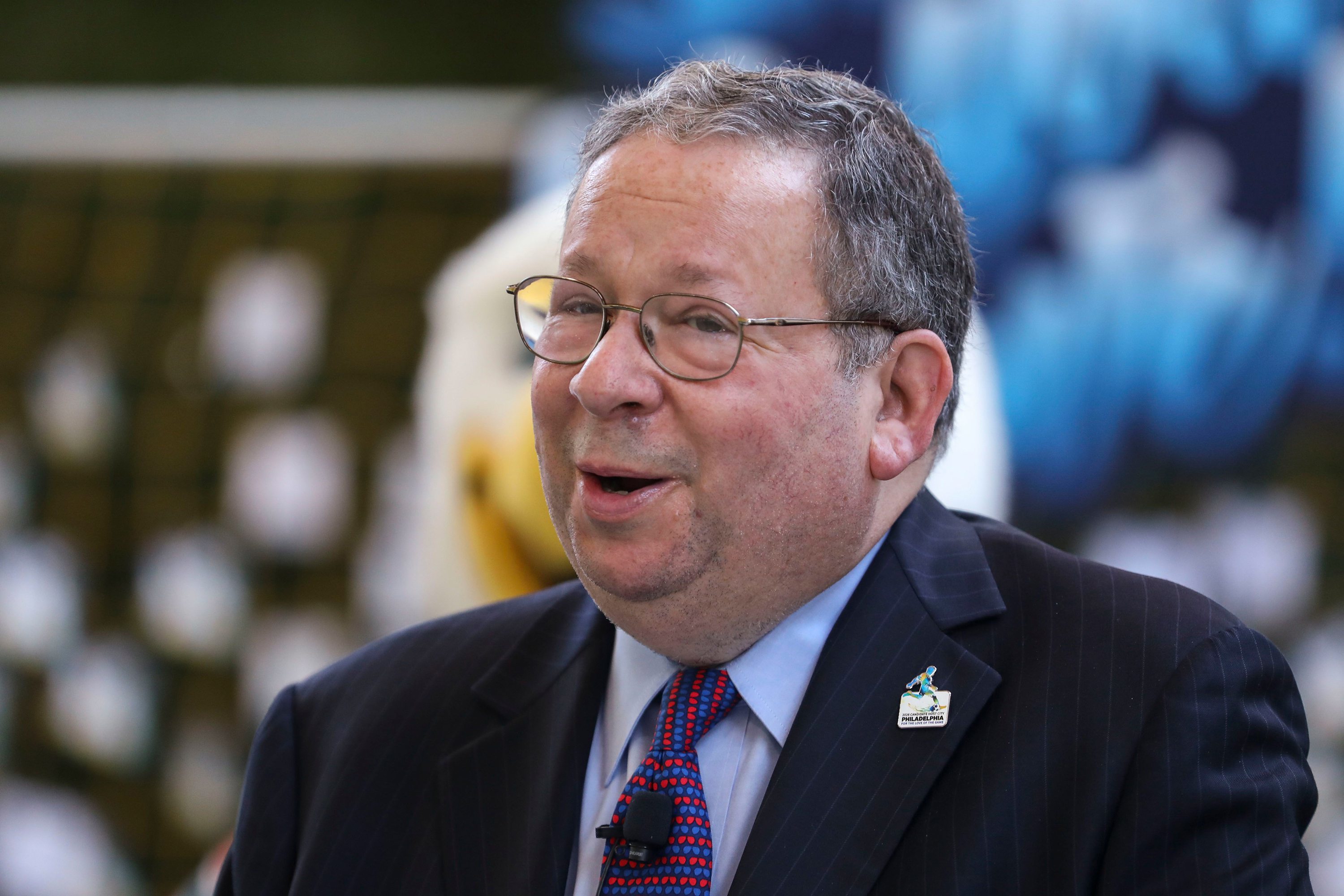
David L. Cohen, the former U.S. ambassador to Canada and Comcast executive, said the governor asked him to be his “agent” in helping to broker a deal between Drexel University and the Academy of Natural Sciences.
No one, he said, wanted to see another University of the Arts, which abruptly closed in June 2024, leaving a hole in the city’s arts landscape and sending students and staff scrambling.
“I don’t want to lose the Academy on my watch, and neither does the mayor,” Gov. Josh Shapiro told Cohen, Cohen said. “Can you figure out if there’s a solution here? If there’s a solution, can you help convince the Academy and Drexel to pursue that solution.”
That’s what Cohen said he has been doing, holding 40 or 50 meetings over the last several months in search of an agreement and producing a draft proposal for the future of the Academy.
The two entities, he said, are close to agreeing to terms on governance and finances. While the museum is closing, as Drexel and the Academy announced Tuesday, the larger agreement would allow for the continued operation and growth of the Academy in Philadelphia, without jeopardizing Drexel, which is facing its own financial challenges.
“We want to preserve the Academy,” he said, “but we also don’t want to jeopardize Drexel.”
“Drexel and the Academy are working with my office, with Gov. Shapiro’s office, and with Ambassador David L. Cohen, as the governor’s representative, to preserve the essential mission of the Academy. We are working collaboratively toward the outcome we all seek for the City of Philadelphia,” Mayor Cherelle L. Parker said in a statement.
The governor’s press office did not responded to requests for comment.
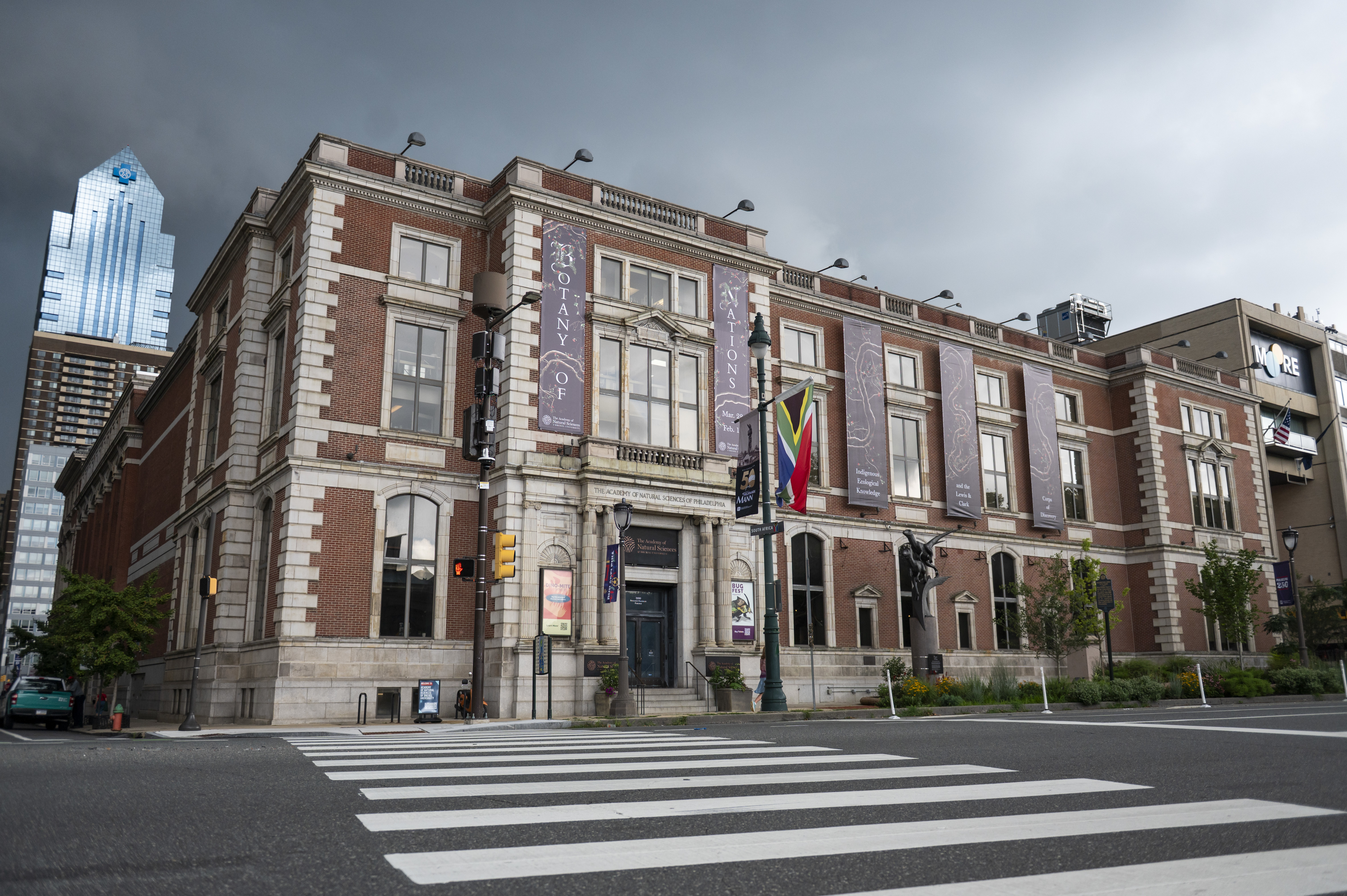
The exterior of the Academy of Natural Sciences on Wednesday, Aug. 5, 2026.Allie Ippolito / For The Inquirer
Cohen has long been a negotiator in many major city issues, formerly serving as chief of staff to former Philadelphia Mayor Ed Rendell and leading the board of trustees of the University of Pennsylvania.
Shapiro, he said, was clear about the objectives.
“The goal that the governor articulated to me and the mayor was to preserve the essential mission of the Academy, all three legs on the stool,” he said citing research, education and public engagement with the collection. “Some of the legs might be a little shorter. They might be a little skinnier. But the goal is that the Academy survives and has a foundation to thrive and grow in Philadelphia. This is a matter of civic importance.”
Drexel and the Academy are exploring establishing another museum, maybe a smaller one, in another location through a third partner, Cohen said.
“That’s a work in process,” he said. “I had an hour and a half meeting yesterday with one of the potential institutions that could serve that function for the Academy and for Drexel.”
Cohen said he hopes ultimately the community rallies around the Academy and helps to support it.
“We don’t need a single savior here,” he said. “This can be a community effort. I know the Philadelphia nonprofit and foundation community, and time and again this community has stepped up, and I have every hope that we, and it’s a we, will step up again.”
Cohen credited both Drexel and the Academy for their cooperation and willingness to “focus on a common need for the community as a whole. They really deserve the credit for doing this.”
The mayor, too, commended Drexel University and the Academy of Natural Sciences “for its significant, ongoing work to preserve the Academy’s educational mission and extraordinary two-century legacy as a natural history institution, including its world-renowned collections.”
Cohen said he first got involved in the matter about a year ago when he was home recovering from back surgery and got a call from two members of the Academy board about the issues they were having with their partner, Drexel.
The Academy was looking at possibly leaving the city, though it really didn’t want to do that, he said. He suggested they talk to the mayor and the governor. The board members told him they had been trying to do that but were unable to get attention.
Cohen texted the governor and mayor on the spot from his living room, he said. Meetings were convened, and that led to the governor seeking Cohen’s help.
“My wife says to me ‘why in the world did you take this on,” Cohen recalled. “Let me tell you, this legacy, this mission, this institution is worth fighting for. There is real history here, real value.”
Roy Hamilton’s varied racial, social, and religious identities helped him in his former role as a chief diversity leader at the University of Pennsylvania— and now they will help him in his new role as chair of Penn’s faculty senate.
The behavioral neurologist at the Perelman School of Medicine is the son of a Japanese immigrant and an African American. He is married to a white woman who is Jewish, while he was raised as one of Jehovah’s Witnesses and now is a secular humanist. And one of the couple’s children is LGBTQ+; he is an ally. Add to that growing up in a lower middle-class family and learning to navigate an Ivy League education system, first as an undergraduate and then as a medical school student.
That background has made it easier for him to understand a range of factors in his own life and how they affect his thinking, Hamilton said, and more readily understand where others are coming from and look for common ground.
Those same skills, he said, will be just as valuable as he steps into a position leading Penn’s faculty senate, the representative body for the school’s approximate 3,000-member standing faculty in a system of shared governance.
Hamilton said one of his primary goals will be to make the faculty senate representative of the collective views of a vastly diverse staff and foster conversation across those views.
“It does call for a person who is interested in hearing and honoring a multiplicity of opinions and perspectives and then coming to some kind of collective consensus as to how to act in the face of that,” Hamilton, 53, said during an interview in his office this month.
“Penn has acted judiciously in a difficult time,” when responding to Trump, said Roy Hamilton, faculty senate chair and a behavioral neurologist at Penn. “It’s trying to thread a needle. Time will tell whether that strategy ultimately pays off.” Monica Herndon / Staff Photographer
The senate plays a key role on campus discussing issues of faculty concern, making policy recommendations, responding to regular reports of university administrators, and providing oversight on issues that include academic freedom and research policy. AndHamilton, who has spent 24 years at Penn, comes in as chair at a pivotal time. The school is searching for a new president to replace J. Larry Jameson, who will step down next summer, and continuing to operate under the scrutiny of the federal government, which has targeted elite universities. There are ongoing concerns about access to federal research funding, and the school this year plans to adopt new guidelines for open expression on campus that have drawn strong objections from faculty.
“As Penn confronts the major questions of our time, the Faculty Senate’s contribution is not to provide a single set of answers, but to pursue a constructive process of thoughtful deliberation and principled engagement conducted in good faith,” he said in a message to faculty last week.
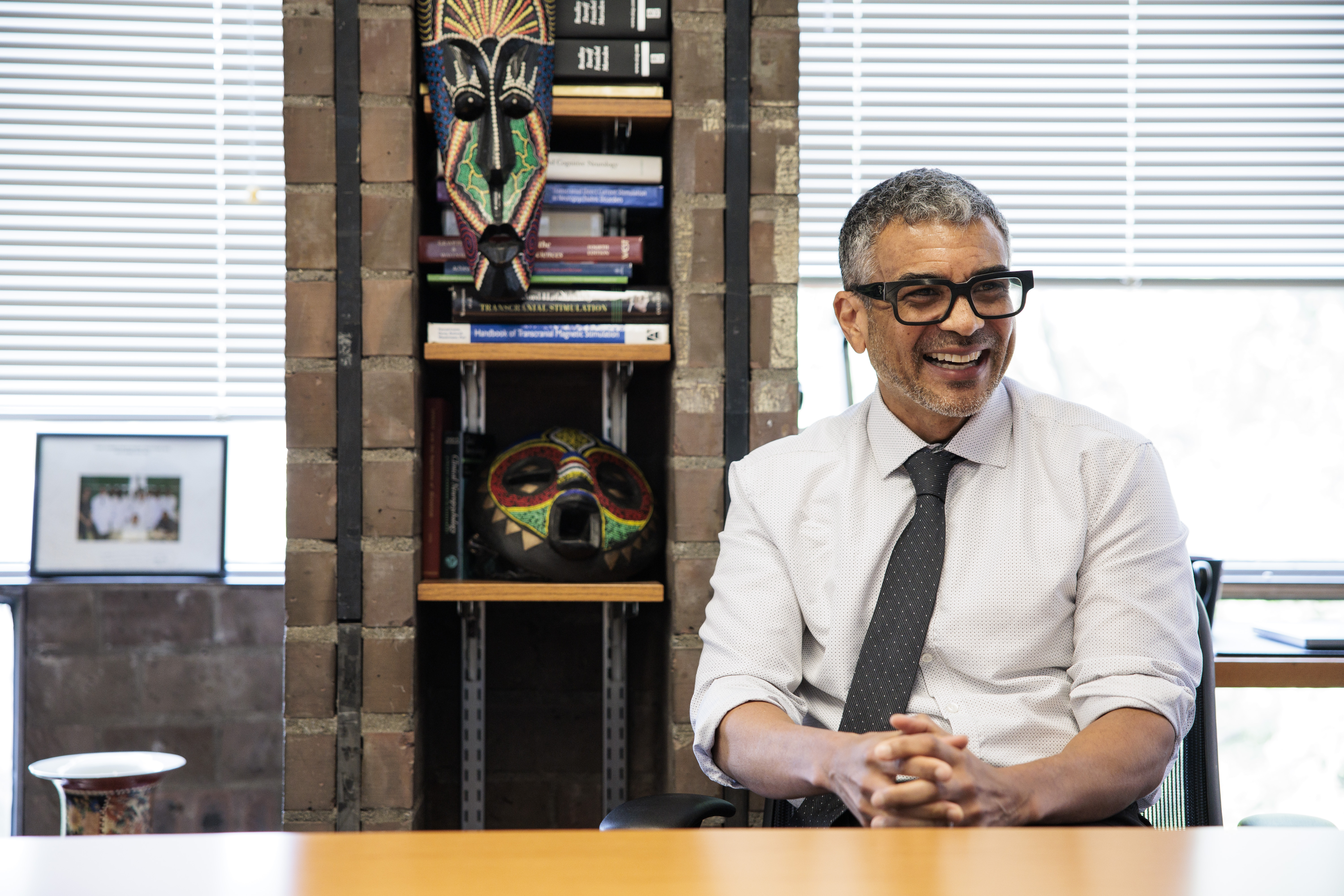
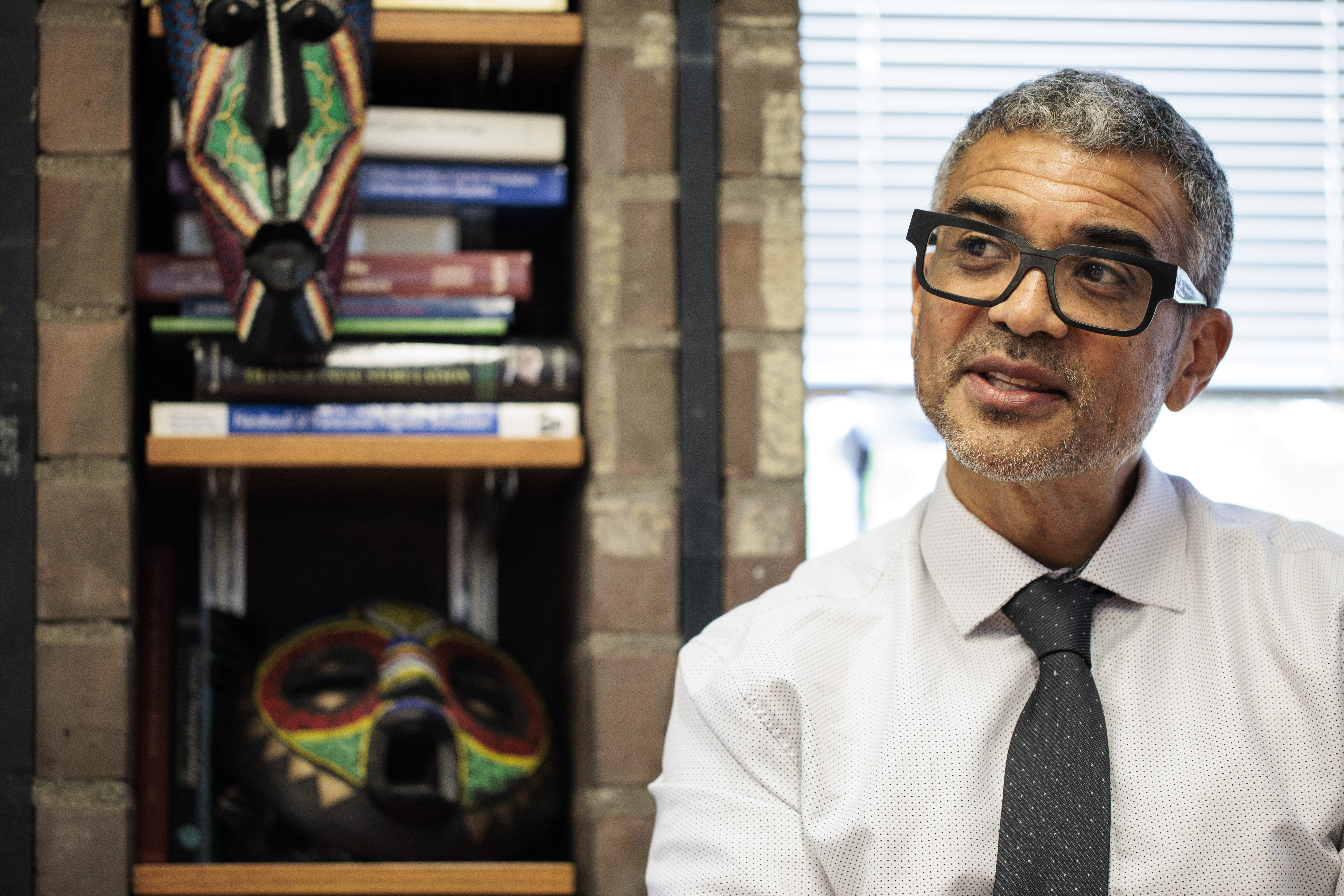
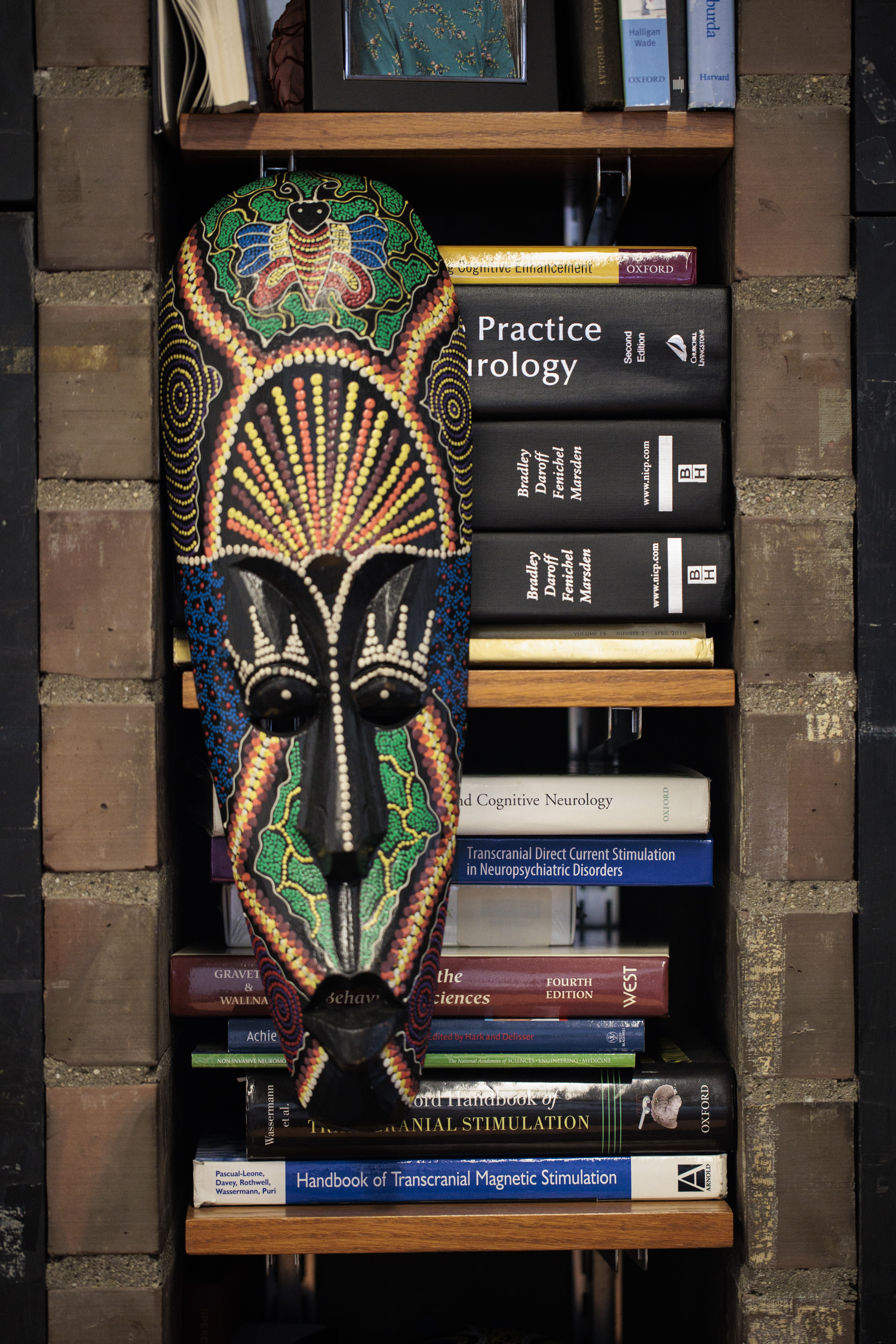
Roy Hamilton collects masks and his office is filled with pieces he has received from his students and mentees over the years. Monica Herndon / Staff Photographer
‘Trying to thread a needle’
Hamilton has been in the hot seat before. He was the medical school’s vice dean for inclusion, diversity, and equity when President Donald Trump’s administration last year cracked down on diversity initiatives in higher education and Penn scrubbed its websites of those programs. Hamilton’s own title was changed to special adviser to the dean.
“It would be disingenuous to say that it was easy,” Hamilton said. “It was a huge change. It was a difficult change. It was a change that I wish the institution didn’t feel like it had to make.”
But Hamilton — who for more than a decade held administrative roles centered on diversity and inclusion at Penn — said he understood that Penn felt it had to make changes, given its reliance on federal research funding. Hamilton pointed out that he gets National Institutes of Health funding for his work.
“If you jeopardize some of the fundamentals of how the institution works and runs, you jeopardize lots of positions and roles, including the roles of persons like myself and the very diverse lab that I run,” he said. “So I understand the Sophie’s choice that the medical school was faced with. That doesn’t mean I have to be happy about it.”
Roy Hamilton talks about his work as a behavioral neurologist.Monica Herndon / Staff Photographer
Still, he said, some of the work continues.
“We are the same people, and I believe that Penn’s values will endure,” he said.
Penn at times has stood up to the Trump administration and at times negotiated. It ardently opposed the Equal Employment Opportunity Commission’s quest to get lists of Jewish people on campus for its investigation into antisemitism. The EEOC dropped its subpoena last month and said it would not take further measures to seek the information through other means.
Last summer, the school entered into an agreement with the administration over the past participation of transgender athlete Lia Thomas on the women’s swim team. Penn met a number of the White House’s demands, including adhering to the Trump administration’s definitions of sex, female, male, women, and men only as they apply to athletics, and sending letters of apology to female athletes who felt aggrieved by Thomas’ position on their team during the 2021-22 season.
“Penn has acted judiciously in a difficult time” when responding to Trump, Hamilton said. “It’s trying to thread a needle. Time will tell whether that strategy ultimately pays off.”
“I was one of those guys, even as a small child, sort of door to door trying to talk to people about the Bible and what God had planned,” Roy Hamilton said, discussing his upbringing as one of Jehovah’s Witnesses. Monica Herndon / Staff Photographer
Hamilton’s upbringing was instrumental to his interest in diversity.
“Every step of the way has felt like I was … some kind of explorer finding some new territory,” he said. “I’ve historically been very interested in seeing to it that other people don’t have that level of alienness in the process.”
Raised as one of Jehovah’s Witnesses, then on to Harvard
Born in Long Beach, Calif., Hamilton grew up as one of Jehovah’s Witnesses. His late father worked in a brewery and his mother, who got her undergraduate degree in Japan, earned money as a seamstress, working from the family home. (She later returned to college, earned a master’s degree, and became a teacher.)
Neither of his parents was raised in the Jehovah’s Witnesses faith, but his father had several family members who belonged. When his mother emigrated from Japan, she told his father she would like to go to church, and he took her to a Kingdom Hall, the worship place of Jehovah’s Witnesses.
“By the time I was a small child, she was one of Jehovah’s Witnesses, and so that was the background in which I was raised,” Hamilton said. “I was one of those guys, even as a small child, sort of door-to-door trying to talk to people about the Bible and what God had planned.”
But he and his family parted ways with the religion when it came time for Hamilton to go to college. Hamilton was in the gifted and talented program as a child, did well in school, and wanted to continue. At that time, the faith generally discouraged higher education, he said.
He recalled congregation elders pulling him aside and questioning his intent to apply to college.
“It had the same kind of vibe as if I had been caught smoking in the boys’ bathroom,” he said.
Hamilton did not just go to college — he went to Harvard University. His father feared flying, so Hamilton took the train from California and arrived three days later in Massachusetts.
The Ivy League experience was “a huge adjustment,” he said. One of his roommates hung out with a son of media mogul Rupert Murdoch, he recalled. A student down the hall was dating then-Vice President Al Gore’s daughter.
He got his bachelor’s degree in psychology and graduated from Harvard’s medical school, where he said he felt a bit of “impostor syndrome.” He also got a master’s degree in health sciences technology from Massachusetts Institute of Technology.
At Harvard, his interest in the brain grew and was amplified when he worked in the lab of cognitive neuroscientist Nancy Kanwisher, whose work led to the discovery of the region of the brain that processes facial recognition.
“It’s the reason why we recognize incredibly subtle differences between faces,” he said.
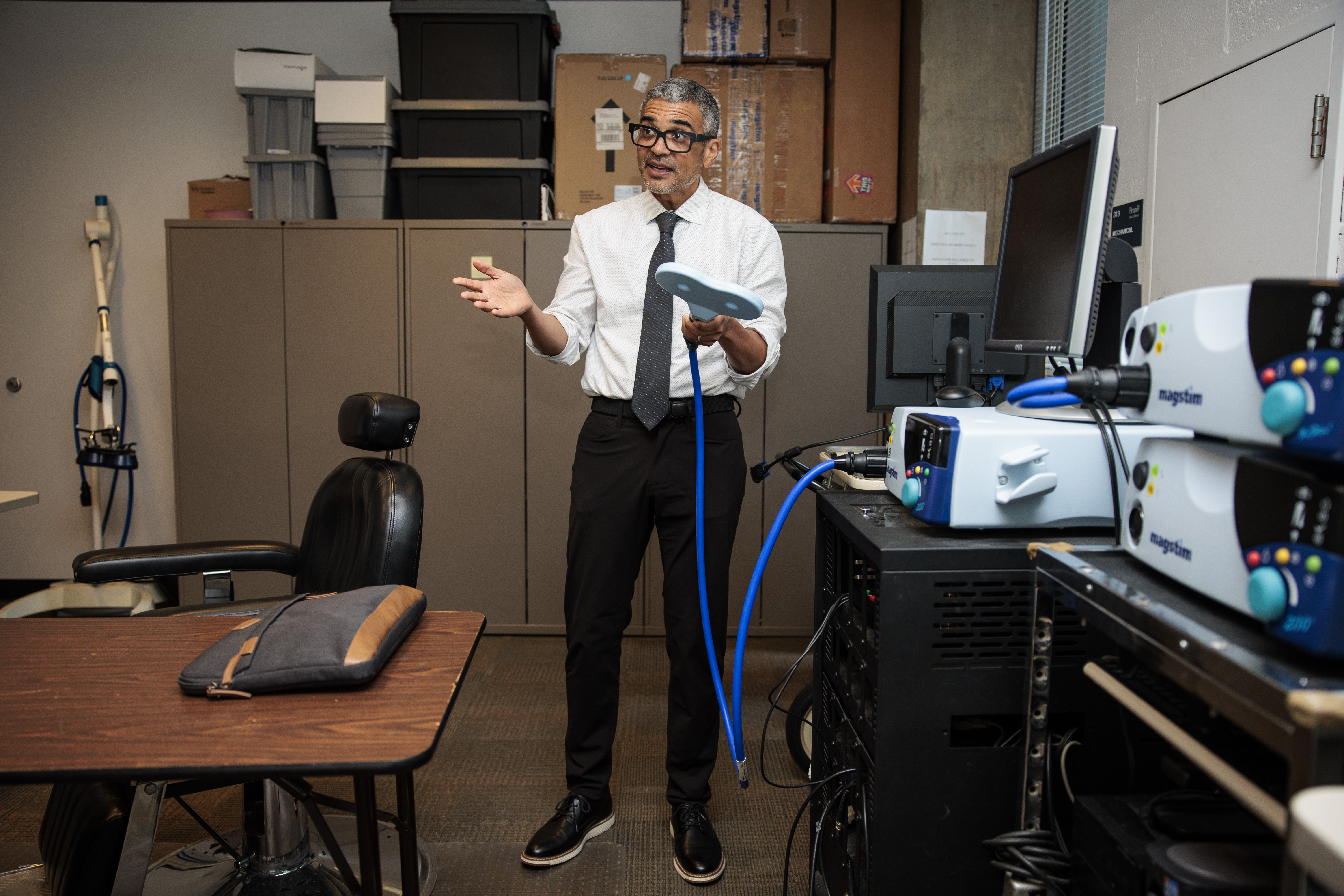
Roy Hamilton discusses how transcranial magnetic stimulation (TMS) units are used in helping to study the brain and develop new treatments for patients with conditions like aphasia. When a TMS device is triggered, the box-shaped main unit discharges a large current through the attached coil. This creates a magnetic field that, when placed against the scalp, activates electrical signals in the brain.
“You can basically force the brain to fire,” he said.
Monica Herndon / Staff Photographer
Another key moment came when neurologist Alvaro Pascual-Leone visited his medical school seminar and showed how magnets aimed at the head could temporarily affect behavior in the brain.
“I was like, ‘That is the most amazing thing I’ve ever seen in my life,’” he said. “‘I’m going to do that for the rest of my life.’”
Magnets and the brain
After an internship at UCLA, in 2002 he came to Penn, where he now runs the Laboratory for Cognition and Neural Stimulation, as well as the Brain Stimulation, Translation, Innovation and Modulation Center. Putting it simply, he said: “I take magnets. I put them on people’s brains and I make them think different things.”
He sees patients struggling with memory and cognition disorders, such as dementia and aphasia.
“The central but not sole clinical focus of my research is in persons with language loss,” he said.
He is married to Dawn Mechanic-Hamilton, a clinical neuropsychologist and associate professor in Penn’s department of neurology.
Last year, Hamilton became chair elect of the senate, which functions under tri-chairs — chair-elect, current chair, and past chair — all one-year terms for a three-year commitment.
The senate earlier this year was charged with naming faculty to serve on a committee outlining priorities for Penn’s next president. Among its priorities this year, the senate will focus on implications of artificial intelligence on teaching and learning, he said.
“While Penn’s future remains full of promise, the road ahead may not always be easy,” he wrote to faculty. “Difficult moments, however, provide an opportunity to think carefully about the principles that give purpose to our work and ought to guide our decisions.”
An event ordinance passed earlier this month by Lower Oxford Township unfairly targets Lincoln University and is unconstitutional and racially discriminatory, the historically Black school said in a federal lawsuit filed Tuesday.
“The ordinance’s disparate negative impact on the Lincoln University community is the result of deliberate racial gerrymandering — or other illicit gerrymandering — by the Defendants,” the school’s lawyers argued in the complaint, filed in the U.S. District Court for the Eastern District.
The suit notes that the township’s three supervisors are white and that the population of the township nestled in farm fields with about 5,000 residents is “overwhelmingly white” except for Lincoln’s community.
The ordinance seeks to regulate events with more than 500 people, requires a permitting process, allows the township to revoke permits without a hearing for a violation, and threatens to prohibit an entity from applying for another permit for two years if a violation occurs. In the permit request, applicants will be asked to address security, parking and traffic impact, number of attendees, planned activities, and other elements. Violations will result in fines of up to $1,000, the ordinance states.
Lower Oxford Township supervisors meet and discuss a potential event ordinance to address problems with large events held on Lincoln University’s campus, Monday, Dec. 8, 2025.Steven M. Falk / For The Inquirer
The rural Chester County township began looking at enacting the ordinance following the shooting last October of seven people, one of whom died, on Lincoln’s campus during homecoming festivities. Township officials also had cited ongoing concerns about traffic, trash on neighbors’ lawns, and other disturbances, including crimes, during large events on the 422-acre campus, where 1,650 students are enrolled. The township previously had passed a parking ordinance in response to access issues created during large events at Lincoln.
Deborah Kinney, township secretary/treasurer and codes enforcement officer, said Tuesday she had not been aware of the lawsuit until The Inquirer called. She declined immediate comment.
Lincoln president Brenda A. Allen said the university is seeking to stop the township from depriving members of its community of their First Amendment rights to free speech, freedom of assembly, and freedom of religion. The ordinance, she said, is attempting to restrict the university from events that are essential to its academic mission.
“Lower Oxford Township’s ordinance is a targeted, unconstitutional overreach that threatens the hallowed traditions ingrained in the university’s foundation,” Allen said in a statement Tuesday. “Lincoln University will remain on the front lines of protecting, defending, and advancing our community as we take this matter seriously.”
In its ordinance, the township states that “activities associated with special events can constitute a hazard to the public’s health, safety and welfare and that these activities can also create a public nuisance when unregulated.”
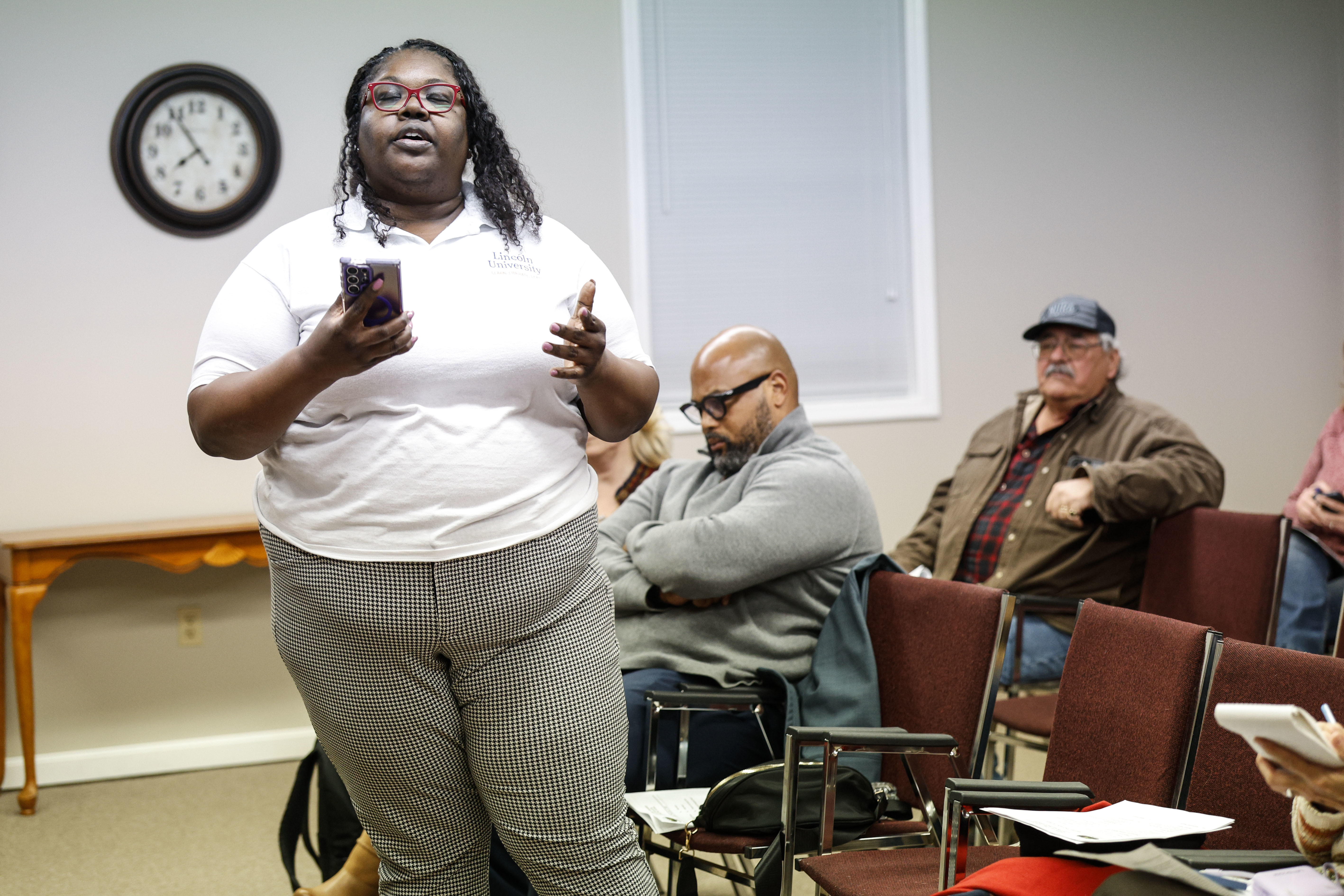
Venus Boston, Lincoln general counsel, speaks to the Lower Oxford Township supervisors in December 2025 as they discuss a potential event ordinance to address issues with large events held on Lincoln University’s campus, Monday, Dec. 8, 2025.Steven M. Falk / For The Inquirer
The township’s supervisors, the ordinance states, have “determined that the impact of special events that involve large numbers of attendees on roads and other infrastructure within the Township represents both a traffic hazard and an impediment to the delivery of emergency services to residents of the Township and therefore constitutes a nuisance.”
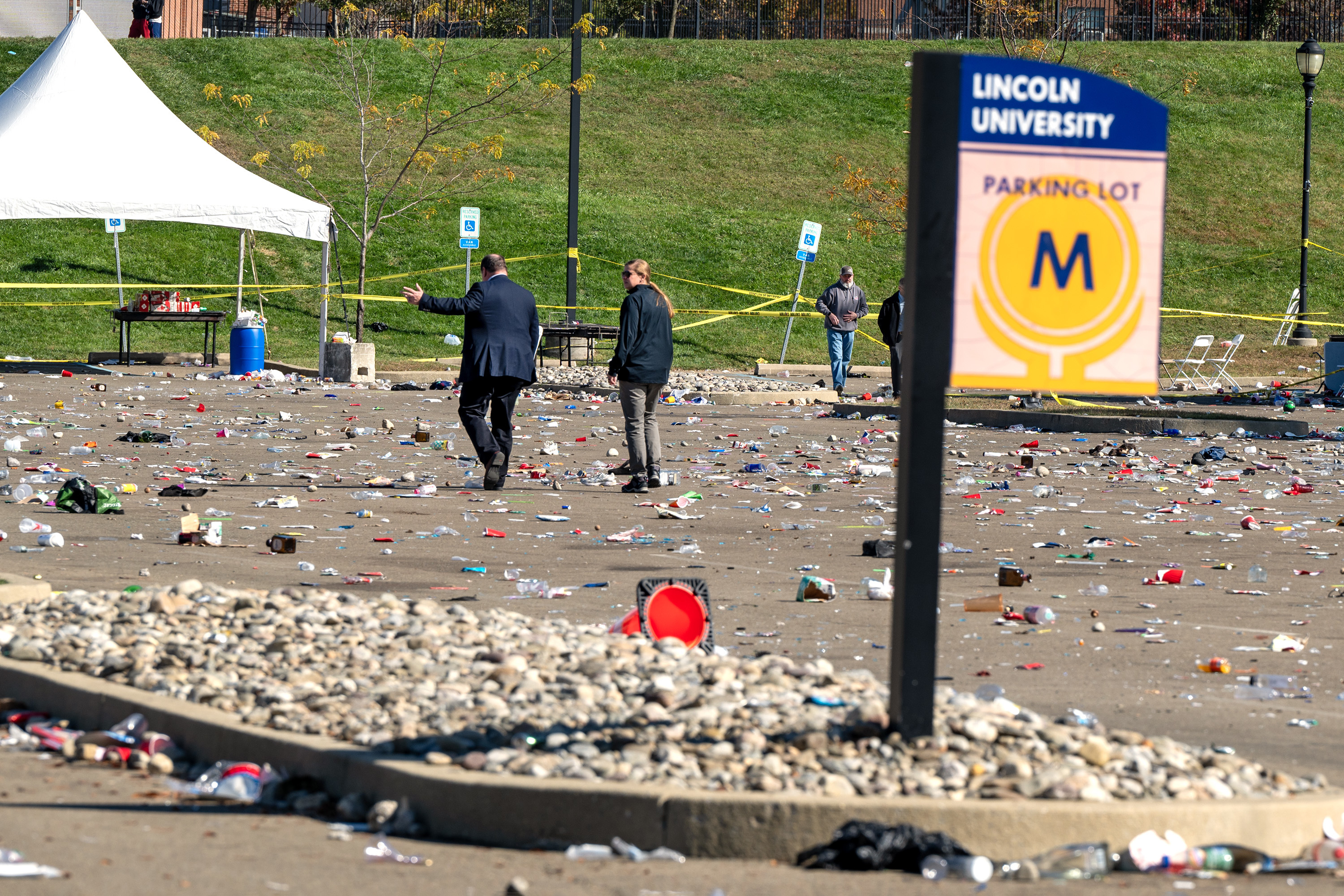
The shootings that spurred the township to begin considering an ordinance occurred Oct. 25, when thousands gathered on campus for Lincoln’s homecoming. Emergency personnel had to use all-terrain vehicles to transport patients on stretchers because ambulances could not access the campus, given how many cars were parked around the venue, township officials said at the time.
Investigators are on the scene outside Lincoln University’s International Cultural Center Sunday, Oct. 26, 2025, where one person was killed and several others were shot the night before during homecoming weekend celebrations.Tom Gralish / Staff Photographer
While the ordinance applies to other township events, the school’s lawyers argue that it targets Lincoln and specifically names examples of special events subject to regulation as “College homecoming or other similar events, college, university or school commencement, graduation or baccalaureate.”
“It was enacted by the township with the deliberate purpose and with the calculated effect of targeting Lincoln,” the school’s lawyers argued. “Specifically, the ordinance was enacted to interfere with Lincoln’s academic mission and with the speech and other academic activities of the Individual Plaintiffs and their academic colleagues.”
The ordinance targets events with over 500 people “with the knowledge that the Lincoln University community is at all times several times in excess of that threshold” and “with the knowledge that very few — if any — of the events outside of Lincoln would exceed that threshold,” the lawyers said.
The ordinance, the school’s lawyers argued, violates Lincoln’s constitutional rights by imposing restrictions on its speech and “its ability to serve as a marketplace of ideas.” The ordinance also violates the First Amendment right to assembly because it treats events of more than 500 people as a nuisance, the lawyers said. And the lawyers said it infringes on religious freedom by naming baccalaureates, which they said “in general — and baccalaureates at Lincoln in particular — are religious services.”
They objected, too, that the township has sole discretion over whether an event is subject to the ordinance and over whether it should be permitted, and that no objective standards exist. And they disputed the township’s intention to require event holders to have liability insurance subject to approval by the township solicitor.
“The ordinance also makes the sponsor of a special event liable for actions of people over whom it has no control,” the school’s lawyers argued.
The ordinance states that the sponsor “shall be responsible to the township for damages sustained to township property caused by participants in the special event.”
Founded in 1854, Lincoln is known as the first degree-granting historically Black university in the nation. The first presidents of both Nigeria and Ghana are Lincoln graduates, as are Philadelphia Mayor Cherelle L. Parker, former U.S. Supreme Court Justice Thurgood Marshall, and poet Langston Hughes.
The school hasreceived $45 million in gifts fromphilanthropist MacKenzie Scott, the ex-wife of Jeff Bezos. Allen, Lincoln’s president, who in 2020 had survived an internal battle to oust her and had her contract extended to 2030, was named a top leader of a historically Black college by a national nonprofitin 2021.
Township officials had been expressing concerns about events at Lincoln for a while before the homecoming shootings brought renewed attention.
In spring 2023, two women were shot and injured on Lincoln’s campus during its annual Spring Fling event. In 2022, a student was fatally stabbed by the sister of a student during a fight inside a dorm. During an on-campus dance in 2018, 15 students were taken to the hospital following a brawl in which a security officer was assaulted. In 2016, there was a robbery and shooting on Lincoln’s campus following homecoming. And in 2015, Lincoln tightened security after shots were fired in a dorm.
At the homecoming last October, Ju’Juan Jeffers, 20, of Wilmington, was killed, and six others, ages 20 to 25, including a student, were also shot. Jeffers’ mother subsequently filed a lawsuit against the school, and three Wilmington men — William Sells, 20; Makaveli Valera, 19; and Karon Rollins, 17 — were charged with second-degree murder, conspiracy, and related crimes in connection with the shootings.
“We have had meetings with people at Lincoln,” Township Supervisor Noel Roy said last December. “They’ve been somewhat reluctant to do what needs to be done to try and control the situation.”
Allen at that time acknowledged that changes were needed around large events as well as better collaboration with the township.
“We want to come together because we are a part of this community as well,” Venus Boston, Lincoln’s general counsel, said during a supervisors meeting last December.
Before its Spring Fling in April, the university announced new safety plans for large events, including no outdoor events after dusk, screening guests, and allowing only one registered guest per student.
Temple University will significantly raise the salaries of its police force under a new five-year contract aimed at addressing its longstanding problem of attracting and retaining enough officers.
The new contract — which comes a year before the previous contract was set to expire — was initiated by university president John Fry after a staffing study released in December found the school needed to increase its number of police officers.
The new pay scale more closely aligns with that of the Philadelphia Police Department, the university said, and is expected to help the school reach its goal of increasing its number of patrol officers by 29, or 58%, over five years. It now has 79 police officers on staff — about 50 of them patrol officers — with three more poised to start Sept. 8. Five more are ready to graduate from Temple’s police academy in October, with more lined up to start there, the university said.
“We understand, like in our bones, how vital this work is not only to the safety of our students and our employees but to our neighbors, which we prioritize as well,” Fry said in an interview Thursday. “If we’re going to make North Philadelphia in particular an investable area, it all starts with public environment and public safety. No one’s going to contemplate making major research or commercial or residential or retail investments in an area that they don’t have confidence in.”
Under the new pact — which was ratified in June and runs through June 30, 2031 — an officer with at least three years of experience will start at a salary of $92,000, up $8,572, or 10.25%, from the previous salary of $83,428.
Those with at least five years of experience will start at $100,000, up $12,878, or 14.75%, from $87,122.
And officers will get raises ranging from 3% to 6.5% at anniversary milestones or across-the-board increases of 3% — whichever is greater. The agreement was announced Thursday.
“From a competitive standpoint, this new contract will make a huge difference,” Andrew Lanetti, president of the Temple University Police Association, the union, said in a statement. “It is going to entice young officers at the beginning of their career to join Temple, and it will also entice officers from other agencies to join our department.”
And it is helping to keep officers, too, he said in an interview.
“Many people who were thinking about moving on to other departments have now changed their minds,” he said.
Officers will see significant salary bumps, ranging from $5,000 to $17,000, as they reach each level, he said.
The contract, said Denise Wilhelm, interim vice president of public safety, also has made officers feel more valued.
“This is a true partnership, and it shows,” Wilhelm said.
Temple enrolled 29,503 students last year excluding its campuses in Rome, Tokyo, and Kyoto, Japan. Its police officers patrol on and around the school’s main campus and health sciences campus in North Philadelphia and on its Ambler campus.
The university had faced criticism from the Temple police union in the past for not doing enough to recruit and retain officers. In a social media post in December 2024, the union said the department had lost more than 50 officers since 2022.
The new pact also includes paid parental leave, an additional week of vacation for a total of five after 15.5 years, field training officer pay, and hazard pay for working during declared states of emergency, the university said.
The staffing study released in December showed that Temple was below the middle tier of a framework that rates law enforcement agencies. The university at that time had 77 sworn officers — 50 of them patrol officers — and Fry pledged to add 29 patrol officers, one detective, six sergeants, and one lieutenant over the next five years. That would increase the overall number of sworn officers to 114.
“We must, and we will, deploy ever more compelling and creative incentives to make Temple’s Department of Public Safety a destination employer for law enforcement in our region,” Fry, who named public safety a top priority when he started as Temple’s president in November 2024, said at that time.
Retaining and hiring police officers have remained challenging, as has been true for police departments nationally. The university in the past had increased salaries and benefits, added signing and retention bonuses and higher contributions to retirement accounts, and hired an associate director to focus solely on hiring, recruitment, retention, and training.
But the overall number of officers had declined over the last few years anyway. Temple ended the last academic year with 76 officers, down one from December.
Fry said he is confident this time will be different because the strategy is long-term and intentional, with the university prepared to make the budgetary investment, even though it means sacrifices will have to be made elsewhere.
“We’re certainly going to do better than we have been doing,” he said.
The university is preparing to bring in new leadership for public safety. Jennifer Griffin, Temple’s former vice president of public safety, resigned in June after nearly four challenging years on the job. The university is conducting a national search for her replacement.
Griffin had started in August 2022 as the university continued to cope with the aftermath of the shooting death of student Samuel Collington outside his off-campus apartment in November 2021.
She led the department when Temple Officer Christopher Fitzgerald was shot and killed in 2023 while on duty and through other challenges facing the campus.
During her tenure, the university implemented or began implementation of all 68 recommendations from a safety audit by former Philadelphia Police Commissioner Charles Ramsey’s firm.
Temple University for the first time in fall 2027 will require freshmen under the age of 21 to live on campus, with certain exceptions for students living locally with parents or guardians and others facing financial hardship.
It is a significant change for a university that for much of its history was largely a commuter school and only transitioned to a major research university with an on-campus living community in recent decades.
“The policy gives Temple an important opportunity to strengthen student success by creating a more intentional first-year experience and connecting students earlier to the people, resources and support that can help them persist and thrive,” Temple president John Fry said in a message to the campus community Wednesday.
Last fall, 63% of first-year students and 22% of all undergraduates lived on Temple’s campus, according to the university.
Many four-year colleges already require their freshmen to live on campus to better connect them to the college community, ensure they have access to support services, and improve their chances at academic success. It also brings in revenue and eases the burden of off-campus housing in surrounding communities.
The University of Pennsylvania and Drexel University require students to live on campus their first two years. Pennsylvania State University — like Temple, a state-related university — calls for freshmen to reside on its main University Park campus. Some colleges, including Dickinson in Carlisle, mandate that students live on campus all four years.
Not all schools have such a requirement, however: West Chester University, which has been tight on student housing over the years, does not, though the majority of first-year students live on campus.
“We want over time for people to think about Temple as a great residential campus that’s also very friendly to commuter students,” Fry said, “as opposed to a commuter campus that is doing some residential things.”
Temple will create “an intentional focus on belonging, connection, academic success, wellness, help-seeking and personal growth” during that first year, Fry said.
Peer mentorship, early intervention and academic support initiatives, mental health resources, and financial counseling for students and families are among the resources that the university will offer, the school said.
“This work will include stronger coordination across housing, advising, academic support, wellness and other student services so that students experience a more connected first year at Temple,” Fry said.
Creating closer connections is especially important for first-generation college students and those coming to Temple from outside the area, the school said.
The university’s recently released strategic plan calls for the construction of a new 1,000-bed residence hall on Broad Street, with work beginning next year. That would increase the current 5,000-bed capacity on the main campus by 20%. Temple welcomed a record-breaking 5,379 first-year students last fall.
“We think we’re at a minimum several thousand beds short of where we need to be,” Fry said in January when the plan was released. “A stronger residential experience really does make for a much more fulfilling undergraduate experience. The more kids living on campus, the more dense campus is, I think the better we’re going to do on safety.”
The university has ramped up its safety efforts in recent years following the shooting death of a student outside his off-campus residence in 2021 and the shooting death of a Temple police officer in 2023. But challenges continue in the school’s North Philadelphia neighborhood. In April, a Temple student was chased into the lobby of the school’s Morgan Hall dormitory and attacked by a group of juveniles.
When the new residence hall opens, Temple will upgrade Johnson and Hardwick Halls, which have an additional 1,000 beds, Fry said in January.
The Annenberg Hall/Tomlinson Theater building, whose programs will relocate to a new arts and communication building in 2027, could also be converted into more residential space if needed, Fry said.
Fry expects the new first-year residency policy will lead to increases in persistence and graduation rates in future years, he said in Wednesday’s announcement.
About a decade ago, 90% of freshmen returned to Temple for their sophomore year, but by last fall, that percentage had slid to 82%, and Temple said in an internal report in April that the figure could fall below 80% this fall.
Fry said that more than 60% of all four-year residential colleges have some kind of first-year residency requirement. That includes many colleges that belong to the national University Innovation Alliance, which Temple joined in March 2025.
“Decades of research have shown that students who live on campus ultimately benefit from a more productive and rewarding college experience,” Elizabeth Wentz, Temple’s new senior vice president and provost, said in a statement.
Temple will offer several exemptions to the requirement, including those living with a parent or guardian in Philadelphia or other approved nearby zip codes. Students facing financial hardship verified through the university; those who are part-time, nontraditional, married, or have custody of one or more dependent children; and those with extenuating medical or personal circumstances that cannot be accommodated in university housing also are exempt, the school said.
The former Cabrini University campus has undergone a more than $100 million, Villanova-fueled rebirth, and students will begin attending classes and living there this month.
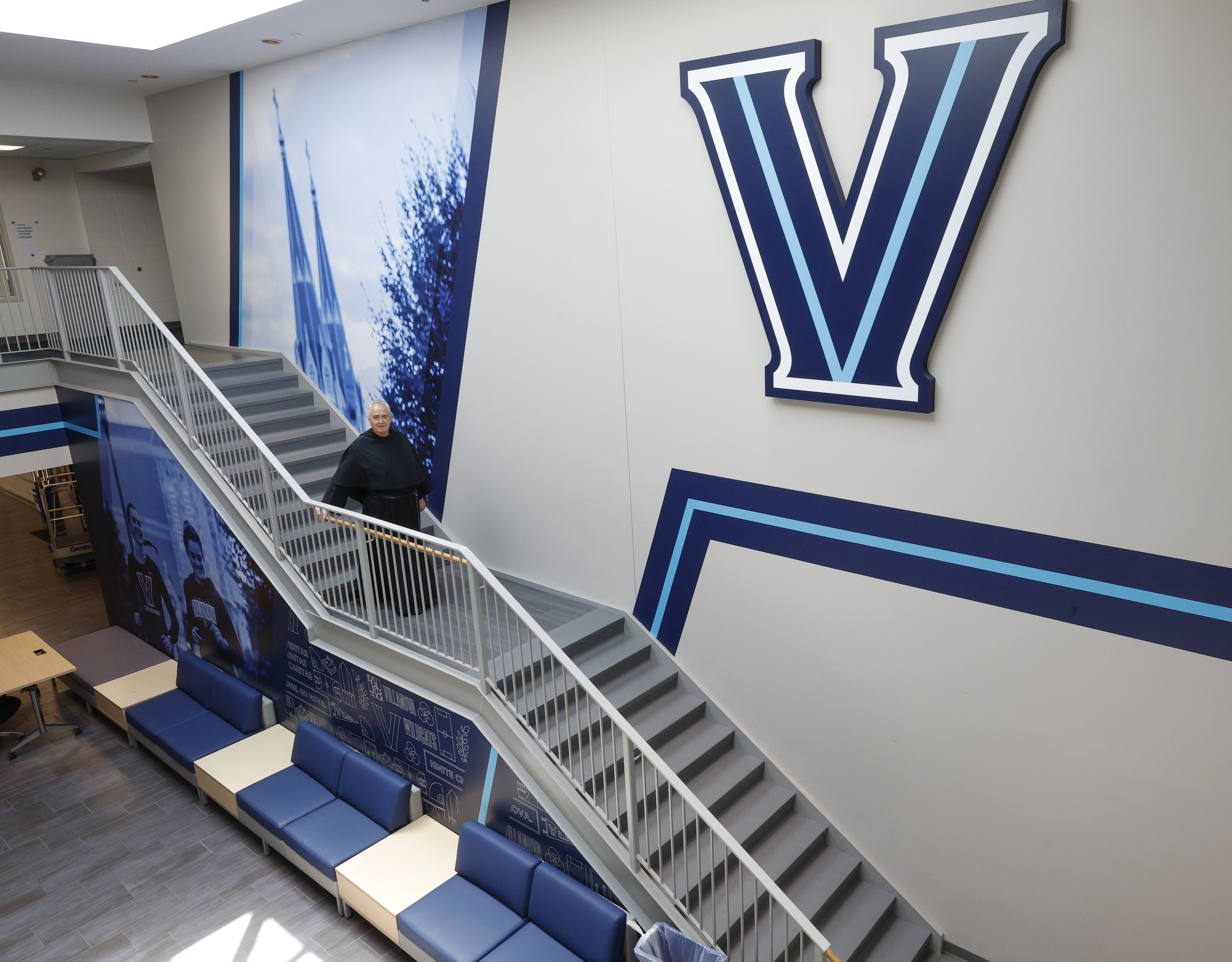
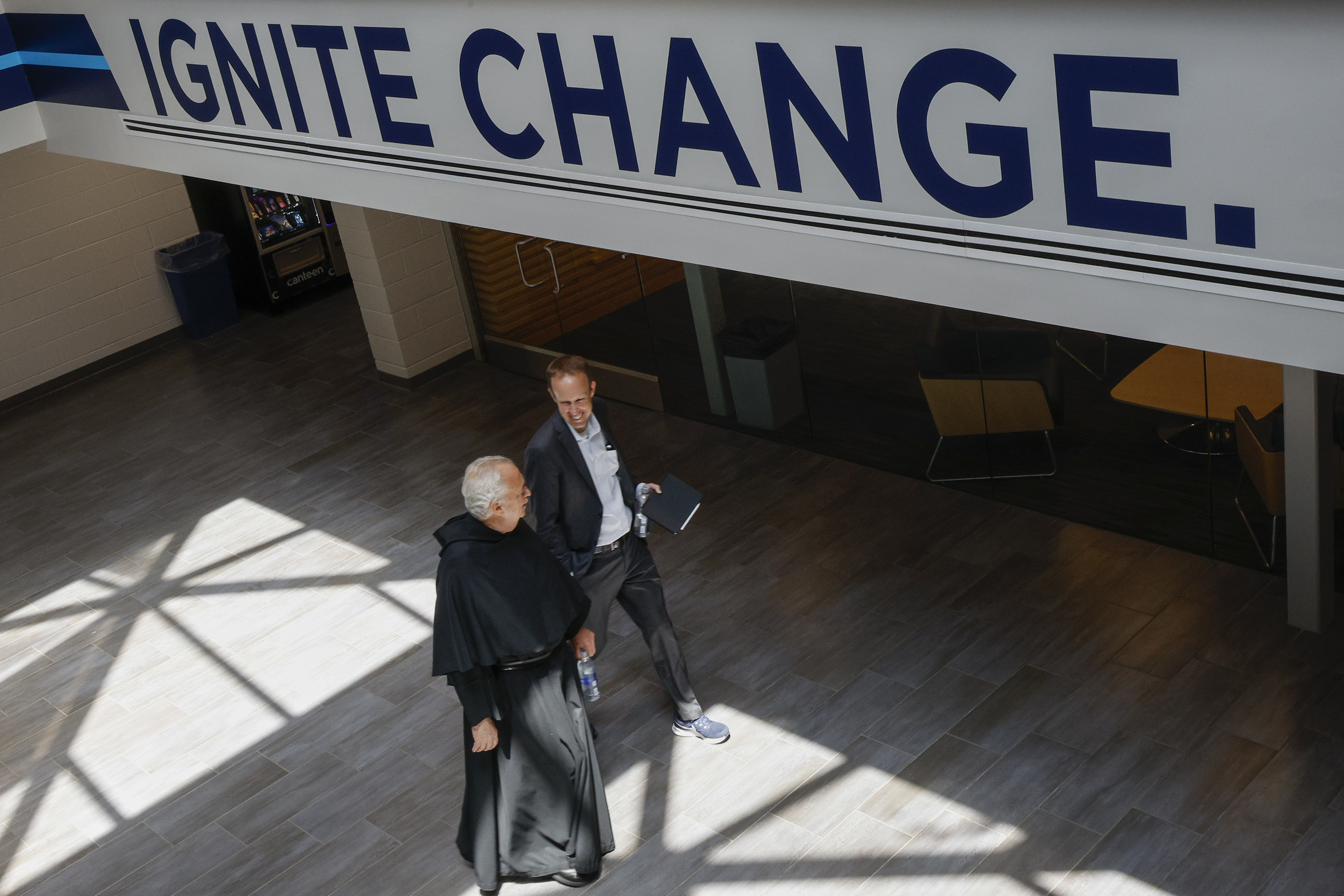
Large signature blue and white V’s for Villanova University are everywhere. “Ignite Change. Go Nova,” says a wall in the student recreation center. Beds in the residence halls now have navy blue sheets, and many of the buildings have been renamed to honor Villanova’s Augustinian heritage.
The Radnor campus once in dire need of maintenance sports a fresh look, including new light poles, landscaping, painting, furniture, boilers, roof repairs, a running fountain, pickleball courts, and restored architectural flourishes, in addition to upgraded educational technology for classrooms.
The university removed dead trees, installed firepits on the campus green, and connected the two campuses’ phone and internet systems.
Villanova President Rev. Peter M. Donohue walks down the stairs at the Dixon Center, which has been covered in Villanova signage and colors. Steven M. Falk / For The Inquirer
It is all part of Villanova’s effort to make the 112-acre campus that it acquired from the shuttered Cabrini look and feel decidedly Villanovan. The campus has been closed for the last two years as the planning and upgrades took place.
“It’s always been a beautiful campus, but it looks very Villanova now,” said Kelly Tuzio, assistant director of Villanova’s graduate nursing program, who worked at Cabrini from 2005 to 2011.
“You can feel the change,” she said, helping to ready the Iadarola Center, the building she works in, for the opening. “Everything is just done to perfection.”
Some things remain largely untouched, like the signature statue of Mother Cabrini on the green and the Mansion, Cabrini’s former administrative building, which is on the National Historic Register. It was renamed Montefalco Hall. Masses will continue to be celebrated in the chapel: Cabrini was a Catholic university, as is Villanova.
Villanova University purchased the nearby campus of the now shuttered Cabrini University two years ago and has had the site closed for remodeling. But this fall, students will live and study there. Steven M. Falk / For The Inquirer
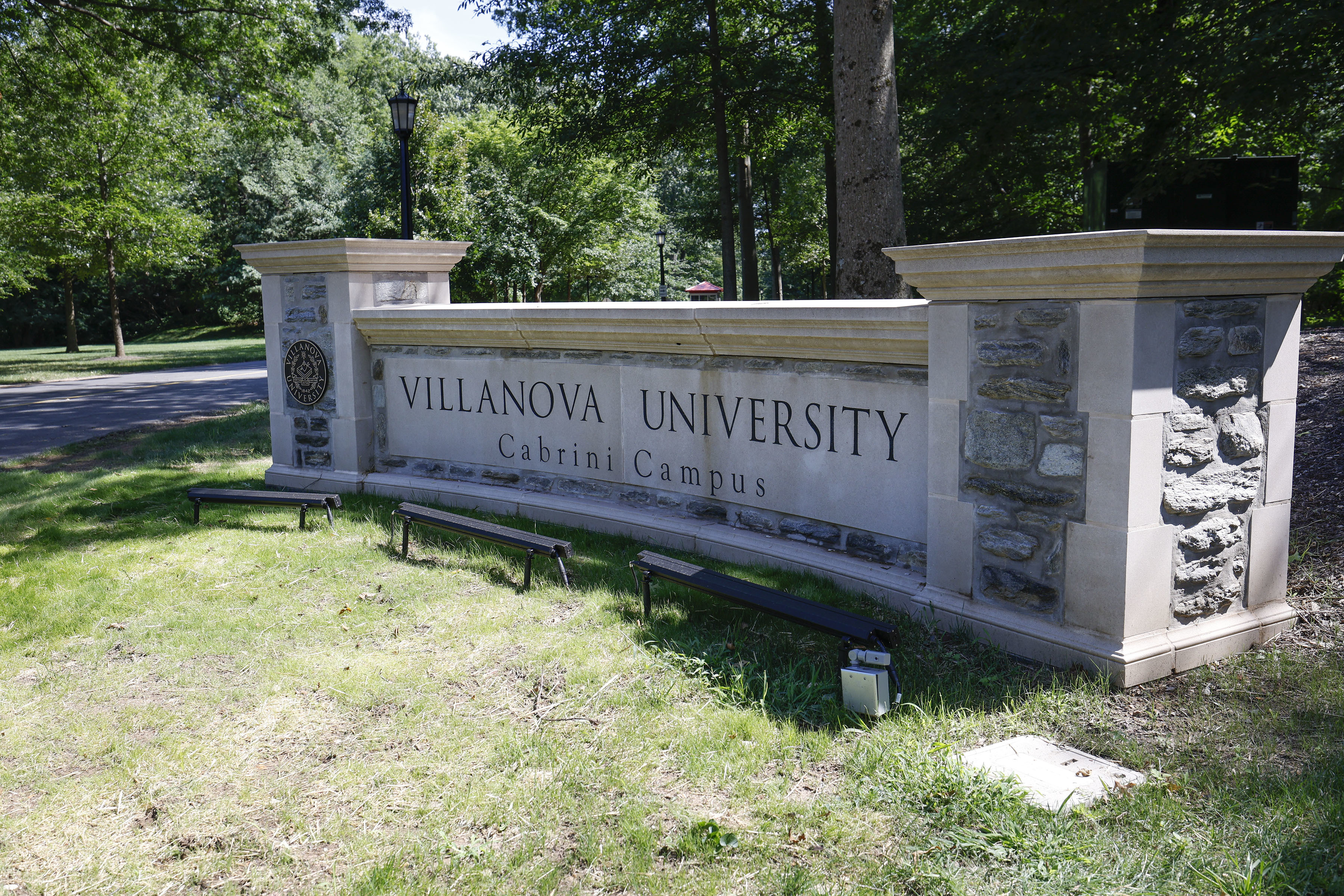
And signs at the entrance to campus say: Villanova University, Cabrini Campus — a nod to Villanova’s larger promise to retain Cabrini’s legacy.
A new era of growth
The acquisition of the campus, which officially opens for fall classes Aug. 24, marks an era of new growth for Villanova.
As many other colleges have lost enrollment in recent years, Villanova plans to grow its undergraduate student body, now at about 7,000, to 8,000 over the next four years, said the Rev. Peter M. Donohue, Villanova’s president. That growth started this year with about 250 additional freshmen. And the school plans to maintain its selectivity; it admitted just 29% of applicants for this fall’s class and saw more than a 10% surge in applications over the last year.
Villanova, which has a 260-acre main campus, will expand 43% in size with the addition of Cabrini.The university’s acquisition of Rosemont College — which will be complete in 2028 — will add 58 acres, increasing Villanova’s total to 430 acres.
The Cabrini campus will house five academic departments: psychological and brain sciences, graduate nursing, education and counseling, ethics, and part of communication. About 75 faculty — 10% of the total — will be based there.
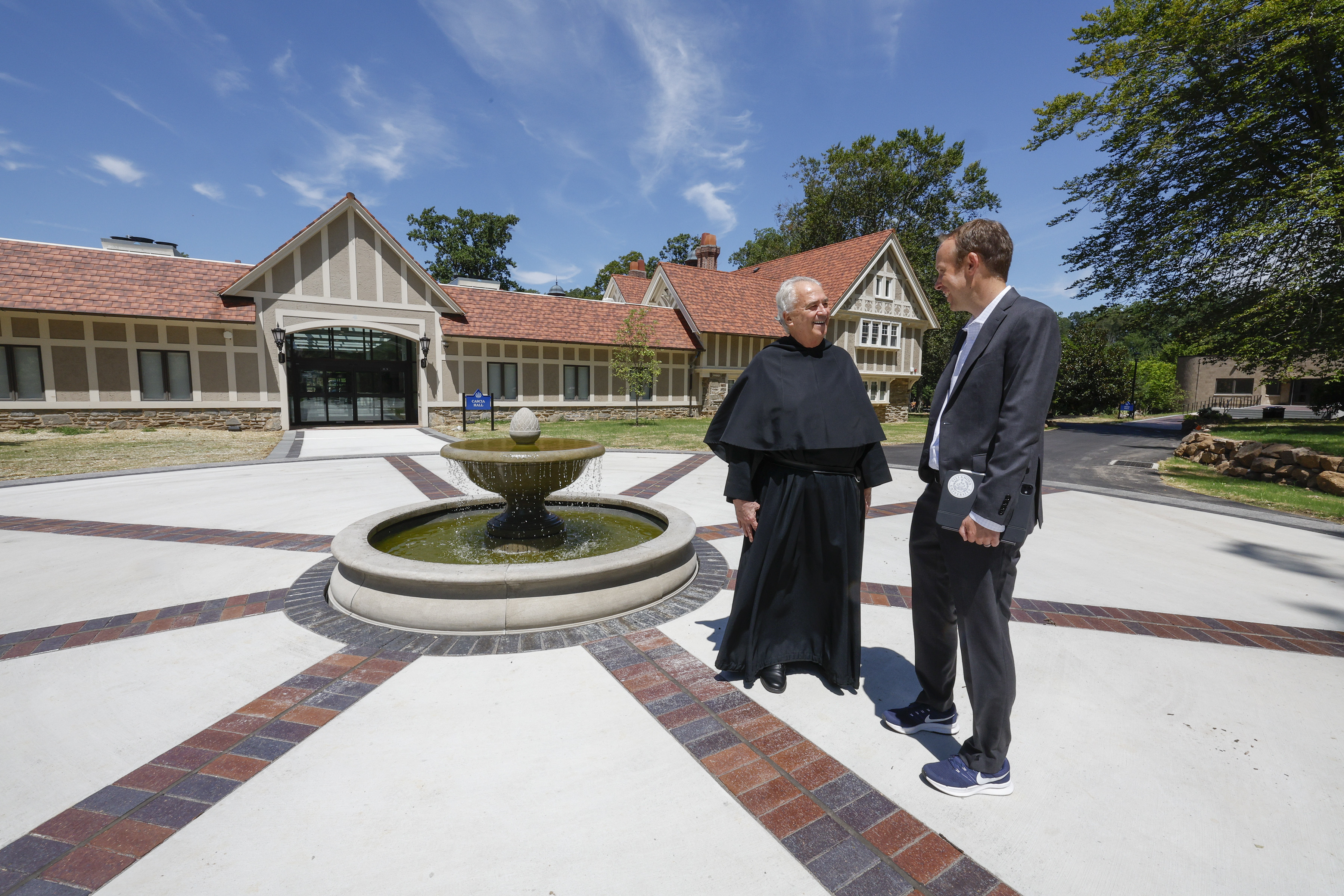
Villanova University President the Rev. Peter M. Donohue left, and Timothy Hoffman, vice provost for finance and administration, stand in front of a newly installed fountain outside Cascia Hall, which received a lot of renovations inside and out. It houses the student center. Steven M. Falk / For The Inquirer
About 900 sophomores — roughly half of those enrolled at Villanova — will live on the campus, expanding the percentage of undergraduates who live on Villanova’s campuses to more than 80%.
In addition, more than 2,000 undergraduate and graduate students — about a fifth of Villanova’s overall student population — will take classes at the Cabrini campus in the fall, said Timothy Hoffman, vice provost for finance and administration.
“I’m just excited to see life again on the campus,” said Michelle Filling-Brown, formerly dean of academic affairs at Cabrini and now associate vice provost for the integrated student experience at Villanova.
She has been designing themed living and learning communities for the new Cabrini campus.
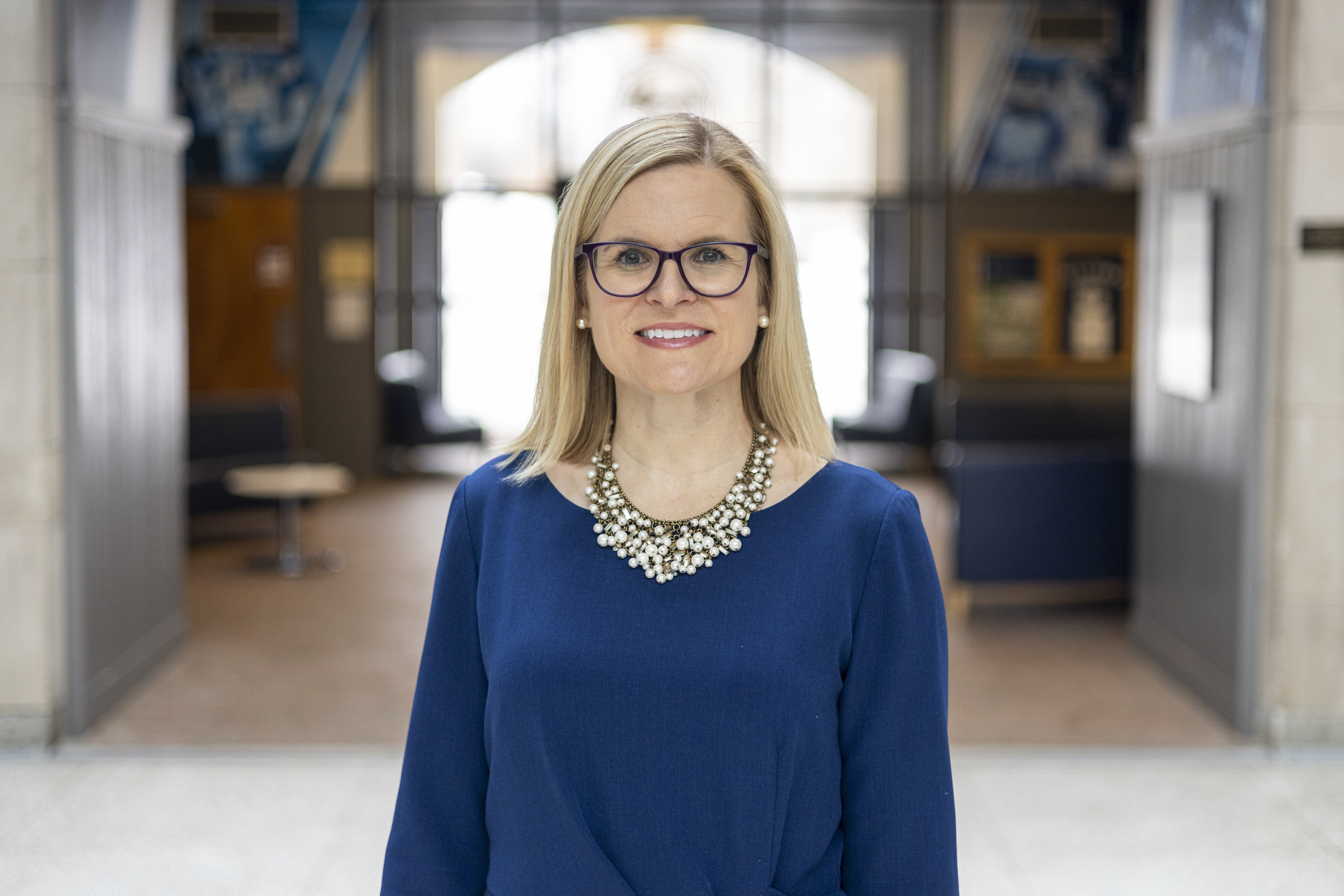
Michelle Filling-Brown, a former top administrator at Cabrini, now works at Villanova.Tyger Williams / Staff Photographer
Started in 1957, Cabrini was the only college founded by Sister Francesca Cabrini’s Missionary Sisters of the Sacred Heart. The university announced in 2023 it would shut the next year and Villanova would take it over, giving students and employees a year to find a new runway. The decision came as enrollment plummeted, finances tightened, and deferred campus maintenance mounted.
Donohue said Villanova has not yet made specific plans for Rosemont.
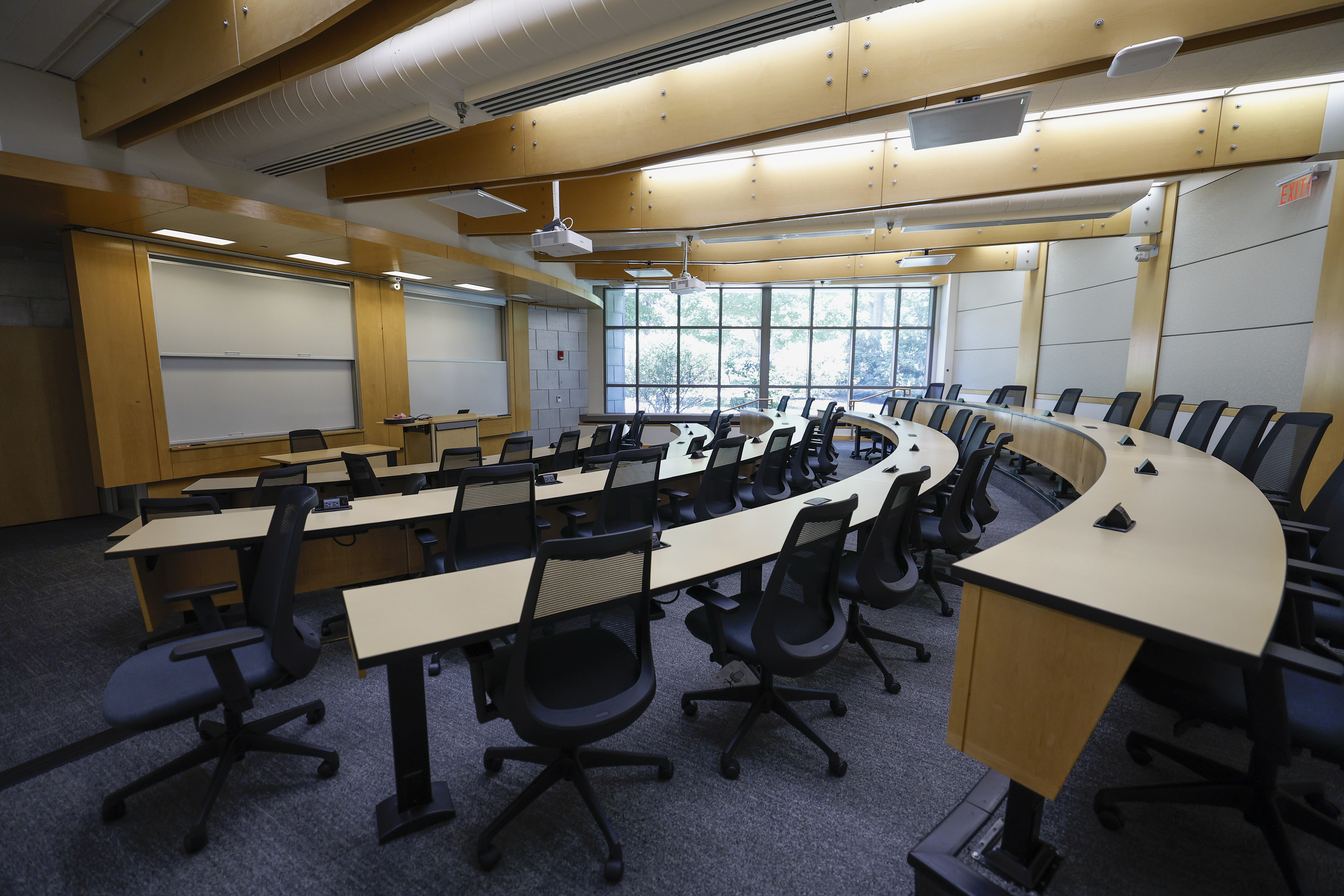
A classroom with new educational technology at the Iadorala CenterSteven M. Falk / For The Inquirer
Before beginning renovations, Villanova invited Cabrini alumni to collect memorabilia, Donohue said. The school also donated truckloads of old furniture and materials that it did not plan to use to nonprofits.
A $170 million-plus investment
The university has invested more than $170 million into the Cabrini purchase, including the $70 million it paid to close out Cabrini’s debt and acquire its land, buildings, and assets, and more than $100 million on renovations. Donohue said it will take just four years for the school to recover that money through the operation of the campus.
The university was able to keep $15 million of Cabrini’s $42 million endowment, the school said.
Though the campus has not officially opened yet, a few students have begun to move in. Last Tuesday, a group of young staff members huddled in a room, planning grand-opening activities. Others unpacked and organized nursing equipment.
Graduate student Curtis Wesley stops by the Iadarola Center where he will study this fall.Steven M. Falk / For The Inquirer
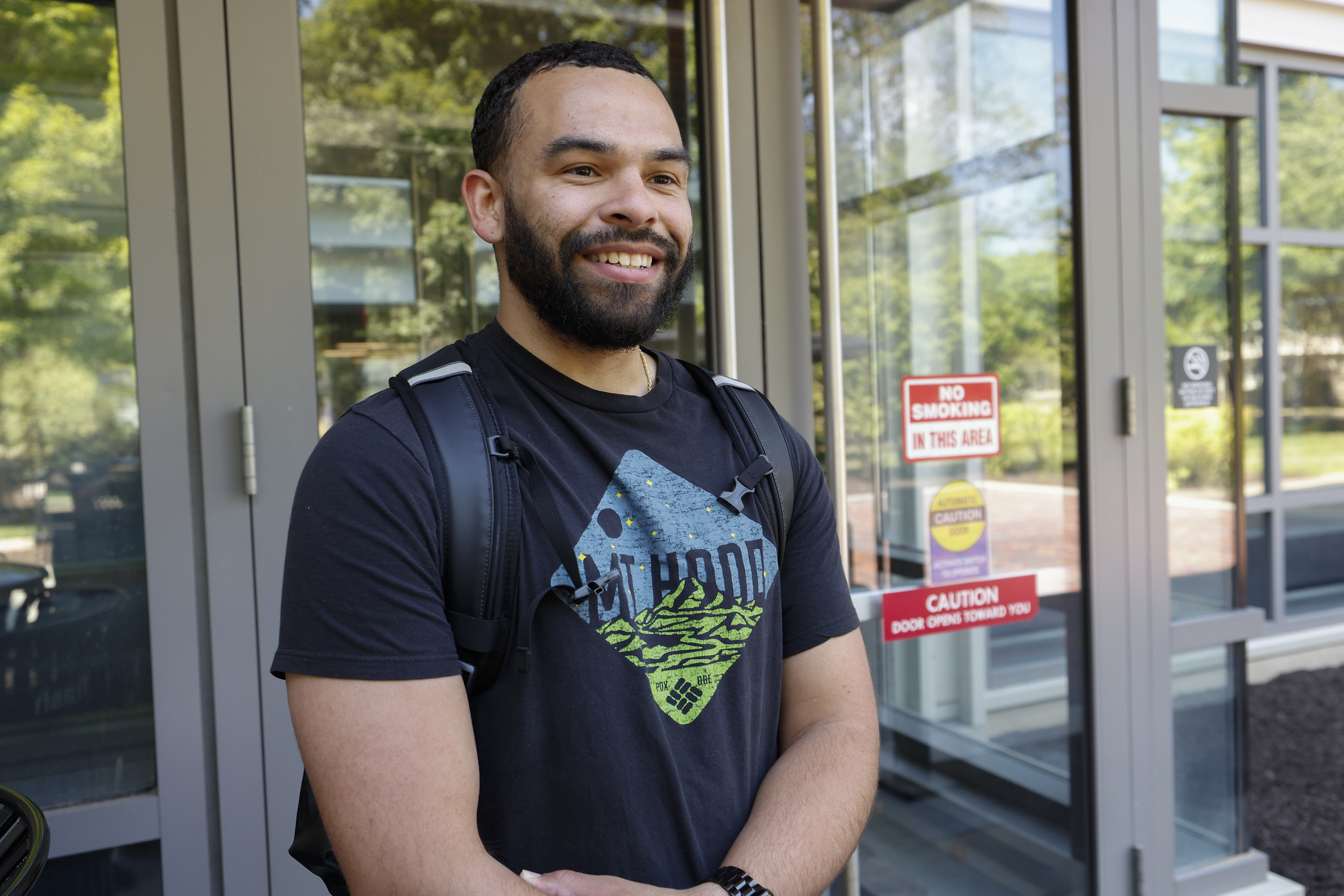
Curtis Wesley, 26, an incoming graduate student in the nurse anesthesia program, strolled out of the building where his classes will be.
“I just wanted to come and check it out,” said Wesley, who is from Kansas. “I was excited to see all the new technology.”
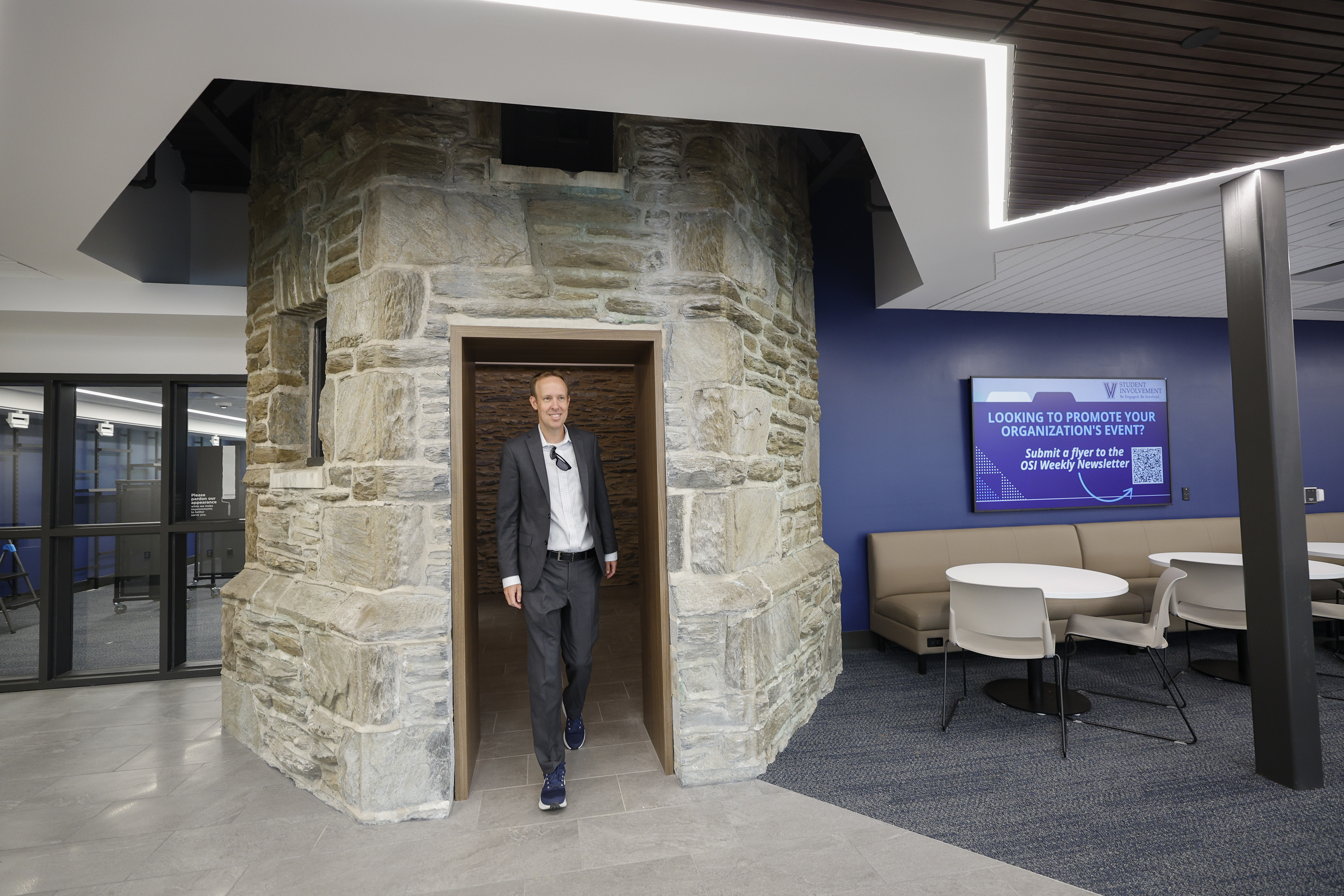
Timothy Hoffman, vice provost for finance and administration, emerges from the stone-walled turret leading to what will be a Villanova apparel shop. The turret was uncovered during remodeling at Cascia Hall. Steven M. Falk / For The Inquirer
One of the buildings that received the most renovation was the former Grace Hall, now Cascia Hall, home to the student center. The building used to be a stable house for the Woodcrest Mansion. Over the years, Cabrini put up drywall and turned much of it into office space.
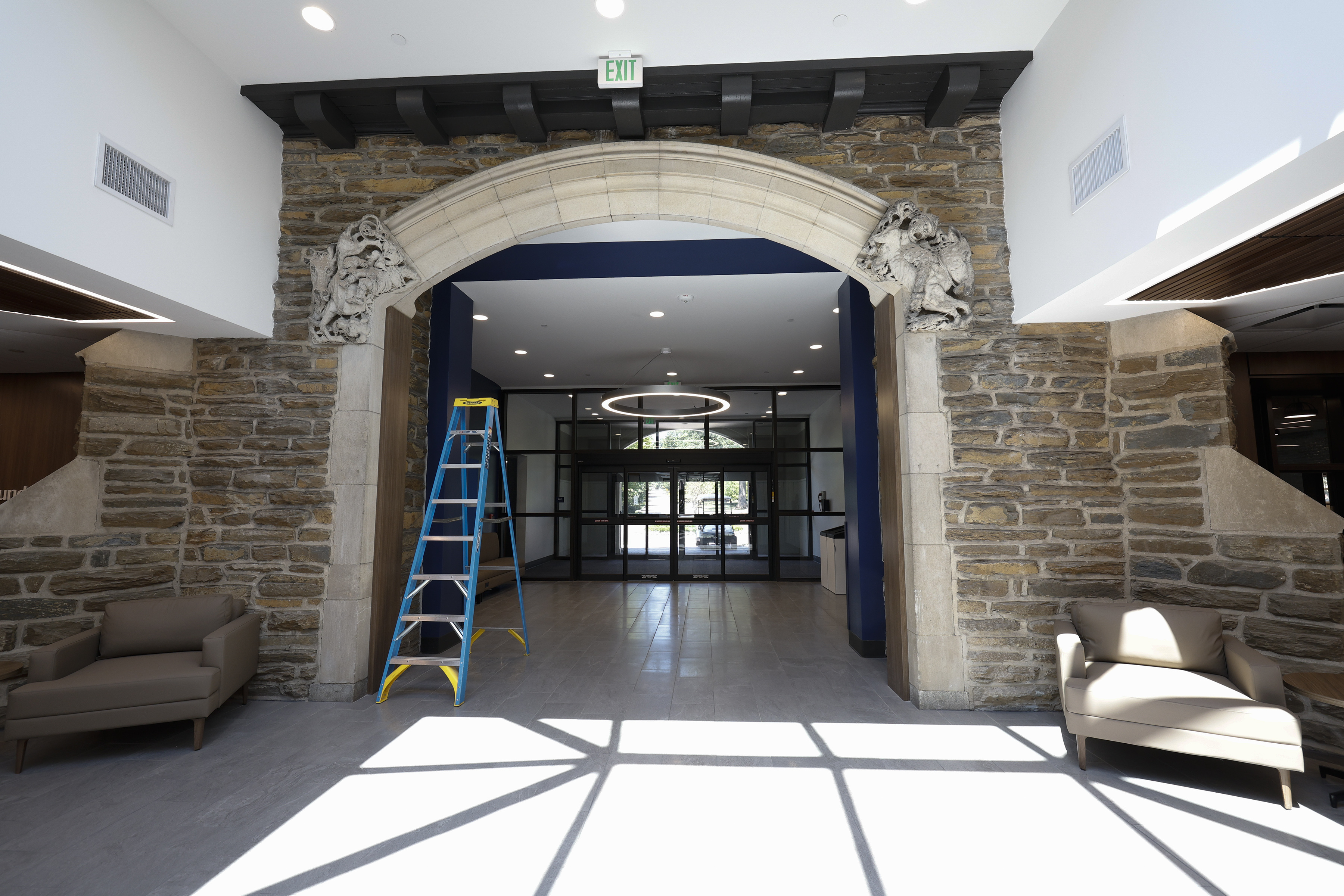
Villanova knocked those walls down and uncovered architectural flourishes including gargoyle-like stone carvings and a cavernous, stone-walled turret with a wooden-framed doorway, leading to what will be a Villanova apparel shop.
Renovations at Cascia Hall uncovered some architectural flourishes, including these stone carved gargoyles. Steven M. Falk / For The Inquirer
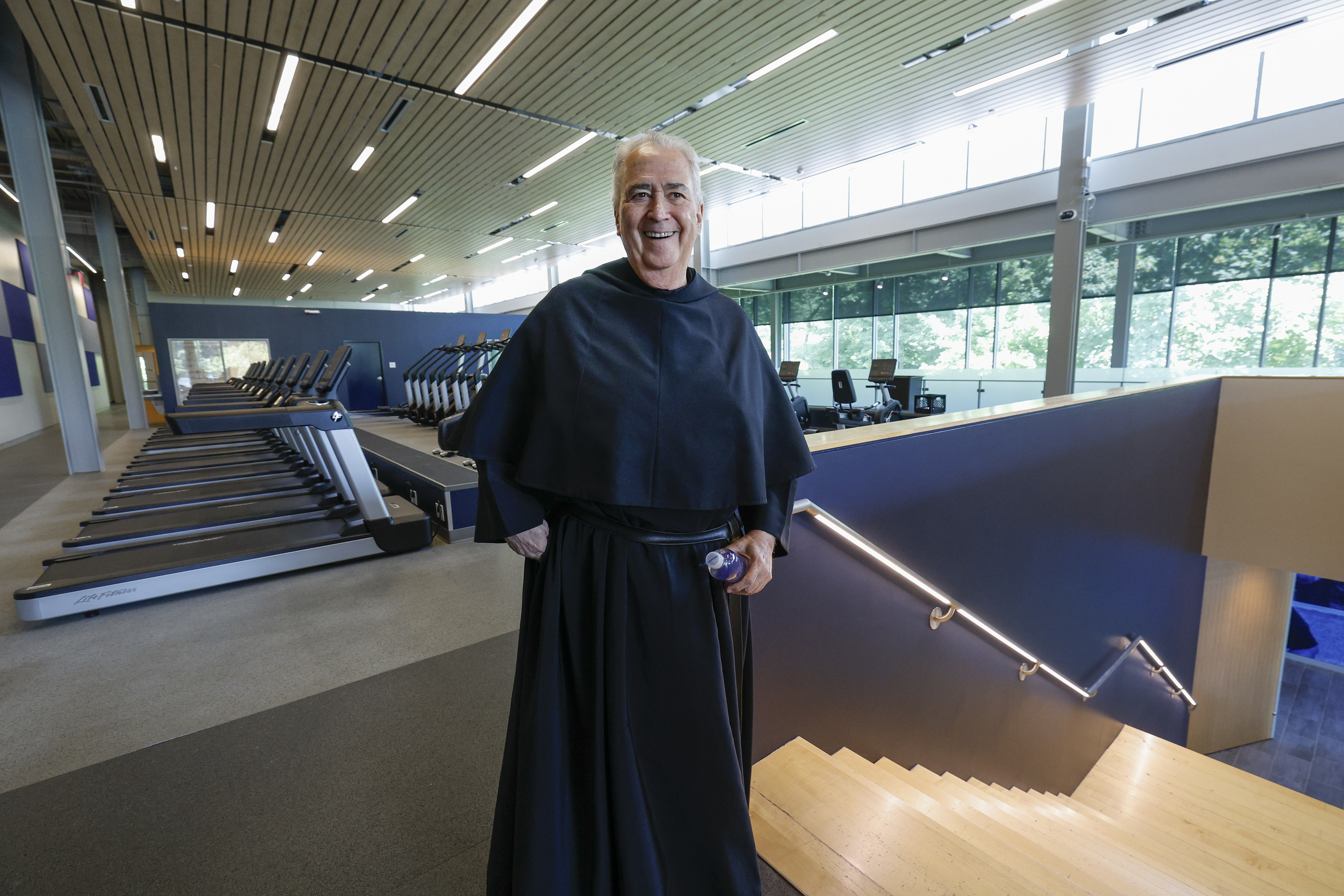
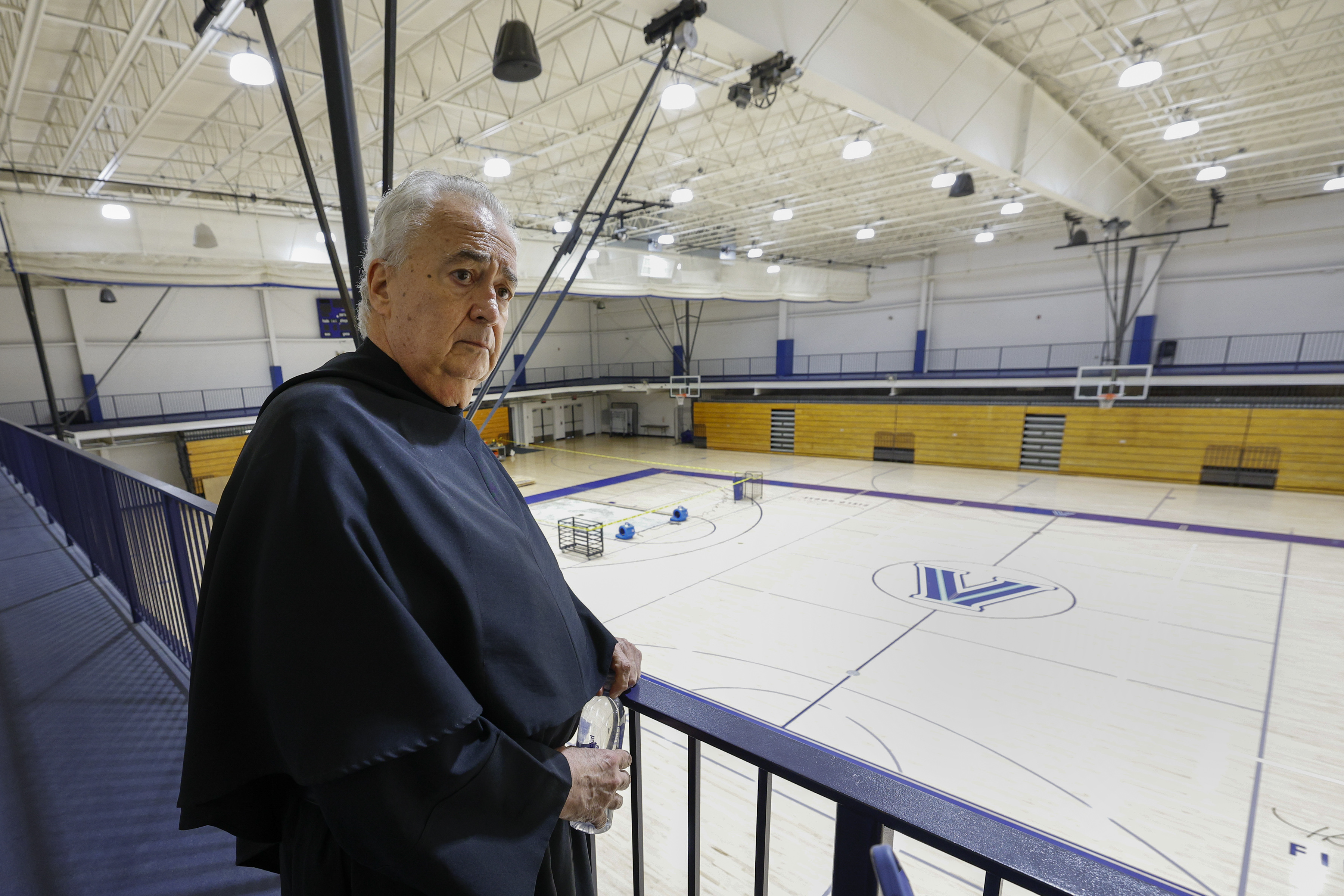
The Dixon Center will remain an athletic facility, but now the basketball court has a large V in the center and the smoothie bar will offer treats such as the Brunson, named after Villanova Wildcats basketball star-turned-New York Knicks standout Jalen Brunson, and the Father Peter Power, honoring the university president.
Donohue couldn’t name the ingredients in his new signature drink.
“I didn’t know it existed,” he said.
The facility, which also got new cardio equipment and reupholstered weight benches, will be used for non-varsity sports recreation.
Villanova President the Rev. Peter M. Donohue overlooks the basketball court at the Dixon Center. Steven M. Falk / For The Inquirer
“Our intramural basketball activity goes into the wee hours because we’re limited in our number of courts, so we are delighted to have this space,” Hoffman said.
The Iadarola Center, Cabrini’s former science building, includes a new nursing simulation facility that Cabrini had recently finished. But Villanova added upgrades, including a vivarium for psychology department research and more space for the brain science program. The former Cabrini library has been converted into student study space.
‘Many more dorm options’
Seven residence halls will house students, including two that had been closed amid Cabrini’s enrollment decline. One of them had a malfunctioning boiler — not anymore.
Sophomores were given the choice of living at Cabrini. Villanova ran tours of the campus for students last academic year. Those who chose Cabrini said they were attracted to the renovated dorms and larger room configurations that allow them to live with several roommates and share a bathroom. Options on main campus for sophomores are largely limited to doubles with a large bathroom shared by an entire floor or wing.
Villanova University sophomore Molly Dunphy-Culp has moved into her new apartment on the Cabrini campus.Courtesy of Molly Dunphy-Culp
“With Cabrini, there are so many more dorm options,” said Molly Dunphy-Culp, 19, a sophomore who was born in Boston and grew up in Abington.
She will be sharing an apartment in Lecceto Hall with three classmates.
She acknowledged that she will have to take the shuttle to main campus for classes, but said the short ride will be worth it. Dunphy-Culp also has a job on Cabrini as a recreation center supervisor — another plus for living there.
About half the students on campus will be allowed to have cars. Sophomores do not have that option on main campus.
“Two of my close friends are both going to have cars on campus,” said Ella Hayman, 19, a sophomore from just outside Boston. “This will give us a little more freedom we didn’t have last year. That was a big motivation.”
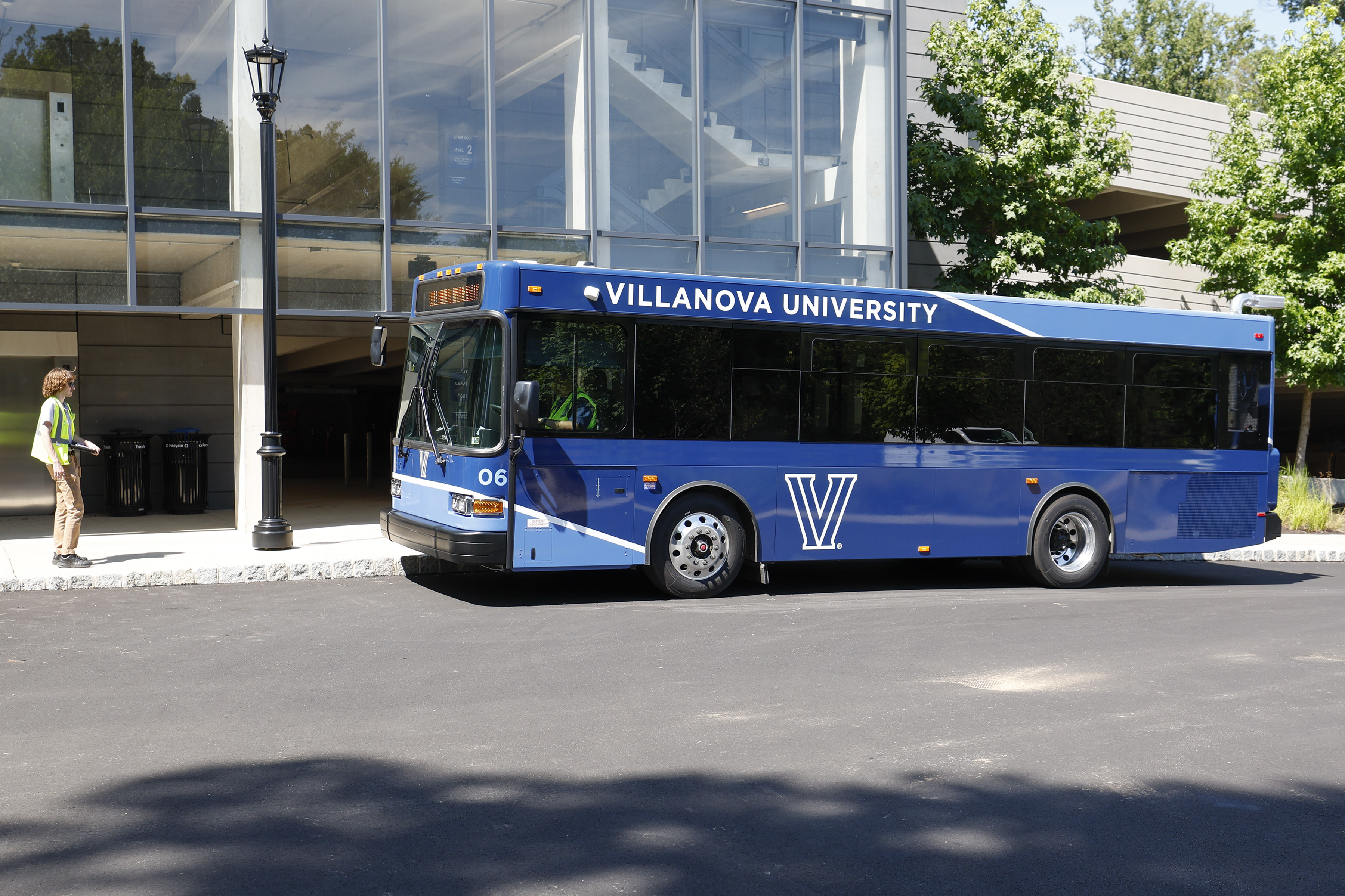
Shuttle buses including this one will transport students between Villanova’s main campus and the Cabrini campus 1.9 miles away. Steven M. Falk / For The Inquirer
Thirteen shuttle buses will transport students between the two campuses, which are 1.9 miles apart — a seven- to 12-minute ride, Hoffman said. A team of Villanova employees over the last couple of years visited five universities with multiple campuses, including Lehigh and George Washington, to learn how best to integrate them. They looked closely at models for a shuttle system that would keep students informed of where and when buses would be arriving and departing, Hoffman said.
Among new dining options on the campus is the restaurant-style Table 1842, named for Villanova’s founding year, where students can order off a menu. It is located in the former Founder’s Hall, now Bellesini Hall, which also was heavily renovated, including the installation of a new entrance that leads directly into dining facilities so people do not have to climb as many steps.
Bellesini has become the third-largest classroom building at Villanova. Some of the nearly 30 classrooms on the Cabrini campus had to be expanded to accommodate slightly larger class sizes, Hoffman said. Cabrini’s classes were 12 to 14, and Villanova starts at 16, Hoffman said.
Villanova University President the Rev. Peter M. Donohue left, and Timothy Hoffman, vice provost for finance and administration, walk through the Dixon Center. Steven M. Falk / For The Inquirer
Some improvements are still to come, including renovations to the former Mansion, which will be costly, and a nature trail, Donohue said.
Villanova named Francesca and Xavier Halls for Mother Cabrini and is continuing Cabrini’s Center for Immigration; Villanova converted it to the Mother Cabrini Institute on Immigration. Villanova also launched an elementary education major in honor of Cabrini’s former program.
Preserving a legacy
“They had a strong desire to make sure some of their legacy lasted, and we wanted to protect that,” Donohue said.
The game room at Cascia HallSteven M. Falk / For The Inquirer
Coincidentally, there is a stained glass window of St. Augustine — namesake of Villanova’s founding order — in Cabrini’s chapel and a stained glass window of Mother Cabrini in Villanova’s Corr Hall chapel.
Filling-Brown, the former Cabrini administrator now at Villanova, said it seems meant to be.
“It’s beyond my wildest dreams for the campus,” Filling-Brown said. “It’s the best outcome to see Catholic higher education continue on that campus.”
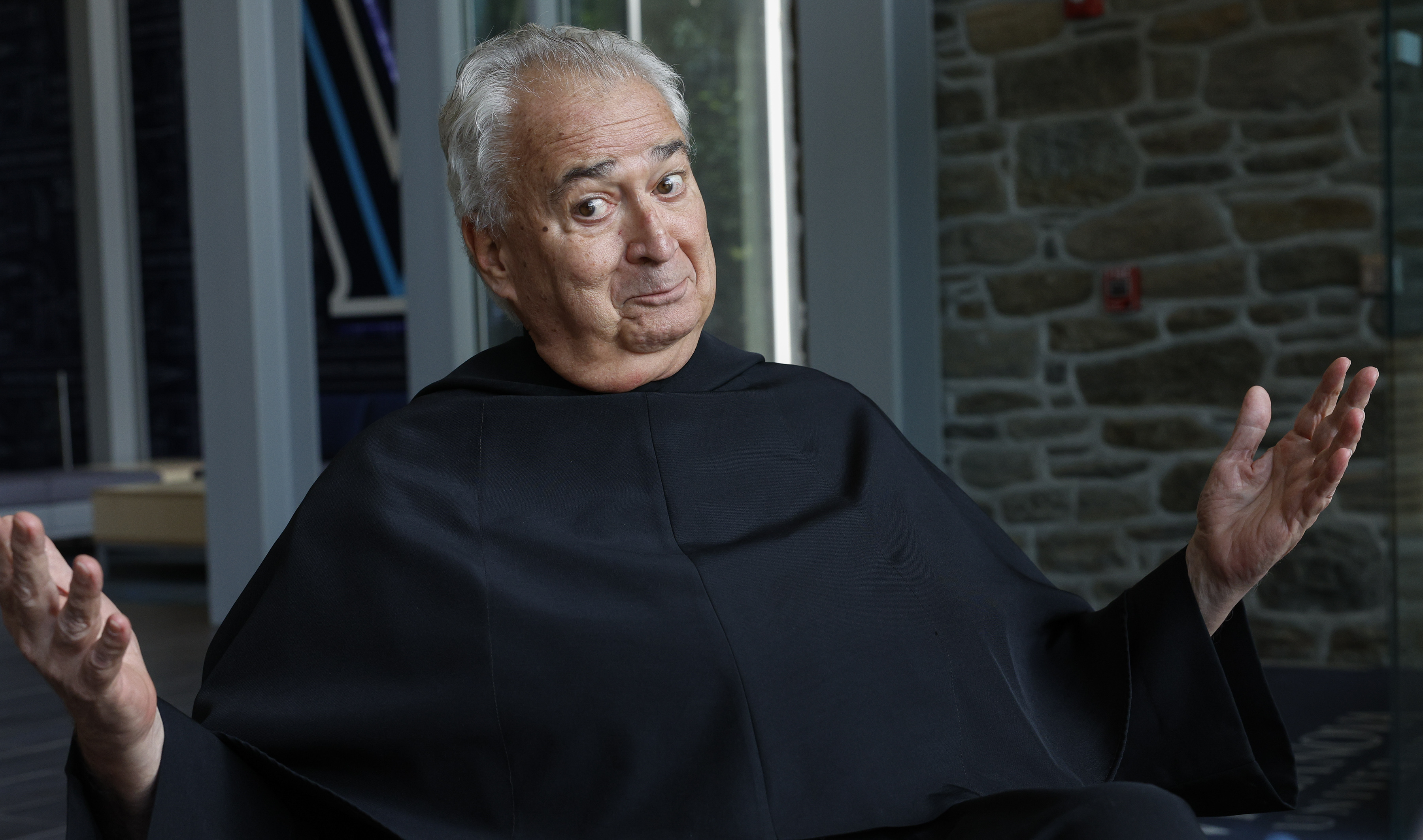
Villanova President the Rev. Peter M. Donohue discusses all it took to remodel the Cabrini campus. Steven M. Falk / For The Inquirer
Haverford College and a Jewish group suing the school over its handling of antisemitism allegations have reached a settlement, according to federal court documents.
The documents in the U.S. District Court for the Eastern District of Pennsylvania did not include details of the settlement, but a lawyer for the plaintiffs says Haverford President Wendy Raymond’s statement to the college community immediately following the settlement announcement Friday was part of it.
“I want to take this opportunity to publicly acknowledge that those members of our community with a commitment to the state of Israel as the Jewish homeland have been deeply hurt by events that have transpired on our campus since Oct. 7, 2023, and that that constitutes a failure on our part,” wrote Raymond, who leads the 1,470-student highly selective liberal arts college on the Main Line. “We commit ourselves to doing better going forward.”
The lawsuit was filed in May 2024 as tensions mounted on many college campuses, including Haverford, in the wake of the Israel-Gaza war, following Hamas’ 2023 attack on Israel. In their complaint, the plaintiffs, three students and the group Jews at Haverford, alleged that the college discriminated against Jews by tolerating antisemitic speech and failing to adequately support Jewish students, some of whom have been shunned on campus and prohibited from participating in group discussions where the war was discussed.
They are represented by an attorney for The Deborah Project, a public interest think tank that defends the rights of Jewish people facing discrimination in the education system.
Raymond, in her statement, repeatedly stated that students who support Zionism, which she defined as “the right of the Jewish people to self-determination and statehood in the land of Israel,” are welcome at Haverford and will have “equal access” to all educational programs and activities.
“Harassing, excluding, or seeking to silence Jewish community members on the basis of their beliefs, their commitment to Jewish observance, or any other element of their Jewish identity, including Zionism, is anathema to the college’s core principles of trust, concern, and respect,” she wrote, noting that the policy applies to offices, classrooms, and student-led organizations and activities.
She said such behavior is a violation of college policy and that those who engage in it would be subject to disciplinary action, and that no Haverford professor can discriminate against or treat differently students based on their commitment to Judaism, Israel, or Zionism.
Support of Zionism has been a flashpoint in the debate over what constitutes antisemitism, with some arguing it’s wrong to conflate antisemitism with anti-Zionism.
Lori Lowenthal Marcus, an attorney for The Deborah Project, which represents plaintiffs, called the settlement “fantastic.” She said Raymond’s statement was part of the settlement, and Marcus said she would be releasing more details on Saturday.
“Plaintiffs are very pleased that they will be protected and respected on Haverford’s campus,” Marcus said Friday.
Stating that students who support Zionism will be protected was important to plaintiffs, she said.
“It’s a new form of antisemitism, saying, ‘Oh, no, I don’t hate Jews, I just hate Zionists,’” she said. “For a Jew to hear that was incredibly painful and led to students really hiding their identities when no one should be forced in any way to hide their identity, including Jewish students who believe in the right of Israel to exist as a Jewish state.”
When the complaint was initially filed in May 2024, one student, Ally Landau, a women’s basketball player who has since graduated, was named in addition to the group Jews at Haverford. Since then, two others were added with their initials.
In their complaint, plaintiffs said, the college failed to condemn Hamas’ attacks on Israel even though it had issued past statements in support of other minority groups, including Black people following the murder of George Floyd by police.
Among other allegations, the group said that a professor called students who supported Israel “racist genocidaires,” which the college did not challenge, and that the school allowed students to host an event where it was asserted that Israel had intentionally infected Palestinians with the coronavirus.
Haverford at the time declined to comment on the lawsuit.
A federal court in February 2025 dismissed the lawsuit, calling the complaint “sprawling and disorganized,” but the plaintiffs refiled.
In May 2025, Raymond was grilled by a congressional committee investigating colleges’ handling of campus antisemitism allegations. She drew fire for reluctance to answer questions about discipline in such incidents, especially in specific cases.
She also issued a statement at that time, saying that the college “came up short” in dealing with the conflict and said both she and Haverford can do better.
“To Jewish members of our community who felt as if the college was not there for you, I am sorry that my actions and my leadership let you down,” she wrote at the time.
The Haverford chapter of the American Association of University Professors, a group of nine Jewish faculty and staff, and more than 50 Jewish students at Haverford had written letters to the committee or issued statements in support of Haverford.
The faculty and staff group, noting they are diverse with some supporting Israel and others not, said at that time they “do not feel that our college is a hotbed of antisemitism.”
“We are all deeply concerned by how you are weaponizing our pain and anguish for your own purposes …,” the students wrote to the congressional committee. “It is a blatant assault on our Black, Brown, transgender, queer, noncitizen, and Palestinian peers.”
Since the congressional committee hearing, tensions have at times continued to flare. Earlier this year, Haverford vowed to make changes in its event policies after a talk by an Israeli journalist speaking on campus was disrupted, including by a protester who shouted through a bullhorn “Death to IOF,” or Israeli Occupying Forces, a name critics use to refer to Israel Defense Forces, and “Shame.”
In her statement to the campus community Friday, Raymond said it is never acceptable to let disagreements over the policies and actions of government “descend into the realm of discrimination, harassment, or bias.
“All members of the Haverford community who wish to express their considered perspectives must do so respectfully while allowing others to do the same.”
The two sides said in court documents they agreed to settle in order “to avoid the further expense, disruption, and uncertainty of litigation, all without admitting liability.”
Raymond, a molecular biologist who has led the college since July 2019, announced last November that she would step down in June 2027.
The University of Pennsylvania, Rutgers University, Pennsylvania State University, and Princeton University belong to a national university group whose leaders helped the U.S. Department of Education develop a new list of reforms it would like all colleges to adopt by the end of the year.
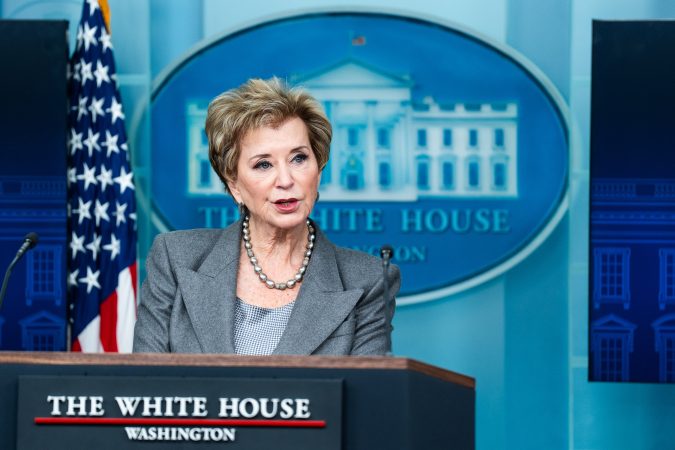
U.S. Secretary of Education Linda McMahon on Monday sent a letter to colleges asking them to agree in public statements on their websites to wide-ranging reforms that includecracking down on protests, hiring more conservative faculty, combating grade inflation, taking steps to ensure there aren’t “covert” attempts to use race-conscious admissions practices, and containing tuition costs, among other changes.
There is no plan to sanction schools that don’t sign on, but those that do could be in line to get more research funding, according to Bloomberg, the first to report on the letter, citing a White House official.
The latest effort by President Donald Trump’s administration to reshape higher education at least initially appears to be getting a warmer response than the list of demands made in its controversial compact that was rejected by most universities, including the University of Pennsylvania, last year.
The reforms were developed with the help of four university presidents from the Association of American Universities, including the group’s board chair and vice chair, according to Bloomberg.
“We’d much rather be a partner than play the guessing game as we have been,” Douglas Girod, president of the University of Kansas and board chair, told Bloomberg.
AAU president Barbara Snyder told Bloomberg she planned to call on her member colleges to support the plan.
Penn is one of 71 research universities nationally and in Canada that belong to the group. The university did not respond to a request for comment on whether it planned to participate.
Penn last October rejected the White House’s university compact, which would have given the school preferential consideration for federal funding in exchange for agreeing to operational demands. Many groups on campus had spoken out against the compact, and Penn president J. Larry Jameson in a letter to the federal government at that time said he outlined areas where Penn found “existing alignment” with the compact and where the school had “substantive concerns.”
“For the good of the nation, university leadership must seize this occasion to drive essential reforms — a process some began by adopting positions of institutional neutrality and improving policies related to campus protests,” McMahon wrote in her letter Monday. She called on all colleges to “describe to the American public your commitments to rigorous teaching, pathbreaking research, and national service — commitments that make our universities a bedrock institution of the American republic.”
She acknowledged that not every college’s response would be the same, but presented schools with a series of questions that they should address. Among them are:
“How will your institution ensure admissions decisions are based on merit, achievement, and your university’s educational purpose?”
“How will you guarantee that unruly and violent protesters do not harass students or disrupt classes, research, public lectures, and campus operations?”
“How will your faculty hiring and evaluation practices support academic vitality and ensure that all relevant perspectives are taken seriously?”
“What can your school do to contain costs, improve pricing transparency, and ensure that every academic program equips students to repay their loans?”
“How will your school protect academic programs from foreign influence and safeguard the integrity of the research enterprise?”
McMahon also warned against allowing academic disciplines to foster political and social goals.
“When disciplines skew toward one side of the ideological spectrum, the truth-seeking function of the university suffers and public trust declines,” McMahon wrote.
Penn State said its leadership team had received the letter and is reviewing it.
Rutgers said it also had received the letter and “welcomes constructive dialogue with federal and state policymakers and remains focused on providing an excellent, accessible education that advances research to serve New Jersey and the nation.”
Princeton did not immediately respond to a request for comment.
“We look forward to learning more from the Department of Education about this effort and collaborating to advance shared goals,” Waded Cruzado, president of the Association of Public & Land Grant Universities, said in a statement. Penn State, Rutgers, Temple University, and the University of Delaware are part of that group.
The other three AAU presidents involved in drafting the new reforms include Andrew Martin at Washington University in St. Louis, Michael M. Crow at Arizona State University, and Ron Daniels at Johns Hopkins University.
Temple is not a part of AAU, but Temple president John Fry has worked closely with Crow, whose university sponsors the University Innovation Alliance that Temple joined last year. The alliance is a national organization of public universities aimed at finding innovations to improve learning and increase college attendance, retention, and graduation rates ― especially for low-income students ― then scaling those innovations across campuses. It was founded by 11 presidents including Crow.
Fry at the time described Crow as a mentor and said that he had known him for more than 30 years. They started presidencies simultaneously in 2002, Fry at Franklin and Marshall College in Lancaster, and Crow at Arizona State.
In a statement, Temple said it was “carefully reviewing” the letter from McMahon.
“Upon initial review, much of what is outlined in the letter is consistent with core tenets of what we do as a university,” the school said. “Our approach will continue to be guided by our mission and our strategic plan.”
Martin, of Washington University, told Bloomberg that he planned to respond to the McMahon letter.
“My expectation is this letter will have some things in it not everybody will agree with, but that universities will consider it,” he told Bloomberg. “Certainly compared to the compact, I think this is a step in the right direction.”
Temple University, which faces a budget deficit and challenging financial headwinds, received a record amount of donations in the last fiscal year, putting the institution ahead of its fundraising goals in the first full year under the leadership of a new president.
The North Philadelphia school received $214 million in donations in fiscal year 2026, more than 60% greater than theprior year’s annual fundraising total and well ahead of its goal of $160 million.
Included in that total and achieved during president John Fry’s tenure are major donations,including the single largest gift the school has received,$55 million from university trustee Christopher Barnett to rename the College of Public Health, and a substantial but undisclosed amount from Jane Creamer Sullivan to establish a new honors college, which will enroll students beginning in fall 2027.
They were among 38 donors who gave $1 million or more to the university, up from 24 the year before.
Fry in an interview credited a new fundraising chief, a strategic plan with clear fundraising goals, and the involvement of deans and other senior leaders in the fundraising process at Temple, which enrolls 33,000 students across its U.S. and international campuses.
“The difference from where we were in late ’24 to today is kind of night and day,“ Fry said. ”Our priorities as an institution are clearer. … We have a lot of engagement from our deans and senior leadership and trustees, and I think we’re developing a much more disciplined approach to donor relationships.”
The increased fundraising comes at a pivotal time for Temple, allowing it to invest in academics and student supports while also coping with a budget crunch. The university laid off about 40 employees earlier this month as part of an effort to close what now stands as a $25.5 million deficit in the 2026-27 budget.
Fry noted that the school cannot use donor funds to plug the deficit because they are restricted, but said the money allows the school to continue to invest.
“The philanthropy that we’re able to to garner right now allows us to address priorities that we wouldn’t be able to address otherwise,” Fry said.
The Barnett gift, for example, has helped create an “essential needs hub” to help support students who are struggling with financial and other needs.
Next for the university is the public launch of what is likely to be a $1.5 billion fundraising campaign kicking off in the next two years and concluding in 2034, when the school celebrates its 150th anniversary. Temple already has raised $340 million during the quiet phase of that campaign, including the $214 million raised in the last fiscal year.
Fry identified fundraising as an area for reform at Temple almost as soon as he arrived, saying that a school of Temple’s stature with more than 380,000 living alumni — more than half of whom live and work in the region — should be raising more than it was.
He said at the time there was no reason that Temple should not be in the same league as schools such as the University of Delaware, which had announced a gift in excess of $71 million. Pennsylvania State University, which has more than twice the enrollment of Temple, announced earlier this month that it had raised $662.7 million in 2025-26.
The university’s previous fundraising record was $133 million in fiscal year 2025, and prior to Fry’s arrival in November 2024, Temple raised about $95 million annually on average from 2014 to 2024, the school said.
Fry hired Al Checcio, who previously led fundraising at the University of Southern California and Fordham University, to assess the university’s fundraising operation. Checcio had previously assisted Fry with fundraising at Drexel when Fry led that university, and he had worked at Temple in the 1990s under the late president Peter Liacouras.
Impressed with Checcio’s assessment, Fry appointed him as interim fundraising leader in March 2025 and in September named him senior vice president for institutional advancement.
“I’ve always felt that the Temple alumni base was so untapped,” Checcio said. “They have a lot of pride in the institution, but maybe not as much pride in how the university has interacted with them.”
To bolster success, Checcio said, fundraising had to become a university-wide priority, with deans, healthcare leaders, and other university leaders all playing a role. It takes vision, leadership, and relationship-building, he said.
That is all happening, including visits by Fry to donors around the world, and donors are reacting positively, Checcio said in an interview.
“We’re communicating clearly what our vision for the university is, and we’re doing a lot of work tying institutional priorities into donor interests,“ he said. ”We’re very pleased with our early progress. We think it’s a real sign of things to come.”
He said the university has the potential to continue raising more than $200 million annually or even more.
“We think we have a really, really high ceiling,” he said.
Among other large gifts from alumni in 2025-26 were $5 million from Richard and Amy Oller to the law school and $3 million from investment adviser and author Joslyn G. Ewart to endow the dean’s post for the Center for the Performing and Cinematic Arts.
Fry said both gifts met several goals in the strategic plan.
The Oller gift “promotes student success because it has scholarships and fellowships and experiential learning opportunities embedded in it,” he said. “It also strengthens faculty excellence by supporting an endowed chair and monies for bringing distinguished scholars to campus.”
The Trump administration has agreed to drop its subpoenaordering the University of Pennsylvania to release the names of Jewish people on its campus, marking what seems to be a victory in the Ivy League school’s battles with the federal government.
The Equal Employment Opportunity Commission has said “it will not take any further measures to enforce the subpoena seeking identification and personal contact information of employees,” according to a resolution agreement filed Thursday in the U.S. Court of Appeals for the Third Circuit. The agency also agreed not to seek the information through other means, according to the agreement.
The commission had been requesting the information to further its investigation into antisemitism complaints on Penn’s campus.
The EEOC initially won the court’s approval to enforce the subpoena, but Penn appealed the decision. Penn said it has agreed to drop its appeal and, according to the resolution, the school agreed not to ask that the district court’s opinion in the case be vacated.
It was not clear what caused the federal agency to change course or the status of the commission’s antisemitism investigation. An EEOC spokesperson said: “We will decline to add anything beyond court filings.”
Penn released a statement. “With the support of many members of the community who have stood with Penn throughout, the university has been able to protect its employees’ rights and none of the subpoenaed personal contact information was disclosed,” a university spokesperson said. “Penn remains committed to fighting antisemitism and all other forms of discrimination, to ensure everyone it serves can learn, work, and thrive.”
The move brings the monthslong battle between the federal agency and the Ivy League university over the subpoena to a close.
The EEOC’s decision to subpoena the information drew widespread criticism from faculty and others, on and off the campus. Among those that opposed the subpoena was the Penn chapter of the American Association of University Professors.
“This victory shows that universities should not capitulate to unjust and unconstitutional demands from the Trump administration,” said Lorena Grundy, vice president of AAUP-Penn. “AAUP-Penn will continue to defend the rights of all communities at Penn, and we look forward to continuing to grow the coalition that has grown out of this effort.”
The Anti-Defamation League Philadelphia, which has supported the EEOC’s effort to address antisemitism at Penn and has been critical of college campuses’ handling of antisemitism complaints, said it was pleased the EEOC was not pursuing the subpoena.
“As we’ve said, demanding lists of Jewish employees and campus organizations is a different matter, one with a troubling history we cannot ignore,” said Andrew Goretsky, senior regional director. “We’re pleased the EEOC has apparently agreed not to pursue its requests for sensitive information and that information was not disclosed. We’ll continue working with our partners to support Jewish students, staff, and faculty at Penn.”
Roy Hamilton, faculty senate chair, said he was “heartened to see that this matter has been resolved in a way that protects the privacy of Penn employees while allowing the university to move forward.
“Our shared focus remains on fostering a community where all members are treated with dignity, respect, and fairness.”
Penn has faced other pressure from the federal government. Last summer, the school struck an agreement with the Trump administration over the participation of transgender athlete Lia Thomas on the women’s swim team. The school met a number of the White House’s demands, including adhering to the Trump administration’s definitions of sex, female, male, women, and men, and sending letters of apology to female athletes who felt aggrieved by Thomas’ participation on their team during the 2021-22 season.
Penn pointed out at the time that the agreement was restricted to athletics and did not affect other university operations.
The EEOC last year — as part of its quest to find people potentially affected by antisemitism concerns at Penn, officials said — demanded a list of employees in Penn’s Jewish Studies Program, a list of all clubs, groups, organizations, and recreation groups related to the Jewish religion, including points of contact and a roster of members, and names of employees who lodged antisemitism complaints.
The original complaint was launched by EEOC Commissioner Andrea Lucas, now chair of the body, on Dec. 8, 2023, two months after Hamas’ attack on Israel that led to unrest on college campuses, including Penn, and charges of antisemitism. It was also just three days after Penn’s then-president, Liz Magill, had testified before a Republican-led congressional committee on the school’s handling of antisemitism complaints; the testimony drew a bipartisan backlash and led to Magill’s resignation days later.
The commission sued Penn in November for failing to turn over the information sought in the subpoena.
Judge Gerald J. Pappert ruled in March that Penn must comply with the subpoena, signaling a major loss for the university in its fight to keep employees’ and students’ personal information from the federal government. In his 32-page ruling, Pappert largely dismissed arguments from Penn and others who intervened on the school’s behalf that releasing the information sought by the commission would put employees at risk, create an undue burden on the school, and cause employees to disaffiliate from such groups.
Pappert had ruled the school had to provide the information to the EEOC, though it did not have to state which particular organization each person is affiliated with.
Penn sought a stay of the order and said it would be “irreparably harmed” if it had to comply before the school had a chance to appeal.
Pappert in April granted Penn a stay while the appeal proceeded. But Pappert at that time also underscored the school’s unlikely success in an appeal.
“The charge of discrimination is valid, the EEOC’s subpoena seeks information relevant to the charge and the subpoena does not unduly burden Penn,” he wrote. “The subpoena also does not violate substantive due process or the First Amendment.”
Penn has said it provided information to the EEOC in cases where employees consented but steadfastly refused in others.
“Violating their privacy and trust is antithetical to ensuring Penn’s Jewish community feels protected and safe,” Penn said when the EEOC filed the suit.
The school offered to help the EEOC reach employees who were willing to speak with the agency by informing all employees of the investigation and how they could reach the agency.
Jon Fansmith, senior vice president for government relations and national engagement at the American Council on Education, said the resolution “reinforces the merits of Penn standing up to something that was clearly inappropriate and excessive from the start.”
The government alleged wrongdoing and then tried to find the evidence to prove it in part by issuing the subpoena.
“This is clearly an abuse by the government of their authority,” Fansmith said.