Author: Jess Rohan

  • For months, Cheltenham football families ‘pleaded’ with administrators not to hire the coach charged in hazing scandal

    For months, Cheltenham football families ‘pleaded’ with administrators not to hire the coach charged in hazing scandal

    Cheltenham High School varsity football families repeatedly warned district officials about allegations that former head coach Terence Tolbert allowed bullying to fester in his previous coaching position at Abington Senior High School, parents say.

    Tolbert, along with three other Cheltenham coaches, was charged last week with endangering the welfare of a child and conspiracy after a 15-year-old player was allegedly assaulted in the football team’s locker room by teammates twice last year. Six players were also charged. The assaults have led to the cancellation of two football seasons.

    Both the district and a Montgomery County grand jury found that inadequate supervision played a role in the assaults. The district also found coaching staff displayed “a failure to prioritize student safety.”

    Tolbert and the other coaches are no longer with the district. Tolbert has declined to comment on the matter, and he and his lawyer did not respond to requests for comment on this story.

    ‘We protested and pleaded’

    In the two months leading up to Tolbert’s hiring in June 2025, Cheltenham football families urged district officials to reconsider Tolbert’s hiring in numerous private conversations and public meetings, parents said in interviews this week.

    “We protested and pleaded,” said Naim Ferguson, father of Cheltenham quarterback Kendall Jackson during Cheltenham’s last season. “We didn’t think the people they were putting in place were adequate to handle the kids.”

    Parents went to the principal, Benjamin Hammond, and vice principal Samuel Sheridan, who is also the athletic director, emails between the officials and football parents show.

    A then-junior on the varsity team started a petition against hiring Tolbert.

    “We … do not want this position to be arbitrary given to the district’s so-called qualified candidate,” the petition reads.
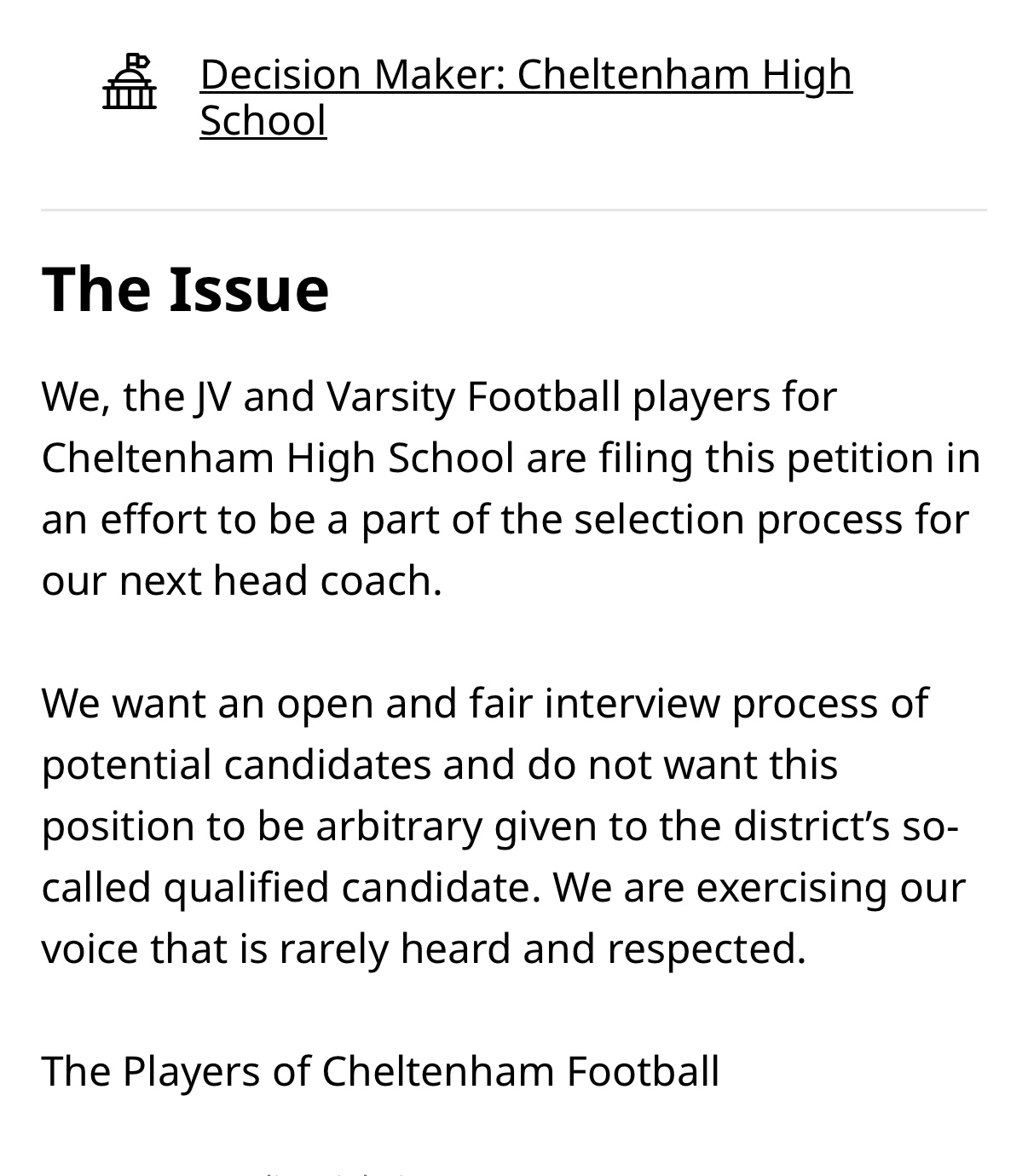
    A petition started by a Cheltenham varsity football player against the hiring of Terence Tolbert as head coach.Change.org

    Taryn Knox, then the vice president of the football parent board, shared her concerns about Tolbert’s hiring process and his record at Abington at school board meetings and in meetings between administrators and football parents until the district formally made Tolbert the coach in June.

    At a May board meeting, Knox said Tolbert had been “let go” from Abington, calling him “not appropriate or qualified” for the head coach job.

    She was not the only parent who spoke out at that meeting.

    “We asked for our children to have a solid leadership,” said Dana Burnley, whose son was on the team. Burnley said that her son had interest from seven Division I schools but that the coaching switch had disrupted the recruitment process.

    Burnley’s husband, Ralph, a volunteer coach, was among those charged alongside Tolbert last week and faces the same charges of endangering the welfare of a child and conspiracy. Ralph Burnley has not responded to calls seeking comment.

    Multiple upperclassmen also met with Hammond and Sheridan in April to voice their concerns, according to a list that Knox emailed to the principal. Included in the list of concerned players were at least two who were charged last week in connection with the assaults.

    “Every plea that we tried was ignored,” Knox said — including one at an April 22 meeting with parents where Knox asked Tolbert to voluntarily resign to reopen the hiring process. Hammond rushed to take the microphone from Tolbert before he could respond, she said.

    Cheltenham did not answer any questions this week about parent concerns ahead of Tolbert’s hiring.

    Tolbert applied for the open Cheltenham position after a brief stint at Abington that he had left an offensive coordinator role at Cheltenham to pursue. The 2023 move to Abington was a promotion to head coach, but his tenure there was short-lived.

    The Abington team won only one game that season, and Tolbert’s employment expired. Abington has acknowledged that the district opted not to renew the one-season appointment but declined to give further details.

    Parents from both schools said they believed it was a failure to address bullying and a toxic team culture that led to his departure.

    “There were kids being bullied in the locker room, the language, cussing out coaches,” Knox said this week.

    After charges against Tolbert went public last week, an Abington parent shared with The Inquirer the text of a 2023 email he said was sent to Abington officials outlining similar allegations he had heard at the time, including that Tolbert failed to intervene in persistent bullying on the team and crude language from other coaches.

    Before a Sept. 8, 2023, game, a coach used the f-slur to refer to the opposing team in a pep talk in front of Tolbert, who did not intervene, the email alleges. The complaint also describes instances when Tolbert failed to break up fights or react appropriately when he saw bullying, including a player who verbally berated a teammate with disabilities.

    “It wasn’t a secret,” said the Abington parent, who requested anonymity for fear of retaliation against his child, who still attends the school. “Many parents knew why he was removed. I’m shocked that he was able to get another job.”

    Union contract gave Tolbert leg up for coach

    Knox and Ferguson said the district hired Tolbert without an interview.

    “The [same] buildup that happened here, happened at Abington,” Knox said. “It just didn’t lead to an assault.”

    Before Tolbert’s hiring, Cheltenham parents were already upset about former coach Troy Gore’s removal during an important recruitment period, Knox and Ferguson said, because it left players who anticipated scholarships from Division I schools without an advocate.

    “These are students who are trying to achieve higher education while also playing a sport that they love, and for some of them, this is their only option,” Knox said at the May 2025 school board meeting.

    But when parents questioned what they viewed as an abbreviated hiring process for Gore’s replacement, administrators pointed to a clause in the teachers union contract that gives qualified staff first pick of coaching jobs ahead of external candidates, Knox and Ferguson said.

    Tolbert briefly taught business at Cheltenham until he resigned in October 2023, board documents show. He then took a job at Abington as a long-term substitute for business education in addition to coaching.

    Cheltenham rehired Tolbert as a business teacher before announcing his 2025 appointment as head coach.

    ‘Be accountable’

    Knox returned for the June 2025 board meeting and said she had been promised a call from the superintendent after the May meeting, but did not receive one.

    “Be accountable,” Knox said at the June meeting. “If you say you’re going to follow up, please follow up.”

    Superintendent Brian Scriven replied that there was a meeting planned with football players.

    “I did say I was going to call you. I opted not to. I will own that,” the superintendent said, adding that Knox had his number and could call him.

    The board officially appointed Tolbert as coach at the meeting.

    Knox’s son did not trust Tolbert as a teacher or a coach, she said.

    “He had been a part of the team for two years prior to that and didn’t have the relationship with the boys,” Knox said.

    ‘The administration failed these kids’

    The administration erred again, Ferguson said, by not suspending students who were involved in the locker room assault recorded on video.

    Nearly 20 members of the team witnessed the locker room assault, according to the district’s investigation, and the video was widely circulated. Ferguson said his son and most of the team did not witness the attack.

    Jackson always stayed on the field after practice running extra drills, his dad said, and Ferguson would bring his younger son to hang out on the grounds while they waited for him to finish.

    By January, the superintendent had publicly acknowledged the district was aware of “several” perpetrators.

    But the lack of disciplinary action left the entire team in limbo all year — isolating Jackson from teachers and other students, who were not sure which players were involved, Ferguson said: “People can’t fathom the fact that he’s the starting quarterback and he didn’t know about it.”

    Now Jackson, who broke the school’s sophomore quarterback passing record in 2024, is struggling to find a transfer school.

    “The administration failed these kids,” Ferguson said.

    Knox transferred her son to a Philadelphia school before the incidents. He is set to play football at East Stroudsburg University, a Division II school.

    “Thank God I pulled him out,” Knox said. “Every school said, ‘We know you came from Cheltenham; we’re glad you transferred.’”

    Staff writer Maddie Hanna contributed to this article.

    This suburban content is produced with support from the Leslie Miller and Richard Worley Foundation and The Lenfest Institute for Journalism. Editorial content is created independently of the project donors. Gifts to support The Inquirer’s high-impact journalism can be made at inquirer.com/donate. A list of Lenfest Institute donors can be found at lenfestinstitute.org/supporters.

  • Is Bradley Cooper really from Jenkintown? We investigate.

    Is Bradley Cooper really from Jenkintown? We investigate.

    Unlike Philadelphia — a city, county, and school district all in one — the collar counties are a mesh of townships, boroughs, and informal neighborhoods.

    That geographical maze, along with the centuries-long evolution of the U.S. Postal Service, means some suburbanites are not even sure what town they live in.

    Which may explain why one of Montgomery County’s most famous sons, former Daily News contributor Bradley Cooper, is often reported to be from Jenkintown, but he is not.

    He is from Abington Township and, like many Abingtonians, he has been living a lie.

    Where is Bradley Cooper from?

    Cooper grew up not in Jenkintown, but a mile away in the unincorporated Abington community of Rydal, in a house his parents bought before he was born, property records show.

    In the 1980s, he attended Rydal Elementary, where he played a mime, according to a playbill shared on social media.

    The Oscar-nominated actor later enrolled at Germantown Academy, a private school in Whitemarsh Township whose reunions he still attends.

    Cooper is known to call nearby Jenkintown his hometown from time to time — maybe because the borough is more well-known, and because that is what his childhood mailing address was. His reps did not return a request for comment this week.

    Some Abingtonians don’t know where they live

    But unlike people who grew up in the tiny enclave, Cooper could not have attended Jenkintown School District or participated in its National Geographic-famous Color Day.

    “As someone who grew up in Jenkintown and loved cute boys and is about the same age as Bradley Cooper, I can tell you he is not from the Borough of Jenkintown,” writer Lauren McCutcheon said.

    Many Abingtonians think they live in J-town, borough manager George Locke has said — so much so that his staff starts resident service calls by asking for an address. Otherwise they could spend 45 minutes on the phone, Locke said, before realizing the caller is in Abington.

    Residents of unofficial neighborhoods like Glenside, or towns that span counties like Telford, may be more aware of their official designation. Some Glensiders attend school in Cheltenham, while others attend Abington School District.

    For people without a kid in public school, an invisible municipal boundary may not matter much day to day. But it matters for local elections and during tax season.

    Nye Stevens, a longtime Postal Service expert for the U.S. Government Accountability Office and the Congressional Research Service, said mailing addresses can also affect people’s insurance rates, which are often based on zip code instead of municipality.

    And a zip code across two towns is nothing, Stevens added — some people get their mail from another state.

    Bob O’Brien of Wyncote used to think his practice, Relief Counseling & Art Therapy, was located in Jenkintown — until the tax bill from Abington arrived.

    “It was confusing,” O’Brien said — especially since there is a Jenkintown post office in the same building.

    “How it got this way, I’m not sure,” he added.

    The demands of mail delivery

    U.S. post offices began primarily as a pickup service in cities until the agency introduced home delivery in the late 1800s.

    Then cars expanded the suburbs, townships shifted, and assigned post office locations grew increasingly messy.

    “As townships grow, post offices seem farther away,” a New York Times headline about South Jersey observed in 1997.

    The U.S. has also closed tens of thousands of post offices in the last several decades, Stevens said, which may mean losing a mailing city that reflects where people actually live.

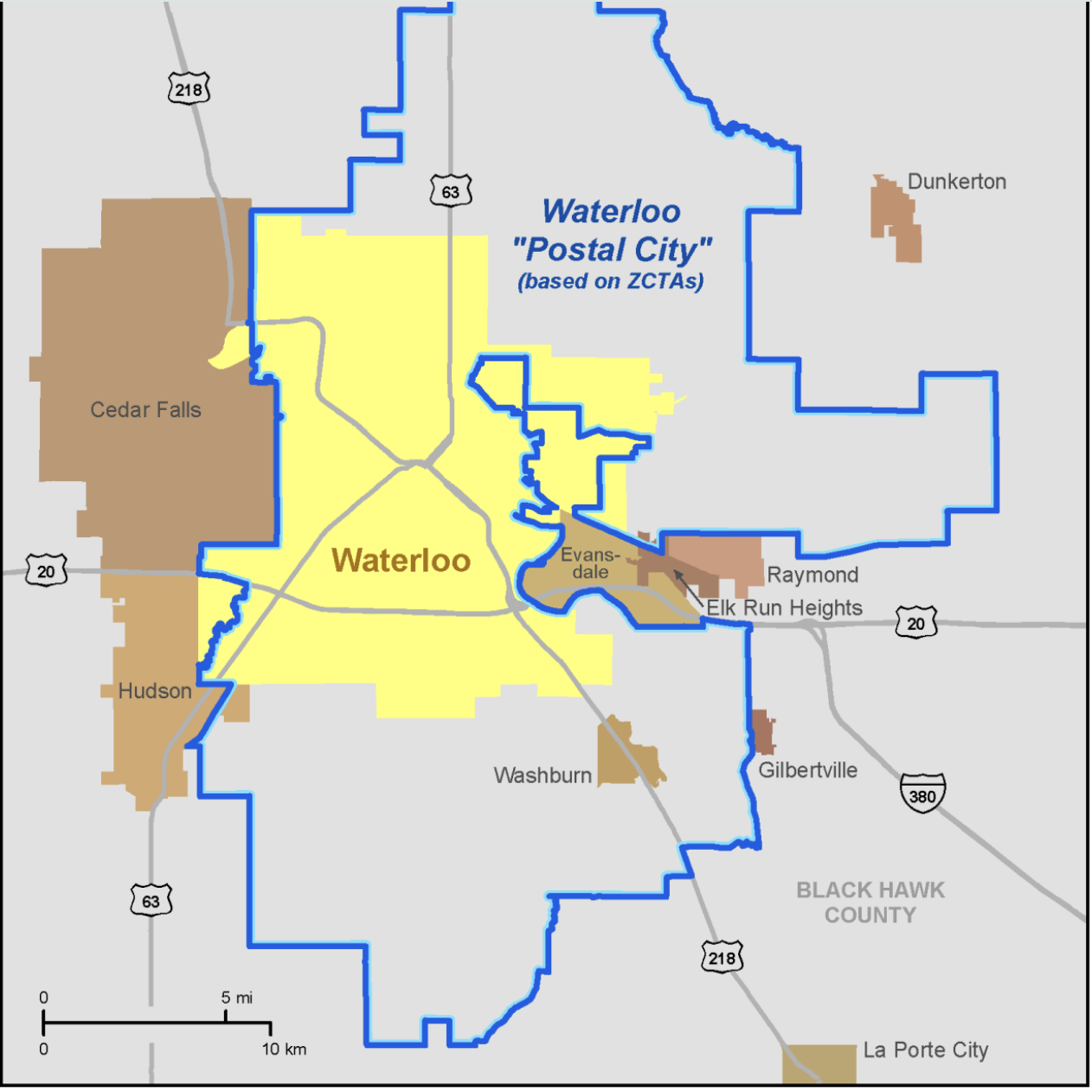
    A map shows the city limits of Waterloo, Iowa, in yellow, while a blue line shows the boundaries of the “Waterloo” zip code.U.S. Census Bureau

    Around 1990, some in Congress tried to fix the issue with a bill requiring the Postal Service make zip codes match municipal boundaries if towns request it.

    But such a change would “absolutely ruin the postal system,” Stevens said. “You can’t have a post office for every little borough.”

    The bill failed, and years later, the Postal Service was routinely rejecting zip code change requests, Stevens wrote in a 2006 Congressional Research Service report.

    “Some communities that lack delivery post offices complain that the need to use mailing addresses of adjacent areas robs them of a community identity,” he noted in the report.

    But at the end of the day, “zip codes are basically a delivery system. They’re not a neighborhood recognition system,” Stevens said this week.

    As for Bradley Cooper, the confusion around his addresses in the Philly suburbs has not ended.

    He supposedly owns an estate in New Hope. But he really lives in Solebury Township.

    This suburban content is produced with support from the Leslie Miller and Richard Worley Foundation and The Lenfest Institute for Journalism. Editorial content is created independently of the project donors. Gifts to support The Inquirer’s high-impact journalism can be made at inquirer.com/donate. A list of Lenfest Institute donors can be found at lenfestinstitute.org/supporters.

  • Abingtonians can now request anti-speeding devices on certain streets. Will yours be one of them?

    Abingtonians can now request anti-speeding devices on certain streets. Will yours be one of them?

    Neck-downs, chicanes, bulb-outs: They sound like threats from a 1930s mobster, but all three are traffic-slowing techniques that could soon arrive on your Abington street.

    The township will now allow residents to request traffic-calming measures under a new policy approved last week that requires traffic studies and majority approval from nearby property owners.

    The new petition policy adds to over a decade of efforts to curb speeding in Abington, which was the first town outside of Philadelphia to begin installing red-light cameras in 2014. Abington police have said they saw a resurgence in violations after the department limited in-person traffic stops during the pandemic.

    Which streets can get traffic calmers?

    To qualify for a traffic-calmer application, a street has to average between 500 and 6,000 vehicles per day on three weekdays in a row and cannot be a major artery or an emergency route. Private roads and alleys aren’t eligible, either, and the road has to be at least 500 feet long.

    There are other criteria too, depending on why the traffic-calming tool is needed.

    If the issue is speeding, only roads where three-day traffic studies show that over 15% of drivers are going more than 10 miles above the speed limit will qualify.

    If cut-through traffic on a sleepy street is the problem, the traffic volume has to exceed the expected level under a formula the township uses, either as a daily average or at its peak.

    Who decides which roads get bumps?

    There are two ways a road can be evaluated for traffic calmers under Abington’s new policy: a property owner’s petition, or the township manager’s request.

    If the manager requests it and a traffic study shows the road meets the criteria, property owners “directly adjacent” to the proposed traffic calmers will get at least 30 days’ notice of the proposal, the traffic data for that road will be posted on the township website, and there will be a two-week public comment period on the plan.

    If a property owner submits their road, the police will do a traffic study and ensure it meets the criteria, and then get approval from the township manager to proceed with a petition for approval from local residents. The property owner who filed the request has to get signatures from 60% of the directly affected home and business owners supporting the measure within 90 days.

    If approved, the property owner would then pass around a second petition to get 60% to 70% approval from a larger group of affected residents for the specific traffic-calming device and its planned location within 90 days.

    Ticketable speeding not as common as some Abingtonians think, traffic studies show

    The traffic study alone may stop many proposals in their tracks, based on similar studies the township already does when residents complain about speeding.

    Most studies on the township’s website from 2025 and 2026, spurred by complaints, found very few enforceable speeding infractions.

    For example, an October 2025 study at the 500 block of Montgomery Avenue where the speed limit is 25 mph found zero enforceable speeding violations. The average driver was going 18 mph, with 85% going 21 mph or slower.

    Many of the dismissed complaints were for roads posted at 25 mph, where going just 9 mph over is 136% of the speed limit.

    But some complaints do reflect frequent, enforceable speeding violations: An August 2025 study of the 300 block of Shelmire Street next to Lawnview Cemetery found an average speed of 31 mph in the 25 mph zone, and about 10% of passing vehicles met the criteria for enforcement. The police department planned to add speed enforcement on that block, according to the report.

    “Most of our residential streets tend to have 25 mph speed limits,” said Sgt. Michael Coughlin, the traffic safety officer who introduced the new policy at last week’s commissioners’ meeting. “In our experience, people tend to be a little more concerned about speeds where they live, which helps explain some of the complaints.”

    What traffic devices could Abington add?

    The traffic-calming measures mentioned in the policy include speed humps, roundabouts, road narrowing (called neck-outs), bulb-outs (extended curbs), and chicanes, which create artificial curves in the road with deflectors.

    A chicane, or artificial curve, at Charlotte Motor Speedway in Concord, N.C., in 2018. AP

    But there are downsides to some devices, township officials have noted at public meetings: Residents might win speed humps on their street, only to realize they now hear the sound of tires thunking over bumps thousands of times per day.

    This suburban content is produced with support from the Leslie Miller and Richard Worley Foundation and The Lenfest Institute for Journalism. Editorial content is created independently of the project donors. Gifts to support The Inquirer’s high-impact journalism can be made at inquirer.com/donate. A list of Lenfest Institute donors can be found at lenfestinstitute.org/supporters.

  • Meet Jenkintown’s new superintendent, whose background ranges from Sixers reporter to Russian translator

    Meet Jenkintown’s new superintendent, whose background ranges from Sixers reporter to Russian translator

    After the sudden departure of Jenkintown’s longtime superintendent in April, the school district’s new CEO started work this month, and she already has plans.

    “I’m really excited once the year starts to really dive in and go into classrooms,” Brea D’Angelo said last week, “and get the narrative out to the community of the incredible things that are happening. … I’m really looking forward to being the communicator of those types of things.”

    D’Angelo used to be a professional communicator: She went to Rider University for TV and radio and then took a reporting job covering the Sixers at WBCB radio in Levittown.

    “I had the opportunity to go into the locker room and interview players,” D’Angelo said. “What I started realizing was that I wasn’t making a difference.”

    New superintendent Brea D’Angelo poses for a portrait at Jenkintown High School on Wednesday, July 22, 2026, in Jenkintown. D’Angelo comes to the Jenkintown School District from the Hatboro-Horsham School District.Monica Herndon / Staff Photographer

    From Sixers to secondary education

    She switched from communications to education, starting as a special education assistant in the Lower Moreland Township School District and spending seven years as a secondary school teacher there before working her way up as an administrator in the Hatboro-Horsham School District, where she spent more than 12 years and still lives with her husband and teenage daughter.

    D’Angelo chose to teach English — a subject she came to love as a reluctant reader who learned the joy of books from a teacher when she was about 15.

    “[She] really took an interest and was like, ‘You just haven’t found the right thing to read yet,’” D’Angelo said, and helped her find early favorites, such as Of Mice and Men. “You want teachers to be that for someone.”

    Her plans as superintendent include a return to publishing, of sorts.

    “I’m going to do a newsletter that comes out monthly, from me,” D’Angelo said. “I just want our story to get out there and to show what an incredible place we really are.”

    Jenkintown finds comms pro to replace superintendent

    Jenkintown’s last superintendent, Jill Takacs, had announced her retirement for Aug. 31 this year before leaving early, in April, for an administrator job in New Jersey.

    Takacs’ departure came after an email from a retiring principal leaked to the public last fall that outlined concerns with Takacs’ management style, including a ”lack of transparency,” outgoing Jenkintown Elementary principal Christopher Jahnke wrote. Takacs was on leave shortly afterward.

    But some locals said they had already had concerns about Takacs’ communication with parents in Montgomery County’s smallest school district — particularly amid the universally quick-shifting plans and procedures of the COVID-19 era.

    Jenkintown’s school board appears to have taken that note, highlighting D’Angelo’s narrative chops as a reason for hiring her.

    “The board decided to hire Dr. D’Angelo due to her combination of leadership, team building, and communication skills,” board president Carolyn Riley said. “She struck the right balance between expertise and a ‘friendly but firm’ quality.”

    Riley also highlighted the new superintendent’s experience with special education and facilities management — critical for the steward of Jenkintown’s 103-year-old high school building.

    But the district’s new chief storyteller also knows what communication barriers feel like: D’Angelo grew up hearing both English and Russian, but had to pick up much more Russian as a child to interact with her Ukrainian grandmother.

    Those skills came in handy when Ukrainian refugees arrived in Hatboro-Horsham, and D’Angelo was enlisted to help families get settled.

    “I fell into it because I was pretty much the only Russian speaker on the staff,” D’Angelo said. ”I can’t even imagine fleeing my home, going to a place not speaking the language. … That was really something that I pride myself in, being able to connect with these families and support them.”

    Public relations is often a struggle for public schools, which must balance legally required disclosure with legally required secrecy, especially for personal details about individual students and staff — details like the circumstances surrounding Takacs’ departure.

    D’Angelo, who earned her Ph.D. from Gwynedd Mercy University, hopes that being fully transparent from the beginning with information she is allowed to share will help residents trust her on topics she cannot say much about.

    “I’m OK with being vulnerable in certain situations,” D’Angelo said. “When you build that strength with community members, with staff, with families — there’s a bit more understanding when I go silent on certain things, knowing it’s not because I don’t want to say it; it’s because I can’t.”

    Perhaps sports will be one of those topics: A diehard Philadelphia football and basketball fan (“I bleed green for the Eagles,” she said), D’Angelo already attended a Color Day this year, but she refuses to say which team is better.

    “I will be rooting for Blue and Red all the time, or I’ll be purple,” the new superintendent said. “Yeah, it’s gonna be one of those.”

    This suburban content is produced with support from the Leslie Miller and Richard Worley Foundation and The Lenfest Institute for Journalism. Editorial content is created independently of the project donors. Gifts to support The Inquirer’s high-impact journalism can be made at inquirer.com/donate. A list of Lenfest Institute donors can be found at lenfestinstitute.org/supporters.