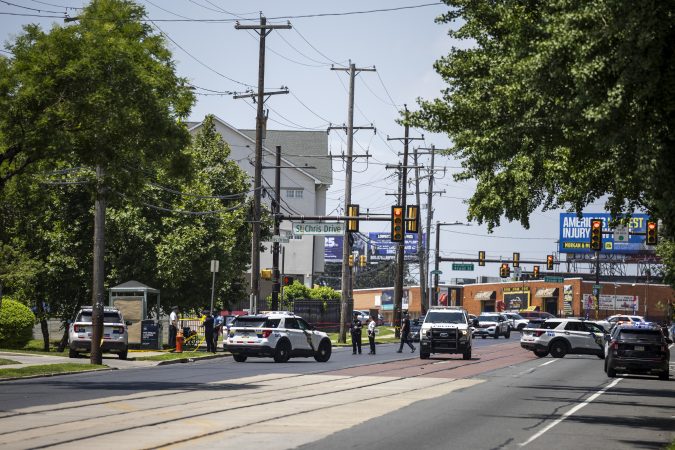
Police shot and killed a man outside St. Christopher’s Hospital for Children in North Philadelphia on Thursday, authorities said.
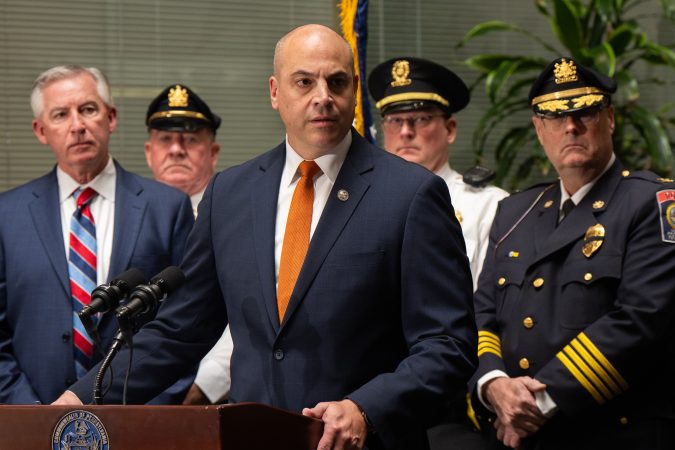
Officers were called to the hospital shortly before 10:30 a.m. for a report by hospital staff of an “irate man,” said Police Commissioner Kevin Bethel.
At a briefing with the media Thursday evening, Bethel clarified that the man, whose name and age were not released, did not threaten anyone at the hospital.
“The hospital was at no time under threat,” Bethel said.
The man was at the hospital yesterday related to something involving a “child in the hospital,” Bethel said, then later adding that it was the man’s son.
The man was asked to leave Wednesday, and when he returned Thursday, he was not allowed to enter the hospital, said Bethel, who did not elaborate on why the man was asked to leave.
But when he returned Thursday, “he did not threaten” staff and was “compliant.”
Shortly thereafter, a relative called police and reported that the man was suicidal and may have a gun, Bethel said.
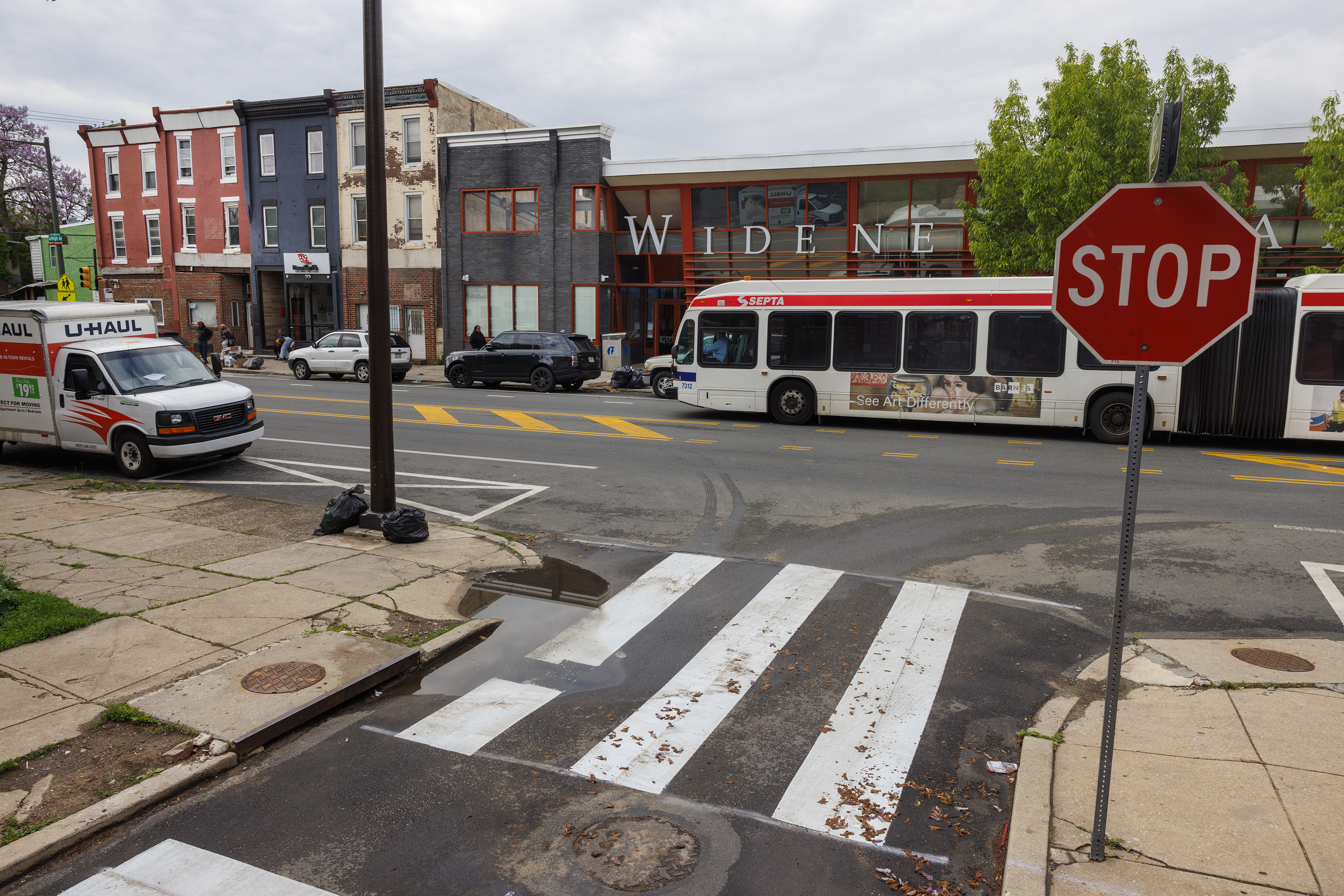
Police drove to the bus stop on Erie Avenue outside the hospital where the man was and an officer was just exiting from the passenger side of a police vehicle when the man allegedly pulled out a gun, Bethel said. The officer then fired.
The man was transported to Temple University Hospital, where he later died. Bethel said a gun was recovered at the scene.
A woman standing next to the man, who Bethel described as his girlfriend, was grazed by a bullet. He said she was in good condition.
“He did not fire his weapon,” Bethel said about the man.
The officer who fatally shot the man was placed on administrative duty while the shooting is investigated.
At an earlier media briefing, Bethel described the shooting as a tragedy that unfolded in a matter of minutes.
He added: “We have a lot to sort through,” including the mental state of the man who was killed. “He may have been going through some mental issue,” Bethel said.
No patients or hospital staff were injured, said hospital spokesperson Bill Tierney. The man who was shot did not come inside the hospital, he said.
The hospital initially went into a lockdown, which has since been lifted, Tierney said. Some entrances to the hospital were closed during the initial police investigation but they had reopened by Thursday afternoon, he said.
Police have not released the name, age, or rank of the officer who discharged his weapon.
Michael Lopez, a senior staffer at a sports complex across the street from the hospital, said he heard about a half dozen gunshots. Initially mistaking the gunfire for July Fourth fireworks, Lopez said he came out to Erie Avenue, where he saw a throng of police officers — and a woman he said appeared to be bleeding from her neck.
“It was gruesome,” Lopez said.
Thursday’s shooting was the second fatal shooting by a Philadelphia police officer in less than three weeks.
On June 14, three officers were injured and Eric Franks was fatally wounded after exchanging gunfire in the Wynnefield neighborhood of West Philadelphia. The officers — who were shot in the hip, leg, and face — were hospitalized and recovered, police said.
Their names had not been released as of Thursday because of an active threat assessment, said police spokesperson Sgt. Eric Gripp.
— Staff writer Robert Moran contributed to this article.
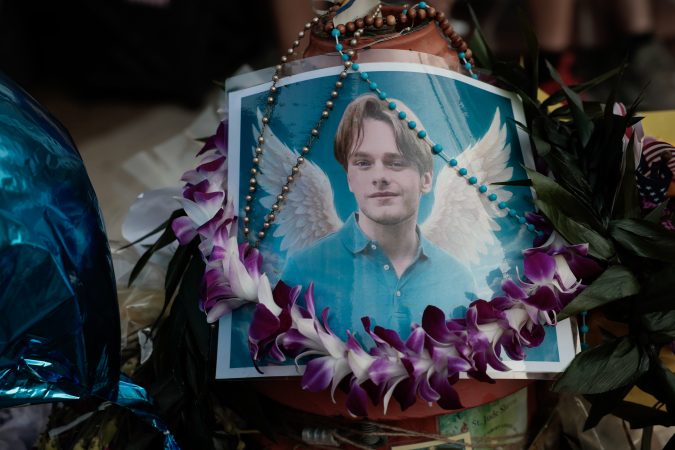
A teenager who authorities say killed a Penn State student surrendered to Philadelphia police on Thursday, one day after U.S. marshals captured a second teen wanted in the slaying more than 1,700 miles from the South Philadelphia street where the crime occurred.
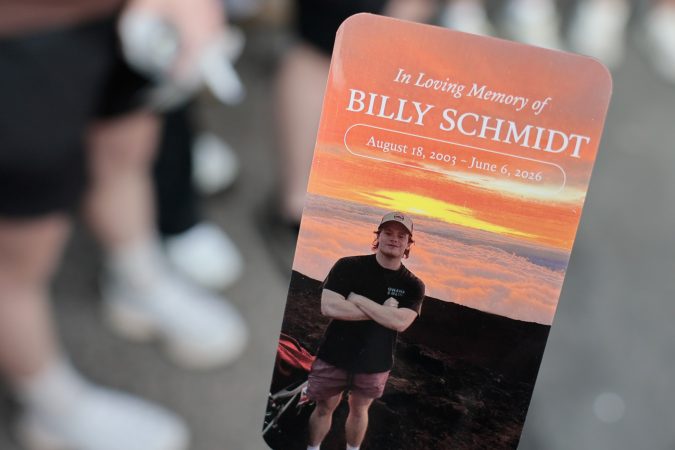
Smith and Azzubair Outen-Fleming, 16, are expected to face charges of murder, robbery, criminal conspiracy, illegal possession of a firearm, and related crimes in the June 6 death of William “Billy” Schmidt.
Both teens had been on the run until Wednesday night, authorities said, when members of the U.S. Marshals Service arrested Outen-Fleming at a house in Colorado Springs, Colo.
Smith remained at large until Thursday.
Police have said Outen-Fleming and Smith killed Schmidt, 22, shortly after 1 a.m. as he walked toward his South Philadelphia home.
According to prosecutors, surveillance video captured two masked people — identified by investigators as Outen-Fleming and Smith — robbing Schmidt of his cell phone, searching his pockets, and then, moments later, shooting him.
Smith, they said, is accused of firing the fatal shot.
The teenagers fled after the shooting, police said.
On Wednesday, prosecutors also announced charges against Outen-Fleming’s stepfather, Donte Abdulmalik, who they said helped him evade authorities after the killing.
Abdulmalik was charged with hindering apprehension, obstruction of justice, tampering with evidence, and related crimes.
Deputies with the U.S. Marshals Service’s Violent Offender Task Force tracked Outen-Fleming this week to a house in southern Colorado Springs with “ties to his family in Philadelphia,” Supervisory Deputy U.S. Marshal Robert Clark said. After conducting surveillance, deputies arrested him there late Wednesday.
Schmidt’s father, William, did not return a phone call Thursday afternoon, and attempts to reach other family members were unsuccessful.
Philadelphia police spokesperson Sgt. Eric Gripp said it was not clear when Outen-Fleming would be returned to Philadelphia.
A teen wanted in the shooting death of Penn State student William “Billy” Schmidt in South Philadelphia last month was apprehended in Colorado, the U.S. Marshals Service said Wednesday night.
Azzubair Outen-Fleming, 16, was taken into custody in Colorado Springs at the home of a distant relative, the U.S. Marshals Service said. The teen was being housed at the Zebulon Pike Youth Center awaiting extradition to Philadelphia.
Earlier on Wednesday, District Attorney Larry Krasner announced the arrest of Outen-Fleming’s stepfather for allegedly hindering the police investigation into the slaying of Schmidt.
Donte Abdulmalik, 35, was charged with hindering apprehension, obstruction of justice, tampering with evidence, and related crimes, Krasner said Wednesday.
Prosecutors said Abulmalik helped his stepson leave the city. He is not accused of participating in the homicide.
The teens will face charges of murder, robbery, criminal conspiracy, illegal possession of a firearm, and related offenses, Krasner said.
He suggested that the investigation could involve others, describing the charges against the two teenagers and Abdulmalik as “a smaller part of a bigger picture.”
“I am not telling you that these are the only people involved,” Krasner said during a news conference Wednesday. “I’m not telling you that this investigation is over or that we have all the answers yet.”
Philadelphia police have said Schmidt was walking home when two masked people approached him. During what investigators say was an attempted robbery, one of the suspects — whom Krasner identified as Smith — shot Schmidt.
Surveillance camera footage shows that one suspect took Schmidt’s phone, prosecutors said Wednesday, then rifled through his pockets before knocking him to the ground.
Additional footage later shows Schmidt walking behind the suspects, before one throws a phone down the block and the other fires a bullet into Schmidt’s chest.
Krasner declined to say whether the gun used to kill Schmidt had been recovered.
Investigators say surveillance cameras captured the suspects before and after the shooting. One was wearing a gray hooded sweatshirt with a hand-drawn “KONFUSED” logo and a skull-and-crossbones sketched in black marker on the front, according to the footage. After the shooting, police said, both suspects fled wearing white T-shirts.
Philadelphia police and the U.S. Marshals Service Fugitive Task Force are searching for the remaining teenager. Both agencies have offered rewards for information leading to the arrests of both teens. Krasner said Smith has ties to Philadelphia’s Point Breeze neighborhood and Delaware.
Anyone with information may contact the U.S. Marshals Service at 1-866-865-8477 or submit a tip online through its website: usmarshals.gov. Tips can also be provided to Philadelphia police at 215-686-3334 or 215-686-8477.
Lawyers for three Philadelphia men whose murder convictions were overturned in May are asking a judge to block the Pennsylvania Attorney General’s Office from intervening in the case in an effort to reverse that outcome.
Attorneys for Marc Brittingham, Jermal Shuler, and Rasheed Turner have asked Common Pleas Court Judge Jennifer Schultz to reject state prosecutors’ effort to appeal the decision that allowed the men to go free. The lawyers said the office did not have the right to intervene at this late stage.
On June 16 — three weeks after the men’s convictions were vacated — the Pennsylvania Supreme Court issued a landmark decision expanding the state’s role in Philadelphia’s post-conviction cases. But that ruling, the lawyers said, doesn’t apply retroactively.
At issue is whether the authority of the attorney general’s office extends to cases still within a window for appeal when the court issued its sweeping decision granting state prosecutors new power to step into post-conviction cases in Philadelphia.
The answer could determine how broadly the attorney general’s office can exercise its new authority.
Last week, the office sought to intervene in the case of Brittingham, Shuler and Turner, whose convictions in the 1997 killing of Essie Mae Thomas were vacated after Philadelphia prosecutors, defense attorneys, and the judge agreed that newly uncovered evidence had undermined their confidence in the jury’s verdict.
The attorney general’s office filed notices seeking to intervene and appeal 29 days after Schultz vacated the convictions, prosecutors withdrew the charges, and the men were released from prison after more than 28 years.
The move marked the office’s first effort to invoke the high court’s ruling, a sharply worded decision in which it accused Philadelphia District Attorney Larry Krasner’s office of repeatedly misleading courts while seeking to overturn convictions. The court ordered that, going forward, trial judges must notify the attorney general’s office whenever Philadelphia prosecutors concede post-conviction relief and give it an opportunity to review the case and potentially intervene.
The filings also underscore a complication the Supreme Court anticipated. The deputy attorney general assigned to the case, Hugh Burns, previously worked in the Philadelphia District Attorney’s Office, where he opposed earlier appeals by Brittingham, Shuler, and Turner to seek DNA testing in an effort to have their convictions reversed.
Justice Christine Donohue warned that the new intervention process could create conflicts when former Philadelphia prosecutors now employed by the attorney general’s office are asked to defend convictions they previously handled.
Defense attorneys say Burns’ involvement highlights that concern. They also described the attorney general’s effort as part of “an ongoing political and ideological battle” between state prosecutors and the district attorney’s office, arguing that Brittingham, Shuler, and Turner “should not be caught in the crossfire.”
The lawyers say the Supreme Court’s order forecloses the attorney general’s attempt to intervene. In its decision, the high court wrote that state prosecutors have “the right to intervene” in any case where the district attorney’s office concedes relief “before [a] ruling on the concession” is made.
The attorney general’s office, they said in the filings, is attempting to “change the rules after the fact.”
Attorney General Dave Sunday did not respond to questions about the case.
In a statement Tuesday, he said, “I don’t think that it benefits anyone for criminal justice leaders to editorialize a lot of the work we do. We intend to litigate in the appropriate venue — the courts.“
He added: “The last thing individuals who live in the community want to hear are elected officials yelling at each other. They want to see outcomes.”
In an earlier interview with The Inquirer, Sunday said that after the high court ruling, his office would be reviewing “cases that are still going through the appellate process.”
In this case, the district attorney’s office sided with the defense, saying in its own filing that the high court’s decision created a right to intervene “before [a] ruling,” not after. While prosecutors said they would comply with the court’s directive in future cases, they argued that nothing in the decision authorizes intervention in this case.
In a statement filed in the men’s case, Burns acknowledged that the state Supreme Court had not yet issued its ruling when Schultz granted the men their freedom. Even so, he asked whether the court should temporarily vacate its order to allow the attorney general to intervene.
Burns’ filing does not challenge the evidence that prompted prosecutors to support overturning the convictions.
That evidence centered on newly disclosed information about the disciplinary history of Bennett Preston, a former assistant medical examiner whose testimony at trial helped establish Thomas’ time of death — testimony prosecutors later concluded was unreliable.
Two forensic pathologists hired by defense attorneys and prosecutors also concluded that Preston had incorrectly estimated when Thomas died. Schultz found that the new information likely would have changed the outcome of the trial had jurors heard it before issuing their verdict.
The notice, filed Wednesday in Philadelphia Common Pleas Court, seeks to insert the attorney general’s office into the case of Marc Brittingham, Rasheed Turner, and Jermal Shuler, whose convictions in a 1997 killing were vacated in May after prosecutors and defense attorneys said key evidence presented at their trial was unreliable.
But last week, the Pennsylvania Supreme Court said in a forceful ruling that District Attorney Larry Krasner’s office had displayed a pattern of misleading judges while seeking to overturn murder convictions. Moving forward, the justices said, the state attorney general’s office should be given the opportunity to review such cases before a judge can decide whether to grant relief.
The filings raise a procedural question at the heart of the new ruling. The Supreme Court’s decision requires judges to notify the attorney general and gives the office “the right to intervene in the case before ruling on the concession.” But in this case, that moment had already come and gone; the judge had accepted the district attorney’s position and overturned the convictions.
What may have allowed the attorney general back in was timing: The 30-day window to appeal the decision had not closed yet. The office filed its notice of intervention and an appeal on day 29.
Krasner, in a brief phone call Wednesday, said, “I hope the public will watch this case carefully.”
“I hope they will watch what our attorney general’s office stands for and what the district attorney’s office stands for,” he said. “Stay tuned. It’s going to tell us a lot about what’s really going on.”
Deputy Attorney General Hugh Burns did not say in court documents how or why the office believed it had authority to intervene in this case, saying only that it was taking the action in response to the state Supreme Court’s order from last week.
A spokesperson for the office declined to comment.
Wednesday’s filing seeks to reopen a case in which many of the facts underlying the district attorney’s decision to join defense lawyers in seeking to vacate the convictions remain obscured by extensive redactions in court filings.
Prosecutors and defense attorneys said the case was undermined by newly uncovered information about the work of Bennett Preston, a former assistant medical examiner whose testimony helped establish the prosecution’s timeline of Essie Mae Thomas’ death.
Thomas, 73, was found stabbed to death inside her Northwest Philadelphia home in November 1997. A jury convicted Brittingham, Turner, and Shuler the following year, after hearing testimony from a neighbor who placed them at the home and from Preston, who linked Thomas’ time of death to the witness’ account. Nearly three decades later, Krasner’s prosecutors said that the testimony of the witness and Preston was questionable, and that disciplinary action had been taken against Preston.
The details of those disciplinary actions, however, were redacted from filings.
Officials with the district attorney’s office have said that the discovery of previously unknown disciplinary action involving Preston helped prompt the reinvestigation. But prosecutors have declined to publicly detail much of that information, and court records filed in the case concealed significant portions of the evidence that led them to conclude the convictions could no longer stand.
When Common Pleas Court Judge Jennifer Schultz vacated the convictions in May, she found that the newly uncovered evidence would likely have changed the outcome of the trial. Prosecutors then withdrew the charges, ending the case and allowing the men to walk free.
Jules Epstein, a criminal law professor at Temple University, said “this is unknown territory.” Because a court order is not final for 30 days, he said, the office could have a right to appeal.
“What disturbs me is did they actually look at the merits of this decision? Or did they just knee jerk and say, ‘It’s Krasner, we’re going to challenge it’?”
Marissa Boyers Bluestine, assistant director of the Quattrone Center for the Fair Administration of Justice at the University of Pennsylvania‘s law school, said the language of the high court’s order did not appear to leave room for retroactivity.
Bluestine, who worked on Brittingham, Turner, and Shuler’s case in her previous role leading the Pennsylvania Innocence Project, said it was also curious that the attorney general’s office was involving itself without the judge’s invitation.
“They’re saying that they are intervening, not requesting permission to intervene, which is an interesting way to put it,” she said.
Two Philadelphia pastors groomed and sexually exploited two teenage boys, authorities say, paying them for explicit videos and sharing the images with each other in a scheme that stretched across years and may involve additional victims.
Isaiah Banks, 30, and Bryan Jackson, 42, are charged with sexual abuse of children, sexual exploitation of children, conspiracy, corruption of minors, and related crimes, District Attorney Larry Krasner said Tuesday.
Banks served as pastor of Second Pilgrim Baptist Church in Francisville, while Jackson served as a pastor at Garden of Prayer World’s Prayer Center in Strawberry Mansion, Krasner said.
Both men were arrested, arraigned, and released from jail after posting bail — $600,000 for Banks, and $100,000 for Jackson. Prosecutors said they had sought higher bail, but their request was denied.
Efforts to reach Banks’ attorney, Richard Kravets, were unsuccessful. No attorney for Jackson was listed in court records.
The investigation into the men began in April after police received a report that a teen had been solicited by Banks through text messages and social media to send sexually explicit videos in exchange for money or food, authorities said. The messages, they said, came to light after a witness checked the boy’s phone.
Prosecutors said Banks shared images he received with Jackson, who they said had also posed online as a female to solicit additional images and videos from the victim.
As investigators dug deeper, authorities said, they found evidence suggesting that Banks and Jackson had received sexually explicit images and videos from other victims, dating back to February 2024.
“A position of trust, when it is abused, has its criminal consequences,” Krasner said during a news conference to announce the charges.
He declined to provide additional details about the case, including the victims’ ages and genders. He said that the investigation is continuing and that releasing additional information could discourage other victims or witnesses from coming forward.
Court records, however, offer a more detailed portrait of the alleged crimes.
The victims, both boys, were 15 and 16 years old when investigators began their inquiry, according to the affidavit of probable cause for Jackson’s arrest. None of the crimes is alleged to have occurred on church grounds.
In the document, police described what they said was a yearslong pattern of communications, photographs, and videos showing Banks and Jackson cultivated transactional relationships with the boys.
Messages recovered from the men’s phones were also “littered with images and videos of nude men,” and photographs “from a barbershop and church events,” according to the affidavit.
By May, as the police investigation was underway, the tone of the messages between the two men had shifted, police said: In one message, Banks warned that one of the boys was rattled by the involvement of authorities.
During an interview with detectives, Banks acknowledged knowing the boys for more than a decade, and said Jackson was a friend, according to the affidavit. He told detectives he typically paid $50 for videos that the boys sent, the document said.
Efforts to reach officials at the church and prayer center where the two men worked were unsuccessful Tuesday.
According to Second Pilgrim Baptist Church’s website, Banks was elected senior pastor in 2017. The website describes him as a leader who is “loved genuinely by our congregation because of his passion to see our church thrive and because of his genuine care and love for all those who are a part of our church.”
Garden of Prayer World’s Prayer Center does not appear to have a website. An Instagram account appearing to belong to the church features photographs of Jackson promoting its events.
Krasner asked that anyone with additional information contact the district attorney’s office victim and witness services unit at 215-686-5709; the police department’s special victims unit at 215-685-3251; or the Philadelphia Center Against Sexual Violence hotline at 215-985-3333.
One of three Philadelphia police officers wounded in an exchange of gunfire that left a retired firefighter dead in West Philadelphia late Saturday was released from the hospital Monday, as authorities continued to investigate the shooting.
The officer, whom police did not identify, left Penn Presbyterian Medical Center shortly after 1 p.m. Monday, 6abc reported. Dozens of uniformed officers lined the emergency department entrance and saluted as their colleague was pushed outside in a wheelchair and helped into a silver SUV. The crowd erupted in applause as the vehicle pulled away.
His release came nearly two days after authorities say Eric Franks, 57, opened fire on officers who were investigating an unrelated report of a vehicle struck by gunfire near 54th and Arlington Streets in Wynnefield around 10:30 p.m.
As the investigation entered its second day, both law enforcement officials and Franks’ family struggled to understand what could have led him to shoot at police. The police department declined to provide additional details about the confrontation, but a source familiar with the case said footage from the officers’ body worn cameras offered little explanation for such a reaction.
According to the source, who spoke on the condition of anonymity to discuss an ongoing investigation, as officers investigated the vehicle that had been struck by bullets, Franks approached and began complaining about crime and policing in the area.
He appeared frustrated, the source said, that officers had not yet cordoned off the area around the vehicle with crime scene tape, and became increasingly agitated as officers repeatedly asked him to step back so they could do their jobs.
Video obtained by The Inquirer appears to show Franks yelling at officers, then pushing one, before stepping back and pulling a gun from his waistband.
Franks then fired multiple shots at the officers, according to the video and police accounts, and four officers returned fire. Three officers — including a sergeant — were struck by gunfire. Franks was shot in the chest and leg and later died at Thomas Jefferson University Hospital.
Police said Franks had a license to carry a firearm. Commissioner Kevin Bethel said investigators are trying to determine why Franks confronted the officers.
District Attorney Larry Krasner said at a news conference Monday that his office is investigating. He said representatives of his office had spoken with Franks’ family, and had visited the scene and begun reviewing evidence, including video footage that captured the events leading up to the fatal encounter.
Krasner declined to provide additional details, describing the investigation as “very active” and saying he could not divulge further information in order to “preserve the integrity of the investigation.”
The district attorney said his “thoughts are with all the people who have been affected and harmed,” but added that his office — like Franks’ family and members of the community — has questions about what transpired.
He joined Mayor Cherelle L. Parker in a promise to “make sure officers receive the support they need as they heal and process the trauma connected to the shooting.” At the same time, he said, “We also stand in solidarity with all Philadelphians who want to make sure we get the truth, and that we apply the law appropriately.”
He encouraged anyone with information about the shooting — including police officers — to contact his office and speak with investigators.
Franks’ wife, Michele, described her husband as a longtime Wynnefield resident, business owner, and former Marine who spent nearly two decades with the Philadelphia Fire Department before retiring last year.
“He cared very much about community, and about Wynnefield,” she said.
The retired firefighter was also a community activist, an attorney representing Franks’ family said, adding that Franks had met with City Councilmember Curtis Jones Jr. about an uptick in drug-related crimes in the neighborhood.
In a letter posted Sunday on Facebook that did not mention Franks by name, Jones wrote that he was “deeply saddened and heartbroken” by the shooting, and called for a continued commitment to “building a safer, and more peaceful Wynnefield for all.”
Bucks County prosecutors on Monday said they had resolved the case of the last teenager arrested during an anti-ICE protest in Quakertown that turned violent.
The 16-year-old girl was scheduled to stand trial Monday on misdemeanor charges of resisting arrest and disorderly conduct, as well as a summary offense of obstructing traffic, according to her lawyer. Instead, prosecutors said, she agreed to enter into a diversion program in exchange for the dismissal and expungement of the charges.
The girl’s lawyer, Ed Angelo, said the agreement includes 20 hours of community service, among other things, to be completed over a 90-day period. “She is a wonderful young lady who, I think, exercised great courage,” both during the protest and throughout her criminal case, he said.
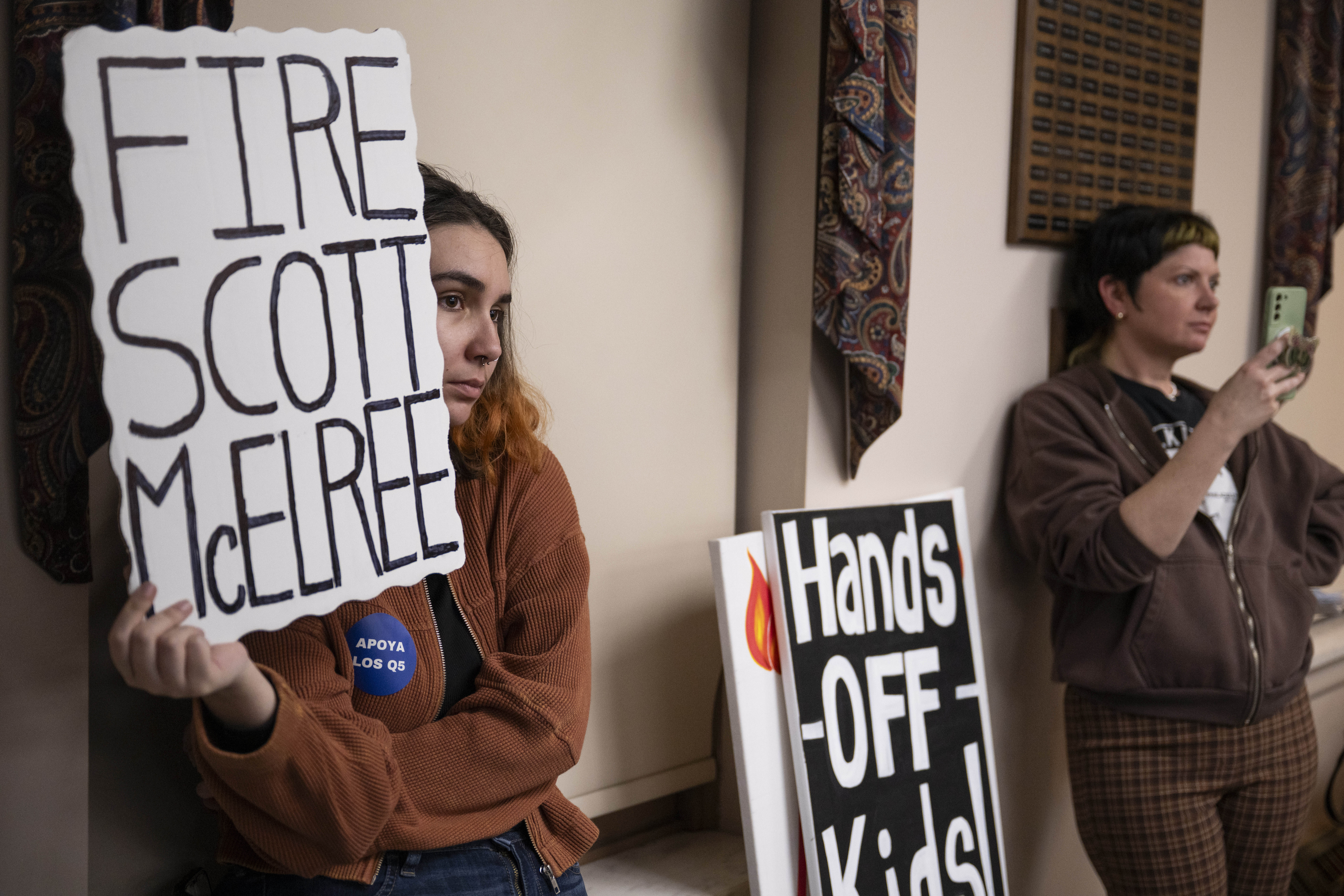
The agreement closes the last outstanding case among five Quakertown Community High School students arrested after a February demonstration against ICE escalated into a physical confrontation with the borough’s police chief and manager, Scott McElree.
The teens’ arrests sparked months of public debate over the melee, which was captured on camera by onlookers whose videos circulated widely online. One video showed McElree, who was dressed in plain clothes, grappling with a boy on the sidewalk. Another captured 72-year-old McElree placing a girl in a chokehold.
Following the confrontation, Bucks County officials said McElree had sought medical care for injuries that included fractured ribs. He also took worker’s compensation leave for several weeks before returning to work in May. And a panel of area police chiefs later cleared McElree of wrongdoing following a review of the case.
The teens were each initially charged with aggravated assault as well as misdemeanor offenses. But on Monday, the Bucks County District Attorney’s Office said in a statement that after reviewing evidence in the case — including “video footage obtained after the initial filing of the charges” — prosecutors had dismissed the aggravated assault charges because they “were unsupported by the evidence as a whole.”
Over the last few months, prosecutors have struck diversion-program deals with the other teens that are “designed to meet the needs of each juvenile,” according to their statement.
The 16-year-old girl, who was 15 at the time of her arrest, had been the only teen whose case remained unresolved.
“She should never have been charged,” Angelo, her lawyer, said.
Angelo had previously sought to have the case dismissed outright, arguing that the allegations relied heavily on secondhand accounts and that his client had done nothing wrong.
The district attorney’s office also said Monday that it continues to investigate the conduct of Quakertown police during the protest.
That investigation began a day after the demonstration, when prosecutors were tasked with independently reviewing the department’s response. In its statement, the office said county detectives had spent the last four months gathering evidence, including video footage submitted by members of the public.
Now that all five of the teens’ cases have been resolved, prosecutors said investigators are working with defense lawyers to secure voluntary interviews with the teenagers so they can provide their accounts of what occurred.
The office did not provide a timeline for completing the investigation but said it intends to move “expeditiously” toward its conclusion.
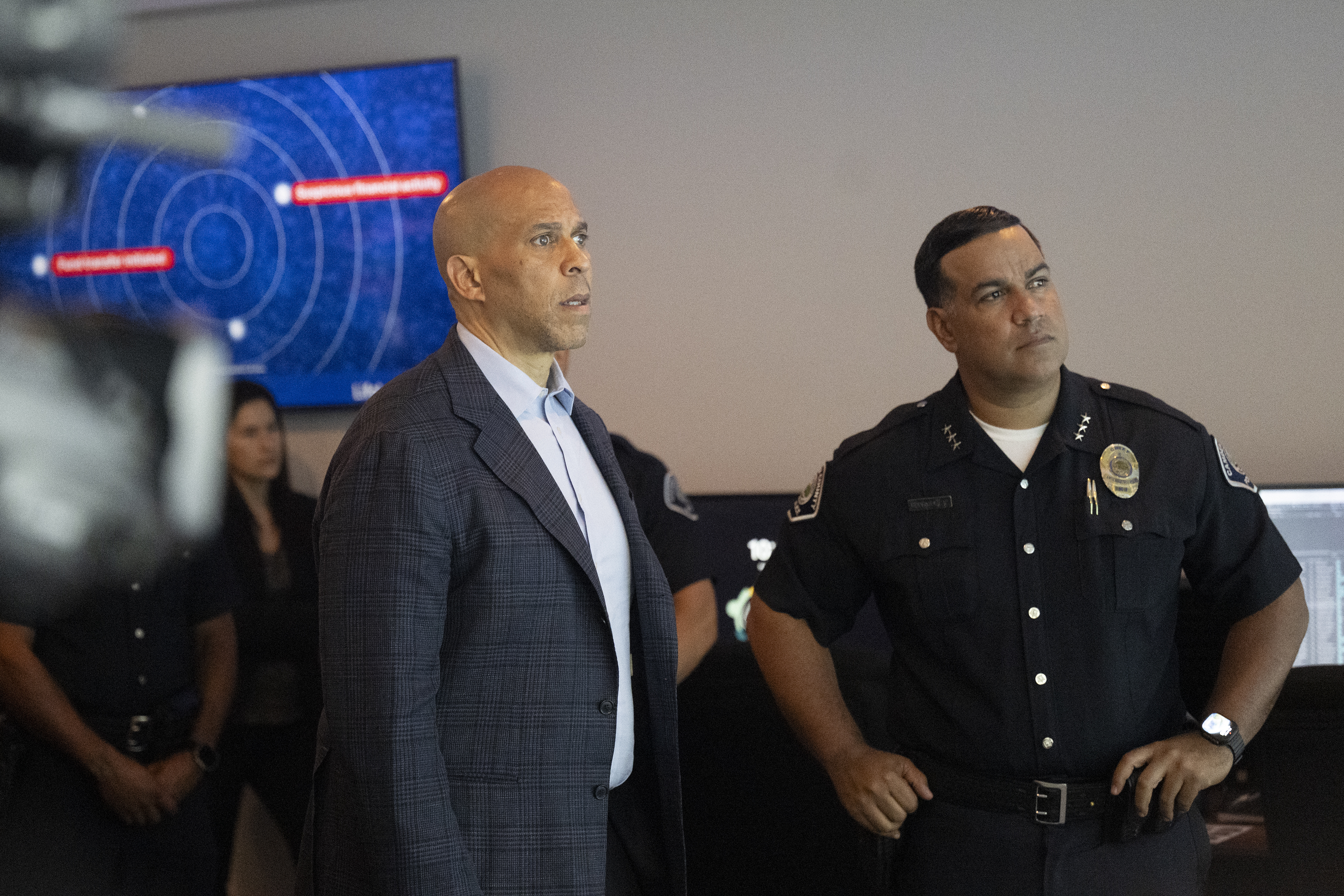
U.S. Sen. Cory Booker stood Friday in the basement of the Camden County Police Department headquarters in downtown Camden, surrounded by floor-to-ceiling video screens displaying a lifelike training scenario: a distraught man teetering near the edge of a bridge, threatening to jump.
A young officer stepped forward and addressed the digital figure: “Just step back from the edge,” the officer said, “and come talk to me.”
The immersive simulation is part of a system the department uses to train officers to respond to volatile encounters without resorting to force — one piece of a growing suite of technology it has embraced over the last decade. Department officials credit those tools, along with broader policing reforms and community-engagement efforts, with helping reduce crime in a city once regarded as among the nation’s most dangerous.
Today, Camden’s homicide total sits at a four-decade low, while robberies, sexual assaults, and other violent crimes have also declined, according to police data.
Booker toured the department Friday to see those tools firsthand as he promotes federal legislation designed to help other law enforcement agencies adopt similar technology.
The proposal, known as the Violent Incident Clearance and Technological Investigative Methods Act, or VICTIM Act, would establish a Department of Justice grant program to help police departments increase staffing, purchase investigative technology, and train personnel to use it. Booker, a New Jersey Democrat, reintroduced the bipartisan legislation in March 2025 alongside Sen. John Kennedy, a Louisiana Republican.
The measure comes as violent crime has fallen sharply in many cities across the country in recent years, a trend Booker said lawmakers should sustain through continued investment.
“What they’re doing here is so innovative and cutting edge,” Booker said after the tour, pointing to Camden as an example for other departments to follow.
Inside the Camden County Police Department’s Real Time Tactical Operations Intelligence Center, analysts monitor live camera feeds, 911 calls, and data streams from license plate readers and other sources. The center provides officers with real-time information during emergencies, helps investigators track suspects, and identifies crime patterns throughout the city, said Chief Gabriel Rodriguez.
The intelligence center works in tandem with the department’s drone unit.
U.S. Sen. Cory Booker, joined by city officials, watches a drone demonstration atop the Camden County Police Department on June 12, 2026.Jose F. Moreno / Staff Photographer
Rodriguez said those tools, combined with training programs such as the simulation Booker observed Friday, have helped drive crime to new lows.
The city recorded 12 homicides in 2025, down from 17 the previous year and the fewest since 1985, according to department data. Violent crime also fell 6% last year, while robberies declined 12% and sexual assaults dropped 32%.
Camden has spent more than a decade reshaping its approach to policing, adding new technologies and investigative tools as funding became available. Booker said departments across the country cannot afford to stop investing in technology as criminal investigations become increasingly reliant on digital tools and real-time information.
“Technology is moving rapidly,” he said. “We’ve got to stay ahead of the curve, and that’s going to take constant investment.”
Several local officials joined Booker on the tour, including Camden Mayor Victor Carstarphen and Camden County Commissioner Director Louis Cappelli Jr., who highlighted the city’s crime reductions and broader public-safety gains as they walked through police headquarters.
Even so, police who have adopted technologies such as automated license plate readers and large-scale camera networks have drawn scrutiny from civil-liberties groups nationwide. And on Friday, Rodriguez acknowledged that some residents are skeptical of the department’s use of technology.
But he said many have also come to view it as a benefit, pointing to faster emergency response times and the department’s efforts to address quality-of-life concerns such as illegal dumping.
Some residents, Rodriguez said, are even curious enough to tour the facility themselves.
“A lot of communities often feel like they have too much of the policing they don’t want and not the policing that they need,” Booker added. “Standing here in Camden, where we’re finding ways … to make tremendous progress … the key for me is making sure that we can continue to get better and better as a state.
“Overall,” he said, “crime is going down in New Jersey. But we want to continue that momentum and not just see crime rates go down, but community strength and community partnerships go up.”
Prosecutors have dismissed at least 24 firearms cases after defense lawyers challenged the legality of stops conducted by two Philadelphia police officers who they say systematically targeted Black men for unlawful searches.
Lawyers with the Defender Association of Philadelphia say former partners August Gershwin and John Lee initiated hundreds of pedestrian investigations in Northwest Philadelphia without sufficient legal justification — ordering Black men to submit to searches during interactions that were supposed to be voluntary, delaying activation of body-worn cameras until after stops were underway, and rarely documenting investigations unless they yielded illegal guns or contraband.
The allegations come more than a decade after Philadelphia entered into a federal consent decree aimed at curbing unconstitutional stop-and-frisk practices. The agreement requires officers to document investigative stops for review by independent monitors and encourages police to handle low-level violations through so-called mere encounters — voluntary interactions with officers in which people are free to ignore questions and walk away.
The lawyers contend that Gershwin and Lee exploited that distinction, routinely detaining people without the legal justification required for a stop while avoiding the scrutiny those interactions would otherwise receive.
Their review, detailed in recent court filings, has prompted prosecutors to abandon dozens of cases tied to the officers, while the fate of dozens more remains uncertain.
The dismissals began with the case of Namir Mack, charged with firearms offenses and evading arrest after a March 2025 stop by Gershwin and Lee led to the recovery of an illegal handgun.
According to court filings, the officers stopped Mack as he walked along West Erie Avenue. Body-worn camera footage showed Mack lifting the back of his sweatshirt after the officers ordered him to expose his waist.
Mack then ran. During a brief chase, he was struck by an SUV on Hunting Park Avenue, and officers recovered a handgun. A supervisor’s body-worn camera footage captured the aftermath.
“What is this?” Sgt. Christopher Bloom asked. “A mere encounter turned into a foot pursuit?”
Defender Association lawyers characterized the pattern of conduct discovered in their review as deeply concerning.
The officers’ actions were “flying in the face of everything that’s supposed to be happening with this march toward more equitable policing in Philadelphia,” said Michael Mellon, who, along with Paula Sen, leads the association’s police accountability unit and conducted the review.
Efforts to reach Lee, who left the department last November, were unsuccessful. Gershwin directed inquiries to his supervisor, who declined to comment.
The police department declined to comment on the dismissed cases and the Defender Association’s findings.
Police Commissioner Kevin J. Bethel declined an interview request, and police union leaders did not respond to requests for comment.
The district attorney’s office, too, declined to comment.
Police spokesperson Sgt. Eric Gripp said that pedestrian stops must be based on something more than a “hunch,” and that “the mere presence of a firearm” or “a person being in a particular area does not, standing alone, automatically justify a detention or frisk.”
Department policy also requires officers to activate body-worn cameras at the outset of investigative stops. But the lawyers found that in every reviewed stop for which footage was available, the officers activated their cameras only after the interaction had begun, obscuring the moments most critical to determining whether the stop was lawful and whether citizens had voluntarily complied with police requests.
Paula Sen and Mike Mellon, who lead the police accountability unit of the Defender Association of Philadelphia, at their offices.Alejandro A. Alvarez / Staff Photographer
According to the lawyers’ legal filings, the department sustained at least three investigations for body-worn camera violations against both Gershwin and Lee during the two-year period reviewed by attorneys.
Of the nearly 500 pedestrian interactions reviewed by Mellon and Sen, only 130 were documented as investigative stops. The officers recorded an additional 320 as mere encounters.
After reviewing body-worn camera footage, police paperwork, and other materials, the lawyers concluded that 277 of the interactions described as mere encounters should have been classified as investigative stops and subjected to consent-decree review. Of those, 218 involved weapons license investigations. None resulted in the recovery of an illegal firearm.
The lawyers also found that all but one of the nearly 500 people the officers stopped during the review period were Black. All but two were men.
<div data-analytics-viewport="autotune" data-analytics-label="stops-06-11-26" id="stops-06-11-26__graphic" data-iframe-fallback="https://media.inquirer.com/storage/inquirer/ai2html/stops-06-11-26/fallback-mobile.jpg" data-iframe-fallback-width="350" data-iframe-fallback-height="1062" data-iframe="https://media.inquirer.com/storage/inquirer/ai2html/stops-06-11-26/index.html" data-iframe-height="1038" data-iframe-resizable></div> <script type="text/javascript">(function() { var l = function() { new pym.Parent( 'stops-06-11-26__graphic', 'https://media.inquirer.com/storage/inquirer/ai2html/stops-06-11-26/index.html'); }; if(typeof(pym) === 'undefined') { var h = document.getElementsByTagName('head')[0], s = document.createElement('script'); s.type = 'text/javascript'; s.src = 'https://pym.nprapps.org/pym.v1.min.js'; s.onload = l; h.appendChild(s); } else { l(); } })(); </script>
In one encounter classified as voluntary, body-worn camera footage showed Gershwin asking to search a man’s bag outside a beer deli. When a woman in the group objected, Gershwin searched the bag anyway before walking away, having found nothing.
In another supposedly voluntary encounter, Gershwin warned two teenage boys that if they did not lift their shirts, “we’re gonna cuff you.” Neither teen was found to have a weapon.
“They know they don’t have reasonable suspicion,” Sen said, “so they’re simply not documenting them.”
Gripp said the department’s internal affairs bureau conducted six investigations involving Gershwin and four involving Lee related to pedestrian stops and searches. Two allegations against Gershwin were sustained, he said, and none of the cases against Lee was sustained.
David Rudovsky, a civil rights lawyer who helped secure the consent decree, said he is “concerned that at least some officers in the department are doing an end run around the consent decree.”
Rudovsky said he plans to press the department to investigate Gershwin, Lee, and other officers who appear in body-worn camera footage reviewed by defense attorneys.
“If we’re not satisfied,” he said, “ultimately we can seek relief from the court.”
The Citizens Police Oversight Commission also said it plans to analyze department data on mere encounters and conduct audits as a result of the Defender Association’s findings and complaints from residents.
While most active cases handled by the Defender Association have been dismissed, Mellon and Sen estimate that an additional 30 to 40 cases involve private defense attorneys. They said they next plan to press the district attorney’s office to review closed cases tied to the officers’ arrests and broaden their analysis to other officers.