Author: Sam Janesch

  • Josh Shapiro’s measles response — and its backlash — reignites COVID-19 fury

    Josh Shapiro’s measles response — and its backlash — reignites COVID-19 fury

    A contagious airborne disease spreads. The tally of cases climbs higher as a vaccine debate rages among the public and their elected officials. Politicians point fingers at each other, arguing over the release of information and the steps that some consider “draconian.”

    The measles outbreak this year represents a far different public health crisis than the COVID-19 pandemic that wreaked havoc across the nation and the rest of the world six years ago.

    But with Pennsylvania at the center of a national conversation around a disease once considered eradicated in the U.S. because of widespread vaccination, the ensuing political rhetoric on measles has a familiar ring.

    Republican critics of Gov. Josh Shapiro’s announcement last week of two measles-associated deaths in Lancaster County — the first reported in the country this year — have repeatedly evoked the COVID pandemic in their critiques.

    Shapiro, as the Democratic nominee for governor four years ago, said during his last campaign that his party got parts of its COVID response wrong, such as vaccine mandates. But he defended the party line in court because of his role as the state’s attorney general.

    Now two months before voters decide on whether to reelect him, the governor’s detractors have condemned both his handling of the measles deaths and his administration’s simultaneous push for a string of new regulations aimed at fighting infectious diseases.

    “IT’S COVID ALL OVER AGAIN — BUT WORSE!!!” State Rep. Russ Diamond, a conservative Republican from Lebanon County, wrote Sunday in a lengthy social media post that led with three fire alarm emoji. The post followed other online comments in which Diamond speculated that Shapiro was broadcasting the measles deaths to “justify the draconian” regulatory proposal.

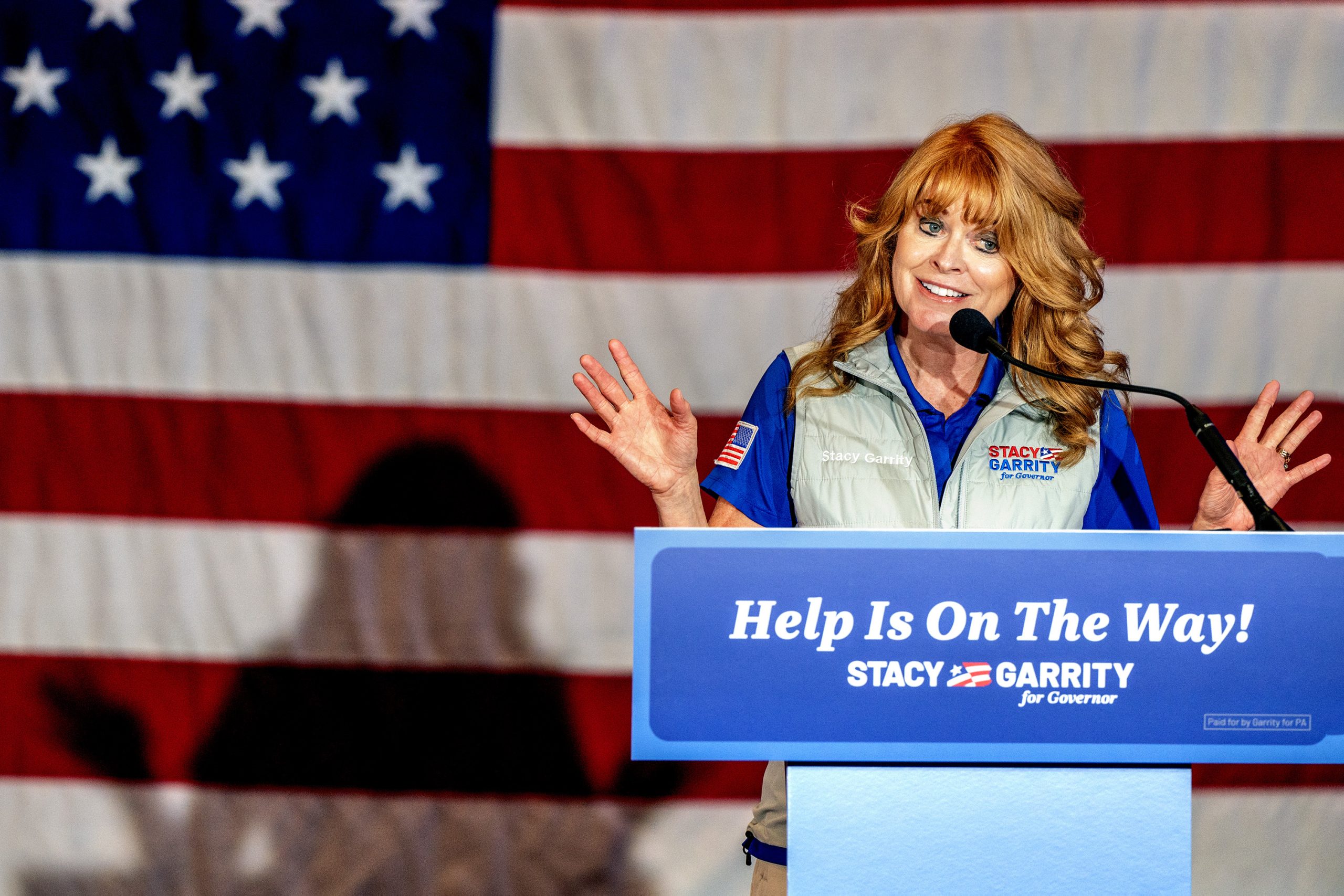
    Treasurer Stacy Garrity, the governor’s Republican challenger this fall, has echoed those recent comments from others in her party as she seeks to close a gap in the polls. She’s leaning into a message that appears strikingly similar to the one used by State Sen. Doug Mastriano, Shapiro’s 2022 Republican opponent who lost by double digits.

    In a video on social media, Garrity said Shapiro proposed “mandates that would make draconian COVID-era restrictions blush.” His “highly staged, partisan news conference” about measles, she added, “demonstrated just how dangerous his proposed mandates could be.”

    Shapiro’s Department of Health proposed the regulations earlier this year, before the state reported its first measles-associated deaths in three decades. The 502-page proposal, according to the state, would bolster officials’ ability to manage the outbreak of diseases, including isolation protocols and the reporting of identified cases. It’s been in the works for years and does not specifically refer to the 2026 measles outbreak, though it could play a role in managing such crises.

    “People want to raise some level of panic and anxiety here,” said Ericka Hayes, the senior medical director of infection prevention at the Children’s Hospital of Philadelphia, who has reviewed the proposal and is concerned about the “alarmist rhetoric” emerging around it. “But the spirit of this, and what is written in the document, as far as I’ve read, really is focused on appropriate measures for response to public health, infectious disease crises.”

    The governor’s office said the regulations were not yet final, and the governor will weigh in after public comment concludes later this month.

    “Disease outbreaks are serious, and Pennsylvania is confronting that reality right now,” Rosie Lapowsky, Shapiro’s spokesperson, said in a statement, which pointed to the reported 540 measles cases in the state.

    “The Governor’s philosophy that will guide the final regulations is that public health depends on trust, and building that trust means respecting individual rights, involving parents in decisions that affect their children, and ensuring government works closely with the people it serves,” she said.

    Shapiro also emphasized trust last week when he publicly clashed with U.S. Health and Human Services Secretary Robert F. Kennedy Jr., whom he blamed for spreading vaccine misinformation, saying Pennsylvania was seeing the negative consequences in the growing outbreak of a vaccine-preventable disease.

    Democrats like State Rep. Tarik Khan, a Philadelphia Democrat and nurse practitioner, have come to Shapiro’s defense. In a livestreamed conversation with other legislators who are also healthcare professionals, Khan said the governor “rightly spoke truth to power” by targeting Kennedy.

    Still, the way Shapiro took a leading role in announcing the measles-related deaths made what could have been two disconnected issues — the outbreak and the separate regulations proposal — “into a conflagration” that is giving “lots of people flashbacks to” COVID, particularly conservatives who believed there was government overreach, said Chris Nicholas, a Harrisburg-based GOP consultant.

    “We’re getting back into a situation where all the usual subjects are going to be relitigating the COVID pandemic restrictions or rules because this has given everyone an excuse to dredge it back up again,” Nicholas said. “I don’t know if the general public is ready for that. But the politicos are certainly ready for that.”

    COVID, measles, and mitigation

    The pandemic was unlike the measles outbreak in Pennsylvania in many ways.

    When the COVID-19 virus started widely spreading in early 2020, the effects and severity for different parts of the population were unknown. Public health officials scrambled to track and contain the virus. For a year, vaccines were not widely available.

    On the other hand, doctors have been writing about measles since at least the ninth century, according to the CDC. And healthcare providers have been required to report the disease to federal authorities since 1912.

    Vaccines, available since the 1960s, are required for children to start school, although Pennsylvania has some of the nation’s most lenient exemption rules. The measles, mumps, and rubella combination shot currently in use is one of the “most-studied vaccines” in part because of misinformation that has circulated about its safety over the last several decades. For example, studies have shown, over and over, that childhood vaccination is not linked to autism.

    Kennedy, a longtime anti-vaccine activist, has sought to upend federal vaccine policy at the helm of the country’s top health agency at a time when rising vaccine hesitancy increasingly divides Republicans and Democrats, and measles outbreaks are resurging.

    Across the country this year, 47 states have reported 2,887 confirmed cases of measles, according to the Centers for Disease Control and Prevention’s weekly update last Thursday.

    Pennsylvania’s Department of Health reported 540 cases as of Wednesday. The two “measles-associated deaths” — which state health officials consider as deaths where evidence of measles is present — that were identified by the state last week remained the only such deaths.

    Shapiro’s decision to withhold any identifying information about the cases his administration reported — such as the victims’ ages, or if they had other health conditions — quickly led to an information vacuum that allowed skeptics — including Kennedy — to question the deaths, independent public health experts said. Shapiro’s administration, however, maintains that state law bars the governor from sharing more information about the individual victims.

    Lancaster County Coroner Stephen Diamantoni, an elected Republican and a physician, drew wide attention for saying he did not believe measles contributed to a newborn’s death. Diamantoni said measles was noted as a significant condition “contributing to death but not resulting in the underlying cause” on the death certificate because the baby tested positive for measles.

    National Institutes of Health Director Jay Bhattacharaya, in a Fox News appearance on Saturday, said Shapiro was “politicizing the issue.”

    “What the governor is doing is he’s playing this out over the airwaves for political purposes just like what happened during COVID,” said Bhattacharaya, an appointee of President Donald Trump.

    The pandemic comparisons erupted as Pennsylvania Republicans began to connect the measles outbreak to the regulatory proposal, which is currently being reviewed by the state’s Independent Regulatory Review Commission. The proposal became public on Aug. 8 and is open for public comment until Sept. 21.

    The lengthy document details what the department described as “much needed amendments” to align the state with recommendations from experts like the CDC and the American Academy of Pediatrics.

    The proposed changes are numerous — including expanding the list of diseases that must be reported to the state and the protocols for pulling children out of school if they contract certain illnesses.

    Instead of the current 24-hour requirement for healthcare practitioners to disclose measles cases, the cases would need to be reported “immediately by telephone” to the state.

    State House Minority Leader Jesse Topper, a Bedford County Republican, compared the regulations to “oppressive COVID-era policies” and called on Shapiro to rescind them. In a statement, he said they would allow the state to interview students in school without notifying their legal guardian.

    Garrity said in her statement Saturday that the regulations would allow the administration to “conduct warrantless searches of private property, access patients’ confidential medical records and require schools to give those officials one-on-one, private access to students.”

    She did not elaborate on which specific regulations raised those concerns when responding to a request for comment from The Inquirer. The Department of Health pushed back on Garrity’s claims as inaccurate.

    Hayes, the CHOP expert, said the regulations are a step toward “further fleshing out” long-used practices like contact tracing, which involves identifying individuals exposed to an infectious case to keep them from infecting more people. Those methods are “really important” in the context of the ongoing measles outbreak, she said, given that measles is so contagious that nine in 10 unvaccinated people will be infected if exposed, and children are especially vulnerable.

    Critics who misrepresent the state’s proposal as a way to invade people’s privacy or take their property is deeply worrying, she said.

    “They’re trying to vilify a work process for controlling infectious outbreaks that has been in place for centuries, and it’s dangerous,” Hayes said.

    COVID flashback

    Under Shapiro’s predecessor, Pennsylvania took an aggressive approach to public safety surrounding the COVID-19 pandemic.

    Former Democratic Gov. Tom Wolf’s moves included a requirement that children wear masks in school — a rule later struck down by the Pennsylvania Supreme Court — and the temporary closure of “nonessential” businesses.

    As attorney general at the time, Shapiro defended the state’s actions in court as his legal duty. In a video that has reemerged and been widely shared since his measles news conference, Shapiro appears with his son to warn the public that “yes, you can” get in trouble for having a gathering at home or in public.

    By March of 2021, just 40% of Pennsylvanians approved of Wolf’s handling of the crisis, according to a Muhlenberg College poll. Shapiro’s eventual opponent, Mastriano, in some ways became the face of the public opposition.

    But as Shapiro campaigned for governor in 2022, he began to distance himself from Wolf’s actions, saying “too many Pennsylvanians could not get the help they needed during COVID,” and government needed to be more responsive — though Republicans continued to tie them together.

    By the summer of that year, Shapiro had fully broken with fellow Democrats on mask and vaccine mandates, saying he opposed them.

    “This is an area where I think folks got it wrong,” Shapiro said of school and business shutdowns, in an August 2022 interview with the Associated Press. “And to me, that’s the approach we need to take more broadly as a public, which is to educate, empower, and respect people’s personal decisions and respect their personal freedom to make those choices.”

    Campaign messaging

    Shapiro’s campaign did not respond to questions about Garrity and others tying his measles response and regulatory proposal to the pandemic — a new messaging strategy in a race where the Republican nominee has at times struggled to find her footing.

    “It feels like this is probably just what’s going to happen for the next 60 days,” said J.J. Abbott, a Democratic consultant and former spokesperson for Wolf.

    Abbott said he believed the criticisms are likely aimed at energizing a base of Republican voters who have not shown the same enthusiasm for Garrity and other GOP candidates as they did in 2024, when Trump won Pennsylvania and Republicans swept the other statewide races.

    Garrity’s statement alludes to some of that potential energy while also contending she showed restraint by waiting for “four days for additional information before issuing a statement about Josh Shapiro’s latest political stunt, despite calls from members of my own base to attack Josh Shapiro.”

    Whether or not voters will be swayed by attacks on Shapiro’s handling of the issue is an open question.

    Shapiro already beat a candidate who ran on nearly the same message on government overreach during a health crisis. That fact, combined with the vast differences between the novel coronavirus and measles, could mean those criticisms largely fall flat with voters, Abbott said.

    “Something that comes off as anti-vaccine for measles isn’t going to be very persuasive or appealing to the vast majority of voters, because most of them are vaccinated and almost all of them get their kids vaccinated,” Abbott said.

    Nicholas, the Republican consultant, said the latest developments had resonated with many conservatives who were still concerned about government overreach during COVID.

    He also pointed to the fact that both Shapiro, during his reelection as attorney general, and Garrity, in her first campaign for treasurer, won campaigns during the pandemic in 2020 and that he wasn’t surprised both sides were bringing up familiar themes six years later.

    “Politicians love things that are familiar,” Nicholas said.

    Staff writer Aubrey Whelan contributed to this article.

    This story was updated to reflect that the governor plans to weigh in on the Department of Health’s proposed regulations once public comment concludes on Sept. 21.

  • Fetterman gains GOP favor as Pa. Democrats regret electing him, new poll finds

    Fetterman gains GOP favor as Pa. Democrats regret electing him, new poll finds

    Two-thirds of Pennsylvania Democrats who are likely to vote this year believe U.S. Sen. John Fetterman supports President Donald Trump too frequently, while about half say the Democratic senator has been too supportive of Israel, according to an Inquirer/New York Times/Siena University poll published Tuesday.

    Democratic voters’ sharply divided views on Fetterman — with 69% having an unfavorable opinion of him in general — are the latest signs he could face an uphill battle if he seeks reelection as a Democrat in 2028.

    Fetterman has not said whether he will run for a second term.

    But as he weighs his options — which include leaving the Democratic Party because of what he considers its anti-Israel sentiment — the senator’s occasional support of Trump’s agenda has contributed to his declining favorability among voters who helped elect him in the first place, the new survey indicates.

    “I’m so disappointed in him, I can’t even see straight,” said Joseph Jaskula, a retired salesman from Lewisburg, Union County, who participated in the poll of 760 likely voters conducted by Siena University on behalf of The Inquirer and the New York Times from Aug. 17 to 21.

    (function() { var l = function() { new pym.Parent( ‘nyt-fetterman__graphic’, ‘https://media.inquirer.com/storage/inquirer/ai2html/nyt-fetterman/index.html’); }; if(typeof(pym) === ‘undefined’) { var h = document.getElementsByTagName(‘head’)[0], s = document.createElement(‘script’); s.type = ‘text/javascript’; s.src = ‘https://pym.nprapps.org/pym.v1.min.js’; s.onload = l; h.appendChild(s); } else { l(); } })();

    Jaskula, a Democrat who said he voted for Fetterman in 2022, said he is particularly upset about the senator’s votes for several of Trump’s nominees and for the war in Iran.

    Fetterman has been the only Senate Democrat to vote against restricting the president’s use of military force in Iran.

    “He voted with the Republicans on that,” Jaskula, 72, said of the war powers resolutions that aimed to rein in Trump. “And he’s had some other ones where we wonder if he’s a Republican or a Democrat.”

    Fetterman’s standing among Pennsylvania voters overall remains split, according to the poll.

    He is viewed favorably by 49% and unfavorably by 43% of all likely voters in the state. That was nearly the same result as the last time the Inquirer/New York Times/Siena poll asked about Fetterman’s favorability, in May 2024.

    But the difference between now and then — when Fetterman was campaigning against Trump’s election and only two years removed from his own sweeping victory in the Pennsylvania Democratic primary — is who is supporting him.

    Pennsylvania’s U.S. Senators John Fetterman (left) and Dave McCormick appear together at June event in Philly to promote the savings accounts for kids that were part of President Donald Trump’s One Big Beautiful Bill Act.Tom Gralish / Staff Photographer

    Fetterman outperforms McCormick with GOP voters

    In almost the exact opposite breakdown compared with about two years ago, just one in five likely Democratic voters reported having a favorable view of Fetterman, while four out of five likely Republican voters said they have a favorable view.

    Even Fetterman’s Republican counterpart in Pennsylvania — U.S. Sen. Dave McCormick, who was elected in 2024 — is viewed favorably by a smaller share of GOP voters, about 66% compared with Fetterman’s 79%.

    (function(){function e(){window.addEventListener(`message`,function(e){if(e.data[`datawrapper-height`]!==void 0){var t=document.querySelectorAll(`iframe`);for(var n in e.data[`datawrapper-height`])for(var r=0,i;i=t[r];r++)if(i.contentWindow===e.source){var a=e.data[`datawrapper-height`][n]+`px`;i.style.height=a}}})}e()})();

    Don Levy, director of the Siena Research Institute, called the Democratic senator’s numbers “shocking.”

    “If you didn’t know any difference, you would immediately assume that Fetterman and McCormick are both Republicans, and that Fetterman is an extremely popular Republican senator amongst Republicans,” Levy said. “I can’t think of another case exactly like this.”

    Fetterman, citing his voting record in the Senate, which still mostly aligns with Democrats, has said repeatedly that he will not switch his registration to Republican.

    GOP leaders, who are fighting to retain control of the Senate this fall, have said they would welcome the Pennsylvania Democrat into their fold.

    And Fetterman has raised the prospect of leaving the party, possibly becoming an independent, if Democrats oppose Israel as an “official” part of their platform. He has staunchly supported the country in the wake of the Oct. 7, 2023, attack by Hamas, and as Democrats have become increasingly critical of Israel’s counterattack.

    (function(){function e(){window.addEventListener(`message`,function(e){if(e.data[`datawrapper-height`]!==void 0){var t=document.querySelectorAll(`iframe`);for(var n in e.data[`datawrapper-height`])for(var r=0,i;i=t[r];r++)if(i.contentWindow===e.source){var a=e.data[`datawrapper-height`][n]+`px`;i.style.height=a}}})}e()})();

    Fetterman has opposed fellow Democrats’ efforts to end the United States’ assistance to Israel’s offensive measures. He has also become the most vocal Democratic supporter of both countries’ attacks against Iran, an issue that also remains deeply unpopular among Pennsylvania voters.

    At the same time, Fetterman has backed other Trump initiatives, like immigration enforcement and the investment accounts for children known as Trump Accounts.

    “He’s a voice in the party, standing up for what’s right,” said Nicholas Morabito, a 32-year-old warehouse worker in Butler who participated in the poll.

    A registered Republican, Morabito said he would consider voting for Fetterman in 2028, regardless of which party label accompanies his name on the ballot.

    “I don’t think there’s very much difference between the two of us. Just the difference in party,” Morabito said.

    Fetterman has acknowledged the shift in support. He wrote in his 2025 memoir that he was “completely at peace” with the idea that his support of Israel might cost him his Senate seat. And in interviews, he has repeatedly said that, as a swing-state senator, he should work with and not demonize the other party.

    A plurality of likely voters — 47% — say Fetterman is “about right” when it comes to supporting or opposing Trump, according to the poll. About 38% said he supports Trump too much, 6% said he opposes Trump too much, and 9% did not answer.

    (function(){function e(){window.addEventListener(`message`,function(e){if(e.data[`datawrapper-height`]!==void 0){var t=document.querySelectorAll(`iframe`);for(var n in e.data[`datawrapper-height`])for(var r=0,i;i=t[r];r++)if(i.contentWindow===e.source){var a=e.data[`datawrapper-height`][n]+`px`;i.style.height=a}}})}e()})();

    But Democratic voters have indicated a strong desire for their elected officials to push back against Trump, and Fetterman’s declining support among them appears to be due in part to that shift during Trump’s second term. About 67% of likely Democratic voters said Fetterman supports the president too much, while 20% said he gets it “about right.”

    “Fetterman has been such an interesting, unique personality now since he broke onto the scene,” Levy said. “Given the state of play right now, Democrats are just angry that he was elected. Democrats are supposed to act like Democrats, and this shows that their perception of him is that he is not.”

  • Will Donald Trump and national Republicans help Stacy Garrity’s campaign from falling flat against Josh Shapiro?

    Will Donald Trump and national Republicans help Stacy Garrity’s campaign from falling flat against Josh Shapiro?

    Seated behind his desk in the Oval Office earlier this month, President Donald Trump spoke directly to the camera in front of him. He turned to his right and looked up at the Pennsylvania Republican who, as he had indicated just a few weeks earlier, might very well lose her race for governor this fall.

    “I think you can win,” he said this time, extending his hand to Stacy Garrity. It was a change in tune for Trump, who last month at an event in Pennsylvania said Garrity’s opponent, Democratic Gov. Josh Shapiro, was “expected to” and might win.

    The president’s confidence in Garrity — and whether his support will extend beyond a handshake and a 17-second video with her at the White House — has become a critical question in the final stretch of the Pennsylvania governor’s race.

    Down in the polls and lagging behind Shapiro’s unprecedented fundraising, Garrity has cultivated the president’s support and the potential boost, both financially and in Republican enthusiasm, that could come with it.

    It is a risky strategy for a swing-state candidate whose party holds the White House, and particularly as polls show Trump becoming increasingly unpopular. Shapiro and his allies have enthusiastically promoted instances when Garrity, the twice-elected state treasurer, has leaned into Trump’s agenda and brand of politics.

    But with less than three months before Election Day, it is not clear to what extent Trump or other key national Republicans will pitch in on her campaign.

    State Treasurer and Republican candidate for governor Stacy Garrity holds a rally in Bucks County at the Newtown Sports & Events Center in this 2025 photo. Tom Gralish / Staff Photographer

    Trump has not yet stumped in any significant way for Garrity in Pennsylvania, a swing state where he was a near-constant presence during his winning 2024 campaign. And he has not lent his vast political resources — including a Trump-aligned super PAC flush with $400 million — to Garrity or other Republican candidates as his party faces tough campaigns across the country in the midterm elections that will determine control of Congress.

    Several gubernatorial races around the country are considered competitive, a reality that also pits Garrity against GOP nominees who polling suggests have better shots of success. The same circumstances have doomed the most recent other Trump-endorsed Pennsylvania Republican nominees for governor — former State Sen. Scott Wagner in 2018 and State Sen. Doug Mastriano in 2022 — who never ended up with national support and lost by double digits.

    Campaigns typically heat up after Labor Day, and there is still time for Garrity’s national allies to converge to boost her. But observers say the political reality is also evident.

    “The president kind of looks toward two things,” said Samuel Chen, an Allentown-based Republican strategist who is not affiliated with Garrity and who previously worked for Tom Corbett, Pennsylvania’s most recent GOP governor.

    “One is loyalty to him. Garrity has been loyal, but has not necessarily been as vocal as some others have. The other side of it is he likes winners. He wants to endorse people who win,” Chen said. “Everyone in Trump’s orbit knows that Garrity has a very uphill climb.”

    Not supporting ‘lost causes’?

    The level of involvement from groups like the Republican Governors Association has been a key indicator of whether the party believes its nominee has a chance at winning recent gubernatorial elections in Pennsylvania.

    The RGA is made up of GOP governors who collectively support one another’s agendas and campaigns. Democratic governors have a similar alliance.

    In 2010 — the last time a Republican won the governor’s mansion in Harrisburg — the group was the largest donor to then-Attorney General Corbett’s gubernatorial campaign, giving him $6 million starting in August of that year. Four years later and helmed by then-New Jersey Gov. Chris Christie, the RGA was once again Corbett’s biggest donor. It donated more than $5.8 million as Corbett became the first sitting Pennsylvania governor in decades to lose a reelection bid. Christie, preparing to run for president in 2016, stumped with Corbett multiple times.

    The picture was starkly different in 2018 and 2022, when Republican voters nominated two candidates closely associated with Trump. Neither Wagner’s campaign against Democratic Gov. Tom Wolf nor Mastriano’s campaign against Shapiro ever became highly competitive — and the RGA and other national groups decided to sit out.

    “We’re watching Pennsylvania very closely,” Arizona Gov. Doug Ducey, then the chair of the RGA, said in September 2022. He added that the group would not support “lost causes” or “landslides.”

    The RGA would spend nothing in the state that year, even with Mastriano and former Trump lawyer Jenna Ellis pleading for assistance. Shapiro went on to trounce Mastriano by nearly 15 percentage points.

    This year, RGA chair and Montana Gov. Greg Gianforte has not publicly weighed in on Garrity’s chances since issuing a brief, generic statement congratulating her after her unchallenged primary in May.

    And the competitive landscape Republicans are facing across the country may mean Pennsylvania’s GOP nominee once again gets the short end of the stick. The RGA did not respond to requests for comment.

    Even with Pennsylvania’s status as a preeminent swing state that went for Trump two years ago, there are nearly a dozen more competitive gubernatorial races across the country this fall, according to the Cook Political Report, a nonpartisan group that provides election analysis.

    Georgia, Iowa, Nevada, Ohio, and Wisconsin — some of which voted overwhelmingly for Trump just two years ago — are all considered toss-ups. Four other states with Democratic governors — Oregon, Arizona, Michigan, and Kansas — are also considered more competitive than Pennsylvania, which is ranked as “solid Democratic,” according to Cook, despite Republicans like Garrity and Trump having won statewide two years ago.

    The RGA, according to its most recent filing with the Federal Election Commission, had less than $1.7 million in its RGA Right Direction super PAC after spending about $16 million so far in the current election cycle.

    Its recent spending has focused on Iowa, where Democrats are attempting to capture the governor’s office for the first time in two decades, and Kansas, where the RGA launched an ad this month.

    “There’s always competition for limited resources,” Charlie Gerow, a longtime Harrisburg-based Republican strategist who also ran for governor in 2022, said of the intraparty competition for donors. “There’s only so much campaign funding to go around as everybody’s trying to get a piece of it.”

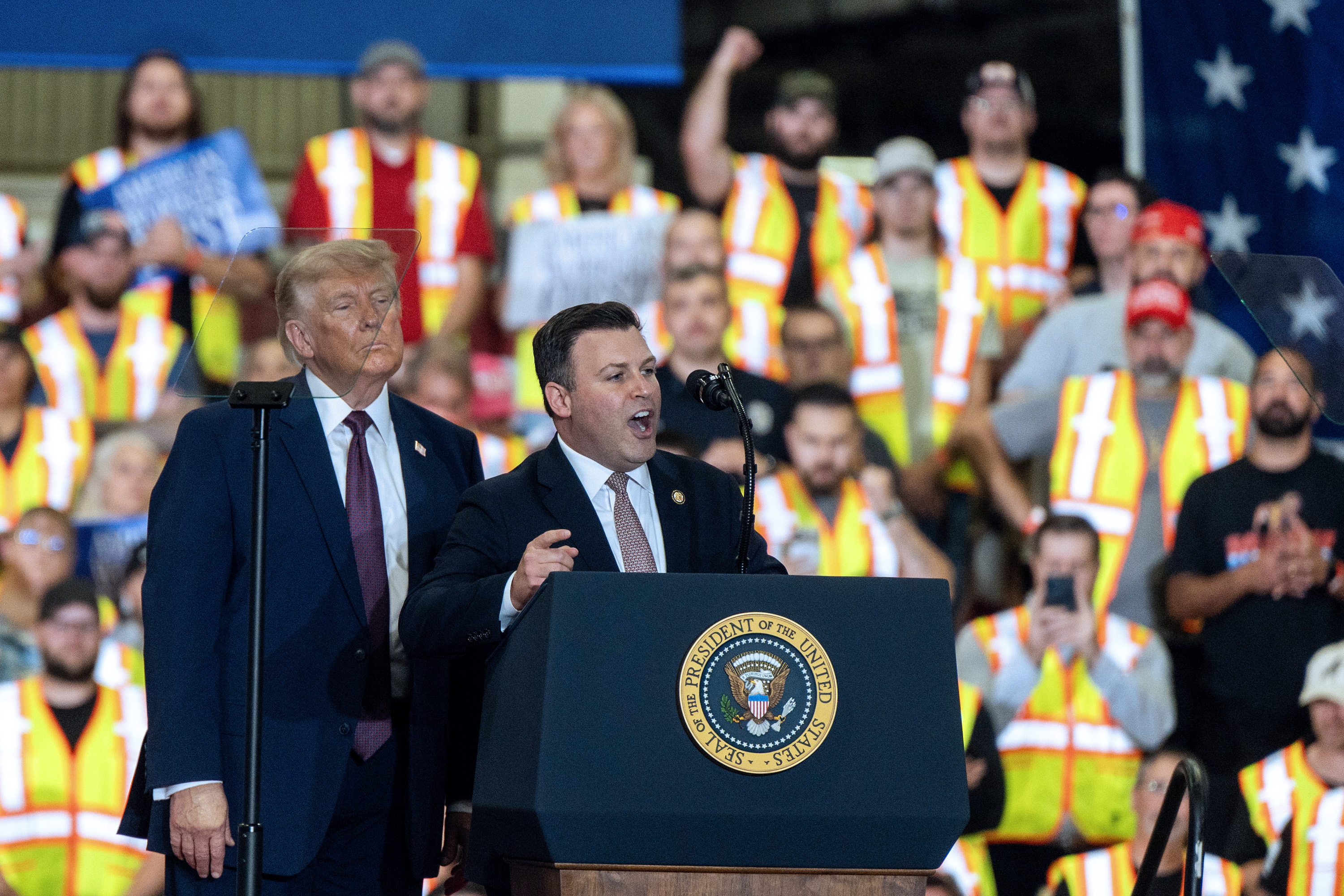
    Trump hosted a fundraiser for Garrity in March at his Mar-a-Lago estate in Florida. He has also visited Pennsylvania twice this summer, though not for events specifically with Garrity — and in one in case he did not mention her among a list of candidates he was supporting.

    In July, Shapiro’s campaign announced he had raised $50 million since January 2025. The next financial filing deadline for statewide candidates is in September, but as of the last reporting cycle, he had outraised Garrity 10-1.

    President Donald Trump brings U.S. Rep. Ryan Mackenzie (right) to the stage as he holds an event in Mackenzie’s Lehigh Valley district at Mack Trucks in Macungie Tuesday, June 23, 2026.Tom Gralish / Staff Photographer

    But Matthew Beynon, a spokesperson for Garrity’s campaign, said she “does not expect, nor does she need, to go dollar-for-dollar with Josh Shapiro.” Instead, he said, she “just needs the resources to prosecute her case against Josh Shapiro … and she is on pace to be able to do so.”

    Garrity looks forward to “continued support” from the RGA, he said.

    Other national attention on Pennsylvania

    After Mastriano’s disastrous performance in 2022, Republicans coalesced around Garrity — whose 3.5 million votes in 2024 were the most ever for a statewide candidate in Pennsylvania — as their best shot at defeating Shapiro.

    But in the year since she received the party’s endorsement, Garrity has barely moved the needle. A Quinnipiac University poll in July found Shapiro leading Garrity 53% to 40% among registered Pennsylvania voters. Trump saw even lower scores: Just 39% of those polled approved of the president’s job performance.

    A poll from a Republican-leaning firm promoted by Garrity showed her down, 50% to 43%.

    Across Pennsylvania, she has also competed for attention and resources as her party prioritizes other major election battles this fall.

    Four Republican-held congressional districts — based in Bucks County, the Lehigh Valley, Scranton, and Harrisburg — are seeing a rush of national attention and money as their outcomes could decide control of the narrowly divided U.S. House.

    Shapiro has also invested heavily in trying to flip the state Senate to Democratic control for the first time in three decades, putting Republicans further on their heels. The $3.3 million that Shapiro committed to the effort is more than Garrity has raised in her entire campaign.

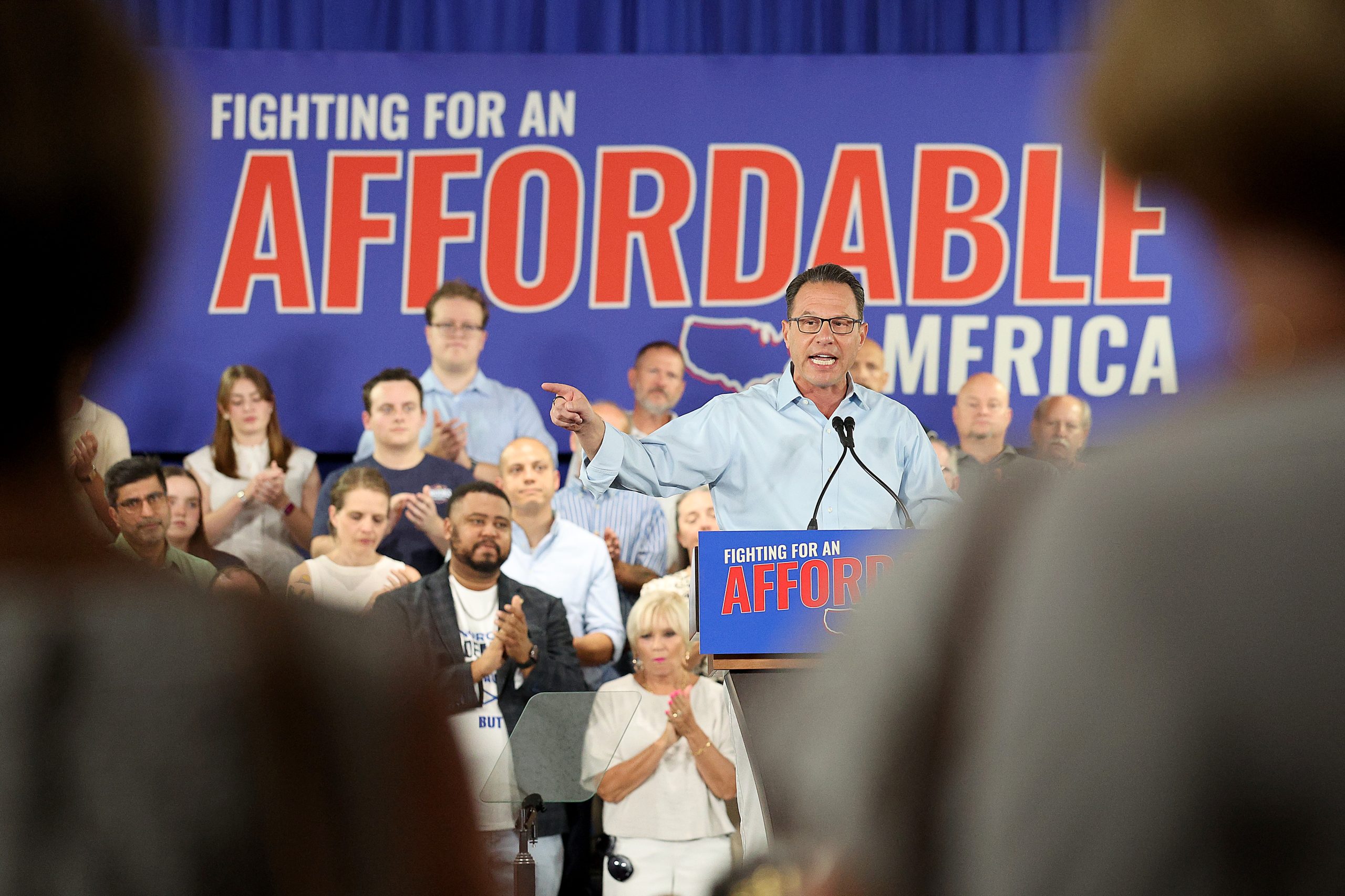
    Pennsylvania Gov. Josh Shapiro addresses the audience during a rally for Democratic congressional candidate Bob Brooks at the United Steelworkers Union Hall in Bethlehem, Pa. on Sunday, July 26, 2026.David Maialetti / Staff Photographer

    On the other side of the aisle, Pennsylvania’s top elected Republican — U.S. Sen. Dave McCormick — has endorsed Garrity but has not appeared to join in her public campaign efforts so far. A Trump ally and former hedge fund leader, McCormick has raised millions since his election in 2024, and political action committees associated with him have donated to other PACs working to elect Pennsylvania Republicans in Congress.

    McCormick has hosted events and campaigned for Garrity, and he “will keep doing everything he can to help her win,” said Mike DeVanney, a spokesperson for the senator.

    “He believes she demonstrates the kind of leadership we need and the kind that President Trump and many others have recognized as one that can move our commonwealth forward,” DeVanney said.

    Gerow said McCormick undoubtedly could help Garrity down the stretch.

    “He’s a prolific fundraiser. He has the connections, and he has the personality to raise large amounts of money. And he can be very, very helpful with the Garrity campaign if he weighs in with full weight,” Gerow said.

    Garrity’s campaign said McCormick has been an “incredible supporter,” including with his early endorsement and connections to supporters.

    Shapiro has also cultivated across-the-aisle relationships with some Pennsylvania Republicans who would be expected to promote Garrity.

    In an April interview with Punchbowl News, U.S. Rep. Brian Fitzpatrick, a Bucks County Republican running for reelection in the nationally watched 1st Congressional District, said he thought Shapiro would win his reelection contest and should run for president, adding: “I think Josh is very, very smart.”

    And during his 2022 run, Shapiro collected endorsements from other prominent Republicans, including Jim Schultz, a former Trump White House lawyer, and former Republican U.S. Rep. Charlie Dent.

    The final stretch

    Though the November election is less than three months away, that is still plenty of time in politics. Most ad spending does not start until September, and ground game efforts — door knocking, phone banking, and get-out-the-vote campaigns — get underway in the fall.

    Winning Pennsylvania is a priority for Trump in the midterms, and Garrity’s campaign said she is “grateful” for his continued support.

    On the state level, James Markley, a spokesperson for the Pennsylvania GOP, said the party is “fully invested” in helping Garrity beat Shapiro. Those efforts include training “thousands” of volunteers and working on education programs around early voting and casting mail-in ballots.

    “The more Pennsylvania voters learn about Stacy Garrity, the more they love her,” he said in a statement. “The more Pennsylvania voters learn about Josh Shapiro, they realize he has no record to stand on.”

    Gerow said Garrity’s challenge, with limited funds compared with Shapiro, is whether she has enough money to get her message out.

    “The major concern for her immediately is to be able to tell her story,” Gerow said. “She doesn’t have the resources to tell that story effectively right now, and she has a great story.”

    Buttons for State Treasurer Stacy Garrity and President Trump are left on a table following a VIP reception before a Garrity rally in Bucks County Thursday, Sept. 25, 2025. Tom Gralish / Staff Photographer

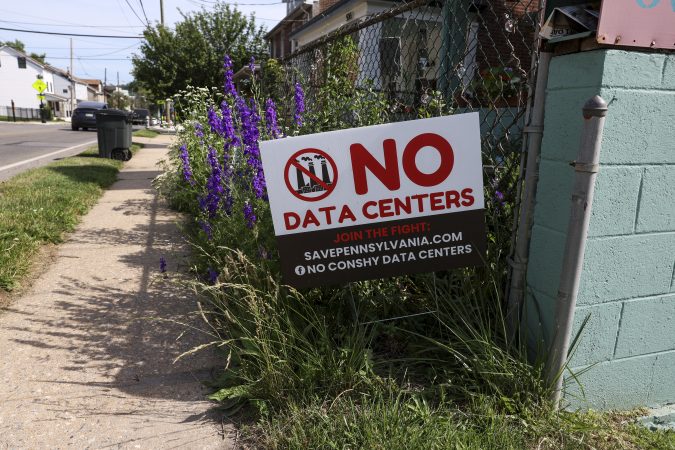
    Throughout her campaign, Garrity has hammered Shapiro on several issues she said reveal his lack of transparency as a public official. She has held roundtable discussions blasting Shapiro for his early embrace of data centers, a position he has since distanced himself from after calling for new guidelines for their development. Her campaign released a video series online that questions his handling of criminal investigations. And she has repeatedly insisted that Shapiro, who is widely rumored to be running for president in 2028, is “more interested in Pennsylvania Avenue than helping Pennsylvania families.”

    Samantha Reposa, a spokesperson for Shapiro’s campaign, disputed Garrity’s framing and emphasized that she has stood in lockstep with Trump on most of his positions.

    “Garrity is now running to be nothing more than a rubber stamp for Trump and his agenda that’s hurting Pennsylvania families — and we will continue to hold her accountable,” Reposa said.

    A new ad from Shapiro’s campaign paints her as “100% MAGA,” highlighting her support for Trump’s tariffs.

    Given Garrity’s fundraising deficit, Chen said, he would advise her to focus on meeting individual people in the community, if he were running her campaign.

    “Forget the GOP dinners. Start going to fairs. Start going to places that Republicans don’t show up. Start retail politics, and start introducing yourself to the state outside of Donald Trump, outside of modern Republicanism,” he said. “Tell the state what you’ve done for them and what you would do differently [as governor].”

    Staff writer Joe Yerardi contributed to this article.

  • A new federal ‘Data Center Bill of Rights’ took lessons from Philly suburbs and Western Pa. fracking country

    A new federal ‘Data Center Bill of Rights’ took lessons from Philly suburbs and Western Pa. fracking country

    WASHINGTON — A new federal proposal to enact protections for communities opposed to the proliferation of data centers has drawn inspiration from both the Philadelphia suburbs and Western Pennsylvania fracking country.

    The Data Center Bill of Rights is one of several national efforts to address a growing dissatisfaction with data centers, which have so far faced few restrictions at either the federal or state level in Pennsylvania.

    U.S. Rep. Ro Khanna, a California Democrat and Bucks County native considering running for president in 2028, said his home state should be doing more.

    He introduced the federal legislation after a recent tour across Pennsylvania that he said was designed to hear from communities that have lost manufacturing jobs and other economic opportunities.

    Data center concerns came up more than any other issue, he said — leading him to incorporate new ideas into the bill he already had in the works, and to call for a pause on data center development in Pennsylvania until further protections and local controls are enacted.

    A statewide pause would be more than what Gov. Josh Shapiro — another potential 2028 Democratic contender — has proposed as he seeks to enact data center guidelines. It would also be less than other Democrats, both in Pennsylvania and nationally, who have called for more robust moratoriums. Shapiro’s Republican challenger this year, Treasurer Stacy Garrity, has also called for a pause but not for an extended moratorium.

    “I was surprised by the anger about it in Pennsylvania,” Khanna said in an interview after his 15-county tour. “In other states, people are sometimes opposed in local communities, local pockets. But not this widespread anger.”

    Khanna, a Council Rock High School graduate who has represented Silicon Valley in Congress since 2017, spoke about the Data Center Bill of Rights during his tour but said afterward that it was “partly inspired” by the concerns he heard in the communities similar to the ones where he grew up.

    He said he was alarmed by the complaints he heard outside Philadelphia, where five data centers have been proposed in close proximity to each other in King of Prussia and another 2-million-square-foot data center is proposed in Conshohocken.

    “As a kid, I used to go to Conshohocken and the King of Prussia Mall. I’m familiar with that area,” Khanna said. “You can’t ride roughshod over what Delaware County wants or when Montgomery County wants.”

    The legislation would declare that communities have the right to reject data centers through a “transparent community process” or allow them with specific protections. That includes demanding that data centers don’t lead to higher electricity rates, that they use renewable energy sources and disclose their water consumption, and “pay their fair share of state and local taxes.”

    State Rep. Chris Rabb (right) joins U.S. Rep. Ro Khanna (left) Tuesday, July 28, 2026, as he stops on his “Made in PA: New Economic Patriotism Tour” at the City Institute Library on Rittenhouse Square.Tom Gralish / Staff Photographer

    One specific provision, Khanna said, was informed by his visit in Washington County with individuals who are paid to host natural gas wells on their properties. It was there that he said he learned of community demands for oil and gas well sites to be at least 2,500 feet from residences. That buffer was a recommendation from a 2020 grand jury report released by Shapiro when he was serving as attorney general and that outlined health and safety issues caused by fracking in the Marcellus Shale region.

    The recommendation was not followed, and advocates are continuing to push for extending the buffer from the current distance of 500 feet, according to Inside Climate News.

    Khanna’s bill of rights would call for data centers to be built no closer than 2,500 feet from residences, schools, childcare facilities, hospitals or nursing homes. He said the environmental and health hazards for data centers aren’t the same as fracking but they should be kept at a distance from communities that don’t want to live directly next to them.

    “At least they were offering royalty checks in the cases of fracking,” Khanna said. “[Data center developers are] not even giving the communities checks. It’s just kind of like, ‘OK, we’re going to build.’ What does the community get out of it? I literally don’t understand it.”

    Data center advocates have argued their development is critical in winning an artificial intelligence war with China, and that they will bring construction and some skilled jobs to communities that need them.

    Even the staunchest advocates, though, have acknowledged the public blowback.

    “I do think that data centers in Pennsylvania have raised legitimate concerns,” U.S. Sen. Dave McCormick (R., Pa.) said during a recent telephone town hall as he continued to promote them in the competition with China and their creation of “thousands of jobs.”

    When developers are making their pitch, McCormick said they should come with commitments to protect energy costs and overuse of water, use local labor, invest in the community and pay taxes.

    “That should be part of the deal up front,” McCormick said during the telephone town hall in late July. “With all those facts, then the local community can decide whether they want the data center or not. And if they choose not to, that’s their choice.”

    Khanna said he’s hoping for bipartisan support as he introduces the bill of rights idea. He’ll also be competing with other proposals — like one from fellow progressives U.S. Rep. Alexandria Ocasio-Cortez (D., N.Y.) and U.S. Sen. Bernie Sanders (I., Vt.) called the AI Data Center Moratorium Act. The bill would enact an immediate federal moratorium on data center construction until other safeguards are passed into law, including some of the ideas Khanna and McCormick have proposed, like around utility costs.

    Several Pennsylvania state-level laws have been proposed, though the legislature did not address them during its busy budget season earlier this spring and summer. Lawmakers also left Harrisburg without ending tax breaks aimed at incentivizing data center construction even though the idea had garnered widespread support.

    “They shouldn’t be getting these tax breaks to build,” Khanna said. “That’s absurd when you’ve got hyperscalers that are making trillions of dollars.”

    The fact that many of those ultra-wealthy corporations are based in his district made the issue a politically dicey situation for him, but also one that the possible presidential hopeful said he was willing to take on.

    “We’ve got to pause it in states like Pennsylvania,” Khanna said. “Some of my own constituents aren’t going to like that.”

  • Chris Rabb warns of ‘great peril’ for Democrats if party ignores Michigan’s Abdul El-Sayed and other progressive wins

    Chris Rabb warns of ‘great peril’ for Democrats if party ignores Michigan’s Abdul El-Sayed and other progressive wins

    WASHINGTON — Chris Rabb is on a winning streak.

    Since his victory in Philadelphia’s highly contested Democratic congressional primary in May, the state lawmaker and presumptive successor to retiring U.S. Rep. Dwight Evans has campaigned across the country — going nine for 10 in races where he’s supported progressives against more establishment-backed, moderate Democrats.

    That wave of momentum — for a left-leaning faction hoping to transform the next generation of the Democratic Party — culminated this week in Michigan, where Dr. Abdul El-Sayed won a consequential U.S. Senate primary in the key swing state.

    Though not a self-described democratic socialist like Rabb, El-Sayed ran on a similar anti-corporation, anti-Israel platform that focused on enacting policies like Medicare for All and dismantling U.S. Immigration and Customs Enforcement.

    Rabb, who was on the ground in Detroit for the final push of the campaign and at El-Sayed’s victory party on Tuesday, said the Michigander prevailed “against extraordinary odds.”

    U.S. Rep. Haley Stevens, with establishment support and about $62 million in outside spending on her behalf, had a roughly 9-to-1 spending advantage over El-Sayed, according to The New York Times. Her loss amid that kind of massive spending “is a testament to the power of economic populism and the growing frustration with incrementalism,” Rabb said.

    “His primary win proves that economic populism and bold progressivism has growing support across the ideological spectrum among Democrats whether they’re voting in Michigan or Pennsylvania,” Rabb said.

    The five-term state representative from East Mount Airy has thrown his energy into other campaigns as his own is pretty much complete. In one of the bluest in the country, he defeated a pair of more moderate Democrats — State Sen. Sharif Street and physician Ala Stanford — and will not face a Republican opponent in the November election. The district covers about half of the city, from South Philadelphia through the Northwest.

    Rabb began looking beyond his district borders almost immediately after the primary.

    In New Jersey’s Trenton-based congressional district, he campaigned for Dr. Adam Hamawy, a former combat surgeon who has also provided medical care to Gazans during the war with Israel. In New York, he threw his weight behind Darializa Avila Chevalier and Claire Valdez, two of the democratic socialists also backed by New York Mayor Zohran Mamdani.

    He turned to other candidates in California, Colorado and Michigan as he door-knocked, called voters and appeared in virtual events.

    “Ever since May 19, which was the night I won, I’ve been paying it forward with so many amazing candidates,” Rabb said during a recent virtual fundraiser for El-Sayed in which Rabb said he was signing and giving away the pink “Philadelphia” baseball hat he was wearing to a lucky donor.

    Rabb hasn’t weighed in on every battle between progressives and moderates. He did not endorse Cori Bush, the former member of Congress and democratic socialist who failed in her attempt at a comeback in Missouri this week. He also has not endorsed every congressional candidate promoted by two key national coalitions that supported him — Justice Democrats, which has been a force behind the election of U.S. Rep. Alexandria Ocasio-Cortez and others, and the Democratic Socialists of America.

    The one candidate he endorsed who did not win was Saikat Chakrabarti, a former campaign manager and chief of staff to Ocasio-Cortez who tried to beat former House Speaker Nancy Pelosi’s hand-picked successor in San Francisco.

    And not all of Rabb’s endorsees are guaranteed to join him in Congress next year. Justin Pearson, a Tennessee state lawmaker who won a U.S. House primary on Thursday, will be the nominee in a state where Republicans redistricted this year in an attempt to root out Democratic incumbents. Pearson’s district is considered “solid Republican” by the Cook Political Report, a nonpartisan group that rates competitive districts.

    While some Democrats have questioned whether progressives can win competitive general election races, Rabb said he was “confident that strategically supporting anti-establishment populist candidates who bring with them new, more active and enthusiastic voters will significantly increase turnout in November.”

    “Ignoring the unique strengths of such candidates and campaigns will be at the Democratic Party’s great peril,” he added.

    That sentiment echoed other comments he’s made in recent months as more centrist leaders in his party questioned the progressive momentum. In June, he responded to an interview in which Gov. Josh Shapiro called the democratic socialists who won in New York an example of “performative politics.” Those candidates would now need to govern effectively, he said, adding that they were not indicative of the types of Democrats winning in Pennsylvania.

    “You’re seeing very different-looking congressional races, and certainly very different Democratic candidates here in Pennsylvania,” Shapiro told CNN, prompting Rabb to respond on social media with, “Ummm…”

    Shapiro, a popular figure as he seeks reelection this fall, has been lending his support to Democrats in four competitive congressional seats in Pennsylvania that are held by Republicans, including a swing district in suburban Bucks County. Flipping those seats in a way that could help Democrats capture the U.S. House majority has been a top priority and has further fueled speculation that Shapiro is eyeing a run for the White House in 2028.

    At the same time, Shapiro has not appeared with or supported Rabb during his campaign, though his team has said the governor looks forward to working with whoever replaces Evans.

    As Rabb has crisscrossed the country, he’s also drawn more ire from the state’s other most nationally prominent Democrat — U.S. Sen. John Fetterman, who Rabb dismissively refers to as “the F word.”

    Fetterman has included Rabb in his broad denouncements of progressives who are winning Democratic primaries. Progressives like Rabb, meanwhile, have indicated they hope to replace Fetterman with a progressive candidate in 2028.

    “Rabb, he won, and he ran on being a very, very anti-Israel guy,” Fetterman said in early June at an American Jewish Committee conference in Washington. “It’s actually a virtue (in the modern Democratic Party)… It’s heartbreaking for me.”

    After El-Sayed’s win this week against a candidate who received more money from the American Israel Public Affairs Committee than possibly any other candidate on record, Rabb and the coalition behind him have shown no signs of slowing down.

    “Ground Zero was Chris Rabb in Pennsylvania, winning a key congressional primary,” Adam Green, co-founder of the Progressive Change Campaign Committee said on the livestreamed fundraiser with Rabb this week.

    The “ripple effects of winning a battleground Senate contest,” like in Michigan, Green said, will be significant.

    “The message will be undebatable that we won, that we’re on the rise, and that we can win anywhere,” he said.

  • Jon Stewart presses John Fetterman on Israel and playing into ‘Republican caricatures’ when he attacks Democrats

    Jon Stewart presses John Fetterman on Israel and playing into ‘Republican caricatures’ when he attacks Democrats

    U.S. Sen. John Fetterman, in perhaps the most in-depth and toughest interview he has faced in recent memory, defended his unwavering support for Israel and his harsh criticisms of fellow Democrats when pressed by Jon Stewart in a podcast episode released Wednesday.

    The liberal comedian and political commentator repeatedly accused Fetterman (D., Pa.) of “caricaturing” the left wing of his party and the debate around Israel’s handling of the war in Gaza.

    “Jewish community and Israel are not the same thing, brother man. They’re not — that is not the same thing,” Stewart, who is Jewish, said at one point as Fetterman described his full-throated support for the war as being because of “the Jewish community.”

    Asked repeatedly about the United States’ moral obligations about backing the Israeli strikes that have led to the deaths of tens of thousands of Palestinian civilians, Fetterman stood firm.

    He said — as he often has since the Oct. 7, 2023, attack by Hamas that sparked the conflict — that it was necessary to go after Hamas leaders. The killing of civilians was “terrible” and “collateral” damage but not a genocide, Fetterman said.

    Stewart continued to press — questioning why Fetterman was standing so firmly behind a foreign ally that was “dehumanizing” and slowly killing another population.

    “I don’t understand how you have no criticisms over their actions, over their increasingly messianic, ultra-right-wing government that seems to think relentless war is, like, that you can bomb people out of resistance,” Stewart said.

    The roughly 75-minute interview, on The Weekly Show with Jon Stewart, came a week after Fetterman once again met with Israeli Prime Minister Benjamin Netanyahu in Washington.

    Many other elected Democrats have distanced themselves from the Israeli government and criticized its tactics. Fetterman has acknowledged his position has hurt him politically. In the interview with Stewart, he echoed previous comments — which have also become evident in public polls — that he has lost the support of his former Democratic base as his and his party’s stances diverged.

    “I’m aware that if I happen to disagree with the party line, there’s a price to pay,” Fetterman said. “There’s a lot of stories of how I’ve become increasingly more unpopular with Democrats in my state. And I’m aware of it. But these were all very specific choices. … I would rather have people know what I happen to believe.”

    Stewart asked Fetterman several times about how he has voiced those disagreements.

    He said the senator has focused far more on arguing with his own party in a way that has further hurt its brand. And he has broken from the party’s ranks as Democrats try to use even an inkling of leverage that could impact Republicans’ agenda as the GOP controls both Congress and the White House, Stewart said. He pointed to issues like immigration enforcement reforms, which Democrats tried to enact by holding out support for a spending bill earlier this year. Fetterman said he supported the reforms but would not go along with letting part of the government shut down as a strategic move.

    Mark Twain Prize recipient Jon Stewart is introduced at the start of the 23rd annual Mark Twain Prize for American Humor at the Kennedy Center for the Performing Arts, in Washington, April 24, 2022. (AP Photo/Kevin Wolf, File)Kevin Wolf

    Stewart also pressed Fetterman on how his approach to President Donald Trump has softened as he has ramped up his criticism of his own party.

    “You called President Donald Trump a jagoff in 2016,” Stewart said, prompting Fetterman to say that he put the phrase on shirts and sold them.

    “You put it on a shirt. And now you’ve been very complimentary to him. And if your concern with Graham Platner is you didn’t think he was very nice to women, you’re ignoring an awful lot of evidence for the current president about his relationship with women,” Stewart said, referencing Fetterman’s attacks on the Maine Democrat who dropped out after facing allegations of sexual assault. “So my point is, there seems like there’s a way to go about this that embraces, as you said, the 90% of things that you agree with, and try and utilize that energy to reform a party that has a worse public image than herpes in terms of getting things done. This feels like it’s playing into the hands of Republican caricatures.”

    Fetterman pushed back, saying he was trying to stop “extreme” elements of his party in a way that would lead to better success in battleground elections — like in Pennsylvania — after Democratic losses in 2024.

    “We keep losing, and now we keep returning back to some of the extreme things,” Fetterman said. “That’s not a caricature. That is a fair assessment of where we are with these kind of things.”

    Stewart, noting that Vice President Kamala Harris was not the most progressive Democratic option in 2024, rejected the idea that the party lost because of far-left views. In an extended conversation about capitalism and socialism, he also encouraged Fetterman to embrace new ideas presented by democratic socialist candidates who Fetterman, like many Republicans, refers to as communists.

    Fetterman, who frequently appears on Fox News but has not appeared on more liberal programs like Stewart’s Daily Show, described himself as a longtime fan of Stewart and said he believed the interview was “very fair.”

    At the end of the podcast, after Fetterman left, Stewart said he “wasn’t sure what to think” and was “weirdly thrown off right now.”

    “I feel like we all just got out of one of those movies. Do you know those movies where it’s like … there was a weirdly traumatizing scene in the movie,” Stewart said. “And now we’re all just, like, ‘Do you guys, um, do you want to go get something? I guess I’m just going to go get a slice and maybe go home.’”

  • Democrats accuse Green Party candidate in Lehigh Valley district of Republican meddling

    Democrats accuse Green Party candidate in Lehigh Valley district of Republican meddling

    WASHINGTON — In a Pennsylvania election where a few thousand votes could make all the difference, the last-minute entrance of a Green Party candidate with a background in Republican politics has sparked the second allegation of election meddling in three months and complicated one of the nation’s most competitive U.S. House races this fall.

    The Lehigh Valley-based 7th Congressional District matchup features U.S. Rep. Ryan Mackenzie, a Republican who won the seat by 1 percentage point in 2024, and Bob Brooks, a Democratic union leader and retired firefighter.

    Both parties are prioritizing the race as control of the U.S. House could come down to a few seats nationwide.

    But the emergence of a third-party candidate has alarmed both Democrats — who have long claimed that Green Party candidates pull votes from their nominees — and the Green Party of Pennsylvania, which said it does not know the person now representing its platform in one of the state’s highest-profile races.

    “It sounds a lot like somebody’s just fooling around and trying to use the Green Party name, which is a well-known thing that happens in many states,” said Tim Runkle, cochair of the state party.

    Andrew Tupone, 37, of Northampton County, filed his nomination papers with the state last week ahead of a Monday deadline for third-party candidates. He was the only candidate to file to represent the Green Party in a Pennsylvania race for Congress.

    Unlike the Green Party’s endorsed candidate for governor — Tony Dastra of Lancaster County — Tupone does not have a long association with the party or its left-leaning policies. In 2021, he was the Republican nominee for a Northampton County magisterial court seat. Voter registration records show he changed his party affiliation from Republican to Democrat in February, and then from Democrat to Green in April.

    In an interview, Tupone rejected accusations that he remained affiliated with the Republican Party or that he was asked to run in a way that would draw votes away from the Democratic nominee. He described a leftward shift in his political views after voting for President Donald Trump in 2020, though he said he could not recall whom he voted for in the 2024 presidential race between Trump and Democratic Vice President Kamala Harris.

    “A lot of people are disillusioned with both parties,” Tupone said. “They’re sick of all the stuff that’s going on.”

    Tupone also said he did not pay anyone to help gather signatures for his nominating papers, which he turned in with upward of 9,000 signatures — more than twice as many as required. Runkle said Green Party members encountered paid canvassers for Tupone who declined to say who was funding the effort.

    According to a copy of the nominating papers obtained by The Inquirer, only one of the 22 individuals who gathered signatures is from Pennsylvania. The rest are from all over the country. Multiple have worked for Republican campaigns, according to public records.

    Colin McEvers, who gathered signatures for Tupone in Lehigh County, is a Republican candidate for the Maryland General Assembly who is also listed as the contact for the Maryland White Republican Council. Others — including individuals from Illinois and Michigan — have been paid to canvas for GOP campaigns, according to Federal Election Commission records.

    Tupone said he had no knowledge of anyone paying his canvassers.

    “I went around and I gave a lot of my nominating papers to friends to give to other people, and I sent it to them as well,” Tupone said. “And as I went around, I recruited people and asked them.”

    While the signatures appear to be based in the district — which stretches from the cities of Allentown, Bethlehem, and Easton into the more Republican-leaning Poconos — the other candidates have until Aug. 10 to challenge their legitimacy.

    Such challenges are common, and the Brooks campaign is reviewing its options to decide whether to bring a challenge, according to a source familiar with the campaign’s thinking.

    ‘No one’s paying me to run’

    Jenna Kauffman, Brooks’ campaign manager, in a statement described the situation as a GOP-initiated and “desperate scheme to meddle in this race.”

    She connected it to a last-minute $1.7 million advertising campaign against Brooks in the May primary that appeared to be run by Democrats but was actually funded by a Republican political organization.

    The spending, by a political action committee called Lead Left, was aimed at boosting another Democrat who observers considered to have a worse shot at beating Mackenzie in the November election. But the effort was anonymous, and records that became public only after Brooks won show that it was funded by the Conservative Americans PAC.

    The effort to prevent Brooks from emerging from the Democratic primary came as he coalesced support from across the ideological spectrum with high-profile endorsements ranging from moderate Democratic Gov. Josh Shapiro to U.S. Sen. Bernie Sanders (Ind., Vt.), a democratic socialist.

    “Voters deserve to know who is paying for this effort and whether Ryan Mackenzie and his Republican backers are involved,” Kauffman said, painting Tupone’s candidacy as a continuation of the move in the primary.

    Mackenzie’s campaign did not address that comment when asked about it Monday.

    Tupone said that the inference was “just false,” and that he instead likes the values of the Green Party, which he said included supporting the environment, social justice, and “stopping the corruption and also the genocide in Gaza.”

    “No one’s paying me to run. No one’s asked me to run for this office. I’m running on my own, hopefully with a lot of hope from everyone who wants to volunteer,” Tupone said. “I’m not associated with the Republican Party anymore. I’m not a candidate for them.”

    For years, Democrats have voiced concerns about the Green Party and other third-party candidates “spoiling” elections, from Jill Stein in the 2016 presidential race that first put Trump in power to the 2024 U.S. Senate race in Pennsylvania, when Democratic U.S. Sen. Bob Casey lost to Republican Dave McCormick by about 15,000 votes. In that 2024 election, a Green Party candidate won about 66,000 votes, a Libertarian candidate won almost 90,000, and a Constitution Party candidate won more than 23,000.

    In the 7th District in 2024, Mackenzie defeated incumbent Democrat Susan Wild by 4,062 votes out of more than 403,000 cast. That was the narrowest margin out of any of the state’s 17 districts, making it a key tossup district this year.

    That margin is also significantly different from the one Shapiro potentially faces during his reelection campaign this year as he maintains a sizable lead over Republican Stacy Garrity, and as a Green candidate officially filed to run on Monday. Shapiro defeated Republican Doug Mastriano in 2022 by almost 793,000 votes; the Green Party candidate won just over 24,000 votes.

    Runkle said that nobody solicited the Green Party’s endorsement in a Pennsylvania congressional race this year, and that a conversation he had with Tupone left “a lot of questions.”

    He said the party is concerned about its reputation and about being targeted in ways that do not lift up its platform, which focuses on environmental protections and liberal positions on healthcare. But he also pushed back on concerns that the party should be considered a spoiler.

    “I do solidly believe that the Green Party policies and the values we represent has a solid bloc of voters,” Runkle said. “If people think that’s spoiling the race, then they should try harder to speak to the issues that we speak to.”

  • Ro Khanna, a potential presidential contender in 2028, joins Chris Rabb in Philly as he pitches a ‘Progressive New Deal’

    Ro Khanna, a potential presidential contender in 2028, joins Chris Rabb in Philly as he pitches a ‘Progressive New Deal’

    Two months after winning a primary to likely become the first democratic socialist representing Philadelphia in Congress, State Rep. Chris Rabb on Tuesday joined forces in the city with U.S. Rep. Ro Khanna, a California progressive kicking off a week of events across the state as he considers running for president in 2028.

    The like-minded Democrats share a similar progressive platform, and Khanna endorsed Rabb ahead of the competitive primary to replace U.S. Rep. Dwight Evans (D., Philadelphia) in May.

    In a sign that the alliance might continue when Rabb enters Congress in January — and potentially beyond as the party considers its options for the next presidential race — the two kicked off Khanna’s statewide tour Tuesday in Philadelphia.

    Khanna, a Bucks County native who has represented parts of the Bay Area since 2017, is pitching a “Progressive New Deal,” invoking President Franklin D. Roosevelt’s platform, which led to the creation of Social Security and other programs.

    The California lawmaker called for the U.S. to end military aid to Israel and recognize Palestinian statehood as the war in Gaza nears its third year. And he called for progressive economic reforms and the tackling of corruption, which Khanna framed around the case of notorious sex offender Jeffrey Epstein and his associations with the rich and powerful.

    “I believe we need a ‘New Deal’ for the 21st century,” Khanna said. “We’re going to have people like Chris [Rabb] and others that are building that momentum. We need bold progressive Democrats: morality on foreign policy, morality on [Jeffrey] Epstein, and a bold economic vision to make this country work not just for the few but for all of us.”

    Khanna is among a slate of Democrats who have branded their platform as “New Economic Patriotism” with a focus on affordability and corruption issues during the first two years of President Donald Trump’s second term.

    Rabb, a five-term state lawmaker from East Mount Airy who ran an unabashedly progressive campaign, has said he is eager to join allies in Congress after the November election, in which he faces no Republican opponent to represent about half of Philadelphia.

    On Tuesday with Khanna, he outlined some of the platform that helped propel him to defeat a pair of more centrist candidates, and that he hopes to carry to Capitol Hill.

    “The issues we’re talking about resonate with a lot of people when you remove the labels,” Rabb said. “Medicare for All. You know, universal childcare. Federal jobs guarantee. No more endless wars. Acknowledging the genocide [in the war between Israel and Gaza].”

    At the Philadelphia City Institute library in Center City, where about 50 people listened and asked questions, Khanna spoke of his upbringing and how he watched people around him struggle after the closure of the Fairless Works steel factory in 2001.

    “My values were shaped in Bucks County,” said Khanna, who has described his week of events in Pennsylvania as a homecoming. “It’s shaped who I am. And I think Bucks County is a symbol for America.”

    But he sees the current anxiety and frustration of achieving the American dream. “I really want to offer a vision about how we can have the economic prosperity,” he said.

    Now, Khanna said, he represents the district that houses Silicon Valley and holds one-third of the nation’s wealth. He said he hopes his advocacy there to tax the billionaires who live in his district helps people all the way to Pennsylvania.

    “We’re in a second Gilded Age,” Khanna said. “I’m saying tax the billionaires in my district and in California so we can pay for free healthcare, so we can have free childcare in this country, so that we can have free college in this country.”

    His itinerary this week included two planned stops in Philadelphia and others across the state, including a Thursday event in Pittsburgh with U.S. Rep. Chris Deluzio, a potential primary challenger to Democratic Sen. John Fetterman in 2028 who shares Khanna’s economic platform.

    State Rep. Chris Rabb greets supporters after appearing with U.S. Rep. Ro Khanna (rear) at the City Institute Library on Rittenhouse Square.Tom Gralish / Staff Photographer

    Rabb has advocated for a similar economic populism, including universal basic income and the Green New Deal.

    Since the primary, Rabb has both campaigned for other similar candidates and visited Washington, where he appeared on stage with Deluzio in June to discuss the surging left — a theme expounded upon again Tuesday.

    Several democratic socialists have won congressional primaries this year in blue districts, including Claire Valdez and Darializa Avila Chevalier in New York. Rabb endorsed them, as well as Melat Kiros, who beat 30-year incumbent U.S. Rep. Diana DeGette in a Colorado primary.

    Rabb said he would want to see a viable progressive candidate in the 2028 presidential election, but he did not specifically endorse Khanna, who could be among several such candidates in a crowded field.

    U.S. Rep. Alexandria Ocasio-Cortez (D., N.Y.), who also campaigned for Rabb in May, and Pennsylvania Gov. Josh Shapiro, who has had a frosty relationship with him, are also expected to be among the contenders for the nomination.

    “It’s coming up in a moment where there’s extraordinary organizing among folks who are very, very concerned about where we’re going as a nation, and the extent to which we can rely on conventional Democrats to deliver the type of justice and the result we seek,” Rabb said.

  • John Fetterman campaigned on ending the filibuster. Here’s why he changed his mind.

    John Fetterman campaigned on ending the filibuster. Here’s why he changed his mind.

    WASHINGTON — U.S. Sen. John Fetterman, doubling down on a position that has already added to Democrats’ frustrations with him in recent months, offered a more detailed explanation this week for his change of heart about eliminating the Senate filibuster.

    The Pennsylvania Democrat wrote in an op-ed for the Washington Post that he had been “horribly wrong” to support ending the practice that requires bills to win 60 votes rather than a 51-vote majority.

    The rule frequently allows members of the minority party to block policies that fail to win bipartisan support, including some of each party’s top priorities — like abortion protections when Democrats have been in control, or the voting restrictions that Republicans are now attempting to pass at President Donald Trump’s urging.

    Fetterman was among many Democrats in recent years to campaign on eliminating the filibuster in order to secure those bigger wins. During his 2022 campaign, he specifically referred to passing abortion protections established under Roe v. Wade as a reason for that position after the Supreme Court overturned its landmark 1973 decision that year.

    “I became one of the first candidates in the country to call for abolishing the filibuster for a reason: it stands in the way of getting things done for [Pennsylvanians],” his active campaign website still read on Tuesday, nearly four years after he won.

    But as he has more frequently sided with Republicans and criticized his fellow Democrats, Fetterman has said repeatedly this year that he had been “wrong.”

    “We were very wrong about that to nuke the filibuster, and we should really humble ourselves,” he said on Fox News in February. In that interview and others, he needled Democrats who opposed the filibuster but now, he said, express a “love” for it as they find themselves in the minority and try to reject Republican policies.

    In the Washington Post this week, Fetterman wrote that Americans who are “horrified” at the policies coming out of the Republican-led Congress and Trump’s administration would be alarmed if the filibuster had been eliminated and every proposal could become law with a simple majority.

    “We’d have the Save America Act by now, which I do not support,” Fetterman wrote. “We could have extreme policies such as nationwide abortion restrictions, backpedaling on LGBT rights, repeal of birthright citizenship and limited voting rights across the country. With a government trifecta firmly in place, many provisions of Project 2025 would have easily been enacted. Republicans could fundamentally change the entire government and country with a simple majority vote.”

    Fetterman’s reference to the SAVE America Act comes as Trump has pressured Senate Republican leaders to eliminate the filibuster in order to pass the bill, which would enact sweeping election changes. It would require individuals to provide proof of citizenship when registering to vote and to show photo ID at the polls, and it would scale back mail voting.

    Opponents of the bill say it would make registering and voting more difficult for millions of people. And Fetterman has opposed the bill because of the changes to mail voting, though he has changed his position to support requiring a photo ID at the polls.

    The bill has failed to receive support from 60 senators, and Trump has demanded that Republicans bypass the filibuster to force it through with only GOP support. U.S. Sen. Dave McCormick (R., Pa.), a Trump ally, has said such a scenario is “very tempting” even though he campaigned against ending the filibuster in 2024.

    “It’s a path to get more things done,” McCormick said during a telephone town hall with constituents last week.

    Fetterman, in his op-ed, called the filibuster “a critical line of defense that prevents President Donald Trump from having a fill-in-the-blank government with new laws, deregulation or procedures of its choosing.”

    He wrote that “history has vindicated” former U.S. Sens. Kyrsten Sinema (D., Arizona) and Joe Manchin (D., W.Va.) for voting with Republicans to block reforming the filibuster when Democrats were in control in 2022.

    Fetterman could potentially play a similar role after the midterm elections this fall if Democrats win control of the Senate with a slim, potentially one-vote majority. Some observers have said Fetterman could also leave his party, becoming a Republican or — as Sinema and Manchin did after serving as Democrats — become an independent.

    “Some of my colleagues, including myself, have been frustrated when engaging with the minority,” Fetterman wrote. “But that process isn’t a bug — it’s one of the best features of the Senate. We have a great democracy that is imperfect, but it requires working together.”

    As Fetterman works more often with Republicans, though, Democrats have become more frustrated with him and vowed to mount a challenge if he seeks a second term in 2028.

    Former U.S. Rep. Conor Lamb — one of the Democrats who has not ruled out another campaign after losing to Fetterman in the 2022 primary — has said the senator’s switch on the filibuster “is probably the worst Fetterman story yet” that most people don’t realize.

    In a social media video in early June, Lamb said eliminating the filibuster was essential for Democrats to “put Roe v. Wade back into law” and to pass legislation on voting rights, gun control, and raising the minimum wage if they regain control of the Senate.

    “When we ran against each other, he promised he would fight for women on this issue and get rid of the filibuster,” Lamb said. “And of course, like so many things, he’s changed his mind.”

  • Dave McCormick, Pa. Republicans aren’t pushing back against Trump’s new election fraud claims as they lobby for the SAVE America Act

    Dave McCormick, Pa. Republicans aren’t pushing back against Trump’s new election fraud claims as they lobby for the SAVE America Act

    In the opening pages of the book he published between losing and then winning a Pennsylvania seat in the U.S. Senate, Dave McCormick painted the picture of an uncomfortable scene at Mar-a-Lago.

    It was early 2022. McCormick, a former hedge fund CEO running in a tough Republican primary against celebrity doctor Mehmet Oz, had made the pilgrimage to meet with then-former President Donald Trump and ask him not to endorse Oz. Trump had maintained a firm grip on the party after leaving office and avoiding conviction for “incitement of insurrection” at his second impeachment trial.

    According to McCormick’s retelling, Trump pulled up a television interview McCormick gave after the Jan. 6, 2021, attack on the U.S. Capitol in which he said the president was partially responsible for political divisiveness.

    “Then the former president looked me in the eyes and warned, ‘You know you can’t win unless you say the election was stolen,’” McCormick wrote. “I made it clear to him that I couldn’t do that. Three days later, Trump endorsed Mehmet Oz.”

    McCormick lost the race but ran again and won with Trump’s support two years later — when they shared a ballot. Now, three years after McCormick penned the book, he has become a prominent cheerleader in the Senate for an election reform proposal — the SAVE America Act — that Trump has advocated for while continuing to falsely say the 2020 election was rigged against him.

    The Pennsylvania Republican has still not echoed the president’s debunked claims of widespread fraud in 2020. He also has not disputed them as he lobbies for the bill, which he and other Trump allies argue will build confidence in elections and which critics say will do the opposite while potentially disenfranchising millions of voters.

    Other Pennsylvania Republicans in Congress — some of whom tried to block the state’s electoral votes hours after the Capitol attack — have similarly stayed quiet as Trump has both resurfaced old allegations and introduced new ones.

    In a prime-time speech earlier this month, Trump claimed that China had secretly obtained U.S. voter information and that a “large-scale voter registration operation” led to fraud in Michigan six years ago. His administration also released a document alleging Pennsylvania was among four states where the Department of Homeland Security had identified more than 250,000 noncitizens registered to vote.

    Pennsylvania Secretary of State Al Schmidt, a Republican appointed by Democratic Gov. Josh Shapiro, has forcefully rejected those claims.

    But adding more fuel to the rhetoric about election integrity, New Jersey officials said last week that about 6,600 people who were not citizens were registered to vote before the 2024 election, and fewer than 400 cast a ballot.

    Still, many of the claims Trump made in his speech have been refuted by election experts and, in many cases, were not new. Meanwhile, none of the 11 Republicans representing Pennsylvania in Congress have commented directly on them, including some who responded to certain questions for this story but did not answer others specifically about the new claims.

    President Donald Trump, left, and Sen. Dave McCormick, R-Pa., attend the finals at the NCAA wrestling championship, Saturday, March 22, 2025, in Philadelphia. (AP Photo/Matt Rourke)Matt Rourke

    McCormick’s spokesperson said only that the senator’s position on 2020 “remains unchanged.”

    A spokesperson for U.S. Rep. Brian Fitzpatrick, a moderate Bucks County Republican who voted to certify President Joe Biden’s 2020 win, said the lawmaker “completely disagrees with the president’s allegations of interference in the 2020 election.” She did not answer a question about the new and specific claims, such as the 250,000 noncitizens registered, but said Fitzpatrick “has full faith and confidence [in] our election officials.”

    Rep. Scott Perry, R-Pa., speaks during the Conservative Political Action Conference, CPAC 2024, in Oxon Hill, Md., Feb. 22, 2024. (AP Photo/Jose Luis Magana, File)Jose Luis Magana

    U.S. Rep. Scott Perry, a York County Republican who tried to overturn election results and became a subject of investigations into Jan. 6, reposted comments online that raised alarm about the White House’s claims of noncitizen voters.

    Perry’s office did not respond to a request for comment. He is one of four Republicans in the state facing a competitive reelection this fall — putting Pennsylvania in the national spotlight as Democrats push to gain control of the narrowly divided U.S. House, and potentially at the center of concerns about Trump’s attempts to control the election process.

    Republicans point to N.J. as they call for new voting law

    Every Pennsylvania Republican in Congress, meanwhile, has supported the SAVE America Act. The bill would require voters to provide proof of citizenship when registering to vote and to show photo ID at the polls. It would also scale back mail voting, which has become increasingly popular since the COVID-19 pandemic but has remained a focus of Trump’s false claims of fraud.

    Supporters of the legislation say that voter ID is widely popular and that eliminating even a few noncitizens from the voter rolls is worth ensuring elections are legal and secure. Opponents say that the issues the bill is trying to solve are either nonexistent or statistically irrelevant, and that it would effectively make registering more difficult for about 21 million people who do not have easy access to the paperwork that would be required, like a passport or birth certificate.

    “It would upend voter registration and our democracy and, on its own terms, is an extraordinarily harmful policy that would hurt millions of American citizens,” said Eliza Sweren-Becker, a voting rights expert at the Brennan Center for Justice. “It is being advanced on the backs of lies about our election system that are themselves harmful to our democracy and trust in election administration.”

    Though he has not addressed Trump’s latest claims, McCormick renewed his public push for the SAVE America Act after Trump’s prime-time address — writing, “Let’s act now,” on social media following the speech.

    Last week, he and others also grasped on to both a nearly decade-old voter registration issue in Pennsylvania and the fresh problem in New Jersey to underscore the need for the law.

    “This isn’t a harmless ‘software error,’” McCormick wrote on social media after Gov. Mikie Sherrill said a technical mistake led to noncitizens registering to vote. “This is why we must confirm citizenship before anyone registers. Only U.S. citizens should vote in our elections.”

    McCormick also elevated a statement from the Department of Homeland Security that referred to an issue that Schmidt, then a Philadelphia city commissioner, discovered in 2017. Schmidt found 168 noncitizens were registered in Philadelphia, and likely hundreds more were registered statewide, due to an error by the Pennsylvania Department of Transportation. State Auditor General Tim DeFoor, a Republican, has said fixes to the system were largely successful.

    U.S. Rep. Ryan Mackenzie, a Lehigh County Republican who is running in one of the most competitive districts in the country, also pointed to the Pennsylvania example and the New Jersey developments while justifying his support for the SAVE America Act during a telephone town hall with constituents Wednesday.

    But while trying to remember the details on the call, Mackenzie potentially overstated the problem.

    “I believe it was about 8,000 people here in Pennsylvania made their way onto the voter rolls, who were not supposed to be there and weren’t asked those proper questions. So these things do happen,” Mackenzie said before stressing the need for the SAVE America Act.

    Asked about that number, a spokesperson for Mackenzie pointed to the Pennsylvania Department of State’s additional review in 2018 that found 8,698 voters whose eligibility needed to be determined. Those voters, however, were not necessarily noncitizens or otherwise ineligible to vote, and the state never released a more detailed analysis.

    The spokesperson did not answer questions about whether Mackenzie agrees with Trump’s old or new claims about election fraud in 2020, or whether Pennsylvanians should have confidence in the state’s current system.

    “This case from Pa., and from N.J. more recently, highlight the lack of appropriate checks taking place when people initially register to vote. We should have appropriate checks to verify the citizenship status when someone initially registers, which is what the SAVE Act provides. The absence of these safeguards, as well as the egregious errors that have been seen in states like New Jersey, are key reasons for the bipartisan frustration with our elections.”

    Sweren-Becker said overstated claims of noncitizen voters have contributed to spreading distrust. The Pennsylvania situation, she said, was also not an example of a scheme to defraud the system, and “not the basis for a policy that would block millions of Americans from being able to cast their ballots.” Both that case and the one in New Jersey are instead examples of administrative errors that occasionally happen in a complex election system and represent “an extraordinarily small fraction” of voters, she said.

    The Cato Institute, a libertarian Washington-based think tank, has also thrown cold water on the idea that the SAVE America Act would have prevented the New Jersey error. Legal fellow and former Arizona Republican official Stephen Richer, in a post that referred to McCormick’s advocacy, wrote that the current structure of the bill “likely wouldn’t have prevented” the software error.

    “Be wary of politicians who say, ‘All of these problems will be fixed with my simple legislation,’” Richer wrote. “That’s often not the case.”

    ‘Deeply unhelpful’

    McCormick, in response to questions for this story, did not directly say if the law would have prevented the issue in New Jersey. But he stressed that the paperwork requirement “helps stop noncitizens from getting registered.” It would also require states to set up a program to “continuously check voter rolls to find noncitizens” using different datasets — which he noted some states already have.

    In a telephone town hall with constituents on Wednesday, the senator also acknowledged concerns about the bill when asked about it by voters on both sides of the issue.

    Pennsylvania’s U.S. Senators John Fetterman (left) and Dave McCormick appear together Monday, June 29, 2026 to promote the savings accounts for kids that were a signature piece of President Trump’s Big Beautiful Bill.Tom Gralish / Staff Photographer

    He said he believed the law would “make it as easy as possible” for people to obtain valid forms of ID if they do not have them. And as someone who lost his first race against Oz by 950 votes and won his second race against Democratic U.S. Sen. Bob Casey by about 15,000 votes, he said even rare cases of noncitizen voting could make a difference in close elections. Eligibility for mail ballots also needs “to tighten up dramatically,” he said, though he did not fully explain his thoughts on the issue or if he believes there has been fraud associated with them.

    As Democrats block the bill in the Senate, he called on them to “defend the indefensible” and said “there should be a political cost in objecting to something that most Americans agree with.”

    One of the Democrats opposing the bill is McCormick’s close friend and ally — U.S. Sen. John Fetterman.

    Though he has frequently broken with his party — and now supports voter ID after previously calling it “insidious and unnecessary” — Fetterman has said the bill’s changes to mail voting are “a nonstarter” for him.” In a CNN interview last week, he also said that the 2020 election in Pennsylvania was fair, that there is “no evidence” of 250,000 noncitizens registered, and that Trump was unnecessarily fixated on the 2020 election.

    “In Pennsylvania, out of 67 counties, the vast, vast, vast majority of them are deep red counties, and they’ve never encountered any kinds of fraud,” Fetterman said. “I don’t know why the president is dragging up all of this stuff. You’re the president. Do something positive. And you are talking about 2020. That’s been settled over six years ago. It’s deeply unhelpful.”

    Other Pennsylvania Democrats have lambasted Trump for dredging up the old claims, and they have blamed GOP “enablers” for supporting him and pushing the bill.

    “The only thing it would ‘save’ is Trump and his Republican enablers from voters holding them accountable,” U.S. Rep. Dwight Evans (D., Philadelphia) said.

    U.S. Rep. Chris Deluzio, an Allegheny County Democrat who worked on election security issues before running for Congress in 2022, said the bill “will do nothing to improve election security” and would instead harm married women — whose birth certificates might not have their current name — and people without passports. He said those who lie about the 2020 election are “cowards” who should not have a place in elected office.

    “The fact that some Republican politicians are so scared of Donald Trump that they lie for him just to keep their jobs is spineless and pathetic,” Deluzio said.

    McCormick, for his part, said during the telephone town hall that the bill is unlikely to pass as Democrats continue to block it from getting the required 60 votes in the Senate, and as Republicans decline to eliminate the filibuster rule to let it move forward with just 50 votes.

    “Where does that leave us? That leaves us in a position where I think we should be constantly talking about this, and I try to do this every single week, multiple times, [saying] why the SAVE America Act is important,” said McCormick, whose staff said he was unavailable for an interview.