WASHINGTON — A new federal proposal to enact protections for communities opposed to the proliferation of data centers has drawn inspiration from both the Philadelphia suburbs and Western Pennsylvania fracking country.
The Data Center Bill of Rights is one of several national efforts to address a growing dissatisfaction with data centers, which have so far faced few restrictions at either the federal or state level in Pennsylvania.
U.S. Rep. Ro Khanna, a California Democrat and Bucks County native considering running for president in 2028, said his home state should be doing more.
He introduced thefederal legislation after a recent tour across Pennsylvania that he said was designed to hear from communities that have lost manufacturing jobs and other economic opportunities.
Data center concerns came up more than any other issue, he said — leading him to incorporate new ideas into the bill healready had in the works, and to call for a pause on data center development in Pennsylvania until further protections and local controls are enacted.
A statewide pause would be more than what Gov. Josh Shapiro — another potential 2028 Democratic contender — has proposed as he seeks to enact data center guidelines. It would also be less than other Democrats, both in Pennsylvania and nationally, who have called for more robust moratoriums. Shapiro’s Republican challenger this year, Treasurer Stacy Garrity, has also called for a pause but not for an extended moratorium.
“I was surprised by the anger about it in Pennsylvania,” Khanna said in an interview after his 15-county tour. “In other states, people are sometimes opposed in local communities, local pockets. But not this widespread anger.”
Khanna, a Council Rock High School graduate who has represented Silicon Valley in Congress since 2017, spoke about the Data Center Bill of Rights during his tour but said afterward that it was “partly inspired” by the concerns he heard in the communities similar to the ones where he grew up.
“As a kid, I used to go to Conshohocken and the King of Prussia Mall. I’m familiar with that area,” Khanna said. “You can’t ride roughshod over what Delaware County wants or when Montgomery County wants.”
The legislation would declare that communities have the right to reject data centers through a “transparent community process” or allow them with specific protections. That includes demanding that data centers don’t lead to higher electricity rates, that they use renewable energy sources and disclose their water consumption, and “pay their fair share of state and local taxes.”
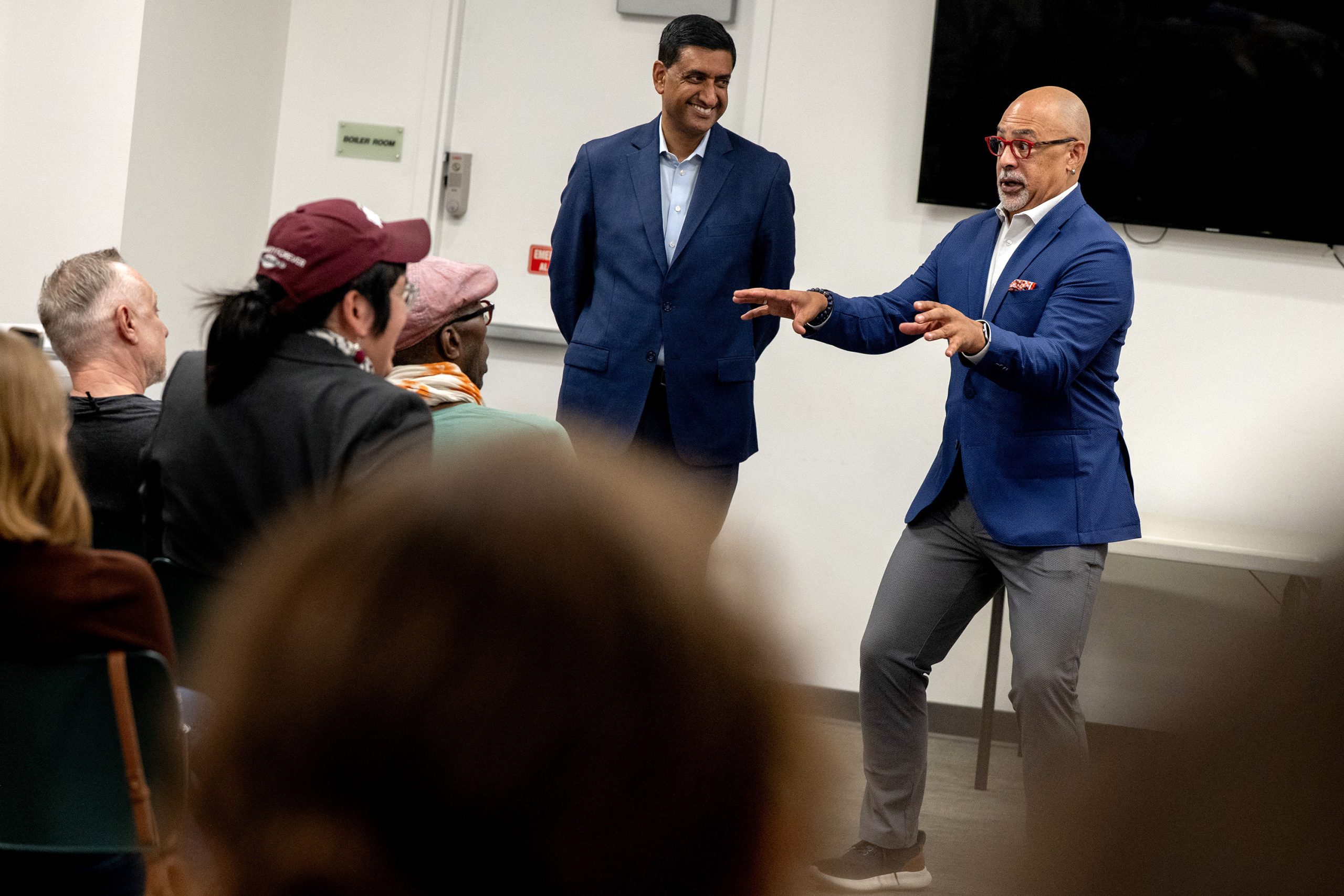
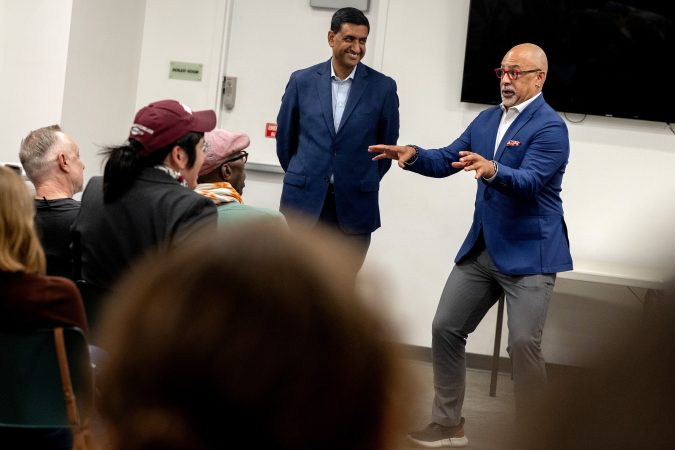
State Rep. Chris Rabb (right) joins U.S. Rep. Ro Khanna (left) Tuesday, July 28, 2026, as he stops on his “Made in PA: New Economic Patriotism Tour” at the City Institute Library on Rittenhouse Square.Tom Gralish / Staff Photographer
One specific provision, Khanna said, was informed by his visit in Washington County with individuals who are paid to host natural gas wells on their properties. It was there that he said he learned of community demands for oil and gas well sites to be at least 2,500 feet from residences. That buffer was a recommendation from a 2020 grand jury report released by Shapiro when he was serving as attorney general and that outlined health and safety issues caused by fracking in the Marcellus Shale region.
The recommendation was not followed, and advocates are continuing to push for extending the buffer from the current distance of 500 feet, according to Inside Climate News.
Khanna’s bill of rights would call for data centers to be built no closer than 2,500 feet from residences, schools, childcare facilities, hospitals or nursing homes. He said the environmental and health hazards for data centers aren’t the same as fracking but they should be kept at a distance from communities that don’t want to live directly next to them.
“At least they were offering royalty checks in the cases of fracking,” Khanna said. “[Data center developers are] not even giving the communities checks. It’s just kind of like, ‘OK, we’re going to build.’ What does the community get out of it? I literally don’t understand it.”
Data center advocates have argued their development is critical in winning an artificial intelligence war with China, and that they will bring construction and some skilled jobs to communities that need them.
Even the staunchest advocates, though, have acknowledged the public blowback.
“I do think that data centers in Pennsylvania have raised legitimate concerns,” U.S. Sen. Dave McCormick (R., Pa.) said during a recent telephone town hall as he continued to promote them in the competition with China and their creation of “thousands of jobs.”
When developers are making their pitch, McCormick said they should come with commitments to protect energy costs and overuse of water, use local labor, invest in the community and pay taxes.
“That should be part of the deal up front,” McCormick said during the telephone town hall in late July. “With all those facts, then the local community can decide whether they want the data center or not. And if they choose not to, that’s their choice.”
Khanna said he’s hoping for bipartisan support as he introduces the bill of rights idea. He’ll also be competing with other proposals — like one from fellow progressives U.S. Rep. Alexandria Ocasio-Cortez (D., N.Y.) and U.S. Sen. Bernie Sanders (I., Vt.) called the AI Data Center Moratorium Act. The bill would enact an immediate federal moratorium on data center construction until other safeguards are passed into law, including some of the ideas Khanna and McCormick have proposed, like around utility costs.
Several Pennsylvania state-level laws have been proposed, though the legislature did not address them during its busy budget season earlier this spring and summer. Lawmakers also left Harrisburg without ending tax breaks aimed at incentivizing data center construction even though the idea had garnered widespread support.
“They shouldn’t be getting these tax breaks to build,” Khanna said. “That’s absurd when you’ve got hyperscalers that are making trillions of dollars.”
The fact that many of those ultra-wealthy corporations are based in his district made the issue a politically dicey situation for him, but also one that the possible presidential hopeful said he was willing to take on.
“We’ve got to pause it in states like Pennsylvania,” Khanna said. “Some of my own constituents aren’t going to like that.”
Since his victory in Philadelphia’s highly contested Democratic congressional primary in May, the state lawmaker and presumptive successor to retiring U.S. Rep. Dwight Evans has campaigned across the country — going nine for 10 in races where he’s supported progressives against more establishment-backed, moderate Democrats.
That wave of momentum — for a left-leaning faction hoping to transform the next generation of the Democratic Party — culminated this week in Michigan, where Dr. Abdul El-Sayed won a consequential U.S. Senate primary in the key swing state.
Though not a self-described democratic socialist like Rabb, El-Sayed ran on a similar anti-corporation, anti-Israel platform that focused on enacting policies like Medicare for All and dismantling U.S. Immigration and Customs Enforcement.
Rabb, who was on the ground in Detroit for the final push of the campaign and at El-Sayed’s victory party on Tuesday, said the Michigander prevailed “against extraordinary odds.”
U.S. Rep. Haley Stevens, with establishment support and about $62 million in outside spending on her behalf, had a roughly 9-to-1 spending advantage over El-Sayed, according to The New York Times. Her loss amid that kind of massive spending “is a testament to the power of economic populism and the growing frustration with incrementalism,” Rabb said.
“His primary win proves that economic populism and bold progressivism has growing support across the ideological spectrum among Democrats whether they’re voting in Michigan or Pennsylvania,” Rabb said.
The five-term state representative from East Mount Airy has thrown his energy into other campaigns as his own is pretty much complete. In one of the bluest in the country, he defeated a pair of more moderate Democrats — State Sen. Sharif Street and physician Ala Stanford — and will not face a Republican opponent in the November election. The district covers about half of the city, from South Philadelphia through the Northwest.
In New Jersey’s Trenton-based congressional district, he campaigned for Dr. Adam Hamawy, a former combat surgeon who has also provided medical care to Gazans during the war with Israel. In New York, he threw his weight behind Darializa Avila Chevalier and Claire Valdez, two of the democratic socialists also backed by New York Mayor Zohran Mamdani.
He turned to other candidates in California, Colorado and Michigan as he door-knocked, called voters and appeared in virtual events.
“Ever since May 19, which was the night I won, I’ve been paying it forward with so many amazing candidates,” Rabb said during a recent virtual fundraiser for El-Sayed in which Rabb said he was signing and giving away the pink “Philadelphia” baseball hat he was wearing to a lucky donor.
Rabb hasn’t weighed in on every battle between progressives and moderates. He did not endorse Cori Bush, the former member of Congress and democratic socialist who failed in her attempt at a comeback in Missouri this week. He also has not endorsed every congressional candidate promoted by two key national coalitions that supported him — Justice Democrats, which has been a force behind the election of U.S. Rep. Alexandria Ocasio-Cortez and others, and the Democratic Socialists of America.
The one candidate he endorsed who did not win was Saikat Chakrabarti, a former campaign manager and chief of staff to Ocasio-Cortez who tried to beat former House Speaker Nancy Pelosi’s hand-picked successor in San Francisco.
And not all of Rabb’s endorsees are guaranteed to join him in Congress next year. Justin Pearson, a Tennessee state lawmaker who won a U.S. House primary on Thursday, will be the nominee in a state where Republicans redistricted this year in an attempt to root out Democratic incumbents. Pearson’s district is considered “solid Republican” by the Cook Political Report, a nonpartisan group that rates competitive districts.
While some Democrats have questioned whether progressives can win competitive general election races, Rabb said he was “confident that strategically supporting anti-establishment populist candidates who bring with them new, more active and enthusiastic voters will significantly increase turnout in November.”
“Ignoring the unique strengths of such candidates and campaigns will be at the Democratic Party’s great peril,” he added.
That sentiment echoed other comments he’s made in recent months as more centrist leaders in his party questioned the progressive momentum. In June, he responded to an interview in which Gov. Josh Shapiro called the democratic socialists who won in New York an example of “performative politics.” Those candidates would now need to govern effectively, he said, adding that they were not indicative of the types of Democrats winning in Pennsylvania.
“You’re seeing very different-looking congressional races, and certainly very different Democratic candidates here in Pennsylvania,” Shapiro told CNN, prompting Rabb to respond on social media with, “Ummm…”
Shapiro, a popular figure as he seeks reelection this fall, has been lending his support to Democrats in four competitive congressional seats in Pennsylvania that are held by Republicans, including a swing district in suburban Bucks County. Flipping those seats in a way that could help Democrats capture the U.S. House majority has been a top priority and has further fueled speculation that Shapiro is eyeing a run for the White House in 2028.
At the same time, Shapiro has not appeared with or supported Rabb during his campaign, though his team has said the governor looks forward to working with whoever replaces Evans.
As Rabb has crisscrossed the country, he’s also drawn more ire from the state’s other most nationally prominent Democrat — U.S. Sen. John Fetterman, who Rabb dismissively refers to as “the F word.”
“Rabb, he won, and he ran on being a very, very anti-Israel guy,” Fetterman said in early June at an American Jewish Committee conference in Washington. “It’s actually a virtue (in the modern Democratic Party)… It’s heartbreaking for me.”
After El-Sayed’s win this week against a candidate who received more money from the American Israel Public Affairs Committee than possibly any other candidate on record, Rabb and the coalition behind him have shown no signs of slowing down.
“Ground Zero was Chris Rabb in Pennsylvania, winning a key congressional primary,” Adam Green, co-founder of the Progressive Change Campaign Committee said on the livestreamed fundraiser with Rabb this week.
The “ripple effects of winning a battleground Senate contest,” like in Michigan, Green said, will be significant.
“The message will be undebatable that we won, that we’re on the rise, and that we can win anywhere,” he said.
U.S. Sen. John Fetterman, in perhaps the most in-depth and toughest interview he has faced in recent memory, defended his unwavering support for Israel and his harsh criticisms of fellow Democrats when pressed by Jon Stewart in a podcast episode released Wednesday.
The liberal comedian and political commentator repeatedly accused Fetterman (D., Pa.) of “caricaturing” the left wing of his party and the debate around Israel’s handling of the war in Gaza.
“Jewish community and Israel are not the same thing, brother man. They’re not — that is not the same thing,” Stewart, who is Jewish, said at one point as Fetterman described his full-throated support for the war as being because of “the Jewish community.”
Asked repeatedly about the United States’ moral obligations about backing the Israeli strikes that have led to the deaths of tens of thousands of Palestinian civilians, Fetterman stood firm.
He said — as he often has since the Oct. 7, 2023, attack by Hamas that sparked the conflict — that it was necessary to go after Hamas leaders. The killing of civilians was “terrible” and “collateral” damage but not a genocide, Fetterman said.
Stewart continued to press — questioning why Fetterman was standing so firmly behind a foreign ally that was “dehumanizing” and slowly killing another population.
“I don’t understand how you have no criticisms over their actions, over their increasingly messianic, ultra-right-wing government that seems to think relentless war is, like, that you can bomb people out of resistance,” Stewart said.
Many other elected Democrats have distanced themselves from the Israeli government and criticized its tactics. Fetterman has acknowledged his position has hurt him politically. In the interview with Stewart, he echoed previous comments — which have also become evident in public polls — that he has lost the support of his former Democratic base as his and his party’s stances diverged.
“I’m aware that if I happen to disagree with the party line, there’s a price to pay,” Fetterman said. “There’s a lot of stories of how I’ve become increasingly more unpopular with Democrats in my state. And I’m aware of it. But these were all very specific choices. … I would rather have people know what I happen to believe.”
Stewart asked Fetterman several times about how he has voiced those disagreements.
He said the senator has focused far more on arguing with his own party in a way that has further hurt its brand. And he has broken from the party’s ranks as Democrats try to use even an inkling of leverage that could impact Republicans’ agenda as the GOP controls both Congress and the White House, Stewart said. He pointed to issues like immigration enforcement reforms, which Democrats tried to enact by holding out support for a spending bill earlier this year. Fetterman said he supported the reforms but would not go along with letting part of the government shut down as a strategic move.
Mark Twain Prize recipient Jon Stewart is introduced at the start of the 23rd annual Mark Twain Prize for American Humor at the Kennedy Center for the Performing Arts, in Washington, April 24, 2022. (AP Photo/Kevin Wolf, File)Kevin Wolf
Stewart also pressed Fetterman on how his approach to President Donald Trump has softened as he has ramped up his criticism of his own party.
“You called President Donald Trump a jagoff in 2016,” Stewart said, prompting Fetterman to say that he put the phrase on shirts and sold them.
“You put it on a shirt. And now you’ve been very complimentary to him. And if your concern with Graham Platner is you didn’t think he was very nice to women, you’re ignoring an awful lot of evidence for the current president about his relationship with women,” Stewart said, referencing Fetterman’s attacks on the Maine Democrat who dropped out after facing allegations of sexual assault. “So my point is, there seems like there’s a way to go about this that embraces, as you said, the 90% of things that you agree with, and try and utilize that energy to reform a party that has a worse public image than herpes in terms of getting things done. This feels like it’s playing into the hands of Republican caricatures.”
Fetterman pushed back, saying he was trying to stop “extreme” elements of his party in a way that would lead to better success in battleground elections — like in Pennsylvania — after Democratic losses in 2024.
“We keep losing, and now we keep returning back to some of the extreme things,” Fetterman said. “That’s not a caricature. That is a fair assessment of where we are with these kind of things.”
Stewart, noting that Vice President Kamala Harris was not the most progressive Democratic option in 2024, rejected the idea that the party lost because of far-left views. In an extended conversation about capitalism and socialism, he also encouraged Fetterman to embrace new ideas presented by democratic socialist candidates who Fetterman, like many Republicans, refers to as communists.
Fetterman, who frequently appears on Fox News but has not appeared on more liberal programs like Stewart’s Daily Show, described himself as a longtime fan of Stewart and said he believed the interview was “very fair.”
At the end of the podcast, after Fetterman left, Stewart said he “wasn’t sure what to think” and was “weirdly thrown off right now.”
“I feel like we all just got out of one of those movies. Do you know those movies where it’s like … there was a weirdly traumatizing scene in the movie,” Stewart said. “And now we’re all just, like, ‘Do you guys, um, do you want to go get something? I guess I’m just going to go get a slice and maybe go home.’”
WASHINGTON — In a Pennsylvania election where a few thousand votes could make all the difference, the last-minute entrance of a Green Party candidate with a background in Republican politics has sparked the second allegation of election meddling in three months and complicated one of the nation’s most competitive U.S. House races this fall.
But the emergence of a third-party candidate has alarmed both Democrats — who have long claimed that Green Party candidates pull votes from their nominees — and the Green Party of Pennsylvania, which said it does not know the person now representing its platform in one of the state’s highest-profile races.
“It sounds a lot like somebody’s just fooling around and trying to use the Green Party name, which is a well-known thing that happens in many states,” said Tim Runkle, cochair of the state party.
Andrew Tupone, 37, of Northampton County, filed his nomination papers with the state last week ahead of a Monday deadline for third-party candidates. He was the only candidate to file to represent the Green Party in a Pennsylvania race for Congress.
Unlike the Green Party’s endorsed candidate for governor — Tony Dastra of Lancaster County — Tupone does not have a long association with the party or its left-leaning policies. In 2021, he was the Republican nominee for a Northampton County magisterial court seat. Voter registration records show he changed his party affiliation from Republican to Democrat in February, and then from Democrat to Green in April.
In an interview, Tupone rejected accusations that he remained affiliated with the Republican Party or that he was asked to run in a way that would draw votes away from the Democratic nominee. He described a leftward shift in his political views after voting for President Donald Trump in 2020, though he said he could not recall whom he voted for in the 2024 presidential race between Trump and Democratic Vice President Kamala Harris.
“A lot of people are disillusioned with both parties,” Tupone said. “They’re sick of all the stuff that’s going on.”
Tupone also said he did not pay anyone to help gather signatures for his nominating papers, which he turned in with upward of 9,000 signatures — more than twice as many as required. Runkle said Green Party members encountered paid canvassers for Tupone who declined to say who was funding the effort.
According to a copy of the nominating papers obtained by The Inquirer, only one of the 22 individuals who gathered signatures is from Pennsylvania. The rest are from all over the country. Multiple have worked for Republican campaigns, according to public records.
Colin McEvers, who gathered signatures for Tupone in Lehigh County, is a Republican candidate for the Maryland General Assembly who is also listed as the contact for the Maryland White Republican Council. Others — including individuals from Illinois and Michigan — have been paid to canvas for GOP campaigns, according to Federal Election Commission records.
Tupone said he had no knowledge of anyone paying his canvassers.
“I went around and I gave a lot of my nominating papers to friends to give to other people, and I sent it to them as well,” Tupone said. “And as I went around, I recruited people and asked them.”
While the signatures appear to be based in the district — which stretches from the cities of Allentown, Bethlehem, and Easton into the more Republican-leaning Poconos — the other candidates have until Aug. 10 to challenge their legitimacy.
Such challenges are common, and the Brooks campaign is reviewing its options to decide whether to bring a challenge, according to a source familiar with the campaign’s thinking.
‘No one’s paying me to run’
Jenna Kauffman, Brooks’ campaign manager, in a statement described the situation as a GOP-initiated and “desperate scheme to meddle in this race.”
She connected it to a last-minute $1.7 million advertising campaign against Brooks in the May primary that appeared to be run by Democrats but was actually funded by a Republican political organization.
The spending, by a political action committee called Lead Left, was aimed at boosting another Democrat who observers considered to have a worse shot at beating Mackenzie in the November election. But the effort was anonymous, and records that became public only after Brooks won show that it was funded by the Conservative Americans PAC.
The effort to prevent Brooks from emerging from the Democratic primary came as he coalesced support from across the ideological spectrum with high-profile endorsements ranging from moderate Democratic Gov. Josh Shapiro to U.S. Sen. Bernie Sanders (Ind., Vt.), a democratic socialist.
“Voters deserve to know who is paying for this effort and whether Ryan Mackenzie and his Republican backers are involved,” Kauffman said, painting Tupone’s candidacy as a continuation of the move in the primary.
Mackenzie’s campaign did not address that comment when asked about it Monday.
Tupone said that the inference was “just false,” and that he instead likes the values of the Green Party, which he said included supporting the environment, social justice, and “stopping the corruption and also the genocide in Gaza.”
“No one’s paying me to run. No one’s asked me to run for this office. I’m running on my own, hopefully with a lot of hope from everyone who wants to volunteer,” Tupone said. “I’m not associated with the Republican Party anymore. I’m not a candidate for them.”
For years, Democrats have voiced concerns about the Green Party and other third-party candidates “spoiling” elections, from Jill Stein in the 2016 presidential race that first put Trump in power to the 2024 U.S. Senate race in Pennsylvania, when Democratic U.S. Sen. Bob Casey lost to Republican Dave McCormick by about 15,000 votes. In that 2024 election, a Green Party candidate won about 66,000 votes, a Libertarian candidate won almost 90,000, and a Constitution Party candidate won more than 23,000.
In the 7th District in 2024, Mackenzie defeated incumbent Democrat Susan Wild by 4,062 votes out of more than 403,000 cast. That was the narrowest margin out of any of the state’s 17 districts, making it a key tossup district this year.
That margin is also significantly different from the one Shapiro potentially faces during his reelection campaign this year as he maintains a sizable lead over Republican Stacy Garrity, and as a Green candidate officially filed to run on Monday. Shapiro defeated Republican Doug Mastriano in 2022 by almost 793,000 votes; the Green Party candidate won just over 24,000 votes.
Runkle said that nobody solicited the Green Party’s endorsement in a Pennsylvania congressional race this year, and that a conversation he had with Tupone left “a lot of questions.”
He said the party is concerned about its reputation and about being targeted in ways that do not lift up its platform, which focuses on environmental protections and liberal positions on healthcare. But he also pushed back on concerns that the party should be considered a spoiler.
“I do solidly believe that the Green Party policies and the values we represent has a solid bloc of voters,” Runkle said. “If people think that’s spoiling the race, then they should try harder to speak to the issues that we speak to.”
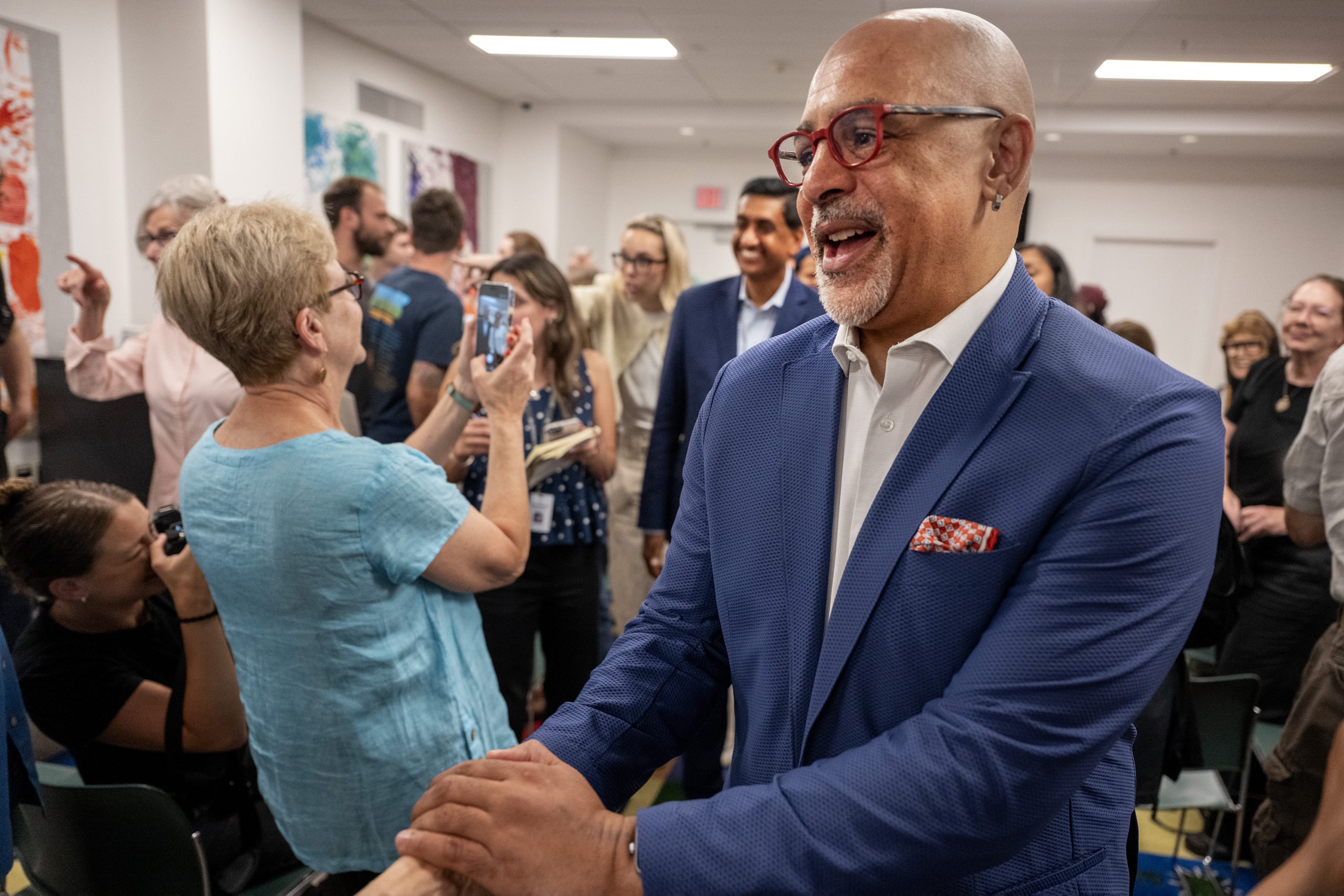
Two months after winning a primary to likely become the first democratic socialist representing Philadelphia in Congress, State Rep. Chris Rabb on Tuesday joined forces in the city with U.S. Rep. Ro Khanna, a California progressive kicking off a week of events across the state as he considers running for president in 2028.
The like-minded Democrats share a similar progressive platform, and Khanna endorsed Rabb ahead of the competitive primary to replace U.S. Rep. Dwight Evans (D., Philadelphia) in May.
In a sign that the alliance might continue when Rabb enters Congress in January — and potentially beyond as the party considers its options for the next presidential race — the two kicked off Khanna’s statewide tour Tuesday in Philadelphia.
Khanna, a Bucks County native who has represented parts of the Bay Area since 2017, is pitching a “Progressive New Deal,” invoking President Franklin D. Roosevelt’s platform, which led to the creation of Social Security and other programs.
The California lawmaker called for the U.S. to end military aid to Israel and recognize Palestinian statehood as the war in Gaza nears its third year. And he called for progressive economic reforms and the tackling of corruption, which Khanna framed around the case of notorious sex offender Jeffrey Epstein and his associations with the rich and powerful.
“I believe we need a ‘New Deal’ for the 21st century,” Khanna said. “We’re going to have people like Chris [Rabb] and others that are building that momentum. We need bold progressive Democrats: morality on foreign policy, morality on [Jeffrey] Epstein, and a bold economic vision to make this country work not just for the few but for all of us.”
Khanna is among a slate of Democrats who have branded their platform as “New Economic Patriotism” with a focus on affordability and corruption issues during the first two years of President Donald Trump’s second term.
Rabb, a five-term state lawmaker from East Mount Airy who ran an unabashedly progressive campaign, has said he is eager to join allies in Congress after the November election, in which he faces no Republican opponent to represent about half of Philadelphia.
On Tuesday with Khanna, he outlined some of the platform that helped propel him to defeat a pair of more centrist candidates, and that he hopes to carry to Capitol Hill.
“The issues we’re talking about resonate with a lot of people when you remove the labels,” Rabb said. “Medicare for All. You know, universal childcare. Federal jobs guarantee. No more endless wars. Acknowledging the genocide [in the war between Israel and Gaza].”
At the Philadelphia City Institute library in Center City, where about 50 people listened and asked questions, Khanna spoke of his upbringing and how he watched people around him struggle after the closure of the Fairless Works steel factory in 2001.
“My values were shaped in Bucks County,” said Khanna, who has described his week of events in Pennsylvania as a homecoming. “It’s shaped who I am. And I think Bucks County is a symbol for America.”
But he sees the current anxiety and frustration of achieving the American dream. “I really want to offer a vision about how we can have the economic prosperity,” he said.
Now, Khanna said, he represents the district that houses Silicon Valley and holds one-third of the nation’s wealth. He said he hopes his advocacy there to tax the billionaires who live in his district helps people all the way to Pennsylvania.
“We’re in a second Gilded Age,” Khanna said. “I’m saying tax the billionaires in my district and in California so we can pay for free healthcare, so we can have free childcare in this country, so that we can have free college in this country.”
His itinerary this week included two planned stops in Philadelphia and others across the state, including a Thursday event in Pittsburgh with U.S. Rep. Chris Deluzio, a potential primary challenger to Democratic Sen. John Fetterman in 2028 who shares Khanna’s economic platform.
State Rep. Chris Rabb greets supporters after appearing with U.S. Rep. Ro Khanna (rear) at the City Institute Library on Rittenhouse Square.Tom Gralish / Staff Photographer
Rabb has advocated for a similar economic populism, including universal basic income and the Green New Deal.
Since the primary, Rabb has both campaigned for other similar candidates and visited Washington, where he appeared on stage with Deluzio in June to discuss the surging left — a theme expounded upon again Tuesday.
Several democratic socialists have won congressional primaries this year in blue districts, including Claire Valdez and Darializa Avila Chevalier in New York. Rabb endorsed them, as well as Melat Kiros, who beat 30-year incumbent U.S. Rep. Diana DeGette in a Colorado primary.
Rabb said he would want to see a viable progressive candidate in the 2028 presidential election, but he did not specifically endorse Khanna, who could be among several such candidates in a crowded field.
U.S. Rep. Alexandria Ocasio-Cortez (D., N.Y.), who also campaigned for Rabb in May, and Pennsylvania Gov. Josh Shapiro, who has had a frosty relationship with him, are also expected to be among the contenders for the nomination.
“It’s coming up in a moment where there’s extraordinary organizing among folks who are very, very concerned about where we’re going as a nation, and the extent to which we can rely on conventional Democrats to deliver the type of justice and the result we seek,” Rabb said.
WASHINGTON — U.S. Sen. John Fetterman, doubling down on a position that has already added to Democrats’ frustrations with him in recent months, offered a more detailed explanation this week for his change of heart about eliminating the Senate filibuster.
The Pennsylvania Democrat wrote in an op-ed for the Washington Post that he had been “horribly wrong” to support ending the practice that requires bills to win 60 votes rather than a 51-vote majority.
The rule frequently allows members of the minority party to block policies that fail to win bipartisan support, including some of each party’s top priorities — like abortion protections when Democrats have been in control, or the voting restrictions that Republicans are now attempting to pass at President Donald Trump’s urging.
Fetterman was among many Democrats in recent years to campaign on eliminating the filibuster in order to secure those bigger wins. During his 2022 campaign, he specifically referred to passing abortion protections established under Roe v. Wade as a reason for that position after the Supreme Court overturned its landmark 1973 decision that year.
“I became one of the first candidates in the country to call for abolishing the filibuster for a reason: it stands in the way of getting things done for [Pennsylvanians],” his active campaign website still read on Tuesday, nearly four years after he won.
But as he has more frequently sided with Republicans and criticized his fellow Democrats, Fetterman has said repeatedly this year that he had been “wrong.”
“We were very wrong about that to nuke the filibuster, and we should really humble ourselves,” he said on Fox News in February. In that interview and others, he needled Democrats who opposed the filibuster but now, he said, express a “love” for it as they find themselves in the minority and try to reject Republican policies.
In the Washington Post this week, Fetterman wrote that Americans who are “horrified” at the policies coming out of the Republican-led Congress and Trump’s administration would be alarmed if the filibuster had been eliminated and every proposal could become law with a simple majority.
“We’d have the Save America Act by now, which I do not support,” Fetterman wrote. “We could have extreme policies such as nationwide abortion restrictions, backpedaling on LGBT rights, repeal of birthright citizenship and limited voting rights across the country. With a government trifecta firmly in place, many provisions of Project 2025 would have easily been enacted. Republicans could fundamentally change the entire government and country with a simple majority vote.”
Fetterman’s reference to the SAVE America Act comes as Trump has pressured Senate Republican leaders to eliminate the filibuster in order to pass the bill, which would enact sweeping election changes. It would require individuals to provide proof of citizenship when registering to vote and to show photo ID at the polls, and it would scale back mail voting.
Opponents of the bill say it would make registering and voting more difficult for millions of people. And Fetterman has opposed the bill because of the changes to mail voting, though he has changed his position to support requiring a photo ID at the polls.
The bill has failed to receive support from 60 senators, and Trump has demanded that Republicans bypass the filibuster to force it through with only GOP support. U.S. Sen. Dave McCormick (R., Pa.), a Trump ally, has said such a scenario is “very tempting” even though he campaigned against ending the filibuster in 2024.
“It’s a path to get more things done,” McCormick said during a telephone town hall with constituents last week.
Fetterman, in his op-ed, called the filibuster “a critical line of defense that prevents President Donald Trump from having a fill-in-the-blank government with new laws, deregulation or procedures of its choosing.”
He wrote that “history has vindicated” former U.S. Sens. Kyrsten Sinema (D., Arizona) and Joe Manchin (D., W.Va.) for voting with Republicans to block reforming the filibuster when Democrats were in control in 2022.
Fetterman could potentially play a similar role after the midterm elections this fall if Democrats win control of the Senate with a slim, potentially one-vote majority. Some observers have said Fetterman could also leave his party, becoming a Republican or — as Sinema and Manchin did after serving as Democrats — become an independent.
“Some of my colleagues, including myself, have been frustrated when engaging with the minority,” Fetterman wrote. “But that process isn’t a bug — it’s one of the best features of the Senate. We have a great democracy that is imperfect, but it requires working together.”
As Fetterman works more often with Republicans, though, Democrats have become more frustrated with him and vowed to mount a challenge if he seeks a second term in 2028.
Former U.S. Rep. Conor Lamb — one of the Democrats who has not ruled out another campaign after losing to Fetterman in the 2022 primary — has said the senator’s switch on the filibuster “is probably the worst Fetterman story yet” that most people don’t realize.
In a social media video in early June, Lamb said eliminating the filibuster was essential for Democrats to “put Roe v. Wade back into law” and to pass legislation on voting rights, gun control, and raising the minimum wage if they regain control of the Senate.
“When we ran against each other, he promised he would fight for women on this issue and get rid of the filibuster,” Lamb said. “And of course, like so many things, he’s changed his mind.”
In the opening pages of the book he published between losing and then winning a Pennsylvania seat in the U.S. Senate, Dave McCormick painted the picture of an uncomfortable scene at Mar-a-Lago.
It was early 2022. McCormick, a former hedge fund CEO running in a tough Republican primary against celebrity doctor Mehmet Oz, had made the pilgrimage to meet with then-former President Donald Trump and ask him not to endorse Oz. Trump had maintained a firm grip on the party after leaving office and avoiding conviction for “incitement of insurrection” at his second impeachment trial.
According to McCormick’s retelling, Trump pulled up a television interview McCormick gave after the Jan. 6, 2021, attack on the U.S. Capitol in which he said the president was partially responsible for political divisiveness.
“Then the former president looked me in the eyes and warned, ‘You know you can’t win unless you say the election was stolen,’” McCormick wrote. “I made it clear to him that I couldn’t do that. Three days later, Trump endorsed Mehmet Oz.”
McCormick lost the race but ran again and won with Trump’s support two years later — when they shared a ballot. Now, three years after McCormick penned the book, he has become a prominent cheerleader in the Senate for an election reform proposal — the SAVE America Act — that Trump has advocated for while continuing to falsely say the 2020 election was rigged against him.
The Pennsylvania Republican has still not echoed the president’s debunkedclaims of widespread fraud in 2020. He also has not disputed them as he lobbies for the bill, which he and other Trump allies argue will build confidence in elections and which critics say will do the opposite while potentially disenfranchising millions of voters.
Other Pennsylvania Republicans in Congress — some of whom tried to block the state’s electoral votes hours after the Capitol attack— have similarly stayed quiet as Trump has both resurfaced old allegations and introduced new ones.
In a prime-time speech earlier this month, Trump claimed that China had secretly obtained U.S. voter information and that a “large-scale voter registration operation” led to fraud in Michigan six years ago. His administration also released a document alleging Pennsylvania was among four states where the Department of Homeland Security had identified more than 250,000 noncitizens registered to vote.
Pennsylvania Secretary of State Al Schmidt, a Republican appointed by Democratic Gov. Josh Shapiro, has forcefully rejected those claims.
But adding more fuel to the rhetoric about election integrity, New Jersey officials said last week that about 6,600 people who were not citizens were registered to vote before the 2024 election, and fewer than 400 cast a ballot.
Still, many of the claims Trump made in his speech have been refuted by election experts and, in many cases, were not new.Meanwhile, none of the 11 Republicans representing Pennsylvania in Congress have commented directly on them, including some who responded to certain questions for this story but did not answer others specifically about the new claims.
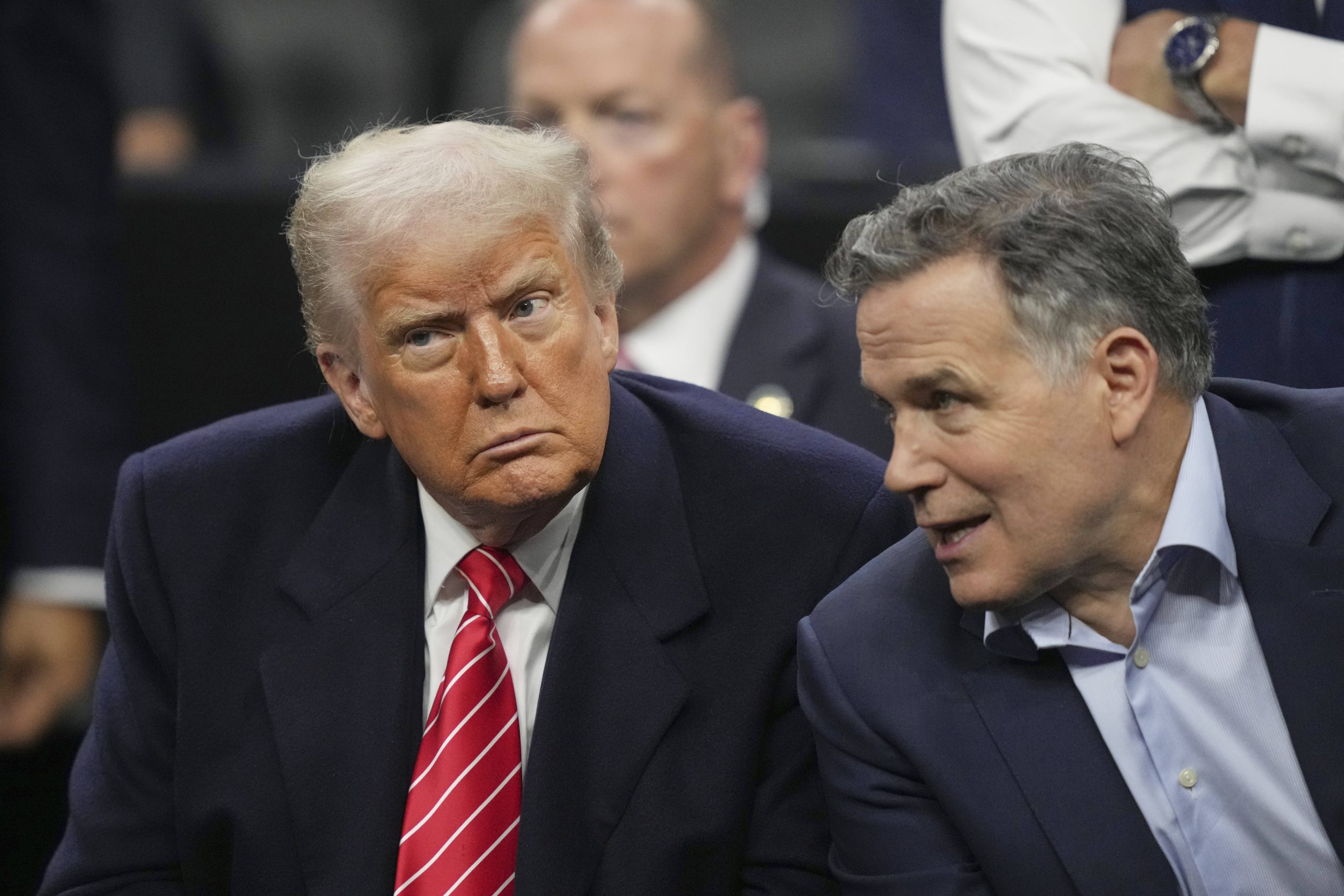
President Donald Trump, left, and Sen. Dave McCormick, R-Pa., attend the finals at the NCAA wrestling championship, Saturday, March 22, 2025, in Philadelphia. (AP Photo/Matt Rourke)Matt Rourke
McCormick’s spokesperson said only that the senator’s position on 2020 “remains unchanged.”
A spokesperson for U.S. Rep. Brian Fitzpatrick, a moderate Bucks County Republican who voted to certify President Joe Biden’s 2020 win, said the lawmaker “completely disagrees with the president’s allegations of interference in the 2020 election.” She did not answer a question about the new and specific claims, such as the 250,000 noncitizens registered, but said Fitzpatrick “has full faith and confidence [in] our election officials.”
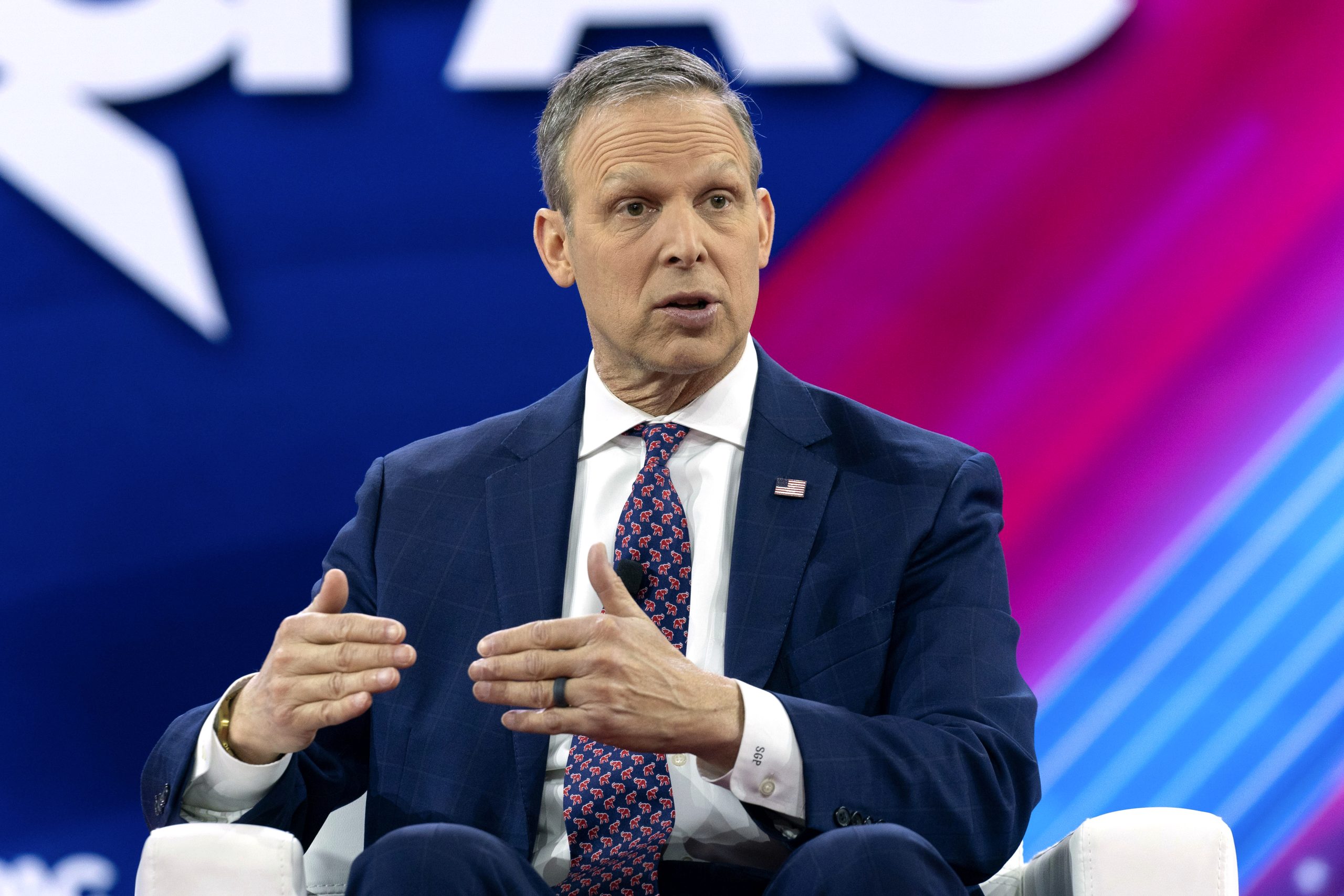
Rep. Scott Perry, R-Pa., speaks during the Conservative Political Action Conference, CPAC 2024, in Oxon Hill, Md., Feb. 22, 2024. (AP Photo/Jose Luis Magana, File)Jose Luis Magana
U.S. Rep. Scott Perry, a York County Republican who tried to overturn election results and became a subject of investigations into Jan. 6, reposted comments online that raised alarm about the White House’s claims of noncitizen voters.
Perry’s office did not respond to a request for comment. He is one of four Republicans in the state facing a competitive reelection this fall — putting Pennsylvania in the national spotlight as Democrats push to gain control of the narrowly divided U.S. House, and potentially at the center of concerns about Trump’s attempts to control the election process.
Republicans point to N.J. as they call for new voting law
Every Pennsylvania Republican in Congress, meanwhile, has supported the SAVE America Act. The bill would require voters to provide proof of citizenship when registering to vote and to show photo ID at the polls. It would also scale back mail voting, which has become increasingly popular since the COVID-19 pandemic but has remained a focus of Trump’s false claims of fraud.
Supporters of the legislation say that voter ID is widely popular and that eliminating even a few noncitizens from the voter rolls is worth ensuring elections are legal and secure. Opponents say that the issues the bill is trying to solve are either nonexistent or statistically irrelevant, and that it would effectively make registering more difficult for about 21 million people who do not have easy access to the paperwork that would be required, like a passport or birth certificate.
“It would upend voter registration and our democracy and, on its own terms, is an extraordinarily harmful policy that would hurt millions of American citizens,” said Eliza Sweren-Becker, a voting rights expert at the Brennan Center for Justice. “It is being advanced on the backs of lies about our election system that are themselves harmful to our democracy and trust in election administration.”
Though he has not addressed Trump’s latest claims, McCormick renewed his public push for the SAVE America Act after Trump’s prime-time address — writing, “Let’s act now,” on social media following the speech.
Last week, he and others also grasped on to both a nearly decade-old voter registration issue in Pennsylvania and the fresh problem in New Jersey to underscore the need for the law.
“This isn’t a harmless ‘software error,’” McCormick wrote on social media after Gov. Mikie Sherrill said a technical mistake led to noncitizens registering to vote. “This is why we must confirm citizenship before anyone registers. Only U.S. citizens should vote in our elections.”
McCormick also elevated a statement from the Department of Homeland Security that referred to an issue that Schmidt, then a Philadelphia city commissioner, discovered in 2017. Schmidt found 168 noncitizens were registered in Philadelphia, and likely hundreds more were registered statewide, due to an error by the Pennsylvania Department of Transportation. State Auditor General Tim DeFoor, a Republican, has said fixes to the system were largely successful.
U.S. Rep. Ryan Mackenzie, a Lehigh County Republican who is running in one of the most competitive districts in the country, also pointed to the Pennsylvania example and the New Jersey developments while justifying his support for the SAVE America Act during a telephone town hall with constituents Wednesday.
But while trying to remember the details on the call, Mackenzie potentially overstated the problem.
“I believe it was about 8,000 people here in Pennsylvania made their way onto the voter rolls, who were not supposed to be there and weren’t asked those proper questions. So these things do happen,” Mackenzie said before stressing the need for the SAVE America Act.
Asked about that number, a spokesperson for Mackenzie pointed to the Pennsylvania Department of State’s additional review in 2018 that found 8,698 voters whose eligibility needed to be determined. Those voters, however, were not necessarily noncitizens or otherwise ineligible to vote, and the state never released a more detailed analysis.
The spokesperson did not answer questions about whether Mackenzie agrees with Trump’s old or new claims about election fraud in 2020, or whether Pennsylvanians should have confidence in the state’s current system.
“This case from Pa., and from N.J. more recently, highlight the lack of appropriate checks taking place when people initially register to vote. We should have appropriate checks to verify the citizenship status when someone initially registers, which is what the SAVE Act provides. The absence of these safeguards, as well as the egregious errors that have been seen in states like New Jersey, are key reasons for the bipartisan frustration with our elections.”
Sweren-Becker said overstated claims of noncitizen voters have contributed to spreading distrust. The Pennsylvania situation, she said, was also not an example of a scheme to defraud the system, and “not the basis for a policy that would block millions of Americans from being able to cast their ballots.” Both that case and the one in New Jersey are instead examples of administrative errors that occasionally happen in a complex election system and represent “an extraordinarily small fraction” of voters, she said.
The Cato Institute, a libertarian Washington-based think tank, has also thrown cold water on the idea that the SAVE America Act would have prevented the New Jersey error. Legal fellow and former Arizona Republican official Stephen Richer, in a post that referred to McCormick’s advocacy, wrote that the current structure of the bill “likely wouldn’t have prevented” the software error.
“Be wary of politicians who say, ‘All of these problems will be fixed with my simple legislation,’” Richer wrote. “That’s often not the case.”
‘Deeply unhelpful’
McCormick, in response to questions for this story, did not directly say if the law would have prevented the issue in New Jersey. But he stressed that the paperwork requirement “helps stop noncitizens from getting registered.” It would also require states to set up a program to “continuously check voter rolls to find noncitizens” using different datasets — which he noted some states already have.
In a telephone town hall with constituents on Wednesday, the senator also acknowledged concerns about the bill when asked about it by voters on both sides of the issue.
Pennsylvania’s U.S. Senators John Fetterman (left) and Dave McCormick appear together Monday, June 29, 2026 to promote the savings accounts for kids that were a signature piece of President Trump’s Big Beautiful Bill.Tom Gralish / Staff Photographer
He said he believed the law would “make it as easy as possible” for people to obtain valid forms of ID if they do not have them. And as someone who lost his first race against Oz by 950 votes and won his second race against Democratic U.S. Sen. Bob Casey by about 15,000 votes, he said even rare cases of noncitizen voting could make a difference in close elections. Eligibility for mail ballots also needs “to tighten up dramatically,” he said, though he did not fully explain his thoughts on the issue or if he believes there has been fraud associated with them.
As Democrats block the bill in the Senate, he called on them to “defend the indefensible” and said “there should be a political cost in objecting to something that most Americans agree with.”
One of the Democrats opposing the bill is McCormick’s close friend and ally — U.S. Sen. John Fetterman.
Though he has frequently broken with his party — and now supports voter ID after previously calling it “insidious and unnecessary” — Fetterman has said the bill’s changes to mail voting are “a nonstarter” for him.” In a CNN interview last week, he also said that the 2020 election in Pennsylvania was fair, that there is “no evidence” of 250,000 noncitizens registered, and that Trump was unnecessarily fixated on the 2020 election.
“In Pennsylvania, out of 67 counties, the vast, vast, vast majority of them are deep red counties, and they’ve never encountered any kinds of fraud,” Fetterman said. “I don’t know why the president is dragging up all of this stuff. You’re the president. Do something positive. And you are talking about 2020. That’s been settled over six years ago. It’s deeply unhelpful.”
Other Pennsylvania Democrats have lambasted Trump for dredging up the old claims, and they have blamed GOP “enablers” for supporting him and pushing the bill.
“The only thing it would ‘save’ is Trump and his Republican enablers from voters holding them accountable,” U.S. Rep. Dwight Evans (D., Philadelphia) said.
U.S. Rep. Chris Deluzio, an Allegheny County Democrat who worked on election security issues before running for Congress in 2022, said the bill “will do nothing to improve election security” and would instead harm married women — whose birth certificates might not have their current name — and people without passports. He said those who lie about the 2020 election are “cowards” who should not have a place in elected office.
“The fact that some Republican politicians are so scared of Donald Trump that they lie for him just to keep their jobs is spineless and pathetic,” Deluzio said.
McCormick, for his part, said during the telephone town hall that the bill is unlikely to pass as Democrats continue to block it from getting the required 60 votes in the Senate, and as Republicans decline to eliminate the filibuster rule to let it move forward with just 50 votes.
“Where does that leave us? That leaves us in a position where I think we should be constantly talking about this, and I try to do this every single week, multiple times, [saying] why the SAVE America Act is important,” said McCormick, whose staff said he was unavailable for an interview.