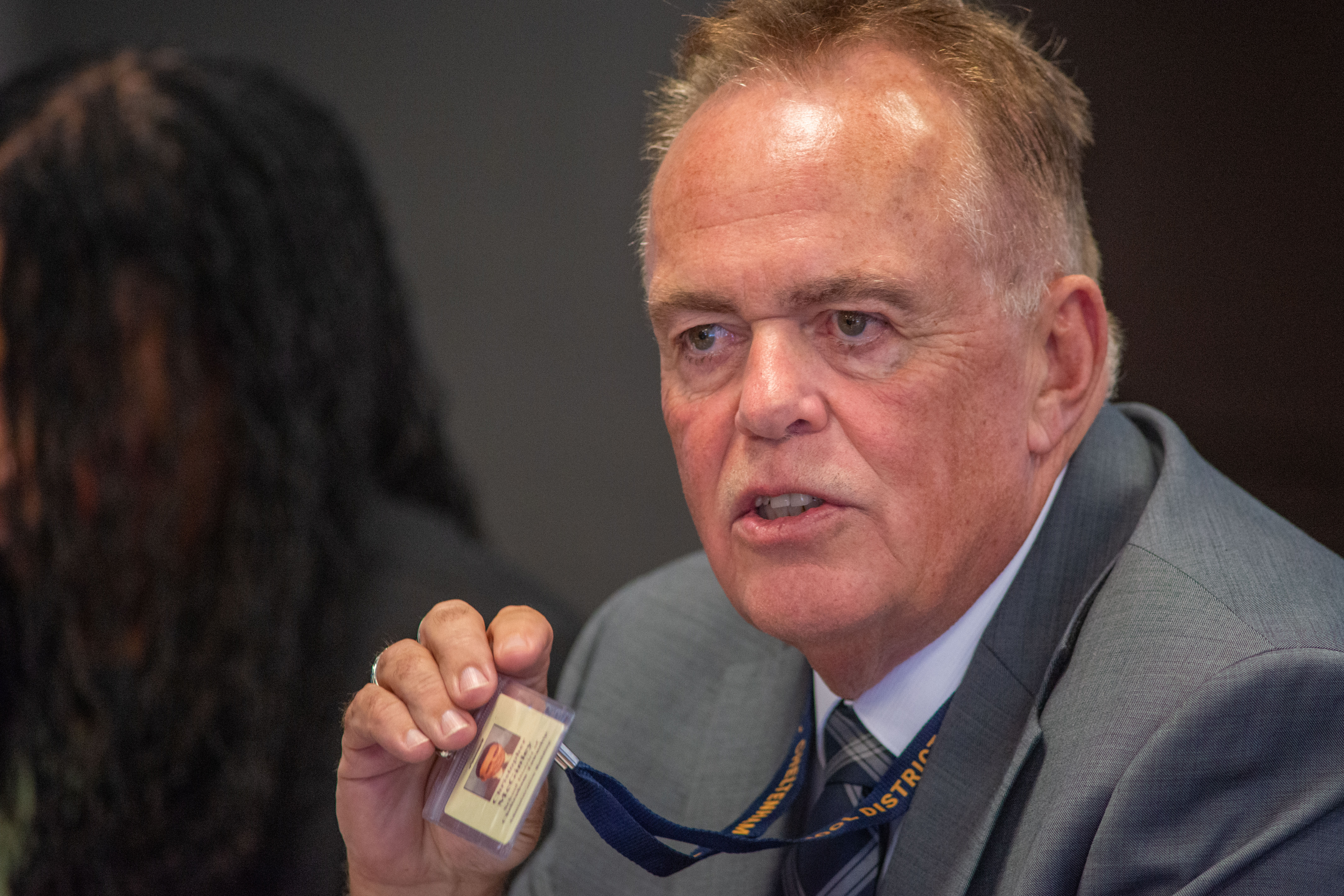
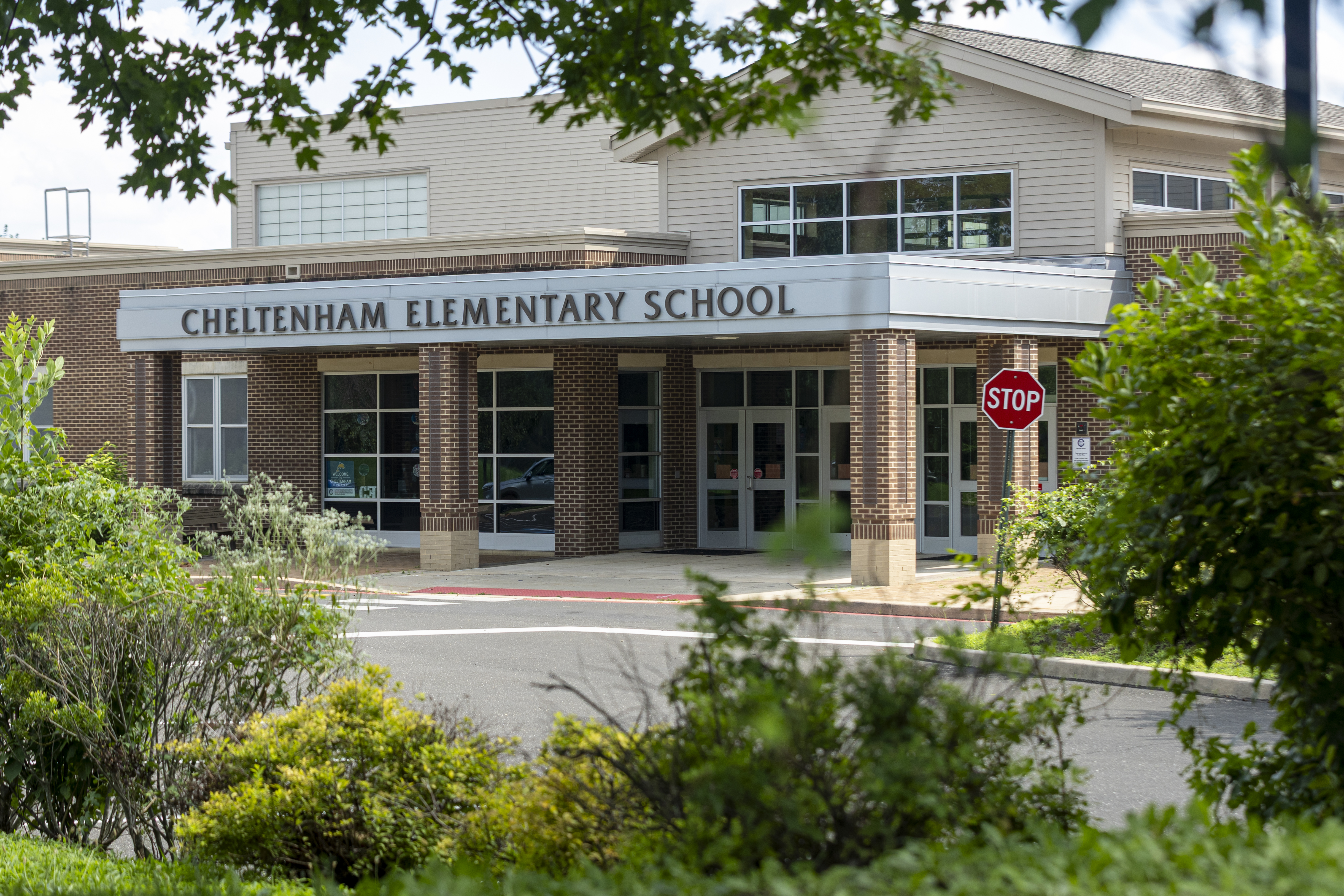
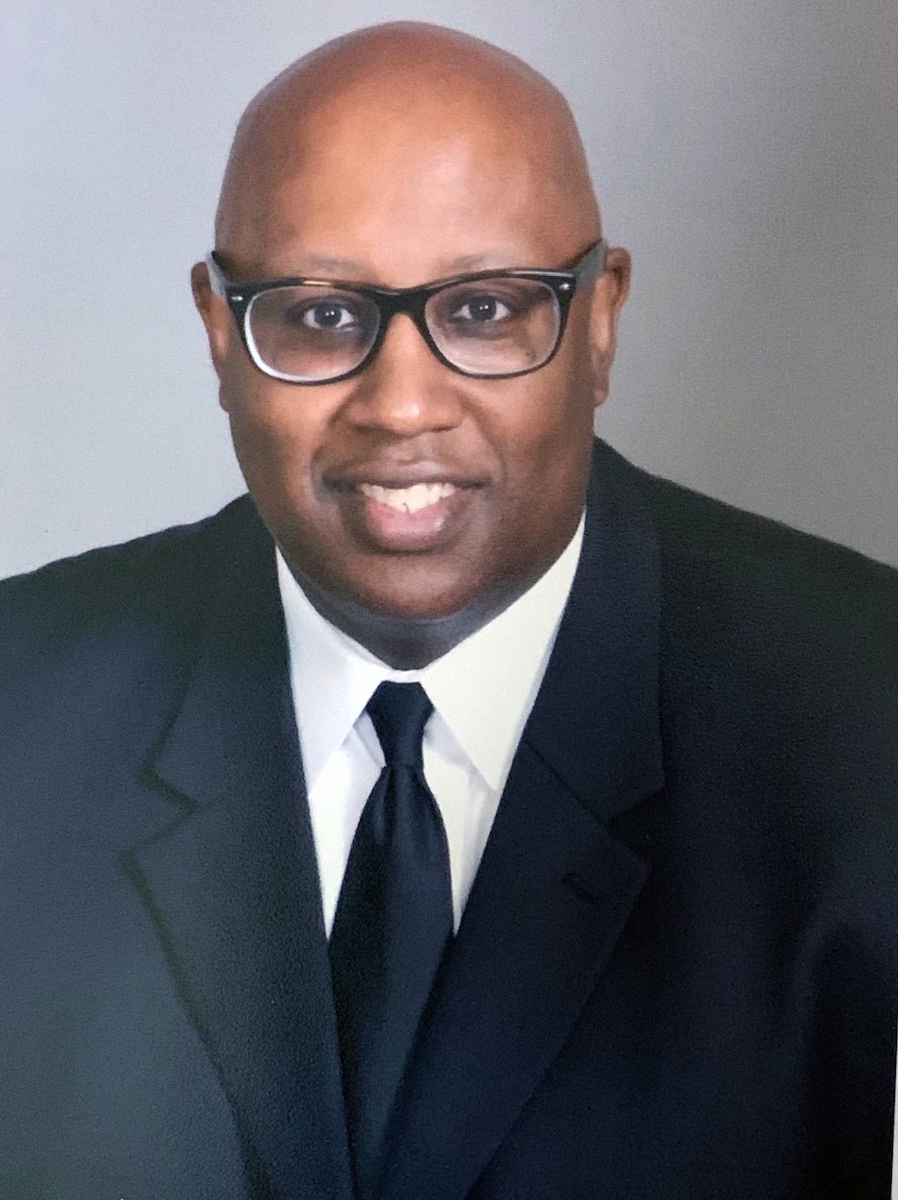
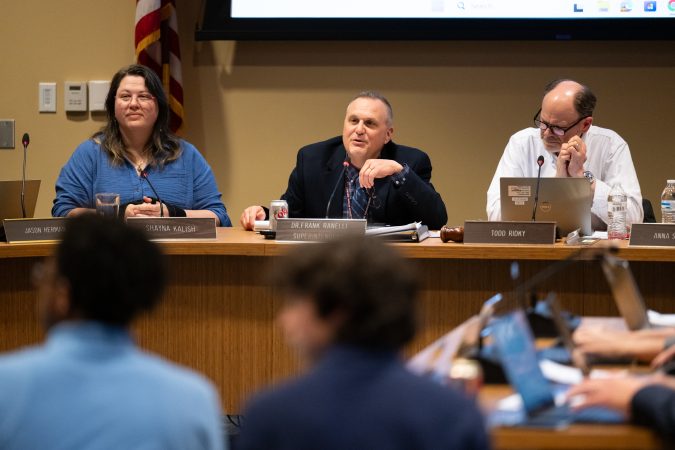
The Cheltenham school board on Tuesday appointed Chris McGinley as its interim superintendent, approving a contract for the veteran administrator through the end of the 2026-27 school year.
McGinley, who first came to Cheltenham as an assistant superintendent in 1999, led efforts in the district aimed at closing its achievement gap, and partnered with the University of Pennsylvania to establish the Center for Equity and Excellence, a regional consortium of school districts working to close their own gaps.
“At a time when the district is focused on rebuilding public trust and ensuring the safety of all students at all district schools, we believe that Dr. McGinley is uniquely qualified to lead our schools during the upcoming school year,” Cheltenham board president Leah Mulhearn said in a statement Tuesday night.
McGinley was approved unanimously at a special meeting Tuesday, according to district spokesperson Kevin Kaufman.
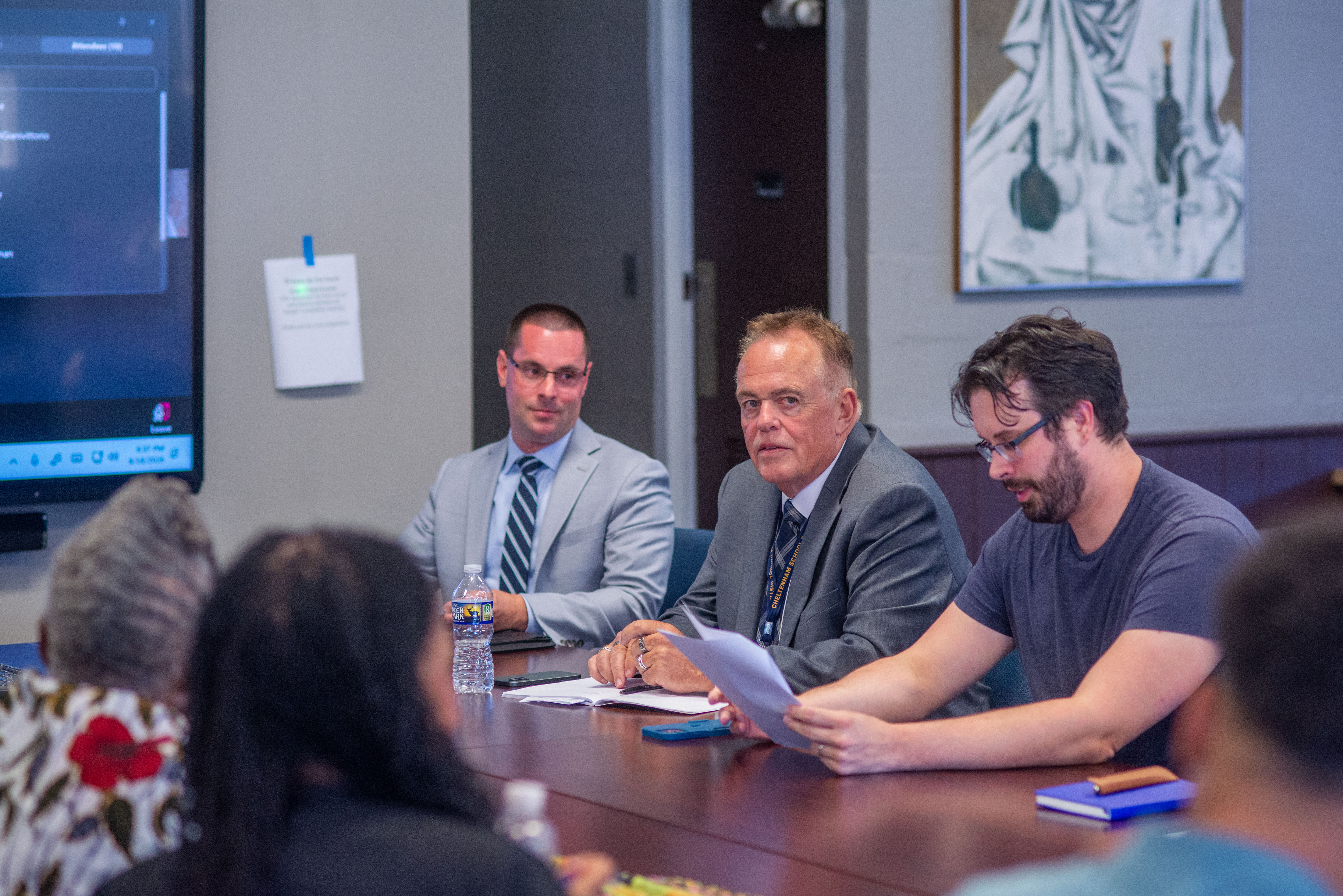
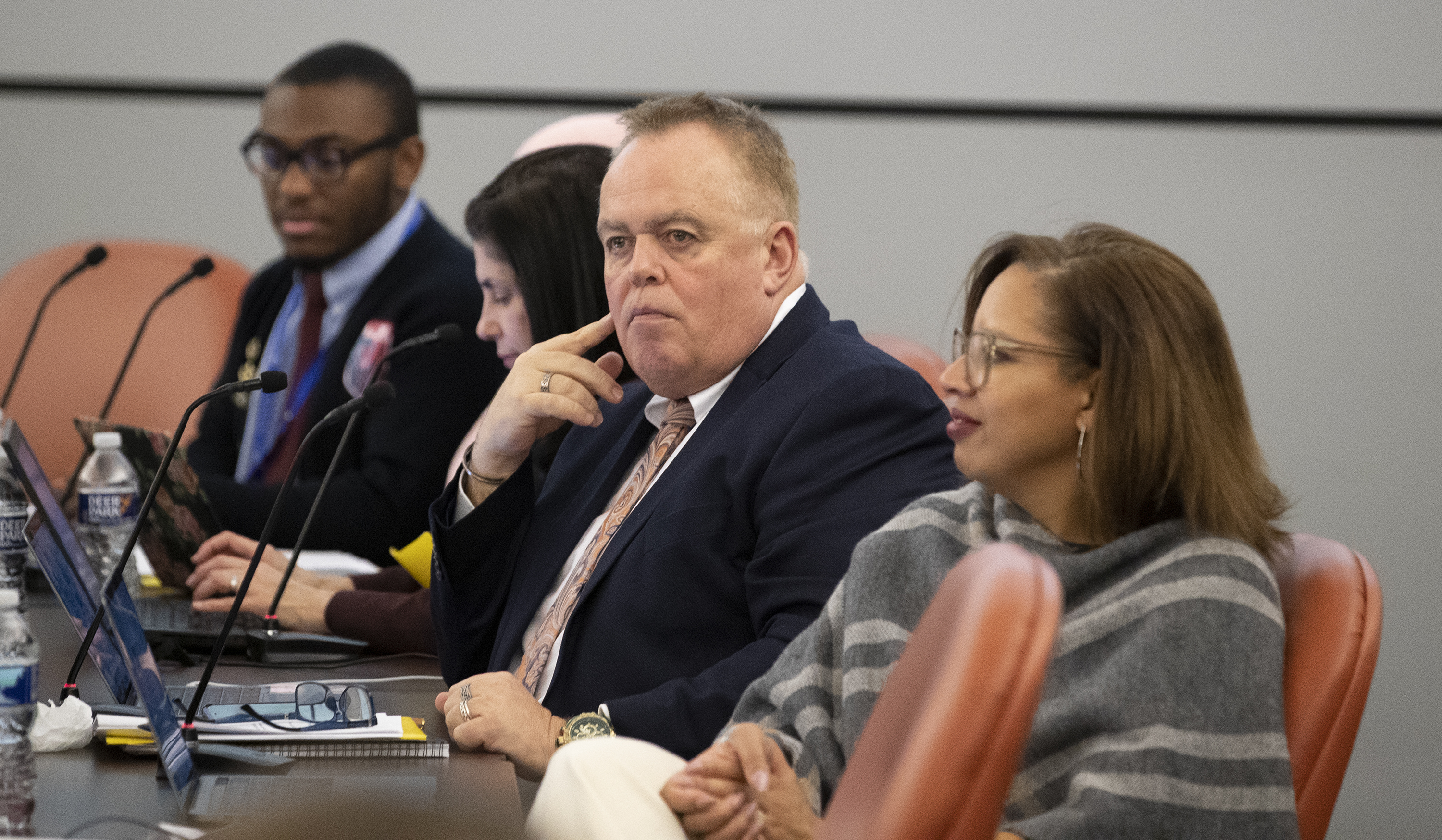
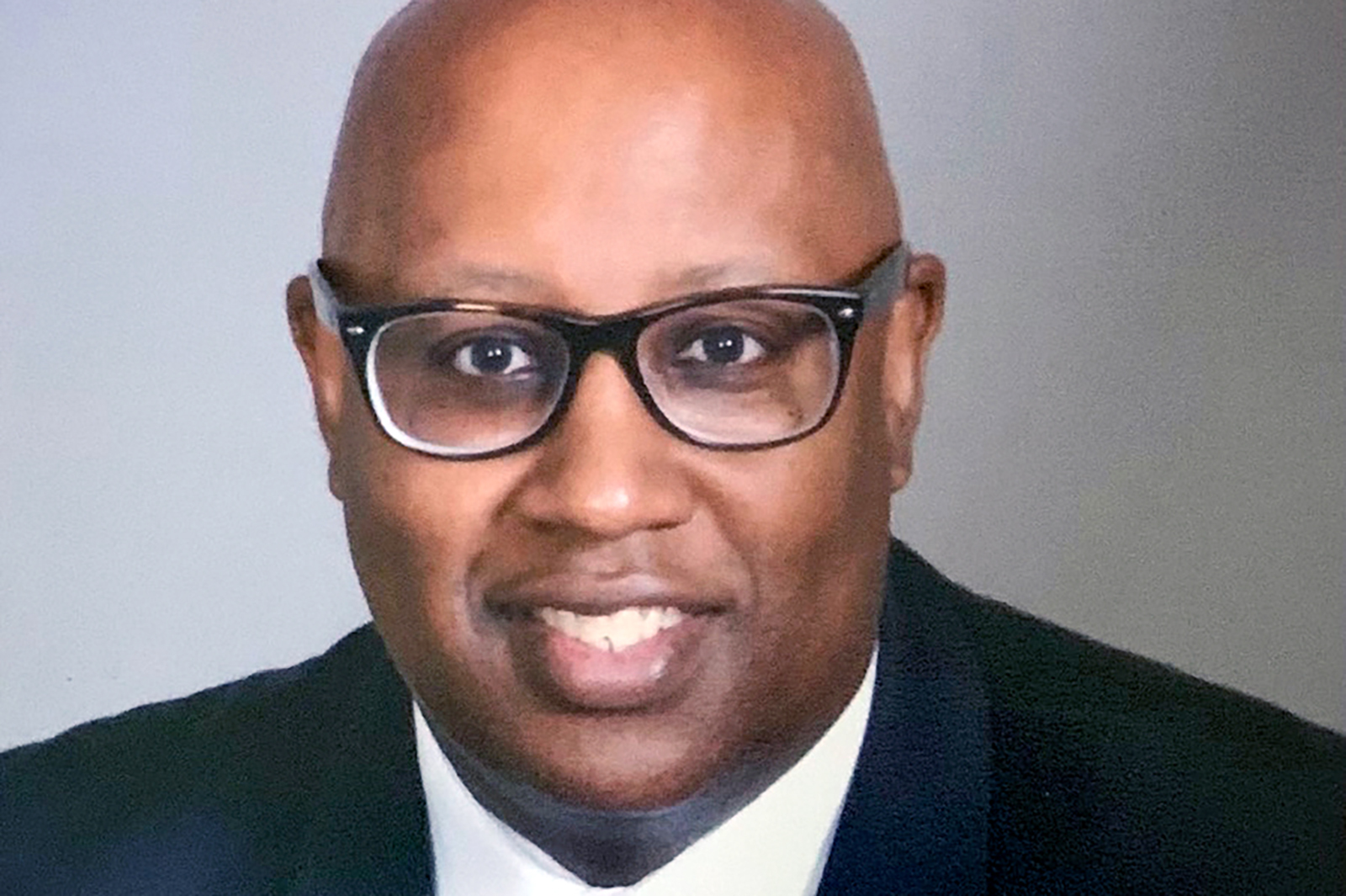
Chris McGinley, newly installed interim superintendent, speaks as solicitor Edward Diasio and board member Daniel Schultz listen Tuesday at the Cheltenham Administration Building in Elkins Park.William Thomas Cain / For The Inquirer
He will be paid $1,500 per business day “for time actually worked” under the contract approved by the board, which specifies that McGinley is not an employee and will not receive benefits.
Cheltenham has not said what it will pay Scriven, who had received a new five-year contract from the board in December. Kaufman said last week that a separation agreement would be negotiated and approved at a future board meeting.
McGinley served as assistant superintendent in Cheltenham from 1999 to 2003. He then became superintendent and led the district until 2006. Two years later, he was named superintendent in Lower Merion, where he worked until leaving to become a professor at Temple in 2014.
In 2017, McGinley was appointed by then-Philadelphia Mayor Jim Kenney to the School Reform Commission, a state-controlled governing body that oversaw the Philadelphia School District. When the SRC dissolved the following year, Kenney named McGinley to the new Philadelphia school board; he served until 2020.
He recently left Temple, where he had worked as policy, organizational, and leadership studies department chair in the university’s College of Education and Human Development.
McGinley began his career in Philadelphia as a special-education teacher, and worked in the district as an elementary and middle school principal, a regional superintendent, and an executive director of leadership development.
Kindergartners, first graders, and second graders in Lower Merion schools will no longer receive personal iPads and laptops, under a policy passed by the school board Monday scaling back on students’ technology use.
The policy — which also specifies that third and fourth graders will not bring computers home and limits fifth and sixth graders’ use of computers at lunch and between classes — follows backlash from parents who have been confronting the board since spring about the use of screens in schools. These parents fault the district for providing their kids with devices they say distract them in the classroom, expose them to dangerous content, and fail to help them learn.
“We heard legitimate concerns and undertook an unusually significant amount of time to really make substantial change,” Anna Shurak, the board’s policy committee chair, said at Monday’s meeting, noting that the district will also give teachers and parents new tools to monitor what kids are doing on their laptops.
“What we actually will see will be much different when students walk into school this fall,” Shurak said.
After parents shouted at the board during a meeting earlier this month, it went into recess and moved the meeting online — and announced late last week that Monday’s meeting would be online only, citing disruptions and “threatening comments posted on social media pages.” The district has banned two parents from school board meetings for a year.
“Over the past several months, Lower Merion school board members and our school district superintendent have been subject to threats, our meetings have sustained disruption over and over, and we have witnessed harassment during our public meetings,” board president Kerry Sautner said at the start of Monday’s meeting, adding that “our school team has had their home and families harassed.”
“This is unacceptable,” Sautner said.
District spokesperson Amy Buckman said that comments posted on the Facebook page for Pencils Over Pixels, the parent group pushing for less technology use, “included calls for both death and doxing of Lower Merion School District leadership.”
The comments “were viewable for approximately 48 hours (and maybe longer),” Buckman said in an email.
In a statement Monday, Pencils Over Pixels said it was “horrified by threatening, violent, or hateful comments directed at board members and district employees.” The group, which has enlisted a public relations firm to help promote its message and has gained national attention, said it did not believe the comments came from its members, and once it became aware of them, “we deleted and reported them.”
The controversy, it said, reflected why the parents have been pushing back on screens in school.
“What chance do children and teenagers have in this toxic digital environment while their brains, judgment, and emotional regulation are still developing?” the group said.
The district is strengthening its filtering system to block kids from inappropriate sites, and parents will be able to restrict what kids can access on their school-issued devices in their homes, Shurak said.
The new technology policy makes clear that “teachers and relationships are central to learning,” Shurak said. “Technology is a tool, not a substitute for instruction.”
Tech changes by grade level
The new policy ends Lower Merion’s practice of giving personal devices to kindergartners, first graders, and second graders.
In the classroom, any use of devices at those grade levels “shall be minimal, highly structured, and limited to specific educational purposes such as diagnostic testing, whole-class demonstration, visual display, or, if applicable, state testing preparation,” the policy says. (Pennsylvania’s standardized tests, which start in third grade, are required to be done online.)
In third and fourth grades, students will have “teacher-directed” access to devices that remain in the classroom, while starting in fifth and sixth grades, kids will be issued individual devices. But they will stay in classrooms unless parents want their kids to bring them home, according to the policy.
By seventh and eighth grades, kids may take their devices to and from school under the policy, though they will not be penalized for not completing any computer-based homework, district officials have said.
The policy describes giving students increased independence with devices to form “responsible digital habits,” preparing high schoolers for college and careers.
Theresa Doggett, a parent of three children in district elementary, middle, and high schools, said the district was making substantial changes.
Because of pushback from parents, “public narrative is making it sound like nothing’s being done,” said Doggett, an administrator at a charter school network in Philadelphia. With help from another parent, she wrote and circulated an open letter to support the board and administrators that read in part: “Enough is enough.”
“We cannot continue creating conditions in which talented educators and leaders spend disproportionate amounts of their time responding to conflict, personal attacks, and the demands of whichever voices are loudest rather than leading our schools,” the letter says, noting high turnover in Lower Merion’s superintendent job.
Questions about implementation
But in comments submitted via chat and read aloud by the district’s solicitor during Monday’s meeting, parents continued to question how the policy would play out in practice.
Some noted the lack of strict limits on screen time. Administrative rules accompanying the policy list guidelines for how much time students should “typically” spend on devices each day: less than 30 minutes for third and fourth grades, 60 minutes for fifth and sixth grades, 90 minutes for seventh and eighth grades, and 120 minutes for high school.
The rules also describe “allowing reasonable flexibility based on educational purpose.”
The policy “leaves devices in my 7-year-old’s classroom and sets no enforceable limit on how long she uses them,” said Akshaya Kumar, a lawyer who teaches at Columbia Law School. She also questioned a separate technology safety policy passed by the board Monday, noting it does not require the district to tell parents what it sees while monitoring student devices.
Michael Post, a physician with two children in the district, said he had “never seen a group of people so adamantly disregard what is happening in front of them.”
“The amount of research and data showing educational technology harms to our children are astronomical,” Post said. He called on the district to form an expert panel to advise it on technology use and “eliminate all technology for elementary and middle school.”
One parent expressed an opposite concern — wondering if children would still be able to take home Chromebooks to do accelerated math, and if her fourth grader would have the same chance to learn how to create PowerPoint presentations as her seventh-grade son.
“Our community does not have one perspective on technology,” Shurak said.
Rebecca Foscolo acknowledges she was “extra spicy” at a Lower Merion school board meeting in June, when the board voted to repeal a policy that let parents like her opt their kids out of school-issued laptops and iPads.
Foscolo, who is part of a group of parents demanding that the affluent Montgomery County district scale back on screens, could not believe the board was moving ahead with the vote, after parents had pleaded for the option to say no to devices they said were imperiling their kids’ ability to learn.
“All these educated people are telling you you are doing something wrong, and you are sitting there and doing nothing,” Foscolo yelled at the board, while seated in a row in the Lower Merion High School auditorium.
Members of the district’s security came up to Foscolo, who left on her own.
Now she is no longer allowed to attend Lower Merion school board meetings in person, for a year.
After a second outburst during a board policy committee meeting on Aug. 3, Foscolo received a letter from the district’s solicitor, informing her she had violated Lower Merion’s civility policy.
A second parent in the Pencils Over Pixels group, David Smyth, said he had received a similar letter after the meeting.
In his Aug. 4 letter to Foscolo, Lower Merion solicitor Kenneth Roos wrote that at both the June 15 and Aug. 3 board meetings, she “displayed disruptive and bullying behavior, including yelling at school board members and administrators while they were conducting board business.” He said her conduct “contributed to the board needing to go into recess prior to the completion of each meeting.”
The district on Friday announced that its meeting on Monday night, when the board is expected to approve a new technology policy, would be virtual only “due to disruptions at two recent meetings,” as well as “threatening comments on social media pages.” It did not say what the social media comments were.
Foscolo, who shouted at the board that “the way you’re responding is ridiculous” after it cut off public comment on Aug. 3 before she had a chance to speak, accused the district of violating her constitutional rights.
“They’re basically just trying to bully me and silence me,” Foscolo said in an interview. She and Smyth were banned from attending school board meetings until June 30, 2027. They can watch meeting live streams and submit written comments, Roos said.
”While we would have preferred that everyone remained calm, and we recognize that the behavior may have been perceived as disruptive, we do not believe banning concerned community members from all future board meetings is an appropriate or productive response,” the group said in a statement.
In another statement, Pencils Over Pixels said it was “disappointed” by the decision to make Monday’s meeting virtual.
Any threatening comments “were not condoned by any member of this group and any threatening language is promptly removed,” the group said.
Is it legal?
First Amendment lawyers said the district’s actions in banning residents could be running afoul of their constitutional rights.
“Unless there’s a threat of violence, there’s really no basis” to ban someone from public meetings, said Sara Rose, deputy legal director of the ACLU of Pennsylvania. A person who is “truly disruptive” can be removed from a meeting, she said, and if the district referred the matter to prosecutors, a court could decide to ban the person.
“But the school district cannot unilaterally tell people they cannot attend future meetings,” Rose said, adding: “I haven’t found a single decision that says that’s permissible.”
The ACLU in November 2024 sued the Souderton Area School District after it banned two parents and a student from school properties, accusing them of threatening a school board member. The parents and student, who were part of a group of demonstrators protesting the board president, said they were wrongly accused, and the district lifted the ban in March 2025.
Melissa Melewsky, media law counsel at the Pennsylvania NewsMedia Association, questioned Lower Merion’s decision to end public comment after 45 minutes during its Aug. 3 policy committee meeting.
While governmentagencies are allowed to have guidelines for how long public comment can last, “there has to be flexibility,” Melewsky said. If there is not enough time to hear every person on a controversial issue, she said, agencies are supposed to schedule another meeting to finish the public comment, and “any proposed action has to be put off as well.”
Asked why the district believed its actions were legal, spokesperson Amy Buckman said that residents “were advised that intentionally disrupting a lawful meeting or the administration of a government function is a criminal offense in Pennsylvania.”
She noted the board’s policy for committee meetings includes a 45-minute time limit for public comment on agenda items, “unless extended by the board for special circumstances.”
Pencils Over Pixels said its members had been “assured by the board that the Aug. 3 meeting would be an opportunity to engage with the policy committee” and receive feedback to their questions about the district’s new technology policy.
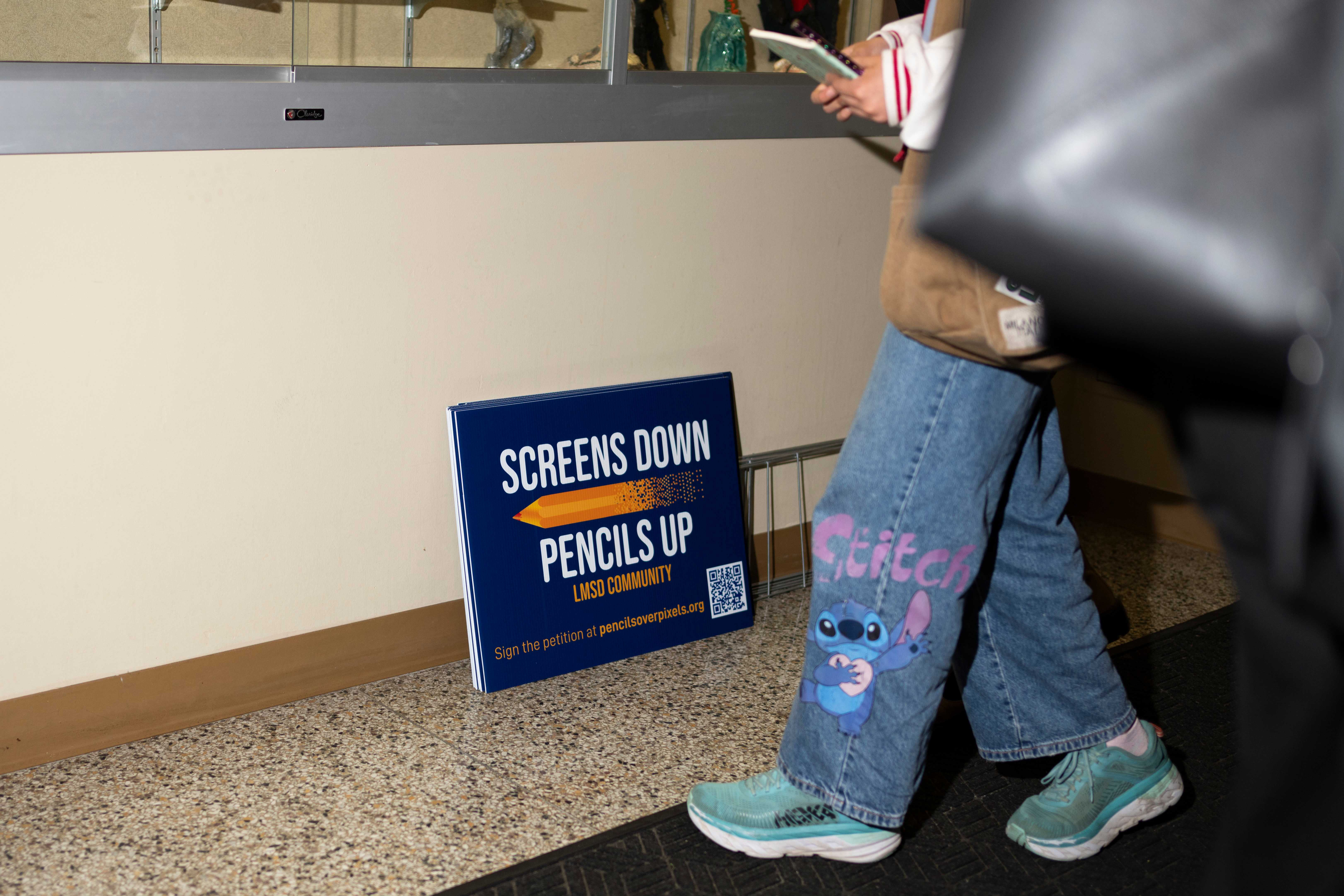
Signs reading, “Screens down, pencils up,” are seen a school board meeting at the Lower Merion School District Administration Building on Monday, May 11, 2026, in Ardmore, Pa. (AP Photo/Joe Lamberti)Joe Lamberti
While Pencils Over Pixels said it had urged its members to remain “calm and professional,” some “were rightfully upset that they were unable to engage in dialogue with the committee as promised,” the group said. “Unfortunately, their emotions governed their behavior.”
Frustrations around tech use
Lower Merion parents have been appearing before the board to complain about school technology use since the spring, describing kids focused on gaming or visiting inappropriate websites instead of doing schoolwork. Others have criticized the district’s use of educational technology programs as low quality, and say they do not want their kids doing reading and math on computers. Hundreds of parents signed a petition in favor of opting out of computers.
The district, which has said it is not possible to opt out of technology use, rescinded its policy allowing for that option and has been moving forward with a new version that places more limits on screens.
Under the policy, which the board is expected to vote on Monday, kindergartners and first and second graders will no longer be issued personal devices, while third and fourth graders will have personal logins to computers in the classroom. The policy includes new guidelines for screen time by grade, and district officials say there will also be new tools for teachers and parents to monitor kids’ internet usage.
Parents pushing for stricter limits have called for the district to release its contracts with educational technology companies and data on how long students are on screens during the school day.
They also want more say in how technology is used, including through the creation of a committee to review the district’s educational technology programs.
“They’ve not been really having good-faith personal conversations,” Smyth, who has a seventh and an eighth grader, said of the board.
Smyth, who went up to the microphone after the board said that public comment was over Aug. 3 and called on the board to answer how many speakers remained, said in an interview he was “only disruptive to insist on continuing public comment.”
Foscolo, who has a rising first grader and a 3-year-old, said that while she had previously addressed the board about the technology policy and had met with several board members, she had repeatedly asked to meet with the board’s president, Kerry Sautner, and the policy committee chair, Anna Shurak.
When Sautner responded, she told Foscolo to come to the Aug. 3 meeting, Foscolo said. She was frustrated she was not able to speak then.
To Foscolo, the board appears to be “placating” parents who have concerns about technology, rather than having genuine debate.
“You have a bunch of parents who want to help, and you’re like, ‘Don’t talk,’” she said.
Kensington High School students and staff are being relocated to the vacant Austin Meehan school building through the end of the calendar year, after an asbestos “concern” arose during an HVAC project, Philadelphia school district officials said.
While workers were installing a new heating and cooling system, “an asbestos inspector identified a concern about the demolition of the old system,” Oz Hill, the district’s deputy superintendent of operations, said in a letter to the high school community Thursday — a little more than a week before the new school year begins Aug. 24.
Hill said the district “immediately stopped the project and has been working cooperatively with the city’s Air Management Services and the Philadelphia Federation of Teachers while the building is thoroughly cleaned and air quality tests are conducted to show the space meets standards to be reopened.”
Arthur Steinberg, president of the PFT, said he was told that “a contractor broke into some space … disturbed some asbestos, and tracked it all over the building.”
“That essentially contaminated the entire building, by them moving around after the asbestos material was disturbed,” Steinberg said in an interview Friday.
Steinberg said the relocation to Austin Meehan, a vacant middle school in Northeast Philadelphia, would mean “turmoil.”
Austin Meehan, which closed in 2022, is more than seven miles away from Kensington High School.
In the message, Hill said the district had considered closer options, but they “did not meet the space or accessibility needs for Kensington’s more than 400 students and 90 staff.” He said “details about the schedule, transportation, and all logistics will be forthcoming.”
A district spokesperson did not immediately respond to a request for comment Friday.
Steinberg said the relocation “creates logistical nightmares for everybody,” with new commutes for staff and families.
“But it’s better than trying to make them occupy a building that’s contaminated with damaged asbestos,” Steinberg said. He said the PFT will be on site as Kensington staff report to Austin Meehan Monday to hear and address concerns.
The PFT also has an occupational hygienist at Kensington High School supervising the district’s work, to ensure the asbestos is properly cleaned up and tested, Steinberg said.
The union “will ensure that building is suitable for occupancy, or our members will not go back in,” he said.
Hill said the district “will also work to address other Kensington building needs, including maintenance repairs and the continued proactive removal of asbestos materials where we can minimize future risk of damage.”
“When Kensington students and staff return to the building in January, they will be welcomed back to a healthy, more comfortable space for learning,” Hill said.
The board announced new leadership — with plans to appoint veteran educator Chris McGinley as interim superintendent — and an independent review of district policies, with recommendations to follow in 60 days.
But questions remain about how the board will respond to the district’s alleged mishandling of the situation, including by employees faulted in a grand jury report. Parents on Tuesday, including some who have alleged the district’s safety problems extend beyond the football program, voiced skepticism of the board’s promises.
The district will pay former Superintendent Brian Scriven, who resigned last week, as part of a separation agreement, according to a spokesperson, but terms have not been disclosed.
Here is what happens next as the board deals with the aftermath of the criminal charges announced two weeks ago, and the lack of confidence expressed by community members:
A former superintendent returns
The board said it plans to tap McGinley, a longtime educator who served as Cheltenham’s superintendent in the early 2000s, to lead the district following Scriven’s resignation.
McGinley, who more recently worked as an education professor at Temple University, will be appointed by the board at a special meeting Tuesday at 6:30 p.m., district spokesperson Kevin Kaufman said Thursday.
Chris McGinley, center, and Angela McIver, right, at a meeting of the Philadelphia Board of Education on Jan. 30, 2020.Charles Fox / Staff Photographer
McGinley, who began his education career as a teacher in Philadelphia, joined Cheltenham in 1999 as an assistant superintendent, where he oversaw efforts to address the district’s racial achievement gap. He then became Cheltenham superintendent, leaving the district in 2006 before becoming superintendent two years later in Lower Merion, which he led through 2014.
McGinley then served on the Philadelphia School Reform Commission, which oversaw the city’s schools while they were under state control. He was later named to the Philadelphia school board by former Mayor Jim Kenney, leaving the board in 2020.
McGinley could not be reached for comment Wednesday.
Scriven had received a new five-year contract in December. Kaufman said in an email Thursday that “the terms and conditions of Dr. Scriven’s separation agreement will be negotiated (in accordance with Dr. Scriven’s contract and applicable law) and approved publicly at a future meeting.”
An outside lawyer’s review
The board has enlisted Leigh Dalton, an education attorney based in York, Pa., with the Saxton & Stump firm, to review its policies and procedures and produce recommendations to the board in 60 days.
Board president Leah Mulhearn said Tuesday that the review would “include consideration of the grand jury’s findings and how to address them.”
None of those findings were discussed by the board Tuesday. In a scathing report accompanying the recommendation of criminal charges, the grand jury accused the district of “incompetence” while describing the actions of three employees at the high school.
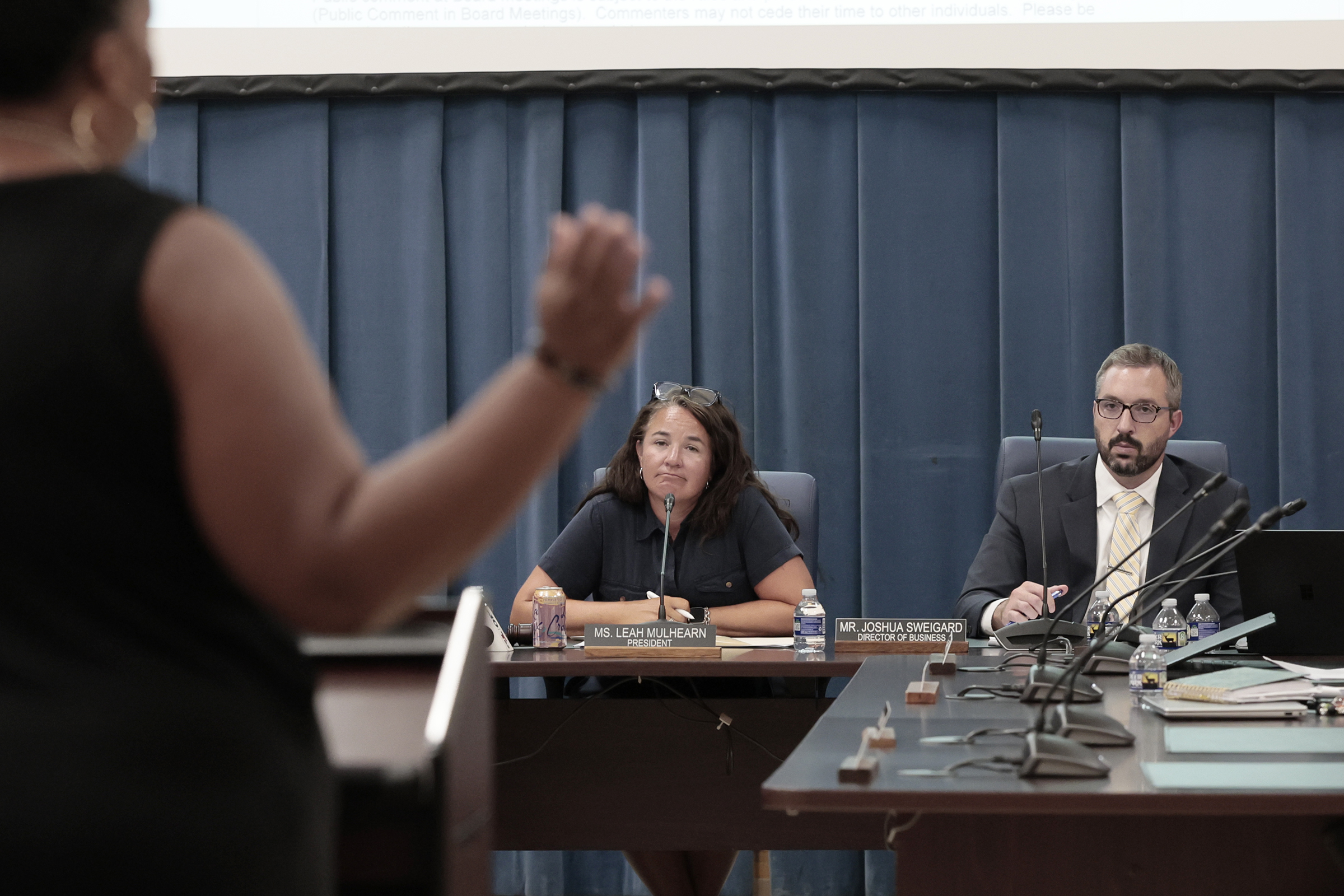
Taryn Knox (left) speaks to School Board President Leah Mulhearn and Director of Business Joshua Sweigard during the Cheltenham School Board meeting in Elkins Park on Tuesday, August 11, 2026. The school board was meeting for the first time since criminal charges against four football coaches and six players were announced, and since Brian Scriven resigned as superintendent. .Elizabeth Robertson / Staff Photographer
The trio — labeled in the report only as Employees #1, #2, and #3 — texted one another after the mother of the 15-year-old victim reported her son’s assault on Sept. 7. One said the student had a “chip on his shoulder” from not making varsity and said he had steered the mother away from coming to the high school in person.
The employees also indicated they trusted the head coach, Terence Tolbert, and did not believe the mother that Tolbert — who, along with three other coaches, has since been charged with conspiracy and endangering the welfare of a child — had instructed the victim not to tell his parents what had happened. The report said the district then included Tolbert in its investigation.
Asked about the status of the three employees, Kaufman said Thursday that the district “doesn’t comment on specific personnel matters.”
On Thursday, Cheltenham High School principal Benjamin Hammond informed families that Mark Hoff, who was vice principal at the high school last year but had been reassigned to Wyncote Elementary in July, would be returning to the high school this fall.
“Due to the heightened environment about student safety and culture, and acknowledging community concerns, the district has decided to continue Mark Hoff’s assignment as vice principal at Cheltenham High School,” Hammond said in a message to families, adding that Hoff would “provide stability this upcoming school year.”
“While communications between counsel are privileged, the board does intend to report out on the recommendations that she makes where appropriate,” Kaufman said.
Football is still canceled
The board will also be reviewing all athletic programs, “top to bottom,” Mulhearn said. And there is no timetable for when football, which the district already canceled in May, will resume.
“Football will not return until we address this, no matter how long it takes,” Mulhearn said.
Safety changes
Mulhearn said some safety changes were already underway. The district is “ensuring that all staff members have current criminal history and child abuse clearances on file,” she said. The grand jury report had said that at least five of the district’s football coaches last year were not up to date on clearances related to child abuse reporting requirements.
She also said the district was “communicating and reinforcing coach expectations and plans for improved locker-room supervision.” While there was an office in the football locker room, coaches did not use it last season, leaving players unsupervised, according to the grand jury report.
Cheltenham has “begun implementing” recommendations from an audit by the Center for Safe Schools, Mulhearn said. She also said the board had retained the Bucks County Intermediate Unit “to audit our human resources function.”
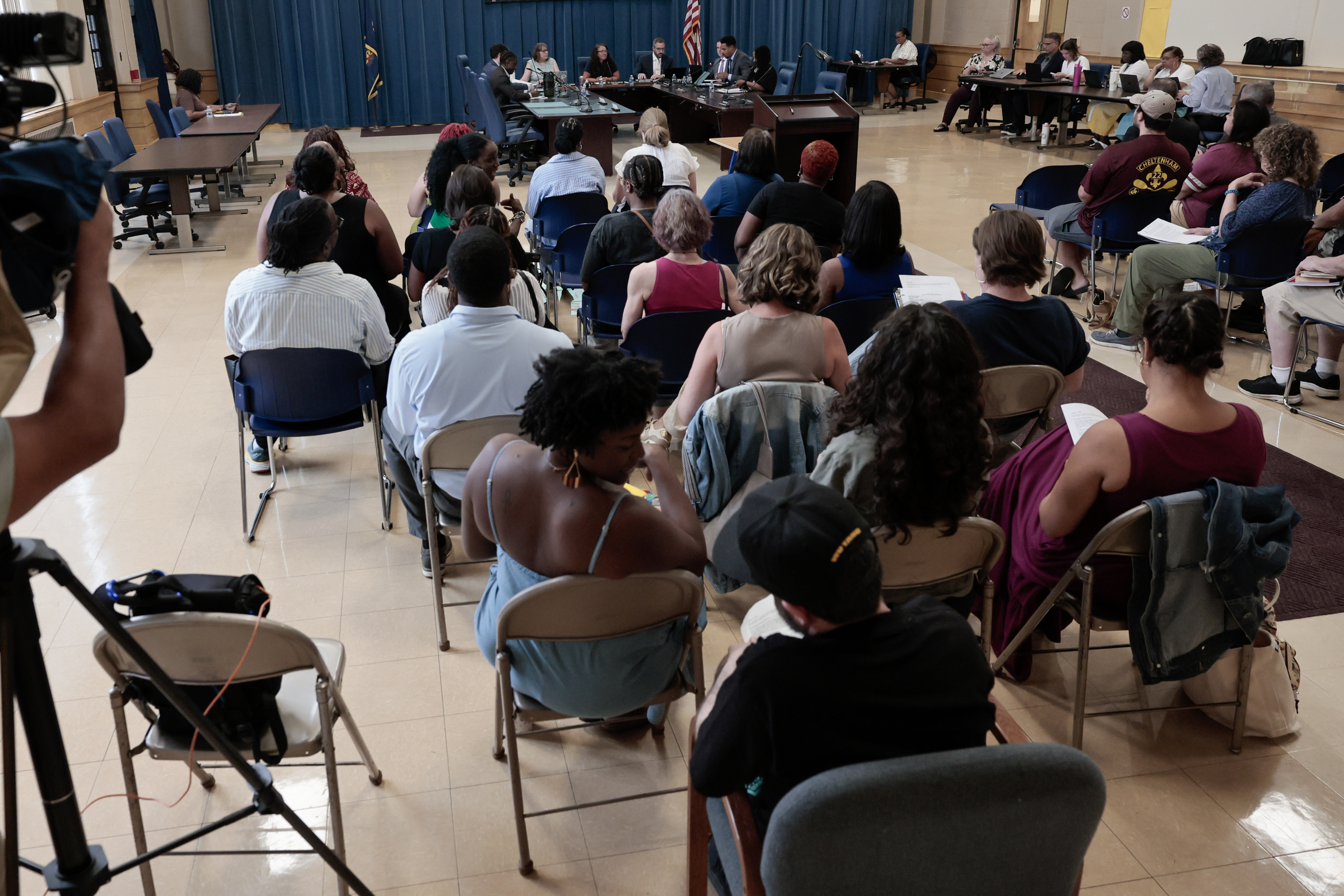
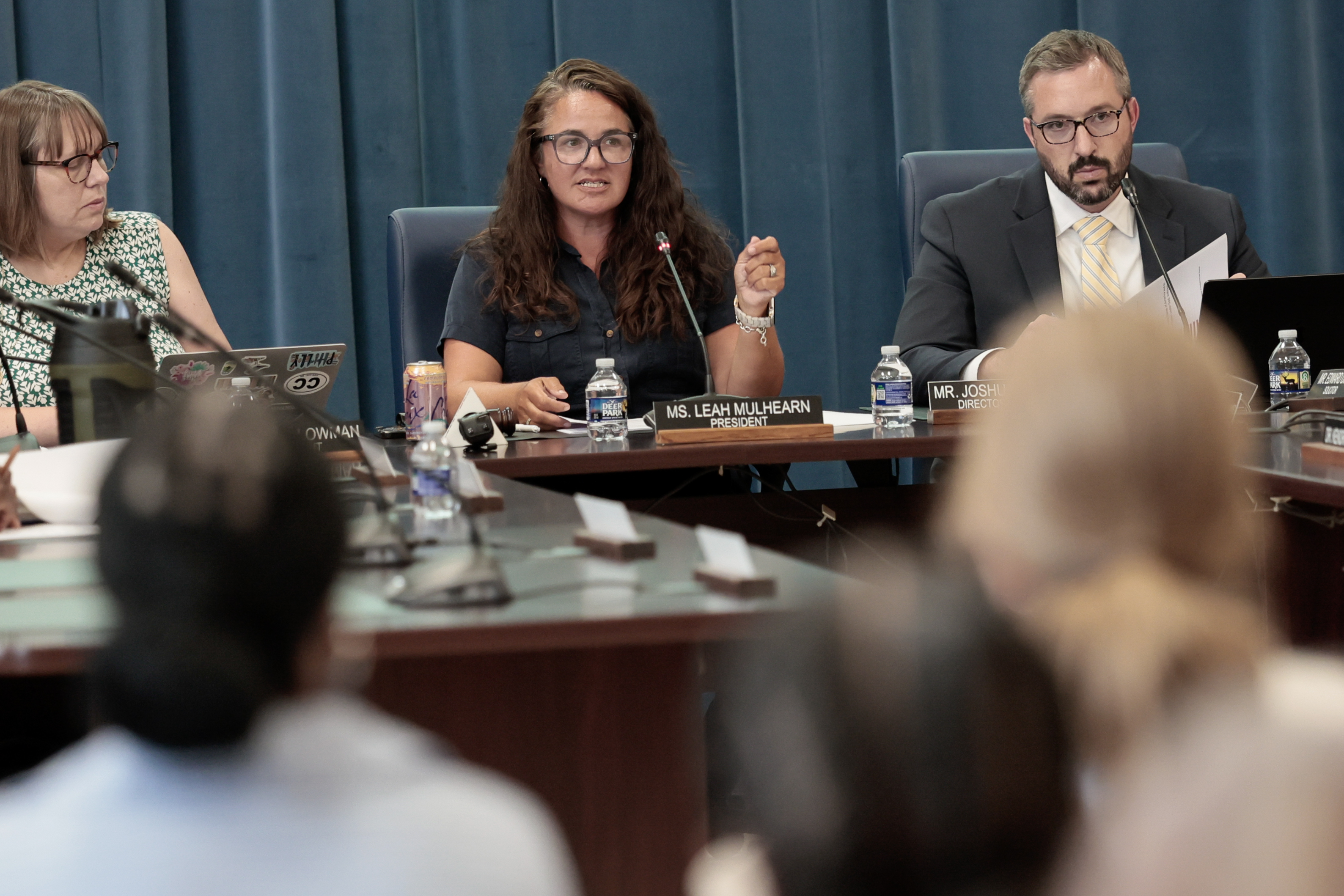
The Cheltenham school board meeting Tuesday, Aug. 11, 2026, in Elkins Park.Elizabeth Robertson / Staff Photographer
The criminal cases
Three coaches and the two players charged as adults by the Montgomery County District Attorney’s Office will face a district judge at a preliminary hearing scheduled for Aug. 27. (Ralph Burnley, the fourth coach charged, has not yet been arraigned in the case, and there is no indication he has hired an attorney. He did not respond to a request for comment.)
The four players charged as juveniles will face separate proceedings in juvenile court that are not open to the public.
At the preliminary hearing for the other defendants, prosecutors will present evidence to the judge to support the charges through witnesses. Defense attorneys will be given the opportunity to cross-examine those witnesses and make arguments to the judge for their clients’ innocence.
After the hearing, the judge will determine whether the prosecution has proved the validity of the charges and, if so, will send the cases to county court.
Staff writer Jess Rohan contributed to this article.
The Cheltenham school board said it would review safety procedures and assess the culture in all of its athletic programs as it pledged to rebuild community trust after an explosive grand jury report condemned the district’s response to the assaults of a football player last season in a high school locker room.
The attacks on the 15-year-old, which took place in August and September 2025, “arose in the context of a culture of intimidation and acceptance of violence,” board president Leah Mulhearn said Tuesday night at the board’s first meeting since criminal charges were announced against four coaches and six players.
Mulhearn, who also announced that veteran educator Chris McGinley would be tapped as interim superintendent, promised the board would move quickly to fix problems.
The district already canceled the 2026 football season in May. “Football will not return until we address this, no matter how long it takes,” Mulhearn said.
Parents, who lined up behind a microphone in the district’s administration building awaiting their turn to speak, expressed skepticism and demanded more from the board after a grand jury report accused the district of endangering students through a failed response to the assaults, one of which was captured on video.
In emotional comments, some parents said their children had been assaulted in the schools, while others questioned how they could believe the board, when they had warned against hiring a coach who has since been charged with conspiracy and endangering the welfare of a child.
“We entrusted our children to this district,” said Chowan Cowans, who withdrew her son, a rising senior and former Cheltenham football player, because “I don’t feel safe with him being there anymore.”
Cowans accused the district of a lack of transparency, which “has to mean something when the truth is uncomfortable,” she said.
PTO president Stephanie Curry (center) waits in line to speak during the Cheltenham School Board meeting in Elkins Park on Tuesday, August 11, 2026. The school board was meeting for the first time since criminal charges against four football coaches and six players were announced, and since Brian Scriven resigned as superintendent. .Elizabeth Robertson / Staff Photographer
Employees at the high school appeared to minimize the Sept. 3 assault after it was reported to them by the 15-year-old victim’s mother, according to the grand jury report. They also took the head coach, Terence Tolbert, at his word that he had not instructed the player not to tell his parents what happened, and they included the coach in their investigation — which failed to uncover that there were two assaults, the report said.
It also noted that employees were also confused about their mandatory reporting requirements.
On Tuesday, Mulhearn said that while the board “may differ with the grand jury with respect to some of its findings about how the district and board responded, the hard truth is that we must acknowledge that mistakes were made.”
Mulhearn said the board would “move with deliberate speed to address these issues.” She said the board would enlist an outside attorney, Leigh Dalton — who was hired by the Central Bucks School District last year to investigate special-education abuse allegations — to review the district’s policies and procedures and make recommendations within 60 days.
She did not comment on Superintendent Brian Scriven’s resignation last week. Some parents questioned whether and when the board’s position on Scriven had shifted, after the board praised the superintendent’s leadership in May.
A district spokesperson did not respond to a question this week about whether Scriven, who received a new five-year contract in December, would receive any payout following his resignation.
Nor did the board indicate whether it was considering taking action against any employees at the high school. One parent, for instance, asked whether Mark Hoff, the former vice principal at Cheltenham High School, would still become the vice principal at Wyncote Elementary, in light of the grand jury report faulting high school employees.
Taryn Knox (left) speaks to School Board President Leah Mulhearn and Director of Business Joshua Sweigard during the Cheltenham School Board meeting in Elkins Park on Tuesday, August 11, 2026. The school board was meeting for the first time since criminal charges against four football coaches and six players were announced, and since Brian Scriven resigned as superintendent. .Elizabeth Robertson / Staff Photographer
The board, which appointed director of business services Joshua Sweigard acting superintendent on Tuesday, will hold a special meeting next week to appoint McGinley as interim superintendent, Mulhearn said. McGinley previously led both the Cheltenham and Lower Merion districts and more recently served on the Philadelphia School Reform Commission and Philadelphia school board. His most recent position was as the faculty program coordinator of the Educational Leadership and Policy program at Temple University.
Parents’ pleas
Parents urged the board to commit to more steps. In a joint statement, the United Parents Group, the Special Education Alliance of Cheltenham, and the Cheltenham African American Alliance called for numerous actions, including a community town hall ahead of the first day of school and an assembly on the first day “to enforce a zero-tolerance policy regarding sexual harassment, bullying and hazing.” They also called for safety data to be a part of every school board meeting.
“We are demanding a fundamental shift in how our school district operates,” Aubria Nance, reading from the groups’ joint statement, told the board.
“Every time I hear a commitment to our students’ safety, I want to see the proof,” said Erin Fadako, a parent at the school.
The Inquirer reported last week that some football parents had urged the district not to hire Tolbert, saying he had allowed bullying while previously serving as head coach in Abington, where he left after one season.
“Everyone from the administration on down that has failed these students, you all have approved them to be hired here,” said Taryn Knox, who was among the football parents who had asked the district not to hire Tolbert.
After a year of negative news coverage, Knox said, “we’re now about to go into the next school year, and the news is still here.”
The Cheltenham school board meeting Tuesday, Aug. 11, 2026, in Elkins Park.Elizabeth Robertson / Staff Photographer
As they voiced their frustration, parents pleaded with the board to make real changes.
“Stop being risk averse and do what you need to do to make it safe for our children,” said Stephanie Curry, president of the high school’s parent teacher organization. “Our kids are the ones that are suffering.”
“This year has tested our community in ways none of us anticipated,” Scriven said in a resignation letter released by the district. “I have come to believe that the district is best served by a fresh start under new leadership, and that stepping aside now is the right and necessary step to allow Cheltenham to move forward.”
The resignation is effective immediately.
“The board has accepted Dr. Scriven’s resignation, and we thank him for his dedicated service to Cheltenham public schools,” school board president Leah Mulhearn said in a statement. She said Cheltenham’s director of business services, Joshua Sweigard, would serve as acting superintendent, pending a vote by the board at its next meeting Tuesday.
After canceling last year’s football season in October amid hazing allegations, the Montgomery County district announced in January that an investigation it commissioned had concluded that a “student-on-student” assault occurred on Sept. 3, witnessed by nearly 20 students.
The district failed to uncover that an earlier assault had occurred in August, Montgomery County prosecutors said. A grand jury report characterized the district’s investigation as flawed from the beginning, saying employees were dismissive when the 15-year-old victim’s mother reported on Sept. 7 that he’d been assaulted, and had wrongly taken the team’s head coach, Terence Tolbert, at his word that he didn’t instruct the boy not to tell his parents.
The employees included Tolbert. who was among the coaches charged with endangering the welfare of a child and conspiracy, “in every step” of their investigation, according to the report.
Scriven responded in a statement last week, saying that Tolbert wasn’t involved in planning the investigation. The superintendent said that “every report brought to the district’s attention was addressed based on the information available at the time.”
He didn’t respond to a number of questions about other failures alleged by the grand jury, including that employees were confused about mandatory reporting requirements, and that five football coaches lacked state-required clearances for completing training on reporting child abuse.
Football parents have also expressed frustration with the district’s response to the assaults, which also led to the cancellation of the upcoming season. Some told the Inquirer this week they urged Cheltenham not to hire Tolbert due to alleged bullying during his tenure as Abington’s coach.
In May, the school board had expressed its support for Scriven, sending a community message that acknowledged “concerns around safety and student conduct” that had challenged the district.
“Five years ago, the board invested in Dr. Scriven and his vision for the district. We continue to support him and his vision. He is a strong strategic thinker,” the board said in the May statement.
“Serving this district has been one of the greatest privileges of my life,” Scriven said in his resignation letter Thursday. He said he was “deeply proud of the work we accomplished together, and I remain hopeful for Cheltenham’s continued success.”
Editor’s note: This story has been updated to correct the year that Brian Scriven graduated from Cheltenham High School. He graduated in 1983.
Cheltenham Superintendent Brian Scriven resigned Thursday, a little more than a week after prosecutors charged four football coaches and six players in connection with violent assaults against a player last season in a high school locker room.
The superintendent’s resignation, effective immediately, came amid community outcry over the district’s handling of the August and September 2025 incidents, which prosecutors say both involved students attacking a 15-year-old and using a broomstick to poke at his buttocks.
Yet the district did not uncover that there had been two assaults, and administrators appeared to downplay a report from the 15-year-old’s mother, according to the Montgomery County grand jury that recommended the charges. It described a “level of incompetence” in the district that “put every young man on the football team at risk.”
Some parents who have been battling the district to take student safety more seriously said Scriven and his administration did not fail only in overseeing the football program.
“I see a complete lack of urgency,” said one mother who has been among a group of parents pressing the district since October to address violent incidents at Cheltenham Elementary School. The mother, who spoke on the condition of anonymity out of fear of retaliation for her child, said administrators still have not answered questions about how students are disciplined and how others are supported after assaults.
Another Cheltenham Elementary parent, Shanyl Jones, said her daughter, an incoming second grader, twice experienced sexual touching and comments in school. In kindergarten, a boy repeatedly touched her against her will, conduct that escalated to him grabbing her vagina, Jones said.
The boy also made sexually explicit comments to her daughter, Jones said. She reported the conduct and filed a Title IX sexual harassment case; the school moved the boy to a different classroom, she said.
After a separate boy made sexual comments to Jones’ daughter in first grade, the principal called Jones and apologized, though the boy was not moved to a different classroom, Jones said.
News of the football charges “just tore me up on what my daughter’s future would be in the school system,” Jones said. “It gave me no assurance they’re going to be able to reconcile what’s happening now.”
Scriven said in his resignation letter Thursday that “this year has tested our community in ways none of us anticipated.”
“I have come to believe that the district is best served by a fresh start under new leadership, and that stepping aside now is the right and necessary step to allow Cheltenham to move forward,” he said.
The district has not commented on how else it plans to respond to the explosive grand jury report released last week, which described the response of several employees at the high school — identified only as Employees #1, #2, and #3 — as minimizing an assault reported by the 15-year-old’s mother, and trusting the word of the head coach, Terence Tolbert, that he had not instructed the student not to tell his parents what happened.
The district did not respond to questions this week about its hiring of Tolbert — who was among the four coaches charged — including whether it had sought references from Abington, which cut ties with him after one year as its head football coach. Some parents of football players told The Inquirer they had “pleaded” with Cheltenham administrators not to hire Tolbert, whom they accused of allowing bullying during his tenure at Abington Senior High School.
Nor did the district respond to questions about whether it would take action against any employees, including those described in the grand jury report.
The Cheltenham High School vice principal whom the mother said she had reported allegations to, Mark Hoff, was named vice principal at Wyncote Elementary last month.
The grand jury report “details very troubling questions about the management and operation of the district’s athletic programs, including the football program,” school board president Leah Mulhearn said in a statement this week. “Our highest priority is the safety and welfare of the children we serve.”
Mulhearn, who did not address questions about Cheltenham Elementary in the statement, said the board was “focused on conducting a comprehensive review of the grand jury’s findings, including our policies and practices related to athletics, as the first step in implementing measures to ensure that no such conduct ever occurs again at our schools.”
The district has said a Title IX investigation into the allegations will soon be finished, with possible discipline for students. Two 18-year-old players charged as adults — the other four were charged as juveniles — have already graduated.
Community members are closely watching the school board’s next steps. Sharif El-Mekki, a nationally known Philadelphia-based educator who runs the Center for Black Educator Development and previously led Mastery Shoemaker Charter School, called on the school board in a letter to apologize to the victimized student and commission an independent investigation into the district administration’s conduct.
“Every student in Cheltenham, every teacher, every parent, and every young leader in Montgomery County is being taught something right now by how the district is responding,” El-Mekki said.
‘Environment of ongoing chaos’
Cheltenham Elementary parents said they raised concerns to administrators last October, after they heard from their children that a student touched another student’s penis sexually in class, over his clothes, in view of classmates.
Some initially did not believe it. “We would have been told about it,” said one mother, who also spoke on the condition of anonymity out of fear of retaliation against her child.
Parents began talking to one another to confirm what happened. Other parents and students told them the same child had been involved in previous sexual incidents, two mothers said.
A group of parents sent an email on Oct. 3 to ShaVon Savage, then the district’s assistant superintendent, saying they had recently learned that a student “touched another child sexually during class time” and that the child had been involved in “multiple sexual incidents over the past few years.” They asked to be notified about instances of physical or sexual assault.
In the email, shared with The Inquirer, they also asked for additional supervision and counseling for students with behavioral challenges and described an “environment of ongoing chaos” at the school, which last year served a larger number of students with emotional support needs than the district’s other three elementary schools.
Savage wrote back 10 days later, saying she needed more details “to conduct a full and thorough investigation,” according to an email shared with The Inquirer. She also said that when a situation poses a “threat to a particular school community,” the district would communicate with parents, but could not share details about particular children due to federal privacy laws.
Savage met with some parents in early November and said she would visit the school — though parents were unsure whether she did, the mothers said.
Their concerns escalated when on Dec. 5, a Friday, the school’s principal, Stephanie Junod, was assaulted by a student, according to the mothers.
That night, Scriven, the superintendent, sent an email to school parents, informing them that “while Ms. Junod was attempting to de-escalate a situation with a high-needs student, she was struck in the head by their thermos.” Scriven said the principal was “expected to make a full recovery.” Junod could not be reached for comment.
Scriven said central office staff would be at the school the following Monday “to begin implementing additional measures to strengthen safety and provide more comprehensive support for students who require additional behavioral interventions.”
Brian Scriven has resigned as superintendent of the Cheltenham School District.Courtesy of Cheltenham School District
The mothers were angry that the district had not already been providing that support. Around the same time as Junod’s injury, they said, there was an assault on a student, and “at least two” against staff members, one of the mothers said.
Parents had a meeting scheduled with Savage for Dec. 15, but administrators pushed it to January, one of the mothers said.
Scriven met with parents on Jan. 8 and apologized for not treating their concerns urgently enough, according to the mother, who said Scriven also assured parents that “the football situation had been handled.”
“Obviously, that was a lie,” she said.
Scriven met with them again on Feb. 25 and said changes would be made, including putting a behavioral specialist at the school four days a week, according to the mother.
Scriven did not mention that Junod would be resigning, the mother said — a decision announced shortly after the meeting.
‘Slow to respond’
Problems at the school continued.
On March 26, parents said, a student assaulted five staff members — including punching one in the face — in view of other children. Police came to the school.
The district did not immediately notify parents. But Scriven sent an email to the school community the next day, reporting that “an emotional support student had an episode during which he eloped from the building and engaged in physical altercations with a number of staff as they were trying to de-escalate” the situation.
“While I cannot share individual student consequences or placements, I can assure you that this situation is being addressed with the highest level of seriousness and urgency,” Scriven said in the email.
In an email the next day demanding a meeting with administrators, one parent wrote: “The frustration among parents has reached a boiling point.”
“Information is simply not being shared, and critical questions regarding the safety and education of our children are being ignored,” the parent said in the email, which one of the mothers shared with The Inquirer.
Scriven responded to the parents on April 14.
“I understand the urgency of your concerns and sincerely apologize for the delay in providing a comprehensive response,” Scriven said, in an email the mother shared with The Inquirer.
Scriven said the school’s new principal, Shareese Nelson, had needed time to settle into the job, but “we are prepared to move forward in a more formal and collaborative manner.” He invited families to the school for an April 29 community meeting.
The meeting was “highly emotional,” one of the mothers said, with parents sharing their children’s experiences. After the meeting, Scriven told a 6abc reporter: “I was slow to respond. I do have to own that, and rectify that immediately.”
Shanyl Jones recalled that administrators seemed “completely unprepared” during the meeting to address parents’ safety concerns.
In a message to the community May 6, the school board acknowledged “concerns around safety and student conduct have presented challenges that we continue to navigate.”
The board said it took “all concerns that are raised with us as a board” seriously and was paying attention to how they were addressed.
It also stood by Scriven, a former Baltimore County Public Schools administrator who was named Cheltenham’s superintendent in 2021.
“Five years ago, the board invested in Dr. Scriven and his vision for the district,” the board said, calling the superintendent a “strong strategic thinker.”
“We continue to support him and his vision,” it said.
On Thursday, Mulhearn said in a statement that the board thanked Scriven “for his dedicated service to Cheltenham public schools.” She said the board had selected Joshua Sweigard, Cheltenham’s director of business services, as acting superintendent.
While the district in May released an action plan for Cheltenham Elementary, including a safety audit, staff training, and monthly reports on school incidents, the mothers said it still has not clearly explained how it handles student assaults, and how kids who are victimized or witness them are supported.
Until it does, “beginning from kindergarten up, we are not going to see this change in any meaningful way,” one of the mothers said. “This is not a one-off event.”
A Lower Merion school board committee on Monday advanced new rules on when screens should be used in classrooms, while facing anger from parents who want more limits on technology.
The policy committee, which has been hammering out a technology policy after parental backlash to excessive screen time, went into recess and later shut down its meeting in the district’s administrative offices in response to shouts from people in the crowd.
“When you are disrupting a public meeting, you are actually breaking the law,” school board president Kerry Sautner said, as a parent in the crowd, David Smyth, called on the committee, which had stopped public comment after 45 minutes, to allow more people to speak.
Sautner — who said earlier that 45 minutes was typical for the committee’s public comment period — told Smyth he could leave, or stay and listen. When he answered that he wanted more public comment, the committee ended the in-person meeting and switched to Zoom to vote to advance the policy.
Lower Merion’s proposed policy scales back on screens for the youngest students — specifying that kids in kindergarten and first and second grades will not be issued individual devices. Previously, kindergartners and first graders were given iPads, while second graders received Chromebooks.
“Many of you came and said, ‘I don’t think my kindergartener needs a one-to-one device.’ I don’t disagree with you,” Superintendent Frank Ranelli said at Monday’s meeting.
Under the proposed policy, any technology use for K-2 students “shall be minimal, highly structured, and limited to specific educational purposes.”
Students in third and fourth grades will not have personal devices, but will have “an assigned log-in” that they can use to access computers on classroom carts, according to a district spokesperson, Amy Buckman.
In grades five and six, students will be assigned devices but will not bring them home unless their parents want them to, Ranelli said.
While bringing computers home becomes the default by seventh and eighth grade, Ranelli said, students who choose not to do so will not be penalized.
But, the superintendent said, families “cannot decline technology” in the new policy — a bitter point of contention throughout school board debates earlier this year, as families demanded to opt out of devices.
At Monday’s meeting, Matthew Posey, a district parent, read from an April 9 email obtained through a Right-to-Know request, indicating that Ranelli had “instructed” Sautner to repeal the policy, according to Posey.
“We also want to make sure … that the board sees the vision in not allowing parents to totally ‘opt out’ of getting a device and having to use it for part of our curriculum,” Ranelli wrote, describing the district’s response to parental concerns.
Replying the next day, Sautner told Ranelli: “Got it.”
“We do not pay premium local taxes to have this insulting, rubber-stamp school board governance,” Posey said. He accused the board of treating months of public meetings over technology use as “an inconvenience to be managed,” rather than a genuine consideration of parental concerns.
Sautner said that she would have to review the email Posey mentioned, but that she sometimes responds “got it” to indicate she has received a message.
“We hold the superintendent accountable,” she said. “It is literally our job as the board.”
Parents pressed the committee for answers Monday on how the policy would work in practice. Ranelli said the district had been training principals in a “default to off” philosophy, to instruct their teachers to tell students that if they are not actively using their computers for an activity, “we want your screens to be down. Or we don’t want them at their desks.”
While rules accompanying the policy include some guidelines for how much screen time kids should be getting each day — from 30-45 minutes in third and fourth grades to up to 90 minutes in fifth through eighth grades — there are no parameters for high school.
School officials said that was too difficult, given how many classes high school students have in a given day.
“I want to make sure we’re not handcuffing the teachers,” Ranelli said.
Ranelli also said the district had stepped up efforts to block inappropriate websites, including all Google sites, which kids had used to play games, he said. It has also blocked all streaming services and AI summaries, Ranelli said.
He said the district — and parents — would be able to better monitor kids’ online activity through a new Securly program, which allows teachers to monitor what kids are looking at in class. Parents, meanwhile, can block more categories of websites and set schedules for their kids’ devices out of school hours, Ranelli said.
Smyth, the parent whose interruptions led the board to end the meeting, said in an interview that parents feel like board members are “checking a box and not really interested” in their comments.
“In our mind, the big sin is really one-to-one devices,” said Smyth, who has children in seventh and eighth grade. He had planned to ask if the district will be tracking time spent by students on various computer programs — to set metrics for “what would have them reconsider” the amount of technology use in classrooms.
On June 1, Kent Groff wrote two $2,400 checks toward his grandchildren’s tuition this fall at United Friends School, a small Quaker early childhood and elementary school in Quakertown.
The checks were cashed on June 4, Groff said. He was shocked when a little more than a month later, United Friends announced it would be closing — in five days.
In a July 10 letter to families, the school’s board of trustees said it could not open for the fall school year because not enough students were enrolled.
“Unfortunately, with slow enrollment activity in early summer and unexpected late attrition, it became clear that there was no sustainable path forward,” the board said in the letter, noting that the school had built a “conservative” budget on 80 students, but only 50 had committed to attend.
The news stunned families, who said they were given no warning that the school, which had been open for 42 years, was on the brink of closure.
“I was like, there’s no way this can be true. There has to be something that can be done,” said Kelly Kringe, Groff’s daughter, who had just picked her children up from a camp at United Friends when she got the email announcing the closure.
Kringe, whose two children had attended United Friends last year and who also paid tuition for the coming fall, said there was “never any plea for help” from the school: “Nobody really knew anything.”
The board — which did not list individual trustee names in the July 10 letter — said it was preparing answers to questions including “how prepaid tuition will be addressed during the wind-down process.”
On Friday, the board said it had followed steps prescribed by the National Association of Independent Schools for closing. It directed families to contact a lawyer, Alex Moretsky, with “questions about tuition reimbursement, compensation or billing.”
Kringe said she called Moretsky but got a message that he was out of the office. Moretsky did not immediately respond to a request for comment Friday.
Before Friday, some families said they had not gotten any answers from the board to their questions.
Groff, for instance, said he got no response to an email he sent the board that read in part: “I’m inquiring on how to get refunded for next year’s tuition that I already paid. … Thanks again for providing 42 years of excellence.”
The board did not respond to a list of questions sent by The Inquirer. United Friends’ head of school, Daena Berdougo Remondelli, did not respond to a request for comment.
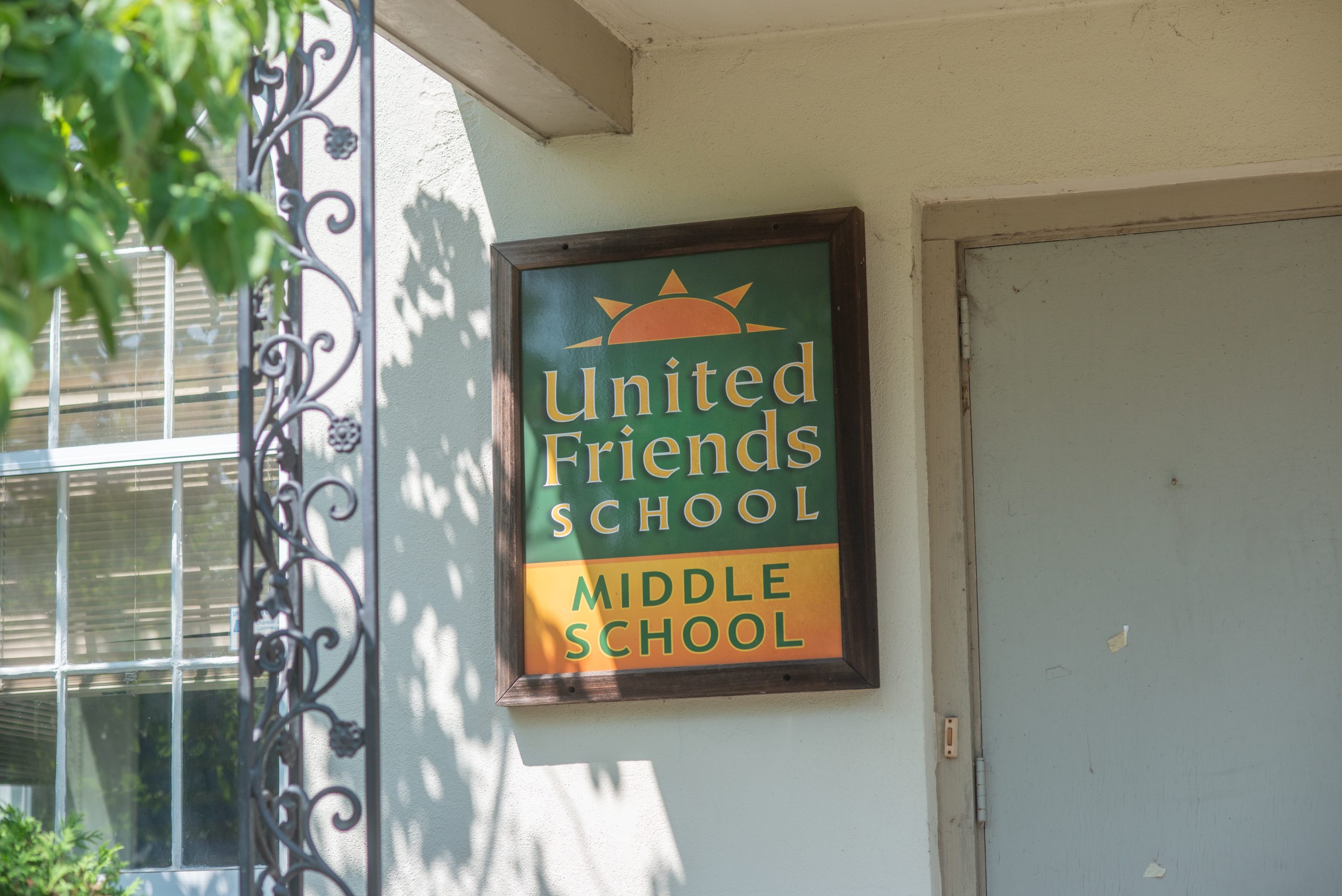
A sign at United Friends School in Quakertown.William Thomas Cain / For The Inquirer
The names of the school’s board members are not listed online. One board member, Bob Wirtschafter, said in a brief phone interview last Monday that he could not comment on what would happen with prepaid tuition.
“We know we owe them,” Wirtschafter said, adding that “I can’t say anything.”
Wirtschafter, who said he had been on the board for 32 years, said he had “seen all kinds of rumors” about the school’s closure, including that there was financial wrongdoing.
“I can tell you, it was all about tuition,” Wirtschafter said. There were 60 students enrolled for the coming year in April, but by May, “we lost five families because of the economy,” he said. The school charged $20,000 a year in tuition.
Wirtschafter said the school had been “struggling for years.” It closed its middle school and sold its building last year, he said, which “kept us alive for another year.”
County records show United Friends sold several properties for $800,000 in May 2025 to AA Property Holdings LLC.
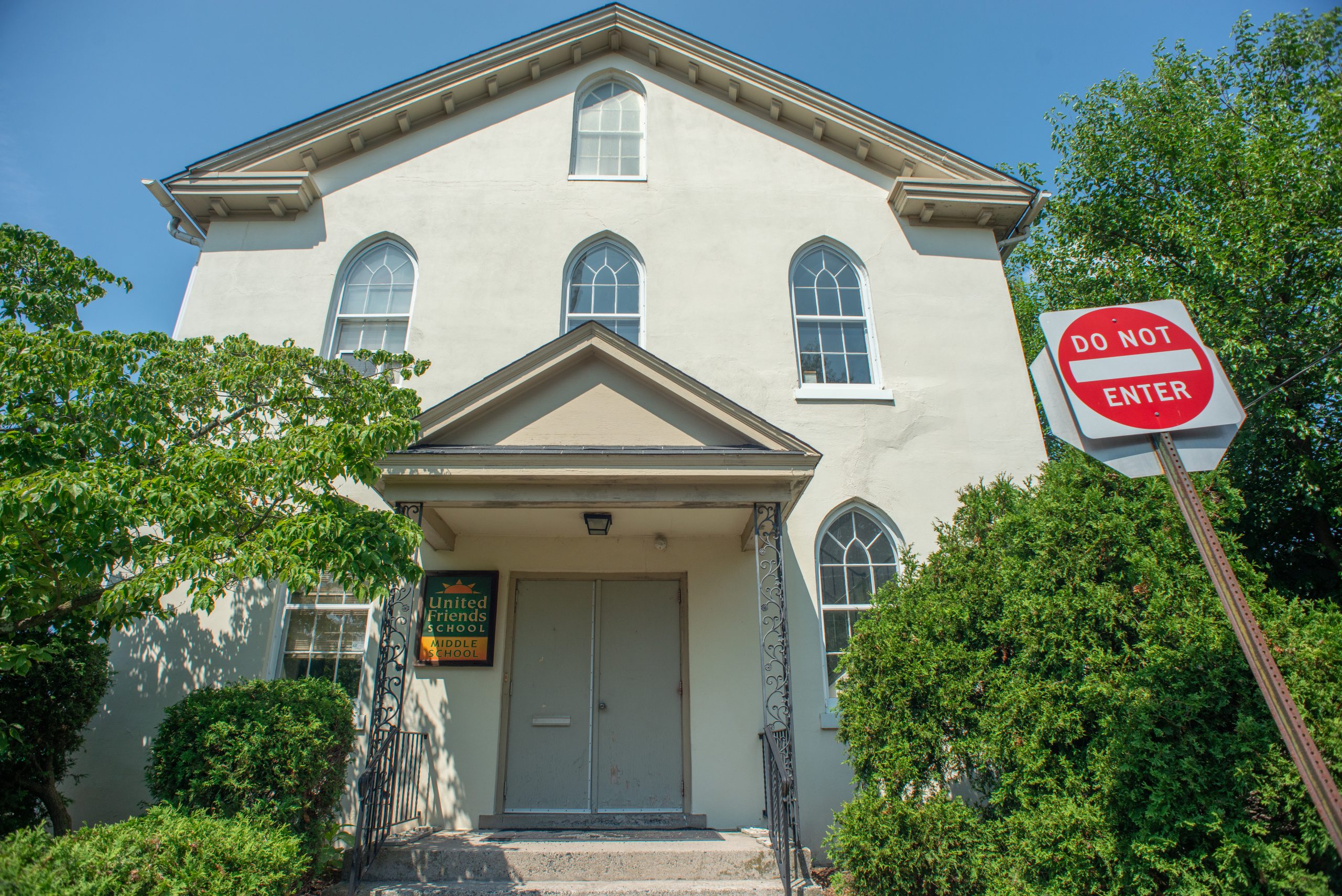
One of the original school buildings at United Friends School in Quakertown.William Thomas Cain / For The Inquirer
The LLC is registered to a Sellersville address owned by Mateen Afzal, whose family founded a manufacturing company in Bucks County and who is listed as director of the Afzal Family Foundation. A message sent through the foundation’s website was not returned this week.
With the drop in enrollment headed into the fall, “we just couldn’t make it work,” Wirtschafter said. “We decided we had to close.”
He said United Friends was not alone among small Quaker schools facing similar troubles, citing Cambridge Friends School in Massachusetts.
Cambridge Friends announced in May that it would be closing after the end of the 2026-27 school year.
A week after announcing its closure, United Friends sent another message to families, inviting them to a “voluntary two-day work effort” to clean out the school on July 24 and 25.
“Community members who are unable to participate in person are welcome to support these efforts by making a voluntary contribution to help offset the costs associated with the cleanup,” the board said in the message.
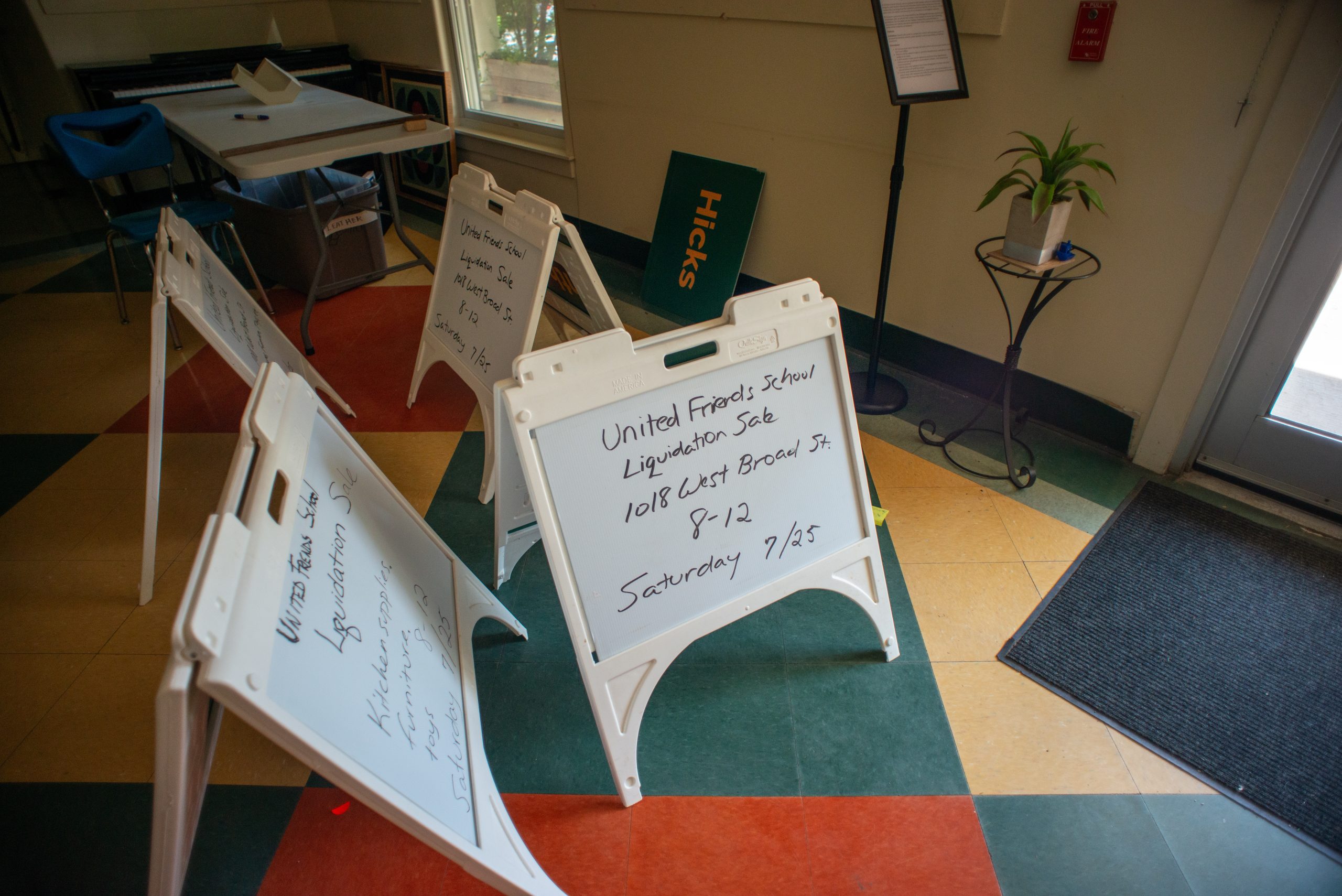
A sign announcing a “liquidation sale” at United Friends on July 25.William Thomas Cain / For The Inquirer
“Can you imagine the sheer anger that hit the teachers and the parents? We just closed your school, we took all your money, can you help us clean up and donate more money?” Groff said.
In his efforts to reclaim his tuition payments, Groff went to his bank and the bank where United Friends had deposited the checks, with no success. He said he also contacted the Quakertown police and the Bucks County District Attorney’s Office.
Manuel Gamiz, a spokesperson for the district attorney’s office, said the county’s consumer protection division was taking complaints from families and “attempting to mediate these matters.” Anyone affected can call 215-348-6060 or, toll-free, 1-800-942-2669, Gamiz said.
Groff went to small claims court, but a clerk told him it would be difficult to file a claim because “you won’t be able to serve their papers,” he said. “There’s nothing that exists,” given that the school already closed. Groff said he does not know if the board of trustees has an address.
Groff, who has another daughter who attended United Friends, said the schools and teachers were “absolutely wonderful.”
“That’s why this is just so devastating and shocking,” he said.