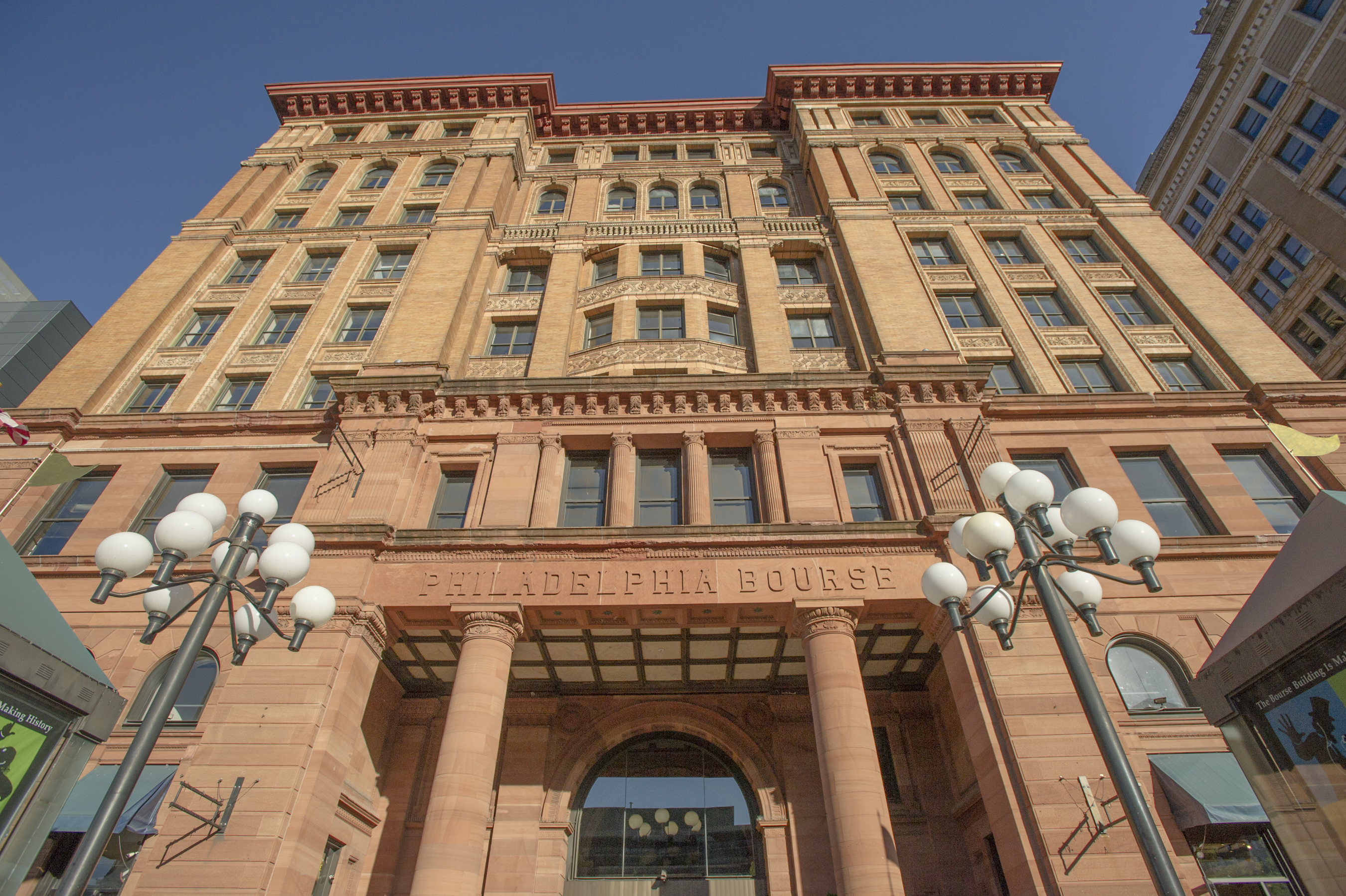
A New York City-based commercial real estate lender has asked a federal judge to force a sale of the Bourse building on Independence Mall after work ground to a halt on a hotel development amid the dissolution of a partnership between real estate magnate Dean Adler and Keystone Development + Investment.
As the two former partners fought a battle for control of the Bourse in Delaware Chancery Court, the property has racked up millions in liens and missed at least one mortgage payment.
The lender, KKR Real Estate Finance Trust, says it is owed more than $24 million in the latest turn in the legal drama surrounding the 131-year-old Beaux Arts building.
The loan also funded the purchase of 400 Market St., which was developed as planned.
The loan agreement required Adler’s development team to show that the hotel project was near completion by the end of May 2026. But earlier this year, the Bourse’s development team “abandoned its plans to redevelop a portion of the Bourse property into a hotel and ceased work on the hotel conversion,” the complaint says.
Adler had decided to scrap the hotel and event space plan and his partnership with Keystone, the Philadelphia Business Journal reported in April. Instead, Adler said he plannedto go into business with PMC Property Group, Philadelphia’s largest apartment owner, to convert the Bourse into a multifamily property.
Keystone filed a breach of contract suit and accused Adler of failure to provide promised funding for the project. Adler, in turn, accused Keystone of unauthorized spending and “gross negligence.”
The two are fighting in Delaware Chancery Court for control of the property and its future. In a March ruling, reported by Law360, a judge ruled against Adler’s attempt to oust Keystone.
The legal conflict between the two former partners has put KKR Real Estate Finance Trust’s investment at risk. By abandoning the plan and stopping construction, the suit says, the Bourse’s development team defaulted on the mortgage with more than $24 million of the principal outstanding.
The Bourse’s owners also racked up more than $2 million in liens filed by at least five contractors for failure to pay for their work and failed to make a mortgage payment starting in June.
KKR Real Estate Finance Trust is asking a federal judge to issue a judgment of $24.2 million plus interest and fees and to order a public auction of the Bourse building to pay back the debt.
Keystone declined to comment on an active lawsuit, but a spokesperson said the firm remains “confident” that it will prevail in the litigation against Adler in Delaware Chancery Court.
For his part, Adler said that he believes the legal cases with Keystone will soon be concluded and that KKR will follow.
“I believe we are near resolution on the Bourse lawsuit with Keystone,” he said. “And then we will resolve KKR’s potential foreclosure and be ready to revitalize the Bourse like we did at 400 Market.”
The former development partners purchased the nearby office building at 400 Market in the same deal as the Bourse and successfully converted it into apartments. KKR Real Estate Finance Trust made clear that building is not included in the lawsuit.
Philadelphia is asking a federal appeals court for a redo on the President’s House, saying the court’s June ruling that allowed President Donald Trump’s administration to swap the exhibit at the historic site limited the ability of judges to restrain the executive branch.
The city is seeking a new hearing in front of the entire U.S. Court of Appeals for the Third Circuit, or the same three judges who issued a unanimous ruling in June that held the city has no rights over the displays at George Washington‘s Philadelphia home.
The ruling created a catch-22, the city’s attorneys said in Monday’s court filing, not only for the President’s House Site but also for the ability of federal courts in the Philadelphia area to review government actions broadly.
The Third Circuit found that the abrupt removal of the slavery exhibit from the President’s House could not be challenged under the statute that governs final actions by federal government agencies. The removal, the appeals court said, was not an “agency action” or “final.”
“Both holdings are wrong, and both are of exceptional importance,” the city’s filing said.
The city contends that the court supplied a road map for federal agencies to evade challenges in court. Under this precedent, the federal government can evade courts’ review by “announcing — even mid-litigation — that it might do something else later,” the city said.
The judges opened the door for a federal agency to defeat a lawsuit over its conduct simply “by pointing to what it might do next,” according to Philadelphia’s filing.
It is rare for circuit courts to hold rehearings in front of the original or the full courts, which is known as en banc, said Adam Crews, a professor at Rutgers School of Law.
“The court will not grant rehearing en banc when the panel correctly states the law and the contested issue is simply the application of the law to specific fact,” Crews said.
Even if the entire court agrees to hear the case, the city might not find a sympathetic audience.
A majority of the court’s 14 members have been appointed by Republicans, and six were named by Trump.
The panel that issued the June ruling consisted of Hardiman, a George W. Bush appointee; Luis F. Restrepo, a Barack Obama appointee; and Peter J. Phipps, who was appointed by Trump.
The city filed the request for reconsideration hours before the deadline to appeal the June order, and at a time when Mayor Cherelle L. Parker’s law department is in transition.
City Solicitor Renee Garcia, who resigned last week, argued the case on behalf of the city at a January district court hearing. U.S. District Judge Cynthia M. Rufe issued a blistering opinion and an injunction ordering the restoration of the exhibits, which was later overturned by the Third Circuit.
Parker appointed Monique Galloway, who worked for the U.S. Attorney Office in Philadelphia, as the city’s next solicitor.
Monday’s filing still carried Garcia’s name,who remains in the role until early September.
The National Park Service and Department of the Interior did not immediately respond to a request for comment.
Advocates for the original exhibit, including Avenging the Ancestors Coalition and city leaders, vowed to keep fighting to restore the removed panels to the site. Michael Coard, leader of Avenging the Ancestors Coalition, said last month the group was exploring new legal strategies.
“This site, Sixth and Market Streets, is the only site where George Washington lived on federal property — that federal property was known as America’s first White House — and Black people were enslaved,” Coard said from the President’s House on the day the exhibit was swapped. “There’s only one place where that happened. Right here.”
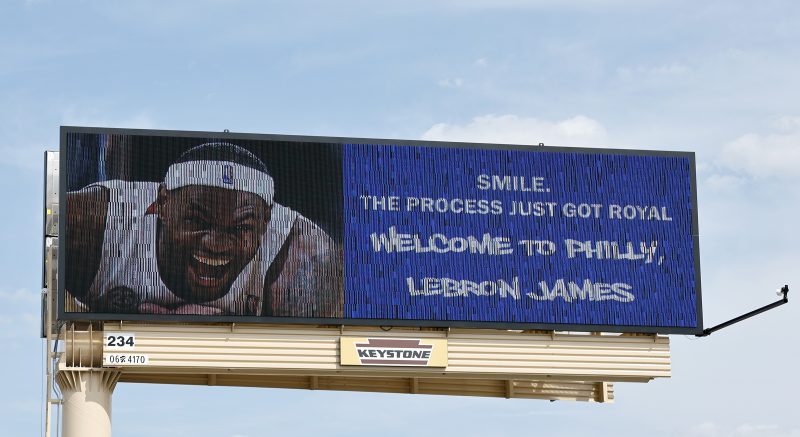
LeBron James is going to take his talent to South Philly, and a portion of his salary to City Hall.
The newly signed Sixer — that feels so good to write — is being rumored to live in New York City and commute to games and practices by helicopter, according to ESPN.
Commuters who live elsewhere but work in Philly are required to pay the city’s wage tax on a portion of their salary. And there is no exemption in the tax code for a King.
Main Liners, rejoice. Next time you look at the withholdings on your pay stub, you are allowed to proclaim: LeBron, he’s just like us, amirite?
In fact, James has likely paid the Philadelphia wage tax throughout his career for games he played here against the Sixers.
But how much of James’ $8 million salary over two years counts toward the wage tax will depend on how, and where, No. 23 spends his time from training camp to the final day of the season.
Let’s break it down.
What is Philly’s wage tax, and does it apply to athletes?
Philadelphia levies a 3.735% tax on the entire income of its residents, and 3.425% on the income nonresidents earned working in the city.
The wage tax is one of the city’s three major revenue sources, alongside property and business taxes, and has brought in more than $2 billion annually in recent years. A third of the taxes collected comes from commuters.
Philly’s tax on earnings is among the highest in the country, and the city led the charge in the 1990s to ensure professional athletes paid their share. It is now common practice for cities to impose a so-called jock tax on players — home and visiting — but athletes are taxed in the City of Brotherly Love under the same wage tax as everyone else.
What counts as a Philly workday for LeBron James?
Calculating the wage tax for commuters can get tricky, especially since remote work has become common.
Every day of work that requires a nonresident to be in Philadelphia counts toward the tax.
The question for James, and other athletes, is what counts as a working day — and how many of those days he spends in Philly vs. the Sixers’ training facility in Camden.
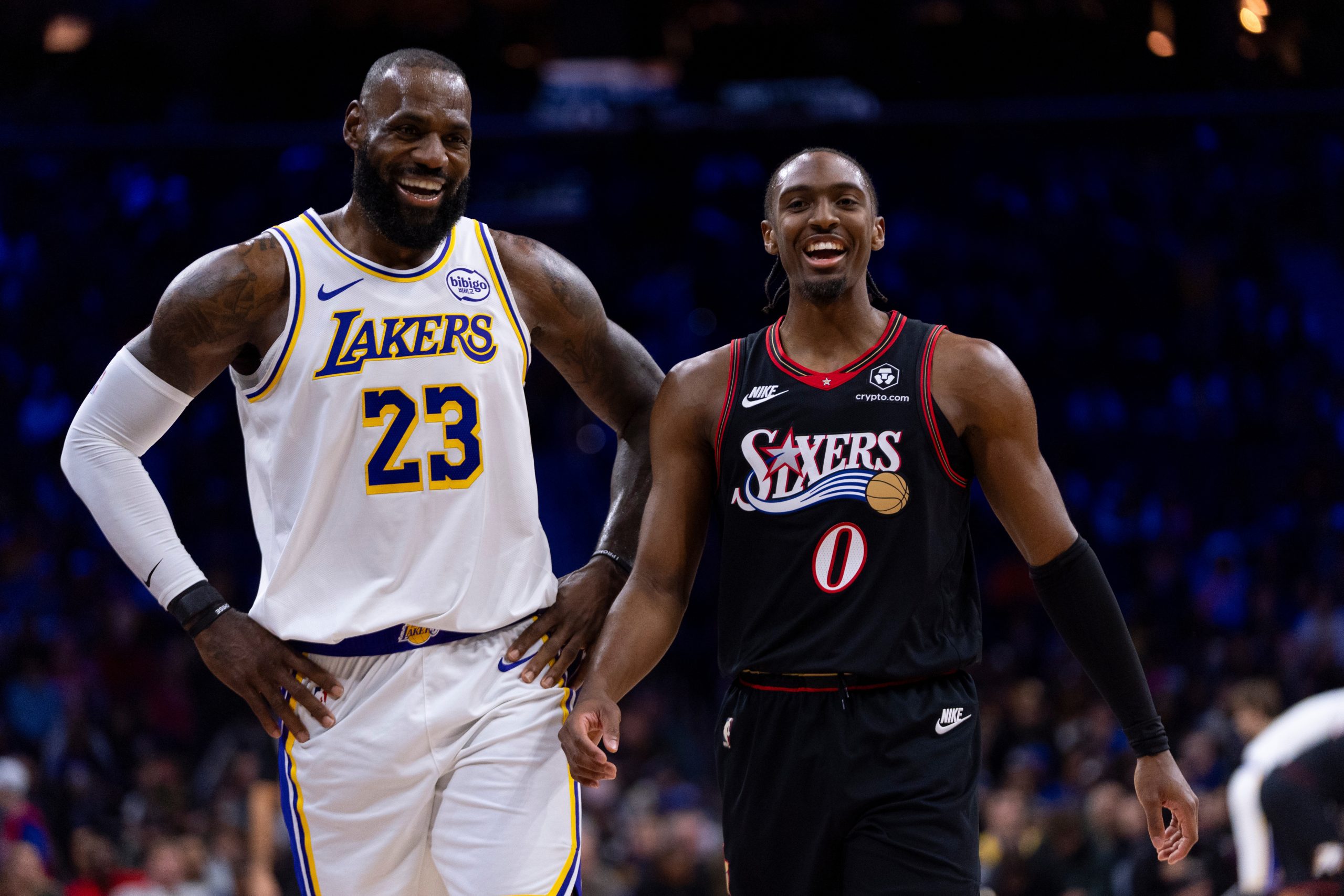
Los Angeles Lakers’ LeBron James, left, shares a laugh with Philadelphia 76ers’ Tyrese Maxey, right, during an NBA basketball game, Sunday, Dec. 7, 2025, in Philadelphia.Chris Szagola / AP
Practice, film review, rehab, and games could all count as workdays, said Stephen Kidder, a tax attorney who specializes in professional sports.
“Every single one of those days is a duty day for a professional athlete,” Kidder said.
A spokesperson for the city said, “Philadelphia welcomes LeBron James with open arms,” but did not respond to a request for comment about any special guidance for athletes.
How much will LeBron James pay in wage taxes?
If James ends up living in Philly, the calculation is simple. He would have to pay 3.735% of his annual salary of $4 million — roughly $150,000 — regardless of where he spends his time.
But if he lives outside the city, it comes down to counting days.
Without knowing James’ overall number of workdays in the year, and how much of that time is spent in Philadelphia, it is impossible to estimate his tax bill.
The number of duty days for an NBA player can vary widely, depending on practice schedule, depth of playoff run, and other activities, such as promotions.
An often-cited number to get a sense of the size of the tax bill for NBA players is 200 workdays.
If his only Philadelphia workdays were the Sixers’ 41 home games, and if, as seemingly the youngest 41-year-old in history, he played in all of them, roughly 20% of King James’ income would be earned in Philly.
In this scenario, the city would tax 20% of James’ annual income at the 3.425% rate for nonresidents, for a hypothetical tax bill of around $28,000. That number would decrease if he missed some home games, or increase if he attended other team activities in Philadelphia.
(This writer refuses to make any calculation related to the playoffs that could constitute a jinx but suffice to say: See you on Broad Street next summer.)
Do taxes affect players’ decisions?
Professional athletes and the associations representing them care a lot about state and local taxes, and are fighting against them.
The MLB, NHL, and NFL players associations, alongside three former professional athletes, sued Pittsburgh over its 3% jock tax for visiting players. And last year the Pennsylvania Supreme Court struck the tax down because it was higher for nonresidents than for residents.
City and state taxes are part of the package when athletes choose where to play, according to Kidder, who represented the associations in the state Supreme Court case. A professional athlete in Florida owes the state no tax, for example, while California has a jock tax of up to 13.3%.
“Some athletes may be in a point in their career where it doesn’t matter that much,” Kidder said. “But for other athletes it may be a big difference playing for a team based in Florida compared to a team based in New York.”
Ed Wasielewski, a Philadelphia-based NFL agent and founder of EMG Sports, says tax considerations come up often in free agency deals. The difference between no tax, Philly’s 3.735% tax on residents, and California’s 13.3% jock tax amounts to millions of dollars in take-home pay.
“A player is well advised to have a good accountant, a good attorney, and a good agent team to correctly analyze the tax consequences,” Wasielewski said. “It definitely comes into play in contract negotiations, especially in free agency.”
If James chooses to live in NYC and commute to practices in Camden and games in Philly by helicopter, taxes might not be high on his list of concerns.
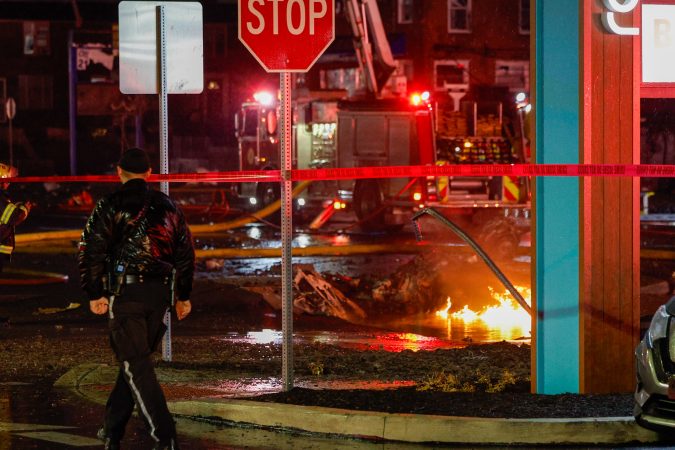
Khlood Hammad was at the drive-thru lane of a Northeast Philadelphia Dunkin’ on the evening of Jan. 31, 2025, when a private medical transportation jet nose-dived into the ground a block away.
The sheer force of the blast and the gruesome scene still haunts Hammad, she said in a lawsuit filed this month against the jet’s operator.
Hammad suffers from dizziness and imbalance because of injuries to her head and ears, the suit says, and she developed post-traumatic stress disorder that has been impacting her ability to work.
“It’s just miraculous that anyone that close survived,” said Joseph Russomanno, Hammad’s attorney.
The lawsuit is the latest against Med Jets, the Mexican air carrier that operates specialized airplanes for medical transport, and the second this month by a witness of the crash that killed eight people, injured dozens, and impacted hundreds of homes.
The new suits, filed in the Philadelphia Court of Common Pleas, expand the circle of crash victims pursuing claims against Med Jets, vying for a chunk of the company’s $10 million insurance policy.
Med Jets — which operates under the name Jet Rescue Air Ambulance — is already facing two wrongful death lawsuits brought by families of Mexican nationals who were killed and a lawsuit brought by a man who was severely burned near the crash site.
“There’s a lot of people in line for the $10 million,” said attorney Michael Hanamirian, who represents another witness who is suing the company. “It sounds like a lot of money, but in this case it’s not a lot of money.”
Hanamirian sued Med Jets this month on behalf of Yunelly Cervera, who saw the crash from her home and had plane debris land on her property.
Cervera has been experiencing troubling dreams and panic attacks, among other symptoms of post traumatic stress, the suit said.
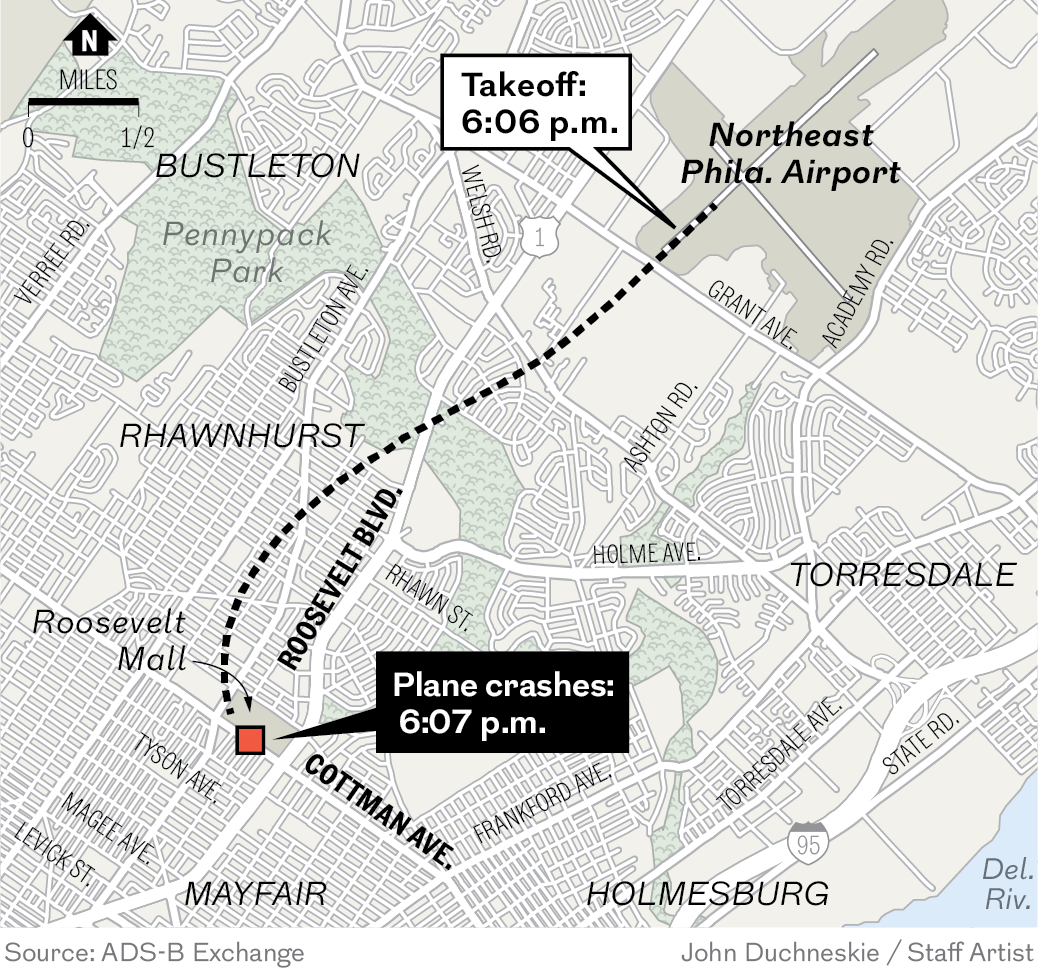
The crash took place shortly after 6 p.m. on a Friday. The Med Jets-owned Learjet 55 plummeted 1,650 feet at more than 235 miles per hour within a minute of taking off from Northeast Philadelphia Airport.
All six people aboard the jet died, including 11-year-old Valentina Guzman Murillo, who was heading home after having spent four months undergoing treatment for a spinal condition at Shriners Children’s Philadelphia.
Map of where a small jet crashed near Roosevelt Boulevard and Cottman Avenue in Northeast Philadelphia on Jan. 31.John Duchneskie
Med Jets did not respond to a request for comment.
The company’s insurance provider, El Águila Compania de Seguros, filed a lawsuit in Philadelphia’s federal court last summer saying claims would far exceed the remaining liability limits” the company’s $10 million insurance policy.
It is unknown how many more people have viable claims similar to Cervera and Hammad, attorneys said.
Once the insurance funds are exhausted, those who weren’t compensated — at all or sufficiently — could attempt to obtain a judgment directly against the company, Hanamirian said.
But the value of Med Jets’ assets remains an open question, the attorney said,and enforcing any award issued in a U.S. court on a company across the border can be tricky.
“The judgment has to be significant enough to enforce because of all the time and steps involved,” Hanamirian said.
Philadelphia’s former chief diversity, equity, and inclusion officer has said before that Mayor Cherelle L. Parker and top administration officials scapegoated her after she reported sexual harassment in City Hall and then fired her “unjustly.”
But in an explosive new lawsuit filed in federal court in Philadelphia this week, that officer, Brandee Anderson, claimed her termination was part of a coordinated effort to “suppress” or rebrand diversity work and came as a top Parker administration official made derisive comments about other DEI leaders.
She claimed Parker — a centrist Democrat who is Black and the city’s first female mayor — said in 2025 that she “did not care about Ms. Anderson’s ‘DEI ideology,’ only minority business.”
And she alleged in the lawsuit that the mayor threatened to remove any administration official who expressed dissenting views, telling a gathering of senior officials that no one “has a right to have an opinion about where we are going.”
The suit, filed Monday in U.S. District Court for the Eastern District of Pennsylvania, seeks unspecified damages and payment of lost wages as a result of her firing. Parker is named as a defendant, as are Deputy Mayor Vanessa Garrett Harley, Inspector General Alexander DeSantis, and communications director Joe Grace. Anderson claimed DeSantis and Grace defamed and retaliated against her in statements to the media after her firing.
Anderson served as Parker’s chief DEI officer beginning in 2024, advising the mayor and administration on matters such as workforce diversity, community engagement, equitable budgeting, and minority business opportunities. She also oversaw offices that serve LGBTQ+ residents and people with disabilities.
She was fired in 2025 after Tyrell Brown, then the director of the Philadelphia Office of LGBTQ+ Affairs, reported to Anderson that they had received a “semi-nude” photo from a senior administration official. Anderson says in the lawsuit that she was fired days after elevating the matter to Garrett Harley and human resources officials.
It was also the second time this month that a former Parker administration official accused senior administration members of fostering a toxic work environment.
Shania Bennett, the former director of the Philadelphia Office of Youth Engagement, last week posted on social media that working for the city was “the worst experience of [her] life” and that she had quit her job after “unprofessional harassment.”
Bennett could not be reached for comment.
‘Stand down’ on DEI matters
Anderson, an attorney who founded a firm that creates anti-racist trainings, was hired in October 2024 to lead the city’s DEI efforts. In the lawsuit, she alleges that Parker officials undermined her authority from the outset.
She claimed Parker forbade her from contacting members of City Council with whom she had existing relationships. And she said Garrett Harley, one of Parker’s most senior officials, told her and other DEI leaders to “stand down” if they expressed dissenting views, saying “if you can’t align with the mayor’s strategy, DEI may not be the job for you.”
Deputy Mayor Vanessa Garrett Harley speaks during a news conference in Philadelphia, Pa., in June 2024.Tyger Williams / Staff Photographer
Anderson also claimed Garrett Harley made discriminatory comments about a transgender official, Celena Morrison-McLean, former director of the Philadelphia Office of LGBTQ+ Affairs, who reported to Anderson. Garrett Harley, the lawsuit alleges, instructed Anderson to “document Celena [Morrison-McLean] out,” or create a paper trail leading to her dismissal.
According to the lawsuit, the deputy mayor also mocked Morrison-McLean during a meeting with several other officials, saying she used a “deep male tone” to intimidate staff.
She is now a consultant, according to her LinkedIn profile. She could not be reached for comment.
Celena Morrison-McLean reads a statement with Darius McLean (rear) Thursday, Mar. 7, 2024. The married LGBTQ leaders were arrested during a contentious traffic stop over the weekend.Tom Gralish / Staff Photographer
Anderson said in the lawsuit that Garrett Harley also made comments to her in early 2025 that she saw as fostering a hostile work environment. She claims she disclosed to Garrett Harley that she was the victim of rape and asked for time off to attend a hearing in the criminal case against her alleged assailant.
“Ms. Garrett-Harley responded,” the lawsuit says, “by questioning how one woman could rape another.”
In a separate instance, Garrett Harley also instructed Anderson to delete emails documenting dangers to children in the city’s care, according to the lawsuit. The lawsuit did not elaborate on the content of the emails.
Harassment report and press fallout
Brown was appointed in March 2025 to succeed Morrison-McLean as the city’s director of LGBTQ+ affairs. In July 2025, Brown reported to Anderson that Christopher Dailey, then a deputy chief of staff in the mayor’s office, had sent them a sexual image on a cruising app.
At the time, Anderson said Brown told her they did not feel harassed by the photo, partly because it was not clear whether Dailey knew to whom he had sent the image, which included Dailey’s face. Brown’s profile was anonymous, Anderson said, but the app used geolocation, meaning that users would have known they were contacting someone in or near City Hall.
Anderson elevated Brown’s report to human resources roughly a week later, the complaint says, leading DeSantis, the city’s inspector general, to launch an investigation.
By July 22, Anderson was fired. DeSantis has said Anderson never possessed the photo, but allowed Brown to display it while another employee besides Anderson, their supervisor, was in the room. That decision, DeSantis said, constituted a violation of the city’s sexual harassment policy.
Mayor Cherelle Parker, right, hugs Tyrell Brown, left, the new Director of LGBTQ+ Affairs, during a press conference to announce new appointments, at City Hall, in Philadelphia, March 21, 2025.Jessica Griffin / Staff Photographer
Anderson’s lawsuit claims racial discrimination, noting that Dailey, who is white, was not fired, but was instead moved to a new role in a different office. Brown and Anderson are both Black.
Brown could not be reached for comment.
Additionally, Anderson claimed that Parker, DeSantis, and Grace each made “false and defamatory” statements in the media after she was fired.
She cited a July 2025 Inquirer article in which Grace said Anderson’s allegations about the reason for her termination included “outright misstatements of fact.”
The lawsuit also mentioned an interview with iHeart Radio’s WDAS 105.3 FM that DeSantis participated in last year about the firings, during which he said that Anderson had “mishandled the photograph” and “did something wrong.”
Anderson, in the lawsuit, said those statements were false.
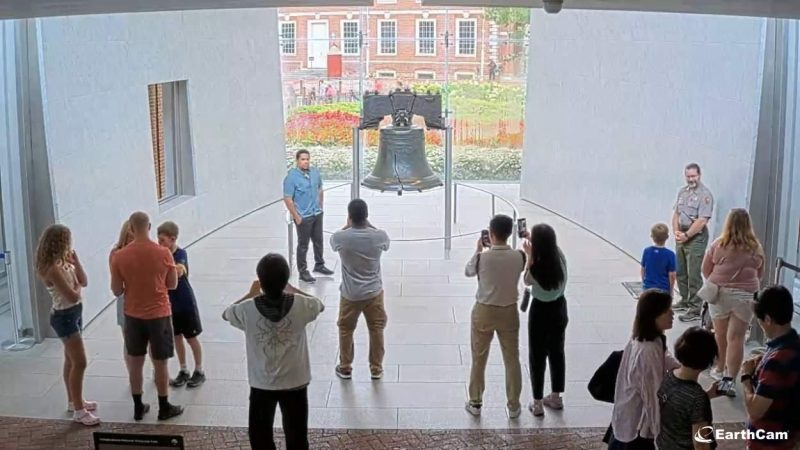
Strangers took photos of families in front of the Liberty Bell, as others took close-up photos of the iconic symbol of U.S. independence.
A little boy in blue shorts and curly hair ran up to the bell to point out the crack. A National Park Service staffer looked at his watch. It was almost closing time at the Liberty Bell Center and the crowd began to dwindle as 5 p.m. approached Tuesday.
The boy posed next to a little girl for the last photo of the day, and the room cleared.
The bell received a reprieve from visitors until 9 a.m. Wednesday, when it all started back up again.
These moments were captured by a new camera that transmits a 24-7 live stream of the Liberty Bell on EarthCam, a website that live streams various iconic sites around the world.
“At Independence National Historical Park, the livestream provides the public with a real-time virtual view of one of the nation’s most iconic historic sites, expanding public access and engagement,” said a spokesperson for Independence National Historical Park in a statement.
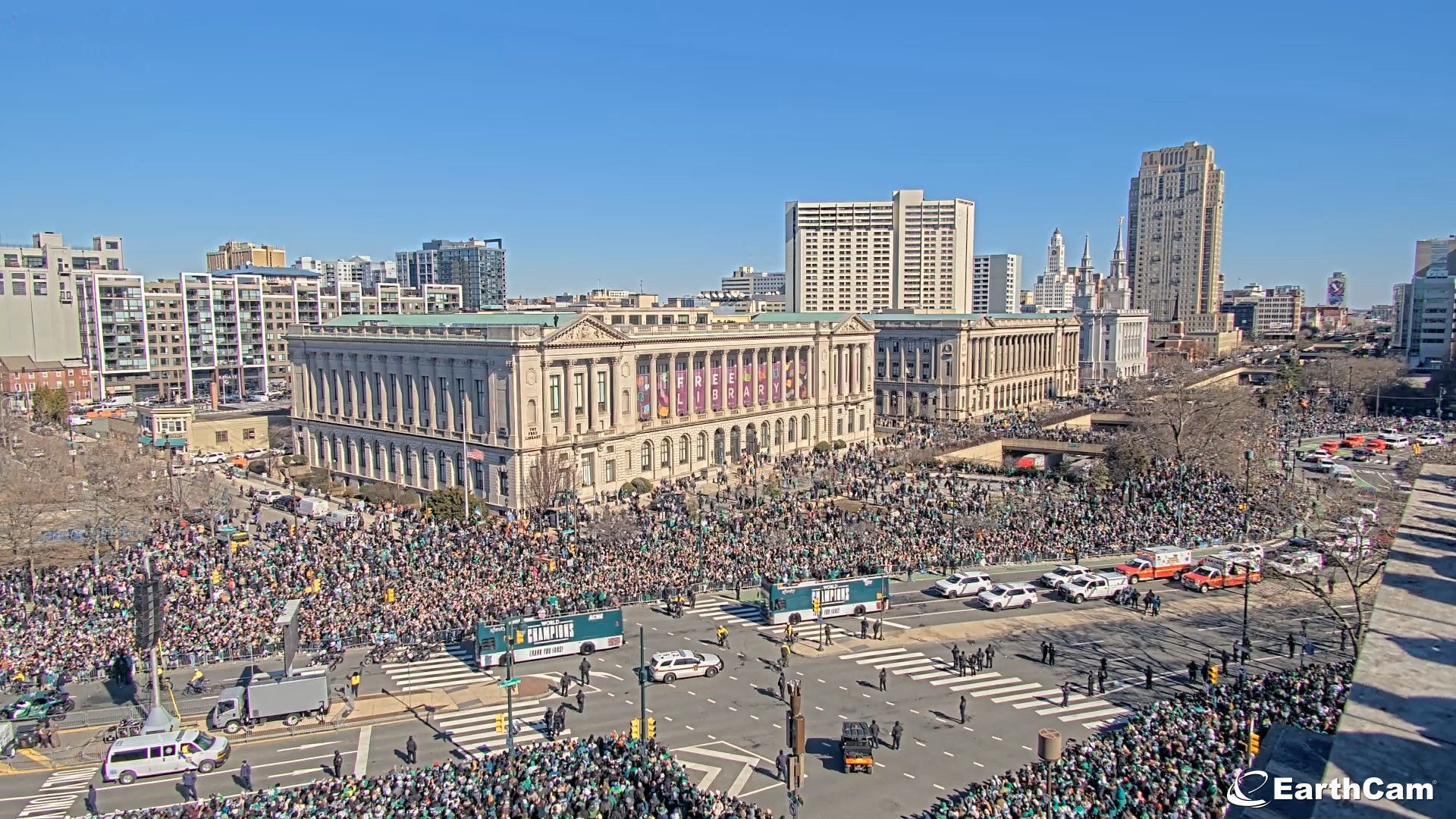
The Eagles Super Bowl parade down the Benjamin Franklin Parkway as captured by EarthCam from the Franklin Institute. February 14, 2025.EarthCam
The camera pointing at the Revolutionary-era relic was set up ahead of the United States’ 250th anniversary celebration earlier this month, and adds to the website’s collection of iconic travel destinations that includes Times Square in New York City, the Temple Bar in Dublin, and the crosswalk at Abbey Road, London. There is also a camera streaming Andy Warhol’s grave in Bethel Park, Pa., outside Pittsburgh.
The streams, while an effort to increase access to historic sites, also raise questions for surveillance experts and are part of a growing number of live streams in public places.
“The general trend of video surveillance [is] becoming pretty ubiquitous in common public spaces and across cities,” said Jake Laperruque, deputy director of the Security and Surveillance Project at the nonprofit Center for Democracy and Technology.
EarthCam, a New Jersey-based web-camera technology company, installed the Liberty Bell camera and live stream as part of a donation of 250 cameras for the United States’ 250th birthday.
“Taking people to that park and showing that view is amazing,” said Brian Cury, EarthCam’s founder and CEO.
The Liberty Bell camhasracked up more than a quarter million streams since it was installed about a month ago, Cury said, including 80,000 virtual visits on July Fourth.
Cury said EarthCam donated the camera to the National Park Service at no cost. The company streams from national parksthroughout the country, including the Flight 93 National Memorial in the Shanksville, Pa., area.
The streams are a way to bring iconic sites to people in a way that is more compelling than a photo, Cury said. And hopefully, he said, they can entice people to step outside.
“There are lots of kids that should get out of the house and go explore our amazing country,” the CEO said. “But they are online.”
Visitors to the EarthCam website can view the live stream, a video archive of the last 24 hours, and a collection of still images from previous days since the camera has been installed (a “hall of fame” of sorts, Cury says.)
Still images from recent days show the bell at night, families visiting, and groups gathering in front of the bell for photos.
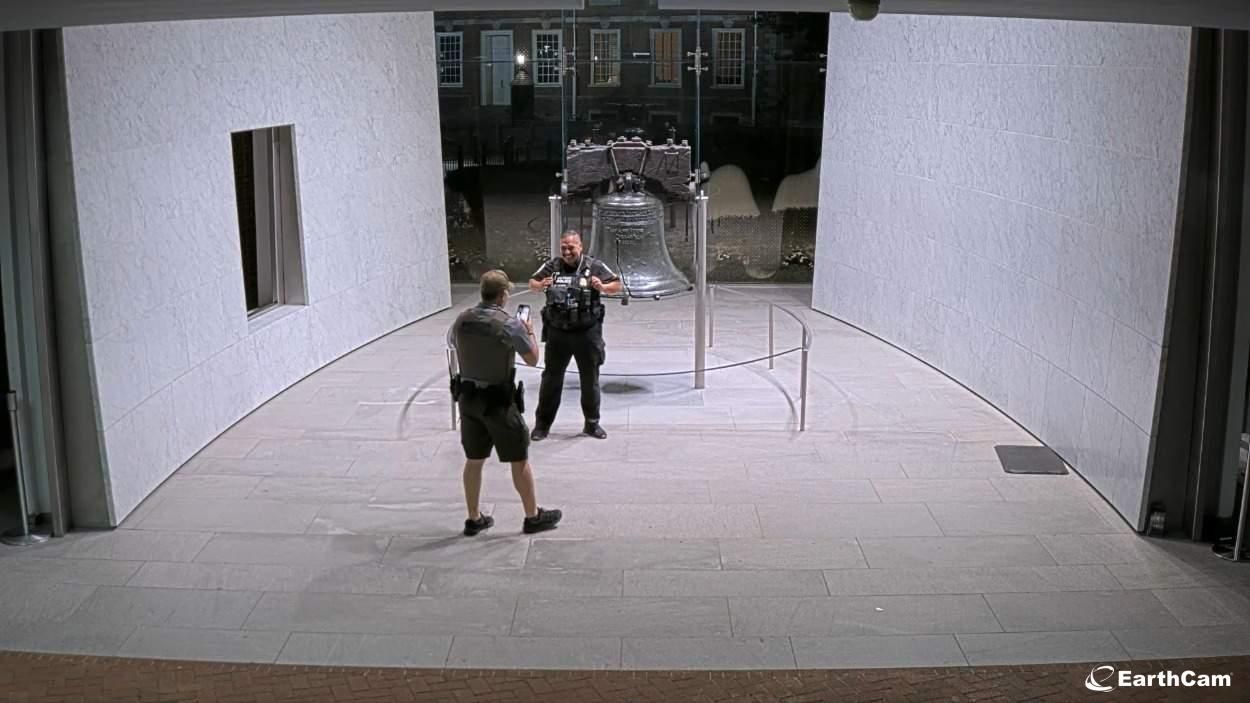
Also on the “hall of fame”: a park ranger taking a photo of a law enforcement officer in a black uniform posing in front of the bell after hours.
A law enforcement officer poses in front of the Liberty Bell after hours.EarthCam
Some surveillance experts say the archive raises privacy concerns, especially because people are identifiable in the image.
“The longer those pictures are kept, the more it makes me uneasy,” said Rachel Levinson-Waldman, director of the Brennan Center for Justice’s Liberty and National Security Program.
“The more it’s susceptible to even a private company just collecting those pictures and using them for some other purpose,” she said. “Or just people scrolling through and seeing the pictures for who knows what purposes people might use them.”
There is no information posted at the site about the live stream, but a security sign at the center’s entrance advises: “video surveillance in effect.” Online, the live stream is advertised via a small link at the top of the National Park Service’s Liberty Bell web page.
EarthCam does not place cameras in private locations where people have an expectation of privacy, Cury said. And the camera itself — on the wall in front of the bell — is not hidden, he said. Visitors, the CEO said, view the camera as an attraction.
“When you are looking at a lot of our cameras,” Cury said, “people are standing in front of them and waving.”
The Pennsylvania Court of Discipline ended Michael Fanning’s suspension without pay Thursday because the only reason for it was the criminal charges against him.
“With no charges and no other reason cited for the suspension of Judge Fanning, no reason exists for that suspension to continue,” the order said.
Fanning, 60, will be assigned administrative duty and will not hear cases until the Philadelphia Court of Common Pleas leadership can decide his future assignment, said court spokesperson Martin O’Rourke.
His request to end the stay did not mention backpay.
The administrative office of Pennsylvania courts did not immediately respond to a request for comment on whether Fanning would receive back pay for the four months he was suspended.
Fortunato Perri Jr., Fanning’s attorney, declined to comment.
Fanning was charged with aggravated assault, strangulation, and related crimes in March after prosecutors said he repeatedly punched his wife in the face, choked her, and dragged his 30-year-old daughter to the ground by her hair, causing her to cut her face, during a fight at their East Torresdale home.
Assistant District Attorney Brian Collins said last week that the two women were evaluated by medics and did not suffer injuries.
Attorneys for Fanning also provided the district attorney’s office with “extensive mitigation” records, prosecutors told the court without describing their content.
Fanning’s wife said in a March hearing that the judge had voluntarily entered a 30-day inpatient recovery program to treat his excessive alcohol use, an issue the family had worked to address in the past.
Within hours, a Department of Justice attorney sent a revamped request for New Jersey’s unredacted voter database to Dale Caldwell, the Garden State’s lieutenant governor and secretary of state.
And the department’s Civil Rights Division launched an investigation and sent Sherrill a letter demanding, within five business days, information about the 6,600 people wrongfully registered as voters, and when and where up to 400 of them voted.
“Ensuring that U.S. citizens’ votes are not illegally diluted by noncitizens’ votes is of paramount importance,” Harmeet Dhillon, assistant attorney general in the Justice Department’s Civil Rights Division, wrote in the Tuesday letter to Sherrill.
For the last year, the Justice Department has been seeking the state’s voter rolls, which include each voter’s full name, date of birth, address, and driver’s license or the last four digits of their Social Security number. But the requests have been rebuffed.
The Trump administration sued Caldwell in February, accusing him of violating federal voting and civil rights laws. Without the data, the suit said, the federal government could not ensure the state was in compliance with federal requirements for voter roll maintenance.
The Tuesday letter to Caldwell said the new information shared by Sherrill provides an “additional basis” to the request, wrote Jesus Osete, a principal deputy assistant attorney general in the Civil Rights Division.
“The Division must also verify that no other noncitizens remain on New Jersey’s voter rolls, in violation of federal law,” Osete’s letter said.
The roughly 6,600 people were improperly added to the voter rolls when applying for driver’s licenses and identification cards. Even though they checked “no” when asked if they were a U.S. citizen, they were registered anyway.
Fewer than 400 of these individuals voted, Sherrill said.
The erroneous registrations took place between June 2023 and June 2024, Sherrill said, “through no fault” of the noncitizens, who were registered due to a software glitch in New Jersey’s motor vehicle system, which processes the automatic registration when a citizen obtains an ID or license.
The Justice Department shared the letter it sent Caldwell with U.S. District Judge Zahid N. Quraishi, who is presiding over the lawsuit.
“While it is currently unknown in which elections those noncitizens voted or whether the ballots those noncitizens cast affected the outcome of any race,“ the department said in a court filing, ”Governor Sherrill acknowledged in a press conference the seriousness of noncitizens voting in American elections.”
But the disclosure did not lead Sherrill, a Democrat who took office in January, to change her position about sharing the unredacted voter data with the federal government.
“The Trump administration has a long history of weaponizing the Justice Department for political purposes and attempting to overturn election results,” Sean Higgins, a spokesperson for Sherrill, said in a statement. “Governor Sherrill has been clear that she will use all the legal tools available to her to protect New Jerseyans’ personal information.”
The announcement came less than a week after Trump delivered a prime-time address in which he repeated his grievances over his 2020 election loss, and claimed without evidence that more than 250,000 noncitizens had registered to vote in New Jersey, Pennsylvania, California, and Nevada.
Republican officials used the New Jersey revelation to make the case for the SAVE Act, which would require proof of citizenship to register to vote.
“This is why we must confirm citizenship before anyone registers. Only US citizens should vote in our elections,” U.S. Sen. Dave McCormick (R., Pa.) said on X in response to the Garden State’s news.
The Trump administration has also attempted to get the Keystone State’s voter rolls through litigation. A judge tossed out the Justice Department’s lawsuit against Pennsylvania Secretary of State Al Schmidt last month. The suit, which is nearly identical to the one against New Jersey, is one of 16 similar lawsuits that have been dismissed by federal judges throughout the country, according to the Brennan Center for Justice.
But this month, the Justice Department threatened to bring criminal charges against top election officials in all 50 states if they allowed noncitizens to vote. The letter threatening Pennsylvania officials was addressed to Schmidt, who again declined to share voter information.
“I take seriously the obligations under both federal and Pennsylvania law to ensure that only eligible voters have access to the ballot box and to see to it that Pennsylvania’s voter rolls are appropriately maintained and updated,” Schmidt wrote.
Staff writer Aliya Schneider contributed to this article.
Gov. Josh Shapiro’s administration can pay for abortions through the state’s Medicaid program while an appeal of the April ruling that recognized “a fundamental right to reproductive autonomy” plays out, a Commonwealth Court judge ruled.
Judge Matthew S. Wolf last week granted a request from abortion providers to allow Medicaid to fund the procedure during the appeal from the Pennsylvania Attorney General’s Office because the state Supreme Court held previously that the funding restriction was “presumptively unconstitutional.”
The appeal led to an automatic stay on the Commonwealth Court ruling, which meant Medicaid could fund abortion only in the cases allowed by the state’s Abortion Control Act.
The coalition of abortion providers that brought the lawsuit in 2019 argued the stay would cause irreparable harm because it would force “an unknown number of their patients to carry pregnancies to term” during the appeal, the opinion said.
If the coverage ban were to remain in place, despite the ruling holding it amounts to sex-based discrimination and recognizing the right to reproductive autonomy, that would violate the constitutional rights of Pennsylvanians, Wolf wrote.
Sunday’s office argued that lifting the stay would allow more abortions, despite the opposition of many taxpayers.
“There can be no legitimate interest — for the Commonwealth or the public — in knowingly violating constitutional rights,” Wolf said, rejecting the attorney general’s argument.
A spokesperson for Sunday declined to comment.
“At last, a terrible injustice that has harmed Pennsylvanians for decades has ended,” Susan Frietsche, executive director of Women’s Law Project, which represented the providers, said in a statement.
Sunday, a Republican, stepped in to defend the law when Shapiro’s administration bowed out after the 2024 state Supreme Court ruling, which used language strongly endorsing abortion access as a constitutional right. But the justices were ultimately split on whether they were ready to make that call and sent the case back to the Commonwealth Court.
It is unclear how quickly medical providers will be able to bill Medicaid for abortions. The Pennsylvania Department of Human Services has not issued guidance for providers yet.
“Gov. Shapiro has a proven track record of defending a woman’s right to choose and protecting access to safe, legal abortion services,” Rosie Lapowsky, a spokesperson for Shapiro, said. “He will continue to fight for women’s right to make their own medical decisions in consultation with their doctor.”
How the United States’ first “White House” became a flash point in the 21st century
Judge Cynthia M. Rufe pauses under in the entrance to the reconstructed "ghost" structure with partial walls and windows officially titled, “Freedom and Slavery in the Making of a New Nation” as she visits the open-air President’s House installation in Independence National Historical Park on Feb. 2.Tom Gralish / Staff Photographer
The United States’ first “White House” was lost to history more than once. But after it was rediscovered by an amateur historian in 2002, there was an effort to ensure that this time the site would be remembered.
In the years since, the President’s House has been a source of controversy at every stage of its development. The site at the doorstep of the Liberty Bell serves as a painful reminder to the flaws of the nation’s Founding Fathers, and George Washington’s own culpability in slavery.
story continues after advertisement
President Donald Trump’s administration in January abruptly dismantled the exhibit memorializing the nine people Washington kept in bondage at his Philadelphia home, deeming its displays to “inappropriately disparage Americans living or past.”
A monthslong court battle ensued leading to the partial restoration of the site, pause of the work, and the involvement of multiple courts — all taking place leading up to the nation’s Semiquincentennial, and culminating in the installation of a new exhibit under the cast of darkness less than two weeks after the 250th celebration.
Robert Morris, a financier whose company participated in the slave trade, offered the site to Washington as the nation’s first executive mansion. The first president moved to the house in 1790 and resided there until the end of his time in office in 1797.
After Washington, John Adams lived at the house until Washington, D.C., became the nation’s capital in 1800.
1804 to 1951
The site demolished, twice
The house was used for commercial purposes, including a hotel, until it was largely demolished in 1832.
The President’s House location in Independence National Historical Park.
The entire block on Sixth and Market Streets was razed in 1951 to create Independence Mall, demolishing portions of the walls that remained intact and burying the foundation of the President’s House underground. The location of the house was forgotten to history.
2002
Discovering the site, protest immediately starts
Independent historian Ed Lawler uncovered the true location of the residence — adjacent to the new Liberty Bell Center. Other historians and The Inquirer’s reporting at the time highlighted the history of slavery at the site. Protests, led by the Avenging the Ancestors Coalition, immediately began encouraging the National Park Service, under then-President George W. Bush, to memorialize the nine people Washington enslaved at his Philadelphia home. The government was, at first, strongly hesitant to do so.
story continues after advertisement
2007 to 2010
Excavation and construction
Guests and dignitaries gather in Independence National Historical Park at the President’s House Site before the start of a ceremonial ground-breaking on March 21, 2007.Tom Gralish / Staff Photographer
On Dec. 15, 2010, the President’s House officially opened. Former Philadelphia Mayor Michael Nutter, under whom the project was finished, highlighted the importance of the site and its role in highlighting the contradictory experiences of liberty and slavery during the founding of the United States. After the ceremony, the site became Independence National Historical Park’s responsibility.
Municipal Judge Charles Hayden, Michael Coard, Independence National Historic Park Superintendent Cynthia MacLeod, and Mayor Michael Nutter at the dedication of the President's House.Clem Murray / Staff Photographer
2015
Philadelphia hands the site to Park Service
The President’s House was in a state of disrepair, marked by intermittently blank and soundless video screens, leaking glass, and fogged up windows. The city, which owned the exhibit, transferred the site to the hands of the National Park Service, as Philadelphia and the federal government agreed during the site’s development.
.
March 2025
Trump signs executive order
Trump signed the “restoring truth and sanity to American politics” executive order that instructed the Department of Interior to flag displays in national parks and historical sites that “inappropriately disparage Americans past or living” ahead of the country’s 250th celebration.
July 2025
Park Service flags President’s House
More than a dozen exhibits throughout Independence National Historical Park — all referencing slavery — were flagged for a Trump administration content review. The President’s House had the most exhibits flagged, though some panels were thought to be spared from the content review. Local stakeholders began ramping up advocacy efforts aimed at protecting the President’s House.
September 2025
Plans for changes
Reports emerged that the Trump administration intended to alter the President’s House. The Department of Interior said at the time that “Interpretive materials that focus solely on challenging aspects of U.S. history, without acknowledging broader context or national progress, may unintentionally provide an incomplete understanding rather than enrich it.”
Jan. 22, 2026
NPS dismantles exhibit; Philadelphia sues
After months of scrutinization and anxiety over the fate of the President’s House, the Trump administration dismantled the entire exhibit. Workers took wrenches and crowbars to the site and loaded the removed panels into the back of a white pickup truck, leaving behind swaths of faded brick.
Workers remove displays from the President’s House Site in Independence National Historical Park.Tom Gralish / Staff Photographer
Shortly after the removal, the City of Philadelphia filed a lawsuit against the Interior Department, the National Park Service, and its leaders. Advocacy efforts continued and Independence Park employees were given talking points on how to address visitors’ questions about the President’s House.
Jan. 31, 2026
Trump and Philly clash in court
Attorneys for Mayor Cherelle L. Parker’s administration argued in federal court in Philadelphia that the removal of the exhibit was unlawful. The city found a receptive audience in U.S. District Judge Cynthia M. Rufe, who called the Justice Department’s argument that the federal government can unilaterally change history “dangerous” and “horrifying to listen to.”
Feb. 16, 2026
Injunction
Rufe ordered the Trump administration to immediately restore the exhibit. In a blistering opinion, published on Presidents Day, which celebrates George Washington’s birthday, the George W**.** Bush-appointed judge compared the actions of the Trump administration to the Ministry of Truth from George Orwell’s novel warning of authoritarianism, 1984.
“Each person who visits the President’s House and does not learn of the realities of founding-era slavery receives a false account of this country’s history.”
U.S. District Judge Cynthia M. Rufe
Feb. 20, 2026
Restoration starts, and quickly stops
Rufe, who ordered the restoration of the site “forthwith,” gave the federal government a hard deadline to restore the site after no work to reinstall the exhibit had taken place. National Park Service staff returned some panels to the walls, but as the deadline neared the federal government appealed and won an administrative stay that paused the restoration. The site’s wall remained half bare for months.
Workers reinstall the displays at the President’s House in Independence National Historical Park.Tom Gralish / Staff Photographer
April 2026
Proposed new exhibit
The National Park Service published 11 digital renderings of new panels proposed at the President’s House. The new exhibit would provide a broad timeline of U.S. history that included slavery, but would be less focused on George Washington’s role and frame the Founding Father’s enslavement of nine individuals at his Philadelphia home during the first presidency in a more sympathetic light. Only two of the 11 newly proposed panels at the time referenced those enslaved at the site, drawing criticism from historians.
Panel for Ona Judge at the President’s House in Independence National Historical Park.Tom Gralish / Staff Photographer
Born into slavery in Mount Vernon, Washington’s Virginia estate, Judge was kept in bondage as Martha Washington’s personal assistant and seamstress. She escaped from the President’s House on May 21, 1796, and made her way to New Hampshire with the help of Philadelphia’s free Black community. Despite Washington’s growing support of emancipation in private communications throughout his life, the first commander-in-chief made multiple attempts to recapture Judge. She was never caught and outlived her enslavers.
June 2, 2026
Trump and Philly clash in court, again
A three-judge panel of the U.S. Court of Appeals for the Third Circuit heard arguments on the Justice Department’s appeal. The judges pushed the city’s attorney to point to language in the cooperative agreement that said Philadelphia maintained rights over the site after the transfer of ownership to the federal government. But the city came short and was left pointing to statements by National Park Service officials that emphasized the collaborative effort to develop the site.
The Justice Department attorney representing the Trump administration told the judges that if the city wanted to maintain control over the exhibit, it “should have bargained for that.”
The half-bare walls of the President's House.Tom Gralish / Staff Photographer
June 18, 2026
Third Circuit sides with Trump
The Third Circuit delivered a blow to the city, ruling that Philadelphia had no rights over the site or its displays. The unanimous decision, signed by judges appointed by George W. Bush, Barack Obama, and Donald Trump, also dismissed all but one claim from the city’s initial lawsuit. The judges further found the Trump administration’s proposed panels “acknowledge the evil of slavery, including its injustices and hypocrisies, and, by telling the story of the nine slaves that Washington kept in the President’s House, remind us of their essential humanity.” The site was in limbo as the order out of Boston conflicted with the Third Circuit ruling.
“The duty to ‘maintain’ is better understood as a general management obligation that accompanies ownership, not a promise that the exhibits will forever remain in place regardless of the owner’s wishes.”
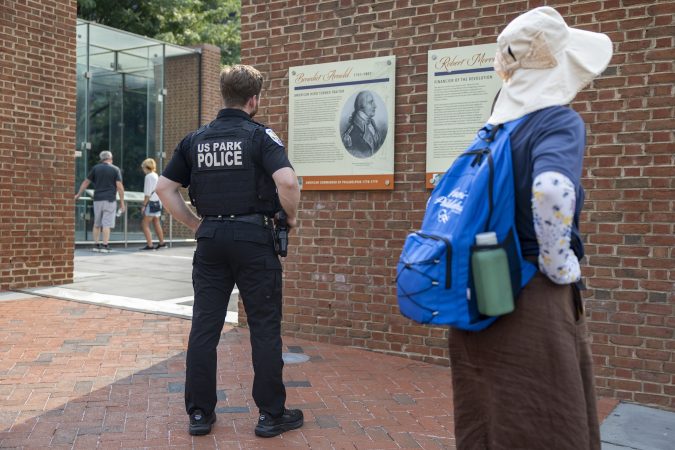
U.S. Park Police Officer Patrick O’Hanlon reads the new panels alongside visitors at the site of the President’s House in Philadelphia.Aidan T. Gallo / Staff Photographer