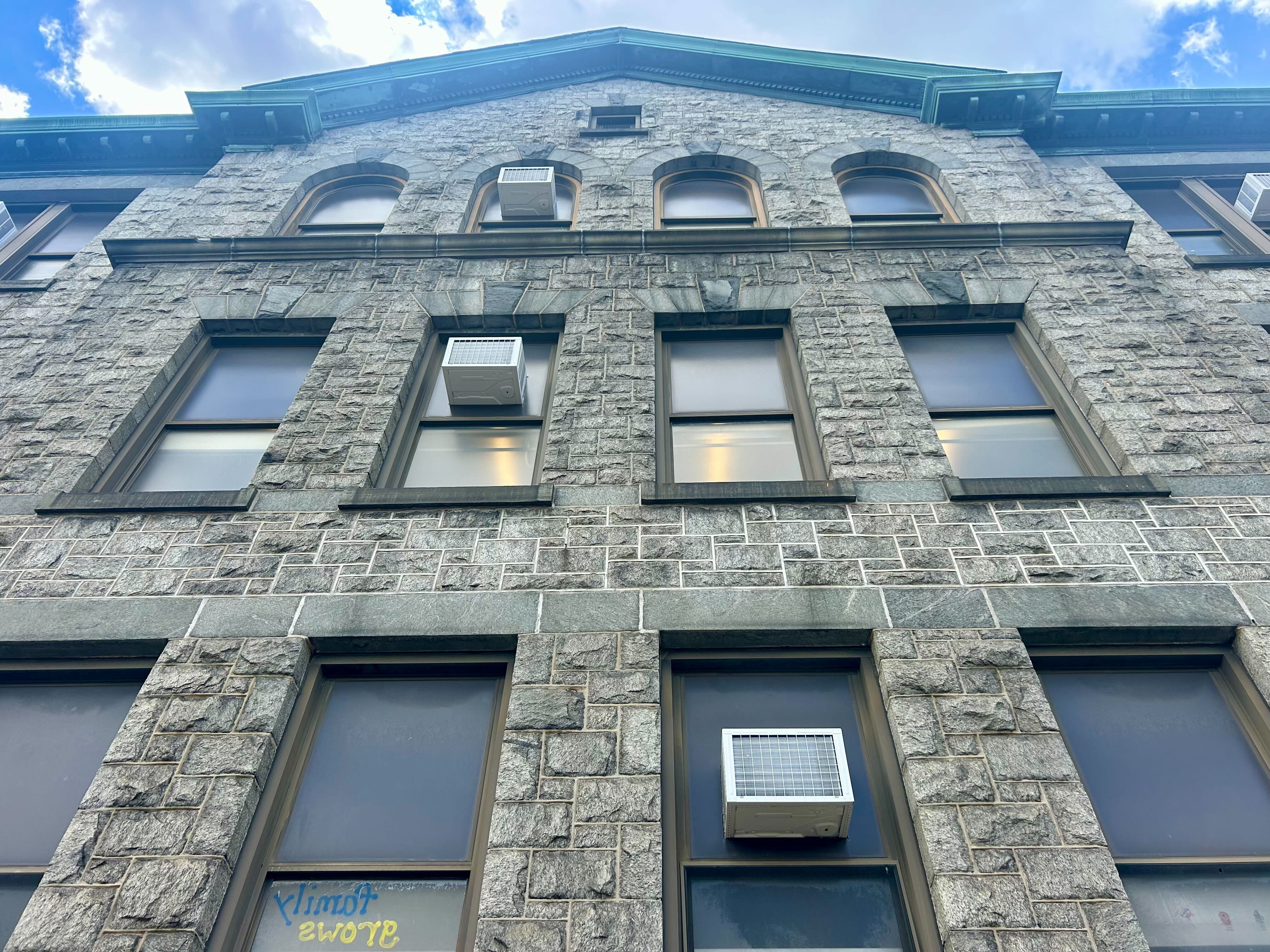
With temperatures expected to get close to 90 degrees later this week, some Philadelphia schools will dismiss early Tuesday.
Fifty-two schools still lack air-conditioning.
“The Philadelphia region is experiencing higher-than-normal temperatures, and while the district has made significant progress toward ensuring our schools are adequately cooled to provide safe and comfortable learning environments, some schools still have inadequate cooling systems,” Oz Hill, the deputy superintendent of operations, wrote in a letter sent to families Monday.
The Philadelphia School District’s extreme-weather protocol means that if temperatures are forecast to reach or exceed 85 degrees by noon, those schools dismiss early; if it hits 85 degrees by 9 a.m., the call is for remote learning.
That means an unequal experience for students across the system, with students in some schools not missing any instructional time when it’s hot, and those in a quarter of schools subject to interrupted schedules.
“While we know that in-person learning is the best environment for students, the safety and well-being of our students, staff, and families remains our top priority,” Hill wrote. “Thank you for your flexibility and partnership. Please take care, stay cool, and stay safe.”
The holdup in air-conditioning all district schools is not related to the cost of air-conditioning units, but rather upgrading old electrical systems in the 52 schools.
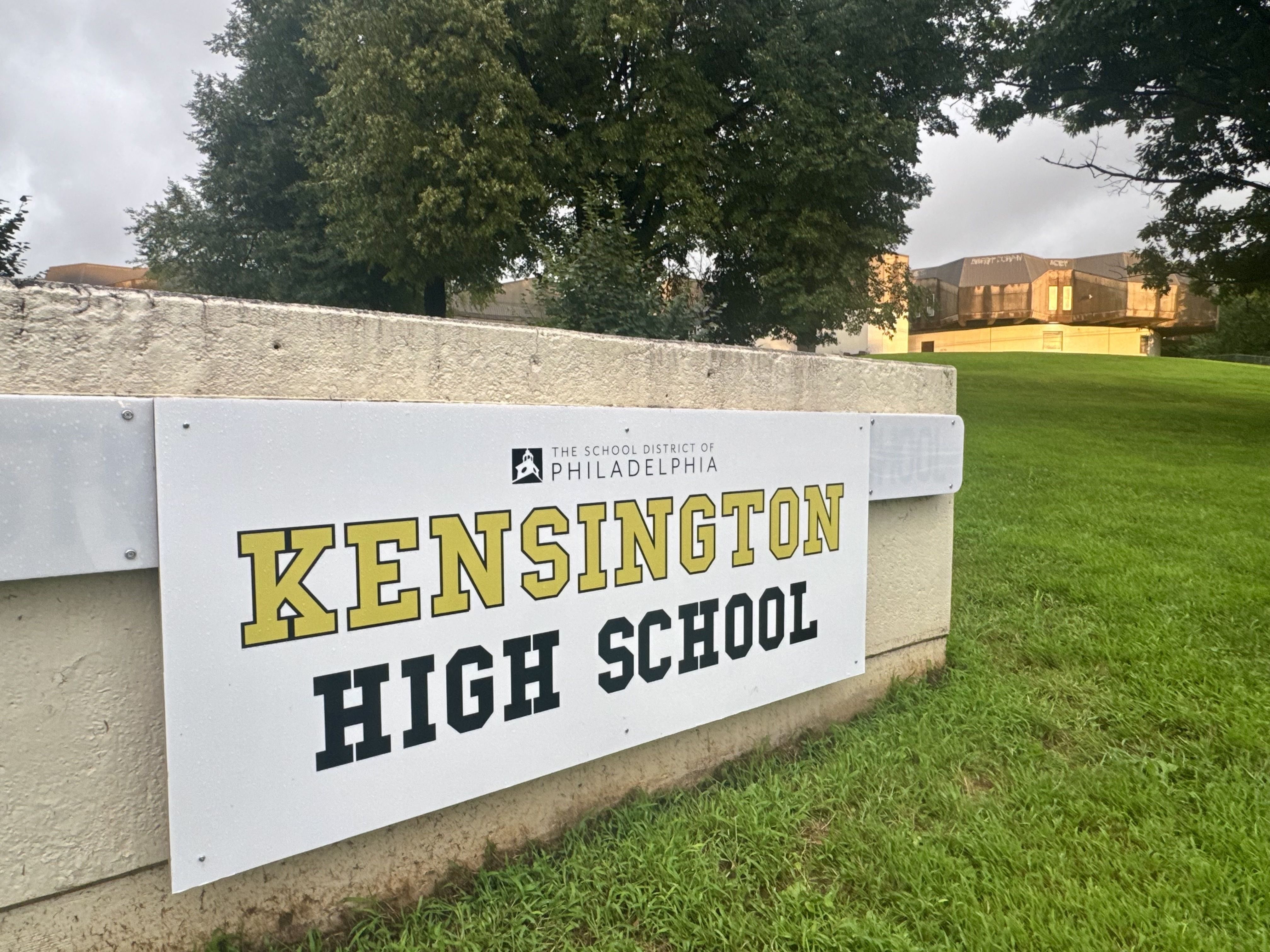
Such upgrades are tricky. An HVAC project at Kensington High went awry this summer, triggering asbestos issues that forced students and staff to relocate for the rest of the calendar year.
School officials said in 2022 they aimed to have all district schools fully air-conditioned by 2027. But on the cusp of that cutoff, that goal seems unlikely.
Which schools will dismiss early?
The 52 schools that will have a half day Tuesday are:
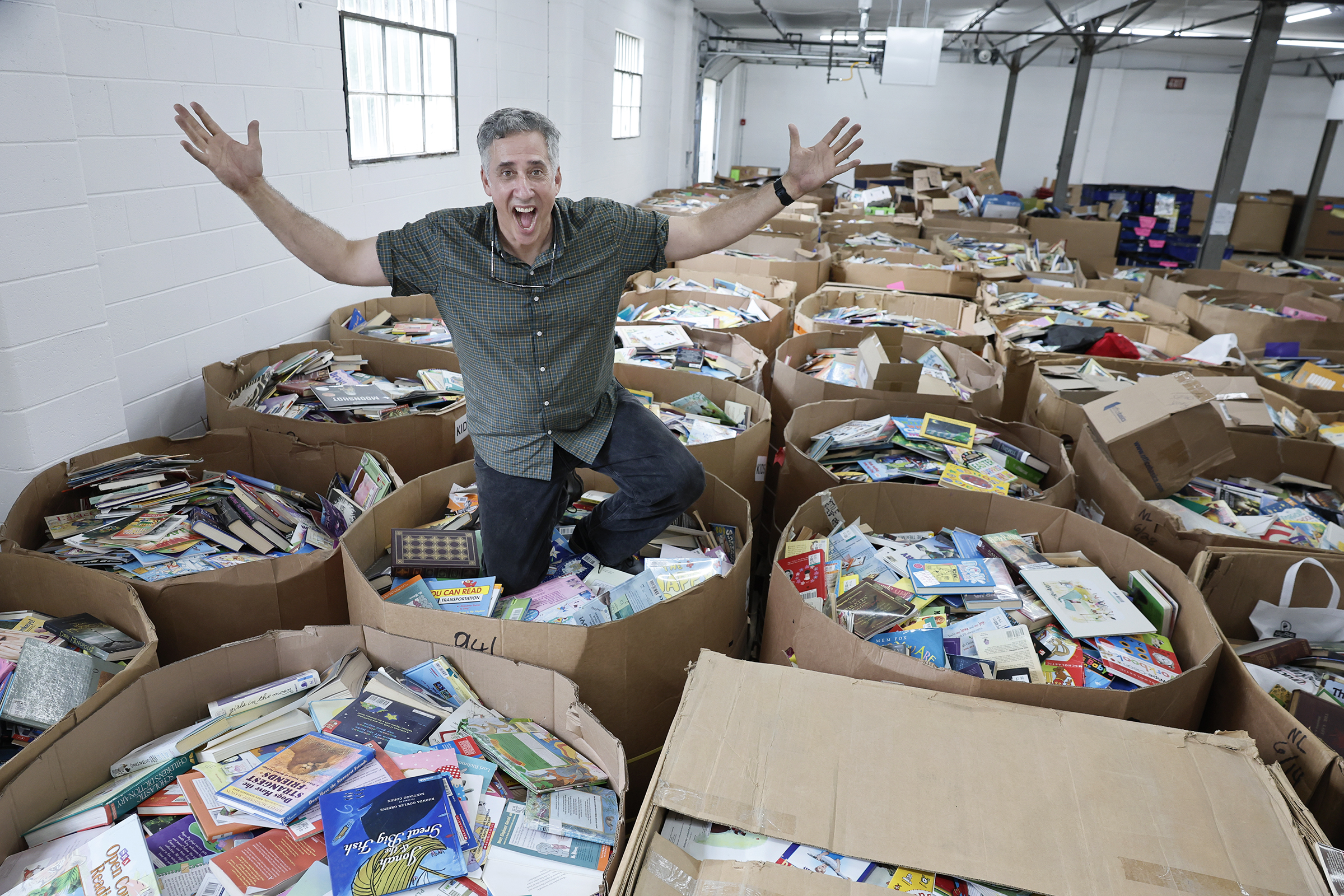
Inside a cavernous warehouse just off I-295 in Cherry Hill, Larry Abrams spread his arms, gesturing to the sea of industrial-size cardboard boxes that surrounded him.
“We’re sitting on a rocket ship,” said Abrams, a third-generation teacher.
Abrams’ rocket ship is composed of books: thousands and thousands of them — picture books and out-of-date science textbooks, cookbooks and battered novels. He sees them as a way to change kids’ life trajectories.
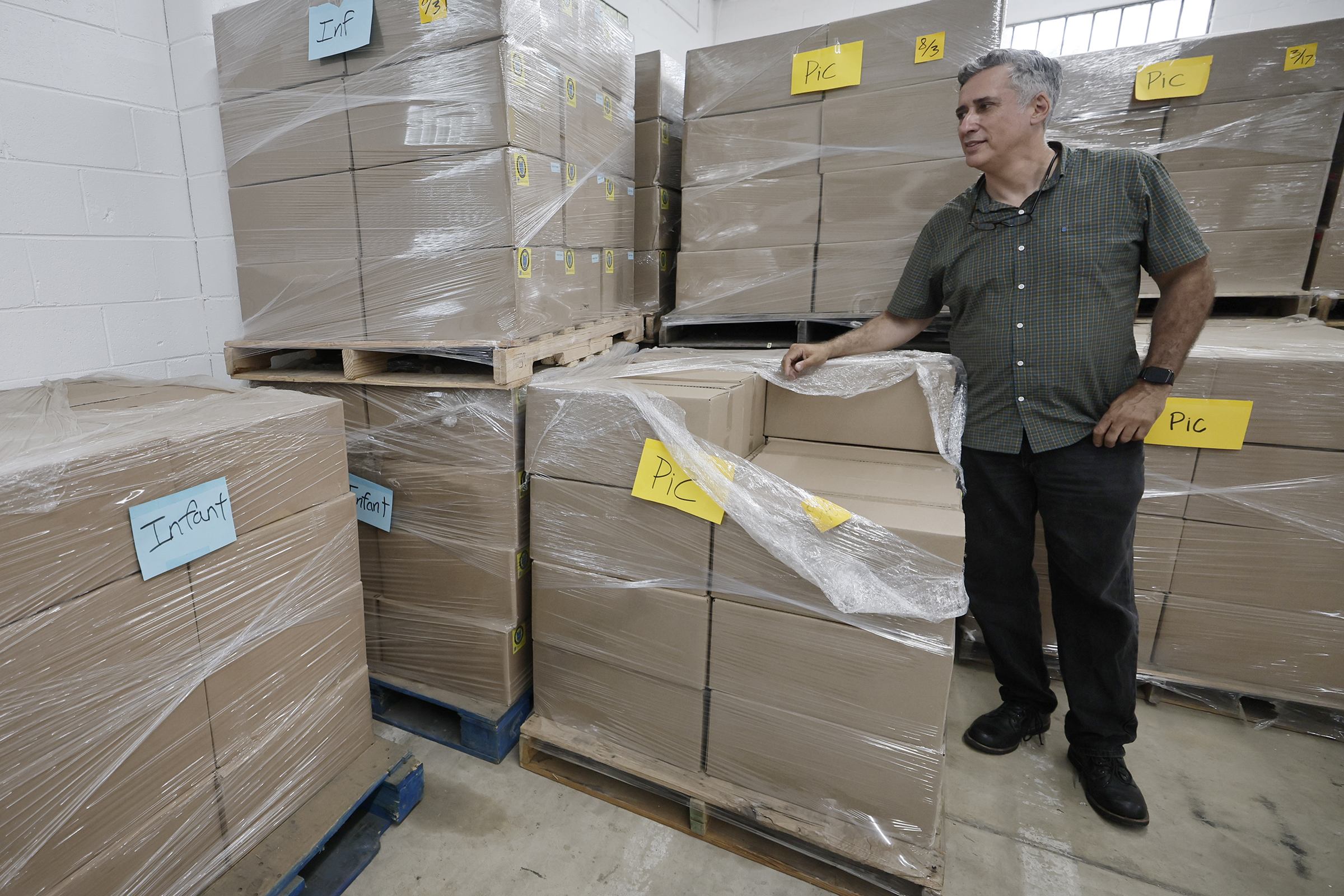
The BookSmiles van and a staffer’s car parked outside of BookSmiles new warehouse in Cherry Hill.Elizabeth Robertson / Staff Photographer
To date, BookSmiles, the nonprofit Abrams started out of his garage in 2017, has distributed five million books. It just outgrew its third location, expanding into a 14,000-square-foot space in Cherry Hill that is formally opening next week.
Book banks are not a new idea. But Abrams believes he’s got the secret sauce.
“We’re the only book bank in America that does this — we actively trade pallets of grown-up books for pallets of upcycled gently used children’s books,” Abrams said. “Never before has there been a low-cost way to get so many beautiful, upcycled books into the homes and hands of kids who need them the most.”
‘It’s simply about lack of book access’
Abrams served in the Navy — he was stationed on an aircraft carrier during the Persian Gulf War — and managed a copy shop. Then he settled into a career as an English teacher, working first in Moorestown, then in Lindenwold.
“I thought, ‘Why do most of the Lindenwold kids in my ninth-grade class read at a third- or fourth-grade reading level?’” Abrams said. “It’s simply about lack of book access. It’s not fair that some kids grow up with no access to books, and other kids have everything.”
Abrams thought long and hard about how to change that equation. What if he redistributed books from wealthy and middle-class communities to the places that didn’t have them?
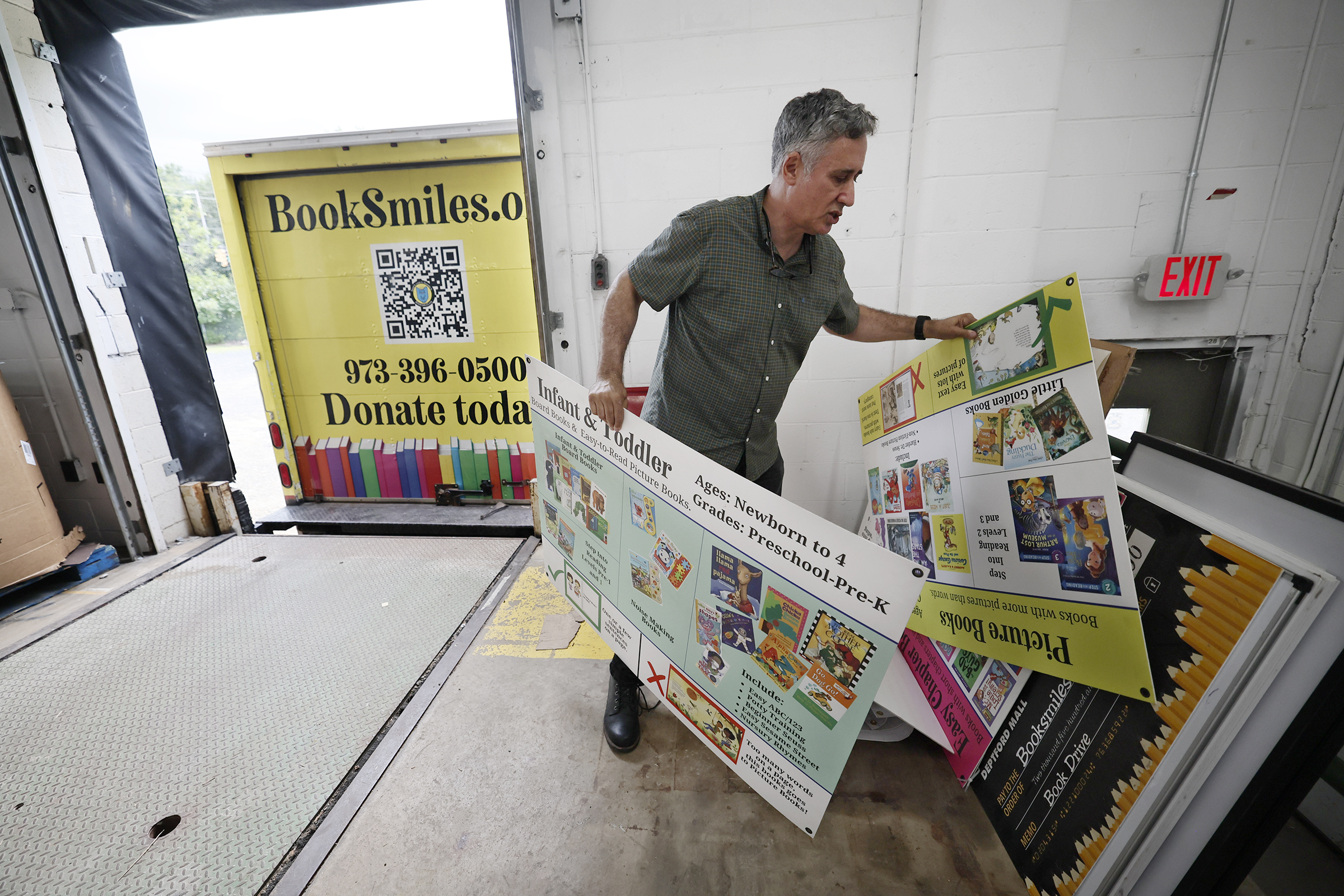
BookSmiles founder Larry Abrams works in the loading dock area of BookSmiles’ new Cherry Hill warehouse on Friday, Aug. 28, 2026.Elizabeth Robertson / Staff Photographer
He put out a social media call for children’s books, and got thousands.
There is no market for reselling used children’s books online, Abrams found — you can’t sell them and make any kind of money. So the BookSmiles concept developed.
Now, people from all over New Jersey and Pennsylvania donate books — any kind of books, from old encyclopedias to nearly new novel series. The BookSmiles team (at first, just Abrams himself; now, it’s 11 people and a growing corps of volunteers) sorts through every single book.
The organization gets books in myriad ways: from folks dropping off what they salvage after cleaning out a bookshelf to donations of entire estates of books. BookSmiles accepts library discards and scrap paper, too.
Adult books, old textbooks, and kids’ books that are not in excellent condition are sold, not for cash, but for gently used children’s books that are distributed directly to teachers, daycares, and other nonprofits that get them in kids’ hands.
‘There’s a low-cost way to raise test scores’
BookSmiles grew so significantly that Abrams retired from teaching and now works full-time as executive director.
But his educator hat is always on. Research shows that access to books, and books in children’s homes, is a powerful determinant of kids’ educational outcomes and economic success.
“This comes from a place of me being a teacher, and seeing there’s a low-cost way to raise test scores,” said Abrams, dipping his hand into a cardboard box and fishing out an old dictionary that will end up being recycled for paper.
BookSmiles founder Larry Abrams among boxes of childrens books ready for young readers in BookSmiles new Cherry Hill warehouse on Friday, August 28, 2026.Elizabeth Robertson / Staff Photographer
The largest share of BookSmiles’ books moves out through its “Teacher Take” program. Teachers pay a nominal fee — BookSmiles asks for $35 annually — and can then take hundreds of books multiple times a year, either for classroom libraries or for distribution.
BookSmiles also sponsors “Fair Book Fairs,” where schools get enough books for every child to take home at least three volumes at no cost.
Schools that serve predominantly students from economically disadvantaged backgrounds are asked to kick in just $200 to get a Fair Book Fair. Others pay a little more.
In 2025, BookSmiles gave away half a million books to teachers and kids in Philadelphia schools. Another 500,000 went to New Jersey teachers and schools, and the remainder, about 250,000, were sent overseas.
With libraries often on the chopping block in low-wealth school systems — Philadelphia had fewer than five people working as full-time, certified school librarians last school year — classroom libraries are key, and teachers often need resources to build them.
“We can hook them up,” Abrams said. “I can’t give them school supplies, but I can give them books.”
Book joy
Abrams still gets struck by moments of “book joy” when he looks at the Teacher Take room, or the massive room of books waiting to be sorted or moved out.
“It’s almost like walking into Willy Wonka’s world, but it’s not candy, it’s books,” he said. “Sometimes, you can’t tell the difference between what Barnes & Noble is selling and what we’re giving away.”
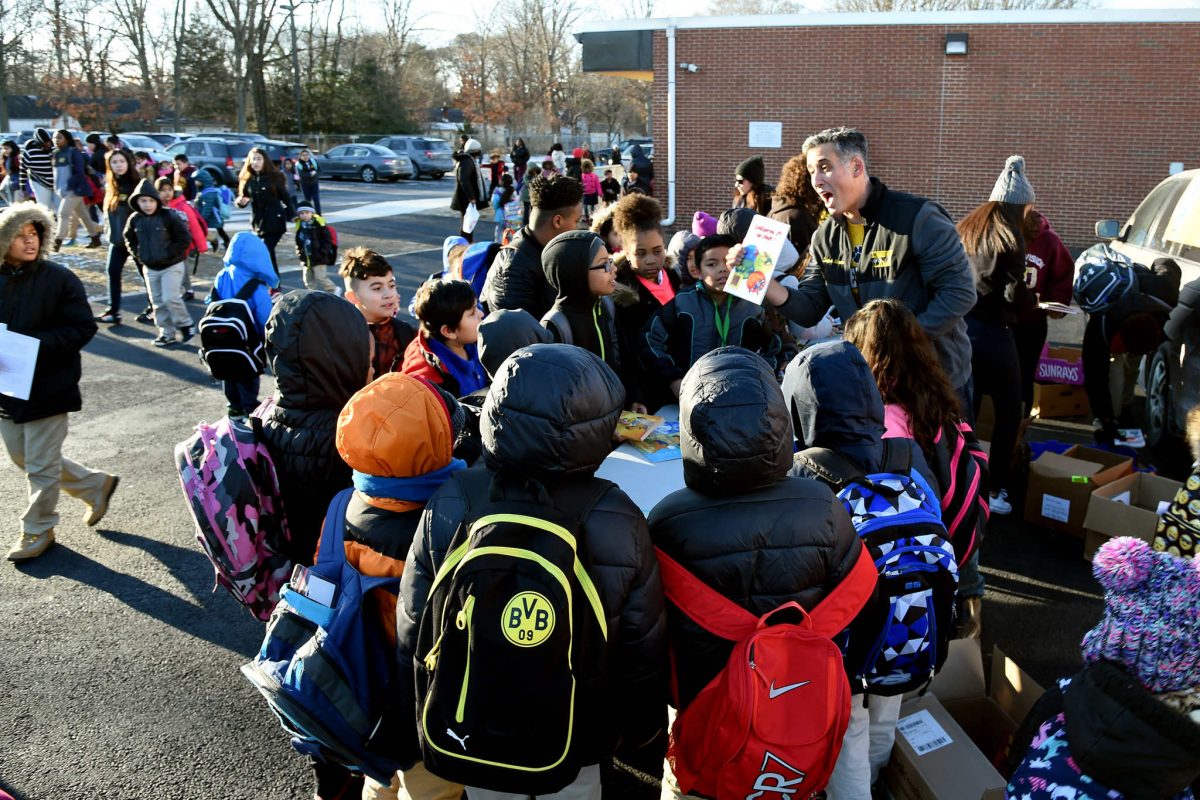
Larry Abrams shows BookSmiles books to Lindenwold Elementary School students in the nonprofit’s early days. This file photo is from 2018.TOM GRALISH / Staff Photographer
BookSmiles’ new space, across the street from the PATCO Woodcrest station, just off I-295, is a level up for the organization. It will allow BookSmiles to move from distributing 1.3 million books per year to five million books per year, and can accommodate more volunteers.
The music icon and humanitarian, who died Tuesday, was an inspiration for BookSmiles and a mentor to him, though he never met her.
Parton began her Imagination Library, a program that sends free books directly to children’s homes, as a tribute to her father, who never learned to read.
“I don’t know if I’ll ever get to 300 million books,” Abrams said. “But we know that if books are in the home, children will be more successful academically. We know that access to books changes equations.”
BookSmiles, 100 Melrose Ave., Cherry Hill, N.J., accepts book donations and volunteers. Its Teacher Take program resumes soon.
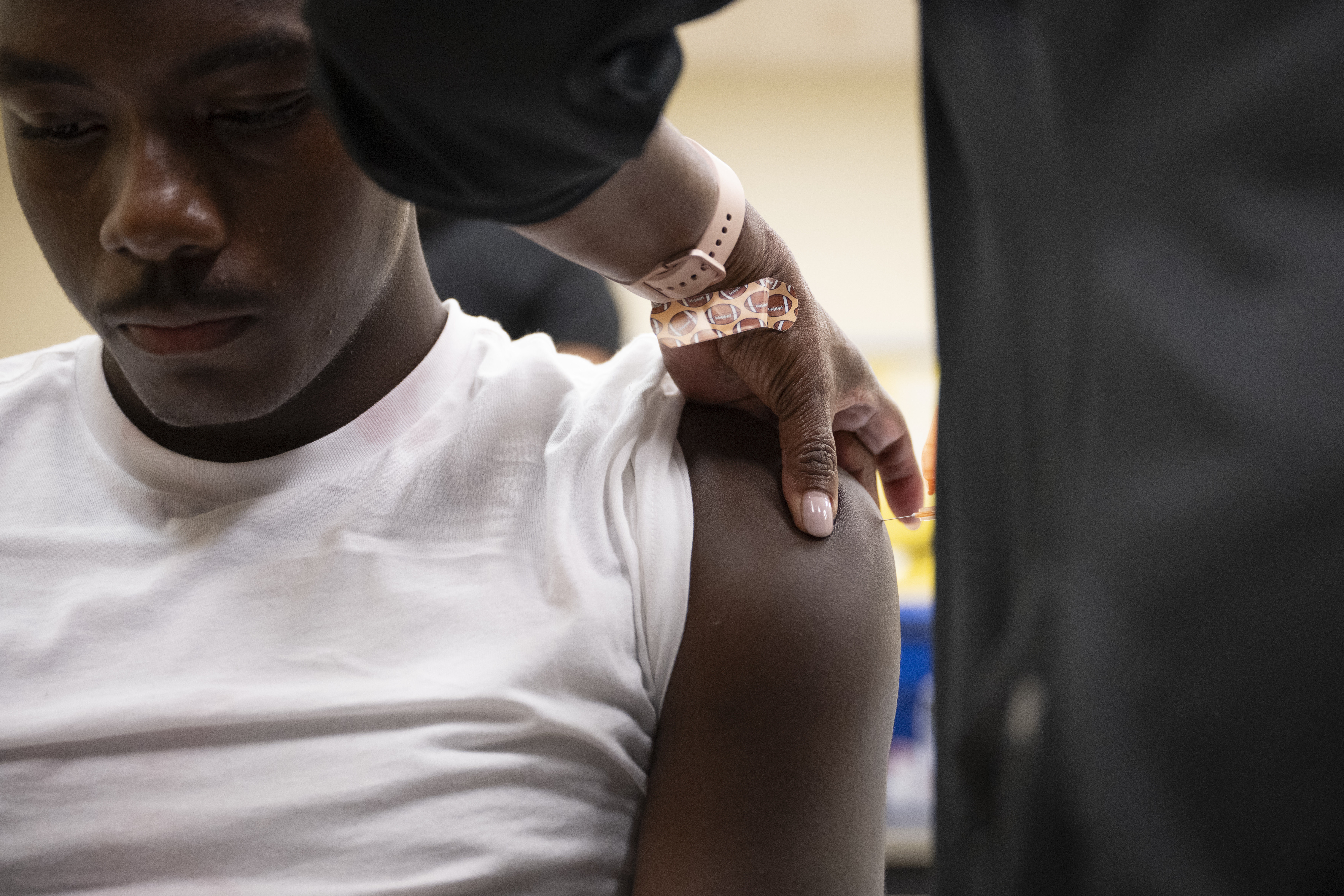
Families with kids in tow lined up Thursday at Benjamin Franklin High School for a one-stop shop: physicals, mental health services, vision screenings, and, perhaps most important, vaccines.
The Philadelphia School District is making a full-court press to get its vaccination rates up, amid a statewide measles outbreak and news that some city schools saw double-digit declines in kindergarten immunization rates in the 2025-26 school year — leaving communities vulnerable to further measles spread.
Kids must be healthy to learn, said Kendra McDow, a pediatrician and the district’s medical director, and vaccines against diseases like measles, whooping cough, and chickenpox are crucial protection.
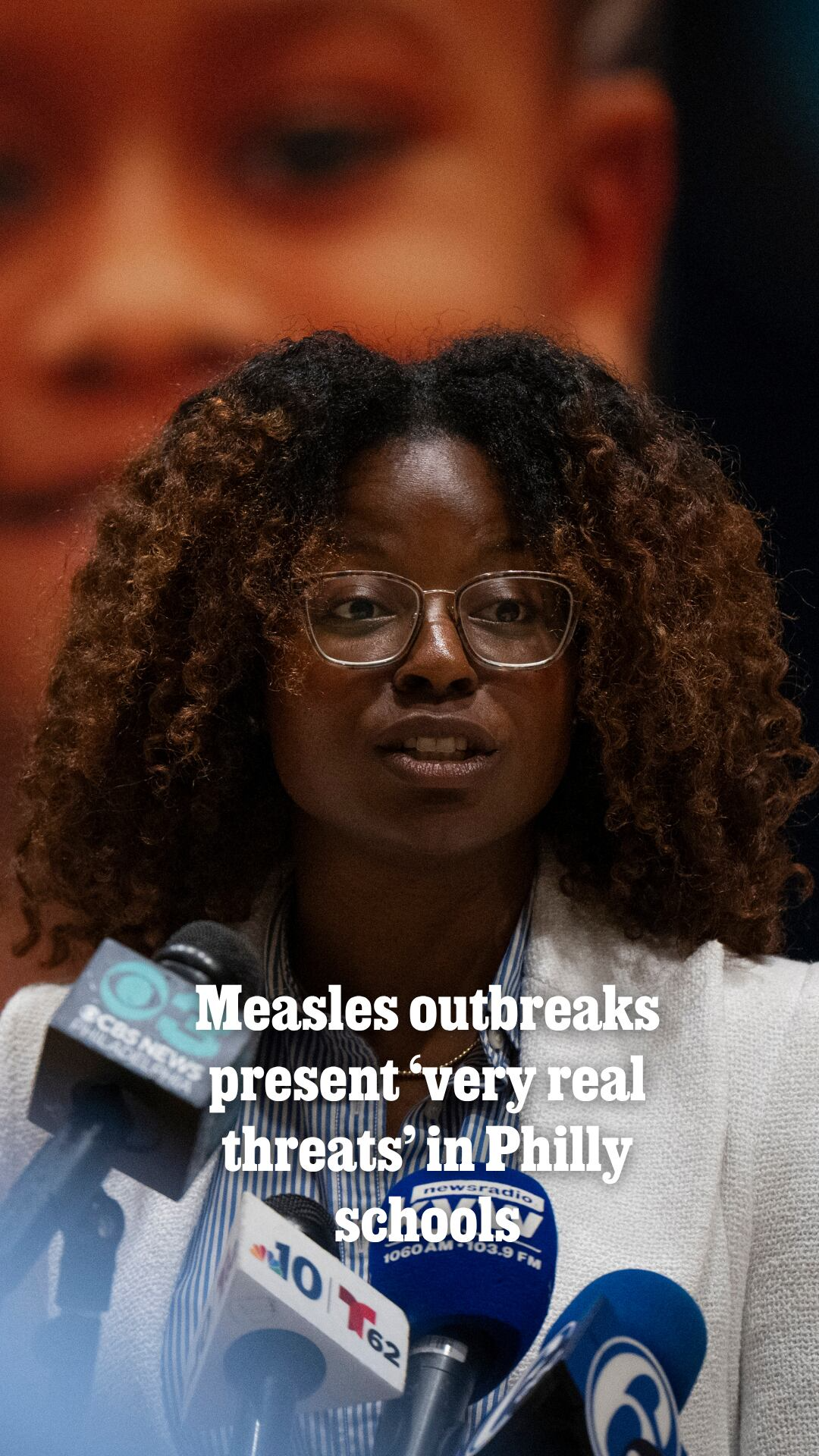
“In 2026, these diseases are very real threats to the health of children and communities,” McDow said. “We are seeing in real time the tragic consequences of children and adolescents not getting vaccinated.”
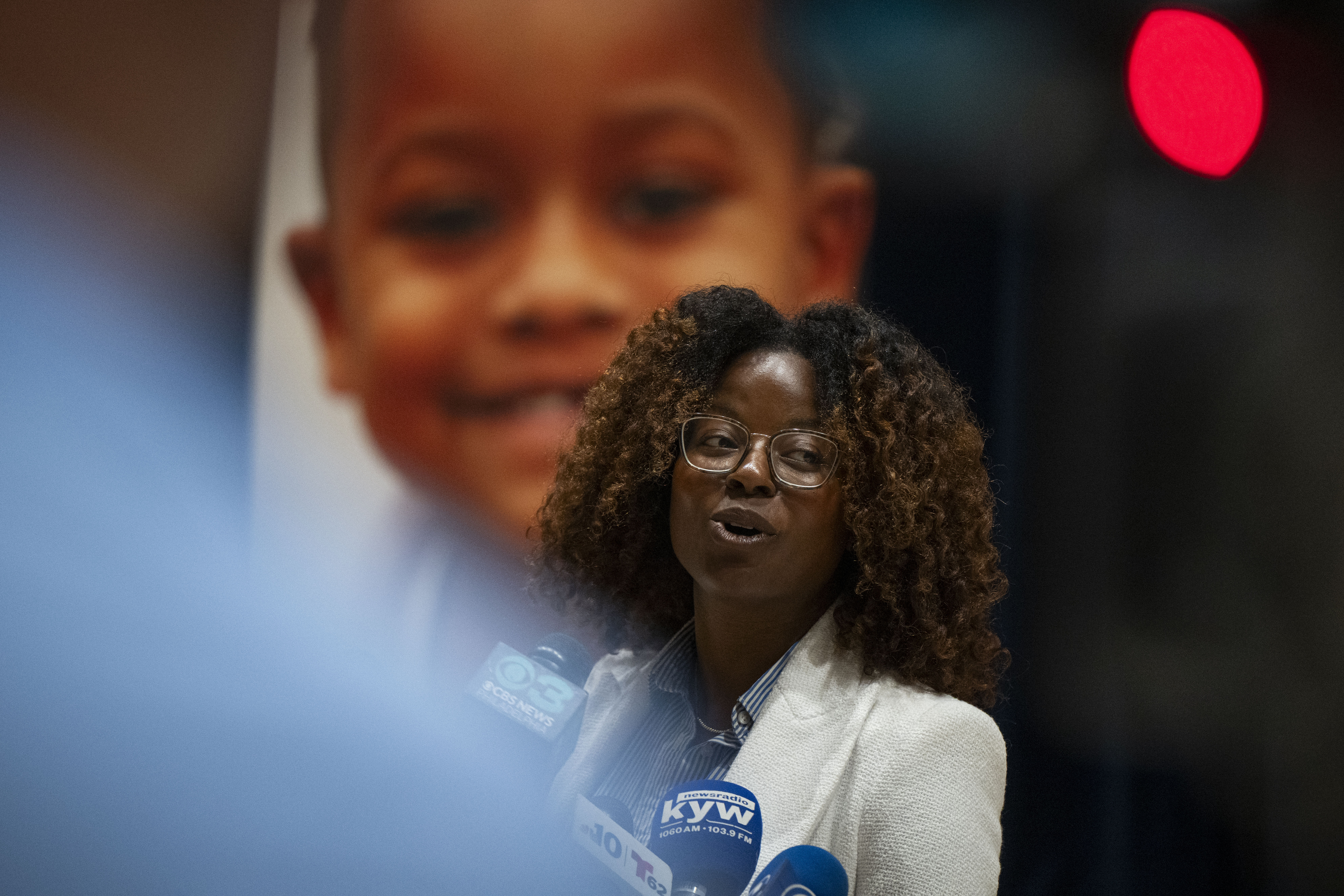
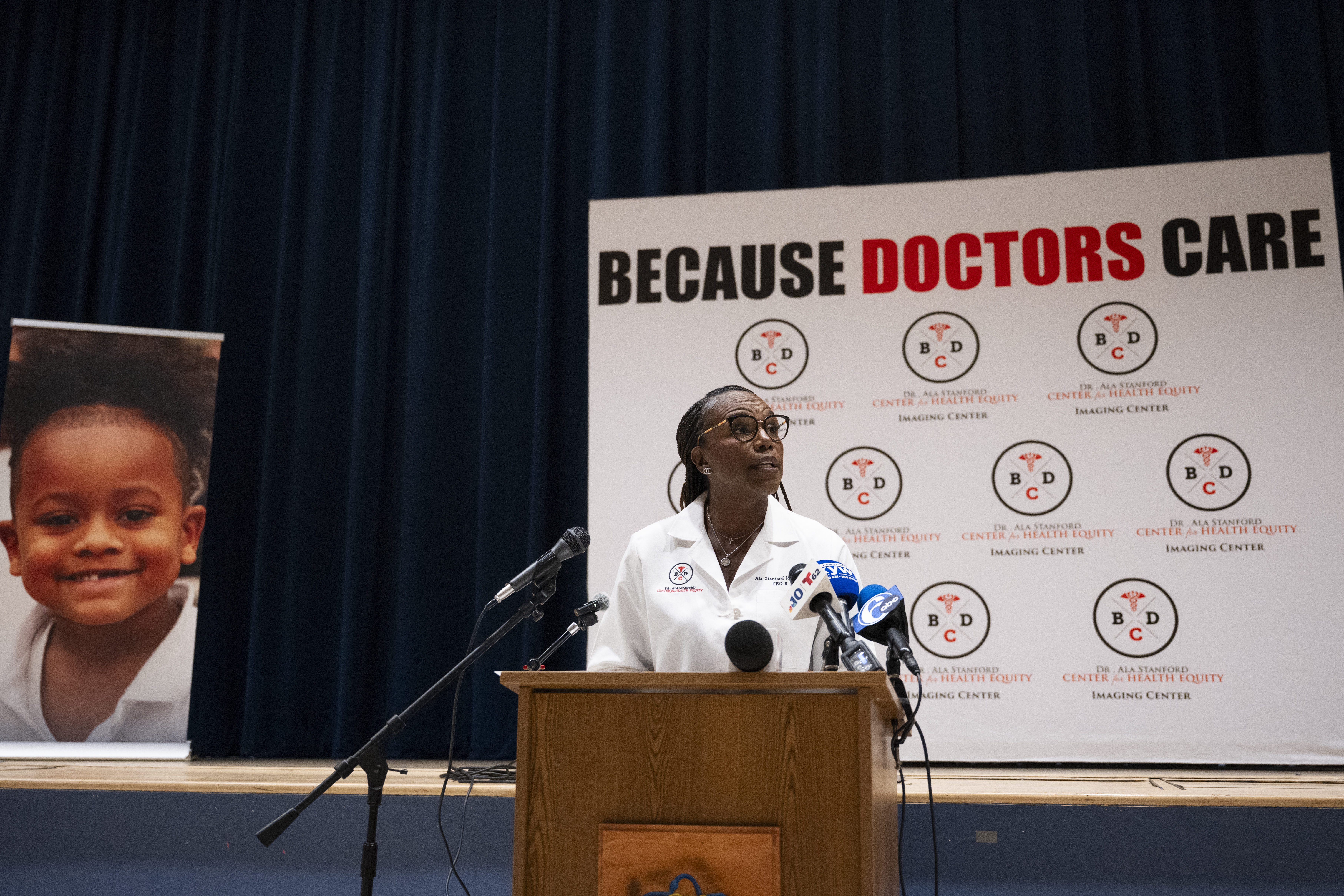
Medical Officer Kendra McDow speaks during press conference encouraging vaccinations for Philadelphia kids on Thursday at Benjamin Franklin High School in Philadelphia.Joe Lamberti / For The Inquirer
To achieve community protection, which scientists call herd immunity, 95% of a school population must be vaccinated. And though Philadelphia’s vaccination rates remain relatively strong compared with other pockets of the state, about 40% of kindergarten classrooms across Philadelphia and its surrounding suburbs became vulnerable to a measles outbreak last school year, up from a third of classrooms the year prior, according to an Inquirer analysis of state data.
To boost city immunization rates, the district is focusing on access — from a back-to-school bus tour this summer that came with a side of childhood vaccines to the Benjamin Franklin eventover two weeks, which runs through Friday.
Parents can register their children at the district’s Constance E. Clayton Education Center, at 440 N. Broad St., then walk up the block to Ben Franklin, at 550 N. Broad, to get their children vaccines and other preventive healthcare, including connection to mental health services and appointments to get eyeglasses.
Measles is now in 28 Pennsylvania counties, with more than 400 cases reported this year — nearly half in the last month. No cases have been reported in Philadelphia, but the highly contagious disease is circulating in suburban Chester County.
Pennsylvania had the most newly reported measles cases in the nation last week, said Ala Stanford, founder of the Black Doctors Consortium, and 73 state residents have been hospitalized.
Pennsylvania now has the highest number of cases reported in the state since 1991.
“This is not a mystery. It’s arithmetic,” Stanford said. “It takes 95% of us vaccinated to stop measles from moving through a community. Pennsylvania is at about 93%, and not one county in this region is at 95%.”
What parents need to remember, Stanford said, is that since children traditionally have not received their first measles vaccine until age 1, “every infant in the city, in the stroller, in the car seat, at the family reunion has no protection of their own. We are their protection. That is the entire system.”
In response to the current outbreak, state officials have started recommending that parents in affected areas vaccinate children as early as 6 months with a “zero dose” to provide extra protection against a disease so contagious that it will infect nine in 10 unvaccinated people who are exposed.
The benefits of community protection go beyond babies and children, Stanford said: “It’s the teacher. The lunchroom lady, the man who sweeps the floor, the security officer at the door — you do not know who they go home to at night. You do not know who is on chemotherapy, who has had a transplant, who is caring for a newborn.”
Video: Philly schools recommend vaccinations for students
‘Why so many?’
School officials plan to set up individual vaccine clinics at schools that have problematic compliance rates.
Emlen Elementary in Mount Airy, for instance, had a 100% vaccination compliance rate among incoming kindergarteners two years ago. Last year, it dropped to 80%. (Many Emlen families citedphilosophical or religious exemptions to vaccination.)
Ericka Hayes, senior medical director of infection prevention at Children’s Hospital of Philadelphia, said rampant misinformation about vaccine safety certainly contributed to lower vaccination rates.
“Parents should not let that sway them from giving their children one of the most tested and effective childhood interventions in history,” Hayes said.
Disruptions from the pandemic are another factor in lagging vaccine rates, Stanford said.
Dr. Ala Stanford of the Black Doctors consortium speaks during press conference encouraging vaccinations for Philadelphia kids on Thursday at Benjamin Franklin High School in Philadelphia.Joe Lamberti / For The Inquirer
At a recent clinic at Strawberry Mansion High, Stanford said, children from 30 schools across the city showed up for shots.
“We had 14- year-olds getting four shots, and we said, ‘Why so many?’” Stanford said. Families told care providers that they had fallen off on vaccine schedules, but were relieved to have a chance to catch up their children.
As word spreads about vaccine access, about ease and availability across the city, “more people show up,” Stanford said.
Kids can be excluded for vaccine noncompliance
Children can be excluded from school under Pennsylvania law if they are unvaccinated and their families have not formally filed for an exemption on religious or philosophical grounds.
According to state data, thePhiladelphia School District excluded 34 12th graders, five seventh graders, and three kindergartners last school year for vaccine noncompliance.
Far more students were labeled “noncompliant and attending” — 1,392 12th graders, 1,853 seventh graders, and 669 kindergartners. That means those students’ families have made a plan for them to get vaccinated, but have not yet followed up on it.
Students without vaccine exemptions can be admitted to kindergarten on a provisional basis as long as they have a plan to catch up on their vaccines. (State law allows exceptions for students living in foster care or without permanent housing.) They are listed as “non-complaint but attending” when families fail to adhere to that plan.
School officials have said they work with families in that category to help them catch up on shots, but unvaccinated kids may be asked to stay home if a communicable disease is identified at their school.
School nurses are key to the effort, officials said, on the front lines of ensuring students are vaccine-compliant. Every school in the district currently has a full-time school nurse, McDow said.
One of the district’s 277 school nurse positions is unfilled, but an agency nurse is covering that vacancy, and “we are working to have the position filled as soon as possible,” McDow said.
The act of getting vaccinated or vaccinating your children, said James Garrow, deputy commissioner of the city health department, is powerful.
“Your vaccination can help save lives,” Garrow said.
(function(){function e(){window.addEventListener(`message`,function(e){if(e.data[`datawrapper-height`]!==void 0){var t=document.querySelectorAll(`iframe`);for(var n in e.data[`datawrapper-height`])for(var r=0,i;i=t[r];r++)if(i.contentWindow===e.source){var a=e.data[`datawrapper-height`][n]+`px`;i.style.height=a}}})}e()})();
Philadelphia Superintendent Tony B. Watlington Sr. zigzagged the city Monday, visiting seven schools across the city to start the 2026-27 year.
The late-summer weather was perfect, sunny but not sweltering — an important factor in a school system laden with old buildings, where extreme heat sometimes means about a quarter of the district’s 113,000-plus students cannot learn in person or at all,
Watlington is hoping that the back-to-school weather was an omen.
“The way we start is going to be the way that we roll, and the way we finished last year,” the superintendent said. “We started off really well.”
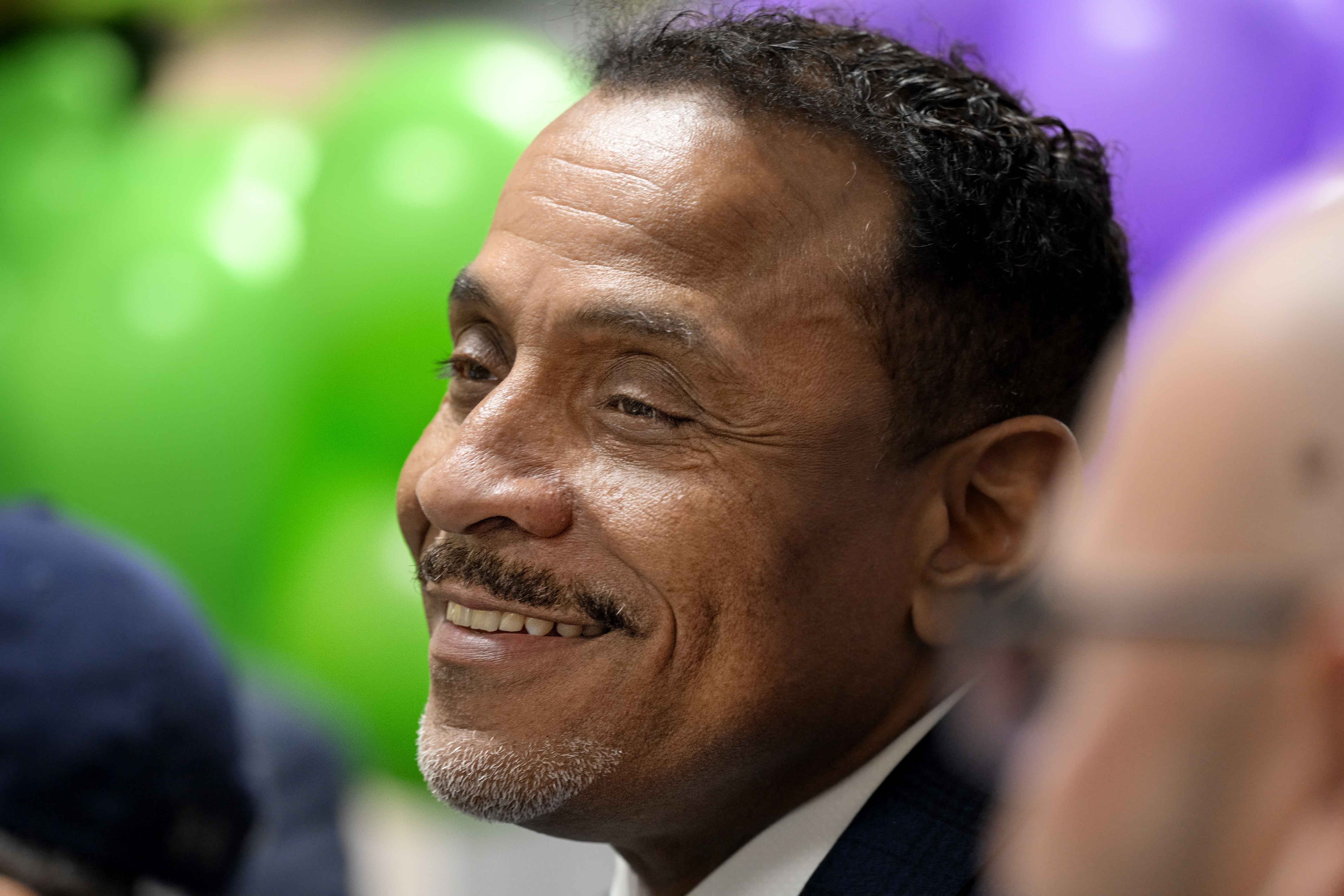
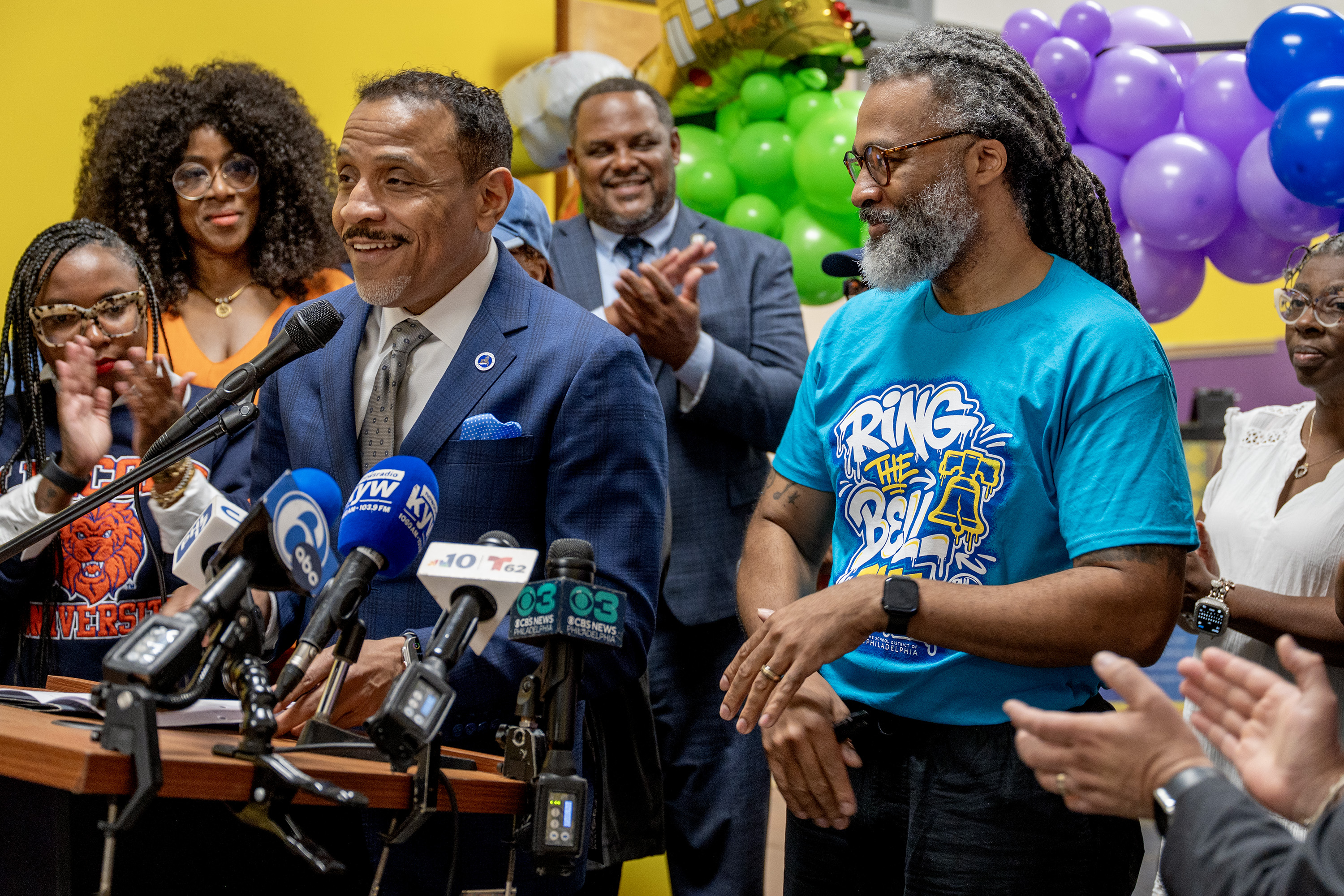
Superintendent Tony B. Watlington Sr. (left) and district board president Reginald L. Streater (right) hold a press conference at McClure Elementary Monday, Aug. 24, 2026 on the first day of school in the Philadelphia School District. Behind them in center is Carlton Williams, just a week into his job as the City’s Philadelphia’s Managing Director (he started Aug. 17)Tom Gralish / Staff Photographer
“We want people to stop and digest that for a moment,” Watlington said. “Because people will say, ‘Well, are the scores still too low?’ I’d say absolutely, yes, we’ve got a lot of work to do and it’s not acceptable that two out of three kids don’t read or perform on grade level in math, but we’re getting better faster than the 25 largest school districts, and that’s our goal to be the fastest-improving, so we’re well on our way,” Watlington said.
“We believe it’s important for us to work with parents as equal partners because they are our children’s first teachers, and when we support our parents and families, our kids just do better in school,” he said.
The Parent and Community Ambassador Program will provide small stipends to “key community members and parents who just have a level of influence and cachet that no teacher, principal, counselor, police officer, or superintendent has in communities,” Watlington said. “If we can figure out how to connect with some of these key community folks, it will do nothing but help us to improve student attendance in schools where there may be some tensions or poor communication between families and school staff.”
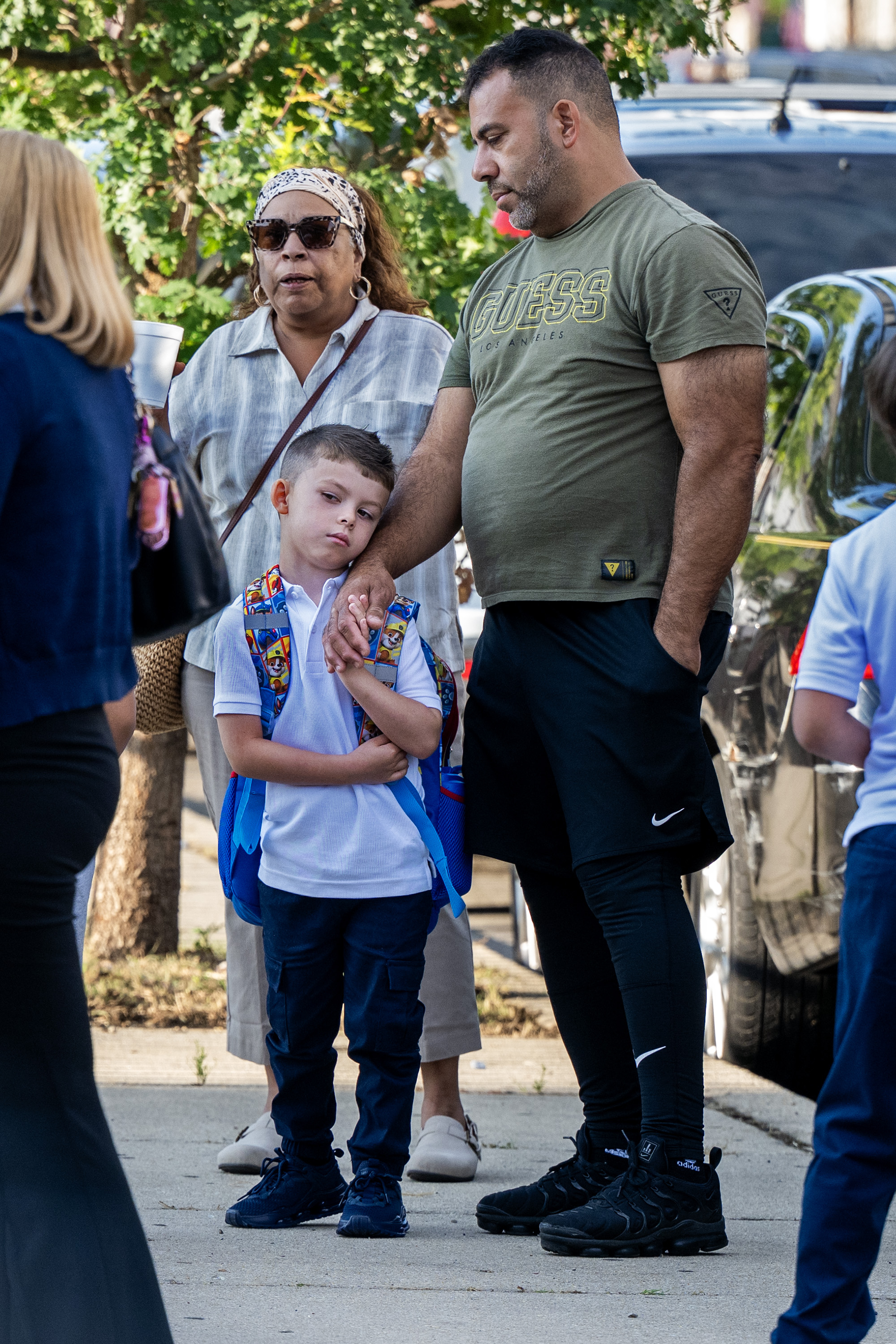
Johnny Beauchamp (right) waits with his son Johnny (5, not a Jr.) as they arrive early at McClure Elementary Monday, Aug. 24, 2026 on the first day of school in the Philadelphia School District. Young Johnny is going into kindergarten and Beauchamp, a single father, took two days off from his work as a truck driver to make sure he could be there on “the start of the rest of his life.”Tom Gralish / Staff Photographer
The aim, the superintendent said, is to address issues like homework completion, or family cooperation with key school initiatives.
“We think that’s a pioneering effort,” Watlington said. “Families first in 2026-2027.”
The program will begin as a pilot in a limited number of schools. Watlington did not provide details about how much ambassadors will be paid or how many schools will participate initially. He said details will be released soon.
About those PSSA and Keystone scores
There has been significant speculation around the release of state test scores. Pennsylvania released preliminary data to districts in the late spring, as it typically does, but Philadelphia has shared only limited student PSSA scores with select staff. Most Philly principals and teachers have not seen the scores, though other districts and schools have not withheld the data.
Wuimarlyn Sanchez, (left) , 7, is greeted by a classmate outside McClure Elementary Monday, Aug. 24, 2026, starting as second graders on the first day of school in the Philadelphia School District.Tom Gralish / Staff Photographer
The Pennsylvania Department of Education notified districts last week that statewide results, typically available to districts in late August or early September, would be delayed, though the release of the data to parents and the public does not typically happen until the fall.
Philadelphia officials then suggested the state holdup was the reason for their own delay.
Watlington said Tuesday that “we’re just going to wait for the official, verified data to come to us. We’re not trying to hide anything, but we need to get the verified data.”
The superintendent suggested, however, that both statewide glitches in the administration of the test on the first day of PSSAs and the shift to online administration of exams, which research links to decline in student scores, will show an effect when the scores are finally made public.
“My hunch is that, at the end of the day, online testing will have had some impact, but I don’t want to speculate on that across the Commonwealth of Pennsylvania,” Watlington said. “When the state verifies the data, we’ll release it immediately.”
Some students were unable to access tests for up to 40 minutes on the first day PSSAs were administered.
“All things being equal, I personally would like to be able to do over every single first-day test,” Watlington said. “That’s not really financially or time practical, but in an ideal world that would be my, my superintendent’s wish.”
School selection’s still up in the air
The district’s much-watched school selection process will open this year on Sept. 8 and close on Oct. 30. Watlington said its details are still being worked out, given the state score wrinkle.
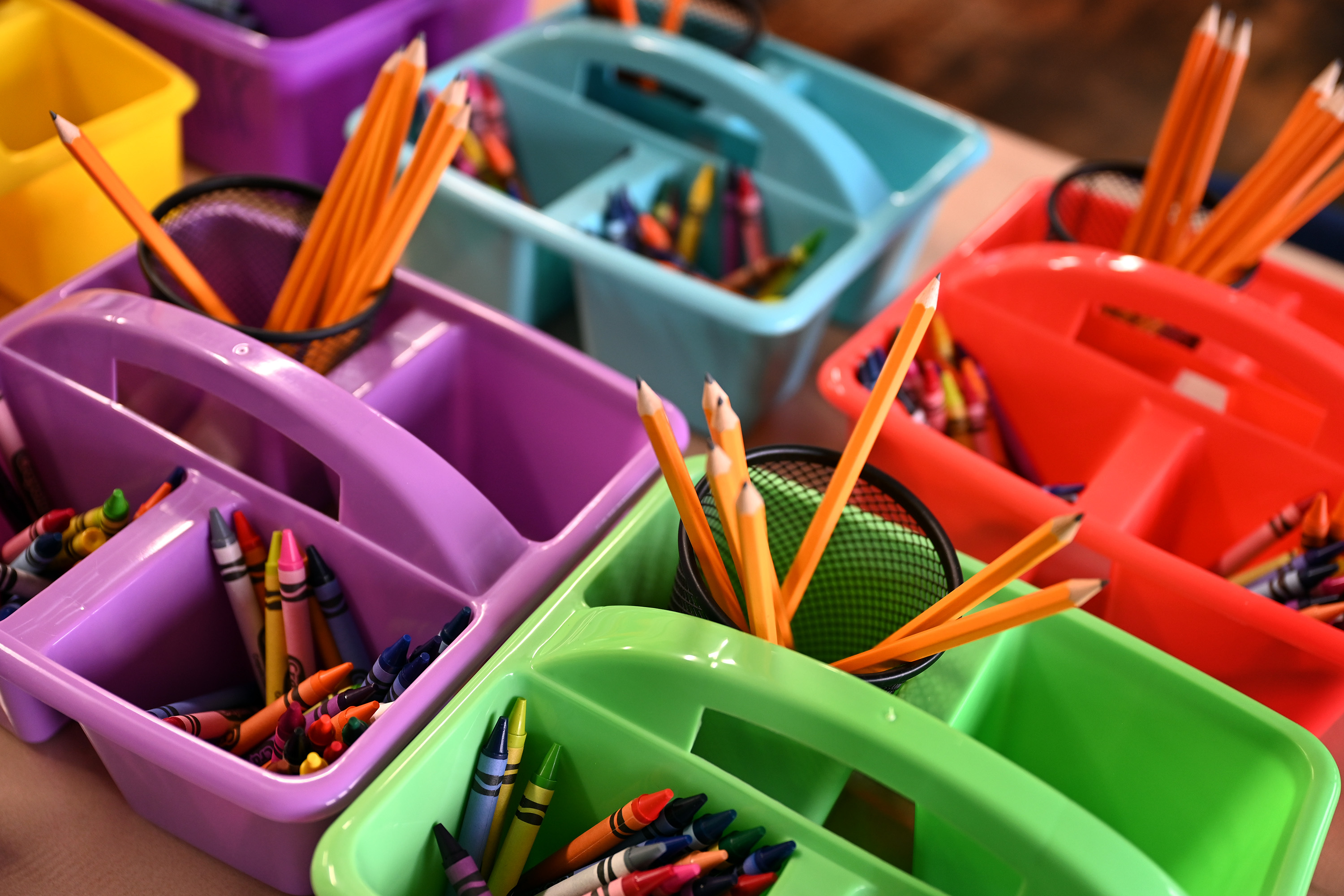
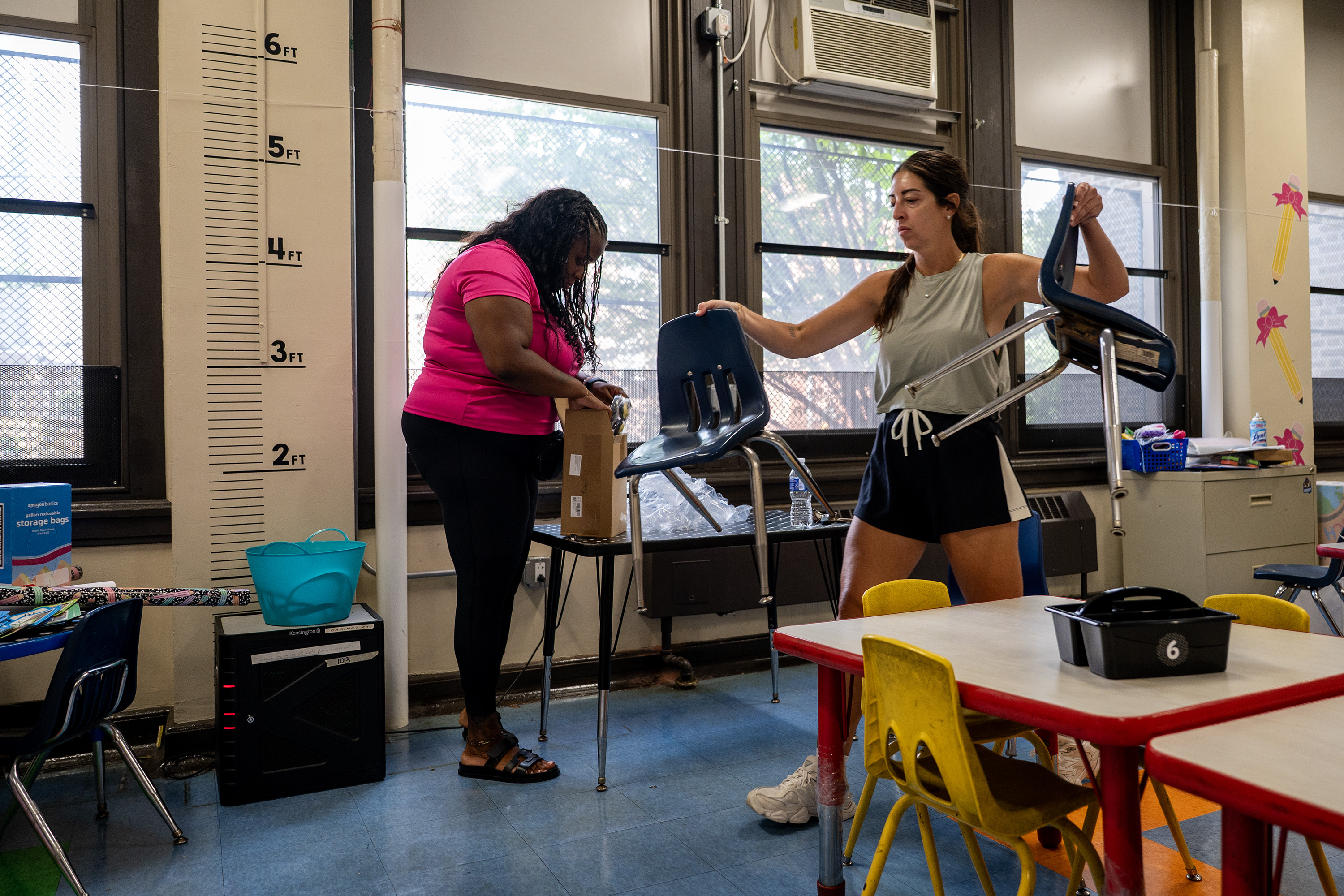
Pencils and crayons in the first grade classroom of teacher Lauren Cucinotta at Fanny Jackson Coppin Elementary are ready to write and color Tuesday, Aug. 18, 2026, as she prepares for the start of the School District of Philadelphia school year on Aug. 24.Tom Gralish / Staff Photographer
Students who wish to gain admission to the system’s 37 criteria-based schools typically submit PSSA scores for consideration. Last week, district officials said they would not use PSSAs for school selection.
Watlington said Tuesday that his team was “currently reviewing a number of options about how to handle the fact that we won’t have 2025-26 data in time for our school selection process. So we’re reviewing all of our options. I believe there was a thinking initially that we’d have students who have access to some special test — the Terra Nova, etc. We’ve not finalized a decision there yet, so we don’t want to get ahead of our skis just yet.”
District size, and winning back kids to Philadelphia schools
When Watlington talks about Philadelphia being one of the 10 largest school systems in the U.S., he is counting children enrolled in both traditional district schools and charters — all of which are supported by taxpayer dollars.
Counted together, last year, the district had 113,735 students, and charters enrolled 64,469.
The district’s enrollment grew for the first time in a decade in 2024-25, inching up by a little fewer than 2,000 students. It then lost 794 students last year, which Watlington attributes to a SEPTA strike at the beginning of the school year that caused a pronounced drop in student attendance and, he believes, caused some families to disenroll children from district schools.
“It’s too soon to know exactly where our numbers will shake out, but my expectation and hope would be that we maintain the similar enrollment to last year,” Watlington said. “I expect this school district to grow over time, though.”
Why? Watlington touted Masterman’s recent ranking by U.S. News & World Report as the nation’s No. 3 public high school in the country and the district’s academic gains.
“We just need to tell that story,” Watlington said, “and go out and market ourselves to parents.”
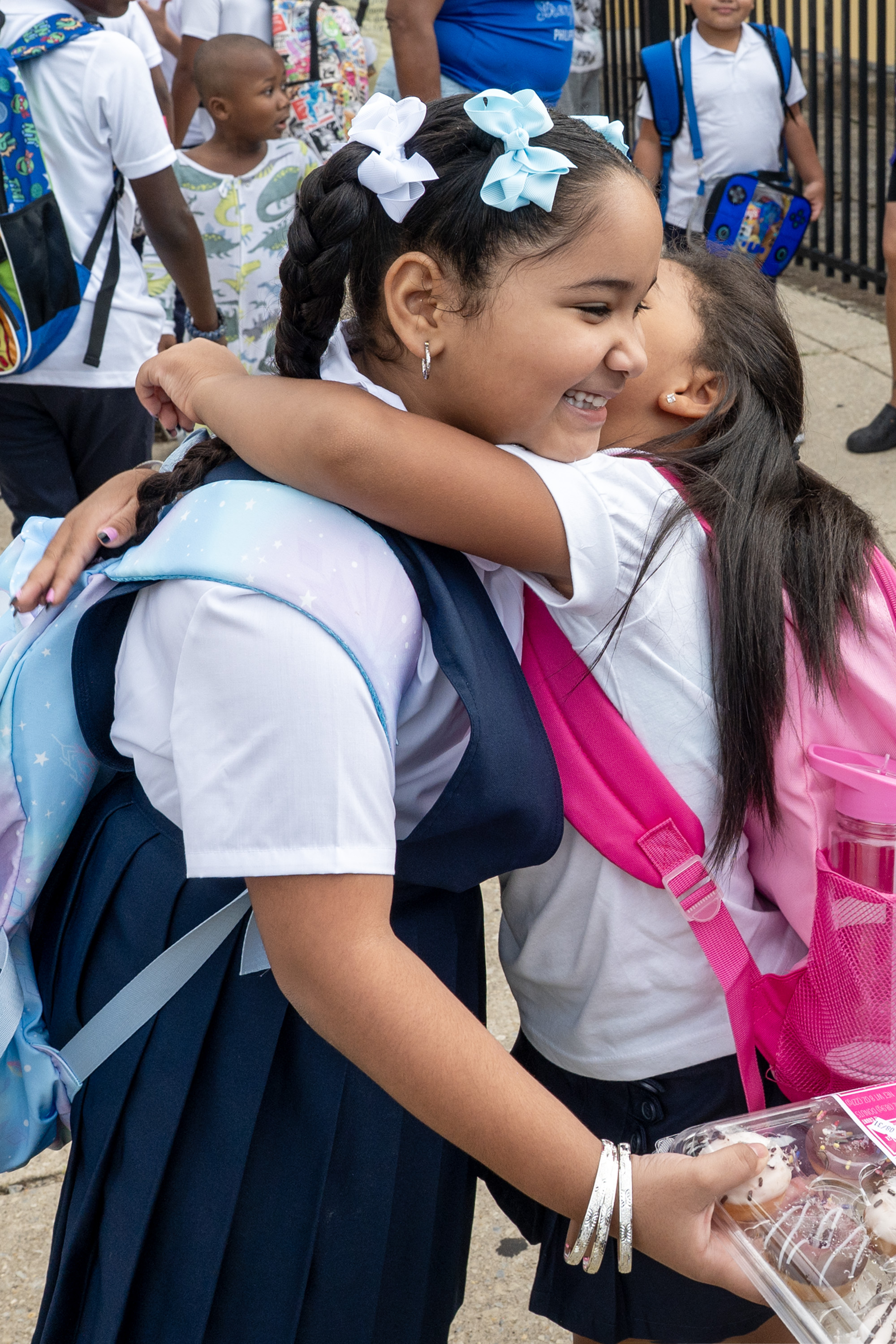
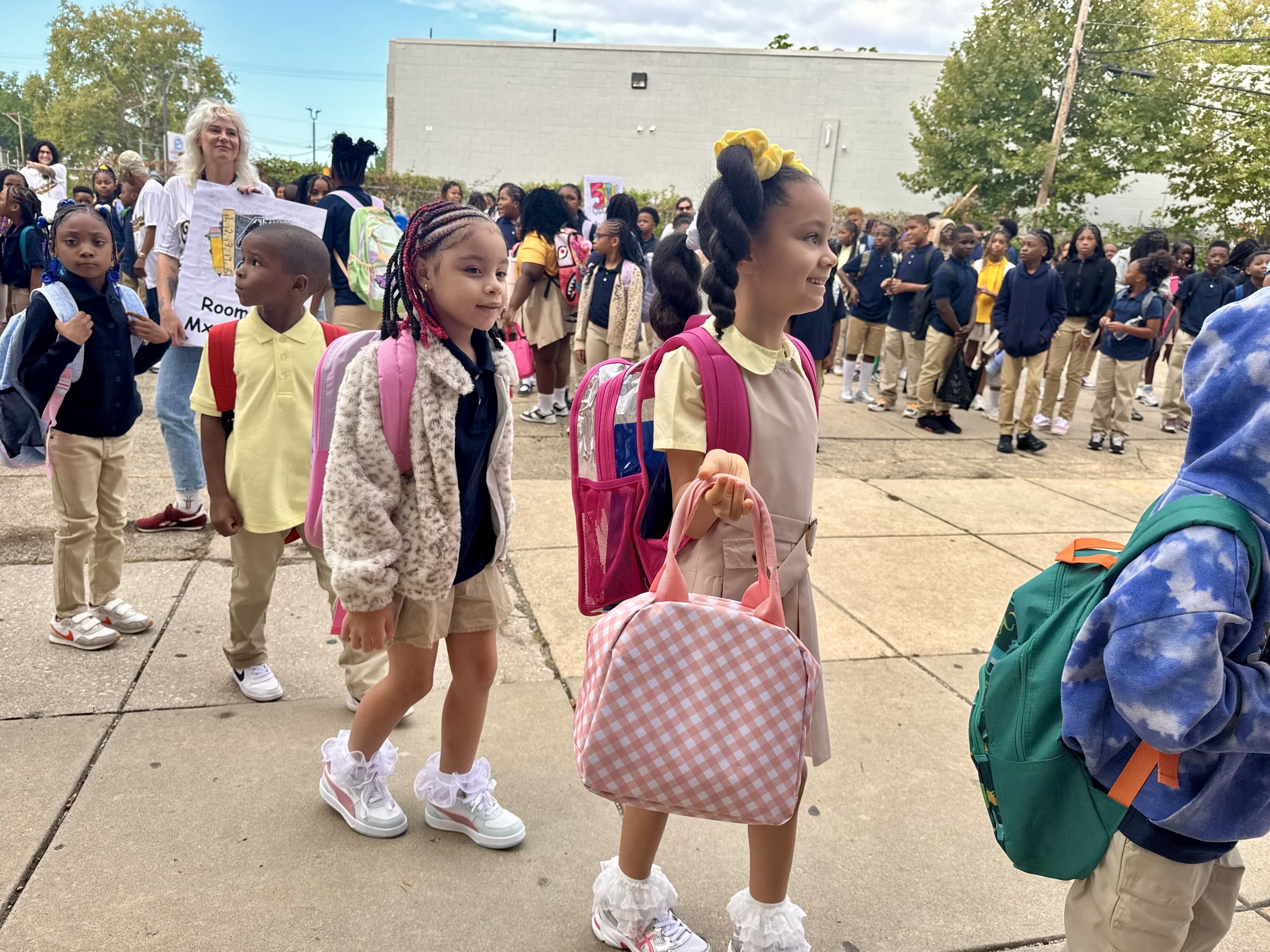
Eighth graders tossed a football across the concrete schoolyard. A fourth grader broke into a dead run, intent on catching up with friends she hadn’t seen all summer. A teacher hugged a first grader with a shy smile and a giant pink backpack crammed with school supplies.
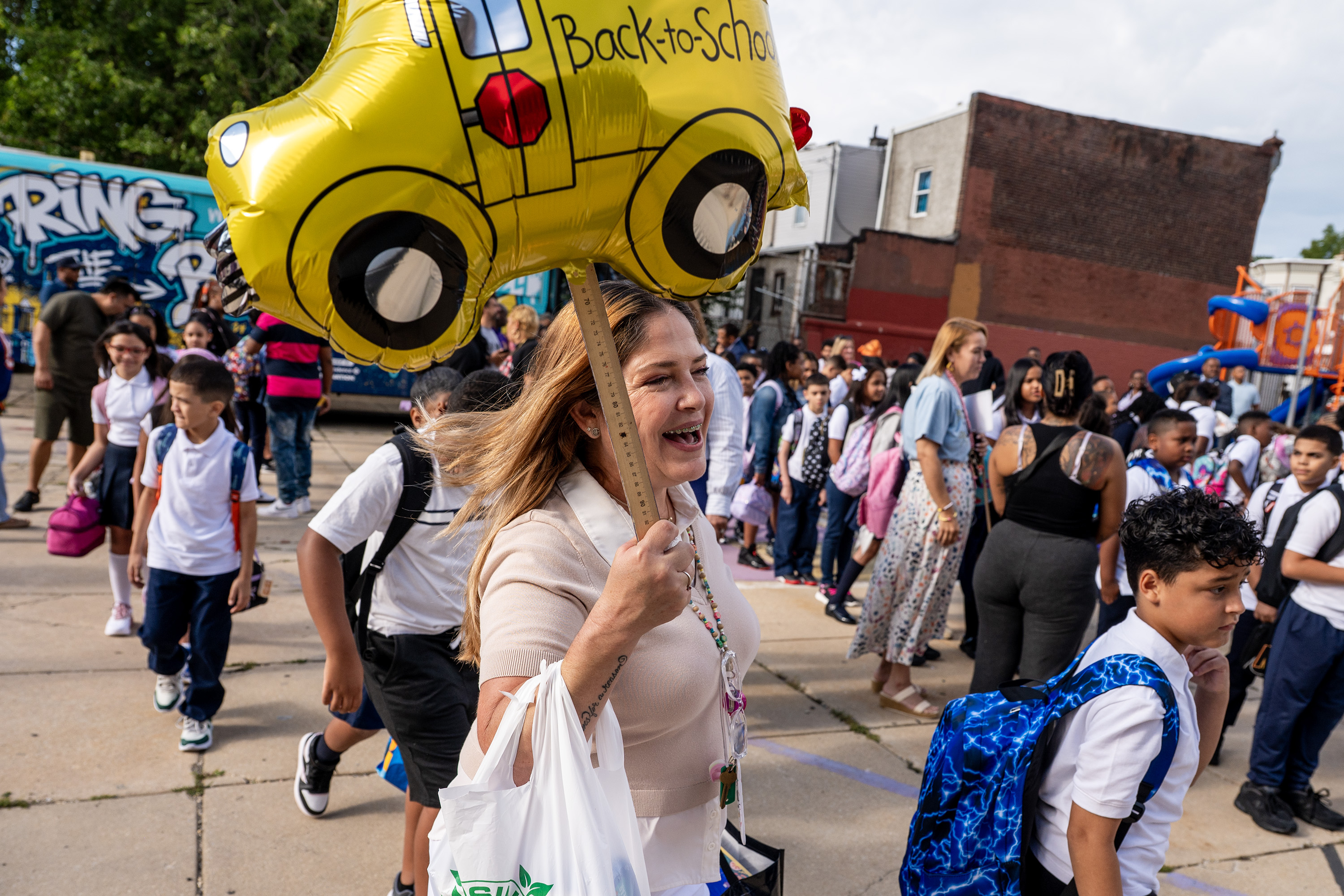
The scene at Overbrook Elementary played out across the city Monday morning as most of the Philadelphia School District’s 113,000 students returned to class for the start of the 2026-27 school year. Kindergartners are due to begin classes Thursday.
At McClure Elementary in Hunting Park, Superintendent Tony B. Watlington Sr. repeated at a news conference his overarching goal: for Philadelphia to become the fastest-improving big-city school district in the U.S.
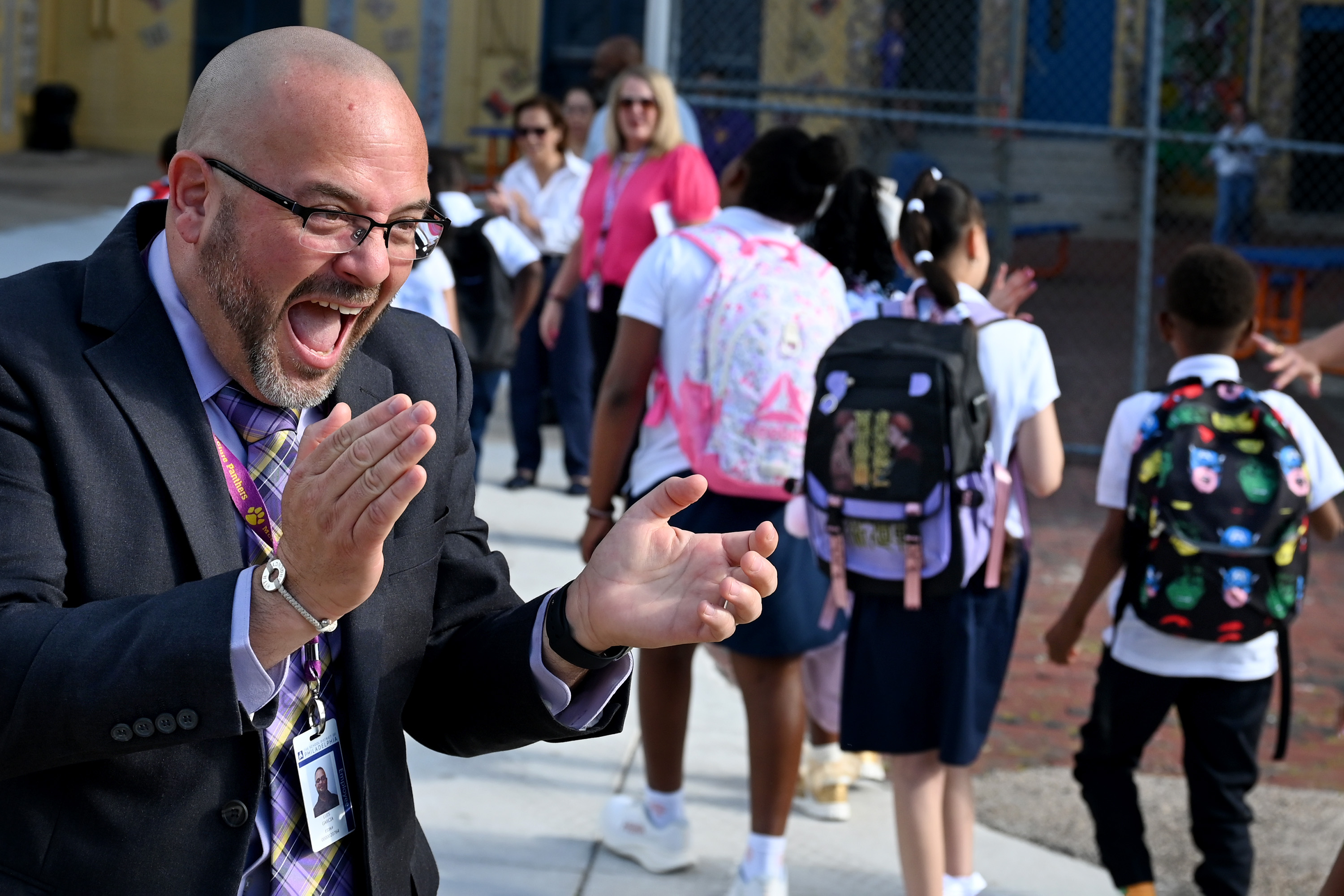
McClure Elementary principal Luis Garcia greets students Monday, Aug. 24, 2026 before they head into class on the first day of school in the Philadelphia School District.Tom Gralish / Staff Photographer
The district will “double down this year to continue to drive this fast improvement, and we won’t rest until all of our children are at grade level in reading and math,” Watlington said. According to 2024-25 state data, 34% of district students meet state standards in reading, and 23% in math. (More recent PSSAs, typically available to teachers and principals by now, have not been shared by Philadelphia leaders.)
Reginald Streater, the school board president, said improving educational outcomes is also about creating generational value.
“A student can walk through the doors, irrespective of their race, creed, class, gender, or shared ancestry, in our schools with a world of possibilities in front of them and leave those same doors with the knowledge, confidence, and opportunity to pursue the future they envision for themselves,” said Streater, father of two children in district schools, “armed with the tools to break the bonds of generational curses and barriers designed to keep them and their ancestors and their progeny in a perpetual state of servitude and second-class citizens.”
Mayor Cherelle L. Parker was not present at the district’s first-day festivities, a rarity, but Debora Carrera, her chief education officer, touted Parker’s $48 million agreement that restored some of the 340 positions that otherwise would have been axed because of budget cuts.
That was good newsfor Johnny Beauchamp, a single father and truck driver, who was dropping off his son for his first day at McClure.
While Beauchamp said he is confident the city has addressed its budgetary concerns regarding staffing and school openings, he hopes to see some initiatives on school safety.
“I’m actually more excited than he is. It’s his first day … and his bright future starts today,” Beauchamp said. “But my main concern nowadays is the safety, especially with guns and stuff like that. Also, making sure our schools are clean and sidewalks are clear of glass and other dangerous stuff where our kids are playing.”
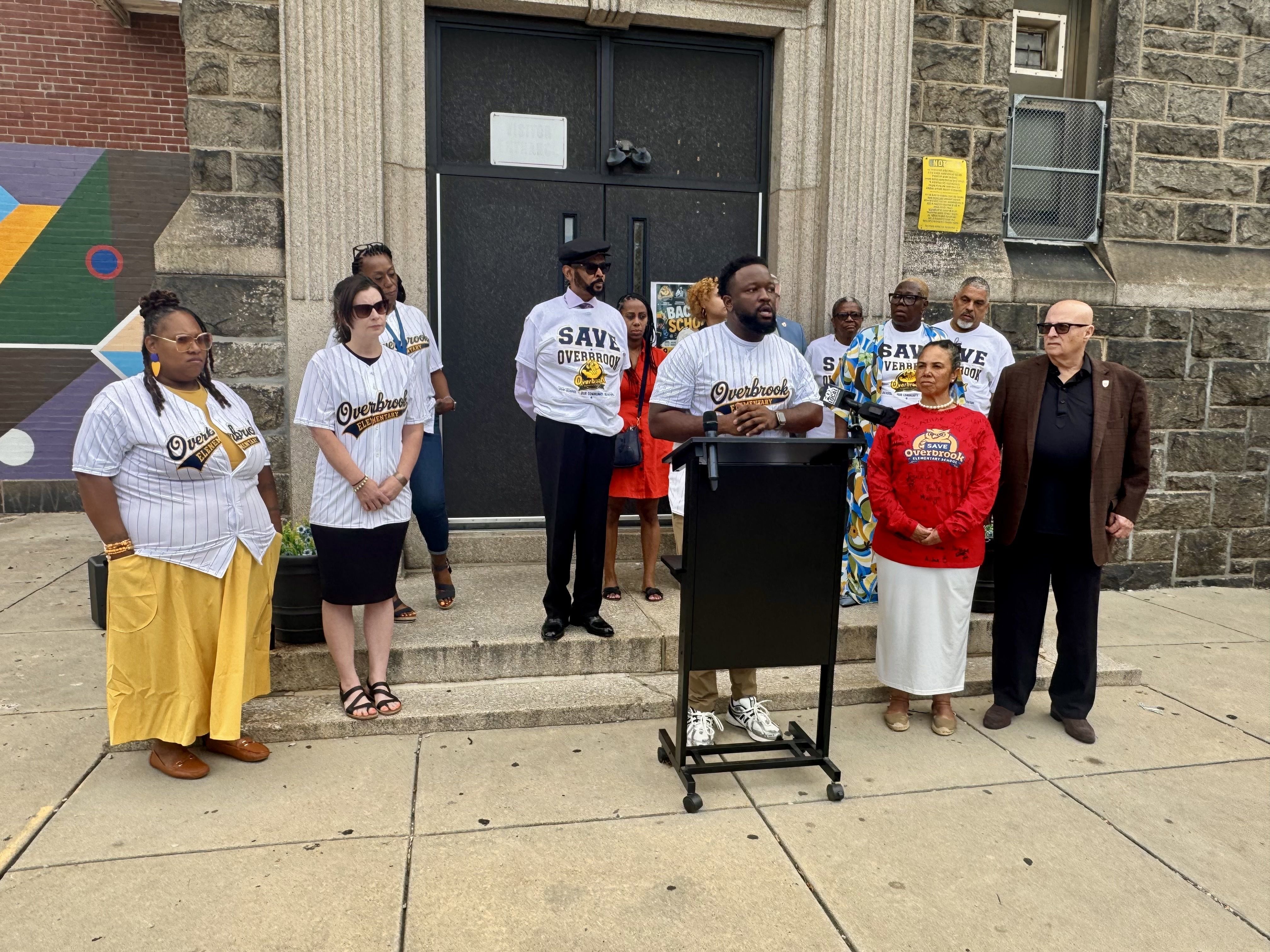
Overbrook is a small, high-performing school in a very old building: The school is celebrating its 120th anniversary this year. Its tight-knit community wraps its arms around Overbrook and has mounted a fierce fight to keep it open.
“Leave Overbrook alone,” said Fahmee Shabazz, dad of an Overbrook fourth grader. “Please, somebody help us.”
Teachers union and elected officials were on hand at Overbrook for a news conference to pledge continuing efforts to try. Multiple politicians have said they will keep the pressure up to remove Overbrook Elementary, Robeson High, and Lankenau High from the district’s closing list.
Teachers, politicians and Philadelphia Federation of Teachers officials listen to Kenneth Glover, principal of Overbrook Elementary School, speak on the first day of the 2026-27 school year. Glover said the school, which is one of 17 Philadelphia schools slated to close, will focus on academics this year and let adults fight a battle to stave off closure.Kristen A. Graham / Staff
“We cannot disrupt the good things that are happening here,” said State Sen. Vincent Hughes (D., Philadelphia), chair of the Senate Appropriations Committee.
Hughes said action needs to happen in Harrisburg to help better fund schools. But he added: “We’re still going to fight for Overbrook Elementary and the schools like it, [which] deserve to stay open.”
Last year, many Overbrook Elementary teachers used news of the school’s closing as an object lesson — in civics and the world around them — said Kenneth Glover, the school’s principal.
“I’m so happy that it’s day one,” he said. “Like I tell my students all the time, each day is a fresh start, and this year is a fresh start. Last year, a lot of the focus was on adult issues, right, fighting to keep the school open. This year, I really want students to focus on academics … for us to just have a beautiful school year.”
Overbrook Elementary School students get ready to enter the building for the first day of the 2026-27 school year. It could be the 120-year-old school’s last first day, as it’s one of 17 schools the Philadelphia School District has slated to close.Kristen A. Graham / Staff
While Glover said he still hoped the school could be kept open, he has begun to work with the district’s newly created transition office to plan for what comes next.
Still, said Kathryn McQuade, Overbrook Elementary’s art teacher, the closure and the fight to prevent it are overshadowing the year for many.
“Seven million could easily go towards … modernizing this building for the future,” McQuade said. “And that wouldn’t be a lease, that would be a one-time price tag.”
Arthur Steinberg, president of the Philadelphia Federation of Teachers, said he “was hoping that when I came here today I’d be able to say, ‘Well, we saved Overbrook from the chopping block.’ Unfortunately, that is not the case. However, we have not given up the fight to keep Overbrook and every other school in the city open.”
Steinberg said the PFT would release a plan this week that would give the district a path to keep all 17 schools open.
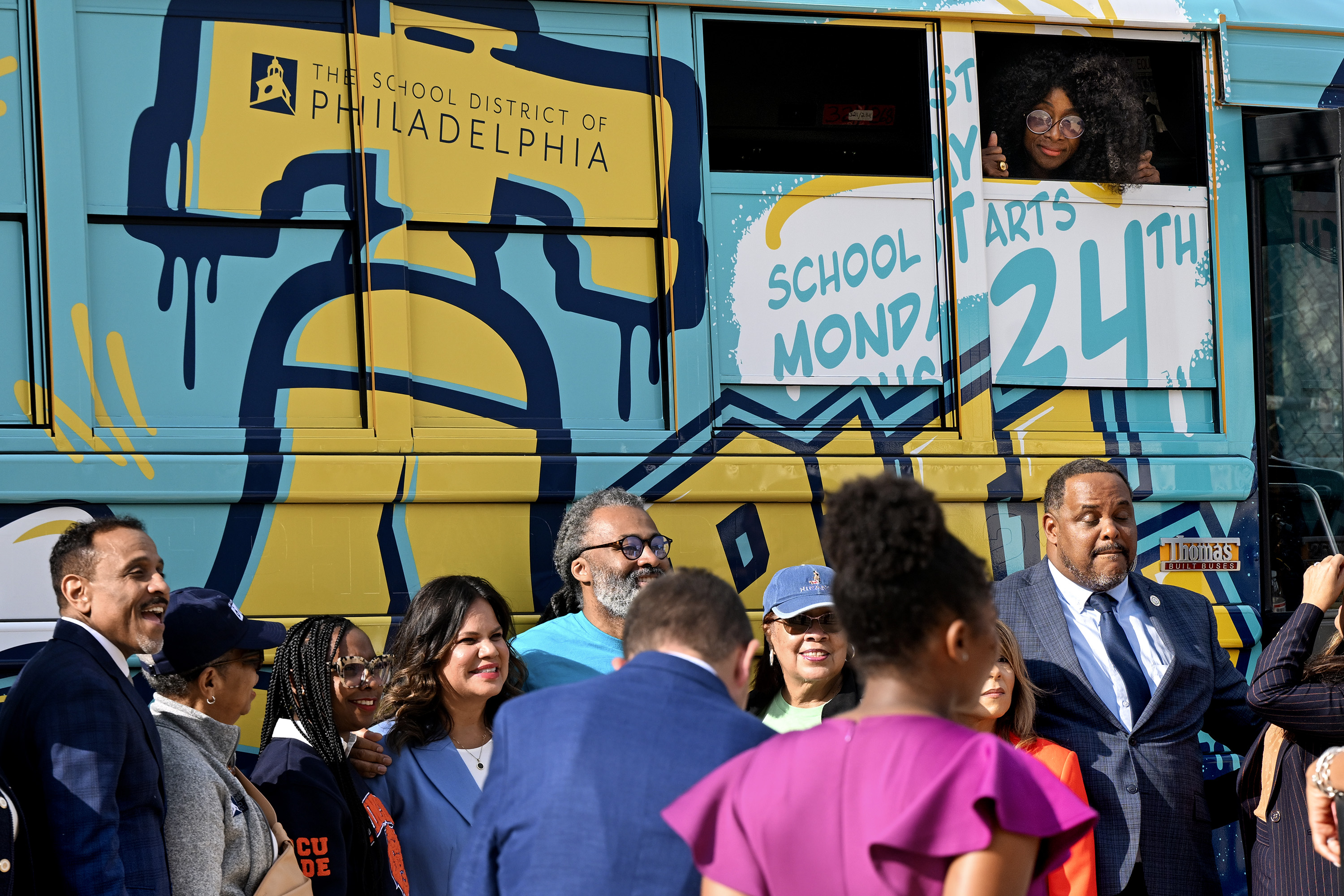
Robin P. Cooper (upper right) watches as school and city official gather for a group photo outside the district bus. Cooper is president of Commonwealth Association of School Administrators (CASA). At far left is Superintendent Tony B. Watlington Sr. The bus, part of Mayor Cherelle L. Parker’s Neighborhood Community Action Centers, was to visit and rally at schools in every city council district.Tom Gralish / Staff Photographer
School begins Monday for about 113,000 Philadelphia School District students.
Janis Butler, the interim principal of Fanny Jackson Coppin Elementary in South Philadelphia, has decades of experience in teaching and administration.
But she is still thrilled at the prospect of personally welcoming back Coppin’s 500-plus students.
“It’s a rah-rah, we’re back in business now,” Butler said.
Here is what to know about the 2026-27 school year.
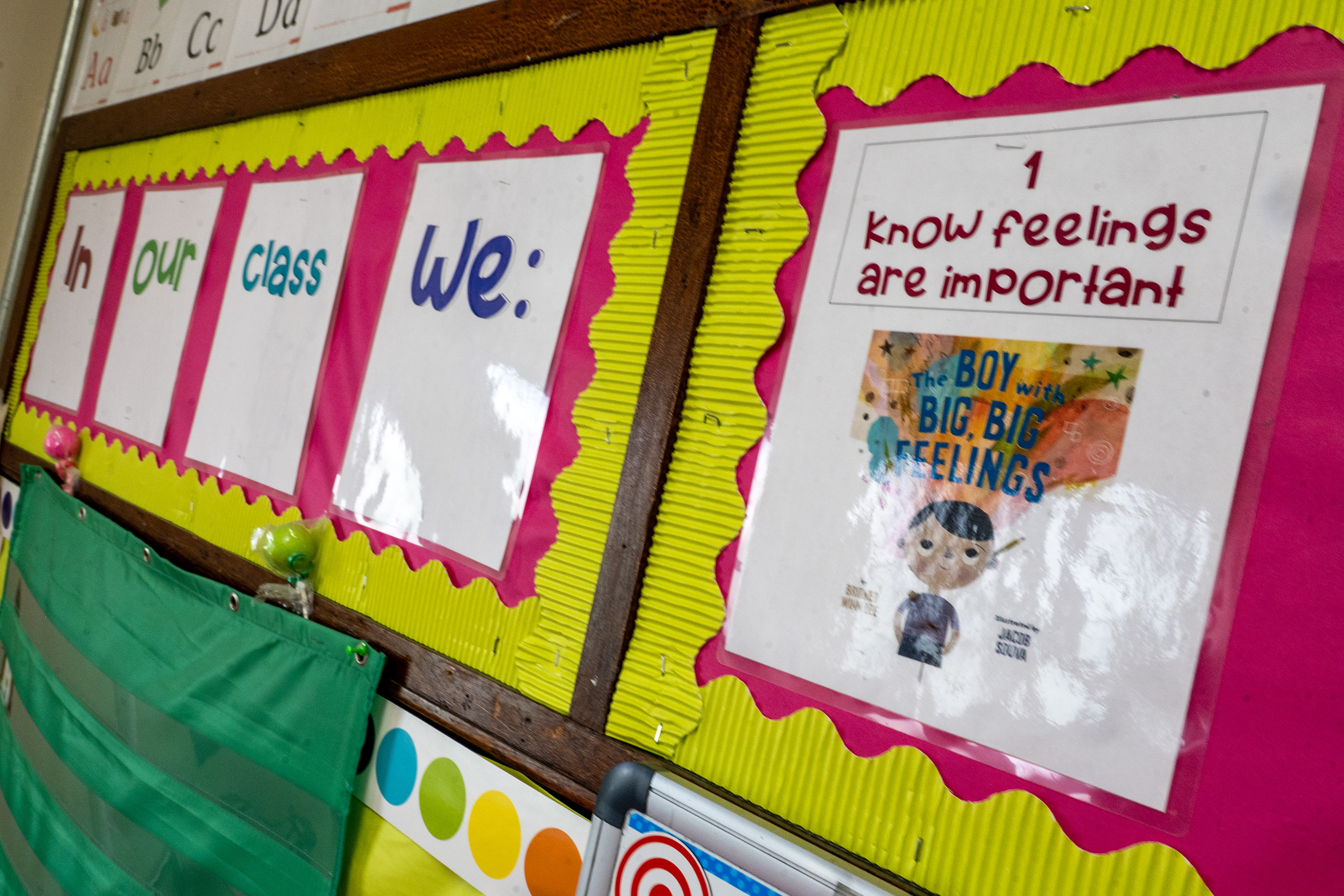
Book cover posters highlight positive emotions in the second grade classroom of teacher Gabrielle DiCrosta at Fanny Jackson Coppin Elementary Tuesday, Aug. 18, 2026 ahead of the start of the school year on Aug. 24 for the School District of Philadelphia.Tom Gralish / Staff Photographer
But on the cusp of that cutoff, 52 schools remain inadequately cooled. That is likely to come into play as school starts in August, with weeks to go before temperatures cool down.
The district’s extreme-weather protocol calls for schools that lack sufficient air-conditioning in classrooms and other learning spaces to dismiss early if temperatures are forecast to reach or go past 85 degrees by noon. The protocol mandates remote learning if temperatures are expected to hit 85 degrees by 9 a.m.
That means an unequal experience for students across the system, with students in some schools not missing any instructional time when it’s hot, and those in a quarter of schools subject to interrupted schedules.
Gloria Casarez Elementary School, in Kensington, got window units in all of its classrooms in 2024. As of the start of the 2026-27 school year, 52 schools still have no air conditioning.Kristen A. Graham / Staff
The holdup in air-conditioning all district schools is not related to the cost of air-conditioning units, but rather upgrading old electrical systems in the 52 schools.
Such upgrades are tricky. An HVAC project at Kensington High went awry this summer, triggering asbestos issues that forced students and staff to relocate for the rest of the calendar year.
Watlington cited dips in student attendance around half days, and said they are inconvenient for parents who must scramble to plan for childcare around the irregular schedule.
Eight half days had been previously scheduled for this year.
This is the final year before some schools close, and others merge
The school board voted in April to move forward with a $3 billion facilities plan that will close 17 schools and renovate 169.
The first closures are expected at the end of the school year. That means that this is a planning year for 50 schools — those that are closing, beginning phaseouts, or receiving students in the 2027-28 school year.
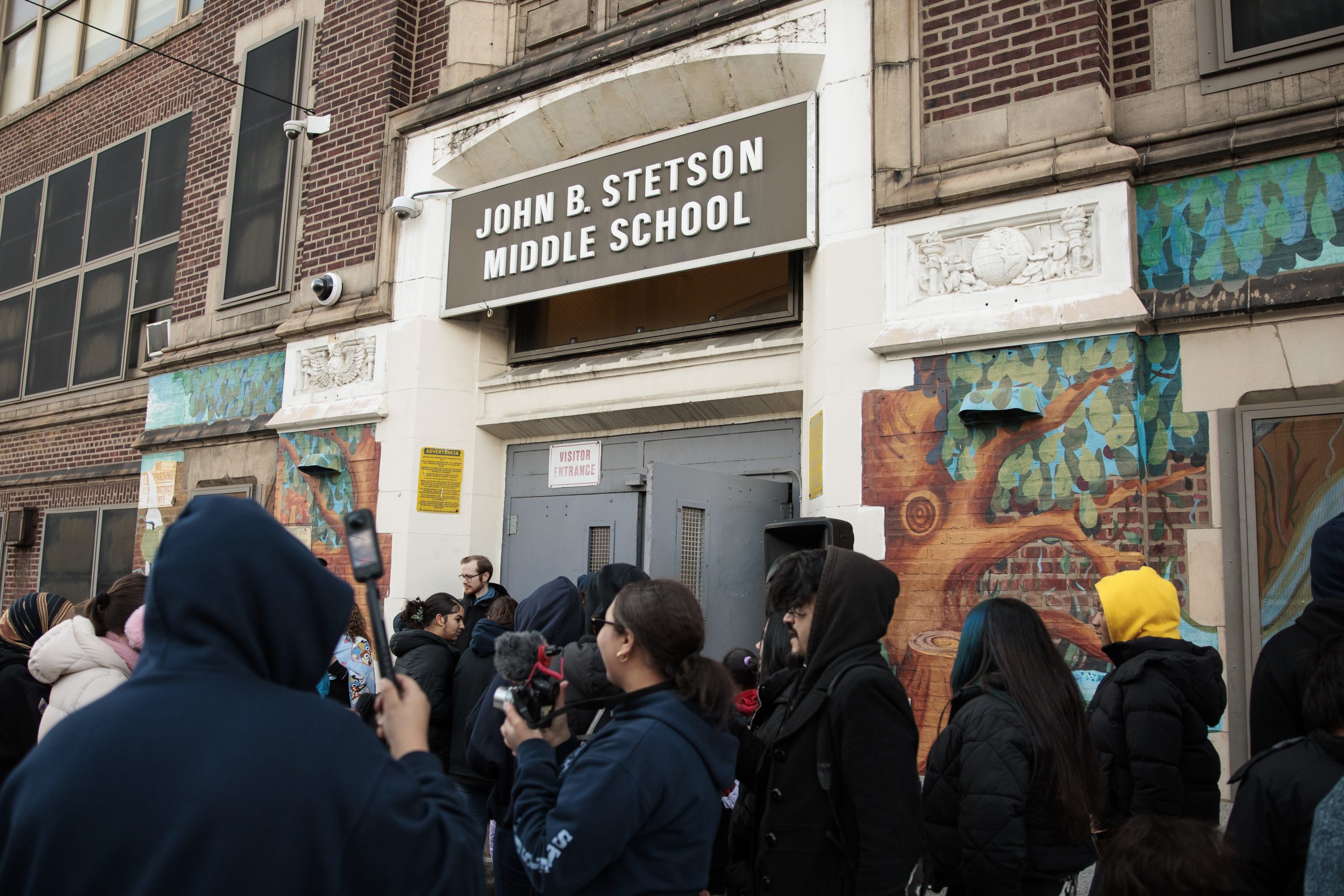
Students, teachers and supporters rally before a community meeting at John B. Stetson Middle School in this February file photo. Stetson is one of 17 schools ordered closed by the Philadelphia school board.Monica Herndon / Staff Photographer
The district is forming transition committees at those 50 schools, and will begin accepting applications Aug. 31 for roughly 20 spots on each transition committee.
Plenty of administrative shifts have happened
Watlington has made a number of changes at the top of his administration, some as a result of departures. Other leaders were given new roles or responsibilities.
Among the changes are: a new chief of talent, Kristi Murphy Baldwin; a new deputy superintendent of academic services, Brenda Elliott; a new chief academic officer, Michael Farrell; and additional responsibilities for Nathalie Nérée, who becomes chief of special education, diverse learners, and wellness.
Nyshawana Francis-Thompson has a new title:senior adviser for strategic initiatives and innovation.
Jamina Clay-Dingle is now assistant superintendent of school management and organization.
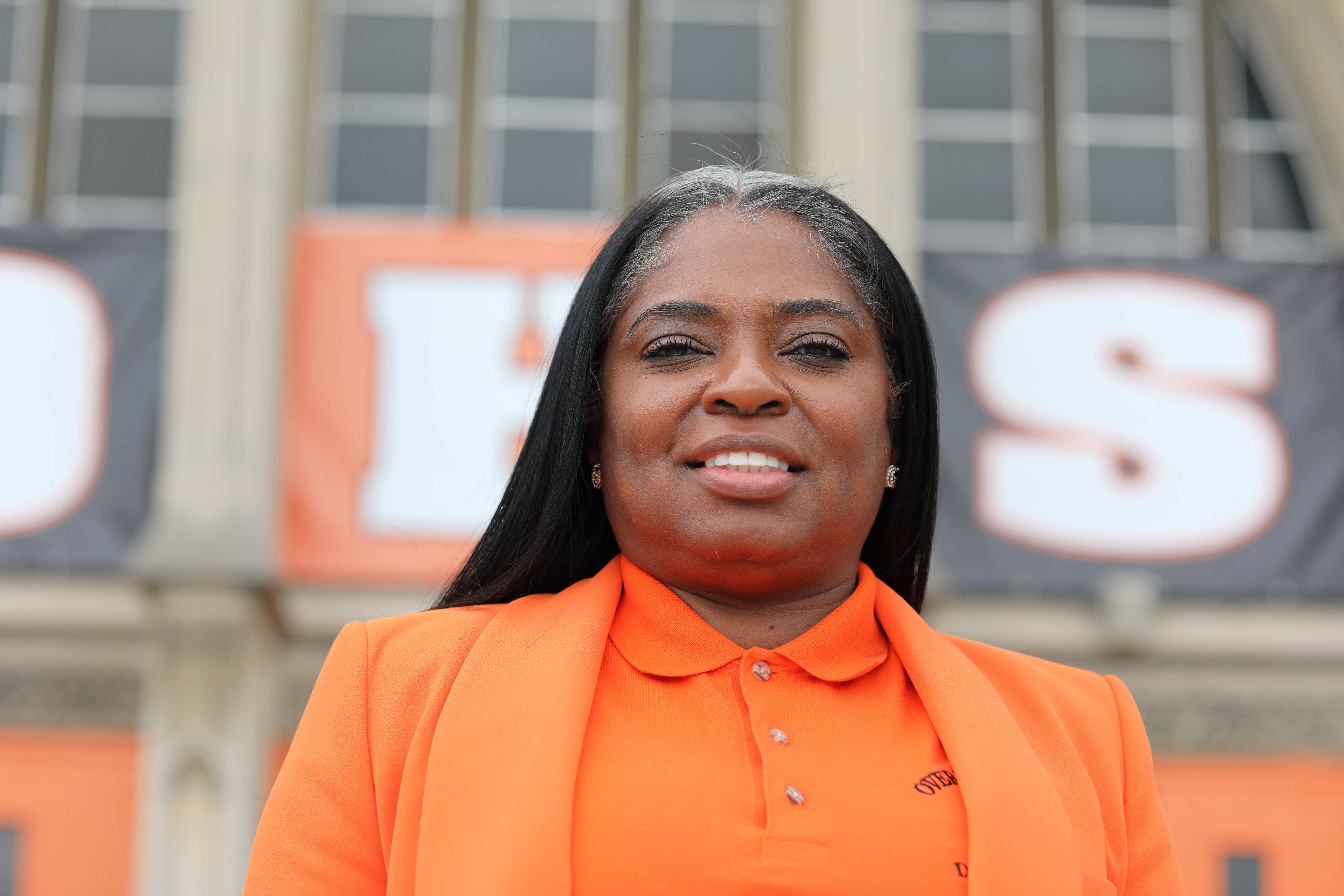
Kahlila Johnson, a former principal of Overbrook High, is now an assistant superintendent responsible for a district learning network.Courtesy of the Philadelphia School District
There are some new assistant superintendents for various learning networks around the city: Kelly Espinosa and Kahlila Johnson will serve full-time, and Wilfredo Ortiz and Lucy Feria on an interim basis.
Noah Tennant is now associate superintendent for secondary schools, and Tomás Hanna is now associate superintendent for student life and school operations.
A number of schools have new principals, too: Adaire Elementary, Amanda Strain; Bridesburg Elementary, Louis Depa; Clemente Middle School, Regina Barr; Edison High, Albert Sniezevage; Benjamin Franklin Elementary, Ryan Sullivan; Heston Elementary, Kamia Smith; Lawton Elementary, Michelle Todd-Coleman; Memphis Street Academy, Wayne Diggs; Northeast High, Andrew Lukov; Southwark Elementary, Mason Luksch Wilson; Bayard Taylor Elementary, Claire Charles; Tilden Middle School, Jessica Culp; Waring Elementary, Cathryn Anderson.
The Philadelphia school board voted Thursday night to spend up to $7 million on rental space to house a district high school in Center City.
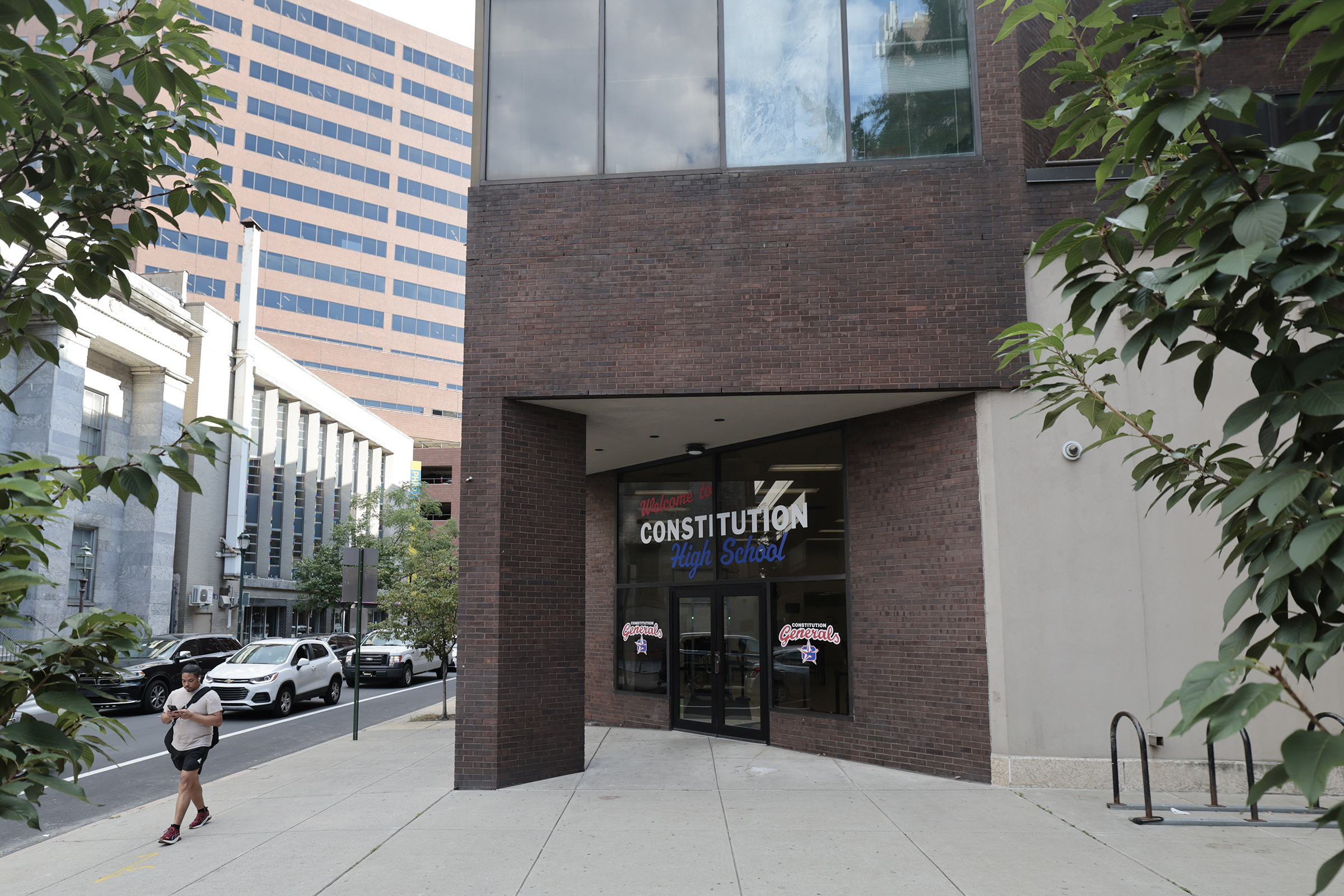
The four-year agreement — the district will pay $1.7 million annually for two years, then $1.8 million and $1.9 million in the final two years — covers classrooms and related spaces at 18 S. Seventh St., the longtime home of Constitution High School.
The move comes months after the district voted to close 17 schools, in part because it has 70,000 empty seats in schools across the city. The school system will also merge some schools — like Overbrook High and the Workshop School — as part of its $3 billion facilities master plan, to be enacted over the next decade, but it opted not to move Constitution High into any school with empty space.
Board members voted unanimously to pass the resolution, which noted the district “continues to work through the completion of the Facilities Master Plan to properly identify appropriate space for our students.”
Officials will “review the opportunities that may exist in the coming years that would cause us to re-evaluate the current necessary decision to remain at this location, which accommodates the needs of the students within this program. If the opportunity arises for the school district to consider relocation, the community and stakeholders will become aware and involved in this process.”
The facilities plan calls for Constitution to move in 2035-36 into the current Bodine High building in Northern Liberties. Bodine will eventually expand and move into the current Penn Treaty building, in Fishtown, and Constitution will then occupy the Bodine space.
Constitution, a citywide admissions school, has been located at its current building since the school opened in 2006 as part of Philadelphia’s small-schools boom. The school was designed with a civics focus, and deliberately located near the National Constitution Center.
The district has moved other schools out of rental properties. It relocated Science Leadership Academy, which had been in rental space near the Franklin Institute, into Benjamin Franklin High. District officials have pointed to that colocation as a model.
Charter renewals, but no mention of missing PSSAs or Kensington asbestos relocation
The board also voted Thursday night to renew two charters: YouthBuild Philadelphia Charter, on North Broad Street in North Philadelphia, and Inquiry Charter, on Belmont Avenue in West Philadelphia.
Both schools received five-year renewals.
YouthBuild’s renewal came with conditions: agreeing to submit a student attendance plan, tracking students’ daily attendance, and divulging supports offered; and promising to ensure the school’s suspension rate is at or below the district’s suspension rate.
No district official addressed two brewing matters: either the asbestos-related relocation of Kensington High students to the former Meehan Middle School building in the Northeast, more than seven miles away, or the district’s missing PSSA scores.
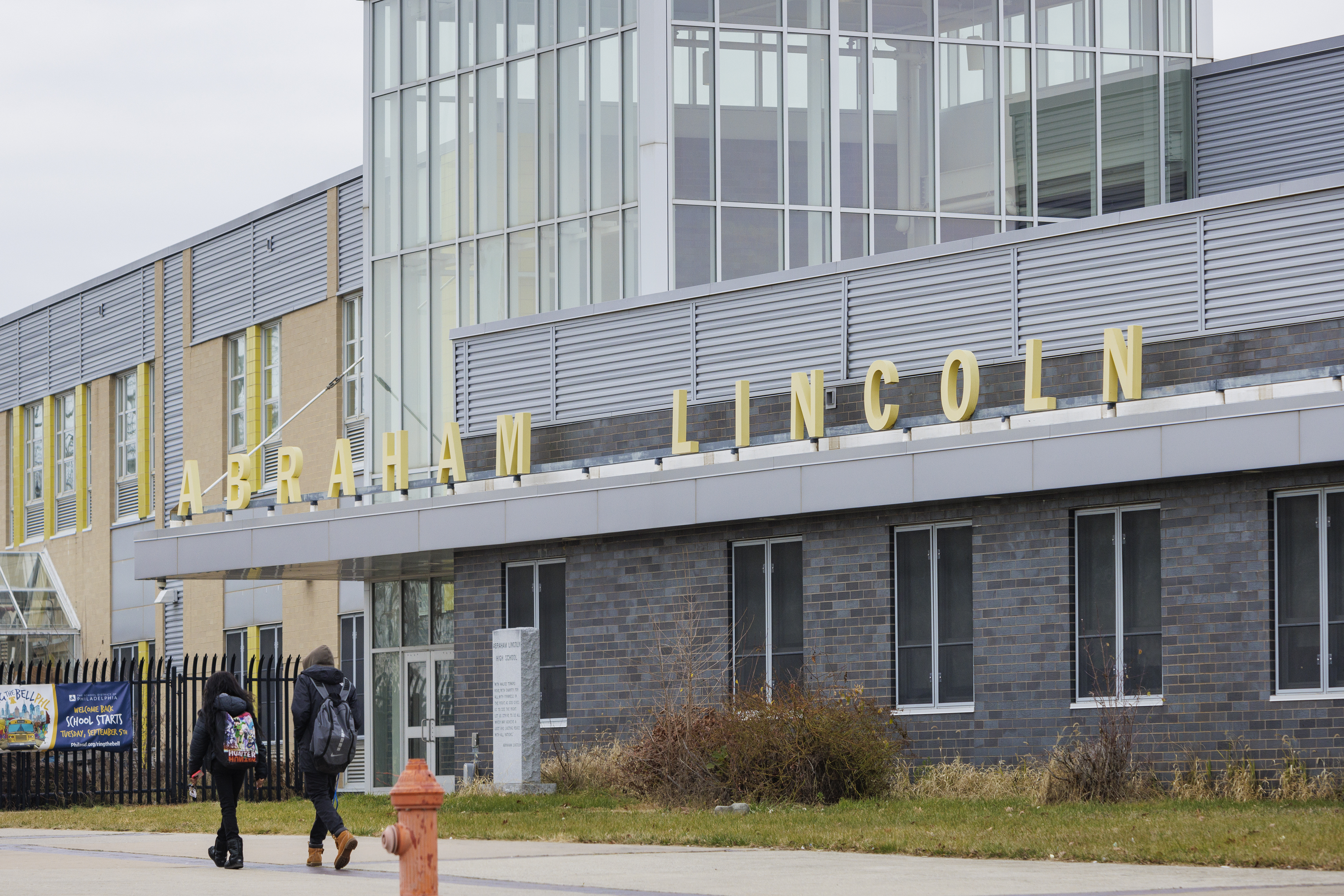
Earlier on Thursday, a Lincoln High parent and a Mayfair resident were attempting to block Kensington’s move to Meehan, a closed district school currently used as swing space to house school populations that need a temporary home.
Meehan shares a campus with Lincoln and Northeast Community Propel Academy, both of which are overcrowded. Parent Harold Brown and Peter McDermott, a former Philadelphia teacher who’s active in Mayfair civic life and city Democratic politics, say moving Kensington onto the campus will harm students.
They also say placing 400 Kensington students and 90 staff at Meehan violates a Community Benefits Agreement signed in 2019, when neighbors OK’d building Propel to ease overcrowding at other Northeast schools.
No mention was made, either, of the lack of data around Philadelphia students’ PSSA and Keystone exams.
District officials said they won’t release the scores of students’ spring tests — which district officials have access to — because of a delay in Harrisburg.
Though the district did receive preliminary student-level scores, and released limited data to some teachers and administrators in order to correctly roster a limited number of students, they have walled off the data from the vast majority of educators.
A district spokesperson said this week that they won’t be using PSSA scores for the school selection process that admits students to 37 magnet schools. Instead, students can take an alternate assessment the district declined to name or detail.
The scores are consequential in a district where officials frequently state their goal to become the fastest-improving large urban school system in the country. Philadelphia has posted academic gains during Superintendent Tony B. Watlington Sr.’s tenure and earned national attention for its post-pandemic improvement, but its students still generally struggle.
Citywide, 34% of students score at grade level in English and 23% in math, as judged by 2024-25 standardized tests.
Administration of this year’s PSSAs, given to students in third through eighth grades, was snarled by some technical glitches. It was the first year Pennsylvania required students to take the exams online.
Research shows that scores usually dip when tests move online.
Kristin Luebbert, a retired district teacher, urged the board and the district to release the scores.
“Obviously, the administration must have strong feelings about what they show,” Luebbert said of the scores. “At this point, we all know they’re out there, so you might as well release them.”
Kensington High students can begin the 2026-27 school year at the former Austin Meehan Middle School in the Northeast, on Monday — despite a lawsuit that hoped to halt the relocation before classes begin.
Philadelphia Common Pleas Court Judge Christopher R. Hall on Friday declined to issue an emergency injunction that would have prevented moving Kensington students to Meehan, a now-empty Northeast middle school.
Asbestos issues rendered Kensington’s E. Clearfield Street building temporarily unusable. District officials decided to move Kensington’s 400-plus students and 90 staff to Meehan — on Ryan Avenue in Mayfair — until Kensington’s building is ready, likely in January.
Meehan shares a campus with Lincoln High and Northeast Community Propel Academy, which are both already overcrowded.
Harold Brown, parent of a rising sophomore at Lincoln, and Peter McDermott, a former district teacher and Mayfair civic leader, objected to the relocation, saying that moving Kensington into the Meehan space would create safety and other concerns.
After a four-hour hearing, Hall said he did not “believe that there is evidence of an immediate and irreparable harm” if Kensington students start the year at Meehan on Monday.
In fact, the judge said, “I think granting the injunction would throw off the Kensington families,” forcing the district to pivot to virtual instruction on short notice, which would harm students’ academics, food security and social and emotional needs.
“The balance does not tip there,” Hall said in court.
Hall’s ruling rests on the district meeting a 5 p.m. Friday deadline to submit a safety plan for the Kensington-at-Meehan campus. Hall and McDermott’s lawyers said they would file another injunction request.
More police, and yellow bus service for most Kensington students
Witnesses for both sides made their case over several hours.
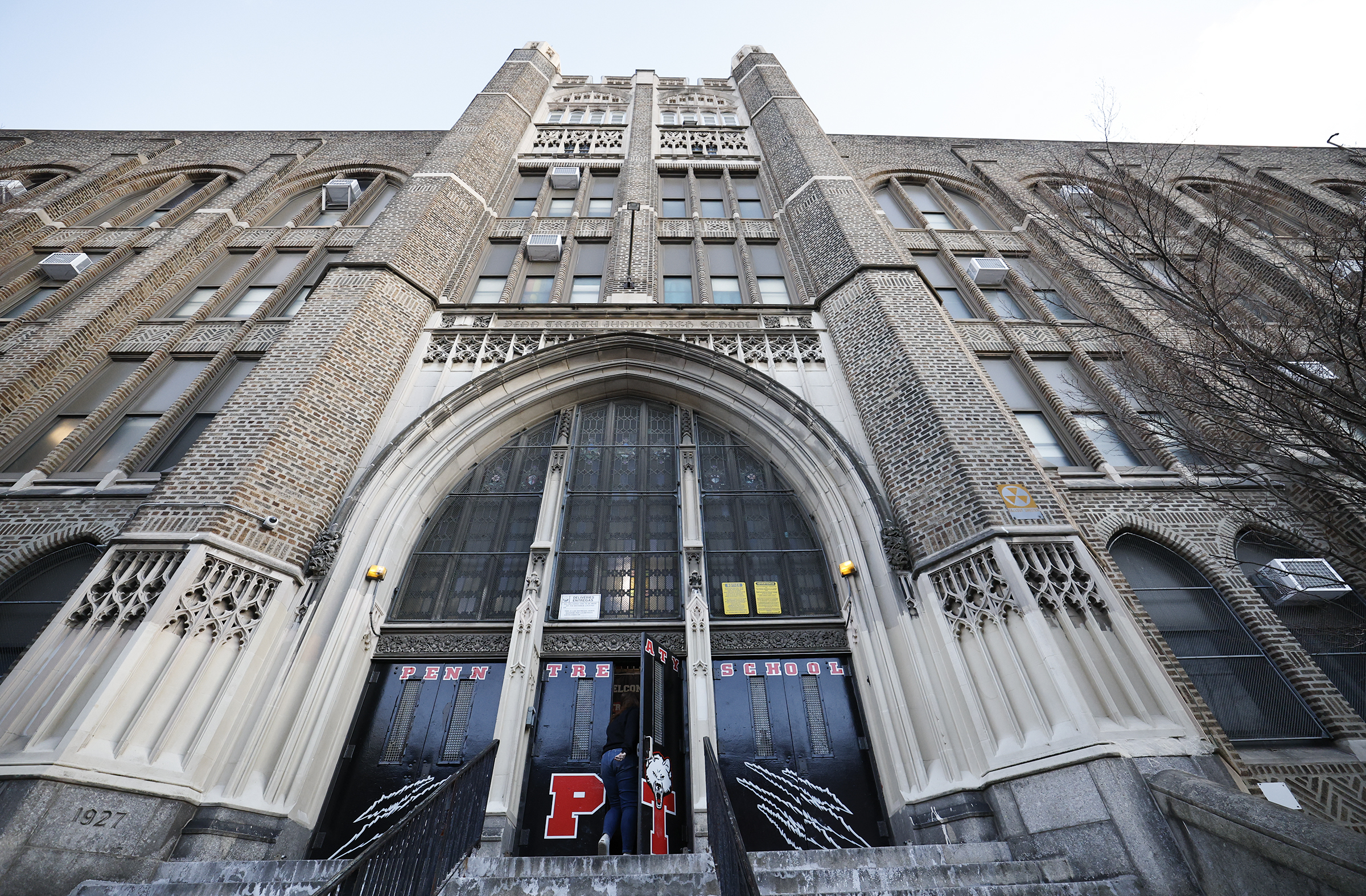
The school system rejected two alternative sites closer to Kensington — Roberto Clemente Middle School, in North Philadelphia, and Penn Treaty High School, in Fishtown — before settling on Meehan, Teresa Fleming, chief operating officer, told the judge.
Clemente was considered the better alternative, but ultimately could not accommodate all Kensington programs. Penn Treaty didn’t meet accessibility needs for students with disabilities, Fleming said.
And Craig Johnson, the school system’s chief safety officer, said the district is adding police officers to ensure student arrival and dismissal run smoothly.
Kensington typically had four school safety officers; it will get a fifth full-time officer with the relocation to Meehan, and a sixth part-time officer to help with arrival and dismissal.
Answering concerns about additional students complicating the transit situation at the Lincoln-Meehan-Propel campus, Fleming said there will be no more than 90 Kensington students traveling to Meehan by SEPTA buses.
Just under 70 Kensington students already receive yellow bus services, and those will continue, Fleming said; an additional 250 students now live close enough to walk to Kensington, and will take yellow bus shuttles from Kensington to Meehan. The remaining 90 students, who are out of catchment for Kensington, already receive SEPTA fare cards and will continue to do so, but may also opt to use the yellow buses if they so choose.
‘The kids are just kids’
Brown, on the witness stand, said he had no problem with Kensington students specifically.
“I don’t even want to say the kids are bad, the kids are just kids, but if you have more kids, things arise,” said Brown.
After Hall made his ruling, Michael van der Veen, a lawyer for the plaintiffs, said his clients remained concerned, despite the district’s plans.
What if “a week from now, or a month from now, we get a shooting, a stabbing, a killing, or violence that breaks out there?” van der Veen said.
Regardless of Hall’s rejection of the injunction, the lawsuit will continue, van der Veen said, and “we’re going to continue to look at what the legal options are.”
William Brennan, another lawyer representing the plaintiffs, said the relocation of Kensington students to Meehan is “a neighborhood safety issue, and we’re going to do everything we can to keep the neighborhood safe.”
Hall, during the hearing, asked Brown and McDermott’s lawyers why parents and the neighborhood groups – who also say the district is violating 2019 and 2020 community benefits agreements – did not object to other students using Meehan.
In the past, elementary school students from Mayfair Elementary — which was overcrowded, and Thomas Holme Elementary, which needed a temporary building while its new school structure was being built — learned in the Meehan space.
“There’s a significant difference in that they were K-8 students, and now we’re looking at 9-12 students,” said McDermott, who previously taught in the district, at Benjamin Franklin High, when it and Science Leadership Academy were relocated after construction on their shared building went awry.
Brennan expressed skepticism that the district’s safety plan, finished a few days before students return to class, will be adequate.
“It sounds like the plan is to drop the bomb on the neighborhood,” Brennan said, “and just hope for the best.”
The Philadelphia School District will soon offer a new way to have a say in how Philadelphia school closings, mergers, and other transitions happen.
The district announced Thursday that it will soon open applications for 50 transition teams to help manage what comes next for a host of schools — those closing or beginning phaseouts at the end of the 2026-27 school year, and those receiving students from those schools in 2027-28.
The school board voted in April to close 17 Philadelphia schools, some as soon as the end of the 2026-27 school year. It’s also ordering mergers and other changes. The $3 billion plan, the funding for which is not assured, also plans for 169 renovation projects at schools around the city.
The aim for the transition committees, officials said, it to “bring together students, families, educators, staff, and community partners to provide input, help identify priorities, and support the development of transition plans that reflect the needs of each school community.”
“We know that successful school transitions require more than a plan — they require meaningful partnership with the students, families, staff, and communities who will experience these changes,” Superintendent Tony B. Watlington Sr. said in a statement. “This next phase gives communities a clear opportunity to help shape the transition process and ensure that we are planning thoughtfully, collaboratively, and with students at the center.”
The applications will open Aug. 31 and can be filled out through Sept. 18.
Transition committees, made up of up to roughly 20 members, may include teachers and staff, parents and families, community members, and students.
Officials said the committees won’t be the only way for people to have their say. School-specific feedback opportunities will be announced later, they said.
Which 50 schools are forming transition teams?
The schools closing in 2027-28 are:
Blankenburg
Fitler
Lankenau High School
Robert Morris
Overbrook Elementary
Parkway Northwest
Parkway West
Pennypacker Elementary
Paul Robeson High School
John Welsh Elementary
The schools beginning phase-outs in 2027-28 are:
AMY Northwest
Penn Treaty
Harding Middle School
Stetson Middle School
Tilden Middle School
Wagner Middle School
The schools receiving students starting in 2027-28 are:
A Lincoln High parent and a Mayfair resident are attempting to block the planned relocation of Kensington High School students to the former Austin Meehan Middle School in the Northeast.
Harold Brown, a Lincoln parent, and Peter McDermott, who is active in Mayfair civic life and Democratic politics, filed suit Thursday against the Philadelphia School District, Superintendent Tony B. Watlington Sr., and the city itself in Common Pleas Court.
While the former middle school has been used as a swing space since it closed in 2022, Brown and McDermott say that moving 400 Kensington High students and 90 staff there will create student safety concerns because the campus is already overpopulated. Meehan is adjacent to Lincoln High and Northeast Community Propel Academy, both of which are overcrowded, with student bodies that exceed the capacity of their respective buildings.
The relocation, they argue, also violates the terms of a 2018 community benefits agreement that allowed the school district to build Propel.
Brown and McDermott want a judge to halt the move before school begins for students on Monday.
The district ordered Kensington relocated to the former Meehan site, more than seven miles away on Ryan Avenue, over asbestos concerns. A contractor working on a new HVAC system for Kensington this summer disturbed asbestos, then tracked it throughout the school, officials said.
District administrators initially believed they could fix the asbestos issues in time for school to start; after urging from the Philadelphia Federation of Teachers, they decided to relocate staff and students through the end of the calendar year.
The district last year spent $11 million to place trailers at Lincoln, which houses over 2,000 students in a school built for 1,200.
City Councilmember Mike Driscoll last week raised worries about adding students from another high school to the Lincoln-Propel campus, and the district said it would prepare and share a school safety plan before classes began.
“The absence of a disclosed and tested plan prevents families from evaluating whether defendants can safely supervise two separate high-school populations and a K-8 population in the same immediate campus area,” the suit says.
The suit suggests students be moved instead to Penn Treaty High or Roberto Clemente Middle School. (The district had initially planned to move Kensington students and staff into Clemente, then judged that building did not have enough room.)
Moving Kensington to Meehan will overtax the campus on multiple levels, the suit said, from congestion and personnel to security and transportation.
“For Plaintiff Brown’s son and the existing Lincoln student body, adding another complete high-school population to an already over-capacity campus will predictably diminish teacher access, disrupt orderly transitions and arrival and dismissal, reduce access to shared services and activities, and materially impair the quality and continuity of the students’ daily learning and overall school experience,” the suit said.
Brown and McDermott also say the district has failed to live up to several promises made in the community benefits agreement — including demolishing Meehan, sprucing up fields, and replacing fencing. Those things have not been done, the suit says.
Philadelphia School District officials could not immediately be reached for comment.