Author: Jake Blumgart

  • West Philly parking wars heat up amid plans for a 420-unit apartment complex on Lancaster Ave.

    West Philly parking wars heat up amid plans for a 420-unit apartment complex on Lancaster Ave.

    Haverford Square Properties wants to transform an industrial stretch of Lancaster Avenue into a residential and small-business hub, with 420 apartments and more than 30,000 square feet of commercial space across three projects.

    The ambitious plan would unfold between 50th and 52nd Street, with the 215-unit Cathedral Yards at 5140 Lancaster Ave. to the northwest and the 160-unit Lancaster Yards to the southeast at 5022-32 Lancaster Ave. Cathedral Yards would take the place of the Greater Bible Way Temple, a church that burned down in 2019.

    The two complexes would comprise four connected six-story buildings, with roof decks and commercial space on the ground floors. A smaller building at 5100 Lancaster Ave. would include 45 mostly two-bedroom apartments, and Haverford Square’s headquarters.

    On Tuesday, the Cathedral Park Community Development Association held a meeting about the project. Attendees shared a variety of concerns, but the chief issue was parking. The project has 65 parking spaces for more than 400 units.

    “That building is gorgeous, but it has an issue and that issue is parking,” said Kim Fuller, a neighborhood leader. Haverford Square noted that because the project sits directly on a trolley line, and enjoys frequent bus service, parking is less necessary.

    Rents will be kept relatively low for new construction, with a one-bedroom unit priced under $1,650 and two-bedroom units under $1,900. Sixty percent of the 420 units will be one-bedrooms, and the rest two-bedrooms.

    Haverford Square will offer “workforce rents for, like, a SEPTA driver or city worker,” said German Yakubov, president of the development group.

    “[Households] making between 12 and 16 bucks an hour that have two incomes can easily afford a brand new apartment with amenities that they wouldn’t otherwise be able to afford in Center City or Northern Liberties,” he said.
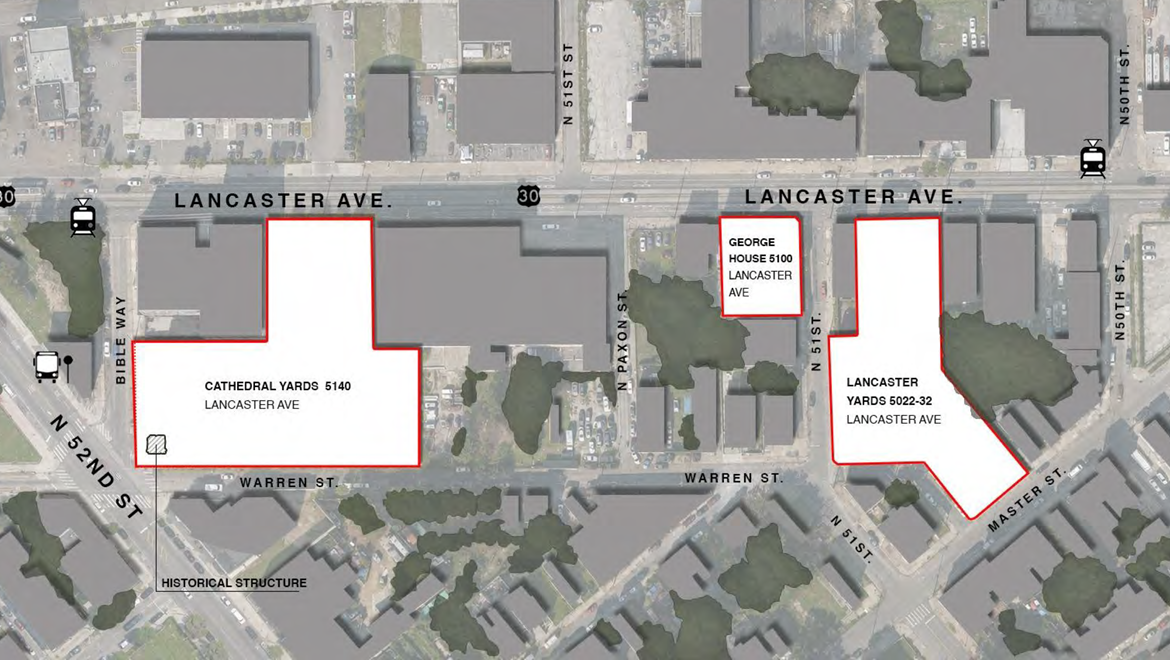
    A map of Haverford Square Properties’ three proposed projects along Lancaster Avenue.Wisdomtree Group

    Permanent homes for food trucks?

    Haverford Square began in 2008, first building in Mantua, and concentrating on West Philadelphia neighborhoods like Belmont and Parkside.

    “We’re able to control a lot of the costs,” said Yakubov, because Haverford Square has its own construction company and in-house architecture. “And because we’re able to build in other places, we’re able to negotiate better pricing for a lot of our material.”

    For this project, low rents are also manageable because the company purchased the land for the three properties for $4.5 million, relatively cheap.

    Ten percent of the apartments in Lancaster Yards and Cathedral Yards will have affordable rents as part of Philadelphia’s Mixed Income Housing Bonus program, which allows developers to build denser projects than zoning would typically allow — as long as they include affordable units.

    Those 42 units will be available to people making less than 50% of area median income, or under $42,000 a year for a one-person household.

    Yakubov says the commercial space is key to the project, and Haverford Square plans to seek small businesses in the neighborhood, such as food truck operators who want to move into a brick-and-mortar space.

    “We’re really targeting businesses that have a following already, but don’t have the financial means to open up a brick-and-mortar location,” said Yakubov.

    “We don’t anticipate opening any bars. We’re not going to have any places to serve alcohol or smoke shops or sell cigarettes or anything that would be a negative impact to the neighborhood,” he said.
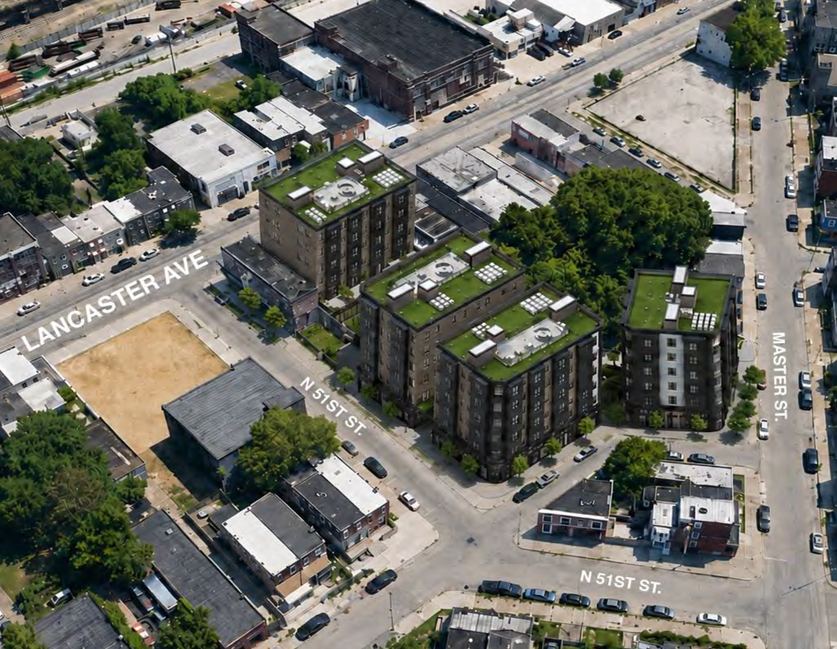
    An overhead rendering of Haverford Square’s 160-unit Lancaster Yards proposal, at 5022-32 Lancaster Avenue.Wisdomtree Group

    Parking wars

    At a Tuesday evening meeting, residents pushed back on the project, some saying the proposed buildings were too tall and others sharing fears of displacement.

    But the most significant and frequent feedback was about parking.

    Haverford Square proposed 65 parking spaces at Cathedral Yards, and none at Lancaster Yards, highlighting nearby bus and trolley routes.

    “Please take it into consideration to eliminate that bottom row [of the building] and put parking in. Parking is so important,” said Fuller, an employee of Councilmember Curtis Jones Jr., who represents the area.

    Audible groans rang out when Yakubov noted that many of his company’s tenants do not own cars — partly because they often have rental vouchers that are reserved for lower-income residents.

    “No one bought it,” said Mark Harris, of the Cathedral Park Community Development Association, in an email following the meeting.
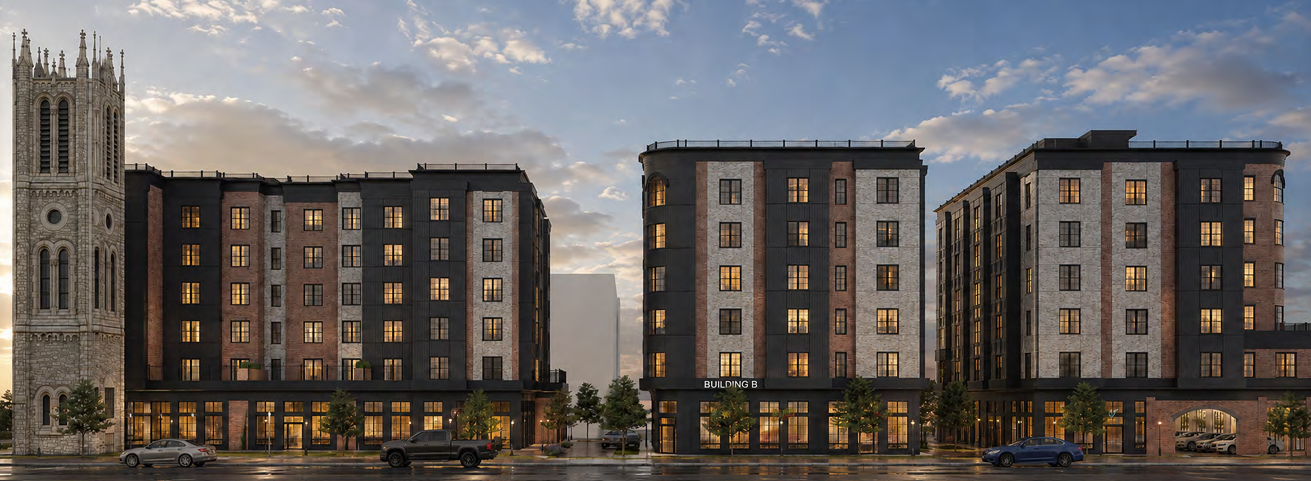
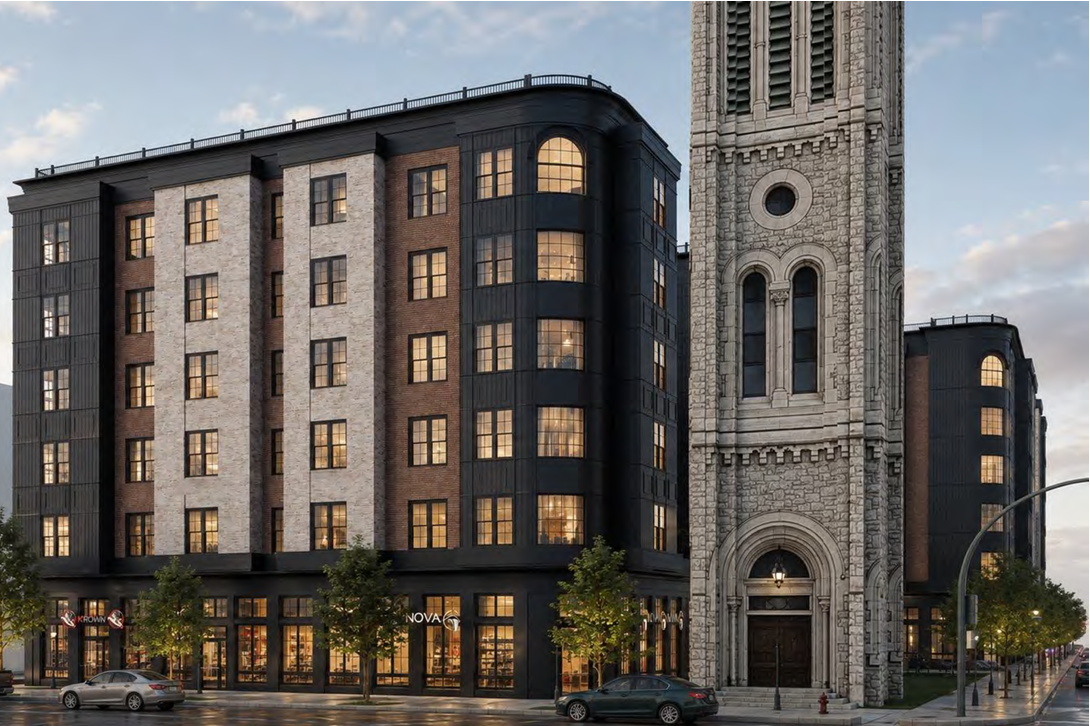
    A rendering of Cathedral Yards, with the remnant tower of Greater Bible Way Temple at the left.Wisdomtree Group

    At the end of the meeting, 21 attendees voted to oppose the project before the zoning board, while four were in support. Comments on Zoom were more supportive of Haverford Square’s plans, compared with the in-person attendees.

    Yakubov said on Tuesday that he would consider adding more parking in place of some commercial space.

    Zoning approvals

    Neighborhood support could be important for Haverford Square’s plans. Although the Philadelphia-based developer already owns the three properties on Lancaster Avenue, they need permission from the Zoning Board of Adjustment to move forward on this project. The board takes community feedback into consideration.

    As currently proposed, the project exceeds the allowed number of units and is taller than existing land-use regulations allow.

    Yakubov says additional height is needed to accommodate commercial space with high ceilings.

    He argues that the zoning board has recently given other projects permission to build above height limits along Lancaster Avenue, so he is optimistic.

    Although the Haverford Square project does not have many immediate residential neighbors, the nearby One Art Community Center is critical of the developer’s plans. The nonprofit organization sought to buy the Greater Bible Way Temple property to expand their services.

    Greater Bible Way Temple sold to Haverford Square properties instead. In advance of Tuesday’s meeting, One Art sent an email to its supporters criticizing Yakubov.
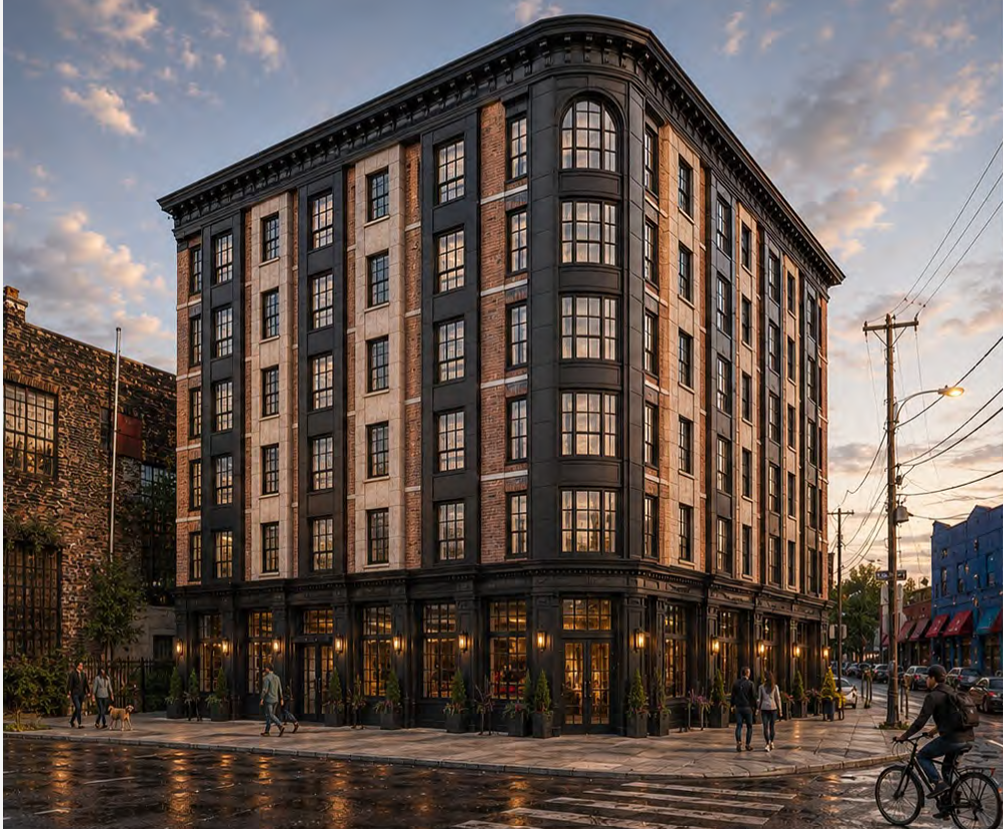
    A rendering of one of the many six-story apartment buildings Haverford Square Properties has proposed for Lancaster Avenue between 50th and 52nd Streets.Wisdomtree Group

    “We’re concerned about the increased traffic. … We have questions around the increased pollution and parking issues, sanitation issues, and the rise of the cost of living for the current residents,” said Malaika Gilpin, co-director of One Art, at the Tuesday night meeting.

    In response to the group’s concerns, Yakubov suggested bringing One Art programming into the commercial space in the proposed project.

    Yakubov said zoning board support is not essential to the project. If the project does not get approval, Haverford Square will move forward with a smaller version of the project without commercial space.

    “If for whatever reason the wheels fall off and we’re not able to get zoning relief, we’re ready to proceed,” said Yakubov. But, he added, “I think that the commercial component it would be a huge boost to the community and to the city.”

    Editor’s note: This story has been edited to update the number of units in the proposed development.
  • A new high-rise built by PMC Property Group would overlook the Schuylkill from Walnut Street

    A new high-rise built by PMC Property Group would overlook the Schuylkill from Walnut Street

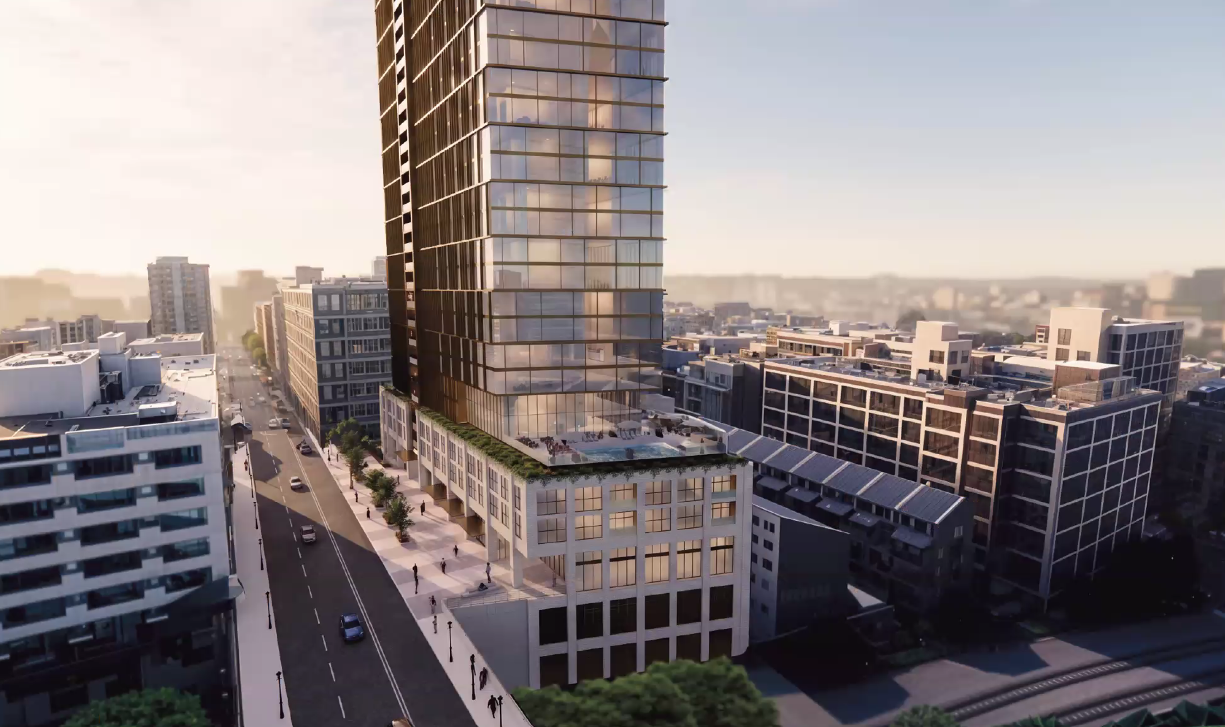
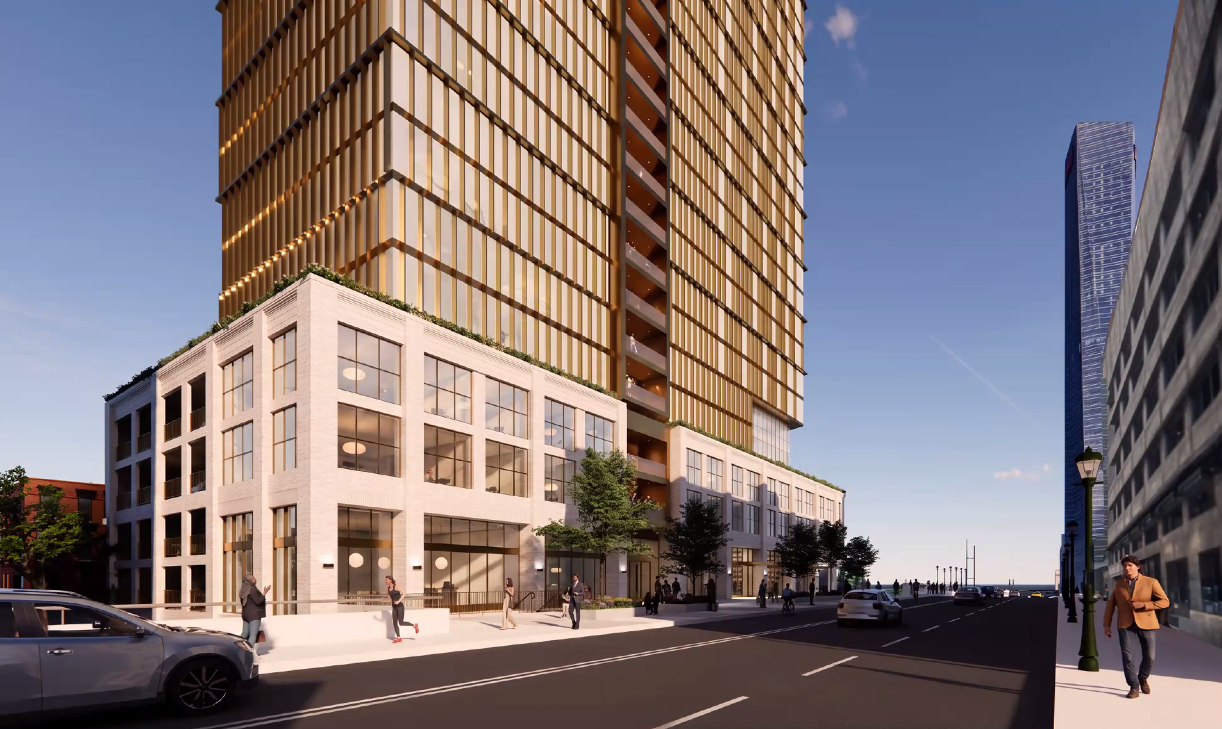
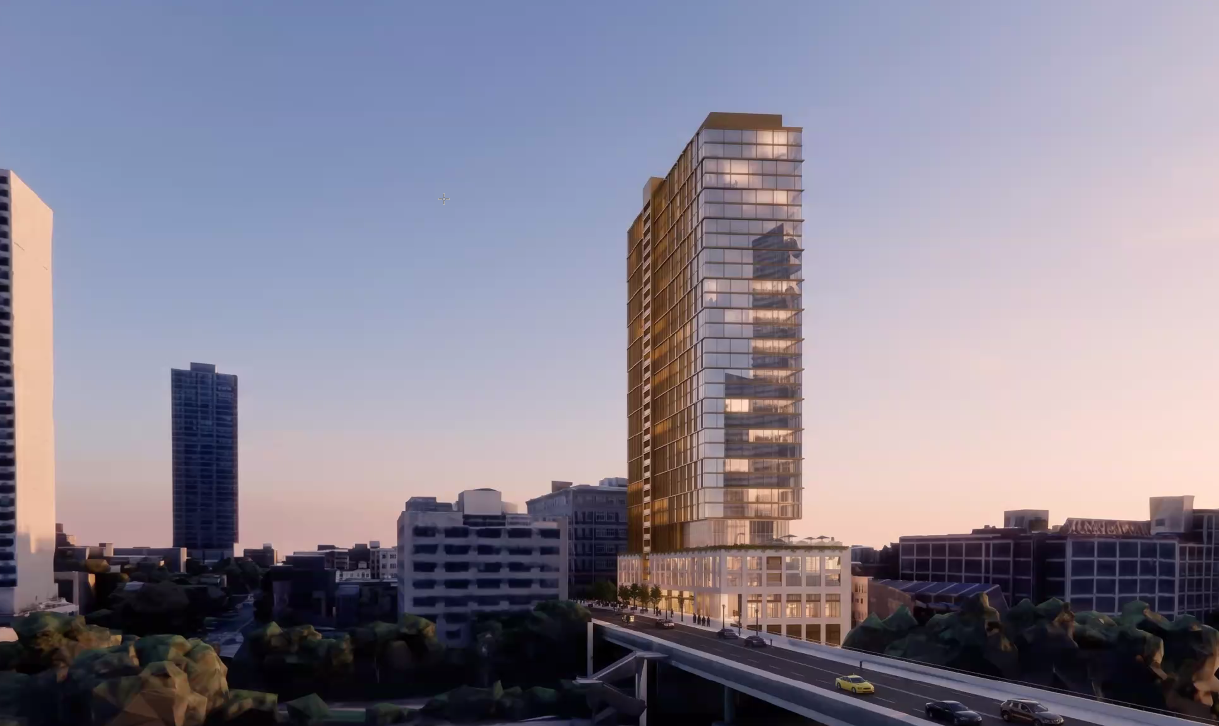
    Philadelphia’s largest apartment owner, PMC Property Group, wants to build a 31-story high-rise at 24th and Walnut Streets.

    The 372-unit apartment building at 200-10 S. 24th St. would also include 118 parking spaces and a swimming pool.

    The proposed 358-foot-tall tower would be the real estate company’s latest apartment development on the Schuylkill. PMC built the two Riverwalk Towers a half mile to the north, in Center City’s Logan Square neighborhood, and the 287-unit building at 2301 John F. Kennedy Blvd.

    “Through these [earlier] efforts, PMC has taken dead space pretty much and activated it, creating the vibrancy of Center City living,” said Adam Laver, a land-use attorney with Blank Rome who represents the developer, in a meeting with the Center City Residents Association (CCRA) on Thursday night.

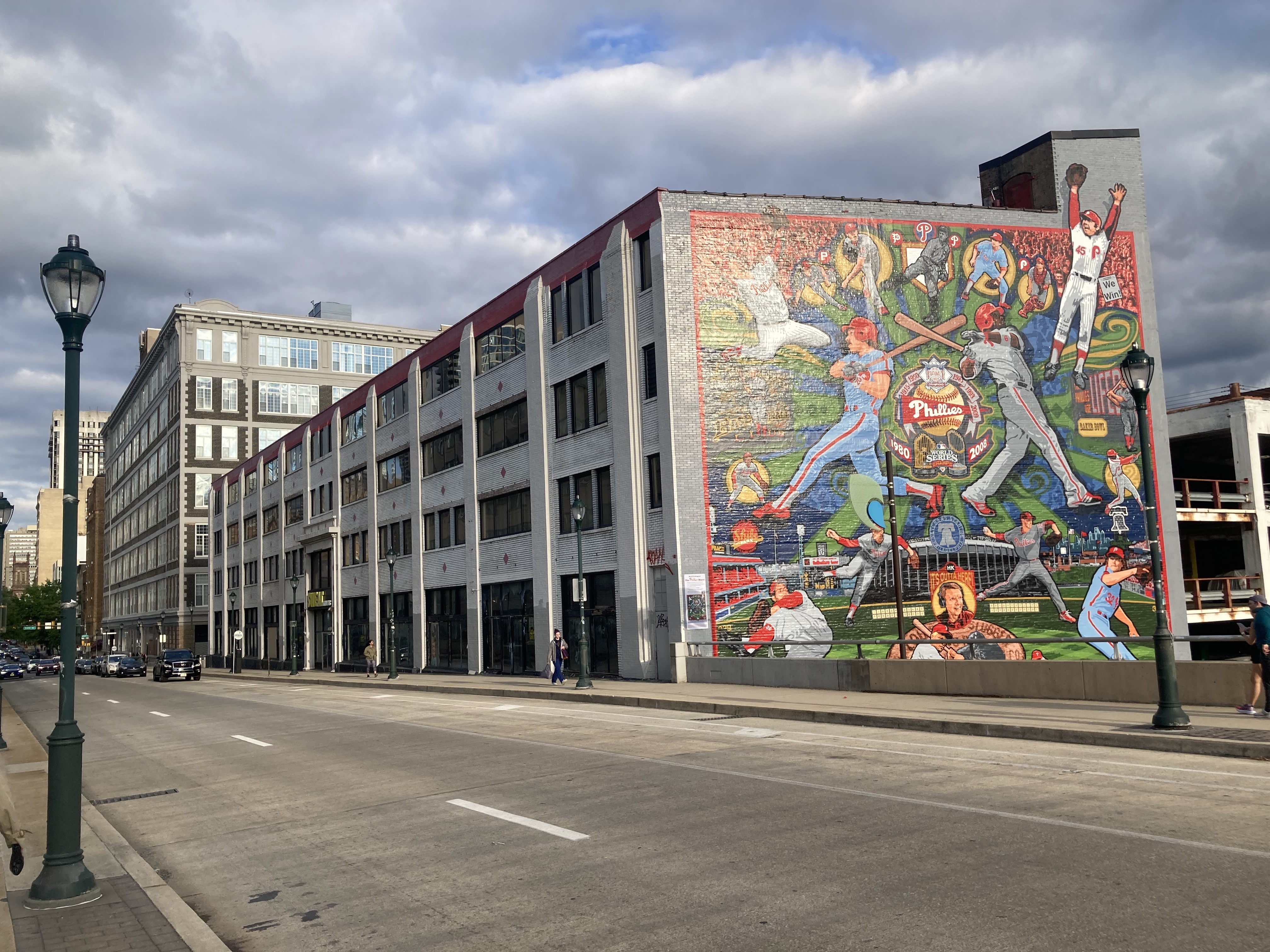
    The 110-year-old building that currently sits at 200-10 S. 24th St. is best known for its mural celebrating the Phillies, by David McShane, which dates to 2015. It would need to be demolished to make way for the project.

    The building currently houses Walnut Bridge Parking & Storage and is owned by Michael Karp, a major local real estate owner, student-housing landlord, and charter school operator. He did not respond to requests for comment.

    “PMC does not currently own the property, and it could potentially be a joint venture,” said Laver.

    PMC Property Group wants to change the zoning on this 110-year-old former industrial building at 200-10 S. 24th St. so they can build a large, new apartment tower.Jake Blumgart

    Parking for the proposed project would be on the bottom two levels, on a podium built to reflect the current industrial building. (The parking garage on those lower floors would exit onto 24th Street.) The tower itself would be set back from the podium and property line.

    Philadelphia-based Tantillo Architecture is designing the building. They have previously worked on projects like the office-to-residential conversion of 400 Market and the redevelopment of the landmark Bellevue Hotel on South Broad Street.

    Like many historical buildings along the Schuylkill, 200-10 S. 24th St. has an industrial past, but unlike some of its counterparts it is still zoned exclusively for that kind of use.

    PMC is seeking to change the property’s zoning legislatively, which would require the support of City Council President Kenyatta Johnson, who represents the area.

    That means support from CCRA — the local registered community organization (RCO) — would be invaluable to the project. RCOs grapple with zoning issues and their feedback often holds significant sway with elected officials.

    The presentation on Thursday night was part of PMC’s ongoing negotiations with CCRA.

    “The industrial [zoning] does not allow residential household living,” said Laver. “That’s really why we’re having this open process with all of you this evening.”

    A rendering of the proposed tower, looking east, along Walnut Street.Tantillo Architecture

    Neighbors were concerned about whether parking could be available to the public, whether demolition could affect the direct neighbors in the condos and townhouses of Fitler’s Walk, and whether the Phillies mural could be saved.

    “That is something that we would be pleased to work with CCRA and others to try to figure that piece out,” Laver said, in regards to the mural.

    He said that PMC would also consider providing some public parking, as the garage’s demolition will mean some current public spaces are lost.

    Laver said that he anticipates that the project could take two and a half years to develop, assuming that PMC gets the support of CCRA and Council President Johnson.

    Following Thursday’s public meeting, CCRA will consider public feedback, and the organization’s board will vote on whether to support the zoning change.

    A rendering of the tower, from street level, looking west.Tantillo Architecture

    A bill changing the property’s zoning could not be introduced until Sept. 17, at the earliest, when City Council returns to session.

    Johnson said earlier this year that he hadn’t yet begun seriously considering the project as negotiations between the developer and CCRA unfold.

    “I’m aware of the project, but they’re still going through the RCO process,” said Council President Johnson, in a May interview.

    “Once they get through that process, if the RCO says, ‘Yes, this is something we want to see in our neighborhood,’ then they’ll get a hearing where we’ll evaluate if this is something we want to support as a body,” said Johnson.

    PMC could also secure relief from the property’s industrial land use regulations from the Zoning Board of Adjustment, but that is often a lengthy and unpredictable endeavor.

    PMC’s president, Ron Caplan, has a long history in Philadelphia. During the recent development slowdown in Philadelphia, the company is one of the few that has continued developing new projects at a steady clip.

  • Market East retail pop-ups extended at 76ers and Comcast properties

    Market East retail pop-ups extended at 76ers and Comcast properties

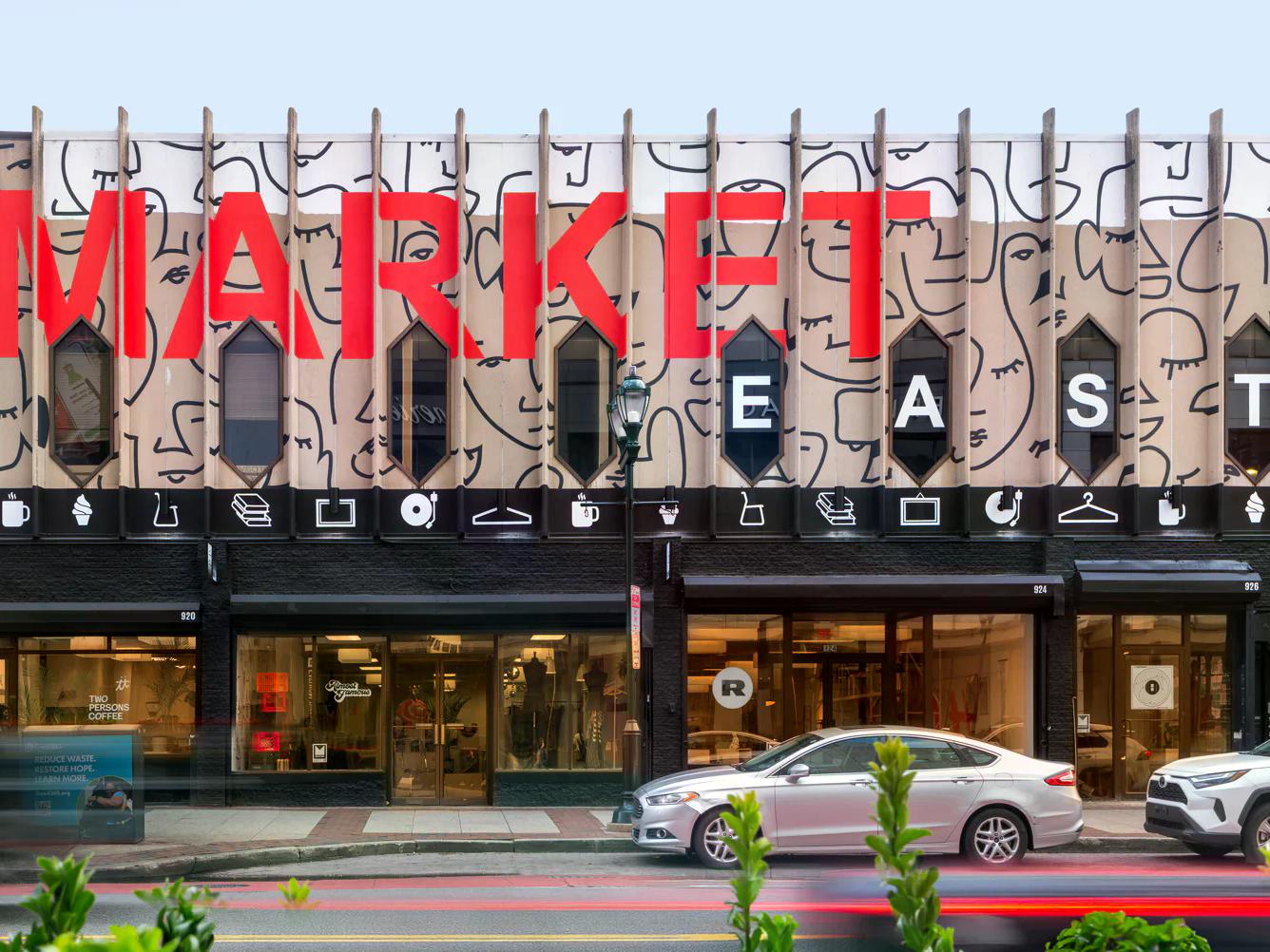
    A row of East Market Street storefronts owned by Comcast and Harris Blitzer Sports & Entertainment (HBSE) will continue hosting small local businesses until at least the end of 2026.

    The experimental initiative, dubbed Meantime on Market, is meant to activate the once-barren stretch of the 900 block of East Market Street. When announced earlier this year, it was planned to only last through the end of July.

    “Midway through the summer pop-up, I think everybody felt like, ‘Why would we go back to vacancy?’” said Brian Phillips, founder of Interface Studio Architects (ISA), which founded the Meantime project. “I don’t think anybody wanted this to end if it didn’t have to.”

    All six businesses that took part in Meantime were offered the opportunity to continue their residency on the 900 block of East Market, and four decided to do so: vintage clothier Almost Famous, music listening hub Clubfriends Radio & Records, media convener space Love Now Media, and West Philadelphia’s Siddiq’s Water Ice.

    “This summer has been incredibly meaningful,” Siddiq Moore of Siddiq’s Real Fruit Water Ice, said in a news release. “It’s been an incredible and beautiful experience for our business, and I’m excited to carry that energy into the fall extension.”

    The city-operated MY Market East, run by the Planning Commission, will continue to function as a community engagement hub at 930 Market St. as well.

    Two Persons Coffee and vintage furniture store Rarify will not continue their tenure on the strip. But those retail spaces will be available for other entrepreneurs to participate in the incubator program and receive three months of free retail space.

    Phillips said that Meantime is in talks with several small Philadelphia businesses about occupying the spaces and that an announcement would be coming “in the next couple weeks.”

    In the first three weeks of the Meantime businesses being open in May and June, 3,300 people visited the stores and $50,000 in sales were generated, according to the news release.

    “That momentum extended to the corridor as a whole — foot traffic along the observed stretch of Market East rose approximately 10% from May to June, outpacing growth in surrounding areas and signaling that the programs were doing more than filling empty storefronts,” the release reads.

    Phillips said weekends have been even busier than weekdays on this stretch of East Market Street, at least for Meantime.

    “Weekend life in Center City has, if anything, become more robust than it was 15 years ago,” Phillips said. “Weekday is a little bit tamped down since COVID.”

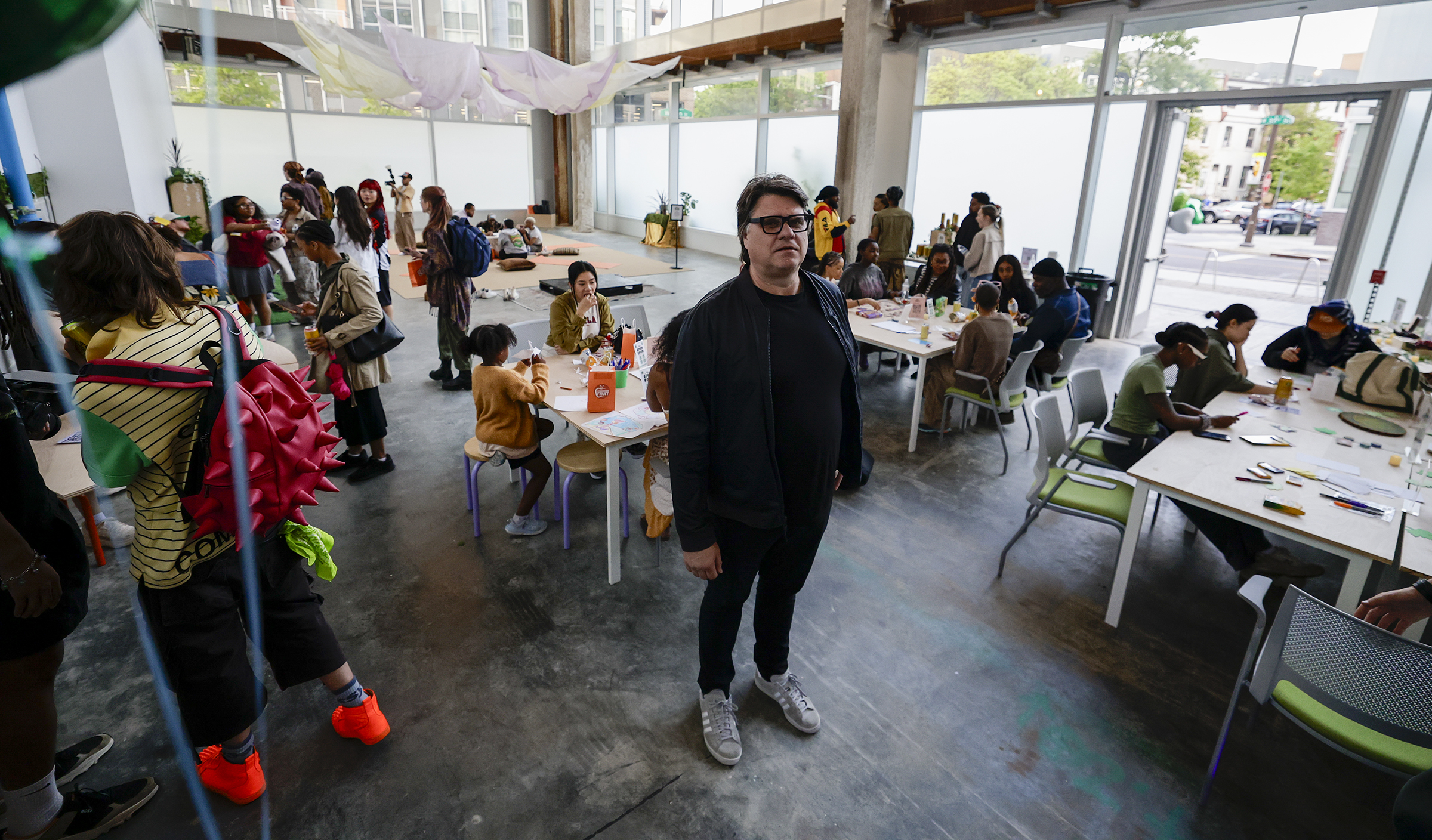
    Brian Phillips, architect and Meantime executive director, at the Green Room grand opening in University City in April. Yong Kim / Staff Photographer

    The properties have a long history with HBSE. From 2022 until early last year, the company planned to build the Philadelphia 76ers a new stadium on East Market Street with accompanying residential and commercial development on the 900 block.

    Then in early 2025, after a contentious political battle, HBSE announced that the Sixers would stay in South Philadelphia and renew their alliance with Comcast Spectacor, which owns the team’s current arena in the stadium district.

    But last June, HBSE and Comcast purchased the buildings on the 900 block of East Market anyway. They promised a project in this corner of Center City that has long lagged its neighboring counterparts in development and foot traffic. A longtime methadone clinic on the block closed down, too.

    The Meantime initiative, first spearheaded by Center City District, activated the long vacant storefronts, which HBSE and Comcast repaired, as they figure out their plans.

    HBSE declined to comment on what the extension of Meantime’s tenure on East Market will mean for potential larger development projects.

    “Our vision for the Market East Revival has always included both the large-scale investment that can transform this corridor and space for small, local businesses from communities across Philadelphia to help shape its future,” Mayor Cherelle L. Parker said in a statement.

  • Site of a Walnut Street beer garden will become a two-story retail building, not an apartment tower

    Site of a Walnut Street beer garden will become a two-story retail building, not an apartment tower

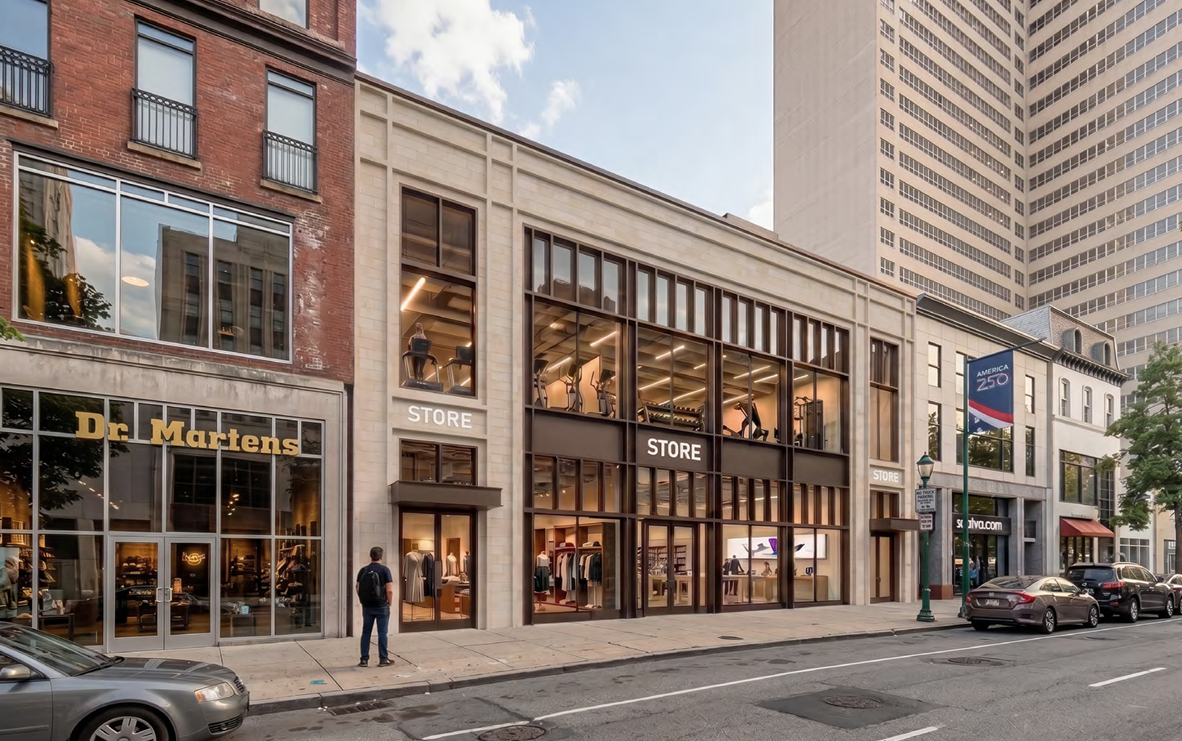
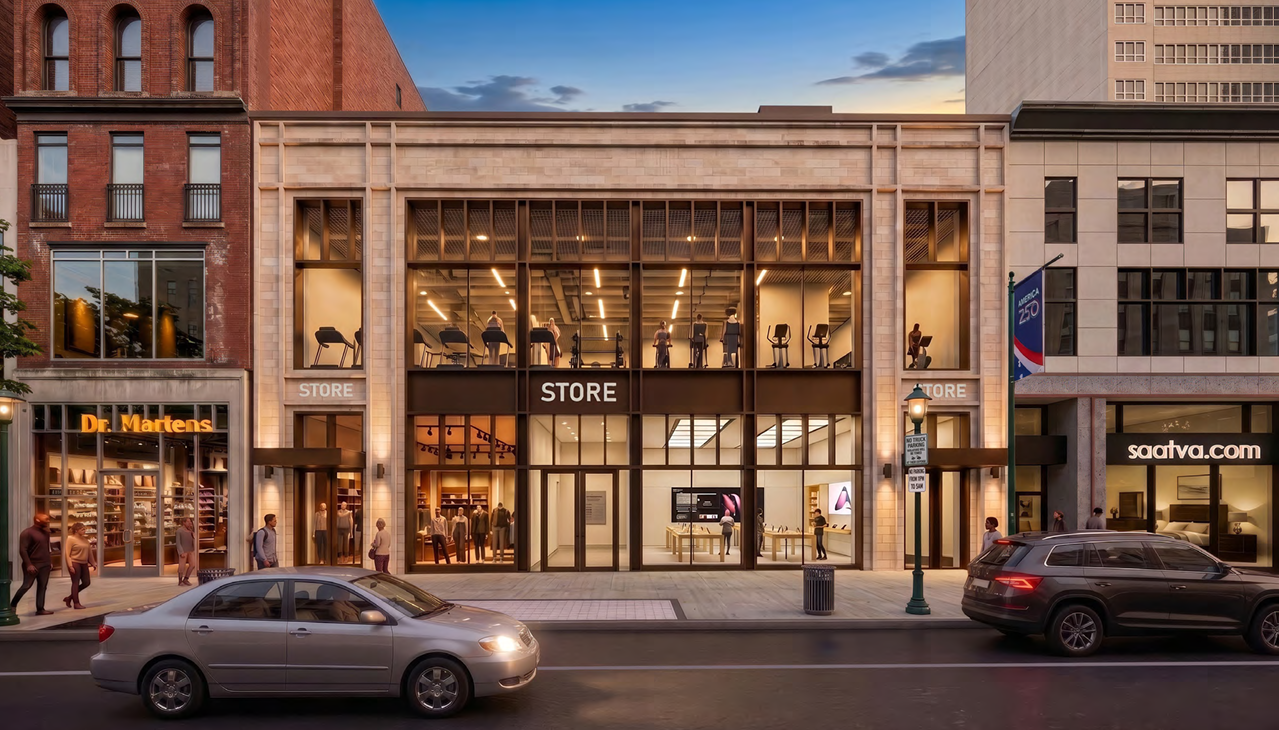
    A two-story, 33,000-square-foot retail building is being proposed for 1706-10 Walnut St., the current site of a beer garden and formerly where three historic buildings were demolished after being damaged by fires during unrest in 2020.

    The property is owned by the Gridmark Group, which was founded by Ari Weber, a Brooklyn-based real estate investor. The building is being designed by Philadelphia-based JKRP Architects.

    After Weber acquired the property in late 2022 for over $12 million, he said he eventually planned to build a 30-story apartment building on the site. Now he has decided that conditions are not favorable for such a large-scale project.

    “You see around Philly that there are sites that are on hold right now, that are sitting there waiting,” Weber said. “We were talking about a 30-story building, and I have made a decision that the time is not right for building such a high tower.”

    Weber didn’t let the Walnut Street property sit empty for long after he acquired it. The Walnut Gardens opened in June 2023 and became a popular outdoor food-and-drinks attraction.

    But Weber said he’s been fielding a lot of calls from high-end national retail companies searching for space on this in-demand stretch of Walnut Street.

    “Currently, [a tower] is not what it calls for. What it calls for is beautiful retail commercial space that will change the block,” Weber said. “It’s the number-one retail block in the whole of Philly.”

    The project will receive oversight from the Philadelphia Historical Commission because the property is in the Rittenhouse-Fitler Historic District. It will be considered by the commission’s Architectural Review committee on Tuesday.

    Materials submitted to the commission show a limestone-clad building that will feature a roof deck “with a restaurant enclosure” and outdoor seating. The commission’s staff recommended approval of the project’s design.

    “It’s meant to be like any other new construction in the historic district,” said Jerry Roller, the principal with JKRP Architects. “It’s meant to be in keeping with and in harmony with the remainder of the streetscape on Walnut Street.”

    A rendering of Ari Weber’s proposed retail building, with a setback roof deck and restaurant, for the site where the Walnut Gardens currently sits.JKRP Architects

    Before demolition, the site held three 19th-century townhomes, one designed by Frank Furness’s architecture firm, which had been converted to retail and restaurant uses, including a McDonald’s.

    During unrest following protests over the police murder of George Floyd in Minneapolis, the buildings were damaged by arson in May 2020. Philadelphia’s Department of Licenses & Inspections found them too damaged to be saved, and they were then demolished in early 2021.

    “It’s not surprising, given the state of the development market today, we all know that there are very few projects coming out of the ground,” said Paul Steinke, head of the Preservation Alliance of Greater Philadelphia.

    “I’m glad that they’re not waiting around in hope for a better day, but that they’re going ahead and knitting back the urban fabric once again,” he said.

    After Weber acquired the properties, he partnered with Philadelphia restaurateur Avram Hornik, of FCM Hospitality, to open the Walnut Gardens outdoor bar and restaurant.

    “Every season was better than the season before,” Hornik said. “It’s been great for us, and it’s been great for the neighborhood. But we always knew it would be a temporary use for this type of property.”

    Hornik said the closure date for Walnut Gardens depends on Weber’s construction timeline — although he believes they will be open through the end of the year.

    “We’ll be open all the way through our regular Halloween and Christmas activations,” he said, and possibly into next year.

    For Weber, the time is right for construction of a modest scale. Weber said he does not intend to have the retail structure built in such a way that it could be used as a podium for a future tower.

    “We’re going to put in something that’s really going to change the whole block and fill in that gap,” he said. “There cannot be any new developments like this on this block. You can’t tear down anything. We’re the only one — it’s unique — so I decided to start making moves and bring tenants in.”

    When Weber first came to Center City, he was known in New York for the apartment brokerage group Brookliv, but he said he sold that company last year. Now, he wants to pursue more projects in Philadelphia, which he said is more conducive to real estate development.

    “I feel like New York is a little bit of a shaky situation, but I like Philadelphia because … everybody wants to see Philly build,” he said. “We are looking at other [sites] in Philadelphia right now.”

  • New York developer proposes 129 affordable apartments near Temple University

    New York developer proposes 129 affordable apartments near Temple University

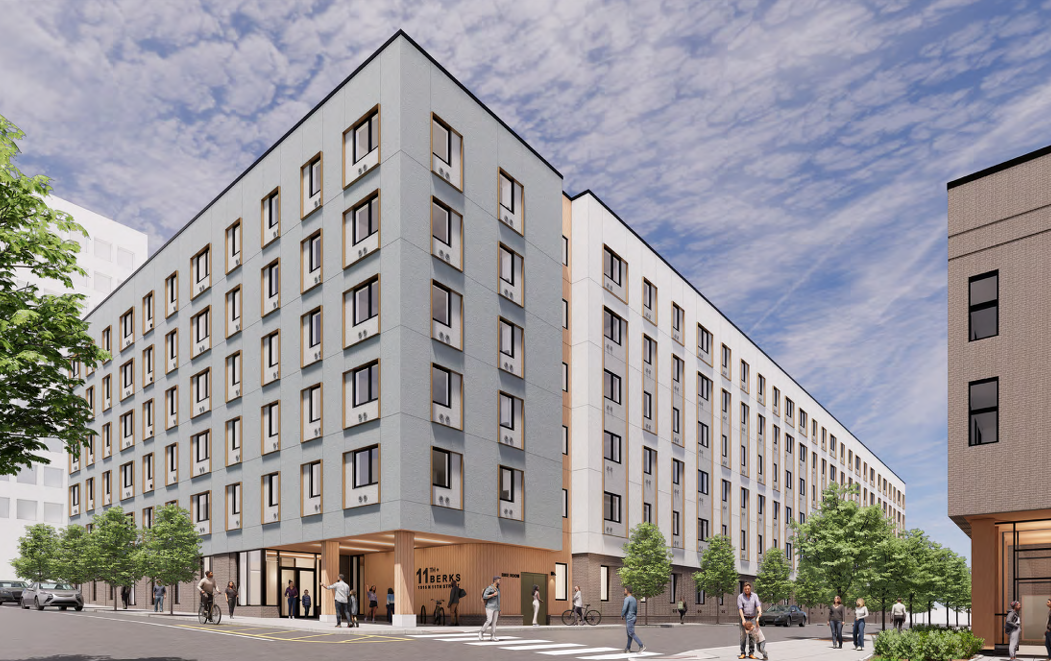
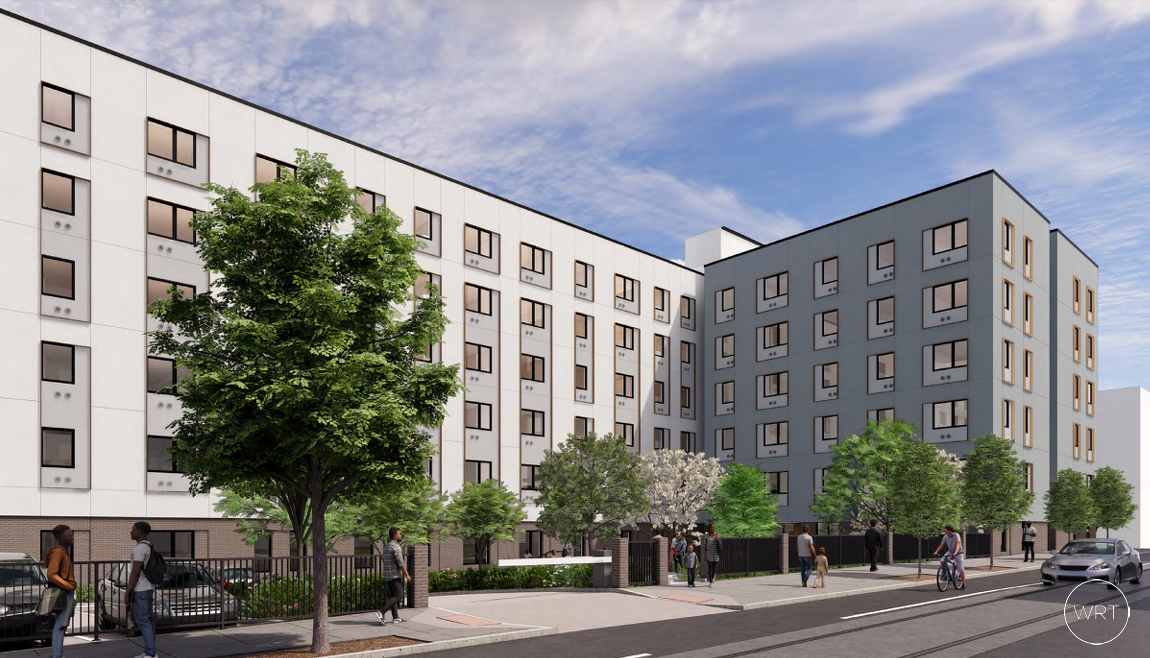
    A 129-unit affordable apartment building is slated for 11th and Berks Streets in North Philadelphia, just east of Temple University’s campus.

    The six-story structure will be built on land owned by the Philadelphia Housing Authority (PHA) but will be developed by New York City-based Jonathan Rose Cos., which has built two other affordable apartment complexes in the area.

    The designer for the building is Philadelphia-based WRT architects, which worked with Jonathan Rose on other projects in the neighborhood.

    “We’ve kind of been marching our way down the block,” said Marissa Hebert, an architect for the building with WRT. “This will be their third project in Philadelphia.”

    The others include 120 units in Paseo Verde at the corner of Ninth and Berks and 133 units at NC Five at 10th and Berks.

    “Being able to still have the site so close to Temple, to be able to put affordable units for the actual residents and long-term community members has been really great,” Hebert said. “You can see the impact of still having affordable housing in this neighborhood.”

    The majority of the units — 61 apartments — will be affordable to those making 60% of area median income (AMI), or just over $44,000 for a one-person household; 54 units will be at 50% of AMI, which is just under $42,000 for a one-person household, and 14 will be for those making under 20% of AMI, or almost $17,000.

    The project is being largely funded through Low Income Housing Tax Credits, a federal program, and subsidies through PHA such as the project-based Section 8 program.

    The proposed apartment building from Jonathan Rose Cos., the New York-based developer’s third project in North Philly.WRT Architects

    The building will be carved into 60 one-bedroom apartments, 60 two-bedrooms units, and nine three-bedrooms.

    “They said they would have the three-bedroom units on the first floor,” said Elizabeth Segarra, of Asociación Puertorriqueños en Marcha (APM), a nonprofit developer and the lead community group in the area.

    “Why? Because they don’t want families on a third floor jumping, and then a single person complaining because they’re hearing too much jumping,” Segarra said. “So they’re going to keep that kind of environment on the first floor.”

    The project will include 21 parking spaces and no ground-floor commercial, although there will be amenities such as a gym and community room in the building.

    On the rest of the site, PHA is planning to build 15 for-sale townhouses at affordable prices, as well as recreational spaces including a basketball court.

    Hebert of WRT says the apartment building will be the largest “passive house” project in Philadelphia, in reference to a building standard that tries to minimize energy use in structures.

    “That’ll mean lower utility costs for all the residents, better thermal comfort for them, and higher indoor air quality,” Hebert said.

    Jonathan Rose plans to begin construction in December and anticipates the building taking two years to complete. Tenants will be able to move in early in 2029.

    “It’s not only going to bring more people to the community, it’s going to bring more jobs, and it’s going to bring a live vibe in that area,” Segarra said. “They really knocked it out of the park.”

  • 45 affordable apartments for artists on Broad Street will be partly funded by Knight Foundation

    45 affordable apartments for artists on Broad Street will be partly funded by Knight Foundation

    Affordable artist apartments will be coming to South Broad Street next year after the John S. and James L. Knight Foundation awarded a $2.5 million grant to the development company that promises to turn former University of the Arts dorms into low-priced housing.

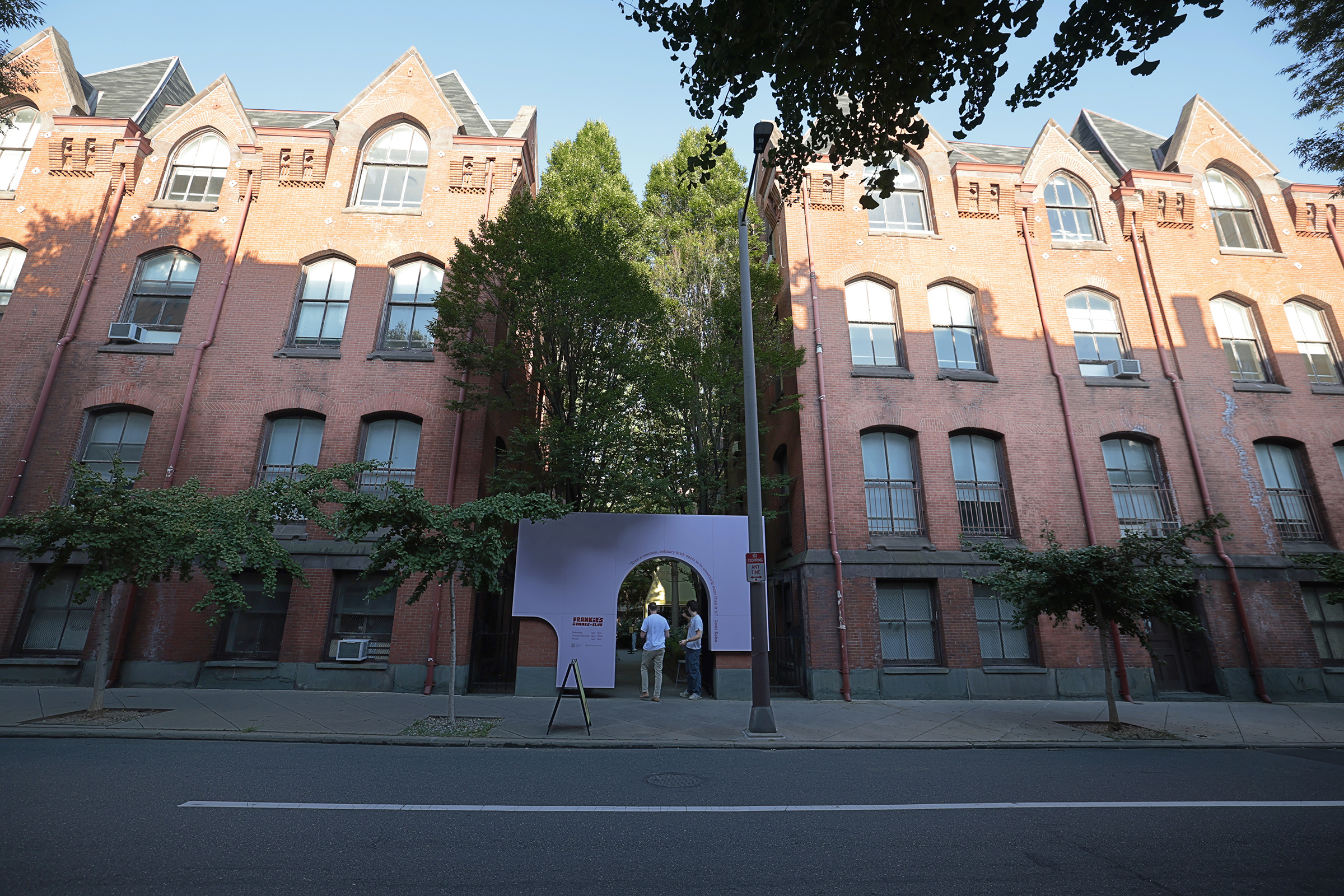
    Lindsey Scannapieco’s company Scout acquired Hamilton Hall, facing Broad Street, and the accompanying Frank Furness-designed former dormitory that front on 15th Street in early 2025 after the surprise bankruptcy and closure of the University of the Arts.

    Scout has renamed the combined complex as the Village of Industry & Art. The company is most known for its redevelopment of a former South Philly public school into a warren of artist studios, small businesses, and eateries, now known as the Bok Building.

    Scannapieco has long promised 45 affordable artist apartments for the former dormitory space, and the Knight Foundation grant provided the final funding to move forward.

    “We have the rest of the funding in place, so this was really about bridging the gap that was required to make this happen,” Scannapieco said.

    She also noted that the project’s affordability would be deed-restricted, locking it in place for the long term.

    “We have a deep commitment now that regardless of what happens to me or my team, this will be affordable housing for artists and cultural workers,” Scannapieco said.

    Scout plans for 35 of the units to be long-term rentals for artists who make between 60% and 80% of area median income, or between $50,000 and almost $67,000 for a one-person household.

    Ten of the units will be furnished and are slated for visiting artists conducting short-term residencies in Philadelphia.

    The apartments range in size from the smallest at a little over 500 square feet to the largest at 726 square feet, with the majority around the 600 square-foot range.

    Those sizes are comparable with the Philadelphia apartment market. In 2023, a study showed that the average size of a new one-bedroom apartment built in Philadelphia over the previous decade had been 764 square feet, while the average studio was 445 square feet. A more recent study found that $1,500 a month would get a renter 591 square feet in the city.

    Scannapieco says Scout has been studying complexes that include artist housing and workspace in cities like New York, Baltimore, and Pittsburgh. The 15th Street project will include specialized amenities like dark rooms, slop sinks, and material storage libraries.

    “Artists are essential to Philadelphia’s identity, economy and future,” said Kristina Newman-Scott, Knight Foundation’s vice president of arts. “This project demonstrates what becomes possible when we design cities with artists in mind, creating affordable places for artists to live and work is an investment in Philadelphia’s long-term vitality.”

    Scannapieco says she expects the affordable artist apartments will be open by mid-2027.

    “A lot of people talk about the need for permanent commitments and allocation of housing for artists and cultural workers, and we’ve never been able to frankly do it at this scale in Philadelphia,” she said. “So that’s very much what this project will provide.”

    The Village of Industry & Art, which covers over 110,00 square feet, currently hosts the popular outdoor restaurant and bar Frankie’s Summer Club in its courtyard facing 15th Street.

    A news release from Knight and Scout noted that it already includes tenants such as BlackStar Projects, Monument Lab, DesignPhiladelphia, and the Stained Glass Project.

  • PHA plans an 85-unit mix of rental and ownership homes in Strawberry Mansion

    PHA plans an 85-unit mix of rental and ownership homes in Strawberry Mansion

    The Philadelphia Housing Authority is planning an 85-unit mix of affordable rental and homeownership units in Strawberry Mansion, around 28th and York Streets.

    The proposal is part of a burst of PHA activity in this North Philadelphia neighborhood in recent years, as the agency has sought to use vacant land to add affordable housing to the area.

    “This proposed development at 28th and York represents exactly the kind of investment Strawberry Mansion deserves — one that replaces long-term vacancy and blight with affordable homes, open space, and renewed opportunity,” Kelvin A. Jeremiah, president and CEO of the Philadelphia Housing Authority, said in a written statement.

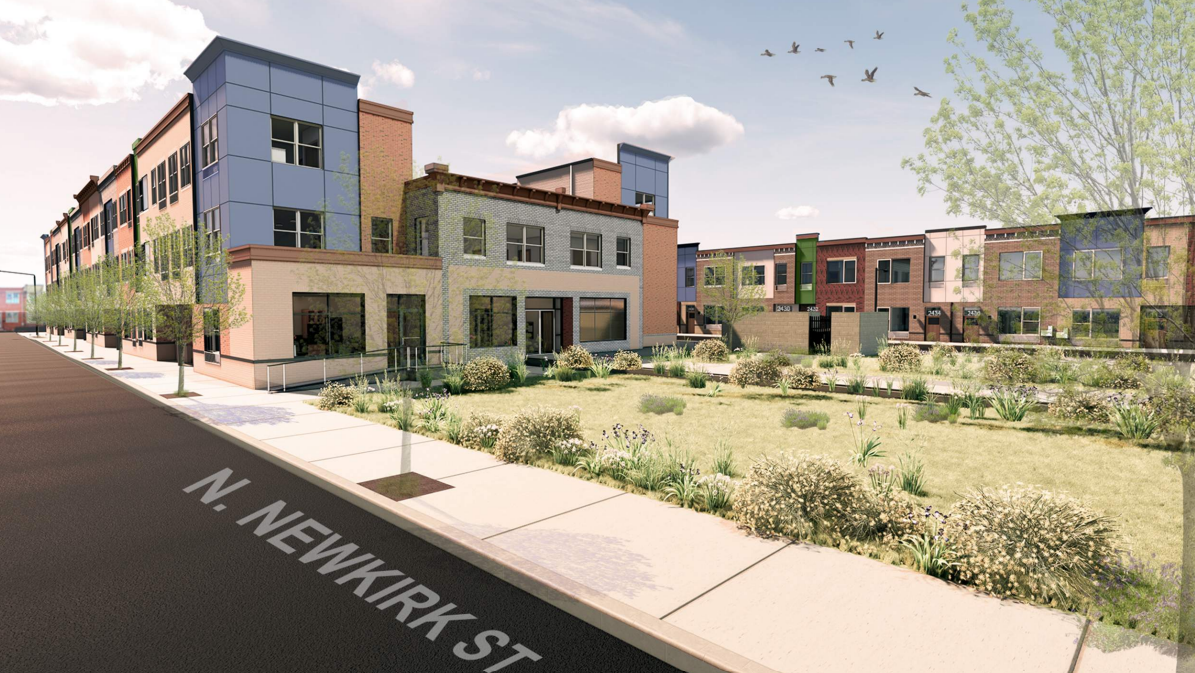
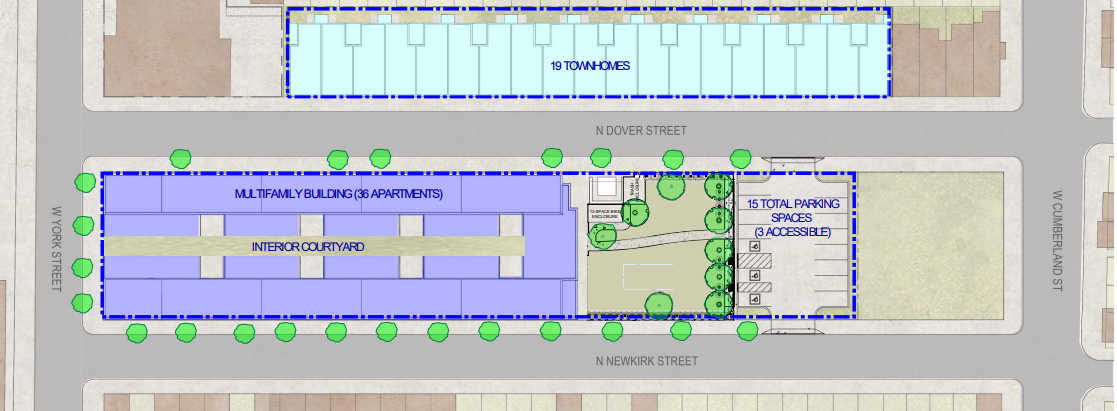
    The project has 30 single-family houses that will be built using the city’s Turn the Key program, 19 rental townhouses, and a 36-unit apartment building roughly split between one- and two-bedroom units.

    PHA also plans 15 parking spaces, street widenings to allow more parking, and a new agency-run park.

    The rental portion of the project, which includes the apartment building at 2401 N. Dover St. and the 19 rental townhouses at 2416 N. Dover St., received permission to move forward from the Zoning Board of Adjustment in late July and early August.

    The housing authority has the support of many of the area’s elected representatives, including State Sen. Sharif Street and State Rep. Keith Harris. The politically influential Laborers union also submitted testimony to the zoning board in support of the project.

    The biggest regulatory hurdle to PHA’s plans is that the land slated for multifamily development is zoned for single-family use, but the board waived that requirement after hearing from community members about PHA’s proposal.

    “I would love to see some development on Dover Street,” said Altrena Nixon, who owns a business at 29th and York Streets.

    “It’s been sitting like that for many, many, many years,” Nixon said in testimony before the zoning board. “We need the vibrancy. We need the development. We need the jobs that it’ll bring to our area.”

    Two speakers warned about the housing authority’s history in the neighborhood, arguing against adding so much density and too much affordable housing.

    All In The Family Group Associates Inc., a community organization, wanted further meetings with PHA to discuss how the project related to other nearby developments.

    In a letter, PHA declined to enter into an agreement with the group over a planned park at 27th and York Streets. All In The Family did not respond to a request for comment.

    “The PHA should not be able to get away with not coming to the table with us and ironing out these issues and ensuring that we have stability in our communities,” Odessa Tate, a member of All In The Family, said in testimony before the board.

    Councilmember Jeffery Young — who is engaged in a legal action against a ZBA ruling in favor of another 57-home development PHA proposed in Strawberry Mansion — asked the board to delay its ruling to allow more time to meet with All In The Family.

    A map showing where the rental portion of PHA’s plan will lay out.Cicada

    But the zoning board ruled in the project’s favor at hearings on July 29 and Aug. 5. Six of the nine speakers at the hearing were in favor of the project.

    “There is a dire need for affordable housing in our community, and to continue to just delay and delay and delay is counterproductive to the needs of the community,” said the Rev. Warren Marshall at the July hearing.

    The 30 homeownership units did not require zoning board permission to move forward. They will be on 29th, Newkirk, and Dover Streets and are being built by Civetta Property Group, the developer that has used the city’s Turn The Key program the most extensively.

    Construction will begin on the for-sale units in October. The rentals are slated for next year as they seek competitive Low-Income Housing Tax Credits that will become available in 2027.

    The 15-space surface parking lot will be next to the apartment building, while Dover and Newkirk Streets will be widened to allow for more on-street parking.

    A proposed park at 27th and York, meanwhile, is being described as a space for community events.

    “PHA will be responsible for development, maintenance, use procedures, and related management functions necessary to preserve the park as a community asset,” Jeremiah said in a letter to local political leaders.

    This isn’t the authority’s only current project in Strawberry Mansion. WHYY recently reported PHA also has proposed converting a 126-year-old school on North 22nd Street into a 50-unit affordable apartment building for seniors.

  • Shift Capital is selling many of its Kensington holdings

    Shift Capital is selling many of its Kensington holdings

    Shift Capital made its name in Kensington.

    The company has long styled itself as a socially conscious real estate developer, rebuilding long-vacant buildings into thriving mixed-use properties in a neighborhood challenged by poverty and addiction.

    Now 14 years after the company’s formation, it is seeking to sell its cornerstone developments in the neighborhood.

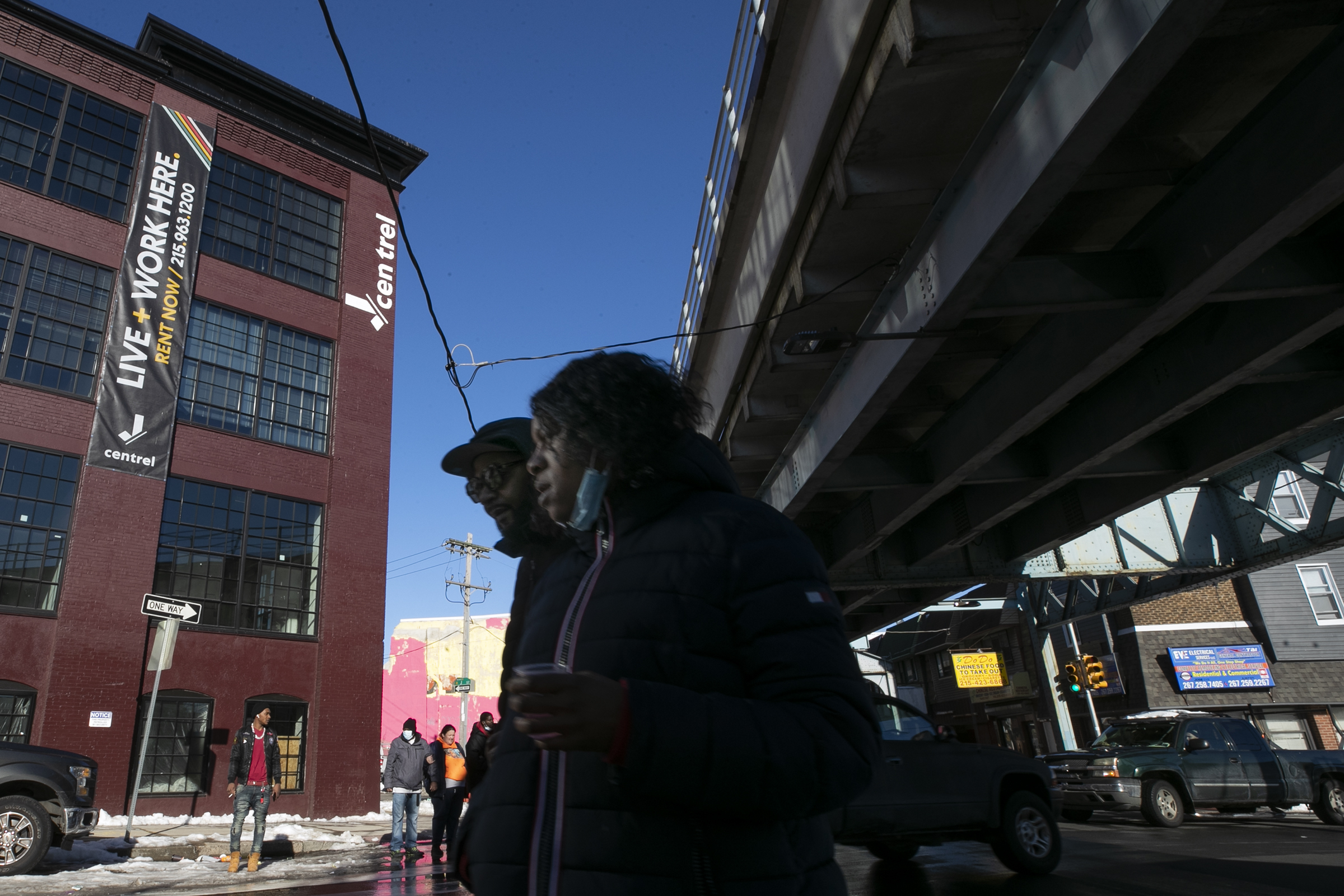
    That includes its Harrowgate flagship, the 116-unit building at 3400 J St. known as J-centrel, which is home to the renowned Vietnamese bakery and cafe Càphê Roasters.

    Kensington Corridor Trust, a nonprofit that Shift helped found, plans to purchase that property for $18 million, although it needs to raise $1.5 million more by the end of August to close on the deal.

    The organization is a neighborhood trust with the mission of acquiring properties on Kensington Avenue and placing them under community control — via a nonprofit board — to preserve affordability. Currently, most of the trust’s properties are storefronts and much smaller than J-centrel.

    “We’re excited to hand the responsibility of creating a healthy, safe neighborhood to the next group to continue the work that we’ve been doing,” said Brian Murray, CEO of Shift Capital. “It’s an exciting moment of transition to the next generation of people … who want to see Kensington be what it could be.”

    Murray says the properties Shift wants to sell represent 30% of their properties in the city.

    They are in talks with potential buyers for the old industrial building at 3775 Kensington Ave., and the artist studios, office space, and light manufacturing at 3525 I St. (MaKen Studios North) and 3401 I St. (MaKen Studios South).

    Murray emphasizes that Shift will retain a presence in Kensington. Their offices will remain in J-centrel, and they are still working on the Càphê Roasters expansion across the street at 3419-23 Kensington Ave.

    He says a sale of this kind has always been part of the plan. The investors who backed these developments in Kensington are nearing the end of their time with the fund, and Shift is not currently planning to recapitalize with new partners.

    “Our world is limited to capital that needs to be returned,” he said. “They can be as mission-driven as they would like, but that still is a limitation of the role that we can play in revitalizing and preserving neighborhoods.”

    That’s why Murray wants to sell to Kensington Corridor Trust, which Shift helped found in 2019 (although it exited the organization’s board in 2021).

    Kensington Corridor Trust owns 32 properties along the avenue, although none is close to the size of J-centrel. In preparation for the purchase, the trust has hired more staff, including a new property manager and a full-time maintenance person who used to be with Shift.

    “Shift Capital’s J-centrel property will be our single largest acquisition to date in terms of square footage, units, and cost,” said Adriana Abizadeh-Barbour, executive director of Kensington Corridor Trust.

    Abizadeh-Barbour said the trust raised a half-million dollars in early August, and she is confident it can get the $1.5 million needed before the end of the month.

    The funds raised so far include $1 million from individual donations, $1 million from the City of Philadelphia, $3 million from foundations, $3 million from investment funds, and $10 million from Community Development Financial Institution, which specifically invests in low-income areas.

    “We have a strong base of supporters who believe in community control and neighborhood power, and we’re excited to bring this under community ownership,” Abizadeh-Barbour said.

    The trust plans to make the apartments more affordable as higher income tenants move out of the building, with the goal of targeting the units to those at 60% of area median income, or roughly $50,000 for a one-person household.

    As for Shift, the company has other big plans in Philadelphia. Earlier this year it announced a partnership with Temple University over a long delayed development proposal near Amtrak’s North Philadelphia station, near Broad Street and Indiana Avenue.

    And although lenders backed away from the firm’s redevelopment of the historic Beury building at 3701 N. Broad St. in 2024 amid an increasingly difficult development environment, Murray says they “are still actively working on” the property.

    “The Kensington Corridor Trust [sale] is an exciting mission exit that we’ve been working on almost from the beginning of our work,” Murray said. “This was always a prescripted game plan to create an entity that was community controlled that could be a steward of assets in the neighborhood long term.”

  • Who’s behind the orange signs around Philly criticizing rogue developers?

    Who’s behind the orange signs around Philly criticizing rogue developers?

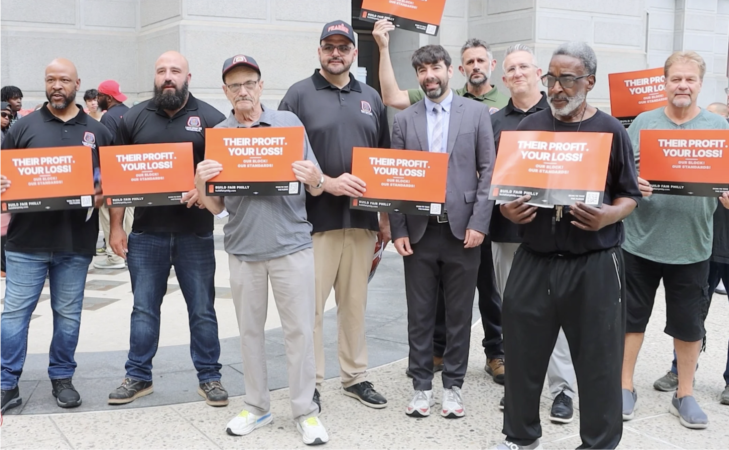
    In May, Passyunk resident Peter Kim found a vivid orange flyer on his door that read, “Their Profit. Your Loss!”

    The messaging on the material inveighed against shoddy and irresponsible real estate development, without naming any particular company or specific foe.

    It encouraged residents to sign the Build Fair Philly pledge and attend registered community organization (RCO) meetings, which developers have to hold in advance of large projects or a zoning change.

    Kim is a pro-housing advocate, and after checking out the website he at first thought that some new antidevelopment political organization had come to town.

    “While on the surface, the talking points sound reasonable, I think because I’ve become so conditioned to NIMBY [not in my backyard] groups finding any reason to oppose new development, I just assumed this campaign was from some NIMBY anti-housing group,” Kim said.

    But Build Fair Philly’s website lists as its address 1803 Spring Garden St., which is the Philadelphia headquarters for the Eastern Atlantic States Regional Council of Carpenters until its forthcoming move to the Navy Yard.

    The Carpenters, like the rest of Philadelphia’s building trades unions, are generally pro-development. After all, the more projects — especially big ones — that get built, the more their members work.

    “[I] was surprised to learn it’s the Carpenters union because, obviously, they’re not anti-housing,” Kim said.

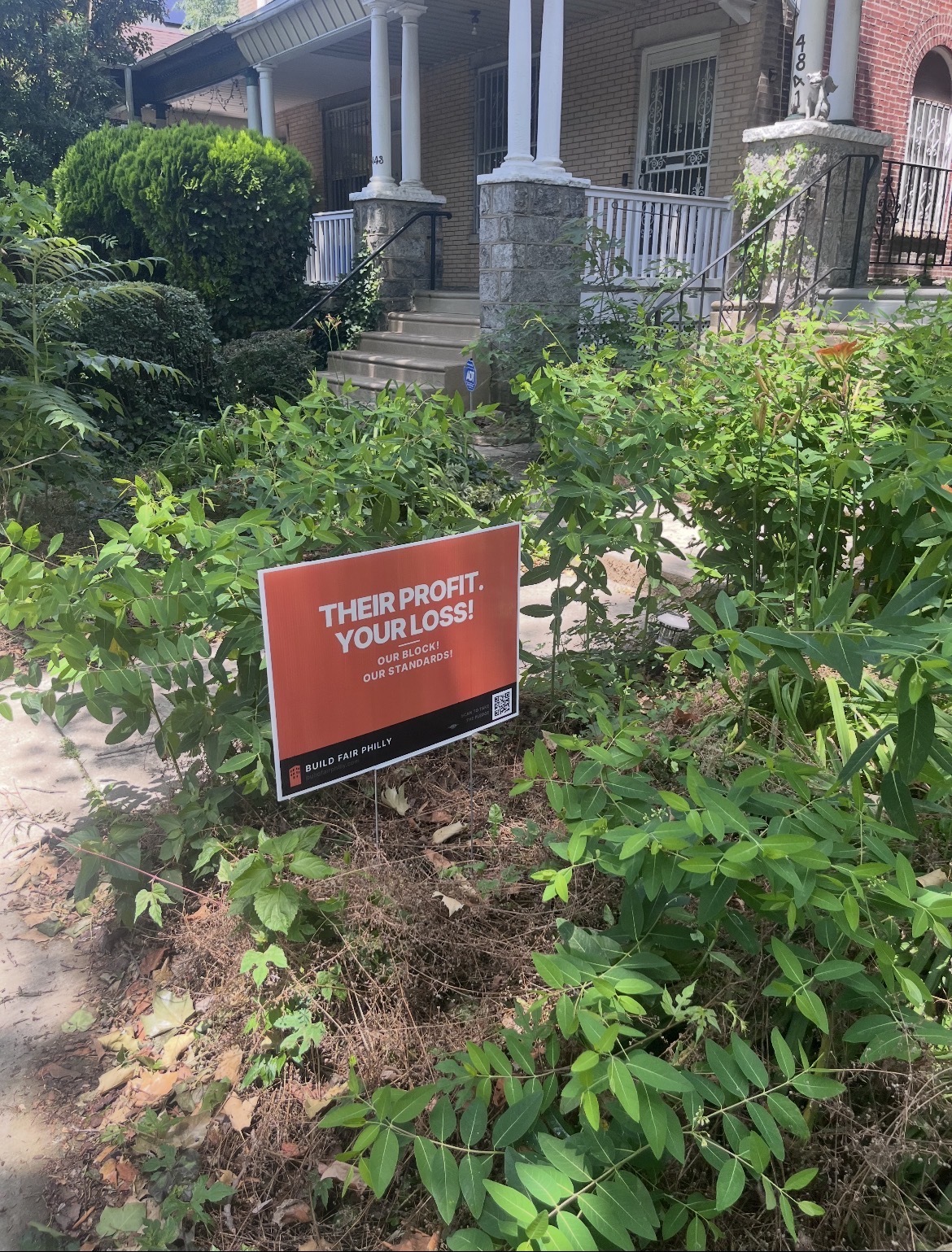
    In recent months, conspicuous orange Build Fair Philly lawn signs have been popping up on rowhouses and lawns around Philadelphia, decrying harmful real estate development. (Another common message: “Our block! Our standards!”)

    A Build Fair Philly sign in West Philadelphia.Zoe Greenberg

    The campaign’s sponsor is not listed on its material, leaving many recipients wondering what the notices are about.

    In an interview, leaders of the Carpenters said that the Build Fair Philly campaign is an attempt to raise popular consciousness about irresponsible construction — which Philadelphia’s rowhouse neighborhoods are very familiar with.

    “We are not against development; if anything, we want more development,” said James Hocker, assistant executive secretary-treasurer with the Eastern Atlantic States Regional Council of Carpenters.

    “But we want more responsible development, development that’s built in a fair way that is creating opportunities,” Hocker said. “We want to see licensed contractors on these projects. We want to see contractors that are paying their workers a responsible wage.”

    The Carpenters say Build Fair Philly is an effort to give community members a way to get involved in a campaign to better regulate the construction industry, forging alliances with community groups to ensure quality building and get pro-labor laws enforced.

    The move comes amid a difficult environment for Philadelphia’s building trades unions. (The Carpenters are not part of the Philadelphia AFL-CIO or the Philadelphia Building and Construction Trades Council.)

    After interest rates spiked in 2022, construction slowed. The commercial sector, which is most likely to employ union labor, has taken a hit from the remote work-induced cessation of new office construction. That is part of why the trades fought so hard on behalf of the proposed, then abandoned, 76ers Center City arena.

    Mayor Cherelle L. Parker’s $800 million housing initiative will create work for the unions. But a lot of the funding — like the signature Turn the Key program — goes into rowhouse construction and rehabilitation, which labor has largely ceded to nonunion, often immigrant, workers.

    There also are not many public works projects currently in the pipeline, and longtime fonts of trades work like the Philadelphia Housing Authority are less reliable sources of employment.

    The website Unionstats.com shows a steady downward trend in union representation in the Philadelphia metropolitan area’s private construction market since the pandemic.

    “I think it’s part of a general campaign by unions in the Northeast to reverse their declining market share,” said Stephen Jacob Smith, executive director of the Center for Building in North America.

    “Exactly what they have in mind as the mechanism, I do not know,” Smith said of the Carpenters. “They have a bunch of political levers, and I don’t know which of them they’re trying to pull with this.”

    But Hocker says the effort is not only about winning more work for the Carpenters members. It is also about holding contractors and developers accountable for not hiring in the city.

    After all, the building trades unions have been criticized for having memberships that do not represent the demographic makeup of Philadelphia. Why are developers not getting attacked if they are also not doing representative hiring?

    “We want development that’s going to create opportunities, whether it’s union or nonunion, for individuals that live in the city of Philadelphia,” Hocker said. “We feel that the development that happens in these communities should reflect what the community looks like. It shouldn’t be a bunch of out-of-state license plates.”

    Build Fair Philly’s Instagram account includes footage of a rally with City Council members, including Quetcy Lozada, Jeffery Young, and a cigar-wielding Jimmy Harrity.

    Eastern Atlantic States Regional Council of Carpenters senior council representative Joseph Lockley talks about Build Fair Philly outside of City Hall.Eastern Atlantic States Regional Council of Carpenters

    But the union leadership says that the campaign is not necessarily about passing new legislation — which many other trades have successfully won before — but about getting the city to enforce the regulations that are already on the books.

    “We’re not asking for elected officials or anybody in any kind of position to create new laws and policies,” said Joseph Lockley, senior council representative for the Carpenters. “These are laws, policies, and procedures that are already in place that are just not being pushed and enforced, or even prioritized.”

    As of early July, the Carpenters said, they had already had 10,000 people sign on to Build Fair Philly’s pledge. “I believe Philadelphia’s development should be safe, fair, and built for all of us — not just for investors and insiders,” it reads.

    They had distributed 6,536 signs and canvassed 17,537 people, knocking on doors and interacting with people on the street.

    They have also put up nine billboards attacking Post Bros., a major Philadelphia developer. (“Philly’s Worst Neighbors. Stop Post Brothers,” the signage reads.)

    A variety of contractors that work with the Carpenters are currently in a legal dispute with Post over the company’s large apartment development at Broad Street and Washington Avenue.

    The Carpenters Union’s Build Fair Philly campaign billboard across from I-95 on Richmond Street. The union hopes the campaign will rally community members to push back against shoddy development.Aidan T. Gallo / Staff Photographer

    As part of the canvassing effort for Build Fair Philly, the Carpenters have been engaging with community members to hear about their experiences of development in the city. They said they are using that information to formulate the next steps for Build Fair Philly.

    “This is also a social justice issue,” said Mungu Sanchez, deputy political director for the Carpenters.

    “This is about fairness and this is about making sure that we’re organized with other community groups who also care about growth and care about making sure that communities are able to have the same options and the same sort of resources that every American should have,” Sanchez said.

  • SEPTA wants to extend its free fare benefit to apartment dwellers

    SEPTA wants to extend its free fare benefit to apartment dwellers

    SEPTA is embarking on an experiment to extend its all-access transit pass, SEPTA Key Advantage, to apartment building residents.

    Currently employers and schools can buy into the benefit program. The institutions pay for the passes, and then workers and students sign up to receive a SEPTA Key card that is free for them to use.

    Since its creation in 2022, beneficiaries have used SEPTA Key Advantage for 25 million rides.

    Now SEPTA has received a $150,000 grant from the Delaware Valley Regional Planning Commission (DVRPC) for a pilot program extending the benefit to apartment building owners.

    The two-year program will be open to a handful of apartment buildings so SEPTA can study how tenants use it. The first company to sign on is the HOW Group, a large multifamily developer and owner in Philadelphia.

    “A lot of our properties are located near SEPTA stations, and with a lot of our buildings, their biggest amenity is their location,” said Kelli Tomczak, vice president of property management at the HOW Group. “It was a great opportunity to emphasize how big of an amenity that is coupled with the SEPTA pass.”

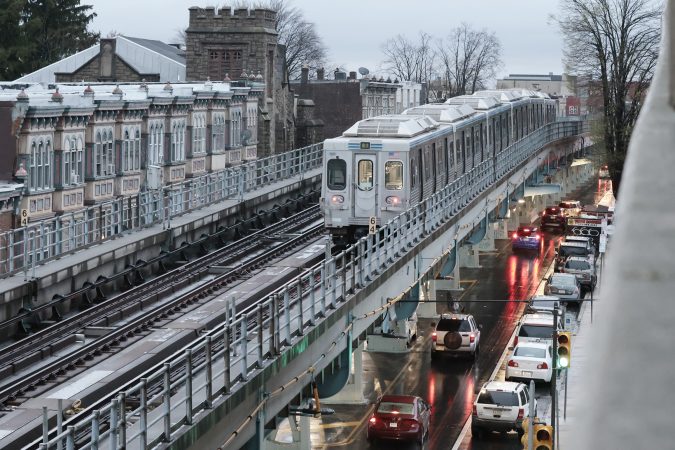
    The SEPTA Key Advantage will be offered first to tenants in the HOW Group’s 104-unit apartment building at 1900 N. Front St. known as the Isaac. It has no parking but is directly across the street from SEPTA’s Berks Station on the Market-Frankford Line.

    “A lot of people who are living there are already utilizing the El. That’s what makes this a great amenity,” Tomczak said.

    SEPTA says it is in talks about bringing the benefit to another HOW building in University City, which has frequent bus lines to Center City, trolleys, and the Market-Frankford line.

    The transit agency also wants to try the pilot in a couple suburban buildings and are searching for partners with 50- to 100-unit buildings near stations in Philadelphia’s collar counties.

    “We are really trying to hone in and really understand, when you have this free pass, do you start to take transit more?” said Gabrielle Pristera, senior sales development specialist with SEPTA.

    “We want to really build the case to show other multifamily properties that there is value in adding Key Advantage as an amenity through this pilot,” Pristera said.

    The HOW Group’s 100+ unit apartment building at 1900 Front St., on the Market-Frankford line, where tenants will be eligible for free SEPTA cards.HOW Group

    SEPTA Key Advantage originated when transit ridership was struggling back from COVID.

    The program was created to get more people riding SEPTA regularly, while raising revenue for the service. SEPTA estimates that it saves regular riders $110 a month.

    Today SEPTA Key Advantage has 60,000 members, 63 participating employers (including the City of Philadelphia), and four participating colleges and universities.

    Roughly half the eligible students and workers have taken advantage of the benefit and SEPTA has found that at small companies 80% of employees sign up.

    The transit authority has long wanted to expand the program to apartment owners and tenants.

    “Especially within Center City, with development being so costly, this is just one of the easiest amenities to get started,” Pristera said. “You don’t have to have space for it. You just can just distribute key cards and go.”

    Philadelphia has seen an apartment building boom in recent years. Neighborhoods like Northern Liberties, Fishtown, and University City have seen thousands of new units added near subway, elevated, and trolley lines.

    DVRPC’s grant money will pay for the administrative costs of the pilot, as property managers don’t have the same kind of human resources departments as employers and higher education institutions.

    The grant from DVRPC will last until 2028. SEPTA will evaluate the results of the program and decide how to proceed from there.