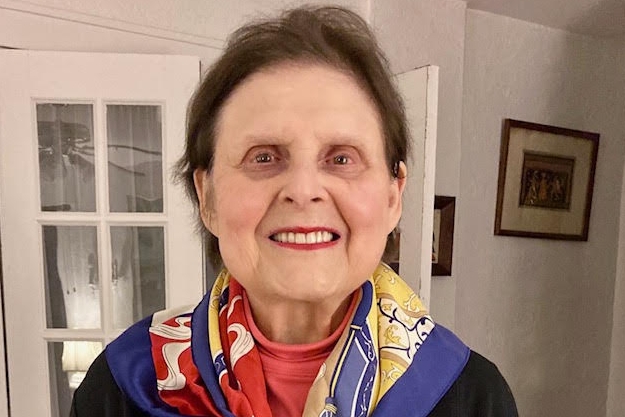
Lenora D. Wolfgang, 91, of Philadelphia, French professor emeritus at Lehigh University, literary researcher, author, teacher, mentor, and artist, died Thursday, May 14, of heart failure at her home near the Philadelphia Museum of Art.
Professor Wolfgang, or, as many of her Lehigh students and colleagues called her, Madame Wolfgang, planned to study art in Paris after high school and live as a painter. But, she told her family, she became so enthralled by the French language at Philadelphia High School for Girls that she curbed her art aspirations, earned three degrees in French at the University of Pennsylvania, and taught French and French literature at Lehigh for 26 years.
Inspired by professors at Penn, she became an expert in medieval French language and literature, and her doctoral dissertation and first book were an analysis of an 800-verse prologue to a 13th-century French poem. She studied in France on a Fulbright Scholarship in 1956 and ’57, and in Spain on a grant from the American Council of Learned Societies in 1978.
She wrote two books on French poetry, served research fellowships with the National Endowment for the Humanities in the 1980s and ’90s, and earned a grant from the American Philosophical Society in 1981 to transcribe manuscripts at the National Library in Paris. In 1990, reviewers at Penn’s French Forum journal said her second book, also on 13th-century French poetry, “provides the modern scholar with a standard text and thorough apparatus that will serve current and future generations well.”
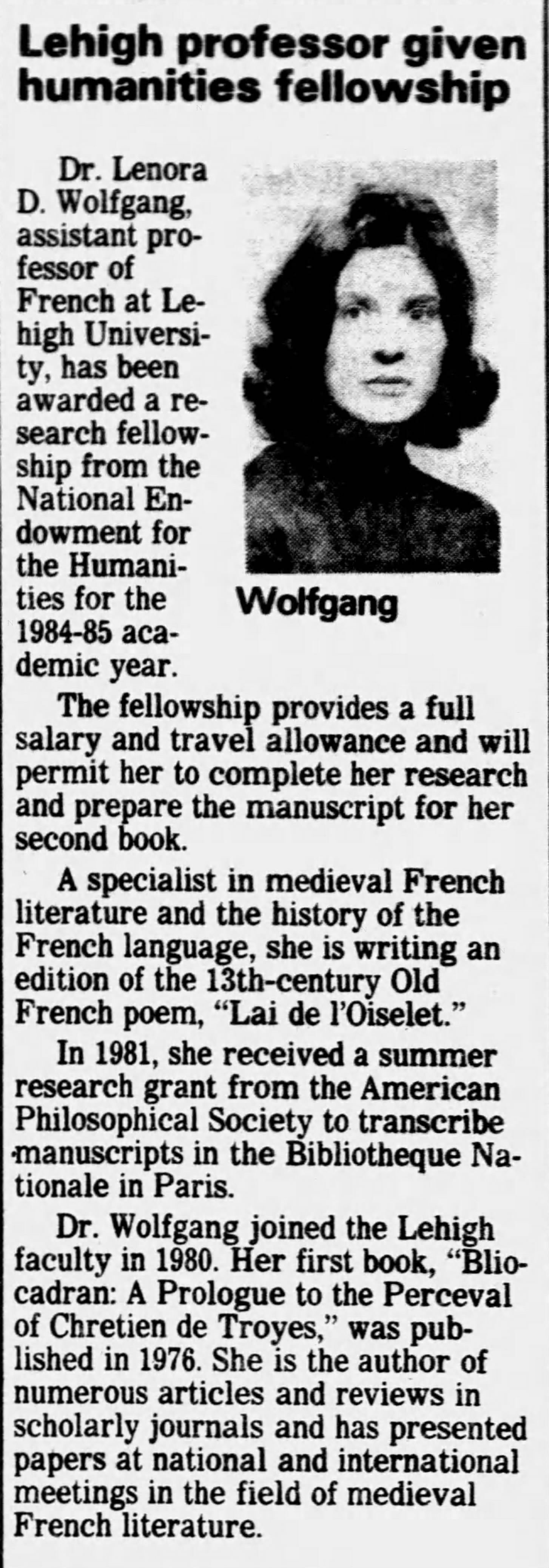
This photo and story about Professor Wolfgang appeared in the Morning Call of Allentown in 1984.Newspapers.com
She belonged to many academic language and literature organizations, and was a student adviser and faculty committee member at Lehigh. In tributes, former colleagues called her “a true mentor” and “a real mensch.” One said: “It was clear that I had an ally in Lenora and that she wanted me to succeed.”
A former student said she was “a good friend and sounding board” in a 2025 interview with the Lehigh alumni relations department. “She was always ready to help, share her knowledge,” a former colleague said, “and always did it with tact and unselfishness.”
Professor Wolfgang earned bachelor’s and master’s degrees, and a doctorate in French at Penn. She taught French classes at Temple and Rutgers Universities, Penn, and high schools in Philadelphia before joining Lehigh’s Department of Modern Languages and Literature in 1980.
She commuted three hours round trip to Lehigh, in Bethlehem, Pa., from West Philadelphia three days a week and was promoted from assistant professor to associate professor in 1986, then to full professor in 1989. She retired from Lehigh in 2006.
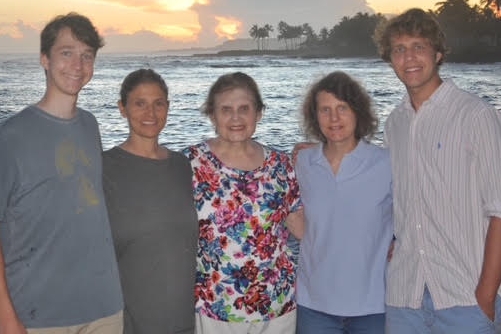
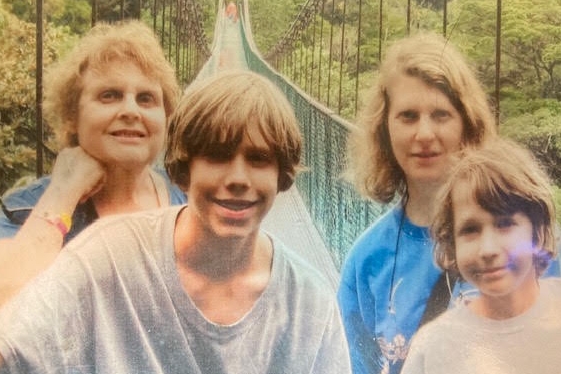
Professor Wolfgang (center) traveled the world and enjoyed hosting dinner parties with family, friends, and academic colleagues. Courtesy of the family
After Lehigh, Professor Wolfgang taught continuing education classes about French playwright Molière and other topics to adults at the Osher Lifelong Learning Institute at Temple. After the COVID-19 pandemic lockdown ended, she returned to the institute briefly as a student.
Professor Wolfgang was adept at painting as a girl in West Philadelphia and won several art competitions, and later showed her photography at Penn’s Faculty Club. “She was a natural talent,” her family said in a tribute.
Lenora Divida Poden was born Sept. 25, 1934, in Philadelphia. Her parents emigrated from Poland and Romania, and her mother leftthe family when Professor Wolfgang was in junior high school.
She and her father had to hide their Jewish heritage and alter their last name to minimize antisemitic attacks. “Yet Lenora overcame these challenges,” her family said, “excelled academically, and rose to the top of her academic field.”
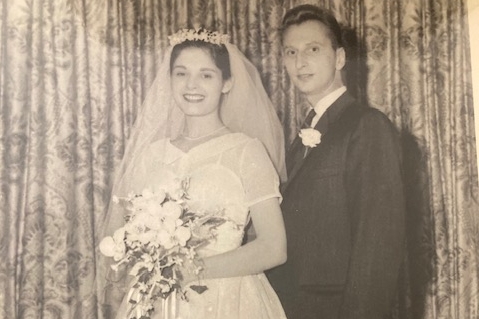
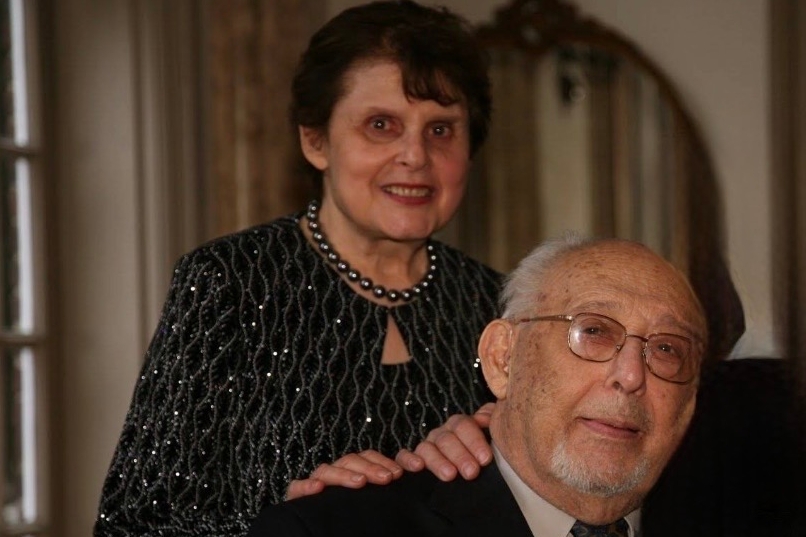
Professor Wolfgang married her first husband, Marvin Wolfgang (above), in 1957, and her second husband, Leon Salganicoff (below), in 2010.Courtesy of the family
An exceptional student, she was valedictorian of both her 1952 senior high school class at Girls’ High and her 1956 senior undergraduate class at Penn’s College for Women. She married Marvin Wolfgang, a professor at Penn, in 1957, and they had daughters Karen and Nina, and lived in University City.
In 1977, The Inquirer featured their house in a photo spread about its French-inspired Gothic style of architecture. Professor Wolfgang said: “Perhaps that is one reason I feel so very much at home.”
After her husband died in 1998, she married Leon Salganicoff, a professor emeritus at Temple, in 2010. He died in 2011.
Professor Wolfgang was an avid reader. She traveled the world, listened to classical music, and enjoyed hosting dinner parties with friends and academic colleagues.
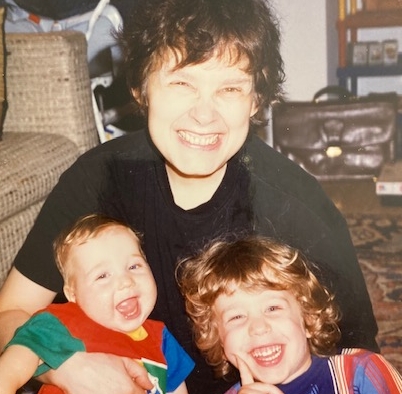
Professor Wolfgang (left) doted on her family and sent personalized birthday cards. Courtesy of the family
She almost went to law school in the 1970s before gaining her full-time teaching position at Lehigh. She doted on her family, sent personalized birthday cards, and kept in touch with teachers, colleagues, former students, and friends even after they parted.
“She was brilliant,” a longtime friend said in a tribute, “and she was fun.” Her family said: “Everyone loved her.”
In addition to her daughters, Professor Wolfgang is survived by two grandsons, a great-grandson, and other relatives. A brother died earlier.
A private celebration of her life was held earlier.
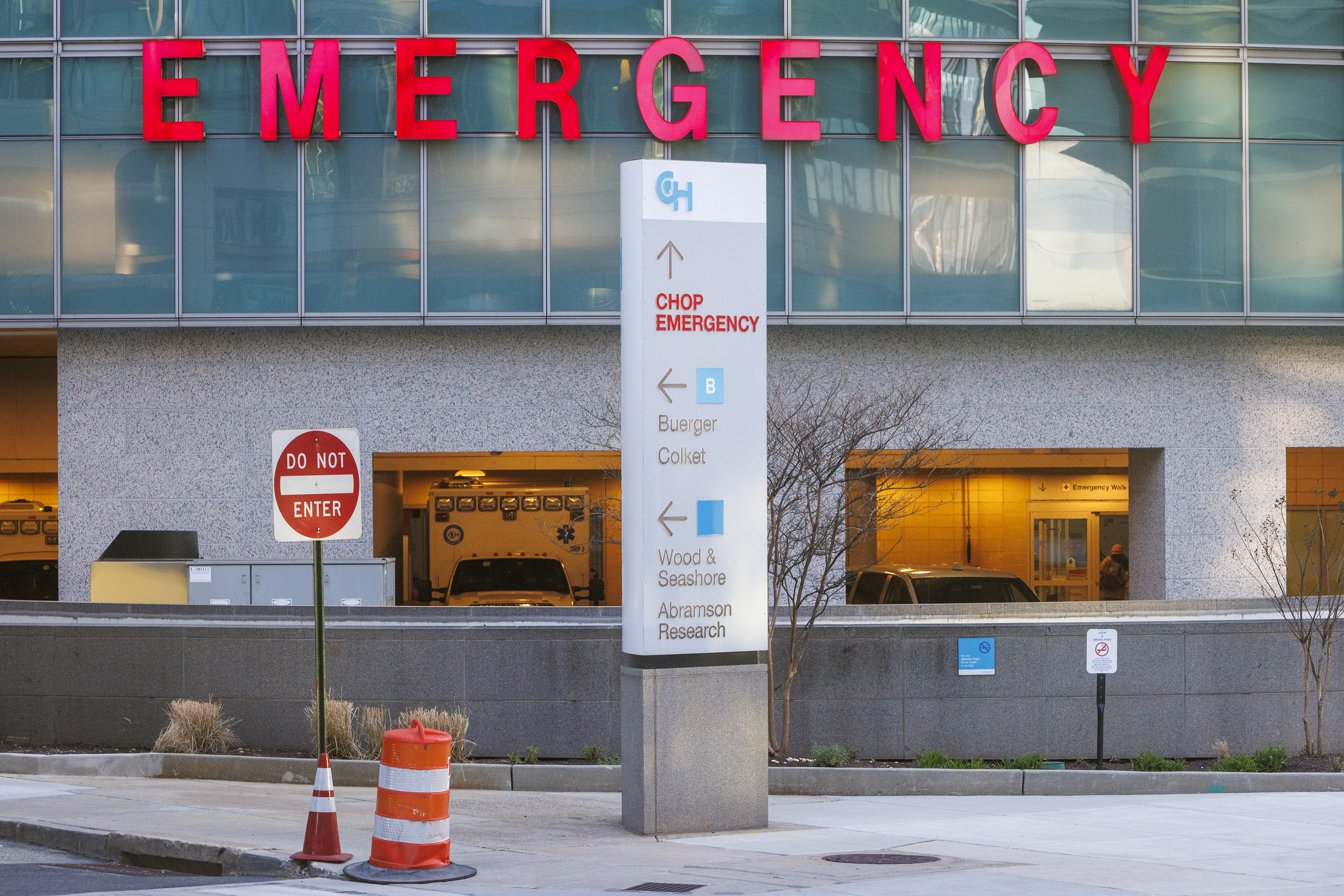
The visitor arrived at a neonatal intensive care unit at the Children’s Hospital of Philadelphia in University City last Friday morning.
Then they visited a family lounge. An atrium. A cafeteria.
At each stop, the person, now known to be infected with measles, potentially exposed others to the highly contagious disease that is particularly risky for young children, city health officials announced this week.
Hospitals have spent years preparing for such incidents, no longer a theoretical concern as Pennsylvania now deals with the nation’s largest measles outbreak this year, which has already sickened more than 760, experts in infectious disease prevention say.
And across the state in Allegheny County, the University of Pittsburgh Medical Center Children’s Hospital has reported several possible measles exposures this summer.
Health officials did not specify how many babies and others were potentially exposed at CHOP in announcing the exposure late Thursday. Philadelphia health officials have issued only general details on the infected person’s visit, along with guidelines for anyone potentially exposed to the virus over the course of several hours on Sept. 11 at the hospital at 3401 Civic Center Blvd.
The hospital is working with NICU families to ensure its patients are protected, Julia Sammons, vice president and associate chief medical officer of CHOP’s Office of Preparedness, Prevention and Response, wrote in an email.
The hospital took “immediate action” after being notified of the exposure to identify babies who might have been exposed and offer preventive treatments to protect them from the virus, Sammons said. Exposed patients have also been placed in isolation and doctors are monitoring them for symptoms.
The hospital is also working with staff and patients outside the NICU to ensure they understand the situation, Sammons said, and partnering with the state and city health departments “on contact tracing, timely testing, and safe quarantining practices for all the areas served by the CHOP enterprise.”
Infectious disease experts say hospitals around the country have been monitoring an explosion of measles cases in the last several years.
Pennsylvania as of Friday had seen 767 cases of measles in 2026, with 93 reported in the last week. One in five people with reported cases has been hospitalized.
“Measles has been up and coming. It’s definitely on the radar of hospitals,” said Ericka Kalp, who directs Drexel University’s infection prevention and control academic programs. “Your risk has increased when you have multiple measles cases within your vicinity.”
Every year, hospitals work on an infection control risk assessment, monitoring rising diseases around the country and internationally, and developing plans on how to treat sickened patients.
That could include triaging patients with respiratory illnesses and isolating those with suspected cases in special rooms, said Kalp, who was not involved in the response at CHOP.
Screening visitors to a hospital is tricky, she said.
“We can ask visitors and the public not to visit if you’re sick, and visitors need to take it upon themselves to not go to the facility if they’ve been around a particular exposure,” she said.
But some may not know they are ill: A person can be contagious for four days before measles’ telltale rash appears.
Sammons said that CHOP screens visitors daily for signs or symptoms of illness at the hospital’s welcome desks, and signs remind visitors that no one with symptoms should be admitted to the NICU. She did not say whether the NICU visitor who exposed others on Friday was symptomatic.
“We have been in constant communication with families in our NICU to discuss guidance to keep them safe,” she said. “As the measles outbreak continues to evolve, we continue to review and update our screening processes to reduce the risk of exposure to our patients and families.”
The virus can linger in the air for up to two hours and infect nine in 10 unvaccinated people exposed to it.
Pregnant women, babies under six months, and some immunocompromised people are among the groups who cannot be vaccinated. Their protection depends on nearly everyone else in a community being vaccinated to prevent the disease from spreading.
But more parents have opted against vaccinating children for religious or philosophical reasons in recent years, The Inquirer has found, leaving hundreds of area schools and communities vulnerable to the spread of the virus.
“When you see fewer people are becoming vaccinated and they have less immunity, it opens up a portal of spread,” Kalp said. “We’ve always trained for this type of thing.”
Sammons said CHOP has stepped up public health education for families and is offering early MMR vaccines for eligible children amid the outbreak, as state health officials have recommended. The hospital is also improving its measles screening capabilities and “developing contingency plans for more widespread community transmission in our area,” she said.
“The best way to control measles outbreaks remains vaccination with the measles, mumps, and rubella vaccine, which is safe and highly effective in preventing measles,” she said, noting the hospital’s long-running Vaccine Education Center, aimed at debunking misinformation about the safety of vaccines.
(function(){function e(){window.addEventListener(`message`,function(e){if(e.data[`datawrapper-height`]!==void 0){var t=document.querySelectorAll(`iframe`);for(var n in e.data[`datawrapper-height`])for(var r=0,i;i=t[r];r++)if(i.contentWindow===e.source){var a=e.data[`datawrapper-height`][n]+`px`;i.style.height=a}}})}e()})();
Treating those exposed
CHOP is offering post-exposure treatments “in the form of antibodies” to infants who may have been exposed to the virus, Sammons said.
Doctors can administer immunoglobulin, a treatment made from the plasma of adult donors, that helps boost a baby’s antibodies to infectious diseases like measles, said Sarah Long, a Drexel pediatrics professor and a physician specializing in infectious disease at the Bristol-Myers Squibb Children’s Hospital in New Brunswick, N.J.
In an outbreak, she said, hospitals can consider limiting visitors to prevent exposures, especially for a virus like measles, which is particularly dangerous for young children and kills about 1 to 3 for every 1,000 infected.
But responding to measles cases or exposures can require hospitals to expend extensive resources.
“It’s an enormous number of meetings, manpower, education about IDing cases early, and sequestering as soon as a patient comes in with a fever,” she said. “It’s an enormous amount of money, gowning, gloving, and masks.”
Now she’s worried again about vulnerable children. Nearly one-third of Pennsylvania’s cases this year have been reported in children under the age of 18, and two of the measles-associated deaths involved infants.
“It makes me just angry, angry, angry. There are so many catastrophes in children’s healthcare that are not preventable,” she said. “To have catastrophes that are preventable is just unconscionable.”
Mooncakes often have a less-than-stellar reputation. They’re beautiful thanks to the intricate molds they’re made with, but they’re usually better to look at than eat. At the Mid-Autumn Festival, one of the four major Chinese holidays — which falls this year on Sept. 25 — people give and receive them much like fruitcakes at Christmas (without anyone actually eating them).
One Philadelphia pastry chef is reversing mooncakes’ bad rap.
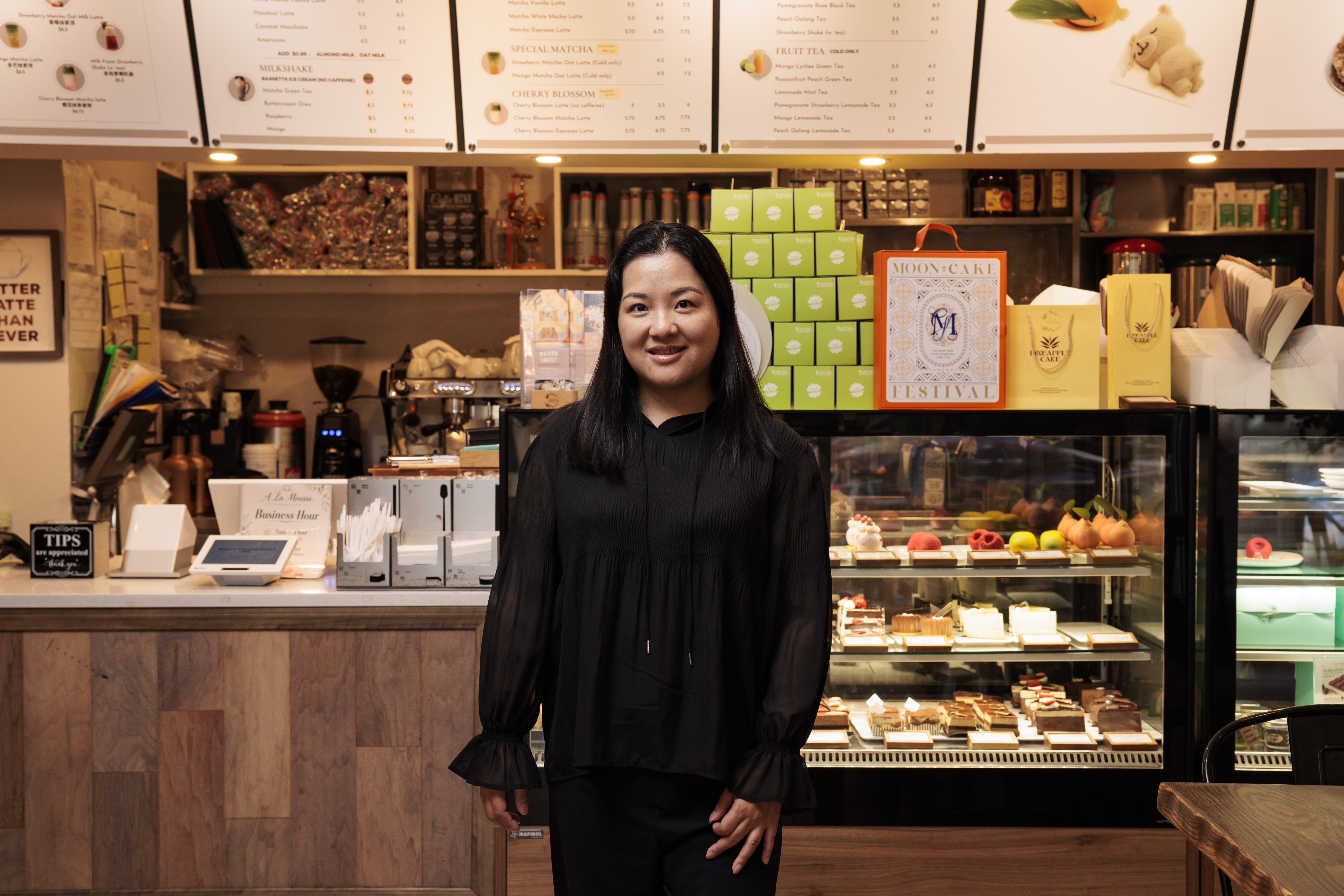
Anna Chen posed for a portrait at A La Mousse on Tuesday, Sept. 15, 2026, in Philadelphia.Monica Herndon / Staff Photographer
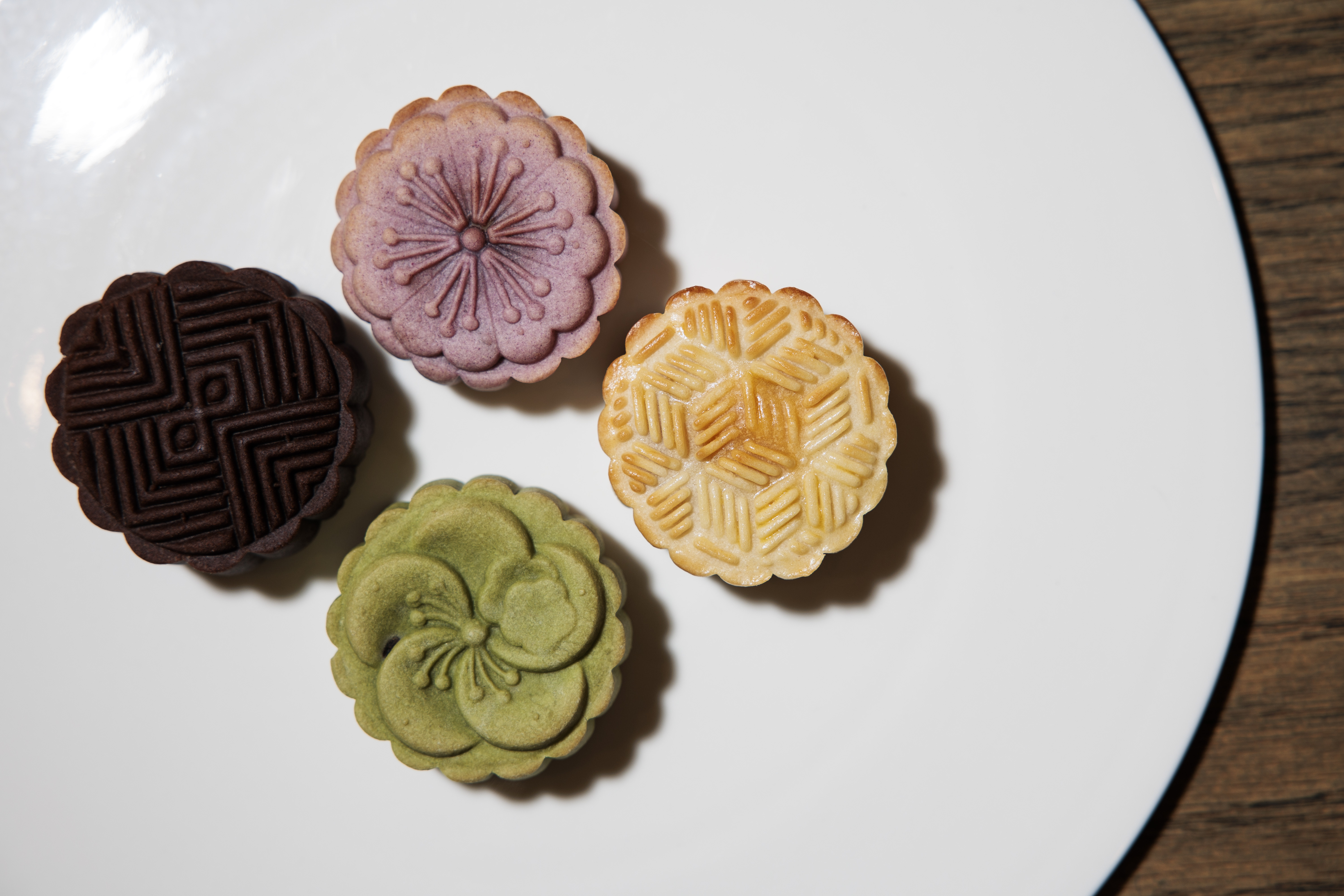
Nobody in Philly is making mooncakes like Anna Chen, the owner of A La Mousse. While most Chinatown bakeries sell conventional versions — made from wheat flour, lacquered with egg wash, and stuffed with lotus bean paste and duck egg yolks — Chen’s are vibrantly colored and stuffed with a range of fillings that cross cultures and marry flavors. Think Oreo cookies with Hong Kong milk tea and Taiwanese pineapple cake with salted duck egg.
Chen’s three bakeries — A La Mousse in Chinatown and Narberth, and Maison Sweet in University City — specialize in mousse cakes, but she and her staff prepare about 400 to 500 boxes of mooncakes every year before Mid-Autumn Festival.
Chen’s approach aligns with aninventive, sometimes wacky strain of mooncake that has emerged in Asia in recent years, as mooncake makers abandon ultrasweet lotus- and winter melon-paste versions in favor of updated varieties stuffed with ice cream, matcha cream, and even beef. They sometimes also trade the traditional dough for flaky pastry or thin mochi skins (referred to as “snow skin”), which are more commonly made by Vietnamese pastry chefs.
Chen takes inspiration from her travels around China, especially to cities like Shanghai and Guangzhou, as well as popular trends in Hong Kong, where she grew up and returns to visit every two years. “Every year we make different flavors, but we keep one or two mooncakes traditional, because that’s what people keep asking me for,” Chen said.
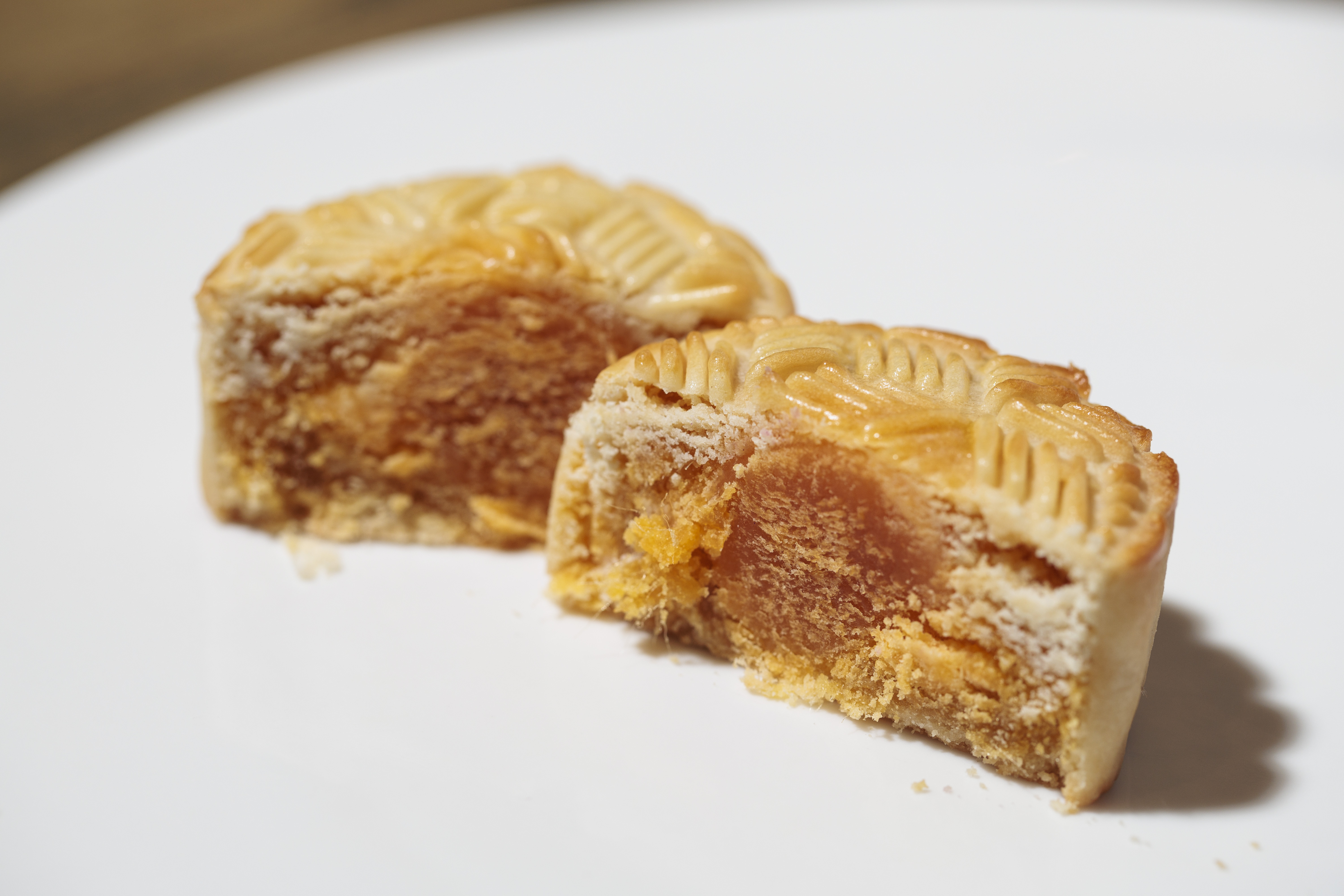
The Mid-Autumn Festival salted egg yolk with pork floss mooncake at A La Mousse on Tuesday, Sept. 15, 2026 in Philadelphia.Monica Herndon / Staff Photographer
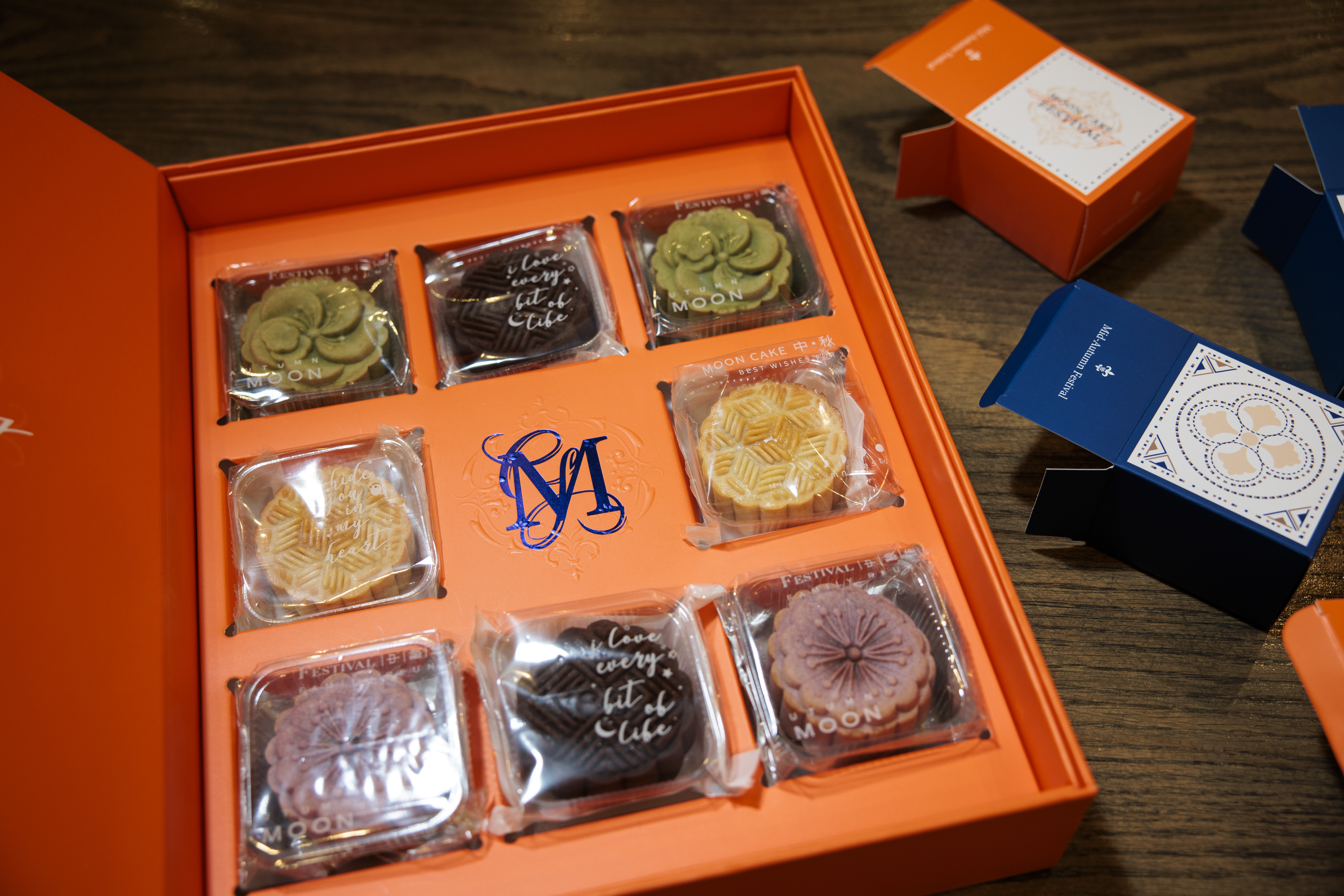
This year, the traditional flavor is pork floss with salted egg yolk; hers is masterful, a delicate balance of savory and sweet — though none of her mooncakes are extremely sweet, in another departure from convention. The other flavors in this year’s box set of eight mooncakes, which sells for $65, include Dubai chocolate (Chen’s current favorite) and purple sweet potato with salted egg yolk.
“We don’t want to follow anyone else’s style; we only want to create our own special mooncakes,” Chen said.
The Mid-Autumn Festival Dubai chocolate mooncake at A La Mousse on Tuesday, Sept. 15, 2026 in Philadelphia.Monica Herndon / Staff Photographer
Chen starts preparing for the season in early August, ordering items like mooncake sugar syrup (also known as golden invert sugar syrup), flowery molds, and specially designed mooncake packaging from China. Then, in September, she and her pastry chefs — along with daughter Joanne, a student at Drexel — get to work, rolling fillings into balls and stuffing them into rice flour-based skins before pressing them into molds.
Chen, who opened Chinatown’s A La Mousse 13 years ago, has longtime customers who often order 30 to 40 boxes to give as gifts.
Even as her creations are trend-driven, she does stick to one tradition: embedding whole egg yolks in most of her mooncakes. The yolks represent the full moon, one of the most important emblems of the Mid-Autumn Festival, symbolizing family reunions and the idea of wholeness.
The Mid-Autumn Festival mooncakes at A La Mousse on Tuesday, Sept. 15, 2026 in Philadelphia.Monica Herndon / Staff Photographer
Anna Chen’s mooncakes are available for pickup and must be preordered two to three days in advance via a Google form at bit.ly/4iwdZwu/..
A La Mousse, 145 N. 11th St., 215-238-9100; A La Mousse, 920 Montgomery Ave., Narberth, 610-664-6888; Maison Sweet, 2930 Chestnut St., 215-387-1388, instagram.com/alamousse
The little bird of an idea to open a restaurant circled the blue skies of Fred Mogul’s imagination for many years while he was preoccupied with other passions. The first few decades of his career were spent in journalism, working in print and at wire services from Nebraska to Jerusalem, then in public radioas a news reporter, first at WHYY, followed by 18 years at WNYC in New York.
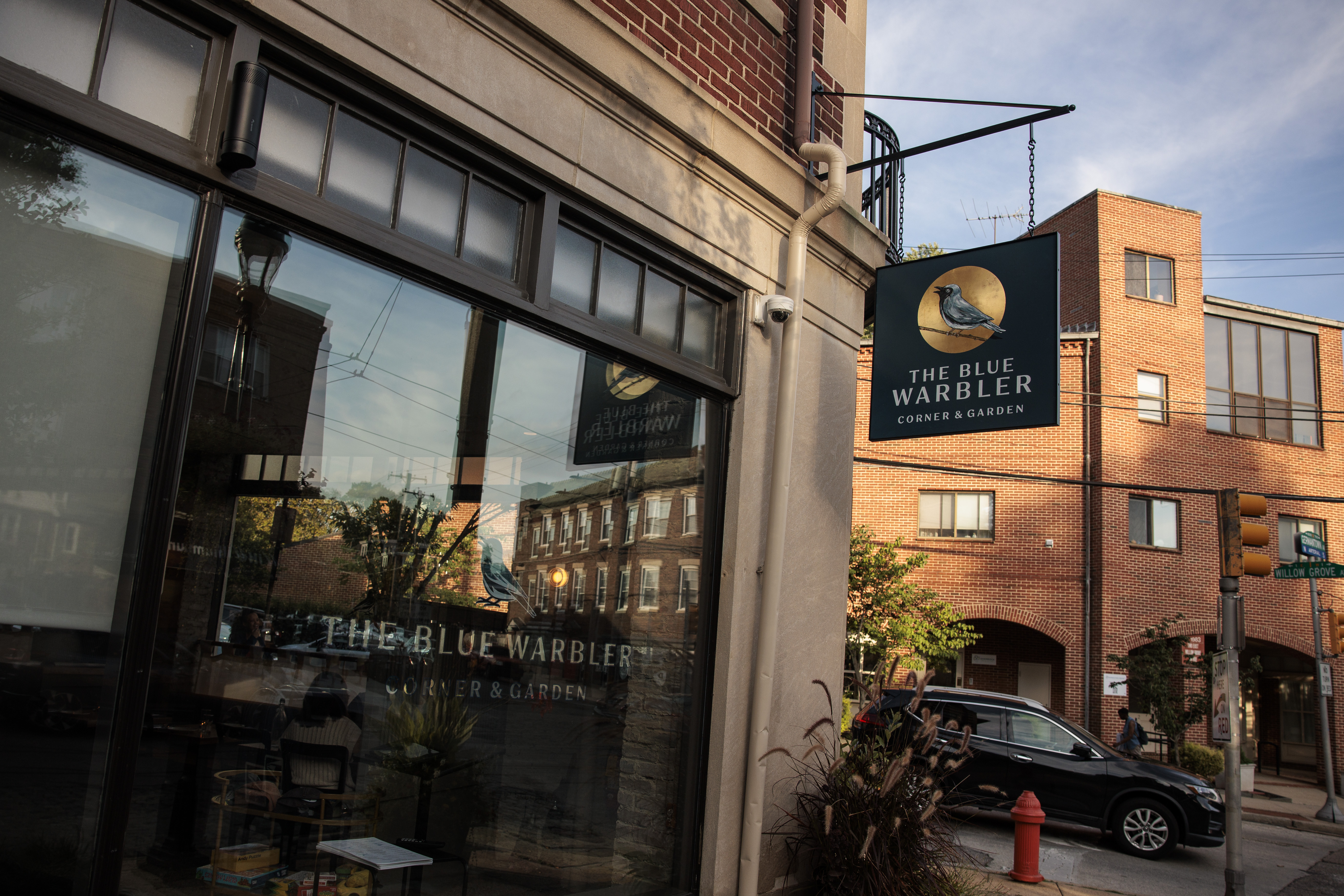
But that little bird persisted, which is how this cheerfully quirky all-day cafe and restaurant in Chestnut Hill — the Blue Warbler — eventually came to be. Having been steeped so long in the perpetual turbulence of the media industry, Mogul was not deterred bythe famously daunting risks of building a restaurant.
“I wanted to do something else for social good and contribute to the world in having a communal gathering place while feeding people,” he said, conjuring a destination that combined the best attributes of a bakery-cafe, a diner, and a local tavern. “But I also want it to be a little surprising, playful, and unpredictable.”
To open such an intriguing place in Chestnut Hill, especially,would absolutely be a good deed. That neighborhood’s chronically underperforming dining scene, despite its abundance of well-to-do residents and quaint retail district lining Germantown Avenue, is such an enduring enigma that the last time I wrote something really nice about a restaurant there was nearly a decade ago when I reviewed Mica, which sadly did not survive the pandemic.
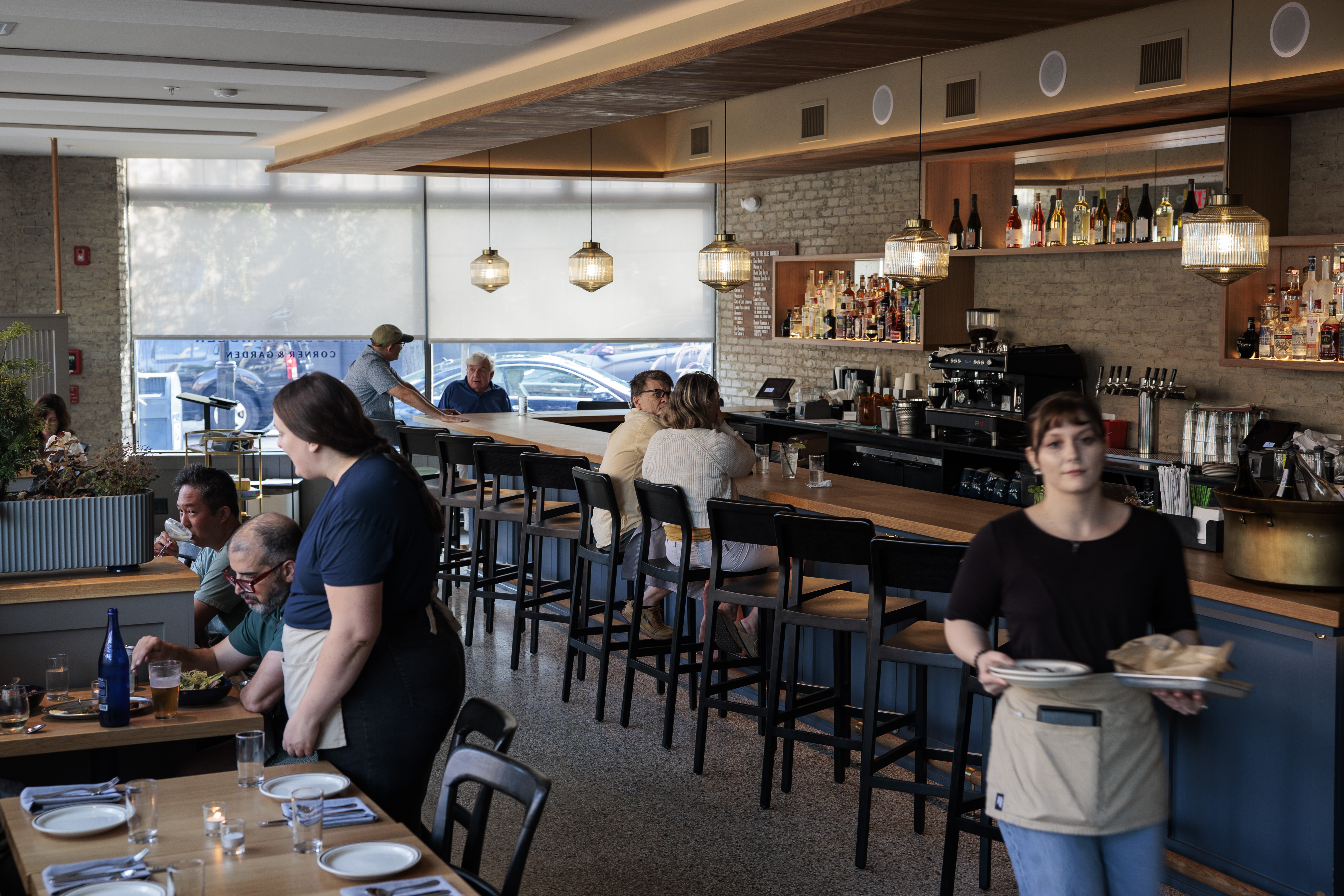
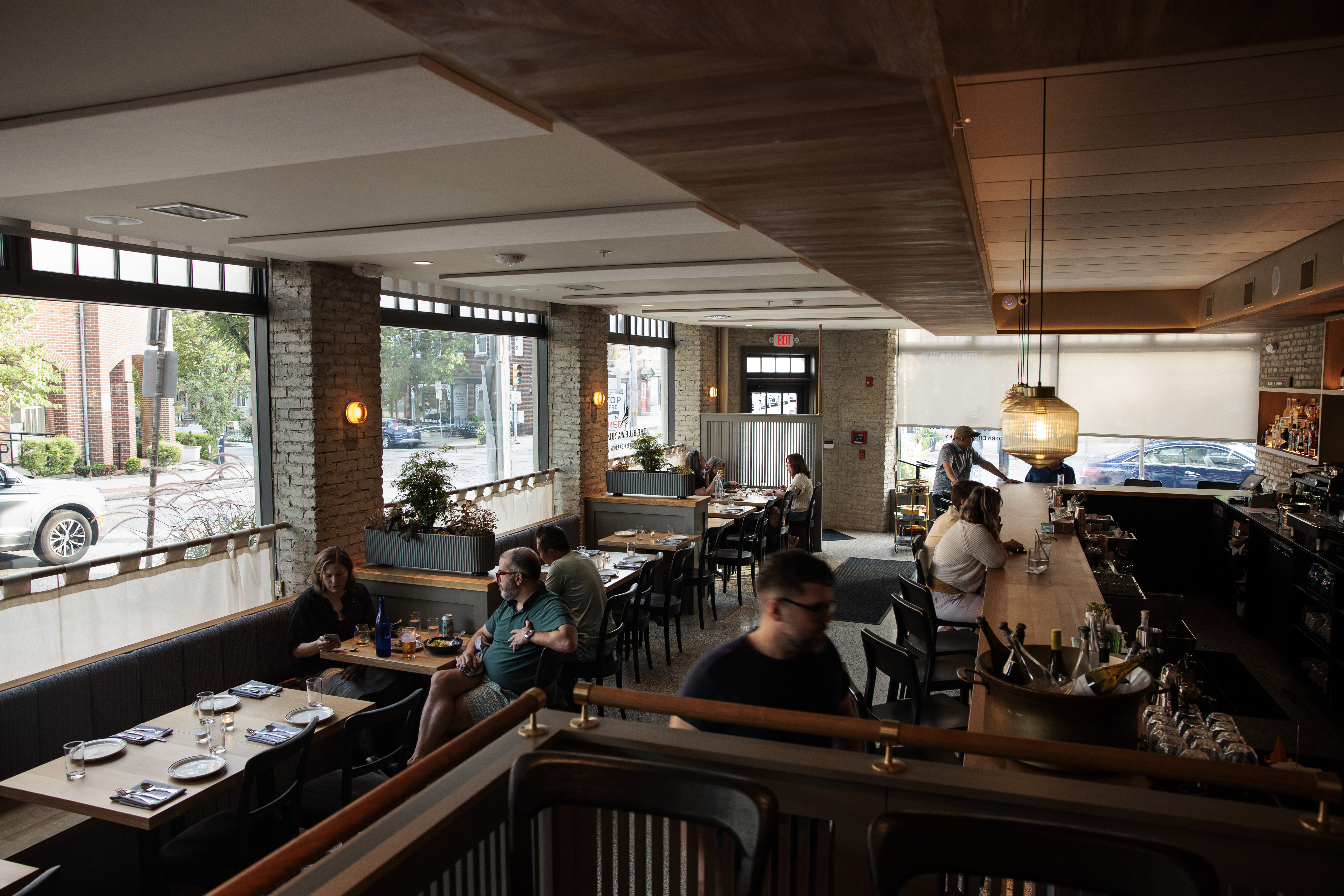
The dining room at the Blue Warbler on Thursday, Sept. 3, 2026 in the Chestnut Hill section of Philadelphia.Monica Herndon / Staff PhotographerThe dining room at the Blue Warbler on Thursday, Sept. 3, 2026 in the Chestnut Hill section of Philadelphia.Monica Herndon / Staff Photographer
But here was Mogul’s vision of the Warbler come to life with such vibrant warmth on a Saturday night, and it was as if this bustling three-month-old newcomer had been ensconced at the corner of Germantown and East Willow Grove Avenues for years.
The slate-blue bar trimmed with white oak was lined with customers sipping Cardamaro spritzes, blushing pink Clover Clubs, and sage gose beer from Germantown’s Attic Brewing Co. Meanwhile, eager diners waited patiently near the front door for their turn in the 71-seat dining room, where comfortable banquettes along the window and a cluster of tables on a raised rear platform create a sense of intimacy within the open space.
As a world-beat soundtrack pulsed with tunes from Brazil, Nigeria, and Afghanistan, the Warbler’s eclectic dinner menu — ranging curiously from Middle Eastern meze to smoked arctic char spread, mushroom kebabs, a tuna melt sandwich, and a faux-meatloaf platter — ultimately landed on the table less chaotically than it reads.
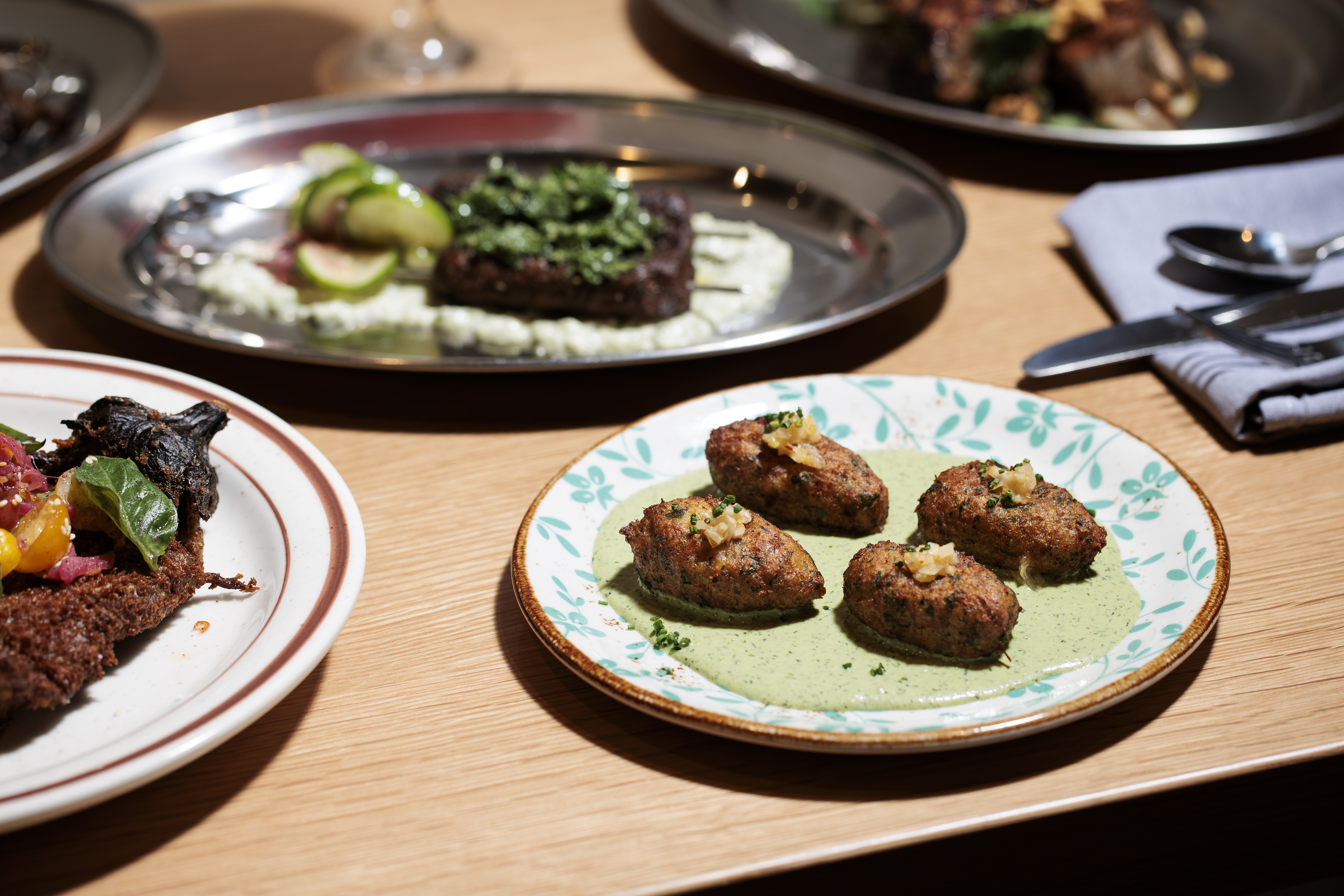
The bacalao, salt cod croquettes with green yogurt and lemon relish at the Blue Warbler.Monica Herndon / Staff Photographer
We swiped rounds of fluffy pita through silky hummus topped with cuminy Moroccan carrots and a spicy-smoky drizzle of harissa crunch. I savored the oceanic tang of warm salt cod fritters against the refreshing coolness of yogurt sauce greened with parsley, dill, and mint.
I’ll admit to the lowest expectations possible for the “meatloaf” made with Impossible meat. But this kitchen, run by chef Daniel Berret (formerly at CO-OP in the Study hotel in University City and Chestnut Hill Brewing Co.), seasoned that loaf nicely with a sweet onion and herb boost, lacquered it with a molasses-ketchup glaze, then added appealing sides of plancha-roasted king oyster mushrooms and fresh-cooked frites with a sriracha mayo dip. It was a comfort winner I’d return for.
Yes, there’s a vaguely retro sensibility to this globe-hopping collection of flavors, as well as the unabashed offering of tofu steaks and wheat meat as entrees in an era when vegetarian cooking has grown into a more vegetable-focused phase. The fact that there is no red meat or poultry on this menu, which does include fish, will be a no go for some.
But as Mogul told my colleague Michael Klein at the Warbler’s opening, he refuses to define this space by “what it lacks” or simply as “that vegetarian place” so much as a neighborhood-centered hub that is inclusive. The handsome dining room and breezy backyard patio are inviting. The service is genuine and outgoing. And the kitchen brings earnestly wrought flavors to everything it makes — including the hand-rolled bagels that anchor much of its daytime cafe menu.
It clearly has the neighborhood’s full attention, as evidenced by the customer who noted that an early version of cinnamon rolls for breakfast was topped with a wave of chai frosting that reminded them of “a Trump combover,” says Mogul. “That image could not be unseen, so we went to DIY schmearing with the frosting in ramekins instead!”
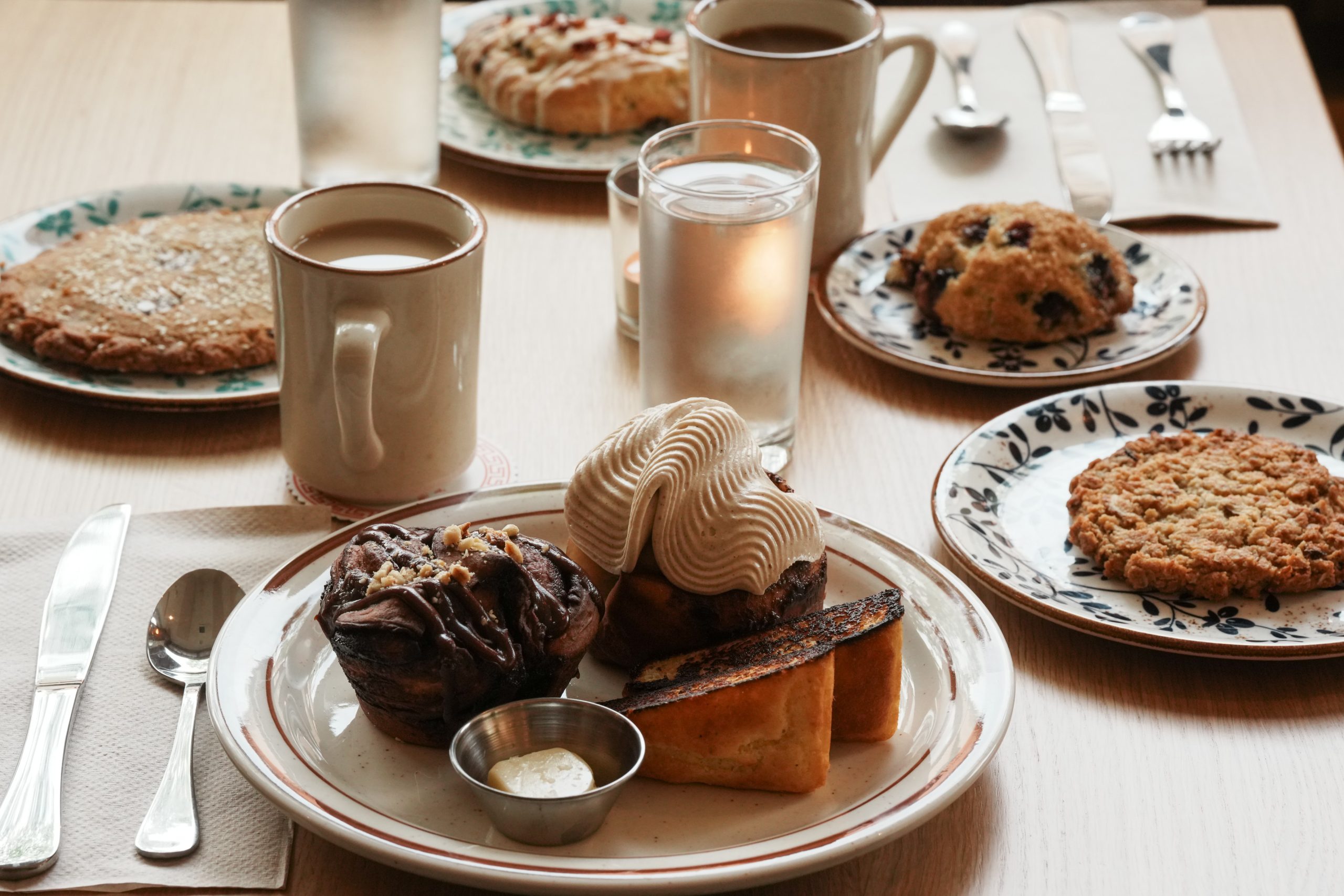
Chocolate hazelnut babka, chai cinnamon roll, and griddled cornbread at the Blue Warbler on June 11. The presentation of the cinnamon roll has since been changed with the frosting served on the side.Jessica Griffin / Staff Photographer
As a restaurant novice, Mogul still has a lot to learn — but he has eagerly embraced input from those with expertise. Just as he turned to Ambit Architecture and In House Studio to tastefully transform the longtime Foster’s Drugstore into its first use as a restaurant (note the salvaged original terrazzo floors and a serious ongoing attempt at soundproofing), he engaged restaurant consultant Arthur Cavaliere to translate his broad vision for the food into workable menus.
It all comes down to execution by Berret and his crew, and for me, the dinner service was the most successful. Aside from the tasty meze nibbles — including salty-sweet haloumi-stuffed dates and a smoky baba ghanoush topped with crispy cornmeal-fried Japanese eggplant — there is an appealing array of grilled skewers to start.
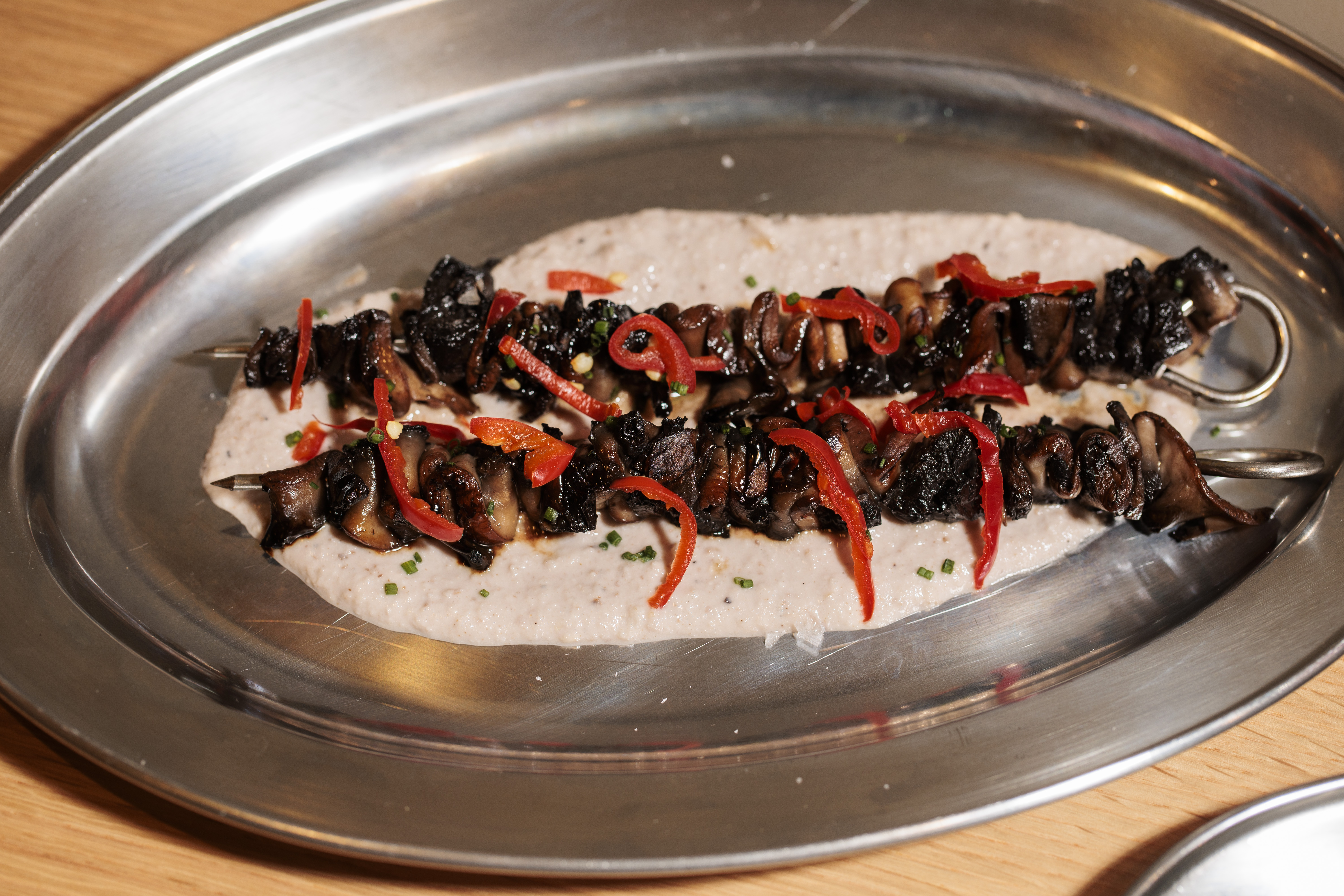
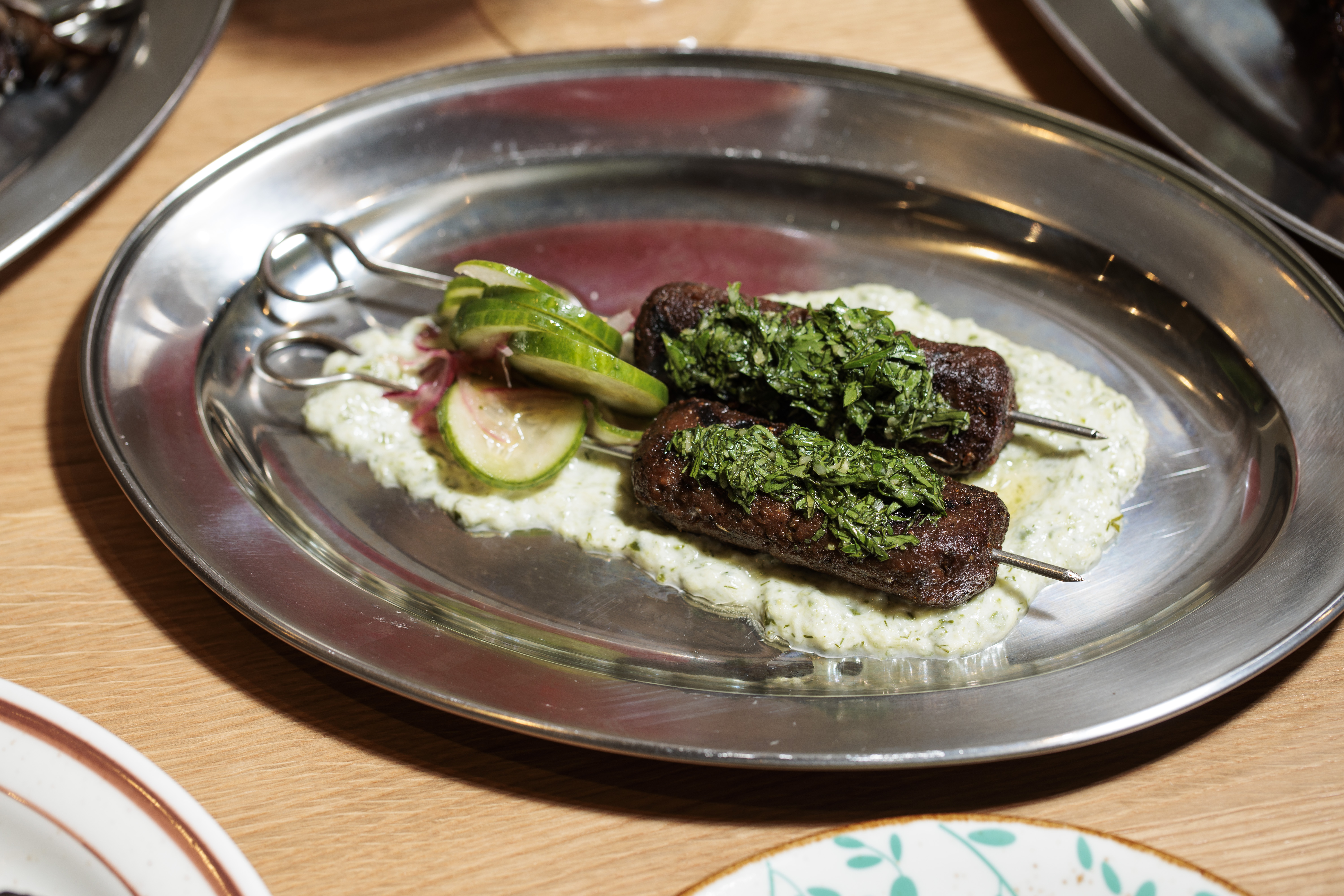
I especially enjoyed the “Chesco” portobello kebab whose long ribbon of mushroom is threaded like an accordion onto the skewer, glazed with date molasses and tamari, then served over a walnut tarator sauce. I also unexpectedly loved another Impossible meat creation: a version of kofta zestily seasoned with onions and garlic in the style of a Balkan ćevapi sausage, garnished with an herbal chimichurri over tzatziki yogurt.
The Chesco skewers at the Blue Warbler on Thursday, Sept. 3, 2026 in the Chestnut Hill section of Philadelphia.Monica Herndon / Staff PhotographerThe Balkan kebab skewers at the Blue Warbler on Thursday, Sept. 3, 2026 in the Chestnut Hill section of Philadelphia.Monica Herndon / Staff Photographer
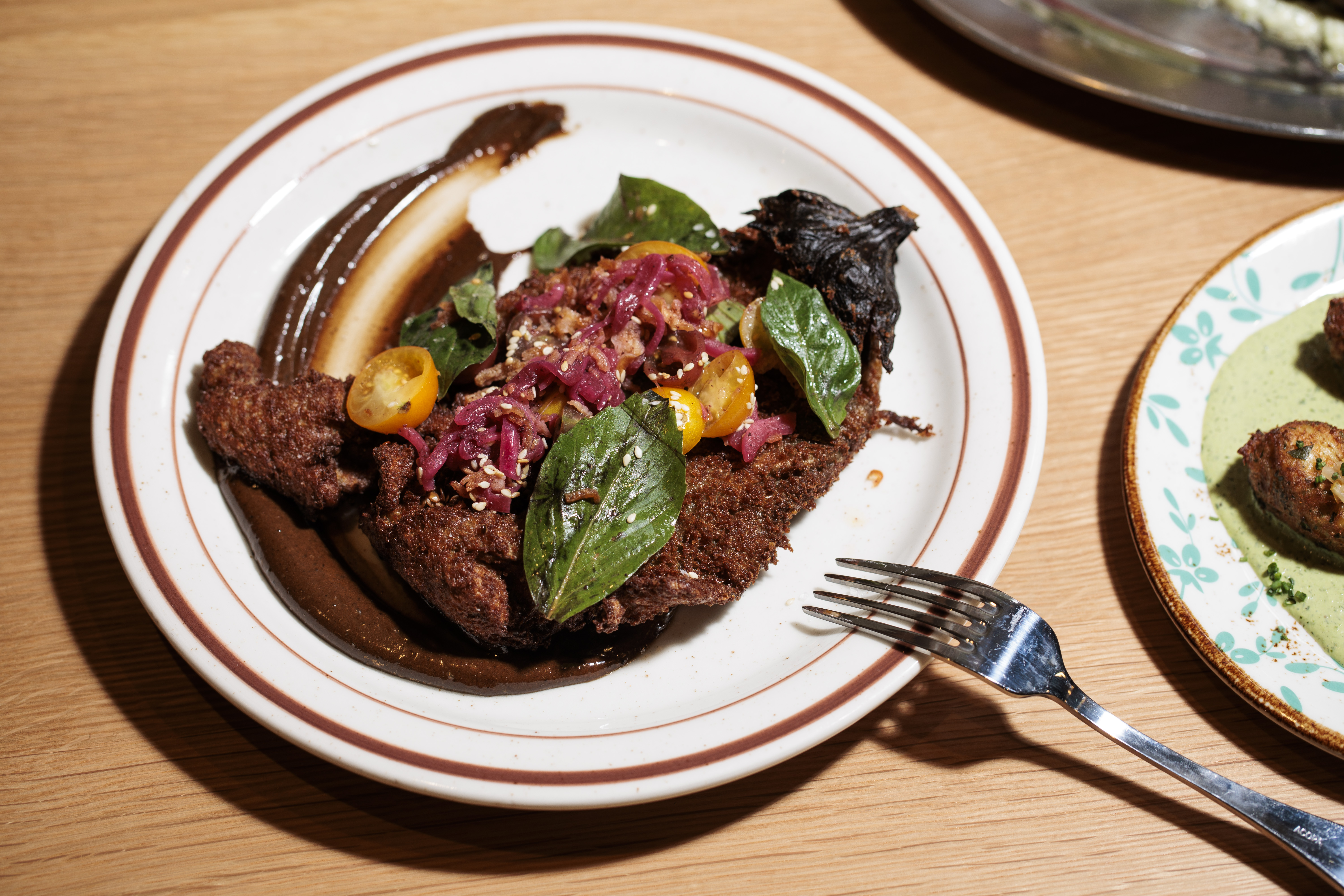
Such mock-meat successes opened my mind to the panko-crusted, lemon-infused tofu steak. It was not bad, especially over a colorful pile of sauteed asparagus and watermelon radish. But it was a bit boring compared to the most satisfying entree here, a whole smoked eggplant that’s deep-fried into a schnitzel, then placed over a black garlic aioli beneath a juicy tumble of fresh heirloom tomatoes tossed with Thai basil, sesame, and tart sumac.
The grilled whole branzino was a perfectly fine option for those craving fish, but it, too, was ultimately less engaging than that eggplant.
The smoked eggplant schnitzel at the Blue Warbler on Thursday, Sept. 3, 2026 in the Chestnut Hill section of Philadelphia.Monica Herndon / Staff Photographer
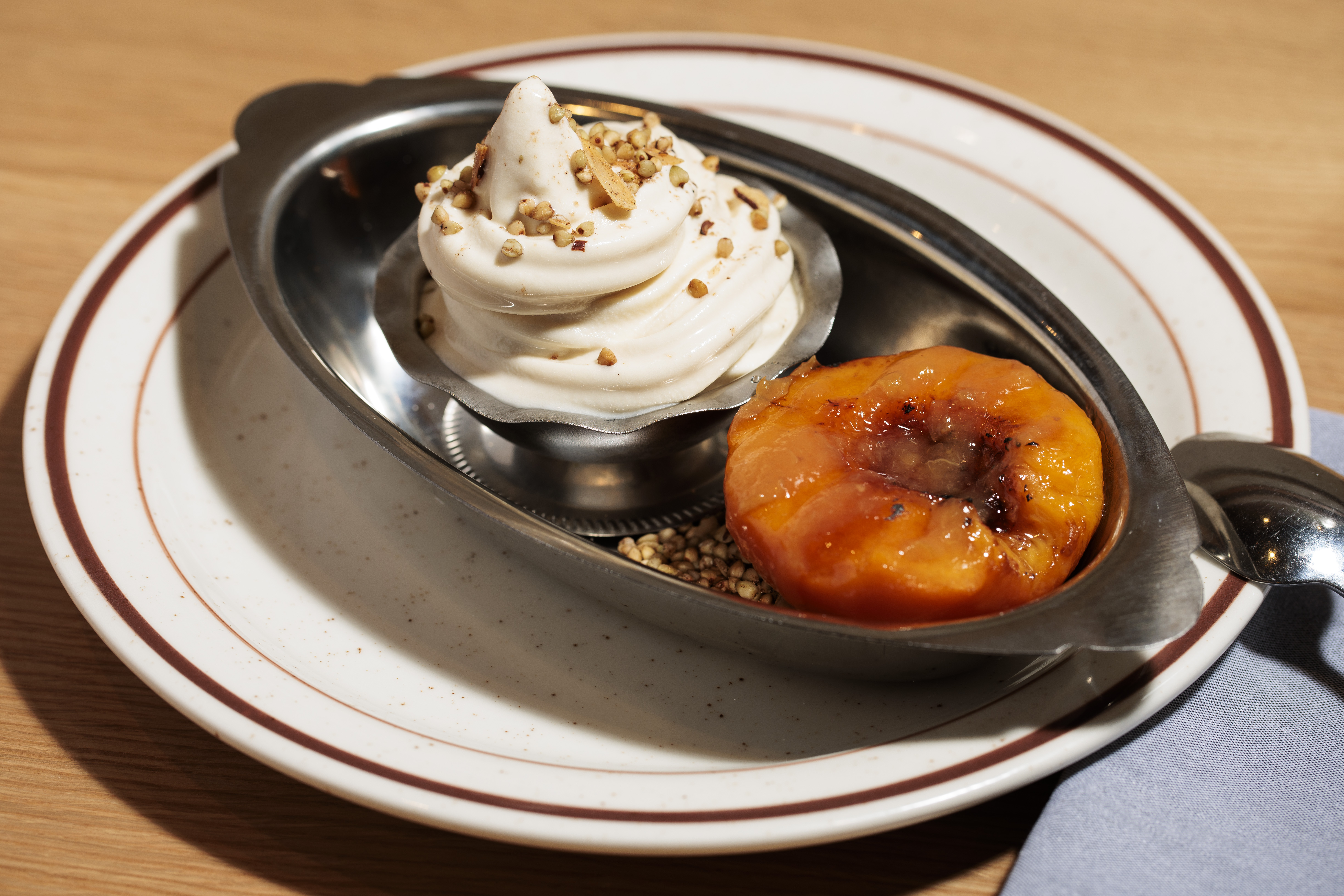
The desserts begin with two solid renditions of crème brûlée, including a classic vanilla custard, stylishly dusted with dried rose petals, and a seasonal variation that has so far ranged from strawberry to matcha and corn. I was most impressed by chef de cuisine Renee Rowlett’s creative deconstruction of a peach crisp into something lighter and more seasonal: A half peach caramelized with demerara sugar was posed over a crunchy mound of brown sugar-toasted almonds and buckwheat groats (a nod to the Ashkenazi Jewish thread woven through the Warbler’s menu) beside creamy maple soft-serve.
The peach crisp at the Blue Warbler on Thursday, Sept. 3, 2026 in the Chestnut Hill section of Philadelphia.Monica Herndon / Staff Photographer
Breakfast, lunch, and brunch are obviously key to the Blue Warbler’s success as an all-day cafe. And while this corner room soaks in the sunshine and exudes a pitch-perfect laid-back aura — I’d happily hang out here and drink that bold Cuban roast brew from Mayorga — our daytime meal was not the layup it should have been.
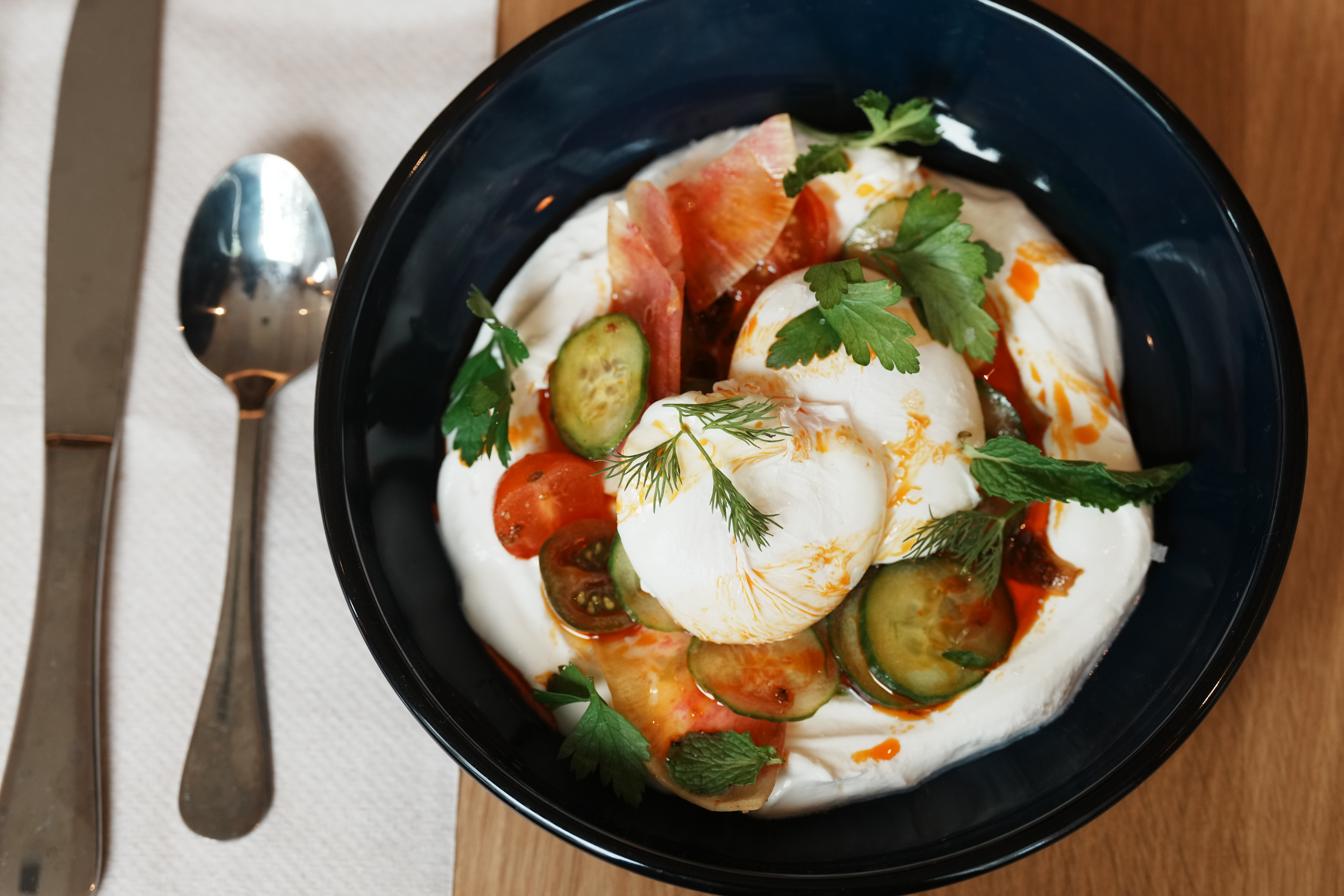
I would have loved my well-cooked omelet with zucchini, onion, peppers, and feta (and especially that side of cuminy tomato shakshuka sauce) but the kitchen forgot to add the zucchini. I’ll never pass up a socca chickpea pancake, but the Warbler’s rendition was unfortunately thick and scorched. The classic American-style pancakes with butterscotch were doughy. The cheddar biscuits were dense. Next time, I’ll definitely try the Turkish breakfast of eggs, tomatoes, and cucumbers over labneh with harissa.
Turkish breakfast at the Blue Warbler, in Philadelphia, June 11, 2026.Jessica Griffin / Staff Photographer
I’ll give the Warbler bonus points for hand-rolling their own bagels, even if the overly fluffy sourdough interior is not my ideal (not to mention the heat bubbles blistering its crust, which should be smooth). It nonetheless worked well enough as a vehicle for a breakfast sandwich stuffed with cheddar, eggs, arugula, and red pepper aioli. I especially liked that bagel hollowed out and stuffed with zesty green herbal tofu purée and tangy red peppadew peppers for the Herbivore sandwich.
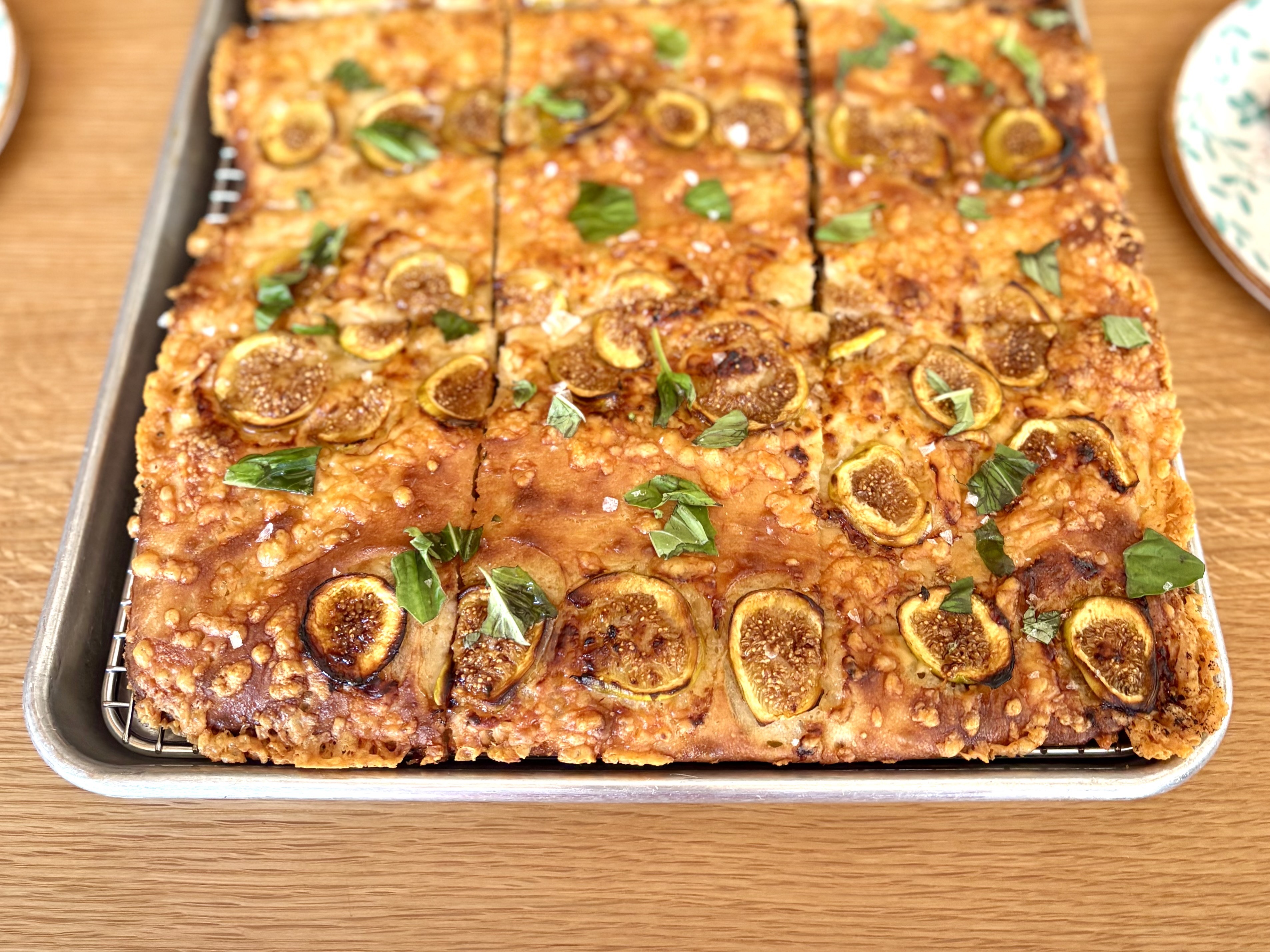
All these flaws can surely be fixed with some tweaks. And considering how well the kitchen infuses seasonal creativity into the grab-and-go items that cycle onto the counter display on the bar throughout the day — from the muffin-shaped herb-and-feta “egg bites” to a fig- and fontina-topped schiacciatta bread still warm from the oven — such modifications are easily within their reach.
Mogul has already been so dialed in to all the details since embarking on making his restaurant dream a reality, I’m hopeful the Warbler will do that soon. There is already so much to appreciate at this promising — and needed — new addition to Chestnut Hill, I’ll look forward to watching it grow.
A schiacciata topped with figs and fontina at the Blue Warbler in Chestnut Hill.Craig LaBan / Staff
Breakfast and lunch 7 a.m. to 2 p.m. Monday through Friday. Dinner 5 to 9 p.m. Sunday, Wednesday, and Thursday, until 10 p.m. Friday and Saturday. Brunch 9 a.m. to 2 p.m. Saturday and Sunday. No dinner Monday or Tuesday.
Main plates, $15-$32 (including sharing platters).
Wheelchair accessible.
About a third of the menu is gluten-free or can be modified.
Menu highlights: Dinner: trio of meze dips; bacalao fritters; haloumi dates; smoked arctic char spread; Balkan and Chesco skewers; eggplant schnitzel; Impossible meatloaf; peach crisp. Breakfast-lunch: omelet; the Herbivore; egg bites; schiacciatta.
Drinks: Fresh and fruity takes on classic cocktails — Clover Club, Mai Tai with fresh orgeat, a pear martini, an amaro spritz, a spicy margarita, and fizzy Sgroppino — are worthwhile, alongside a selection of thoughtful N/A options. Local beers on draft and an international selection of well-priced wines by the glass ensure there’s something for everyone.
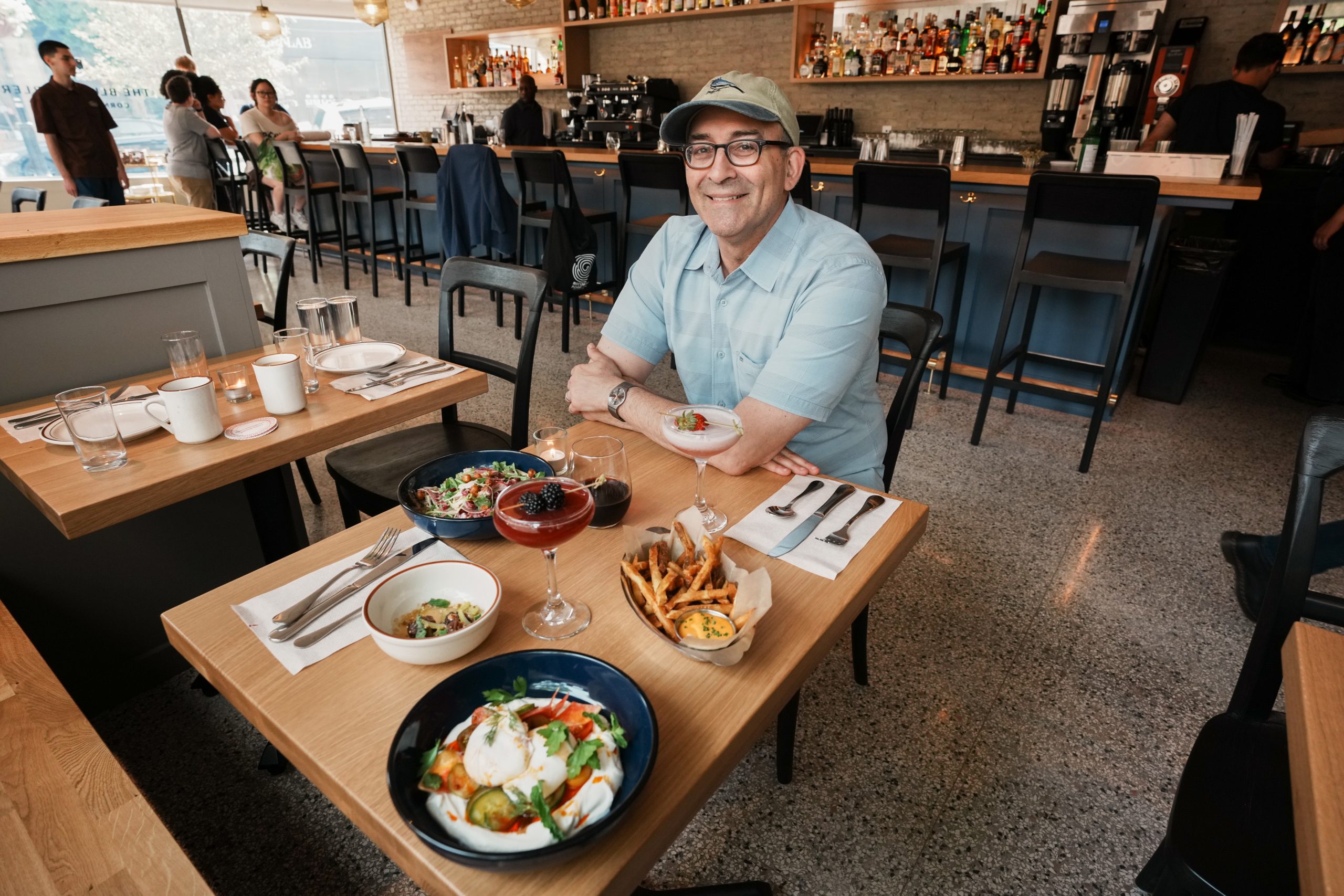
Owner Fred Mogul at the Blue Warbler, in Philadelphia, June 11, 2026.Jessica Griffin / Staff Photographer
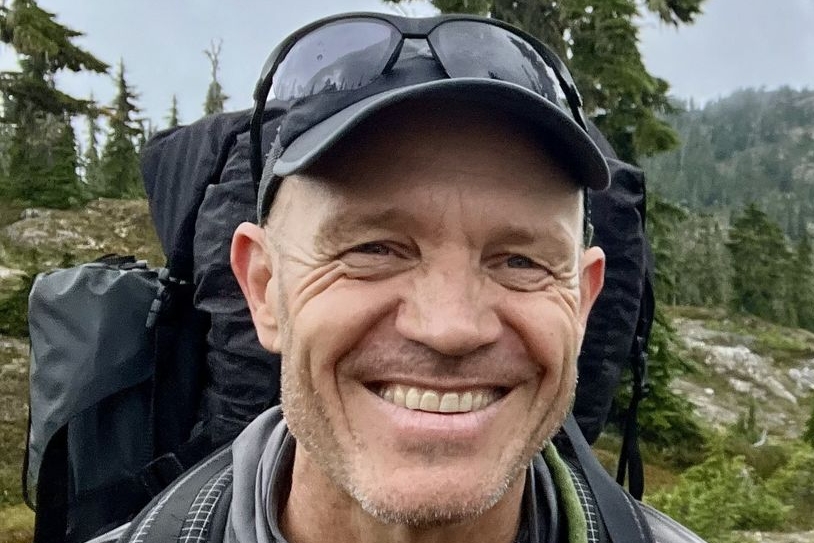
Peter D. Yeomans, 58, of Philadelphia, innovative clinical psychologist at the Corporal Michael J. Crescenz Department of Veterans Affairs Medical Center, founder of Cold Mountain Counseling LLC, worldwide mountaineer and backcountry adventurer, teacher, author, mentor, Quaker, and volunteer, died Friday, Aug. 28, of cardiac arrhythmia at the VA Medical Center in University City.
Dr. Yeomans was an expert in trauma, substance use disorder, moral injury, and spiritually integrated healthcare. He joined the Philadelphia VA Medical Center as a staff psychologist in 2009 and became director of its innovative PTSD outpatient team program in 2019.
He opened his own psychology practice, Cold Mountain Counseling, in 2021 and advised thousands of veterans, fellow backcountry adventurers, and other clients in need across the country. “He was instrumental in the healing process for so many veterans that it is hard to fathom the reach of his influence,” a VA colleague said in a tribute.
R. Tyson Smith, a friend and colleague, said several veterans told him: “Peter Yeomans saved my life.”
At the VA center, in addition to physical and mental ailments, Dr. Yeomans and others innovated a treatment for what are called “moral injuries” from military service. They connected therapists with VA chaplains to link emotional healing with faith rituals, and veterans in the program spoke appreciatively about shifting the guilt and shame of moral failures during war from soldiers in general to society at large.
“These are stories to hear and also for the public to wrestle with,” Dr. Yeomans told The Inquirer in 2019. His wife, Kate O’Shea, said: “He was the most responsible person you could imagine, and he felt he had a responsibility to humanity.”
Outside the medical center, Dr. Yeomans spent weeks at a time hiking, backpacking, packrafting, skiing, rock climbing, and mountain biking around the world. He reached summits in Alaska and Argentina, had to be rescued from a deep crevasse, and worked as a program supervisor and senior field instructor in the 1990s for the National Outdoor Leadership School in Alaska, Wyoming, Arizona, and Utah.
Later, he cofounded the local Wilderness Outdoor Leadership Force for teens in Kensington. Talia Young, a longtime WOLF member, called him “genuine and earnest … and joyful with kids.”
Dr. Yeomans was an avid cyclist.Bicycle Coalition of Greater Philadelphia
Longtime colleague Rob Riman said he was a “consummate adventure partner and wildly inspired guide.” On his website, coldmountaincounseling.com, Dr. Yeomans said: “Many of the fondest memories of my life are from adventures in the mountains.”
He earned a bachelor’s degree in psychology from Harvard University in 1991 and came to Philadelphia from Wyoming in 1997 to be with O’Shea. He earned a master’s degree in psychology from Lesley University in Massachusetts in 2001 and a doctorate in clinical psychology from Drexel University in 2008.
Dr. Yeomans traveled to New Zealand, Rwanda, Burundi, and elsewhere to train other counselors. He worked in state correctional institutions in Philadelphia and Chester, and earlier for the American Red Cross in Germany.
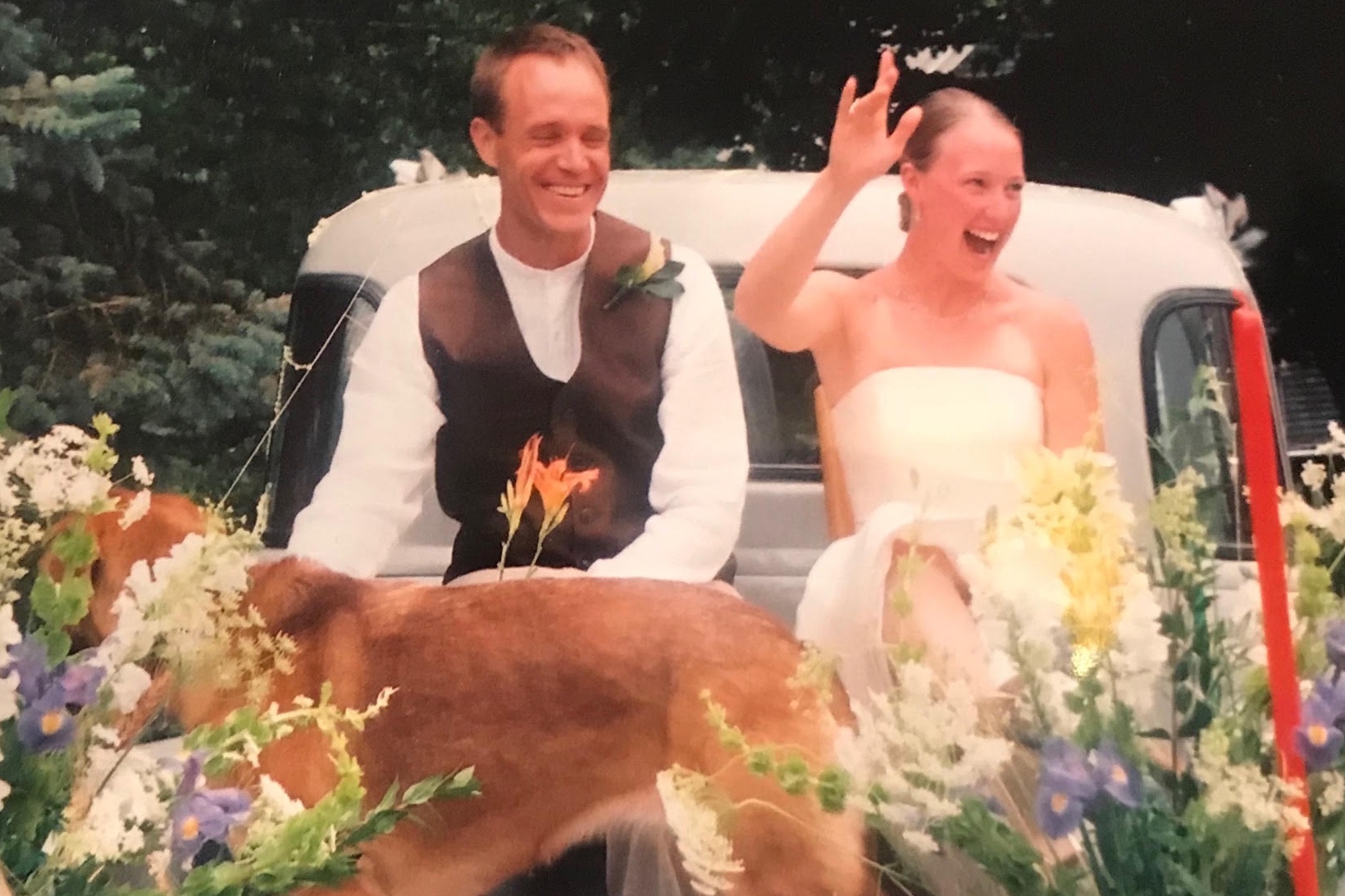
Dr. Yeomans and his wife, Kate, married in 2002 and had many adventures together. Courtesy of the family
He taught classes on moral injuries at Germantown Friends School, the University of Pennsylvania, and elsewhere. Longtime friend William Anninger said: “He was particularly good at creating emotional sharing among men.”
Friend Lila Berman said: “He exuded warmth and care for the people around him, and for the natural environment.”
Peter Douglass Yeomans was born Aug. 27, 1968, in Berkeley, Calif. The family moved to Massachusetts when he started high school, and he graduated from Concord Academy in 1986.
He met Kate O’Shea at an environmental ethics course in Utah in 1996, and they married in 2002 and lived in Germantown. He made her tea in the mornings and left love notes behind when he left the house first. They reared a daughter, Ada, and sons Josiah and Levi, and they all went on memorable adventures in Wissahickon Valley Park, across the country, and around the world.
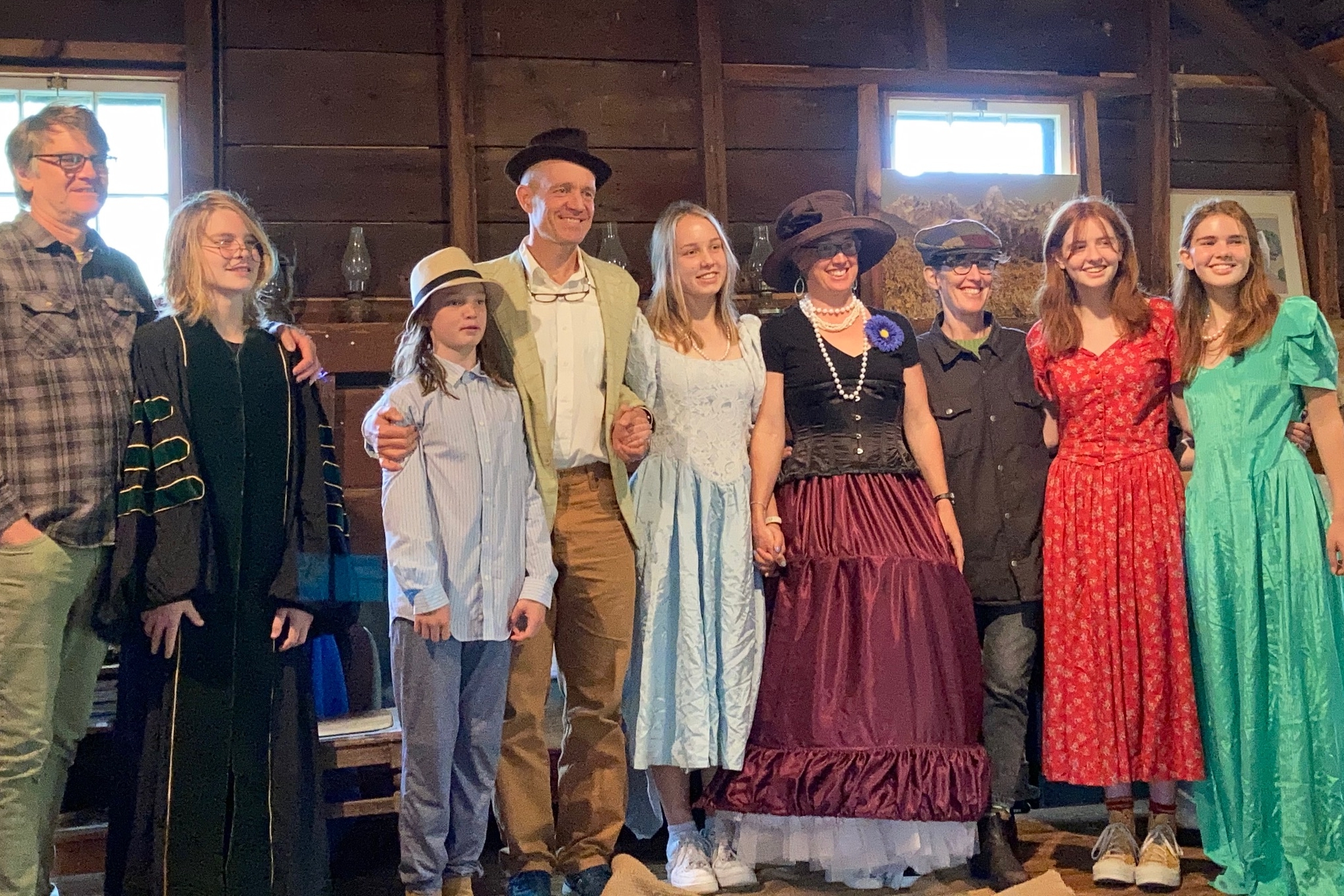
Dr. Yeomans, rear left on top and fourth from the left on bottom, enjoyed time with his family in the mountains and on stage. Courtesy of the family
“They complemented each other perfectly,” their daughter said. “He taught us how to read a map, find a campsite, and most importantly bake cinnamon rolls in the backcountry.”
Dr. Yeomans was a member of the Bicycle Coalition of Greater Philadelphia, and he rode his bike often from home in Germantown to work in University City. He went to Germantown Friends Meeting, played guitar, sang, and acted in theatrical shows in high school and later with community groups and his family.
He was inclusive and encouraging, his brother, Ben, said, “drawing out capacities in me I wasn’t yet trusting.” His parents, Anne and Tom, said: “It has been a great privilege to have been Peter’s parents.”
His mother-in-law, Margaret O’Shea, praised his “compassion, selflessness, nobility, and grace,” and his father-in-law, Dan O’Shea, said: “When our daughter met Peter she described him as ‘Mr. Perfect.’ Little did we know how perfect.”
“It has been a great privilege to have been Peter’s parents,” his parents said.Courtesy of the family
Kate O’Shea said: “Because of Peter, our world is a kinder, more generous, and more loving place.”
In addition to his wife, children, parents, brother, and in-laws, Dr. Yeomans is survived by other relatives.
A memorial service is to be held at 2 p.m. Saturday, Oct. 3, at Germantown Friends Meeting, 47 W. Coulter St., Philadelphia, Pa. 19144.
Penn Medicine researchers are testing whether an ultrafast form of radiation therapy can treat cancers in the head and neck with fewer side effects.
The clinical trial marks the first time the technology, conformal FLASH proton therapy, is being used in humans.
Radiation therapy, one of the most commonly used cancer treatments, works by aiming high-energy beams at tumors. While this kills cancer cells, it can also cause damage to surrounding healthy tissues.
Patients with head and neck cancers, for example, can develop ulcers in the mouth, damage to the jawbone, dry mouth, and scarring as a result.
A trial launched this month at Penn Medicine’s Abramson Cancer Center will assess whether delivering radiation more than 100 times faster than typical therapies is safe and could lessen that damage.
The pilot trial will enroll 10 people whose head and neck cancers have returned.
These are patients who lack good treatment options and risk side effects that interfere with speaking, breathing, and swallowing.
“Giving another full dose of radiation is very hard for these patients,” said Jonathan Schoenfeld, who directs the Head & Neck Radiation Oncology program at Mass General Brigham and is not involved in the trial. “This is a good population that could potentially benefit from this type of approach.”
The specific type of FLASH radiation used in this study was developed by researchers at Penn and the Belgium-based Ion Beam Applications S.A. (IBA), which manufactures the platform and is sponsoring the study.
In mouse studies, FLASH proton therapy reduced side effects while still killing cancer cells. Researchers have since tested the approach in a clinical trial involving dogs with cancer.
However, promising results in animalsoften do not translate to humans. Even if the trial produces encouraging results, it could take years before the therapy becomes widely available.
The hope, ultimately, is not only to preserve quality of life in patients, but to make radiation therapy more convenient and accessible.
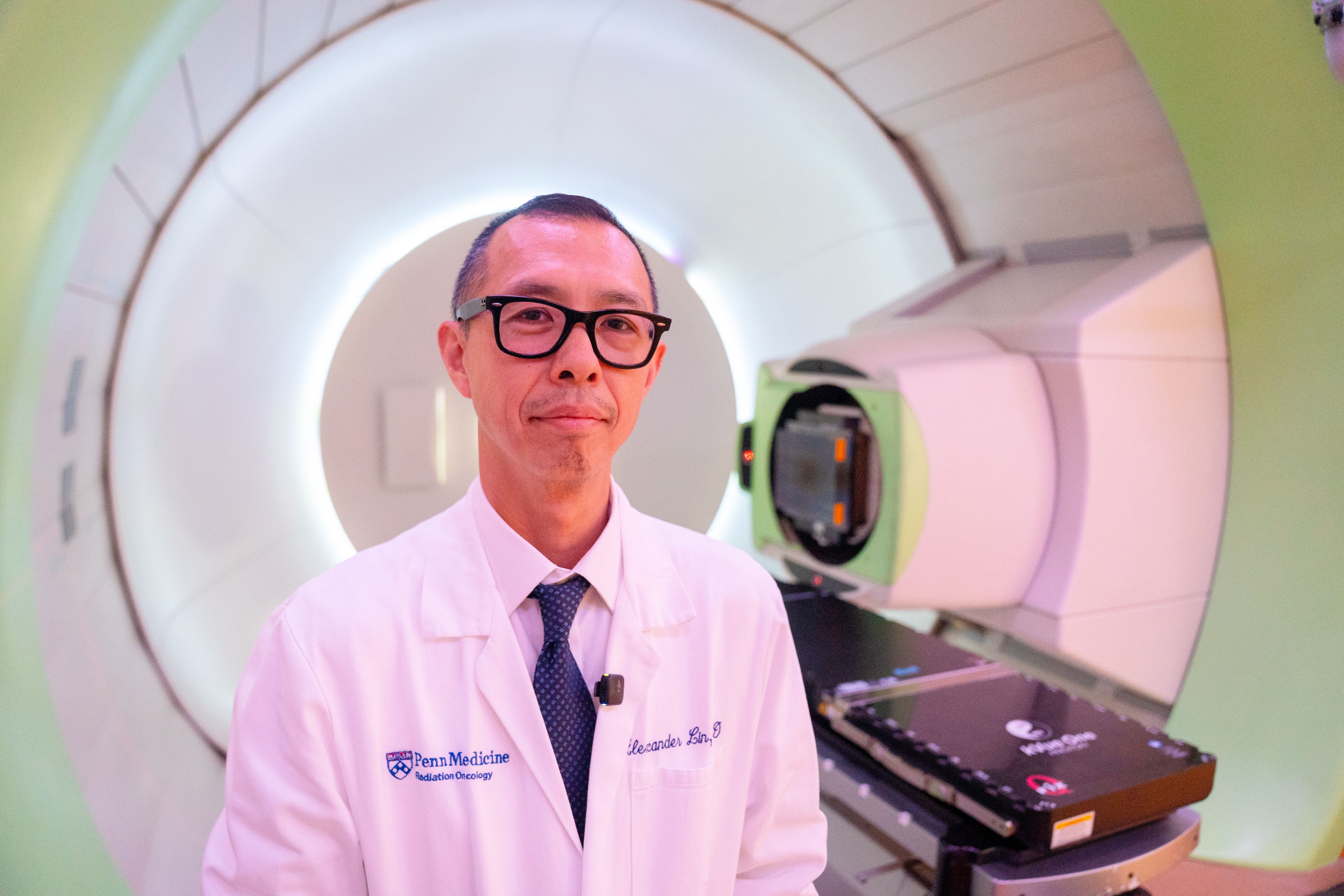
“Instead of 30 to 40 treatments, we can do the treatment in one to five treatments,” said Alexander Lin, a radiation oncologist at Penn and the trial’s lead investigator.
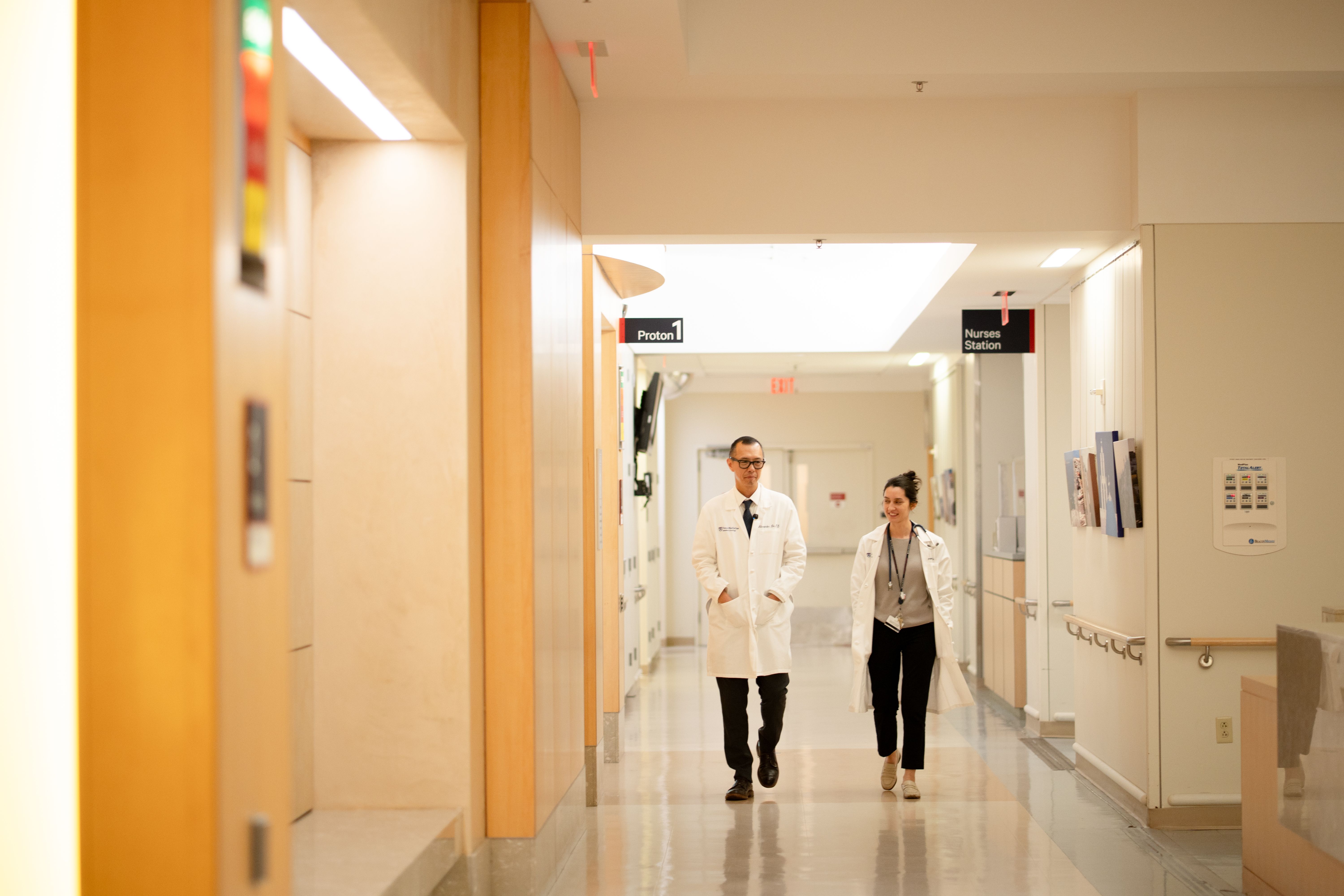
Lin walks through the Roberts Proton Therapy Center.Credit to Margo Reed Studios
Faster and fewer doses
Doctors typically divide a patient’s radiation therapy into dozens of daily treatments over several weeks.
FLASH radiation aims to accomplish that in fewer doses.
Think of it like air travel: A trip from the East to the West Coast would take hours with today’s technology. But if you can fly at the speed of light, it would take less than a second.
“We’re giving the same dose or similar dose, but the dosage rate changes,” said Constantinos Koumenis, the vice chair for research in Penn’s Department of Radiation Oncology and a developer of the therapy.
Lin hopes this lighter schedule could alleviate some of the time and financial burden of treatment.
The FLASH therapy builds upon a highly advanced radiation treatment, proton therapy, which uses protons to more precisely target tumors. Penn has heavily invested in the expensive technology, with its fourth proton therapy center — a $224 million facility at Penn Presbyterian Medical Center in University City — expected to open in 2027.
The researchers are also incorporating a technique called conformal radiation therapy, which shapes the radiation beam to match the tumor’s three-dimensional size and location. This helps limit exposure to nearby healthy tissue.
The exact biological explanation for FLASH radiation’s effects remains a mystery. However, scientists theorize that the treatment reduces damaging oxidation in healthy tissue while promoting faster recovery.
“The hope is that, if this type of trial is successful, you can treat patients who need more radiation with much lower risks,” Schoenfeld said.
But “it’s a new treatment that we don’t fully understand yet, so I would highlight that it’s still very early days,” he added.
First trial
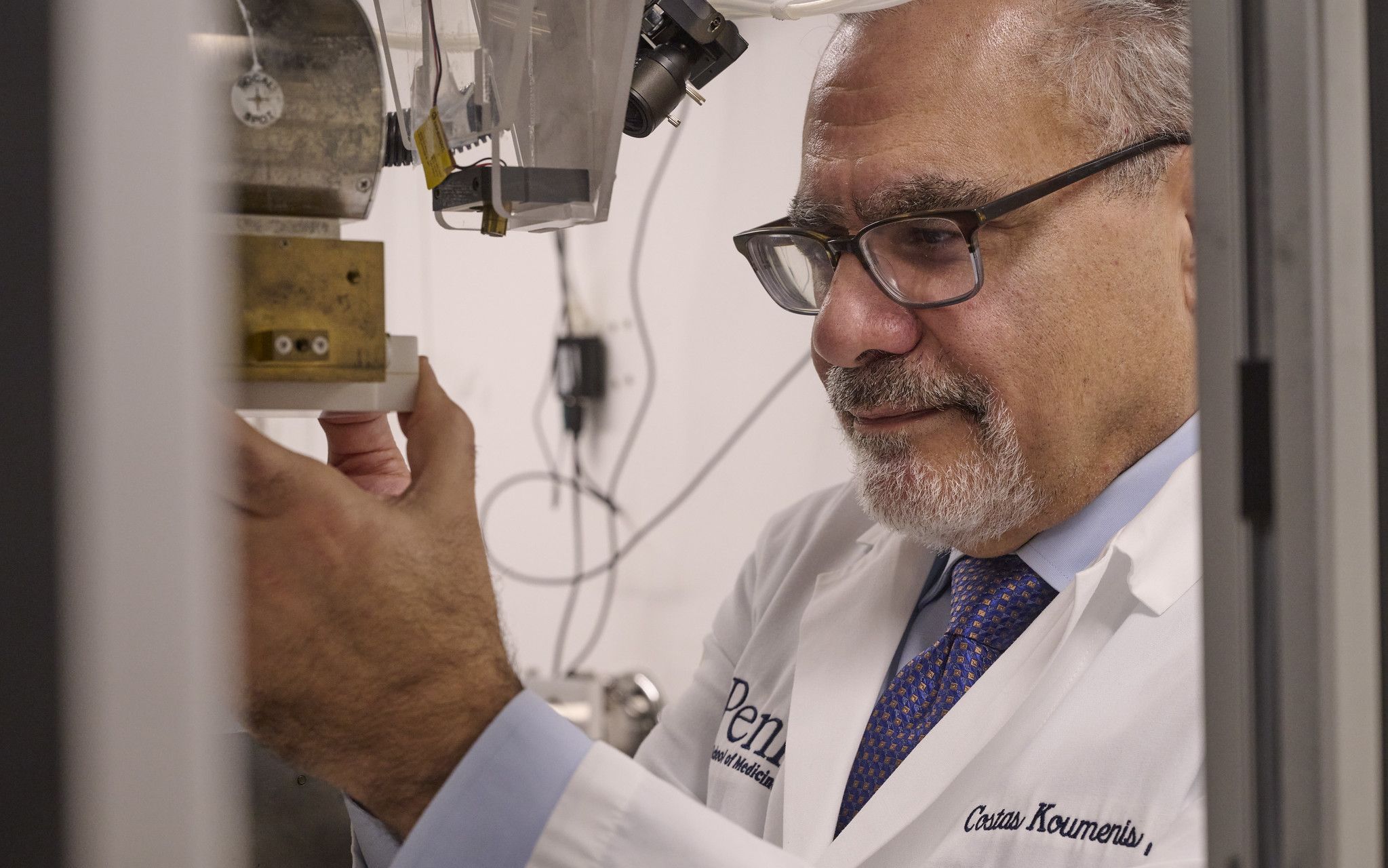
Constantinos Koumenis is the vice chair for research in Penn’s Department of Radiation Oncology and a developer of the new therapy being tested.Credit to Peggy Peterson
The primary focus of the Penn trial will be assessing the treatment’s safety and feasibility, with an eye on quality of life and cancer outcomes.
Researchers will be taking a more cautious approach to begin, using a dose and schedule that have already been found safe and effective in patients. The only difference will be giving the radiation at the FLASH speed, Lin said.
Schoenfeld said he would first want to see whether the team can deliver their treatment with the intended speed and precision — an accomplishment in itself for an early-stage trial.
Then he would look at how the tumors respond to FLASH and whether patients develop side effects over a period of months to years.
“Some of these side effects are longer term side effects, so it’s important to start to follow these initial cohorts of patients as long as possible,” he said.
The Penn team will follow patients for at least five years.
If the trial shows promise, the researchers hope to launch additional trials in other types of cancer, from gastrointestinal to liver tumors.
“If these trials show that they’re safe, we want to target any solid tumor that we can target,” Koumenis said.
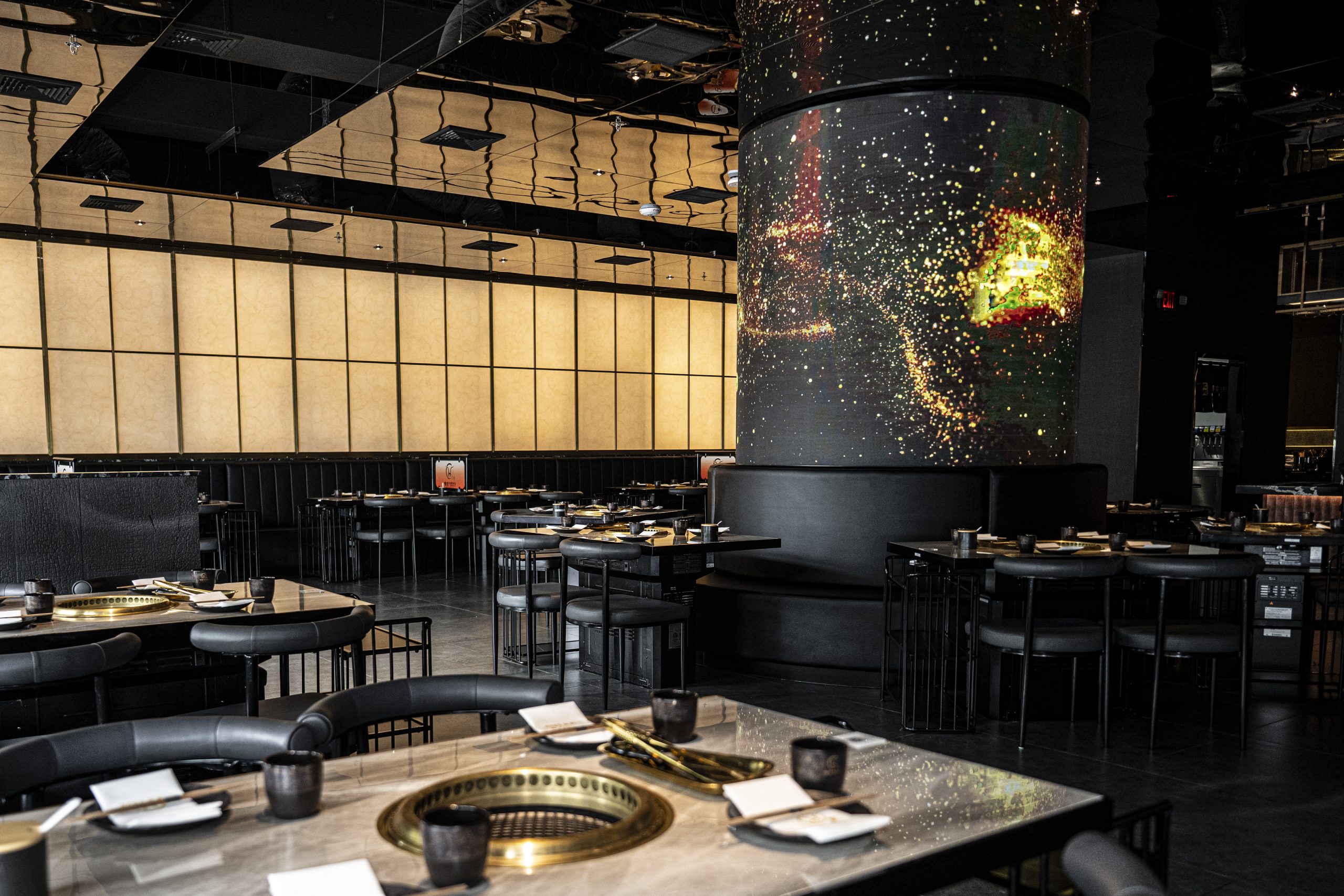
In our quest to keep you up to date on the restaurant scene, here are 12 spots that opened in the last few months. One example is Ogyu (shown above), which took over Ardmore’s former Iron Hill Brewing. It’s a grill-it-yourself Japanese steakhouse from the owner of the nearby Osushi.
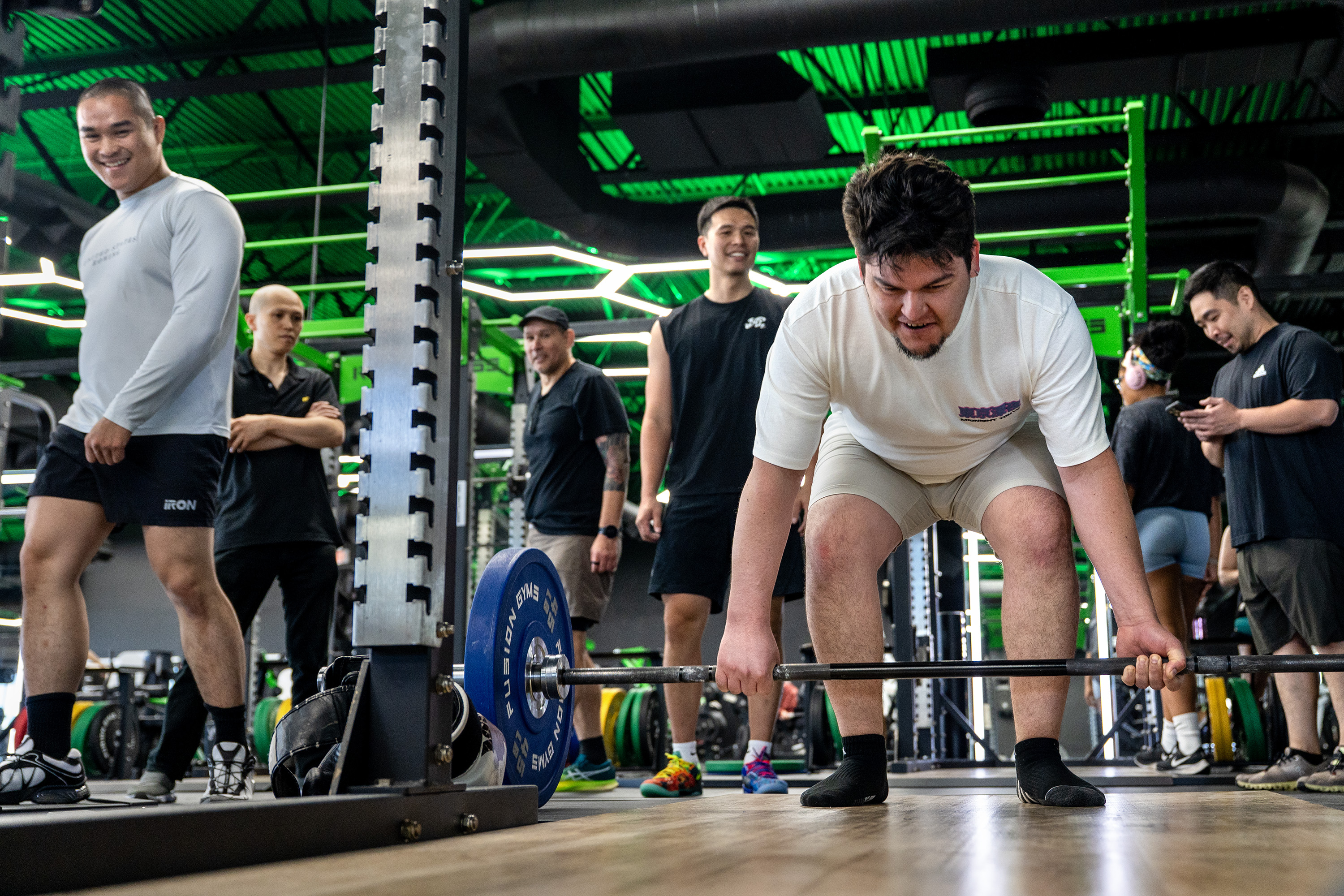
You have to be in shape to lug around 100-pound salmon and tuna. Kiki Aranita found a group of sushi chefs who routinely lift weights. As they say in the maki game: no pain, no grain.
A couple didn’t want their local drinking spot to shut down for good. Sarah Nicell writes that they found a solution: They bought it.
The lines are long, and the branding is adorable. Kiki Aranita visits Kyo Matcha in Chinatown.
Pinot grigio is wildly popular for a good reason, and wine writer Marnie Old explains where the best ones come from.
Poe is expanding
Sandwichmeister N.A. Poe will expand the hours of his kitchen operation at Poison Heart next week while preparing to open a new Poe’s Sandwich Joint location by the end of the year.
Starting Tuesday, Poe’s will operate seven days a week out of Poison Heart, 931 Spring Garden St., where he’s run the cocktail bar’s kitchen since last September. Daytime service will be pickup, takeout, and delivery only; Poison Heart itself will not open for daytime bar or dine-in service.
Poe, the nom de plume of Richard Tamaccio Jr., is not disclosing the new joint’s location or opening date. “We look forward to the freedom to do things our way without interference or apologies,” he said.
The move follows Poe’s split with Human Robot Brewing Co., where he had operated since 2019. His last day at Human Robot’s Kensington location is Thursday. Cantina La Martina will take over Human Robot’s kitchens at both Kensington and Brewerytown. Poe also parted company with the Monto, a new Old City bar.
At Poison Heart, Poe’s will operate from 11 a.m. to 9 p.m. Sunday through Tuesday and 11 a.m. to 6 p.m. Wednesday through Saturday. Poison Heart’s regular Wednesday-through-Saturday evening service will continue, with Poe’s classics and specials added to the menu.
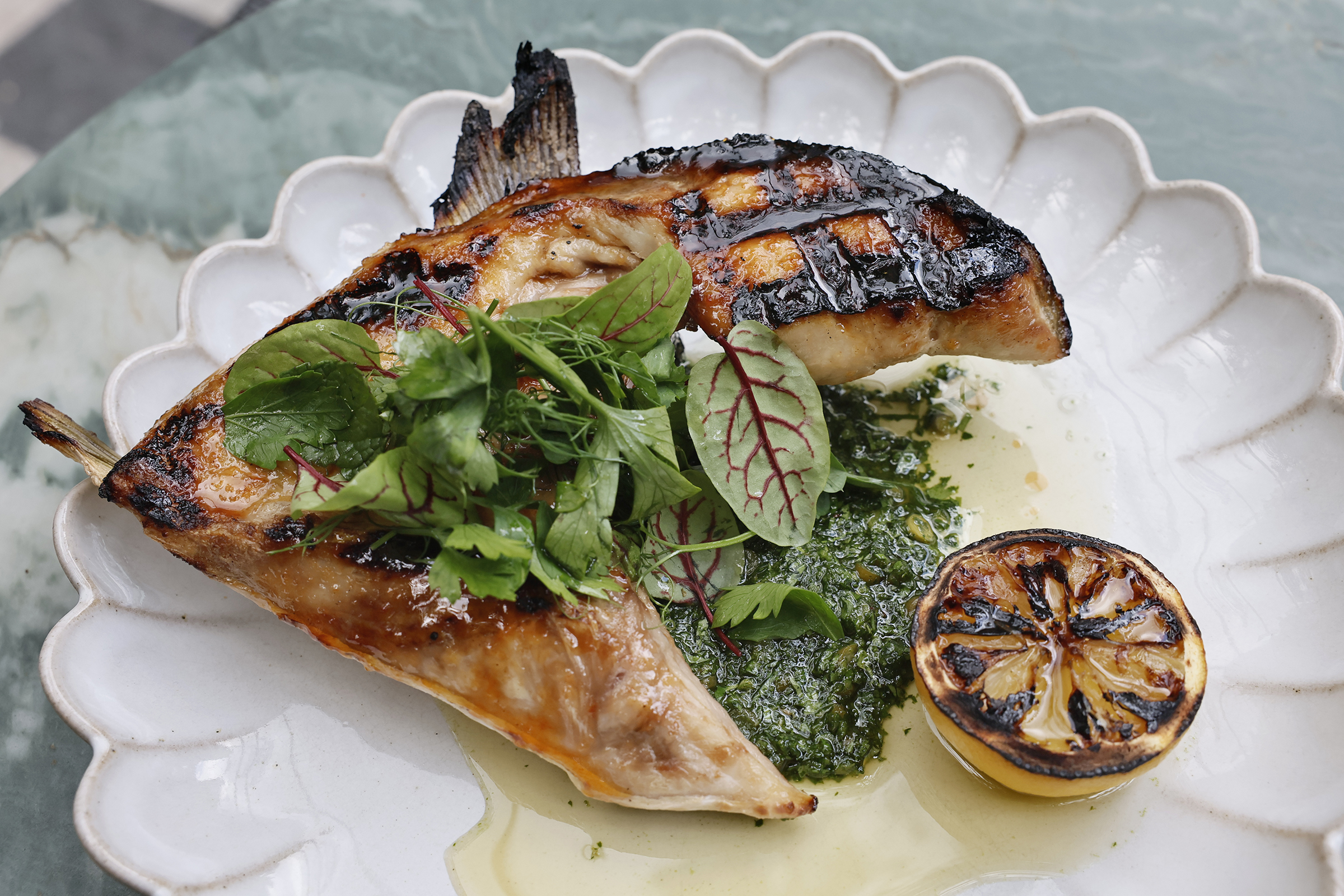
Two tasty bright spots of a staycation for Emily Bloch and her boyfriend included hamachi collar and poolside swordfish skewers. In other words: There’s great fish to be had in Fishtown.
Scoops
Old Friend, an upscale restaurant with a wood-fired grill and a chef with a Center City pedigree, is coming to the Main Line later this year.
Corte, on its way to the former East Market home of Mulherin’s Pizza, will have an Italian backbone, focusing on handmade pasta and cooking from the wood-fired oven. If that sounds like University City’s Corio, that’s because the same crew is behind it.
Big Charlie’s Saloon, the nationally known Kansas City Chiefs-theme bar in South Philadelphia that closed with the owner’s death last December, is under agreement of sale. The buyers’ plans don’t include NFL memorabilia.
Restaurant report
We’re in a New York state of mind:
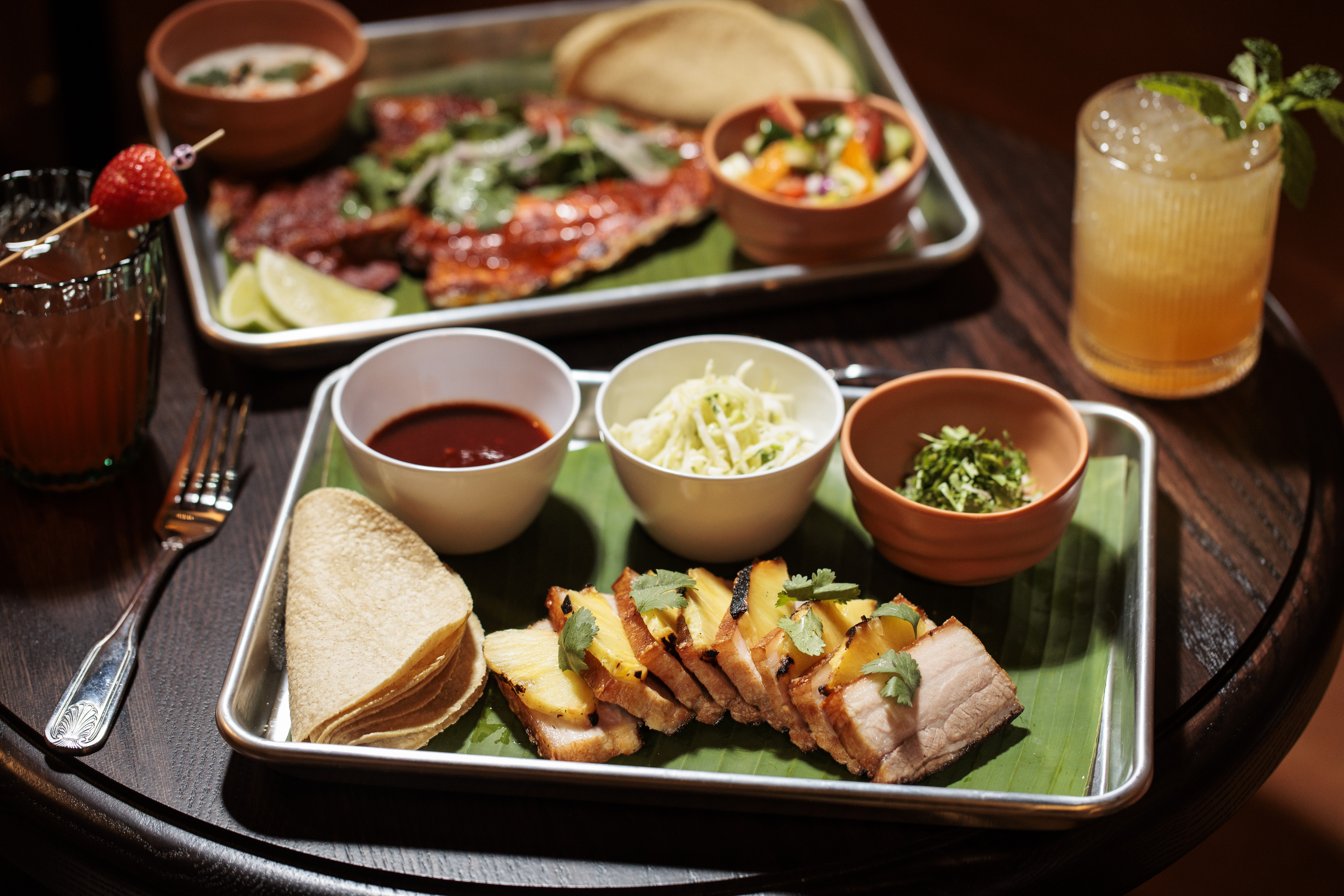
Dorade asado and pork belly al pastor (shown above) are two dishes offered at the new Mixteca, the Kensington offshoot of a Manhattan agave-focused coctelería from two James Beard Award-winning bartenders. Beatrice Forman heads to the former Martha for a look around.
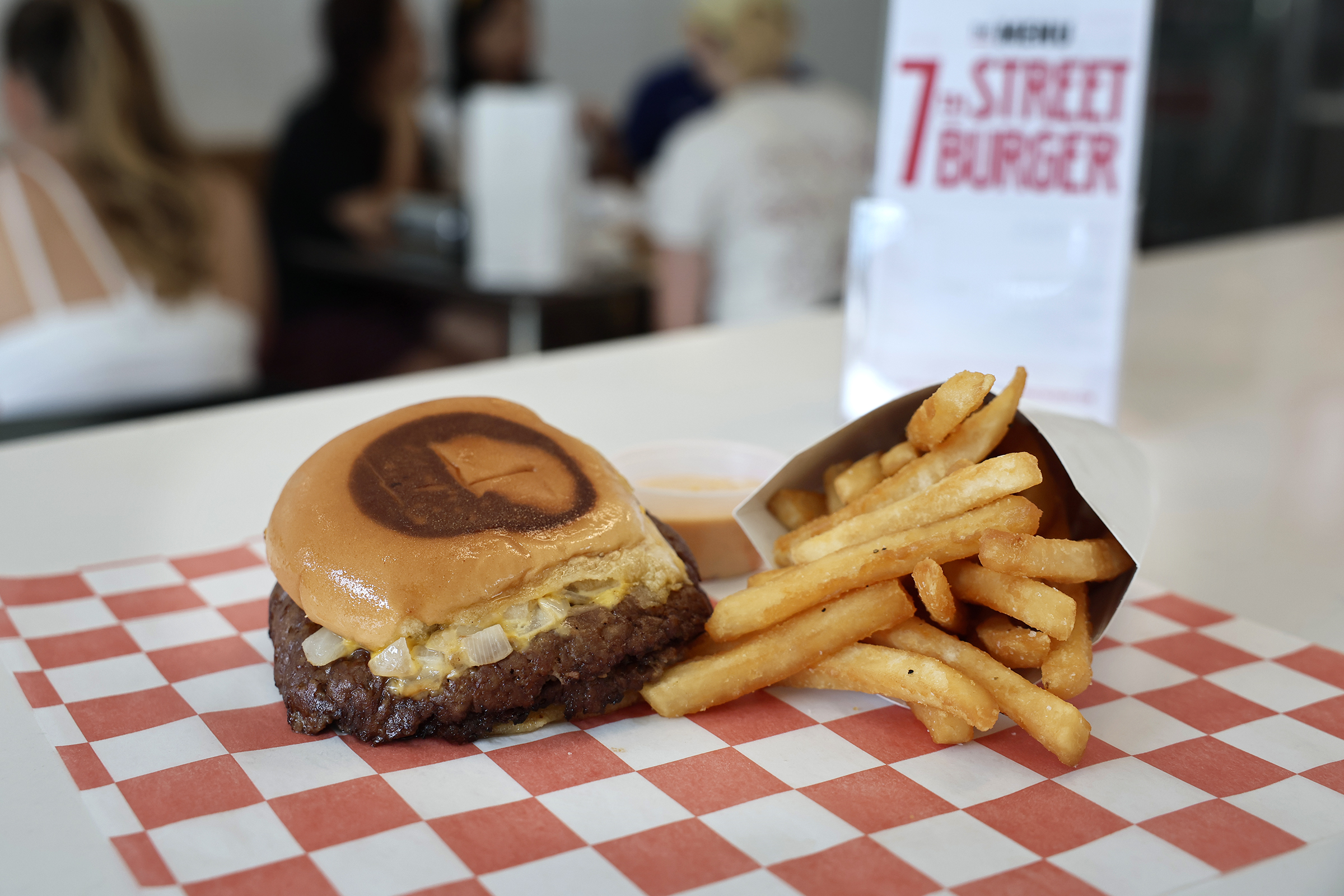
Smash burgers and fries are the hook at 7th Street Burger, a fast-growing Manhattan-based burger chain that just opened the first of four Philadelphia-area locations in Fishtown. Kiki Aranita takes a bite.
Briefly noted
Jose Pistola’s 19-year run in Center City has ended. Its related bars in Fishtown and South Philadelphia are unaffected.
Mount Masala Himalayan Cuisine (300 White Horse Rd., Voorhees) will host a Nepal disaster-relief fundraiser on Thursday, Sept. 10 from 5 p.m. to closing under the auspices of South Jersey Food Scene. It’s a $25 buffet of Nepali-Himalayan dishes for dine-in or takeout, with all sales donated to the Nepalese government for flood relief.
🥂 New Jersey has permanently allowed the sale and delivery of to-go alcoholic beverages in towns that permit it.
Ask Mike anything
Did Philip Korshak ever open his store, Korshak Picnic Provisions? — Joan M.
Back in February, Phil Korshak, the poet-baker who left town in 2023 after closing his cult-favorite Korshak Bagels, thought he’d open his quirky corner store at 13th and Reed Streets by May. However, “you have no idea how many contractors, electricians, and plumbers go to Europe and Japan in the summertime,” he told me in June. This week, Korshak said the store — now called Korshak Parkside Provisions — is in the health department inspections queue and he’s expecting equipment deliveries. “Let’s call it October,” he told me.
📮 Have a question about food in Philly? Email your questions to me at mklein@inquirer.com for a chance to be featured in my newsletter.
By submitting your written, visual, and/or audio contributions, you agree to The Inquirer’s Terms of Use, including the grant of rights in Section 10.
You’d be forgiven if you walk into any 7th Street Burger and think that the burger chain has been around forever. Its spare, almost bare-bones menu of smash burgers and fries is more classic than innovative, but perhaps its austerity is part of what is fueling its growth.
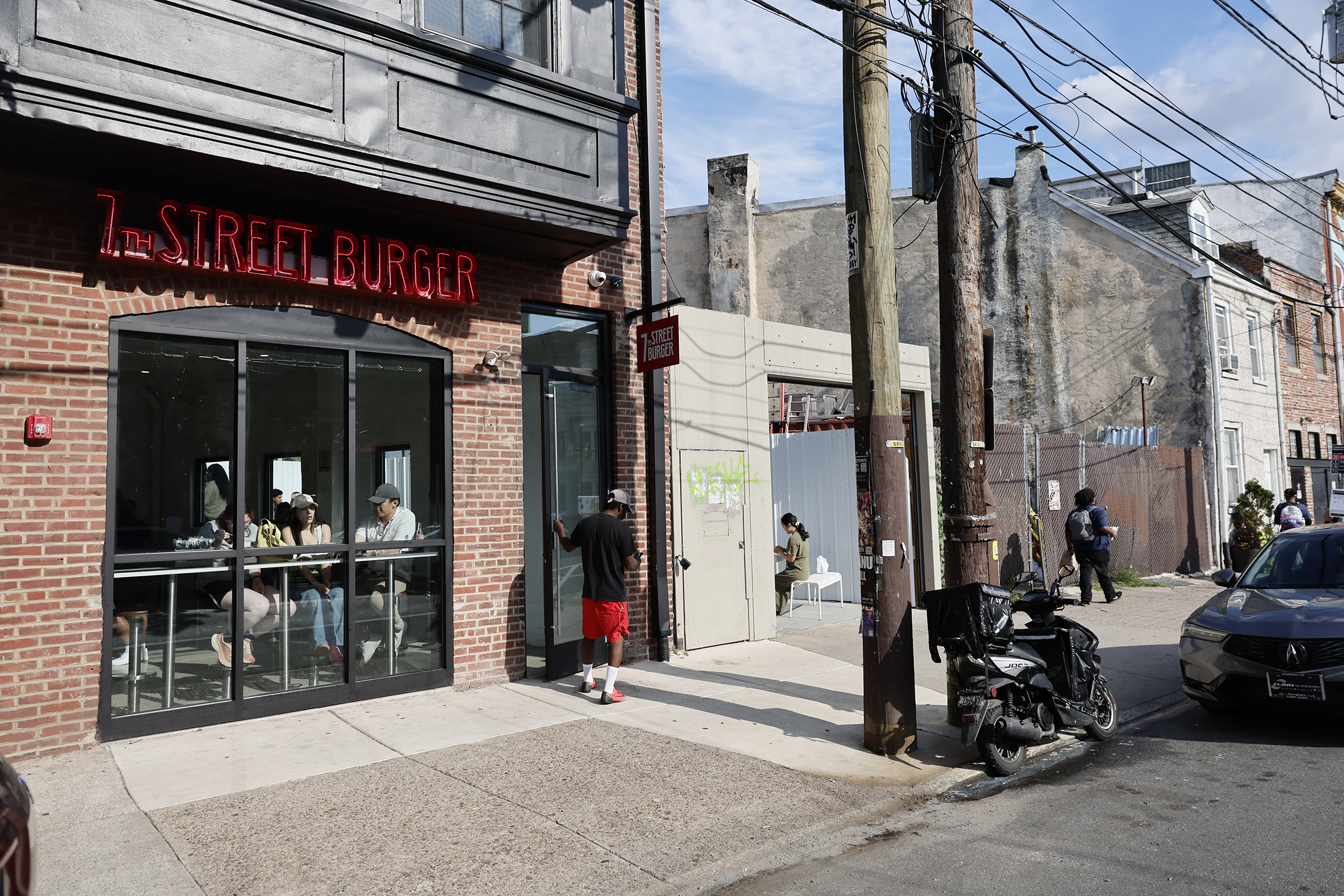
The chain is growing at a breakneck pace. The New York-based chain opened its 35th location in Fishtown (1215 Frankford Ave.) earlier this week. It has three more Philly-area locations that are slated to open by the end of this year, in University City, Center City, and Conshohocken.
On a Wednesday at 4 p.m., squarely between regular lunch and dinner hours, it was packed with people of seemingly every demographic, waiting in line for burgers.
It was first opened on its namesake East 7th Street in New York’s East Village in May 2021 by entrepreneurs Kevin Rezvani and Paras Jain who “maxed out” their credit cards in order to do so. The burger joint took off. They quickly opened another location in Greenwich Village within a year. Venture capital firm Left Lane Capital invested in 7th Street Burger in 2023, and since then, the brand has been on an opening spree up and down the East Coast.
Philly’s first location took nearly a year to open, from when the chain first took possession of the previously empty space in October.
7th Street Burger at 1215 Frankford Ave.Elizabeth Robertson / Staff Photographer
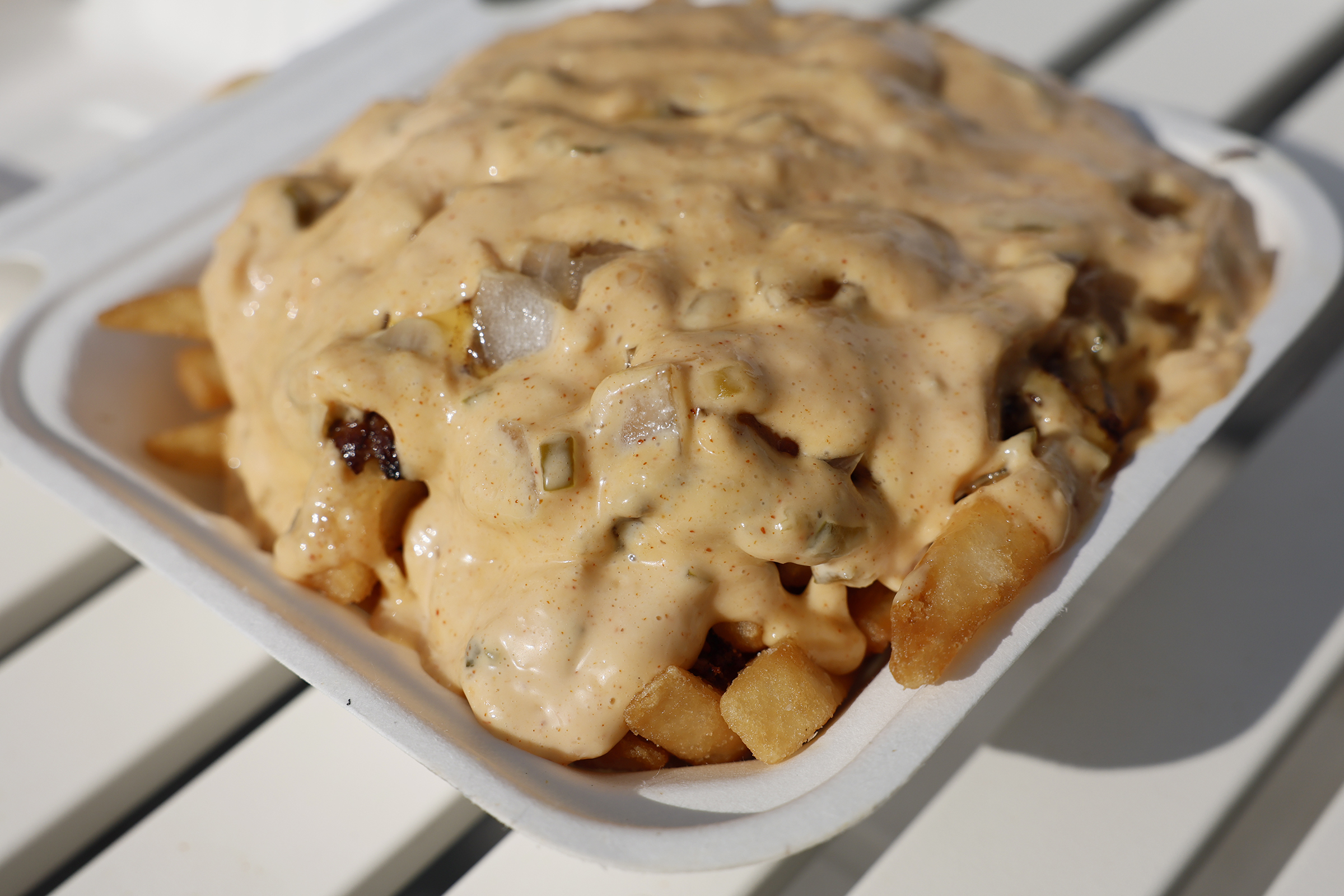
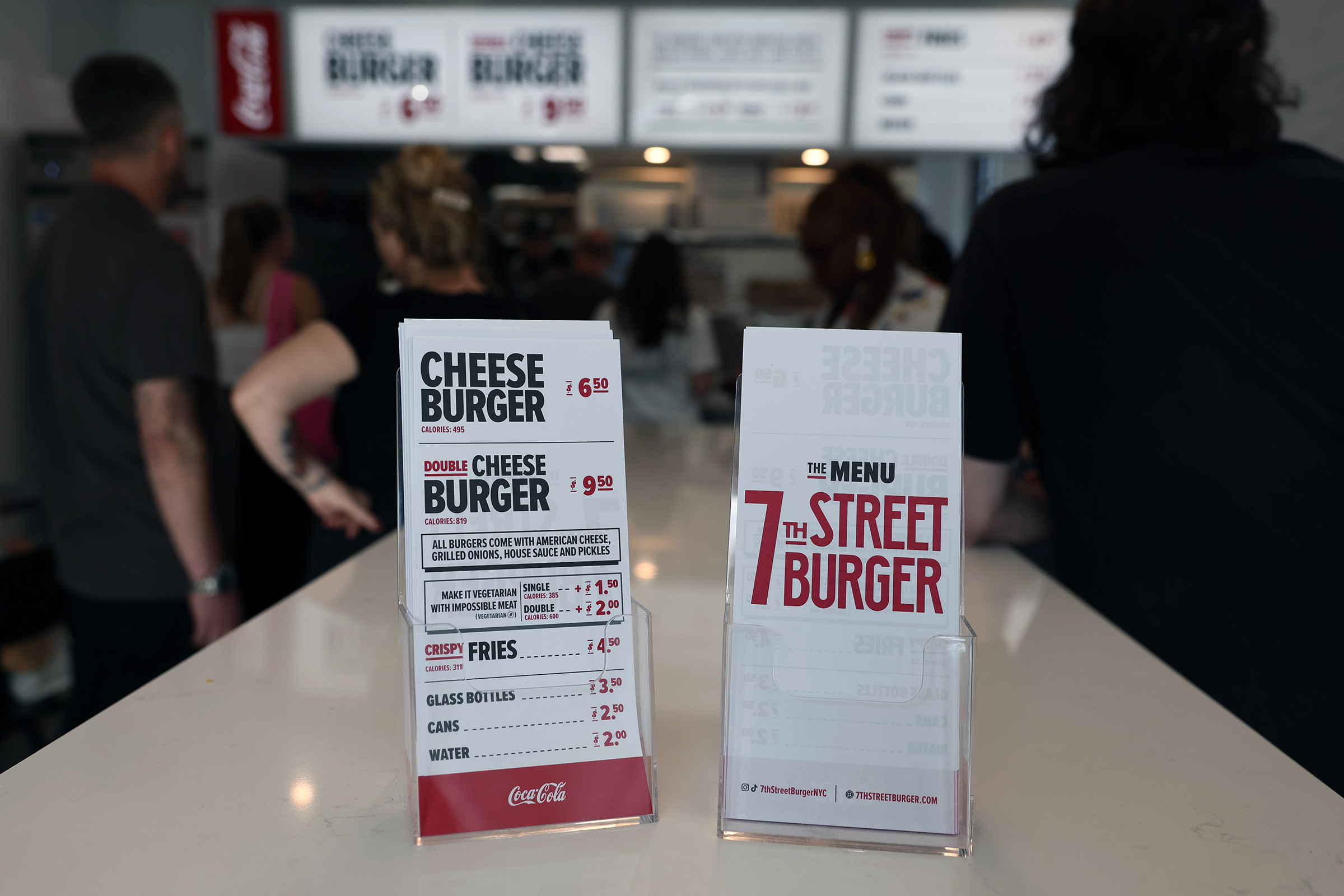
All 7th Street Burger locations serve the same menu (at the same prices) consisting of a cheeseburger ($6.50), double cheeseburger ($9.50), and crispy fries ($4.50). Cheeseburgers and double cheeseburgers can be made vegetarian with Impossible Meat for an additional $1.50 and $2, respectively. Only Coca-Cola, Sprite, and water are available as beverages. All burgers are served on Martin’s potato rolls with American cheese, grilled onions, a mayonnaise-based house sauce that manager Frank Perez declined to give any other ingredients of, and pickles. There is a secret menu of Cajun fries and loaded fries that isn’t posted at any of their restaurants, but is rather written with a Sharpie on a takeout box at the register. Loaded fries are topped with the same ingredients as the burgers, with options to make them spicy (with a ghost pepper sauce and jalapeños).
The loaded French fries at 7th Street Burger.Elizabeth Robertson / Staff PhotographerThe menu is limited and the same from location to location.Elizabeth Robertson / Staff Photographer
Hours will likely change, as 7th Street Burger learns the Philly market’s demands and that of their locations’ surrounding neighborhoods. “For late night, we’ll probably extend Friday and Saturday to be closer to our New York shops,” said Perez. In New York, the locations are open until 3 a.m.
Since opening, Philly’s 7th Street Burger has sold hundreds of burgers (Perez declined to state how many hundreds) but did note that they have sold far less Impossible Meat burgers here than in any other markets.
7th Street Burger is at 1215 Frankford Ave. 877-428-2693, 7thstreetburger.com. Hours: 11 a.m. to midnight every day. Hours may change depending on demand.
The people who built 3.0 University Place, an eight-story lab and office complex that covers a landscaped block of West Philly, had a problem: During the biotech slump after their 2023 opening, security costsescalated faster than occupancy.
“We had 80 Siemens cameras in there,” remotely monitored from a suburban surveillance office, and were “paying more than $150,000 a year for guard shifts,“ said Anthony Maher, the University Place Associates president.
But the building’s New York owners were still getting midnight calls for nonevents. Meanwhile the human video watchers missed incidents of concern — the stranger who had taken to sleeping on a tenant’s canopy at night, the fired contractor who sneaked back into the building one weekend.
Investors pressed them for a better way.
Maher and his partner, Scott Mazo, went hunting for an artificial-intelligence solution — an AI-era automated security system to collect and analyze camera, physical, and human-observed surveillance data; rank threats; sort out false alarms; open or shut locks; and quickly notify law enforcement, emergency services, management and owners’ groups as needed.
They rang an entrepreneur they’d met five years earlier at a Drexel University pitch meeting: Matias Klein, founder of Manayunk-based Kognition AI.
Kognition specializes in what Klein calls “cyber-physical threat detection systems,” which link and analyze digital security video, activate remote locks and sensors, load key data into formulas matching clients’ priorities and requests, sort and sharecommunications to alert the right people and agencies, and update responses based on results.
“You hang the cameras; we network the building systems,” as Klein puts it.
100 North American buildings
At 3.0 University Place, “Matias’ system gave us full access to the best 25 cameras, every floor, all times,” said Maher. The system caught incidents, routed them to the right people, and suggested simpler warning paths.
“They keep teaching us to manage the building, telling us, for example, about our people coming in when they didn’t really need to,” he said.
It worked so well “we told the owners to take the security-guard line-item out of the budget,” though they still use guards on occasion. It helps that the building’s big new tenant is the city police forensics unit: “We have a lot of cops coming here,” Mazo added, laughing.
More than 100 North American properties use Kognition AI, from Scotia Plaza, one of the largest office buildings in Toronto; to Pa.-based Benco Dental locations in several states.
A growing sector
Kognition, founded by Klein in 2017, was one of a handful of Philadelphia-area AI start-ups that presented to local investors at a June gathering. Investors included Osage Capital, MissionOG, and Susquehanna International Group’s SIG Growth Equity Fund.
“The AI landscape is changing so fast, it’s hard to tell what will be supplanted in a few months,” said Ellen Weber, who runs Robin Hood Ventures, and attended the meeting.
Robin Hood is a Philadelphia investors’ group whose members include start-up veterans. Members’ portfolio of local AI-dependent start-ups include Center City-based Deepwave, which makes laser weapons guidance systems for Air National Guard jets and other military projects; University City-based GreenIRR, which uses AI to speed carbon-emissions detection for truckers; and Proscia, which digitizes biotech images for fast diagnosis and pharmaceutical drug trials.
Thomas P. Dwyer, a partner at the law firm Troutman Pepper Locke who organized the June meeting, said Philadelphia trails other AI hotbeds.
“Philly has a lot of potential and opportunity here, especially if some of its larger companies get involved, as they do in Silicon Valley,” he said.
AI, he noted, is still seen as a threat by many local companies. They worry, “Can someone armed with Claude overtake your business, duplicate your software, and compete with you immediately — without having to hire people?”
And veteran investors are “gun shy” about AI profitability, he said.
Which, he added, leaves opportunity to those investors who make the “leap of faith” to promising AI start-ups
Operating on ‘the edge’
“An AI product makes itself better” the more it is used, said Kognition AI founder Klein.
Some of the best-known (and most-feared) AI image-and-data applications are based on giant AI companies’ mass sorting of millions of individuals’ information into ever-improving, readily searchable central databases at big new data centers — raising familiar privacy worries, as seen in the recent controversy over the alleged misuse of Flock digital camera data that police have used in attempting to quickly identify drivers.
By contrast, Kognition is one of the firms that operates at the “edge” of big networks, Klein said in an interview at his firm’s Manayunk meeting space. “We don’t send customers’ data throughout our network, and we don’t preload that information,” he said. “We don’t flow data back to a central monitoring station.”
Rather, the goal is “to give people control over the spaces where they live or work or worship, so they can get into a defensive posture fast, if they ever need to.” Custom, localized, focused solutions are “a big area of value creation” for AI start-ups, according to Klein.
Customized experiences
Kognition AI’s custom sharing limits and options are part of its appeal to Ravi Kalidindi. He was tasked by leaders of Bharatiya Temple, a Jain and Hindu religious congregation inMontgomery County, with setting up a system “that gave us control of our doors” without intimidating visitors or compromising members’ private information.
Kalidindi turned to Kognition as a locally based provider.
The system at Bharatiya starts with security cameras at the main entrance and stairways, integrated into a software and communications platform. “They check if our doors are closed. They tell us where there is human traffic. We can let the cleaning crew in without a key. It has mobile device control. It can even work on fobs,” Kalidindi said.
Kognition also has capabilities the temple has not used: “It has a weapons-detection system we have not enabled. It has additional sensors that can ID what people are carrying. It can tell us if we are seeing an above-average or above-expected crowd, make a note of the faces of people who are entering for the first time, and trigger an alert.”
There is a sense of user control of the AI systems that Kalidindi finds reassuring: ”We want to enhance the sense of security, that our facilities are being monitored, but also that everyone with good intent is allowed to enjoy the premises.”
For years, Graduate Hospital — the Center City neighborhood roughly bounded by South Street and Washington Avenue, and Broad Street and the Schuylkill — has been sorely lacking in places to stop in for a snack, pastry, or ice cream cone.
It didn’t seem to matter: Rittenhouse was so close that residents’ desires for little treats were generally met by walking a couple blocks north, where “little treats,” the culture of which has been surging worldwide, abound. On the 200 block of 20th Street alone, between Walnut and Spruce, you’ll find 1-900-Ice-Cream, which opened in 2022 and sees relentless lines down the block; All Aboard Candy, which opened last year and is one of two places you can buy adorable gummy candies; and Biederman’s, a seafood-centric “appetizing” shop that opened earlier this year.
Now, Grad Hospital is seeing its own treat boom. In recent months, the neighborhood has seen an influx of treat sellers that shows no sign of stopping.
The openings have been concentrated on South Street between 15th and 17th Streets, but other parts of the neighborhood are changing as well.
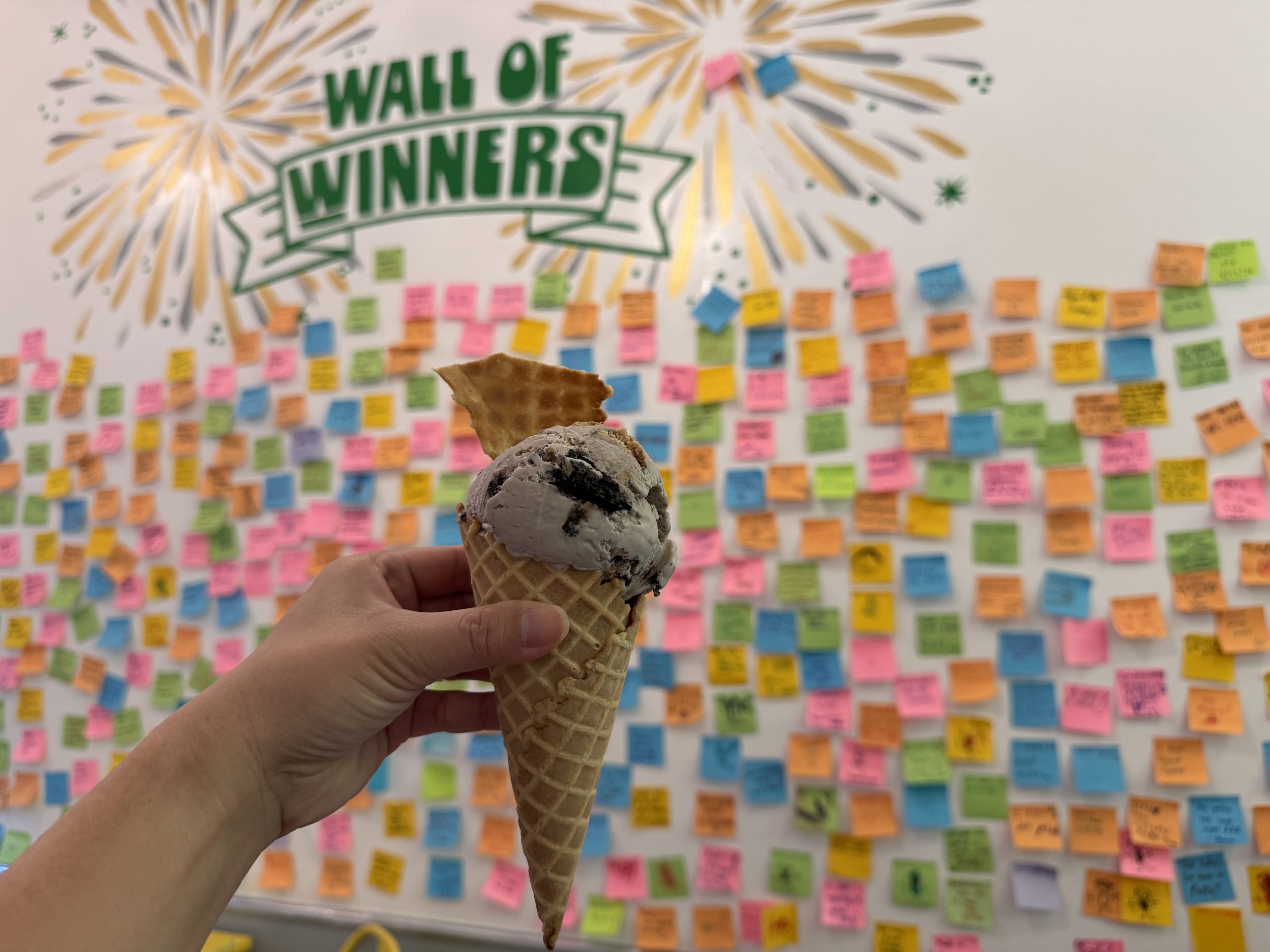
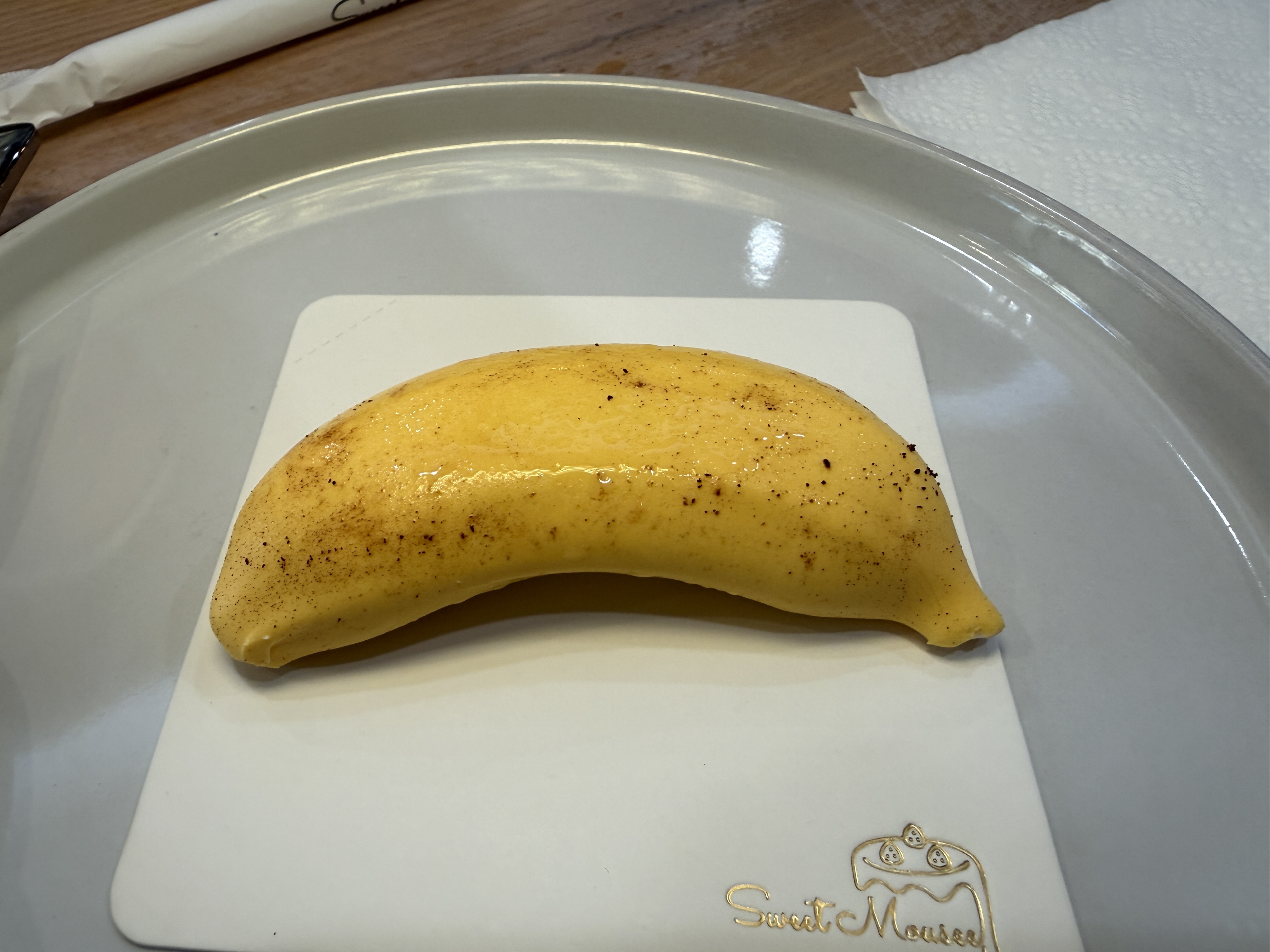
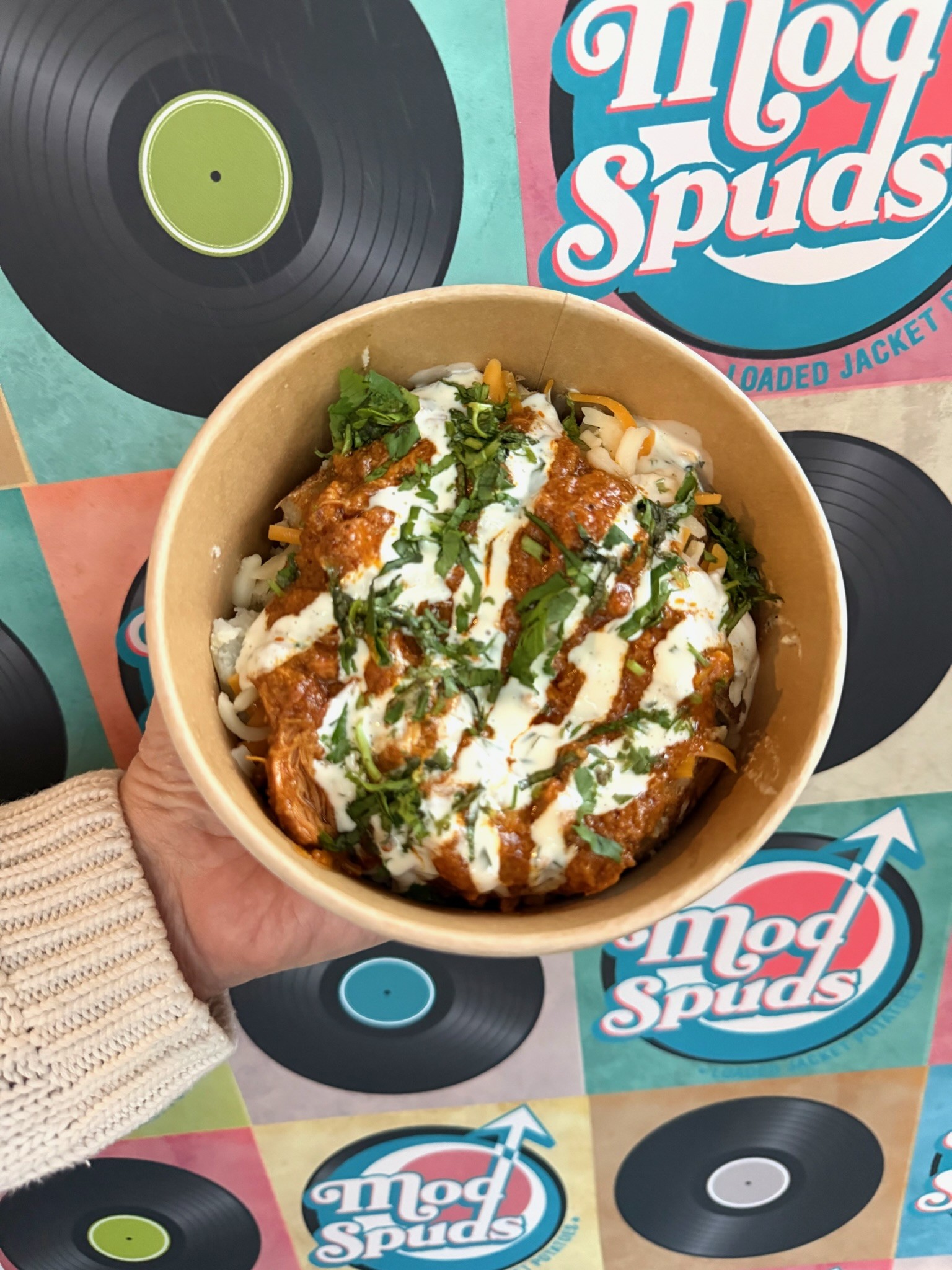
Winners Ice Cream, Ange Branca’s jacket potato and creamsicle-driven operation Mod Spuds, Sandpiper Cafe (where you can get trendy matcha lattes), and Sweet Mousse (which sells even fancier beverages and mousse cakes) all opened within two blocks of one another on South Street between May and July this year. They are all Asian-owned — a notable aspect of little treat culture, as Asian flavors like matcha and ube have been extremely popular at little treat retailers. (Demand for both ingredients has been so high, both have seen global supply chain shortages.)
The market for little treats, also known as treatonomics, is propelled by Gen Z but not at all restricted to that generation, as spending on “pick-me-ups” generally increases in recessions and in uncertain economic conditions, economists have found.
Cookies and cream dream in a waffle cone at Winners Ice Cream in Graduate Hospital.Kiki Aranita
The Grad Hospital boom is powered by nimble operators with no need for the ventilation systems required at most full-service restaurants. Thus, they are able to launch after footing comparatively light construction costs.
“We’re two months in and it’s been awesome,” said Anh Nguyen, the owner of Winners. “Many are saying Grad Hospital needed an ice cream shop, so I’m happy we opened here.”
Nguyen’s clientele consists mostly of neighborhood residents and families. He hopes to attract more customers from outside the area. “My aim is to win the block, then win the city. I love being the neighborhood ice cream parlor — somewhere for families to go celebrate and make memories.”
Though Nguyen currently lives in Roxborough, he hopes to move. “I’ve fallen in love with Grad Hospital since being here and everyone I’ve met has been so welcoming and encouraging.”
The dark chocolate banana mousse cake from Sweet Mousse in Graduate Hospital.Kiki Aranita / Staff /
Little treats are massively impacting a neighborhood that, until this year, was stalled in gentrification. Once primarily home to working-class Black residents, Grad Hospital fell into disrepair when the manufacturing industry declined in Philadelphia. The neighborhood gentrified rapidly between the late 1990s and early 2010s due to city tax abatements and proximity to University City and Center City. According to a study by Pew Charitable Trusts, Graduate Hospital experienced the most dramatic changes in racial composition in Philadelphia in the early aughts: “[Graduate Hospital’s] total Black population fell from 7,793 in 2000 to 3,450 in 2014. During the same period, the number of white residents more than tripled in the neighborhood.”
The wave of redevelopment, new construction, and gentrification brought comparatively few small businesses and restaurants. Unlike South Philly and Fishtown, Grad Hospital has no established restaurant corridor.
A Malaysian spud from Mod Spuds.Courtesy of Mod Spuds
“Mod Spuds [on the 1400 block of South Street] needed a place that is a fine balance between good traffic, neighborhood-y, and affordable,” said Branca, who said that the location was perfect despite (or even because of) being a “less desirable block.” Its limited kitchen space, which does not allow for an exhaust hood, kept her rent down. It was only after Mod Spuds opened that Branca realized she was right on Grad Hospital residents’ commute home from jobs in Center City.
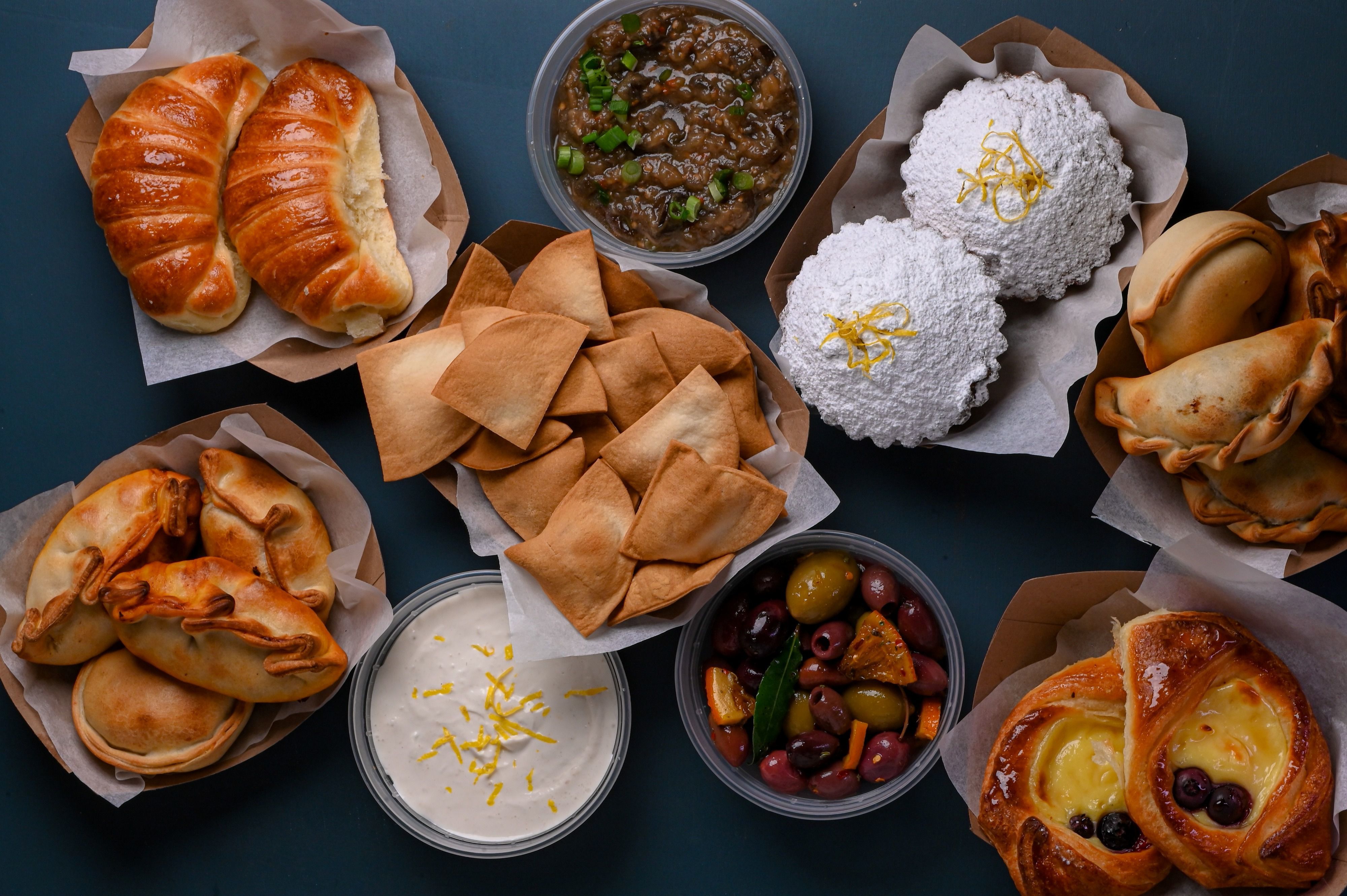
The neighborhood has also beckoned “empanada queen” Jezabel Careaga, who had left as a business owner, but not as a resident, in 2018. Technically, Careaga’s original Argentine bakery, Jezabel’s, was in Fitler Square, but now she is reopening it at 617 S. 24th St., right on the cusp of Grad Hospital. Careaga’s empanadas and alfajores helped define Philly’s little treat scene long before the culture acquired its tagline.
“Graduate Hospital has changed so much since I first came to this neighborhood, but what is really special to me is seeing the generations grow up here,” said Careaga, who has lived in the neighborhood since 2010. “It feels like I’m creating a little piece of the memory I had with my grandmother, right here in my own neighborhood.”
Assorted dishes from Jezabel Careaga, including empanadas, medialunas, escabeche, ricotta cake, facturas, olive oil crackers and preserved lemon labneh.Lucas Careaga / Innprodev Agency
The same children who would stop at her bakery after school are now grown up — some have even asked her for jobs. “And now I’m seeing them with children of their own, stopping by our bake sales with their little ones,” said Careaga. “It makes me so happy to think that the traditions we started years ago can continue with another generation.”