The Eagles are 2-0, and not for the reasons one might have anticipated going into the season.
The offense under Sean Mannion is supposed to be rooted in a sound running game. It hasn’t clicked yet, as evidenced by the Eagles’ minus-.09 expected points added per rush, which ranks in the middle of the pack as of Monday afternoon, according to Next Gen Stats.
The defense under Vic Fangio in his third year as coordinator is supposed to set the floor for the team’s overall success this season. But through two weeks, the Eagles defense ranks below the median in EPA per play allowed at +.01.
There’s plenty of time for the Eagles to improve in both facets. Still, arguably the biggest reason for the team’s 2-0 record through two weeks rests on the arm of Jalen Hurts and the plays he has pulled off in the passing game.
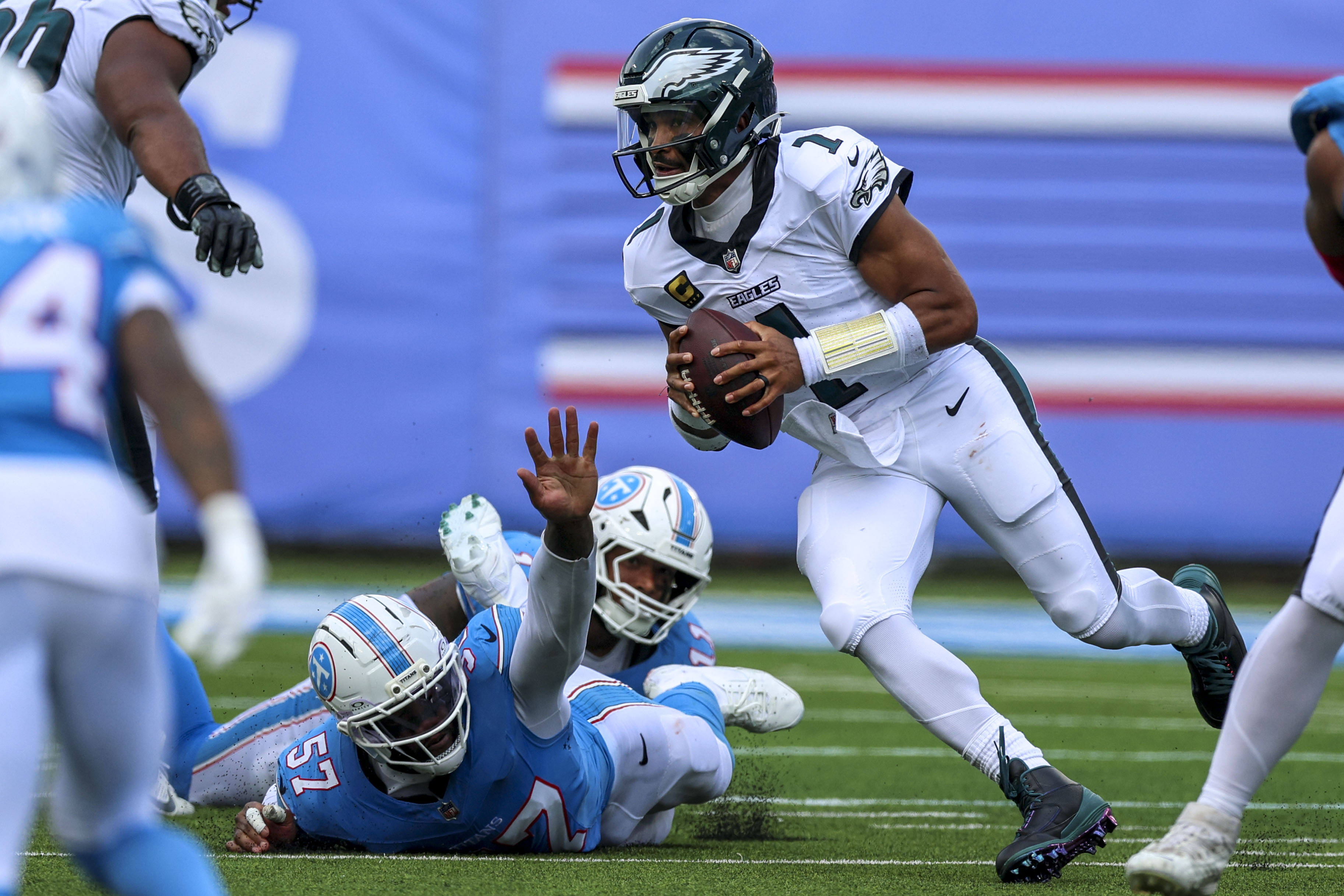
Despite tossing two interceptions in the 24-20 win over the Tennessee Titans on Sunday, Hurts orchestrated his eighth fourth-quarter comeback since 2023, which is tied for the second-most in the NFL in that span, according to Next Gen Stats. For the last two weeks, Hurts has showcased his clutch gene and his ability to generate explosive passing and rushing plays, two encouraging traits from the franchise quarterback as the Eagles continue to acclimate to their new offense.
Here’s what we know (and what we don’t) about the Eagles going into their Week 3 matchup against the 1-1 Chicago Bears:
Defense loading
The Eagles entered the season with high expectations on defense, given their talented personnel at every level and their coordinator continuity. But so far, the overall group is off to a relatively quiet start.
To their credit, they have held their first two opponents, the Titans and the Washington Commanders, to less than 300 yards of offense, a feat only six other teams have accomplished heading into Monday night.
But Nick Sirianni typically harps on winning the turnover battle. While the offense has given the ball away twice (on Hurts’ pair of interceptions against the Titans), the defense has yet to force a takeaway. Jalen Carter and Jihaad Campbell have forced fumbles, but the opposition ultimately recovered.
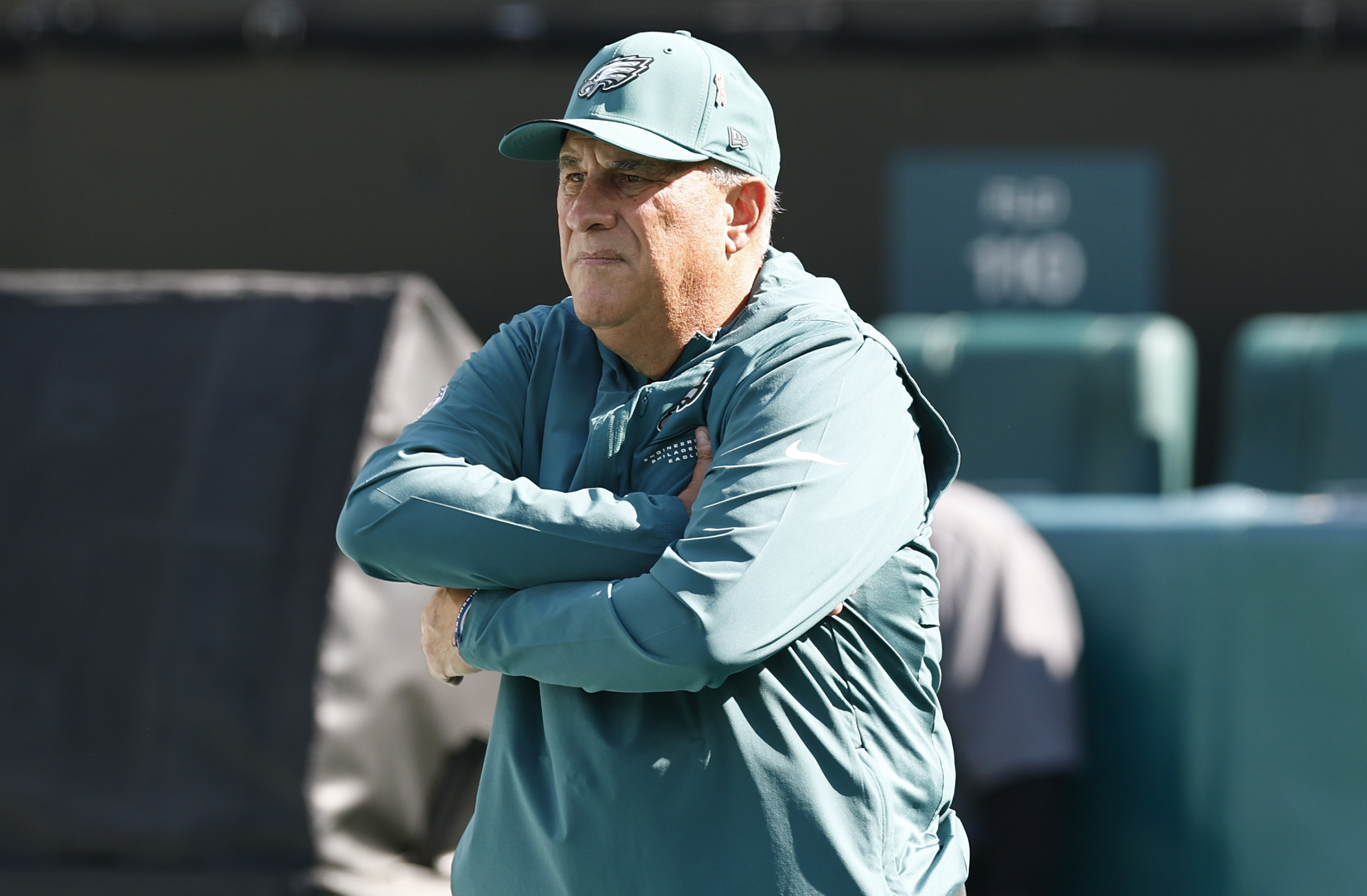
Through two games, Vic Fangio’s much-heralded defense has yet to force a turnover.Yong Kim / Staff Photographer
Through two weeks, the Eagles are one of three teams that have not generated a takeaway, along with the Commanders and the Houston Texans. Last year, the Eagles finished tied for 10th in takeaways with 21.
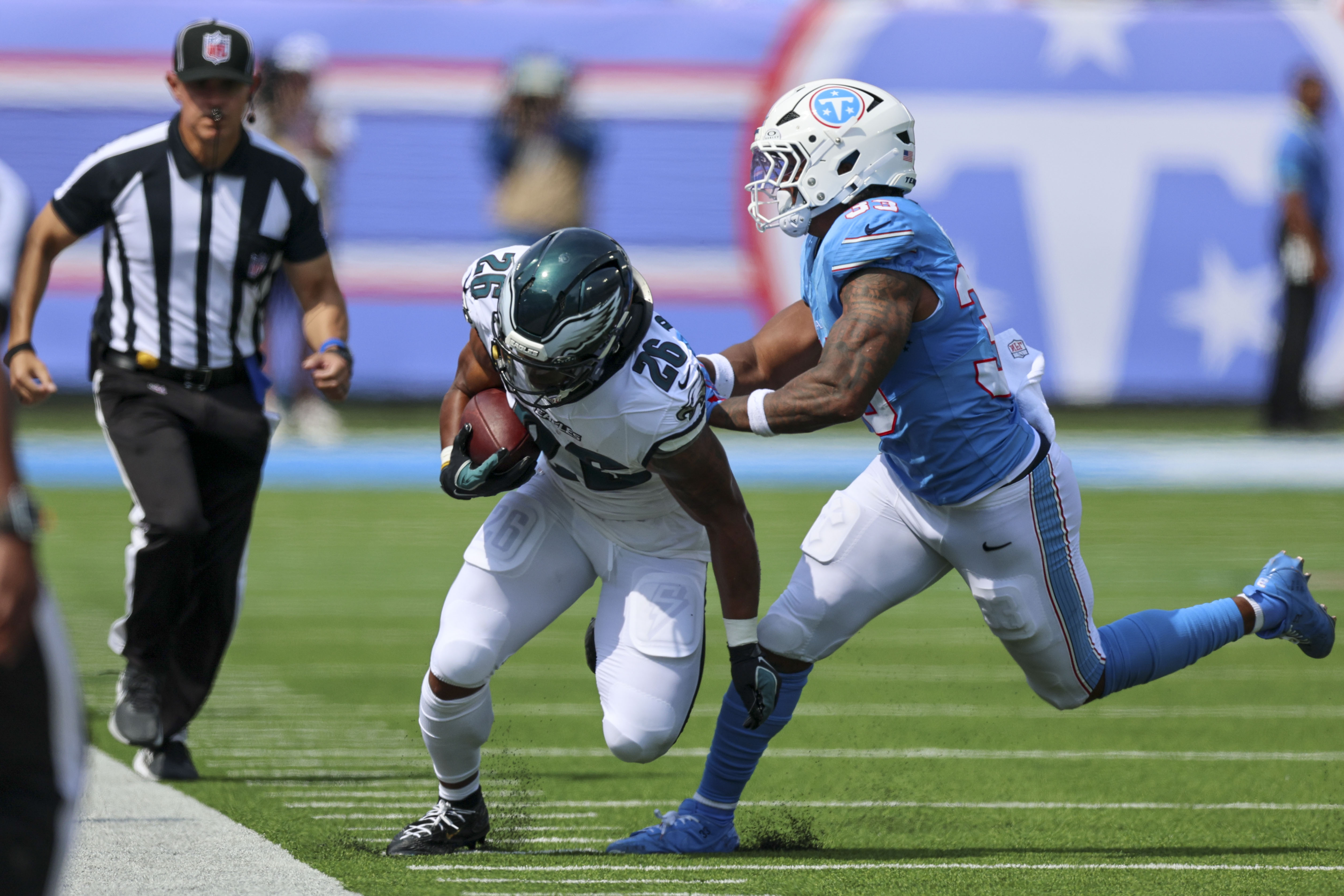
The Eagles are also coming off of a poor tackling day in their win over the Titans. The team missed 12 tackles, according to Pro Football Focus, led by starting safety tandem Andrew Mukuba and Marcus Epps with three apiece. That issue was on display during the Titans’ go-ahead field-goal drive late in the fourth quarter, especially on running back Tyjae Spears’ 27-yard carry when he forced missed tackles from Moro Ojomo and Epps.
The pass rush is a work in progress. According to Next Gen Stats, the Eagles are tied with the Titans for the highest average time to pressure (3.12 seconds) in the NFL.
Two of these three issues — the lack of takeaways and the poor tackling — could be anomalies. The Eagles have fared well in turnover differential over the last couple of seasons, and they have been sound tacklers on the whole under Fangio.
The lack of a prolific pass rush was an issue last year, too, leading to the acquisition of Jaelan Phillips at the trade deadline. Their output could improve when Jonathan Greenard, who has been ramping up in practice after sitting out of training camp with a pectoral injury, returns to action. Regardless, the Eagles have much to improve defensively going into Week 3.
Bears down?
Could the Eagles defense catch a break against the Bears?
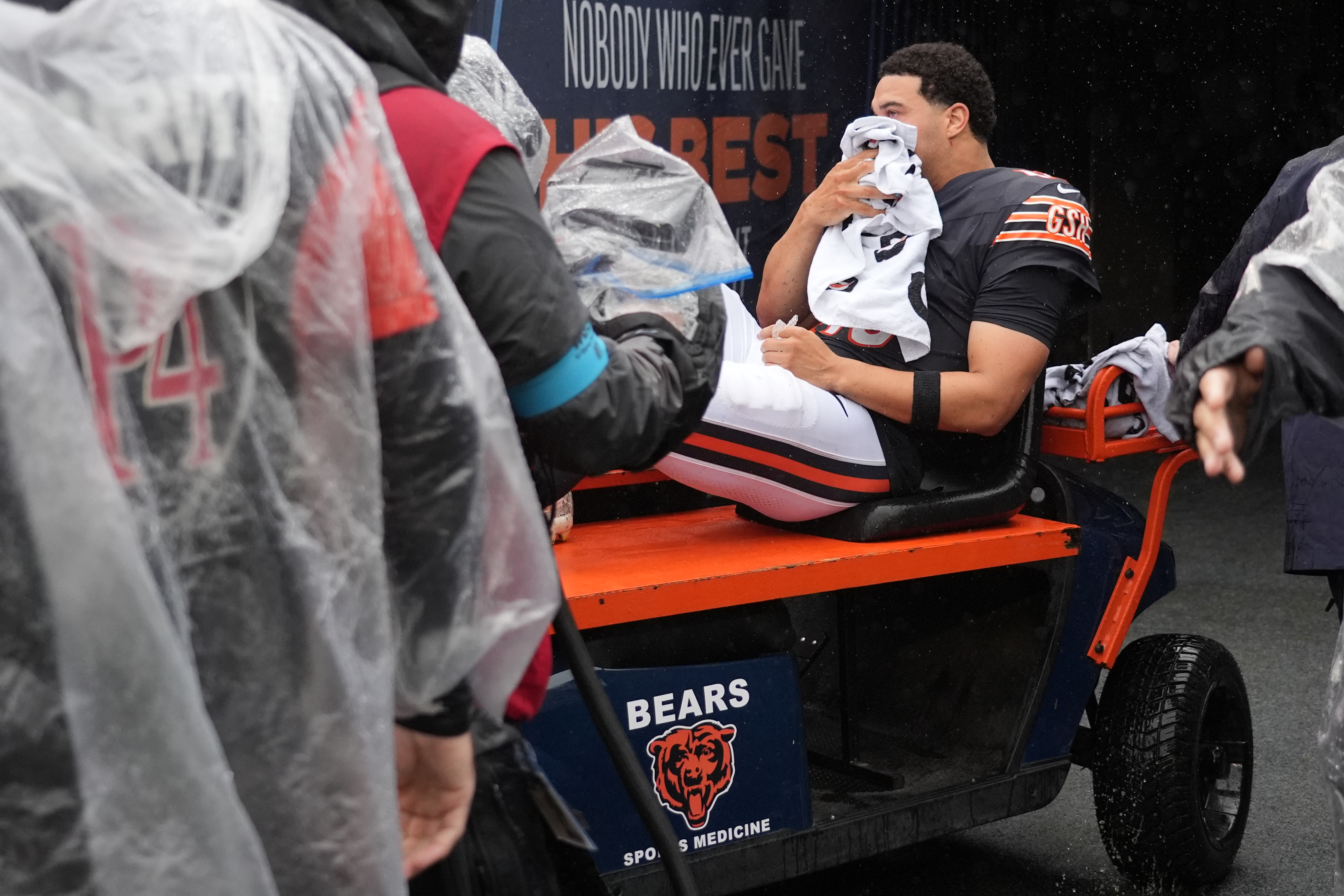
Third-year starting quarterback Caleb Williams went down with a hamstring injury in the fourth quarter of the Bears’ 9-3 loss to the Minnesota Vikings on Sunday. Bears head coach Ben Johnson said Monday on Chicago radio station ESPN1000 that Williams is considered “week to week.”
Chicago Bears quarterback Caleb Williams looks to be a long shot to play Monday after injuring his hamstring in Week 2.Nam Y. Huh
Last season, Williams and the Bears handed the Eagles a 24-15 loss, gashing them on the ground thanks to a combined 255 rushing yards from running backs D’Andre Swift and Kyle Monangai. Williams was less than stellar in that game, going 17 of 36 (47.2%) for 154 yards with one touchdown and one interception.
Still, the windy elements played a role in the passing game that day, and Williams was otherwise solid in his first year under Johnson.
If Williams can’t go on Monday night, the Bears may not be able to turn to backup Tyson Bagent to start at quarterback. According to ESPN report from Tuesday, the 2023 undrafted free agent out of Division II Shepherd University is in the concussion protocol.
Bagent entered Sunday’s game down 6-3 against a talented Vikings defense with 7 minutes, 15 seconds left in the game. He had the opportunity to win it with a minute remaining, but he was sacked on the final play at the Vikings’ 12 on fourth down. With his status in question, the Bears could turn to third-stringer Case Keenum, the 38-year-old NFL veteran who last saw game action in 2023 as a member of the Houston Texans.
Keenum is 0-2 against the Eagles, including his 2017 NFC championship game loss as a member of the Minnesota Vikings and his 2019 regular-season loss with Washington. Both games were in Philadelphia. He has been with the Bears since the start of the 2025 season, coinciding with the beginning of Johnson’s tenure as head coach.
But if Williams can play against the Eagles, how would his hamstring injury limit him, especially on the ground?
Williams is adept at extending plays with his legs and scrambling, traits he showcased in the loss to the Vikings, as he picked up 27 scramble yards, according to PFF. He threw an interception, though, while fleeing the pocket prematurely in the first quarter on Sunday.
Ertz in action
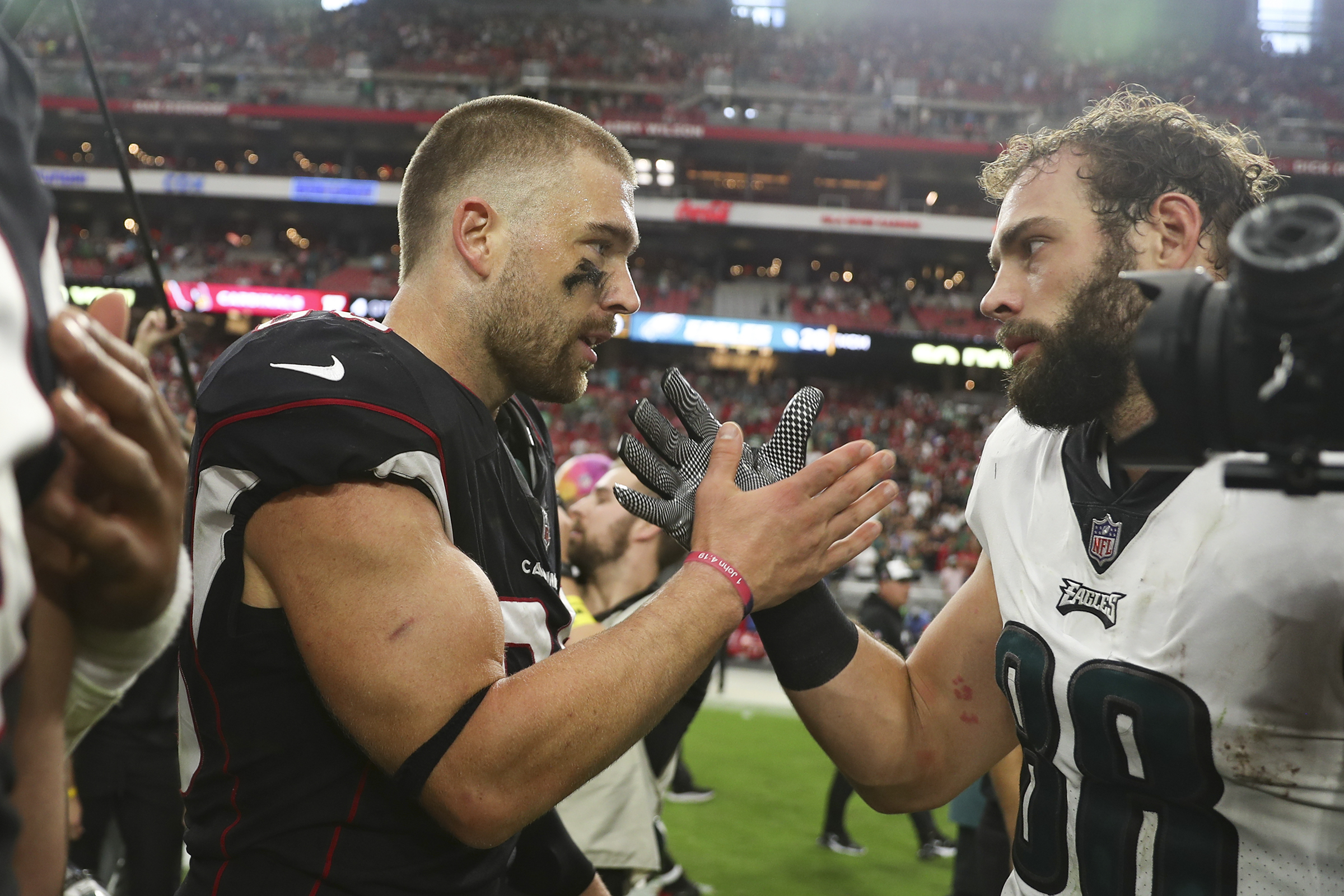
With Dallas Goedert out of commission for the next few weeks due to a sprained medial collateral ligament (MCL) in his knee sustained against the Titans, the Eagles are signing a familiar face in Zach Ertz to infuse pass-catching prowess into the tight ends room.
Ertz, who turns 36 in November, is set to join the practice squad. But he could be a candidate to be elevated to the game day roster against the Bears, as he was cleared for football activity in July, seven months after he tore his ACL in Week 14 last season as a member of the Commanders.
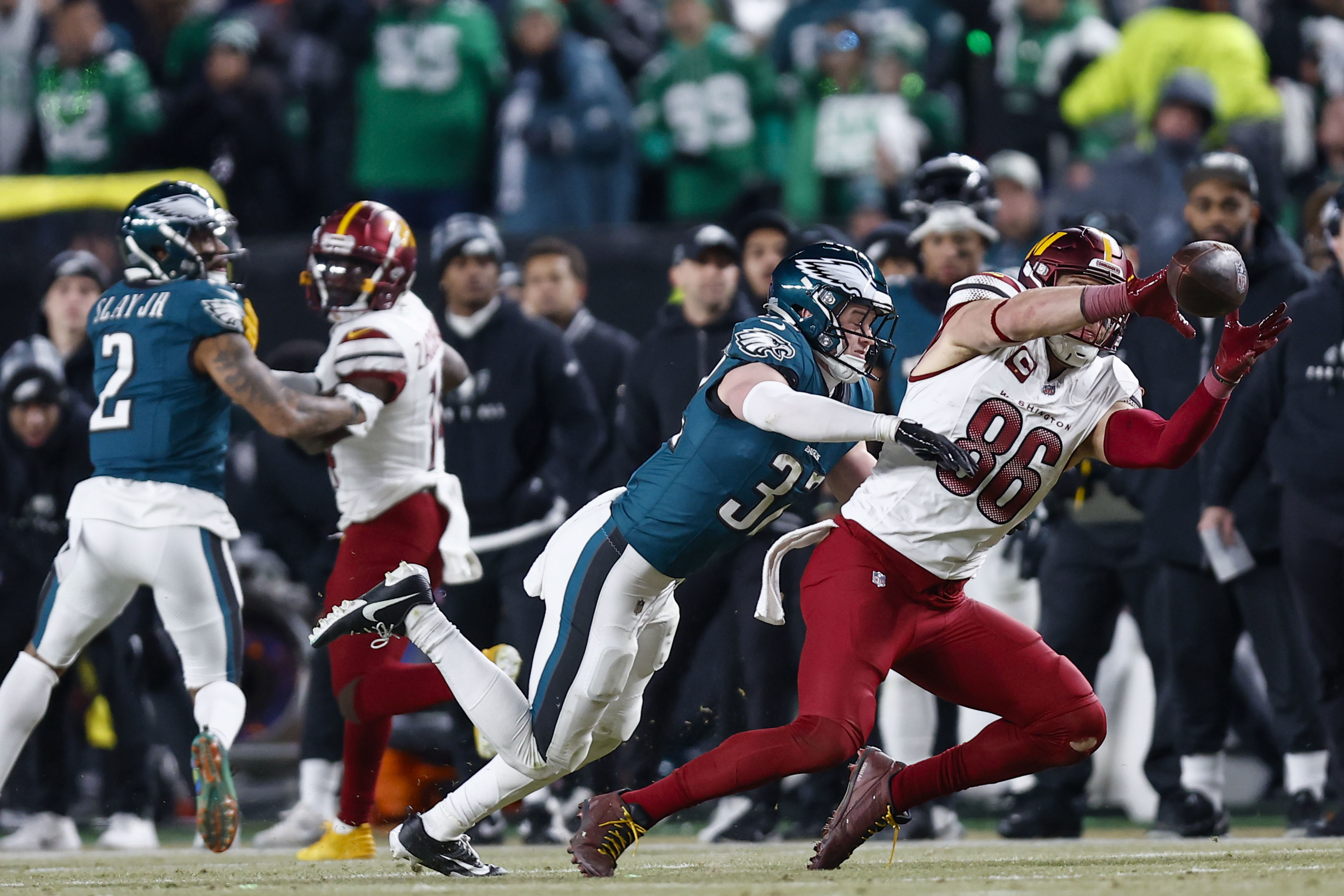
With tight end Dallas Goedert set to miss time, the Eagles are reuniting with franchise legend Zach Ertz (86). Monica Herndon / Staff Photographer
The Eagles could use his receiving ability, stat. Aside from the injured Goedert, they currently have two tight ends on the active roster in Johnny Mundt and EJ Jenkins. Mundt, 31, has been heralded for his blocking ability throughout his 10-year NFL career. Jenkins has grown as a blocker, as Howie Roseman acknowledged after training camp, and while he converted from wide receiver to tight end in the NFL, he has just one reception for 7 yards in his pro career.
With the addition of Ertz, the Eagles could take advantage of a Bears defense that has been challenged to cover tight ends through two games.
The Bears defense has conceded 115 yards on 10 receptions to tight ends, the 10th-most yardage in the league. The Vikings’ T.J. Hockenson had the most success of any tight end to face the Bears on Sunday, totaling 29 yards on three receptions.
Hockenson’s best play came on a second-and-10 under-center play-action fake in the fourth quarter in which he blocked at the line of scrimmage to sell the run. He then made the Bears defenders pay for biting on the fake by leaking downfield and hauling in a 19-yard pass from Carson Wentz.
Ertz might not be known for his blocking ability, but he has made similar plays on play-action passes, including his 20-yard touchdown reception last season against the Green Bay Packers.
He stands to make the biggest impact in the red zone, as all 16 of his touchdown catches over his last four seasons since he departed Philadelphia in 2021 have come inside the 20.
In the span of an hour, after it was revealed that Dallas Goedert will miss a few weeks, the Eagles decided to reunite with Zach Ertz.
News landed Monday that Goedert suffered a sprained MCL in his knee during Sunday’s 24-20 win over the Titans. The tight end left the game midway through the second quarter and did not return. Goedert is expected to be out for a few weeks with the injury.
His absence left the Eagles with an interesting situation — and a lack of tight end depth. So general manager Howie Roseman responded quickly by signing Ertz to their practice squad, and he could be ready to play Monday night.
Ertz, a three-time Pro Bowler, tore the ACL and lateral collateral ligaments in his right knee as well as his hamstring in December 2025 with the Commanders. He was cleared to play in July, but didn’t sign with a team.
Time will tell how impactful the 35-year-old Ertz will be after a major surgery and recovery, but it does give the Eagles a pass-catching talent at tight end with Goedert sidelined.
Now, let’s get into Week 3. Olivia Reiner tells us what we know — and what we don’t — about the Eagles going into their matchup against the 1-1 Bears.
The impact of rookie reliever Alex McFarlane has been a pleasant surprise for the Phillies this season.Elizabeth Robertson / Staff Photographer
The Phillies return for their final homestand of the regular season with some work to do.
Their magic number to clinch a postseason berth is three. Any combination of wins and Diamondbacks losses that totals three will ensure the Phillies’ season continues beyond Sunday. But while they remain in control of their own destiny, it won’t be easy.
To close out the final week, the Phillies host the top team in the National League, the Brewers, followed by the top team in the American League, the Rays.
Next: The Phillies open a home series against Milwaukee at 6:40 tonight (NBCSP). Zack Wheeler (13-5, 2.99 ERA) will start against Brewers right-hander Dustin May (7-9, 4.61).
Jalen Hurts scrambles out of trouble on Sunday.David Maialetti / Staff Photographer
There was something unique about Jalen Hurts carrying the offense at the scorching Nissan Stadium. He’s had better games against better opponents when the stakes were much higher before.
But this was the 2.0 version. This was Hurts evolving as a quarterback in a new scheme that gives him more freedom as a passer. If the narrative entering this season was that the 28-year-old faced a make-it-or-break-it tipping point, Hurts has shown through two weeks that he’s making it, writes Jeff McLane.
Tyson Foerster is a man on a mission after an injury derailed his season a year ago.Jose F. Moreno / Staff Photographer
Lost during the Flyers’ improbable second-half surge to the playoffs is the fact that they did most of their damage without top young sniper Tyson Foerster, who had been playing at a 40-goal pace before an upper-body injury cost him 49 games.
Fresh off a massive contract extension and with the benefit of his first full summer of training in a couple of years due to health, Foerster seems poised for a breakout campaign.
Can he become the first Flyers 40-goal scorer since Jeff Carter in 2009? We’re not counting him out.
DeVonta Smith hauls in a pass against the Titans on Sunday.David Maialetti / Staff Photographer
Since 2021, Ja’Marr Chase has been targeted at least 10 times in 38 games. Justin Jefferson has been targeted at least 10 times in 39 games. CeeDee Lamb, 37.
DeVonta Smith, however, has been targeted that much just 16 times. While there’s several reasons that factor into Smith’s lower frequency of high targets, the Eagles need to feed Smith the ball, writes columnist Marcus Hayes.
🧠 Trivia time
Which tight end holds the record for the most single-season receiving yards in Eagles history?
A) Brent Celek
B) Dallas Goedert
C) Pete Retzlaff
D) Zach Ertz
What you’re saying about Jalen Hurts
We asked: What did you think of Jalen Hurts’ play against the Titans? Among your responses:
Except for the 2 ints Jalen was pretty stout, especially on that last drive. O line needs to get a lot better fast and tackling was horrible most of the game. Fangio needs to gets the D playing better. — Tom G.
Jalen Hurts showed poise and skill in leading the winning 2 minute drill with no time-outs. Despite pressure all day, he attempted to stay in the pocket to find the open receivers. No forced throws! An MVP level performance. Let’s get an extension done Howie! — Bob C.
As a lifelong (73yrs) Eagles fan I now believe Jalen is the best QB we’ve ever had. I loved Cunningham, Jaworski, and McNabb, but we’ve never had a warrior like Hurts. It’s a cliche, but true: ALL HE DOES IS WIN! — Jerome J.
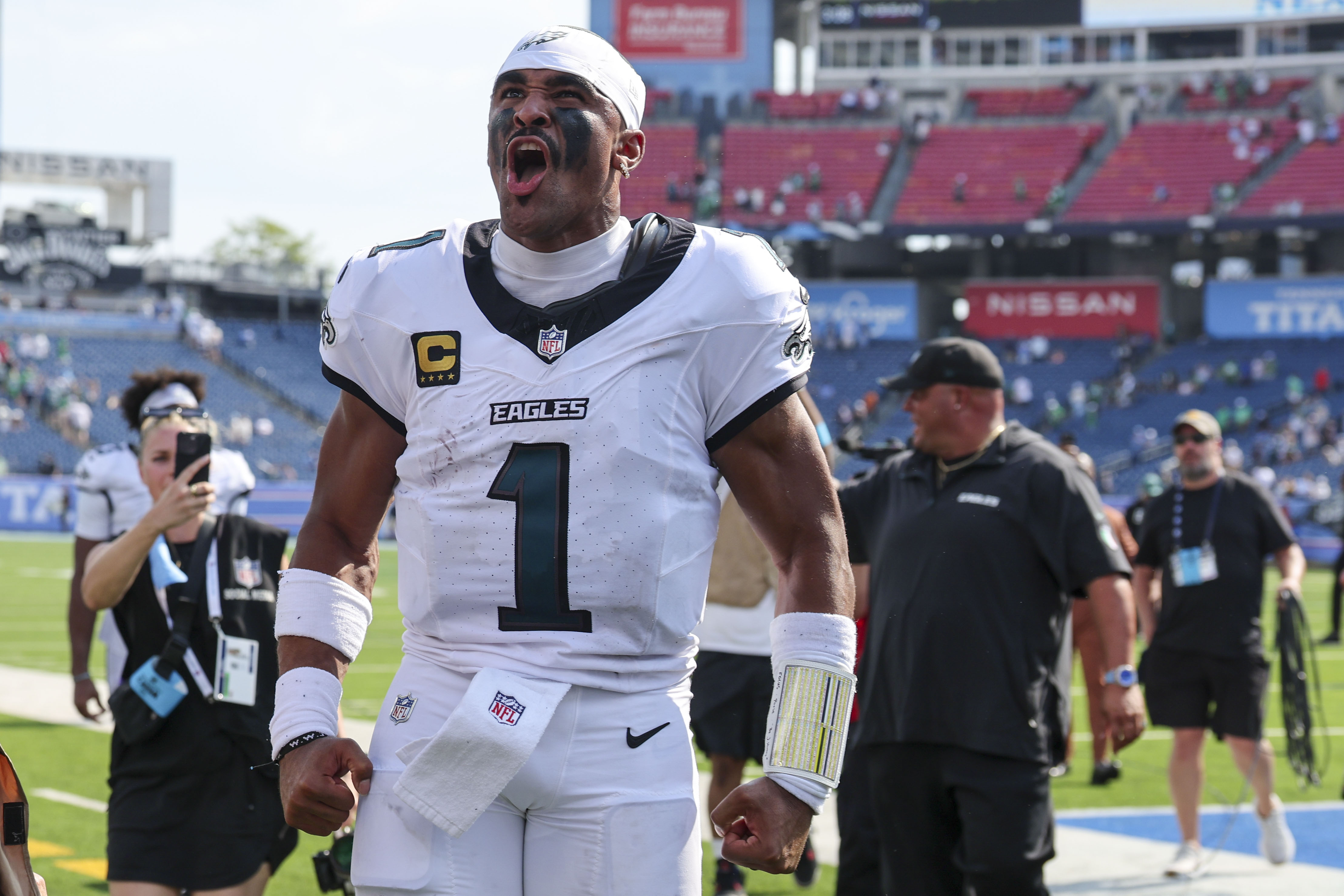
Jalen Hurts celebrates after beating the Titans on Sunday.David Maialetti / Staff Photographer
The guy is fabulous. All he does is win games. Whatever it takes. Get off his case. — Bill M.
One of the writers gave Jalen a B+, but I think I would give him an A- for such an amazing comeback from throwing the two interceptions. Playing against a team they were supposed to crush, they suddenly found themselves down and being seriously outplayed. Considering the struggling offensive line and being without his All-Pro running back Hurts did a remarkable job passing, running, and leading, and that spectacular game winning TD at the end was awesome. — Everett S.
I’m totally biased because I think he’s the hottest men alive but I thought he was great. The look on his face when they scored the last touchdown was priceless. It said, “oh yeah. We did that. That’s how it’s done.” Yes, he threw 2 interceptions and got sacked a couple times but look at that winning drive! I’m telling you, he does the just enough to win and that makes every game very exciting. — Cathy J.
Do I not understand, but doesn’t Hurts seem to do better staying in the pocket more, instead of running around the backfield field in jeopardy of getting sacked!!!!!!! Look what he accomplished in the last seconds of the game! He was fantastic, so why wasn’t the play calling like that the entire game!??? But what does an old lady know? — Susan B.
We compiled today’s newsletter using reporting from Marcus Hayes, Olivia Reiner, Jeff McLane, Jeff Neiburg, Lochlahn March, Ariel Simpson, Gustav Elvin, Jackie Spiegel, and Rob Tornoe.
By submitting your written, visual, and/or audio contributions, you agree to The Inquirer’s Terms of Use, including the grant of rights in Section 10.
That’s it for me this week. Thanks for reading, enjoy the cooler temps, and we’ll be back in your inbox tomorrow. — Bella
After another high-wire financial rescue from the state, SEPTA leaders are determined to flip their script in the transit funding debate from warning of calamity to showing what the system could be with more investment.
“I wanted to get away from the doom and gloom message,” SEPTA general manager Scott A. Sauer told The Inquirer.
The transit system has been chronically underfunded, but “we never pivoted to ‘Imagine what we could be if we got more than just enough,’” Sauer said.
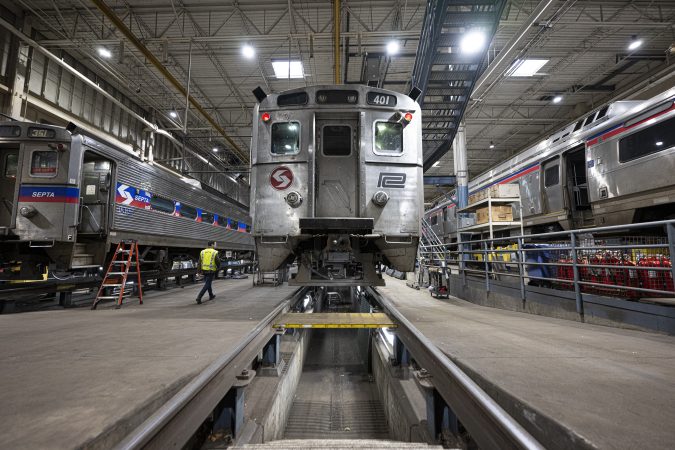
And so on Tuesday, SEPTA is putting out “Accelerate,” its strategic vision for the next decade with investments in a new trolley fleet with stations instead of corner stops, new subway cars for the El, and a reimagined Regional Rail service with more frequent service on critical lines, many in the city.
When those and other, smaller changes are in place, SEPTA says two million people in the region will be within a quarter mile of frequent transit service — up from 900,000 today — and 100% of all trips will go through an accessible station. Today only about 60% of rail and subway stations are accessible.
It’s an ambitious goal, and that’s deliberate, Sauer said.
“You can inspire people to action when you show them what they could get for their investment,” he said.
The idea for a message shift developed as SEPTA representatives and supporters advocated for more state funding last year and lawmakers said that they didn’t have a concrete picture of what SEPTA wants to be and what that would take.
Instead of a demand, the report is framed as a menu of choices for legislators, local officials, business leaders, and the public.
SEPTA projects a structural operating deficit of $192 million in the coming fiscal year. If the state meets that, current levels of service would be preserved along with some improvements.
Beyond that — including a plan to reorganize Regional Rail so trains run every 15 minutes on lines in the city and some suburbs — would require more funding. As would making 50 old stations ADA accessible.
“If you ask me how much do you need, I would say I need enough to do what the people want us to do,” Sauer said.
Last year, Harrisburg lawmakers and the Shapiro administration failed for the third straight year to agree on a steady source of new state funding for SEPTA and other transit agencies.
The transit agency also says it has found about $30 million in annual savings, as well as increased income from advertising, parking, and real estate, and a spike in ridership during a busy summer of big events.
Sauer said SEPTA needs to chip away at changes right away, using what’s at hand, rather than waiting to accomplish a big project in a decade.
“We can’t have everything all at once, so we are trying to move methodically,” he said. “We have to show people continual improvement.”
HERSHEY — You can put Game 1 of the preseason in the books.
The Flyers, fielding a lineup missing most of the regulars, lost 5-2 to a Washington Capitals team stacked with NHLers.
But the score wasn’t the focus for coach Rick Tocchet. He was more concerned that certain concepts, like protecting the middle and the weak side, were not achieved. The bench boss also thought that his group was making tired mistakes as the game wore on. However, a couple of guys did catch his eye.
Here are four takeaways from the Flyers’ preseason lid-lifter .
Denver Barkey left the game roughly 15 seconds into the second period and did not return due to a lower-body injury.
Barkey, who was centering the top line between Zach Aston-Reese and Porter Martone, looked like he tried to generate speed after swinging low in the Flyers’ zone but pulled up once he hit the neutral zone. He went to the bench and later went down the tunnel.
The injury appeared to happen in the first period. With 4 minutes, 38 seconds left, Barkey won a defensive zone face-off and got the puck back on a pass by defenseman Helge Grans off the glass. The 5-foot-10, 171-pound forward, carried the puck up the ice, heading down the right side into the Capitals zone where Washington defenseman Martin Fehérváry, who is 6-2, 215 pounds, crushed him into the boards.
Barkey got up and seemed unfazed, but as he tried to take a few steps, it was apparent he was having issues. He quickly went to the bench but returned later in the period. With around 70 seconds left in the first, he got on the ice but was off 20 seconds later, as it was clear he pulled up by the bench.
Tocchet did not have an update after the game.
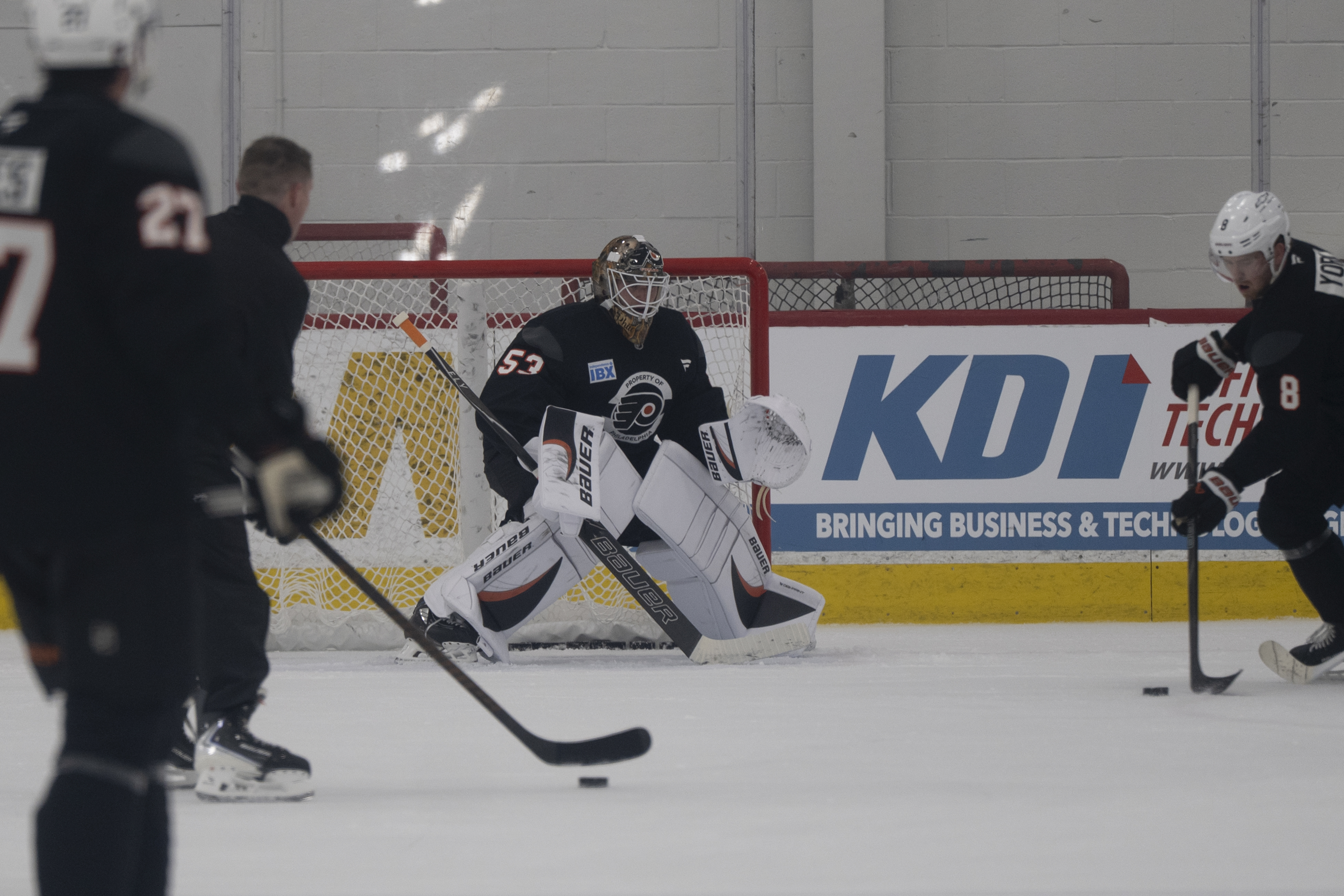
Joseph Woll (center) looked solid in his first action with the Flyers on Monday night.Jose F. Moreno / Staff Photographer
Woll was solid
Acquired in a trade alongside defenseman Simon Benoit in June, goaltender Joseph Woll comes to the Flyers with a career 2.94 goals-against average, .906 save percentage, and 63 wins in 117 games, all with the Toronto Maple Leafs. The expectation is he will be an upgrade as the backup to goalie Dan Vladař, and if his play on Monday is any indication, that should be the case.
Woll played the first two periods and allowed three goals on 19 shots — the first goal popped off his glove and rolled down his back before Capitals forward Aliaksei Protas scored on a two-man advantage; the second goal looked like Woll was screened; and the third came on a bad line change — but his saves, reads, and timing stood out.
Less than 30 seconds into the game, Woll stopped Washington’s Ethen Frank, who got past Benoit, with a stretching right-toe save on Ryan Leonard as he crashed down the left side.
Later in the period, during a five-on-three, Woll stoned Protas off a cross-crease pass at the backdoor, before robbing Leonard point-blank in the slot. In the second period, he stopped Theodor Niederbach on a short-handed breakaway.
“I think my skating, my athletic ability is definitely something I’m trying to prioritize and really use when I’m able to. I’ve talked about it, after the summer [it] is really my goal to balance the two between the technical part of the game and the athletic kind of instinctual part,” he said.
“So felt like I had a couple nice saves showing that part and a few things I can work on as well. So I think that’s the goal, when you come out of a game, is feel good, feel like you’ve made some good saves, [and] at the same time, feel like you have stuff to take you forward.”
Defense competition
Several blueliners who are in contention for the sixth and seventh spots with the Flyers were in the lineup in Hershey. Benoit, the veteran of the group, was paired with David Jiříček, Oliver Bonk with Hunter McDonald, and Ty Murchison with Grans. While Bonk had an assist and McDonald and Murchison brought the physicality — on one play, McDonald drilled Leonard cleanly and then was nailed in the face by Andrew Cristall, who was given a five-minute major — none of the defensemen separated themselves.
“There’s some good stuff, and there’s some stuff they’ve got to clean up,” Tocchet said. “Just things under pressure. Don’t get yourself boxed in. Sometimes Washington, they have three or four guys back; I think the D got to skate with it. A lot of times we were passing it instead of skating with it. Those are things that, as camp goes on, you’ll start to get used to.”
David Jiříček is competing for a defenseman spot on the Flyers’ roster during the preseason.Elizabeth Robertson / Staff Photographer
The expectation is that the veteran Benoit and Jiříček, who is no longer waiver-exempt, will make the Flyers roster out of camp. Jiříček had an up-and-down game as he was on the ice for two goals against, but showed what he can bring on the Flyers’ power play.
During the Flyers’ five-minute man advantage — they did not score across the power play — Jiříček fired off a low screaming one-timer on goal that handcuffed goalie Clay Stevenson, who came in halfway through the game. Seconds later, he turned it over at the blue line, allowing that Niederbach breakaway chance.
“A couple times there, I think he was overpassing, but yeah, like when he’s in the middle of the ice, unless somebody’s wide-open in front, I want him to fire it, and that’s the sort of stuff we want for him,” Tocchet said of the young Czech defenseman.
Did any forwards stand out?
Up front, the Flyers fielded some youth mixed with veteran players hoping to crack the roster.
Jack Studnicka, who played under Tocchet in Vancouver, had a power-play goal and was active and noticeable all night as he led the Flyers with five shots on goal; Noah Powell threw the body early, knocking down Washington’s Dylan McIlrath, who went back at him later on the shift, leading to Garrett Wilson coming to Powell’s defense and dropping the gloves. Jett Luchanko was flying as usual, especially in the neutral zone, and got a chance to slot in between Alex Bump and Martone when Barkey went down.
But the biggest standout was Cole Knuble. In his first NHL preseason game — he turned pro in March after finishing his junior year at Notre Dame — the son of former Flyers forward Mike Knuble showcased his high motor all night.
“I was a little nervous before puck drop for sure, to be honest,” Knuble said. “But just [thought] about like three things: work or compete, make plays, and skate. So I feel like if my legs are moving, I’m at my best and just try to keep my feet moving and have some energy out there.”
The younger Knuble consistently pressured the Capitals’ defense, sometimes creating turnovers. It’s something he worked on at college “because I know at the pro game, you’ve got to be able to do that if you want to play, and you can make a big impact and get in the lineup because of that. So that’s a focus every game for sure.”
Knuble tied the game at 2-2 in the second when he redirected a point shot by Bonk originally deflected by Ilya Protas’ stick. But his work at the start of the play showed what the 5-10 forward can bring to a lineup. Knuble picked up the puck in the neutral zone, carried it into the offensive end, and although he lost control, he stayed with it, outmuscling Protas for the puck.
The Michigan native passed the puck up to McDonald, and as the defenseman went D-to-D, he crashed the net for the goal. Knuble also had an assist on Studnicka’s power-play goal.
“Well, I kind of liked him last year. I was new here, like everybody else, I didn’t know a lot of these people, and [he] kind of caught my eye,” Tocchet said. “Just his hockey IQ, the way he can skate.”
Breakaways
As planned, goalie Carson Bjarnason entered the game to start the third period and made six saves on eight shots.
Up next
The Flyers get right back to action with a preseason game in Boston on Tuesday against the Bruins (7 p.m., NBCSP).
It should come as no surprise that 76ers tickets will be significantly more expensive this season after the massive additions of LeBron James and Jaylen Brown.
But last Thursday’s single-game ticket drop and the earlier presale for season-ticket holders still caused a bit of sticker shock for fans.
Single-game ticket prices started at $75 before fees for upper-deck seating, which bumped the final tally up to $88 with fees.
However, that base-level price was only available for six of the Sixers’ 41 home games at point-of-sale. Those include games against the Bulls (Nov. 2), Raptors (Nov. 12), Grizzlies (Dec. 1), Wizards (Jan. 12), Clippers (Jan. 25), and Hawks (April 4).
For marquee games, including games against the Knicks and the home opener against Cleveland on Oct. 22, primary ticket prices started at $320.
For years, the Sixers searched for a solution to Knicks fans taking over Xfinity Mobile Arena. In the playoffs in 2024 and 2026, everyone from Joel Embiid to Sixers ownership to Fanatics owner Michael Rubin pitched in to fill the arena with Sixers fans, to no avail.
At Madison Square Garden, faced with similar fan complaints of price gouging (opening-night Knicks vs. Sixers tickets were running fans upward of $1,000 just to get in the building), Knicks ownership paused single-game ticket sales, apologized, and said that “mistakes” had been made in pricing the tickets.
“We are rolling back to last year’s prices plus an average increase of 12 percent,” the team said in a release.
Knicks just sent a release recognizing they made a mistake on their ticket pricing this week and "will restart sales with new prices shortly." Anyone who already purchased tickets will be refunded the difference. "Our intention was never to overcharge our loyal fans." pic.twitter.com/YLLl53XmoT
Sixers tickets are still well below that threshold. Even on the secondary market, tickets for marquee games like the home opener vs. the Cavs and home games against the Knicks start at approximately $359.
After the Sixers’ disastrous 2024-25 season, when Embiid, Paul George, and Tyrese Maxey suffered season-ending injuries and the team won 24 games, the Sixers offered season-ticket holders the opportunity to extend for two seasons at the same price.
That means ticket holders who chose to renew are still paying the same rate from two seasons ago to watch a team now featuring James and Brown.
Currently, season-ticket holders cannot sell or transfer their tickets through the member portal on Ticketmaster, so secondary-market prices could drop further as more inventory becomes available. But others already are listing tickets on platforms like StubHub, with plans to transfer later.
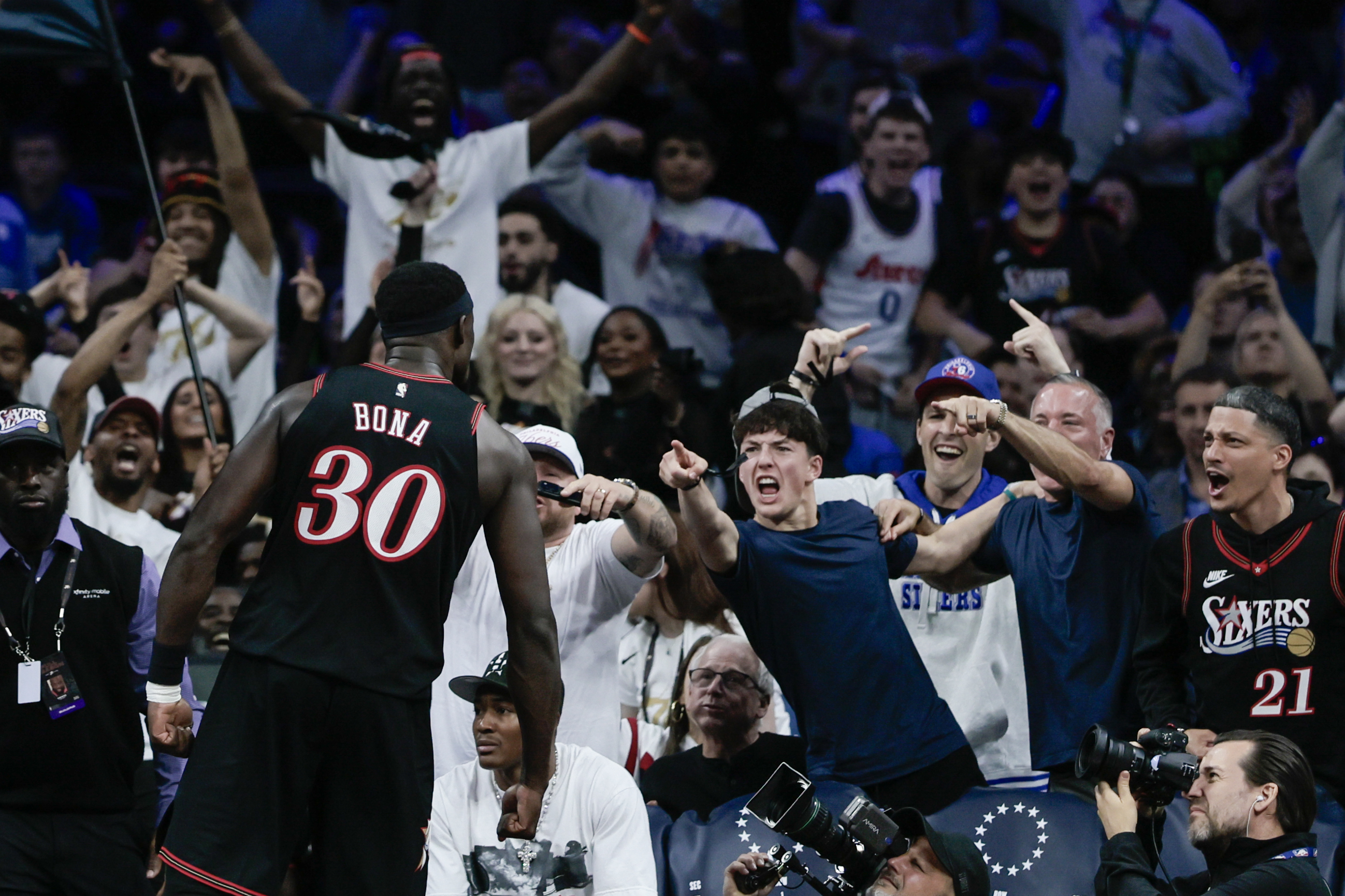
Adem Bona hypes up the fans after during Game 3 of the Sixers’ first-round series against Boston in April.Elizabeth Robertson / Staff Photographer
Resale policies changed over the summer. Before the Sixers signed James, full season-ticket holders could sell up to 10 games without facing a penalty. Since James’ signing, a contract sent to The Inquirer showed that number has dropped to seven games, and season-ticket holders already are reporting that the Sixers are sending notices to fans who have been identified as potential brokers that their tickets could be revoked.
During a season of high expectations and increased fan interest, full and partial season-ticket prices also have risen dramatically, even since the beginning of the summer. One season-ticket holder who invested after the Sixers traded for Brown, but before they signed James, secured a lower-level package for approximately $250 per ticket per game. Single-game tickets in a similar location are running upward of $1,000 for marquee games at face value.
“I think ultimately, this will be good for the city and for the Sixers,” comedian and Sixers fan Samantha Ruddy said. “… There will be more passion in the stands than last season, but I’ll miss getting to have a night out at an NBA game for a bargain with my buds.”
Ticket availability, especially in the more expensive lower-bowl sections, already is limited after just days of single-game tickets being on sale. The Sixers open training camp on Sept. 29 before beginning the season on the road at the Knicks on Oct. 20.
More than a year and a half into President Donald Trump’s second term, U.S. Rep. Brian Fitzpatrick has voted against the White House and the GOP more than any other House Republican.
Yet, he has still voted with the president and his party nearly 70%and 77%of the time, respectively, during this congressional term, according to a new Inquirer analysis.
Fitzpatrick’s nuanced voting record has become a focal point of Democrats’ campaign against the five-term GOP incumbent from purple Bucks County this fall.
HisDemocratic challenger, Bob Harvie, argues that Fitzpatrick has been a “rubber stamp” for Trump’s policies and the GOP establishment when it matters most. Meanwhile, Fitzpatrick continues to tout his moderate, bipartisan brand that has proved successful in elections past.
Both of those assertions will be tested in front of voters this November as Fitzpatrick defends his swing district seat in a heated race in the 1st Congressional District, which includes all of Bucks County and a sliver of Montgomery County. Trump narrowly lost the district in 2024, despite winning Bucks County.
Fitzpatrick is voting with the president and his party less frequently during the current Congress, which began last year, than he did during the two years of Trump’s first term, when the GOP also held the majority, The Inquirer found in a comprehensive analysis of the Bucks County lawmaker’s 5,064 roll-call votes since he joined Congress nearly a decade ago.
(function () {window.addEventListener(‘message’, function (e) { var message = e.data; var els = document.querySelectorAll(‘iframe[src*=”‘ + message.id + ‘”]’); els.forEach(function(el) { el.style.height = message.height + ‘px’; }); }, false); })();
The data underscore how Fitzpatrick, the last remaining GOP U.S. representative in the Philadelphia suburbs, is able to simultaneously straddle party lines and talk about his disdain for the two-party system while also serving as a key vote in the Republican conference— a cocktail of qualities that has made him difficult to unseat in years past.
This year, Democrats are hoping that a focus on affordability issues amid a national environment that has become increasingly unfavorable to Republicans will be what it takes to unseat Fitzpatrick.
U.S. Rep. Brian Fitzpatrick (R-Pa.) makes remarks in support the grand opening of the new headquarters and expanded financial stability center for United Way Thursday, Sept. 10, 2026 at United Way of Bucks County Headquarters in Levittown.William Thomas Cain / For The Inquirer
When Fitzpatrick does — and doesn’t — back Trump
Trump and the Bucks County Republican have had their fair share of tense moments, including the president threatening the lawmaker in May for voting against him.
Fitzpatrick has continued tovote against the president recently, including on a war powers resolution torestrict Trump’s military actions in Iran.
“[Fitzpatrick’s] bosses are his constituents back home,” Heather Roberts, a spokesperson for the Fitzpatrick campaign, said in a statement. “Political party retaliation has zero impact on his decision-making.”
Since January 2025, Fitzpatrick has voted with the Trump administration’s 133 stated positions on congressional votes 93 times, according to the analysis.
(function () {window.addEventListener(‘message’, function (e) { var message = e.data; var els = document.querySelectorAll(‘iframe[src*=”‘ + message.id + ‘”]’); els.forEach(function(el) { el.style.height = message.height + ‘px’; }); }, false); })();
Fitzpatrick voted with Trump on several high-profile GOP bills, including the SAVE Act, a controversial overhaul of voting laws, and the Laken Riley Act, legislation also supported by some Democrats that requires federal authorities to detain undocumented immigrants arrested for theft-related crimes, issues that Roberts maintained 1st District voters of both parties support.
Fitzpatrick’s votes have also aligned with the White House on other legislation related to immigration, law enforcement, energy, and renaming the Gulf of Mexico the “Gulf of America.”
At the same time, no other House Republican has been less loyal to the president in this time frame. That includes every GOP member from Pennsylvania, many of whom are staunch supporters of Trump. Republicans like U.S. Reps. Ryan Mackenzie, Rob Bresnahan, and Scott Perry, who are defending their seats in contentious swing-district races, vote with Trump more than 90% of the time.
Both Mackenzie and Bresnahan spoke at Trump’s Republican midterm convention in Dallas this month, but Fitzpatrick — the only GOP member of Congress from Pennsylvania not endorsed by Trump — did not attend.
(function(){function e(){window.addEventListener(`message`,function(e){if(e.data[`datawrapper-height`]!==void 0){var t=document.querySelectorAll(`iframe`);for(var n in e.data[`datawrapper-height`])for(var r=0,i;i=t[r];r++)if(i.contentWindow===e.source){var a=e.data[`datawrapper-height`][n]+`px`;i.style.height=a}}})}e()})();
The final bill had enough GOP support — 218 members voted yes — to pass without Fitzpatrick’s vote.
Harvie, Fitzpatrick’s Democratic challenger, contended that Fitzpatrick “has mastered the art of the meaningless gesture and breaks with Trump only when he gives him a hall pass.”
“[Voters] want somebody who’s going to go there and fight for them,” Harvie said. “And, you know, people’s lives aren’t better than they were 10 years ago. And Brian Fitzpatrick and Donald Trump are the big reasons why.”
Roberts said Harvie’s criticism is “absurd” and has been “debunked many times over and in every single election cycle.” She also criticized Harvie’s voting record and said he has not exercised similar levels of independence during his time as Bucks County commissioner and Falls Township supervisor.
Back in Trump’s first term in office, Fitzpatrick sided with the White House on 59% of votes — 81% of the time in 2017-18, but dropping to almost 42% in the following two years, after Democrats gained control of the U.S. House in the 2018 midterms.
Fitzpatrick voted with his party roughly 60% of the time during both the 117th and 118th Congresses, when Biden was in office and the GOP had the majority for the latter two years of his term.
The lawmaker played a key role in getting Biden’s signature bipartisan infrastructure law passed, drawing sharp attacks from fellow Republicans when he was one of 13 GOP members to support it in the House.
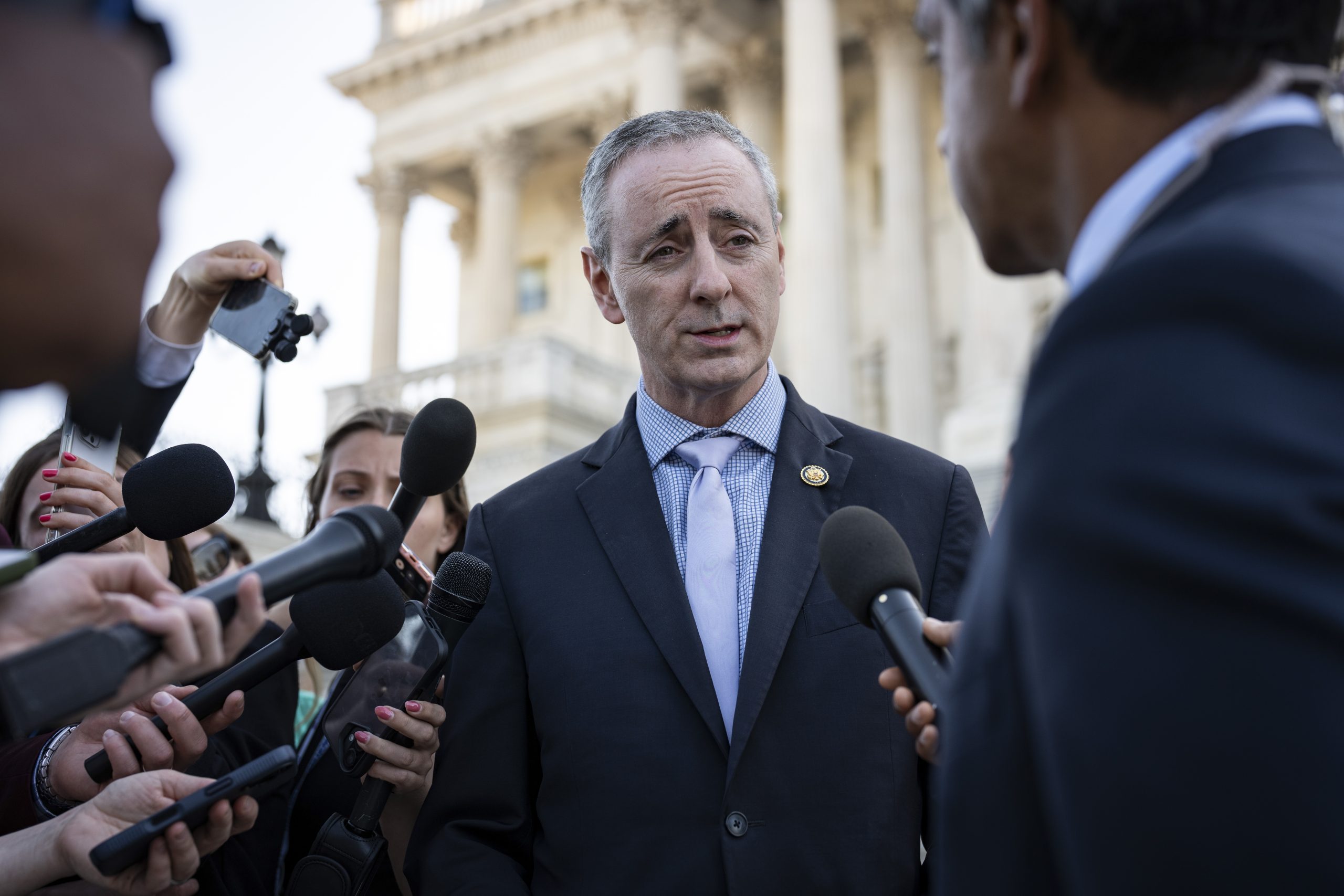
Rep. Brian Fitzpatrick (R-Pa.) speaks to reporters after the House passed an Iran war powers resolution on Capitol Hill in Washington, on Wednesday, June 3, 2026. Haiyun Jiang
What about the GOP?
Fitzpatrick’s alignment with the House Republican Conference has fluctuated depending on which party is in power.
During this Congress, when the GOP holds a narrowmajority in the U.S. House, Fitzpatrick has voted with his party 77% of the time, meaning he has split from Republicans 107 times on 472 party unity votes, defined by CQ Roll Call as instances when a majority of voting Republicans oppose a majority of voting Democrats.
That figure is the highest of his career, the analysis shows, though still far below the median of Republicans. It was a similar story during Fitzpatrick’s first term during the 115th Congress in 2017-18, when Trump was in office and Republicans had the House.
By contrast, Fitzpatrick was the least loyal to his party during the 116th Congress in 2019-20 — at 55% — when Trump was still in office, but the GOP did not have the gavel.
A congressional lawmaker’s votes are dependent on which bills make it to the floor. Currently, that is up to House Speaker Mike Johnson, a Louisiana Republican, whom Fitzpatrick has criticized for his reluctance to bring some bipartisan bills for a vote if Trump opposes them.
Fitzpatrick has introduced 249 bills as lead sponsor, and just under half — 123 — have a bipartisan group of cosponsors.
“The numbers and percentages will change from year to year based entirely on what votes are put on the House Floor,” Roberts said in her statement. “The best measure of independence is how often, and on which issues, does one vote against their own political party, regardless of who the President is and regardless of who the Speaker is.”
(function(){function e(){window.addEventListener(`message`,function(e){if(e.data[`datawrapper-height`]!==void 0){var t=document.querySelectorAll(`iframe`);for(var n in e.data[`datawrapper-height`])for(var r=0,i;i=t[r];r++)if(i.contentWindow===e.source){var a=e.data[`datawrapper-height`][n]+`px`;i.style.height=a}}})}e()})();
Jim Worthington, a major GOP donor in Bucks and owner of the Newtown Athletic Club, said Fitzpatrick’s record is representative of the purple county, home to a plethora of split-ticket voters, and shows that he is able to go against power structures in Washington.
“When you have someone who’s willing to stand up to the power of the majority and take a stand, that’s the type of guy you want,” Worthington said. “It’s pretty lonely when there’s 216 other people in your party voting for something, and you’re voting no. It takes guts, and that’s what he’s doing.”
Over the course of his time in Congress, Fitzpatrick has defected from his fellow House Republicans on votes related to economic and public finance issues, but has agreed with his caucus most on legislation connected to international affairs.
Of the 10 closest votes in which Fitzpatrick diverged from the GOP this year, three were decisive votes that blocked GOP amendments to bills.
Two others were votes in which he supported Democratic motions that fell just short of passing.
Fitzpatrick also joined Democrats in voting against fiveGOP amendments to bills thatpassed by one vote.
US Rep Brian Fitzpatrick speaks during the Garden of Reflection remembrance ceremonies Friday, Sept. 11, 2026 at Garden of Reflection in Yardley, Pennsylvania. The Garden of Reflection is Pennsylvania’s official state memorial honoring all 2,973 victims of the September 11 terrorist attacks, with a special tribute to 18 local residents from Bucks County, Pennsylvania.William Thomas Cain / For The Inquirer
What does this mean for the midterms?
At the U.S. Capitol on Wednesday, Fitzpatrick stood alongside members of the bipartisan Problem Solvers Caucus that he cochairs, condemning the redistricting wars both parties have engaged in and unveiling legislation to prevent a similar situation in the future.
He said in an interview that both Trump and Democrats were “wrong” to kick-start a gerrymandering spree.
“There are so many forces pulling us away from the center, when most Americans are in the center,” he said.
Fitzpatrick has been working to run on that centrist message back at home — even as he wages an aggressive ad campaign against Harvie.
But will his brand and well-fundraised campaign help him in a disadvantageous national political environment for Republicans this year?
Brittany Crampsie, a Democratic consultant in Pennsylvania, said 1st District voters should consider whether they, too, agree with Trump a majority of the time, noting that Fitzpatrick creates an “illusion” that he is independent from the president or his party.
“[Fitzpatrick] doesn’t have enough to celebrate, and voters don’t want to see him pat himself on the back for only supporting this administration 75% of the time,” Crampsie said.
She said that Fitzpatrick’s voting record will not help him survive a blue wave this time around because the issues facing the country, such as the cost of living, are too dire amid what she calls a “change election.” Crampsie said Harvie should continue to focus his campaign on both Fitzpatrick’s record and kitchen-table issues.
“Making a campaign all about opposition to Trump, we’ve seen, is not successful,” Crampsie said. “Voters want a new vision. They want a new platform. They want new ideas, and that’s what Bob Harvie is offering.”
Worthington, the GOP donor, predicted that Fitzpatrick will once again be victorious this year, noting the lawmaker’s massive coalition of labor support,which would typically go to a Democratic candidate, and voters’ desire for a moderate candidate.
“He’s a free, independent thinker. At the end of the day, he tries to do what’s right for everybody, for the majority of people,” Worthington said.
“That’s the problem — there’s too many extremes. You’re either one side or the other. It shouldn’t be like that.”
Staff writer Sam Janesch contributed to this article.
When Buddy Osborne’s phone rings, it’s because something has gone wrong. An accident. A death. A traumatic event on a job site. This past April, it was a catastrophic collapse. A parking garage had fallen, and three construction workers were dead.
Osborne, 67, the chaplain for the Philadelphia Building and Construction Trades Council, arrived at the scene to find an ironworker being interviewed by investigators from the Occupational Safety and Health Administration. The man had witnessed the collapse. The workers who died had been part of his crew. Osborne did not know him. They had never met. But as a chaplain, Osborne was there to help the workers who witnessed the traumatic event. His job, as he put it, was to “render support to workers in distress.”
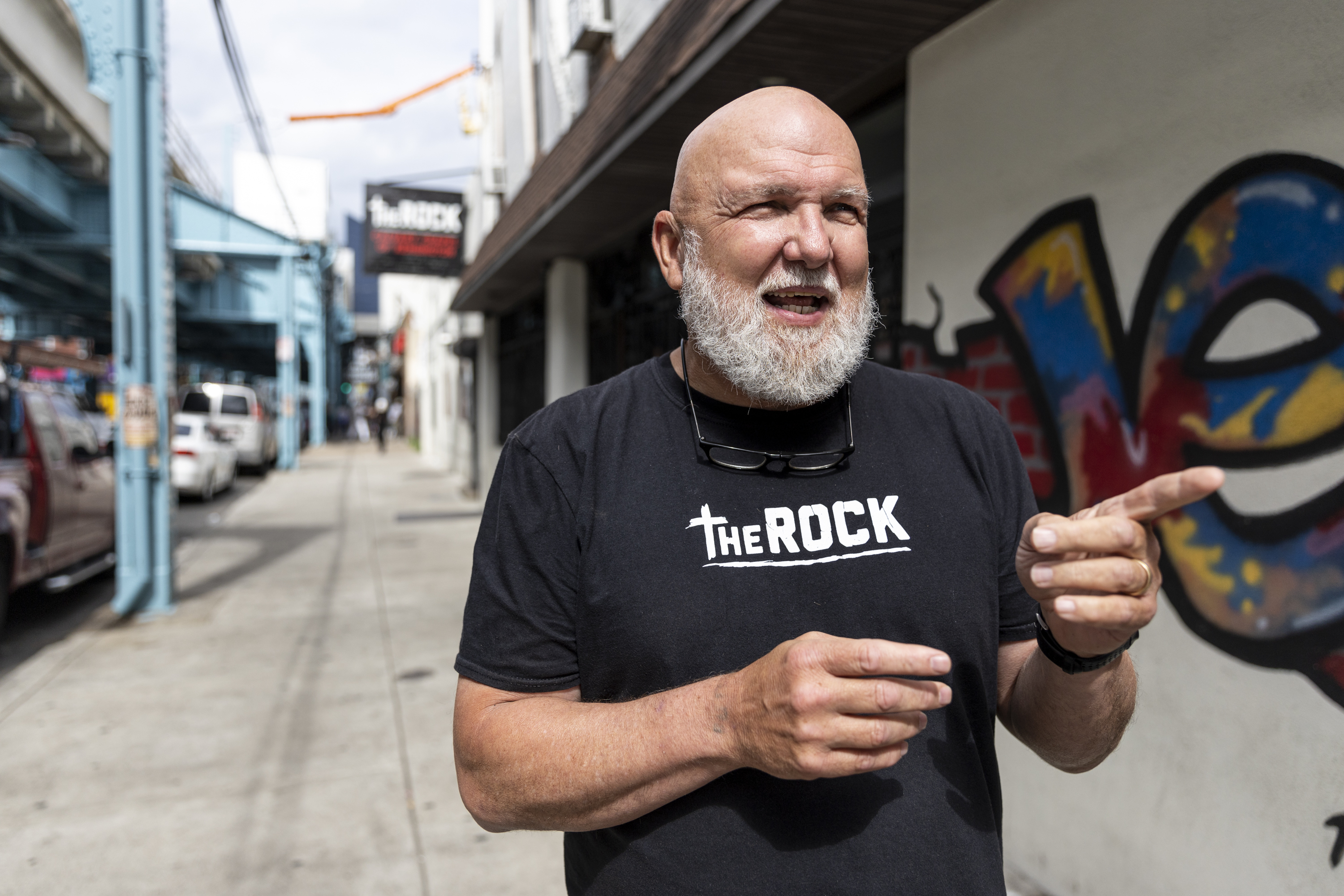
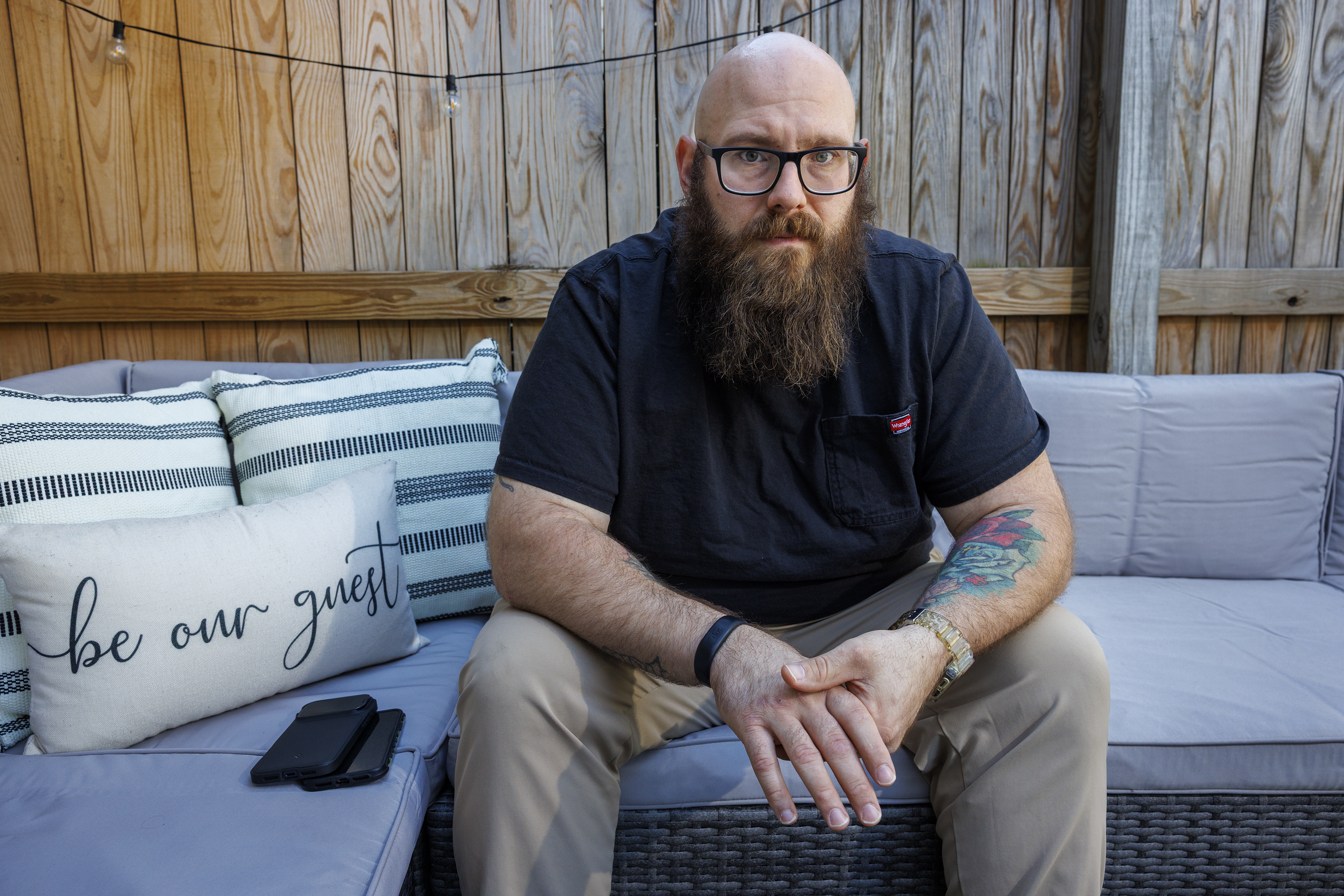
In addition to being a pastor at the Rock Ministry, Buddy Osborne is the chaplain for the Philadelphia Building Trades Council and a former Tyger Williams / Staff Photographer
He waited until the interview ended. Then he walked over, introduced himself, and placed a hand on the worker’s shoulder. “He’s a tough guy,” Osborne said, “but he just broke down.” Osborne hugged the worker as he wept. By the time he pulled away, his shirt was wet with the man’s tears.
The ironworker Osborne comforted was part of a workforce that is deeply woven into Philadelphia’s civic identity. Roughly 121,000 people across the Philadelphia metropolitan area work in construction, following a decade of steady growth. The Philadelphia Building and Construction Trades Council alone represents more than 50 local unions. Politicians court their support. The city celebrates the buildings, roads, and public projects they construct. But behind that civic pride is a workforce in profound distress.
Construction has one of the highest suicide rates of any major industry in the country, according to the Centers for Disease Control and Prevention. More than 5,000 construction workers die by suicide each year, roughly five times the number who die from fatal worksite injuries, and male construction workers are 75% more likely to die by suicide than the general population. Construction workers also die from drug overdoses at a higher rate than workers in any other industry.
Those numbers have set off an urgent effort in Philadelphia to confront the mental health crisis roiling the construction industry. Osborne is but one small part of it. An entire alphabet of organizations, from ATAP, the Allied Trades Assistance Program, and CIASP, the Construction Industry Alliance for Suicide Prevention, to CWC, Carpenters Who Care, and MACSC, the Mid-Atlantic Construction Safety Council, now offer expanded access to mental healthcare and substance use treatment.
There are peer-support networks and suicide prevention training programs. On job sites, there are daily stand-downs and toolbox talks devoted to mental health awareness. There is a Construction Suicide Prevention Week every September, and this past May, for the first time, 50 workers gathered in the Wissahickon for the Greater Philadelphia Construction Hike for Hope, sponsored by the American Foundation for Suicide Prevention.
All of this is to say: Everybody cares. All eyes are on the issue.
As Johnathan Davis, a professor at the University of Iowa’s College of Public Health, put it: “The construction industry has had a phenomenal response to this problem, and the awareness, the destigmatization, and the support programs are important parts of that response.” Indeed, it has never been easier for a construction worker in distress to get help.
Yet the crisis of the distressed construction worker persists, in part because, according to interviews with dozens of workers, the industry itself produces the suffering. And, so far, it has done more to treat it than to prevent it. The focus now, Davis said, needs to be on “upstream solutions.” So, not only helping workers once they hit their breaking points, but also addressing the conditions that bring them there in the first place.
Union workers watch as demolition continues in Grays Ferry on Sunday, April 12, 2026, at the site of the parking garage collapse.Tom Gralish / Staff Photographer
The same day Osborne, who lives in Kensington, was at the parking garage, Marianne Wolfe was meeting with the workers in their union halls.
Wolfe is the managed care supervisor for ATAP, an employee assistance program that provides mental health and substance use services for organized labor. After a tragedy like the parking garage collapse, part of her job is to lead workers through critical incident stress debriefing, a structured, therapist-led conversation meant to help people process the trauma they have just experienced.
In this case, that meant sitting with workers who had witnessed the collapse and were still trying to make sense of it.
“They were just trying to wrap their heads around what took place,” Wolfe said. “Survivor’s guilt. It was a ‘Why wasn’t it me?’ type of thing.”
Trauma, Wolfe said, “is a very tricky thing.” It does not always arrive when expected. It can surface weeks or years later. That is why she expected ATAP to keep receiving calls about the collapse for at least several months. If so, those calls will come into an office that is already busy.
“We’re a high-volume call center,” Wolfe said.
Scaffold workers work on a building on North Broad street in Philadelphia Pa.Jose F. Moreno / Staff Photographer
Workers reach out to ATAP when they need help and don’t know where to turn. They call ATAP’s 24-hour emergency hotline when they are desperate, sometimes actively suicidal, and an ATAP employee quickly connects them to the right level of support, whether that is outpatient counseling, substance use treatment, or immediate inpatient care.
For years, Wolfe said, most of the calls coming into ATAP were about substance use that was exacerbated, in part, by wear and tear from demanding physical labor.
“We were still in the opioid epidemic,” she said. “Now we are in what we’re calling a mental health epidemic.” She attributed the shift to years of education and anti-stigma work that made it easier for workers to ask for help.
Some workers call because they are anxious. Some call to discuss family or work-life balance issues. Sometimes they call because they cannot sleep. Their reasons run the gamut, but they all lead back to a simple truth: “Being a construction worker isn’t an easy job,” Wolfe said.
Layoffs and financial instability are par for the course. The hours are grueling. Some work seven days a week. There is hardly any time to see family. Left unaddressed, those pressures can pile up until a worker feels helpless, or hopeless, or, in Anthony Zecca’s case, both.
A nonprofit called ATAP helped Anthony Zecca get a psychiatrist and helped find treatment and services for his son, Salvatore, who has autism.William Thomas Cain / For The Inquirer
“I’ll be honest with you,” Zecca, who lives in Fairless Hills, said in April. “I didn’t want to live anymore.”
He was describing how low things had gotten the previous December. His marriage was on the brink of collapse. His father-in-law had warned him that if he couldn’t get his temper under control, he was going to lose his family. He had been having anger issues ever since he got out of prison in 2023, after serving four years for possession of a firearm. “I had a very hard time adjusting,” he said.
At Christmas, Zecca got so angry that he kicked over the tree and broke his toe. He had to get surgery and could not work for six weeks. But the real wake-up call was his daughter’s reaction that night.
“I saw how terrified she was of me, and I just broke down in tears,” he said. “I couldn’t do it anymore.”
Zecca, 41, called ATAP the next day and spoke to Wolfe. “I told her I’m having a lot of problems at home,” he recalled. “I said I’m really depressed. I’m not doing good.”
Wolfe got to work on Zecca’s behalf immediately. She got him into anger management and found him a therapist and a psychiatrist, whom he now sees every month. She helped his 8-year-old son who has autism, too, by connecting him with a behavioral psychologist. Zecca ended up calling ATAP so frequently that Wolfe gave him her personal cell phone number.
Anthony Zecca (CQ) and his son Salvatore Zecca (CQ), 8, pose for a photograph in their yard Friday, May 08, 2026 at private residence in Fairless Hills, Pennsylvania. A nonprofit called ATAP helped get him a psychiatrist and helped find treatment and services for his son, Salvatore, who has autism.William Thomas Cain / For The Inquirer
Life has been much better for Zecca ever since he reached out to ATAP. He and his wife still fight sometimes, mostly about his hours. He is away from 4 a.m. until 7 p.m. every day. But they have not had any major blowouts since Christmas. His psychiatrist put him on Wellbutrin, which Zecca says helps with both his depression and his ADHD. He uses his therapy sessions to work through the different stressors in his life.
Zecca still has many sleepless nights and considers himself an “anxiety-ridden person.” And the construction industry remains his biggest stressor. He wakes up every day worried he will be laid off and out of work for the next month. “It really wears on me,” he said.
Unable to make peace with the industry’s uncertainty, Zecca is trying to change his circumstances.
“I just want a steady job where I don’t have to worry about being laid off,” he said. He is tired of the stress on the job, the demanding timelines, and the endless hours. He is hardly alone.
John Sobetsky of Royersford at his home on Tuesday, May 12, 2026. John has been dealing with depression over the years and is a major advocate of mental health treatment in the construction industry.Alejandro A. Alvarez / Staff Photographer
John Sobetsky, 35, was among the workers who gathered in the Wissahickon for the Greater Philadelphia Construction Hike for Hope. For him, the cause is personal: Sobetsky survived a suicide attempt in high school and is now active in the industry’s mental health efforts. He also knows firsthand how the pressures of construction can overwhelm the rest of a person’s life.
The former technician and concrete mixer-turned-business development manager said his life is much more manageable ever since he traded the grind and churn of construction work for a 9-to-5.
“It’s almost night and day,” he said. “I don’t have those deadlines weighing on me. I have freedom. I have flexibility.”
Three years ago, Sobetsky, who lives in Royersford, was managing a construction project that was such a “complete cluster from beginning to end. … I wasn’t sleeping. I wasn’t eating,” Sobetsky recalled. “My anxiety was out of control.”
Eventually, it affected his ability to do his job. “I was missing wire runs,” he said. “I was spending way too much time on tasks that should have taken me half the time because I was just mentally out of it.” It got so bad that his boss asked him if he was OK. That, experts say, is often how distress shows up on the job.
“Warning signs often masquerade as performance issues,” said Sonya Bohmann, executive director of the Construction Industry Alliance for Suicide Prevention. “It’s things like not showing up for work on time anymore. It’s things like jumping to conflict when you’re usually the person who’s really the steady Eddie.”
Those sorts of behavioral changes are opportunities for bosses and supervisors to check in and point workers to available services. But, according to Bohmann, culture frequently gets in the way.
“It’s hard to say I’m going to therapy because people will look at you like you’re weak or selfish,” she said, “and you never want someone to think that you’re not fit for duty under the hard hat because then they don’t want you on their crew.”
John Sobetsky of Royersford with books that he enjoys reading for relaxation at his home on Tuesday, May 12, 2026. John has been dealing with depression over the years and is a major advocate of mental health treatment in the construction industry.Alejandro A. Alvarez / Staff Photographer
That fear stopped Zecca from seeing the free mental health counselor at his union hall. “I didn’t want a higher-up to see me go in and out of there and think I was a head case,” he said.
According to Sobetsky, until the culture changes, even the best-intentioned services are nothing more than a “checkbox.” Because when a boss or superintendent treats leaving 45 minutes early on a Tuesday to see a therapist as a problem, the help exists only on paper. “Then you don’t really offer it,” Sobetsky said, “because I can’t use it.”
To Bohmann, that is where the work has to move next: from checking the box to creating what she calls a “culture of care,” built on the understanding that the way the industry functions actually affects workers’ mental health.
That’s not just her hunch. It is what new research from professor Davis and the Center for Construction Research and Training (known by its former acronym, CPWR) suggests. Davis conducted an unpublished study that he says shows the presence of family and paid leave policies correlated with lower rates of suicide for construction workers.
“I believe it,” Zecca said when told about the study’s findings. The implications could not be clearer.
As Davis said: “If you as an employer, you as a contractor, you as a union, are interested in lowering the rate of suicide … these are the type of benefits that you should be working into your programs.”
One upstream, preventive solution the industry so desperately needs? It already exists. It is called PTO.
A construction worker stood in a window at 21st and Washington Streets in Philadelphia, Pa. on Thursday, July 27, 2023. Philly had declared a “heat emergency,” when it felt like 106 degrees in the shade.Monica Herndon / Staff Photographer
Jason Scholl, the owner of LK Miller, based in Ambler, recently transitioned all of his workers from hourly to salaried wages. He gives them Friday afternoons off in the summer and generally tries to create a culture where his team feels safe. “I try to give them every tool in my toolbox to help them handle the rigors of what they’re doing on a day-to-day,” Scholl said.
There are concerned bosses, too. Ones who take decisive action, like Mary Pat Geppert, who runs Geppert Bros., the demolition contractor that cleaned up the site of the deadly January 2025 plane crash in Northeast Philadelphia. The work was horrifying, Geppert said. Debris and human remains were spread across a 12-block area. Geppert’s workers would not even bring their boots home because of what they walked through. She knew they needed help, so she brought in Buddy Osborne and gave everyone the morning off to talk about what they had seen. She bought them new boots, too. And reminded them of one of her favorite sayings: “It’s OK to not be OK.”
But it’s what Geppert does not do that she believes makes the biggest difference to her workers’ mental health. She does not lay people off. Or at least she tries very hard not to. Even when Geppert Bros. does not have a contract, she keeps her guys working in the company’s own yard. “That’s our secret sauce,” she said. “We don’t let our guys go back to the hall.”
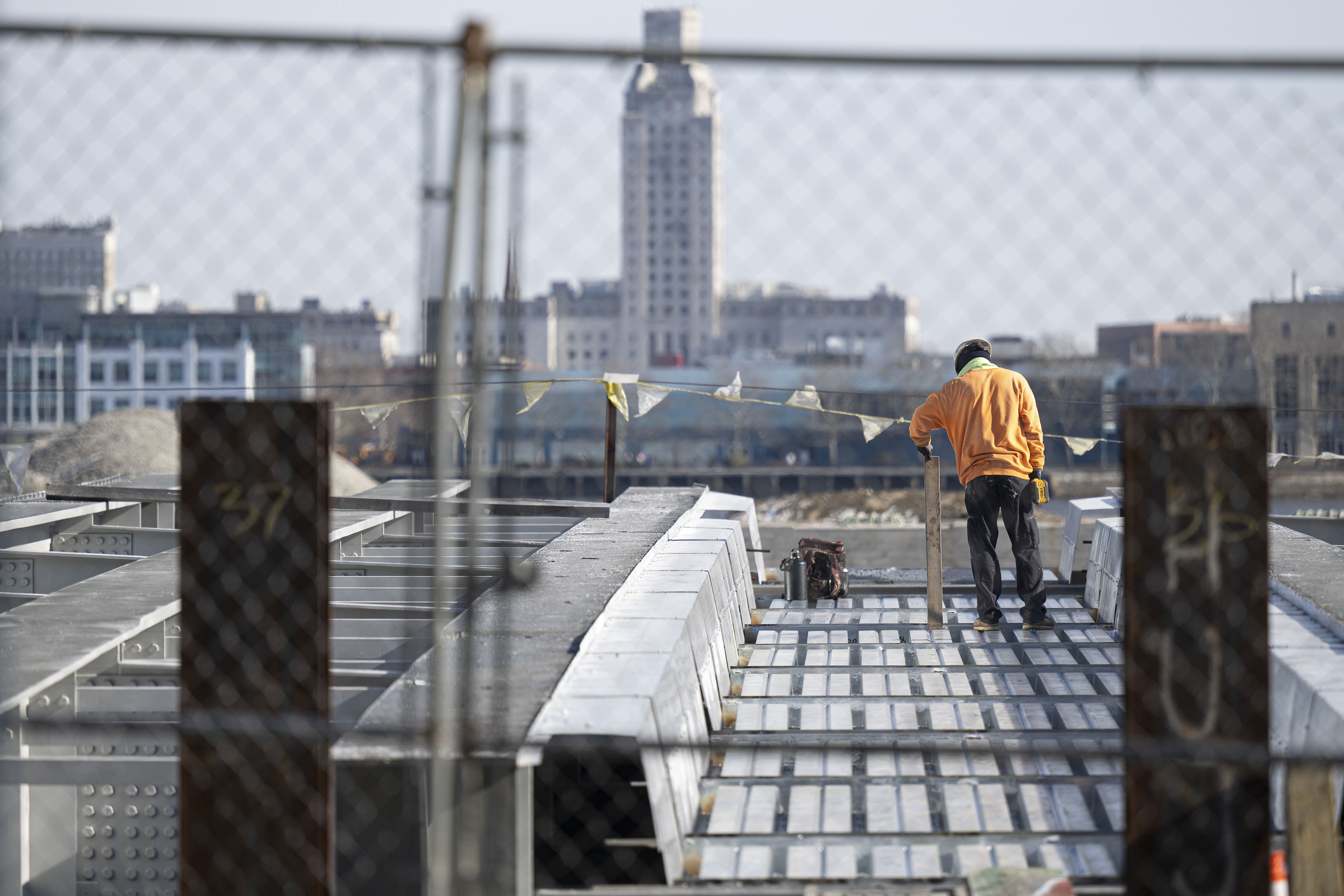
A construction worker works at a construction site near Interstate 95 in Philadelphia, Thursday, Jan. 22, 2026.Jose F. Moreno / Staff Photographer
What Geppert Bros. has figured out is what Davis hopes the industry can move toward: steadier, more long-term employment. Such big conceptual changes, like reconfiguring benefits packages and contracts to increase stability, might take more time, but Davis says the industry is well-suited to address these problems.
Zecca is not waiting for those changes to arrive. For more than a year, he has been trying to land a full-time job with Energy Transfer, an oil and gas company headquartered in Texas. The job would involve maintaining the company’s pipelines in Pennsylvania. Instead of starting over with new bosses, crews, and equipment every few months, he would work with the same team on the same project.
It is his dream job. Not because of the work itself or the money. Because it is steady. He wears the company’s navy-and-white hat every day for good luck.
“I just need something with more consistency,” he said one evening in May.
Two days later, he was laid off.
A construction worker helps guide a section of pre-cast concrete in place in the upper level at the site of the new Eagles Stadium on Friday, May 10, 2002.David Maialetti / Staff Photographer
How does one explain the blatant hypocrisy of a president who says he defends freedom of speech, but who banishes CNN, MS NOW, and Politico from the White House? Donald Trump endorses free speech for white supremacists, anti-LGBTQ people, Christian nationalists, anti-immigrant people, those who oppose Muslims, and so on. Those people whose far-right beliefs were at one time scandalous are now mainstream. The president doesn’t think the opinions of the left are worthy of the First Amendment. Trump is not interested in protecting the First Amendment for all of America’s citizens. He is simply interested in squelching the opinions of those who disagree with him.
Sandra Detweiler, West Chester
. . .
Now that Donald Trump has decided to ban selected news outlets from access to the White House, I wish all news outlets would join in solidarity and boycott the White House, Trump, press briefings, interviews, and news articles related to his current administration. We as a country believe in freedom of speech. This president has gone too far in subverting any news article, story, or question that he finds unfavorable. What if he did not see or hear himself in the news at all? What if no one showed up to interview him or ask him questions? Frankly, for many of us, even a day without Trump in the news would offer some respite.
Kathleen Coyne, Wallingford
. . .
Donald Trump just announced that he plans to ban CNN, MS NOW, and Politico from the White House due to unfavorable press coverage. Does the news media really need a news conference with Trump where he spouts his lies? The press already gets all of the information it needs from Trump’s Truth Social posts. Why do reporters need to attend a dog-and-pony show where he makes lame jokes, attacks female reporters, and calls the news media fake, corrupt, scum, and enemies of the people? Such news conferences only enable an increasingly out-of-touch president to market his fascist brand and push his narcissistic claims of greatness. It would be much more constructive if Trump gave a news conference and no reporters showed up, just like what happened at the Pentagon. In that regard, if the First Amendment is so important, why are the news media as a whole not boycotting any future news conferences?
George Magakis Jr., Norristown
Join the conversation: Send letters to letters@inquirer.com. Limit length to 150 words and include home address and day and evening phone number. Letters run in The Inquirer six days a week on the editorial pages and online.
ARIES (March 21-April 19). You’re working on a problem and attracting a high level of expertise to assist with it. You admire people who have honed their craft, and you’ll receive the benefit of their experience.
TAURUS (April 20-May 20). Forget the big quest for a moment while you focus on doing yourself proud on the smaller jobs. It will feel good to see concrete evidence of a task completed, even if it’s one as simple as sweeping the floor.
GEMINI (May 21-June 21). You’ll have a blast crossing items off the list: sending the email, making the appointment, buying the part, returning the call. Each small checkmark brings you closer to the wonderful feeling of crossing a finish line.
CANCER (June 22-July 22). An hour left open, a meal you chose because you wanted it, or someone else taking care of a task — these are all signs that you’re learning to leave more room for yourself in your life. It’s what you need to thrive.
LEO (July 23-Aug. 22). You may have learned that shining too bright makes certain people feel threatened, which didn’t go well for you. But in the right environment, it pays to let yourself be seen and appreciated. You’ll be in that space today. Take it in.
VIRGO (Aug. 23-Sept. 22). It will feel great to know that a system you created really works, or something you fixed is working better than ever now. It’s the kind of thing that some people take for granted but others never forget and will keep thanking you for.
LIBRA (Sept. 23-Oct. 23). Look closely at the terms of new arrangements. It’s tempting to sign the line before you’ve read the document, but spending a few more minutes to ask questions and really understand what you’re getting into will save you from later regret.
SCORPIO (Oct. 24-Nov. 21). You have something good on the horizon, and it changes the feel of the weeks ahead. A ticket, a reservation, a visit or a plan with friends gives you a little point of light to move toward.
SAGITTARIUS (Nov. 22-Dec. 21). You’re looking for a smarter way to do something, and the research is paying off. A review, recommendation or late-night search leads you to a tool, price or method that makes the whole project easier.
CAPRICORN (Dec. 22-Jan. 19). You’re choosing what will hold up over time. Proof is everywhere: the repair done right, the savings account growing, the routine you enjoy keeping. You’re building a life that will keep taking good care of you.
AQUARIUS (Jan. 20-Feb. 18). You start the season on a brave note, following your famously auspicious curiosities, and they don’t disappoint. You follow a link, enter a room or start a conversation, and soon you’ll hear people speaking your language or vibing just right.
PISCES (Feb. 19-March 20). You’re seeing more of the story behind someone’s behavior. A detail about their family, health, money or past explains why they have been acting this way. Understanding the context helps you decide whether to get involved or give more space.
TODAY’S BIRTHDAY (Sept. 22). It’s your Year of Easy Breezy. It’s a vibe you cultivate, a way you come across and approach problems. It’s not a weather report on actualities. In fact, you do hard things all the time, and it’s the practice of doing hard things until they are easy that expands your world in wonderful ways. More highlights: Professional accolades and travel for work, epic family and gatherings, and renovations. Pisces and Aries adore you. Your lucky numbers are: 6, 22, 50, 4 and 16.
DEAR ABBY: My mom died of extreme old age recently. She was a sweet woman everyone loved. I sent invitations to her memorial, and I’m getting a lot of excuses for why my friends can’t attend. I am upset.
In my circle of friends (all similar ages), I was the last to graduate, get a career job, start a relationship, buy a house, be married and so forth. I’ve attended my friends’ graduations, weddings, baby showers, milestone birthdays, and family funerals, yet there hasn’t been much reciprocation.
Excuses for not attending Mom’s memorial included going to a grandkid’s soccer game and attending a 2-year-old’s birthday party. Really? I know I’m dealing with unusually strong emotions due to Mom’s death, but I want to scream, “This is MY MOM,” not some distant friend or relative. My spouse says I shouldn’t stress and that all we need is each other (said by someone who has a huge, loving family whereas my family is just me and my dad). How do I deal with my feelings of resentment, abandonment and being a low priority?
— LAST ONE IN CALIFORNIA
DEAR LAST ONE: Your spouse is right. In the final analysis, all you need is each other — though a few supportive friends would certainly be welcome. I have always said that funerals are for the living, not the deceased. Be grateful for the support you are receiving from the people who accepted the invitation to your mother’s funeral. They are your core support group; the others are mere acquaintances, so start thinking of them in those terms.
** ** **
DEAR ABBY: I rent a two-bedroom apartment, which I shared with my best friend. When he moved away last month due to a work relocation, I advertised the room, and a couple moved in. They are friendly and pay their rent on time, but their cooking produces extremely strong smells that I cannot tolerate. My medication causes hypersensitivity to odors, and I can no longer stand to be in the kitchen because the smells linger. They also live on a very different schedule from me. As a result, my diet and sleep are both suffering. They remain unaware of how the adjustment has affected me because I don’t feel they are doing anything wrong. I would like to move out into a studio of my own. The lease on this apartment is currently a month-to-month, so the only thing keeping me here is the guilt I feel about burdening my roommates with this. They will have to move out, find a replacement for me or take on the full rent themselves. I want to do right by them, but I know it would be best for me to leave. What is the proper course of action here?
— DOOMED IN AUSTRALIA
DEAR DOOMED: There is no reason why you should feel guilty for leveling with this couple; your health must come first. Explain the problem to them and tell them that while you like them personally, your health is being affected by the cooking odors. Tell them that because you are now on a month-to-month lease, you plan to move to a smaller place of your own and give them the option of staying or moving. Consider this a first step in learning to stand up for yourself.