Pet loss is a painful and often isolating experience. But for one South Philadelphia family, the end of their cat Tormund’s life is being grieved by thousands of strangers across the internet.
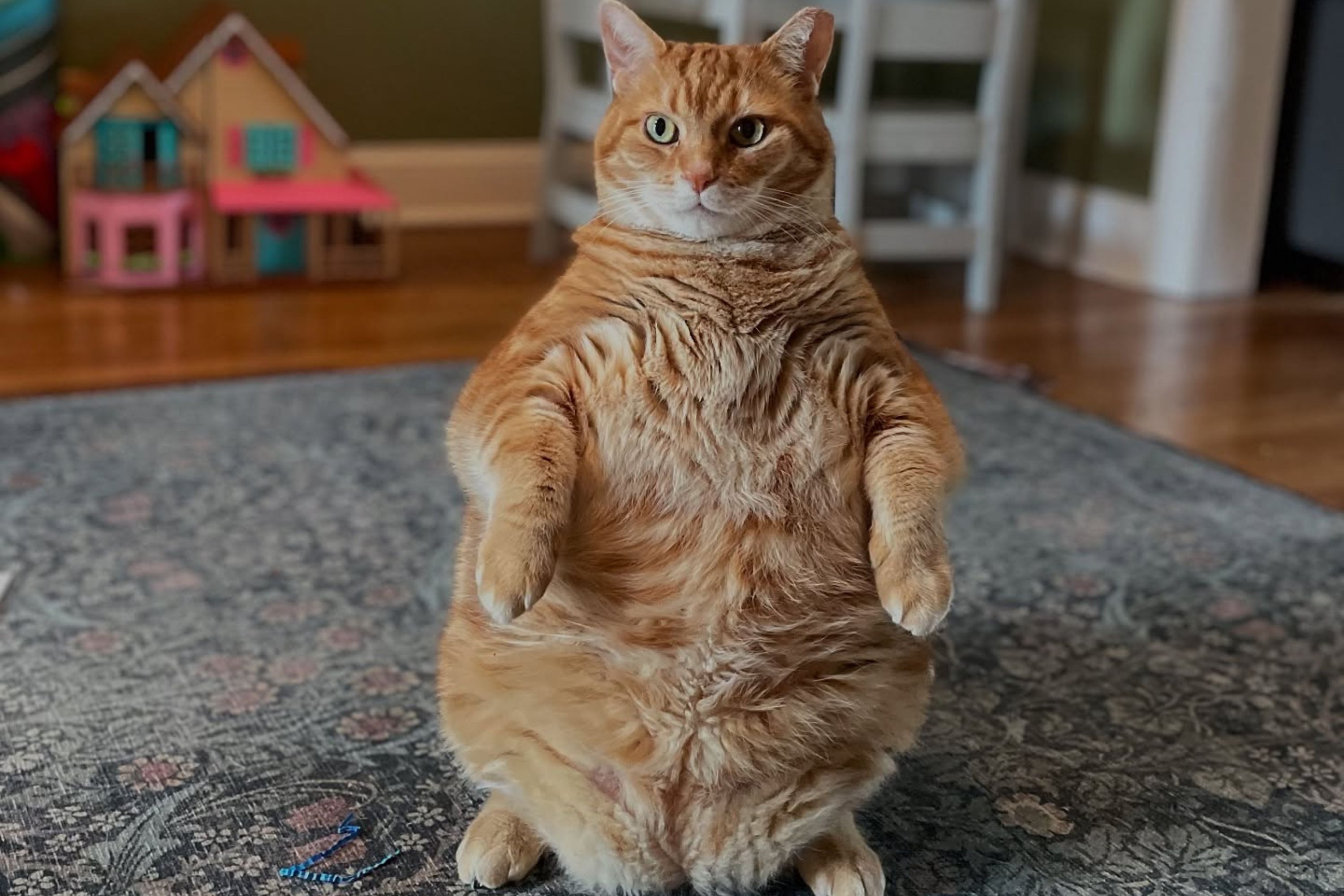
Tormund, best known as Standing Orange Cat, has died of medical complications, his humans said in a social media post. He amassed nearly 300,000 fans across his dedicated social media platforms because of, well, the funny way he would stand.
The bulbous orange tabby, with white whiskers, freckles on his lips, and green eyes, was a rescue from the streets — so his exact age was unclear. His owners, Alex and Jeff Holden, began posting photos of Tormund online in 2020.
In hundreds of photos and videos posted of the chunky feline since, Tormund could be seen perched on his short hind legs, belly protruding, and front arms awkwardly flapping in the front.
Quickly, the followers came. Comments on social media would call him “rare,” “aloof,” “hilarious,” and “adorable.”
“We don’t know why he started standing,” the Holdens wrote on Tormund’s website, orangecatstanding.com, which they used to sell stickers and other merch. “We’re just glad he did.”
His charming standing pose became fodder online for memes, even inspiring a birthday cake carved in the shape of a standing orange cat for Alex Holden’s birthday celebration last year.
Despite his online virality, Tormund’s owners say he was a sweet, affectionate boy behind the scenes.
“He would jump on the bed and force me to cuddle,” Alex Holden wrote on social media. “He slept on Jeff’s sweatpants, beside his side of the bed almost every night.”
And, Garfield-esque appearances aside, Tormund had never tried lasagna. His favorite human foods were popcorn and turkey. The Holdens said he was on an exercise and diet regimen under their care and that the way Tormund stood made him appear larger than he was.
Last week, the Holdens posted that Tormund’s health appeared to be declining quickly. Veterinarians said he likely had a mass on his spleen, and the cat’s family needed to weigh options fast.
Within about 72 hours, fans raised nearly $5,000 to go toward Tormund’s ultrasounds, scans, and veterinary care.
In a Facebook post, Alex Holden wrote that fans’ quick mobilizing efforts gave her family the ability to make decisions without finances being a factor.
Monday night, she posted the update all pet owners dread.
“We took Tormund to the vet and it was determined it was time to let him go,” she wrote, explaining that a prolonged vet stay had no guarantees and would be traumatic on the cat who famously already hated going to the vet. “We are absolutely heartbroken and feel his loss around us every minute.”
Alex Holden added that leftover funds raised for Tormund would go to Jeff Holden’s cousin, Lindsay Gaspari, who is credited as “Tormund’s original fan” and the woman who encouraged Alex Holden to post photos of Tormund standing online.
Gaspari was diagnosed with an inoperable cancerous brain tumor last year. She has undergone radiation and chemotherapy to slow the cancer’s growth. The Holdens have directed Tormund’s fans to Gaspari’s GoFundMe if they feel compelled to support.
Alex Holden says she plans to continue posting to Tormund’s Orange Cat Standing social media profiles in time — “when I can look at pics without crying” and plans to do a run of holiday-themed merch.
“Thank you all for loving him and the community we have created,” she wrote.
Tormund is survived by “his humans,” Alex and Jeff Holden, their son (known as his “human brother,” Oliver), his cat brothers, Gandalf and Lazlo, and his dog brother, George Costanza.
First things first. During the last week, I heard from a few of you asking whether I would condemn a demonstration that occurred Sunday in Philadelphia in which bike riders, aggrieved by Israel’s war conduct in Gaza, protested a half dozen Jewish-owned dining places. I do condemn it, strongly — and I say that as someone who’s been a fierce critic of war crimes committed under the extreme right-wing government of Benjamin Netanyahu. I applaud those who went to New York this summer to protest him, but harassing businesses explicitly because of their Judaism — and a handful of donations to humanitarian causes that support Israelis — was a jumble of dangerous naivete and antisemitism. This time, the heroes were the many who showed up to support these businesses.
Can the Dems’ blue wave start making U.S. college great again?
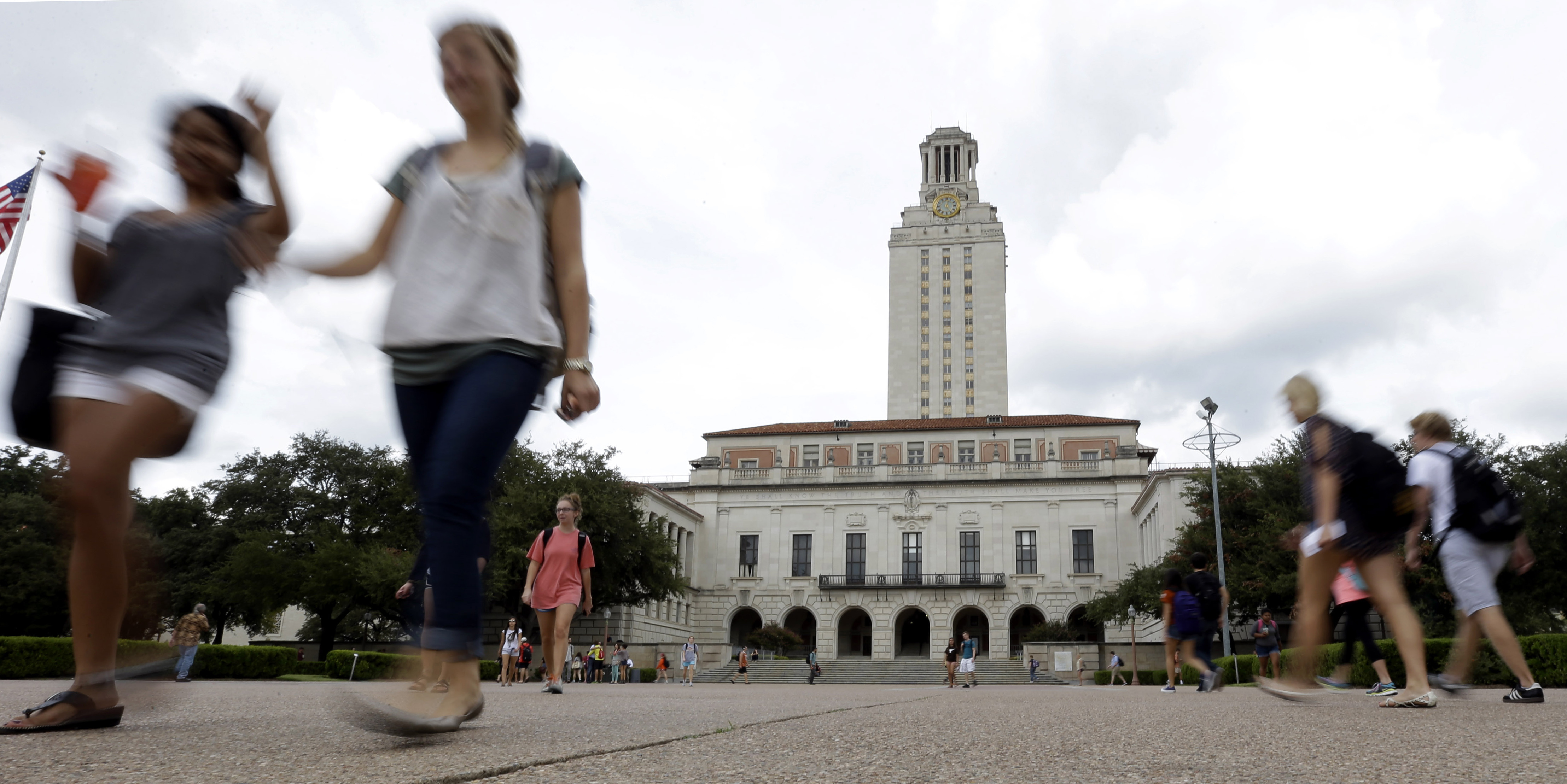
Students make their way across the campus of the University of Texas at Austin in 2012.Eric Gay
Last Tuesday morning, as Americans were waiting for the polls to open in a midterm election poised to change everything in U.S. politics, NPR touted on Bluesky its story about the culture wars at Texas Tech University. There, academic freedom has been undermined to the point where professors fear they will soon no longer be allowed to teach great books like Moby-Dick or The Odyssey.
The head of the nation’s largest union of college academics, Todd Wolfson of the American Association of University Professors (AAUP), later reposted the story from that hopeful morning with a three-word comment:
“Not for long.”
That might have sounded overly optimistic in the moment, but just hours later, Texas — which will have a Democratic governor, lieutenant governor, and their party’s control of the Texas House for the first time in decades — emerged as the vanguard of the so-called blue tsunami that rebuked Donald Trump and GOP policies from coast to coast.
Those issues simmered on the back burner in an election in which attention was heavily focused on high prices and widespread corruption in the Trump regime. But advocates such as Wolfson are optimistic that huge Democratic gains in once blood-red states that had all but declared war on higher education — not just Texas but North Carolina, Wisconsin, and Ohio — can start to swing back the pendulum of change.
Wolfson told me Monday night that allies including groups like the AAUP, the closely connected American Federation of Teachers, and the National Education Association are talking about not just undoing some of the more egregious Republican state laws but to “start to drive proactive visions for higher education.”
The idea is to change the national debate about academia away from the conservative-driven culture wars and angst over high tuition and student debt and back toward the positive American dream of college that flourished in the decades after World War II.
After the new Democratic majorities take root on Capitol Hill this spring, Wolfson said higher ed boosters are discussing how to push for a big agenda such as a crusade for free public university education, or perhaps an even broader “crib-to-college” initiative that would also urge more investment in early childhood education and K-12 schools.
“That is a response to creeping authoritarianism and the threats of AI,” he said. “You know, invest in your children and their future against the threats that we’re facing.” Wolfson acknowledged that it will take a few years, including a robust debate in the 2028 presidential primaries, to turn the battleship of government policy around. “But we’re going to launch it, and fight for it.”
Existential dread over the future of U.S. higher ed, which is playing out in fears over falling enrollment and closures of some liberal arts colleges, may not have been the marquee issue last Tuesday, but the issue likely played a role in higher youth turnout — especially among students — and a strong shift in the 18-to-29-year-old demographic toward the Democrats.
At the University of Texas at Arlington, for example, the decision by Republican officials to close a convenient on-campus polling place caused students to organize a march to their new off-campus site. Explained student organizer Emmanuel Hernandez: “Because I think it’s very important for us to just show a message and actually show that we never give up no matter the circumstance.”
That message could be applied more broadly to advocates for strong universities, who’ve seen Republicans in red states — and the Trump regime — depict campuses as hotbeds of liberal indoctrination that they need to rein in by ending diversity, equity, and inclusion (DEI) programs, terminating departments centered on race or gender and curbing what can be taught, and by restrictions on tenure and faculty governance.
How much of that can be rolled back under the big Democratic election gains? It’s complicated.
Wolfson noted that it would be hard for Texas Gov.-elect Gina Hinojosa to repeal the state’s Senate Bill 37, which gave state-appointed university regents sweeping powers to eliminate classes or even degree programs. The measure has been blamed for the end of gender or ethnic and racial studies at some public campuses. The problem with a repeal is that Republicans have retained control of the Texas Senate.
But Wolfson also believes the Democratic victories in Texas will create a climate that might end the harsh interpretations of the law by college administrators, such as last year’s firing of a Texas A&M professor for classroom comments on gender.
“Some of the reforms that universities embraced over the last two years were not because of any legal mandate,” John D. Sailer, director of higher education policy at the conservative Manhattan Institute, told the Chronicle of Higher Education. “They went beyond what the law actually mandated. They were, if you want to put it in a term, based on vibes.”
But the biggest change in the short term may be the ability of new Democratic governors like Hinojosa or Keisha Lance Bottoms in Georgia to appoint new university trustees or regents with a more liberal view of academic freedom and campus diversity. In 2027, Hinojosa will be appointing 20 new regents across seven public universities in Texas.
Another unheralded source of political power for academic freedom, Wolfson said, will be efforts to undo the curbs on professors or other academic workers from unionizing that exist in a number of heartland states such as Wisconsin, which, with its Act 10, banned faculty unions despite huge, vocal protests in 2011.
But the conditions for a radical reversal are not in place, not yet. In Washington, two more years of Trump and his close ally, Education Secretary Linda McMahon, will likely thwart efforts to reestablish DEI policies at the federal level. But a Democratic Congress and its power of the purse should be able to undo some of the cuts in scientific research funding that have devastated top campuses.
Still, Wolfson acknowledged that the desired vibe shift that would lead to long-term policies to make a college diploma more accessible — as opposed to the current push to limit what professors can teach or which students can be admitted — goes beyond just defeating Republicans at the ballot box. Leading Democrats have mostly avoided a positive, pro-college agenda to focus instead on reviving trade schools (which is also a good thing), or opening up more state jobs to noncollege graduates.
The faculty union president said true leaders can bring the conversation around the American way of college back to ideals like children doing better than their parents, or the need for scientific breakthroughs, or the role education plays in a democratic civil society. “It’s really hard to get that narrative out there in a way that is lifted up when the Elon Musks of the world have such a big megaphone and have been beating us down so hard for so long,” Wolfson said.
It’s a heavy lift, for sure, but after last Tuesday, the winds of change for American universities are finally blowing in the right direction.
Yo, do this!
I rarely venture out from my undisclosed location, but I’m going to do it this Friday night, Nov. 13, to moderate a very special book event with author Akbar Shahid Ahmed, who formerly covered international affairs for the HuffPost and has written the definitive history of our former president’s badly botched policy in the Middle East: Crossing the Red Line: Biden, His Advisors, and Israel’s War in Gaza. Please read the book, and then meet us Friday at 7 p.m. at the Haraz Coffee House at 1822 Chestnut St. in Center City, Philadelphia, for what should be a lively conversation.
It’s still mind-blowing to boomers like me that most voters either weren’t around or were too young to care much about Watergate, the scandal that, in 1974, ended the presidency of Richard Nixon, who was the worst POTUS anyone could imagine until, well, you know. The passage of time has allowed the far right to create a false narrative that Nixon was framed, which is why I’m urging everyone to rent or buyThe Watergate Caper: Richard Nixon and the Death of the American Dream, which is narrated by the great (and occasional friend of this space) Harry Shearer. Reviews say you’ll feel like you’re experiencing Watergate in real time, which — as someone who did exactly that as a teenager — is a pretty wild ride.
Ask me anything
Question: What does it [the midtermelection] mean for [Pennsylvania Sen. John] Fetterman? — John Robinson (@jrobin.bsky.social) via Bluesky
Answer: Great question from my retired ace journalist friend John, which seems to be on the mind of a lot of my neighbors here in the Keystone State. Fetterman, who has dismal Democratic approval numbers after his hard right turn toward Benjamin Netanyahu’s Israel and other moments of siding with Trump, looked shell-shocked when a reporter tried to interview him this week. The early appearance of a primary opponent, Philly-based Palestinian American writer Ahmed Moor, suggests others with bigger resumés are likely to follow. I don’t see any path for Fetterman as a Democrat, and I think a switch to the GOP would be a bumpy ride that would leave no one happy. That said, the poli-sci major in me does think Fetterman might have a chance as an independent, especially if the major parties both nominated candidates from their left and right flanks. Hard to believe, but some voters still viewhis erratic behavior as bucking the system. We’ll see.
What you’re saying about …
For the second time in three weeks, a question was a total dud. The timing of the newsletter that went out in the middle of Election Day, when people were hanging on the results, all but guaranteed a zero response rate, since folks tend to answer in the moment, or not at all.
📮 This week’s question: The debate about whether New York’s Chuck Schumer should continue to lead the Senate Democrats has been fascinating to watch. Online progressives seem to agree with me that it’s time for a change, and that Maryland Sen. Chris Van Hollen would be a great alternative. The Morning Joe punditocracy sees this as crazy talk. What do you think? (Feel free to suggest other candidates.) Please email me your answer and put the exact phrase “Replacing Schumer” in the subject line.
Backstory on the ‘blue wave’ crashing into reality
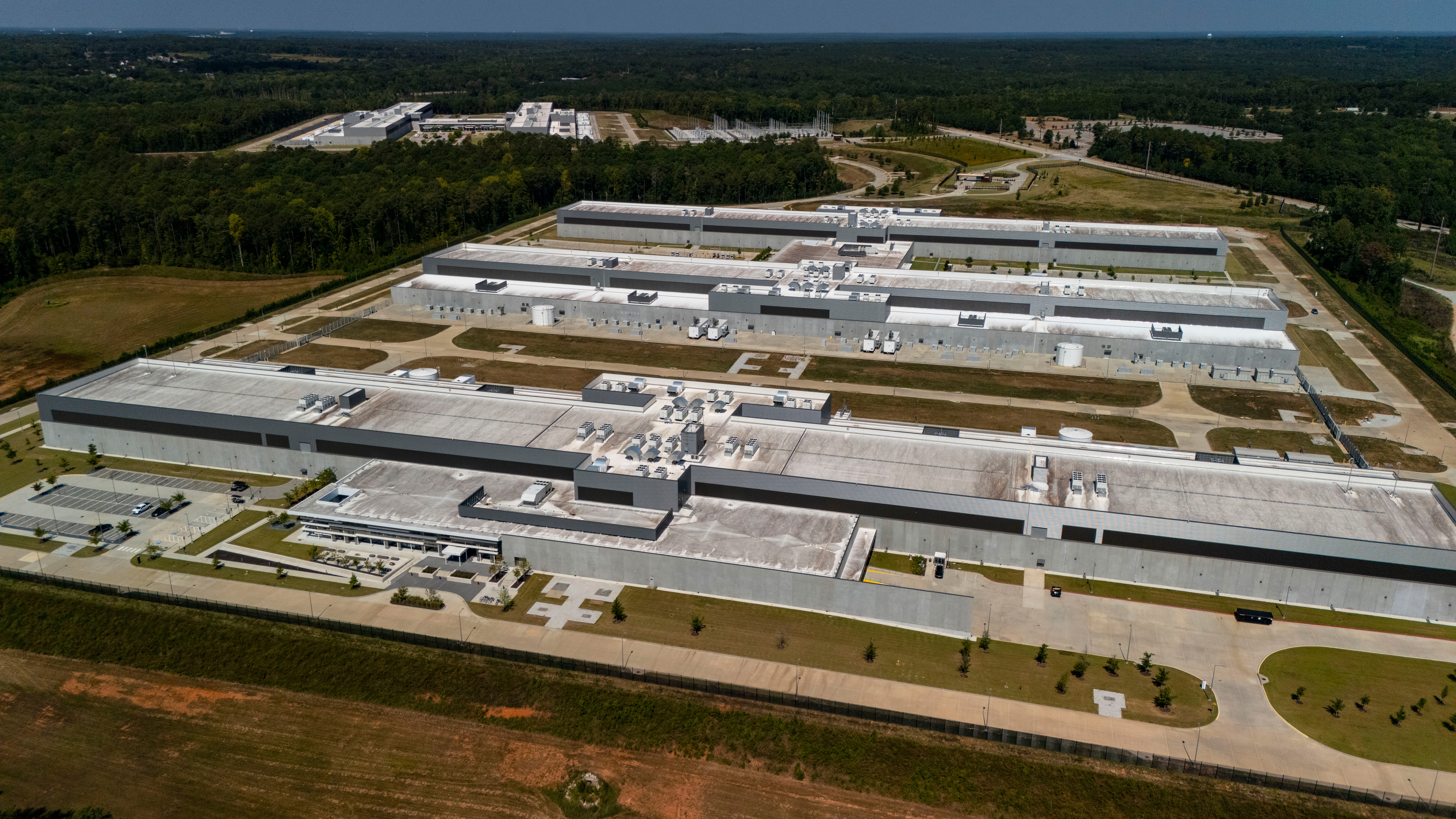
Meta data centers operate near Social Circle, Ga., in September.Mike Stewart
For Democrats, winning the midterms will surely be looked back on as the easy part. There’s already been a ton of speculation about how congressional Democrats will try to govern through two more years (probably) of Donald Trump in the White House, and at least 44 Senate Republicans eager to filibuster any left-leaning legislation. But forget next year; the crisis of governing in this brave new world is already here, this week. And it is not going well.
The issue is a piece of major legislation that — while the mainstream media was obsessing over Sen.-elect James Talarico’s breakfast taco or whatever — sneaked its way through Capitol Hill with no one but congressional aides and a few keen lobbyists paying any attention, until now. It’s called the Bipartisan American Affordability and Jobs Act, or BAAJA, and what’s so complicated is that the sweeping measure deals with a problem that bothers both liberals and conservatives, but in very different ways. The bill aims to speed up the slow pace of environmental and other federal permits for energy-related projects.
There are energy projects that are largely loved by the right and loathed by the left — hyperscale data centers and the fossil-fuel plants that power them — but the bill would also streamline permitting for projects liberals want, including clean energy developments as well as mass transit and affordable housing. Several key Democrats, led by Sen. Sheldon Whitehouse of Rhode Island, negotiated the bill with Republicans and the Trump regime. It certainly is an old-fashioned compromise in the sense that both sides are conceding some ground to get something they want.
Still, it’s telling who wants passage of BAAJA and who doesn’t. Trump, arguably Planet Earth’s biggest booster for data centers and climate-crushing fossil fuels, desperately wants the bill and calls it “a BIG WIN for U.S. ENERGY INDEPENDENCE and DOMINANCE.” (He also insists he won’t abide new wind energy projects, which undermines the deal.) But former Vice President Al Gore, who won a Nobel Peace Prize for his climate activism, is urging a no vote.
“Given how this Administration has run roughshod over the environmental laws and protections that are currently in place, now is not the time to give the Trump administration freer rein to double down on fossil fuels — which is what President Trump would surely do,” Gore posted on X. “And after last week’s historic election, we will have a new Congress in January that can strike a far better balance.”
I don’t know if Gore is actually right about the last part. A Democratic Congress would surely produce a better bill, but Trump would veto anything that doesn’t serve his obsession with data centers. It’s a tough call. On the whole, I’d argue that both the reality of green-lighting more fossil fuels and the symbolism of giving Trump a victory just days after he was repudiated by American voters outweigh any benefits.
Right now, 22 Democratic senators see it differently. They sided with the lame-duck GOP majority to avoid a filibuster and set up a vote on final passage. As I said here recently in a different context, lost causes are the ones worth fighting for. Call your senator ASAP and tell them that helping data centers, and Trump, is not what you just voted for.
What I wrote on this date in 2024
What a difference two years make. On Nov. 10, 2024, I — like a lot of Americans, although sadly not a majority — was questioning how a seemingly failed one-term president who’d attempted a coup and had been convicted of 34 felony charges got a second crack at the job. A big part of the problem, I concluded, was the broken state of American news media, which helped produce an information-free citizenry. I wrote that “nothing mattered more than this: Donald Trump was returned to power by the most badly informed electorate in modern American history.”
Yes, it was a busy and memorable week for me. I let others report on what happened, so I could look at lingering questions from the “blue tsunami” of 2026. First, I pondered what didn’t happen on Election Day — the lack of troops or masked goons at polling places, or FBI agents seizing ballot boxes, or any other markings of a Donald Trump coup. That was partly great prep work by democracy defenders, but I also argued that dictatorship just isn’t in Americans’ DNA. Over the weekend, I asked: What’s next? Specifically, can the Democrats accept that voters want a different way of doing things? I made the case that Maryland Sen. Chris Van Hollen — who showed enormous courage in fighting to save the immigrant Kilmar Ábrego García when no one else would — should be the next Senate majority leader. Not Chuck Schumer.
Of course, there’s what’s immediately next, and then there’s what’s next after that, as in the 2028 elections that essentially kicked off as soon as the polls closed at 8 p.m. on election night. The next two years are especially pivotal in Pennsylvania, where no one can figure out what will happen regarding the reelection of John Fetterman, who is wildly unpopular in his Democratic Party. Philadelphia U.S. Rep. Brendan Boyle surprised a lot of folks (including me) by not running. Meanwhile, Ahmed Moor, a Palestinian American writer who was born in Gaza and worked in international development, has said he will challenge Fetterman, who’s infuriated many Dems with his stance on the war in Moor’s native Gaza. Meanwhile, did Gov. Josh Shapiro’s landslide reelection launch him into a sustainable orbit for his expected White House bid? It’s a lot to digest, but The Inquirer is already gearing up to give you a steady diet of the political fodder that anyone who’s made it this far in the newsletter craves. Subscribe today and join us at the table.
By submitting your written, visual, and/or audio contributions, you agree to The Inquirer’s Terms of Use, including the grant of rights in Section 10.
A Bristol Township man oversaw a wide network of drug and gun distribution, police said Tuesday, pushing methamphetamine throughout Bucks County.
Charles Vandenberg, 51, was arrested Nov. 4 and charged with a litany of felony drug and gun crimes, according to Bensalem Public Safety Director William McVey.
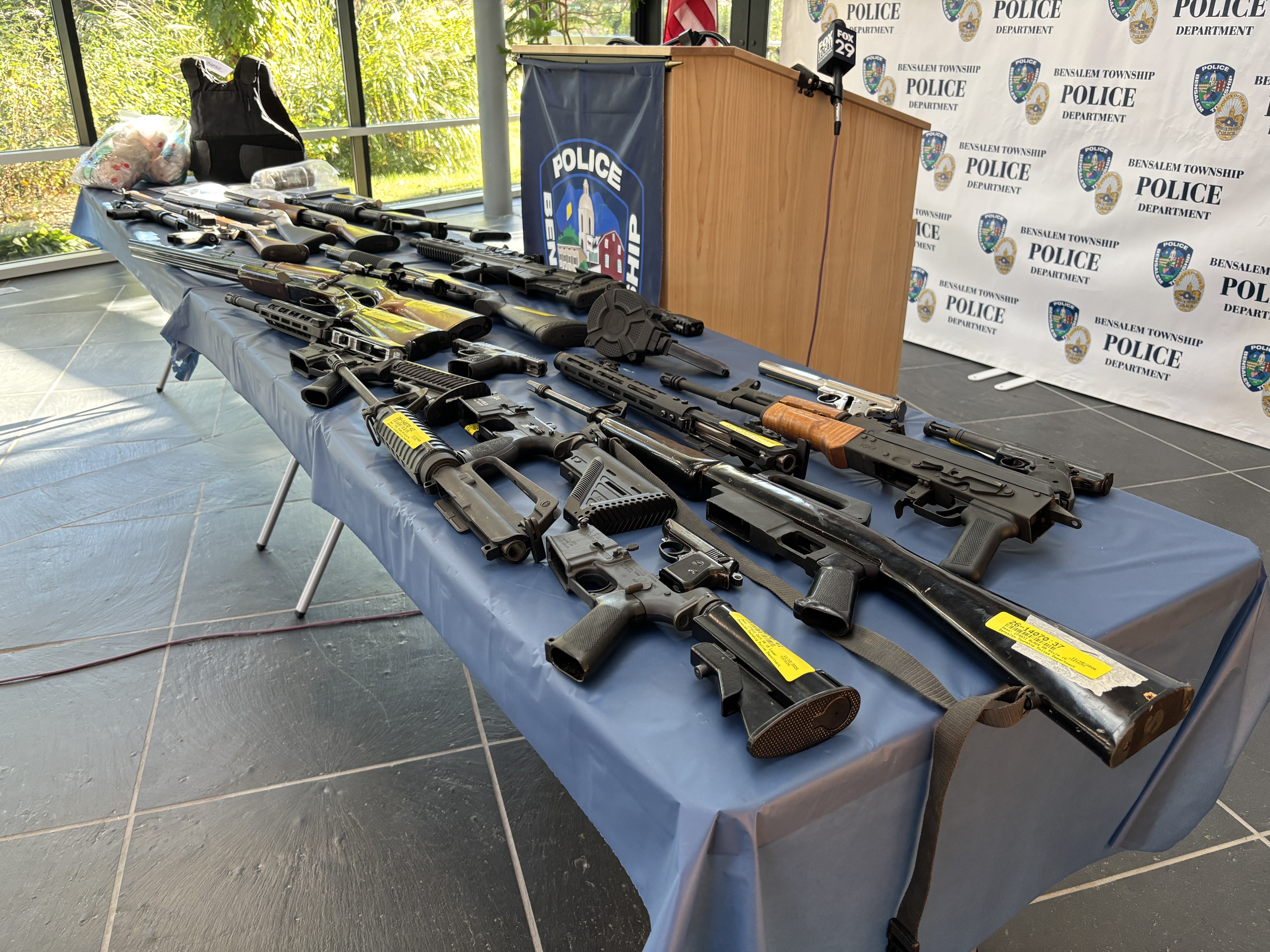
Investigators recovered 20 guns from Vandenberg’s home on Maryland Avenue in Croydon, including a handgun with an obliterated serial number, McVey said. Officers also allegedly found a pound of methamphetamine and body armor in the home.
“They truly made Bucks County safer,” he said. “Twenty weapons will never be on the street, and they saved lives by their actions.”
Vandenberg was not able to legally possess guns due to convictions for drug possession, court records show.
He already was under scrutiny by law enforcement: Last summer, he was charged with arson, conspiracy, and related crimes for allegedly recruiting another person to set fire to a van as part of a plot to rob the vehicle’s owners.
The investigation into Vandenberg’s drug distribution began in July, when, during a street-level drug arrest, Bensalem police learned that Vandenberg was distributing methamphetamine in the area, McVey said.
While serving a search warrant on Vandenberg’s home last week, detectives discovered the guns, drugs, and materials used to package them, according to the affidavit of probable cause for his arrest.
In an interview with detectives, Vandenberg admitted that the items were his, the affidavit said.
Vandenberg remained in custody Tuesday, denied bail. There was no indication he had hired an attorney.
Bucks County District Attorney Joe Khan said his office had pushed a district judge to withhold Vandenberg’s bail as part of a new policy for suspects deemed dangerous to the public.
“It really ought to be the case that if you’re a danger to the community, that you shouldn’t be able to buy your way out of trouble,” Khan said. “Defendants such as Mr. Vandenberg, who are too dangerous to be trusted out in our community, will not be able to make bail no matter how much money they’re able to come up with.”
Before his arrest, Vandenberg was free after posting 10% of $350,000 bail in the August 2025 arson case.
In that incident, police say, Vandenberg recruited another man, Gavin Montoya, to rob someone of drugs and set a van on fire outside the victim’s home on Cedar Avenue in Croydon.
However, the blaze, which Montoya set with a road flare, spread to the home, police said.
Three firefighters who responded were injured while putting it out. Another firefighter, Capt. Ed Margavich of the Third District Volunteer Fire Company, later died of complications from an injury — he fell at the station while putting equipment away, breaking his leg.
Vandenberg, Montoya, and an alleged accomplice, Thomas Parker, were not charged in connection with Margavich’s death, investigators said.
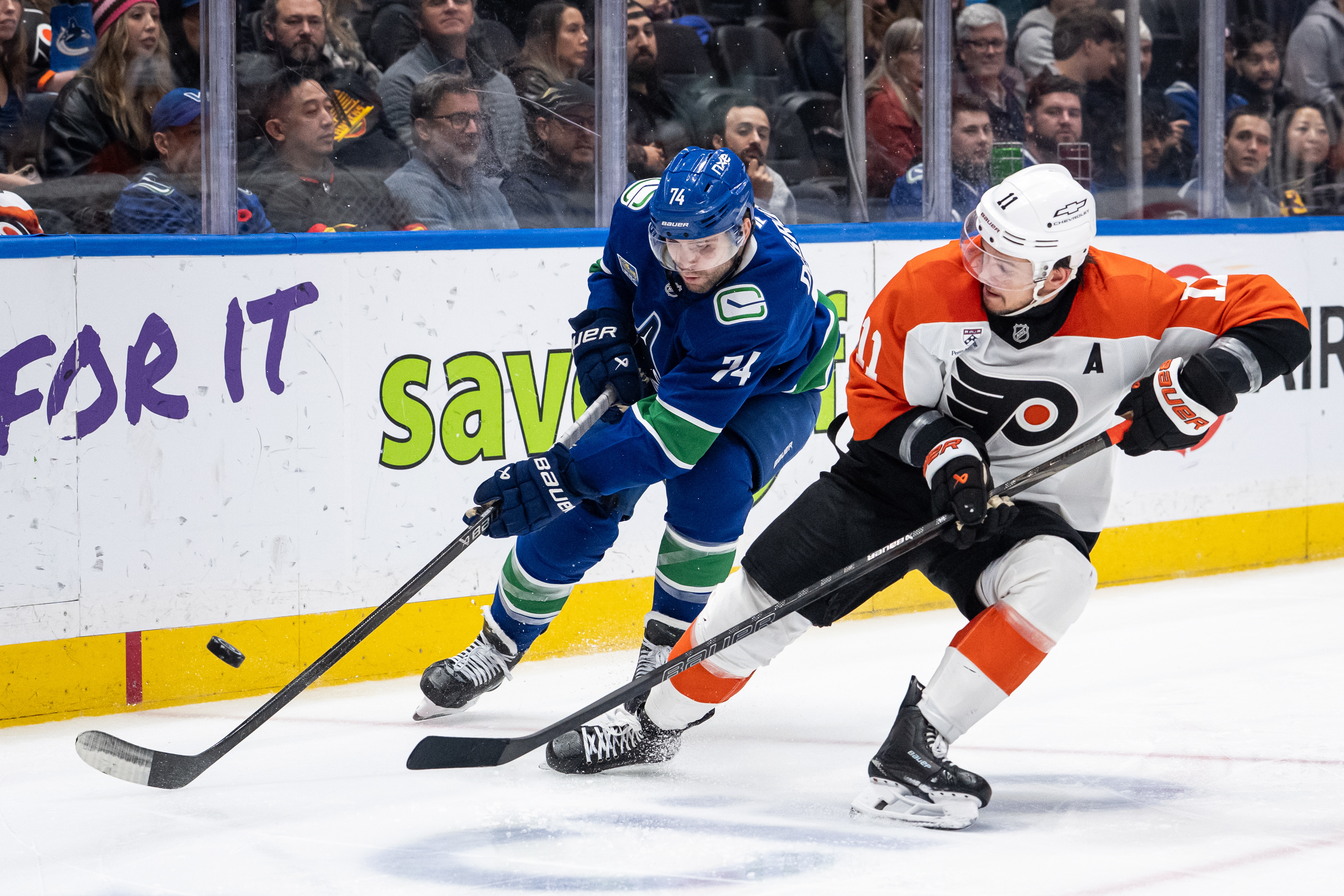
VANCOUVER, British Columbia ― The Flyers almost blew another game but held off the NHL basement-dwelling Vancouver Canucks for a 3-1 victory on Monday.
It’s a small step but could prove a building block for a team that needs wins and its mojo back.
“Yeah, it’s a win, right? You can build on those for sure,” winger Travis Konecny said. “I think it was big for us to finish out that third period. We’ve been in those spots where we should have won games in the last couple, and we didn’t finish them. So yeah, can look at that and maybe give us confidence so we can close them out.”
After two straight demoralizing losses despite being up by a goal heading into the third period of each game, you’d think the Flyers would have learned their lesson.
Well, they did not.
In the first two periods, the Flyers forechecked hard, got sticks in lanes, stole pucks, created turnovers, and played aggressively at both ends of the ice. They had 70.8% of the shot attempts.
However, once Tyson Foerster’s goal 25 seconds into the third period — which would have made it 3-0 — was overturned on a coach’s challenge for offside, it felt like the air was sucked out of the Flyers’ game. It truly felt like they didn’t think their 2-0 lead was safe, and it wasn’t.
How bad did it get? Let’s count the ways:
Philly did not get another shot on goal until Travis Sanheim sent a shorthanded clear down the ice and into the net.
They finished with two shots in the final 59 seconds of the game. That was all they got the entire period.
After holding Vancouver to six shots on goal the first 40 minutes, Joseph Woll faced 13 in the final 20.
Three borderline penalties in the final 9 minutes, 10 seconds of regulation didn’t help matters. Michael Bunting was called for elbowing — did he really make contact? — Konecny got an iffy slashing call, and Woll was tagged for removing his own mask when the strap came undone, which is really a safety issue.
The Canucks made it a one-goal game on Bunting’s penalty, and while those are just the analytics and numbers, by the eye test, they lost what set them far apart from the home team in the first two periods. That strong forecheck and stick checking that helped stake them to a two-goal lead disappeared.
Hear from the Orange & Black following Monday night's win in Vancouver.#PHIvsVAN | #LetsGoFlyers
“Teams are going to have their pushes, and you’ve got to be able to handle them,” Konecny said. “We played pretty good the first two [periods], and then they found their legs in the third. And sometimes it’s not pretty; you’ve got to find a way. But yeah, we would like to be able to counter and put some pressure back on them.”
Could getting a win like this propel the Flyers forward? Maybe.
There’s no arguing the Canucks are the worst team in the NHL, but good teams, even great ones, can lose on any given night. And backed by Woll, who stopped 18 of 19 shots and was stellar again, especially when facing an onslaught in the third, the Flyers followed a mantra used a ton last season: bending but not breaking.
“I think we knew this was a big game, and I thought we came in … the first two periods were great, and then obviously some penalties there; so I think that’s why the shot clock was dictated [like] that,” said Bunting. “Killed off every one except for one, and yeah, I thought that [third period] was a learning, growing part of the game, and I thought it was really good that we stuck together and got the win.”
Scoring is still a struggle for the Flyers
Aside from another near third-period collapse, maybe the bigger problem is that the Flyers just cannot score.
In the first two periods, they had so many Grade-A’s — 19 scoring chances and 12 high-danger chances, according to Natural Stat Trick — that it felt like at any moment they would bury the Canucks.
They did not.
Bunting, playing in his first game since Oct. 27, easily scored on the Flyers’ second shot on goal as he followed up a broken pass to center Christian Dvorak. It seemed to spark the Flyers as they kept coming in waves.
They got under the Canucks’ skin, and Porter Martone drew a roughing penalty on Linus Karlsson just under two minutes after Bunting’s goal. It seemed like destiny for the offense to explode.
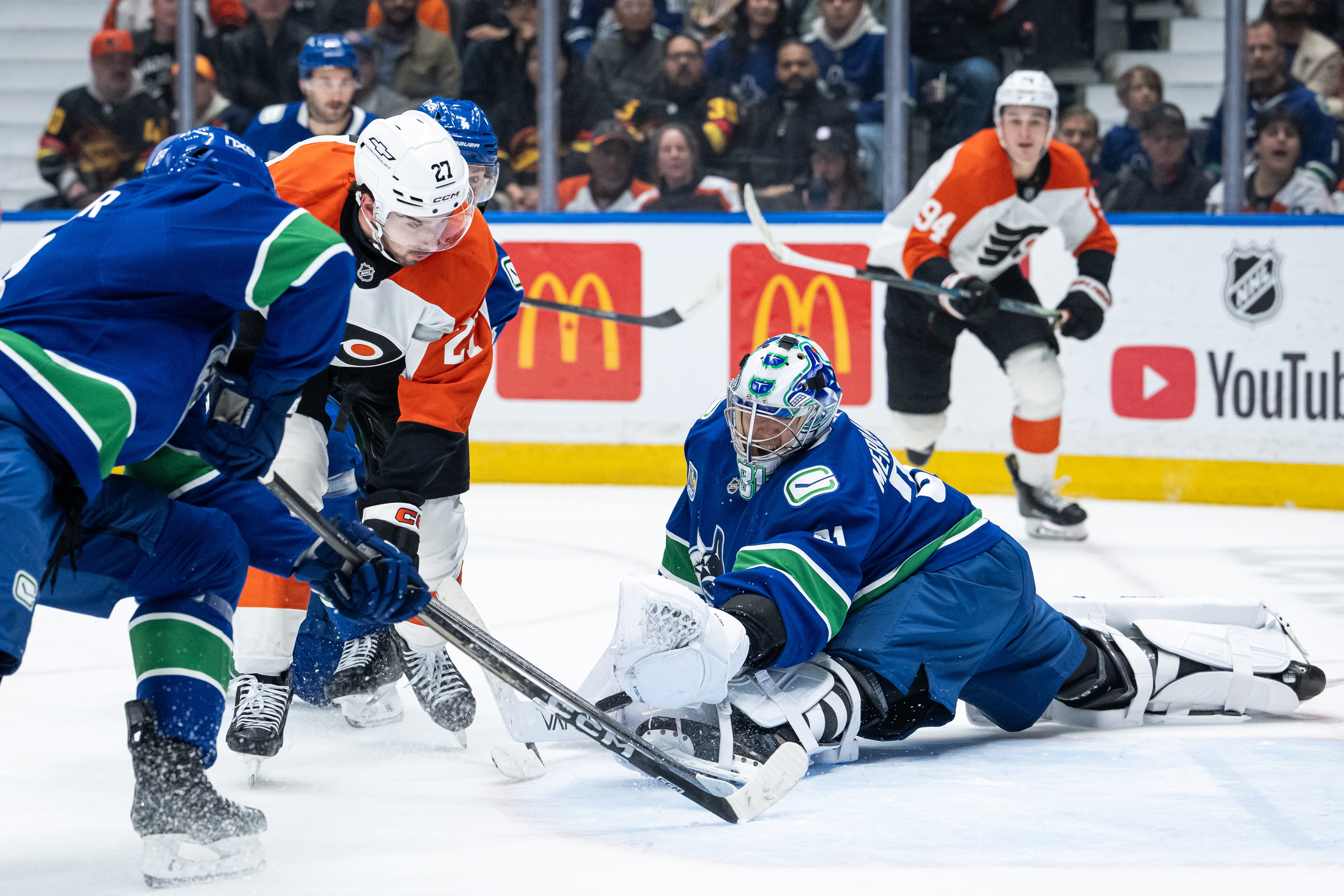
Instead, Canucks goalie Leevi Meriläinen only needed to save eight other shots in the first period. The Flyers missed the night five times, notably when Konecny cut to the middle and shot wide as he fell, and Trevor Zegras followed it up with a wide shot off the carom. Noah Cates scooped up his own rebound and got around Meriläinen but was robbed by the stick of Canucks forward Drew O’Connor. And with 20 seconds left, Sean Couturier stole the puck and set up Martone for a shot into the Canucks goalie.
In the second period, Cates hit the crossbar on a delayed call on the defenseman Elias Pettersson — yes, the Canucks have two Elias Petterssons, with the other being the often-talked-about center. And later Cates, who tied Foerster and Martone for the team-high in shot attempts (six), was robbed of a wraparound by a sliding Luke Schenn. Foerster later missed a wide-open net from atop the crease, and Matvei Michkov, who had a strong 200-foot game, missed on a redirect as he cut through the slot.
Vancouver Canucks defenseman Drew O’Connor thwarted Noah Cates at the goal line late in the first period Monday.ETHAN CAIRNS
Tocchet said on Saturday in Calgary that he wanted his players to be shot-oriented. They were, but still couldn’t finish and are now ranked 31st in goals per game despite playing one of their better forechecking games of the season.
“Yeah, I thought it was a lot better,” Sanheim said of the Flyers’ structure. “I thought breakouts were a lot better. Regroups were quick. [We were] playing fast, and then just the forecheck; I think they had a lot of trouble with it. Our guys were hounding pucks, and you could tell it was making a difference, and we were generating more offense that way.”
David Jiříček should not sit for long stretches again
Despite not playing since Oct. 19 — an eight-game span of healthy scratches — David Jiříček re-entered the lineup on the third defensive pairing with Nick Seeler and played well. He skated 13:23, including 14 seconds on the power play that ended with Konecny scoring, and he was credited with one hit.
Tocchet said recently that he wanted to see him “try to limit the bad mistakes, not the little ones, the big ones. And I think maybe go back with the puck a little bit quicker, [and with the] outlet pass, and then on the blue line be real sure of yourself. ‘I’ve got this. I’m going to take a shot.’ Use your talent.”
He did that.
The Czech blueliner had three shot attempts and two shots on goal; in the first period he put a smart low shot that created a rebound, and in the second period, a one-timer with traffic in front.
Jiříček told The Inquirer last week that he was working on his skating, not overthinking and “just staying in the game in my head” while out of the lineup. He knew it wouldn’t be easy once he got back in because mistakes can take him out just as quickly.
But the defenseman played a strong game. He made quick decisions on clears and passes, notably a smart clear off the glass in the first period before, a few seconds later, hitting Couturier in stride in the neutral zone after a regroup. Also in the first, he outmuscled Marco Rossi for the puck in the corner of the Flyers’ zone.
“I thought he did a nice job,” Tocchet said. “I thought he got up in the play, played the game simple, had a couple of good shots.”
According to Natural Stat Trick, when Jiříček was on the ice at five-on-five, the Flyers had 21 shot attempts, eight scoring chances, and a team-high 0.94 expected goals. In comparison, the opposition had 10 shot attempts, two scoring chances, and zero high-danger chances.
While he may struggle against quicker teams and need to play sheltered minutes like the 9:20 he played against the Colorado Avalanche in his last game, the 22-year-old defenseman put in work while out and should get more opportunities to grow his skills in a game setting.
A black box theater, a proper box office, and a sizablecostume department. Those are just a few of the visions SALT Performing Arts president Lauren McComas has for the group’s building — if it can raise $2 million to buy it before the township sells it to someone else.
A groundswell of public support for the community theater, which has since 2014had its roots in Chester Springs within West Pikeland’s municipal building at 1645 Art School Rd., served as the launching pad for a massive fundraising effort, which is seeking to drum up millions of dollars in the coming weeks.
The new push comes roughly a week after West Pikeland officials voted to put the property — which, in addition to SALT, houses the township’s municipal offices and the police department in a separate building — up for public bid. The bidding period is set to close in early December.
Started by several members, with SALT leadership’s blessing, by Tuesday the fundraiser had garnered more than $22,000 in just more than a day — about 1% of the overall goal. An “angel donor” is offering to match funds up to $50,000, according to the donation page.
“We feel very hopeful that there is a next chapter for SALT,” McComas said. “We believe that we would not have been brought this far and have grown this much only for it to then be over because of this. And we’re excited to see the community that makes up a community theater be the ones to save the day.”
SALT was offered the first right of refusal for the property, but felt its resources were depleted after spending years raising money for the renovations, McComas said. The group hesitated to reach back out to the community for funds again, she said.
But three members involved with the theater company — as performers, production members, and parents of children involved — asked to help, and put together the fundraiser. Donations have ranged from less than $10 up to $5,000.
“We’re trying to engage the power of the people to move a mountain,” she said. “If we link arms on this, and if everybody were to give what they can, it could save SALT.”
The building’s previous owner, Historic Yellow Springs, said in a social media post that it did not have the financial means “necessary to meet the reported minimum asking price of $2 million along with the operating and maintenance expenses associated with such a large historic building.”
“We remain committed to exploring collaborative solutions with SALT Performing Arts, West Pikeland Township, and public, private, and governmental partners who share an interest in preserving the historic integrity and cultural vitality of this important site,” it wrote.
Since opening more than a decade ago, the theater has produced 90 main-stage productions and had more than 14,000 children perform onstage through educational arts programs, McComas said.
SALT has community partnerships with Acting Antics, an all-abilities theater group; the Chester County Food Bank; the Domestic Violence Center of Chester County; and the VFW, busing unhoused veterans to the facility for private shows during the holidays and providing them with hot meals and necessities.
If SALT is able to buy the building, McComas envisions the theater working with other community organizations, depending on a show’s themes.
The back portion of the building, where the township has its offices and meeting room, could be turned into a black box theater, where SALT could do a play series — something different from the usual musical lineup, McComas said.
The space where the police currently reside could become a “beautiful costume department,” where SALT could lend materials to other theaters and schools.
“We definitely have a vision to make full use of all the spaces that exist there, if we are permitted that opportunity,” she said.
If the theater company is outbid for the property, the funds raised gives SALT a “safety net” to explore other options, which “would also be a game changer for our future,” she said.
The township plans to use the funds from the sale of the current property to offset the cost of its purchase of 1001 Kimberton Rd., where it plans to relocate and expand its police department. The decision comes after the community voted in 2025 to save the police force from disbandment. The township is expected to close Nov. 13 on the new building, which it has already invested roughly $400,000 into with down payment and due diligence fees.
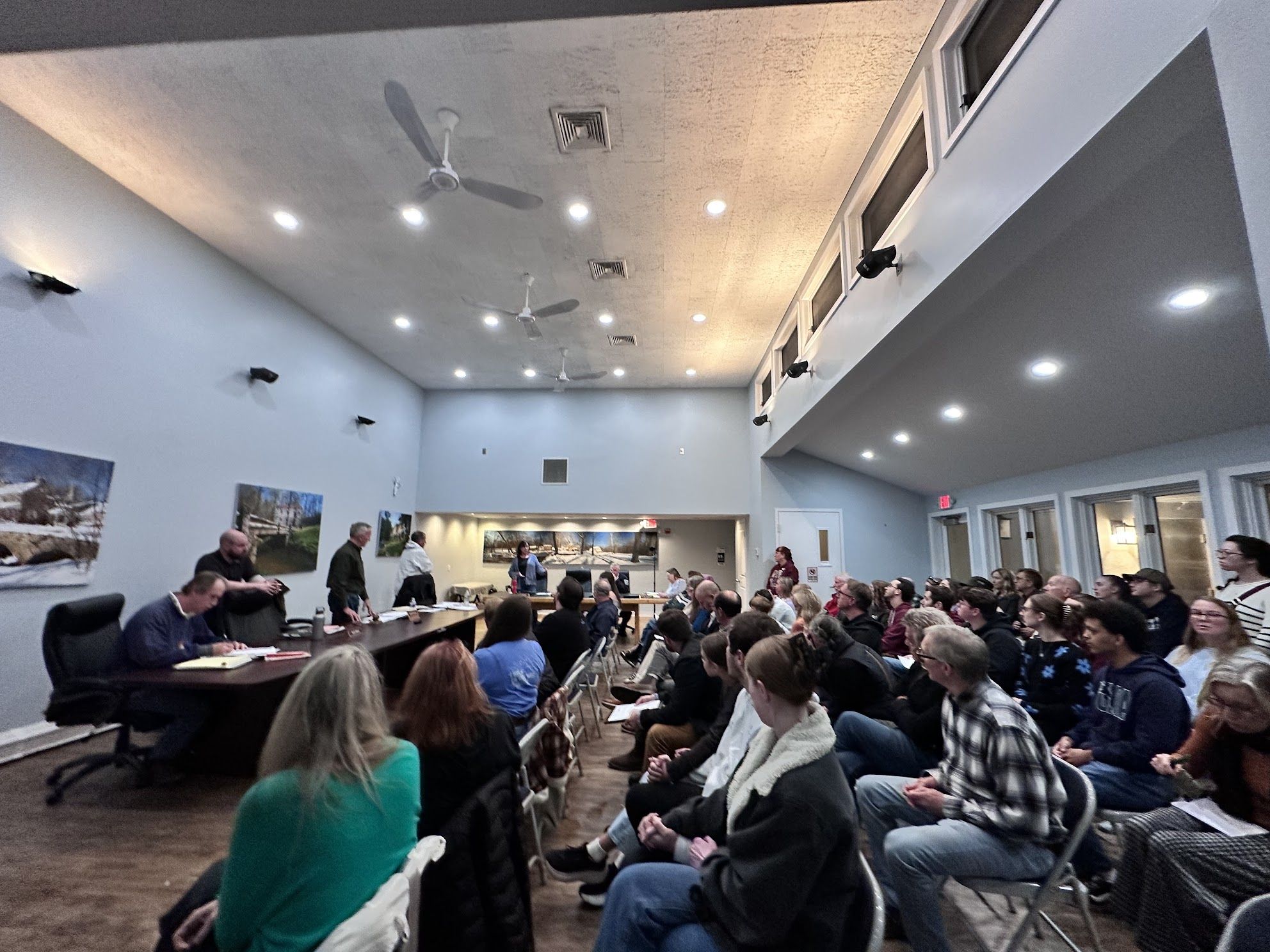
The sale and proposed purchase have drawn pushback from community members, who at a recent meeting spoke for hours, decrying the decisions.
This suburban content is produced with support from the Leslie Miller and Richard Worley Foundation and The Lenfest Institute for Journalism. Editorial content is created independently of the project donors. Gifts to support The Inquirer’s high-impact journalism can be made at inquirer.com/donate. A list of Lenfest Institute donors can be found at lenfestinstitute.org/supporters.
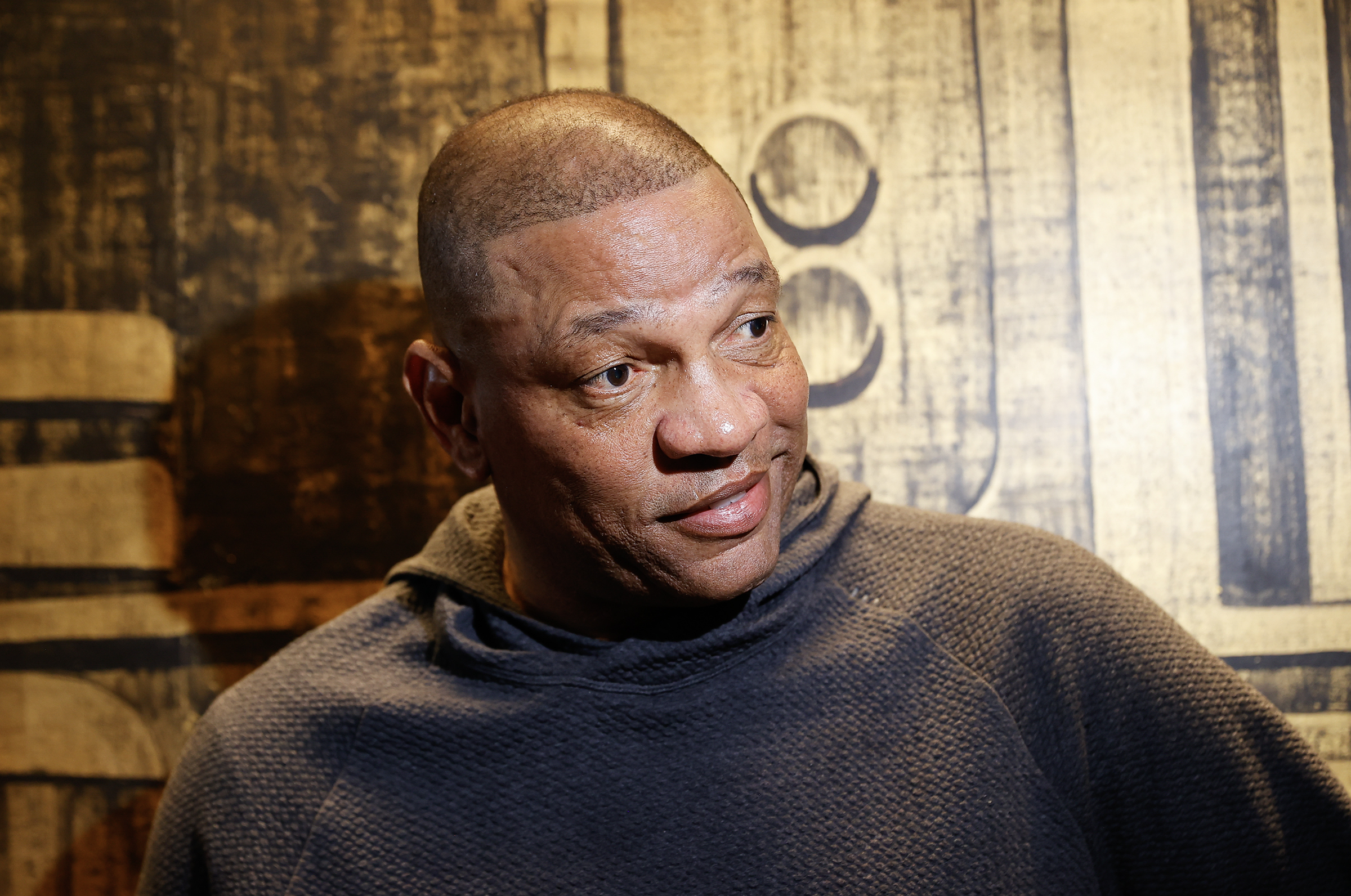
The 76ers take on the Boston Celtics Tuesday in South Philly (8 p.m., NBC, NBC Sports Philadelphia), and Doc Rivers has a distinctive perspective on the historic rivalry.
Rivers, who works as a color analyst for NBC, is one of just three people to have been the head coach of both the Sixers and Celtics (Chris Ford and Jim O’Brien are the others).
“The league is always healthy when the Celtics and Sixers are a rivalry and don’t like each other,” Rivers said.
If you haven’t seen much of Rivers on TV, that’s by design. After stepping down as head coach of the Milwaukee Bucks in April, he joined NBC as an analyst but his schedule doesn’t really pick up until the NFL season ends in January.
Rivers will call his first game for NBC next week — Los Angeles Lakers vs. Charlotte Hornets on Nov. 17 alongside Terry Gannon and courtside reporter Grant Liffman. Once his schedule ramps up, Rivers will call games alongside Mike Tirico and Noah Eagle, but it’s unclear if he’ll land any Sixers or Celtics games.
He’ll also spend some time doing studio work, which he did for the first time last week on Peacock’s RedZone-style NBA Whiparound show alongside Noah Eagle and Brian Scalabrine.
“It’s hard to get 15 games in,” Rivers said. “If somehow we could figure out once a week doing seven or eight games on at the same time … I didn’t know I was going to have that much fun doing that.”
It’s a big change from what his role was at ESPN when he was hired in 2023 to call the NBA Finals, something he’s done just once (in a prior broadcast stint, alongside Al Michaels on ABC in 2004). It was a role he gave up for the chance to coach the Bucks, which convinced Rivers his days of coaching in the NBA are over.
“I remember the game, sitting next to [Bucks assistant coach] Darvin Ham, and in the middle of the game I said to him, ‘You know what? That is it for me,’” Rivers said. “You just know when you still want to be around the game, but you don’t want to work in the game, and that’s basically what I’m doing.”
LeBron is ‘playing the role of Magic Johnson’
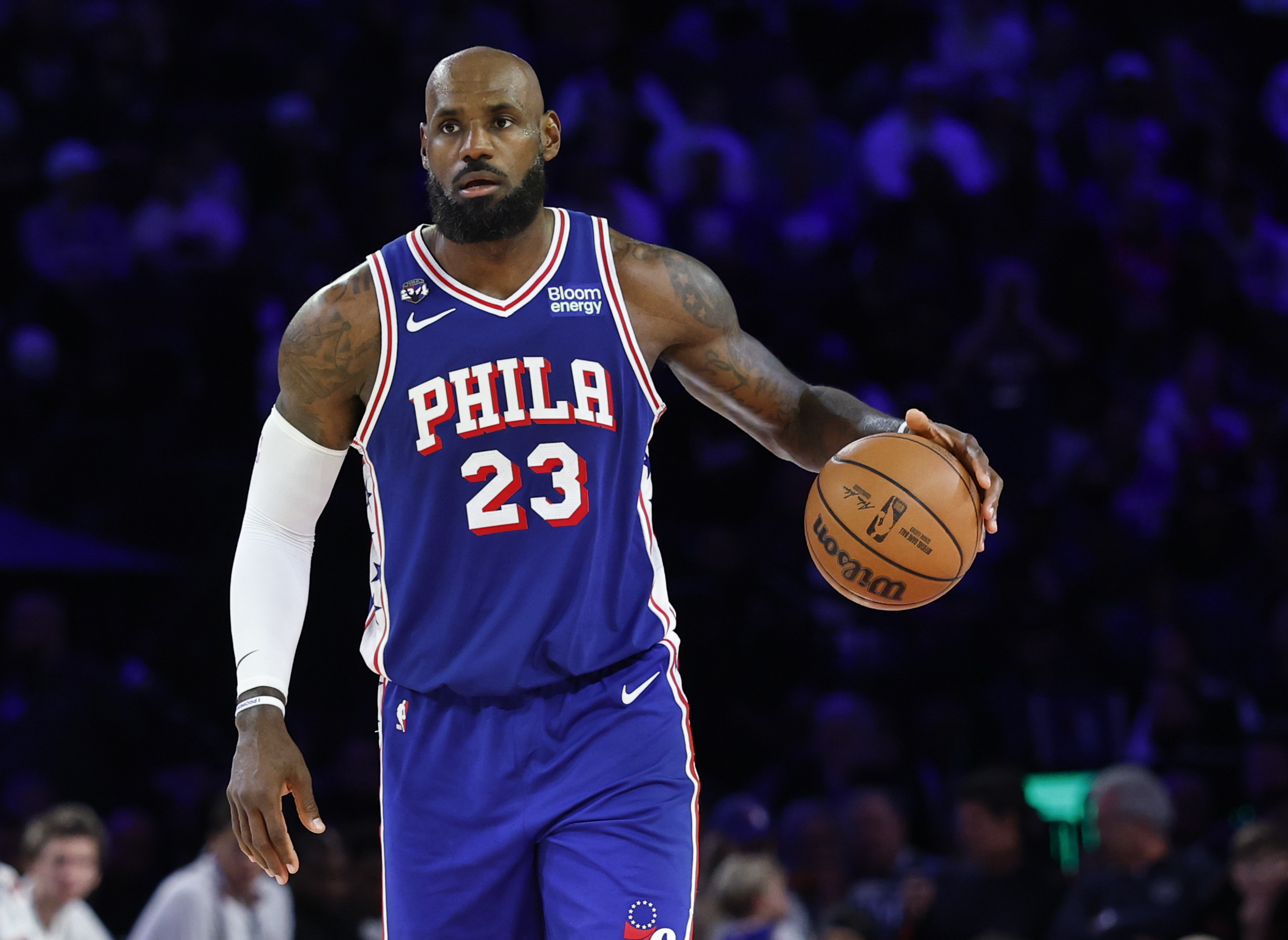
LeBron James has helped lead the Sixers to a quick start by taking a backseat role. Yong Kim / Staff Photographer
Rivers praised Sixers head coach Nick Nurse for figuring out a way to put his star players in the right spots. That includes identifying Tyrese Maxey as the team’s top scorer and how LeBron James fits in on the court.
“LeBron has really sacrificed everything — salary, his game,” Rivers said. “He’s playing the role of Magic Johnson, and it’s been fun to watch.”
While the Sixers will obviously hit bumps along the way, Rivers said the success the team has had through their first 11 games should be sustainable throughout the season and into the playoffs.
“If you rank the top five point guards in the league, Maxey is in the top five. If you rank the top five centers, Joel Embiid’s in the top five. If you rank the top threes, Jaylen Brown’s in the top five. If you rank the top five defensive guards, V. J. Edgecombe’s in the top five,” Rivers said. “And I haven’t even mentioned LeBron yet. That’s sustainable.”
While the additions of James and Brown captured headlines, Rivers also highlighted three signings that have gone a bit under-the-radar outside of Philly — Dean Wade, Anfernee Simmons, and Kentavious Caldwell-Pope.
“Anyone can go out and get a star on their team,” Rivers said. “Championship teams need great role players, and great front offices go out and fit all the right pieces around the stars to win.
Rivers reflects on his disappointing Sixers tenure
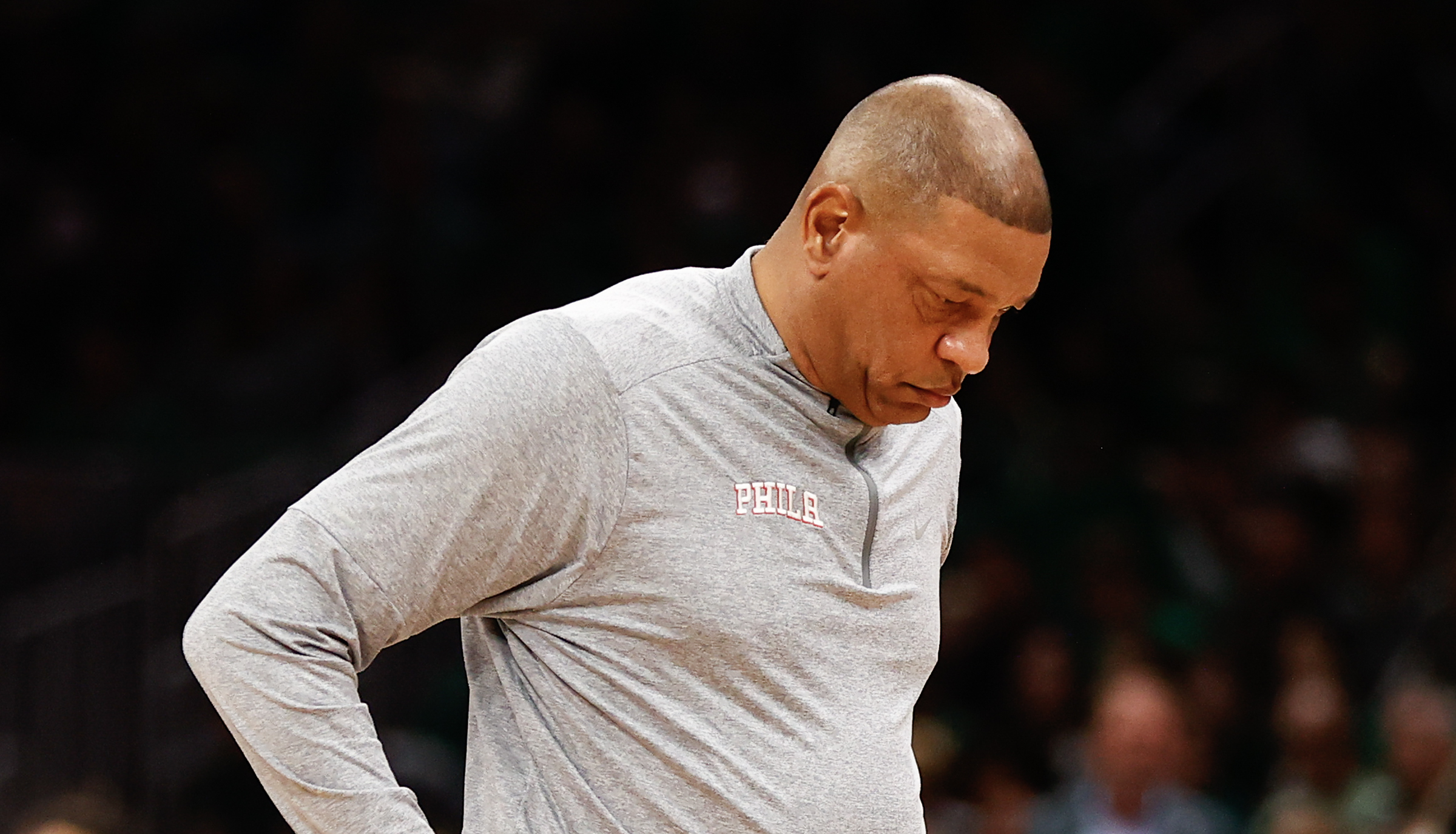
Doc Rivers failed to get the Sixers beyond the second round of the playoffs. Yong Kim / Staff Photographer
Rivers coached the Sixers for three seasons, and while he was able to rack up a lot of regular-season wins, he’s largely remembered for failing to lead the team beyond the second round of the playoffs.
Is there anything Rivers wishes he’d done differently during his time in Philly?
“We had some big games we didn’t come through on, and that will always be my regret,” Rivers said.
“You can do a lot of winning, and I thought we did,” he added. “But we were never the winner.”
Rivers regrets one word he said about Giannis
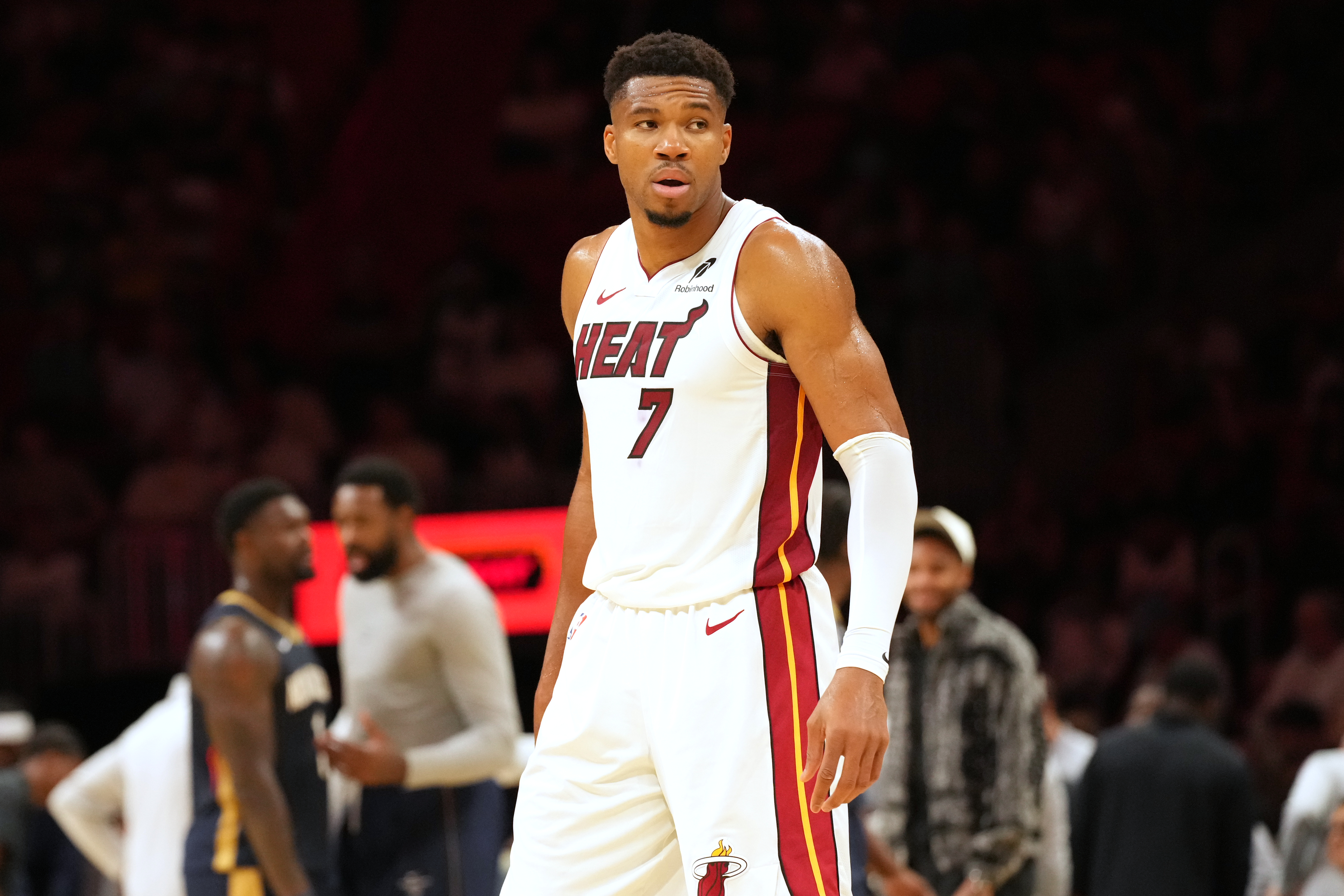
Heat star Giannis Antetokounmpo was surprised by Doc Rivers’ comments. Marta Lavandier
Rivers defended comments he made on The Bill Simmons Podcast last week, where he said it “wasn’t easy” coaching Giannis Antetokounmpo in Milwaukee because of his aggressive playing style.
“I could have said that better,” Rivers said. “I was trying to say it more as a compliment. Coaching great players is hard, and coaching Giannis is hard. That doesn’t mean Giannis is hard to coach.”
Rivers did have one regret over his remarks. In describing Antetokounmpo’s many skills on the court, Rivers told Simmons the Miami Heat star “has this great passing ability, but he doesn’t necessarily have super IQ at the same time.”
In hindsight, Rivers wishes he’d used a different word.
“I used the word IQ, which you should never use,” Rivers said. “I should have used feel.”
Regardless, the comments didn’t sit well with Antetokounmpo, who told reporters Monday he was “speechless.”
“That’s crazy. Never let bitterness and pettiness get in front of your goals and dreams, man,” Antetokounmpo said, according to The Athletic. “For every athlete out there, never let that [happen]. That’s insane.”
The Eagles’ trade of edge rusher Arnold Ebiketie to the Bengals in exchange for a 2027 sixth-round pick fell through less than two hours after the deal was confirmed by multiple outlets.
The Birds were set to ship the Penn State and Temple product to Cincinnati in exchange for a 2027 sixth-round pick, a league source told The Inquirer. NFL Network and ESPN’s Ian Rapoport was first to report the move.
In addition to giving the Eagles the pick, the Bengals would have lost a 2027 third-round compensatory pick, according to Over the Cap contributor Nick Korte, based on the league’s formula for awarding compensatory selections.
Arnold Ebiketie was signed as a compensatory free agent by the Eagles.
The Bengals lost 3 CFAs and signed 2 (Cordell Volson not qualifying), thus while they gain a 2027 6th rounder, they lose a 2027 3rd round comp pick that was via Trey Hendrickson going to Baltimore. https://t.co/DxWAA8L0KN
The reversal of the deal keeps Ebiketie in Philly. The Eagles signed him to a one-year, $7.3 million contract, including $4.3 million fully guaranteed, in March.
Ebiketie, a rotational edge rusher, has recorded 25 combined tackles and two quarterback hits in nine games this season.
Ebiketie played 37% of the Eagles’ defensive snaps in their last game vs. the Giants.
The Eagles started the trade deadline period with a bang on Monday with their deal to send Jordan Davis to the Jaguars for a first-round pick in 2027 and a second-round choice in 2029 but did not complete another move before Tuesday afternoon’s deadline.
After the deadline had passed, they waived running back Jaydon Blue, who averaged 22.3 yards on 12 kickoffs and had one 9-yard catch over the past two weeks.
The team still has nine scheduled selections in next year’s draft after the Ebiketie reversal, including two in the first round, one each in the second, third, fourth, and seventh, and three choices in the fifth round.
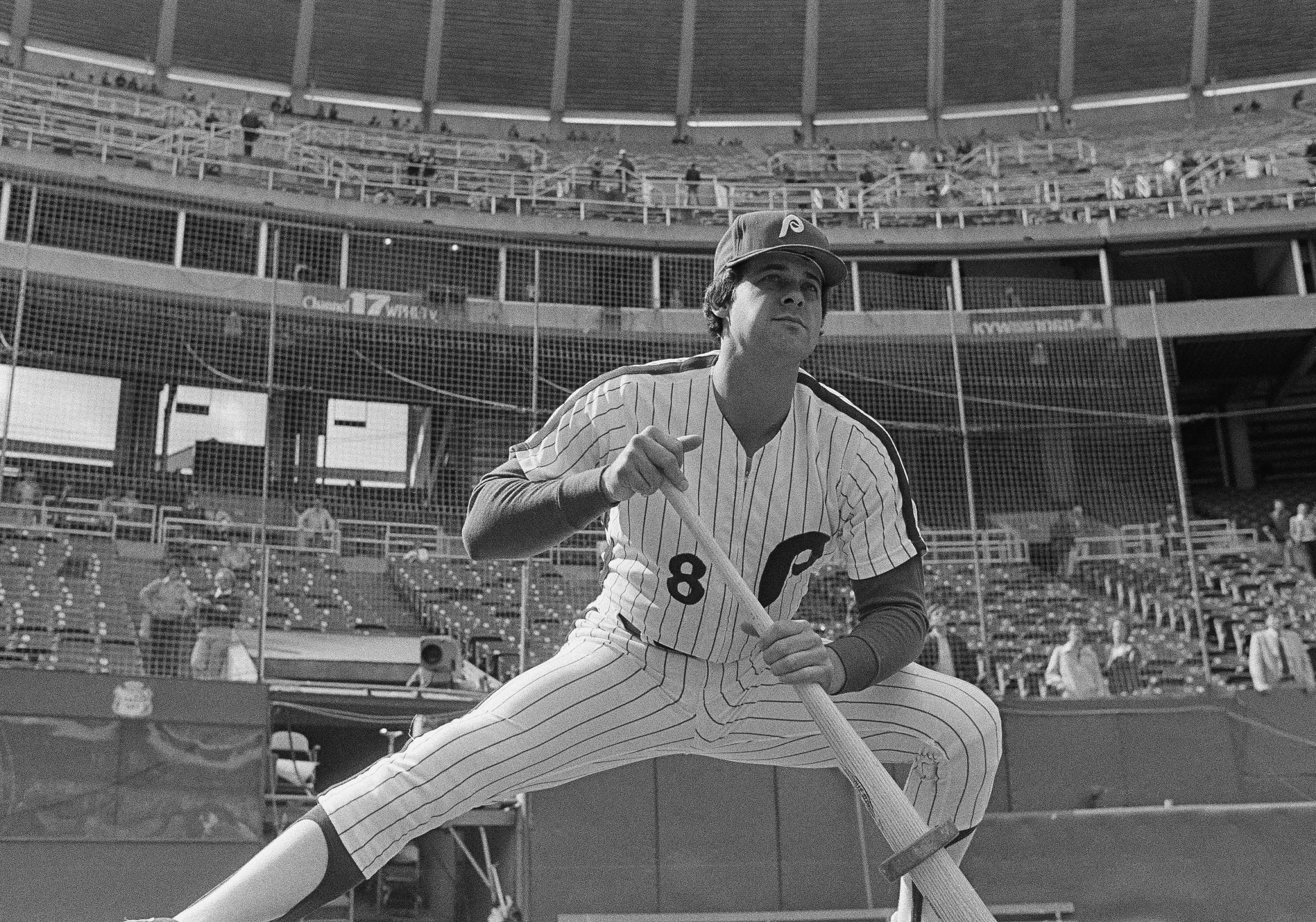
Bob Boone, the rugged catcher on the 1980 world champion Phillies who was part of baseball’s first three-generation family, died Monday. He was 78.
Mr. Boone was a third baseman at Stanford before the Phillies, who drafted him in 1969, turned him into a catcher. His father Ray played 13 seasons in the big leagues and his sons Aaron and Bret both became All-Stars. The Boones are one of five families to have three generations of major leaguers.
Mr. Boone played 10 seasons with the Phillies and he often pushed through injuries to stay on the field. He caught the fastball from Tug McGraw that clinched the 1980 World Series and was part of the homegrown cast of players who brought the Phillies their first crown.
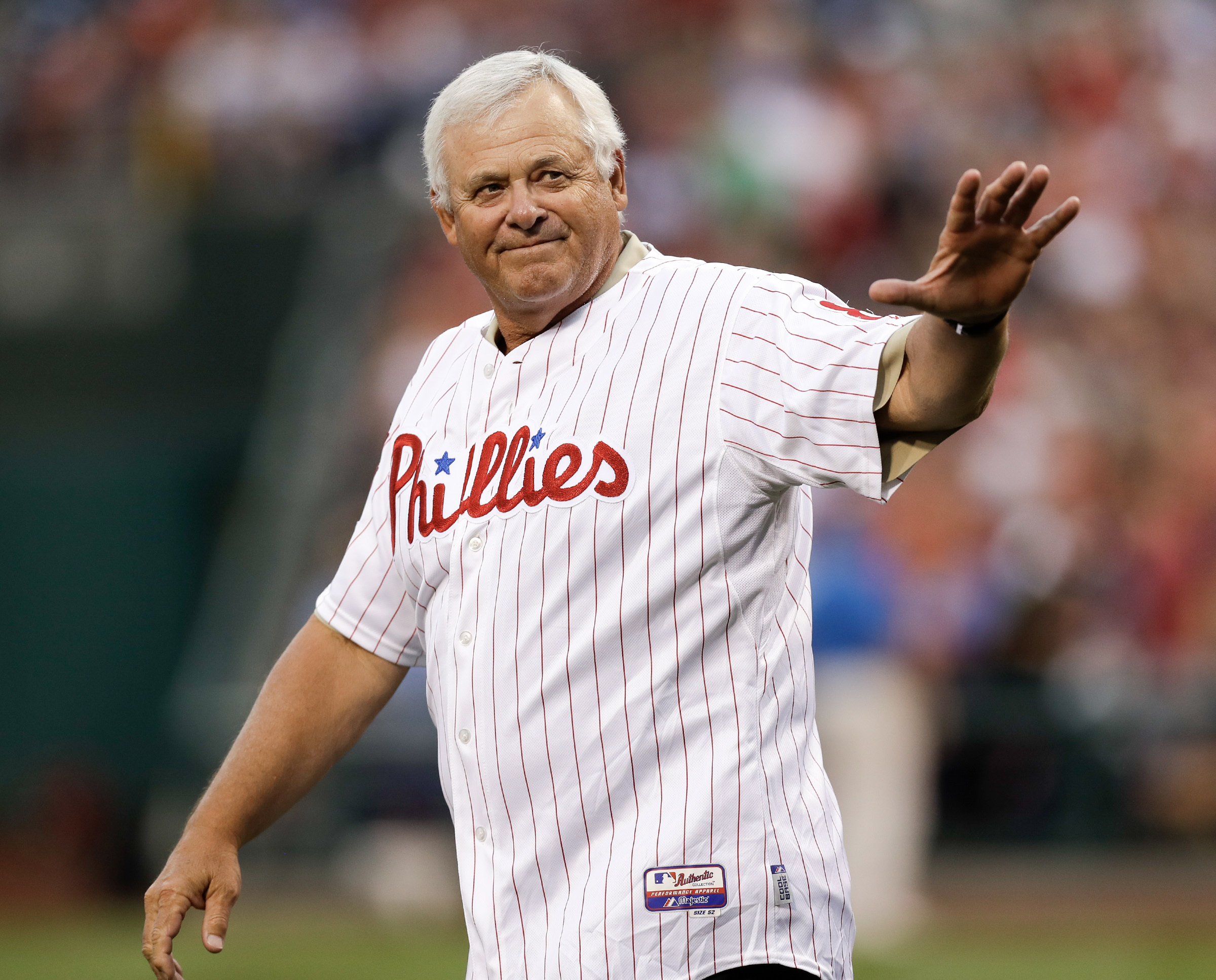
Bob Boone waves to the crowd before a Phillies game in 2017.Yong Kim / Staff Photographer
“He was a man of great integrity,” his son, Bret Boone, wrote on Facebook. “He was a great dad, husband, and patriarch. It was a privilege to call him my father. Baseball lost a great one today.”
Robert Raymond Boone was born on Nov. 19, 1947 in San Diego and was a descendant of American pioneer Daniel Boone. He tagged along with his dad to the ballpark, just like his sons would do years later with him at Veterans Stadium. Mr. Boone graduated from Stanford with a psychology degree and finished his pre-med courses before joining the Phillies.
He was a minor-league infielder when he left the Phillies in 1970 to serve in the Army and was moved to catcher later that season when he returned.
“We played in the minors together where he gave up third base so I could play it, only to become one of the best catchers in baseball history,” said Phillies Hall of Famer Mike Schmidt. “Bob was a great father and husband. Our lives and careers were intertwined, we pursued our Christian faith together, worked out together, and became world champions together. We lost a close friend. Rest in peace, Bob.”
Mr. Boone reached the majors at the end of the 1972 season and was the starting catcher a season later. Mr. Boone fractured his elbow in the minors, played through back spasms, and missed the Phillies’ National League championship celebration in 1980 because he was having his ankle tended to in the trainer’s room after a runner slid into him at home plate. It was just a flesh wound, Mr. Boone told reporters.
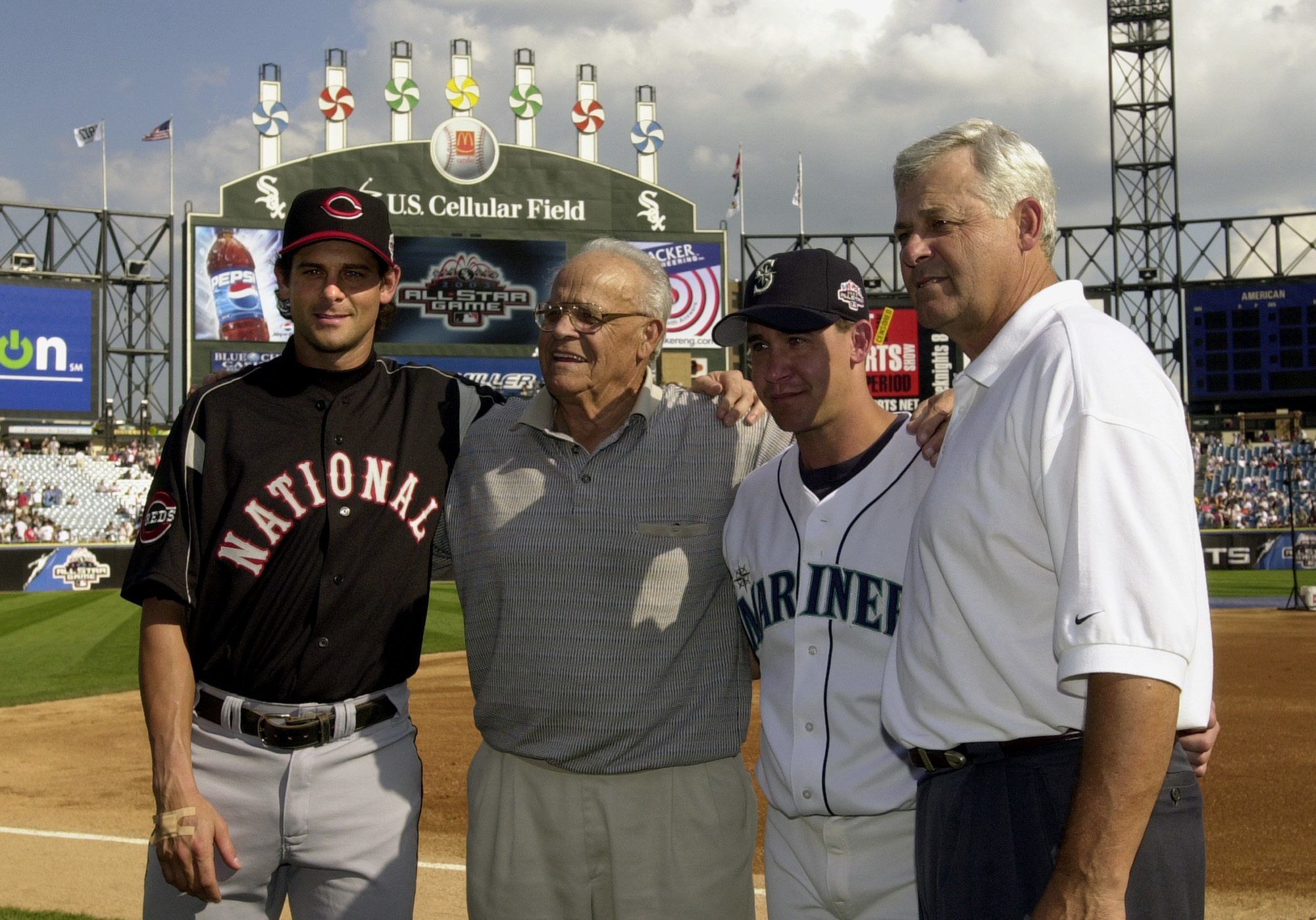
In this 2003 photo, the Reds’ Aaron Boone (left) and his brother and Mariner, Bret, pose with their grandfather, Ray, and father, Bob, at the All-Star Game in Chicago.MARK DUNCAN / AP
Mr. Boone prepared days later for the World Series opener by chilling his foot in an ice machine, swallowing aspirin an hour before first pitch, and taping his ankle so tight that his toenails turned blue. He had three hits that night and drove in two runs as the Phillies won Game 1 against Kansas City, 7-6.
“We were watching on television and I said to my wife, ‘Bob’s hurt. I can tell by the way he’s moving around,’” Ray Boone told the Daily News’ Ray Didinger after Game 1. “I talked to him on the phone the next day. I asked him about it. He said, ‘Oh, it’s nothing. I got some X-rays but it’s nothing.’ That’s the way he is. He’s tough. He’s not a complainer. I knew he’d start this game tonight. A little pain’s not going to keep him out of the World Series.”
Mr. Boone won seven Gold Glove awards, played for three teams over 19 seasons, and retired in 1990 with Kansas City as the major league leader in games caught. He made four All-Star teams, led the Phillies with a .412 average in the 1980 World Series, and in 2005 was added to the Phillies’ Wall of Fame.
“Bob Boone was a quiet leader, both on and off the field,” former Phillies shortstop Larry Bowa said. “I had the privilege of playing alongside him for nearly my entire career, and without question, he was the backbone of our team. He was a man of deep faith who loved his family dearly.”
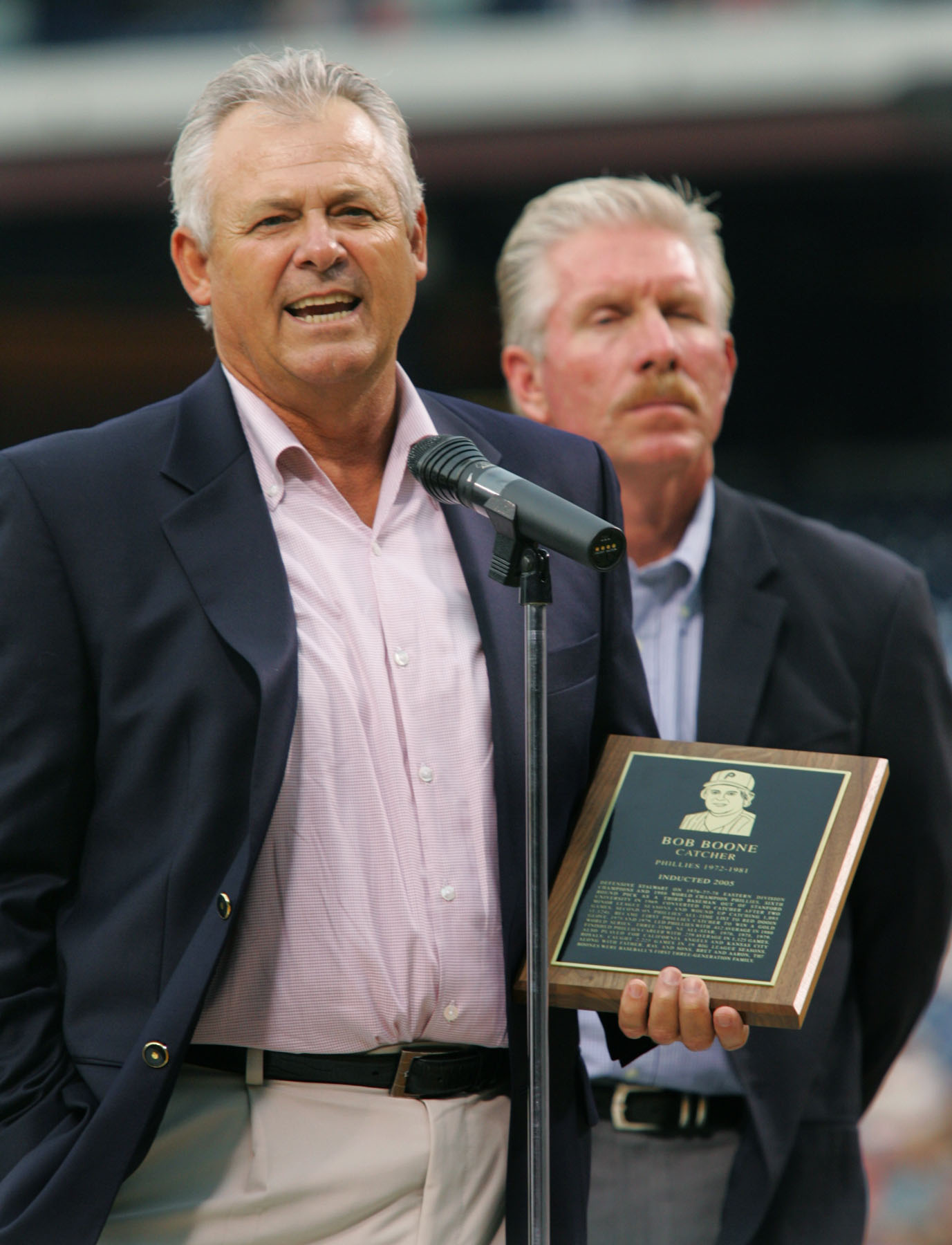
Bob Boone addresses fans after being inducted into the Phillies Hall of Fame in 2005. At right is Mike Schmidt.RUSTY KENNEDY
He was hired during his final season by former Sixers general manager Pat Williams to manage the proposed expansion baseball team in Orlando but Major League Baseball instead awarded franchises to Miami and Denver. Mr. Boone managed in Detroit and Oakland’s minor-league systems before joining the Reds in 1994 as their bench coach, weeks after the team traded for his son Bret. A year later, Mr. Boone returned to Kansas City to manage the Royals. Mr. Boone managed six seasons, three with the Royals and three with the Reds. His son Aaron has managed the Yankees since 2018 and his son Bret was the Rangers’ hitting coach in 2025.
Mr. Boone struggled to call games from behind the plate after becoming a catcher but worked tirelessly to improve his skills. By the end of his career, Mr. Boone was a savant. Jim Murray, a Pulitzer Prize-winning columnist from the Los Angeles Times, once compared Mr. Boone to a boxing manager as he worked behind the plate with a sense of ownership. He didn’t use “we” or “him” when describing what the pitcher was throwing. He wore the responsibility.
“It’s an art form,” Mr. Boone said of catching. “It’s two parts ability and one part instinct.”
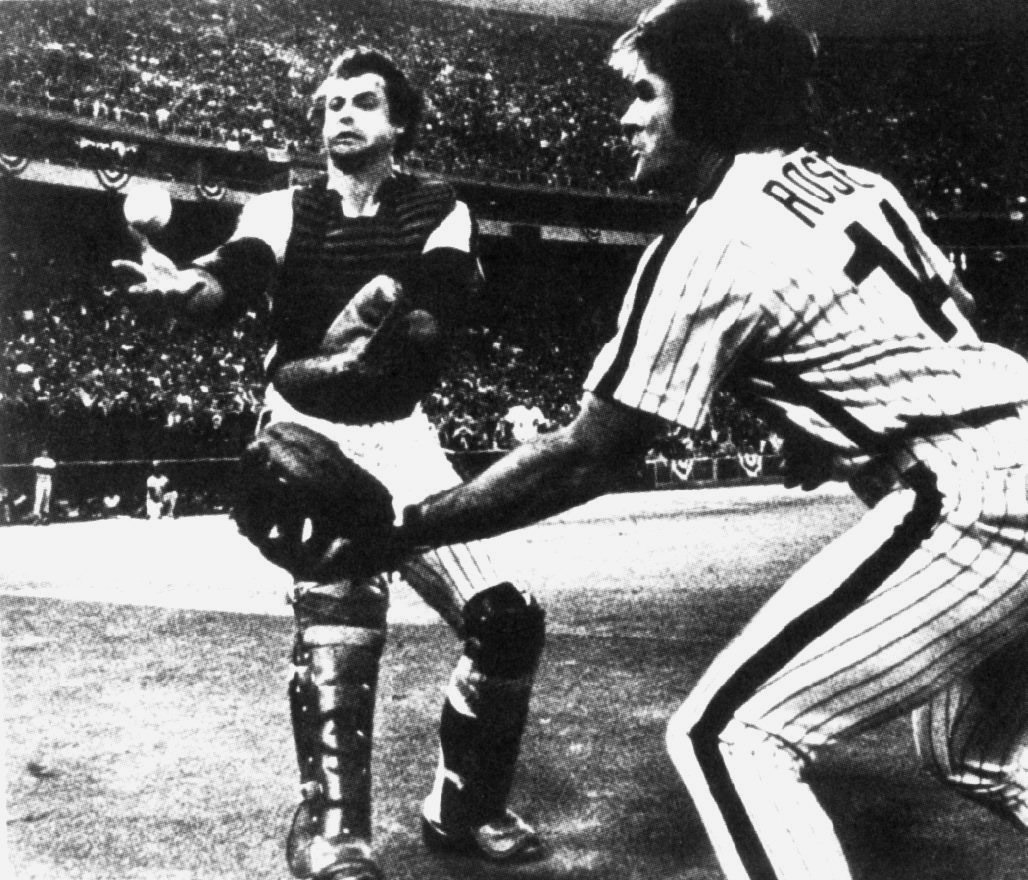
With two outs to go for a World Series championship, a pop foul off the bat of the Royals’ Frank White bounced out of Bob Boone’s mitt and into Pete Rose’s for the second out of the ninth inning in Game 6. Norman Y. Lono / Staff Photographer
Mr. Boone and McGraw famously disagreed during the final at-bat of the 1980 World Series as the catcher wanted McGraw to throw his famous screwball to Willie Wilson, but the pitcher’s elbow would not let him. He shrugged off Boone’s signals repeatedly before they agreed to throw the fastball that Willie Wilson missed. A batter earlier, Mr. Boone hustled to catch a foul ball near the Phillies’ dugout before it popped out of his glove and into the waiting mitt of Pete Rose. Mr. Boone, known for his defensive prowess, said years later that the mishap was on Rose as the first baseman was late to arrive and should’ve called off the catcher. Mr. Boone feared Rose was going to knock them both into the dugout. At last, the out was made.
“I wanted to kiss him,” Mr. Boone said of Rose as the Phillies soon became champions.
Mr. Boone is survived by his wife Sue; sons Aaron, Bret, and Matt; and grandchildren.
Move over Philadelphia Museum of Art, and better luck next time, Barnes Foundation, because the hottest gallery show opening in the city this year happened at an empty cement lot in South Philly on Friday night.
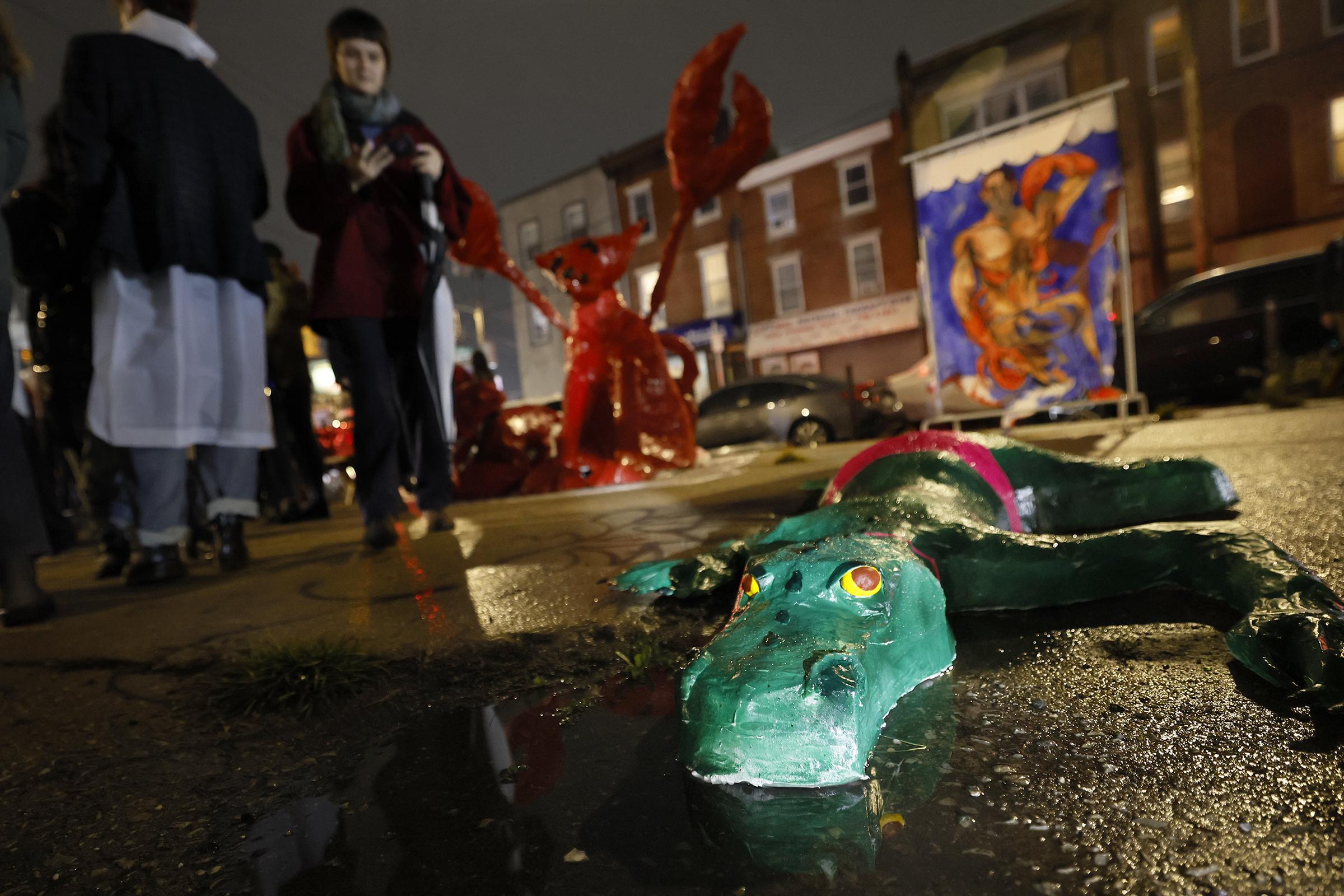
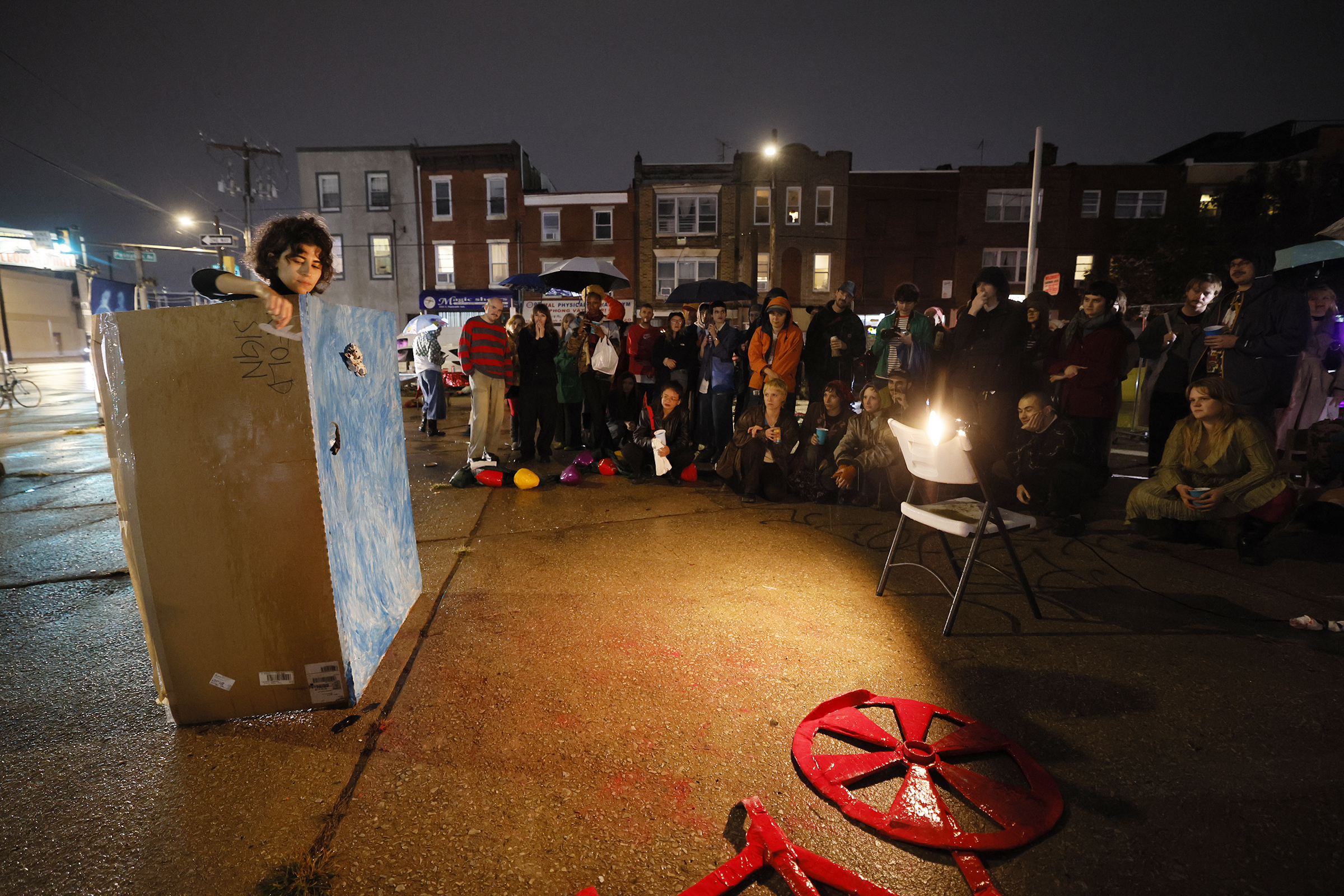
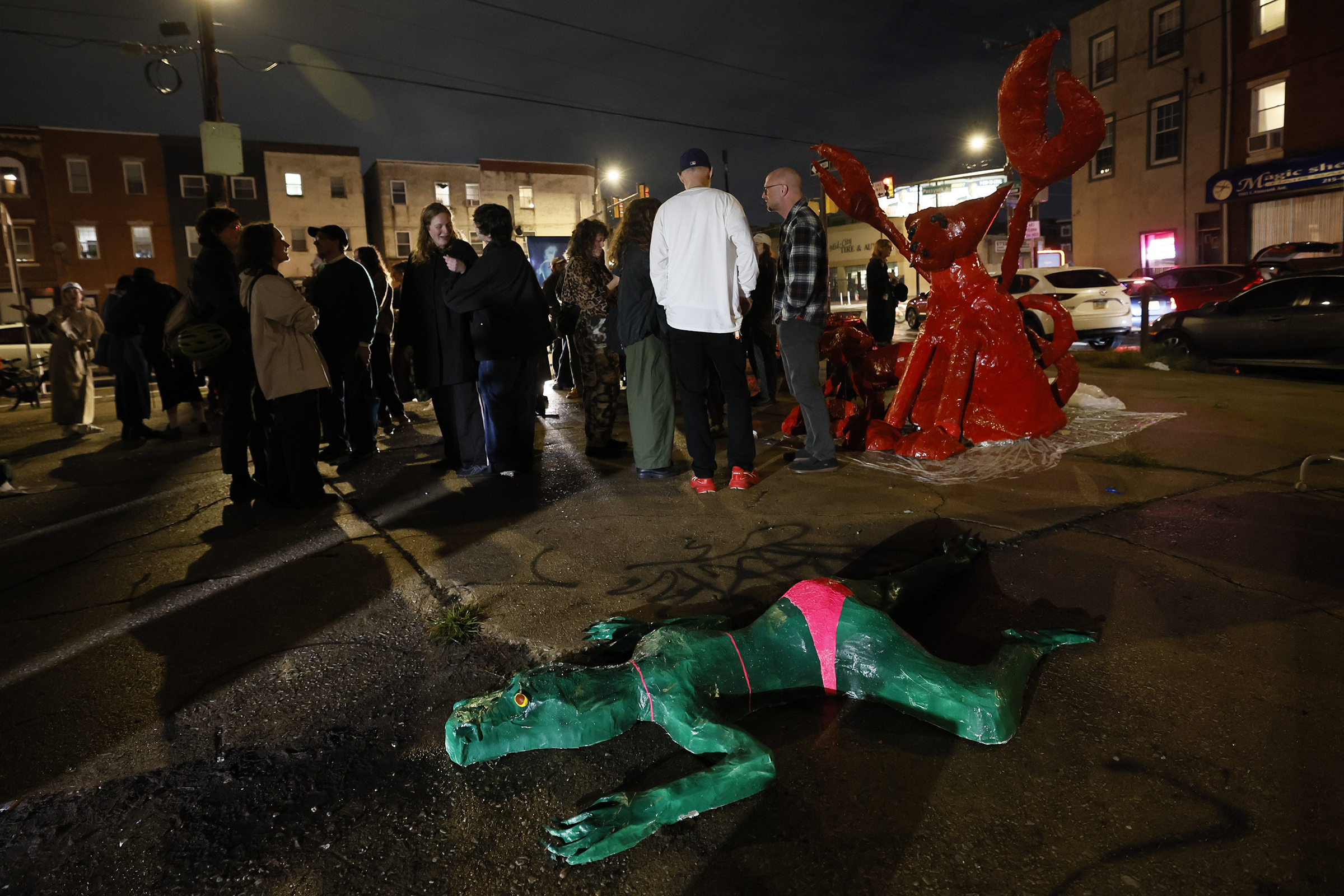
This guerrilla group art show had everything: a papier-mâché alligator in pink bikini bottoms, a prognosticating crab sculpture, a puppet show, a punk band, boxed wine, and even a tray of questionably soggy shrimp (though, to be fair, it was raining).
More than a dozen artists participated in the unsanctioned show, which was attended by more than 75 people, some of whom just wandered into the free and surreal experience as they were walking down Washington Avenue.
Olivia Guarnieri performs a puppet show titled “A bird observes two things. Then, someone takes a photo,” during the opening night party for “Imitation Crab,” a community art show in the empty lot along Washington Avenue in South Philly that used to house Capt. Jesse G’s Crab Shack.Elizabeth Robertson / Staff Photographer
“I think the best part about Philadelphia is that we get to be a community and I think the best part of our art is the exact same thing,” artist Gio Cullen said. “Making spaces like this that are abandoned really full of life is wonderful. This is so Philadelphia.”
Held at the empty triangle cement lot at the intersection of Washington and Passyunk Avenues that was once home to Capt. Jesse G’s Crab Shack (and still home to its giant sign), “Imitation Crab” is the first collaborative art show held at what’s become known in select circles as “Capt. Jesse G’s Crab Shack Gallery.”
‘Am I really seeing this?’
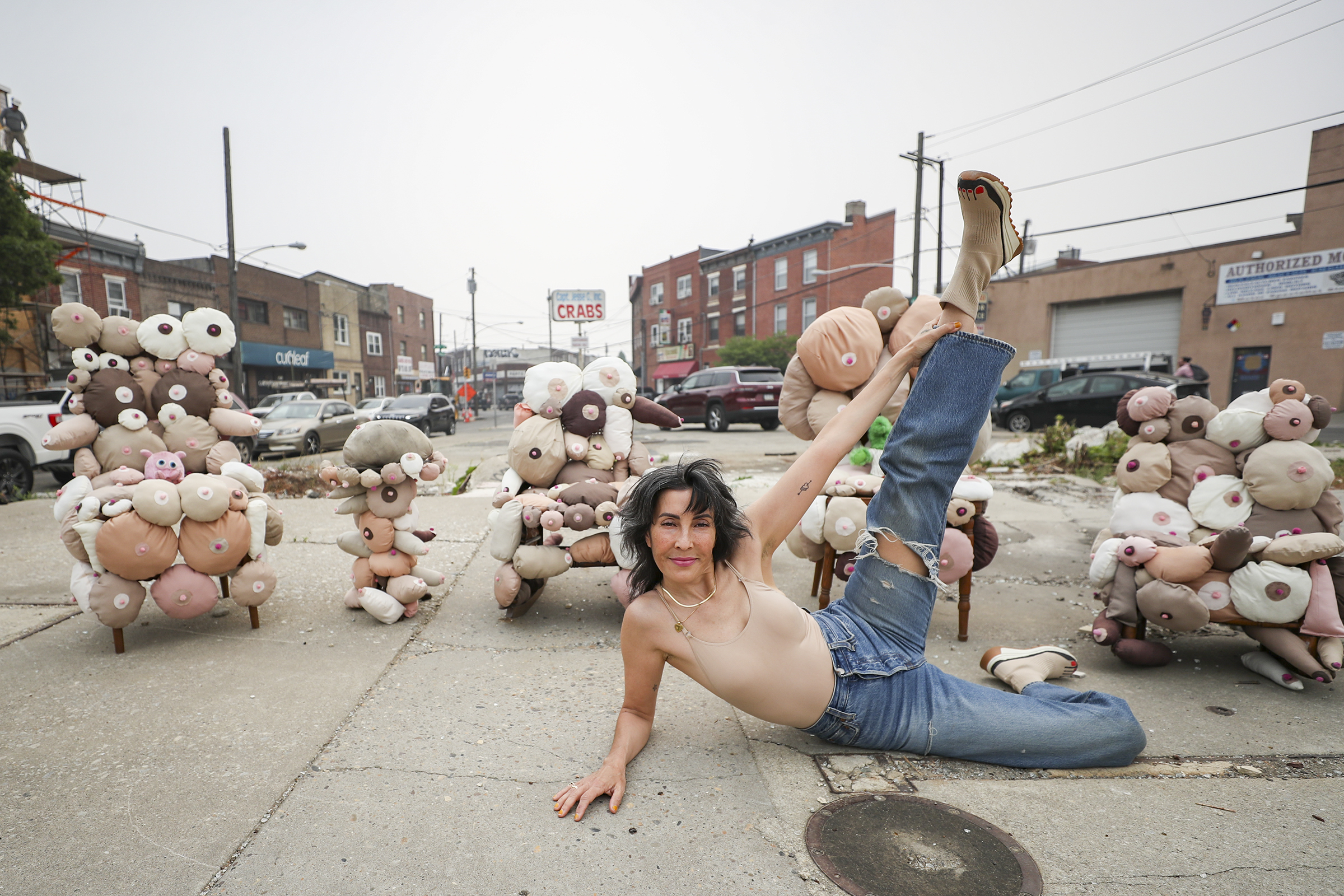
The name was bestowed upon the lot by artist Rose Luardo, who was the first to put her art there in 2023 when she erected her Boob Garden, a furniture set covered in handmade breast plushies, in the center areola of the cement pad under the cover of night.
Rose Luardo poses for a photo in 2023 next to her pop-up exhibit, the “Boob Garden,” at the vacant lot where Capt. Jesse G’s Crab Shack once stood on Washington Avenue. Heather Khalifa / Staff Photographer
Her work wasn’t signed, so it took some digging to track down Luardo back then. When we connected, our conversation brought me as much joy as her work.
“I really love that zany weird, waking LSD trip of it all, like ‘Am I really seeing this?’” she told me.
Every year since, I’ve held out hope I’ll get a message from Luardo that she’s set up another piece at the Crab Shack Gallery, and every year, she’s come through.
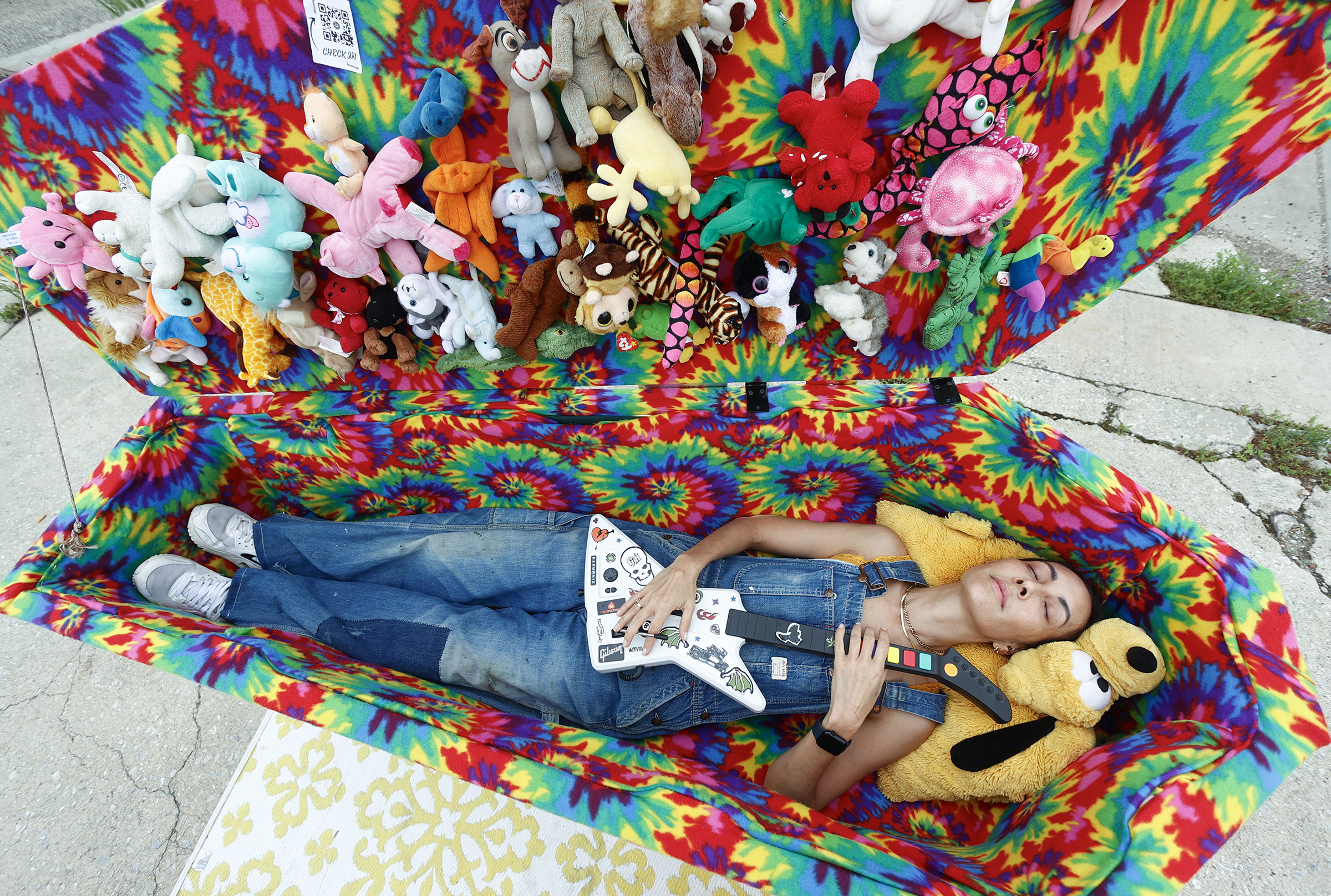
Artist Rose Luardo in 2024, laying in her art project, the tie-dye “Rave Coffin,” at the triangular cement lot on Washington Avenue that used to house Capt. Jesse G’s Crab Shack. Yong Kim / Staff Photographer
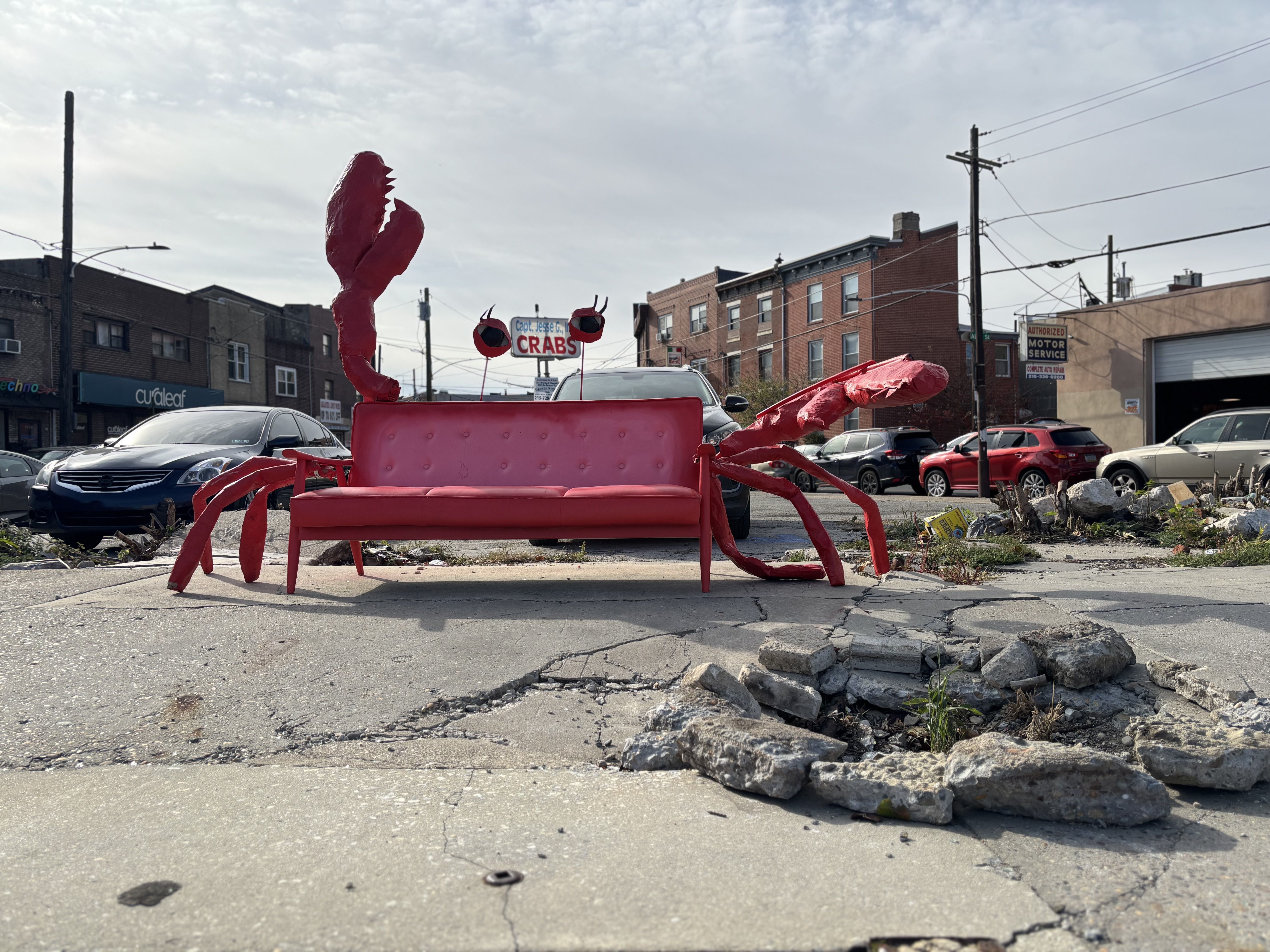
In 2024, it was her Rave Coffin, a casket covered in tie-dyed felt that passersby could lie down in, and last year she installed her Crab Couch at the gallery, which was a sofa Frankensteined into a giant crab.
For more than a decade, the Crab Shack Gallery lot has sat vacant, a gaping hole along a busy corridor. According to city records, it’s owned by 1100 Passyunk Partners LLC. I’ve never been able to locate contact information for the owners and they’ve never contacted Luardo or me. As far as anyone knows, neither the property owner nor the city has removed any of the pieces from the lot. They tend to remain until worn by time and weather, though the Boob Garden was vandalized after a few months.
Artist Rose Luardo installed her “Crab Couch” at Capt. Jesse G’s Crab Shack Gallery in 2025.Stephanie Farr / Staff
I wasn’t sure how Luardo and the small team of artists who help her were going to level up things this year, or if they’d even try. In late October, just as I was losing hope, Luardo sent me a flyer for the “Imitation Crab” show.
“Oh shell yes!” I thought.
‘The coolest place’
As I approached the gallery Friday night, I was surprised to see it buzzing with life and lights (“We had to get generators. We didn’t know how to even start the generators!” Luardo told me.)
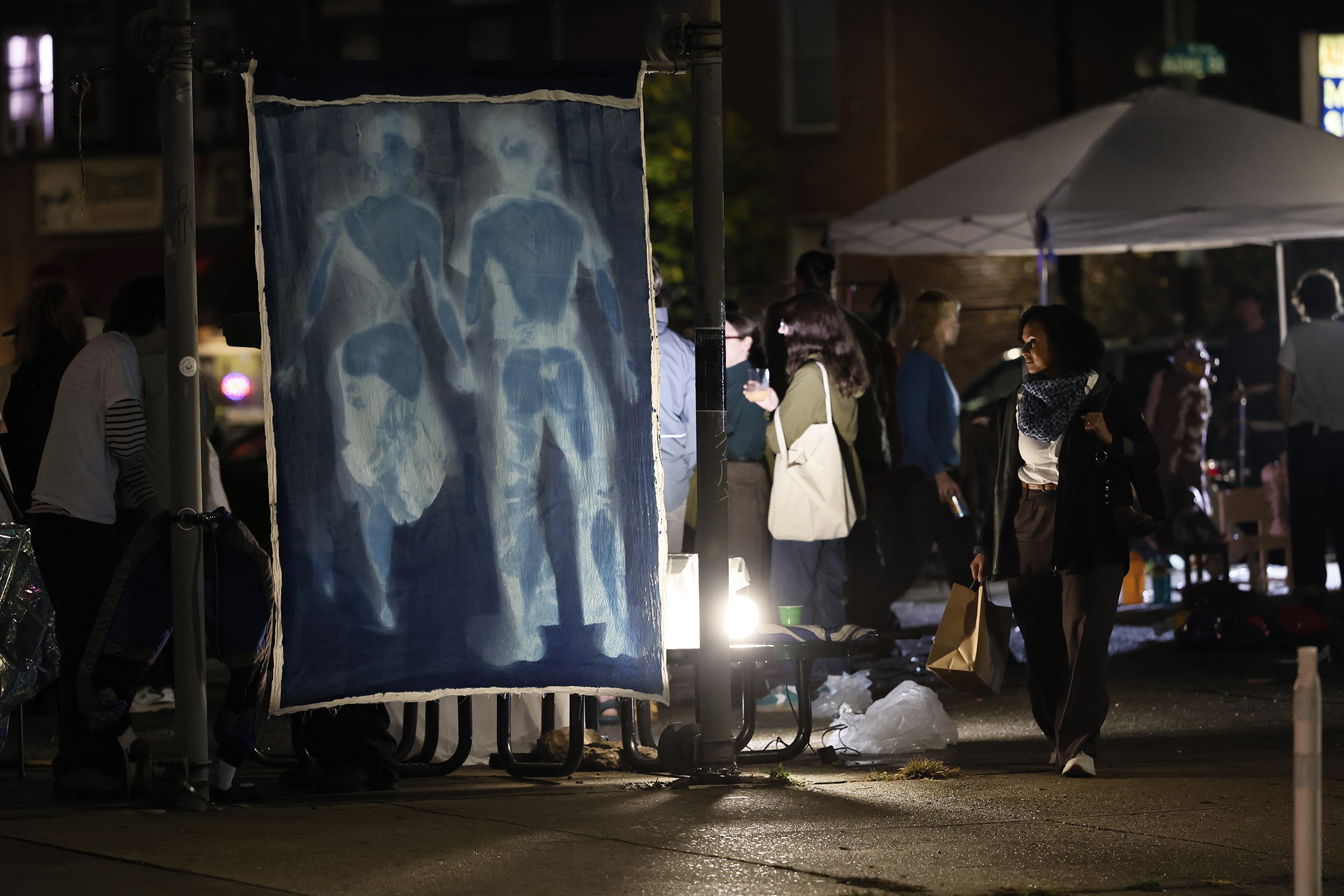
A woman looks at “Pictures of You,” a large-scale cyanotype by artist Mercedes Tien during the opening night party for “Imitation Crab,” a community art show in the empty lot along Washington Avenue in South Philly that used to house Capt. Jesse G’s Crab Shack.Elizabeth Robertson / Staff Photographer
My attention was immediately captured by an 8-foot blue cloth displayed in a corner, with the outline of a couple holding hands on it. Artist Mercedes Tien, 23, of West Philly, told me it was a cyanotype of her and her boyfriend lying on his roof together. A recent graduate of Temple University’s Tyler School of Art and Architecture, Tien said this was her first art show outside of school.
“It’s the first art show I’ve seen that really takes in the setting, like the actual lot itself,” she said.
Artists Rose Luardo (left) and Mercedes Tien hug during the opening night party for “Imitation Crab,” community art show in the empty lot along Washington Avenue in South Philly that used to house Capt. Jesse G’s Crab Shack.Elizabeth Robertson / Staff Photographer
Tien was right. People leaned into the crab theme with crab sculptures, hats, and shirts, while artists like Cullen, 24, of Northern Liberties, and their best friend, Bridge Veix, 28, also made found-object sculptures with things they collected from the lot, like rocks, glass, bricks, and weeds.
“We started looking around and realizing how much awesome material is here and then we kind of just started filling the space,” Veix said. “Art in a public space is really special because it’s full access for everyone. So even if you’re walking by, you get to be a part of it and interact with it and there’s no payment. There’s just enjoyment.”
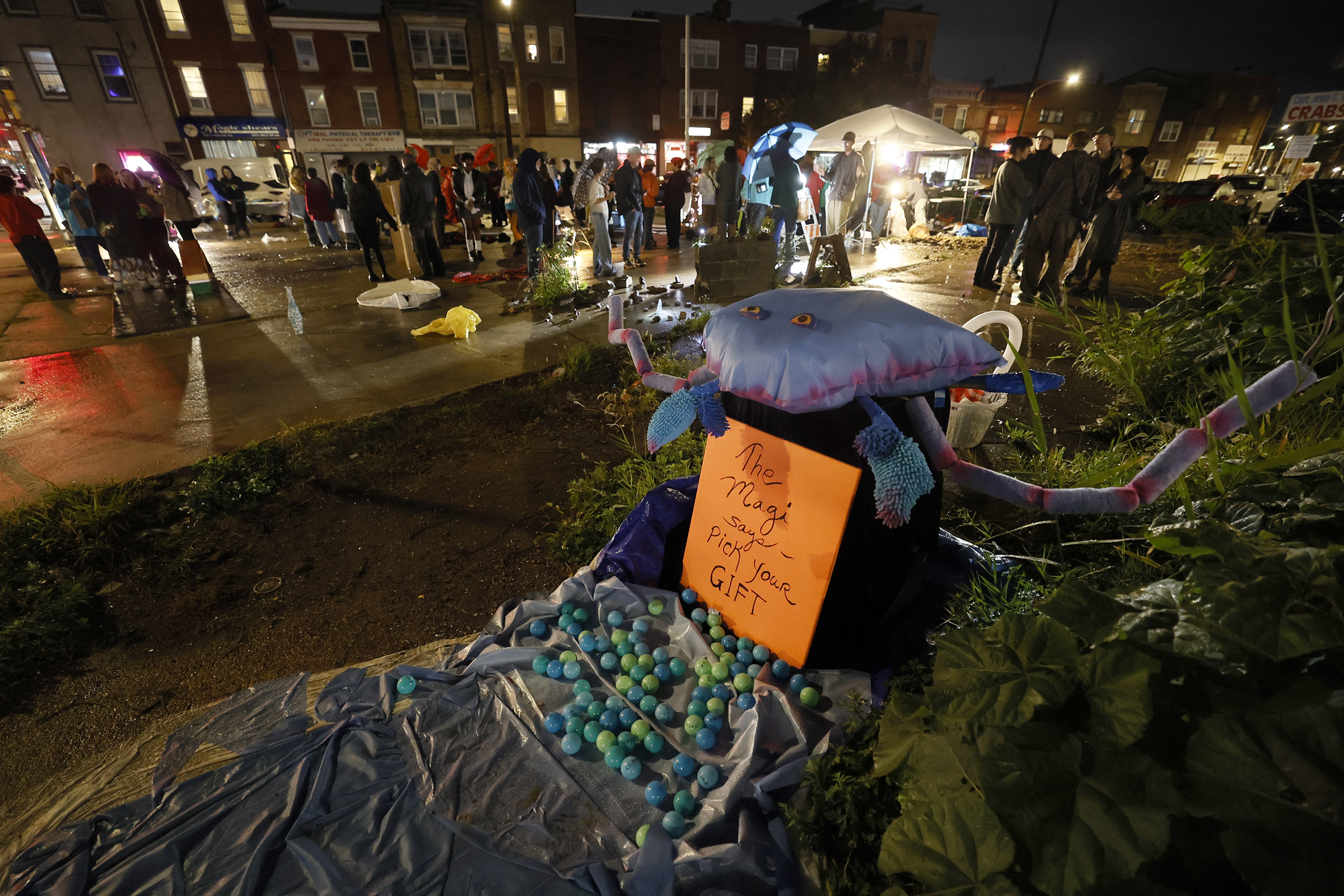
Iris Brenneman’s sculpture, The Blue Crab Magi, featured a large, blue crab on a pedestal and blue tarps on the ground flowing toward it like a river. Where the two met, dozens of plastic balls, each with a word like “artistry” or “longevity” written on it, were gathered into a pile. A sign above the balls read: “The Magi says — pick your gift.”
Brenneman, 64, a therapist by trade, dressed for the opening in a classy black evening gown and white coat. She’s been a fan of the Crab Shack Gallery since the Boob Garden, and her son helped organize the group show.
Iris Brenneman’s “The Blue Crab Magi” on display during the opening night party for “Imitation Crab,” a community art show in the empty lot along Washington Avenue in South Philly that used to house Capt. Jesse G’s Crab Shack.Elizabeth Robertson / Staff Photographer
“I try to support everything they do and I think the Crab Shack Gallery is the coolest place,” she said.
Steven Gulotta, 34, and Allana Wooley, 33, who live a block away from the lot, are also big fans of the gallery.
“I walk by this lot basically every day and it’s got a lot of beauty in its decrepitness. Then stuff pops up randomly like the Boob Garden, the Rave Coffin, and the Crab Couch and makes it even more interesting,” Gulotta said.
Inspired by the Crab Crouch, Wooley and Gulotta made a small, red papier-mâché Crab Cat and put it in the gallery earlier this year without telling anyone. Luardo heard about it, tracked the two down, and invited them to participate in the group exhibit.
People mingle around the art, including a papier-mâché crocodile by artist Jill Donahue, during the opening night party for “Imitation Crab,” a community art show in the empty lot along Washington Avenue in South Philly that used to house Capt. Jesse G’s Crab Shack.Elizabeth Robertson / Staff Photographer
In less than a month, Gulotta and Wooley made a second, much larger Crab Cat, about six feet tall, for the show.
“This is a dream come true,” Gulotta said. “I love this lot.”
‘The ultimate solution’
The exhibit, which also featured a puppet performance and a punk band, was the brainchild of Luardo’s niece, Ingrid Koppisch. The event was spearheaded by Koppisch and her friends Max Brenneman and Val Roberta, who’ve helped Luardo set up her previous installations.
“I wanted to take on the Crab Shack because I just moved into Rose’s [old] house, which is like two blocks away, and I love this place,” Koppisch said. “Every time we make something big and we don’t know what to do with it, we love putting stuff here.”
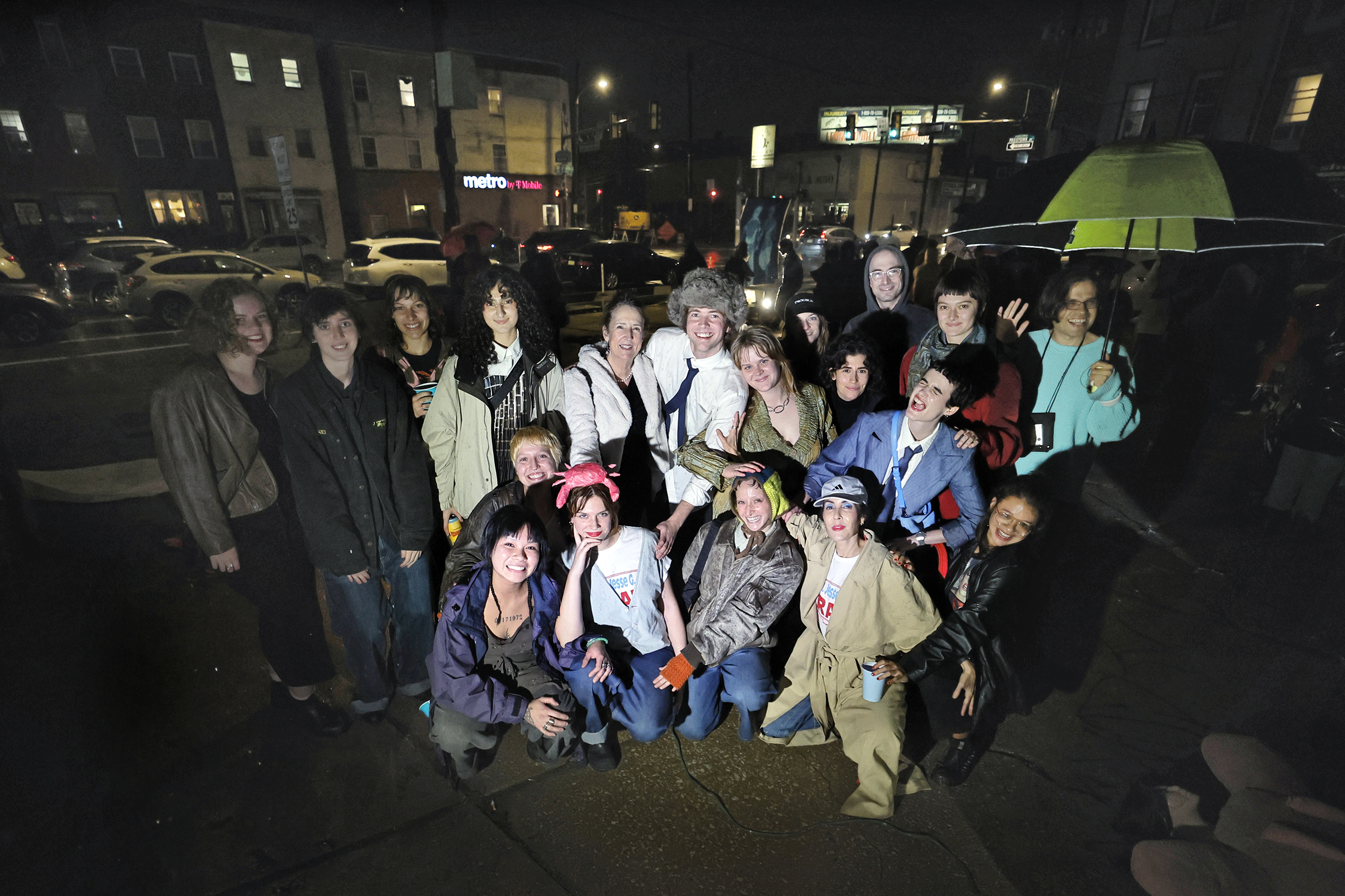
Participating artists got together for a group photo during the opening night party for “Imitation Crab,” a community art show in the empty lot along Washington Avenue in South Philly that used to house Capt. Jesse G’s Crab Shack.Elizabeth Robertson / Staff Photographer
Luardo, who helped organize the show and had a set of furniture covered with fake intestines in it, agreed.
“This is like the ultimate solution for our work,” she said of the lot. “It’s dilapidated and lawless and I see freedom and I see creativity.”
“That’s how I feel about Philly overall,” I said.
Philadelphians’ ability to create beauty in the empty and broken corners of our city never ceases to amaze me and the freedom this city offers us to be creative weirdos is never lost on me.
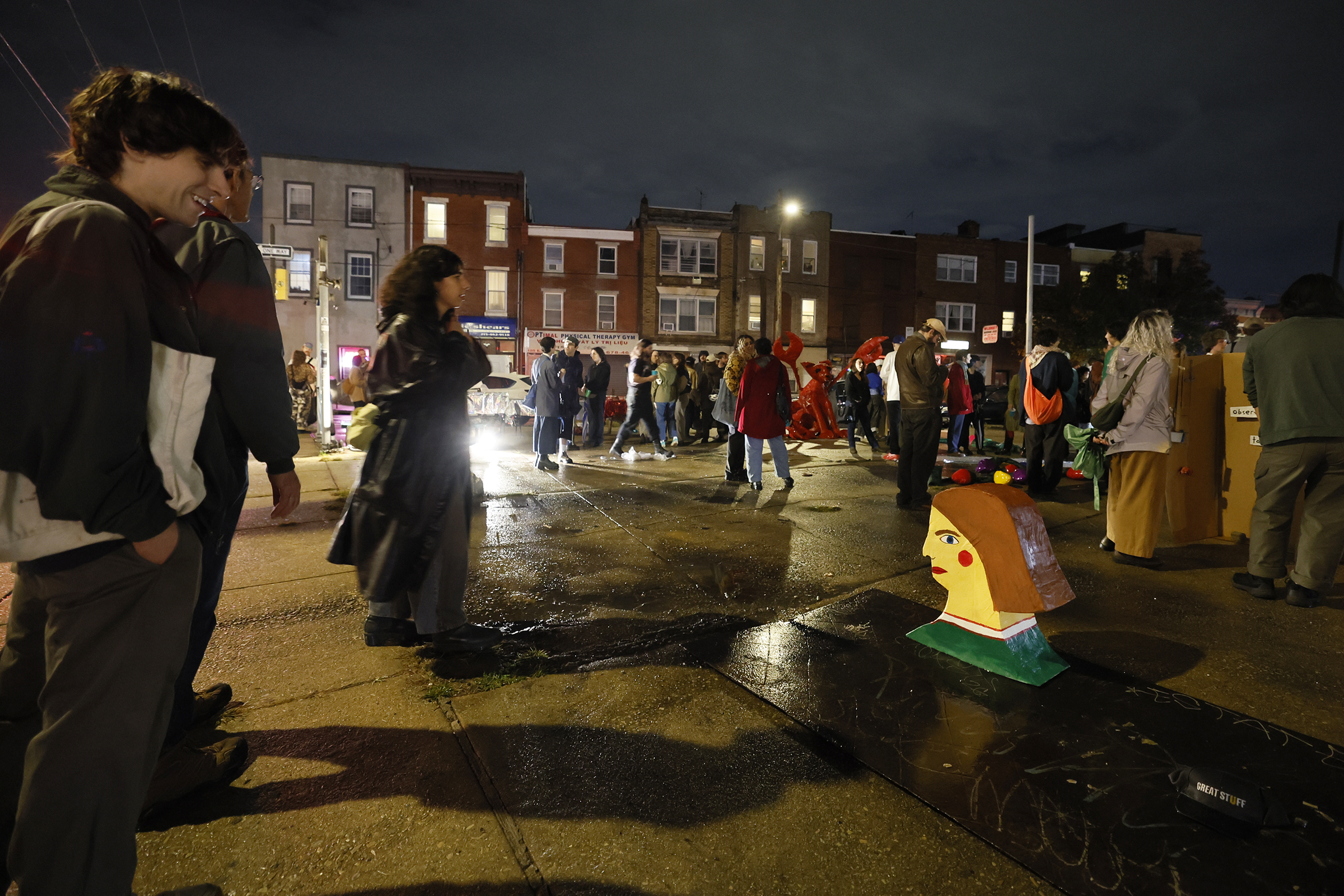
A man passing by looks at a papier-mâché head titled “Watching” by artist Ingrid Koppisch during the opening night party for “Imitation Crab,” a community art show in the empty lot along Washington Avenue in South Philly that used to house Capt. Jesse G’s Crab Shack.Elizabeth Robertson / Staff Photographer
As I stood in the gallery Friday night, I was struck by something I don’t see often anymore: Nobody was on their phone. Nobody was livestreaming. Nobody was doing this for likes.
They were doing it for the sake of art, and for the sake of Philly, and it was beautiful, in a way that only an empty lot suddenly filled with life can be.
While some of the pieces were removed after opening night, many remained at the Crab Shack Gallery as of Monday, where they will continue to surprise and delight those who happen upon Philly’s quirkiest gallery.
Jim Friedlich is CEO and executive director of the Lenfest Institute for Journalism, the nonprofit, noncontrolling owner of The Inquirer. @jimfriedlich
When I was a kid growing up in Verona, N.J., we awoke to two local newspapers on our doorstep: the Star-Ledger and the Verona-Cedar Grove Times. By the end of the day, a third arrived, the Newark Evening News.
The news was local, personal, and community-building.
There was deep, consequential coverage of local school boards, city council, high school sports, and local business. Local news was a part of a virtuous cycle. Each newspaper reflected its community and, in turn, helped to build it.
Today, each of those papers, as I knew them, is gone. The Evening News was shuttered in 1972. The Star-Ledger stopped printing last year, but lives online as part of Advance Publications’ NJ.com. And the Times mainly operates under the banner of Gannett-owned NorthJersey.com.
Those organizations are hardly outliers. The cumulative effect of more than two decades of disruption to the American local news ecosystem has been devastating.
On average, three newspapers shut down per week in the United States, according to research from Northwestern University. The country has lost more than 3,400 newspapers since 2005, a decline of more than a third.
A decade ago, against this grim backdrop, a perennially optimistic Philadelphia cable television entrepreneur named H.F. “Gerry” Lenfest dared to imagine not just a revival for local news in America but a true renaissance. He posited that some combination of new capital, new technology, new ownership, and new creativity could revive the business of local American news in digital form.
In 2014, Lenfest bought The Philadelphia Inquirer, his beloved hometown newspaper, for close to $90 million. Rather than operate the newspaper for profit, he donated it in 2016 to the Lenfest Institute for Journalism, a new nonprofit organization dedicated to addressing the business challenges of local news throughout the country using Philadelphia as a laboratory.
In 2016, H.F. “Gerry” Lenfest donated The Inquirer to the Lenfest Institute for Journalism, a nonprofit organization dedicated to addressing the business challenges of local news throughout the nation.MICHAEL BRYANT / Staff Photographer
This year, the Lenfest Institute celebrates its 10th anniversary. The best measure of the institute’s impact is the transformation of The Inquirer, now a national model of revitalization.
Thanks, in part, to investment from the Lenfest Institute and thousands of individual donors, large and small, and sound management by its leadership, The Inquirer is now a profitable, growing digital news business, reaching far more readers with essential coverage of life in Philadelphia through social media, video, its mobile app, its website, and real-time digital news alerts than in print.
The Inquirer now employs more than 200 reporters and editors, by far the largest reporting team in its region, and operates a thriving internship program and a high school journalism workshop to help train the next generation.
This newspaper, or your most cherished local news organization, is very much deserving and in need of your support.
How do we grade the Lenfest Institute’s own progress 10 years into this mission? We believe we have played a meaningful role in the start of a national revival of local news, and for this we are proud. But the problem we are attempting to solve is immense. The local news industry has not yet moved fast enough or far enough.
Our ambition for the coming decade is to help power a true renaissance in local news — a renewal of growth and creativity. Our goal is not to save struggling newspapers, but to enable a rejuvenation of local journalism’s essential functions — helping to keep powerful institutions accountable and creating a shared understanding of local issues. Nationally, this will require much more capital, much bolder investment, and much greater resolve.
We envision this renaissance for local news in four parts, each proven in one or more American news markets — among them changes in local news ownership, thoughtful new public policy, an embrace of smart information technology, and committed investment in skilled reporters and editors.
Fundamental changes in the ownership and funding of local news have taken hold throughout our region. Major public service news organizations are now owned by nonprofits in Baltimore, Delaware, Harrisburg, Lancaster, State College, Reading, and Pittsburgh, as well as Philadelphia. The Lenfest Institute enthusiastically supports each of them.
In Pennsylvania, two proposals in support of local news — HB 2047, which would create a fellowship program in local newsrooms for early and mid-career journalists, and HB 2048, a measure that would establish a Civic Information Consortium to support local news projects — are under consideration by the General Assembly. Both bills have passed the state House of Representatives and are likely to be approved by the Senate in the next legislative session.
The use of new artificial intelligence technology has also proved an encouraging way to advance the reach and power of local reporters rather than to replace them. Through AI, The Inquirer, for instance, now can monitor public meetings in more than 70 municipalities surrounding Philadelphia.
Irrespective of changes in technology — and arguably because of them — news in America needs more boots on the street, a commitment to cover our communities with more reporters, editors, and more diverse news sources providing independent news.
Obviously, this all costs money, and it is worth asking: What is an appropriate national investment in local news? It seems to me that we have just witnessed one useful indicator. Midterm election spending this year was estimated at $11.8 billion — the vast majority spent on local TV and digital advertising, and it turns out much of it was dedicated to attack ads in support of losing candidates. A fraction of the money wasted in these efforts would more than suffice to revitalize the reporting that is the lifeblood of democracy.
We need to make public and private investment in local news — from large contributions to many smaller ones — a serious financial priority to meet a serious national challenge.
Our nation needs a renaissance in local news, and we need your help to make it happen.