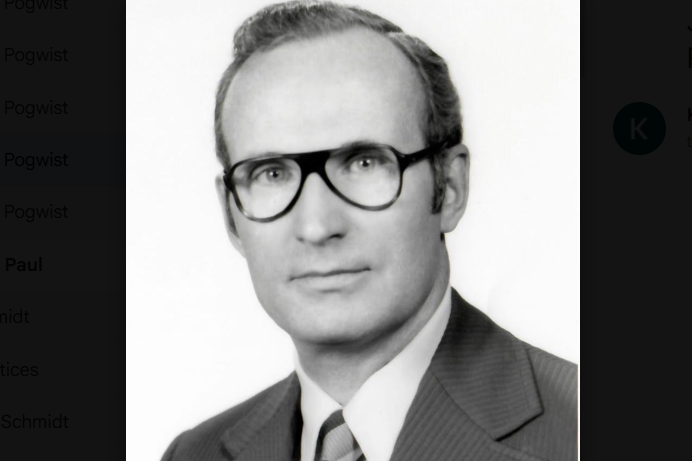
John J. Sweeney Jr., 99, of Haverford, former Pennsylvaniastate senator, longtime official with the federal Small Business Administration, veteran, and volunteer, died Friday, Oct. 2, of age-associated decline at his home.
Sen. Sweeney served in the state Senate from 1975 through 1978 as the first Democrat elected to represent the 26th District in Delaware County. The Inquirer covered his 600-vote election victory over Republican F. Joseph Loeper in 1974 and said he had been “given little if any chance even by members of his own party” to win in a district “that includes some of the strongest Republican areas in the county.”
A month before his victory, Sen. Sweeney told The Inquirer: “I find that my biggest asset is that I’ve never been in politics.” His daughter Kathy said: “He loved election night. That was his Super Bowl.”
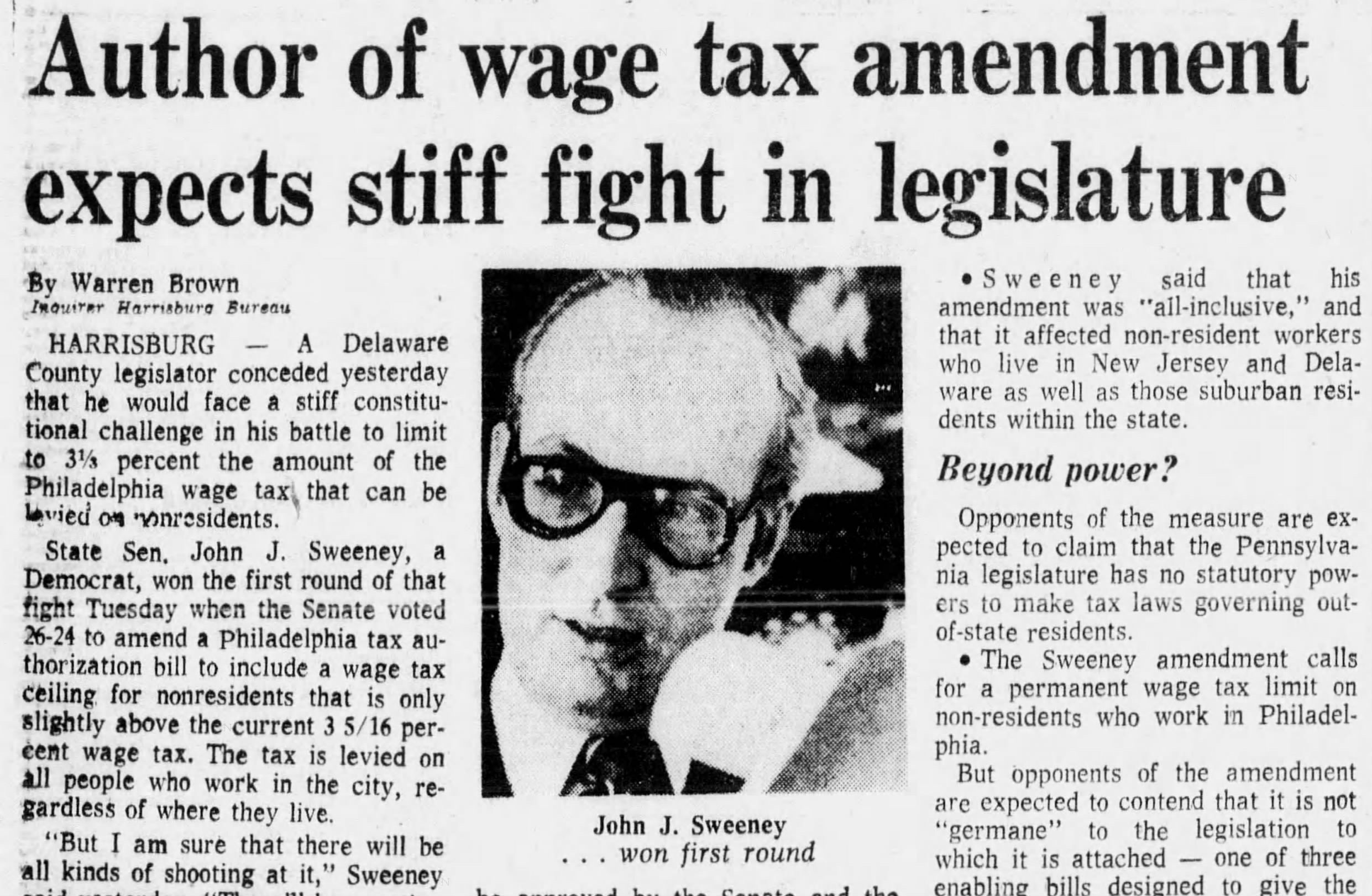
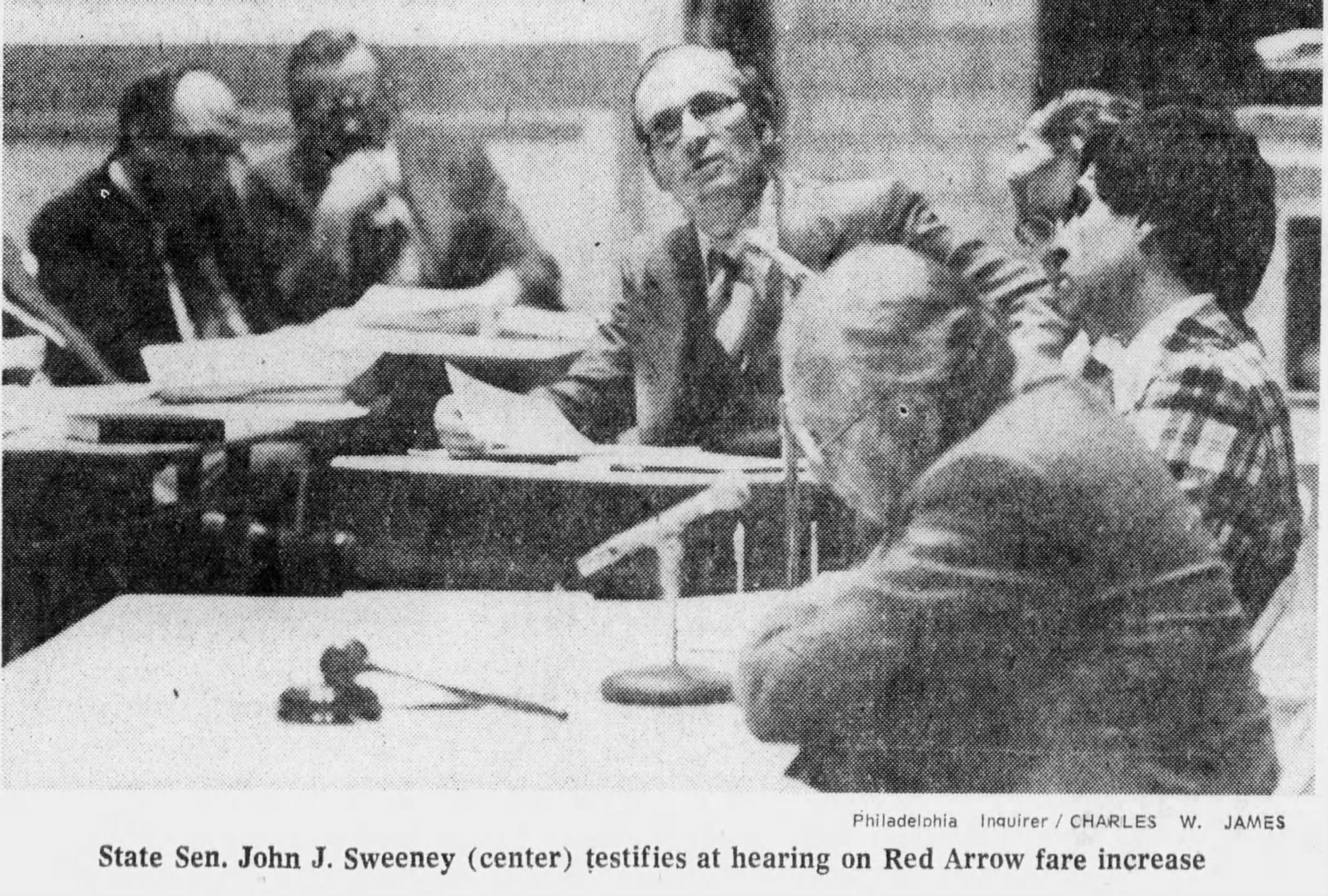
He went on to become chair of the Senate’s old Military Affairs and Aeronautics Committee, vice chair of the Consumer Affairs Committee, and member of the Health and Welfare Committee and the Pennsylvania Public Television Commission. In 1976, he championed legislation that provided a permanent wage tax limit on nonresidents who work in Philadelphia and urged SEPTA to voluntarily place itself under the supervision of the state’s Public Utility Commission due to fare increase issues.
Sen. Sweeney appeared many times in The Inquirer in 1976.Newspapers.com
He also opened the first local state senator’s office in Delaware County. According to his online Senate Library biography, he did not seek reelection “as the $18,720 salary couldn’t support his [growing] family.”
On Oct. 21, the state Senate recognized Sen. Sweeney with a moment of silence on the floor and a resolution of condolence. “He modernized Senate procedures, most notably with Senate confirmation hearings for cabinet appointments, and championed other important reforms for the commonwealth,” Sen. Tim Kearney, a Delaware County Democrat, said in a tribute. “It was an honor to celebrate his life of service.”
After his Senate term, Sen. Sweeney spent 30 years as an award-winning administrator with the federal Small Business Administration in Philadelphia and Washington. In retirement, he mentored juveniles for the Upper Darby Youth Aid Panel and seniors for the Delaware County Office of Services for the Aging.
He also represented Irish Americans for the old Pennsylvania Heritage Affairs Commission. One of his favorite sayings was: “A Sweeney never quits.”
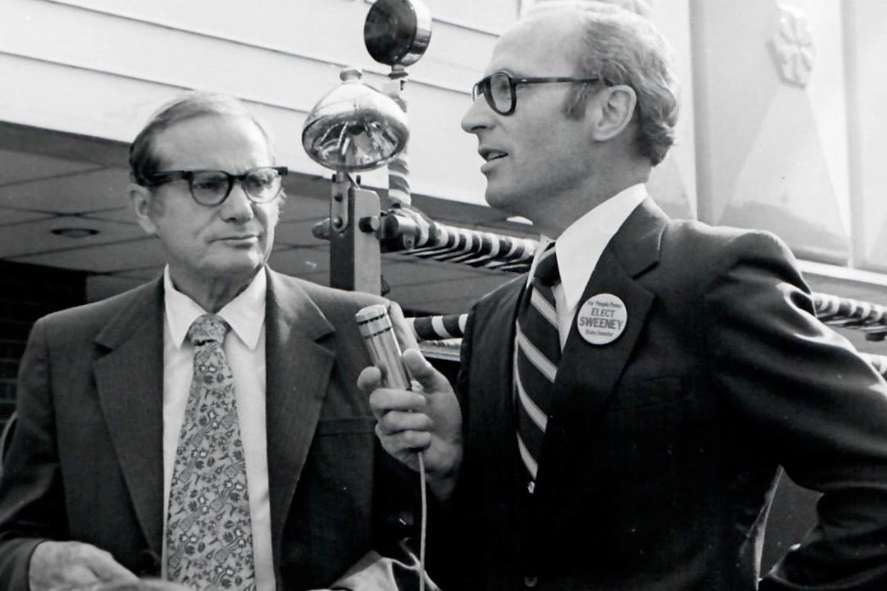
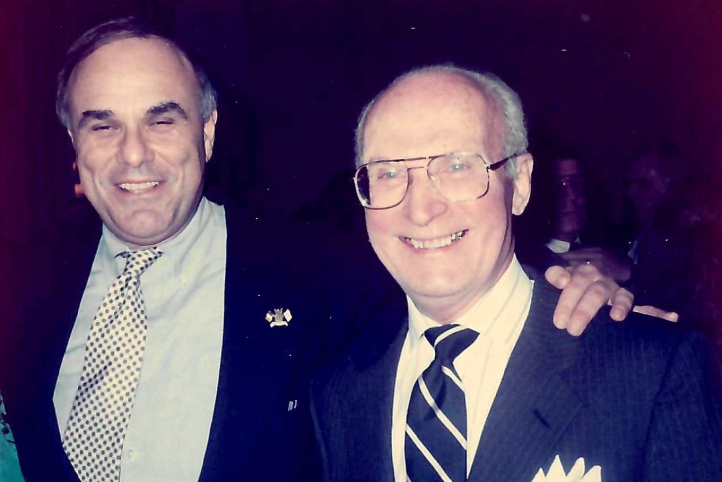
Sen. Sweeney, right in both photos, worked with Gov. Milton Shapp (above) and Gov. Ed Rendell (below). Courtesy of the family
Sen. Sweeney enlisted in the Army in 1946, was stationed in Japan after World War II, and rose to the rank of staff sergeant. He attended classes at St. Joseph’s, Temple, and Pennsylvania State Universities, earned a real estate broker license, and was vice president at Mortgage Corp. of America before joining the Senate.
His father died when he was 9, and he worked jobs at a pharmacy, a butcher’s shop, and elsewhere to help support his mother and two sisters. He graduated from the old St. Thomas More High School in 1945.
“The challenges he faced as he grew up laid the foundation for his future success,” his family said in a tribute. “He believed the dinner table was the foundation of a loving family, a time to gather, listen, learn, support, and advise those we loved.”
John James Sweeney Jr. was born June 1, 1927, in Philadelphia. A first-generation Irish American, he married Dolores Grzymala in 1954, and they had sons John III, Gerard, Dennis, Joseph, and Kevin and daughters Grace Ann and Kathleen.
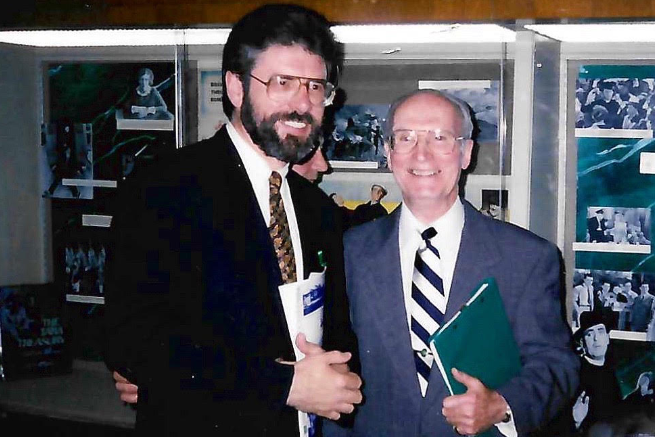
Sen. Sweeney (right) stands with Irish politician Gerry Adams.Courtesy of the family
They lived in Springfield, Delaware County, Drexel Hill, and Haverford. His wife and son Kevin died earlier.
A devout Catholic, Sen. Sweeney was a Communion minister and youth religion teacher at St. Andrew the Apostle Church in Drexel Hill. He was active with the Knights of Columbus and received an honorary title of Kentucky Colonel by the governor of Kentucky for his work in the state with the Small Business Administration.
He was an avid reader and do-it-yourself plumber, carpenter, and electrician. He was active with many Irish American cultural activities and spent memorable vacations with his family in Avalon, N.J.
His son John said: “We learned kindness and compassion for others through his example. Charity was a consistent theme.”
Sen. Sweeney and his wife, Dolores, married in 1954.Courtesy of the family
His daughter Grace Ann said: “He was devoted to helping people. His door was always open.”
His family said: “He was always ready to lend a hand, give a hug, wipe a tear, or just listen. He was a rich man not defined by wealth but by love of his family.”
In addition to his children, Sen. Sweeney is survived by many grandchildren and great-grandchildren, a sister, and other relatives. A sister died earlier.
A new Philadelphia ban on kratom and intoxicating hemp products was forced into limbo the day it was slated to go into effect.
Kratom and other hemp products, commonly sold as gummies, drinks, and smokable flower, are reclassified as “intoxicating products,” with their sale prohibited, under a new law that was introduced by City Councilmember Katherine Gilmore Richardson, was passed by Council earlier this year, and officially kicked in Thursday.
Intoxicating hemp products photographed at the Philadelphia Inquirer, November 21, 2025. Under a 2026 city law, these hemp-THC drinks, kratom, and other intoxicating products will be banned from sale within Philadelphia.Jessica Griffin / Staff Photographer
The lawrequires store owners to get licenses, which do not currently exist, to sell these products. However, since the U.S. Food and Drug Administration has not approved kratom and intoxicating hemp for consumption, the Philadelphia Department of Public Health will not create the license, so “there are no products allowable for sale,” a spokesperson for Gilmore Richardson’s office said.
This would effectively end the market in Philadelphia entirely.
But a kratom seller and an industrygroupfiled a lawsuit Tuesday asking a Philadelphia Common Pleas Court judge to pause the enforcement of the ordinance, saying it would force businesses to close and kill jobs.
The ordinance fails to distinguish between “conscientious, law-abiding retailers” and “the bad actors who sell dangerous products to anyone willing to pay,” the suit says. And instead of regulating kratom sellers to prevent harm, the complaint says, Philadelphia passed a ban that “destroys a lawful industry.”
Pennsylvania Healthy Alternatives Association, a nonprofit organization advocating for hemp and kratom sellers, and CBD Kratom, a St. Louis-based retailer with three stores in Philadelphia, filed the lawsuit against Mayor Cherelle L. Parker and thePhiladelphia Department of Licenses and Inspections’ co-commissioners.
Judge Brian R. Kisielewski had scheduled a hearing to consider the injunction request for Thursday afternoon. But the city moved the lawsuit to federal court 40 minutes before the hearing was set to begin.
The case is better suited for federal court because the kratom sellers claim the city’s ordinance violates the U.S. Constitution, city attorneys said in a court filing.
Removal of cases to federal court is common, but the eleventh-hour change seemed to irk Kisielewski, who said he had spent his Wednesday preparing for the hearing.
“I wish they provided you or myself notice,” he told the retailers’ lawyers before sending them home.
Stores are now in limbo, Craig Katz, president of the Pennsylvania Health Alternatives Association and a member of CBD Kratom’s management, said after the quick adjournment.
“We have several stores now that we are hoping to get some kind of answer as to whether they can stay in business and sell products after today,” Katz said. “And now we don’t have an answer to that.”
The lawsuit does not change the status of law and the ban remains in effect, said Gilmore Richardson.
The city did not immediately respond to a request for comment.
Nearly all of the shelves of Center City’s CBD Kratom store sat empty on Thursday, Nov. 12, 2026, the first day of enforcement of the city’s new kratom and intoxicating hemp ban.Abraham Gutman / Staff
The federal hemp ban, originally set to take effect Thursday but delayed to Dec. 11, will only allow the sale of hemp-based products, like CBD, with up to 0.4 milligrams of THC in a single container.
Philly’s ban on intoxicating hemp and kratom products without FDA approval was slated to start Thursday. Whether the health department started enforcement was unclear.
Aside from Epidiolex, a prescribed form of CBD for treating seizures, the FDA has not approved any hemp or kratom products for human consumption.
Stores caught selling these products can face a $2,000-per-day fine from the Philadelphia Department of Public Health.
LAS VEGAS — Hours before a game in late September, Justin Crawford walked across the outfield and slapped hands with Chandler Simpson.
“That’s my guy,” Crawford said this week.
Friends for years, admirers for even longer, they were drafted 53 picks apart in 2022 — Crawford by the Phillies in the first round, Simpson by the Tampa Bay Rays in the second. They played against each other in the minor leagues and comprised two-thirds of Team USA’s outfield at a tournament in Mexico and Japan in November 2024.
And because they have similar skill sets — left-handed hitters with elite speed and an extreme tendency to hit the ball on the ground — they have elicited frequent comparisons from scouts and talent evaluators.
But as they converged in Citizens Bank Park that day, it was impossible not to wonder if Crawford, who will be 23 in January, looked at Simpson, 25, and saw the player that the Phillies need him to become.
“Yeah, definitely,” Crawford said on The Inquirer’s Phillies Extra podcast while the general managers’ meetings were being held in Las Vegas, his hometown. “I love watching Chan play. … I also know, too, the jump he made from his first year into his second year. And that’s definitely something that I’ve thought about, too, to be like, OK, I could definitely improve that way.”
It’s almost an imperative for an expensive, aging Phillies roster.
Video: Carl Crawford provides a scouting report on his son, Justin Crawford
As that core ages, the next youth wave must be more like a tsunami. Dave Dombrowski declared this week that he believes top prospect Aidan Miller, when healthy, is “as good as” award-winning rookies (read: Delco’s Kevin McGonigle of the Tigers), and Crawford must progress as Simpson did this year.
Crawford’s rookie year was a mixed bag. The 22-year-old center fielder debuted on opening day and stayed on the roster all season. He batted .279 over the season’s final two months and .264 overall, and was the fourth Phillies rookie since 2006 with 100 hits.
But he had only a .309 on-base percentage, leaving him unable to optimize his speed. After stealing 40 bases in three consecutive minor-league seasons, he swiped 17 in only 21 attempts.
Defensively, Crawford didn’t grade well, based on both the metrics and the eye test. And because he struggled against left-handed pitching, he slipped into a platoon in center field with righty-hitting Derek Hill.
As always, though, context is important. Crawford got 465 plate appearances, more than only four players who have not yet turned 23. Among them: McGonigle and Sal Stewart, who were crowned Rookie of the Year this week, and Jackson Chourio, who just won the World Series.
So, when Dombrowski and Don Mattingly summed up Crawford’s rookie year in separate news conferences by using the same expression — “He kept his head above water” — it’s easy to understand what they meant.
But the Phillies will hold Crawford to a higher standard next season.
Just like the Rays did this year with Simpson.
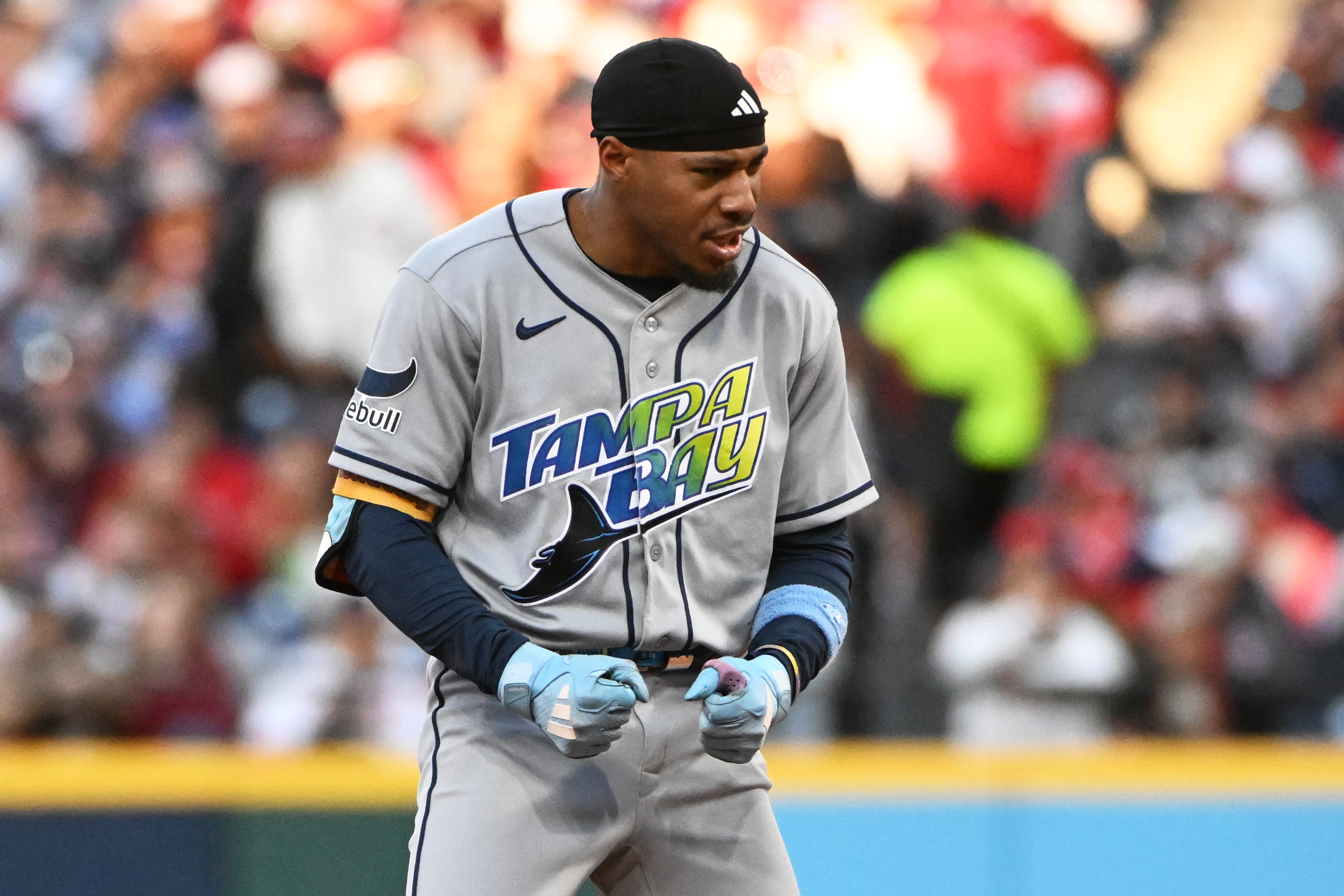
Rays left fielder Chandler Simpson led the majors with 42 infield hits and was second with 14 bunt hits.Phil Long
Getting defensive
Before he batted third in the World Series and led the Rays with eight hits in the five games against the Brewers, Simpson got demoted to triple A.
Like Crawford, Simpson was a polarizing prospect. He received equal praise for putting his bat on the ball at a high rate and rarely striking out, and criticism for making soft contact and often hitting the ball on the ground.
Given his blazing speed, the Rays were mostly content to let Simpson do his thing. But six weeks after making his major league debut in April 2025, he was unable to outrun a .315 on-base percentage and defensive shortcomings, neither of which can be tolerated from a player who doesn’t slug (one homer in 2,050 at-bats between the majors and minors).
“The raw speed is undeniable, but there was uncertainty about kind of its application,” Rays president of baseball operations Erik Neander said this week. “But he’s someone we always believed in because we knew he takes constructive criticism as well as anyone. The desire to be great, the willingness to work is second to none.”
Simpson returned to triple A for three weeks in 2025 before rejoining the Rays. They also moved him to left field. And he went from minus-9 defensive runs saved last season to plus-8, a 17-run upturn from 2025 to 2026 that made him a Gold Glove finalist.
“It was impressive to watch how much he improved all the way into the playoffs, crashing into the walls and putting his body on the line,” said Neander, who credited Simpson’s work with outfield coach Corey Dickerson. “But the jumps, the reads, the technique, the skill, the nuance of playing the position improved by leaps and bounds.
“And if he continues to stay on it the way he has, he’s going to win a Gold Glove, and that’s a tremendous amount of progress compared to where he was.”
Phillies center fielder Justin Crawford struggled at times defensively in his rookie season.Monica Herndon / Staff Photographer
The Phillies believe Crawford is equally coachable. They extol his work habits and his curiosity to learn. He sought help last winter from three-time former Gold Glove outfielder Eric Davis and said Phillies outfield coach Paco Figueroa “stayed on me all year long” about jumps, reads, and pre-pitch preparation. Crawford said he also picked Hill’s brain about ways to get better.
And there’s room for improvement. Crawford tied for second-worst among center fielders with minus-8 defensive runs saved, re-raising a debate within the organization about whether he’s better suited for left field.
The Phillies are planning to keep Crawford in center … for now. As Mattingly put it: “We’ve seen him have periods of time in center field that were really good, other times that weren’t as good.”
“From my first month in the big leagues until the last month — I don’t know what the numbers would say, or anything — I know the way I felt that I definitely felt like I improved out there and got more comfortable and felt really confident,” Crawford said.
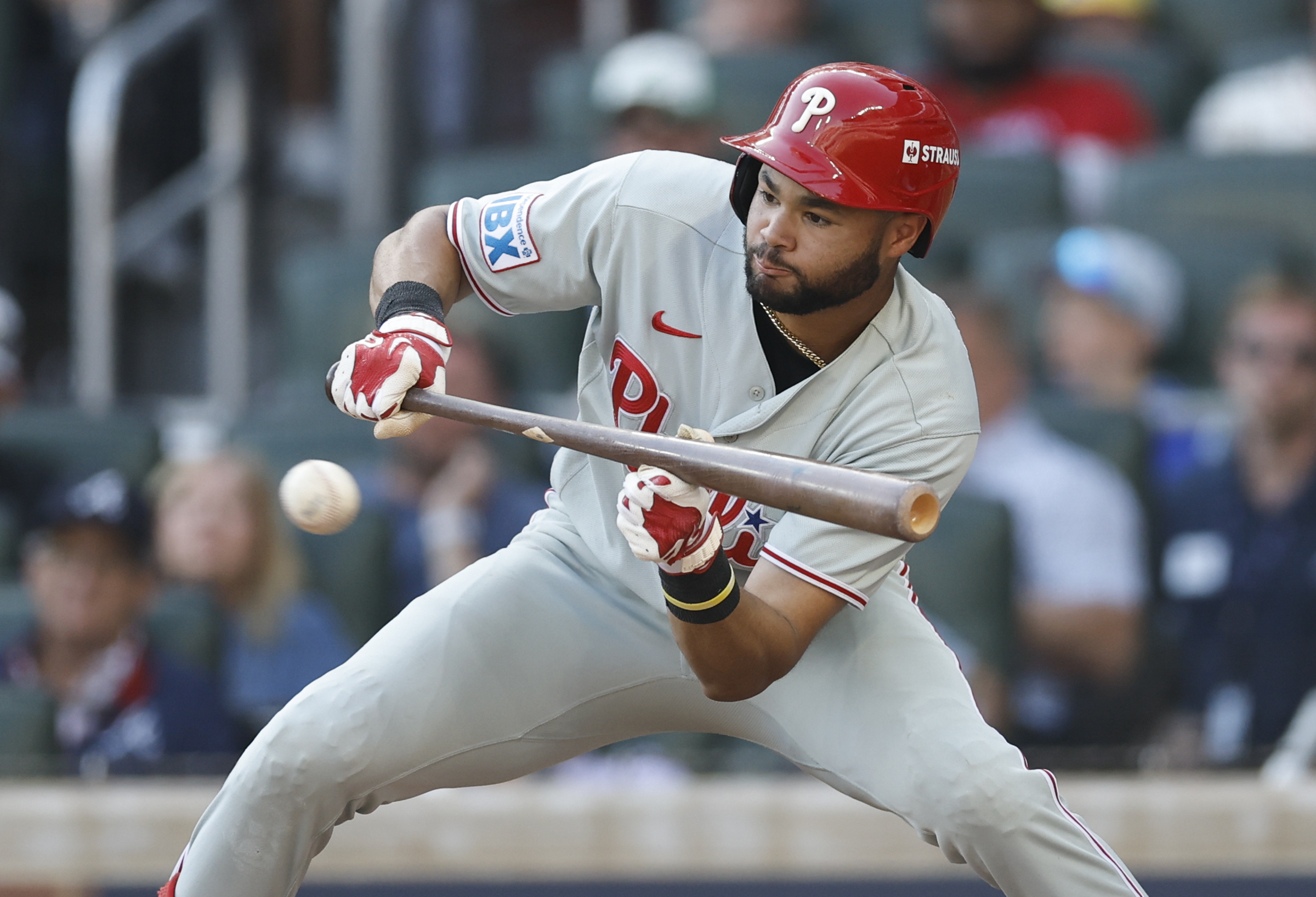
The speedy Justin Crawford had just three bunt hits in 12 attempts in 2026.Yong Kim / Staff Photographer
Speed demons
Crawford stole 145 bases in 325 minor-league games in part because he reached at a .385 clip. But the Phillies’ player-development staff also emboldened him.
“In the minor leagues,” Crawford said, “I had the green light all the time.”
It wasn’t the same in the majors.
Never mind that Crawford got on base at a much lower rate. He often batted ninth, and when he did reach ahead of the top of the order, the Phillies tended to apply the brakes. He had 590 chances to steal, according to Statcast, and only a 2.9% attempt rate.
Looking back, Mattingly conceded the Phillies “played a little cautious.” (Stott’s attempted-steal rate was 2.4%; Turner’s was only 1.6%.) Mattingly pledged to utilize the team’s speed more often next season. He views Crawford as a “30- to 40-stolen-base guy.”
“I’m always ready to steal, and I’m always ready to run,” Crawford said. “I steal bases whenever I get the green light, and I don’t steal bases whenever I get the red light. Definitely if you ask me, though, I’m always trying to steal bases and looking to get into scoring position and cause havoc. I mean, that’s my game. That’s what I do best.”
But there are other ways to impact a game with speed. Simpson led the American League with 46 steals, but also paced the majors with 42 infield hits and 14 bunt singles, up from 18 infield hits and five bunt singles in his rookie season.
And amid the launch-angle craze that has permeated batting cages in the last decade, the Rays are content to let Simpson do what makes him special.
Video: The Phillies are counting on youth in 2027 | Gameday Central
“It is a unique skill set, and that doesn’t leave you many places to look for guidance and feedback to help yourself improve,” Neander said. “There aren’t many that can relate to him, right? So, it’s making sure that we continue to demonstrate belief that who he is, his strengths, his profile, have a place in Major League Baseball, not just to have an opportunity but to thrive.
“A lot of it is being there to support him and staying out of his way because he’s got a pretty good road map for what he needs to do.”
Crawford knows he didn’t travel that road often enough.
Mattingly has told him to focus on controlling the strike zone and reducing the swings and misses, especially at non-strikes, a message that Crawford expects new hitting coach Pete Fatse will reinforce when they get together next week in Vegas.
But Crawford also legged out only 25 infield hits and three bunt singles in just 12 attempts. It might have been the difference between his .264 average and Simpson’s .306 mark.
“I could definitely improve in that way,” Crawford said. “Obviously we have similar games, just trying to cause havoc. That’s something I like a lot and really admire is how he’s able to just go out there and be himself and play his game and not [listen to] whatever anyone says. He’s like, ‘No, I’m doing what I do, and this is how I help the team win.’ And it helps [the Rays] win, as we saw.
“Yeah, I’ve always loved watching him play. I definitely try to take some things, pick some things up from him, and try to use that in my game as well.”
Simpson’s second-year jump turned him into a core player for the pennant-winning Rays. The Phillies look at Crawford’s skills and see similar potential.
“I think there’s an upside with Justin, and where he goes is — I shouldn’t say totally dependent upon him — it’s dependent upon us to get it out of him and to help him go there,” Mattingly said. “It’ll be interesting to where it goes with him, and I think the sky is the limit with Justin.”
Ever wonder who the region’s most internet-searched locally born celebrities are?
The Inquirer’s Lizzie Mulvey and Charmaine Runes dug into the 2025 most popular celebrities on Wikipedia who were born in the Philadelphia area. The results were a mix of obvious contenders and surprises.
We went even further, looking at the top five most-searched individuals born in Chester County, a list that features mostly well-known personalities.
Downingtown native and actor Miles Teller, 39, tops the rankings. He gained acclaim for his role in Whiplash and a slew of other mid-2010s films, and more recently played Rooster in Top Gun: Maverick. In addition to topping the local list, he ranks nine in the region overall.
Olympian Johnny Weir (left) has since traded his skates for commentating. Paul Sancya / AP
He’s followed by Coatesville native and two-time Olympian Johnny Weir, who has since traded his skates for commentating. The 42-year-old also appeared in the most recent season of Peacock’s Emmy Award-winning reality series, The Traitors.
Bam Margera hails from West Chester and still calls the area home. Jose F. Moreno / Staff Photographer
West Chester’s notorious skateboarder and TV personality Bam Margera, 47, takes the third spot locally (and No. 25 overall). The Jackass star made an appearance in the franchise’s latest film by way of old footage. He still calls the area home.
Charlie McDermott (right) in the final season of ABC’s “The Middle.”MICHAEL ANSELL / ABC
At number four locally (and No. 45 overall) is West Chester native and actor Charlie McDermott, who’s best known for his role on ABC sitcom The Middle. McDermott, 36, has also been in comedies such as Sex Drive and Hot Tub Time Machine, and more recently in Netflix miniseries Unbelievable. Early in his career, he played in M. Night Shyamalan’s The Village.
Rounding out the list is retired adult film actor and Downingtown native Adriana Chechik. The 35-year-old landed at No. 57 in the overall ranking.
While they didn’t make the top five in Chester County, Kyle Gallner (No. 59) and Smedley Butler (No. 82) both made the overall list. Gallner, a West Chester native and actor, has had roles in shows including Veronica Mars, Smallville, and CSI: NY. Butler, who also hailed from West Chester, was born in 1881 and rose to major general in the Marine Corps. When he died in 1940 at the age of 58, he was the most decorated Marine in U.S. history.
This suburban content is produced with support from the Leslie Miller and Richard Worley Foundation and The Lenfest Institute for Journalism. Editorial content is created independently of the project donors. Gifts to support The Inquirer’s high-impact journalism can be made at inquirer.com/donate. A list of Lenfest Institute donors can be found at lenfestinstitute.org/supporters.
Lower Merion is weighing a property tax increase for the third year in a row as personnel and infrastructure costs strain the township’s budget.
Township staff have proposed raising real estate taxes by 19% in 2027, which they say would bring in an additional $6.8 million to help offset costs from increased staffing, healthcare and pension obligations, storm response, and police overtime.
If passed by commissioners, it would be the third consecutive annual increase in Lower Merion after 13 years of no increases. The township raised taxes by 6.5% in 2025 and 8% in 2026.
Though the 19% recommendation from staff hasprompted sticker shock from some residents, any tax increase will ultimately be decided by the board of commissioners, which is set to adopt the 2027 budget on Dec. 16 after a series of public hearings.
The board has amended staff recommendations in the past (commissioners last year approved an 8% tax increase despite staff suggesting 9.5%), and some commissioners at a Wednesday night meeting seemed poised to favor a lower rate for next year.
With the proposed increase, property owners with the median assessed home in Lower Merion of $287,600, which equates to a market value of about $966,000, would owe an extra $263 annually.
Lower Merion property owners continue to pay real estate taxes calculated on property values established in 1998, the last time Montgomery County reassessed property, according to a report in the 2027 proposed budget penned by township manager Ernie McNeely.
Commissioner Gilda Kramer said at the meeting that more than adecade without an increase left the township needing to levy higher taxes.
“Our residents have had the benefit of tremendous stability and no increases while our costs have gone up for many, many, many years,” Kramer said.
Board president Todd Sinai argued the township has little room to cut spending given the many rising costs baked into the budget.
“There aren’t a whole lot of places that we have much discretion, unfortunately,” Sinai said.
Township staff said they can look into trimming the budget, but warned that cuts would likely mean eliminating staff. Two-thirds of Lower Merion’s general fund expenditures go toward staffing.
Officials say Lower Merion is facing considerable budgetary headwinds, including higher pension obligations and a 19% rise in employee healthcare costs.
“We are getting hit hard by healthcare,” Adam Szumski, Lower Merion’s chief financial officer, told commissioners.
The township hired a number of employees in 2026, including 17 newpolice officers.
Lower Merion also faces high remediation expenses from winter and summer storms and plans to direct money to its solid waste fund, which is facing acute budget pressures.
While the township is projected to bring in $6 million more than expected in revenue in 2026, due largely to strong business and transfer tax revenue, investment income, and licenses and permits, spending is expected to be$1.7 million over budget. The township is projected to end 2026 with a fund balance of $23 million.
According to McNeely’s report,Lower Merion has two main avenues for raising revenue: increasing property taxes or levying an earned income tax.
The township is among the 3% of municipalities in Pennsylvania without an earned income tax. Local governments across the commonwealth, many facing similar budget pressures, have moved toimplement earnedincome taxes in recent years, in many cases reducing their reliance on regular property tax increases.
Lower Merion staff have recommended against an earned income tax, however, arguing that even with the proposed 19% property tax increase, the township’s millage rate would be around average for the county, and that, per the report from McNeely, an earned income tax would be “much more disruptive and significant” for taxpayers.
The first public hearing on the budget will take place on Nov. 18.
This suburban content is produced with support from the Leslie Miller and Richard Worley Foundation and The Lenfest Institute for Journalism. Editorial content is created independently of the project donors. Gifts to support The Inquirer’s high-impact journalism can be made at inquirer.com/donate. A list of Lenfest Institute donors can be found at lenfestinstitute.org/supporters.
The blue tsunami that resulted from last week’s election has scrambled just about everything and raised questions about where the nation is headed.
While it is clear what the Democrats will try to accomplish, the question is: Will their proposals lower costs and inflation without harming growth?
The economy is solid, maybe
To judge the impact of potential Democratic policies, we need to know the economy’s condition.
After a lackluster start to 2026, growth has improved. Still, over the last year, the economy expanded by an unexceptional 2.1%.
Of concern is the heavy dependence on massive investment in AI and related industries, which accounted for as much as 40% of GDP growth in 2025 and into this year.
If that investment growth is not sustainable, overall economic growth will be at risk. That threat will hang over the equity markets no matter what the Democrats do.
The labor market: Solid or mediocre?
The labor market, too, is showing signs of strength. Recent monthly job gains have exceeded expectations, and the unemployment rate is consistent with full employment.
But again, the headlines mask underlying issues.
What is considered strong job gains now would have been viewed as mediocre over the previous 50 years.
The unemployment rate has remained low, but only because a dramatic drop in immigration, combined with retiring baby boomers, counterbalanced tepid hiring.
To sum it up, the economy is moving forward, but risks are emerging.
Making things less expensive is really difficult
The Democrats ran largely on the issues of affordability and accountability. While the two are interrelated, let’s talk economics.
The electorate is irate about the high price of just about everything, except maybe eggs, whose prices have dropped sharply.
Can the Democrats do anything to lower costs?
For the most part, no. Except for a few commodities, most prices are sticky downward.
What they can do is slow the rate of price increases, especially where costs have risen excessively.
How? By dealing with the root causes of the higher inflation.
Tariffs should top the Democrats hit list
There are two major underlying factors pressuring prices: Tariffs and wars.
Job No. 1 for the Democrats is likely to be passing bills to repeal the Trump tariffs.
The New York Fed’s economic researchers recently calculated that the 2025 tariffs not only added to inflation but if they had not been imposed, consumer prices might have been flat or even down.
If the Democrats want the biggest bang for their efforts, they need to reduce or eliminate as many tariffs as possible.
While passing bills repealing tariffs should be easy lifting for the Democrats, getting the bill signed by the president or overriding a veto could be problematic. That is a political issue. The economic necessity is to repeal tariffs.
Energy costs are second, but more intractable
Nothing angers consumers more than high gasoline prices. Every day, drivers literally see how much the Iran and Russia/Ukraine wars have caused costs to surge.
It needs to be understood that both wars are at play here.
Energy prices are set internationally.
It is not just the production and delivery of energy products by Russia or Middle Eastern nations that move prices. Geopolitical reactions to the wars, such as Chinese or European decisions on energy imports and strategic inventories also impact markets.
Democrats have limited control over those wars, and until they are ended, risks will remain elevated, and energy price reductions will be limited.
The Fed cannot do much
The Federal Reserve may not be of much help as its inflation-fighting tool kit consists mainly of raising interest rates.
The Fed increased rates a quarter-point once this year. That barely changes borrowing costs. More hikes may be coming, but their effectiveness is questionable.
Why? Supply, both actual and expected, is driving energy prices, not demand. The wars are why the markets are worried about supply.
Without raising rates significantly, there may be little the Fed can do to slow inflation.
Restraining AI and data center investment makes sense
The race to dominate AI and the need to build out data centers is powering the economy. Yet voters despise the process.
Democrats are likely to pass laws regulating the behavior of AI firms and data center builders.
Surprisingly, that may be beneficial.
The debt load of the major AI-related companies is staggering, and the costs are starting to be factored into decision-making and stock prices.
But this is a race to be the Google of AI, and it is not clear who will blink first.
Maybe the AI race should decelerate? As the saying goes, “You really don’t know you are in a bubble until it bursts.”
Given mounting risks and resource constraints on the ability to build out capacity, Democratic restrictions may actually provide the breathing room needed to prevent overbuilding the sector.
Unwinding the ‘One Big Billionaire Boondoggle Bill’
Taxes will be a Democrat target.
The overweighting of upper-income beneficiaries in the One Big Beautiful Bill will likely be addressed.
The bill was terrible not simply because it accelerated the redistribution of income and wealth toward upper-income households. It also contained truly stupid tax cuts supposedly for lower-income people.
Giving special tax breaks only to tipped workers is not rational tax policy. It is pure politics. Why are tipped workers worthy of tax cuts but not workers in any other occupation?
And what logic is there in allowing the tax breaks to fully benefit single filers with incomes of $150,000, or $300,000 for married couples? Those aren’t poor people.
If the Democrats are smart, they will replace these tax breaks with real tax reform.
Of course, that will require the president signing the bill or Republicans voting to override the likely veto. Good luck with that.
The Democrats can pass bills, but that’s all
The Democrats won a massive electoral victory. But their power to implement change is limited.
So, look for bill after bill being passed that forces Republicans and the president to take stands on issues the voters said they wanted to see resolved.
Microsoft said progress is being made in bringing its popular workplace software back online as a global outage enters its second day, disrupting business communications, police emergency calls, court operations and AI tools.
The outage, which affected a wide range of Microsoft 365 services including Outlook, Teams and AI assistant Copilot, left many complaining they couldn’t access their emails.
Microsoft indicated that it was making some headway as it tried to restore services, in fresh updates posted Friday on social media.
“We’re seeing encouraging recovery progress, with service availability and email delivery performance improving across a growing portion of affected Microsoft 365 infrastructure,” the company said in its latest update, as some users started reporting that their emails were restored.
On a separate status page, the company reported “broader improvements” in North America and “sustained improvements across much of Europe,” as well as “encouraging recovery signals” in the Asia-Pacific region.
Some users could still have “intermittent access issues or delayed email delivery as mitigation progresses across the remaining affected infrastructure,” Microsoft said.
The total number of people affected is not clear, but the company said in January that it had more than 450 million paid Microsoft 365 commercial subscriptions.
Microsoft scrambles to recover services
The Redmond, Washington-based company said it was trying different ways to identify the cause of the problem, which it flagged 18 hours earlier on Thursday, and get its servers back online, using “a measured approach to identify and repair affected infrastructure.”
The company said it did not have any indication that the outage was caused by malicious activity and would treat the incident “with urgency and priority until full resolution.”
A series of 20 posts by the company on X suggested its engineers were struggling to get the problem fully under control.
One post offered little hope for users expecting a quick resolution, saying the changes were “not taking as expected,” the company wrote.
By Friday morning, Microsoft reported “early stabilization and capacity improvements” and “incremental improvement in several workloads.”
“We’re seeing improvements in key scenarios, including mailbox access and delayed email processing, though some intermittent issues may continue,” it said in a subsequent post.
In its latest post, the company said it was focusing on “recovery for the remaining affected environments while prioritizing email queue and backlog reduction.”
Europe woke up to disruptions
In Britain, the outage brought a halt to a trial in Manchester. Judge Maurice Greene sent jurors home because of delays that he said illustrated the danger of the court’s reliance on technology.
The British government said it is “working closely” with Microsoft to assess any impact on public services but that “robust contingency plans” are in place to minimize disruption.
British police forces said they’re unable to receive crime reports online and are urging people to call emergency responders to make any urgent reports.
The National Pharmacy Association said people could face delays getting their prescriptions because the outage is affecting the email systems of the state-run National Health Service.
In Norway, the government said the outage affected “several ministries,” including losing email access, and it had “not received any indication” about when the problem would be resolved.
Asian businesses and governments were affected
In Australia, Home Affairs Minister Tony Burke said Friday that Microsoft had likened the widespread disruption to the 2024 CrowdStrike outage, which stemmed from a faulty update to computers running Microsoft Windows. That outage grounded flights and disrupted hospitals, banks and retailers.
Burke said he had spoken to Microsoft’s top executive in Australia and the government’s national cybersecurity coordinator about the global disruption.
“They (Microsoft) don’t believe they are dealing with a cyberattack. They believe that they are dealing in some ways (with something) similar to what we saw with respect to CrowdStrike where there is an update that has gone awry,” Burke told reporters in Sydney.
Hong Kong businessperson Danny Lau, who runs an aluminum firm, said his company could not receive updates from its U.S. customers through Outlook. If the situation dragged on further, this could “impact the production timeline,” he said. Some banks in Hong Kong, an Asian financial hub, also saw part of their operations disrupted.
Air India said its flight operations were unaffected by the global Microsoft outage. However, it temporarily rerouted its email services to ensure customer queries continued to reach the airline without interruption, the company said in a statement.
IndiGo, another Indian airline company, also reported disruptions to its email support services, which affected its ability to receive customer queries. The airline in a statement on X said its other support channels remained operational and its flight operations were unaffected.
Singapore’s Government Technology Agency said that government emails were down and that the agency is working with Microsoft to resolve the issue.
The Philippines’ Supreme Court said in a statement on X that the outage affected some of its operations, including email responses.
In Japan, Deputy Chief Cabinet Secretary Masanao Ozaki said the government’s IT infrastructure was affected and that officials were “keeping a close eye on the developments.” Japanese authorities had taken steps including securing alternative communication tools such as telephones, the government said.
U.S.-based industrial technology company Workhorse Group Inc. delayed a conference call for its quarterly earnings because of the outage.
OpenAI and Anthropic reported problems connecting with Microsoft 365 tools, underscoring the ripple effects of outages as more people use artificial intelligence platforms to interact with other companies’ software.
Democrats have secured a stunning victory in Mississippi, with veteran prosecutor Scott Colom narrowly defeating incumbent Republican U.S. Sen. Cindy Hyde-Smith to become the Magnolia State’s first Black senator since Reconstruction.
Like the victory in Georgia by Keisha Lance Bottoms, who became the first Black woman elected governor in U.S. history, and many other races in this year’s midterms, Colom’s unlikely win was largely driven by high turnout among Black voters. But it’s not enough to know African Americans voted in droves.
We also need to understand why.
Black voters, much like those from other demographics, flocked to the polls because of the inflation tied to the president’s war of choice with Iran and his ongoing tariffs. More importantly, we voted because we were angered by Donald Trump’s brazen attempt to relegate us to second-class citizenship.
We spoke with our ballots across generations and geography.
We spoke with our feet as we marched to the polls.
We spoke with determination as we pushed through every obstacle the president and his allies placed in front of us.
Just as we’ve always done, African Americans stood up and acted as our country’s conscience. In Mississippi, that meant remembering Medgar Evers, who was murdered 63 years ago as he fought for Black voting rights. It meant remembering that in July, a Black teenager, Nolan Wells, died under questionable circumstances in the same state. It meant knowing that past is prologue, and that history’s horrors can reemerge, even in the midst of moments that appear to move us forward.
I remember the jubilation that followed Joe Biden’s victory in the 2020 presidential election. Having watched 375,000 Americans die as a result of the COVID-19 pandemic that year, many Americans were repulsed by the air of incompetence and racism we’d experienced during Trump’s first administration. We were eager to wash our hands of it all. Then came the lies.
These are the same kinds of claims Trump made when he was defeated in 2020, so if the previous pattern carries through to completion, others will echo those claims, anger will consume his followers, and violence could result.
Trump has already pardoned about 1,500 people who were either charged or convicted in the insurrection. Given that they’ve already shown their willingness to sow chaos on the president’s behalf, we must be ready for them to do so again.
We must also accept that many GOP legislators are still loyal to the president, as evidenced by their successful defeat of Kentucky Republican Rep. Thomas Massie’s attempt to impeach Defense Secretary Pete Hegseth.
For Black voters, however, it’s about much more than understanding the ongoing threat posed by Trumpism. It’s about reaping the benefits of our votes.
Democratic victories don’t matter if we still lose economically. Nor do we benefit if racism goes unchecked.
The symbol of Black representation is no longer enough for us. Black people must get wins beyond the vote.
WASHINGTON — The Navy has quietly fired or removed several top officers in recent months but broke with its usual practice of announcing those changes, drawing pushback from Congress.
Two Democratic lawmakers said Thursday that the Navy failed to inform Congress that it fired the entire leadership team of a nuclear-powered attack submarine last month after an underwater collision. Separately, the sea service in September fired the commander of a destroyer deployed to the Middle East, according to a defense official, who spoke on condition of anonymity to describe sensitive personnel matters.
Dr. Brian Monahan, a Navy rear admiral and attending physician for Congress and the Supreme Court, also departed his post during a Navy investigation — with no public announcement or confirmation.
All three are a break from the Navy’s longstanding policy to announce major removals of commanders and other highly visible officials. They also follow an increasing level of secrecy over military operations, especially in the Middle East.
“As a result of the Navy’s failure to communicate, what should have been a standard exercise in information sharing has instead raised questions about the Navy’s commitment to transparency and its commitment to a productive working relationship with Congress,” Reps. Joe Courtney of Connecticut and Adam Smith of Washington wrote in a letter to Navy leaders.
The developments could set up a contentious confirmation hearing next week for acting Navy Secretary Hung Cao as he seeks to permanently take over as the top civilian official.
In a letter to Cao and the Navy’s top uniformed officer, Adm. Daryl Caudle, Courtney and Smith said they had “deep frustration” over the Navy’s failure to notify the House Armed Services Committee about the firing of the commander, second in command and top enlisted sailor of the USS South Dakota submarine.
The letter says they were fired after the submarine ran into something on the seabed, but the Navy would not offer public comment.
The Navy also on Sept. 27 relieved Cmdr. Caitlin Cunningham, commander of the USS Michael Murphy destroyer, which has been deployed to support operations against Iran, due to a loss of confidence, the defense official said. She had been in the job less than a year.
Typically, the firing of someone like Cunningham would be announced by the Navy within days, but the service did not offer public comment even when asked about it.
On Thursday, Republican Sen. Mike Rounds of South Dakota and Democratic Sen. Alex Padilla of California also confirmed the departure of Monahan, the attending physician for Congress and the Supreme Court, but provided few other details.
The Navy has opened an investigation, according to a person familiar with the situation who was not authorized to discuss the matter and spoke on the condition of anonymity.
For nearly 18 years, Monahan held the top job in the Office of the Attending Physician, which is responsible for providing emergency medical assistance to members of Congress and the Supreme Court as well as congressional staff and visitors.
Restrictions on the military sharing information go beyond the Navy.
U.S. Central Command, which oversees operations in the Middle East, has released few details on recent limited strikes on Iran and refused to comment on or specify damage to bases or equipment, usually citing the need for operational security.
Major satellite imagery providers with U.S. contracts have blocked or delayed public release of images in the region at the request of American officials. As a result, it took months to determine that Iranian drone and missile strikes damaged or destroyed structures on 26 military bases and other sites with U.S. equipment in the region, according to an Associated Press analysis.
Midway through the first quarter on Thursday night, Sixers center Joel Embiid was lying on the ground with clear pain in his knee.
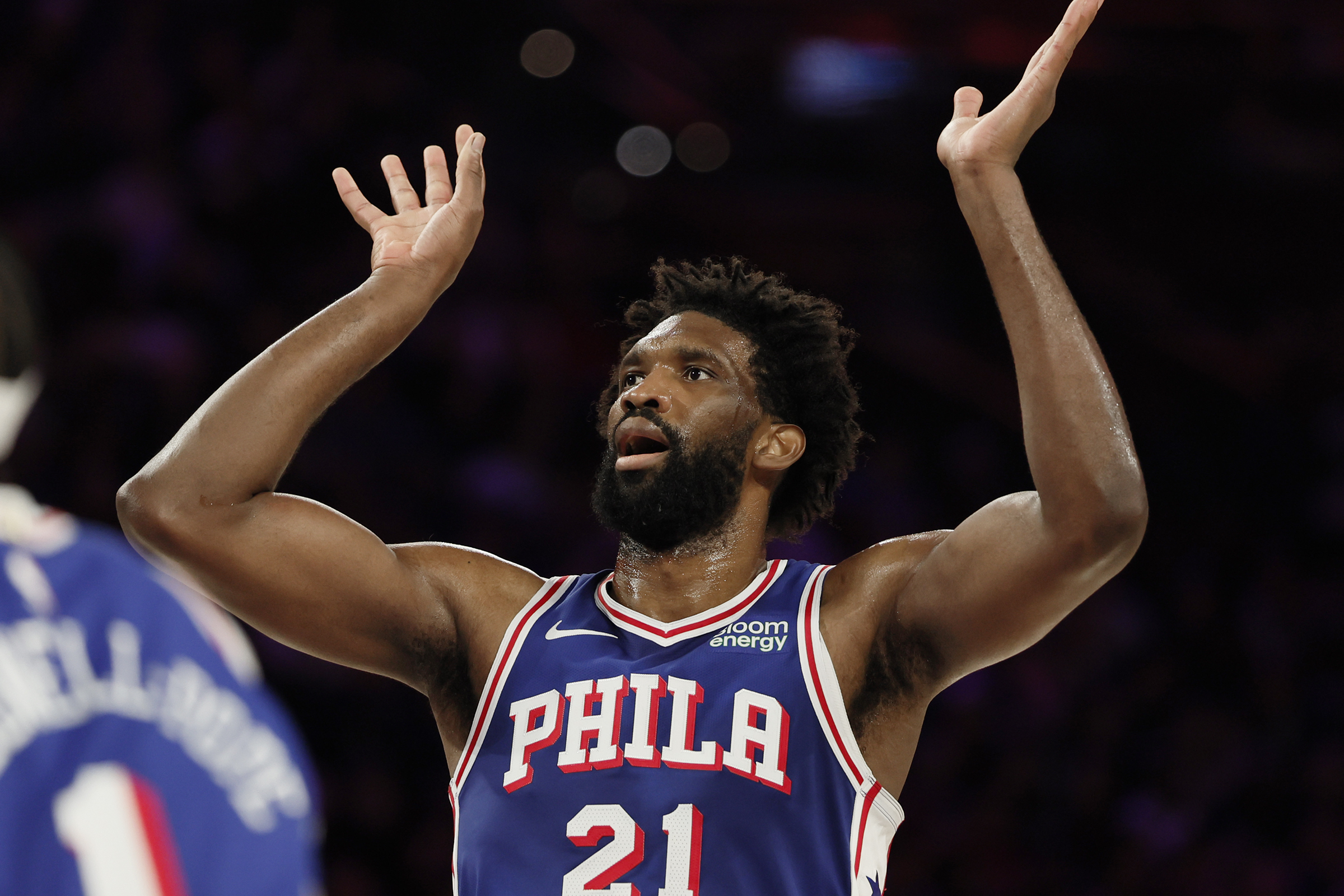
Raptors guard Ja’Kobe Walter, fighting through Embiid’s screen to get to Tyrese Maxey, had knocked into Embiid’s right knee. Embiid left the court limping, grabbing at the knee as he walked off with a trainer.
It looked like a potential nightmare scenario. The LeBron fan accounts were throwing in the towel on the season. Embiid said at the end of last season that he felt his knee injuries were finally behind him.
“I always tell him all the time, just please don’t fall,” VJ Edgecombe said.
Nick Nurse said after the Sixers’ 123-112 victory that he gets nervous every time he sees Embiid grab at his knee, and Thursday was no exception.
But Embiid, after a brief stint in the locker room, got right back out on the court, to thunderous applause.
“I’m kind of pessimistic at times, because, you never know what happened when someone’s just laying on the floor,” Edgecombe said. “… For him to go back and then come back out, it just shows his heart.”
Joel Embiid left the Raptors game early after banging knees with Ja’Kobe Walter, but returned and thrived. Elizabeth Robertson / Staff Photographer
Tyrese Maxey said he knew immediately that Embiid’s injury wasn’t going to be serious, and that Embiid, while on the ground, kept saying that he just got kneed.
Embiid ended the night with 20 points, four rebounds, and three assists. He told reporters at shootaround that he wanted to be “more aggressive” against Toronto.
“He was aggressive, man,” Maxey said. “He didn’t think. You know what I’m saying? I think he’s been thinking.”
He still didn’t find much luck from behind the arc, missing all three of his three-point attempts to add to his tough 4-for-36 start to the season. But Embiid did get two dunks — something he jokingly swore off earlier this year — and a block.
Nurse said Embiid’s movement, especially after that jolt of pain from the knee-on-knee bump, was the most promising sign from his night.
“He’s just moving better, and I’m not sure that was the case for a couple games here recently,” Nurse said. “It’s nice to see the movement spark come back.”
The Sixers don’t need Embiid to carry the team every night the way they once did. Even with LeBron James out for back sciatica management, Maxey and Edgecombe performed at an elite level against Toronto, and the Sixers maximized the depth on their bench with strong nights from Anfernee Simons and Kentavious Caldwell-Pope.
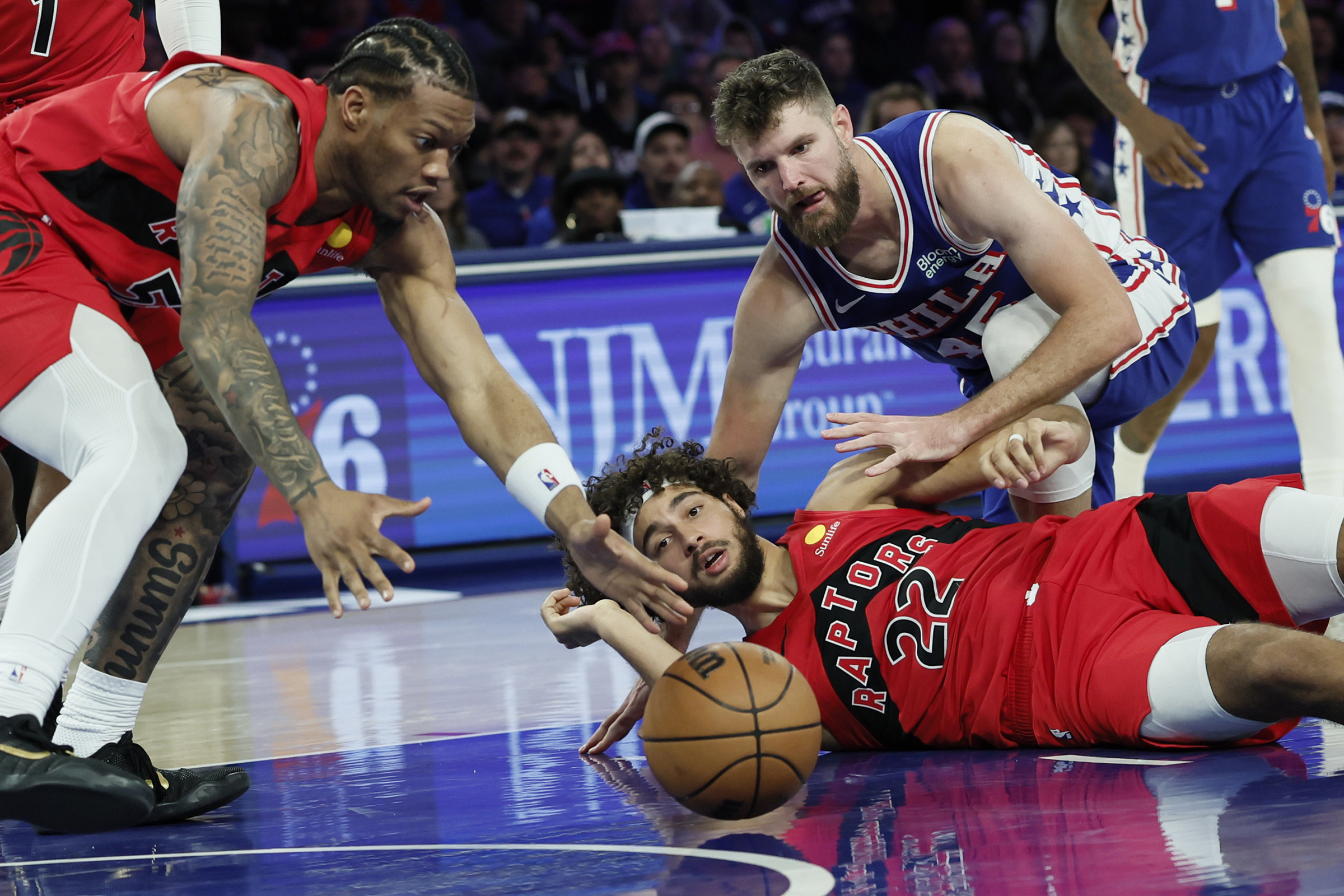
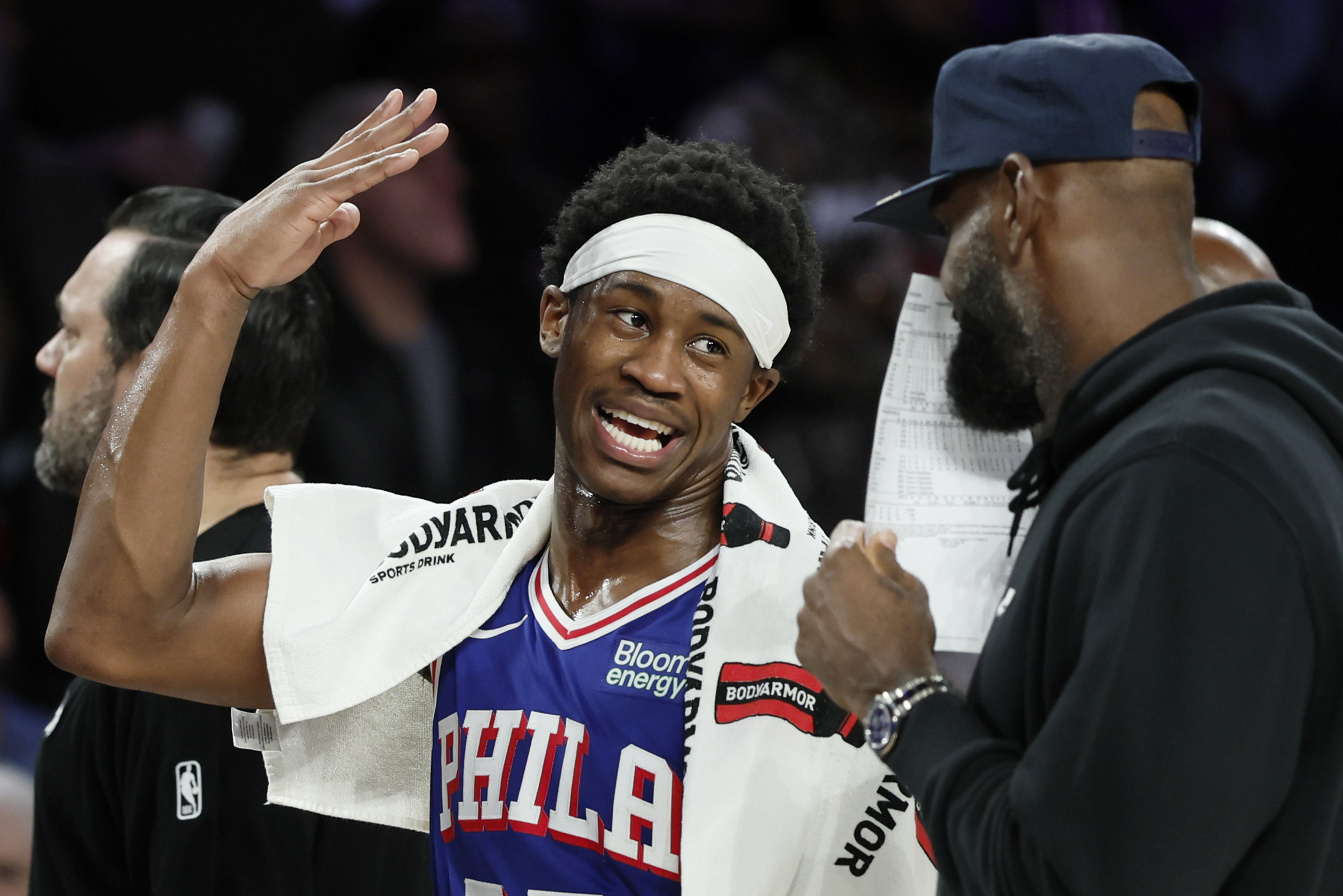
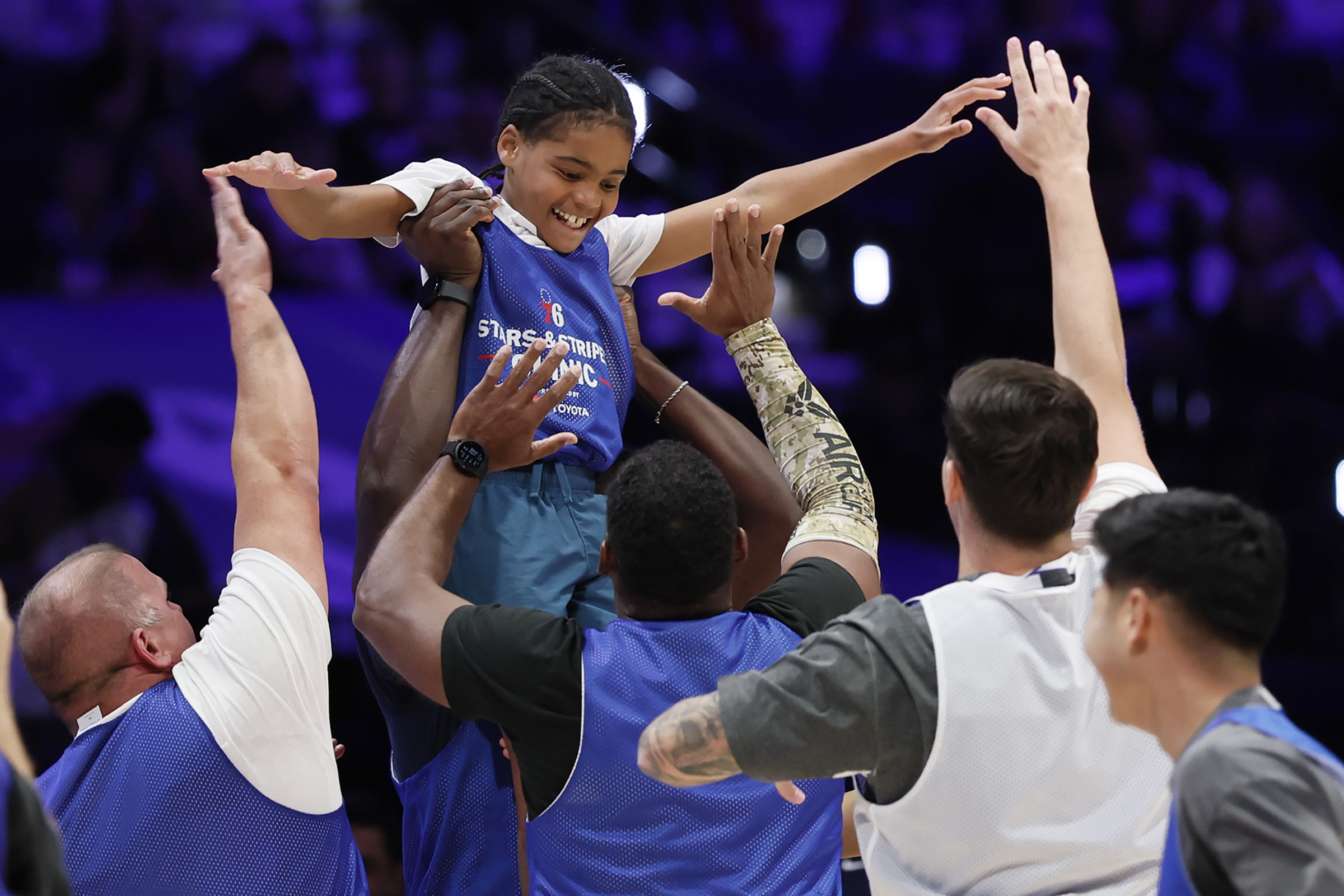
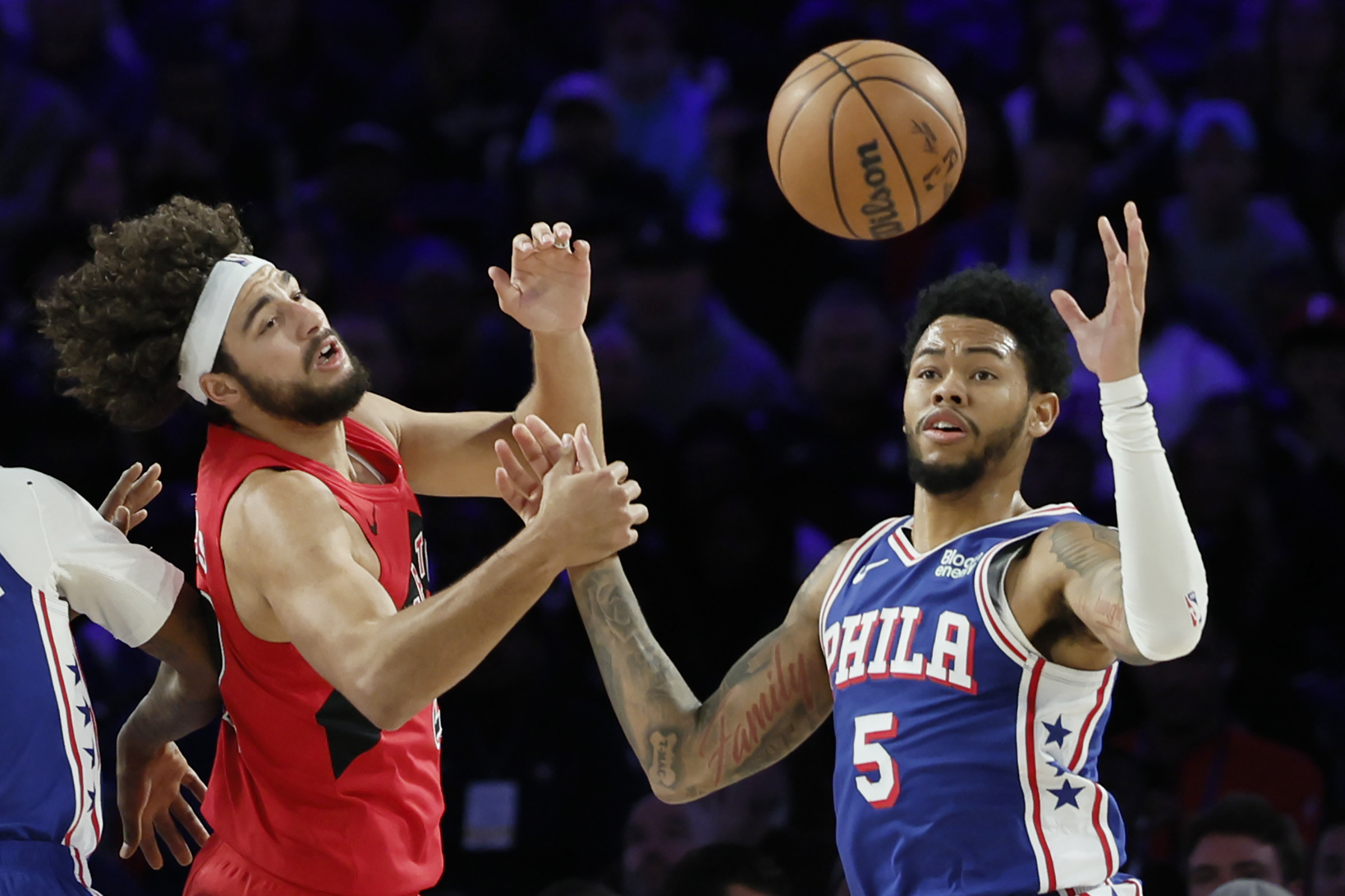
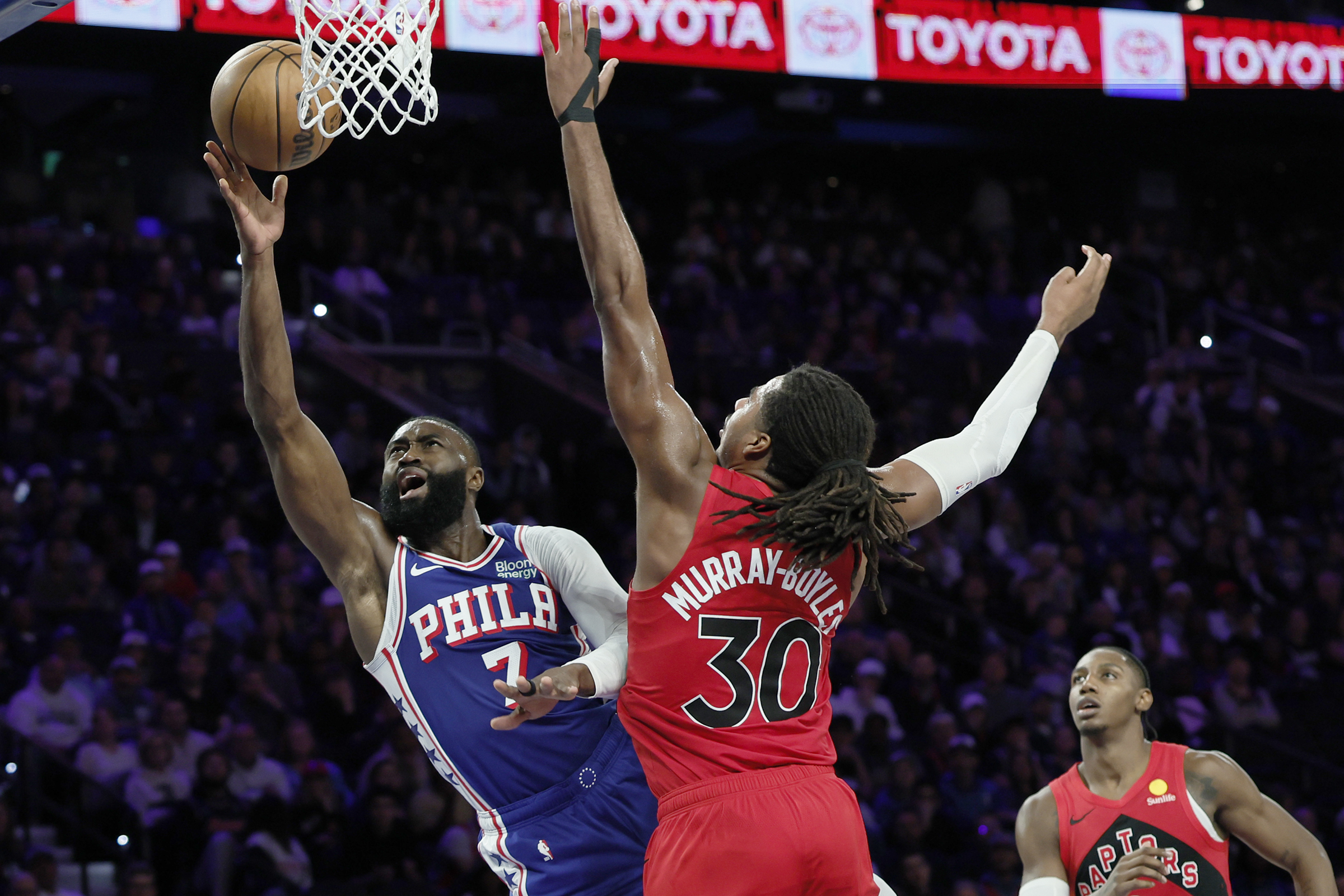
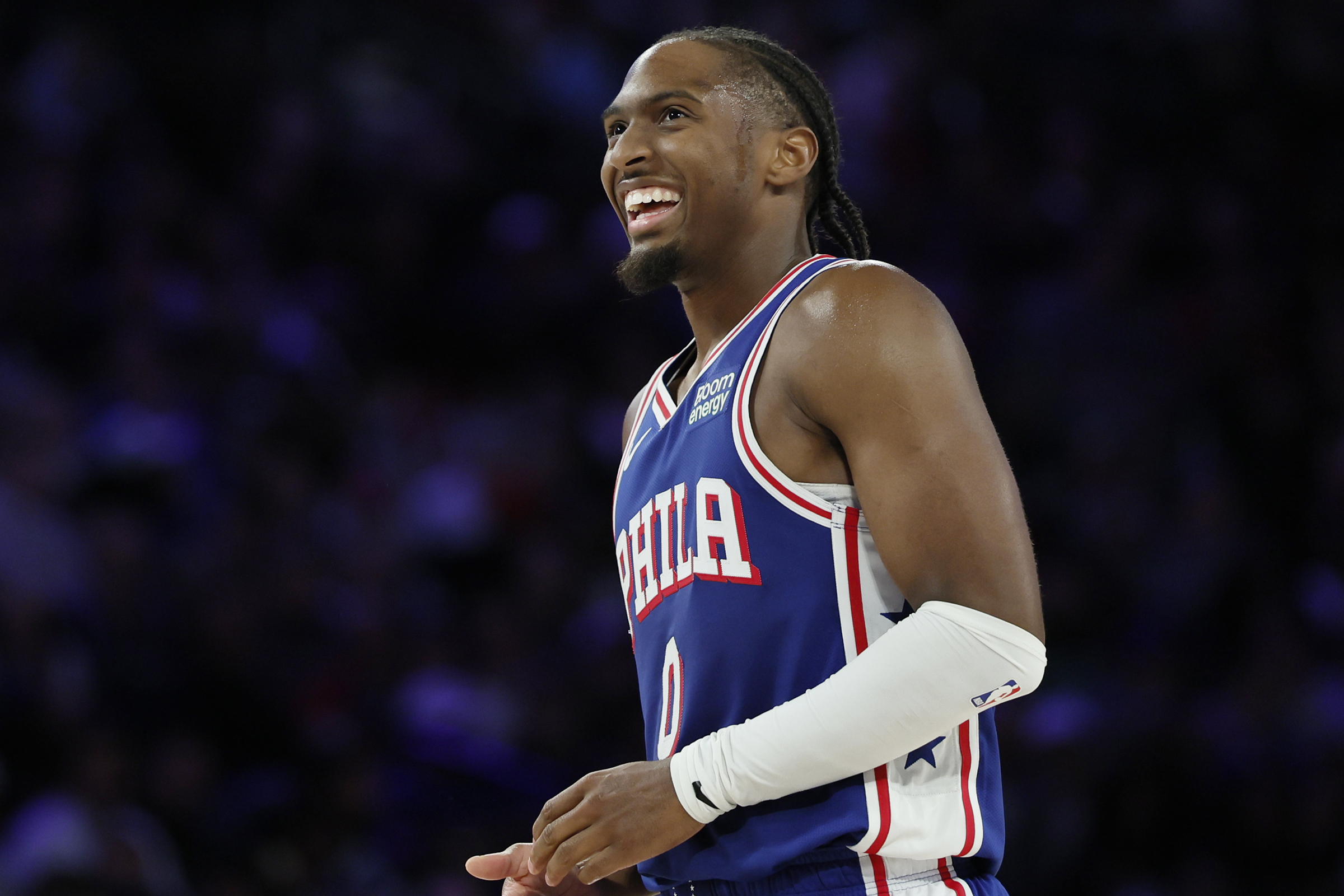
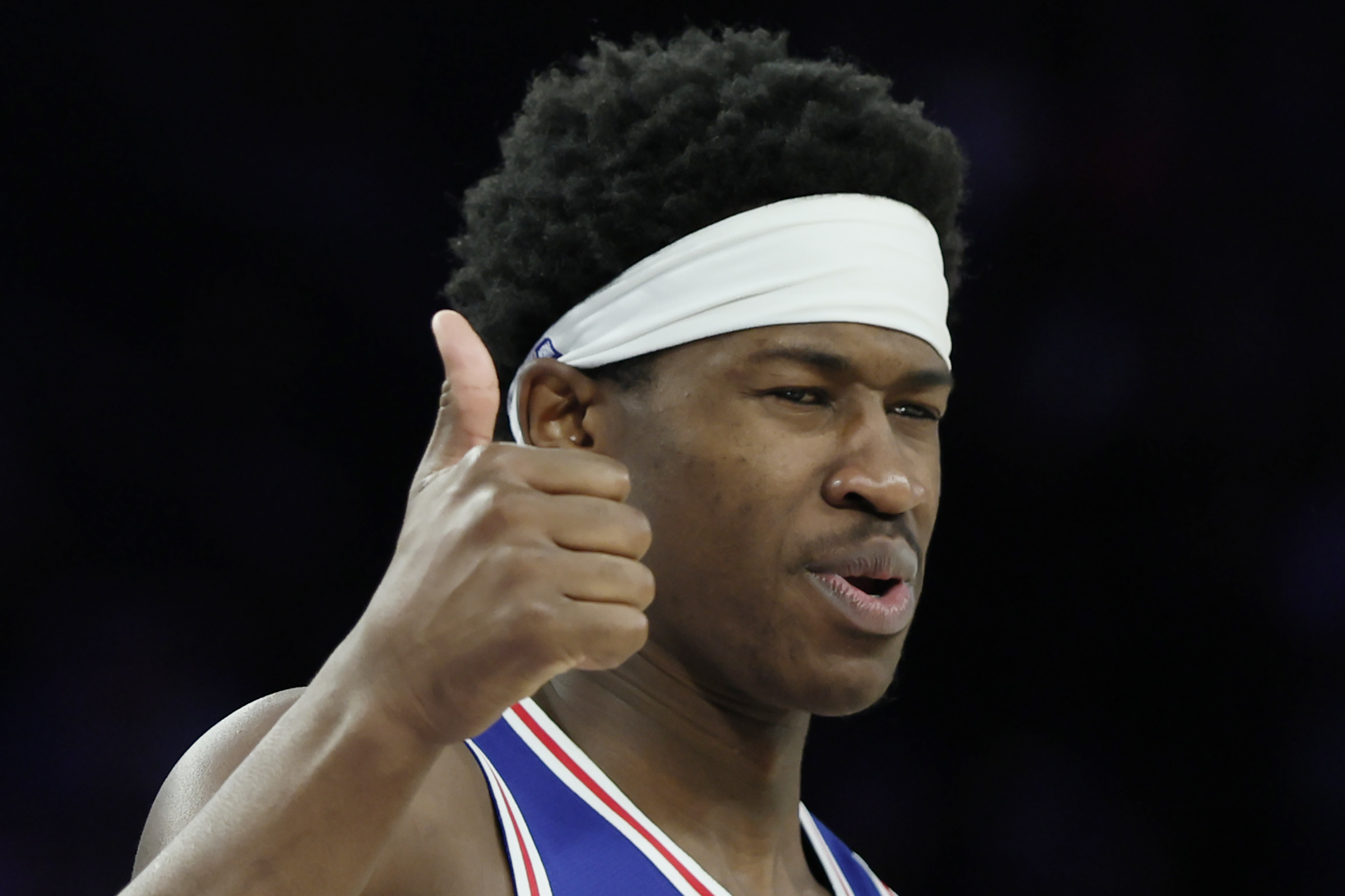
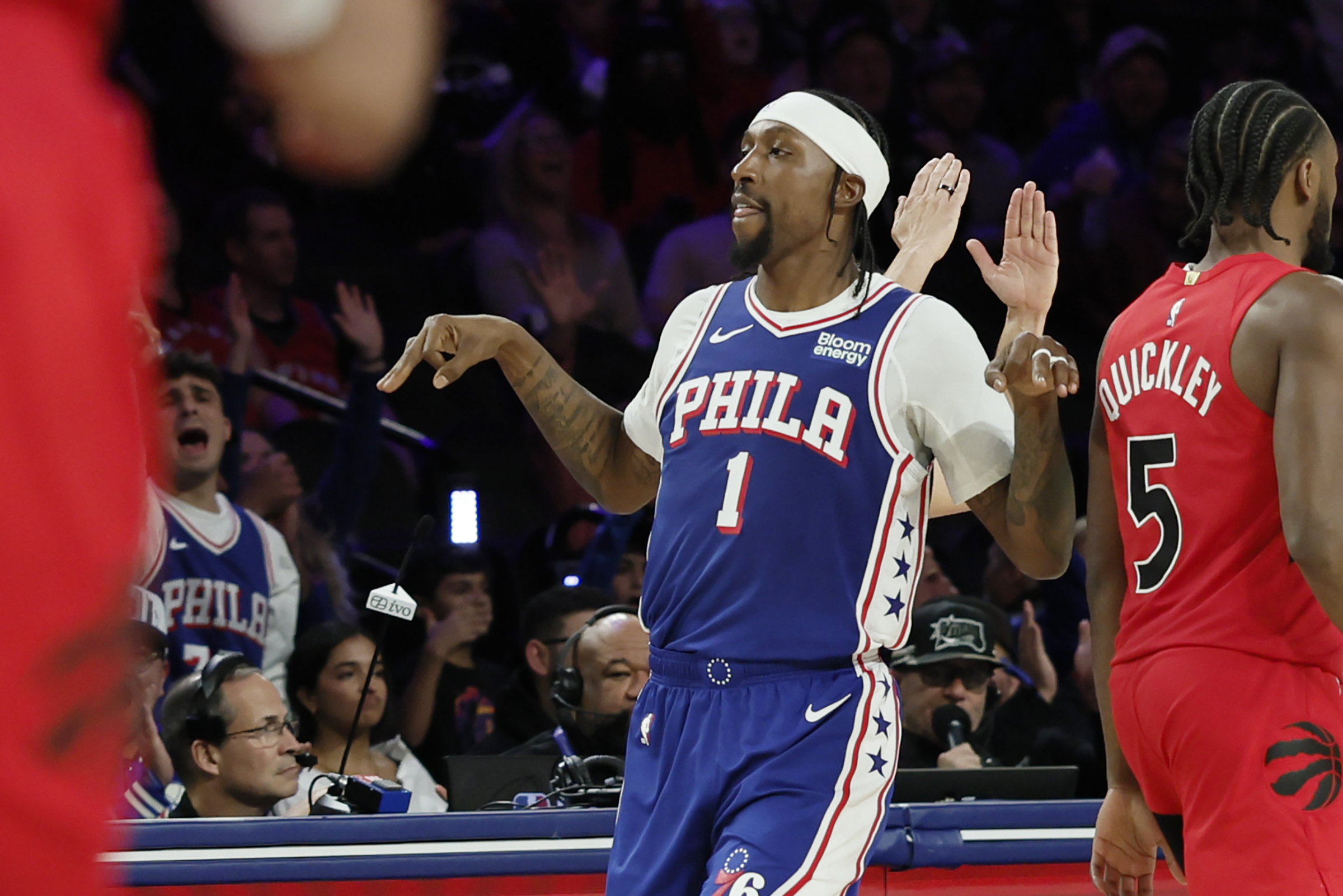
Raptors # 5 Immanuel Quickley, # 22 Allen Graves and Sixers # 45 Dean Wade have their eyes on a loose ball during the Toronto Raptors vs. Philadelphia 76ers (Sixers) NBA game at Xfinity Mobile Arena in Philadelphia on Thursday, November 12, 2026.Elizabeth Robertson / Staff PhotographerSixers VJ Edgecombe (left) and LeBron James have an animated conversation during a break in the Toronto Raptors vs. Philadelphia 76ers (Sixers) NBA game at Xfinity Mobile Arena in Philadelphia on Thursday, November 12, 2026.Elizabeth Robertson / Staff PhotographerTen year old Noah Solomon of Moorestown is lifted into the air by teammates after he scored the winning basket for his team during a short game featuring the military community at halftime of the Toronto Raptors vs. Philadelphia 76ers (Sixers) NBA game at Xfinity Mobile Arena in Philadelphia on Thursday, November 12, 2026.Elizabeth Robertson / Staff PhotographerRaptors # 1 Jamal Shead walks by as Sixers Joel Embiid pauses for a moment before heading to the foul line in the second half of the Toronto Raptors vs. Philadelphia 76ers (Sixers) NBA game at Xfinity Mobile Arena in Philadelphia on Thursday, November 12, 2026.Elizabeth Robertson / Staff PhotographerRaptors # 22 Allen Graves and Sixers # 5 Anfernee Simons watch the ball in the second half of the Toronto Raptors vs. Philadelphia 76ers (Sixers) NBA game at Xfinity Mobile Arena in Philadelphia on Thursday, November 12, 2026.Elizabeth Robertson / Staff PhotographerSixers Tyrese Maxey argues that he should have three foul shots after being fouled in the second half of the Toronto Raptors vs. Philadelphia 76ers (Sixers) NBA game at Xfinity Mobile Arena in Philadelphia on Thursday, November 12, 2026.Elizabeth Robertson / Staff PhotographerSixers # 21 Joel Embiid shoots over Raptors # 19 Jakob Poeltl during the Toronto Raptors vs. Philadelphia 76ers (Sixers) NBA game at Xfinity Mobile Arena in Philadelphia on Thursday, November 12, 2026.Elizabeth Robertson / Staff PhotographerSixers # 7 Jaylen Brown has this shot tipped by Raptors # 30 Collin Murray-Boyles as Raptors # 9 RJ Barrett looks on in the second half of the Toronto Raptors vs. Philadelphia 76ers (Sixers) NBA game at Xfinity Mobile Arena in Philadelphia on Thursday, November 12, 2026.Elizabeth Robertson / Staff PhotographerSixers Tyrese Maxey during the Toronto Raptors vs. Philadelphia 76ers (Sixers) NBA game at Xfinity Mobile Arena in Philadelphia on Thursday, November 12, 2026.Elizabeth Robertson / Staff PhotographerSixers VJ Edgecombe gives a thumbs up after a heads up play in the second half of the Toronto Raptors vs. Philadelphia 76ers (Sixers) NBA game at Xfinity Mobile Arena in Philadelphia on Thursday, November 12, 2026.Elizabeth Robertson / Staff PhotographerSixers # 1 Kentavious Caldwell-Pope hits a three point shot at the shot clock buzzer in the second half of the Toronto Raptors vs. Philadelphia 76ers (Sixers) NBA game at Xfinity Mobile Arena in Philadelphia on Thursday, November 12, 2026.Elizabeth Robertson / Staff Photographer
But they are still at their best with Embiid on the floor. He was a +11, the best mark of any starter. So far this season, Embiid and the Sixers have gotten lucky with injuries, with their full starting lineup playing in nine of 14 games, missing just the scheduled back-to-backs before James missed Thursday.
Even with the team’s load management plan, Embiid joked after the first leg of a back-to-back that he wanted to play the next one. He’s more motivated than ever to be on the court and deliver for the Sixers.
“[Embiid] was very, very motivated to play,” Nurse said. “It was hard to get him out for his scheduled rests tonight, which, it’s a good problem.”