Tag: topic-link-auto

  • Black Americans are reviving an ancient Nigerian apprenticeship model to build wealth

    Black Americans are reviving an ancient Nigerian apprenticeship model to build wealth

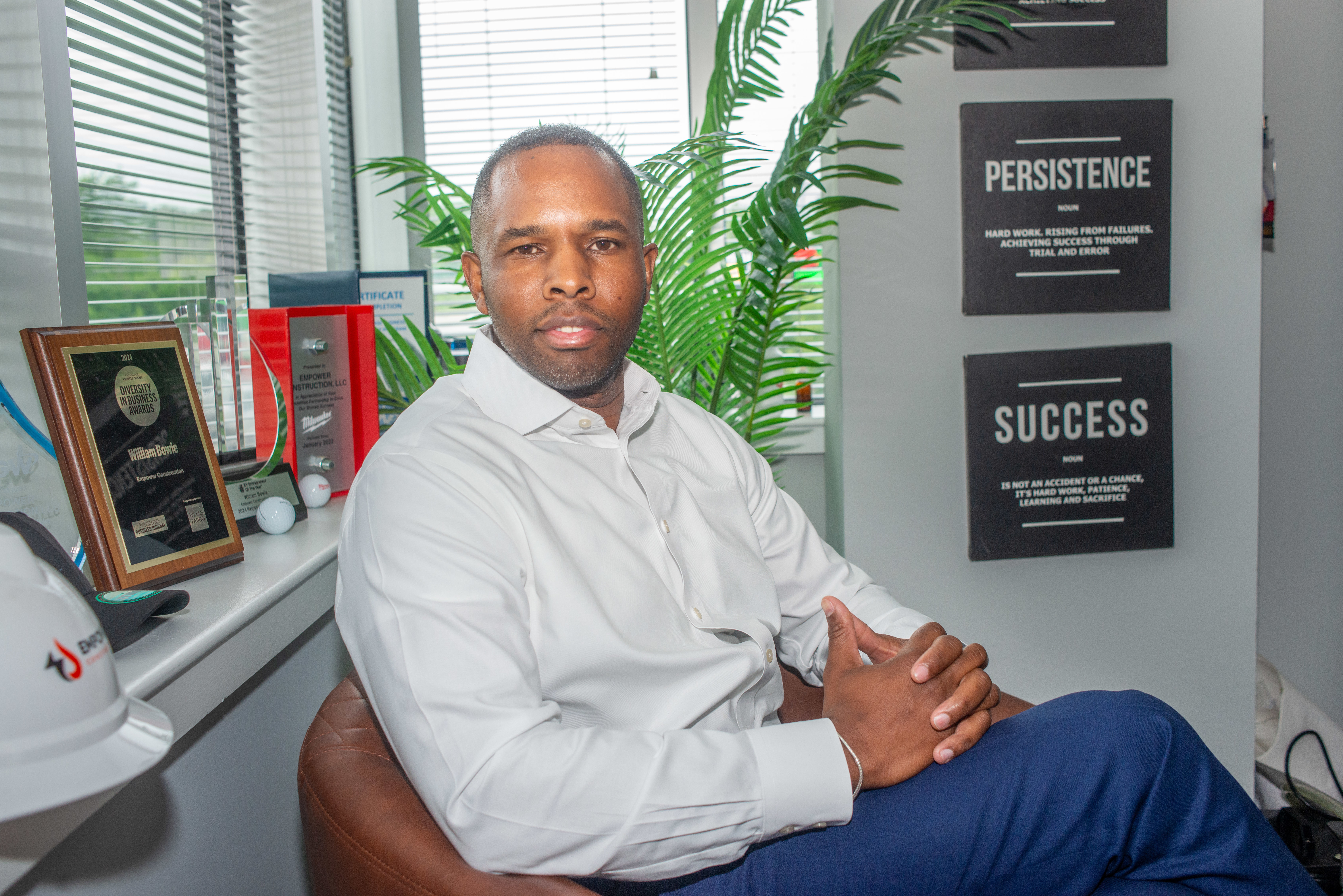
    Growing up, William Bowie measured poverty in cups of water warmed in the microwave for his morning baths at a sink. He lived in the Richard Allen public housing project in the Poplar section of North Philadelphia, raised with his brother by a single mother. Even as a high schooler, he was eager to improve his life’s circumstances, but lacked just about everything he needed to do so except a willingness to work hard.

    Three decades later, Bowie is president and CEO of his own nine-figure construction company, a journey that he largely attributes to a Philadelphia-based trade community apprenticeship system, similar to the “Nwa Boy” model that has been practiced in West Africa for centuries.

    “I kind of challenged myself,” said Bowie, who’s 42, referring to his mindset when he was embarking on his career. “Why can’t I be the best? And why can’t I open that door for others?”

    Bowie’s path is hardly an isolated success story. It is one node in a growing, informal network — from union apprenticeships in Philadelphia to a training cohort in Oakland, Calif. — of programs borrowing the Nwa Boy model’s core promise: a credentialed path from labor to ownership, built on relationships and trust rather than credit scores or venture capital.

    As race-conscious funding efforts designed to level the playing field for African Americans are dismantled, that promise is drawing new attention from investors, workforce officials, and Black entrepreneurs looking for an alternative route to generational wealth.

    The Nwa Boy system, which has its roots in the communities of the Igbo people in southeastern Nigeria, works this way: An established craftsman or business owner — known as the “Oga,” or master — takes on the training of a young person — known as the “Nwa Boy” (pronounced: nwah), or apprentice — often straight out of secondary school.

    The apprentice lives and works closely with the Oga for as long as eight years, learning the nuances, logistics, and administration of their chosen craft.

    When the apprenticeship ends, the Oga provides the graduate with a “settlement,” or capital — which often includes giving them money or business space — to launch their own independent businesses. The apprentice then continues the cycle.

    The Harvard Business Review has called the Nwa Boy system “a Nigerian model for stakeholder capitalism” in which community, workers, and shared prosperity take precedence over individual shareholder return.

    In 1970, at the conclusion of three years of civil war, the Igbo people used the Nwa Boy system to build a multibillion-dollar economy from the ground up. That’s when the Nigerian government seized control of the nation’s financial institutions and gave the equivalent of only about 20 British pounds (or roughly $400 in today’s money) to every Igbo adult, regardless of how much they had in their bank accounts before the conflict.

    Today, at a moment when Black Americans are witnessing the erosion of affirmative action and DEI programs through court rulings and presidential executive orders, Bowie and others believe the Nwa Boy system may provide an answer to the question of what happens when the system meant to fix a problem becomes the next thing that needs fixing.
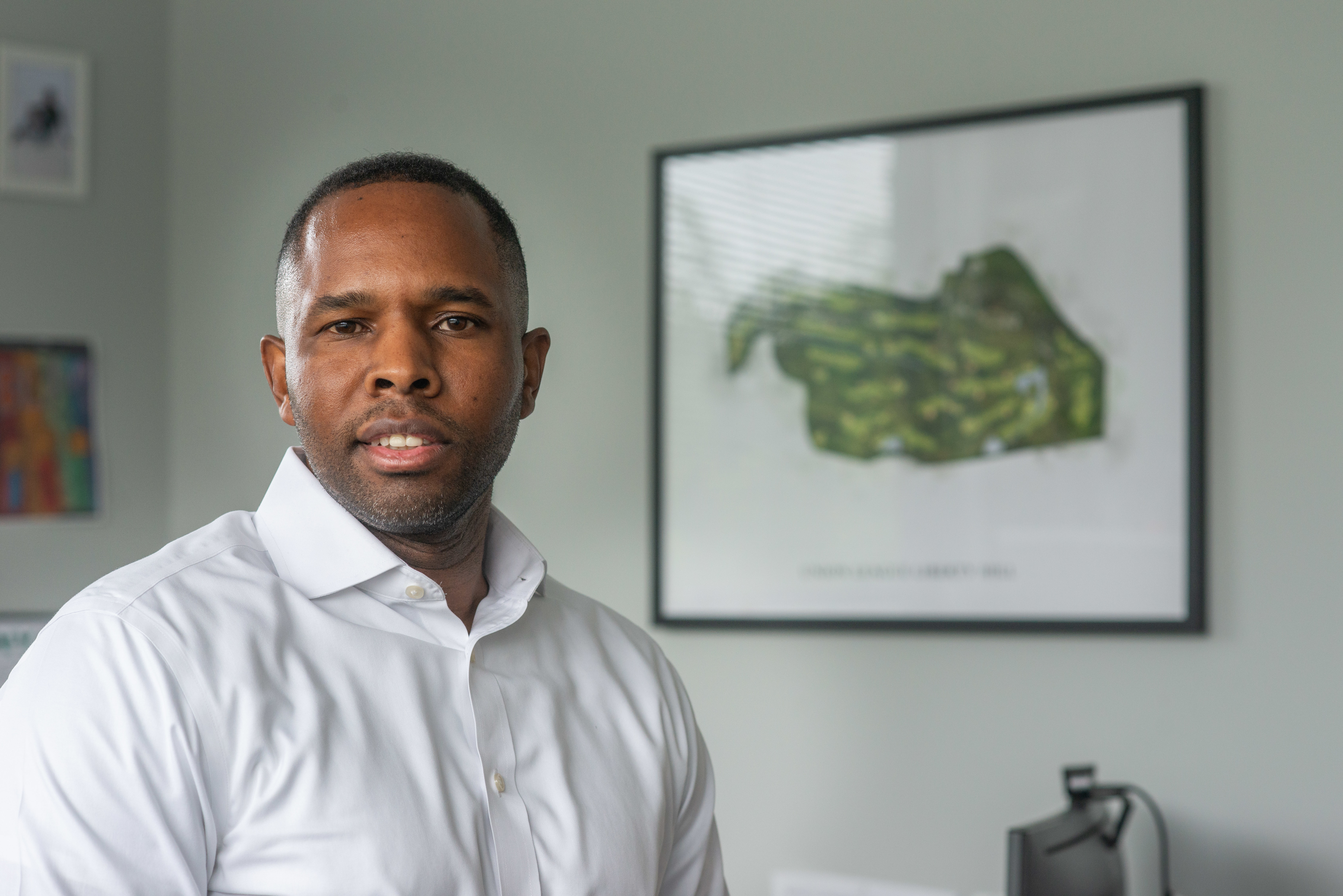
    As he was embarking on his career in construction, North Philadelphia native William Bowie said he asked himself, “Why can’t I be the best? And why can’t I open that door for others?”William Thomas Cain / For The Inquirer

    The blueprint

    While Bowie’s blueprint moves from employment to ownership, it did not happen in a vacuum.

    After finishing his first year at Drexel University, Bowie faced a dilemma — he had no way to pay a $6,500 bill to enroll for his sophomore year.

    “I tested into a magnet school,” Bowie said. “Academics wasn’t a problem. I was thriving in that environment. It’s just that financially I couldn’t afford it after the first year.”

    Bowie was not deterred.

    “I looked for a different path,” he said. “I tried to make money to get back into my second year in college.”

    In Nigeria, young men had been solving the same problem for generations — not with legislation, but with a handshake that meant more than a contract between an Oga and their apprentice. The pact is simple: The master teaches. The apprentice serves.

    In North Philadelphia, though, the syndicate of trust had little that resembled the stalls of Lagos’ Alaba International Market. It had Frank Murray.

    Murray, a member of the International Brotherhood of Electrical Workers (IBEW) and a family friend of Bowie’s mother, Margaret, encountered a young man desperate for an opportunity. He told Bowie, “This is where the money is at.”

    In the Nwa Boy system, the Oga does not simply teach a trade — he transfers his reputation, his customer network, and at the end of the apprenticeship cycle, his start-up capital. The system does not run on contracts, but on trust enforced by community witnesses.

    Murray gave Bowie the same thing — a pathway — and Bowie walked through it. Bowie joined IBEW at 19 years old.

    He completed a four-year U.S. Department of Labor-certified apprenticeship in three and a half years, earned $75,000 in his first year, and rose to become the youngest area manager overseeing about $300 million in business.

    Bowie says IBEW gave him what the Nwa Boy system has always understood, and American institutions have always struggled to replicate — a means to succeed that required no college degree, no venture capital pitch, and no generational wealth.

    ‘Financial gravity’

    Bowie’s playbook from two decades ago is what many American venture builders and investors are now being forced to consider as the formula for prosperity is being recalibrated. They must confront the brutal reality that even seven-figure salaries are no guarantee for wealth creation.

    “A paycheck — even a seven-figure one — is just a stay of execution. It doesn’t detach you from financial gravity,” Brandon Jones, founder and CEO of Gravy Capital, said during a virtual panel in April hosted by Visible Hands VC.

    When Bowie applied for capital to launch his company, Empower Construction, he felt the earth tugging at his dreams. Even though he had two decades of industry experience and managed a $300 million book of business, the banks still said no.

    What finally opened the door was not a stronger application, but a different messenger.

    One of Bowie’s mentors, Daniel K. Fitzpatrick, an executive at Citizens Bank, made a single phone call to his colleagues. A line of credit came through. To Bowie, it was the equivalent of receiving an Oga’s settlement.

    Saantis Fenmu Davis, a Philadelphia-based financial literacy educator and founder of Geb Cultural Exchange, said the problem starts earlier than the bank. He said it’s essential that Black Americans are taught how to be producers and investors, and not just consumers. “While higher spending and status-signaling often masquerade as affluence, they represent a fundamental mirage of social capital, which may or may not translate to equity or wealth,” he said.
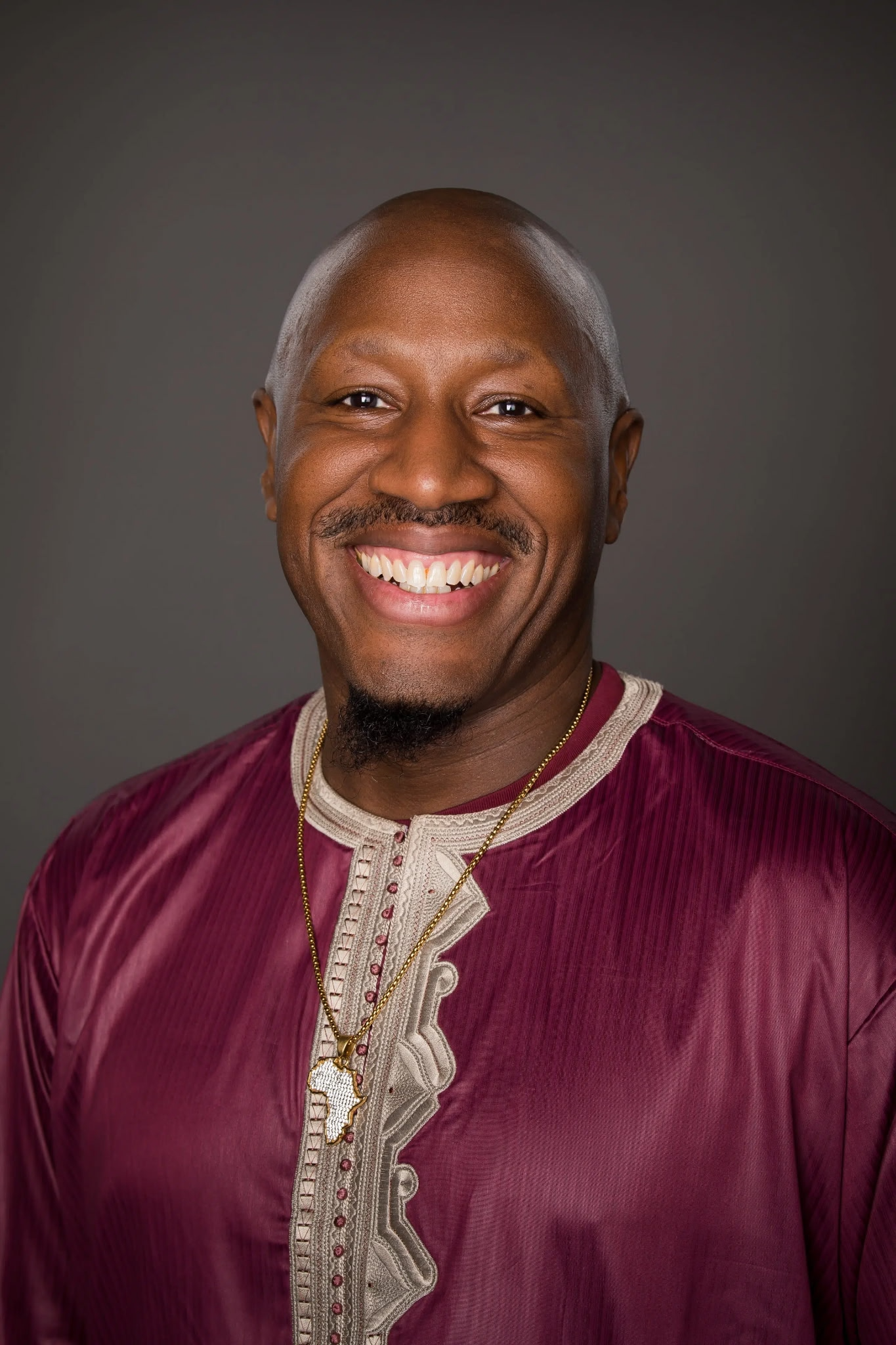
    Saantis Fenmu Davis, a Philadelphia-based financial literacy educator and founder of Geb Cultural Exchange, says consumerism is a “fundamental mirage of social capital.”Courtesy of Saantis Fenmu Davis

    Murray did not teach Bowie to consume. He taught him to produce.

    Patrick Clancy, president and CEO of the city’s workforce development program, Philadelphia Works, is trying to replicate what Murray did across its programs. Philadelphia Works manages roughly $11 million in apprenticeship funding across skilled trades and emerging sectors including IT, healthcare, and education.

    Murray was Bowie’s Philadelphia Works, but the path is not without its shadows.

    For every successful apprenticeship program or Nwa Boy story told, there is a possibility of exploitation.

    In the Nwa Boy framework in Lagos, Nigeria, some apprentices have reported exploitation at the hands of their masters.

    Naboth Nwaikwu spent 20 grueling years navigating three successive apprenticeships before finally being settled. He was an orphan. His first master did not settle him because his aunt and uncle instructed him not to. The same thing happened the second time.

    It wasn’t until his third attempt, under the apprenticeship of a friend, that he got his settlement, all of which could not account for the years lost.

    Nwaikwu now sells construction accessories for a living at Lagos’ Alaba International Market, and makes enough profit to take apprentices of his own if he wanted to, but told me he refuses to do so because “There is a thin line between unpaid apprenticeship and indentured service. I do not want to be the one to cross it.”

    Uyi Samuel Oni, a corporate attorney licensed in Nigeria and trained at the University of Pennsylvania’s Carey Law School, said the covenant must become a contract before it can successfully cross continents. “The Nwa Boy system must avoid negative historical connotations linked to terms such as master,” Oni said.
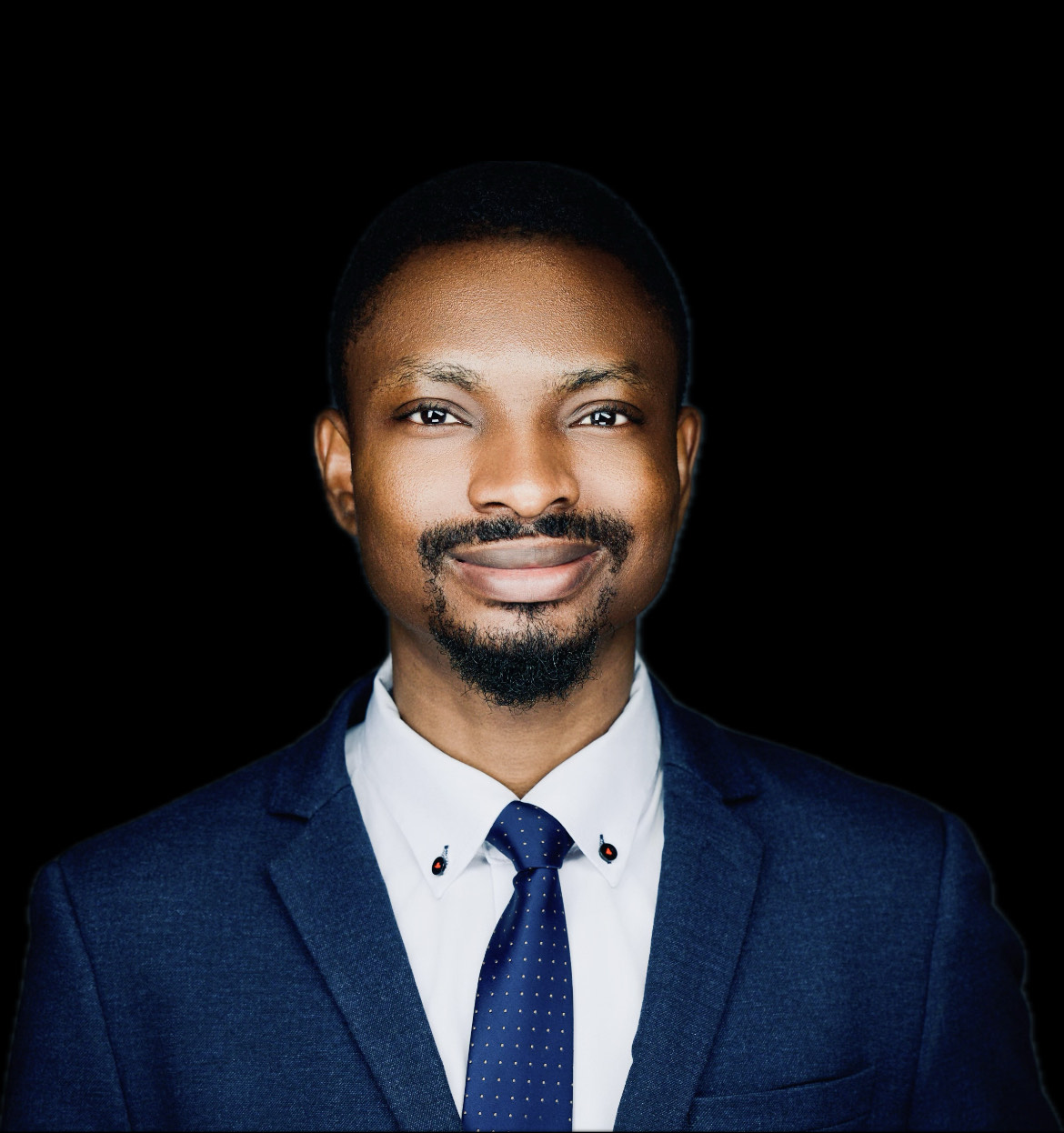
    Uyi Samuel Oni, a corporate attorney licensed in Nigeria and trained at the University of Pennsylvania’s Carey Law School, says the Nwa Boy covenant must become a legally binding contract before it can successfully be used in America.Courtesy of Uyi Samuel Oni

    A legally compliant American adaptation, he said, must be a win-win for both parties — not merely vocational or community service, but a binding agreement that protects the apprentice’s right to the capital payout that makes ownership possible.

    In Oakland, a program called Built Here has emerged as a 21st-century proxy for the Nwa Boy system.

    Onye Ahanotu, a former Harvard engineering research fellow and founding member of Built Here, uses training cohorts to mirror the communal trade apprenticeships of southeastern Nigeria. “We meet every week,” Ahanotu said.

    The frequency is intentional. In the Nwa Boy system, the covenant is not a one-time transaction — it is a continuous relationship between master and apprentice, reinforced week by week, skill by skill, until the apprentice is ready to stand alone.

    Clancy, of Philadelphia Works, understands that frequency. But he said the barriers that push apprentices out are not about ambition. They are about logistics. Most apprentices who do not complete the program fall off because of logistics — literacy gaps, a lack of childcare, transportation difficulties, and rigid drug-testing requirements.

    The apprenticeship demands sacrifice.

    Bowie was 19 years old and the only African American male in a trade that was overwhelmingly white and male. The culture shock was real. His determination was not given. It was chosen every single day.

    Bowie narrated his apprenticeship years as a period of determination and exposure to wealth — not suffering. Once he entered IBEW, his obstacles became opportunities.

    Clancy said Philadelphia Works offers pathways into the building trades and is open to second-chance applicants. Prior convictions are not automatic disqualifiers. The door is open. Most people do not know it is there.

    At the Philadelphia Navy Yard, Hanwha builds ships. The company needs welders. It cannot find them.
    Patrick Clancy, president and CEO of Philadelphia Works, the city’s workforce development program, which offers pathways into the building trades and is open to second-chance applicants.Courtesy of Patrick Clancy

    Not because the welders do not exist. Not because the work is not there. Not because the wages are not competitive — apprenticeship wages in the building trades start at $25 per hour and can exceed $100,000 annually with overtime. The positions have gone unfilled for three years, Bowie said, because nobody told the kids in North Philadelphia, West Philadelphia, and Germantown that the door is open.

    Bowie knows this the way he knows everything about the trades — from the inside. He gives talks online. He goes into Philadelphia schools. And while he may not have known about the Nwa Boy system when he was an apprentice, he regularly references its principles today.

    He stands in front of teenagers the same age he was when the system ran out of road for him and tells them what Murray told him: This is where the money is at.

    “In Philadelphia, there’s a shipbuilding company at the Navy Yard,” Bowie said. “They need welders. They can’t find them. And you’re telling me that in the city of Philadelphia, in the communities that we come from, that we can’t find welders?” He paused. “The parents don’t know. The kids don’t know. Nobody’s telling them.”

    Clancy is trying to change that. Philadelphia Works is actively pursuing apprenticeship funding for Hanwha’s shipyard — planned cohorts of 20 to 30 apprentices at a time. The infrastructure, funding, and jobs exist. What is missing is the same thing that was missing when Bowie was standing at the edge — someone to point at the door.

    Murray pointed. One phone call — and a kid from the Richard Allen Homes became a $100 million CEO. Philadelphia has not yet produced its Frank Murrays at scale.

    Bowie is working on it. One conversation — and one handshake — at a time.

    Ibe Imo is a Philadelphia-based investigative journalist whose reporting examines technology, power, capital, and the systems that determine who builds wealth and who pays for it. He is a recent graduate of the master of journalism program at Harvard University.
  • Pennsylvania ended automatic life sentences for felony murder. Here’s what happens next.

    For decades, a second-degree murder conviction in Pennsylvania meant an automatic sentence of life in prison — even for people who did not kill anyone.

    But in March, the Pennsylvania Supreme Court ruled that punishment unconstitutional in the case of Derek Lee, a Pittsburgh man who argued the mandatory nature of the sentence violated constitutional prohibitions against cruel punishment.

    The high court gave the state legislature 120 days to devise an alternative and decide whether to apply it to those already serving the sentence.

    That deadline passed without a resolution on July 24. And in early August, the high court rejected a bid by several district attorneys to give lawmakers more time.

    So what happens now? Here’s what to know.

    What was the maximum sentence for second-degree murder — and what is it now?

    Before the ruling, the punishment was life without parole. Now there is no clear answer.

    Setting criminal penalties is the legislature’s job, and lawmakers have not put in place a replacement.

    The high court’s ruling did not abolish life without parole for felony murder; it only barred making the punishment automatic. A judge may still impose such a sentence, but only after weighing a defendant’s role in the crime.

    The justices declined to say whether the ruling applies retroactively to people already serving those sentences, leaving that question to lawmakers, too.

    How will judges sentence second-degree murder now that there’s no mandatory penalty?

    With no law to guide them, judges are left to their own decisions. And without statewide guidelines, similar cases could end differently depending on the county in which a defendant is tried and on the judge who hears the case.

    Philadelphia District Attorney Larry Krasner has expressed little concern about the lack of guidelines.

    In an interview this week, Krasner, a Democrat who has forged a path as a progressive prosecutor, said “there’s nothing unusual” about asking judges to weigh the facts and use their discretion. “I’ve always believed that mandatory sentencing is problematic at best, usually a terrible idea, and that individual justice is what the system is supposed to be about,” he said.

    But at a joint GOP policy committee meeting in Hazleton last week, several Republican prosecutors and lawmakers voiced concern about the lack of uniformity across the state.

    Luzerne County District Attorney Sam Sanguedolce pointed to a case in which a defendant recently asked to plead guilty to second-degree murder.

    “I can’t properly advise the defendant what the consequence might be,” Sanguedolce said. “Second [-degree murder] sounds like it’s better than first, but is it? We don’t even know.”

    What happens to the people already serving life in prison?

    For the nearly 1,100 people serving life for second-degree murder, nothing changes automatically.

    The ruling made only one person eligible for resentencing: Lee. And even he could again receive life without parole, if a judge finds his role warrants it.

    Others who wish to have their life sentences reconsidered have to go to court and ask to be resentenced. Bret Grote, a lawyer with the Abolitionist Law Center who represented Lee, said such petitions are likely to be denied by trial courts until retroactivity is settled.

    Hundreds are expected to try anyway.

    That flood could overwhelm courts and public defenders. Statewide, handling the cases could cost more than $34 million, the Public Defender Association of Pennsylvania estimates. In Philadelphia — home to more than 500 people currently serving such sentences — Chief Defender Keisha Hudson puts her office’s share at $40,000 per defendant, or $24 million total.

    “We are going to need substantial funding,” she said last week, adding that she hopes to meet soon with city officials about how to pay for it.

    Legal experts expect the question of retroactivity to reach the state Supreme Court again, either through an appeal of a lower court’s denial or a so-called King’s Bench petition asking the justices to take up the issue directly.

    Lawmakers could also provide a quicker alternative by writing legislation that allows people serving second-degree murder sentences to seek parole, rather than requiring individual resentencing.

    Can lawmakers still pass a fix, and what might that look like?

    Lawmakers say negotiations will resume when they return in September. Each chamber has passed its own bill, but the two are far apart, with no compromise in sight.

    The bill in the Republican-controlled Senate would set a 35-year mandatory minimum for most second-degree murder convictions, while keeping life without parole as an option. Current lifers would become eligible for parole after 35 years — or 20 years, if they are at least 70.

    The measure in the Democratic-led House sets no mandatory minimum, instead directing the Pennsylvania Commission on Sentencing to write guidelines while keeping life without parole available. It would make current lifers parole-eligible after 30 years and add a medical parole option for the terminally ill.

    Sen. Lisa Baker (R., Luzerne), who wrote the Senate proposal, said she is still hopeful that her caucus and House Democrats will reach a deal. But the parties remain far apart, she said.

    “It’s difficult when you’ve got people whose priorities are no mandatory minimums for any crime,” she said. “I understand that we want to keep nonviolent first-time offenders [out of prison], give people second chances. But there needs to be accountability for these crimes.”

    Few expect action before November’s midterm elections. “We can’t, unfortunately, make Harrisburg move any more quickly than they already are,” said Hudson, of the Defender Association. “And in the meantime, there are a lot of questions.”

    What does all this mean for victims’ families?

    Victims’ families are caught in a limbo of their own, said Melany Nelson, executive director of Northwest Victim Services, a Philadelphia nonprofit that assists crime victims.

    Those whose loved ones’ killers have not been sentenced are now waiting to learn what punishment will come, and whether it will feel like justice. Those whose cases closed long ago face now the prospect of being summoned back — to a courtroom or a parole hearing — to confront the killer again and potentially watch them set free.

    Nelson urged families to contact prosecutors’ offices and victim-advocate services now, rather than be caught off guard, and to weigh in with their state lawmakers.

    “We do not want them to be blindsided by anything,” she said.

    Correction: A previous version of this article incorrectly described what could happen to people who wish to appeal their sentences. Bret Grote, a lawyer with the Abolitionist Law Center, said such petitions are likely to be denied by trial courts until the question of whether a recent Pennsylvania Supreme Court ruling applies retroactively is settled.

  • The problem is not that we disagree; it’s how we disagree

    The problem is not that we disagree; it’s how we disagree

    I love hearing from readers. From those who agree and those who disagree. Unless I mess up, I try to respond to everyone who invested their time in what I had to say and then cared enough to write in. The only kind of feedback I abhor is the one that accuses me of bias, because duh.

    Whether you’re reading this in print (bless you) or online (thank you), it should be clear we are in the Opinion section, and bias, in the sense of a bent or an outlook, is how we do. However, I do not consider my side of the story to be the end of it. Regardless of whether someone is moved to drop me a line or not, I am here for the conversation.

    This is what happens in real life, at least ideally. I say something, and you say something back, and if we disagree, we at least respect each other’s right to do so.

    Unfortunately, the hardening of political positions seems to be doing away with even that. I know liberals who feel it’s a waste of time to try and talk to someone who thinks differently on trans rights, for example, just like I know conservatives who believe there’s nothing they care to learn from some socialist “Dumocrat.”

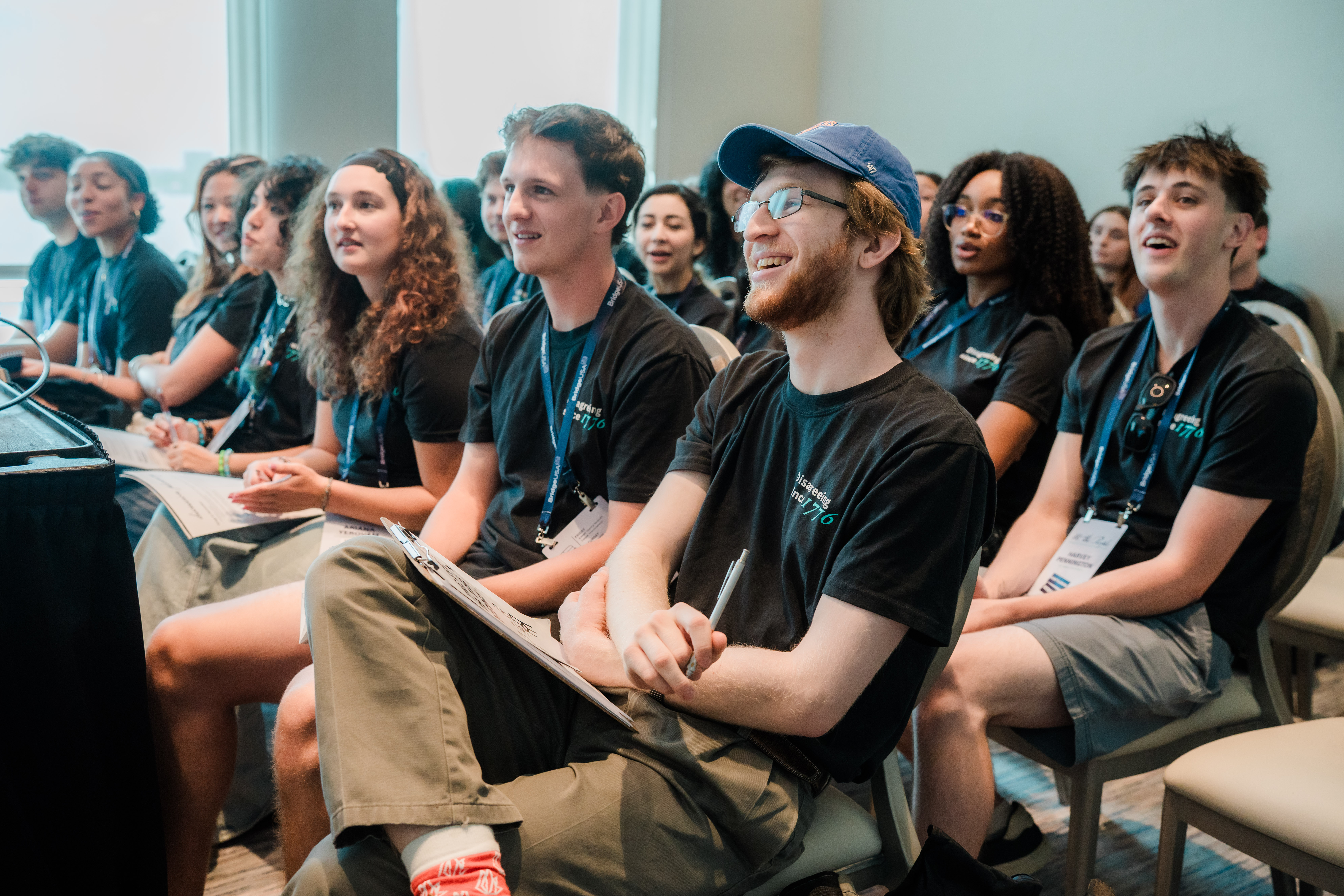
    Perhaps that’s why — even with the decade or two (or three) age gap between the participants and me — there was a feeling of kinship for me at the 2026 BridgeUSA National Summit held recently in Philadelphia. The group, which has 130 chapters on college campuses across the country, wants to ensure we don’t stop talking (and listening) to each other — especially if we disagree.

    And no, this isn’t some equivocating, middle-of-the-road, fine-people-on-both-sides kind of thing, Manu Meel, BridgeUSA cofounder and CEO, said. The organization’s goal isn’t to find common ground or change the way people think, but to urge and teach students to use their strong opinions to engage respectfully and constructively with those who have different beliefs.

    To hear the 27-year-old Meel tell it, Americans have always had differing opinions, and that disagreement is the engine of democracy. What our young nation would look like, in fact, was forged in disagreement. The problem today isn’t that there are disparate points of view, he said.

    “The real divide is between the open-minded MAGA people, the open-minded liberals, the curious conservatives, and the close-minded ideologues,” Meel noted. “The real divide is between the builders and the breakers.”

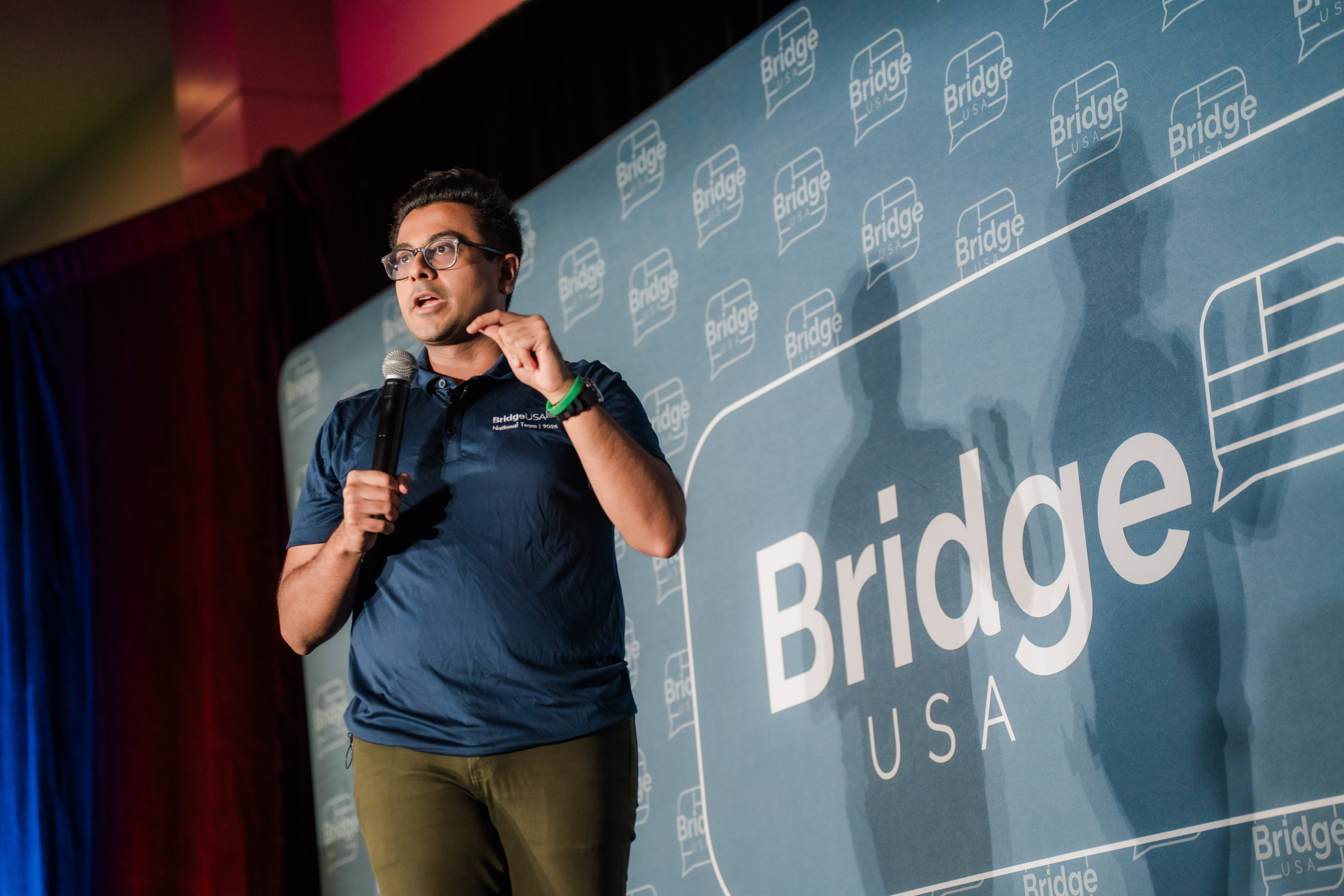
    Manu Meel, cofounder and CEO of BridgeUSA, speaks during his keynote speech at the group’s annual summit in Philadelphia on Aug. 8.Courtesy Clay Goswick/BridgeUSA

    The breakers in this case are the extremists on both sides of the political spectrum, those who make up for what they lack in numbers with the volume of their voices and rigidity of their views. The ones who stoke the outrage machine and scare the majority into silence.

    Sahar Toshtzar, a 21-year-old political science student at Drexel, told me she feels that fear often keeps people from engaging.

    “Sometimes it can be a little bit isolating having a mission of wanting to bridge the political divide,” she said. “Nobody really wants to talk about politics; nobody feels safe enough to talk.”

    For Toshtzar, her first BridgeUSA events on campus about a year ago proved revelatory.

    “I went to the discussions that we had, and it was, ‘Wow, people are talking like normal,’” she said. “I’m laughing with a conservative and relating to something completely outside of politics with them.”

    The experience didn’t alter her beliefs, but it changed her opinion about those she disagreed with politically, she said, and she hoped that perhaps they shifted their opinion, as well.

    I think that’s the biggest lesson to learn from engaging with people we disagree with. Our differences aren’t the issue. Deciding we can’t talk about them is — and that decision is just a choice we dress up as a fact. If we can start to acknowledge that, it will become much harder for those who fearmonger and demonize to control the public discourse, to degrade our politics until it is all a zero-sum game meant to humiliate the losing side.

    Of course, there are a few people who you absolutely cannot reach, and some you may not even want to be in the same room with, but, again, they are in the minority. Speaking from experience, even someone who may seem initially hostile can turn out to be willing to engage in conversation. So, to paraphrase Hillary Clinton, don’t put all your deplorables in one basket.

    Better still, we can learn from young people like Meel and Toshtzar.

    “At the end of the day, it’s a basic social skill to be able to sit down and talk to somebody. To stay calm, hear them out, and have them hear you out. Maybe even change your opinion on something,” Toshtzar said. “If you can’t do that, the basics of politics don’t exist.”

    We could certainly do far worse than sticking to the basics.

  • More Americans are picking communal living over nuclear families. Including this Penn Valley author.

    More Americans are picking communal living over nuclear families. Including this Penn Valley author.

    “Quit your job. Sell your stuff. Come home.”

    That’s what Samantha Paige Rosen’s father told her when she was 29.

    Rosen was living alone in Bethesda, Md., and struggling with what she called unrealistic deadlines at her copywriting job.

    She liked being in the D.C. area and was reluctant to move back to her parents’ house in Bala Cynwyd. Plus, this wasn’t what adults were supposed to do, she thought. Ultimately, she decided to listen to her dad.

    “My job was making me sick,” she said, referring to her deteriorating mental health.

    The morning after she moved back into her childhood room, she already felt a difference. “The depression lifted. A lightness. A steady, quiet heartbeat,” she wrote in a 2022 essay, “Unlearning the Shame of Living with My Parents as an Adult,” for the literary publication Catapult.

    That decision shaped the trajectory of her life.

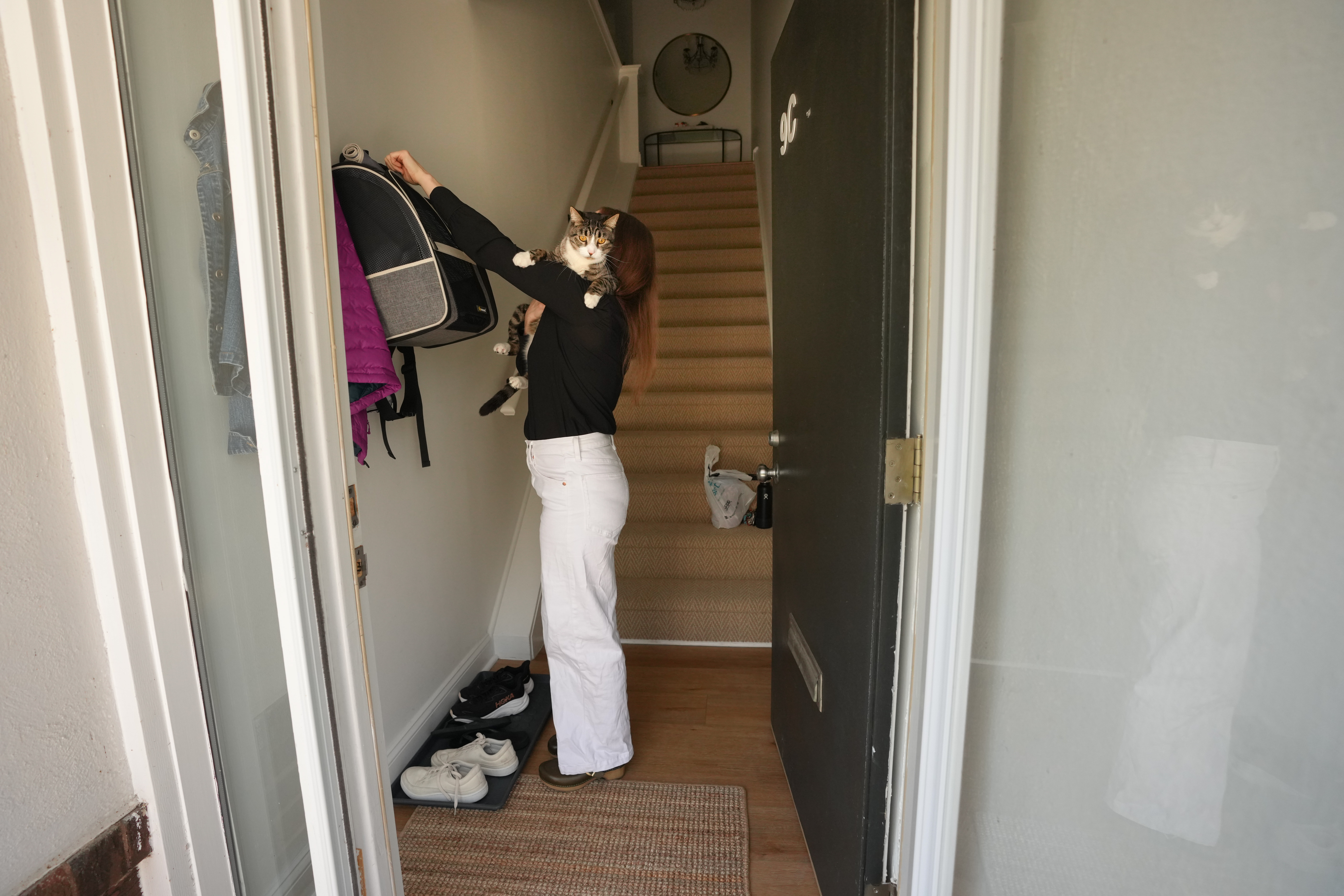
    Samantha Paige Rosen, author of the anthology “Living, Together,” prepares to take her cat to her parents’ home for a visit last month. She lives in Penn Valley, a short walk from her parents’ home.Jessica Griffin / Staff Photographer

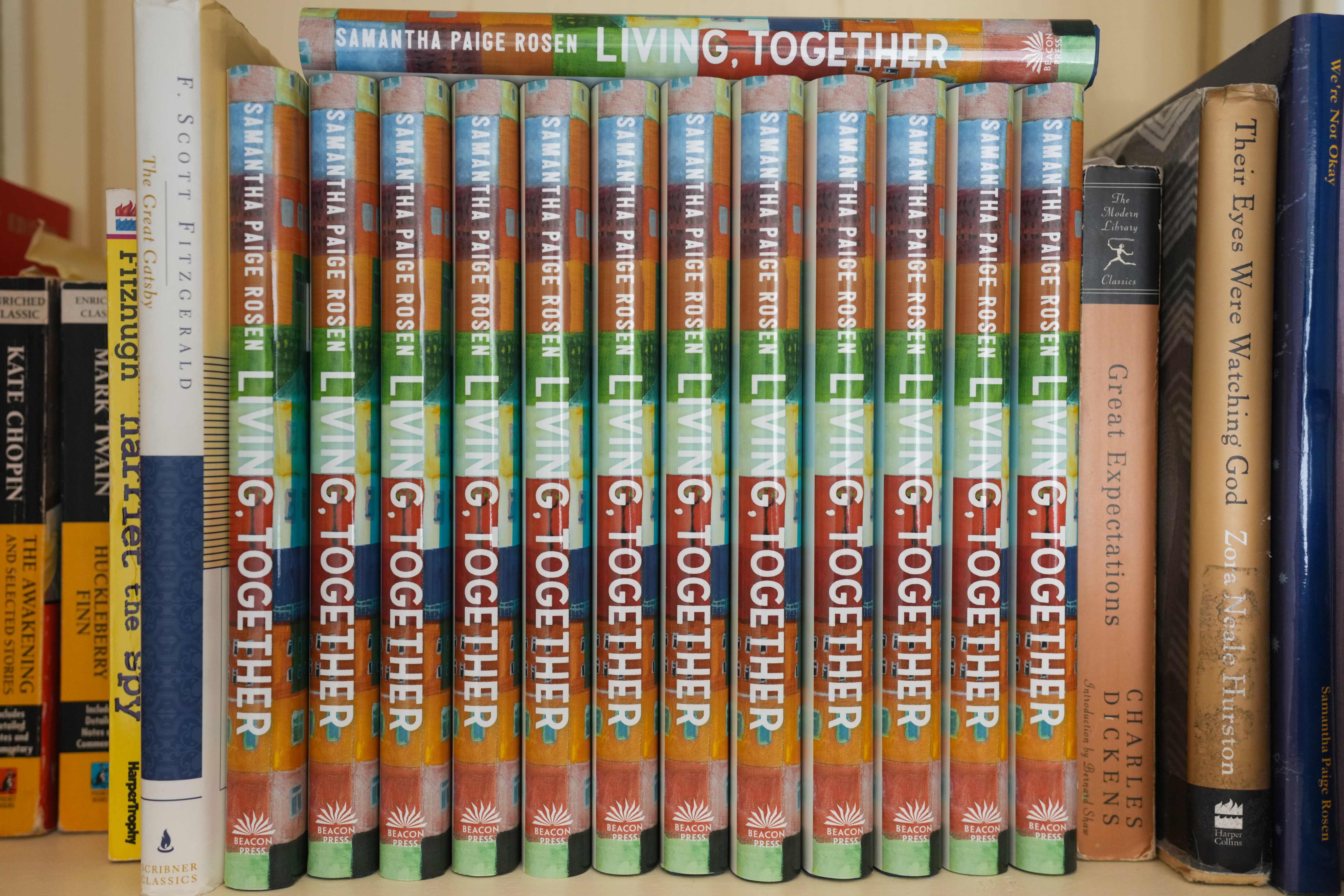
    Thanks to the care provided by her parents, she was able to get well and build a tutoring business. And her experience inspired her to pitch, sell, and edit an anthology called Living, Together: Reimagining Community in the Age of Disconnection, out last month from Beacon Press and now an indie press bestseller.

    The anthology, a mix of personal essays and conversations featuring 22 writers who live in the U.S., offers a window into the experience of living outside of a nuclear family arrangement. For some, that means living in a multigenerational household, a cohousing community, or three polyamorous parents and children. The book also goes beyond just housing, to focus on building community and chosen family.

    Copies of the anthology “Living, Together” by writer Samantha Paige Rosen.Jessica Griffin / Staff Photographer

    Novelist Sarah Thankam Mathews writes about her experience sustaining Bed Stuy Strong, the mutual aid organization she helped found during the pandemic. Author Rhaina Cohen explores her and her husband’s decision to live with their friends. Novelist Jonathan Escoffery talks about how his sense of community was shaped by his Jamaican immigrant parents and fellow writers of color.

    When she was living with her parents, Rosen, now 36, said she didn’t know anyone who was living in a nontraditional setting and couldn’t find much writing about it. In a lot of ways, the book, she said, “was for me.” She wanted to hear about all the ways people were building homes and community.

    It’s difficult to quantify the trend of alternative living arrangements because it’s such a vast term. But what is clear is that what Americans tend to think is middle-class “normal” — living with a spouse and children — is on the decline.

    In 1970, 67% of Americans ages 25 to 49 were living with their spouse and one or more children under 18. Today, that number is closer to 37%, according to a 2023 Pew Research Center analysis of census data. At the same time, people are increasingly living alone or in multigenerational households.

    Writer Samantha Paige Rosen, author of an anthology called “Living, Together”, in her home, located a short walk from her parents house, July 20, 2026, in Penn Valley, PA.Jessica Griffin / Staff Photographer

    Multigenerational and otherwise non-nuclear family living is common in several global cultures, but Rosen wanted to highlight American writers as a way to combat the thinking that more communal ways of living are suited for other countries but not here.

    Living, Together fits into a growing canon of literature focused on envisioning alternative family and relationship structures. From Cohen’s best-selling 2024 The Other Significant Others: Reimagining Life with Friendship at the Center to Mathews’ 2022 novel All This Could Be Different, from Sophie Lewis’ 2022 Abolish the Family: A Manifesto for Care and Liberation to Lola Milholland’s 2024 memoir Group Living and Other Recipes, there’s a growing tide of voices calling for collectivism over individualism.

    “There’s a real hunger for interdependence and people don’t know how to get it,” Rosen said. She hopes the book will open people’s eyes to what’s possible. And not just what’s great about communal living, but what’s difficult about it, too.

    When Rosen lived with her parents, sometimes she’d visit friends’ places and wonder if she was doing what she should be doing “as an adult woman.” Her mom, Patty Rosen, also remembers fielding some judgment from others about her daughter’s living situation.

    “When’s Sam gonna move out?” they asked.

    But the Rosens said they loved living together, even with things like negotiating sound while Samantha was tutoring and dealing with her cat crying at the front door. Or being parented a little too much.

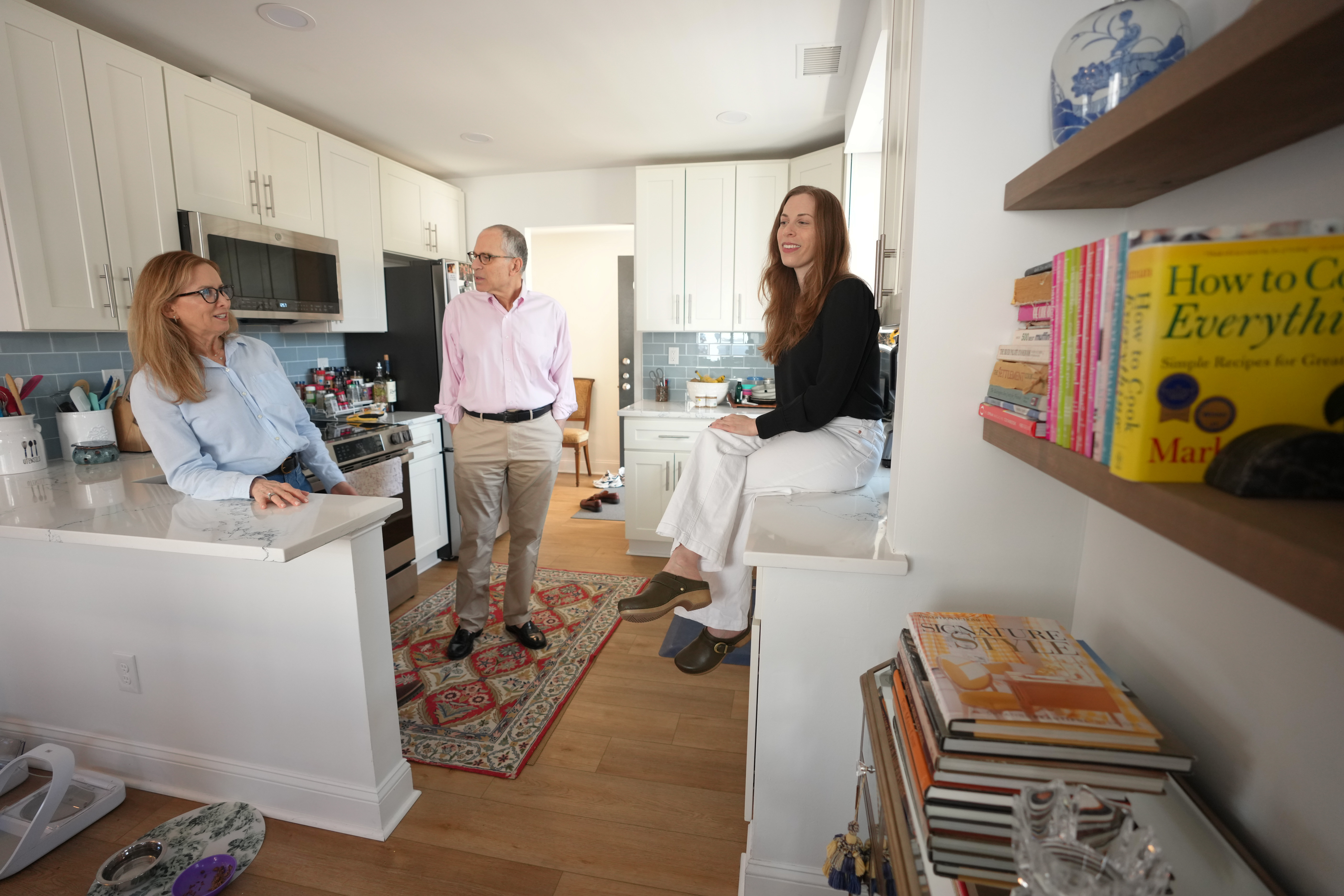
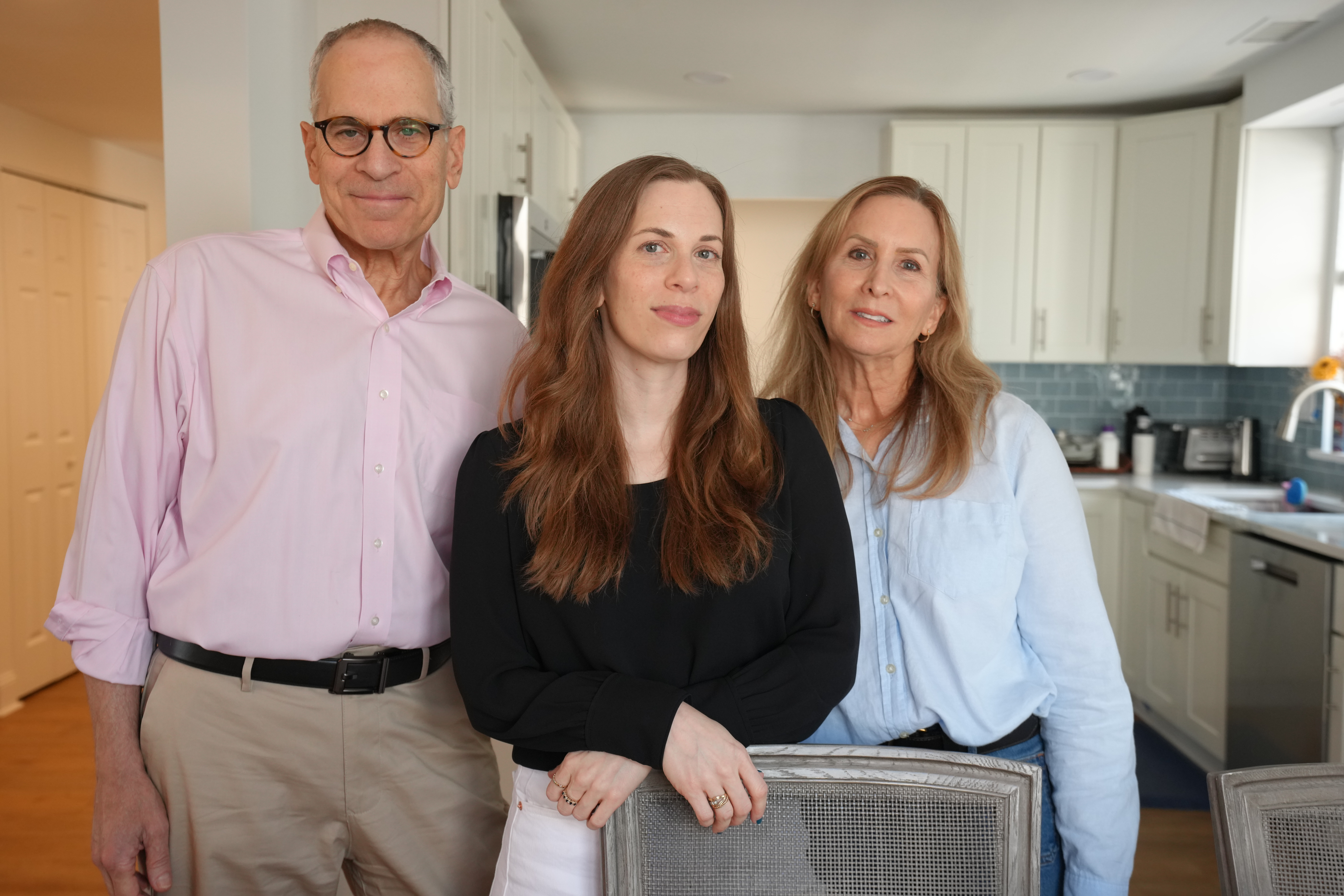
    Writer Samantha Paige Rosen, author of the anthology “Living, Together,” poses with her parents in their home in July. Rosen lives a short walk from her parents’ home in Penn Valley and visits with them daily.Jessica Griffin / Staff Photographer

    And going on dates? “She didn’t like to be asked about it,” Patty said.

    They’d ask about the date’s name and profession, Rosen explained. “Then,” her father, Stuart Rosen, said, pretending to whisper behind his hand, “I would Google.”

    In 2025, Stuart and Patty downsized and moved into a house in Penn Valley. Rosen moved into the house across the parking lot — a house she could only afford because of the years she lived with her parents.

    The shift in their family’s living situation echoes something Rosen learned while working on the book.

    “Those who’ve taken communal living from an idea to reality have reframed their thinking around it again and again, or gotten rid of the frame entirely,” Rosen wrote in an email. “It can last forever or for a season of life.”

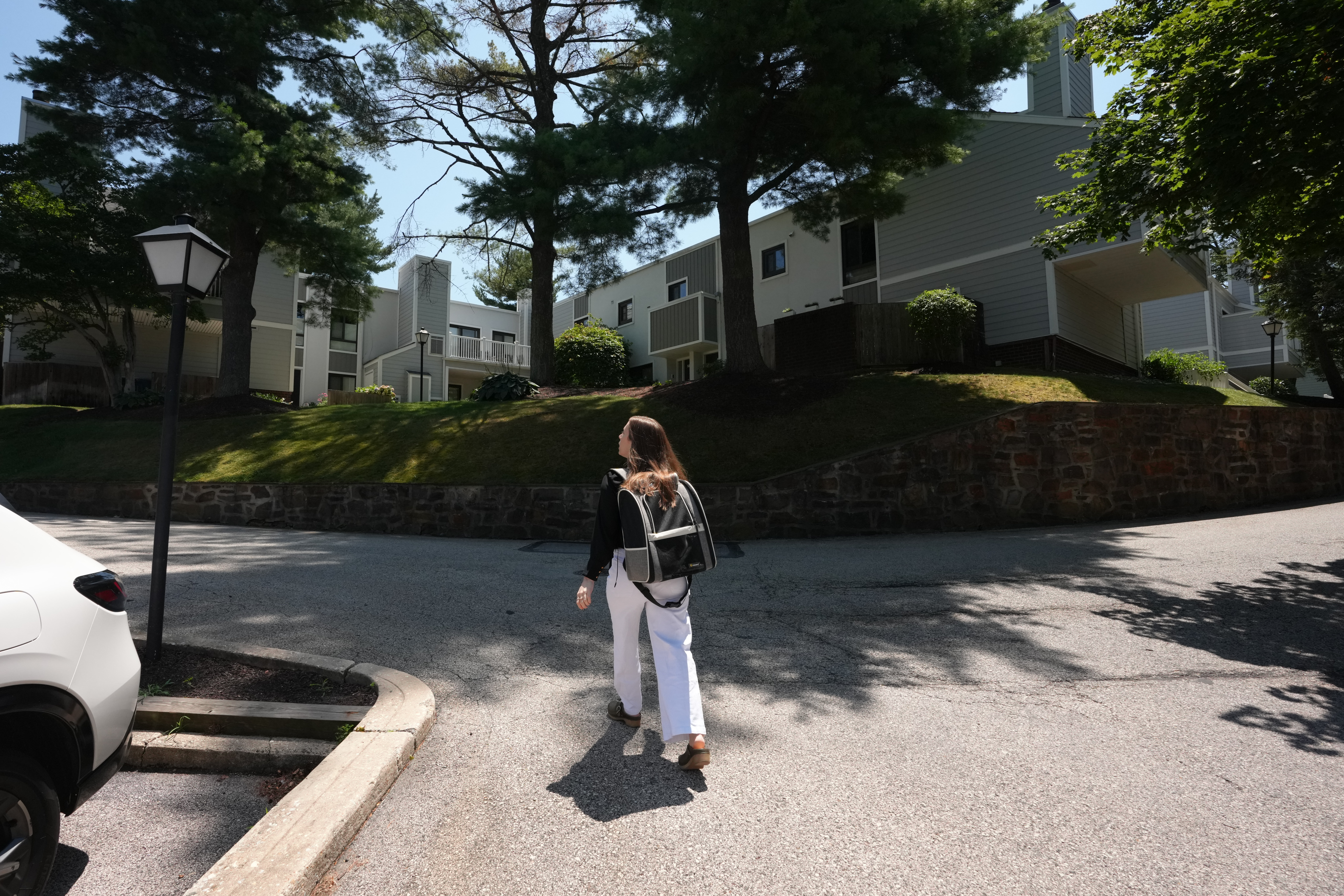
    In this season of life, Rosen brings Fergal, her cat, in a backpack to her parents’ house everyday to play with their cats. Every Tuesday, she and her dad have dinner and watch a movie. Some evenings, her mom comes over after she finishes work to watch a movie in bed.

    Writer Samantha Paige Rosen, author of the anthology “Living, Together,” lives across a parking lot from her parents’ home in Penn Valley.Jessica Griffin / Staff Photographer

    The latest iteration of their living situation — and the potential for all the other ways she might live in the future — calls to mind something Rosen wrote in her essay.

    She said she wasn’t sure what she’d choose if she had complete freedom to live the way she wanted.

    “But I know I’m interested in figuring out how to live beyond the boundaries society has established for me. I didn’t always believe I was capable of that, but I am. We all are.”


    Samantha Paige Rosen will be speaking about her book at the Head & the Hand, 2230 Frankford Ave., Philadelphia, as part of “Hot Debut Summer” on Saturday, Aug. 22, 7 p.m.-9 p.m.

    “Living, Together: Reimagining Community in the Age of Disconnection” is available in digital and physical bookstores.

  • ‘A Nation of Artists’ is the epic story of American art. It has its charms and its slights.

    ‘A Nation of Artists’ is the epic story of American art. It has its charms and its slights.

    To find “A Nation of Artists” at the Philadelphia Museum of Art, you walk from the Great Stair Hall down a long gallery lined with art that’s not part of the show. The path zigs left and tightens into what looks like a service corridor, and then zags right past the bathrooms.

    After this distinctly unceremonious approach, you’ve arrived at one of the museum’s most spectacular events of recent years.

    Not only is “A Nation of Artists” momentous — it is billed as the “most expansive presentation of American art ever mounted in Philadelphia” — but it comes with the added juice of inaugurating the museum’s newly renovated American wing on the second floor after a 14-month closure.

    The occasion brings yet another distinction: amazingly, after three more galleries open in the wing, it will be the first time in a decade that all of the galleries in the main building will have been open at the same time.

    The odd journey to the second-floor American galleries has long been in place, but it seems especially odd now. It would have been nice to reopen this major piece of real estate with more of an architectural drumroll than a drab, winding hallway, especially for an institution that, after the tumultuous year it’s had, could use a thing or two to celebrate.

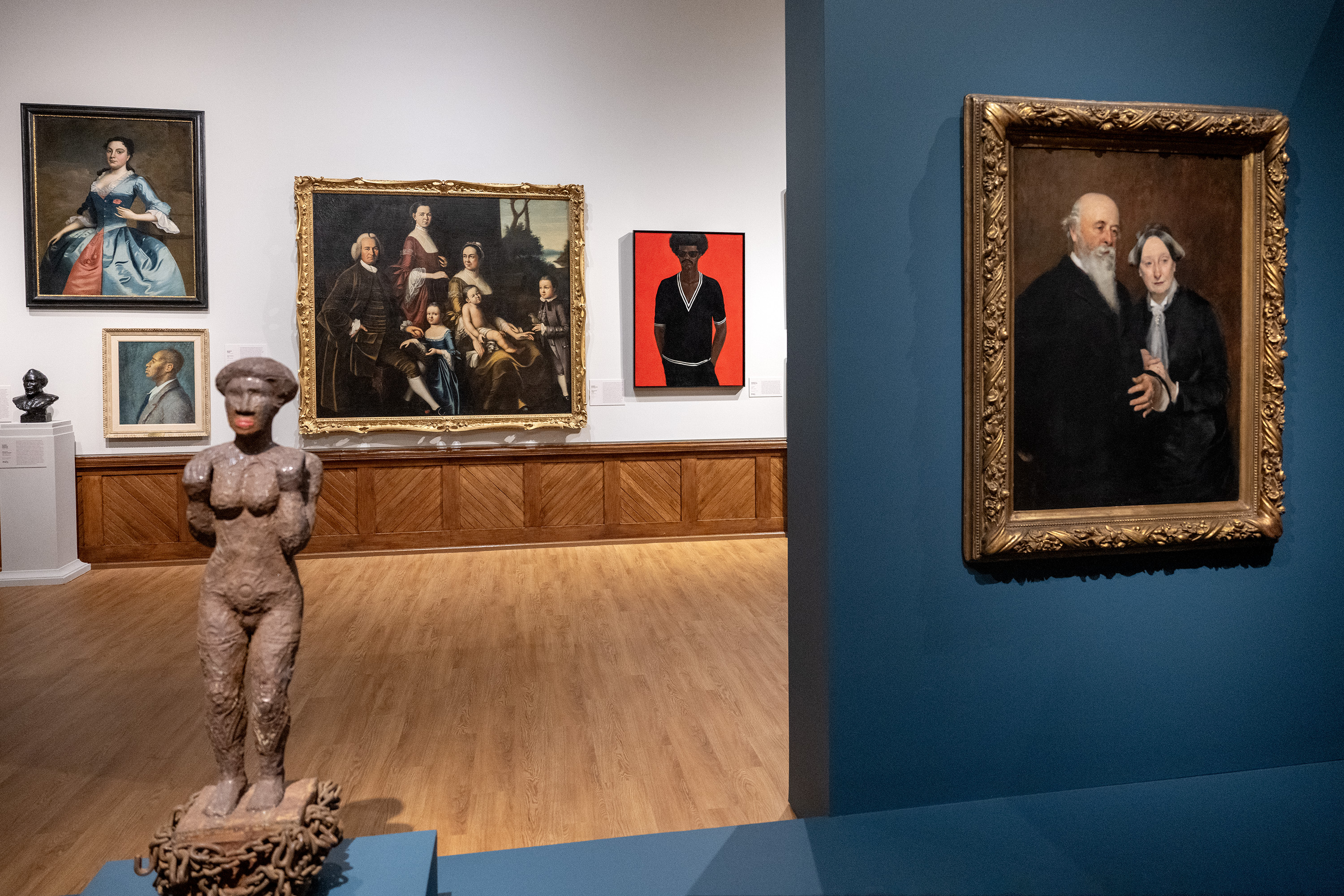
    “Miners’ Wives” (right) by Ben Shahn and “The End of the War, Starting Home” by Horace Pippin at the Philadelphia Museum of Art.

    It might also be easy to miss the show’s greater significance to the museum and its cohost, the Pennsylvania Academy of the Fine Arts. “A Nation of Artists,” which opened in April with more than 1,000 works at both museums, arrives as a bolt of ambition as the groups work their way through deficits and reorganizations and remind audiences and funders that beyond crisis, there is art, and it is glorious.

    The show is the city’s major visual arts celebration of the nation’s 250th anniversary, and while it’s an impossible task to compress the story of art in America into any single show, the overall image that emerges is not a cohesive snapshot, but a fascinating mirror.

    There’s sometimes a random, almost improvisatory feeling to “A Nation of Artists” — despite the show’s attempt to place works around themes like the American West or inequity — because America is itself ever-random and improvisatory.

    Works in thematically grouped ensembles in ‘A Nation of Artists’ in the newly renovated Furness and Hewitt building at the Pennsylvania Academy of the Fine Arts.Tom Gralish / Staff Photographer

    More than 120 works from the collection of John and Leigh Middleton and their family are augmenting “A Nation of Artists.” But after the show closes and the Middleton works are gone, PAFA will put in place a newly curated permanent collection, and the PMA will be left with a sweeping look at American art that starts on the first floor with earlier works and proceeds to the second to bring it up to the mid-20th century.

    In other words, “A Nation of Artists” absorbs the Middleton works, but also spotlights the incredible riches in residence nearly all the time. That’s no small thing at a time when arts and culture in Philadelphia is struggling for engagement in the attention economy.

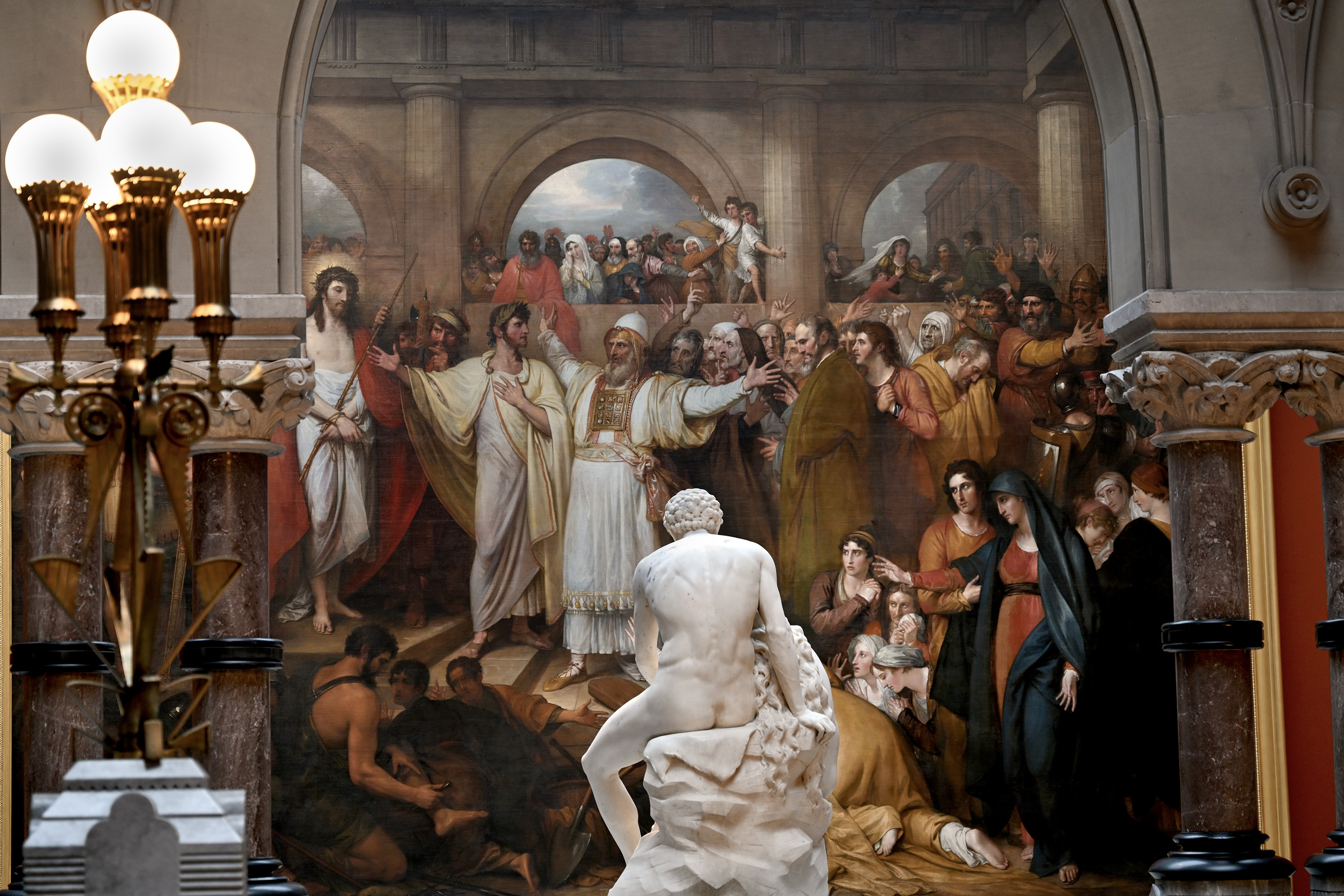
    The painting “Christ Rejected” by Benjamin West and marble sculpture “Paradise Lost” by Joseph A. Bailly at the Pennsylvania Academy of the Fine Arts.Tom Gralish / Staff Photographer

    A crisp reset at PAFA

    At PAFA, the outside world seems to creep in in ways both positive and worrisome.

    How can you admire the fruitful pedagogy at PAFA on display by generations of academy students and instructors without feeling concern for the place? The relationship between the museum and school — a specific artistic legacy unique to Philadelphia — is what makes PAFA special, and it remains to be seen whether a recently revamped certificate program at the school is the ultimate answer, artistically or financially.

    The exhibition marks a crisp reset: the reopening of PAFA’s jewel of a building, the riotously detailed 1876 Furness and Hewitt-designed landmark, after a renovation project that included a new HVAC system and other renovations.

    Laylights (variously utilizing natural or artificial light) in the newly renovated Furness and Hewitt building at the Pennsylvania Academy of the Fine Arts.Tom Gralish / Staff Photographer

    It’s good news that there are no dramatic changes; the building continues to dazzle. I visited the show there a half dozen times, and via the church-like rose window and skylights, nature played handmaiden to art. When clouds parted, sun filtered into some of the spaces, and in one gallery the natural light made the whites and colors of George Bellows’ North River pop.

    The marble sculpture “Peri at the Gates of Paradise” by Thomas Crawford in the grand staircase at the Pennsylvania Academy of the Fine Arts.Tom Gralish / Staff Photographer

    On another morning, the sunlight made the grand stair hall of the Furness building practically vibrate. The smooth white of marble sculptures like Thomas Crawford’s Peri at the Gates of Paradise glowed and the stars-on-cobalt pattern beneath the skylight seemed to be showering down.

    Here on this day, there was no more beautiful interior in the city.

    At the Pennsylvania Academy of the Fine Arts. In the rear is the oil painting “Death on the Pale Horse” by Benjamin West.Tom Gralish / Staff Photographer

    A more sequestered PMA

    If PAFA maintains a lively relationship with the outside world, the PMA’s new American wing feels sequestered. There are no visible windows letting in light in the second floor American galleries — no natural light except for a small opening in a staircase.

    The layout and footpath (including that unceremonious approach) is largely the same as it had been before the renovation. But the flow within and from gallery to gallery is more open, and there is now a central spine of four continuous middle galleries that opens up a vista that helps to orient the visitor. Three remaining galleries in the renovated American wing are expected to reopen, though the date is uncertain.

    Three Thomas Eakins oils (from left): “Mending the Net,” “The Pair-Oared Shell,” and “Sailboats Racing on the Delaware.”Tom Gralish / Staff Photographer

    The PMA half of “A Nation of Artists” features a lot of big names (Andrew Wyeth, John Singer Sargent, Georgia O’Keeffe), as well as about three dozen works by Thomas Eakins — intimate portraits as well as epic canvases. There’s a beautiful sequence of three Eakins oils, all painted within a decade of one another, all with rivers in various hues and states of excitement: The Pair-Oared Shell, Sailboats Racing on the Delaware, and the stunning Mending the Net, a seemingly ordinary scene that gathers filmic mystery and story through minutely detailed figures mending a fishing net by the river against a gauzy beyond.

    In terms of visitor experience, the new second floor American space succeeds most in moments of drama. The wall in one gallery uses a specially reproduced rich-burgundy period wallpaper, and the relationships among the paintings, furniture, pottery, and other items in the room ricochet beautifully.

    “The Lost Pleiad” by Randolph Rogers in the Philadelphia Museum of Art’s salon-style gallery.Tom Gralish / Staff Photographer

    A sumptuous feeling immerses visitors in the high-ceilinged salon-style room (gallery 211) that includes vast landscapes and marble sculpture. Though it’s not immediately obvious, the first-floor American works are also part of the show, and they hold yet more Middleton works.

    Classics and surprises, and a lot of charm

    There’s greater poetry in the architecture at PAFA, but the work itself at both museums is undeniably impressive in scope, and especially at the PMA: painting, sculpture, furniture, silver, fabric, works in clay, and more.

    The curators — Kathleen A. Foster and Alexandra A. Kirtley at the PMA, and Leah Triplett and Lea C. Stephenson at PAFA — have delivered not just old favorites, but also surprises.

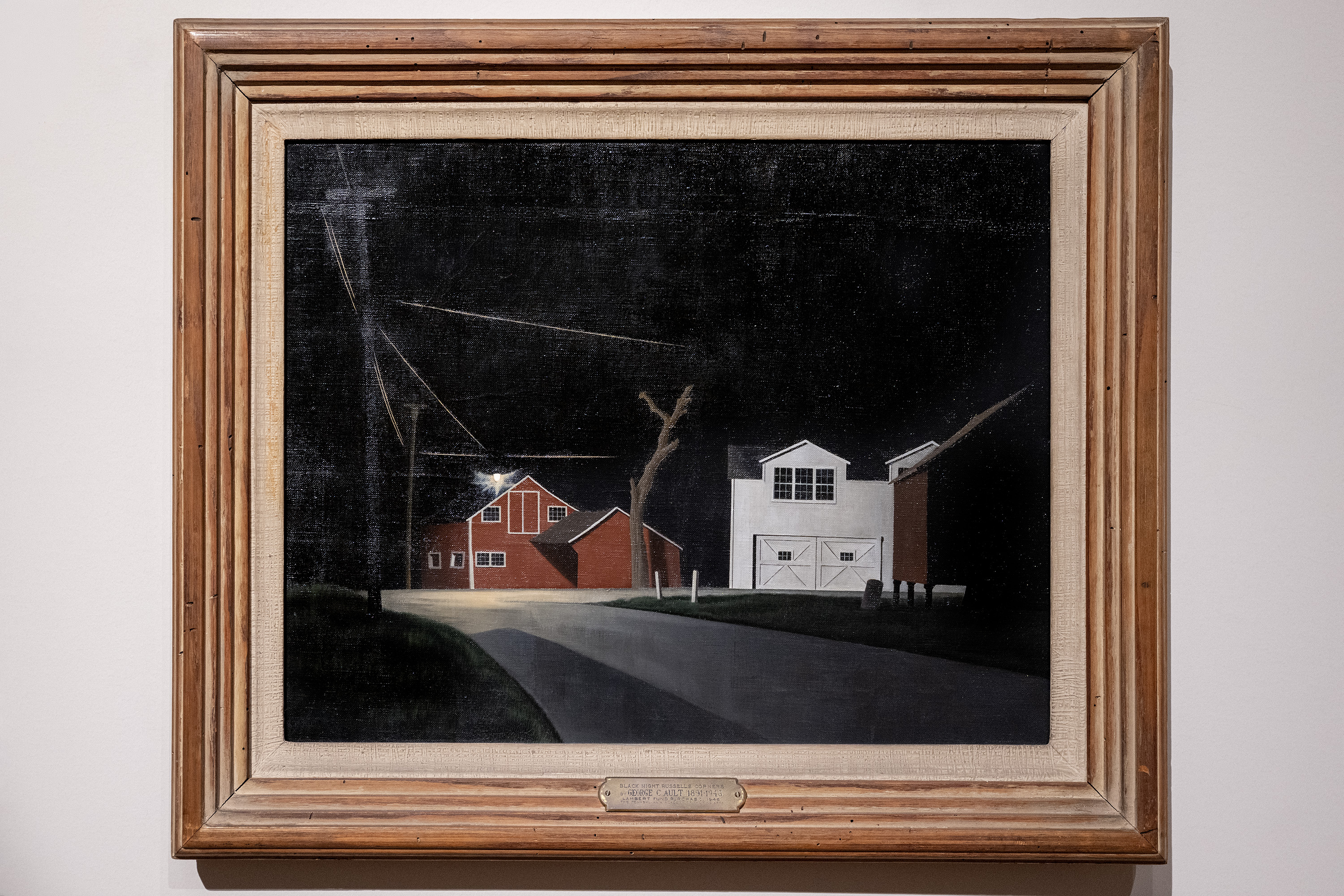
    “Black Night: Russell’s Corners” by George Copeland Ault at the Pennsylvania Academy of the Fine Arts.Tom Gralish / Staff Photographer

    PAFA’s classics include Winslow Homer’s Fox Hunt; the Jasper Johns Flag 1960-66 from the Middletons (which the couple brought home from an auction in 2010 for $28.6 million); and George Copeland Ault’s Black Night: Russell’s Corners (1943), whose flat, cold, electric light suggesting a modern encroachment on agrarian life, can only be appreciated in person.

    Among the pieces to which I kept returning: Pink Flower with Clock by PAFA 2011 graduate Aubrey Levinthal, because of the smart way it plays with the idea of photographic positive and negative imagery even though it is an oil; and Harriet Goodhue Hosmer’s Puck on a Toadstool, from 1856, whose supernatural energy is so potent that the figure appears poised to shape-shift and break free of its marble confines.

    At the PMA, a single canvas has me reconsidering Edward L. Loper Sr., the Wilmington artist who had his beginnings working for the WPA. Loper’s Abandoned Ferry Terminal is a complex refraction of shadows and colors from 1958 whose geometries never seem to stop shifting.

    A small shadowbox of a man and woman formally costumed from around 1880 might be the most unassuming bit of charm in the entire exhibition. Its maker is unknown.

    Custom wallpaper at the Philadelphia Museum of Art, with “Portrait Figures of a Man and a Woman, in a Shadowbox.”Tom Gralish / Staff Photographer

    Leaning into representation

    If you ever wanted a lesson in the difference how a work is displayed can make, just consider how much more substantial an achievement The Gross Clinic looked a few months ago. With bright but warm lighting at the PMA, Eakins’ 1875 canvas was frightening in its vividness, the red of blood on the surgeons’ hands glistening. Today, at PAFA, it looks a little washed out, overpowered by the light coming through the nearby rose window.

    Both museums have made a conscious effort to represent a spectrum of identity — gender, regional origin, ethnicity, and so on. This is all to the good, of course. Everyone will find something relatable in this exhibition, and many will discover works that aren’t necessarily relatable on first examination but become so. This is why museums, and good curators, are important.

    Detail of “Nydia, the Blind Girl of Pompeii” by Randolph Rogers at the Pennsylvania Academy of the Fine Arts.Tom Gralish / Staff Photographer

    It’s a fascinating marker of time to think about the cultural whiplash of the past couple of years in this country, and how vulnerable the simple concept of representation now feels. The tastes of the art establishment change, and so too does how we perceive art.

    How could it be otherwise? Every movement comes in with an air of moral and scholarly authority that purports to lay down once and for all an accurate cultural perspective.

    The prevailing ethos arrives as the new reality. Then the next reality comes along.

    “A Nation of Artists” runs through July 5, 2027, at the PMA, 2600 Ben Franklin Parkway; and Sept. 5, 2027, at PAFA, Broad and Cherry Streets. philamuseum.org, pafa.org.

  • Ex-Philly Fed chair is back at Wharton and on a quest to save the world financial system

    Ex-Philly Fed chair is back at Wharton and on a quest to save the world financial system

    U.S. borrowing is at record levels, interest rates are up, and Social Security is running low on cash. Yet new Federal Reserve Chairman Kevin Warsh has offered investors little information on whether the Fed will boost interest rates and fight inflation, or cut rates to feed growth.

    As a past president of the Philadelphia Federal Reserve Bank, Patrick Harker sat in and sometimes voted at Fed Open Market Committee meetings that decided interest rate targets under Warsh’s predecessors from 2015 to 2025. He says it’s important for Fed leaders to speak clearly.

    An engineering Ph.D. who grew up in blue-collar Gloucester City, Harker spent the previous 15 years, first as dean of the Wharton business school at University of Pennsylvania, then as president of the University of Delaware, before he was chosen to run the Philly Fed by the search committee he headed after others declined the job.

    Harker finished his second five-year Fed term in June 2025 and reported back to Wharton the next day as a professor. He says he has been putting what he learned there to use.

    This interview has been edited for clarity and brevity.

    How did you align while you were with the Fed?

    People at the Fed asked: Was I a hawk, leaning toward higher rates to fight inflation? Or a dove, leaning toward lower rates to support jobs? I’m an eagle, loyal to this country. I’m for doing what the economy requires.

    I’m where the vast majority of Americans are: They’re sick of ideology. It gets us nowhere. It drives countries to ruin. That’s never been us.

    We are a pragmatic people. Let’s do reasonable stuff.

    Are you worried digital finance will spin out of control?

    My particular interest is around operational risks caused by technology. Those come in different flavors:

    • Concentration risk: Just a few key firms — Amazon, Microsoft — providing a lot of the financial infrastructure.
    • Model risk: Everyone using the same AI models. Some of my colleagues have found that if AI models set prices, they will collude [to illegally boost prices at consumers’ expense]. They will do the same with loans.
    • Fraud risk: Faster payments equals faster fraud.
    • Market risk, credit risk, and operational risk: We are looking down into the bowels of the systems moving the money and at cyber hygiene.
    Will hedge funds’ use of insurance companies to make risky private credit loans fuel the next financial crisis?

    If you pull one thread, will it start to fall apart? At the Fed, I was a bank supervisor. I worried about it. I still worry.

    It’s not big enough yet to threaten the system [as mortgage losses did in 2008]. But the ‘private’ asset risks eventually all filter back to the regulated institutions.

    I said that at a dinner of people in the private credit industry. They said, ‘We know what we are doing!’ They do; the first people in always know what they are doing.

    But there’s only so much talent. And now you have people on the fringe taking bigger and bigger risks. And again all hell will break loose, and everyone will have to deal with it. It will go beyond the skill set of the industry.

    At the Fed you wrote about radical changes in the workforce. Will AI kill jobs? Do we still need immigrants?

    You know Jevons Paradox? Technology puts people out of work, then becomes so cheap, demand for that technology explodes, and so do the jobs providing it.

    Will AI improve productivity? It better. Our birth rate is not replacing ourselves. Our immigration policy has flatlined.

    It’s the most basic rule of economics: If you want more output, you either get more workers, or better machines.

    I’m more worried that in the United States, we are really bad at helping people make transitions to new kinds of work. A kid will figure it out. But if you’re 40 or 50, what do we do with you? No one cares; you can understand their anger.

    Can Congress fix Social Security and the deficit?

    I’m less worried about Social Security because politicians know they can’t get reelected without solving the problem.

    With the deficit, they keep kicking the can down the road. It really depends on healthcare, a very large part of the U.S. budget. Economists are starting to talk about the Fed losing the ability to set rates [because it is too busy] keeping Treasury’s financing costs down. When debt gets too high, you can’t avert default.

    After the Supreme Court said the president can’t fire Fed officials, you wrote about the Fed’s ‘fragility’ on LinkedIn. How did readers respond?

    A lot of people want the Fed to be independent.

    Fed independence is not a slam dunk. And the Fed’s independence is only around monetary policy. Congress is free to change the bank regulations.

    So you have to earn that independence every day. And you have to defy the administration sometimes because it’s the right thing to do.

    I worry about the new chair [Kevin Warsh, who has promised to comment less than his predecessors]. The Fed needs to communicate more. Very clearly.

    In this country, we’ve all gone into our own herds, we don’t listen to the other side. But if there’s a vacuum in communications, someone else will fill it with their narrative instead of yours.

    You protect credibility the institution built over decades by explaining yourself.

    What can you make happen now that you’re back at Penn?

    I’m a tenured faculty member. I put together an MBA class. I’m publishing academic journal articles on fraud in payment systems. I had to dust off my quantitative brain.

    I’m director of academic engagement for Penn Washington. We work with faculty, bringing fact-based, objective content like Kent Smetters’ Penn Wharton Budget Project and Olivia Mitchell’s work on pensions and Social Security to Washington. They aren’t lobbying. They don’t tell anyone what to do. You want to do this; here’s what it costs.

    And I’m joining Itay Goldstein at the Wharton Future of Finance initiative.

    Patrick Harker outside the Wharton School, 2026.The Wharton School
    Billionaire investor Marc Rowan is at the center of your interests. He led a fight to change Penn’s leaders; he backed the Wharton Budget Project, and his Apollo led the private-equity charge into private-credit and insurance.

    What motivates him I’m not sure, but he loves this place. His father died when he was here, and the school stepped up with financial aid, he doesn’t forget that.

    What do you miss about the Fed?

    One of the great privileges of the Fed, when you go to the Open Market Committee, there’s no personal electronics. For two days you have nothing to do but seriously think about what everyone else is saying.

    Even if you disagree, it’s in a very professional way. To the public, Washington can look like a big food fight. But at places like the Fed, there are people seriously dedicated to their job.

    Are you worried for your grandchildren?

    There is hope. People worry everything’s gone nuts; we’re leaving the young people with a giant bill. And a political system that is seemingly broken.

    People peddling crazy ideas understand the brain very well: Push these panic buttons. But to quote [former President Richard] Nixon, there is a silent majority who want to have a better life. Not to fight culture wars.

  • A former dump in Camden County will soon be home to energy-generating solar panels

    A former dump in Camden County will soon be home to energy-generating solar panels

    A former landfill in Voorhees Township will become the home of a new solar field aimed at expanding access to renewable energy and lowering utility bills for New Jersey residents.

    Once complete, the 13.5-acre community-scale solar array will join the more than 200 solar projects that make up the state’s Community Solar Energy Program.

    Started in 2019, the program allows households served by the state’s four major electricity providers — Public Service Electric & Gas, Jersey Central Power & Light, Atlantic City Electric, and Rockland Electric Co. — to subscribe to a participating solar facility to receive renewable energy credits on their bill without requiring that they install solar panels themselves.

    The program also mandates that a majority of the available renewable energy be set aside for low- and moderate-income households, who are less likely to be able to install their own systems, program manager Sawyer Morgan said in an email.

    There are now more than 51,000 households subscribed to the community solar program statewide, Morgan said, receiving over $18 million in net savings since the first projects came online in 2021.

    Most of the existing community solar projects are at capacity for participating households, he said, but the program anticipates over 100 additional solar projects to be completed and operational before the end of the year.

    While New Jersey is currently home to 209 community solar projects with a total capacity of 291 megawatts, Morgan said, an additional 392 projects that are in development or under construction will add 703 megawatts of capacity to the grid.

    “These projects are all on rooftops, canopies, landfills, contaminated sites, mining sites, and certain bodies of water as floating solar,” he said, including the solar project in Voorhees.

    The 35-acre landfill on Centennial Boulevard ceased operations in 1972, and the property was acquired by the township five years later. In the decades since, the land has remained largely untouched, unable to be developed because of its prior use.

    Now, solar panels are expected to cover about half the property, according to development plans approved by the Voorhees Township Planning Board last month. The exact configuration of the panels will be finalized before construction begins, the plans show.

    The developer, Voorhees Solar LLC, was not immediately available for comment about the construction schedule, overall cost, and other project details. The company is owned by the Pegasus Cos. Inc., a wireless and broadband service provider based in Bala Cynwyd, according to the application submitted to the township.

    “We can’t build a park or redevelop it with homes,” said Stephen Steglik, Voorhees Township administrator. “The only other option was keeping it empty and in its current state.”

    At least with the solar project, he said, the township can create savings for residents while also collecting nearly $900,000 in one-time land lease fees.

    The project will have the capacity to produce around four megawatts of energy when operating at full power, according to the project plans, enough to power up to 4,000 typical households.

    Of the energy is generated by the project, 51% is going to be dedicated to low- and moderate-income households, Steglik said.

    “While costs are going higher and higher, at the very least Voorhees Township is trying to take steps to maintain utility costs and at least try to save people a little bit of money,” he said.

  • Eagles 53-man roster projection 3.0: What changed after the first preseason game?

    Eagles 53-man roster projection 3.0: What changed after the first preseason game?

    For the first time since training camp kicked off late last month, the Eagles got some work against a real opponent Saturday, when they traveled down to Baltimore for what ended up being a 24-7 preseason defeat to the Ravens.

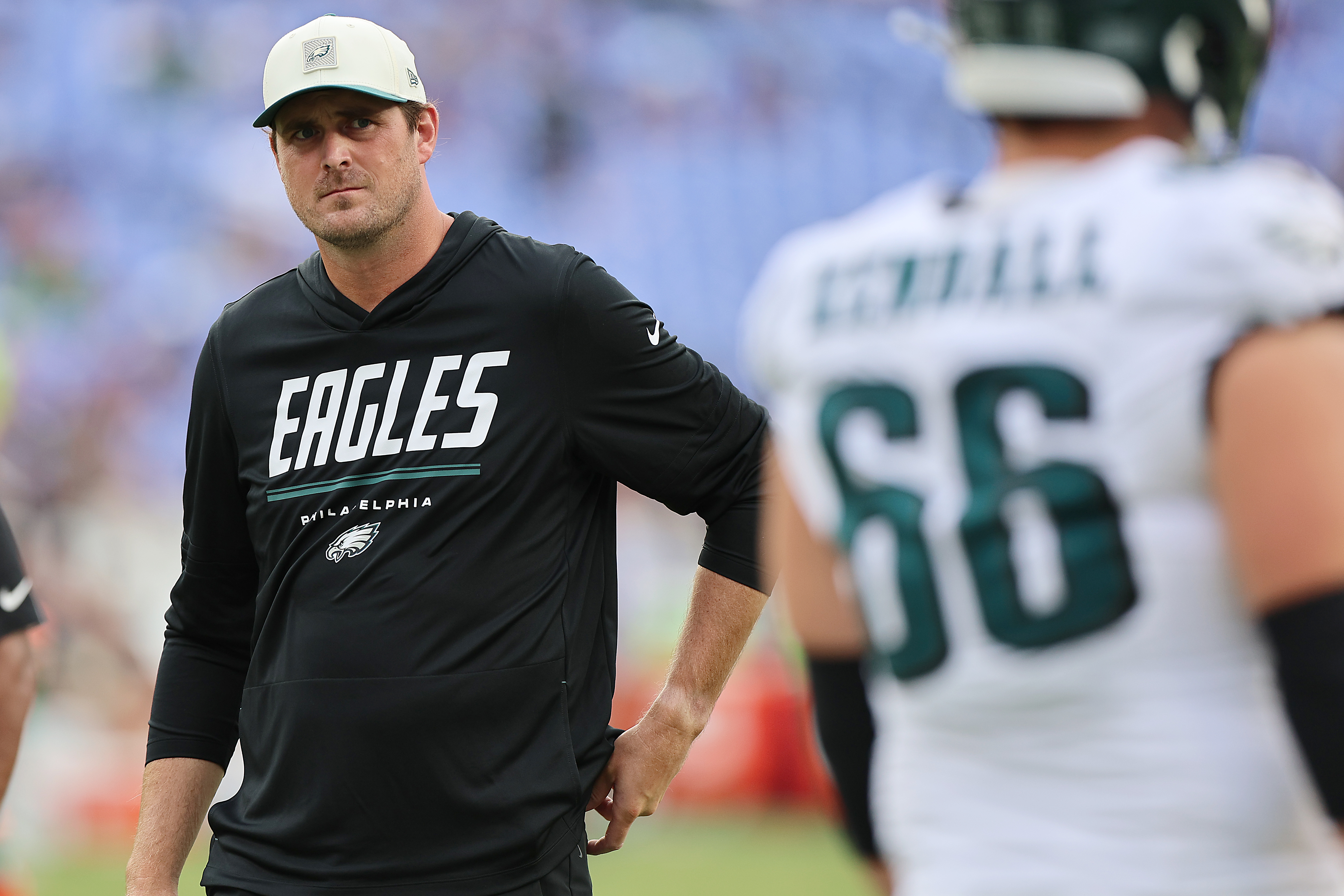
    What was learned? Not a whole lot, really. The Eagles, as expected, rested almost all of their projected starters. They ran a pretty bland offense and didn’t peel back the curtain to what the new scheme under Sean Mannion might fully look like.

    More will be revealed this week, when the Eagles head north for two joint practices against the New England Patriots on Wednesday and Thursday before preseason game No. 2 on Saturday.

    Still, Saturday’s action combined with some recent practice observations were enough to stir some movement in our latest 53-man roster projection. (Here are links to our previous iterations from a month before training camp started, and two weeks ago.)

    Quarterbacks (3): Jalen Hurts, Andy Dalton, Cole Payton

    Traded: Tanner McKee

    Status quo here. Dalton got the start on Saturday, which seemed to reveal that the Eagles consider him QB2 over McKee for now, even despite Nick Sirianni again saying after the game that nothing has been decided. Neither quarterback looked very good, though the play-calling and scheme were pretty vanilla and they were playing behind backup linemen and throwing to backup receivers. The end goal here hasn’t changed. The Eagles likely will be looking for a trade partner for a quarterback-needy team between now and roster cut-down day, which is Aug. 30. We’ll leave McKee as the one who eventually is traded, though it could be Dalton.

    Running backs (3): Saquon Barkley, Tank Bigsby, Will Shipley

    Cut: Dameon Pierce, Carson Steele, Ja’Quinden Jackson

    Same three here from our previous two projections. Pierce popped a little in the early days of camp but has been dealing with a hamstring injury. Shipley had a few solid runs on Saturday, a little bright spot in what was a lousy night for the offense.

    Wide receivers (5): DeVonta Smith, Dontayvion Wicks, Makai Lemon, Darius Cooper, Hollywood Brown

    Cut: Elijah Moore, Johnny Wilson, Danny Gray, Britain Covey, Quez Watkins, Erik Ezukanma, Samori Toure

    Our first position group with some movement. We’re keeping five players instead of six this time because needs for spots at two positions on defense came up (more on those later). The order of the top five players also has changed. Cooper has moved into the “lock” category with the three guys listed ahead of him, while Brown’s struggles in camp make it fair to wonder if the Eagles would consider cutting him and dealing with the cost of releasing a player who signed a $5 million guaranteed deal. That seems hard to fathom for now. Moore has played well enough to warrant giving him a roster spot, but one could argue keeping Brown and Moore is a bit redundant.

    Tight ends (4): Dallas Goedert, Johnny Mundt, Eli Stowers, Cameron Latu

    Cut: Grant Calcaterra, Stone Smartt, E.J. Jenkins

    Another unchanged position group. Goedert and Mundt will be on the field often, while Stowers, a rookie second-round pick, might need some more seasoning. Latu’s status as a blocker and special teamer should have him on the right side of the cuts.

    Offensive line (10): Jordan Mailata, Landon Dickerson, Cam Jurgens, Tyler Steen, Lane Johnson, Fred Johnson, Markel Bell, Drew Kendall, Willie Lampkin, Micah Morris

    Cut: Myles Hinton, Michael Jordan, John Ojukwu, Jake Majors, Cameron Williams, Hollin Pierce

    Two new names make the cut with the final two spots in this group. The first eight players listed are locks. Lampkin has come on strong over the last week or so and was a bright spot Saturday. Lampkin and Morris, a sixth-round pick, are in the field over Jordan and Hinton for now. The No. 9 and No. 10 spots certainly are still up for grabs. It’s also possible the Eagles keep only nine on the initial 53 and try to get some guys through to the practice squad. Kendall and Lampkin can play both center and guard.

    Defensive tackles (6): Jalen Carter, Jordan Davis, Moro Ojomo, Byron Young, Ty Robinson, Uar Bernard

    Cut: Gabe Hall, Zion Wilson, David Blay

    We left Robinson off of our initial iterations of this exercise, but he had his best week of camp and had a sack Saturday (though he did have some mishaps, too). Bernard remains the wild card. For now, we’ll guess the Eagles decide it’s too risky to expose him to waivers and keep him on the roster after camp breaks. Robinson offers some insurance at a position where the Eagles are rostering a player who likely won’t play.

    Ty Robinson sacks Ravens quarterback Tyler Huntley during the first quarter of a preseason game.David Maialetti / Staff Photographer

    Edge rushers (6): Jonathan Greenard, Jalyx Hunt, Nolan Smith, Arnold Ebiketie, A.J. Epenesa, Joshua Weru

    Cut: Tarron Jackson, Keyshawn James-Newby, Jose Ramirez

    This may be considered an overreaction. Weru, an International Pathway Player like Bernard, played his first-ever padded football game Saturday and had a quarterback hit. Sure, he was unblocked off the edge, but you saw the athleticism the Eagles loved when they signed the former rugby player from Kenya. Weru has a lot of developing to do, but he has clocked a 4.45-second 40-yard dash, a 41 1/2-inch vertical leap, and a broad jump of 11-2. If he flashes in more preseason action, will another team claim him if the Eagles waive him?

    Much has been made about Bernard. The Eagles drafted him in the seventh round and signed Weru as an undrafted free agent. But they might have two players worth protecting come Aug. 30. We’ll see. Ahead of Weru, those five spots should be considered locks. Barring injury, don’t expect much movement here. It’s the top five guys, and then maybe Weru.

    Linebackers (4): Zack Baun, Jihaad Campbell, Jeremiah Trotter Jr., Smael Mondon Jr.

    Cut: Chance Campbell, Deontae Lawson, Brandon George

    There’s some buzz around Chance Campbell. Vic Fangio seems to like him. The 2022 sixth-round pick came off injury and was a well-liked member of the practice squad last year. He’s also having a good camp. But unless the Eagles want to cut Mondon, their own fifth-round draft pick from last season, it seems superfluous to keep five off-ball linebackers just for the heck of it. Mondon seems to be developing and is a solid special teamer. Trotter, meanwhile, probably starts on some NFL teams. There doesn’t seem to be a need to keep five players here.

    Cornerbacks (5): Quinyon Mitchell, Cooper DeJean, Riq Woolen, Jonathan Jones, Mac McWilliams

    Cut: Kelee Ringo, Jakorian Bennett, Ambry Thomas, Shaun Wade, Tariq Castro-Fields

    We are going one fewer here than last time for a few reasons. Needs along the defensive line forced the hand a little, and there’s also some positional versatility in the defensive backfield that makes it unnecessary to roster six corners if there are other positions worth stretching. Michael Carter II, who is in a competition to start at safety, can be the backup nickel. DeJean will play safety in base. Jones, who is out right now with a shoulder injury, and McWilliams offer inside-out abilities. Ringo is the roster casualty here. He had a nice interception on Saturday, but also got beat for a touchdown.

    Kelee Ringo intercepts a pass in the end zone to stop a Ravens drive late during a preseason game.David Maialetti / Staff Photographer

    Safeties (4): Drew Mukuba, Marcus Epps, Michael Carter II, J.T. Gray

    Cut: Cole Wisniewski, Andre’ Sam, Max Pulley, Kapena Gushiken

    This position is getting pretty interesting. Wisniewski, a seventh-round pick, has been sidelined by a hamstring injury, and it’s hard to give him a roster spot right now. The new UDFAs, Gushiken and Pulley, have had their moments. Sam has been around the building on the practice squad for a few years. But we’ll give the fourth spot to Gray for now. The 30-year-old is an elite special teamer.

    Special teams (3): Jake Elliott (kicker), Braden Mann (punter), Rocco Underwood (long snapper)

    These are the only three specialists on the roster. Underwood has had a few snapping issues so far in camp, but the Eagles haven’t brought anyone else in. They could cut him on Aug. 30 and then find another snapper before Week 1.

  • 🏀 A cultural phenomenon | Sports Daily Newsletter

    🏀 A cultural phenomenon | Sports Daily Newsletter

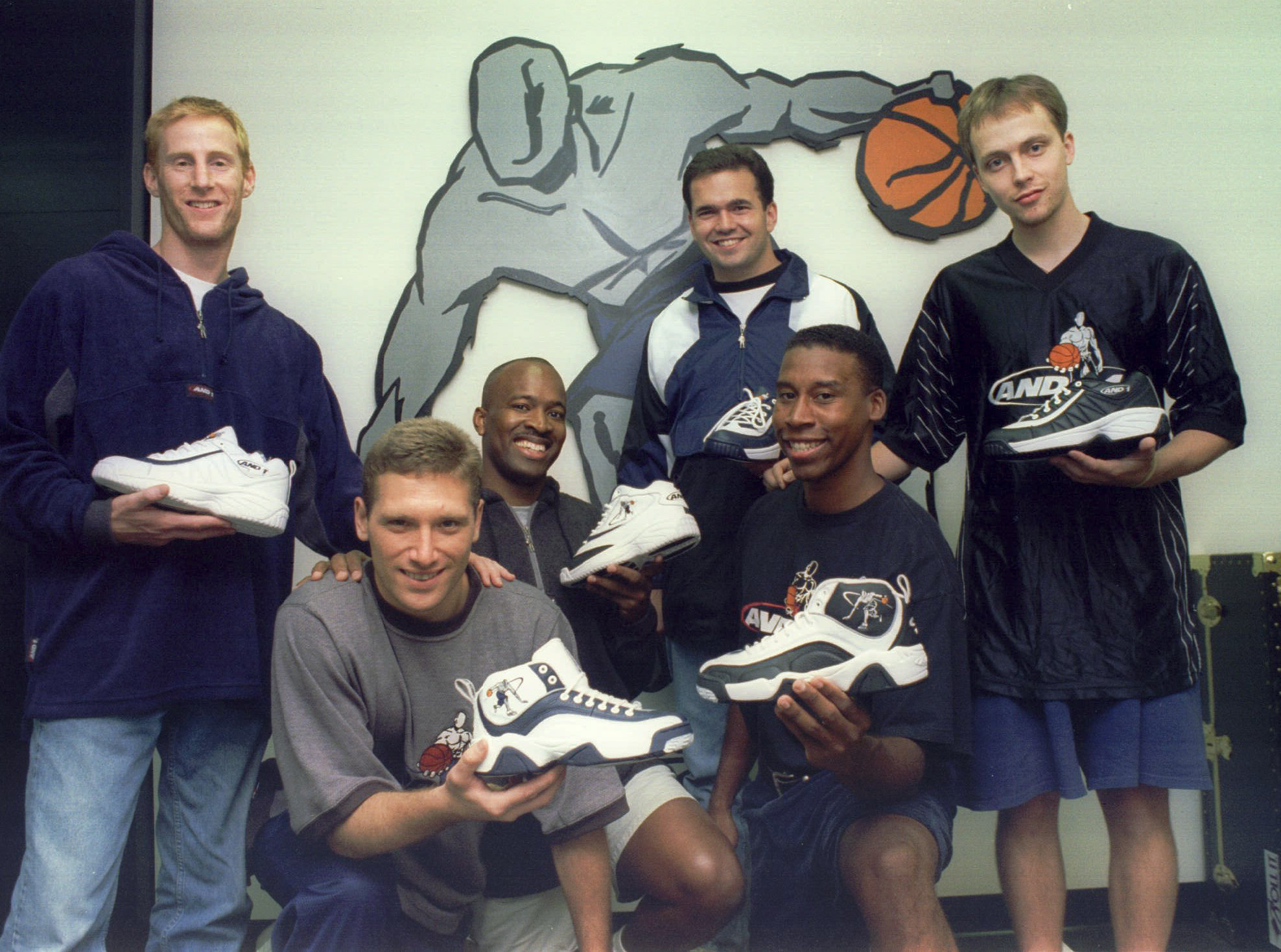
    In the summer of 1993, Tom Austin, a Wharton grad, was in the process of creating a start-up with a fellow Penn alum, Seth Berger, and a friend, Jay Coen Gilbert.

    The company was going named “AND1,” and Austin wanted to take edgy slogans — the kind you’d hear in a local pickup basketball game — and print them on T-shirts. Six months later, the T-shirts became a cultural phenomenon.

    AND1 sold $1.6 million worth of apparel in its first year. Then came AND1’s mixtapes, which were video compilations of street ball moves, but because the first mixtape was shot at Rucker Park in Harlem, the company became known with New York basketball.

    Though, at its core, AND1 was a Philadelphia brand.

    Alex Coffey gives us a deep dive into how AND1 came to be, and even after the company was sold, its roots remain very much intact.

    — Isabella DiAmore, @phillysport, sports.daily@inquirer.com.

    If someone forwarded you this email, sign up for free here.

    ❓What will it take for the Phillies to make the playoffs and go on a run? Email us back for a chance to be featured in the newsletter.

    Complete the sweep

    Alec Bohm, celebrates after hitting a three-run home run during the sixth inning against the Twins on Sunday.Bailey Hillesheim

    Things were looking bleak, then a funny thing happened on Sunday. The Phillies rallied from an early five-run deficit to pull ahead in the eighth inning of a 7-5 victory to complete a three-game, two-state sweep of the Twins.

    It marked the second-largest comeback of the season for the Phillies. They have now inched ahead of the Diamondbacks and back into sole possession of a wild card spot.

    And the infield did some shuffling on Sunday with Trea Turner out for the game. But Don Mattingly confirmed that their star shortstop avoided an injury after fouling a pitch off his leg. He could’ve started Sunday, but the interim manager didn’t want to push it.

    What we’re…

    👊 Reminiscing: The highlight moments from UFC 330 taking over Xfinity Mobile Arena — did you see who lost their teeth?

    👏 Celebrating: Before the Women’s Lacrosse League championship, Tina Sloan Green was honored for her legacy in the sport.

    🏌️ Reading: On a rainy Sunday, Jack Whaley, a 22-year-old rising senior at Florida State, won the U.S. Amateur Golf Championship.

    🏀 Learning: Dawn Staley doesn’t want to coach in the WNBA, she wants ownership. Philly has yet to extend the offer.

    Sean Mannion’s debut

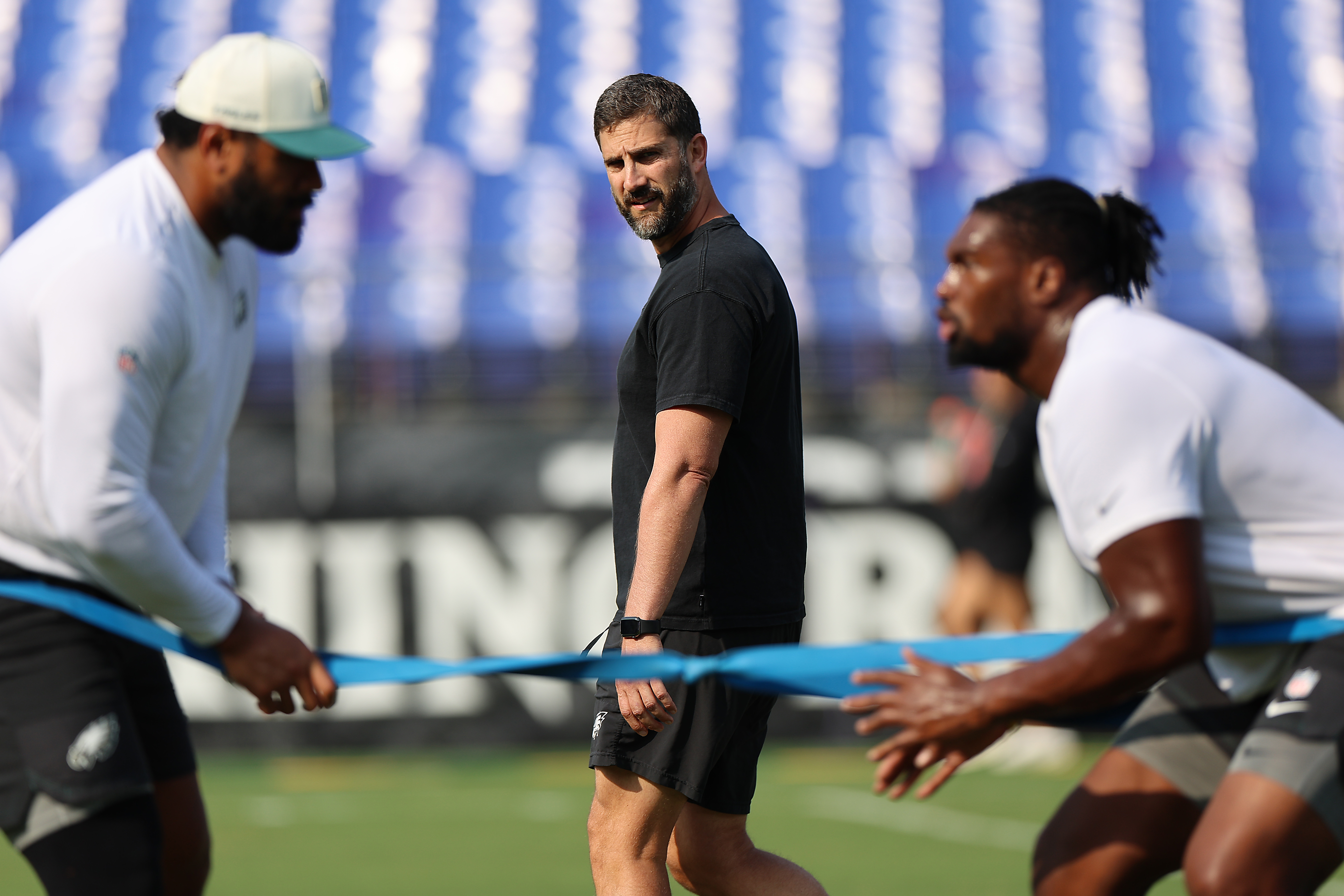
    The Eagles played backups across the board on offense, and Sean Mannion’s scheme intentionally featured vanilla looks.David Maialetti / Staff Photographer

    The Eagles’ 24-7 loss to the Ravens on Saturday night didn’t reveal much, especially their new offensive scheme.

    It was difficult to identify Sean Mannion’s version of the Kyle Shanahan-Sean McVay system, let alone any functioning NFL offense, but Jeff McLane writes, that’s not surprising … or all that concerning as of now.

    In other news, Joshua Weru and Uar Bernard suited up for their first football game at any level. Neither player lit up the stat sheet, but they certainly showed glimpses of potential.

    And while there wasn’t a whole lot to take away from the Eagles’ first preseason game, it was enough to stir some movement in our latest 53-man roster projection.

    Past meets future

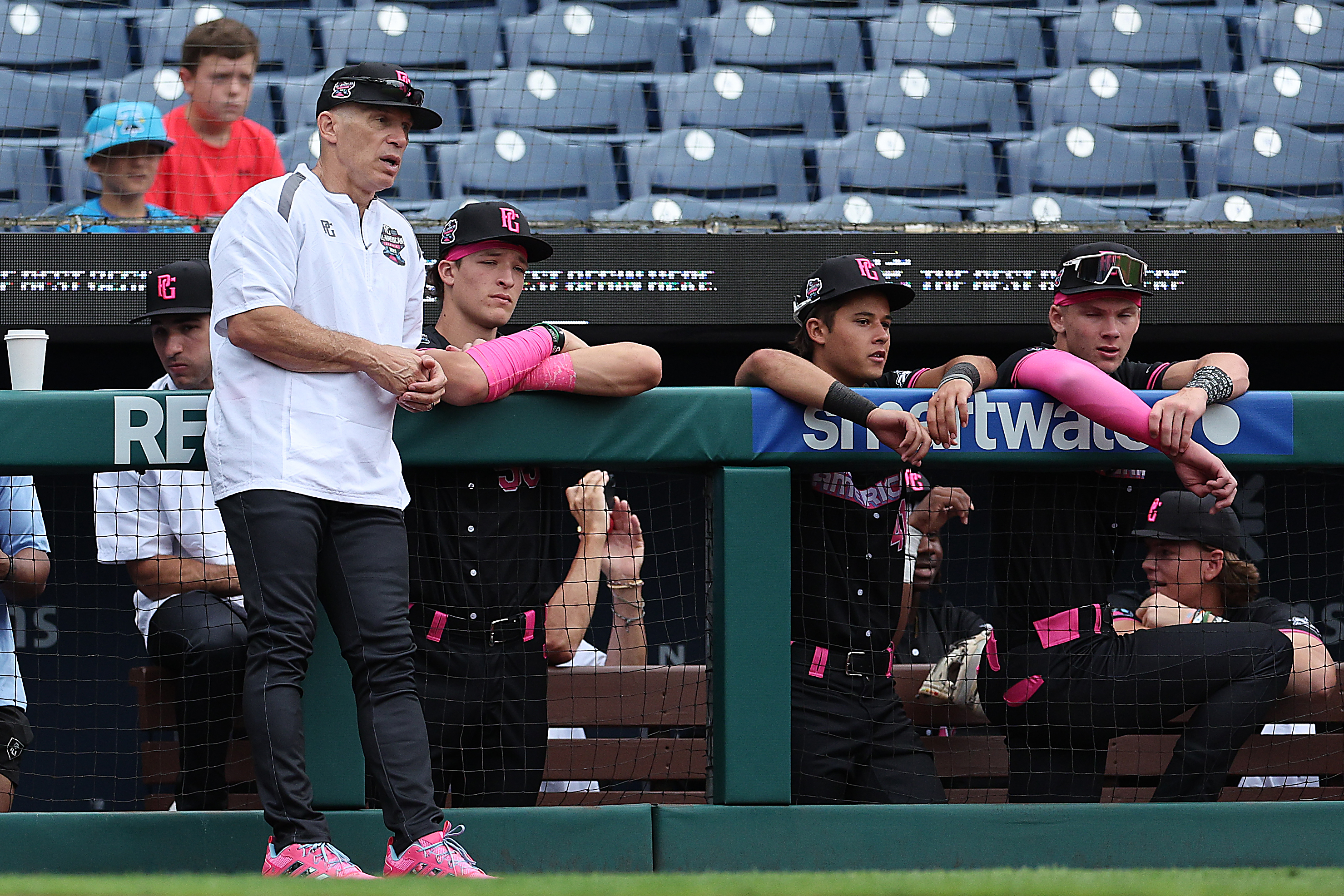
    Joe Girardi manages the West team in the All-American Classic on Sunday.David Maialetti / Staff Photographer

    The Perfect Game All-American Classic brought together 60 of the top high school baseball players in the country and former major leaguers at Citizens Bank Park on Sunday.

    Former Phillies manager Joe Girardi and former Phillies center fielder Shane Victorino coached Team West and East, respectively. With several other coaches involved in the event, Victorino said it’s a testament to the “Phillie way.”

    Offseason grades

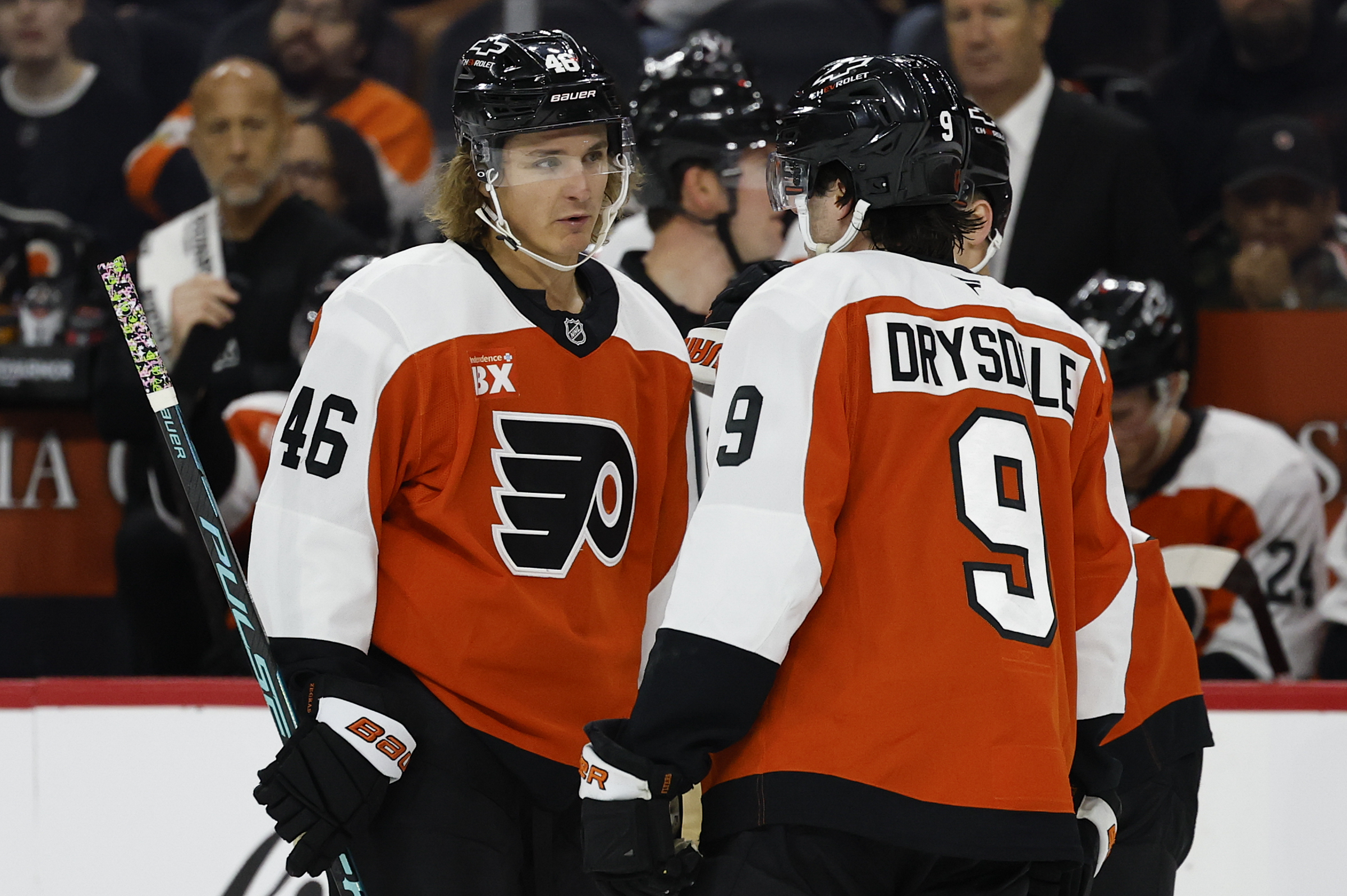
    Were the Jamie Drysdale and Trevor Zegras contract extensions enough to give the Flyers passing offseason grades?

    It looked as if the Flyers were making the biggest splash of the NHL offseason by offer-sheeting Leo Carlsson, but ultimately, Carlsson is still an Anaheim Duck — and the Flyers still don’t have a young center on the roster.

    With training camp a month away, how do we assess the Flyers’ actual offseason moves? Here’s what those in the national media are saying about the 2026-27 version of the team.

    Marcus Hayes’ take

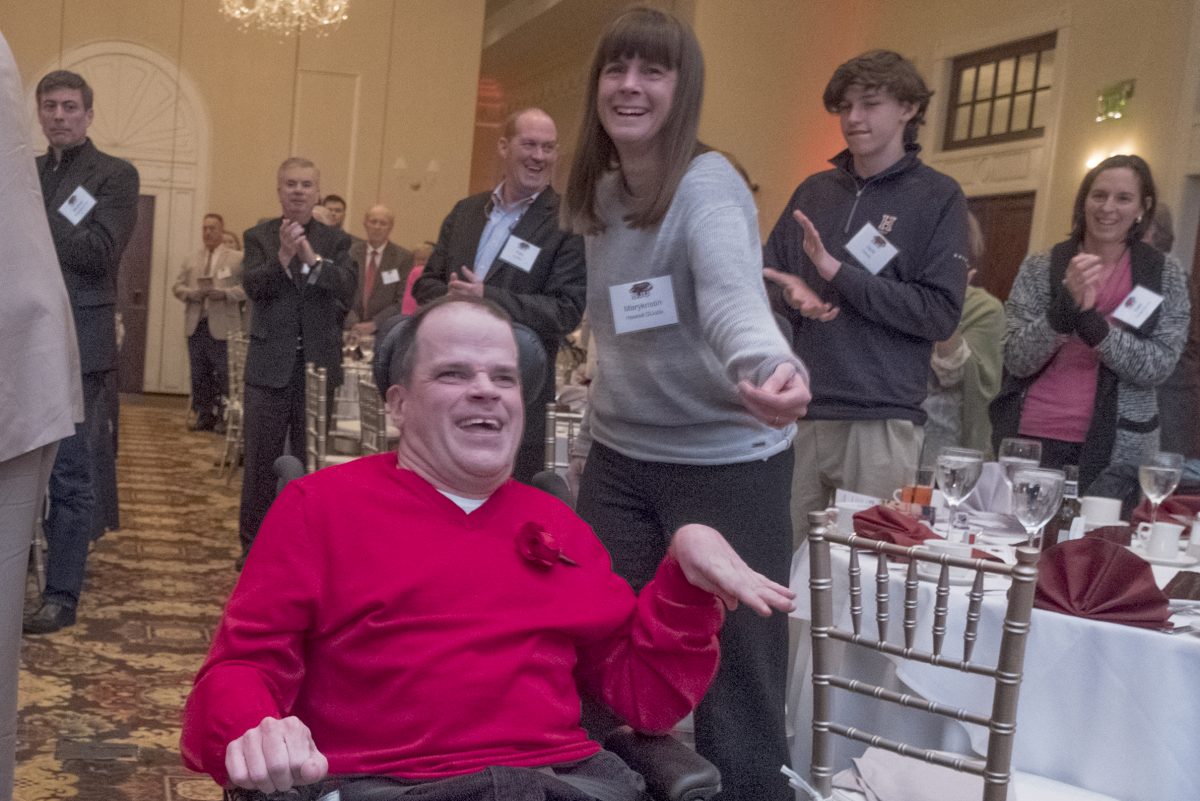
    Chris DiJulia’s funeral drew around 600 attendees.Ed Hille / For the Inquirer

    More than 600 people crowded into St. Denis Catholic Church in Haverford last Wednesday for an 80-minute celebration of 56 years of life well-lived.

    Chris DiJulia was a fixture at St. Joe’s basketball games. He had cerebral palsy and spent his life in a wheelchair. On July 27, he died of natural causes related to his condition. DiJulia was inspirational to all who knew him, and last Wednesday, he was the king of Philadelphia basketball, writes Marcus Hayes.

    We compiled today’s newsletter using reporting from Marcus Hayes, Alex Coffey, Scott Lauber, Jeff Neiburg, Jeff McLane, Olivia Reiner, Ryan Novozinsky, Ariel Simpson, Gabriela Carroll, Mia Messina, Lauren Jones, and Conor Smith.

    By submitting your written, visual, and/or audio contributions, you agree to The Inquirer’s Terms of Use, including the grant of rights in Section 10.

    Happy Monday! Thanks for getting your morning started with me. We’ll be back in your inbox tomorrow. — Bella

  • Inside the hitters’ meeting that sparked the Phillies’ on-base percentage turnaround this month

    Inside the hitters’ meeting that sparked the Phillies’ on-base percentage turnaround this month

    MINNEAPOLIS — Pick a date, almost any date during the season, and the Phillies have ranked near the bottom of the majors in on-base percentage.

    It’s a fundamental problem.

    “Because everything we’re trying to do up there,” Kyle Schwarber said, at risk of stating the obvious, “is based around that result of trying to find a way on base.”

    The numbers never really added up, though. Going into the last week of July, for instance, the Phillies reached base at a .303 clip, tied for last. But they also had the fourth-best hard-hit rate and were near the middle of the pack in barrel rate, which measures how often a hitter makes contact with the optimal combination of exit velocity and launch angle.

    Maybe it was bad luck. The Phillies were batting .281 on balls in play. (Major league average is .289.) Or maybe it was self-inflicted. As a team, they swung at the second-highest rate of non-strikes (34%).

    Whatever the case, they needed to figure it out.

    So, they had a meeting.

    Hitting coach Kevin Long, his two assistants, and hitting analysts meet with the players before every series to go over strategy and review scouting reports on opposing pitchers. But this was different, multiple players said over the weekend.

    In getting together the last week of July — before the deadline trade for contact-hitting savant Luis Arraez — Long and his staff highlighted things the Phillies were doing well before inviting the players to brainstorm why it wasn’t translating into better on-base results.

    Bryce Harper (right) has drawn a walk in seven consecutive games through Sunday and has 21 walks in 15 games in August.Bailey Hillesheim

    “I think there was a stigma there of us being last in on-base, and that can wear on a group, right?” Schwarber said. “But the room starts talking, guys start giving their opinions, and then it’s like, all right, how do we work through what we want to work through to get to where we need to be?

    “As a group, it was a pretty good conversation, and I feel like we’ve been building on that and doing some really good things.”

    In fact, halfway through the month, the Phillies are leading the majors with a .362 on-base percentage in August.

    To make sense of the relative traffic jam on the bases, the easiest place to start is here: a 29% rate of swings at non-strikes so far this month, far below their 33.2% season average — and even the 30.4% league average.

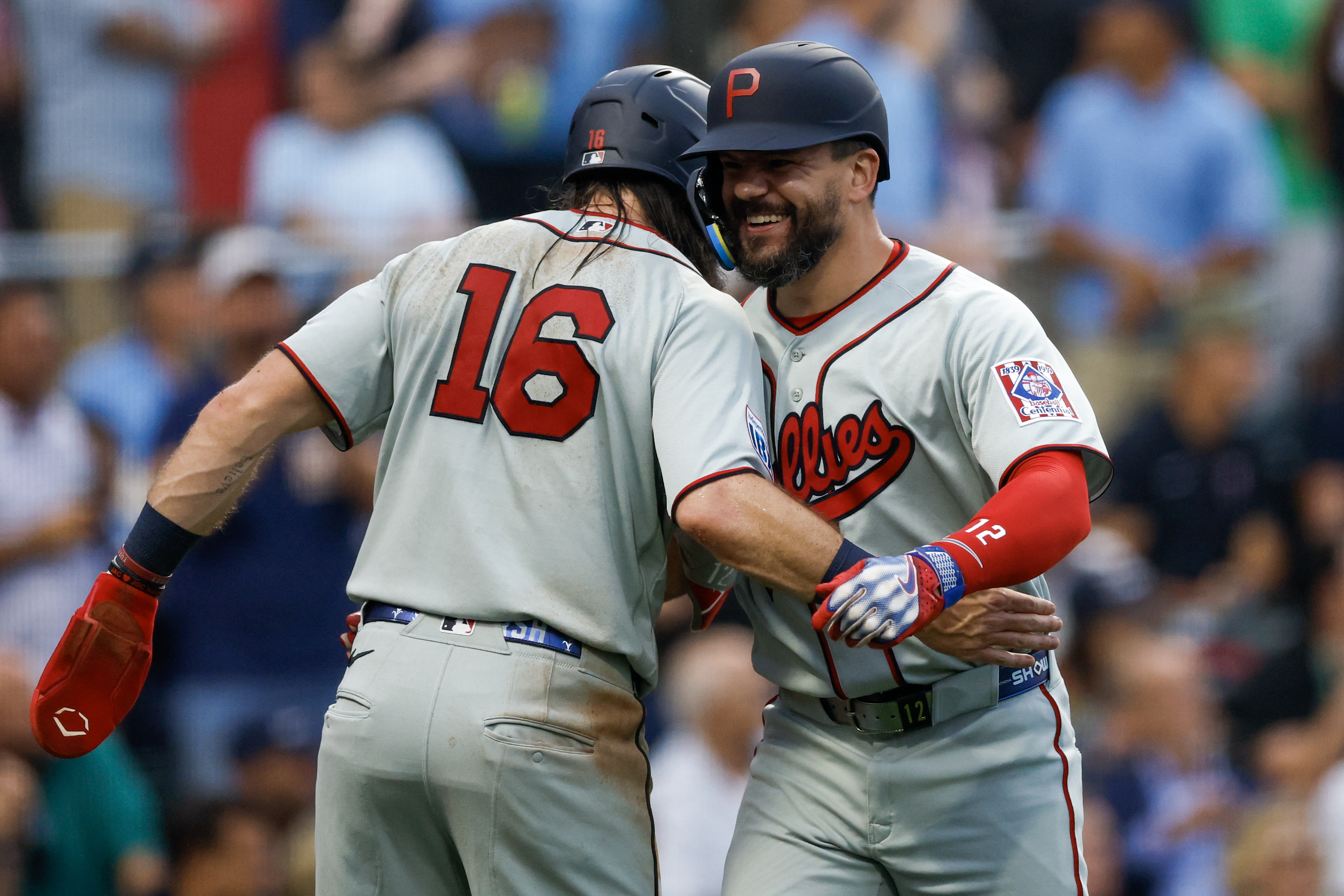
    But there’s more. The Phillies are walking nearly twice as often, from a 7.8% rate through July 31 to 13.1% this month. Bryce Harper says his dad tells him he’s at his best when he’s walking. With Arraez batting behind him, Harper has drawn 21 walks in 15 games in August. Bryson Stott (15) and Schwarber (13) are also walking at a higher clip.

    As a team, the Phillies appear to be staying true to Long’s long-held philosophy of being “selective-aggressive.”

    It’s more than that, though, according to Schwarber. Because if the last few years have taught the Phillies’ hitters anything, it’s that chasing pitches out of the strike zone is “the nature of the beast of the game,” Schwarber said. It’s in their DNA. Most of them won’t suddenly stop doing it, even though they don’t mean to.

    And besides, every hitter is unique, with different strengths and vulnerabilities. There wasn’t a paint-by-numbers approach to figuring out how the collective group could reach base more frequently.

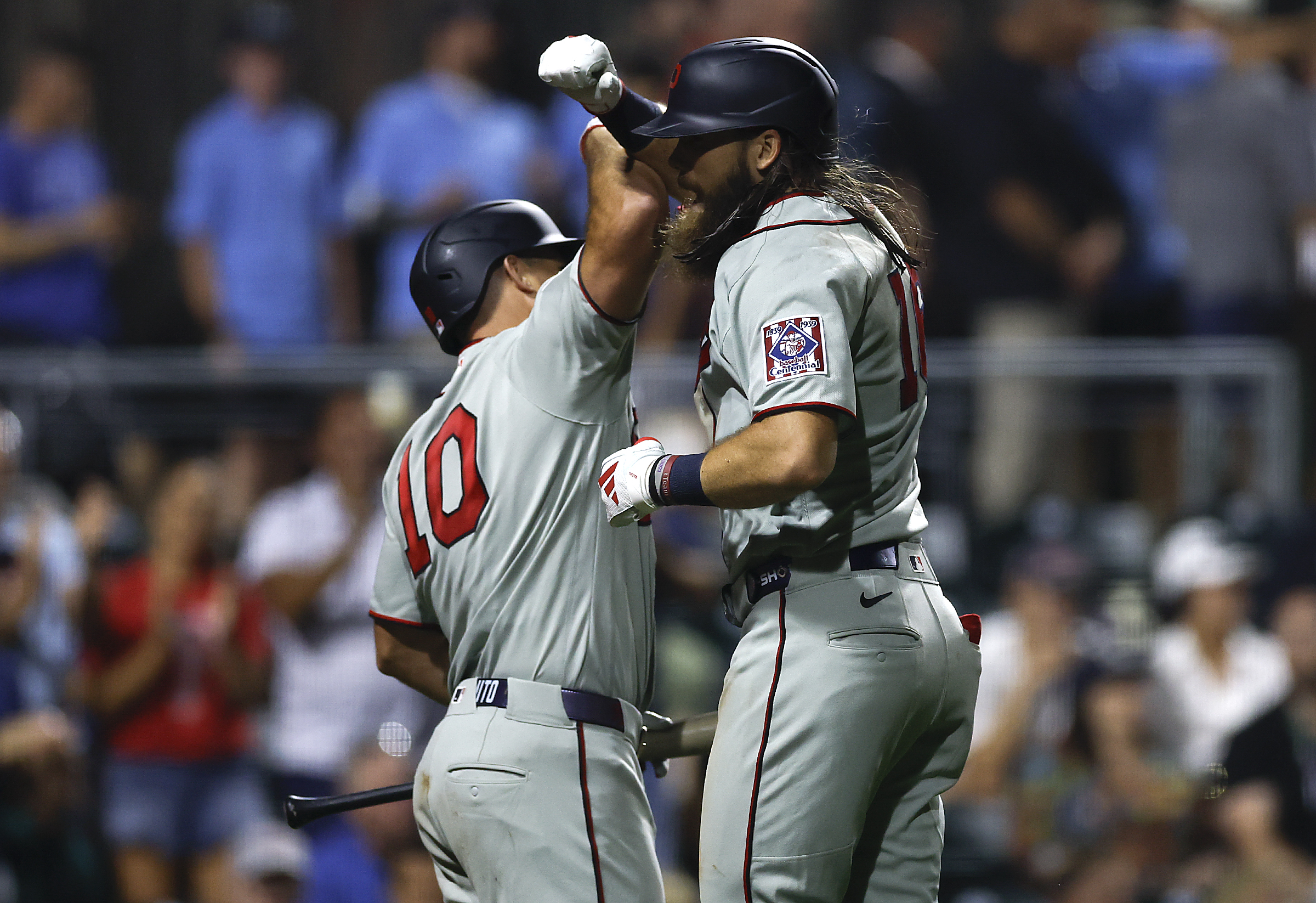
    Phillies catcher J.T. Realmuto (left), celebrating after a homer by Brandon Marsh.Yong Kim / Staff Photographer

    But several players cited something J.T. Realmuto brought up in the meeting that seemed to resonate.

    Stay aggressive to your plan.

    “There’s going to be times when, yeah, we’ll have a team approach on some guy or whatever it is, but also, everyone’s got their own individual plan, right?” Schwarber said. “So, if you have your plan, that means that you’re going to be aggressive to the things that you want to do.”

    In talking it over, the hitters concluded that many of them were often deviating from their plan and letting the pitcher dictate an at-bat.

    “I think it just kind of brought out that, look, we’ve kind of got to clean it up a little bit,” Alec Bohm said. “We’re swinging ourselves out of innings, out of at-bats, and the numbers say there’s not a lot of strikes coming over the plate to a lot of us.

    “So, let’s at least be looking for something [specific]. And if we’re going to go down, let’s go down with a plan and not just be up there free-swinging. I think that kind of landed with everybody, and I think we’re definitely responding in a good way.”

    The Phillies have 37 games left and a one-game lead for a National League wild card. Applying more pressure to opposing pitchers would help ease the burden on theirs. One-quarter of the Phillies’ games have been decided by one run.

    Two weeks of getting on base at a higher clip doesn’t erase four months at or near the bottom of the leader board. But Arraez brings a contact-oriented approach and lengthens a lineup that has lacked a cleanup hitter to provide protection to Harper.

    Maybe it’s all sustainable. Maybe not. Maybe they’ll look back at a hitters meeting in late July as a turning point.

    window.addEventListener(“message”,function(a){if(void 0!==a.data[“datawrapper-height”]){var e=document.querySelectorAll(“iframe”);for(var t in a.data[“datawrapper-height”])for(var r,i=0;r=e[i];i++)if(r.contentWindow===a.source){var d=a.data[“datawrapper-height”][t]+”px”;r.style.height=d}}});

    “The biggest thing we were able to accomplish in that meeting was highlighting a lot of things that we do well,” Schwarber said. “Those are things that can get your brain going in a different way, and then it’s like, ‘OK, we’re last in on-base. How do we kind of maneuver this?’

    “I felt like it was just a really good conversation that we had. There was input from everyone in the room, so I felt like that was a really good way to go about it.”