Tag: topic-link-auto

  • New Air Force One lacks defensive countermeasures of previous model, officials say

    New Air Force One lacks defensive countermeasures of previous model, officials say

    The new Air Force One, which President Donald Trump flew on earlier this week to Turkey, lacks the same defensive countermeasures that were security features of the old model, including its advanced antimissile capabilities, according to multiple officials who have been briefed on how the jet was retrofitted.

    Experts say the absence of those capabilities on the Boeing 747-8 aircraft, which was donated by Qatar, creates potential risk in using the jet abroad, a dynamic underscored by the abrupt decision Wednesday for Trump to leave Turkey on the old Air Force One at the urging of the Secret Service.

    The episode is intensifying the focus on Trump’s demands to rapidly retrofit the donated 747 to replace an aging fleet that had served as the official presidential planes.

    Lawmakers have called on the administration to disclose whether the overhaul of the Qatari plane, which the Air Force oversaw in the course of the past year, provided sufficient security upgrades. The safety of the aircraft is critical not only for the president, but also for the large entourage of White House staff, Secret Service officials, journalists, and guests who fly aboard.

    Trump pushed for the new plane to be put into use as quickly as possible and frequently complained that the old presidential aircraft was not impressive enough to take on international trips.

    On Thursday, the White House did not address specific questions about the new plane’s capabilities, but defended its safety.

    “The new Air Force One is a state-of-the-art aircraft that has been fitted with high-level security protocols that ensure the safety of the president and his staff,” Steven Cheung, the communications director, said in a statement. “As the president has said recently, there are many enemies of America who have their sights on him, and we use every tool at our disposal to address those threats.”

    The Air Force has declined to discuss specifics around security systems on the retrofitted Qatari plane, which is being used as a “bridge” aircraft while two Boeing jets that will be part of the permanent presidential fleet are being finished.

    But in a statement it made when it announced that the donated jet was ready to transport the president, it acknowledged that the temporary plane did not have all the equipment usually found on an Air Force One.

    “No risk was taken in security, safety, or mission communications,” the Air Force said in a statement on June 19. “But the collective team made trades on some of the less commonly used mission sets that Boeing must deliver to support the next 40 years.”

    The Air Force would not say what it meant by “less commonly used mission sets.”

    However, officials who have been briefed on the retrofitting of the Qatari jet, who spoke on the condition of anonymity to describe its security features, said it did not have the same counter-defensive capabilities of the previous model.

    Two former Air Force officials, who had both been involved in the effort to replace the older Air Force One planes, said they were surprised to see Trump fly on the new jet overseas, where there are greater security risks. Turkey, where Trump attended a NATO summit, borders Iran, which the United States pummeled with renewed strikes this week.

    The former officials were not involved with the retrofitting of the Qatari jet, but said the speed of the project meant there would not have been enough time to make all of the security modifications that are traditionally associated with a fully equipped presidential aircraft.

    “Time didn’t permit all the normal Air Force One modifications, so some mix of security, communications and support is missing,” said Frank Kendall, the former Air Force secretary who was in charge of the department as it tried to push Boeing to accelerate its long-delayed contract to deliver two new Air Force One planes.

    “With the Iran situation, this could be of concern,” Kendall said. “Frankly, I’m surprised to see this plane used outside the U.S.”

    Andrew P. Hunter, the former Air Force assistant secretary who was in charge of the Air Force One program during the Biden administration, also said that a true retrofit of a 747 jet to prepare it to become Air Force One would require more than a year of work.

    The day before Trump left for Turkey, Senate Democrats wrote to the Air Force asking questions about the modifications to the Qatari plane and questioning whether it had all the necessary security upgrades.

    “Trump’s own statements — including his celebration of ‘a level of luxury that nobody’s ever seen before’ — make it clear that these decisions prioritized Trump’s personal comfort and tastes over U.S. national security,” they wrote in the letter sent by Sen. Christopher Murphy (D., Conn.) and 12 other senators.

    The older planes that served as Air Force One included a defensive system designed to defeat heat-seeking missiles. That capacity is also planned to be included in the new Boeing planes, according to three former Pentagon officials.

    Different parts of the defensive systems are visible on the old Air Force One, under the wing of the plane and on its tail. They are not observable in photographs of the new Qatari plane, according to a third former Air Force official, who spoke on the condition of anonymity to describe the security protocols.

    Missile defense systems on Air Force One have seen little use in the history of the aircraft, but have nevertheless been considered critical aspects of the plane’s security features.

    The Pentagon published specifications for the Boeing aircraft now under construction that indicate the new jets will include a “self-defense system” and “mission communication system,” as these and other upgrades are needed “to enable the president to execute the duties of head of state, chief executive, and commander in chief.”

    U.S. officials have said that Iran has been targeting Trump since he ordered the drone strike that killed Qassem Soleimani, in January 2020. During the 2024 campaign, the Secret Service increased protection for Trump, even before the attempt on his life in Butler, Pa., because of intelligence about Iran’s plotting against him.

    Despite the resumption of intense U.S. strikes on Iran, U.S. policymakers briefed on the current intelligence do not believe that Iran has a current plan to kill Trump during this period. A U.S. official, who spoke on the condition of anonymity to describe intelligence assessments, said that Iran had a clear understanding of what kind of deep provocation any attempt on Trump’s life would be and the intensity of a U.S. response.

    Nevertheless, the Secret Service was concerned enough about Trump’s proximity to the country while in Ankara to force the president to swap planes on the way out of the country, as the New York Times first reported Wednesday.

    In announcing the change, Trump offered a different story: He claimed that he was flying out on the old plane so the new jet could leave early and make stops at U.S. military bases to show it off to the troops because the aircraft is “magnificent.”

    One former senior White House official involved in discussions about military aircraft used for presidential travel said that there were frequently points of tension between White House staff and the military advisers and Secret Service over travel plans when security questions emerged.

    But when the military experts demanded changes, White House officials generally let them prevail, with “course of action” plans that mitigated potential threats.

    This article originally appeared in the New York Times.
  • Pennsylvania is among 25 states suing over federal Medicaid rules they say ‘overstep’ the law

    Pennsylvania is among 25 states suing over federal Medicaid rules they say ‘overstep’ the law

    Felix White worries his ability to keep working — and avoid a health crisis — could be at risk.

    The 62-year-old Montgomery County resident relies on Medicaid to afford the insulin he needs to manage his type 1 diabetes.

    Beginning in January, people with Medicaid will be required to provide proof that they are working 80 hours a month, unless they are considered too sick to work and qualify for an exemption.

    If White fails to submit enough evidence, he could lose Medicaid. Yet without the government-funded coverage, he won’t be able to get the medications and care he needs to stay healthy enough to keep working.

    “It would be a death sentence for me,” White said.

    A few years ago, White lost his job in computer science — and the private health insurance that once covered the medications, glucose monitor, and specialists he needs to manage type 1 diabetes.

    Finding work in his field has been challenging at his age, White said. So instead, he’s relied on a string of odd jobs, such as mowing lawns, for income and Medicaid for healthcare.

    Pennsylvania expects 310,000 residents to lose Medicaid when the new rules take effect, and White fears he could be among them.

    The work requirements are part of Republicans’ 2025 spending and tax cut bill, which is expected to cut more than $900 billion in Medicaid spending over the next 10 years.

    The legislation passed by Congress allowed exemptions for Medicaid recipients considered “medically frail.” The law loosely defined categories of exemptions, such as for people with a substance use disorder, a disabling mental disorder, a “serious or complex” medical condition, and disabilities that limit their daily activities.

    White’s Type 1 diabetes is considered a disability that could hinder a person’s ability to work.

    But in June, the Centers for Medicare and Medicaid Services provided additional details: To be exempt from the work requirement, people will need to prove not only that they are “medically frail,” but also that their illness is so severe they are unable to work.

    Republicans who pushed the legislation argue that work requirements ensure only people with the greatest needs receive the safety-net support, while helping people who have been sick reintegrate into society.

    Pennsylvania is among 25 Democrat-led states suing over the interim final CMS rule, which they say oversteps the law, HR 1. The June rule “differed significantly” from initial guidance and “undermines months of work and human and financial resources” Pennsylvania has spent to meet the new requirements outlined in HR 1, the Pennsylvania Department of Human Services said in a statement.

    “This redirection poses an even greater threat to health and well-being for Medicaid recipients and the stability of our entire healthcare system,” said Brandon Cwalina, a spokesperson for DHS.

    Shifting Medicaid rules

    Implementing the new Medicaid rules represents a massive undertaking for states. The law calls for many people to prove on a monthly basis that they are working, and reapply for coverage every six months, instead of once a year. Certain groups of immigrants will no longer be eligible.

    These changes have required Pennsylvania and other states to overhaul the type of information they document about Medicaid applicants. Processing renewals twice as often will require more staff.

    States also had to devise strategies for alerting people of the changes, for fear they will be dropped from coverage they didn’t know they were at risk of losing.

    Pennsylvania DHS “has worked in good faith” to make these changes, sharing designs and plans with CMS leadership, Cwalina said.

    The June rules from CMS will require “a more complex, costly, and labor-intensive approach,” he said.

    Administrative hurdles for vulnerable patients

    The new rules will make it harder for people to get the care they need, patient advocates and health analysts warn, saying it will drive more people to rely on emergency care, further straining the health system.

    “What the administration is calling work requirements are really just hurdles for people who deserve Medicaid and access to the care they need,” said Michael Berman, director of Protect Our Care PA, a healthcare advocacy group, who spoke at a virtual press conference Wednesday with stakeholders and patients, including White.

    Under the June rules, states are responsible for developing a list of diagnosis codes that qualify for an exemption, and devising a system to determine how a person can prove their diagnosis prevents them from working.

    The CMS guidance provides some specific limitations.

    People with substance abuse disorder, for instance, will not be eligible for a work requirement exemption if they have been in recovery for at least five years.

    Behavioral health workers worry that will lead to more people relapsing.

    “We know recovery works, but only when people can consistently access care,” said Jeannine L. Lisitski, CEO of Mental Health Partnerships, which provides mental health and substance abuse services in Pennsylvania.

    People with HIV/AIDS and cancer, also considered serious medical conditions, will only be exempt from the work requirement rules if they prove they are too sick to maintain a job.

    Gathering the documentation could be especially burdensome for people who are seriously ill.

    “For someone who’s in cancer treatment, to go back to a doctor and get another piece of paper filled out is just going to make it harder and less likely they’re able to get the care they need to survive,” Berman said.

  • New York construction scare highlights the challenges of converting offices into housing

    New York construction scare highlights the challenges of converting offices into housing

    NEW YORK — When two steel columns buckled this week inside the former Pfizer headquarters in midtown Manhattan, the scare prompted evacuations and halted work on one of the nation’s largest office-to-apartment conversions.

    It also highlighted the complex engineering behind adaptive reuse projects, which have become increasingly popular as officials try to tackle a nationwide housing shortage by transforming offices that have sat underused since the COVID-19 pandemic.

    The plans call for turning two office buildings — one built in 1909, the other in the 1960s — into about 1,600 apartments by adding more than a dozen stories atop the older structure and redesigning and expanding the other. The buckling occurred on the 21st floor of the newer structure, and crews have installed temporary supports as officials investigate.

    Engineering experts said the conversion project is complex and poses many challenges, which include making sure older buildings can safely support new loads and carving up office floors to accommodate residential living.

    But none said the high-profile setback should make people doubt the ability of engineers to complete such projects.

    “I don’t think it really brings into question our understanding of how to do something like this,” said Ben Schafer, a structural engineering professor at Johns Hopkins University.

    How do you build a new tower on top of an old one?

    On its website highlighting the midtown project, adaptive reuse firm Collaborative Construction Management says the nine-story building from 1909 will be “threaded through” with a new addition of about 30 stories of poured concrete.

    Schafer, who is not involved with the undertaking, said the likely approach is to have the century-old building continue to carry its own weight while building a new structural system to support additions.

    “My interpretation would be that they’re going to leave that building carrying its own load, and they’re just going to poke holes in it so that they can take the load from the building that they’ve put above it and bring it all the way down to the foundation,” Schafer said.

    Schafer said construction on the other tower presents a different challenge: punching holes in the existing floor plate to bring light into apartments, while also ensuring that the steel frame can support the newly added loads.

    City officials have not determined what caused the columns to buckle. But both Schafer and Emily Guglielmo, a San Francisco-based structural engineer, believe the failure likely resulted from the added load.

    Spokespersons for MetroLoft, the project developer, didn’t respond to requests for comment Thursday. But Nathan Berman, the firm’s founder, acknowledged in an interview with The Wall Street Journal that the added weight from widening the top 15 or so floors of the building likely caused the damage.

    Guglielmo thinks that either the original design assumptions were misunderstood, something went wrong during the design or construction process, or construction crews overloaded or weakened the structure.

    Adding stories to existing buildings is common in dense urban areas where land is scarce, she said, but it requires reviewing original construction documents and inspecting the building before determining how additional floors will affect the structure.

    “In cities and towns that don’t have that available geography, you’re going to see a lot more of this type of a design where there’s an adaptive reuse to an existing building,” Guglielmo said.

    Why not just create a new building from scratch?

    To many structural engineers, demolition should occur only as a last resort.

    “Tearing buildings down is a terrible waste,” Schafer said, pointing out that buildings and the construction sector are responsible for about 40% of the world’s energy-related carbon emissions. “From a sustainability standpoint, that’s a disaster.”

    Beyond the environmental costs, demolishing and hauling away the remnants of huge buildings is especially expensive in dense cities such as New York.

    If an existing structure can safely be reused, engineers generally prefer that.

    James LaFave, a structural engineering professor at the University of Illinois, said a steel-framed building from the 1960s, like the former Pfizer structure, would typically be a “very good” starting point for a conversion.

    Does the scare in New York call into question other adaptive reuse projects?

    In recent years, officials across the country have embraced office-to-housing conversions as a potential lifeline for downtown business districts that have struggled since the pandemic.

    New York, especially, has embraced this push, as officials have made zoning changes and enacted tax incentives to spur housing production. A report from the New York City comptroller’s office last year noted there are 44 adaptive reuse projects in the city that, as of early 2025, had either been completed, were underway or could move forward.

    Pfizer moved out of the building in 2023 after opening a new office near Penn Station, leaving the property vacant. Construction on the property began in 2024.

    Joshua Harris, director of Fordham University’s Real Estate Institute, said office-to-residential conversions are a key part of solving the housing shortages in New York and other cities, even if they come with risk.

    “In a certain sense, it’s not terribly surprising that this happened, and we should have a little bit of grace,” he said. “These are very, very complicated surgical procedures being done to very old buildings.”

    “This is part of the reality of fixing the housing crisis,” Harris continued. “Things like this can happen. It doesn’t look as complex as putting a rocket into space, but, in a real estate sense, construction in an environment like Manhattan on 42nd Street and Second Avenue is very complex.”

    Guglielmo, the California engineer, said a combination of building codes, inspections and experienced construction crews makes failures like this rare.

    “We’re very fortunate here in the United States that we are not seeing these types of failures on a day-to-day basis,” she said. “We’re privileged to have really robust building codes that explain to us as engineers how to do our designs in a way that’s safe.”

    Still, Harris said it is likely a gut check for the industry, as office conversions transform once sleepy business districts across the city into 24/7 neighborhoods, like parts of Wall Street in recent years.

    “If this building has a problem, all the other projects that have been sort of greenlit, they’re going to want to review to make sure that it’s not something similar,” Harris said.

  • Trump’s all-out assault on free and fair elections undermines trust in democracy | Editorial

    Trump’s all-out assault on free and fair elections undermines trust in democracy | Editorial

    Let’s begin with the obvious: Donald Trump is out to rig the midterm elections.

    We know this because the president commits many of his illegal acts in broad daylight.

    For the past year, Trump has revved up his election-tampering efforts by throwing everything at the proverbial wall.

    He called for nationalizing elections, pushed to redraw election maps, slashed funding for election security, moved to restrict voting, targeted election workers, rewarded election deniers, and continued to repeat baseless claims that the 2020 presidential election was fixed.

    Trump even mused about canceling the November midterms. The White House said it was a joke, but his track record indicates anything is possible.

    Trump has ignored court orders, trampled presidential norms, and even refused to uphold the Constitution. He has cheated at everything, including the draft, golf, taxes, and marriage, so why not elections?

    If the Great Experiment in self-government that the founders began 250 years ago is to continue, we need free and fair elections. But Trump is working feverishly to tilt the playing field to ensure Republicans win.

    Last summer, he pushed GOP lawmakers in Texas to take the rare step of redrawing congressional maps in the middle of the decade to add more Republican seats.

    Lawmakers in other red states, including Florida, Ohio, and Missouri, followed Trump’s blatant call for gerrymandering. Some blue states, like California, moved to do the same to offset the Republican scheme, sparking an undemocratic arms race.

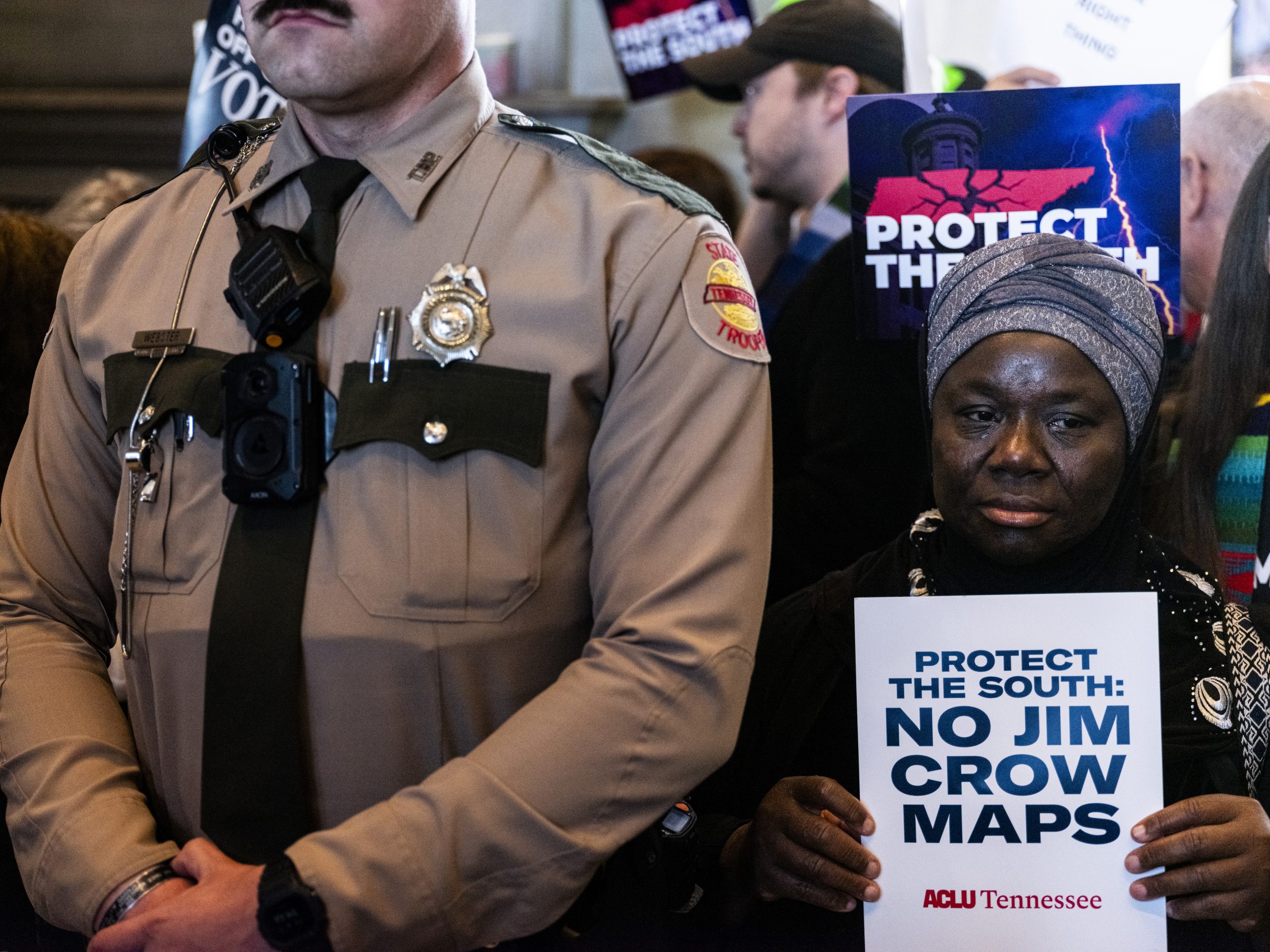
    The U.S. Supreme Court joined in by further obliterating the Voting Rights Act that previously provided for majority-minority districts. With that safeguard dismantled, Tennessee, Louisiana, and Alabama carved up Black majority districts to eliminate Democratic seats.

    Zulfat Suara (right) protests a new congressional map next to a Tennessee state trooper at the state Capitol in Nashville in May.BRAD J. VEST

    Polls indicate deep dissatisfaction with Trump and Republicans, who control the House and Senate. He fears hearings and investigations into his corruption, incompetence, and self-dealing if Democrats take control of either chamber.

    “If we don’t win the midterms … I’ll get impeached,” Trump said earlier this year.

    Hence, the all-out attack on the election system.

    Trump called for the federal government to seize control of elections — even though the Constitution put the states in charge.

    He demanded the end of mail-in voting — even though presidents do not have the power to change voting laws.

    Trump signed an executive order that would require voters to show proof of citizenship and that all mail-in ballots be received by the time polls closed — moves that were blocked last month by a federal judge, but the president remains relentless.

    This week, Trump’s Justice Department threatened criminal charges against Pennsylvania’s top election officials if they let noncitizens vote. Other states received a similar warning, even though the issue is exceedingly rare and already illegal.

    But Trump’s baseless rhetoric helps to sow distrust in elections — something he has done throughout his tumultuous decade in politics.

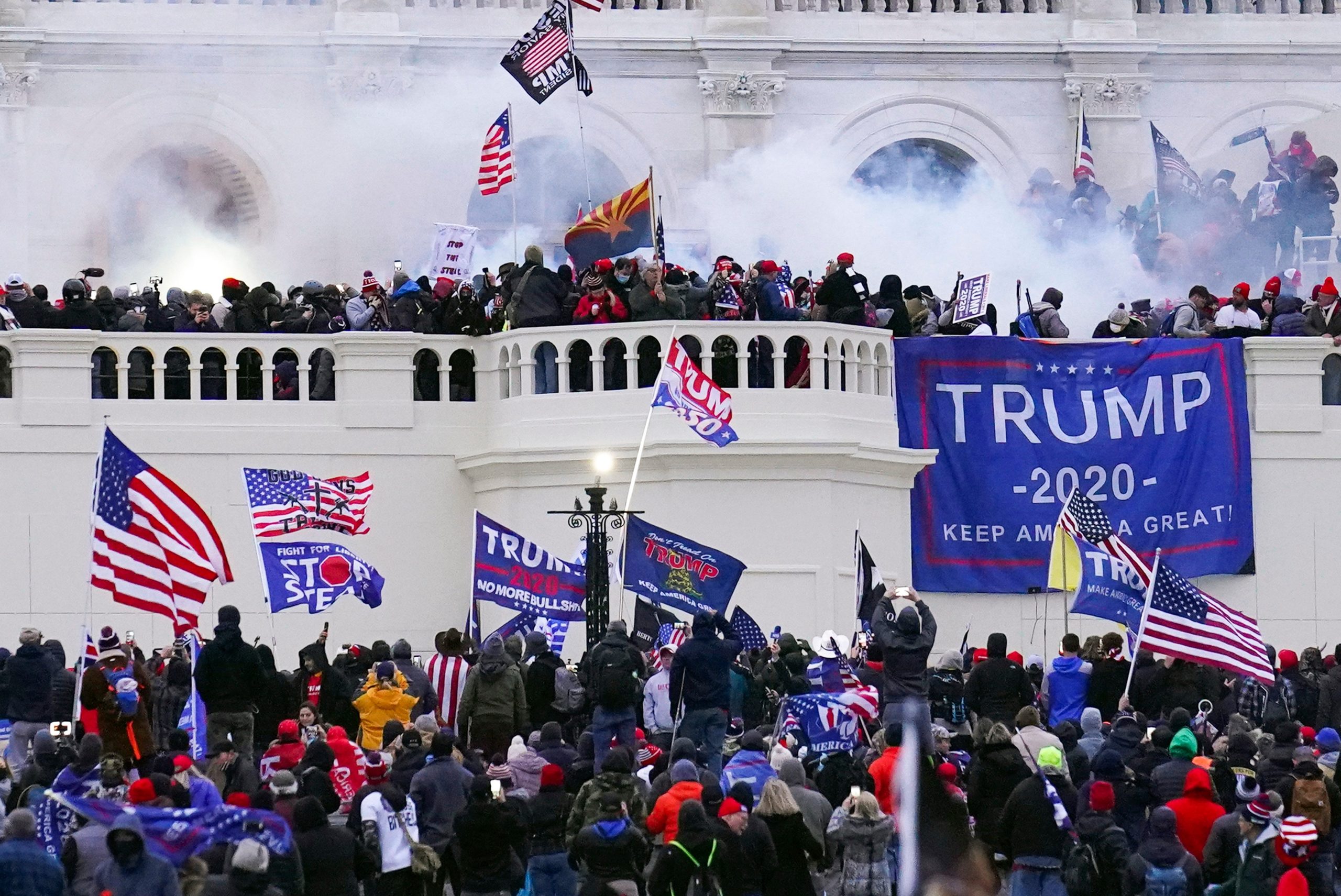
    Trump has demonstrated he will cross any line. As president, he incited an insurrection as part of a broad conspiracy to overturn the 2020 presidential results — an act of treachery that has earned its place in infamy.

    Trump was criminally indicted for his monthslong effort to interfere with the peaceful transfer of power, but the charges were dropped after he returned to the White House and assumed control of the U.S. Department of Justice.

    To this day, Trump refuses to admit he lost the 2020 presidential race, despite producing no credible evidence of widespread voter fraud and abusing the legal system by mounting 60 failed election cases before state and federal judges.

    In fact, Trump is still seeking to overturn the 2020 results.

    Rioters storm the West Front of the U.S. Capitol Jan. 6, 2021, in Washington.John Minchillo

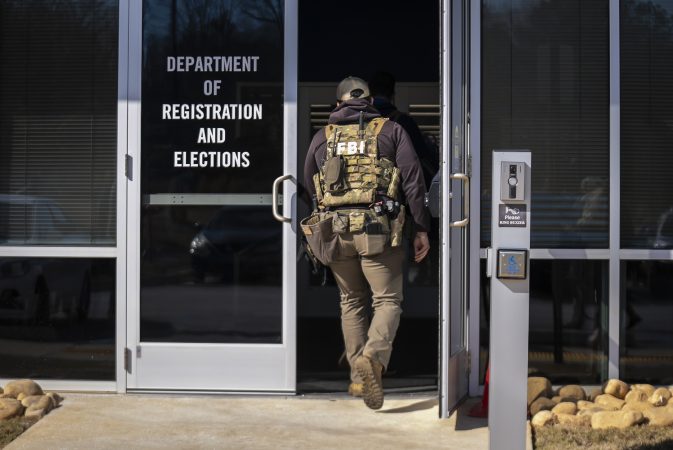
    In February, he ordered Tulsi Gabbard, the then-director of national intelligence, to attend an FBI search of election facilities in Georgia, where Trump lost in 2020.

    The FBI recently assigned more than 200 agents to search for election fraud in Georgia, six years after exhaustive state and federal investigations found none.

    During a ballyhooed visit to Arizona to discuss election security, former Homeland Security Secretary Kristi Noem couldn’t cite a single case of election fraud.

    But a Republican-led Senate Intelligence Committee investigation did find top Trump campaign officials had extensive contacts with Russian operatives during the 2016 election.

    For all of Trump’s bluster about rigged elections, he remains the poster child for election interference. Now, he is willing to undermine national security to get the election results he wants. He demanded states change election rules, such as requiring voter identification, or risk losing federal terrorism prevention funds.

    Trump also put his political gain above the public’s pain. He refused to sign a landmark bipartisan bill designed to lower housing costs until Congress passed legislation that would require proof of citizenship for all voters.

    Trump has taken other steps recently to weaken election security.

    One directive disbanded an FBI task force created to combat foreign influence in U.S. elections, and another crippled the Cybersecurity and Infrastructure Security Agency that Trump created.

    The moves come as Russia, China, and Iran ramp up efforts to meddle in U.S. elections, just as they did during Trump’s victories in 2016 and 2024.

    Before Jan. 6, 2021, it was hard to imagine a sitting president inciting a mob to storm the U.S. Capitol, attack police, defecate in offices, and look to hang the vice president.

    So, how much further will Trump go to get his desired election results?

    With Trump, there is no bottom.

  • Mysterious airstrikes target Iran after US attacks, raising questions of who launched them

    Mysterious airstrikes target Iran after US attacks, raising questions of who launched them

    DUBAI, United Arab Emirates — A series of mysterious, unclaimed airstrikes that hit Iran after the U.S. said it finished its attacks have again raised questions of who else may be targeting the Islamic Republic.

    The strikes Thursday, just as Iran prepared to bury the late Supreme Leader Ayatollah Ali Khamenei, hit areas across southern Iran. The country’s theocracy hasn’t directly blamed anyone for the strikes, though one lawmaker issued a warning to the United Arab Emirates over allegedly providing support to the United States in its campaign against Iran.

    Gulf Arab states, which repeatedly have been targeted by Iran since the war began Feb. 28, did not immediately respond to requests for comment Friday over the strikes. The attacks come as they and the U.S. insist the Strait of Hormuz must be open and free to ships to transit. Iran insists the strait, through which about a fifth of all oil and natural gas passes, must now be under its sole control and that vessels should begin to pay fees to Tehran — even though the world for decades has considered it an international waterway.

    Iran’s grip on the strait during the conflict led to an global energy crisis, though oil prices have sharply dropped since wartime highs of $120 a barrel.

    Israel, which took part in the Iran war, also has not claimed any recent attacks on Iran.

    Unclaimed strikes came after US ended its attacks

    The U.S. military’s Central Command said Thursday around 6:30 a.m. local Iran time that it had concluded a round of strikes that saw some 90 targets hit. Shortly after that, Iranian news outlets and state media reported a series of airstrikes and explosions targeting the country’s Bushehr and Sistan and Baluchestan provinces, the cities of Ahvaz and Chabahar and other areas.

    Central Command did not respond to a request for comment over the additional strikes.

    Iran responded to the strikes Thursday by launching a wider volley of attacks across the Mideast, targeting Bahrain, Jordan, Kuwait and Qatar. Missile alert sirens sounded in the four countries, sending people to seek shelter. One person was reportedly hurt in Kuwait as air defense systems targeted the incoming fire across the region.

    The leader of the UAE, Sheikh Mohammed bin Zayed Al Nahyan, traveled to Kuwait immediately after the Iranian attack for a meeting with the small, oil-rich nation’s ruling emir. Gulf Arab countries also held calls with Qatar’s foreign minister, who has been deeply involved along with Pakistan in mediating talks between Iran and the U.S. over the interim deal now in place to halt the return of open warfare.

    During the Iran war, officials say both Saudi Arabia and the UAE launched airstrikes targeting Iran, after Tehran struck energy sites in their countries.

    Israel, which under Prime Minister Benjamin Netanyahu has engaged in an intense campaign against Iran, has not attacked the Islamic Republic since June. Israel also broadly immediately claims its attacks on Iran.

    Israel’s government said Netanyahu spoke with Trump on Thursday night, with Trump updating Netanyahu “on American moves in the Gulf.”

    Israel Katz, Israel’s defense minister, also renewed threats that his nation stood ready to confront Iran if needed.

    The Israel military “is on alert and ready to renew the campaign, to reestablish aerial superiority, and to carry out a blue-white (Israeli) strike in Iran to remove threats, even for a third time,” Katz told a military ceremony. “If we will have to return, we will return with even greater force.”

    Iran keeps up its threats

    On Friday, Iranian state media quoted Esmail Kousari, a member of the Iranian parliament’s national security committee and a former commander in the paramilitary Revolutionary Guard, as warning the UAE would “pay the price for its cooperation with the United States.” He accused the Emirates of having a “behind-the-scenes” role in the recent U.S. attacks.

    Iran repeatedly accused Gulf Arab states of actively supporting the U.S. war effort, something they denied during the war. The U.S. since the 1991 Gulf War has maintained a broad footprint of military bases across the Gulf Arab states, including in Bahrain, which is home to the U.S. Navy’s 5th Fleet headquarters.

    Meanwhile, Iran insists it must be the sole controller of the Strait of Hormuz. But the U.S. is continuing to urge mariners to travel on a southern route through Oman’s territorial waters to avoid Iran.

    The Joint Maritime Information Center, a multinational body overseen by the U.S. Navy, issued a new advisory Friday urging ships to travel that route. A similar message for ships to use that route sparked an Iranian attack on Tuesday that saw three vessels hit.

    “Notwithstanding recent unprovoked attacks on merchant vessels, mariners are reminded that the southern route of the (strait) has been expanded and remains available for all traffic,” the maritime center said.

  • How Pakistani mangoes make their way from Karachi to Delco through a secretive WhatsApp network

    How Pakistani mangoes make their way from Karachi to Delco through a secretive WhatsApp network

    On a warm June evening, Aqeel Ahmed and his son Musa Khan eagerly waited outside their recently opened Delco Farmers Market in Folcroft for a minivan and its long-awaited cargo.

    The drop-off occurred at 6 p.m., with their Upper Darby supplier pulling up right on schedule.

    The father-son duo behind the Delco Farmers Market had spent two months coordinating to get their hands on three varieties of the once-illicit content. For this, they had to navigate a secretive network of WhatsApp groups and subgroups.

    The 36 boxes of Anwar Ratol, Chaunsa, and Sindhri mangos filled the market’s produce section with a smell that defined Ahmed’s summers growing up in Karachi.

    “It smells like you’re in Pakistan. That’s how fresh they are,” Khan said.

    The cargo of mangoes had traveled more than 7,000 air miles from Khan and Ahmed’s homeland, where they are considered the “King of Fruits” and celebrated in songs and poetry.

    Within six hours, all 36 boxes were sold.

    With customs restrictions, high transport costs, and a short shelf life, Pakistani mangoes are difficult to come by in the U.S. despite being approved for import in 2010. A network of mango dealers across the country makes it possible for the diaspora to acquire their homeland’s national fruit, albeit from a limited supply.

    Musa Khan (left) and his father, Aqeel Ahmed, pose while holding Sindhri mangos at the Delco Farmers Market on Monday, July 6, 2026, in Folcroft.Monica Herndon / Staff Photographer

    “For a group of internet-savvy immigrants and their children, a new option has emerged over the past few years: Middlemen and logistics experts acquire the mangoes from farms in Pakistan and sell them over WhatsApp at a premium, often only a few days after harvest,” James Beard-winning writer Ahmed Ali Akbar wrote in the food publication Eater in 2021.

    A member of the Philly-area Muslim and Pakistani communities, Aqeel Ahmed was aware of the vast mango trade network and wanted to sell the fruit even before he opened the supermarket in May.

    “When it was illegal to bring Pakistani mangoes, people — not my dad — would smuggle it from Canada, because it was legal to bring [the fruit] there,“ Khan said. ”A lot of people used to drive all the way to Chicago, New York, and California to get these mangoes. So it was a big thing and you always knew who had it.”

    Ahmed previously ordered from a mango middleman in Long Island. His son was 12 years old when he had his first bite of a Pakistani mango in America.

    “It just tasted better; it was so refreshing,” Khan, 19, said. “They’re juicier — you need to eat it over the sink because every time it’s a mess. And it’s definitely sweeter.”

    Ahmed began his search for a local mango dealer in early April. Mango season, which lasts roughly from April to September in Pakistan was around the corner and he knew dealers would be overwhelmed with orders soon. He heard through the WhatsApp grapevine that there was a mango middleman in Upper Darby. So he spent the month calling all the people he knew in the area.

    Boxes of Sindhri and Chaunsa mangos from Pakistan are on display at the Delco Farmers Market on Monday, July 6, 2026 in Folcroft.Monica Herndon / Staff Photographer

    At the end of April, he made contact.

    “My dad called him and said, ‘I’m local in the community as well. We’re opening up a big supermarket and we want to sell Pakistani mangoes,’” Khan said. “It took a little bit of convincing, but [the mango dealer] was able to get us boxes … there’s such a high demand.”

    The Upper Darby middleman initially gave the father-and-son duo 12 boxes each of three varieties of mangoes: the small, sweet, and aromatic Anwar Ratol; the almost fiberless, custard-like Chaunsa; and the sweet-tart Sindhri.

    Each 4.4-pound box held six or seven mangoes and cost the store $33.

    Before the July Fourth holiday, Ahmed ordered another shipment to replenish the first. There were fewer than 200 boxes being sold at the store for $40 each, with a four-to-five day shelf-life.

    Pakistani mangoes can go for over $7 apiece due to transportation costs, Akbar said.

    After one post about their mango stock, Khan said the store’s Instagram DMs were flooded with people looking to buy. Some even asked if the mangoes could be shipped as far as Kansas, California, and Ohio.

    But this was the last order from the mango dealer, Khan said.

    With the high demand, the Delco Farmers Market family is looking to cut out the middleman and import directly from Pakistan.

    “We didn’t ask [the mango middleman] how he got them,” said Khan, “but we figured out how after a company in Pakistan contacted us on Instagram.”

    Middlemen across the country pick up mangoes from airport cargo bays, including Ahmed’s dealer who picks up his stock from the Philadelphia airport. With no direct flights to America from Pakistan, the mangoes need to secure passage to a hub city like Dubai before arriving at an American international airport, said Akbar.

    Upon arrival, the fruit is taken to an irradiation facility, quarantined, and then loaded onto another cargo flight.

    And all of this needs to happen within a few days of harvest before the fruit spoils.

    Boxes of Sindhri and Chaunsa mangos from Pakistan on display at the Delco Farmers Market on Monday, July 6, 2026 in Folcroft.Monica Herndon / Staff Photographer

    The next step to going solo, Khan said, is to figure out a way to get the mangoes to Dubai and then to an international airport in Texas or New York.

    “Our main goal is to have our own boxes — we want them to say Delco Farmers Market,” Khan said.

    Growing up in Lower Merion, Khan never saw a big supermarket dedicated to selling Pakistani and halal products in his neighborhood. The goal for his family, he said, was to be that hub where Philly-area immigrants and diaspora could shop for meat, prepared foods, and fruit from their home country.

    “We’re not making anything by selling Pakistani mangoes, but we’re serving the community,” Khan said. “And to have them in our own store after eating it as a kid is a full-circle moment.”

    Delco Farmers Market: 1850 Delmar Drive, Folcroft; 610-862-1955; delcofarmersmarket.com

  • Nobody likes property tax hikes, but the city already protects lower-income homeowners | Shackamaxon

    Nobody likes property tax hikes, but the city already protects lower-income homeowners | Shackamaxon

    This week’s Shackamaxon covers property tax assessments, state budget negotiations, and Pennsylvania’s gambling dependence.

    Assessment anger

    Philadelphia property owners have by now received one of the least anticipated pieces of snail mail of the year: our assessment notifications. My own home’s value went up by around $30,000, meaning my family will have to fork over another $400 a year to the city and school district.

    Ever since Mayor Michael A. Nutter instituted the Actual Value Initiative in 2013, property taxes in Philadelphia have become an increasingly contentious issue. In the past, valuations stuck around for years — whether or not they matched the overall economic climate.

    This meant some property owners were stuck paying more than they should, while others were getting a significant break. By switching to AVI, Nutter hoped to create a system that would be fairer. It also ensured city coffers would benefit from investments in neighborhoods.

    This being Philadelphia, however, nothing is so simple.

    While many of the underassessed properties were owned by people of significant means, like landlords or vacant-land speculators, the city also has one of the largest concentrations of low-income homeowners in the country. While no one wants to pay an additional $400 a year, this kind of increase is much harder to manage for the nearly 100,000 Philadelphia homeowners who earn less than $50,000.

    That is why City Council often feels pressure to provide relief. Sometimes, however, the conversation on this topic would lead one to believe the city currently does nothing for longtime, low-income residents who are struggling with higher bills. Fortunately, this is not the case.

    The biggest program on offer is the Homestead Exemption, which allows resident homeowners to deduct roughly $1,400 from their property tax bill. For those whose home is worth less than $200,000, they are getting more than half of their bill eliminated. There’s also the Longtime Owner Occupants Program and the senior tax freeze.

    City Hall is also helping homeowners keep up with the costs of repairs. Mayor Cherelle L. Parker’s H.O.M.E. Initiative offers $10,000 to help fix problems like leaky roofs, and the Adaptive Modifications Program ensures residents can age in place or adapt to unexpected physical limitations.

    Between those programs, the city is spending hundreds of millions of dollars each year on protecting homeowners. That’s more than the combined receipts for the proposed rideshare tax, the soda tax, and the liquor-by-the-drink tax. Renters, who tend to be poorer and more cost-burdened than homeowners, get comparably little support from City Hall.

    When City Council returns this fall and considers how to react to rising assessments, the conversation must reflect how much Philadelphia already does to help struggling homeowners.

    Gov. Josh Shapiro delivers his third budget address to a joint session of the state House and Senate at the state Capitol in 2025.Tom Gralish / Staff Photographer

    Budget funding

    Even though state senators have been called back for budget votes, there’s still no official word on what will be in the document.

    Last year, the commonwealth spent just over $50 billion, while bringing in just under $49 billion in revenue. This meant using money from the state’s reserves — although the Rainy Day Fund, which has around $8 billion, was not touched. Instead, state leaders cannibalized other sources, like the Public Transportation Trust Fund, to pay for services without raising taxes.

    The plan Gov. Josh Shapiro unveiled in February proposed around $53 billion in spending. Absent new sources of revenue, this would require tapping into the Rainy Day Fund. It remains to be seen whether Harrisburg will finally act on so-called games of skill. Taxing the machines could bring in around $1 billion per year, which would significantly close the gap between projected revenue and the governor’s proposal.

    Still, no one expects the Republican-controlled Senate to approve the full proposal. In the past, they’ve objected to any increase in funding for public transit agencies, for which Shapiro has proposed an additional $300 million. There’s also another $565 million in funding for schools, meant to address a structural imbalance that the courts have ordered rectified. Given the emphasis from Mayor Parker, Council President Kenyatta Johnson, and the city’s legislative delegation on education funding, it’d be a surprise if the final deal did not include a significant increase in support for schools.

    Philadelphia Phillies first baseman and star hitter Bryce Harper appears in a custom-made video for the betting site FanDual.Obtained by The Inquirer

    Aiding in betting

    The biggest reason not to tax skill games is that Pennsylvania is already too dependent on gambling to pay the bills.

    Between brick-and-mortar casinos and online betting outlets, the commonwealth generated more than $270 million in revenue in just May of this year. The sports betting platform FanDuel even subsidized SEPTA service for the Eagles’ playoff run. While this money does help avoid unpopular service cuts and tax increases, it comes with its own costs. Research says that problem gambling is on the rise, with the ease of betting on your phone a key component.

    While gambling has long been a part of human society, the legal online gambling platforms that dominate the scene today are unprecedented. Inquirer reporter David Gambacorta managed to locate one local man who wagered $18.5 million on sports. Along the way, he was offered multiple perks to keep him in the game. Casinos have long sought to keep big spenders happy through meal vouchers, free drinks, and comped accommodations. FanDuel went a step further: It secured a personalized video from Phillies star Bryce Harper.

    Part of the justification for legalizing gambling was to clean things up. Legitimate businesses don’t break kneecaps or organize “bust outs.” They had to operate with the kind of regulatory guardrails that simply didn’t apply to illegal bookies who dominated the trade not so long ago.

    Stories like these complicate that logic. The more lawmakers in the Keystone State rely on gambling to pay our bills, the more complicit we are in the industry’s misdeeds.

  • A Delco library made headlines for a ‘borrowed book returned after 100 years.’ The real story may be more complicated.

    A Delco library made headlines for a ‘borrowed book returned after 100 years.’ The real story may be more complicated.

    A familiar legend at Delaware County’s Darby Free Library goes as follows.

    It was an October day in 1947 when a woman walked into the library and returned a book. The woman had found the library book while going through her late grandfather’s possessions, she said, and she was returning it on his behalf. What was remarkable was that the book had been taken out of the library in the mid-1800s, more than 100 years earlier. It was overdue by a century.

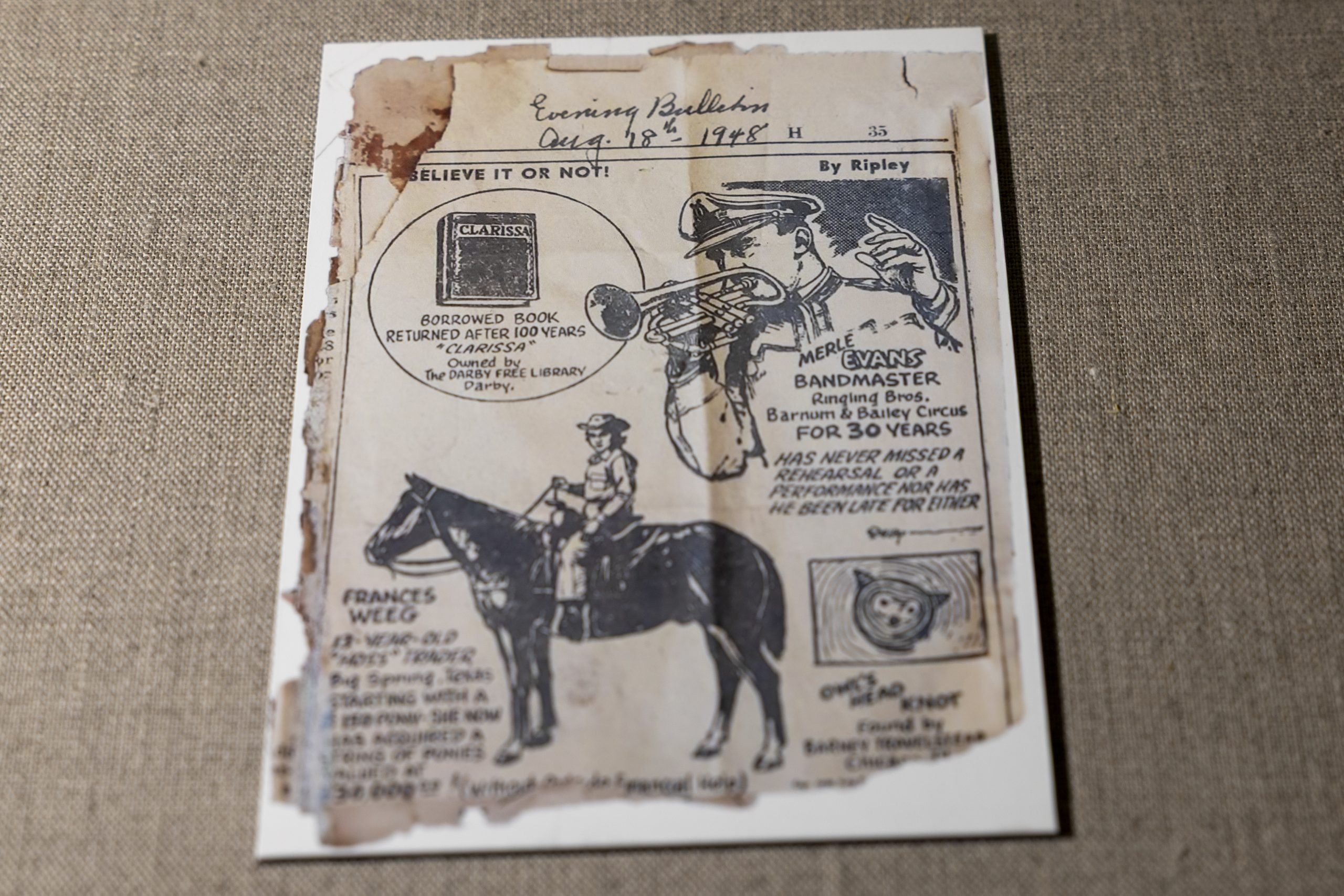
    The local paper purportedly caught wind of the story, and on Aug. 18, 1948, the tale was featured in the Ripley’s Believe It or Not! panel and syndicated in over 750 newspapers around the world.

    “BORROWED BOOK RETURNED AFTER 100 YEARS,” the Ripley‘s panel declared.

    The “Ripley’s Believe It or Not” clipping about the century-overdue volume of “Clarissa” inside the Darby Free Library. Aidan T. Gallo / Staff Photographer

    The famed book was volume four of Clarissa, a 1748 novel by Samuel Richardson that follows the trials and tribulations of Clarissa Harlowe, a young woman who flees home with a charming but untrustworthy man, Robert Lovelace. The book, considered controversial by many at the time, is written largely in the form of letters between Clarissa and Robert Lovelace and is thought to be an early great psychological novel, exploring the characters’ inner lives and the complex themes of gender, power, and freedom. Clarissa spans seven to eight volumes and has a word count of nearly one million.

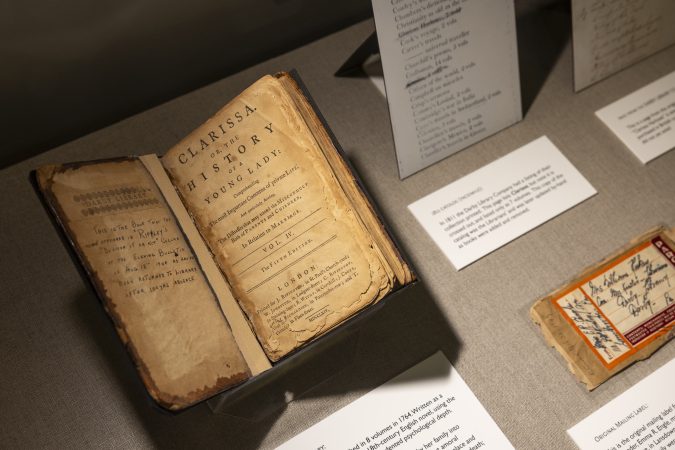
    The Darby Free Library’s Emily Finigan was sorting through the library’s collection a few years ago when she came across the famed overdue copy of Clarissa. Finigan found the book inside of a small box adorned with a mailing label. Attached to the mailing label was the Ripley’s clip, and inside the book was an inscription: “This is the book that the incident appeared in ‘Ripley’s Believe It or Not’ column of the Evening Bulletin of Aug. 18th, 1948 as having been returned to library after 100 yrs absence.”

    Finigan wears a lot of hats at the library, including fundraising, volunteer work, and, with her husband, managing the library building’s restoration.

    Finding Clarissa piqued her interest, and she began to wonder if she could use archival research to uncover the identity of the borrower who first checked out the 100-year overdue book.

    Yet a quest to identify the original borrower of volume four of Clarissa sent Finigan down a rabbit hole that left her with more questions than answers: Was Clarissa really a century-old overdue book? And, if not, what really happened to the library’s copy of the 1700s novel?

    The “Clarissa” copy inside the Darby Free Library.Aidan T. Gallo / Staff Photographer

    The Darby Free Library was founded in March 1743 by a group of Quaker farmers and merchants looking to organize their village’s first cultural institution. The group, made up of 29 townsmen, threw together money to purchase 45 original books, many of which are on display in the library today.

    In 1826, the library offered up borrowing rights to anyone who could pay three pounds. In 1898, it became a public library. Nearly a century later, in 1984, the Darby Free Library was adopted into the Delaware County Libraries system.

    According to records, the Darby Free Library acquired all eight volumes of Clarissa in 1769 for 2 pounds, 6 shillings, and 2 pence.

    By 1811, a catalog of the library’s collection only counted seven of eight volumes, a sign that one may have already gone missing, or had been borrowed by a reader.

    Though the legend of the 100-year overdue volume of Clarissa involved a woman walking into the library to return the book, the copy, Finigan noted, had seemingly been mailed to the library, not returned by a mysterious visitor. So who mailed the package?

    The original shipping label identified the sender as Emma Engle, a local librarian who mailed the book from her sister Josephine’s home in Landsdowne. Emma and Josephine’s parents and grandparents weren’t local to the area, according to archival research, making it unlikely that Emma Engle had returned her own grandfather’s book, as the legend went.

    Darby Mayor Joar Dahn looks on while Liz McDermott, a conservation technician, handles a centuries-old copy of “Clarissa” at the Darby Free Library.Aidan T. Gallo / Staff Photographer

    Josephine Engle, however, was married to a man named Isaac Rhoads, a member of the Darby Quaker Meeting, which was affiliated with the library. Isaac’s mother, Mary Hibberd Rhoads, was listed as a library member, and his grandfather, Samuel Rhoads, would have been alive around the time Clarissa was taken out of the library.

    So was Engle mailing back a long-lost book once taken out, and never returned, by her brother-in-law’s grandfather? That’s one possibility, Finigan said.

    Another possibility? The Darby Free Library may have sold off Clarissa in an attempt to clear its shelves of controversial material, and one volume made its way back to the library through Engle.

    In 1826, the same year the library opened borrowing rights to the community, it appointed a committee to make a list of books that it “may be expedient … to dispose of.” When they met again the following year, a number of titles had made the chopping block, including the seven accounted-for volumes of Clarissa.

    Why would the Darby Free Library want to sell Clarissa, among other books? Finigan has a few ideas. In the eighteenth and nineteen centuries, some saw novels as frivolous, distracting, and tempting readers toward vanity. Some novels with more sinister or self-interested characters may have been viewed as at-odds with the values of honesty and sincerity held by Darby’s Quaker residents, Finigan said.

    The Darby Free Library in Delaware County, founded in 1743, is currently undergoing renovations. Aidan T. Gallo / Staff Photographer

    So, was the missing volume of Clarissa actually removed from the library in the early 1800s for objectionable content? That would be one explanation as to why seven, not eight, volumes were listed for sale in 1827.

    Was volume four actually sold with the rest of the collection in 1827 before eventually making it back to the library through Emma Engle? Could the list of seven, and not eight, volumes have been an incorrect count?

    Or could it have truly been an overdue book, taken out by a relative of Emma Engle’s and returned over 100 years later?

    Finigan says the mystery remains, and may never be revealed. But curious minds can view the famed “century overdue” copy of Clarissa at the Darby Free Library from July 10 through Aug. 1 during normal library hours.

    “Treasures from the Darby Library: THE 100-YEAR OVERDUE BOOK”

    📍 Darby Free Library, 📅 through Aug. 1, 🌐 darbylibrary.org/programs

    This suburban content is produced with support from the Leslie Miller and Richard Worley Foundation and The Lenfest Institute for Journalism. Editorial content is created independently of the project donors. Gifts to support The Inquirer’s high-impact journalism can be made at inquirer.com/donate. A list of Lenfest Institute donors can be found at lenfestinstitute.org/supporters.

  • Bingo was legalized in Pennsylvania on this week in Philly history

    Bingo was legalized in Pennsylvania on this week in Philly history

    The stampers were runnin’ wild, and state officials wanted their piece.

    So it was time to crack down on the ping-pong-ball pullers.

    On July 10, 1981, Republican Pennsylvania Gov. Dick Thornburgh signed the Bingo Law.

    The bill, which took effect on Nov. 9 of that year, would ensure the popular game remained a tool of charitable groups and remained small-stakes operations. This new law limited prize money to $250 (about $920 today) per game, $2,000 (about $7,300 today) for a so-called jackpot game, and $4,000 (about $14,700 today) in total for any one day.

    The bill also specified that only nonprofits that had been existence for at least two years could host the games, and that they could do so no more than twice a week.

    Traditionally, bingo games were put on by charitable associations — think church groups and senior centers — that were legitimate nonprofits. Still, it was a prohibited form of gambling, and law enforcement across the state chose to ignore this fact and instead allowed the parlor game to thrive.

    The bill, Thornburgh told The Inquirer in 1981, would “end this hypocrisy.”

    He added, however, that he was not “convinced that this is the absolute, ideal bill,” and that his administration would continue working with the General Assembly “to ensure that some of the loopholes that have been alleged to exist are addressed.”

    The bill-pushers were pumped. Legalizing bingo, they told anyone who would listen, would protect charitable foundations, civic groups, and legitimate nonprofits from what an Inquirer reporter called “unscrupulous bingo entrepreneurs.” It would, theoretically, keep those groups from having to pay taxes on the raised money, and keep it out of organized crime’s reach.

    But the bingo bill had noisy detractors, like future Philly Mayor Ed Rendell, then the district attorney, who astutely pointed out that the bill would allow anyone to organize a nonprofit and run bingo games. The bill did not provide much enforcement infrastructure, either.

    Today, bingo licenses run $100 for a year, or $15 for a three-day stint.

    The state only takes check or money order.

  • One year of inspections at Jefferson Einstein Philadelphia Hospital: April 2025 — March 2026

    One year of inspections at Jefferson Einstein Philadelphia Hospital: April 2025 — March 2026

    Jefferson Einstein Philadelphia Hospital was cited by the Pennsylvania Department of Health for maintenance and sanitation issues in March.

    The incident was one of nine times inspectors visited the hospital, formerly known as Einstein Medical Center, to investigate potential safety problems.

    Here’s a look at the publicly available details:

    • April 15, 2025: Inspectors came to investigate a complaint but found the hospital was in compliance. Complaint details are not made public when inspectors determine it was unfounded.
    • June 3: Inspectors came to investigate a complaint but found the hospital was in compliance.
    • June 18: Inspectors came to investigate a complaint but found the hospital was in compliance.
    • July 30: Inspectors came to investigate a complaint but found the hospital was in compliance.
    • Sept. 30: Inspectors came to investigate a complaint but found the hospital was in compliance.
    • Nov. 19: Inspectors came to investigate a complaint but found the hospital was in compliance.
    • Jan. 23, 2026: Inspectors came to investigate a complaint but found the hospital was in compliance.
    • March 11: Inspectors visited for a mental health survey and found the hospital was in compliance.
    • March 11: Inspectors cited the hospital for sanitation issues in several rooms, including tacky floor stains, debris left in trash cans, and a dark substance in the corners of a shower stall. Inspectors also found the hospital had not installed sloped safety coverings for medical gas and vacuum valves on the wall above the bed in four patient rooms. Without the coverings, the exposed valves posed a ligature risk, meaning a patient could use the edges to harm themselves. Hospital administrators agreed to install valve covers and retrained staff on cleaning procedures.