Jimmy Rollins, Chase Utley, Ryan Howard, and Cole Hamels — the core of one of the greatest eras in Phillies history — will record a live podcast on Tuesday at All-Star Village at the Convention Center.
The recording will be an episode of Rollins and Howard’s “6-1-1 Podcast,” which is produced by Major League Baseball. Fans attending All-Star Village on Tuesday will be able to attend the hourlong live show, which begins at 10:30 a.m. Rollins and Howard launched their podcast in 2024 and have been joined this year by Freddie Freeman, Darryl Strawberry, and rapper Raekwon of the Wu-Tang Clan.
“That’s big bro, right there,” Howard said of Rollins. “Jimmy took me into his house when I first came up. He showed me the ropes and showed me what it’s like to be a big leaguer. It was always natural with Jimmy and us being ourselves around each other.”
Howard said Rollins was a good landlord as he didn’t charge him rent after he moved in during the end of the 2004 season. Rollins did the same a season later for Shane Victorino.
“We kept it clean,” Howard said. “Despite what he might try to tell you about the ‘Dishgate.’ He’ll try to talk about me not cleaning up dishes and stuff like that. I beg to differ. He probably had the cleanest dishes when I was there.”
Howard said the Phillies from his era remain close years later because they always cared about more than what happened on the field. The four players many symbolized from those years will be together on Tuesday.
“That’s what gave such a great bond,” Howard said. “We still have a text chain now where we update each other and try to see about getting together for a golf trip. It was a great time. It was a fun time.”
America’s current plight was nailed recently in an analysis by the Harvard Kennedy School’s Jeffrey Frankel, who dedicated an entire paragraph to the notorious despot who was bankrupting the world’s greatest superpower, “building luxurious villas and hosting huge parties.”
Of course, you all know the Harvard scholar was writing here about the Roman emperor Caligula, who ruled the ancient regime during the tumultuous four years from 37 A.D. to 41 A.D., and whose obsessions with large public works, humiliating his political enemies, self-deification, and perversion have sparked two millennia of speculation about his cognitive state.
Why, yes, this does all sound very familiar. Donald Trump has never pushed his favorite horse for a top government position — as Caligula is said to have done with his trusted steed Incitatus — but he did send Pete Hegseth to the Pentagon, which is close enough. Professor Frankel’s riff on the notorious Roman is found in a February essay about Trump, “Caligula Reincarnated,” in which he argues that Trump’s “bizarre words and actions” are reaching the same depths of irrationality.
I agree, and it’s important to note that in the five months since that essay, there’s a new parallel between Caligula’s doomed and dangerous reign and the 47th American president, and it’s becoming a huge danger to civil liberties here at home and to peace abroad: fear of assassination and the paranoia that flows from that.
The last months of Caligula’s reign were marked by his mental deterioration and his panic that the many enemies he’d made in a short time on the throne — the once-allied lawmakers he’d publicly humiliated, or the political enemies that he’d prosecuted — would attempt to murder him. The emperor accelerated the most repressive aspects of his regime, even as he schemed to move the seat of power to Alexandria for his own safety.
In recent days, Trump has begun wobbling down this same bumpy, ancient Appian Way. It’s been reported that a Trump murder threat by Iran, which has seen a top general and its supreme leader killed on orders from the American president or his allies, was relayed to the White House by Israeli intelligence. That prompted a remarkable public moment in which the U.S. leader mused about his own death.
“I speak about it a lot because the life of a president is very dangerous,” Trump told reporters during a NATO summit in Ankara, Turkey. “I don’t really care, because I’m doing my job … I like being No. 1 on TikTok better. But I’m No. 1 on the list for killing,” which sounds, oddly, like a boast from a TV reality star still obsessed with his ratings.
There are several things to unpack here. First, you probably know this truism: Just because you’re paranoid doesn’t mean there’s not someone who’s out to get you. Famously, Caligula was assassinated (as were his wife and young daughter) just before his planned move to Alexandria by his own trusted guards.
Similarly, Trump has been the subject of at least four assassination attempts, including one at a 2024 Butler, Pa., campaign rally in which shots apparently grazed his ear and killed an attendee. This unfortunate situation has felt inevitable as Trump’s toxic, divisive, and often hateful rhetoric lights a spark under a nation where violence was already as American as cherry pie.
But political violence is morally abhorrent and never solves anything. The healing of America from the bad place we’re in right now depends on Trump’s continued health, so he can someday be brought to justice for his corruption and his crimes against humanity. A Trump assassination wouldn’t be just wrong, but it would trigger a wave of repression under JD Vance that would also drive the final nail in the coffin of U.S. democracy.
Then-presidential candidate Donald Trump is surrounded by U.S. Secret Service agents after an assassination attempt at a campaign rally in Butler, Pa., on July 13, 2024.Evan Vucci
Still, the actual danger to Trump’s life — which the Secret Service learned of through a tip from some of the same Israeli intelligence officials who worked to goad the U.S. into this botched Iran war in the first place — remains hypothetical. The threat to the liberty of all Americans from the president’s spiraling paranoia is real and already underway.
To begin with, Trump has already used the assassination tip as an excuse to ratchet up tensions in the Persian Gulf, where the fragile ceasefire between the United States and Iran’s new hard-line rulers had already imploded — bringing new death and destruction while dragging down the world economy. The president, who sounded blasé about his own mortality on Wednesday, has changed his tune.
Trump wrote Saturday in a Truth Social post that “1,000 missiles are locked and loaded” if he is killed by Iranian agents, adding, “Orders have already been given, and the US Military is ready, willing, and able, for a one-year period of time, subject to extension, to completely decimate and destroy all areas of Iran.” There are many reasons here to worry — not only over the escalation of a war that was pointless from Day One, but also over the likelihood that Iran will be blamed if anything happens to Trump, regardless of who is actually responsible.
But the assassination paranoia is coming out in other, insidious ways. Alarm bells went off this week when Trump flew to the summit in Turkey in his new Air Force One — the $400 million “gift” airliner from Qatar that U.S. taxpayers spent hundreds of millions of dollars to upgrade, even as Trump plans to keep it for his presidential foundation in 2029 — but ditched it to fly home in an older Air Force model.
The New York Times put five top reporters on this story because Americans deserve an explanation of how and why our tax dollars were spent on this project — exactly the kind of free-press accountability the founders envisioned when drafting the First Amendment. Their sources told them that despite the massive expenditures, on top of the initial corruption, the former Qatari jet lacked key defensive features like advanced anti-missile capabilities — which explains why Trump switched planes after the Iranian assassination tip was delivered.
Staff lay a carpet on the tarmac before President Donald Trump exits Air Force One upon arriving for the NATO summit in Ankara, Turkey, on Tuesday.Alex Brandon
The White House was livid at the article, which it seemed to interpret not as accountability journalism but as a breach of security. Embattled FBI Director Kash Patel was yanked off an airport tarmac where he was flying to Chicago to mainly watch his girlfriend in a country music festival and was summoned for urgent meetings.
Late Friday, federal agents banged on the doors of several Times reporters and delivered subpoenas demanding that they testify before a grand jury on Wednesday, in what appears to be a pivot point for America’s already shrinking freedom of the press under a Trump regime.
“The appearance of federal law enforcement agents on the doorstep of news reporters should shock the conscience of any American who believes in the Constitution and the press freedom it protects,” David McCraw, the Times’ lead attorney, said.
Let’s be clear: Trump is using these assassination fears — real or perceived — to drastically increase his assault on the civil liberties of American citizens, and this is likely to only get worse in the coming days.
While the FBI was out badgering journalists, workers back at the White House were erecting scaffolding on the North Portico of the presidential residence, part of an apparent security upgrade that is supposed to last for months. This is in addition to the failed push for $1 billion in taxpayer money to build a massive underground bunker beneath his new ballroom, meant to replace the already demolished East Wing.
Somewhere underneath all of that, Caligula is surely looking up from his fiery final repose with a knowing smile of recognition.
Scaffolding is visible under a covering with an image of the North Portico over the space as it is renovated at the White House in Washington on Thursday.
The madness has been a slow train coming, but it’s starting to accelerate and may soon run off the rails. The assassination paranoia is a new layer on top of the president’s late-life obsessions with imposing his physical legacy on the nation’s capital and with clinging to absolute power — and thus forestalling the inevitable probes into his rank criminality — by any means necessary.
It is all moving in the same direction: building the foundation to declare a national emergency, the last refuge of every dictator from Caligula to Adolf Hitler to the strutting strongmen of the 21st century. If, heaven forbid, there is a fifth major assassination attempt against this president, it will surely reignite any smoldering embers of the Nazi’s 1933 Reichstag fire — a justification for the end of civil liberties.
Let’s not sing along to the age of paranoia. The lynchpin of American democracy remains the same as it ever was: the peaceful transfer of power. In the present crisis, that can’t come soon enough.
Philadelphia Mayor Cherelle L. Parker has declared a disaster emergency one day after at least four storms known as microbursts ripped through parts of Philadelphia and Montgomery County, downing trees and power lines and causing electrical outages and road closures.
A disaster emergency declaration allows the city to more quickly mobilize resources, bypass certain regulations, and potentially obtain state or federal assistance.
Parker applauded the work of first responders and city crews, who she said had been working since Saturday afternoon to deal with a storm that tore off roofs and partially collapsed buildings in the city.
“I’m here to say we’re not going anywhere, that we’re going to stay at it,” Parker said at a news conference Sunday afternoon.
Parker and more than a dozen city officials and staff toured the cleanup effort at Malcolm X Park, where they had to carefully walk around a tree with a branch that looked ready to fall off at any moment.
Parker said the city and related entities are investigating 125 downed wires and handling more than 296 tree emergencies similar to that one.
Office of Emergency Management Director Dominick Mireles said the city has received over 100 public reports of damage to personal property, and there were still about 2,500 power outages around Philly as of early Sunday evening.
Susan Blum, and her dog Lucy, look at the downed trees at Malcolm X Park on Sunday, July 12, 2026, in West Philadelphia. On Saturday severe thunderstorms caused damage across the region. “I felt like we were in the middle of a hurricane,” Blum said. “The rain was going sideways.”Monica Herndon / Staff Photographer
Mireles urged people to stay out of areas marked off by caution tape due to the ongoing threat of live electrical wires or trees with dangerous overhanging branches.
Mireles emphasized that the city will not charge for tree removal or other services and to beware of people attempting to take advantage of the situation for money.
Mireles said the disaster emergency declaration will help the city to hire more arborists to remove trees and obtain machinery such as wood chippers.
Parker said the fallen trees will not slow down the city’s “clean and green” efforts to plant trees and beautify neighborhoods. She said she was thankful that the storms did not result in any loss of life.
“It was by the grace of God that we stand here today,” she said.
How can damage be reported?
For immediate hazards, and to address any life-threatening emergencies, call 911. All non-emergency issues in the city should be reported to 311.
People with power outages should call Peco at 1-800-841-4141.
For flooding, contact the Philadelphia Water Department at 215-685-6300.
Parker urged people to check on their neighbors and help one another.
What the damage looked like
In South Philly’s Girard Estates neighborhood, Scott Hutcheon used 311 to request help with a mature tree that had splintered apart and fallen on his 2017 Chrysler minivan.
“I really didn’t hear the branch fall, but I heard the winds howling. They were coming down the street like a freight train,” Hutcheon said Sunday.
The 43-year old electrician and father of four had to keep his kids, who didn’t understand how vicious the winds were, from going out on the porch to get closer to the action.
“I don’t think that I’ve seen winds this strong since Hurricane Sandy,” said Hutcheon, referring to the 2012 tropical storm that deluged the region and much of the East Coast.
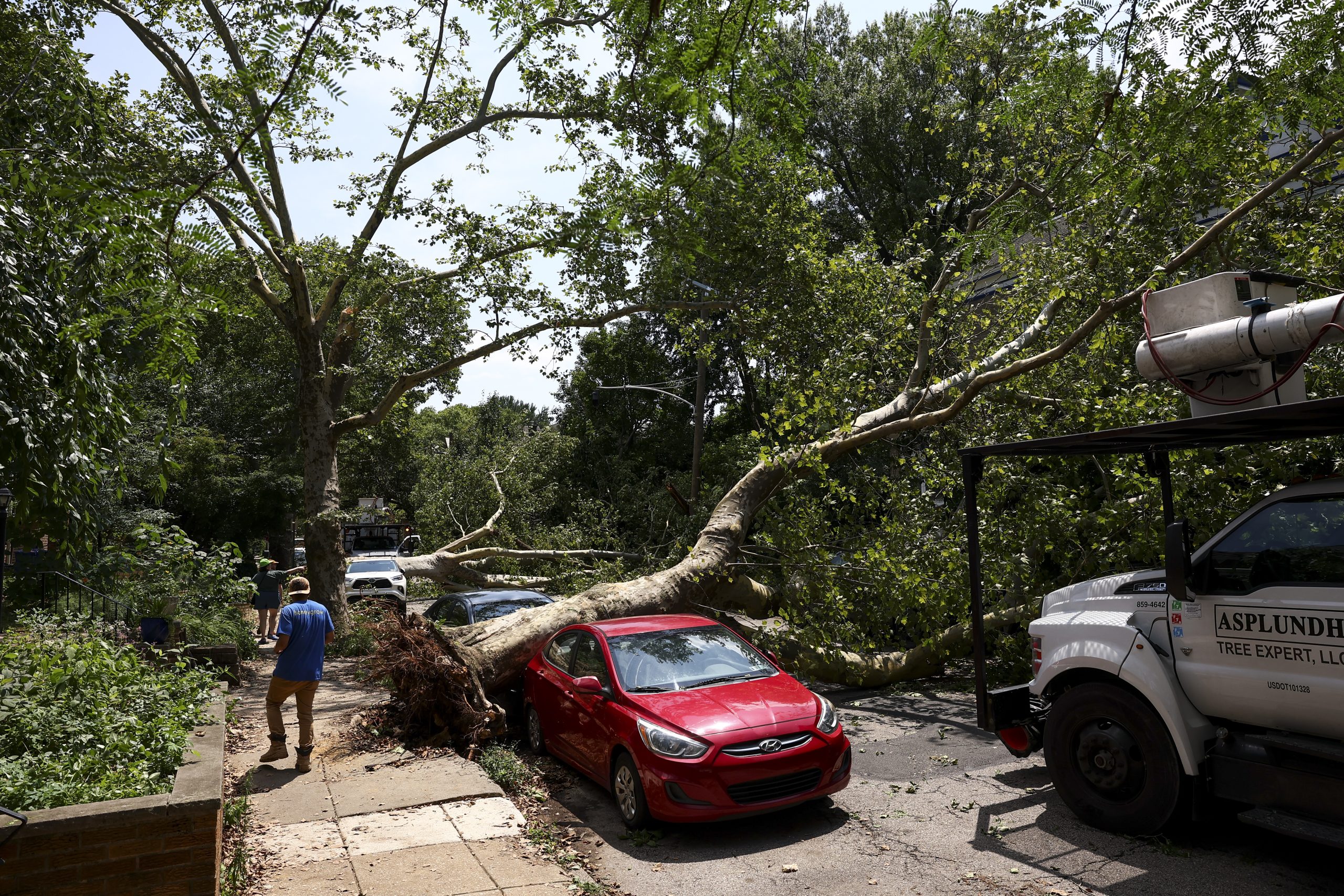
Multiple fallen trees crushed cars on the 4500 block of Larchwood Avenue on Sunday, July 12, 2026, in West Philadelphia. On Saturday severe thunderstorms caused damage across the region.Monica Herndon / Staff Photographer
Hutcheon said he hopes the tree is removed soon because 19th Street is a bus route, but he understood that workers had to address another tree on nearby Colorado Avenue first. That one had fallen on a house, he said.
His neighbor, Joanne Podagrosi, noted that the storm felled two trees on their block, as well as a large bough of branches. The debris lay on the street late Sunday morning, wreathed by smaller leaves and branches, while police tape kept cars from turning down the street.
“It was just a blur of rain,” said Podagrosi. She said she’s lived on the street 22 years, “and it’s the worst we’ve ever seen.”
What is a microburst?
At least four microbursts hit the region, the National Weather Service (NWS) said Saturday. The first hit Lower Merion in Montgomery County. Subsequent microbursts landed in Northeast Philly, West Philly, and South Philly.
“Microbursts are where during a thunderstorm, we see a rapid increase in the updraft, and then it ultimately stops, and the whole mass of the storm goes down, and that’s how you get those very strong winds,” said NWS meteorologist Ray Martin. “As they say, what goes up, must come down.”
City emergency management officials said winds reached up to 70 mph.
Broken plastic glasses from the Lemon Drop Festival litter the ground at Malcolm X Park on Sunday, July 12, 2026, in West Philadelphia. On Saturday severe thunderstorms caused damage across the region.Monica Herndon / Staff Photographer
Philadelphia Police Commissioner Kevin Bethel said Saturday that the city’s 911 dispatchers fielded 3,000 calls during a one-hour period at the height of the storm.
A Philadelphia Housing Authority (PHA) property on Vine Street near 55th in West Philadelphia had part of its roof blown off during the storm. Eleven units in the building were affected, officials said, and residents were relocated to nearby hotels.
Those displaced residents will be moved into new PHA units on Monday while repairs are completed, according to PHA president Kelvin A. Jeremiah.
Elsewhere in the city, at least two buildings partially collapsed due to the storm: a vacant property at 24th Street near Washington Avenue, and another building in West Philadelphia on Lansdowne Avenue near 56th Street.
Slightly fewer than 7,000 Peco customers remained without power Sunday at 4:30 p.m., down from 34,000 Saturday evening, according to the Peco outage tracker. Most of the outages were concentrated in West Philly and Montgomery County.
The damage was evident to anyone walking or driving around the city.
Trees were ripped from the squares of dirt where they’d grown for decades and lay toppled on sidewalks and roadways. Debris from drywall or similar construction materials was scattered on the Girard Point Bridge linking South and West Philly.
At the Wawa on Bartram Avenue, guests tugged on a locked door and peered inside before seeing the handwritten signs turning them away: “Power outage. System down.”
Just a block away, the traffic light was blinking red, leaving drivers to move through the intersection on their own.
At the edge of Yeadon Borough, a downed tree had dragged an electrical line with it. Cars swerved around both. All along Cobbs Creek Parkway in West Philly, drivers faced fallen trees and road closures.
Signage on Doro Bet notes that they are closed due to the power outage on Sunday, July 12, 2026, in West Philadelphia. On Saturday severe thunderstorms caused damage across the region.Monica Herndon / Staff Photographer
Lower Merion Township was one of the worst-hit places, and its leadership declared a state of emergency Saturday afternoon.
The disaster declaration has since been lifted, but “at least 55 township streets are still blocked or partially blocked with trees,” the township said.
Resident Gigi Moffat said one upshot is that the disaster brought people together. In her neighborhood, people were out cleaning up, checking on neighbors, and offering people coffee.
“Everyone stayed really positive, which is great,” she said.
Michelle “MiMi” Gravley changed addresses frequently during her childhood in the 1990s, but rarely with a moving truck.
With her belongings in boxes and plastic bags, she would often find herself lodging at others’ houses in rooms her single mother could afford to rent. So it meant the world to Gravley, herself a single mother, last fall when she bought her first house, a rowhouse in North Philadelphia.
Gravley, 38, is no longer battling housing instability. But she has spent much of her adult life poor, including nearly two decades straight of government assistance, and wants a different fate for her three children. So she’s looking at wealth — specifically her house and her high-yield savings accounts — as something that can help her children avoid poverty as adults.
“I just want them to be OK,” Gravley told me, referring to her daughter, Buttons, 17, and her sons, Chippy, 14, and Boots, 11. “And when they have their kids, their kids is OK. And just, just breaking up generational curses.”
Gravley is one of the parents I spoke with recently in the Philadelphia area who wants to help their children build wealth to break the cycle of poverty in their families. Their goal is to bequeath something — whether it be modest savings or a piece of real estate — to help counter the pull of intergenerational poverty.
They face long odds: Only 16% of children who spend at least half their childhood poor go on to be economically successful, one study found. But there are emerging ideas and policies designed for children that some believe could improve those odds.
I’ve been a business reporter for more than a decade, with a keen interest in how wealth is built and deployed. I’ve had conversations with people from across the economic spectrum, from workers earning minimum wage to C-suite executives and billionaires. I closely follow developments about wealth and personal finance. And lately, I’ve been noticing growing momentum and innovation around wealth-building policies for children — some of which could impact the children or grandchildren of people like Gravley.
In my reporting, two relatively new wealth-building programs stand out. The first is baby bonds, which are government-run trust funds designed to benefit poor children. The other program is Trump Accounts, which are private investment accounts available to all children that allow nonprofits, philanthropic groups, and other entities to target contributions at low-income zip codes. Each has its pros and cons.
Because the creation of baby bonds and Trump Accounts are relatively recent developments (Connecticut approved the first statewide baby bond program in 2021; Trump Accounts were launched this year), there aren’t yet any long-term studies that directly assess their impact on poor populations. But advocates of early wealth accounts, as they are often called, point to supporting evidence from similar initiatives, including Education Savings Accounts. They also argue that structural changes in the economy necessitate a new kind of social contract with America’s young people.
Of her children’s financial future, MiMi Gravley says, “I just want them to be OK.”Aidan T. Gallo / Staff Photographer
“Younger generations face economic headwinds that older generations have not — student loans, unaffordability of housing, starting a family, probably declining Social Security benefits,” said Ray Boshara, a senior policy adviser with the Aspen Institute and Washington University in St. Louis who helped design the framing for Trump Accounts and a similar precursor plan by former Sen. Bob Casey, 401Kids.
He added: “They face a transformed economy. So part of the real purpose of Trump Accounts, I think, is … to give them start-up capital at age 18 to counter these economic headwinds.”
Gaining steam
Across the country, efforts rooted in baby bonds or Trump Accounts are either active, forthcoming, or undergoing serious consideration.
The framework for baby bonds was proposed in a 2010 paper by Darrick Hamilton, founding director of the Institute of Race, Power and the Political Economy at the New School, and William Darity Jr., an economist and social scientist at Howard University and Duke University.
Connecticut launched its CT Baby Bonds program in 2023. It automatically enrolls children whose births are covered by Medicaid. The idea is straightforward enough: When participants turn 18 and complete a financial literacy course, they can claim at least a five-figure sum that can only be used for specified wealth-buildingactivities, such as buying a home or starting a business.
Trump Accounts, also known as 530A accounts, were signed into law last year and took effect this month. Children who are enrolled in the program by their parents could potentially receive $1,000 from the U.S. government. When the enrollee turns 18, the account becomes a traditional IRA and can be used for a variety of purposes, though the tax consequences are lower if used for postsecondary education, a first home, or retirement.
Unlike baby bonds, Trump Accounts were not specifically designed for poor children. And one criticism is that wealthier families will likely contribute more than poor families, which would worsen wealth inequality. But what’s notable about them is that they allow third parties such as employers or philanthropists to contribute cash or stock directly to children in low-income neighborhoods.
For instance, the Dell family pledged funds for every American child in specific zip codes, while the Dalio family and financier Brad Gerstner pledged funds to children in Connecticut and in Indiana, respectively.
Attention in the Keystone State
It’s still early, but for now, the idea of helping poor children build a foundation of capital for the future appears to be drawing bipartisan interest. And in Pennsylvania, policymakers have started paying attention.
“Baby bonds have been a topic of a lot of focus because we all want to make sure that we are creating long-term economic mobility and really breaking the cycles of financial insecurity early,” said State Rep. Morgan Cephas, a Democrat whose district covers West Philadelphia. “So these are some models that we’ve been looking at … and are absolutely looking to do more.”
State Rep. Martina White, a Republican whose district covers Northeast Philadelphia, said Trump Accounts can be a “great tool for working families” and planned to look further into the concept of baby bonds.
Her initial preference, she said, would be to model baby bonds like a college endowment, in which the funding source for the program would come from interest or investment earnings, as opposed to directly from taxpayer dollars.
“I think that the fact that more legislative bodies and governments are looking into ways that we can provide the tools for working families to build their wealth — I think that’s phenomenal, and we should be doing more of that,” White said. “But also helping make sure that government is getting out of the way, too.”
Democratic State Rep. Morgan Cephas said baby bonds have been a focal point for her party “because we all want to make sure that we are creating long-term economic mobility.”Tom Gralish / Staff Photographer
Although baby bonds haven’t been proposed in Pennsylvania’s legislature, the state does have an early wealth initiative through its Keystone Scholars program, which puts $100 into an account that Pennsylvania students can use toward their education costs.
In Philadelphia, there aren’t any initiatives specifically targeting wealth building for children. But there are programs that aim to advance overall wealth access and accumulation. One of the latest is Philly Saves, which, upon implementation, would give workers a way to save for retirement if their current jobs don’t offer retirement plans.
Last month, Sens. John Fetterman and Dave McCormick made a joint appearance in Nicetown, where they urged parents to sign up for Trump Accounts. Fetterman seemed to anticipate that some listeners might be dubious about the program and presume it is politically partisan because of its name.
“Do not fall into that political trap,” Fetterman said. “This isn’t some radical thing. … Do this for your child.”
Even if early wealth initiatives arrive soon in Pennsylvania, it may be too late to have a big impact on older children because the accounts need time to grow.
For Gravley, that means early wealth policies could impact her children but will likely yield larger sums for her future grandchildren. Gravley said she welcomes them as long as there’s some kind of financial literacy involved.
“If you give these children … $10,000 with no instructions, good luck with that,” she said. “It has to be instructions with it, but I think it could be a big stepping stone.”
Darity, the social scientist who helped conceive the idea for baby bonds, said early wealth accounts will have different maximum outcomes based on their design, even if they each grew at 1% above the inflation rate.
For instance, the baby bonds plan he coauthored would turn $60,000 into $72,000 over 18 years at that growth rate (no annual contributions allowed). A federal baby bonds plan proposed by New Jersey Sen. Cory Booker ($1,000 deposit; maximum yearly government contributions of $2,000) would grow to about $41,000 at those terms. For Trump Accounts, a $1,000 deposit and maximum yearly private contributions of $5,000 would grow to $100,000 in 18 years.
While Trump Accounts have the highest growth potential, low-income families who don’t have thousands to contribute annually won’t have “a transformative sum of money at the end of the 18 years,” Darity said.
Because both programs are still so new, we’re decades away from seeing the results of any long-term studies on the efficacy of baby bonds or Trump Accounts once participants reach adulthood. But research into other programs suggests that external interventions in wealth building can have positive outcomes.
For instance, a long-term study of Oklahoma’s SEED OK program found that newborns who randomly received $1,000 in state funds had, by age 14, higher educational expectations, greater social-emotional development, and more family-contributed savings for college compared with those who didn’t.
A 2015 global study of roughly 10,000 households found that asset interventions — like giving impoverished families an income-producing asset, cash assistance, and skills training — had positive economic outcomes well after the program stopped.
Those findings are part of a growing body of evidence from other asset-building experiments that “already points in a consistent direction,” said William Elliott, founding director of the Center on Assets, Education, and Inclusion at the University of Michigan.
That direction, Elliott said, indicates that early wealth accounts should be a pillar of a new social contract with Americans — especially in an age when higher education debt can stall wealth creation.
“The current policy setup strongly favors those who already have wealth,” Elliott said. “And so you don’t have meritocracy happening. To get there, you can’t just give [people] a job anymore, because there’s a gap between wages and productivity. You also have to give them some wealth to make their effort and ability pay off.”
During an appearance in Nicetown with Sen. Dave McCormick, Sen. John Fetterman urged parents to sign up for child wealth-building accounts.Tom Gralish / Staff Photographer
The landscape in Philadelphia
There are more than 300,000 Philadelphians living below the poverty line, according to Pew Charitable Trusts — that translates to about $33,000 annually for a family of four. While the poverty rate here has declined to 19.7% from 26% over the past decade, Philadelphia still has the second-highest poverty rate among large U.S. cities.
Other figures show the prevalence of low-income households in our city.
Gravley, the only worker in her household of four, makes about $40,000 annually.
Raising Pennsylvania’s minimum wage above $7.25 may help workers locally; all of the commonwealth’s neighboring states have higher wage floors. But it could also be untenable for some small businesses.
For Gravley, her home is an asset that could help her family long term, but there’s little it can do to improve her economic prospects today. Despite holding three degrees — an associate in culinary arts, an associate in early childhood education, and a bachelor’s degree in leadership and organizational change — she still regularly grapples with the challenge of making ends meet.
As a program coordinator at Strawberry Mansion High School, Gravley said her expenses are usually about $2,200 per month, which means she typically has about $100 per month for the high-yield savings accounts she manages for herself and her children.
At one point she invested in the stock market but pulled out because she didn’t understand it.
It’s been this way for more than a decade for Gravley. As a recipient of Supplemental Nutrition Assistance Program and Medicaid benefits, she is making enough to cover needs, but financial security and financial growth for her family appear largely out of reach.
“[Welfare] helps, but it’s nothing programmed to get me out of the food stamp thing. Because you tell me to get the degrees and get the better job, and I’m trying to do that, or I did that, and it’s still not enough money. So where is the money?”
Jared Council is a business journalist based in Philadelphia. He was part of a team at the Wall Street Journal recognized as a finalist for the 2022 Pulitzer Prize in explanatory reporting for a series about the 1921 Tulsa Massacre. He is currently a program manager at Every Voice, Every Vote, a civic information and engagement program at the Lenfest Institute for Journalism.
The Inquirer is one of two dozen news organizations powering the Philadelphia Journalism Collaborative. Follow us at @PHLJournoCollab. This article is part of a national initiative exploring how geography, policy, and local conditions influence access to opportunity. Find more stories at economicopportunitylab.com.
When dealing with President Donald Trump at a NATO summit, the European allies resemble desperate adults hovering around an unruly child who is clutching fireworks and matches.
So it was a relief that, despite his usual juvenile tantrums and threats at this week’s Ankara, Turkey, gathering — and his erratic behavior toward Iran — the president mostly kept his powder dry.
Indeed, POTUS had an unprecedented adult moment with Ukraine’s President Volodymyr Zelensky. Trump finally recognized Kyiv’s stunning technological prowess in the production of drones that can now reach deep into Russia (some adviser must finally have convinced him that Ukraine had winning cards the United States lacked).
Trump actually heaped praise on Zelensky, in stark contrast to his shameful efforts in the past to humiliate the Ukrainian leader, saying he was “courageous” and had done “an amazing job” on the battlefield.
The president finally granted Zelensky’s years-old request to let Kyiv produce American Patriot missiles — the only available Western weapons capable of stopping the ballistic missiles Russia is using against Ukraine.
However, that’s the end of the good news.
The U.S. president’s ill-informed, incompetent, and, frankly, juvenile behavior on foreign policy, combined with his visible aging, presents a clear and growing danger to U.S. security. With his garbled and error-filled speech, his omnipresent ego, and his constantly shifting positions, he has become a global embarrassment.
Trump’s ineptitude helps our adversaries, from Tehran to Moscow to Beijing to Pyongyang.
Nothing shows this more clearly than Trump’s belated shift on Ukraine. Mind you, I offer two cheers for the dawning light, but how can anyone count on follow-through when the president changes his positions like he changes shirts?
Even if Trump keeps his word on the licensing of Patriot technology, setting up the complex production process is a lengthy operation that would probably take at least a couple of years (he hasn’t even bothered yet to notify the U.S. producers of Patriot interceptors, RTX and Lockheed Martin).
Similar licensing of Patriot missiles was only granted before to Germany and Japan, and it has taken them each years to scale up. I am confident that savvy Ukrainian techies can do so faster. But they need those interceptors right now, when Vladimir Putin is raining down ballistic missiles on Ukrainian cities because he knows they have no defense.
European allies, who need their own Patriots to defend against Russia, are willing to risk giving Kyiv more if the United States will pledge to backfill their needs quickly. Trump has made no such pledge, claiming they are in short supply in the U.S.
That is true, but do you know why? The U.S. and Gulf allies have wasted years’ worth of U.S. production of Patriot interceptors during the Iran war. They used hundreds, possibly thousands, of Patriots that cost $2 million to $4 million each to shoot down $30,000 Iranian drones.
Trump keeps hinting that the U.S. is interested in Ukrainian drone technology, but has still not taken up Zelensky’s offer to trade Ukrainian drone skills and wider joint production in return for Patriots.
POTUS claimed in Ankara that U.S. drone producers are building new factories for interceptors that will be up and running quickly “in the not-too-distant future.”
Bluster, bluster, bluster.
Lockheed, which produces the most advanced interceptor, the PAC3, has publicly announced its goal of producing 2,000 of these marvels a year … by 2030. That is a tiny fraction of what is needed.
Yet, this week, still short of drones and drone interceptors for the U.S. military, Trump announced at the Ankara summit that the ceasefire with Iran is ending. He appears to be plunging into a renewal of the Iran war. He is stuck in a trap of his own making because he relied only on his gut before entering the conflict.
POTUS never imagined that Tehran would respond to his attack alongside Israel by closing the Strait of Hormuz, even though he was warned by his military and civilian advisers. Then he claimed, totally contrary to the facts, that he had concluded a “peace deal” and started paying off the ayatollahs with billions in advance by letting them sell oil again. Now he is threatening a new war, which he clearly doesn’t want and for which he doesn’t have the proper weapons.
Trump knows he cannot win from the air. And, unless he is ready to invade Iran or occupy parts of that country indefinitely — which would be a disaster — he has trapped America into accepting some form of Iranian control over the strait.
That is why, in Ankara, with the rage of a spoiled child, Trump cursed the Iranians (whom he had praised only weeks ago) and pouted: “I’m not sure I want to make a deal. Let’s just finish the job.” This is not the language of a leader. This is the insincere threat of a 6-year-old throwing food at the wall to see if it sticks.
What is so terrifying about Trump is not his threats, which our allies and adversaries alike now tend to ignore, but his total incapacity to think in strategic terms. He talks big — “Iran cannot have a nuclear weapon” — but has no strategy on how to achieve this.
And even when recognizing Ukraine’s achievements, he insisted that “President Putin wants [this war] to end. I will tell you that very strongly.” If he really believes this, at this late date, he definitely lives in an infantile fantasy world.
As a result, there is a huge risk that he will drag America into an uglier quagmire in Iran.
And he will throw away the chance that he, himself, helped create by pushing Europe to rearm: the opportunity to work with a stronger Europe and bolster NATO’s role positively to counter Russia, China, and Iran.
Lost in fantasy, he drives America’s allies away.
Ukraine will try to stay on his good side, but will proceed to revolutionize unmanned warfare in cooperation with Europe, and possibly, eventually, with Washington.
And U.S. adversaries like Iran will choose whether to take advantage of Trump’s childishness or try to assassinate him in revenge, helped by his own fecklessness. Fear of that latter possibility was what made the Secret Service insist Trump fly back from Ankara on the original Air Force One, rather than use one of his vanity projects, the upgraded luxury gift plane from Qatar, which had not been secured sufficiently to protect against possible attack.
Trump had insisted at first on luxury over security. Even when it came to his own safety, the child in him could not be curbed.
Scientist Aaron Bauer gawked at the cat-sized gecko.
The two-foot-long, preserved creature had sat unidentified in a natural-history museum in France for nearly two centuries.
Staring at its huge head and climber’s build, “I sure as heck could recognize that this was a gigantic, unknown species,” he said.
The extinct creature was the largest gecko to ever live, and the first new species Bauer — at the time a PhD student in his 20s — ever discovered and described.
French museum worker Alain Delcourt is pictured holding the giant gecko, which was the first new species of gecko Aaron Bauer ever described.Courtesy of Aaron Bauer
Now a renowned herpetologist at Villanova University, Bauer, 65, has identified 320 new species of reptiles and counting — more than any other living scientist.
Scientists worldwide discover more than 16,000 new species every year, researchers estimate, spanning plants, animals, insects, and other forms of life.
Nicknamed “the Lizard King” by his students, Bauer retired in Mayfrom a 38-year-long teaching career at the university, where he mentored dozens of master’s students in herpetology, the study of reptiles and amphibians.
Aaron Bauer’s former students are hosting a Bauer-fest in honor of his retirement from teaching.Courtesy of Villanova
Some of his discoveries happened much like his first — seeing something in a museum that was “clearly something new,” he said. Others happened through regular travels to Africa, the South Pacific, and Asia.
His longest research project revolves around the original giant gecko he discovered 40 years ago during a 1980s trip to Marseille.
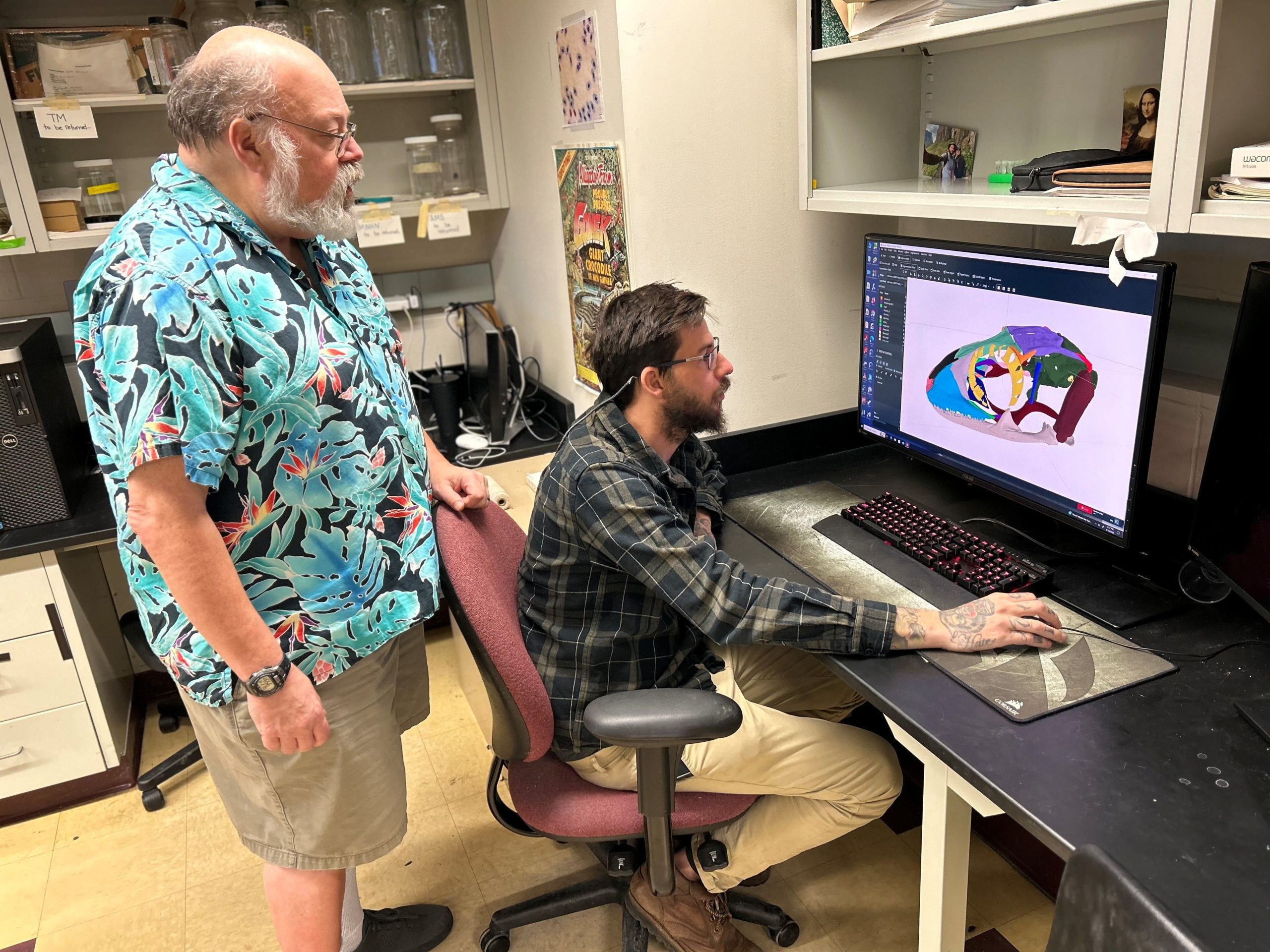
Bauer’s former graduate student, who later became a University of Michigan-Dearborn professor of biology, helped him analyze DNA from the gecko’s leg bone in 2023.
“If I have had a successful career, it’s because I’ve had great students who didn’t just come and go,” Bauer said.
The snazziest snake
Aaron Bauer keeps in touch with his former students. The majority have stayed in herpetology.Courtesy of Villanova
Bauer spent his childhood exploring ponds, fields, and wildlife on the 68-acre Long Island estate where his grandfather was a caretaker.
He decided to become a herpetologist at age 5, after catching “the snazziest snake we have in the northeastern U.S.”
As an 8-year-old captivated by the bright green creature, Bauer typed up lists of all the Latin names of amphibians and reptiles.
He knew he wanted to work with these critters, but not how to make a living from it.
“Nobody in my family had gone to college, so what do I know?” Bauer said.
His path began with studying zoology and history at Michigan State University, where he graduated in 1982.
As aPhD student at the University of California, Berkeley, he specialized in lizards. It was the one species he could not find at the Long Island estate, where frogs, salamanders, turtles, and snakes abounded.
“Everybody wants what they don’t have,” he said.
Geckos, in particular, captivated him with their “weird features,” he said, including toe pads, the ability to climb, and lack of eyelids.
Aaron Bauer holds a container of African House Geckos in the labs at Mendel Hall at Villanova University.TYGER WILLIAMS / Staff Photographer
His research explores the diversity of life and its history:
How does this lizard’s anatomy allow it to be successful? How is it related to the area of the world where it lives, and how did it get there?
In the field
At work, people know Bauer as the guy in Hawaiian shirts and shorts.
He tries not to wear such bright shirts in the field, because “you want to be a little more inconspicuous in the vegetation,” he said.
In these areas, the nearest human could be 50 or 100 miles away.
His team tries to sample from as many places as possible to capture diversity. Some days, they cover hundreds of miles. Other days, they spend a week in one place.
Usually, they identify a new species.
“One of the facts of field work is you don’t know what you’re going to find,” Bauer said.
His team brings nets for frogs, snake sticks for pinning venomous snakes, and equipment to collect tissue samples for DNA analysis. Lizards can be caught by hand.
From these field trips, he has collected enough material to work on for the rest of his life. Still, he said he feels a “physiological urge” to go back, and will continue researching as an emeritus professor.
Aaron Bauer retired from his 38-year-long teaching career at Villanova in May.Courtesy of Villanova
Bauer always reminds his students how lucky they are to go to remote places like northern Namibia, where they may go a week without seeing another person.
“There’s something special about that,” Bauer said. “To go places that most people will never see and don’t know even exist.”
Raising an academic family tree
A group photo of Aaron Bauer, Todd Jackman, and many current and former students at a herpetology meeting at the University of Kansas in 2015.Courtesy of Daniel Paluh
At this week’s national herpetology conference in New Orleans, a special session called “Bauer-fest” will celebrate hiscareer.
“He’s always continued to be a really strong advocate for all of his students,” said Daniel Paluh, an assistant professor at the University of Dayton in Ohio, and one of the former students organizing the event.
Paluh was intimidated by Bauer when he first met him at a conference, before realizing he was “a very friendly, funny, personable person.”
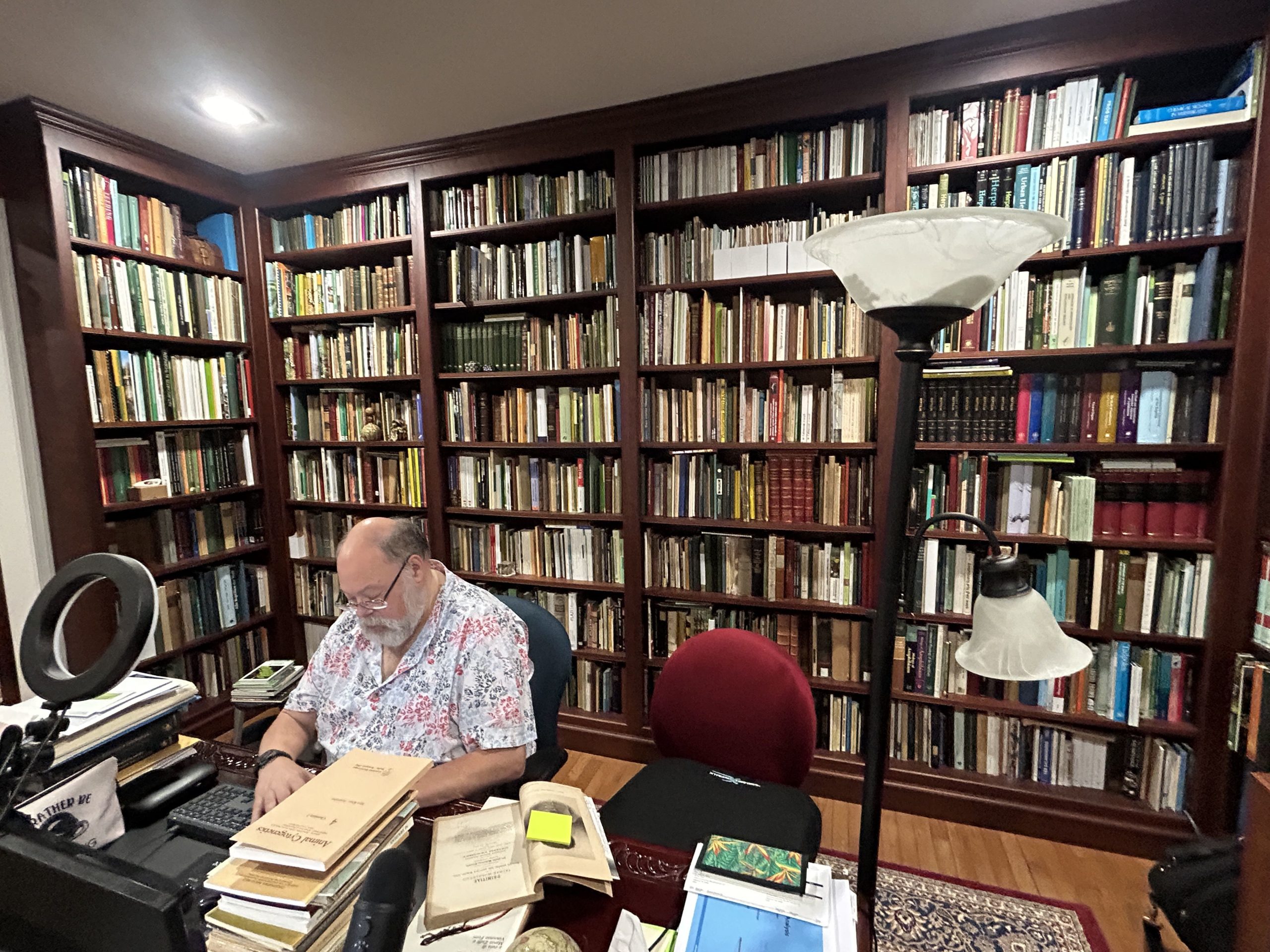
Bauer had an “open-door policy,” Paluh recalled, to help his students with research. That came with access to his personal library — one of the largest collections of books on herpetology in the world and the inspiration for a scene in the 2012 movie The Amazing Spider-Man.
Aaron Bauer’s personal library is one of the largest collections of books on herpetology in the world. It was used as inspiration for a scene in the 2012 movie “The Amazing Spider-Man.”Courtesy of Aaron Bauer
Bauer alsocares about his students’ lives beyond graduation, said his Villanova colleague Todd Jackman, who is organizing a “Bauer-palooza” near the university in September.
About 80% of his former master’s students have stayed in the field, becoming professors in Louisiana and Kentucky, a museum curator in Australia, the head of nature conservancy in southern Angola, and more.
“I’m not crazy about being the center of attention, but I think that’s outweighed by the fact that I’ll have all of these people in one place,” Bauer said.
When Home Appétit moved into a space just off City Avenue in West Philadelphia in 2020, founder and CEO Lee Wallach thought the company would stay five to 10 years.
But given the business’ quick growth, particularly during the pandemic, the company is already “bursting at the seams,” Wallach said. The meal delivery company is moving to East Falls in September, to a former catering facility Wallach bought and is renovating.
Home Appétit, founded in 2013 in Wallach’s Center City apartment, is on track to bring in $10 million in revenue this year, Wallach says. His company delivers roughly 16,000 to 20,000 meals a week within a 50-mile radius.
Wallach sees untapped customers and opportunities he can now pursue.
In addition to buying the new headquarters for a little over $2 million, he plans to spend between $3 million and $4 million on renovations and business upgrades, which he’s been able to do through bank financing. He’s building out a fleet of delivery vans, opening a pickup window, and setting up the business to make and sell more meals. That includes hiring dozens more employees.
With that, Wallach predicts, Home Appétit will “have almost unlimited potential for growth.”
Why Home Appétit grew as some competitors fizzled
In Home Appétit’s early days, Wallach planned to discontinue chicken cutlets. Breading the chicken by hand and cooking it was very labor intensive for his small team, he says.
“I tried to take them off the menu, and I had many customers messaging me that I couldn’t do that,” Wallach said. “They’ve been on the menu ever since.”
It was an early lesson in what keeps people coming back to Home Appétit. Wallach’s earliest customers were doctors. Today, customers include doctors, nurses, and professors, as well as young families, and new parents who receive meal delivery as a gift. Of his original first five customers, two still buy his meals.
In recent decades, plenty ofmeal kit companies such as Blue Apron and HelloFresh have tried to shake up home cooking, providing customers with premeasured ingredients and detailed instructions. But they have faced retention challenges.
Home Appétit, on the other hand, offers fully prepared heat-and-eat or ready-to-eat meals — so do several competitors.
Factor has Keto and vegan options; Thistle offers gluten-free and dairy-free meals; and CookUnity brings together distinct chefs to craft menus.
They’re all helped by a trend of people eating fewer meals out, said Michael Infranco, a RetailStat analyst who covers businesses such as Wegmans, HelloFresh, and Kroger.
But the industry is facing competition from grocery stores that offer prepared meals and delivery, he says. Some are partnering with Uber Eats or DoorDash.
There’s a lot of industry pressure around trends, says Wallach, who has steered clear of them.
“People are looking for protein, and people look for macros, and everybody wants to count calories, and everybody wants to know how many carbs are in [their food],” he said. “That’s not really us.”
His business doesn’t cater to a specific diet, he says. Instead, his team aims to make “restaurant quality” food.
“We’re not just dumping butter or dumping salt into a dish to make it taste good,” Wallach said. “We’re finding different ways and using different techniques to really elevate the flavor and the profile of the meals that we prepare.”
Home Appétit sets itself apart because of its focus on the long-term, Wallach said. He wants it to be an “essential service” to its customers.
That’s been true for Ricky Grenis of Northern Liberties. He and his wife, Bonnie, have been considering a move to the suburbs and often joke that they must stay in the Home Appétit delivery range, Grenis said.
“It’s hard to put a price on the convenience that it provides us as two working parents,” said Grenis, 37, who has two young children andworks in the wine industry. The couple tried out a few national meal-kit companies, but they were unimpressed by the ingredients and still had to cook.
Grenis is a vegetarian, but Bonnie isn’t, and Home Appétit allows them to order meals that both can enjoy, as well as kid-friendly options. “It literally feels like we have a private chef,” said Grenis.
The only downside, he said, is the amount of plastic packaging. “If we could figure out how to even be more sustainable, that would be a plus,” he said.
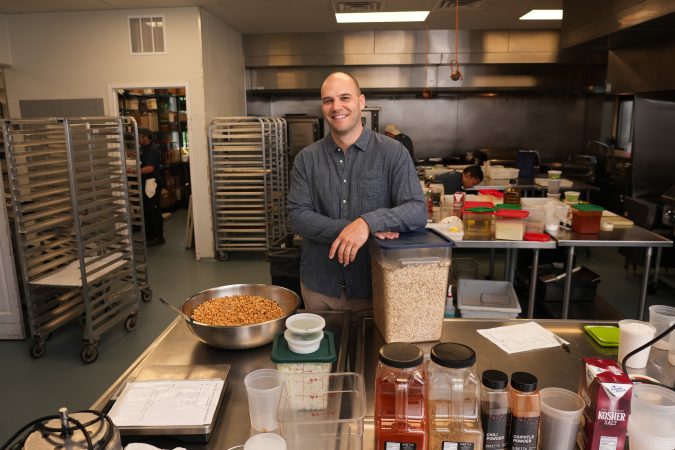
Lee Wallach at the company’s kitchen.Jessica Griffin / Staff Photographer
Staying competitive, and focused on the Philly area
On a recent day in July, Home Appétit’s entree menu included a miso-glazed salmon bowl with bok choy and brown rice, a pulled buffalo chicken sandwich, and a “Southwest Salad” with tortilla strips and buttermilk dressing. The company also offers small plates and add-ons such as roasted asparagus, steamed broccoli, and hard-boiled eggs.
Customers can order anytime between Tuesday and Friday night, to receive their meals the following Monday.
The minimum order costs $100 and covers four to six meals for a single person. Customers can also increase their order size for more people.
While some businesses have struggled with rising food costs, Wallach says Home Appétit has been partly insulated because it sources products from cooperatives and small farms.
“That’s kind of been a bit of a competitive advantage for us, and has allowed us to control our prices a little bit more,” he said.
Still, economic conditions have changed since 2013, particularly the costs of labor. He increased prices for the first time last year. While the basic order still costs $100, adding more people to an order now costs more.
The new headquarters is 23,000 square feet, up from the current 3,500-square-foot space, as well as a leased office in South Philly. With the move, the company will consolidate under one roof.
Wallach plans to have a staff of 200 to 250 by 2028. He currently employs roughly 50 full-time kitchen staff and 10 corporate employees. Meals are delivered by 40 to 50 drivers, who are mostly contractorsin their own vehicles.
Tech company founder Lilly Chen, 30, orders most of her food to her Chinatown apartment, where she lives with her cofounder. She has tried every food delivery service under the sun, she says, but Home Appétit stands out because of its delivery model. She says it’s because the company doesn’t outsource delivery.
“There’s a lot of other meal providers, that because they don’t own it, if something goes wrong — the food spoils or it’s late or you can’t find a delivery — they just kind of have to refund you and then you’re on your own,” Chen said.
Wallach plans to launch pickup at the new location, which customers have been asking for. Home Appétit also got its first refrigerated van.
Under the company’s current model, food gets delivered in insulated bags with ice packs in contractors cars, which puts a limit on how far meals can travel — but Wallach plans to expand the company’s delivery zone as he adds additional refrigerated vans.
He also plans to deliver on more days, not just Mondays, starting next year.
“If we can start delivering [closer to the weekend] and deliver to the Shore, I think it’s a home run for us for the summer months,” Wallach said.
He might pursue other markets in the future, perhaps Boston or Washington, D.C. But for now, Wallach is focused on the Philadelphia region, he says.
“There’s a ton of untapped opportunity here,” he said. “I’m excited to finally be able to take advantage.”
You’ve just retired, and in the blush of that found time, your life seems to be taking a decidedly positive turn. You are freer now than you’ve ever been. You can sleep later, take a leisurely shower, and plan trips whenever you want. There are no deadlines to meet, no meetings to endure, and no clients or other stakeholders to manage.
But there are also no appealing challenges for you to ponder or triumphs to celebrate. Eventually, in the honesty of your most objective moments, you know something is “off,” and you are starting to feel adrift. Your calendar has now opened to days of mostly blank space. Metaphorically, it is something between desert and forest. Dry and dark … and getting darker.
It is a particular derangement, a silent assault on your sense of identity, and you have no passport away from it. This life state called “retirement” has occupied you completely, and it is not what you might have expected. It feels more like an ending, a loss, an uncertainty, an inert state in which your energy is no longer directed toward anything challenging or meaningful.
As a psychologist and an executive coach, I have always eschewed the concept of retirement, and the word, too. Retirement — it just didn’t seem apt for anyone who, in the words of a global CEO whom I coached before he retired, “… still had a lot of juice left.”
Some years before I was approaching my own retirement, I started thinking about a more apt and ego-syntonic way to refer to it. Eventually, I hit on the neologism “rewirement,”and whenever I used it in conversation — especially with retirees or pre-retirees — it elicited immediate and positive reactions, strong resonant reactions, and even fervent reactions of gratitude for this term.
Many of the retirees had had demanding and truly successful careers, but they were now feeling flat and at odds with themselves. Uncertain. Unhappy. While they had no financial or physical or familial concerns to worry about, I detected a distinct, almost depressive angst that had been triggered and sustained by their status as a retiree. Their conversation dwelled on “what was before” with no trace of “what could be now.” While they weren’t clear about the concept of rewirement, they brightened at the sound of it.
Of course, not everyone falls into an emotional abyss after retirement. There are people who move through their adult development phases successfully and for whom that growth helps propel them into a state of rewirement upon their retirement — they just didn’t have a word for it. These rewiredpeople serve as role models in that their postretirement journeys are characterized by self-compassion, humor, optimism, curiosity, resilience, and self-expression.
As I’ve come to see it, rewirement is the postretirement life phase during which the retiree identifies pursuits that foster a state of renewal. These pursuits may be new, or they may be “back-burner” dreams or interests that one finally has time to explore.
This state of renewal is sustained by a sense of meaning and contentment. This is comparable to or may even transcend the sense of accomplishment experienced in their previous work-related role.
I am reminded of the former global business executive who became a fine art photographer, the nonprofit leader who joined a community group in which members mended the clothing of low-income and homeless people, the psychotherapist (and former priest) who became a chaplain to hospital patients, and the human resources professional who became a master gardener.
The factors that identify the difference between these successful rewirements and those who get stuck in a conflicted or discontented state of retirement await the scrutiny of research. There is much to discover here.
However, in the meantime, I highlight the concept of rewirementas a possible neutralizer to the quotidian malaise that can seize us in retirement. I see it as a mental compass that can help us progress to renewal. And I’ve also identified three guideposts for those seeking a new sense of meaning as they transition out of their careers.
Identifying the ‘aspirational self’
This is based on one overarching question: What’s my aspirational self now? Exploring the answer to this question involves a concerted reflection about what pursuits one aspires to focus on now in this newfound time they’ve been calling retirement. In short, it’s the identification of the pursuits that will yield challenge and be meaningful in postretirement. This may be clear and even obvious for some, but it can be difficult for others; serious discussion with people who know us well (e.g., colleagues, close friends, partner, executive coach) can help clarify the path forward.
Regardless of how we address this fundamental question, the answer will significantly inform efforts toward achieving rewirement — efforts focused forward on possibilities vs. getting stuck in feelings of loss, despair, emptiness, or even unrequitedness. This is a time to build, not mourn.
Being more discerning about time
Greater discernment about time can prove especially difficult because we are habituated to our daily routines and priorities. Our routines and priorities are deeply ingrained. We trust and value these habits. They have abetted our success.
However, true rewirementnecessitates an abandonment of certain habits — especially those that could interfere with what we really want to pursue during this life phase. For example, pleasing others and an inability to say no, even to requests for spending time and doing things we really don’t want to do anymore, are particular blockers to rewirement.
The necessary behavioral shift here is to deny requests for our time that are not in the service of achieving our aspirational self. While it may sound egocentric, asking yourself the question “Does this really deserve my time given what I’m trying to do now?” is a proactive habit to cultivate on the path to rewirement.
Being more discerning about relationships
Achieving rewirementoften requires a difficult reflection about the quality of our relationships. Who’s supportive? Who’s not? Who’s a time drain? Who fuels our progress, happiness, and sense of meaning in postretirement? If we have a partner, do we need to have a courageous conversation with them about how we can successfully navigate this next life phase together?
Like habituated work habits that can block progress toward rewirement, certain relationships may also need to be changed or even let go in rewirement. As a successfully rewiredbusiness leader once told me: “I realized I had to prune my relationship portfolio as if it were a business. There were so many people from the past with whom I had little in common now.”
Ultimately, to achieve a successful rewirement, retirees may need to change some habits, they may need to manage their time differently, and they may need to adjust some relationships. However, as difficult as these efforts may be at first, they should be rewarded — rewarded because they support the retiree’s tilting toward what can be now vs. slipping into the emotional abyss of what was.
Sigmund Freud maintained that a human life is primarily about two spheres: love and work, and if there’s trouble in one sphere, or surely if there’s trouble in both, that’s a scenario for a depression.
As a sturdy and adventuresome bridge between work and love, a retiree’s personal renewal — fostered by their rewirement pursuits — is a reliable antidote to depression.
Yes, you are freer in retirement, but you can be even freer — and happier — in a state of rewirement. It is an oasis in the desert. Moonlight in the forest. So, are you in your rewirement now? And if not, what will it take to get you there?
Karol M. Wasylyshyn is a consulting psychologist happily in the midst of her evolving rewirement.
LAS VEGAS — Nick Nurse’s view entering the 76ers’ offseason was similar to the outside consensus — that his team did not have much financial “wiggle room” with Joel Embiid, Tyrese Maxey, and Paul George all on max contracts.
Then the Sixers pulled off the stunning blockbuster trade for All-NBA wing Jaylen Brown. They surrounded that big swing with complementary moves, adding Dean Wade, Anfernee Simons, and Ariel Hukporti in free agency and drafting Labaron Philon Jr. The Sixers are now among the threats in a deep Eastern Conference.
“Sitting here right now,” Nurse told a small group of reporters from a Las Vegas hotel Saturday, “I think, obviously, we’ve had a really good summer so far. … It was some good teamwork, some good maneuvers.
“I’d like to think we got better at several positions: younger, faster, depth, shooting, rebounding. There [were] a lot of areas to address, and I think we addressed some of them.”
One giant potential free-agency domino could still fall, of course, if all-timer LeBron James chooses to sign with the Sixers. Nurse did not comment on that possibility, since he does not hold the front office’s role in recruitment and negotiation. Bob Myers, Harris Blitzer Sports & Entertainment’s president, already made his pitch as a guest on Game Over podcast hosted by James’ agent, Rich Paul.
Nurse, though, lauded the early collaboration with new president of basketball operations Mike Gansey, saying he could “feel a good organizational blueprint” entering the offseason. The coach has long been impressed by Brown’s versatility on both ends of the floor, his year-by-year improvement, and his winning resume as an NBA champion and Finals MVP.
“He’s sitting in his prime,” Nurse said of Brown. “It’s amazing that he’s going to be a Sixer.”
Now Brown joins the dynamic backcourt of Maxey and VJ Edgecombe, along with the 2023 MVP (though oft-injured) Embiid. The goal is for this configuration of top-end talent to be healthy enough to gain consistency — Embiid, Maxey, and George played only 36 games together in two seasons — while building enough depth “to have some more gas in the tank to make a longer [postseason] run.”
Jaylen Brown (right) will join the Sixers’ dynamic backcourt, including leading scorer Tyrese Maxey.Monica Herndon / Staff Photographer
After a thrilling comeback to upset the Boston Celtics in the first round, the Sixers were swept by the eventual champion New York Knicks. Nurse acknowledged he “pushed all the chips in [for] Game 2 in New York,” and that it was difficult to rebound after they lost that down-to-the-wire matchup.
“It’s a hell of a lot longer tournament than one round,” said Nurse, who won the 2019 NBA title with the Toronto Raptors. “ … We were tired as hell Game 1 [in New York]. We were spinning from that. They were on a heater of beyond proportions, and it was like, ‘We’ve got to knock them off this heater,’ and Game 2 was our chance to do it.
“Unfortunately, we didn’t make enough shots in the fourth quarter, because they were wide open. … The gas tank was pretty low. We just need some more depth. We need a little bit more experience. We need to not be totally drained out of that after one round.”
Here are three more takeaways from the wide-ranging offseason conversation with Nurse.
Other newcomers
Nurse reiterated that he would not hesitate to immediately insert Philon into the rotation, a belief rewarded by the crafty guard’s terrific start to Summer League play. He totaled 24 points and six assists in the Sixers’ overtime win over the Indiana Pacers on Saturday afternoon at Cox Pavilion, after compiling 18 points and seven assists in Thursday’s opening win over the Detroit Pistons.
“I just feel like he’s talented enough,” Nurse said. “I think we liked him enough as a staff. … I think he’s going this direction [up] quickly. I think he’s got some confidence to him that I don’t think he’ll be afraid. I think he’ll make the most of the opportunity.”
Nick Nurse said that he believes first-round pick Labaron Philon Jr. will “make the most of the opportunity.” Tom Gralish / Staff Photographer
Nurse offered similar (and warranted) trust in Edgecombe to become a Day 1 starter last season, and in then-rookie Jared McCain to instantly contribute before his 2024 knee surgery.
Wade, meanwhile, is what Nurse called an “opportunity scorer” and, more importantly, a rebounder and versatile defender at 6-foot-9 and 225 pounds. Hukporti’s addition means a competition with Adem Bona for the backup center job — which becomes a starting role when Embiid is sidelined — is “all in play, as of now,” Nurse said. The coach also believes Simons, in addition to his high-volume shooting, can handle the ball and play in the pick and roll.
“We may be a touch small at times [or] whatever,” Nurse said of the guard group. “But I’ll certainly take the speed and athleticism. Then it’s just up to our staff to put them in the right spot.”
Though Brown has become the Sixers’ flashy offseason addition, much of their present and future will be fueled by Maxey, an All-NBA third-team selection last season, and Edgecombe, who finished third on a terrific NBA Rookie of the Year ballot.
When asked where Edgecombe can most develop in his second NBA season, Nurse highlighted extending his three-point range — he connected on 35.4% of his 5.6 attempts, but had a knack for crunch-time makes — to provide more spacing for teammates. Nurse also wants to see Edgecombe progress toward becoming a lockdown perimeter defender, and to go coast-to-coast more frequently when he gets the ball in transition.
“Instead of two of those a game,” Nurse said, “I’d like to see 10. Or at least try. I just think there’s a little bit more pace he can add to his game offensively.”
Tyrese Maxey and VJ Edgecombe grew into a dynamic backcourt for the Sixers last season.Monica Herndon / Staff Photographer
For Maxey, Nurse again emphasized the midrange game between his explosive drives to the basket and deep three-pointers.
“He’s got that in his game,” Nurse said of Maxey, who ranked fifth in the league in scoring last season (28.3 points per game). “He’s just so good at the other stuff [that] he doesn’t hardly ever get put in those positions. But I think it’s an area of growth for him.”
Optimism for Embiid?
At Embiid’s end-of-season news conference, he expressed optimism that the Sixers’ medical and training staff had “figured out” how to manage his knee following multiple surgeries. He expects that will make him more available after logging 96 total games the past three seasons. Last month, Myers reiterated that Embiid had no procedures scheduled, allowing him to spend more time on basketball work.
When Nurse was asked Saturday if he shared Embiid’s optimism that the big man will be able to play more in 2026-27, Nurse said, “I do” but did not elaborate much further.
“I think that he’s feeling pretty good,” Nurse said. “I think he’s working pretty hard right now. So I do think I share his optimism.”