DEAR ABBY: My fiancé and I often talked about maybe getting a dog. He really wanted one, but I never fully committed because I knew it would be additional work and responsibility I don’t have time for. I work full time, do part-time work as well and manage the household tasks, shopping, cleaning, etc. When I ask him to pitch in, he always does, but I’m at max capacity with work.
Not long ago, he asked me to go look at dogs. I agreed but only to look. When we arrived, I told him and the dog owner that the puppies looked very sweet but added that we were just not ready. I reiterated this several times, but my fiancé placed the money on the counter despite my objections and now we have a dog, “Butch.”
Fast-forward: Butch is a sweet, loving pup. I adore him, but he’s a ton of work. My fiancé is back in school and working so he’s not happy stopping multiple times a day to take Butch out for air and exercise as the dog is an active breed. He does it, but some days are stressful for us both.
Abby, I resent him for this. We’re both overloaded and now have another full-time responsibility plus extra bills. We love Butch but are overwhelmed. I would be miserable giving him away, which is what my fiancé now suggests.
We treat Butch well. We love him and give him the best of everything, and he is sensitive and sweet. I don’t think another person or family would treat him as well, and I would be sick with worry if he weren’t here. We paid for daycare and walks; that helped immensely, but we can’t afford it anymore. What do I do?
— PET PROBLEM IN MARYLAND
DEAR PET PROBLEM: Why do you think another family would not appreciate Butch and treat him as well as you have? If he is sensitive and sweet, is housebroken and has been taught basic manners during the time he has been with you, he might find a very loving home — hopefully one with children he can play with.
Contact pet rescue groups in your area and explain the situation, and you may be pleasantly surprised. And the next time your fiancé pulls his money out and puts it on the counter when you have told him you don’t want something, tell him to put it back.
** ** **
DEAR ABBY: Our new neighbors have been out of town for several weeks, and their newspapers keep piling up outside their home. We don’t know them well enough to have their contact information to ask if they need help with the newspapers. At what point can we pick them up and place them in our recycling bin?
— MINDFUL NEIGHBOR
DEAR NEIGHBOR: Newspapers piled in front of a house are like an invitation to an open house. Your neighbors should have called the newspaper before they left and told them they wanted their newspapers held until they returned. It would be kind of you to pick the papers up and save them for your neighbors rather than dispose of them.
HARRISBURG — Gov. Josh Shapiro signed a $50.8 billion state budget on Sunday following the rushed passage of the overall deal by the General Assembly thatlawmakers said helps address the state’s affordability crisis but delays action on some of the most significant issues before the legislature.
“We managed, as the [vote count] indicates, to find compromise without compromising our core values,” Shapiro said during a news conference Sunday evening, before signing his fourth budget as Pennsylvania’s governor.
The deal was hashed out over weeks in closed-door meetings among top leaders and includes new transparency requirements for data centers, publicly funded housing projects, and public transit agencies. Lawmakers also agreed to a long-sought cost-of-living adjustment totaling approximately $168 million per year for some Pennsylvania retired teachers, police officers, and firefighters — some of whom have not seen an increase to their monthly pension payments in more than 20 years.
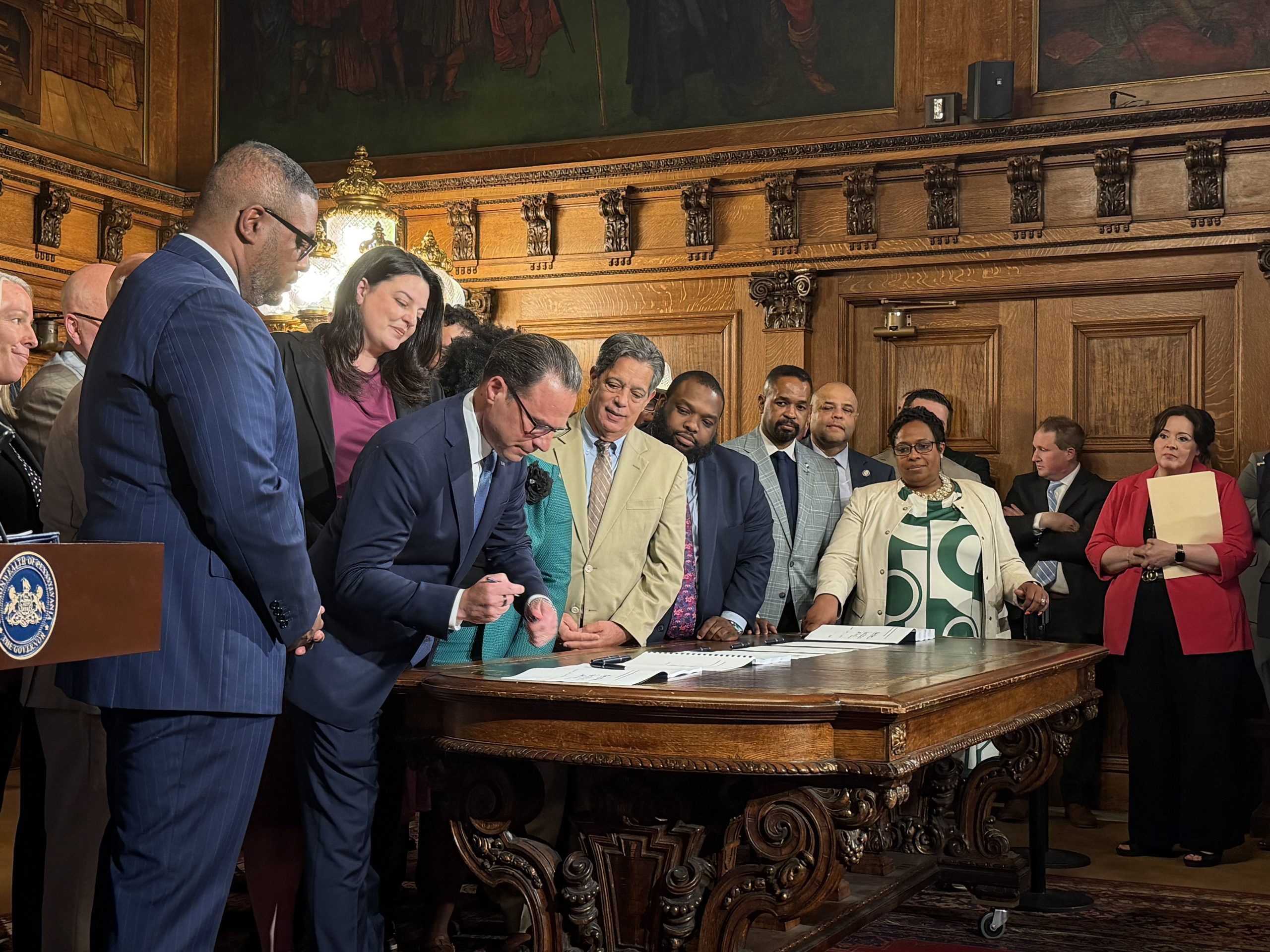
Gov. Josh Shapiro, flanked by fellow state Democrats, signs the 2026-27 Pennsylvania state budget in Harrisburg, Pa. on Sunday, July 12, 2026.Gillian McGoldrick / Staff
More education funding, data center requirements
Pennsylvania will have invested nearly $2 billion in new school funding through its adequacy and tax equity formulas since 2024. That’s when lawmakers first employed the new calculations to close a $4 billion “adequacy gap” after a landmark court ruling that found the state was illegally underfunding students in low-income districts. This year’s installment of adequacy funding topped $565 million, as part of an effort to prevent districts from having to raise property taxes on already low-income residents. The additional investment sends $136 million more this year to the School District of Philadelphia.
Legislative leaders failed to agree in the final budget on other issues that have seen broad support in both chambers, such as repealing a sales tax exemption for data center projects, allowing local moratoriums on data center projects, or banning cell phones in K-12 schools. They may revisit the issues during the fall legislative session.
Instead, they approved a new reporting requirement that will force data centers to submit annual reports detailing their water and energy usage. The companies will face a $10,000-a-day fine for failing to submit their reports.
But the budget does not address some of the most pressing issues before the General Assembly, including whether to tax and regulate skill games or allow the more than 70,000 gambling machines in Pennsylvania bars, corner stores and fraternal organizations to become illegal come October. The state has until then to decide how to approach the machines after the state’s Supreme Court last month determined that skill games, which have for years operated in a legal gray area, are slot machines and should be regulated as such. They also punted on finding a long-term funding solution to fund mass transit until next year, when a two-year fail-safe runs out.
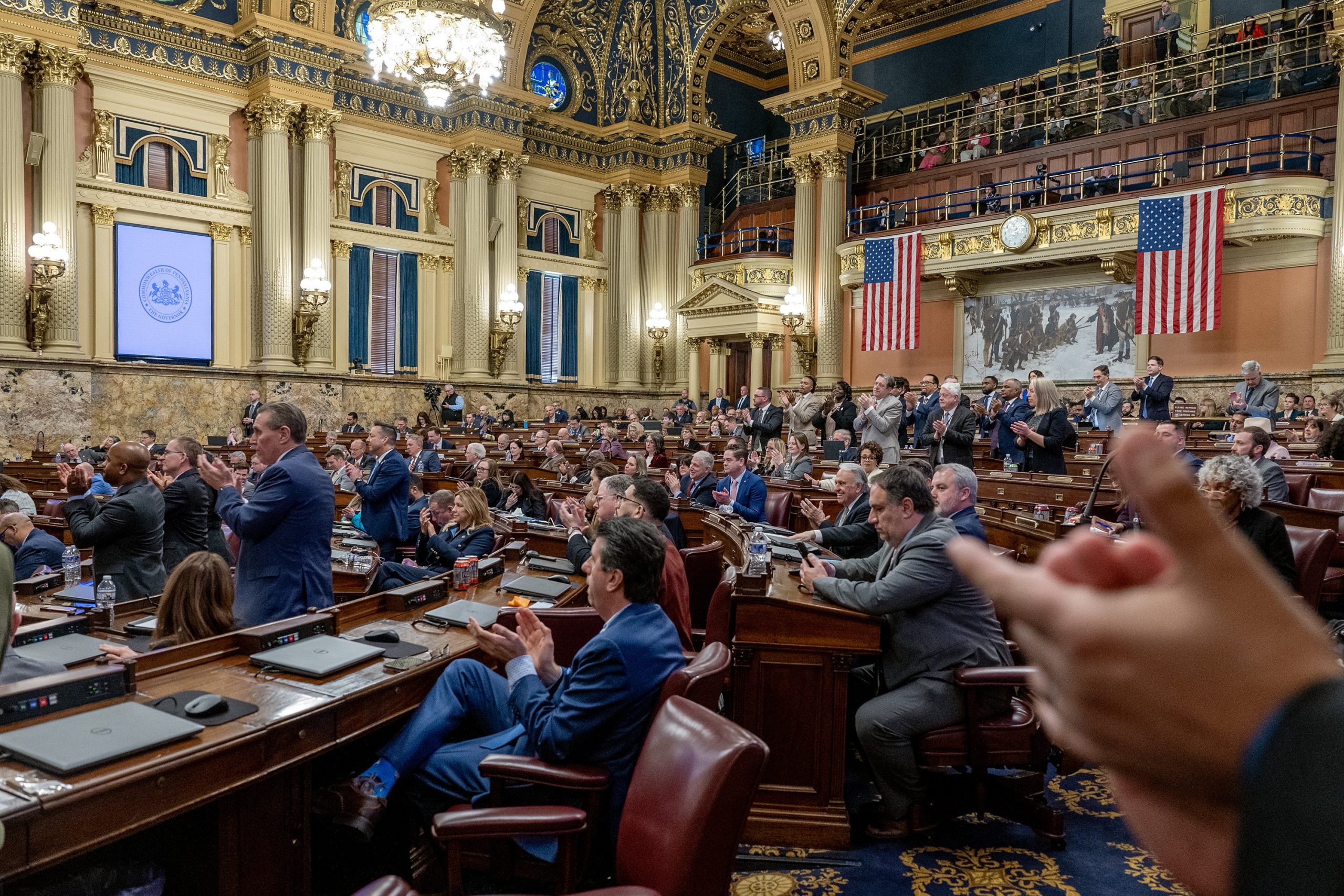
The state House chamber as Gov. Josh Shapiro makes his annual budget proposal in Harrisburg Tuesday, Feb. 3, 2026.Tom Gralish / Staff Photographer
Shapiro, a first-term Democrat facing reelection this year, proposed a $53.3 budget in February that for a fourth time emphasized top Democratic initiatives such as raising the state minimum wage to $15 per hour or legalizing recreational marijuana. He also proposed other initiatives, such as a $1 billion critical infrastructure fund to help the state drive out public dollars to build more housing and energy generation, which did not see funding in the final budget deal.
State Sen. Nikil Saval (D., Philadelphia) was among the two Democrats who opposed the state budget, in part because it did not make the ambitious investments needed to address the state’s limited affordable housing stock.
“We cannot defer at this moment,” added Saval, the chair of the Philadelphia delegation in the Senate, in his floor remarks before the vote.
Lawmakers also declined to create any new generators of revenue for Pennsylvania,anddeferred addressing the state’s multibillion dollar structural deficit until future years.
‘Met in the middle’
The overall deal passed with bipartisan support in the GOP-controlled Senate, 44-6, and in the House, where Democrats hold a narrow majority, 167-35.
“We have met in the middle,” said Senate Majority Leader Joe Pittman (R., Indiana). “I am proud of this product, despite what some naysayers may say.”
The 2026-27 budget, which is a 1.4% increase in spending over the prior fiscal year, has no widespread tax increases. It also largely relies on accounting maneuvers like spending down unused or underused dedicated funds to address the structural deficit instead of pulling from the state’s emergency savings account.
One of the accounting moves to balance Pennsylvania’s budget includes delaying two months of payments totaling $1.3 billion to insurance companies that fulfill the state’s ballooning Medicaid programs until the next fiscal year. Without those delayed payments, the budget would total closer to $52.1 billion.
Several GOP House members opposed the budget, arguing it is unbalanced and only postpones tax increases to future years if spending isn’t cut.
State Rep. Brad Roae (R., Crawford), called the final budget a “fake number.” State Rep. Charity Grimm Krupa (R., Fayette) called it “voodoo math.” And State Rep. Marc Anderson (R., York) said the state was “cooking the books.”
But broadly, both Democratic and Republican members called the budget a reasonable compromise, acknowledging that they will have additional work to do in the fall legislative session and during next year’s budget negotiations to balance the state’s finances. During speeches on the Senate floor, several Republican senators quoted The Rolling Stones’ song “You Can’t Always Get What You Want,” emphasizing the second half of the refrain: “You might find you get what you need.”
State Rep. Jordan Harris (D., Philadelphia) also turned to music to represent his position on the budget deal, paraphrasing Anthony Hamilton’s “Do You Feel Me” as a response to his constituents’ concerns about affordability by sending more state dollars to school districts to help them avoid property tax increases and raising monthly pension payments for retirees.
“I am glad to stand today to support it, to let the people of Pennsylvania know, baby, the message is getting through,” Harris added.
Pennsylvania Legislative Correspondents’ Association Intern Ethan Young contributed to this article.
Philadelphia is set for a huge summer of women’s sports. The Stoop Pigeon wants to be at the center of it.
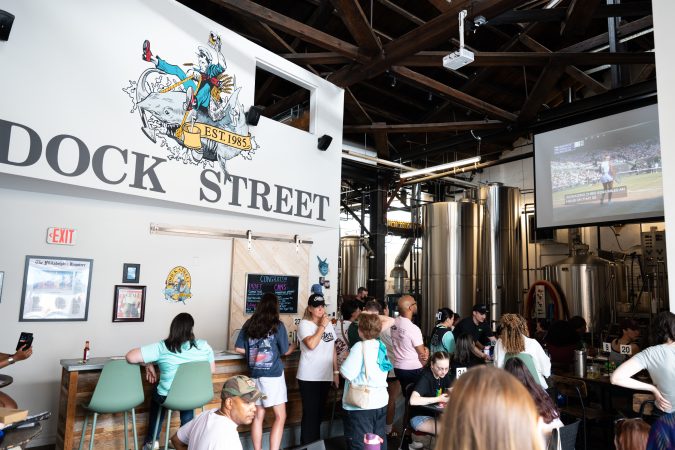
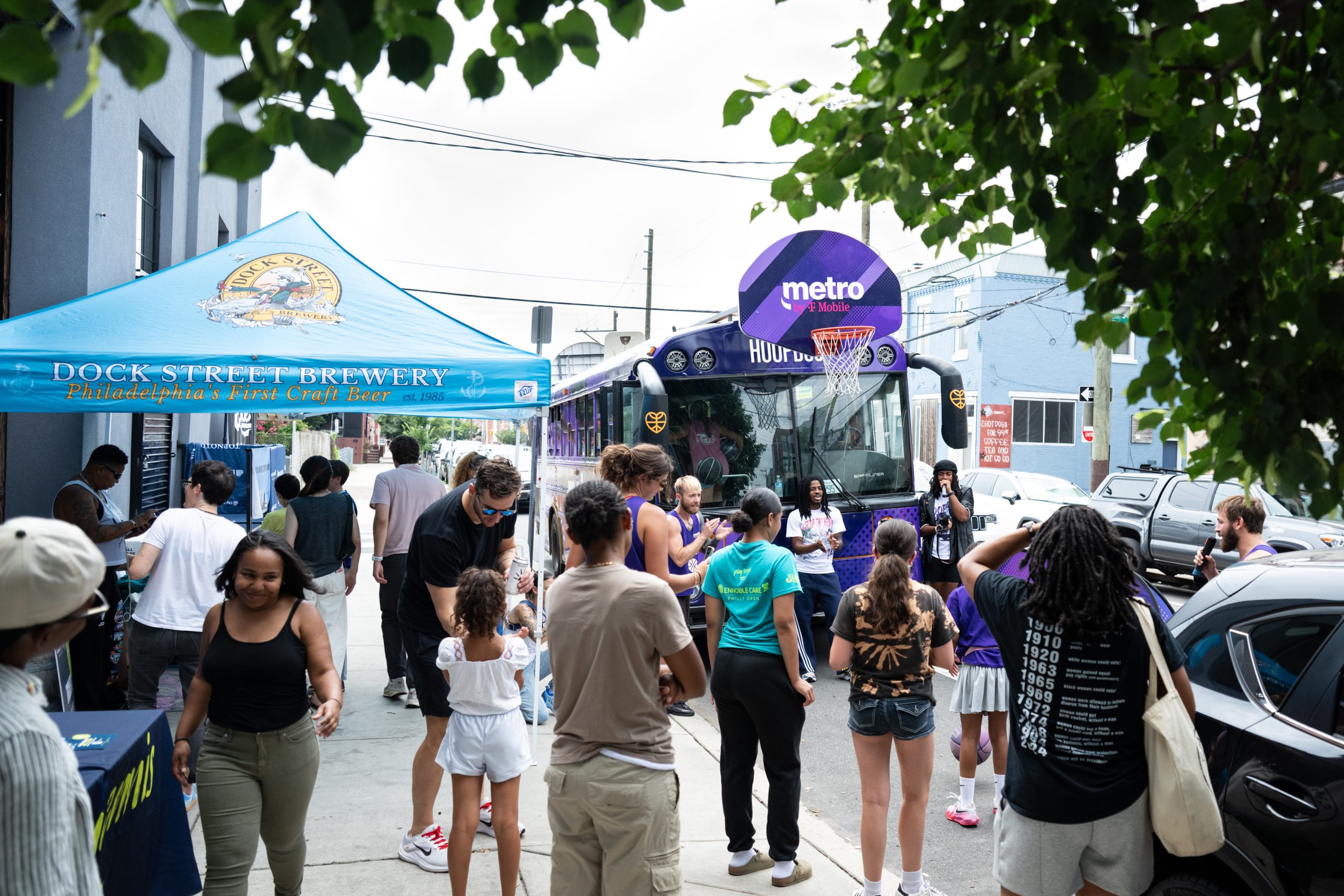
The Stoop Pigeon hosted a double-watch party for the Wimbledon women’s final and Saturday’s WNBA slate at Dock Street Brewing in South Philly. The organization partnered with United States Tennis Association Middle States and the Philadelphia Sisters, to help promote August’s Ennoble Care Philly Open on the University Pennsylvania’s campus, and Hoopbus, a charitable organization dedicated to the transformative power of basketball. Attendees could play red ball tennis, win tennis racket prize packs, and shoot hoops outside on the bus.
After starting as a monthly WNBA watch party group, The Stoop Pigeon has grown into one of the largest dedicated women’s sports fan communities in the city. Jen Leary, founder of The Stoop Pigeon, now regularly hears from local and national organizations looking to activate the women’s sports communities about partnerships.
“Anytime we hold a certain event, like if it’s tennis, we reach out to all the tennis organizations we can find on the internet,” Leary said. “Similarly, with the WNBA game, Hoopbus reached out to us because they were going to be on this national tour, and they were going to be in Philly. Having them stop here, it’s a win-win. It gives something fun for the community, but also helps us continue again to build momentum for what we’re building.”
Leary emphasized that while The Stoop Pigeon might be one of the most vocal groups, promoting women’s sports in the city is a “team effort,” and a big part of that is partnering with other local organizations.
Attendees play basketball courtesy of Hoopbus outside Dock Street Brewery South during Saturday’s watch party.Erin Blewett / For The Inquirer
“The one thing that women’s sports around the world does is we lift each other up and we work together. Progress in numbers,” she added.
The Stoop Pigeon is aiming to open a women’s sports hub on Broad Street by midfall, Leary said. But in a year with several high-profile women’s sports events, Leary is committed to keeping the momentum growing in the city and building the community as they prepare the space.
After the massive success of Unrivaled in January, Philly will host professional women’s lacrosse, tennis, and squash over the next five months. Leary believes that the efforts The Stoop Pigeon and other organizations have put into developing a women’s sports community in the city are part of the reason Philly is landing more events, but landing the event is half the battle.
“The goal is just to get people there, to show the WTA and all the other women’s sports leagues in the country that Philly is a women’s sports town, and if you come to Philly, we will pack the stadiums like we did with Unrivaled,” Leary said. “Even if you don’t know tennis or even if you don’t know lacrosse, we want you there.”
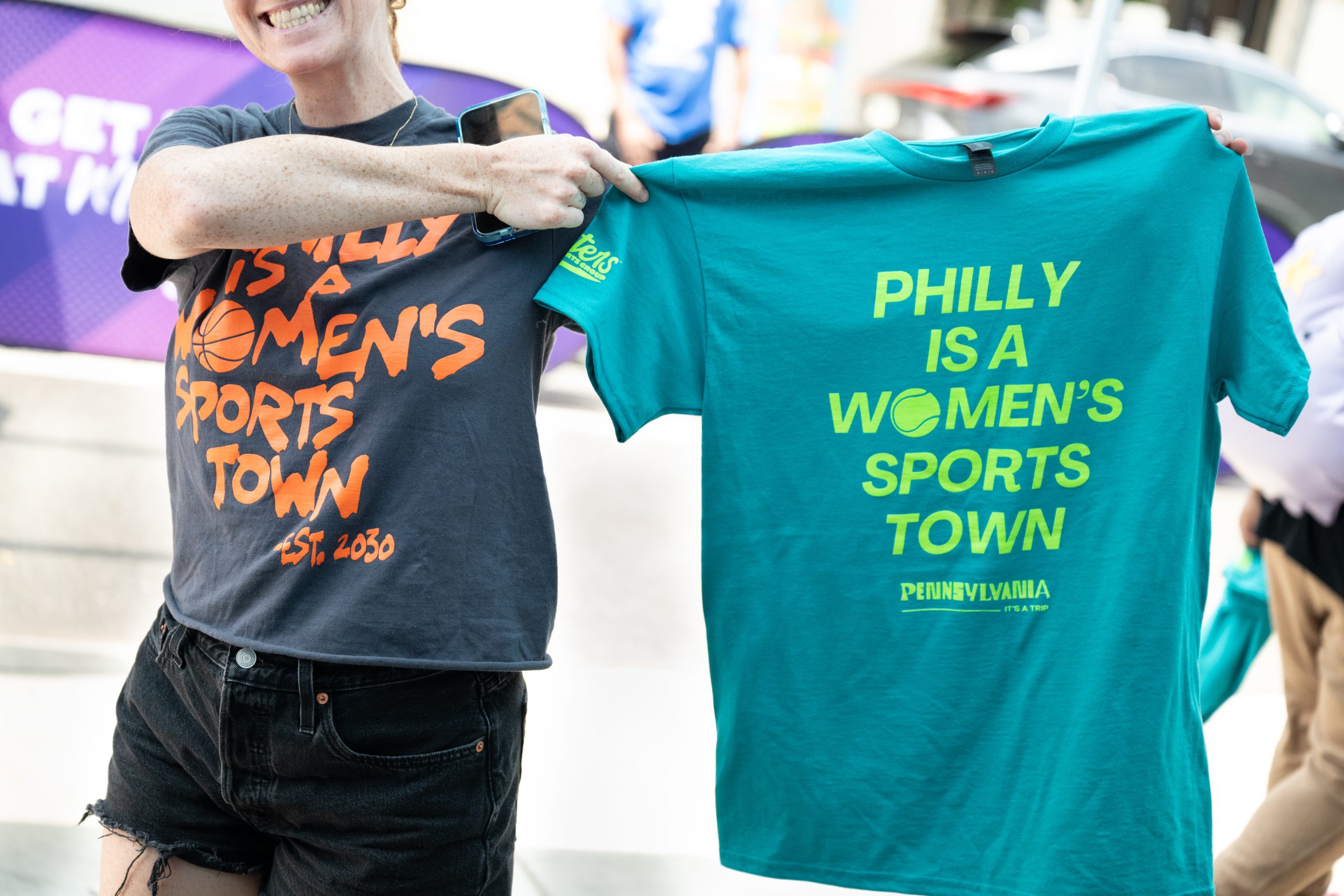
An attendee holds up a T-shirt reading “Philly Is a Women’s Sports Town” during a watch party Saturday at Dock Street Brewery co-hosted by Hoopbus and The Stoop Pigeon.Erin Blewett / For The Inquirer
Here’s a look at the locals who were selected on Day 2:
Fifth Round
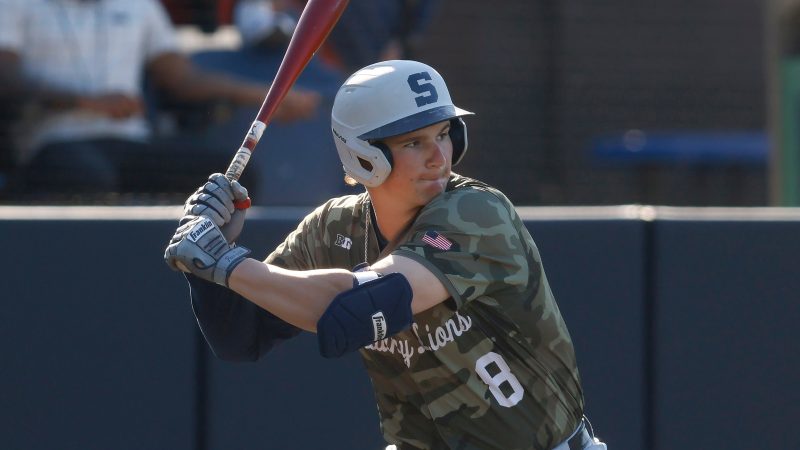
Michael Anderson Jr. was selected by the Texas Rangers with the 149th pick in the draft. Anderson, a Drexel Hill native, played high school ball at Bonner-Prendergast before going to University of Rhode Island and then University of Arkansas.
The 6-foot-3 first baseman finished his collegiate career at Penn State, where he posted a record-breaking season for the Nittany Lions, earning him First Team All-Big 10 honors.
His 20 home runs set a program record, as well as his 18 hit-by-pitches. His 141 total bases and .742 slugging percentage were the fourth-most in a season in school history. He was second on the team with a .358 batting average and led the team in RBIs (53), hits (68), and OPS (1.212).
Sixth Round
The Chicago White Sox selected South Jersey’s Alex Weingartner at pick 166.
A two-way player at St. Augustine Prep, Weingartner was drafted as an outfielder but also pitched for the Hermits.
The Penn State pledge was named the 2025-26 Gatorade New Jersey Baseball Player of the Year following his senior season with the Hermits where he batted .495 with a .817 slugging percentage, 36 RBIs, 46 hits, and seven home runs. On the mound, Weingartner had a 6-1 record with a 0.87 ERA in 48.1 innings pitched, recording 81 strikeouts.
The 6-2 outfielder from Berlin was the number one prospect in the state for the class of 2026, according to Perfect Game, and is ranked 75th nationally.
Seventh Round
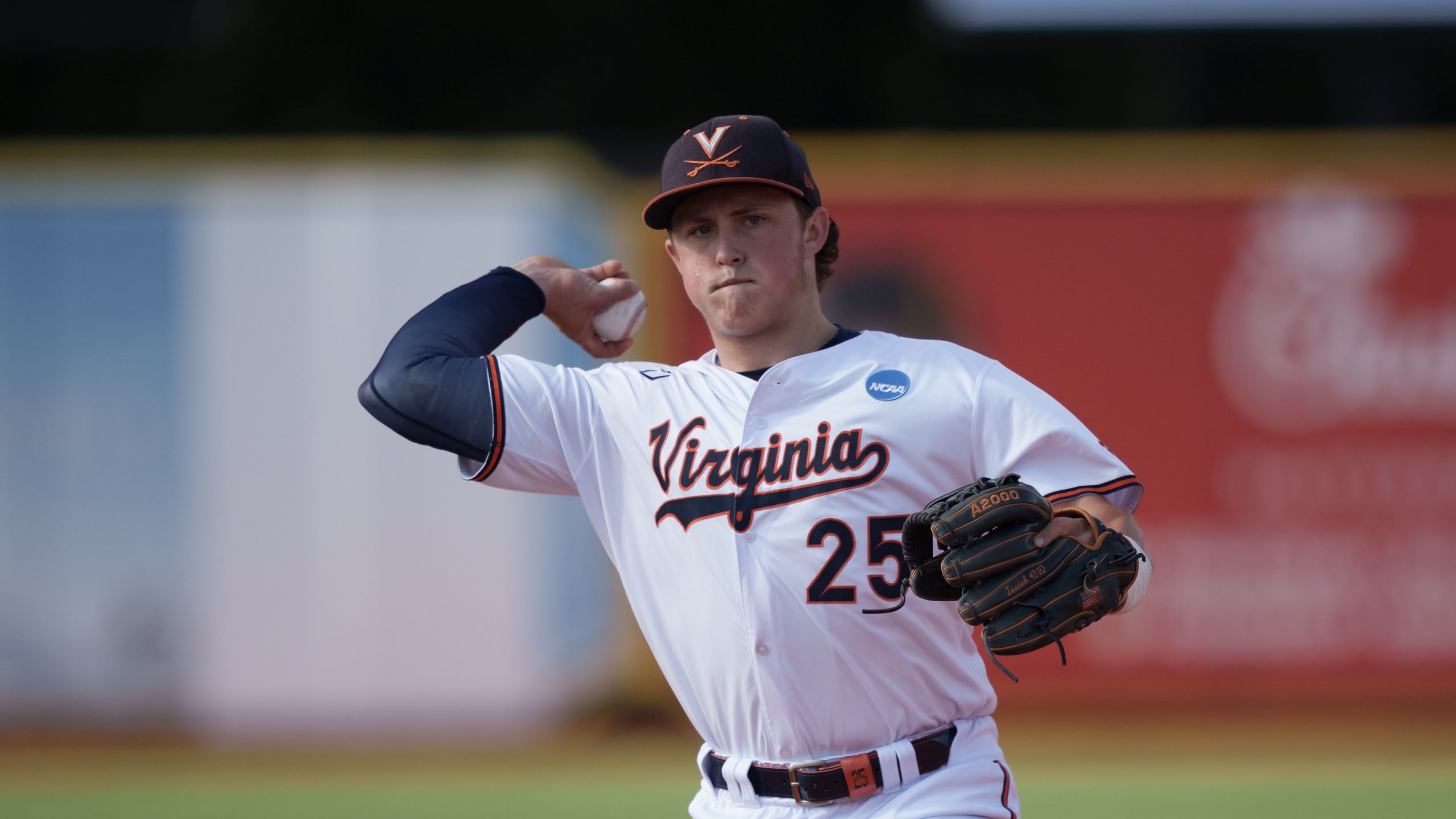
Yardley’s Joe Tiroly was selected by the San Diego Padres with the 215th pick.
The 6-foot second baseman from University of Virginia was one of just two Cavaliers to play in all 60 games. He led Virginia in hits (76), home runs (16), RBIs (66) and total bases (137) while batting .319.
Joe Tiroly played in all 60 games for Virginia last season.Matthew Hinton
Prior to playing at Virginia, Tiroly was at Rider where he led the team during his sophomore year in hits, doubles, triples, home runs, total bases, and slugging percentage. He also set a single-season record with his 70 RBIs and 66 runs.
Prior to entering college, Tiroly played at Pennsbury High where he was ranked as the No. 15 third baseman in the state.
Eighth round
Central Buck sEast graduate Aiden Weaver was selected 231st overall by the Athletics.
Weaver, a right-handed pitcher from Duke, finished the season with a 6.37 ERA across 65 innings pitched, tallying 87 strikeouts.
The 6-5 senior started in all 14 of his appearances, recording the most innings for the Blue Devils this season, but finished with a 4-9 record.
10th Round
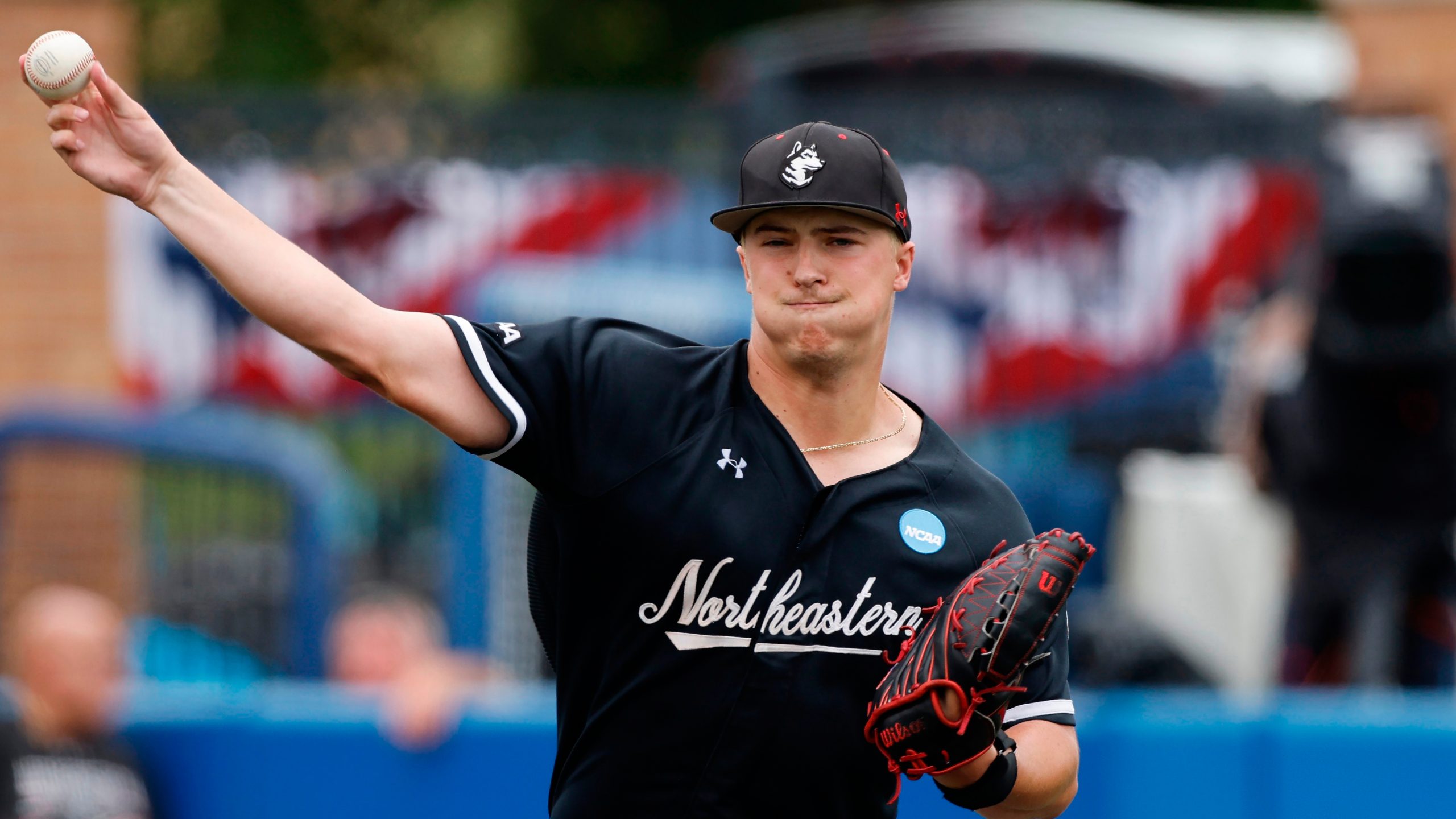
Right-handed pitcher Luc Rising was drafted by the Los Angeles Angels with the 289th pick.
An Exton native, Rising started in 13 of his 16 appearances at Northeastern. The 6-f2 pitcher went 5-5 with a 3.54 ERA and 84 strikeouts, pitching 81.1 innings, including an inning in the CAA championship to help Northeastern secure its second consecutive conference title.
Luc Rising helped Northeastern win back-to-back conference titles in 2026.Colin E. Braley
Before playing at Northeastern for his senior year, Rising played at the Rochester Institute of Technology where he earned First Team All Liberty League honors and was named a Perfect Game College Baseball League All-Star. Rising played baseball at Downingtown East.
Later in the 10th round, Andrew Gaines was selected by the Milwaukee Brewers with the 311th pick.
A pitcher at St. Joseph’s, the 6-5 senior from Marlton was selected to Atlantic 10 all-conference second team after matching the St. Joe’s single-season save record (10).
The 6-5 right hander finished the season with a 4.99 ERA and 47 strikeouts in 30.2 innings pitched, helping St. Joe’s set a program record for most wins in a season.
Gaines graduated from St. Augustine Prep before going to Iona College. He then transferred to Pitt after two seasons before spending his senior year with the Hawks.
12th Round
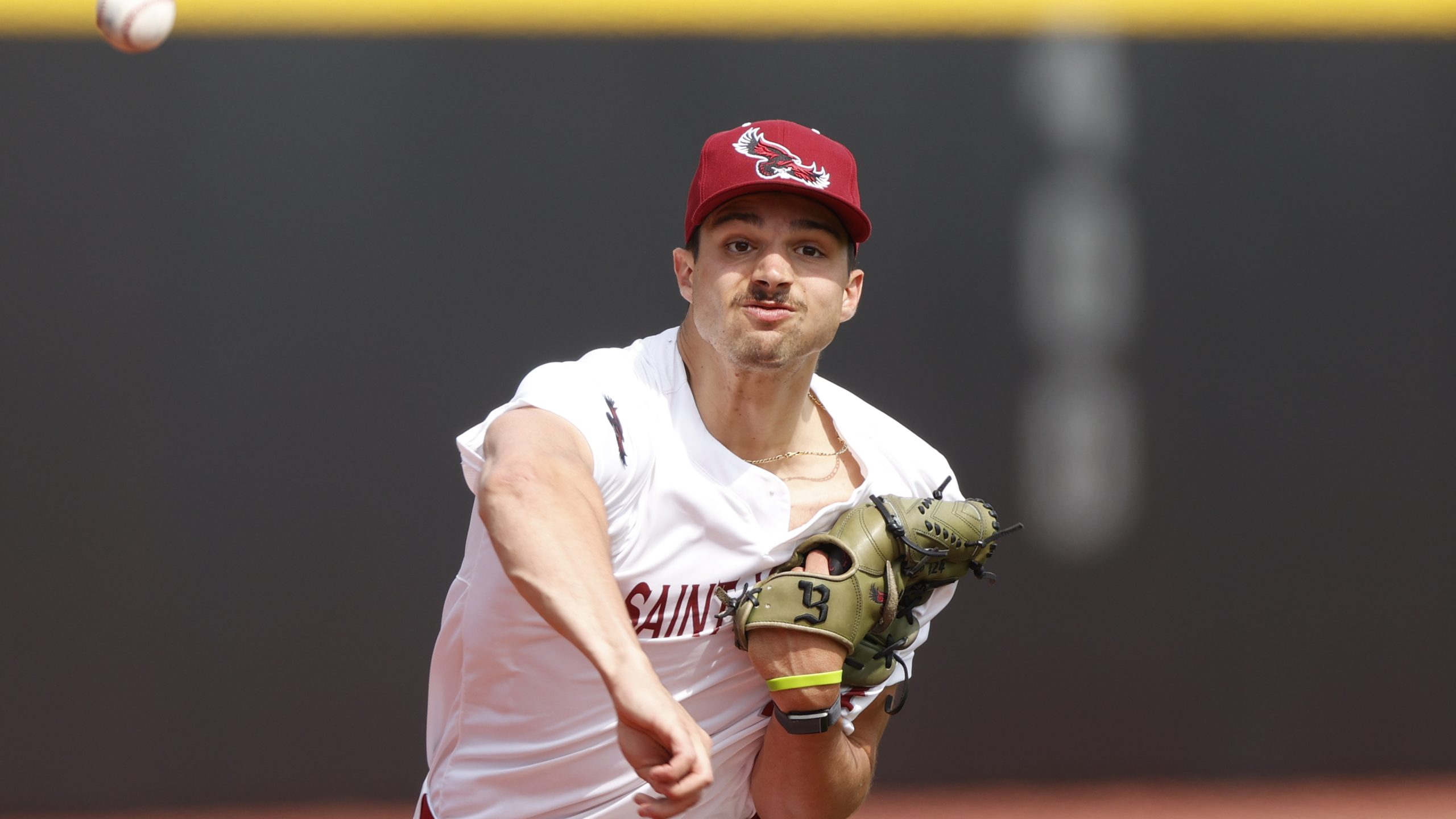
Christian Coppola from St. Joe’s was selected by the Phillies with the 369th pick.
A 6-5 right-handed pitcher from Galloway, Atlantic County, Coppola transferred to St. Joe’s this year after spending two seasons at Rutgers and one at Arizona.
Christian Coppola helped St. Joe’s set a program record for wins in a season.Jason E. Miczek
This season, the relief pitcher had a 1.69 ERA in 37.1 innings pitched for the Hawks, earning him American Baseball Coaches Association All-East Regional first team honors.
Coppola played high school ball at Cedar Creek, where he set the school record for single season strikeouts during his senior year.
15th Round
Souderton Area graduate Liam O’Leary went to the Pittsburgh Pirates as the 438th pick overall.
O’Leary, a right-handed pitcher from St. John’s, played previous seasons with Lackawanna Community College and Montgomery County Community College.
This season, the 6-4 junior posted a 3.64 ERA, pitching 108.2 innings after starting in all 17 of his appearances. He added 78 strikeouts to 32 walks to his statline for a 1.23 WHIP and a 8-5 record.
St. Joe’s had its third player drafted in the 17th round, when Duke McCarron went to the Miami Marlins with the 505th pick.
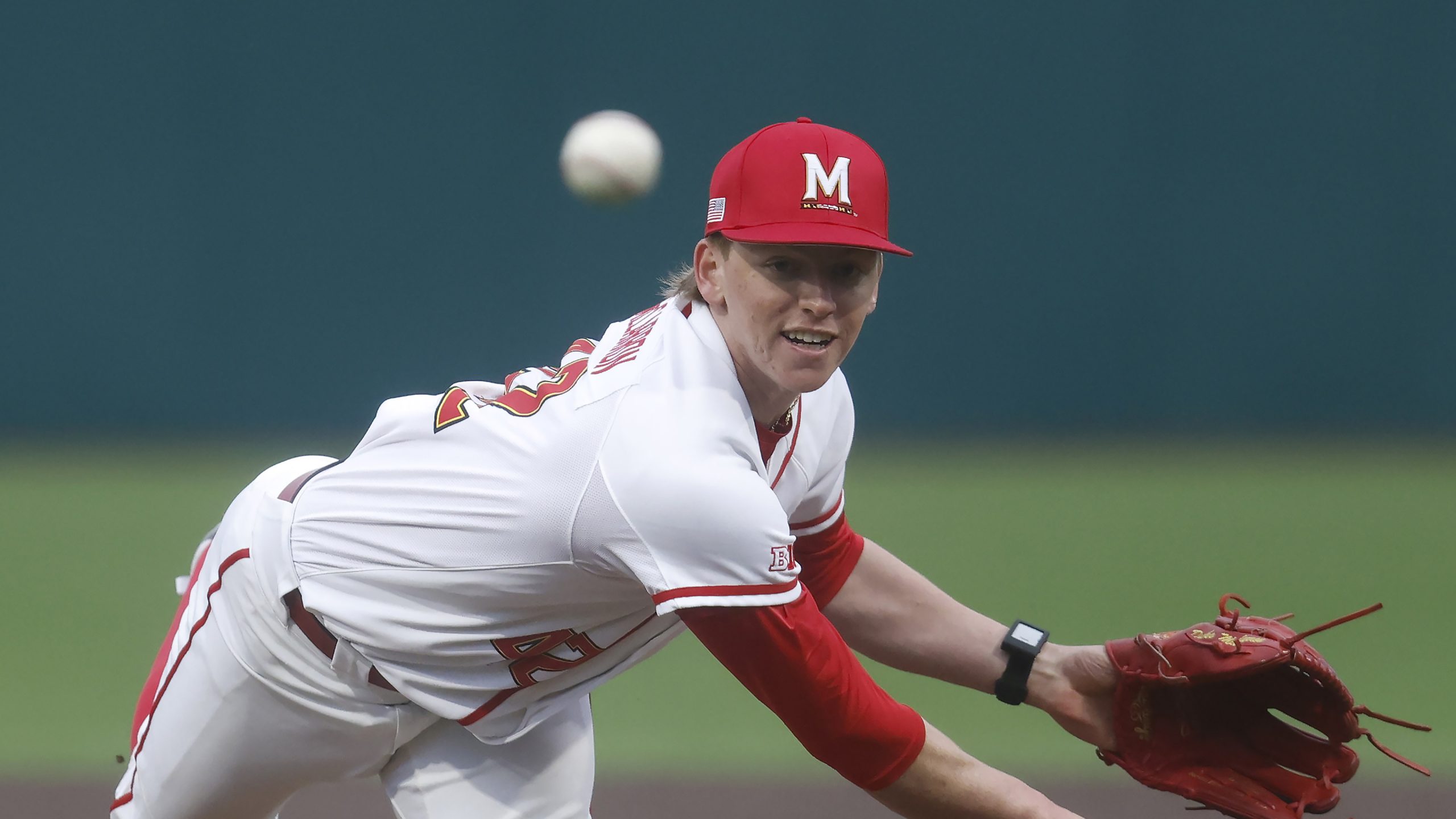
The 6-foot right hander spent his junior year with the Hawks after spending a season at Maryland and one at State College of Florida. He finished this season with a 5.27 ERA after pitching 70 innings, starting all 15 games he appeared in for a 4-3 record.
Duke McCarron spent one season at Maryland before transferring to St. Joe’s.Mike Buscher
McCarron, one of the main arms for St. Joe’s this season, hails from Ventnor, N.J. and played baseball for Ocean City High.
18th Round
Philly’s Mark Quatrani went to the Padres with the 545th pick.
A graduate of the Haverford School and a junior at Notre Dame, Quatrani earned a Buster Posey National Collegiate Catcher of the Year Semifinalist and a second team all-ACC nod after only his first season with the Fighting Irish.
In his 53 games started, the 5-11 catcher posted the best batting average on the team, with a .376, also leading in hits (80), RBIs (66), and slugging percentage (.643). Quatrani was second on the team in home runs (15) and total bases (137). Defensively, he caught 14 runners out during the season.
19th Round
The Phillies had another local selection with the 579th pick, drafting Braeden Lipoff from Gloucester Catholic.
The 5-11 catcher batted .459 during his senior year with the Rams and is the 18th-ranked catcher nationally for the Class of 2026, according to Perfect Game. A native of Woolwich, Gloucester County, he ranks second for catchers in his class from the state.
The East Carolina recruit was also a two-time all-state honoree and played a role behind the plate in three of Gloucester Catholic’s four consecutive state titles.
20th Round
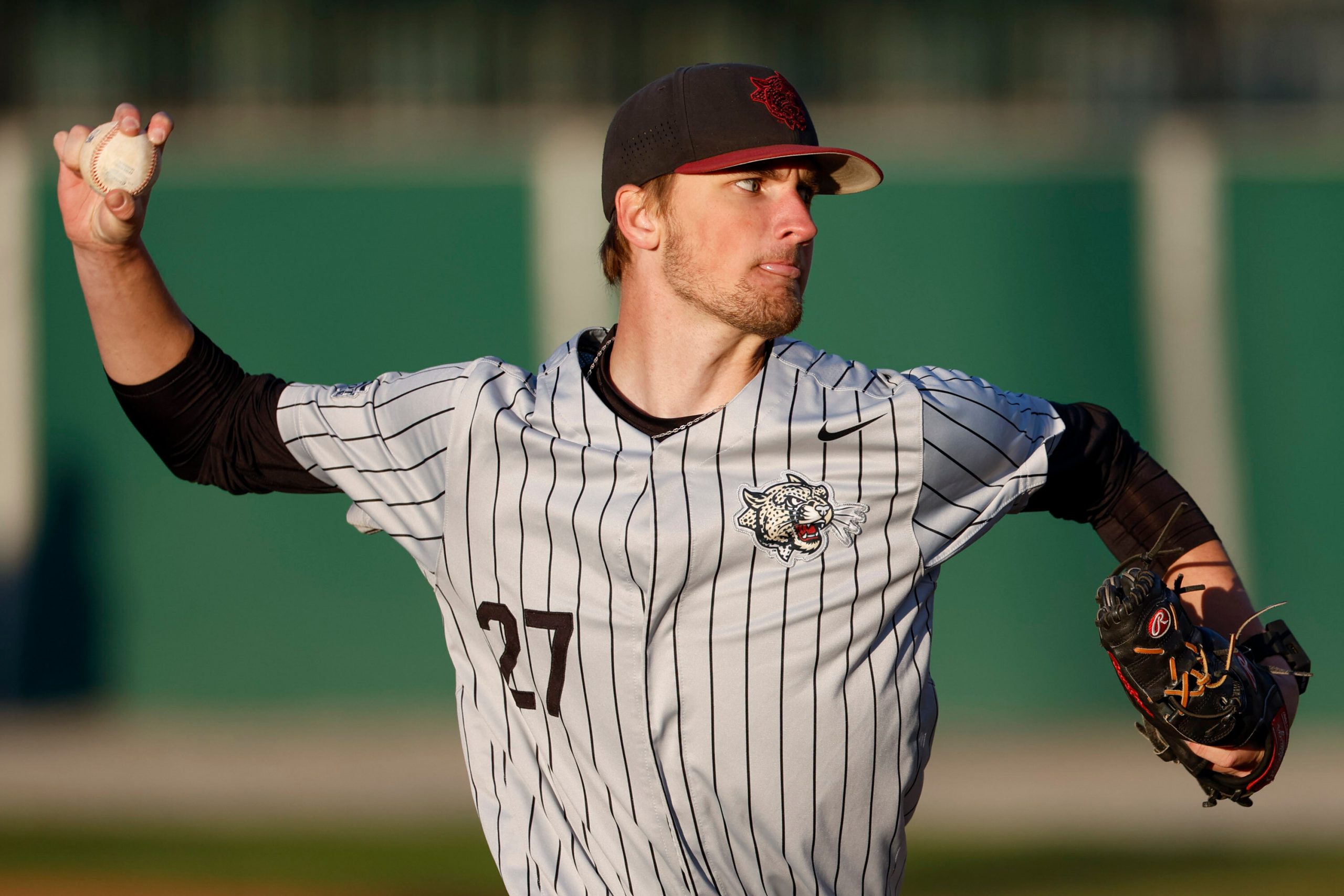
Late in the final round of the draft, Lafayette’s Tristan Helmick was drafted by the Cleveland Guardians at 602nd overall.
In his third season with the Leopards, Helmick had 11 appearances on the mound, all of them starts, owning a 5.78 ERA, 62 strikeouts, and a 1.48 WHIP with 62.1 innings pitched.
Tristan Helmick posted a 1.48 WHIP last season.Greg M. Cooper
The 6-6 right hander, originally from Fort Washington attended La Salle College High, where he was first team all-catholic and first team all-county, finishing his senior year with a 2.30 ERA and 6-1 record with 48.1 innings pitched.
The penultimate pick of the draft belonged to the Toronto Blue Jays, who selected Eddie Rosado Jr. from Holy Ghost Prep.
The 6-foot left-handed batter led Holy Ghost Prep in batting average (.463), OPS (1.545), hits (37), runs (44), and home runs (8), also setting the school career hit record with 111.
The outfielder from Bristol is committed to St. Joe’s and was ranked second in the state nationally for outfielders in his class by Perfect Game. He was also named to the 2026 Class 4A all-state team.
In six drafts since Brian Barber was hired to head up the amateur scouting department, the Phillies’ best pick so far came in the fifth round: Orion Kerkering in 2022.
They were shopping for another steal Sunday.
One day after using their first pick — No. 36 overall — to take a big swing for Tyler Spangler, a high school shortstop who didn’t play this season because of a back injury, the Phillies completed the draft with one pick in each of the final 16 rounds.
If there was a theme, 18 of their 21 picks were college players. Barber said the college-heavy emphasis was due in large part to having the fifth-lowest bonus pool ($7.773 million) from which to sign players. And they will spend a chunk of that money to lure Spangler away from Stanford.
“Once you do the Tyler Spanglers of the world, and then trying to work off of your budget pool that you have, you’re just not going to be able to sign too many high school players,” Barber said. “Those two don’t match up very well, to be honest with you.”
A roundup of the Phillies’ Day 2 selections:
Round 5
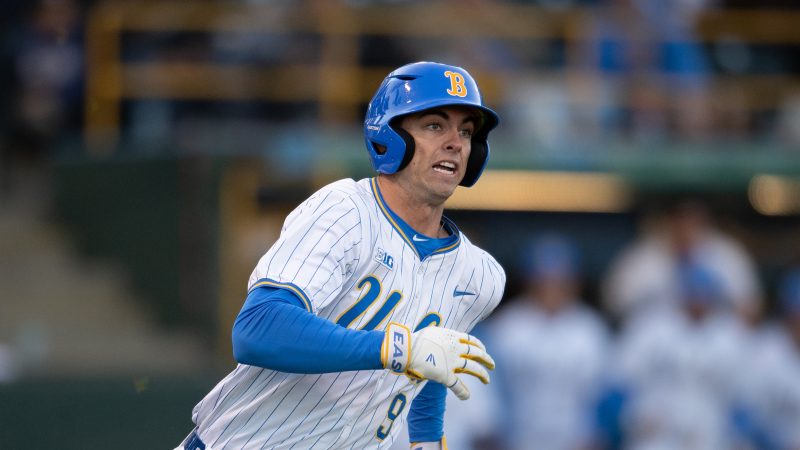
Will Gasparino, OF, UCLA
A teammate of No. 1 overall pick Roch Cholowsky, the 21-year-old broke out this season with 20 homers and a 1.071 OPS. At 6-foot-6, Gasparino figures to bring right-handed power into a system that needs it.
“It’s a tremendous body,” Barber said. “It’s large, it’s athletic. He’s always had the huge tools. He can really play center field. He can run, he can throw, and he can hit the ball a long way. And his game has come a long way in the last, I’ll say, 12 to 18 months.
“As far as trying to translate some of those raw tools into skills now, it’s just a guy that we’re excited to try to see that progress continue because we know he has the pure ability to be an impact player in the big leagues.”
Gasparino is also from a baseball family. His dad, Billy, ran the Dodgers’ draft room for five years as amateur scouting director before moving to the major league side as vice president of baseball operations.
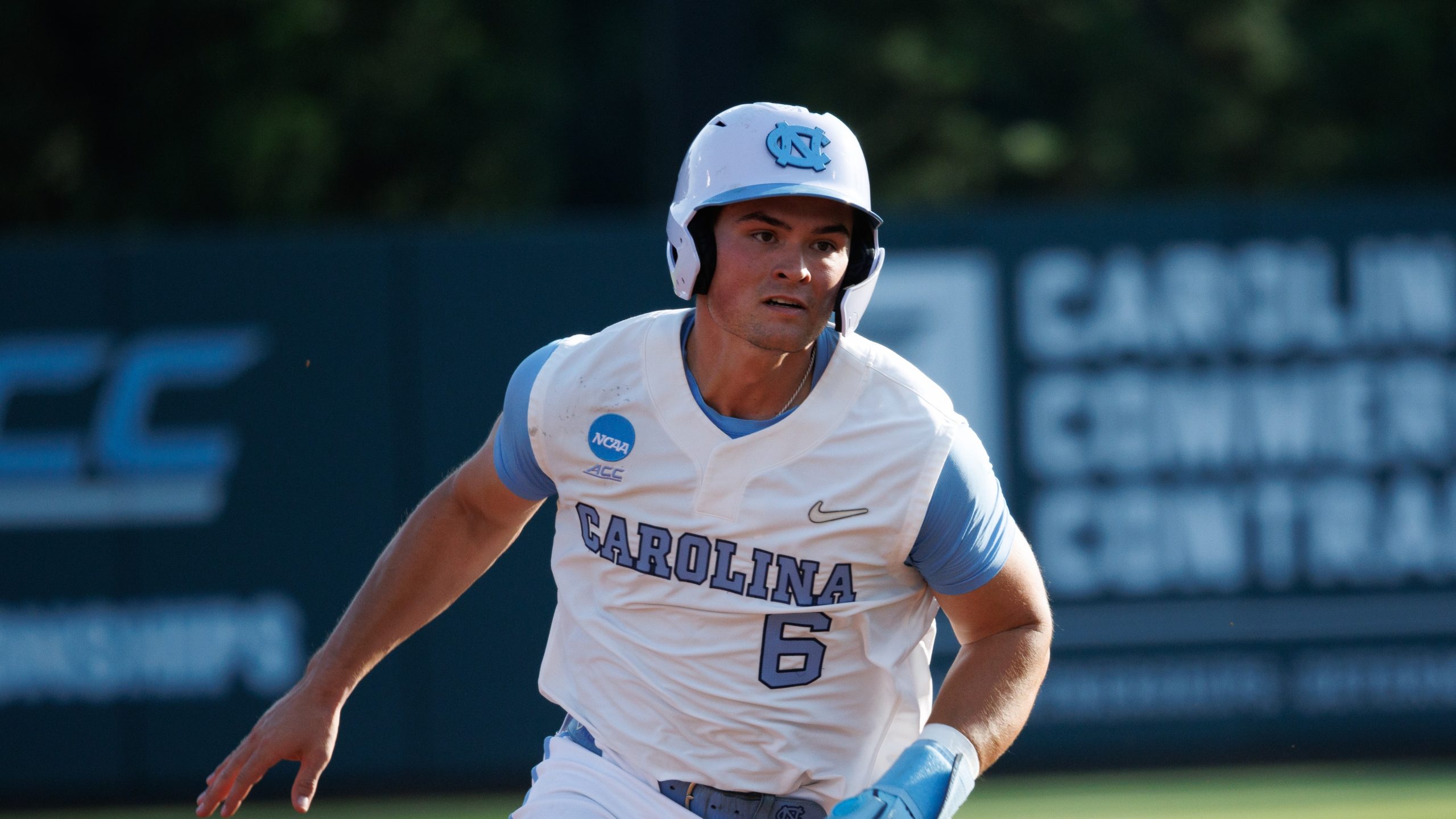
The Phillies drafted catching depth in North Carolina’s Macon Winslow.Ben McKeown
Round 6
Macon Winslow, C, North Carolina
Because of the time it takes to develop in the minors, teams hardly ever draft for need at the major league level. Still, the Phillies passed on multiple chances on Day 1 to add organizational catching depth behind 36-year-old J.T. Realmuto.
Winslow, 21, transferred from Duke and had a strong start to his junior year before fracturing a hand and shifting into a DH role. He’s expected to remain behind the plate in pro ball.
Led by analyst David Slusser, the Phillies identified qualities in Rhudy’s fastball that they believe will make it a major league pitch. Barber cited Rhudy’s low arm slot and “vertical rise” in spin and movement that creates swings-and-misses.
Rhudy, like Sheerin, was a reliever in college, closing out games for Tennessee with a fastball-slider combination.
“I happened to see him at the SEC Tournament when he was more in the 94- to 96-mph range and hitters have no chance against it,” Barber said, noting that Rhudy was 91-92 mph earlier in the year. “We’re hoping to see that velocity continue to rise along with the innate qualities that he has with it and for that pitch to continue to work.”
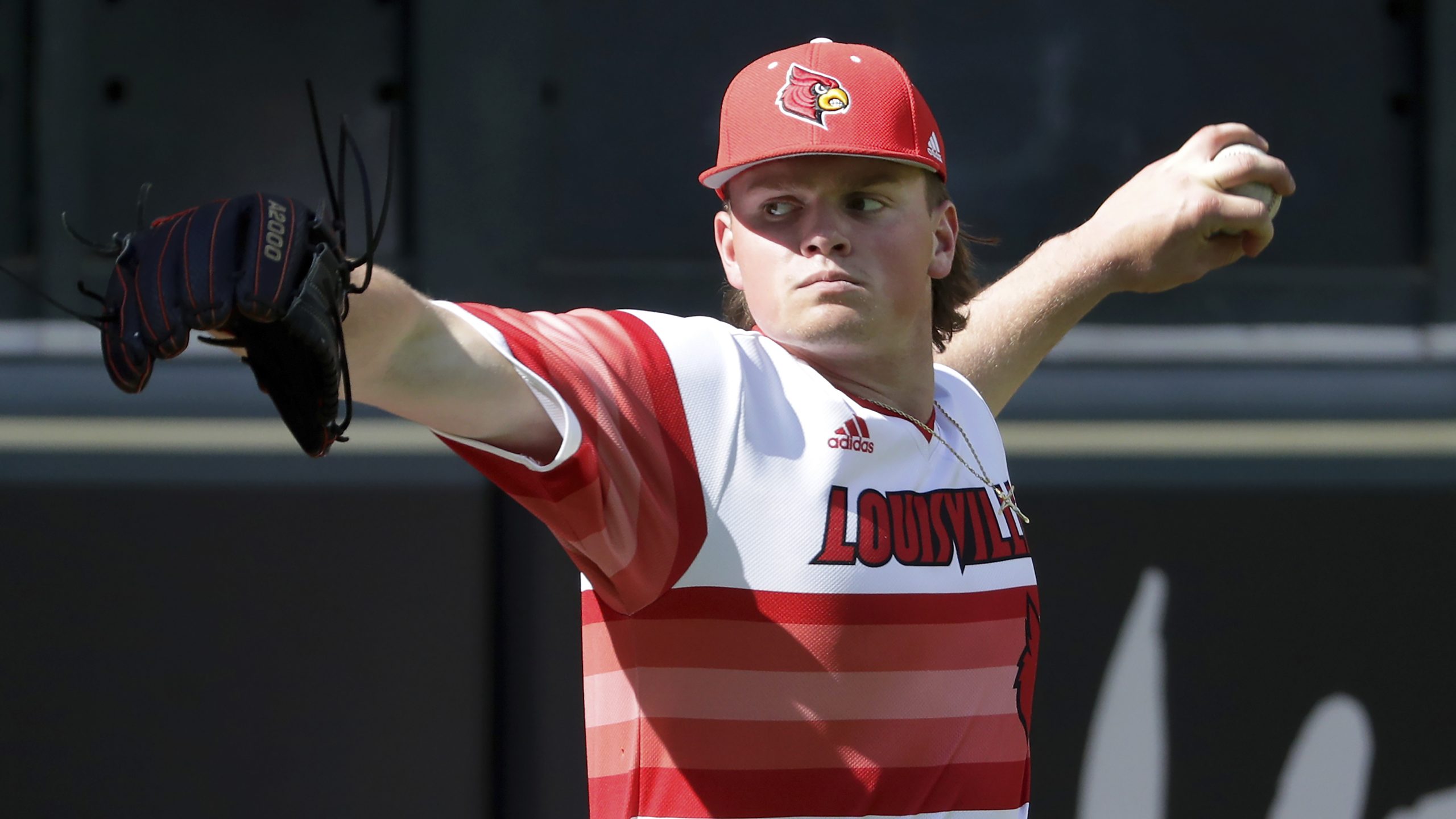
Louisville pitcher Wyatt DanilowiczMichael Wyke
Round 8
Wyatt Danilowicz, LHP, Louisville
In continuing their run on college pitchers, the Phillies snatched a lefty. Danilowicz, 22, was a reliever for two years at Louisville before moving to the rotation and posting a 6.00 ERA in 14 starts.
Round 9
Cooper Consiglio, LHP, North Carolina State
After a tough sophomore year in the bullpen, the 20-year-old’s stock rose last summer in the Cape Cod League. He went back to college and struggled again, with a 6.90 ERA in 16 games (11 starts).
Consiglio played for longtime NC State coach Elliott Avent, who had Trea Turner in his program for three seasons.
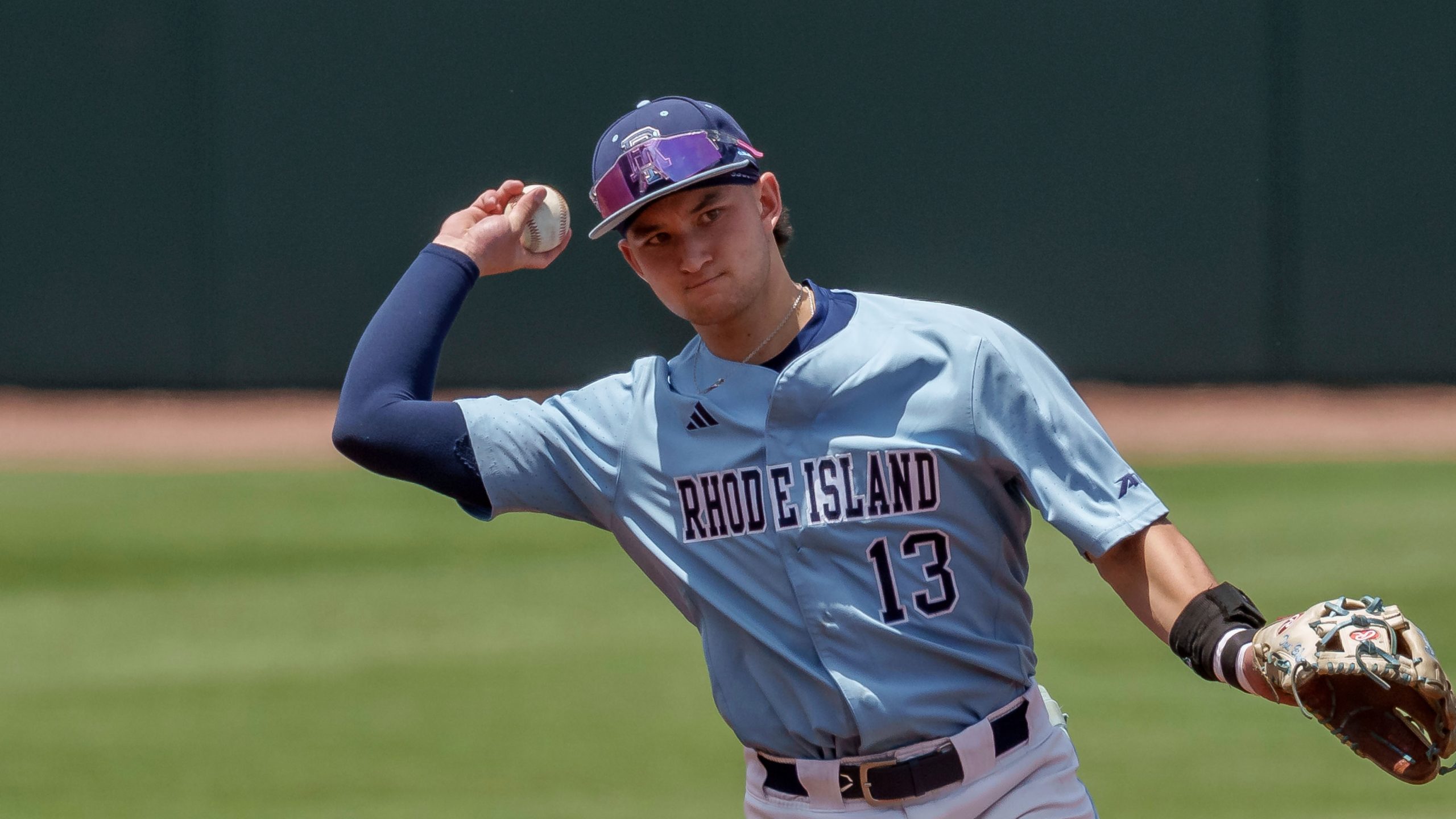
Rhode Island infielder Reece MoroneyMatthew Hinton
Round 10
Reece Moroney, SS, Univ. of Rhode Island
Undersized players from Northeast colleges are often overlooked. But Moroney, 5-11 and 185 pounds, caught the attention of scouts because of his contact skills and ability to reach base.
As a sophomore, he batted .356 with a .464 on-base percentage before hitting .370 and reaching base at a .426 clip as a junior.
Round 11
Drew Titsworth, RHP, Clemson
Like many of the other college pitchers in the Phillies’ draft class, the 21-year-old tries to create deception by throwing from a low arm slot. He gained experience as a starter and reliever in college.
Saint Joseph’s pitcher Christian CoppolaJason E. Miczek
Round 12
Christian Coppola, RHP, St. Joseph’s
The Phillies stayed local to find another college pitcher.
Coppola went to Cedar Creek High School in Egg Harbor City, N.J., then pitched as a starter at Rutgers for two seasons. He transferred to Arizona for one year before coming home to St. Joseph’s. He’s a reliever now, with a sweeping slider and fastball.
“He’s got swing-and-miss stuff, to be honest with you,” Barber said. “This is a guy that we identified a couple of months ago. Left-handed guy with good stuff who gets swing-and-miss with his repertoire.”
Round 13
Brayden Bakes, OF, Illinois State
After dislocating his left shoulder twice and medically redshirting as a freshman at Indiana, he transferred, got healthy, and batted .360 with 24 homers and a 1.091 OPS over the last two seasons.
Bakes, 21, is a left-handed hitter with a stocky build (5-10, 195). He had almost as many walks (64) as strikeouts (65) at Illinois State.
Patrick Clemmey, LHP, Avon Old Farms School (Conn.)
One of only three high schoolers selected by the Phillies and the first since Spangler at No. 36 overall, Clemmey had a private workout at Citizens Bank Park last month and impressed with a 6-5 frame and mid-90s heater.
Now, the Phillies have to sign him.
Clemmey graduated from a Rhode Island high school, then did a postgraduate year at Avon Old Farms after decommitting to Vanderbilt. Now, he’s committed to Georgia … unless the Phillies show him the money.
“I feel pretty confident that we’re going to bring him into the mix here, but nothing’s ever done until it’s done,” Barber said. “When were found out this was a possibility to hopefully sign him, we were all over it and took him at the earliest opportunity.”
George Mason infielder Owen Clyne Mike Buscher
Round 15
Owen Clyne, SS, George Mason
A versatile infielder, the 22-year-old played shortstop, second base, and third base in college. He also walked 72 times and struck out only 64 in two seasons, while batting .338 with 13 homers and 41 stolen bases.
Round 16
Matt Quintanar, C, Texas Tech
After transferring from Blinn College in Texas, he made 53 starts behind the plate as a junior and batted .323 with six homers and an .870 OPS. But his strength may be his defense. He threw out 44.9% of basestealers to lead the Power 4 conferences (SEC, ACC, Big 12, Big Ten).
Despite featuring three offspeed pitches (gyro slider, changeup, curveball), the 22-year-old settled into a relief role as a freshman at Pepperdine and kept pitching out of the bullpen after transferring to USC.
As a junior, he had a 4.28 ERA in 31 appearances this season. Command is an issue, with 19 walks in 33⅔ innings.
Round 18
Lane Haworth, OF, Texas-San Antonio
A left-handed hitter, he spent two seasons at Wichita State before transferring within the American Athletic Conference and having his best season yet. In 57 games, the 21-year-old batted .315, nine homers, more walks (44) than strikeouts (38), and a .927 OPS.
Round 19
Braeden Lipoff, C, Gloucester Catholic High (N.J.)
The Phillies didn’t have to look far for Lipoff, whom they worked out along with Clemmey. But will the South Jersey native stay home and sign with the Phillies? He’s committed to East Carolina University.
“This is one that we’re probably going to have to work a little bit on,” Barber said. “I do think there’s a chance. We’ve gotten to know him quite well. This one’s not a done deal, but I don’t think we’re super far apart, either. I’m very hopeful, but I don’t know quite yet.”
Round 20
Justin Lee, RHP, Notre Dame HS (Calif.)
Lee went to the same high school as Jack McDowell, Giancarlo Stanton, and Hunter Greene, and was highly touted as a hard-throwing reliever when he arrived at UCLA. But he had a 7.55 ERA and a 6.75 mark in his first two seasons. The 21-year-old was better as a junior, with a 3.26 ERA, albeit in only 19⅓ innings.
Sokah McNear had just handed a customer a spiral potato from her stand at the Southeast Asian Market in South Philadelphia on Saturday afternoon when her husband pointed to the dark clouds that had suddenly gathered in the sky.
“I said, ‘OK, this is your last potato,’” recalled McNear, the vice president of the vendors’ association at the long-running outdoor market in FDR Park. She switched off her stove, and nearly a dozen friends and family members who had been working the stall with her started to pack up.
Within minutes, they were caught in a torrential downpour. Then came the winds, whipping through dozens of tents across the market.
McNear and her family were struggling to keep their tent from flying away when another vendor raced by, yelling that it was no longer safe to stay outside. As branches cracked and fell from nearby trees, they abandoned the tent and ran to their car.
“We sat in there for maybe five minutes. Then we came out and saw the devastation,” McNear recounted on Sunday.
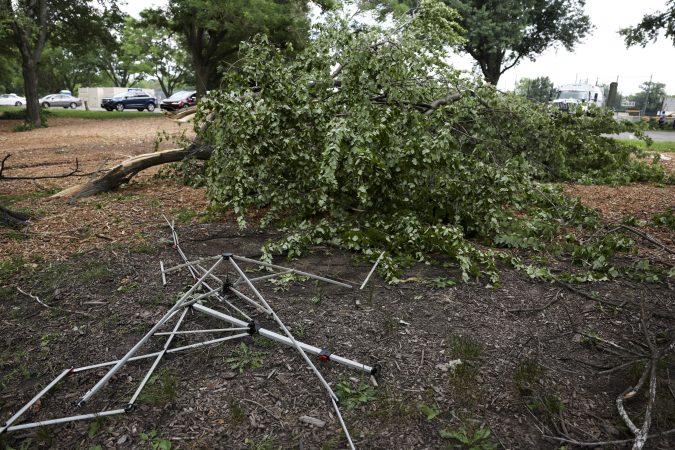
All of the market’s 53 tents were damaged. Tables were overturned, with ruined food and clothing scattered throughout the market. Two vendors suffered minor injuries when a tree branch fell on their tent.
Flying debris left a cut on a customer’s nose, said Sonetha Svay, who sells cookies and bagels at the market. “Everything was just flying. We really didn’t know what to do — we just hung on,” she said.
Eventually, she sheltered in her car with the woman and two other customers. A tree branch also fell on a tent near hers, she said, but the vendors working there had already fled.
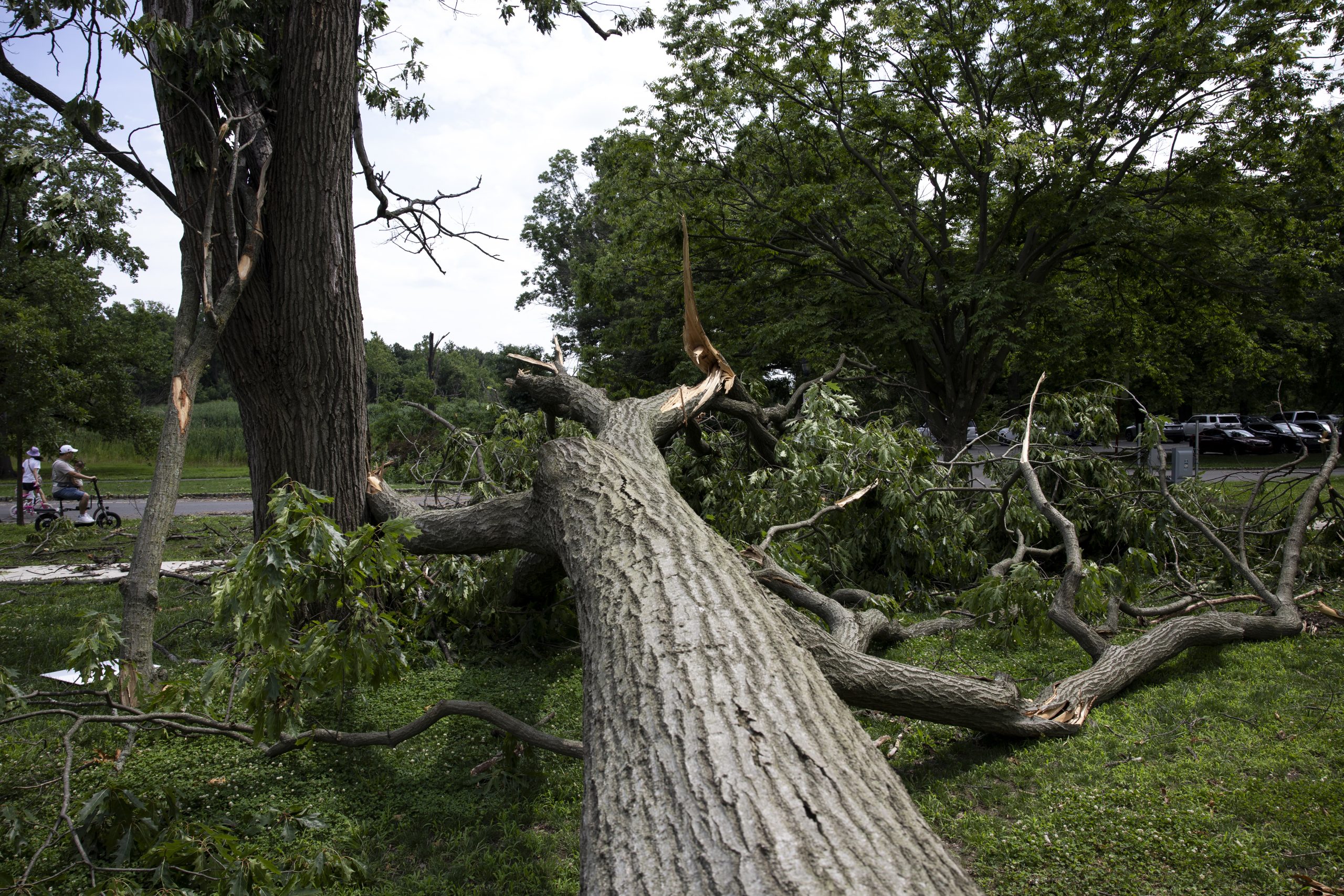
A large downed tree near the Anna C. Verna Playground at FDR Park in South Philly on Sunday, July 12, 2026. The Southeast Asian Market, which was also damaged, is near the playground. On Saturday severe thunderstorms caused damage across the region.Monica Herndon / Staff Photographer
Afterward, Svay, McNear, and other vendors picked through what was left of the market in shock.
Melissa Mgar, the vendors’ association secretary, had raced home with her three young children after a falling tree branch narrowly missed their car. She returned to find all three of her family’s tents destroyed. “One was crumpled into a ball,” she said.
Food inside coolers had survived, but nearly everything else — including supplies for barbecue and papaya salad — was lost.
Mgar, who has been selling at the market for more than 20 years, estimated her losses at around $1,500. She said she believed inventory at her neighbor’s clothing tent next door was “completely damaged.” Svay also lost her tent and food and estimated damages around $1,000.
Between ruined food and other merchandise and broken tents and equipment, most stalls likely sustained damage between $500 and $1,000, McNear said.
Vendors have already been struggling this season with market closures related to high-profile events like the World Cup at the sports stadium complex across the street from FDR Park, McNear said. Food and other supplies are more expensive now, too.
When she first saw the damage, McNear said, she panicked, worrying that vendors or customers had been injured. Once she made sure no one was seriously hurt, she said, her mind turned to the impact on the market. “These are people’s livelihoods,” she said.
By Sunday, the market was still closed for safety reasons. “You don’t want any more of these branches to fall,” McNear said.
Most vendors had managed to clean up what was left of their tents. Market organizers were encouraging donations from the public to help vendors rebuild. A “Dolla Holla” sale set for next weekend was postponed.
Trees had fallen all over the park, and the Friends of FDR Park marshaled volunteers to help clear debris. Park director John Murawski said he was too busy overseeing cleaning operations to comment. On the park’s Instagram account, staff noted that the storm had also caused flooding throughout the park.
McNear said that the market’s vendors are resilient and determined to bounce back from an unexpected setback.
“If you see any of the videos [from the market cleanup], everyone is still smiling. Everyone has such a positive attitude. Even with the devastation, we’re helping each other as a community,” she said.
Added Mgar: “After the storm, it’s going to be sunshine.”
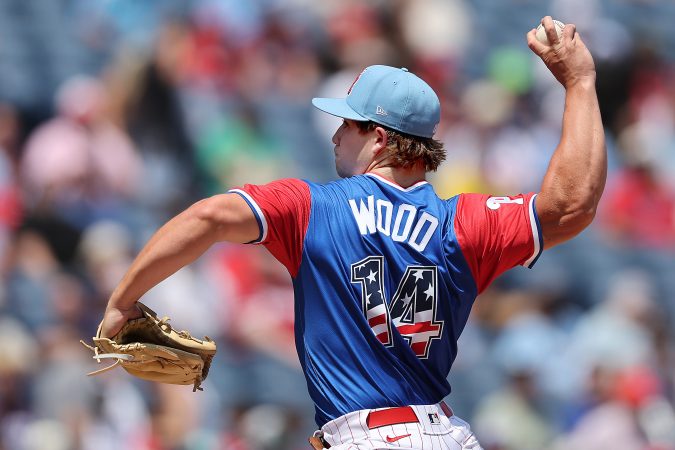
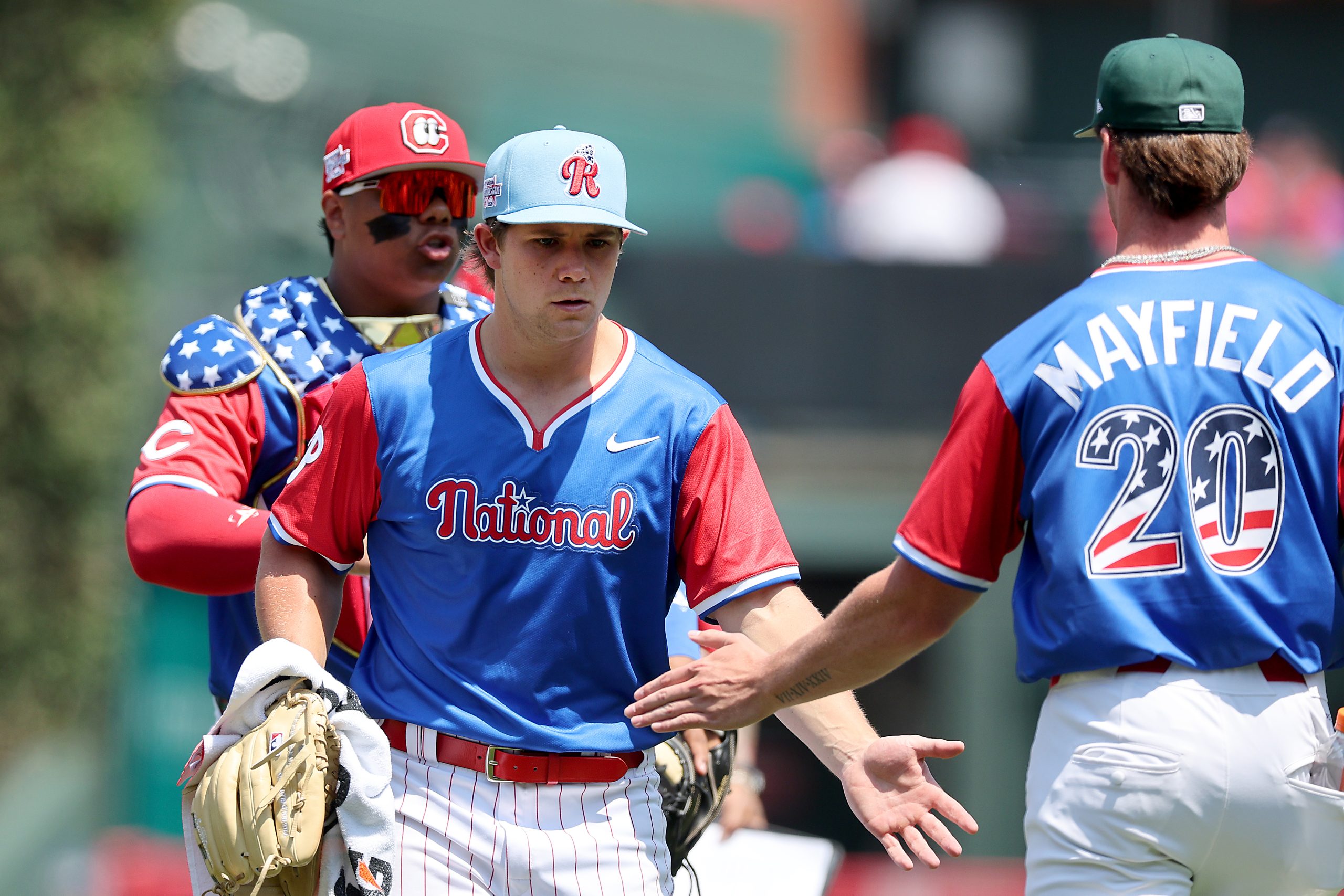
Gage Wood was the envy of the National League Futures team locker room on Sunday at Citizens Bank Park.
Not only did Wood earn the starting nod in the MLB All-Star Futures Game, but he also took the mound in his potential future home ballpark.
“When I got up those steps, and I got out there on that grass, I looked up and I was like, ‘Wow, this looks way bigger than from the suite when we signed last year,’” Wood said. “That was awesome. The park’s huge. Everybody here was like, ‘Man, you’ve got a good home park.’”
Wood, the No. 2 prospect in the Phillies farm system and No. 51 across MLB, gave up a hit and a run on 11 pitches in the top of the first. The American League Futures team went on to win the seven-inning game, 6-1.
“It was fun,” Wood said after his start. “I know before that first pitch my heart was pumping.”
The Phillies picked Wood out of Arkansas with the 26th overall pick in the 2025 MLB draft. The right-handed pitcher started his season with Clearwater, the Phillies’ low-A affiliate, before earning a promotion to double-A Reading in May.
Gage Wood (center) heads to the dugout before pitching in the Futures Game on Sunday.David Maialetti / Staff Photographer
Wood has a 3.45 ERA and 1.15 WHIP across eight starts for Reading, which earned him a spot on the National League Futures team.
“I hope it was a moment he’ll never forget,” Victorino said before Sunday’s game. “It’s always an honor to hand the ball to someone that’s a home-team kid, who will get an opportunity, hopefully, to someday pitch for that team.”
Wood gave up a leadoff single to Leo De Vries, MLB Pipeline’s No. 2 prospect. De Vries stole second and third before coming home on a Franklin Arias ground out.
After De Vries scored, Wood kept the other batters he faced off the base paths. Luis Peña ranged back from his spot at third base to snag a Ralphy Velazquez fly ball down the left-field foul line, earning a tip of the cap from Wood.
Walker Jenkins then grounded out to first base on the first pitch to end Wood’s inning.
Wood finished his lone inning without a strikeout, but nine of his 11 pitches were strikes. He threw two changeups, two sliders, and seven fastballs, topping out at 97.7 mph.
While Sunday’s outing gave Wood a glimpse of his potential future, Wood is not interested in projecting when he will be ready for the majors.
“I don’t look that far ahead into things,” Wood said. “I just, kind of, stay where I’m at. [My] main goal was to go out there today and enjoy this experience with these awesome players. I’m very blessed to be here.”
Wood was not the only Phillies pitching prospect in action on Sunday.
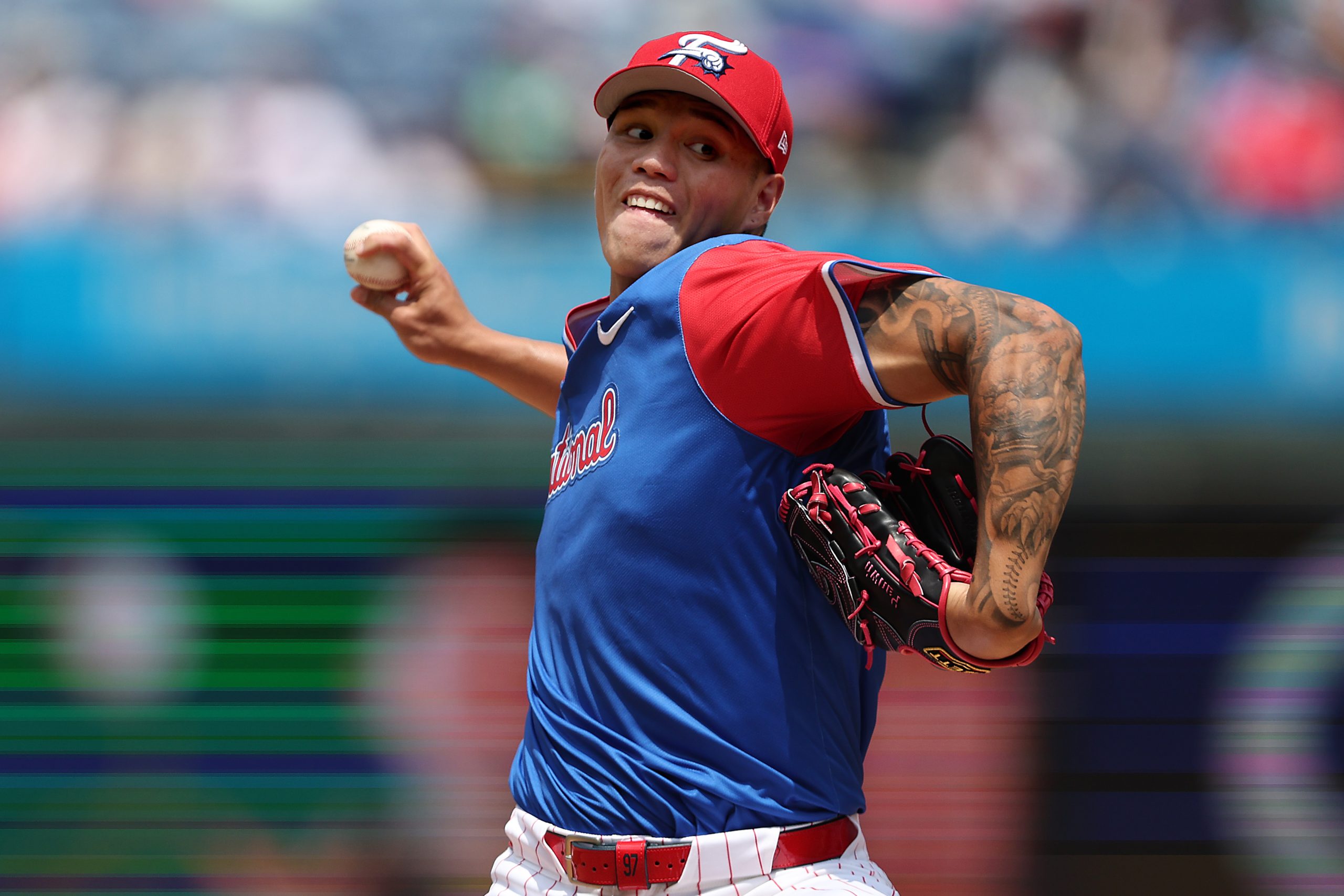
Wen-Hui Pan, the No. 12 prospect in their system, took the mound with two outs and the bases empty in the top of the sixth inning.
Pan walked the first batter, then gave up a two-run homer to Nathan Flewelling. Pan struck out Xavier Neyens to end the top of the sixth and was replaced in the seventh.
Phillies prospect Wen-Hui Pan gave up two earned runs in 1/3 of an inning on Sunday in the Futures Game.David Maialetti / Staff Photographer
This season, Pan, 23, has a 3.38 ERA in eight relief appearances since being called up to double-A Reading in June.
Before Sunday’s Futures Game, Pan said he relished an opportunity to take the mound at Citizens Bank Park.
“[I am] really excited about the game today,” Pan said through a translator. “Before [I get] into the major leagues, [I am] really happy that he got a chance to get on this mound and pitch in this stadium.”
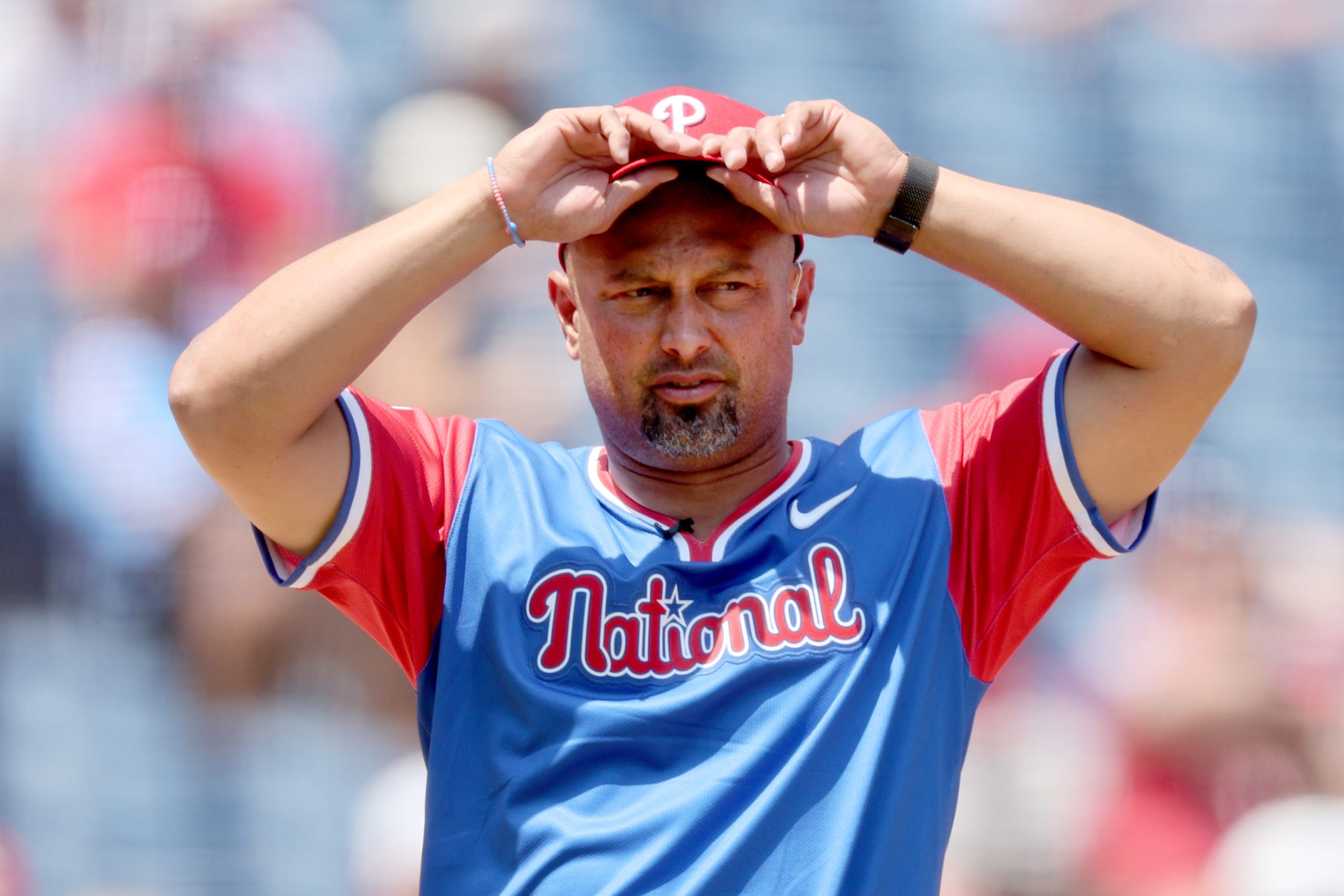
Both teams of minor league prospects were managed by former Phillies. Victorino, who won a World Series with the Phillies in 2008, managed the NL team, while Larry Bowa led the American League team.
“When you have an opportunity to have an organization love you as much as you love the organization, that means a lot,” Victorino said. “To be able to do stuff with Major League Baseball as well, and be asked to do this, the Futures Game, the opportunities with MLBx and all the other things around Philadelphia this weekend, it’s an honor.”
Bowa, who won the World Series with the Phillies in 1980, stacked his staff with former Phillies. Juan Samuel, Milt Thompson, Billy Wagner, and Michael Bourn all coached with Bowa on Sunday.
Former Phillie Shane Victorino was the National League manager in the Futures Game on Sunday.David Maialetti / Staff Photographer
Bowa, 80, had two stints managing the Phillies and has served as a senior adviser to baseball operations since 2017.
“I’ve been very fortunate,” Bowa said. “Not only with health and the good man upstairs, but [with] the organization, the Phillies. … The fact they let me do this. Without the help of those guys, I couldn’t keep suiting up the way I’m doing right now.”
The sacred space sits quiet now. But amid the ruins and solemn silence, one can almost hear the ghostly prayers of the damned. Inmates from a century ago, whose bodies were incarcerated, but whose souls found escape.
On July 2, Eastern State Penitentiary opened its new permanent exhibition, “Freedom Through Faith: Judaism at Eastern State and Beyond.” Centered in the historic penitentiary’s painstakingly restored synagogue — the first within a U.S. prison — the exhibit powerfully recounts how incarcerated Jewish people and local Philadelphians came together amid rising antisemitism in the 1920s to construct a sacred space unlike any other in the United States.
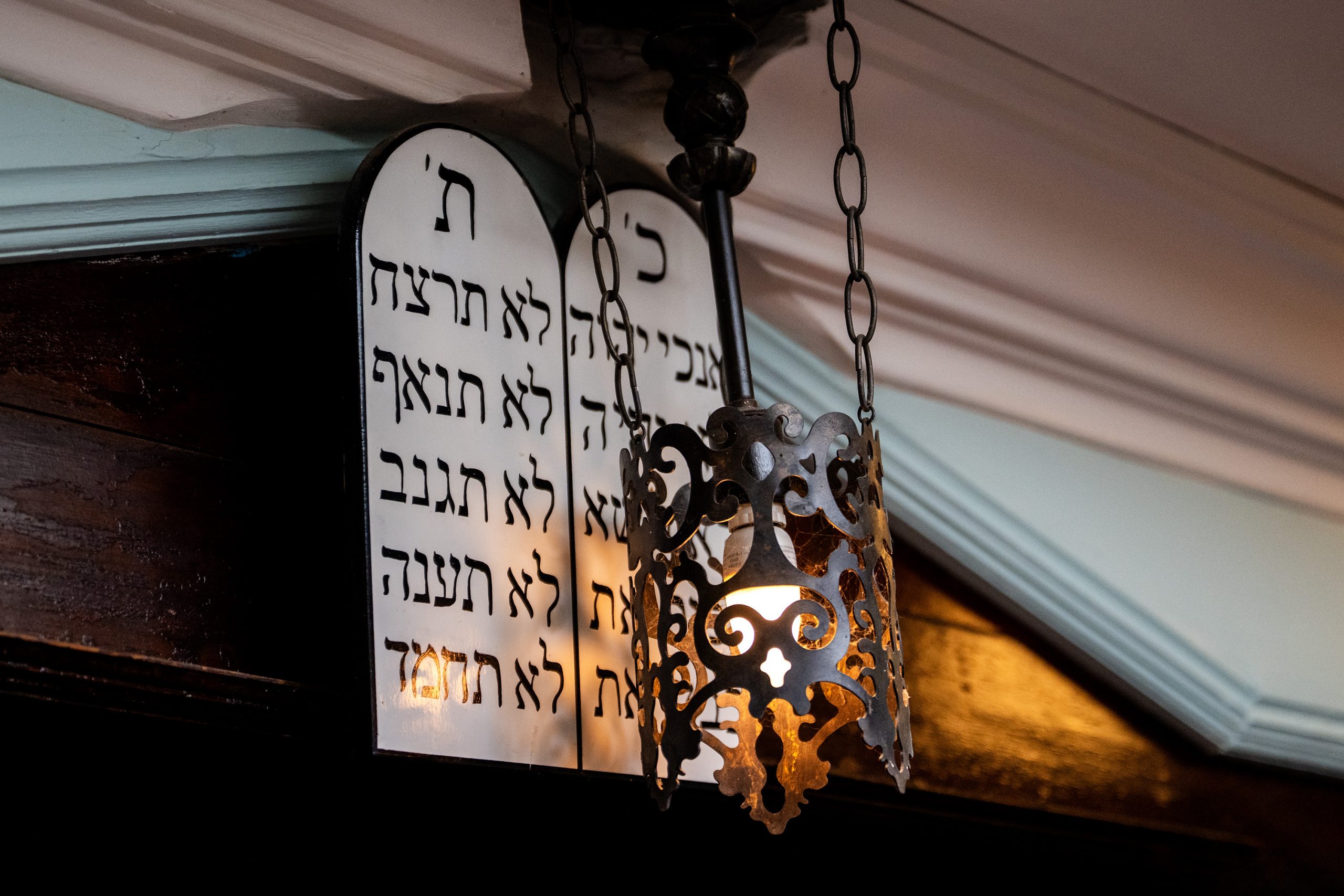
A Ten Commandments tablet in Eastern State Penitentiary’s Alfred W. Fleisher Memorial Synagogue.Tom Gralish / Staff Photographer
“We are so excited to open our newest permanent exhibition, especially in such a powerful year, to explore this remarkable story,” said Kerry Sautner, president and CEO of Eastern State. “This is a powerful sacred space that all Americans should visit and learn from.”
A tale of hope
As the nation continues to celebrate the 250th anniversary of the Declaration of Independence, the exhibit examines how one of America’s founding ideals — religious liberty — was experienced at America’s first penitentiary, opened in Fairmount in 1829, and which emphasized strict solitary confinement as a path to true penitence.
By combining a gripping mix of personal stories, archival materials, letters, photographs, and historical artifacts, and the power of the space itself, the exhibit tells a tale of hope.
The space was first established as an informal synagogue in 1922 in a former prison yard and weaving shop. It was restored by researchers in 2009.
“In the very place that invented solitary confinement, a small group of civically minded Philadelphians came together to build a community rooted in faith and belonging,” said Sautner, who served as chief learning officer at the National Constitution Center before coming to Eastern State in 2023. “Their work was revolutionary then, and we still have much to learn from it today.”
The story of Jewish Philadelphia
To tell the tale of the forgotten synagogue, Eastern State researchers tell the tale of Jewish Philadelphia itself.
Fleeing pogroms and poverty in Eastern Europe, more than two million Jews immigrated to America between 1880 and 1924. Tens of thousands settled in Philadelphia, where, like so many other marginalized immigrant groups, they experienced hardships and prejudice. Some landed behind Eastern State’s imposing 30-foot granite walls, and served their sentences mostly in solitude.
Until the synagogue, Christianity dominated life in the prison, where ministers preached in the cell blocks. Isolated from their families and religious life, Jewish inmates were pressured to convert, Sautner said.
“The only time people got real human contact with another human was the rabbi and the clergy from the Jewish community coming in and checking on their cells,” she said.
With urging from the outside community, prison officials allowed Jewish inmates to hold religious ceremonies in the prison’s cramped emergency hospital in 1913. It was the first known communal gathering in the prison’s history.
“This is a revolutionary act,” said Sautner. “It happens because of the influence of the Jewish community in Philadelphia.”
A grim mellowness
Soon the inmates were holding weekly Shabbat services. In 1917, an article in The Jewish Exponent, a local Philadelphia paper, reported on the first inmates-led Passover Seder at the prison. The article described how the inmates built a Torah ark — the sacred and ornate chamber that houses the Torah scrolls — for the service.
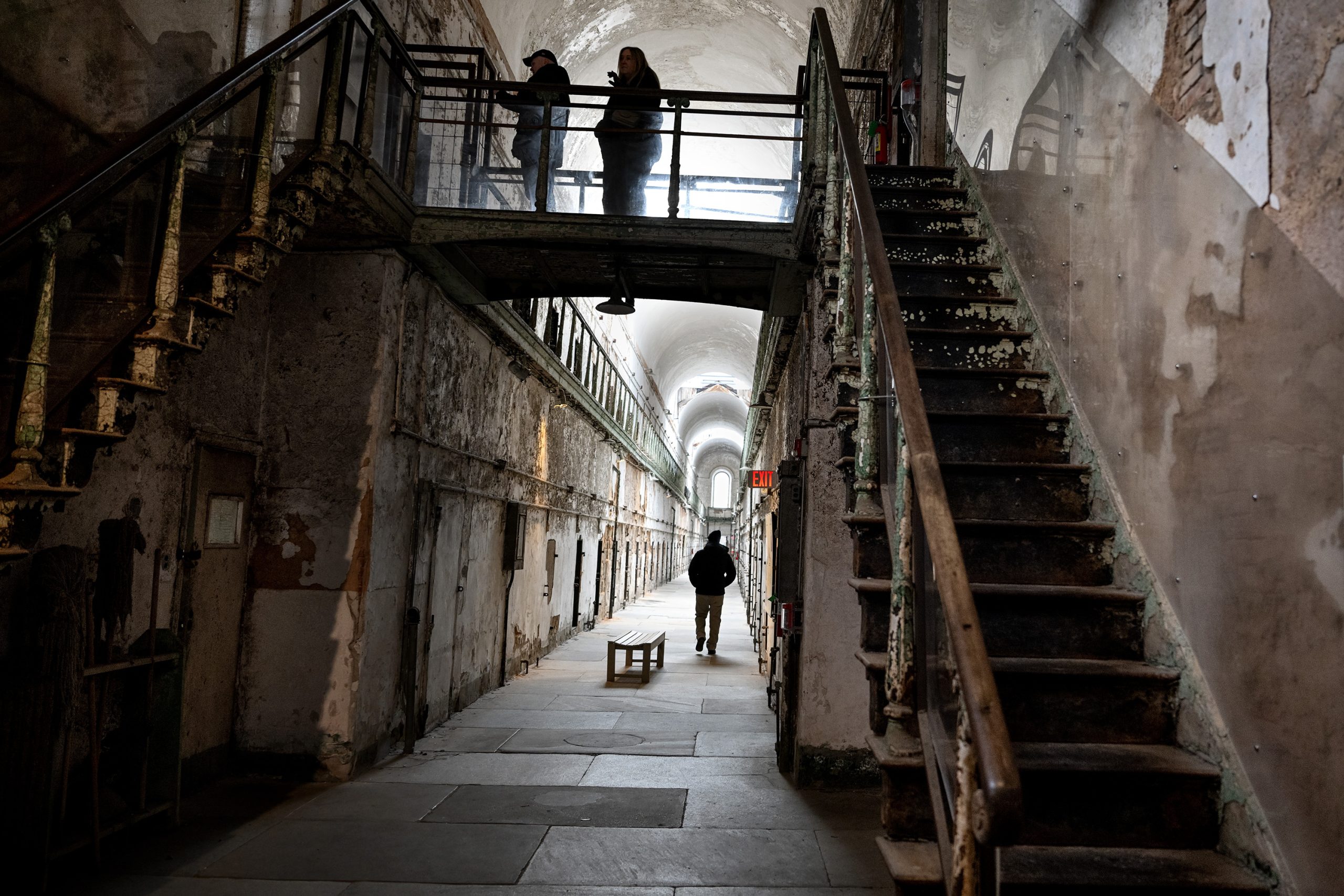
Visitors in a cellblock at Eastern State Penitentiary on Feb. 26. The historic prison is hosting a yearlong slate of free public programming celebrating the 250th anniversary of America.Tom Gralish / Staff Photographer
By 1922, with the help of Philadelphia philanthropist and prison reformer Alfred W. Fleisher, the inmates began meeting in their makeshift synagogue in the tucked away weaving shop. In 1928, the prison rabbi, Isaac Feinberg, worked with local Philly design firms to design a proper synagogue, which was unprecedented in an American prison.
“The Jewish community on the outside is working with the community on the inside,” said Sautner. “This is communal teamwork to give one another a chance to hold onto their identity and hope.”
The designs were eventually implemented by two incarcerated men: Jacob Forbes and David Goldman — and other inmates who learned trades to help complete the synagogue.
“It was designed and developed by incarcerated people here,” Sautner said. “Some who were Jewish and some who were not. But it was really about, ‘How do you hold onto community?’”
Named in memory of Fleisher, the completed synagogue, according to a 1920s newspaper article, “lends a mellowness to that grim institution.”
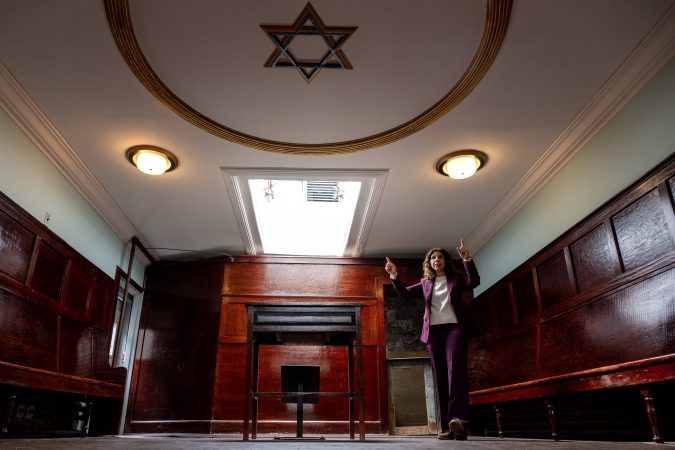
The synagogue was built of dark cherry wood with a white-tiled ceiling, and bearing a metal Star of David on the door.
‘A sacred place’
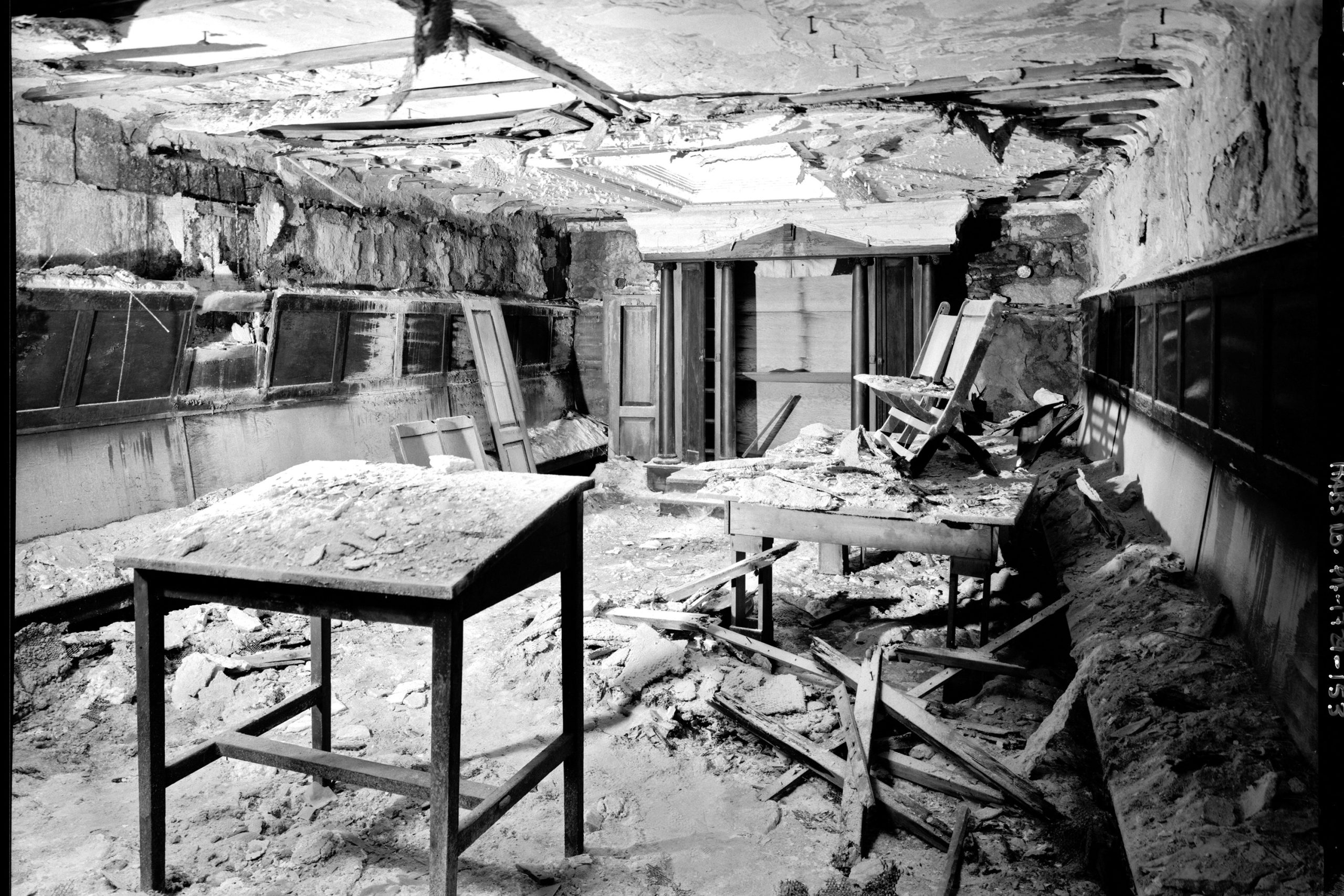
By 2009, the synagogue was in ruins, buried beneath a caved-in roof in a mostly abandoned section of the prison. Researchers meticulously sifted through the dirt and disrepair, finding a jar holding the synagogue’s former Star of David.
The 1924 Alfred W. Fleisher Memorial Synagogue as it appeared in 1998, before restoration. It was the first dedicated Jewish house of worship in a U.S. prison, and was restored in 2009 to its 1959 appearance.Jack E. Boucher / Library of Congress
For the exhibit, the nonprofit that owns the former prison spent more than $500,000 to restore the space to its 1950s solemnity, also rehabbing a nearby prep kitchen that served as the synagogue Seder space.
The exhibit, open seven days a week, occupies an adjacent room, allowing visitors to stand in the quiet of the synagogue to imagine the peace and belonging found there by souls gone by.
“We wanted you to be in the synagogue,” said Sautner. “To be in a sacred place.”
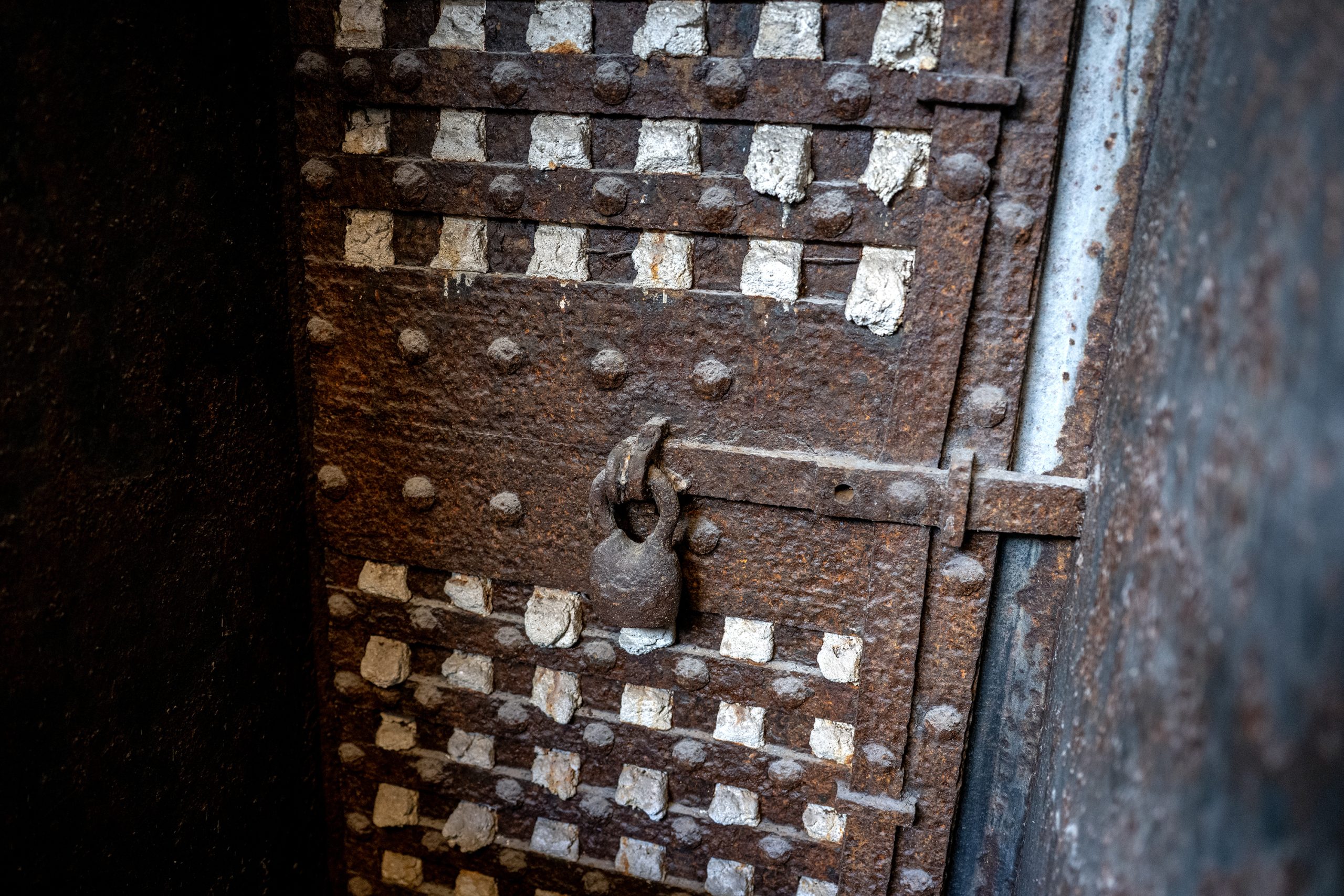
Metal doors — with huge 1830s padlocks sealed behind a wall in 1924 — in Eastern State Penitentiary’s restored 1924 Alfred W. Fleisher Memorial Synagogue. It was the first dedicated Jewish house of worship in a U.S. prison, and was restored in 2009 to its 1959 appearance. The metal doors were revealed when the walls were removed during the renovation. The doorway once led from cells in Cellblock 7 to individual exercise yards. The metal door kept the prisoners in while wooden doors kept the weather out.Tom Gralish / Staff Photographer
Cristopher Sánchez‘s meteoric rise to the ranks of elite major league pitchers will now come with the stamp of an All-Star Game start.
Sánchez, the Phillies‘ ace lefty, was informed Sunday by Dodgers manager Dave Roberts that he’s the choice to start for the National League on Tuesday night in Citizens Bank Park, a league source confirmed before Roberts made it official.
“I smiled a lot,” Sánchez told reporters, through a team interpreter, after the Phillies wrapped up the first half in Detroit. “It’s reflection of all the hard work that I’ve been doing throughout the year, and I’m just extremely proud of myself right now.”
Sánchez, who will be opposed by Blue Jays starter Dylan Cease for the American League, is the first Phillies pitcher to start an All-Star Game since Roy Halladay in 2011. Curt Schilling, Steve Carlton, Curt Simmons, and Robin Roberts also started at least one All-Star Game as a Phillie.
“He deserves it,” Roberts told reporters in Los Angeles. “He’s a hometown ballplayer, and I think the city of Philly will enjoy watching and supporting him. He was very grateful. In a time where guys are not wanting to participate in the midsummer classic for the fans, this is a good thing that he’s that excited about pitching.”
Sánchez ranks second in the majors in innings (127⅓), third in strikeouts (144), and ninth in ERA (2.62). The 29-year-old is also second among pitchers in wins above replacement (4.0, according to Fangraphs).
But Sánchez’s chances of starting for the NL improved because neither ERA leader Jacob Misiorowski of the Brewers nor Dodgers two-way unicorn Shohei Ohtani will pitch in the All-Star Game. Misiorowski was scheduled to start Sunday for Milwaukee and later scratched with arm fatigue, while Ohtani bowed out with an irritated left knee.
Cristopher Sanchez will join teammates Brandon Marsh and Kyle Schwarber as starters for the National League.Elizabeth Robertson / Staff Photographer
Sánchez will join the Phillies’ Brandon Marsh and Kyle Schwarber in the NL’s lineup. Marsh was elected by fans to start in the outfield; Schwarber, chosen as a reserve on the players’ ballot, will replace Ohtani as the NL’s designated hitter.
A year ago, Sánchez was overlooked for the All-Star team, which rankled many of his teammates. There wasn’t any chance of that happening this year.
Not after Sánchez went 50⅔ innings without allowing a run, the longest streak ever by a lefty and fifth-longest all-time. He had a 1.80 ERA through 16 starts before stumbling in a five-run start at Washington and a career-worst nine-run start last Sunday in Kansas City.
This season, the Phillies’ frustration stems from the omission of Zack Wheeler, who lowered his ERA to 2.13 with six scoreless innings Sunday in Detroit but also missed the season’s first month while coming back from thoracic outlet syndrome.
Wheeler said it was “B.S.” that MLB didn’t name him as an All-Star and later replaced him on the NL roster. (Pitchers who start their team’s last game before the break don’t usually pitch in the All-Star Game on one day’s rest.) The league approached Wheeler on Friday about adding him as a replacement, but he said he declined “because they disrespected me.”
But Wheeler also declined to pitch — or even attend — the All-Star Game in 2024 in Texas and last year in Atlanta, his hometown.
“There’s certain circumstances where guys can’t play, they are injured. But this is an honor,” Roberts said. “It’s not only just an honor to be named it, but it’s an honor to participate and want to participate. Cristopher wants to, and I’m excited about naming him the starter in the All-Star Game.”
Sánchez is at his best at home. In his last 56 starts in Citizens Bank Park dating to 2024, he is 23-8 with a 2.21 ERA and 377 strikeouts in 354 innings. This year, he’s 7-1 with an 0.86 ERA in 11 home starts.
“I think it’s just fan support overall,” Sánchez said recently through a team interpreter, “and also knowing every inch of this stadium.”
After giving up two runs on 10 hits Saturday in Detroit, Sánchez said, “It would be awesome to start the All-Star Game at home. With the fans, it just would be an awesome thing. It’s another accomplishment and another goal, for sure, but it would be an awesome thing to do.”
It’s now a reality.
“Yeah, it’s just going to be crazy,” Sánchez said. “You guys know that Philly is the best environment in baseball that there is, so it’s just going to be really joyful and really crazy.”
Staff writer Lochlahn March contributed to this report.
DETROIT — The Phillies were playing that night, so Kevin McGonigle had to get to the ballpark early. Around 10 a.m., when the batting cages would be empty.
He was a senior in high school, and the Phillies hitting coach, Kevin Long, had invited him to take some swings at Citizens Bank Park. Long’s son, Jaron, worked for the agency that represented McGonigle. He asked his father if he would hit with his client, who was a Delco native, a big Phillies fan, and poised to be taken early in the 2023 MLB draft.
“I said, ‘I’d love to. Let me check out what this guy’s got,’” Long said.
Long is used to working with major leaguers. On the Phillies, he oversees the second-oldest group of hitters in baseball. McGonigle was on the cusp of being selected 37th overall by the Tigers, but at the time, he was still a high schooler at Bonner-Prendergast, still a teenager.
The session was a memorable experience for both of them. They spent about half an hour swinging in the cages. And when they were done, McGonigle still had more questions.
“Hey, can you show me Bryce Harper’s routine?” he asked Long. “Can you show me Kyle Schwarber’s routine?”
Long would demonstrate, explaining how and why a certain player would approach a drill. And so the session went on for another half an hour, with McGonigle emulating the major leaguers he’d grown up admiring, in their batting cage.
“I had a feeling he was going to be special,” Long said. “Had a feeling he was going to be in the big leagues. This quick of success probably surprised me a little bit.”
Bonner-Prendergast’s Kevin McGonigle was the 37th overall selection in the 2023 draft.Heather Khalifa / Staff Photographer
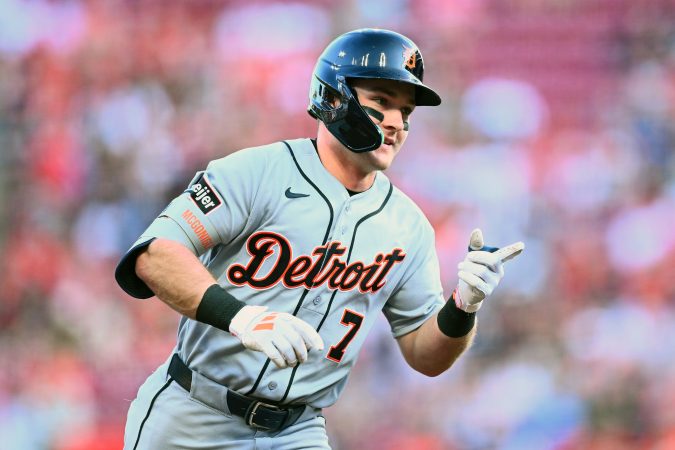
This week, McGonigle will return to the same stadium, this time as a major leaguer himself. The 21-year-old Tigers infielder will make his Citizens Bank Park debut in the All-Star game, just over three years after that session with Long.
The Tigers drafted McGonigle during Competitive Balance Round A, which falls between the first and second rounds. He went 10 picks after the Phillies selected shortstop Aidan Miller 27th overall.
During the 2025 All-Star festivities in Atlanta, McGonigle was one of the top prospects selected to play in the Futures Game. He was playing for Detroit’s double-A affiliate at the time. But after making the Tigers’ opening day lineup in March, the kid from Delco has put together a sparkling rookie season.
“Growing up wanting to go to an All-Star Game in Philadelphia just as a fan, it was always a dream of mine,” McGonigle said. “Just to go experience it and watch the All-Star Game in Philly. But now I get to have a front-row seat and actually play in it, so I haven’t really been able to think of words to describe the way I feel.”
He has a .285/.394/.424 slash line in his first 92 games, and will be an infield reserve on the American League team.
McGonigle will be staying at home with his parents for the festivities. He said about 35 friends and family members will be in attendance at the game. He also had plenty of family in the stands over the weekend at Comerica Park to see him face his hometown team, a trip planned before McGonigle was selected for the game.
None of this has sunk in yet for him.
“I think it’s gonna all hit me either when my name gets called or the national anthem, somewhere in the lines of the All-Star Game,” he said.
His phone started blowing up immediately on Friday after McGonigle took starter Aaron Nola deep in the series opener. In the third inning, he sent a sinker 414 feet into the Phillies’ bullpen in right-center field.
After the game, Nola gave an unprompted shoutout to McGonigle, who grew up a fan of his. He was 10 years old when Nola debuted for the Phillies in 2015.
“Good hitting, right there,” Nola said of McGonigle. “Hit that ball pretty hard, out of one of the deepest parts of the field. So hat off to him on that one.”
McGonigle was excited after seeing the clip.
“He gave me some props on that, which was really nice of him,” McGonigle said. “So hopefully, I can run into him at some point, and just get to know him a little bit and thank him for the good words he said about me.”
McGonigle briefly chatted with Harper on the field in Detroit. The first baseman was one of his favorite Phillies growing up, after Chase Utley. He hopes to get the chance to talk more during the All-Star festivities.
“I was nervous to say something to him, and it was just like a normal conversation, which was awesome,” McGonigle said. “I think that’s the best part about it. All these superstars are just normal guys, and you get to build relationships with them, learn from them, and just get to know them.”
He and Long have kept in touch over text since their hitting session three years ago. They haven’t been able to connect in person in Detroit because Long’s duties usually keep him busy in the batting cages underneath the stadium.
But they have been messaging. McGonigle had a bat sent over to Long at his request. And watching him from the opposite dugout, Long still recognizes the high schooler he swung with back in 2023.
“That’s the same kid,” Long said. “He’s tough. He’s gritty. He puts together these at-bats, it’s like, ‘Wow.’ Takes a really good swing. He’s not trying to baby his swing. He’s letting it kind of eat a little bit, which I like.”
He recalled seeing similarities between a younger McGonigle and former Red Sox infielder Dustin Pedroia, based on his size, demeanor, and his toughness.
What makes him a tough at-bat now for the Phillies to plan for is McGonigle’s discipline at the plate, Long said.
“His swing is a little bit unorthodox, but it’s a tight, compact swing,” Long said. “He controls his barrel very well. Uses the whole field. And his toughness. You can just see it. You can see it as soon as he goes to that at-bat, and overall, what he does at the plate. You sense that he’s not going to get out, or he’s going to make it really tough on the opposing pitcher.”
Long was so impressed by McGonigle back then that he later stopped by one of McGonigle’s games at Bonner in his senior season, to get a look at how he played defense.
He was blown away.
“I’m very proud of him, and I’m glad that we were able to cross paths,” Long said. “Something he’ll remember for a long time, and I’ll never forget it.”