Tag: topic-link-auto

  • U.S. reimposes blockade and steps up strikes as Iran threatens to halt Mideast energy exports

    U.S. reimposes blockade and steps up strikes as Iran threatens to halt Mideast energy exports

    DUBAI, United Arab Emirates — The U.S. reimposed a naval blockade on Iran and intensified its airstrike campaign Wednesday in retaliation for Tehran’s attacks on ships trying to pass through the Strait of Hormuz. The American strikes hit an Iranian army barracks, killed at least seven troops and wounded hundreds of people across the country, Iranian officials said.

    Days of back-and-forth strikes by the U.S. and Iran across the Middle East — and renewed threats to the waterway crucial to global energy supplies — have shredded the interim deal to end the conflict and the region could tip back into all-out war.

    The U.S. first imposed a blockade in April and then lifted it last month after signing the interim deal that paused the fighting and set a 60-day period for negotiations over issues such as Iran’s nuclear program. Those talks have stalled as fighting over the Strait of Hormuz has intensified.

    When the U.S. and Israel launched the war on Iran on Feb. 28, Tehran effectively closed the waterway to shipping traffic — a move that sent the price of oil, fertilizer, and many other goods soaring far beyond the region and gave Iran major leverage in negotiations. Those rising prices pose a particular challenge to President Donald Trump and his Republican Party, which hopes to retain control of Congress in elections in November. But Washington has struggled to successfully reopen the waterway.

    Iran’s parliament speaker and lead negotiator, Mohammad Bagher Qalibaf, said Iran was prepared for a fuller military confrontation if the U.S. does not live up to the terms of the interim deal, and Iran’s paramilitary Revolutionary Guard threatened to halt all energy exports from the Middle East over the blockade.

    “The export of oil and gas from the region will be either for everyone or for no one,” the Guard said.

    Soon after the U.S. launched its third wave of strikes in 24 hours, Trump said Iran was ready to strike a peace deal, but he did not elaborate.

    “They don’t like what we’re doing, and they do want to settle. We’ll find out whether or not we settle with them, or we just finish it off,” he said Wednesday at a defense summit at the U.S. Army War College in Pennsylvania.

    Trump insisted that the U.S. is “doing really well with Iran” and added that the Islamic Republic “is not happy right now.”

    Both the U.S. and Iran launch attacks as the blockade is reimposed

    The U.S. carried out a wave of strikes, hitting dozens of targets overnight, the military’s Central Command said Wednesday, and then resumed striking Iran during daylight — an unusual move that further signaled the increasing tempo of the attacks. Another wave of strikes began late Wednesday.

    About 24 hours after the blockade went into effect, the U.S. military opened fire and disabled a merchant vessel Wednesday.

    U.S. Central Command said that they spotted Curacao-flagged oil tanker Belma sailing toward Kharg Island and, after the ship “ignored multiple warnings,” a U.S. aircraft disabled the vessel after firing hellfire missiles into the ship’s smokestack.

    In addition to the now-disabled Belma, the U.S. military said it has also had to speak with two other commercial vessels but they complied with their instructions to turn away.

    Among the U.S. military’s targets was Greater Tunb Island, which is viewed as a strategic point in the Strait of Hormuz. Central Command said the attack targeted Iranian defense and missile sites.

    Iran took control of three islands — Abu Musa, Greater Tunb and Lesser Tunb — from what would become the United Arab Emirates in 1971. The UAE has sought to reclaim them.

    Some analysts have suggested that if the U.S. seized the islands, they could allow it to control the strait.

    The U.S. military said its bombing campaign hit targets along Iran’s southern coast in Bandar Abbas, Khormuj, Ahvaz, Qeshm, Bushehr, and Kuh-e Stak — a list that includes several coastal towns and another island near the strait.

    Another strike targeted a barracks for Iran’s 388th Mechanized Infantry Brigade, which operates tanks and armored vehicles, in Sistan and Baluchestan province, Iranian state television reported. The report said the Americans fired at least 13 missiles in the attack and that the seven dead included conscripts and career soldiers. A number of troops were wounded.

    More than 35 people have been killed and more than 300 wounded by U.S. airstrikes in recent days, said Hossein Kermanpour, a spokesperson for the Iranian Health Ministry. At least 72 people are hospitalized, he added.

    Kermanpour did not break down the figures between civilians and combatants.

    The announcement marked the first overall toll given by Iranian authorities for this round of fighting. The number of wounded was far larger than for any other recent violence between Iran and the U.S. The army said it would make “a decisive response,” according to state TV.

    U.S. Navy Adm. Brad Cooper, who leads Central Command, said in a statement that Iran had launched dozens of missiles and drones at neighboring Gulf Arab countries.

    Missile-alert warnings sounded Wednesday in Bahrain and Kuwait as they faced incoming Iranian fire — a daily occurrence in recent days. In a post on X late in the day, Bahrain’s Interior Ministry urged people to “head to the nearest safe place.”

    Jordan said it shot down three incoming Iranian missiles. Iran claimed attacks on the three nations, all of which host U.S. forces.

    In a statement published online, Qalibaf said the United States had not lived up to the terms of the interim peace deal, which he said included “Iranian arrangements” over the Strait of Hormuz.

    “Now that we have entered the implementation phase, the United States, having exhausted its legal and diplomatic options, is trying to undermine those Iranian arrangements through force,” he wrote.

    Qalibaf’s comments appeared aimed at critics within Iran who oppose negotiations with the U.S. He argued that negotiations should not be equated with compromise or surrender, but as part of a broader strategy of resistance.

    The Strait of Hormuz remains at the heart of the fighting

    The latest round of fighting is focused on the Strait of Hormuz, through which a fifth of the world’s oil and natural gas trade passes during peacetime. How to reopen the strait has bedeviled the U.S. since Iran choked it off in the early days of the war.

    During the interim deal, some ships began moving through the passage using a route near Oman overseen by the U.S. military that is outside Tehran’s control.

    In recent days, Iran attacked ships using that route — and back-and-forth attacks ensued. The U.S. has threatened to reopen the strait by force — but experts say that would require a much bigger armada if not tens of thousands of ground troops. Imposing the blockade is another way to put pressure on Iran.

    But in the meantime, oil prices are rising. The price for Brent crude oil, the international standard, traded above $85 a barrel on Wednesday — more than 15% higher than the price before the war, but still well below the nearly $120 reached at the height of the conflict.

    Analysts with the International Monetary Fund warned Wednesday that while a surplus of oil had kept prices low, “much of that room has now been used up.”

    “Unless inventories are replenished, the world will start from a weaker position when the next shock comes,” Azim Sadikov and Jean-Marc Natal wrote in a blog post.
  • Clean up underway after thousands of gallons of wastewater spilled at Burlington County landfill

    Clean up underway after thousands of gallons of wastewater spilled at Burlington County landfill

    Burlington County officials are working to clean up a major wastewater spill at a Florence Township landfill that could have entered a local waterway.

    Workers with a wastewater hauling company discovered a crack on the cap of a leachate cleanout pipe around 4 a.m. Tuesday, the county said. An investigation into the cause is ongoing.

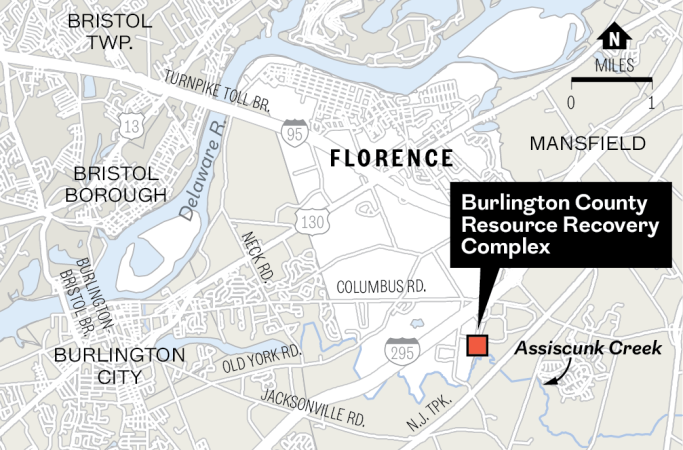
    Officials estimate that as a result of the break, between 5,000 and 25,000 gallons of wastewater from the Burlington County Resource Recovery Complex had spilled onto the ground and then spread into a detention basin with an outfall to the Assiscunk Creek.

    “It’s possible some wastewater may have entered the water before the spill was contained; however, there are not anticipated impacts,” David Levinsky, a public information officer with the county, said Wednesday.

    No nearby residences or businesses were impacted by the spill.

    The Burlington County Department of Solid Waste and Recycling is working with the New Jersey Department of Environmental Protection to clean up the spill and remediate the area.

    The immediate area where the spill occurred has been treated and the county anticipated completing all remaining remediation actions on Thursday, the county said.

    The Assiscunk Creek is a 17-mile tributary of the Delaware River that is a popular fishing, kayaking, and birdwatching spot for South Jersey locals. Assiscunk Creek Park is a series of three preserves along the creek that are connected by walking and bike trails with sports fields, playgrounds, gazebos, and benches overlooking the creek.

  • Former Bucks County man who voted twice for President Donald Trump in 2020 sentenced to six months of house arrest

    Former Bucks County man who voted twice for President Donald Trump in 2020 sentenced to six months of house arrest

    A former Bucks County man who voted twice for President Donald Trump in the 2020 election was sentenced Wednesday to six months of house arrest and three years of probation.

    Matthew Laiss was found guilty by a jury earlier this year of casting two ballots in the 2020 election: first by mail in Pennsylvania, where he had once lived in Ottsville, and then again in person in Florida, where he was living at the time.

    Laiss, 32, said in court Wednesday that his actions were “stupid” and a mistake. And his lawyer said that Laiss never meant for both votes to actually count — that he had wrongfully assumed election officials would identify he had voted twice and only count one of his ballots.

    “In hindsight, it wasn’t good judgment,” Laiss said.

    Prosecutors, however, said they did not believe that, in part because they said Laiss misled FBI agents about his actions when he was confronted years later. And Assistant U.S. Attorney Mark Dubnoff said Laiss had shown a “striking” lack of remorse for what he did, repeatedly saying it was the result of his age or mental health at the time, as opposed to realizing he had committed a crime.

    “Mr. Laiss has not accepted ownership of what he did,” Dubnoff said.

    U.S. District Judge Joseph F. Leeson Jr. said Laiss’ crimes were serious and had affected “all citizens of this country.”

    But he declined to send Laiss to prison, noting that Laiss had already lost his job as an insurance salesman as a result of the case, and that he would have the felony conviction on his record for the rest of his life.

    The U.S. Attorney’s Office charged Laiss last year with crimes including voter fraud and voting more than once in a federal election.

    Prosecutors said records showed that Laiss had filled out and returned a mail-in Pennsylvania ballot in October 2020. And less than a week later, they said, he went to a polling place in Florida and voted again.

    Laiss later said in court documents that he voted twice for Trump. And as his case progressed toward trial, he sought to claim that his actions were covered by pardons Trump extended to people who tried to help him overturn the results of the 2020 election, which Joe Biden won.

    Leeson denied Laiss’ motion, and in March, Laiss, now a resident of Bethlehem, was found guilty by a federal jury in Allentown.

    Prosecutors announced Laiss’ case alongside the indictment of a Philadelphia woman, Miya Pack, who was separately charged with voting twice in the 2020 election. She pleaded guilty last month and is awaiting sentencing.

    Still, attorneys said cases involving people casting multiple ballots were relatively rare in eastern Pennsylvania. Laiss’ lawyer said the only other comparable case in the region that unfolded in recent years was that of Philip C. Pulley, a Philadelphia landlord who voted in the city, Montgomery County, and Florida in 2020 and 2022. He was also sentenced to probation.

    Trump has nonetheless made frequently questionable or false statements about the prevalence of voter fraud, particularly in instances where his opponents or Democrats have won. Election officials and experts generally agree that voter fraud has not historically occurred at widespread rates or in ways that could lead to incorrect outcomes.

  • President’s House advocates vow to keep fighting despite the new exhibit — and a vandalism citation

    President’s House advocates vow to keep fighting despite the new exhibit — and a vandalism citation

    Sandra Shachar has been posting news articles on the walls of the President’s House Site almost every day since January.

    She was outraged that President Donald Trump’s administration had dismantled the exhibit telling the story of the nine people George Washington enslaved in his executive mansion at Sixth and Market Streets, and sharing information with visitors was her way to push back.

    When she arrived at Independence Mall on Wednesday morning, new panels were on the historic site’s walls. The National Park Service had installed a new exhibit before dawn.

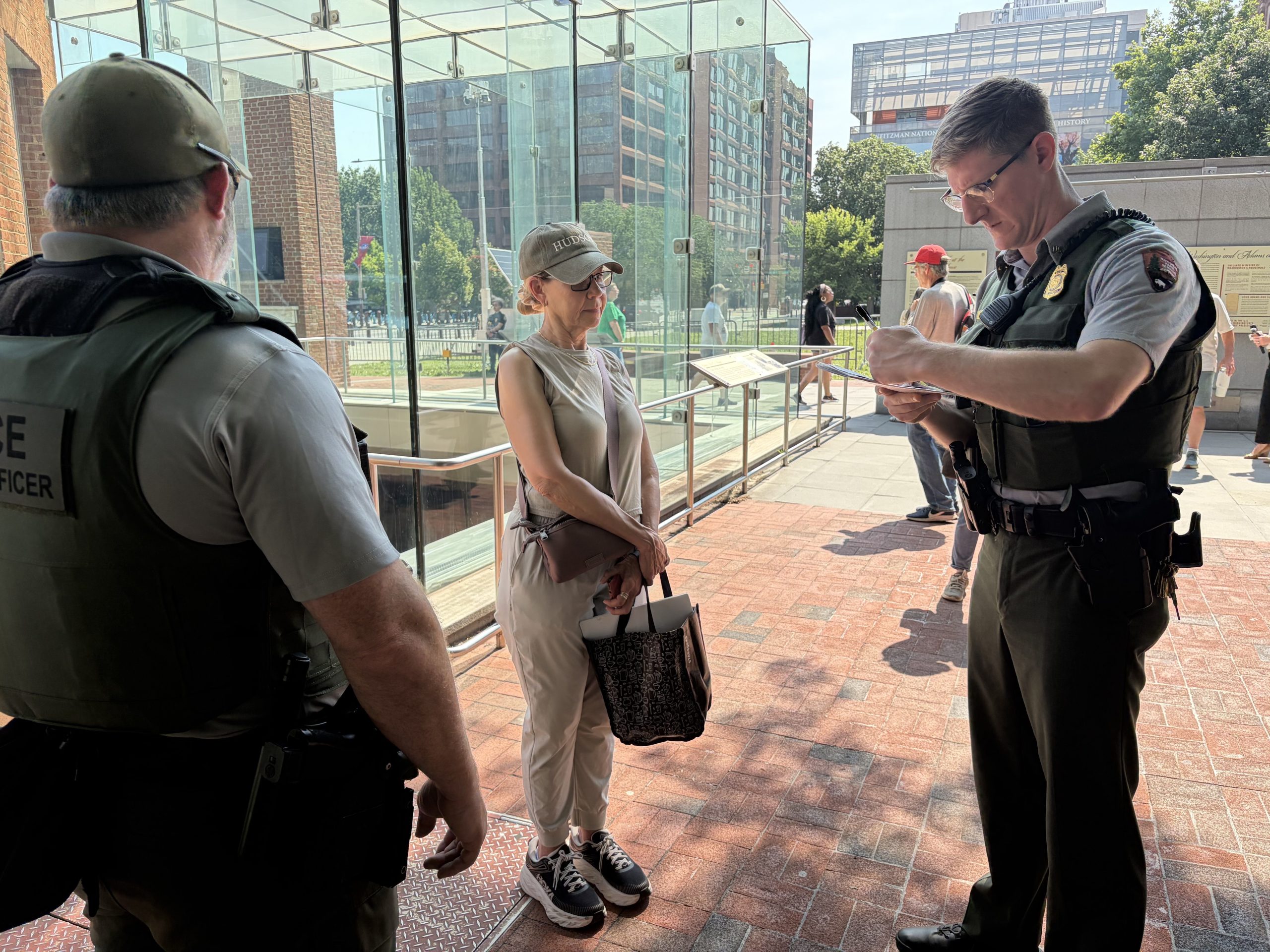
    But Shachar, 72, continued with her routine. This time, two park rangers stopped her.

    “When I went to tape my sign up, they came and said, ‘You can’t do that. Please stop,’” the psychologist from Center City said.

    Sandra Shachar, 72, cited for vandalism at the President’s House site on July 15, 2026 for attempting to post news articles on the walls.Abraham Gutman

    The rangers issued Shachar a citation for vandalism, which carried a $305 fine, and warned her that next time she could be arrested.

    The news came as a gut punch.

    “It was something I could do,” Shachar said. “And now for doing something, I’m issued a citation that says I have created vandalism on federal property.”

    The vandalism citation marks an escalation in the National Park Service’s response to protest at the President’s House, and comes as activists promise to keep the fight over the site’s history alive.

    The National Park Service installed the new exhibit early Wednesday, hours after the city hosted MLB All-Star Game events near the site.

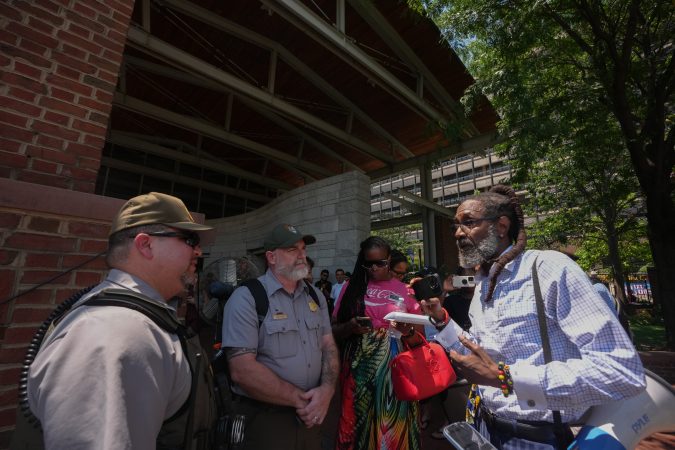
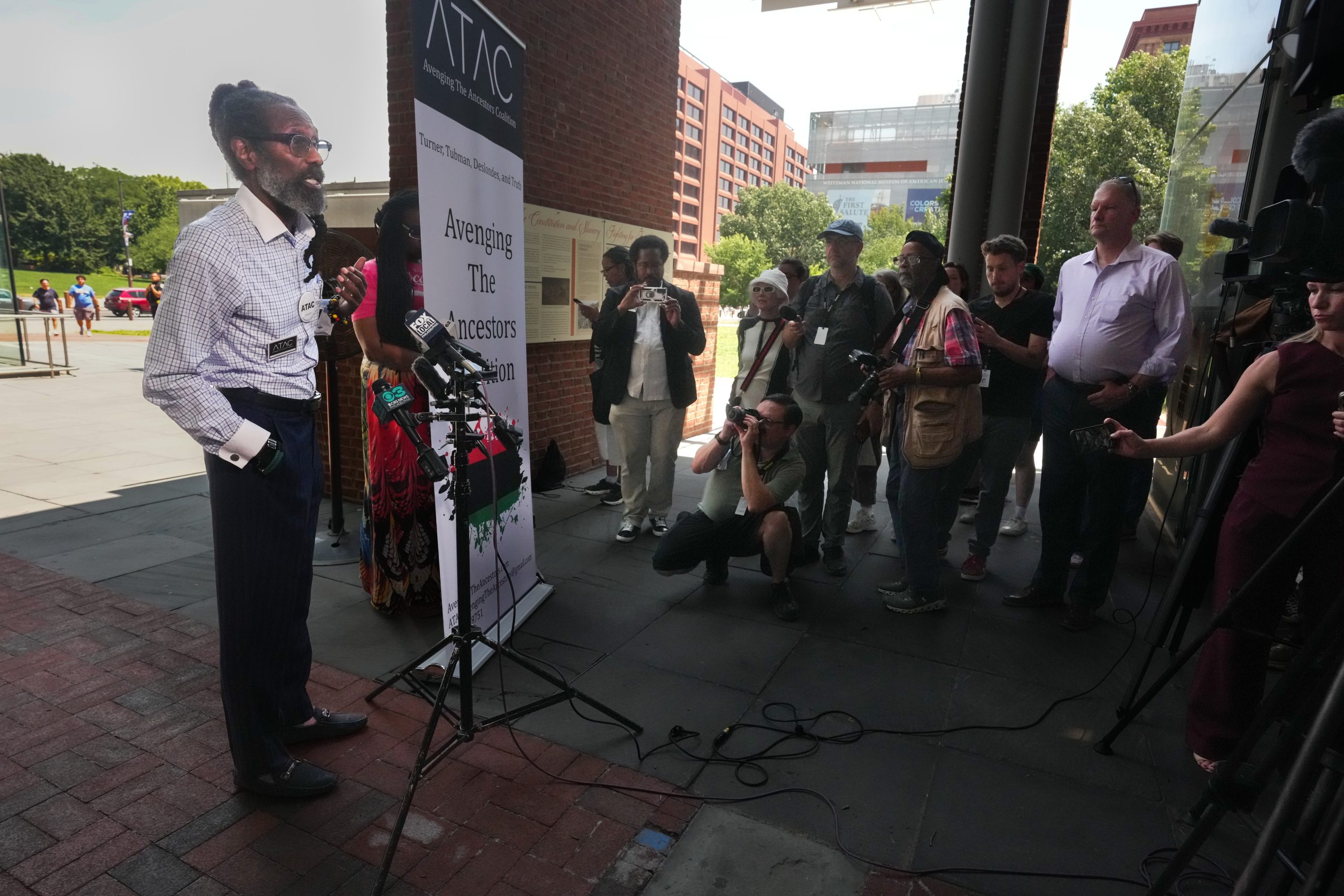
    Michael Coard, leader of Avenging the Ancestors Coalition, a group that has fought to develop and protect the President’s House exhibit, spoke at the site shortly after noon and vowed resistance.

    “I don’t care whether you’re a Republican or Democrat, liberal or conservative … this is some scary [expletive],” Coard said. “Despite being very afraid, we got to keep fighting.”

    Fascist leaders throughout history have attempted to rewrite the past as part of their campaign to control the future, the attorney said. And that is the level of threat the Trump administration’s changes to the President’s House represent, Coard said.

    The new panels have been criticized for minimizing the brutality of slavery, whitewashing George Washington’s culpability, and shifting the focus away from the nine people who were kept in bondage at the nation’s first executive mansion.

    It is outrageous that visitors will see panels that, for example, discuss Washington’s “discomfort” with slavery and suggest the lives of those enslaved in Philadelphia were not too bad, Coard said.

    “The fact that the federal government would ignore the hell of slavery for the victim but highlight the president’s ‘discomfort,’” Coard said. “What kind of nonsense is that?”

    Avenging the Ancestors Coalition’s goal continues to be the full restoration of the site with the original panels that had been developed through partnership with the city and input from the community. The group is exploring new legal strategies, Coard said.

    The city is also not done fighting, Mayor Cherelle L. Parker said in a statement.

    Her administration plans to ask the U.S. Court of Appeals for the Third Circuit for a new hearing, giving city attorneys a chance to argue their case again.

    A three-judge panel held that the city has no rights over the site and dismissed all but one count in Philadelphia’s underlying lawsuit.

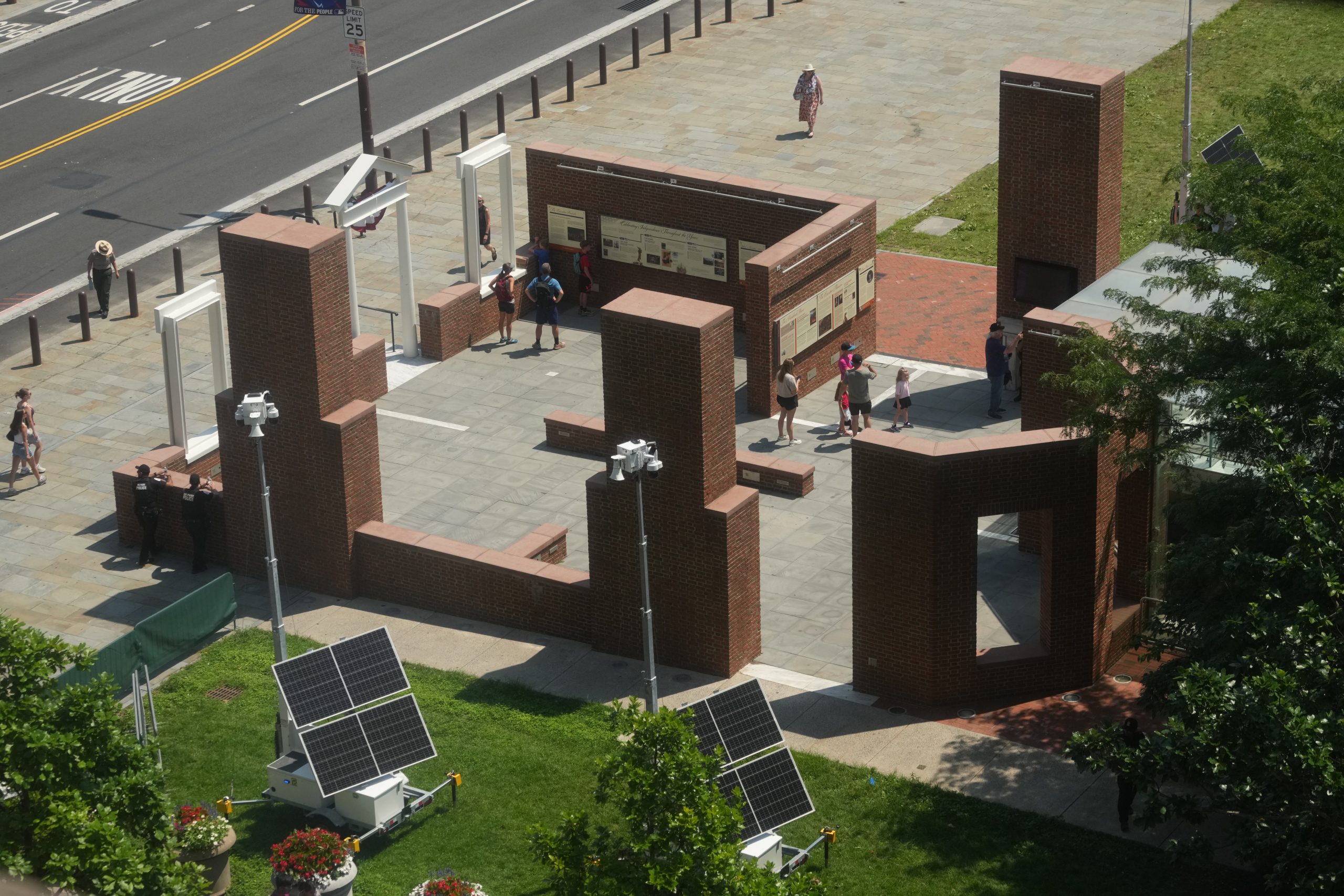
    Security cameras that have been placed at the President’s House site, where new panels have been installed, in Philadelphia, July 15, 2026. Historians and advocates have criticized the new panels for minimizing Washington’s role as an enslaver.Jessica Griffin / Staff Photographer

    The case raises “serious legal issues” that go beyond the President’s House, Parker said.

    “I will continue fighting on behalf of everyone who supports the core belief: All of our history must be told,” the mayor’s statement said.

    It will be up to the Third Circuit to decide whether to grant a second hearing to an issue that three judges had agreed on unanimously.

    The efforts to educate visitors about the President’s House continue as well.

    Old City Remembers, a grassroots effort, will continue to register volunteers to read aloud the text of the removed signs. And the Black Journey: African-American Walking Tour of Philadelphia will continue to offer tours that tell the story of those enslaved at the site.

    Brian Wells, 65, has been putting up protest posters on the President’s House walls since the day after the January removal. On Tuesday, Wells said, national park police stopped him from taping papers and threatened him with arrest.

    He thought the heightened security was because of an MLB All-Star event held Tuesday on Independence Mall, but now that the panels have been replaced, he isn’t so sure.

    “I will continue with Old City Remembers folks to volunteer to read aloud the text from the former panels,” Wells said Wednesday. “Other actions? I don’t know at this point.”

  • A Delco man who killed two of his coworkers told a judge that he acted in self-defense

    A Delco man who killed two of his coworkers told a judge that he acted in self-defense

    Wilbert Rosado-Ruiz’s fate was placed Wednesday in the hands of a Delaware County judge, who, in the coming week, will determine whether the shooting he committed where he worked, killing two people and wounding three others, was justified or an act of murder.

    At the close of his bench trial on charges of murder, attempted murder, and related crimes for the May 2024 shooting, Rosado-Ruiz, 63, testified that he felt his life was in danger and acted in self-defense. A group of his coworkers at Delaware County Linen had ganged up on him, he said, cornering him in the industrial laundry facility and threatening to kill him and his family.

    He had to shoot his way to safety, he said, because he knew at least two of them were armed with knives he had caught glimpses of.

    “I’m a person who would never try to hurt anyone,” he said. “Anyone who is inoffensive to me, anyone who would not try to hurt me, I would not try to hurt.

    “Now, if someone does try to make a move on my life, yes, I am someone who is armed, and I would defend myself.”

    Wilbert Rosado Ruiz, seen here in June 2024, told a judge that his coworkers had threatened to kill him, and that he shot at them in self-defense.Tyger Williams / Staff Photographer

    Rosado-Ruiz’s attorney, Kevin O’Neill, urged Judge Kevin Kelly to acquit his client of all charges, saying he had reacted to what he believed to be credible threats to his life and the lives of his loved ones.

    Assistant District Attorney Sophia Polites balked at that explanation during her closing arguments Wednesday. None of the victims were armed, and surveillance footage from the Chester business showed them running for their lives as Rosado-Ruiz chased them from room to room.

    Rosado-Ruiz, she said, shot at his fleeing coworkers because he wanted to, not because he needed to. He believed, she said, they had disrespected him.

    “This was not a decision made out of fear. This was about his ego,” Polites said. “One by one, the people he perceived to have disrespected him, they became his targets.”

    Brothers Leovanny Peña Peña, 30, and Giguenson Peña Peña, 26, were killed by Rosado-Ruiz after he clocked in for his early-morning shift.

    Testimony during the trial showed that Rosado-Ruiz had gotten into an altercation with another coworker, Nilamarie Valdivieso, while on a video call with his wife and daughter. Valdivieso testified that she approached Rosado-Ruiz to ask him why he was angry, and he responded explosively, screaming that he was “tired of all these people,” before pulling out his 9mm handgun and shooting Valdivieso in the shoulder.

    But Rosado-Ruiz offered a different version of that initial encounter. He testified that Valdivieso had hurled insults at him before threatening to cut his head off.

    The Peña Peña brothers, as well as other coworkers, joined Valdivieso, Rosado-Ruiz said, and formed a crowd to block him from leaving the room. He said he saw that the two brothers were carrying knives, and moved toward him in a threatening manner.

    That is when, he said, he opened fire.

    “I waited, and I really thought nothing would happen,” he said. “I didn’t want to hurt anyone.”

    Rosado-Ruiz remained on the video call with his family throughout the initial encounter and eventual shooting, but his wife and daughter testified that they could not see or hear the shooting as it took place.

    But Polites, the prosecutor, said evidence in the case, including surveillance footage of the encounter, showed that the people around Rosado-Ruiz scattered at the sight of his gun.

    After shooting Valdivieso, he shot Leovanny Peña Peña three times before chasing the other people who fled. Rosado-Ruiz caught up with Giguenson Peña Peña after he had exited the building, and shot him as he ran away from him, according to prosecutors.

    None of the victims were armed, despite what Rosado-Ruiz said he saw, Polites said.

    Judge Kelly said he will deliver his verdict on July 22.

  • State investigation into K-9’s 2022 death has quietly closed in Gloucester County with no criminal charges and no public announcement

    State investigation into K-9’s 2022 death has quietly closed in Gloucester County with no criminal charges and no public announcement

    Ember, a red fox Labrador working for the Gloucester County Fire Marshal’s Office, and another dog died four years ago when a local official allegedly left them in a hot vehicle in August.

    Now, days after a similar case in Salem County resulted in charges, a Gloucester County commissioner is using the case to renew calls for justice.

    Eric Campo, Gloucester County’s counsel, said the New Jersey Attorney General’s Office notified the county last week that its investigation into the 2022 incident was closed and returned to Campo’s office with no charges filed. He reported receiving an official letter from Andrew Wellbrock, assistant attorney general, on July 10. NJ.com first reported about the letter last week; Campo later shared it with The Inquirer.

    Campo said Gloucester County first received notice that the office had closed the investigation on July 8, one day after the Salem County Prosecutor’s Office charged Salem County Sgt. Cody Henderson with two third-degree counts of animal cruelty resulting in death and more crimes after Henderson allegedly left two K-9s, Boomer and Rip, in a work vehicle for seven hours in May.

    Boomer and Rip likely died of heat stroke, prosecutors said. Henderson has since been suspended, and his pay ceased as of Monday, NJ.com reported. A pre-indictment conference for the case is scheduled for Sept. 10 in Superior Court.

    The Ember investigation did not move as quickly.

    In fall of 2022, residents packed board of commissioners meetings to demand information on how Ember, who was donated to the county fire marshal’s office in 2020 by Joe Nick K-9 Training in Monroeville, had been allegedly left in Chief County Fire Marshal Shawn Layton’s vehicle to die on Aug. 12.

    Meeting minutes from the time describe residents reading statements about Ember and calling for memorials. Those records do not indicate that county officials revealed what happened.

    Ember, who died at 3 years old, worked under Layton’s care as a fire K-9 trained in ignitable liquid detection. Layton’s personal dog also allegedly died in the incident, according to 2022 reporting from 6abc.

    Layton, a former Mantua Township Committee member, still works for Gloucester County as chief county fire marshal, according to the county website. A Mantua Township Facebook post from December 2024 detailed that Layton chose not to run for reelection as a committee member to focus on his career.

    A representative with the Gloucester County Fire Marshal’s Office reached Wednesday declined to comment on the county’s current K-9 protocols but said that the office no longer has any K-9s.

    In 2023, Ember’s investigation was transferred from the Gloucester County Prosecutor’s Office to the New Jersey Attorney General’s Office following conflict-of-interest concerns. The investigation, at least publicly, has been largely silent since.

    Chris Konawel, a Republican Gloucester County commissioner, said he was one of the first county officials to find out about the incident back in 2022, when he said an anonymous phone call informed him Layton had buried the dogs in his backyard.

    Since then, Konawel said, he has sent about two dozen emails and letters to the attorney general’s office inquiring about the investigation. Some of those messages have received responses, he said, but none contained information about the status of the investigation.

    Resident inquiries about Ember have waned over the years, too. Two years ago, a petition among residents demanding accountability slowed at 371 signatures, though some Facebook users are sharing the link again.

    “But the incident in Salem County has shined a light back on this,” Konawel said.

    The New Jersey Attorney General’s Office did not publicly announce the closure of the investigation into Layton, and an official with the office declined to say whether the investigation is over.

    The official said the office is not required to provide notice to anyone, but may provide letters “to an entity that would be responsible for taking an administrative action.” It is unclear whether Gloucester County plans to take administrative action against Layton now that the state investigation has been passed back to the county, but the letter said the investigation’s end at the state does not mean Layton has immunity.

    The Gloucester County Prosecutor’s Office declined to comment on the record, and several other Gloucester County officials did not respond to requests for comment.

  • Burlington County just got $500,000 to improve its trails. Here’s what the money is going toward.

    Burlington County just got $500,000 to improve its trails. Here’s what the money is going toward.

    Trail improvements are headed to Burlington County, though it will be years before they can be enjoyed by the public.

    The county will be using nearly $500,000 in grant funding for feasibility studies and engineering designs for multiple trail projects.

    Awarded at the end of June and funded by the nonprofit William Penn Foundation, the grants are just a fraction of the more than $4.5 million awarded for trail projects in New Jersey and Pennsylvania as part of the Delaware Valley Regional Planning Commission’s Regional Trail Program.

    “Burlington County’s parks and outdoor spaces are among our most important assets, and we are excited by the opportunities to expand the County’s network of trails into additional areas,” Burlington County Commissioner Deputy Director Allison Eckel said in a statement announcing the funding. “These new trails will enhance our parks and open spaces and improve mobility throughout our county.”

    What’s planned for Burlington County trails?

    The majority of the grant funding, about $400,000, will go toward the engineering design costs for a four-mile trail segment through Mount Laurel from the Rowan College at Burlington County campus across Route 38 to the Melvin and Florence Levin Nature Conservancy off Centerton Road.

    The grant covers about 40% of the total expected design costs for the project, the county said.

    Burlington County intends to cover the remaining design costs in its 2027 capital projects budget and will likely contract with a design consultant for the project in early 2027, according to county officials. During the 12 to 18 months in which permitting work is being done, the county will pursue additional grant funding to cover construction costs, with the goal of breaking ground in 2029.

    The remaining $85,000 in grant funding will pay for a feasibility study for an approximately nine-mile route on the Rancocas Creek Greenway Trail from Rowan College at Burlington County in Mount Laurel to Historic Smithville Park in Eastampton. The county will also study a Mount Holly-to-Medford trail spur to connect both communities’ downtown business districts.

    The county expects to have a consultant team on board by the end of the year for both studies. The work is expected to take about six months to complete, the county said, with results likely to be published next spring or summer.

    Both trails are expected to become part of the Circuit Trails network — a vast regional network of hundreds of miles of multiuse trails planned throughout South Jersey and Pennsylvania.

    The county has other trail projects in the works, including a new four-mile trail linking Willingboro Lakes Park with Mill Creek Park, a 13-mile extension of the Delaware River Heritage Trail, and a connecting 3.25-mile extension of the Kinkora Trail.

    Earlier this year, the county also completed an initial study to potentially create an additional 50 miles of trails through Mount Laurel, Moorestown, Evesham, Maple Shade, Medford, Tabernacle, Southampton, and Shamong.

  • U.S. pledges to buy more Philly-made ships and nuclear sub parts

    U.S. pledges to buy more Philly-made ships and nuclear sub parts

    As President Donald Trump prepared Wednesday to address CEOs from Boeing, General Dynamics, and other big military contractors in Carlisle, Pa., Sen. Dave McCormick confirmed details of large government projects that will keep workers busy at Philadelphia’s two principal shipyards as they plan to grow.

    Hanwha Philly Shipyard, which employs around 2,000, will get approvals for new ship orders to continue building National Security Multi-Mission Vessels for the U.S. Maritime Administration (MARAD). McCormick valued the new orders at $1.5 billion, which is about the same as it cost to build the previous five MARAD ships at the yard.

    The new orders will enable the yard to keep workers busy as it plans new facilities for civilian and military orders that could double employment and add work for thousands of subcontractors.

    General Dynamics, which builds Columbia-class nuclear submarines for the Navy at its New England shipyards, and Rhoads Industries, which builds modules for parts of those submarines, will share $2.5 billion over 10 years in additional orders for submarine construction work in Philadelphia.

    JPMorgan Chase & Co. chief executive Jamie Dimon visited the Navy Yard district to pledge $13 million in financing for the ongoing construction of Rhoads’ 95,000-square-foot submarine manufacturing facility near its existing ship repair pier, which Rhoads announced a year ago.

    Company president Michael Rhoads said his family is paying most of the $100 million cost of that facility, with help from the Navy, state government, and now the loan from JPMorgan.

    Dimon also pledged $11 million for subcontractor assistance and labor training programs, which are affiliated with the Chamber of Commerce for Greater Philadelphia.

    Dimon noted that JPMorgan is a banker to Hanwha operations in Korea, where the company has its main shipyard, and may finance larger future Hanwha projects.

    JPMorgan is seeking more government, military, data center, and energy work as mass-market consumer companies, office construction, and other sectors are lagging, Dimon said.

    The bank also wants to raise its profile in the Philadelphia area, where it is targeting small businesses and investors as it builds a 100-branch network as part of a larger national system, even as other banks are closing offices.

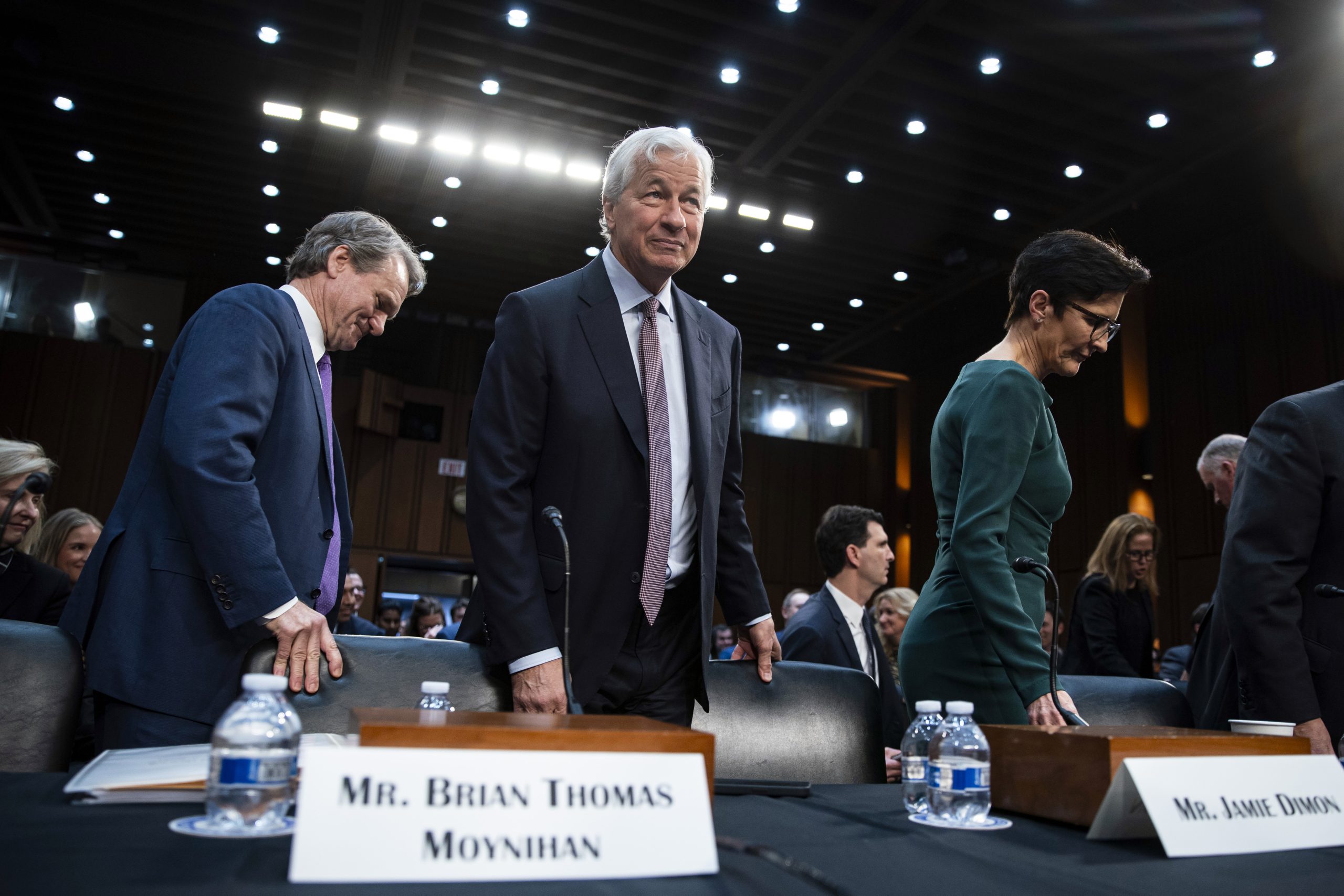
    Jamie Dimon (center), CEO of JPMorgan Chase, with rival Brian Moynihan of Bank of America, at a Washington hearing in 2023. AL DRAGO

    The $13 million loan to Rhoads will be raised through the federal New Market Tax Credits program, Dimon said.

    Rhoads’ current ship repair facilities employ around 700. The company says it will add 450 to handle new work at the complex. President Michael Rhoads said it should open next year.

    Employees and contracted labor at Hanwha and Rhoads are represented by the Philadelphia Metal Trades Council. Union tradespeople also work on construction projects and hope for more hiring as Hanwha expands operations, said Ryan Boyer, business manager of the Philadelphia Building & Construction Trades Council, who attended Dimon’s announcement.

    Hanwha has promised to invest up to $5 billion in the yard. The company bought the complex in 2024 for $100 million and says it has spent another $100 million upgrading facilities. Larger investments such as new drydocks, giant cranes, or more land may follow as Hanwha vies for U.S. and foreign contracts.

    Shares of the company’s shipbuilding affiliate Hanwha Ocean fell 23% on July 6 after the company was passed over for a Canada submarine-building contract.

    U.S. shipbuilding costs are far higher than in industry-leading China, Japan, and Korea.

    Hanwha says it can make the Philadelphia yard profitable and bring down costs for building Navy ships if it can increase volume — from the recent one ship every eight months to one or two a month. Hanwha officials have said they will build ships for the company’s own nascent shipping arm to keep workers busy, especially when orders are slow.

    Rhoads noted that his father, chief executive officer Dan Rhoads, was with McCormick at the Pennsylvania Defense and Innovation Summit at the Army War College in Carlisle, a gathering of military contractors and Washington officials, where Dimon was also on the guest list.

    Other funding that JPMorgan promised include:

    After Dimon’s announcement, Mayor Cherelle L. Parker reiterated her support for shipbuilding, heavy industry, and job creation along the Delaware River waterfront in what she calls Lower South Philly. She has pledged to speed up permitting for large projects.

    Parker promised “to make sure government bureaucracy, which is usually the most significant barrier to entry the private sector has,” is kept out of the way of the bank and its clients’ projects.

    The former Navy Yard, which includes the Hanwha and Rhoads ship facilities, is co-owned by the city and the Chamber of Commerce. It is home to businesses and government agencies that employ around 16,000.

    “We are eds and meds — and maritime and shipbuilding and defense,” Parker said.

    Dimon responded: “God bless you 100%.”

  • Jefferson, Nemours, Temple, and St. Chris are exploring alliance to support the North Philadelphia children’s hospital

    Jefferson, Nemours, Temple, and St. Chris are exploring alliance to support the North Philadelphia children’s hospital

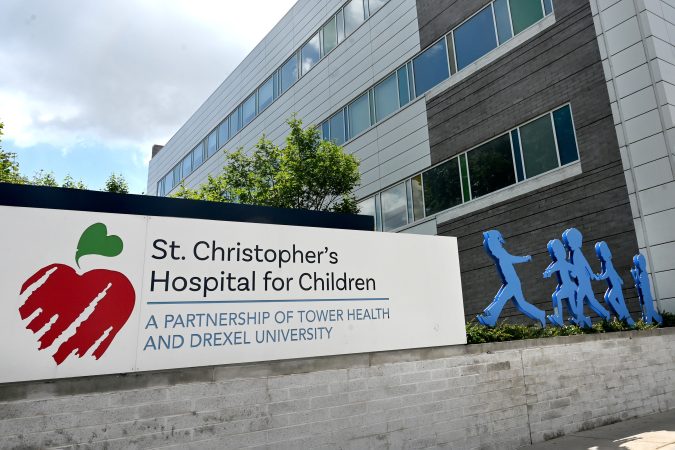
    Three major Philadelphia-area health systems are exploring an alliance to support financially struggling St. Christopher’s Hospital for Children in North Philadelphia, its leaders announced Wednesday.

    The proposed alliance would involve Nemours Children’s Health, Jefferson Health, and Temple Health, a St. Chris statement said.

    St. Chris’ ownership would not change from the current 50-50 partnership between Drexel University and Tower Health.

    Under the alliance, Wilmington-based Nemours would provide highly advanced, or tertiary, care. Nemours is Jefferson’s primary pediatric partner in the Philadelphia area.

    The preliminary agreement announcement provided no timeline to form the alliance. It also did not mention specific financial support for the North Philadelphia institution, which has received millions from local health players following a 2019 bankruptcy and steep losses during the pandemic.

    St. Chris’ board chair, P. Sue Perrotty, said the 150-year-old hospital will remain a “gateway” to care for families.

    “Our goal is to preserve what makes St. Christopher’s so special while strengthening our operations, so our community-focused mission will endure,” she said.

    “Whether care is delivered at St. Christopher’s or through our partners when clinically appropriate, our team will continue to coordinate every step of a patient’s journey, providing families with a seamless experience and a trusted guide throughout their child’s care.”

    Beyond the critical health services St. Chris provides, the institution also plays a vital part in medical education for area medical schools, including those at Drexel, Thomas Jefferson University, Philadelphia College of Osteopathic Medicine, and Temple University.

    It serves as a safety net for healthcare in some of Philadelphia’s lowest-income communities. About 85% of its patients in recent years have been insured by Medicaid, the highest percentage of any children’s hospital in the nation, according to St. Chris.

    Twice in the past four years, a coalition of Philadelphia nonprofits provided financial lifelines for St. Chris.

    Children’s Hospital of Philadelphia, Jefferson, Temple, Philadelphia College of Osteopathic Medicine, Independence Health Group, and private donors provided $50 million over two years starting in 2022. Two years later, the same group, minus Independence, contributed another $30 million.

    Jefferson and Temple were also part of a consortium that considered bidding for St. Chris in 2019 during its parent company’s bankruptcy. They backed out before the auction, which Drexel and Tower won with a $50 million bid.

    Nemours spokesperson Shelley Meadowcroft said there was no financial support included in the agreement.

    Nemours in recent years has lost affiliations with Main Line Health and ChristianaCare to CHOP. The alliance will strengthen “access to high-quality pediatric care in our region,” she wrote in an email.

    “This collaboration also strengthens Delaware’s role in pediatric care by positioning Nemours Children’s Delaware-based clinical operations as a central hub for advanced specialty care, education, and innovation,” she added, “while supporting the long-term strength and mission of St. Christopher’s Children’s Hospital and the communities it serves.

    In a statement, Temple University officials characterized the agreement as “non-binding letter of intent” to form an alliance “in support of St. Chris and its future.”

    “The proposed alliance reflects a shared commitment to securing a future for St. Christopher’s while preserving the mission, clinical excellence and community role that have made the hospital a resource for children and families in Philadelphia and across the region,” officials said.

  • Slavery exhibits at the President’s House have been swapped for the Trump administration’s version

    Slavery exhibits at the President’s House have been swapped for the Trump administration’s version

    President Donald Trump’s administration has installed its own version of history at the President’s House Site, swapping panels on the brutality of slavery at the site for displays that experts say sanitize George Washington’s role as an enslaver.

    The replacement caps a monthslong legal battle over the site on Independence Mall that was the first direct skirmish between Mayor Cherelle L. Parker and the Trump administration.

    The change happened overnight Tuesday into Wednesday, hours after the city hosted MLB All-Star Game events near the site, allowing the government to switch out the displays and shut down the television screens without public scrutiny.

    Roughly a week prior to the changes, park employees installed security cameras near the site, which one worker explained as being for the All-Star Game festivities. The cameras were still present Wednesday.

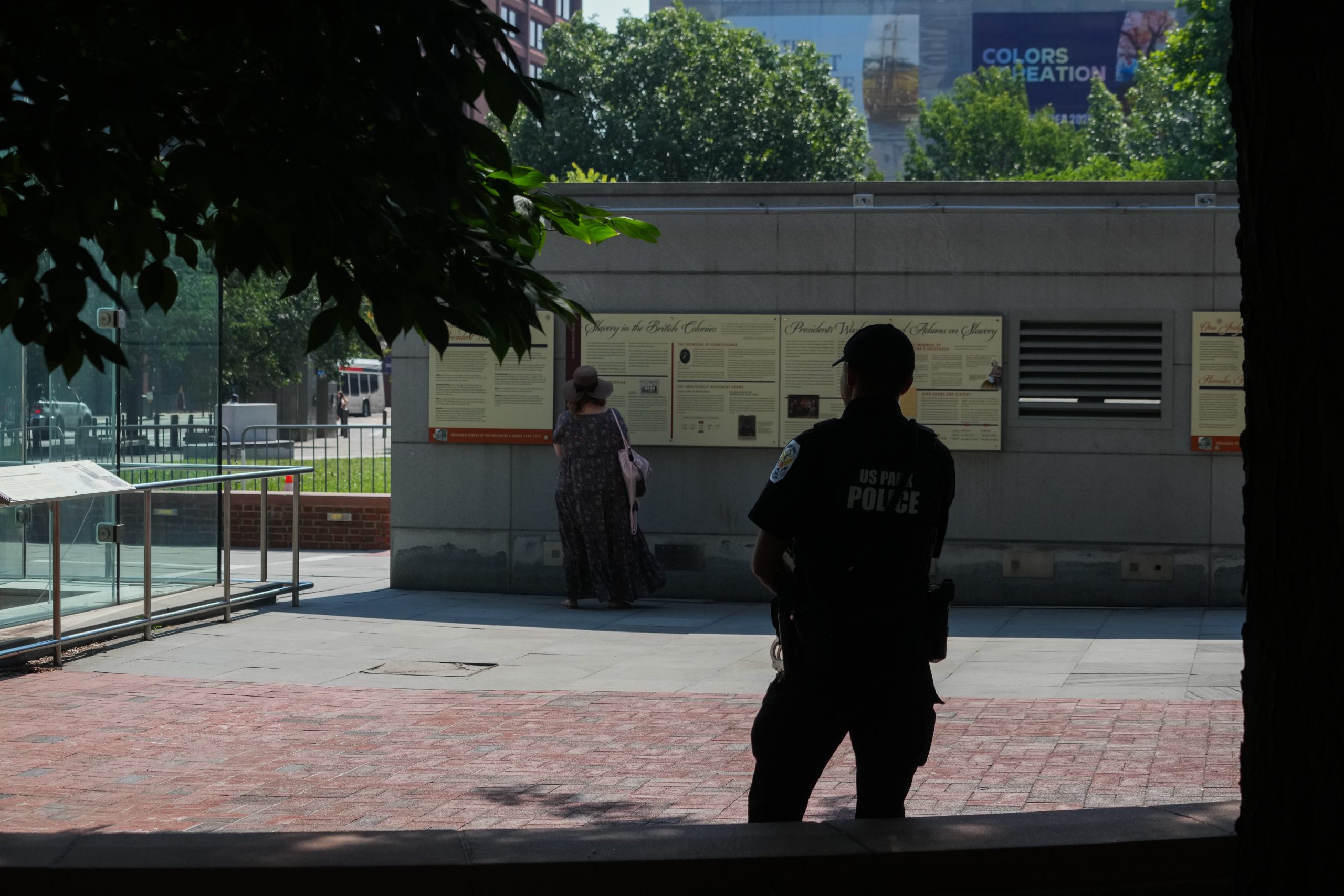
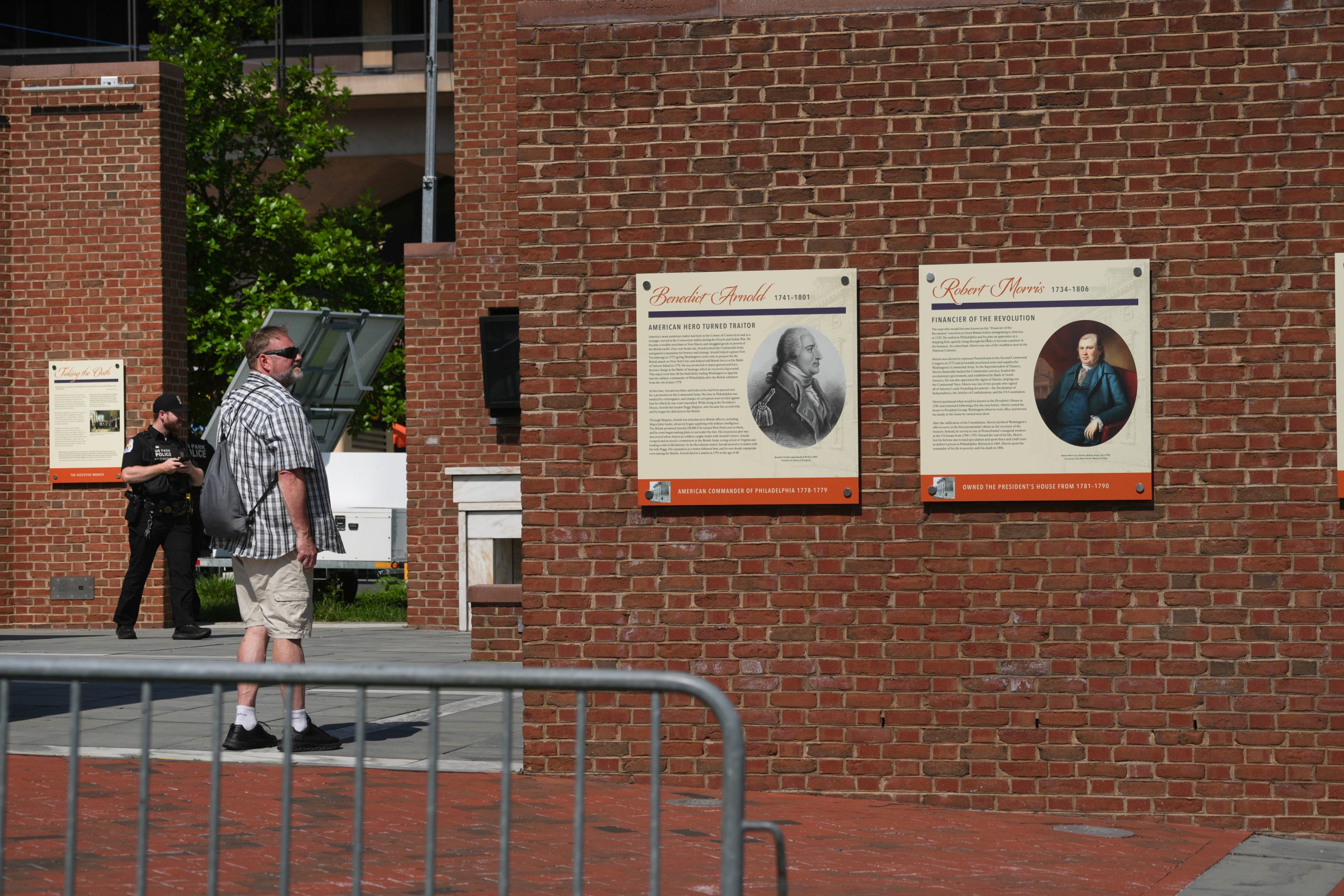
    A U.S. parks police officer and a visitor at the President’s House Site, where new panels have been installed, in Philadelphia, July 15, 2026. Historians and advocates have criticized the panels for minimizing Washington’s role as an enslaver.Jessica Griffin / Staff Photographer

    The overhaul of the President’s House exhibit, which was established to memorialize the nine people Washington enslaved at his Philadelphia residence, comes a little more than a week after the city celebrated the United States’ 250th birthday and tourists from around the world saw an incomplete version as the exhibit hung in limbo.

    On July 3, the U.S. Court of Appeals for the Third Circuit gave the Trump administration the final go-ahead to replace the panels.

    In a statement, Parker said the city intended to seek a rehearing on “serious legal issues” presented in the Third Circuit’s decision and slammed the federal government for installing the panels ”under the cover of darkness.”

    “It was allowed to do this by the decision of the federal court, but that it did so at night shows it understands this action is shameful, that it violates community trust,” Parker said.

    The site now features the 11 panels were proposed by the Trump administration in April, in addition to more than a dozen smaller panels that detail governmental processes, the lives of various historical figures, and a panel dedicated to the escape of Ona Judge and Hercules, two people enslaved by Washington who fled to freedom.

    Though the panels do mention slavery and the people Washington enslaved, the new exhibits mostly offer a broad timeline of U.S. history that significantly strays from the original intent of the President’s House as outlined in the park’s foundation document in 2017: “It would explore the historic context of the site in the context of its ties to slavery and the lives of the enslaved who lived at the site.”

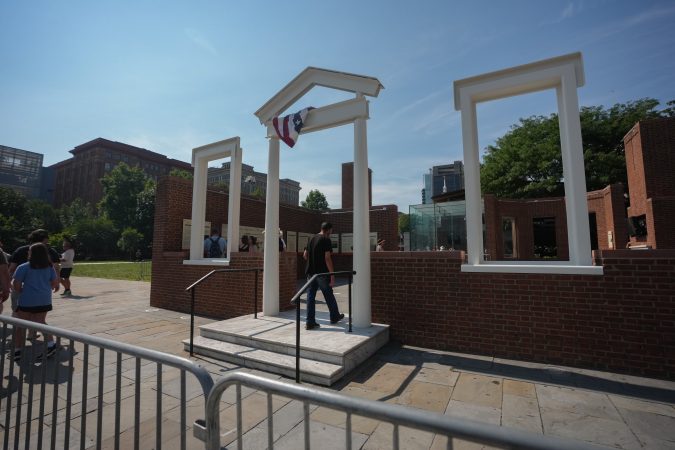
    Visitors to the President’s House Site, where new panels have been installed, in Philadelphia, July 15, 2026. Historians and advocates have criticized the panels for minimizing Washington’s role as an enslaver.Jessica Griffin / Staff Photographer

    The new panels also soften Washington’s role as an enslaver.

    For instance, one display says: “Caught between his private doubts about slavery and his public responsibilities as president, George Washington navigated a nation deeply divided over slavery.”

    “Privately, George Washington often expressed discomfort with the institution and a desire to see it abolished,” the panel continued. “Yet as a Virginia plantation owner, his wealth and livelihood were deeply tied to it.”

    Later in that panel, the Trump administration writes: “Slaves living in the President’s House experienced a greater modicum of autonomy than elsewhere in the South such as to explore the city and sometimes even attend the theater, with Washington buying the tickets.”

    Another panel, titled “Enslaved People at the President’s House,” discusses the lives of each of the nine individuals enslaved by Washington, but reframes Washington’s role.

    “President Washington knew and trusted his enslaved house staff enough to buy them tickets for the circus and theater and to let them venture out into the city’s markets on their own,” the panel says.

    A spokesperson for the Interior Department said in a statement that the “new panels are full of historical context and highlight the momentous events that took place in the President’s House and other sites at Independence National Historical Park.”

    The statement said that the panels “acknowledge the evils of slavery, including its injustice and hypocrisies,” and properly tells the story of the nine individuals enslaved by Washington and the “full story” of U.S. history.

    Michael Coard, leader of Avenging the Ancestors Coalition, a group that has fought to protect the President’s House, said stakeholders were “not surprised — we saw it coming” and were reviewing all possible legal avenues and advocacy options.

    Shortly after noon, Coard and other activists spoke defiantly at the site.

    He called the new panels “a complete whitewashing of American history” and said the few references to existence of slavery are a reminder that “the best lie is one that has a little bit of truth.”

    Lawyer Michael Coard holds a press conference at the President’s House Site, where new panels have been installed, in Philadelphia, July 15, 2026. Historians and advocates have criticized the panels for minimizing Washington’s role as an enslaver.Jessica Griffin / Staff Photographer

    The drastic alterations are a culmination of about a year of turmoil since the Trump administration began scrutinizing the site as part of the president’s executive order to review or remove displays at national parks that “inappropriately disparage Americans past or living.”

    In January, the administration abruptly removed all of the exhibits at the President’s House, provoking a legal battle waged by the City of Philadelphia and nonstop advocacy from stakeholders who helped develop the site in the early 2000s.

    Removals also happened at national parks around the country.

    Sheri Utain, 77, has been coming to the President’s House site since January to read aloud the content of the missing panels. When she arrived Wednesday, she was shocked to learn the exhibit had been replaced overnight.

    “How sneaky is that?” Utain said. “What kind of government is that?”

    Others also continued with their routines, but the response from National Park Service rangers was harsher.

    Sandra Shachar has been posting news articles on the President’s House walls almost every day since January to provide visitors updates on the court battles over the slavery exhibit.

    Sandra Shachar, 72, cited for vandalism at the President’s House Site on July 15, 2026 for attempting to post news articles on the walls.Abraham Gutman

    But Wednesday, the local psychologist was cited for vandalism and ordered to pay a $305 fine.

    “It was something I could do … it feels better than doing nothing,” Shachar said, holding back tears. “Part of free speech and our First Amendment rights is to put up signs. It’s not defacing. It’s not vandalizing.”

    An Interior Department spokesperson said “any vandalism, tampering, destroying, or defacing of cultural or archaeological resources is a federal crime.”

    The installation of the new exhibit marks the end of a phase in the city’s legal battle against Trump’s administration.

    The city sued in January when the slavery exhibit was abruptly dismantled, asking a federal judge to issue an injunction ordering the panels be restored. Judge Cynthia M. Rufe issued a blistering opinion on Presidents’ Day ordering the restoration, comparing the Trump administration’s action to the Ministry of Truth from George Orwell’s 1984 novel.

    The administration installed roughly half of the removed panels before Rufe’s deadline, but left the site’s walls half bare after appealing to the Third Circuit and securing an administrative stay.

    A unanimous Third Circuit three-judge panel — which included Trump, George W. Bush, and Barack Obama appointees — held in June that the city had no rights over the exhibit after having donated the President’s House Site to the National Park Service.

    No changes followed on the ground immediately after the ruling because of litigation in federal court in Boston that challenged the legality of display removals in national parks and historic sites nationwide, leading a district judge to order the Trump administration to restore all removed items.

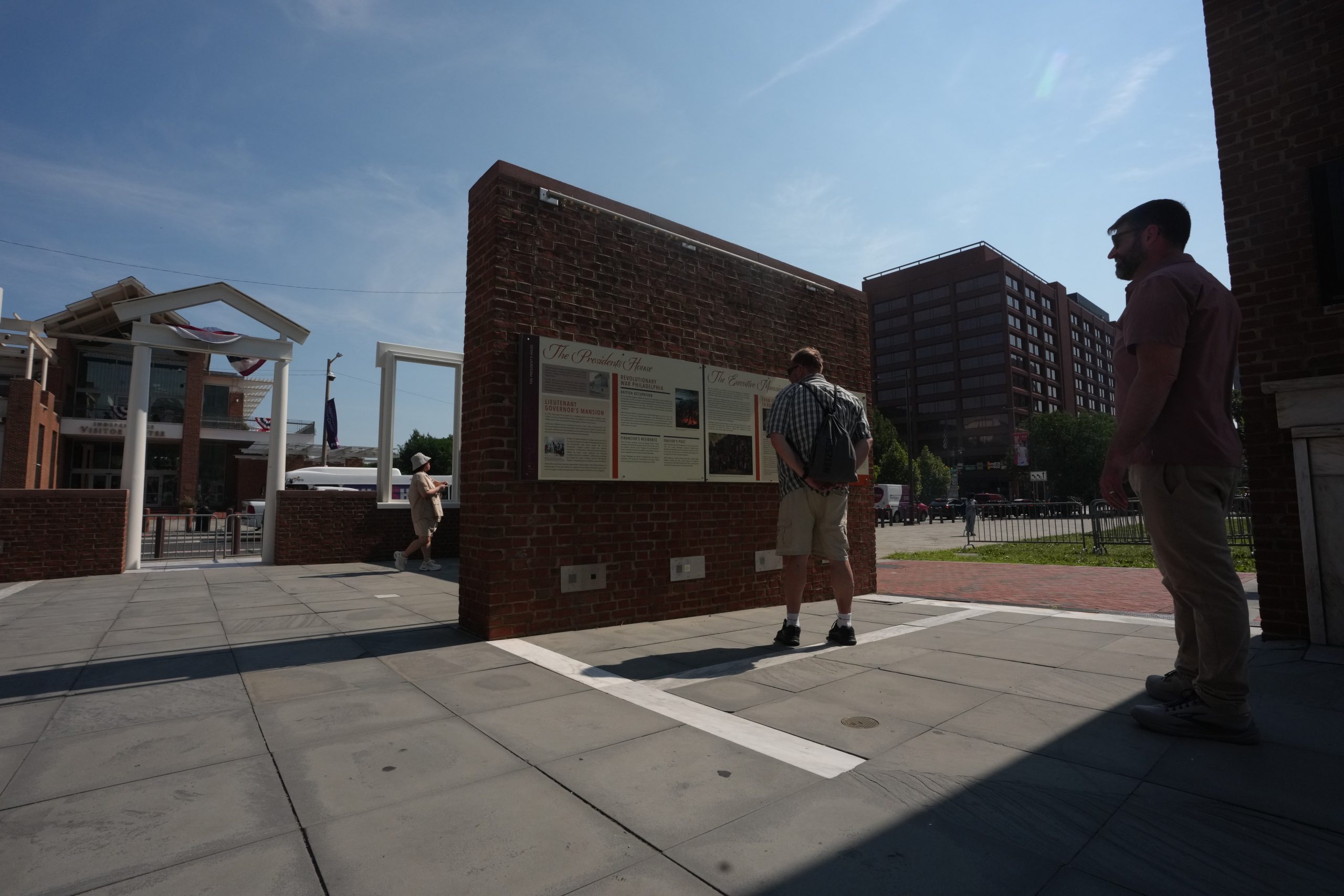
    Visitors to the President’s House Site, where new panels have been installed, in Philadelphia, July 15, 2026. Historians and advocates have criticized the panels for minimizing Washington’s role as an enslaver.Jessica Griffin / Staff Photographer

    But on July 2, the U.S. Court of Appeals for the Second Circuit stayed that order, clearing any legal obstacles preventing the federal government from installing the new panels.

    In the aftermath of the 250th anniversary celebrations, Parker said, examining the paradoxes of liberty and slavery that existed during the founding of the United States is key.

    “This paradox reveals core questions we still live and struggle with today — how do we share power for the betterment of all people? That is a hard question, and one that President’s House forced us all to consider,” Parker said.

    As activists and the city vow to continue the legal fight, the efforts to educate visitors about the history of the President’s House will also continue.

    Mijuel Johnson, a guide with the Black Journey: African-American Walking Tour of Philadelphia, will lead a tour of the site Thursday.

    “Regardless to what it says on the walls,” Johnson said, “the whole truth is still going to be told.”