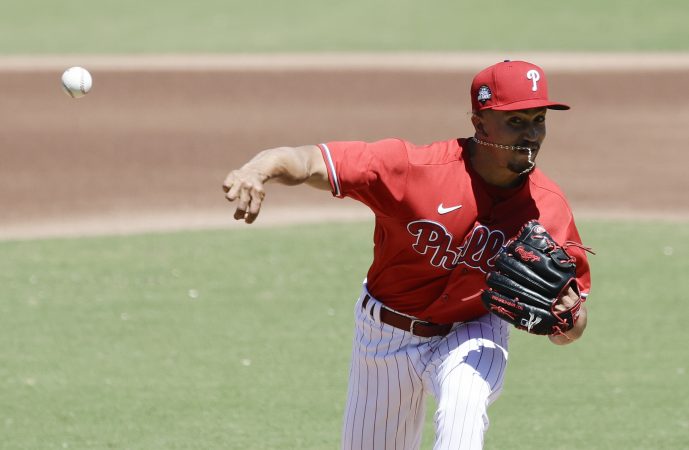
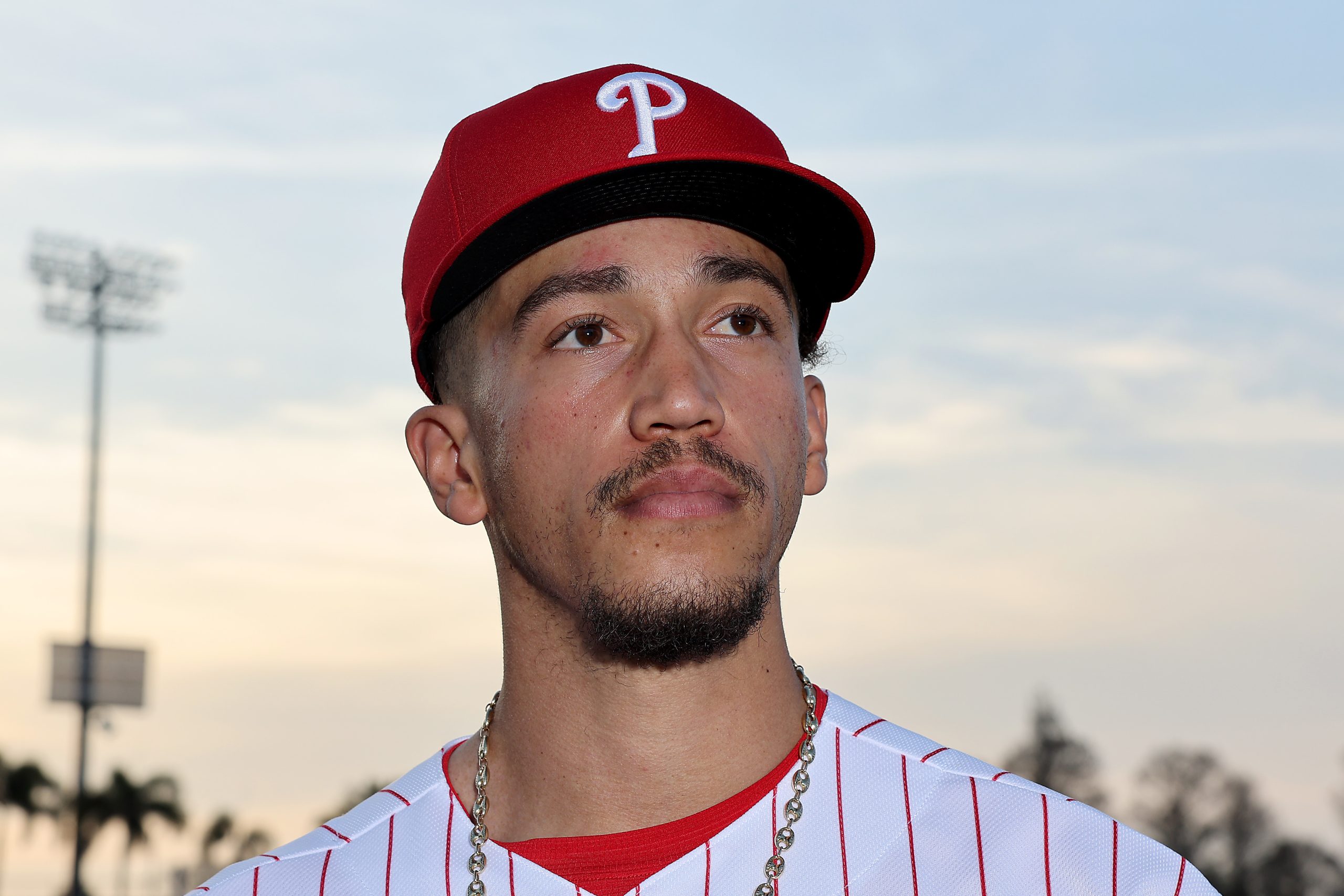
In a move that could serve dual purposes, the Phillies called up hard-throwing reliever Alex McFarlane from double A, the team announced Monday.
McFarlane, a 25-year-old right-hander, represents a fresh arm for a bullpen that was taxed Sunday in a 6-1 loss to the Mets. Five Phillies pitchers combined to throw 208 pitches, including 42 from Max Lazar and 31 from Seth Johnson in relief of No. 5 starter Alan Rangel, who needed 91 pitches to get through only four innings.
To make room for McFarlane, Rangel was optioned to triple A.
“The stuff’s been really good,” interim manager Don Mattingly said of McFarlane. “I think he’s got a really good arm. Obviously he’s young, so don’t really know exactly what to expect. But we know he’s got the stuff to be build on.”
It’s possible McFarlane will be with the team for only a few days. He got called up in a similar situation on April 24 and was optioned back to double A the next day.
But the Phillies could also opt to keep McFarlane on the roster to determine if he could contribute down the stretch. The Phillies were already seeking help for the bullpen ahead of the Aug. 3 trade deadline — and that was before setup man Brad Keller was lost for the season to a torn elbow ligament.
“We’ll just see what happens,” Mattingly said.
Alex McFarlane was selected by the Phillies in the fourth round of the 2022 draft out of the University of Miami. David Maialetti / Staff Photographer
McFarlane has a 2.06 ERA in 32 appearances for double-A Reading with 47 strikeouts in 35 innings. He has held opponents to a .187 batting average. But he also has a 12.6% walk rate, which has delayed his promotion to triple A.
In that case, this could be a chance for McFarlane to show that he can factor into the Phillies’ bullpen mix sooner than expected.
“Just doing what I need to do, whatever the team asks for me,” he said. “Whenever the team calls, I’ll be ready.”
One adjustment for McFarlane at the next level, either in the big leagues or triple A, will be the baseball.
From the lower levels of the minors through double A, the baseball is softer, with slightly larger seams. It isn’t until triple A that the balls are the same as in the big leagues. Top pitching prospect Gage Wood, McFarlane’s teammate in double A, said he threw only one slider in the Futures Game on July 13 because the big-league baseball tended to pop out of his hand.
McFarlane said he has played catch with the big-league ball in Reading to get more familiar with it.
“Just started incorporating it and playing catch with it as much as I could and just getting familiar with the grips and all types of stuff,” he said. “It just feels a little smaller in my hand, so just took the time to adjust and just play light catch, understand how how the ball feels, and just be ready for whenever that call is.”
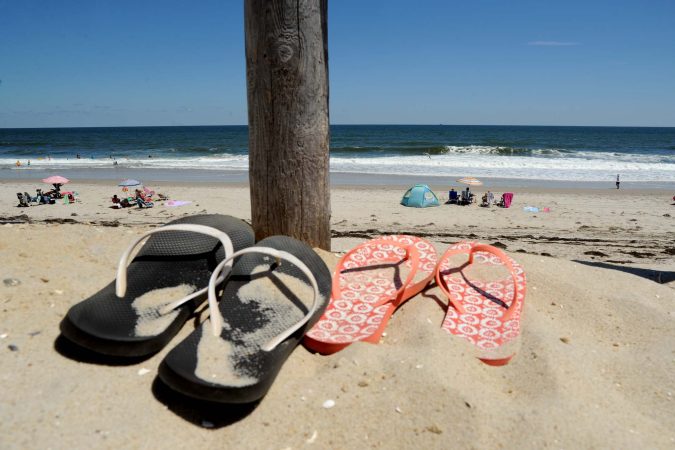
Q. How bad are flip-flops, really? Am I inflicting lasting damage on my feet every time I wear them?
A. Flip-flops must be the most vilified form of footwear. Each summer, the media are filled with stories about how bad they are for your feet. According to some experts, wearing flip-flops will cause acute injuries, such as sprains, or contribute to more insidious injuries, such as plantar fasciitis. Some even claim they can contribute to hammertoes and bunions.
While it is reasonable to be cautious about flip-flop use for those who may be vulnerable to lower-extremity conditions, are they really that bad for everyone? And should you never slip on a pair if you care about your foot health? The answer I give my patients might surprise you.
As a podiatrist in Minnesota, my clinic is slowest in late winter and becomes busier as we transition to spring and summer. Coincidently, some people also start to wear flip-flops around this time. It would be easy to assume a cause-and-effect relationship for the flip-flop wearers and their foot pain, but that is an incomplete picture.
A winter spent in more structured shoes combined with the tendency to be more sedentary can essentially decondition your feet, so when you start to become more active and wear less supportive shoes, your feet might hurt as they adjust to the greater demands you’re putting on them. This reduced capacity is often high on the list of potential causes of foot pain whether wearing flip-flops or not.
It is true that the risk of falling is higher in flip-flops, but this risk applies to all shoes that do not secure well to the foot such as high heels, mules, clogs, or even poorly fitting shoes.
Additionally, there is no evidence in the research that flip-flops increase the risk of heel pain or toe alignment changes in people with healthy feet any more than other types of footwear. Heel pain, hammertoes, and bunions are common in the general population, even in those who have never worn flip-flops. Many factors contribute to these foot concerns including genetics, lifestyle, and biomechanical imbalances.
As a general rule of thumb, I caution anyone with poor balance, osteoarthritis, rheumatoid arthritis, a history of lower-extremity surgery, diabetes, lower-extremity swelling, peripheral neuropathy, peripheral vascular disease, neurodegenerative conditions, or gait abnormalities to avoid not just flip-flops but any footwear that does not strap securely to the foot including at the heel. People with these conditions are more likely to fall or worsen existing issues when wearing unsupportive footwear.
Even if you don’t have any of the health concerns listed above, remember that flip-flops are really made for walking on flat, dry surfaces only. That’s because you are more likely to fall if you are on a wet surface and subsequently injure yourself if your footwear is not secured to your feet.
If you’re wondering what footwear is best for avoiding foot conditions, the answer is that there’s no one single type. Each of the shoes that we own uniquely alters how our feet function and affects how we move. Therefore, it’s best to have multiple types of comfortable footwear options with varying degrees of cushioning, support, and fit characteristics to allow your feet to maintain their strength, mobility, and adaptability.
Flip-flops place more demand on the muscles and joints of the feet than conventional shoes, and that can be a good thing. Having a capacity to wear footwear with little to no support is an important part of long-term foot health. If you don’t have any of the health issues that I previously mentioned, this capacity can be built by transitioning to flip-flops gradually at the beginning of the season, wearing them for short periods of time in the beginning to give your feet a chance to adjust. Doing targeted foot-strengthening exercises as part of a fitness routine can also help.
An often-overlooked benefit of flip-flops (and more broadly, sandals) is that they let our feet spread out more than shoes typically do. This is one of the reasons people find flip-flops comfortable. It is very common for people to develop foot pain due to poorly fitting shoes. In fact, a 2018 study showed that up to 72% of people wore shoes that did not fit properly and there was also an association with improper shoe fit and foot pain.
All shoes affect our lower extremities in ways that can be potentially beneficial or detrimental. Telling healthy people to avoid certain types of footwear is like telling people to avoid the sun. Sure, too much exposure to either can be bad, but some exposure is beneficial and even necessary for our overall health. Having a variety of comfortable footwear options is a good strategy to maintain foot health — and for many people, that strategy can include flip-flops.
Paul Langer is a sports medicine podiatrist practicing with Twin Cities Orthopedics in Minnesota and an adjunct clinical faculty at the University of Minnesota Medical School. He is also the author of “Great Feet for Life.”
Drivers should expect backups and delays near Amtrak’s 30th Street Station as the Pennsylvania Department of Transportation carries out roadwork nearby in the coming month.
Starting Monday and through Thursday, PennDot will close I-76 West traffic between the 30th Street and I-676 interchanges from 9 p.m. to 5 a.m.
Drivers are advised to take the 30th Street exit on I-76 West and use Schuylkill Avenue to access I-676 East or return to I-76 West.
Between July 20 and Aug. 20, the middle lane on Market Street between 30th Street and Schuylkill Avenue will also be closed. Drivers will be able to use two lanes of traffic in either direction on that stretch during the closure.
The work being carried out in the next month will prepare for the demolition and reconstruction of the Market Street bridge above the Schuylkill River, which is expected to begin in late August. Detours will be announced closer to that date.
The construction work is part of PennDot’s $148.9 million project for bridge rehabilitation in the area, which includes improvements to the Walnut Street bridge over the Schuylkill.
Construction began in March 2025 and is expected to end in April 2029. The majority of the project is federally funded, with the remaining 20% coming from the state.
The 1939 Phillies were managed by a dentist, lost 30 of their final 37 games, and finished more than 50 games back of the pennant. So it’s safe to say the current Phils aren’t hoping to channel that squad next month when they wear 1939 throwback uniforms for the Field of Dreams Game.
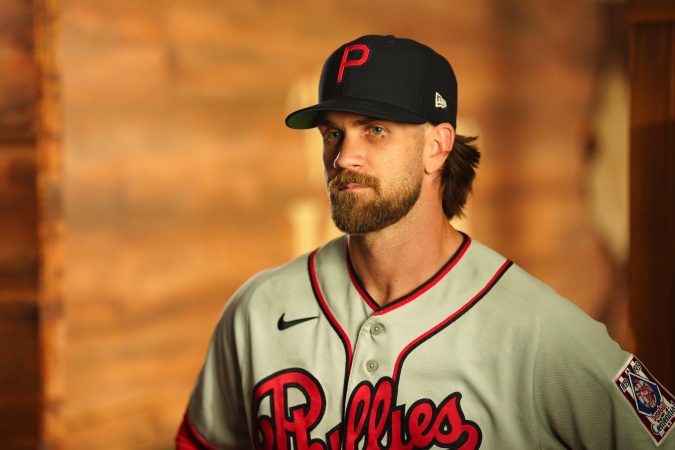
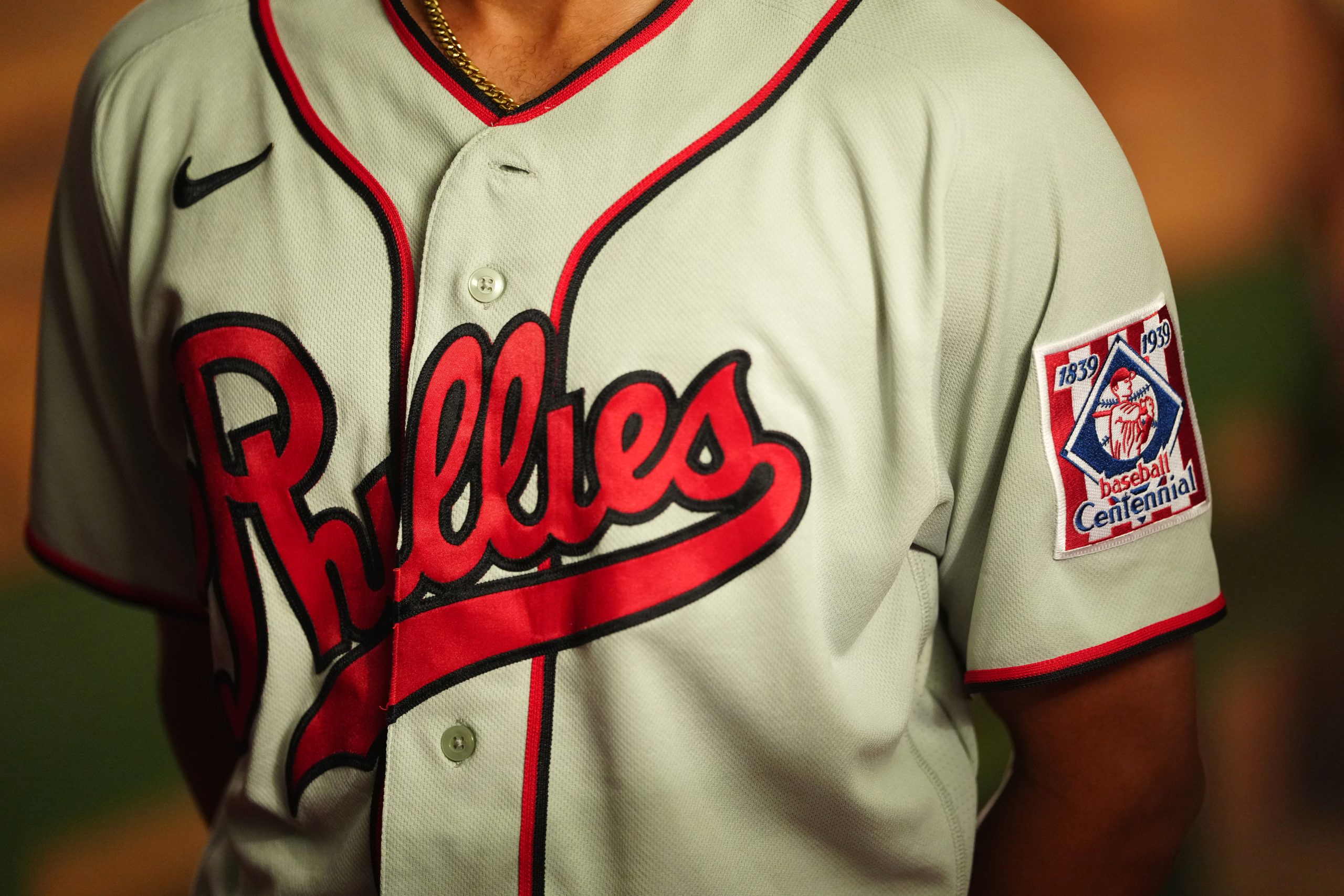
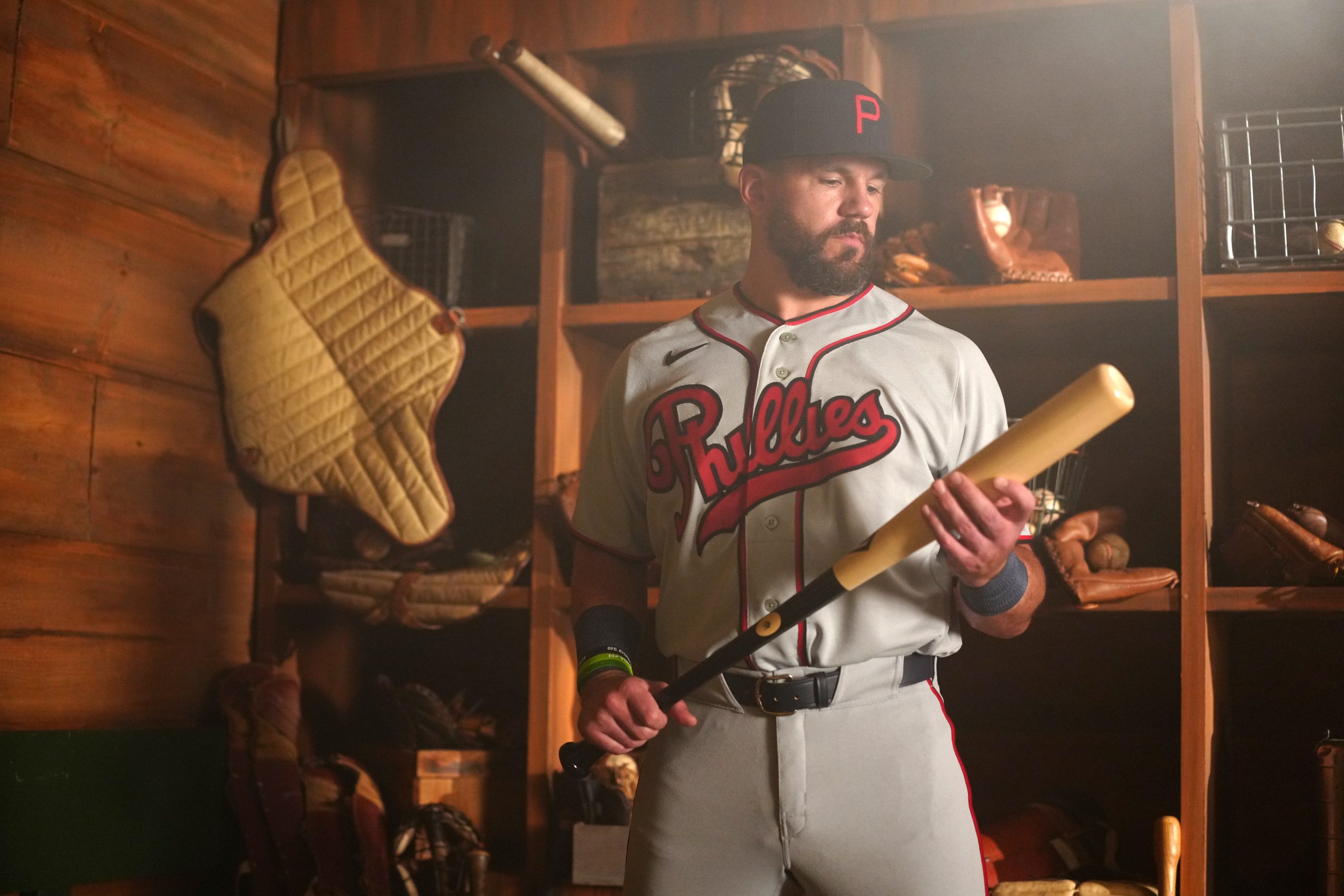
The jerseys — a sharp grey top with red and navy “Phillies” script across the chest — were unveiled Monday along with the uniforms that will be worn by Minnesota on Aug. 13 in Dyersville, Iowa. The Phils will wear navy hats with a bold red “P” on the front. The sleeve will feature the 1939 Baseball Centennial patch that all teams wore that season.
The Phillies will wear their Field of Dreams uniforms on Aug. 13. Daniel Shirey
This year’s game is the third Field of Dreams Game and first since 2022, which is played at a ballpark constructed adjacent to the field used to film the 1989 movie. The game will air on Netflix. The ballpark holds about 7,800 fans, and the big league players usually enter the game by walking through the cornfield, just as the White Sox players did in the film.
Kyle Schwarber did a promo shoot including the Field of Dreams uniforms last month. Daniel Shirey
The 1939 Phillies started the season by training in a small Texas town, where they received “one of the warmest welcomes ever accorded a team at spring training.” It was the highlight of the season. By the end of May, they were 12 games back. Doc Prothro, the new manager who pulled teeth in the offseason, had “more cavities to fill than any other team in the National League,” the Inquirer wrote.
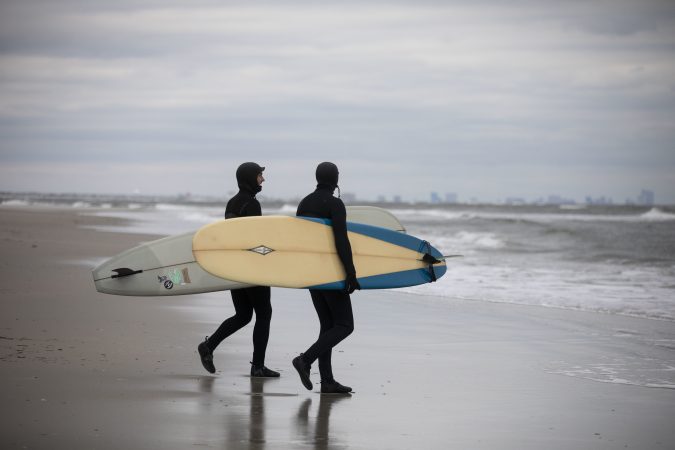
The beaches of tiny, quirky Strathmere may be in their last tag-free season.
The Upper Township Committee, the governmental body that includes Strathmere and its mainland counterpart, is considering beach tags that would cost as much as $45 for the season, said administrator James Van Zlike.
Strathmere’s possible move to a paid beach will leave only Atlantic City, Wildwood, North Wildwood, and Wildwood Crest as free oceanfront beaches in Atlantic and Cape May Counties.
“We didn’t want to do it,” Van Zlike said. He said beach patrol personnel costs alone were over $500,000 per season, and the township was responsible for $2.1 million for the current beach replenishment project. “Beaches are expensive to run and maintain and operate.”
Proposed pricing for the tags would be $10 daily, $20 weekly, and a seasonal tag of $45 with a pre-season discounted rate of $30, he said, which would generate about $320,000. Veterans and active duty military would be exempt.
The beach patrol’s headquarters had to be demolished in March after bad weather and beach erosion left it in a precarious state. The township has yet to rebuild it.
Although ending the free beach status is anathema to many, Mayor Curtis T. Corson Jr., said at the July committee meeting that it came down to beaches or parking, both of which are currently free in Strathmere.
The township determined it would be more cost effective to hire two roaming beach tag checkers than to retrofit the town’s narrow streets for parking meters, and create a parking enforcement bureaucracy.
“We don’t have parking meters, we don’t have a parking authority, we don’t have any of that,” the mayor said at the July 13 meeting. “We would actually, because of the narrow streets, lose parking spots.”
Neighboring Sea Isle’s beach tags max out at $30 for the season, but Corson noted the city takes in $1.7 million in parking meter fees.
“We take in zero for parking fees,” he said.
Reaction was mostly negative on Facebook groups, with many questioning why any of the beaches in New Jersey required a beach tag. “Terrible idea,” said one poster. “Residents already pay high taxes.”
Corson said state law would not allow them to give a discounted price to residents of Upper Township.
A beach tag ordinance will likely be introduced at an August meeting, Van Zlike said. The township last considered instituting beach tags in 2021.
Anthony Iovino, a lifelong resident of Williamstown, realized during the COVID-19 pandemic that Gloucester County needed a new playground.
His son, Finn, was diagnosed with autism at 2 years old, and with the world shut down, Iovino’s family quickly taught themselves how to support Finn from home.
“So then you learn that one of the most essential therapies for kids with special needs is play,” Iovino, 51, said. “And there really wasn’t a space for kids with special needs.”
Now Finn is 8, and an accessible playground named in his honor has finally opened to the public. It sits between the baseball fields and basketball courts off Church Street in Monroe Township, by Pfeiffer Community Center.
“I’m very happy that this park is done because, like, it’s a special memory I think I’m going to remember forever,” Finn said.
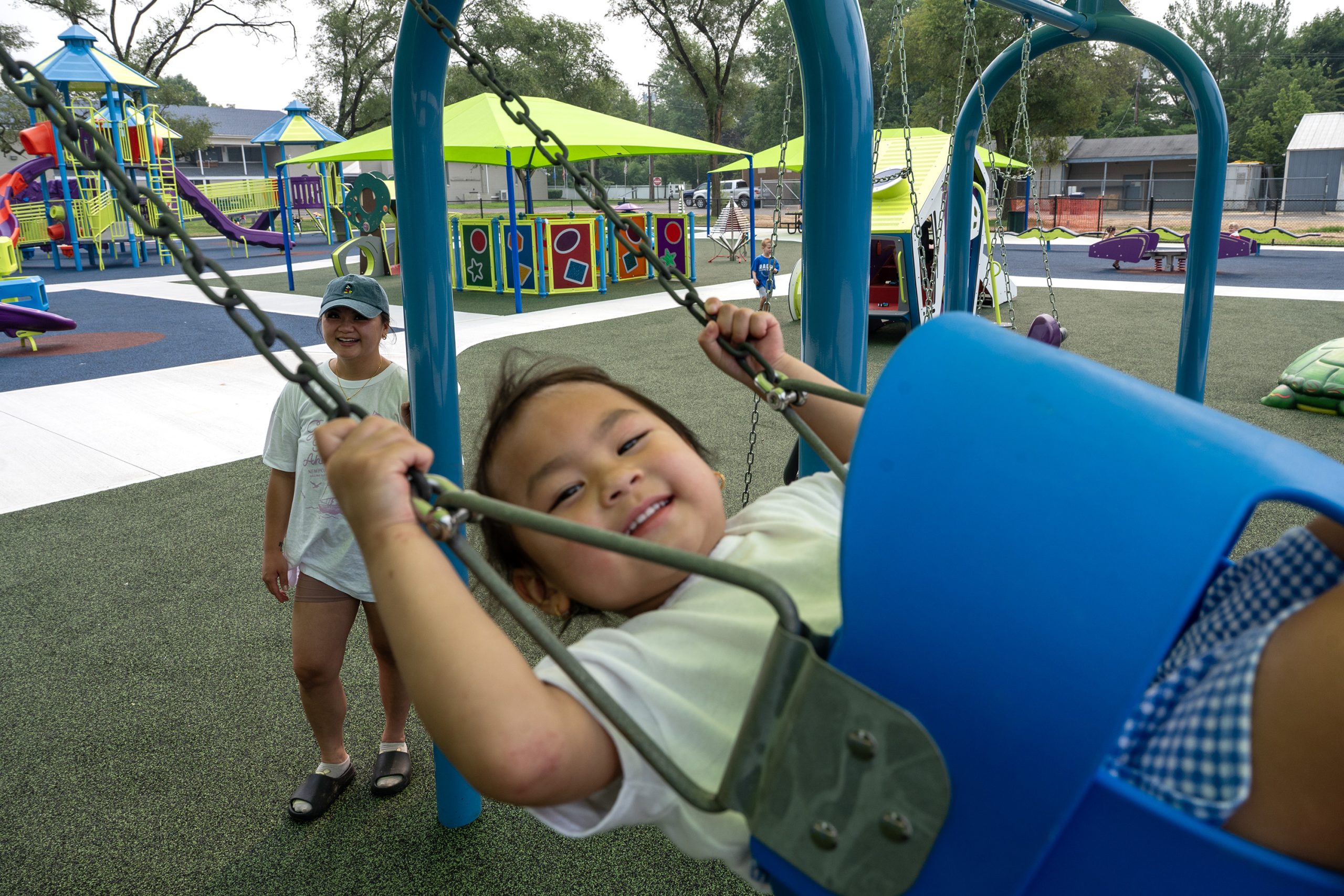
Lindsey Truong (rear) pushes her daughter Amelia, 3, on the swing in the newly opened Finn’s Friends Park in Williamstown Thursday, July 16, 2026. Tom Gralish / Staff Photographer
The project to revamp an old T-ball field into an autism and mobility-friendly playground was a collaborative effort between Monroe Township and Finn’s Friends, an autism awareness nonprofit run by Iovino and founded in 2024.
Iovino, a local real estate broker and owner of Cocaboni’s Cafe in Williamstown, said he approached Monroe Township Council a few years ago about the project, and Monroe officials agreed right away.
Mayor Greg Wolfe said Monroe has some other parks with limited-accessibility features, but none to the scale of Finn’s Friends.
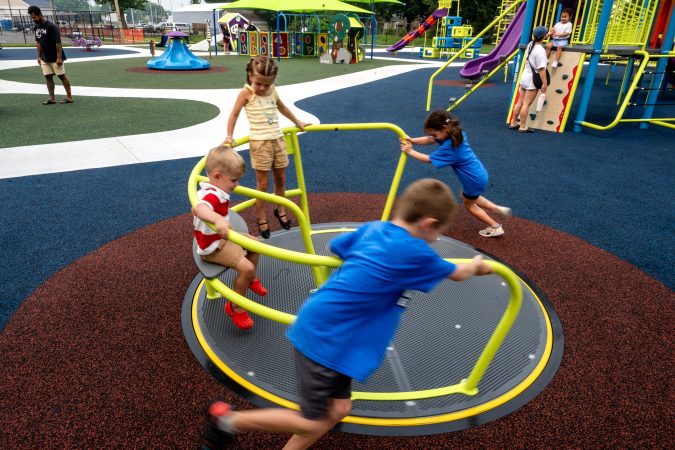
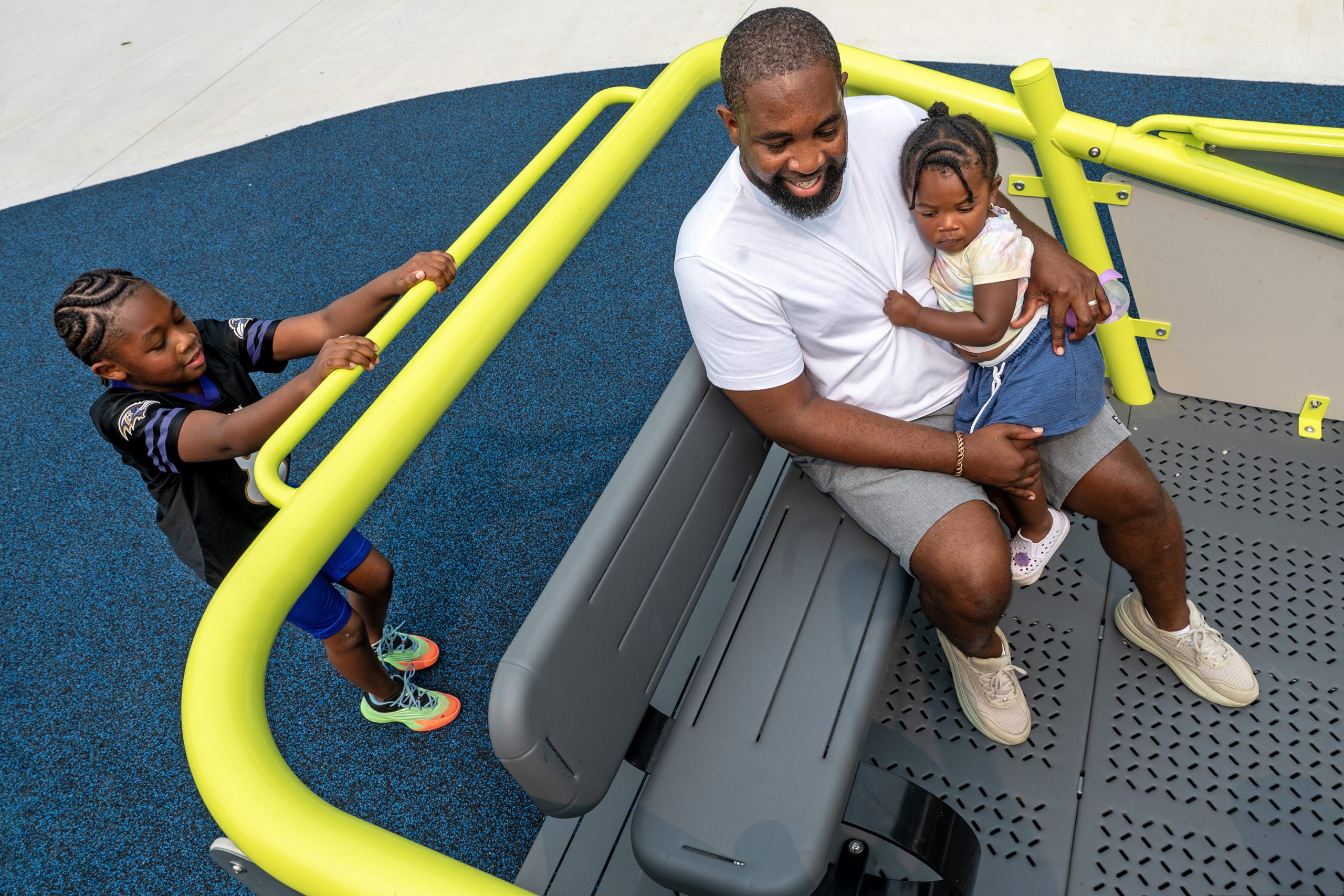
The new playground uses rubberized flooring rather than mulch to allow mobility aids, wheelchairs, and strollers to move smoothly, along with concrete pathways throughout. For children with sensory needs, the playground features musical equipment, canopies for shade, and lots of texture and color. Educational panels built into the playground teach kids sign language and Braille. The playground is fenced in, a first for Monroe, to keep children who tend to wander inside.
Arnold Patten III, 8, pushes his dad, Arnold Patten II, who is holding his little sister, Jaliyah, 2, in a swinging sled in the newly opened Finn’s Friends Park in Williamstown on Thursday, July 16, 2026.Tom Gralish / Staff Photographer
“I hope that everybody utilizes it,” Wolfe said. “I hope that it draws children from other communities who might not have access to a park like this.”
Most of the $1 million project was funded by a $750,000 state grant awarded in 2024 by the New Jersey Department of Environmental Protection’s Green Acres Program. The rest of the money came from the township’s capital improvement fund budgeted for parks.
Jake’s Law, a 2018 state law supporting all-inclusive parks, made the grant possible. Jake’s Place, an accessible playground in Cherry Hill named after Jacob Cummings-Nasto of Voorhees, inspired the law. Cummings-Nasto, who enjoyed the playground despite his own physical limitations, died at 2 from a cardiac medical condition.
On Thursday morning, the humidity and air quality warnings didn’t stop about a dozen children from playing at Finn’s Friends Park. Lindsey Truong, 29, of Deptford, hung out with her family at the park for about a half hour after a visit to the local farmer’s market. She said her kids, Amelia, 3, and Tristan, 1, enjoyed the musical elements and the shade, and felt safe there as compared to other playgrounds in the region.
Teresa Casey, 65, of Williamstown, brought her four grandkids to the playground, too. Even though Casey lives down the street from Mary Mazza Duffy Memorial Park, she said she’s started bringing the kids to Finn’s Friends instead.
“We used to go there, but everybody comes here now, so there’s hardly any kids there to play with,” Casey said. “If there’s a playground around, we’ve hit it, but right now, this is their go-to spot.”
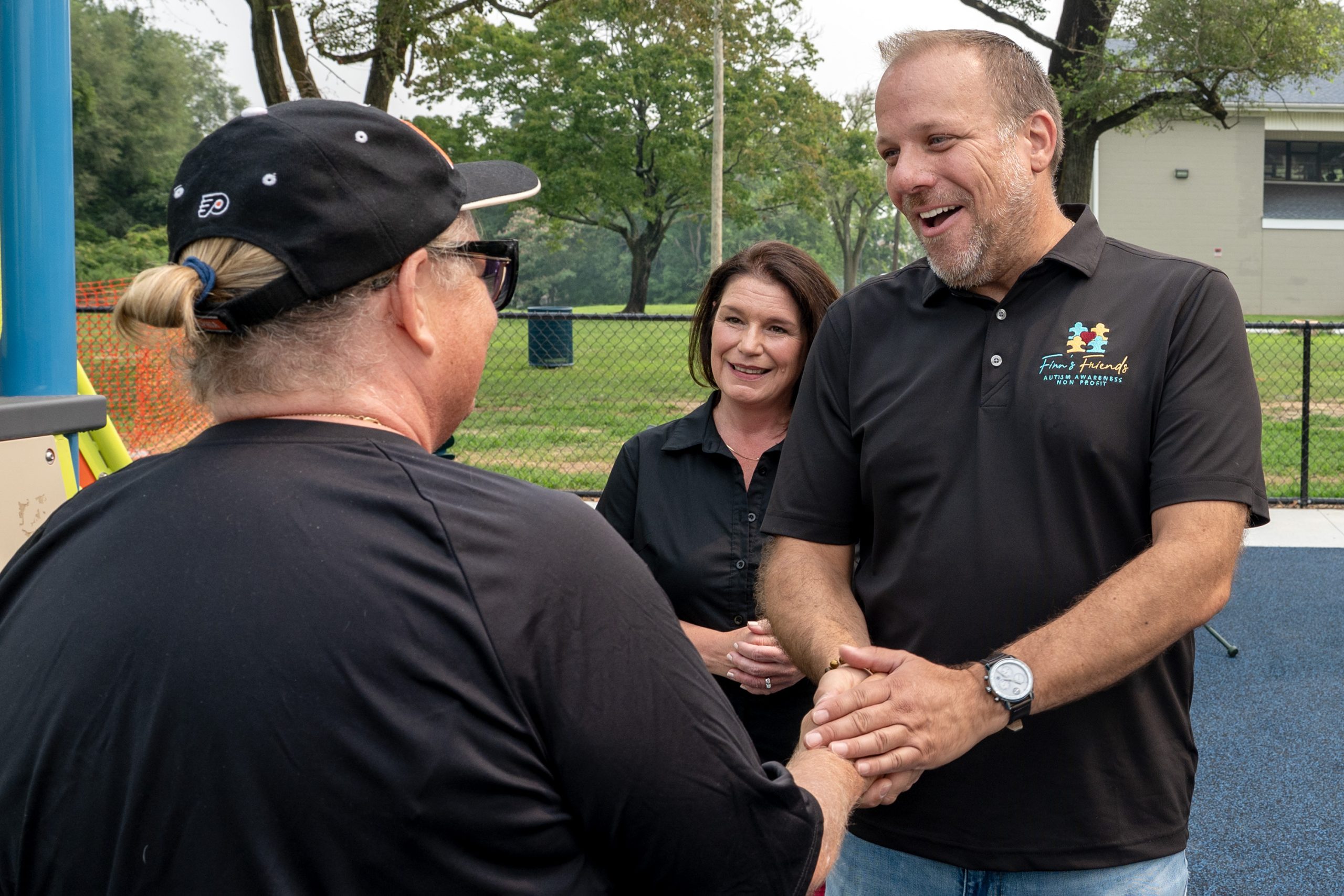
Teresa Casey thanks Anthony Iovino (right) and Kim Bidinger (center) with Finn’s Friends in the newly-opened Finn’s Friends Park in Williamstown on Thursday, July 16, 2026. Tom Gralish / Staff Photographer
There is still work to do. Finn’s Friends is fundraising through sponsored golf outings and engraved brick sales to build an archway at the entrance, and the nonprofit is hoping to eventually add a pavilion and bathrooms by the playground. So far, Iovino said Finn’s Friends has raised about $50,000 for the park.
To maintain the park, Wolfe said the nonprofit is also raising money to go into a trust account through the township.
Other Jake’s Law-funded playgrounds already exist in South Jersey, but Wolfe said the park is a first for Gloucester County.
Washington Township received the same grant as Monroe in 2024 for an all-inclusive park project at Washington Lake Park, but that work is still in progress.
“Hopefully when they’re there, we can get over there and support them,” Iovino said. “The more the merrier.”
Pope Leo XIV will present a new Villanova University-created award in his name that recognizes outstanding leadership in sustainabilityat a conference in Italy in October, another sign of the school’s close ties to the pontiff.
It will be several weeks before Villanova and Notre Dame officially open their basketball seasons in Rome with a men’s and women’s doubleheader on Nov. 1.
While Villanova has had a longstanding relationship with the Vatican, including an internship program that sends students there every year, both events signify the Catholic university’s deepening relationship with the Vatican and Italy since Pope Leo, a Villanova graduate, became pope last year.
In 1977, Pope Leo, then known as Robert Prevost, earned a bachelor’s degree in mathematics from Villanova and in 2014 received an honorary doctorate from the university.
The medal winner — an international honor — will be announced in September and then presented in October at the university’sInternational Sustainability Conference, Responding to the Cries of the Earth and the Poor,in Castel Gandolfo near Rome, the school said. The conference, which is expected to draw 300 participants including academics, church representatives, and leaders from the public and private sectors, will be held Oct. 12 to 15.
The front side of a new international medal recognizing leadership in sustainability that Villanova University will award in Italy in OctoberCourtesy of Villanova University
It is the university’s second sustainability conference, the first to be held in Italy. Its first conference in 2024 was on Villanova’s campus.
“The Pope Leo XIV Sustainability Medal reflects a deeply held belief at Villanova University: that care for our common home and care for one another are inseparable,” the Rev. Peter M. Donohue, Villanova University’s president, said in a statement. “By recognizing leaders whose work advances both environmental stewardship and the common good, we hope to inspire meaningful and lasting impact in communities around the world.”
The back of the new international medal that Villanova University will award for the first time in Italy in OctoberCourtesy of Villanova University
The award, which will be a biennial honor, will recognize those who have advanced “sustainability, ecological responsibility and integral human development,” the school said. It specifically will highlight those who excel at “integrating care for the environment, social justice, concern for vulnerable populations, and responsible stewardship of economic and natural resources.”
The winner can come from any field or discipline and will be selected by a committee of members of the university’s Sustainability Leadership Council. The award includes a monetary component, but details are still being determined, a university spokesperson said.
The medal will feature Pope Leo on one side and Villanova University’s name on the other and is meant to highlight the pope’s commitment to sustainability, the school said.
A man was critically injured and a dog was killed when someone opened fire in Kensington on Sunday evening, authorities said.
The incident happened just after 10:45 p.m. in a lot on the 2400 block of Kensington Avenue, according to police.
Police arrived to find the man shot multiple times in the legs and abdomen, and officers transported him to Temple University Hospital, where he was placed in critical condition.
A dog was found dead in the lot, and officers determined the animal had been shot.
Police have not identified a suspect or a motive in the shooting, and they continue to investigate.
When Ariel and Simon Censor opened their tiny used bookshop — Little Yenta Books — in the back of a South Philly children’s dressmaking shop in February, they knew it was an unconventional setup.
What the couple — in life and now books — could not know is just how fast they would outgrow the space.
And although they’re relinquishing the unofficial appellation as Philadelphia’s tiniest used book shop, the pair has moved their impressive literary thicket from their 150-square-foot loft space into a full-sized rented storefront on Passyunk Avenue.
The problem was a great one: Business is booming.
“People were telling us that they would walk by because it was way too crowded and they couldn’t fit,” said Ariel Censor, sitting behind the counter of the new shop, located at 1912 E. Passyunk Ave., home of the former Civil Stock General Store, which closed earlier this year. “We also just ran out of shelf space. We had way more books than we could fit.”
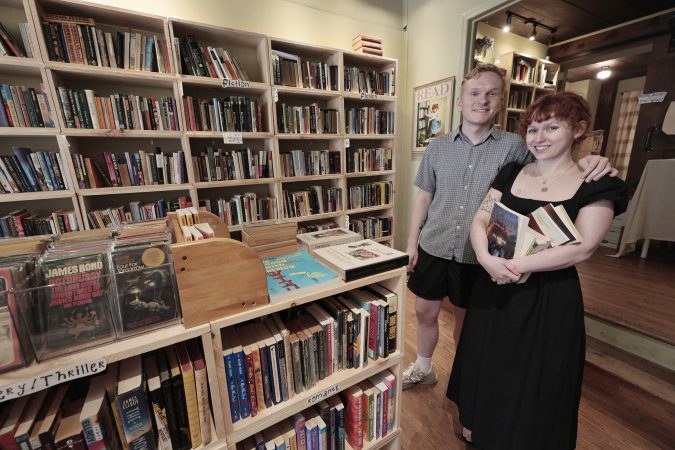
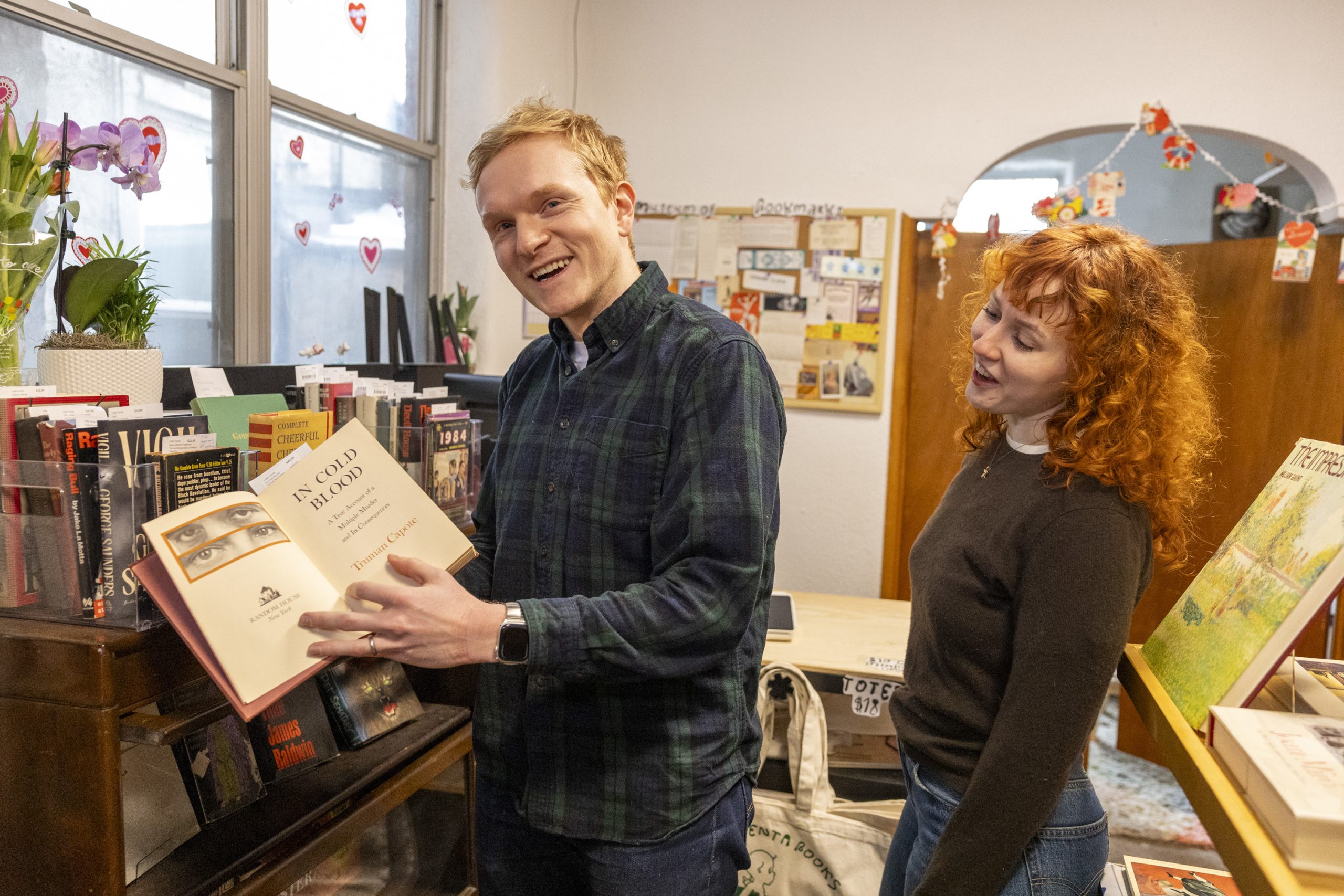
Little Yenta Books co-owner Ariel Censor stocks the shelves with books at the new shop on East Passyunk Avenue in Philadelphia on Friday, July 17, 2026.Elizabeth Robertson / Staff Photographer
The popular used bookstore — the only one along Passyunk — has nearly tripled its titles in the new storefront, which they opened last month. That means a whole lot more of the popular and literary fiction, classics, vintage sci-fi, poetry, and rare books customers have been buying up.
“People really complimented our curation,” Censor, 27, said of the shop’s success. “People thought our taste was good, and our prices were good, and that they are really happy to have us.”
The couple — Haverford College grads who live in the neighborhood — opened their initial tiny shop as a passion project, after holding used book pop-ups in South Philly bars.
Simon Censor, of Providence R.I., and Ariel Censor, of New York City, opened Little Yenta Books, in East Passyunk in February. They have now moved into a larger space nearby.Tyger Williams / Staff Photographer
Situated speakeasy-style, in a postage-stamp-sized loft above the Painted Lady children’s boutique, the shop burst with over 1,500 titles.
Now, with its green-and-white striped awning, stained-glass light fixture, and charming decor, the new shop has a spacious, homey feel.
“One thing we got with the little shop is that people really liked that it wasn’t overwhelming,” said Censor. “They could look at every book. We have tripled the amount of books but wanted to make it feel manageable and still have a real eye to curation. I’m really excited about the mix of modern and classics that we have.”
The expanded shop comes with expanded hours, with Little Yenta Books now open every day except Tuesday and Wednesday.
On a recent afternoon, Aine McCauley, 24, dropped in at the new shop on her way home from work. She perused the shelves before landing on a copy of André Aciman’s 2008 coming-of-age novel, Call Me by Your Name.
“It’s so awesome,” she told Censor about the shop. “You have every good book in here.”
More than 30% of high school students in the affluent Radnor and Wallingford-Swarthmore districts played sports in the 2024-25 school year.
In the Philadelphia school district, less than 10% of high school students did.
The disparities are part of a pattern, with fewer students playing sports in lesser-resourced urban schools, according to Research for Action, a Philadelphia-based educational research organization that released a report Thursday analyzing high school sports participation rates across Pennsylvania.
The report, which looked at sports as another barometer of opportunities available to students, found participation varies widely — as does school spending on sports programs.
It also found a link between funding and sports participation, with more students on average playing in higher-spending districts.
“The degree to which a student may have access to school athletics really depends on what district they’re in,” said Maja Pehrson, the report’s lead author.
Here’s what the report found — and what questions it raises about access to high school sports in Pennsylvania.
There are big differences in sports participation rates
Participation in school sports “hasn’t really been looked at very much,” Pehrson said. Research for Action analyzed data that school districts and charter schools are required to report to the Pennsylvania Department of Education on athletic opportunities.
The report found participation rates in the 2024-25 school year ranging from 5% in some school districts, to a handful of districts with rates above 40%.
Topping the list locally were Jenkintown School District, at 35%, and Springfield Township School District in Montgomery County at 34%; followed by Radnor and New Hope school districts, at 31%; Wallingford-Swarthmore, at 30%; West Chester, at 28%; and Upper Dublin, at 27% — all majority white, relatively affluent districts.
Below the Philadelphia school district’s 9.6% rate were Upper Darby, at 9%; William Penn and Norristown, at 8%; and Chester-Upland, at 6% — all districts that are majority non-white and high-poverty.
Overall, large, urban districts tended to have the lowest participation rates, meaning “almost half of Pennsylvania high school students are enrolled in districts where the likelihood of participating in a school athletics team is relatively low,” the report said.
Those “very low” participation districts — with 5% to 17% of students participating — also offered fewer sports per 1,000 students than high-participation districts, the report found.
Naima DeBrest, a spokesperson for the Philadelphia district, said the district had expanded athletic opportunities in recent years “by introducing new sports such as girls wrestling and girls flag football” and creating intramural programs at the elementary and middle school levels.
Despite “common challenges” faced by urban districts, “the district remains committed to expanding access to high-quality athletic opportunities and ensuring students have meaningful opportunities to participate in sports that support their academic success, well-being, and overall development,” DeBrest said, noting that the district’s rate is comparable to other urban districts.
<iframe title="Sports Participation and Athletics Spending Among Local School Districts" aria-label="Table" id="datawrapper-chart-dyc1W" src="https://datawrapper.dwcdn.net/dyc1W/1/" scrolling="no" frameborder="0" style="width: 0; min-width: 100% !important; border: none;" height="971" data-external="1"></iframe><script type="text/javascript">(function(){function e(){window.addEventListener(`message`,function(e){if(e.data[`datawrapper-height`]!==void 0){var t=document.querySelectorAll(`iframe`);for(var n in e.data[`datawrapper-height`])for(var r=0,i;i=t[r];r++)if(i.contentWindow===e.source){var a=e.data[`datawrapper-height`][n]+`px`;i.style.height=a}}})}e()})();</script>
And looking at what districts spend on athletics, it varied widely, the report found. Districts with “very low” participation reported spending an average of $409 per high school student on athletics, while “very high” participation districts — with 28.2% to 61.6% of students participation — spent an average of $939 per student.
Locally, the Jenkintown, West Chester, Phoenixville, and Colonial school districts reported spending more than $1,100 per high school student on athletics, compared with $145 per high school student in Philadelphia.
The report noted that those figures don’t fully reflect spending on school sports. Many districts didn’t report any spending on athletic facilities, for instance; Pehrson said it was likely hard for schools to calculate how much of their overall facilities spending was tied to athletics.
The data also don’t reflect any activities fees paid by students.
Charters have lower participation rates — but in line with Philly
Statewide, brick-and-mortar charter schools, which are publicly funded but independently run, reported lower rates of sports participation. On average, 8.4% of charter high school students participated in sports, compared with 18.1% in district schools. (Cyber charter schools reported no participation; charter students who participate in district programs are counted by districts.)
Rather than a difference between the charter and district sectors, however, the gap could largely be a product of school district conditions, the report said. Half the state’s charter high schools are located in Philadelphia, where the charter sports participation rates largely mirror the district’s, the report said.
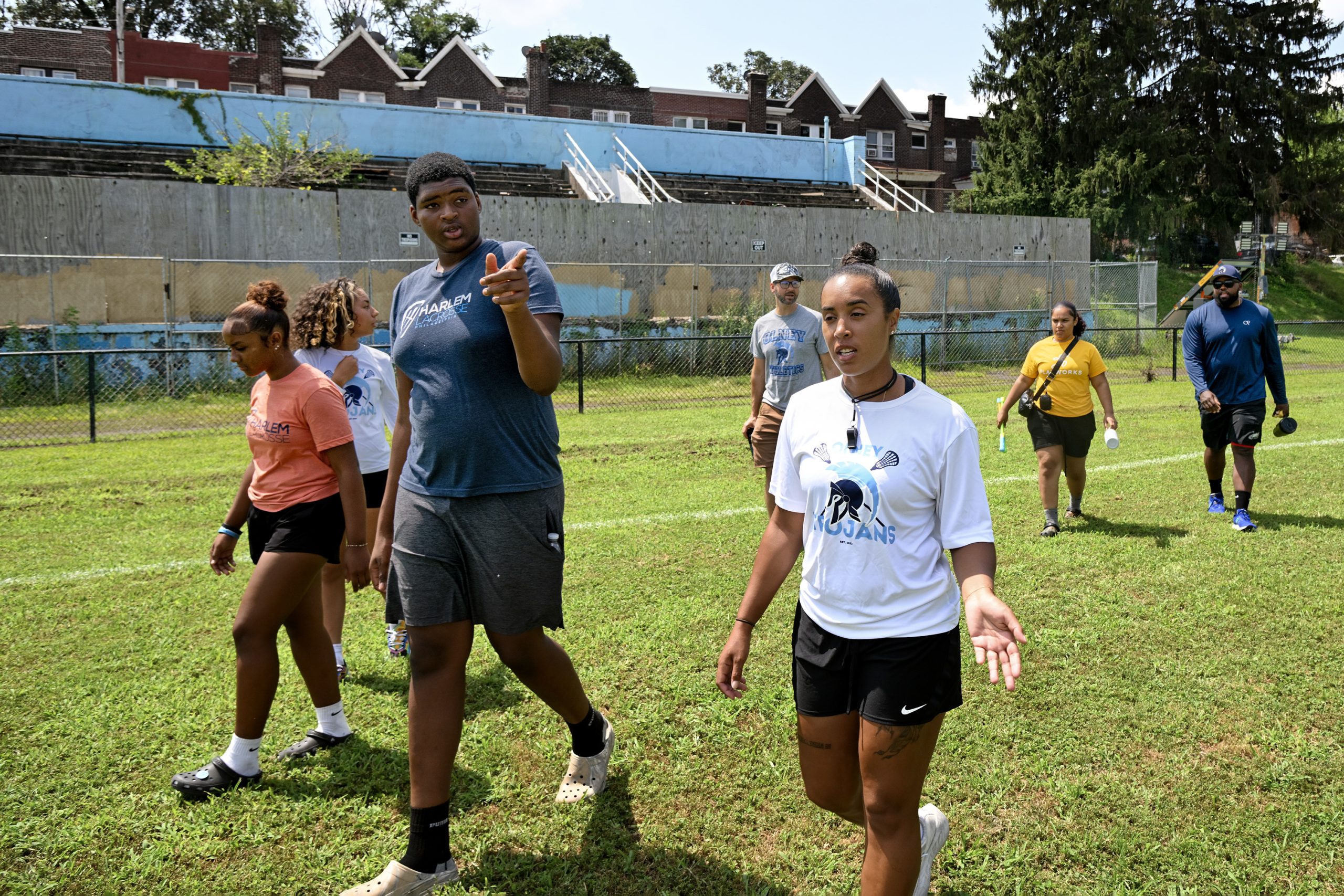
In front of their boarded up dilapidated stadium, Olney High School athletes Cindi Lizardo (from left), Emma Blanco, Sidi Traore; and principal Michael Roth, coach Siena Childs, recent graduate Ysis Rivera, and athletic director Jorge Gonzalez point out the deplorable condition the sports facilities are in July 24, 2025. Olney High School, which spent a decade under charter management, was turned back over to the Philadelphia school district in 2022.Tom Gralish / Staff Photographer
Gender gaps persist
Boys participated in sports in 2024-25 at a higher rate than girls — at an average rate of 20.3% compared with 15.8%, the report found.
And those gaps persisted across different types of school districts, the report found. For instance, in districts with “very low” overall sports participation, 14% of boys participated, compared with 10% of girls. In districts with “moderate” participation, 24% of boys participated, compared with 19% of girls. And in “very high” participation districts, 35% of boys participated, compared with 30% of girls.
What’s driving the disparities?
The report found that access to high school sports in Pennsylvania “is not evenly distributed and is strongly shaped by structural conditions.”
“Districts with fewer athletic opportunities are more likely to be urban districts with large high schools and more students of color, and they tend to offer a narrower range of teams and spend less per student on athletics, limiting the extent to which students can engage,” the report said.
But district funding alone isn’t responsible for disparities, the report noted. The gender gap, for instance, is found in well-funded and poorly funded districts.
The pattern of higher-spending districts seeing more participation “doesn’t line up neatly for every district,” Pehrson said, noting that the data can’t fully answer questions about what’s driving differences in participation.
Other possible factors could include transportation and sports outside of schools, Pehrson said.
DeBrest, the Philadelphia spokesperson, noted that urban districts may also have limited athletic facilities, and practice space “and the need for some students to balance academics, work, or family responsibilities.”
Pehrson hopes the findings prompt more investigation into the availability of school sports, which “are a key part of students’ educational opportunities,” Pehrson said — from boosting physical and mental health, to promoting social-emotional skills and building community.
“There are clear disparities in terms of sports opportunities students are having,” Pehrson said. “Why is that, and how can we move forward and try to figure out these differences?”
Editor’s note: This story has been updated to reflect that Jenkintown and Springfield Township were the local districts with the highest sports participation rates.